EP0007204A1 - Phenethanolamines, their formulations, use and preparation - Google Patents
Phenethanolamines, their formulations, use and preparation Download PDFInfo
- Publication number
- EP0007204A1 EP0007204A1 EP79301279A EP79301279A EP0007204A1 EP 0007204 A1 EP0007204 A1 EP 0007204A1 EP 79301279 A EP79301279 A EP 79301279A EP 79301279 A EP79301279 A EP 79301279A EP 0007204 A1 EP0007204 A1 EP 0007204A1
- Authority
- EP
- European Patent Office
- Prior art keywords
- methyl
- formula
- propylamine
- compound
- phenyl
- Prior art date
- Legal status (The legal status is an assumption and is not a legal conclusion. Google has not performed a legal analysis and makes no representation as to the accuracy of the status listed.)
- Granted
Links
- 239000000203 mixture Substances 0.000 title claims description 30
- 238000002360 preparation method Methods 0.000 title description 19
- 238000009472 formulation Methods 0.000 title description 3
- 150000001875 compounds Chemical class 0.000 claims abstract description 107
- 150000003839 salts Chemical class 0.000 claims abstract description 31
- 125000002887 hydroxy group Chemical group [H]O* 0.000 claims abstract description 22
- 229910052799 carbon Inorganic materials 0.000 claims abstract description 11
- 125000003917 carbamoyl group Chemical group [H]N([H])C(*)=O 0.000 claims abstract description 10
- 229910052739 hydrogen Inorganic materials 0.000 claims abstract description 10
- 239000001257 hydrogen Substances 0.000 claims abstract description 10
- 125000002496 methyl group Chemical group [H]C([H])([H])* 0.000 claims abstract description 10
- 125000004423 acyloxy group Chemical group 0.000 claims abstract description 6
- 241000124008 Mammalia Species 0.000 claims abstract description 5
- 125000004453 alkoxycarbonyl group Chemical group 0.000 claims abstract description 5
- 125000004432 carbon atom Chemical group C* 0.000 claims abstract description 5
- 125000004458 methylaminocarbonyl group Chemical group [H]N(C(*)=O)C([H])([H])[H] 0.000 claims abstract description 5
- 125000004435 hydrogen atom Chemical group [H]* 0.000 claims abstract description 4
- PXGOKWXKJXAPGV-UHFFFAOYSA-N Fluorine Chemical group FF PXGOKWXKJXAPGV-UHFFFAOYSA-N 0.000 claims abstract description 3
- 125000001495 ethyl group Chemical group [H]C([H])([H])C([H])([H])* 0.000 claims abstract description 3
- 229910052731 fluorine Chemical group 0.000 claims abstract description 3
- 239000011737 fluorine Chemical group 0.000 claims abstract description 3
- WGYKZJWCGVVSQN-UHFFFAOYSA-N propylamine Chemical compound CCCN WGYKZJWCGVVSQN-UHFFFAOYSA-N 0.000 claims description 76
- 241001465754 Metazoa Species 0.000 claims description 35
- 150000001412 amines Chemical class 0.000 claims description 26
- 238000000034 method Methods 0.000 claims description 23
- 239000008194 pharmaceutical composition Substances 0.000 claims description 13
- AWMVMTVKBNGEAK-UHFFFAOYSA-N Styrene oxide Chemical compound C1OC1C1=CC=CC=C1 AWMVMTVKBNGEAK-UHFFFAOYSA-N 0.000 claims description 10
- 125000001797 benzyl group Chemical group [H]C1=C([H])C([H])=C(C([H])=C1[H])C([H])([H])* 0.000 claims description 7
- 230000008569 process Effects 0.000 claims description 6
- 230000015572 biosynthetic process Effects 0.000 claims description 5
- 210000000577 adipose tissue Anatomy 0.000 claims description 4
- 239000003085 diluting agent Substances 0.000 claims description 4
- 230000001603 reducing effect Effects 0.000 claims description 4
- 239000003937 drug carrier Substances 0.000 claims description 3
- 238000007327 hydrogenolysis reaction Methods 0.000 claims description 3
- 238000004519 manufacturing process Methods 0.000 claims description 3
- 238000004260 weight control Methods 0.000 abstract description 6
- OKKJLVBELUTLKV-UHFFFAOYSA-N Methanol Chemical compound OC OKKJLVBELUTLKV-UHFFFAOYSA-N 0.000 description 164
- RTZKZFJDLAIYFH-UHFFFAOYSA-N Diethyl ether Chemical compound CCOCC RTZKZFJDLAIYFH-UHFFFAOYSA-N 0.000 description 100
- 239000000243 solution Substances 0.000 description 86
- LFQSCWFLJHTTHZ-UHFFFAOYSA-N Ethanol Chemical compound CCO LFQSCWFLJHTTHZ-UHFFFAOYSA-N 0.000 description 79
- 239000011541 reaction mixture Substances 0.000 description 74
- XEKOWRVHYACXOJ-UHFFFAOYSA-N Ethyl acetate Chemical compound CCOC(C)=O XEKOWRVHYACXOJ-UHFFFAOYSA-N 0.000 description 72
- ZMXDDKWLCZADIW-UHFFFAOYSA-N N,N-Dimethylformamide Chemical compound CN(C)C=O ZMXDDKWLCZADIW-UHFFFAOYSA-N 0.000 description 51
- UHOVQNZJYSORNB-UHFFFAOYSA-N Benzene Chemical compound C1=CC=CC=C1 UHOVQNZJYSORNB-UHFFFAOYSA-N 0.000 description 45
- WYURNTSHIVDZCO-UHFFFAOYSA-N Tetrahydrofuran Chemical compound C1CCOC1 WYURNTSHIVDZCO-UHFFFAOYSA-N 0.000 description 44
- 239000002904 solvent Substances 0.000 description 44
- 238000001704 evaporation Methods 0.000 description 41
- 230000008020 evaporation Effects 0.000 description 41
- VEXZGXHMUGYJMC-UHFFFAOYSA-N Hydrochloric acid Chemical compound Cl VEXZGXHMUGYJMC-UHFFFAOYSA-N 0.000 description 40
- 239000007787 solid Substances 0.000 description 36
- XLYOFNOQVPJJNP-UHFFFAOYSA-N water Substances O XLYOFNOQVPJJNP-UHFFFAOYSA-N 0.000 description 36
- 239000003921 oil Substances 0.000 description 31
- 235000019198 oils Nutrition 0.000 description 31
- WEVYAHXRMPXWCK-UHFFFAOYSA-N Acetonitrile Chemical compound CC#N WEVYAHXRMPXWCK-UHFFFAOYSA-N 0.000 description 30
- VEXZGXHMUGYJMC-UHFFFAOYSA-M Chloride anion Chemical compound [Cl-] VEXZGXHMUGYJMC-UHFFFAOYSA-M 0.000 description 30
- 235000019441 ethanol Nutrition 0.000 description 29
- 238000006243 chemical reaction Methods 0.000 description 28
- 239000000047 product Substances 0.000 description 28
- YXFVVABEGXRONW-UHFFFAOYSA-N Toluene Chemical compound CC1=CC=CC=C1 YXFVVABEGXRONW-UHFFFAOYSA-N 0.000 description 27
- CDBYLPFSWZWCQE-UHFFFAOYSA-L Sodium Carbonate Chemical compound [Na+].[Na+].[O-]C([O-])=O CDBYLPFSWZWCQE-UHFFFAOYSA-L 0.000 description 24
- 238000004458 analytical method Methods 0.000 description 24
- 239000002253 acid Substances 0.000 description 23
- 150000001408 amides Chemical class 0.000 description 22
- 230000000694 effects Effects 0.000 description 22
- YLQBMQCUIZJEEH-UHFFFAOYSA-N tetrahydrofuran Natural products C=1C=COC=1 YLQBMQCUIZJEEH-UHFFFAOYSA-N 0.000 description 22
- ZMANZCXQSJIPKH-UHFFFAOYSA-N Triethylamine Chemical compound CCN(CC)CC ZMANZCXQSJIPKH-UHFFFAOYSA-N 0.000 description 21
- 238000006722 reduction reaction Methods 0.000 description 20
- QOSSAOTZNIDXMA-UHFFFAOYSA-N Dicylcohexylcarbodiimide Chemical compound C1CCCCC1N=C=NC1CCCCC1 QOSSAOTZNIDXMA-UHFFFAOYSA-N 0.000 description 19
- 238000001914 filtration Methods 0.000 description 19
- 230000009467 reduction Effects 0.000 description 19
- -1 N-substituted 3-phenylpropylamine Chemical class 0.000 description 18
- IXCSERBJSXMMFS-UHFFFAOYSA-N hydrogen chloride Substances Cl.Cl IXCSERBJSXMMFS-UHFFFAOYSA-N 0.000 description 15
- 229910000041 hydrogen chloride Inorganic materials 0.000 description 15
- VLKZOEOYAKHREP-UHFFFAOYSA-N n-Hexane Chemical compound CCCCCC VLKZOEOYAKHREP-UHFFFAOYSA-N 0.000 description 15
- 238000010992 reflux Methods 0.000 description 13
- 238000012360 testing method Methods 0.000 description 13
- YMWUJEATGCHHMB-UHFFFAOYSA-N Dichloromethane Chemical compound ClCCl YMWUJEATGCHHMB-UHFFFAOYSA-N 0.000 description 12
- 238000002425 crystallisation Methods 0.000 description 12
- 230000008025 crystallization Effects 0.000 description 12
- 239000000706 filtrate Substances 0.000 description 12
- 229910000029 sodium carbonate Inorganic materials 0.000 description 12
- 241000282472 Canis lupus familiaris Species 0.000 description 11
- KDLHZDBZIXYQEI-UHFFFAOYSA-N Palladium Chemical compound [Pd] KDLHZDBZIXYQEI-UHFFFAOYSA-N 0.000 description 11
- 230000037396 body weight Effects 0.000 description 11
- 229940079593 drug Drugs 0.000 description 11
- 239000003814 drug Substances 0.000 description 11
- HEMHJVSKTPXQMS-UHFFFAOYSA-M sodium hydroxide Inorganic materials [OH-].[Na+] HEMHJVSKTPXQMS-UHFFFAOYSA-M 0.000 description 11
- ASOKPJOREAFHNY-UHFFFAOYSA-N 1-Hydroxybenzotriazole Chemical class C1=CC=C2N(O)N=NC2=C1 ASOKPJOREAFHNY-UHFFFAOYSA-N 0.000 description 10
- CSCPPACGZOOCGX-UHFFFAOYSA-N Acetone Chemical compound CC(C)=O CSCPPACGZOOCGX-UHFFFAOYSA-N 0.000 description 10
- ULSIYEODSMZIPX-UHFFFAOYSA-N phenylethanolamine Chemical class NCC(O)C1=CC=CC=C1 ULSIYEODSMZIPX-UHFFFAOYSA-N 0.000 description 10
- 229950006768 phenylethanolamine Drugs 0.000 description 10
- FYSNRJHAOHDILO-UHFFFAOYSA-N thionyl chloride Chemical compound ClS(Cl)=O FYSNRJHAOHDILO-UHFFFAOYSA-N 0.000 description 10
- WFDIJRYMOXRFFG-UHFFFAOYSA-N Acetic anhydride Chemical compound CC(=O)OC(C)=O WFDIJRYMOXRFFG-UHFFFAOYSA-N 0.000 description 9
- 239000012298 atmosphere Substances 0.000 description 9
- IWYDHOAUDWTVEP-SSDOTTSWSA-N (R)-mandelic acid Chemical compound OC(=O)[C@H](O)C1=CC=CC=C1 IWYDHOAUDWTVEP-SSDOTTSWSA-N 0.000 description 8
- ADFXKUOMJKEIND-UHFFFAOYSA-N 1,3-dicyclohexylurea Chemical compound C1CCCCC1NC(=O)NC1CCCCC1 ADFXKUOMJKEIND-UHFFFAOYSA-N 0.000 description 8
- QCQCHGYLTSGIGX-GHXANHINSA-N 4-[[(3ar,5ar,5br,7ar,9s,11ar,11br,13as)-5a,5b,8,8,11a-pentamethyl-3a-[(5-methylpyridine-3-carbonyl)amino]-2-oxo-1-propan-2-yl-4,5,6,7,7a,9,10,11,11b,12,13,13a-dodecahydro-3h-cyclopenta[a]chrysen-9-yl]oxy]-2,2-dimethyl-4-oxobutanoic acid Chemical compound N([C@@]12CC[C@@]3(C)[C@]4(C)CC[C@H]5C(C)(C)[C@@H](OC(=O)CC(C)(C)C(O)=O)CC[C@]5(C)[C@H]4CC[C@@H]3C1=C(C(C2)=O)C(C)C)C(=O)C1=CN=CC(C)=C1 QCQCHGYLTSGIGX-GHXANHINSA-N 0.000 description 8
- QTBSBXVTEAMEQO-UHFFFAOYSA-N Acetic acid Chemical compound CC(O)=O QTBSBXVTEAMEQO-UHFFFAOYSA-N 0.000 description 8
- 208000008589 Obesity Diseases 0.000 description 8
- 235000012631 food intake Nutrition 0.000 description 8
- 235000020824 obesity Nutrition 0.000 description 8
- IJGRMHOSHXDMSA-UHFFFAOYSA-N Atomic nitrogen Chemical compound N#N IJGRMHOSHXDMSA-UHFFFAOYSA-N 0.000 description 7
- 239000002585 base Substances 0.000 description 7
- 239000003795 chemical substances by application Substances 0.000 description 7
- 229910001873 dinitrogen Inorganic materials 0.000 description 7
- 150000002576 ketones Chemical class 0.000 description 7
- 239000003960 organic solvent Substances 0.000 description 7
- 125000006239 protecting group Chemical group 0.000 description 7
- JOXIMZWYDAKGHI-UHFFFAOYSA-N toluene-4-sulfonic acid Chemical compound CC1=CC=C(S(O)(=O)=O)C=C1 JOXIMZWYDAKGHI-UHFFFAOYSA-N 0.000 description 7
- 238000011282 treatment Methods 0.000 description 7
- LYUQWQRTDLVQGA-UHFFFAOYSA-N 3-phenylpropylamine Chemical compound NCCCC1=CC=CC=C1 LYUQWQRTDLVQGA-UHFFFAOYSA-N 0.000 description 6
- BAVYZALUXZFZLV-UHFFFAOYSA-N Methylamine Chemical compound NC BAVYZALUXZFZLV-UHFFFAOYSA-N 0.000 description 6
- CTQNGGLPUBDAKN-UHFFFAOYSA-N O-Xylene Chemical compound CC1=CC=CC=C1C CTQNGGLPUBDAKN-UHFFFAOYSA-N 0.000 description 6
- JUJWROOIHBZHMG-UHFFFAOYSA-N Pyridine Chemical compound C1=CC=NC=C1 JUJWROOIHBZHMG-UHFFFAOYSA-N 0.000 description 6
- 239000007868 Raney catalyst Substances 0.000 description 6
- NPXOKRUENSOPAO-UHFFFAOYSA-N Raney nickel Chemical compound [Al].[Ni] NPXOKRUENSOPAO-UHFFFAOYSA-N 0.000 description 6
- 229910000564 Raney nickel Inorganic materials 0.000 description 6
- 239000005457 ice water Substances 0.000 description 6
- 230000003287 optical effect Effects 0.000 description 6
- CTSLXHKWHWQRSH-UHFFFAOYSA-N oxalyl chloride Chemical compound ClC(=O)C(Cl)=O CTSLXHKWHWQRSH-UHFFFAOYSA-N 0.000 description 6
- 239000008096 xylene Substances 0.000 description 6
- AWMVMTVKBNGEAK-QMMMGPOBSA-N (R)-styrene oxide Chemical compound C1O[C@@H]1C1=CC=CC=C1 AWMVMTVKBNGEAK-QMMMGPOBSA-N 0.000 description 5
- RYHBNJHYFVUHQT-UHFFFAOYSA-N 1,4-Dioxane Chemical compound C1COCCO1 RYHBNJHYFVUHQT-UHFFFAOYSA-N 0.000 description 5
- NGNBDVOYPDDBFK-UHFFFAOYSA-N 2-[2,4-di(pentan-2-yl)phenoxy]acetyl chloride Chemical compound CCCC(C)C1=CC=C(OCC(Cl)=O)C(C(C)CCC)=C1 NGNBDVOYPDDBFK-UHFFFAOYSA-N 0.000 description 5
- 241000700159 Rattus Species 0.000 description 5
- UIIMBOGNXHQVGW-UHFFFAOYSA-M Sodium bicarbonate Chemical compound [Na+].OC([O-])=O UIIMBOGNXHQVGW-UHFFFAOYSA-M 0.000 description 5
- 150000001721 carbon Chemical group 0.000 description 5
- 230000000747 cardiac effect Effects 0.000 description 5
- 239000003054 catalyst Substances 0.000 description 5
- 239000007810 chemical reaction solvent Substances 0.000 description 5
- 238000005859 coupling reaction Methods 0.000 description 5
- 150000002466 imines Chemical class 0.000 description 5
- 239000012044 organic layer Substances 0.000 description 5
- 239000002244 precipitate Substances 0.000 description 5
- 125000001436 propyl group Chemical group [H]C([*])([H])C([H])([H])C([H])([H])[H] 0.000 description 5
- 208000016261 weight loss Diseases 0.000 description 5
- HEDRZPFGACZZDS-UHFFFAOYSA-N Chloroform Chemical compound ClC(Cl)Cl HEDRZPFGACZZDS-UHFFFAOYSA-N 0.000 description 4
- OAKJQQAXSVQMHS-UHFFFAOYSA-N Hydrazine Chemical compound NN OAKJQQAXSVQMHS-UHFFFAOYSA-N 0.000 description 4
- UFHFLCQGNIYNRP-UHFFFAOYSA-N Hydrogen Chemical compound [H][H] UFHFLCQGNIYNRP-UHFFFAOYSA-N 0.000 description 4
- 150000007513 acids Chemical class 0.000 description 4
- 238000004587 chromatography analysis Methods 0.000 description 4
- 230000008878 coupling Effects 0.000 description 4
- 238000010168 coupling process Methods 0.000 description 4
- 239000007789 gas Substances 0.000 description 4
- 150000002431 hydrogen Chemical group 0.000 description 4
- 238000005984 hydrogenation reaction Methods 0.000 description 4
- ISWSIDIOOBJBQZ-UHFFFAOYSA-N phenol group Chemical group C1(=CC=CC=C1)O ISWSIDIOOBJBQZ-UHFFFAOYSA-N 0.000 description 4
- 230000003389 potentiating effect Effects 0.000 description 4
- 238000001953 recrystallisation Methods 0.000 description 4
- 238000003756 stirring Methods 0.000 description 4
- 229910052717 sulfur Inorganic materials 0.000 description 4
- 239000000725 suspension Substances 0.000 description 4
- 230000004584 weight gain Effects 0.000 description 4
- 235000019786 weight gain Nutrition 0.000 description 4
- 239000013585 weight reducing agent Substances 0.000 description 4
- QBYIENPQHBMVBV-HFEGYEGKSA-N (2R)-2-hydroxy-2-phenylacetic acid Chemical class O[C@@H](C(O)=O)c1ccccc1.O[C@@H](C(O)=O)c1ccccc1 QBYIENPQHBMVBV-HFEGYEGKSA-N 0.000 description 3
- WWSRHIZZWWDONI-SSDOTTSWSA-N (2r)-2-(2-fluorophenyl)-2-hydroxyacetic acid Chemical compound OC(=O)[C@H](O)C1=CC=CC=C1F WWSRHIZZWWDONI-SSDOTTSWSA-N 0.000 description 3
- YZPBMJZGHIBDAM-QMMMGPOBSA-N (2r)-2-(2-fluorophenyl)oxirane Chemical compound FC1=CC=CC=C1[C@H]1OC1 YZPBMJZGHIBDAM-QMMMGPOBSA-N 0.000 description 3
- UCTWMZQNUQWSLP-VIFPVBQESA-N (R)-adrenaline Chemical compound CNC[C@H](O)C1=CC=C(O)C(O)=C1 UCTWMZQNUQWSLP-VIFPVBQESA-N 0.000 description 3
- 229930182837 (R)-adrenaline Natural products 0.000 description 3
- RQEUFEKYXDPUSK-UHFFFAOYSA-N 1-phenylethylamine Chemical compound CC(N)C1=CC=CC=C1 RQEUFEKYXDPUSK-UHFFFAOYSA-N 0.000 description 3
- KWIVRAVCZJXOQC-UHFFFAOYSA-N 3h-oxathiazole Chemical compound N1SOC=C1 KWIVRAVCZJXOQC-UHFFFAOYSA-N 0.000 description 3
- PJLBHTNCHZROBQ-UHFFFAOYSA-N 4-(3-oxobutyl)benzoic acid Chemical compound CC(=O)CCC1=CC=C(C(O)=O)C=C1 PJLBHTNCHZROBQ-UHFFFAOYSA-N 0.000 description 3
- QTBSBXVTEAMEQO-UHFFFAOYSA-M Acetate Chemical compound CC([O-])=O QTBSBXVTEAMEQO-UHFFFAOYSA-M 0.000 description 3
- GUBGYTABKSRVRQ-XLOQQCSPSA-N Alpha-Lactose Chemical compound O[C@@H]1[C@@H](O)[C@@H](O)[C@@H](CO)O[C@H]1O[C@@H]1[C@@H](CO)O[C@H](O)[C@H](O)[C@H]1O GUBGYTABKSRVRQ-XLOQQCSPSA-N 0.000 description 3
- CPELXLSAUQHCOX-UHFFFAOYSA-M Bromide Chemical compound [Br-] CPELXLSAUQHCOX-UHFFFAOYSA-M 0.000 description 3
- GUBGYTABKSRVRQ-QKKXKWKRSA-N Lactose Natural products OC[C@H]1O[C@@H](O[C@H]2[C@H](O)[C@@H](O)C(O)O[C@@H]2CO)[C@H](O)[C@@H](O)[C@H]1O GUBGYTABKSRVRQ-QKKXKWKRSA-N 0.000 description 3
- KWYUFKZDYYNOTN-UHFFFAOYSA-M Potassium hydroxide Chemical compound [OH-].[K+] KWYUFKZDYYNOTN-UHFFFAOYSA-M 0.000 description 3
- IWYDHOAUDWTVEP-UHFFFAOYSA-N R-2-phenyl-2-hydroxyacetic acid Natural products OC(=O)C(O)C1=CC=CC=C1 IWYDHOAUDWTVEP-UHFFFAOYSA-N 0.000 description 3
- 239000002262 Schiff base Substances 0.000 description 3
- 150000004753 Schiff bases Chemical class 0.000 description 3
- 229960000583 acetic acid Drugs 0.000 description 3
- WETWJCDKMRHUPV-UHFFFAOYSA-N acetyl chloride Chemical compound CC(Cl)=O WETWJCDKMRHUPV-UHFFFAOYSA-N 0.000 description 3
- 239000012346 acetyl chloride Substances 0.000 description 3
- 239000004480 active ingredient Substances 0.000 description 3
- 230000010933 acylation Effects 0.000 description 3
- 238000005917 acylation reaction Methods 0.000 description 3
- 239000012670 alkaline solution Substances 0.000 description 3
- 230000003579 anti-obesity Effects 0.000 description 3
- 230000004071 biological effect Effects 0.000 description 3
- 210000004369 blood Anatomy 0.000 description 3
- 239000008280 blood Substances 0.000 description 3
- 230000007883 bronchodilation Effects 0.000 description 3
- 239000000969 carrier Substances 0.000 description 3
- 239000003153 chemical reaction reagent Substances 0.000 description 3
- 238000009833 condensation Methods 0.000 description 3
- 230000005494 condensation Effects 0.000 description 3
- 238000001035 drying Methods 0.000 description 3
- 229960005139 epinephrine Drugs 0.000 description 3
- 235000021588 free fatty acids Nutrition 0.000 description 3
- 239000008101 lactose Substances 0.000 description 3
- 238000000746 purification Methods 0.000 description 3
- UMJSCPRVCHMLSP-UHFFFAOYSA-N pyridine Natural products COC1=CC=CN=C1 UMJSCPRVCHMLSP-UHFFFAOYSA-N 0.000 description 3
- 239000007858 starting material Substances 0.000 description 3
- PWMWNFMRSKOCEY-QMMMGPOBSA-N (1r)-1-phenylethane-1,2-diol Chemical compound OC[C@H](O)C1=CC=CC=C1 PWMWNFMRSKOCEY-QMMMGPOBSA-N 0.000 description 2
- YCKSJHSNIYQXSM-UHFFFAOYSA-N 4-(3-oxobutyl)benzamide Chemical compound CC(=O)CCC1=CC=C(C(N)=O)C=C1 YCKSJHSNIYQXSM-UHFFFAOYSA-N 0.000 description 2
- FJKROLUGYXJWQN-UHFFFAOYSA-N 4-hydroxybenzoic acid Chemical compound OC(=O)C1=CC=C(O)C=C1 FJKROLUGYXJWQN-UHFFFAOYSA-N 0.000 description 2
- YYROPELSRYBVMQ-UHFFFAOYSA-N 4-toluenesulfonyl chloride Chemical compound CC1=CC=C(S(Cl)(=O)=O)C=C1 YYROPELSRYBVMQ-UHFFFAOYSA-N 0.000 description 2
- VHUUQVKOLVNVRT-UHFFFAOYSA-N Ammonium hydroxide Chemical compound [NH4+].[OH-] VHUUQVKOLVNVRT-UHFFFAOYSA-N 0.000 description 2
- OKTJSMMVPCPJKN-UHFFFAOYSA-N Carbon Chemical compound [C] OKTJSMMVPCPJKN-UHFFFAOYSA-N 0.000 description 2
- 229920002261 Corn starch Polymers 0.000 description 2
- FBPFZTCFMRRESA-FSIIMWSLSA-N D-Glucitol Natural products OC[C@H](O)[C@H](O)[C@@H](O)[C@H](O)CO FBPFZTCFMRRESA-FSIIMWSLSA-N 0.000 description 2
- IAZDPXIOMUYVGZ-UHFFFAOYSA-N Dimethylsulphoxide Chemical compound CS(C)=O IAZDPXIOMUYVGZ-UHFFFAOYSA-N 0.000 description 2
- GKQLYSROISKDLL-UHFFFAOYSA-N EEDQ Chemical compound C1=CC=C2N(C(=O)OCC)C(OCC)C=CC2=C1 GKQLYSROISKDLL-UHFFFAOYSA-N 0.000 description 2
- PEDCQBHIVMGVHV-UHFFFAOYSA-N Glycerine Chemical compound OCC(O)CO PEDCQBHIVMGVHV-UHFFFAOYSA-N 0.000 description 2
- KFZMGEQAYNKOFK-UHFFFAOYSA-N Isopropanol Chemical compound CC(C)O KFZMGEQAYNKOFK-UHFFFAOYSA-N 0.000 description 2
- KEAYESYHFKHZAL-UHFFFAOYSA-N Sodium Chemical compound [Na] KEAYESYHFKHZAL-UHFFFAOYSA-N 0.000 description 2
- 230000002378 acidificating effect Effects 0.000 description 2
- 230000009471 action Effects 0.000 description 2
- 125000003277 amino group Chemical group 0.000 description 2
- 239000000908 ammonium hydroxide Substances 0.000 description 2
- 102000012740 beta Adrenergic Receptors Human genes 0.000 description 2
- 108010079452 beta Adrenergic Receptors Proteins 0.000 description 2
- UORVGPXVDQYIDP-UHFFFAOYSA-N borane Chemical compound B UORVGPXVDQYIDP-UHFFFAOYSA-N 0.000 description 2
- 239000012267 brine Substances 0.000 description 2
- CJZGTCYPCWQAJB-UHFFFAOYSA-L calcium stearate Chemical class [Ca+2].CCCCCCCCCCCCCCCCCC([O-])=O.CCCCCCCCCCCCCCCCCC([O-])=O CJZGTCYPCWQAJB-UHFFFAOYSA-L 0.000 description 2
- 150000003943 catecholamines Chemical class 0.000 description 2
- IJOOHPMOJXWVHK-UHFFFAOYSA-N chlorotrimethylsilane Chemical compound C[Si](C)(C)Cl IJOOHPMOJXWVHK-UHFFFAOYSA-N 0.000 description 2
- 239000008120 corn starch Substances 0.000 description 2
- 239000010779 crude oil Substances 0.000 description 2
- 230000003247 decreasing effect Effects 0.000 description 2
- FBCCMZVIWNDFMO-UHFFFAOYSA-N dichloroacetyl chloride Chemical compound ClC(Cl)C(Cl)=O FBCCMZVIWNDFMO-UHFFFAOYSA-N 0.000 description 2
- 238000004821 distillation Methods 0.000 description 2
- 239000012153 distilled water Substances 0.000 description 2
- LZCLXQDLBQLTDK-UHFFFAOYSA-N ethyl 2-hydroxypropanoate Chemical compound CCOC(=O)C(C)O LZCLXQDLBQLTDK-UHFFFAOYSA-N 0.000 description 2
- XYIBRDXRRQCHLP-UHFFFAOYSA-N ethyl acetoacetate Chemical compound CCOC(=O)CC(C)=O XYIBRDXRRQCHLP-UHFFFAOYSA-N 0.000 description 2
- 239000006260 foam Substances 0.000 description 2
- 235000013305 food Nutrition 0.000 description 2
- 238000001640 fractional crystallisation Methods 0.000 description 2
- 239000004041 inotropic agent Substances 0.000 description 2
- 239000012280 lithium aluminium hydride Substances 0.000 description 2
- 229910052987 metal hydride Inorganic materials 0.000 description 2
- 150000004681 metal hydrides Chemical class 0.000 description 2
- 229910052763 palladium Inorganic materials 0.000 description 2
- 230000001766 physiological effect Effects 0.000 description 2
- 239000000902 placebo Substances 0.000 description 2
- 229940068196 placebo Drugs 0.000 description 2
- 102000004196 processed proteins & peptides Human genes 0.000 description 2
- 108090000765 processed proteins & peptides Proteins 0.000 description 2
- AOJFQRQNPXYVLM-UHFFFAOYSA-N pyridin-1-ium;chloride Chemical compound [Cl-].C1=CC=[NH+]C=C1 AOJFQRQNPXYVLM-UHFFFAOYSA-N 0.000 description 2
- 238000011946 reduction process Methods 0.000 description 2
- 239000000523 sample Substances 0.000 description 2
- 229920006395 saturated elastomer Polymers 0.000 description 2
- 238000000926 separation method Methods 0.000 description 2
- 210000002966 serum Anatomy 0.000 description 2
- 229910000030 sodium bicarbonate Inorganic materials 0.000 description 2
- 235000017557 sodium bicarbonate Nutrition 0.000 description 2
- 239000012279 sodium borohydride Substances 0.000 description 2
- 229910000033 sodium borohydride Inorganic materials 0.000 description 2
- 239000012312 sodium hydride Substances 0.000 description 2
- 229910000104 sodium hydride Inorganic materials 0.000 description 2
- HPALAKNZSZLMCH-UHFFFAOYSA-M sodium;chloride;hydrate Chemical compound O.[Na+].[Cl-] HPALAKNZSZLMCH-UHFFFAOYSA-M 0.000 description 2
- 239000012265 solid product Substances 0.000 description 2
- 239000000600 sorbitol Substances 0.000 description 2
- 238000010561 standard procedure Methods 0.000 description 2
- 239000000829 suppository Substances 0.000 description 2
- 239000006188 syrup Substances 0.000 description 2
- 235000020357 syrup Nutrition 0.000 description 2
- 238000005406 washing Methods 0.000 description 2
- 238000005303 weighing Methods 0.000 description 2
- RQEUFEKYXDPUSK-ZETCQYMHSA-N (1S)-1-phenylethanamine Chemical compound C[C@H](N)C1=CC=CC=C1 RQEUFEKYXDPUSK-ZETCQYMHSA-N 0.000 description 1
- ULSIYEODSMZIPX-QMMMGPOBSA-N (1r)-2-amino-1-phenylethanol Chemical compound NC[C@H](O)C1=CC=CC=C1 ULSIYEODSMZIPX-QMMMGPOBSA-N 0.000 description 1
- SYGNMYITQXSNDD-SSDOTTSWSA-N (2r)-2-(2,2-dichloroacetyl)oxy-2-(2-fluorophenyl)acetic acid Chemical compound ClC(Cl)C(=O)O[C@@H](C(=O)O)C1=CC=CC=C1F SYGNMYITQXSNDD-SSDOTTSWSA-N 0.000 description 1
- BDNKZNFMNDZQMI-UHFFFAOYSA-N 1,3-diisopropylcarbodiimide Chemical compound CC(C)N=C=NC(C)C BDNKZNFMNDZQMI-UHFFFAOYSA-N 0.000 description 1
- WWSRHIZZWWDONI-UHFFFAOYSA-N 2-(2-fluorophenyl)-2-hydroxyacetic acid Chemical compound OC(=O)C(O)C1=CC=CC=C1F WWSRHIZZWWDONI-UHFFFAOYSA-N 0.000 description 1
- QDNWNJSLWKHNTM-UHFFFAOYSA-N 2-bromo-1-(2-fluorophenyl)ethanone Chemical compound FC1=CC=CC=C1C(=O)CBr QDNWNJSLWKHNTM-UHFFFAOYSA-N 0.000 description 1
- ICNCZFQYZKPYMS-UHFFFAOYSA-N 2-methylpropanoyl bromide Chemical compound CC(C)C(Br)=O ICNCZFQYZKPYMS-UHFFFAOYSA-N 0.000 description 1
- WRMNZCZEMHIOCP-UHFFFAOYSA-N 2-phenylethanol Chemical compound OCCC1=CC=CC=C1 WRMNZCZEMHIOCP-UHFFFAOYSA-N 0.000 description 1
- CQQSQBRPAJSTFB-UHFFFAOYSA-N 4-(bromomethyl)benzoic acid Chemical compound OC(=O)C1=CC=C(CBr)C=C1 CQQSQBRPAJSTFB-UHFFFAOYSA-N 0.000 description 1
- XSQBCUUOSBWSKN-JTQLQIEISA-N 4-[(3s)-3-aminopentyl]phenol Chemical compound CC[C@H](N)CCC1=CC=C(O)C=C1 XSQBCUUOSBWSKN-JTQLQIEISA-N 0.000 description 1
- KAPATTWEORQHKE-UHFFFAOYSA-N 4-[3-(1-phenylethylamino)butyl]benzamide Chemical class C=1C=CC=CC=1C(C)NC(C)CCC1=CC=C(C(N)=O)C=C1 KAPATTWEORQHKE-UHFFFAOYSA-N 0.000 description 1
- YKMIYUOGBPFWSF-SFHVURJKSA-N 4-[3-[[(2r)-2-hydroxy-2-phenylethyl]amino]propyl]-n-methylbenzamide Chemical compound C1=CC(C(=O)NC)=CC=C1CCCNC[C@H](O)C1=CC=CC=C1 YKMIYUOGBPFWSF-SFHVURJKSA-N 0.000 description 1
- ZTZKPXDGOQIXGS-KRWDZBQOSA-N 4-[3-[[(2r)-2-hydroxy-2-phenylethyl]amino]propyl]benzamide Chemical compound C1=CC(C(=O)N)=CC=C1CCCNC[C@H](O)C1=CC=CC=C1 ZTZKPXDGOQIXGS-KRWDZBQOSA-N 0.000 description 1
- 229940090248 4-hydroxybenzoic acid Drugs 0.000 description 1
- 208000019901 Anxiety disease Diseases 0.000 description 1
- CIWBSHSKHKDKBQ-JLAZNSOCSA-N Ascorbic acid Natural products OC[C@H](O)[C@H]1OC(=O)C(O)=C1O CIWBSHSKHKDKBQ-JLAZNSOCSA-N 0.000 description 1
- 241000283690 Bos taurus Species 0.000 description 1
- COVZYZSDYWQREU-UHFFFAOYSA-N Busulfan Chemical compound CS(=O)(=O)OCCCCOS(C)(=O)=O COVZYZSDYWQREU-UHFFFAOYSA-N 0.000 description 1
- FERIUCNNQQJTOY-UHFFFAOYSA-M Butyrate Chemical compound CCCC([O-])=O FERIUCNNQQJTOY-UHFFFAOYSA-M 0.000 description 1
- FERIUCNNQQJTOY-UHFFFAOYSA-N Butyric acid Natural products CCCC(O)=O FERIUCNNQQJTOY-UHFFFAOYSA-N 0.000 description 1
- 0 CN*N**N*NI Chemical compound CN*N**N*NI 0.000 description 1
- FBPFZTCFMRRESA-KVTDHHQDSA-N D-Mannitol Chemical compound OC[C@@H](O)[C@@H](O)[C@H](O)[C@H](O)CO FBPFZTCFMRRESA-KVTDHHQDSA-N 0.000 description 1
- FBPFZTCFMRRESA-JGWLITMVSA-N D-glucitol Chemical compound OC[C@H](O)[C@@H](O)[C@H](O)[C@H](O)CO FBPFZTCFMRRESA-JGWLITMVSA-N 0.000 description 1
- 235000019739 Dicalciumphosphate Nutrition 0.000 description 1
- MNYARIILPGRTQL-WPRPVWTQSA-N Ephedroxane Chemical compound O1C(=O)N(C)[C@@H](C)[C@H]1C1=CC=CC=C1 MNYARIILPGRTQL-WPRPVWTQSA-N 0.000 description 1
- 108010010803 Gelatin Proteins 0.000 description 1
- WQZGKKKJIJFFOK-GASJEMHNSA-N Glucose Natural products OC[C@H]1OC(O)[C@H](O)[C@@H](O)[C@@H]1O WQZGKKKJIJFFOK-GASJEMHNSA-N 0.000 description 1
- 206010019233 Headaches Diseases 0.000 description 1
- 206010020772 Hypertension Diseases 0.000 description 1
- DGAQECJNVWCQMB-PUAWFVPOSA-M Ilexoside XXIX Chemical compound C[C@@H]1CC[C@@]2(CC[C@@]3(C(=CC[C@H]4[C@]3(CC[C@@H]5[C@@]4(CC[C@@H](C5(C)C)OS(=O)(=O)[O-])C)C)[C@@H]2[C@]1(C)O)C)C(=O)O[C@H]6[C@@H]([C@H]([C@@H]([C@H](O6)CO)O)O)O.[Na+] DGAQECJNVWCQMB-PUAWFVPOSA-M 0.000 description 1
- 229930195725 Mannitol Natural products 0.000 description 1
- 241000699670 Mus sp. Species 0.000 description 1
- 235000019502 Orange oil Nutrition 0.000 description 1
- 206010033557 Palpitations Diseases 0.000 description 1
- 241001494479 Pecora Species 0.000 description 1
- BHHGXPLMPWCGHP-UHFFFAOYSA-N Phenethylamine Chemical class NCCC1=CC=CC=C1 BHHGXPLMPWCGHP-UHFFFAOYSA-N 0.000 description 1
- VYPSYNLAJGMNEJ-UHFFFAOYSA-N Silicium dioxide Chemical compound O=[Si]=O VYPSYNLAJGMNEJ-UHFFFAOYSA-N 0.000 description 1
- PMZURENOXWZQFD-UHFFFAOYSA-L Sodium Sulfate Chemical compound [Na+].[Na+].[O-]S([O-])(=O)=O PMZURENOXWZQFD-UHFFFAOYSA-L 0.000 description 1
- UIIMBOGNXHQVGW-DEQYMQKBSA-M Sodium bicarbonate-14C Chemical compound [Na+].O[14C]([O-])=O UIIMBOGNXHQVGW-DEQYMQKBSA-M 0.000 description 1
- 229920002472 Starch Polymers 0.000 description 1
- CZMRCDWAGMRECN-UGDNZRGBSA-N Sucrose Chemical compound O[C@H]1[C@H](O)[C@@H](CO)O[C@@]1(CO)O[C@@H]1[C@H](O)[C@@H](O)[C@H](O)[C@@H](CO)O1 CZMRCDWAGMRECN-UGDNZRGBSA-N 0.000 description 1
- 229930006000 Sucrose Natural products 0.000 description 1
- 241000282887 Suidae Species 0.000 description 1
- 206010043268 Tension Diseases 0.000 description 1
- 206010044565 Tremor Diseases 0.000 description 1
- WODYYONPNMWYJG-SSDOTTSWSA-N [(1r)-2-chloro-1-(2-fluorophenyl)-2-oxoethyl] 2,2-dichloroacetate Chemical compound FC1=CC=CC=C1[C@@H](OC(=O)C(Cl)Cl)C(Cl)=O WODYYONPNMWYJG-SSDOTTSWSA-N 0.000 description 1
- ORWKVZNEPHTCQE-UHFFFAOYSA-N acetic formic anhydride Chemical compound CC(=O)OC=O ORWKVZNEPHTCQE-UHFFFAOYSA-N 0.000 description 1
- 125000002777 acetyl group Chemical group [H]C([H])([H])C(*)=O 0.000 description 1
- 125000003668 acetyloxy group Chemical group [H]C([H])([H])C(=O)O[*] 0.000 description 1
- 150000008065 acid anhydrides Chemical class 0.000 description 1
- 125000002252 acyl group Chemical group 0.000 description 1
- 239000000654 additive Substances 0.000 description 1
- 150000001299 aldehydes Chemical class 0.000 description 1
- 238000005804 alkylation reaction Methods 0.000 description 1
- PNEYBMLMFCGWSK-UHFFFAOYSA-N aluminium oxide Inorganic materials [O-2].[O-2].[O-2].[Al+3].[Al+3] PNEYBMLMFCGWSK-UHFFFAOYSA-N 0.000 description 1
- 125000003368 amide group Chemical group 0.000 description 1
- 239000000538 analytical sample Substances 0.000 description 1
- 239000000883 anti-obesity agent Substances 0.000 description 1
- 239000003963 antioxidant agent Substances 0.000 description 1
- 235000006708 antioxidants Nutrition 0.000 description 1
- 230000036506 anxiety Effects 0.000 description 1
- 239000011260 aqueous acid Substances 0.000 description 1
- 239000011668 ascorbic acid Substances 0.000 description 1
- 235000010323 ascorbic acid Nutrition 0.000 description 1
- 229960005070 ascorbic acid Drugs 0.000 description 1
- 150000007514 bases Chemical class 0.000 description 1
- PASDCCFISLVPSO-UHFFFAOYSA-N benzoyl chloride Chemical class ClC(=O)C1=CC=CC=C1 PASDCCFISLVPSO-UHFFFAOYSA-N 0.000 description 1
- 238000005574 benzylation reaction Methods 0.000 description 1
- WQZGKKKJIJFFOK-VFUOTHLCSA-N beta-D-glucose Chemical compound OC[C@H]1O[C@@H](O)[C@H](O)[C@@H](O)[C@@H]1O WQZGKKKJIJFFOK-VFUOTHLCSA-N 0.000 description 1
- 229910000085 borane Inorganic materials 0.000 description 1
- 239000001506 calcium phosphate Substances 0.000 description 1
- 235000013539 calcium stearate Nutrition 0.000 description 1
- 239000008116 calcium stearate Substances 0.000 description 1
- 239000002775 capsule Substances 0.000 description 1
- 150000001718 carbodiimides Chemical class 0.000 description 1
- 239000000496 cardiotonic agent Substances 0.000 description 1
- 230000005792 cardiovascular activity Effects 0.000 description 1
- 239000001913 cellulose Substances 0.000 description 1
- 229920002678 cellulose Polymers 0.000 description 1
- 238000001311 chemical methods and process Methods 0.000 description 1
- 239000003638 chemical reducing agent Substances 0.000 description 1
- 125000002668 chloroacetyl group Chemical group ClCC(=O)* 0.000 description 1
- 238000006482 condensation reaction Methods 0.000 description 1
- 238000001816 cooling Methods 0.000 description 1
- 229940099112 cornstarch Drugs 0.000 description 1
- 238000011461 current therapy Methods 0.000 description 1
- 125000004122 cyclic group Chemical group 0.000 description 1
- 230000001627 detrimental effect Effects 0.000 description 1
- 239000008121 dextrose Substances 0.000 description 1
- NEFBYIFKOOEVPA-UHFFFAOYSA-K dicalcium phosphate Chemical compound [Ca+2].[Ca+2].[O-]P([O-])([O-])=O NEFBYIFKOOEVPA-UHFFFAOYSA-K 0.000 description 1
- 229940038472 dicalcium phosphate Drugs 0.000 description 1
- 229910000390 dicalcium phosphate Inorganic materials 0.000 description 1
- 230000037213 diet Effects 0.000 description 1
- 235000005911 diet Nutrition 0.000 description 1
- 235000014113 dietary fatty acids Nutrition 0.000 description 1
- 230000003292 diminished effect Effects 0.000 description 1
- 230000003467 diminishing effect Effects 0.000 description 1
- 201000010099 disease Diseases 0.000 description 1
- 208000037265 diseases, disorders, signs and symptoms Diseases 0.000 description 1
- 239000006185 dispersion Substances 0.000 description 1
- 208000002173 dizziness Diseases 0.000 description 1
- 230000002526 effect on cardiovascular system Effects 0.000 description 1
- 150000002148 esters Chemical class 0.000 description 1
- BEFDCLMNVWHSGT-UHFFFAOYSA-N ethenylcyclopentane Chemical compound C=CC1CCCC1 BEFDCLMNVWHSGT-UHFFFAOYSA-N 0.000 description 1
- 125000003754 ethoxycarbonyl group Chemical group C(=O)(OCC)* 0.000 description 1
- DLLJVQNYBYOKGS-UHFFFAOYSA-N ethoxyethane;pentane Chemical compound CCCCC.CCOCC DLLJVQNYBYOKGS-UHFFFAOYSA-N 0.000 description 1
- GYHQHPIRJZUHHD-UHFFFAOYSA-N ethyl 4-(3-oxobutyl)benzoate Chemical compound CCOC(=O)C1=CC=C(CCC(C)=O)C=C1 GYHQHPIRJZUHHD-UHFFFAOYSA-N 0.000 description 1
- CZRFMLIQIMVSKS-IBGZPJMESA-N ethyl 4-[3-[[(2r)-2-(2-fluorophenyl)-2-hydroxyethyl]amino]propyl]benzoate Chemical compound C1=CC(C(=O)OCC)=CC=C1CCCNC[C@H](O)C1=CC=CC=C1F CZRFMLIQIMVSKS-IBGZPJMESA-N 0.000 description 1
- 229940116333 ethyl lactate Drugs 0.000 description 1
- 239000000284 extract Substances 0.000 description 1
- 239000000194 fatty acid Substances 0.000 description 1
- 229930195729 fatty acid Natural products 0.000 description 1
- 150000004665 fatty acids Chemical class 0.000 description 1
- 239000012458 free base Substances 0.000 description 1
- 239000008273 gelatin Substances 0.000 description 1
- 229920000159 gelatin Polymers 0.000 description 1
- 239000007903 gelatin capsule Substances 0.000 description 1
- 235000019322 gelatine Nutrition 0.000 description 1
- 235000011852 gelatine desserts Nutrition 0.000 description 1
- 230000008570 general process Effects 0.000 description 1
- 239000012362 glacial acetic acid Substances 0.000 description 1
- 235000011187 glycerol Nutrition 0.000 description 1
- 230000007773 growth pattern Effects 0.000 description 1
- 150000004820 halides Chemical class 0.000 description 1
- 229910052736 halogen Inorganic materials 0.000 description 1
- 230000002140 halogenating effect Effects 0.000 description 1
- GNOIPBMMFNIUFM-UHFFFAOYSA-N hexamethylphosphoric triamide Chemical compound CN(C)P(=O)(N(C)C)N(C)C GNOIPBMMFNIUFM-UHFFFAOYSA-N 0.000 description 1
- 230000007062 hydrolysis Effects 0.000 description 1
- 238000006460 hydrolysis reaction Methods 0.000 description 1
- 230000006872 improvement Effects 0.000 description 1
- 239000004615 ingredient Substances 0.000 description 1
- 230000000977 initiatory effect Effects 0.000 description 1
- 239000007924 injection Substances 0.000 description 1
- 238000002347 injection Methods 0.000 description 1
- 229910052500 inorganic mineral Inorganic materials 0.000 description 1
- 230000000297 inotrophic effect Effects 0.000 description 1
- LSACYLWPPQLVSM-UHFFFAOYSA-N isobutyric acid anhydride Chemical compound CC(C)C(=O)OC(=O)C(C)C LSACYLWPPQLVSM-UHFFFAOYSA-N 0.000 description 1
- TYQCGQRIZGCHNB-JLAZNSOCSA-N l-ascorbic acid Chemical compound OC[C@H](O)[C@H]1OC(O)=C(O)C1=O TYQCGQRIZGCHNB-JLAZNSOCSA-N 0.000 description 1
- 229960001375 lactose Drugs 0.000 description 1
- 239000010410 layer Substances 0.000 description 1
- 244000144972 livestock Species 0.000 description 1
- 208000020442 loss of weight Diseases 0.000 description 1
- 229960002510 mandelic acid Drugs 0.000 description 1
- 239000000594 mannitol Substances 0.000 description 1
- 235000010355 mannitol Nutrition 0.000 description 1
- 239000000463 material Substances 0.000 description 1
- 238000005259 measurement Methods 0.000 description 1
- 235000013372 meat Nutrition 0.000 description 1
- 230000001404 mediated effect Effects 0.000 description 1
- 125000001160 methoxycarbonyl group Chemical group [H]C([H])([H])OC(*)=O 0.000 description 1
- RFKQUJVVAPULID-UHFFFAOYSA-N methyl 4-(3-oxobutyl)benzoate Chemical compound COC(=O)C1=CC=C(CCC(C)=O)C=C1 RFKQUJVVAPULID-UHFFFAOYSA-N 0.000 description 1
- 239000011707 mineral Substances 0.000 description 1
- 235000010755 mineral Nutrition 0.000 description 1
- 239000002480 mineral oil Substances 0.000 description 1
- 235000010446 mineral oil Nutrition 0.000 description 1
- 150000007522 mineralic acids Chemical class 0.000 description 1
- SREHKRPYVITDDK-UHFFFAOYSA-N n-[2-(3,4-dimethoxyphenyl)ethyl]-3,3-diphenylpropan-1-amine;hydrochloride Chemical compound Cl.C1=C(OC)C(OC)=CC=C1CCNCCC(C=1C=CC=CC=1)C1=CC=CC=C1 SREHKRPYVITDDK-UHFFFAOYSA-N 0.000 description 1
- 208000019180 nutritional disease Diseases 0.000 description 1
- 238000013116 obese mouse model Methods 0.000 description 1
- 229940100692 oral suspension Drugs 0.000 description 1
- 239000010502 orange oil Substances 0.000 description 1
- 150000007524 organic acids Chemical class 0.000 description 1
- VWMVAQHMFFZQGD-UHFFFAOYSA-N p-Hydroxybenzyl acetone Natural products CC(=O)CC1=CC=C(O)C=C1 VWMVAQHMFFZQGD-UHFFFAOYSA-N 0.000 description 1
- 125000001997 phenyl group Chemical group [H]C1=C([H])C([H])=C(*)C([H])=C1[H] 0.000 description 1
- 239000003495 polar organic solvent Substances 0.000 description 1
- 229920006316 polyvinylpyrrolidine Polymers 0.000 description 1
- 239000003755 preservative agent Substances 0.000 description 1
- 230000002265 prevention Effects 0.000 description 1
- RZWZRACFZGVKFM-UHFFFAOYSA-N propanoyl chloride Chemical compound CCC(Cl)=O RZWZRACFZGVKFM-UHFFFAOYSA-N 0.000 description 1
- KRIOVPPHQSLHCZ-UHFFFAOYSA-N propiophenone Chemical compound CCC(=O)C1=CC=CC=C1 KRIOVPPHQSLHCZ-UHFFFAOYSA-N 0.000 description 1
- PYNUOAIJIQGACY-UHFFFAOYSA-N propylazanium;chloride Chemical compound Cl.CCCN PYNUOAIJIQGACY-UHFFFAOYSA-N 0.000 description 1
- 238000005086 pumping Methods 0.000 description 1
- NJGBTKGETPDVIK-UHFFFAOYSA-N raspberry ketone Chemical compound CC(=O)CCC1=CC=C(O)C=C1 NJGBTKGETPDVIK-UHFFFAOYSA-N 0.000 description 1
- 102000005962 receptors Human genes 0.000 description 1
- 108020003175 receptors Proteins 0.000 description 1
- 238000011160 research Methods 0.000 description 1
- 230000005801 respiratory difficulty Effects 0.000 description 1
- 238000007086 side reaction Methods 0.000 description 1
- 239000000741 silica gel Substances 0.000 description 1
- 229910002027 silica gel Inorganic materials 0.000 description 1
- WXMKPNITSTVMEF-UHFFFAOYSA-M sodium benzoate Chemical compound [Na+].[O-]C(=O)C1=CC=CC=C1 WXMKPNITSTVMEF-UHFFFAOYSA-M 0.000 description 1
- 239000004299 sodium benzoate Substances 0.000 description 1
- 235000010234 sodium benzoate Nutrition 0.000 description 1
- BEOOHQFXGBMRKU-UHFFFAOYSA-N sodium cyanoborohydride Chemical compound [Na+].[B-]C#N BEOOHQFXGBMRKU-UHFFFAOYSA-N 0.000 description 1
- 235000010199 sorbic acid Nutrition 0.000 description 1
- 239000004334 sorbic acid Substances 0.000 description 1
- 229940075582 sorbic acid Drugs 0.000 description 1
- 238000001228 spectrum Methods 0.000 description 1
- 239000003381 stabilizer Substances 0.000 description 1
- 230000000087 stabilizing effect Effects 0.000 description 1
- 239000008107 starch Substances 0.000 description 1
- 235000019698 starch Nutrition 0.000 description 1
- 230000000638 stimulation Effects 0.000 description 1
- 238000007920 subcutaneous administration Methods 0.000 description 1
- KDYFGRWQOYBRFD-UHFFFAOYSA-L succinate(2-) Chemical compound [O-]C(=O)CCC([O-])=O KDYFGRWQOYBRFD-UHFFFAOYSA-L 0.000 description 1
- 239000005720 sucrose Substances 0.000 description 1
- 239000012730 sustained-release form Substances 0.000 description 1
- 229940127230 sympathomimetic drug Drugs 0.000 description 1
- 238000003786 synthesis reaction Methods 0.000 description 1
- 230000009897 systematic effect Effects 0.000 description 1
- 238000011287 therapeutic dose Methods 0.000 description 1
- ILWRPSCZWQJDMK-UHFFFAOYSA-N triethylazanium;chloride Chemical compound Cl.CCN(CC)CC ILWRPSCZWQJDMK-UHFFFAOYSA-N 0.000 description 1
- 239000005051 trimethylchlorosilane Substances 0.000 description 1
- 125000000026 trimethylsilyl group Chemical group [H]C([H])([H])[Si]([*])(C([H])([H])[H])C([H])([H])[H] 0.000 description 1
- 230000002861 ventricular Effects 0.000 description 1
- 208000003663 ventricular fibrillation Diseases 0.000 description 1
- 238000011684 zucker rat (obese) Methods 0.000 description 1
Classifications
-
- C—CHEMISTRY; METALLURGY
- C07—ORGANIC CHEMISTRY
- C07C—ACYCLIC OR CARBOCYCLIC COMPOUNDS
- C07C253/00—Preparation of carboxylic acid nitriles
- C07C253/06—Preparation of carboxylic acid nitriles from N-formylated amino compounds
-
- C—CHEMISTRY; METALLURGY
- C07—ORGANIC CHEMISTRY
- C07C—ACYCLIC OR CARBOCYCLIC COMPOUNDS
- C07C255/00—Carboxylic acid nitriles
-
- A—HUMAN NECESSITIES
- A61—MEDICAL OR VETERINARY SCIENCE; HYGIENE
- A61P—SPECIFIC THERAPEUTIC ACTIVITY OF CHEMICAL COMPOUNDS OR MEDICINAL PREPARATIONS
- A61P3/00—Drugs for disorders of the metabolism
-
- A—HUMAN NECESSITIES
- A61—MEDICAL OR VETERINARY SCIENCE; HYGIENE
- A61P—SPECIFIC THERAPEUTIC ACTIVITY OF CHEMICAL COMPOUNDS OR MEDICINAL PREPARATIONS
- A61P3/00—Drugs for disorders of the metabolism
- A61P3/04—Anorexiants; Antiobesity agents
-
- A—HUMAN NECESSITIES
- A61—MEDICAL OR VETERINARY SCIENCE; HYGIENE
- A61P—SPECIFIC THERAPEUTIC ACTIVITY OF CHEMICAL COMPOUNDS OR MEDICINAL PREPARATIONS
- A61P3/00—Drugs for disorders of the metabolism
- A61P3/06—Antihyperlipidemics
-
- C—CHEMISTRY; METALLURGY
- C07—ORGANIC CHEMISTRY
- C07C—ACYCLIC OR CARBOCYCLIC COMPOUNDS
- C07C229/00—Compounds containing amino and carboxyl groups bound to the same carbon skeleton
- C07C229/38—Compounds containing amino and carboxyl groups bound to the same carbon skeleton having amino groups bound to acyclic carbon atoms and carboxyl groups bound to carbon atoms of six-membered aromatic rings of the same carbon skeleton
-
- C—CHEMISTRY; METALLURGY
- C07—ORGANIC CHEMISTRY
- C07C—ACYCLIC OR CARBOCYCLIC COMPOUNDS
- C07C243/00—Compounds containing chains of nitrogen atoms singly-bound to each other, e.g. hydrazines, triazanes
- C07C243/24—Hydrazines having nitrogen atoms of hydrazine groups acylated by carboxylic acids
- C07C243/38—Hydrazines having nitrogen atoms of hydrazine groups acylated by carboxylic acids with acylating carboxyl groups bound to carbon atoms of six-membered aromatic rings
-
- C—CHEMISTRY; METALLURGY
- C07—ORGANIC CHEMISTRY
- C07C—ACYCLIC OR CARBOCYCLIC COMPOUNDS
- C07C29/00—Preparation of compounds having hydroxy or O-metal groups bound to a carbon atom not belonging to a six-membered aromatic ring
- C07C29/132—Preparation of compounds having hydroxy or O-metal groups bound to a carbon atom not belonging to a six-membered aromatic ring by reduction of an oxygen containing functional group
- C07C29/136—Preparation of compounds having hydroxy or O-metal groups bound to a carbon atom not belonging to a six-membered aromatic ring by reduction of an oxygen containing functional group of >C=O containing groups, e.g. —COOH
- C07C29/147—Preparation of compounds having hydroxy or O-metal groups bound to a carbon atom not belonging to a six-membered aromatic ring by reduction of an oxygen containing functional group of >C=O containing groups, e.g. —COOH of carboxylic acids or derivatives thereof
-
- C—CHEMISTRY; METALLURGY
- C07—ORGANIC CHEMISTRY
- C07C—ACYCLIC OR CARBOCYCLIC COMPOUNDS
- C07C51/00—Preparation of carboxylic acids or their salts, halides or anhydrides
- C07C51/42—Separation; Purification; Stabilisation; Use of additives
- C07C51/487—Separation; Purification; Stabilisation; Use of additives by treatment giving rise to chemical modification
-
- C—CHEMISTRY; METALLURGY
- C07—ORGANIC CHEMISTRY
- C07D—HETEROCYCLIC COMPOUNDS
- C07D303/00—Compounds containing three-membered rings having one oxygen atom as the only ring hetero atom
- C07D303/02—Compounds containing oxirane rings
- C07D303/04—Compounds containing oxirane rings containing only hydrogen and carbon atoms in addition to the ring oxygen atoms
Definitions
- This invention relates to phenethanolamine derivatives, pharmaceutical formulations containing those compounds, methods of preparing the novel compounds and their use in weight control in mammals.
- Epinephrine is a potent sympathomimetic drug and a powerful cardiac stimulant.
- the use of epinephrine is limited because of its undesirable side effects, which include fear, anxiety, tremor, tenseness, throbbing headache, increased blood pressure, dizziness, respiratory difficulty and palpitation, as well as its short duration of action.
- ⁇ -receptors a drug acting on such ⁇ -receptors not only would effect bronchodilation, but additionally could cause observable effects upon the heart.
- ⁇ -receptors a drug acting on such ⁇ -receptors not only would effect bronchodilation, but additionally could cause observable effects upon the heart.
- allegedly some individuals have died from ventricular fibrillation caused by excessive ⁇ -stimulation after using bronchodilation agents; (See Greenburg and Pines, Br. Med. J. 1, 563 (1967).
- a preferred group of compounds have the above formula wherein R 2 is methyl.
- R 1 is hydrogen
- R 2 is methyl
- R 3 is hydroxy, methoxycarbonyl, aminocarbonyl or methylaminocarbonyl.
- the most preferred compounds of formula (I) are those wherein R 1 is hydrogen, R 2 is methyl and R 3 is hydroxy or aminocarbonyl, and the pharmaceutically acceptable salts thereof.
- a pharmaceutical formulation which comprises a compound of formula (I), or a pharmaceutically-acceptable salt thereof, associated with a pharmaceutically-acceptable carrier therefor.
- a preferred formulation comprises a compound of the above formula wherein R 2 is methyl.
- An especially preferred pharmaceutical formulation comprises an R,S phenethanolamine of the above formula wherein R 1 is hydrogen, R 2 is methyl and R 3 is hydroxy or aminocarbonyl.
- the stereochemical configuration of the compounds of this invention is designated according to the R and S nomenclature. A full discussion of this system of nomenclature is presented by Cahn et al., Experientia, Vol. XII, pp. 81-124 (1956).
- the stereochemical configuration of the carbon atom labeled "C” is R and will be presented first when naming the compounds of the invention.
- the asymmetric carbon atom labeled "C” has the S absolute stereochemical configuration.
- the compounds provided by this invention can be prepared by any of a number of methods involving well known and routinely used chemical processes.
- a preferred process involves the reaction of an optically active styrene oxide with an optically active 1-alkyl-3-phenylpropylamine.
- optically active amines of formula (IV) are novel and are provided in a further aspect of the invention.
- ketones of formula can be prepared from the corresponding ketones of formula: by reaction with (-)- ⁇ -methylbenzylamine in the presence of an acid such as p-toluenesulfonic acid to provide the corresponding S-N-(a-methylbenzyl)-1-(R 2 )-3-(4-(R 3 )phenyl)-propylimine. Reduction of this imine with Raney nickel gives The above amine is salified, for example with HC1, and the salt purified by repeated crystallization from a suitable organic solvent.
- optically active S,S-N-( ⁇ -methylbenzyl)-1-(R 2 )-3-(4-(R 3 )-phenyl)propylaminium salt thus obtained can then be hydrogenated with palladium on charcoal to remove the a-methylbenzyl group and liberate the amine of formula IV in salt form.
- an optically active styrene oxide such as R-ortho-fluorostyrene oxide can be reacted with approximately an equimolar quantity of an optically active phenylpropylamine such as S-1-methyl-3-(4-methylaminocarbonylphenyl)propylamine to provide the corresponding optically active phenethanolamine of this invention, namely R,S-N-[2-(2-fluorophenyl)-2-hydroxyethyl]-l-methyl-3-(4-methylaminocar- bonylphenyl)propylamine.
- Condensation reactions of this type can be carried out in an unreactive polar organic solvent such as ethanol, dioxane, toluene or dimethylformamide, and usually at a temperature of from about 20 to about 120°C, preferably from 50 to 110°C. Under such conditions, the condensation generally is substantially complete after about 6 to about 10 hours, and the product phenethanolamine can be isolated by simply removing the reaction solvent, for instance by evaporation under reduced pressure. Further purification of the product thus formed can be accomplished if desired by standard methods including chromatography, crystallization and salt formation.
- an unreactive polar organic solvent such as ethanol, dioxane, toluene or dimethylformamide
- Another preferred method for preparing the compounds of this invention comprises reacting an optically active mandelic acid derivative with a phenylpropylamine to provide an amide, and then reducing the amide carbonyl group to provide a compound of the invention.
- Such a method is ideally suited to the preparation of compounds wherein R 3 is a hydroxy or alkoxycarbonyl substituent, but is not preferred for compounds in which R3is an amide group since a mixture of products may result.
- a method of preparing a compound of formula (I) which comprises reducing a compound of formula (III) where R 1 and.R 2 are as defined above and where R 3 is also as defined above or benzyl, followed in the case where R 3 is benzyl by hydrogenolysis of the benzyl group to give the compound of formula (I) where R 3 is hydroxyl, and, where the carbon atom at -CHOH- is unresolved by resolution to the R-enantiomer.
- the reaction of the mandelic acid derivative with the phenylpropylamine is best accomplished utilizing coupling reagents such as those commonly used in the synthesis of peptides.
- coupling reagents include carbodiimides such as N,N'-dicyclohexylcarbodiimide (DCC) and N,N'-diisopropylcarbodiimide, as well as N-ethoxycarbonyl-2-ethoxy-1,2-dihydroquinoline (EEDQ).
- Dicyclohexylcarbodiimide generally is a preferred coupling reagent.
- a substituted or unsubstituted 1-hydroxybenzotriazole can be employed to accelerate the reaction if desired.
- the coupling reaction is best carried out in an organic solvent such as dimethylformamide, hexamethylphosphorotriamide, acetonitrile, dichloromethane, and the like.
- the reaction is normally carried out at reduced temperatures, for example at a temperature below about 50°C., generally at about 0 to about 10°C.
- the reaction normally is substantially complete within about two to about twenty hours; however, longer reaction periods appear not to be detrimental to the desired product and can be utilized if necessary.
- the coupling of an acid and an amine in the presence of dicyclohexylcarbodiimide to form an amide converts the dicyclohexylcarbodiimide to dicyclohexylurea.
- This latter compound is characteristically quite insoluble in organic solvents and accordingly can be removed from the reaction mixture simply by filtration.
- the product amide can be isolated by removal of the reaction solvent, for instance by evaporation of the solvent under a reduced pressure.
- the product thus formed can be dissolved in a water immiscible organic solvent such as ethyl acetate and washed with aqueous sodium bicarbonate to remove any remaining 1-hydroxybenzotriazole.
- the amide so formed can, if desired, be further purified by routine procedures including crystallization and chromatography.
- the amide next is reduced to provide the corresponding optically active N-phenylpropyl phenethanolamine comprehended by this invention.
- Reduction of such amide can be accomplished by any of a number of routine reduction processes, such as reaction with metal hydride reducing agents.
- a preferred reduction process comprises reaction of an amide with diborane.
- an amide such as R,S-N-[2 ⁇ (2-fluorophenyl)-2-hydroxy-l-oxoethyl]-l-ethyl-3-(4-hydroxyphenyl)propylamine can be reduced with diborane to provide a compound of formula (I).
- the diborane typically is utilized in an excess relative to the amide, such as from about 1 to about 4 molar excess.
- the reduction generally is carried out in an inert organic solvent such as tetrahydrofuran, diethyl ether, benzene, dichloromethane, toluene or dioxane.
- Such reduction reactions typically are complete within about two to twenty hours when carried out at a temperature of from about 0° to about 100°C.
- Any excess diborane and borane complex remaining in the reaction mixture after the reduction of the amide is complete can be decomposed by the addition to the reaction mixture of an alcohol such as methanol or ethanol and an acid such as hydrochloric acid.
- the reduced product thus formed can be isolated by simply removing the reaction solvent, for example by evaporation.
- the product, an optically active phenethanolamine having the above formula generally exists as a solid and can thus be further purified by crystallization or chromatography.
- the amine so formed can be converted to an acid addition salt, as will be discussed more fully hereinbelow.
- this invention comprehends only compounds of formula (I) wherein the asymmetric center labelled C has the S absolute stereochemical con- figuration, since the R optical isomers (at the C ** asymmetric center) are potent inotropic agents and cannot be used to treat obesity without simultaneously imparting a significant cardiac effect.
- the unresolved (at C) material may be particularly desirable if the compounds of the invention are to be utilized in the improvement of the quality of meat in livestock animals, such as cattle, pigs and sheep, by removing, or preventing the formation of, excess adipose tissue therein.
- the compounds of the invention have particular value in improving the quality of pig carcasses, an animal which tends to fat.
- the mixture is preferably applied in an amount of from 5 to 250 mg./kg. per day-usually in the animal's feed.
- Another method of preparing compounds of the invention comprises reacting a phenethanolamine with an aldehyde or ketone to provide the corresponding Schiff base, followed by reduction of the Schiff base.
- a phenethanolamine with an aldehyde or ketone to provide the corresponding Schiff base, followed by reduction of the Schiff base.
- Such process is illustrated by the following scheme:
- optically active R-phenethanolamines should be used in the reaction.
- a compound such as R-2-phenyl-2-hydroxyethylamine can be condensed with an equimolar quantity of a ketone such as methyl 2-(4-ethoxycarbonylphenyl)ethyl ketone.
- Such condensation of a phenethanclamine and a phenethyl ketone can be carried out in an organic solvent such as toluene, generally in the presence of an acidic catalyst such as para-toluenesulfonic acid.
- the product from the condensation is an imine, i.e., a Schiff base, which upon reduction provides the corresponding phenethanolamine of the invention.
- Such reduction typically can be carried out with hydrogen or with a metal hydride such as sodium cyanoborohydride.
- the reduction of the imine affords a mixture of optical isomers at C , the separation of which can be accomplished utilizing standard resolution techniques such as fractional crystallization.
- Still another method for preparing the compounds of this invention comprises reacting a hydroxy protected 2-phenyl-2-hydroxyacetic acid acylating agent with an optically active l-alkyl-3-phenylpropylamine to provide an amide, followed by reduction of the amide carbonyl group to provide a compound of this invention.
- This process may be depicted by the following reaction scheme: R 1 , R 2 and R 3 in the above formulae are as defined above, X is a good leaving group and M is a readily removable hydroxy protecting group.
- Commonly used hydroxy protecting groups include acyl moieties such as acetyl, chloroacetyl and dichloroacetyl, as well as ether forming groups such as trimethylsilyl and the like.
- X is defined as a good leaving group and includes halogen radicals such as chloride and bromide, as well as acyloxy groups such as acetoxy and dichloroacetoxy.
- a compound such as R-2-(2-fluorophenyl)-2-hydroxyacetic acid can be reacted with dichloroacetyl chloride to provide R -2-(2-fluorophenyl)-2-dichloroacetoxyacetic acid.
- Reaction of this latter compound with a halogenating agent such as thionyl chloride or oxalyl chloride provides the corresponding acid chloride, namely R -2-(2-fluorophenyl)-2-dichloroacetoxyacetyl chloride.
- a further method of preparing compounds of formula (I) comprises reacting a phenacyl halide with an optically active S-l-alkyl-3-phenylpropylamine.
- a phenacyl halide such as 2-fluorophenacyl bromide can be reacted with about an equimolar quantity of an amine such as S-l-methyl-3-(4-hydroxyphenyl)propylamine.
- alkylation reactions are normally carried out in an organic solvent such as ethanol and in the presence of a base such as sodium carbonate or triethylamine. The reaction is complete within about six hours when carried out at about 50°C.
- ketone intermediate for instance S -N-[2-(2-fluorophenyl)-2-oxoethyl]-l-methyl-3-(4-hydroxyphenyl)propylamine.
- the ketone thus formed can be isolated as the free amine base or as an acid addition salt.
- Such a mixture of R, S and S,S optical isomers * can be separated by standard procedures, or if desired can be utilized directly since the S,S isomer is essentially devoid of biological activity.
- R 3 is hydroxyl
- compounds of this invention which bear a phenolic hydroxyl group can be readily acylated to provide compounds having the above formula in which R 3 is C 1 -C 4 alkanoyloxy.
- C 1 -C 4 alkanoyloxy includes formyloxy, acetoxy, propionoxy, butyroxy, and isobutyroxy.
- the acylation of a compound of this invention having a phenolic hydroxyl group typically is accomplished by reacting the hydroxyl compound with an acylating agent such as the appropriate acid anhydride or acid halide for example the acid chloride or acid bromide.
- Typical acylating agents commonly employed include acetic anhydride, propionyl chloride, isobutyryl bromide and formic-acetic anhydride.
- a compound of this invention such as R,S-N-[2-(2-fluorophenyl)-2-hydroxyethyl]-l-ethyl-3-(4-hydroxyphenyl)propylamine can be reacted with thionyl chloride in the presence of a base such as triethylamine and in a solvent such as tetrahydrofuran to form a cyclic oxathiazole, thus effectively protecting both the hydroxyl group and the amino group of the phenethanolamine portion of the molecule.
- R,S-N-[l-ethyl-3-(4-hydroxyphenyl)propyl]-5-(2-fluorophenyl)-l-oxo-4,5-dihydro-l,2,3-oxathiazole can be reacted with an acylating agent such as acetic anhydride or acetyl chloride in a solvent such as benzene, xylene or toluene and in the presence of a base such as triethylamine, generally at a temperature of about 50° to 100°C., thus effecting acylation of the phenolic hydroxyl group to provide R,S-N-[l-ethyl-3-(4-acetoxyphenyl)propyl]-5-(2-fluorophenyl)-l-oxo-4,5-dihydro- 1 ,2,3-oxathiazole.
- an acylating agent such as acetic anhydride or acetyl chloride
- the oxathiazole thus prepared is treated with an acid such as a dilute mineral acid to remove the protecting groups and thus recover the desired phenethanolamine.
- an acid such as a dilute mineral acid
- the above-named oxathiazole can be treated with 1 N hydrochloric acid at a temperature of about 30°C. to provide R,S-N-[2-(2-fluorophenyl)-2-hydroxyethyl]-1-ethyl-3-(4-acetoxyphenyl)propylamine as the acid addition salt, which upon treatment with a base such as sodium carbonate affords a free amine of formula (I).
- R 3 is aminocarbonyl
- R 3 is C l -C 2 alkoxycarbonyl such as methoxycarbonyl or ethoxycarbonyl.
- R-mandelic acid can be coupled with S-1-methyl-3-(4-methoxycarbonylphenyl)propylamine to provide, after reduction of the amide carbonyl, the corresponding amine of this invention, namely R,S-N-(2-phenyl-2-hydroxyethyl)-l-methyl-3-(4-methoxycarbonylphenyl)-propylamine.
- This amine can be reacted with hydrazine for about 2 to 40 hours at about 50 to 100°C. to convert the alkoxycarbonyl group to a hydrazino carbonyl group.
- the latter compound is converted by hydrogenation to the corresponding aminocarbonyl derivative, utilizing common hydrogenation catalysts such as Raney nickel.
- Compounds of formula (I) wherein R 3 is methylaminocarbonyl are preferably prepared by reacting a styrene oxide with a 3-(4-methylaminocar- bonylphenyl)propylamine.
- the required phenylpropylamine starting material can be prepared by simply reacting methylamine with the appropriate benzoyl chloride derivative.
- S-1-ethyl-3-(4-chlorocarbonylphenyl)propylaminium chloride can be reacted with methylamine to provide S-1-ethyl-3-(4-methylaminocarbonylphenyl)propylamine. Reaction of the latter compound with a styrene oxide affords a compound of this invention.
- an additional embodiment of this invention comprises pharmaceutically acceptable salts of the N-phenylpropyl phenethanolamines of the above formula.
- salts of this invention are not critical, and such salts include those which are prepared by reaction of the amine of this invention with any of a number of common acids such as hydrochloric, hydrobromic, sulfuric, phosphoric, nitric, perchloric, formic, acetic, butyric, citric, maleic, succinic, oxalic, fumaric, lactic, methanesulfonic, p-toluenesulfonic, and related acids.
- common acids such as hydrochloric, hydrobromic, sulfuric, phosphoric, nitric, perchloric, formic, acetic, butyric, citric, maleic, succinic, oxalic, fumaric, lactic, methanesulfonic, p-toluenesulfonic, and related acids.
- the pharmaceutically acceptable acid addition salts which are formed by reaction of an amine of this invention with an acid such as one of the above-named acids typically exist as highly crystalline solids, and thus lend themselves to ready purification by recrystallization from common solvents such as methanol, ethanol, ethyl acetate and the like. Additionally, such salts are easily formulated for convenient administration, particularly by the oral route, to subjects in need of treatment for obesity. When desired, such acid addition salts are readily converted to the corresponding free amine base by reaction w'.th a suitable basic compound, for instance sodium or potassium hydroxide, sodium carbonate, triethylamine, sodium bicarbonate, and the like.
- a suitable basic compound for instance sodium or potassium hydroxide, sodium carbonate, triethylamine, sodium bicarbonate, and the like.
- Obesity is a very serious disease that currently is the subject of a great deal of concern, particularly since no truly effective treatments are known.
- a full discussion of nutritional diseases and obesity in general is presented by Albrink in Textbook of Medicine, l2th Ed., 1969, W. B. Saunders Company, Philadelphia, Pa., pp. 1164-1174 and by Salans in Current Therapy, 1977, W. B. Saunders Company, pp. 455-460.
- Compounds provided by this invention are particularly useful due to their ability to effect an actual reduction in weight when administered to a mature obese animal. Such weight reduction is accomplished without a concomitant reduction in daily food consumption. When the compounds of this invention are administered to immature obese animals, the degree of weight gain is significantly reduced compared to that observed in young obese animals not receiving a compound of the invention.
- the anti-obesity activity of the compounds of this invention has been demonstrated in a number of biological tests utilizing mice, rats and dogs.
- One of the major actions of the claimed compounds on a biological system appears to be the mobilization of fatty acids from adipose tissue stores.
- a compound of this invention was administered to a total of eight normal fed rats of the Charles River strain, each weighing about 180 to 200 grams.
- a blood sample from each animal was taken immediately preceding the administration of the test compound and served as the control for each of the eight animals.
- a compound of this invention was then administered to each animal subcutaneously at the dose of 10 mg./kg. of body weight.
- the anti-obesity drugs provided by this invention additionally have demonstrated their ability to effect weight reductions in obese dogs.
- Obese breeder beagles from the Pin Oak colony ranging in age from 4 to 9 years and weighing from 15.4 to 29.0 kg. were selected for the test.
- the dogs were fed ad libitum a Eucanuba diet containing sixteen percent fat for six months prior to the initiation of the study, thereby stabilizing the dogs' obesity.
- the animals received R,S-N-(2-phenyl-2-hydroxyethyl)-1-methyl-3-(4-hydroxyphenyl)propylaminium chloride at a subcutaneous dose of 3.2 mg./kg. twice each day.
- the effect of the drug on body weight was determined by measuring body weight in kilograms. No decrease in food consumption was noted.
- the results of five weeks treatment are summarized in Table IV.
- the unique physiological effect of the compounds of this invention is derived from their potent anti-obesity activity coupled with their physiologically tolerable degree of cardiovascular activity. This uniquely specific activity is achieved by selecting the correct, i.e. R,S-, stereochemistry at both the asymmetric carbon atoms of the compound of formula (I).
- the unique physiological activity of the R,S-isomers of this invention compared with the corresponding R,R-isomers (which are potent inotropic agents) has been demonstrated in dogs.
- the compounds to be evaluated were administered intravenously to dogs having implanted cardiovascular transducers for measurement of the derivative of the left ventricular pressure, which is the index of cardiac contractile force.
- a dose of compound sufficient to cause a twenty-five percent increase in contractile force was administered.
- the dose required to effect such increase in contractile force is reported in Table VI as the ED25 in mcg./kg.
- the results demonstrate that very little of the inotropically active R,R-isomers is required to effect a twenty-five percent increase in contractile force, whereas a significantly larger dose of the corresponding R,S-isomer is required to cause the same effect.
- the compounds of this invention can be administered to an animal at doses large enough to effect release of free fatty acids from adipose stores without causing a substantial increase in the pumping force of the heart.
- weight control in obese animals refers to the ability of the compounds of this invention to effect an actual weight reduction when administered to a mature obese animal, whereas such compounds are effective in the prevention of excessive weight gain when administered to immature obese animals.
- mature and immatature are used herein to refer to the generally accepted definitions of age and growth patterns. "Obesity" is an art recognized term and is used as such herein.
- An additional aspect of this invention is a method for controlling weight in obese animals. While the anti-obesity effective dose of a compound of this invention employed in the control of obesity will vary depending on the particular drug employed and the severity of the condition being treated, the usual dosage of a compound of this invention will be from about 1.0 to about 25 mg. per kilogram of animal body weight.
- the compounds of the invention preferably will be administered orally at a dosage of from about 1 to about 5 mg./kg., generally given in individual doses from one to four times per day.
- the drug can be administered orally in the form of a tablet or capsule, or alternatively in sustained release form.
- a compound defined by the above general formula is administered to a mature obese animal to effect an actual reduction in weight without diminishing the daily food consumption.
- the drug will be administered daily, at increasing dosage levels if desired, until the desired weight reduction is effected.
- the compounds of the invention can be administered to an immature obese animal to effect a reduction in weight gain without a diminished daily food consumption. Once the immature obese animal reaches maturity, a reduction of weight will be effected until a substantially normal weight is achieved.
- the compounds comprehended by this invention can be formulated by normal procedures for convenient administration by any of a number of routes. It is preferred that the compounds be formulated for oral administration. Pharmaceutical formulations which are useful in weight control in obese animals are provided in a further embodiment of this invention.
- Such pharmaceutical compositions can contain, as active ingredient, one or more of the compounds provided by this invention, in combination if desired with any of the inactive isomers as hereinbefore indicated, in addition to any of a number of pharmaceutically acceptable carriers or diluents.
- Typical carriers and diluents commonly used include gelatin, starch, dextrose, sucrose, lactose, cellulose derivatives, stearates, polyvinylpyrrolidine, glycerine, ethyl lactate, sorbitol, mannitol, and the like.
- a suitable pharmaceutical composition can additionally include any of a number of common preserving agents, stabilizers, antioxidants, taste correctors, and the like. Examples of such additives include ascorbic acid, sorbic acid, various esters of p-hydroxybenzoic acid, and the like.
- Typical pharmaceutical compositions useful in the treatment of obesity according to this invention will generally include from about 1 to about 50 percent by weight of a compound of this invention as active ingredient. The remainder of said pharmaceutical composition will comprise suitable carriers and diluents, and any of the indicated inactive optical isomers as desired.
- a pharmaceutical composition containing as active ingredient at least one of the compounds of this invention can be molded into tablets, encapsulated into empty gelatin capsules, or made into a solution or suspension. Such pharmaceutical compositions can be administered to an obese subject in need of treatment by any of a number of routes, including the oral and parenteral routes.
- a preferred formulation for example, comprises about 250 mg. of R,S-N-(2-phenyl-2-hydroxyethyl)-l-methyl-3-(4-aminocarbonylphenyl)-propylaminium chloride admixed with any of a number of suitable carriers and molded into a tablet for oral administration to an obese human subject at the rate of from 1 to about 4 tablets per day for effective weight control.
- the crude oil was combined with 1.2 1. of glacial acetic acid, 140 ml. of concentrated hydrochloric acid and 750 ml. of water and heated at refluxed for three and one half hours.
- the solvents were removed under reduced pressure and the residue was dissolved in a mixture of ether and xylene and washed with water.
- the solid obtained after removal of the solvents was recrystallized twice from a mixture of ethanol and water to give 111 g. of 4-(4-carboxyphenyl)-2-butanone, m.p. 120.5-123°C.
- Optically active S,S-N-(a-methylbenzyl)-1-methyl-3-(4-methoxycarbonylphenyl)propylamine was hydrolyzed by reaction with 10 percent aqueous hydrochloric acid to provide optically active S,S-N-( ⁇ -methylbenzyl)-1-methyl-3-(4-hydroxycarbonyl- phenyl)propylaminium chloride. M.P. 234-237°C.
- the acid thus formed was reacted with oxalyl chloride in benzene to provide the corresponding optically active acid chloride.
- the acid chloride was dissolved in dioxane and added dropwise to a stirred solution cf methylamine in 50 ml. of dioxane.
- reaction mixture was stirred for twelve hours at room temperature, and then diluted with 100 ml. of water.
- the aqueous reaction mixture was extracted with ethyl acetate, and the organic layer was separated, washed with water and dried.
- the solvent was removed by evaporation under reduced pressure to provide, after chromatography over silica gel, optically active S,S-V-( ⁇ -methylbenzyl)-1-methyl-3-(4-methylamino- carbonylphenyl)propylamine.
- Hydrogenation of the product thus formed according to the procedure of Preparation 3 effected de-benzylation to provide S-1-methyl-3-(4-methylaminocarbonylphenyl)propyl- am i n i um chloride.
- the amine so formed was converted to the hydrochloride salt by reaction with hydrogen chloride in diethyl ether to provide, following crystallization from methanol and ethyl acetate, 1.2 g. of R,S-N-(2-phenyl-2-hydroxyethyl)-1-methyl-3-(4-methyl- aminocarbonylphenyl)propylaminium chloride. M.P. 179-182°C.
- Dicyclohexylurea had precipitated out of solution, and was separated from the reaction mixture by filtration. Removal of the solvent from the filtrate by evaporation under reduced pressure provided a solid residue. The solid was purified by washing it with sodium carbonate followed by crystallization from acetonitrile to provide 7.31 g. of R,S-N-(2-phenyl-2-hydroxy-l-oxoethyl)-l-ethyl-3-(4-hydroxyphenyl)propylamine. M.P. 116-118.5°C. [ ⁇ ] D -61° (MeOH).
- the reaction mixture was stirred at 5°C. for two hours, and then was stored at 0°C. for an additional seventy-two hours.
- Dicyclohexylurea precipitated out of solution and was removed from the reaction mixture by filtration.
- the filtrate was concentrated by evaporation of the solvent under reduced pressure to provide an oil.
- the oil was dissolved in 200 ml. of ethyl acetate, and washed with dilute aqueous hydrochloric acid solution, with aqueous sodium carbonate solution, and with water.
- a solution of 122.0 g. of S-1-methyl-3-(4-hydroxyphenyl)propylamine in 300 ml. of DMF was cooled to 5°C. in an ice-water bath and stirred while a solution of 112.6 g. of R-mandelic acid and 100.0 g. of 1-hydroxybenzotriazole in 300 ml. of DMF was added in one portion.
- the reaction mixture was stirred at 5°C. while a solution of 156.0 g. of dicyclohexylcarbodiimide in 500 ml. of DMF was added dropwise over two hours.
- the reaction mixture was stirred for an additional fifteen minutes, and then was allowed to set at 0°C. for twelve hours.
- the reaction mixture then was filtered to remove the precipitated dicyclohexylurea.
- the solvent was removed from the reaction mixture by evaporation under reduced pressure, leaving an oily residue.
- the oil so formed was dissolved in 1000 ml. of ethyl acetate and washed with aqueous sodium carbonate and water. After drying the solution, the solvent was removed by evaporation under reduced pressure, thus providing 205.8 g.
- the reaction mixture next was filtered, thus removing the precipitated dicyclohexylurea.
- the filtrate was concentrated by evaporation of the solvent under reduced pressure to provide an oily residue.
- the oil so formed was dissolved in 400 ml. of benzene and washed with aqueous sodium carbonate solution, with 1 N hydrochloric acid solution, and with water. After drying the reaction mixture, the solvent was removed by evaporation under reduced pressure, providing 13.6 g. of R,S-N-(2-phenyl-2-hydroxy-1-oxoethyl)-l-methyl-3-(4-benzyloxyphenyl)propylamine as a crystalline solid. M.P. 102-104.5°C. [ ⁇ ] D -48.98° (MeOH).
- a solution of 110 ml. of 1 molar diborane in THF was diluted with an additional 100 ml. of THF.
- the solution was cooled in an ice-acetone bath and stirred under a nitrogen gas atmosphere while a solution of 12.3 g. of R,S-N-(2-phenyl-2-hydroxyl-oxoethyl)-l-methyl-3-(4-benzyloxyphenyl)propylamine in 75 ml. of THF was added dropwise over twenty minutes.
- the reaction mixture was heated at reflux for four hours, and then cooled to room temperature and stirred for an additional twelve hours. Excess methanol next was added to the reaction mixture in order to decompose any unreacted diborane.
- reaction mixture was washed several times with aqueous saturated sodium bicarbonate solution, and then with water.
- the solvent was removed from the reaction mixture by evaporation under reduced pressure to provide 8.1 g. of R,S-N-[1-methyl-3-(4-hydroxyphenyl)propyl]-5-phenyl-l-oxo-4,5-dihydro-l,2,3-oxathiazole as an orange oil.
- Methyl 2-(4-hydroxycarbonylphenyl)ethyl ketone was esterified by reaction with methyl alcohol and hydrochloric acid to provide methyl 2-(4-methoxycarbonylphenyl)ethyl ketone.
- the ketone was condensed with optically active S-a-methylbenzylamine, and the imine which was formed was reduced to provide N-(a-methylbenzyl)-l-methyl-3-(4-methoxy- carbonylphenyl)propylamine.
- the oil was dissolved in 50 ml. of fresh methanol, and the solution was diluted with 100 ml. of diethyl ether saturated with hydrogen chloride, thereby forming the hydrochloride salt of the product as a white solid.
- the solid was recrystallized from 100 ml. of acetonitrile to provide 15.60 g. of R,S-N-(2-phenyl-2-hydroxyethyl)-l-methyl-3-(4-methcxycarbonylphenyl)-propylaminium chloride.
- the salt was converted to the free amine base which was crystallized from ethyl acetate.
- the aqueous acid solution was washed with ethyl acetate, and then made basic by the gradual addition of ammonium hydroxide.
- the aqueous alkaline solution was extracted several times with fresh portions of ethyl acetate.
- the organic extracts were combined, washed with water and dried. Removal of the solvent by evaporation under reduced pressure provided, as a white solid, R,S-N-(2-phenyl-2-hyaroxyethyl)-l-methyl-3-(4-amino- carbonylphenyl)propylamine.
- the solid thus formed was dissolved in methanol and the solution was diluted with 30 ml. of diethyl ether saturated with hydrogen chloride.
- the precipitate was triturated with water, dried, and recrystallized from acetonitrile to provide 72.6 g. of the free amine product as a solid.
- the amine so formed was converted to the hydrochloride salt by reaction with hydrogen chloride in diethyl ether to provide 64.0 g. of R,S-N-(2-phenyl-2-hydroxyethyl)-l-methyl-3-(4-aminocarbonylphenyl)propylaminium chloride.
- the active drug, corn starch, lactose, and dicalcium phosphate are uniformly blended.
- the corn starch paste is prepared as a 10 percent aqueous paste and is blended into the mixture to uniformity.
- the mixture is blended with the calcium stearate and then compressed into tablets. Such tablets can be administered to an obese subject at the rate of 1 to about 4 tablets per day or as needed.
- Each suppository will weigh about 2 grams and can be administered to a mature obese subject from 1 to 2 times each day for the reduction of weight, or to an immature obese subject for the control of weight gain.
- the sorbitol solution is added to 40 ml. of distilled water and the R,S-N-[2-(2-fluorophenyl)-2-hydroxyethyl]-l-methyl-3-(4-hydroxyphenyl)propylaminium acetate is dissolved therein.
- the lactose, sodium benzoate and flavoring are added and dissolved.
- the volume of the solution is adjusted to 100 ml. with distilled water.
- Each ml. of syrup contains 50 mg. of active drug.
- a mature obese mammal will be administered about 5 to about 20 ml. of syrup each day for the effective loss of weight.
Landscapes
- Chemical & Material Sciences (AREA)
- Organic Chemistry (AREA)
- Health & Medical Sciences (AREA)
- Engineering & Computer Science (AREA)
- General Chemical & Material Sciences (AREA)
- Chemical Kinetics & Catalysis (AREA)
- Obesity (AREA)
- Animal Behavior & Ethology (AREA)
- Diabetes (AREA)
- Bioinformatics & Cheminformatics (AREA)
- Medicinal Chemistry (AREA)
- Nuclear Medicine, Radiotherapy & Molecular Imaging (AREA)
- Veterinary Medicine (AREA)
- Pharmacology & Pharmacy (AREA)
- Life Sciences & Earth Sciences (AREA)
- Hematology (AREA)
- General Health & Medical Sciences (AREA)
- Public Health (AREA)
- Child & Adolescent Psychology (AREA)
- Oil, Petroleum & Natural Gas (AREA)
- Organic Low-Molecular-Weight Compounds And Preparation Thereof (AREA)
- Acyclic And Carbocyclic Compounds In Medicinal Compositions (AREA)
- Pharmaceuticals Containing Other Organic And Inorganic Compounds (AREA)
- Fodder In General (AREA)
- Dairy Products (AREA)
Abstract
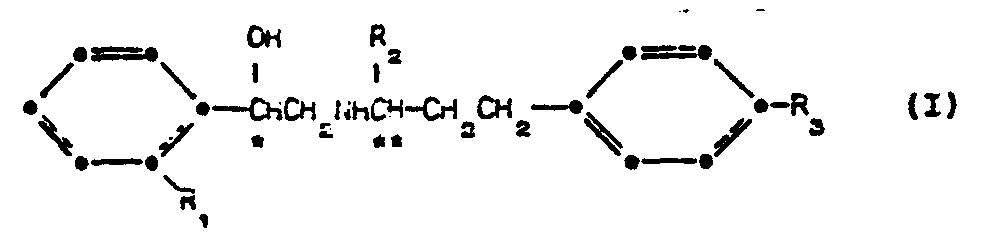
- R1 is hydrogen or fluorine;
- R2 is methyl or ethyl;
- R, is hydroxy, C1-C4 alkanoyloxy, aminocarbonyl. methylaminocarbonyl or C1-C2 alkoxycarbonyl;
- C is an asymmetric carbon atom having the R absolute stereochemical configuration; and
- C is an asymmetric carbon atom having the S absolute stereochemical configuration;
and pharmaceutically-acceptable salts thereof, are useful in the weight control of mammals.
Description
- This invention relates to phenethanolamine derivatives, pharmaceutical formulations containing those compounds, methods of preparing the novel compounds and their use in weight control in mammals.
- In recent years very extensive research efforts have been effected in the area of β-phenylethylamine derivatives, such as catecholamines. A great deal of study, for example, has been carried out on the naturally occurring catecholamine epinephrine. Epinephrine is a potent sympathomimetic drug and a powerful cardiac stimulant. However, the use of epinephrine is limited because of its undesirable side effects, which include fear, anxiety, tremor, tenseness, throbbing headache, increased blood pressure, dizziness, respiratory difficulty and palpitation, as well as its short duration of action.
- Use of drugs which cause more than one biological effect is always potentially dangerous. For example, since both bronchodilation and cardiac stimulation are mediated by the broad group of receptors known as β-receptors, a drug acting on such β-receptors not only would effect bronchodilation, but additionally could cause observable effects upon the heart. In fact, allegedly some individuals have died from ventricular fibrillation caused by excessive β-stimulation after using bronchodilation agents; (See Greenburg and Pines, Br. Med. J. 1, 563 (1967).
- The cardiac activity of phenethanolamines has long been known and is well-documented, see for instance U.S. Patent Specification No. 3,816,516.
- It has now surprisingly been discovered that the R,S-stereoisomer of certain N-substituted 3-phenylpropylamine derivatives are effective in weight control in obese mammals by removing, or preventing the formation of, excess adipose tissue and further that such compounds possess minimal cardiac activity.
- According to the present invention there is provided a compound of the formula (I):

- R1 is hydrogen or fluorine;
- R2 is methyl or ethyl;
- R3 is hydroxy, Cl-C4 alkanoyloxy, aminocarbonyl, methylaminocarbonyl or C1-C2 alkoxycarbonyl;
- C is an asymmetric carbon atom having the R absolute stereochemical configuration; and
- C is an asymmetric carbon atom having the S absolute stereochemical configuration;
- or a pharmaceutically-acceptable salt thereof.
- A preferred group of compounds have the above formula wherein R2 is methyl.
- Additionally preferred compounds have the above formula wherein R1 is hydrogen, R2 is methyl and R3 is hydroxy, methoxycarbonyl, aminocarbonyl or methylaminocarbonyl.
- The most preferred compounds of formula (I) are those wherein R1 is hydrogen, R2 is methyl and R3 is hydroxy or aminocarbonyl, and the pharmaceutically acceptable salts thereof.
- In one aspect of the invention there is provided a pharmaceutical formulation which comprises a compound of formula (I), or a pharmaceutically-acceptable salt thereof, associated with a pharmaceutically-acceptable carrier therefor. A preferred formulation comprises a compound of the above formula wherein R2 is methyl. An especially preferred pharmaceutical formulation comprises an R,S phenethanolamine of the above formula wherein R1 is hydrogen, R2 is methyl and R3 is hydroxy or aminocarbonyl.
- Whilst the compounds provided by this invention may be referred to generically as phenethanolamines, they will be systematically named herein as N-substituted-3-phenylpropylamines. The stereochemical configuration of the compounds of this invention is designated according to the R and S nomenclature. A full discussion of this system of nomenclature is presented by Cahn et al., Experientia, Vol. XII, pp. 81-124 (1956). The stereochemical configuration of the carbon atom labeled "C" is R and will be presented first when naming the compounds of the invention. The asymmetric carbon atom labeled "C" has the S absolute stereochemical configuration. Such fact is designated in the systematic naming of such compounds as illustrated for the compound of the above formula wherein R1 is hydrogen, R2 is methyl and R3 is aminocarbonyl: R,S-N-(2-phenyl-2-hydroxyethyl)-l-methyl-3-(4-aminocarbonylphenyl)propylamine.
- The compounds provided by this invention can be prepared by any of a number of methods involving well known and routinely used chemical processes. A preferred process involves the reaction of an optically active styrene oxide with an optically active 1-alkyl-3-phenylpropylamine.
- According to a further aspect of the invention there is provided a method of preparing a compound of formula (I) in which a styrene oxide of formula (II):

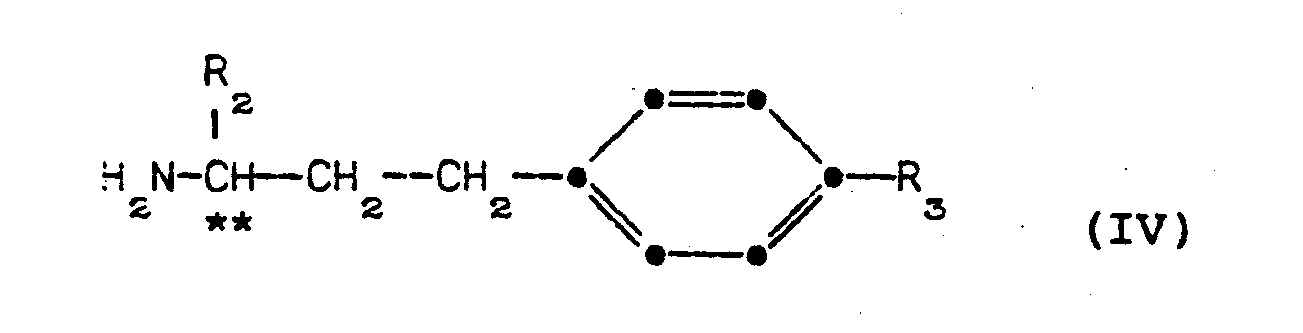
- The optically active amines of formula (IV) are novel and are provided in a further aspect of the invention.
- They can be prepared from the corresponding ketones of formula:


- For example, an optically active styrene oxide such as R-ortho-fluorostyrene oxide can be reacted with approximately an equimolar quantity of an optically active phenylpropylamine such as S-1-methyl-3-(4-methylaminocarbonylphenyl)propylamine to provide the corresponding optically active phenethanolamine of this invention, namely R,S-N-[2-(2-fluorophenyl)-2-hydroxyethyl]-l-methyl-3-(4-methylaminocar- bonylphenyl)propylamine. Condensation reactions of this type can be carried out in an unreactive polar organic solvent such as ethanol, dioxane, toluene or dimethylformamide, and usually at a temperature of from about 20 to about 120°C, preferably from 50 to 110°C. Under such conditions, the condensation generally is substantially complete after about 6 to about 10 hours, and the product phenethanolamine can be isolated by simply removing the reaction solvent, for instance by evaporation under reduced pressure. Further purification of the product thus formed can be accomplished if desired by standard methods including chromatography, crystallization and salt formation.
- Another preferred method for preparing the compounds of this invention comprises reacting an optically active mandelic acid derivative with a phenylpropylamine to provide an amide, and then reducing the amide carbonyl group to provide a compound of the invention. Such a method is ideally suited to the preparation of compounds wherein R3 is a hydroxy or alkoxycarbonyl substituent, but is not preferred for compounds in which R3is an amide group since a mixture of products may result.
- According to a further aspect of the invention there is provided a method of preparing a compound of formula (I) which comprises reducing a compound of formula (III)

- The reaction of the mandelic acid derivative with the phenylpropylamine is best accomplished utilizing coupling reagents such as those commonly used in the synthesis of peptides. Such routinely used coupling reagents include carbodiimides such as N,N'-dicyclohexylcarbodiimide (DCC) and N,N'-diisopropylcarbodiimide, as well as N-ethoxycarbonyl-2-ethoxy-1,2-dihydroquinoline (EEDQ). Dicyclohexylcarbodiimide generally is a preferred coupling reagent. A substituted or unsubstituted 1-hydroxybenzotriazole can be employed to accelerate the reaction if desired. The general process for preparing peptides utilizing dicyclohexylcarbodiimide and 1-hydroxybenzotriazole is discussed in detail by Konig and Geiger in Chem. Ber., 103, 788-798 (1970). According to such preferred process for preparing a compound of this invention, either R-2-phenyl-2-hydroxyacetic acid or R-2-(2-fluorophenyl)-2-hydroxyacetic acid can be reacted with approximately an equimolar quantity of an optically active S-l-alkyl-3-phenylpropylamine in the presence of a substantially equimolar amount of both dicyclohexylcarbodiimide and 1-hydroxybenzotriazole. The coupling reaction is best carried out in an organic solvent such as dimethylformamide, hexamethylphosphorotriamide, acetonitrile, dichloromethane, and the like. The reaction is normally carried out at reduced temperatures, for example at a temperature below about 50°C., generally at about 0 to about 10°C. The reaction normally is substantially complete within about two to about twenty hours; however, longer reaction periods appear not to be detrimental to the desired product and can be utilized if necessary.
- The coupling of an acid and an amine in the presence of dicyclohexylcarbodiimide to form an amide converts the dicyclohexylcarbodiimide to dicyclohexylurea. This latter compound is characteristically quite insoluble in organic solvents and accordingly can be removed from the reaction mixture simply by filtration. Once the dicyclohexylurea is removed from the reaction mixture, the product amide can be isolated by removal of the reaction solvent, for instance by evaporation of the solvent under a reduced pressure. The product thus formed can be dissolved in a water immiscible organic solvent such as ethyl acetate and washed with aqueous sodium bicarbonate to remove any remaining 1-hydroxybenzotriazole. The amide so formed can, if desired, be further purified by routine procedures including crystallization and chromatography.
- The amide next is reduced to provide the corresponding optically active N-phenylpropyl phenethanolamine comprehended by this invention. Reduction of such amide can be accomplished by any of a number of routine reduction processes, such as reaction with metal hydride reducing agents. A preferred reduction process comprises reaction of an amide with diborane. For example, an amide such as R,S-N-[2~(2-fluorophenyl)-2-hydroxy-l-oxoethyl]-l-ethyl-3-(4-hydroxyphenyl)propylamine can be reduced with diborane to provide a compound of formula (I). In this reduction the diborane typically is utilized in an excess relative to the amide, such as from about 1 to about 4 molar excess. The reduction generally is carried out in an inert organic solvent such as tetrahydrofuran, diethyl ether, benzene, dichloromethane, toluene or dioxane. Such reduction reactions typically are complete within about two to twenty hours when carried out at a temperature of from about 0° to about 100°C. Any excess diborane and borane complex remaining in the reaction mixture after the reduction of the amide is complete can be decomposed by the addition to the reaction mixture of an alcohol such as methanol or ethanol and an acid such as hydrochloric acid. The reduced product thus formed can be isolated by simply removing the reaction solvent, for example by evaporation. The product, an optically active phenethanolamine having the above formula, generally exists as a solid and can thus be further purified by crystallization or chromatography. Alternatively, the amine so formed can be converted to an acid addition salt, as will be discussed more fully hereinbelow.
- It should be recognized that the above- described processes for preparing compounds of formula (I) can be carried out utilizing starting materials unresolved at C, thereby affording mixtures * of diastereomers of S,N-phenylpropyl phenethanolamines. Separation of the diastereomers so formed can be accomplished by normal processes when required. Whilst the R-optical isomer of the phenethanol portion of compounds having the above formula (i.e. C) is required for useful biological activity, it is not a major disadvantage to have such R-isomer in admixture with the corresponding S-isomer (i.e. at C), since the S-* isomer is substantially devoid of activity and causes no undesired side effects in biological systems at therapeutic doses. However, it is to be clearly understood that this invention comprehends only compounds of formula (I) wherein the asymmetric center labelled C has the S absolute stereochemical con- figuration, since the R optical isomers (at the C ** asymmetric center) are potent inotropic agents and cannot be used to treat obesity without simultaneously imparting a significant cardiac effect.
- Use of the unresolved (at C) material may be particularly desirable if the compounds of the invention are to be utilized in the improvement of the quality of meat in livestock animals, such as cattle, pigs and sheep, by removing, or preventing the formation of, excess adipose tissue therein. The compounds of the invention have particular value in improving the quality of pig carcasses, an animal which tends to fat. In such a method the mixture is preferably applied in an amount of from 5 to 250 mg./kg. per day-usually in the animal's feed.
- Another method of preparing compounds of the invention comprises reacting a phenethanolamine with an aldehyde or ketone to provide the corresponding Schiff base, followed by reduction of the Schiff base. Such process is illustrated by the following scheme:

- Still another method for preparing the compounds of this invention comprises reacting a hydroxy protected 2-phenyl-2-hydroxyacetic acid acylating agent with an optically active l-alkyl-3-phenylpropylamine to provide an amide, followed by reduction of the amide carbonyl group to provide a compound of this invention. This process may be depicted by the following reaction scheme:

- A further method of preparing compounds of formula (I) comprises reacting a phenacyl halide with an optically active S-l-alkyl-3-phenylpropylamine. For example, a phenacyl halide such as 2-fluorophenacyl bromide can be reacted with about an equimolar quantity of an amine such as S-l-methyl-3-(4-hydroxyphenyl)propylamine. Such alkylation reactions are normally carried out in an organic solvent such as ethanol and in the presence of a base such as sodium carbonate or triethylamine. The reaction is complete within about six hours when carried out at about 50°C. and provides a ketone intermediate, for instance S-N-[2-(2-fluorophenyl)-2-oxoethyl]-l-methyl-3-(4-hydroxyphenyl)propylamine. The ketone thus formed can be isolated as the free amine base or as an acid addition salt. Reduction of the ketone, for example with sodium borohydride, affords a compound of formula (I), generally as a mixture of optical isomers at C. Such a mixture of R, S and S,S optical isomers * can be separated by standard procedures, or if desired can be utilized directly since the S,S isomer is essentially devoid of biological activity.
- Compounds having the above formula wherein R3 is hydroxyl, that is compounds of this invention which bear a phenolic hydroxyl group, can be readily acylated to provide compounds having the above formula in which R3 is C1-C4 alkanoyloxy. As used herein, the term "C1-C4 alkanoyloxy" includes formyloxy, acetoxy, propionoxy, butyroxy, and isobutyroxy. The acylation of a compound of this invention having a phenolic hydroxyl group typically is accomplished by reacting the hydroxyl compound with an acylating agent such as the appropriate acid anhydride or acid halide for example the acid chloride or acid bromide. Typical acylating agents commonly employed include acetic anhydride, propionyl chloride, isobutyryl bromide and formic-acetic anhydride.
- It may be desirable to protect the hydroxyl and amino groups of the phenethanolamine portion of the compound of this invention prior to acylation of the free phenolic hydroxyl group, thereby precluding any undesired side reactions. For example, a compound of this invention such as R,S-N-[2-(2-fluorophenyl)-2-hydroxyethyl]-l-ethyl-3-(4-hydroxyphenyl)propylamine can be reacted with thionyl chloride in the presence of a base such as triethylamine and in a solvent such as tetrahydrofuran to form a cyclic oxathiazole, thus effectively protecting both the hydroxyl group and the amino group of the phenethanolamine portion of the molecule. Such reaction converts the above-named compound into R,S-N-[l-ethyl-3-(4-hydroxyphenyl)propyl]-5-(2-fluorophenyl)-l-oxo-4,5-dihydro-l,2,3-oxathiazole. This latter compound can then be acylated at the free phenolic hydroxyl functionality without risk of affecting other sites in the molecule. For instance, R,S-N-[l-ethyl-3-(4-hydroxyphenyl)propyl]-5-(2-fluorophenyl)-l-oxo-4,5-dihydro-l,2,3-oxathiazole can be reacted with an acylating agent such as acetic anhydride or acetyl chloride in a solvent such as benzene, xylene or toluene and in the presence of a base such as triethylamine, generally at a temperature of about 50° to 100°C., thus effecting acylation of the phenolic hydroxyl group to provide R,S-N-[l-ethyl-3-(4-acetoxyphenyl)propyl]-5-(2-fluorophenyl)-l-oxo-4,5-dihydro- 1,2,3-oxathiazole. The oxathiazole thus prepared is treated with an acid such as a dilute mineral acid to remove the protecting groups and thus recover the desired phenethanolamine. For example, the above-named oxathiazole can be treated with 1 N hydrochloric acid at a temperature of about 30°C. to provide R,S-N-[2-(2-fluorophenyl)-2-hydroxyethyl]-1-ethyl-3-(4-acetoxyphenyl)propylamine as the acid addition salt, which upon treatment with a base such as sodium carbonate affords a free amine of formula (I).
- Compounds of the formula (I) wherein R3 is aminocarbonyl can be prepared either directly by reacting the appropriate phenylpropylamine with a styrene oxide or alternatively can be derived from those compounds wherein R3 is Cl-C2 alkoxycarbonyl such as methoxycarbonyl or ethoxycarbonyl. For example, R-mandelic acid can be coupled with S-1-methyl-3-(4-methoxycarbonylphenyl)propylamine to provide, after reduction of the amide carbonyl, the corresponding amine of this invention, namely R,S-N-(2-phenyl-2-hydroxyethyl)-l-methyl-3-(4-methoxycarbonylphenyl)-propylamine. This amine can be reacted with hydrazine for about 2 to 40 hours at about 50 to 100°C. to convert the alkoxycarbonyl group to a hydrazino carbonyl group. The latter compound is converted by hydrogenation to the corresponding aminocarbonyl derivative, utilizing common hydrogenation catalysts such as Raney nickel.
- Compounds of formula (I) wherein R3 is methylaminocarbonyl are preferably prepared by reacting a styrene oxide with a 3-(4-methylaminocar- bonylphenyl)propylamine. The required phenylpropylamine starting material can be prepared by simply reacting methylamine with the appropriate benzoyl chloride derivative. For example, S-1-ethyl-3-(4-chlorocarbonylphenyl)propylaminium chloride can be reacted with methylamine to provide S-1-ethyl-3-(4-methylaminocarbonylphenyl)propylamine. Reaction of the latter compound with a styrene oxide affords a compound of this invention.
- The compounds provided by this invention are amines and as such are basic in nature. Consequently, they can readily be converted to acid addition salts by reaction with organic or inorganic acids. Accordingly, an additional embodiment of this invention comprises pharmaceutically acceptable salts of the N-phenylpropyl phenethanolamines of the above formula. The particular acids utilized to form salts of this invention are not critical, and such salts include those which are prepared by reaction of the amine of this invention with any of a number of common acids such as hydrochloric, hydrobromic, sulfuric, phosphoric, nitric, perchloric, formic, acetic, butyric, citric, maleic, succinic, oxalic, fumaric, lactic, methanesulfonic, p-toluenesulfonic, and related acids. The pharmaceutically acceptable acid addition salts which are formed by reaction of an amine of this invention with an acid such as one of the above-named acids typically exist as highly crystalline solids, and thus lend themselves to ready purification by recrystallization from common solvents such as methanol, ethanol, ethyl acetate and the like. Additionally, such salts are easily formulated for convenient administration, particularly by the oral route, to subjects in need of treatment for obesity. When desired, such acid addition salts are readily converted to the corresponding free amine base by reaction w'.th a suitable basic compound, for instance sodium or potassium hydroxide, sodium carbonate, triethylamine, sodium bicarbonate, and the like.
- The following list of compounds is provided to illustrate the range of compounds comprehended by this invention. The representative listing is not intended to be inclusive of every compound claimed herein, but rather simply illustrates certain preferred compounds and the relative scope of the disclosure.
-
- R,S-N-(2-phenyl-2-hydroxyethyl)-1-methyl-3-(4-hydroxyphenyl)propylamine;
- R,S-N-(2-phenyl-2-hydroxyethyl)-l-methyl-3-(4-aminocarbonylphenyl)propylamine;
- R,S-N-(2-phenyl-2-hydroxyethyl)-1-ethyl-3-(4-hydroxyphenyl)propylamine;
- R,S-N-(2-phenyl-2-hydroxyethyl)-1-ethyl-3-(4-aminocarbonylphenyl)propylamine;
- R,S-N-(2-phenyl-2-hydroxyethyl)-1-methyl-3-(4-methylaminocarbonylphenyl)propylamine;
- R,S-N-(2-phenyl-2-hydroxyethyl)-1-methyl-3-(4-acetoxyphenyl)propylamine;
- R,S-N-[2-(2-fluorophenyl)-2-hydroxyethyl]-1-methyl-3-(4-ethoxycarbonylphenyl)propylamine;
- R,S-N-[2-(2-fluorophenyl)-2-hydroxyethyl]-l-ethyl-3-(4-methoxycarbonylphenyl)propylamine;
- R-N-(2-phenyl-2-hydroxyethyl)-3-(4-methylamino- carbonylphenyl)propylamine;
- R,S-N-(2-phenyl-2-hydroxyethyl)-1-methyl-3-(4-isobutyroxyphenyl)propylamine;
- R,S-N-(2-phenyl-2-hydroxyethyl)-1-ethyl-3-(4-methylaminocarbonylphenyl)propylamine;
- R-N-[2-(2-fluorophenyl)-2-hydroxyethyl]-3-(4-ethoxycarbonylphenyl)propylamine;
- R,S-N-(2-phenyl-2-hydroxyethyl)-l-methyl-3-(4-ethoxycarbonylphenyl)propylamine;
- R-N-(2-phenyl-2-hydroxyethyl)-3-(4-amino- carbonylphenyl)propylamine;
- R,S-N-(2-phenyl-2-hydroxyethyl)-1-methyl-3-(4-hydroxyphenyl)propylaminium chloride;
- R,S-N-(2-phenyl-2-hydroxyethyl)-l-methyl-3-(4-methylaminocarbonylphenyl)propylaminium bromide;
- R,S-N-(2-phenyl-2-hydroxyethyl)-1-methyl-3-(4-hydroxyphenyl)propylaminium acetate;
- R,S-N-(2-phenyl-2-hydroxyethyl)-l-methyl-3-(4-hydroxyphenyl)propylaminium butyrate;
- R,S-N-(2-phenyl-2-hydroxyethyl)-l-methyl-3-(4-aminocarbonylphenyl)propylaminium succinate;
- Obesity is a very serious disease that currently is the subject of a great deal of concern, particularly since no truly effective treatments are known. A full discussion of nutritional diseases and obesity in general is presented by Albrink in Textbook of Medicine, l2th Ed., 1969, W. B. Saunders Company, Philadelphia, Pa., pp. 1164-1174 and by Salans in Current Therapy, 1977, W. B. Saunders Company, pp. 455-460. Compounds provided by this invention are particularly useful due to their ability to effect an actual reduction in weight when administered to a mature obese animal. Such weight reduction is accomplished without a concomitant reduction in daily food consumption. When the compounds of this invention are administered to immature obese animals, the degree of weight gain is significantly reduced compared to that observed in young obese animals not receiving a compound of the invention.
- The anti-obesity activity of the compounds of this invention has been demonstrated in a number of biological tests utilizing mice, rats and dogs. One of the major actions of the claimed compounds on a biological system appears to be the mobilization of fatty acids from adipose tissue stores. In a test designed to demonstrate such mobilization, a compound of this invention was administered to a total of eight normal fed rats of the Charles River strain, each weighing about 180 to 200 grams. A blood sample from each animal was taken immediately preceding the administration of the test compound and served as the control for each of the eight animals. A compound of this invention was then administered to each animal subcutaneously at the dose of 10 mg./kg. of body weight. Blood samples were then taken from each animal at intervals of 30, 60, 90 and 120 minutes after dosing, and the serum free fatty acid levels were determined for each blood sample. Table I presents the results of such test carried out with two compounds of this invention. The results demonstrate that a dramatic increase in serum free fatty acid levels is caused by a compound of this invention.

- In a test designed to demonstrate the actual weight reducing effects of the compounds of this invention, viable yellow genetically obese mice were selected as a model. All of the animals were 6.5 months old at the beginning of the study. The animals were fed Purina Laboratory Chow and water ad libitum throughout the study. Five obese animals were randomly selected to receive 10 mg./kg. of R,S-N-(2-phenyl-2-hydroxyethyl)-l-methyl-3-(4-hydroxyphenyl)propylamine subcutaneously twice daily, and five animals received placebo. The initial body weight of each animal was determined on day 1 of the study prior to the first injections. Table II presents the results of the study. The data is presented as the average body weight in grams of the control group and of the group receiving the test compound. Such average body weight in grams is presented in column I under each of the indicated days. Column II under each of the indicated days provides the average food consumption in grams for the control group and for the test group.
- The results presented in Table II demonstrate that the compounds of this invention cause an actual reduction in body weight in mature obese animals without causing a decrease in food consumption.
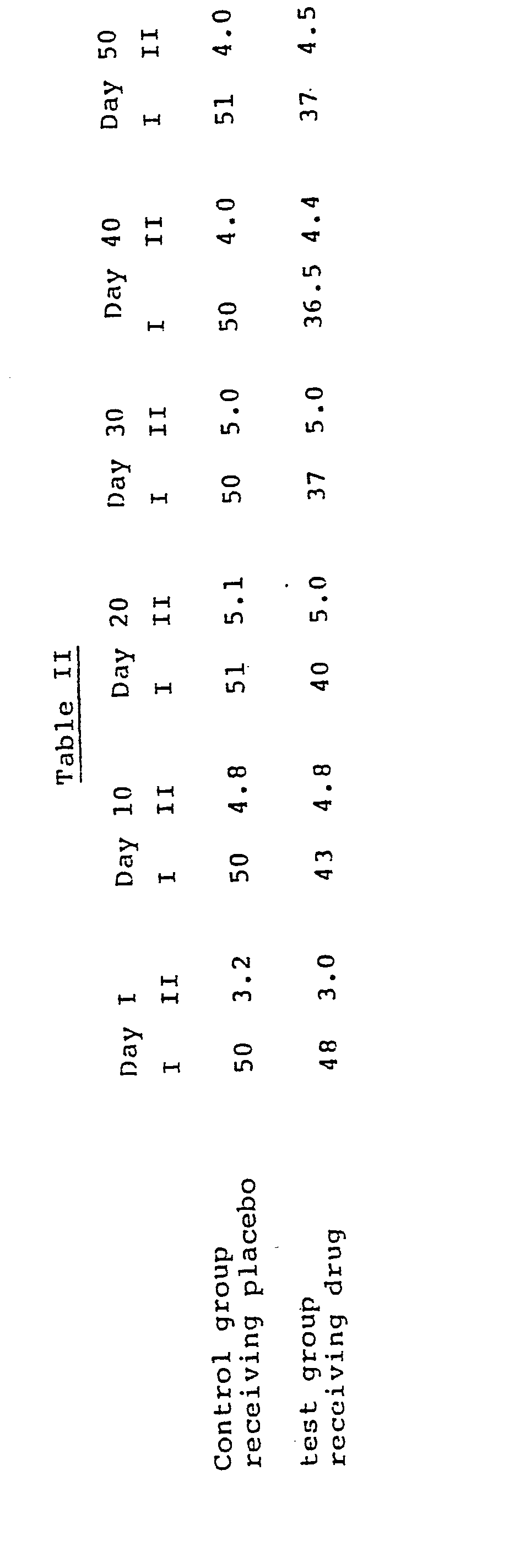
- A similar study was carried out utilizing genetically obese Zucker rats. The compounds of the invention effected a dramatic weight reduction without decreasing daily food consumption when administered to adult obese rats (6 months and older). When administered to immature obese rats ranging in age from 2 to 5 months, the compounds were effective in preventing the excessive gain in weight as was observed with the young obese rats which did not receive a compound of this invention. Table III presents the results of a study carried out by administering R,S-N-(2-phenyl-2-hydroxyethyl)-l-methyl-3-(4-hydroxyphenyl)propylamine at 10 mg./kg. twice daily to the test animals. All animals were permitted to eat all the food and drink all the water they wanted. The food consumption of the animals given a compound of the invention did not differ significantly from the control animals receiving placebo. Each of the body weights reported in the table is the average weights of five animals in each of the test classes.

- The anti-obesity drugs provided by this invention additionally have demonstrated their ability to effect weight reductions in obese dogs. Obese breeder beagles from the Pin Oak colony ranging in age from 4 to 9 years and weighing from 15.4 to 29.0 kg. were selected for the test. The dogs were fed ad libitum a Eucanuba diet containing sixteen percent fat for six months prior to the initiation of the study, thereby stabilizing the dogs' obesity. In one test, the animals received R,S-N-(2-phenyl-2-hydroxyethyl)-1-methyl-3-(4-hydroxyphenyl)propylaminium chloride at a subcutaneous dose of 3.2 mg./kg. twice each day. The effect of the drug on body weight was determined by measuring body weight in kilograms. No decrease in food consumption was noted. The results of five weeks treatment are summarized in Table IV.

- In a similar test utilizing mature obese beagle hounds, fed ad libitum on standard dog chow, R,S-N-(2-phenyl-2-hydroxyethyl)-l-methyl-3-(4-amino- carbonylphenyl)propylaminium chloride was administered orally at 15 mg./kg. twice daily for twenty-seven days. The effect of the drug on body weight was determined by measuring body weight in kilograms and girth size in inches. Two dogs were selected as control animals receiving food and water ad libitum, but no drug. Table V presents the results of the test. As the data demonstrates, the control dogs did not fluctuate a great deal in weight or girth size. In contrast, the obese dogs treated with a compound of this invention lost from 1.8 to 2.9 kilograms during a 27 day treatment period, and the girth of such obese dogs decreased by as much as 2 inches in the same period of time.
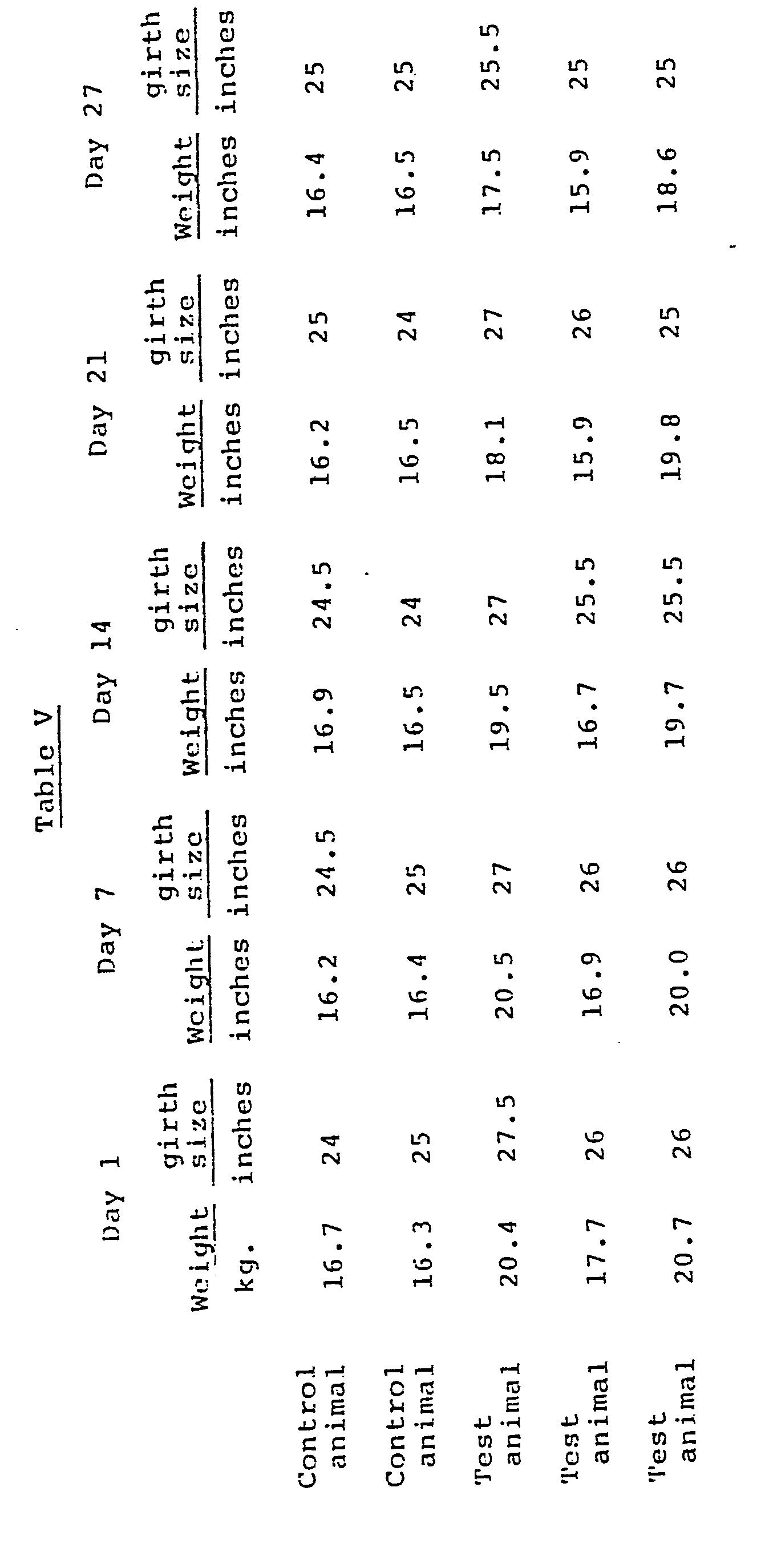
- As already pointed out, the unique physiological effect of the compounds of this invention is derived from their potent anti-obesity activity coupled with their physiologically tolerable degree of cardiovascular activity. This uniquely specific activity is achieved by selecting the correct, i.e. R,S-, stereochemistry at both the asymmetric carbon atoms of the compound of formula (I).
- The unique physiological activity of the R,S-isomers of this invention compared with the corresponding R,R-isomers (which are potent inotropic agents) has been demonstrated in dogs. The compounds to be evaluated were administered intravenously to dogs having implanted cardiovascular transducers for measurement of the derivative of the left ventricular pressure, which is the index of cardiac contractile force. A dose of compound sufficient to cause a twenty-five percent increase in contractile force was administered. The dose required to effect such increase in contractile force is reported in Table VI as the ED25 in mcg./kg. The results demonstrate that very little of the inotropically active R,R-isomers is required to effect a twenty-five percent increase in contractile force, whereas a significantly larger dose of the corresponding R,S-isomer is required to cause the same effect.

- Because of the surprisingly low inotropic activity of the compounds of this invention, they can be administered to an animal at doses large enough to effect release of free fatty acids from adipose stores without causing a substantial increase in the pumping force of the heart. Such unique biological spectrum of the compounds of this invention renders them. particularly useful in the control of weight in obese animals. As used herein, "weight control in obese animals" refers to the ability of the compounds of this invention to effect an actual weight reduction when administered to a mature obese animal, whereas such compounds are effective in the prevention of excessive weight gain when administered to immature obese animals. The terms "mature" and "immature" are used herein to refer to the generally accepted definitions of age and growth patterns. "Obesity" is an art recognized term and is used as such herein.
- An additional aspect of this invention is a method for controlling weight in obese animals. While the anti-obesity effective dose of a compound of this invention employed in the control of obesity will vary depending on the particular drug employed and the severity of the condition being treated, the usual dosage of a compound of this invention will be from about 1.0 to about 25 mg. per kilogram of animal body weight. The compounds of the invention preferably will be administered orally at a dosage of from about 1 to about 5 mg./kg., generally given in individual doses from one to four times per day. When desired, the drug can be administered orally in the form of a tablet or capsule, or alternatively in sustained release form. According to the method of this invention a compound defined by the above general formula is administered to a mature obese animal to effect an actual reduction in weight without diminishing the daily food consumption. The drug will be administered daily, at increasing dosage levels if desired, until the desired weight reduction is effected. The compounds of the invention can be administered to an immature obese animal to effect a reduction in weight gain without a diminished daily food consumption. Once the immature obese animal reaches maturity, a reduction of weight will be effected until a substantially normal weight is achieved.
- The compounds comprehended by this invention can be formulated by normal procedures for convenient administration by any of a number of routes. It is preferred that the compounds be formulated for oral administration. Pharmaceutical formulations which are useful in weight control in obese animals are provided in a further embodiment of this invention.
- Such pharmaceutical compositions can contain, as active ingredient, one or more of the compounds provided by this invention, in combination if desired with any of the inactive isomers as hereinbefore indicated, in addition to any of a number of pharmaceutically acceptable carriers or diluents. Typical carriers and diluents commonly used include gelatin, starch, dextrose, sucrose, lactose, cellulose derivatives, stearates, polyvinylpyrrolidine, glycerine, ethyl lactate, sorbitol, mannitol, and the like. A suitable pharmaceutical composition can additionally include any of a number of common preserving agents, stabilizers, antioxidants, taste correctors, and the like. Examples of such additives include ascorbic acid, sorbic acid, various esters of p-hydroxybenzoic acid, and the like.
- Typical pharmaceutical compositions useful in the treatment of obesity according to this invention will generally include from about 1 to about 50 percent by weight of a compound of this invention as active ingredient. The remainder of said pharmaceutical composition will comprise suitable carriers and diluents, and any of the indicated inactive optical isomers as desired.
- A pharmaceutical composition containing as active ingredient at least one of the compounds of this invention can be molded into tablets, encapsulated into empty gelatin capsules, or made into a solution or suspension. Such pharmaceutical compositions can be administered to an obese subject in need of treatment by any of a number of routes, including the oral and parenteral routes. A preferred formulation, for example, comprises about 250 mg. of R,S-N-(2-phenyl-2-hydroxyethyl)-l-methyl-3-(4-aminocarbonylphenyl)-propylaminium chloride admixed with any of a number of suitable carriers and molded into a tablet for oral administration to an obese human subject at the rate of from 1 to about 4 tablets per day for effective weight control.
- In an effort to more fully illustrate particular aspects of this invention, the following Preparations illustrate how starting materials useful in the invention may be prepared whereas the following Examples illustrate the preparation of final products of formula (I). The Examples are representative only and should not be construed as limiting in any respect.
- To a cold stirred solution of 300 g. of R-mandelic acid in 2000 ml. of tetrahydrofuran was added dropwise over two hours 3000 ml. of a 1 molar solution of diborane in tetrahydrofuran. The reaction mixture was stirred for twelve hours at 25°C. following complete addition, and then was cooled to 0°C. in an ice water bath. To the cold solution was added 600 ml. of methanol dropwise over thirty minutes, and the reaction mixture was then stirred for another three hours. Removal of the solvent by evaporation under reduced pressure provided 260 g. of the product as a solid. The solid was crystallized from diethyl ether to provide R-2-phenyl-2-hydroxyethanol.
- A solution of 256.7 g. of R-2-phenyl-2-hydroxyethanol in 1000 ml. of toluene containing 50 ml. of pyridine was stirred at 0°C. while a solution of 372.1 g. of p-toluenesulfonyl chloride in 400 ml. of toluene was added dropwise over two hours. The reaction mixture was stirred at 0°C. for forty-eight hours and then filtered to remove the precipitated pyridine hydrochloride. The filtrate was concentrated to dryness by evaporation under reduced pressure to provide the product as an oil. The oil was dissolved in fresh toluene, washed with dilute hydrochloric acid and with water, and dried. Evaporation of the solvent under reduced pressure and crystallization of the product from diethyl ether and hexane afforded 435 g. of R-2-phenyl-2-hydroxy-1-E-toluenesulfonyloxyethane. The product thus formed was dissolved in 1000 ml. of dimethyl sulfoxide containing 418 ml. of 5 N sodium hydroxide. The alkaline solution was stirred at 0°C. for twelve hours, and then was poured into ice water. The product was extracted into 50% diethyl ether-pentane, and the organic layer was separated, washed with water and dried. Removal of the solvent by evaporation afforded, after distillation, 165 g. of R-styrene oxide. B.P. 55-56°C. 0.6 torr. [α]D -23.7° (chloroform).
- One hundred three grams of dl-o-fluoro- mandelic acid was resolved by reaction with (+)-a-methylbenzylamine to form the salt, and crystallization of the salt from ethanol and ethyl acetate to provide optically active a-methylbenzylaminium 2-(2-fluorophenyl-2-hydroxy)acetate, M.P. 155-157°C. [α]D -43.1° (MeOH). The salt thus formed was hydrolyzed to the free acid to provide R-ortho- fluoromandelic acid, M.P. 88-90°C. [α]D -138° (MeCH). The acid was then converted to R-ortho-fluorostyrene oxide by the procedure of Preparation 1, B.P. 58-61°C. (3 torr), [α]D -32.7° (chloroform).
- The oil from 280 g. of a 50% dispersion cf sodium hydride in mineral oil was removed by several washings with hexane. The hexane was replaced with 1.5 1. of dimethylformamide, and the mixture was stirred and cooled in an ice-bath while 950 g. of ethyl acetoacetate was slowly added. After the sodium hydride had reacted a solution of 314 g. of a-bromo-p-toluic acid in 500 ml. of dimethylformamide was added. The ice bath was removed and the mixture was allowed to stir at 25°C. for eighteen hours, poured into water acidified with 3N hydrochloric acid and extracted with ethyl acetate. The combined organic layers were washed with water and brine and dried over anhydrous sodium sulfate. The solvent and excess ethyl acetoacetate were removed at reduced pressure to afford 500 g. of oil.
- The crude oil was combined with 1.2 1. of glacial acetic acid, 140 ml. of concentrated hydrochloric acid and 750 ml. of water and heated at refluxed for three and one half hours. The solvents were removed under reduced pressure and the residue was dissolved in a mixture of ether and xylene and washed with water. The solid obtained after removal of the solvents was recrystallized twice from a mixture of ethanol and water to give 111 g. of 4-(4-carboxyphenyl)-2-butanone, m.p. 120.5-123°C.

- A mixture of 9.50 g. of 4-(4-carboxyphenyl)-2-butanone, 100 ml. of benzene, 15.7 g. of oxalyl chloride and one drop of dimethylformamide was stirred and warmed to 50°C. for two hours. The reaction mixture was then allowed to stir for eighteen hours at 25°C. and concentrated under reduced pressure. The residue was dissolved in 50 ml. of dioxane and, with stirring, was added slowly to 300 ml. of cold (0°C.) concentrated ammonium hydroxide. The mixture was stirred for seventy-five minutes and diluted to 1 1. with water. The solid was removed by filtration, washed with water, dried and recrystallized from a mixture of methanol and ether to provide 4.1 g. of 4-(4-aminocarbonylphenyl)-2-butanone, m.p. 144-146°C. An analytical sample, m.p. 149-150°C., was obtained by recrystallizing twice from a mixture of methanol and ether.
- Analysis calc. for C11H13NO2
- Theory: C, 69.09; H, 6.85; N, 7.32.
- Found : C, 68.98; H, 7.10; N, 6.99.
- A solution of 45.7 g. of 4-(4-amino- carbonylphenyl)-2-butanone in 400 ml. of toluene containing 29.0 g. of (-)-α-methylbenzylamine and 1.0 g. of p-toluenesulfonic acid was heated at reflux for four hours with removal of water via a Dean Stark trap. After cooling the reaction mixture to room temperature, the solvent was removed therefrom by evaporation under reduced pressure to provide S-N-(a-methylbenzyl)-l-methyl-3-(4-aminocarbonyl- phenyl)-propylimine. The imine was hydrogenated in 625 ml. of methanol utilizing 15 g. of Raney Nickel as the catalyst to provide a mixture of optical isomers of N-(α-methylbenzyl)-1-methyl-3-(4-amino- carbonylphenyl)propylamine. The amine was reacted with hydrogen chloride to provide the corresponding acid addition salt as a solid. The mixture was purified by repeated crystallization of the salt from methanol and acetonitrile to provide 23.6 g. of optically active S,S-N-(α-methylbenzyl)-1-methyl-3-(4-aminocarbonylphenyl)propylaminium chloride. M.P. 256-258°C. [α]D -80.1° (MeOH).
- 480 ml. of ethanol containing 3.0 g. of five percent palladium suspended on carbon was hydrogenated for twenty-two hours at 50°C. under a pressure of 60 p.s.i. The reaction mixture then was filtered and the solvent was removed from the filtrate by evaporation under reduced pressure to provide the product as a solid. The solid was recrystallized three times from ethanol and ethyl acetate to afford 9.4 g. of S-1-methyl-3-(4-aminocarbonylphenyl)propylaminium chloride. M.P. 237-240°C. [α]D -8.2 (MeOH).
- Analysis calc. for C11H17ClN2O
- Theory: C, 57.76; H, 7.49; N, 12.25
- Found: C, 57.65; H, 7.57; N, 12.10
- Optically active S,S-N-(a-methylbenzyl)-1-methyl-3-(4-methoxycarbonylphenyl)propylamine was hydrolyzed by reaction with 10 percent aqueous hydrochloric acid to provide optically active S,S-N-(α-methylbenzyl)-1-methyl-3-(4-hydroxycarbonyl- phenyl)propylaminium chloride. M.P. 234-237°C. The acid thus formed was reacted with oxalyl chloride in benzene to provide the corresponding optically active acid chloride. The acid chloride was dissolved in dioxane and added dropwise to a stirred solution cf methylamine in 50 ml. of dioxane. The reaction mixture was stirred for twelve hours at room temperature, and then diluted with 100 ml. of water. The aqueous reaction mixture was extracted with ethyl acetate, and the organic layer was separated, washed with water and dried. The solvent was removed by evaporation under reduced pressure to provide, after chromatography over silica gel, optically active S,S-V-(α-methylbenzyl)-1-methyl-3-(4-methylamino- carbonylphenyl)propylamine. Hydrogenation of the product thus formed according to the procedure of Preparation 3 effected de-benzylation to provide S-1-methyl-3-(4-methylaminocarbonylphenyl)propyl- aminium chloride. [α]D -6° [α]365 -42.3° (MeOH).
- To 213 g. of (S)-(-)-a-methylbenzylamine in 1 1. of benzene was added 290 g. of 4-(4-hydroxyphenyl)-2-butanone and 0.5 g. of p-toluenesulfonic acid. The reaction mixture was stirred and heated to reflux. The water that was formed during the reaction was azeotropically removed. After the theoretical amount of water had separated, the benzene was removed at reduced pressure, and the residue was dissolved in methanol and hydrogenated in the presence of Raney nickel at ambient temperature over a sixteen hour period. The catalyst was removed by filtration, and the methanol and any unreacted a-methylbenzylamine were removed at reduced pressure. The residue was dissolved in 500 ml. of ethanol and an excess of hydrogen chloride in ether was added. The solid that formed was filtered, washed with ether, and recrystallized from a mixture of ethanol and acetone. Several more recrystallizations from a mixture of methanol and acetonitrile gave 263 g. of S,5-N-(α-methylbenzyl)-1-methyl-3-(4-aminocarbonyl- phenyl)propylamine, hydrochloride, m.p. 180-182°C. [α]D -72.2, [α]365 -257.5° (MeOH).
- A mixture of 258 g. of the above-named hydrochloride salt, 26 g. of 5 percent palladium on carbon and 1700 ml. of ethanol was hydrogenated at 60°C. for eight and one half hours. The catalyst was removed by filtration and the solvent was evaporated. The residue was dissolved in hot ethanol, ether was added and 149 g. of crystalline title product was removed by filtration, m.p. 198-202°C., [α]D -8.5, [α]365 -23.5° (MeOH).
- To a refluxing solution of 3.6 g. of S-l-methyl-3-(4-methylaminocarbonylphenyl)propylamine in 50 ml. of ethanol was added dropwise over ten minutes a solution of 2.1 g. of R-styrene oxide in 20 ml. of ethanol. Following complete addition of the styrene oxide, the reaction mixture was heated at reflux for four hours and then cooled to 25°C. and stirred at that temperature for twelve hours. The solvent was next removed by evaporation under reduced pressure to provide an oil which was then crystallized from diethyl ether to provide 3.5 g. of the product as a solid. The solid was recrystallized from ethyl acetate and diethyl ether to afford 1.7 g. of R,S-N-(2-phenyl-2-hydroxyethyl)-1-methyl-3-(4-methylaminocarbonylphenyl)propylamine. M.P. 158-160°C.
- The amine so formed was converted to the hydrochloride salt by reaction with hydrogen chloride in diethyl ether to provide, following crystallization from methanol and ethyl acetate, 1.2 g. of R,S-N-(2-phenyl-2-hydroxyethyl)-1-methyl-3-(4-methyl- aminocarbonylphenyl)propylaminium chloride. M.P. 179-182°C.
- Analysis calc. for C20H27ClN2O2
- Theory: C, 66.19; H, 7.50; N, 7.72.
- Found: C, 66.40; H, 7.82; N, 7.49.
- A solution of 7.16 g. of (S)-l-ethyl-3-(4-hydroxyphenyl)propylamine in 50 ml. of N,N-dimethylformamide (DMF) was cooled in an ice-water bath and stirred under a nitrogen gas atmosphere while a solution of 6.08 g. of R-mandelic acid and 5.41 g. of 1-hydroxybenzotriazole in 15 ml. of DMF was added in one portion. A solution of 8.24 g. of dicyclohexylcarbodiimide in 10 ml. of DMF was added dropwise over thirty minutes to the stirred reaction mixture. The reaction mixture was stirred for two hours at 5°C., and then allowed to set for twelve hours at 0°C. Dicyclohexylurea had precipitated out of solution, and was separated from the reaction mixture by filtration. Removal of the solvent from the filtrate by evaporation under reduced pressure provided a solid residue. The solid was purified by washing it with sodium carbonate followed by crystallization from acetonitrile to provide 7.31 g. of R,S-N-(2-phenyl-2-hydroxy-l-oxoethyl)-l-ethyl-3-(4-hydroxyphenyl)propylamine. M.P. 116-118.5°C. [α]D -61° (MeOH).
- Analysis calc. for C19H23NO3
- Theory: C, 72.82; H, 7.40; N, 4.47.
- Found: C, 72.73; H, 7.22; N, 4.77.
- A solution of 6.17 g. of the amide thus formed in 70 ml. of tetrahydrofuran (THF) was added dropwise over one hour to a stirred solution of 60 ml. of 1 molar diborane in THF. Following the addition, the reaction mixture was stirred at 24°C. under a nitrogen gas atmosphere for forty-eight hours. Excess methanol then was added to the reaction mixture in order to decompose any unreacted diborane. The solvents were removed from the reaction mixture by evaporation under reduced pressure to provide the product as an oil. The oil so formed was dissolved in ethyl alcohol and diethyl ether, and excess hydrogen chloride gas was bubbled through the reaction mixture in order to form the hydrogen chloride acid addition salt. The salt precipitated out of solution and was removed therefrom by filtration. The solid product so formed was recrystallized several times from ethyl acetate to afford 171 mg. of R,S-N-(2-phenyl-2-hydroxyethyl)-l-ethyl-3-(4-hydroxyphenyl)propylaminium chloride. M.P. 148-151°C. [α]D -25.0° (MeOH).
- Analysis calc. for C19H26ClNO2
- Theory: C, 67.94; H, 7.80; N, 4.17.
- Found: C, 67.97; H, 7.72; N, 4.45.
- A solution of 15.05 g. of S-1-methyl-3-(4-benzyloxyphenyl)propylamine in 50 ml. of DMF was cooled in an ice-water bath and stirred under a nitrogen gas atmosphere while a solution of 10.0 g. of R-2-(2-fluorophenyl-2-hydroxy)acetic acid and 7.97 g. of 1-hydroxybenzotriazole in 50 ml. of DMF was added in one portion. The reaction mixture was stirred at 5°C. while a solution of 12.15 g. of dicyclohexylcarbodiimide in 20 ml. of DMF was added dropwise over thirty minutes. The reaction mixture was stirred at 5°C. for one hour, and then allowed to stand at 9°C. for twelve hours. Dicyclohexylurea had precipitated out of solution, and was removed from the reaction mixture by filtration. The filtrate was diluted with ethyl acetate, washed with sodium carbonate, and then concentrated by evaporation of the solvent under reduced pressure, thus providing 23.0 g. of R,S-N-[2-(2-fluorophenyl)-2-hydroxy-1-oxoethyl]-I-methyl-3-(4-benzyloxyphenyl)propylamine as an oil.
- To a stirred solution of 15.2 g. of lithium aluminum hydride in 800 ml. of diethyl ether was added dropwise over one hour a solution of 23.0 g. of the amide thus formed in 100 ml. of THF. After the addition was complete, the reaction mixture was heated at reflux for six hours, and then stirred for an additional twelve hours at 24°C. Any unreacted lithium aluminum hydride remaining in the reaction mixture was decomposed by the dropwise addition of 16 ml. of water, followed by the addition of 12 ml. of twenty percent aqueous sodium hydroxide solution and 56 ml. of water. Filtration and removal of the solvents from the reaction mixture by evaporation under reduced pressure provided R,S-K-[2-(2-fluorophenyl-2-hydroxyethyl]-1-methyl-3-(4-benzyloxyphenyl)-propylamine. The residue so formed was dissolved in ethyl alcohol and diethyl ether, and excess hydrogen chloride gas was bubbled through the solution. The precipitate which formed was collected by filtration and recrystallized twice from ethyl alcohol and diethyl ether, affording 10.0 g. of R,S-N-[2-(2-fluorophenyl)-2-hydroxyethyl]-1-methyl-3-(4-benzyloxyphenyl)propylaminium chloride. M.P. 162-163°C.
- Analysis calc. for C25H29ClFNO2
- Theory: C, 69.84; H, 6.80; N, 3.26.
- Found: C, 70.04; H, 6.95; N, 3.41.
- A solution of 10.0 g. of the salt thus formed in 190 ml. of ethyl alcohol containing 2.0 g. of a suspension containing five percent of palladium .on carbon was heated at 50°C. and stirred for two hours under a hydrogen gas atmosphere at 50 p.s.i. The reaction mixture then was cooled to room temperature and filtered. The filtrate was concentrated by evaporation of the solvent under reduced pressure, thus affording, after crystallization twice from ethanol and ether, 6.9 g. of R,S-N-[2-(2-fluorophenyl)-2-hydroxyethyl]-l-methyl-3-(4-hydroxyphenyl)propylaminium chloride. M.P. 180-183°C. [a]D -40.6° (MeOH).
- Analysis calc. for C18H23ClFNO2
- Theory: C, 63.62; H, 6.82; Cl, 10.43; F, 5.54; N, 4.12.
- Found: C, 63.44; H, 6.81; Cl, 10.63; F, 5.38; N, 4.27.
- A solution of 11.62 g. of S-1-ethyl-3-(4-hydroxyphenyl)propylamine in 50 ml. of DMF was cooled in an ice-water bath and stirred under a nitrogen gas atmosphere while to it was added in one portion a solution of 11.0 g. of R-2-(2-fluorophenyl-2-hydroxy)acetic acid in 20 ml. of DMF containing 8.78 g. of 1-hydroxybenzotriazole. The reaction mixture was stirred at 5°C. while a solution of 13.39 g. of dicyclohexylcarbodiimide in 15 ml. of DMF was added dropwise over thirty minutes. Following complete addition of the dicyclohexylcarbodiimide solution, the reaction mixture was stirred at 5°C. for two hours, and then was stored at 0°C. for an additional seventy-two hours. Dicyclohexylurea precipitated out of solution and was removed from the reaction mixture by filtration. The filtrate was concentrated by evaporation of the solvent under reduced pressure to provide an oil. The oil was dissolved in 200 ml. of ethyl acetate, and washed with dilute aqueous hydrochloric acid solution, with aqueous sodium carbonate solution, and with water. The solution was dried and the solvent was removed therefrom by evaporation under reduced pressure to provide R,S-N-[2-(2-fluorophenyl)-2-hydroxy-l-oxoethyl]-1-ethyl-3-(4-hydroxyphenyl)propylamine as a solid. M.P. 114-118°C.
- A solution of 13.0 g. of the above-named amide derivative in 100 ml. of tetrahydrofuran (THF) was added dropwise over one hour to a stirred solution of 105 ml. of 1 molar diborane in THF. Following complete addition of the amide derivative, the reaction mixture was stirred for six hours at 24°C., and then was cooled to 0°C. and allowed to set for twelve hours. The reaction mixture was next warmed to room temperature and stirred while excess methanol was added to decompose any unreacted diborane remaining in the reaction mixture. Evaporation of the reaction solvent under reduced pressure then provided R,S-N-[2-(2-fluorophenyl)-2-hydroxyethyl]-1-ethyl-3-(4-hydroxyphenyl)propylamine as an oil. The oil so formed was dissolved in ethanol, and diethyl ether containing excess hydrogen chloride gas was added. The hydrochloride salt of the above-named amine precipitated out of solution, and was recovered by filtration. Recrystallization of the solid so formed from ethanol and diethyl ether afforded R,S-N-[2-(2-fluorophenyl)-2-hydroxyethyl]-1-ethyl-3-(4-hydroxyphenyl)propylaminium chloride. M.P. 121-124°C. [α]D -27.3° (MeOH) .
- Analysis calc. for C19H25ClFNO2
- Theory: C, 64.49; H, 7.12; Cl, 10.02; F, 5.37; N, 3.96.
- Found: C, 64.58; H, 6.91; Cl, 10.16; F, 5.47; N, 4.11.
- A solution of 122.0 g. of S-1-methyl-3-(4-hydroxyphenyl)propylamine in 300 ml. of DMF was cooled to 5°C. in an ice-water bath and stirred while a solution of 112.6 g. of R-mandelic acid and 100.0 g. of 1-hydroxybenzotriazole in 300 ml. of DMF was added in one portion. The reaction mixture was stirred at 5°C. while a solution of 156.0 g. of dicyclohexylcarbodiimide in 500 ml. of DMF was added dropwise over two hours. Following the complete addition of the dicyclohexylcarbodiimide, the reaction mixture was stirred for an additional fifteen minutes, and then was allowed to set at 0°C. for twelve hours. The reaction mixture then was filtered to remove the precipitated dicyclohexylurea. Next, the solvent was removed from the reaction mixture by evaporation under reduced pressure, leaving an oily residue. The oil so formed was dissolved in 1000 ml. of ethyl acetate and washed with aqueous sodium carbonate and water. After drying the solution, the solvent was removed by evaporation under reduced pressure, thus providing 205.8 g. of R,S-N-(2-phenyl-2-hydroxy-1-oxoethyl)-1-methyl-3-(4-hydroxyphenyl)propylamine. The amide thus formed was recrystallized from ethyl acetate and hexane. M.P. 219-223°C. [a]D -54.1° (MeOH).
- Analysis calc. for C18H21NO3
- Theory: C, 72.22; H, 7.07; N, 4.68.
- Found: C, 71.98; H, 6.79; N, 4.89.
- A solution of 168.2 g. of the amide and 170 ml. of triethylamine in 3000 ml. of benzene and 700 ml. of THF was stirred at 24°C. while 143 ml. of trimethylchlorosilane was added portionwise. The reaction mixture was stirred for thirty minutes and then filtered to remove the precipitated triethylamine hydrochloride. The filtrate was concentrated by evaporation of the solvent under reduced pressure, leaving an oily residue. The oil was next dissolved in 1000 ml. of THF, and the solution was stirred at 24°C. under a nitrogen gas atmosphere while 1300 ml. of 1 molar diborane in THF was added portionwise. The reaction mixture was stirred at room temperature for sixteen hours, and then excess methanol was added to the solution in order to decompose any unreacted diborane and to hydrolyze the trimethylsilyl ester. Removal of the solvent by evaporation under reduced pressure provided an oil. The oil was dissolved in diethyl ether containing hydrogen chloride, and the salt which formed was collected by filtration and recrystallized from ethanol and diethyl ether, affording 131.0 g. of R,S-N-(2-phenyl-2-hydroxyethyl)-1-methyl-3-(4-hydroxyphenyl)propylaminium chloride. M.P. 149-150.5°C. [α]D -51.7° (MeOH).
- A solution of 10.4 g. of S-1-methyl-3-(4-benzyloxyphenyl)propylamine in 150 ml. of DMF was stirred at room temperature under a nitrogen gas atmosphere while 6.35 g. of R-mandelic acid and 5.63 g. of 1-hydroxybenzotriazole were added. The reaction mixture was cooled to -5°C. in an ice and methanol bath and stirred while a solution of 9.03 g. of dicyclohexylcarbodiimide in 70 ml. of DMF was added dropwise over ten minutes. The reaction mixture then was stirred at 5°C. for one hour and then stored at 0°C. for twelve hours. The reaction mixture next was filtered, thus removing the precipitated dicyclohexylurea. The filtrate was concentrated by evaporation of the solvent under reduced pressure to provide an oily residue. The oil so formed was dissolved in 400 ml. of benzene and washed with aqueous sodium carbonate solution, with 1 N hydrochloric acid solution, and with water. After drying the reaction mixture, the solvent was removed by evaporation under reduced pressure, providing 13.6 g. of R,S-N-(2-phenyl-2-hydroxy-1-oxoethyl)-l-methyl-3-(4-benzyloxyphenyl)propylamine as a crystalline solid. M.P. 102-104.5°C. [α]D -48.98° (MeOH).
- Analysis calc. for C25H27NO3
- Theory: C, 77.09; H, 6.99; N, 3.60.
- Found: C, 76.87; H, 7.03; N, 3.65.
- A solution of 110 ml. of 1 molar diborane in THF was diluted with an additional 100 ml. of THF. The solution was cooled in an ice-acetone bath and stirred under a nitrogen gas atmosphere while a solution of 12.3 g. of R,S-N-(2-phenyl-2-hydroxyl-oxoethyl)-l-methyl-3-(4-benzyloxyphenyl)propylamine in 75 ml. of THF was added dropwise over twenty minutes. The reaction mixture was heated at reflux for four hours, and then cooled to room temperature and stirred for an additional twelve hours. Excess methanol next was added to the reaction mixture in order to decompose any unreacted diborane. Concentration of the reaction mixture by evaporation of the solvent under reduced pressure provided an oily residue. The oil was dissolved in 100 ml. of methanol and 100 ml. of diethyl ether. The solution was stirred and hydrogen chloride was bubbled through the solution, thus forming a precipitate. The precipitate was collected by filtration and recrystallized from acetonitrile. The crystalline solid so formed was suspended in ethyl acetate and washed with sodium carbonate and water. After drying the ethyl acetate solution, the solvent was removed by evap- . oration under reduced pressure, thus affording R,S-N-(2-phenyl-2-hydroxyethyl)-1-methyl-3-(4-benzyloxyphenyl)propylamine. M.P. 113-115.5°C. [α]D -17.5° (MeOH).
- Analysis calc. for C25H29NO2
- Theory: C, 79.96; H, 7.78; N, 3.73.
- Found: C, 79.74; H, 7.82; N, 3.43.
- A solution of 5.9 g. of the amine thus formed in 50 ml. of methanol was stirred at 24°C. while a solution of excess hydrogen chloride gas in diethyl ether was added in one portion. The precipitated solid which immediately formed was collected by filtration and then was recrystallized from acetonitrile and diethyl ether, providing 6.39 g. of the amine as the hydrochloride salt. M.P. 158.0- 160.5°C. [α]D -36.1° (MeOH).
- Analysis calc. for C25H30ClNO2
- Theory: C, 72.89; H, 7.34; N, 3.40.
- Found: C, 72.91; H, 7.34; N, 3.27.
- A solution of 10.6 g. of R,S-N-(2-phenyl-2-hydroxyethyl)-l-methyl-3-(4-benzyloxyphenyl)-propylaminium chloride in 140 ml. of methanol was stirred while 1.0 g. of a five percent suspension of palladium on carbon was added portionwise. The reaction mixture then was stirred for four hcurs at 60°C. under a hydrogen gas atmosphere at 50 p.s.i. The reaction mixture then was filtered, and the filtrate was concentrated by evaporation of the solvent under reduced pressure, thus providing 10.6 g. of a pink foam. The foam was dissolved in 600 ml. of water and stirred while a solution of 35 g. of sodium carbonate in 300 ml. of water was added portionwise over ten minutes. The product precipitated out of the aqueous alkaline solution and was collected by filtration. Recrystallization of the solid product so formed twice from 450 ml. of hot ethyl acetate provided 6.63 g. of R,S-N-(2-phenyl-2-hydroxyethyl)-1-methyl-3-(4-hydroxyphenyl)propylamine. M.P. 169.5-173°C. [α]D-24.5° (MeOH).
- Analysis calc. for C18H23NO2
- Theory: C, 75.76; H, 8.12; N, 4.91.
- Found: C, 75.99; H, 8.11; N, 4.68.
- A solution of 6.63 g. of the free amine from Example 6 in 200 ml. of methanol was stirred while a solution of hydrogen chloride in diethyl ether was added in one portion. The solvent was removed by evaporation under reduced pressure to provide the product as a white solid. The solid was collected by filtration and then was recrystallized from acetone and diethyl ether to afford R,S-N-(2-phenyl-2-hydroxyethyl)-1-methyl-3-(4-hydroxyphenyl)propylaminium chloride. M.P. 150-159°C. [α]D -47.0° (MeOH).
- Analysis calc. for C18H24ClNO2
- Theory: C, 67.17; H, 7.52; N, 4.35; Cl, 11.02.
- Found: C, 66.97; H, 7.29; N, 4.50; Cl, 11.32.
- A solution of 6.03 g. of R,S-N-(2-phenyl-2-hydroxyethyl)-1-methyl-3-(4-hydroxyphenyl)propylamine dissolved in 350 ml. of tetrahydrofuran and 200 ml. of benzene was stirred at room temperature while 9.05 g. of triethylamine was added in one portion. The reaction mixture was stirred while a solution of 4.97 g. of thionyl chloride in 100 ml. of benzene was added dropwise over eight minutes. An additional 3.62 g. of triethylamine dissolved in 50 ml. of benzene was added to the reaction mixture, and then the reaction mixture was stirred for two hours at room temperature. The reaction mixture was washed several times with aqueous saturated sodium bicarbonate solution, and then with water. The solvent was removed from the reaction mixture by evaporation under reduced pressure to provide 8.1 g. of R,S-N-[1-methyl-3-(4-hydroxyphenyl)propyl]-5-phenyl-l-oxo-4,5-dihydro-l,2,3-oxathiazole as an orange oil.
- A solution of 3.6 g. of the above-named oil in 20 ml. of benzene was stirred at room temperature while 1.5 ml. of pyridine was added, followed by the addition to the reaction mixture of 1.15 ml. of acetic anhydride. The reaction mixture was refluxed and stirred for one hour. The reaction mixture was cooled to room temperature and allowed to stand for twelve hours. The reaction mixture was next poured into 50 ml. of xylene, and the solvents were then removed by evaporation under reduced pressure to provide an oil. The oil was chromatographed over 25 g. of alumina; eluting with benzene and 80% benzene in ethyl acetate. Ccllection of the appropriate fractions and evaporation of the solvent therefrom gave 2.41 g. of an oil. A solution of 2.41 g. of the oil in 50 ml. of ethyl alcohol containing 4.5 ml. of 3 N hydrochloric acid was stirred for fifteen minutes at room temperature. The reaction mixture was then poured into 50 ml. of xylene, and the solvents were removed by evaporation under reduced pressure, providing 2.17 g. of a solid residue. Crystallization from ethyl acetate of the solid residue thus formed provided 1.77 g. of R,S-N-(2-phenyl-2-hydroxyethyl)-l-methyl-3-(4-acetoxyphenyl)propylaminium chloride. M.P. 160-161°C. [α]D -44° (MeOH).
- Analysis calc. for C20H26ClNO3
- Theory: C, 66.02; H, 7.20; N, 3.85; Cl, 9.74.
- Found: C, 65.92; H, 7.31; N, 3.86; Cl, 9.78.
- A solution of 4.5 g. of R,S-N-[1-methyl-3-(4-hydroxyphenyl)propyl]-5-phenyl-1-oxo-4,5-di- hydro-1,2,3-oxathiazole in 40 ml. of benzene was stirred at room temperature while 4.0 ml. of pyridine and 2.85 g. of isobutyric anhydride were added in one portion. The reaction mixture was stirred and heated at reflux for sixteen hours. The reaction mixture was cooled and diluted with xylene, and the solvents were removed by evaporation under reduced pressure, providing 4.36 g. of an oil. The oil so formed was dissolved in 8 ml. of 3 N hydrochloric acid, and the mixture was stirred for fifteen minutes at room temperature. The reaction mixture was next poured into 50 ml. of xylene, and concentrated to dryness under reduced pressure, providing 4.34 g. of a solid residue. The solid thus formed was crystallized from acetonitrile to afford 3.75 g. of R,S-N-(2-phenyl-2-hydroxyethyl)-l-methyl-3-(4-isobutyroxyphenyl)-propylaminium chloride. M.P. 158.5-160°C. [α]D -41.6° (MeOH).
- Analysis calc. for C22H30ClNO3
- Theory: C, 67.42; H. 7.72; N, 3.57; Cl, 9.05.
- Found: C, 67.61; H, 8.01; N, 3.74; Cl, 9.16.
- Methyl 2-(4-hydroxycarbonylphenyl)ethyl ketone was esterified by reaction with methyl alcohol and hydrochloric acid to provide methyl 2-(4-methoxycarbonylphenyl)ethyl ketone. The ketone was condensed with optically active S-a-methylbenzylamine, and the imine which was formed was reduced to provide N-(a-methylbenzyl)-l-methyl-3-(4-methoxy- carbonylphenyl)propylamine. The amine was converted to the hydrochloride salt, and fractional crystallization of the salt thus formed afforded optically active S,S-N-(a-methylbenzyl)-l-methyl-3-(4-methoxy- carbonylphenyl)propylaminium chloride. M.P. 198-205°C. [α]D -81.2° (MeOH).
- The resolved a-methylbenzyl protected aminium chloride was hydrogenated in the presence of Raney nickel to effect removal of the a-methylbenzyl protecting group, thus providing optically active S-1-methyl-3-(4-methoxycarbonylphenyl)propylaminium chloride. M.P. 165-172°C. [a]D -6.7° (MeOH).
- A solution of S-1-methyl-3-(4-methoxy- carbonylphenyl)propylaminium chloride in ethyl acetate was reacted with aqueous sodium carbonate to provide 4.8 g. of S-1-methyl-3-(4-methoxycarbonyl- phenyl)propylamine. The optically active free amine was dissolved in a solution of 150 ml. of N,N-dimethylformamide containing 3.52 g. of R-mandelic acid and 3.4 g. of 1-hydroxybenzotriazole. The reaction mixture was stirred while a solution of 4.78 g. of N,N'-dicyclohexylcarbodiimide in 50 ml. of DMF was added dropwise over twenty minutes. Following the complete addition of the dicyclohexylcarbodiimide, the reaction mixture was cooled to about 10°C. and stored for twelve hours at that temperature. The dicyclohexylurea which had precipitated out of the reaction solution was removed by filtraticn, and the filtrate was concentrated to dryness by evaporation of the solvent under reduced pressure to provide an oil. The oil so formed was dissolved in ethyl acetate and washed with aqueous sodium carbonate, with water, and dried. Evaporation of the solvent under reduced pressure afforded an oil which was crystallized from diethyl ether and hexane to provide 6.27 g. of R,S-(2-phenyl-2-hydroxy-l-oxoethyl)-l-methyl-3-(4-methoxycarbonylphenyl)propylamine. M.P. 99-101°C. [α]D -59.2° (MeOH).
- Analysis calc. for C20H23NO4
- Theory: C, 70.36; H, 6.79; N, 4.10.
- Found: C, 70.57; H, 6.85; N, 4.21.
- The above reactions were repeated on several occasions to provide additional quantities of the amide. To a stirred solution of 26.2 g. of R,S-N-(2-phenyl-2-hydroxy-l-oxoethyl)-l-methyl-3-(4-methoxycarbonylphenyl)propylamine in 300 ml. of tetrahydrofuran was added portionwise over one hour 400 ml. of a 1.02 N solution of diborane in tetrahydrofuran. Following the addition, the reaction mixture was stirred at 25°C. for twenty-six hours. The reaction mixture next was diluted by the addition of 250 ml. of methanol. Removal of the reaction solvent by evaporation under reduced pressure provided the product as a crude oil. The oil was dissolved in 50 ml. of fresh methanol, and the solution was diluted with 100 ml. of diethyl ether saturated with hydrogen chloride, thereby forming the hydrochloride salt of the product as a white solid. The solid was recrystallized from 100 ml. of acetonitrile to provide 15.60 g. of R,S-N-(2-phenyl-2-hydroxyethyl)-l-methyl-3-(4-methcxycarbonylphenyl)-propylaminium chloride. M.P. 141-1550C. The salt was converted to the free amine base which was crystallized from ethyl acetate. M.P. 125-128°C. The free base was converted to the hydrochloride salt, which when crystallized from acetonitrile and diethyl ether afforded the desired product having a M.P. 149-154°C. [α]D -48.8° (MeOH).
- Analysis calc. for C20H26ClNO3
- Theory: C, 66.02; H, 7.20; N, 3.85.
- Found: C, 65.91; H, 6.96; N, 3.78
- A solution of 1.21 g. of R,S-N-(2-phenyl-2-hydroxyethyl)-l-methyl-3-(4-methoxycarbonylphenyl)-propylamine in 60 ml. of ethyl alcohol containing 20 ml. of anhydrous hydrazine was stirred and heated at reflux for twenty-eight hours. The reaction mixture then was cooled to room temperature and the solvent was removed therefrom by evaporation under reduced pressure to provide a product which was crystallized from isopropanol to give 940 mg. of R,S-N-(2-phenyl-2-hydroxyethyl)-l-methyl-3-(4- hydrazinocarbonylphenyl)propylamine. M.P. 134-142°C. [α]D -27.9° (MeOH).
- Analysis calc. for C19H25N3O2
- Theory: C, 69.70; H, 7.70; N, 12.83.
- Found: C, 69.72; H, 7.44; N, 12.97.
- A solution of 720 mg. of R,S-N-(2-phenyl-2-hydroxyethyl)-l-methyl-3-(4-hydrazinocarbonyl- phenyl)propylamine in 100 ml. of ethanol containing 8 g. of Raney nickel was hydrogenated in a Brown hydrogenation apparatus utilizing 4 g. of sodium borohydride as the hydrogen source. The reaction mixture was stirred at 25°C. for twelve hours, and then was filtered through hyflo super cell. The filtrate was evaporated to dryness under reduced pressure to provide a solid. The solid residue thus formed was dissolved in 50 ml. of water containing 25 ml. of 3 N hydrochloric acid. The aqueous acid solution was washed with ethyl acetate, and then made basic by the gradual addition of ammonium hydroxide. The aqueous alkaline solution was extracted several times with fresh portions of ethyl acetate. The organic extracts were combined, washed with water and dried. Removal of the solvent by evaporation under reduced pressure provided, as a white solid, R,S-N-(2-phenyl-2-hyaroxyethyl)-l-methyl-3-(4-amino- carbonylphenyl)propylamine. The solid thus formed was dissolved in methanol and the solution was diluted with 30 ml. of diethyl ether saturated with hydrogen chloride. Filtration of the precipitated solid which formed afforded 72.6 mg. of R,S-N-(2-phenyl-2-hydroxyethyl)-l-methyl-3-(4-aminocar- bonylphenyl)propylaminium chloride. M.P. 229-230°C. [α]D -51.6° (MeOH).
- Analysis calc. for C19H25ClN2O2
- Theory: C, 65.41; H, 7.22; N, 8.03; Cl, 10.16.
- Found: C, 65.29; H, 7.14; N, 8.24; Cl, 10.04.
- To a refluxing solution of 109.6 g. of S-l-methyl-3-(4-aminocarbonylphenyl)propylamine in 600 ml. of ethanol and 200 ml. of methanol was added dropwise over one hour a solution of 68.4 g. of R-styrene oxide in 100 ml. of ethanol. The reaction mixture was heated at reflux for three hours following complete addition of the styrene oxide, and then was cooled to room temperature and concentrated by evaporation of the solvent under reduced pressure. The reaction mixture next was diluted by the addition of 200 ml. of diethyl ether and filtered. The precipitate was triturated with water, dried, and recrystallized from acetonitrile to provide 72.6 g. of the free amine product as a solid. The amine so formed was converted to the hydrochloride salt by reaction with hydrogen chloride in diethyl ether to provide 64.0 g. of R,S-N-(2-phenyl-2-hydroxyethyl)-l-methyl-3-(4-aminocarbonylphenyl)propylaminium chloride. M.P. 229-231°C. [a]D -52.1° (MeOH).
- Analysis calc. for C19H25ClN2O2
- Theory: C, 65.41; H, 7.22; N, 8.03.
- Found: C, 65.17; H, 7.10; N, 8.03.
- A mixture of 100 g. of R-mandelic acid and 244 ml. of dichloracetyl chloride was heated at 60°C. and stirred for three hours. The mixture then was cooled to room temperature and concentrated in volume under reduced pressure to provide a yellow oil. The oil was dissolved in 200 ml. of thionyl chloride, and the reaction mixture was heated to reflux and stirred for four hours. The reaction mixture was cooled to room temperature and excess thionyl chloride was removed by evaporation under reduced pressure. The product was purified by distillation to provide 180.9 g. of R-(2-phenyl-2-dichloroacetoxy)acetyl chloride. B.P. l12.5°C. (0.08 torr); [α]D -191° (toluene).
- A solution of 4.3 g. of S-l-methyl-3-(4-benzyloxyphenyl)propylamine in 70 ml. of dichloromethane was added in one portion to a stirred suspension of 5.5 g. of sodium bicarbonate and 5.02 g. of R-(2-phenyl-2-dichloroacetoxy)acetyl chloride in 100 ml. of dichloromethane. The reaction mixture was stirred at room temperature for sixteen hours and then filtered. The filtrate was concentrated by evaporation of the solvent under reduced pressure to provide a solid residue. The residue was crystallized from 75 ml. of diethyl ether to afford 6.70 g. of R,S-N-(2-phenyl-2-dichloroacetoxy-l-oxoethyl)-1-methyl-3-(4-benzyloxyphenyl)propylamine. M.P. 110-111.5°C. [α]D -41.7° (MeOH).
- Analysis calc. for C27H27Cl2NO4
- Theory: C, 64.80; H, 5.44; N, 2.80; Cl, 14.17.
- Found: C, 64.66; H, 5.61; N, 2.94; Cl, 14.42.
- A solution of 6.70 g. of the amide thus formed in 130 ml. of tetrahydrofuran containing 50 ml. of 1 N diborane in tetrahydrofuran was heated to reflux and stirred for twenty hours. The reaction mixture was cooled to 60°C. and decomposed by the dropwise addition of 2 ml. of water and 35 ml. of 3 N hydrochloric acid. The aqueous acidic mixture was heated to reflux for two hours, again cooled to about 40°C., and then made alkaline by the addition of 100 ml. of 5 N sodium hydroxide. After stirring the alkaline mixture for two hours at room temperature, the organic layer was separated and the aqueous alkaline layer was extracted with ethyl acetate. The organic layers were combined, washed with brine, dried and the solvent was evaporated to provide 5.1 g. of a solid residue. The solid was dissolved in 100 ml. of hot ethanol and acidified by the addition of a diethyl ether solution of hydrogen chloride. The crystalline precipitate which formed was collected by filtration and dried to provide 4.40 g. of R,S-N-(2-phenyl-2-hydroxyethyl)-l-methyl-3-(4-benzyloxyphenyl)propylaminium chloride. M.P. 160-162.5°C. [α]D -37.8° (MeOH).
- Analysis calc for C25H30CINO2
- Theory: C, 72.89; H, 7.34; N, 3.40; Cl, 8.61.
- Found: C, 73.02; H, 7.58; N, 3.64; Cl, 8.96.
- Hydrogenolysis of 4.28 g. of the amine salt thus formed in the presence of 500 mg. of five percent palladium on carbon in methanol for three hours at 40°C. effected removal of the benzyl protecting group to provide, after purification by crystallization from acetone and diethyl ether, 2.79 g. of R,S-N-(2-phenyl-2-hydroxyethyl)-l-methyl-3-(4-hydroxyphenyl)propylaminium chloride. M.P. 153-154°C. [α]D -49.9° (MeOH).
- Analysis calc. for C18H24ClNO2
- Theory: C, 67.17; H, 7.52; N, 4.35; Cl, 11.02.
- Found: C, 67.08; H, 7.33; N, 4.51; Cl, 11.37.
-

-

-

Claims (12)

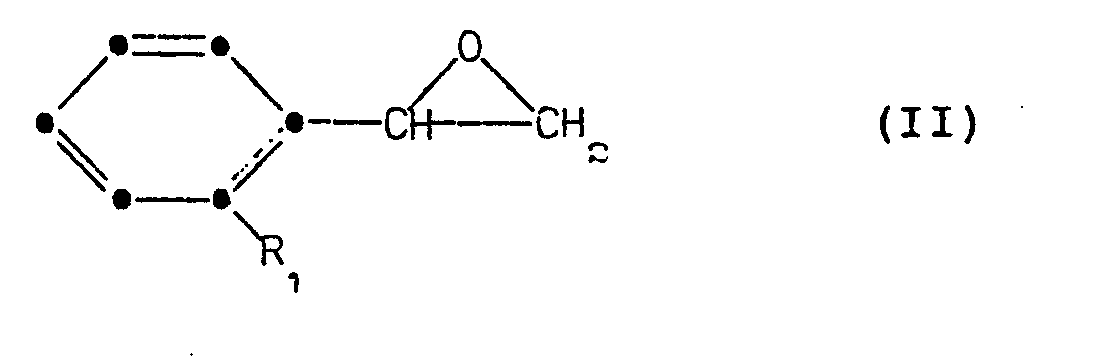


Applications Claiming Priority (2)
| Application Number | Priority Date | Filing Date | Title |
|---|---|---|---|
| US92167078A | 1978-07-03 | 1978-07-03 | |
| US921670 | 1992-07-30 |
Related Child Applications (1)
| Application Number | Title | Priority Date | Filing Date |
|---|---|---|---|
| EP81109789.8 Division-Into | 1981-11-20 |
Publications (2)
| Publication Number | Publication Date |
|---|---|
| EP0007204A1 true EP0007204A1 (en) | 1980-01-23 |
| EP0007204B1 EP0007204B1 (en) | 1982-11-24 |
Family
ID=25445792
Family Applications (3)
| Application Number | Title | Priority Date | Filing Date |
|---|---|---|---|
| EP79301279A Expired EP0007204B1 (en) | 1978-07-03 | 1979-07-02 | Phenethanolamines, their formulations, use and preparation |
| EP81109789A Ceased EP0048037A1 (en) | 1978-07-03 | 1979-07-02 | Optically active 1-alkyl-3-(4-substituted-phenyl)-propylamines |
| EP79301278A Expired EP0006766B1 (en) | 1978-07-03 | 1979-07-02 | Phenethanolamines, their formulations, use and preparation |
Family Applications After (2)
| Application Number | Title | Priority Date | Filing Date |
|---|---|---|---|
| EP81109789A Ceased EP0048037A1 (en) | 1978-07-03 | 1979-07-02 | Optically active 1-alkyl-3-(4-substituted-phenyl)-propylamines |
| EP79301278A Expired EP0006766B1 (en) | 1978-07-03 | 1979-07-02 | Phenethanolamines, their formulations, use and preparation |
Country Status (31)
| Country | Link |
|---|---|
| EP (3) | EP0007204B1 (en) |
| JP (2) | JPS559096A (en) |
| KR (1) | KR880002310B1 (en) |
| AR (4) | AR225744A1 (en) |
| AT (2) | AT367025B (en) |
| AU (2) | AU523721B2 (en) |
| BE (2) | BE877393A (en) |
| BG (4) | BG31645A3 (en) |
| CA (2) | CA1145767A (en) |
| CH (2) | CH643529A5 (en) |
| CS (4) | CS208664B2 (en) |
| DD (2) | DD144761A5 (en) |
| DE (2) | DE2964604D1 (en) |
| DK (2) | DK160936C (en) |
| EG (1) | EG14238A (en) |
| ES (4) | ES482156A1 (en) |
| FI (2) | FI792082A7 (en) |
| FR (3) | FR2430410B1 (en) |
| GB (3) | GB2028802B (en) |
| GR (2) | GR74524B (en) |
| HU (2) | HU179171B (en) |
| IE (2) | IE48586B1 (en) |
| IL (2) | IL57671A (en) |
| LU (2) | LU81458A1 (en) |
| NZ (2) | NZ190863A (en) |
| PH (2) | PH14522A (en) |
| PL (4) | PL117997B1 (en) |
| PT (2) | PT69843A (en) |
| RO (4) | RO77732A (en) |
| SU (4) | SU965350A3 (en) |
| ZA (2) | ZA793297B (en) |
Cited By (27)
| Publication number | Priority date | Publication date | Assignee | Title |
|---|---|---|---|---|
| EP0066351A1 (en) * | 1981-03-06 | 1982-12-08 | Beecham Group Plc | Arylethanol amine derivatives, their preparation and use in pharmaceutical compositions |
| EP0006735B1 (en) * | 1978-06-28 | 1983-06-15 | Beecham Group Plc | Secondary amines, their preparation, pharmaceutical compositions containing them and their use |
| EP0101069A1 (en) * | 1982-08-10 | 1984-02-22 | F. HOFFMANN-LA ROCHE & CO. Aktiengesellschaft | Phenethanol amines |
| EP0104888A1 (en) * | 1982-09-27 | 1984-04-04 | Eli Lilly And Company | Process for preparing 2-hydroxy-2-phenylethylamines |
| EP0089154A3 (en) * | 1982-03-12 | 1984-08-08 | Beecham Group Plc | Ethanolamine derivatives, their preparation and use in pharmaceutical compositions |
| EP0146392A1 (en) * | 1983-12-19 | 1985-06-26 | Eli Lilly And Company | B-phenethanolamine antiobesity agents |
| EP0151513A1 (en) * | 1984-01-12 | 1985-08-14 | Eli Lilly And Company | Inotropic agent |
| US4588749A (en) * | 1980-05-08 | 1986-05-13 | Beecham Group P.L.C. | Arylethanolamine derivatives, their preparation and use in pharmaceutical compositions |
| EP0070133B1 (en) * | 1981-07-11 | 1986-05-14 | Beecham Group Plc | Secondary phenylethanol amines, processes for their preparation and their pharmaceutical application |
| EP0140243A3 (en) * | 1983-10-19 | 1986-07-02 | F. Hoffmann-La Roche & Co. Aktiengesellschaft | Phenoxypropanol amines |
| US4652679A (en) * | 1982-05-14 | 1987-03-24 | Hoffmann-La Roche Inc. | Aziridine and phenethanolamine derivatives having antiobesity and anti-hyperglycaemic acitivity |
| EP0345591A1 (en) * | 1988-06-10 | 1989-12-13 | F. Hoffmann-La Roche Ag | Propanol amine derivatives |
| EP0255415A3 (en) * | 1986-06-27 | 1990-08-16 | Sanofi S.A. | Use of phenylethanolamines for the preparation of medicaments acting on gastrointestinal troubles |
| US5135955A (en) * | 1988-04-25 | 1992-08-04 | Eli Lilly And Company | Propanamine derivatives |
| US5166218A (en) * | 1983-10-19 | 1992-11-24 | Hoffmann-La Roche Inc. | Phenoxypropanolamines and pharmaceutical compositions thereof |
| US5321036A (en) * | 1993-02-10 | 1994-06-14 | Bristol-Myers Squibb Company | Thiazole and oxazole-based β3 adrenergic receptor agonists |
| EP0657029A4 (en) * | 1991-08-23 | 1996-02-07 | Nps Pharma Inc | Calcium receptor active molecules. |
| US5688938A (en) * | 1991-08-23 | 1997-11-18 | The Brigham & Women's Hospital, Inc. | Calcium receptor-active molecules |
| US5763569A (en) * | 1991-08-23 | 1998-06-09 | The Brigham And Women's Hospital, Inc | Calcium receptor-active molecules |
| US5858684A (en) * | 1991-08-23 | 1999-01-12 | The Brigham And Women's Hospital, Inc. | Method of screening calcium receptor-active molecules |
| US5962314A (en) * | 1993-02-23 | 1999-10-05 | Nps Pharmaceuticals, Inc. | Calcium receptor-active molecules |
| US5981599A (en) * | 1996-05-01 | 1999-11-09 | Nps Pharmaceuticals, Inc. | Inorganic ion receptor active compounds |
| US6001884A (en) * | 1991-08-23 | 1999-12-14 | Nps Pharmaceuticals, Inc. | Calcium receptor-active molecules |
| US6011068A (en) * | 1991-08-23 | 2000-01-04 | Nps Pharmaceuticals, Inc. | Calcium receptor-active molecules |
| US6031003A (en) * | 1991-08-23 | 2000-02-29 | Nps Pharmaceuticals, Inc. | Calcium receptor-active molecules |
| US6211244B1 (en) | 1994-10-21 | 2001-04-03 | Nps Pharmaceuticals, Inc. | Calcium receptor-active compounds |
| US6313146B1 (en) | 1991-08-23 | 2001-11-06 | Nps Pharmaceuticals, Inc. | Calcium receptor-active molecules |
Families Citing this family (9)
| Publication number | Priority date | Publication date | Assignee | Title |
|---|---|---|---|---|
| EP0028105B1 (en) * | 1979-10-25 | 1983-01-19 | Beecham Group Plc | Secondary amines, their preparation and use in pharmaceutical compositions |
| EP0029320B1 (en) * | 1979-11-15 | 1985-07-10 | Beecham Group Plc | Secondary ethanol amines, their preparation and their use in pharmaceutical compositions |
| EP0061907B1 (en) * | 1981-03-31 | 1984-08-01 | Beecham Group Plc | Secondary amines, their preparation, pharmaceutical compositions containing them and their use |
| DK171627B1 (en) * | 1983-01-31 | 1997-03-03 | Lilly Co Eli | Use of beta-phenethanolamine and pharmaceutically acceptable salts thereof and animal feed pre-mix thereof |
| PT82120B (en) * | 1985-03-01 | 1988-06-16 | Beecham Group Plc | Process for preparing veterinary formulations containing ethanolamine derivatives |
| GB8505284D0 (en) * | 1985-03-01 | 1985-04-03 | Beecham Group Plc | Growth promoters |
| JP2837408B2 (en) * | 1987-05-30 | 1998-12-16 | 鐘紡株式会社 | Acrylic fiber treatment method |
| US5191112A (en) * | 1989-10-17 | 1993-03-02 | Nissan Chemical Industries, Ltd. | Process for optical resolution of (±)-2-(3-benzoyl)-phenylpropionic acid |
| US7321065B2 (en) * | 2003-04-18 | 2008-01-22 | The Regents Of The University Of California | Thyronamine derivatives and analogs and methods of use thereof |
Citations (2)
| Publication number | Priority date | Publication date | Assignee | Title |
|---|---|---|---|---|
| DE1643224A1 (en) * | 1966-09-23 | 1972-03-02 | Allen & Hanburys Ltd | 1-Phenyl-2-aminoethanol derivatives and processes for their preparation and their use |
| US4000192A (en) * | 1973-05-07 | 1976-12-28 | Allen & Hanburys Limited | Pharmacologically active compounds |
Family Cites Families (6)
| Publication number | Priority date | Publication date | Assignee | Title |
|---|---|---|---|---|
| NL56308C (en) * | 1941-03-15 | |||
| GB1301134A (en) | 1970-07-18 | 1972-12-29 | Pfizer Ltd | SUBSTITUTED 1-PHENYL-2-ALLYLAMINO-ALKANOLS, 1-PHENYL-2-ALLYLAMINO-ALKANES AND alpha-AMINOALKYLPHENYL KETONES |
| BE788850A (en) * | 1972-09-15 | 1973-03-15 | Hoffmann La Roche | BENZOIC ACID DERIVATIVES |
| IE39247B1 (en) * | 1973-05-07 | 1978-08-30 | Allen & Hanburys Ltd | Substituted benzamides |
| NZ190854A (en) * | 1978-06-28 | 1984-10-19 | Beecham Group Ltd | 2-hydroxy-2-phenyl ethylamine derivatives;pharmaceutical compositions |
| DK269079A (en) * | 1978-07-03 | 1980-02-01 | Lilly Co Eli | PROCEDURE FOR THE PREPARATION OF PHENETHANOLAMINES |
-
1979
- 1979-06-26 IL IL57671A patent/IL57671A/en unknown
- 1979-06-26 DK DK268679A patent/DK160936C/en not_active IP Right Cessation
- 1979-06-26 IL IL57672A patent/IL57672A/en unknown
- 1979-06-26 CA CA000330554A patent/CA1145767A/en not_active Expired
- 1979-06-26 DK DK268779A patent/DK268779A/en not_active Application Discontinuation
- 1979-06-26 CA CA000330553A patent/CA1142954A/en not_active Expired
- 1979-06-27 NZ NZ190863A patent/NZ190863A/en unknown
- 1979-06-27 NZ NZ190861A patent/NZ190861A/en unknown
- 1979-06-27 PH PH22702A patent/PH14522A/en unknown
- 1979-06-27 EG EG387/78A patent/EG14238A/en active
- 1979-06-27 PH PH22698A patent/PH15275A/en unknown
- 1979-06-28 PT PT69843A patent/PT69843A/en unknown
- 1979-06-28 PT PT69839A patent/PT69839A/en unknown
- 1979-06-28 AU AU48489/79A patent/AU523721B2/en not_active Ceased
- 1979-06-28 AU AU48487/79A patent/AU523720B2/en not_active Expired
- 1979-06-29 FR FR7916993A patent/FR2430410B1/en not_active Expired
- 1979-06-29 FR FR7916994A patent/FR2430411A1/en active Granted
- 1979-06-29 HU HU79EI867A patent/HU179171B/en unknown
- 1979-06-29 HU HU79EI868A patent/HU179172B/en not_active IP Right Cessation
- 1979-07-02 CH CH616279A patent/CH643529A5/en not_active IP Right Cessation
- 1979-07-02 BE BE1/9444A patent/BE877393A/en not_active IP Right Cessation
- 1979-07-02 CH CH616179A patent/CH642618A5/en not_active IP Right Cessation
- 1979-07-02 BG BG044166A patent/BG31645A3/en unknown
- 1979-07-02 DE DE7979301278T patent/DE2964604D1/en not_active Expired
- 1979-07-02 RO RO7998013A patent/RO77732A/en unknown
- 1979-07-02 CS CS794631A patent/CS208664B2/en unknown
- 1979-07-02 EP EP79301279A patent/EP0007204B1/en not_active Expired
- 1979-07-02 FI FI792082A patent/FI792082A7/en not_active Application Discontinuation
- 1979-07-02 CS CS794631A patent/CS208663B2/en unknown
- 1979-07-02 RO RO105064A patent/RO83051B/en unknown
- 1979-07-02 LU LU81458A patent/LU81458A1/en unknown
- 1979-07-02 BG BG045343A patent/BG31647A3/en unknown
- 1979-07-02 SU SU792786202A patent/SU965350A3/en active
- 1979-07-02 BG BG045342A patent/BG31646A3/en unknown
- 1979-07-02 JP JP8489079A patent/JPS559096A/en active Granted
- 1979-07-02 SU SU792782302A patent/SU849997A3/en active
- 1979-07-02 CS CS794632A patent/CS209815B2/en unknown
- 1979-07-02 GR GR59491A patent/GR74524B/el unknown
- 1979-07-02 RO RO105065A patent/RO83052B/en unknown
- 1979-07-02 EP EP81109789A patent/EP0048037A1/en not_active Ceased
- 1979-07-02 EP EP79301278A patent/EP0006766B1/en not_active Expired
- 1979-07-02 GB GB7922955A patent/GB2028802B/en not_active Expired
- 1979-07-02 RO RO7998009A patent/RO77728A/en unknown
- 1979-07-02 BG BG044169A patent/BG31375A3/en unknown
- 1979-07-02 GB GB08135768A patent/GB2101582B/en not_active Expired
- 1979-07-02 DE DE7979301279T patent/DE2964091D1/en not_active Expired
- 1979-07-02 GB GB7922952A patent/GB2028799B/en not_active Expired
- 1979-07-02 CS CS794631A patent/CS208662B2/en unknown
- 1979-07-02 JP JP8489179A patent/JPS559097A/en active Pending
- 1979-07-02 GR GR59490A patent/GR72940B/el unknown
- 1979-07-02 BE BE1/9445A patent/BE877394A/en not_active IP Right Cessation
- 1979-07-02 FI FI792081A patent/FI792081A7/en not_active Application Discontinuation
- 1979-07-02 LU LU81457A patent/LU81457A1/en unknown
- 1979-07-03 AR AR277166A patent/AR225744A1/en active
- 1979-07-03 ZA ZA793297A patent/ZA793297B/en unknown
- 1979-07-03 ES ES482156A patent/ES482156A1/en not_active Expired
- 1979-07-03 PL PL1979226370A patent/PL117997B1/en unknown
- 1979-07-03 AT AT0463679A patent/AT367025B/en not_active IP Right Cessation
- 1979-07-03 AR AR277167A patent/AR229080A1/en active
- 1979-07-03 DD DD79214069A patent/DD144761A5/en unknown
- 1979-07-03 PL PL1979216811A patent/PL121297B1/en unknown
- 1979-07-03 ES ES482155A patent/ES482155A1/en not_active Expired
- 1979-07-03 PL PL1979226371A patent/PL117996B1/en unknown
- 1979-07-03 AT AT0463579A patent/AT372937B/en not_active IP Right Cessation
- 1979-07-03 DD DD79214070A patent/DD144762A5/en unknown
- 1979-07-03 ZA ZA793296A patent/ZA793296B/en unknown
- 1979-07-03 PL PL1979216814A patent/PL117551B1/en unknown
- 1979-08-08 IE IE1228/79A patent/IE48586B1/en unknown
- 1979-08-08 IE IE1227/79A patent/IE48769B1/en not_active IP Right Cessation
-
1980
- 1980-04-01 ES ES490214A patent/ES490214A0/en active Granted
- 1980-04-01 ES ES490215A patent/ES8104190A1/en not_active Expired
- 1980-04-24 FR FR8009239A patent/FR2450806B1/en not_active Expired
- 1980-08-13 SU SU802957757A patent/SU1007554A3/en active
- 1980-08-13 SU SU802955864A patent/SU957761A3/en active
- 1980-10-29 AR AR283051A patent/AR231434A1/en active
- 1980-10-29 AR AR283050A patent/AR227165A1/en active
-
1982
- 1982-02-12 KR KR8200619A patent/KR880002310B1/en not_active Expired
Patent Citations (2)
| Publication number | Priority date | Publication date | Assignee | Title |
|---|---|---|---|---|
| DE1643224A1 (en) * | 1966-09-23 | 1972-03-02 | Allen & Hanburys Ltd | 1-Phenyl-2-aminoethanol derivatives and processes for their preparation and their use |
| US4000192A (en) * | 1973-05-07 | 1976-12-28 | Allen & Hanburys Limited | Pharmacologically active compounds |
Cited By (32)
| Publication number | Priority date | Publication date | Assignee | Title |
|---|---|---|---|---|
| EP0006735B1 (en) * | 1978-06-28 | 1983-06-15 | Beecham Group Plc | Secondary amines, their preparation, pharmaceutical compositions containing them and their use |
| US4588749A (en) * | 1980-05-08 | 1986-05-13 | Beecham Group P.L.C. | Arylethanolamine derivatives, their preparation and use in pharmaceutical compositions |
| EP0066351A1 (en) * | 1981-03-06 | 1982-12-08 | Beecham Group Plc | Arylethanol amine derivatives, their preparation and use in pharmaceutical compositions |
| EP0070133B1 (en) * | 1981-07-11 | 1986-05-14 | Beecham Group Plc | Secondary phenylethanol amines, processes for their preparation and their pharmaceutical application |
| EP0089154A3 (en) * | 1982-03-12 | 1984-08-08 | Beecham Group Plc | Ethanolamine derivatives, their preparation and use in pharmaceutical compositions |
| US4652679A (en) * | 1982-05-14 | 1987-03-24 | Hoffmann-La Roche Inc. | Aziridine and phenethanolamine derivatives having antiobesity and anti-hyperglycaemic acitivity |
| EP0101069A1 (en) * | 1982-08-10 | 1984-02-22 | F. HOFFMANN-LA ROCHE & CO. Aktiengesellschaft | Phenethanol amines |
| US4585796A (en) * | 1982-08-10 | 1986-04-29 | Hoffmann-La Roche Inc. | Novel phenethanolamines |
| EP0104888A1 (en) * | 1982-09-27 | 1984-04-04 | Eli Lilly And Company | Process for preparing 2-hydroxy-2-phenylethylamines |
| US5166218A (en) * | 1983-10-19 | 1992-11-24 | Hoffmann-La Roche Inc. | Phenoxypropanolamines and pharmaceutical compositions thereof |
| EP0140243A3 (en) * | 1983-10-19 | 1986-07-02 | F. Hoffmann-La Roche & Co. Aktiengesellschaft | Phenoxypropanol amines |
| EP0146392A1 (en) * | 1983-12-19 | 1985-06-26 | Eli Lilly And Company | B-phenethanolamine antiobesity agents |
| EP0151513A1 (en) * | 1984-01-12 | 1985-08-14 | Eli Lilly And Company | Inotropic agent |
| EP0255415A3 (en) * | 1986-06-27 | 1990-08-16 | Sanofi S.A. | Use of phenylethanolamines for the preparation of medicaments acting on gastrointestinal troubles |
| US5002946A (en) * | 1986-06-27 | 1991-03-26 | Sanofi | Phenylethanolamine analog active compounds for the treatment of gastrointestinal diseases |
| US5135955A (en) * | 1988-04-25 | 1992-08-04 | Eli Lilly And Company | Propanamine derivatives |
| EP0345591A1 (en) * | 1988-06-10 | 1989-12-13 | F. Hoffmann-La Roche Ag | Propanol amine derivatives |
| US5763569A (en) * | 1991-08-23 | 1998-06-09 | The Brigham And Women's Hospital, Inc | Calcium receptor-active molecules |
| US6001884A (en) * | 1991-08-23 | 1999-12-14 | Nps Pharmaceuticals, Inc. | Calcium receptor-active molecules |
| US5688938A (en) * | 1991-08-23 | 1997-11-18 | The Brigham & Women's Hospital, Inc. | Calcium receptor-active molecules |
| EP1281702A3 (en) * | 1991-08-23 | 2004-01-07 | Nps Pharmaceuticals, Inc. | Calcium receptor active molecules |
| US5858684A (en) * | 1991-08-23 | 1999-01-12 | The Brigham And Women's Hospital, Inc. | Method of screening calcium receptor-active molecules |
| US6313146B1 (en) | 1991-08-23 | 2001-11-06 | Nps Pharmaceuticals, Inc. | Calcium receptor-active molecules |
| US6031003A (en) * | 1991-08-23 | 2000-02-29 | Nps Pharmaceuticals, Inc. | Calcium receptor-active molecules |
| EP0657029A4 (en) * | 1991-08-23 | 1996-02-07 | Nps Pharma Inc | Calcium receptor active molecules. |
| US6011068A (en) * | 1991-08-23 | 2000-01-04 | Nps Pharmaceuticals, Inc. | Calcium receptor-active molecules |
| US5321036A (en) * | 1993-02-10 | 1994-06-14 | Bristol-Myers Squibb Company | Thiazole and oxazole-based β3 adrenergic receptor agonists |
| US5962314A (en) * | 1993-02-23 | 1999-10-05 | Nps Pharmaceuticals, Inc. | Calcium receptor-active molecules |
| US6211244B1 (en) | 1994-10-21 | 2001-04-03 | Nps Pharmaceuticals, Inc. | Calcium receptor-active compounds |
| US5981599A (en) * | 1996-05-01 | 1999-11-09 | Nps Pharmaceuticals, Inc. | Inorganic ion receptor active compounds |
| US6342532B1 (en) | 1996-05-01 | 2002-01-29 | Nps Pharmaceuticals, Inc. | Inorganic ion receptor active compounds |
| US6710088B2 (en) | 1996-05-01 | 2004-03-23 | Nps Pharmaceuticals, Inc. | Inorganic ion receptor-active compounds |
Also Published As
Similar Documents
| Publication | Publication Date | Title |
|---|---|---|
| EP0007204B1 (en) | Phenethanolamines, their formulations, use and preparation | |
| US4391826A (en) | Phenethanolamines, compositions containing the same, and method for effecting weight control | |
| JPH0320225B2 (en) | ||
| US4385066A (en) | Arylethanolamine derivatives, their preparation and use in pharmaceutical compositions | |
| EP0091749A2 (en) | Ethanolamine derivatives, process for their preparation and pharmaceutical compositions containing them | |
| EP0007205A1 (en) | Optically active phenethanolamines, their formulations, use and preparation | |
| EP0029320A2 (en) | Secondary ethanol amines, their preparation and their use in pharmaceutical compositions | |
| MC1744A1 (en) | PHENYLETHANOLAMINE DERIVATIVES | |
| US4602044A (en) | β-phenethanolamine antiobesity agents | |
| US4845127A (en) | Phenethanolamines, compositions containing the same and method for effecting weight control | |
| EP0262785B1 (en) | N-[2-(4-carboxymethoxyphenyl)-1-methylethyl]-2-hydroxy-2-(3-chlorophenyl)ethane amine, the methyl ester, salt and stereoisomeric forms thereof | |
| CA1126296A (en) | R-n-(2-phenyl-2-hydroxyethyl)-3-phenylpropyl amines, formulations and method of treatment | |
| CA2161284C (en) | Novel o-arylmethyl n-thioacyl hydroxylamines, processes for their preparation and pharmaceutical compositions containing them | |
| CA1331005C (en) | Pyridylethanolamines, pharmaceutical compositions containing them and processes for their preparation | |
| KR820001300B1 (en) | Process for the preparation of phenethanolamines | |
| KR820002065B1 (en) | Process for the preparation of phenethanol aminos | |
| LU87945A1 (en) | DICHLOROANILINE DERIVATIVE | |
| AT371101B (en) | METHOD FOR PRODUCING NEW OPTICALLY ACTIVE PHENETHANOLAMINS AND THE PHARMACEUTICALLY SAFE SALTS THEREOF | |
| CH674204A5 (en) | ||
| JPS6365662B2 (en) | ||
| EP0081418A1 (en) | Oxygen-containing 3,7a-diazacyclohepta(J,K) fluorenes, their preparation and therapeutic use |
Legal Events
| Date | Code | Title | Description |
|---|---|---|---|
| PUAI | Public reference made under article 153(3) epc to a published international application that has entered the european phase |
Free format text: ORIGINAL CODE: 0009012 |
|
| AK | Designated contracting states |
Designated state(s): DE GB IT NL SE |
|
| 17P | Request for examination filed | ||
| ITF | It: translation for a ep patent filed | ||
| GRAA | (expected) grant |
Free format text: ORIGINAL CODE: 0009210 |
|
| AK | Designated contracting states |
Kind code of ref document: B1 Designated state(s): DE GB IT NL SE |
|
| REF | Corresponds to: |
Ref document number: 2964091 Country of ref document: DE Date of ref document: 19821230 |
|
| ITTA | It: last paid annual fee | ||
| EAL | Se: european patent in force in sweden |
Ref document number: 79301279.0 |
|
| PGFP | Annual fee paid to national office [announced via postgrant information from national office to epo] |
Ref country code: SE Payment date: 19970613 Year of fee payment: 19 Ref country code: DE Payment date: 19970613 Year of fee payment: 19 |
|
| PGFP | Annual fee paid to national office [announced via postgrant information from national office to epo] |
Ref country code: GB Payment date: 19970701 Year of fee payment: 19 |
|
| PGFP | Annual fee paid to national office [announced via postgrant information from national office to epo] |
Ref country code: NL Payment date: 19970731 Year of fee payment: 19 |
|
| PG25 | Lapsed in a contracting state [announced via postgrant information from national office to epo] |
Ref country code: GB Free format text: LAPSE BECAUSE OF NON-PAYMENT OF DUE FEES Effective date: 19980702 |
|
| PG25 | Lapsed in a contracting state [announced via postgrant information from national office to epo] |
Ref country code: SE Free format text: LAPSE BECAUSE OF NON-PAYMENT OF DUE FEES Effective date: 19980703 |
|
| PG25 | Lapsed in a contracting state [announced via postgrant information from national office to epo] |
Ref country code: NL Free format text: LAPSE BECAUSE OF NON-PAYMENT OF DUE FEES Effective date: 19990201 |
|
| GBPC | Gb: european patent ceased through non-payment of renewal fee |
Effective date: 19980702 |
|
| EUG | Se: european patent has lapsed |
Ref document number: 79301279.0 |
|
| NLV4 | Nl: lapsed or anulled due to non-payment of the annual fee |
Effective date: 19990201 |
|
| PG25 | Lapsed in a contracting state [announced via postgrant information from national office to epo] |
Ref country code: DE Free format text: LAPSE BECAUSE OF NON-PAYMENT OF DUE FEES Effective date: 19990501 |
|
| PLBE | No opposition filed within time limit |
Free format text: ORIGINAL CODE: 0009261 |
|
| STAA | Information on the status of an ep patent application or granted ep patent |
Free format text: STATUS: NO OPPOSITION FILED WITHIN TIME LIMIT |