EP0005652A2 - Verfahren und Dispersion zur Herstellung von Bildern durch elektrophoretische Migration - Google Patents
Verfahren und Dispersion zur Herstellung von Bildern durch elektrophoretische Migration Download PDFInfo
- Publication number
- EP0005652A2 EP0005652A2 EP79300938A EP79300938A EP0005652A2 EP 0005652 A2 EP0005652 A2 EP 0005652A2 EP 79300938 A EP79300938 A EP 79300938A EP 79300938 A EP79300938 A EP 79300938A EP 0005652 A2 EP0005652 A2 EP 0005652A2
- Authority
- EP
- European Patent Office
- Prior art keywords
- quinoline
- benzo
- substituted
- particles
- dispersion
- Prior art date
- Legal status (The legal status is an assumption and is not a legal conclusion. Google has not performed a legal analysis and makes no representation as to the accuracy of the status listed.)
- Ceased
Links
- BMLMXLRJGCBOOF-UHFFFAOYSA-N CC(CC1)CC1=C Chemical compound CC(CC1)CC1=C BMLMXLRJGCBOOF-UHFFFAOYSA-N 0.000 description 1
Images
Classifications
-
- G—PHYSICS
- G03—PHOTOGRAPHY; CINEMATOGRAPHY; ANALOGOUS TECHNIQUES USING WAVES OTHER THAN OPTICAL WAVES; ELECTROGRAPHY; HOLOGRAPHY
- G03G—ELECTROGRAPHY; ELECTROPHOTOGRAPHY; MAGNETOGRAPHY
- G03G17/00—Electrographic processes using patterns other than charge patterns, e.g. an electric conductivity pattern; Processes involving a migration, e.g. photoelectrophoresis, photoelectrosolography; Processes involving a selective transfer, e.g. electrophoto-adhesive processes; Apparatus essentially involving a single such process
- G03G17/04—Electrographic processes using patterns other than charge patterns, e.g. an electric conductivity pattern; Processes involving a migration, e.g. photoelectrophoresis, photoelectrosolography; Processes involving a selective transfer, e.g. electrophoto-adhesive processes; Apparatus essentially involving a single such process using photoelectrophoresis
Definitions
- This invention relates to electrophoretic migration imaging and, in particular, to a novel imaging process and to a novel dispersion of electrically photosensitive particles for use in such process.
- Electrophoretic migration imaging processes including photoelectric migration imaging processes, and colorants used in such processes are well known and have been described, for example, in U.S. Patents Nos. 2,758,939; 2,940,847; 3,100,426; 3,140,175; 3,143,508; 3,384,565; 3,384,488; 3,615,558; 3,384,566; and 3,383,993.
- Another type of electrophoretic migration imaging process called photo- immobilized electrophoretic recording or "PIER" is described in U.S. Patent No. 3,976,485.
- electrophoretic migration processes employ a layer of charge-bearing electrically photosensitive colorant particles positioned between two spaced electrodes, one of which may be transparent. To form an image the charged particles are subjected to an electric field and exposed to activating radiation which causes the particles to migrate electrophoretically to one or the other of the electrodes. A negative image forms on one electrode and a positive image on the other as a result of the net change in charge polarity of either the exposed particles (in conventional electrophoretic migration imaging) or the unexposed particles (in the "PIER" process).
- the present invention provides a novel imaging process and dispersion employing particles which unexpectedly have the desired combination of colorant properties and electrical photosensitivity.
- A represents a nitrogen-substituted basic heterocyclic nucleus of the type used in cyanine dyes.
- Such nuclei include:
- Substituents on the ring nitrogen of the above basic heterocyclic nuclei may be alkyl, aryl, and aralkyl which may be further substituted by groups such as alkoxy, aryloxy, alkoxycarbonyl, acyl, hydroxy, cyano, amino, alkylamino, arylamino, dialkylamino, diarylamino, and halogens.
- a 2 may represent the same basic heterocyclic nucleus. as A and in addition may represent an amino-substituted aryl group (e.g., p-aminophenyl) or an alkoxy-substituted aryl group (e.g., 4-methoxyphenyl, l-methoxy-2-naphthyl, or 1-ethoxy-2-anthryl) or A 2 may be, for example, a heterocyclic nucleus such as thiophene, benzo[b]thiophene, naphtho[2,3-b]thiophene, furan, isobenzofuran, chromene, pyran, xanthene, pyrrole, 2H-pyrrole, pyrazole, indolizine, indoline, indole, indazole, carbazole, pyrimidine, isothiazole, isoxazole, furazan, chroman, isochroman, 1,2,3,
- alkyl refers to saturated aliphatic hydrocarbon groups of 1-20 carbon atoms such as methyl, ethyl, propyl, isopropyl, butyl, heptyl, dodecyl, octadecyl and eicosyl.
- Aryl refers to aromatic groups of 6-20 carbons such as phenyl, naphthyl, anthryl or to alkyl-or aryl-substituted aryl groups such as tolyl, ethylphenyl and biphenyl.
- Aralkyl refers to aryl-substituted alkyl groups, where aryl and alkyl are as described above, e.g., benzyl, and phenethyl.
- Alkoxy refers to groups RO- where R is alkyl.
- charge-bearing, electrically photosensitive particles comprising compounds of Formula I or II are positioned between two spaced electrodes. While so positioned, the photosensitive particles are subjected to an electric field and exposed to a pattern of activating radiation, i.e., radiation to which the particles are electrically photosensitive. As a consequence, the exposed particles undergo a radiation-induced reversal in their charge polarity and migrate to one or the other of the electrode surfaces to form on at least one of these electrodes an image pattern.
- the compounds of Formulas I and II can be obtained by known procedures for preparing methine dyes, for example, by the procedures described in U.S. Patent Nos. 3,630,749 and 3,743,638 which disclose methine dyes prepared from nitrogen-substituted 1,3-isoquinolinediones. (The patents disclose the use of these dyes as spectral sensitizers for silver halide emulsions and for zinc oxide). Such isoquinolinediones and analogous thiones can be made by known procedures as described, for example, in U.S. Patent No. 2,328,652.
- the compounds of Formulas I and II which have been found to be electrically photosensitive exhibit a maximum absorption wavelength, lmax, within the range from 420 to 750 nm.
- lmax maximum absorption wavelength
- a large number of colorant compounds defined by Formulas I and II have been tested and found to exhibit useful levels of electrical photosensitivity in electrophoretic migration imaging in accordance with the invention.
- a partial listing of representative compounds which have been tested is provided in Table I.
- the electrically photosensitive particles described herein have an average particle size within the range from 0.01 micron to 20 microns, preferably from 0.01 to 5 microns.
- the particles are composed of one or more of the described colorant compounds of Formulas I and II. They may also, however, contain nonphotosensitive compounds such as electrically insulating polymers, charge control agents, organic and inorganic fillers, and additional dyes or pigments.
- the particles may contain spectral sensitizing dyes and chemical sensitizers.
- the electrically photosensitive particles are positioned between electrodes, at least one of which preferably is transparent to activating radiation.
- the particles may be dispersed simply as a dry powder between two electrodes and then subjected to electrophoretic migration imaging as described in U.S. Patent No. 2,758,939, it is desirable to disperse them in an electrically insulating carrier.
- the dispersion preferably contains from 0.05 part to 2.0 parts of electrically photosensitive particles for 10 parts by weight of electrically insulating carrier.
- the carrier may be an electrically insulating, normally solid polymer capable of being softened or liquefied by heat, solvent, or pressure so that the electrically photosensitive particles dispersed therein can migrate.
- the carrier is an electrically insulating liquid such as decane, paraffin, Sohio Odorless Solvent 3440 (a kerosene fraction marketed by the Standard Oil Company, Ohio), an isoparaffinic hydrocarbon liquid such as 'Isopar' G ('Isopar' is the registered trade mark of Exxon Corporation for an isoparaffinic hydrocarbon liquid having a boiling point in the range of 145° C to 186°C), a halogenated hydrocarbon such as carbon tetrachloride and trichloromonofluore- methane, alkylated aromatic hydrocarbon liquids such as the alkylated benzenes, for example, xylenes, and other alkylated aromatic hydrocarbons as described in U.S.
- An example of a useful commercially- available alkylated aromatic hydrocarbon liquid is 'Solvesso' 100, ('Solvesso' is the registered Trade Mark of Exxon Corporation for an aromatic hydrocarbon liquid boiling in the range of 157°C to 177°C and composed of 9 percent dialkyl benzenes, 37 percent trialkyl benzenes, and 4 percent aliphatics).
- the electrically insulating carrier has a resistivity greater than about 10 9 ohms-cm, preferably greater than about 10 12 o h m-cm.
- charge control agents may be incorporated to improve the uniformity of charge polarity of the electrically photosensitive particles dispersed in the liquid and to stabilize the dispersion against settling out of particles.
- charge control agents usually polymers, are well known in the field of liquid electrographic developers where they are employed for similar purposes.
- a natural or synthetic resin may be dispersed or dissolved in the electrically insulating carrier to serve as a binder for the final photosensitive particle image.
- Suitable binders include those known for use in liquid electrographic developers.
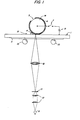
- the accompanying drawing represents diagrammatically one form of imaging apparatus for carrying out the electrophoretic migration imaging process of the invention.
- Electrode 1 may be a layer of transparent glass or of an electrically insulating, transparent polymer such as polyethylene terephthalate, covered with a thin, transparent, conductive layer such as tin oxide, indium oxide or nickel.
- the surface of electrode 1 may bear a "dark charge exchange" material, such as a solid solution of an electrically insulating polymer and 2,4,7,trinitro-9-fluorenone as described in U.S. Patent No. 3,976,485.
- Electrode 5 In pressure contact with electrode 1 is a second electrode 5, an idler roller which serves as a counter electrode to electrode 1 for producing the electric field.
- Electrode 5 has on its surface a thin, electrically insulating layer 6 and is connected to one side of the power source 15 by switch 7. The opposite side of the power source 15 is connected to electrode 1 so that as an exposure takes place, switch 7 is closed and an electric field is applied to the dispersion of electrically photosensitive particles 4 positioned between electrodes 1 and 5.
- Exposure of electrically photosensitive particles 4 takes place by use of an exposure system consisting of light source 8, an original image 11 to be reproduced, such as a photographic transparency, a lens system 12, and any desirable radiation filters 13 whereby electrically photosensitive particles 4 are irradiated with a pattern of activating radiation corresponding to original image 11.
- an exposure system consisting of light source 8, an original image 11 to be reproduced, such as a photographic transparency, a lens system 12, and any desirable radiation filters 13 whereby electrically photosensitive particles 4 are irradiated with a pattern of activating radiation corresponding to original image 11.
- the drawing shows electrode 1 to be transparent, it is possible to irradiate the particles without either being transparent.
- the exposure source 8 and lens system 12 are arranged so that particles 4 are exposed Ln the nip or gap 21 between the electrodes.
- roller electrode 5 has a conductive core 14 connected to power source 15.
- the core is covered with an insulating layer 6, for example, baryta paper. Insulating layer 6 prevents or reduces the possibility of charge reversal of particles 4 when they migrate to electrode 5. Hence, electrode 5 is called a "blocking electrode.”
- electrode 5 as a roller and electrode 1 as a translatable, flat transparent plate
- either or both may be of different shapes such as a web, rotating drum or opaque plate
- electrodes 1 and 5 are in pressure contact or very close to one another during the imaging process, e.g., less than 50 microns apart.
- the electrodes may be spaced more than 50 microns apart.
- the strength of the electric field imposed between electrodes 1 and 5 may vary considerably. Optimum image density and resolution are obtained by increasing the field strength to as high a level as possible without causing electrical breakdown of the carrier.
- the carrier is an electrically insulating liquid such as an isoparaffinic hydrocarbon
- the applied voltage across electrodes 1 and 5 typically is from 100 volts to 4 kilovolts or higher.
- Image formation occurs as the result of the combined action of activating radiation and electric field on the electrically photosensitive particles.
- field application and exposure to activating radiation occur concurrently.
- suitable light sensitive addenda with the electrically photosensitive compounds of Formula I or II, e.g., by incorporation of a persistent photoconductive compound, it is possible to use sequential exposure and field application rather than concurrent field application and exposure.
- the electrically photosensitive particles When disposed between imaging electrodes 1 and 5 the electrically photosensitive particles exhibit an electrostatic charge polarity, either as a result of triboelectric interaction of the particles or interaction with the carrier material, as occurs also in conventional liquid electrographic developers comprising toner particles which acquire a charge when dispersed in an electrically insulating carrier liquid.
- the electrically photosensitive colorant compounds of Formulas I and II may be used to form monochrome or polychrome images. Many of the compounds of Formulas I and II have hues which make them particularly suited for polychrome imaging mixtures.
- the apparatus used in the imaging process was of the type illustrated in the drawing.
- a transparent film base having a conductive coating of 0.1 optical density cermet (Cr'Si0) served as electrode 1 and was in pressure contact with electrode 5 comprising aluminum roller 14(10 cm diameter) covered with dielectric paper coated with poly(vinyl butyral) resin.
- the transparency 11 to be reproduced was taped to the back of film plate 1.
- the transparency consisted of adjacent strips of clear, red, green and blue Wratten filters.
- the light source was a projector with a 1000 watt xenon lamp modulated with an eleven-step 0.3 neutral density step tablet.
- the residence time in the exposure zone was 10 milliseconds.
- the log of the light intensity (Log I) was as follows:
- the voltage between the electrode 5 and film plate 1 was about 2 kv.
- Film plate 1 was negative polarity when particles 4 carried a positive electrostatic charge, and film plate 1 was positive when the particles were negatively charged.
- the translational speed of film plate 1 was about 25 cm. per second. Image formation occurred on the surfaces of film plate 1 and electrode 5 after simultaneous application of light exposure and electric field to the electrically photosensitive particles.
- the electrically photosensitive particles 4 were admixed with a liquid carrier as described below to form a liquid imaging dispersion in accordance with the invention which was placed in nip 21 between the electrodes.
- Imaging dispersions were prepared for each of the compounds of Table I by first making a stock solution of the following components:
- Each of the 27 compounds of Table I was tested according to these procedures. Each was found to be electrophotosensitive as evidenced by obtaining a negative image of the original on electrode 5 and a complementary image on electrode 1. Compounds 1, 2, 3, 4, 6, 7, 9, 11, 12, 14, 15, 17, 18, 20, 21, 22, 24, 26 and 27 provided images having good to excellent quality. Image quality was determined visually having regard to minimum and maximum densities, speed and colour saturation.
Landscapes
- Health & Medical Sciences (AREA)
- Life Sciences & Earth Sciences (AREA)
- Chemical & Material Sciences (AREA)
- Chemical Kinetics & Catalysis (AREA)
- Electrochemistry (AREA)
- Molecular Biology (AREA)
- Physics & Mathematics (AREA)
- General Physics & Mathematics (AREA)
- Electrochromic Elements, Electrophoresis, Or Variable Reflection Or Absorption Elements (AREA)
- Photoreceptors In Electrophotography (AREA)
- Liquid Developers In Electrophotography (AREA)
- Addition Polymer Or Copolymer, Post-Treatments, Or Chemical Modifications (AREA)
- Pyridine Compounds (AREA)
Applications Claiming Priority (2)
| Application Number | Priority Date | Filing Date | Title |
|---|---|---|---|
| US05/909,245 US4165985A (en) | 1978-05-24 | 1978-05-24 | Electrophotosensitive materials for migration imaging processes |
| US909245 | 1992-07-06 |
Publications (2)
| Publication Number | Publication Date |
|---|---|
| EP0005652A2 true EP0005652A2 (de) | 1979-11-28 |
| EP0005652A3 EP0005652A3 (de) | 1979-12-12 |
Family
ID=25426882
Family Applications (1)
| Application Number | Title | Priority Date | Filing Date |
|---|---|---|---|
| EP79300938A Ceased EP0005652A3 (de) | 1978-05-24 | 1979-05-24 | Verfahren und Dispersion zur Herstellung von Bildern durch elektrophoretische Migration |
Country Status (4)
| Country | Link |
|---|---|
| US (1) | US4165985A (de) |
| EP (1) | EP0005652A3 (de) |
| JP (1) | JPS5521086A (de) |
| CA (1) | CA1142784A (de) |
Families Citing this family (1)
| Publication number | Priority date | Publication date | Assignee | Title |
|---|---|---|---|---|
| JPS5871202A (ja) * | 1981-10-20 | 1983-04-27 | Kanai Hiroyuki | 自動車用車輪におけるリムとデイスクの接合方法 |
Family Cites Families (14)
| Publication number | Priority date | Publication date | Assignee | Title |
|---|---|---|---|---|
| US2328652A (en) * | 1941-04-18 | 1943-09-07 | Du Pont | Process of color photography and composition thereof |
| DE1265582B (de) * | 1963-10-12 | 1968-04-04 | Kalle Ag | Elektrophotographisches Aufzeichnungsmaterial zur Herstellung von Bildern oder Flachdruckformen |
| US3384566A (en) * | 1964-07-23 | 1968-05-21 | Xerox Corp | Method of photoelectrophoretic imaging |
| US3721554A (en) * | 1969-12-29 | 1973-03-20 | Canon Kk | Organic photoconductive materials formed by condensing photoconductive and dyestuff reactants |
| US3630749A (en) * | 1970-03-19 | 1971-12-28 | Eastman Kodak Co | Silver halide emulsions sensitized with merocyanine dyes containing a thioureido group |
| CH558209A (de) * | 1970-12-16 | 1975-01-31 | Gretag Ag | Verwendung organischer pigmente bei der elektrophoretischen bilderzeugung. |
| US3743638A (en) * | 1971-04-19 | 1973-07-03 | Eastman Kodak Co | Polymethine dyes |
| US3719480A (en) * | 1971-05-19 | 1973-03-06 | Eastman Kodak Co | Electrophotographic compositions and elements |
| CH552231A (de) * | 1972-05-23 | 1974-07-31 | Ciba Geigy Ag | Verfahren zum reproduzieren von ein- oder mehrfarbigen bildervorlagen auf photoelektophoretischem wege unter verwendung sublimierbarer dispersionsfarbstoffe. |
| US3912507A (en) * | 1973-06-04 | 1975-10-14 | Itek Corp | Polyrhodanine photoconductive materials |
| US3961952A (en) * | 1973-06-04 | 1976-06-08 | Itek Corporation | Merocyanine photoconductors |
| US4017311A (en) * | 1974-07-29 | 1977-04-12 | Xerox Corporation | Photoelectrophoretic imaging suspension |
| US3976485A (en) * | 1974-09-30 | 1976-08-24 | Eastman Kodak Company | Photoimmobilized electrophoretic recording process |
| US4012376A (en) * | 1975-12-29 | 1977-03-15 | Eastman Kodak Company | Photosensitive colorant materials |
-
1978
- 1978-05-24 US US05/909,245 patent/US4165985A/en not_active Expired - Lifetime
-
1979
- 1979-04-18 CA CA000325722A patent/CA1142784A/en not_active Expired
- 1979-05-24 EP EP79300938A patent/EP0005652A3/de not_active Ceased
- 1979-05-24 JP JP6334779A patent/JPS5521086A/ja active Granted
Also Published As
| Publication number | Publication date |
|---|---|
| JPS5633706B2 (de) | 1981-08-05 |
| JPS5521086A (en) | 1980-02-14 |
| US4165985A (en) | 1979-08-28 |
| CA1142784A (en) | 1983-03-15 |
| EP0005652A3 (de) | 1979-12-12 |
Similar Documents
| Publication | Publication Date | Title |
|---|---|---|
| CA1110898A (en) | Migration imaging process using an unsaturated heterocyclic photoconductor containing an exocyclic point of unsaturation | |
| US4012376A (en) | Photosensitive colorant materials | |
| US4322487A (en) | Composite electrically photosensitive particles for electrophoretic migration imaging process | |
| US4256819A (en) | Organic electrophotosensitive materials for migration imaging processes | |
| US3128179A (en) | Cyanine dye-sensitized photoconductive compositions comprising zinc oxide | |
| US4241157A (en) | Organic heterocyclic electrophotosensitive materials for migration imaging processes | |
| US4197120A (en) | Electrophoretic migration imaging process | |
| EP0000596A1 (de) | Elektrophotosensible Teilchen für elektrophoretische Bilderzeugung | |
| US4251609A (en) | Isoquinolinedione photoelectrophoretic materials for imaging processes | |
| US4166740A (en) | Electrophotosensitive materials for migration imaging processes | |
| US4293626A (en) | Electrophotosensitive materials for migration imaging processes | |
| EP0000599B1 (de) | Elektrophotosensible Teilchen für photoelektrophoretische Bilderzeugung | |
| EP0005652A2 (de) | Verfahren und Dispersion zur Herstellung von Bildern durch elektrophoretische Migration | |
| US4450219A (en) | Electrophotographic photoreceptor with thiobarbituric acid derivative | |
| US4299894A (en) | Electrically photosensitive materials and elements for photoelectrophoretic imaging processes | |
| US4394428A (en) | Photoconductive composition and elements comprising two different compounds having a dioxaborin nucleas on a derivative thereof | |
| US4272595A (en) | Electrophotosensitive materials for migration imaging processes | |
| US4254198A (en) | Electrophotosensitive materials for migration imaging processes | |
| CA1115578A (en) | Electrophotosensitive materials for migration imaging processes | |
| US4331751A (en) | Electrically photosensitive materials and elements for photoelectrophoretic imaging processes | |
| US3676313A (en) | Removing undesired potential from the blocking electrode in a photoelectrophoretic imaging system | |
| US4463076A (en) | Merocyanine-cyanine-merocyanine (MCM) electrically photosensitive colorants for photoelectrophoretic imaging | |
| US3684505A (en) | Methine dye sensitization of a dihydroquinoline photoconductor | |
| US4356244A (en) | Quinoxaline cyanine dye sensitized organic electron donor compounds | |
| EP0086230B1 (de) | Merocyanin-cyanin-merocyanin (mcm) elektrisch-photoempfindliche farbstoffe |
Legal Events
| Date | Code | Title | Description |
|---|---|---|---|
| PUAI | Public reference made under article 153(3) epc to a published international application that has entered the european phase |
Free format text: ORIGINAL CODE: 0009012 |
|
| PUAL | Search report despatched |
Free format text: ORIGINAL CODE: 0009013 |
|
| AK | Designated contracting states |
Designated state(s): DE FR GB |
|
| AK | Designated contracting states |
Designated state(s): DE FR GB |
|
| DET | De: translation of patent claims | ||
| 17P | Request for examination filed | ||
| STAA | Information on the status of an ep patent application or granted ep patent |
Free format text: STATUS: THE APPLICATION HAS BEEN REFUSED |
|
| 18R | Application refused |
Effective date: 19830509 |
|
| RIN1 | Information on inventor provided before grant (corrected) |
Inventor name: WEBSTER, FRANK GLENN Inventor name: REGAN, MICHAEL THOMAS Inventor name: NONNEMACHER, JAMES RICHARD |