EP0003660B1 - Method for cleaning a surface of an unbrazable metal part - Google Patents
Method for cleaning a surface of an unbrazable metal part Download PDFInfo
- Publication number
- EP0003660B1 EP0003660B1 EP79300164A EP79300164A EP0003660B1 EP 0003660 B1 EP0003660 B1 EP 0003660B1 EP 79300164 A EP79300164 A EP 79300164A EP 79300164 A EP79300164 A EP 79300164A EP 0003660 B1 EP0003660 B1 EP 0003660B1
- Authority
- EP
- European Patent Office
- Prior art keywords
- gamma prime
- unbrazeable
- cleaning
- parts
- metal part
- Prior art date
- Legal status (The legal status is an assumption and is not a legal conclusion. Google has not performed a legal analysis and makes no representation as to the accuracy of the status listed.)
- Expired
Links
- 238000000034 method Methods 0.000 title claims description 23
- 238000004140 cleaning Methods 0.000 title claims description 13
- 229910052751 metal Inorganic materials 0.000 title claims description 13
- 239000002184 metal Substances 0.000 title claims description 13
- 229910045601 alloy Inorganic materials 0.000 claims description 31
- 239000000956 alloy Substances 0.000 claims description 31
- 239000011347 resin Substances 0.000 claims description 13
- 229920005989 resin Polymers 0.000 claims description 13
- PXHVJJICTQNCMI-UHFFFAOYSA-N Nickel Chemical group [Ni] PXHVJJICTQNCMI-UHFFFAOYSA-N 0.000 claims description 12
- UFHFLCQGNIYNRP-UHFFFAOYSA-N Hydrogen Chemical compound [H][H] UFHFLCQGNIYNRP-UHFFFAOYSA-N 0.000 claims description 10
- 238000006243 chemical reaction Methods 0.000 claims description 10
- 229910052731 fluorine Inorganic materials 0.000 claims description 9
- 239000011737 fluorine Substances 0.000 claims description 9
- NBVXSUQYWXRMNV-UHFFFAOYSA-N fluoromethane Chemical compound FC NBVXSUQYWXRMNV-UHFFFAOYSA-N 0.000 claims description 9
- -1 titanium metals Chemical class 0.000 claims description 9
- 239000001257 hydrogen Substances 0.000 claims description 7
- 229910052739 hydrogen Inorganic materials 0.000 claims description 7
- 239000010936 titanium Substances 0.000 claims description 7
- 229910052719 titanium Inorganic materials 0.000 claims description 7
- 239000004411 aluminium Substances 0.000 claims description 6
- 229910052782 aluminium Inorganic materials 0.000 claims description 6
- XAGFODPZIPBFFR-UHFFFAOYSA-N aluminium Chemical compound [Al] XAGFODPZIPBFFR-UHFFFAOYSA-N 0.000 claims description 6
- 238000000354 decomposition reaction Methods 0.000 claims description 6
- 229910052759 nickel Inorganic materials 0.000 claims description 6
- 238000005979 thermal decomposition reaction Methods 0.000 claims description 6
- 150000003568 thioethers Chemical class 0.000 claims description 6
- 229920001343 polytetrafluoroethylene Polymers 0.000 claims description 5
- 239000002344 surface layer Substances 0.000 claims description 4
- UOUJSJZBMCDAEU-UHFFFAOYSA-N chromium(3+);oxygen(2-) Chemical class [O-2].[O-2].[O-2].[Cr+3].[Cr+3] UOUJSJZBMCDAEU-UHFFFAOYSA-N 0.000 claims description 2
- PXGOKWXKJXAPGV-UHFFFAOYSA-N Fluorine Chemical compound FF PXGOKWXKJXAPGV-UHFFFAOYSA-N 0.000 claims 1
- 238000005219 brazing Methods 0.000 description 17
- 239000007789 gas Substances 0.000 description 10
- NPURPEXKKDAKIH-UHFFFAOYSA-N iodoimino(oxo)methane Chemical compound IN=C=O NPURPEXKKDAKIH-UHFFFAOYSA-N 0.000 description 10
- XKRFYHLGVUSROY-UHFFFAOYSA-N Argon Chemical compound [Ar] XKRFYHLGVUSROY-UHFFFAOYSA-N 0.000 description 8
- YCKRFDGAMUMZLT-UHFFFAOYSA-N Fluorine atom Chemical compound [F] YCKRFDGAMUMZLT-UHFFFAOYSA-N 0.000 description 8
- RTAQQCXQSZGOHL-UHFFFAOYSA-N Titanium Chemical compound [Ti] RTAQQCXQSZGOHL-UHFFFAOYSA-N 0.000 description 5
- 229910052786 argon Inorganic materials 0.000 description 4
- 239000000463 material Substances 0.000 description 4
- 239000004810 polytetrafluoroethylene Substances 0.000 description 4
- OKTJSMMVPCPJKN-UHFFFAOYSA-N Carbon Chemical compound [C] OKTJSMMVPCPJKN-UHFFFAOYSA-N 0.000 description 3
- 239000002585 base Substances 0.000 description 3
- 229920002493 poly(chlorotrifluoroethylene) Polymers 0.000 description 3
- 229910001220 stainless steel Inorganic materials 0.000 description 3
- KRHYYFGTRYWZRS-UHFFFAOYSA-M Fluoride anion Chemical compound [F-] KRHYYFGTRYWZRS-UHFFFAOYSA-M 0.000 description 2
- 238000005054 agglomeration Methods 0.000 description 2
- 230000002776 aggregation Effects 0.000 description 2
- 229910052799 carbon Inorganic materials 0.000 description 2
- 239000012159 carrier gas Substances 0.000 description 2
- 230000000694 effects Effects 0.000 description 2
- 229910052736 halogen Inorganic materials 0.000 description 2
- 150000002367 halogens Chemical class 0.000 description 2
- 238000010438 heat treatment Methods 0.000 description 2
- 229910001088 rené 41 Inorganic materials 0.000 description 2
- 239000010935 stainless steel Substances 0.000 description 2
- FTBATIJJKIIOTP-UHFFFAOYSA-K trifluorochromium Chemical compound F[Cr](F)F FTBATIJJKIIOTP-UHFFFAOYSA-K 0.000 description 2
- MIMUSZHMZBJBPO-UHFFFAOYSA-N 6-methoxy-8-nitroquinoline Chemical compound N1=CC=CC2=CC(OC)=CC([N+]([O-])=O)=C21 MIMUSZHMZBJBPO-UHFFFAOYSA-N 0.000 description 1
- ZAMOUSCENKQFHK-UHFFFAOYSA-N Chlorine atom Chemical compound [Cl] ZAMOUSCENKQFHK-UHFFFAOYSA-N 0.000 description 1
- VYZAMTAEIAYCRO-UHFFFAOYSA-N Chromium Chemical compound [Cr] VYZAMTAEIAYCRO-UHFFFAOYSA-N 0.000 description 1
- CDBYLPFSWZWCQE-UHFFFAOYSA-L Sodium Carbonate Chemical compound [Na+].[Na+].[O-]C([O-])=O CDBYLPFSWZWCQE-UHFFFAOYSA-L 0.000 description 1
- 239000004809 Teflon Substances 0.000 description 1
- 229920006362 Teflon® Polymers 0.000 description 1
- QCWXUUIWCKQGHC-UHFFFAOYSA-N Zirconium Chemical compound [Zr] QCWXUUIWCKQGHC-UHFFFAOYSA-N 0.000 description 1
- 239000003513 alkali Substances 0.000 description 1
- 230000000712 assembly Effects 0.000 description 1
- 238000000429 assembly Methods 0.000 description 1
- 239000010953 base metal Substances 0.000 description 1
- 230000015572 biosynthetic process Effects 0.000 description 1
- 229910021386 carbon form Inorganic materials 0.000 description 1
- 229910052801 chlorine Inorganic materials 0.000 description 1
- 239000000460 chlorine Substances 0.000 description 1
- 239000011651 chromium Substances 0.000 description 1
- 229910052804 chromium Inorganic materials 0.000 description 1
- 150000001845 chromium compounds Chemical class 0.000 description 1
- 229910021563 chromium fluoride Inorganic materials 0.000 description 1
- 238000001816 cooling Methods 0.000 description 1
- 238000005336 cracking Methods 0.000 description 1
- 230000008021 deposition Effects 0.000 description 1
- 150000002221 fluorine Chemical group 0.000 description 1
- 150000002431 hydrogen Chemical class 0.000 description 1
- 238000011835 investigation Methods 0.000 description 1
- 239000010410 layer Substances 0.000 description 1
- 238000004519 manufacturing process Methods 0.000 description 1
- 239000000155 melt Substances 0.000 description 1
- 150000004706 metal oxides Chemical class 0.000 description 1
- 239000000178 monomer Substances 0.000 description 1
- 229910000510 noble metal Inorganic materials 0.000 description 1
- 230000035945 sensitivity Effects 0.000 description 1
- 229910000601 superalloy Inorganic materials 0.000 description 1
- XLYOFNOQVPJJNP-UHFFFAOYSA-N water Substances O XLYOFNOQVPJJNP-UHFFFAOYSA-N 0.000 description 1
- 238000003466 welding Methods 0.000 description 1
- 238000009736 wetting Methods 0.000 description 1
- 229910052726 zirconium Inorganic materials 0.000 description 1
Images
Classifications
-
- C—CHEMISTRY; METALLURGY
- C23—COATING METALLIC MATERIAL; COATING MATERIAL WITH METALLIC MATERIAL; CHEMICAL SURFACE TREATMENT; DIFFUSION TREATMENT OF METALLIC MATERIAL; COATING BY VACUUM EVAPORATION, BY SPUTTERING, BY ION IMPLANTATION OR BY CHEMICAL VAPOUR DEPOSITION, IN GENERAL; INHIBITING CORROSION OF METALLIC MATERIAL OR INCRUSTATION IN GENERAL
- C23G—CLEANING OR DE-GREASING OF METALLIC MATERIAL BY CHEMICAL METHODS OTHER THAN ELECTROLYSIS
- C23G5/00—Cleaning or de-greasing metallic material by other methods; Apparatus for cleaning or de-greasing metallic material with organic solvents
-
- B—PERFORMING OPERATIONS; TRANSPORTING
- B23—MACHINE TOOLS; METAL-WORKING NOT OTHERWISE PROVIDED FOR
- B23K—SOLDERING OR UNSOLDERING; WELDING; CLADDING OR PLATING BY SOLDERING OR WELDING; CUTTING BY APPLYING HEAT LOCALLY, e.g. FLAME CUTTING; WORKING BY LASER BEAM
- B23K1/00—Soldering, e.g. brazing, or unsoldering
- B23K1/20—Preliminary treatment of work or areas to be soldered, e.g. in respect of a galvanic coating
- B23K1/206—Cleaning
Definitions
- the present invention relates to a method for cleaning unbrazeable metal parts sufficiently to render them brazeable and more particularly, to a method for treating damaged gamma prime hardened alloy parts so that the parts can be repaired by brazing.
- Late model gas turbine engines (for example, those on the Boeing 747, the DC-10, and the Lockheed 1011) employ in their turbine sections nickel based alloys that are gamma prime hardened. Many other engines contain such material, and the use of gamma prime hardened alloys will no doubt increase in the future due to the desirable properties of these super alloys.
- a successful braze is manifest when braze material is placed at the source of a crack (say 0.0254 mm wide and 12.7 mm long) and, at brazing temperature, not only melts and sticks to the parent material, but also runs into and fills the length of the crack.
- a gamma prime hardened alloy becomes oxidised (and/or sulfuridised) to the extent that the aluminium, titanium and chromium oxides (or sulfides) which coat the surface of the part, including the surfaces of the crack, prevent successful repair by brazing.
- the present invention provides a method of cleaning a surface of an unbrazeable metal part so as to render it brazeable which is characterised in that the thermal decomposition products of a fluorocarbon resin comprising free fluorine, together with gaseous hydrogen are contacted with said unbrazeable part whilst it is located within a reaction zone and preheated to a temperature at which reaction with said decomposition products occurs.
- the present invention is particularly useful as a simple, inexpensive method for cleaning damaged gamma prime hardened alloy parts, the results of which have been found to be consistently reproducible. Those results are, in effect, what appears to be a denuding of the surface layer (10-25 microns deep) on the damaged part to substantially deplete that layer of aluminium and titanium metals and oxides (or sulfides) to a reduced or more reducible form.
- This denuded surface which extends into and along any cracks present, is brazeable - the part is, therefore, braze repairable. There is little crack sensitivity in the braze repaired part once it has been re-heat treated to restore all the properties common to gamma prime hardened alloy parts.
- the method by which these results are achieved involves the use of the thermal decomposition products of a thermally decomposable fluorocarbon resin at elevated temperatures (400 to 1200°C) to clean the damaged gamma prime hardened alloy part. Hydrogen gas is also used.
- the time of treatment may vary (the longer the treatment generally, the deeper the cleaning effect), but generally 30 to 60 minutes is sufficient to achieve a 10-25 micron deep denuded surface layer.
- the fluorocarbon resins which have been found to be useful are polytetrafluoroethylene and polymonochlorotrifluoroethylene, both of which release fluorine gas upon thermal decomposition. From the literature it is known that polytetrafluoroethylene resin liberates fluorine when heated to 350°C or higher and the rate of evolution sharply increases between 400° and 450°C. Likewise, polymonochlorotrifluoroethylene resin liberates fluorine (and chlorine) at temperatures above 250°C and the rate of evolution increases markedly above 300°C.
- nickel-based, gamma prime hardened alloys include INCO 713C, Mar M-200, Rene 80, Rene 95, Rene 125, Rene 41, Udimet 500, and Udimet 520. These range from low (i.e. Rene 41) to medium (i.e. INCO 713C) to high (i.e. Rene 125) levels of gamma prime hardening. All levels may be cleaned, and rendered brazeable at even commercial vacuums 1.33-0.0133 Pa (10-1 to 10- 4 Torr) by the present process.
- the present process may be used to clean other types of unbrazeable metal parts such as stainless steels to render them brazeable; although, it finds its principal utility in the cleaning of damaged (particularly crack-damaged) gamma prime hardened alloy parts of the type mentioned.
- oxides or sulfides
- noble metal oxides can with reproducible consistency be removed from the surface of damaged gamma prime hardened alloy parts and deplete their surfaces of aluminium and titanium.
- the cleaning allows nickel brazing and the aluminium and titanium depletion allows for wetting to fill cracks by the braze alloy.
- the present invention utilises a thermally decomposable fluorocarbon resin as a source of fluorine along with a reducing atmosphere of hydrogen to clean unbrazeable metal parts and render them brazeable at commercial vacuum levels 1.33-0.0133 Pa (10- 2 to 10- 4 Torr). It has been found that when a fluorocarbon resin is decomposed adjacent the part in the absence of a reducing gas such as hydrogen (i.e. without a carrier gas at all or using an inert one such as argon), carbon forms on the part and prevents brazing. The hydrogen gas is apparently necessary to prevent carbon deposition.
- a reducing gas such as hydrogen
- a three-zone tube furnace (approximately 14.6 cm (54" diameter) was used. The ends of the tube furnace were hermetically sealed. At one end of the furnace a gas inlet port was located. This port was connected to a supply (bottle) of carrier gas such as argon or hydrogen. The supply of that gas was controlled by a valve arrangement. At the other end of the passage through the tube furnace there was located an outlet port through which the used gases exited. The tube outlet connected via a valve to the outlet port was directed into alkali (soda) containing water traps which themselves exhausted into an exhaust hood.
- carrier gas such as argon or hydrogen
- the system was then heated to a part treatment temperature of approximately 950°C in zone two and a resin decomposition temperature of approximately 650°C in zone one.
- hydrogen gas is flowed through the passage at a rate of approximately 0.085 m 3 (3 cubic feet) per hour, while the temperatures are maintained. This flow was continued for approximately 60 minutes. All along the third zone is maintained as cool as possible (approximately 300°C) to entrap monomer vapors on heat shields which were placed in the third zone for that purpose.
- the outlet area were cooled with cooling coils to room temperature or below. Following heating, the furnace was allowed to cool to 500°C under moderate hydrogen gas flow and then with argon gas flow until the part could be removed.
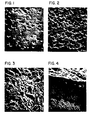
- FIGs. 1-4 Photomicrographs of parts treated in this manner are given in Figs. 1-4.
- Fig. 4 As can be seen in the surface and edge view (Fig. 4), there appears to be a denuded surface area of approximately 10-25 microns depth.
- the characteristic gamma prime hardened structure represented by the fine uniform grain formation at the base is not present on the surface, and instead it is replaced by a microporous (wormy) surface layer which follows the crack and is brazeable.
- This surface structure is seen even better in Fig. 3.
- Figs. 1-2 there can be seen crystalline agglomerations of the surface alluminium and chromium as compared to the base alloy. These agglomerations are also low in nickel content compared to the base alloy. This is as a direct consequence of the cleaning process described above.
- the method of the present invention enables one to clean and then braze repair what would otherwise be unbrazeable parts. Repair of gamma prime hardened alloy parts is presently the goal of every high volume user of these alloys. Brazing is also by far the least expensive and most promising means of achieving this repair.
- the present invention provides a method for cleaning and the cleaned parts by which the repair can be done by brazing.
Landscapes
- Chemical & Material Sciences (AREA)
- Engineering & Computer Science (AREA)
- Mechanical Engineering (AREA)
- Chemical Kinetics & Catalysis (AREA)
- General Chemical & Material Sciences (AREA)
- Materials Engineering (AREA)
- Metallurgy (AREA)
- Organic Chemistry (AREA)
- Cleaning And De-Greasing Of Metallic Materials By Chemical Methods (AREA)
Applications Claiming Priority (2)
| Application Number | Priority Date | Filing Date | Title |
|---|---|---|---|
| US05/874,915 US4188237A (en) | 1978-02-02 | 1978-02-02 | Method for cleaning metal parts with elemental fluorine |
| US874915 | 1978-02-02 |
Publications (2)
| Publication Number | Publication Date |
|---|---|
| EP0003660A1 EP0003660A1 (en) | 1979-08-22 |
| EP0003660B1 true EP0003660B1 (en) | 1983-04-27 |
Family
ID=25364854
Family Applications (1)
| Application Number | Title | Priority Date | Filing Date |
|---|---|---|---|
| EP79300164A Expired EP0003660B1 (en) | 1978-02-02 | 1979-02-01 | Method for cleaning a surface of an unbrazable metal part |
Country Status (5)
| Country | Link |
|---|---|
| US (1) | US4188237A (enExample) |
| EP (1) | EP0003660B1 (enExample) |
| JP (1) | JPS54157737A (enExample) |
| CA (1) | CA1131103A (enExample) |
| DE (1) | DE2965260D1 (enExample) |
Cited By (1)
| Publication number | Priority date | Publication date | Assignee | Title |
|---|---|---|---|---|
| DE112006002001B4 (de) * | 2005-07-26 | 2020-12-31 | Chromalloy Gas Turbine Corp. | Verfahren zur Reinigung und Reparatur einer Oberfläche eines inneren Hohlraums einer Gasturbinenkomponente mit schwefelenthaltenden Ablagerungen |
Families Citing this family (30)
| Publication number | Priority date | Publication date | Assignee | Title |
|---|---|---|---|---|
| US4328044A (en) * | 1978-02-02 | 1982-05-04 | University Of Dayton | Method for cleaning metal parts |
| US4324594A (en) * | 1978-02-02 | 1982-04-13 | University Of Dayton | Method for cleaning metal parts |
| US4965095A (en) * | 1979-03-30 | 1990-10-23 | Alloy Surfaces Company, Inc. | Method for refurbishing used jet engine hot section airfoils |
| US4317685A (en) * | 1980-06-06 | 1982-03-02 | General Electric Company | Method for removing a scale from a superalloy surface |
| US4339281A (en) * | 1981-08-20 | 1982-07-13 | Rca Corporation | Shank diamond cleaning |
| EP0209307B1 (en) * | 1985-07-15 | 1988-09-07 | The Secretary of State for Defence in Her Britannic Majesty's Government of the United Kingdom of Great Britain and | Cleaning of metal articles |
| AU586530B2 (en) * | 1986-02-06 | 1989-07-13 | University Of Dayton, The | Process for removing protective coatings and bonding layers from metal parts |
| US5071486A (en) * | 1986-02-06 | 1991-12-10 | University Of Dayton | Process for removing protective coatings and bonding layers from metal parts |
| US5000371A (en) * | 1987-08-24 | 1991-03-19 | Cooper Industries, Inc. | Method of producing a metallic interface |
| US5419927A (en) * | 1988-09-26 | 1995-05-30 | Chromalloy Gas Turbine Corporation | Process for coating fiber reinforced ceramic composites |
| US5016810A (en) * | 1989-08-25 | 1991-05-21 | The United States Of America As Represented By The Department Of Energy | Method for improving weldability of nickel aluminide alloys |
| US5263641A (en) * | 1992-11-04 | 1993-11-23 | Coating Applications, Inc. | Method of bonding hard metal objects with braze slurry |
| US5407121A (en) * | 1993-11-19 | 1995-04-18 | Mcnc | Fluxless soldering of copper |
| US5499754A (en) * | 1993-11-19 | 1996-03-19 | Mcnc | Fluxless soldering sample pretreating system |
| US5577655A (en) * | 1994-11-30 | 1996-11-26 | The Morgan Crucible Company Plc | Flexible metal-containing tapes or films and associated adhesives |
| US5898994A (en) * | 1996-06-17 | 1999-05-04 | General Electric Company | Method for repairing a nickel base superalloy article |
| US5728227A (en) * | 1996-06-17 | 1998-03-17 | General Electric Company | Method for removing a diffusion coating from a nickel base alloy |
| US6416589B1 (en) | 1999-02-18 | 2002-07-09 | General Electric Company | Carbon-enhanced fluoride ion cleaning |
| EP1160352B1 (en) | 2000-05-31 | 2009-04-22 | ALSTOM Technology Ltd | Method of adjusting the size of cooling holes of a gas turbine component |
| US6434823B1 (en) | 2000-10-10 | 2002-08-20 | General Electric Company | Method for repairing a coated article |
| US6367687B1 (en) | 2001-04-17 | 2002-04-09 | General Electric Company | Method for preparing a plate rim for brazing |
| ATE283936T1 (de) | 2001-05-14 | 2004-12-15 | Alstom Technology Ltd | Verfahren zum isothermischen hartlöten von einkristallinen gegenständen |
| US7010987B2 (en) * | 2002-10-31 | 2006-03-14 | Alstom (Switzerland) Ltd | Non-destructive method of detecting defects in braze-repaired cracks |
| EP1424158B1 (en) * | 2002-11-29 | 2007-06-27 | Alstom Technology Ltd | A method for fabricating, modifying or repairing of single crystal or directionally solidified articles |
| US6878215B1 (en) | 2004-05-27 | 2005-04-12 | General Electric Company | Chemical removal of a metal oxide coating from a superalloy article |
| US7846261B2 (en) * | 2006-02-14 | 2010-12-07 | Aeromet Technologies, Inc. | Methods of using halogen-containing organic compounds to remove deposits from internal surfaces of turbine engine components |
| DE102008011747A1 (de) * | 2008-02-28 | 2009-09-03 | Mtu Aero Engines Gmbh | Verfahren zum thermochemischen Reinigen und/oder Strippen von Turbinenbauteilen |
| EP2327813A1 (de) | 2009-11-11 | 2011-06-01 | Siemens Aktiengesellschaft | Verstärkte Fluor-Ionen-Reinigung von verunreinigten Rissen |
| JP6508823B2 (ja) * | 2015-05-08 | 2019-05-08 | 三菱重工航空エンジン株式会社 | 酸化膜除去方法 |
| CN116120068B (zh) * | 2023-02-08 | 2024-12-06 | 四川沪碳半导体材料科技有限公司 | 等静压石墨的生产工艺、等静压石墨及应用 |
Family Cites Families (4)
| Publication number | Priority date | Publication date | Assignee | Title |
|---|---|---|---|---|
| US2585819A (en) * | 1946-06-22 | 1952-02-12 | United Aircraft Corp | Process of joining metal parts |
| US2571328A (en) * | 1947-12-22 | 1951-10-16 | Ohio Rubber Co | Method of cleaning metal articles of adherent rubber and the like |
| US2851387A (en) * | 1957-05-08 | 1958-09-09 | Chapman Valve Mfg Co | Method of depassifying high chromium steels prior to nitriding |
| CA1011177A (en) * | 1973-12-14 | 1977-05-31 | Wall Colmonoy Corporation | Vacuum furnace brazing of superalloy parts |
-
1978
- 1978-02-02 US US05/874,915 patent/US4188237A/en not_active Expired - Lifetime
-
1979
- 1979-01-29 CA CA320,401A patent/CA1131103A/en not_active Expired
- 1979-02-01 EP EP79300164A patent/EP0003660B1/en not_active Expired
- 1979-02-01 DE DE7979300164T patent/DE2965260D1/de not_active Expired
- 1979-02-02 JP JP1132379A patent/JPS54157737A/ja active Granted
Cited By (1)
| Publication number | Priority date | Publication date | Assignee | Title |
|---|---|---|---|---|
| DE112006002001B4 (de) * | 2005-07-26 | 2020-12-31 | Chromalloy Gas Turbine Corp. | Verfahren zur Reinigung und Reparatur einer Oberfläche eines inneren Hohlraums einer Gasturbinenkomponente mit schwefelenthaltenden Ablagerungen |
Also Published As
| Publication number | Publication date |
|---|---|
| EP0003660A1 (en) | 1979-08-22 |
| US4188237A (en) | 1980-02-12 |
| CA1131103A (en) | 1982-09-07 |
| JPS6151037B2 (enExample) | 1986-11-07 |
| DE2965260D1 (en) | 1983-06-01 |
| JPS54157737A (en) | 1979-12-12 |
Similar Documents
| Publication | Publication Date | Title |
|---|---|---|
| EP0003660B1 (en) | Method for cleaning a surface of an unbrazable metal part | |
| US4324594A (en) | Method for cleaning metal parts | |
| US4405379A (en) | Method for cleaning metal parts | |
| CA1163533A (en) | Method for cleaning metal parts and parts cleaned thereby | |
| JP3027005B2 (ja) | 腐食した超合金または耐熱鋼製部材の再研磨方法および再研磨された部材 | |
| US5217757A (en) | Method for applying aluminide coatings to superalloys | |
| EP0340300B1 (en) | High temperature metal alloy mixtures for filling holes and repairing damages in superalloy bodies | |
| CA1275871C (fr) | Procede de reparation par diffusion | |
| JPH0791662B2 (ja) | 金属製品の洗浄方法 | |
| US4566939A (en) | Surface preparation of nickel base alloys for brazing | |
| SE447488B (sv) | Forfarande for reparering av tranga fordjupningar i ytan av ett foremal av ni-baserad varmhallfast legering | |
| US5071486A (en) | Process for removing protective coatings and bonding layers from metal parts | |
| US4655385A (en) | Method of brazing an aluminum material | |
| WO2000048751A9 (en) | Carbon-enhanced fluoride ion cleaning | |
| US4119262A (en) | Method of joining metal, particularly aluminum or aluminum alloys, using bromine fluxing agent | |
| EP0815998B1 (en) | Brazing of aluminium articles and furnaces therefor | |
| EP0237153B1 (en) | Process for removing protective coatings and bonding layers from metal parts | |
| US2674790A (en) | Method of soldering aluminous metal parts by treating with chloride fluxes | |
| US2800711A (en) | Brazing method | |
| US4444353A (en) | Brazing filler metal composition and process | |
| US5538177A (en) | Method for welding metallic alloy parts | |
| US4379121A (en) | Brazing filler metal composition and process | |
| US2674791A (en) | Method of soldering aluminous metal parts by treating with bromide and iodide fluxes | |
| JPS59166681A (ja) | 耐食部材 | |
| Takemoto et al. | H sub 2 S Gas Corrosion Resistance of Copper Joints Brazed With Low Melting Temperature Copper Phosphorus Brazing Filler Metals |
Legal Events
| Date | Code | Title | Description |
|---|---|---|---|
| PUAI | Public reference made under article 153(3) epc to a published international application that has entered the european phase |
Free format text: ORIGINAL CODE: 0009012 |
|
| AK | Designated contracting states |
Designated state(s): DE FR GB IT |
|
| 17P | Request for examination filed | ||
| ITF | It: translation for a ep patent filed | ||
| GRAA | (expected) grant |
Free format text: ORIGINAL CODE: 0009210 |
|
| AK | Designated contracting states |
Designated state(s): DE FR GB IT |
|
| REF | Corresponds to: |
Ref document number: 2965260 Country of ref document: DE Date of ref document: 19830601 |
|
| ET | Fr: translation filed | ||
| ITTA | It: last paid annual fee | ||
| PGFP | Annual fee paid to national office [announced via postgrant information from national office to epo] |
Ref country code: FR Payment date: 19980121 Year of fee payment: 20 |
|
| PGFP | Annual fee paid to national office [announced via postgrant information from national office to epo] |
Ref country code: DE Payment date: 19980123 Year of fee payment: 20 |
|
| PGFP | Annual fee paid to national office [announced via postgrant information from national office to epo] |
Ref country code: GB Payment date: 19980127 Year of fee payment: 20 |
|
| PG25 | Lapsed in a contracting state [announced via postgrant information from national office to epo] |
Ref country code: GB Free format text: LAPSE BECAUSE OF EXPIRATION OF PROTECTION Effective date: 19990131 |
|
| REG | Reference to a national code |
Ref country code: GB Ref legal event code: PE20 Effective date: 19990131 |
|
| PLBE | No opposition filed within time limit |
Free format text: ORIGINAL CODE: 0009261 |
|
| STAA | Information on the status of an ep patent application or granted ep patent |
Free format text: STATUS: NO OPPOSITION FILED WITHIN TIME LIMIT |