EP0003560B1 - Imidazole derivatives and salts thereof, their synthesis, and pharmaceutical formulations - Google Patents
Imidazole derivatives and salts thereof, their synthesis, and pharmaceutical formulations Download PDFInfo
- Publication number
- EP0003560B1 EP0003560B1 EP79100289A EP79100289A EP0003560B1 EP 0003560 B1 EP0003560 B1 EP 0003560B1 EP 79100289 A EP79100289 A EP 79100289A EP 79100289 A EP79100289 A EP 79100289A EP 0003560 B1 EP0003560 B1 EP 0003560B1
- Authority
- EP
- European Patent Office
- Prior art keywords
- group
- imidazole
- formula
- heterocyclyl
- compound
- Prior art date
- Legal status (The legal status is an assumption and is not a legal conclusion. Google has not performed a legal analysis and makes no representation as to the accuracy of the status listed.)
- Expired
Links
- 150000003839 salts Chemical class 0.000 title claims description 56
- 150000002460 imidazoles Chemical class 0.000 title claims description 36
- 239000008194 pharmaceutical composition Substances 0.000 title claims description 10
- 230000015572 biosynthetic process Effects 0.000 title description 7
- 229940079865 intestinal antiinfectives imidazole derivative Drugs 0.000 title description 7
- 238000003786 synthesis reaction Methods 0.000 title description 4
- RAXXELZNTBOGNW-UHFFFAOYSA-N imidazole Natural products C1=CNC=N1 RAXXELZNTBOGNW-UHFFFAOYSA-N 0.000 claims description 247
- 150000001875 compounds Chemical class 0.000 claims description 78
- 239000002253 acid Substances 0.000 claims description 60
- 239000000203 mixture Substances 0.000 claims description 51
- -1 aryalkylthio Chemical group 0.000 claims description 49
- 125000000623 heterocyclic group Chemical group 0.000 claims description 39
- 125000004432 carbon atom Chemical group C* 0.000 claims description 33
- 125000000217 alkyl group Chemical group 0.000 claims description 29
- 125000003118 aryl group Chemical group 0.000 claims description 28
- 238000000034 method Methods 0.000 claims description 26
- 238000009472 formulation Methods 0.000 claims description 22
- 125000003545 alkoxy group Chemical group 0.000 claims description 15
- 125000000392 cycloalkenyl group Chemical group 0.000 claims description 14
- 229910052739 hydrogen Inorganic materials 0.000 claims description 13
- 125000001570 methylene group Chemical group [H]C([H])([*:1])[*:2] 0.000 claims description 13
- MMPXKUSIQTTZCJ-UHFFFAOYSA-N 1-(naphthalen-1-ylmethyl)imidazole Chemical group C=1C=CC2=CC=CC=C2C=1CN1C=CN=C1 MMPXKUSIQTTZCJ-UHFFFAOYSA-N 0.000 claims description 12
- 125000005843 halogen group Chemical group 0.000 claims description 12
- 239000001257 hydrogen Substances 0.000 claims description 11
- 125000004433 nitrogen atom Chemical group N* 0.000 claims description 11
- OXQPWBLBKUIDOU-UHFFFAOYSA-N 1-[(2-bromophenyl)methyl]imidazole Chemical group BrC1=CC=CC=C1CN1C=NC=C1 OXQPWBLBKUIDOU-UHFFFAOYSA-N 0.000 claims description 10
- 241000124008 Mammalia Species 0.000 claims description 9
- 125000004182 2-chlorophenyl group Chemical group [H]C1=C([H])C(Cl)=C(*)C([H])=C1[H] 0.000 claims description 8
- 125000002947 alkylene group Chemical group 0.000 claims description 8
- 125000000468 ketone group Chemical group 0.000 claims description 8
- 125000003854 p-chlorophenyl group Chemical group [H]C1=C([H])C(*)=C([H])C([H])=C1Cl 0.000 claims description 8
- 229920006395 saturated elastomer Polymers 0.000 claims description 8
- 125000001424 substituent group Chemical group 0.000 claims description 8
- 238000011282 treatment Methods 0.000 claims description 8
- 239000004215 Carbon black (E152) Substances 0.000 claims description 7
- 125000001246 bromo group Chemical group Br* 0.000 claims description 7
- 229910052799 carbon Inorganic materials 0.000 claims description 7
- 125000001309 chloro group Chemical group Cl* 0.000 claims description 7
- 125000000753 cycloalkyl group Chemical group 0.000 claims description 7
- 229930195733 hydrocarbon Natural products 0.000 claims description 7
- MTNDZQHUAFNZQY-UHFFFAOYSA-N imidazoline Chemical compound C1CN=CN1 MTNDZQHUAFNZQY-UHFFFAOYSA-N 0.000 claims description 7
- BGYZLOIBJCHCTI-UHFFFAOYSA-N 1-[(3-bromophenyl)methyl]imidazole Chemical group BrC1=CC=CC(CN2C=NC=C2)=C1 BGYZLOIBJCHCTI-UHFFFAOYSA-N 0.000 claims description 6
- 125000004189 3,4-dichlorophenyl group Chemical group [H]C1=C([H])C(Cl)=C(Cl)C([H])=C1* 0.000 claims description 6
- UFHFLCQGNIYNRP-UHFFFAOYSA-N Hydrogen Chemical compound [H][H] UFHFLCQGNIYNRP-UHFFFAOYSA-N 0.000 claims description 6
- 125000004414 alkyl thio group Chemical group 0.000 claims description 6
- 125000004435 hydrogen atom Chemical group [H]* 0.000 claims description 6
- 125000004356 hydroxy functional group Chemical group O* 0.000 claims description 6
- 239000000126 substance Substances 0.000 claims description 6
- 230000009424 thromboembolic effect Effects 0.000 claims description 6
- CQCBXRUVSZDVOZ-UHFFFAOYSA-N 1-[3-(2,4-dichlorophenyl)propyl]imidazole Chemical group ClC1=CC(Cl)=CC=C1CCCN1C=NC=C1 CQCBXRUVSZDVOZ-UHFFFAOYSA-N 0.000 claims description 5
- 125000001255 4-fluorophenyl group Chemical group [H]C1=C([H])C(*)=C([H])C([H])=C1F 0.000 claims description 5
- NINIDFKCEFEMDL-UHFFFAOYSA-N Sulfur Chemical compound [S] NINIDFKCEFEMDL-UHFFFAOYSA-N 0.000 claims description 5
- 239000005864 Sulphur Substances 0.000 claims description 5
- QVGXLLKOCUKJST-UHFFFAOYSA-N atomic oxygen Chemical compound [O] QVGXLLKOCUKJST-UHFFFAOYSA-N 0.000 claims description 5
- 125000003178 carboxy group Chemical group [H]OC(*)=O 0.000 claims description 5
- 239000003795 chemical substances by application Substances 0.000 claims description 5
- 125000004122 cyclic group Chemical group 0.000 claims description 5
- 125000001475 halogen functional group Chemical group 0.000 claims description 5
- 125000002496 methyl group Chemical group [H]C([H])([H])* 0.000 claims description 5
- 125000001624 naphthyl group Chemical group 0.000 claims description 5
- 229910052760 oxygen Inorganic materials 0.000 claims description 5
- 239000001301 oxygen Substances 0.000 claims description 5
- OKTJSMMVPCPJKN-UHFFFAOYSA-N Carbon Chemical compound [C] OKTJSMMVPCPJKN-UHFFFAOYSA-N 0.000 claims description 4
- VGGSQFUCUMXWEO-UHFFFAOYSA-N Ethene Chemical compound C=C VGGSQFUCUMXWEO-UHFFFAOYSA-N 0.000 claims description 4
- 239000005977 Ethylene Substances 0.000 claims description 4
- 208000007536 Thrombosis Diseases 0.000 claims description 4
- 125000004450 alkenylene group Chemical group 0.000 claims description 4
- 125000005099 aryl alkyl carbonyl group Chemical group 0.000 claims description 4
- 125000004104 aryloxy group Chemical group 0.000 claims description 4
- 239000003153 chemical reaction reagent Substances 0.000 claims description 4
- 125000004188 dichlorophenyl group Chemical group 0.000 claims description 4
- 239000003937 drug carrier Substances 0.000 claims description 4
- 125000001997 phenyl group Chemical group [H]C1=C([H])C([H])=C(*)C([H])=C1[H] 0.000 claims description 4
- 238000011321 prophylaxis Methods 0.000 claims description 4
- 125000001712 tetrahydronaphthyl group Chemical group C1(CCCC2=CC=CC=C12)* 0.000 claims description 4
- 125000004201 2,4-dichlorophenyl group Chemical group [H]C1=C([H])C(*)=C(Cl)C([H])=C1Cl 0.000 claims description 3
- 241001465754 Metazoa Species 0.000 claims description 3
- 208000018262 Peripheral vascular disease Diseases 0.000 claims description 3
- 206010050902 Postoperative thrombosis Diseases 0.000 claims description 3
- DHKHKXVYLBGOIT-UHFFFAOYSA-N acetaldehyde Diethyl Acetal Chemical class CCOC(C)OCC DHKHKXVYLBGOIT-UHFFFAOYSA-N 0.000 claims description 3
- 125000002887 hydroxy group Chemical group [H]O* 0.000 claims description 3
- 230000000302 ischemic effect Effects 0.000 claims description 3
- 208000010125 myocardial infarction Diseases 0.000 claims description 3
- 239000002243 precursor Substances 0.000 claims description 3
- 125000004805 propylene group Chemical group [H]C([H])([H])C([H])([*:1])C([H])([H])[*:2] 0.000 claims description 3
- KYWMCFOWDYFYLV-UHFFFAOYSA-N 1h-imidazole-2-carboxylic acid Chemical class OC(=O)C1=NC=CN1 KYWMCFOWDYFYLV-UHFFFAOYSA-N 0.000 claims description 2
- 125000004105 2-pyridyl group Chemical group N1=C([*])C([H])=C([H])C([H])=C1[H] 0.000 claims description 2
- 125000002252 acyl group Chemical group 0.000 claims description 2
- 125000003172 aldehyde group Chemical class 0.000 claims description 2
- 150000001450 anions Chemical class 0.000 claims description 2
- 125000002102 aryl alkyloxo group Chemical group 0.000 claims description 2
- 125000005110 aryl thio group Chemical group 0.000 claims description 2
- 239000002775 capsule Substances 0.000 claims description 2
- 125000005059 halophenyl group Chemical group 0.000 claims description 2
- 125000005322 morpholin-1-yl group Chemical group 0.000 claims description 2
- 230000003647 oxidation Effects 0.000 claims description 2
- 238000007254 oxidation reaction Methods 0.000 claims description 2
- 125000000587 piperidin-1-yl group Chemical group [H]C1([H])N(*)C([H])([H])C([H])([H])C([H])([H])C1([H])[H] 0.000 claims description 2
- 230000009467 reduction Effects 0.000 claims description 2
- 239000000725 suspension Substances 0.000 claims description 2
- 125000002485 formyl group Chemical class [H]C(*)=O 0.000 claims 2
- 125000002777 acetyl group Chemical class [H]C([H])([H])C(*)=O 0.000 claims 1
- 125000002015 acyclic group Chemical group 0.000 claims 1
- 150000002430 hydrocarbons Chemical group 0.000 claims 1
- 229940102223 injectable solution Drugs 0.000 claims 1
- 229940102213 injectable suspension Drugs 0.000 claims 1
- 125000002924 primary amino group Chemical group [H]N([H])* 0.000 claims 1
- 125000001436 propyl group Chemical group [H]C([*])([H])C([H])([H])C([H])([H])[H] 0.000 claims 1
- HEDRZPFGACZZDS-UHFFFAOYSA-N Chloroform Chemical compound ClC(Cl)Cl HEDRZPFGACZZDS-UHFFFAOYSA-N 0.000 description 156
- OKKJLVBELUTLKV-UHFFFAOYSA-N Methanol Chemical compound OC OKKJLVBELUTLKV-UHFFFAOYSA-N 0.000 description 120
- 239000000243 solution Substances 0.000 description 113
- LFQSCWFLJHTTHZ-UHFFFAOYSA-N Ethanol Chemical compound CCO LFQSCWFLJHTTHZ-UHFFFAOYSA-N 0.000 description 71
- 239000003921 oil Substances 0.000 description 65
- 235000019198 oils Nutrition 0.000 description 65
- HEMHJVSKTPXQMS-UHFFFAOYSA-M Sodium hydroxide Chemical compound [OH-].[Na+] HEMHJVSKTPXQMS-UHFFFAOYSA-M 0.000 description 60
- 230000002829 reductive effect Effects 0.000 description 60
- RTZKZFJDLAIYFH-UHFFFAOYSA-N Diethyl ether Chemical compound CCOCC RTZKZFJDLAIYFH-UHFFFAOYSA-N 0.000 description 58
- 239000011541 reaction mixture Substances 0.000 description 52
- XEKOWRVHYACXOJ-UHFFFAOYSA-N Ethyl acetate Chemical compound CCOC(C)=O XEKOWRVHYACXOJ-UHFFFAOYSA-N 0.000 description 42
- VEXZGXHMUGYJMC-UHFFFAOYSA-N Hydrochloric acid Chemical compound Cl VEXZGXHMUGYJMC-UHFFFAOYSA-N 0.000 description 41
- 239000000047 product Substances 0.000 description 41
- 238000002360 preparation method Methods 0.000 description 40
- 239000007787 solid Substances 0.000 description 29
- VYPSYNLAJGMNEJ-UHFFFAOYSA-N Silicium dioxide Chemical compound O=[Si]=O VYPSYNLAJGMNEJ-UHFFFAOYSA-N 0.000 description 28
- 239000000741 silica gel Substances 0.000 description 28
- 229910002027 silica gel Inorganic materials 0.000 description 28
- 229960001866 silicon dioxide Drugs 0.000 description 28
- 238000010828 elution Methods 0.000 description 26
- 229910052943 magnesium sulfate Inorganic materials 0.000 description 25
- 238000001816 cooling Methods 0.000 description 24
- LRHPLDYGYMQRHN-UHFFFAOYSA-N N-Butanol Chemical compound CCCCO LRHPLDYGYMQRHN-UHFFFAOYSA-N 0.000 description 23
- 239000002026 chloroform extract Substances 0.000 description 23
- 238000010992 reflux Methods 0.000 description 21
- XLYOFNOQVPJJNP-UHFFFAOYSA-N water Substances O XLYOFNOQVPJJNP-UHFFFAOYSA-N 0.000 description 20
- 239000000706 filtrate Substances 0.000 description 19
- LPNYRYFBWFDTMA-UHFFFAOYSA-N potassium tert-butoxide Chemical compound [K+].CC(C)(C)[O-] LPNYRYFBWFDTMA-UHFFFAOYSA-N 0.000 description 17
- 238000009835 boiling Methods 0.000 description 16
- UIIMBOGNXHQVGW-UHFFFAOYSA-M Sodium bicarbonate Chemical compound [Na+].OC([O-])=O UIIMBOGNXHQVGW-UHFFFAOYSA-M 0.000 description 14
- 238000006243 chemical reaction Methods 0.000 description 13
- CSNNHWWHGAXBCP-UHFFFAOYSA-L Magnesium sulfate Chemical compound [Mg+2].[O-][S+2]([O-])([O-])[O-] CSNNHWWHGAXBCP-UHFFFAOYSA-L 0.000 description 12
- 239000003637 basic solution Substances 0.000 description 11
- 239000003208 petroleum Substances 0.000 description 10
- 238000001953 recrystallisation Methods 0.000 description 9
- 210000001772 blood platelet Anatomy 0.000 description 7
- 125000002883 imidazolyl group Chemical group 0.000 description 7
- 229910000030 sodium bicarbonate Inorganic materials 0.000 description 7
- 235000017557 sodium bicarbonate Nutrition 0.000 description 7
- QTBSBXVTEAMEQO-UHFFFAOYSA-N Acetic acid Chemical compound CC(O)=O QTBSBXVTEAMEQO-UHFFFAOYSA-N 0.000 description 6
- CSCPPACGZOOCGX-UHFFFAOYSA-N Acetone Chemical compound CC(C)=O CSCPPACGZOOCGX-UHFFFAOYSA-N 0.000 description 6
- UHOVQNZJYSORNB-UHFFFAOYSA-N Benzene Chemical compound C1=CC=CC=C1 UHOVQNZJYSORNB-UHFFFAOYSA-N 0.000 description 6
- 239000004615 ingredient Substances 0.000 description 6
- 235000019341 magnesium sulphate Nutrition 0.000 description 6
- 229910052757 nitrogen Inorganic materials 0.000 description 6
- 150000003254 radicals Chemical class 0.000 description 6
- 0 *C(*)=[N+]1C=NC=C1 Chemical compound *C(*)=[N+]1C=NC=C1 0.000 description 5
- 230000002744 anti-aggregatory effect Effects 0.000 description 5
- 239000007864 aqueous solution Substances 0.000 description 5
- 208000037265 diseases, disorders, signs and symptoms Diseases 0.000 description 5
- 208000035475 disorder Diseases 0.000 description 5
- 239000000543 intermediate Substances 0.000 description 5
- 208000010110 spontaneous platelet aggregation Diseases 0.000 description 5
- VZCYOOQTPOCHFL-OWOJBTEDSA-N Fumaric acid Chemical compound OC(=O)\C=C\C(O)=O VZCYOOQTPOCHFL-OWOJBTEDSA-N 0.000 description 4
- DGAQECJNVWCQMB-PUAWFVPOSA-M Ilexoside XXIX Chemical compound C[C@@H]1CC[C@@]2(CC[C@@]3(C(=CC[C@H]4[C@]3(CC[C@@H]5[C@@]4(CC[C@@H](C5(C)C)OS(=O)(=O)[O-])C)C)[C@@H]2[C@]1(C)O)C)C(=O)O[C@H]6[C@@H]([C@H]([C@@H]([C@H](O6)CO)O)O)O.[Na+] DGAQECJNVWCQMB-PUAWFVPOSA-M 0.000 description 4
- PXHVJJICTQNCMI-UHFFFAOYSA-N Nickel Chemical compound [Ni] PXHVJJICTQNCMI-UHFFFAOYSA-N 0.000 description 4
- KDLHZDBZIXYQEI-UHFFFAOYSA-N Palladium Chemical compound [Pd] KDLHZDBZIXYQEI-UHFFFAOYSA-N 0.000 description 4
- KFSLWBXXFJQRDL-UHFFFAOYSA-N Peracetic acid Chemical compound CC(=O)OO KFSLWBXXFJQRDL-UHFFFAOYSA-N 0.000 description 4
- JUJWROOIHBZHMG-UHFFFAOYSA-N Pyridine Chemical compound C1=CC=NC=C1 JUJWROOIHBZHMG-UHFFFAOYSA-N 0.000 description 4
- HEDRZPFGACZZDS-MICDWDOJSA-N Trichloro(2H)methane Chemical compound [2H]C(Cl)(Cl)Cl HEDRZPFGACZZDS-MICDWDOJSA-N 0.000 description 4
- 150000001299 aldehydes Chemical class 0.000 description 4
- YZXBAPSDXZZRGB-DOFZRALJSA-N arachidonic acid Chemical compound CCCCC\C=C/C\C=C/C\C=C/C\C=C/CCCC(O)=O YZXBAPSDXZZRGB-DOFZRALJSA-N 0.000 description 4
- 239000003054 catalyst Substances 0.000 description 4
- 238000001704 evaporation Methods 0.000 description 4
- 230000008020 evaporation Effects 0.000 description 4
- 238000010438 heat treatment Methods 0.000 description 4
- BASFCYQUMIYNBI-UHFFFAOYSA-N platinum Chemical compound [Pt] BASFCYQUMIYNBI-UHFFFAOYSA-N 0.000 description 4
- 230000003389 potentiating effect Effects 0.000 description 4
- 239000011734 sodium Substances 0.000 description 4
- 229910052708 sodium Inorganic materials 0.000 description 4
- KDYFGRWQOYBRFD-UHFFFAOYSA-N succinic acid Chemical compound OC(=O)CCC(O)=O KDYFGRWQOYBRFD-UHFFFAOYSA-N 0.000 description 4
- 239000007916 tablet composition Substances 0.000 description 4
- ZFXYFBGIUFBOJW-UHFFFAOYSA-N theophylline Chemical compound O=C1N(C)C(=O)N(C)C2=C1NC=N2 ZFXYFBGIUFBOJW-UHFFFAOYSA-N 0.000 description 4
- DSNBHJFQCNUKMA-SCKDECHMSA-N thromboxane A2 Chemical compound OC(=O)CCC\C=C/C[C@@H]1[C@@H](/C=C/[C@@H](O)CCCCC)O[C@@H]2O[C@H]1C2 DSNBHJFQCNUKMA-SCKDECHMSA-N 0.000 description 4
- 239000008215 water for injection Substances 0.000 description 4
- GPHCPUFIWQJZOI-UHFFFAOYSA-N 1-(2-bromoethyl)naphthalene Chemical compound C1=CC=C2C(CCBr)=CC=CC2=C1 GPHCPUFIWQJZOI-UHFFFAOYSA-N 0.000 description 3
- DNJYJMDQLURVBB-UHFFFAOYSA-N 2-(2-bromoethyl)naphthalene Chemical compound C1=CC=CC2=CC(CCBr)=CC=C21 DNJYJMDQLURVBB-UHFFFAOYSA-N 0.000 description 3
- GGWVGNGJDGJFEU-UHFFFAOYSA-N 2-(imidazol-1-ylmethyl)pyridine Chemical compound C1=CN=CN1CC1=CC=CC=N1 GGWVGNGJDGJFEU-UHFFFAOYSA-N 0.000 description 3
- AYPKYQSHFKQVDL-UHFFFAOYSA-N 3-(chloromethyl)-2,3-dihydro-1,4-benzodioxine Chemical compound C1=CC=C2OC(CCl)COC2=C1 AYPKYQSHFKQVDL-UHFFFAOYSA-N 0.000 description 3
- WKBOTKDWSSQWDR-UHFFFAOYSA-N Bromine atom Chemical compound [Br] WKBOTKDWSSQWDR-UHFFFAOYSA-N 0.000 description 3
- MHAJPDPJQMAIIY-UHFFFAOYSA-N Hydrogen peroxide Chemical compound OO MHAJPDPJQMAIIY-UHFFFAOYSA-N 0.000 description 3
- 102000003960 Ligases Human genes 0.000 description 3
- 108090000364 Ligases Proteins 0.000 description 3
- 238000005481 NMR spectroscopy Methods 0.000 description 3
- MUBZPKHOEPUJKR-UHFFFAOYSA-N Oxalic acid Chemical compound OC(=O)C(O)=O MUBZPKHOEPUJKR-UHFFFAOYSA-N 0.000 description 3
- 229920002472 Starch Polymers 0.000 description 3
- YXFVVABEGXRONW-UHFFFAOYSA-N Toluene Chemical compound CC1=CC=CC=C1 YXFVVABEGXRONW-UHFFFAOYSA-N 0.000 description 3
- 125000001931 aliphatic group Chemical group 0.000 description 3
- 239000002585 base Substances 0.000 description 3
- GDTBXPJZTBHREO-UHFFFAOYSA-N bromine Substances BrBr GDTBXPJZTBHREO-UHFFFAOYSA-N 0.000 description 3
- 229910052794 bromium Inorganic materials 0.000 description 3
- 150000001721 carbon Chemical group 0.000 description 3
- 239000000969 carrier Substances 0.000 description 3
- KRKNYBCHXYNGOX-UHFFFAOYSA-N citric acid Chemical compound OC(=O)CC(O)(C(O)=O)CC(O)=O KRKNYBCHXYNGOX-UHFFFAOYSA-N 0.000 description 3
- 230000000694 effects Effects 0.000 description 3
- VZCYOOQTPOCHFL-OWOJBTEDSA-M fumarate(1-) Chemical compound OC(=O)\C=C\C([O-])=O VZCYOOQTPOCHFL-OWOJBTEDSA-M 0.000 description 3
- 150000003180 prostaglandins Chemical class 0.000 description 3
- QDRKDTQENPPHOJ-UHFFFAOYSA-N sodium ethoxide Chemical compound [Na+].CC[O-] QDRKDTQENPPHOJ-UHFFFAOYSA-N 0.000 description 3
- 239000008107 starch Substances 0.000 description 3
- 235000019698 starch Nutrition 0.000 description 3
- 239000012258 stirred mixture Substances 0.000 description 3
- 230000001225 therapeutic effect Effects 0.000 description 3
- OITUGMZTFPLOGE-UHFFFAOYSA-N 1-(2,3-dihydro-1,4-benzodioxin-3-ylmethyl)imidazole Chemical compound C1OC2=CC=CC=C2OC1CN1C=CN=C1 OITUGMZTFPLOGE-UHFFFAOYSA-N 0.000 description 2
- CXVVPVODFXNMFI-UHFFFAOYSA-N 1-(2,3-dimethylphenyl)imidazole Chemical compound CC1=CC=CC(N2C=NC=C2)=C1C CXVVPVODFXNMFI-UHFFFAOYSA-N 0.000 description 2
- NUXHRJHNSNRMMO-UHFFFAOYSA-N 1-(2-ethoxyethyl)imidazole Chemical compound CCOCCN1C=CN=C1 NUXHRJHNSNRMMO-UHFFFAOYSA-N 0.000 description 2
- WNMZZTWZWOURBS-UHFFFAOYSA-N 1-(2-ethylsulfanylethyl)imidazole Chemical compound CCSCCN1C=CN=C1 WNMZZTWZWOURBS-UHFFFAOYSA-N 0.000 description 2
- UJETXOHXYOOXIS-UHFFFAOYSA-N 1-(2-naphthalen-1-ylethyl)imidazole Chemical compound C=1C=CC2=CC=CC=C2C=1CCN1C=CN=C1 UJETXOHXYOOXIS-UHFFFAOYSA-N 0.000 description 2
- INUSBZKZIYQSRM-UHFFFAOYSA-N 1-(2-phenoxyethyl)imidazole Chemical compound C=1C=CC=CC=1OCCN1C=CN=C1 INUSBZKZIYQSRM-UHFFFAOYSA-N 0.000 description 2
- LGCPYQSYWVJQCJ-UHFFFAOYSA-N 1-(4-imidazol-1-ylbutyl)imidazole Chemical compound C1=CN=CN1CCCCN1C=CN=C1 LGCPYQSYWVJQCJ-UHFFFAOYSA-N 0.000 description 2
- GDPWATAXYXUQBY-UHFFFAOYSA-N 1-(5,6,7,8-tetrahydronaphthalen-1-ylmethyl)imidazole Chemical compound C=1C=CC=2CCCCC=2C=1CN1C=CN=C1 GDPWATAXYXUQBY-UHFFFAOYSA-N 0.000 description 2
- WOKXNHIYUMJTHA-UHFFFAOYSA-N 1-(benzenesulfonyl)imidazole Chemical compound C1=CN=CN1S(=O)(=O)C1=CC=CC=C1 WOKXNHIYUMJTHA-UHFFFAOYSA-N 0.000 description 2
- XZHNRZDLODMDIQ-UHFFFAOYSA-N 1-(oxolan-2-ylmethyl)imidazole Chemical compound C1=CN=CN1CC1CCCO1 XZHNRZDLODMDIQ-UHFFFAOYSA-N 0.000 description 2
- HPMFKOBTJATLDZ-UHFFFAOYSA-N 1-(phenylmethoxymethyl)imidazole Chemical compound C=1C=CC=CC=1COCN1C=CN=C1 HPMFKOBTJATLDZ-UHFFFAOYSA-N 0.000 description 2
- NZRBCQKALFBQDM-UHFFFAOYSA-N 1-(phenylsulfanylmethyl)imidazole Chemical compound C1=CN=CN1CSC1=CC=CC=C1 NZRBCQKALFBQDM-UHFFFAOYSA-N 0.000 description 2
- OPCJKENNKLSJMC-UHFFFAOYSA-N 1-[(2,4-dichlorophenyl)methyl]imidazole Chemical compound ClC1=CC(Cl)=CC=C1CN1C=NC=C1 OPCJKENNKLSJMC-UHFFFAOYSA-N 0.000 description 2
- FGLXEODJTYLSDV-UHFFFAOYSA-N 1-[(2-chlorophenyl)methyl]imidazole Chemical compound ClC1=CC=CC=C1CN1C=NC=C1 FGLXEODJTYLSDV-UHFFFAOYSA-N 0.000 description 2
- XMZQHRBYYYBDJW-UHFFFAOYSA-N 1-[(2-methylnaphthalen-1-yl)methyl]imidazole Chemical compound CC1=CC=C2C=CC=CC2=C1CN1C=CN=C1 XMZQHRBYYYBDJW-UHFFFAOYSA-N 0.000 description 2
- VNLZUFXPTXSAKG-UHFFFAOYSA-N 1-[(3,4-dibromocyclohexyl)methyl]imidazole Chemical compound C1C(Br)C(Br)CCC1CN1C=NC=C1 VNLZUFXPTXSAKG-UHFFFAOYSA-N 0.000 description 2
- MZJSYLIOMLCYIS-UHFFFAOYSA-N 1-[(4-bromophenyl)methyl]imidazole Chemical compound C1=CC(Br)=CC=C1CN1C=NC=C1 MZJSYLIOMLCYIS-UHFFFAOYSA-N 0.000 description 2
- LOHJXVMUYVDWOW-UHFFFAOYSA-N 1-[(4-fluorophenyl)methyl]imidazole Chemical compound C1=CC(F)=CC=C1CN1C=NC=C1 LOHJXVMUYVDWOW-UHFFFAOYSA-N 0.000 description 2
- YJVXECLQPXXJEI-UHFFFAOYSA-N 1-[(5,5-dimethyl-1,3-dioxan-2-yl)methyl]imidazole Chemical compound O1CC(C)(C)COC1CN1C=NC=C1 YJVXECLQPXXJEI-UHFFFAOYSA-N 0.000 description 2
- MCTWTZJPVLRJOU-UHFFFAOYSA-N 1-methyl-1H-imidazole Chemical compound CN1C=CN=C1 MCTWTZJPVLRJOU-UHFFFAOYSA-N 0.000 description 2
- GVLRTOYGRNLSDW-UHFFFAOYSA-N 1h-pyrazolo[3,4-b]pyridine Chemical class C1=CC=C2C=NNC2=N1 GVLRTOYGRNLSDW-UHFFFAOYSA-N 0.000 description 2
- BVRXXBNZYYMNMI-UHFFFAOYSA-N 2-(2-imidazol-1-ylethyl)isoindole-1,3-dione Chemical compound O=C1C2=CC=CC=C2C(=O)N1CCN1C=CN=C1 BVRXXBNZYYMNMI-UHFFFAOYSA-N 0.000 description 2
- NTWZHQAXJSJOIB-UHFFFAOYSA-N 2-imidazol-1-yl-1-phenylethanol Chemical compound C=1C=CC=CC=1C(O)CN1C=CN=C1 NTWZHQAXJSJOIB-UHFFFAOYSA-N 0.000 description 2
- CVJNXVLQSKPUGP-UHFFFAOYSA-N 2-imidazol-1-yl-1-phenylethanone Chemical compound C=1C=CC=CC=1C(=O)CN1C=CN=C1 CVJNXVLQSKPUGP-UHFFFAOYSA-N 0.000 description 2
- IRLWEKCRDMFHQW-UHFFFAOYSA-N 3-(imidazol-1-ylmethyl)pyridine Chemical compound C1=CN=CN1CC1=CC=CN=C1 IRLWEKCRDMFHQW-UHFFFAOYSA-N 0.000 description 2
- RHDZJMWEZVMVPX-UHFFFAOYSA-N 5-(chloromethyl)-1,2,3,4-tetrahydronaphthalene Chemical compound C1CCCC2=C1C=CC=C2CCl RHDZJMWEZVMVPX-UHFFFAOYSA-N 0.000 description 2
- FDDVGEFFNYETAN-UHFFFAOYSA-N 6-(chloromethyl)-1,2,3,4-tetrahydronaphthalene Chemical compound C1CCCC2=CC(CCl)=CC=C21 FDDVGEFFNYETAN-UHFFFAOYSA-N 0.000 description 2
- XKRFYHLGVUSROY-UHFFFAOYSA-N Argon Chemical compound [Ar] XKRFYHLGVUSROY-UHFFFAOYSA-N 0.000 description 2
- RYGMFSIKBFXOCR-UHFFFAOYSA-N Copper Chemical compound [Cu] RYGMFSIKBFXOCR-UHFFFAOYSA-N 0.000 description 2
- XTHFKEDIFFGKHM-UHFFFAOYSA-N Dimethoxyethane Chemical compound COCCOC XTHFKEDIFFGKHM-UHFFFAOYSA-N 0.000 description 2
- 108090000790 Enzymes Proteins 0.000 description 2
- 102000004190 Enzymes Human genes 0.000 description 2
- KFZMGEQAYNKOFK-UHFFFAOYSA-N Isopropanol Chemical compound CC(C)O KFZMGEQAYNKOFK-UHFFFAOYSA-N 0.000 description 2
- 239000002841 Lewis acid Substances 0.000 description 2
- 238000006683 Mannich reaction Methods 0.000 description 2
- 235000019502 Orange oil Nutrition 0.000 description 2
- 229930040373 Paraformaldehyde Chemical class 0.000 description 2
- NBIIXXVUZAFLBC-UHFFFAOYSA-N Phosphoric acid Chemical compound OP(O)(O)=O NBIIXXVUZAFLBC-UHFFFAOYSA-N 0.000 description 2
- WTKZEGDFNFYCGP-UHFFFAOYSA-N Pyrazole Chemical compound C=1C=NNC=1 WTKZEGDFNFYCGP-UHFFFAOYSA-N 0.000 description 2
- 239000007868 Raney catalyst Substances 0.000 description 2
- 229910000564 Raney nickel Inorganic materials 0.000 description 2
- WQDUMFSSJAZKTM-UHFFFAOYSA-N Sodium methoxide Chemical compound [Na+].[O-]C WQDUMFSSJAZKTM-UHFFFAOYSA-N 0.000 description 2
- WYURNTSHIVDZCO-UHFFFAOYSA-N Tetrahydrofuran Chemical compound C1CCOC1 WYURNTSHIVDZCO-UHFFFAOYSA-N 0.000 description 2
- HCHKCACWOHOZIP-UHFFFAOYSA-N Zinc Chemical compound [Zn] HCHKCACWOHOZIP-UHFFFAOYSA-N 0.000 description 2
- 150000001241 acetals Chemical class 0.000 description 2
- 239000003929 acidic solution Substances 0.000 description 2
- 125000003342 alkenyl group Chemical group 0.000 description 2
- 230000029936 alkylation Effects 0.000 description 2
- 238000005804 alkylation reaction Methods 0.000 description 2
- VSCWAEJMTAWNJL-UHFFFAOYSA-K aluminium trichloride Chemical compound Cl[Al](Cl)Cl VSCWAEJMTAWNJL-UHFFFAOYSA-K 0.000 description 2
- 239000003708 ampul Substances 0.000 description 2
- 239000007900 aqueous suspension Substances 0.000 description 2
- 229940114079 arachidonic acid Drugs 0.000 description 2
- 235000021342 arachidonic acid Nutrition 0.000 description 2
- 125000003710 aryl alkyl group Chemical group 0.000 description 2
- 210000004369 blood Anatomy 0.000 description 2
- 239000008280 blood Substances 0.000 description 2
- 210000004204 blood vessel Anatomy 0.000 description 2
- 230000037396 body weight Effects 0.000 description 2
- 239000011203 carbon fibre reinforced carbon Substances 0.000 description 2
- 229910052802 copper Inorganic materials 0.000 description 2
- 239000010949 copper Substances 0.000 description 2
- 239000013078 crystal Substances 0.000 description 2
- 238000006114 decarboxylation reaction Methods 0.000 description 2
- 238000004821 distillation Methods 0.000 description 2
- 239000003480 eluent Substances 0.000 description 2
- 239000012259 ether extract Substances 0.000 description 2
- 125000001495 ethyl group Chemical group [H]C([H])([H])C([H])([H])* 0.000 description 2
- 125000000816 ethylene group Chemical group [H]C([H])([*:1])C([H])([H])[*:2] 0.000 description 2
- 238000001914 filtration Methods 0.000 description 2
- 239000001530 fumaric acid Substances 0.000 description 2
- 238000001727 in vivo Methods 0.000 description 2
- 239000003112 inhibitor Substances 0.000 description 2
- 230000002401 inhibitory effect Effects 0.000 description 2
- 239000007972 injectable composition Substances 0.000 description 2
- JVTAAEKCZFNVCJ-UHFFFAOYSA-N lactic acid Chemical compound CC(O)C(O)=O JVTAAEKCZFNVCJ-UHFFFAOYSA-N 0.000 description 2
- 239000010410 layer Substances 0.000 description 2
- 150000007517 lewis acids Chemical class 0.000 description 2
- 239000007788 liquid Substances 0.000 description 2
- HQKMJHAJHXVSDF-UHFFFAOYSA-L magnesium stearate Chemical compound [Mg+2].CCCCCCCCCCCCCCCCCC([O-])=O.CCCCCCCCCCCCCCCCCC([O-])=O HQKMJHAJHXVSDF-UHFFFAOYSA-L 0.000 description 2
- 238000004519 manufacturing process Methods 0.000 description 2
- 239000012528 membrane Substances 0.000 description 2
- 239000010502 orange oil Substances 0.000 description 2
- 210000000056 organ Anatomy 0.000 description 2
- 239000012044 organic layer Substances 0.000 description 2
- 229910000489 osmium tetroxide Inorganic materials 0.000 description 2
- 239000012285 osmium tetroxide Substances 0.000 description 2
- MUBZPKHOEPUJKR-UHFFFAOYSA-M oxalate(1-) Chemical compound OC(=O)C([O-])=O MUBZPKHOEPUJKR-UHFFFAOYSA-M 0.000 description 2
- 229940094443 oxytocics prostaglandins Drugs 0.000 description 2
- 229910052763 palladium Inorganic materials 0.000 description 2
- XQYZDYMELSJDRZ-UHFFFAOYSA-N papaverine Chemical compound C1=C(OC)C(OC)=CC=C1CC1=NC=CC2=CC(OC)=C(OC)C=C12 XQYZDYMELSJDRZ-UHFFFAOYSA-N 0.000 description 2
- 229920002866 paraformaldehyde Chemical class 0.000 description 2
- 229910052697 platinum Inorganic materials 0.000 description 2
- 239000011148 porous material Substances 0.000 description 2
- BWHMMNNQKKPAPP-UHFFFAOYSA-L potassium carbonate Chemical compound [K+].[K+].[O-]C([O-])=O BWHMMNNQKKPAPP-UHFFFAOYSA-L 0.000 description 2
- 239000002244 precipitate Substances 0.000 description 2
- SGUKUZOVHSFKPH-YNNPMVKQSA-N prostaglandin G2 Chemical compound C1[C@@H]2OO[C@H]1[C@H](/C=C/[C@@H](OO)CCCCC)[C@H]2C\C=C/CCCC(O)=O SGUKUZOVHSFKPH-YNNPMVKQSA-N 0.000 description 2
- YIBNHAJFJUQSRA-YNNPMVKQSA-N prostaglandin H2 Chemical compound C1[C@@H]2OO[C@H]1[C@H](/C=C/[C@@H](O)CCCCC)[C@H]2C\C=C/CCCC(O)=O YIBNHAJFJUQSRA-YNNPMVKQSA-N 0.000 description 2
- 238000000746 purification Methods 0.000 description 2
- UMJSCPRVCHMLSP-UHFFFAOYSA-N pyridine Natural products COC1=CC=CN=C1 UMJSCPRVCHMLSP-UHFFFAOYSA-N 0.000 description 2
- 125000004076 pyridyl group Chemical group 0.000 description 2
- 125000000714 pyrimidinyl group Chemical group 0.000 description 2
- 230000002285 radioactive effect Effects 0.000 description 2
- HPALAKNZSZLMCH-UHFFFAOYSA-M sodium;chloride;hydrate Chemical class O.[Na+].[Cl-] HPALAKNZSZLMCH-UHFFFAOYSA-M 0.000 description 2
- 239000002904 solvent Substances 0.000 description 2
- KDYFGRWQOYBRFD-UHFFFAOYSA-M succinate(1-) Chemical compound OC(=O)CCC([O-])=O KDYFGRWQOYBRFD-UHFFFAOYSA-M 0.000 description 2
- 239000001384 succinic acid Substances 0.000 description 2
- 229960000278 theophylline Drugs 0.000 description 2
- 238000004809 thin layer chromatography Methods 0.000 description 2
- FYSNRJHAOHDILO-UHFFFAOYSA-N thionyl chloride Chemical compound ClS(Cl)=O FYSNRJHAOHDILO-UHFFFAOYSA-N 0.000 description 2
- VZCYOOQTPOCHFL-UHFFFAOYSA-N trans-butenedioic acid Natural products OC(=O)C=CC(O)=O VZCYOOQTPOCHFL-UHFFFAOYSA-N 0.000 description 2
- 239000011701 zinc Substances 0.000 description 2
- 229910052725 zinc Inorganic materials 0.000 description 2
- VUJOBZRRJKKHSG-UHFFFAOYSA-N (4-chloro-3-bicyclo[4.1.0]hepta-1,3,5-trienyl)-imidazol-1-ylmethanediol Chemical compound ClC1=C(C(N2C=NC=C2)(O)O)C=C2C(=C1)C2 VUJOBZRRJKKHSG-UHFFFAOYSA-N 0.000 description 1
- FMNQRUKVXAQEAZ-JNRFBPFXSA-N (5z,8s,9r,10e,12s)-9,12-dihydroxy-8-[(1s)-1-hydroxy-3-oxopropyl]heptadeca-5,10-dienoic acid Chemical compound CCCCC[C@H](O)\C=C\[C@@H](O)[C@H]([C@@H](O)CC=O)C\C=C/CCCC(O)=O FMNQRUKVXAQEAZ-JNRFBPFXSA-N 0.000 description 1
- QCOZYUGXYJSINC-UHFFFAOYSA-N 1,3,7-trimethylpurine-2,6-dione Chemical compound CN1C(=O)N(C)C(=O)C2=C1N=CN2C.CN1C(=O)N(C)C(=O)C2=C1N=CN2C QCOZYUGXYJSINC-UHFFFAOYSA-N 0.000 description 1
- ULTHEAFYOOPTTB-UHFFFAOYSA-N 1,4-dibromobutane Chemical compound BrCCCCBr ULTHEAFYOOPTTB-UHFFFAOYSA-N 0.000 description 1
- XEFLCLZQKDDENB-UHFFFAOYSA-N 1-(2,4,6-trimethylphenyl)imidazole Chemical compound CC1=CC(C)=CC(C)=C1N1C=NC=C1 XEFLCLZQKDDENB-UHFFFAOYSA-N 0.000 description 1
- XIAMMDAVBRBCOV-UHFFFAOYSA-N 1-(2,4-diethylphenyl)imidazole Chemical compound CCC1=CC(CC)=CC=C1N1C=NC=C1 XIAMMDAVBRBCOV-UHFFFAOYSA-N 0.000 description 1
- QHZMTARJNZPNHE-UHFFFAOYSA-N 1-(2,4-dimethylphenyl)imidazole Chemical compound CC1=CC(C)=CC=C1N1C=NC=C1 QHZMTARJNZPNHE-UHFFFAOYSA-N 0.000 description 1
- HLABUWOSYZYNKP-UHFFFAOYSA-N 1-(2,6-diethylphenyl)imidazole Chemical compound CCC1=CC=CC(CC)=C1N1C=NC=C1 HLABUWOSYZYNKP-UHFFFAOYSA-N 0.000 description 1
- OVJCKUOFQLFZJI-UHFFFAOYSA-N 1-(2,6-dimethylphenyl)imidazole Chemical compound CC1=CC=CC(C)=C1N1C=NC=C1 OVJCKUOFQLFZJI-UHFFFAOYSA-N 0.000 description 1
- MQZSSWAZHBYHAS-UHFFFAOYSA-N 1-(2-ethylphenyl)imidazole Chemical compound CCC1=CC=CC=C1N1C=NC=C1 MQZSSWAZHBYHAS-UHFFFAOYSA-N 0.000 description 1
- GWEXXBVPLGNFOW-UHFFFAOYSA-N 1-(2-fluorophenyl)imidazole Chemical compound FC1=CC=CC=C1N1C=NC=C1 GWEXXBVPLGNFOW-UHFFFAOYSA-N 0.000 description 1
- TWCVCECJVZOZRM-UHFFFAOYSA-N 1-(2-methylphenyl)imidazole Chemical compound CC1=CC=CC=C1N1C=NC=C1 TWCVCECJVZOZRM-UHFFFAOYSA-N 0.000 description 1
- FYMXVELUTWDCQO-UHFFFAOYSA-N 1-(2-naphthalen-2-ylethyl)imidazole Chemical compound C=1C=C2C=CC=CC2=CC=1CCN1C=CN=C1 FYMXVELUTWDCQO-UHFFFAOYSA-N 0.000 description 1
- HESJLLCGKVDGIB-UHFFFAOYSA-N 1-(2-nitrophenyl)imidazole Chemical compound [O-][N+](=O)C1=CC=CC=C1N1C=NC=C1 HESJLLCGKVDGIB-UHFFFAOYSA-N 0.000 description 1
- CFYUQXNGWZNTQA-UHFFFAOYSA-N 1-(2-propan-2-ylphenyl)imidazole Chemical compound CC(C)C1=CC=CC=C1N1C=NC=C1 CFYUQXNGWZNTQA-UHFFFAOYSA-N 0.000 description 1
- VCGQONMOLINMJP-UHFFFAOYSA-N 1-(2-pyrrolidin-1-ylethyl)imidazole Chemical compound C1CCCN1CCN1C=CN=C1 VCGQONMOLINMJP-UHFFFAOYSA-N 0.000 description 1
- QUGKDYCNOGZPMO-UHFFFAOYSA-N 1-(3-bromophenyl)imidazole Chemical compound BrC1=CC=CC(N2C=NC=C2)=C1 QUGKDYCNOGZPMO-UHFFFAOYSA-N 0.000 description 1
- SQJDRLQZCRNMQU-UHFFFAOYSA-N 1-(3-fluorophenyl)imidazole Chemical compound FC1=CC=CC(N2C=NC=C2)=C1 SQJDRLQZCRNMQU-UHFFFAOYSA-N 0.000 description 1
- CONMFQGRYDVJRS-UHFFFAOYSA-N 1-(3-methylphenyl)imidazole Chemical compound CC1=CC=CC(N2C=NC=C2)=C1 CONMFQGRYDVJRS-UHFFFAOYSA-N 0.000 description 1
- NUIYHMRBFZOEES-UHFFFAOYSA-N 1-(3-nitrophenyl)imidazole Chemical compound [O-][N+](=O)C1=CC=CC(N2C=NC=C2)=C1 NUIYHMRBFZOEES-UHFFFAOYSA-N 0.000 description 1
- SERULNRLZWOYPK-UHFFFAOYSA-N 1-(4-bromophenyl)imidazole Chemical compound C1=CC(Br)=CC=C1N1C=NC=C1 SERULNRLZWOYPK-UHFFFAOYSA-N 0.000 description 1
- QNLKISPTZOYPAN-UHFFFAOYSA-N 1-(4-chloro-2-nitrophenyl)imidazole Chemical compound [O-][N+](=O)C1=CC(Cl)=CC=C1N1C=NC=C1 QNLKISPTZOYPAN-UHFFFAOYSA-N 0.000 description 1
- KKKSMWMXKUAZHK-UHFFFAOYSA-N 1-(4-fluorophenyl)imidazole Chemical compound C1=CC(F)=CC=C1N1C=NC=C1 KKKSMWMXKUAZHK-UHFFFAOYSA-N 0.000 description 1
- AMHMQVYBILXHQS-UHFFFAOYSA-N 1-(4-methoxy-2-nitrophenyl)imidazole Chemical compound [O-][N+](=O)C1=CC(OC)=CC=C1N1C=NC=C1 AMHMQVYBILXHQS-UHFFFAOYSA-N 0.000 description 1
- XNLOIFUGGCCEQX-UHFFFAOYSA-N 1-(4-methoxyphenyl)imidazole Chemical compound C1=CC(OC)=CC=C1N1C=NC=C1 XNLOIFUGGCCEQX-UHFFFAOYSA-N 0.000 description 1
- DVJFCBMEBFBNKF-UHFFFAOYSA-N 1-(4-methyl-2-nitrophenyl)imidazole Chemical compound [O-][N+](=O)C1=CC(C)=CC=C1N1C=NC=C1 DVJFCBMEBFBNKF-UHFFFAOYSA-N 0.000 description 1
- IEAYECHBGTTWPZ-UHFFFAOYSA-N 1-(4-methylphenyl)imidazole Chemical compound C1=CC(C)=CC=C1N1C=NC=C1 IEAYECHBGTTWPZ-UHFFFAOYSA-N 0.000 description 1
- DJQDXNFAVWIROO-UHFFFAOYSA-N 1-(5,6,7,8-tetrahydronaphthalen-2-ylmethyl)imidazole Chemical compound C=1C=C2CCCCC2=CC=1CN1C=CN=C1 DJQDXNFAVWIROO-UHFFFAOYSA-N 0.000 description 1
- VVTQUHHGUTVLGK-UHFFFAOYSA-N 1-(benzylsulfanylmethyl)imidazole Chemical compound C=1C=CC=CC=1CSCN1C=CN=C1 VVTQUHHGUTVLGK-UHFFFAOYSA-N 0.000 description 1
- PURSZYWBIQIANP-UHFFFAOYSA-N 1-(bromomethyl)-2-chlorobenzene Chemical compound ClC1=CC=CC=C1CBr PURSZYWBIQIANP-UHFFFAOYSA-N 0.000 description 1
- RZJGKPNCYQZFGR-UHFFFAOYSA-N 1-(bromomethyl)naphthalene Chemical compound C1=CC=C2C(CBr)=CC=CC2=C1 RZJGKPNCYQZFGR-UHFFFAOYSA-N 0.000 description 1
- STBYRSZXHDPASK-UHFFFAOYSA-N 1-(chloromethyl)-2-methylnaphthalene Chemical compound C1=CC=CC2=C(CCl)C(C)=CC=C21 STBYRSZXHDPASK-UHFFFAOYSA-N 0.000 description 1
- IZXWCDITFDNEBY-UHFFFAOYSA-N 1-(chloromethyl)-4-fluorobenzene Chemical compound FC1=CC=C(CCl)C=C1 IZXWCDITFDNEBY-UHFFFAOYSA-N 0.000 description 1
- AEIPTPGUCDQKLT-UHFFFAOYSA-N 1-(cyclohex-3-en-1-ylmethyl)imidazole Chemical compound C1=CN=CN1CC1CCC=CC1 AEIPTPGUCDQKLT-UHFFFAOYSA-N 0.000 description 1
- HYLSWRZMVYIUFW-UHFFFAOYSA-N 1-(furan-2-ylmethyl)imidazole Chemical compound C1=CN=CN1CC1=CC=CO1 HYLSWRZMVYIUFW-UHFFFAOYSA-N 0.000 description 1
- YISSIVSXTMOZPT-UHFFFAOYSA-N 1-(imidazol-1-ylmethyl)naphthalen-2-ol Chemical compound OC1=CC=C2C=CC=CC2=C1CN1C=CN=C1 YISSIVSXTMOZPT-UHFFFAOYSA-N 0.000 description 1
- GIROEOBVZRVCNQ-UHFFFAOYSA-N 1-(imidazol-1-ylmethyl)piperidine Chemical compound C1=CN=CN1CN1CCCCC1 GIROEOBVZRVCNQ-UHFFFAOYSA-N 0.000 description 1
- UZUVSUCGEWGDBE-UHFFFAOYSA-N 1-(naphthalen-1-ylmethyl)imidazole;oxalic acid Chemical compound OC(=O)C(O)=O.C=1C=CC2=CC=CC=C2C=1CN1C=CN=C1 UZUVSUCGEWGDBE-UHFFFAOYSA-N 0.000 description 1
- YYUNLYGEACGPFE-UHFFFAOYSA-N 1-(naphthalen-2-ylmethyl)imidazole Chemical compound C=1C=C2C=CC=CC2=CC=1CN1C=CN=C1 YYUNLYGEACGPFE-UHFFFAOYSA-N 0.000 description 1
- DYJKYVNYWMRDBQ-WLHGVMLRSA-N 1-[(2-bromophenyl)methyl]imidazole;(e)-but-2-enedioic acid Chemical compound OC(=O)\C=C\C(O)=O.BrC1=CC=CC=C1CN1C=NC=C1 DYJKYVNYWMRDBQ-WLHGVMLRSA-N 0.000 description 1
- JUKJGTVDGXUWPZ-UHFFFAOYSA-N 1-[(2-bromophenyl)methyl]imidazole;butanedioic acid Chemical compound OC(=O)CCC(O)=O.BrC1=CC=CC=C1CN1C=NC=C1 JUKJGTVDGXUWPZ-UHFFFAOYSA-N 0.000 description 1
- AEFZJKKTCTXJPY-UHFFFAOYSA-N 1-[(2-bromophenyl)methyl]imidazole;oxalic acid Chemical compound OC(=O)C(O)=O.BrC1=CC=CC=C1CN1C=NC=C1 AEFZJKKTCTXJPY-UHFFFAOYSA-N 0.000 description 1
- QNTHJHFPYFNEAB-UHFFFAOYSA-N 1-[(2-methoxynaphthalen-1-yl)methyl]imidazole Chemical compound COC1=CC=C2C=CC=CC2=C1CN1C=CN=C1 QNTHJHFPYFNEAB-UHFFFAOYSA-N 0.000 description 1
- OHNWABUKPZWPIJ-UHFFFAOYSA-N 1-[(4-methylnaphthalen-1-yl)methyl]imidazole Chemical compound C12=CC=CC=C2C(C)=CC=C1CN1C=CN=C1 OHNWABUKPZWPIJ-UHFFFAOYSA-N 0.000 description 1
- DGIPDDULRWQSAB-UHFFFAOYSA-N 1-[(5-chlorothiophen-2-yl)methyl]imidazole Chemical compound S1C(Cl)=CC=C1CN1C=NC=C1 DGIPDDULRWQSAB-UHFFFAOYSA-N 0.000 description 1
- IIHOLVNXMDCGKH-UHFFFAOYSA-N 1-[(6-chloro-1,3-benzodioxol-5-yl)methyl]imidazole Chemical compound ClC1=CC=2OCOC=2C=C1CN1C=CN=C1 IIHOLVNXMDCGKH-UHFFFAOYSA-N 0.000 description 1
- OWSXDWUAPKBLOI-UHFFFAOYSA-N 1-[2,6-di(propan-2-yl)phenyl]imidazole Chemical compound CC(C)C1=CC=CC(C(C)C)=C1N1C=NC=C1 OWSXDWUAPKBLOI-UHFFFAOYSA-N 0.000 description 1
- WZBWBNCQUTXYEL-UHFFFAOYSA-N 1-[2-(trifluoromethyl)phenyl]imidazole Chemical compound FC(F)(F)C1=CC=CC=C1N1C=NC=C1 WZBWBNCQUTXYEL-UHFFFAOYSA-N 0.000 description 1
- KZVUPVJLOACZIL-UHFFFAOYSA-N 1-[3-(trifluoromethyl)phenyl]imidazole Chemical compound FC(F)(F)C1=CC=CC(N2C=NC=C2)=C1 KZVUPVJLOACZIL-UHFFFAOYSA-N 0.000 description 1
- FUJKJTAYTFLIDA-UHFFFAOYSA-N 1-[4-(trifluoromethyl)phenyl]imidazole Chemical compound C1=CC(C(F)(F)F)=CC=C1N1C=NC=C1 FUJKJTAYTFLIDA-UHFFFAOYSA-N 0.000 description 1
- LZSYGJNFCREHMD-UHFFFAOYSA-N 1-bromo-2-(bromomethyl)benzene Chemical compound BrCC1=CC=CC=C1Br LZSYGJNFCREHMD-UHFFFAOYSA-N 0.000 description 1
- WNKBNVXUYLXITH-UHFFFAOYSA-N 1-bromo-2-ethylsulfanylethane Chemical compound CCSCCBr WNKBNVXUYLXITH-UHFFFAOYSA-N 0.000 description 1
- ZPCJPJQUVRIILS-UHFFFAOYSA-N 1-bromo-3-(bromomethyl)benzene Chemical compound BrCC1=CC=CC(Br)=C1 ZPCJPJQUVRIILS-UHFFFAOYSA-N 0.000 description 1
- YLRBJYMANQKEAW-UHFFFAOYSA-N 1-bromo-4-(bromomethyl)benzene Chemical compound BrCC1=CC=C(Br)C=C1 YLRBJYMANQKEAW-UHFFFAOYSA-N 0.000 description 1
- GPTVQTPMFOLLOA-UHFFFAOYSA-N 1-chloro-2-ethoxyethane Chemical compound CCOCCCl GPTVQTPMFOLLOA-UHFFFAOYSA-N 0.000 description 1
- JMTFLSQHQSFNTE-UHFFFAOYSA-N 1-dodecylimidazole Chemical compound CCCCCCCCCCCCN1C=CN=C1 JMTFLSQHQSFNTE-UHFFFAOYSA-N 0.000 description 1
- RDEGFHUPHVYMOD-UHFFFAOYSA-N 11-oxa-2,4,5-triazatricyclo[7.3.0.03,7]dodeca-1(12),2,4,6,8-pentaen-10-one Chemical class N1=C2N=NC=C2C=C2C(=O)OC=C21 RDEGFHUPHVYMOD-UHFFFAOYSA-N 0.000 description 1
- GWQOQQVKVOOHTI-UHFFFAOYSA-N 2,3-dihydro-1,4-benzodioxin-3-ylmethanol Chemical compound C1=CC=C2OC(CO)COC2=C1 GWQOQQVKVOOHTI-UHFFFAOYSA-N 0.000 description 1
- AMGIJLLWCLDNJD-UHFFFAOYSA-N 2,4-dichloro-1-(3-chloropropyl)benzene Chemical compound ClCCCC1=CC=C(Cl)C=C1Cl AMGIJLLWCLDNJD-UHFFFAOYSA-N 0.000 description 1
- IRSVDHPYXFLLDS-UHFFFAOYSA-N 2,4-dichloro-1-(chloromethyl)benzene Chemical compound ClCC1=CC=C(Cl)C=C1Cl IRSVDHPYXFLLDS-UHFFFAOYSA-N 0.000 description 1
- WLUVXTVDZBMQMX-UHFFFAOYSA-N 2-(2-imidazol-1-ylethyl)-4,6-dimethylpyridine Chemical compound CC1=CC(C)=NC(CCN2C=NC=C2)=C1 WLUVXTVDZBMQMX-UHFFFAOYSA-N 0.000 description 1
- UDWWATGYMLXFTH-UHFFFAOYSA-N 2-(2-imidazol-1-ylethyl)-4-methylpyridine Chemical compound CC1=CC=NC(CCN2C=NC=C2)=C1 UDWWATGYMLXFTH-UHFFFAOYSA-N 0.000 description 1
- GYYMOAGAEJUECL-UHFFFAOYSA-N 2-(2-imidazol-1-ylethyl)-6-methylpyridine Chemical compound CC1=CC=CC(CCN2C=NC=C2)=N1 GYYMOAGAEJUECL-UHFFFAOYSA-N 0.000 description 1
- JXFKUPRQMYDHOQ-UHFFFAOYSA-N 2-(2-imidazol-1-ylethyl)piperidine Chemical compound C1CCCNC1CCN1C=CN=C1 JXFKUPRQMYDHOQ-UHFFFAOYSA-N 0.000 description 1
- OOWAWXWMHSRVDR-UHFFFAOYSA-N 2-(2-imidazol-1-ylethyl)pyridine Chemical compound C=1C=CC=NC=1CCN1C=CN=C1 OOWAWXWMHSRVDR-UHFFFAOYSA-N 0.000 description 1
- SWKNHIFWKFUIKP-UHFFFAOYSA-N 2-(chloromethyl)-5,5-dimethyl-1,3-dioxane Chemical compound CC1(C)COC(CCl)OC1 SWKNHIFWKFUIKP-UHFFFAOYSA-N 0.000 description 1
- IVJLGIMHHWKRAN-UHFFFAOYSA-N 2-(chloromethyl)oxolane Chemical compound ClCC1CCCO1 IVJLGIMHHWKRAN-UHFFFAOYSA-N 0.000 description 1
- JPMRGPPMXHGKRO-UHFFFAOYSA-N 2-(chloromethyl)pyridine hydrochloride Chemical compound Cl.ClCC1=CC=CC=N1 JPMRGPPMXHGKRO-UHFFFAOYSA-N 0.000 description 1
- WDETYCRYUBGKCE-UHFFFAOYSA-N 2-(chloromethyl)quinolin-1-ium;chloride Chemical compound Cl.C1=CC=CC2=NC(CCl)=CC=C21 WDETYCRYUBGKCE-UHFFFAOYSA-N 0.000 description 1
- KCIKCTBVFQVVKM-UHFFFAOYSA-N 2-(imidazol-1-ylmethyl)-1-methylbenzimidazole Chemical compound N=1C2=CC=CC=C2N(C)C=1CN1C=CN=C1 KCIKCTBVFQVVKM-UHFFFAOYSA-N 0.000 description 1
- KOHLJLOLTYUYPK-UHFFFAOYSA-N 2-(imidazol-1-ylmethyl)-1-methylindole Chemical compound C=1C2=CC=CC=C2N(C)C=1CN1C=CN=C1 KOHLJLOLTYUYPK-UHFFFAOYSA-N 0.000 description 1
- YZRAHPJHGZVIMR-UHFFFAOYSA-N 2-(imidazol-1-ylmethyl)quinoline Chemical compound C=1C=C2C=CC=CC2=NC=1CN1C=CN=C1 YZRAHPJHGZVIMR-UHFFFAOYSA-N 0.000 description 1
- JYARBGGPLKDNRV-UHFFFAOYSA-N 2-[(dimethylamino)methyl]-7-methoxy-3,4-dihydro-2h-naphthalen-1-one Chemical compound C1CC(CN(C)C)C(=O)C2=CC(OC)=CC=C21 JYARBGGPLKDNRV-UHFFFAOYSA-N 0.000 description 1
- JJFOBACUIRKUPN-UHFFFAOYSA-N 2-bromoethoxybenzene Chemical compound BrCCOC1=CC=CC=C1 JJFOBACUIRKUPN-UHFFFAOYSA-N 0.000 description 1
- 125000004974 2-butenyl group Chemical group C(C=CC)* 0.000 description 1
- MQTKXCOGYOYAMW-UHFFFAOYSA-N 2-chloro-5-(chloromethyl)thiophene Chemical compound ClCC1=CC=C(Cl)S1 MQTKXCOGYOYAMW-UHFFFAOYSA-N 0.000 description 1
- IAHGMMXTFVWGTJ-UHFFFAOYSA-N 2-imidazol-1-yl-1-methylbenzimidazole Chemical compound N=1C2=CC=CC=C2N(C)C=1N1C=CN=C1 IAHGMMXTFVWGTJ-UHFFFAOYSA-N 0.000 description 1
- LLDXJQVVAXBXHD-UHFFFAOYSA-N 2-imidazol-1-yl-3-methyl-1h-indole Chemical compound N1C2=CC=CC=C2C(C)=C1N1C=CN=C1 LLDXJQVVAXBXHD-UHFFFAOYSA-N 0.000 description 1
- MIJZSNMJNBVCEB-UHFFFAOYSA-N 2-imidazol-1-ylpyridine Chemical compound C1=NC=CN1C1=CC=CC=N1 MIJZSNMJNBVCEB-UHFFFAOYSA-N 0.000 description 1
- ZQEAOLDJTCZWIH-UHFFFAOYSA-N 2-methyl-6-phenyl-4-piperidin-1-ylpyrazolo[3,4-b]pyridine Chemical compound N=1C2=NN(C)C=C2C(N2CCCCC2)=CC=1C1=CC=CC=C1 ZQEAOLDJTCZWIH-UHFFFAOYSA-N 0.000 description 1
- RXWNCMHRJCOWDK-UHFFFAOYSA-N 2-naphthalen-1-ylethanol Chemical compound C1=CC=C2C(CCO)=CC=CC2=C1 RXWNCMHRJCOWDK-UHFFFAOYSA-N 0.000 description 1
- VCZANYLMPFRUHG-UHFFFAOYSA-N 2-naphthalen-2-ylethanol Chemical compound C1=CC=CC2=CC(CCO)=CC=C21 VCZANYLMPFRUHG-UHFFFAOYSA-N 0.000 description 1
- JWAZRIHNYRIHIV-UHFFFAOYSA-N 2-naphthol Chemical class C1=CC=CC2=CC(O)=CC=C21 JWAZRIHNYRIHIV-UHFFFAOYSA-N 0.000 description 1
- 125000000094 2-phenylethyl group Chemical group [H]C1=C([H])C([H])=C(C([H])=C1[H])C([H])([H])C([H])([H])* 0.000 description 1
- 125000003903 2-propenyl group Chemical group [H]C([*])([H])C([H])=C([H])[H] 0.000 description 1
- RZPFVRFSYMUDJO-UHFFFAOYSA-N 2h-naphthalen-1-one Chemical class C1=CC=C2C(=O)CC=CC2=C1 RZPFVRFSYMUDJO-UHFFFAOYSA-N 0.000 description 1
- 125000003762 3,4-dimethoxyphenyl group Chemical group [H]C1=C([H])C(OC([H])([H])[H])=C(OC([H])([H])[H])C([H])=C1* 0.000 description 1
- WNPICDLJFFJZSC-UHFFFAOYSA-N 3-(3-imidazol-1-ylpropyl)pyridine Chemical compound C1=CN=CN1CCCC1=CC=CN=C1 WNPICDLJFFJZSC-UHFFFAOYSA-N 0.000 description 1
- UZGLOGCJCWBBIV-UHFFFAOYSA-N 3-(chloromethyl)pyridin-1-ium;chloride Chemical compound Cl.ClCC1=CC=CN=C1 UZGLOGCJCWBBIV-UHFFFAOYSA-N 0.000 description 1
- LJJYBRJETUDKJW-UHFFFAOYSA-N 3-(imidazol-1-ylmethyl)-1-methylpiperidine Chemical compound C1N(C)CCCC1CN1C=NC=C1 LJJYBRJETUDKJW-UHFFFAOYSA-N 0.000 description 1
- BMYNFMYTOJXKLE-UHFFFAOYSA-N 3-azaniumyl-2-hydroxypropanoate Chemical compound NCC(O)C(O)=O BMYNFMYTOJXKLE-UHFFFAOYSA-N 0.000 description 1
- 125000004975 3-butenyl group Chemical group C(CC=C)* 0.000 description 1
- 125000004179 3-chlorophenyl group Chemical group [H]C1=C([H])C(*)=C([H])C(Cl)=C1[H] 0.000 description 1
- HBSOMQPAIFVKGZ-UHFFFAOYSA-N 3-imidazol-1-ylpyridine Chemical compound C1=NC=CN1C1=CC=CN=C1 HBSOMQPAIFVKGZ-UHFFFAOYSA-N 0.000 description 1
- CGJSSCMIRBKUPH-UHFFFAOYSA-N 4-(butylamino)-1-ethyl-1,7-dihydro-7-hydroxy-5h-furo-[3,4-e]pyrazolo[3,4-b]pyridin-5-one Chemical compound CCCCNC1=C2C(=O)OC(O)C2=NC2=C1C=NN2CC CGJSSCMIRBKUPH-UHFFFAOYSA-N 0.000 description 1
- LIDMLICXMLIHKI-UHFFFAOYSA-N 4-(imidazol-1-ylmethyl)morpholine Chemical compound C1=CN=CN1CN1CCOCC1 LIDMLICXMLIHKI-UHFFFAOYSA-N 0.000 description 1
- GYFGZFJGMRRTTP-UHFFFAOYSA-N 4-imidazol-1-ylbenzonitrile Chemical compound C1=CC(C#N)=CC=C1N1C=NC=C1 GYFGZFJGMRRTTP-UHFFFAOYSA-N 0.000 description 1
- JNDMBEDJCZRWLO-UHFFFAOYSA-N 4-imidazol-1-ylpyridine Chemical compound C1=NC=CN1C1=CC=NC=C1 JNDMBEDJCZRWLO-UHFFFAOYSA-N 0.000 description 1
- NIOLGYAVSZNKLE-UHFFFAOYSA-N 5-chloro-6-(chloromethyl)-1,3-benzodioxole;hydrochloride Chemical compound Cl.C1=C(Cl)C(CCl)=CC2=C1OCO2 NIOLGYAVSZNKLE-UHFFFAOYSA-N 0.000 description 1
- JKYHVIUVWIEWJZ-UHFFFAOYSA-N 6-(imidazol-1-ylmethyl)-1h-pyrimidine-2,4-dione Chemical compound N1C(=O)NC(=O)C=C1CN1C=NC=C1 JKYHVIUVWIEWJZ-UHFFFAOYSA-N 0.000 description 1
- LRFVTYWOQMYALW-UHFFFAOYSA-N 9H-xanthine Chemical class O=C1NC(=O)NC2=C1NC=N2 LRFVTYWOQMYALW-UHFFFAOYSA-N 0.000 description 1
- 229930008281 A03AD01 - Papaverine Natural products 0.000 description 1
- 241000282472 Canis lupus familiaris Species 0.000 description 1
- 241000282693 Cercopithecidae Species 0.000 description 1
- VEXZGXHMUGYJMC-UHFFFAOYSA-M Chloride anion Chemical compound [Cl-] VEXZGXHMUGYJMC-UHFFFAOYSA-M 0.000 description 1
- 238000006214 Clemmensen reduction reaction Methods 0.000 description 1
- QPLDLSVMHZLSFG-UHFFFAOYSA-N Copper oxide Chemical compound [Cu]=O QPLDLSVMHZLSFG-UHFFFAOYSA-N 0.000 description 1
- 239000005751 Copper oxide Substances 0.000 description 1
- ZAFNJMIOTHYJRJ-UHFFFAOYSA-N Diisopropyl ether Chemical compound CC(C)OC(C)C ZAFNJMIOTHYJRJ-UHFFFAOYSA-N 0.000 description 1
- PIICEJLVQHRZGT-UHFFFAOYSA-N Ethylenediamine Chemical compound NCCN PIICEJLVQHRZGT-UHFFFAOYSA-N 0.000 description 1
- 241000282326 Felis catus Species 0.000 description 1
- 206010020772 Hypertension Diseases 0.000 description 1
- 229930194542 Keto Natural products 0.000 description 1
- GUBGYTABKSRVRQ-QKKXKWKRSA-N Lactose Natural products OC[C@H]1O[C@@H](O[C@H]2[C@H](O)[C@@H](O)C(O)O[C@@H]2CO)[C@H](O)[C@@H](O)[C@H]1O GUBGYTABKSRVRQ-QKKXKWKRSA-N 0.000 description 1
- PHSPJQZRQAJPPF-UHFFFAOYSA-N N-alpha-Methylhistamine Chemical compound CNCCC1=CN=CN1 PHSPJQZRQAJPPF-UHFFFAOYSA-N 0.000 description 1
- 239000007832 Na2SO4 Substances 0.000 description 1
- GRYLNZFGIOXLOG-UHFFFAOYSA-N Nitric acid Chemical compound O[N+]([O-])=O GRYLNZFGIOXLOG-UHFFFAOYSA-N 0.000 description 1
- 241000283973 Oryctolagus cuniculus Species 0.000 description 1
- 229910019142 PO4 Inorganic materials 0.000 description 1
- 229940099471 Phosphodiesterase inhibitor Drugs 0.000 description 1
- 238000010478 Prins reaction Methods 0.000 description 1
- 241000700159 Rattus Species 0.000 description 1
- BUGBHKTXTAQXES-UHFFFAOYSA-N Selenium Chemical compound [Se] BUGBHKTXTAQXES-UHFFFAOYSA-N 0.000 description 1
- PMZURENOXWZQFD-UHFFFAOYSA-L Sodium Sulfate Chemical compound [Na+].[Na+].[O-]S([O-])(=O)=O PMZURENOXWZQFD-UHFFFAOYSA-L 0.000 description 1
- 108010049356 Steroid 11-beta-Hydroxylase Proteins 0.000 description 1
- AWMVMTVKBNGEAK-UHFFFAOYSA-N Styrene oxide Chemical compound C1OC1C1=CC=CC=C1 AWMVMTVKBNGEAK-UHFFFAOYSA-N 0.000 description 1
- QAOWNCQODCNURD-UHFFFAOYSA-N Sulfuric acid Chemical compound OS(O)(=O)=O QAOWNCQODCNURD-UHFFFAOYSA-N 0.000 description 1
- ZMZDMBWJUHKJPS-UHFFFAOYSA-M Thiocyanate anion Chemical compound [S-]C#N ZMZDMBWJUHKJPS-UHFFFAOYSA-M 0.000 description 1
- 239000007983 Tris buffer Substances 0.000 description 1
- 238000006887 Ullmann reaction Methods 0.000 description 1
- 150000007513 acids Chemical class 0.000 description 1
- 230000009471 action Effects 0.000 description 1
- 239000013543 active substance Substances 0.000 description 1
- 239000000853 adhesive Substances 0.000 description 1
- 230000001070 adhesive effect Effects 0.000 description 1
- 150000001298 alcohols Chemical class 0.000 description 1
- 229910052783 alkali metal Inorganic materials 0.000 description 1
- 125000005907 alkyl ester group Chemical group 0.000 description 1
- 125000004390 alkyl sulfonyl group Chemical group 0.000 description 1
- 239000004411 aluminium Substances 0.000 description 1
- 229910052782 aluminium Inorganic materials 0.000 description 1
- XAGFODPZIPBFFR-UHFFFAOYSA-N aluminium Chemical compound [Al] XAGFODPZIPBFFR-UHFFFAOYSA-N 0.000 description 1
- 229910000147 aluminium phosphate Inorganic materials 0.000 description 1
- PECIYKGSSMCNHN-UHFFFAOYSA-N aminophylline Chemical compound NCCN.O=C1N(C)C(=O)N(C)C2=NC=N[C]21.O=C1N(C)C(=O)N(C)C2=NC=N[C]21 PECIYKGSSMCNHN-UHFFFAOYSA-N 0.000 description 1
- 229960003556 aminophylline Drugs 0.000 description 1
- 238000010171 animal model Methods 0.000 description 1
- 230000003276 anti-hypertensive effect Effects 0.000 description 1
- 229940030600 antihypertensive agent Drugs 0.000 description 1
- 239000002220 antihypertensive agent Substances 0.000 description 1
- 239000008346 aqueous phase Substances 0.000 description 1
- 229910052786 argon Inorganic materials 0.000 description 1
- 125000002029 aromatic hydrocarbon group Chemical group 0.000 description 1
- 125000004659 aryl alkyl thio group Chemical group 0.000 description 1
- 125000005279 aryl sulfonyloxy group Chemical group 0.000 description 1
- 239000012298 atmosphere Substances 0.000 description 1
- CSKNSYBAZOQPLR-UHFFFAOYSA-N benzenesulfonyl chloride Chemical compound ClS(=O)(=O)C1=CC=CC=C1 CSKNSYBAZOQPLR-UHFFFAOYSA-N 0.000 description 1
- WPYMKLBDIGXBTP-UHFFFAOYSA-N benzoic acid group Chemical group C(C1=CC=CC=C1)(=O)O WPYMKLBDIGXBTP-UHFFFAOYSA-N 0.000 description 1
- 125000001797 benzyl group Chemical group [H]C1=C([H])C([H])=C(C([H])=C1[H])C([H])([H])* 0.000 description 1
- 239000010836 blood and blood product Substances 0.000 description 1
- 229940125691 blood product Drugs 0.000 description 1
- 239000003633 blood substitute Substances 0.000 description 1
- 244000309464 bull Species 0.000 description 1
- XQFCNQTXEPYTRI-UHFFFAOYSA-N butanedioic acid;1-(naphthalen-1-ylmethyl)imidazole Chemical compound OC(=O)CCC(O)=O.C=1C=CC2=CC=CC=C2C=1CN1C=CN=C1 XQFCNQTXEPYTRI-UHFFFAOYSA-N 0.000 description 1
- 125000002837 carbocyclic group Chemical group 0.000 description 1
- IQNQAOGGWGCROX-UHFFFAOYSA-N cartazolate Chemical compound CCCCNC1=C(C(=O)OCC)C=NC2=C1C=NN2CC IQNQAOGGWGCROX-UHFFFAOYSA-N 0.000 description 1
- 238000006555 catalytic reaction Methods 0.000 description 1
- LADPCMZCENPFGV-UHFFFAOYSA-N chloromethoxymethylbenzene Chemical compound ClCOCC1=CC=CC=C1 LADPCMZCENPFGV-UHFFFAOYSA-N 0.000 description 1
- LLSMWLJPWFSMCP-UHFFFAOYSA-N chloromethylsulfanylbenzene Chemical compound ClCSC1=CC=CC=C1 LLSMWLJPWFSMCP-UHFFFAOYSA-N 0.000 description 1
- 238000007796 conventional method Methods 0.000 description 1
- 229910000431 copper oxide Inorganic materials 0.000 description 1
- 150000001925 cycloalkenes Chemical class 0.000 description 1
- 125000000596 cyclohexenyl group Chemical group C1(=CCCCC1)* 0.000 description 1
- 125000000113 cyclohexyl group Chemical group [H]C1([H])C([H])([H])C([H])([H])C([H])(*)C([H])([H])C1([H])[H] 0.000 description 1
- 125000002433 cyclopentenyl group Chemical group C1(=CCCC1)* 0.000 description 1
- 125000001511 cyclopentyl group Chemical group [H]C1([H])C([H])([H])C([H])([H])C([H])(*)C1([H])[H] 0.000 description 1
- 125000000298 cyclopropenyl group Chemical group [H]C1=C([H])C1([H])* 0.000 description 1
- 125000001559 cyclopropyl group Chemical group [H]C1([H])C([H])([H])C1([H])* 0.000 description 1
- 238000000354 decomposition reaction Methods 0.000 description 1
- 238000005695 dehalogenation reaction Methods 0.000 description 1
- 239000012024 dehydrating agents Substances 0.000 description 1
- 230000002939 deleterious effect Effects 0.000 description 1
- 238000001085 differential centrifugation Methods 0.000 description 1
- 239000002552 dosage form Substances 0.000 description 1
- 239000003814 drug Substances 0.000 description 1
- 229920001971 elastomer Polymers 0.000 description 1
- 230000008030 elimination Effects 0.000 description 1
- 238000003379 elimination reaction Methods 0.000 description 1
- KAQKFAOMNZTLHT-VVUHWYTRSA-N epoprostenol Chemical compound O1C(=CCCCC(O)=O)C[C@@H]2[C@@H](/C=C/[C@@H](O)CCCCC)[C@H](O)C[C@@H]21 KAQKFAOMNZTLHT-VVUHWYTRSA-N 0.000 description 1
- 229960001123 epoprostenol Drugs 0.000 description 1
- 150000002148 esters Chemical class 0.000 description 1
- 239000000284 extract Substances 0.000 description 1
- 239000012530 fluid Substances 0.000 description 1
- 125000001153 fluoro group Chemical group F* 0.000 description 1
- 125000000524 functional group Chemical group 0.000 description 1
- 230000000855 fungicidal effect Effects 0.000 description 1
- 239000000417 fungicide Substances 0.000 description 1
- 125000002541 furyl group Chemical group 0.000 description 1
- 230000004927 fusion Effects 0.000 description 1
- 239000011521 glass Substances 0.000 description 1
- 239000008187 granular material Substances 0.000 description 1
- 238000005469 granulation Methods 0.000 description 1
- 230000003179 granulation Effects 0.000 description 1
- 150000004820 halides Chemical class 0.000 description 1
- 125000001188 haloalkyl group Chemical group 0.000 description 1
- 230000026030 halogenation Effects 0.000 description 1
- 238000005658 halogenation reaction Methods 0.000 description 1
- 125000005842 heteroatom Chemical group 0.000 description 1
- 238000004896 high resolution mass spectrometry Methods 0.000 description 1
- 150000002431 hydrogen Chemical group 0.000 description 1
- ZMZDMBWJUHKJPS-UHFFFAOYSA-N hydrogen thiocyanate Natural products SC#N ZMZDMBWJUHKJPS-UHFFFAOYSA-N 0.000 description 1
- 238000011065 in-situ storage Methods 0.000 description 1
- 238000011534 incubation Methods 0.000 description 1
- 230000005764 inhibitory process Effects 0.000 description 1
- 229910052500 inorganic mineral Inorganic materials 0.000 description 1
- 238000007918 intramuscular administration Methods 0.000 description 1
- 238000001990 intravenous administration Methods 0.000 description 1
- 125000002346 iodo group Chemical group I* 0.000 description 1
- 125000000959 isobutyl group Chemical group [H]C([H])([H])C([H])(C([H])([H])[H])C([H])([H])* 0.000 description 1
- 238000002955 isolation Methods 0.000 description 1
- 125000001449 isopropyl group Chemical group [H]C([H])([H])C([H])(*)C([H])([H])[H] 0.000 description 1
- 125000002183 isoquinolinyl group Chemical class C1(=NC=CC2=CC=CC=C12)* 0.000 description 1
- 239000004310 lactic acid Substances 0.000 description 1
- 235000014655 lactic acid Nutrition 0.000 description 1
- 239000008101 lactose Substances 0.000 description 1
- 125000005647 linker group Chemical group 0.000 description 1
- 229940083747 low-ceiling diuretics xanthine derivative Drugs 0.000 description 1
- 235000019359 magnesium stearate Nutrition 0.000 description 1
- WSFSSNUMVMOOMR-NJFSPNSNSA-N methanone Chemical compound O=[14CH2] WSFSSNUMVMOOMR-NJFSPNSNSA-N 0.000 description 1
- 210000001589 microsome Anatomy 0.000 description 1
- 235000010755 mineral Nutrition 0.000 description 1
- 239000011707 mineral Substances 0.000 description 1
- ISFDRJXUWTUUMS-UHFFFAOYSA-N n'-(4-morpholin-4-ylthieno[3,2-d]pyrimidin-2-yl)ethane-1,2-diamine Chemical compound C=12SC=CC2=NC(NCCN)=NC=1N1CCOCC1 ISFDRJXUWTUUMS-UHFFFAOYSA-N 0.000 description 1
- 125000004108 n-butyl group Chemical group [H]C([H])([H])C([H])([H])C([H])([H])C([H])([H])* 0.000 description 1
- 125000001280 n-hexyl group Chemical group C(CCCCC)* 0.000 description 1
- 125000000740 n-pentyl group Chemical group [H]C([H])([H])C([H])([H])C([H])([H])C([H])([H])C([H])([H])* 0.000 description 1
- 125000004123 n-propyl group Chemical group [H]C([H])([H])C([H])([H])C([H])([H])* 0.000 description 1
- 125000005186 naphthyloxy group Chemical group C1(=CC=CC2=CC=CC=C12)O* 0.000 description 1
- 229910052759 nickel Inorganic materials 0.000 description 1
- 229910017604 nitric acid Inorganic materials 0.000 description 1
- 150000002825 nitriles Chemical class 0.000 description 1
- QJGQUHMNIGDVPM-UHFFFAOYSA-N nitrogen group Chemical group [N] QJGQUHMNIGDVPM-UHFFFAOYSA-N 0.000 description 1
- 229910000510 noble metal Inorganic materials 0.000 description 1
- 239000003960 organic solvent Substances 0.000 description 1
- 235000006408 oxalic acid Nutrition 0.000 description 1
- GEVPUGOOGXGPIO-UHFFFAOYSA-N oxalic acid;dihydrate Chemical compound O.O.OC(=O)C(O)=O GEVPUGOOGXGPIO-UHFFFAOYSA-N 0.000 description 1
- 125000002971 oxazolyl group Chemical group 0.000 description 1
- 230000001590 oxidative effect Effects 0.000 description 1
- 229960001789 papaverine Drugs 0.000 description 1
- 230000037361 pathway Effects 0.000 description 1
- 230000010412 perfusion Effects 0.000 description 1
- LIGACIXOYTUXAW-UHFFFAOYSA-N phenacyl bromide Chemical compound BrCC(=O)C1=CC=CC=C1 LIGACIXOYTUXAW-UHFFFAOYSA-N 0.000 description 1
- 125000000951 phenoxy group Chemical group [H]C1=C([H])C([H])=C(O*)C([H])=C1[H] 0.000 description 1
- NBIIXXVUZAFLBC-UHFFFAOYSA-K phosphate Chemical compound [O-]P([O-])([O-])=O NBIIXXVUZAFLBC-UHFFFAOYSA-K 0.000 description 1
- 239000010452 phosphate Substances 0.000 description 1
- 239000002571 phosphodiesterase inhibitor Substances 0.000 description 1
- 239000001267 polyvinylpyrrolidone Substances 0.000 description 1
- 229920000036 polyvinylpyrrolidone Polymers 0.000 description 1
- 235000013855 polyvinylpyrrolidone Nutrition 0.000 description 1
- 229910000027 potassium carbonate Inorganic materials 0.000 description 1
- 239000000843 powder Substances 0.000 description 1
- 229920003133 pregelled starch Polymers 0.000 description 1
- 230000002265 prevention Effects 0.000 description 1
- 230000008569 process Effects 0.000 description 1
- 230000000069 prophylactic effect Effects 0.000 description 1
- 125000004309 pyranyl group Chemical group O1C(C=CC=C1)* 0.000 description 1
- JOZPEVMCAKXSEY-UHFFFAOYSA-N pyrimido[5,4-d]pyrimidine Chemical class N1=CN=CC2=NC=NC=C21 JOZPEVMCAKXSEY-UHFFFAOYSA-N 0.000 description 1
- 230000005855 radiation Effects 0.000 description 1
- 238000006722 reduction reaction Methods 0.000 description 1
- 238000007790 scraping Methods 0.000 description 1
- 229910052711 selenium Inorganic materials 0.000 description 1
- 239000011669 selenium Substances 0.000 description 1
- 238000000926 separation method Methods 0.000 description 1
- 210000002966 serum Anatomy 0.000 description 1
- 238000007493 shaping process Methods 0.000 description 1
- 229910052938 sodium sulfate Inorganic materials 0.000 description 1
- SYXYWTXQFUUWLP-UHFFFAOYSA-N sodium;butan-1-olate Chemical compound [Na+].CCCC[O-] SYXYWTXQFUUWLP-UHFFFAOYSA-N 0.000 description 1
- 239000007858 starting material Substances 0.000 description 1
- 238000007920 subcutaneous administration Methods 0.000 description 1
- 125000000547 substituted alkyl group Chemical group 0.000 description 1
- 125000005346 substituted cycloalkyl group Chemical group 0.000 description 1
- 125000000446 sulfanediyl group Chemical group *S* 0.000 description 1
- 150000003467 sulfuric acid derivatives Chemical class 0.000 description 1
- 239000001117 sulphuric acid Substances 0.000 description 1
- 235000011149 sulphuric acid Nutrition 0.000 description 1
- 238000001356 surgical procedure Methods 0.000 description 1
- 230000002195 synergetic effect Effects 0.000 description 1
- YLQBMQCUIZJEEH-UHFFFAOYSA-N tetrahydrofuran Natural products C=1C=COC=1 YLQBMQCUIZJEEH-UHFFFAOYSA-N 0.000 description 1
- 125000003718 tetrahydrofuranyl group Chemical group 0.000 description 1
- 125000001412 tetrahydropyranyl group Chemical group 0.000 description 1
- RBNBDIMXFJYDLQ-UHFFFAOYSA-N thieno[3,2-d]pyrimidine Chemical class C1=NC=C2SC=CC2=N1 RBNBDIMXFJYDLQ-UHFFFAOYSA-N 0.000 description 1
- 125000001544 thienyl group Chemical group 0.000 description 1
- RZWIIPASKMUIAC-VQTJNVASSA-N thromboxane Chemical compound CCCCCCCC[C@H]1OCCC[C@@H]1CCCCCCC RZWIIPASKMUIAC-VQTJNVASSA-N 0.000 description 1
- 230000009466 transformation Effects 0.000 description 1
- 238000000844 transformation Methods 0.000 description 1
- LENZDBCJOHFCAS-UHFFFAOYSA-N tris Chemical compound OCC(N)(CO)CO LENZDBCJOHFCAS-UHFFFAOYSA-N 0.000 description 1
- 230000002792 vascular Effects 0.000 description 1
- 230000000304 vasodilatating effect Effects 0.000 description 1
Classifications
-
- C—CHEMISTRY; METALLURGY
- C07—ORGANIC CHEMISTRY
- C07D—HETEROCYCLIC COMPOUNDS
- C07D233/00—Heterocyclic compounds containing 1,3-diazole or hydrogenated 1,3-diazole rings, not condensed with other rings
- C07D233/54—Heterocyclic compounds containing 1,3-diazole or hydrogenated 1,3-diazole rings, not condensed with other rings having two double bonds between ring members or between ring members and non-ring members
- C07D233/56—Heterocyclic compounds containing 1,3-diazole or hydrogenated 1,3-diazole rings, not condensed with other rings having two double bonds between ring members or between ring members and non-ring members with only hydrogen atoms or radicals containing only hydrogen and carbon atoms, attached to ring carbon atoms
-
- A—HUMAN NECESSITIES
- A61—MEDICAL OR VETERINARY SCIENCE; HYGIENE
- A61K—PREPARATIONS FOR MEDICAL, DENTAL OR TOILETRY PURPOSES
- A61K31/00—Medicinal preparations containing organic active ingredients
- A61K31/33—Heterocyclic compounds
- A61K31/395—Heterocyclic compounds having nitrogen as a ring hetero atom, e.g. guanethidine or rifamycins
- A61K31/41—Heterocyclic compounds having nitrogen as a ring hetero atom, e.g. guanethidine or rifamycins having five-membered rings with two or more ring hetero atoms, at least one of which being nitrogen, e.g. tetrazole
- A61K31/415—1,2-Diazoles
-
- A—HUMAN NECESSITIES
- A61—MEDICAL OR VETERINARY SCIENCE; HYGIENE
- A61K—PREPARATIONS FOR MEDICAL, DENTAL OR TOILETRY PURPOSES
- A61K31/00—Medicinal preparations containing organic active ingredients
- A61K31/33—Heterocyclic compounds
- A61K31/395—Heterocyclic compounds having nitrogen as a ring hetero atom, e.g. guanethidine or rifamycins
- A61K31/435—Heterocyclic compounds having nitrogen as a ring hetero atom, e.g. guanethidine or rifamycins having six-membered rings with one nitrogen as the only ring hetero atom
- A61K31/44—Non condensed pyridines; Hydrogenated derivatives thereof
-
- A—HUMAN NECESSITIES
- A61—MEDICAL OR VETERINARY SCIENCE; HYGIENE
- A61K—PREPARATIONS FOR MEDICAL, DENTAL OR TOILETRY PURPOSES
- A61K31/00—Medicinal preparations containing organic active ingredients
- A61K31/33—Heterocyclic compounds
- A61K31/395—Heterocyclic compounds having nitrogen as a ring hetero atom, e.g. guanethidine or rifamycins
- A61K31/435—Heterocyclic compounds having nitrogen as a ring hetero atom, e.g. guanethidine or rifamycins having six-membered rings with one nitrogen as the only ring hetero atom
- A61K31/44—Non condensed pyridines; Hydrogenated derivatives thereof
- A61K31/445—Non condensed piperidines, e.g. piperocaine
-
- A—HUMAN NECESSITIES
- A61—MEDICAL OR VETERINARY SCIENCE; HYGIENE
- A61K—PREPARATIONS FOR MEDICAL, DENTAL OR TOILETRY PURPOSES
- A61K31/00—Medicinal preparations containing organic active ingredients
- A61K31/33—Heterocyclic compounds
- A61K31/395—Heterocyclic compounds having nitrogen as a ring hetero atom, e.g. guanethidine or rifamycins
- A61K31/435—Heterocyclic compounds having nitrogen as a ring hetero atom, e.g. guanethidine or rifamycins having six-membered rings with one nitrogen as the only ring hetero atom
- A61K31/47—Quinolines; Isoquinolines
- A61K31/485—Morphinan derivatives, e.g. morphine, codeine
-
- A—HUMAN NECESSITIES
- A61—MEDICAL OR VETERINARY SCIENCE; HYGIENE
- A61K—PREPARATIONS FOR MEDICAL, DENTAL OR TOILETRY PURPOSES
- A61K31/00—Medicinal preparations containing organic active ingredients
- A61K31/33—Heterocyclic compounds
- A61K31/395—Heterocyclic compounds having nitrogen as a ring hetero atom, e.g. guanethidine or rifamycins
- A61K31/495—Heterocyclic compounds having nitrogen as a ring hetero atom, e.g. guanethidine or rifamycins having six-membered rings with two or more nitrogen atoms as the only ring heteroatoms, e.g. piperazine or tetrazines
- A61K31/505—Pyrimidines; Hydrogenated pyrimidines, e.g. trimethoprim
-
- A—HUMAN NECESSITIES
- A61—MEDICAL OR VETERINARY SCIENCE; HYGIENE
- A61K—PREPARATIONS FOR MEDICAL, DENTAL OR TOILETRY PURPOSES
- A61K31/00—Medicinal preparations containing organic active ingredients
- A61K31/33—Heterocyclic compounds
- A61K31/395—Heterocyclic compounds having nitrogen as a ring hetero atom, e.g. guanethidine or rifamycins
- A61K31/495—Heterocyclic compounds having nitrogen as a ring hetero atom, e.g. guanethidine or rifamycins having six-membered rings with two or more nitrogen atoms as the only ring heteroatoms, e.g. piperazine or tetrazines
- A61K31/505—Pyrimidines; Hydrogenated pyrimidines, e.g. trimethoprim
- A61K31/519—Pyrimidines; Hydrogenated pyrimidines, e.g. trimethoprim ortho- or peri-condensed with heterocyclic rings
- A61K31/52—Purines, e.g. adenine
-
- A—HUMAN NECESSITIES
- A61—MEDICAL OR VETERINARY SCIENCE; HYGIENE
- A61K—PREPARATIONS FOR MEDICAL, DENTAL OR TOILETRY PURPOSES
- A61K31/00—Medicinal preparations containing organic active ingredients
- A61K31/33—Heterocyclic compounds
- A61K31/395—Heterocyclic compounds having nitrogen as a ring hetero atom, e.g. guanethidine or rifamycins
- A61K31/535—Heterocyclic compounds having nitrogen as a ring hetero atom, e.g. guanethidine or rifamycins having six-membered rings with at least one nitrogen and one oxygen as the ring hetero atoms, e.g. 1,2-oxazines
-
- A—HUMAN NECESSITIES
- A61—MEDICAL OR VETERINARY SCIENCE; HYGIENE
- A61K—PREPARATIONS FOR MEDICAL, DENTAL OR TOILETRY PURPOSES
- A61K31/00—Medicinal preparations containing organic active ingredients
- A61K31/33—Heterocyclic compounds
- A61K31/395—Heterocyclic compounds having nitrogen as a ring hetero atom, e.g. guanethidine or rifamycins
- A61K31/55—Heterocyclic compounds having nitrogen as a ring hetero atom, e.g. guanethidine or rifamycins having seven-membered rings, e.g. azelastine, pentylenetetrazole
-
- A—HUMAN NECESSITIES
- A61—MEDICAL OR VETERINARY SCIENCE; HYGIENE
- A61P—SPECIFIC THERAPEUTIC ACTIVITY OF CHEMICAL COMPOUNDS OR MEDICINAL PREPARATIONS
- A61P7/00—Drugs for disorders of the blood or the extracellular fluid
-
- C—CHEMISTRY; METALLURGY
- C07—ORGANIC CHEMISTRY
- C07C—ACYCLIC OR CARBOCYCLIC COMPOUNDS
- C07C17/00—Preparation of halogenated hydrocarbons
- C07C17/093—Preparation of halogenated hydrocarbons by replacement by halogens
- C07C17/16—Preparation of halogenated hydrocarbons by replacement by halogens of hydroxyl groups
-
- C—CHEMISTRY; METALLURGY
- C07—ORGANIC CHEMISTRY
- C07D—HETEROCYCLIC COMPOUNDS
- C07D231/00—Heterocyclic compounds containing 1,2-diazole or hydrogenated 1,2-diazole rings
- C07D231/02—Heterocyclic compounds containing 1,2-diazole or hydrogenated 1,2-diazole rings not condensed with other rings
- C07D231/10—Heterocyclic compounds containing 1,2-diazole or hydrogenated 1,2-diazole rings not condensed with other rings having two or three double bonds between ring members or between ring members and non-ring members
- C07D231/12—Heterocyclic compounds containing 1,2-diazole or hydrogenated 1,2-diazole rings not condensed with other rings having two or three double bonds between ring members or between ring members and non-ring members with only hydrogen atoms, hydrocarbon or substituted hydrocarbon radicals, directly attached to ring carbon atoms
-
- C—CHEMISTRY; METALLURGY
- C07—ORGANIC CHEMISTRY
- C07D—HETEROCYCLIC COMPOUNDS
- C07D233/00—Heterocyclic compounds containing 1,3-diazole or hydrogenated 1,3-diazole rings, not condensed with other rings
- C07D233/54—Heterocyclic compounds containing 1,3-diazole or hydrogenated 1,3-diazole rings, not condensed with other rings having two double bonds between ring members or between ring members and non-ring members
- C07D233/66—Heterocyclic compounds containing 1,3-diazole or hydrogenated 1,3-diazole rings, not condensed with other rings having two double bonds between ring members or between ring members and non-ring members with hetero atoms or with carbon atoms having three bonds to hetero atoms with at the most one bond to halogen, e.g. ester or nitrile radicals, directly attached to ring carbon atoms
- C07D233/84—Sulfur atoms
-
- C—CHEMISTRY; METALLURGY
- C07—ORGANIC CHEMISTRY
- C07D—HETEROCYCLIC COMPOUNDS
- C07D249/00—Heterocyclic compounds containing five-membered rings having three nitrogen atoms as the only ring hetero atoms
- C07D249/02—Heterocyclic compounds containing five-membered rings having three nitrogen atoms as the only ring hetero atoms not condensed with other rings
- C07D249/08—1,2,4-Triazoles; Hydrogenated 1,2,4-triazoles
-
- C—CHEMISTRY; METALLURGY
- C07—ORGANIC CHEMISTRY
- C07D—HETEROCYCLIC COMPOUNDS
- C07D319/00—Heterocyclic compounds containing six-membered rings having two oxygen atoms as the only ring hetero atoms
- C07D319/10—1,4-Dioxanes; Hydrogenated 1,4-dioxanes
- C07D319/14—1,4-Dioxanes; Hydrogenated 1,4-dioxanes condensed with carbocyclic rings or ring systems
- C07D319/16—1,4-Dioxanes; Hydrogenated 1,4-dioxanes condensed with carbocyclic rings or ring systems condensed with one six-membered ring
- C07D319/20—1,4-Dioxanes; Hydrogenated 1,4-dioxanes condensed with carbocyclic rings or ring systems condensed with one six-membered ring with substituents attached to the hetero ring
Definitions
- the present invention relates to imidazole derivatives and salts thereof, to their synthesis to pharmaceutical formulations containing such compounds and to the use of these compounds in medicine.
- Thromboxane A 2 (TXA 2 ), a potent stimulator of blood platelet aggregation, is produced in platelets, from the prostaglandin endoperoxides PGG 2 and PGH 2 .
- Prostacyclin (PGl 2 ) which has potent anti-aggregatory activity, is also produced (in blood vessel walls) from PGG z and PGH z and it has been suggested that a balance between the production of TXA 2 and PGl 2 is the controlling factor in thrombus formation.
- Imidazole and 1-methylimidazole are known to provide some degree of inhibition of the enzymic conversion of the endoperoxides (PGG 2 and PGH 2 ) to thromboxane A 2 by platelet microsomes (Monconda et al., Prostaglandins, 13/4 611-618, 1977).
- Certain 1-n-alkylimidazoles especially 1-n-dodecylimidazole and its higher homologues have been described as being capable of lowering serum chlesterol levels (U.K. Patent No. 1 364 312; Biochem. Pharmacol., 24, 1902-1903, 1975).
- DE-C-488 681 and GB-A-1 533 706 disclose a method for the preparation of imidazole derivatives having therapeutic activities and fungicidal imidazoles, respectively.
- DE-A-26 04 047 discloses imidazole derivatives carrying a 2,4-dichlorophenyl group bound to the nitrogen atom of the imidazole residue via either an ethylene group or a branched propylene group. These compounds are intended as agricultural or horticultural fungicides.
- TXA z synthetase may be inhibited by 1-substituted imidazoles of formulae (IA) and (I) and the acid addition salts thereof. These compound and their salts are hereafter referred to as the "active compounds”.
- the present application therefore relates to a pharmaceutical formulation, adapted for administation to a human or animal subject, which comprises an imidazole of formula (IA) wherein
- alkyl refers to both straight and branched chain alkyl groups having from 1 to 9 carbon atoms and thus includes primary, secondary and tertiary alkyl groups.
- Typical alkyl groups include, for example, n-propyl, iso-propyl, n-butyl, iso-butyl, n-pentyl, and n-hexyl.
- cycloalkyl refers to saturated cyclic aliphatic hydrocarbon groups having from 3 to 9 especially 3 to 8, or 4 to 9, carbon atoms such as, for example, cyclopropyl, cyclopentyl and cyclohexyl.
- alkenyl refers to an unsaturated aliphatic hydrocarbon group having from 2 to 9 carbon atoms and one or more carbon-carbon double bonds.
- Typical alkenyl groups include, for example, 2-propenyl, 2-butenyl and 3-butenyl.
- cycloalkenyl refers to an unsaturated cyclic aliphatic hydrocarbon group having from 3 to 9, especially 3 to 8 or 4 to 9, carbon atoms and one or more carbon-carbon double bonds.
- Typical cycloalkenyl groups include, for example, cyclopropenyl, cyclopentenyl, cyclohexenyl and 1,4-cyclo- hexadienyl.
- aryl refers to an aromatic hydrocarbon group, for example phenyl or naphthyl.
- aralkyl refers to an aryl substituted alkyl group such as benzyl, phenethyl or phenpropyl.
- alkylsulphonyl refers to a group ⁇ SO 2 ⁇ Alk where Alk is alkyl as defined above.
- heterocyclyl refers to a carbocyclic ring, either aromatic or non-aromatic, where one or more carbon atoms have been replaced by hetero-atoms, preferably by one or more oxygen, sulphur or nitrogen atoms or groups where R 5 is hydrogen or alkyl as defined above.
- Typical heterocyclyl groups are, for example, tetrahydrofuranyl, tetrahydropyranyl, piperdinyl, 2,5-dihydrofuranyl, furanyl, pyranyl, pyridyl, thienyl, imidazolyl, pyrollyl, pyrollidinyl, pyrimidyl, oxazolyl, and oxythiazolyl.
- aryloxy refers to a group having the formula ArO- where Ar is aryl as defined above.
- Typical aryloxy groups include, for example, phenoxy and naphthyloxy.
- alkylthio refers to a group having the formula AlkS-, where Alk is as defined above.
- Halo refers to iodo, bromo, chloro or fluoro groups.
- the group A is methylene (-CH 27 -).
- the various groups R are preferably substituted by one or more hydroxy, alkyloxy, halo or alkyl group(s), preferably by one or more hydroxy, methoxy, chloro, bromo or methyl group(s).
- Particularly preferred compounds for use in the pharmaceutical formulations are:
- the group A is preferably methylene.
- the group R in the compounds of formula (I) is, where possible, substituted by one or more hydroxy, alkyloxy, halo or alkyl group(s), preferably by one or more hydroxy, methoxy, chloro or bromo, or methyl group(s).
- Preferred compounds of formula (I) are:
- Known compounds of formula (IA) that may be used in the pharmaceutical formulation include 1- skatolylimidazole.
- the 1-(substituted-phenyl)imidazoles may be prepared by the method described by A.L. Johnson et al, J. Med. Chem 12(6) 1024 ⁇ 8 (1969).
- the benzimidazolyl compound may be prepared by the method of Kolodyazhnaya, S.N. et a/, Khim. Geterotsikl. Soedin. 1970 (2) 238-44.
- the piperidinyl compound may be prepared by the method of Fred. B. Stocker et al, J. Org. Chem. 1970, 35(4), 833 ⁇ 7; the 1-morpholinylmethyl compound may also be made by the same method.
- the 1-morpholinylethyl compound is known from French Patent Specification No. 1486817.
- the compounds of formulae (I) and (IA) are more potent inhibitors of TXA 2 synthetase. Many of the compounds are also more selective in their action in not inhibiting other anti-aggregatory prostaglandin-generating enzymes.
- the compounds of formulae (I) and (IA) also do not produce the side-effects found with imidazole upon in vivo administration.
- the compounds of formulae (I) and (IA) are further capable of inhibiting platelet aggregation in vivo and also are capable of disaggregating platelet clumps.
- Imidazoles of formulae (I) and (lA) and acid addition salts thereof may be made by any method known in the art for the synthesis of compounds of analogous structure. In general these methods preferably comprise (a) linking the imidazole ring to the remainder of the molecule; (b) converting a precursor molecule by elimination of a functional group from the imidazole or aromatic ring; or (c) formation of the desired compound from a corresponding pyrazole, imidazoline, or other unsaturated analogue.
- a most convenient method of synthesis involves the reaction of imidazole (formula II) or a salt thereof with an agent of formula (III): wherein R and A are as defined in formula (I) or (IA) and Z is a leaving group.
- This reaction is well established in the literature, and the leaving group may be chosen from variety of substituents but especially halo, preferably chloro or bromo, or from p-toluenesulphonyloxy, but other arylsulphonyloxy, alkanesulphonyloxy or arylalkylsulphonyloxy radicals may be used.
- the reaction is preferably performed in the presence of an acid acceptor, for example an alkali metal alkoxide, such as sodium methoxide or potassium tertiary butoxide in the presence of an alkanol.
- an acid acceptor for example an alkali metal alkoxide, such as sodium methoxide or potassium tertiary butoxide
- Z is halo
- the reaction may be carried out in the presence of a copper catalyst, eg. as in an Ullmann reaction, especially when A is a chemical bond.
- a hydrohalogenic acid e.g. hydrochloric acid or a Lewis acid, such as
- a dehydrating agent such as phosphoric acid, or a phosphate (see Japanese Patent Publication No. 51 105 060), sulphuric acid or sulphates (see Japanese Patent Publication No. 51 105 061 ).
- Desulphurisation may be performed by oxidative or reductive procedures using, from example, nitric acid or Raney nickel; and reductive dehalogenation by the use of zinc and acetic acid or Raney nickel or other reagents known in the art or described in the literature.
- Another class of examples include carboxy-imidazoles or derivatives thereof formula (VI): wherein A and R are as defined for formula (I), or (IA) at least one of R', R 2 and R 4 is carboxyl or a derivative thereof (for example an ester such as an alkyl ester, an acid halide such as the chloride, or the nitrile) and the other(s) is hydrogen or carboxyl or a derivative as described (with the proviso that when R is, or includes, aryl or aromatic heterocyclyl the removable groups R 1 , R 2 etc may be (or may also be) on the aryl or heterocyclyl ring(s) and removed from there) which may be converted into the imidazoles of formula (I) or (IA) by any suitable decarboxylation conditions which may simply comprise heating the compounds with or without a catalyst such as copper.
- a and R are as defined for formula (I), or (IA) at least one of R', R 2 and R 4 is carboxyl or
- the imidazoles of formula (I) or (IA) may also be made from a compound of formula (Vll): wherein is 1-imidazoline, 1-imidazole or 1-pyrazole, A 1 is a straight or branched saturated or unsaturated acyclic hydrocarbon radical which may include a keto group, and R 3 is as defined for R in formula (I) or (lA) provided that at least one of A 1 and R 3 is other than 1-imidazole, a saturated acyclic hydrocarbon and R of the product of formula (I) or (lA).
- an imidazoline (VIII): wherein one of ---- represents an extra bond and, A and R are as defined in formula (I) or (IA) may be dehydrogenated to the corresponding imidazole in the presence of a catalyst, for example by heating to 250°C in the presence of palladium, nickel or platinum under pressure, or by heating with a dehydrogenating agent, such as selenium or copper oxide.
- 1-Pyrazole compounds (VII) may be treated with ultra-violet radiation, optionally under an inert atmosphere (e.g. argon) in for example 1,2-dimethoxyethane at room or elevated temperature (see for example "Ring Transformations of Heterocycles" edited van der Plas, Academic Press, 1973 at page 261).
- the unsaturated imidazoles of formula (I) or (IA) may be reduced to the corresponding less saturated or completely saturated compounds (but not reducing any aromatic nucleus) with a noble metal catalyst, for example platinum or palladium in an alkanol.
- a noble metal catalyst for example platinum or palladium in an alkanol.
- a compound of for example formula (IX) where R is as defined in formula (I) or (IA), may be reduced at the keto group to a ⁇ CH 2 ⁇ group for example by a Clemmensen reduction.
- R is aryl or aromatic heterocyclyl
- alkyl groups or other groups, eg keto groups
- R a is an aryl or aromatic heterocyclyl R (R being as defined for formula (I) or (IA))
- x is an integer less than or equal to the number of unsubstituted positions in the aromatic ring(s) of R a
- Q is an alkyl or acyl group
- Z 1 is a leaving group, e.g. halo, suitable for use in this type of alkylation.
- Compounds of formula (I) or (IA) may also be prepared by cyclising, preferably in the presence of an acid acceptor, a compound of formula wherein A and R are as defined for formula (I) or (IA) and X 2 is a leaving group for example as defined for Z above.
- Compounds of formula (I) or (IA) may also be prepared by reacting compound of formula wherein A and R are as defined for formula (I) or (IA), with a compound of formula: wherein either of X 3 and Y 3 is a leaving group such as halo or hydroxy and the other is hydrogen, or X 3 and Y 3 are both halo or, together with the CH group to which they are attached, form an aldehyde group or an acetal derivative thereof e.g. both X 3 and Y 3 are alkoxy; and X 4 and Y 4 are as defined for X 3 and Y 3 , although they may be the same as or different from X 3 and Y 3 .
- An imine salt of for example formula: (wherein R is as defined for formula (I) or (IA), X- is an anion, A 2 is a chemical bond or a straight or branching, saturated or unsaturated acyclic hydrocarbon radical, which my include a keto group, A3 is hydrogen or a saturated or unsaturated acyclic hydrocarbon radical, which may include a keto group, with the proviso that A 2 and A3 together contain no more than 3 carbon atoms), may be reduced to the corresponding compound of formula (I) or (IA) by e.g. zinc and a mineral acid, e.g. hydrochloric acid.
- R in formula (I) or (lA) is substituted cycloalkyl or substituted cycloalkenyl
- the substituents may be introduced by reaction of carbon to carbon double or triple bonds in an intermediate cycloalkenyl or cycloalkynyl compound with a suitable electrophilic reagent capable of adding across the double or triple bonds to provide the substituents in the cycloalkyl or cycloalkenyl group.
- a di-bromocycloalkyl R group can be made by brominating a compound in which R is a cycloalkenyl group with a solution of bromine in an organic solvent such as chloroform.
- a di-hydroxy-cycloalkyl R group may be prepared by oxidising a compound in which R is cycloalkenyl, for example with peracetic acid or with osmium tetroxide and hydrogen peroxide solution.
- the reaction between the heterocyclyl compound and the aldehyde, preferably formaldehyde, is carried out before the reaction with the imidazole, the reaction with the imidazole preferably being carried out in acidic solution.
- the aldehyde preferably formaldehyde
- Compounds of formula (I) or (lA) in which R is a heterocyclyl group to which the group A is attached by a ring nitrogen atom may also be prepared by a process in which one: reacts imidazole with a Mannich base which may be prepared from (i) an aldehyde A 4 CHO, wherein A4 is hydrogen or contains less carbon atom than A as defined for formula (I), (ii) a heterocyclyl compound RH, R being a heterocyclyl group as defined for formula (I) to which the hydrogen atom is attached to form a ring -NH-group and (iii) a cyclic or acyclic secondary amine: or reacts a heterocyclyl compound RH, R being a heterocyclyl group as defined for formula (I) to which the hydrogen atom is attached to form a ring -NH-group, with a Mannich base which may be prepared from
- the intermediates for use in the above described reactions may also be made by conventional methods known in the art.
- the 1-pyrazole and 1-imidazoline intermediates (formula (VII)) may be prepared by alkylation of pyrazole and imidazoline in an analogous manner to that described above for preparation of the corresponding imidazoles.
- the alcohol when R is aryl and A is unsaturated with 3 or 4 carbon atoms the alcohol may be prepared from paraformaldehyde and the corresponding unsaturated-A compound with 2 or 3 carbon atoms.
- the substituted imidazole intermediates of formula (IV) may be made in known manner, for example see “Imidazole and its derivatives” Part 1, Ed. K. Hoffmann, Inter-science Publishers Inc. New York, 1973.
- the 2-thioimidazoles of formula (IV) may be made by cyclisation of an acetal of formula (XIV): with thiocyanate, wherein R 5 is alkyl, aryl or arylalkyl.
- the pharmaceutically acceptable acid addition salts of the compounds of formula (I) or (IA) may be prepared by any method known in the art. In particuar they may be prepared by treating the parent imidazole with the appropriate acid.
- Examples of the addition salts of the compounds of formula (I) or (IA) include those salts derived from the following acids: oxalic, hydrochloric, hydrobromic, sulphuric, nitric, perchloric, fumaric, maleic, phosphoric, glycollic, lactic, salicylic, succinic, toluene-p-sulphonic, tartaric, acetic, citric, methanesulphonic, formic, benzoic, malonic, naphthalene-2-sulphonic and benzenesulphonic.
- the imidazoles of formula (I) or (lA) may be used in conjunction with a phosphodiesterase inhibitor, which provides a further, synergistic increase in effect, as it acts against platelet aggregation by a different pathway.
- Suitable phosphodiesterease inhibitors for use in potentiating the anti-aggregatory effects of the active compounds include as such or as pharmaceutically acceptable salts:-
- the active compounds are particularly useful in the treatment and/or prophylaxis of thrombo- embolic disorders in mammals, including man. It is to be understood that the term "thrombo-embolic disorders" includes those disorders whose etiology is associated with platelet aggregation.
- the active compounds are useful wherever it is desired to inhibit platelet aggregation and/or to reduce the adhesive character of platelets, and consequently to treat or prevent the formation of thrombi in mammals, including man.
- the compounds are useful in the treatment and prevention of myocardial infarcts, cerebro-vascular thrombosis and ischaemic peripheral vascular disease; to treat and prevent post-operative thrombosis; and to promote patency of vascular grafts following surgery.
- the active compounds are also useful as an addition to blood, blood products, blood substitutes, and other fluids which are used in artificial extra-corporeal circulation and perfusion of isolated body portions, e.g., limbs and organs, whether attached to the original body, detached and being preserved or prepared for transplant, or attached to a new body. It may also be used in laboratory animals, e.g. cats, dogs, rabbits, monkeys and rats, for these purposes in order to develop new methods and techniques for organ and limb transplants.
- the active compounds also exhibit some vasodilatory action on blood vessels and therefore have a utility as anti-hypertensives for the treatment of high blood pressure in mammals, including man.
- the amount of active compound required for therapeutic or prophylactic effect will vary with the route of administration, and the nature of the condition under treatment.
- a suitable dose for a mammal, including man, of active compound will lie in the range of 0.1 to 300 mg per kg body weight, particularly from 0.5 to 10 mg per kg body weight, for example 2 mg per kg.
- a suitable single oral dose for an adult human lies within the range of 50 to 600 mg, preferably 100 to 300 mg for example 150 mg given say three times a day.
- the active compounds While it is possible for the active compounds to be administered as the raw chemical, it is preferable to present them as a pharmaceutical formulation.
- the formulations, both for veterinary and for human medical use, of the present invention comprise an active compound as above defined, together with one or more acceptable carriers therefor and optionally other therapeutic ingredients.
- the carrier(s) must be 'acceptable' in the sense of being compatible with the other ingredients of the formulation and not deleterious to the recipient thereof.
- Unit doses of a formulation may contain between 60 mg and 1.5 g of an active compound.
- the formulations include those suitable for oral, rectal, vaginal or parenteral (including subcutaneous, intramuscular and intravenous) administration.
- Preferred formulations include tablets, capsules and injectable suspensions or solutions.
- the formulations may conveniently be presented in unit dosage form and may be prepared by any of the methods well known in the art of pharmacy. All methods include the step of bringing into association the active compound (in the form of the base or a pharmaceutically acceptable acid addition salts) with the carrier which constitutes one or more accessary ingredients. In general the formulations are prepared by uniformly and intimately bringing into association the active compound with liquid carriers or finely divided solid carriers or both, and then, if necessary, shaping the product into the desired formulation.
- the aqueous solution was then extracted with chloroform (3 x 6.25 ml), and the organic layer and chloroform extracts were combined and washed with sodium hydroxide solution (62.5 ml, 2M), and with water (62.5 ml).
- the chloroform solution was dried (MgS0 4 ), and the chloroform was then evaporated under reduced pressure to afford 2-(2-bromoethyl)naphthalene which was used without further purification.
- the acid solution was then basified with sodium hydroxide solution (10 m), and the basic solution was then extracted with chloroform (3 x 100 ml).
- the chloroform solutions were combined, dried (MgS0 4 ), and the chloroform was then evaporated to afford an oil which was purified using a silica gel column and by elution with chloroform/methanol (9:1).
- the product fractions were pooled, concentrated, and the resulting solid was recrystallized from aqueous ethanol, to afford, 1-(2-quinolylmethyl)imidazole as buff crystals, m.p. 106-108°.
- the reaction mixture was then evaporated to dryness and the residue was suspended in water (150 ml).
- the aqueous mixture was extracted with chloroform (3 x 100 ml), and the chloroform extracts were washed with sodium bicarbonate solution (100 ml) and were then dried (MgS0 4 ).
- the chloroform was then removed under reduced pressure to give a residue which was purified using a column of silica gel and by elution with chloroform/methanol (9:1
- the product fractions were pooled and concentrated, to afford a solid which was recrystallised from toluene, to give 1-(benzoylmethyl) imidazole as a white solid, m.p. 121-122 1.
- 2-Chloroethyl ethyl ether (25.0 ml, 0.225 mol) was added dropwise to a stirred, boiling solution of imidazole (13.6 g, 0.2 mol) in ethanolic sodium ethoxide (prepared from sodium (4.6 g, 0.2 mol) in dry ethanol (100 ml)). Following the addition, the reaction mixture was stirred and boiled for 6 h.
- 2-Phenoxyethyl bromide (22.62 g, 0.1 mol) was added dropwise to a stirred, boiling solution of imidazole (6.8 g, 0.1 mol) in ethanolic sodium ethoxide (prepared from sodium (2.75 g, 0.12 mol) and dry ethanol (100 ml)). Following the addition, the reaction mixture was stirred and boiled for 4 h.
- the product was pure as examined by thin layer chromatography (using chloroform/methanol (9:1) as eluent), by nuclear magnetic resonance spectroscopy, and by high resolution mass spectrometry:
- N-(2-Bromoethyl)-hthalimide (28.0 g, 0.11 mol) was added to a stirred mixture of sodium bicarbonate (8.4 g, 0.1 mol) and imidazole (6.8 g, 0.1 mol) in dry methanol (100 mi). Following the addition, the reaction mixture was stirred and heated under reflux for 13 h.
- the reaction mixture was then concentrated under reduced pressure, and the residue was suspended in water (100 ml).
- the product was extracted with chloroform (3 x 100 ml), and the chloroform solutions were combined and dried (MgS0 4 ).
- the chloroform solution was concentrated under reduced pressure, and the resulting oil was purified using a silica gel column, and by elution with chloroform/methanol (9:1).
- the product fractions were combined and concentrated, giving a solid which was recrystallised from ethanol, to afford 1-(2-phthalimidoethyl)imidazole, m.p. 151-153°.
- reaction mixture was then concentrated under reduced pressure, and the residue was dissolved in hydrochloric acid (150 ml, 2M).
- the acidic solution was washed with ether (1 x 150 ml), and the acid solution was then basified with sodium hydroxide solution (10M).
- the basic solution was extracted with chloroform (3 x 100 ml), and the combined chloroform extracts were washed with water (1 ⁇ 100 ml) and then dried (Na 2 SO 4 ).
- the acid solution was then basified with sodium hydroxide solution (10M), and the basic solution was extracted with chloroform (3 x 100 ml).
- the chloroform solutions were combined, dried (MgS0 4 ), and the chloroform was then removed under reduced pressure.
- the residue was purified by using a silica- gel column and by elution with chloroform/methanol (9:1 The resulting solid was recrystallised from ethanol/light petroleum affording 1-(2-pyridylmethyl)imidazole as white cubes, m.p. 79-80°.
- Horse platelets were prepared from whole horse blood by differential centrifugation. Approximately 10 6 platelets were homogenised in 1 ml 100 mM Tris buffer pH 7.4. Various concentrations of active compound were added and the reaction sets incubated for 5 minutes at ambient temperature. To each tube was added 20 nM of arachidonic acid containing 10 6 disintegrations per minute (DPM) of labelled arachidonic acid and the tubes incubated for 3 minutes at 37°C in a shaking water bath. After incubation the radioactive products were extracted from the acidified aqueous phase with ethyl acetate and after concentration resolved by thin layer chromatography on silica gel with chloroform/methanol/acetic acid/water (90:18:1:0.8) as a developing solvent. The amount of thromboxane produced was measured by scraping the radioactive zone corresponding to thromboxane B 2 and estimating the radioactivity in a liquid scintillation counter.
- DPM disintegrations per minute
- the selectivity of the active compounds was measured in a similar manner to that described above and the amount of PGE, PGF and PGD produced was determined. The greater the selectivity, the more of the anti-aggregating prostaglandins are produced.
- the imidazole or salt is ground to a fine powder, blended with the starch and then the mixture granulated with an aqueous solution of the polyvinylpyrrolidone.
- the granules are sieved 1000 ⁇ , dried, sieved again and the magnesium stearate added. The mixture is then compressed into tablets.
- the lactose is blended with the starch.
- Tablets 150 mg of the imidazoles or salts of Example A are prepared in the same manner from the following ingredients, except that the starch, pregelled starch and imidazole compound are all blended together prior to granulation:
- Example E Injectable formulation
- Example F Injectable formulation
- Each 1 ml of solution provides 150 mg of the compound e.g. 1-(1-naphthylmethyl)imidazole.
Landscapes
- Chemical & Material Sciences (AREA)
- Health & Medical Sciences (AREA)
- Organic Chemistry (AREA)
- Public Health (AREA)
- Animal Behavior & Ethology (AREA)
- Veterinary Medicine (AREA)
- Life Sciences & Earth Sciences (AREA)
- General Health & Medical Sciences (AREA)
- Medicinal Chemistry (AREA)
- Pharmacology & Pharmacy (AREA)
- Epidemiology (AREA)
- Emergency Medicine (AREA)
- Engineering & Computer Science (AREA)
- Hematology (AREA)
- Nuclear Medicine, Radiotherapy & Molecular Imaging (AREA)
- Chemical Kinetics & Catalysis (AREA)
- General Chemical & Material Sciences (AREA)
- Diabetes (AREA)
- Bioinformatics & Cheminformatics (AREA)
- Pharmaceuticals Containing Other Organic And Inorganic Compounds (AREA)
- Plural Heterocyclic Compounds (AREA)
- Medicinal Preparation (AREA)
Description
- The present invention relates to imidazole derivatives and salts thereof, to their synthesis to pharmaceutical formulations containing such compounds and to the use of these compounds in medicine.
- Thromboxane A2 (TXA2), a potent stimulator of blood platelet aggregation, is produced in platelets, from the prostaglandin endoperoxides PGG2 and PGH2. Prostacyclin (PGl2), which has potent anti-aggregatory activity, is also produced (in blood vessel walls) from PGGz and PGHz and it has been suggested that a balance between the production of TXA2 and PGl2 is the controlling factor in thrombus formation. It would, in consequence, be desirable in the treatment or prophylaxis of thromboembolic disorders to be able to selectively inhibit TXA2 synthetase, thereby favouring the production of the anti-aggregatory agent PGl2.
- Imidazole and 1-methylimidazole are known to provide some degree of inhibition of the enzymic conversion of the endoperoxides (PGG2 and PGH2) to thromboxane A2 by platelet microsomes (Monconda et al., Prostaglandins, 13/4 611-618, 1977). Certain 1-n-alkylimidazoles especially 1-n-dodecylimidazole and its higher homologues have been described as being capable of lowering serum chlesterol levels (U.K. Patent No. 1 364 312; Biochem. Pharmacol., 24, 1902-1903, 1975).
- In the journal of Medicinal Chemistry, Vol. 12 (November 1969), pages 1024-1028, new 1- arylimidazoles are disclosed, which are shown to inhibit steroid 11 β-hydroxylase. The aryl group of these compounds being directly bound to the nitrogen atom of the imidazole residue.
- DE-C-488 681 and GB-A-1 533 706 disclose a method for the preparation of imidazole derivatives having therapeutic activities and fungicidal imidazoles, respectively.
- DE-A-26 04 047 discloses imidazole derivatives carrying a 2,4-dichlorophenyl group bound to the nitrogen atom of the imidazole residue via either an ethylene group or a branched propylene group. These compounds are intended as agricultural or horticultural fungicides.
- K.K. Baggaley described in J. Med. Chem. 18 (1975) 833-836 imidazole derivatives carrying a 4-fluorophenyl, 2-, 3- or 4-chlorophenyl or 2,6-, 2,5- or 3,4-dichlorophenyl group bound to the nitrogen atom of the imidazole residue via a methylene group.
- In J. Org. Chem. 22 (1957) 1323-1326, imidazole derivatives carrying a 2-chloro- or 4-chlorophenyl or 2,6-, 2,5- or 3,4-dichlorophenyl group bound to the nitrogen atom of the imidazole residue via a ethylene group are described.
- It has now been discovered that TXAz synthetase may be inhibited by 1-substituted imidazoles of formulae (IA) and (I) and the acid addition salts thereof. These compound and their salts are hereafter referred to as the "active compounds".
- The present application therefore relates to a pharmaceutical formulation, adapted for administation to a human or animal subject, which comprises an imidazole of formula (IA)

- (i) A is a straight or branched alkylene or alkenylene group having 1, 2, 3 or 4 carbon atoms, and R is a naphthyl, tetrahydronaphthyl, heterocyclyl, arylthio, aralkylthio, aryloxy, arylalkyloxy, arylalkylcarbonyl, alkyloxy, alkylthio group or a cycloalkyl or cycloalkenyl group of from 4 to 9 carbon atoms substituted by one or more hydroxy, halo, alkyl or alkyloxy groups,
- (ii) A is an ―SO2― group, and R is an aryl or a heterocyclyl group,
- (iii) A is a chemical bond and R is a heterocyclyl or 2,3-dimethylphenyl group, or
- (iv) A is a straight or branched alkylene group having 1, 2 or 3 carbon atoms and R is a halo- substituted phenyl group providing that
- a) where A is a methylene group, R does not represent a mono- or dichloro-phenyl group or the 4-fluorophenyl group, and
- b) where A is an ethylene (―CH2)2―)group, R does not represent a 2- or 4-chlorophenyl 2,4- or 3,4-dichlorophenyl group;
with the proviso that- "heterocyclyl" stands for a heterocyclyl group containing one or more oxygen, sulphur or nitrogen atoms and "alkyl" stand for an alkyl group having from 1 to 9 carbon atoms,
- or a pharmaceutically acceptable acid addition salt of such an imidazole; and a pharmaceutically acceptable carrier for the imidazole or salt thereof.
- As used in this specification the term "alkyl" (unless otherwise stated) refers to both straight and branched chain alkyl groups having from 1 to 9 carbon atoms and thus includes primary, secondary and tertiary alkyl groups. Typical alkyl groups include, for example, n-propyl, iso-propyl, n-butyl, iso-butyl, n-pentyl, and n-hexyl.
- The term "cycloalkyl" refers to saturated cyclic aliphatic hydrocarbon groups having from 3 to 9 especially 3 to 8, or 4 to 9, carbon atoms such as, for example, cyclopropyl, cyclopentyl and cyclohexyl.
- The term "alkenyl" refers to an unsaturated aliphatic hydrocarbon group having from 2 to 9 carbon atoms and one or more carbon-carbon double bonds. Typical alkenyl groups include, for example, 2-propenyl, 2-butenyl and 3-butenyl.
- The term "cycloalkenyl" refers to an unsaturated cyclic aliphatic hydrocarbon group having from 3 to 9, especially 3 to 8 or 4 to 9, carbon atoms and one or more carbon-carbon double bonds. Typical cycloalkenyl groups include, for example, cyclopropenyl, cyclopentenyl, cyclohexenyl and 1,4-cyclo- hexadienyl.
- The term "aryl" refers to an aromatic hydrocarbon group, for example phenyl or naphthyl.
- The term "aralkyl" refers to an aryl substituted alkyl group such as benzyl, phenethyl or phenpropyl.
- The term "alkylsulphonyl" refers to a group ―SO2―Alk where Alk is alkyl as defined above.
- The term "heterocyclyl" refers to a carbocyclic ring, either aromatic or non-aromatic, where one or more carbon atoms have been replaced by hetero-atoms, preferably by one or more oxygen, sulphur or nitrogen atoms or

- As used herein the term "alkyloxy" refers to a group having the formula AlkO- where Alk is alkyl as defined above. Typical alkoxy groups include for example, methoxy, ethoxy, and t-butoxy.
- The term "aryloxy" refers to a group having the formula ArO- where Ar is aryl as defined above. Typical aryloxy groups include, for example, phenoxy and naphthyloxy.
- The term "alkylthio" refers to a group having the formula AlkS-, where Alk is as defined above.
- "Halo" as used herein refers to iodo, bromo, chloro or fluoro groups.
- Preferably in the compounds of formula (lA) the group A is methylene (-CH27-).
- In the compounds of formula (IA) the various groups R are preferably substituted by one or more hydroxy, alkyloxy, halo or alkyl group(s), preferably by one or more hydroxy, methoxy, chloro, bromo or methyl group(s).
- Particularly preferred compounds for use in the pharmaceutical formulations are:
- 1-(1-naphthyimethyi)imidazoie and its salts,
- 1-(2,3-dimethylphenyl)imidazole and its salts,
- 1-(2-bromobenzyl)imidazole and its salts,
- 1-(3-bromobenzyl)imidazole and its salts, and
- 1-[3-(2,4-dichlorophenyl)propyl]imidazole and its salts.
- Of the compounds of formula (IA) those of formula (I) are novel:

- (i) A is a straight or branched alkylene or alkenylene group having 1, 2, 3 or 4 carbon atoms, and R is selected from:
- a) a naphthyl group of formula

- b) a tetrahydronaphthyl group,
- c) a heterocyclyl group, with the proviso that when the heterocyclyl group is 2-pyridyl, 1-methyl- benzimidazol-2-yl, 2- or 3-indolyl, 1-piperidinyl, or 1-morpholinyl, the group A has 3 or 4 carbon atoms and, preferably, with a second proviso that the heterocyclyl group is not formed by a methylenedioxy group attached to a adjacent positions on a benzene ring attached to the group A;
- d) an arylalkylcarbonyl group;
- e) an alkylthio group; or
- f) a cycloalkyl or cycloalkenyl group of from 4 to 9 carbon atoms substituted by one or more hydroxy, halo alkyl or alkyloxy groups; or
- a) a naphthyl group of formula
- (ii) A is an ―SO2― group, and R is an aryl or a heterocyclyl group,
- (iii) A is straight or branched alkylene group having 1, 2 or 3 carbon atoms and R is a halophenyl group providing that
- a) where A is a methylene group, R does not represent a mono- or dichloro-phenyl group or the 4-fluorophenyl group,
- b) where A is an ethylene (―(CH2)2―)group, R does not represent a 2- or 4-chlorophenyl or 2,4-or 3,4-dichlorophenyl group; and
- c) where A is a branched propylene group, R does not represent a 2,4-dichlorophenyl group with the proviso that
- "heterocyclyl" stands for a heterocyclyl group containing one or more oxygen, sulphur or nitrogen atoms, and
- "alkyl" unless otherwise defined stands for an alkyl group having from 1 to 9 carbon atoms;
or an acid addition salt of such an imidazole.
- In these compounds of formula (I) the group A is preferably methylene.
- Preferably the group R in the compounds of formula (I) is, where possible, substituted by one or more hydroxy, alkyloxy, halo or alkyl group(s), preferably by one or more hydroxy, methoxy, chloro or bromo, or methyl group(s).
- Preferred compounds of formula (I) are:
- 1-(1-naphthylmethyl)imidazole and its salts,
- 1-(2-bromobenzyl)imidazole and its salts,
- 1-(3-bromobenzyl)imidazole and its salts, and
- 1-[3-(2,4-dichlorophenyl)propyl]imidazole and its salts.
- Known compounds of formula (IA) that may be used in the pharmaceutical formulation include 1- skatolylimidazole.
- 1-(2-pyridyl)imidazole,
- 1-(3-pyridyl) imidazole,
- 1-(4-pyridyl)imidazole,
- 1-(4-(2-hydroxymethyl)pyridyl)imidazole,
- 1-(2-(3-cyano)pyrimidyl)imidazole,
- 2-(imidazol-1-yl)-1-methylbenzimidazole,
- 1-(2-hydroxy naphth-1-yl methyl)imidazole,
- 1-(2-pyridylmethyl)imidazole,
- 1-[2-(2-pyridyl)ethyl]imidazole,
- 1-[2-(4-methyl-2-pyridyl)ethyl]imidazole,
- 1-[2-(4,6-dimethyl-2-pyridyl)ethyl]imidazole,
- 1-[2-(6-methyl-2-pyridyl)ethyl]imidazole,
- 1-( 1-methyl indol-2-ylmethyl)imidazole,
- 1-( -piperidinylmethyl)imidazole,
- 1-(1-morpholinylmethyl)imidazole,
- 1-[2-( 1-morpholinyl)ethyl]imidazole,
- 1-(3-nitrophenyl)imidazole,
- 1-(3-fluorophenyl)imidazole,
- 1-(4-methylphenyl)imidazole,
- 1-(2-methylphenyl)imidazole,
- 1-(4-bromophenyl)imidazole,
- 1-(4-methoxyphenyl)imidazole,
- 1-(2-trifluoromethylphenyl)imidazole
- 1-(3-trifluoromethylphenyl)imidazole
- 1-(4-trifluoromethylphenyl)imidazole
- 1-(2,3-dimethylphenyl)imidazole,
- 1-(3-bromophenyl)imidazole,
- 1-(4-cyanophenyl)imidazole,
- 1-(2-fluorophenyl)imidazole,
- 1-(4-fluorophenyl)imidazole,
- 1-(2-nitrophenyl)imidazole,
- 1-(2-nitro-4-methylphenyl)imidazole,
- 1-(2-nitro-4-chlorophenyl)imidazole,
- 1-(2-nitro-4-methoxyphenyl)imidazole,
- 1 (2,6-dimethylphenyl)imidazole,
- 1-(2-isopropylphenyl)imidazole,
- 1-(2-ethylphenyl)imidazole,
- 1 (2,6-diethylphenyl)imidazole,
- 1-(3-methylphenyl)imidazole,
- 1-(2,4,6-trimethylphenyl)imidazole,
- 1-(2,6-di-isopropylphenyl)imidazole,
- 1-(2,4-diethylphenyl)imidazole,
- 1-(2,4-dimethylphenyl)imidazole,
- 2-(imidazol-1-ylmethyl)-1-methylbenzimidazole,
- and their pharmaceutically acceptable acid addition salts.
- The 1-(substituted-phenyl)imidazoles may be prepared by the method described by A.L. Johnson et al, J. Med. Chem 12(6) 1024―8 (1969).
- The skatolyland 2-hydroxynaphthalene derivatives may be made by the method described by G. Decodts and M. Wakselman in Compt. Rend. C 266 (15) 1168-70 (1968). The 2-pyridylethyl compounds may be made by the method of E. Profft and W. Georgi. Ann. 643, 136―44, (1961 The 2-pyridylmethyl compound may be made by the method of R. J. Sundberg et al, J. Heterocycl. Chem. 14(7), 1279―81(1977).
- The benzimidazolyl compound may be prepared by the method of Kolodyazhnaya, S.N. et a/, Khim. Geterotsikl. Soedin. 1970 (2) 238-44. The piperidinyl compound may be prepared by the method of Fred. B. Stocker et al, J. Org. Chem. 1970, 35(4), 833―7; the 1-morpholinylmethyl compound may also be made by the same method. The 1-morpholinylethyl compound is known from French Patent Specification No. 1486817.
- Other known 1-substituted-imidazoles are described in
- W.N. Cannon et al, J. Org. Chem., 22, 1323―1326 (1975)
- K.H. Baggalay et al, J. Med. Chem., 18(8), 833―836 (1975)
- In contrast to imidazole and 1-methyl-imidazole the compounds of formulae (I) and (IA) are more potent inhibitors of TXA2 synthetase. Many of the compounds are also more selective in their action in not inhibiting other anti-aggregatory prostaglandin-generating enzymes. The compounds of formulae (I) and (IA) also do not produce the side-effects found with imidazole upon in vivo administration. The compounds of formulae (I) and (IA) are further capable of inhibiting platelet aggregation in vivo and also are capable of disaggregating platelet clumps.
- Imidazoles of formulae (I) and (lA) and acid addition salts thereof may be made by any method known in the art for the synthesis of compounds of analogous structure. In general these methods preferably comprise (a) linking the imidazole ring to the remainder of the molecule; (b) converting a precursor molecule by elimination of a functional group from the imidazole or aromatic ring; or (c) formation of the desired compound from a corresponding pyrazole, imidazoline, or other unsaturated analogue.
- A most convenient method of synthesis involves the reaction of imidazole (formula II) or a salt thereof with an agent of formula (III):

- Among precursor molecules which may be converted to a compound of formula (I) or (IA) or an acid addition salt thereof, are substituted imidazole derivatives of formula (IV), or addition salts thereof:

- Another class of examples include carboxy-imidazoles or derivatives thereof formula (VI):

- The imidazoles of formula (I) or (IA) may also be made from a compound of formula (Vll):


- Thus an imidazoline (VIII):

- A compound of for example formula (IX)

- When R is aryl or aromatic heterocyclyl, alkyl groups (or other groups, eg keto groups) may be introduced into the aryl or heterocyclyl ring by a Friedel Crafts or similar Lewis-acid catalysed reaction for example of the type:-

- Compounds of formula (I) or (IA) may also be prepared by cyclising, preferably in the presence of an acid acceptor, a compound of formula
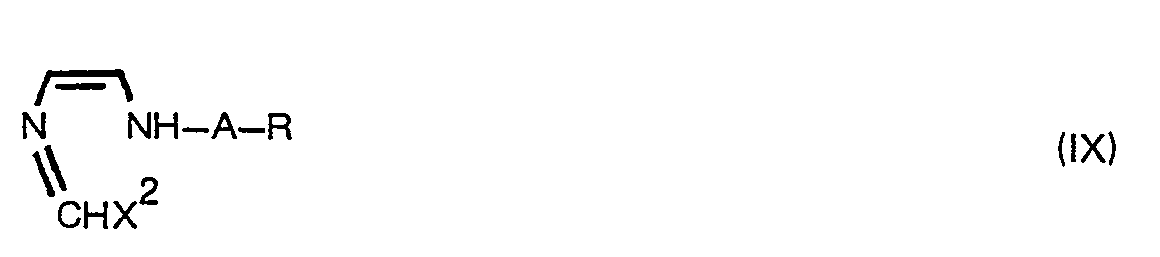
- Compounds of formula (I) or (IA) may also be prepared by reacting compound of formula


- An imine salt of for example formula:

- When R in formula (I) or (lA) is substituted cycloalkyl or substituted cycloalkenyl, the substituents may be introduced by reaction of carbon to carbon double or triple bonds in an intermediate cycloalkenyl or cycloalkynyl compound with a suitable electrophilic reagent capable of adding across the double or triple bonds to provide the substituents in the cycloalkyl or cycloalkenyl group. For example a di-bromocycloalkyl R group can be made by brominating a compound in which R is a cycloalkenyl group with a solution of bromine in an organic solvent such as chloroform. A di-hydroxy-cycloalkyl R group may be prepared by oxidising a compound in which R is cycloalkenyl, for example with peracetic acid or with osmium tetroxide and hydrogen peroxide solution.
- When R is heterocyclyl group to which the A group is attached by a ring nitrogen atom in the heterocyclic ring, the compound of formula (I) or (IA) may be prepared by a Mannich reaction reacting imidozole (II) with the parent heterocyclyl compound containing an -NH- group in the heterocyclyl ring and an aldehyde (to form the linking group A) which may have 1,2,3 or 4 carbon atoms. In this Mannich reaction the imidazole and heterocyclyl group will in the product be attached to the same carbon atom of A.
- Preferably the reaction between the heterocyclyl compound and the aldehyde, preferably formaldehyde, is carried out before the reaction with the imidazole, the reaction with the imidazole preferably being carried out in acidic solution.
- Compounds of formula (I) or (lA) in which R is a heterocyclyl group to which the group A is attached by a ring nitrogen atom may also be prepared by a process in which one: reacts imidazole with a Mannich base which may be prepared from (i) an aldehyde A4CHO, wherein A4 is hydrogen or contains less carbon atom than A as defined for formula (I), (ii) a heterocyclyl compound RH, R being a heterocyclyl group as defined for formula (I) to which the hydrogen atom is attached to form a ring -NH-group and (iii) a cyclic or acyclic secondary amine: or reacts a heterocyclyl compound RH, R being a heterocyclyl group as defined for formula (I) to which the hydrogen atom is attached to form a ring -NH-group, with a Mannich base which may be prepared from
- (i) an aldehyde A4CHO, wherein A4 is hydrogen or contains 1 less carbon atom than A as defined for formula (I),
- (ii) imidazole and
- (iii) a cyclic or acyclic secondary amine (other than RH).
- The intermediates for use in the above described reactions may also be made by conventional methods known in the art. Thus the 1-pyrazole and 1-imidazoline intermediates (formula (VII)) may be prepared by alkylation of pyrazole and imidazoline in an analogous manner to that described above for preparation of the corresponding imidazoles. The intermediates of formula (111) may be made in known manner prepferably by halogenation of the corresponding alcohols (formula (III), Z = - OH) where in such compounds R is substituted cycloalkenyl the alcohol is conveniently prepared by the Prins reaction from the substituted cycloalkene and paraformaldehyde (cf. Bull. Chem. Soc. Japan 46/48, 2512-5, 1973). Similarly when R is aryl and A is unsaturated with 3 or 4 carbon atoms the alcohol may be prepared from paraformaldehyde and the corresponding unsaturated-A compound with 2 or 3 carbon atoms. The substituted imidazole intermediates of formula (IV) may be made in known manner, for example see "Imidazole and its derivatives" Part 1, Ed. K. Hoffmann, Inter-science Publishers Inc. New York, 1973. For example the 2-thioimidazoles of formula (IV) may be made by cyclisation of an acetal of formula (XIV):

- The pharmaceutically acceptable acid addition salts of the compounds of formula (I) or (IA) may be prepared by any method known in the art. In particuar they may be prepared by treating the parent imidazole with the appropriate acid. Examples of the addition salts of the compounds of formula (I) or (IA) include those salts derived from the following acids: oxalic, hydrochloric, hydrobromic, sulphuric, nitric, perchloric, fumaric, maleic, phosphoric, glycollic, lactic, salicylic, succinic, toluene-p-sulphonic, tartaric, acetic, citric, methanesulphonic, formic, benzoic, malonic, naphthalene-2-sulphonic and benzenesulphonic.
- The imidazoles of formula (I) or (lA) may be used in conjunction with a phosphodiesterase inhibitor, which provides a further, synergistic increase in effect, as it acts against platelet aggregation by a different pathway.
- Suitable phosphodiesterease inhibitors for use in potentiating the anti-aggregatory effects of the active compounds include as such or as pharmaceutically acceptable salts:-
- (a) Xanthine derivatives such as:-
- Theophylline (3,7-dihydro-1,3-dimethyl-1 H-purine-2,6-dionel, Caffeine (3,7-dihydro-1,3,7-trimethyl-lH-purine-2,6-dione): and Aminophylline (adduct of Theophylline and 1,2-ethanediamine (2:1)).
- Isoquinoline derivatives, for example:-
- papaverine (1-[(3,4-dimethoxyphenyl)methyl]-6,7-dimethoxyisoquinolinel;
- (b) Derivatives of pyrimido (5,4-d)-pyrimidine, for example:-
- Dipyrimidamole (2,2',2",2"'-(4,8-dipiperidinopyrimido[5,4-d]pyrimidin-2,6-diyldinitro-tetraethanol) and its salts;
- (c) Derivatives of thieno[3,2-d]pyrimidine, for example:-
- N-[4-(4-morpholinyl)thieno[3,2-d]pyrimidin-2-yl]-1,2-ethanediamine.
- (d) Derivatives of pyrazolo[3',4':2,3]pyrido[4,5-b]-[1,5]benzodiazepin-6-(3H)one, for example:-
- 3-Ethyl-7,12-dihydro-7,12-di methylpyrazolo-[4',3';5,6]pyride[4,3-b]-[1,5]benzodiazepin-6-(3H)-one;
- (e) Derivatives of 1 H- or 2H-pyrazolo[3,4-b]-pyridine, for example:-
- 4-(Butylamino)-1-ethyl-1H-pyrazolo[3,4-b]-pyridine-5-carboxylic acid ethyl ester; and
- 2-Methyl-6-phenyl-4-( 1-piperidinyl)-2H-pyrazolo-[3,4-b]pyridine-
- (f) Derivatives of 5H-furo-[3,4-e]pyrazolo-[3,4-b]pyridine-5-one, for example:-
- 4-(Butylamino)-1-ethyl-1,7-dihydro-7-hydroxy-5H-furo-[3,4-e]pyrazolo[3,4-b]pyridine-5-one; and
- (g) Derivatives of 1-(2H)-naphthalenone, for example:
- 2-(Dimethylamino)methyl-3,4-dihydro-7-methoxy-1 (2H)-naphthalenone or its salts e.g. its 1:1 hydrochloride.
- The active compounds are particularly useful in the treatment and/or prophylaxis of thrombo- embolic disorders in mammals, including man. It is to be understood that the term "thrombo-embolic disorders" includes those disorders whose etiology is associated with platelet aggregation.
- The active compounds are useful wherever it is desired to inhibit platelet aggregation and/or to reduce the adhesive character of platelets, and consequently to treat or prevent the formation of thrombi in mammals, including man. For example, the compounds are useful in the treatment and prevention of myocardial infarcts, cerebro-vascular thrombosis and ischaemic peripheral vascular disease; to treat and prevent post-operative thrombosis; and to promote patency of vascular grafts following surgery.
- The active compounds are also useful as an addition to blood, blood products, blood substitutes, and other fluids which are used in artificial extra-corporeal circulation and perfusion of isolated body portions, e.g., limbs and organs, whether attached to the original body, detached and being preserved or prepared for transplant, or attached to a new body. It may also be used in laboratory animals, e.g. cats, dogs, rabbits, monkeys and rats, for these purposes in order to develop new methods and techniques for organ and limb transplants.
- The active compounds also exhibit some vasodilatory action on blood vessels and therefore have a utility as anti-hypertensives for the treatment of high blood pressure in mammals, including man.
- The amount of active compound required for therapeutic or prophylactic effect will vary with the route of administration, and the nature of the condition under treatment. In general a suitable dose for a mammal, including man, of active compound will lie in the range of 0.1 to 300 mg per kg body weight, particularly from 0.5 to 10 mg per kg body weight, for example 2 mg per kg. A suitable single oral dose for an adult human lies within the range of 50 to 600 mg, preferably 100 to 300 mg for example 150 mg given say three times a day.
- While it is possible for the active compounds to be administered as the raw chemical, it is preferable to present them as a pharmaceutical formulation. The formulations, both for veterinary and for human medical use, of the present invention comprise an active compound as above defined, together with one or more acceptable carriers therefor and optionally other therapeutic ingredients. The carrier(s) must be 'acceptable' in the sense of being compatible with the other ingredients of the formulation and not deleterious to the recipient thereof. Unit doses of a formulation may contain between 60 mg and 1.5 g of an active compound.
- The formulations include those suitable for oral, rectal, vaginal or parenteral (including subcutaneous, intramuscular and intravenous) administration. Preferred formulations include tablets, capsules and injectable suspensions or solutions.
- The formulations may conveniently be presented in unit dosage form and may be prepared by any of the methods well known in the art of pharmacy. All methods include the step of bringing into association the active compound (in the form of the base or a pharmaceutically acceptable acid addition salts) with the carrier which constitutes one or more accessary ingredients. In general the formulations are prepared by uniformly and intimately bringing into association the active compound with liquid carriers or finely divided solid carriers or both, and then, if necessary, shaping the product into the desired formulation.
- It will be appreciated from the foregoing that the present invention provides the following features:
- (a) Novel 1-substituted imidazole of formula (I) and acid addition salts thereof.
- (b) Methods of preparing imidazoles of formula (I) and acid addition salts thereof.
- (c) Pharmaceutical formulations containing the imidazoles of formula I(A) or a pharmaceutically acceptable acid addition salt thereof and a pharmaceutically acceptable carrier.
- (d) Method of preparing the pharmaceutical formulations containing the imidazoles of formula I(A) or a pharmaceutically acceptable acid addition salt thereof.
- (e) An 1-substituted imidazole of formula (IA) or salt thereof as an active agent for the treatment of a thrombo-embolic disorder in a mammal or mammalian tissue, including man or human tissue.
- The following Examples are provided by way of an illustration of the present invention and should in no way be construed as constituting a limitation thereof. All temperatures are given in degrees Celsius.
- A solution of phosphorus tribromide (3.52 g, 0.013 mol) in chloroform (6.25 ml) was added dropwise at -10° to a stirrerd solution of 2-naphthalene-ethanol (4.3 g, 0.025 mol) in chloroform (20 ml), containing dry pyridine (0.13 ml, 0.0016 mol). Following the addition, the mixture was stirred at -10° for 2 h, and was then stood at ambient temperature overnight. Next day, the reaction mixture was poured into water (62.5 ml) and the organic layer was separated. The aqueous solution was then extracted with chloroform (3 x 6.25 ml), and the organic layer and chloroform extracts were combined and washed with sodium hydroxide solution (62.5 ml, 2M), and with water (62.5 ml). The chloroform solution was dried (MgS04), and the chloroform was then evaporated under reduced pressure to afford 2-(2-bromoethyl)naphthalene which was used without further purification.
- A mixture of imidazole (1.02 g, 0.015 mol), 2-(2-bromoethyl)naphthalene (3.53 g, 0.015 mol) and potassium tert-butoxide (1.68 g, 0.015 mol) in dry butan-1-ol (100 ml) was stirred and heated under reflux for 29 h.
- After cooling,the reaction mixture was filtered, and the filtrate was concentrated to afford a light brown oil. The oil was suspended in hydrochloric acid (45 ml, 2M), and the acid solution was washed with ether (45 ml). The acid solution was then basified with sodium hydroxide solution (10M) and the product was then extracted with chloroform. The chloroform extracts were combined and dried (MgS04), when removal of the chloroform under reduced pressure afforded an oil which was purified using a silica gel column and by elution with chloroform/methanol (9:1). The product fractions were pooled and concentrated to afford the product as a brown solid. Recrystallisation of the solid from ethyl acetate/light petroleum afforded a white solid, m.p. 98-99°.
- A mixture of hydrobromic acid (50 ml, 46% w/v) and 1-(2-hydroxyethyl)naphthalene (10.0 g, 0.0058 mol) was stirred and heated under reflux for 4 h. After cooling, the reaction mixture was diluted with water (150 ml), and the resulting precipitate was extracted with ether (3 x 150 mi). The ether extracts were combined and dried (MgS04), when the ether was evaporated under reduced pressure, to afford 1-(2-bromoethyl)-naphthalene which was used without further purification.
- A mixture of imidazole (3.9 g, 0.057 mol), 1-(2-bromoethyl)naphthalene (13.4 g, 0.057 mol) and potassium tert-butoxide (6.4 g, 0.057 mol) in dry butan-1-oi (100 ml) was stirred and heated under reflux for 26 h.
- After cooling, the reaction mixture was filtered, and the filtrate was evaporated under reduced pressure to afford an oil. The oil was dissolved in hydrochloric acid (150 ml, 2M), and the acid solution was washed with ether (150 ml). The acid solution was then basified with sodium hydroxide solution (1 OM) and the basic solution was then extracted with chloroform (3 x 100 ml). The chloroform extracts were combined and dried (MgS04). Removal of the chloroform under reduced pressure afforded an oil which was purified using a silica gel column and by elution with chloroform/methanol. The product fractions were combined and concentrated, to give an oil which was distilled, yielding 1-[2-(1-naphthyl)ethyl]imidazole as a viscous yellow oil, b.p. 150°/0.01 mm Hg.
- 1-Bromomethylnaphthalene (5.6 g, 0.0253 mol) was added dropwise to a stirred boiling solution of imidazole (1.72 g, 0.0253 mol) and sodium bicarbonate (2.13 g, 0.0253 mole) in dry methanol (40 ml). Following the addition, the reaction mixture was stirred and boiled for 6 h.
- After cooling, the reaction mixture was concentrated under reduced pressure, and the residue was suspended in water (70 mi). The aqueous mixture was extracted with chloroform (3 x 70 ml), and the chloroform extracts were combined and dried. The residue was chromatographed using a silica gel column and by elution with chloroform/methanol (9:1). The product fractions were combined, concentrated, and the residue was distilled, to afford 1-(1-naphthylmethyl)imidazole, b.p. 150-1560/0.1 mm Hg.
- 1-Chloromethyl-2-methylnaphthalene (9.55 g, 0.05 mol) was added dropwise to a solution of imidazole (3.4 g, 0.05 mol) and potassium tert-butoxide (5.6 g 0.05 mol) in dry butan-1-ol. Following the addition, the reaction mixture was stirred and heated under reflux for 3 h.
- After cooling, the reaction mixture was filtered, and the filtrate was concentrated under reduced pressure to afford a brown oil. The oil was dissolved in hydrochloric acid (150 ml, 2M), and this mixture was washed with ether (1 x 150 ml). The aqueous solution was then basified with sodium hydroxide solution (10M) and the resulting oil was extracted with chloroform (3 x 100 ml). The chloroform extracts were combined, dried (MgS04), and then concentrated to afford a brown oil. A portion of the oil (5 g) was purified using a silica gel column and by elution with chloroform/methanol (9:1 The product fractions were pooled and concentrated to afford a solid, which was recrystallized from ethyl acetate/petroleum ether (b.p. 40-60°), giving 1-(2-methyl-1-naphthylmethyl)imidazole as a fawn solid, m.p. 98-98.5°.
- A mixture of imidazole (6.8 g, 0.1 mol), potassium tert-butoxide (11.2 g, 0.1 mol) and 2-chloromethyl-5,5-dimethyl-1,3-dioxane (16.5 g, 0.1 mol) in dry butan-1-ol (150 ml) was stirred and heated under reflux for 16 h.
- After cooling, the reaction mixture was filtered, and the filtrate was concentrated under reduced pressure to afford a brown oil. The oil was dissolved in hydrochloric acid (100 ml, 2M), and the acid solution was washed with ether (1 x 100 ml). The acid solution was then basified with sodium hydroxide solution (10M) and the product was extracted with chloroform (2 x 100 ml). The chloroform extracts were combined, dried (MgS04), and then concentrated to afford an oil. The oil was purified using a silica gel column, and by elution with chloroform/methanol (9:1). The product fractions were pooled, concentrated, and the residue was distilled, to afford 1-(5,5-dimethyl-1,3-dioxan-2-ylmethyl)imidazole, b.p. 98―104°/0.15 mm Hg.
- A mixture'of imidazole (13.6 g, 0.2 mol) and sodium butoxide (prepared from sodium (4.6 g, 0.2 mol) and dry butan-1-ol (100 ml) was stirred and heated to 70°, when 1,4-dibromobutane (43.2 g, 0.2 mol) was added dropwise at such a rate that the internal temperature did not exceed 75°. Following the addition, the reaction mixture was then stirred and heated at 70° in a sealed vessel for 20 h.
- After cooling, the reaction mixture was filtered, and the filtrate was concentrated under reduced pressure to afford an oil. Distillation of the residual oil gave the product as a colourless oil, b.p. 183-1850/0.1 mm Hg which solidified on standing. Recrystallisation of the solid from ethyl acetate/petroleum ether (b.p. 40―60°) gave 1,1'-tetramethylenedi-imidazole, m.p. 84―86°.
- A solution of 2-chloromethyltetrahydrofuran (1.205 g, 0.01 mol), imidazole (0.68 g, 0.01 mol) and potassium tert-butoxide (1.12 g, 0.01 mol) in dry butan-l-ol (8 ml) was stirred and heated under reflux for 16 h.
- After cooling, the reaction mixture was concentrated under reduced pressure, and the residue was extracted with chloroform (4 x 25 ml). The chloroform extracts were concentrated to afford a yellow oil which was purified using a silica gel column, and by elution with chloroform/methanol (9:1). The product fractions were pooled, concentrated, and the residue was distilled, to afford 1-(2-tetrahydro- furanylmethyl)imidazole, b.p. 86―88°/0.05 mm Hg.
- A solution of 3-chloromethylpyridine hydrochloride (11.5 g, 0.07 mol) in methanol (30 ml) was added dropwise to a stirred, boiling mxiture of imidazole (4.8 g, 0.07 mol) and sodium bicarbonate (11.8 g, 0.14 mol) in methanol (100 ml). Following the addition, the mixture was stirred and boiled for 6h.
- After cooling, the reaction mixture was filtered, and the filtrate was evaporated to dryness. The residue was dissolved in hydrochloric acid (100 ml), and the acid solution was washed with ether (2 x 100 ml). The acid solution was then basified with sodium hydroxide solution (10M), and basic mixture was extracted with chloroform (3 x 100 ml). The chloroform extracts were combined, dried (MgS04), and the chloroform was then removed under reduced pressure to yield a black oil which was purified using a silica gel column and by elution with chloroform/methanol (9:1). The product fractions were pooled, concentrated under reduced pressure, and the residue was distilled to afford 1-(3-pyridylmethyl)imidazole, b.p. 140-1421/0.25 mm Hg.
- A mixture of thionyl chloride (36.0 g, 0.3 mol) and 2-hydroxymethyl-1,4-benzodioxan (25.0 g, 0.15 mol) was stirred and heated under reflux for 0.75 h. The reaction mixture was concentrated under reduced pressure, and the residue was distilled, to afford 2-chloromethyl-1,4-benzodioxan, b.p. 140-146°/22 mm Hg.
- A mixture of imidazole (5.35 g, 0.078 mol) 2-chloromethyl-1 ,4-benzodioxan (14.5 g, 0.078 mol) and potassium tert-butoxide (8.82 g, 0.078 mol) in dry butan-1-o! (100 ml) was stirred and heated under reflux for 30 h.
- After cooling, the reaction mixture was filtered, and the filtrate was concentrated under reduced pressure to afford a brown oil. The oil was dissolved in hydrochloric acid (150 ml), and the acid solution was washed with ether (1 x 150 ml). The aqueous layer was then basified with sodium hydroxide solution (10M), and the basic solution was extracted with chloroform (3 x 100 mi). The chloroform extracts were then combined and dried (MgS04), when removal of the chloroform under reduced pressure afforded an oil which was purified using a silica gel column and by elution with chloroform/methanol (9:1). The product fractions were pooled and concentrated to give an oil which was distilled to afford 1-(1,4-benzodioxan-2-ylmethyl)imidazole, b.p. 148°/0.13 mm Hg.
- A solution of 2-Chloromethylquinoline hydrochloride (10.7 g, 0.05 mol) in methanol (50 ml) was added dropwise to a stirred, boiling solution of potassium tert-butoxide (11.2 g, 0.1 mol) and imidazole (3.4 g, 0.05 mol) in dry butan-1-ol. Following the addition, the reaction mixture was stirred and heated under reflux for 5 h. After removal of the butan-1-ol under reduced pressure, the resulting orange oil was dissolved in hydrochloric acid (150 ml 2M), and the acid solution was washed with ether (3 x 100 mi). The acid solution was then basified with sodium hydroxide solution (10 m), and the basic solution was then extracted with chloroform (3 x 100 ml). The chloroform solutions were combined, dried (MgS04), and the chloroform was then evaporated to afford an oil which was purified using a silica gel column and by elution with chloroform/methanol (9:1). The product fractions were pooled, concentrated, and the resulting solid was recrystallized from aqueous ethanol, to afford, 1-(2-quinolylmethyl)imidazole as buff crystals, m.p. 106-108°.
- A mixture of imidazole (27.2 g, 0.4 mol), and benzenesulphonyl chloride (35.3 g, 0.2 mol) in dry tetrahydrofuran (200 ml) was stirred at ambient temperature for 1 h, when the resulting precipitate was removed by filtration. The filtrate was evaporated under reduced pressure and the resulting solid was recrystallised from benzene/petroleum ether (b.p. 40-60°), to afford 1-(benzenesulphonyl) imidazole m.p. 82-83°.
- A solution of imidazole (47.0 g, 0.69 mol) in 'super-dry' ethanol (175 ml) containing dry pyridine (3.0 ml) was stirred and heated to 75° when styrene oxide (80.0 g, 0.67 mol) was added dropwise at such a rate that the temperature of the reaction mixture was maintained at 80-85°. Following the addition, the reaction mixture was stirred until the internal temperature had failed to 50°. Isopropyl ether (300 ml) was then added to the reaction mixture, and the resulting mixture was poured into iced- water (1,000 ml). Separation of the resulting solid by filtration afforded the product which was washed wtih acetone (1 x 500 ml) and with ether (2 x 300 ml), to give 1-(2-hydroxy-2-phenylethyl)imidazole, m.p. 149-151 °.
- A solution of a-bromoacetophenone (45.0 g, 0.226 mol) in methanol (150 ml) was added dropwise to a stirred solution of imidazole (13.6 g, 0.2 mol) and sodium hydroxide solution (25 ml, 10M) in methanol (100 ml) at 75°. Following the addition, the reaction mixture was stirred at ambient temperature for 20 h.
- The reaction mixture was then evaporated to dryness and the residue was suspended in water (150 ml). The aqueous mixture was extracted with chloroform (3 x 100 ml), and the chloroform extracts were washed with sodium bicarbonate solution (100 ml) and were then dried (MgS04). The chloroform was then removed under reduced pressure to give a residue which was purified using a column of silica gel and by elution with chloroform/methanol (9:1 The product fractions were pooled and concentrated, to afford a solid which was recrystallised from toluene, to give 1-(benzoylmethyl) imidazole as a white solid, m.p. 121-1221.
- A mixture of bromoethyl ethyl sulphide (16.9 g, 0.1 mol), potassium tert-butoxide (1 1.2 g, 0.1 mol) and imidazole (6.8 g, 0.1 mol) was stirred and heated under reflux for 11 h.
- After cooling, the reaction mixture was filtered, and the filtrate was concentrated under reduced pressure to give a brown oil. The oil was suspended in hydrochloric acid (150 ml) and the acid solution was washed with ether (2 x 100 ml). The acid solution was then basified with sodium hydroxide solution (10M), and the basic solution was extracted with chloroform (3 x 150 ml). The chloroform extracts were combined and dried (MgS04), when evaporation of the chloroform afforded a brown oil which was purified using a silica gel column, and by elution with chloroform/methanol (9:1). The product fractions were pooled and concentrated to afford 1-(2-ethylthioethyl)imidazole, b.p. 141―143°/15 mm Hg.
- 2-Chloroethyl ethyl ether (25.0 ml, 0.225 mol) was added dropwise to a stirred, boiling solution of imidazole (13.6 g, 0.2 mol) in ethanolic sodium ethoxide (prepared from sodium (4.6 g, 0.2 mol) in dry ethanol (100 ml)). Following the addition, the reaction mixture was stirred and boiled for 6 h.
- After cooling, the reaction mixture was concentrated under reduced pressure, and the residue was suspended in water (150 ml). The aqueous suspension was extracted with chloroform (3 x 50 ml), and the combined chloroform extracts were dried (MgS04) and then concentrated under reduced pressure to give an oil. The oil was purified using a silica gel column and by elution with chloroform/methanol (9:1). The product fractions were combined and concentrated to afford an oil, which was distilled, to afford 1-(3-oxapentyl)imidazole, b.p. 140°/14 mm Hg.
- 2-Phenoxyethyl bromide (22.62 g, 0.1 mol) was added dropwise to a stirred, boiling solution of imidazole (6.8 g, 0.1 mol) in ethanolic sodium ethoxide (prepared from sodium (2.75 g, 0.12 mol) and dry ethanol (100 ml)). Following the addition, the reaction mixture was stirred and boiled for 4 h.
- After cooling, the reaction mixture was filtered and the filtrate was concentrated under reduced pressure. The residue was supsended in water (100 ml), and the aqueous suspension was extracted with chloroform (3 x 100 ml). The combined chloroform extracts were dried (MgS04), and the chloroform was then removed under reduced pressure to afford an oil. THe oil was purified using a silica gel column and by elution with chloroform/methanol (9:1). The product fractions were pooled, concentrated, and the resulting white solid was recrystallised from ethyl acetate/light petroleum, to afford 1-(2-phenoxyethyl)imidazole, m.p. 88°.
- Chloromethyl benzyl ether (32.3 g, 0.2 mol) was added dropwise to a stirred, boiling solution of imidazole (13.6 g, 0.2 ml) and ethanolic sodium ethoxide (prepared from sodium (4.6 g, 0.2 mol) in dry ethanol (150 ml)). Following the addition, the reaction mixture was stirred and heated under reflux for 8 h.
- After cooling, the reaction mixture was filtered, and the filtrate was concentrated under reduced pressure to afford an oil which was purified using a silica gel column and by elution with chloroform/methanol (9:1). The product fractions were pooled, concentrated, and the residual oil was distilled, to afford 1-(3-phenyl-2-oxapropyl)imidazole, b.p. 122-1240/0.15 mm Hg.
- A mixture of chloromethyl phenyl sulphide (2.0 g, 0.1126 mol), potassium carbonate (1.8 g, 0.013 mol) and imidazole (0.94 g, 0.014 mol) in dry acetone (20 ml) was stirred and heated under reflux for 24 h.
- After cooling, the reaction mixture was filtered, and the filtrate was concentrated under reduced pressure to give a brown residue. The residue was dissolved in ether (200 ml), and the ether solution was washed with water (5 x 50 ml). The other solution was then extracted with hydrochloric acid (2 x 50 ml, 1 M), and the acid extracts were then basified with sodium hydroxide solution. The resulting oil was extracted with ether (3 x 100 ml), and the ether extracts were combined and dried (MgS04). Evaporation of the ether under reduced pressure gave an oil which was purified using a silica gel column and by elution with chloroform/methanol (9:1). The product fractions were pooled and concentrated to afford an oil which was distilled, giving 1-(phenylthiomethyl)imidazole, b.p. 102-1030/0.025 mm Hg.
- A solution of bromine (2 ml) in chloroform (25 ml) was added dropwise to a stirred solution of 1-(cyclohex-3-enylmethyl)imidazole (2.5 g, 0.015 mol) in chloroform at 25°. Following the addition, chloroform (50 ml) was added to the reaction mixture, when a heavy red oil separated. The chloroform layer was separated, dried (MgS04), and was then concentrated under reduced pressure to afford 1-(3,4-dibromocyclohexylmethyl)imidazole.
- Attempted distillation of the above oil resulted in substantial decomposition.
- The product was pure as examined by thin layer chromatography (using chloroform/methanol (9:1) as eluent), by nuclear magnetic resonance spectroscopy, and by high resolution mass spectrometry:

- N-(2-Bromoethyl)-hthalimide (28.0 g, 0.11 mol) was added to a stirred mixture of sodium bicarbonate (8.4 g, 0.1 mol) and imidazole (6.8 g, 0.1 mol) in dry methanol (100 mi). Following the addition, the reaction mixture was stirred and heated under reflux for 13 h.
- The reaction mixture was then concentrated under reduced pressure, and the residue was suspended in water (100 ml). The product was extracted with chloroform (3 x 100 ml), and the chloroform solutions were combined and dried (MgS04). The chloroform solution was concentrated under reduced pressure, and the resulting oil was purified using a silica gel column, and by elution with chloroform/methanol (9:1). The product fractions were combined and concentrated, giving a solid which was recrystallised from ethanol, to afford 1-(2-phthalimidoethyl)imidazole, m.p. 151-153°.
- 5-Chloro-2-chloromethylthiophene (11.0 g, 0.066 mol) was added dropwise to a stirred mixture of imidazole (4.0 g, 0.058 mol) and sodium bicarbonate (5.4 g, 0.064 mol) in dry methanol (50 ml). Following the addition, the reaction mixture was stirred and heated under reflux for 20 h.
- The reaction mixture was then concentrated under reduced pressure, and the residue was dissolved in hydrochloric acid (150 ml, 2M). The acidic solution was washed with ether (1 x 150 ml), and the acid solution was then basified with sodium hydroxide solution (10M). The basic solution was extracted with chloroform (3 x 100 ml), and the combined chloroform extracts were washed with water (1 × 100 ml) and then dried (Na2SO4). The chloroform solution was concentrated under reduced pressure and the resulting oil was purified using a silica gel column and by elution with chloroform/methanol (9:1 The product fractions were pooled and concentrated, to afford 1-(5-chloro- thien-2-ylmethyl)-imidazole as a pale yellow oil.
- NMR (CDCl3) δ 5.15 (2H, s, CH2), 6.75 (2H, s, thienyi), 6.95 (1H, s, imidazole, 7.05 (1H, s, imidazole), and 7.5 (1 H, s, imidazole).
- This mixture of compounds was prepared according to the methods of R. H. Wightman et al., J. Org. Chem., 1978, 43, 2167 and R. T. Arnold and R. Barnes, J. Amer. Chem. Soc., 1943, 65, 2393.
- A solution of potassium tert-butoxide (4.48 g, 0.04 mol) and imidazole (2.72 g, 0.04 mol) in dry butan-1-ol (100 ml) was stirred and heated under reflux when a 50:50 mixture of 5-chloromethyl-1,2,3,4-tetrahydronaphthalene and 6-chloromethyl-1,2,3,4-tetrahydronaphthalene (7.25 g, 0.04 mol) was added dropwise. Following the addition, the reaction mixture was stirred and heated under reflux for 4 h.
- After cooling, the reaction mixture was filtered, and the filtrate was concentrated under reduced pressure. The residue was dissolved in hydrochloric acid (150 ml, 2M), and the acid solution was washed with ether (2 x 50 ml). The acid solution was then basified with sodium hydroxide solution (1 OM). The basic solution was then extracted with chloroform (3 x 50 ml), and the chloroform extracts were combined and dried. Evaporation of the chloroform afforded a yellow oil which was purified using a silica gel column and by elution with chloroform/methanol (9:1). The product fractions were pooled and concentrated to afford an oil which was distilled, yielding a 50:50 mixture of 1-(1,2,3,4-tetra- hydronaphth-5-ylmethyl)imidazole and 1-(1,2,3,4-tetrahydronaptha-6-ylmethyl)imidazole, b.p. 128―132°/0.01 mm Hg.
- NMR (CDCl3) δ 1.6―1.9 4H, m), 2.4―2.9 (4H, m), 4.95 (s, CH2), 5.0 (s, CH2), 4.95 and 5.0 together 2H, 6.65-7.05 (5H, m, Ar and imidazole) and 7.4 (1 H, d, imidazole).
- The signals (8 4.95 and 5.0) due to the methylene groups linking the imidazole ring to the rest of the molecule were of equal intensity.
- A solution of 2-chloromethylpyridine hydrochloride (16.4 g, 0.1 mol) in ethanol (50 ml) was added dropwise to a stirred, boiling solution of potassium tert-butoxide (22.4 g, 0.2 mol) and imidazole (6.8 g, 0.1 mol) in dry butan-1-ot (100 ml). Following the addition, the reaction mixture was stirred and heated under reflux for 5 h. After removal of the solvents under reduced pressure, the resulting oil was dissolved in hydrochloric acid (150 ml, 2M), and the acid solution was washed with ether (100 ml). The acid solution was then basified with sodium hydroxide solution (10M), and the basic solution was extracted with chloroform (3 x 100 ml). The chloroform solutions were combined, dried (MgS04), and the chloroform was then removed under reduced pressure. The residue was purified by using a silica- gel column and by elution with chloroform/methanol (9:1 The resulting solid was recrystallised from ethanol/light petroleum affording 1-(2-pyridylmethyl)imidazole as white cubes, m.p. 79-80°.
- A solution of fumaric acid (0.21 g) in hot ethanol (10 ml) was added to a solution of 1-(1-naphthylmethyl)imidazole (0.4 g) in ethanol (5 ml). After boiling for 10 minutes, the solution was evaporated under reduced pressure to afford a white solid. Recrystallisation of the solid from ethanol afforded 1-(1-naphthylmethyl)imidazole, hydrogen fumarate, m.p. 159―161 °C.
- A solution of succinic acid (0.22 g) in hot ethanol (10 ml) was added to a solution of 1-(1-naphthylmethyl)imidazole (0.4 g) in ethanol (5 ml). After boiling for 10 minutes, the solution was evaporated under reduced pressure to afford a white solid. Recrystallisation of the solid from ethyl acetate afforded 1-(1-naphthylmethyl)imidazole hydrogen succinate, m.p. 121-123°C.
- A solution of oxalic acid dihydrate (0.25 g) in hot ethanol (10 ml) was added to a solution of 1-(1-naphthylmethylimidazole (0.43 g) in ethanol (5 ml). The solution was boiled for 10 minutes, when the ethanol was removed under reduced pressure to afford a white solid. Recrystallisation of the solid from ethanol afforded 1-(1-naphthylmethyl)imidazole hydrogen oxalate, m.p. 139-141 °C.
- A solution of imidazole (3.4 g, 0.05 mol), 2-chlorobenzyl bromide (10.28 g, 0.05 mol) and potassium tert-butoxide (5.6 g 0.05 mol) in dry butan-1-ot (100 ml) was stirred and heated under reflux for 4 h.
- After cooling, the reaction mixture was filtered, and the filtrate was concentrated under reduced pressure to afford a brown residue. The residue was dissolved in hydrochloric acid (150 ml), and the acid solution was washed with ether (100 ml). The acid solution was then basified with sodium hydroxide solution (10M), and the product was extracted with chloroform (3 x 50 ml). The combined chloroform extracts were dried (MgS04) and then concentrated under reduced pressure to afford a brown oil. The oil was purified using a silica gel column and by elution with chloroform/methanol (9:1). The product fractions were pooled and concentrated to afford an oil which was distilled, to give 1-(2-chlorobenzyl)imidazole as a colourless oil, b.p. 114-1161/0.25 mm Hg.
- A solution of 2-chloro-4,5-methylenedioxybenzylchloride hydrochloride (10.0 g, 041 mol) in methanol (30 ml) was added dropwise to a stirred, boiling solution of potassium tert-butoxide (9.2 g, 0.082 mol) and imidazole (2.7 g, 0.038 mol) in dry butan-1-ol. Following the addition, the reaction mixture was stirred and heated under reflux for 6 h.
- After cooling, the reaction mixture was filtered, and the filtrate was concentrated under reduced pressure to afford an orange oil. The oil was dissolved in hydrochloric acid (100 ml, 2M), and the acid solution was washed with ether (2 x 100 ml). The acid solution was then basified with sodium hydroxide solution (1 OM), and the basic mixture was then extracted with chloroform (3 x 150 ml). The chloroform extracts were combined, dried (MgS04), and then concentrated to give an oil which was purified using a silica gel column, and by elution with chloroform/methanol (9:1). The product fractions were pooled and concentrated, to give an oil which crystallised on standing. Recrystallisation of the solid from benzene/light petroleum gave 1-(2-chloro-4,5-methylenedioxybenzyl)imidazole as buff crystals, m.p. 99-102°.
- 1-Chloromethyl-2,4-dichlorobenzene (44.0 g, 0.225 mol) was added to a mixture of imidazole (13.6 g, 0.2 mol) and sodium bicarbonate (16.8 g, 0.2 mol) in methanol (100 ml). Following the addition, the reaction mixture was stirred and boiled for 3.5 h.
- After cooling the reaction mixture was concentrated under reduced pressure, and water (100 mi) was then added. The aqueous solution wa extracted with chloroform (3 x 100 ml) and the chloroform extracts were combined, washed with saturated brine (100 ml), and then dried (magnesium sulphate). Evaporation of the chloroform solution under reduced pressure aforded a pale yellow oil, which was purified using a silica gel column and ethyl acetate/methanol (9:1) as eluent. The product fractions were combined, concentrated, and the resulting oil was distilled to afford 1-(2,4-dichlorobenzyl)-imidazole, b.p. 128-1301/0.005 mm Hg. The product solidified on standing, and was recrystallised from petroleum ether (b.p. 40-60°), to afford the product as a colourless solid, m.p. 49-50°.
- 1-Chloromethyl-4-fluorobenzene (32.51 g, 0.225 mol) was added dropwise to a stirred mixture of imidazole (13.6 g, 0.2 mol) and sodium bicarbonate (16.8 g, 0.2 mol) in methanol (100 ml). Following the addition, the reaction mixture was stirred and heated under reflux for 2 h.
- After cooling, the reaction mixture was concentrated under reduced pressure, and the residue was dissolved in water (100 ml) and the aqueous solution was extracted with chloroform (3 x 100 ml). The chloroform extracts were combined, washed with saturated brine (100 ml) and then dried (magnesium sulphate). Concentration of the chloroform solution under reduced pressure afforded a yellow oil which was purified using a silica gel column and elution with ethyl acetate/methanol (9:1 The product fractions were pooled, concentrated, and the resulting oil was distilled to afford 1-(4-fluorobenzyl)-imidazole, b.p. 94-970/0.18 mm Hg.
- 1-Bromo-2-bromomethylbenzene (12.5 g, 0.05 mol) was added dropwise to a stirred, boiling mixture of imidazole (3.4 g, 0.05 mol) and potassium tert-butoxide (5.6 g, 0.05 mol) in dry butan-1-ol (80 ml). Following the addition, the reaction mixture was stirred and boiled for 2.5 h.
- After cooling, the reaction mixture was filtered and the filtrate was evaporated under reduced pressure. The residue was dissolved in hydrochloric acid (150 ml, 2M), and the acid solution was washed with ether (2 x 50 ml). The acid solution was basified with sodium hydroxide solution (10M), and the basic solution was extracted with chloroform (4 x 50 ml), and the chloroform extracts were combined and dried (magnesium sulphate). Concentration of the chloroform solution under reduced pressure afforded a brown oil which was purified using a silica gel column and elution with ethyl acetate/methanol (9:1). The product fractions were combined, concentrated, and distilled to afford 1-(2-bromobenzyl)imidazole, b.p. 128°/0.05 mm.
- 1-Bromo-4-bromomethylbenzene (12.5 g, 0.05 mol) was added dropwise to a stirred, boiling mixture of imidazole (3.4 g, 0.05 mol) and potassium tert-butoxide (5.6 g, 0.05 mol) in dry butan-1-o) (60 ml). Following the addition the reaction mixture was stirred and boiled for 4 h.
- After cooling, the reaction mixture was filtered and the filtrate was evaporated under reduced pressure. The residue was dissolved in hydrochloric acid (150 ml, 2M), and the acid solution was washed with ether (2 x 50 ml). The acid solution was basified with sodium hydroxide solution (10M), and the basic solution was extracted with chloroform (4 x 50 ml), and the chloroform extracts were combined and dried (magnesium sulphate). Concentration of the chloroform solution under reduced pressure afforded a brown oil which was purified using a silica gel column and elution with ethyl acetate/methanol (9:1 The product fractions were combined, concentrated, and distilled to afford 1-(4-bromobenzyl)imidazole, b.p. 122-1260/0.03 mm Hg.
- The oil solidified on standing and was recrystallised from ethyl acetate/petroleum ether (b.p. 60-80°) to afford the product as white striated needles, m.p. 81-83°.
- 1-Bromo-3-bromomethylbenzene (12.6 g, 0.05 mol) was added dropwise to a stirred, boiling mixture of imidazole (3.4 g, 0.05 mol) and potassium tert-butoxide (5.6 g, 0.05 mol) in dry butan-1-ol (80 ml). Following the addition, the reaction mixture was stirred and boiled for 4 h.
- After cooling, the reaction mixture was filtered and the filtrate was evaporated under reduced pressure. The residue was dissolved in hydrochloric acid (150 ml, 2M), and the acid solution was. washed with ether (2 x 50 ml). The acid solution was basified with sodium hydroxide solution (10M), and the basic solution was extracted with chloroform (4 x 50 ml) and the chloroform extracts were combined and dried (magnesium sulphate). Concentration of the chloroform solution under reduced pressure afforded a brown oil which was purified using a silica gel column and elution with ethyl acetate/methanol (9:1). The product fractions were combined, concentrated, and distilled to afford 1-(3-bromobenzyl)imidazole, b.p. 124-1260/0.06 mm Hg.
- 1-(3-Chloropropyl)-2,4-dichlorobenzene (16.65 g, 0.075 mol) was added dropwise to a stirred solution of imidazole (5.1 g, 0.075 mol) and potassium tert-butoxide (8.4 g, 0.075 mol) in dry butan-1-ol. Following the addition, the reaction mixture was stirred and heated under reflux for 2 h.
- After cooling, the reaction mixture was filtered and the filtrate was concentrated under reduced pressure. The residue was dissolved in hydrochloric acid (150 ml, 2M) and the solution was washed with ether (1 x 50 mi). The acid solution was then basified with sodium hydroxide solution (10M), and the basic solution was extracted with chloroform (3 x 50 ml). The combined chloroform extracts were dried over magnesium sulphate and were then concentrated under reduced pressure. The resulting oil was purified using a silica gel column, and elution with ethyl acetate/methanol (9:1). The product fractions were pooled, concentrated, and the resulting oil was distilled to afford 1-[3-(2,4-dichloro- phenyl)propyl]imidazole, b.p. 140°/0.04 mm Hg.
- By the method of example 1 (b) the following compounds were made:
- (a) 1-(2-naphthylmethyl)imidazole,
- (b) 1-(1-(4-methylnaphthyl)methyl)imidazole,
- (c) 1-(1-(2-methoxynaphthyl)methyl)imidazole,
- (d) 1-(1-methylpiperidin-3-ylmethyl)imidazole,
- (e) 1-(6-uracilylmethyl)imidazole,
- (f) 1-(3-(1-piperidinylpropyl)imidazole,
- (g) 1-(2-(1-pyrrolidinyl)ethyl)imidazole,
- (h) 1-(2-(2-piperidinyl)ethyl)imidazole,
- (i) 1-(3-(3-pyridyl)propyl)imidazole,
- (j) 1-(2-furanylmethyl)imidazole
- By the method of Example 18 the following compounds were made:-
- (a) 1-(Benzylthiomethyl)imidazole and
- (b) 1-(2-Phenylthio)ethyl)imidazole.
- By the method of Example 19 the following compounds were made, in each case the bromine being replaced by the reagent indicated
- (a) 1-(cis-3,4-dihydroxycyclohexylmethyl)imidazole
using osmium tetroxide and hydrogen peroxide. - (b) 1-(trans-3,4-dihydroxycyclohyexylmethyl)imidazole
- A solution of fumaric acid (0.18 g) in hot ethanol (10 ml) was added to a solution of 1-(2-bromobenzyl)imidazole (0.4 g) in hot ethanol (5 ml). After boiling for 10 minutes, the solution was evaporated under reduced pressure to afford a white solid. Recrystallisation of the solid from propan-2-ol gave 1-(2-bromobenzyl)imidazole hydrogen fumarate, m.p. 158-159°.
- A solution of succinic acid (0.19 g) was dissolved in hot ethanol (10 ml) was added to a solution of 1-(2-bromobenzyl)imidazole (0.4 g) in hot ethanol (5 ml). After boiling for 10 minutes, the solution was evaporated under reduced pressure to afford a white solid. Recrystallisation of the solid from ethyl acetate/light petroleum gave 1-(2-bromobenzyl)imidazole hydrogen succinate m.p. 112-113°.
- A solution of oxalic acid (0.14 g) in hot ethanol (10 ml was added to a solution of 1-(2-bromobenzyl)imidazole (0.4 g) in hot ethanol (5 ml). After boiling for 10 minutes, the solution was evaporated under reduced pressure to afford a white solid. Recrystallisation of the solid from propan-2-ol gave 1-(2-bromobenzyl)imidazole hydrogen oxalate, m.p. 146-147°.
- Horse platelets were prepared from whole horse blood by differential centrifugation. Approximately 106 platelets were homogenised in 1 ml 100 mM Tris buffer pH 7.4. Various concentrations of active compound were added and the reaction sets incubated for 5 minutes at ambient temperature. To each tube was added 20 nM of arachidonic acid containing 106 disintegrations per minute (DPM) of labelled arachidonic acid and the tubes incubated for 3 minutes at 37°C in a shaking water bath. After incubation the radioactive products were extracted from the acidified aqueous phase with ethyl acetate and after concentration resolved by thin layer chromatography on silica gel with chloroform/methanol/acetic acid/water (90:18:1:0.8) as a developing solvent. The amount of thromboxane produced was measured by scraping the radioactive zone corresponding to thromboxane B2 and estimating the radioactivity in a liquid scintillation counter.
- The concentration of active compound to reduce the enzyme activity by 50% (EDso) was established. The results are shown in Table A.
- The selectivity of the active compounds was measured in a similar manner to that described above and the amount of PGE, PGF and PGD produced was determined. The greater the selectivity, the more of the anti-aggregating prostaglandins are produced.
- The ED50 and Selectivity results are shown in Table A in which 0 indicates no selectivity; + low selectivity; ++ medium selectivity; +++ high selectivity; ++++ exceptionally high selectivity; ND not determined.


-

- The imidazole or salt is ground to a fine powder, blended with the starch and then the mixture granulated with an aqueous solution of the polyvinylpyrrolidone. The granules are sieved 1000µ, dried, sieved again and the magnesium stearate added. The mixture is then compressed into tablets.
- In this manner, tablets of 1-(1-naphthylmethyl)imidazole (as a salt) were prepared.
- Tablets (150 mg) of the imidazoles or salts described in the preceding Example are prepared as in the same manner from the following ingredients:

- In the preparation, the lactose is blended with the starch.
- Tablets (100 mg) of the imidazoles or salts of Example A are prepared in the same manner from the following ingredients:

- Tablets (150 mg) of the imidazoles or salts of Example A are prepared in the same manner from the following ingredients, except that the starch, pregelled starch and imidazole compound are all blended together prior to granulation:

-

- Suspend the compound in 3/4 of the available quantity of water. Add sufficient lactic acid to dissolve the compound and to reduce the pH to 3.0. Dilute to volume with Water for Injections.
- Sterilise the solution by passage through a membrane filter, pore size 0.22 αm.
- Distribute the solution using aseptic precautions into sterilised ampoules, 1 ml per ampoule. Seal by fusion of the glass.
- Each 1 ml ampoule supplies 150 mg of the imidazole compound e.g. 1-(1-naphthylmethyl)imidazole.
-

- Suspend the compound in -1 the final volume of Water for Injections. Add sufficient citric acid as a 10% solution in Water for Injections to dissolve the compound and reduce the pH to 3.0. Dilute to volume with Water for Injections.
- Sterilise the solution by passage through a membrane filter, pore size 0.22 um.
- Distribute the solution with aseptic precautions into sterilsed vials, 25 ml per vial. Stopper with sterile rubber closures and seal with an aluminium cap.
- Each 1 ml of solution provides 150 mg of the compound e.g. 1-(1-naphthylmethyl)imidazole.
using peracetic acid.
Claims (26)

with the proviso that


with the proviso that





Applications Claiming Priority (2)
| Application Number | Priority Date | Filing Date | Title |
|---|---|---|---|
| GB398478 | 1978-02-01 | ||
| GB398478 | 1978-02-01 |
Publications (3)
| Publication Number | Publication Date |
|---|---|
| EP0003560A2 EP0003560A2 (en) | 1979-08-22 |
| EP0003560A3 EP0003560A3 (en) | 1979-10-31 |
| EP0003560B1 true EP0003560B1 (en) | 1984-05-02 |
Family
ID=9768613
Family Applications (2)
| Application Number | Title | Priority Date | Filing Date |
|---|---|---|---|
| EP78101294A Expired EP0003732B1 (en) | 1978-02-01 | 1978-11-02 | Imidazole derivatives and salts thereof, their synthesis, and pharmaceutical formulations thereof |
| EP79100289A Expired EP0003560B1 (en) | 1978-02-01 | 1979-01-31 | Imidazole derivatives and salts thereof, their synthesis, and pharmaceutical formulations |
Family Applications Before (1)
| Application Number | Title | Priority Date | Filing Date |
|---|---|---|---|
| EP78101294A Expired EP0003732B1 (en) | 1978-02-01 | 1978-11-02 | Imidazole derivatives and salts thereof, their synthesis, and pharmaceutical formulations thereof |
Country Status (26)
| Country | Link |
|---|---|
| US (2) | US4528195A (en) |
| EP (2) | EP0003732B1 (en) |
| JP (1) | JPS54145665A (en) |
| AT (1) | AT372949B (en) |
| AU (1) | AU533272B2 (en) |
| BE (1) | BE873849A (en) |
| CA (2) | CA1146549A (en) |
| CH (1) | CH643736A5 (en) |
| DE (3) | DE2862340D1 (en) |
| DK (1) | DK41479A (en) |
| ES (1) | ES477305A1 (en) |
| FI (1) | FI790314A7 (en) |
| FR (2) | FR2416012A1 (en) |
| GB (2) | GB2018136B (en) |
| GR (1) | GR65609B (en) |
| HU (1) | HU182629B (en) |
| IE (1) | IE47649B1 (en) |
| IL (1) | IL56556A (en) |
| IT (1) | IT1115800B (en) |
| LU (1) | LU80863A1 (en) |
| MC (1) | MC1241A1 (en) |
| NL (1) | NL7900807A (en) |
| NZ (1) | NZ189520A (en) |
| PT (1) | PT69165A (en) |
| SE (1) | SE7900834L (en) |
| ZA (1) | ZA79412B (en) |
Families Citing this family (60)
| Publication number | Priority date | Publication date | Assignee | Title |
|---|---|---|---|---|
| JPS55313A (en) * | 1978-06-13 | 1980-01-05 | Kissei Pharmaceut Co Ltd | Imidazole derivative |
| EP0015002B1 (en) * | 1979-02-22 | 1984-04-18 | The Wellcome Foundation Limited | 1-substituted imidazoles, and salts thereof, a method for their preparation and pharmaceutical formulations thereof |
| GR73560B (en) * | 1979-02-24 | 1984-03-15 | Pfizer | |
| DK157860C (en) * | 1979-06-07 | 1990-07-30 | Shionogi & Co | METHOD OF ANALOGUE FOR THE PREPARATION OF BENZYLIMIDAZOLD DERIVATIVES AND PHARMACEUTICAL ACCEPTABLE ACID ADDITION SALTS THEREOF |
| US4218461A (en) * | 1979-08-15 | 1980-08-19 | E. R. Squibb & Sons, Inc. | 2,3-Dihydro-2-[(1H-imidazol-1-yl)-methylene]-1H-inden-1-ones |
| PH16249A (en) * | 1980-02-04 | 1983-08-16 | Reckitt & Colmann Prod Ltd | Imidazoline derivatives,its pharmaceutical composition and method of use |
| US4321272A (en) * | 1980-08-25 | 1982-03-23 | Syntex (U.S.A.) Inc. | Derivatives of substituted N-alkylimidazoles |
| NL8005204A (en) * | 1980-09-17 | 1982-04-16 | Gist Brocades Nv | ETHENYL-IMIDAZOLE DERIVATIVES WITH ANTIMYCOTIC EFFICACY. |
| GR75101B (en) * | 1980-10-23 | 1984-07-13 | Pfizer | |
| JPS6036427B2 (en) * | 1980-12-05 | 1985-08-20 | 塩野義製薬株式会社 | 1-benzylimidazole derivative |
| DE3103068A1 (en) * | 1981-01-30 | 1982-08-26 | Basf Ag, 6700 Ludwigshafen | VINYLAZOLE, METHOD FOR THE PRODUCTION THEREOF AND THEIR USE IN FIGHTING FUNGI |
| AU559687B2 (en) * | 1981-07-01 | 1987-03-19 | Upjohn Company, The | Pyridinyl-and imidazolyl-benzofurane and benzothiophenes |
| ZA825413B (en) * | 1981-08-26 | 1983-06-29 | Pfizer | Thromboxane synthetase inhibitors, processes for their production, and pharmaceutical compositions comprising them |
| DE3379951D1 (en) * | 1982-02-09 | 1989-07-06 | Ici Plc | AZOLYL DERIVATIVES AS FUNGICIDES |
| EP0091503A1 (en) * | 1982-04-14 | 1983-10-19 | Gist-Brocades N.V. | Process of combatting fungal infections |
| AU566014B2 (en) * | 1982-08-14 | 1987-10-08 | Wellcome Foundation Limited, The | Imidazole derivatives |
| JPS59225183A (en) * | 1983-02-01 | 1984-12-18 | Yoshitomi Pharmaceut Ind Ltd | Dihydrobenzofuran derivative |
| DE3484023D1 (en) * | 1983-03-03 | 1991-03-07 | Basf Ag | AZOLYLMETHYLCYCLOALKANE, METHOD FOR THE PRODUCTION THEREOF AND THEIR USE AS A MEDICINAL PRODUCT. |
| US4536505A (en) * | 1983-05-17 | 1985-08-20 | Ciba-Geigy Corporation | Certain N-(pyridyl) indoles |
| PH22076A (en) * | 1983-08-25 | 1988-05-20 | Daiichi Seiyaku Co | Benzocycloalkane derivative |
| IT1212791B (en) * | 1983-11-24 | 1989-11-30 | Medea Res Srl | IMIDAZOLIC DERIVATIVES VASODILATOR AND ANTITROMBOTIC ADAPTITY, ITS PREPARATION AND PHARMACEUTICAL COMPOSITIONS THAT CONTAIN IT. |
| EP0149426B1 (en) * | 1983-12-20 | 1988-05-04 | Ciba-Geigy Ag | Microbizides |
| EP0149976A3 (en) * | 1983-12-30 | 1986-12-10 | Ciba-Geigy Ag | Substituted imidazoles |
| US4593029A (en) * | 1984-02-15 | 1986-06-03 | Syntex (U.S.A.) Inc. | Novel ω-(N-imidazolyl)alkyl ethers of 1,2,3,5-tetrahydroimidazo[2,1-b]quinazolin-2-ones |
| US4659730A (en) * | 1984-06-18 | 1987-04-21 | Eli Lilly And Company | Aromatase inhibiting imidazole derivatives |
| US4609733A (en) * | 1984-12-27 | 1986-09-02 | Ciba-Geigy Corporation | 3-keto-substituted-N-pyridylindoles |
| DE3508905A1 (en) * | 1985-03-13 | 1986-09-18 | Hoechst Ag, 6230 Frankfurt | NEW IMIDAZOLYL COMPOUNDS AND METHOD FOR THEIR PRODUCTION |
| IL81264A (en) * | 1986-01-30 | 1990-11-05 | Takeda Chemical Industries Ltd | Quinone derivatives,their production and pharmaceutical compositions containing them |
| US5229385A (en) * | 1986-01-30 | 1993-07-20 | Takeda Chemical Industries, Ltd. | Quinone derivatives, their production and use |
| US4749713A (en) * | 1986-03-07 | 1988-06-07 | Ciba-Geigy Corporation | Alpha-heterocycle substituted tolunitriles |
| JP2581556B2 (en) * | 1986-05-06 | 1997-02-12 | メレルダウファーマスーティカルズ インコーポレーテッド | Novel dopamine beta-hydroxylase inhibitor |
| KR930004646B1 (en) * | 1986-12-09 | 1993-06-02 | 다나베 세이야꾸 가부시끼가이샤 | Pharmaceutical composition for prophylaxis and treatment of cardiac hypertrophy |
| EP0285356A3 (en) * | 1987-03-30 | 1989-05-31 | Smithkline Beecham Corporation | Dopamine-beta-hydroxylase inhibitors |
| US4837333A (en) * | 1987-05-14 | 1989-06-06 | G. D. Searle & Co. | Substituted alkylidene imidazoles |
| DE3811574A1 (en) * | 1988-03-31 | 1989-10-19 | Schering Ag | N-SUBSTITUTED IMIDAZOLES, METHODS FOR THEIR PRODUCTION AND THEIR USE IN MEDICINAL PRODUCTS |
| IL91542A0 (en) * | 1988-10-06 | 1990-04-29 | Erba Carlo Spa | N-imidazolyl-and n-imidazolyl-methyl derivatives of substituted bicyclic compounds,their preparation and pharmaceutical compositions containing them |
| JPH0710862B2 (en) * | 1989-08-08 | 1995-02-08 | 宇部興産株式会社 | Azolidine derivative, its manufacturing method and agricultural / horticultural fungicide |
| JPH03115267A (en) * | 1989-09-28 | 1991-05-16 | Maruho Kk | Propiophenone derivative, its production and central muscle relaxant and antispasmodic agent containing the same |
| US5073566A (en) * | 1989-11-30 | 1991-12-17 | Eli Lilly And Company | Angiotensin ii antagonist 1,3-imidazoles and use thereas |
| US5635521A (en) * | 1991-09-23 | 1997-06-03 | Sandoz Ltd. | Imidazolylmethyl-pyridines |
| DE4131584A1 (en) * | 1991-09-23 | 1993-03-25 | Sandoz Ag | IMIDAZOLYLMETHYL-PYRIDINE, THEIR PRODUCTION AND USE AS A PHARMACEUTICAL |
| NZ246441A (en) * | 1991-12-18 | 1996-02-27 | Schering Corp | Imidazol or imidazolalkyl substituted with a 4 or 5 membered nitrogen containing heterocycle, preparation and pharmaceutical compositions thereof |
| GB9127304D0 (en) * | 1991-12-23 | 1992-02-19 | Boots Co Plc | Therapeutic agents |
| US5612360A (en) * | 1992-06-03 | 1997-03-18 | Eli Lilly And Company | Angiotensin II antagonists |
| US5401851A (en) * | 1992-06-03 | 1995-03-28 | Eli Lilly And Company | Angiotensin II antagonists |
| US5359073A (en) * | 1992-11-24 | 1994-10-25 | G. D. Searle & Co. | Substituted-phenyl (N,N'-cycloalkyl/alkyl carboxamide)-1H/3H-imidazo[4,5-b]pyridine compounds as PAF antagonists |
| US5262426A (en) * | 1993-01-22 | 1993-11-16 | G. D. Searle & Co. | N,N'-cycloalkyl/alkyl carboxamide 4H-imidazo-[4,5-b]pyridine compounds as PAF antagonists |
| US5360907A (en) * | 1993-06-14 | 1994-11-01 | G.D. Searle & Co. | Pyrrolo[3,2-B]pyridinylalkyl benzamide derivatives |
| GB9312893D0 (en) * | 1993-06-22 | 1993-08-04 | Boots Co Plc | Therapeutic agents |
| AU2199195A (en) * | 1994-04-28 | 1995-11-29 | Uniroyal Chemical Company, Inc. | Fungicidal azole derivatives |
| FR2723369B1 (en) * | 1994-08-02 | 1996-09-13 | Roussel Uclaf | NEW IMIDAZOLE DERIVATIVES, THEIR PREPARATION PROCESS, THE NEW INTERMEDIATES OBTAINED, THEIR APPLICATION AS MEDICAMENTS AND THE PHARMACEUTICAL COMPOSITIONS CONTAINING THEM. |
| FR2723370B1 (en) * | 1994-08-02 | 1996-09-13 | Roussel Uclaf | NEW IMIDAZOLE DERIVATIVES, THEIR PREPARATION PROCESS, THE NEW INTERMEDIATES OBTAINED, THEIR APPLICATION AS MEDICAMENTS AND THE PHARMACEUTICAL COMPOSITIONS CONTAINING THEM |
| US5652363A (en) * | 1995-10-05 | 1997-07-29 | C.D. Searle & Co. | Pyrido-1,4-oxazinylalkyl-benzamide derivatives |
| FR2757511B1 (en) * | 1996-12-23 | 2001-05-04 | Sanofi Sa | PROCESS FOR THE PREPARATION OF A TETRAHYDROPYRIDINE DERIVATIVE |
| US5855869A (en) * | 1996-12-31 | 1999-01-05 | Rhodia Inc. | Microparticulate abrasives |
| WO2000069823A1 (en) * | 1999-05-12 | 2000-11-23 | Neurosearch A/S | Ion channel modulating agents |
| JP2002262119A (en) | 2001-02-28 | 2002-09-13 | Sharp Corp | Image processing apparatus, image processing method, machine-readable recording medium storing image processing program, and image processing program |
| WO2011136285A1 (en) * | 2010-04-27 | 2011-11-03 | 日本製紙株式会社 | Cell differentiation promoter and use of same |
| US9394290B2 (en) * | 2010-10-21 | 2016-07-19 | Universitaet Des Saarlandes Campus Saarbruecken | Selective CYP11B1 inhibitors for the treatment of cortisol dependent diseases |
| WO2013181136A1 (en) | 2012-05-29 | 2013-12-05 | Momentive Performance Materials Gmbh | Preparation of isocyanato silanes |
Citations (1)
| Publication number | Priority date | Publication date | Assignee | Title |
|---|---|---|---|---|
| FR2215153A5 (en) * | 1973-01-19 | 1974-08-19 | Cit Alcatel |
Family Cites Families (16)
| Publication number | Priority date | Publication date | Assignee | Title |
|---|---|---|---|---|
| DE488681C (en) * | 1927-02-27 | 1930-01-06 | I G Farbenindustrie Akt Ges | Process for the preparation of imidazole derivatives |
| DE1620362A1 (en) * | 1966-05-04 | 1970-04-02 | Shell Int Research | Process for the production of N-alkyl- or N-alkenylimidazoles |
| US3592826A (en) * | 1967-05-22 | 1971-07-13 | Union Carbide Corp | Imidazole catalysts for diketene reactions |
| IE34545B1 (en) * | 1969-10-01 | 1975-06-11 | Continental Pharma | Amino-alcohols,their salts and process for preparing the same |
| GB1321701A (en) * | 1969-10-01 | 1973-06-27 | Continental Pharma | Amino-alcohols their salts and process for prepairing the same |
| FR2115153A1 (en) * | 1970-11-30 | 1972-07-07 | Berlin Chemie Veb | 1-acyl-imidazoles - with antiviral activity |
| GB1364312A (en) * | 1972-01-25 | 1974-08-21 | Beecham Group Ltd | Biologically active imidazoles |
| FR2249616A1 (en) * | 1973-10-31 | 1975-05-30 | Pepro | Fungicidal compositions contg 1-aralkyl benzimidazoles - for treatment of plants and seeds |
| JPS5437953B2 (en) * | 1974-04-25 | 1979-11-17 | ||
| US3927017A (en) * | 1974-06-27 | 1975-12-16 | Janssen Pharmaceutica Nv | 1-({62 -Aryl-{62 -R-ethyl)imidazoles |
| DE2533211A1 (en) * | 1975-07-24 | 1977-02-10 | Heumann Ludwig & Co Gmbh | Imidazole deriv. prepn. - by reacting iminoester or amidine or their salts with alpha-acylamino ketone in liquid ammonia |
| US4036975A (en) * | 1975-07-28 | 1977-07-19 | Xyntex (U.S.A) Inc. | 1-[2-(1-Adamantyl)-2-(R-thio)ethyl]imidazoles and 1-[2-(1-adamantyl)-2-(R-oxy)ethyl]imidazoles |
| US4118461A (en) * | 1975-12-18 | 1978-10-03 | Rohm And Haas Company | 1-Substituted aralkyl imidazoles |
| GB1533706A (en) * | 1976-03-01 | 1978-11-29 | Ici Ltd | Fungicidal imidazoles and 1,2,4-triazoles |
| US4150153A (en) * | 1977-05-13 | 1979-04-17 | Syntex (U.S.A.) Inc. | 1-(Naphthylethyl)imidazole derivatives |
| US4284641A (en) * | 1977-08-26 | 1981-08-18 | Burroughs Wellcome Co. | Pharmaceutically active imidazole derivatives |
-
1978
- 1978-11-02 DE DE7878101294T patent/DE2862340D1/en not_active Expired
- 1978-11-02 EP EP78101294A patent/EP0003732B1/en not_active Expired
-
1979
- 1979-01-29 MC MC791359A patent/MC1241A1/en unknown
- 1979-01-31 NL NL7900807A patent/NL7900807A/en not_active Application Discontinuation
- 1979-01-31 AU AU43808/79A patent/AU533272B2/en not_active Ceased
- 1979-01-31 ZA ZA79412A patent/ZA79412B/en unknown
- 1979-01-31 NZ NZ189520A patent/NZ189520A/en unknown
- 1979-01-31 FI FI790314A patent/FI790314A7/en not_active Application Discontinuation
- 1979-01-31 BE BE193196A patent/BE873849A/en not_active IP Right Cessation
- 1979-01-31 DE DE19792903653 patent/DE2903653A1/en not_active Withdrawn
- 1979-01-31 AT AT0070979A patent/AT372949B/en not_active IP Right Cessation
- 1979-01-31 GB GB7903452A patent/GB2018136B/en not_active Expired
- 1979-01-31 SE SE7900834A patent/SE7900834L/en not_active Application Discontinuation
- 1979-01-31 HU HU79WE594A patent/HU182629B/en unknown
- 1979-01-31 LU LU80863A patent/LU80863A1/en unknown
- 1979-01-31 IL IL56556A patent/IL56556A/en unknown
- 1979-01-31 DK DK41479A patent/DK41479A/en not_active Application Discontinuation
- 1979-01-31 IE IE177/79A patent/IE47649B1/en unknown
- 1979-01-31 PT PT7969165A patent/PT69165A/en unknown
- 1979-01-31 IT IT47847/79A patent/IT1115800B/en active
- 1979-01-31 DE DE7979100289T patent/DE2966948D1/en not_active Expired
- 1979-01-31 GR GR58227A patent/GR65609B/en unknown
- 1979-01-31 JP JP1028479A patent/JPS54145665A/en active Pending
- 1979-01-31 CH CH94579A patent/CH643736A5/en not_active IP Right Cessation
- 1979-01-31 ES ES477305A patent/ES477305A1/en not_active Expired
- 1979-01-31 FR FR7902450A patent/FR2416012A1/en active Granted
- 1979-01-31 EP EP79100289A patent/EP0003560B1/en not_active Expired
- 1979-01-31 GB GB8137257A patent/GB2098064B/en not_active Expired
- 1979-01-31 CA CA000320640A patent/CA1146549A/en not_active Expired
- 1979-09-19 FR FR7923318A patent/FR2429593A1/en active Granted
-
1981
- 1981-04-02 US US06/250,481 patent/US4528195A/en not_active Expired - Fee Related
- 1981-04-02 US US06/250,454 patent/US4416895A/en not_active Expired - Fee Related
-
1982
- 1982-11-30 CA CA000416728A patent/CA1162855A/en not_active Expired
Patent Citations (1)
| Publication number | Priority date | Publication date | Assignee | Title |
|---|---|---|---|---|
| FR2215153A5 (en) * | 1973-01-19 | 1974-08-19 | Cit Alcatel |
Also Published As
Similar Documents
| Publication | Publication Date | Title |
|---|---|---|
| US4528195A (en) | Imidazole derivatives and salts thereof, their synthesis and intermediates and pharmaceutical formulations | |
| EP0000951B1 (en) | Pharmaceutical formulations comprising 1-substituted imidazoles, 1-substituted imidazoles and 1-substituted imidazoles for use in the treatment or prophylaxis of thrombo-embolic disorders | |
| EP0015002B1 (en) | 1-substituted imidazoles, and salts thereof, a method for their preparation and pharmaceutical formulations thereof | |
| CA1111433A (en) | Imidazole derivatives and their salts | |
| EP0000950B1 (en) | Imidazole derivatives and salts thereof and their synthesis | |
| US4431815A (en) | 1-[3-(2,4-Dichlorophenyl)propyl]imidazole and salts thereof | |
| US4357340A (en) | Imidazole derivatives and angina pectoris | |
| US4396771A (en) | Imidazole derivatives and salts thereof | |
| US4405634A (en) | Imidazole derivatives for treating myocardial infarction | |
| US4425354A (en) | Imidazole derivatives and salts thereof, their synthesis, and intermediates, and pharmaceutical formulations | |
| US4317830A (en) | Treatment of shock | |
| US4562199A (en) | Imidazole derivatives, compositions and use | |
| EP0106060B1 (en) | Imidazole derivatives and salts thereof, their synthesis, and pharmaceutical formulations | |
| KR830000614B1 (en) | Method for preparing imidazole derivative | |
| NZ188693A (en) | 1-arylalkylimidazoles and pharmaceutical compositions | |
| KR820001911B1 (en) | Process for preparing imidazole derivatives | |
| KR820001912B1 (en) | Process for preparing imidazoles | |
| GB2126218A (en) | Imidazoles | |
| HU181992B (en) | Process for preparing imidazole derivatives and salts thereof | |
| IE47650B1 (en) | Pharmaceutical formulations comprising imidazole derivatives and salts |
Legal Events
| Date | Code | Title | Description |
|---|---|---|---|
| PUAI | Public reference made under article 153(3) epc to a published international application that has entered the european phase |
Free format text: ORIGINAL CODE: 0009012 |
|
| AK | Designated contracting states |
Designated state(s): BE CH DE FR GB IT LU NL SE |
|
| PUAL | Search report despatched |
Free format text: ORIGINAL CODE: 0009013 |
|
| AK | Designated contracting states |
Designated state(s): BE CH DE FR GB IT LU NL SE |
|
| 17P | Request for examination filed | ||
| ITF | It: translation for a ep patent filed | ||
| GRAA | (expected) grant |
Free format text: ORIGINAL CODE: 0009210 |
|
| AK | Designated contracting states |
Designated state(s): BE CH DE FR GB IT LU NL SE |
|
| REF | Corresponds to: |
Ref document number: 2966948 Country of ref document: DE Date of ref document: 19840607 |
|
| PGFP | Annual fee paid to national office [announced via postgrant information from national office to epo] |
Ref country code: FR Payment date: 19840628 Year of fee payment: 7 |
|
| ET | Fr: translation filed | ||
| PGFP | Annual fee paid to national office [announced via postgrant information from national office to epo] |
Ref country code: SE Payment date: 19841231 Year of fee payment: 7 Ref country code: BE Payment date: 19841231 Year of fee payment: 7 |
|
| PG25 | Lapsed in a contracting state [announced via postgrant information from national office to epo] |
Ref country code: LU Free format text: LAPSE BECAUSE OF NON-PAYMENT OF DUE FEES Effective date: 19850131 |
|
| PGFP | Annual fee paid to national office [announced via postgrant information from national office to epo] |
Ref country code: DE Payment date: 19850227 Year of fee payment: 7 |
|
| PLBE | No opposition filed within time limit |
Free format text: ORIGINAL CODE: 0009261 |
|
| STAA | Information on the status of an ep patent application or granted ep patent |
Free format text: STATUS: NO OPPOSITION FILED WITHIN TIME LIMIT |
|
| 26N | No opposition filed | ||
| PGFP | Annual fee paid to national office [announced via postgrant information from national office to epo] |
Ref country code: LU Payment date: 19860120 Year of fee payment: 8 |
|
| PGFP | Annual fee paid to national office [announced via postgrant information from national office to epo] |
Ref country code: NL Payment date: 19870131 Year of fee payment: 9 |
|
| PG25 | Lapsed in a contracting state [announced via postgrant information from national office to epo] |
Ref country code: CH Effective date: 19880131 |
|
| PG25 | Lapsed in a contracting state [announced via postgrant information from national office to epo] |
Ref country code: SE Effective date: 19880201 |
|
| BERE | Be: lapsed |
Owner name: THE WELLCOME FOUNDATION LTD Effective date: 19880131 |
|
| PG25 | Lapsed in a contracting state [announced via postgrant information from national office to epo] |
Ref country code: NL Effective date: 19880801 |
|
| NLV4 | Nl: lapsed or anulled due to non-payment of the annual fee | ||
| GBPC | Gb: european patent ceased through non-payment of renewal fee | ||
| PG25 | Lapsed in a contracting state [announced via postgrant information from national office to epo] |
Ref country code: FR Free format text: LAPSE BECAUSE OF NON-PAYMENT OF DUE FEES Effective date: 19880930 |
|
| REG | Reference to a national code |
Ref country code: CH Ref legal event code: PL |
|
| PG25 | Lapsed in a contracting state [announced via postgrant information from national office to epo] |
Ref country code: DE Effective date: 19881101 |
|
| PG25 | Lapsed in a contracting state [announced via postgrant information from national office to epo] |
Ref country code: GB Free format text: LAPSE BECAUSE OF NON-PAYMENT OF DUE FEES Effective date: 19881117 |
|
| REG | Reference to a national code |
Ref country code: FR Ref legal event code: ST |
|
| PG25 | Lapsed in a contracting state [announced via postgrant information from national office to epo] |
Ref country code: BE Effective date: 19890131 |
|
| EUG | Se: european patent has lapsed |
Ref document number: 79100289.2 Effective date: 19880927 |