EP0002001A1 - Heterocyclische Polyisocyanate, ihre Herstellung und Verwendung - Google Patents
Heterocyclische Polyisocyanate, ihre Herstellung und Verwendung Download PDFInfo
- Publication number
- EP0002001A1 EP0002001A1 EP78101269A EP78101269A EP0002001A1 EP 0002001 A1 EP0002001 A1 EP 0002001A1 EP 78101269 A EP78101269 A EP 78101269A EP 78101269 A EP78101269 A EP 78101269A EP 0002001 A1 EP0002001 A1 EP 0002001A1
- Authority
- EP
- European Patent Office
- Prior art keywords
- radical
- aliphatic
- aromatic
- groups
- group
- Prior art date
- Legal status (The legal status is an assumption and is not a legal conclusion. Google has not performed a legal analysis and makes no representation as to the accuracy of the status listed.)
- Granted
Links
- 239000005056 polyisocyanate Substances 0.000 title claims description 41
- 229920001228 polyisocyanate Polymers 0.000 title claims description 41
- 238000002360 preparation method Methods 0.000 title claims description 6
- 125000000623 heterocyclic group Chemical group 0.000 title description 2
- -1 amido imide Chemical class 0.000 claims abstract description 41
- 125000004432 carbon atom Chemical group C* 0.000 claims abstract description 15
- 229910052736 halogen Inorganic materials 0.000 claims abstract description 14
- 150000002367 halogens Chemical class 0.000 claims abstract description 14
- 125000001931 aliphatic group Chemical group 0.000 claims abstract description 13
- 125000003118 aryl group Chemical group 0.000 claims abstract description 13
- 150000002148 esters Chemical class 0.000 claims abstract description 13
- 229920000582 polyisocyanurate Polymers 0.000 claims abstract description 13
- WJRBRSLFGCUECM-UHFFFAOYSA-N hydantoin Chemical group O=C1CNC(=O)N1 WJRBRSLFGCUECM-UHFFFAOYSA-N 0.000 claims abstract description 12
- 239000011495 polyisocyanurate Substances 0.000 claims abstract description 12
- 229920000642 polymer Polymers 0.000 claims abstract description 9
- 229910052760 oxygen Inorganic materials 0.000 claims abstract description 8
- RTZKZFJDLAIYFH-UHFFFAOYSA-N Diethyl ether Chemical compound CCOCC RTZKZFJDLAIYFH-UHFFFAOYSA-N 0.000 claims abstract description 7
- JOYRKODLDBILNP-UHFFFAOYSA-N Ethyl urethane Chemical compound CCOC(N)=O JOYRKODLDBILNP-UHFFFAOYSA-N 0.000 claims abstract description 6
- 125000004185 ester group Chemical group 0.000 claims abstract description 6
- 239000001257 hydrogen Substances 0.000 claims abstract description 6
- 229910052739 hydrogen Inorganic materials 0.000 claims abstract description 6
- 229910052717 sulfur Inorganic materials 0.000 claims abstract description 6
- XSQUKJJJFZCRTK-UHFFFAOYSA-N Urea Chemical compound NC(N)=O XSQUKJJJFZCRTK-UHFFFAOYSA-N 0.000 claims abstract description 5
- 125000000217 alkyl group Chemical group 0.000 claims abstract description 5
- 150000001408 amides Chemical class 0.000 claims abstract description 5
- 125000005842 heteroatom Chemical group 0.000 claims abstract description 5
- NINIDFKCEFEMDL-UHFFFAOYSA-N Sulfur Chemical compound [S] NINIDFKCEFEMDL-UHFFFAOYSA-N 0.000 claims abstract description 4
- 150000003949 imides Chemical class 0.000 claims abstract description 4
- 239000001301 oxygen Substances 0.000 claims abstract description 4
- QVGXLLKOCUKJST-UHFFFAOYSA-N atomic oxygen Chemical compound [O] QVGXLLKOCUKJST-UHFFFAOYSA-N 0.000 claims abstract description 3
- 239000004202 carbamide Substances 0.000 claims abstract description 3
- 125000003700 epoxy group Chemical group 0.000 claims abstract 2
- 238000006243 chemical reaction Methods 0.000 claims description 30
- OKKJLVBELUTLKV-UHFFFAOYSA-N Methanol Chemical compound OC OKKJLVBELUTLKV-UHFFFAOYSA-N 0.000 claims description 21
- LFQSCWFLJHTTHZ-UHFFFAOYSA-N Ethanol Chemical compound CCO LFQSCWFLJHTTHZ-UHFFFAOYSA-N 0.000 claims description 14
- LYCAIKOWRPUZTN-UHFFFAOYSA-N ethylene glycol Natural products OCCO LYCAIKOWRPUZTN-UHFFFAOYSA-N 0.000 claims description 14
- 238000000034 method Methods 0.000 claims description 14
- WQJONRMBVKFKOB-UHFFFAOYSA-N cyanatosulfanyl cyanate Chemical class N#COSOC#N WQJONRMBVKFKOB-UHFFFAOYSA-N 0.000 claims description 11
- MTHSVFCYNBDYFN-UHFFFAOYSA-N diethylene glycol Chemical compound OCCOCCO MTHSVFCYNBDYFN-UHFFFAOYSA-N 0.000 claims description 11
- 125000002887 hydroxy group Chemical group [H]O* 0.000 claims description 11
- 239000012948 isocyanate Substances 0.000 claims description 11
- 150000002513 isocyanates Chemical class 0.000 claims description 11
- 150000003254 radicals Chemical class 0.000 claims description 9
- PEDCQBHIVMGVHV-UHFFFAOYSA-N Glycerine Chemical compound OCC(O)CO PEDCQBHIVMGVHV-UHFFFAOYSA-N 0.000 claims description 8
- LRHPLDYGYMQRHN-UHFFFAOYSA-N N-Butanol Chemical class CCCCO LRHPLDYGYMQRHN-UHFFFAOYSA-N 0.000 claims description 8
- 239000011248 coating agent Substances 0.000 claims description 8
- 238000000576 coating method Methods 0.000 claims description 8
- 150000001875 compounds Chemical class 0.000 claims description 8
- 150000001414 amino alcohols Chemical class 0.000 claims description 7
- 150000001510 aspartic acids Chemical class 0.000 claims description 7
- 238000004519 manufacturing process Methods 0.000 claims description 6
- VZCYOOQTPOCHFL-OWOJBTEDSA-N Fumaric acid Chemical compound OC(=O)\C=C\C(O)=O VZCYOOQTPOCHFL-OWOJBTEDSA-N 0.000 claims description 5
- 235000019445 benzyl alcohol Nutrition 0.000 claims description 5
- 150000002989 phenols Chemical class 0.000 claims description 5
- VZCYOOQTPOCHFL-UHFFFAOYSA-N trans-butenedioic acid Natural products OC(=O)C=CC(O)=O VZCYOOQTPOCHFL-UHFFFAOYSA-N 0.000 claims description 5
- HZAXFHJVJLSVMW-UHFFFAOYSA-N 2-Aminoethan-1-ol Chemical compound NCCO HZAXFHJVJLSVMW-UHFFFAOYSA-N 0.000 claims description 4
- UFHFLCQGNIYNRP-UHFFFAOYSA-N Hydrogen Chemical compound [H][H] UFHFLCQGNIYNRP-UHFFFAOYSA-N 0.000 claims description 4
- 125000002924 primary amino group Chemical group [H]N([H])* 0.000 claims description 4
- VGGSQFUCUMXWEO-UHFFFAOYSA-N Ethene Chemical compound C=C VGGSQFUCUMXWEO-UHFFFAOYSA-N 0.000 claims description 3
- OFOBLEOULBTSOW-UHFFFAOYSA-N Propanedioic acid Natural products OC(=O)CC(O)=O OFOBLEOULBTSOW-UHFFFAOYSA-N 0.000 claims description 3
- 150000005840 aryl radicals Chemical class 0.000 claims description 3
- VZCYOOQTPOCHFL-UPHRSURJSA-N maleic acid Chemical compound OC(=O)\C=C/C(O)=O VZCYOOQTPOCHFL-UPHRSURJSA-N 0.000 claims description 3
- 239000011976 maleic acid Substances 0.000 claims description 3
- CDAWCLOXVUBKRW-UHFFFAOYSA-N 2-aminophenol Chemical compound NC1=CC=CC=C1O CDAWCLOXVUBKRW-UHFFFAOYSA-N 0.000 claims description 2
- BLFRQYKZFKYQLO-UHFFFAOYSA-N 4-aminobutan-1-ol Chemical compound NCCCCO BLFRQYKZFKYQLO-UHFFFAOYSA-N 0.000 claims description 2
- WUGQZFFCHPXWKQ-UHFFFAOYSA-N Propanolamine Chemical compound NCCCO WUGQZFFCHPXWKQ-UHFFFAOYSA-N 0.000 claims description 2
- 235000003704 aspartic acid Nutrition 0.000 claims description 2
- 150000003938 benzyl alcohols Chemical class 0.000 claims description 2
- OQFSQFPPLPISGP-UHFFFAOYSA-N beta-carboxyaspartic acid Natural products OC(=O)C(N)C(C(O)=O)C(O)=O OQFSQFPPLPISGP-UHFFFAOYSA-N 0.000 claims description 2
- 239000001530 fumaric acid Substances 0.000 claims description 2
- WGCNASOHLSPBMP-UHFFFAOYSA-N hydroxyacetaldehyde Natural products OCC=O WGCNASOHLSPBMP-UHFFFAOYSA-N 0.000 claims description 2
- 239000011593 sulfur Substances 0.000 claims description 2
- 239000000853 adhesive Substances 0.000 claims 1
- 230000001070 adhesive effect Effects 0.000 claims 1
- 239000010408 film Substances 0.000 claims 1
- 150000002431 hydrogen Chemical class 0.000 claims 1
- 239000000463 material Substances 0.000 claims 1
- 238000000465 moulding Methods 0.000 claims 1
- 239000000843 powder Substances 0.000 claims 1
- 125000004435 hydrogen atom Chemical class [H]* 0.000 abstract description 3
- 125000000753 cycloalkyl group Chemical group 0.000 abstract 2
- 125000004169 (C1-C6) alkyl group Chemical group 0.000 abstract 1
- 125000006736 (C6-C20) aryl group Chemical group 0.000 abstract 1
- 239000005864 Sulphur Substances 0.000 abstract 1
- 125000002877 alkyl aryl group Chemical group 0.000 abstract 1
- 150000001913 cyanates Chemical class 0.000 abstract 1
- 230000000306 recurrent effect Effects 0.000 abstract 1
- 239000000203 mixture Substances 0.000 description 11
- WVDDGKGOMKODPV-UHFFFAOYSA-N Benzyl alcohol Chemical compound OCC1=CC=CC=C1 WVDDGKGOMKODPV-UHFFFAOYSA-N 0.000 description 9
- ISWSIDIOOBJBQZ-UHFFFAOYSA-N Phenol Chemical compound OC1=CC=CC=C1 ISWSIDIOOBJBQZ-UHFFFAOYSA-N 0.000 description 7
- 239000002904 solvent Substances 0.000 description 7
- QTBSBXVTEAMEQO-UHFFFAOYSA-N Acetic acid Chemical compound CC(O)=O QTBSBXVTEAMEQO-UHFFFAOYSA-N 0.000 description 6
- 239000002253 acid Substances 0.000 description 5
- 150000001469 hydantoins Chemical class 0.000 description 5
- 238000011065 in-situ storage Methods 0.000 description 5
- XLLIQLLCWZCATF-UHFFFAOYSA-N 2-methoxyethyl acetate Chemical compound COCCOC(C)=O XLLIQLLCWZCATF-UHFFFAOYSA-N 0.000 description 4
- KWOLFJPFCHCOCG-UHFFFAOYSA-N Acetophenone Chemical compound CC(=O)C1=CC=CC=C1 KWOLFJPFCHCOCG-UHFFFAOYSA-N 0.000 description 4
- GLUUGHFHXGJENI-UHFFFAOYSA-N Piperazine Chemical compound C1CNCCN1 GLUUGHFHXGJENI-UHFFFAOYSA-N 0.000 description 4
- 229940091173 hydantoin Drugs 0.000 description 4
- 229920000728 polyester Polymers 0.000 description 4
- 239000000047 product Substances 0.000 description 4
- 229920005989 resin Polymers 0.000 description 4
- 239000011347 resin Substances 0.000 description 4
- 230000035939 shock Effects 0.000 description 4
- ALQLPWJFHRMHIU-UHFFFAOYSA-N 1,4-diisocyanatobenzene Chemical compound O=C=NC1=CC=C(N=C=O)C=C1 ALQLPWJFHRMHIU-UHFFFAOYSA-N 0.000 description 3
- WSFSSNUMVMOOMR-UHFFFAOYSA-N Formaldehyde Chemical compound O=C WSFSSNUMVMOOMR-UHFFFAOYSA-N 0.000 description 3
- ZMXDDKWLCZADIW-UHFFFAOYSA-N N,N-Dimethylformamide Chemical compound CN(C)C=O ZMXDDKWLCZADIW-UHFFFAOYSA-N 0.000 description 3
- SJRJJKPEHAURKC-UHFFFAOYSA-N N-Methylmorpholine Chemical compound CN1CCOCC1 SJRJJKPEHAURKC-UHFFFAOYSA-N 0.000 description 3
- 239000004962 Polyamide-imide Substances 0.000 description 3
- ZMANZCXQSJIPKH-UHFFFAOYSA-N Triethylamine Chemical compound CCN(CC)CC ZMANZCXQSJIPKH-UHFFFAOYSA-N 0.000 description 3
- 150000007513 acids Chemical class 0.000 description 3
- 125000003262 carboxylic acid ester group Chemical group [H]C([H])([*:2])OC(=O)C([H])([H])[*:1] 0.000 description 3
- 239000003054 catalyst Substances 0.000 description 3
- 239000007795 chemical reaction product Substances 0.000 description 3
- 239000010949 copper Substances 0.000 description 3
- JBKVHLHDHHXQEQ-UHFFFAOYSA-N epsilon-caprolactam Chemical compound O=C1CCCCCN1 JBKVHLHDHHXQEQ-UHFFFAOYSA-N 0.000 description 3
- IQPQWNKOIGAROB-UHFFFAOYSA-N isocyanate group Chemical group [N-]=C=O IQPQWNKOIGAROB-UHFFFAOYSA-N 0.000 description 3
- 150000003951 lactams Chemical class 0.000 description 3
- 239000003973 paint Substances 0.000 description 3
- 229920002312 polyamide-imide Polymers 0.000 description 3
- 239000000376 reactant Substances 0.000 description 3
- 238000005476 soldering Methods 0.000 description 3
- YEJRWHAVMIAJKC-UHFFFAOYSA-N 4-Butyrolactone Chemical compound O=C1CCCO1 YEJRWHAVMIAJKC-UHFFFAOYSA-N 0.000 description 2
- PAYRUJLWNCNPSJ-UHFFFAOYSA-N Aniline Chemical compound NC1=CC=CC=C1 PAYRUJLWNCNPSJ-UHFFFAOYSA-N 0.000 description 2
- RYGMFSIKBFXOCR-UHFFFAOYSA-N Copper Chemical compound [Cu] RYGMFSIKBFXOCR-UHFFFAOYSA-N 0.000 description 2
- KFZMGEQAYNKOFK-UHFFFAOYSA-N Isopropanol Chemical compound CC(C)O KFZMGEQAYNKOFK-UHFFFAOYSA-N 0.000 description 2
- 239000004642 Polyimide Substances 0.000 description 2
- ZJCCRDAZUWHFQH-UHFFFAOYSA-N Trimethylolpropane Chemical compound CCC(CO)(CO)CO ZJCCRDAZUWHFQH-UHFFFAOYSA-N 0.000 description 2
- XXROGKLTLUQVRX-UHFFFAOYSA-N allyl alcohol Chemical compound OCC=C XXROGKLTLUQVRX-UHFFFAOYSA-N 0.000 description 2
- 150000001412 amines Chemical class 0.000 description 2
- 150000008064 anhydrides Chemical class 0.000 description 2
- WPYMKLBDIGXBTP-UHFFFAOYSA-N benzoic acid Chemical compound OC(=O)C1=CC=CC=C1 WPYMKLBDIGXBTP-UHFFFAOYSA-N 0.000 description 2
- 229940112021 centrally acting muscle relaxants carbamic acid ester Drugs 0.000 description 2
- 150000001896 cresols Chemical class 0.000 description 2
- HPXRVTGHNJAIIH-UHFFFAOYSA-N cyclohexanol Chemical compound OC1CCCCC1 HPXRVTGHNJAIIH-UHFFFAOYSA-N 0.000 description 2
- JHIVVAPYMSGYDF-UHFFFAOYSA-N cyclohexanone Chemical compound O=C1CCCCC1 JHIVVAPYMSGYDF-UHFFFAOYSA-N 0.000 description 2
- 238000004821 distillation Methods 0.000 description 2
- 235000011187 glycerol Nutrition 0.000 description 2
- RRAMGCGOFNQTLD-UHFFFAOYSA-N hexamethylene diisocyanate Chemical compound O=C=NCCCCCCN=C=O RRAMGCGOFNQTLD-UHFFFAOYSA-N 0.000 description 2
- ZXEKIIBDNHEJCQ-UHFFFAOYSA-N isobutanol Chemical compound CC(C)CO ZXEKIIBDNHEJCQ-UHFFFAOYSA-N 0.000 description 2
- NIMLQBUJDJZYEJ-UHFFFAOYSA-N isophorone diisocyanate Chemical compound CC1(C)CC(N=C=O)CC(C)(CN=C=O)C1 NIMLQBUJDJZYEJ-UHFFFAOYSA-N 0.000 description 2
- 239000000155 melt Substances 0.000 description 2
- 238000002844 melting Methods 0.000 description 2
- 230000008018 melting Effects 0.000 description 2
- XRWKADIRZXTTLH-UHFFFAOYSA-N n,n-dimethylnitramide Chemical compound CN(C)[N+]([O-])=O XRWKADIRZXTTLH-UHFFFAOYSA-N 0.000 description 2
- 229920003055 poly(ester-imide) Polymers 0.000 description 2
- 229920001721 polyimide Polymers 0.000 description 2
- 239000004814 polyurethane Substances 0.000 description 2
- 229920002635 polyurethane Polymers 0.000 description 2
- BWHMMNNQKKPAPP-UHFFFAOYSA-L potassium carbonate Chemical compound [K+].[K+].[O-]C([O-])=O BWHMMNNQKKPAPP-UHFFFAOYSA-L 0.000 description 2
- 238000007790 scraping Methods 0.000 description 2
- 238000011144 upstream manufacturing Methods 0.000 description 2
- GGAUUQHSCNMCAU-ZXZARUISSA-N (2s,3r)-butane-1,2,3,4-tetracarboxylic acid Chemical compound OC(=O)C[C@H](C(O)=O)[C@H](C(O)=O)CC(O)=O GGAUUQHSCNMCAU-ZXZARUISSA-N 0.000 description 1
- WHIVNJATOVLWBW-PLNGDYQASA-N (nz)-n-butan-2-ylidenehydroxylamine Chemical compound CC\C(C)=N/O WHIVNJATOVLWBW-PLNGDYQASA-N 0.000 description 1
- LZDKZFUFMNSQCJ-UHFFFAOYSA-N 1,2-diethoxyethane Chemical compound CCOCCOCC LZDKZFUFMNSQCJ-UHFFFAOYSA-N 0.000 description 1
- ZTNJGMFHJYGMDR-UHFFFAOYSA-N 1,2-diisocyanatoethane Chemical compound O=C=NCCN=C=O ZTNJGMFHJYGMDR-UHFFFAOYSA-N 0.000 description 1
- VGHSXKTVMPXHNG-UHFFFAOYSA-N 1,3-diisocyanatobenzene Chemical compound O=C=NC1=CC=CC(N=C=O)=C1 VGHSXKTVMPXHNG-UHFFFAOYSA-N 0.000 description 1
- 229940008841 1,6-hexamethylene diisocyanate Drugs 0.000 description 1
- KDLIYVDINLSKGR-UHFFFAOYSA-N 1-isocyanato-4-(4-isocyanatophenoxy)benzene Chemical compound C1=CC(N=C=O)=CC=C1OC1=CC=C(N=C=O)C=C1 KDLIYVDINLSKGR-UHFFFAOYSA-N 0.000 description 1
- LBLYYCQCTBFVLH-UHFFFAOYSA-N 2-Methylbenzenesulfonic acid Chemical compound CC1=CC=CC=C1S(O)(=O)=O LBLYYCQCTBFVLH-UHFFFAOYSA-N 0.000 description 1
- POAOYUHQDCAZBD-UHFFFAOYSA-N 2-butoxyethanol Chemical compound CCCCOCCO POAOYUHQDCAZBD-UHFFFAOYSA-N 0.000 description 1
- QTWJRLJHJPIABL-UHFFFAOYSA-N 2-methylphenol;3-methylphenol;4-methylphenol Chemical compound CC1=CC=C(O)C=C1.CC1=CC=CC(O)=C1.CC1=CC=CC=C1O QTWJRLJHJPIABL-UHFFFAOYSA-N 0.000 description 1
- UGWULZWUXSCWPX-UHFFFAOYSA-N 2-sulfanylideneimidazolidin-4-one Chemical group O=C1CNC(=S)N1 UGWULZWUXSCWPX-UHFFFAOYSA-N 0.000 description 1
- UPMLOUAZCHDJJD-UHFFFAOYSA-N 4,4'-Diphenylmethane Diisocyanate Chemical compound C1=CC(N=C=O)=CC=C1CC1=CC=C(N=C=O)C=C1 UPMLOUAZCHDJJD-UHFFFAOYSA-N 0.000 description 1
- DCXYFEDJOCDNAF-UHFFFAOYSA-N Asparagine Natural products OC(=O)C(N)CC(N)=O DCXYFEDJOCDNAF-UHFFFAOYSA-N 0.000 description 1
- 239000005711 Benzoic acid Substances 0.000 description 1
- ZAMOUSCENKQFHK-UHFFFAOYSA-N Chlorine atom Chemical compound [Cl] ZAMOUSCENKQFHK-UHFFFAOYSA-N 0.000 description 1
- MYMOFIZGZYHOMD-UHFFFAOYSA-N Dioxygen Chemical compound O=O MYMOFIZGZYHOMD-UHFFFAOYSA-N 0.000 description 1
- IYXGSMUGOJNHAZ-UHFFFAOYSA-N Ethyl malonate Chemical compound CCOC(=O)CC(=O)OCC IYXGSMUGOJNHAZ-UHFFFAOYSA-N 0.000 description 1
- PXGOKWXKJXAPGV-UHFFFAOYSA-N Fluorine Chemical compound FF PXGOKWXKJXAPGV-UHFFFAOYSA-N 0.000 description 1
- 239000005057 Hexamethylene diisocyanate Substances 0.000 description 1
- 239000005058 Isophorone diisocyanate Substances 0.000 description 1
- SECXISVLQFMRJM-UHFFFAOYSA-N N-Methylpyrrolidone Chemical compound CN1CCCC1=O SECXISVLQFMRJM-UHFFFAOYSA-N 0.000 description 1
- 239000004952 Polyamide Substances 0.000 description 1
- KDYFGRWQOYBRFD-UHFFFAOYSA-N Succinic acid Natural products OC(=O)CCC(O)=O KDYFGRWQOYBRFD-UHFFFAOYSA-N 0.000 description 1
- UCKMPCXJQFINFW-UHFFFAOYSA-N Sulphide Chemical compound [S-2] UCKMPCXJQFINFW-UHFFFAOYSA-N 0.000 description 1
- FEWJPZIEWOKRBE-UHFFFAOYSA-N Tartaric Acid Chemical class [H+].[H+].[O-]C(=O)C(O)C(O)C([O-])=O FEWJPZIEWOKRBE-UHFFFAOYSA-N 0.000 description 1
- UKLDJPRMSDWDSL-UHFFFAOYSA-L [dibutyl(dodecanoyloxy)stannyl] dodecanoate Chemical compound CCCCCCCCCCCC(=O)O[Sn](CCCC)(CCCC)OC(=O)CCCCCCCCCCC UKLDJPRMSDWDSL-UHFFFAOYSA-L 0.000 description 1
- 238000010521 absorption reaction Methods 0.000 description 1
- 150000001241 acetals Chemical class 0.000 description 1
- 230000002378 acidificating effect Effects 0.000 description 1
- 230000032683 aging Effects 0.000 description 1
- 230000001476 alcoholic effect Effects 0.000 description 1
- 150000001298 alcohols Chemical class 0.000 description 1
- 125000003368 amide group Chemical group 0.000 description 1
- 238000007098 aminolysis reaction Methods 0.000 description 1
- 235000009582 asparagine Nutrition 0.000 description 1
- 229960001230 asparagine Drugs 0.000 description 1
- 235000010233 benzoic acid Nutrition 0.000 description 1
- 239000011230 binding agent Substances 0.000 description 1
- 230000015572 biosynthetic process Effects 0.000 description 1
- OHJMTUPIZMNBFR-UHFFFAOYSA-N biuret Chemical group NC(=O)NC(N)=O OHJMTUPIZMNBFR-UHFFFAOYSA-N 0.000 description 1
- 239000002981 blocking agent Substances 0.000 description 1
- 238000009835 boiling Methods 0.000 description 1
- FPCJKVGGYOAWIZ-UHFFFAOYSA-N butan-1-ol;titanium Chemical compound [Ti].CCCCO.CCCCO.CCCCO.CCCCO FPCJKVGGYOAWIZ-UHFFFAOYSA-N 0.000 description 1
- 125000000484 butyl group Chemical group [H]C([*])([H])C([H])([H])C([H])([H])C([H])([H])[H] 0.000 description 1
- VPKDCDLSJZCGKE-UHFFFAOYSA-N carbodiimide group Chemical group N=C=N VPKDCDLSJZCGKE-UHFFFAOYSA-N 0.000 description 1
- 150000001733 carboxylic acid esters Chemical class 0.000 description 1
- 150000001735 carboxylic acids Chemical class 0.000 description 1
- 239000000460 chlorine Substances 0.000 description 1
- 229910052801 chlorine Inorganic materials 0.000 description 1
- 239000008199 coating composition Substances 0.000 description 1
- 238000009833 condensation Methods 0.000 description 1
- 230000005494 condensation Effects 0.000 description 1
- 229930003836 cresol Natural products 0.000 description 1
- 238000002425 crystallisation Methods 0.000 description 1
- 230000008025 crystallization Effects 0.000 description 1
- 125000004122 cyclic group Chemical group 0.000 description 1
- 239000012975 dibutyltin dilaurate Substances 0.000 description 1
- 150000001991 dicarboxylic acids Chemical class 0.000 description 1
- 125000005442 diisocyanate group Chemical group 0.000 description 1
- 125000000118 dimethyl group Chemical group [H]C([H])([H])* 0.000 description 1
- SZXQTJUDPRGNJN-UHFFFAOYSA-N dipropylene glycol Chemical compound OCCCOCCCO SZXQTJUDPRGNJN-UHFFFAOYSA-N 0.000 description 1
- DLAHAXOYRFRPFQ-UHFFFAOYSA-N dodecyl benzoate Chemical compound CCCCCCCCCCCCOC(=O)C1=CC=CC=C1 DLAHAXOYRFRPFQ-UHFFFAOYSA-N 0.000 description 1
- 239000012772 electrical insulation material Substances 0.000 description 1
- 230000032050 esterification Effects 0.000 description 1
- 238000005886 esterification reaction Methods 0.000 description 1
- 150000002170 ethers Chemical class 0.000 description 1
- XYIBRDXRRQCHLP-UHFFFAOYSA-N ethyl acetoacetate Chemical compound CCOC(=O)CC(C)=O XYIBRDXRRQCHLP-UHFFFAOYSA-N 0.000 description 1
- 125000001495 ethyl group Chemical group [H]C([H])([H])C([H])([H])* 0.000 description 1
- 229910052731 fluorine Inorganic materials 0.000 description 1
- 239000011737 fluorine Substances 0.000 description 1
- DYDNPESBYVVLBO-UHFFFAOYSA-N formanilide Chemical compound O=CNC1=CC=CC=C1 DYDNPESBYVVLBO-UHFFFAOYSA-N 0.000 description 1
- 150000008282 halocarbons Chemical class 0.000 description 1
- 150000002391 heterocyclic compounds Chemical class 0.000 description 1
- 229930195733 hydrocarbon Natural products 0.000 description 1
- 150000002430 hydrocarbons Chemical class 0.000 description 1
- 125000002349 hydroxyamino group Chemical group [H]ON([H])[*] 0.000 description 1
- 150000002443 hydroxylamines Chemical class 0.000 description 1
- 238000009776 industrial production Methods 0.000 description 1
- 239000011261 inert gas Substances 0.000 description 1
- 238000002329 infrared spectrum Methods 0.000 description 1
- 239000000543 intermediate Substances 0.000 description 1
- LZKLAOYSENRNKR-LNTINUHCSA-N iron;(z)-4-oxoniumylidenepent-2-en-2-olate Chemical compound [Fe].C\C(O)=C\C(C)=O.C\C(O)=C\C(C)=O.C\C(O)=C\C(C)=O LZKLAOYSENRNKR-LNTINUHCSA-N 0.000 description 1
- ZFSLODLOARCGLH-UHFFFAOYSA-N isocyanuric acid Chemical group OC1=NC(O)=NC(O)=N1 ZFSLODLOARCGLH-UHFFFAOYSA-N 0.000 description 1
- 238000006317 isomerization reaction Methods 0.000 description 1
- 150000002540 isothiocyanates Chemical class 0.000 description 1
- 150000002576 ketones Chemical class 0.000 description 1
- 239000004922 lacquer Substances 0.000 description 1
- DSSXKBBEJCDMBT-UHFFFAOYSA-M lead(2+);octanoate Chemical compound [Pb+2].CCCCCCCC([O-])=O DSSXKBBEJCDMBT-UHFFFAOYSA-M 0.000 description 1
- 239000002184 metal Substances 0.000 description 1
- 229910052751 metal Inorganic materials 0.000 description 1
- 125000002496 methyl group Chemical group [H]C([H])([H])* 0.000 description 1
- FJCCWUVWFDOSAU-UHFFFAOYSA-N n-benzylnitramide Chemical compound [O-][N+](=O)NCC1=CC=CC=C1 FJCCWUVWFDOSAU-UHFFFAOYSA-N 0.000 description 1
- 150000002825 nitriles Chemical class 0.000 description 1
- 239000003960 organic solvent Substances 0.000 description 1
- 150000002923 oximes Chemical class 0.000 description 1
- 125000001997 phenyl group Chemical group [H]C1=C([H])C([H])=C(*)C([H])=C1[H] 0.000 description 1
- 229920003023 plastic Polymers 0.000 description 1
- 239000004033 plastic Substances 0.000 description 1
- 229920002647 polyamide Polymers 0.000 description 1
- 229920000647 polyepoxide Polymers 0.000 description 1
- 229920005862 polyol Polymers 0.000 description 1
- 150000003077 polyols Chemical class 0.000 description 1
- 229910000027 potassium carbonate Inorganic materials 0.000 description 1
- 238000001556 precipitation Methods 0.000 description 1
- BDERNNFJNOPAEC-UHFFFAOYSA-N propan-1-ol Chemical compound CCCO BDERNNFJNOPAEC-UHFFFAOYSA-N 0.000 description 1
- QQONPFPTGQHPMA-UHFFFAOYSA-N propylene Natural products CC=C QQONPFPTGQHPMA-UHFFFAOYSA-N 0.000 description 1
- 125000004805 propylene group Chemical group [H]C([H])([H])C([H])([*:1])C([H])([H])[*:2] 0.000 description 1
- HNJBEVLQSNELDL-UHFFFAOYSA-N pyrrolidin-2-one Chemical compound O=C1CCCN1 HNJBEVLQSNELDL-UHFFFAOYSA-N 0.000 description 1
- 230000035484 reaction time Effects 0.000 description 1
- 238000006798 ring closing metathesis reaction Methods 0.000 description 1
- 239000007858 starting material Substances 0.000 description 1
- 239000000126 substance Substances 0.000 description 1
- 239000000758 substrate Substances 0.000 description 1
- 150000005846 sugar alcohols Polymers 0.000 description 1
- 239000010936 titanium Substances 0.000 description 1
- 229910052719 titanium Inorganic materials 0.000 description 1
- RUELTTOHQODFPA-UHFFFAOYSA-N toluene 2,6-diisocyanate Chemical compound CC1=C(N=C=O)C=CC=C1N=C=O RUELTTOHQODFPA-UHFFFAOYSA-N 0.000 description 1
- 125000005270 trialkylamine group Chemical group 0.000 description 1
- AVWRKZWQTYIKIY-UHFFFAOYSA-N urea-1-carboxylic acid Chemical group NC(=O)NC(O)=O AVWRKZWQTYIKIY-UHFFFAOYSA-N 0.000 description 1
- 150000007934 α,β-unsaturated carboxylic acids Chemical class 0.000 description 1
- PAPBSGBWRJIAAV-UHFFFAOYSA-N ε-Caprolactone Chemical compound O=C1CCCCCO1 PAPBSGBWRJIAAV-UHFFFAOYSA-N 0.000 description 1
Classifications
-
- C—CHEMISTRY; METALLURGY
- C08—ORGANIC MACROMOLECULAR COMPOUNDS; THEIR PREPARATION OR CHEMICAL WORKING-UP; COMPOSITIONS BASED THEREON
- C08G—MACROMOLECULAR COMPOUNDS OBTAINED OTHERWISE THAN BY REACTIONS ONLY INVOLVING UNSATURATED CARBON-TO-CARBON BONDS
- C08G18/00—Polymeric products of isocyanates or isothiocyanates
- C08G18/06—Polymeric products of isocyanates or isothiocyanates with compounds having active hydrogen
- C08G18/70—Polymeric products of isocyanates or isothiocyanates with compounds having active hydrogen characterised by the isocyanates or isothiocyanates used
- C08G18/72—Polyisocyanates or polyisothiocyanates
- C08G18/80—Masked polyisocyanates
- C08G18/8003—Masked polyisocyanates masked with compounds having at least two groups containing active hydrogen
- C08G18/8054—Masked polyisocyanates masked with compounds having at least two groups containing active hydrogen with compounds of C08G18/38
- C08G18/8058—Masked polyisocyanates masked with compounds having at least two groups containing active hydrogen with compounds of C08G18/38 with compounds of C08G18/3819
-
- C—CHEMISTRY; METALLURGY
- C07—ORGANIC CHEMISTRY
- C07D—HETEROCYCLIC COMPOUNDS
- C07D233/00—Heterocyclic compounds containing 1,3-diazole or hydrogenated 1,3-diazole rings, not condensed with other rings
- C07D233/54—Heterocyclic compounds containing 1,3-diazole or hydrogenated 1,3-diazole rings, not condensed with other rings having two double bonds between ring members or between ring members and non-ring members
- C07D233/66—Heterocyclic compounds containing 1,3-diazole or hydrogenated 1,3-diazole rings, not condensed with other rings having two double bonds between ring members or between ring members and non-ring members with hetero atoms or with carbon atoms having three bonds to hetero atoms with at the most one bond to halogen, e.g. ester or nitrile radicals, directly attached to ring carbon atoms
- C07D233/72—Two oxygen atoms, e.g. hydantoin
- C07D233/76—Two oxygen atoms, e.g. hydantoin with substituted hydrocarbon radicals attached to the third ring carbon atom
- C07D233/78—Radicals substituted by oxygen atoms
-
- C—CHEMISTRY; METALLURGY
- C07—ORGANIC CHEMISTRY
- C07D—HETEROCYCLIC COMPOUNDS
- C07D233/00—Heterocyclic compounds containing 1,3-diazole or hydrogenated 1,3-diazole rings, not condensed with other rings
- C07D233/54—Heterocyclic compounds containing 1,3-diazole or hydrogenated 1,3-diazole rings, not condensed with other rings having two double bonds between ring members or between ring members and non-ring members
- C07D233/66—Heterocyclic compounds containing 1,3-diazole or hydrogenated 1,3-diazole rings, not condensed with other rings having two double bonds between ring members or between ring members and non-ring members with hetero atoms or with carbon atoms having three bonds to hetero atoms with at the most one bond to halogen, e.g. ester or nitrile radicals, directly attached to ring carbon atoms
- C07D233/86—Oxygen and sulfur atoms, e.g. thiohydantoin
-
- C—CHEMISTRY; METALLURGY
- C08—ORGANIC MACROMOLECULAR COMPOUNDS; THEIR PREPARATION OR CHEMICAL WORKING-UP; COMPOSITIONS BASED THEREON
- C08G—MACROMOLECULAR COMPOUNDS OBTAINED OTHERWISE THAN BY REACTIONS ONLY INVOLVING UNSATURATED CARBON-TO-CARBON BONDS
- C08G18/00—Polymeric products of isocyanates or isothiocyanates
- C08G18/06—Polymeric products of isocyanates or isothiocyanates with compounds having active hydrogen
- C08G18/70—Polymeric products of isocyanates or isothiocyanates with compounds having active hydrogen characterised by the isocyanates or isothiocyanates used
- C08G18/72—Polyisocyanates or polyisothiocyanates
- C08G18/77—Polyisocyanates or polyisothiocyanates having heteroatoms in addition to the isocyanate or isothiocyanate nitrogen and oxygen or sulfur
- C08G18/78—Nitrogen
- C08G18/7875—Nitrogen containing heterocyclic rings having at least one nitrogen atom in the ring
- C08G18/7887—Nitrogen containing heterocyclic rings having at least one nitrogen atom in the ring having two nitrogen atoms in the ring
Definitions
- the invention relates to polyisocyanates with at least one hydantoin or thiohydantoin ring substituted by carboxylic acid ester groups in the molecule, their preparation by reaction of ethylene-1,2-dicarboxylic acid esters, amino alcohols and an excess of polyiso (thio) cyanates, and their use for the production of heat-resistant coating compositions.
- Another object of the invention is a process for the preparation of polyiso (thio) cyanates containing hydantoin rings substituted with carboxylic acid ester groups by reacting optionally substituted, optionally incorporated in polymers, ethylene-1,2-dicarboxylic acid esters with primary amino alcohols to give the corresponding aspartic acid esters and optionally simultaneous and / or subsequent reaction with polyisocyanates, which is characterized in that at least 2.1 equivalents of isocyanate are used per mole of aspartic acid ester.
- OH group-containing aspartic acid esters are available in a known manner in situ or in an upstream reaction from 1,2-dicarboxylic acid esters and primary amino alcohols optionally incorporated in polymers .
- the unsaturated dicarboxylic acid esters are obtained by reacting the free acids or from the anhydride by esterification with monoalcohols such as methanol, ethanol, butanol or cyclohexanol, benzyl alcohol, ethylene, diethylene glycol monoether, phenol or else polyalcohols such as ethylene glycol and / or glycerin, optionally in a mixture with others Polycarboxylic acids, optionally in a mixture with monoalcohols or with hydroxy-containing polyesters,
- R and R 3 in the formulas V given above and all the following formulas is therefore preferably an aliphatic radical with C 1 -C 20 , particularly preferably C 1 -C 10 ', which is substituted by OH groups or by ether, ester, Urethane, urea, amide, imide, amidimide, esterimide, esteramideimide, - epoxy groups etc. can be incorporated into polymers, or forms a ring with up to 8 ring members with R or R 2 .
- halogen or C 1 -C 6 alkyl-substituted ethylene-1,2-dicarboxylic acid esters preferably methyl, dimethyl, ethyl, butyl, phenyl or ⁇ 1 -cyclohexane-1,2, can also be used -dicarboxylic acid esters in any isomeric form for reaction with the amino alcohols be brought. If necessary, cis / trans isomerization can be achieved by heat, bases and / or halogens.
- R 1 and R 2 in the general formulas given above are therefore, preferably, the same or different, hydrogen, halogen such as chlorine or fluorine, or an alkyl radical with C 1 -C 6 or cycloalkyl radical with C 5 -C 8 , alkylaryl radical with C 7 - C 16 , an aryl radical with C 6 -C 20 and can together form a ring with up to 8 ring members.
- halogen such as chlorine or fluorine
- Esters of maleic or fumaric acid with methanol, ethanol, butanols, benzyl alcohols, phenols, glycol ethers, and the monoesters with ethylene and diethylene glycol, glycerol are particularly preferably used.
- the hydroxyamino compounds used to build up the aspartic acid esters can be optionally substituted aliphatic, cycloaliphatic, araliphatic, aromatic or else heterocyclic compounds which, in addition to at least one hydroxyl group, contain a primary amino group in the molecule.
- R 4 in the general formula IV of the aminohydroxy compound preferably denotes an aliphatic radical with C 2 -C 10 , a cycloaliphatic radical with C 4 -C 16 , an araliphatic radical with C 7 -C 16 , an aromatic radical with C 6 -C 20 or an aryl or cycloalkyl radical with C 5 -C 12 containing one or more heteroatanes such as N, 0 or S, which can all be substituted with halogen and / or alkyl groups with C 1 -C 6 .
- R 4 particularly preferably represents an alkyl radical with C2-C6, a cycloalkyl radical with C 4 -C 10 or an aryl radical with C 6 -C 10 '.
- Particularly preferred representatives are ethanolamine, propanolamine, butanolamine, aminomethylphenyl or aminophenol.
- hydroxylamine compounds of the carried ethylene-1,2-dicarboxylic acid generally at temperatures from -30 ° C to 1 0 0 o C, preferably at -10 ° C until 7 0 o C, to avoid aminolysis of the ester groups still present in the respective molecule to give the amide, optionally also imide.
- catalysts such as potassium carbonate, trialkylamine, endoethylene piperazine, acetic acid and the like can be added during the addition. can also be used.
- the 1st reaction stage is generally expediently carried out in organic solvents, as can also be used for the subsequent reactions and are described below.
- the proportions between ⁇ , ⁇ -unsaturated carboxylic acid esters and amino alcohols should expediently be chosen stoichiometrically. Excess portions of one or the other component can, however, be used and incorporated into the polymers by means of subsequent reactions which are known per se and are not recorded according to the invention.
- Suitable polyisocyanates to be used according to the invention are aliphatic, cycloaliphatic, araliphatic, aromatic and heterocyclic polyisocyanates (cf. Annals 562, pages 75 to 136), for example ethylene diisocyanate, 1,4-tetramethylene diisocyanate, 1,6-hexamethylene diisocyanate, 1,12- Dodecane diisocyanate, cyclobutane-1,3-diisocyanate, cyclohexane-1,3- and -1,4-diisocyanate as well as any mixtures of these isomers, 1-isocyanato-3,3,5-trimethyl-5-isocyanato-methyl -cyclohexane (DAS 1 202 785), 2,4- and 2,6-hexahydrotoluenediisocyanate and any mixtures of these isomers, hexahy- dro-1,3- and / or 1,4-pheny
- distillation residues obtained in the industrial production of isocyanate and containing isocyanate groups optionally dissolved in one or more of the aforementioned polyisocyanates. It is also possible to use any mixtures of the aforementioned polyisocyanates.
- Polyisocyanates of the general formula are preferably suitable in which R 5 , as defined in general formula (I), preferably for an optionally substituted aliphatic radical having 2 to 20 C atoms, an aromatic radical having 5 to 12 C atoms, a cycloaliphatic radical having 5 to 12 C atoms -Atoms, an aliphatic-aromatic radical with 6-20 C atoms and is one or more heteroatoms such as N, O or S containing aromatic or cycloaliphatic radical having 5-12 carbon atoms.
- n is an integer from 1-3, preferably 1-2, particularly preferably 1 and Q is defined analogously above.
- radicals can all be substituted by halogen, alkyl by C 1 -C 6 and / or aryl groups by C 6 -C 16 .
- the isocyanates can be used in free form, furthermore partly or completely also in the form of their derivatives which are accessible on conversion with reactive hydrogen-containing compounds and which react as isocyanate releasers under the reaction conditions.
- carbamic acid esters containing aromatic and aliphatic mono- and polyhydroxy compounds and the addition products of lactams, oximes and CH-acidic compounds are preferably used as releasers.
- Examples include the carbamic acid esters from phenol, isomeric cresols, their technical mixtures and similar aromatic hydroxyl compounds, aliphatic monoalcohols such as methanol, ethanol, propanol, isopropanol, butanol, isobutanol, cyclohexanol, AlLyl alcohol, benzyl alcohol and aliphatic di- or polyols such as ethylene glycol, trimethylolpropane and trimethylolpropane further the addition products with pyrrolidone (2), caprolactam, butanone oxime, malonic ester, acetoacetic ester and acetophenone listed.
- the monoethers of ethylene and diethylene glycol or propylene and dipropylene glycol with methanol, ethanol, butanol, benzyl alcohol or phenols are also suitable here.
- the isocyanate releasers can be used as such or can only be generated in situ by reaction with the corresponding reactants.
- the proportions between the OH group-containing aspartic acid esters and polyisocyanates must be chosen so that the reaction products obtained should contain excess isocyanate groups, preferably over 10%, preferably over 30%, optionally in masked form. For this it is necessary that more than 2 equivalents of isocyanate groups and a maximum of 2 moles of the polyisocyanate component to be used must be used per mole of asparagine ester with two H atoms reactive in the sense of the Zerewitinoff reaction, where in the case of excess polyisocyanate used, which may subsequently be removed or left in the reaction product as an additional polyisocyanate not according to the invention, at least 2.1, preferably at least 2.2 equivalents of isocyanate per mole of N-hydroxyalkylaspartic ester unit should be used.
- the reaction according to the invention of the hydroxyl group-containing aspartic acid esters with the polyisocyanates to give the polyisocyanates containing the claimed polyhydantoin groups is carried out, if appropriate, in solvents which are inert to the reaction components or which are especially capable of the compounds with cleavable addition compounds, e.g. the polyisocyanate component.
- solvents which are inert to the reaction components or which are especially capable of the compounds with cleavable addition compounds, e.g. the polyisocyanate component.
- Cresol mixtures E-caprolactam, acetophenone, ethylene glycol butyl ether, diethyl glycol methyl ether, cyclohexanone, glycol monomethyl ether acetate, ⁇ -butyrolactone, ⁇ -caprolactone, alkyl benzoate, N-methylpyrrolidone, dimethylformamide, benzyl nitramide and dimethyl nitramide, as well as their dimethyl nitramide.
- the reaction components are kept at from -30 ° C. to 350 ° C., preferably from -10 ° C. to 250 ° C., for a few minutes to several hours.
- the course of the reaction can be followed via the IR spectra.
- the high speed of the reaction according to the invention also allows it to be carried out in the presence of phenolic and / or alcoholic hydroxyl groups and / or amide groups, i.e. such groups can be present in the reaction components, if appropriate as blocking agents, or excess hydroxyl or lactam components can also be used as solvents.
- This reaction can optionally be carried out under inert gas.
- acidic solvents such as phenols or cresols
- carboxylic acids with a sufficient melting or boiling point such as acetic acid, benzoic acid, succinic acid, benzene dicarboxylic acids, butane tetracarboxylic acid, trimelitic acid or their anhydrides
- acetic acid benzoic acid
- succinic acid succinic acid
- benzene dicarboxylic acids butane tetracarboxylic acid
- trimelitic acid or their anhydrides can optionally also be used as built-in catalysts in amounts of 0.1 to 40, preferably from 1 to 10 percent in Val, based on one Val of isocyanate, can also be used.
- Known bases, acids and / or metal catalysts such as triethylamine, N-methylmorpholine, endoethylene piperazine, titanium tetrabutylate, titanium amino alcoholate, iron acetylacetonate, dibutyltin dilaurate, lead octoate, toluenesulfonic acid or pentacetic acid, are to be used to further accelerate the reactions taking place.
- the implementation according to the invention can also be carried out in situ from the individual components, i.e. the amino alcohols, the .beta.-unsaturated 1,2-dicarboxylic esters and the optionally latently blocked polyisocyanates are carried out in one reaction step.
- a further variant of the process consists in a reaction sequence such that the primary addition products obtained from the amino alcohol component and the optionally latently blocked polyisocyanates are blocked by adding the ⁇ , ⁇ -unsaturated 1,2-dicarboxylic esters optionally incorporated in polymers into the hydantoin groups according to the invention Polyisocyanates are converted (by the equilibria of the corresponding reaction components evidently occurring under the reaction conditions of the reaction according to the invention).
- those in polymers e.g. Polyester, polyurethane, polyamides, polyimides, polyesterimides, polyamideimides, polyesteramideimides, polyepoxides, etc. incorporated ⁇ , ⁇ -unsaturated -1,2-dicarboxylic acid esters with amino alcohols and polyisocyanates to the compounds containing hydantoin groups according to the invention and incorporated.
- polyisocyanates containing hydantoin groups according to the invention are highly viscous to brittle compositions which, depending on their intended use, can be present in concentrated form or as solutions in the solvents already mentioned earlier.
- the polyisocyanates containing hydantoin groups according to the invention are used for the production of polyurethane plastics, preferably electrical insulation materials.
- the polyisocyanates according to the invention can be burned in directly with the customary polyesters, polyesterimides, polyamideimides, polyesteramideimides, polyesterhydantoins with the formation of carboxylic ester and carbamic ester structures by the known methods.
- Another variant for the polyisocyanates described is that they can be used as polyester and polyisocyanate components in the customary processes for the preparation of polyimides, polyamideimides and polyhydantoins which may have ester groups.
- This reaction can be carried out both in an upstream operation and in situ together with the baking process. The procedure used for this can be seen, for example, from BE 678 282, DP 1 035 362.
- the deep brown resin has the typical hydantoin bands in the IR, has a latent NCO content of 9.0% by weight and has a viscosity of approx. 8500 cP 20 ° C in 70% by weight solution in carbitol.
- the resulting light brown melt has an mp: 66 ° C., a viscosity of approx. 998 cP 150 ° C. and a latent NCO content of approx. 12.0% by weight.
- the copper wire which is insulated at a pull-off speed of 10 m, has a softening temperature of 240 - 250 ° C, a heat shock of approx. 180 Z C with high elasticity, good scraping resistance and a soldering time of approx. 2 seconds at 370 ° C.
- the melt resin itself has an mp of 50 ° C and a viscosity of 358 cP 150 ° C.
- the honey-colored resin which is brittle at room temperature, has an mp: 92-95 ° C., a viscosity of 1610 cP 20 ° C. , 50% strength in methylglycol acetate, and a hydroxyl content of approx. 5.8% by weight.
- This coating solution can be used to paint a 0.1 mm Cu wire at a peeling speed of 450/400 m using an Aumann FLK 240® wire coating machine at an oven temperature of 450/500 ° C.
- the soldering time is approx. 1 second at 360 ° C, the tg ⁇ is> 150 ° C.
- the binder remaining after methanol precipitation has the IR bands that are specific to hydantoins and amidimides.
- the paint film applied with the paint solution in a 4 m oven at 9 m / minute on a 0.7 mm Cu wire has a softening temperature of> 330 ° C, a heat shock of> 260 ° C and good solvent resistance.
- the resulting coating solution has a viscosity of approx. 27 seconds in a For d-4 cup.
- the coating of a 0.7 mm copper wire with the above coating solution in a 3 m oven of approx. 320 ° C oven temperature provides an elastic coating film of good surface hardness with a softening temperature of approx. 260 ° C at a take-off speed of 10 m / minute , a heat shock of a good 180 ° C and a tg ⁇ break point of approx. 150 ° C and a soldering time of ⁇ 1 second at 370 ° C.
- the resulting brittle, honey-yellow resin has a viscosity of approx. 87,000 cP 160 ° C. and an NCO content of 15.2% by weight.
- the light brown product shows i.a. the absorption bands typical of hydantoins and has a viscosity of 210 cP at 150 ° C.
- the resulting resin has a viscosity of approx. 2700 cl at 170 ° C.
- It can either be used directly from the melt at a bath temperature of approx. 160 - 170 ° C or, for example, from an approx. 35% by weight solution in benzyl alcohol with a solution viscosity of approx. 2450 cp 20 ° C for coating heat-resistant substrates.
- the lacquer films baked from the above melt or from the above solution in a 4 m oven at 400 ° C on a Cu wire of 0.7 mm have a softening temperature of> 330 ° C, a heat shock of at least 240 ° C, heat aging of at least 7 days at 200 ° C with high elasticity, good scraping resistance and solvent resistance.
Landscapes
- Chemical & Material Sciences (AREA)
- Organic Chemistry (AREA)
- Health & Medical Sciences (AREA)
- Chemical Kinetics & Catalysis (AREA)
- Medicinal Chemistry (AREA)
- Polymers & Plastics (AREA)
- Polyurethanes Or Polyureas (AREA)
- Paints Or Removers (AREA)
- Macromolecular Compounds Obtained By Forming Nitrogen-Containing Linkages In General (AREA)
Abstract
Description
- Die Erfindung betrifft Polyisocyanate mit mindestens einem durch Carbonsäureestergruppen substituierten Hydantoin-oder Thiohydantoinring im Molekül, deren Herstellung durch Umsetzung von Äthylen-1,2-dicarbonsäureestern, Aminoalkoholen und einem Überschuß an Polyiso(thio)cyanaten, sowie deren Verwendung zur Herstellung hitzebeständiger Beschichtungsmittel.
- Verfahren zur Herstellung von Hydantoinen (J. Am. Chem. 45/383) bzw. Polyhydantoinen (BE 678 282) sind bekannt. Auch die Hydantoinherstellung durch Umsatz von Äthylen-1,2-dicarbonsäureestern, Aminen und Isocyanaten ist beschrieben worden. Dabei werden aber in der Regel äquivalente Mengen der Reaktionspartner eingesetzt, da man bei Verwendung eines Überschusses eines Reaktionspartners, insbesondere des Polyisocyanats befürchten mußte, daß die Polyisocyanate in Gegenwart der Amine bevorzugt zu Polyisocyanuraten und nicht unter Ringschluß zu den gewünschten Hydantoinen reagieren.
- Überraschenderweise wurde nun gefunden, daß trotz eines Überschusses an Polyisocyanaten die Herstellung von mit Carbonsäureestergruppen substituierten Hydantoinen reibungslos verläuft und man dabei neue Hydantoingruppenhaltige Polyisocyanate erhält, die wertvolle Zwischenprodukte darstellen.
- Gegenstand der Erfindung sind daher neue mit Estergruppen modifizierte Hydantoingruppenhaltige Polyiso(thio)cyanate, vorzugsweise solche der allgemeinen Formel (I)

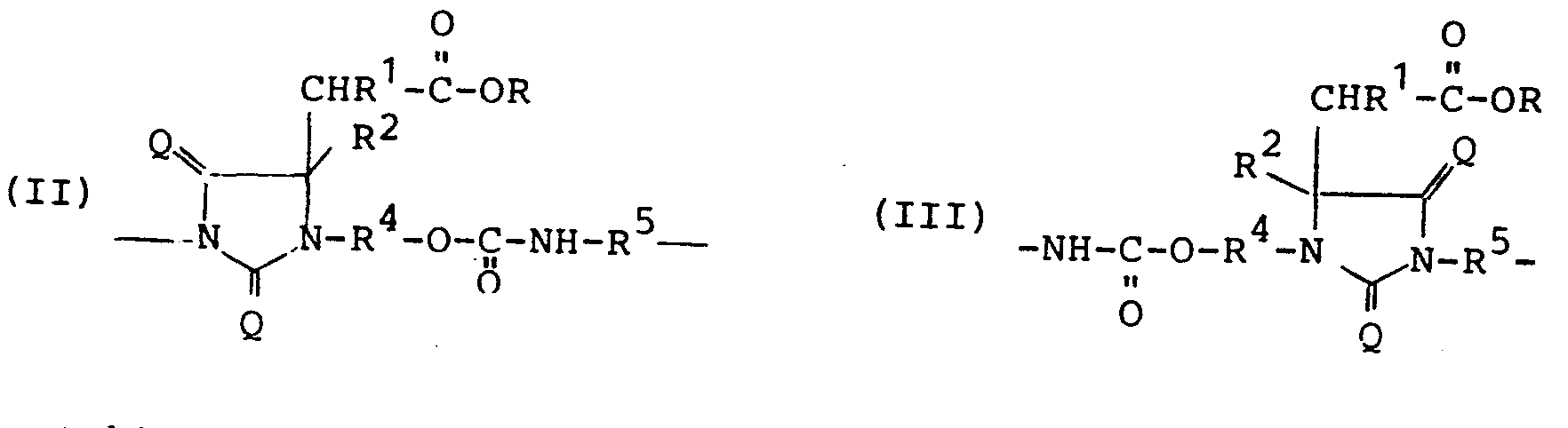
- R, R und R2 gleich oder verschieden, gegebenenfalls substituierte aliphatische, aliphatisch-aromatische oder aromatische Reste,
- R 4 einen mindestens zweiwertigen, gegebenenfalls substituierten aliphatischen, aliphatisch-aromatischen oder aromatischen Rest'
- R5 einen mindestens zweiwertigen, gegebenenfalls substituierten aliphatischen, aliphatisch-aromatischen oder aromatischen Rest der eingesetzten Polyiso(thio)cyanat- komponente,
- R1 und R2 außerdem noch Wasserstoff oder Halogen,
- Y 0 oder eine ganze Zahl, vorzugsweise von 1-20
- n eine ganze Zahl von 1 bis 3 und
- Q Sauerstoff oder Schwefel bedeuten.
- Ein weiterer Gegenstand der Erfindung ist ein Verfahren zur Herstellung von Polyiso(thio)cyanaten, die mit Carbonsäureestergruppen substituierte Hydantoinringe enthalten, durch Umsetzung von gegebenenfalls substituierten, gegebenenfalls in Polymeren eingebauten Äthylen-1,2-dicarbonsäureestern mit primären Aminoalkoholen zu den entsprechenden Asparaginsäureestern und gegebenenfalls gleichzeitige und/oder anschließende Reaktion mit Polyisocyanaten,das dadurch gekennzeichnet ist, daß pro Mol Asparaginsäureester mindestens 2,1 Äquivalente Isocyanat eingesetzt werden.
- Der Reaktionsverlauf kann schematisch durch folgende Formelgleichung wiedergegeben werden:

- In der Formelgleichung haben
- R, R1, R2, R4, R5, X und Y die oben angegebene Bedeutung,
- n steht für eine ganze Zahl von 1-3 und
- R 3 hat die Bedeutung von R, muß aber nicht identisch mit R sein.
- Zur Herstellung der erfindungsgemäßen Polyiso(thio)cyanate werden, gegebenenfalls über die Estergruppen polymerisierte, OH-gruppenhaltige Asparaginsäureester eingesetzt, die in situ oder in einer vorgeschalteten Reaktion aus,gegebenenfalls in Polymeren eingebauten 1,2-Dicarbonsäureestern und primären Aminoalkoholen in bekannter Weise zugänglich sind. Die ungesättigten Dicarbonsäureester erhält man durch Umsetzung der freien Säuren oder aus dem Anhydrid durch Veresterung mit Monoalkoholen wie Methanol, Äthanol, Butanol oder Cyclohexanol, Benzylalkohol, Äthylen-, Diäthylenglykolmonoäther, Phenol oder auch Polyalkoholen wie Äthylenglykol und/oder Glycerin, gegebenenfalls in Abmischung mit weiteren Polycarbonsäuren, gegebenenfalls in Gemisch mit Monoalkoholen oder mit hydroxyhaltigen Polyestern,
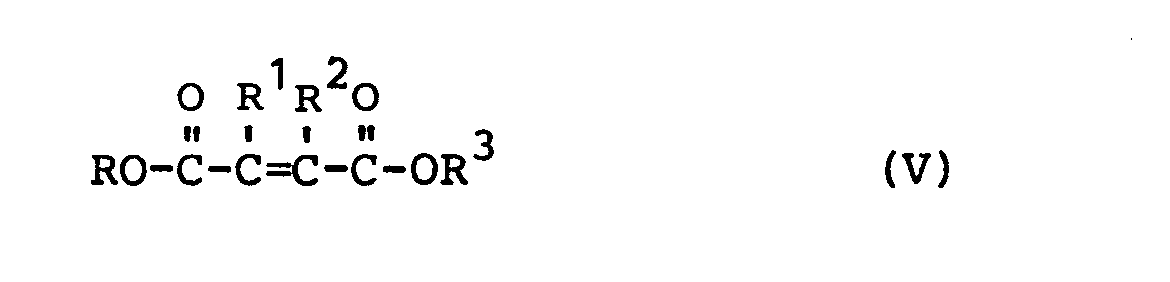
- R und R 3 in den oben angegebenen Formeln V und allen folgenden Formeln ist daher vorzugsweise ein aliphatischer Rest mit C1-C20, besonders bevorzugt C1-C10' der mit OH-Gruppen substituiert bzw. über Äther-, Ester-, Urethan-, Harnstoff-, Amid-, Imid-, Amidimid-, Esterimid-, Esteramidimid,- Epoxidgruppen usw. in Polymere eingebaut sein kann, oder mit R bzw. R2 einen Ring mit bis zu 8 Ringgliedern bildet.
- Neben den Malein- bzw. Fumarsäureestern können auch vorzugsweise Halogen- oder C1-C6 alkylsubstituierte Äthylen-1,2-dicarbonsäureester, vorzugsweise Methyl-, Dimethyl-, Äthyl-, Butyl-, Phenyl oder Δ 1-Cyclohexan-1,2-dicarbonsäureester in jeder isomeren Form zur Reaktion mit den Aminoalkoholen gebracht werden. Gegebenenfalls kann eine cis/trans- Isomerisierung durch Wärme, Basen und/oder Halogene erzielt werden. R1 und R2 in den oben angegebenen allgemeinen Formeln ist daher vorzugsweise, gleich oder verschieden, Wasserstoff, Halogen wie Chlor oder Fluor, oder ein Alkylrest mit C1-C6 oder Cycloalkylrest mit C5-C8, Alkylarylrest mit C7-C16, ein Arylrest mit C6-C20 und können zusammen einen Ring mit bis zu 8 Ringgliedern bilden.
- Besonders bevorzugt verwendet werden Ester der Malein- oder Fumarsäure mit Methanol, Äthanol, Butanolen, Benzylalkoholen, Phenolen, Glykoläther, sowie die Monoester mit Äthylen- und Diäthylenglykol, Glycerin.
- Die zum Aufbau der Asparaginsäureester eingesetzten Hydroxyaminoverbindungen können gegebenenfalls substituierte aliphatische, cycloaliphatische, araliphatische, aromatische oder auch heterocyclische Verbindungen sein, die neben mindestens einer Hydroxylgruppe eine primäre Aminogruppe im Molekül enthalten. Vorzugsweise bedeutet R4 in der allgemeinen Formel IV der Aminohydroxyverbindung einen aliphatischen Rest mit C2-C10, einen cycloaliphatischen Rest mit C4-C16, einen araliphatischen Rest mit C7-C16, einen aromatischen Rest mit C6- C20 oder einen ein oder mehrere Heteroatane wie N, 0 oder S enthaltenden Aryl-oder Cycloalkylrest mit C5-C12, die alle mit Halogen und/oder Alkylaruppen mit C1-C6 substituiert sein können. Besonders bevorzugt steht R4 für einen Alkylrest mit C2-C6, einen Cycloalkylrest mit C4-C10 oder einen Arylrest mit C6-C10' Als besonders bevorzugt verwendete Vertreter seien Äthanolamin, Propanolamin, Butanolamin, Aminomethylphenyl oder Aminophenol genannt.
- Die Addition der Hydroxyaminoverbindungen an die Äthylen-1,2-dicarbonsäureester erfolgt im allgemeinen bei Temperaturen von -30°C bis 100oC, bevorzugt bei -10°C bis 70 oC, um eine Aminolyse der in der jeweiligen Molekül noch vorhandenen Estergruppierungen zum Amid, gegebenenfalls auch Imid, zu vermeiden.
- Gegebenenfalls können bei der Addition Katalysatoren wie Kaliumcarbonat, Trialkylamin, Endoäthylenpiperazin, Essigsäure u.a. mitverwendet werden. Bei weniger löslichen bzw. höher schmelzenden Komponenten wird die 1. Reaktionsstufe im allgemeinen zweckmäßigerweise in organischen Lösungsmitteln durchgeführt, wie sie auch für die Folgereaktionen verwendet werden können und anschließend beschrieben sind. Die Mengenverhältnisse zwischen α,β-ungesättigten Carbonsäureestern und Aminoalkoholen sollten zweckmäßig stöchiometrisch gewählt werden. Überschüssige Anteile der einen oder anderen Komponente können jedoch eingesetzt und durch an sich bekannte, erfindungsgemäß nicht erfaßte Folgereaktionen in die Polymeren eingebaut werden.
- Anstelle der in situ hergestellten Hydroxylgruppen-haltige Asparaginsäureester können natürlich auch auf beliebigen Wegen hergestellte, gegebenenfalls durch Kristallisation und/oder Destillation gereinigte Vertreter dieser Substanzklasse eingesetzt werden.
- Als erfindungsgemäß einzusetzende Polyisocyanate kommen aliphatische, cycloaliphatische, araliphatische, aromatische und heterocyclische Polyisocyanate in Betracht (vgl. Annalen 562, Seiten 75 bis 136), beispielsweise Äthylen-diisocyanat, 1,4-Tetramethylendiisocyanat, 1,6-Hexamethylendiisocyanat, 1,12-Dodecandiisocyant, Cyclobutan-1,3-diisocyanat, Cyclohexan-1,3- und -1,4-diiso- canant sowie beliebige Gemische dieser Isomeren, 1-Iso- cyanato-3,3,5-trimethyl-5-isocyanato-methyl-cyclohexan (DAS 1 202 785), 2,4- und 2,6-Hexahydrotoluylendiisocyanat sowie beliebige Gemische dieser Isomeren, Hexahy- dro-1,3- und/oder -1,4-phenylen-diisocyanat, Perhydro-2,4'- und/oder -4,4'-diphenylmethan-diisocyanat, 1,3- und 1,4-Phenylendiisocyanat, 2,4- und 2,6-Toluylendiisocyanat sowie beliebige Gemische dieser Isomeren, Diphenylmethan-2,4'- und/oder -4,4'-diisocyanat, Naphthylen-1,5-diisocyanat, Triphenylmethan-2,2',4"-triisocyanat, Polyphenylpolymethylen-polyisocyanate, wie sie durch Anilin-Formaldehyd-Kondensation und anschließende Phosgenierung erhalten und z.B. in den britischen Patentschriften 874 430 und 848 671 beschrieben werden, perchlorierte Arylpolyisocyanate, wie sie z.B. in der deutschen Auslegeschrift 1 157 601 beschrieben werden, Carbodiimidgruppen aufweisende Polyisocyanate, wie sie in der deutschen Patentschrift 1 092 007 beschrieben werden, Diisocyanate, wie sie in der US-Patentschrift 3 492 330 beschrieben werden, Allophanatgruppen aufweisende Polyisocyanate, wie sie z.B. in der britischen Patentschrift 994 890, der belgischen Patentschrift 761 626 und der veröffentlichten holländischen Patentanmeldung 7 102 524 beschrieben werden, Isocyanuratgruppen aufweisende Polyisocyanate, wie sie z.B. in den deutschen Patentschriften 1 022 789, 1 222 067 und 1 027 394 sowie in den deutschen Offenlegungsschriften 1 929 034 und 2 004 048 beschrieben werden, Urethangruppen aufweisende Polyisocyanate, wie sie z.B. in der belgischen Patentschrift 752 261 oder in der US-Patentschrift 3 394 164 beschrieben werden, acylierte Harnstoffgruppen aufweisende Polyisocyanate gemäß der deutschen Patentschrift 1 230 778, Biuretgruppen aufweisende Polyisocyanate, wie sie z.B. in der deutschen Patentschrift 1 101 394, in der britischen Patentschrift 889 050 und in der französischen Patentschrift 7 015 514 beschrieben werden, durch Telomerisationsreaktionen hergestellte Polyisocyanate, wie sie z.B. in der belgischen Patentschrift 723 640 beschrieben werden, Estergruppen aufweisende Polyisocyanate, wie sie z.B. in den britischen Patentschriften 956 474 und 1 072 956, in der US-Patentschrift 3 567 763 und in der deutschen Patentschrift 1 231 688 genannt werden, Umsetzungsprodukte der obengenannten Isocyanate mit Acetalen gemäß der deutschen Patentschrift 1 072 358.
- Es ist auch möglich, die bei der technischen Isocyanatherstellung anfallenden, Isocyanatgruppen aufweisenden Destillationsrückstände, gegebenenfalls gelöst in einem oder mehreren der vorgenannten Polyisocyanate, einzusetzen. Ferner ist es möglich, beliebige Mischungen der vorgenannten Polyisocyanate zu verwenden.
- Vorzugsweise eignen sich Polyisocyanate der allgemeinen Formel
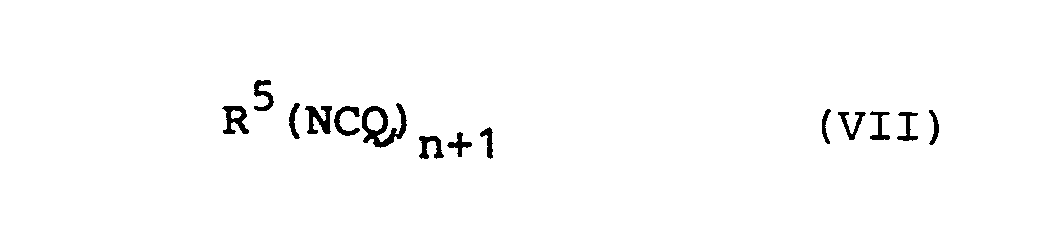
- Die Reste können alle durch Halogen, Alkyl- mit C1-C6 und/oder Arylgruppen mit C6-C16 substituiert sein.
- Bevorzugt verwendet werden die technisch leicht zugänglichen Gemische aus Toluylen-diisocyanaten, m-Phenylendiisocyanat, sowie phosgenierte Kondensate aus Anilin und Formaldehyd mit Polyphenylen-methylen-struktur und die symmetrischen Verbindungen 4,4'-Diisocyanatodiphenylmethan, 4,4'-Diisocyanatodiphenyläther, p-Phenylendiisocyanat und 4,4'-Diisocyanatodiphenyldimethylmethan, Isophorondiisocyanat sowie 4,4'-Diisocyanatodiphenylsulfid und Hexamethylendiisocyanat.
- Die Isocyanate können in freier Form, ferner zum Teil oder vollständig auch in Form ihrer beim Umsatz mit reaktiven Wasserstoff enthaltenden Verbindungen zugänglichen und unter den Reaktionsbedingungen als Isocyanat- Abspalter reagierenden Derivate eingesetzt werden.
- Vorzugsweise werden als Abspalter die aus aromatischen und aliphatischen Mono- und Polyhydroxy-Verbindungen enthaltenden Carbamidsäureester und die Additionsprodukte aus Lactamen, Oximen und CH-aciden Verbindungen eingesetzt.
- Als Beispiele seien die Carbamidsäureester aus Phenol, isomeren Kresolen, deren technischen Gemischen und ähnlichen aromatischen Hydroxylverbindungen, aliphatische Monoalkohole wie Methanol, Äthanol, Propanol, Isopropanol, Butanol, Isobutanol, Cyclohexanol, AlLylalkohol, Benzylaklohol und aliphatische Di- oder Polyole wie Äthylenglykol und Trimethylolpropan, weiterhin die Additionsprodukte mit Pyrrolidon-(2), Caprolactam, Butanon-oxim, Malonester, Acetessigester und Acetophenon aufgeführt. Ferner kommen hier die Monoäther von Äthylen- und Diäthylenglykol bzw. Propylen- und Dipropylenglykol mit Methanol, Äthanol, Butanol, Benzylalkohol oder Phenolen in Frage.
- Die Isocyanat-Abspalter können als solche eingesetzt oder erst in situ durch Umsetzung mit den entsprechenden Reaktanten erzeugt werden.
- Anstelle der genannten (Poly)Isocyanate können auch die analogen (Poly)Isothiocyanate als Ausgangsmaterialien benutzt werden.
- Die Mengenverhältnisse zwischen den OH-gruppenhaltigen Asparaginsäureester und Polyisocyanaten müssen so gewählt werden, daß die erhaltenen Reaktionsprodukte überschüssige Isocyanatgruppen, möglichst über 10%, vorzugsweise über 30%, gegebenenfalls in verkappter Form, enthalten sollen. Hierzu ist es erforderlich, daß pro Mol an eingesetztem Asparaginester mit zwei im Sinne der Zerewitinoff-Reaktion reaktiven H-Atome mehr als 2 Äquivalente an Isocyanatgruppen und maximal 2 Mol der einzusetzenden Polyisocyanatkomponente verwendet werden müssen, wobei allerdings überschüssiges eingesetztes Polyisocyanat, welches gegebenenfalls anschließend entfernt oder auch als zusätzliches nicht erfindungsgemäßes Polyisocyanat im Reaktionsprodukt belassen werden kann, nicht stört.Es sollten mindestens 2,1, vorzugsweise mindestens 2,2 Äquivalente Isocyanat pro Mol N-Hydroxyalkylasparaginsäureestereinheit eingesetzt werden.
- Die erfindungsgemäße Umsetzung der Hydroxygruppen-haltigen Asparaginsäureester mit den Polyisocyanaten zu den beanspruchten Polyhydantoingruppen enthaltenden Polyisocyanaten erfolgt gegebenenfalls in Lösungsmitteln, die gegenüber den Reaktionskomponenten inert sind oder aber speziell gegenüber der Polyisocyanatkomponente zu Verbindungen mit spaltbaren Additionsverbindungen befähigt sind, z.B. Phenole, Lactame, Alkohole, Kohlenwasserstoffe, Halogenkohlenwasserstoffe, Ester, cyclische Ester, Ketone, Äther, substituierte Amide, Nitrile. Genannt seien beispielsweise Phenol, techn. Kresolgemische, E-Caprolactam, Acetophenon, Äthylenglykolbutyläther, Diäthylglykolmethyläther, Cyclohexanon, Glykolmonomethylätheracetat, γ-Butyrolacton, ε-Caprolacton, Benzoesäurealkylester, N-Methylpyrrolidon, Dimethylformamid, Dimethylacetamid, Benzonitril und andere sowie deren Gemische.
- Zur Umsetzung der Asparaginsäureester mit den Polyisocyanaten werden die Reaktionskomponenten, gegebenenfalls mit den Lösungsmitteln einige Minuten bis zu mehreren Stunden bei Temperaturen von -30°C bis 350°C, bevorzugt -10°C bis 250°C, gehalten. Der Reaktionsverlauf kann über die IR-Spektren verfolgt werden.
- Die hohe Geschwindigkeit der erfindungsgemäßen Umsetzung gestattet auch deren Durchführung in Gegenwart phenolischer und/oder alkoholischer Hydroxylgruppen und/oder Amidgruppen, d.h. derartige Gruppierungen können in den Umsetzungskomponenten, gegebenenfalls als Blockmittel, durchaus vorhanden sein, bzw. überschüssige Hydroxyl- bzw. Lactam-Komponenten können auch als Lösungsmittel verwendet werden.
- Die Durchführung dieser Reaktion kann gegebenenfalls unter Inertgas vorgenommen werden.
- Die Acidität saurer Lösungsmittel wie der Phenole bzw. Kresole genügt zur Reaktionsführung innerhalb hinreichend kurzer Reaktionszeiten. In inerten Medien oder in Schmelzansätzen können beispielsweise Carbonsäuren mit hinreichendem Schmelz- bzw. Siedepunkt wie Essigsäure, Benzoesäure, Bernsteinsäure, Benzoldicarbonsäuren, Butantetracarbonsäure, Trimelitsäure bzw. deren Anhydride gegebenenfalls auch als einbauiähige Katalysatoren in Mengen von 0,1 bis 40, vorzugsweise von 1 bis 10 Prozent in Val, bezogen auf ein Val Isocyanat, mitverwendet werden.
- Zur weiteren Beschleunigung der ablaufenden Reaktionen sind die aus der Isocyanatchemie geeigneten bekannten Basen, Säuren und/oder Metallkatalysatoren wie Triäthylamin, N-Methylmorpholin, Endoäthylenpiperazin, Titantetrabutylat, Titanaminoalkoholat, Eisenacetylacetonat, Dibutylzinndilaurat, Bleioctoat, Essigsäure oder p-Toluolsulfonsäure zu verwenden.
- Wie bereits erwähnt, kann die erfindungsgemäße Umsetzung auch in situ aus den einzelnen Komponenten, d.h. den Aminoalkoholen, den d.,ß-ungesättigten 1,2-Dicarbonestern und den gegebenenfalls latent blockierten Polyisocyanaten in einem Reaktionsschritt durchgeführt werden. Eine weitere Variante des Verfahrens besteht in einer dergestalt verlaufenden Reaktionsfolge, daß die aus der Aminoalkoholkomponente und den gegebenenfalls latent blockierten Polyisocyanaten erhaltenen primären Additionsprodukte durch Zugabe der gegebenenfalls in Polymeren eingebauten α,β-ungesättigten 1,2-Dicarbonester in die erfindungsgemäßen Hydantoingruppen enthaltenden gegebenenfalls blockierten Polyisocyanate übergeführt werden,(indem sich unter den Reaktionsbedingungen der erfindungsgemäßen Umsetzung offensichtlich Gleichgewichte der entsprechenden Reaktionskomponenten einstellen). Ferner können auch die in Polymere, z.B. Polyester, Polyurethan Polyamiden, Polyimiden, Polyesterimiden, Polyamidimiden, Polyesteramidimiden, Polyepoxiden usw. eingebauten α,β-ungesättigen -1,2-Dicarbonsäureester mit Aminoalkoholen und Polyisocyanaten zu den erfindungsgemäßen Hydantoingruppen enthaltenden Verbindungen umgesetzt und eingebaut werden.
- Die erfindungsgemäßen Hydantoingruppen enthaltenden Polyisocyanate stellen hochviskose bis spröde Massen dar, die je nach ihrem Anwendungszweck in konzentrierter Form oder auch als Lösungen in den bereits früher aufgeführten Lösungsmitteln vorliegen können.
- Die erfindungsgemäßen Hydantoingruppen enthaltenden Polyisocyanate werden zur Herstellung von Polyurethankunststoffen, vorzugsweise von Elektroisolierstoffen, eingesetzt. Hierbei können die erfindungsgemäßen Polyisocyanate direkt mit den üblichen Polyestern, Polyesterimiden, Polyamidimiden, Polyesteramidimiden, Polyesterhydantoinen unter Ausbildung von Carbonester- und Carbamidesterstrukturen nach den bekannten Methoden eingebrannt werden. Eine weitere Variante für die beschriebenen Polyisocyanate besteht darin, daß sie als Polyester- und Polyisocyanatkomponente in den üblichen Verfahren zur Herstellung von gegebenenfalls Estergruppen aufweisenden Polyimiden, Polyamidimiden und Polyhydantoinen eingesetzt werden können. Diese Reaktion kann sowohl in einer vorgeschalteten Operation als auch in situ zusammen mit dem Einbrennvorgang vorgenommen werden. Die hierzu angewendeteten Verfahrensweise gehen beispielsweise aus den BE 678 282, DP 1 035 362 hervor.
- a)

- Das tiefbraune Harz besitzt im IR die typischen Hydantoinbanden, hat einen latenten NCO-Gehalt von 9,0 Gew.-% und besitzt in 70 gew.-%iger Lösung in Carbitol eine Viskosität von ca. 8500 cP20°C·
- b)


-


- a)
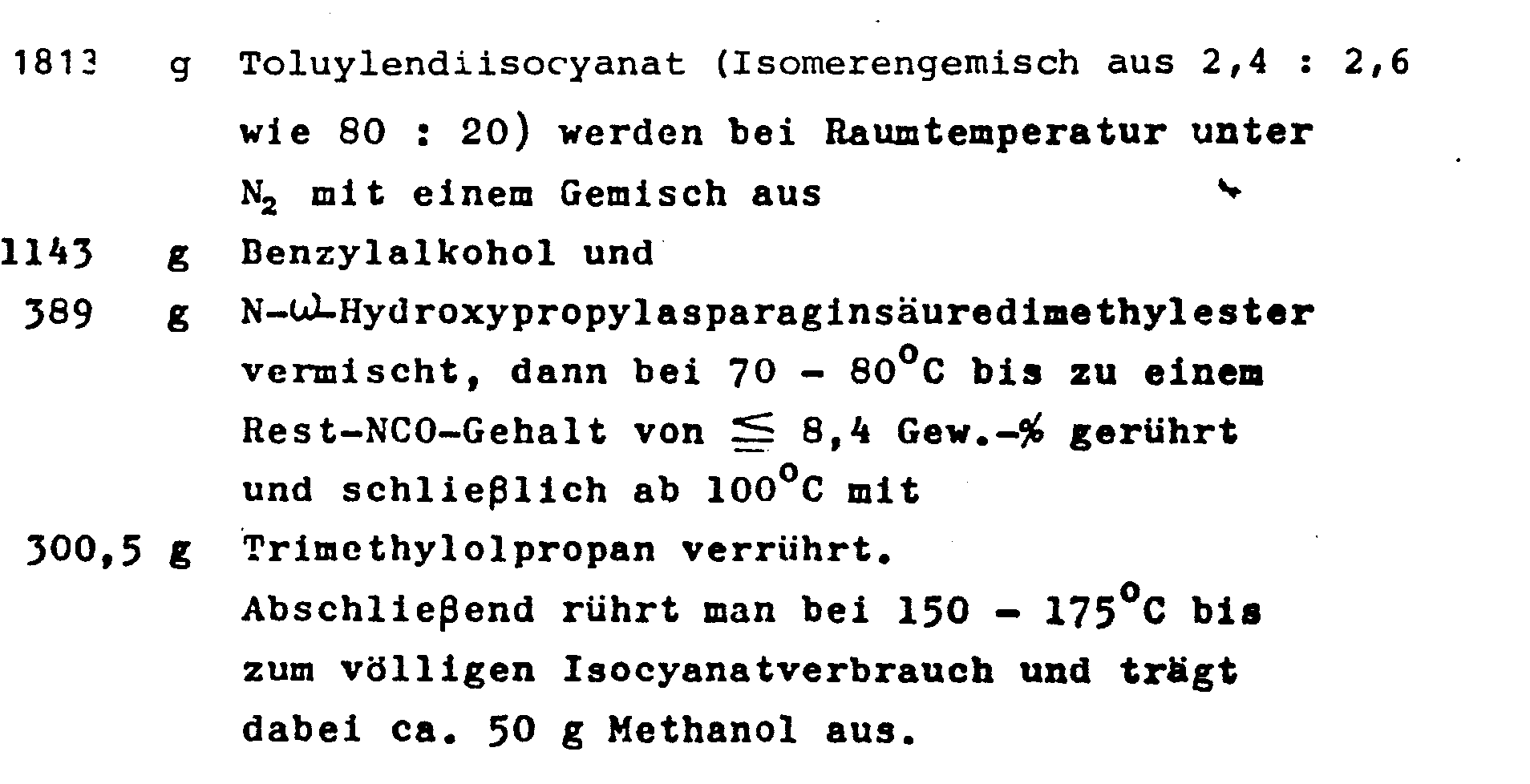
- Die resultierende hellbraune Schmelze besitzt einen Fp: 66°C, eine Viskosität von ca. 998 cP150°C, einen latenten NCO-Gehalt von ca. 12,0 Gew.-%.
- b)

- Der bei einer Abzugsgeschwindigkeit von 10 m lackisolierte Cu-Draht besitzt eine Erweichungstemperatur von 240 - 250°C, einen Hitzeschock von ca. 180ZC bei hoher Elastizität, guter Schabefestigkeit und einer Lötzeit von ca. 2 Sekunden bei 370°C. Das Schmelzharz selbst hat einen Fp von 50°C und eine Viskosität von 358 cP150°C.
- a)

- Das bei Raumtemperatur spröde, honigfarbene Harz besitzt einen Fp: 92 - 95°C, eine Viskosität von 1610 cP20°C, 50 %ig in Methylglykolacetat, sowie einen Hydroxylgehalt von ca. 5,8 Gew.-%.
- b)

- Mit dieser Lacklösung kann mit einer Aumann-Drahtlackiermaschine FLK 240®bei einer Ofentemperatur von 450/500°C ein 0,1 mm Cu-Draht mit einer Abzugsgeschwindigkeit von 450/400 m lackiert werden. Die Lötzeit beträgt ca. 1 Sekunde bei 360°C, der tg δ liegt bei > 150°C.
-
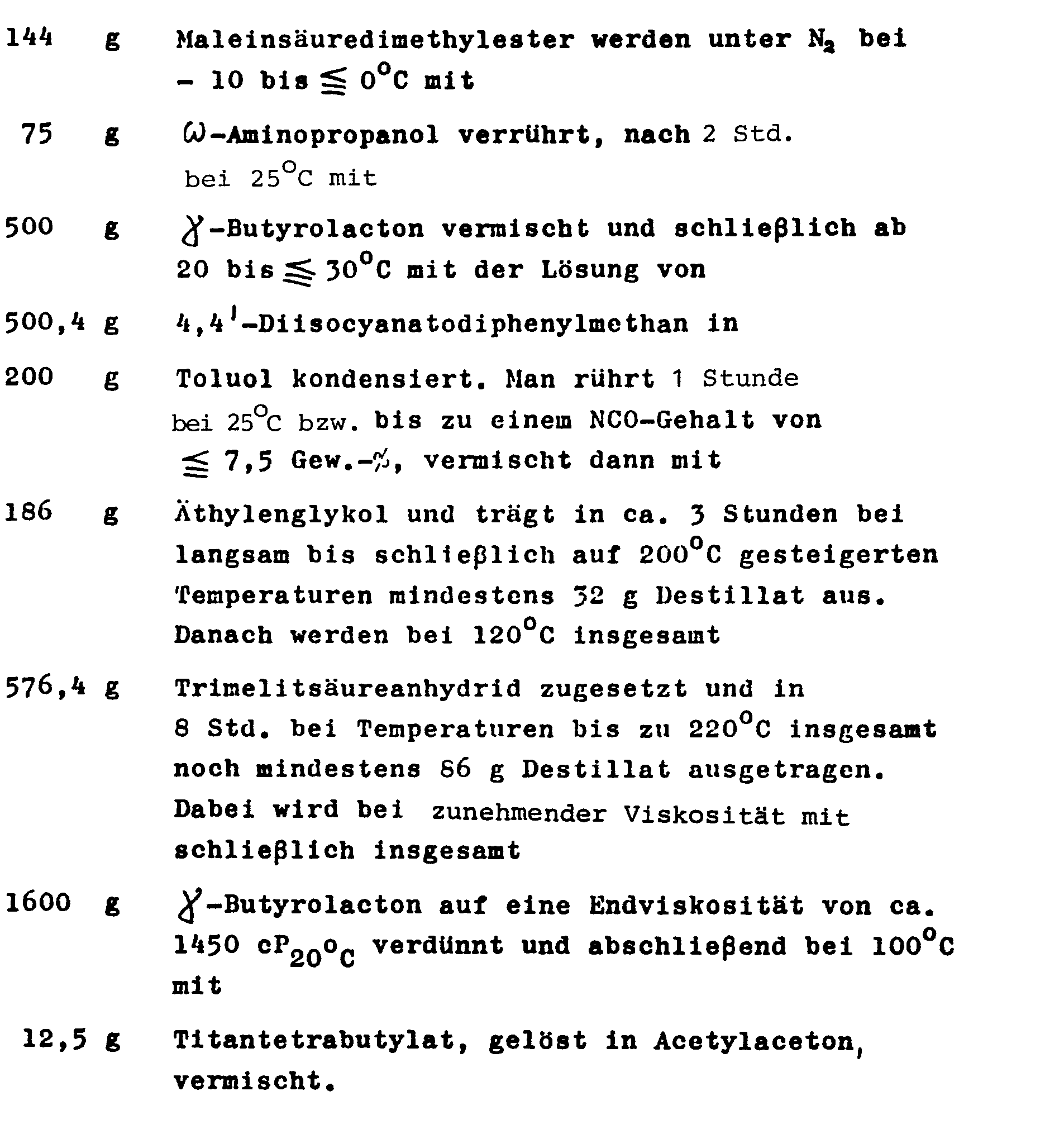
- Das nach einer Methanolfällung verbleibende Bindemittel besitzt die den Hydantoinen und Amidimiden eigenen IR-Banden.
- Der mit der Lacklösung in einem 4 m Ofen bei 9 m/Minute auf einen 0,7 mm Cu-Draht aufgebrachte Lackfilm besitzt eine Erweichungstemperatur von > 330°C, einen Hitzeschock von >260°C und eine gute Lösungsmittelfestigkeit.
- a)

- b)


- Die resultierende Lacklösung besitzt eine Viskosität von ca. 27 Sekunden im For d-4-Becher.
- Die Lackierung eines 0,7 mm Cu-Drahtes mit obiger Lacklösung in einem 3 m-Ofen von ca. 320°C Ofentemperatur liefert bei einer Abzugsgeschwindigkeit von 10 m/Minute einen elastischen Lackfilm von guter Oberflächenhärte mit einer Erweichstemperatur von ca. 260°C, einem Hitzeschock von gut 180°C sowie einem tg γ-Knickpunkt von ca. 150°C und einer Lötzeit von < 1 Sekunde bei 370°C.
-
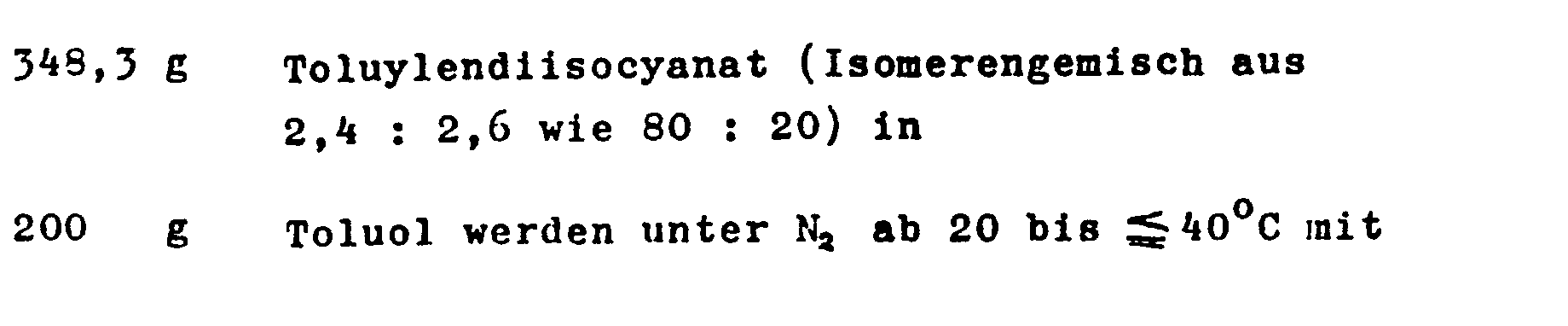

- Das resultierende spröde, honiggelbe Harz besitzt eine Viskosität von ca. 87 000 cP160°C und einen NCO-Gehalt von 15,2 Gew.-%.
- a)

- Das hellbraune Produkt zeigt im IR-Spektrum u.a. die für Hydantoine typischen Absorbtionsbanden und besitzt eine Viskosität von 210 cP bei 150°C.
- b)

- Das resultierende Harz besitzt eine Viskosität von ca. 2700 cl bei 170°C.
- Es kann entweder direkt aus der Schmelze bei einer Badtemperatur von ca. 160 - 170°C oder beispielsweise aus einer ca. 35 Gewichtsprozentigen Lösung in Benzylalkohol mit einer Lösungsviskosität von ca. 2450 cp20°C zur Beschichtung hitzeresistenter Substrate verwendet werden.
- So besitzen die aus der obigen Schmelze oder aus der obigen Lösung in einem 4 m-Ofen bei 400°C auf einem Cu-Draht von 0,7 mm eingebrannten Lackfilme eine Erweichungstemperatur von > 330°C, einen Hitzeschock von mindestens 240°C, eine Wärmealterung von mindestens 7 Tagen 200°C bei hoher Elastizität, guter Schabefestigkeit und Lösungsmittelbeständigkeit.
Claims (10)




Applications Claiming Priority (2)
| Application Number | Priority Date | Filing Date | Title |
|---|---|---|---|
| DE2750722 | 1977-11-12 | ||
| DE19772750722 DE2750722A1 (de) | 1977-11-12 | 1977-11-12 | Heterocyclische polyisocyanate |
Publications (2)
| Publication Number | Publication Date |
|---|---|
| EP0002001A1 true EP0002001A1 (de) | 1979-05-30 |
| EP0002001B1 EP0002001B1 (de) | 1981-04-01 |
Family
ID=6023626
Family Applications (1)
| Application Number | Title | Priority Date | Filing Date |
|---|---|---|---|
| EP78101269A Expired EP0002001B1 (de) | 1977-11-12 | 1978-11-02 | Heterocyclische Polyisocyanate, ihre Herstellung und Verwendung |
Country Status (4)
| Country | Link |
|---|---|
| EP (1) | EP0002001B1 (de) |
| JP (1) | JPS5476581A (de) |
| DE (2) | DE2750722A1 (de) |
| IT (1) | IT1109255B (de) |
Cited By (8)
| Publication number | Priority date | Publication date | Assignee | Title |
|---|---|---|---|---|
| EP0744427A3 (de) * | 1995-05-23 | 1997-03-19 | Bayer Ag | Blockierte Polyisocyanate mit verbesserter thermischer Stabilität |
| EP0744426A3 (de) * | 1995-05-23 | 1997-03-19 | Bayer Ag | Blockierte Polyisocyanate mit verbesserter thermischer Stabilität |
| EP0744425A3 (de) * | 1995-05-23 | 1997-03-19 | Bayer Ag | Blockierte Polyisocyanate mit verbesserter thermischer Stabilität |
| EP0744424A3 (de) * | 1995-05-23 | 1997-03-19 | Bayer Ag | Blockierte Polyisocyanate mit verbesserter thermischer Stabilität |
| EP0931791A1 (de) * | 1998-01-23 | 1999-07-28 | Basf Aktiengesellschaft | Hydantoingruppenhaltige Diisocyanate und diese beinhaltende Polyurethane |
| EP1199321A1 (de) * | 2000-10-17 | 2002-04-24 | Bayer Ag | Lackbindemittel mit Harnstoff- und/oder Hydantoinstrukturen, ein Verfahren zu ihrer Herstellung und deren Verwendung |
| WO2006076724A3 (en) * | 2005-01-13 | 2006-10-19 | Du Pont | Durable coating compositions containing aspartic amine compounds with improved potlife |
| WO2012059512A1 (de) | 2010-11-03 | 2012-05-10 | Verbio Vereinigte Bioenergie Ag | Verfahren zur gewinnung von phytosterolen und/oder tocopherolen aus rückständen einer destillation von estern pflanzlicher öle, vorzugsweise aus destillationsrückständen aus einer umesterung von pflanzlichen ölen |
Families Citing this family (2)
| Publication number | Priority date | Publication date | Assignee | Title |
|---|---|---|---|---|
| DE3405939A1 (de) * | 1984-02-18 | 1985-08-22 | Bayer Ag, 5090 Leverkusen | Verfahren zur herstellung von urethanmodifizierten polyisocyanat-zubereitungen und ihre verwendung bei der herstellung von polyurethankunststoffen oder von polyisocyanuratkunststoffen |
| CZ2010300A3 (cs) | 2010-04-16 | 2011-10-26 | Ecoraw, S.R.O. | Rozperka |
Citations (1)
| Publication number | Priority date | Publication date | Assignee | Title |
|---|---|---|---|---|
| DE1670812A1 (de) * | 1967-03-01 | 1971-03-11 | Bayer Ag | Polycarbonsaeureester |
-
1977
- 1977-11-12 DE DE19772750722 patent/DE2750722A1/de not_active Withdrawn
-
1978
- 1978-11-02 DE DE7878101269T patent/DE2860588D1/de not_active Expired
- 1978-11-02 EP EP78101269A patent/EP0002001B1/de not_active Expired
- 1978-11-10 IT IT51862/78A patent/IT1109255B/it active
- 1978-11-11 JP JP13842678A patent/JPS5476581A/ja active Pending
Patent Citations (1)
| Publication number | Priority date | Publication date | Assignee | Title |
|---|---|---|---|---|
| DE1670812A1 (de) * | 1967-03-01 | 1971-03-11 | Bayer Ag | Polycarbonsaeureester |
Cited By (10)
| Publication number | Priority date | Publication date | Assignee | Title |
|---|---|---|---|---|
| EP0744427A3 (de) * | 1995-05-23 | 1997-03-19 | Bayer Ag | Blockierte Polyisocyanate mit verbesserter thermischer Stabilität |
| EP0744426A3 (de) * | 1995-05-23 | 1997-03-19 | Bayer Ag | Blockierte Polyisocyanate mit verbesserter thermischer Stabilität |
| EP0744425A3 (de) * | 1995-05-23 | 1997-03-19 | Bayer Ag | Blockierte Polyisocyanate mit verbesserter thermischer Stabilität |
| EP0744424A3 (de) * | 1995-05-23 | 1997-03-19 | Bayer Ag | Blockierte Polyisocyanate mit verbesserter thermischer Stabilität |
| US5668238A (en) * | 1995-05-23 | 1997-09-16 | Bayer Corporation | Blocked polyisocyanates with improved thermal stability |
| EP0931791A1 (de) * | 1998-01-23 | 1999-07-28 | Basf Aktiengesellschaft | Hydantoingruppenhaltige Diisocyanate und diese beinhaltende Polyurethane |
| EP1199321A1 (de) * | 2000-10-17 | 2002-04-24 | Bayer Ag | Lackbindemittel mit Harnstoff- und/oder Hydantoinstrukturen, ein Verfahren zu ihrer Herstellung und deren Verwendung |
| WO2006076724A3 (en) * | 2005-01-13 | 2006-10-19 | Du Pont | Durable coating compositions containing aspartic amine compounds with improved potlife |
| US7427647B2 (en) | 2005-01-13 | 2008-09-23 | E.I. Du Pont De Nemours & Company | Durable coating compositions containing aspartic amine compounds with improved potlife |
| WO2012059512A1 (de) | 2010-11-03 | 2012-05-10 | Verbio Vereinigte Bioenergie Ag | Verfahren zur gewinnung von phytosterolen und/oder tocopherolen aus rückständen einer destillation von estern pflanzlicher öle, vorzugsweise aus destillationsrückständen aus einer umesterung von pflanzlichen ölen |
Also Published As
| Publication number | Publication date |
|---|---|
| DE2750722A1 (de) | 1979-05-17 |
| JPS5476581A (en) | 1979-06-19 |
| IT7851862A0 (it) | 1978-11-10 |
| IT1109255B (it) | 1985-12-16 |
| DE2860588D1 (en) | 1981-04-23 |
| EP0002001B1 (de) | 1981-04-01 |
Similar Documents
| Publication | Publication Date | Title |
|---|---|---|
| DE2542706C3 (de) | Verfahren zur Herstellung von Imidgruppen enthaltenden Polykondensaten | |
| DE2725318A1 (de) | Verfahren zur herstellung von allophanatgruppen aufweisenden polyisocyanaten | |
| DE10041943A1 (de) | Polyamidimidharzlösung und ihre Verwendung zur Herstellung von Drahtlacken | |
| EP0002001B1 (de) | Heterocyclische Polyisocyanate, ihre Herstellung und Verwendung | |
| EP1238993A1 (de) | Verfahren zur Herstellung von Polyisocyanaten durch Umsetzung von Carbonsäuren mit Isocyanaten, die nach diesem Verfahren hergestellten Produkte und deren Verwendung in Polyurethankunststoffen | |
| EP0012379B1 (de) | Lackmischung und Beschichtungsmittel enthaltend Polyamidhydantione | |
| DE2654112C2 (de) | Polykondensate | |
| EP0002662B1 (de) | Verfahren zur Herstellung von (Thio)Hydantoinen | |
| EP0015479B1 (de) | Temperaturbeständige vernetzte Polymere, ihre Verwendung, sie enthaltende Lösungen bzw. Mischungen und deren Verwendung | |
| EP0012381B1 (de) | Verfahren zur Herstellung von Hydantoingruppen enthaltenden Verbindungen | |
| EP0183150B1 (de) | Verfahren zur Herstellung von modifizierten Polyisocyanaten und ihre Verwendung in Polyurethananlacken | |
| CH502343A (de) | Verfahren zur Herstellung von Polycarbonsäureestern | |
| EP0033477B1 (de) | Verfahren zur Herstellung von Hydantoinen und deren Verwendung in temperaturbeständigen Lacken, Folien, Klebern, Schaumstoffen oder Formkörpern | |
| DE2714655A1 (de) | Verfahren zur herstellung von hydantoinen | |
| EP0085880B1 (de) | Verfahren zur Herstellung von Ethen-(1,2)-dicarbonamidsäureestern | |
| EP0013727B1 (de) | Verfahren zur Herstellung von (Thio)hydantoinen und ihre Verwendung als hitzebeständige Überzugsmaterialien, Folien, Pulver, Kleber, Formkörper, Lacke und Fasern | |
| EP0002445A1 (de) | Einen Hydantoin- oder Thiohydantoin-Ring enthaltende Polyiso(thio) cyanate, ihre Herstellung und Verwendung | |
| EP0002444B1 (de) | Verfahren zur Herstellung von Hydantoinen und nach diesem Verfahren erhältliche Verbindungen | |
| EP0080079B1 (de) | Verfahren zur Herstellung von Hydantoinen | |
| EP0086278B1 (de) | Verfahren zur Herstellung von Hydantoinestern | |
| EP0012380B1 (de) | Verfahren zur Herstellung von Amidimidgruppen aufweisenden Polyhydantoinen, deren Verwendung zur Herstellung hitzebeständiger Beschichtungsmaterialien sowie daraus hergestellte Lackmischungen | |
| DE2657560C2 (de) | ||
| DE2855770A1 (de) | Hydantoine | |
| DE2443575C2 (de) | Verfahren zur Herstellung von Imid- Gruppen enthaltenden Polykondensaten | |
| EP0044418B1 (de) | Verfahren zur Herstellung von Imidazolidin-trionen |
Legal Events
| Date | Code | Title | Description |
|---|---|---|---|
| PUAI | Public reference made under article 153(3) epc to a published international application that has entered the european phase |
Free format text: ORIGINAL CODE: 0009012 |
|
| 17P | Request for examination filed | ||
| AK | Designated contracting states |
Designated state(s): DE FR GB |
|
| GRAA | (expected) grant |
Free format text: ORIGINAL CODE: 0009210 |
|
| AK | Designated contracting states |
Designated state(s): DE FR GB |
|
| REF | Corresponds to: |
Ref document number: 2860588 Country of ref document: DE Date of ref document: 19810423 |
|
| PGFP | Annual fee paid to national office [announced via postgrant information from national office to epo] |
Ref country code: FR Payment date: 19811127 Year of fee payment: 4 |
|
| PGFP | Annual fee paid to national office [announced via postgrant information from national office to epo] |
Ref country code: DE Payment date: 19821231 Year of fee payment: 5 |
|
| PG25 | Lapsed in a contracting state [announced via postgrant information from national office to epo] |
Ref country code: FR Free format text: LAPSE BECAUSE OF NON-PAYMENT OF DUE FEES Effective date: 19830729 |
|
| REG | Reference to a national code |
Ref country code: FR Ref legal event code: ST |
|
| GBPC | Gb: european patent ceased through non-payment of renewal fee | ||
| PG25 | Lapsed in a contracting state [announced via postgrant information from national office to epo] |
Ref country code: DE Effective date: 19840801 |
|
| PG25 | Lapsed in a contracting state [announced via postgrant information from national office to epo] |
Ref country code: GB Effective date: 19881117 |
|
| PLBE | No opposition filed within time limit |
Free format text: ORIGINAL CODE: 0009261 |
|
| STAA | Information on the status of an ep patent application or granted ep patent |
Free format text: STATUS: NO OPPOSITION FILED WITHIN TIME LIMIT |