EP0001148B1 - Verfahren zum Beschichten von Glasoberflächen - Google Patents
Verfahren zum Beschichten von Glasoberflächen Download PDFInfo
- Publication number
- EP0001148B1 EP0001148B1 EP78200172A EP78200172A EP0001148B1 EP 0001148 B1 EP0001148 B1 EP 0001148B1 EP 78200172 A EP78200172 A EP 78200172A EP 78200172 A EP78200172 A EP 78200172A EP 0001148 B1 EP0001148 B1 EP 0001148B1
- Authority
- EP
- European Patent Office
- Prior art keywords
- coating
- glass
- necessary
- glass surfaces
- blocked
- Prior art date
- Legal status (The legal status is an assumption and is not a legal conclusion. Google has not performed a legal analysis and makes no representation as to the accuracy of the status listed.)
- Expired
Links
- 239000011521 glass Substances 0.000 title claims description 46
- 238000000576 coating method Methods 0.000 title claims description 41
- 239000011248 coating agent Substances 0.000 title claims description 34
- 238000000034 method Methods 0.000 title claims description 21
- 150000001875 compounds Chemical class 0.000 claims description 31
- -1 cyclic amidines Chemical class 0.000 claims description 30
- 239000005056 polyisocyanate Substances 0.000 claims description 25
- 229920001228 polyisocyanate Polymers 0.000 claims description 25
- 239000003795 chemical substances by application Substances 0.000 claims description 24
- 230000008018 melting Effects 0.000 claims description 22
- 238000002844 melting Methods 0.000 claims description 22
- 239000004593 Epoxy Substances 0.000 claims description 19
- 239000000126 substance Substances 0.000 claims description 8
- 125000002887 hydroxy group Chemical group [H]O* 0.000 claims description 7
- BLRPTPMANUNPDV-UHFFFAOYSA-N Silane Chemical compound [SiH4] BLRPTPMANUNPDV-UHFFFAOYSA-N 0.000 claims description 4
- 239000000654 additive Substances 0.000 claims description 4
- 230000001476 alcoholic effect Effects 0.000 claims description 4
- 125000003118 aryl group Chemical group 0.000 claims description 4
- 239000002245 particle Substances 0.000 claims description 4
- 229910000077 silane Inorganic materials 0.000 claims description 4
- 238000005245 sintering Methods 0.000 claims description 4
- 125000000217 alkyl group Chemical group 0.000 claims description 3
- 125000000753 cycloalkyl group Chemical group 0.000 claims description 3
- 229920006395 saturated elastomer Polymers 0.000 claims description 3
- 125000001424 substituent group Chemical group 0.000 claims description 3
- 125000002947 alkylene group Chemical group 0.000 claims description 2
- 125000004432 carbon atom Chemical group C* 0.000 claims description 2
- 239000000975 dye Substances 0.000 claims description 2
- 229910052739 hydrogen Inorganic materials 0.000 claims description 2
- 239000001257 hydrogen Substances 0.000 claims description 2
- 125000004435 hydrogen atom Chemical class [H]* 0.000 claims description 2
- 229910052760 oxygen Inorganic materials 0.000 claims description 2
- 125000004430 oxygen atom Chemical group O* 0.000 claims description 2
- 229910052717 sulfur Inorganic materials 0.000 claims description 2
- 125000004434 sulfur atom Chemical group 0.000 claims description 2
- 125000004122 cyclic group Chemical group 0.000 claims 1
- 238000000151 deposition Methods 0.000 claims 1
- 125000001183 hydrocarbyl group Chemical group 0.000 claims 1
- 230000001681 protective effect Effects 0.000 claims 1
- 239000000203 mixture Substances 0.000 description 44
- 239000000843 powder Substances 0.000 description 33
- NIMLQBUJDJZYEJ-UHFFFAOYSA-N isophorone diisocyanate Chemical compound CC1(C)CC(N=C=O)CC(C)(CN=C=O)C1 NIMLQBUJDJZYEJ-UHFFFAOYSA-N 0.000 description 30
- CSCPPACGZOOCGX-UHFFFAOYSA-N Acetone Chemical compound CC(C)=O CSCPPACGZOOCGX-UHFFFAOYSA-N 0.000 description 27
- 239000005058 Isophorone diisocyanate Substances 0.000 description 26
- MTHSVFCYNBDYFN-UHFFFAOYSA-N diethylene glycol Chemical compound OCCOCCO MTHSVFCYNBDYFN-UHFFFAOYSA-N 0.000 description 24
- 229920000647 polyepoxide Polymers 0.000 description 22
- 239000003822 epoxy resin Substances 0.000 description 14
- 238000006243 chemical reaction Methods 0.000 description 13
- 239000007787 solid Substances 0.000 description 13
- IISBACLAFKSPIT-UHFFFAOYSA-N bisphenol A Chemical compound C=1C=C(O)C=CC=1C(C)(C)C1=CC=C(O)C=C1 IISBACLAFKSPIT-UHFFFAOYSA-N 0.000 description 12
- 239000008199 coating composition Substances 0.000 description 12
- 239000007795 chemical reaction product Substances 0.000 description 11
- RTZKZFJDLAIYFH-UHFFFAOYSA-N Diethyl ether Chemical compound CCOCC RTZKZFJDLAIYFH-UHFFFAOYSA-N 0.000 description 9
- BKCCAYLNRIRKDJ-UHFFFAOYSA-N 2-phenyl-4,5-dihydro-1h-imidazole Chemical compound N1CCN=C1C1=CC=CC=C1 BKCCAYLNRIRKDJ-UHFFFAOYSA-N 0.000 description 8
- 238000009472 formulation Methods 0.000 description 8
- DIHAURBCYGTGCV-UHFFFAOYSA-N xi-4,5-Dihydro-2,4(5)-dimethyl-1H-imidazole Chemical compound CC1CN=C(C)N1 DIHAURBCYGTGCV-UHFFFAOYSA-N 0.000 description 8
- 239000004848 polyfunctional curative Substances 0.000 description 7
- XEKOWRVHYACXOJ-UHFFFAOYSA-N Ethyl acetate Chemical compound CCOC(C)=O XEKOWRVHYACXOJ-UHFFFAOYSA-N 0.000 description 6
- 230000000903 blocking effect Effects 0.000 description 6
- 239000012948 isocyanate Substances 0.000 description 6
- 150000002513 isocyanates Chemical class 0.000 description 6
- 230000008569 process Effects 0.000 description 6
- 239000011541 reaction mixture Substances 0.000 description 6
- JJUVAPMVTXLLFR-UHFFFAOYSA-N 5-methyl-2-phenyl-4,5-dihydro-1h-imidazole Chemical compound N1C(C)CN=C1C1=CC=CC=C1 JJUVAPMVTXLLFR-UHFFFAOYSA-N 0.000 description 5
- DHKHKXVYLBGOIT-UHFFFAOYSA-N acetaldehyde Diethyl Acetal Natural products CCOC(C)OCC DHKHKXVYLBGOIT-UHFFFAOYSA-N 0.000 description 5
- 125000001931 aliphatic group Chemical group 0.000 description 5
- 125000005442 diisocyanate group Chemical group 0.000 description 5
- IQPQWNKOIGAROB-UHFFFAOYSA-N isocyanate group Chemical group [N-]=C=O IQPQWNKOIGAROB-UHFFFAOYSA-N 0.000 description 5
- 239000000155 melt Substances 0.000 description 5
- 150000005326 tetrahydropyrimidines Chemical class 0.000 description 5
- 239000004970 Chain extender Substances 0.000 description 4
- 125000003700 epoxy group Chemical group 0.000 description 4
- 239000010410 layer Substances 0.000 description 4
- 238000011417 postcuring Methods 0.000 description 4
- 239000000047 product Substances 0.000 description 4
- 239000011241 protective layer Substances 0.000 description 4
- XLYOFNOQVPJJNP-UHFFFAOYSA-N water Substances O XLYOFNOQVPJJNP-UHFFFAOYSA-N 0.000 description 4
- OTPDWCMLUKMQNO-UHFFFAOYSA-N 1,2,3,4-tetrahydropyrimidine Chemical compound C1NCC=CN1 OTPDWCMLUKMQNO-UHFFFAOYSA-N 0.000 description 3
- ZWEHNKRNPOVVGH-UHFFFAOYSA-N 2-Butanone Chemical compound CCC(C)=O ZWEHNKRNPOVVGH-UHFFFAOYSA-N 0.000 description 3
- WJIOHMVWGVGWJW-UHFFFAOYSA-N 3-methyl-n-[4-[(3-methylpyrazole-1-carbonyl)amino]butyl]pyrazole-1-carboxamide Chemical compound N1=C(C)C=CN1C(=O)NCCCCNC(=O)N1N=C(C)C=C1 WJIOHMVWGVGWJW-UHFFFAOYSA-N 0.000 description 3
- UHOVQNZJYSORNB-UHFFFAOYSA-N Benzene Chemical compound C1=CC=CC=C1 UHOVQNZJYSORNB-UHFFFAOYSA-N 0.000 description 3
- LYCAIKOWRPUZTN-UHFFFAOYSA-N Ethylene glycol Chemical compound OCCO LYCAIKOWRPUZTN-UHFFFAOYSA-N 0.000 description 3
- PEDCQBHIVMGVHV-UHFFFAOYSA-N Glycerine Chemical compound OCC(O)CO PEDCQBHIVMGVHV-UHFFFAOYSA-N 0.000 description 3
- ZMXDDKWLCZADIW-UHFFFAOYSA-N N,N-Dimethylformamide Chemical compound CN(C)C=O ZMXDDKWLCZADIW-UHFFFAOYSA-N 0.000 description 3
- YXFVVABEGXRONW-UHFFFAOYSA-N Toluene Chemical compound CC1=CC=CC=C1 YXFVVABEGXRONW-UHFFFAOYSA-N 0.000 description 3
- 230000008901 benefit Effects 0.000 description 3
- 239000004305 biphenyl Substances 0.000 description 3
- 238000010438 heat treatment Methods 0.000 description 3
- 239000007788 liquid Substances 0.000 description 3
- 238000004519 manufacturing process Methods 0.000 description 3
- 238000002360 preparation method Methods 0.000 description 3
- 229920005989 resin Polymers 0.000 description 3
- 239000011347 resin Substances 0.000 description 3
- 239000002904 solvent Substances 0.000 description 3
- 238000005507 spraying Methods 0.000 description 3
- 238000003756 stirring Methods 0.000 description 3
- 229920001187 thermosetting polymer Polymers 0.000 description 3
- 229920002554 vinyl polymer Polymers 0.000 description 3
- 229940008841 1,6-hexamethylene diisocyanate Drugs 0.000 description 2
- IKHGUXGNUITLKF-UHFFFAOYSA-N Acetaldehyde Chemical compound CC=O IKHGUXGNUITLKF-UHFFFAOYSA-N 0.000 description 2
- HEDRZPFGACZZDS-UHFFFAOYSA-N Chloroform Chemical compound ClC(Cl)Cl HEDRZPFGACZZDS-UHFFFAOYSA-N 0.000 description 2
- IAZDPXIOMUYVGZ-UHFFFAOYSA-N Dimethylsulphoxide Chemical compound CS(C)=O IAZDPXIOMUYVGZ-UHFFFAOYSA-N 0.000 description 2
- IMNFDUFMRHMDMM-UHFFFAOYSA-N N-Heptane Chemical compound CCCCCCC IMNFDUFMRHMDMM-UHFFFAOYSA-N 0.000 description 2
- ISWSIDIOOBJBQZ-UHFFFAOYSA-N Phenol Chemical compound OC1=CC=CC=C1 ISWSIDIOOBJBQZ-UHFFFAOYSA-N 0.000 description 2
- NINIDFKCEFEMDL-UHFFFAOYSA-N Sulfur Chemical group [S] NINIDFKCEFEMDL-UHFFFAOYSA-N 0.000 description 2
- WYURNTSHIVDZCO-UHFFFAOYSA-N Tetrahydrofuran Chemical compound C1CCOC1 WYURNTSHIVDZCO-UHFFFAOYSA-N 0.000 description 2
- YIMQCDZDWXUDCA-UHFFFAOYSA-N [4-(hydroxymethyl)cyclohexyl]methanol Chemical compound OCC1CCC(CO)CC1 YIMQCDZDWXUDCA-UHFFFAOYSA-N 0.000 description 2
- 150000001241 acetals Chemical class 0.000 description 2
- 150000001409 amidines Chemical class 0.000 description 2
- 125000003277 amino group Chemical group 0.000 description 2
- 229940058307 antinematodal tetrahydropyrimidine derivative Drugs 0.000 description 2
- 230000015572 biosynthetic process Effects 0.000 description 2
- 239000002981 blocking agent Substances 0.000 description 2
- 230000009172 bursting Effects 0.000 description 2
- DKPFZGUDAPQIHT-UHFFFAOYSA-N butyl acetate Chemical compound CCCCOC(C)=O DKPFZGUDAPQIHT-UHFFFAOYSA-N 0.000 description 2
- CQEYYJKEWSMYFG-UHFFFAOYSA-N butyl acrylate Chemical compound CCCCOC(=O)C=C CQEYYJKEWSMYFG-UHFFFAOYSA-N 0.000 description 2
- 229910052799 carbon Inorganic materials 0.000 description 2
- 235000014171 carbonated beverage Nutrition 0.000 description 2
- 239000003054 catalyst Substances 0.000 description 2
- MVPPADPHJFYWMZ-UHFFFAOYSA-N chlorobenzene Chemical compound ClC1=CC=CC=C1 MVPPADPHJFYWMZ-UHFFFAOYSA-N 0.000 description 2
- 238000004140 cleaning Methods 0.000 description 2
- JHIVVAPYMSGYDF-UHFFFAOYSA-N cyclohexanone Chemical compound O=C1CCCCC1 JHIVVAPYMSGYDF-UHFFFAOYSA-N 0.000 description 2
- BGTOWKSIORTVQH-UHFFFAOYSA-N cyclopentanone Chemical compound O=C1CCCC1 BGTOWKSIORTVQH-UHFFFAOYSA-N 0.000 description 2
- 238000004821 distillation Methods 0.000 description 2
- 238000001035 drying Methods 0.000 description 2
- 150000002118 epoxides Chemical group 0.000 description 2
- 150000002148 esters Chemical class 0.000 description 2
- 125000000524 functional group Chemical group 0.000 description 2
- RRAMGCGOFNQTLD-UHFFFAOYSA-N hexamethylene diisocyanate Chemical compound O=C=NCCCCCCN=C=O RRAMGCGOFNQTLD-UHFFFAOYSA-N 0.000 description 2
- MTNDZQHUAFNZQY-UHFFFAOYSA-N imidazoline Chemical compound C1CN=CN1 MTNDZQHUAFNZQY-UHFFFAOYSA-N 0.000 description 2
- 150000002462 imidazolines Chemical class 0.000 description 2
- 239000000463 material Substances 0.000 description 2
- 125000000956 methoxy group Chemical group [H]C([H])([H])O* 0.000 description 2
- QPJVMBTYPHYUOC-UHFFFAOYSA-N methyl benzoate Chemical compound COC(=O)C1=CC=CC=C1 QPJVMBTYPHYUOC-UHFFFAOYSA-N 0.000 description 2
- 238000002156 mixing Methods 0.000 description 2
- LQNUZADURLCDLV-UHFFFAOYSA-N nitrobenzene Chemical compound [O-][N+](=O)C1=CC=CC=C1 LQNUZADURLCDLV-UHFFFAOYSA-N 0.000 description 2
- 229910052757 nitrogen Inorganic materials 0.000 description 2
- 230000003647 oxidation Effects 0.000 description 2
- 238000007254 oxidation reaction Methods 0.000 description 2
- 229940083254 peripheral vasodilators imidazoline derivative Drugs 0.000 description 2
- XYFCBTPGUUZFHI-UHFFFAOYSA-N phosphine group Chemical group P XYFCBTPGUUZFHI-UHFFFAOYSA-N 0.000 description 2
- 229920003023 plastic Polymers 0.000 description 2
- 229920000768 polyamine Polymers 0.000 description 2
- 229920000570 polyether Polymers 0.000 description 2
- 229920005862 polyol Polymers 0.000 description 2
- 150000003077 polyols Chemical class 0.000 description 2
- 238000007086 side reaction Methods 0.000 description 2
- 239000007858 starting material Substances 0.000 description 2
- VZGDMQKNWNREIO-UHFFFAOYSA-N tetrachloromethane Chemical compound ClC(Cl)(Cl)Cl VZGDMQKNWNREIO-UHFFFAOYSA-N 0.000 description 2
- 238000001291 vacuum drying Methods 0.000 description 2
- DNIAPMSPPWPWGF-VKHMYHEASA-N (+)-propylene glycol Chemical compound C[C@H](O)CO DNIAPMSPPWPWGF-VKHMYHEASA-N 0.000 description 1
- ZWVMLYRJXORSEP-UHFFFAOYSA-N 1,2,6-Hexanetriol Chemical compound OCCCCC(O)CO ZWVMLYRJXORSEP-UHFFFAOYSA-N 0.000 description 1
- ZTNJGMFHJYGMDR-UHFFFAOYSA-N 1,2-diisocyanatoethane Chemical compound O=C=NCCN=C=O ZTNJGMFHJYGMDR-UHFFFAOYSA-N 0.000 description 1
- RTTZISZSHSCFRH-UHFFFAOYSA-N 1,3-bis(isocyanatomethyl)benzene Chemical compound O=C=NCC1=CC=CC(CN=C=O)=C1 RTTZISZSHSCFRH-UHFFFAOYSA-N 0.000 description 1
- PCHXZXKMYCGVFA-UHFFFAOYSA-N 1,3-diazetidine-2,4-dione Chemical compound O=C1NC(=O)N1 PCHXZXKMYCGVFA-UHFFFAOYSA-N 0.000 description 1
- YPFDHNVEDLHUCE-UHFFFAOYSA-N 1,3-propanediol Substances OCCCO YPFDHNVEDLHUCE-UHFFFAOYSA-N 0.000 description 1
- RYHBNJHYFVUHQT-UHFFFAOYSA-N 1,4-Dioxane Chemical compound C1COCCO1 RYHBNJHYFVUHQT-UHFFFAOYSA-N 0.000 description 1
- ALQLPWJFHRMHIU-UHFFFAOYSA-N 1,4-diisocyanatobenzene Chemical compound O=C=NC1=CC=C(N=C=O)C=C1 ALQLPWJFHRMHIU-UHFFFAOYSA-N 0.000 description 1
- QGLRLXLDMZCFBP-UHFFFAOYSA-N 1,6-diisocyanato-2,4,4-trimethylhexane Chemical compound O=C=NCC(C)CC(C)(C)CCN=C=O QGLRLXLDMZCFBP-UHFFFAOYSA-N 0.000 description 1
- ULJDCHKHOJHGBW-UHFFFAOYSA-N 1,8-diisocyanato-2,4-dimethyloctane Chemical compound O=C=NCC(C)CC(C)CCCCN=C=O ULJDCHKHOJHGBW-UHFFFAOYSA-N 0.000 description 1
- MIDIHVRZNKERPO-UHFFFAOYSA-N 1,9-diisocyanato-5-methylnonane Chemical compound O=C=NCCCCC(C)CCCCN=C=O MIDIHVRZNKERPO-UHFFFAOYSA-N 0.000 description 1
- VXNZUUAINFGPBY-UHFFFAOYSA-N 1-Butene Chemical compound CCC=C VXNZUUAINFGPBY-UHFFFAOYSA-N 0.000 description 1
- OZCMOJQQLBXBKI-UHFFFAOYSA-N 1-ethenoxy-2-methylpropane Chemical compound CC(C)COC=C OZCMOJQQLBXBKI-UHFFFAOYSA-N 0.000 description 1
- SFWXMFQDGKFTLH-UHFFFAOYSA-N 2,3-dimethyl-2,6-dihydro-1h-pyrimidine Chemical compound CC1NCC=CN1C SFWXMFQDGKFTLH-UHFFFAOYSA-N 0.000 description 1
- ZNWOXGIEIAGCQA-UHFFFAOYSA-N 2-(2-methylphenyl)-4,5-dihydro-1h-imidazole Chemical compound CC1=CC=CC=C1C1=NCCN1 ZNWOXGIEIAGCQA-UHFFFAOYSA-N 0.000 description 1
- VDGKMJYQQUTBQD-UHFFFAOYSA-N 2-(4-methylphenyl)-4,5-dihydro-1h-imidazole Chemical compound C1=CC(C)=CC=C1C1=NCCN1 VDGKMJYQQUTBQD-UHFFFAOYSA-N 0.000 description 1
- IZXIZTKNFFYFOF-UHFFFAOYSA-N 2-Oxazolidone Chemical compound O=C1NCCO1 IZXIZTKNFFYFOF-UHFFFAOYSA-N 0.000 description 1
- CMBVSYQSELVHQA-UHFFFAOYSA-N 2-benzyl-1,2,3,4-tetrahydropyrimidine Chemical compound C=1C=CC=CC=1CC1NCC=CN1 CMBVSYQSELVHQA-UHFFFAOYSA-N 0.000 description 1
- GVPLALUKJMMFAU-UHFFFAOYSA-N 2-ethyl-1,2,3,4-tetrahydropyrimidine Chemical compound CCC1NCC=CN1 GVPLALUKJMMFAU-UHFFFAOYSA-N 0.000 description 1
- QUPKCFBHJFNUEW-UHFFFAOYSA-N 2-ethyl-4,5-dihydro-1h-imidazole Chemical compound CCC1=NCCN1 QUPKCFBHJFNUEW-UHFFFAOYSA-N 0.000 description 1
- GKUYEWXKJWAGHB-UHFFFAOYSA-N 2-ethyl-4-methyl-1,2,3,4-tetrahydropyrimidine Chemical compound CCC1NC=CC(C)N1 GKUYEWXKJWAGHB-UHFFFAOYSA-N 0.000 description 1
- SHYARJUKNREDGB-UHFFFAOYSA-N 2-ethyl-5-methyl-4,5-dihydro-1h-imidazole Chemical compound CCC1=NCC(C)N1 SHYARJUKNREDGB-UHFFFAOYSA-N 0.000 description 1
- YIWUKEYIRIRTPP-UHFFFAOYSA-N 2-ethylhexanol Substances CCCCC(CC)CO YIWUKEYIRIRTPP-UHFFFAOYSA-N 0.000 description 1
- FEJIGNDKURQIRD-UHFFFAOYSA-N 2-methyl-1,2,3,4-tetrahydropyrimidine Chemical compound CC1NCC=CN1 FEJIGNDKURQIRD-UHFFFAOYSA-N 0.000 description 1
- VWSLLSXLURJCDF-UHFFFAOYSA-N 2-methyl-4,5-dihydro-1h-imidazole Chemical compound CC1=NCCN1 VWSLLSXLURJCDF-UHFFFAOYSA-N 0.000 description 1
- HALGJUKFQIYBHW-UHFFFAOYSA-N 2-phenyl-1,2,3,4-tetrahydropyrimidine Chemical compound N1C=CCNC1C1=CC=CC=C1 HALGJUKFQIYBHW-UHFFFAOYSA-N 0.000 description 1
- ZXTHWIZHGLNEPG-UHFFFAOYSA-N 2-phenyl-4,5-dihydro-1,3-oxazole Chemical compound O1CCN=C1C1=CC=CC=C1 ZXTHWIZHGLNEPG-UHFFFAOYSA-N 0.000 description 1
- RNLHGQLZWXBQNY-UHFFFAOYSA-N 3-(aminomethyl)-3,5,5-trimethylcyclohexan-1-amine Chemical compound CC1(C)CC(N)CC(C)(CN)C1 RNLHGQLZWXBQNY-UHFFFAOYSA-N 0.000 description 1
- OAUXRCWJJKAORT-UHFFFAOYSA-N 3-methyl-2,6-dihydro-1h-pyrimidine Chemical compound CN1CNCC=C1 OAUXRCWJJKAORT-UHFFFAOYSA-N 0.000 description 1
- UPMLOUAZCHDJJD-UHFFFAOYSA-N 4,4'-Diphenylmethane Diisocyanate Chemical compound C1=CC(N=C=O)=CC=C1CC1=CC=C(N=C=O)C=C1 UPMLOUAZCHDJJD-UHFFFAOYSA-N 0.000 description 1
- HMLNCJWNWZMUMI-UHFFFAOYSA-N 4-[(2-phenyl-4,5-dihydro-1h-imidazol-5-yl)methyl]morpholine Chemical compound C1COCCN1CC(N=1)CNC=1C1=CC=CC=C1 HMLNCJWNWZMUMI-UHFFFAOYSA-N 0.000 description 1
- HWQZOQMYXVPOSU-UHFFFAOYSA-N 5-butyl-2-methyl-4,5-dihydro-1h-imidazole Chemical compound CCCCC1CNC(C)=N1 HWQZOQMYXVPOSU-UHFFFAOYSA-N 0.000 description 1
- WPYMKLBDIGXBTP-UHFFFAOYSA-N Benzoic acid Natural products OC(=O)C1=CC=CC=C1 WPYMKLBDIGXBTP-UHFFFAOYSA-N 0.000 description 1
- 239000005711 Benzoic acid Substances 0.000 description 1
- OKTJSMMVPCPJKN-UHFFFAOYSA-N Carbon Chemical compound [C] OKTJSMMVPCPJKN-UHFFFAOYSA-N 0.000 description 1
- BRLQWZUYTZBJKN-UHFFFAOYSA-N Epichlorohydrin Chemical compound ClCC1CO1 BRLQWZUYTZBJKN-UHFFFAOYSA-N 0.000 description 1
- 208000020564 Eye injury Diseases 0.000 description 1
- 238000005684 Liebig rearrangement reaction Methods 0.000 description 1
- NTIZESTWPVYFNL-UHFFFAOYSA-N Methyl isobutyl ketone Chemical compound CC(C)CC(C)=O NTIZESTWPVYFNL-UHFFFAOYSA-N 0.000 description 1
- UIHCLUNTQKBZGK-UHFFFAOYSA-N Methyl isobutyl ketone Natural products CCC(C)C(C)=O UIHCLUNTQKBZGK-UHFFFAOYSA-N 0.000 description 1
- FXHOOIRPVKKKFG-UHFFFAOYSA-N N,N-Dimethylacetamide Chemical compound CN(C)C(C)=O FXHOOIRPVKKKFG-UHFFFAOYSA-N 0.000 description 1
- 239000004698 Polyethylene Substances 0.000 description 1
- 239000004721 Polyphenylene oxide Substances 0.000 description 1
- 229920000388 Polyphosphate Polymers 0.000 description 1
- XBDQKXXYIPTUBI-UHFFFAOYSA-M Propionate Chemical compound CCC([O-])=O XBDQKXXYIPTUBI-UHFFFAOYSA-M 0.000 description 1
- DNIAPMSPPWPWGF-UHFFFAOYSA-N Propylene glycol Chemical class CC(O)CO DNIAPMSPPWPWGF-UHFFFAOYSA-N 0.000 description 1
- 206010041662 Splinter Diseases 0.000 description 1
- ZJCCRDAZUWHFQH-UHFFFAOYSA-N Trimethylolpropane Chemical compound CCC(CO)(CO)CO ZJCCRDAZUWHFQH-UHFFFAOYSA-N 0.000 description 1
- 208000027418 Wounds and injury Diseases 0.000 description 1
- HCHKCACWOHOZIP-UHFFFAOYSA-N Zinc Chemical compound [Zn] HCHKCACWOHOZIP-UHFFFAOYSA-N 0.000 description 1
- KXKVLQRXCPHEJC-UHFFFAOYSA-N acetic acid trimethyl ester Natural products COC(C)=O KXKVLQRXCPHEJC-UHFFFAOYSA-N 0.000 description 1
- 239000002253 acid Substances 0.000 description 1
- 239000003513 alkali Substances 0.000 description 1
- 229910001854 alkali hydroxide Inorganic materials 0.000 description 1
- 150000008044 alkali metal hydroxides Chemical class 0.000 description 1
- 125000003545 alkoxy group Chemical group 0.000 description 1
- KFVBMBOOLFSJHV-UHFFFAOYSA-K aluminum;sodium;hexane-1,2,3,4,5,6-hexol;carbonate;hydroxide Chemical compound [OH-].[Na+].[Al+3].[O-]C([O-])=O.OCC(O)C(O)C(O)C(O)CO KFVBMBOOLFSJHV-UHFFFAOYSA-K 0.000 description 1
- 150000008064 anhydrides Chemical class 0.000 description 1
- 239000000010 aprotic solvent Substances 0.000 description 1
- 239000012736 aqueous medium Substances 0.000 description 1
- 125000003710 aryl alkyl group Chemical group 0.000 description 1
- 150000005840 aryl radicals Chemical class 0.000 description 1
- QVGXLLKOCUKJST-UHFFFAOYSA-N atomic oxygen Chemical group [O] QVGXLLKOCUKJST-UHFFFAOYSA-N 0.000 description 1
- 235000013405 beer Nutrition 0.000 description 1
- 235000010233 benzoic acid Nutrition 0.000 description 1
- 235000010290 biphenyl Nutrition 0.000 description 1
- MLVSWIXRZNPEKF-UPHRSURJSA-N bis(oxiran-2-ylmethyl) (z)-but-2-enedioate Chemical compound C1OC1COC(=O)\C=C/C(=O)OCC1CO1 MLVSWIXRZNPEKF-UPHRSURJSA-N 0.000 description 1
- JRPRCOLKIYRSNH-UHFFFAOYSA-N bis(oxiran-2-ylmethyl) benzene-1,2-dicarboxylate Chemical compound C=1C=CC=C(C(=O)OCC2OC2)C=1C(=O)OCC1CO1 JRPRCOLKIYRSNH-UHFFFAOYSA-N 0.000 description 1
- KIKYOFDZBWIHTF-UHFFFAOYSA-N bis(oxiran-2-ylmethyl) cyclohex-3-ene-1,2-dicarboxylate Chemical compound C1CC=CC(C(=O)OCC2OC2)C1C(=O)OCC1CO1 KIKYOFDZBWIHTF-UHFFFAOYSA-N 0.000 description 1
- XFUOBHWPTSIEOV-UHFFFAOYSA-N bis(oxiran-2-ylmethyl) cyclohexane-1,2-dicarboxylate Chemical compound C1CCCC(C(=O)OCC2OC2)C1C(=O)OCC1CO1 XFUOBHWPTSIEOV-UHFFFAOYSA-N 0.000 description 1
- KBWLNCUTNDKMPN-UHFFFAOYSA-N bis(oxiran-2-ylmethyl) hexanedioate Chemical compound C1OC1COC(=O)CCCCC(=O)OCC1CO1 KBWLNCUTNDKMPN-UHFFFAOYSA-N 0.000 description 1
- OHJMTUPIZMNBFR-UHFFFAOYSA-N biuret Chemical compound NC(=O)NC(N)=O OHJMTUPIZMNBFR-UHFFFAOYSA-N 0.000 description 1
- CDQSJQSWAWPGKG-UHFFFAOYSA-N butane-1,1-diol Chemical class CCCC(O)O CDQSJQSWAWPGKG-UHFFFAOYSA-N 0.000 description 1
- IAQRGUVFOMOMEM-UHFFFAOYSA-N butene Natural products CC=CC IAQRGUVFOMOMEM-UHFFFAOYSA-N 0.000 description 1
- 150000001732 carboxylic acid derivatives Chemical class 0.000 description 1
- PMMYEEVYMWASQN-IMJSIDKUSA-N cis-4-Hydroxy-L-proline Chemical compound O[C@@H]1CN[C@H](C(O)=O)C1 PMMYEEVYMWASQN-IMJSIDKUSA-N 0.000 description 1
- 239000012459 cleaning agent Substances 0.000 description 1
- 238000003776 cleavage reaction Methods 0.000 description 1
- 239000011247 coating layer Substances 0.000 description 1
- 238000009833 condensation Methods 0.000 description 1
- 230000005494 condensation Effects 0.000 description 1
- 238000001816 cooling Methods 0.000 description 1
- 229920001577 copolymer Polymers 0.000 description 1
- 238000004132 cross linking Methods 0.000 description 1
- 239000003431 cross linking reagent Substances 0.000 description 1
- 150000004292 cyclic ethers Chemical class 0.000 description 1
- 125000002993 cycloalkylene group Chemical class 0.000 description 1
- 230000006378 damage Effects 0.000 description 1
- 238000000354 decomposition reaction Methods 0.000 description 1
- 235000014113 dietary fatty acids Nutrition 0.000 description 1
- GYZLOYUZLJXAJU-UHFFFAOYSA-N diglycidyl ether Chemical class C1OC1COCC1CO1 GYZLOYUZLJXAJU-UHFFFAOYSA-N 0.000 description 1
- 150000002009 diols Chemical class 0.000 description 1
- 238000007598 dipping method Methods 0.000 description 1
- 238000009826 distribution Methods 0.000 description 1
- 230000000694 effects Effects 0.000 description 1
- 125000001033 ether group Chemical group 0.000 description 1
- 150000002170 ethers Chemical class 0.000 description 1
- 125000001301 ethoxy group Chemical group [H]C([H])([H])C([H])([H])O* 0.000 description 1
- 239000002360 explosive Substances 0.000 description 1
- 229930195729 fatty acid Natural products 0.000 description 1
- 239000000194 fatty acid Substances 0.000 description 1
- 150000004665 fatty acids Chemical class 0.000 description 1
- 239000000945 filler Substances 0.000 description 1
- 238000005429 filling process Methods 0.000 description 1
- 239000011888 foil Substances 0.000 description 1
- 235000013305 food Nutrition 0.000 description 1
- 239000012634 fragment Substances 0.000 description 1
- 235000015203 fruit juice Nutrition 0.000 description 1
- 230000009477 glass transition Effects 0.000 description 1
- 125000003055 glycidyl group Chemical group C(C1CO1)* 0.000 description 1
- LNEPOXFFQSENCJ-UHFFFAOYSA-N haloperidol Chemical compound C1CC(O)(C=2C=CC(Cl)=CC=2)CCN1CCCC(=O)C1=CC=C(F)C=C1 LNEPOXFFQSENCJ-UHFFFAOYSA-N 0.000 description 1
- 125000000623 heterocyclic group Chemical group 0.000 description 1
- ACCCMOQWYVYDOT-UHFFFAOYSA-N hexane-1,1-diol Chemical class CCCCCC(O)O ACCCMOQWYVYDOT-UHFFFAOYSA-N 0.000 description 1
- NAQMVNRVTILPCV-UHFFFAOYSA-N hexane-1,6-diamine Chemical class NCCCCCCN NAQMVNRVTILPCV-UHFFFAOYSA-N 0.000 description 1
- XXMIOPMDWAUFGU-UHFFFAOYSA-N hexane-1,6-diol Chemical compound OCCCCCCO XXMIOPMDWAUFGU-UHFFFAOYSA-N 0.000 description 1
- 150000002430 hydrocarbons Chemical group 0.000 description 1
- 208000014674 injury Diseases 0.000 description 1
- 229910052500 inorganic mineral Inorganic materials 0.000 description 1
- 150000002576 ketones Chemical class 0.000 description 1
- 230000007246 mechanism Effects 0.000 description 1
- QSHDDOUJBYECFT-UHFFFAOYSA-N mercury Chemical compound [Hg] QSHDDOUJBYECFT-UHFFFAOYSA-N 0.000 description 1
- 229910052753 mercury Inorganic materials 0.000 description 1
- 229940095102 methyl benzoate Drugs 0.000 description 1
- 239000011707 mineral Substances 0.000 description 1
- SYSQUGFVNFXIIT-UHFFFAOYSA-N n-[4-(1,3-benzoxazol-2-yl)phenyl]-4-nitrobenzenesulfonamide Chemical class C1=CC([N+](=O)[O-])=CC=C1S(=O)(=O)NC1=CC=C(C=2OC3=CC=CC=C3N=2)C=C1 SYSQUGFVNFXIIT-UHFFFAOYSA-N 0.000 description 1
- 239000001301 oxygen Substances 0.000 description 1
- 239000003973 paint Substances 0.000 description 1
- ZUOUZKKEUPVFJK-UHFFFAOYSA-N phenylbenzene Natural products C1=CC=CC=C1C1=CC=CC=C1 ZUOUZKKEUPVFJK-UHFFFAOYSA-N 0.000 description 1
- 150000004714 phosphonium salts Chemical group 0.000 description 1
- 229910000073 phosphorus hydride Inorganic materials 0.000 description 1
- 239000000049 pigment Substances 0.000 description 1
- 239000004033 plastic Substances 0.000 description 1
- 239000006223 plastic coating Substances 0.000 description 1
- 239000002985 plastic film Substances 0.000 description 1
- 229920006255 plastic film Polymers 0.000 description 1
- 229920000728 polyester Polymers 0.000 description 1
- 229920001223 polyethylene glycol Polymers 0.000 description 1
- 239000001205 polyphosphate Substances 0.000 description 1
- 235000011176 polyphosphates Nutrition 0.000 description 1
- 229920001451 polypropylene glycol Polymers 0.000 description 1
- 229920000166 polytrimethylene carbonate Polymers 0.000 description 1
- 150000003141 primary amines Chemical class 0.000 description 1
- 235000013772 propylene glycol Nutrition 0.000 description 1
- 230000009257 reactivity Effects 0.000 description 1
- 238000001953 recrystallisation Methods 0.000 description 1
- 230000007017 scission Effects 0.000 description 1
- 150000003335 secondary amines Chemical class 0.000 description 1
- 230000035939 shock Effects 0.000 description 1
- 238000007873 sieving Methods 0.000 description 1
- 150000004756 silanes Chemical class 0.000 description 1
- 229920002050 silicone resin Polymers 0.000 description 1
- 238000004513 sizing Methods 0.000 description 1
- 239000000344 soap Substances 0.000 description 1
- 159000000000 sodium salts Chemical class 0.000 description 1
- 239000003381 stabilizer Substances 0.000 description 1
- 238000003860 storage Methods 0.000 description 1
- 150000005846 sugar alcohols Polymers 0.000 description 1
- 239000011593 sulfur Chemical group 0.000 description 1
- YBBRCQOCSYXUOC-UHFFFAOYSA-N sulfuryl dichloride Chemical compound ClS(Cl)(=O)=O YBBRCQOCSYXUOC-UHFFFAOYSA-N 0.000 description 1
- 150000003512 tertiary amines Chemical class 0.000 description 1
- YLQBMQCUIZJEEH-UHFFFAOYSA-N tetrahydrofuran Natural products C=1C=COC=1 YLQBMQCUIZJEEH-UHFFFAOYSA-N 0.000 description 1
- 239000012815 thermoplastic material Substances 0.000 description 1
- YODZTKMDCQEPHD-UHFFFAOYSA-N thiodiglycol Chemical compound OCCSCCO YODZTKMDCQEPHD-UHFFFAOYSA-N 0.000 description 1
- 229950006389 thiodiglycol Drugs 0.000 description 1
- 239000013008 thixotropic agent Substances 0.000 description 1
- JIVZKJJQOZQXQB-UHFFFAOYSA-N tolazoline Chemical compound C=1C=CC=CC=1CC1=NCCN1 JIVZKJJQOZQXQB-UHFFFAOYSA-N 0.000 description 1
- JXUKBNICSRJFAP-UHFFFAOYSA-N triethoxy-[3-(oxiran-2-ylmethoxy)propyl]silane Chemical compound CCO[Si](OCC)(OCC)CCCOCC1CO1 JXUKBNICSRJFAP-UHFFFAOYSA-N 0.000 description 1
- ZIBGPFATKBEMQZ-UHFFFAOYSA-N triethylene glycol Chemical compound OCCOCCOCCO ZIBGPFATKBEMQZ-UHFFFAOYSA-N 0.000 description 1
- BPSIOYPQMFLKFR-UHFFFAOYSA-N trimethoxy-[3-(oxiran-2-ylmethoxy)propyl]silane Chemical compound CO[Si](OC)(OC)CCCOCC1CO1 BPSIOYPQMFLKFR-UHFFFAOYSA-N 0.000 description 1
- QXJQHYBHAIHNGG-UHFFFAOYSA-N trimethylolethane Chemical compound OCC(C)(CO)CO QXJQHYBHAIHNGG-UHFFFAOYSA-N 0.000 description 1
- 150000004072 triols Chemical class 0.000 description 1
- KGLSETWPYVUTQX-UHFFFAOYSA-N tris(4-isocyanatophenoxy)-sulfanylidene-$l^{5}-phosphane Chemical compound C1=CC(N=C=O)=CC=C1OP(=S)(OC=1C=CC(=CC=1)N=C=O)OC1=CC=C(N=C=O)C=C1 KGLSETWPYVUTQX-UHFFFAOYSA-N 0.000 description 1
- XSQUKJJJFZCRTK-UHFFFAOYSA-N urea group Chemical group NC(=O)N XSQUKJJJFZCRTK-UHFFFAOYSA-N 0.000 description 1
- 150000003673 urethanes Chemical class 0.000 description 1
- 230000000007 visual effect Effects 0.000 description 1
- 238000004804 winding Methods 0.000 description 1
- 239000008096 xylene Substances 0.000 description 1
- 150000003738 xylenes Chemical class 0.000 description 1
- 229910052725 zinc Inorganic materials 0.000 description 1
- 239000011701 zinc Substances 0.000 description 1
Classifications
-
- C—CHEMISTRY; METALLURGY
- C08—ORGANIC MACROMOLECULAR COMPOUNDS; THEIR PREPARATION OR CHEMICAL WORKING-UP; COMPOSITIONS BASED THEREON
- C08G—MACROMOLECULAR COMPOUNDS OBTAINED OTHERWISE THAN BY REACTIONS ONLY INVOLVING UNSATURATED CARBON-TO-CARBON BONDS
- C08G18/00—Polymeric products of isocyanates or isothiocyanates
- C08G18/06—Polymeric products of isocyanates or isothiocyanates with compounds having active hydrogen
- C08G18/70—Polymeric products of isocyanates or isothiocyanates with compounds having active hydrogen characterised by the isocyanates or isothiocyanates used
- C08G18/72—Polyisocyanates or polyisothiocyanates
- C08G18/80—Masked polyisocyanates
- C08G18/8061—Masked polyisocyanates masked with compounds having only one group containing active hydrogen
- C08G18/807—Masked polyisocyanates masked with compounds having only one group containing active hydrogen with nitrogen containing compounds
- C08G18/808—Monoamines
-
- B—PERFORMING OPERATIONS; TRANSPORTING
- B65—CONVEYING; PACKING; STORING; HANDLING THIN OR FILAMENTARY MATERIAL
- B65D—CONTAINERS FOR STORAGE OR TRANSPORT OF ARTICLES OR MATERIALS, e.g. BAGS, BARRELS, BOTTLES, BOXES, CANS, CARTONS, CRATES, DRUMS, JARS, TANKS, HOPPERS, FORWARDING CONTAINERS; ACCESSORIES, CLOSURES, OR FITTINGS THEREFOR; PACKAGING ELEMENTS; PACKAGES
- B65D23/00—Details of bottles or jars not otherwise provided for
- B65D23/08—Coverings or external coatings
- B65D23/0807—Coatings
- B65D23/0814—Coatings characterised by the composition of the material
-
- C—CHEMISTRY; METALLURGY
- C03—GLASS; MINERAL OR SLAG WOOL
- C03C—CHEMICAL COMPOSITION OF GLASSES, GLAZES OR VITREOUS ENAMELS; SURFACE TREATMENT OF GLASS; SURFACE TREATMENT OF FIBRES OR FILAMENTS MADE FROM GLASS, MINERALS OR SLAGS; JOINING GLASS TO GLASS OR OTHER MATERIALS
- C03C17/00—Surface treatment of glass, not in the form of fibres or filaments, by coating
- C03C17/28—Surface treatment of glass, not in the form of fibres or filaments, by coating with organic material
- C03C17/32—Surface treatment of glass, not in the form of fibres or filaments, by coating with organic material with synthetic or natural resins
-
- C—CHEMISTRY; METALLURGY
- C03—GLASS; MINERAL OR SLAG WOOL
- C03C—CHEMICAL COMPOSITION OF GLASSES, GLAZES OR VITREOUS ENAMELS; SURFACE TREATMENT OF GLASS; SURFACE TREATMENT OF FIBRES OR FILAMENTS MADE FROM GLASS, MINERALS OR SLAGS; JOINING GLASS TO GLASS OR OTHER MATERIALS
- C03C17/00—Surface treatment of glass, not in the form of fibres or filaments, by coating
- C03C17/34—Surface treatment of glass, not in the form of fibres or filaments, by coating with at least two coatings having different compositions
- C03C17/3405—Surface treatment of glass, not in the form of fibres or filaments, by coating with at least two coatings having different compositions with at least two coatings of organic materials
-
- C—CHEMISTRY; METALLURGY
- C08—ORGANIC MACROMOLECULAR COMPOUNDS; THEIR PREPARATION OR CHEMICAL WORKING-UP; COMPOSITIONS BASED THEREON
- C08G—MACROMOLECULAR COMPOUNDS OBTAINED OTHERWISE THAN BY REACTIONS ONLY INVOLVING UNSATURATED CARBON-TO-CARBON BONDS
- C08G18/00—Polymeric products of isocyanates or isothiocyanates
- C08G18/06—Polymeric products of isocyanates or isothiocyanates with compounds having active hydrogen
- C08G18/28—Polymeric products of isocyanates or isothiocyanates with compounds having active hydrogen characterised by the compounds used containing active hydrogen
- C08G18/40—High-molecular-weight compounds
- C08G18/58—Epoxy resins
Definitions
- Some of the previously known coatings for this purpose have the disadvantage that the coating layer becomes cloudy upon repeated cleaning, which may be due to a recrystallization effect of the plastic when using thermoplastic materials. Such bottles give a negative visual impression and are therefore undesirable in terms of sales psychology.
- Various coating materials have the disadvantage of being susceptible to oxidation, which leads to embrittlement of the protective layer and thus, in particular with reusable bottles, to loss of splinter protection after some time.
- the polyisocyanate blocked with cyclic amidines in the case of the diisocyanates can be represented by the following general formula are described in which a and R have the meaning given above, n is 0 or 1, X is oxygen, sulfur or an NH group, R 'is the same or different, optionally alkyl-substituted Alkylene, cycloalkylene or arylene radical and R "is a substituted, saturated or unsaturated alkylene radical with 2-18 C atoms, optionally with one or more alkyl radicals, where several may also be part of a cycloaliphatic ring, which optionally has one or more oxygen atoms. or contains sulfur atoms in the hydrocarbon chain, or can be an optionally alkyl-substituted aryl or cycloalkylene radical.
- the hardeners according to the invention are extremely compatible with most epoxy resins and, at elevated temperatures, provide homogeneous melts which are very suitable for the production of coating compositions.
- the curable mixtures according to the invention are stable on storage at room temperature; Depending on the curing temperature used, the curing times are in the range of 5-25 minutes.
- the hardening mechanism is believed to be complex.
- the homopolymerization of the 1,2-epoxy groups is catalyzed by the basic N of the compounds according to the invention, and on the other hand, during curing, the hardener is deblocked into the cyclic amidines and the polyisocyanates.
- the released amidine catalyzes the homopolymerization of the 1,2-epoxy groups, while the released NCO groups react with the OH groups of the epoxy resin via an NCO / OH reaction to form urethane bonds.
- Oxazolidinone formation is also allowed. are not neglected by reaction of NCO groups with epoxy groups.
- the hardened coatings or coatings are characterized by very good chemical and mechanical properties.
- Particularly suitable for the preparation of the mixtures according to the invention, which are to be used as coating compositions, are hydroxyl-containing 1,2-epoxy compounds with more than one 1,2-epoxy group in the molecule and a lower melting point of > 40 ° C., that is to say compounds which correspond to these characteristics are polyepoxide compounds which are solid at 40 ° C.
- solid resins those which are solid due to their symmetrical structure or the size of the carbon systems bound to the 1,2-epoxy group and on the other hand, those which have been prepared by reacting liquid 1,2-epoxy compounds having more than one epoxide group per molecule with primary or secondary amines in such an amount that the adduct at least on average more than one 1,2-epoxy group per molecule contains.
- the 1,2-epoxy compounds can be both saturated and unsaturated as well as aliphatic, cycloaliphatic, aromatic and heterocyclic. They can also contain substituents which do not cause any undesirable side reactions under the mixing or reaction conditions. No side reactions cause alkyl or aryl substituents, ether groups and the like.
- 1,2-epoxy compounds with more than one epoxy group in the molecule are preferred for this application, the epoxy equivalent weight of which is between 500-2000.
- the solid, polymeric polyglycidyl polyethers of 2,2-bis (4-hydroxyphenyl) propane e.g. are obtained by reaction of 2,2-bis (4-hydroxyphenyl) propane with epichlorohydrin in molar ratios of 1: 1.9-1.2 (in the presence of an alkali hydroxide in an aqueous medium).
- Polymeric polyepoxides of this type can also be obtained by reacting a polyglycidyl ether of 2,2-bis (4-hydroxyphenyl) propane with less than the equimolecular amount of dihydric phenol, preferably in the presence of a catalyst such as a tertiary amine, a tertiary phosphine or a quaternary phosphonium salt.
- the polyepoxide can also be a solid, epoxidized polyester which has been obtained, for example, by reacting a polyhydric alcohol and / or a polybasic carboxylic acid or its anhydride with a low molecular weight polyepoxide.
- Examples of such low molecular weight polyepoxides are liquid diglycidyl ethers of 2,2-bis (4-hydroxyphenyl) propane, diglycidyl phthalate, diglycidyl adipate, diglycidyl tetrahydrophthalate, diglycidyl hexahydrophthalate, diglycidyl maleate and 3,4-epoxycyclohexohexyl methoxy acid.
- Solid polyepoxides can also be used, e.g. a mixture of a polyepoxide whose melting point is between 120 and 160 ° C and a polyepoxide with a melting point between 60 and 80 ° C (melting point is determined according to the mercury method of Durrans).
- Suitable mixtures contain between 30 and 50% by weight of a solid polyglycidyl ether of 2,2-bis (4-hydroxyphenyl) propane with an epoxy equivalent weight between 1650 and 2050 and a melting point of 120 to 160 ° C and between 50 and 70% by weight.
- the polyisocyanates blocked according to the invention and blocked with cyclic amidines of the general formula described can be prepared by reaction at temperatures of 0-150 ° C., preferably at 80-120 ° C., the polyisocyanates and the cyclic amidines being used in such amounts that come to an isocyanate group 0.5-1.1, preferably 0.8-1.0 mol of cyclic amidine.
- the reaction temperature used should be below the decomposition temperature.
- the reaction can be carried out either in solvents, in the melt or in excess polyisocyanate.
- Suitable starting compounds which can be used for blocking with the cyclic amidines are, for example, polyisocyanates, in particular diisocyanates, such as aliphatic, cycloaliphatic, araliphatic, i.e. aryl-substituted aliphatic and / or aromatic diisocyanates, as described, for example, in Houben Weyl, Methods of Organic Chemistry, Volume 14/2, pages 61-70, and in the article by W. Siefken in Justus Liebigs Annalen der Chemie 562, 75- 136, are described, such as 1,2-ethylene diisocyanate, 1,4-tetramethylene diisocyanate, 1,6-hexamethylene diisocyanate, 2,2,4-or.
- diisocyanates such as aliphatic, cycloaliphatic, araliphatic, i.e. aryl-substituted aliphatic and / or aromatic diisocyanates, as described, for example, in
- TMDI 2,4,4-trimethyl-1,6-hexamethylene diisocyanate
- 1,8-diisocyanato-2,4-dimethyl-octane 1,9-diisocyanato-5-methyl-nonane
- 1,12-dodecane diisocyanate w, w 'Diisocyanatodipropyl ether
- cyclobutane-1,3-diisocyanate cyclohexane-1,3- and 1,4-diisocyanate
- 3-isocyanatomethyl-3,5,5-trimethylcyclohexyl isocyanate which is also referred to as isophorone diisocyanate and is abbreviated to IPDI, 2,5- or 2,6-bis (isocyanatomethyl) biscyclo- [2,2,1] heptane, decahydro-1,4-methano-naphthalene-2 (or 3) 5-ylenedimethylene diis
- starting materials for blocking with the cyclic amidines such as imidazolines and tetrahydropyrimidines described in detail below can of course also be used in the dimeric and trimeric forms of polyisocyanates such as uretdiones, biuret, isocyanurates and urethane adducts, which can be prepared by known methods .
- polyisocyanates are also understood to be those which, prior to blocking with the cyclic amidines, have been subjected to a reaction to enlarge the molecules with the so-called chain extenders, such as water, polyols, polyamines, which are customary in isocyanate chemistry, the bi- or trifunctional Chain extenders, that is to say those having groups which are reactive toward isocyanate groups, such as compounds bearing hydroxyl and / or amino groups, are used in such amounts that the resulting new isocyanate bears at least two isocyanate groups on average.
- chain extenders such as water, polyols, polyamines, which are customary in isocyanate chemistry
- the bi- or trifunctional Chain extenders that is to say those having groups which are reactive toward isocyanate groups, such as compounds bearing hydroxyl and / or amino groups, are used in such amounts that the resulting new isocyanate bears at least two isocyanate groups on average.
- the use of water as a chain extender results in poly
- Suitable polyols include diols and triols, e.g. Ethylene glycol, propylene glycols such as 1,2- and 1,3-propanediol, 2,2-dimethylpropanediol- (1,3), butanediols such as butanediol- (1,4), hexanediols e.g.
- the suitable imidazoline and tetrahydropyrimidine derivatives for the purposes of the present invention which correspond to the general formula described earlier are, for example, those with optionally aryl-substituted alkyl radicals or with optionally alkyl-substituted aryl radicals, such as 2-methylimidazoline, 2,4-dimethylimidazoline, 2-methyl - 4 - (n - butyl) - imidazoline, 2-ethylimidazoline, 2 - ethyl - 4 - methyl - imidazoline, 2 - benzyl - imidazoline, 2 - phenylimidazoline, 2-phenyl - 4 - methyl - imidazoline, 2 - phenyl - 4 - (N - morpholinylmethyl) - imidazoline, 2 - (o-tolyl) - imidazoline, 2 - (p - tolyl) - imi
- imidazoline and tetrahydropyrimidine derivatives which can be used according to the invention can be prepared by known processes from optionally substituted 1,2- or 1,3-diamines and, for example, aliphatic or aromatic mononitriles in the presence of elemental sulfur or sulfuryl chloride as a catalyst.
- the blocking can also be carried out in solvents.
- Solvents for this reaction are only those which do not react with the polyisocyanates, for example ketones, such as acetone, methyl ethyl ketone, methyl isobutyl ketone, cyclopentanone, cyclohexanone and others; Aromatics such as benzene, toluene, xylenes, chlorobenzene, nitrobenzene and others; cyclic ethers such as tetrahydrofuran, dioxane and others; Esters such as methyl acetate, n-butyl acetate and others; aliphatic chlorinated hydrocarbons such as chloroform, carbon tetrachloride, etc. and aprotic solvents such as dimethylformamide, dimethylacetamide, dimethyl sulfoxide, etc.
- the reaction mixtures are kept at the stated temperatures until the NCO content of the reaction mixture has dropped to values below 0.2% NCO, otherwise for ⁇ 1 to Achievement of a constant NCO value.
- Blocked polyisocyanates which can be obtained by subsequent reaction of a group of blocked polyisocyanates, namely those in which cyclic amidines have been used in substoichiometric amounts, i.e. the ratio of cyclic amidine to isocyanate groups was ⁇ 1: 1, with the same chain extenders that have previously been described as molecular enlargement agents.
- the reaction also takes place at temperatures in the range of 0-160 ° C, preferably 80-140 ° C, but below the deblocking temperature of the blocked polyisocyanate.
- These blocked polyisocyanates can be used to produce coating compositions which cover practical requirements within very wide limits. This process variant is of particular interest for polyisocyanates with differently reactive NCO groups.
- the amount of polyisocyanate blocked with a cyclic amidine used as the curing agent can be varied within wide limits. Excellent results are already obtained when using 2-15 parts by weight, preferably 6-12 parts by weight, of curing agent, based on the amount of solid 1,2-epoxy compound used. Higher additives are impractical for practical and economic reasons.
- mixed-blocked polyisocyanates i.e. blocked both with imidazolines and with tetrahydropyrimidines
- these can be prepared by mixing the individual components or by blocking with mixtures of cyclic amidines.
- at least 1% by weight of the second component should be included.
- Such leveling agents can be contained in the batches in amounts of 0.2-5.0% by weight, based on the total amount of the coating composition.
- thermosetting coating composition such as pigments, soluble dyes, fillers, thixotropic agents, UV and oxidation stabilizers, etc. can vary within a wide range, based on the amount of 1,2-epoxy compounds. The amount added is also based on the requirements for the quality of the coatings.
- the coating composition is produced by using the solid 1,2-epoxy compounds and the curing agents, if appropriate after adding the paint additives mentioned, mixed in the proportions mentioned and extruded at least 30 ° C. below the splitting temperature of the curing agent and then, when used as a powder coating, to a grain size of less than 0.25 mm, preferably ⁇ 100 p, and a grain size maximum between 20 and 60 ⁇ , preferably between 30 and 50p, and optionally the larger fraction is removed by sieving.
- the cleaned glass bottle is first treated with an aqueous or alcoholic silane size.
- silanes are used with residues that can be assigned to two different types of functions. These are firstly lower alkoxy residues, in particular methoxy and ethoxy residues, which react with OH groups on the glass surface and secondly organic residues with such functional groups, which either have the 1, 2-epoxy compounds, such as amino groups, or can react with the hardener, for example Epoxy groups, glycidyl residues and the like, such as y-aminopropyl-trimethoxy-silane, p-aminopropyl-triethoxy-silane, glycidyloxypropyl-trimethoxy-silane, glycidyloxypropyl-triethoxy-silane, etc.
- Mixtures with similar functional groups can also be used , ie Mixtures of those with epoxy groups, reactive groups or those reacting with the hardeners.
- the glass bottles can be treated, for example, by dipping or spraying with the sizing agent.
- the bottles treated in this way can then be dried separately. Drying can also take place simultaneously by heating the bottle to a temperature of up to 120 ° C, i.e. to a temperature that occurs during bottle production during the cooling process.
- the coating composition described above is applied to the heated glass bottles by known methods, e.g. in the case of powder coatings by electrostatic powder spraying, by fluidized bed sintering or electrostatic fluidized bed sintering, etc. or in the case of melts, for example by winding the rotating bottle with the melt film.
- the method of application depends on the vitreous to be coated.
- the coating composition After the coating composition has been applied to the glass surfaces to be painted using one of the methods described, they are heated to temperatures of 120-200 ° C., preferably 140-180 ° C., for curing.
- the resulting coating then has the advantages described.
- the layer thicknesses of the hardened coatings can be adjusted between 50 and 250 ⁇ m depending on the stress on the glasses.
- the protective layer applied in this way is highly elastic and has excellent adhesion, so that when the glass breaks or the bottle bursts, the glass fragments cannot penetrate to the outside. After the glass bottle is destroyed, the bottle shape remains intact. The kinetic energy that occurs is converted by stretching and heating the plastic coating.
- the advantage of the coating according to the invention is that even after repeated rinsing in the hot, alkaline wash liquor, there is no softening of the material and no loss of adhesion. There are also no changes visually.
- the glass bottles coated in this way can be used as containers for carbonated beverages without risk of breaking or bursting.
- the service life of a coated bottle is considerably longer than that of the unprotected bottle, which due to the movement sequences is rubbed against each other by sharp edges and rinsing processes in hot alkalis.
- Another object of the invention are the glasses, glass bodies, such as bottles, coated according to the invention with a transparent, thermosetting protective layer.
- Untempered and pure glass bottles or glass plates of 5 mm thickness were first coated with an approximately monomolecular layer at room temperature with aqueous or alcoholic y-amino-propyl-triethoxy-silane solution (1.5% by weight) and then dried.
- the 1,2-epoxy compounds used with the special characteristics referred to in practice usually as the epoxy resin were mixed with the ratios as well as acting both as a crosslinking agent as a hardener, with cyclic amidines blocked polyisocyanates and the leveling agent in the indicated weight 3, extruded and then ground.
- the particle size of the powder components was ⁇ 100 ⁇ m.
- the frequency distribution of the particle size had its maximum in the range of 30-50 ⁇ m.
- the IPDI blocked with 2-phenylimidazoline is a white powder having a melting range is from 98-1 06 ° C, a softening point (DTA) of 63-80 o C and a content of free isocyanate of 0.2%. It also has a splitting temperature of approx. 120 ° C.
- the reaction product is a white crystalline powder with a melting range of 95-98 ° C, a softening point (DTA) of 65-85 ° C and a free NCO content of 0.2%.
- the splitting temperature was approx. 140 ° C.
- reaction product 500 parts by weight of the according to B.a. prepared adduct were portionwise 484 parts by weight at 120 ° C. Connection F.a. added so that the temperature did not rise above 125 ° C. After the addition had ended, the reaction product was heated at 120 ° C. for a further 2 h.
- the reaction product is a pale yellow powder with a melting range of 89-101 ° C, a softening point (DTA) of 75--86 ° C and a free NCO content of 0.2%.
- Analogous to example F.b. was made from 210 parts by weight 2,2,4- or 2,4,4-trimethylhexamethylene diisocyanate (TMDI) and 484 parts by weight Connection F.a. the corresponding isocyanate adduct is prepared at 100.degree. Melting range: 75-89 ° C, softening point (DTA): 52-75 ° C, NCO content ⁇ 0.3%.
- TMDI 2,2,4- or 2,4,4-trimethylhexamethylene diisocyanate
- Connection F.a the corresponding isocyanate adduct is prepared at 100.degree. Melting range: 75-89 ° C, softening point (DTA): 52-75 ° C, NCO content ⁇ 0.3%.
- the highly viscous, viscous product is colored yellowish and contains, among other things, compounds of the following formula:
- the layer thicknesses of the foils were between 115 and 138 ⁇ m.
- IPDI adduct blocked with 2-phenylimidazoline according to Example B.b. was processed with the specified epoxy resin and a small addition of leveling agent in the following ratio to the coating powder:
- This formulation was applied to glass bottles that had a temperature of approximately 240 ° C at the time of application. There was no post-curing.
- the blocked polysiocyanate is a white powder with a melting range of 95-100 ° C, a glass transition temperature (IDTA) of 60-85 ° C and a splitting temperature of approx. 150 ° C.
- the reaction product was free from unblocked NCO groups.
- the properties of the coated glass bottle corresponded to those of Example 1.
- the properties of the coated glass bottle corresponded to those of Example 1.
- IPDI / diethylene glycol adduct blocked with 2,4-dimethylimidazoline according to Example E was processed with the specified epoxy resin and a small amount of leveling agent in the following ratio to the coating powder:
- This formulation was applied to glass bottles at 120 ° C. These coatings were then cured at 200 ° C. for 10 minutes and subjected to the following tests:
- the IPDI blocked with compound F.a was mixed with the epoxy resin described below and a small addition of leveling agent and processed into a powder.
- the solid epoxy resin used for the preparation described in Example 1 had an epoxy equivalent weight of 900-1000, an epoxy value of 0.10-0.11, a hydroxyl value of 0.34 and a melting range of 96-104 ° C.
- the film thicknesses were between 110 and 148 ⁇ m. The following test settings were explained in Example 1.
- connection F.a. blocked IPDI adduct according to example B.b. was mixed with epoxy resin and leveling agent and processed into coating powder.
- This formulation was applied to glass bottles that had a temperature of approximately 240 ° C at the time of application. There was no post-curing.
- Example 7 The coated bottles were tested as explained in Example 1, the results of Example 7 being obtained.
- TDMI blocked with compound F.a according to Example H was mixed with epoxy resin and leveling agent as described and processed into coating powder:
- This formulation was applied to glass bottles that were heated to 200 ° C. No post-curing was carried out.
- the blocked IPDI adduct described in I b was processed with the specified epoxy resin and a small addition of leveling agent in the following ratio to the coating powder.
- This formulation was applied to glass bottles at 120 ° C. These coatings were then cured at 200 ° C. for 10 minutes and subjected to the following tests:
Landscapes
- Chemical & Material Sciences (AREA)
- Chemical Kinetics & Catalysis (AREA)
- Organic Chemistry (AREA)
- Engineering & Computer Science (AREA)
- Life Sciences & Earth Sciences (AREA)
- Materials Engineering (AREA)
- Polymers & Plastics (AREA)
- Health & Medical Sciences (AREA)
- Medicinal Chemistry (AREA)
- General Chemical & Material Sciences (AREA)
- Geochemistry & Mineralogy (AREA)
- Mechanical Engineering (AREA)
- Paints Or Removers (AREA)
- Surface Treatment Of Glass (AREA)
- Laminated Bodies (AREA)
- Polyurethanes Or Polyureas (AREA)
- Application Of Or Painting With Fluid Materials (AREA)
- Details Of Rigid Or Semi-Rigid Containers (AREA)
Description
- Das Überziehen von Glasoberflächen, insbesondere Glasflaschen, mit einer festhaftenden, einheitlichen und transparenten Kunststoffschicht verleiht diesen Flaschen beim Einsatz für kohlensäurehaltige Getränke, wie Mineralwasser, Bier, Fruchtsaftgetränke u.a., eine außerordentliche Sicherheit und verlängert bei der Mehrwegflasche die Gebrauchsdauer. Infolge Schlag- und Stoßeinwirkung, aber auch durch Erhitzen im Sonnenlicht oder anderer Wärmequellen, ist es nämlich in der Vergangenheit häufig zu Explosionen ungeschützter Flaschen gekommen, die verschiedentlich schwere körperliche Verletzungen, insbesondere Augenverletzungen, bei Menschen verursacht haben.
- Einige der bisher bekannten Beschichtungen für diesen Zweck besitzen den Nachteil, daß sich die Überzugsschicht bei wiederholter Reinigung eintrübt, was bei der Verwendung von thermoplastischen Materialien möglicherweise auf einen Nachkristallisationseffekt des Kunststoffs zurückzuführen ist. Derartige Flaschen vermitteln einen negativen optischen Eindruck und sind daher verkaufspsychologisch unerwünscht. Verschiedene Überzugsmaterialien besitzen den Nachteil der Oxidationsanfälligkeit, was zu einem Verspröden der Schutzschicht führt und somit, insbesondere bei Mehrwegflaschen, nach einiger Zeit zum Verlust des Splitterschutzes führt.
- Es wurde nun gefunden, daß man Glasoberflächen auch ohne diese und andere Nachteile bei gleichzeitig guten handling-Eigenschaften beschichten kann, wenn man das Verfahren zum Beschichten insbesondere von Glasflaschen zur Verhinderung der Streuung von Glaspartikeln beim Bersten mit einer transparenten, duroplatischen Schutzschicht von vorzugsweise mehr als 50 ,um durch Auftragen von Massen aus hydroxylgruppenhaltigen 1,2 Epoxidverbindungen mit mindestens einer 1,2-Epoxidgruppe im Molekül und einem unteren Aufschmelzpunkt von >40°C und Härtern sowie Verarbeitungszusätzen und Aushärten des Überzugs bei erhöhten Temperaturen so ausführt, daß man zunächst die reinen Glasoberflächen mit einer wässrigen oder alkoholischen Silanschlichte behandelt, die Glasflächen gegebenenfalls trocknet und anschließend auf eine Temperatur bis zu 120°C erwärmt, die Masse auf bekannte Weise auf die so behandelten Glasflächen aufträgt, wobei man als Härter mit cyclischen Amidinen der allgemeinen Formel


- Die erfindungsgemäßen Härter sind mit den meisten Epoxidharzen ausgezeichnet verträglich und liefern bei erhöhten Temperaturen homogene Schmelzen, die sehr gut zur Herstellung von Überzugsmassen geeignet sind. Die erfindungsgemäßen härtbaren Gemische sind bei Zimmertemperatur lagerstabil; die Aushärtungszeiten liegen je nach angewendeter Härtungstemperatur im Bereich von 5-25 Minuten. Der Härtungsmechanismus ist mutmaßlich komplex. Einmal wird die Homopolymerisation der 1,2-Epoxidgruppen durch den basischen N der erfindungsgemäßen Verbindungen katalysiert, zum anderen erfolgt bei der Härtung eine Deblockierung der Härter in die cyclischen Amidine und die Polyisocyanate. Das in Freiheit gesetzte Amidin katalysiert wiederum die Homopolymerisation der 1,2-Epoxidgruppen, während die freigewordenen NCO-Gruppen mit den OH-Gruppen des Epoxidharzes über eine NCO/OH-Reaktion unter Bildung von Urethanbindungen reagieren. Auch darf die Oxazolidinon-Bildung. durch Reaktion von NCO-Gruppen mit Epoxidgruppen nicht vernachlässigt werden. Die gehärteten Überzüge bzw. Beschichtungen zeichnen sich durch sehr gute chemische und mechanische Eigenschaften aus.
- Aus DE - A - 2 510 734 sind zwar Überzugsmassen für glasflaschen aus 1,2-Epoxidverbindungen bekannt aber dabei werden nur die Epoxidgruppen durch Amidine gehärtet und es wird keine Vernetzung, wie bei dem erfindungsgemäßen verfahren, erreicht.
- Zur Herstellung der erfindungsgemäßen Gemische, die als Überzugsmassen Verwendung finden sollen, eignen sich besonders hydroxylgruppenhaltige 1,2-Epoxidverbindungen mit mehr als einer 1,2-Epoxidgruppe im Molekül und einem unteren Aufschmelzpunkt von >40°C, also Verbindungen, die diesen Charakteristika entsprechen, sind einmal Polyepoxidverbindungen, die bei 40°C und darunter fest sind, wobei darunter höhermolekulare Verbindungen (sogenannte Festharze) fallen, und solche, die infolge ihres symmetrischen Aufbaus bzw. der Größe der an die 1,2-Epoxidgruppe gebundenen Kohlenstoffsysteme fest sind und zum anderen solche, die durch Reaktion von flüssigen 1,2-Epoxidverbindungen mit mehr als einer Epoxidgruppe pro Molekül mit primären oder sekundären Aminen in solcher Menge hergestellt worden sind, daß das Addukt mindestens im Durchschnitt noch mehr als eine 1,2-Epoxidgruppe pro Molekül enthält.
- Die 1,2-Epoxidverbindungen können sowohl gesättigt als auch ungesättigt sowie aliphatisch, cycloaliphatisch, aromatisch und heterocyclisch sein. Sie können weiterhin solche Substituenten enthalten, die unter den Mischungs- oder Reaktionsbedingungen keine störenden Nebenreaktionen verursachen. Keine Nebenreaktionen rufen Alkyl- oder Arylsubstituenten, Äthergruppierungen und ähnliche hervor.
- Von den Festharzen werden für diesen Anwendungszweck 1,2-Epoxidverbindungen mit mehr als einer Epoxidgruppe im Molekül bevorzugt, deren Epoxyäquivalentgewicht zwischen 500-2000 liegt. Diese sind die festen, polymeren Polyglycidylpolyäther von 2,2-Bis-(4-hydroxyphenyl)-propan, die z.B. erhalten werden durch Reaktion von 2,2-Bis-(4-hydroxyphenyl)-propan mit Epichlorhydrin in Molverhältnissen von 1:1,9-1,2 (in Anwesenheit eines Alkalihydroxids im wässrigen Medium). Polymere Polyepoxide dieser Art können auch erhalten werden durch Umsetzung eines Polyglycidyläthers von 2,2-Bis-(4-hydroxyphenyl)-propan mit weniger als der äquimolekularen Menge an zweiwertigem Phenol, vorzugsweise in Anwesenheit eines Katalysators, wie eines tertiären Amins, eines tertiären Phosphins oder eines quaternären Phosphoniumsalzes. Das Polyepoxid kann auch ein fester, epoxidierter Polyester sein, der beispielsweise erhalten wurde durch Umsetzung eines mehrwertigen Alkohols und/oder einer mehrbasischen Carbonsäure bzw. deren Anhydrid mit einem niedermolekularen Polyepoxid. Beispiele für derartige Polyepoxide mit niedrigem Molekulargewicht sind flüssige Diglycidyläther des 2,2-Bis-(4-hydroxyphenyl)-propans, Diglycidylphthalats, Diglycidyladipats, Diglycidyltetrahydrophthalats, Diglycidylhexahydrophthalats, Diglycidylmaleats und des 3,4-Epoxycyclohexylmethylester der 3,4-Epoxycyclohexancarbonsäure.
- Gemische aus festen Polyepoxiden können ebenfalls verwendet werden, z.B. ein Gemisch aus einem Polyepoxid, dessen Schmelzpunkt zwischen 120 und 160°C liegt, und einem Polyepoxid mit einem Schmelzpunkt zwischen 60 und 80°C (Schmelzpunkt wird bestimmt nach der Quecksilbermethode von Durrans). Geeignete Mischungen enthalten zwischen 30 und 50 Gew.% eines festen Polyglycidyläthers von 2,2-Bis-(4-hydroxyphenyl)-propan mit einem Epoxyäquivalentgewicht zwischen 1650 und 2050 und einem Schmelzpunkt von 120 bis 160°C und zwischen 50 und 70 Gew.% eines festen Polyglycidylpolyäthers von 2,2-Bis-(4-hydroxyphenyl)-propan mit einem Epoxyäquivalentgewicht zwischen 450 und 525 und einem Schmelzpunkt von 60 bis 80°C.
- Die erfindungsgemäß verwendeten, mit cyclischen Amidinen der beschriebenen allgemeinen Formel blockierten Polyisocyanate können durch Umsetzung bei Temperaturen von 0-150°C, vorzugsweise bei 80-120°C, hergestellt werden, wobei die Polyisocyanate und die cyclischen Amidine in solchen Mengen eingesetzt werden, daß auf eine Isocyanatgruppe 0,5-1,1, vorzugsweise 0,8-1,0 Mol cyclisches Amidin kommen. Die angewendete Reaktionstemperatur sollte jedoch unterhalb der Aufspalttemperatur liegen.
- Die Umsetzung kann sowohl in Lösungsmitteln, in der Schmelze als auch in im Überschuß vorgelegten Polyisocyanat durchgeführt werden.
- Als Ausgangsverbindungen, die zur Blockierung mit den cyclischen Amidinen eingesetzt werden können, eignen sich beispielsweise Polyisocyanate, insbesondere Diisocyanate, wie aliphatische, cycloaliphatische, araliphatische, d.h. arylsubstituierte aliphatische, und/oder aromatische Diisocyanate, wie sie beispielsweise in Houben Weyl, Methoden der organischen Chemie, Band 14/2, Seite 61--70, und in dem Artikel von W. Siefken in Justus Liebigs Annalen der Chemie 562, 75-136, beschrieben werden, wie 1,2-Athylendiisocyanat, 1,4-Tetramethylendiisocyanat, 1,6-Hexamethylendiisocyanat, 2,2,4-bzw. 2,4,4-Trimethyl-1,6-hexamethylendiisocyanat (TMDI), 1,8-Diisocyanato-2,4-dimethyl- octan, 1,9-Diisocyanato-5-methylnonan, 1,12-Dodecandiisocyanat, w,w'-Diisocyanatodipropyläther, Cyclobutan-1,3-diisocyanat, Cyclohexan-1,3- und 1,4-diisocyanat, 3-Isocyanatomethyl-3,5,5-tri- methylcyclohexylisocyanat, welches auch als Isophorondiisocyanat bezeichnet und mit IPDI abgekürzt wird, 2,5- bzw. 2,6-Bis (isocyanatomethyl-)biscyclo-[2,2,1]-heptan, Decahydro-1,4-methano-naphthalin-2 (oder 3) 5-ylendimethylen-diisocyanat, Hexahydro-4-7-methanoindan-1- (oder 2) 5- (oder 6)-ylendimethylen-diisocyanat, Hexahydro-1,3- bzw. -1,4-phenylen-diisocyanat, 2,4- und 2,6-Hexahydrotoluylendiisocyanat, Perhydro-2,4' und/oder -4,4'-diphenyl-methan-diisocyanat, w,w'-Diisocyanato-1,4-diäthyl-benzol, 1,4-Phenylendiisocyanat, 4,4'-Diisocyanato-diphenyl, 4,4'-Diisocyanato-3,3'-dichlordiphenyl, 4,4'-Diisocyanato-3,3'-dimethoxy-diphenyl, 4,4'-Diisocyanato-3,3'-dimethyl-diphenyl, 4,4'-Diisocyanato-3,3'-diphenyl-diphenyl, 4,4' -Diisocyanato-diphenylmethan Naphthylen-1,5-diisocyanat, Toluylendiisocyanate Toluylen-2,4- bzw. 2,6-diisocyanat, N,N'-(4,4'-Dimethyl-3,3'-diiso- cyanatodiphenyl)-uretdion, m-Xylylen-diisocyanat, aber auch die Triisocyanat, wie 2,4,4'-Triisocyanatodiphenyläther, 4,4',4"-Triisocyanato-triphenylmethan, Tris-(4-isocyanatophenyl) thiophosphat, sowie beliebige Gemische dieser Verbindungen. Weitere geeignete Isocyanate werden in dem genannten Artikel in den Annalen auf Seite 122 f beschrieben.
- Besonders bevorzugt werden in der Regel die technisch leicht zugängigen aliphatischen oder cycloaliphatischen Diisocyanate und besonders das 1,6-hexamethyiendiisocyanat, das 3-lsocyanato- methyl-3,5,5-trimethylcyclohexylisocyanat und 2,4-Hexahydrotoluylendiisocyanat sowie deren isomere Gemische.
- Neben den monomeren Polyisocyanaten können Ausgangsstoffe für die Blockierung mit den nachstehend ausführlich beschriebenen cyclischen Amidinen, wie Imidazolinen und Tetrahydropyrimidinen, selbstverständlich auch die dimeren und trimeren Formen de Polyisocyanate, wie Uretdione, Biuret, Isocyanurate und Urethanaddukte, eingesetzt werden, die nach bekannten Methoden herstellbar sind.
- Unter Polyisocyanaten im Sinne der vorliegenden Erfindung werden auch solche verstanden, die vor der Blockierung mit den cyclischen Amidinen einer Umsetzung zur Molekülvergrößerung mit den in der Isocyanatchemie gebraüchlichen sogenannten Kettenverlängerungsmitteln, wie Wasser, Polyolen, Polyaminen u.a., unterworfen wurden, wobei das bi- oder trifunktionelle Kettenverlängerungsmittel, also solche mit gegenüber Isocyanatgruppen reaktionsfähigen Gruppen, wie Hydroxyl- und/oder Aminogruppen-tragende Verbindungen, in solchen Mengen verwendet wird, daß das resultierende neue Isocyanat im Durchschnitt mindestens 2 Isocyanatgruppen trägt. Bei Verwendung von Wasser als Kettenverlängerungsmittel resultieren Polyisocyanate, mit einer oder mehreren Harnstoffgruppierungen.
- Geeignete Polyole sind beispielsweise Diole und Triole, z.B. Äthylenglykol, Propylenglykole, wie 1,2- und 1,3-Propandiol, 2,2-Dimethylpropandiol-(1,3), Butandiole, wie Butandiol-(1,4), Hexandiole, z.B. Hexandiol-(1,6), 2,2,4-Trimethylhexandiol-(1,6), 2,4,4-Trimethyihexandio)-(1,6), Heptandiol-(1.7), Octadecen-9,10-diol-(1,12),Thiodiglykol, Octadecandiol-(1,18), 2,6-Dimethyl-2-propylheptandiol-(1,3, Buten- oder Butindiol-(1,4), Diäthylenglykol, Triäthylenglykol, trans- und cis-1,4-Cyclohexandimethanol, 1,4-Cyclohexandiol, Glycerin, Hexantriol-(1,2,6), 1,1,1-Trimethylolpropan, 1,1, 1-Trimethylol- äthan u.a. Es können auch Mischungen der vorgenannten Verbindungen verwendet werden.
- Von den für die Kettenverlängerung bzw. Molekülvergrößerung geeigneten Polyaminen sollen beispielsweise das Äthylendiamin-1,2, Propylendiamin-1,2 und -1,3, Butylendiamin-1,2, -1,3 und 1,4 sowie die Hexamethylendiamine, die eine oder mehrere C,-C4-Alkylreste tragen können, wie 2,2,4- bzw. 2,4,4-Trimethylhexamethylendiamin-1,6 u.ä., und 3-Aminomethyl-3,5,5-trimethylcyclohexylamin, welches auch als IPD bezeichnet wird, genannt werden.
- Die geeigneten Imidazolin- und Tetrahydropyrimidin-Derivate im Sinne der vorliegenden Erfindung, die der früher beschriebenen allgemeinen Formel entsprechen, sind beispielsweise solche mit gegebenenfalls arylsubstituierten Alkylresten oder mit gegebenenfalls alkylsubstituierten Arylresten, wie 2-Methylimidazolin, 2,4 - Dimethylimidazolin, 2 - Methyl - 4 - (n - butyl) - imidazolin, 2-Äthylimidazolin, 2 - Äthyl - 4 - methyl - imidazolin, 2 - Benzyl - imidazolin, 2 - Phenylimidazolin, 2-Phenyl - 4 - methyl - imidazolin, 2 - Phenyl - 4 - (N - morpholinylmethyl) - imidazolin, 2 - (o-Tolyl) - imidazolin, 2 - (p - Tolyl) - imidazolin bzw. 2 - Methyltetrahydropyrimidin, 2,4 - (5 oder 6), Dimethyltetrahydropyrimidin, 2 - Äthyltetrahydropyrimidin, 2 - Äthyl - 4 - methyl - tetrahydropyrimidin, 2 - Benzyltetrahydropyrimidin, 2 - Phenyl - tetrahydropyrimidin, 2 - Phenyl - 4(5 oder 6) -methyl - tetrahydropyrimidin, 2,4 - Diaza - 3 - phenyl - 7,9,9 - (oder 7,7,9) - trimethyl - bicyclo-[4,3,0] - nonen - (2), 2,4 - Diaza - 3 - methyl - 7,9,9 - (oder 7,7,9) - trimethyl - bicyclo - [4,3,0]-nonen - (2) u.a.m. Es können auch Gemische dieser cyclischen Amidine erfindungsgemäß eingesetzt werden. Dieses ist besonders dann zweckmäßig, wenn blockierte Isocyanate mit niedrigen Schmelzpunkten bzw. -bereichen benötigt werden.
- Die erfindungsgemäß einsetzbaren Imidazolin- und Tetrahydropyrimidin-Derivate können nach bekannten Verfahren aus gegebenenfalls substituierten 1,2- bzw. 1,3-Diaminen und beispielsweise aliphatischen oder aromatischen Mononitrilen in Gegenwart von elementarem Schwefel oder Sulfurylchlorid als Katalysator hergestellt werden.
- Die Blockierung kann, wie bereits erwähnt, auch in Lösungsmitteln durchgeführt werden. Als Lösungsmittel für diese Reaktion kommen nur solche infrage, die mit den Polyisocyanaten nicht reagieren, beispielsweise Ketone, wie Aceton, Methyläthylketon, Methylisobutylketon, Cyclopentanon, Cyclohexanon u.a.; Aromaten, wie Benzol, Toluol, Xylole, Chlorbenzol, Nitrobenzol u.a.; cyclische Äther, wie Tetrahydrofuran, Dioxan u.a.; Ester, wie Methylacetat, n-Butylacetat u.a.; aliphatische Chlorkohlenwasserstoffe wie Chloroform, Tetrachlorkohlenstoff u.a. sowie aprotische Lösungsmittel, wie Dimethylformamid, Dimethylacetamid, Dimethylsulfoxid usw.
- Wenn das Blockierungsmittel im Verhältnis von ≧1 zur Anzahl der Isocyanatgruppen eingesetzt wird, werden die Reaktionsmischungen so lange bei den angegebenen Temperaturen gehalten, bis der NCO-Gehalt der Reaktionsmischung auf Werte unter 0,2% NCO abgesunken ist, ansonsten für <1 bis zur Erreichung eines konstanten NCO-Wertes.
- Ebenfalls erfindungsgemäß einsetzbar sind solche blockierten Polyisocyanate, die durch nachträgliche Umsetzung einer Gruppe von blockierten Polyisocyanaten erhalten werden können, nämlich solche, bei denen cyclische Amidine in unterstöchiometrischen Mengen eingesetzt worden sind, d.h. das Verhältnis cyclisches Amidin zu Isocyanatgruppen war <1:1, mit den gleichen Kettenverlängerungsmitteln, die bereits früher als Mittel zur Molekülvergrößerung beschrieben worden sind. Die Umsetzung erfolgt ebenfalls bei Temperaturen im Bereich von 0-160°C, verzugsweise 80-140°C, jedoch unterhalb der Deblockierungstemperatur des blockierten Polyisocyanats. Durch diese blockierten Polyisocyanate lassen sich Überzugsmittel herstellen, die in sehr weiten Grenzen praktische Erfordernisse abdecken. Diese Verfahrensvariante ist besonders von Interesse für Polyisocyanate mit unterschiedlich reaktiven NCO-Gruppen.
- So lassen sich durch Wechsel der Reihenfolge Adduktbildung/Blockierung blockierte Polyisocyanate mit unterschiedlicher Reaktivität, Schmelzbereich und Struktur erhalten.
- Die Menge des als Härtungsmittel eingesetzten, mit einem cyclischen Amidin blockierten Polyisocyanats kann bemerkenswerterweise in weiten Grenzen variiert werden. Man erhält bereits ausgezeichnete Resultate bei Verwendung von 2-15 Gew.-Teilen, vorzugsweise 6-12 Gew.T., Härtungsmittel, bezogen auf die Menge der eingesetzten festen 1,2-Epoxidverbindung. Höhere Zusätze sind aus praktischen und wirtschaftlichen Gründen unzweckmäßig.
- Bei Anwendung von gemischt-blockierten Polyisocyanaten, d.h. sowohl mit Imidazolinen als auch mit Tetrahydropyrimidinen blockierten, können diese durch Vermischen der Einzelbestandteil als auch durch Blockierung mit Gemischen cylischer Amidine hergestellt werden. Bei gemischt-blockierten Polyisocyanaten sollte mindestens 1 Gew.% der jeweils 2. Komponente mitenthalten sein.
- Zur Verbesserung der Verlaufeigenschaften der Überzugsmassen werden bei der Zubereitung sogenannte Verlaufmittel zugesetzt. Bei diesen Mitteln kann es sich um chemische Verbindungen bzw. deren Gemische sehr unterschiedlicher chemischer Art handeln, z.B. polymere oder monomere Verbindungen, Acetale, wie
- Polyvinylformal, Polyvinylacetal, Polyvinylbutryal,
- Polvvinylacetobutyral bzw.
- Di-2-äthylhexyl-i-butyraldehyd-acetal, I,
- Di-2-äthylhexyl-n-butyraldehyd-acetal, I,
- Diäthyl-2-äthylhexanol-acetal,
- Di-n-butyl-2-äthyl-hexanol-acetal,
- Di-1-butyl-2-äthylhexanol-acetal,
- Di-2-äthylhexyl-acetaldehyd-actal u.ä.,
- Derartige Verlaufmittel können in den Ansätzen in Mengen von 0,2-5,0 Gew.%, bezogen auf die Gesamtmenge der Überzugsmasse, enthalten sein.
- Die anderen Bestandteile der heißhärtbaren Überzugsmasse, wie Pigmente, lösliche Farbstoffe, Füllstoffe, Thixotropiermittel, UV- und Oxidationsstabilisatoren u.a. können, bezogen auf die Menge an 1,2-Epoxidverbindungen, innerhalb eines weiten Bereichs schwanken. Die zugesetzte Menge orientiert sich auch an den Anforderungen an die Qualität der Überzüge.
- Die Herstellung der Überzugsmasse erfolgt, indem man die festen 1,2-Epoxidverbindungen und die Härtungsmittel, gegebenenfalls nach Zugabe der genannten Lackzusätze, in den genannten Mengenverhältnissen mischt und mindestens 30°C unterhalb der Aufspalttemperatur des Härtungsmittels extrudiert und anschließend bei Einsatz als Pulverlack auf eine Korngröße kleiner als 0,25 mm, vorzugsweise <100 p, und einem Korngrößenmaximum zwischen 20 und 60 µ, vorzugsweise zwischen 30 und 50p, mahlt und gegebenenfalls die größere Fraktion durch Siebung entfernt.
- Zur Durchführung des erfindungsgemäßen Verfahrens wird die gereinigte Glasflasche zunächst mit einer wässrigen oder alkoholischen Silanschlichte behandelt. Für die Behandlung werden Silane mit Resten verwendet, die zwei verschiedenen Funktionstypen zuzuordnen sind Dieses sind erstens niedere Alkoxyreste, insbesondere Methoxy- und Äthoxyreste, die mit OH-Gruppen der Glasoberfläche reagieren und zweitens organische Reste mit solchen funktionellen Gruppen, die entweder mit den 1,2-Expoxidverbindungen, wie Aminogruppen, oder mit dem Härter reagieren können, z.B. Epoxidgruppen, Glycidylreste u.ä., wie y-Aminopropyl-trimethoxy-silan, p-Aminopropyl-triäthoxy-silan, Glycidyloxypropyl-trimethoxy-silan, Glycidyloxy-propyl-triäthoxy-silan etc. Es können auch Mischungen mit gleichartigen funktionellen Resten verwendet werden, d.h. Mischungen solcher mit Epoxidgruppen, reaktiven Gruppen oder solche mit den Härtern reagierenden Gruppen. Die Behandlung der Glasflaschen kann beispielsweise durch Tauchen oder Besprühen mit dem Schlichtemittel erfolgen. Die so behandelten Flaschen können dann anschließend separat getrocknet werden. Auch kann die Trocknung gleichzeitig durch das Erwärmen der Flasche auf eine Temperatur bis zu 120°C erfolgen, d.h. auf eine Temperatur, wie sie bei der Flaschenherstellung im Laufe des Abkühlprozesses auftritt.
- Die Aufbringung der vorstehend beschriebenen Überzugsmasse auf die erwärmten Glasflaschen
- Die Aufbringung der vorstehend beschriebenen Überzugsmasse auf die erwärmten Glas-claschen geschieht nach bekannten Methoden, z.B. bei Pulverlacken durch elektrostatisches Pulverspritzen, durch Wirbelsintern oder elektrostatisches Wirbelsintern etc. oder bei Schmelzen beispielsweise durch Bewickeln der rotierenden Flasche mit dem Schmelzfilm. Die angewandte Aufbringungsmethode ist von dem zu überziehenden Glaskörper abhängig.
- Das sofortige Schmelzen des im Schmelzbereich von ca. 100°C liegenden Pulvers bewirkt den ausgezeichneten, transparenten Verlauf des Filmes.
- Nach dem Aufbringen der Überzugsmasse nach einer der beschriebenen Methoden auf die zu lackierenden Glasoberflächen werden sie zur Aushärtung auf Temperaturen von 120-200°C, vorzugsweise 140-180°C, erhitzt. Danach besitzt der resultierende Überzug die beschriebenen Vorteile.
- Die Schichtdicken der ausgehärteten Überzüge können je nach Beanspruchung der Gläser zwischen 50 und 250 um eingestellt werden.
- Die so aufgebrachte Schutzschicht ist hochelastisch und besitzt eine ausgezeichnete Haftung, so daß beim Glasbruch oder Zerplatzen der Flasche die Glassplitter nicht nach außen dringen können. Nach der Zerstörung der Glasflasche bleibt die Flaschenform voll erhalten. Die auftretende kinetische Energie wird durch Streckung und Erwärmung des Kunststoffüberzuges umgesetzt.
- Von besonderem Vorteil ist die Beständigkeit der Beschichtung gegenüber heißen, alkalihaltigen Spüllaugen, in denen die Flaschen vor dem Abfüllen des Genußmittels gereinigt werden. Dieses trifft in besonderem Maße für Mehrwegflaschen zu, die vor jedem Füllvorgang einer intensiven Reinigung unterzogen werden.
- Der Vorteil der erfindungsgemäßen Beschichtung liegt darin, daß auch nach wiederholtem Spülen in der heißen, alkalischen Waschlauge keine Aufweichung des Materials und kein Haftungsverlust auftritt. Auch optisch zeigen sich keine Veränderungen.
- Die so beschichteten Glasflaschen können als Behälter für kohlensäurehaltige Getränke ohne Gefahr beim Zubruchgehen oder Zerplatzen verwendet werden.
- Bei ihrem Einsatz als Mehrwegflaschen ist die Gebrauchsdauer einer beschichteten Flasche wesentlich länger als die der ungeschützten Flasche, die infolge der Bewegungsabläufe durch Gegeneinanderreiben von scharfen Kanten und Spülvorgängen in heißen Laugen oberflächenmäßig stark beansprucht bzw. leicht beschädigt werden.
- Weiterer Gegenstand der Erfindung sind die erfindungsgemäß mit einer transparenten, duroplastischen Schutzschicht beschichteten Gläser, Glaskörper, wie Flaschen.
- Unvergütete und reine Glasflaschen bzw. Glasplatten von 5 mm Stärke wurden zunächst mit wässriger oder alkoholischer y-Amino-propyl-triäthoxy-silanlösung (1,5 Gew.%) bei Raumtemperatur mit einer etwa monomolekularen Schicht überzogen und anschließend getrocknet.
- Die verwendeten 1,2-Epoxidverbindungen mit den speziellen Charakteristika, in der Praxis meist als Epoxidharz bezeichnet, wurden mit den sowohl als Vernetzer als auch als Härter wirkenden, mit cyclischen Amidinen blockierten Polyisocyanaten und dem Verlaufmittel in den angegebenen Gewichts- 3 verhältnissen gemischt, extrudiert und anschließend gemahlen. Die Teilchengröße der Pulverbestandteile war < 100 µm. Die Häufigkeitsverteilung der Teilchengröße besaß im Bereich von 30-50 µm ihr Maximum. Diese feinkörnigen Gemische wurden dann durch elektrostatisches Pulverspritzen auf die vorgewärmten Glasflächen aufgebracht und anschließend bei den genannten Temperaturen und Zeiten ausgehärtet. Die Eigenschaften der erhaltenen Überzüge wurden durch die später beschriebenen Prü- ; fungen ermittelt.
- Zu einer Mischung aus 222 Gew.-Teilen Isophorondiisocyanat (IPDI) und 300 Gew.-Teilen wasserfreiem Aceton wurden bei Raumtemperatur langsam 292 Gew.-Teile 2-Phenylimidazolin, die in 500 Gew.-Teilen wasserfreiem Aceton gelöst waren, zugetropft. Nach Beendigung der 2-Phenylimidazolin-Zugabe wurde eine Stunde bei 50°C erhitzt. Das Aceton wurde abdestilliert. Die letzten Reste an Aceton wurden durch Trocknung des Reaktionsproduktes bei 60°C im Vakuumtrockenschrank entfernt. Das mit 2-Phenylimidazolin blockierte IPDI stellt ein weißes Pulver mit einem Schmelzbereich von 98-1 06°C dar, einem Erweichungspunkt (DTA) von 63-80oC und einem Gehalt an freiem lsocyanat von 0,2%. Es besitzt weiter eine Aufspalttemperatur von ca. 120°C.
-
- a. Zu 444 Gew.-Teilen IPDI wurden bei 80°C unter guter Rührung 106 Gew.-Teile Diäthylenglykol langsam zugegeben. Nach erfolgter Diäthylenglykol-Zugabe wurde noch zwei Stunden bei 80°C erhitzt. Der NCO-Gehalt des IPDI/Diäthylenglykol-Gemisches betrug dann 15,1%.
- b. Zu 556 Gew.-Teilen des unter a. hergestellten Adduktes aus 2 Molen IPDI und 1 Mol Diäthylenglykol wurden bei 120°C portionsweise 292 Gew.-Teile 2-Phenylimidazolin so zugegeben, daß die Temperatur nicht über 125°C anstieg. Nach Beendigung der 2-Phenylimidazolin-Zugabe wurde das Reaktionsgemisch noch eine Stunde bei 120°C erhitzt. Das Reaktionsprodukt ist ein blaßgelbes Pulver mit einem Schmelzbereich von 100-106°C, einem Erweichungspunkt (DTA) von 70-90oC und einem freien NCO-Gehalt von 0,2%. Die Aufspalttemperatur liegt bei ca. 140°C.
- Zu einer Schmelze von 320 Gew.-Teilen 2-Phenyl-4-methyl-imidazolin wurden 222 Gew.-Teilie IPDI so zugetropft, daß die Temperatur im Reaktionskolben nicht über 120°C stieg. Zur Vervollständigung der Reaktion wurde die Reaktionsmischung 3 Stunden bei 120°C gehalten. Diese Bedingungen reichten für eine nahezu vollständige Umsetzung. Das Reaktionsprodukt ist ein weißes kristallines Pulver mit einem Schmelzbereich von 95-98°C, einem Erweichungspunkt (DTA) von 65-85°C und einem freien NCO-Gehalt von 0.2%. Die Aufspalttemperatur betrug ca. 140°C.
- Zu 222 Gew.-Teilen IPDI wurden bei 80°C 196 Gew.-Teile 2,4-Dimethylimidazolin so zugetropft, daß die Temperatur nicht über 90°C anstieg. Nach beendeter 2,4-Dimethylimidazolin-Zugabe wurde noch eine weitere Stunde bei 100°C erhitzt. Das Reaktionsprodukt ist ein farbloses Pulver mit einem Schmelzbereich von 104―110°C und einem Erweichungspunkt (DTA) von 75-90°C. Im Reaktionsprodukt konnte kein NCO mehr nachgewiesen werden. Die Aufspalttemperatur betrug ca. 160°C.
- Zu 556 Gew.-Teilen des unter B.a. beschriebenen Addukts aus 2 Molen IPDI und 1 Mol Diäthylenglykol wurden bei 100°C 196 Gew.-Teile 2,4-Dimethylimidazolin so zugetropft, daß die Temperatur nicht über 110°C anstieg. Nach erfolgter 2,4-Dimethylimidazolin-Zugabe wurde das Reaktionsgemisch noch weitere 2 Stunden bei 110°C erhitzt. In dem so hergestellten Reaktionsprodukt konnte kein NCO mehr nachgewiesen werden. Das Reaktionsprodukt ist ein farbloses Pulver mit einem Schmelzbereich von 100―107°C und einem Erweichungspunkt von 60-95°C. Die Aufspalttemperatur lag bei ca. 170°C.
-
- a. 1547 Gew.-T. Benzoesäuremethylester wurden zu 3125 Gew.T eines Isomerengemisches aus 1-Amino-2-aminomethyl-3,3,5 bzw. -3,5-5-trimethyl-cyclopentan (TMCPD) in einen Reaktor eingefüllt und unter Rühren auf 190°C erhitzt. Es stellt sich ein Druck von ca. 9 bar ein. Das Reaktionsgemisch wurde 2,5 h bei dieser Temperatur gehalten. Anschließend wurde der Druck entspannt und Wasser abdestilliert. Durch Destillation im Olpumpenvakuum (0,5 mbar) ließ sich im Temperaturbereich von 158-170°C ein Isomerengemisch verschiedener bicyclischer Tetrahydropyrimidine der folgenden Struktur isolieren (Verbindung F.a.)

- Ausbeute: 2120 Gew.-Teile ≙ 87% bezogen auf eingesetzten Ester.
- b. Zu 222 Gew.T. Isophorondiisocyanat (IPDI) in 300 Gew.T. wasserfreiem Aceton wurden bei Raumtemperatur langsam 484 Gew.T. Verbindung F.a., die ebenfalls in 500 Gew.T. wasserfreiem Aceton gelöst waren, zugetropft. Nach beendeter Zugabe wurde 1 h bei 50°C erhitzt. Das Aceton wurde abdestilliert; die letzten Reste Aceton im Vakuumtrockenschrank bei 60°C entfernt. Das Reaktionsprodukt stellt ein weißes Pulver mit einem Schmelzbereich von 85-98°C dar, einem Erweichungspunkt (DTA) von 67-75°C und einem Gehalt an freiem NCO von 0,2%.
- Zu 500 Gew.-Teilen des gemäß B.a. hergestellten Adduktes wurden bei 120°C portionsweise 484 Gew.T. Verbindung F.a. so zugegeben, daß die Temperatur nicht über 125°C anstieg. Nach beendeter Zugabe wurde das Reaktionsprodukt noch 2 h bei 120°C erhitzt. Das Reaktionsprodukt ist ein blaßgelbes Pulver mit einem Schmelzbereich von 89-101 °C, einem Erweichungspunkt (DTA) von 75--86°C und einem freien NCO-Gehalt von 0,2%.
- Analog Beispiel F.b. wurde aus 210 Gew.T. 2,2,4- bzw. 2,4,4-Trimethylhexamethylendiisocyanat (TMDI) und 484 Gew.T. Verbindung F.a. bei 100°C das entsprechende Isocyanataddukt hergestellt. Schmelzbereich: 75-89°C, Erweichungspunkt (DTA): 52-75°C, NCO-Gehalt < 0.3%.
-
- a. 216 g Essigsäureäthylester und 1248 g TMCPD-Isomerengemisch (Molverhältnis 1:4) wurden in einem Druckreaktor unter Rühren eingefüllt und 2,5 h bei 190°C und 6,5 umgesetzt. Nach Enterfernen des überschüssigen TMCPD's und der Abspaltprodukte durch Destillation ließ sich im Vakuum (0,5 mbar) bei 100-1 19°C ein Isomerengemisch mit Tetrahydropyrimidinstruktur isolieren.
- Ausbeute: 274 g ≙ 76% d.Th.
- Das hochviskose, zähflüssige Produkt ist gelblich gefärbt und enthält u.a. Verbindungen folgender Formel:


- Diese Formulierung wurde auf 200°C warme Glasflaschen aufgebracht und 5 Minuten bei 180°C gehärtet. An den beschichteten Flaschen wurden folgende Prüfungen vorgenommen:

- g. Zur Beurteilung des Uberzugsmittels bei Stroßbeanspruchung wurde nach DIN 53 373 der "Durchstoßversuch mit elektronischer Meßwerterfassung" durchgeführt. Er ließ aufgrund seiner Ergebnisse die Flexibilität und Widerstandskraft einer Kunststoff-Folie erkennen.
- Die Schichtstärken der Folien lagen zwischen 115 und 138 µm. Folgende Prüfeinstellungen wurden verwendet:


- Mit 2-Phenylimidazolin blockiertes IPDI-Addukt gemäß Beispiel B.b. wurde mit dem angegebenen Epoxidharz sowie einem geringen Zusatz an Verlaufmittel in folgendem Verhältnis zu dem Beschichtungspulver verarbeitet:
-
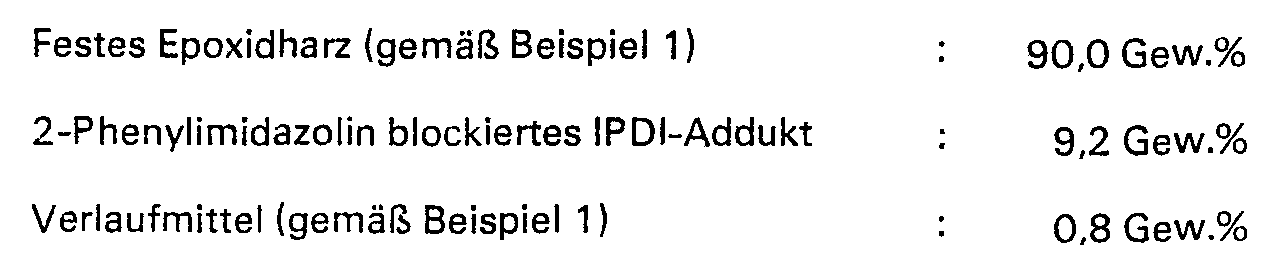
- Diese Formulierung wurde auf Glasflaschen aufgebracht, die im Augenblick des Auftrages eine Temperatur von ca. 240°C aufwiesen. Es erfolgte keine Nachhärtung.
- Die Prüfungen der beschichteten Flaschen wurden, wie in Beispiel 1 erläutert, durchgeführt, wobei die Ergebnisse aus Beispiel 1 erhalten wurden.
- Mit 2-Phenyl-4-methylimidazolin blockiertes IPDI gemäß Beispiel C wurde mit dem angegebenen Epoxidharz sowie einem geringen Zusatz an Verlaufmittel in folgendem Verhältnis zu dem Beschichtungspulver verarbeitet:
-

- Diese Formulierung wurde auf Glasflaschen aufgebracht, die auf 200°C erhitzt worden waren. Es wurde keine Nachhärtung vorgenommen. Folgende Prüfungen wurden anschließend durchgeführt:

- Mit 2-Phenyl-4-methylimidazolin blockiertes IPDI/Diäthylenglykol-Addukt, hergestellt entsprechend Beispiel B, wurde mit dem angegebenen Epoxidharz sowie einem geringen Zusatz an Verlaufmittel in folgendem Verhältnis zu dem Beschichtungspulver verarbeitet. Das blockierte Polysiocyanat stellt ein weißes Pulver dar mit einem Schmelzbereich von 95―100°C, einer Glasumwandlungstemperatur IDTA) von 60-85°C und einer Aufspalttemperatur von ca. 150°C. Das Reaktionsprodukt war frei von unblockierten NCO-Gruppen.
-

- Die Eigenschaften der beschichteten Glasflasche entsprachen denen des Beispiels 1.
- Mit 2,4-Dimethylimidazolin blockiertes IPDI gemäß Beispiel D wurde mit dem angegebenen Epoxidharz sowie einem geringen Zusatz an Verlaufmittel in folgendem Verhältnis zu dem Beschichtungspulver verarbeitet:
-

- Die Eigenschaften der beschichteten Glasflasche entsprachen denen des Beispiels 1.
- Mit 2,4-Dimethylimidazolin blockiertes IPDI/Diäthylenglykol-Addukt gemäß Beispiel E wurde mit dem angegebenen Epoxidharz sowie einem geringen Zusatz an Verlaufmittel in folgendem Verhältnis zu dem Beschichtungspulver verarbeitet:
-

- Diese Formulierung wurde auf 120°C heiße Glasflaschen aufgetragen. Anschließend wurden diese Überzüge 10 Minuten bei 200°C gehärtet und folgenden Prüfungen unterworfen:

- Das mit Verbindung F.a blockierte IPDI wurde mit dem unten beschriebenen Epoxidharz sowie einem geringen Zusatz an Verlaufmittel gemischt und zu einem Pulver verarbeitet.
- Das eingesetzte feste Epoxidharz der im Beispiel 1 beschriebenen Herstellungsweise besaß ein Epoxidäquivalentgewicht von 900-1000, einen Epoxidwert von 0,10-0,11, einen Hydroxylwert von 0,34 und einen Schmelzbereich von 96-104°C.
-

- Diese Formulierung wurde auf 200°C warme Glasflaschen aufgebracht und 8 Minuten bei 180°C gehärtet. An den beschichteten Flaschen wurden die folgenden Prüfungen vorgenommen:

- Die Schichtstärken der Folien lagen zwischen 110 und 148 µm. Folgende Prüfeinstellungen wurden im Beispiel 1 erläutert.
-

- Mit Verbindung F.a. blockiertes IPDI-Addukt gemäß Beispiel B.b. wurde mit Epoxidharz und Verlaufmittel vermischt und zu Beschichtungspulver verarbeitet.
-
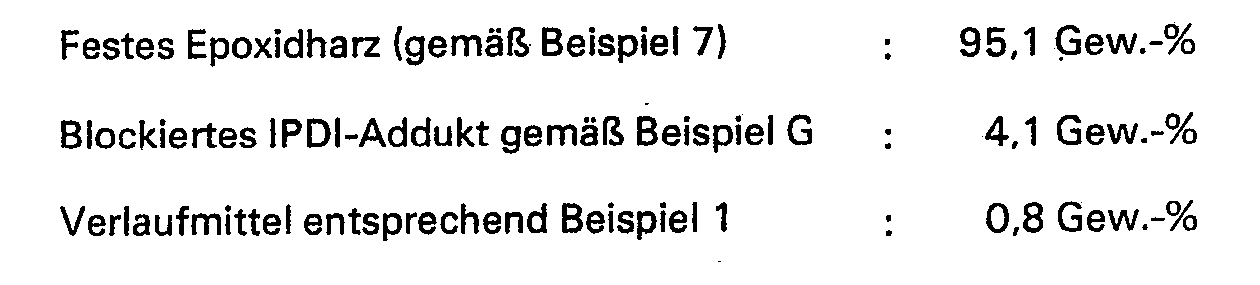
- Diese Formulierung wurde auf Glasflaschen aufgebracht, die im Augenblick des Auftrages eine Temperatur von ca. 240°C aufwiesen. Es erfolgte keine Nachhärtung.
- Die Prüfung der beschichteten Flaschen wurde, wie in Beispiel 1 erläutert, durchgeführt, wobei die Ergebnisse aus Beispiel 7 erhalten wurden.
- Mit Verbindung F.a blockiertes TDMI gemäß Beispiel H wurde mit Epoxidharz und Verlaufmittel wie beschrieben vermischt und zu Beschichtungspulver verarbeitet:
-

- Diese Formulierung wurde auf Glasflaschen aufgebracht, die auf 200°C erhitzt wurden. Es wurde keine Nachhärtung vorgenommen.
- Die folgenden Prüfungen wurden anschließend durchgeführt:

- Mit Verbindung 1.a. blockiertes IPDI, Epoxidharz und Verlaufmittel wurden wie beschrieben zu Beschichtungspulver verarbeitet:
- Das gemäß I b beschriebene blockierte IPDI-Addukt wurde mit dem angegebenen Expoxidharz sowie einem geringen Zusatz an Verlaufmittel im folgenden Verhältnis zu dem Beschichtungspulver verarbeitet.

- Diese Formulierung wurde auf 120°C heiße Glasflaschen aufgetragen. Anschließend wurden diese Überzüge 10 Minuten bei 200°C gehärtet und folgenden Prüfungen unterworfen:

- Anstelle der in den Beispielen 7-10 als Blockierungsmittel verwendeten Tetrahydropyrimidine können auch andere, wie die vorstehend genannten, für diesen Zweck eingesetzt werden.
Äther, wie die polymeren Polyäthylen- und Polypropylenglykole, Mischpolymerisate aus n-Butylacrylat und Vinylisobutyläther, Keton-Aldehyd-Kondensationsharze, feste Siliconharze oder auch Gemische von Zinkseifen, von Fettsäuren und aromatischen Carbonsäuren u.ä. Auch werden für diesen Zweck im Handel Produkte, wie Modaflow@, angeboten, deren chemischer Charakter den Verbrauchern unbekannt ist und von dem lediglich bekannt ist, daß es sich um eine komplexe, polymere, wirksame Flüssigkeit handelt.
Claims (5)


Applications Claiming Priority (4)
| Application Number | Priority Date | Filing Date | Title |
|---|---|---|---|
| DE2740253 | 1977-09-07 | ||
| DE19772740253 DE2740253A1 (de) | 1977-09-07 | 1977-09-07 | Verfahren zum beschichten von glasoberflaechen |
| DE19782830590 DE2830590A1 (de) | 1978-07-12 | 1978-07-12 | Verfahren zum beschichten von glasoberflaechen |
| DE2830590 | 1978-07-12 |
Publications (2)
| Publication Number | Publication Date |
|---|---|
| EP0001148A1 EP0001148A1 (de) | 1979-03-21 |
| EP0001148B1 true EP0001148B1 (de) | 1981-09-30 |
Family
ID=25772681
Family Applications (1)
| Application Number | Title | Priority Date | Filing Date |
|---|---|---|---|
| EP78200172A Expired EP0001148B1 (de) | 1977-09-07 | 1978-09-05 | Verfahren zum Beschichten von Glasoberflächen |
Country Status (9)
| Country | Link |
|---|---|
| EP (1) | EP0001148B1 (de) |
| JP (1) | JPS5453125A (de) |
| AT (1) | AT376647B (de) |
| DE (1) | DE2861235D1 (de) |
| DK (1) | DK394678A (de) |
| ES (1) | ES473144A1 (de) |
| IT (1) | IT7827367A0 (de) |
| PT (1) | PT68519A (de) |
| YU (1) | YU211578A (de) |
Families Citing this family (5)
| Publication number | Priority date | Publication date | Assignee | Title |
|---|---|---|---|---|
| JPS5659832A (en) * | 1979-10-19 | 1981-05-23 | Mitsubishi Petrochem Co Ltd | Production of normal temperature water-curable urethane prepolymer |
| DE3403499A1 (de) * | 1984-02-02 | 1985-08-08 | Bayer Ag, 5090 Leverkusen | Verwendung von hitzehaertbaren polyurethanharnstoff-reaktiv-klebstoffmassen |
| US6214414B1 (en) * | 1999-07-22 | 2001-04-10 | Ppg Industries Ohio, Inc. | Method for forming a sequence of crosslinked pigmented coatings on ceramic substrates |
| CN101012300B (zh) * | 2007-01-24 | 2010-06-23 | 山东师范大学 | 咪唑啉改性线型聚氨基甲酸酯及其合成与应用 |
| MX2009010674A (es) * | 2007-04-03 | 2009-12-01 | Ppg Ind Ohio Inc | Articulo de ceramica recubierto. |
Family Cites Families (3)
| Publication number | Priority date | Publication date | Assignee | Title |
|---|---|---|---|---|
| JPS531766B2 (de) * | 1972-12-23 | 1978-01-21 | ||
| DE2510734B2 (de) * | 1975-03-12 | 1979-06-21 | Chemische Werke Huels Ag, 4370 Marl | Verfahren zum Beschichten von Glasflaschen mit einer transparenten Schutzschicht |
| AU1664876A (en) * | 1975-08-11 | 1978-02-09 | Du Pont | Caustic-resistant polymer coatings for glass |
-
1978
- 1978-09-05 AT AT0641478A patent/AT376647B/de not_active IP Right Cessation
- 1978-09-05 DE DE7878200172T patent/DE2861235D1/de not_active Expired
- 1978-09-05 EP EP78200172A patent/EP0001148B1/de not_active Expired
- 1978-09-06 DK DK394678A patent/DK394678A/da not_active Application Discontinuation
- 1978-09-06 YU YU02115/78A patent/YU211578A/xx unknown
- 1978-09-06 ES ES473144A patent/ES473144A1/es not_active Expired
- 1978-09-06 PT PT68519A patent/PT68519A/de unknown
- 1978-09-06 JP JP10867178A patent/JPS5453125A/ja active Pending
- 1978-09-06 IT IT7827367A patent/IT7827367A0/it unknown
Also Published As
| Publication number | Publication date |
|---|---|
| DK394678A (da) | 1979-03-08 |
| IT7827367A0 (it) | 1978-09-06 |
| DE2861235D1 (en) | 1981-12-10 |
| JPS5453125A (en) | 1979-04-26 |
| ATA641478A (de) | 1984-05-15 |
| EP0001148A1 (de) | 1979-03-21 |
| AT376647B (de) | 1984-12-10 |
| PT68519A (de) | 1978-10-01 |
| ES473144A1 (es) | 1979-04-16 |
| YU211578A (en) | 1983-01-21 |
Similar Documents
| Publication | Publication Date | Title |
|---|---|---|
| EP0053766B2 (de) | Verfahren zur Herstellung von Ueberzügen | |
| EP0096210B1 (de) | Lagerstabile Polyurethan-Einkomponenten-Einbrennlacke | |
| EP1666513B1 (de) | Verfahren zur Herstellung eines Polyurethanbindemittels mit einem niedrigen Gehalt an leichtflüchtigen Monomeren | |
| EP2291424B1 (de) | Hochreaktive, uretdiongruppen haltige polyurethanzusammensetzungen, die metallfreie acetylacetonate enthalten | |
| DE2740253A1 (de) | Verfahren zum beschichten von glasoberflaechen | |
| EP1475400A1 (de) | Bei niedriger Temperatur härtbare feste uretdiongruppenhaltige Polyurethan-Pulverlackzusammensetzungen | |
| DE2502934A1 (de) | Uretdiongruppen und endstaendige blockierte isocyanatgruppen aufweisende organische verbindungen | |
| EP0178398B1 (de) | Lagerstabile Polyurethanharz-Pulverlacke | |
| DE2738270A1 (de) | Pulverfoermige ueberzugsmittel und deren anwendung | |
| EP0467153B1 (de) | Bindemittelkombination, ihre Verwendung in Einbrennlacken und ein Verfahren zur Herstellung von Überzügen | |
| EP0001468B1 (de) | Pulverförmige Überzugsmittel, Verfahren zu deren Herstellung und deren Anwendung | |
| DE19549029A1 (de) | Cyclische Amidin- sowie Uretdiongruppen enthaltende Verbindungen, ein Verfahren zu ihrer Herstellung sowie deren Verwendung | |
| EP0301403B1 (de) | Härtungskomponente für Kunstharze, diese enthaltende härtbare Mischungen sowie deren Verwendung | |
| EP0001148A1 (de) | Verfahren zum Beschichten von Glasoberflächen | |
| EP0001467B1 (de) | Lagerstabile Einbrennlacke auf Basis imidazolinblockierter Polyisocyanate | |
| DE19603389A1 (de) | Blockierte aliphatische Diisocyanate oder Diisocyanat-Addukte | |
| DE2906134C2 (de) | Polyvinylchloridplastisole mit verbessertem Eigenschaftsbild und Verfahren zu deren Herstellung | |
| EP0164661B1 (de) | Verfahren zur Herstellung von Acylurethanen und deren Verwendung | |
| EP0000971B1 (de) | Pulverförmige Überzugsmittel | |
| DE3610758C2 (de) | ||
| DE4204995C2 (de) | Mit 2,5-Diketopiperazinen blockierte Diisocyanate, ein Verfahren zu ihrer Herstellung sowie ihre Verwendung in Polyurethan-Pulverlacken | |
| DE19627951A1 (de) | Pulverförmige Verbindungen, ein Verfahren zu ihrer Herstellung sowie deren Verwendung | |
| EP0780416A1 (de) | Pulverlack und seine Verwendung zur Beschichtung von hitzeresistenten Substraten | |
| DE19731392A1 (de) | Blockierte Polyisocyanate, ein Verfahren zu ihrer Herstellung sowie die daraus hergestellten PUR-Pulverlacke | |
| DE3035639A1 (de) | Neue di- und polyamine, verfahren zu ihrer herstellung, und ihre verwendung |
Legal Events
| Date | Code | Title | Description |
|---|---|---|---|
| PUAI | Public reference made under article 153(3) epc to a published international application that has entered the european phase |
Free format text: ORIGINAL CODE: 0009012 |
|
| AK | Designated contracting states |
Designated state(s): BE CH DE FR GB LU NL SE |
|
| 17P | Request for examination filed | ||
| GRAA | (expected) grant |
Free format text: ORIGINAL CODE: 0009210 |
|
| AK | Designated contracting states |
Designated state(s): BE CH DE FR GB LU NL SE |
|
| REF | Corresponds to: |
Ref document number: 2861235 Country of ref document: DE Date of ref document: 19811210 |
|
| PGFP | Annual fee paid to national office [announced via postgrant information from national office to epo] |
Ref country code: LU Payment date: 19820903 Year of fee payment: 5 |
|
| PG25 | Lapsed in a contracting state [announced via postgrant information from national office to epo] |
Ref country code: LU Free format text: LAPSE BECAUSE OF NON-PAYMENT OF DUE FEES Effective date: 19820930 |
|
| PGFP | Annual fee paid to national office [announced via postgrant information from national office to epo] |
Ref country code: CH Payment date: 19820930 Year of fee payment: 5 Ref country code: BE Payment date: 19820930 Year of fee payment: 5 |
|
| PG25 | Lapsed in a contracting state [announced via postgrant information from national office to epo] |
Ref country code: CH Effective date: 19830930 Ref country code: BE Effective date: 19830930 |
|
| PGFP | Annual fee paid to national office [announced via postgrant information from national office to epo] |
Ref country code: SE Payment date: 19830930 Year of fee payment: 6 Ref country code: NL Payment date: 19830930 Year of fee payment: 6 Ref country code: FR Payment date: 19830930 Year of fee payment: 6 |
|
| REG | Reference to a national code |
Ref country code: CH Ref legal event code: PL |
|
| PG25 | Lapsed in a contracting state [announced via postgrant information from national office to epo] |
Ref country code: SE Effective date: 19840906 |
|
| PGFP | Annual fee paid to national office [announced via postgrant information from national office to epo] |
Ref country code: DE Payment date: 19840926 Year of fee payment: 7 |
|
| PG25 | Lapsed in a contracting state [announced via postgrant information from national office to epo] |
Ref country code: NL Effective date: 19850401 |
|
| GBPC | Gb: european patent ceased through non-payment of renewal fee | ||
| NLV4 | Nl: lapsed or anulled due to non-payment of the annual fee | ||
| PG25 | Lapsed in a contracting state [announced via postgrant information from national office to epo] |
Ref country code: FR Free format text: LAPSE BECAUSE OF NON-PAYMENT OF DUE FEES Effective date: 19850531 |
|
| REG | Reference to a national code |
Ref country code: FR Ref legal event code: ST |
|
| PG25 | Lapsed in a contracting state [announced via postgrant information from national office to epo] |
Ref country code: GB Effective date: 19881117 |
|
| PG25 | Lapsed in a contracting state [announced via postgrant information from national office to epo] |
Ref country code: DE Effective date: 19900601 |
|
| EUG | Se: european patent has lapsed |
Ref document number: 78200172.1 Effective date: 19850617 |
|
| PLBE | No opposition filed within time limit |
Free format text: ORIGINAL CODE: 0009261 |
|
| STAA | Information on the status of an ep patent application or granted ep patent |
Free format text: STATUS: NO OPPOSITION FILED WITHIN TIME LIMIT |