EP0000563B1 - Process for preparing aromatic urethanes - Google Patents
Process for preparing aromatic urethanes Download PDFInfo
- Publication number
- EP0000563B1 EP0000563B1 EP78100468A EP78100468A EP0000563B1 EP 0000563 B1 EP0000563 B1 EP 0000563B1 EP 78100468 A EP78100468 A EP 78100468A EP 78100468 A EP78100468 A EP 78100468A EP 0000563 B1 EP0000563 B1 EP 0000563B1
- Authority
- EP
- European Patent Office
- Prior art keywords
- compound
- formula
- group
- process according
- carbon atoms
- Prior art date
- Legal status (The legal status is an assumption and is not a legal conclusion. Google has not performed a legal analysis and makes no representation as to the accuracy of the status listed.)
- Expired
Links
Classifications
-
- C—CHEMISTRY; METALLURGY
- C07—ORGANIC CHEMISTRY
- C07C—ACYCLIC OR CARBOCYCLIC COMPOUNDS
- C07C271/00—Derivatives of carbamic acids, i.e. compounds containing any of the groups, the nitrogen atom not being part of nitro or nitroso groups
- C07C271/06—Esters of carbamic acids
Definitions
- This invention relates to improvements in the preparation of aromatic urethanes. More particularly, it relates to an improved process for preparing an aromatic urethane (hereinafter referred to simply as “urethane") which comprises reacting an aromatic nitro compound, an organic compound containing at least one hydroxyl group (hereinafter referred to simply as “hydroxyl-containing compound”), and carbon monoxide at elevated temperature and pressure in the presence of a catalytic system composed of a catalyst selected from the group consisting of platinum group metals, compounds of platinum group metals and mixtures thereof and a promoter selected from the group consisting of
- U.S. Patent No. 3,338,956 describes a process wherein urethanes are prepared from alcohols, carbon monoxide, and nitro compounds with the aid of a rhodium chlorocarbonyl catalyst.
- this process is not economically advantageous in the preparation of highly pure urethanes because the desired product is obtained only at low yield even if the urethanation reaction is carried out for a long period of time in the presence of a large amount of the catayst.
- the invention relates therefore to a process for preparing an aromatic urethane wherein an aromatic nitro compound, an organic hydroxyl-containing compound having at least one hydroxyl group, and carbon monoxide are reacted with each other in the presence of a catalytic system at a temperature of from 80 to 230°C and a pressure of from 10 to 1000 kg/cm 2 G
- the process according to the invention is characterized in that the reaction is carried out in the presence of a catalytic system composed of a catalyst selected from the group consisting of platinum group metals, compounds of platinum group metals and mixtures thereof and a promoter selected from the group consisting of
- the urethanation reaction is carried out in the presence of a small amount of water and one or more of those organic primary amino compounds, urea compounds, biuret compounds, and allophanate compounds which can be derived from the starting aromatic compound.
- the starting aromatic nitro compound is a compound of the formula where A represents a substituted or unsubstituted aromatic residue of an aromatic nitro compound from which the nitro group or groups are removed and x is an integer equal to from 1 to 4
- the starting hydroxyl-containing compound is a compound of the formula where R i represents a linear or branched alkyl group containing from 1 to 16 carbon atoms, a cycloalkyl group of 6 carbon atoms with or without an alkyl substituent containing from 1 to 3 carbon atoms or an aryl group with or without at least one alkyl substituent containing from 1 to 6 carbon atoms
- these alkyl, cycloalkyl and aryl groups may further include at least one halogen, aryl, alkenyl, nitro, alkoxy, phenoxy or carbamate substituent, those organic primary amino compounds, urea compounds, biuret compounds, and allophanate compounds which can be derived from the starting aromatic nitro compound are represented
- a and x have the same meanings as defined in formula (V), R 1 has the same meanings as defined in formula (VI), y is an integer equal to from 1 to 4, z is an integer equal to from 0 to 3, and the sum of y and z does not exceed x.
- A' represents a group of the formula where A, R,, x, y and z have the same meanings as defined in formula (VII).
- the desired aromatic urethane can be prepared at a higher reaction rate, or in a shorter reaction time, than that attainable by the afore-mentioned processes. Morever, when one or more of those organic primary amino compounds, urea compounds, biuret compounds, and allophanate compounds which can be derived from the starting aromatic nitro compound are used, the yield of the desired aromatic urethane is enhanced. The yield based on the starting aromatic nitro compound can even reach a substantially theoretical level depending on the amount of the aforesaid compound or compounds added to the reaction system.
- reaction rate is further increased without reducing the yield of the desired product.
- the aromatic nitro compounds useful as the main starting material in the process of the invention are those represented by the formula where A and x have the same meanings as defined in formula (V), and may be mononitro and polynitro compounds. They include, for example, nitrobenzene, dinitrobenzenes, dinitrotoluenes, nitronaphtha- lenes, nitroanthracenes, nitrobiphenyls, bis(nitrophenyl)alkanes, bis(nitrophenyl)ethers, bis(nitrophenyl)-thioethers, bis(nitrophenyl)sulfones, nitrodiphenoxyalkanes, nitrophenothiazines, and heterocyclic compounds such as 5-nitropyrimidine.
- nitro compounds are nitrobenzene, o-, m-, and p-nitrotoluenes, o-nitro-p-xylene, 1-nitronaphthalene, m- and p-dinitrobenzenes, 2,4- and 2,6-dinitrotoluenes, dinitromesitylene, 4,4'-dinitrobiphenyl, 2,4-dinitrobiphenyl, 4,4'-dinitrodibenzyl, bis(4-nitrophenyl)methane, bis(4-nitrophenyl)ether, bis(2.4-dinitrophenyl)ether, bis(4-nitrophenyl)thioether, bis(4-nitrophenyl)sulfone, bis(4-nitrophenoxy)ethane, ⁇ , ⁇ '-dinitro-p-xylene, ⁇ . ⁇ '- dinitro-m-xylene, 2,4,6-trinitrotoluene, o-, m- and
- aromatic nitro compounds mononitro compounds such as nitrobenzene, o-, m- and p-chloronitrobenzenes, 2,3- and 3,4-dichloronitrobenzenes, etc. and dinitro compounds such as m- and p-dinitrobenzenes, 2,4- and 2,6-dinitrotoluenes, 1,5-dinitronaphthalene, etc. are preferred because they can be readily reacted with other reactants to give high yields of desired products which have wide applications in the manufacture of drugs, agricultural chemicals, polyurethanes, and the like.
- hydroxyl-containing compounds useful in the process of the invention are those represented by the formula where R, has the same meanings as defined in formula (VI), and n is an integer equal to or greater than 1 and preferably in the range of from 1 to 3. They include monohydric and polyhydric alcohols having one or more hydroxyl groups attached to primary, secondary or tertiary carbon atoms, as well as monohydric and polyhydric phenols.
- suitable alcohols are monohydric alcohols such as methyl alcohol, ethyl alcohol, n- and iso-propyl alcohols, n-, iso- and t-butyl alcohols, linear or branched amyl alcohol, hexyl alcohol, cyclohexyl alcohol, lauryl alcohol, cetyl alcohol, benzyl alcohol, chlorobenzyl alcohol, methoxybenzyl alcohol, etc.; dihydric alcohols such as ethylene glycol, diethylene glycol, propylene glycol, dipropylene glycol, etc.; trihydric alcohols such as glycerol, hexanetriol, etc.; and further polyhydric alcohols.
- monohydric alcohols such as methyl alcohol, ethyl alcohol, n- and iso-propyl alcohols, n-, iso- and t-butyl alcohols, linear or branched amyl alcohol, hexyl alcohol, cyclohexyl alcohol, lau
- Suitable phenols are phenol, chlorophenol, cresol, ethylphenol, linear or branched propylphenol, butyl- and higher alkylphenols, catechol, resorcinol, 4,4'-dihydroxy-diphenylmethane, 2,2'-isopropylidenediphenol, anthranol, phenanthrol, pyrogallol, phloroglucinol, etc.
- methyl alcohol, ethyl alcohol, and isobutyl alcohol are preferred because they give higher yields of desired products at a higher reaction rate as compared with other hydroxyl-containing compounds.
- the catalysts useful in the process of the invention include, for example, elemental palladium, rhodium and ruthenium; the halides, cyanides, thiocyanides, isocyanides, oxides, sulfates, nitrates and carbonyl compounds of these metals; the addition products or complexes of these compounds with tertiary amines such as triethylamine, pyridine, isoquinoline, etc. and the complexes of these compounds with organic phosphorus compounds such triphenylphosphine, etc.; and mixtures of the foregoing.
- These catalysts may be used either by adding them directly to the reaction system or by associating them with carriers such as alumina, silica, carbon, barium sulfate, calcium carbonate, asbestos, bentonite, diatomaceous earth, fullers's earth, organic ion exchange resins, inorganic ion exchange resins, magnesium silicate, aluminum silicate, molecular sieve, and the like and then adding them to the reaction system.
- carriers such as alumina, silica, carbon, barium sulfate, calcium carbonate, asbestos, bentonite, diatomaceous earth, fullers's earth, organic ion exchange resins, inorganic ion exchange resins, magnesium silicate, aluminum silicate, molecular sieve, and the like and then adding them to the reaction system.
- these carriers may be added to the reaction system separately from the catalysts including elemental palladium, rhodium and ruthenium as well as compounds thereof.
- elemental palladium and palladium compounds are preferred. Specific examples are elemental palladium, palladium chloride, palladium bromide, and elemental palladium associated with a carrier such as carbon or alumina.
- the Lewis acids useful as the promoter in the process of the invention are, for example, those described in Jack Hine: “Physical Organic Chemistry” (McGraw-Hill Book Co., New York, 1962) and imply Bronsted acids. They include, for example, the halides, sulfates, acetates, phosphates, and nitrates of metals such as tin, titanium, germanium, aluminum, iron, nickel, zinc, cobalt, manganese, thallium, zirconium, copper, lead, vanadium, niobium, tantalum, mercury, etc.
- Lewis acids are ferric chloride, ferrous chloride, stannic chloride, stannous chloride, aluminum chloride, cupric chloride, cuprous chloride, copper acetate, etc.
- Lewis acids with tertiary amines also complexes of Lewis acids with tertiary amines and mixtures of Lewis acids and a complex of a Lewis acid with a tertiary amine and also a mixture of a tertiary amine and a complex of a Lewis acid with tertiary amines.
- Specific examples of the complex-forming tertiary amines are triethylamine, N,N-diethylaniline, N,N-diethylcyclohexylamine, 1,4-diazabicyclo[2,2,2]octane, pyridine, picoline, isoquinoline, quinoline, etc.
- nitrogen-containing heterocyclic compounds such as pyridine, picoline and isoquinoline are preferred.
- the use of'a complex derived from such a nitrogen-containing heterocyclic compound and a Lewis acid prevents the corrosion ot the reactor by the Lewis acid, enhances the yield of the desired product, and facilitates recovery of the catalyst, as compared with the use of the Lewis acid alone.
- the reaction rate is further increased by adding a small amount of water to the reaction system.
- the amount of water added should be from 1 to 70 moles of preferaby from 10 to 50 moles per 100 moles of the starting aromatic nitro compound. If the amount is less than 1 mole, the addition of water will be virtually ineffective, while if the amount is more than 70 moles, the yield of the desired product will be greatly reduced.
- the organic primary amino compounds useful in the process of the invention include, for example methylamine, ethylamine, propylamine, butylamine, pentylamine, hexylamine, ethylenediamine, propylenediamine, butylenediamine, hexanediamine, cyclohexylamine, cyclohexaldiamine, aniline, o-, m- and p-diaminobenzenes, 2-amino-4-carbamatetoluene, 4-amino-2-carbamatetoluene, 2-amino-6-carba- matetoluene, o-, m- and p-nitroanilines, 4-nitro-2-aminotoluene, 2-nitro-4-aminotoluene, 2-nitro-6-aminotoluene, 3-nitro-4-aminotoluene, 4-nitro-3-aminotoluene, 2-nitro-3-aminotoluene,
- aromatic amino compounds those which can be derived from the starting aromatic nitro compounds are preferred.
- nitrobenzene is used as the starting aromatic nitro compound
- aniline is preferred.
- 2-amino-4-nitrotoluene, 4-amino-2-nitrotoluene, 2-amino-4-carbamatetoluene, 4-amino-2-carbamatetoluene, and 2,4-diaminotoluene are preferably used when the starting aromatic nitro compound is 2,4-dinitrotoluene
- 2-amino-6-nitrotoluene, 2-amino-6-carbamatetoluene, and 2,6-diaminotoluene are preferably used when the starting aromatic nitro compound is 2,6-dinitrotoluene.
- urea compounds, biuret compounds, and allophanate compounds useful in the process of the invention are those represented by the respective formulae (VIII), (IX) and (X) in which, for example, A' is a phenyl group when the starting aromatic nitro compound is nitrobenzene or a tolyl group having a nitro, amino or carbamate group when the starting aromatic nitro compound is dinitrotoluene.
- Suitable solvents include, for example, aromatic solvents such as benzene, toluene, xylene, etc.; nitriles such as acetonitrile, benzonitrile, etc.; sulfones such as sulfolane, etc.; halogenated aliphatic hydrocarbons such as 1,1,2-trichloro-1,2,2-trifluorethane, etc.; halogenated aromatic hydrocarbons such as monochlorobenzene, dichlorobenzene, trichlorobenzene, etc.; ketones; esters; and other solvents such as tetrahydrofuran, 1,4-dioxane, 1,2-dimethoxyethane, etc.
- aromatic solvents such as benzene, toluene, xylene, etc.
- nitriles such as acetonitrile, benzonitrile, etc.
- sulfones such as sulfolane,
- the hydroxyl-containing compound and carbon monoxide are preferably used in amounts equal to at least 1 mole per mole of the nitro group of the starting aromatic nitro compound.
- the amount of platinum group metal or platinum group metal compound used as the catalyst may vary widely according to the type thereof and other reaction conditions. However, on a weight basis, the amount of catalyst is generally in the range of from 1 x 10- 5 to 1 part, and preferably from 1 x 10- 4 to 5 x 10-' part, per part of the starting aromatic nitro compound when expressed in terms of its metallic component.
- the amount of Lewis acid used as the promoter is generally in the range of from 2 x 10- 3 to 2 parts, and preferably from 5 x 10- 2 to 1 part, per part of the starting aromatic nitro compund.
- the reaction temperature is held in the range of from 80° to 230°C, and preferably from 140° to 200°C.
- the reaction pressure is in the range of from 10 to 1,000 kg/cm 2 G, and preferably from 30 to 500 kg/cm 2 G.
- the reaction time depends on the nature of aromatic nitro compound used, the reaction temperature, the reaction pv :.;sure, the type and amount of catalyst used, the type and amount of organic primary amino compound, urea compound, biuret compound, or allophanate compound added, the type of reactor employed, and the like, but is generally in the range of from 5 minutes to 6 hours.
- the reaction mixture is cooled and the gas is discharged from the reactor.
- the reaction mixture is subjected to any conventional procedure including filtration, distillation, or other suitable separation steps, whereby the resulting urethane is separated from any unreacted materials, any by-products, the solvent, the catalyst, and the like.
- the urethanes prepared by the process of the invention have wide applications in the manufacture of agricultural chemicals, isocyanates, and polyurethanes.
- Example 2 The procedure of Example 1 was repeated except that the aniline was replaced by 0.7 g of diphenylurea (Example 2). In addition, the procedure of Example 1 was repeated except that the aniline was omitted (Control 1). The results of Example 2 and Control 1, together with those of Example 1, are summarized in Table 1 below.
- Example 3 The procedure of Example 3 was repeated except that the isopropylamine was replaced by a variety of primary amino compounds and urea compounds (Examples 4-11). In addition, the procedure of Example 3 was repeated except that the isopropylamine was omitted (Control 2). The results of Examples 4-11 and Control 2 are summarized in Table 2 below.
- Example 3 The procedure of Example 3 was repeated except that the ethanol was replaced by 68 ml of isobutanol and the isopropylamine was replaced by 0.8 g of 2-amino-4-isobutylcarbamatetoluene and 0.8 g of 4-amino-2-isobutylcarbamatetoluene. After 160 minutes of reaction, the yield of diurethane was 99%.
- Example 13 The procedure of Example 13 was repeated except that the aminoethylcarbamatetoluenes were omitted. The reaction was carried out for the same period of time, or 120 minutes, as in Example 13. Analysis of the resulting solution revealed that the starting 2,4-dininitrotoluene was absent but the yield of mononitromonourethane was 15% and that of diurethane was 80%.
- Example 14 The procedure of Example 14 was repeated except that the allophanate compound was replaced by 1.4 g of a biuret compound (formed by heating a mixture of 2,4-toluene diisocyanate and water). The absorption of carbon monoxide ceased in 120 minutes. Analysis of the resulting solution revealed that the yield of diurethane was 97%.
Landscapes
- Chemical & Material Sciences (AREA)
- Organic Chemistry (AREA)
- Organic Low-Molecular-Weight Compounds And Preparation Thereof (AREA)
- Low-Molecular Organic Synthesis Reactions Using Catalysts (AREA)
Description
- This invention relates to improvements in the preparation of aromatic urethanes. More particularly, it relates to an improved process for preparing an aromatic urethane (hereinafter referred to simply as "urethane") which comprises reacting an aromatic nitro compound, an organic compound containing at least one hydroxyl group (hereinafter referred to simply as "hydroxyl-containing compound"), and carbon monoxide at elevated temperature and pressure in the presence of a catalytic system composed of a catalyst selected from the group consisting of platinum group metals, compounds of platinum group metals and mixtures thereof and a promoter selected from the group consisting of
- a) a mixture of a Lewis acid and a tertiary amine;
- b) a complex of a Lewis acid with a tertiary amine; and
- c) a mixture of a Lewis acid and a complex of a Lewis acid with a tertiary amine.
- Urethanes have heretofore been produced mainly by reaction of isocyanates with alcohols. In recent years, the production of isocyanates has become difficult partly due to the lack and rising costs of starting materials therefor and partly due to the high toxicity of intermediate formed during the manufacture of isocyanates. Consequently, there have been developed and proposed many novel processes for the preparation of urethanes without using any isocyanate. However, these newly developed processes involve several serious problems and have not yet been put into practice on an industrial scale.
- For example, U.S. Patent No. 3,338,956 describes a process wherein urethanes are prepared from alcohols, carbon monoxide, and nitro compounds with the aid of a rhodium chlorocarbonyl catalyst. However, this process is not economically advantageous in the preparation of highly pure urethanes because the desired product is obtained only at low yield even if the urethanation reaction is carried out for a long period of time in the presence of a large amount of the catayst.
- There has been proposed another process in which urethanes are prepared by reacting organic hydroxyl-containing compounds, carbon monoxide, and nitro compounds in the presence of a metal of Group VIII of the Periodic Table combined with a promoter comprising a salt of a metal capable of existing in two or more valence states (German Patent No. 1,543,051). However, in this process the yield of urethane is low even if mononitro compounds are used as the main starting material, and the use of dinitro compounds results in still lower yields.
- Moreover, a process is known which uses a catalytic system composed of palladium and a Lewis acid (U.S. Patent No. 3,531,512). In this process, urethanes can be obtained at a fairly high yield of 80-90% even when using dinitro compounds as the main starting material. In order to attain such a high yield, however, it is necessary to carry out the urethanation reaction under such severe reaction conditions as an initial carbon monoxide pressure of 190-350 kg/cm2 and a temperature of 190°-200°C. In addition, the process has an industrially serious drawback in that the Lewis acid, e.g. ferric chloride, used as the promoter exerts a considerable corrosive action on metallic materials such as iron, stainless steel, and the like. Consequently, it is essential to use a reactor made of or lined with glass or tantalum in order to realize the process industrially. However, the use of a glass or tantalum reactor under the above-mentioned high temperature and pressure conditions poses further technical and economical problems.
- Thus, all of these processes use a catalyst consisting of a platinum metal and/or a compound thereof and occasionally a promoter consisting of a Lewis acid and/or a Lewis acid-containing compound, but the above mentioned difficulties including the low yield of the desired product, the use of severe reaction conditions, and the corrosion of the reactor by the catalyst have kept them from industrial practice.
- Accordingly, it is the primary object of this invention to provide an improved process for preparing aromatic urethanes wherein high yields of the desired product can be obtained at a high reaction rate, or in a short reacton time.
- The invention relates therefore to a process for preparing an aromatic urethane wherein an aromatic nitro compound, an organic hydroxyl-containing compound having at least one hydroxyl group, and carbon monoxide are reacted with each other in the presence of a catalytic system at a temperature of from 80 to 230°C and a pressure of from 10 to 1000 kg/cm2G
- The process according to the invention is characterized in that the reaction is carried out in the presence of a catalytic system composed of a catalyst selected from the group consisting of platinum group metals, compounds of platinum group metals and mixtures thereof and a promoter selected from the group consisting of
- a) a mixture of a Lewis acid and a tertiary amine;
- b) a complex of a Lewis acid with a tertiary amine;
- c) a mixture of a Lewis acid and a complex of a Lewis acid with a tertiary amine; and in the presence of at least one compound selected from the group consisting of:
- an organic primary amino compound of the formula


- a biuret compound of the formula


- an organic primary amino compound of the formula
- In one preferred embodiment of this invention, the urethanation reaction is carried out in the presence of a small amount of water and one or more of those organic primary amino compounds, urea compounds, biuret compounds, and allophanate compounds which can be derived from the starting aromatic compound.
- More specifically, when the starting aromatic nitro compound is a compound of the formula


- In the above formula (VII) A and x have the same meanings as defined in formula (V), R1 has the same meanings as defined in formula (VI), y is an integer equal to from 1 to 4, z is an integer equal to from 0 to 3, and the sum of y and z does not exceed x. In the above formulae (VII), (IX) and (X), A' represents a group of the formula

- When an organic primary amino compound, a urea compound, a biuret compound, an allophanate compound, or a mixture thereof is added to the reaction system in accordance with this invention, the desired aromatic urethane can be prepared at a higher reaction rate, or in a shorter reaction time, than that attainable by the afore-mentioned processes. Morever, when one or more of those organic primary amino compounds, urea compounds, biuret compounds, and allophanate compounds which can be derived from the starting aromatic nitro compound are used, the yield of the desired aromatic urethane is enhanced. The yield based on the starting aromatic nitro compound can even reach a substantially theoretical level depending on the amount of the aforesaid compound or compounds added to the reaction system.
- Furthermore, when a mixture or complex composed of a Lewis acid and a tertiary amine (preferably a nitrogen-containing heterocyclic compound such as pyridine) is used as the promoter, the yield is enhanced, corrosion of the reactor is suppressed, and recovery of the catalyst is facilitated, as compared with the use of Lewis acids alone.
- In addition, when a small amount of water is added to the reaction system, the reaction rate is further increased without reducing the yield of the desired product.
- The aromatic nitro compounds useful as the main starting material in the process of the invention are those represented by the formula

- Among the above-enumerated aromatic nitro compounds, mononitro compounds such as nitrobenzene, o-, m- and p-chloronitrobenzenes, 2,3- and 3,4-dichloronitrobenzenes, etc. and dinitro compounds such as m- and p-dinitrobenzenes, 2,4- and 2,6-dinitrotoluenes, 1,5-dinitronaphthalene, etc. are preferred because they can be readily reacted with other reactants to give high yields of desired products which have wide applications in the manufacture of drugs, agricultural chemicals, polyurethanes, and the like.
- The hydroxyl-containing compounds useful in the process of the invention are those represented by the formula

- Specific examples of suitable alcohols are monohydric alcohols such as methyl alcohol, ethyl alcohol, n- and iso-propyl alcohols, n-, iso- and t-butyl alcohols, linear or branched amyl alcohol, hexyl alcohol, cyclohexyl alcohol, lauryl alcohol, cetyl alcohol, benzyl alcohol, chlorobenzyl alcohol, methoxybenzyl alcohol, etc.; dihydric alcohols such as ethylene glycol, diethylene glycol, propylene glycol, dipropylene glycol, etc.; trihydric alcohols such as glycerol, hexanetriol, etc.; and further polyhydric alcohols.
- Specific examples of suitable phenols are phenol, chlorophenol, cresol, ethylphenol, linear or branched propylphenol, butyl- and higher alkylphenols, catechol, resorcinol, 4,4'-dihydroxy-diphenylmethane, 2,2'-isopropylidenediphenol, anthranol, phenanthrol, pyrogallol, phloroglucinol, etc.
- Among the above-enumerated hydroxyl-containing compounds, methyl alcohol, ethyl alcohol, and isobutyl alcohol are preferred because they give higher yields of desired products at a higher reaction rate as compared with other hydroxyl-containing compounds.
- The catalysts useful in the process of the invention include, for example, elemental palladium, rhodium and ruthenium; the halides, cyanides, thiocyanides, isocyanides, oxides, sulfates, nitrates and carbonyl compounds of these metals; the addition products or complexes of these compounds with tertiary amines such as triethylamine, pyridine, isoquinoline, etc. and the complexes of these compounds with organic phosphorus compounds such triphenylphosphine, etc.; and mixtures of the foregoing. These catalysts may be used either by adding them directly to the reaction system or by associating them with carriers such as alumina, silica, carbon, barium sulfate, calcium carbonate, asbestos, bentonite, diatomaceous earth, fullers's earth, organic ion exchange resins, inorganic ion exchange resins, magnesium silicate, aluminum silicate, molecular sieve, and the like and then adding them to the reaction system. Furthermore, these carriers may be added to the reaction system separately from the catalysts including elemental palladium, rhodium and ruthenium as well as compounds thereof.
- Among the above-enumerated catalysts, elemental palladium and palladium compounds are preferred. Specific examples are elemental palladium, palladium chloride, palladium bromide, and elemental palladium associated with a carrier such as carbon or alumina.
- The Lewis acids useful as the promoter in the process of the invention are, for example, those described in Jack Hine: "Physical Organic Chemistry" (McGraw-Hill Book Co., New York, 1962) and imply Bronsted acids. They include, for example, the halides, sulfates, acetates, phosphates, and nitrates of metals such as tin, titanium, germanium, aluminum, iron, nickel, zinc, cobalt, manganese, thallium, zirconium, copper, lead, vanadium, niobium, tantalum, mercury, etc.
- Specific examples of suitable Lewis acids are ferric chloride, ferrous chloride, stannic chloride, stannous chloride, aluminum chloride, cupric chloride, cuprous chloride, copper acetate, etc.
- As promoters there are used besides the mixtures of Lewis acids with tertiary amines also complexes of Lewis acids with tertiary amines and mixtures of Lewis acids and a complex of a Lewis acid with a tertiary amine and also a mixture of a tertiary amine and a complex of a Lewis acid with tertiary amines. Specific examples of the complex-forming tertiary amines are triethylamine, N,N-diethylaniline, N,N-diethylcyclohexylamine, 1,4-diazabicyclo[2,2,2]octane, pyridine, picoline, isoquinoline, quinoline, etc.
- Among the above-enumerated tertiary amines, nitrogen-containing heterocyclic compounds such as pyridine, picoline and isoquinoline are preferred. The use of'a complex derived from such a nitrogen-containing heterocyclic compound and a Lewis acid prevents the corrosion ot the reactor by the Lewis acid, enhances the yield of the desired product, and facilitates recovery of the catalyst, as compared with the use of the Lewis acid alone.
- Where a nitrogen-containing hetereocyclic compound as described above is used in combination with a Lewis acid, the reaction rate is further increased by adding a small amount of water to the reaction system. The amount of water added should be from 1 to 70 moles of preferaby from 10 to 50 moles per 100 moles of the starting aromatic nitro compound. If the amount is less than 1 mole, the addition of water will be virtually ineffective, while if the amount is more than 70 moles, the yield of the desired product will be greatly reduced.
- The organic primary amino compounds useful in the process of the invention include, for example methylamine, ethylamine, propylamine, butylamine, pentylamine, hexylamine, ethylenediamine, propylenediamine, butylenediamine, hexanediamine, cyclohexylamine, cyclohexaldiamine, aniline, o-, m- and p-diaminobenzenes, 2-amino-4-carbamatetoluene, 4-amino-2-carbamatetoluene, 2-amino-6-carba- matetoluene, o-, m- and p-nitroanilines, 4-nitro-2-aminotoluene, 2-nitro-4-aminotoluene, 2-nitro-6-aminotoluene, 3-nitro-4-aminotoluene, 4-nitro-3-aminotoluene, 2-nitro-3-aminotoluene, 3-nitro-2-aminotoluene, o- and p-phenylenediamine, benzylamine, o-amino-p-xylene, 1-aminonaphtha- lene, 2,4- and 2,6-diaminotoluenes, diaminomesitylene, 4,4'-diaminodibenzyl, bis(4-aminophenyl)methane, bis(4-aminophenyl)ether bis(2,4-diaminophenyl)ether, bis(4-aminophenyl)thioether, bis(4-aminophenyl)sulfone, bis(4-aminophenoxy)ethane, a,a'-diamino-p-xylene, α,α'-diamino-m-xylene, 2,4,6-triaminotoluene, o-, m- and p-chloroanilines, 1-chloro-2,4-diaminobenzene, p-bromoaniline, 1-fluoro-2,4-diaminobenzene, 2,4-diaminophenetole, o-, m- and p-aminoanisoles, ethyl p-aminobenzoate, 3-aminophthalic anhydride, 3,3'-dimethyl-4,4'-diaminobiphenyl, 4-amino-4'-nitro- diphenylmethane, 1-amino-5-nitronaphthalene, etc., and isomers and homologues of the foregoing. These aromatic amino compounds may be used alone or in combination.
- Among the above-enumerated aromatic amino compounds, those which can be derived from the starting aromatic nitro compounds are preferred. For example, when nitrobenzene is used as the starting aromatic nitro compound, aniline is preferred. Similarly, 2-amino-4-nitrotoluene, 4-amino-2-nitrotoluene, 2-amino-4-carbamatetoluene, 4-amino-2-carbamatetoluene, and 2,4-diaminotoluene are preferably used when the starting aromatic nitro compound is 2,4-dinitrotoluene, while 2-amino-6-nitrotoluene, 2-amino-6-carbamatetoluene, and 2,6-diaminotoluene are preferably used when the starting aromatic nitro compound is 2,6-dinitrotoluene.
- The urea compounds, biuret compounds, and allophanate compounds useful in the process of the invention are those represented by the respective formulae (VIII), (IX) and (X) in which, for example, A' is a phenyl group when the starting aromatic nitro compound is nitrobenzene or a tolyl group having a nitro, amino or carbamate group when the starting aromatic nitro compound is dinitrotoluene.
- No particular limitation is placed on the amount of organic primary amino compounds, urea compound, biuret compound, and/or allophanate compound used. However, they are preferably used in an amount equal to from 0.1 to 100 moles per mole of the nitro group of the starting aromatic nitro compound. The process of the invention may be carried out in the absence of solvent, but the use of a solvent is not precluded. Suitable solvents include, for example, aromatic solvents such as benzene, toluene, xylene, etc.; nitriles such as acetonitrile, benzonitrile, etc.; sulfones such as sulfolane, etc.; halogenated aliphatic hydrocarbons such as 1,1,2-trichloro-1,2,2-trifluorethane, etc.; halogenated aromatic hydrocarbons such as monochlorobenzene, dichlorobenzene, trichlorobenzene, etc.; ketones; esters; and other solvents such as tetrahydrofuran, 1,4-dioxane, 1,2-dimethoxyethane, etc.
- In carrying out the process of the invention, the hydroxyl-containing compound and carbon monoxide are preferably used in amounts equal to at least 1 mole per mole of the nitro group of the starting aromatic nitro compound.
- The amount of platinum group metal or platinum group metal compound used as the catalyst may vary widely according to the type thereof and other reaction conditions. However, on a weight basis, the amount of catalyst is generally in the range of from 1 x 10⁻⁵ to 1 part, and preferably from 1 x 10⁻⁴ to 5 x 10-' part, per part of the starting aromatic nitro compound when expressed in terms of its metallic component.
- Similarly, on a weight basis, the amount of Lewis acid used as the promoter is generally in the range of from 2 x 10⁻³ to 2 parts, and preferably from 5 x 10⁻² to 1 part, per part of the starting aromatic nitro compund.
- The reaction temperature is held in the range of from 80° to 230°C, and preferably from 140° to 200°C.
- The reaction pressure, or the initial carbon monoxide pressure, is in the range of from 10 to 1,000 kg/cm2G, and preferably from 30 to 500 kg/cm2G.
- The reaction time depends on the nature of aromatic nitro compound used, the reaction temperature, the reaction pv :.;sure, the type and amount of catalyst used, the type and amount of organic primary amino compound, urea compound, biuret compound, or allophanate compound added, the type of reactor employed, and the like, but is generally in the range of from 5 minutes to 6 hours. After completion of the reaction, the reaction mixture is cooled and the gas is discharged from the reactor. Then, the reaction mixture is subjected to any conventional procedure including filtration, distillation, or other suitable separation steps, whereby the resulting urethane is separated from any unreacted materials, any by-products, the solvent, the catalyst, and the like.
- The urethanes prepared by the process of the invention have wide applications in the manufacture of agricultural chemicals, isocyanates, and polyurethanes.
- This invention is more fully illustrated by the following examples. However, they are not to be construed to limit the scope of the invention. In all of these examples, the reaction was carried out in an electromagnetic stirring type autoclave made of stainless steel (SUS 32). The yields shown in these examples were calculated from the results of analysis by gas chromatography and liquid chromatography.
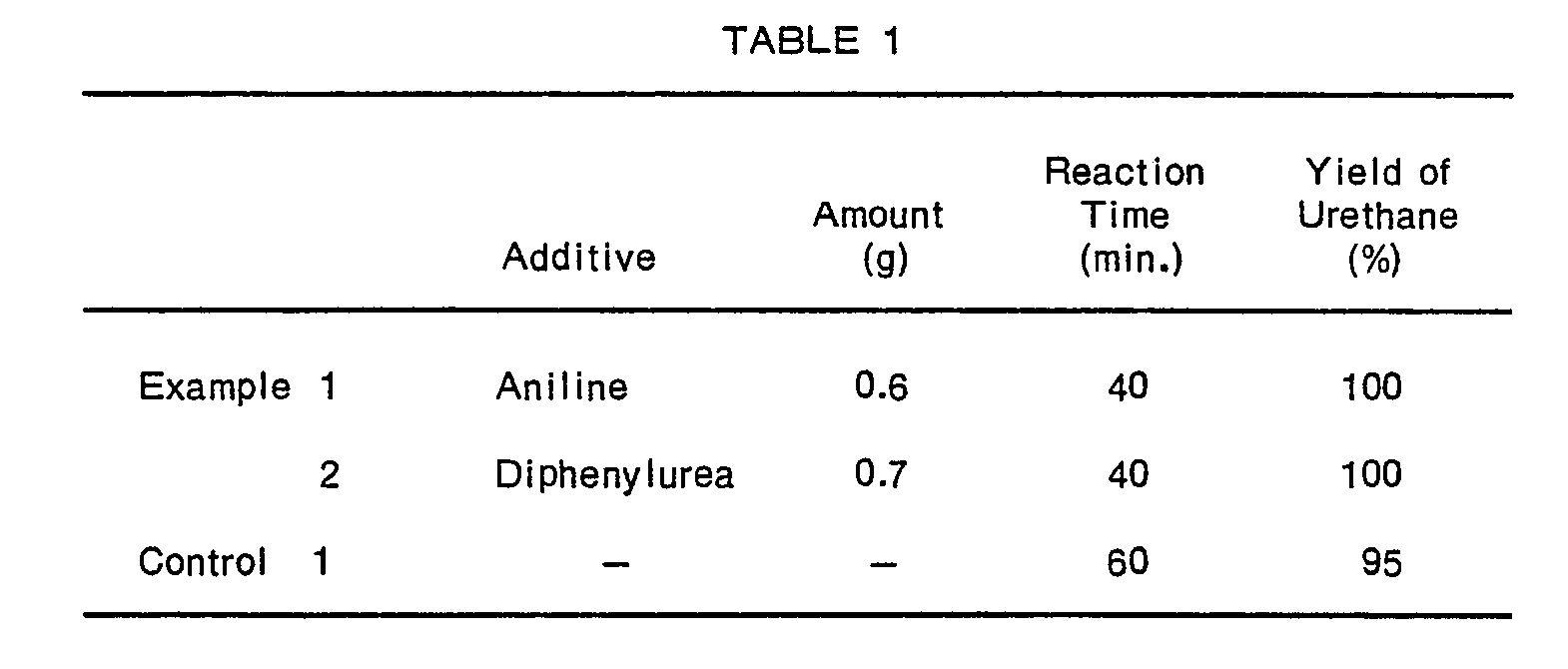
- Into an autoclave having a capacity of 200 ml were charged 8.4 g of nitrobenzene, 68 ml of ethanol, 0.0086 g of palladium chloride, 1.86 g of ferrous chloride-pyridine complex (formed by dissolving ferrous chloride and pyridine in ethanol and mixing them in a molar ratio of 1:2), 0.29 g of water, and 0.6 g of aniline. The air in the autoclave was replaced by nitrogen gas. Then, carbon monoxide was introduced into the autoclave until an initial pressure of 50 kg/cm2G was established. The reaction mixture was heated with stirring and held at 165°C for 40 minutes. After completion of the reaction, the reaction mixture was cooled to room temperature and the gas was discharged from the autoclave. Analysis of the resulting solution revealed that the yield of urethane (ethyl N-phenylcarbamate) was 100% based on the charged nitrobenzene.
- The procedure of Example 1 was repeated except that the aniline was replaced by 0.7 g of diphenylurea (Example 2). In addition, the procedure of Example 1 was repeated except that the aniline was omitted (Control 1). The results of Example 2 and Control 1, together with those of Example 1, are summarized in Table 1 below.
- Into an autoclave having a capacity of 200 ml were charged 12.39 g of 2,4-dinitrotoluene, 68 ml of ethanol, 0.0086 g of palladium chloride, 3.71 g of ferrous chloride-pyridine complex, 0.29 g of water, and 1.2 g of isopropylamine. The air in the autoclave was replaced by nitrogen gas. The carbon monoxide was introduced into the autoclave until an initial pressure of 90 kg/cm2G was established. The reaction mixture was heated with stirring and held at 165°C for 110 minutes until the pressure ceased to drop. After completion of the reaction, the reaction mixture was cooled to room temperature and the gas was discharged from the autoclave. Analysis of the resulting solution revealed that the starting 2,4-dinitrotoluene and the intermediate mononitromonoethylcarbamatetoluene (hereinafter referred to simply as "mononitromonourethane") were absent and that the yield of 2,4-diethylcar- bamatetoluene (hereinafter referred to simply as "diurethane") was 92% based on the charged 2,4-dinitrotoluene.
- The procedure of Example 3 was repeated except that the isopropylamine was replaced by a variety of primary amino compounds and urea compounds (Examples 4-11). In addition, the procedure of Example 3 was repeated except that the isopropylamine was omitted (Control 2). The results of Examples 4-11 and Control 2 are summarized in Table 2 below.

- The procedure of Example 3 was repeated except that the ethanol was replaced by 68 ml of isobutanol and the isopropylamine was replaced by 0.8 g of 2-amino-4-isobutylcarbamatetoluene and 0.8 g of 4-amino-2-isobutylcarbamatetoluene. After 160 minutes of reaction, the yield of diurethane was 99%.
- Into an autoclave having a capacity of 200 ml were charged 6.0 g of 2,4-dinitrotoluene, 48 ml of ethanol, 0.51 g of 5% palladium-alumina, 1.38 g of ferric chloride, 2.01 g of pyridine, 0.16 g of 2-amino-4-ethylcarbamatetoluene, and 0.16 g of 4-amino-2-ethylcarbamatetoluene. The air in the autoclave was replaced by nitrogen gas. Then, carbon monoxide was introduced into the autoclave until an initial pressure of 70 kg/cm2G was established. The reaction mixture was heated with stirring and held at 160°C for 120 minutes. Analysis of the resulting solution revealed that the yield of diurethane was 100% based on the charged 2,4-dininitrotoluene.
- The procedure of Example 13 was repeated except that the aminoethylcarbamatetoluenes were omitted. The reaction was carried out for the same period of time, or 120 minutes, as in Example 13. Analysis of the resulting solution revealed that the starting 2,4-dininitrotoluene was absent but the yield of mononitromonourethane was 15% and that of diurethane was 80%.
- Under the same conditions, the reaction was carried out until the absorption of carbon monoxide ceased. After 150 minutes of reaction, the yield of diurethane was 94%.
- Into an autoclave having a capacity of 200ml were charged 6.0 g of 2,4-dinitrotoluene, 48 ml of ethanol, 0.51 g of 5% palladium-alumina, 1.38 g of ferric chloride, 2.01 g of pyridine, and 1.4 g of an allophanate compound (formed by heating an equimolar mixture of 2,4-diethytcarbamate-toiuene and 2,4-diisocyanatotoluene). After an initial pressure of 70 kg/c M2 G was established, the reaction mixture was held at 165°C for 120 minutes. Analysis of the resulting solution revealed that the yield of diurethane was 98%.
- The procedure of Example 14 was repeated except that the allophanate compound was replaced by 1.4 g of a biuret compound (formed by heating a mixture of 2,4-toluene diisocyanate and water). The absorption of carbon monoxide ceased in 120 minutes. Analysis of the resulting solution revealed that the yield of diurethane was 97%.
Claims (21)


Applications Claiming Priority (4)
| Application Number | Priority Date | Filing Date | Title |
|---|---|---|---|
| JP8844177A JPS5424853A (en) | 1977-07-25 | 1977-07-25 | Preparation of aromatic urethane compound |
| JP88441/77 | 1977-07-25 | ||
| JP89805/77 | 1977-07-28 | ||
| JP8980577A JPS5424854A (en) | 1977-07-28 | 1977-07-28 | Preparation of aromatic urethane compound |
Publications (2)
| Publication Number | Publication Date |
|---|---|
| EP0000563A1 EP0000563A1 (en) | 1979-02-07 |
| EP0000563B1 true EP0000563B1 (en) | 1982-05-12 |
Family
ID=26429816
Family Applications (1)
| Application Number | Title | Priority Date | Filing Date |
|---|---|---|---|
| EP78100468A Expired EP0000563B1 (en) | 1977-07-25 | 1978-07-21 | Process for preparing aromatic urethanes |
Country Status (4)
| Country | Link |
|---|---|
| US (1) | US4178455A (en) |
| EP (1) | EP0000563B1 (en) |
| DE (1) | DE2861807D1 (en) |
| IT (1) | IT1097336B (en) |
Families Citing this family (23)
| Publication number | Priority date | Publication date | Assignee | Title |
|---|---|---|---|---|
| DE2838754A1 (en) * | 1978-09-06 | 1980-03-20 | Bayer Ag | METHOD FOR PRODUCING URETHANES |
| US4258201A (en) * | 1979-01-29 | 1981-03-24 | Halcon Research And Development Corp. | Process for the manufacture of carbamates |
| DE2903950A1 (en) * | 1979-02-02 | 1980-08-07 | Bayer Ag | METHOD FOR PRODUCING URETHANES |
| DE2908252A1 (en) * | 1979-03-02 | 1980-09-11 | Bayer Ag | METHOD FOR PRODUCING URETHANES |
| DE2908251A1 (en) * | 1979-03-02 | 1980-09-11 | Bayer Ag | METHOD FOR PRODUCING URETHANES |
| DE2908250A1 (en) * | 1979-03-02 | 1980-09-11 | Bayer Ag | METHOD FOR PRODUCING URETHANES |
| US4266070A (en) * | 1979-05-25 | 1981-05-05 | Halcon Research And Development Corp. | Catalytic process for the manufacture of urethanes |
| US4260781A (en) * | 1979-05-25 | 1981-04-07 | Halcon Research And Development Corp. | Process for the manufacture of carbamates |
| DE2943551A1 (en) | 1979-10-27 | 1981-05-07 | Bayer Ag, 5090 Leverkusen | METHOD FOR PRODUCING N, O-DISUBSTITUTED URETHANES AND THEIR USE FOR PRODUCING ISOCYANATES |
| US4621149A (en) * | 1981-12-25 | 1986-11-04 | Asahi Kasei Kogyo Kabushiki Kaisha | Production of urethane compounds |
| US4709073A (en) * | 1985-06-17 | 1987-11-24 | Catalytica Associates | Process for the preparation of urethanes |
| KR890005036B1 (en) * | 1985-09-04 | 1989-12-08 | 니홍 고강 가부시기가이샤 | Process for the preparation of aromatic urethane and intermediate thereof |
| US4876379A (en) * | 1987-09-21 | 1989-10-24 | Amoco Corporation | Oxidative alkoxycarbonylation of amines and amine derivatives |
| US5101062A (en) * | 1988-09-13 | 1992-03-31 | Babcock-Hitachi Kabushiki Kaisha | Process for producing carbamic acid esters |
| US5130464A (en) * | 1989-05-31 | 1992-07-14 | Nkk Corporation | Method of manufacturing aromatic urethanes |
| PL164286B1 (en) * | 1990-10-08 | 1994-07-29 | Inst Chemii Przemyslowej | Method of obtaining n-phenylcarbamic esters |
| US5578652A (en) * | 1995-02-17 | 1996-11-26 | Exxon Chemical Patents, Inc. | Method of producing rigid foams and products produced therefrom |
| US6306919B1 (en) | 1995-07-03 | 2001-10-23 | Exxonmobil Chemical Patents, Inc. | Thermosetting plastic foam |
| US20030158277A1 (en) * | 1995-07-03 | 2003-08-21 | Blanpied Robert H. | Method of producing rigid foams and products produced therefrom |
| US5866626A (en) * | 1995-07-03 | 1999-02-02 | Exxon Chemical Patents Inc. | Method of producing rigid foams and products produced therefrom |
| KR100239678B1 (en) * | 1997-05-13 | 2000-01-15 | 박호군 | Method for producing carbamate |
| US6748995B2 (en) * | 2000-08-24 | 2004-06-15 | Radio Frequency Services, Inc. | Apparatus and method for manufacturing panels from wood pieces |
| CN102952022B (en) * | 2012-09-13 | 2014-04-09 | 赛鼎工程有限公司 | Method for continuously preparing tolylenediamine by utilizing dinitrotoluene, catalyst used in method and preparation method of catalyst |
Family Cites Families (4)
| Publication number | Priority date | Publication date | Assignee | Title |
|---|---|---|---|---|
| GB1087896A (en) * | 1965-07-06 | 1967-10-18 | Ici Ltd | Process for the manufacture of urethanes |
| US3956360A (en) * | 1973-06-21 | 1976-05-11 | Atlantic Richfield Company | Process for the manufacture of urethanes |
| US3993685A (en) * | 1974-10-21 | 1976-11-23 | Atlantic Richfield Company | Process for the production of urethanes |
| JPS51149242A (en) * | 1975-06-17 | 1976-12-22 | Mitsui Toatsu Chem Inc | Process for preparing urethanes |
-
1978
- 1978-07-17 US US05/925,543 patent/US4178455A/en not_active Expired - Lifetime
- 1978-07-21 DE DE7878100468T patent/DE2861807D1/en not_active Expired
- 1978-07-21 EP EP78100468A patent/EP0000563B1/en not_active Expired
- 1978-07-24 IT IT26046/78A patent/IT1097336B/en active
Also Published As
| Publication number | Publication date |
|---|---|
| IT7826046A0 (en) | 1978-07-24 |
| EP0000563A1 (en) | 1979-02-07 |
| US4178455A (en) | 1979-12-11 |
| IT1097336B (en) | 1985-08-31 |
| DE2861807D1 (en) | 1982-07-01 |
Similar Documents
| Publication | Publication Date | Title |
|---|---|---|
| US4178455A (en) | Process for preparing aromatic urethanes | |
| CA1153386A (en) | Process for the preparation of urethanes | |
| US3993685A (en) | Process for the production of urethanes | |
| US3895054A (en) | Process for the manufacture of urethanes | |
| US4080365A (en) | Process for preparing aromatic urethanes | |
| US4134880A (en) | Process for producing an aromatic urethane from nitro compounds, hydroxyl compounds and carbon monoxide using metal-Lewis acid-ammonia catalyst systems | |
| US4170708A (en) | Process for preparing aromatic urethanes | |
| US4236016A (en) | Process for the preparation of urethanes | |
| US4251667A (en) | Process for the preparation of aromatic urethanes | |
| US4262130A (en) | Process for the production of urethanes | |
| US4304922A (en) | Process for the preparation of urethane | |
| US4600793A (en) | Process for the preparation of urethanes | |
| US4227008A (en) | Process for preparing aromatic urethanes | |
| US4219661A (en) | Process for the production of urethanes | |
| EP0000815B1 (en) | Process for preparing n-aryl or n-aralkyl substituted urethanes | |
| US4603216A (en) | Process for the preparation of urethanes | |
| EP0157828B1 (en) | Process for the preparation of urethanes | |
| US4230876A (en) | Process for the preparation of urethanes | |
| EP0029460B1 (en) | Process for preparing aromatic urethane | |
| US3728370A (en) | Catalytic process for converting aromatic nitro compounds to aromatic isocyanates | |
| US3714216A (en) | Process for preparing aromatic isocyanates | |
| US5241118A (en) | Process for the preparation of trisubstituted ureas by reductive carbonylation | |
| US3719699A (en) | Process for the production of polyisocyanates | |
| KR790001664B1 (en) | Process for manufacture of urethanes | |
| JPS5811943B2 (en) | Method for producing aromatic urethane compounds |
Legal Events
| Date | Code | Title | Description |
|---|---|---|---|
| PUAI | Public reference made under article 153(3) epc to a published international application that has entered the european phase |
Free format text: ORIGINAL CODE: 0009012 |
|
| AK | Designated contracting states |
Designated state(s): DE FR GB NL |
|
| 17P | Request for examination filed | ||
| GRAA | (expected) grant |
Free format text: ORIGINAL CODE: 0009210 |
|
| AK | Designated contracting states |
Designated state(s): DE FR GB NL |
|
| REF | Corresponds to: |
Ref document number: 2861807 Country of ref document: DE Date of ref document: 19820701 |
|
| PLBI | Opposition filed |
Free format text: ORIGINAL CODE: 0009260 |
|
| 26 | Opposition filed |
Opponent name: BAYER AG, LEVERKUSEN ZENTRALBEREICH PATENTE, MARKE Effective date: 19820925 |
|
| PGFP | Annual fee paid to national office [announced via postgrant information from national office to epo] |
Ref country code: FR Payment date: 19840625 Year of fee payment: 7 |
|
| PGFP | Annual fee paid to national office [announced via postgrant information from national office to epo] |
Ref country code: DE Payment date: 19840714 Year of fee payment: 7 |
|
| PGFP | Annual fee paid to national office [announced via postgrant information from national office to epo] |
Ref country code: NL Payment date: 19850731 Year of fee payment: 8 |
|
| RDAG | Patent revoked |
Free format text: ORIGINAL CODE: 0009271 |
|
| STAA | Information on the status of an ep patent application or granted ep patent |
Free format text: STATUS: PATENT REVOKED |
|
| 27W | Patent revoked |
Effective date: 19860228 |
|
| NLR2 | Nl: decision of opposition | ||
| GBPC | Gb: european patent ceased through non-payment of renewal fee | ||
| REG | Reference to a national code |
Ref country code: FR Ref legal event code: ST |
|
| GBPR | Gb: patent revoked under art. 102 of the ep convention designating the uk as contracting state | ||
| ITCP | It: supplementary protection certificate |
Spc suppl protection certif: CCP 341 |