DE69918752T2 - HEFESTAMMS WITH BROKEN ATF2 GENES AND THEIR USES - Google Patents
HEFESTAMMS WITH BROKEN ATF2 GENES AND THEIR USES Download PDFInfo
- Publication number
- DE69918752T2 DE69918752T2 DE69918752T DE69918752T DE69918752T2 DE 69918752 T2 DE69918752 T2 DE 69918752T2 DE 69918752 T DE69918752 T DE 69918752T DE 69918752 T DE69918752 T DE 69918752T DE 69918752 T2 DE69918752 T2 DE 69918752T2
- Authority
- DE
- Germany
- Prior art keywords
- gene
- atf2
- yeast strain
- transformed
- strain according
- Prior art date
- Legal status (The legal status is an assumption and is not a legal conclusion. Google has not performed a legal analysis and makes no representation as to the accuracy of the status listed.)
- Expired - Lifetime
Links
Classifications
-
- C—CHEMISTRY; METALLURGY
- C12—BIOCHEMISTRY; BEER; SPIRITS; WINE; VINEGAR; MICROBIOLOGY; ENZYMOLOGY; MUTATION OR GENETIC ENGINEERING
- C12N—MICROORGANISMS OR ENZYMES; COMPOSITIONS THEREOF; PROPAGATING, PRESERVING, OR MAINTAINING MICROORGANISMS; MUTATION OR GENETIC ENGINEERING; CULTURE MEDIA
- C12N15/00—Mutation or genetic engineering; DNA or RNA concerning genetic engineering, vectors, e.g. plasmids, or their isolation, preparation or purification; Use of hosts therefor
- C12N15/09—Recombinant DNA-technology
- C12N15/11—DNA or RNA fragments; Modified forms thereof; Non-coding nucleic acids having a biological activity
- C12N15/52—Genes encoding for enzymes or proenzymes
-
- C—CHEMISTRY; METALLURGY
- C12—BIOCHEMISTRY; BEER; SPIRITS; WINE; VINEGAR; MICROBIOLOGY; ENZYMOLOGY; MUTATION OR GENETIC ENGINEERING
- C12N—MICROORGANISMS OR ENZYMES; COMPOSITIONS THEREOF; PROPAGATING, PRESERVING, OR MAINTAINING MICROORGANISMS; MUTATION OR GENETIC ENGINEERING; CULTURE MEDIA
- C12N9/00—Enzymes; Proenzymes; Compositions thereof; Processes for preparing, activating, inhibiting, separating or purifying enzymes
- C12N9/10—Transferases (2.)
- C12N9/1025—Acyltransferases (2.3)
- C12N9/1029—Acyltransferases (2.3) transferring groups other than amino-acyl groups (2.3.1)
-
- C—CHEMISTRY; METALLURGY
- C12—BIOCHEMISTRY; BEER; SPIRITS; WINE; VINEGAR; MICROBIOLOGY; ENZYMOLOGY; MUTATION OR GENETIC ENGINEERING
- C12N—MICROORGANISMS OR ENZYMES; COMPOSITIONS THEREOF; PROPAGATING, PRESERVING, OR MAINTAINING MICROORGANISMS; MUTATION OR GENETIC ENGINEERING; CULTURE MEDIA
- C12N1/00—Microorganisms; Compositions thereof; Processes of propagating, maintaining or preserving microorganisms or compositions thereof; Processes of preparing or isolating a composition containing a microorganism; Culture media therefor
- C12N1/14—Fungi; Culture media therefor
- C12N1/16—Yeasts; Culture media therefor
-
- C—CHEMISTRY; METALLURGY
- C12—BIOCHEMISTRY; BEER; SPIRITS; WINE; VINEGAR; MICROBIOLOGY; ENZYMOLOGY; MUTATION OR GENETIC ENGINEERING
- C12P—FERMENTATION OR ENZYME-USING PROCESSES TO SYNTHESISE A DESIRED CHEMICAL COMPOUND OR COMPOSITION OR TO SEPARATE OPTICAL ISOMERS FROM A RACEMIC MIXTURE
- C12P33/00—Preparation of steroids
Landscapes
- Life Sciences & Earth Sciences (AREA)
- Chemical & Material Sciences (AREA)
- Health & Medical Sciences (AREA)
- Engineering & Computer Science (AREA)
- Organic Chemistry (AREA)
- Genetics & Genomics (AREA)
- Wood Science & Technology (AREA)
- Zoology (AREA)
- Bioinformatics & Cheminformatics (AREA)
- Biotechnology (AREA)
- General Engineering & Computer Science (AREA)
- Biomedical Technology (AREA)
- Microbiology (AREA)
- Biochemistry (AREA)
- General Health & Medical Sciences (AREA)
- Molecular Biology (AREA)
- Medicinal Chemistry (AREA)
- Chemical Kinetics & Catalysis (AREA)
- General Chemical & Material Sciences (AREA)
- Mycology (AREA)
- Biophysics (AREA)
- Plant Pathology (AREA)
- Physics & Mathematics (AREA)
- Botany (AREA)
- Tropical Medicine & Parasitology (AREA)
- Virology (AREA)
- Micro-Organisms Or Cultivation Processes Thereof (AREA)
- Preparation Of Compounds By Using Micro-Organisms (AREA)
- Enzymes And Modification Thereof (AREA)
Description
Die Bildung von 3-Oxo-delta4-steroiden, ausgehend von 3β-Hydroxy-delta5-Vorläufern wird in der Biosynthese aller Klassen der Steroidhormone bei den Säugern durch das enzymatische System 3β-Hydroxy-delta5-steroid-Dehydrogenase (EC 1.1.1.145) und delta5-delta4-Steroid-Isomerase (EC 5.3.3.1), 3β-HSD genannt, katalysiert. 3β-HSD katalysiert z. B. die Umwandlung von Pregnenolon in Progesteron, von 17α-Hydroxypregnenolon in 17α-Hydroxyprogesteron, von Dehydroepiandrosteron in delta4-Androstendion oder von 5-Androsten-3β-17β-diol in Testosteron (Simard et al., 1996).The formation of 3-oxo-delta- 4- steroids from 3β-hydroxy-delta- 5 precursors is studied in the biosynthesis of all classes of steroid hormones in mammals by the enzymatic system 3β-hydroxy-delta 5- steroid dehydrogenase (EC 1.1 .1.145) and delta 5 -delta 4 steroid isomerase (EC 5.3.3.1), called 3β-HSD. 3β-HSD catalyzes z. G., The conversion of pregnenolone to progesterone, 17α-hydroxypregnenolone to 17α-hydroxyprogesterone, dehydroepiandrosterone to delta 4 -androstendione or 5-androstene-3β-17β-diol to testosterone (Simard et al., 1996).
Die
3β-HSD stellt
somit eines der Schlüsselenzyme
des Biosynthesewegs von Hydrocortison ausgehend von Cholesterin
in der Nebennierenrinde der Säuger
dar (
Die
Verwendung von rekombinanten Mikroorganismen, insbesondere von transformierten
Hefen, ermöglicht
die heterologe Expression eines Enzyms oder mehrerer Enzyme der
Säugetiere
für diesen
Biosyntheseweg, um Hydrocortison oder Zwischenprodukte dieser Biosynthese
zu produzieren, und wurde z. B. in der europäischen Patentanmeldung
Wenn
die funktionelle 3β-HSD
in der Hefe exprimiert wird, wandeln die transformierten Hefezellen
die 3β-Hydroxysteroide
nicht vollständig
in entsprechende 3-Oxosteroide um, z. B. das Pregnenolon in Progesteron,
sondern akkumulieren eine Verbindung, die ebenfalls im Fall der
Zellen der nicht- transformierten
Hefe beobachtet wird. Die Identifizierung der akkumulierten Verbindung
als 3β-Essigsäureester
des Ausgangssteroids und die Charakterisierung des Enzyms, das Acyltransferaseaktivität hat, die
für diese
Veresterung verantwortlich ist (später als APAT für "Acetylcoenzym A Pregnenolon-Acetyltransferase" bezeichnet) werden
in der vorliegenden Anmeldung beschrieben. Andererseits wurde die
Ansammlung von Pregnenolonacetat durch einen transformierten Hefestamm,
der Pregnenolon produziert, in der europäischen Patentanmeldung
Als Folge der erhaltenen Resultate, die oben genannt wurden, beschreibt die vorliegende Erfindung die Konstruktion von Hefestämmen, die die unerwünschte APAT-Aktivität verloren haben, durch Veränderung des Gens, das für diese Aktivität codiert, und führt demnach zu einer Stabilisierung der 3β-Hydroxysteroide in Gegenwart dieser. Diese Stämme sind demnach als Ausgangsstämme verwendbar, um rekombinante Stämme zu konstruieren, die fähig sind, 3β-Hydroxysteroide mit verbesserten Ausbeuten in Folgeprodukte umzuwandeln.When Sequence of the results obtained, which have been mentioned above the present invention the construction of yeast strains which the unwanted APAT activity have lost, by changing the Gene, that for this activity coded, and leads thus stabilizing the 3β-hydroxysteroids in the presence of these. These tribes are therefore as parent strains usable to recombinant strains to construct that capable are 3β-hydroxysteroids convert with improved yields into secondary products.
Die Erfindung beschreibt auch die Konstruktion von Hefestämmen, die die APAT-Aktivität durch Veränderung des Gens, das für diese Aktivität codiert, verloren haben und entweder 3β-HSD oder das Cytochrom P45017α exprimieren oder 3β-HSD und das Cytochrom P45017α des Biosynthesewegs des Hydrocortisons ausgehend von Cholesterin coexprimieren. Die Stämme, die z. B. 3β-HSD exprimieren, ermöglichen es, die Ausbeuten der Bioumwandlung der 3β-Hydroxy-delta5-steroide in 3-Οxo-delta4-steroide zu verbessern und sind somit in den verbesserten Herstellungsverfahren für Cortison oder seine Zwischenprodukte in der Hefe einsetzbar.The invention also describes the construction of yeast strains which have lost APAT activity by altering the gene coding for this activity and express either 3β-HSD or the cytochrome P 450 17α or 3β-HSD and the cytochrome P 450 17α of the Biosynthesis of hydrocortisone from cholesterol coexpress. The trunks, the z. B. expressing 3β-HSD, it is possible to improve the yields of the bioconversion of the 3β-hydroxy-delta 5 -steroids into 3-oxo-delta 4- steroids and are thus used in the improved production process for cortisone or its intermediates in yeast ,
Gegenstand der vorliegenden Erfindung ist ein modifizierter Hefestamm, bei dem die Acetyl-CoA-Pregnenolon-Acetyltransferase (APAT)-Aktivität durch Veränderung des Gens, das für diese Aktivität codiert, eliminiert ist und bei dem somit eine Stabilisierung der 3β-Hydroxysteroide resultiert.object The present invention is a modified yeast strain, in the acetyl-CoA-pregnenolone acetyltransferase (APAT) activity through change of the gene that is for encodes this activity, and thus stabilizing the 3β-hydroxysteroids results.
Die Veränderung des Gens, das für die APAT-Aktivität codiert, kann z. B. durch Insertion, Deletion oder Substitution einer DNA-Sequenz in den funktionellen Elementen des Gens, z. B. der Promotor oder die Sequenz, die für das Protein mit der APAT-Aktivität codiert, realisiert werden. Der Einbau der so veränderten DNA-Sequenz in einen Hefewirtsstamm kann dann beispielsweise durch die Methodologie der homologen Rekombination durchgeführt werden und führt zur Erzeugung von Hefechromosomenmutanten, die den modifizierten Stämmen der Erfindung entsprechen, in denen das Verschwinden der APAT-Aktivität und die Stabilisierung der 3β-Hydroxysteroide sich bemerkbar machen, z. B. durch Kultur der Zellen in Gegenwart von Pregnenolon und durch Messung des Gehalts an Pregnenolon als Funktion der Zeit unter den später im experimentellen Teil beschriebenen Arbeitsbedingungen.The alteration of the gene coding for the APAT activity may e.g. Example, by insertion, deletion or substitution of a DNA sequence in the functional elements of the gene, for. For example, the promoter or the sequence coding for the protein with the APAT activity can be realized. Incorporation of the so altered DNA sequence into a yeast host strain can then be accomplished, for example, by the homologous recombination methodology and results in the production of yeast chromosomal mutants corresponding to the modified strains of the invention in which the disappearance of APAT activity and the stabilization of the 3β Hydroxysteroids make themselves felt, z. By culture of the cells in the presence of preg nenolone and by measuring the content of pregnenolone as a function of time under the working conditions described later in the experimental section.
Als Wirtshefestämme, die für die Erfindung verwendet werden, kann man insbesondere die Saccharomyces-Stämme, wie S. cerevisiae, die Candida-Stämme wie C. maltosa, die Kluyveromyces-Stämme, wie K. lactis, oder die Pichia-Stämme, wie z. B. P. pastoris, nennen.When Wirtshefestämme, the for The invention can be used, in particular the Saccharomyces strains, such as S. cerevisiae, the Candida strains such as C. maltosa, the Kluyveromyces strains such as K. lactis, or the Pichia strains such as B. P. pastoris call.
Gegenstand der vorliegenden Erfindung ist insbesondere ein modifizierter Hefestamm, in dem das veränderte Gen das Gen ATF2 von S. cerevisiae oder ein Homologes dieses ist.object the present invention is in particular a modified yeast strain, in which the changed Gene is the gene ATF2 of S. cerevisiae or a homologue of this.
Unter
dem Gen ATF2 versteht man das Gen von S. cerevisiae, das in dem
Genom der Hefe unter dem Locus ATF2 oder YGR177c, "Saccharomyces-Genome
Database" (SGD);
(Cherry et al. http://genome-www.stanford.edu/Saccharomyces/) identifiziert
ist, dessen offenes Leseraster (ORF), YGR177c genannt, in die Aminosäuresequenz
in der Hinterlegungsbank Mips, zugänglich mit der Zugangsnummer
564491 (Hebling U., Hofmann B und Delius H. (Mai 1996)), deren Sequenz
in
Unter einem Gen, das zu dem Gen ATF2 homolog ist, versteht man ein Gen, das für ein Protein codiert, das APAT-Aktivität hat und das eine Sequenzidentität von etwa 60% und mehr mit der Sequenz des Proteins YGR177C hat.Under a gene homologous to the ATF2 gene is a gene that for encodes a protein that has APAT activity and that has a sequence identity of about Has 60% and more with the sequence of the protein YGR177C.
Gegenstand der vorliegenden Erfindung ist insbesondere ein modifizierter Hefestamm, in dem das veränderte Gen das Gen ATF2 von S. cerevisiae ist und der später mutanter Stamm atf2 genannt wird.object the present invention is in particular a modified yeast strain, in which the changed Gen is the gene ATF2 of S. cerevisiae and later mutant Strain is called atf2.
Gegenstand der Erfindung ist speziell ein Hefestamm, der wie oben modifiziert ist, in dem das Gen ATF2 durch Insertion einer DNA-Sequenz, die mindestens ein Nucleotid hat, verändert ist.object Specifically, the invention is a yeast strain modified as above in which the ATF2 gene is inserted by insertion of a DNA sequence, the has changed at least one nucleotide.
Die DNA-Sequenz, die in das Gen ATF2 derart insertiert ist, dass es die gesamte APAT-Aktivität verliert, ist z. B. ein auxotrophes Selektionsgen, das eine Nahrungserfordernis des Wirtsstamms ergänzt, z. B. das Gen URA3, das Gen LEU2, das Gen TΡP1, das Gen HIS3 oder das Gen ADE2, beispielsweise ein dominantes Selektionsgen, wie ein Resistenzgen für ein Antibiotikum, wie G418, Phleomycin oder Hygromycin oder z. B. ein Reportergen, wie das Gen βGAL.The DNA sequence inserted into the ATF2 gene such that it the entire APAT activity loses, z. B. an auxotrophic selection gene that is a nutritional requirement of the host strain supplemented, z. The gene URA3, the gene LEU2, the gene TΡP1, the gene HIS3 or the gene ADE2, for example a dominant selection gene, such as a resistance gene for a Antibiotic, such as G418, phleomycin or hygromycin or z. B. a Reporter gene, such as the gene βGAL.
Die DNA-Sequenz, die in das Gen ATF2 insertiert wird, kann auch ein Hefeexpressionsblock sein, der aus einem Promotor und einem Transkriptionsterminator besteht, z. B. ein Hefepromotor, wie PGK, TDH3, CYC1 oder TEF1, beispielsweise ein Hefeterminator, wie CYC1, TDH3, TEF1 oder PGK. Der Expressionsblock kann z. B. eine Kombination der oben angegebenen Elemente sein, z. B. der Block ΤΕF1prom/PGKterm Gegenstand der Erfindung ist speziell ein modifizierter Hefestamm, in dem das Gen ATF2 durch Insertion des Selektionsgens URA3 oder des Expressionsblocks TEF1prom/PGKterm verändert ist.The DNA sequence inserted into the ATF2 gene may also be a yeast expression block consisting of a promoter and a transcription terminator, e.g. A yeast promoter such as PGK, TDH3, CYC1 or TEF1, for example a yeast terminator such as CYC1, TDH3, TEF1 or PGK. The expression block can, for. B. be a combination of the above elements, for. B. the block ΤΕF1 prom / PGK term subject of the invention is specifically a modified yeast strain in which the ATF2 gene by insertion of the URA3 selection gene or of the expression block TEF1 prom / PGK term is changed.
Gegenstand der Erfindung ist insbesondere ein modifizierter Hefestamm, in dem das Gen ATF2 durch Insertion des Selektionsgens URA3 verändert ist.object The invention is in particular a modified yeast strain in which the gene ATF2 is altered by insertion of the selection gene URA3.
Die Mutantenstämme atf2 der Erfindung, die an APAT-Aktivität verarmt sind und in die das Gen URA3 insertiert ist, die später als atf2-Δ::URA3 bezeichnet werden, konnten durch Prototrophie für Uracil selektioniert werden.The mutant strains atf2 of the invention depleted of APAT activity and into which Gen URA3 is inserted later as atf2-Δ :: URA3 could be selected by prototrophy for uracil.
Gegenstand der vorliegenden Erfindung sind speziell die modifizierten Stämme von S. cerevisiae, die TGY156 und TGY158 genannt werden, deren detaillierte Konstruktionen später im experimentellen Teil angegeben werden.object The present invention specifically relates to the modified strains of S. cerevisiae, which are called TGY156 and TGY158, whose detailed Constructions later be given in the experimental part.
Die Erfindung hat außerdem insbesondere einen modifizierten Hefestamm zum Gegenstand, in dem das Gen ATF2 durch Insertion des Expressionsblocks ΤΕF1prom/PGKterm verändert ist. Die Mutantenstämme atf2 der Erfindung, die an APAT-Aktivität verarmt sind und in die Expressionsblock ΤΕF1prom/PGKterm eingesetzt wurde, später als atf2-Δ::ΤΕF1prom/PGKterm bezeichnet, konnten wegen des funktionellen Gens URA3, das durch einen Expressionsblock ersetzt war, durch ihre Resistenz gegenüber 5-Fluor-orotsäure (5-FO) selektioniert werden.The invention also relates in particular to a modified yeast strain in which the gene ATF2 is altered by insertion of the expression block ΤΕF1 prom / PGK term . The mutant strains ATF2 of the invention which was used to APAT activity are poor, and in the expression block ΤΕF1 prom / PGK term, later referred to as ATF2-Δ :: ΤΕF1 prom / PGK term could because of the functional URA3 gene represented by an expression block was replaced by its resistance to 5-fluoro-orotic acid (5-FO) are selected.
Gegenstand der vorliegenden Erfindung ist in spezieller Weise der modifizierte Stamm von S. cerevisiae, TGY186 bezeichnet, dessen detaillierter Aufbau später im experimentellen Teil angegeben ist.object The present invention is specifically modified Strain of S. cerevisiae, TGY186, whose more detailed Construction later is indicated in the experimental part.
Gegenstand der vorliegenden Erfindung ist auch ein transformierter Hefestamm, in dem die Acetyl-CoA-Pregnenolon-Acetyltransferase (APAT)-Aktivität durch Veränderung des Gens, das für diese Aktivität codiert, und der mindestens eines der Säugerenzyme des Biosynthesewegs von Hydrocortison, ausgehend von Cholesterin, ausgewählt unter folgenden exprimiert:
- – das Enzym zur Spaltung der Seitenkette des Cholesterins ( P450SCC),
- – 3β-Hydroxy-delta5-steroid-Dehydrogenase/delta5-delta4-Steroid-Isomerase (3β-HSD) und
- – 17α-Steroidhydroxylase (P45017α).
- The enzyme for cleaving the side chain of cholesterol (P 450 SCC),
- 3β-hydroxy-delta 5- steroid dehydrogenase / delta 5 -delta 4 steroid isomerase (3β-HSD) and
- - 17α-Steroidhydroxylase (P 450 17α).
Die transformierten Hefestämme der Erfindung können z. B. durch Transformation der Mutantenstämme atf2 der Erfindung nach bekannten Methoden, z. B. Transformation eines Expressionsvektors von P450SCC wie auch von ADX und ADR, durch einen Expressionsvektor der 3β-HSD oder durch einen Expressionsvektor der P45017α erhalten werden. Die Mutantenstämme atf2 können gegebenenfalls auch co-transformiert werden, z. B. durch einen Expressionsvektor der 3β-HSD und durch einen Expressionsvektor der P45017α, oder können durch einen Co-Expressionsvektor der 3β-HSD und der P45017α transformiert werden und werden z. B. in einem Verfahren der Bioumwandlung von Pregnenolon in 17α-Hydroxyprogesteron verwendet.The transformed yeast strains of the invention may e.g. B. by transformation of the mutant strains atf2 of the invention by known methods, for. B. transformation of an expression vector of P 450 SCC as well as of ADX and ADR, by an expression vector of the 3β-HSD or by an expression vector of P 450 17α. Optionally, the mutant strains atf2 may also be co-transformed, e.g. B. by an expression vector of the 3β-HSD and by an expression vector of P 450 17α, or can be transformed by a co-expression vector of the 3β-HSD and the P 450 17α and z. In a process of bioconversion of pregnenolone to 17α-hydroxyprogesterone.
Vektoren,
die zur Expression von P450SCC sowie von
ADX und ADR, 3β-HSD
oder P45017α vom Rind oder vom Menschen
in Hefezellen konstruiert sind, wurden z. B. von Dumas et al., 1994,
in der europäischen Patentanmeldung
Die Erfindung betrifft insbesondere einen transformierten Hefestamm, in dem das veränderte Gen das Gen ATF2 von S.cerevisiae oder ein Homologes dieses ist. Gegenstand der vorliegenden Erfindung ist insbesondere ein transformierter Hefestamm, in dem das veränderte Gen das Gen ATF2 von S. cerevisiae ist und der einem transformierten Stamm atf2 entspricht.The Invention particularly relates to a transformed yeast strain, in which the changed Gene is the gene ATF2 of S. cerevisiae or a homologue of this. The subject of the present invention is in particular a transformed one Yeast strain in which the changed Gen is the gene ATF2 of S. cerevisiae and the one transformed Strain corresponds to atf2.
Gegenstand der vorliegenden Erfindung ist insbesondere ein transformierter Hefestamm, in dem das Gen ATF2 durch Insertion einer DNA-Sequenz, die mindestens ein Nucleotid hat, verändert ist; und ein spezieller Gegenstand der vorliegenden Erfindung ist ein tranformierter Hefestamm, in dem das Gen ATF2 durch Insertion des Selektionsgens URA3 verändert ist, und der einem transformierten Stamm atf2-Δ::URA3 entspricht.object In particular, the present invention is a transformed one Yeast strain in which the gene ATF2 is inserted by insertion of a DNA sequence, which has at least one nucleotide is changed; and a special one The present invention is a transformed yeast strain, in which the gene ATF2 is altered by insertion of the selection gene URA3, and which corresponds to a transformed strain atf2-Δ :: URA3.
Die Veränderung des Gens derart, dass es jede APAT verliert, das Gen ATF2 oder ein Homologes davon, sowie die Wirtsstämme haben die Bedeutungen, die vorstehend gegeben wurden.The change of the gene such that it loses any APAT, the ATF2 gene or a Homologous thereof, as well as the host strains have the meanings which were given above.
Die vorliegende Erfindung betrifft in ganz spezieller Art den transformierten Hefestamm atf2-Δ::URA3, der 3β-HSD exprimiert, und insbesondere den transformierten Stamm von S. cerevisiae, der TGY158/pTG10862 genannt wird, dessen detaillierte Konstruktion später im experimentellen Teil beschrieben wird.The The present invention relates in a very special way to the transformed Yeast strain atf2-Δ :: URA3, the 3β-HSD expressed, and in particular the transformed strain of S. cerevisiae, TGY158 / pTG10862 whose detailed construction later in the experimental Part is described.
Die vorliegende Erfindung hat speziell als Gegenstand einen transformierten Hefestamm, in dem das Gen ATF2 durch Insertion des Expressionsblocks ΤΕF1prom/PGKterm verändert ist, und der dem transformierten Stamm atf2-Δ::ΤΕF1prom/PGKterm entspricht.The present invention has especially as subject matter a transformed yeast strain in which the ATF2 gene by insertion of the expression block ΤΕF1 prom / PGK term is changed, and the transformed strain ATF2-Δ :: ΤΕF1 prom / PGK term corresponds to.
Die Erfindung betrifft in ganz spezieller Weise einen transformierten Stamm atf2-Δ::ΤΕF1prom/PGKterm der P45017α exprimiert, und insbesondere den transformierten Stamm von S. cerevisiae, der TGY186/pTG10435 genannt wird.The invention relates in a very special way a transformed strain ATF2-Δ :: ΤΕF1 prom / PGK term of P 450 17α expressed, and in particular the transformed strain of S. cerevisiae, named pTG10435 TGY186 of /.
Die Erfindung betrifft besonders einen transformierten Hefestamm atf2-Δ::ΤΕF1prom/PGKterm der 3β-HSD und P45017α gleichzeitig exprimiert, und in ganz besonderer Weise den transformierten Stamm von S. cerevisiae, der TGY186/pTG10417 genannt wird.The invention relates in particular to a transformed yeast strain atf2-Δ :: ΤΕF1 prom / PGK term of 3β-HSD and P 450 17α expressed simultaneously, and in a very special way the transformed strain of S. cerevisiae, which is called TGY186 / pTG10417.
Gegenstand der vorliegenden Erfindung ist auch ein Verfahren zur in vivo-Oxidation eines Substrats, das aus einem endogenen Sterol, einem exogenen Sterol und einem exogenen Steroid ausgewählt ist, wobei man einen transformierten Hefestamm verwendet, den man entweder allein kultiviert, wenn der Stamm das endogene Sterol bildet, oder den man mit dem Sterol oder dem exogenen Steroid inkubiert und gegebenenfalls die erhaltene oxidierte Verbindung isoliert.object The present invention also provides a method for in vivo oxidation a substrate that consists of an endogenous sterol, an exogenous Sterol and an exogenous steroid is selected, one being transformed Yeast strain is used, which one cultivates either alone, if the Strain which forms the endogenous sterol, or which one with the sterol or the exogenous steroid incubated and optionally the resulting isolated oxidized compound.
Unter
endogenem Sterol versteht man ein Sterol, das im Hefestamm akkumuliert
wird und das ein Substrat für
das Enzym zur Spaltung der Seitenkette (P450SCC)
ist, wenn die Hefe nach Transformation beispielsweise durch einen
Expressionsvektor von P450SCC, ADX und ADR
in Abwesenheit von exogenem Sterol kultiviert wird. Die endogenen
Sterole, die zur Durchführung
des erfindungsgemäßen Verfahrens
verwendet werden, können
z. B. Ergosta-5-en-3-ol, Ergosta-5,24(28)-dien-3-ol oder Ergosta-5,22-dien-3-ol
sein. Die europäische
Patentanmeldung
Unter exogenem Sterol versteht man ein Sterol, das ein Substrat für das Spaltungsenzym P450SCC durch Inkubation mit einem Hefestamm ist, welcher durch einen Expressionsvektor von P450SCC, ADX und ADR transformiert wurde, z. B. Cholesterin und Sitosterol. Ein solcher Stamm kann z. B. ein mutanter Stamm atf2 sein, der durch einen Expressionsvektor von P450SCC, ADX und ADR transformiert ist.By exogenous sterol is meant a sterol which is a substrate for the cleavage enzyme P 450 SCC by incubation with a yeast strain transformed by an expression vector of P 450 SCC, ADX and ADR, e.g. As cholesterol and sitosterol. Such a strain may, for. A mutant strain atf2 transformed by an expression vector of P 450 SCC, ADX and ADR.
Das 3β-Hydroxysteroid, das durch Spaltung der Seitenkette des endogenen oder exogenen Sterols, das als Substrat verwendet wird, erhalten wird, liegt in den Kulturen der transformierten Stämme atf2, die P450SCC, ADX und ADR exprimieren, in vollständig freier Form vor, d. h. es ist nicht von dem entsprechenden 3β-Essigsäureester begleitet.The 3β-hydroxysteroid obtained by cleavage of the side chain of the endogenous or exogenous sterol used as a substrate is present in completely free form in the cultures of transformed strains atf2 expressing P 450 SCC, ADX and ADR, ie it is not accompanied by the corresponding 3β-acetic acid ester.
Unter Steroid versteht man ein Steroid, das ein Substrat des Enzyms 3β-HSD durch Inkubation mit einem Hefestamm, der z. B. durch einen Expressionsvektor der 3β-HSD transformiert ist, ist, z. B. Pregnenolon, 17α-Hydroxypregnenolon oder Dehydroepiandrosteron, oder ein Steroid, das ein Substrat des Enzyms P45017α durch Inkubation mit einem Hefestamm, der z. B. durch einen Expressionsvektor von P45017α transformiert ist, ist, wie z. B. Progesteron oder Pregnenolon. Ein derartiger Stamm kann z. B. ein mutanter Stamm atf2 sein, der durch einen Expressionsvektor der 3β-HSD oder durch einen Expressionsvektor von P45017α gemäß der Erfindung transformiert ist.By steroid is meant a steroid containing a substrate of the enzyme 3β-HSD by incubation with a yeast strain, e.g. B. is transformed by an expression vector of 3β-HSD, z. Pregnenolone, 17α-hydroxypregnenolone or dehydroepiandrosterone, or a steroid which is a substrate of the enzyme P 450 17α by incubation with a yeast strain, the z. B. is transformed by an expression vector of P 450 17α, such. For example, progesterone or pregnenolone. Such a strain may, for. A mutant strain atf2 transformed by an expression vector of the 3β-HSD or by an expression vector of P 450 17α according to the invention.
Gegenstand der vorliegenden Erfindung ist insbesondere das Verfahren zur in vivo-Oxidation, wobei das Substrat ein β-Hydroxysteroid ist und wobei man den transformierten Hefestamm atf2-Δ::URA3, der 3β-HSD exprimiert, verwendet und gegebenenfalls das erhaltene 3-Oxo-delta4-steroid isoliert; Gegenstand der vorliegenden Erfindung ist insbesondere ein Verfahren, in dem das 3β-Hydroxysteroid unter Pregnenolon und 17α-Hydroxypregnenolon ausgewählt wird.The subject of the present invention is in particular the method for in vivo oxidation, wherein the substrate is a β-hydroxysteroid and wherein the transformed yeast strain atf2-Δ :: URA3, which expresses 3β-HSD, is used and optionally the resulting 3-oxo delta 4 steroid isolated; In particular, the present invention relates to a process in which the 3β-hydroxysteroid is selected from pregnenolone and 17α-hydroxypregnenolone.
Das als Substrat verwendete 3β-Hydroxysteroid ist stabil, wenn man es mit dem erfindungsgemäßen Stamm atf2-Δ::URA3, der durch einen Expressionsvektor von 3β-HSD transformiert ist, inkubiert. Somit liefert die Erfindung ein verbessertes Verfahren zur Herstellung von 3-Oxo-delta4-steroid in einer Hefe, da das gesamte 3β-Hydroxysubstrat in 3-Oxo-delta4-steroid oxidiert werden kann, wie es später im experimentellen Teil gezeigt wird.The 3β-hydroxysteroid used as a substrate is stable when incubated with the strain of atf2-Δ :: URA3 according to the invention, which is transformed by an expression vector of 3β-HSD. Thus, the invention provides an improved process for producing 3-oxo-delta 4 steroid in a yeast, since the entire 3β-hydroxy substrate can be oxidized sterically in 3-oxo-delta 4 , as shown later in the experimental section.
Die Erfindung hat insbesondere das obige Verfahren zur in vivo-Oxidation zum Gegenstand, wobei das Substrat ein Steroid ist und wobei man den transformierten Hefestamm atf2-Δ::ΤΕF1prom/PGKterm verwendet, der P45017α exprimiert, und gegebenenfalls das erhaltene 17α-hydroxylierte Steroid isoliert; Gegenstand ist insbesondere ein Verfahren, in dem das Steroidsubstrat Pregnenolon oder Progesteron ist.The invention has particular, the above method of in vivo oxidation to the object, wherein the substrate is a steroid, and wherein the transformed yeast strain the ATF2-Δ :: ΤΕF1 prom / PGK term is used, the P expressed 450 17α and optionally the 17α obtained -hydroxylated steroid isolated; The subject matter is in particular a method in which the steroid substrate is pregnenolone or progesterone.
Das als Substrat verwendete Pregnenolon ist stabil, wenn man es mit dem Stamm atf2-Δ::ΤΕF1prom/PGKterm, der durch einen Expressionsvektor von P45017α tranformiert ist, inkubiert.The pregnenolone substrate used is stable when incubated with the atf2-Δ :: ΤΕF1 prom / PGK term strain, which is transformed by an expression vector of P 450 17α.
Die vorliegende Erfindung liefert somit auch ein verbessertes Verfahren zur Herstellung von 17α-Hydroxysteroiden, ausgehend von 3β-Hydroxysteroiden, da die Gesamtheit des 3β-Hydroxysubstrats 17α-hydroxyliert werden kann.The The present invention thus also provides an improved method for the preparation of 17α-hydroxysteroids, starting from 3β-hydroxysteroids, since the entirety of the 3β-hydroxy substrate 17α-hydroxylated can be.
Die Erfindung hat insbesondere das obige Verfahren zur in vivo-Oxidation zum Gegenstand, wobei das Substrat ein 3β-Hydroxysteroid ist und wobei man den transformierten Hefestamm atf2-Δ::ΤΕF1prom/PGKterm verwendet, der 3β-HSD und P45017α co-exprimiert, und wobei man gegebenenfalls das erhaltene 17α-hydroxylierte 3-Oxo-delta4-steroid isoliert. Gegenstand der vorliegenden Erfindung ist insbesondere das obige Verfahren, in dem das Steroidsubstrat Pregnenolon ist.The invention has particular, the above method of in vivo oxidation to the article, wherein the substrate is a 3β-hydroxysteroid, and wherein using the transformed yeast strain the ATF2-Δ :: ΤΕF1 prom / PGK term, the 3β-HSD and P 450 17α co optionally, and optionally isolating the obtained 17α-hydroxylated 3-oxo-delta- 4- steroid. In particular, the subject of the present invention is the above method in which the steroid substrate is pregnenolone.
Die transformierten Mutantenhefestämme atf2 und das erfindungsgemäße Verfahren erlauben es, ihre vorteilhafte Verwendung in der verbesserten Produktion von Hydrocortison oder seinen Zwischenprodukten in der Hefe vorauszusagen.The transformed mutant yeast strains atf2 and the method according to the invention allow it, their advantageous use in the improved production of hydrocortisone or its intermediates in yeast.
Im später aufgeführten experimentellen Teil sind Beispiele des Aufbaus der erfindungsgemäßen Hefen und der Verwendung des erfindungsgemäßen Verfahrens beschrieben.in the later listed experimental part are examples of the structure of the yeasts of the invention and the use of the method according to the invention described.
Materialien und allgemeine VerfahrenMaterials and general method
1. Stämme und Milieu1. Tribes and milieu
Die zur Durchführung der Erfindung verwendeten Stämme von S. cerevisiae sind der Stamm TGY73.4 (MATα, URA3-Δ5, pral-1, prbl-1, prcl-1, cpsl-3, his)isogenes Leu+-Derivat von c13ABYS86, beschrieben von Achstetter et al., 1992, und der Stamm Fy1679 (MATa, URA3-52, trpl-Δ63, leu2-Δ1, his3-Δ200, fen1, GAL), beschrieben von Thierry et al., 1990. Das Wachstum der Stämme wird in vollständigem YPD-Milieu (Difco Laboratories), das 2% Glucose enthält, bei 28°C unter den Bedingungen, die von F. Sherman, 1991, beschrieben wurden, durchgeführt.The strains of S. cerevisiae used in the practice of the invention are strain TGY73.4 (MATα, URA3-Δ5, pral-1, prbl-1, prcl-1, cpsl-3, his) isogenic Leu + derivative of c13ABYS86, described by Achstetter et al., 1992, and strain Fy1679 (MATa, URA3-52, trpl-Δ63, leu2-Δ1, his3-Δ200, fen1, GAL) described by Thierry et al., 1990. Growth of strains is carried out in complete YPD medium (Difco Laboratories) containing 2% glucose at 28 ° C under the conditions described by F. Sherman, 1991.
Für die Transformation von S. cerevisiae werden die Zellen durch das Lithiumacetatverfahren kompetent gemacht (Ito et al., 1983). Die Hefen werden in Routinekulturen auf synthetischem Minimalmedium SD, das 2% Glucose enthält (F. Sherman, 1991), unter Zusatz von Nährstoffbedarf in einer Konzentration von 100 μg/ml kultiviert.For the transformation of S. cerevisiae, the cells are transformed by the lithium acetate method made competent (Ito et al., 1983). The yeasts are in routine cultures on synthetic minimal medium SD containing 2% glucose (F. Sherman, 1991), with the addition of nutrient requirements in a concentration of 100 μg / ml cultured.
Der Stamm E. coli BJ5183 (D. Hanahan, 1983) wurde für die in vivo-Rekombination verwendet und der Stamm E. coli C600, hsdR (Hubacek et al., 1970) wurde als Stamm für die klassischen Ligationsreaktionen verwendet.Of the Strain E. coli BJ5183 (D. Hanahan, 1983) was used for in vivo recombination and strain E. coli C600, hsdR (Hubacek et al., 1970). was as a tribe for used the classical ligation reactions.
2. Manipulation der DNA und in vivo-Rekombination in E. coli2. Manipulation of the DNA and in vivo recombination in E. coli
Die allgemeinen Verfahren der Molekularbiologie, die verwendet wurden, sind bei Sambrook et al., 1989, beschrieben. Das Verfahren zur in vivo-Rekombination wurde von E. Degryse, 1995 und E. Degryse, 1996, beschrieben.The general methods of molecular biology that have been used are described in Sambrook et al., 1989. The procedure for in in vivo recombination was reported by E. Degryse, 1995 and E. Degryse, 1996, described.
Test auf enzymatische APAT-AktivitätTest for enzymatic APAT activity
Die Acetyltransferase-Aktivität der APAT wurde durch Messung des Einbaus von [3H]Acetat in Pregnenolon, ausgehend von [3H]Acetyl-CoA (New England Nuclear) bestimmt. Das Reaktionsmilieu (500 μl) enthielt [3H]Acetyl-CoA (20 μM, 25 Ci/mol) und Pregnenolon (Sigma) (30 μM). Das Pregnenolon wird in Lösung in 2 μl des Gemisches Tyloxapol (Sigma)/Ethanol (1 : 1) in Kaliumphosphatpuffer (20 mM) mit pH 7,0 zugesetzt. Nach 15 min Inkubation bei 30°C wird die Reaktion durch Zusatz von 2 ml Dichlormethan gestoppt.The acetyltransferase activity of APAT was determined by measuring the incorporation of [ 3 H] acetate into pregnenolone starting from [ 3 H] acetyl-CoA (New England Nuclear). The reaction medium (500 μl) contained [ 3 H] acetyl-CoA (20 μM, 25 Ci / mol) and pregnenolone (Sigma) (30 μM). The pregnenolone is added in solution in 2 μl of the mixture of tyloxapol (Sigma) / ethanol (1: 1) in pH 7.0 potassium phosphate buffer (20 mM). After 15 min incubation at 30 ° C, the reaction is stopped by adding 2 ml of dichloromethane.
Die Steroide werden mit Dichlormethan extrahiert, mit Hochdruckflüssigkeitschromatographie mit Umkehrphase (im Folgenden als RP-HPLC bezeichnet) unter Bedingungen einer isokratischen Elution mit Acetonitril an einer Ultrasphere ODS-Säule (Beckman) mit 45°C getrennt, wobei ein HP 1090 (Hewlett Packard)-Chromatograph, kombiniert mit einem Radiodetektor FLO-One 500 (Packard) verwendet wurde, der die Messung von gebildetem Pregnenolon-[3H]acetat ermöglicht.The steroids are extracted with dichloromethane, separated by reverse phase high pressure liquid chromatography (hereinafter referred to as RP-HPLC) under conditions of isocratic elution with acetonitrile on an Ultrasphere ODS column (Beckman) at 45 ° C using an HP 1090 (Hewlett Packard). Chromatograph, combined with a radio detector FLO-One 500 (Packard) was used, which allows the measurement of formed pregnenolone [ 3 H] acetate.
Eine Einheit APAT ist als die Enzymmenge definiert, die 1 nmol Pregnenolonacetat pro Minute bei 30°C unter den vorstehend beschriebenen Bedingungen produziert.A Unit APAT is defined as the amount of enzyme containing 1 nmol of pregnenolone acetate per minute at 30 ° C produced under the conditions described above.
4. Bestimmung der Proteinkonzentration4. Determination the protein concentration
Die Proteinkonzentration wurde unter Verwendung des "Proteinassaykits" (Bio-Rad) mit Rinderserumalbumin als Standard gemessen.The Protein concentration was measured using the "protein assay kit" (Bio-Rad) with bovine serum albumin Standard measured.
Die angefügten Figuren erläutern bestimmte Aspekte der Erfindung.The appended Explain figures certain aspects of the invention.
Die
Die
Die
- (A) zeigt das Profil der APAT-Aktivität, die in den Fraktionen 10 bis 20 vorliegt;
- (B) zeigt die Analyse der Fraktionen 14, 15 und 16, die vereinigt und konzentriert worden waren, durch SDS-PAGE unter Färbung mit Coomassie-Blau (Bande 2) in Gegenwart von Molekulargewichtsmarkern (Bande 1). Der Pfeil zeigt die MG-Bande, die bei 62 kDa auftritt.
- (A) shows the profile of APAT activity present in fractions 10-20;
- (B) shows the analysis of fractions 14, 15 and 16 which had been pooled and concentrated by SDS-PAGE staining with Coomassie blue (band 2) in the presence of molecular weight markers (band 1). The arrow shows the MG band that occurs at 62 kDa.
Die
Die
Die
Die
Die
Die
Die
Die
Die
Die
Die
Die
Die
Die
Die
Die
Die
Die
Die
Die
(Abkürzungen der Restriktionsenzyme: S, SalI; N,NotI; BII,BglII; M,MluI, C,ClaI; N°, NcoI-Stelle verloren; XbaI°, XbaI-Stelle verloren; E,EcoR).(Abbreviations of the restriction enzymes: S, SalI, N, NotI, BII, BglII, M, MluI, C, ClaI, N °, NcoI site lost ren; XbaI °, XbaI site lost; E, EcoR).
Beispiel 1: Identifizierung der APAT-Aktivität der HefeExample 1: Identification the APAT activity the yeast
A – in vivo-Acetylierung von Pregnenolon durch die HefeA - in vivo acetylation from pregnenolone through the yeast
Der Stamm TGY73.4 wurde bei 28°C in 10 ml YPD-Milieu (Difco), das mit A600 = 0,1 beimpft war, ausgehend von einer Vorkultur von 24 h und unter Zusatz von 100 μl einer Lösung von Pregnenolon mit 10 mg/ml in einem Gemisch aus Tergitol (Sigma)/Ethanol (1 : 1) kultiviert. Die gebildeten Steroide wurden an 250 μl-Aliquots der Brühe, die in Zeitintervallen während 10 h entnommen wurde, identifiziert. Nach Extraktion mit 2 ml Dichlormethan wurden die organischen Phasen unter Stickstoff eingeengt, dann wurden die erhaltenen Rückstände in Acetonitril wieder aufgelöst. Die Steroide wurden durch RP-HPLC an einer Ultrasphere ODS-Säule (Beckman) analysiert, wobei wie folgt eluiert wurde: 60% Acetonitril in Wasser während 10 min, dann Acetonitril, variierend von 60 bis 80 in Wasser, während 5 min, dann 80% Acetonitril während 5 min mit einem Durchfluss von 1 ml pro min bei 45°C und bei Detektion bei 205 nm.Of the Strain TGY73.4 was at 28 ° C in 10 ml of YPD medium (Difco) inoculated with A600 = 0.1 from a preliminary culture of 24 h and with the addition of 100 .mu.l of a solution of Pregnenolone at 10 mg / ml in a mixture of Tergitol (Sigma) / ethanol (1: 1) cultivated. The steroids formed were on 250 μl aliquots the broth, during intervals of time 10 h was identified identified. After extraction with 2 ml of dichloromethane The organic phases were concentrated under nitrogen, then the resulting residues in acetonitrile dissolved again. The steroids were analyzed by RP-HPLC on an Ultrasphere ODS column (Beckman) analyzed, eluting as follows: 60% acetonitrile in water while 10 min, then acetonitrile varying from 60 to 80 in water, during 5 min, then 80% acetonitrile during 5 min with a flow of 1 ml per min at 45 ° C and at Detection at 205 nm.
Die
erhaltenen Chromatogramme (
Nach Behandlung mit Alkali (6% KOH in Methanol) setzt der beobachtete Metabolit ein Produkt frei, das eine RT hat, die mit der des Pregnenolons identisch ist. Die Identifizierung des Metaboliten als Pregnenolonacetats wurde dann durch Massenspektrometrie bestätigt.To Treatment with alkali (6% KOH in methanol) sets the observed Metabolite a product that has a RT, which is the same as that of the pregnenolone is identical. The identification of the metabolite as pregnenolone acetate was then confirmed by mass spectrometry.
B – Reinigung des Enzyms, das APAT-Aktivität hatB - Purification of the enzyme, the APAT activity Has
Der Stamm TGY73.4 wurde in einem 10 l-Fermentator in Käppeli-Medium (Fiechter et al., 1981), das mit 160 g/l Glucose angereichert war, bei 30°C bis A600 = 30 kultiviert. Die Zellen wurden durch Zentrifugation abgetrennt, mit Wasser gewaschen, dann in 4 l 20 mM Tris-HCl-Puffer, pH 8,0, mit 4°C (Puffer A), der 1 mM PMSF enthielt, in Suspension gebracht. Die Zellen wurden einem Bersten unter einem Druck von 1000 psi in einem Manton Gaulin-Homogenisator unterworfen. Das erhaltene Zelllysat wurde mit 12.000 g während 15 min bei 4°C zentrifugiert, dann wurde Zinkchlorid dem Überstand zu einer Endkonzentration von 40 mM zugesetzt. Der pH wurde mit 1 N HCl auf 5,5 eingestellt und die Präzipitation wurde während 30 min bei 4°C durchgeführt. Nach Zentrifugation bei 10.000 g während 10 min bei 4°C wurde das isolierte Präzipitat in 3 l Puffer A, der 100 mM EDTA und 1 mM PSFM enthielt, wieder in Suspension gebracht. Nach Eliminierung des EDTA durch Diafiltration mit einer Y10S10-Kartusche (Amicon) gegen 30 l Puffer A wurde das Retentat mit einer Geschwindigkeit von 35 ml/min und bei 4°C auf eine Säule mit 1,5 l DEAE-Sephacel (Pharmacia), die vorher mit dem Puffer A äquilibriert worden war, geladen. Nach Waschen der Säule mit Puffer A, dann mit Puffer A, der 0,15 M NaCl enthielt, wurde die APAT-Aktivität mit dem Puffer A, der 0,4 M NaCl enthielt, eluiert. Die DEAE-Sephacel-Fraktionen, die die APAT-Aktivität enthielten, welche wie in "Materialien und allgemeine Verfahren" angegeben gemessen worden war, wurden vereinigt, mit NaCl zu einer Endkonzentration von 2 M versetzt, dann mit einer Geschwindigkeit von 15 ml pro min und mit 4°C auf eine Säule mit 500 ml Phenyl-Sepharose (Pharmacia) geladen, die vorher mit dem Puffer A, der 2 M NaCl enthielt, äquilibriert worden war. Nach Waschen der Säule mit dem Puffer A, der 0,5 M NaCl enthielt, wurde die APAT-Aktivität mit 1,5 l eines linearen Gradienten von Natriumcholat, der von 0 bis 1% in Puffer A variierte, eluiert. Die Fraktionen, die die APAT-Aktivität enthielten, wurden vereinigt, dann durch Ultrafiltration über eine YM10-Membran (Amicon) konzentriert, danach bis zur Verwendung bei –80°C konserviert.Of the Strain TGY73.4 was grown in a 10 l fermentor in Käppeli medium (Fiechter et al., 1981) enriched with 160 g / L glucose at 30 ° C to A600 = 30 cultivated. The cells were separated by centrifugation, washed with water, then in 4 l of 20 mM Tris-HCl buffer, pH 8.0, with 4 ° C (Buffer A) containing 1 mM PMSF in suspension. The Cells were bursting under a pressure of 1000 psi in one Subjected to Manton Gaulin homogenizer. The obtained cell lysate was with 12,000 g during 15 min at 4 ° C centrifuged, then zinc chloride became the supernatant to a final concentration of 40 mM added. The pH was adjusted to 5.5 with 1N HCl and the precipitation was during 30 min at 4 ° C carried out. To Centrifugation at 10,000 g during 10 min at 4 ° C became the isolated precipitate in 3 L buffer A containing 100 mM EDTA and 1 mM PSFM brought into suspension. After elimination of EDTA by diafiltration with a Y10S10 cartridge (Amicon) against 30 l buffer A was the Retentate at a rate of 35 ml / min and at 4 ° C to one Pillar with 1.5 L of DEAE Sephacel (Pharmacia) previously equilibrated with buffer A. had been loaded. After washing the column with buffer A, then with Buffer A, containing 0.15 M NaCl, was shown to have APAT activity with the Buffer A, containing 0.4 M NaCl, eluted. The DEAE-Sephacel fractions, the APAT activity contained as in "materials and general methods " were pooled, combined with NaCl to a final concentration of 2 M, then at a rate of 15 ml per min and at 4 ° C on a pillar loaded with 500 ml phenyl-Sepharose (Pharmacia), previously with buffer A, containing 2M NaCl, had been equilibrated. To Wash the column with buffer A, containing 0.5 M NaCl, had APAT activity of 1.5 l of a linear gradient of sodium cholate ranging from 0 to 1% varied in buffer A, eluted. The fractions containing the APAT activity were combined, then by ultrafiltration over a YM10 membrane (Amicon) concentrated, then preserved at -80 ° C until use.
Die Gesamtheit des Verfahrens wurde einmal wiederholt, so dass Material in ausreichender Menge hergestellt wurde, um die Reinigung fortzusetzen.The Entire process was repeated once, leaving material was prepared in sufficient quantity to continue the cleaning.
Das gereinigte Material aus den zwei Herstellungen oben wurde aufgetaut, dann mit einer Geschwindigkeit von 4 ml/min und mit 4°C auf eine 100 ml Säule Q-Sepharose Fast Flow (Pharmacia) gegeben, die vorher im Puffer A äquilibriert worden war. Nach Waschen der Säule mit dem selben Puffer wurde die APAT-Aktivität mit 500 ml eines linearen NaCl-Gradienten, steigend von 0 bis 1 M in dem selben Puffer, eluiert. Die Q-Sepharose-Fraktionen, die APAT-Aktivität enthielten, wurden vereinigt, dann mit einer Geschwindigkeit von 2,5 ml/min und mit 4°C auf eine Säule mit 7 ml Natriumcholat, das an Sepharose-Perlen immobilisiert ist (Pharmacia) aufgeladen, wobei diese vorher mit Puffer A, der 0,5 M NaCl enthielt, äquilibriert worden war. Nach Waschen der Säule mit dem selben Puffer wurde die APAT-Aktivität mit 100 ml eines linearen Natriumcholat-Gradienten, der von 0 bis 1% in dem selben Puffer variierte, eluiert. Die Fraktionen, die APAT-Aktivität enthielten, wurden vereinigt, durch Ultrafiltration an einer YM10-(Amicon)-Membran bis zu einer Proteinkonzentration von 1,8 mg/ml konzentriert, dann bei –80°C konserviert.The purified material from the two preparations above was thawed, then added at a rate of 4 ml / min and 4 ° C to a 100 ml column of Q-Sepharose Fast Flow (Pharmacia) previously equilibrated in buffer A. After washing the column with the same buffer, the APAT activity was eluted with 500 ml of a linear NaCl gradient increasing from 0 to 1 M in the same buffer. The Q-sepharose fractions containing APAT activity were pooled, then at a rate of 2.5 ml / min and at 4 ° C on a column with 7 ml of sodium cholate immobilized on Sepharose beads (Pharmacia). which had previously been equilibrated with buffer A containing 0.5 M NaCl. After washing the column with the same buffer, the APAT activity was eluted with 100 ml of a linear sodium cholate gradient varying from 0 to 1% in the same buffer. The fractions containing APAT activity were pooled, concentrated by ultrafiltration on a YM10 (Amicon) membrane to a protein concentration of 1.8 mg / ml, then conserved at -80 ° C.
Die APAT-Aktivität war so etwa 500-fach, bezogen auf die spezifische Aktivität, gereinigt worden, und zwar mit einer Ausbeute von etwa 16%, wie es in der folgenden Tabelle 1 angegeben ist:The APAT activity was thus about 500-fold, based on the specific activity, purified with a yield of about 16%, as in the given in Table 1 below:
Tabelle
1 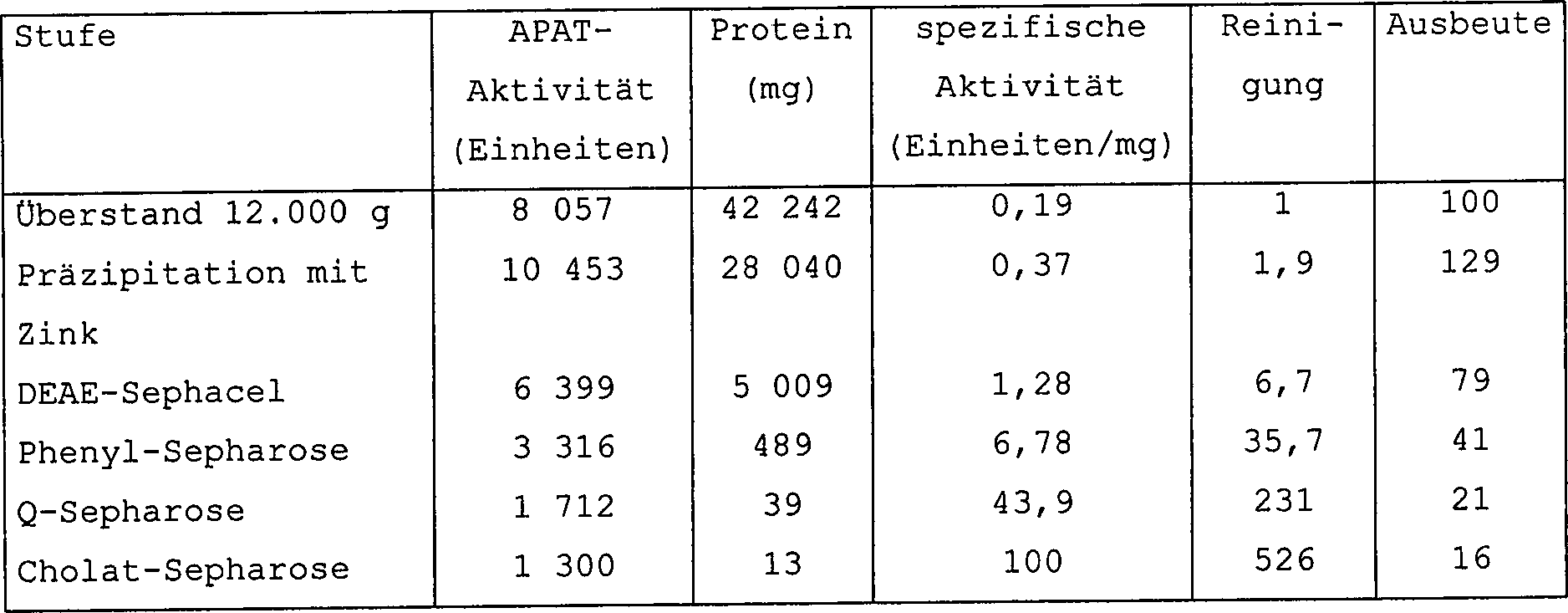
Die
Hälfte
des halb-gereinigten Materials, das oben erhalten worden war (etwa
6 mg Protein), wurde dann aufgetaut, danach mit PEG 4000 (Prolabo)
zu einer Endkonzentration von 20 (G/V) versetzt, um das Cholat und
NaCl zu eliminieren. Nach 30-minütigem
Rühren
bei 4°C
wurde das Präzipitat
durch Zentrifugation mit 12.000 g während 30 min bei 4°C gesammelt,
dann in 4 ml Puffer A erneut aufgelöst. Die so erhaltene Lösung wurde
dann mit einer Geschwindigkeit von 1 ml/min auf eine MonoP HR 5/20-Säule (Pharmacia)
aufgebracht, die vorher mit 25 mM bis-Tris-Puffer, pH 6,3, äquilibriert
worden war. Die APAT-Aktivität
wurde mit dem Puffer Polypuffer 74, pH 4,0, (Pharmacia) eluiert.
1 ml-Fraktionen wurden in Gegenwart von je 50 μl 2 M Tris-HCl-Puffer, pH 8,0,
derart gesammelt, dass die Inaktivierung des Enzyms bei saurem pH
begrenzt wurde. Die Fraktionen 14, 15 und 16 (
C – Eigenschaften der APATC - Properties the APAT
a) Substratspezifitäta) Substrate specificity
Nach dem oben für Acetyl-CoA und Pregnenolon angegebenen Verfahren unter Verwendung verschiedener Acyl-Donatoren oder unterschiedlicher Steroidsubstrate überträgt halb-gereinigte APAT Acetat auf 3β-Ol-delta4- oder -delta5-steroide mit vergleichbarer Wirksamkeit, während der Transfer auf die Östrogene schwach ist und auf die Sterole nicht nachweisbar ist und wobei eine deutliche Präferenz für Acetyl-CoA als Acyldonator besteht.Following the procedure outlined above for acetyl-CoA and pregnenolone using various acyl donors or different steroid substrates, semi-purified APAT transfers acetate to 3β-ol delta 4 or delta 5 steroids with comparable efficacy while transferring to the estrogens is weak and is not detectable on the sterols and where there is a clear preference for acetyl-CoA as Acyldonator.
Die folgende Tabelle 2 zeigt die erhaltenen Resultate, wobei für a) die Versuche mit 30 μM jedes getesteten Steroids und 100 μM [3H]Acetyl-CoA durchgeführt wurden und für b) die Versuche mit 100 μM jedes Acyldonators und 30 μM [3H]Pregnenolon durchgeführt wurden:The following Table 2 shows the results obtained, wherein for a) the experiments with 30 uM of each steroid tested and 100 uM [ 3 H] acetyl-CoA were performed and for b) the experiments with 100 uM each acyl donor and 30 uM [ 3 H ] Pregnenolone were carried out:
Tabelle
2 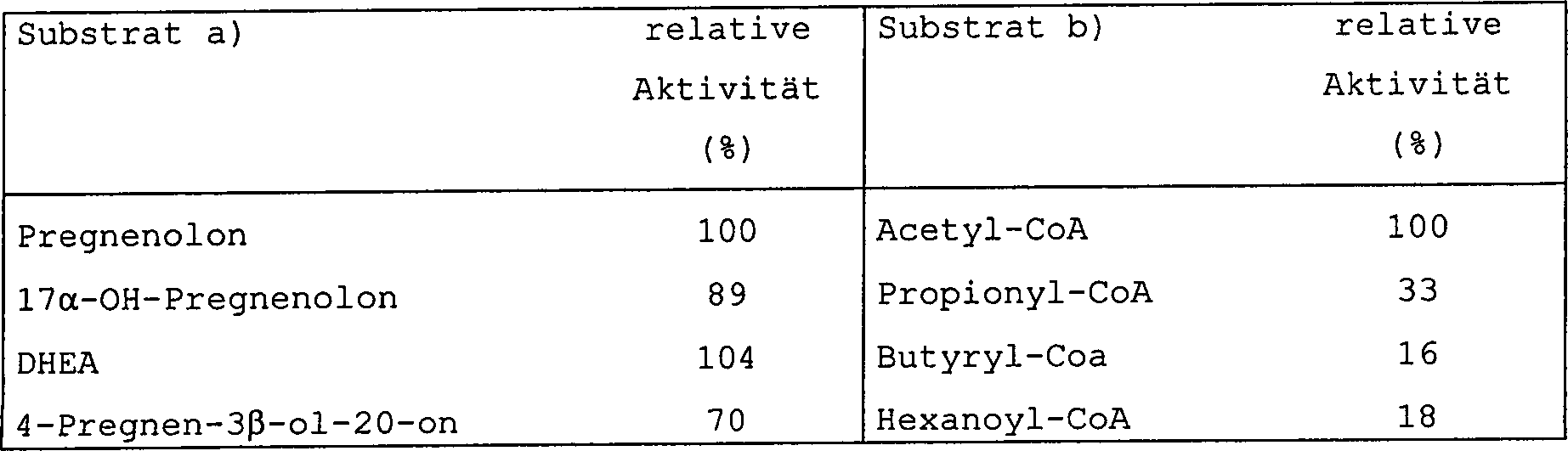
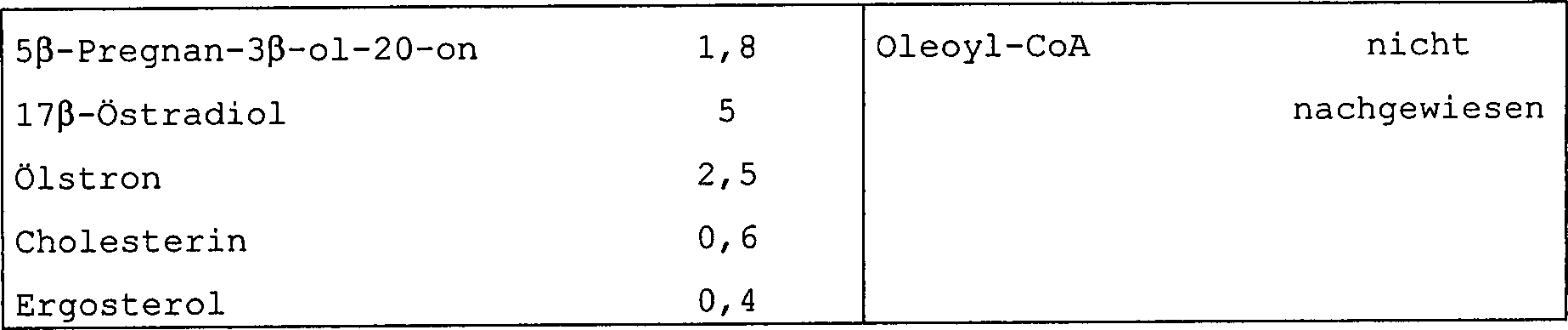
b) Inhibierungb) inhibition
Die APAT-Aktivität wird durch die Reagenzien mit Sulfhydryl-Gruppierungen, wie z. B. NEM und DTNB, stark inhibiert. Die Inhibierung ist in Gegenwart von Zinkchlorid (1 mM) vollständig.The APAT activity is replaced by the reagents with sulfhydryl groups, such. NEM and DTNB, strong inhibited. The inhibition is in the presence of zinc chloride (1 mM) Completely.
D – Partielle AminosäuresequenzD - Partial amino acid sequence
Die partielle Aminosäuresequenz wurde nach Abbau mit Trypsin an den Gelschnitten nach dem Verfahren, das von Rosenfeld et al. (1992) beschrieben wurde, bestimmt.The partial amino acid sequence after digestion with trypsin on the gel slices after the process, that of Rosenfeld et al. (1992).
Ausgehend von zwei Drittel des oben erhaltenen Konzentrats, das dann durch SDS-PAGE getrennt worden war, wurde die 62 kDa-Bande ausgeschnitten, dann mit Trypsin (Promega) inkubiert. Die erzeugten Peptide wurden dann durch RP-HPLC an einer Vydac 218TP-Säule (1,5 × 125 mm) mit einer Geschwindigkeit von 100 μl/min getrennt, wobei ein linearer Acetonitrilgradient, der von 0 bis 60% in 80 min, dann von 60 bis 100% in 20 min in einer 0,1% TFA-Lösung in Wasser, verwendet wurde; dann wurden sie einer Aminosäuresequenzierung unterworfen.outgoing of two-thirds of the concentrate obtained above, then through SDS-PAGE was separated, the 62 kDa band was excised, then trypsin (Promega). The generated peptides were then purified by RP-HPLC on a Vydac 218TP column (1.5 x 125 mm) separated at a rate of 100 μl / min, with a linear Acetonitrile gradient ranging from 0 to 60% in 80 minutes, then from 60 to 100% in 20 min in a 0.1% TFA solution in water, was used; then they were subjected to amino acid sequencing subjected.
Die N-terminale Sequenz wurde an einem Proteinsequenzanalysator Modell 477A, der mit einem HPLC-Analysator für PTH-Aminosäuren verbunden war (Applied Biosystems), bestimmt.The N-terminal sequence was modeled on a protein sequence analyzer 477A, which was connected to an HPLC analyzer for PTH amino acids was (Applied Biosystems), determined.
Unter
den sequenzierten Proben lieferten zwei Peaks x und y eine eindeutige
Sequenz, die aus den folgenden 10 bzw. 16 Aminosäuren bestehen:
Für den Peak
x: ISEQFKKDDF
für
den Peak y: LIELISPVIIPLGNPK.Among the sequenced samples, two peaks x and y provided a unique sequence consisting of the following 10 and 16 amino acids, respectively:
For the peak x: ISEQFKKDDF
for the peak y: LIELISPVIIPLGNPK.
Die
zwei so erhaltenen Peptidsequenzen wurden verwendet, um die Datenbank
des Genoms von S. cerevisiae durchzumustern. Es konnte ein Protein
mit 62 kDa identifiziert werden, dessen Sequenz genau die Sequenz
der zwei oben genannten enthält
(Mips, Zugangsnummer S64491, Hebling et al., Mai 1996). Dieses Protein,
dessen Sequenz in
Beispiel 2: Konstruktion von Hefestämmen, die das Gen ATFS, unterbrochen durch das Gen URA3 haben, und die die APAT-Aktivität verloren haben (atf2-Δ::URA3)Example 2: Construction of yeast strains, which have the gene ATFS, interrupted by the gene URA3, and the lost the APAT activity have (atf2-Δ :: URA3)
A) Targeting des Gens ATF2A) Targeting of the gene ATF2
Das Gen URA3 von S. cerevisiae wurde durch Substitution eines ausgewählten Teils des Gens ATF2 von S. cerevisiae eingeführt, was eine anschließende Selektion der Mutantenstämme durch Prototrophie für Uracil erlaubt.The Gen URA3 from S. cerevisiae was obtained by substitution of a selected part of the ATF2 gene from S. cerevisiae, resulting in subsequent selection of the mutant strains by prototrophy for uracil allowed.
Der
Selektionsmarker URA3 wurde durch Doppelfusions-PCR nach dem Verfahren,
das von Amberg et al., 1995, beschrieben wurde, mit dem Gen ATF2
assoziiert. Die in
Im ersten Verfahrensschritt wurde eine Probe ganzer Zellen des Stamms Fy1679, der als DNA-Quelle des Zielgens ATF2 verwendet wurde, im PCR-Puffer, der 2 mM dNTP (Pharmacia) enthielt, unter den folgenden Bedingungen amplifiziert: 25 Zyklen; 93°C, 30 s; 54°C, 2 min; 68°C, 3 min, gefolgt von einer Verlängerung von 5 min bei 72°C; Polymerase Ampli Taq (Perkin Elmer).in the first step was a whole cell sample of the strain Fy1679, which was used as the DNA source of the target gene ATF2, in PCR buffer containing 2 mM dNTP (Pharmacia) among the following Conditions amplified: 25 cycles; 93 ° C, 30 s; 54 ° C, 2 minutes; 68 ° C, 3 min, followed by a Extension of 5 min at 72 ° C; Polymerase Ampli Taq (Perkin Elmer).
Einerseits
wurde die Region 5' des
Gens ATF2 durch PCR amplifiziert, wobei die Oligonucleotide mit den
folgenden Sequenzen als direkte oder indirekte Primer verwendet
wurden:
OTG10841: AAAAGTCGACAAAATGGAAGRTATAGAAGGATACGAACCACRTATCACTC
(SEQ ID No: 1)
und
OTG10844: ATCAATCTCCAATTAGGCCTCTTCGGATTACCC
(SEQ ID NO: 2),
die eine homologe Region zu der Region 5' der Sequenz des
Gens ATF2 (SGD : YGR177c) enthalten, und wobei eine Restriktionsstelle
SalI für
OTG10841 angefügt
wurde.On the one hand, the region 5 'of the ATF2 gene was amplified by PCR using the oligonucleotides with the following sequences as direct or indirect primers:
OTG10841: AAAAGTCGACAAAATGGAAGRTATAGAAGGATACGAACCACRTATCACTC (SEQ ID NO: 1)
and
OTG10844: ATCAATCTCCAATTAGGCCTCTTCGGATTACCC (SEQ ID NO: 2),
which contain a homologous region to the region 5 'of the sequence of the ATF2 gene (SGD: YGR177c), and a restriction site SalI was added for OTG10841.
Andererseits
wurde die Region 3' des
Gens ATF2 durch PCR amplifiziert, wobei als direkte und indirekte
Primer die Oligonucleotide mit den folgenden Sequenzen verwendet
wurden:
OTG10846: CATTCGACATTCCCGAAGGTGACAATGACAAG (SEQ ID
NO: 3)
und
OTG10842: AAAAACGCGTAACTATTAAAGCGACGCAAATTCGCCGATGGTTTGG
(SEQ ID NO: 4)
die homologe Regionen der Region 3' der Sequenz des
Gens ATF2 (SGD : YGR177c) enthielten, und wobei eine Restriktionsstelle
MluI für
OTG10842 angefügt
wurde.On the other hand, the region 3 'of the ATF2 gene was amplified by PCR, using as direct and indirect primers the oligonucleotides having the following sequences:
OTG10846: CATTCGACATTCCCGAAGGTGACAATGACAAG (SEQ ID NO: 3)
and
OTG10842: AAAAACGCGTAACTATTAAAGCGACGCAAATTCGCCGATGGTTTGG (SEQ ID NO: 4)
the homologous regions of region 3 'of the sequence of the ATF2 gene (SGD: YGR177c) were included, and a MluI restriction site was added for OTG10842.
In
einem zweiten Verfahrensschritt wurde das Gen URA3 von S. cerevisiae
durch PCR amplifiziert, wobei als direkter Beginn das Oligonucleotid
mit der folgenden Sequenz verwendet wurde:
OTG10843:
GGGTAATCCGAAGAGGCCTAATTGGAGATTGATAAGCTTTTCAATTCAATTCATCATTTTTTTTTTATTCTTTTTTTTG
(SEQ ID NO: 5).In a second method step, the S. cerevisiae URA3 gene was amplified by PCR, using as direct start the oligonucleotide having the following sequence:
OTG10843:
GGGTAATCCGAAGAGGCCTAATTGGAGATTGATAAGCTTTTCAATTCAATTCATCATTTTTTTTTTTCTCTTTTTTTG (SEQ ID NO: 5).
Diese
enthält
eine Sequenz, die zur Region 5' der
publizierten Sequenz des Gens URA3 homolog ist (Rose et al., 1984;
GenBank: YSCODCD-Zugangsnummer: K02207; SGD : YEL021w), und zwar
assoziiert mit einer Sequenz, die zur Region 5' des Gens ATF2 homolog ist (komplementär zu OTG10844);
als indirekter Primer wurde das Oligonucleotid mit der folgenden
Sequenz verwendet:
OTG10845:
CTTGTCATTGTCACCTTCGGGAATGTCGAATGGGGTAATAACTGATATAATTAAATTGAACTC
(SEQ ID NO: 6)This contains a sequence homologous to the region 5 'of the published sequence of the URA3 gene (Rose et al., 1984; GenBank: YSCODCD accession number: K02207; SGD: YEL021w) associated with a sequence corresponding to region 5 homologous to the ATF2 gene (complementary to OTG10844); The indirect primer used was the oligonucleotide having the following sequence:
OTG10845:
CTTGTCATTGTCACCTTCGGGAATGTCGAATGGGGTAATAACTGATATAATTAAATTGAACTC (SEQ ID NO: 6)
Diese enthält eine Sequenz, die zur Region 3' des Gens URA3 homolog ist, assoziiert mit einer Sequenz, die zur Region 3' des Gens ATF2 homolog ist (komplementär zu OTG10846). Eine 20 ng-Probe von DNA des Gens URA3, die ausgehend vom Pendelvektor E. coli-Hefe pTG10021 (Degryse et al., 1995) durch Verdauung mit dem Restriktionsenzym HindIII isoliert worden war, wurde unter den oben angegebenen Bedingungen amplifiziert.These contains a sequence belonging to the region 3 'of the Gens URA3 is homologous, associated with a sequence leading to the region 3 'of the ATF2 gene is homologous (complementary to OTG10846). A 20 ng sample of DNA from the URA3 gene starting from the shuttle vector E. coli yeast pTG10021 (Degryse et al., 1995) by digestion with the restriction enzyme HindIII was isolated amplified above conditions.
Die entsprechend erhaltenen PCR-Produkte wurden gereinigt, indem der "Geneclean Kit" (Bio 101 Inc., La Jolla, USA) verwendet wurde, dann wurden sie der Doppelfusionsreaktion unterworfen, wobei als Primer die oben genannten Oligonucleotide OTG10841 und OTG10842 unter den Amplifikationsbedingungen, welche für die früheren PCR-Reaktionen verwendet wurden, mit einem Programm aus 20 Zyklen verwendet wurden.The correspondingly obtained PCR products were purified using the "Geneclean Kit" (Bio 101 Inc., La Jolla, USA), then subjected to the double fusion reaction using as Pri the above oligonucleotides OTG10841 and OTG10842 were used under the amplification conditions used for the previous PCR reactions with a 20-cycle program.
Nach Reinigung des Fusionsendproduktes, das die flankierenden Regionen des Gens ATF2 fusioniert an das funktionelle Gen URA3 enthielt, wurde das Vorliegen des Gens URA3 durch Verdauung mit dem Restriktionsenzym EcoRV bestätigt, welches das Vorliegen dieser Stelle im amplifizierten Material zeigt.To Purification of the final fusion product containing the flanking regions of the ATF2 gene fused to the functional gene URA3, was the presence of the gene URA3 by digestion with the restriction enzyme EcoRV confirms which shows the presence of this site in the amplified material.
B) Bildung der Hefestämme atf2-Δ::URA3B) Formation of yeast strains atf2-Δ :: URA3
Das oben erhaltene Fusionsprodukt wurde direkt in die kompetenten Zellen des Stamms Fy1679 oder des Stamms TGY73.4 transformiert und die Transformanten wurden durch Wachstum auf dem Milieu SD (F. Sherman, 1991) in Gegenwart des Nährstoffbedarfs des Stamms und in Abwesenheit von Uracil selektioniert.The The fusion product obtained above was directly into the competent cells the strain Fy1679 or the strain TGY73.4 and the Transformants were identified by growth in the environment SD (F. Sherman, 1991) in the presence of nutrient demand of the strain and in the absence of uracil.
Ausgehend von den isolierten Klonen wurde die neue Verbindung zwischen der Region 5' des Gens ATF2 und dem Gen URA3 (5'ATF2-URA3-3'ATF2) durch Amplifikation durch PCR an den ganzen Zellen gezeigt, wobei die oben genannten Primer OTG10841 und OTG10845 verwendet wurden. Die Abwesenheit der APAT-Aktivität wurde dann nach dem beschriebenen Test, ausgehend vom Zellhomogenat, im Vergleich zum Elternstamm, der eine deutliche APAT-Aktivität aufweist, gezeigt.outgoing from the isolated clones, the new connection between the Region 5 'of the ATF2 gene and the gene URA3 (5'ATF2-URA3-3'ATF2) by amplification shown by PCR on the whole cells, the above Primers OTG10841 and OTG10845 were used. The absence of APAT activity was then according to the described test, starting from the cell homogenate, in Comparison to the parent strain, which has a clear APAT activity, shown.
Die Stämme, die auf diese Kriterien ansprechen, wurden so als die Mutantenstämme atf2 charakterisiert und als atf2-Δ::URA3 bezeichnet. Ein mutanter Stamm, der so ausgehend vom Elternstamm Fy1679 erhalten worden war, wurde TGY156 genannt, und ein mutanter Stamm, der ausgehend vom Elternstamm TGY73.4 erhalten worden war, wurde TGY158 genannt.The strains which respond to these criteria were so called the atf2 mutant strains characterized as atf2-Δ :: URA3 designated. A mutant strain starting from the parent strain Fy1679 was named TGY156, and a mutant Strain obtained from the parent strain TGY73.4, was called TGY158.
Eine Probe des Stamms TGY156 wurde bei der Collection Nationale de Cultures de Microorganismes (CNCM) INSTITUT PASTEUR, 25, Rue du Docteur Roux 75724 Paris Cedex 15, Frankreich, am 02. Februar 1998 unter der Nummer I-1977 hinterlegt.A Sample of strain TGY156 was obtained from the Collection Nationale de Cultures de Microorganismes (CNCM) INSTITUTE PASTEUR, 25, Rue du Docteur Roux 75724 Paris Cedex 15, France, on 02 February 1998 under the Number I-1977 deposited.
Eine Probe des Stamms TGY158 wurde bei der Collection Nationale de Cultures de Microorganismes (CNCM) INSTITUT PASTEUR, 25, Rue du Docteur Roux 75724 Paris Cedex 15, Frankreich, am 02. Februar 1998 unter der Nummer I-1976 hinterlegt.A Sample of strain TGY158 was obtained from the Collection Nationale de Cultures de Microorganismes (CNCM) INSTITUTE PASTEUR, 25, Rue du Docteur Roux 75724 Paris Cedex 15, France, on 02 February 1998 under the Deposited number I-1976.
C) Stabilisierung von Pregnenolon in vivo in den Kulturen der Hefestämme atf2-Δ::URA3C) stabilization of Pregnenolone in vivo in cultures of yeast strains atf2-Δ :: URA3
Die
Zellen des Stamms TGY158, die oben erhalten worden waren, wurden
mit A600 = 0,1 in YPD (Difco)-Medium, das 100 μg/ml Pregnenolon enthielt, inokuliert.
Nach 16-stündiger
Inkubation bei 28°C
wurden die Steroide mit Dichlormethan extrahiert und durch RP-HPLC,
wie oben angegeben, analysiert. Die
Diese Resultate lassen den Schluss zu, dass das Produkt des Gens ATF2 für die Veresterung von Pregnenolon durch die Hefe verantwortlich ist, während die Unterbrechung des Gens ATF2 zu keinen offensichtlichen Modifikationen des Zellwachstums unter normalen Bedingungen geführt hat.These Results suggest that the product of the ATF2 gene for the Esterification of pregnenolone by the yeast is responsible, while the Disruption of the ATF2 gene to no obvious modifications cell growth under normal conditions.
Beispiel 3: Konstruktion eines Hefestamms, der das Gen ATF2 durch das Gen URA3 unterbrochen hat und 3β-HSD exprimiertExample 3: Construction of a yeast strain that disrupted the ATF2 gene by the URA3 gene has and 3β-HSD expressed
Plasmide
2μ, die
eine cDNA, die für
die humane 3β-HSD
codiert, unter der Kontrolle des Promotors CYC1 von S. cerevisae
oder des Promotors TEF1 von S. cerevisae tragen und das Resistenzgen
für G418 tragen,
wurden nach dem Schema der
Im ersten Arbeitsgang wurde ein Transfervektor pTG10095, der die cDNA-Sequenz, die für die humane 3β-HSD, Typ II, beschrieben von E. Rheaume et al., 1991, codiert, flankiert von den SalI- und MluI-Stellen und stromabwärts vom Hefepromotor GAL10/CYC1 gelegen, enthält, wurde in folgender Weise gebildet:in the first operation was a transfer vector pTG10095 containing the cDNA sequence, the for the human 3β-HSD, Type II, described by E. Rheaume et al., 1991, encoded, flanked from the SalI and MluI sites and downstream from the yeast promoter GAL10 / CYC1 located, contains, was formed in the following way:
Die
Sequenz, die für
die 3β-HSD
codiert, wurde nach E. Rheaume et al., 1991, als SalI-NotI-Restriktionsfragment
in dieselben Stellen des Vektors Bluescript II (Stratagene) subkloniert.
Der erhaltene Vektor, der von E. Rheaume et al., 1991, beschrieben
wurde, enthält
eine NotI-Stelle am 3'-Ende
der Sequenz, welche für 3β-HSD codiert,
lokalisiert. Dieser Vektor wurde dann durch das Restriktionsenzym
NotI verdaut, danach durch das Klenow-Fragment in Gegenwart von
dNTP behandelt, um die kohäsiven
Enden aufzufüllen,
danach in Gegenwart des Oligonucleotids mit der folgenden Sequenz:
OTG4461:
CACACGCGTGTG (SEQ ID NO: 7),
die vorher phosphoryliert und
mit sich selbst hybridisiert worden war, um eine MluI-Stelle einzuführen, religiert. Der
so erhaltene Vektor pTG10082 (
OTG4461: CACACGCGTGTG (SEQ ID NO: 7),
which had previously been phosphorylated and hybridized with itself to introduce a MluI site, religated. The vector pTG10082 (
Um
die Stelle SalI des ATG-Initiators stromaufwärts, zu der, an der man den
Promotor GAL10/CYC1 einführen
möchte,
anzunähern,
wurde der Vektor pTG10082 durch das Restriktionsenzym MscI, dessen
Stelle in der nicht-codierenden
Region 5' und genau
stromaufwärts
des ATG-Initiators
gelegen ist, und durch das Restriktionsenzym MluI verdaut. Das Fragment
MscI-MluI mit 1,8 kb, das die codierende Sequenz für 3β-HSD enthält (
In
einem zweiten Verfahrensschritt wird der Rekombinationsvektor pTG10268,
der das Plasmid 2μ von Hefe,
ein Replikon von E. coli, eine Expressionskassette CYClprom-PGKterm und
den Selektionsmarker LEU2 (
Das
Expressionsplasmid pTG10268 wurde dann durch homologe Rekombination
durch Einführung des
Expressionsblocks, der den Promotor Gal10/CYClp enthält, welcher
ausgehend vom Plasmid pTG10095, welches oben hergestellt worden
war, dann durch das Restriktionsenzym NotI verdaut worden war, erhalten worden
war, in das Plasmid pTG10260, welches vorher durch die Restriktionsenzyme
SalI und MluI verdaut worden war, erzeugt. Das Plasmid pTG10268
(
Expressionsplasmid
pTG10862, das die codierende Sequenz für 3β-HSD unter der Kontrolle des
Promotors TEF1 enthält,
wurde danach in folgender Weise konstruiert (
Zunächst wurde
das Plasmid pTG10832 (
Das Expressionsplasmid pTG10862 wurde danach durch Einführung des Promotors TEF1 erhalten, welcher in dem Fragment ClaI-SalI enthalten war, welches, ausgehend vom Plasmid pTG10085 (E. Degryse et al., 1995), isoliert worden war, an die Stelle des Promotors CYC1, der durch Verdau des Plasmids pTG10832, das oben konstruiert worden war, durch die Restriktionsenzyme ClaI und SalI ausgeschnitten worden war, erhalten.The Expression plasmid pTG10862 was then replaced by introduction of the Obtained promoter TEF1, which was contained in the fragment ClaI-SalI, which, starting from the plasmid pTG10085 (E. Degryse et al., 1995), had been isolated, in place of the promoter CYC1, by Digestion of plasmid pTG10832, constructed above the restriction enzymes ClaI and SalI had been excised, receive.
Das
Plasmid pTG10862, das so erhalten worden war (
Die so erhaltenen Kolonienkandidaten wurden dann auf SD-Medium, das die für jeden Stamm notwendigen Nährstoffe enthielt (Histidin und Uracil für den Stamm TGY73.4; Histidin für TGY158; Tryptophan, Histidin, Leucin und Uracil für den Stamm FY1679; Tryptophan, Histidin und Leucin für den Stamm TGY156; jeweils in einer Konzentration von 100 μg/ml) vorkultiviert, dann in ein Medium inokuliert, das 100 μg/ml Pregnenolon enthielt. Nach 24 h Wachstum und Bioumwandlung bei 28°C wurden die Steroide extrahiert und wie oben angegeben durch RP-HPLC gemessen. Die erhaltenen Resultate, die für jeden Stamm an drei Klonen gemessen wurden, sind in der folgenden Tabelle 3 angegeben:The colony candidates thus obtained were then seeded on SD medium containing the nutrients necessary for each strain (histidine and uracil for the strain TGY73.4, histidine for TGY158, tryptophan, histidine, leucine and uracil for the strain FY1679, tryptophan, histidine and Leucine for strain TGY156, each pre-cultured at a concentration of 100 μg / ml), then inoculated into a medium containing 100 μg / ml pregnenolone. After 24 h of growth and bioconversion at 28 ° C, the steroids were extracted and as above given by RP-HPLC. The results obtained, which were measured for each strain on three clones, are given in the following Table 3:
Tabelle
3 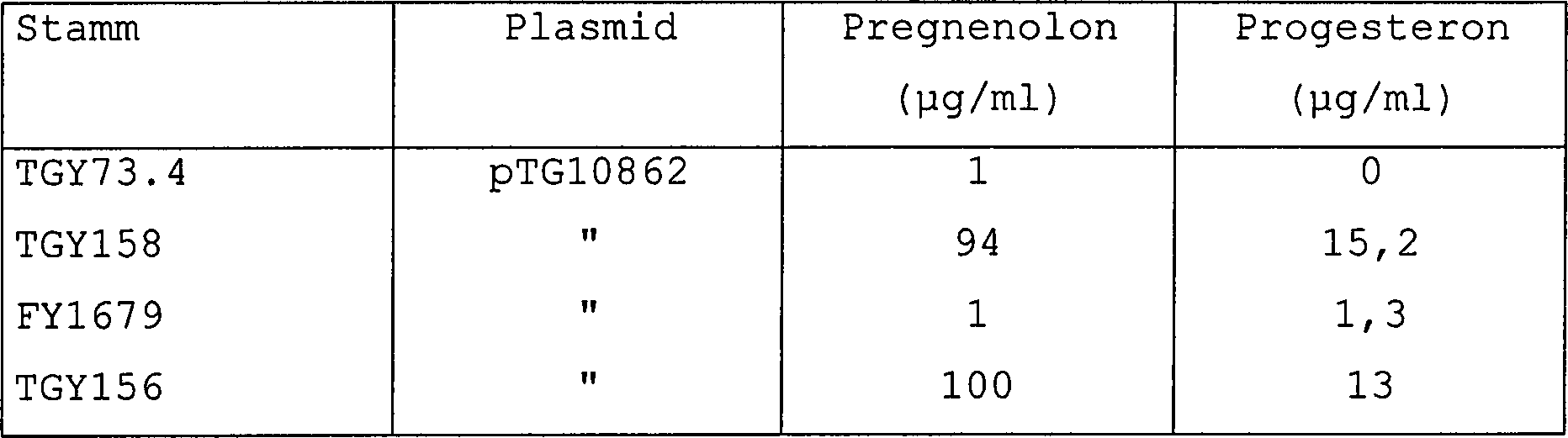
Diese Resultate zeigen, dass das Substrat Pregnenolon in den Mutantenstämmen TGY156 oder TGY158 fast quantitativ wiedergewonnen wird, wobei in diesen das Auftreten einer Bioumwandlung von Pregnenolon in Progesteron beobachtet wird, während in den Elternstämmen TGY73.4 oder FY1679 das Verschwinden von Pregnenolon fast vollständig ist, wobei diese kein oder sehr wenig Progesteron produzieren, das Pregnenolonacetat allerdings akkumulieren, wie es in Beispiel 2 gezeigt wurde.These Results show that the substrate pregnenolone in the mutant strains TGY156 or TGY158 is recovered almost quantitatively, taking in these the occurrence of a bioconversion of pregnenolone to progesterone is observed while in the parent strains TGY73.4 or FY1679 the disappearance of pregnenolone is almost complete, these produce no or very little progesterone, the pregnenolone acetate however, accumulate as shown in Example 2.
Eine Probe des transformierten Stamms TGY158/pTG10862 wurde bei der Collection Nationale de Cultures de Microorganismes (CNCM) (INSTITUT PASTEUR, 25, Rue du Docteur Roux 75724 Paris Cedex 15, Frankreich, am 02. Februar 1998 unter der Nummer I-1978 hinterlegt.A Sample of transformed strain TGY158 / pTG10862 was used in the collection National de Cultures de Microorganisms (CNCM) (INSTITUT PASTEUR, 25, Rue du Docteur Roux 75724 Paris Cedex 15, France, on 02. February 1998 under number I-1978 deposited.
Beispiel 4: Konstruktion eines Hefestamms, der das Gen ATF2, das durch TEF1prom/PGKterm unterbrochen ist, hat (atf2-Δ::ΤΕF1/PGK)Example 4: Construction of a yeast strain the ATF2 gene, which is interrupted by TEF1 prom / PGK term has, (ATF2-Δ :: ΤΕF1 / PGK)
Der Stamm TGY186, der ein Stamm ist, der vom Stamm TGY156 abgeleitet ist (atf2-Δ::URA3) und der in Beispiel 2 beschrieben ist, wobei das Gen URA3 am Locus ATF2 durch den Expressionsblock ΤΕF1prom/PGKterm ersetzt wurde, wurde wie folgt konstruiert:The strain TGY186, which is a strain derived from the strain TGY156 (atf2-Δ :: URA3) and described in Example 2, where the gene URA3 at the locus ATF2 has been replaced by the expression block ΤΕF1 prom / PGK term constructed as follows:
In
einem ersten Verfahrensschritt wurde der Expressionsblock ΤΕF1prom/PGKterm mit
dem Gen ATF2 durch Doppelfusions-PCR unter den in Beispiel 2 beschriebenen
Bedingungen assoziiert, wobei allerdings der Expressionsblock ΤΕF1prom/PGKterm von
S. cerevisiae, der von E. Degryse et al., 1995, beschrieben wurde,
anstelle des Selektionsmarkers URA3 verwendet wurde. Die zwei ersten
PCR-Reaktionen (PCR1), die die Amplifikation der codierenden Regionen
5' und 3' des Gens ATF2, die
die Insertionsstelle des Blocks ΤΕF1prom/PGKterm im unterbrochenen
Zielgen ATF2 flankieren, wurden durchgeführt, indem als direkte oder
indirekte Primer für
die Region 5' die
Oligonucleotide verwendet wurden, die die folgenden Sequenzen haben:
OTG11049:
CTCTCTGTCGACAAAATGGAAGATATAGAAGGATACGAACCACATATCACTC
(SEQ ID NO: 8) und
OTG10844: ATCAATCTCCAATTAGGCCTCTTCGGATTACCC
(SEQ ID NO: 9)
und für
die Region 3', die
Oligonucleotide mit den folgenden Sequenzen verwendet wurden:
OTG10846:
CATTCGACATTCCCGAAGGTGACAATGACAAG. (SEQ ID NO: 10) und
OTG11050:
AACAACACGCGTAACTATTAAAGCGACGCAAATTCGCCGATGCTTTGG (SEQ ID NO: 11).In a first method step, the expression block ΤΕF1 prom / PGK term was associated with the gene ATF2 by double fusion PCR under the conditions described in Example 2, except that the expression block ΤΕF1 prom / PGK term of S. cerevisiae, by E. Degryse et al , 1995, was used instead of the selection marker URA3. The first two PCR reactions (PCR1) involving the amplification of the coding regions 5 'and 3' of the ATF2 gene flanking the insertion site of the block ΤΕF1 prom / PGK term in the interrupted target ATF2 were carried out using as direct or indirect primers for the region 5 'the oligonucleotides were used which have the following sequences:
OTG11049:
CTCTCTGTCGACAAAATGGAAGATATAGAAGGATACGAACCACATATCACTC (SEQ ID NO: 8) and
OTG10844: ATCAATCTCCAATTAGGCCTCTTCGGATTACCC (SEQ ID NO: 9)
and for region 3 ', oligonucleotides having the following sequences were used:
OTG10846: CATTCGACATTCCCGAAGGTGACAATGACAAG. (SEQ ID NO: 10) and
OTG11050: AACAACACGCGTAACTATTAAAGCGACGCAAATTCGCCGATGCTTTGG (SEQ ID NO: 11).
Die Primer OTG11049 und OTG11050 wurden entwickelt, um jeweils die Restriktionsstellen SalI und MluI einzuführen.The Primers OTG11049 and OTG11050 were designed to each contain the restriction sites Introduce SalI and MluI.
Die
dritte PCR-Reaktion (PCR2), die die Amplifikation des Blocks ΤΕF1prom/PGKterm ermöglicht,
wurde durchgeführte,
indem als direkte oder indirekte Primer die Oligonucleotide verwendet
wurden, die die folgenden Sequenzen haben:
OTG11052:
GGGTAATCCGAAGAGGCCTAATTGGAGATTGATATCGATCACACACCATAGCTTCAAAATGTTTCTAC (SEQ
ID NO: 12) und
OTG11053:
CTTGTCATTGTCACCTTCGGGAATGTCGAAGCTTCGAAACGCAGAATTTTCGAGTTATTAAACTTAR
(SEQ ID NO: 13),
welche die Restriktionsstellen ClaI und HindIII
einführen.
Schließlich
wurde die Verbindung durch Doppelfusion der oben erhaltenen PCR-Produkte
realisiert, wobei als Primer die Oligonucleotide mit den Sequenzen OTG11049
(SEQ ID NO: 8) und OTG11050 (SEQ ID NO: 11) verwendet wurden, welche
die Restriktionsstellen SalI und MluI an ATF2-junction-Stellen einführen.The third PCR reaction (PCR2), which allows amplification of the block ΤΕF1 prom / PGK term , was carried out using as direct or indirect primers the oligonucleotides having the following sequences:
OTG11052:
GGGTAATCCGAAGAGGCCTAATTGGAGATTGATATCGATCACACACCATAGCTTCAAAATGTTTCTAC (SEQ ID NO: 12) and
OTG11053:
CTTGTCATTGTCACCTTCGGGAATGTCGAAGCTTCGAAACGCAGAATTTTCGAGTTATTAAACTTAR (SEQ ID NO: 13),
which introduce the restriction sites ClaI and HindIII. Finally, the compound was made by double fusion of the PCR products obtained above, using as primers the oligonucleotides having the sequences OTG11049 (SEQ ID NO: 8) and OTG11050 (SEQ ID NO: 11), which introduce the restriction sites SalI and MluI at ATF2 junction sites.
Nach Reinigung wurde das Fusionsendprodukt mit dem Gen ATF2, welches in dem Plasmid pTG10885 enthalten war und wie oben angegeben konstruiert und vorher mit den Restriktionsenzymen BstI und StuI verdaut worden war, rekombiniert. Auf diese Weise wird das Plasmid pTG10888, das das Signal ΤΕF1prom/PGKterm an den Stellen ClaI und HindIII enthält, welche durch die flankierenden Regionen des Gens ATF2 begrenzt werden.After purification, the fusion end product was recombined with the ATF2 gene contained in the plasmid pTG10885 and constructed as indicated above and previously digested with the restriction enzymes BstI and StuI. In this way, the plasmid pTG10888, which contains the signal ΤΕF1 prom / PGK term at the sites ClaI and HindIII, which are bounded by the flanking regions of the gene ATF2.
Die Herstellung des Plasmids pTG10885 umfasst die Amplifikation des Gens ATF2, ausgehend vom Stamm FY1679, nach den in Beispiel 2 beschriebenen Bedingungen, aber unter Verwendung als direkte und indirekte Primer, der Oligonucleotide, die die Sequenzen OTG11049 (SEQ ID NO: 8) und OTG11050 (SEQ ID NO: 11), die oben angegeben sind, haben, welche die Restriktionsstellen SalI und MluI einführen. In dem erhaltenen PCR-Produkt werden diese Stellen dann durch Verdauung mit den Restriktionsenzymen SalI und MluI, danach Behandlung mit dem Klenow-Fragment der Polymerase I von E. coli, um die klebrigen Enden aufzufüllen, eliminiert. Das erhaltene Fragment wurde dann in den Expressionsvektor pTG10031, der von E. Degryse et al., 1995, beschrieben wurde und der vorher mit den Enzymen ClaI und HindIII verdaut, danach mit dem Klenow-Fragment behandelt worden war, ligiert. Durch Transformation in E. coli wird das Plasmid pTG10885 erhalten, das aus der Ligation der SalI-Stelle des PCR-Produktes, das unter Verwendung des Klenow-Fragments derart aufgefüllt wurde, dass die Sequenz GTCGA erhalten wurde, mit der HindIII-Stelle des Vektors, die derart unter Verwendung des Klenow-Fragments aufgefüllt wurde, dass die Sequenz AGCTT erhalten wurde, resultiert, und zwar derart, dass die Stelle HindIII (GTCGAAGCTT) (SEQ ID NO: 14) wieder aufgebaut wurde und die Stelle ClaI verloren ging. Die Stelle ClaI des Vektors, die unter Verwendung des Klenow-Fragments so aufgefüllt wurde, dass die Sequenz ATCG erhalten wurde, geht nach Ligation des PCR-Produktes verloren.The Preparation of the plasmid pTG10885 involves the amplification of the Gens ATF2, starting from strain FY1679, according to those described in Example 2 Conditions, but using as direct and indirect primers, the oligonucleotides comprising the sequences OTG11049 (SEQ ID NO: 8) and OTG11050 (SEQ ID NO: 11) given above have which introduce the restriction sites SalI and MluI. In the resulting PCR product These are then digested by digestion with the restriction enzymes SalI and MluI, then treatment with the Klenow fragment of polymerase I from E. coli to fill in the sticky ends is eliminated. The obtained Fragment was then inserted into the expression vector pTG10031, that of E. Degryse et al., 1995, and previously with the enzymes ClaI and HindIII digested, then treated with the Klenow fragment had been ligated. By transformation into E. coli, the plasmid pTG10885 obtained from the ligation of the SalI site of the PCR product described in U.S. Pat Using the Klenow fragment was filled up so that the sequence GTCGA was obtained with the HindIII site of the vector so was padded using the Klenow fragment that sequence AGCTT results in such a way that the site HindIII (GTCGAAGCTT) (SEQ ID NO: 14) was reconstituted and the place ClaI went lost. The place ClaI of the vector, the using the Klenow fragment so that the sequence ATCG is lost after ligation of the PCR product.
Das Signal ΤΕF1prom/PGKterm wurde dann in Form eines Fragments NotI mit 1,8 kb aus dem Plasmid pTG10888 ausgeschnitten, danach wurde es mit dem Marker URA3 in dem Stamm TGY156 (atf2-Δ::URA3) ausgetauscht.The signal ΤΕF1 prom / PGK term was then in the form of a fragment with 1.8 kb NotI from the plasmid pTG10888 cut, after which it was exchanged with the URA3 marker in strain TGY156 (ATF2-Δ :: URA3).
Der in Beispiel 2 hergestellte Stamm TGY156, der als Wirtsstamm verwendet wurde, wurde mit der DNA, die aus dem Plasmid pTG10888 ausgeschnitten worden war, und mit dem Hefevektor, der einen ARS-Ursprung enthält, Yrp7 genannt, beschrieben von Struhl et al., 1979, co-transformiert, was es ermöglicht, den Tryptophanbedarf des Stamms TGY156 zu ergänzen, und eine selektive Detektion der Kolonien durch ihre Resistenz gegenüber der 5-Fluororotsäure (5-FO) ermöglicht.Of the in Example 2, strain TGY156 prepared using as host strain was cut out with the DNA extracted from the plasmid pTG10888 and with the yeast vector containing an ARS origin, Yrp7 named, described by Struhl et al., 1979, co-transformed, what makes it possible To supplement the tryptophan requirement of the strain TGY156, and a selective detection of the colonies by their resistance to 5-fluororotic acid (5-FO) allows.
2 bis 5 μg der DNA, die durch Verdau mit dem Restriktionsenzym NotI aus dem Plasmid pTG10888 und dem Plasmid Yrp7 ausgeschnitten worden war, wurden durch das Lithiumacetatverfahren (Ito et al., 1983) in den Stamm TGY156 eingeführt. Die Selektion auf Komplementation des Bedarfs an Tryptophan des Stamms wurde dann nach Ausbreitung in Agarschalen in YNGB-Medium (Difco), das mit Histidin und Leucin angereicht war (jeweils mit 100 μg/ml) durchgeführt. Die Kandidatenkolonien, die mit Hilfe eines cure-dent entnommen wurden, wurden dann auf ein Medium gegeben, das 5-FO enthielt und das nach Boeke et al., 1984, hergestellt worden war; dann wurde die Resistenz gegenüber 5-FO auf demselben Medium bestätigt, wobei der eventuelle Verlust des Vektors Yrp7 in den gegenüber 5-FO resistenten Kolonien durch einen Bedarf an Tryptophan angezeigt wurde. Unter den so selektionierten Klonen wurde die Assoziation des Gens ATF2 mit ΤΕF1prom und PGKterm durch PCR gesteuert. Auf diese Weise wird der Stamm TGY186 erhalten.2 to 5 μg of DNA cut by digestion with the restriction enzyme NotI from plasmid pTG10888 and plasmid Yrp7 were introduced into strain TGY156 by the lithium acetate method (Ito et al., 1983). Selection for complementation of the tryptophan requirement of the strain was then carried out after propagation in agar dishes in YNGB medium (Difco) supplemented with histidine and leucine (each at 100 μg / ml). The candidate colonies, harvested with the aid of a cure-dent, were then placed on a medium containing 5-FO and prepared according to Boeke et al., 1984; then the resistance to 5-FO on the same medium was confirmed, indicating the eventual loss of the vector Yrp7 in the 5-F0 resistant colonies due to a need for tryptophan. Among the clones thus selected, the association of the ATF2 gene with ΤΕF1 was prom and PGK term by PCR controlled. In this way the strain TGY186 is obtained.
Beispiel 5: Konstruktion eines Hefestamms, der das Gen ATF2, unterbrochen durch ΤΕF1prom/PGKterm, hat und P45017α exprimiertExample 5: Construction of a yeast strain which has the ATF2 gene interrupted by ΤΕF1 prom / PGK term and expresses P 450 17α
Ein
Plasmid (pTG10435), das einen Hefereplikationsursprung ARSH4/CEN6,
den Selektionsmarker URA3 enthält
und eine cDNA-Sequenz,
die für
das bovine Cytochrom P45017α codiert,
unter der Kontrolle des Promotors TEF1 von S. cerevisiae trägt, wurde
nach dem Schema der
OTG4511: TCGACGGACGCGTGG (SEQ ID NO: 15) und
OTG4512:
TCGACCACGCGTCCG (SEQ ID NO: 16)
in die Stelle XhoI eingeführt, wodurch
das Plasmid pTG10104 gebildet wurde. Das Plasmid pTG10104 wurde dann
durch die Restriktionsenzyme SalI und MluI behandelt, dann in das
von E. Degryse et al., 1995, beschriebene Plasmid pTG10031 eingeführt, das
den Hefepromotor CYC1 enthielt, der vorher mit den Restriktionsenzymen
SalI und MluI verdaut worden war und mit alkalischer Phosphatase
behandelt worden war. Auf diese Weise wird der Vektor pTG10058,
der die cDNA, die für
das bovine Cytochrom P45017α codiert,
enthält,
erhalten (
OTG4511: TCGACGGACGCGTGG (SEQ ID NO: 15) and
OTG4512: TCGACCACGCGTCCG (SEQ ID NO: 16)
introduced into the site XhoI, whereby the plasmid pTG10104 was formed. The plasmid pTG10104 was then treated by the restriction enzymes SalI and MluI, then introduced into the plasmid pTG10031 described by E. Degryse et al., 1995, which contained the yeast promoter CYC1, previously digested with the restriction enzymes SalI and MluI, and with alkaline phosphatase had been treated. In this way, the vector pTG10058, which contains the cDNA coding for the bovine cytochrome P 450 17α, is obtained (
Die erhaltenen Resultate sind in μg/ml ausgedrückt und werden in der folgenden Tabelle 4 gezeigt:The results obtained are in μg / ml expressed and are shown in the following Table 4:
Tabelle
4 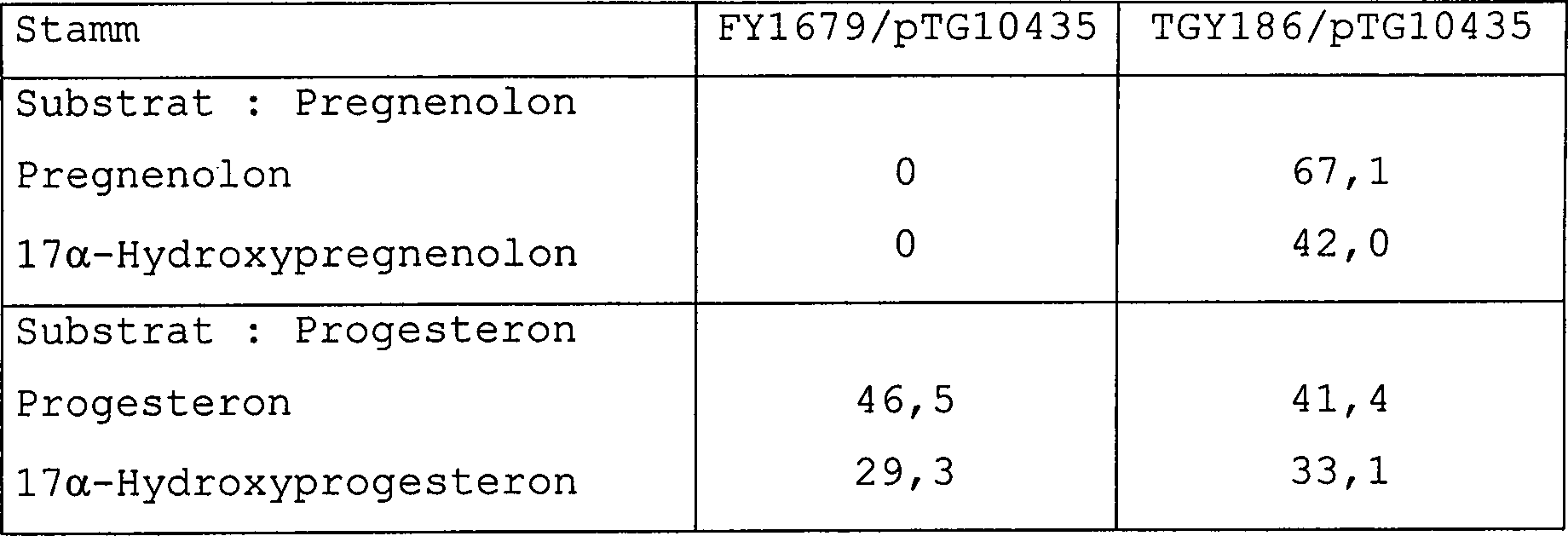
Die Resultate zeigen, dass das Bioumwandlungsvermögen des Cytochroms P45017α, das vom Vektor pTG10435 exprimiert wird, etwas das gleiche wie das im Wildstamm (FY) oder in seiner Mutante atf2 (TGY186) mit Progesteron als Substrat ist. Andererseits wird mit Pregnenolon als Substrat dieselbe Bioumwandlung wie bei Progesteron erreicht, allerdings nur mit der Mutante atf2 (TGY186). Im Wildstamm FY werden das Substrat und das Produkt gleichzeitig acetyliert, und es wird kein freies Hydroxyprogesteron nachgewiesen.The results show that the bioconvertivity of the cytochrome P 450 17α expressed by the vector pTG10435 is somewhat the same as that in the wild strain (FY) or in its mutant atf2 (TGY186) with progesterone as substrate. On the other hand, the same bioconversion as progesterone is achieved with pregnenolone as substrate, but only with the mutant atf2 (TGY186). In the wild strain FY, the substrate and the product are simultaneously acetylated and no free hydroxyprogesterone is detected.
Eine Probe des transformierten Stamms TGY186/pTG10435 wurde bei der Collection Nationale de Cultures de Microorganismes (CNCM) INSTITUT PLASTEUR, 25, Reu du Docteur Roux 75724 Paris Cedex 15, Frankreich, am 20. Januar 1999 unter der Nummer I-2119 hinterlegt.A Sample of transformed strain TGY186 / pTG10435 was included in the collection National Cultures of Microorganisms (CNCM) INSTITUTE PLASTEUR, 25, Reu du Docteur Roux 75724 Paris Cedex 15, France, on the 20th. Deposited in January 1999 under the number I-2119.
Beispiel 6: Konstruktion eines Hefestamms, der das Gen ATF2, das durch TEF1prom/PKGterm unterbrochen ist, hat und der 3β-HSD und P45017α gleichzeitig exprimiertExample 6: Construction of a yeast strain which has the ATF2 gene disrupted by TEF1 prom / PKG term and which expresses 3β-HSD and P 450 17α simultaneously
Das
Plasmid pTG10417 (
Stufe 1: Konstruktion des Plasmids pTG10210Stage 1: Construction of the plasmid pTG10210
Der
Expressionsvektor pTG10033, der von E. Degryse et al., 1995, beschrieben
wurde und der den Hefehybridpromotor GAL10/CYC1, der vorher durch
das Restriktionsenzym pvuII verdaut worden war, enthielt, wurde
mit alkalischer Phosphatase behandelt und dann in Gegenwart des
Oligonucleotids, das die folgende Sequenz hat:
OTG1050: CCCGAATTCGGG
(SEQ ID NO: 17),
das vorher phosphoryliert und mit sich selbst
hybridisiert worden war, um die Stellen EcoRI am Rand des Expressionsblocks,
der den Promotor GAL10/CYC1 enthält,
einzuführen,
religiert. Auf diese Weise wird der Vektor pTG10210 erhalten.The expression vector pTG10033, described by E. Degryse et al., 1995, containing the yeast hybrid promoter GAL10 / CYC1, previously digested by the restriction enzyme pvuII, was treated with alkaline phosphatase and then in the presence of the oligonucleotide, the the following sequence has:
OTG1050: CCCGAATTCGGG (SEQ ID NO: 17),
which had previously been phosphorylated and hybridized with itself to religate the sites EcoRI at the border of the expression block containing the promoter GAL10 / CYC1. In this way the vector pTG10210 is obtained.
Stufe 2: Konstruktion des Plasmids pTG10214Stage 2: Construction of the plasmid pTG10214
Der Expressionsblock, der den Promotor GAL10/CYC1 enthält, der im Vektor pTG10210 vorliegt, wird dann in den Pendelvektor E. coli-Hefe pTG10013 eingeführt, der von E. Degryse et al., 1995, beschrieben wurde und den Selektionsmarker URA3-d enthält.Of the Expression block containing the promoter GAL10 / CYC1, the is present in the vector pTG10210, then in the shuttle vector E. coli yeast pTG10013 introduced, described by E. Degryse et al., 1995, and the selection marker URA3-d contains.
Der Vektor pTG10013 wurde nach Behandlung mit dem Restriktionsenzym EcoRI und Behandlung mit alkalischer Phosphatase in den in Stufe 1 hergestellten Vektor pTG10210, der vorher mit dem Enzym EcoRI verdaut worden war, ligiert. Der so erhaltene Vektor pTG10214 enthält den Expressionsblock, der den Promotor GAL10/CYC1 enthält, welcher zum Replikon 2μ verdaut worden war.Of the Vector pTG10013 was given after treatment with the restriction enzyme EcoRI and treatment with alkaline phosphatase in the in step 1 prepared vector pTG10210, which previously digested with the enzyme EcoRI had been ligated. The vector pTG10214 thus obtained contains the expression block, containing the promoter GAL10 / CYC1, which digests 2μ for the replicon had been.
Stufe 3: Konstruktion des Plasmids pTG10274Stage 3: Construction of the plasmid pTG10274
In
Plasmid pTG10214 wurde dann der Promotor GAL10/CYC1 durch homologe
Rekombination nach Ausschneiden des Plasmids durch Behandlung mit
den Restriktionsenzymen ClaI und SalI durch den Promotor CYC1 ausgetauscht.
Der Expressionsvektor pTG100312, der von E. Degryse et al., 1995,
beschrieben worden war und den Promotor CYC1 enthält, wurde
durch die Restriktionsenzyme HindIII und FspI verdaut, dann mit
Plasmid pTG10214, das in Stufe 2 hergestellt worden war und vorher
mit den Restriktionsenzymen ClaI und SalI verdaut worden war, rekombiniert;
auf diese Weise wurde das Plasmid pTG10274 (
Stufe 4: Konstruktion des Plasmids pTG10401Stage 4: Construction of the plasmid pTG10401
Ausgehend vom Plasmid pTG10274, das den Promotor CYC1 enthält, und vom Plasmid pTG10293, das die Sequenz enthält, die für das Cytochrom P45017α unter der Kontrolle des Promotors TEF1 codiert, wurde dass durch homologe Rekombination neues Plasmid pTG10401, das die Sequenz enthält, die unter der Kontrolle des Promotors TEF1 für das Cytochrom P45017α codiert, gebildet.Starting from the plasmid pTG10274, which contains the promoter CYC1, and from the plasmid pTG10293, which contains the sequence coding for the cytochrome P 450 17α under the control of the promoter TEF1, that by homologous recombination new plasmid pTG10401, which contains the sequence, which codes for the cytochrome P 450 17α under the control of the promoter TEF1.
Der
Promotor CYC1 und ein Teil des Replikons von E. coli wurden aus
dem Plasmid pTG10274, das in sTufe 3 hergestellt worden war, durch
Verdau mit den Restriktionsenzymen MluI und DraI ausgeschnitten. Das
in Beispiel 5 hergestellte Plasmid pTG10293 wurde mit den Restriktionsenzymen
HindIII und PvuII verdaut, dann mit dem Plasmid pTG10274, das mit
den Restriktionsenyzen MluI und DraI verdaut worden war, rekombiniert;
auf diese Weise wurde das Plasmid pTG10401 (
Stufe 5: Konstruktion des Plasmids pTG10403Stage 5: Construction of the plasmid pTG10403
Die cDNA, die für die humane 3β-HSD des Typs II codiert, wurde dann in das Plasmid pTG10401 unter der Kontrolle des Promotors CYC1 eingeführt.The cDNA coding for the human 3β-HSD Type II was then inserted into the plasmid pTG10401 under the Control of the promoter CYC1 introduced.
In
einem ersten Arbeitsschritt wurde der Expressionsvektor pTG10262,
der die cDNA enthielt, die für die
humane 3β-HSD
des Typs II codiert, nach dem Schema der
Der
Expressionsblock der humanen 3β-HSD
des Typs II wurde durch Verdau mit dem Restriktionsenzym NotI aus
dem Transfervektor pTG10095 ausgeschnitten, dann in den Rekombinationsvektor
pTG10257, der vorher mit den Restriktionsenzymen SalI und MluI verdaut
worden war, eingeführt;
auf diese Weise wurde der Expressionsvektor pTG10262 (
In
einem zweiten Verfahren wird der oben hergestellte Expressionsvektor
pTG10262 mit dem Restriktionsenzym XmnI verdaut. Das erhaltene Fragment,
das die cDNA enthält,
welche für
3β-HSD codiert,
wurde mit dem Fragment des in Stufe 4 hergestellten Plasmids pTG10401,
das die cDNA enthält,
welche für
das Cytochrom P45017α codiert, das durch Verdau mit
dem Restriktionsenzym ScalI erhalten worden war. Das so erhaltene
Plasmid pTG10403 (
Stufe 6: Konstruktion des Plasmids pTG10417Stage 6: Construction of the plasmid pTG10417
Schließlich wurde in dem obigen Plasmid pTG10403 der Promotor TEF1 durch den Promotor CYC1 ausgetauscht.Finally became in the above plasmid pTG10403, the promoter TEF1 by the promoter Exchanged CYC1.
Einerseits
wurde das in Beispiel 5 beschriebene Plasmid pTG10058 mit dem Restriktionsenzym
PvuII verdaut, was es ermöglicht,
einen Teil der für
das Cytochrom P45017α codierenden Sequenz, die mit
dem Promotor CYC1 assoziiert ist, sowie den Hauptteil des Replikons
von E. coli freizusetzen. Andererseits wurde ein Teil des Replikons
von E. coli aus dem in Stufe 5 hergestellten Plasmid pTG10403 durch
Verdau mit dem Restriktionsenzym DraI eliminiert. Durch Rekombination
der zwei Plasmide, die vorher so verdaut worden waren, wird schließlich das
Plasmid pTG10417 erhalten. Das Plasmid pTG10417 enthält das Hefereplikon
2μ, den
Selektionsmarker URA3-d und die zwei Expressionsblöcke, von
denen einer für
die humane 3β-HSD
codiert, der andere für
das Cytochrom P45017α vom Rind codiert, wobei die
beiden unter der Kontrolle des Hefepromotors CYC1 sind (
Das Plasmid pTG10417 wurde dann in den Elternstamm FY1679 oder in den in Beispiel 4 hergestellten Stamm TGY186 (atf2-Δ::ΤΕF1prom/PGKterm) transformiert.The plasmid pTG10417 was then transformed into the parent strain FY1679 or in strain TGY186 prepared in Example 4 (ATF2-Δ :: ΤΕF1 prom / PGK term).
Die Transformanten wurden auf einem gelierten YNB-Medium (Difco), das 0,5% Glucose enthielt, mit Tryptophan, Histidin und Leucin angereichert war (100 μg/ml jeweils) isoliert.The Transformants were probed on a gelled YNB medium (Difco) 0.5% glucose, enriched with tryptophan, histidine and leucine was (100 μg / ml each isolated).
Die so erhaltenen Kolonien wurden 24 h lang bei 28°C im YNB-Medium (Difco), das 0,5% Glucose und 0,1% Casaminosäuren enthält, vorkultiviert, dann auf A600 = 0,1 verdünnt und mit 100 μg/ml Pregnenolon ergänzt, entweder im selben frischen Medium (Medium 1) oder im YNB-Medium (Difco), das 0,1% Glucose, 2% Glycerin und 0,2% Casaminosäuren enthielt (Medium 2). Nach 48 Stunden Wachstum und Umwandlung wurden die Steroide extrahiert und durch RP-HPLC, wie in Beispiel 1 beschrieben, gemessen, wobei die Standards Pregnenolon, 17α-Hydroxypregnenolon, Progesteron und 17α-Hydroxyprogesteron verwendet wurden.The colonies so obtained were incubated for 24 h at 28 ° C. in YNB medium (Difco) containing 0.5% glucose and 0.1%. casamino contains pre-cultured, then diluted to A600 = 0.1 and with 100 μg / ml pregnenolone added, either in the same fresh medium (medium 1) or in the YNB medium (Difco) containing 0.1% glucose, 2% glycerol and 0.2% casamino acids (Medium 2). After 48 hours of growth and conversion, the steroids became extracted and measured by RP-HPLC as described in Example 1, the standards being pregnenolone, 17α-hydroxypregnenolone, progesterone and 17α-hydroxyprogesterone were used.
Die erhaltenen Resultate, die in μg/ml ausgedrückt sind, werden in Tabelle 5 (Medium 1) und Tabelle 6 (Medium 2), die folgen, gezeigt:The results obtained in μg / ml expressed are in Table 5 (Medium 1) and Table 6 (Medium 2), the follow, shown:
Tabelle
5 
Tabelle
6 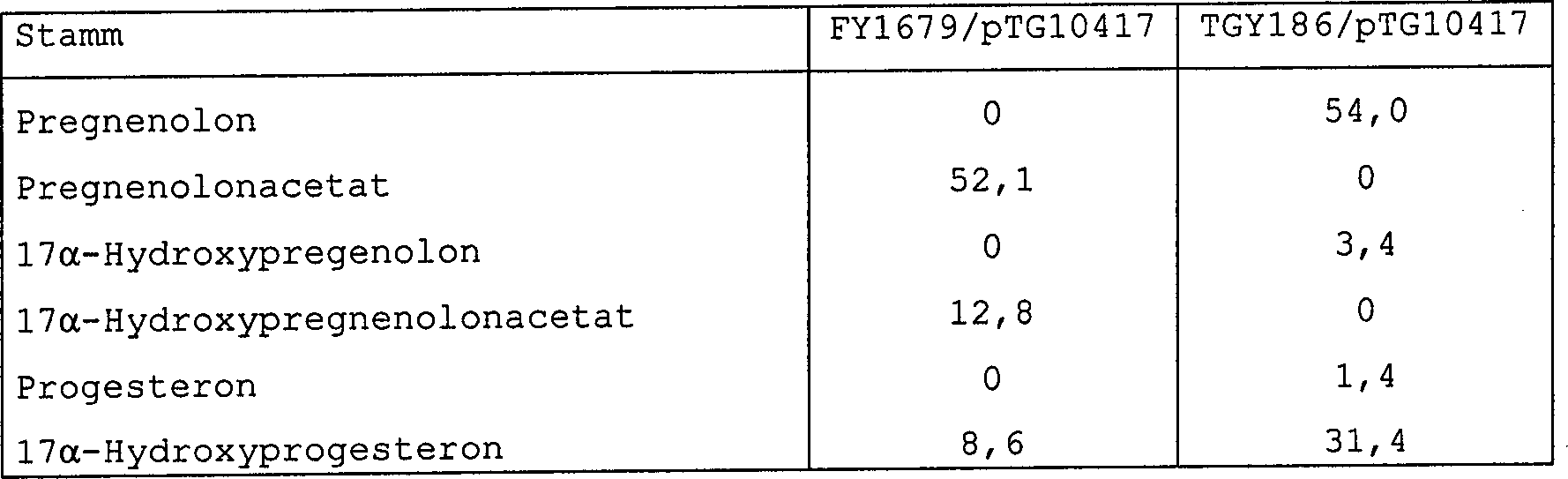
Diese Resultate zeigen, dass die Bioumwandlung in den Wildstamm (FY), der durch das Plasmid pTG10417 transformiert war, zu einer Akkumulierung von Pregnenolonacetat und 17α-Hydroxypregnenolonacetat führt, die letztlich durch die Enzyme 3β-HSDH oder P45017α nicht transformiert werden, und dass die Bilanz der Bioumwandlung schlechter ist als die, die mit der transformierten Mutante atf2 (TGY186) beobachtet wird.These results show that bioconversion to the wild strain (FY) transformed by the plasmid pTG10417 leads to an accumulation of pregnenolone acetate and 17α-hydroxypregnenolone acetate which are ultimately not transformed by the enzymes 3β-HSDH or P 450 17α, and that the balance of the bioconversion is worse than that observed with the transformed mutant atf2 (TGY186).
Eine Probe des transformierten Stamms TGY186/pTG10417 wurde bei der Collection Nationale de Cultures de Microorganismes (CNCM) INSTITUT PASTEUR, 25, Rue du Docteur Roux 75724 Paris Cedex 15, Frankreich, am 20. Januar 1999 unter der Nummer I-2118 hinterlegt.A Sample of transformed strain TGY186 / pTG10417 was used in the collection National de Cultures de Microorganisms (CNCM) INSTITUT PASTEUR, 25, Rue du Docteur Roux 75724 Paris Cedex 15, France, on the 20th. Deposited in January 1999 under the number I-2118.
Literaturstellenreferences
- – Achstetter, T., Nguyen-Julleret M., Findeli A., Merkamm M. und Lemoine Y. (1992), Gene 110, 25–31.- Achstetter, T., Nguyen-Julleret M., Findeli A., Merkamm M. and Lemoine Y. (1992), Gene 110, 25-31.
- – Amberg D. C., Botstein D. und Beasley E. M., (1995), Yeast 11 : 1275–1280.- On the mountain D.C., Botstein D. and Beasley E.M., (1995), Yeast 11: 1275-1280.
- – Boeke Jef D., Lacroute F. und Fink G. R., (1984) Mol Gen Genet 197 : 345–346.- Boeke Jef D., Lacroute F. and Fink G.R., (1984) Mol Gen Genet 197: 345-346.
- – Cauet G., Dumas B., Degryse E, Spagnoli R. und Achstetter T.. (1994) in Cytochrome P-450 biochemistry, biophysics and molecular biology (Lechner M. C., Herausg.), S. 583–586, John Libbey Eurotext.- Cauet G., Dumas B., Degryse E, Spagnoli R. and Achstetter T. (1994) in Cytochrome P-450 biochemistry, biophysics and molecular biology (Lechner M.C., Eds.), Pp. 583-586, John Libbey Eurotext.
- – Cherry J. M., Adler C., Ball C., Dwight S., Chervitz S., Jia Y., Juvik G., Roe T., Wenig S. und Botstein D., "Saccharomyces Genome Database" http://genome-www.standard.edu/Saccharomyces/- Cherry J.M., Adler C., Ball C., Dwight S., Chervitz S., Jia Y., Juvik G., Roe T., Little S. and Botstein D., "Saccharomyces Genome Database" http://genome-www.standard.edu/Saccharomyces/
- – Degryse E., J. Biotech. 39 (1995) 181–187.- Degryse E., J. Biotech. 39 (1995) 181-187.
- – Degryse E., Dumas B., Dietrich M., Laruelle L. und Achstetter T. (1995). Yeast 11 : 629–640.- Degryse E., Dumas B., Dietrich M., Laruelle L. and Achstetter T. (1995). Yeast 11: 629-640.
- – Degryse E. (1996), Gene 170, 45–50.- Degryse E. (1996), Gene 170, 45-50.
- – Dumas B., Cauet G., Degryse E., Spagnoli R. & Achstetter T. (1994). Cytochrome P450. 8th International Conference. Herausg. M. C. Lechner. John Lebbey Eurotext, Paris, S. 527–530.- Dumas B., Cauet G., Degryse E., Spagnoli R. & Achstetter T. (1994). cytochromes P450. 8th International Conference. Ed. M.C. Lechner. John Lebbey Eurotext, Paris, pp. 527-530.
- – Fiechter A., Fuhrmann G. F. und Käppeli O., (1981). Adv. Microb. Physiol. 22, 123–183.- Fiechter A., Fuhrmann G. F. and Käppeli O., (1981). Adv. Microb. Physiol. 22, 123-183.
- – Fujii T., Nagasawa N., Iwamatsu A., Bogaki T., Tamai Y. und Hamachi M. (1994) Appl. Environ. Microbiol. 60, 2786–2792.- Fujii T., Nagasawa N., Iwamatsu A., Bogaki T., Tamai Y. and Hamachi M. (1994) Appl. Environ. Microbiol. 60, 2786-2792.
- – Hanahan D., J. Mol. Biol. 166 (1983) 557–580.- Hanahan D., J. Mol. Biol. 166 (1983) 557-580.
- – Hubacek J. und Glover S. W., (1970), J. Mol. Biol. 50: 111–127.- Hubacek J. and Glover S.W., (1970), J. Mol. Biol. 50: 111-127.
- – Ito H., Fukuda Y., Murata K. und Kimura A., 1983, Journal of Bacteriology, 163–168.- Ito H., Fukuda Y., Murata K. and Kimura A., 1983, Journal of Bacteriology, 163-168.
- – Rhéaume E., Lachance Y., Zhao H.–F., Breton N., Dumont M., de Launoit Y., Trudel C., Luu-The V., Simard J. & Labrie F. (1991). Mol. Endocrinol. 5, 1147–1157.- Rhéaume E., Lachance Y., Zhao H.-F., Breton N., Dumont M., de Launoit Y., Trudel C., Luu-The V., Simard J. & Labrie F. (1991). Mol. Endocrinol. 5, 1147-1157.
- – Rose M., Grisafi P. und Botstein D., Gene 29, 113–114 (1984).- Rose M., Grisafi P. and Botstein D., Gene 29, 113-114 (1984).
- – Rosenfeld J., Capdevielle J., Guillemot J. C. und Ferrara P. (1992) Anal. Biochem. 203, 173–179.- Rose field J., Capdevielle J., Guillemot J.C. and Ferrara P. (1992) Anal. Biochem. 203, 173-179.
- – Sambrook J., Fritsch E. F. und Maniatis T., (1989). Molecular Cloning : A Laboratory Manual. Cold Spring Harbor University Press, 2. Ausgabe, Cold Spring Harbor.- Sambrook J., Fritsch E.F. and Maniatis T., (1989). Molecular Cloning: A Laboratory Manual. Cold Spring Harbor University Press, 2nd Edition, Cold Spring Harbor.
- – Sherman F. (1991) Methods in Enzymology 194, 3–21.- Sherman F. (1991) Methods in Enzymology 194, 3-21.
- – Simard J., Durocher F., Mébarki F., Turgeon C., Sanchez R., Labrie Y., Couet J., Trudel C., Rheaume E., Morel Y., Luu-The V. And Labrie F. (1996) J. Endocrinol. 150, 5189–5207.- Simard J., Durocher F., Mébarki F., Turgeon C., Sanchez R., Labrie Y., Couet J., Trudel C., Rheaume E., Morel Y., Luu-The V. And Labrie F. (1996) J. Endocrinol. 150 From 5189 to 5207.
- – Struhl K., Stinchomb DT., Scherer S. und Davis RW., 1979, Proc. Natl. Acad. Sci. USA Bd. 76, Nr. 3, 1035–1039.- Struhl K., Stinchomb DT., Scherer S. and Davis RW., 1979, Proc. Natl. Acad. Sci. USA Vol. 76, No. 3, 1035-1039.
- – Thierry A., Fairhead C. und Dujon B., Yeast; Bd. 6 521–534 (1990).- Thierry A., Fairhead C. and Dujon B., Yeast; Vol. 6 521-534 (1990).
- – Zuber MX., Shimpson ER. und Waterman MR., (1986a) Science 234, 1258–1261.- Zuber MX., Shimpson ER. and Waterman MR., (1986a) Science 234, 1258-1261.
SEQUENZPROTOKOLL 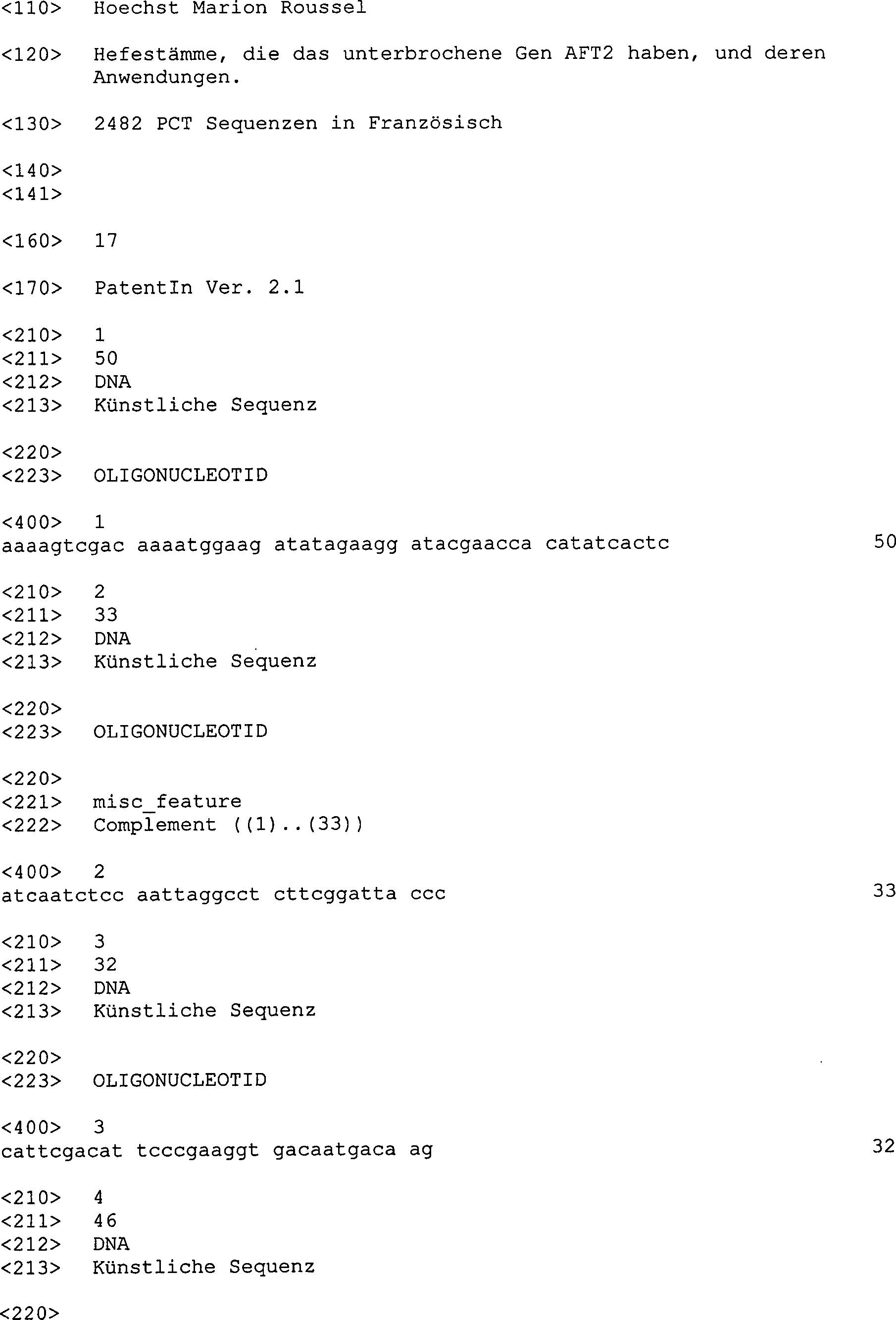
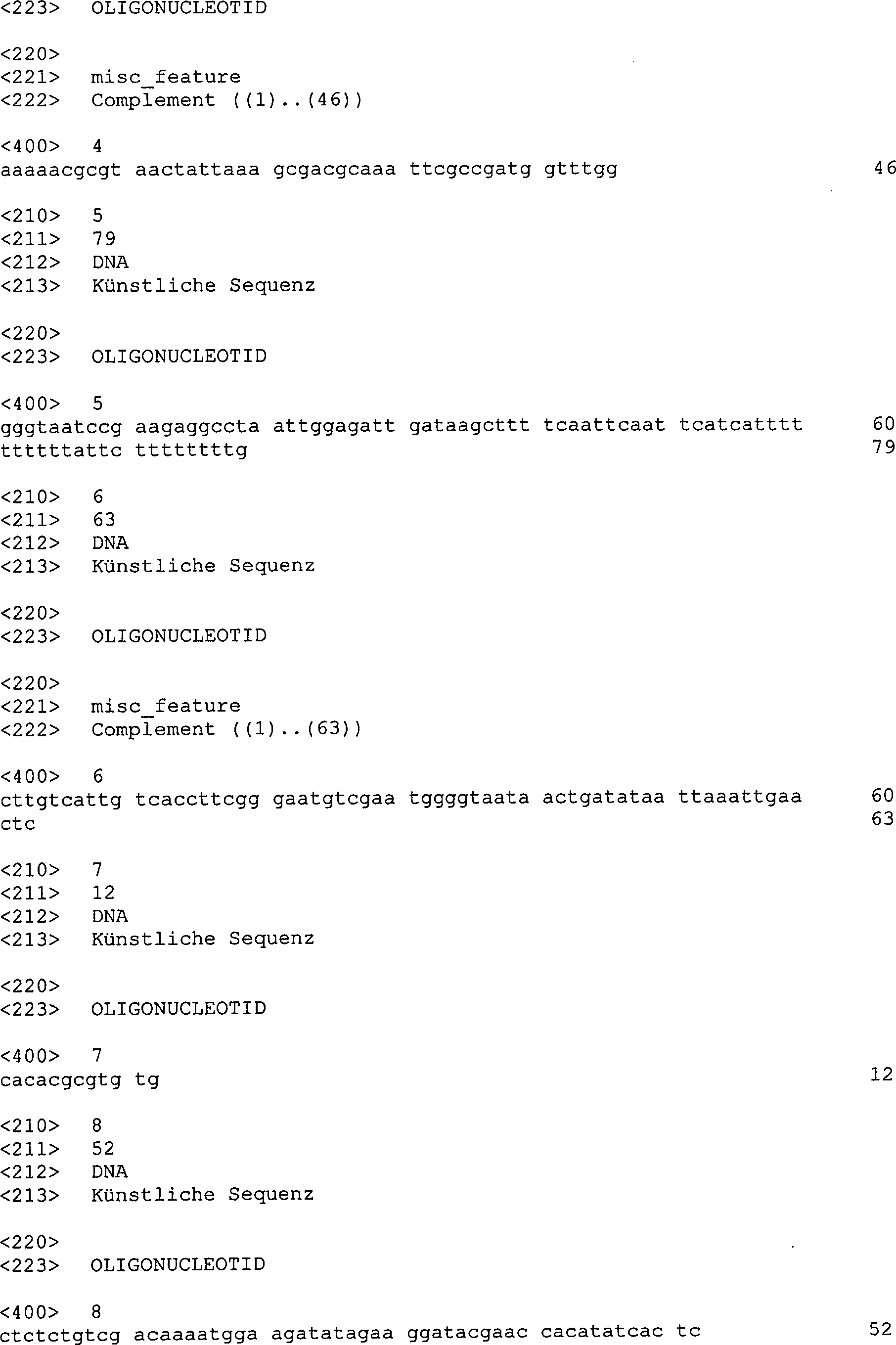
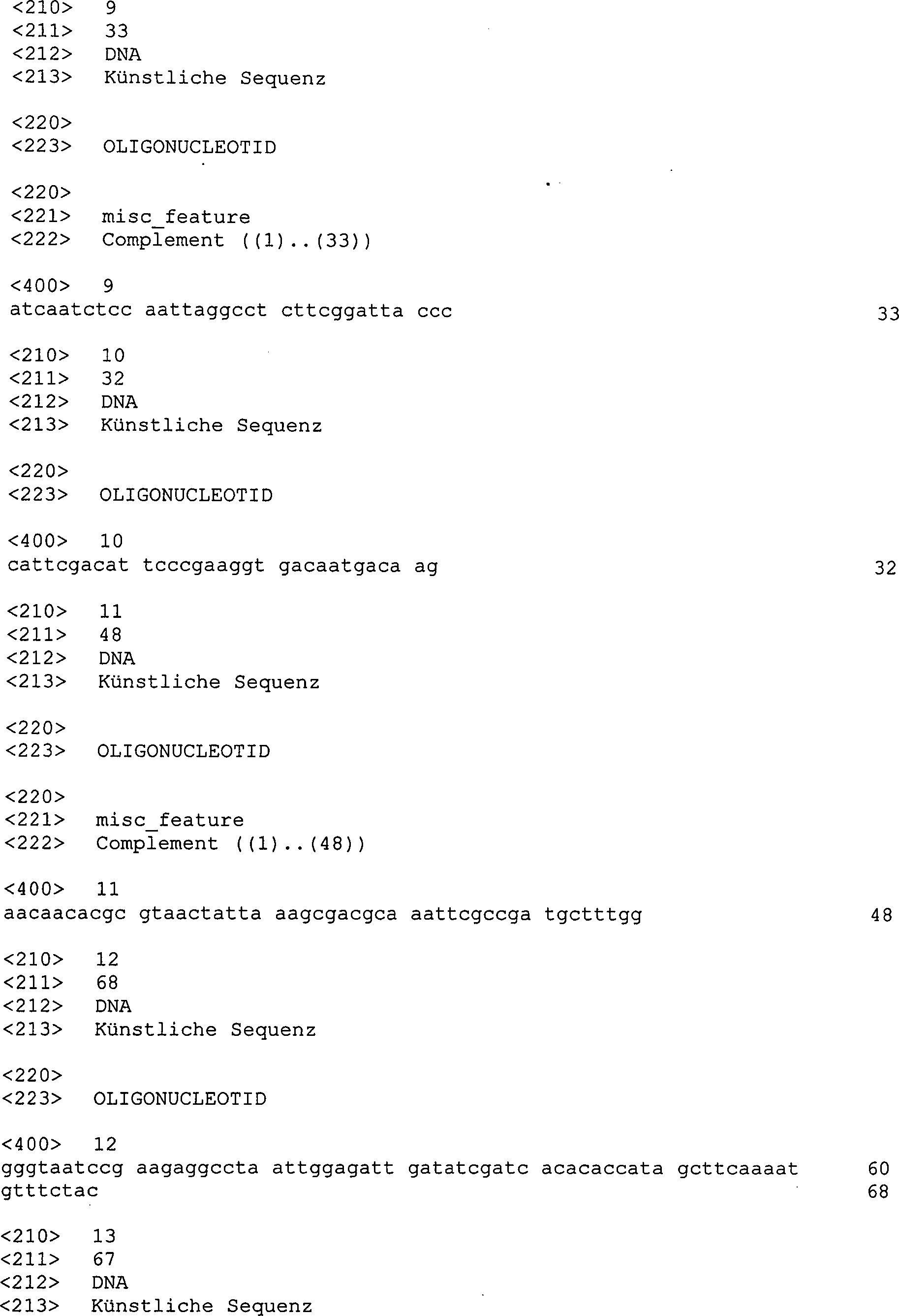
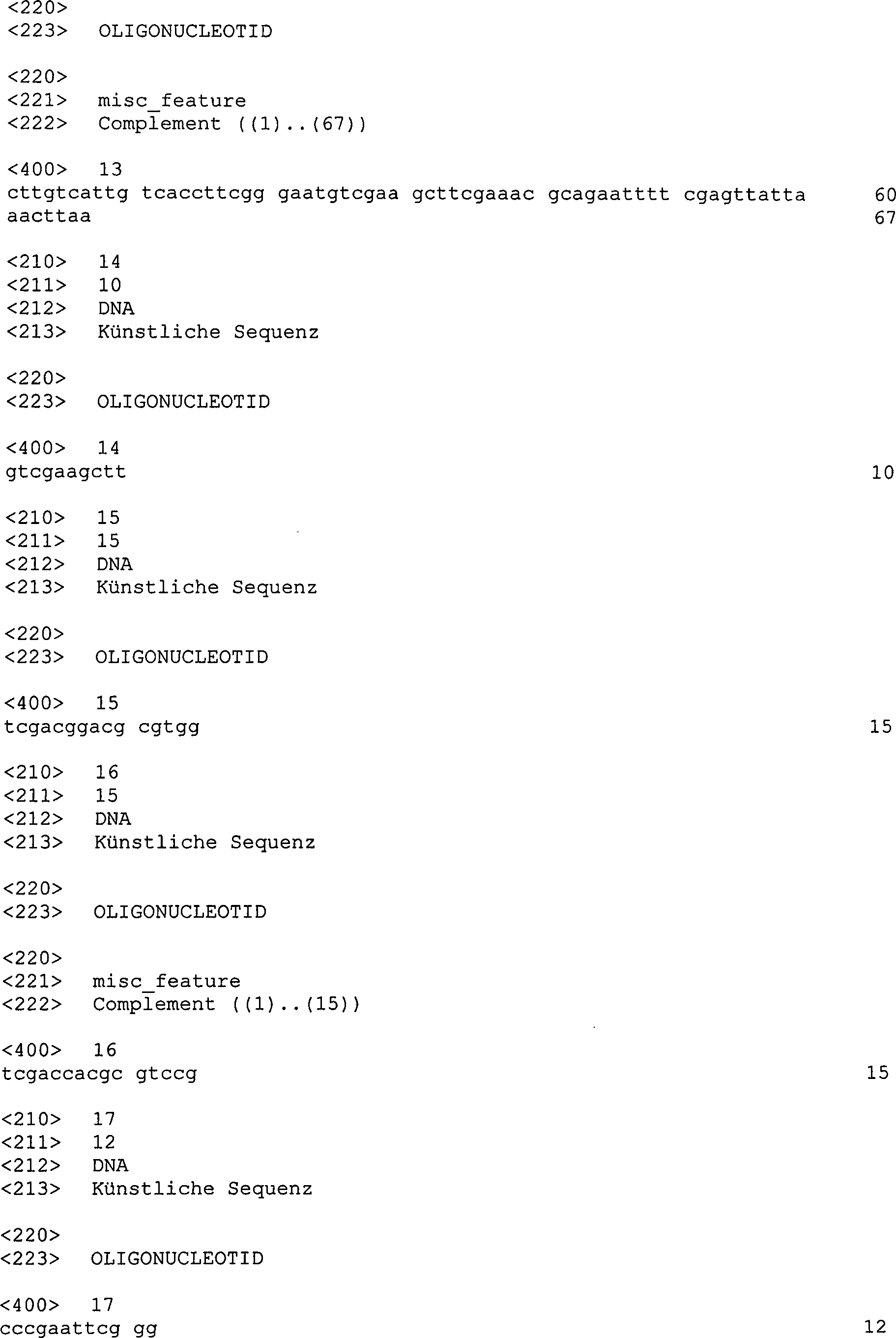
Claims (27)
Applications Claiming Priority (3)
| Application Number | Priority Date | Filing Date | Title |
|---|---|---|---|
| FR9801329 | 1998-02-05 | ||
| FR9801329A FR2774393B1 (en) | 1998-02-05 | 1998-02-05 | YEAST STRAINS WITH THE INTERRUPTED ATF2 GENE AND THEIR APPLICATIONS |
| PCT/FR1999/000237 WO1999040203A1 (en) | 1998-02-05 | 1999-02-04 | Yeast strains with interrupted atf2 gene and uses |
Publications (2)
| Publication Number | Publication Date |
|---|---|
| DE69918752D1 DE69918752D1 (en) | 2004-08-26 |
| DE69918752T2 true DE69918752T2 (en) | 2005-08-04 |
Family
ID=9522616
Family Applications (1)
| Application Number | Title | Priority Date | Filing Date |
|---|---|---|---|
| DE69918752T Expired - Lifetime DE69918752T2 (en) | 1998-02-05 | 1999-02-04 | HEFESTAMMS WITH BROKEN ATF2 GENES AND THEIR USES |
Country Status (30)
| Country | Link |
|---|---|
| US (2) | US6218139B1 (en) |
| EP (1) | EP0977868B1 (en) |
| JP (1) | JP4443636B2 (en) |
| KR (1) | KR100599346B1 (en) |
| CN (1) | CN1201008C (en) |
| AR (1) | AR015225A1 (en) |
| AT (1) | ATE271610T1 (en) |
| AU (1) | AU748129B2 (en) |
| BR (1) | BR9904771A (en) |
| CA (1) | CA2285686C (en) |
| CZ (1) | CZ299506B6 (en) |
| DE (1) | DE69918752T2 (en) |
| DK (1) | DK0977868T3 (en) |
| EA (1) | EA004629B1 (en) |
| ES (1) | ES2221353T3 (en) |
| FR (1) | FR2774393B1 (en) |
| HR (1) | HRP990303B1 (en) |
| HU (1) | HU226657B1 (en) |
| ID (1) | ID22741A (en) |
| IL (1) | IL132151A (en) |
| ME (1) | ME00670B (en) |
| PL (1) | PL198376B1 (en) |
| PT (1) | PT977868E (en) |
| RS (1) | RS49619B (en) |
| SI (1) | SI0977868T1 (en) |
| SK (1) | SK286279B6 (en) |
| TR (1) | TR199902457T1 (en) |
| UA (1) | UA72438C2 (en) |
| WO (1) | WO1999040203A1 (en) |
| ZA (1) | ZA99676B (en) |
Families Citing this family (6)
| Publication number | Priority date | Publication date | Assignee | Title |
|---|---|---|---|---|
| FR2799206A1 (en) * | 1999-10-05 | 2001-04-06 | Transgene Sa | Production of hydroxylated or acetylated steroids, useful for treating nervous system disorders, comprises incubating precursor with yeast transformed with cyp7b gene |
| FR2812884B1 (en) * | 2000-08-08 | 2002-11-08 | Aventis Pharma Sa | MODIFIED YEASTS AND USES, ESPECIALLY FOR THE PRODUCTION OF STEROID DERIVATIVES |
| FR2820145B1 (en) * | 2001-01-31 | 2004-01-23 | Aventis Pharma Sa | YEAST STRAIN PRODUCING INDEPENDENT STEROIDS |
| WO2005055944A2 (en) | 2003-12-05 | 2005-06-23 | Cincinnati Children's Hospital Medical Center | Oligosaccharide compositions and use thereof in the treatment of infection |
| FR2869914B1 (en) | 2004-05-06 | 2012-11-09 | Aventis Pharma Sa | YEAST STRAINS PRODUCING CHOLESTEROL AND THEIR APPLICATIONS |
| CN102604847B (en) * | 2012-03-23 | 2013-05-15 | 天津科技大学 | A Saccharomyces cerevisiae Engineering Strain Containing Lg-ATF1 Gene |
Family Cites Families (7)
| Publication number | Priority date | Publication date | Assignee | Title |
|---|---|---|---|---|
| JPS6447380A (en) * | 1987-08-19 | 1989-02-21 | Agency Ind Science Techn | Steroid-oxidizing yeast strain |
| EP0340878B1 (en) * | 1988-05-06 | 2001-05-16 | Aventis Pharma S.A. | Process for the biochemical oxidation of steroids and genetically engineered cells to be used therefor |
| FR2678611B1 (en) | 1991-07-04 | 1995-01-20 | Roussel Uclaf | NOVEL PYRETHRINOUID ESTERS OF ALCOHOL 1,3,4,5,6,7-HEXAHYDRO 1,3-DIOXO-2H-ISOINDOL-2-YL-METHYLIQUE, THEIR PREPARATION PROCESS AND THEIR APPLICATION AS PESTICIDES. |
| JP3363197B2 (en) * | 1992-06-18 | 2003-01-08 | 麒麟麦酒株式会社 | Alcohol acetyltransferase gene and its use |
| IL116872A (en) * | 1995-02-15 | 2004-12-15 | Aventis Pharma Sa | Delta-5, 7 sterol reductase from arabidopsis thaliana |
| JP4093598B2 (en) * | 1995-03-14 | 2008-06-04 | 大関株式会社 | A novel alcohol acetyltransferase gene |
| FR2743829A1 (en) * | 1996-01-19 | 1997-07-25 | Hydroplus | AUTOMATIC RISE FOR HYDRAULIC WORK SUCH AS THRESHOLD IN RIVER, OVERFLOW ON A DAM OR ON A PROTECTION DYE |
-
1998
- 1998-02-05 FR FR9801329A patent/FR2774393B1/en not_active Expired - Lifetime
-
1999
- 1999-01-28 ZA ZA9900676A patent/ZA99676B/en unknown
- 1999-02-01 US US09/243,367 patent/US6218139B1/en not_active Expired - Lifetime
- 1999-02-04 HR HR990303A patent/HRP990303B1/en not_active IP Right Cessation
- 1999-02-04 HU HU0002858A patent/HU226657B1/en unknown
- 1999-02-04 EA EA199900903A patent/EA004629B1/en not_active IP Right Cessation
- 1999-02-04 KR KR1019997009076A patent/KR100599346B1/en not_active Expired - Lifetime
- 1999-02-04 WO PCT/FR1999/000237 patent/WO1999040203A1/en not_active Ceased
- 1999-02-04 ID IDW991153A patent/ID22741A/en unknown
- 1999-02-04 CA CA002285686A patent/CA2285686C/en not_active Expired - Lifetime
- 1999-02-04 BR BR9904771A patent/BR9904771A/en not_active Application Discontinuation
- 1999-02-04 CN CNB998004634A patent/CN1201008C/en not_active Expired - Lifetime
- 1999-02-04 DE DE69918752T patent/DE69918752T2/en not_active Expired - Lifetime
- 1999-02-04 DK DK99901708T patent/DK0977868T3/en active
- 1999-02-04 EP EP99901708A patent/EP0977868B1/en not_active Expired - Lifetime
- 1999-02-04 RS YUP-497/99A patent/RS49619B/en unknown
- 1999-02-04 ES ES99901708T patent/ES2221353T3/en not_active Expired - Lifetime
- 1999-02-04 SI SI9930668T patent/SI0977868T1/en unknown
- 1999-02-04 SK SK1331-99A patent/SK286279B6/en not_active IP Right Cessation
- 1999-02-04 TR TR1999/02457T patent/TR199902457T1/en unknown
- 1999-02-04 AU AU21714/99A patent/AU748129B2/en not_active Expired
- 1999-02-04 IL IL132151A patent/IL132151A/en not_active IP Right Cessation
- 1999-02-04 JP JP54009599A patent/JP4443636B2/en not_active Expired - Lifetime
- 1999-02-04 AT AT99901708T patent/ATE271610T1/en active
- 1999-02-04 PT PT99901708T patent/PT977868E/en unknown
- 1999-02-04 CZ CZ0351299A patent/CZ299506B6/en not_active IP Right Cessation
- 1999-02-04 PL PL336301A patent/PL198376B1/en unknown
- 1999-02-04 ME MEP-1999-497A patent/ME00670B/en unknown
- 1999-02-05 AR ARP990100487A patent/AR015225A1/en active IP Right Grant
- 1999-04-02 UA UA99116075A patent/UA72438C2/en unknown
-
2001
- 2001-03-01 US US09/797,239 patent/US6503749B2/en not_active Expired - Lifetime
Also Published As
Similar Documents
| Publication | Publication Date | Title |
|---|---|---|
| US7977065B2 (en) | Yeast strains autonomously producing steroids | |
| FI120877B (en) | DNA sequence encoding A. thaliana protein having delta-5,7-sterol, delta-7-reductase activity, delta-7-Red protein, process for its preparation, modified yeast strains and applications | |
| DE68929296T2 (en) | Process for the biochemical oxidation of steroids and genetically manipulated cells that can be used for this | |
| JP4443636B2 (en) | Yeast strains with interrupted ATF2 gene and use thereof | |
| HU218111B (en) | A method for multiple oxidation of steroids and genetically modified cells for this purpose | |
| JP2012024084A (en) | New yeast, and method of producing δ5,7-sterol and hydrocortisone using the same | |
| US7033779B1 (en) | Method for preparing steroids modified by yeast fermentation | |
| AU707957B2 (en) | DNA sequence coding for a protein of A. thaliana having a delta-5,7sterol,delta-7 reductase activity, delta7-red protein, production process, strains of transformed yeasts, uses |
Legal Events
| Date | Code | Title | Description |
|---|---|---|---|
| 8364 | No opposition during term of opposition | ||
| 8328 | Change in the person/name/address of the agent |
Representative=s name: PFENNING MEINIG & PARTNER GBR, 80339 MUENCHEN |
|
| 8328 | Change in the person/name/address of the agent |
Representative=s name: MAIWALD PATENTANWALTSGESELLSCHAFT MBH, 80335 MUENC |