DE69918707T2 - Wound bandage made of hydrogel with quaternary amines that is inherently micro-killing - Google Patents
Wound bandage made of hydrogel with quaternary amines that is inherently micro-killing Download PDFInfo
- Publication number
- DE69918707T2 DE69918707T2 DE69918707T DE69918707T DE69918707T2 DE 69918707 T2 DE69918707 T2 DE 69918707T2 DE 69918707 T DE69918707 T DE 69918707T DE 69918707 T DE69918707 T DE 69918707T DE 69918707 T2 DE69918707 T2 DE 69918707T2
- Authority
- DE
- Germany
- Prior art keywords
- polymer
- hydrogel
- group
- wound dressing
- use according
- Prior art date
- Legal status (The legal status is an assumption and is not a legal conclusion. Google has not performed a legal analysis and makes no representation as to the accuracy of the status listed.)
- Expired - Fee Related
Links
Classifications
-
- C—CHEMISTRY; METALLURGY
- C08—ORGANIC MACROMOLECULAR COMPOUNDS; THEIR PREPARATION OR CHEMICAL WORKING-UP; COMPOSITIONS BASED THEREON
- C08F—MACROMOLECULAR COMPOUNDS OBTAINED BY REACTIONS ONLY INVOLVING CARBON-TO-CARBON UNSATURATED BONDS
- C08F20/00—Homopolymers and copolymers of compounds having one or more unsaturated aliphatic radicals, each having only one carbon-to-carbon double bond, and only one being terminated by only one carboxyl radical or a salt, anhydride, ester, amide, imide or nitrile thereof
- C08F20/02—Monocarboxylic acids having less than ten carbon atoms, Derivatives thereof
- C08F20/52—Amides or imides
- C08F20/54—Amides, e.g. N,N-dimethylacrylamide or N-isopropylacrylamide
- C08F20/60—Amides, e.g. N,N-dimethylacrylamide or N-isopropylacrylamide containing nitrogen in addition to the carbonamido nitrogen
-
- A—HUMAN NECESSITIES
- A01—AGRICULTURE; FORESTRY; ANIMAL HUSBANDRY; HUNTING; TRAPPING; FISHING
- A01N—PRESERVATION OF BODIES OF HUMANS OR ANIMALS OR PLANTS OR PARTS THEREOF; BIOCIDES, e.g. AS DISINFECTANTS, AS PESTICIDES OR AS HERBICIDES; PEST REPELLANTS OR ATTRACTANTS; PLANT GROWTH REGULATORS
- A01N25/00—Biocides, pest repellants or attractants, or plant growth regulators, characterised by their forms, or by their non-active ingredients or by their methods of application, e.g. seed treatment or sequential application; Substances for reducing the noxious effect of the active ingredients to organisms other than pests
- A01N25/08—Biocides, pest repellants or attractants, or plant growth regulators, characterised by their forms, or by their non-active ingredients or by their methods of application, e.g. seed treatment or sequential application; Substances for reducing the noxious effect of the active ingredients to organisms other than pests containing solids as carriers or diluents
- A01N25/10—Macromolecular compounds
-
- A—HUMAN NECESSITIES
- A01—AGRICULTURE; FORESTRY; ANIMAL HUSBANDRY; HUNTING; TRAPPING; FISHING
- A01N—PRESERVATION OF BODIES OF HUMANS OR ANIMALS OR PLANTS OR PARTS THEREOF; BIOCIDES, e.g. AS DISINFECTANTS, AS PESTICIDES OR AS HERBICIDES; PEST REPELLANTS OR ATTRACTANTS; PLANT GROWTH REGULATORS
- A01N33/00—Biocides, pest repellants or attractants, or plant growth regulators containing organic nitrogen compounds
- A01N33/02—Amines; Quaternary ammonium compounds
- A01N33/12—Quaternary ammonium compounds
-
- A—HUMAN NECESSITIES
- A01—AGRICULTURE; FORESTRY; ANIMAL HUSBANDRY; HUNTING; TRAPPING; FISHING
- A01N—PRESERVATION OF BODIES OF HUMANS OR ANIMALS OR PLANTS OR PARTS THEREOF; BIOCIDES, e.g. AS DISINFECTANTS, AS PESTICIDES OR AS HERBICIDES; PEST REPELLANTS OR ATTRACTANTS; PLANT GROWTH REGULATORS
- A01N37/00—Biocides, pest repellants or attractants, or plant growth regulators containing organic compounds containing a carbon atom having three bonds to hetero atoms with at the most two bonds to halogen, e.g. carboxylic acids
- A01N37/12—Biocides, pest repellants or attractants, or plant growth regulators containing organic compounds containing a carbon atom having three bonds to hetero atoms with at the most two bonds to halogen, e.g. carboxylic acids containing the group, wherein Cn means a carbon skeleton not containing a ring; Thio analogues thereof
-
- A—HUMAN NECESSITIES
- A01—AGRICULTURE; FORESTRY; ANIMAL HUSBANDRY; HUNTING; TRAPPING; FISHING
- A01N—PRESERVATION OF BODIES OF HUMANS OR ANIMALS OR PLANTS OR PARTS THEREOF; BIOCIDES, e.g. AS DISINFECTANTS, AS PESTICIDES OR AS HERBICIDES; PEST REPELLANTS OR ATTRACTANTS; PLANT GROWTH REGULATORS
- A01N37/00—Biocides, pest repellants or attractants, or plant growth regulators containing organic compounds containing a carbon atom having three bonds to hetero atoms with at the most two bonds to halogen, e.g. carboxylic acids
- A01N37/18—Biocides, pest repellants or attractants, or plant growth regulators containing organic compounds containing a carbon atom having three bonds to hetero atoms with at the most two bonds to halogen, e.g. carboxylic acids containing the group —CO—N<, e.g. carboxylic acid amides or imides; Thio analogues thereof
- A01N37/20—Biocides, pest repellants or attractants, or plant growth regulators containing organic compounds containing a carbon atom having three bonds to hetero atoms with at the most two bonds to halogen, e.g. carboxylic acids containing the group —CO—N<, e.g. carboxylic acid amides or imides; Thio analogues thereof containing the group, wherein Cn means a carbon skeleton not containing a ring; Thio analogues thereof
-
- A—HUMAN NECESSITIES
- A61—MEDICAL OR VETERINARY SCIENCE; HYGIENE
- A61K—PREPARATIONS FOR MEDICAL, DENTAL OR TOILETRY PURPOSES
- A61K31/00—Medicinal preparations containing organic active ingredients
- A61K31/74—Synthetic polymeric materials
- A61K31/785—Polymers containing nitrogen
-
- A—HUMAN NECESSITIES
- A61—MEDICAL OR VETERINARY SCIENCE; HYGIENE
- A61K—PREPARATIONS FOR MEDICAL, DENTAL OR TOILETRY PURPOSES
- A61K47/00—Medicinal preparations characterised by the non-active ingredients used, e.g. carriers or inert additives; Targeting or modifying agents chemically bound to the active ingredient
- A61K47/30—Macromolecular organic or inorganic compounds, e.g. inorganic polyphosphates
- A61K47/32—Macromolecular compounds obtained by reactions only involving carbon-to-carbon unsaturated bonds, e.g. carbomers, poly(meth)acrylates, or polyvinyl pyrrolidone
-
- A—HUMAN NECESSITIES
- A61—MEDICAL OR VETERINARY SCIENCE; HYGIENE
- A61K—PREPARATIONS FOR MEDICAL, DENTAL OR TOILETRY PURPOSES
- A61K9/00—Medicinal preparations characterised by special physical form
- A61K9/0002—Galenical forms characterised by the drug release technique; Application systems commanded by energy
- A61K9/0009—Galenical forms characterised by the drug release technique; Application systems commanded by energy involving or responsive to electricity, magnetism or acoustic waves; Galenical aspects of sonophoresis, iontophoresis, electroporation or electroosmosis
-
- A—HUMAN NECESSITIES
- A61—MEDICAL OR VETERINARY SCIENCE; HYGIENE
- A61K—PREPARATIONS FOR MEDICAL, DENTAL OR TOILETRY PURPOSES
- A61K9/00—Medicinal preparations characterised by special physical form
- A61K9/0012—Galenical forms characterised by the site of application
- A61K9/0014—Skin, i.e. galenical aspects of topical compositions
-
- A—HUMAN NECESSITIES
- A61—MEDICAL OR VETERINARY SCIENCE; HYGIENE
- A61L—METHODS OR APPARATUS FOR STERILISING MATERIALS OR OBJECTS IN GENERAL; DISINFECTION, STERILISATION OR DEODORISATION OF AIR; CHEMICAL ASPECTS OF BANDAGES, DRESSINGS, ABSORBENT PADS OR SURGICAL ARTICLES; MATERIALS FOR BANDAGES, DRESSINGS, ABSORBENT PADS OR SURGICAL ARTICLES
- A61L15/00—Chemical aspects of, or use of materials for, bandages, dressings or absorbent pads
- A61L15/16—Bandages, dressings or absorbent pads for physiological fluids such as urine or blood, e.g. sanitary towels, tampons
- A61L15/42—Use of materials characterised by their function or physical properties
- A61L15/46—Deodorants or malodour counteractants, e.g. to inhibit the formation of ammonia or bacteria
-
- A—HUMAN NECESSITIES
- A61—MEDICAL OR VETERINARY SCIENCE; HYGIENE
- A61L—METHODS OR APPARATUS FOR STERILISING MATERIALS OR OBJECTS IN GENERAL; DISINFECTION, STERILISATION OR DEODORISATION OF AIR; CHEMICAL ASPECTS OF BANDAGES, DRESSINGS, ABSORBENT PADS OR SURGICAL ARTICLES; MATERIALS FOR BANDAGES, DRESSINGS, ABSORBENT PADS OR SURGICAL ARTICLES
- A61L15/00—Chemical aspects of, or use of materials for, bandages, dressings or absorbent pads
- A61L15/16—Bandages, dressings or absorbent pads for physiological fluids such as urine or blood, e.g. sanitary towels, tampons
- A61L15/42—Use of materials characterised by their function or physical properties
- A61L15/60—Liquid-swellable gel-forming materials, e.g. super-absorbents
-
- C—CHEMISTRY; METALLURGY
- C08—ORGANIC MACROMOLECULAR COMPOUNDS; THEIR PREPARATION OR CHEMICAL WORKING-UP; COMPOSITIONS BASED THEREON
- C08F—MACROMOLECULAR COMPOUNDS OBTAINED BY REACTIONS ONLY INVOLVING CARBON-TO-CARBON UNSATURATED BONDS
- C08F20/00—Homopolymers and copolymers of compounds having one or more unsaturated aliphatic radicals, each having only one carbon-to-carbon double bond, and only one being terminated by only one carboxyl radical or a salt, anhydride, ester, amide, imide or nitrile thereof
- C08F20/02—Monocarboxylic acids having less than ten carbon atoms, Derivatives thereof
- C08F20/10—Esters
- C08F20/34—Esters containing nitrogen, e.g. N,N-dimethylaminoethyl (meth)acrylate
-
- H—ELECTRICITY
- H01—ELECTRIC ELEMENTS
- H01B—CABLES; CONDUCTORS; INSULATORS; SELECTION OF MATERIALS FOR THEIR CONDUCTIVE, INSULATING OR DIELECTRIC PROPERTIES
- H01B1/00—Conductors or conductive bodies characterised by the conductive materials; Selection of materials as conductors
- H01B1/06—Conductors or conductive bodies characterised by the conductive materials; Selection of materials as conductors mainly consisting of other non-metallic substances
- H01B1/12—Conductors or conductive bodies characterised by the conductive materials; Selection of materials as conductors mainly consisting of other non-metallic substances organic substances
- H01B1/122—Ionic conductors
-
- A—HUMAN NECESSITIES
- A61—MEDICAL OR VETERINARY SCIENCE; HYGIENE
- A61L—METHODS OR APPARATUS FOR STERILISING MATERIALS OR OBJECTS IN GENERAL; DISINFECTION, STERILISATION OR DEODORISATION OF AIR; CHEMICAL ASPECTS OF BANDAGES, DRESSINGS, ABSORBENT PADS OR SURGICAL ARTICLES; MATERIALS FOR BANDAGES, DRESSINGS, ABSORBENT PADS OR SURGICAL ARTICLES
- A61L2300/00—Biologically active materials used in bandages, wound dressings, absorbent pads or medical devices
- A61L2300/20—Biologically active materials used in bandages, wound dressings, absorbent pads or medical devices containing or releasing organic materials
- A61L2300/204—Biologically active materials used in bandages, wound dressings, absorbent pads or medical devices containing or releasing organic materials with nitrogen-containing functional groups, e.g. aminoxides, nitriles, guanidines
- A61L2300/208—Quaternary ammonium compounds
-
- A—HUMAN NECESSITIES
- A61—MEDICAL OR VETERINARY SCIENCE; HYGIENE
- A61L—METHODS OR APPARATUS FOR STERILISING MATERIALS OR OBJECTS IN GENERAL; DISINFECTION, STERILISATION OR DEODORISATION OF AIR; CHEMICAL ASPECTS OF BANDAGES, DRESSINGS, ABSORBENT PADS OR SURGICAL ARTICLES; MATERIALS FOR BANDAGES, DRESSINGS, ABSORBENT PADS OR SURGICAL ARTICLES
- A61L2300/00—Biologically active materials used in bandages, wound dressings, absorbent pads or medical devices
- A61L2300/40—Biologically active materials used in bandages, wound dressings, absorbent pads or medical devices characterised by a specific therapeutic activity or mode of action
- A61L2300/404—Biocides, antimicrobial agents, antiseptic agents
Landscapes
- Health & Medical Sciences (AREA)
- Life Sciences & Earth Sciences (AREA)
- Chemical & Material Sciences (AREA)
- General Health & Medical Sciences (AREA)
- Engineering & Computer Science (AREA)
- Veterinary Medicine (AREA)
- Medicinal Chemistry (AREA)
- Epidemiology (AREA)
- Animal Behavior & Ethology (AREA)
- Public Health (AREA)
- Wood Science & Technology (AREA)
- Pest Control & Pesticides (AREA)
- Plant Pathology (AREA)
- Pharmacology & Pharmacy (AREA)
- Dentistry (AREA)
- Agronomy & Crop Science (AREA)
- Zoology (AREA)
- Environmental Sciences (AREA)
- Hematology (AREA)
- Chemical Kinetics & Catalysis (AREA)
- Polymers & Plastics (AREA)
- Organic Chemistry (AREA)
- Materials Engineering (AREA)
- Dermatology (AREA)
- Dispersion Chemistry (AREA)
- Bioinformatics & Cheminformatics (AREA)
- Physics & Mathematics (AREA)
- Spectroscopy & Molecular Physics (AREA)
- Inorganic Chemistry (AREA)
- Toxicology (AREA)
- Materials For Medical Uses (AREA)
- Medicinal Preparation (AREA)
- Addition Polymer Or Copolymer, Post-Treatments, Or Chemical Modifications (AREA)
Description
Diese Erfindung bezieht sich auf Hydrogel-Wundverbände, die aufgrund ihrer Beschaffenheit antimikrobiell sind. Im Besonderen ist diese Erfindung auf Wundverbände gerichtet, die inhärent antimikrobielle Hydrogele enthalten, wobei das Hydrogel durch die Polymerisation von acrylierten quaternären Ammonium-Monomeren in einem flüssigem Medium gebildet wird.This Invention relates to hydrogel dressings due to their nature are antimicrobial. In particular, this invention is directed to wound dressings the inherent contain antimicrobial hydrogels, the hydrogel through which Polymerization of acrylated quaternary ammonium monomers in one liquid Medium is formed.
In der Vergangenheit wurden Wunden mit auf die Wunde aufgetragenen antimikrobiell aktiven Substanzen behandelt und mit einer Abdeckung bedeckt, die den Wundheilungsprozess hemmt. Zum Beispiel war es zu Beginn des 20. Jahrhunderts gängige Praxis, ein antiseptisches Quecksilber-Reagenz, wie Thimerosal (Merthiolat) oder Merbromin (Mercuchrom) und Ähnliche auf eine Wunde zu applizieren, und dann die Wunde mit einer Bandage, wie Gaze oder einem klebenden Streifen, der in der Mittel einen absorbierende Gazeanteil aufwies, abzudecken oder zu umwickeln.In in the past, wounds were also applied to the wound treated with antimicrobial active substances and with a cover covered, which inhibits the wound healing process. For example it was common at the beginning of the 20th century Practice, an antiseptic mercury reagent, such as thimerosal (merthiolate) or Merbromin (Mercuchrom) and the like to apply to a wound, and then the wound with a bandage, like gauze or an adhesive strip that sticks in the middle had absorbent gauze to cover or wrap.
Ein Nachteil dieses Vorgehens ist, dass die Wunde häufig nässt oder Flüssigkeiten, wie Blut, Eiter und Ähnliches, austritt. Während die Gaze einige dieser Flüssigkeiten absorbieren kann, haftet die Gaze oft so fest an der Wunde, dass ein Entfernen des Verbandes die Wunde wieder öffnet.On The disadvantage of this procedure is that the wound often wets or liquids such as blood and pus and similar, exit. While the gauze some of these liquids absorbs, the gauze often sticks to the wound so tightly that removing the dressing opens the wound again.
Fortschritte im Stand der Technik wurden sowohl bei den Verbänden als auch bei den antimikrobiellen Substanzen gemacht. Bestimmte Verbände enthalten heute eine nicht-anhaftende, polymerische Beschichtung oder stattdessen hemmt die Gaze nicht nur das Anhaften des absorbierenden Materials an die Wunde, sondern auch die Absorption der Wundflüssigkeit (Exsudat), was notwendig ist, um die Wunde in geeigneter Weise zu heilen.progress in the prior art, both in the associations and in the antimicrobial substances made. Certain associations contain a non-adherent, polymeric coating or instead does not inhibit the gauze just sticking the absorbent material to the wound, but also the absorption of the wound fluid (Exudate) what is necessary to appropriately close the wound heal.
Bestimmte Wundverband-Materialien wurden verwendet, um Exsudat zu absorbieren und die Heilung zu fördern. Mason et al. z. B., U.S. Patent Nr. 4,393,048, lehren eine Hydrogel-Zusammensetzung, die, als Puder auf die Wunde aufgetragen, Exsudat absorbiert. Die Hydrogel-Bildung kann nicht vollständig sein, und Klumpen von nur teilweise hydratisiertem Puder können sich bilden, so dass, wenn sie entfernt werden, die Wunde sich wieder öffnen kann.Certain Wound dressing materials have been used to absorb exudate and promote healing. Mason et al. z. B., U.S. U.S. Patent No. 4,393,048 teach a hydrogel composition which, when applied to the wound as a powder, absorbs exudate. The Hydrogel formation cannot be complete, and clumps of only partially hydrated powder can form, so that, if they are removed, the wound can open again.
Es ist bekannt, dass Wunden schneller und vollständig heilen, wenn sie in einem leicht feuchten oder hydratisierten Zustand gehalten werden. Polyethylenglykol enthaltende Hydrogel-Wundabdeckungen sind in Spence, U.S. Patent Nr. 4,226,232, offenbart. Diese Hydrogele können nicht durch Strahlung sterilisiert werden, da sich dabei freie Radikale bilden.It It is known that wounds heal faster and completely when in one kept slightly moist or hydrated. polyethylene glycol Hydrogel wound covers containing are available in Spence, U.S. patent No. 4,226,232. These hydrogels cannot be exposed to radiation be sterilized because free radicals are formed.
Rawlings et al., U.S. Patent Nr. 4,657,006, beschreiben Wundverbände, die ein hydrophiles Polymer mit feuchtigkeits- und dampfdurchlassenden Eigenschaften enthalten. Jedoch neigt das Exsudat, das von dem hydrophilen Polymer absorbiert wurde, zur Aushärtung bzw. verfestigt das Polymer.Rawlings et al., U.S. U.S. Patent No. 4,657,006 describe wound dressings that a hydrophilic polymer with moisture and vapor permeability Features included. However, the exudate tends to be that of the hydrophilic Polymer was absorbed, to harden or solidify the polymer.
Ein idealer Wundverband sollte nicht nur Exsudat absorbieren, sondern auch antimikrobielle Eigenschaften aufweisen. Mason et al., z. B., U.S. Patent Nr. 4,728, 323, offenbaren einen Wundverband, der ein Substrat enthält, das mit einer antimikrobiellen Lage eines Silbersalzes bedeckt ist, das angeblich die Wunde feucht hält.On ideal wound dressing should not only absorb exudate, but also have antimicrobial properties. Mason et al., E.g. B., U.S. U.S. Patent No. 4,728,323, disclose a wound dressing that is a substrate contains which is covered with an antimicrobial layer of silver salt, that supposedly keeps the wound moist.
Korol, U.S. Patent 4,563,184, offenbart Wundverbände, die ein Polymer, wie Poly(2-Hydroxyäthylmethacrylat), ein Lösungsmittel, wie Polyethylenglykol, und ein Weichmacher, wie DMSO, enthalten. Ein antimikrobieller Wirkstoff, wie Silbersulfadiazin, kann in das polymerische Material mit eingeschlossen werden.Korol, U.S. U.S. Patent 4,563,184 discloses wound dressings containing a polymer such as poly (2-hydroxyethyl methacrylate) a solvent, such as polyethylene glycol, and a plasticizer such as DMSO. An antimicrobial agent, such as silver sulfadiazine, can be found in the polymeric material are included.
Widra, U.S. Patent 4,570,629, bezieht sich auf absorbierende Hydrogelmembran-Wundverbände, die aus hydrophilen, biopolymerischen Co-Polyelektrolyten hergestellt sind, die eine wasserlösliche, lineare, anionische Protein-Polyelektrolyt-Komponente aufweisen, die entweder von Kollagen oder einem Glukosaminglykan, abgeleitet ist. Die Membranen können auch Antibiotika enthalten.Widra, U.S. Patent 4,570,629, relates to absorbent hydrogel membrane dressings made from hydrophilic, biopolymeric copolyelectrolytes are produced, the one water soluble, have linear, anionic protein-polyelectrolyte component, derived from either collagen or a glucosamine glycan is. The membranes can also contain antibiotics.
Klemm et al., U.S. Patent 4,191,743, lehren die Verabreichung von Antibiotika auf Wunden durch Verwendung von Wundverbänden, die mindestens zwei übereinander angeordnete Lagen eines synthetischen Harzes enthalten, mit einer Zwischenlage, die aus einem synthetischen Harzgranulat und eingeschlossenem Antibiotikum, zusammengesetzt ist.terminal et al., U.S. Patent 4,191,743 teach the administration of antibiotics on wounds by using wound dressings that are at least two on top of each other arranged layers of a synthetic resin contain, with a Intermediate layer made of synthetic resin granules and enclosed antibiotic, is composed.
Es ist bekannt, dass bestimmte quaternäre Aminsalze antimikrobielle Eigenschaften aufweisen. Beispiele schließen Benzethoniumchlorid und Benzalkoniumchlorid (Bactin®) ein. Es ist auch bekannt, das bestimmte quaternäre Amine in polymerische Substrate eingeschlossen werden können, um einen bestimmten Grad an antimikrobieller Aktivität zu liefern.Certain quaternary amine salts are known to have antimicrobial properties. Examples include benzethonium chloride and benzalkonium chloride (Bactin ®) a. It is also known that be tuned quaternary amines can be included in polymeric substrates to provide a certain level of antimicrobial activity.
Rebaum et al., U.S. Patent 3,898,188 lehren kationische Polyelektrolyt-Homopolymere, die aus einem Alkylaminhalogenid-Monomer gebildet werden, die für verschiedene medizinische Anwendungen nützlich sind. Diese Polymere werden durch die Kopf-Schwanz Quaternisierungsreaktion der Monomere gebildet, um lineare Ketten zu bilden. Von solchen Polyelektrolyt-Homopolymeren wurde berichtet, dass sie bakterizide Aktivität aufweisen und topisch auf verletzte Hautgebiete aufgebracht werden können, wie bei der Behandlung von Verbrennungen, Abschürfungen und Schnitten. Die Homopolymere jedoch weisen keine gelbildenden Eigenschaften auf und müssen, um eine die Feuchtigkeit zurückhaltende Struktur zu bilden, mit Polyvinylalkohol oder Polyvinylpyrrolidon zusammengebracht werden. Solche Kombinationen resultieren in Filmen, die Gazematerialen imprägnieren können, um ein antiseptisches oder keimtödendes Verbandmaterial zu erhalten. Die Homopolymere können auch, durch das Anbinden von quaternären Homopolymeren an dem Gerüst eines Polymersubstrates, wie ein Poly-Dialkylamino-Alkylacrylat oder ein Polyalkyl-Aminoacrylamid, zu verzweigten Polymeren umgewandelt werden, die eine kammartige Struktur aufweisen. Solche kammartigen Polymere sind für das Bedecken von Substraten, wie Fotokopierpapier, nützlich. Weiterhin können die Polyelektrolyt-Monomeren mit anionischen Polymeren, wie Polystyrolsulfonaten, Polyacrylaten oder Heparin, copolymerisiert werden, um Copolymere zu liefern, die Oberflächen, wie Röhren, Kathether, Klappen und Ähnliche, mit einer nicht-thrombogenen Beschichtung bedecken können.Rebaum et al., U.S. Patent 3,898,188 teach cationic polyelectrolyte homopolymers which are formed from an alkylamine halide monomer, which are used for various medical applications are useful. These polymers are produced by the head-to-tail quaternization reaction Monomers formed to form linear chains. Such polyelectrolyte homopolymers have been reported to have bactericidal activity and are topical injured skin areas can be applied, such as in the treatment of Burns, abrasions and cuts. However, the homopolymers have no gel-forming ones Properties on and must a moisture-retentive Form structure with polyvinyl alcohol or polyvinyl pyrrolidone be brought together. Such combinations result in films impregnate the gauze materials can, an antiseptic or germicidal Get dressing material. The homopolymers can also, by binding of quaternaries Homopolymers on the framework a polymeric substrate such as a poly-dialkylamino alkyl acrylate or a polyalkyl aminoacrylamide, converted to branched polymers that have a comb-like structure. Such comb-like Polymers are for covering substrates such as photocopy paper is useful. Can continue the polyelectrolyte monomers with anionic polymers, such as polystyrene sulfonates, Polyacrylates, or heparin, are copolymerized to copolymers to deliver the surfaces, like tubes, Kathether, flaps and the like, can be covered with a non-thrombogenic coating.
Hou et al., U.S. Patent 4,791,063 lehren eine Polyionen-transformierte modifizierte Polymerpolysaccharid-Trennmatrix zur Verwendung bei der Entfernung von mikrobiellen Verunreinigungen aus biologischen Flüssigkeiten. Dieses Patent lehrt, dass die Absorption der Bakterienzellen durch Ionenaustausch-Säulen auf elektrostatische Anziehung zwischen quaternären Ammoniumgruppen auf der Säulenoberfläche und den Carboxylgruppen auf der Bakterienzellwand zurückzuführen ist.Hou et al., U.S. Patent 4,791,063 teach a polyion-transformed modified polymer polysaccharide separation matrix for use with the removal of microbial contaminants from biological fluids. This patent teaches that the absorption of bacterial cells by Ion exchange columns on electrostatic attraction between quaternary ammonium groups on the Column surface and the carboxyl groups on the bacterial cell wall.
Hansen et al., U.S. Patent 5,498,478 beziehen sich auf die Verwendung von Polyethylenglykol oder einem ähnlichen Polymer als ein Bindemittel für Fasern jeglicher Art. Die Bindemittel und Fasern können vorbehandelt werden, indem die Fasern in Bädern aufgeschlämmt werden, die antimikrobielle Wirkstoffe als Teil der Lösung enthalten, wobei die Fasern und die nachfolgend gebildete Matrix aus Polymer und Fasern eine antimikrobielle Eigenschaft aufweist.Hansen et al., U.S. Patent 5,498,478 relate to the use of Polyethylene glycol or the like Polymer as a binder for Fibers of all kinds. The binders and fibers can be pretreated be by the fibers in baths slurried that contain antimicrobial agents as part of the solution, the fibers and the subsequently formed matrix of polymer and fibers have an antimicrobial property.
Mixon et al., U.S. Patent 5,069,907 beziehen sich auf die Bildung und die Verwendung eines Polymerblatts, das einen antimikrobiellen Wirkstoff enthalten kann. Dieses Patent lehrt den Einschluss von antimikrobiellen Wirkstoffen in entweder eine druckempfindliche Schicht, wie ein Adhäsiv, oder in einem Stoff, der zum Abdecken von einer Wunde oder anderen empfindlichen Gebieten verwendet werden kann.Mixon et al., U.S. Patent 5,069,907 relate to education and the use of a polymer sheet that contains an antimicrobial agent may contain. This patent teaches the inclusion of antimicrobial Active ingredients in either a pressure sensitive layer, such as a adhesively or in a fabric that is used to cover a wound or other sensitive areas can be used.
Diez et al., U.S. Patente 5,674, 561 und 5,670,557 lehren polymerisierte, druckempfindliche, adhäsive, polymerisierte Mikroemulsions-Zusammensetzungen, die optional antimikrobielle und/oder andere biologisch wirksame Substanzen enthalten können. Die mögliche antimikrobielle Aktivität des quaternären Amins und des quaternären Ammoniumsalzes wird beschrieben. Weiter wird gelehrt, dass ein antimikrobieller Wirkstoff zugefügt werden kann, so dass er in einer bestimmten Schicht des druckempfindlichen, adhäsiven Mittels enthalten ist, zur Verwendung als eine medizinische Kunsthaut zum Abdecken und/oder als Wundverband.Diez et al., U.S. Patents 5,674, 561 and 5,670,557 teach polymerized, pressure sensitive, adhesive, polymerized Microemulsion compositions that are optionally antimicrobial and / or may contain other biologically active substances. The possible antimicrobial activity of the quaternary Amine and quaternary Ammonium salt is described. It also teaches that an antimicrobial Active ingredient added so that it is in a certain layer of the pressure sensitive, adhesive Included is for use as a medical artificial skin for covering and / or as a wound dressing.
Young et al., U.S. Patent 5,432,000 lehren die Verwendung eines polymerisierten Netzwerkes zum Anheften von partikulärem Material an eine Faser oder ein Faserprodukt. Insbesondere lehrt dieses Patent die Verwendung eines Polymers, wie Polyethylenglykol oder Polyethylen, um die Bindung von partikulären Material an eine Faser, wie Stoff, zu bewirken. Ein solches besonderes Reagenz, das an einen Stoff befestigt werden kann, ist ein antimikrobieller Wirkstoff, wie Epoxidphenol oder eine andere antimikrobielle Substanz.Young et al., U.S. Patent 5,432,000 teach the use of a polymerized Network for attaching particulate material to a fiber or a fiber product. In particular, this patent teaches use a polymer, such as polyethylene glycol or polyethylene, around the bond of particulate To effect material on a fiber, such as fabric. Such a special one Reagent that can be attached to a substance is an antimicrobial Active ingredient such as epoxy phenol or another antimicrobial substance.
Wo-A-98/29463 offenbart eine Klasse antimikrobieller Polymere, die eine Acrylat-Hauptstruktur in Kombination mit einer quaternären Ammoniumgruppe umfassen. Diese Veröffentlichung bezieht sich hauptsächlich auf die Verwendung dieser Polymere in Farben, insbesondere für Fassaden, die in Gefahr sind, durch Mikroorganismen beeinträchtigt zu werden. Darüber hinaus bezieht sich diese Publikation auch sehr allgemein auf die Verwendung dieser Polymere zur Herstellung von medizinischen Materialien, ohne diese näher zu spezifizieren.WO-A-98/29463 discloses a class of antimicrobial polymers that combine an acrylate main structure with a quaternary Include ammonium group. This publication mainly refers to the use of these polymers in paints, especially for facades, which are at risk of being affected by microorganisms become. About that In addition, this publication also relates very generally to the Use of these polymers for the production of medical materials, without this closer to be specified.
WO-A-98/19311 bezieht sich auf elektrisch leitende adhäsive Hydrogele, die kationische quaternäre Aminacrylat-Einheiten umfassen.WO-A-98/19311 refers to electrically conductive adhesive hydrogels, the cationic quaternary amine acrylate units include.
Es besteht ein Bedürfnis für einen Wundverband, der die gewünschten Eigenschaften, der Exsudatabsorption, der Rückhaltung von Feuchtigkeit in der Wunde und antimikrobielle Eigenschaft in einer einzelnen Hydrogelstruktur vereinigt.It there is a need for one Wound dressing that the desired Properties, exudate absorption, moisture retention in the wound and antimicrobial property in a single hydrogel structure united.
Es ist eine Aufgabe der vorliegenden Erfindung, einen kationischen quaternären Amin-Polyacrylat-Hydrogel-Wundverband zu liefern, der aufgrund ihrer Beschaffenheit antimikrobiell ist.It is an object of the present invention, a cationic quaternary Amine polyacrylate hydrogel wound dressing to deliver, which is antimicrobial due to its nature.
Eine andere Aufgabe dieser Erfindung ist es, einen Hydrogel-Wundverband zu liefern, der Exsudat aufsaugt und es erlaubt, die Wunde in einer hydratisierten oder feuchten, abdichtenden Umgebung zu halten.A another object of this invention is a hydrogel wound dressing deliver the exudate and allow the wound to be delivered in one to keep hydrated or moist, sealing environment.
Eine weitere Aufgabe dieser Erfindung ist es, einen Wundverband, der ein Hydrogel enthält, zu liefern, aus der Polymerisation des kationischen quaternären Amin-Polyacrylsäureesters oder Amid-Monomeren gebildet, wobei die gebildeten Polymeren inhärent anti-mikrobiell sind und, wenn sie im hydrastisiertem Zustand vorliegen, Hydrogel-Verbände liefern, die eine adhäsive Eigenschaft aufweisen und locker an der Wunde haften, um die Wunde hydratisiert zu halten, die das Exsudat aufzusaugen und einfach entfernt werden können, ohne den Wundheilungsprozess zu stören.A Another object of this invention is a wound dressing that contains a hydrogel, to deliver, from the polymerization of the cationic quaternary amine polyacrylic acid ester or amide monomers, the polymers formed inherently anti-microbial and, if they are in the hydrated state, provide hydrogel dressings, which is an adhesive Have property and adhere loosely to the wound to the wound to keep hydrated, soak up the exudate and easy can be removed without disrupt the wound healing process.
Die
vorliegende Erfindung richtet sich auf die Verwendung von einem
anti-mikrobiellen kationischen quaternären Amin-Acrylat-Polymeren
der Formel (I): 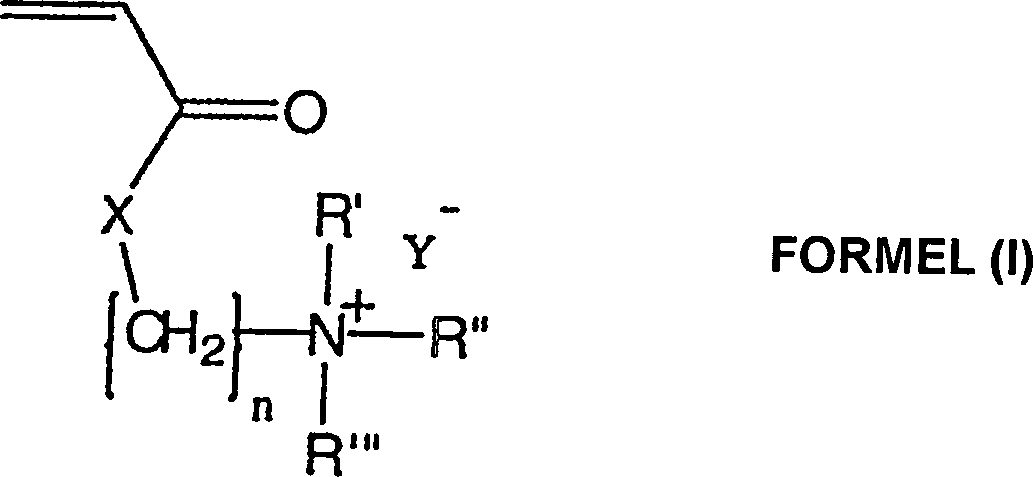
Die
vorliegende Erfindung liefert einen Wundverband, umfassend ein Hydrogel,
das von ungefähr
15 bis 95 Gewichtsprozent des inhärenten antimikrobiellen Polyamin-Acrylat-Monomeren der Formel
(I); 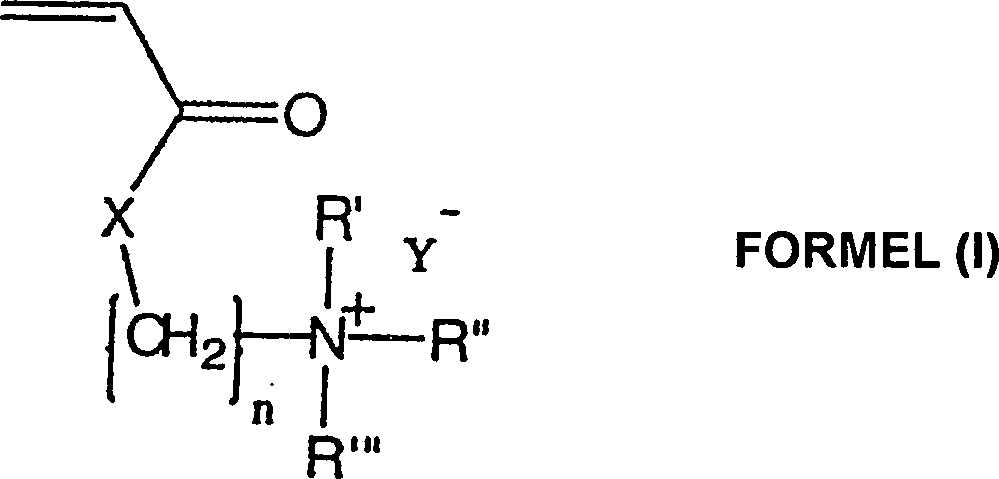
Die
vorliegende Erfindung liefert weiter ein Mittel zum Abdecken von
Wunden, umfassend ein Substrat, das fest daran gebunden einen Wundverband
aufweist, der eine Hydrogel umfasst, das ungefähr 15 bis 95 Gewichtsprozent
eines antimikrobiellen in-Acrylat-Polymeren der Formel (I) enthält: 
Darüber hinaus
ist die Erfindung auf die Verwendung eines Hydrogels gerichtet,
das von ungefähr
15 bis 95 Gewichtsprozent eines inhärenten antimikrobiellen kationischen
quaternären
Amin-Polyacrylat-Polymeren der Formel (I) enthält: 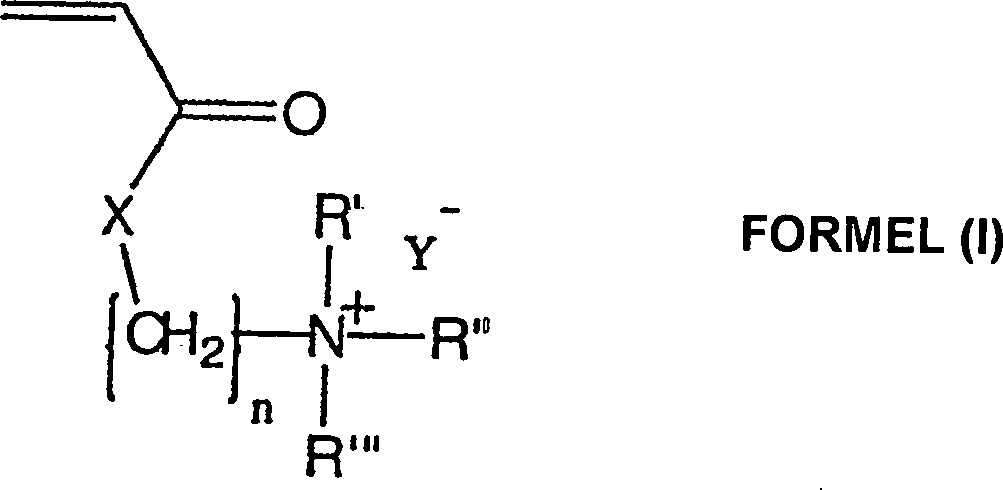
Bevorzugte Ausführungsformen der vorliegenden Erfindung sind in den Unteransprüchen aufgeführt.preferred embodiments of the present invention are set out in the subclaims.
Die Alkylgruppen sind vorzugsweise solche mit wenigen C-Atomen, von C1 bis C6 mit Methyl- oder Äthylgruppen. Aryl ist bevorzugt Phenyl, aber kann irgendeine geeignete aromatische Teileinheit sein, wie solche, die aus der Gruppe ausgewählt sind, die aus Phenyl, Thiophenyl, Naphthyl, Biphenyl, Pyridyl, Pyrimidinyl, Pyrazyl, Pyridazinyl, Furyl, Thienyl, Pyrryl, Quinolinyl und Bipyridyl. Ein repräsentativer Vertreter einer Aralkylgruppe ist Benzyl und ein repräsentativer Vertreter aus einer Alkarylgruppe ist Tolyl. X ist O oder NH Repräsentative Gegenionen, mit Y– gekennzeichnet, sind Mitglieder, die aus der Gruppe ausgewählt sind, die aus Cl–, Br–, HSO4 – und CH3SO4 – besteht. Alkylgruppen können gerade oder unverzweigt sein und Alkyl- und Arylgruppen können durch nicht- interferierende Substituenten ersetzt werden, die die Funktionalität der Polymers nicht stören.The alkyl groups are preferably those with a few carbon atoms, from C 1 to C 6 with methyl or ethyl groups. Aryl is preferably phenyl, but can be any suitable aromatic moiety, such as those selected from the group consisting of phenyl, thiophenyl, naphthyl, biphenyl, pyridyl, pyrimidinyl, pyrazyl, pyridazinyl, furyl, thienyl, pyrryl, quinolinyl and bipyridyl , A representative representative of an aralkyl group is benzyl and a representative representative of an alkaryl group is tolyl. X is O or NH Representative counterions, marked Y - are members selected from the group consisting of Cl - , Br - , HSO 4 - and CH 3 SO 4 - . Alkyl groups can be straight or unbranched and alkyl and aryl groups can be replaced by non-interfering substituents that do not interfere with the functionality of the polymers.
Das kationische quaternäre Ammoniumpolymer kann in einem wässrigen Medium hergestellt werden und ein Hydrogel in situ bilden oder kann in einem wässrigen Medium hergestellt, getrocknet und zu einem Pulver umgewandelt werden, das dann in einem wässrigen Medium zu einem Hydrogel rekonstituiert werden kann.The cationic quaternaries Ammonium polymer can be in an aqueous Medium are prepared and can or can form a hydrogel in situ in an aqueous Medium is prepared, dried and converted into a powder, then in a watery one Medium can be reconstituted into a hydrogel.
Das
Polymer wird durch Polymerisation eines Acrylsäuremonomers, gemäß nachstehender
Formel (II) hergestellt: 
Die kationischen quaternären Ammoniumpolymere, die in dieser Erfindung verwendet werden, besitzen aufgrund ihrer Beschaffenheit antimikrobielle Eigenschaften und sind absorbierend und nicht-reizend für die Haut oder offene Wunden. Die Absorptionskraft des Hydrogels erlaubt, dass, wenn es als Wundverband angewendet wird, weniger Verbandswechsel notwendig sind, die Wunde schneller heilt und eine feuchte heilende Umgebung aufrecht erhalten wird. Die Polymere sind resistent gegenüber Strahlung und können daher durch solche Mittel sterilisiert werden. Weil die Polymere inhärent antimikrobiell sind, wird die Wunde in einer sterilen Umgebung gehalten, die die Wundheilung fördert. Weil die Polymere polykationisch sind, ist es weiter möglich, dass die Heilung beschleunigt ist, da die Blutgerinnung aktiviert ist, weil das kationische Polymer die polyanionischen Gerinnungsinhibitoren, wie das natürlich vorkommende anionische Polysaccharid Heparin, neutralisiert,.The cationic quaternary Possess ammonium polymers used in this invention due to their nature antimicrobial properties and are absorbent and non-irritating to the skin or open wounds. The absorption power of the hydrogel allows that when applied as a wound dressing less dressing changes are necessary, the wound faster heals and maintains a moist healing environment. The polymers are resistant to radiation and can therefore pass through such agents are sterilized. Because the polymers are inherently antimicrobial the wound is kept in a sterile environment that the Promotes wound healing. Because the polymers are polycationic, it is also possible that the Healing is accelerated because blood clotting is activated because the cationic polymer the polyanionic anticoagulant, like that of course occurring anionic polysaccharide heparin, neutralized ,.
Die Hydrogele werden vorzugsweise mit einer physikalischen Trägerstruktur hergestellt, um das Hydrogel auf der Wunde zu halten. Diese physikalische Trägerstruktur kann in Form eines abdichtenden Mittels, das eine undurchlässige Rückseite aufweist, vorliegen, z. B. als ein Pflaster. Da das Hydrogel sowohl inhärent adhäsiv als auch antimikrobiell ist, kann die Verwendung von dauerhafteren Haftmitteln entweder nützlich oder weniger nützlich sein. Das Hydrogel kann auch um ein Netz oder einen Faserträger gebildet werden und in geeignete Größen hinsichtlich Fläche und Tiefe, zugeschnitten werden, d. h. in Blätter, Streifen, Quadrate, Kreise oder Ovale.The Hydrogels are preferably made with a physical support structure made to hold the hydrogel on the wound. This physical support structure can be in the form of a sealant that has an impervious back has, exist, e.g. B. as a plaster. Because the hydrogel both inherently adhesive as is also antimicrobial, the use of more permanent adhesives either useful or less useful his. The hydrogel can also be formed around a mesh or a fiber support and in appropriate sizes with regard to area and depth, are tailored, d. H. in leaves, strips, squares, circles or ovals.
Die kationischen quaternären Amin-Polyacrylatgele, die in dieser Erfindung verwendet werden, sind geeignet, signifikante Mengen an Flüssigkeit oder Exsudat, das aus der Wunde oder anderen oberflächigen Hautabschürfungen stammt, aufzusaugen. Es ist bekannt, dass die Ansammlung von überschüssiger Wundflüssigkeit schädlich für den Heilungsprozess ist und einen fruchtbaren Ort für das Bakterienwachstum darstellt, was den Wundheilungsprozess zusätzlich hemmt. Wegen der Absorptionskraft des Hydrogels, kann ein Wechsel des Wundverbandes seltener erfolgen und eine sterile Umgebung ist trotzdem gewährleistet. Alternativ kann der Wundverband gewechselt werden, wenn die Exsudatabgabe zu hoch ist.The cationic quaternary Amine polyacrylate gels used in this invention are capable of significant amounts of liquid or exudate from the wound or other superficial skin abrasions comes to soak up. It is known that the accumulation of excess wound fluid harmful for the Healing process and is a fertile place for bacterial growth, what the wound healing process additionally inhibits. Because of the absorption force of the hydrogel, a change can be made wound dressing is less common and is a sterile environment guaranteed anyway. Alternatively, the wound dressing can be changed when the exudate is delivered is too high.
Die kationischen Hydrogele belassen die Wunde in einer feuchten Umgebung, die nicht nur die Heilung erleichtert, sondern steigert auch das kosmetische Erscheinungsbild der Wunde beim Heilen.The cationic hydrogels leave the wound in a moist environment, which not only makes healing easier, but also increases it cosmetic appearance of the wound when healing.
Wie vorher schon festgestellt, wurde zu den Hydrogelen und/oder Wundverbänden aus dem Stand der Technik ein Antibiotikum oder ein anderes Desinfektionsmittel zugefügt, um Sterilität zu erreichen und die Heilung zu beschleunigen. Während solche externen Antibiotika immer noch zugefügt werden können, wenn es notwendig erscheint, ist die Zugabe solcher externer Additiva aufgrund der inhärent antimikrobiellen Eigenschaften der in dieser Erfindung verwendeten Hydrogele unnötig. Wie man sehen wird, sind die antimikrobiellen Eigenschaften der in dieser Erfindung verwendeten Hydrogele wirksam gegenüber einem weiten Bereich an Mikroorganismen.How previously determined, was made to the hydrogels and / or wound dressings the prior art an antibiotic or other disinfectant added about sterility to achieve and accelerate healing. While such external antibiotics still inflicted can be if it appears necessary, the addition of such external additives due to the inherent antimicrobial properties of those used in this invention Hydrogels unnecessary. As will be seen, the antimicrobial properties of the Hydrogels used effectively in this invention against one wide range of microorganisms.
Ein anderer vorteilhafter Unterschied der kationischen quaternären Amin-Polyacrylat-Hydrogele betrifft die Sterilisation. Die Anbieter von Verbänden verpacken diese im allgemeinen in einer geschlossenen Umgebung unter sterilen Bedingungen. Weil die Hydrogele Dampf und andere bei der Sterilisation verwendeten Wirkstoffe absorbieren, wie z. B. Äthylenoxid, können sie auf diese Weise nicht sterilisiert werden und die Verwendung von Strahlung wirkt sich aufgrund der Degradation durch freie Radikale nachteilig auf viele Gele aus dem Stand der Technik aus. Die Hydrogele, die in der vorliegenden Erfindung verwendet werden, können ohne negative Effekte auf die Stabilität bestrahlt und verschlossen werden. Wegen der Eigenschaft der polykationischen Hydrogele mittels Strahlung sterilisiert werden zu können, brauchen sie nicht in einem „Reinraum" oder in einer sterilen Umgebung hergestellt oder verpackt zu werden.Another advantageous difference of the cationic quaternary amine polyacrylate hydrogels be meets the sterilization. Association providers generally pack these in a closed environment under sterile conditions. Because the hydrogels absorb steam and other agents used in sterilization, such as. B. ethylene oxide, they can not be sterilized in this way and the use of radiation has a disadvantageous effect on many gels from the prior art due to the degradation by free radicals. The hydrogels used in the present invention can be irradiated and sealed without negative effects on stability. Because of the ability of the polycationic hydrogels to be sterilized by radiation, they do not need to be manufactured or packaged in a "clean room" or in a sterile environment.
Wie im U.S. Patent 5,800,685 bemerkt, sind die kationischen quaternären Amin-Polyacrylat-Hydrogele gute elektrische Leiter und können zur Verwendung als Elektroden in medizinischen Einrichtungen formuliert werden, weil sie mit der Haut bei ausreichenden Feuchte und adhäsiven Eigenschaften in Kontakt stehen, und so den Durchtritt von elektrischem Strom erlauben, ohne das Hydrogel oder die Haut wesentlich negativ zu beeinflussen.How in U.S. Patent 5,800,685 noted, the cationic quaternary amine polyacrylate hydrogels are good electrical conductors and can formulated for use as electrodes in medical facilities, because they are with the skin with sufficient moisture and adhesive properties are in contact, and thus the passage of electrical current allow without significantly affecting the hydrogel or the skin.
Wenn die Hydrogele als leitende adhäsive Hydrogele verwendet werden, werden im allgemeinen große Mengen einer die elektrische Leitfähigkeit steigernden Substanz der Formulierung zugefügt, wie z. B. Kaliumchlorid. In der vorliegenden Erfindung können Salzlösungen aus Natrium- oder Kaliumchlorid in geringeren Konzentrationen als die Polymerisation fördernde Substanzen bei der Bildung des Hydrogels anwesend sein.If the hydrogels as conductive adhesive Hydrogels are generally used in large quantities one the electrical conductivity added increasing substance of the formulation, such as. B. Potassium chloride. In the present invention salt solutions from sodium or potassium chloride in lower concentrations than promoting polymerization Substances are present in the formation of the hydrogel.
Wenn die kationischen Hydrogele als Wundverbände verwendet werden, kann das Gel auch ein Puffersystem enthalten, um die Verfärbung und/oder Hydrolyse der Hydrogele zu verhindern und/oder um ihre Haltbarkeit zu verlängern. Auch andere Additiva können den Hydrogelen, entweder vor oder nach dem Härten, zugefügt werden (d. h. Pharmaka, Feuchthaltemittel, Weichmacher). Die Eignung solcher Additiva hängt im allgemeinen davon ab, welcher Verband hergestellt und auf die Wunde aufgetragen wird.If the cationic hydrogels can be used as wound dressings The gel also contain a buffer system to prevent discoloration and / or Prevent hydrolysis of the hydrogels and / or their durability to extend. Other additives can also added to the hydrogels, either before or after curing (i.e. pharmaceuticals, Humectant, plasticizer). The suitability of such additives generally depends depending on which dressing is made and applied to the wound becomes.
Zusätzlich zu der Fähigkeit, Exsudat zu absorbieren und der inhärenten antimikrobiellen Eigenschaften, sind es weitere Eigenschaften, wegen denen die kationischen Acrylat-Hydrogele, die in dieser Erfindung verwendet werden, nützlich für die Verwendung als Wundverbände sind. Sie besitzen exzellente physikalische Eigenschaften in Bezug auf die Adhäsionsfähigkeit, da sie sowohl an der Haut anhaften, wenn sie aufgebracht werden, aber auch schnell wieder von der Haut entfernt werden können, ohne einen Gelrest übrig zu lassen. Verglichen mit Hydrogelen aus dem Stand der Technik, sind die kationischen Acrylat-Hydrogele der vorliegenden Erfindung über einen weiten Hydrationsbereich wirksam. Mit anderen Worten können die Gele weniger als 15 oder soviel wie 95% Gewichtsprozent der kationischen Polyacrylate enthalten. Vorzugsweise wird das Hydrogel zwischen ungefähr 61 und 90 Gewichtsprozent des Polyacrylat-Polymers enthalten und besonders bevorzugt sind Bereiche zwischen ungefähr 65 bis 75 Gewichtsprozent. Sogar bei den höheren Feststoffgehalten der Polyacrylatpolymere sind die Hydrogele auf der Wunde oder der Hautoberfläche relativ nicht-reizend.In addition to the ability Absorb exudate and inherent antimicrobial properties, are there other properties because of which the cationic acrylate hydrogels used in of this invention are useful for use as wound dressings. They have excellent physical properties in terms of the adhesiveness, since they both adhere to the skin when applied, but can also be quickly removed from the skin without a gel residue left allow. Compared to prior art hydrogels, are the cationic acrylate hydrogels of the present invention wide hydration range effective. In other words, they can Gels less than 15 or as much as 95% by weight of the cationic Contain polyacrylates. Preferably the hydrogel is between approximately Contain 61 and 90 percent by weight of the polyacrylate polymer and particularly preferred are ranges between approx 65 to 75 percent by weight. Even at the higher solids levels Polyacrylate polymers are relative to the hydrogels on the wound or skin surface non-irritating.
Die chemische Formel für kationische Amin-Polyacrylate, die zur Verwendung in der vorliegenden Erfindung geeignet sind, wird in der Formel (I) oben angegeben. Das quaternäre Amin, das Acrylsäurester oder Amidmonomere enthält, die für den Polymerisationsprozess verwendet werden können, ist in der Formel (II) gezeigt. Das bevorzugte Verfahren zum Herstellen solcher kationischen Acrylate, die zur Verwendung in der vorliegenden Erfindung geeignet sind, ist unten beschrieben.The chemical formula for cationic amine polyacrylates for use in the present Invention are suitable, is given in formula (I) above. The quaternary Amin, the acrylic acid ester or contains amide monomers, the for the polymerization process can be used is shown in formula (II). The preferred method of making such cationic acrylates, which are suitable for use in the present invention, is described below.
Im allgemeinen wird das Polymerisationsverfahren in einer wässrigen Lösung ablaufen, so dass das gebildete Hydrogel die oben erwähnten Feststoffe enthält und durch Wasser und andere Additivs ausgeglichen wird, wie oben erwähnt. Falls gewünscht, kann das Hydrogel auch ausreichend Puffer einschließen, um den pH-Wert des Hydrogels in jedem gewünschten pH-Bereich zu halten.in the generally the polymerization process is carried out in an aqueous solution run off, so that the hydrogel formed the above-mentioned solids contains and is offset by water and other additives, as above mentioned. If desired, the hydrogel may also include sufficient buffer to to keep the pH of the hydrogel in any desired pH range.
Beispiele besonderer quaternärer kationischer Amin-Acrylatester oder von Amidmonomerern, die polymerisiert werden können, sind in den folgenden Formeln, (III), (IV), (V) und (VI) gezeigt:Examples special quaternary cationic amine acrylate ester or amide monomers that polymerize can be are shown in the following formulas, (III), (IV), (V) and (VI):
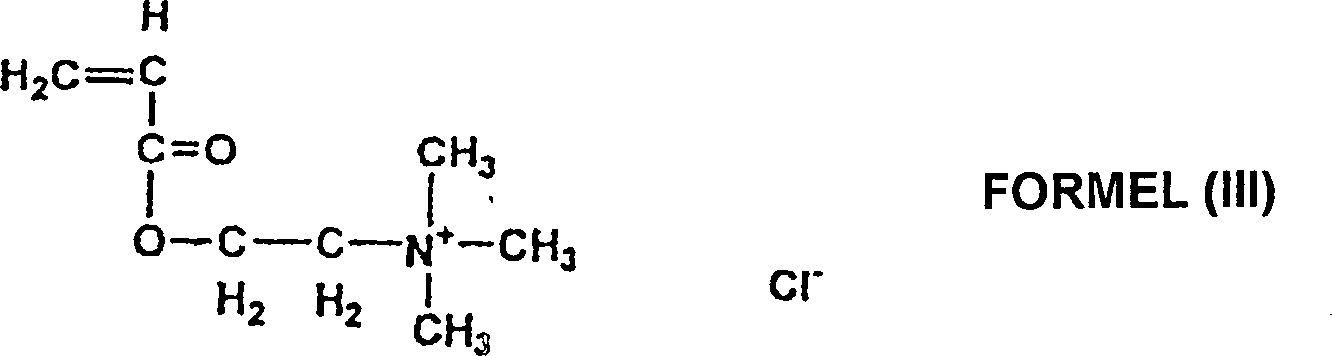
Formel (III) zeigt Acryloyloxyäthyltrimethyl-Ammoniumchlorid, das von CPS Chemical Co. erhältlich ist.Formula (III) shows acryloyloxyethyl trimethyl ammonium chloride available from CPS Chemical Co. is.
Formel (IV) zeigt Acryloyloxyäthyltrimethyl-Ammoniummethylsulfat, das von Allied Colloid Co. erhältlich ist.formula (IV) shows acryloyloxyethyl trimethyl ammonium methyl sulfate, that available from Allied Colloid Co. is.
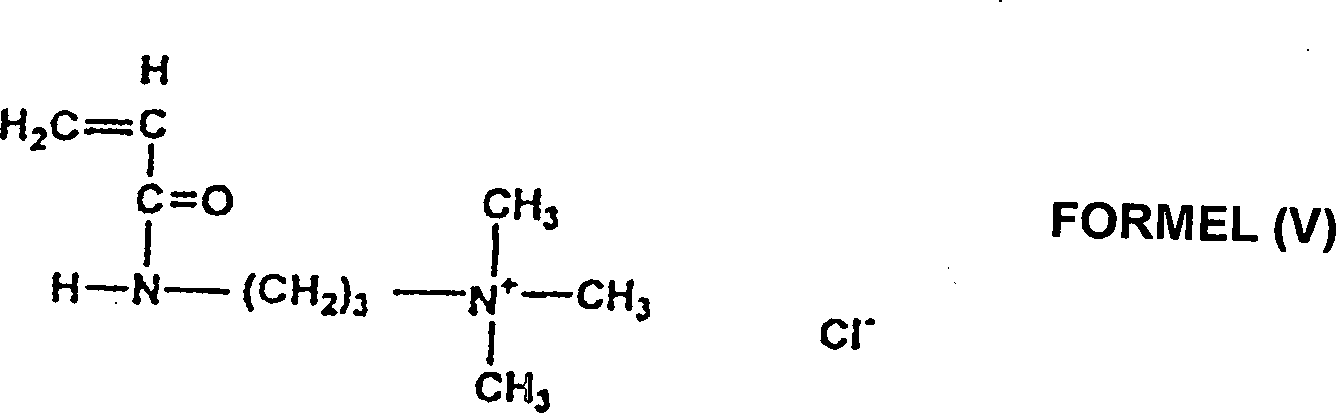
Formel (V) zeigt Acrylamidopropyltrimethyl-Ammoniumchlorid, das von Stockhausen (Deutschland) erhältlich ist.formula (V) shows acrylamidopropyltrimethyl ammonium chloride, that from Stockhausen (Germany) available is.

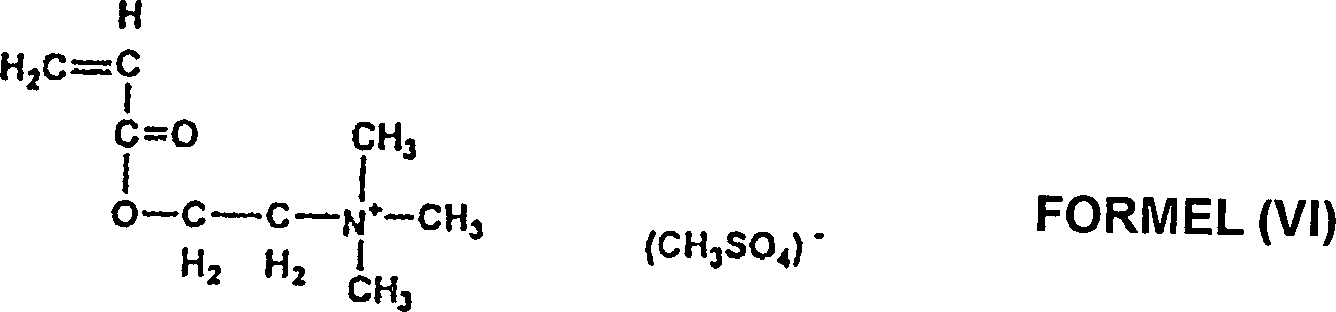
Formel (VI) zeigt Acryloxyäthyldimethylbenzyl-Ammoniumchlorid, das von Elf Atochem erhältlich ist.formula (VI) shows acryloxyethyldimethylbenzyl ammonium chloride, that available from Elf Atochem is.
Das bevorzugte Verfahren zum Herstellen der kationischen Amin-Polyacrylat-Hydrogele aus einer oder mehrerer dieser spezifischen Monomere wird im Detail unten beschrieben.The preferred methods of making the cationic amine polyacrylate hydrogels one or more of these specific monomers becomes in detail described below.
Die kationischen quaternären Amin-Polyacrylat-Hydrogele werden vorzugsweise in situ durch freie Radikal-Polymerisation eines wasserlöslichen Monomers (wie solche, die oben gezeigt sind) in der Anwesenheit von Wasser gebildet, vorzugsweise durch Ultraviolett-Härtung mit Starter(n) und multi-funktionellen, quervernetzenden Wirkstoffen. Ein geeignetes Acrylat-Monomer z. B. (wie in der Formel (III) gezeigt), Wasser, optional zusätzliche Verstärker der Polymerisation (wie Salz, z. B. Natriumchlorid, Kaliumchlorid), Starter oder Katalysatoren (z. B. α-Hydroxy-1,α-Dimethylacetophenon in DMSO) und ein multi-funktioneller Quervernetzer (z. B. Methylen-bis-Acrylamid) werden kombiniert, in eine Form gegeben und einer Ultraviolett-Strahlung, wie im Stand der Technik bekannt, ausgesetzt. Das so gebildete kationische quaternäre Amin-Polyacrylat-Hydrogel ist etwas klarer in der Farbe, viskos und bei Berührung klebrig. Das Hydrogel haftet, als Wundverband verwendet, tendenziell in genügendem Ausmaß auf der Haut einer Person, ist aber noch genügend kohäsiv, um einfach wieder von der Haut einer Person entfernt und getrennt werden zu können.The cationic quaternary Amine-polyacrylate hydrogels are preferably generated in situ by free radical polymerization of a water soluble Monomers (such as those shown above) in the presence formed by water, preferably by ultraviolet curing with Starter (s) and multi-functional, cross-linking agents. A suitable acrylate monomer e.g. B. (as shown in formula (III)) Water, optional additional amplifier polymerization (such as salt, e.g. sodium chloride, potassium chloride), Starters or catalysts (e.g. α-hydroxy-1, α-dimethylacetophenone in DMSO) and a multi-functional cross-linker (e.g. methylene-bis-acrylamide) are combined, put in a mold and an ultraviolet radiation, as known in the art. The cationic thus formed quaternary Amine polyacrylate hydrogel is slightly clearer in color, viscous and when touched sticky. The hydrogel tends to stick when used as a wound dressing in sufficient Extent to the skin of a person, but is still sufficiently cohesive to just come back from to be able to remove and separate a person's skin.
Wie oben erwähnt, können die in dieser Erfindung erwähnten Hydrogele ein Puffersystem einschließen, um den pH-Wert zu kontrollieren, die Verfärbung zu vermeiden, und/oder helfen, den Abbau aufgrund der verlängerten Anwesenheit von Wasser zu verhindern (d. h. die Hydrolyse zu verhindern). Die Puffer werden, wenn überhaupt, vorzugsweise vor dem Härten zu der Mischung zugefügt. Geeignete Puffer schließen z. B. Natrium-Kalium-Tartrat und/oder monobasisches Natriumphosphat ein, beide sind z. B. von Aldrich Chemical Co., IN. erhältlich. Die Verwendung eines Puffersystems mit dem Hydrogel ist bevorzugt, um das Hydrogel mit einer für den Handel geeigneten Haltbarkeit bereitzustellen (d. h. eine Haltbarkeit von über einem Jahr), ohne dass es sich verfärbt.As mentioned above, the hydrogels mentioned in this invention may include a buffer system to control pH, avoid discoloration, and / or help prevent degradation due to the prolonged presence of water (ie, prevent hydrolysis) , If at all, the buffers are preferably added to the mixture prior to curing. Suitable buffers include e.g. B. sodium potassium tartrate and / or monobasic sodium phosphate, both are e.g. B. from Aldrich Chemical Co., IN. available. The use of a buffer system with the hydrogel is preferred in order to provide the hydrogel with a commercial shelf life (ie a shelf life of over a year) without discoloration.
Wie auch oben erwähnt, können auch andere Additiva in das Hydrogel eingeschlossen werden, entweder vor oder nach dem Härten (d. h. Pharmaka wie Antibiotika, Desinfektionsmittel, Feuchthaltemittel, Weichmacher). Die Eignung solcher Additiva ist im allgemeinen von dem bezweckten Endnutzen des besonderen Hydrogels als ein Wundverband abhängig.How also mentioned above, can other additives can also be included in the hydrogel, either before or after hardening (i.e. pharmaceuticals such as antibiotics, disinfectants, humectants, plasticizers). The suitability of such additives is generally different from that for which they are intended End use of the special hydrogel dependent as a wound dressing.
Wie oben erwähnt, werden Starter bevorzugt bei der Polymerisation der Hydrogele verwendet. Beispiele für Starter, die verwendet werden können, schließen z. B. IRGACURE® 184 (1-Hydroxycyclohexyl-Phenylketon) und DAROCURE® 1173 (α-Hydroxy-1-α-Dimethylacetophenon) ein, die beide kommerziell von der Ciba-Geigy Corp. erhältlich sind. Diese UV-Katalysatoren sind bevorzugt, weil sind keine Gelbfärbung erzeugen. Andere Starter, die die bevorzugte Wasser-weisse und Wasser-klare Erscheinung des Hydrogels gewährleisten, sind bevorzugt. Zusätzliche Beispiele von Startern jedoch (die Photo-Starter oder Wärme-Starter sein können) schließen ein: Benzoylperoxid, Azo-bis-Isobutyronitril, Di-t-Butylperoxid, Bromylperoxid, Cumylperoxid, Lauroylperoxid, Isopropylpercarbonat, Methyläthylketonperoxid, Cyclohexanperoxid, t-Butylhydroperoxid, Di-t-Amylperoxid, Dicumylperoxid, t-Butylperbenzoat, Benzoinalkyläther (wie Benzoin, Benzoin-Isopropyläther und Benzoin-Isobutyläther), Benzophenone (wie Benzophenon und Methyl-o-Benzoyl-Benzoat), Acetophenone (wie Acetophenon, Trichloroacetophenon, 2,2-Diäthyoxyacetophenon, p-t-Butyltrichloro-Acetophenon, 2,2-Dimethoxy-2-Phenylacetophenon und p-Dimethylaminoacetophenon), Thioxanthone (wie Xanthon, Thioxanthon, 2-Chlorothioxanthon und 2-Isopropylthioxanthon), Benzyl-2-Äthyl-Anthraquinon, Methylbenzoylformat, 2-Hydroxy-2-Methyl-1-Phenyl-Propan-1-on, 2-Hydroxy-4'-Isopropyl-2-Methyl-Propiophenon, α-Hydroxyketon, Tetramethyl-Thiuram-Monosulfid, Allyldiazonium-Salz und Kombinationen von Kamphoquinon und Äthyl-4-(N,N-Dimethylamino)-Benzoat. Andere Starter können z. B. in Berner et al., „Photo Initiators – An Overview", J. Radiation Curing (April 1979), pp. 2–9, gefunden werden.As mentioned above, starters are preferably used in the polymerization of the hydrogels. Examples of starters that can be used include e.g. B. IRGACURE ® 184 (1-hydroxycyclohexyl phenyl ketone), and DAROCURE ® 1173 (α-hydroxy-1-α-dimethylacetophenone), both of which are commercially available from the Ciba-Geigy Corp. are available. These UV catalysts are preferred because they do not produce a yellow color. Other starters which ensure the preferred water-white and water-clear appearance of the hydrogel are preferred. However, additional examples of starters (which can be photo starters or heat starters) include: benzoyl peroxide, azo-bis-isobutyronitrile, di-t-butyl peroxide, bromyl peroxide, cumyl peroxide, lauroyl peroxide, isopropyl percarbonate, methyl ethyl ketone peroxide, cyclohexane peroxide, t-butyl hydroperoxide, Di-t-amyl peroxide, dicumyl peroxide, t-butyl perbenzoate, benzoin alkyl ethers (such as benzoin, benzoin isopropyl ether and benzoin isobutyl ether), benzophenones (such as benzophenone and methyl-o-benzoyl benzoate), acetophenones (such as acetopacetone, trichloro -Diethyoxyacetophenone, pt-butyltrichloro-acetophenone, 2,2-dimethoxy-2-phenylacetophenone and p-dimethylaminoacetophenone), thioxanthones (such as xanthone, thioxanthone, 2-chlorothioxanthone and 2-isopropylthioxanthone), benzyl-2-benzoquinone, benzyl-2-benzoquinone, benzyl-2-benzene 2-hydroxy-2-methyl-1-phenyl-propan-1-one, 2-hydroxy-4'-isopropyl-2-methyl-propiophenone, α-hydroxyketone, tetramethyl-thiuram monosulfide, allyl diazonium salt and combinations of Kamphoquinone and ethyl 4- (N, N-dimethylamino) benzoate. Other starters can e.g. B. in Berner et al., "Photo Initiators - An Overview", J. Radiation Curing (April 1979), pp. 2-9.
Die Menge an Starter liegt vorzugsweise innerhalb des Bereichs von ungefähr 0,02 bis 0,2 Gewichtsprozent in Bezug Gesamtmenge an Monomeren und bevorzugter innerhalb des Bereichs von ungefähr 0,05 bis 0,5 Gewichtsprozent in Bezug auf die Gesamtmenge an Monomeren.The The amount of starter is preferably within the range of about 0.02 to 0.2 weight percent based on total amount of monomers and more preferred within the range of approximately 0.05 to 0.5 percent by weight based on the total amount of monomers.
Die Parameter zum UV-Härten, mit denen die gewünschten Polymereigenschaften erhalten werden können, sind dem Fachmann auf seinem Gebiet gut bekannt. Ein Starter für die vorliegenden Zwecke wirkt tendenziell über die Absorption ausgewählter UV-Wellenlängen, was den Zerfall in die freien Radikale nach sich zieht und dadurch die Polymerisation startet. Die Wellenlängen und die zu härtende Fläche bestimmen die Art der UV-Lampe, die in dem Härtungsvorgang verwendet wird. Die Hemmung der Polymerisation aufgrund von gelöstem Sauerstoff, Monomeren-Schutzagenzien oder andere Komponenten können dadurch verhindert werden, dass die Strahlungsintensität durch Pulsieren verändert wird, und/oder durch Verwendung von Katalysationsbeschleunigern. Die Menge an restlichem Monomeren (nach der Polymerisation) beträgt vorzugsweise weniger als ungefähr 3%, um eine gute Biokompatibilität zu erhalten.The Parameters for UV curing, with which the desired Polymer properties can be obtained are known to the person skilled in the art well known in his area. A starter for the present purposes tends to work via the Absorption of selected UV wavelengths, which entails the breakdown into free radicals and thereby the polymerization starts. The wavelengths and the surface to be hardened determine the Type of UV lamp used in the curing process is used. Inhibition of polymerization due to dissolved oxygen, Monomer protective agents or other components can thereby prevent the radiation intensity from being changed by pulsing, and / or by using catalyst accelerators. The amount residual monomer (after the polymerization) is preferably less than about 3% to have good biocompatibility to obtain.
Wie auch oben schon bemerkt, werden quervernetzende Wirkstoffe beim Quervernetzen der kationischen Polyacrylat-Hydrogele bevorzugt. Beispiele multifunktioneller quervernetzender Substanzen, die verwendet werden können, sind Methylen-Bis-Acrylamid (MBA) und Diäthylenglykol-Diacrylat, die beide kommerziell von Polysciences, Inc., Warrington, Pennsylvania, erhältlich sind.How already noted above, cross-linking agents are used in Cross-linking of the cationic polyacrylate hydrogels is preferred. Examples of multifunctional cross-linking substances used can be are methylene-bis-acrylamide (MBA) and diethylene glycol diacrylate, both commercially available from Polysciences, Inc., Warrington, Pennsylvania, available are.
Weitere Beispiele von quervernetzenden Wirkstoffen, die zur Verwendung in der vorliegenden Erfindung akzeptabel sein können, schließen ein: Äthylenglykol-Diacrylat, Triäthylenglykol-Bis-Methacrylat, Äthylenglykol-Bis-Methacrylat, Äthylenglykol-Dimethacrylat, Bisacrylamid, Triäthylenglykol-Bis-Acrylat, 3,3'-Äthylen-Bis-(N-Vinyl-2-Pyrrolidon), Trimethylolpropat-Trimethacrylat, Glycerin-Trimethacrylat, Polyäthylenglycol-Dimethacrylat und andere Polyacrylate und Polymethacrylat-Ester.Further Examples of cross-linking agents that are used in the present invention may be acceptable include: ethylene glycol diacrylate, Triethylene glycol bis methacrylate, ethylene glycol bis methacrylate, ethylene glycol dimethacrylate, bisacrylamide, Triethyleneglycol-bis-acrylate, 3,3'-ethylene-bis- (N-vinyl-2-pyrrolidone), trimethylolpropate trimethacrylate, Glycerol trimethacrylate, polyethylene glycol dimethacrylate and other polyacrylates and polymethacrylate esters.
Die Menge an verwendetem quervernetzenden Wirkstoff liegt vorzugsweise innerhalb des Bereichs von ungefähr 0,02 bis 2,0 Gewichtsprozent in Bezug auf die Gesamtmenge an Monomeren, und bevorzugter innerhalb des Bereichs von ungefähr 0,05 bis 0,5 Gewichtsprozent in Bezug auf die Gesamtmenge an Monomeren.The The amount of crosslinking active ingredient used is preferably within the range of approximately 0.02 to 2.0 percent by weight based on the total amount of monomers, and more preferably within the range of about 0.05 to 0.5 weight percent in terms of the total amount of monomers.
Nachfolgend sind spezifische, exemplarische Ausführungsformen kationischer quaternärer Amin-Acrylat-Hydrogele zur Verwendung in der vorliegenden Erfindung aufgeführt.following are specific, exemplary embodiments of cationic quaternary amine acrylate hydrogels listed for use in the present invention.
In
jedem der folgenden Beispiele war das verwendete quaternäre Amin-Acrylat-Monomer
80% Acryloyloxyäthyltrimethyl-Ammoniumchlorid
in Wasser (AAC), die quervernetzende Lösung war 1% Methylen-bis-Acrylamid
in Wasser (MBA), der Katalysator war 0,01% α-Hydroxyl-1,α-Dimethylacetophenon in DMSO (DAROCURE® 1173). Beispiel
1
Diese
Bestandteile wurden in der angegebenen Reihenfolge gemischt und
in ein geeignetes UV-Härtungssystem überführt, wie
oben beschrieben, und gemäß der im
Stand der Technik gut bekannten Verfahren gehärtet. Das resultierende Gel
war transparent, war leicht klebrig und hatte eine Feststoffgehalt
von 61% auf das Gewicht bezogen. Beispiel
2
Das
resultierende Gel hatte eine Feststoffgehalt von 61% auf das Gewicht
bezogen und ist ähnlich dem
in Beispiel 1, mit Ausnahme, dass die Salzlösung durch Wasser ersetzt wurde.
Der Polymerisationsprozess war der gleiche wie auch die Eigenschaften
des Gels. Beispiel
3
Dem
Verfahren aus Beispiel 1 wurde gefolgt und das resultierende transparente
Gel war leicht klebrig und hatte eine Feststoffgehalt von 70% auf
das Gewicht bezogen. Beispiel
4
Das
resultierende transparente Gel war leicht klebrig und hatte eine
Feststoffgehalt von 70% auf das Gewicht bezogen. Dieses Beispiel
ist ähnlich
dem aus Beispiel 3, mit Ausnahme, dass die Salzlösung durch Wasser ersetzt wurde.
Der Polymerisationsprozess war der gleiche. Beispiel
5
Das
resultierende transparente Gel hatte eine Feststoffgehalt von 70%
auf das Gewicht bezogen und ist ähnlich
dem aus Beispiel 4, mit Ausnahme, dass die Menge an MBA-Quervernetzer halbiert
war. Der Polymerisationsprozess war der gleiche und das Gel war
im wesentlichen klar und leicht klebrig. Beispiel
6
Dem
Verfahren aus Beispiel 1 wurde gefolgt und das resultierende transparente
Gel war leicht klebrig und hatte eine Feststoffgehalt von 80% auf
das Gewicht bezogen. Beispiel
7
Das
resultierende Gel hatte eine Feststoffgehalt von 80% auf das Gewicht
bezogen und ist ähnlich dem
aus Beispiel 6, mit Ausnahme, dass die Salzlösung durch Wasser ersetzt wurde.
Der Polymerisationsprozess war der gleiche, wie auch die physikalischen
Eigenschaften des Gels. Beispiel
8
Das
resultierende Gel hatte eine Feststoffgehalt von 80% auf das Gewicht
bezogen und ist ähnlich dem
aus Beispiel 7, mit Ausnahme, dass der Gehalt an MBA-Quervernetzter
halbiert wurde. Der Polymerisationsprozess war der gleiche, wie
auch die physikalischen Eigenschaften des Gels. Beispiel
9
Das
Gel wurde wie in Beispiel 1 hergestellt. Das resultierende transparente
Gel war leicht klebrig und hatte einen Feststoffgehalt von 90% auf
das Gewicht bezogen. Beispiel
10
Das
resultierende Gel hatte einen Feststoffgehalt 90% auf das Gewicht
bezogen und ist ähnlich
dem auf Beispiel 9, mit Ausnahme, dass das Wasser durch 2%-ige Salzlösung ersetzte
wurde und die Menge an MBA-Quervernetzer halbiert wurde. Der Polymerisationsprozess
war der gleiche und die Geleigenschaften waren ähnlich. Beispiel
11
Das resultierende Gel hatte einen Feststoffgehalt 90% auf das Gewicht bezogen und ist ähnlich dem auf Beispiel 10, mit Ausnahme, dass die Menge MBA-Quervernetzer verdoppelt wurde. Der Polymerisationsprozess war der gleiche wie auch die Geleigenschaften.The resulting gel had a solids content of 90% by weight related and is similar that on Example 10, except that the amount of MBA crosslinker was doubled. The polymerization process was the same as also the gel properties.
Beispiel 12Example 12
Das Gel aus Beispiel 11 wurde nach Anpassung mit einem Verfahren nach Kirby-Bauer zur Untersuchung von Antibiotika auf antimikrobielle Aktivität durchgemustert.The Gel from Example 11 was modified after adjustment using a method Kirby-Bauer to test antibiotics for antimicrobial activity screened.
Die
folgenden Organismen wurden auf einen Soja-Casein-Verdau-Agar (SCDA) überführt und
bei 37°C
+/– 2°C für 24–28 Stunden
inkubiert:
Pseudomonas aeruginosa, ATCC, #9027
Escherichia
coli, ATCC #8739
Klebsiella pneumoniae, ATCC #4352
Staphylococcus
aureus, ATCC #6538
Enterococcus (Streptococcus) faecalis, ATCC
#19433
Candida albicans, ATCC #10231The following organisms were transferred to a soy casein digest agar (SCDA) and incubated at 37 ° C +/- 2 ° C for 24-28 hours:
Pseudomonas aeruginosa, ATCC, # 9027
Escherichia coli, ATCC # 8739
Klebsiella pneumoniae, ATCC # 4352
Staphylococcus aureus, ATCC # 6538
Enterococcus (Streptococcus) faecalis, ATCC # 19433
Candida albicans, ATCC # 10231
Der Test-Organismus wurde unter Verwendung von 0,9% Salzlösung geerntet. Jede Kultur wurde mittels Vortex intensiv gerührt, um die Klumpen aufzulösen. Der Titer jeder Suspension wurde auf ungefähr 106 koloniebildende Einheiten pro ml eingestellt (CFU/ml). Der Titer der Organismus-Suspensionen wurde durch für Petrischalen geeignete Auszähltechniken bestätigt.The test organism was harvested using 0.9% saline. Each culture was vortexed intensively to dissolve the clumps. The titer of each suspension was adjusted to approximately 10 6 colony forming units per ml (CFU / ml). The titer of the organism suspensions was confirmed by counting techniques suitable for petri dishes.
Auf jeder Testschale wurde eine konfluente Schicht des Organismus hergestellt, indem zuerst ein steriler Wattebausch mit der Testorganismus-Suspension befeuchtet wurde, dann auf einer Muller-Hinton-Agar (MHAG)-Schale in drei Richtungen ausgestrichen wurde, mit einem letzten Ausstreichen entlang des Randes des Platte. Insgesamt wurde für jeden Satz an Proben sieben Schalen hergestellt. Eine zusätzliche Schale wurde hergestellt und als Positivkontrolle inkubiert. Als Negativ- und Medium-Kontrolle wurde jeweils eine Probe in dem Experiment eingeschlossen.On a confluent layer of the organism was produced in each test dish, by first making a sterile cotton ball with the test organism suspension was then moistened on a Muller Hinton Agar (MHAG) dish was streaked in three directions, with one last streak along the edge of the plate. In total, there were seven for each set of samples Bowls made. An additional Dish was made and incubated as a positive control. As Negative and medium controls each became a sample in the experiment locked in.
Die Gelproben wurden in einheitliche Stücke von ungefähr 5 mm2 geschnitten. Jede Probe wurde auf sieben verschiedenen Agarschalen getestet. Die Schalen wurde bei 37 +/– 2°C inkubiert, bis eine konfluente Schicht des Testorganismus erkennbar war. Die Schalen wurden bei 2–8°C über das Wochenende im Kühlschrank aufbewahrt, bis sie gemessen werden konnten.The gel samples were cut into uniform pieces of approximately 5 mm 2 . Each sample was tested on seven different agar dishes. The dishes were incubated at 37 +/- 2 ° C until a confluent layer of the test organism was visible. The dishes were kept in the refrigerator at 2-8 ° C over the weekend until they could be measured.
Mittlere Hemmzonen von jeder Probe und jedem Testorganismus sind in Tabelle 1 wiedergegeben.middle Inhibition zones of each sample and test organism are in the table 1 reproduced.
Tabelle
1
Mittlere Zone der Hemmung in Millimetern 
Der
Animpfungstiter für
jeden Organismus ist in Tabelle 2 beschrieben. Tabelle
2
Animpfungstiter
Es ist offensichtlich, mit Ausnahme von Candida albicans, dass das Gel aus Beispiel 11 signifikant antimikrobielle Eigenschaften aufweist, bestimmt über die mittlere Hemmzone. Obwohl keine Hemmzonen auf den Candida albicans Platten zu beobachten waren, war ein signifikant verringertes Wachstum um dieses Testproben zu sehen, was eine antimikrobielle Aktivität anzeigt.It is obvious, with the exception of Candida albicans, that the Gel from Example 11 has significant antimicrobial properties, determined over the middle zone of inhibition. Although there are no zones of inhibition on the Candida albicans Plates were observed to show significantly reduced growth to see this test sample, which indicates antimicrobial activity.
Beispiel 13Example 13
Um zu bestimmten, ob die in dieser Erfindung verwendeten Gele irgendwelche ungünstigen Wirkungen auf angeritzte Stellen auf der menschlichen Haut ausüben, wurden fünf Testproben ausgewählt und untersucht. Die Tests wurden durch ein unabhängiges Testlabor unter Verwendung eines Standard-Kammer-Anritzungs- Testverfahrens durchgeführt. Nur eine Zusammenfassung dieses Verfahrens ist unten angegeben.Around to determine whether the gels used in this invention are any unfavorable Effects on scratched areas on human skin have been exerted five test samples selected and examined. The tests were carried out by an independent test laboratory a standard chamber scribing test procedure carried out. Only a summary of this procedure is given below.
Die folgenden Hydrogele wurden untersucht: Probe A (das Gel aus Beispiel 1), Probe B (das Gel aus Beispiel 5), Probe C (das Gel aus Beispiel 6), Probe D (das Gel aus Beispiel 11) und Probe E (das Gel aus Beispiel 5, dem eine kleine Menge Povidon-Jod, Betadin®, zugefügt war).The following hydrogels were examined: Sample A (the gel from Example 1), Sample B (the gel from Example 5), Sample C (the gel from Example 6), Sample D (the gel from Example 11) and Sample E (the gel of example 5, which was a small amount of povidone-iodine, Betadine ® added).
Die Gele wurden zu kreisrunden Verbänden mit 2 cm im Durchmesser zur Insertion in eine Kammervertiefung geformt. Kontroll-Verbände aus sauberen fusselfreien Baumwollstreifen wurden ausgestanzt und mit einem Kontrollmaterial für Vergleichszwecke befeuchtet.The Gels became circular associations 2 cm in diameter for insertion into a chamber cavity. Control organizations From clean, lint-free cotton strips were punched out and with a control material for Humidified comparative purposes.
Zehn Freiwillige wurde in die Testreihen untersucht. Eine spezielle Stelle auf der Oberseite der Unterarms wurde ausgewählt und für den Kontakt mit jeder der Proben A–E vorgesehen. Der Ort der Stelle, die für ein bestimmtes Testmaterial vorgesehen war, variierte von Person zu Person.ten Volunteers were examined in the test series. A special place was selected on the top of the forearm and for contact with each of the Samples AE intended. The location of the site for a particular test material was provided varied from person to person.
Die Haut jedes Freiwilligen wurde mit Alkohol gereinigt und jede Stelle umrandet. Die Haut an jeder Stelle wurde mit der scharten abgeschrägten Kante einer 30-gauge Nadel angeritzt. Eine neue geöffnete sterile Nadel wurde für jeden Teilnehmer verwendet. Dreimal wurde horizontal und drei mal vertikal eingeritzt, so dass sich die Linien kreuzten. Dann wurde gerade genug Druck auf die Nadel angewendet, so dass die Epidermis gespalten wurde, ohne ein deutliches Bluten aus den Kapillaren zu verursachen. Jede Stelle wurde dann mit einer Kammer bedeckt, die Baumwolltuch enthielt, das mit 0,1 ml steriler physiologischer Salzlösung befeuchtet waren. Die Kammern wurden an den Stellen mit breiten Streifen Hypafix®-Klebeband befestigt. Nach vier Stunden wurden die Kammern entfernt, die angeritzten Stellen untersucht und auf nachteilige Wirkungen hin genormt. Diese genormten Stellen wurden dann als Basiswerte zum Bestimmen der Wirkungen der Hydrogelproben auf die Stellen verwendet.The skin of each volunteer was cleaned with alcohol and every area was bordered. The skin at every point was scratched with the sharp beveled edge of a 30-gauge needle. A new opened sterile needle was used for each participant. Three horizontal and three vertical incisions were made so that the lines crossed. Then just enough pressure was applied to the needle to split the epidermis without causing significant bleeding from the capillaries. Each site was then covered with a chamber containing cotton cloth moistened with 0.1 ml of sterile physiological saline. The chambers were fastened in places with wide strips of Hypafix ® adhesive tape. After four hours the chambers were removed, the scratched areas examined and standardized for adverse effects. These standardized points were then used as basic values for determining the effects of the hydrogel samples used on the spots.
Nachdem die Basiswerte erhoben wurden, wurde mittels aseptischer Techniken, die schützende Abdeckung über den vorbereiteten Probenkammern entfernt und der freiliegende Gelverbandwurde direkt auf die angeritzte Stelle gelegt. Der Gelverband wurde dann mit einer Kammereinrichtung bedeckt und mit Hypafix®-Klebeband befestigt.After the baseline values were collected, the protective cover over the prepared sample chambers was removed using aseptic techniques and the exposed gel bandage was placed directly on the scored area. The gel dressing was then covered with a chamber device and fastened with Hypafix ® adhesive tape.
Die Test-Stellen bei jedem Freiwilligen wurden täglich untersucht und genormt und die Gelverbandprobe wurde wieder ersetzt bis sie am nächsten Tag untersucht wurde.The Test sites at each volunteer were examined and standardized daily and the gel dressing sample was replaced again until the next day was investigated.
Nach zweiundsiebzig Stunden wurde der Test beendet und die Daten wurden für jede Versuchsperson erstellt und für jede Testprobe gemittelt. Jede Stelle wurde wie folgt ausgewertet und Punktzahlen zugeordnet: 0,1 = Keine angeritzten Stellen oder Erytheme sichtbar; 0,5 = angeritze Stellen sichtbar, aber keine Erytheme vorhanden; 1 = schwache Erytheme entlang der angeritzten Stellen; 2 = moderate bis intensive Erytheme benachbart zu den angeritzten Stellen; 3 = konfluente, schwere Erytheme, die die Gebiete zwischen den angeritzten Stellen ausfüllen; 4 = schwere Erytheme, die mit Pusteln oder Blasen zusammen auftreten.To Seventy-two hours, the test was stopped and the data were for every Subject created and for every test sample averaged. Each position was evaluated as follows and scores assigned: 0.1 = no scratches or Erythema visible; 0.5 = scratched spots visible, but none Erythema present; 1 = weak erythema along the scratched Put; 2 = moderate to intense erythema adjacent to the scratched Put; 3 = confluent, severe erythema covering the areas between fill in the scratched areas; 4 = severe erythema that occurs with pustules or blisters.
Von einer mittleren Punktzahl von 0,0 bis 0,49 wurde angenommen, dass sie ein nur gering reizendes Potential anzeigt. Eine mittlere Punktzahl von 0,5 bis 1,49 zeigt ein niedrig reizendes Potential an. Eine mittlere Punktzahl von 1,5 bis 2,49 zeigt ein moderat reizendes Potential an. Eine mittlere Punktzahl von 2,5 bis 4,0 zeigt ein hoch-reizendes Potential an.Of an average score of 0.0 to 0.49 was assumed to be it shows only a slightly irritating potential. An average score from 0.5 to 1.49 indicates a low irritant potential. A average score from 1.5 to 2.49 shows a moderately irritating Potential. An average score of 2.5 to 4.0 shows a highly irritating potential.
Die Ergebnisse sind unten angegeben, wobei physiologische Salzlösung als Basiswert verwendet wurde, um die anderen Proben zu normen.The Results are given below, with physiological saline as Base value was used to standardize the other samples.
Tabelle
3
Punktzahlen im Mittel 
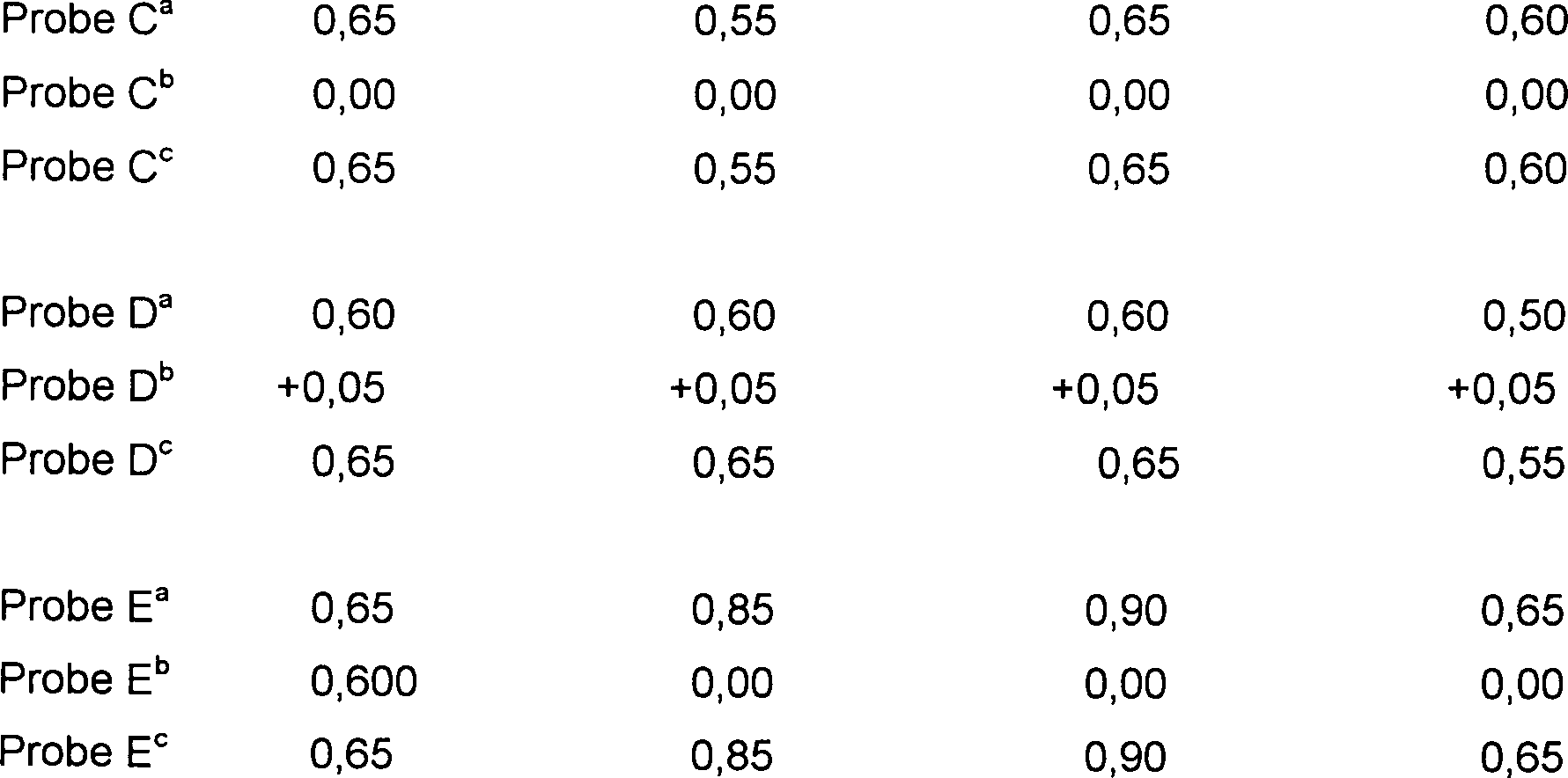
Aus der oberen Tabelle wird klar, dass alle Proben A–E in Bezug auf das Potential die Haut zu reizen, nicht signifikant verschieden von der Kontrolle sind, d. h., alle, einschließlich der Salzlösungskontrolle, fallen in die Kategorie „niedrig". Während nicht genügend Daten gesammelt wurden, um den Grad der Wundheilung, der auf die Proben zurückzuführen ist, zu ermitteln, stellten doch viele Versuchspersonen fest, dass ihre angeritzten Stellen weniger schmerzhaft waren, wenn die Verbände, die die Proben A–E enthielten, verwendet wurden. Mit anderen Worten wurde eine mildernde Wirkung beobachtet, wenn die Proben A–E auf die angeritzen Stellen aufgebracht wurden.Out The table above clearly shows that all samples A-E are in terms of potential irritate the skin, not significantly different from the control are, d. i.e., all, including the saline control, fall into the "low" category. While not enough Data were collected to determine the degree of wound healing that occurred on the Samples is due To determine, many test subjects found that their scratched areas were less painful when the bandages that samples A-E contained, were used. In other words, it was an attenuating one Effect observed when Samples A – E on the scratched areas were applied.
Claims (51)


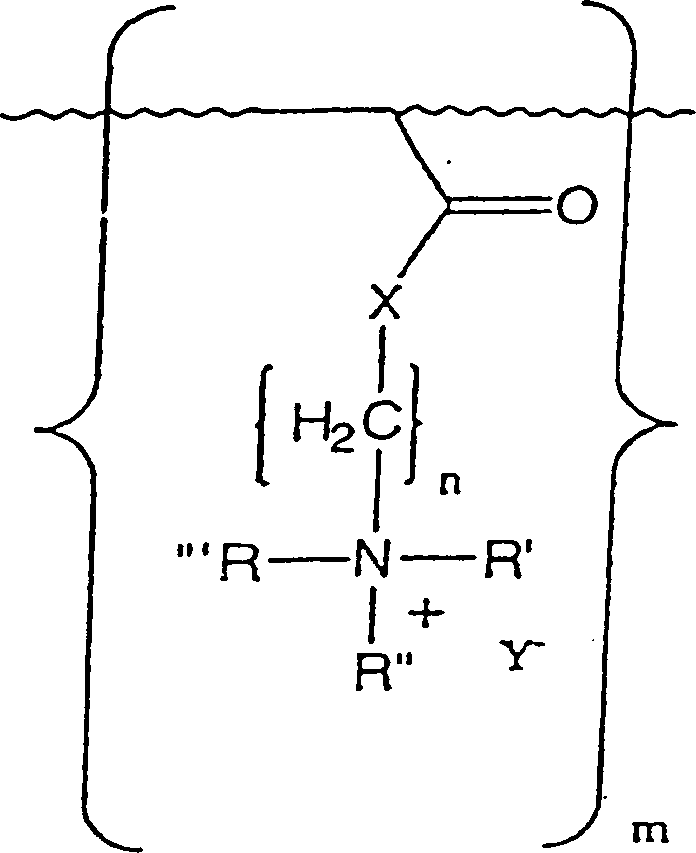
Applications Claiming Priority (3)
| Application Number | Priority Date | Filing Date | Title |
|---|---|---|---|
| US144727 | 1998-09-01 | ||
| US09/144,727 US6039940A (en) | 1996-10-28 | 1998-09-01 | Inherently antimicrobial quaternary amine hydrogel wound dressings |
| PCT/US1999/019441 WO2000012100A1 (en) | 1998-09-01 | 1999-08-30 | Inherently antimicrobial quaternary amine hydrogel wound dressings |
Publications (2)
| Publication Number | Publication Date |
|---|---|
| DE69918707D1 DE69918707D1 (en) | 2004-08-19 |
| DE69918707T2 true DE69918707T2 (en) | 2004-12-02 |
Family
ID=22509863
Family Applications (1)
| Application Number | Title | Priority Date | Filing Date |
|---|---|---|---|
| DE69918707T Expired - Fee Related DE69918707T2 (en) | 1998-09-01 | 1999-08-30 | Wound bandage made of hydrogel with quaternary amines that is inherently micro-killing |
Country Status (8)
| Country | Link |
|---|---|
| US (1) | US6039940A (en) |
| EP (1) | EP1123104B1 (en) |
| JP (1) | JP2002523565A (en) |
| AU (1) | AU5785099A (en) |
| CA (1) | CA2339823A1 (en) |
| DE (1) | DE69918707T2 (en) |
| MX (1) | MXPA01002247A (en) |
| WO (1) | WO2000012100A1 (en) |
Families Citing this family (76)
| Publication number | Priority date | Publication date | Assignee | Title |
|---|---|---|---|---|
| US6034129A (en) * | 1996-06-24 | 2000-03-07 | Geltex Pharmaceuticals, Inc. | Ionic polymers as anti-infective agents |
| US6800278B1 (en) | 1996-10-28 | 2004-10-05 | Ballard Medical Products, Inc. | Inherently antimicrobial quaternary amine hydrogel wound dressings |
| US6290947B1 (en) | 1997-09-19 | 2001-09-18 | Geltex Pharmaceuticals, Inc. | Ionic polymers as toxin-binding agents |
| US6872384B1 (en) | 1998-02-23 | 2005-03-29 | Life Medical Sciences, Inc. | Treatment of trauma |
| US7045673B1 (en) | 1998-12-08 | 2006-05-16 | Quick-Med Technologies, Inc. | Intrinsically bactericidal absorbent dressing and method of fabrication |
| US20050033251A1 (en) * | 1998-12-08 | 2005-02-10 | Quick-Med Technologies, Inc. | Controlled release of biologically active substances from select substrates |
| US7709694B2 (en) * | 1998-12-08 | 2010-05-04 | Quick-Med Technologies, Inc. | Materials with covalently-bonded, nonleachable, polymeric antimicrobial surfaces |
| US6540792B1 (en) * | 1999-04-14 | 2003-04-01 | Toray Industries, Inc. | Cellulose fiber-containing structure |
| US6482402B1 (en) * | 1999-05-13 | 2002-11-19 | Geltex Pharmaceuticals, Inc. | Antimicrobial compositions and methods |
| US6348212B2 (en) * | 1999-05-18 | 2002-02-19 | Lectec Corporation | Treating traumatic burns or blisters of the skin |
| US6232366B1 (en) * | 1999-06-09 | 2001-05-15 | 3M Innovative Properties Company | Pressure sensitive conductive adhesive having hot-melt properties and biomedical electrodes using same |
| US20050065284A1 (en) * | 1999-08-06 | 2005-03-24 | Venkataram Krishnan | Novel latex compositions for deposition on various substrates |
| FR2806629B1 (en) * | 2000-03-22 | 2003-01-24 | Lhd Lab Hygiene Dietetique | ANTISEPTIC COMPRESS |
| CA2409188A1 (en) * | 2000-05-30 | 2001-12-06 | Viridis Biotech Inc. | Polyubiquitin based hydrogel and uses thereof |
| EP1318819A4 (en) * | 2000-08-23 | 2006-03-15 | Phairson Medical Inc | Treatment of trauma, and other indications |
| US20030007951A1 (en) * | 2000-08-23 | 2003-01-09 | Richard Franklin | Treatment of trauma |
| US6588425B2 (en) * | 2000-12-21 | 2003-07-08 | Kimberly-Clark Worldwide, Inc. | Respiratory suction catheter apparatus with antimicrobial chamber |
| US6399092B1 (en) | 2000-12-27 | 2002-06-04 | Healthpoint, Ltd. | Anhydrous, hydrophilic absorbent wound dressing (tube) with antimicrobials or other pharmaceutically active agents |
| US7041868B2 (en) | 2000-12-29 | 2006-05-09 | Kimberly-Clark Worldwide, Inc. | Bioabsorbable wound dressing |
| WO2002102425A2 (en) * | 2001-06-20 | 2002-12-27 | Panayiotis Spyros Spyropoulos | Compound hydrogel wound dressing |
| JP2005510837A (en) | 2001-11-24 | 2005-04-21 | デルファイ・テクノロジーズ・インコーポレーテッド | Improvement of wiring harness |
| US7005031B2 (en) * | 2002-01-16 | 2006-02-28 | 3M Innovative Properties Company | Pressure sensitive adhesives having quaternary ammonium functionality, articles, and methods |
| US6838078B2 (en) * | 2002-01-16 | 2005-01-04 | 3M Innovative Properties Company | Film-forming compositions and methods |
| US7147873B2 (en) | 2002-01-16 | 2006-12-12 | 3M Innovative Properties Company | Antiseptic compositions and methods |
| GB0211529D0 (en) * | 2002-05-20 | 2002-06-26 | First Water Ltd | Ionic hydrogels with low aqueous fluid absorption |
| US20040009210A1 (en) * | 2002-07-09 | 2004-01-15 | Kimberly-Clark Worldwide, Inc. | Wound management products incorporating cationic compounds |
| US20040009141A1 (en) * | 2002-07-09 | 2004-01-15 | Kimberly-Clark Worldwide, Inc. | Skin cleansing products incorporating cationic compounds |
| US7264859B2 (en) * | 2002-12-19 | 2007-09-04 | Kimberly-Clark Worldwide, Inc. | Lubricious coating for medical devices |
| US7220491B2 (en) * | 2002-12-19 | 2007-05-22 | Kimberly-Clark Worldwide, Inc. | Lubricious coating for medical devices |
| US20040166144A1 (en) * | 2003-01-15 | 2004-08-26 | Arie Besemer | Bacteria trapping fibrous material |
| AU2004220629A1 (en) * | 2003-03-12 | 2004-09-23 | 3M Innovative Properties Company | Polymer compositions with bioactive silver, copper or zinc compounds, medical articles, and processes |
| US7285576B2 (en) * | 2003-03-12 | 2007-10-23 | 3M Innovative Properties Co. | Absorbent polymer compositions, medical articles, and methods |
| US7491753B2 (en) | 2003-07-03 | 2009-02-17 | Mallard Creek Polymers, Inc. | Antimicrobial and antistatic polymers and methods of using such polymers on various substrates |
| US7781498B2 (en) * | 2003-07-03 | 2010-08-24 | Mallard Creek Polymers, Inc. | Cationic latex as a carrier for bioactive ingredients and methods for making and using the same |
| US7981946B2 (en) * | 2003-07-03 | 2011-07-19 | Mallard Creek Polymers, Inc. | Antimicrobial and antistatic polymers and methods of using such polymers on various substrates |
| GB2404920A (en) * | 2003-08-12 | 2005-02-16 | Johnson & Johnson Medical Ltd | Antimicrobial polymer |
| US20050214376A1 (en) * | 2003-10-21 | 2005-09-29 | Marie-Pierre Faure | Hydrogel-containing medical articles and methods of using and making the same |
| US20050123621A1 (en) * | 2003-12-05 | 2005-06-09 | 3M Innovative Properties Company | Silver coatings and methods of manufacture |
| US7745509B2 (en) * | 2003-12-05 | 2010-06-29 | 3M Innovative Properties Company | Polymer compositions with bioactive agent, medical articles, and methods |
| US20050123590A1 (en) * | 2003-12-05 | 2005-06-09 | 3M Innovative Properties Company | Wound dressings and methods |
| US7144992B2 (en) * | 2004-04-01 | 2006-12-05 | Kane Biotech Inc. | Synergistic antimicrobial compositions and methods for reducing biofilm formation |
| AU2005259789A1 (en) * | 2004-06-30 | 2006-01-12 | Covalon Technologies Inc. | Non-adhesive hydrogels |
| US20060035039A1 (en) * | 2004-08-12 | 2006-02-16 | 3M Innovative Properties Company | Silver-releasing articles and methods of manufacture |
| GB2417248A (en) * | 2004-08-19 | 2006-02-22 | Avanticare Ltd | Photopolymerisable composition |
| WO2006132653A2 (en) | 2004-08-30 | 2006-12-14 | Southwest Research Institute | Biocidal fibrous and film materials comprising silver and chlorite ions |
| WO2006026573A2 (en) * | 2004-08-30 | 2006-03-09 | Southwest Research Institute | Biocidal fibrous and film materials utilizing silver ion |
| CN101160048A (en) * | 2004-12-30 | 2008-04-09 | 哈达斯特医学研究服务与开发有限公司 | Antimicrobial nanoparticle additives to form non-leachable sustained antimicrobial polymeric compositions |
| US8399027B2 (en) * | 2005-04-14 | 2013-03-19 | 3M Innovative Properties Company | Silver coatings and methods of manufacture |
| US7398883B2 (en) * | 2005-05-23 | 2008-07-15 | Tucker Kenneth H | Blister kit and method of using same |
| US20070292469A1 (en) * | 2005-07-25 | 2007-12-20 | Rothenburger Stephen J | Antimicrobial composition |
| JP2009506056A (en) * | 2005-08-22 | 2009-02-12 | クイック−メッド テクノロジーズ、インク. | Method for attaching an antibacterial cationic polyelectrolyte to the surface of a substrate |
| US20070048249A1 (en) | 2005-08-24 | 2007-03-01 | Purdue Research Foundation | Hydrophilized bactericidal polymers |
| RU2407522C2 (en) | 2005-10-24 | 2010-12-27 | ТЕЙКОКУ ФАРМА ЮЭсЭй, ИНК. | Topical analgesic compositions of n,2,3-trimethyl-2-isopropylbutamide and modes of administration thereof |
| US20070166399A1 (en) * | 2006-01-13 | 2007-07-19 | 3M Innovative Properties Company | Silver-containing antimicrobial articles and methods of manufacture |
| US20070166344A1 (en) * | 2006-01-18 | 2007-07-19 | Xin Qu | Non-leaching surface-active film compositions for microbial adhesion prevention |
| US20080233062A1 (en) * | 2006-08-24 | 2008-09-25 | Venkataram Krishnan | Cationic latex as a carrier for active ingredients and methods for making and using the same |
| US20080207774A1 (en) * | 2006-08-24 | 2008-08-28 | Venkataram Krishnan | Anionic latex as a carrier for active ingredients and methods for making and using the same |
| EP2094243B1 (en) | 2006-08-24 | 2013-04-17 | Mallard Creek Polymers, Inc | Anionic latex as a carrier for bioactive ingredients and methods for making and using the same |
| RU2444541C2 (en) * | 2006-08-24 | 2012-03-10 | Маллард Крик Полимерс, Инк. | Cationic latex as carrier for bioactive ingredients and methods of obtaining and using said latex |
| US20100098949A1 (en) * | 2006-10-18 | 2010-04-22 | Burton Scott A | Antimicrobial articles and method of manufacture |
| CN100463930C (en) * | 2006-12-21 | 2009-02-25 | 天津大学 | Redispersible pH-sensitive cationic polymer hydrogel submicron particles and preparation method thereof |
| WO2011119393A2 (en) | 2010-03-26 | 2011-09-29 | 3M Innovative Properties Company | Method of sterilization of wound dressings |
| US10307297B2 (en) * | 2010-08-16 | 2019-06-04 | Fasttrack Medical Solutions Llc | Peripheral hydrogel wound dressing |
| US8545951B2 (en) | 2012-02-29 | 2013-10-01 | Kimberly-Clark Worldwide, Inc. | Endotracheal tubes and other polymer substrates including an anti-fouling treatment |
| US20180296497A1 (en) | 2014-10-31 | 2018-10-18 | Avent, Inc. | Method and Articles for Inhibiting Bladder Contractions |
| CN104358104B (en) * | 2014-11-07 | 2016-06-15 | 江南大学 | A kind of method utilizing electron radiation technology to prepare antibacterial fabric |
| US9976974B2 (en) * | 2015-01-27 | 2018-05-22 | University Of Utah Research Foundation | Osmolarity-responsive hydrogel sensors and method of use |
| US10149956B2 (en) | 2015-02-28 | 2018-12-11 | John P. Ure | Bi-lateral endobronchial suctioning device and medical suctioning system for intubated patients |
| US10045885B2 (en) | 2015-09-24 | 2018-08-14 | Medline Industries, Inc. | Wound dressing materials and methods of making thereof |
| WO2017145142A1 (en) | 2016-02-25 | 2017-08-31 | Nobio Ltd. | Micro and nanoparticulate compositions comprising anti-microbially active groups |
| EP3629731A1 (en) | 2017-05-27 | 2020-04-08 | Poly Group LLC | Dispersible antimicrobial complex and coatings therefrom |
| HUE068413T2 (en) | 2017-06-16 | 2024-12-28 | Poly Group LLC | Polymeric antimicrobial surfactant |
| BR112020004157A2 (en) | 2017-08-30 | 2020-09-08 | Nobio Ltd. | medical compositions and devices comprising antimicrobial particles |
| US11864964B2 (en) | 2018-07-31 | 2024-01-09 | University Of Florida Research Foundation, Inc. | Quarternized titanium-nitride anti-bacterial coating for dental implants |
| CN113321820A (en) * | 2021-05-28 | 2021-08-31 | 吉林大学 | Preparation method and application of novel antibacterial adhesive moisturizing hydrogel |
| GB202204326D0 (en) * | 2022-03-28 | 2022-05-11 | Univ Bath | Composition |
Family Cites Families (34)
| Publication number | Priority date | Publication date | Assignee | Title |
|---|---|---|---|---|
| US3975350A (en) * | 1972-08-02 | 1976-08-17 | Princeton Polymer Laboratories, Incorporated | Hydrophilic or hydrogel carrier systems such as coatings, body implants and other articles |
| US3898188A (en) * | 1972-08-14 | 1975-08-05 | California Inst Of Techn | Novel polyelectrolytes |
| DE2650306A1 (en) * | 1976-11-02 | 1978-05-03 | Merck Patent Gmbh | ANTIBACTERIAL DRESSING AND METHOD OF ITS MANUFACTURING |
| US4119094A (en) * | 1977-08-08 | 1978-10-10 | Biosearch Medical Products Inc. | Coated substrate having a low coefficient of friction hydrophilic coating and a method of making the same |
| US4226232A (en) * | 1979-04-09 | 1980-10-07 | Spenco Medical Corporation | Wound dressing |
| US4318947A (en) * | 1979-12-26 | 1982-03-09 | The Kendall Company | Polymer coating and curing process for catheters |
| US4393048A (en) * | 1980-02-15 | 1983-07-12 | The United States Of America As Represented By The Secretary Of The Army | Protective gel composition for wounds |
| US4373009A (en) * | 1981-05-18 | 1983-02-08 | International Silicone Corporation | Method of forming a hydrophilic coating on a substrate |
| US4515593A (en) * | 1981-12-31 | 1985-05-07 | C. R. Bard, Inc. | Medical tubing having exterior hydrophilic coating for microbiocide absorption therein and method for using same |
| US4570629A (en) * | 1982-03-17 | 1986-02-18 | University Of Illinois Foundation | Hydrophilic biopolymeric copolyelectrolytes, and biodegradable wound dressing comprising same |
| US4769013A (en) * | 1982-09-13 | 1988-09-06 | Hydromer, Inc. | Bio-effecting medical material and device |
| US5512329A (en) * | 1982-09-29 | 1996-04-30 | Bsi Corporation | Substrate surface preparation |
| AU562370B2 (en) * | 1982-10-02 | 1987-06-11 | Smith & Nephew Associated Companies Plc | Moisture vapour permeable adhesive surgical dressing |
| US4791063A (en) * | 1983-02-14 | 1988-12-13 | Cuno Incorporated | Polyionene transformed modified polysaccharide supports |
| US4563184A (en) * | 1983-10-17 | 1986-01-07 | Bernard Korol | Synthetic resin wound dressing and method of treatment using same |
| US4705709A (en) * | 1985-09-25 | 1987-11-10 | Sherwood Medical Company | Lubricant composition, method of coating and a coated intubation device |
| US4728323A (en) * | 1986-07-24 | 1988-03-01 | Minnesota Mining And Manufacturing Company | Antimicrobial wound dressings |
| US5019096A (en) * | 1988-02-11 | 1991-05-28 | Trustees Of Columbia University In The City Of New York | Infection-resistant compositions, medical devices and surfaces and methods for preparing and using same |
| US5082697A (en) * | 1988-02-17 | 1992-01-21 | The Dow Chemical Company | Polymer salt complex for fiber or fabric treatment |
| US5498478A (en) * | 1989-03-20 | 1996-03-12 | Weyerhaeuser Company | Polyethylene glycol as a binder material for fibers |
| US5432000A (en) * | 1989-03-20 | 1995-07-11 | Weyerhaeuser Company | Binder coated discontinuous fibers with adhered particulate materials |
| US5006267A (en) * | 1989-11-08 | 1991-04-09 | The Dow Chemical Company | Biocidal fluid filters |
| US5269770A (en) * | 1990-01-10 | 1993-12-14 | Rochester Medical Corporation | Microcidal agent releasing catheter with balloon |
| US5261896A (en) * | 1990-01-10 | 1993-11-16 | Rochester Medical Corporation | Sustained release bactericidal cannula |
| US5004760A (en) * | 1990-02-16 | 1991-04-02 | The Dow Chemical Company | Biocidal foams |
| US5069907A (en) * | 1990-03-23 | 1991-12-03 | Phoenix Medical Technology | Surgical drape having incorporated therein a broad spectrum antimicrobial agent |
| DE69125018T2 (en) * | 1990-10-12 | 1997-06-12 | Dow Chemical Co | ANTIMICROBIAL HYDROGELS |
| JP3455217B2 (en) * | 1992-02-13 | 2003-10-14 | バイオ−メトリック システムズ インコーポレイテッド | Immobilization of chemical species in crosslinked matrix |
| US5670557A (en) * | 1994-01-28 | 1997-09-23 | Minnesota Mining And Manufacturing Company | Polymerized microemulsion pressure sensitive adhesive compositions and methods of preparing and using same |
| TW369558B (en) * | 1994-01-28 | 1999-09-11 | Minnesota Mining & Mfg | Polymerized microemulsion pressure sensitive adhesive compositions and methods of preparing and using same |
| US5624704A (en) * | 1995-04-24 | 1997-04-29 | Baylor College Of Medicine | Antimicrobial impregnated catheters and other medical implants and method for impregnating catheters and other medical implants with an antimicrobial agent |
| GB9521253D0 (en) * | 1995-10-17 | 1995-12-20 | Luthra Ajay K | Biocompatible lubricious hydrophilic materials for medical devices |
| US5800685A (en) * | 1996-10-28 | 1998-09-01 | Cardiotronics Systems, Inc. | Electrically conductive adhesive hydrogels |
| FR2757866B1 (en) * | 1996-12-30 | 2004-12-17 | Catalyse | POLYMERS COMPRISING QUATERNARY AMMONIUM GROUPS, THEIR USE FOR THE MANUFACTURE OF AN ANTIBACTERIAL PROPERTY MATERIAL AND THEIR PREPARATION METHODS |
-
1998
- 1998-09-01 US US09/144,727 patent/US6039940A/en not_active Expired - Lifetime
-
1999
- 1999-08-30 WO PCT/US1999/019441 patent/WO2000012100A1/en not_active Ceased
- 1999-08-30 JP JP2000567217A patent/JP2002523565A/en not_active Abandoned
- 1999-08-30 CA CA002339823A patent/CA2339823A1/en not_active Abandoned
- 1999-08-30 DE DE69918707T patent/DE69918707T2/en not_active Expired - Fee Related
- 1999-08-30 AU AU57850/99A patent/AU5785099A/en not_active Abandoned
- 1999-08-30 EP EP99945192A patent/EP1123104B1/en not_active Expired - Lifetime
- 1999-08-30 MX MXPA01002247A patent/MXPA01002247A/en unknown
Also Published As
| Publication number | Publication date |
|---|---|
| US6039940A (en) | 2000-03-21 |
| JP2002523565A (en) | 2002-07-30 |
| MXPA01002247A (en) | 2002-05-08 |
| EP1123104B1 (en) | 2004-07-14 |
| DE69918707D1 (en) | 2004-08-19 |
| WO2000012100A1 (en) | 2000-03-09 |
| EP1123104A4 (en) | 2002-07-17 |
| CA2339823A1 (en) | 2000-03-09 |
| EP1123104A1 (en) | 2001-08-16 |
| AU5785099A (en) | 2000-03-21 |
Similar Documents
| Publication | Publication Date | Title |
|---|---|---|
| EP1123104B1 (en) | Inherently antimicrobial quaternary amine hydrogel wound dressings | |
| US6800278B1 (en) | Inherently antimicrobial quaternary amine hydrogel wound dressings | |
| DE69706824T2 (en) | Cyanoacrylate compositions containing antimicrobial compounds | |
| DE69032125T2 (en) | GEL Wound Dressing Compositions And Method For Using Them | |
| DE602004002717T2 (en) | Leaf-shaped wound dressing of microbial cellulose containing PHMB for chronic wounds | |
| DE69938612T2 (en) | FUNCTIONAL CHITOSANDERIVATE | |
| DE60109487T2 (en) | WATER-FREE, HYDROPHILIC ABSORBENT WING ASSOCIATION | |
| DE3883171T2 (en) | Pressure sensitive medical sealant. | |
| DE60313471T2 (en) | WOUND BRACELET WITH ANIONIC POLYSACCHARIDE COMPLEXES WITH SILVER | |
| DE69214732T2 (en) | Healing wound dressing | |
| DE2403269C2 (en) | ||
| DE69629519T2 (en) | Stable complexes of cross-linked polyvinylpyrrolidones and iodine and process for their preparation | |
| DE10330971B4 (en) | Process for the production of skin or wound dressings with encapsulated, wound-healing and / or skin-care substances | |
| DE3744289C2 (en) | ||
| EP1095665B1 (en) | Wound-covering preparation, wound-covering material, and method of wound healing | |
| CH637833A5 (en) | TRANSPARENT LIQUID BANDAGE MATERIAL, ITS PRODUCTION AND USE. | |
| DE212012000057U1 (en) | Antimicrobial blend and antimicrobial coverage to aid wound healing | |
| EP1104679A2 (en) | Antimicrobial wound dressing | |
| EP1027085A1 (en) | Prepolymer compositions comprising an antimicrobial agent | |
| DE112019006443T5 (en) | MEDICAL SEAL ADHESIVE FOR THE PROMOTION OF WOUND HEALING AND THE METHOD OF MANUFACTURING IT | |
| DE60101269T2 (en) | ANTISEPTIC COMPRESS | |
| US12343238B2 (en) | Wound dressing comprising a combination of hydrogel and honey, method of preparation and uses thereof | |
| DE69508356T2 (en) | Wound dressing | |
| DE69231973T2 (en) | Absorbent wound filler | |
| DE3785311T2 (en) | ADHESIVE, METHOD FOR PRODUCING IT AND ITS USE. |
Legal Events
| Date | Code | Title | Description |
|---|---|---|---|
| 8364 | No opposition during term of opposition | ||
| 8327 | Change in the person/name/address of the patent owner |
Owner name: KIMBERLY-CLARK WORLDWIDE, INC., NEENAH, WIS., US |
|
| 8339 | Ceased/non-payment of the annual fee |