DE69918698T2 - HARDENABLE PERFLUORELASTOMER COMPOSITION - Google Patents
HARDENABLE PERFLUORELASTOMER COMPOSITION Download PDFInfo
- Publication number
- DE69918698T2 DE69918698T2 DE69918698T DE69918698T DE69918698T2 DE 69918698 T2 DE69918698 T2 DE 69918698T2 DE 69918698 T DE69918698 T DE 69918698T DE 69918698 T DE69918698 T DE 69918698T DE 69918698 T2 DE69918698 T2 DE 69918698T2
- Authority
- DE
- Germany
- Prior art keywords
- perfluoroelastomer
- ammonia
- perfluoro
- nitrile
- ethers
- Prior art date
- Legal status (The legal status is an assumption and is not a legal conclusion. Google has not performed a legal analysis and makes no representation as to the accuracy of the status listed.)
- Expired - Lifetime
Links
- 239000000203 mixture Substances 0.000 title claims description 50
- QGZKDVFQNNGYKY-UHFFFAOYSA-N Ammonia Chemical compound N QGZKDVFQNNGYKY-UHFFFAOYSA-N 0.000 claims description 68
- 229920006169 Perfluoroelastomer Polymers 0.000 claims description 56
- 229910021529 ammonia Inorganic materials 0.000 claims description 32
- 239000000178 monomer Substances 0.000 claims description 27
- 150000001875 compounds Chemical class 0.000 claims description 19
- -1 perfluoro Chemical group 0.000 claims description 18
- 150000002825 nitriles Chemical class 0.000 claims description 16
- BFKJFAAPBSQJPD-UHFFFAOYSA-N tetrafluoroethene Chemical group FC(F)=C(F)F BFKJFAAPBSQJPD-UHFFFAOYSA-N 0.000 claims description 16
- 150000002170 ethers Chemical class 0.000 claims description 14
- 229920002554 vinyl polymer Polymers 0.000 claims description 14
- 238000004132 cross linking Methods 0.000 claims description 9
- RRZIJNVZMJUGTK-UHFFFAOYSA-N 1,1,2-trifluoro-2-(1,2,2-trifluoroethenoxy)ethene Chemical compound FC(F)=C(F)OC(F)=C(F)F RRZIJNVZMJUGTK-UHFFFAOYSA-N 0.000 claims description 5
- QYKIQEUNHZKYBP-UHFFFAOYSA-N Vinyl ether Chemical class C=COC=C QYKIQEUNHZKYBP-UHFFFAOYSA-N 0.000 claims description 5
- 150000001336 alkenes Chemical class 0.000 claims description 5
- HSTOKWSFWGCZMH-UHFFFAOYSA-N 3,3'-diaminobenzidine Chemical compound C1=C(N)C(N)=CC=C1C1=CC=C(N)C(N)=C1 HSTOKWSFWGCZMH-UHFFFAOYSA-N 0.000 claims description 4
- CRHIAMBJMSSNNM-UHFFFAOYSA-N tetraphenylstannane Chemical compound C1=CC=CC=C1[Sn](C=1C=CC=CC=1)(C=1C=CC=CC=1)C1=CC=CC=C1 CRHIAMBJMSSNNM-UHFFFAOYSA-N 0.000 claims description 3
- CDAWCLOXVUBKRW-UHFFFAOYSA-N 2-aminophenol Chemical class NC1=CC=CC=C1O CDAWCLOXVUBKRW-UHFFFAOYSA-N 0.000 claims description 2
- VRVRGVPWCUEOGV-UHFFFAOYSA-N 2-aminothiophenol Chemical class NC1=CC=CC=C1S VRVRGVPWCUEOGV-UHFFFAOYSA-N 0.000 claims description 2
- 229920000642 polymer Polymers 0.000 description 25
- VYPSYNLAJGMNEJ-UHFFFAOYSA-N Silicium dioxide Chemical compound O=[Si]=O VYPSYNLAJGMNEJ-UHFFFAOYSA-N 0.000 description 19
- 238000000034 method Methods 0.000 description 11
- 239000003795 chemical substances by application Substances 0.000 description 10
- 239000004810 polytetrafluoroethylene Substances 0.000 description 10
- 229920001343 polytetrafluoroethylene Polymers 0.000 description 10
- 239000000377 silicon dioxide Substances 0.000 description 9
- 229920001577 copolymer Polymers 0.000 description 8
- 229920001971 elastomer Polymers 0.000 description 8
- 239000002245 particle Substances 0.000 description 8
- 125000004432 carbon atom Chemical group C* 0.000 description 7
- 238000010521 absorption reaction Methods 0.000 description 6
- 239000000654 additive Substances 0.000 description 6
- 239000000945 filler Substances 0.000 description 6
- 229920002313 fluoropolymer Polymers 0.000 description 6
- 239000004811 fluoropolymer Substances 0.000 description 6
- 230000008569 process Effects 0.000 description 6
- XLYOFNOQVPJJNP-UHFFFAOYSA-N water Chemical compound O XLYOFNOQVPJJNP-UHFFFAOYSA-N 0.000 description 6
- 239000006229 carbon black Substances 0.000 description 5
- 235000019241 carbon black Nutrition 0.000 description 5
- 238000002329 infrared spectrum Methods 0.000 description 5
- 239000004848 polyfunctional curative Substances 0.000 description 5
- 239000004071 soot Substances 0.000 description 5
- IJGRMHOSHXDMSA-UHFFFAOYSA-N Atomic nitrogen Chemical compound N#N IJGRMHOSHXDMSA-UHFFFAOYSA-N 0.000 description 4
- 150000003863 ammonium salts Chemical class 0.000 description 4
- HCDGVLDPFQMKDK-UHFFFAOYSA-N hexafluoropropylene Chemical group FC(F)=C(F)C(F)(F)F HCDGVLDPFQMKDK-UHFFFAOYSA-N 0.000 description 4
- 238000004519 manufacturing process Methods 0.000 description 4
- 238000002844 melting Methods 0.000 description 4
- 230000008018 melting Effects 0.000 description 4
- 125000002560 nitrile group Chemical group 0.000 description 4
- 125000005010 perfluoroalkyl group Chemical group 0.000 description 4
- HIXDQWDOVZUNNA-UHFFFAOYSA-N 2-(3,4-dimethoxyphenyl)-5-hydroxy-7-methoxychromen-4-one Chemical compound C=1C(OC)=CC(O)=C(C(C=2)=O)C=1OC=2C1=CC=C(OC)C(OC)=C1 HIXDQWDOVZUNNA-UHFFFAOYSA-N 0.000 description 3
- 239000006244 Medium Thermal Substances 0.000 description 3
- 230000008901 benefit Effects 0.000 description 3
- 230000015572 biosynthetic process Effects 0.000 description 3
- 150000007942 carboxylates Chemical group 0.000 description 3
- 239000011248 coating agent Substances 0.000 description 3
- 238000000576 coating method Methods 0.000 description 3
- 239000000806 elastomer Substances 0.000 description 3
- 238000007720 emulsion polymerization reaction Methods 0.000 description 3
- RTZKZFJDLAIYFH-UHFFFAOYSA-N ether Substances CCOCC RTZKZFJDLAIYFH-UHFFFAOYSA-N 0.000 description 3
- FOKCKXCUQFKNLD-UHFFFAOYSA-N pent-1-enyl hypofluorite Chemical compound C(CC)C=COF FOKCKXCUQFKNLD-UHFFFAOYSA-N 0.000 description 3
- 238000006116 polymerization reaction Methods 0.000 description 3
- 238000007789 sealing Methods 0.000 description 3
- 239000000243 solution Substances 0.000 description 3
- 239000002904 solvent Substances 0.000 description 3
- 239000000126 substance Substances 0.000 description 3
- BLTXWCKMNMYXEA-UHFFFAOYSA-N 1,1,2-trifluoro-2-(trifluoromethoxy)ethene Chemical compound FC(F)=C(F)OC(F)(F)F BLTXWCKMNMYXEA-UHFFFAOYSA-N 0.000 description 2
- BBMCTIGTTCKYKF-UHFFFAOYSA-N 1-heptanol Chemical compound CCCCCCCO BBMCTIGTTCKYKF-UHFFFAOYSA-N 0.000 description 2
- LYIPDZSLYLDLCU-UHFFFAOYSA-N 2,2,3,3-tetrafluoro-3-[1,1,1,2,3,3-hexafluoro-3-(1,2,2-trifluoroethenoxy)propan-2-yl]oxypropanenitrile Chemical compound FC(F)=C(F)OC(F)(F)C(F)(C(F)(F)F)OC(F)(F)C(F)(F)C#N LYIPDZSLYLDLCU-UHFFFAOYSA-N 0.000 description 2
- LFQSCWFLJHTTHZ-UHFFFAOYSA-N Ethanol Chemical compound CCO LFQSCWFLJHTTHZ-UHFFFAOYSA-N 0.000 description 2
- KDLHZDBZIXYQEI-UHFFFAOYSA-N Palladium Chemical compound [Pd] KDLHZDBZIXYQEI-UHFFFAOYSA-N 0.000 description 2
- DTQVDTLACAAQTR-UHFFFAOYSA-N Trifluoroacetic acid Chemical compound OC(=O)C(F)(F)F DTQVDTLACAAQTR-UHFFFAOYSA-N 0.000 description 2
- ROOXNKNUYICQNP-UHFFFAOYSA-N ammonium persulfate Chemical compound [NH4+].[NH4+].[O-]S(=O)(=O)OOS([O-])(=O)=O ROOXNKNUYICQNP-UHFFFAOYSA-N 0.000 description 2
- ZFVMWEVVKGLCIJ-UHFFFAOYSA-N bisphenol AF Chemical compound C1=CC(O)=CC=C1C(C(F)(F)F)(C(F)(F)F)C1=CC=C(O)C=C1 ZFVMWEVVKGLCIJ-UHFFFAOYSA-N 0.000 description 2
- 238000007906 compression Methods 0.000 description 2
- 230000006835 compression Effects 0.000 description 2
- 230000000694 effects Effects 0.000 description 2
- 230000007613 environmental effect Effects 0.000 description 2
- 239000003999 initiator Substances 0.000 description 2
- 239000004816 latex Substances 0.000 description 2
- 229920000126 latex Polymers 0.000 description 2
- 229910052757 nitrogen Inorganic materials 0.000 description 2
- 150000002902 organometallic compounds Chemical class 0.000 description 2
- 229920005548 perfluoropolymer Polymers 0.000 description 2
- 229920006254 polymer film Polymers 0.000 description 2
- 238000011417 postcuring Methods 0.000 description 2
- FGIUAXJPYTZDNR-UHFFFAOYSA-N potassium nitrate Chemical compound [K+].[O-][N+]([O-])=O FGIUAXJPYTZDNR-UHFFFAOYSA-N 0.000 description 2
- 239000011347 resin Substances 0.000 description 2
- 229920005989 resin Polymers 0.000 description 2
- 239000007787 solid Substances 0.000 description 2
- 230000003595 spectral effect Effects 0.000 description 2
- 238000010557 suspension polymerization reaction Methods 0.000 description 2
- JYEUMXHLPRZUAT-UHFFFAOYSA-N 1,2,3-triazine Chemical group C1=CN=NN=C1 JYEUMXHLPRZUAT-UHFFFAOYSA-N 0.000 description 1
- KECOIASOKMSRFT-UHFFFAOYSA-N 2-amino-4-(3-amino-4-hydroxyphenyl)sulfonylphenol Chemical compound C1=C(O)C(N)=CC(S(=O)(=O)C=2C=C(N)C(O)=CC=2)=C1 KECOIASOKMSRFT-UHFFFAOYSA-N 0.000 description 1
- MSTZGVRUOMBULC-UHFFFAOYSA-N 2-amino-4-[2-(3-amino-4-hydroxyphenyl)-1,1,1,3,3,3-hexafluoropropan-2-yl]phenol Chemical compound C1=C(O)C(N)=CC(C(C=2C=C(N)C(O)=CC=2)(C(F)(F)F)C(F)(F)F)=C1 MSTZGVRUOMBULC-UHFFFAOYSA-N 0.000 description 1
- 125000003903 2-propenyl group Chemical group [H]C([*])([H])C([H])=C([H])[H] 0.000 description 1
- 125000001494 2-propynyl group Chemical group [H]C#CC([H])([H])* 0.000 description 1
- 229910002012 Aerosil® Inorganic materials 0.000 description 1
- 229910002016 Aerosil® 200 Inorganic materials 0.000 description 1
- VHUUQVKOLVNVRT-UHFFFAOYSA-N Ammonium hydroxide Chemical compound [NH4+].[OH-] VHUUQVKOLVNVRT-UHFFFAOYSA-N 0.000 description 1
- OKTJSMMVPCPJKN-UHFFFAOYSA-N Carbon Chemical compound [C] OKTJSMMVPCPJKN-UHFFFAOYSA-N 0.000 description 1
- 239000006057 Non-nutritive feed additive Substances 0.000 description 1
- 241000872198 Serjania polyphylla Species 0.000 description 1
- 238000005299 abrasion Methods 0.000 description 1
- 230000002378 acidificating effect Effects 0.000 description 1
- 230000002411 adverse Effects 0.000 description 1
- 125000000217 alkyl group Chemical group 0.000 description 1
- 125000003277 amino group Chemical group 0.000 description 1
- 239000000908 ammonium hydroxide Substances 0.000 description 1
- 229910001870 ammonium persulfate Inorganic materials 0.000 description 1
- 239000002518 antifoaming agent Substances 0.000 description 1
- 239000007864 aqueous solution Substances 0.000 description 1
- 125000003118 aryl group Chemical group 0.000 description 1
- YOALFLHFSFEMLP-UHFFFAOYSA-N azane;2,2,3,3,4,4,5,5,6,6,7,7,8,8,8-pentadecafluorooctanoic acid Chemical compound [NH4+].[O-]C(=O)C(F)(F)C(F)(F)C(F)(F)C(F)(F)C(F)(F)C(F)(F)C(F)(F)F YOALFLHFSFEMLP-UHFFFAOYSA-N 0.000 description 1
- 230000009286 beneficial effect Effects 0.000 description 1
- 150000001555 benzenes Chemical class 0.000 description 1
- NLNRQJQXCQVDQJ-UHFFFAOYSA-N bis(3,4-diaminophenyl)methanone Chemical compound C1=C(N)C(N)=CC=C1C(=O)C1=CC=C(N)C(N)=C1 NLNRQJQXCQVDQJ-UHFFFAOYSA-N 0.000 description 1
- 150000001721 carbon Chemical class 0.000 description 1
- 239000011203 carbon fibre reinforced carbon Chemical group 0.000 description 1
- 229910002091 carbon monoxide Inorganic materials 0.000 description 1
- 125000005392 carboxamide group Chemical group NC(=O)* 0.000 description 1
- 125000002843 carboxylic acid group Chemical group 0.000 description 1
- 239000000969 carrier Substances 0.000 description 1
- 239000003054 catalyst Substances 0.000 description 1
- 230000003197 catalytic effect Effects 0.000 description 1
- 238000009903 catalytic hydrogenation reaction Methods 0.000 description 1
- 230000008859 change Effects 0.000 description 1
- 230000015271 coagulation Effects 0.000 description 1
- 238000005345 coagulation Methods 0.000 description 1
- 239000002131 composite material Substances 0.000 description 1
- 238000005260 corrosion Methods 0.000 description 1
- 230000007797 corrosion Effects 0.000 description 1
- 239000008367 deionised water Substances 0.000 description 1
- 229910021641 deionized water Inorganic materials 0.000 description 1
- 230000003111 delayed effect Effects 0.000 description 1
- 238000003795 desorption Methods 0.000 description 1
- 238000009792 diffusion process Methods 0.000 description 1
- 125000001028 difluoromethyl group Chemical group [H]C(F)(F)* 0.000 description 1
- 239000006185 dispersion Substances 0.000 description 1
- 238000005553 drilling Methods 0.000 description 1
- 239000000839 emulsion Substances 0.000 description 1
- 125000001033 ether group Chemical group 0.000 description 1
- 239000004744 fabric Substances 0.000 description 1
- 239000000835 fiber Substances 0.000 description 1
- 238000011049 filling Methods 0.000 description 1
- 239000012467 final product Substances 0.000 description 1
- 238000009472 formulation Methods 0.000 description 1
- 239000007789 gas Substances 0.000 description 1
- 229920001519 homopolymer Polymers 0.000 description 1
- 125000002887 hydroxy group Chemical group [H]O* 0.000 description 1
- 238000010348 incorporation Methods 0.000 description 1
- 230000003993 interaction Effects 0.000 description 1
- 230000005865 ionizing radiation Effects 0.000 description 1
- 238000002955 isolation Methods 0.000 description 1
- 239000007788 liquid Substances 0.000 description 1
- 239000000314 lubricant Substances 0.000 description 1
- 239000000463 material Substances 0.000 description 1
- 239000000155 melt Substances 0.000 description 1
- 229910052751 metal Inorganic materials 0.000 description 1
- 239000002184 metal Substances 0.000 description 1
- 239000003607 modifier Substances 0.000 description 1
- 239000002808 molecular sieve Substances 0.000 description 1
- 230000006855 networking Effects 0.000 description 1
- 238000006396 nitration reaction Methods 0.000 description 1
- 239000003129 oil well Substances 0.000 description 1
- 125000006551 perfluoro alkylene group Chemical group 0.000 description 1
- 230000000704 physical effect Effects 0.000 description 1
- 239000004033 plastic Substances 0.000 description 1
- 229920003023 plastic Polymers 0.000 description 1
- 239000004014 plasticizer Substances 0.000 description 1
- 229920000570 polyether Polymers 0.000 description 1
- 235000010333 potassium nitrate Nutrition 0.000 description 1
- 239000004323 potassium nitrate Substances 0.000 description 1
- 239000000843 powder Substances 0.000 description 1
- 230000002028 premature Effects 0.000 description 1
- 238000002360 preparation method Methods 0.000 description 1
- 125000002924 primary amino group Chemical group [H]N([H])* 0.000 description 1
- 230000009467 reduction Effects 0.000 description 1
- 239000006235 reinforcing carbon black Substances 0.000 description 1
- 238000000518 rheometry Methods 0.000 description 1
- 239000004065 semiconductor Substances 0.000 description 1
- 239000000741 silica gel Substances 0.000 description 1
- 229910002027 silica gel Inorganic materials 0.000 description 1
- URGAHOPLAPQHLN-UHFFFAOYSA-N sodium aluminosilicate Chemical compound [Na+].[Al+3].[O-][Si]([O-])=O.[O-][Si]([O-])=O URGAHOPLAPQHLN-UHFFFAOYSA-N 0.000 description 1
- 238000001179 sorption measurement Methods 0.000 description 1
- 238000001228 spectrum Methods 0.000 description 1
- 239000003381 stabilizer Substances 0.000 description 1
- 239000000758 substrate Substances 0.000 description 1
- 125000001273 sulfonato group Chemical group [O-]S(*)(=O)=O 0.000 description 1
- 125000000542 sulfonic acid group Chemical group 0.000 description 1
- 239000004094 surface-active agent Substances 0.000 description 1
- 230000002459 sustained effect Effects 0.000 description 1
- 239000012815 thermoplastic material Substances 0.000 description 1
- 125000003960 triphenylenyl group Chemical group C1(=CC=CC=2C3=CC=CC=C3C3=CC=CC=C3C12)* 0.000 description 1
- 238000004073 vulcanization Methods 0.000 description 1
Classifications
-
- C—CHEMISTRY; METALLURGY
- C08—ORGANIC MACROMOLECULAR COMPOUNDS; THEIR PREPARATION OR CHEMICAL WORKING-UP; COMPOSITIONS BASED THEREON
- C08F—MACROMOLECULAR COMPOUNDS OBTAINED BY REACTIONS ONLY INVOLVING CARBON-TO-CARBON UNSATURATED BONDS
- C08F8/00—Chemical modification by after-treatment
- C08F8/30—Introducing nitrogen atoms or nitrogen-containing groups
-
- C—CHEMISTRY; METALLURGY
- C08—ORGANIC MACROMOLECULAR COMPOUNDS; THEIR PREPARATION OR CHEMICAL WORKING-UP; COMPOSITIONS BASED THEREON
- C08F—MACROMOLECULAR COMPOUNDS OBTAINED BY REACTIONS ONLY INVOLVING CARBON-TO-CARBON UNSATURATED BONDS
- C08F8/00—Chemical modification by after-treatment
Landscapes
- Chemical & Material Sciences (AREA)
- General Chemical & Material Sciences (AREA)
- Health & Medical Sciences (AREA)
- Chemical Kinetics & Catalysis (AREA)
- Medicinal Chemistry (AREA)
- Polymers & Plastics (AREA)
- Organic Chemistry (AREA)
- Addition Polymer Or Copolymer, Post-Treatments, Or Chemical Modifications (AREA)
- Compositions Of Macromolecular Compounds (AREA)
- Processes Of Treating Macromolecular Substances (AREA)
- Manufacture Of Macromolecular Shaped Articles (AREA)
Description
QUERVERWEIS AUF VERWANDTE ANMELDUNGCROSS REFERENCE ON RELATED APPLICATION
Diese Anmeldung beansprucht die Vorteile der am 10. August 1998 eingereichten Provisorischen Anmeldung U.S. 60/095, 915.These Application claims the benefits of filed on 10 August 1998 Provisional Application U.S. 60/095, 915.
GEBIET DER ERFINDUNGAREA OF INVENTION
Diese Erfindung betrifft Perfluorelastomerzusammensetzungen, welche in Anwesenheit von Ammoniak gehärtet werden.These The invention relates to perfluoroelastomer compositions which are described in US Pat Presence of ammonia hardened become.
HINTERGRUND DER ERFINDUNGBACKGROUND THE INVENTION
Perfluorelastomere haben einen außergewöhnlichen wirtschaftlichen Erfolg erzielt und sie werden bei einer breiten Vielfalt von Anwendungen eingesetzt, bei welchen sie harten Umwelt- und Umgebungsbedingungen begegnen, insbesondere bei solchen Endnutzungen, bei denen die Perfluorelastomere hohen Temperaturen und aggressiven Chemikalien ausgesetzt sind. Diese Polymere werden häufig verwendet bei Abdichtungen für Flugzeugmotoren, bei Bohrgeräten für Ölförderlöcher und bei Abdichtungselementen für industrielle Ausrüstungen, die bei hohen Temperaturen eingesetzt werden.perfluoroelastomers have an extraordinary achieved economic success and they will be at a wide Variety of applications where they are harsh environmental and environmental conditions, especially in such end-uses, where the perfluoroelastomers are high in temperature and aggressive Exposed to chemicals. These polymers are commonly used in seals for Aircraft engines, drilling rigs for oil wells and for sealing elements for industrial equipment that be used at high temperatures.
Die hervorragenden Eigenschaften der Perfluorelastomere sind überwiegend der Stabilität und der Trägheit der copolymerisierten, perfluorierten Monomereinheiten zuzurechnen, welche den größten Teil der Polymerhauptgerüste dieser Verbindungen ausmachen. Solche Monomere schließen Tetrafluorethylen und Perfluor(alkylvinyl)ether mit ein. Um die elastomeren Fähigkeiten voll zu entwickeln, werden die Perfluorelastomere auf typische Weise vernetzt, das heißt vulkanisiert. Zu diesem Zweck wird ein schmaler Prozentsatz eines Monomers mit einer für das Härten geeigneten Stelle (cure-site) mit den perfluorierten Monomereinheiten copolymerisiert. Solche so genannten cure-site Monomere enthalten mindestens eine Nitrilgruppe, zum Beispiel wird Perfluor-8-cyan-5-methyl-3,6-dioxa-1-octen besonders bevorzugt. Solche Zusammensetzungen sind in den U.S. Patenten 4,281,092; 4,394,489; 5,789,489; und 5,789,509 beschrieben worden.The outstanding properties of the perfluoroelastomers are predominant stability and inertia attributable to the copolymerized, perfluorinated monomer units, which is the biggest part the polymer backbones make up these connections. Such monomers include tetrafluoroethylene and perfluoro (alkyl vinyl) ether. To the elastomeric abilities To develop fully, the perfluoroelastomers become typical networked, that is vulcanized. For this purpose, a narrow percentage of a Monomers with a for the hardening suitable site (cure site) with the perfluorinated monomer units copolymerized. Such so-called cure-site monomers contain at least a nitrile group, for example, becomes perfluoro-8-cyano-5-methyl-3,6-dioxa-1-octene particularly preferred. Such compositions are described in U.S. Pat. patents 4,281,092; 4,394,489; 5,789,489; and 5,789,509.
Härtende Systeme, welche Tetraphenylzinn enthalten, sind erfolgreich eingesetzt worden, um Nitril enthaltende Perfluorelastomere zu vulkanisieren; die Härtungsgeschwindigkeit bei solchen Zusammensetzungen ist jedoch in bestimmten Fällen zu langsam für eine wirtschaftlich effiziente kommerzielle Produktion von Perfluorelastomerartikeln. Logothetis und Schmiegel offenbaren in dem U.S. Patent 5,677,389 die Verwendung von Ammoniumsalzen als Beschleuniger für den Einsatz in einer Vielfalt von Härtungssystemen, die im Zusammenhang mit Perfluorelastomeren nützlich sind. Härtbare Zusammensetzungen, welche die Ammoniumsalze enthalten, weisen eine erhöhte Härtungsgeschwindigkeit auf, jedoch sind in einigen Fällen bestimmte Ammoniumsalzbeschleuniger nicht wirksam wegen der Unlöslichkeit in dem Polymer. Außerdem sind organometallische Verbindungen teuer. Es wäre daher günstig über eine alternative Vorrichtung zur Erhöhung der Härtungsgeschwindigkeit der Perfluorelastomere zu verfügen, welche nicht von dem Einsatz von Ammoniumsalzbeschleunigern abhängt oder welche den Einsatz von organometallischen Verbindungen nicht erfordert.Hardening systems, which contain tetraphenyltin have been used successfully, to vulcanize nitrile-containing perfluoroelastomers; the cure speed however, with such compositions, it is too slow in certain cases for one Economically efficient commercial production of perfluoroelastomer articles. Logothetis and Schmiegel disclose in U.S. Pat. Patent 5,677,389 the use of ammonium salts as accelerators for use in a variety of curing systems, which are useful in the context of perfluoroelastomers. Curable compositions, which contain the ammonium salts have an increased rate of cure on, however, are in some cases certain ammonium salt accelerators are not effective because of insolubility in the polymer. Furthermore organometallic compounds are expensive. It would therefore be beneficial via an alternative device to increase the cure speed having the perfluoroelastomers, which does not depend on the use of ammonium salt accelerators or which does not require the use of organometallic compounds.
ZUSAMMENFASSUNG DER ERFINDUNGSUMMARY OF THE INVENTION
Die vorliegende Erfindung zielt ab auf ein Verfahren zur Härtung einer Perfluorelastomerzusammensetzung, welches ein Aussetzen eines ungehärteten Perfluorelastomers gegenüber Ammoniak während einer gewissen Zeit aufweist, welche lange genug ist, um das Perfluorelastomer zu vernetzen, wobei jenes Perfluorelastomer copolymerisierte Einheiten enthält von (1) Tetrafluorethylen, von (2) einem Perfluorvinylether, welche ausgewählt werden aus der Gruppe bestehend aus Perfluor(alkylvinyl)ethern, Perfluor(alkoxyvinyl)ethern und aus Mischungen derselben, und von (3) einer für das Härten geeigneten Monomerstelle, die ausgewählt wird aus der Gruppe bestehend aus Nitril enthaltenden, fluorierten Olefinen und aus Nitril enthaltenden, fluorierten Vinylethern.The The present invention is directed to a method for curing a A perfluoroelastomer composition which comprises exposing an uncured perfluoroelastomer to ammonia during a has a certain time which is long enough for the perfluoroelastomer to crosslink, wherein those perfluoroelastomer copolymerized units contains of (1) tetrafluoroethylene, of (2) a perfluorovinyl ether, which selected are selected from the group consisting of perfluoro (alkyl vinyl) ethers, perfluoro (alkoxyvinyl) ethers and mixtures thereof, and (3) a suitable monomer site for curing, the selected is selected from the group consisting of nitrile-containing, fluorinated Olefins and nitrile-containing, fluorinated vinyl ethers.
Die Erfindung zielt weiterhin ab auf eine härtbare Zusammensetzung, welche umfasst:
- A. ein ungehärtetes Perfluorelastomer, welches copolymerisierte Einheiten enthält von (1) Tetrafluorethylen, von (2) einem Perfluorvinylether, der ausgewählt wird aus der Gruppe bestehend aus Perfluor(alkylvinyl)ethern, Perfluor(alkoxylvinyl)-ethern und aus Mischungen derselben, und von (3) einer für das Härten geeigneten Monomerstelle, die ausgewählt wird aus der Gruppe bestehend aus Nitril enthaltenden, fluorierten Olefinen und aus Nitril enthaltenden, fluorierten Vinylethern; und
- B. eine Zusammensetzung, welche ausgewählt wird aus der Gruppe bestehend aus Ammoniak und aus Ammoniak, welches auf einem inerten Träger adsorbiert ist.
- A. an uncured perfluoroelastomer containing copolymerized units of (1) tetrafluoroethylene, (2) a perfluorovinyl ether selected from the group consisting of perfluoro (alkyl vinyl) ethers, perfluoro (alkoxy vinyl) ethers and mixtures thereof, and of (3) a cure site monomer site selected from the group consisting of nitrile-containing fluorinated olefins and nitrile-containing fluorinated vinyl ethers; and
- Example, a composition which is selected from the group consisting of ammonia and ammonia, which is adsorbed on an inert carrier.
In einer anderen Ausführungsform der Erfindung ist ein Härtungsmittel, welches ein anderes als Ammoniak ist, in der härtbaren Zusammensetzung vorhanden.In another embodiment the invention is a curing agent, which is other than ammonia, present in the curable composition.
DETAILLIERTE BESCHREIBUNG DER ERFINDUNGDETAILED DESCRIPTION OF THE INVENTION
Die Zusammensetzungen der vorliegenden Erfindung beruhen auf elastomeren Perfluorpolymeren (nachfolgend auch als "Perfluorelastomere" bezeichnet), das heißt im Wesentlichen auf voll fluorierten Fluorpolymeren, welche, wenn sie gehärtet sind, einen elastomeren Charakter aufweisen. Die Perfluorelastomere enthalten Nitrilgruppen, welche die Polymere versetzbar machen.The compositions of the present Invention are based on elastomeric perfluoropolymers (hereinafter also referred to as "perfluoroelastomers"), that is substantially on fully fluorinated fluoropolymers, which, when cured, have an elastomeric character. The perfluoroelastomers contain nitrile groups which render the polymers displaceable.
Perfluorelastomere
sind polymere Zusammensetzungen mit copolymerisierten Einheiten
von mindestens zwei perfluorierten Hauptmonomeren. Im Allgemeinen
ist eines der Hauptmonomere ein Perfluorolefin, während das
andere ein Perfluorvinylether ist. Repräsentative perfluorierte Olefine
schließen
Tetrafluorethylen und Hexafluorpropylen mit ein. Geeignete perfluorierte
Vinylether sind solche mit der nachfolgenden Formel;
Eine
bevorzugte Klasse von Perfluor(alkylvinyl)ethern enthält Zusammensetzungen
mit der Formel;
Die
am meisten bevorzugte Klasse von Perfluor(alkylvinyl)ethern enthält jene
Ether, bei denen n entweder 0 oder 1 ist und bei denen Rf 1–3
Kohlenstoffatome enthält.
Beispiele solcher perfluorierten Ether schließen Perfluor(methylvinyl)ether
und Perfluor(propylvinyl)ether mit ein. Andere nützliche Monomere schließen Verbindungen
der Formel mit ein;
m = 0 oder 1, n = 0–5
und Z = F oder CF3.The most preferred class of perfluoro (alkyl vinyl) ethers contains those ethers in which n is either 0 or 1 and in which R f contains 1-3 carbon atoms. Examples of such perfluorinated ethers include perfluoro (methyl vinyl) ether and perfluoro (propyl vinyl) ether. Other useful monomers include compounds of the formula;
m = 0 or 1, n = 0-5 and Z = F or CF 3 .
Bevorzugte Elemente dieser Klasse sind solche, bei denen Rf C3F7 ist, m = 0 und n = 1.Preferred elements of this class are those in which R f is C 3 F 7 , m = 0 and n = 1.
Zusätzlich enthalten
Perfluor(alkylvinyl)ethermonomere auch Verbindungen mit der Formel:
Bevorzugte Elemente aus dieser Klasse enthalten Verbindungen, bei denen n = 0–1, m = 0–1 und x = 1.preferred Elements of this class contain compounds where n = 0-1, m = 0-1 and x = 1.
Beispiele
von nützlichen
Perfluor(alkoxylvinyl)ethern umfassen
Mischungen von Perfluor(alkylvinyl)ethern und Perfluor(alkoxylvinyl)ethern können auch verwendet werden.mixtures of perfluoro (alkyl vinyl) ethers and perfluoro (alkoxy vinyl) ethers can also be used.
Bevorzugte Perfluorelastomere sind aus Tetrafluorethylen zusammengesetzt und aus mindestens einem Perfluor(alkylvinyl)ether als den Hauptmonomereinheiten. In solchen Copolymeren machen die copolymerisierten, perfluorierten Ethereinheiten etwa 15–60 Molprozent, auf die gesamten Monomereinheiten in dem Polymer bezogen, aus.preferred Perfluoroelastomers are composed of tetrafluoroethylene and of at least one perfluoro (alkyl vinyl) ether as the main monomer units. In such copolymers make the copolymerized, perfluorinated Ether units about 15-60 Mole percent, based on the total monomer units in the polymer, out.
Das
Perfluorpolymer enthält
ferner copolymerisierte Einheiten von mindestens einer für das Härten bestimmten
Monomerstelle (cure-site Monomer), im Allgemeinen in Mengen von
0,1–5
Molprozent. Der Bereich liegt vorzugsweise zwischen 0,3–1,5 Molprozent.
Obwohl mehr als ein Typ einer für
das Härten
bestimmten Monomerstelle vorhanden sein kann, wird meistens gewöhnlich eine
für das Härten bestimmte
Monomerstelle verwendet und sie enthält mindestens eine Nitrilsubstituentengruppe. Für das Härten einer
bestimmten Monomerstelle geeignete Monomere beinhalten Nitril enthaltende,
fluorierte Olefine und Nitril enthaltende, fluorierte Vinylether.
Die für
das Härten
einer bestimmten Monomerstelle nützliches
Nitril enthaltenden Monomere schließen solche mit den nachfolgend
gezeigten Formeln mit ein.
Solche
der Formel (VIII) werden bevorzugt. Besonders bevorzugte cure-site
Monomere sind perfluorierte Polyether mit einer Nitrilgruppe und
mit einer Trifluorvinylethergruppe. Ein am meisten bevorzugtes cure-site
Monomer ist
Die Perfluorelastomere, welche für den Einsatz bei der vorliegenden Erfindung geeignet sind, können irgendeine Vielfalt von Endgruppen enthalten als Ergebnis der Verwendung während der Polymerisation von verschiedenen Initiatoren oder von verschiedenen die Kette übertragenden Mittel. Zum Beispiel können die Polymere enthalten; Sulfonatgruppen, Sulfonsäuregruppen, Carboxylatgruppen, Carboxylsäuregruppen, Carboxamidgruppen, Difluormethylgruppen oder Trifluorvinylgruppen.The Perfluoroelastomers which are suitable for may be suitable for use in the present invention may be any Diversity of end groups included as a result of use during the Polymerization of different initiators or of different ones transferring the chain Medium. For example, you can contain the polymers; Sulfonate groups, sulfonic acid groups, carboxylate groups, carboxylic acid groups, Carboxamide groups, difluoromethyl groups or trifluorovinyl groups.
Die zweite Komponente der härtbaren Zusammensetzungen der Erfindung ist Ammoniak oder Ammoniak, welches auf einem inerten Träger adsorbiert ist. Das Ammoniak kann in der Form einer Flüssigkeit (z. B. eine Lösung von Ammoniak in einer wässrigen oder nicht wässrigen Lösung) oder eines Gases vorliegen. Unter einem inerten Träger ist eine Zusammensetzung gemeint, welche reversibel Ammoniak adsorbiert und chemisch nicht mit der Perfluorelastomerzusammensetzung reagiert oder sonst wie einwirkt, um das Perfluorelastomer bei Temperaturen bis zu 350°C chemisch abzubauen. Beispiele geeigneter inerter Träger schließen mit ein; Molekularsiebe, Russ (Carbon Black) und Silikagel. Das Ammoniak wirkt als ein Härtungsmittel für das Perfluorelastomer über einen weiten Temperaturbereich, d. h. sowohl unter 0°C als auch bei herkömmlichen Aushärtungstemperaturen bis zu 300°C. Bevorzugte Zusammensetzungen, bei denen das Ammoniak auf einem inerten Träger adsorbiert ist, sind solche, welche das Ammoniak bei Temperaturen freisetzen, die größer sind als die Temperatur, bei welcher das Polymer mit Additiven verbunden ist, zum Beispiel bei 25°C–200°C.The second component of the curable Compositions of the invention is ammonia or ammonia which on an inert carrier is adsorbed. The ammonia may be in the form of a liquid (eg a solution of ammonia in an aqueous or non-aqueous Solution) or a gas. Under an inert carrier is a composition which reversibly adsorbs ammonia and does not react chemically with the perfluoroelastomer composition or otherwise acting to the perfluoroelastomer at temperatures up to 350 ° C chemically degrade. Examples of suitable inert carriers include one; Molecular sieves, carbon black and silica gel. The ammonia acts as a hardener for the Perfluoroelastomer over a wide temperature range, d. H. both below 0 ° C as well at conventional curing temperatures up to 300 ° C. Preferred compositions wherein the ammonia is on an inert carrier are adsorbed, are those which the ammonia at temperatures release those who are taller as the temperature at which the polymer is associated with additives is, for example at 25 ° C-200 ° C.
In einer anderen Ausführung der Erfindung werden härtbare Zusammensetzungen auch mindestens eine andere Komponente mit enthalten, welche in der Lage ist, das Perfluorelastomer zu vernetzen, zum Beispiel eine Organozinnverbindung oder bestimmte eine Aminogruppe enthaltende Benzolverbindungen. Geeignete Organozinnverbindungen enthalten Allyl-, Propargyl-, Triphenyl- und Allenylzinnhärtungsmittel. Tetraalkylzinnverbindungen oder Tetraarylzinnverbindungen sind die bevorzugten Härtungsmittel für den Einsatz in Verbindung mit Nitril-substituierten Härtungsstellen (cure-sites). Tetraphenylzinn wird besonders bevorzugt. Die Menge des eingesetzten Härtungsmittels wird in notwendiger Weise sowohl von dem erwünschten Ausmaß der Vernetzung in dem Endprodukt als auch von dem Typ und von der Konzentration der reaktiven Anteile in dem Perfluorelastomer abhängen. Im Allgemeinen können etwa 0,5–10 phr des Härtungsmittels verwendet werden und 1–4 phr sind für die meisten Zwecke ausreichend genug. Man glaubt, dass die Nitrilgruppen sich trimerisieren, um s-förmige Triazinringe bei dem Vorhandensein von Härtungsmitteln wie Organozinn zu bilden, wodurch sie das Perfluorelastomer vernetzen. Solche Vernetzungen sind thermisch stabil, sogar bei Temperaturen von 275°C und darüber.In another version The invention will be curable Compositions also contain at least one other component, which is capable of crosslinking the perfluoroelastomer, for Example, an organotin compound or certain an amino group containing benzene compounds. Suitable organotin compounds contain allyl, propargyl, triphenyl and allenyl tin hardeners. Tetraalkyltin compounds or tetraaryltin compounds are the preferred curing agents for the Use in conjunction with nitrile-substituted cure sites (Cure-sites). tetraphenylstannane is particularly preferred. The amount of hardener used necessarily becomes both of the desired extent of crosslinking in the final product as well as the type and concentration of the reactive moieties in the perfluoroelastomer. in the Generally can about 0.5-10 phr of the curing agent be used and 1-4 phr are for enough purposes for most purposes. It is believed that the nitrile groups trimerize to s-shaped Triazine rings in the presence of hardeners such as organotin to form, thereby crosslinking the perfluoroelastomer. Such networking are thermally stable, even at temperatures of 275 ° C and above.
Ein
bevorzugtes Härtungssystem,
welches nützlich
für Perfluorelastomere
ist, die Nitril enthaltende cure-sites enthalten, verwendet bis(Aminophenole)
und bis(Aminothiophenole) mit den Formeln; 
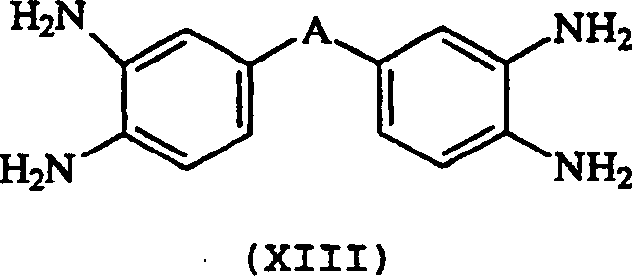
Carboxylierte Perfluorelastomere, welche in Anwesenheit von 3,3'-Diaminobenzidin gehärtet worden sind, zeigen eine ungewöhnlich gute Lösungsmittelresistenz, wie dies durch einen größeren Widerstand gegenüber einer Volumenzunahme in bestimmten Lösungsmitteln offenbar wird, dies im Vergleich zu Perfluorelastomeren, welche in Anwesenheit anderer Mittel gehärtet worden sind. Der Anteil des Härtungsmittels sollte so gewählt werden, dass die gewünschten Eigenschaften des Vulkanisats optimiert werden. Im Allgemeinen wird ein geringer Überschuss eines Härtungsmittels gegenüber der Menge verwendet, die erforderlich ist, um mit allen in dem Polymer vorhandenen für das Härten bestimmten Stellen (cure-sites) zu reagieren. Typischerweise sind 0,5–5,0 Gewichtsteile des Härtungsmittels auf 100 Gewichtsteile des Polymers erforderlich. Der bevorzugte Bereich liegt bei 1,2–2,5 Teilen.carboxylated Perfluoroelastomers, which in the presence of 3,3'-diaminobenzidine hardened have an unusual show good solvent resistance, like this by a greater resistance across from an increase in volume in certain solvents, this compared to perfluoroelastomers, which in presence hardened other means have been. The proportion of curing agent should be chosen be that desired Properties of the vulcanizate be optimized. In general, will a small surplus a curing agent across from the amount needed to work with all in the polymer existing for the hardening certain sites (cure sites) to respond. Typically they are 0.5-5.0 Parts by weight of the curing agent to 100 parts by weight of the polymer required. The preferred one Range is 1.2-2.5 Share.
Zusatzstoffe wie etwa Russ, Stabilisatoren, Weichmacher, Schmierstoffe, Füllelemente und Verarbeitungshilfsstoffe, welche typischerweise in einer Perfluorelastomerverbindung verwendet werden, können in die Zusammensetzungen gemäß der vorliegenden Erfindung mit eingebunden werden, vorausgesetzt dass sie eine adäquate Stabilität gegenüber den Bedingungen des beabsichtigten Einsatzes aufweisen. Insbesondere kann das Leistungsverhalten bei einer geringen Temperatur durch Einbindung von Perfluorelastomeren erhöht werden.additives such as soot, stabilizers, plasticizers, lubricants, fillers and processing aids, typically in a perfluoroelastomer compound can be used in the compositions according to the present invention Be included, provided that they have adequate stability over the Conditions of intended use. Especially can perform at a low temperature through Incorporation of perfluoroelastomers be increased.
Füllmittel aus Ruß werden in den Elastomeren als ein Mittel verwendet, um den Modul, die Zugfestigkeit, die Dehnung, die Härte, die Abriebfestigkeit, die Leitfähigkeit und die Verarbeitungsfähigkeit der Zusammensetzungen auszugleichen. In Perfluorelastomer-zusammensetzungen sind Rußteilchen von kleiner Partikelgröße und mit einer großen Oberfläche die Füllmittel der ersten Wahl. Eine gewöhnlich gewählte Klasse ist das SAF Carbon Black, ein stark verstärkender Ruß mit einer typischen durchschnittlichen Partikelgröße von etwa 14 nm und welcher als N 110 in der Gruppe No.1 entsprechend ASTM D 1765 bezeichnet wird. Eine besondere Klasse von Carbon Blacks, welche nützlich in den Zusammensetzungen der vorliegenden Erfindung sind, werden in WO 95/22575 beschrieben. Diese Carbon Blacks haben durchschnittliche Partikelgrößen von mindestens etwa 100 nm bis etwa 500 nm, wenn dieselben nach ASTM D 3849 bestimmt werden. Beispiele schließen MT Blacks (mittlere thermische Blacks) mit ein, welche als N – 991, N – 990, N – 908 und N – 907 und Ofenruß mit einer großen Partikelgröße bezeichnet werden. MT Blacks werden bevorzugt. Beim Gebrauch reichen im Allgemeinen 1–70 phr von dem Ruß mit der großen Partikelgröße aus und diese Menge verzögert die Aushärtungszeit nicht.fillers become soot used in the elastomers as a means to increase the modulus, tensile strength, the strain, the hardness, the abrasion resistance, the conductivity and the processability of the Compensating compositions. In perfluoroelastomer compositions are soot particles of small particle size and with a big one surface the fillers the first choice. A commonly chosen class is the SAF Carbon Black, a strong reinforcing carbon black with a typical average carbon black content Particle size of about 14 nm and which as N 110 in group No.1 according to ASTM D 1765 is designated. A special class of carbon blacks, which useful in the compositions of the present invention are disclosed in U.S. Pat WO 95/22575. These carbon blacks have average Particle sizes of at least about 100 nm to about 500 nm when measured according to ASTM D 3849 be determined. Examples include MT Blacks (medium thermal Blacks), which is designated N-991, N - 990, N - 908 and N - 907 and Furnace soot with a big one Particle size called become. MT Blacks are preferred. In use, generally enough 1-70 phr from the soot with the big Particle size off and this amount is delayed the curing time Not.
Zusätzlich oder als Alternative können Fluorpolymerfüllmittel in der Zusammensetzung vorhanden sein. Im Allgemeinen verwendet man 1 bis 50 Teile pro hundert Teile Perfluorelastomer (phr) eines Fluorpolymerfüllmittels, und vorzugsweise sind mindestens etwa 5 phr vorhanden. Das Fluorpolymerfüllmittel kann irgendein fein geteiltes, leicht dispergierbares plastisches Fluorpolymer sein, welches bei den höchsten Temperaturen fest ist, welche bei der Herstellung und beim Härten der Perfluorelastomerzusammensetzung verwendet werden. Mit fest ist gemeint, dass das Fluorpolymer, wenn es teilweise kristallin ist, eine kristalline Schmelztemperatur über den jeweiligen Verarbeitungstemperaturen des oder der betroffenen Perfluorelastomere haben wird. Solche fein verteilten, leicht dispergierbaren Fluorpolymere werden gewöhnlich Mikropulver oder Fluoradditive genannt. Mikropulver sind gewöhnlich teilweise kristalline Polymere.Additionally or as an alternative you can Fluorpolymerfüllmittel be present in the composition. Generally used from 1 to 50 parts per hundred parts of perfluoroelastomer (phr) of a fluoropolymer filler, and preferably at least about 5 phr are present. The fluoropolymer filler may be any finely divided, easily dispersible plastic Fluoropolymer, which is solid at the highest temperatures, which in the manufacture and curing of the perfluoroelastomer composition be used. By firm is meant that the fluoropolymer, though it is partially crystalline, a crystalline melting temperature above the respective Processing temperatures of the or the affected perfluoroelastomers will have. Such finely divided, easily dispersible fluoropolymers become usually Called micropowder or fluoroadditive. Micropowders are usually partial crystalline polymers.
Mikropulver, welche in den Zusammensetzungen gemäß der Erfindung verwendet werden können, schließen jene Mikropulver mit ein, sind aber nicht beschränkt auf die Gruppe der Polymere, die als Tetrafluorethylen (TFE) Polymere bekannt sind. Diese Gruppe enthält Homopolymere von TFE (PTFE) und Copolymere von TFE mit kleinen Konzentrationen von mindestens einem copolymerisierbaren, modifizierenden Monomer derart, dass die Harze ohne Schmelzen erzeugbar bleiben (modifiziertes PTFE).Micropowder, which are used in the compositions according to the invention can, shut down those micropowders, but are not limited to the group of polymers, which are known as tetrafluoroethylene (TFE) polymers. This group contains Homopolymers of TFE (PTFE) and copolymers of TFE with small concentrations of at least one copolymerizable modifying monomer such that the resins remain producible without melting (modified PTFE).
Das modifizierende Monomer kann zum Beispiel sein; ein Hexafluorpropylen (HFP), ein Perfluor(propylvinyl)ether (PPVE), ein Perfluorbutylethylen, ein Chlortrifluorethylen oder ein anderes Monomer, welches Seitengruppen in das Polymermolekül einführt. Die Konzentration solcher copolymerisierter Modifiziermittel in dem Polymer ist gewöhnlich kleiner als 1 Molprozent. Das PTFE und die modifizierten PTFE Harze, welche in dieser Erfindung verwendet werden können, enthalten sowohl solche, welche von einer Suspensionspolymerisation abgeleitet worden sind, als auch solche, welche von einer Emulsionspolymerisation abgeleitet worden sind.The modifying monomer may be, for example; a hexafluoropropylene (HFP), a perfluoro (propyl vinyl) ether (PPVE), a perfluorobutylethylene Chlorotrifluoroethylene or other monomer having side groups into the polymer molecule introduces. The concentration of such copolymerized modifier in the polymer is ordinary less than 1 mole percent. The PTFE and the modified PTFE resins, which can be used in this invention include both which have been derived from a suspension polymerization, as well as those derived from an emulsion polymerization have been.
Ein PTFE mit einem hohen Molekulargewicht, wie es bei der Herstellung von Mikropulver verwendet wird, wird gewöhnlich einer ionisierenden Strahlung unterzogen, um das Molekulargewicht zu vermindern. Dies ermöglicht ein Zerkleinern und erhöht die Zerreibbarkeit, wenn das PTFE durch das Verfahren der Suspensionspolymerisation hergestellt wird, oder es unterdrückt die Faserung und erhöht ein Entagglomerieren, wenn das PTFE durch das Verfahren der Emulsionspolymerisation hergestellt wird. Es ist auch möglich, das TFE direkt zu einem PTFE Mikropulver zu polymerisieren durch eine geeignete Steuerung des Molekulargewichts bei dem Verfahren der Emulsionspolymerisation, wie dies von Kuhls et al. in dem U.S. Patent 3,956,000 offenbart worden ist. Morgan offenbart in dem U.S. Patent 4,879,362 ein nicht faserndes modifiziertes PTFE, welches ohne Schmelzen erzeugbar ist, und welches nach dem Verfahren der Emulsions(Dispersions)polymerisation hergestellt worden ist. Dieses Polymer bildet flache Plättchen, wenn es mittels Scherung zu elastomere Zusammensetzungen vermischt wird anstatt dass es zu einer Faserbildung kommt.A high molecular weight PTFE, as used in the preparation of micropowders, is usually subjected to ionizing radiation to reduce the molecular weight. This allows for shredding and increases friability when the PTFE is replaced by the A process of suspension polymerization is prepared or it suppresses the fiberization and increases Entagglomerieren when the PTFE is prepared by the process of emulsion polymerization. It is also possible to polymerize the TFE directly to a PTFE micropowder by appropriate control of the molecular weight in the emulsion polymerization process as described by Kuhls et al. in US Patent 3,956,000. Morgan, in U.S. Patent 4,879,362, discloses a non-fibrous modified PTFE which is melt-free to produce and which has been prepared by the emulsion (dispersion) polymerization process. This polymer forms flat platelets when blended sheared into elastomeric compositions rather than resulting in fiber formation.
TFE Polymere enthalten auch durch Schmelzen erzeugbare Copolymere von TFE mit ausreichenden Konzentrationen an copolymerisierten Einheiten von einem oder von mehreren Monomeren, um den Schmelzpunkt deutlich unter den von PTFE zu vermindern. Solche Copolymere haben im Allgemeinen eine Schmelzviskosität in dem Bereich von 0,5–60 × 103 Pa·s, aber auch Viskositäten außerhalb dieses Bereiches sind bekannt. Perfluorolefine und Perfluor(alkylvinyl)ether sind bevorzugte Comonomere. Hexafluorpropylen und Perfluor(propylvinyl)ether werden am meisten bevorzugt. In der Schmelze erzeugbare TFE Copolymere, wie FEP (TFE/Hexafluorpropylen Copolymer) und PFA [TFE/Perfluor(propylvinyl)ether Copolymer], können verwendet werden, vorausgesetzt, dass sie die Beschränkungen bezüglich der Schmelztemperatur in Bezug auf die Verarbeitungstemperatur des Perfluorelastomers erfüllen. Diese Copolymere können in Pulverform verwendet werden, so wie sie von dem Polymerisationsmedium isoliert worden sind, sofern die Partikelgröße annehmbar ist, oder sie können auf eine geeignete Partikelgröße zerkleinert werden, wobei man mit einem Ausgangsbestand an größeren Dimensionsabmessungen beginnt.TFE polymers also contain melt-formable copolymers of TFE with sufficient levels of copolymerized units of one or more monomers to significantly lower the melting point below that of PTFE. Such copolymers generally have a melt viscosity in the range of 0.5-60 x 10 3 Pa · s, but also viscosities outside this range are known. Perfluoroolefins and perfluoro (alkyl vinyl) ethers are preferred comonomers. Hexafluoropropylene and perfluoro (propyl vinyl) ether are most preferred. Melt-formable TFE copolymers such as FEP (TFE / hexafluoropropylene copolymer) and PFA [TFE / perfluoro (propyl vinyl) ether copolymer] can be used provided they meet the melting temperature limitations with respect to the processing temperature of the perfluoroelastomer. These copolymers can be used in powder form as isolated from the polymerization medium as long as the particle size is acceptable, or they can be ground to a suitable particle size starting with a starting stock of larger dimensional dimensions.
Ein weiteres bevorzugtes Füllmittel ist wasserfreies Siliziumdioxid, im Allgemeinen ein saures Siliziumdioxid oder ein geschwärztes Siliziumdioxid. Solche Siliziumdioxide sind zu beziehen von Degussa Aktiengesellschaft (Frankfurt, Germany) unter der Handelsmarke Aerosil®. Ein besonders nützlicher Typ ist Aerosil® 200 Siliziumdioxid. Andere geeignete Siliziumdioxide schließen mit ein; Reolosil® Siliziumdioxide, erhältlich bei Tokuyama KK (Tokio, Japan), zum Beispiel Reolosil® QS13 Siliziumdioxid, Reolosil® QS102 Siliziumdioxid und Reolosil® QS30 Siliziumdioxid. Mengen von 1–25 Teile pro hundert Teile Perfluorelastomer (phr) sind wirksam, um eine HF Erzeugung in gehärteten Zusammensetzungen unter Dienstbedingungen zu vermindern. Man zieht es jedoch vor, nicht mehr als 1–7 phr zu verwenden, weil sich bei höheren Konzentrationen an wasserfreiem Siliziumdioxid die Beständigkeit gegen Druckverformung von gehärteten Perfluorelastomerzusammensetzungen, welche die hohen Konzentrationen enthalten, verschlechtert (d. h. sie nimmt zu), was zu einer hohen Druckverformung und zu schlechten Abdichtungseigenschaften führt. Wenn weniger als 1 phr anhydriertes Siliziumdioxid verwendet wird, dann wird das Ausmaß an Korrosion für viele Anwendungen unannehmbar.Another preferred filler is anhydrous silica, generally an acidic silica or a blackened silica. Such silicas are available from Degussa Aktiengesellschaft (Frankfurt, Germany) under the trade mark Aerosil ®. A particularly useful type is Aerosil ® 200 silica. Other suitable silicas include; Reolosil ® silicas, available from Tokuyama KK (Tokyo, Japan), for example Reolosil ® QS13 silica Reolosil ® QS102 silica and Reolosil ® QS30 silica. Quantities of 1-25 parts per hundred parts of perfluoroelastomer (phr) are effective to reduce HF generation in cured compositions under service conditions. It is preferred, however, to use no more than 1-7 phr, because at higher concentrations of anhydrous silica, the resistance to compression set of cured perfluoroelastomer compositions containing the high concentrations deteriorates (ie, increases), resulting in a high Pressure deformation and leads to poor sealing properties. If less than 1 phr of anhydrous silica is used, then the extent of corrosion becomes unacceptable for many applications.
In einer Ausführungsform des Verfahrens gemäß der Erfindung wird das Perfluorelastomer einem Ammoniakdampf ausgesetzt. Im Allgemeinen findet das Aussetzen unter der Form eines Films von einer Dicke von weniger als 1 mm statt. Solche Filme können durch eine Vielfalt von Methoden gebildet werden. Zum Beispiel können die Filme aus einer Lösung gegossen oder aus Latex gebildet werden, welches zu einem Film getrocknet worden ist. Sie können auch aus einem festen Polymer gepresst werden. Ammoniakdampf kann auch über eine dünne Beschichtung geführt werden, wie etwa über einen Film aus einem Nitril enthaltenden Perfluorelastomer auf einem metallischen oder einem nicht metallischen Substratträger. Während der Perfluorelastomerfilm dem Ammoniakdampf ausgesetzt ist, wird er vernetzt und die Beschichtung wird immobilisiert oder befestigt. Eine besonders bevorzugte Ausführung impliziert die Aushärtung der inneren Oberfläche eines Artikels, wie etwa die eines Rohres, eines Schlauches oder einer Rohrleitung, welche innere Oberfläche mit einer dünnen Schicht des mit Ammoniak härtbaren Perfluorelastomers beschichtet worden ist, im Allgemeinen in einer Dicke von 0,1–1 mm. In dieser Ausführung wird der Ammoniakdampf durch den ausgekleideten Artikel bei Drücken und Temperaturen geleitet, welche von den Anforderungen an die Aushärtungsgeschwindigkeit des Perfluorelastomers abhängen. Der ausgekleidete Artikel kann aus irgendeiner Vielfalt von Materialien hergestellt sein, zum Beispiel aus einem Elastomer, aus einem thermoplastischen Material, aus einem Gewebe oder aus Metall. Eine äußere Oberflächenbeschichtung kann auch in der gleichen Art und Weise gehärtet werden.In an embodiment of the method according to the invention the perfluoroelastomer is exposed to ammonia vapor. In general finds exposure under the form of a film of a thickness less than 1 mm. Such films can be made by a variety of Methods are formed. For example, the films may be cast from a solution or formed from latex, which is dried to a film has been. You can also be pressed from a solid polymer. Ammonia vapor can also over a thin coating guided be like about a film of nitrile-containing perfluoroelastomer on a metallic or a non-metallic substrate carrier. During the Perfluoroelastomer film is exposed to the ammonia vapor, it is crosslinked and the coating is immobilized or attached. A special preferred embodiment implies the hardening the inner surface an article, such as that of a pipe, a hose or a pipeline, which inner surface with a thin layer of ammonia curable Perfluoroelastomer has been coated, generally in one Thickness of 0.1-1 mm. In this version is the ammonia vapor through the lined article at pressures and Temperatures are governed by the requirements of the cure rate depend on the perfluoroelastomer. The lined article can be made from any variety of materials be made of, for example, an elastomer, a thermoplastic Material, made of a fabric or metal. An outer surface coating can also be cured in the same way.
Das Verfahren kann auch verwendet werden, um die Oberfläche von dickeren Artikeln, wie diejenige von O-Ringen, zu härten. Diese letztere Ausführung würde vorzugsweise verwendet werden, wenn die Zusammensetzung ein zusätzliches Härtungsmittel enthalten würde. Das Aussetzen kann dadurch beeinflusst werden, dass man die ungehärtete Perfluorelastomer-zusammensetzung in einer Kammer anordnet, in welche Ammoniakgas eingeführt wird. Alternativ können die ungehärteten Perfluorelastomerzusammensetzungen extrudiert werden und dann durch einen Tunnel oder durch eine Kammer, welche Ammoniakgas enthalten, hindurchgeleitet werden. Die Experten auf diesem Gebiet werden erkennen, dass die Konzentration von Ammoniak und die Dauer des Aussetzers gesteuert werden müssen in Abhängigkeit von dem Ausmaß der für das Härten bestimmten Monomerstelle (cure-site des Monomers) in dem Polymer, von dem Ausmaß der gewünschten Vernetzung und von den gewünschten physikalischen Eigenschaften der gehärteten Zusammensetzung, zum Beispiel von dem Ausmaß der gewünschten Beständigkeit gegen Druckverformung oder von dem gewünschten Ausmaß der Härte. Im Allgemeinen sind Temperaturen von bis zu 250°C nützlich, um eine Härtung zu bewirken, und Temperaturen von bis zu 25°C–200°C werden bevorzugt.The method can also be used to cure the surface of thicker articles, such as that of O-rings. This latter embodiment would preferably be used if the composition included an additional curing agent. The exposure may be affected by placing the uncured perfluoroelastomer composition in a chamber into which ammonia gas is introduced. Alternatively, the uncured perfluoroelastomer compositions may be extruded and then passed through a tunnel or through a chamber containing ammonia gas. The experts in this field will be recognize that the concentration of ammonia and the duration of the misfire must be controlled, depending on the extent of the cure site of the monomer in the polymer, the extent of crosslinking desired, and the desired physical properties of the polymer cured composition, for example, the extent of the desired resistance to compression set or the desired degree of hardness. In general, temperatures up to 250 ° C are useful to effect cure and temperatures of up to 25 ° C-200 ° C are preferred.
Zusätzlich zu den Vorteilen einer niedrigen Aushärtungstemperatur bietet das Verfahren der Erfindung die Vorteile einer Härtung durch Diffusion. Dies vermeidet eine Aussetzung des Polymers gegenüber der Hitze während der Mischung mit den Härtungsmitteln und mit anderen Zusatzstoffen. In einer herkömmlichen Gummiverbindung werden das Elastomer und Zusatzstoffe auf einer Gummimühle oder in einem internen Mischer gemischt. Dieses Verfahren erzeugt Wärme und kann zu solchen nachteiligen Wirkungen führen, wie eine verfrühte Vulkanisation (angebranntes Gummi), eine Härtung vor dem vollständigen Füllen einer Form oder einer Bildung von ungeordneten Extrudaten. Nachteilige Wechselwirkungen der Zusatzstoffe werden auch durch das Verfahren der Erfindung minimiert.In addition to the advantages of a low curing temperature that offers Process of the invention the advantages of curing by diffusion. This avoids exposure of the polymer to heat during the Mixture with the hardeners and with other additives. Be in a conventional rubber compound the elastomer and additives on a rubber mill or in an internal Mixer mixed. This process generates heat and can be such disadvantageous Cause effects, like a premature one Vulcanization (burnt rubber), hardening before complete filling of one Shape or formation of disordered extrudates. Adverse Interactions of the additives are also by the process of the invention minimized.
In einer weiteren Ausfühungsform der Erfindung wird eine Perfluorelastomer-zusammensetzung mit einer Zusammensetzung verbunden, welche Ammoniak enthält, welches auf einem inerten Träger adsorbiert ist. Die zusammengestellte Zusammensetzung wird dann bei einer Temperatur von 50°C–250°C gehärtet. Das Zusammensetzen kann bewerkstelligt werden durch irgendeine der üblichen Techniken zur Gummimischung, zum Beispiel auf einer Gummimühle aus zwei Walzen oder in einem internen Mischer, wie etwa einem internen Banburry Mischer. Das Zusammensetzen wird gewöhnlich unterhalb der Desorptionstemperatur des adsorbierten Ammoniaks durchgeführt, typischerweise unter 60°C. Das Aushärten kann in einer Form stattfinden oder das Polymer kann aus der Form heraus genommen werden. Vorzugsweise wird eine Nachhärtung an der Luft oder in Stickstoff bei Temperaturen über 200°C während einer Dauer von mehreren Stunden ausgeführt, um die Aushärtung vollständig zu entwickeln.In another embodiment The invention is a perfluoroelastomer composition with a Compound containing ammonia, which on an inert carrier is adsorbed. The assembled composition then becomes cured at a temperature of 50 ° C-250 ° C. The Composition can be accomplished by any of the common techniques for rubber compound, for example on a rubber mill of two rolls or in an internal mixer, such as an internal Banburry mixer. The assembling becomes ordinary below the desorption temperature of the adsorbed ammonia, typically below 60 ° C. The curing may take place in a mold or the polymer may be out of the mold taken out. Preferably, a post-curing in air or in nitrogen at temperatures above 200 ° C for a period of several Hours running, to the curing Completely to develop.
Die härtbaren Zusammensetzungen gemäß der vorliegenden Erfindung sind nützlich für das Herstellen von Laminaten, von Dichtungen, von Röhrenmaterial und von Abdichtungen. Solche Artikel werden im Allgemeinen hergestellt, indem man eine zusammengesetzte Formulierung der härtbaren Zusammensetzung mit verschiedenen Zusatzstoffen unter Druck verformt, das Teil härtet und indem man es dann dem Zyklus einer Nachhärtung unterzieht. Die gehärteten Zusammensetzungen haben eine ausgezeichnete thermische Stabilität und chemische Widerstandsfähigkeit. Sie sind besonders nützlich bei Anwendungen wie Abdichtungen und Dichtungen zur Herstellung von Halbleitervorrichtungen und bei Abdichtungen bei hohen Temperaturen in Einsätzen auf dem Automobilsektor.The curable Compositions according to the present invention Invention are useful for the Manufacture of laminates, gaskets, tubing and seals. Such articles are generally manufactured by using a composite formulation of the curable composition with various additives deformed under pressure, the part hardens and by then subjecting it to the cycle of postcuring. The cured compositions have excellent thermal stability and chemical resistance. They are especially useful in Applications such as seals and gaskets for the production of Semiconductor devices and sealing at high temperatures in missions the automotive sector.
Die Erfindung wird anhand der nachfolgenden Ausführungen dargestellt, bei denen alle Teile auf das Gewicht bezogen sind, wenn es nicht anders spezifiziert worden ist.The Invention will be illustrated with reference to the following embodiments in which All parts are by weight unless otherwise specified has been.
BEISPIELEXAMPLE
Ein Perfluorelastomerlatex, welches ein Perfluorelastomer mit copolymerisierten Einheiten von annähernd 43,0 Gew.-% Perfluor(methylvinyl)ether, 54,8 Gew.-% Tetrafluorethylen und 2,2 Gew.-% 8-CNVE enthält, wurde allgemein gesehen gemäß dem in dem Patent 5,789,489 beschriebenen Verfahren hergestellt, dies unter Verwendung eines Ammoniumpersulfatinitiators und eines aus Ammoniumperfluoroctanoat bestehenden grenzflächenaktiven Stoffes. Das Polymer wurde durch Koagulation mit MgSO4 isoliert, zweimal mit entionisiertem Wasser gewaschen und dann getrocknet. Heptanol wurde während des Isolationsschrittes als Entschäumungsmittel verwendet. Das getrocknete Polymer wurde dann während einer Dauer von 1 Stunde bei 300°C in einem Luftofen erwärmt, um Carboxylatendgruppen zu entfernen, und dann wurde das IR Spektrum (auf einem bei 121°C gepressten Film) des Polymers aufgenommen, um das Entfernen des Carboxylats zu bestätigen. Das IR Spektrum zeigte die Anwesenheit der charakteristischen scharfen, Nitrildehnungsabsorption des copolymerisierten 8-CNVE bei etwa 2269 cm–1 auf der Seite der tiefen Frequenzen der um etwa 2370 cm–1 herum zentrierten Banddicke. Es gab keine wesentliche Absorption zwischen 1600 und 1750 cm–1.A perfluoroelastomer latex containing a perfluoroelastomer having copolymerized units of approximately 43.0% by weight of perfluoro (methyl vinyl) ether, 54.8% by weight of tetrafluoroethylene and 2.2% by weight of 8-CNVE has been generally used according to U.S. Pat in US Pat. No. 5,789,489, using an ammonium persulfate initiator and an ammonium perfluorooctanoate surfactant. The polymer was isolated by coagulation with MgSO 4 , washed twice with deionized water and then dried. Heptanol was used as a defoaming agent during the isolation step. The dried polymer was then heated at 300 ° C for 1 hour in an air oven to remove carboxylate end groups, and then the IR spectrum (on a 121 ° C pressed film) of the polymer was taken to remove the carboxylate to confirm. The IR spectrum showed the presence of the characteristic sharp nitrile elongation absorption of the copolymerized 8-CNVE at about 2269 cm -1 on the low frequency side of the band thickness centered around about 2370 cm -1 . There was no significant absorption between 1600 and 1750 cm -1 .
Ein ähnlicher Film desselben decarboxylierten Perfluorelastomers wurde bei 121°C gepresst und wurde in Ammoniakdampf über einer konzentrierten wässrigen Ammoniumhydroxidlösung aufgehängt und über Nacht in einem geschlossenen Behälter bei Raumtemperatur gelassen. Der Film wurde dann entfernt und dessen IR Spektrum wurde aufgenommen. Nach der Aussetzung an Ammoniak war das Absorptionsband des Nitrils bei 2265 cm–1 verschwunden und ein intensives Band bei 1654 cm–1 und ein schwächeres Band bei 3499 cm–1 waren in dem IR Spektrum vorhanden. Das Spektrum des Films war andererseits unverändert mit der Ausnahme einer Verringerung eines breiten Wasserbandes, welches zwischen 3200 cm–1 und 3400 cm–1 zentriert war, als derselbe während der Dauer von einer Stunde mit einem in das Spektrometer hinein gerichteten Strom von trockenem Stickstoff getrocknet wurde. Im Anschluss an die Ammoniakbehandlung wurde der Polymerfilm untersucht hinsichtlich eines Nachweises einer Veränderung der Rheologie. Eine Probe des Filmes wurde gefaltet und dann demselben hohen Druck zwischen parallelen Platten unterworfen, unter welchem der Film ursprünglich hergestellt worden war. Dieser Versuch, das Polymer dazu zu veranlassen, unter dem Druck zu fließen, misslang, was einen Hinweis darauf lieferte, dass der Film vernetzt war. Außerdem konnte der elastomere Film nicht bei Temperaturen unter 220°C erneut gepresst werden, was einen Hinweis auf die Bildung von durch Ammoniak induzierten chemischen Vernetzungen mit einer ausgezeichneten thermischen Stabilität lieferte.A similar film of the same decarboxylated perfluoroelastomer was pressed at 121 ° C and was suspended in ammonia vapor over a concentrated aqueous ammonium hydroxide solution and left overnight in a closed container at room temperature. The film was then removed and its IR spectrum was recorded. After exposure to ammonia, the nitrile absorption band at 2265 cm -1 had disappeared and an intense band at 1654 cm -1 and a weaker band at 3499 cm -1 were present in the IR spectrum. The spectrum of the film, on the other hand, was unchanged except for a reduction of a broad water band centered between 3200 cm -1 and 3400 cm -1 when it was sustained for one hour with a stream of dry nitrogen directed into the spectrometer. Following the ammonia treatment, the polymer film was tested for evidence of change in rheology. A sample of the film was folded and then subjected to the same high pressure between parallel plates under which the film was originally made. This attempt to cause the polymer to flow under pressure failed, indicating that the film was cross-linked. In addition, the elastomeric film could not be re-pressed at temperatures below 220 ° C, providing an indication of the formation of ammonia-induced chemical crosslinks with excellent thermal stability.
Als eine Kontrolle wurde ein dritter Film derselben Perfluorelastomerzusammensetzung bei Umgebungstemperatur über Nacht in einem geschlossenen Behälter dem Wasserdampf ausgesetzt. Diese Behandlung verursachte nur diejenigen IR Spektralveränderungen, welche man von der physikalischen Absorption und Adsorption von Wasser erwartete. Verglichen mit dem IR Spektrum des Perfluorelastomers, welches dem Ammoniak ausgesetzt worden war, war die Nitrilabsorption unverändert, keine unterschiedliche Absorption erschien in dem Bereich 1600–1750 cm–1, und der einzige wesentliche spektrale Unterschied bestand in dem Vorhandensein eines breiten Wasserbandes, welches zwischen 3200 cm–1 und 3400 cm–1 zentriert war. Der Polymerfilm war leicht zurückpressbar bei 121°C, was einen Hinweis darauf lieferte, dass der Film, als Ergebnis der Aussetzung gegenüber dem Wasserdampf, nicht vernetzt war.As a control, a third film of the same perfluoroelastomer composition was exposed to water vapor at ambient temperature overnight in a closed container. This treatment caused only those IR spectral changes expected from the physical absorption and adsorption of water. Compared with the IR spectrum of the perfluoroelastomer which had been exposed to the ammonia, the nitrile absorption was unchanged, no difference in absorption appeared in the range 1600-1750 cm -1 and the only significant spectral difference was the presence of a broad band of water between 3200 cm -1 and 3400 cm -1 was centered. The polymer film was easily backpressurable at 121 ° C, indicating that the film was not crosslinked as a result of exposure to water vapor.
Claims (6)
Applications Claiming Priority (3)
| Application Number | Priority Date | Filing Date | Title |
|---|---|---|---|
| US9591598P | 1998-08-10 | 1998-08-10 | |
| US95915P | 1998-08-10 | ||
| PCT/US1999/017868 WO2000009569A2 (en) | 1998-08-10 | 1999-08-06 | Curable perfluoroelastomer composition |
Publications (2)
| Publication Number | Publication Date |
|---|---|
| DE69918698D1 DE69918698D1 (en) | 2004-08-19 |
| DE69918698T2 true DE69918698T2 (en) | 2005-08-04 |
Family
ID=22254183
Family Applications (1)
| Application Number | Title | Priority Date | Filing Date |
|---|---|---|---|
| DE69918698T Expired - Lifetime DE69918698T2 (en) | 1998-08-10 | 1999-08-06 | HARDENABLE PERFLUORELASTOMER COMPOSITION |
Country Status (7)
| Country | Link |
|---|---|
| US (1) | US6221970B1 (en) |
| EP (1) | EP1114094B1 (en) |
| JP (1) | JP4362258B2 (en) |
| KR (1) | KR100589103B1 (en) |
| DE (1) | DE69918698T2 (en) |
| TW (1) | TW482805B (en) |
| WO (1) | WO2000009569A2 (en) |
Families Citing this family (30)
| Publication number | Priority date | Publication date | Assignee | Title |
|---|---|---|---|---|
| US6559238B1 (en) * | 1998-06-29 | 2003-05-06 | E. I. Du Pont De Nemours And Company | Thermally cross-linked fluoropolymer |
| JP3514155B2 (en) * | 1999-02-19 | 2004-03-31 | 富士写真光機株式会社 | Endoscope device |
| JP4547735B2 (en) * | 1999-07-14 | 2010-09-22 | ダイキン工業株式会社 | Method for curing fluorine-containing polymer |
| JP5122718B2 (en) * | 2000-09-18 | 2013-01-16 | スリーエム イノベイティブ プロパティズ カンパニー | Imidate-containing fluoropolymer composition |
| AU2001290835A1 (en) * | 2000-09-18 | 2002-04-02 | 3M Innovative Properties Company | Metal amine complex containing fluoropolymer compositions |
| EP1353958B1 (en) * | 2000-12-14 | 2007-01-24 | Dupont Dow Elastomers L.L.C. | A process for making high purity translucent perfluoroelastomer articles |
| US6890995B2 (en) | 2001-01-31 | 2005-05-10 | 3M Innovative Properties Company | Fluoropolymer compositions |
| US6844388B2 (en) | 2001-04-12 | 2005-01-18 | 3M Innovative Properties Company | Fluoropolymer compositions containing a nitrogen cure site monomer |
| US6803425B2 (en) | 2001-04-12 | 2004-10-12 | 3M Innovative Properties Company | Fluoropolymers having pendant imidate structures |
| US6794457B2 (en) | 2001-04-30 | 2004-09-21 | 3M Innovative Properties Company | Fluoropolymer curing system containing a nitrogen cure site monomer |
| US6956085B2 (en) | 2003-02-14 | 2005-10-18 | 3M Innovative Properties Company | Fluoroelastomer compositions |
| US7304115B2 (en) | 2003-12-30 | 2007-12-04 | 3M Innovative Properties Company | Fluoropolymer coagulation method and composition |
| US7402630B2 (en) | 2004-12-16 | 2008-07-22 | 3M Innovative Properties Company | Curing compositions for fluoropolymers |
| JP5029359B2 (en) * | 2005-05-02 | 2012-09-19 | ダイキン工業株式会社 | Crosslinkable polytetrafluoroethylene composition, crosslinked polytetrafluoroethylene powder, polytetrafluoroethylene molded article, resin blend composition, and resin blend molded article |
| US8211964B2 (en) | 2005-07-26 | 2012-07-03 | Daikin Industries, Ltd. | Curable composition, molded article obtained from same and process for production of molded article |
| US8069833B2 (en) | 2006-10-20 | 2011-12-06 | Bando Kiko Co., Ltd. | Reciprocating engine |
| JP2009001748A (en) * | 2007-06-25 | 2009-01-08 | Daikin Ind Ltd | Articles for manufacturing semiconductors |
| US9650479B2 (en) | 2007-10-04 | 2017-05-16 | W. L. Gore & Associates, Inc. | Dense articles formed from tetrafluoroethylene core shell copolymers and methods of making the same |
| US8637144B2 (en) * | 2007-10-04 | 2014-01-28 | W. L. Gore & Associates, Inc. | Expandable TFE copolymers, method of making, and porous, expended articles thereof |
| US9040646B2 (en) * | 2007-10-04 | 2015-05-26 | W. L. Gore & Associates, Inc. | Expandable TFE copolymers, methods of making, and porous, expanded articles thereof |
| WO2009111120A2 (en) * | 2008-02-29 | 2009-09-11 | 3M Innovative Properties Company | Perfluoroelastomers with low carbonyl endgroup ratios |
| US20110112265A1 (en) * | 2008-06-30 | 2011-05-12 | Daikin Industries Ltd. | Curable composition and molded article made of same |
| KR101684719B1 (en) | 2009-06-25 | 2016-12-08 | 쓰리엠 이노베이티브 프로퍼티즈 캄파니 | Curing compositions for fluoropolymers |
| JP5549419B2 (en) * | 2009-07-15 | 2014-07-16 | ダイキン工業株式会社 | Method for producing curable perfluoroelastomer composition, curable perfluoroelastomer composition, and molded article comprising the same |
| KR101349064B1 (en) | 2010-02-01 | 2014-01-08 | 반도키코 가부시키가이샤 | Reciprocating engine |
| US8772997B2 (en) | 2010-09-13 | 2014-07-08 | Baker Hughes Incorporated | Electrical submersible pump system having high temperature slot, end bell and phase-to-phase insulation |
| US9644054B2 (en) | 2014-12-19 | 2017-05-09 | W. L. Gore & Associates, Inc. | Dense articles formed from tetrafluoroethylene core shell copolymers and methods of making the same |
| WO2021119454A1 (en) * | 2019-12-13 | 2021-06-17 | Chromis Fiberoptics, Inc. | Amorphous fluorinated copolymers and methods of making and using the same |
| US12160183B2 (en) * | 2020-01-03 | 2024-12-03 | C-Motive Technologies, Inc. | Method of producing an electrostatic motor |
| JP2026061973A (en) * | 2024-09-30 | 2026-04-09 | ダイキン工業株式会社 | Compositions and molded articles containing fluorine-containing polymers |
Family Cites Families (14)
| Publication number | Priority date | Publication date | Assignee | Title |
|---|---|---|---|---|
| US3332907A (en) | 1963-06-17 | 1967-07-25 | Du Pont | Oxy aromatic polyamides and process for preparation |
| US3956000A (en) | 1972-07-21 | 1976-05-11 | Hoechst Aktiengesellschaft | Fluorocarbon waxes and process for producing them |
| US4281092A (en) | 1978-11-30 | 1981-07-28 | E. I. Du Pont De Nemours And Company | Vulcanizable fluorinated copolymers |
| US4242498A (en) * | 1979-04-09 | 1980-12-30 | Frosch Robert A | Process for the preparation of fluorine containing crosslinked elastomeric polytriazine and product so produced |
| US4394489A (en) | 1982-02-25 | 1983-07-19 | E. I. Du Pont De Nemours & Co. | Fluoroelastomer curatives |
| US4879362A (en) | 1987-12-31 | 1989-11-07 | E. I. Dupont De Nemours And Company | Modified polytetrafluoroethylene resins |
| US5693748A (en) * | 1989-02-01 | 1997-12-02 | Asahi Kasei Kogyo Kabushiki Kaisha | High molecular weight polyimidoylamidine and a polytriazine derived therefrom |
| JP3523258B2 (en) | 1993-07-16 | 2004-04-26 | イー・アイ・デュポン・ドゥ・ヌムール・アンド・カンパニー | High purity fluoroelastomer compound |
| US5554680A (en) | 1994-02-16 | 1996-09-10 | E. I. Du Pont De Nemours And Company | Heat-resistant perfluoroelastomer composition |
| JPH08143535A (en) | 1994-11-17 | 1996-06-04 | Nippon Mektron Ltd | Bisaminothiophenol compound, its production and curing agent for elastomer containing fluorine comprising the same |
| JP3223776B2 (en) | 1995-03-31 | 2001-10-29 | 日本メクトロン株式会社 | Fluorine-containing elastomer composition |
| US5877264A (en) | 1996-11-25 | 1999-03-02 | E. I. Du Pont De Nemours And Company | Fast-curing perfluoroelastomer composition |
| JP3676823B2 (en) | 1996-11-25 | 2005-07-27 | イー・アイ・デュポン・ドウ・ヌムール・アンド・カンパニー | Perfluoroelastomer having improved processability and process for producing the same |
| US5677389A (en) * | 1996-11-25 | 1997-10-14 | E. I. Du Pont De Nemours | Perfluoroelastomer composition having enhanced curing performance |
-
1999
- 1999-08-06 US US09/369,801 patent/US6221970B1/en not_active Expired - Lifetime
- 1999-08-06 KR KR1020007009680A patent/KR100589103B1/en not_active Expired - Fee Related
- 1999-08-06 JP JP2001576397A patent/JP4362258B2/en not_active Expired - Fee Related
- 1999-08-06 EP EP99940932A patent/EP1114094B1/en not_active Expired - Lifetime
- 1999-08-06 WO PCT/US1999/017868 patent/WO2000009569A2/en not_active Ceased
- 1999-08-06 DE DE69918698T patent/DE69918698T2/en not_active Expired - Lifetime
- 1999-08-18 TW TW088113901A patent/TW482805B/en not_active IP Right Cessation
Also Published As
| Publication number | Publication date |
|---|---|
| WO2000009569A8 (en) | 2001-02-08 |
| WO2000009569A3 (en) | 2000-06-29 |
| US6221970B1 (en) | 2001-04-24 |
| WO2000009569A2 (en) | 2000-02-24 |
| KR100589103B1 (en) | 2006-06-14 |
| EP1114094A2 (en) | 2001-07-11 |
| DE69918698D1 (en) | 2004-08-19 |
| KR20010041511A (en) | 2001-05-25 |
| EP1114094B1 (en) | 2004-07-14 |
| JP4362258B2 (en) | 2009-11-11 |
| JP2003531222A (en) | 2003-10-21 |
| TW482805B (en) | 2002-04-11 |
Similar Documents
| Publication | Publication Date | Title |
|---|---|---|
| DE69921134T2 (en) | HEAT-RESISTANT PERFLUOROELASTOMER COMPOSITION | |
| DE69912141T2 (en) | CURABLE PERFLUORELASTOMER COMPOSITION | |
| DE69628465T2 (en) | PERFLUORELASTOMIC COMPOSITION WITH IMPROVED PROCESSABILITY | |
| EP1114094B1 (en) | Curable perfluoroelastomer composition | |
| DE69627716T2 (en) | PERFLUORELASTOMER COMPOSITION WITH INCREASED VOLCANIZATION PROPERTIES | |
| EP1885796B1 (en) | High purity perfluoroelastomer composites and a process to produce the same | |
| DE602005003819T2 (en) | PERFLUOROELASTOMER AND FLUOROOPLASTIC MIXTURES | |
| US8063150B2 (en) | High purity transparent perfluoroelastomer parts and a process to produce the same | |
| DE69631604T2 (en) | QUICK-NETWORKING PERFLUOR RUBBER COMPOSITION | |
| DE69716289T2 (en) | SULFONED PERFLUORELASTOMER COMPOSITIONS WITH IMPROVED PROCESSABILITY | |
| DE69731394T2 (en) | PERFLUORELASTOMER COMPOSITION WITH IMPROVED PROCESSABILITY | |
| DE69929329T2 (en) | WHITE ELASTOMER SEALING MATERIALS AND METHOD FOR THE PRODUCTION THEREOF | |
| EP4623026A1 (en) | Fluoroelastomer compounds | |
| HK1108708B (en) | High purity perfluoroelastomer composites and a process to produce the same |
Legal Events
| Date | Code | Title | Description |
|---|---|---|---|
| 8364 | No opposition during term of opposition |