DE69918668T2 - USE OF AMPHOTERIC SURFACTANTS AS COATING AGENT FOR CATIONIC POLYMERS DURING THE DILUTION IN COSMETIC COMPOSITIONS - Google Patents
USE OF AMPHOTERIC SURFACTANTS AS COATING AGENT FOR CATIONIC POLYMERS DURING THE DILUTION IN COSMETIC COMPOSITIONS Download PDFInfo
- Publication number
- DE69918668T2 DE69918668T2 DE69918668T DE69918668T DE69918668T2 DE 69918668 T2 DE69918668 T2 DE 69918668T2 DE 69918668 T DE69918668 T DE 69918668T DE 69918668 T DE69918668 T DE 69918668T DE 69918668 T2 DE69918668 T2 DE 69918668T2
- Authority
- DE
- Germany
- Prior art keywords
- weight
- water
- polc
- cationic polymer
- alkyl
- Prior art date
- Legal status (The legal status is an assumption and is not a legal conclusion. Google has not performed a legal analysis and makes no representation as to the accuracy of the status listed.)
- Expired - Lifetime
Links
Classifications
-
- A—HUMAN NECESSITIES
- A61—MEDICAL OR VETERINARY SCIENCE; HYGIENE
- A61Q—SPECIFIC USE OF COSMETICS OR SIMILAR TOILETRY PREPARATIONS
- A61Q19/00—Preparations for care of the skin
-
- A—HUMAN NECESSITIES
- A61—MEDICAL OR VETERINARY SCIENCE; HYGIENE
- A61K—PREPARATIONS FOR MEDICAL, DENTAL OR TOILETRY PURPOSES
- A61K8/00—Cosmetics or similar toiletry preparations
- A61K8/18—Cosmetics or similar toiletry preparations characterised by the composition
- A61K8/30—Cosmetics or similar toiletry preparations characterised by the composition containing organic compounds
- A61K8/40—Cosmetics or similar toiletry preparations characterised by the composition containing organic compounds containing nitrogen
- A61K8/44—Aminocarboxylic acids or derivatives thereof, e.g. aminocarboxylic acids containing sulfur; Salts; Esters or N-acylated derivatives thereof
- A61K8/442—Aminocarboxylic acids or derivatives thereof, e.g. aminocarboxylic acids containing sulfur; Salts; Esters or N-acylated derivatives thereof substituted by amido group(s)
-
- A—HUMAN NECESSITIES
- A61—MEDICAL OR VETERINARY SCIENCE; HYGIENE
- A61K—PREPARATIONS FOR MEDICAL, DENTAL OR TOILETRY PURPOSES
- A61K8/00—Cosmetics or similar toiletry preparations
- A61K8/18—Cosmetics or similar toiletry preparations characterised by the composition
- A61K8/30—Cosmetics or similar toiletry preparations characterised by the composition containing organic compounds
- A61K8/46—Cosmetics or similar toiletry preparations characterised by the composition containing organic compounds containing sulfur
- A61K8/463—Cosmetics or similar toiletry preparations characterised by the composition containing organic compounds containing sulfur containing sulfuric acid derivatives, e.g. sodium lauryl sulfate
-
- A—HUMAN NECESSITIES
- A61—MEDICAL OR VETERINARY SCIENCE; HYGIENE
- A61K—PREPARATIONS FOR MEDICAL, DENTAL OR TOILETRY PURPOSES
- A61K8/00—Cosmetics or similar toiletry preparations
- A61K8/18—Cosmetics or similar toiletry preparations characterised by the composition
- A61K8/30—Cosmetics or similar toiletry preparations characterised by the composition containing organic compounds
- A61K8/46—Cosmetics or similar toiletry preparations characterised by the composition containing organic compounds containing sulfur
- A61K8/466—Cosmetics or similar toiletry preparations characterised by the composition containing organic compounds containing sulfur containing sulfonic acid derivatives; Salts
-
- A—HUMAN NECESSITIES
- A61—MEDICAL OR VETERINARY SCIENCE; HYGIENE
- A61K—PREPARATIONS FOR MEDICAL, DENTAL OR TOILETRY PURPOSES
- A61K8/00—Cosmetics or similar toiletry preparations
- A61K8/18—Cosmetics or similar toiletry preparations characterised by the composition
- A61K8/72—Cosmetics or similar toiletry preparations characterised by the composition containing organic macromolecular compounds
- A61K8/73—Polysaccharides
-
- A—HUMAN NECESSITIES
- A61—MEDICAL OR VETERINARY SCIENCE; HYGIENE
- A61K—PREPARATIONS FOR MEDICAL, DENTAL OR TOILETRY PURPOSES
- A61K8/00—Cosmetics or similar toiletry preparations
- A61K8/18—Cosmetics or similar toiletry preparations characterised by the composition
- A61K8/72—Cosmetics or similar toiletry preparations characterised by the composition containing organic macromolecular compounds
- A61K8/73—Polysaccharides
- A61K8/731—Cellulose; Quaternized cellulose derivatives
-
- A—HUMAN NECESSITIES
- A61—MEDICAL OR VETERINARY SCIENCE; HYGIENE
- A61K—PREPARATIONS FOR MEDICAL, DENTAL OR TOILETRY PURPOSES
- A61K8/00—Cosmetics or similar toiletry preparations
- A61K8/18—Cosmetics or similar toiletry preparations characterised by the composition
- A61K8/72—Cosmetics or similar toiletry preparations characterised by the composition containing organic macromolecular compounds
- A61K8/73—Polysaccharides
- A61K8/737—Galactomannans, e.g. guar; Derivatives thereof
-
- A—HUMAN NECESSITIES
- A61—MEDICAL OR VETERINARY SCIENCE; HYGIENE
- A61K—PREPARATIONS FOR MEDICAL, DENTAL OR TOILETRY PURPOSES
- A61K8/00—Cosmetics or similar toiletry preparations
- A61K8/18—Cosmetics or similar toiletry preparations characterised by the composition
- A61K8/72—Cosmetics or similar toiletry preparations characterised by the composition containing organic macromolecular compounds
- A61K8/81—Cosmetics or similar toiletry preparations characterised by the composition containing organic macromolecular compounds obtained by reactions involving only carbon-to-carbon unsaturated bonds
- A61K8/817—Compositions of homopolymers or copolymers of compounds having one or more unsaturated aliphatic radicals, each having only one carbon-to-carbon double bond, and at least one being terminated by a single or double bond to nitrogen or by a heterocyclic ring containing nitrogen; Compositions or derivatives of such polymers, e.g. vinylimidazol, vinylcaprolactame, allylamines (Polyquaternium 6)
-
- A—HUMAN NECESSITIES
- A61—MEDICAL OR VETERINARY SCIENCE; HYGIENE
- A61K—PREPARATIONS FOR MEDICAL, DENTAL OR TOILETRY PURPOSES
- A61K8/00—Cosmetics or similar toiletry preparations
- A61K8/18—Cosmetics or similar toiletry preparations characterised by the composition
- A61K8/72—Cosmetics or similar toiletry preparations characterised by the composition containing organic macromolecular compounds
- A61K8/84—Cosmetics or similar toiletry preparations characterised by the composition containing organic macromolecular compounds obtained by reactions otherwise than those involving only carbon-carbon unsaturated bonds
- A61K8/88—Polyamides
-
- A—HUMAN NECESSITIES
- A61—MEDICAL OR VETERINARY SCIENCE; HYGIENE
- A61Q—SPECIFIC USE OF COSMETICS OR SIMILAR TOILETRY PREPARATIONS
- A61Q5/00—Preparations for care of the hair
-
- A—HUMAN NECESSITIES
- A61—MEDICAL OR VETERINARY SCIENCE; HYGIENE
- A61K—PREPARATIONS FOR MEDICAL, DENTAL OR TOILETRY PURPOSES
- A61K2800/00—Properties of cosmetic compositions or active ingredients thereof or formulation aids used therein and process related aspects
- A61K2800/20—Chemical, physico-chemical or functional or structural properties of the composition as a whole
- A61K2800/26—Optical properties
- A61K2800/262—Transparent; Translucent
-
- A—HUMAN NECESSITIES
- A61—MEDICAL OR VETERINARY SCIENCE; HYGIENE
- A61K—PREPARATIONS FOR MEDICAL, DENTAL OR TOILETRY PURPOSES
- A61K2800/00—Properties of cosmetic compositions or active ingredients thereof or formulation aids used therein and process related aspects
- A61K2800/40—Chemical, physico-chemical or functional or structural properties of particular ingredients
- A61K2800/54—Polymers characterized by specific structures/properties
- A61K2800/542—Polymers characterized by specific structures/properties characterized by the charge
- A61K2800/5426—Polymers characterized by specific structures/properties characterized by the charge cationic
-
- A—HUMAN NECESSITIES
- A61—MEDICAL OR VETERINARY SCIENCE; HYGIENE
- A61Q—SPECIFIC USE OF COSMETICS OR SIMILAR TOILETRY PREPARATIONS
- A61Q19/00—Preparations for care of the skin
- A61Q19/10—Washing or bathing preparations
-
- A—HUMAN NECESSITIES
- A61—MEDICAL OR VETERINARY SCIENCE; HYGIENE
- A61Q—SPECIFIC USE OF COSMETICS OR SIMILAR TOILETRY PREPARATIONS
- A61Q5/00—Preparations for care of the hair
- A61Q5/02—Preparations for cleaning the hair
-
- A—HUMAN NECESSITIES
- A61—MEDICAL OR VETERINARY SCIENCE; HYGIENE
- A61Q—SPECIFIC USE OF COSMETICS OR SIMILAR TOILETRY PREPARATIONS
- A61Q5/00—Preparations for care of the hair
- A61Q5/12—Preparations containing hair conditioners
Landscapes
- Health & Medical Sciences (AREA)
- Life Sciences & Earth Sciences (AREA)
- Animal Behavior & Ethology (AREA)
- General Health & Medical Sciences (AREA)
- Public Health (AREA)
- Veterinary Medicine (AREA)
- Birds (AREA)
- Epidemiology (AREA)
- Dermatology (AREA)
- Cosmetics (AREA)
Abstract
Description
Die vorliegende Erfindung hat die Verwendung in wäßrigen, transparenten kosmetischen Zusammensetzungen, die zum Spülen vorgesehen sind, von mindestens einem amphoteren oberflächenaktiven Mittel als Fällungsmittel beim Verdünnen im Fall der Anwendung der genannten Zusammensetzungen auf dem Haar und/oder der Haut von wasserlöslichen oder wasserdispergierbaren kationischen Polymeren, abgeleitet von Polysacchariden (insbesondere kationische Cellulosen und hydroxyalkylierte kationische Guars), die in den genannten Zusammensetzungen enthalten sind, zum Gegenstand. Sie hat ebenfalls die wäßrigen kosmetischen Zusammensetzungen für das Haar und/oder die Haut zum Gegenstand, die außer dem genannten amphoteren oberflächenaktiven Mittel mindestens ein anionisches oberflächenaktives Mittel, mindestens ein oberflächenaktives Mittel, ausgewählt unter den Betaïnen, und mindestens ein wasserlösliches kationisches Polymer, abgeleitet von einem Polysaccharid, umfassen.The The present invention has the use in aqueous, transparent cosmetic Compositions for rinsing provided by at least one amphoteric surfactant Agent as precipitant when diluting in the case of the application of said compositions to the hair and / or the skin of water-soluble or water-dispersible cationic polymers derived from polysaccharides (in particular cationic celluloses and hydroxyalkylated cationic Guars) contained in said compositions, for Object. It also has the aqueous cosmetic compositions for the Hair and / or the skin subject to the amphoteric mentioned above surfactants At least one anionic surfactant, at least a surface active Medium, selected among the betaines, and at least one water-soluble cationic polymer derived from a polysaccharide.
Das Haar oder der menschliche Körper verschmutzen in Kontakt mit der Luftverunreinigung und in einem noch größeren Maße durch natürliche Absonderungen wie Talg. Dieses Phänomen erfordert eine häufige Reinigung der Haut und der Haare mit Hilfe von kosmetischen Zusammensetzungen. Wenn deren Reinigungseigenschaften sich auch oft als weitgehend zufriedenstellend erweisen, so haben häufige und wiederholte Waschungen zur Folge, das Haar in einem Zustand zu belassen, der eine zusätzliche Behandlung erfordert. Zur Lösung dieses Problems wurden bereits verschiedene Lösungen vorgeschlagen, die vom Gebrauch von Konditionierungsmitteln, die in der kosmetischen Formulierung enthalten sind, bis zur Entwicklung von spezifischen Produkten zur Nachbehandlung reichen.The Hair or the human body pollute in contact with the air pollution and in one even greater dimensions natural Secretions like sebum. This phenomenon requires frequent cleaning the skin and hair with the help of cosmetic compositions. If their cleaning properties are also often considered to be extensive have satisfactory, so have frequent and repeated ablutions The result is to leave the hair in a condition that is extra Treatment required. To the solution Various solutions have already been proposed to address this problem Use of conditioning agents in the cosmetic formulation are included until the development of specific products Subsequent treatment is sufficient.
Wegen der Kosten und der Effektivität versucht man, die Ablagerung von Konditionierungsmitteln auf dem Haar und/oder der Haut zu maximieren. Eine allgemeine Annäherung besteht darin, assoziative Wechselwirkungen zwischen einem anionischen oberflächenaktiven Mittel und einem kationischen Polymer anzuwenden, wobei diese Wechselwirkungen zur Ausfällung eines Komplexes oberflächenaktives Mittel/Polymer auf der erforderlichen Oberfläche führen. Als Beispiel kann man Formulierungen auf der Basis des Systems Natrium-laurylethersulfat/Cocamidopropyl-betaïn und Hydroxypropyl-trimonium-guar-chlorid, gehandelt als Jaguar C13S von der Firma Rhône-Poulenc. Dieses System fällt bei der Verdünnung durch Phasentrennung aus und führt zu einer wachsenden Ablagerung von Polymer auf dem Haar und/oder der Haut. Jedoch ermöglicht dieses System nicht, Formulierungen mit der erforderlichen Transparenz zu erhalten.Because of the cost and the effectiveness one tries, the deposition of conditioning agents on the To maximize hair and / or skin. A general approach exists therein, associative interactions between an anionic surfactant Apply agents and a cationic polymer, these interactions for precipitation a complex surface-active Guide medium / polymer to the required surface. As an example you can Formulations based on the system sodium lauryl ether sulphate / cocamidopropyl-betaïn and hydroxypropyl trimonium guar chloride, traded as Jaguar C13S from Rhône-Poulenc. This system falls by the dilution by phase separation and leads to a growing deposit of polymer on the hair and / or of the skin. However, possible this system does not, formulations with the required transparency to obtain.
Eine Lösung zur Verbesserung dieser Transparenz besteht darin, als kationisches Guar das Chlorid von Hydroxypropyl-hydroxypropyl-trimonium-guar, gehandelt als Jaguar C162 von der Firma Rhône-Poulenc, zu verwenden, aber dieses System, gebildet durch Assoziation mit den vorstehend genannten oberflächenaktiven Mitteln, fällt nicht durch Verdünnung aus.A solution To improve this transparency is as cationic Guar the chloride of hydroxypropyl-hydroxypropyl-trimonium-guar, traded as Jaguar C162 by Rhône-Poulenc, to use but this system, formed by association with the above surface-active Means, falls not by dilution out.
Die Anmelderin hat in unerwarteter Weise gefunden, daß der Zusatz einer geringen Menge eines oberflächenaktiven Mittels vom amphoteren Typ zu einem transparenten wäßrigen Medium, das ein anionisches oberflächenaktives Mittel vom Typ der Betaïne und ein wasserlösliches oder wasserdispergierbares kationisches Polymer enthält, das von einem Polysaccharid abgeleitet ist, und das nicht beim Verdünnen durch Phasentrennung (insbesondere kationische Cellulosen und hydroxyalkylierte kationische Guars) ausfällt, ermöglicht, bei der Verdünnung die Ausfällung des genannten kationischen Polymers durch ein Phänomen der Phasentrennung zu erhalten.The Applicant has unexpectedly found that the additive a small amount of an amphoteric surfactant Type to a transparent aqueous medium, that is an anionic surfactant Agent of the type of betaïne and a water-soluble one or water-dispersible cationic polymer containing derived from a polysaccharide, and not when diluted by phase separation (in particular cationic celluloses and hydroxyalkylated cationic Guar) fails, allows in the dilution the precipitate said cationic polymer by a phenomenon of phase separation receive.
Bei der kosmetischen Anwendung zieht diese Ausfällung eine starke Erhöhung der Ablagerung von kationischen Polymer, das von Polysaccharid abgeleitet ist, auf dem Haar und/oder der Haut nach sich, wenn das genannte wäßrige Medium durch In-Kontakt-Bringen mit dem feuchten oder nassen Haar und/oder der Haut verdünnt wird.at In cosmetic use, this precipitate attracts a great deal of Deposition of cationic polymer derived from polysaccharide is, on the hair and / or the skin after, if the said aqueous medium by contacting with damp or wet hair and / or diluted in the skin becomes.
Dieses System kann auch gleichzeitig für die Erhöhung der Ablagerung von nicht wasserlöslichen organischen kosmetischen Mitteln verwendet werden, die in Form von Teilchen-Dispersionen vorliegen können.This System can also be used simultaneously the increase the deposit of non-water soluble organic cosmetic products used in the form of Particle dispersions may be present.
Die
vorliegende Erfindung hat in erster Linie die Verwendung in wäßrigen,
transparenten kosmetischen Zusammensetzungen für das Haar und/oder die Haut,
die zum Spülen
vorgesehen sind, von mindestens einem amphoteren oberflächenaktiven
Mittel (A) in einer Menge in der Größenordnung von 0,5 bis 10 Gew.-%,
vorzugsweise in der Größenordnung
von 0,5 bis 3 Gew.-%, bezogen auf das Gewicht der genannten kosmetischen
Zusammensetzungen, als Fällungsmittel
von wasserlöslichem
oder wasserdispergierbarem kationischem Polymer, abgeleitet von
einem Polysaccharid (PolC), bei der Verdünnung und im Fall der Anwendung
der genannten Zusammensetzungen auf dem Haar und/oder der Haut zum
Gegenstand,
wobei die genannten wäßrigen, transparenten kosmetischen
Zusammensetzungen mindestens zu 90% ihres Gewichtes eine wäßrige Phase
(Φ) umfassen,
die ihrerseits 8 bis 20% ihres Gewichtes ein System umfaßt, gebildet
von mindestens einem anionischen oberflächenaktiven Mittel (TAn), mindestens
einem oberflächenaktiven
Mittel, ausgewählt
unter den Betaïnen
(TB), und mindestens einem wasserlöslichen oder wasserdispergierbaren
kationischen Polymer, abgeleitet von einem Polysaccharid (PolC),
und wobei die jeweiligen Mengen der Bestandteile (TAn), (TB) und
(PolC) und die Beschaffenheit des kationischen Polymers (PolC) in
dem genannten System derart sind, daß die wäßrige Phase (Φ), gebildet
von dem genannten System (S) in wäßriger Lösung bei einer Konzentration von
8 bis 20%, einen Transmissionsgrad, gemessen bei 600 nm, von mindestens
gleich 90% aufweist und kein Verhalten der Phasentrennung mit Bildung
eines Niederschlages bei der Verdünnung zeigt.The present invention has primarily the use in aqueous, transparent hair and / or skin cosmetic compositions intended for rinsing of at least one amphoteric surfactant (A) in an amount of the order of 0.5 to 10 wt .-%, preferably of the order of 0.5 to 3 wt .-%, based on the weight of said cosmetic compositions, as a precipitating agent of water-soluble or water-dispersible cationic polymer derived from a polysaccharide (PolC), in the dilution and in the case of application of said compositions to hair and / or skin,
wherein said aqueous transparent cosmetic compositions comprise at least 90% by weight of an aqueous phase (Φ) which in turn comprises 8 to 20% of its weight of a system constituted by at least one anionic surfactant (TAn), at least one surfactant, selected from among betweens (TB), and at least one water-soluble or water-dispersible cationic polymer derived from a polysaccharide (PolC), and wherein the respective amounts of the constituents (TAn), (TB) and (PolC) and the nature of the cationic polymer ( PolC) in said system such that the aqueous phase (Φ) formed by said system (S) in aqueous solution at a concentration of 8 to 20% has a transmittance, measured at 600 nm, of at least equal to 90%. and shows no behavior of phase separation with formation of a precipitate upon dilution.
Gemäß der Erfindung zeigt die wäßrige Phase (Φ), gebildet von dem genannten System (S) in wäßriger Lösung bei einer Konzentration von 8 bis 20%, kein Verhalten der Phasentrennung mit Bildung eines Niederschlages bei der Verdünnung, wobei die gleiche wäßrige Phase (Φ) bei der Verdünnung und in Anwesenheit des genannten amphoteren oberflächenaktiven Mittels (A) ein Verhalten der Phasentrennung mit Bildung eines Niederschlages aufweist.According to the invention shows the aqueous phase (Φ), formed of said system (S) in aqueous solution at a concentration from 8 to 20%, no behavior of phase separation with formation of a Precipitation during dilution, being the same aqueous phase (Φ) at the dilution and in the presence of said amphoteric surfactant By means of (A) a behavior of phase separation with formation of a precipitate having.
Dieses Phänomen der Phasentrennung durch Verdünnung vollzieht oder offenbart sich bei der Anwendung der genannten kosmetischen Zusammensetzung in Kontakt mit der zu behandelnden Oberfläche (Haar und/oder Haut), die bereits einen relativ starken Hydratationsgrad aufweist (beispielsweise nasses Haar, feuchte Haut). Im Fall von beispielsweise einer Haarwäsche kann der Faktor der Verdünnung der kosmetischen Zusammensetzung bei ihrer Anwendung auf einen Wert in der Größenordnung von 3 bis 10 geschätzt werden, indem man berücksichtigt, daß ein Gramm nasses Haar im Mittel 0,6 bis 1 g Wasser mit sich zieht, und daß nach allgemeinem Standard 0,1 g Shampoo pro Gramm Haar, ausgedrückt als trocken, mit im allgemeinen einer Anwendungsdauer von 30 bis 45 Sekunden verwendet werden.This phenomenon the phase separation by dilution takes place or manifests itself in the application of said cosmetic Composition in contact with the surface to be treated (hair and / or Skin), which already has a relatively high degree of hydration (for example, wet hair, damp skin). For example a hair wash can be the factor of dilution the cosmetic composition when applied to a value in the order of magnitude be estimated from 3 to 10, by taking into account the existence Gram of wet hair attracts on average 0.6 to 1 g of water, and that after general standard 0.1 g shampoo per gram of hair, expressed as dry, generally with an application time of 30 to 45 Seconds are used.
Nachdem sie angewendet wurde, soll die kosmetische Zusammensetzung ausgespült werden, um die überschüssigen oberflächenaktiven Mittel zu entfernen.After this it was applied, the cosmetic composition should be rinsed out, around the excess surface active To remove funds.
Für eine gute Realisierung der Erfindung umfaßt die wäßrige Phase (Φ):
- – in der Größenordnung von 5 bis 15% ihres Gewichtes, vorzugsweise in der Größenordnung von 8 bis 12% ihres Gewichtes, von mindestens einem anionischen oberflächenaktiven Mittel (TAn),
- – in der Größenordnung von 0,5 bis 10% ihres Gewichtes, vorzugsweise in der Größenordnung von 0,5 bis 3% ihres Gewichtes, von mindestens einem oberflächenaktiven Mittel (TB), und
- – in der Größenordnung von 0,015 bis 2% ihres Gewichtes, vorzugsweise in der Größenordnung von 0,05 bis 0,5% ihres Gewichtes, von mindestens einem kationischen Polymer (PolC).
- On the order of 5 to 15% of its weight, preferably of the order of 8 to 12% of its weight, of at least one anionic surfactant (TAn),
- On the order of 0.5 to 10% of its weight, preferably of the order of 0.5 to 3% of its weight, of at least one surfactant (TB), and
- On the order of 0.015 to 2% of its weight, preferably of the order of 0.05 to 0.5% of its weight, of at least one cationic polymer (PolC).
Unter den kationischen Polymeren (PolC), die nicht bei Verdünnung der wäßrigen Phase (Φ) und bei Abwesenheit des amphoteren oberflächenaktiven Mittels (A) ausfallen, aber in Anwesenheit des amphoteren oberflächenaktiven Mittels (A) ein Verhalten der Phasentrennung mit Bildung eines Niederschlages zeigen, kann man insbesondere die kationischen Derivate der Cellulose und die Derivate von hydroxyalkylierten kationischen Guars nennen.Under the cationic polymers (PolC), which do not dilute the aqueous phase (Φ) and in the absence of the amphoteric surfactant (A), but in the presence of the amphoteric surfactant (A) Behavior of the phase separation with formation of a precipitate can show in particular the cationic derivatives of cellulose and the Call derivatives of hydroxyalkylated cationic guars.
Unter den bevorzugten kationischen Polymeren kann man die hydroxyalkylierten (2 bis 22 Kohlenstoffatome) kationischen Guars, insbesondere das Chlorid von Hydroxypropyl-trimonium-hydroxypropyl-guar (JAGUAR C162 und JAGUAR C2000, gehandelt von der Firma Rhône-Poulenc) und die kationischen Derivate der Cellulose wie insbesondere der Ether von Poly-(1,2-oxyethandiyl)-2-hydroxychlorid von Trimethylammonium-3-propyl-cellulose oder 10-Polyquaternium (Polymer JR400, gehandelt von Union Carbide) nennen. Die Kationizität dieser Polymere ist variabel. So wird in dem Fall der hydroxypropylierten Derivate von kationischem Guar wie bei den JAGUARS C162 und C2000, gehandelt von der Firma Rhône-Poulenc, der Grad der Hydroxypropylierung ("molar substitution" oder MS) zwischen 0,02 und 1,1 betragen und der Grad der Kationizität ("degree of substitution" oder DS) zwischen 0,01 und 0,6. Diese Produkte können gegebenenfalls durch hydrophobe Gruppen wie Alkylketten funktionalisiert werden.Under The preferred cationic polymers can be the hydroxyalkylated (2 to 22 carbon atoms) cationic guar, especially the Chloride of hydroxypropyl-trimonium-hydroxypropyl-guar (JAGUAR C162 and JAGUAR C2000, traded by Rhône-Poulenc) and the cationic ones Derivatives of cellulose, in particular the ethers of poly (1,2-oxyethanediyl) -2-hydroxychloride of trimethylammonium 3-propyl cellulose or 10-polyquaternium (Polymer JR400, traded by Union Carbide). The cationicity of this Polymers is variable. Thus, in the case of hydroxypropylated Derivatives of cationic guar as in the JAGUARS C162 and C2000, traded by the company Rhône-Poulenc, the degree of hydroxypropylation ("molar substitution "or MS) between 0.02 and 1.1, and the degree of substitution (or DS) between 0.01 and 0.6. These products can optionally functionalized by hydrophobic groups such as alkyl chains become.
Diese kationischen Polymere können gegebenenfalls durch anionische Gruppen wie Gruppen Carboxymethyl, Sulfat, Sulfonat oder Phosphat funktionalisiert werden, unter der Bedingung, daß der Substitutionsgrad dieser anionischen Gruppen in allen diesen Fällen unter dem Substitutionsgrad der kationischen Gruppen liegt. These cationic polymers can optionally by anionic groups such as carboxymethyl groups, Sulfate, sulfonate or phosphate are functionalized under the Condition that the Substitution of these anionic groups in all these cases the degree of substitution of the cationic groups.
Diese kationischen Polymere weisen im allgemeinen eine Molekularmasse von mindestens 2000, noch allgemeiner in der Größenordnung von 200000 bis 3000000 auf.These cationic polymers generally have a molecular mass of at least 2000, even more generally on the order of 200,000 to 3,000,000.
Unter den anionischen oberflächenaktiven Mitteln (TAn), die geeignet sind, im Rahmen dieser Erfindung eingesetzt zu werden, kann man nennen:
- – die Alkylester-sulfonate der Formel R-CH(SO3M)-COOR', worin R einen Rest Alkyl mit 8 bis 20 Kohlenstoffatomen, vorzugsweise 10 bis 16 Kohlenstoffatomen darstellt, R' einen Rest Alkyl mit 1 bis 6 Kohlenstoffatomen, vorzugsweise 1 bis 3 Kohlenstoffatomen bedeutet und M ein Alkalikation (Natrium, Kalium, Lithium), Ammonium, substituiert oder unsubstituiert (Methyl-, Dimethyl-, Trimethyl-, Tetramethylammonium, Dimethylpiperidinium ...) oder ein Derivat eines Alkanolamins (Monoethanolamin, Diethanolamin, Triethanolamin ...) ist. Man kann ganz besonders die Methylestersulfonate nennen, bei denen der Rest R 14 bis 16 Kohlenstoffatome umfaßt;
- – die Alkylsulfate der Formel ROSO3M, worin R einen Rest Alkyl oder Hydroxyalkyl mit 10 bis 24 Kohlenstoffatomen, vorzugsweise 12 bis 20 Kohlenstoffatomen und ganz besonders 12 bis 18 Kohlenstoffatomen darstellt, M ein Wasserstoffatom oder ein Kation mit der gleichen Definition wie vorstehend bedeutet sowie ihre ethoxylenischen (OE) und/oder propoxylenischen (OP) Derivate, die im Mittel 0,5 bis 6 Struktureinheiten, vorzugsweise 0,5 bis 3 Struktureinheiten OE und/oder OP aufweisen;
- – die Alkylamid-sulfate der Formel RCONHR'OSO3M, worin R einen Rest Alkyl mit 2 bis 22 Kohlenstoffatomen, vorzugsweise 6 bis 20 Kohlenstoffatomen darstellt, R' ein Rest Alkyl mit 2 bis 3 Kohlenstoffatomen ist, M ein Wasserstoffatom oder ein Kation mit der gleichen Definition wie vorstehend bedeutet sowie ihre ethoxylenischen (OE) und/oder propoxylenischen (OP) Derivate, die im Mittel 0,5 bis 60 Struktureinheiten OE und/oder OP aufweisen;
- – die Salze von gesättigten oder ungesättigten Fettsäuren mit 8 bis 24 Kohlenstoffatomen, vorzugsweise 14 bis 20 Kohlenstoffatomen, die Alkylbenzolsulfonate mit 9 bis 20 Kohlenstoffatomen, die primären oder sekundären Alkylsulfonate mit 8 bis 22 Kohlenstoffatomen, die Alkylglycerin-sulfonate, die sulfonierten Polycarbonsäuren, wie sie in GB-A-1 082 179 beschrieben sind, die Paraffinsulfonate, die N-Acyl-N-alkyltaurate, die Alkylphosphate, die Alkylisethionate, die Alkylsuccinamate, die Alkylsulfosuccinate, die Monoester oder Diester von Sulfosuccinaten, die N-Acyl-sarcosinate, die Sulfate von Alkylglycosiden, die Polyethoxycarboxylate,
- The alkyl ester sulfonates of the formula R-CH (SO 3 M) -COOR ', wherein R is a radical of alkyl having 8 to 20 carbon atoms, preferably 10 to 16 carbon atoms, R' is a radical alkyl of 1 to 6 carbon atoms, preferably 1 to 3 carbon atoms and M is an alkali cation (sodium, potassium, lithium), ammonium, substituted or unsubstituted (methyl, dimethyl, trimethyl, tetramethylammonium, dimethylpiperidinium ...) or a derivative of an alkanolamine (monoethanolamine, diethanolamine, triethanolamine. ..) is. One can particularly mention the methyl ester sulfonates in which the radical R comprises 14 to 16 carbon atoms;
- The alkyl sulfates of the formula ROSO 3 M, where R is a radical of alkyl or hydroxyalkyl having 10 to 24 carbon atoms, preferably 12 to 20 carbon atoms and more particularly 12 to 18 carbon atoms, M represents a hydrogen atom or a cation having the same definition as above, and their ethoxylenic (OE) and / or propoxylenic (OP) derivatives, which on average have 0.5 to 6 structural units, preferably 0.5 to 3 structural units OE and / or OP;
- The alkylamide sulfates of the formula RCONHR'OSO 3 M, wherein R is a radical of alkyl having 2 to 22 carbon atoms, preferably 6 to 20 carbon atoms, R 'is a radical of alkyl having 2 to 3 carbon atoms, M is a hydrogen atom or a cation the same definition as above and their ethoxylated (OE) and / or propoxylenic (OP) derivatives having on average 0.5 to 60 structural units OE and / or OP;
- The salts of saturated or unsaturated fatty acids having 8 to 24 carbon atoms, preferably 14 to 20 carbon atoms, the alkylbenzenesulfonates having 9 to 20 carbon atoms, the primary or secondary alkyl sulfonates having 8 to 22 carbon atoms, the alkyl glycerol sulfonates, the sulfonated polycarboxylic acids as described in GB-A-1 082 179, the paraffin sulfonates, the N-acyl-N-alkyl taurates, the alkyl phosphates, the alkyl isethionates, the alkyl succinamates, the alkyl sulfosuccinates, the monoesters or diesters of sulfosuccinates, the N-acyl sarcosinates, the Sulfates of alkyl glycosides, the polyethoxycarboxylates,
Man bevorzugt für die Verwendung die ethoxylierten Derivate von Fettsäuren, insbesondere die Derivate von Laurylalkohol wie Laurylethersulfat von Natrium, Magnesium oder ihre Mischungen.you preferred for the use of the ethoxylated derivatives of fatty acids, in particular the derivatives of lauryl alcohol such as lauryl ether sulfate of sodium, Magnesium or its mixtures.
Unter oberflächenaktivem Mittel, ausgewählt unter den Betaïnen (TB), versteht man jedes oberflächenaktive Mittel, das an dem gleichen Molekül eine negative Ladung und eine permanente positive Ladung trägt, wie der pH-Wert auch sein mag, und das keinen isoelektrischen Punkt aufweist. Es handelt sich dabei um quaternisierte Derivate.Under surfactant Medium, selected among the betaines (TB), one understands every surface active Means that has a negative charge on the same molecule and carries a permanent positive charge, as well as its pH like, and that has no isoelectric point. It is about while quaternized derivatives.
Als Beispiele kann man nennen:
- • die Betaïne der Formel wie Laurylbetaïn (Miratain BB der Firma Rhône-Poulenc)

- • die
Sulfobetaïne
der Formel
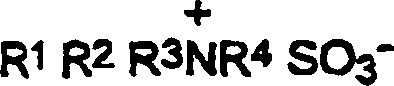
- • die
Amidoalkylbetaïne
der Formel wie Cocamidopropyl-betaïn (Miratain BDJ der Firma Rhône-Poulenc)

- • die
Sulfobetaïne
der Formel

wobei in den Formeln die Reste R1 einen Rest Alkyl oder Alkenyl mit 10 bis 24 Kohlenstoffatomen darstellen, R2, R3, R4 und R5, gleich oder verschieden, einen Rest Alkyl oder Alkenyl mit 1 bis 4 Kohlenstoffatomen bedeuten.As examples you can call:
- • the betaïne of the formula like Laurylbetaïn (Miratain BB from Rhône-Poulenc)
- • the sulfobetaines of the formula
- • the Amidoalkylbetaïne the formula such as cocamidopropyl-betaïn (Miratain BDJ from Rhône-Poulenc)
- • the sulfobetaines of the formula
where in the formulas the radicals R 1 represent a radical alkyl or alkenyl having 10 to 24 carbon atoms, R 2 , R 3 , R 4 and R 5 , identical or different, represent an alkyl or alkenyl radical having 1 to 4 carbon atoms.
Unter amphoterem oberflächenaktiven Mittel (A) versteht man jedes oberflächenaktive Mittel, das gleichzeitig eine anionische Ladung und eine kationische Ladung trägt, wobei der Ionisationsgrad dieses Produktes in Abhängigkeit vom pH-Wert des Mediums, in dem es sich befindet, schwankt. Diese Produkte weisen einen isoelektrischen Punkt (IEP) zwischen 3,5 und 6,5 auf.Under amphoteric surfactant Agent (A) is understood to mean any surfactant simultaneously carries an anionic charge and a cationic charge, wherein the degree of ionization of this product as a function of the pH of the medium, in which it is located, fluctuates. These products have an isoelectric Point (IEP) between 3.5 and 6.5.
Als Beispiele kann man nennen:
- – die Alkyl- oder Alkenyl-amphoacetate
oder -amphodiacetate, die allgemeiner der Formel entsprechen: in der R1 einen Rest Alkyl oder Alkenyl mit 10 bis 24 Kohlenstoffatomen darstellt, meistens Ketten Coco oder Lauryl (Miranol C2M und Miranol Ultra C32 der Firma Rhône-Poulenc), und X ein Wasserstoffatom, ein Alkalimetall oder Erdalkalimetall oder ein Amin bedeutet,

- – die Alkyl-amphopropionate oder -dipropionate (Miranol C2M SF der Firma Rhône-Poulenc),
- – die Alkyl-amphohydroxypropyl-sultaine (Miranol CS der Firma Rhône-Poulenc), bei denen die Alkylgruppen 8 bis 24 Kohlenstoffatome enthalten und meistens Gruppen Coco oder Lauryl sind.
- The alkyl or alkenyl amphoacetates or amphodiacetates more generally corresponding to the formula: R1 is a radical of alkyl or alkenyl having 10 to 24 carbon atoms, mostly chains Coco or Lauryl (Miranol C2M and Miranol Ultra C32 from Rhône-Poulenc), and X is a hydrogen atom, an alkali metal or alkaline earth metal or an amine,
- The alkyl amphopropionates or dipropionates (Miranol C2M SF from Rhône-Poulenc),
- The alkyl amphohydroxypropyl sultaines (Miranol CS from Rhône-Poulenc) in which the alkyl groups contain from 8 to 24 carbon atoms and are usually groups Coco or Lauryl.
Gemäß einer Ausführungsvariante der Erfindung kann das amphotere oberflächenaktive Mittel (A) ebenfalls verwendet werden zur Erhöhung der Ablagerung der Teilchen der kosmetisch interessanten, nicht wasserlöslichen organischen Verbindungen (POins) bei der Verdünnung im Fall der Anwendung der genannten kosmetischen Zusammensetzungen, die außerdem mindestens eine wäßrige Dispersion der genannten, nicht wasserlöslichen organischen Teilchen enthalten.According to one variant of the invention, the amphoteric surfactant (A) also used to increase Deposit of particles of cosmetically interesting, not water-soluble organic compounds (POins) when diluted in the case of application said cosmetic compositions which also have at least an aqueous dispersion the said, not water-soluble contain organic particles.
Die genannten Teilchen können in den genannten Zusammensetzungen in einem Verhältnis in der Größenordnung von 0,1 bis 10 Gew.-%, vorzugsweise in der Größenordnung von 0,2 bis 2 Gew.-% vorliegen. Ihre Größe kann zwischen 0,15 und 70 Mikrometer betragen.The mentioned particles can in the said compositions in a ratio of the order of magnitude from 0.1 to 10% by weight, preferably of the order of 0.2 to 2% by weight available. Your size can between 0.15 and 70 microns.
Unter den kosmetisch interessanten, nicht wasserlöslichen organische Verbindungen (POins), die in Form von Teilchen in wäßriger Dispersion in den genannten kosmetischen Zusammensetzung vorliegend können, sind die nicht wasserlöslichen und nicht flüchtigen Organopolysiloxane (im folgenden auch als "nicht wasserlösliche und nicht flüchtige Silicone" bezeichnet) zu erwähnen, unter denen man die Öle, Gummis oder die Harze Polyalkylsiloxane, Polyarylsiloxane, Polyalkylarylsiloxane oder ihre funktionalisierten, nicht wasserlöslichen Derivate oder ihre nicht flüchtigen Mischungen nennen kann.Under the cosmetically interesting, non-water-soluble organic compounds (POins), in the form of particles in aqueous dispersion in said cosmetic composition are present, are not water-soluble and non-volatile Organopolysiloxanes (hereinafter also referred to as "non-water-soluble and non-volatile silicones"), under which one the oils, Gums or the resins polyalkylsiloxanes, polyarylsiloxanes, polyalkylarylsiloxanes or their functionalized, non-water-soluble derivatives or theirs non-volatile Can call mixtures.
Die genannten Organopolysiloxane werden als nicht wasserlöslich und nicht flüchtig betrachtet, wenn ihre Löslichkeit in Wasser unter 50 g/Liter liegt und ihre innere Viskosität mindestens 3000 mPa.s beträgt.The Organopolysiloxanes mentioned are not water-soluble and nonvolatile considered if their solubility in water is less than 50 g / liter and its inherent viscosity is at least 3000 mPa.s is.
Als besondere Beispiele für nicht wasserlösliche und nicht flüchtige Organopolysiloxane kann man die Silicongummis wie beispielsweise den Diphenyl-dimethicon-Gummi, gehandelt von der Firma Rhône-Poulenc, nennen und vorzugsweise die Polydimethylsiloxane mit einer Viskosität von mindestens gleich 600000 mPa.s bei 25°C und in noch mehr bevorzugter Weise, diejenigen mit einer Viskosität von über 2000000 mPa.s bei 25°C, wie das Mirasil DM 500000®, gehandelt von der Firma Rhône-Poulenc.As specific examples of non-water-soluble and nonvolatile organopolysiloxanes, mention may be made of silicone gums such as diphenyl dimethicone gum sold by Rhône-Poulenc, and preferably polydimethylsiloxanes having a viscosity of at least 600,000 mPa.s at 25 ° C and even more preferably, those with a viscosity greater than 2000000 mPa.s at 25 ° C as the Mirasil DM 500 000 ®, marketed by the company Rhone-Poulenc.
Die nicht wasserlöslichen und nicht flüchtigen Organopolysiloxane oder Silicone befinden sich in dispergierter Form in der kosmetischen Zusammensetzung vor, die sie enthält. Sie liegen in Form von Teilchen vor, deren Größe in Abhängigkeit von der Beschaffenheit der kosmetischen Zusammensetzung oder der für die genannte Zusammensetzung gesuchten Leistungsfähigkeit ausgewählt werden kann. Im allgemeinen kann diese Größe von 0,02 bis 70 Mikrometer variieren. In bevorzugter Weise liegt diese Größe im Bereich von 1 bis 80 Mikrometer, ganz besonders im Bereich von 1 bis 30 Mikrometer.The not water-soluble and non-volatile Organopolysiloxanes or silicones are dispersed Form in the cosmetic composition that contains it. she are in the form of particles whose size depends on the nature of the cosmetic composition or of the said composition sought efficiency selected can be. In general, this size can be from 0.02 to 70 microns vary. Preferably, this size is in the range of 1 to 80 Micrometer, especially in the range of 1 to 30 microns.
Diese Siliconteilchen können aus der Mischung von Siliconen bestehen, deren Anwesenheit mit dem Einsatz des interessanten kosmetischen Siliconmittels in der kosmetischen Zusammensetzung einhergeht. So können die kosmetisch interessanten Organopolysiloxane zuvor in den flüchtigen oder nicht flüchtigen Siliconderivaten von geringer Viskosität dispergiert oder gelöst und anschließend in der kosmetischen Zusammensetzung emulgiert werden. Unter den Siliconen mit geringer Viskosität kann man die cyclischen flüchtigen Silicone und die Polydimethylsiloxane mit niedriger Masse nennen.These silicone particles may consist of the mixture of silicones whose presence is associated with the use of the silicone cosmetic benefit agent in the cosmetic composition. Thus, the cosmetically interesting organopolysiloxanes can be previously dispersed or dissolved in the volatile or non-volatile silicone derivatives of low viscosity and then in the cosmetic Zusammen be emulsified. Among the low viscosity silicones may be mentioned the cyclic volatile silicones and the low mass polydimethylsiloxanes.
Man kann ebenfalls als Polyorganosiloxane die Derivate von funktionalisierten Siliconen erwähnen, wie die Aminderivate, beispielsweise das Mirasil ADM-E, gehandelt von der Firma Rhône-Poulenc (direkt eingesetzt in Form von Emulsion in der kosmetischen Zusammensetzung oder ausgehend von vorformulierten Mikroemulsionen).you can also be functionalized as polyorganosiloxanes the derivatives of Silicones mention how the amine derivatives, for example the Mirasil ADM-E, traded by Rhône-Poulenc (used directly in the form of emulsion in the cosmetic composition or starting of preformulated microemulsions).
Man kann ebenfalls als unlösliche organische Verbindungen, die in Form von Teilchen anwesend sein können, Öle nennen, die konditionierende, schützende oder weichmachende Funktionen ausüben. Diese Öle werden im allgemeinen unter den Alkylmonoglyceriden, den Alkyldiglyceriden, den Triglyceriden wie den aus Pflanzen oder Pflanzentei1en extrahierten Ölen (Palmöl, Kopraöl, Baumwollsamen öl, Sojaöl, Sonnenblumenöl, Olivenöl, Weintraubenkernöl, Sesamöl, Erdnußöl, Rizinusöl ...) oder den Ölen tierischer Herkunft (Talg, Fischöle ...), den Derivaten dieser Öle wie den hydrierten Ölen, den Derivaten von Lanolin, den Mineralölen oder den Paraffinölen, Perhydrosqualan, Squalen, den Diolen wie 1,2-Dodecandiol, Cetylalkohol, Stearylalkohol, Oleinalkohol, den fetten Estern wie Isopropylpalmitat, 2-Ethylhexyl-cocoat, Myristyl-myristat, den Estern der Milchsäure, Stearinsäure, Behensäure und Isostearinsäure ausgewählt.you can also be considered insoluble organic compounds that may be present in the form of particles, oils, the conditioning, protective or softening functions. These oils are generally under the alkyl monoglycerides, the alkyl diglycerides, the triglycerides such as oils extracted from plants or plant extracts (palm oil, copra oil, cottonseed oil, soybean oil, sunflower oil, olive oil, grape seed oil, sesame oil, peanut oil, castor oil, etc.) or the oils of animal origin (tallow, fish oils ...), the derivatives of these oils like the hydrogenated oils, the derivatives of lanolin, mineral oils or paraffin oils, perhydrosqualane, Squalene, the diols such as 1,2-dodecanediol, cetyl alcohol, stearyl alcohol, Oleic alcohol, the fatty esters such as isopropyl palmitate, 2-ethylhexyl cocoate, Myristyl myristate, the esters of lactic acid, stearic acid, behenic acid and isostearic selected.
Man kann ebenfalls Teilchen von bakteriziden oder fungiziden Mitteln nennen, um die Desinfektion der Haut zu verbessern, wie beispielsweise das Triclosan, Mittel gegen Kopfschuppen wie Zinkpyrithion oder Octopyrox, insektizide Mittel wie natürliche oder synthetische Pyrethroide. Diese verschiedenen organischen Moleküle können gegebenenfalls zuvor in geeignete Matrizen nach üblichen, dem Fachmann bekannten Methoden eingekapselt werden. Unter diesen kann man beispielsweise die Einkapselung der organischen Moleküle in Polymer-Latizes nennen.you may also be particles of bactericidal or fungicidal agents to improve the disinfection of the skin, such as triclosan, an anti-dandruff remedy such as zinc pyrithione or Octopyrox, insecticidal agents such as natural or synthetic pyrethroids. These various organic molecules may be previously in suitable matrices according to usual, encapsulated methods known in the art. Under these For example, it is possible to encapsulate the organic molecules in polymer latexes call.
Die in Wasser unlöslichen organischen Teilchen können ebenfalls aus Mitteln zum Schutz der Haut und/oder der Haare gegenüber Angriffen von Sonnenlicht und UV-Strahlung bestehen, wie aus Solarfiltern, die chemische Verbindungen mit starker Absorption von UV-Strahlung sind, wie die in der europäischen Direktive No. 76/768/CEE, ihren Anlagen und den späteren Änderungen dieser Direktive empfohlenen Verbindungen.The insoluble in water organic particles can also from means to protect the skin and / or hair against attacks sunlight and UV radiation, such as solar filters, the chemical compounds with strong absorption of UV radiation are like those in the European Directive No. 76/768 / CEE, their annexes and subsequent amendments this directive recommended connections.
In dem Fall, wo die kosmetisch interessanten, unlöslichen organischen Verbindungen eine sehr beträchtliche mizellare Löslichkeit aufweisen (bezogen auf die Menge der anwesenden oberflächenaktiven Mittel) oder bei Umgebungstemperatur in fester Form vorliegen, können sie entweder in einem organischen Trägerstoff, wie in Mineralölen oder natürlichen Ölen, Siliconderivaten, Wachsen, in Lösung gebracht, oder in Matrizen wie den Polymeren (beispielsweise acrylischen) eingekapselt werden, die in Dispersion, beispielsweise in Form von Latex vorliegen.In the case where the cosmetically interesting, insoluble organic compounds a very considerable one micellar solubility (based on the amount of surfactants present Medium) or in solid form at ambient temperature, they can either in an organic carrier, as in mineral oils or natural oils, silicone derivatives, Grow, in solution or in matrices such as the polymers (for example acrylic) be encapsulated in dispersion, for example in the form of Latex present.
Ein zweiter Gegenstand der vorliegenden Erfindung besteht in wäßrigen, transparenten kosmetischen Zusammensetzungen für das Haar und/oder die Haut, die zum Spülen vorgesehen sind, umfassend mindestens zu 90% ihres Gewichtes eine wäßrige Phase (Φ), umfassend
- – mindestens ein amphoteres oberflächenaktives Mittel (A) in einer Menge in der Größenordnung von 0,5 bis 10 Gew.-%, vorzugsweise in der Größenordnung von 0,5 bis 3 Gew.-%, bezogen auf das Gewicht der genannten kosmetischen Zusammensetzungen, und
- – 8 bis 20% ihres Gewichtes ein System (S), gebildet von mindestens einem anionischen oberflächenaktiven Mittel (TAn), mindestens einem oberflächenaktiven Mittel, ausgewählt unter den Betaïnen (TB), und mindestens einem wasserlöslichen oder wasserdispergierbaren kationischen Polymer, abgeleitet von einem Polysaccharid (PolC),
- At least one amphoteric surfactant (A) in an amount of the order of 0.5 to 10% by weight, preferably of the order of 0.5 to 3% by weight, based on the weight of said cosmetic compositions, and
- From 8 to 20% of its weight, a system (S) formed from at least one anionic surfactant (TAn), at least one surfactant selected from betaines (TB), and at least one water-soluble or water-dispersible cationic polymer derived from a polysaccharide (PolC),
Im Hinblick auf eine gute Realisierung der Erfindung umfaßt die genannte wäßrige Phase (Φ):
- – in der Größenordnung von 5 bis 15% ihres Gewichtes, vorzugsweise in der Größenordnung von 8 bis 12% ihres Gewichtes, von mindestens einem anionischen oberflächenaktiven Mittel (TAn),
- – in der Größenordnung von 0,5 bis 10 ihres Gewichtes, vorzugsweise in der Größenordnung von 0,5 bis 3% ihres Gewichtes, von mindestens einem oberflächenaktiven Mittel, ausgewählt unter den Betaïnen (TB), und
- – in der Größenordnung von 0,015 bis 2% ihres Gewichtes, vorzugsweise in der Größenordnung von 0,05 bis 0,5% ihres Gewichtes, von mindestens einem kationischen Polymer (PolC). Beispiele für kationische Polymere (PolC) und oberflächenaktive Mittel (TAn), (TB) und (A) können in den verschiedenen Zusammensetzungen vorliegen, wie sie bereits oben beschrieben wurden.
- On the order of 5 to 15% of its weight, preferably of the order of 8 to 12% of its weight, of at least one anionic surfactant (TAn),
- - In the order of 0.5 to 10 of their weight, preferably in the order of 0.5 to 3% of their weight, of at least one surfactant selected from betweens (TB), and
- On the order of 0.015 to 2% of its weight, preferably of the order of 0.05 to 0.5% of its weight, of at least one cationic polymer (PolC). Examples of cationic polymers (PolC) and surfactants (TAn), (TB) and (A) can be present in the various compositions already described above.
Man versteht unter dem Ausdruck kosmetische Zusammensetzung oder Formulierung alle kosmetischen Produkte oder Präparationen, wie sie in der Anlage I ("illustrative list by category of cosmetic products") der europäischen Direktive No. 76/768/CEE vom 27. Juli 1976, der sogenannten kosmetischen Direktive, beschrieben sind. Die den Gegenstand der vorliegenden Erfindung bildenden kosmetischen Zusammensetzungen können in einer großen Anzahl von Produkttypen für die Haut und/oder das Haar formuliert werden, in Gelen (insbesondere Frisiergelen), Konditioniermitteln, Formulierungen für das Frisieren und zur Erleichterung des Kämmens der Haare, Formulierungen zum Spülen, Lotionen für die Hände und den Körper, Produkten zur Regulierung der Haut-Hydratation, Toilette-Milch, Abschminkmitteln, Haarwaschmitteln, Duschgelen, flüssigen Seifen und vielen anderen Zusammensetzungen des gleichen Typs.you means by the term cosmetic composition or formulation all cosmetic products or preparations as they are in the Annex I ("illustrative list by category of cosmetic products ") of European Directive No. 76/768 / CEE of 27 July 1976, the so-called Cosmetic Directive are. The subject of the present invention forming cosmetic Compositions can in a big one Number of product types for the skin and / or the hair are formulated in gels (in particular Hair styling gels), conditioners, styling formulations and for the convenience of combing hair, rinse-off formulations, Lotions for hands and the body, Skin hydration regulating products, toilet milk, make-up removing preparations, Shampoos, shower gels, liquid soaps and many other compositions of the same type.
Gemäß einer Ausführungsvariante der Erfindung können die genannten kosmetischen Zusammensetzungen außerdem Teilchen von kosmetisch interessanten, nicht wasserlöslichen organischen Verbindungen (POins) enthalten.According to one variant of the invention said cosmetic compositions also contain particles of cosmetic interesting, not water-soluble containing organic compounds (POins).
Die genannten Teilchen können in den genannten Zusammensetzungen in einem Verhältnis in der Größenordnung von 0,1 bis 10 Gew.-%, vorzugsweise in der Größenordnung von 0,2 bis 2 Gew.-% anwesend sein. Ihre Größe kann zwischen 0,15 und 70 Mikrometer betragen. Beispiele für Bestandteile (POins), die in den genannten Zusammensetzungen anwesend sein können, wurden bereits oben erwähnt.The mentioned particles can in the said compositions in a ratio of the order of magnitude from 0.1 to 10% by weight, preferably of the order of 0.2 to 2% by weight to be present. Your size can between 0.15 and 70 microns. Examples of ingredients (POins) which may be present in said compositions already mentioned above.
Im Hinblick auf eine gute Realisierung der Erfindung können die den Gegenstand der vorliegenden Erfindung bildenden kosmetischen Zusammensetzungen außerdem Fixativ-Harze umfassen. Diese Fixativ-Harze sind im allgemeinen in Konzentrationen zwischen 0,01 und 10%, vorzugsweise zwischen 0,5 und 5% anwesend.in the With a view to a good realization of the invention, the the subject of the present invention forming cosmetic Compositions as well Include fixative resins. These fixative resins are generally in concentrations between 0.01 and 10%, preferably between 0.5 and 5%.
Diese Fixativ-Harze werden vorzugsweise ausgewählt unter den Copolymeren Methylacrylat/Acrylamid, den Copolymeren Polyvinylmethylether/Maleinsäureanhydrid, den Copolymeren Vinylacetat/Crotonsäure, den Copolymeren Octylacrylamid/Methylacrylat/Butylaminoethylmethacrylat, den Polyvinylpyrrolidonen, den Copolymeren Polyvinylpyrrolidon/Methylmethacrylat, den Copolymeren Polyvinylpyrrolidon/Vinylacetat, den Polyvinylalkoholen, den Copolymeren Polyvinylalkohol/Crotonsäure, den Copolymeren Polyvinylalkohol/Maleinsäure, den Hydroxypropylcellulosen, den Hydroxypropyl-Guars, den Natrium-polystyrolsulfonaten, den Terpolymeren Polyvinylpyrrolidon/Ethylmethacrylat/Methacrylsäure, den Monomethylethern von Poly-(Methylvinylether/Maleinsäure), den Polyvinylacetaten, gepfropft mit polyoxyethylenischen Grundketten (EP-A-219 048), den Copolyestern abgeleitet von Säure, Anhydrid oder einem terephthalischen und/oder isophthalischen und/oder sulfoisophthalischen Diester und einem Diol, wie:
- – die Polyester-Copolymeren auf der Basis von Struktureinheiten Ethylen-terephthalat und/oder Propylen-terephthalat und Polyoxyethylen-terephthalat (US-A-3 959 230, US-A-3 893 929, US-A-4 116 896, US-A-4 702 857, US-A-4 770 666);
- – die sulfonierten Polyester-Oligomeren, erhalten durch Sulfonierung eines Oligomer-Derivates von ethoxyliertem Allylakohol, Dimethylterephthalat und 1,2-Propylendiol (US-A-4 968 451);
- – die Polyester-Copolymeren auf der Basis von Struktureinheiten Propylen-terephthalat und Polyoxyethylenterephthalat mit Endgruppen Alkylpolyethoxy (US-A-4 702 857) oder anionischen Gruppen Sulfopolyethoxy (US-A-4 721 580), Sulfoaryl (US-A-4 877 896);
- – die Polyester-Polyurethane, erhalten durch Reaktion eines Polyesters, erhalten ausgehend von Adipinsäure und/oder Terephthalsäure und/oder Sulfoisonhthalsäure und einem Diol, mit einem Pre polymer mit Isocyanat-Endgruppen, erhalten ausgehend von einem Polyoxyethylenglycol und einem Diisocyanat (FR-A-2 334 698);
- – die ethoxylierten Monoamine oder Polyamine, die Polymeren von ethoxylierten Aminen (US-A-4 597 898, EP-A-11 984);
- – die sulfonierten Polyester-Oligomeren, erhalten durch Kondensation von Isophthalsäure, Dimethyl-sulfosuccinat und Diethylenglycol (FR-A-2 236 926);
- – die Polyester-Copolymeren, abgeleitet von Dimethylterephthalat, Isophthalsäure, Sulfoisophthalat von Dimethyl und Ethylenglycol (EP-A-540374);
- – die Copolymeren, umfassend Polyester-Einheiten, abgeleitet von Dimethylterephthalat, Isophthalsäure, Sulfoisophthalat von Dimethyl und Ethylenglycol und Einheiten Polyorganosiloxan (FR-A-2-728 915).
- The polyester copolymers based on structural units ethylene terephthalate and / or propylene terephthalate and polyoxyethylene terephthalate (US Pat. No. 3,959,230, US Pat. No. 3,893,929, US Pat. No. 4,116,896, US Pat. A-4 702 857, US-A-4 770 666);
- The sulfonated polyester oligomers obtained by sulfonating an oligomer derivative of ethoxylated allyl alcohol, dimethyl terephthalate and 1,2-propylene diol (US Pat. No. 4,968,451);
- The polyester copolymers based on structural units of propylene terephthalate and polyoxyethylene terephthalate having end groups alkylpolyethoxy (US Pat. No. 4,702,857) or anionic groups sulfopolyethoxy (US Pat. No. 4,721,580), sulfoaryl (US Pat. No. 4,877,896) );
- The polyester-polyurethanes obtained by reaction of a polyester obtained from adipic acid and / or terephthalic acid and / or sulfoisonhthalic acid and a diol with an isocyanate-terminated prepolymer obtained from a polyoxyethylene glycol and a diisocyanate (FR-A) 2 334 698);
- The ethoxylated monoamines or polyamines, the polymers of ethoxylated amines (US-A-4 597 898, EP-A-11 984);
- The sulfonated polyester oligomers obtained by condensation of isophthalic acid, dimethyl sulfosuccinate and diethylene glycol (FR-A-2 236 926);
- The polyester copolymers derived from dimethyl terephthalate, isophthalic acid, sulfoisophthalate of dimethyl and ethylene glycol (EP-A-540374);
- The copolymers comprising polyester units derived from dimethyl terephthalate, isophthalic acid, Sulfoisophthalate of dimethyl and ethylene glycol and polyorganosiloxane units (FR-A-2-728 915).
In bevorzugter Weise sind die Fixativ-Harze vom Typ Polyvinylpyrrolidon (PVP), Copolymere von Polyvinylpyrrolidon und Methylmethacrylat, Copolymere von Polyvinylpyrrolidon und Vinylacetat (VA), Copolymere Polyterephthalat von Ethylenglycol/Polyethylenglycol, Copolymere Polyterephthalat von Ethylenglycol/Polyethylenglycol/Natrium-Polyisophthalat-sulfonat und ihre Mischungen. Diese Fixativ-Harze werden vorzugsweise in dem gewählten Trägerstoff dispergiert oder aufgelöst.In Preferably, the fixative resins are of the polyvinylpyrrolidone type (PVP), copolymers of polyvinyl pyrrolidone and methyl methacrylate, Copolymers of polyvinylpyrrolidone and vinyl acetate (VA), copolymers Polyterephthalate of ethylene glycol / polyethylene glycol, copolymers Polyterephthalate of ethylene glycol / polyethylene glycol / sodium polyisophthalate sulfonate and their mixtures. These fixative resins are preferably used in the chosen one excipient dispersed or dissolved.
Die den Gegenstand der Erfindung bildenden kosmetischen Zusammensetzungen können ebenfalls Polymerderivate enthalten, die eine Schutzfunktion ausüben.The the subject of the invention forming cosmetic compositions can also contain polymer derivatives that exert a protective function.
Diese Polymerderivate können in Mengen in der Größenordnung von 0,01 bis 10 Gew.-%, vorzugsweise etwa 0,1 bis 5 Gew.-% und noch bevorzugter in der Größenordnung von 0,2 bis 3 Gew.-% anwesend sein. Es sind Mittel wie
- – Cellulosederivate wie die Hydroxyether von Cellulose, Methylcellulose, Ethylcellulose, Hydroxypropylmethylcellulose, Hydroxybutylmethylcellulose,
- – Polyvinylester, gepfropft auf polyalkylenische Grundketten (EP-A-219 048);
- – Polyvinylalkohole.
- Cellulose derivatives such as the hydroxyethers of cellulose, methylcellulose, ethylcellulose, hydroxypropylmethylcellulose, hydroxybutylmethylcellulose,
- Polyvinyl esters grafted onto polyalkylenic backbones (EP-A-219 048);
- - Polyvinyl alcohols.
Die Leistungsfähigkeiten der den Gegenstand der Erfindung bildenden kosmetischen Zusammensetzungen können ebenfalls durch Verwendung von Weichmachern verbessert werden. Die Weichmacher werden zwischen 0,1 bis 10% der Formulierung bilden können, vorzugsweise von 1 bis 10%. Unter den besonders nützlichen Weichmachern kann man die Adipate, die Phthalate, die Isophthalate, die Azelate, die Stearate, die Silicon-copolyole, die Glycole, Rizinusöl, oder ihre Mischungen nennen.The capabilities the subject of the invention forming cosmetic compositions can can also be improved by using plasticizers. The Plasticizers will form between 0.1 to 10% of the formulation can, preferably from 1 to 10%. Among the most useful Plasticizers can be added to adipates, phthalates, isophthalates, the azelates, the stearates, the silicone copolyols, the glycols, castor oil, or to call their mixtures.
Man kann ebenfalls diesen Zusammensetzungen Maskierungsmittel für Metalle zusetzen, insbesondere diejenigen, die Calcium als Citrationen maskieren.you can also mask these compositions for metals especially those that mask calcium as citrate ions.
Man kann ebenfalls in diese kosmetischen Zusammensetzungen, die den Gegenstand der Erfindung bilden, Feuchtigkeitsmittel einbringen und in diesem Zusammenhang Glycerin, Sorbitol, Harnstoff, Kollagen, Gelatine, Aloe vera, Hyaluronsäure nennen.you may also be incorporated into these cosmetic compositions containing the Form of the invention, introduce moisturizing and in this context glycerin, sorbitol, urea, collagen, gelatin, Aloe vera, hyaluronic acid call.
Um noch weiter die Reizung oder die Aggression der Kopfhaut zu verringern, kann man auch wasserlösliche oder wasserdispergierbare Polymere zusetzen wie Kollagen oder einige nicht allergische Derivate von tierischen oder pflanzlichen Proteinen (beispielsweise Hydrolysate von Weizenprotein), natürliche Hydrokolloide (Gummi von Guar, Karuba, Tara ...) oder die von Fermentationsprozessen stammen und die Derivate von diesen Polycarbohydraten wie die modifizierten Cellulosen (beispielsweise Hydroxyethylcellulose, Carboxymethylcellulose), die Derivate von Guar oder Karube, wie ihre nichtionischen Derivate (beispielsweise Hydroxypropylguar), die anionischen Derivate (Carboxymethylguar und Carboxymethylhydroxypropylguar).Around to further reduce irritation or scalp aggression, you can also water-soluble or water-dispersible polymers such as collagen or some non-allergic derivatives of animal or vegetable proteins (For example, hydrolyzates of wheat protein), natural hydrocolloids (Gum from Guar, Karuba, Tara ...) or from fermentation processes and the derivatives of these polycarbohydrates such as the modified Celluloses (for example hydroxyethylcellulose, carboxymethylcellulose), the derivatives of guar or karube, such as their nonionic derivatives (For example, hydroxypropyl guar), the anionic derivatives (carboxymethylguar and carboxymethylhydroxypropylguar).
Die Konservierungsmittel wie die Methyl-, Ethyl-, Propyl- und Butylester von para-Hydroxybenzoesäure, Natriumbenzoat, GERMABEN (Markenname) oder jedes chemische Mittel, das die bakterielle Proliferation oder Schimmelpilz verhindert und üblicherweise in den kosmetischen Zusammensetzung verwendet wird, kann im allgemeinen in diese Zusammensetzungen in einer Höhe von 0,01 bis 3 Gew.-% eingebracht werden. Die Mengen von diesen Produkten werden im allgemeinen so eingestellt, daß jede Proliferation von Bakterien, Schimmelpilz oder Hefen in den kosmetischen Zusammensetzungen verhindert wird.The Preservatives such as the methyl, ethyl, propyl and butyl esters of para-hydroxybenzoic acid, Sodium benzoate, GERMABEN (trade name) or any chemical agent, which prevents bacterial proliferation or mold and usually used in the cosmetic composition, in general introduced into these compositions in an amount of 0.01 to 3 wt .-% become. The quantities of these products generally become so set that each Proliferation of bacteria, mold or yeast in the cosmetic Composition is prevented.
Alternativ zu diesen chemischen Mitteln kann man mitunter Mittel verwenden, die die Aktivität des Wassers modifizieren und den osmotischen Druck stark erhöhen, wie die Carbohydrate oder Salze. Zu diesen Bestandteilen gibt man im allgemeinen zur Steigerung einer angenehmen Verwendung der Zusammensetzung durch den Verbraucher ein oder mehrere Parfums, Farbstoffe, unter denen man die in der Anlage IV ("List of colouring agents allowed for use in cosmetic products) der europäischen Direktive No. 76/768CEE vom 27. Juli 1976, der sogenannten kosmetischen Direktive, beschriebenen erwähnen kann und/oder Trübungsmittel wie Pigmente. Es können Parfums, Farbstoffe oder Pigmente zugesetzt werden.alternative One can sometimes use agents for these chemicals. the the activity of the water and greatly increase the osmotic pressure, such as the carbohydrates or salts. These ingredients are given in general for enhancing a pleasant use of the composition the consumer one or more perfumes, dyes, among which those listed in Annex IV ("List of coloring agents allowed for use in cosmetic products) of the European directive No. 76 / 768CEE of 27 July 1976, the so-called Cosmetic Directive, mention mentioned can and / or opacifiers like pigments. It can Perfumes, dyes or pigments are added.
Die Zusammensetzung kann außerdem viskositätssteigernde oder gelbildende Polymere enthalten, wie vernetzte Polyacrylate CARBOPOL, gehandelt von GOODRICH, Cellulosederivate wie Hydroxypropylcellulose, Carboxymethylcellulose, Guars und ihre Derivate .., allein verwendet oder in Assoziation, oder die gleichen Verbindungen, im allgemeinen in Form von wasserlöslichen Polymeren, modifiziert mit hydrophoben Gruppen, die in kovalenter Weise an das Polymergerüst gebunden sind, wie in dem Patent WO 92/16187 beschrieben, und/oder Wasser, um die Gesamtheit der Bestandteile der Formulierung auf 100% zu bringen.The composition may also contain viscosity-increasing or gel-forming polymers, such as crosslinked polyacrylates CARBOPOL, marketed by GOODRICH, cellulose derivatives, such as hydroxypropylcellulose, carboxymethylcellulose, guars and their derivatives., Used alone or in association, or the same compounds, generally in the form of water-soluble polymers modified with hydrophobic groups covalently bonded to the polymer backbone as described in patent WO 92/16187 written, and / or water to bring the totality of the components of the formulation to 100%.
Die den Gegenstand der vorliegenden Erfindung bildenden kosmetischen Zusammensetzungen können ebenfalls polymerische Dispergierungsmittel in der Größenordnung von 0,1 bis 7 Gew.-% enthalten, um die Härte an Calcium und Magnesium zu kontrollieren. Dies sind Mittel wie:
- – wasserlösliche Salze von Polycarbonsäuren mit einer Molekularmasse in der Größenordnung von 2000 bis 100000, erhalten durch Polymerisation oder Copolymerisation von ethylenisch ungesättigten Carbonsäuren wie Acrylsäure, Maleinsäure oder Maleinsäureanhydrid, Fumarsäure, Itaconsäure, Aconitsäure, Mesaconsäure, Citraconsäure, Methylenmalonsäure und ganz besonders die Polyacrylate mit einer Molekularmasse in der Größenordnung von 2000 bis 10000 (US-A-3 308 067), die Copolymeren von Acrylsäure und Maleinsäureanhydrid mit einer Molekularmasse in der Größenordnung von 5000 bis 75000 (EP-A-66 915),
- – die Polyethylenglycole mit einer Molekularmasse in der Größenordnung von 1000 bis 50000.
- Water-soluble salts of polycarboxylic acids having a molecular mass of the order of 2,000 to 100,000, obtained by polymerization or copolymerization of ethylenically unsaturated carboxylic acids such as acrylic acid, maleic acid or maleic anhydride, fumaric acid, itaconic acid, aconitic acid, mesaconic acid, citraconic acid, methylenemalonic acid and especially the polyacrylates with a Molecular mass of the order of 2,000 to 10,000 (US Pat. No. 3,308,067), the copolymers of acrylic acid and maleic anhydride having a molecular mass of the order of 5,000 to 75,000 (EP-A-66 915),
- - The polyethylene glycols having a molecular mass in the order of 1000 to 50,000.
Die folgenden Beispiele werden zur Veranschaulichung angegeben.The The following examples are given by way of illustration.
Beispiel 1example 1
Die folgenden Formulierungen werden in traditioneller Weise hergestellt (End-pH-Wert 6). Die Mengen sind in Prozentsätzen an Wirkstoff ausgedrückt.The The following formulations are prepared in a traditional manner (Final pH 6). The amounts are expressed in percentages of active ingredient.

Die Formulierungen (Formeln) 1 bis 6 der vorstehenden Tabelle, die etwa 10 Gew.-% Trockenextrakt enthalten, werden mit ansteigenden Wassermengen verdünnt. Der Transmissionsgrad der verdünnten Formulierungen wird mit Hilfe eines Spektrophotometers Jasco 7800 gemessen. Der folgende Graph zeigt die Entwicklung des Transmissionsgrades in Abhängigkeit von der Konzentration an Wirkstoff.The Formulations (formulas) 1 to 6 of the above table, which are approximately 10 wt .-% dry extract, are with increasing amounts of water diluted. The transmittance of the diluted Formulations are made using a spectrophotometer Jasco 7800 measured. The following graph shows the evolution of the transmittance dependent on from the concentration of active ingredient.
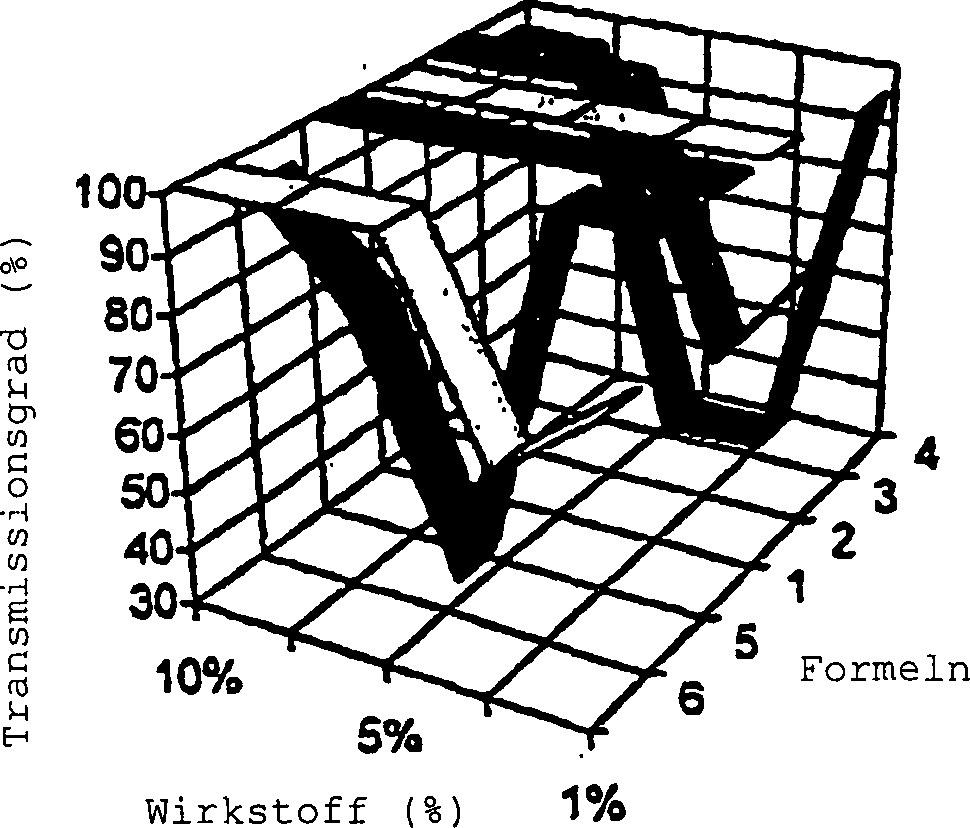
Man stellt fest, daß die Formulierungen, die Natrium-cocoamphoacetat enthalten, die Anwesenheit eines Phänomens der Ausfällung bei der Verdünnung zeigen, während die Formulierungen, die nur Cocamidopropyl-betaïn enthalten, bei der Verdünnung stabil bleiben.you notes that the Formulations that contain sodium cocoamphoacetate, the presence a phenomenon the precipitate in the dilution show while the formulations containing only cocamidopropyl-betaïn are stable upon dilution stay.
Beispiel 2Example 2
Die folgenden Formulierungen werden in traditioneller Weise hergestellt (End-pH-Wert 6). Die Mengen sind in Prozentsätzen an Wirkstoff ausgedrückt.The The following formulations are prepared in a traditional manner (Final pH 6). The amounts are expressed in percentages of active ingredient.

Die Formulierungen (Formeln) der vorstehenden Tabelle, die etwa 10 Gew.-% Trockenextrakt enthalten, werden mit ansteigenden Wassermengen verdünnt. Der Transmissionsgrad der verdünnten Formulierungen wird mit Hilfe eines Spektrophotometers Jasco 7800 gemessen. Der folgende Graph zeigt die Entwicklung des Transmissionsgrades in Abhängigkeit von der Konzentration.The Formulations (formulas) of the above table containing about 10% by weight Dry Extract are diluted with increasing amounts of water. Of the Transmittance of the diluted Formulations are made using a spectrophotometer Jasco 7800 measured. The following graph shows the evolution of the transmittance dependent on from the concentration.

Die Formulierungen, die amphotere oberflächenaktive Mittel enthalten, zeigen die Anwesenheit eines Phänomens der Ausfällung bei der Verdünnung. Die Formulierungen, die nur Cocamidopropyl-betaïn enthalten, bleiben bei der Verdünnung stabil.The Formulations containing amphoteric surfactants show the presence of a phenomenon the precipitate in the dilution. The formulations containing only cocamidopropyl-betaïn remain with the dilution stable.
Beispiel 3Example 3
Die folgenden Formulierungen werden in traditioneller Weise hergestellt (End-pH-Wert 6). Die Mengen sind in Prozentsätzen an Wirkstoff ausgedrückt.The The following formulations are prepared in a traditional manner (Final pH 6). The amounts are expressed in percentages of active ingredient.

Die Formulierungen (Formeln) der vorstehenden Tabelle, die etwa 10 Gew.-% Trockenextrakt enthalten, werden mit ansteigenden Wassermengen verdünnt. Der Transmissionsgrad der verdünnten Formulierungen wird mit Hilfe eines Spektrophotometers Jasco 7800 gemessen.The Formulations (formulas) of the above table containing about 10% by weight Dry Extract are diluted with increasing amounts of water. Of the Transmittance of the diluted Formulations are made using a spectrophotometer Jasco 7800 measured.
Der folgende Graph zeigt die Entwicklung des Transmissionsgrades in Abhängigkeit von der Konzentration an Wirkstoff.Of the The following graph shows the evolution of the transmittance in dependence from the concentration of active ingredient.
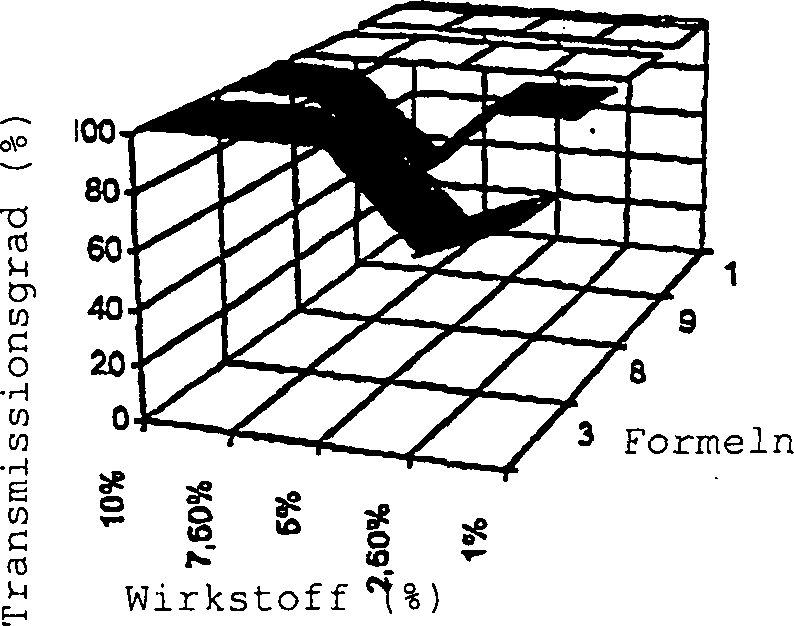
Die Anwesenheit von amphoterem oberflächenaktiven Mittel führt zu Phänomenen der Ausfällung bei der Verdünnung.The Presence of amphoteric surfactant leads to phenomena the precipitate in the dilution.
Beispiel 4Example 4
Vergleich (nicht hydroxyalkyliertes kationisches Guar) Die folgenden Formulierungen werden in traditioneller Weise hergestellt (End-pH-Wert 6). Die Mengen sind in Prozentsätzen an Wirkstoff ausgedrückt.comparison (non hydroxyalkylated cationic guar) The following formulations are prepared in a traditional manner (final pH 6). The Quantities are in percentages expressed in terms of active ingredient.
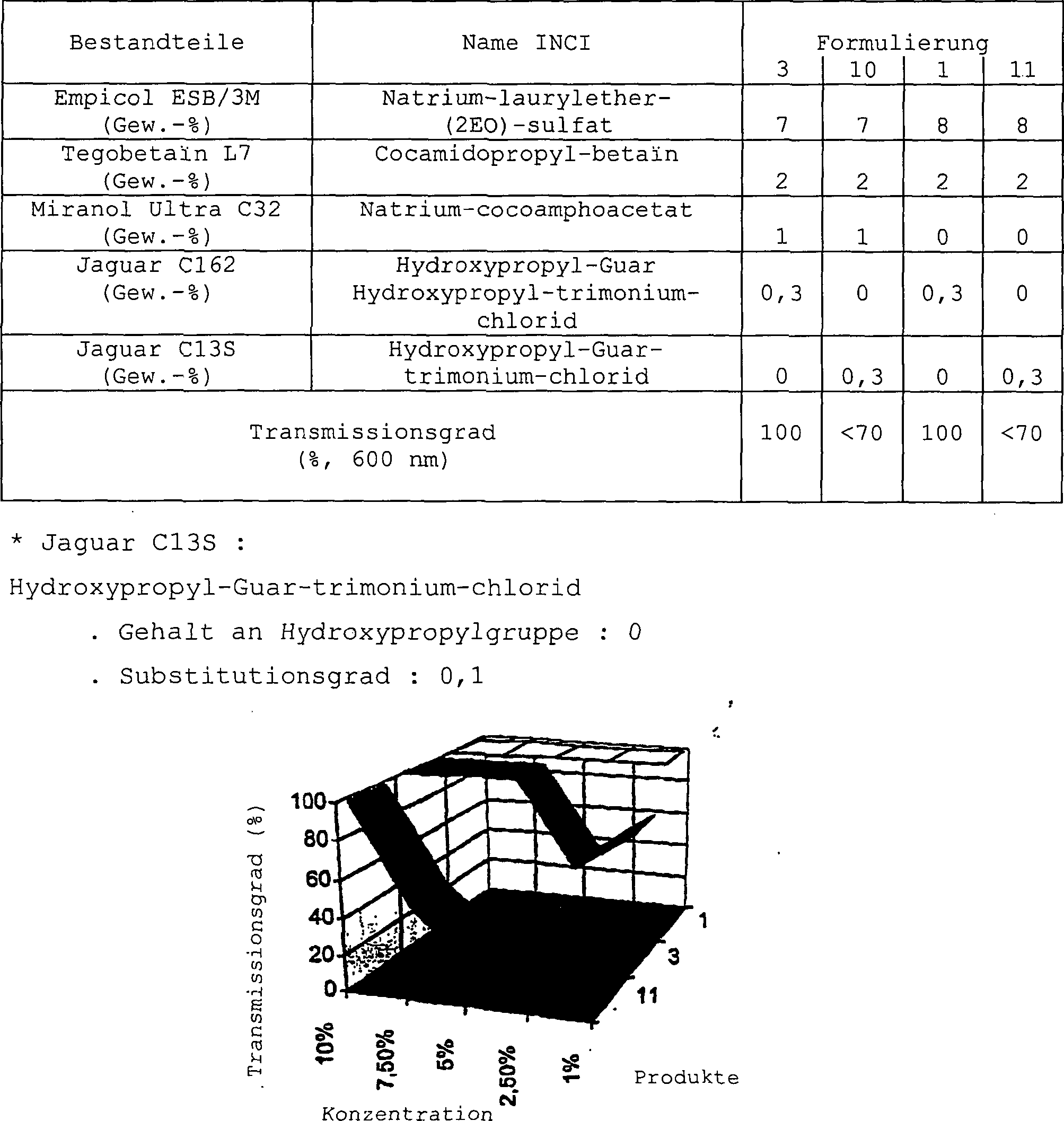
Die Formulierung 11, die ein Hydroxypropyl-Guar-trimoniumchlorid (das heißt, nicht hydroxyalkyleniert) enthält, fällt sogar bei Abwesenheit eines amphoteren oberflächenaktiven Mittels aus.The Formulation 11, which is a hydroxypropyl guar trimonium chloride (the is called, not hydroxyalkylenated), even falls in the absence of an amphoteric surfactant.
Beispiel 5Example 5
Vergleich (synthetische Polymere, keine Polysaccharide) Die folgenden Formulierungen werden in traditioneller Weise hergestellt (End-pH-Wert 6). Die Mengen sind in Prozentsätzen an Wirkstoff ausgedrückt.comparison (synthetic polymers, not polysaccharides) The following formulations are prepared in a traditional manner (final pH 6). The Quantities are in percentages expressed in terms of active ingredient.
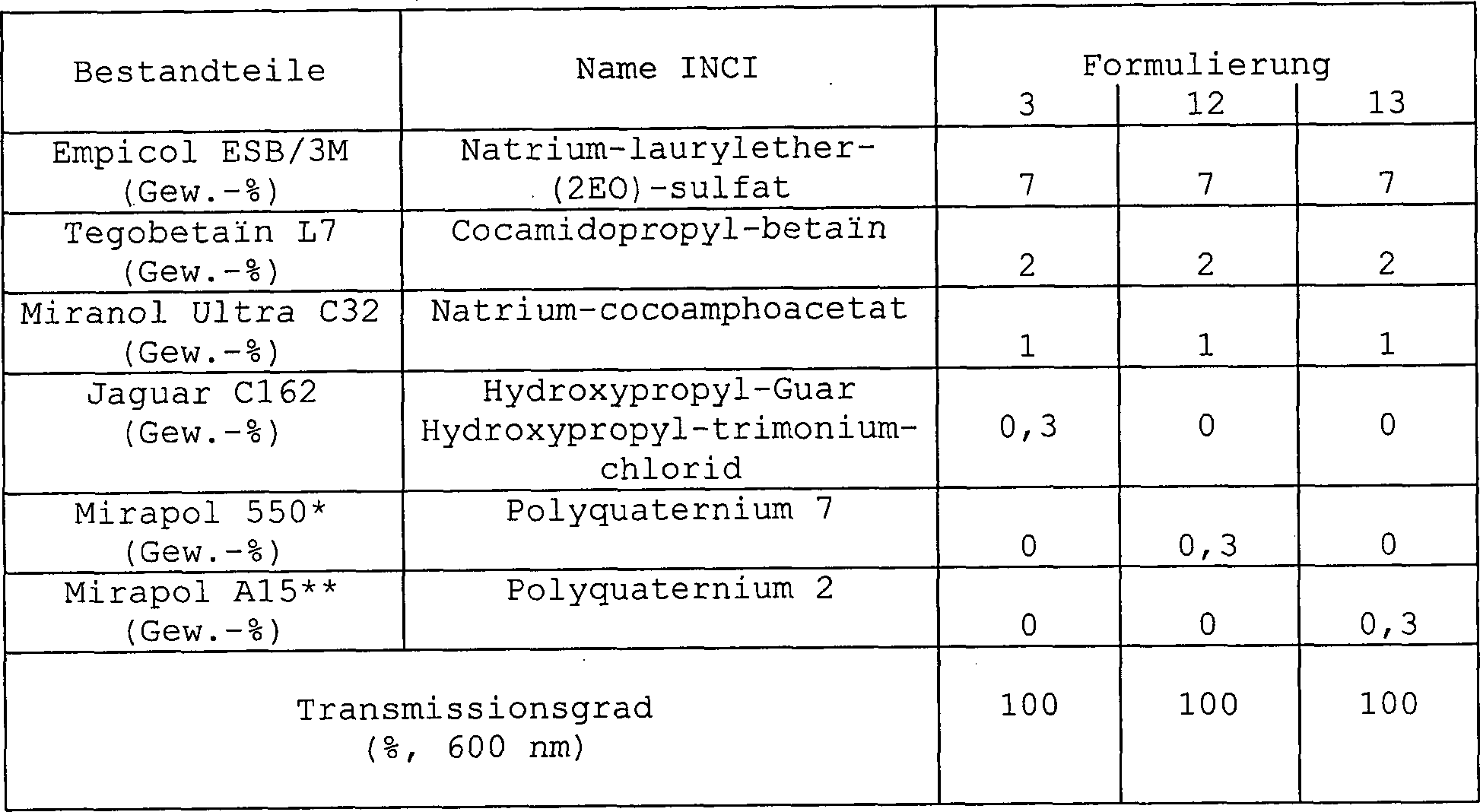
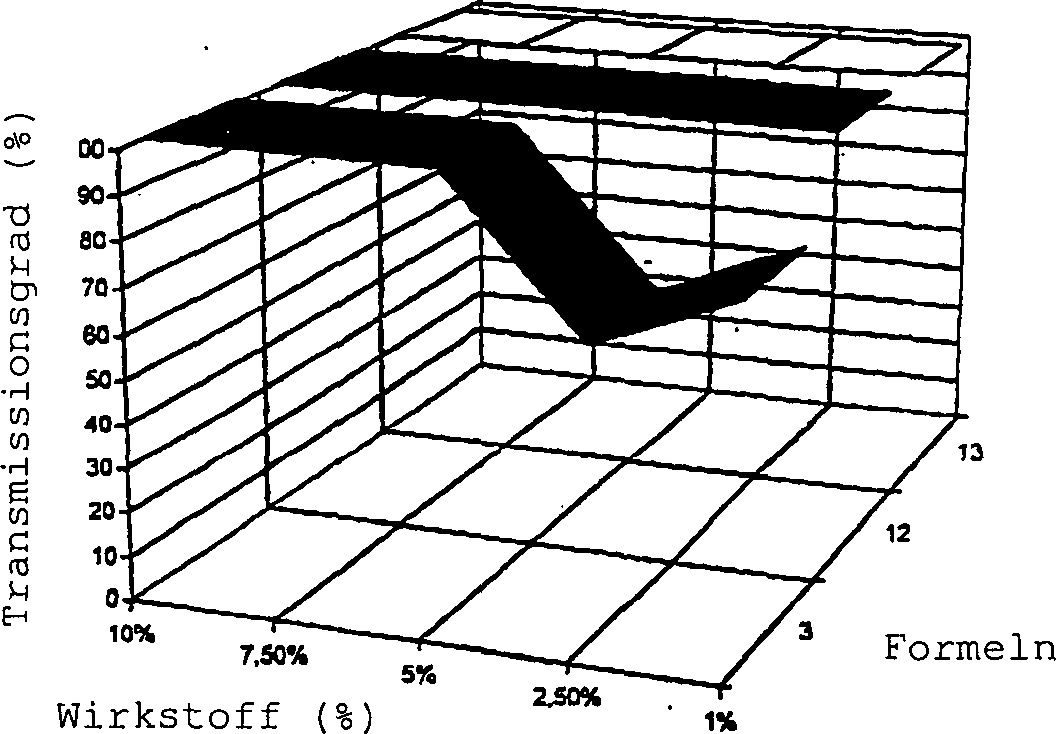
Die Formulierungen (Formeln) der vorstehenden Tabelle, die etwa 10 Gew.-% Trockenextrakt enthalten, werden mit ansteigenden Wassermengen verdünnt. Der Transmissionsgrad der verdünnten Formulierungen wird mit Hilfe eines Spektrophotometers Jasco 7800 gemessen.The Formulations (formulas) of the above table containing about 10% by weight Dry Extract are diluted with increasing amounts of water. Of the Transmittance of the diluted Formulations are made using a spectrophotometer Jasco 7800 measured.
Der folgende Graph zeigt die Entwicklung des Transmissionsgrades in Abhängigkeit von der Konzentration an Wirkstoff.Of the The following graph shows the evolution of the transmittance in dependence from the concentration of active ingredient.
Man stellt fest, daß die Formulierungen, die Mirapol 550 und Mirapol A15 und kationische Polymere enthalten, die sich nicht von Polysacchariden ableiten, bei der Verdünnung nicht ausfallen.you notes that the Formulations, the Mirapol 550 and Mirapol A15 and cationic Contain polymers that are not derived from polysaccharides, in the dilution do not fail.
Beispiel 6Example 6
Sensorische AnalyseSensory analysis
Die folgenden Formulierungen werden in traditioneller Weise hergestellt (End-pH-Wert 6). Die Mengen sind in Prozentsätzen an Wirkstoff ausgedrückt.The The following formulations are prepared in a traditional manner (Final pH 6). The amounts are expressed in percentages of active ingredient.
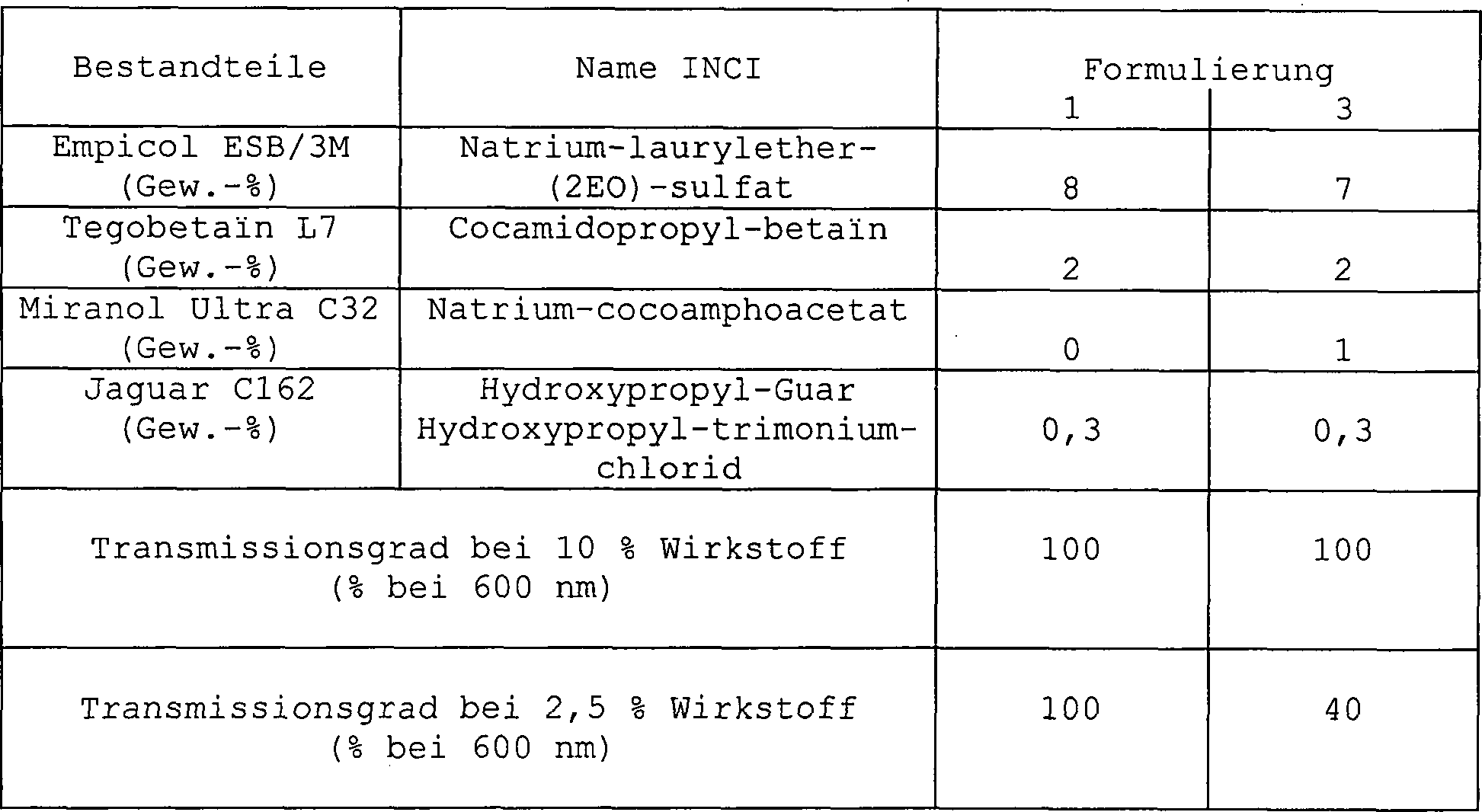
Diese Formulierungen werden durch sensorische Analyse bewertet (Panel von 25 Testpersonen).These Formulations are evaluated by sensory analysis (Panel of 25 subjects).
Die Haarsträhnen (europäisches Haar) von 7 Personen werden zuerst durch eine Lösung von Laurylsulfat (5%) während einer Stunde vorbehandelt. Anschließend werden die Haarsträhnen mit Wasser gespült und danach getrocknet.The strands of hair (European Hair) of 7 persons are first treated by a solution of lauryl sulfate (5%) while pretreated for one hour. Subsequently, the hair strands with Water rinsed and then dried.
Dann werden die Strähnen 30 Sekunden lang mit 0,7 g der Formulierung gewaschen und anschließend 45 Sekunden lang gespült. Schließlich werden die Strähnen auf Lockenwickler gewickelt und danach getrocknet.Then become the strands Washed with 0.7 g of the formulation for 30 seconds and then 45 Rinsed for seconds. After all become the strands wrapped on curlers and then dried.
Die
Ergebnisse der Bewertung sind aus dem folgenden Graphen zu entnehmen: 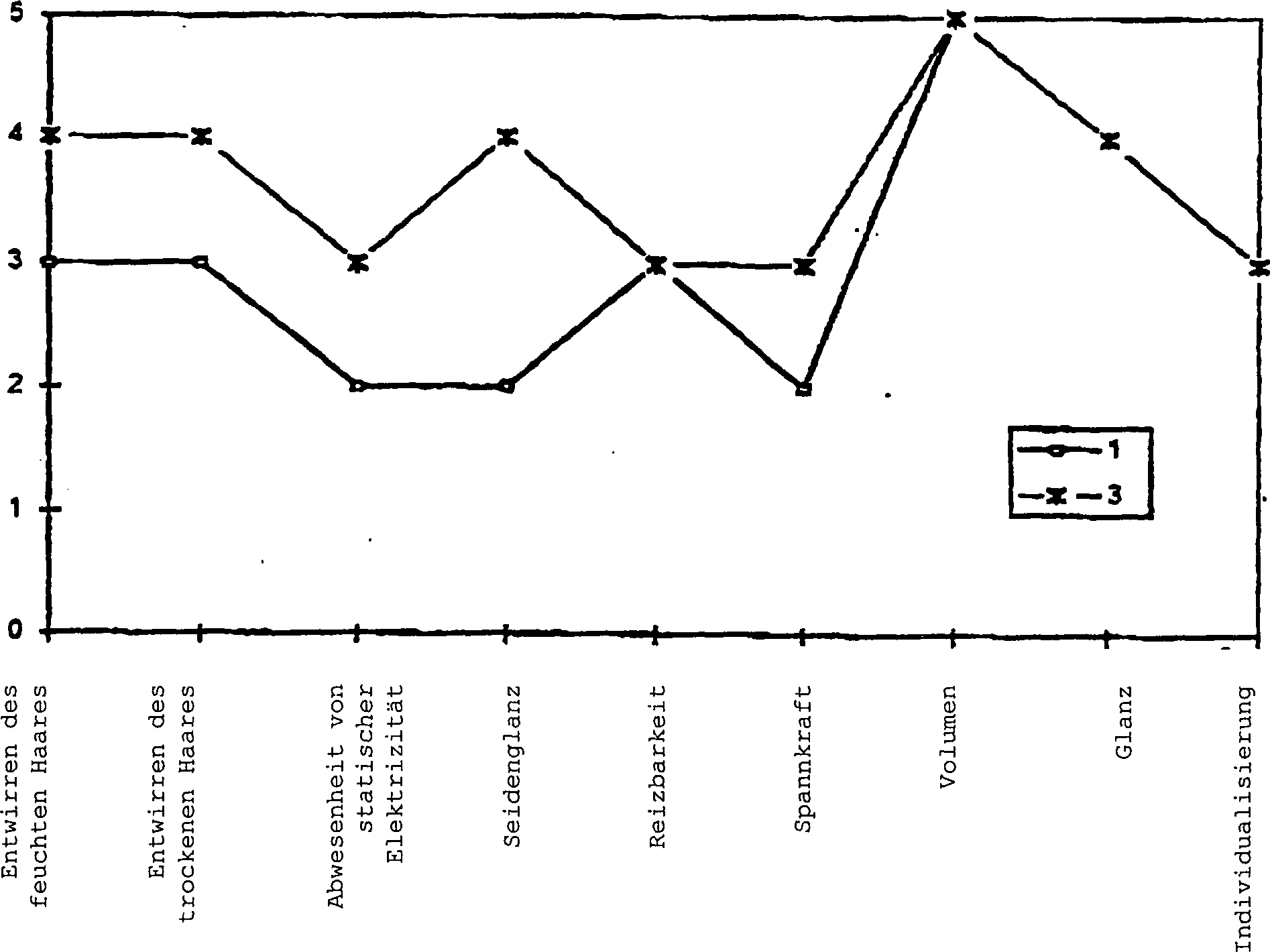
Das Phänomen der kontrollierten Ausfällung ermöglicht die Verbesserung des Entwirrens, der Abwesenheit von statischer Elektrizität und des Seidenglanzes.The phenomenon the controlled precipitation allows the improvement of unraveling, the absence of static electricity and the silk shine.
Beispiel 7Example 7
Erhöhung der AblagerungIncrease of the deposit
Die folgenden Formulierungen werden in traditioneller Weise hergestellt (End-pH-Wert 6). Die Mengen sind in Prozentsätzen an Wirkstoff ausgedrückt.The The following formulations are prepared in a traditional manner (Final pH 6). The amounts are expressed in percentages of active ingredient.
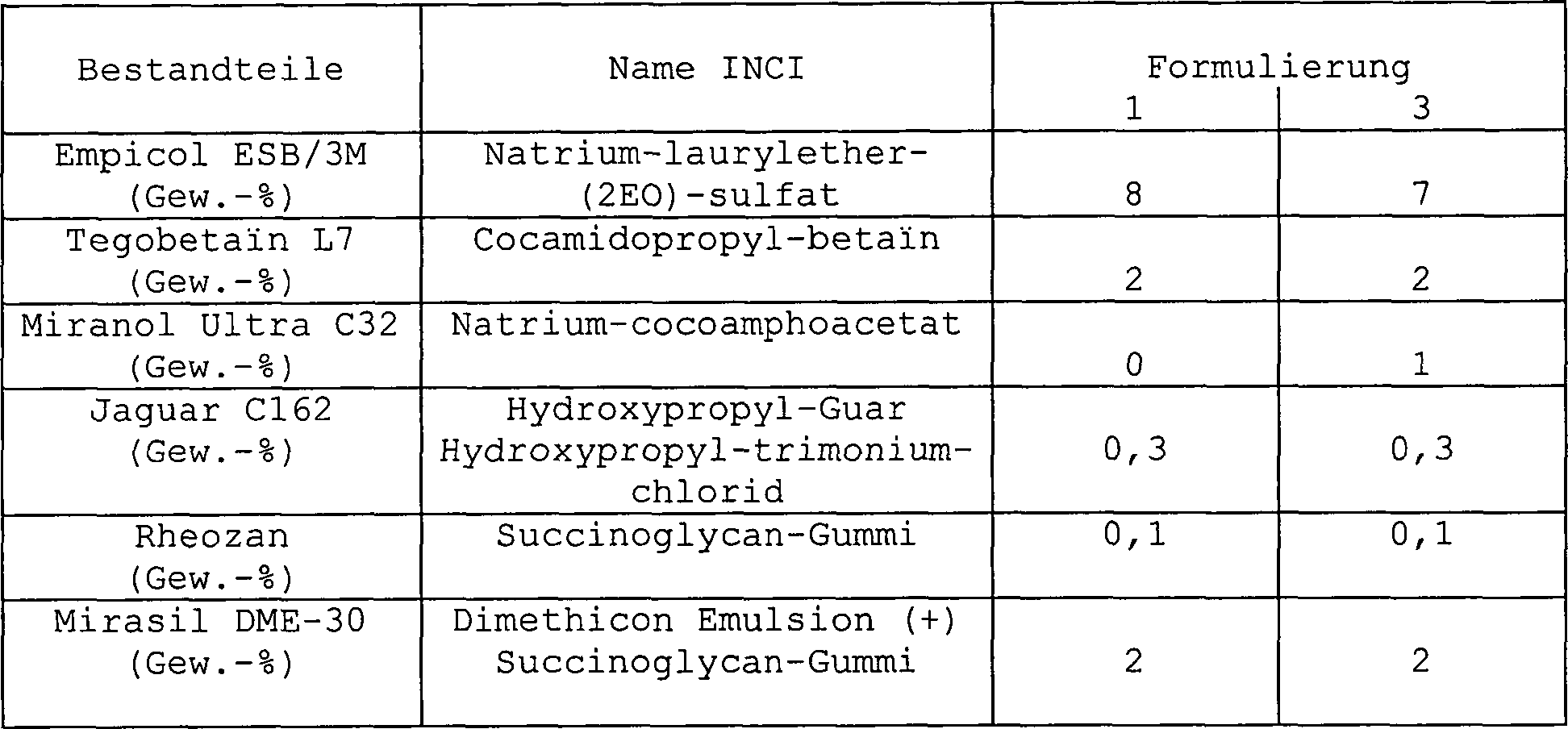
Strähnen von europäischen Haaren (4 g) werden zuerst gespült und anschließend 60 Sekunden lang mit einer Lösung von Laurylsulfat (10%) behandelt. Danach werden die Strähnen 60 Sekunden lang gespült. Diese Operation wird zweimal wiederholt.Strands of European hair (4 g) are rinsed first and then treated with a solution of lauryl sulfate (10%) for 60 seconds. Thereafter, the strands are rinsed for 60 seconds. This operation is repeated twice.
Dann werden die Strähnen 30 Sekunden lang mit 0,25 g der Formulierung behandelt und 60 Sekunden lang gespült.Then become the strands Treated with 0.25 g of the formulation for 30 seconds and 60 seconds rinsed.
Anschließend werden die Strähnen eine Stunde lang an der Luft getrocknet.Then be the strands Air dried for one hour.
Die abgelagerte Menge von Silicon wird nach der Alkoholyse des abgelagerten Silicons bestimmt und die Bestimmung der restlichen flüchtigen Anteile durch Gasphasen-Chromatographie vorgenommen. Die Ergebnisse werden in der Ausbeute der Ablagerung ausgedrückt. Die Ausbeute der Ablagerung der Formulierung 1 beträgt 4% und die der Formulierung 3 8%. Die Anwesenheit einer geringen Menge von amphoterem oberflächenaktiven Mittel ermöglicht somit, die Menge von auf dem Haar abgelagertem Silicon zu verdoppeln.The Deposited amount of silicone is deposited after alcoholysis of the Silicons determined and determining the residual volatile Shares made by gas phase chromatography. The results are expressed in the yield of the deposit. The yield of the deposit the formulation is 1 4% and that of the formulation 3 8%. The presence of a small Amount of amphoteric surfactant Means enabled thus doubling the amount of silicone deposited on the hair.
Beispiel 8Example 8
Konditionier-ShampooConditioning shampoo
Die Mengen sind in Prozentsatz Produkt ausgedrückt, so wie es ist.The Quantities are expressed as a percentage of product as it is.

Verfahrensweiseprocedure
Das Jaguar C162 wird in Wasser dispergiert und mit der Citronensäure hydratisiert. Dann erfolgt unter Rühren die Zugabe von Miranol Ultra C32, Tegobetaïn L7 und anschließend Empicol ESB/3M. Danach wird der pH-Wert mit Citronensäure auf 6,5 eingestellt.The Jaguar C162 is dispersed in water and hydrated with citric acid. Then it is stirred the addition of Miranol Ultra C32, Tegobetaïn L7 and then Empicol ESB / 3M. Thereafter, the pH is adjusted to 6.5 with citric acid.
Beispiel 9Example 9
Transparentes DuschgelTransparent shower gel
Die Mengen sind in Prozentsatz Produkt ausgedrückt, so wie es ist.The Quantities are expressed as a percentage of product as it is.

Verfahrensweiseprocedure
Das Jaguar C162 wird in Wasser dispergiert und mit der Citronensäure hydratisiert. Dann erfolgt unter Rühren die Zugabe der anderen Bestandteile in der angegebenen Reihenfolge. Danach wird der pH-Wert mit Citronensäure auf 6,5 eingestellt.The Jaguar C162 is dispersed in water and hydrated with citric acid. Then it is stirred the addition of the other ingredients in the order given. Thereafter, the pH is adjusted to 6.5 with citric acid.
Beispiel 10Example 10
Duschgelshower gel
Die Mengen sind in Prozentsatz Produkt ausgedrückt, so wie es ist.The Quantities are expressed as a percentage of product as it is.

Verfahrensweiseprocedure
Das Polymer JR400 wird in Wasser dispergiert und anschließend das Miranol CSE, das Tegobetaïn L7 und dann das Empicol ESB/3M zugegeben. Danach wird der pH-Wert mit Citronensäure auf 6,5 eingestellt.The Polymer JR400 is dispersed in water and then the Miranol CSE, the Tegobetaïn L7 and then added the Empicol ESB / 3M. Thereafter, the pH is with citric acid set to 6.5.
Claims (13)
Applications Claiming Priority (3)
| Application Number | Priority Date | Filing Date | Title |
|---|---|---|---|
| FR9800634 | 1998-01-19 | ||
| FR9800634A FR2773710B1 (en) | 1998-01-19 | 1998-01-19 | USE IN COSMETIC COMPOSITIONS OF AMPHOTERIC SURFACTANTS TO PRECIPITATE CATIONIC POLYMERS ON DILUTION |
| PCT/FR1999/000073 WO1999036054A1 (en) | 1998-01-19 | 1999-01-15 | Use in cosmetic compositions of amphoteric surface-active agents for precipitating cationic polymers in the diluted state |
Publications (2)
| Publication Number | Publication Date |
|---|---|
| DE69918668D1 DE69918668D1 (en) | 2004-08-19 |
| DE69918668T2 true DE69918668T2 (en) | 2005-07-28 |
Family
ID=9522010
Family Applications (1)
| Application Number | Title | Priority Date | Filing Date |
|---|---|---|---|
| DE69918668T Expired - Lifetime DE69918668T2 (en) | 1998-01-19 | 1999-01-15 | USE OF AMPHOTERIC SURFACTANTS AS COATING AGENT FOR CATIONIC POLYMERS DURING THE DILUTION IN COSMETIC COMPOSITIONS |
Country Status (10)
| Country | Link |
|---|---|
| US (2) | US6475474B1 (en) |
| EP (1) | EP1049456B1 (en) |
| AT (1) | ATE270877T1 (en) |
| AU (1) | AU2058699A (en) |
| BR (1) | BR9907113A (en) |
| CA (1) | CA2318337C (en) |
| DE (1) | DE69918668T2 (en) |
| ES (1) | ES2221352T3 (en) |
| FR (1) | FR2773710B1 (en) |
| WO (1) | WO1999036054A1 (en) |
Families Citing this family (27)
| Publication number | Priority date | Publication date | Assignee | Title |
|---|---|---|---|---|
| EP1647591A1 (en) * | 1999-09-10 | 2006-04-19 | Unilever Plc | Suspending clear cleansing formulation |
| US6533873B1 (en) * | 1999-09-10 | 2003-03-18 | Unilever Home & Personal Care Usa Division Of Conopco, Inc. | Suspending clear cleansing formulation |
| FR2811884B1 (en) * | 2000-07-21 | 2003-01-31 | Oreal | USE IN COSMETICS OF STARCH BETAINATES AND COMPOSITION COMPRISING SAME WITH AT LEAST ONE BENEFICIAL AGENT FOR KERATINIC MATERIALS |
| JP3929780B2 (en) | 2002-01-21 | 2007-06-13 | 花王株式会社 | Hair cleanser |
| US7067499B2 (en) | 2002-05-06 | 2006-06-27 | Hercules Incorporated | Cationic polymer composition and its use in conditioning applications |
| US20040185024A1 (en) * | 2002-12-19 | 2004-09-23 | Mireille Maubru | Composition for washing keratin materials comprising at least one amphoteric surfactant and at least one polyethylene glycol ester or ether comprising at least one hydrophobic group |
| FR2848848B1 (en) * | 2002-12-19 | 2005-01-28 | Oreal | COMPOSITION FOR WASHING KERATINIC MATERIALS BASED ON AMPHOTERIC SURFACTANT AND PEG MODIFIED BY A HYDROPHOBIC GROUP |
| FR2848830B1 (en) * | 2002-12-19 | 2005-05-13 | Oreal | COSMETIC COMPOSITIONS CONTAINING AN AMPHOTERIC SURFACTANT AND A NACRANT AGENT AND USES THEREOF |
| FR2848832B1 (en) * | 2002-12-19 | 2005-05-13 | Oreal | COSMETIC COMPOSITIONS CONTAINING AMPHOTERIC SURFACTANT AND HYDROXYACID AND USES THEREOF |
| US20040185025A1 (en) * | 2002-12-19 | 2004-09-23 | Mireille Maubru | Cosmetic compositions containing at least one alkylamphohydroxyalkylsulphonate amphoteric surfactant and at least one hydroxy acid, and uses thereof |
| FR2848831B1 (en) * | 2002-12-19 | 2005-06-03 | Oreal | COMPOSITION FOR WASHING ALKYLETHERSULFATE-BASED KERATINIC MATERIALS AND AMPHOTERIC SURFACTANT |
| FR2848829B1 (en) * | 2002-12-19 | 2005-05-13 | Oreal | COSMETIC COMPOSITION CONTAINING AMPHOTERIC SURFACTANT AND SILICONE AND USES THEREOF |
| GB0229733D0 (en) * | 2002-12-23 | 2003-01-29 | Unilever Plc | Hair treatment compositions |
| CA2524745A1 (en) * | 2003-05-23 | 2004-12-09 | The Procter & Gamble Company | Clear personal care compositions containing a cationic conditioning polymer and an anionic surfactant system |
| CN1909884A (en) * | 2004-01-16 | 2007-02-07 | 宝洁公司 | Conditioning Shampoo Composition |
| US7589051B2 (en) | 2004-04-08 | 2009-09-15 | Hercules Incorporated | Cationic, oxidized polysaccharides in conditioning applications |
| US7795201B2 (en) * | 2005-01-10 | 2010-09-14 | Dow Global Technologies | Personal care compositions |
| US20060286058A1 (en) * | 2005-06-16 | 2006-12-21 | Conopco, Inc., D/B/A Unilever | System for cleaning and conditioning hair |
| EP2001910B1 (en) * | 2006-03-30 | 2017-05-17 | Solvay USA Inc. | Reactive monomeric surfactants |
| JP2012524038A (en) * | 2009-04-15 | 2012-10-11 | ロディア オペレーションズ | How to treat damaged hair |
| US8796196B2 (en) | 2010-02-26 | 2014-08-05 | Hercules Incorporated | Polysaccharide products with improved performance and clarity in surfactant-based aqueous formulations and process for preparation |
| CN104768523B (en) | 2012-10-29 | 2017-08-15 | 宝洁公司 | There is 0.30 or the more personal care composition of lossy angle tangent value at 10 DEG C |
| EP3522988A1 (en) * | 2016-10-04 | 2019-08-14 | Rhodia Operations | Hair repair composition |
| EP3522990A1 (en) | 2016-10-04 | 2019-08-14 | Rhodia Operations | Hair repair composition |
| US12059485B2 (en) * | 2018-06-21 | 2024-08-13 | Conopco, Inc. | Personal cleansing compositions comprising a surfactant system consisting of an alkyl ether sulfate and betaine |
| FR3098721B1 (en) | 2019-07-17 | 2021-06-11 | Oreal | Cosmetic composition comprising anionic and amphoteric surfactants, cationic polysaccharides and unsaturated fatty alcohols, and method of cosmetic treatment |
| WO2025163343A1 (en) * | 2024-01-30 | 2025-08-07 | Quimicos E Solucoes Sustentaveis Do Brasil S.A. | Use of a combination of a galactomannan and succinoglycan in home and personal care compositions |
Family Cites Families (3)
| Publication number | Priority date | Publication date | Assignee | Title |
|---|---|---|---|---|
| JPH11505840A (en) * | 1995-05-27 | 1999-05-25 | ザ、プロクター、エンド、ギャンブル、カンパニー | Cleansing composition |
| US5747435A (en) * | 1995-08-01 | 1998-05-05 | Colgate-Palmolive Company | Mild foaming and conditioning detergents |
| US6210689B1 (en) * | 1998-03-18 | 2001-04-03 | National Starch & Chemical Co. Investment Holding Corporation | Keratin treating cosmetic compositions containing amphoteric polysaccharide derivatives |
-
1998
- 1998-01-19 FR FR9800634A patent/FR2773710B1/en not_active Expired - Fee Related
-
1999
- 1999-01-15 AT AT99900933T patent/ATE270877T1/en not_active IP Right Cessation
- 1999-01-15 EP EP99900933A patent/EP1049456B1/en not_active Expired - Lifetime
- 1999-01-15 AU AU20586/99A patent/AU2058699A/en not_active Abandoned
- 1999-01-15 BR BR9907113-4A patent/BR9907113A/en not_active Application Discontinuation
- 1999-01-15 US US09/600,371 patent/US6475474B1/en not_active Expired - Lifetime
- 1999-01-15 DE DE69918668T patent/DE69918668T2/en not_active Expired - Lifetime
- 1999-01-15 CA CA002318337A patent/CA2318337C/en not_active Expired - Fee Related
- 1999-01-15 ES ES99900933T patent/ES2221352T3/en not_active Expired - Lifetime
- 1999-01-15 WO PCT/FR1999/000073 patent/WO1999036054A1/en not_active Ceased
-
2002
- 2002-07-05 US US10/188,896 patent/US6660285B2/en not_active Expired - Lifetime
Also Published As
| Publication number | Publication date |
|---|---|
| FR2773710B1 (en) | 2000-04-28 |
| FR2773710A1 (en) | 1999-07-23 |
| BR9907113A (en) | 2001-08-21 |
| EP1049456B1 (en) | 2004-07-14 |
| ATE270877T1 (en) | 2004-07-15 |
| AU2058699A (en) | 1999-08-02 |
| CA2318337C (en) | 2007-03-20 |
| US6660285B2 (en) | 2003-12-09 |
| US20030086953A1 (en) | 2003-05-08 |
| EP1049456A1 (en) | 2000-11-08 |
| US6475474B1 (en) | 2002-11-05 |
| WO1999036054A1 (en) | 1999-07-22 |
| CA2318337A1 (en) | 1999-07-22 |
| DE69918668D1 (en) | 2004-08-19 |
| ES2221352T3 (en) | 2004-12-16 |
Similar Documents
| Publication | Publication Date | Title |
|---|---|---|
| DE69918668T2 (en) | USE OF AMPHOTERIC SURFACTANTS AS COATING AGENT FOR CATIONIC POLYMERS DURING THE DILUTION IN COSMETIC COMPOSITIONS | |
| DE69838337T2 (en) | AMPHOLITIC POLYMERS FOR USE IN BODY CARE PRODUCTS | |
| DE69708295T3 (en) | SILICONE HAIR DETERGENT | |
| DE69616330T2 (en) | ANTIMICROBIC HAIR TREATMENT | |
| DE69600155T2 (en) | Conditioning and washing hair care products | |
| DE69209716T2 (en) | Optically clear hair care products containing silicone microemulsion | |
| DE69600048T2 (en) | Cosmetic shampoo and its use | |
| DE69712278T2 (en) | Thickened personal care product | |
| DE69710055T2 (en) | SELECTED CATIONIC CONDITIONING POLYMERS CONDITIONING SHAMPOO COMPOSITIONS | |
| DE69625383T2 (en) | PREPARATIONS FOR CLEANING, CONDITIONING AND HAIRSTYLEING THE HAIR | |
| DE69903744T2 (en) | HAIR CARE SHAMPOO | |
| EP0754443A2 (en) | Hair treatment composition and method for producing the same | |
| DE3302921A1 (en) | HAIR AND SKIN CLEANSING AGENTS BASED ON ACYLISETHIONATES, CATIONIC POLYMERS AND SALTS OF THE CONDENSATES OF FATTY ACIDS AND POLYPEPTIDES AND METHODS OF USE THEREOF | |
| DE4315396A1 (en) | Hair-softening compositions | |
| DE3541305A1 (en) | COSMETIC AGENTS BASED ON N-HYDROXYPROPYL CHITOSANS, NEW N-HYDROXYPROPYL CHITOSANS AND METHODS FOR THE PRODUCTION THEREOF | |
| DE60008055T2 (en) | Composition for cleaning keratin substances based on a cleaning surfactant, a polyorganosiloxane, a cationic polymer and an acrylic terpolymer | |
| EP0277322B1 (en) | N-hydroxypropylisopropyl ether derivatives of chitosan, and cosmetic compositions containing them | |
| DE69830741T2 (en) | LIQUID POLYMER SUSPENSIONS OF CATIONIC POLYSACCHARIDES IN POLYOLS AND THEIR USE IN THE PREPARATION OF BODY CARRIER | |
| DE3303346A1 (en) | METHOD FOR WAVING OR SMOOTHING AND SIMULTANEOUSLY CONDITIONING HAIR, AND A HAIRWAVE COMPOSITION FOR USE IN THIS METHOD | |
| DE69004016T2 (en) | Cosmetic hair preparation. | |
| EP0259678A2 (en) | Compositions for the care and after-treatment of the hair | |
| DE69803867T2 (en) | CLEANING COSMETIC COMPOSITION AND USE | |
| DE2363871A1 (en) | HAIR WASHERS AND HAIR TREATMENT PRODUCTS | |
| DD295309A5 (en) | FIBER CONDITIONING COMPOSITION AND USE THEREOF | |
| DE69719750T2 (en) | COSMETIC HAIR DETERGENTS AND THEIR USE |
Legal Events
| Date | Code | Title | Description |
|---|---|---|---|
| 8328 | Change in the person/name/address of the agent |
Representative=s name: PFENNING MEINIG & PARTNER GBR, 80339 MUENCHEN |
|
| 8363 | Opposition against the patent | ||
| 8365 | Fully valid after opposition proceedings | ||
| 8328 | Change in the person/name/address of the agent |
Representative=s name: MAIWALD PATENTANWALTSGESELLSCHAFT MBH, 80335 MUENC |