DE69918662T2 - COMPONENTS AND CATALYSTS FOR OLEFIN POLYMERIZATION - Google Patents
COMPONENTS AND CATALYSTS FOR OLEFIN POLYMERIZATION Download PDFInfo
- Publication number
- DE69918662T2 DE69918662T2 DE69918662T DE69918662T DE69918662T2 DE 69918662 T2 DE69918662 T2 DE 69918662T2 DE 69918662 T DE69918662 T DE 69918662T DE 69918662 T DE69918662 T DE 69918662T DE 69918662 T2 DE69918662 T2 DE 69918662T2
- Authority
- DE
- Germany
- Prior art keywords
- catalyst
- group
- alkyl
- catalyst component
- diethyl
- Prior art date
- Legal status (The legal status is an assumption and is not a legal conclusion. Google has not performed a legal analysis and makes no representation as to the accuracy of the status listed.)
- Expired - Fee Related
Links
Classifications
-
- C—CHEMISTRY; METALLURGY
- C08—ORGANIC MACROMOLECULAR COMPOUNDS; THEIR PREPARATION OR CHEMICAL WORKING-UP; COMPOSITIONS BASED THEREON
- C08F—MACROMOLECULAR COMPOUNDS OBTAINED BY REACTIONS ONLY INVOLVING CARBON-TO-CARBON UNSATURATED BONDS
- C08F10/00—Homopolymers and copolymers of unsaturated aliphatic hydrocarbons having only one carbon-to-carbon double bond
- C08F10/04—Monomers containing three or four carbon atoms
- C08F10/06—Propene
-
- C—CHEMISTRY; METALLURGY
- C07—ORGANIC CHEMISTRY
- C07C—ACYCLIC OR CARBOCYCLIC COMPOUNDS
- C07C69/00—Esters of carboxylic acids; Esters of carbonic or haloformic acids
- C07C69/62—Halogen-containing esters
- C07C69/63—Halogen-containing esters of saturated acids
-
- C—CHEMISTRY; METALLURGY
- C08—ORGANIC MACROMOLECULAR COMPOUNDS; THEIR PREPARATION OR CHEMICAL WORKING-UP; COMPOSITIONS BASED THEREON
- C08F—MACROMOLECULAR COMPOUNDS OBTAINED BY REACTIONS ONLY INVOLVING CARBON-TO-CARBON UNSATURATED BONDS
- C08F10/00—Homopolymers and copolymers of unsaturated aliphatic hydrocarbons having only one carbon-to-carbon double bond
-
- C—CHEMISTRY; METALLURGY
- C08—ORGANIC MACROMOLECULAR COMPOUNDS; THEIR PREPARATION OR CHEMICAL WORKING-UP; COMPOSITIONS BASED THEREON
- C08F—MACROMOLECULAR COMPOUNDS OBTAINED BY REACTIONS ONLY INVOLVING CARBON-TO-CARBON UNSATURATED BONDS
- C08F110/00—Homopolymers of unsaturated aliphatic hydrocarbons having only one carbon-to-carbon double bond
- C08F110/04—Monomers containing three or four carbon atoms
- C08F110/06—Propene
Landscapes
- Chemical & Material Sciences (AREA)
- Organic Chemistry (AREA)
- Health & Medical Sciences (AREA)
- Chemical Kinetics & Catalysis (AREA)
- Medicinal Chemistry (AREA)
- Polymers & Plastics (AREA)
- Transition And Organic Metals Composition Catalysts For Addition Polymerization (AREA)
Abstract
Description
Die vorliegende Erfindung betrifft Katalysatorkomponenten für die Polymerisation von Olefinen, die daraus erhaltenen Katalysatoren und die Verwendung der Katalysatoren zur Polymerisation von Olefinen CH2=CHR, worin R für Wasserstoff oder einen Kohlenwasserstoffrest mit 1–12 Kohlenstoffatomen steht. Insbesondere betrifft die vorliegende Erfindung für die stereospezifische Polymerisation von Olefinen geeignete Katalysatorkomponenten, die Ti, Mg, Halogen und eine unter Estern von Malonsäuren (heteroatomhaltigen Malonsäureestern) ausgewählte Elektronendonatorverbindung enthalten. Mit den Katalysatorkomponenten kann man bei der Polymerisation von Olefinen und insbesondere von Propylen Polymere in hohen Ausbeuten und mit hohem isotaktischem Index, ausgedrückt in Form einer hohen Xylolunlöslichkeit, erhalten.The present invention relates to catalyst components for the polymerization of olefins, the catalysts obtained therefrom and the use of the catalysts for the polymerization of olefins CH 2 = CHR, wherein R is hydrogen or a hydrocarbon radical having 1-12 carbon atoms. In particular, the present invention relates to catalyst components suitable for the stereospecific polymerization of olefins which contain Ti, Mg, halogen and an electron donor compound selected from esters of malonic acids (heteroatom-containing malonic esters). With the catalyst components, in the polymerization of olefins, and particularly propylene, polymers can be obtained in high yields and with a high isotactic index, expressed as a high xylene solubility.
Die Verwendung einiger Malonsäureester als interne Elektronendonatoren in Katalysatoren für die Polymerisation von Propylen ist bereits aus dem Stand der Technik bekannt.The Use of some malonates as internal electron donors in catalysts for the polymerization of propylene is already known from the prior art.
In der EP-A-45977 wird die Verwendung eines Malonsäureesters (2,2-Diisobutylmalonsäurediethylester) als interner Donator für einen Katalysator für die Polymerisation von Olefinen beschrieben. In der EP-A-86473 wird ein Katalysator für die Polymerisation von Olefinen beschrieben, der (a) eine Aluminiumalkylverbindung, (b) eine Elektronendonatorverbindung mit bestimmten Reaktivitätsmerkmalen gegenüber MgCl2 und (c) eine feste Katalysatorkomponente, enthaltend ein Titanhalogenid und einen unter vielen Klassen von Esterverbindungen einschließlich Malonsäureestern ausgewählten Elektronendonator auf MgCl2 geträgert, enthält. In keiner der oben zitierten Anmeldungen werden heteroatomhaltige Malonsäureester beschrieben. Das Gleiche gilt für die EP-A-86644, in der die Verwendung von 2-n-Butylmalonsäurediethylester und 2-Isopropylmalonsäurediethylester als interne Donatoren in magnesiumgeträgerten Katalysatoren für die Polymerisation von Propylen beschrieben wird.EP-A-45977 describes the use of a malonic acid ester (2,2-diisobutylmalonic acid diethyl ester) as an internal donor for a catalyst for the polymerization of olefins. EP-A-86473 discloses a catalyst for the polymerization of olefins which comprises (a) an aluminum alkyl compound, (b) an electron donor compound having certain reactivity characteristics towards MgCl 2 and (c) a solid catalyst component containing a titanium halide and one of many Classes of ester compounds including malonic acid selected electron donor supported on MgCl 2 . In none of the applications cited above are heteroatom-containing malonic esters described. The same applies to EP-A-86644, in which the use of diethyl 2-n-butylmalonate and diethyl 2-isopropylmalonate as internal donors in magnesium-supported catalysts for the polymerization of propylene is described.
Aus
der Analyse der in den obigen Anmeldungen angegebenen Polymerisationsergebnisse
geht hervor, daß ein üblicher
Nachteil bei der Verwendung der erwähnten Malonsäureester
in einer immer noch ungenügenden
Polymerisationsausbeute und/oder einem ungeeigneten isotaktischen
Index des fertigen Polymers bestand. Dies wird auch durch die Offenbarung
der JP-08157521 bestätigt.
Diese Anmeldung betrifft ein Verfahren zur Herstellung einer festen
Katalysatorkomponente für
die Polymerisation von Olefinen, das dadurch gekennzeichnet ist,
daß man
eine durch Umsetzung einer Magnesiumverbindung, einer Titanverbindung
und einer Halogenverbindung hergestellte feste Katalysatorkomponente
mit einer oder mehreren Elektronendonatorverbindungen der allgemeinen
Formel: 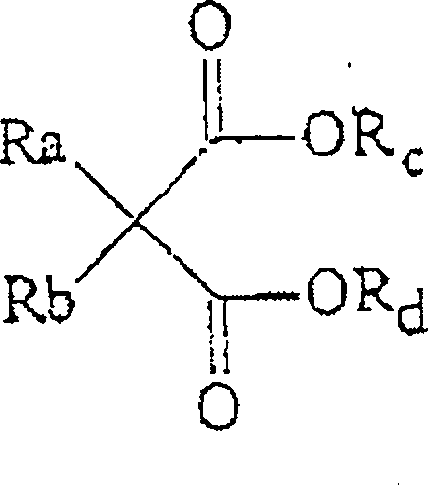
Es wurde nun überraschenderweise gefunden, daß die Polymerisationsausbeuten und der isotaktische Index des Polymers durch Verwendung von Katalysatorkomponenten, die heteroatomhaltige Malonsäureester als interne Donatoren enthalten, verbessert werden können.It was now surprisingly found that the Polymerization yields and the isotactic index of the polymer by using catalyst components that are heteroatom-containing malonate as internal donors can be improved.
Gegenstand der Erfindung ist daher die Bereitstellung einer festen Katalysatorkomponente für die Polymerisation von Olefinen CH2=CHR, worin R für Wasserstoff oder einen Kohlenwasserstoffrest mit 1–12 Kohlenstoffatomen steht, enthaltend Mg, Ti, Halogen und einen heteroatomhaltigen Malonsäureester.The invention therefore provides a solid catalyst component for the polymerization of olefins CH 2 = CHR, wherein R is hydrogen or a hydrocarbon radical having 1-12 carbon atoms, containing Mg, Ti, halogen and a heteroatom-containing malonic acid ester.
Unter dem Begriff Heteroatom ist jedes von C und H verschiedene Atom zusätzlich zu den von der Malonsäure stammenden Sauerstoffatomen zu verstehen.Under For the term heteroatom, any atom other than C and H is in addition to that of the malonic acid to understand originating oxygen atoms.
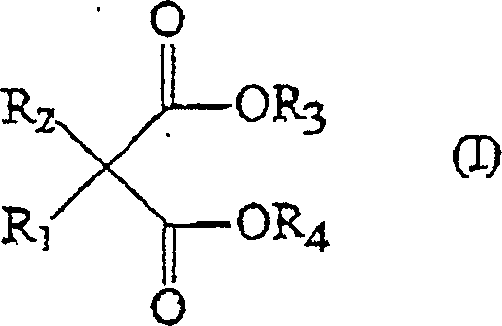
Insbesondere
könnnen
die Elektronendonatorverbindungen unter heteroatomhaltigen Malonsäureestern
der Formel (I) ausgewählt
sein: 
Die Heteroatome sind vorzugsweise unter F, Cl, Br und Si ausgewählt und nach einer bevorzugten Ausführungsform in den Gruppen R1 oder R2 enthalten.The heteroatoms are preferably selected from F, Cl, Br and Si and, according to a preferred embodiment, in the groups R 1 or R 2 .
R3 und R4 stehen vorzugsweise für primäre Alkyl-, Arylalkyl- oder Alkylarylgruppen mit 2 bis 8 Kohlenstoffatomen, die Heteroatome enthalten können. Besonders bevorzugt stehen sie für primäre verzweigte Alkylgruppen, die gegebenenfalls Heteroatome enthalten. Beispiele für geeignete Gruppen R3 und R4 ohne Heteroatome sind Methyl, Ethyl, n-Propyl, n-Butyl, Isobutyl, Neopentyl und 2-Ethylhexyl. Beispiele für geeignete Gruppen R3 und R4 mit Heteroatomen sind 2-Chlorethyl, 1-Trifluormethylethyl, 2-Trifluormethylpropyl, 2-Trimethylsilylethyl, 2-Bromethyl, 2-Trifluormethylpropyl, 4-Chlorbenzyl, 2-Fluorethyl und 3-Trimethylsilylallyl.R 3 and R 4 are preferably primary alkyl, arylalkyl or alkylaryl groups of 2 to 8 carbon atoms which may contain heteroatoms. Particularly preferably, they stand for primary branched alkyl groups which optionally contain heteroatoms. Examples of suitable groups R 3 and R 4 without heteroatoms are methyl, ethyl, n-propyl, n-butyl, isobutyl, neopentyl and 2-ethylhexyl. Examples of suitable groups R 3 and R 4 with heteroatoms are 2-chloroethyl, 1-trifluoromethylethyl, 2-trifluoromethylpropyl, 2-trimethylsilylethyl, 2-bromoethyl, 2-trifluoromethylpropyl, 4-chlorobenzyl, 2-fluoroethyl and 3-trimethylsilylallyl.
R2 steht vorzugsweise, und insbesonder für den Fall, daß R1 für H steht, für eine lineare oder verzweigte C3-C20-Alkyl-, -Cycloalkyl- oder -Arylalkylgruppe; besonders bevorzugt steht R2 für eine sekundäre C3-C20-Alkyl-, -Cycloalkyl- oder -Arylalkylgruppe. Besonders bevorzugt sind auch Verbindungen der Formel (I), worin R1 für H und R2 für eine lineare oder verzweigte primäre C5-C20-Alkylgruppe, eine C5-C20-Cycloalkylgruppe, eine C7-C20-Arylalkyl- oder eine C7-C20-Alkylarylgruppe steht. R2 enthält vorzugsweise mindestens ein Heteroatom. Beispiele für geeignete monosubstituierte Malonsäureesterverbindungen sind im einzelnen 2-(1-Trifluormethylethyl)malonsäurediethylester, 2-(1-Trifluormethylethyliden)malonsäurediethylester, 2-Isopropyl malonsäuredi(2-chlorethyl)ester, 2-(Trimethylsilylmethyl)malonsäurediethylester, 2-p-Chlorbenzylmalonsäurediethylester, 2-Piperidylmalonsäurediethylester, 2-(2-Ethylpiperidyl)malonsäurediethylester, 2-(1-Trifluormethyl-1-methylethyl)malonsäurediethylester, 2-α-Phenyl-p-(trifluormethyl)benzylmalonsäurediethylester, 2-Isopropylmalonsäuredi(2-fluorethyl)ester und 2-Ethylmalonsäuredi(2-fluorethyl)ester.R 2 is preferably, and especially in the case where R 1 is H, is a linear or branched C 3 -C 20 alkyl, cycloalkyl or arylalkyl group; R 2 particularly preferably represents a secondary C 3 -C 20 -alkyl, -cycloalkyl or -arylalkyl group. Particular preference is also given to compounds of the formula (I) in which R 1 is H and R 2 is a linear or branched primary C 5 -C 20 -alkyl group, a C 5 -C 20 -cycloalkyl group, a C 7 -C 20 -arylalkyl - or a C 7 -C 20 alkylaryl group. R 2 preferably contains at least one heteroatom. Specific examples of suitable monosubstituted malonic ester compounds are diethyl 2- (1-trifluoromethylethyl) malonate, diethyl 2- (1-trifluoromethylethyl) malonate, di (2-chloroethyl) 2-isopropylmalonate, diethyl 2- (trimethylsilylmethyl) malonate, diethyl 2-p-chlorobenzylmalonate, Diethyl 2-piperidylmalonate, diethyl 2- (2-ethylpiperidyl) malonate, diethyl 2- (1-trifluoromethyl-1-methylethyl) malonate, diethyl 2-α-phenyl-p- (trifluoromethyl) benzylmalonate, di (2-fluoroethyl) 2-isopropylmalonate, and 2 -Ethylmalonsäuredi (2-fluoroethyl) ester.
Unter disubstituierten Malonsäureestern sind diejenigen Verbindungen bevorzugt, in denen mindestens eine der Gruppen R1 und R2 für eine primäre C3-C20-Alkyl-, -Cycloalkyl- oder -Arylalkylgruppe steht.Among disubstituted malonic acid esters, preference is given to those compounds in which at least one of the groups R 1 and R 2 is a primary C 3 -C 20 -alkyl, -cycloalkyl or -arylalkyl group.
Beispiele für geeignete disubstituierte Malonsäureesterverbindungen sind im einzelnen 2-(1-Trifluormethylethyl)-2-benzylmalonsäurediethylester, 2-(1-Trifluormethylethyl)-2-methylmalonsäurediethylester, 2-Methyltrimethylsilyl-2-methylmalonsäurediethylester, 2-p-Chlorbenzyl-2-isopropylmalonsäurediethylester, 2-Piperidyl-2-methylmalonsäurediethylester, 2-(1-Trifluormethyl-1-methylethyl)-2-methylmalonsäurediethylester, 2-Isopropyl-2-isobutylmalonsäuredi(2-trimethylsilylethyl)ester und 2-Cyclohexyl-2-methylmalonsäuredi(p-chlorbenzyl)ester.Examples for suitable disubstituted malonic ester compounds Specifically, diethyl 2- (1-trifluoromethylethyl) -2-benzylmalonate, Diethyl 2- (1-trifluoromethylethyl) -2-methylmalonate, diethyl 2-methyltrimethylsilyl-2-methylmalonate, Diethyl 2-p-chlorobenzyl-2-isopropylmalonate, diethyl 2-piperidyl-2-methylmalonate, 2- (1-trifluoromethyl-1-methylethyl) -2-methylmalonate, diethyl 2-isopropyl-2-isobutylmalonsäuredi (2-trimethylsilylethyl) ester and di (p-chlorobenzyl) 2-cyclohexyl-2-methylmalonate.
Es wurde überraschenderweise gefunden, daß Katalysatorkomponenten, in denen es sich bei dem internen Donator um einen heteroatomhaltigen Malonsäureester handelt, hinsichtlich Ausbeuten und isotaktischem Index leistungsfähiger sind als Katalysatorkomponenten, die analoge Malonsäureester ohne Heteroatome enthalten.It was surprisingly found that catalyst components, in which the internal donor is a heteroatom-containing malonate is more efficient in terms of yields and isotactic index as catalyst components containing analogous malonic acid esters without heteroatoms.
Wie
oben ausgeführt,
enthalten erfindungsgemäße Katalysatorkomponenten
neben dem obigen Elektronendonator Ti, Mg und Halogen. Insbesondere
enthält
die Katalysatorkomponente eine Titanverbindung mit mindestens einer
Ti-Halogen-Bindung und die obige Elektronendonatorverbindung auf
einem Mg-Halogenid geträgert.
Bei dem Magnesiumhalogenid handelt es sich vorzugsweise um MgCl2 in aktiver Form, das aus der Patentliteratur
als Träger
für Ziegler-Natta-Katalysatoren weithin
bekannt ist. Die Verwendung dieser Verbindungen bei der Ziegler-Natta-Katalyse
wurde zuerst in den Patentschriften
Als Titanverbindungen verwendet man in der erfindungsgemäßen Katalysatorkomponente vorzugsweise TiCl4 und TiCl3; es können aber auch Ti-Halogenidalkoholate der Formel (Ti(OR)n-yXy, worin n für die Wertigkeit des Titans steht und y für eine Zahl zwischen 1 und n steht, eingesetzt werden.The titanium compounds used in the catalyst component according to the invention are preferably TiCl 4 and TiCl 3 ; However, it is also possible to use Ti halide alcoholates of the formula (Ti (OR) ny X y , where n is the valence of the titanium and y is a number between 1 and n.
Die feste Katalysatorkomponente kann nach mehreren Verfahren hergestellt werden.The Solid catalyst component can be prepared by several methods become.
Gemäß einem dieser Verfahren werden das Magnesiumdichlorid in wasserfreiem Zustand, die Titanverbindung und der heteroatomhaltige Malonsäureester unter Bedingungen vermahlen, unter denen die Aktivierung des Magnesiumdichlorids eintritt. Das so erhaltene Produkt kann ein- oder mehrmals bei einer Temperatur zwischen 80 und 135°C mit einem Überschuß an TiCl4 behandelt werden. Danach wird mit Kohlenwasserstofflösungsmitteln chloridionenfrei gewaschen. Gemäß einem weiteren Verfahren wird das durch gemeinsames Vermahlen des Magnesiumchlorids in wasserfreiem Zustand, der Titanverbindung und des heteroatomhaltigen Malonsäureesters erhaltene Produkt mit halogenierten Kohlenwasserstoffen, wie 1,2-Dichlorethan, Chlorbenzol, Dichlormethan usw., behandelt. Die Behandlung wird über einen Zeitraum zwischen 1 und 4 Stunden und bei einer Temperatur von 40°C bis zum Siedepunkt des halogenierten Kohlenwasserstoffs durchgeführt. Dann wird das erhaltene Produkt im allgemeinen mit inerten Kohlenwasserstofflösungsmitteln, wie Hexan, gewaschen.According to one of these methods, the magnesium dichloride in the anhydrous state, the titanium compound and the heteroatom-containing malonic acid ester are milled under conditions in which the activation of the magnesium dichloride occurs. The product thus obtained can be treated one or more times at a temperature between 80 and 135 ° C with an excess of TiCl 4 . Thereafter, it is washed free of chloride ions with hydrocarbon solvents. According to another method, the product obtained by co-grinding the magnesium chloride in the anhydrous state, the titanium compound and the heteroatom-containing malonic acid ester is treated with halogenated hydrocarbons such as 1,2-dichloroethane, chlorobenzene, dichloromethane, etc. The treatment is carried out for a period of between 1 and 4 hours and at a temperature of 40 ° C to the boiling point of the halogenated hydrocarbon. Then, the obtained product is generally washed with inert hydrocarbon solvents such as hexane.
Gemäß einem anderen Verfahren wird Magnesiumdichlorid nach gut bekannten Verfahren voraktiviert und dann bei einer Temperatur von etwa 80 bis 135°C mit einem Überschuß an TiCl4, der einen heteroatomhaltigen Malonsäureester in Lösung enthält, behandelt. Die Behandlung mit TiCl4 wird wiederholt und der Feststoff zur Abtrennung von jeglichem nicht umgesetztem TiCl4 mit Hexan gewaschen.According to another method, magnesium dichloride is preactivated by well-known methods and then treated at a temperature of about 80 to 135 ° C with an excess of TiCl 4 containing a heteroatom-containing malonic acid ester in solution. The treatment with TiCl 4 is repeated and the solid washed to remove any unreacted TiCl 4 with hexane.
Bei einem weiteren Verfahren setzt man Magnesiumalkoholate oder -chloridalkoholate (insbesondere gemäß US-PS 4,220,554 hergestellte Magnesiumchloridalkoholate) bei einer Temperatur von etwa 80 bis 120°C mit einem Überschuß an TiCl4, der einen heteroatomhaltigen Malonsäureester in Lösung enthält, um.In another method, magnesium alcoholates or chloroalcoholates are employed (in particular in accordance with US-PS 4,220,554 Magnesiumchloridalkoholate produced) at a temperature of about 80 to 120 ° C with an excess of TiCl 4 containing a heteroatom containing malonate in solution.
Gemäß einem bevorzugten Verfahren kann man die feste Katalysatorkomponente herstellen, indem man eine Titanverbindung der Formel Ti(OR)n-yXy, worin n für die Wertigkeit des Titans steht und y für eine Zahl zwischen 1 und n steht, vorzugsweise TiCl4, mit einem Magnesiumchlorid, das sich von einem Addukt der Formel MgCl2·pROH, worin p für eine Zahl zwischen 0,1 und 6 steht und R für einen Kohlenwasserstoffrest mit 1-18 Kohlenstoffatomen steht, ableitet, umsetzt. Das Addukt kann zweckmäßigerweise in Kugelform hergestellt werden, indem man Alkohol und Magnesiumchlorid in Gegenwart eines inerten, mit dem Addukt nicht mischbaren Kohlenwasserstoffs vermischt, wobei man bei der Schmelztemperatur des Addukts (100–130°C) rührt. Dann wird die Emulsion schnell abgekühlt, wodurch das Addukt in Form von kugelförmigen Teilchen verfestigt wird. Beispiele für nach diesem Verfahren hergestellte kugelförmige Addukte werden in der US-PS 4,399,054 und der US-PS 4,469,648 beschrieben. Das so erhaltene Addukt kann direkt mit der Ti-Verbindung umgesetzt werden oder vorher noch einer kontrollierten thermischen Entalkoholisierung (80–130°C) unterworfen werden, wobei man ein Addukt erhält, in dem die Zahl der Mole Alkohol im allgemeinen unter 3 und vorzugsweise zwischen 0,1 und 2,5 liegt. Zur Umsetzung mit der Ti-Verbindung kann man das Addukt (entalkoholisiert oder als solches) in kaltem TiCl4 (im allgemeinen 0°C) suspendieren; die Mischung wird auf 80–130°C erhitzt und 0,5–2 Stunden bei dieser Temperatur gehalten. Die Behandlung mit TiCl4 kann ein- oder mehrmals durchgeführt werden. Der heteroatomhaltige Malonsäureester kann während der Behandlung mit TiCl4 zugegeben werden. Die Behandlung mit der Elektronendonatorverbindung kann ein- oder mehrmals wiederholt werden.According to a preferred method, the solid catalyst component can be prepared by reacting a titanium compound of the formula Ti (OR) ny X y , wherein n is the valence of the titanium and y is a number between 1 and n, preferably TiCl 4 Magnesium chloride derived from an adduct of the formula MgCl 2 .pROH, wherein p is a number between 0.1 and 6 and R is a hydrocarbon radical of 1-18 carbon atoms. The adduct may conveniently be prepared in spherical form by mixing alcohol and magnesium chloride in the presence of an inert hydrocarbon immiscible with the adduct, stirring at the melting temperature of the adduct (100-130 ° C). Then, the emulsion is rapidly cooled, whereby the adduct is solidified in the form of spherical particles. Examples of spherical adducts prepared by this process are described in U.S. Patent 4,399,054 and U.S. Patent 4,469,648. The adduct thus obtained can be reacted directly with the Ti compound or previously subjected to a controlled thermal dealcoholization (80-130 ° C) to obtain an adduct in which the number of moles of alcohol is generally below 3, and preferably between 0.1 and 2.5. For the reaction with the Ti compound, the adduct (dealcoholized or as such) can be suspended in cold TiCl 4 (generally 0 ° C); The mixture is heated to 80-130 ° C and held for 0.5-2 hours at this temperature. The treatment with TiCl 4 can be carried out one or more times. The heteroatom-containing malonic acid ester may be added during treatment with TiCl 4 . The treatment with the electron donor compound can be repeated one or more times.
Die Herstellung von Katalysatorkomponenten in Kugelform wird beispielsweise in den europäischen Patentanmeldungen EP-A-395083, EP-A-553805, EP-A-553806, EP-A-601525 und der WO 98/44001 beschrieben.The Preparation of catalyst components in spherical form becomes, for example in the European patent applications EP-A-395083, EP-A-553805, EP-A-553806, EP-A-601525 and WO 98/44001 described.
Die nach dem obigen Verfahren erhaltenen festen Katalysatorkomponenten haben eine Oberfläche (nach der BET-Methode), die im allgemeinen zwischen 20 und 500 m2/g und vorzugsweise zwischen 50 und 400 m2/g liegt, und eine Gesamtporosität (nach der BET-Methode) von mehr als 0,2 cm3/g und vorzugsweise zwischen 0,2 und 0,6 cm3/g. Die durch Poren mit einem Radius bis zu 10000 Å bedingte Porosität (Hg-Methode) beträgt im allgemeinen 0,3 bis 1,5 cm3/g und vorzugsweise 0,45 bis 1 cm3/g.The solid catalyst components obtained by the above method have a surface (according to the BET method), which is generally between 20 and 500 m 2 / g and preferably between 50 and 400 m 2 / g, and a total porosity (according to the BET method) of more than 0.2 cm 3 / g and preferably between 0.2 and 0.6 cm 3 / g. The porosity (Hg method) due to pores having a radius of up to 10000 Å is generally 0.3 to 1.5 cm 3 / g, and preferably 0.45 to 1 cm 3 / g.
Bei einem weiteren Verfahren zur Herstellung der erfindungsgemäßen festen Katalysatorkomponente werden Magnesiumdihydrocarbyloxidverbindungen, wie Magnesiumdialkoxid oder -diaryloxid, mit einer Lösung von TiCl4 in einem aromatischen Kohlenwasserstoff (wie Toluol, Xylol usw.) bei Temperaturen zwischen 80 und 130°C halogeniert. Die Behandlung mit TiCl4 in Lösung in aromatischem Kohlenwasserstoff kann ein- oder mehrmals wiederholt werden, und der heteroatomhaltige Malonsäureester wird während einer oder mehrerer dieser Behandlungen zugegeben.In another process for preparing the solid catalyst component of the present invention, magnesium dihydrocarbyloxide compounds such as magnesium dialkoxide or diaryl oxide are halogenated with a solution of TiCl 4 in an aromatic hydrocarbon (such as toluene, xylene, etc.) at temperatures between 80 and 130 ° C. The treatment with TiCl 4 in solution in aromatic hydrocarbon can be repeated one or more times, and the heteroatom-containing malonic acid ester is added during one or more of these treatments.
Bei jedem dieser Herstellungsverfahren kann der heteroatomhaltige Malonsäureester als solcher zugegeben werden oder alternativ dazu auch durch Verwendung eines geeigneten Vorläufers, der beispielsweise mit Hilfe von bekannten chemischen Reaktionen, wie Veresterung, Umesterung usw., in die gewünschte Elektronendonatorverbindung umgewandelt werden kann, in situ hergestellt werden. Im allgemeinen wird der heteroatomhaltige Malonsäureester in einem Molverhältnis in bezug auf das MgCl2 von 0, 01 bis 1 und vorzugsweise von 0, 05 bis 0, 5 verwendet.In any of these methods of preparation, the heteroatom-containing malonic acid ester may be added as such or, alternatively, prepared in situ by use of a suitable precursor capable of being converted to the desired electron donor compound, for example, by known chemical reactions such as esterification, transesterification, etc. , In general, the heteroatom-containing malonic acid ester is used in a molar ratio with respect to the MgCl 2 of from 0.01 to 1, and preferably from 0.55 to 0.5.
Die erfindungsgemäße feste Katalysatorkomponente wird durch Umsetzung mit Organoaluminiumverbindungen nach bekannten Verfahren in Katalysatoren für die Polymerisation von Olefinen umgewandelt.The solid according to the invention Catalyst component is prepared by reaction with organoaluminum compounds according to known processes in catalysts for the polymerization of olefins transformed.
Gegenstand der vorliegenden Erfindung ist insbesondere ein Katalysator für die Polymerisation von Olefinen CH2=CHR, worin R für Wasserstoff oder einen Kohlenwasserstoffrest mit 1–12 Kohlenstoffatomen steht, enthaltend das Produkt der Umsetzung zwischen:
- (a) einer festen Katalysatorkomponente, die als wesentliche Elemente Mg, Ti und Halogen und einen heteroatomhaltigen Malonsäureester enthält;
- (b) einer Alkylaluminiumverbindung und gegebenenfalls
- (c) einer oder mehreren Elektronendonatorverbindungen (externer Donator).
- (A) a solid catalyst component containing as essential elements Mg, Ti and halogen and a heteroatom-containing malonic acid ester;
- (b) an alkylaluminum compound and optionally
- (c) one or more electron donor compounds (external donor).
Die Alkylaluminiumverbindung (b) wird vorzugsweise unter den Trialkylaluminiumverbindungen, wie beispielsweise Triethylaluminium, Triisobutylaluminum, Tri-n-butylaluminium, Tri-n-hexylaluminium und Tri-n-octylaluminium, ausgewählt. In Betracht kommen auch Gemische von Trialkylaluminiumverbindungen mit Alkylaluminiumhalogeniden, Alkylaluminiumhydriden oder Alkylaluminiumsesquichloriden, wie AlEt2Cl und Al2Et3Cl3.The alkylaluminum compound (b) is preferably selected from trialkylaluminums such as triethylaluminum, triisobutylaluminum, tri-n-butylaluminum, tri-n-hexylaluminum and tri-n-octylaluminum. Also contemplated are mixtures of trialkylaluminum compounds with alkylaluminum halides, alkylaluminum hydrides or alkylaluminum sesquichlorides such as AlEt 2 Cl and Al 2 Et 3 Cl 3 .
Der
externe Donator (c) kann von der gleichen Art sein oder sich von
dem heteroatomhaltigen Malonsäureester
unterscheiden. Geeignete externe Elektronendonatorverbindungen sind
u.a. Siliciumverbindungen, Ether, Ester, wie 4-Ethoxybenzoesäureethylester,
Amine, heterocyclische Verbindungen und insbesondere 2,2,6,6-Tetramethylpiperidin,
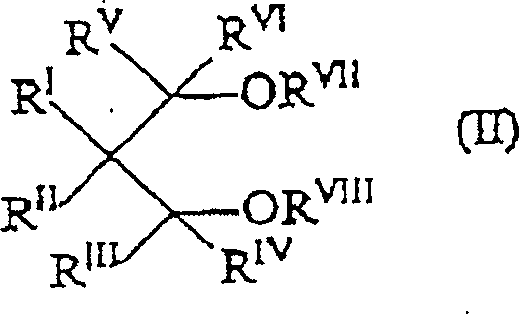
Ketone und die 1,3-Diether der allgemeinen Formel (II): 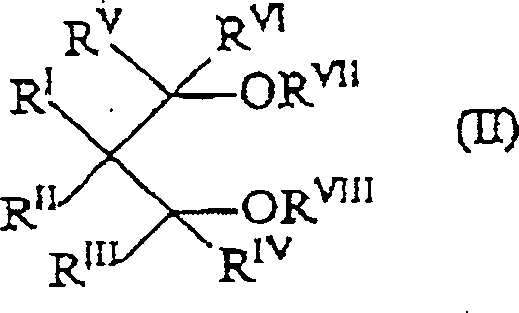
Eine andere Klasse bevorzugter externer Donatorverbindungen bilden Siliciumverbindungen der Formel Ra 5Rb 6Si(OR7)c, worin a und b für eine ganze Zahl von 0 bis 2 stehen, c für eine ganze Zahl von 1 bis 3 steht und die Summe (a + b + c) gleich 4 ist und R5, R6 und R7 für gegebenenfalls Heteroatome enthaltende Alkyl-, Cycloalkyl- oder Arylreste mit 1-18 Kohlenstoffatomen stehen. Besonders bevorzugt sind diejenigen Siliciumverbindungen, in den a für 1 steht, b für 1 steht, c für 2 steht, mindestens einer der Reste R5 und R6 unter verzweigten Alkyl-, Cycloalkyl- oder Arylgruppen mit 3–10 Kohlenstoffatomen und gegebenenfalls Heteroatomen ausgewählt ist und R7 für eine C1-C10-Alkylgruppe, insbesondere Methyl, steht. Beispiele für derartige bevorzugte Siliciumverbindungen sind Methylcyclohexyldimethoxysilan, Diphenyldimethoxysilan, Methyl-t-butyldimethoxysilan, Dicyclopentyldimethoxysilan, 2-Ethylpiperidinyl-2-t-butyldimethoxysilan und 1,1,1-Trifluorpropyl-2-ethylpiperidinyldimethoxysilan. Bevorzugt sind außerdem auch die Siliciumverbindungen, in denen a für 0 steht, c für 3 steht, R6 für eine verzweigte Alkyl- oder Cycloalkylgruppe, gegebenenfalls mit Heteroatomen, steht und R7 für Methyl steht. Beispiele für derartige bevorzugte Siliciumverbindungen sind Cyclohexyltrimethoxysilan, t-Butyltrimethoxysilan und Thexyltrimethoxysilan.Another class of preferred external donor compounds are silicon compounds of the formula R a 5 R b 6 Si (OR 7 ) c wherein a and b are an integer from 0 to 2, c is an integer from 1 to 3 and the sum (a + b + c) is 4 and R 5 , R 6 and R 7 are optionally heteroatom-containing alkyl, cycloalkyl or aryl radicals having 1-18 carbon atoms. Particularly preferred are those silicon compounds in which a is 1, b is 1, c is 2, at least one of R 5 and R 6 is selected from branched alkyl, cycloalkyl or aryl groups having 3-10 carbon atoms and optionally heteroatoms and R 7 is a C 1 -C 10 alkyl group, in particular methyl. Examples of such be Preferred silicon compounds are methylcyclohexyldimethoxysilane, diphenyldimethoxysilane, methyl-t-butyldimethoxysilane, dicyclopentyldimethoxysilane, 2-ethylpiperidinyl-2-t-butyldimethoxysilane and 1,1,1-trifluoropropyl-2-ethylpiperidinyldimethoxysilane. Also preferred are the silicon compounds in which a is 0, c is 3, R 6 is a branched alkyl or cycloalkyl group, optionally with heteroatoms, and R 7 is methyl. Examples of such preferred silicon compounds are cyclohexyltrimethoxysilane, t-butyltrimethoxysilane and thexyltrimethoxysilane.
Die Elektronendonatorverbindung (c) wird in einer solchen Menge eingesetzt, daß sich ein Molverhältnis zwischen der Organoaluminiumverbindung und der Elektronendonatorverbindung (c) von 0,1 bis 500, vorzugsweise von 1 bis 300 und besonders bevorzugt von 3 bis 100 ergibt. Wie oben erwähnt, kann man mit den erfindungsgemäßen Katalysatoren bei der (Co)polymerisation von Olefinen und insbesondere von Propylen mit hohen Ausbeuten Polymere mit hohem isotaktischem Index (ausgedrückt durch eine hohe Xylolunlöslichkeit X.U.) erhalten. Daher zeigen die erfindungsgemäßen Katalysatoren ein hervorragendes Eigenschaftsprofil. Dies ist besonders überraschend, da die Verwendung von Malonsäureesterverbindungen ohne Heteroatome als interne Elektronendonatoren schlechtere Ergebnisse hinsichtlich Ausbeuten und/oder Xylolunlöslichkeit ergibt, wie aus den nachstehend aufgeführten Vergleichsbeispielen hervorgeht.The Electron donating compound (c) is used in such an amount that yourself a molar ratio between the organoaluminum compound and the electron donor compound (c) from 0.1 to 500, preferably from 1 to 300, and more preferably from 3 to 100 results. As mentioned above, it is possible with the catalysts of the invention in the (co) polymerization of olefins and in particular propylene with high yields polymers with high isotactic index (expressed by a high xylene solubility X.U.). Therefore, the catalysts of the invention show an excellent property profile. This is especially surprising since the use of malonic ester compounds without heteroatoms as internal electron donors worse results in terms of yields and / or xylene insolubility, as shown in listed below Comparative examples emerge.
Einen weiteren Gegenstand der vorliegenden Erfindung bildet daher ein Verfahren zur (Co)polymerisation von Olefinen CH2=CHR, worin R für Wasserstoff oder einen Kohlenwasserstoffrest mit 1–12 Kohlenstoffatomen steht, das in Gegenwart eines Katalysators, enthaltend das Produkt der Umsetzung zwischen:
- (a) einer festen Katalysatorkomponente, enthaltend Mg, Ti, Halogen und einen heteroatomhaltigen Malonsäureester, gemäß obiger Definition;
- (b) einer Alkylaluminiumverbindung und gegebenenfalls
- (c) einer oder mehreren Elektronendonatorverbindungen (externer Donator),
- (a) a solid catalyst component containing Mg, Ti, halogen and a heteroatom-containing malonic acid ester as defined above;
- (b) an alkylaluminum compound and optionally
- (c) one or more electron donor compounds (external donor),
Die Polymerisation kann nach einer bekannten Technik durchgeführt werden, beispielsweise als Suspensionspolymerisation unter Verwendung eines inerten Kohlenwasserstofflösungsmittels als Verdünnungsmittel, oder als Massepolymerisation unter Verwendung des flüssigen Monomers (beispielsweise Propylen) als Reaktionsmedium. Außerdem kann man die Polymerisation auch in der Gasphase durchführen, wobei man in einem oder mehreren Wirbelschichtreaktoren oder mechanisch gerührten Bettreaktoren arbeitet.The Polymerization can be carried out according to a known technique, for example, as a suspension polymerization using a inert hydrocarbon solvent as a diluent, or as bulk polymerization using the liquid monomer (For example, propylene) as the reaction medium. In addition, can you perform the polymerization in the gas phase, wherein one in one or more fluidized bed reactors or mechanically stirred Bed reactors works.
Die Polymerisation wird im allgemeinen bei einer Temperatur von 20 bis 120°C und vorzugsweise von 40 bis 80°C durchgeführt. Bei Durchführung der Polymerisation in der Gasphase liegt der Arbeitsdruck im allgemeinen zwischen 0,5 und 10 MPa und vorzugsweise zwischen 1 und 5 MPa. Bei der Massepolymerisation liegt der Arbeitsdruck im allgemeinen zwischen 1 und 6 MPa und vorzugsweise zwischen 1,5 und 4 MPa. Das Molekulargewicht des Polymers kann durch Verwendung von Wasserstoff oder anderen Verbindungen, die als Kettenübertragungsmittel wirken können, reguliert werden.The Polymerization is generally carried out at a temperature of 20 to 120 ° C and preferably from 40 to 80 ° C carried out. When performing the polymerization in the gas phase is the working pressure in general between 0.5 and 10 MPa and preferably between 1 and 5 MPa. at In bulk polymerization, the working pressure is generally intermediate 1 and 6 MPa and preferably between 1.5 and 4 MPa. The molecular weight of the polymer may be by use of hydrogen or others Compounds used as chain transfer agents can act, be regulated.
Ein weiterer Gegenstand der Erfindung ist die Verwendung der heteroatomhaltigen Malonsäureester der Formel (I) als Elektronendonatorverbindungen in Katalysatoren.One Another object of the invention is the use of the heteroatom-containing Malonic acid ester of Formula (I) as Elektronendonatorverbindungen in catalysts.
Die folgenden Beispiele sollen die Erfindung erläutern, ohne sie einzuschränken.The The following examples are intended to illustrate the invention without limiting it.
CHARAKTERISIERUNGENCHARACTERIZATIONS
Die
im Rahmen der vorliegenden Erfindung verwendeten Malonsäureester
wurden durch Knoevenagel-Kondensation von halogenierten Ketonen
mit Malonsäurediethylester,
siehe Tetrahedron, 29, 635 (1973), und anschließende selektive Reduktion der
Doppelbindung (J. March in „Advanced
Organic Chemistry",
IV. Auflage (1992), S. 771–781)
hergestellt. Die Malonsäureester
mit einer anderen Alkoholgruppierung als Ethyl wurden durch Umesterung
des entsprechenden Malonsäurediethylesters
wie in Beispiel 1 der
Allgemeine Vorschrift für die Polymerisation von PropylenGeneral rule for the Polymerization of propylene
In einem eine Stunde mit einem Stickstoffstrom bei 70°C gespülten 4-Liter-Autoklaven wurden in Propylenstrom bei 30°C 75 ml wasserfreies Hexan mit 800 mg AlEt3, 79,8 mg Dicyclopentyldimethoxysilan und 10 mg feste Katalysatorkomponente eingetragen. Nach Verschließen des Autoklaven wurden 1,5 Nl Wasserstoff zugegeben und dann unter Rühren 1,2 kg flüssiges Propylen eingespeist. Die Temperatur wurde innerhalb von 5 Minuten auf 70°C erhöht, und die Polymerisation wurde bei dieser Temperatur über einen Zeitraum von zwei Stunden durchgeführt. Nach Entfernung des nicht umgesetzten Propylens wurde das Polymer isoliert, drei Stunden bei 70°C unter Vakuum getrocknet und dann gewogen und zur Bestimmung des xylolunlöslichen Anteils (X.U.) mit o-Xylol fraktioniert.75 ml of anhydrous hexane containing 800 mg of AlEt 3 , 79.8 mg of dicyclopentyldimethoxysilane and 10 mg of solid catalyst component were introduced into a propylene stream at 30 ° C. in a 4 liter autoclave which had been purged with nitrogen at 70 ° C. for one hour. After closing the autoclave, 1.5 Nl of hydrogen were added and then 1.2 kg of liquid propylene was fed with stirring. The temperature was within 5 minutes to 70 ° C, and the polymerization was carried out at this temperature over a period of two hours. After removal of the unreacted propylene, the polymer was isolated, dried under vacuum at 70 ° C for three hours and then weighed and fractionated with o-xylene to determine the xylene insoluble portion (XU).
Bestimmung des X.U.Determination of the X.U.
2,5 g Polymer wurden unter Rühren bei 135°C über einen Zeitraum von 30 Minuten in 250 ml o-Xylol gelöst. Dann wurde die Lösung auf 25°C abgekühlt, und nach 30 Minuten wurde das unlösliche Polymer abfiltriert. Die erhaltene Lösung wurde in einem Stickstoffstrom eingedampft, wonach der Rückstand getrocknet und gewogen wurde, um den Prozentanteil an löslichem Polymer und dann durch Differenzbildung den xylol-unlöslichen Anteil in % zu bestimmen.2.5 g of polymer were stirred at 135 ° C over a Dissolved period of 30 minutes in 250 ml of o-xylene. Then the solution came up Cooled to 25 ° C, and after 30 minutes it became insoluble Polymer filtered off. The resulting solution was in a nitrogen stream evaporated, after which the residue was dried and weighed by the percentage of soluble Polymer and then by subtraction the xylene-insoluble Determine percentage in%.
BEISPIELEEXAMPLES
Beispiele 1–5 und Vergleichsbeispiele 6–9Examples 1-5 and Comparative Examples 6-9
Herstellung fester KatalysatorkomponentenPreparation of solid catalyst components
In einen mit Stickstoff gespülten 500-ml-Vierhalskolben wurden bei 0°C 250 ml TiCl4 eingetragen. Unter Rühren wurden 10,0 g mikrokugelförmiges MgCl2·2,8C2H5OH (hergestellt nach dem Verfahren gemäß Bsp. 2 der US-PS 4,399,054, aber bei 3000 U/min anstelle von 10000 U/min) und 7,5 mmol Malonsäureester eingetragen. Die Temperatur wurde auf 100°C erhöht und 120 min beibehalten. Danach wurde der Rührer abgestellt, das feste Produkt absetzen gelassen und die überstehende Flüssigkeit abgehebert.250 ml of TiCl 4 were introduced at 0 ° C. into a 500 ml four-necked flask purged with nitrogen. With stirring, 10.0 g of microspheroidal MgCl 2 .2.8C 2 H 5 OH (prepared by the method described in Example 2 of US Pat. No. 4,399,054 but at 3,000 rpm instead of 10,000 rpm) and 7.5 mmol of malonic acid ester. The temperature was raised to 100 ° C and maintained for 120 minutes. Thereafter, the stirrer was turned off, allowed to settle the solid product and the supernatant liquid siphoned off.
Nach
Zugabe von 250 ml frischem TiCl4 wurde die
Mischung unter Rühren
60 min bei 120°C
umgesetzt, wonach die überstehende
Flüssigkeit
abgehebert wurde. Der Feststoff wurde sechsmal mit wasserfreiem
Hexan (6 × 100
ml) bei 60°C
gewaschen. Schließlich
wurde der Feststoff unter Vakuum getrocknet und analysiert. Die
Art und Menge von Malonsäureester
(Gew.-%) und die Ti-Menge
(Gew.-%) in der festen Katalysatorkomponente sind in Tabelle 1 aufgeführt. Die
Polymerisationsergebnisse sind in Tabelle 2 aufgeführt. Tabelle
1 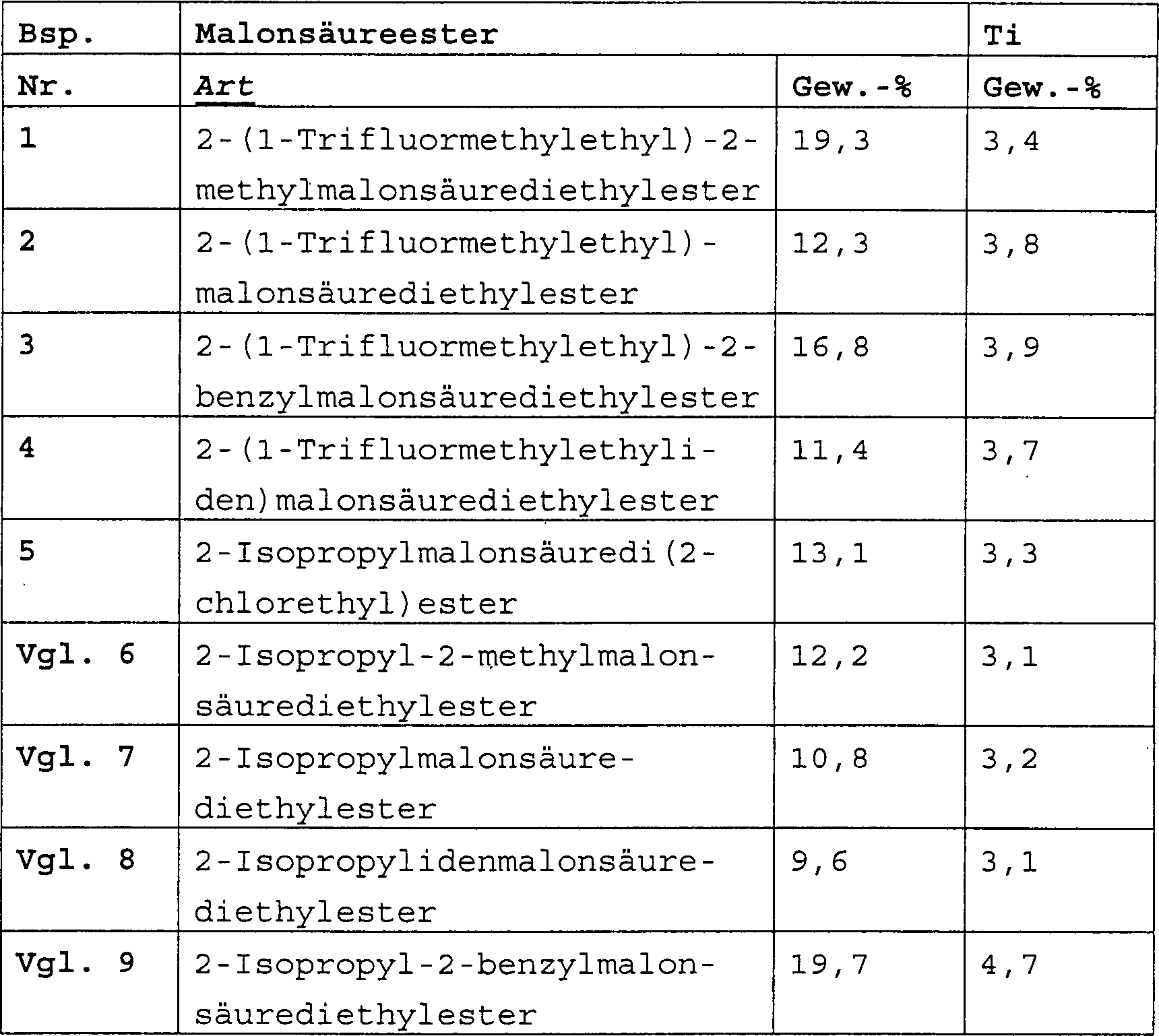

Claims (26)
Applications Claiming Priority (3)
| Application Number | Priority Date | Filing Date | Title |
|---|---|---|---|
| EP98203733 | 1998-11-04 | ||
| EP98203733 | 1998-11-04 | ||
| PCT/EP1999/008018 WO2000026259A1 (en) | 1998-11-04 | 1999-10-22 | Components and catalysts for the polymerization of olefins |
Publications (2)
| Publication Number | Publication Date |
|---|---|
| DE69918662D1 DE69918662D1 (en) | 2004-08-19 |
| DE69918662T2 true DE69918662T2 (en) | 2005-08-11 |
Family
ID=8234301
Family Applications (1)
| Application Number | Title | Priority Date | Filing Date |
|---|---|---|---|
| DE69918662T Expired - Fee Related DE69918662T2 (en) | 1998-11-04 | 1999-10-22 | COMPONENTS AND CATALYSTS FOR OLEFIN POLYMERIZATION |
Country Status (14)
| Country | Link |
|---|---|
| US (4) | US6605562B1 (en) |
| EP (1) | EP1042372B1 (en) |
| JP (1) | JP2002528606A (en) |
| KR (1) | KR20010033872A (en) |
| CN (1) | CN1146585C (en) |
| AT (1) | ATE271072T1 (en) |
| AU (1) | AU6342099A (en) |
| BR (1) | BR9907140A (en) |
| CA (1) | CA2315179A1 (en) |
| DE (1) | DE69918662T2 (en) |
| ES (1) | ES2224704T3 (en) |
| HU (1) | HUP0104266A2 (en) |
| IL (1) | IL136761A0 (en) |
| WO (1) | WO2000026259A1 (en) |
Families Citing this family (36)
| Publication number | Priority date | Publication date | Assignee | Title |
|---|---|---|---|---|
| EP1396503A4 (en) * | 2001-04-23 | 2007-03-14 | Idemitsu Kosan Co | SOLID CATALYST COMPONENT FOR POLYMERIZATION OF OLEFIN |
| CN1318457C (en) * | 2004-09-02 | 2007-05-30 | 中国石油化工股份有限公司 | Catalyst component for olefinic polymerization and its catalyst |
| CN100338018C (en) | 2004-10-29 | 2007-09-19 | 中国石油化工股份有限公司 | Cyclopentyl ester analog compound and its synthesis method and uses |
| JP5340916B2 (en) * | 2007-03-30 | 2013-11-13 | 東邦チタニウム株式会社 | Solid catalyst component for olefin polymerization, polymerization catalyst, and process for producing olefin polymer using the same |
| CN101735346B (en) | 2008-11-07 | 2012-05-30 | 中国石油天然气股份有限公司 | Catalyst for homopolymerization and copolymerization of propylene, preparation method and application thereof |
| RU2497834C2 (en) * | 2008-11-25 | 2013-11-10 | Юнион Карбайд Кемикалз Энд Пластикс Текнолоджи Ллс | Procatalyst composition with multi-component ester-containing internal donor and method |
| US8088872B2 (en) | 2008-11-25 | 2012-01-03 | Dow Global Technologies Llc | Procatalyst composition including silyl ester internal donor and method |
| US8383540B2 (en) * | 2010-12-21 | 2013-02-26 | Dow Global Technologies Llc | Catalyst composition with halo-malonate internal electron donor and polymer from same |
| EP2730590B1 (en) * | 2011-07-06 | 2018-04-04 | Toho Titanium CO., LTD. | Solid catalyst component for olefin polymerization, catalyst for olefin polymerization, and method for producing olefin polymer |
| EP2679609A1 (en) | 2012-06-28 | 2014-01-01 | Lummus Novolen Technology Gmbh | Sterically demanding dialkoxydialkylsilanes as external donors for ziegler catalysts for the polymerization of propylene |
| CN104513328B (en) * | 2013-09-30 | 2017-09-29 | 中国石油化工股份有限公司 | Carbon monoxide-olefin polymeric and its application for olefinic polyreaction |
| TWI639626B (en) | 2013-09-30 | 2018-11-01 | 中國石油化工科技開發有限公司 | Catalyst composition for olefin polymerization and application thereof |
| CN104558292B (en) * | 2013-10-28 | 2017-05-31 | 中国石油化工股份有限公司 | One kind is used for olefin polymerization catalysis preparation method |
| CN104558290B (en) * | 2013-10-28 | 2018-11-02 | 中国石油化工股份有限公司 | One kind being used for catalyst component for olefin polymerization and catalyst |
| CN104610056B (en) * | 2013-11-01 | 2017-04-26 | 中国石油化工股份有限公司 | Compound, catalyst solid composition containing compound, and catalyst |
| CN105566534B (en) * | 2014-10-13 | 2018-03-02 | 中国石油化工股份有限公司 | A kind of olefin polymer and its manufacture method |
| US9593184B2 (en) | 2014-10-28 | 2017-03-14 | Formosa Plastics Corporation, Usa | Oxalic acid diamides as modifiers for polyolefin catalysts |
| SI3364958T1 (en) | 2015-10-23 | 2023-05-31 | Navitor Pharmaceuticals, Inc. | Modulators of sestrin-gator2 interaction and uses thereof |
| US9777084B2 (en) * | 2016-02-19 | 2017-10-03 | Formosa Plastics Corporation, Usa | Catalyst system for olefin polymerization and method for producing olefin polymer |
| US11427660B2 (en) | 2016-08-17 | 2022-08-30 | Formosa Plastics Corporation, Usa | Organosilicon compounds as electron donors for olefin polymerization catalysts and methods of making and using same |
| US9815920B1 (en) | 2016-10-14 | 2017-11-14 | Formosa Plastics Corporation, Usa | Olefin polymerization catalyst components and process for the production of olefin polymers therewith |
| WO2018164658A1 (en) | 2017-03-06 | 2018-09-13 | W.R. Grace & Co.-Conn. | Electron donors for ziegler-natta precatalyst preparation and catalyst system for olefin polymerization |
| ES3040534T3 (en) | 2017-04-26 | 2025-11-03 | Navitor Pharm Inc | Modulator of sestrin-gator2 interaction for use in the treatment of treatment-resistant depression |
| US10124324B1 (en) | 2017-05-09 | 2018-11-13 | Formosa Plastics Corporation, Usa | Olefin polymerization catalyst components and process for the production of olefin polymers therewith |
| US10822438B2 (en) | 2017-05-09 | 2020-11-03 | Formosa Plastics Corporation | Catalyst system for enhanced stereo-specificity of olefin polymerization and method for producing olefin polymer |
| CA3117336A1 (en) | 2018-10-24 | 2020-04-30 | Navitor Pharmaceuticals, Inc. | Polymorphs of (s)-2-amino-5,5-difluoro-4,4-dimethylpentanoic acid for use in modulating mtorc1 |
| CN113179643B (en) * | 2019-01-09 | 2024-07-05 | 巴塞尔聚烯烃意大利有限公司 | Catalyst components for olefin polymerization |
| IL292612A (en) | 2019-11-01 | 2022-07-01 | Navitor Pharm Inc | Methods of treatment using an mtorc1 modulator |
| MY209584A (en) | 2021-10-15 | 2025-07-23 | Skechers Usa Inc Ii | Footwear counter for easier entry and removal |
| CN116041577B (en) | 2021-10-28 | 2024-12-06 | 中国石油化工股份有限公司 | Olefin polymerization catalyst component, catalyst system and application thereof and olefin polymerization method |
| US20250066513A1 (en) | 2023-08-23 | 2025-02-27 | Formosa Plastics Corporation, U.S.A. | Catalyst System For Enhanced Stereo-Specificity Of Olefin Polymerization |
| US20250066514A1 (en) | 2023-08-24 | 2025-02-27 | Formosa Plastics Corporation, U.S.A. | Catalysts component and process for the production of polypropylene having high melt flow rate with high isotacticity |
| US20250109218A1 (en) | 2023-09-29 | 2025-04-03 | Formosa Plastics Corporation, U.S.A. | Method for preparing catalyst component for polymerization of polyolefin without the use of internal electron donors |
| US20250115687A1 (en) | 2023-10-06 | 2025-04-10 | Formosa Plastics Corporation, U.S.A. | Production method for solid catalyst component for polymerizing olefins, and catalyst for polymerizaing olefins |
| US20250115686A1 (en) | 2023-10-09 | 2025-04-10 | Formosa Plastics Corporation, U.S.A. | Olefin polymerization catalyst components containing silane and process for the production of polypropylene having high isotacticity at high melt flow rate |
| US20250297039A1 (en) | 2024-03-19 | 2025-09-25 | Formosa Plastics Corporation, U.S.A. | Olefin polymerization catalyst components containing diglycidylester components and its use for the production of polypropylene having high isotacticity at high melt flow rate |
Family Cites Families (26)
| Publication number | Priority date | Publication date | Assignee | Title |
|---|---|---|---|---|
| SE363977B (en) | 1968-11-21 | 1974-02-11 | Montedison Spa | |
| YU35844B (en) | 1968-11-25 | 1981-08-31 | Montedison Spa | Process for obtaining catalysts for the polymerization of olefines |
| AR194578A1 (en) * | 1970-11-09 | 1973-07-31 | Kendall & Co | A PROCEDURE FOR PREPARING 5-SUBSTITUTED-5-PHENYLALKYL BARBITURIC ACIDS AND AN INTERMEDIATE COMPOUND OBTAINED DURING SUCH PROCEDURE |
| GB1572669A (en) | 1977-05-26 | 1980-08-28 | Ici Ltd | Manufacture of esters |
| GB1603724A (en) | 1977-05-25 | 1981-11-25 | Montedison Spa | Components and catalysts for the polymerisation of alpha-olefins |
| IT1096661B (en) | 1978-06-13 | 1985-08-26 | Montedison Spa | PROCEDURE FOR THE PREPARATION OF SOLID SPHEROIDAL PRODUCTS AT AMBIENT TEMPERATURE |
| IT1098272B (en) | 1978-08-22 | 1985-09-07 | Montedison Spa | COMPONENTS, CATALYSTS AND CATALYSTS FOR THE POLYMERIZATION OF ALPHA-OLEFINS |
| IT1209255B (en) | 1980-08-13 | 1989-07-16 | Montedison Spa | CATALYSTS FOR THE POLYMERIZATION OF OLEFINE. |
| IT1190683B (en) * | 1982-02-12 | 1988-02-24 | Montedison Spa | COMPONENTS AND CATALYSTS FOR THE POLYMERIZATION OF OLEFINE |
| JPS58138720A (en) * | 1982-02-12 | 1983-08-17 | Mitsui Petrochem Ind Ltd | Preparation of propylene random copolymer |
| JPS58138706A (en) | 1982-02-12 | 1983-08-17 | Mitsui Petrochem Ind Ltd | Polymerization of olefin |
| CA2004281A1 (en) * | 1988-12-09 | 1990-06-09 | Nun-Sian Tsai | Etching of integrated-circuit device metallization and resulting device |
| US5066795A (en) * | 1989-02-10 | 1991-11-19 | Sagami Chemical Research Center | Perfluoroalkyl-containing compound |
| IT1230134B (en) | 1989-04-28 | 1991-10-14 | Himont Inc | COMPONENTS AND CATALYSTS FOR THE POLYMERIZATION OF OLEFINE. |
| IT1262934B (en) | 1992-01-31 | 1996-07-22 | Montecatini Tecnologie Srl | COMPONENTS AND CATALYSTS FOR THE POLYMERIZATION OF OLEFINE |
| IT1262935B (en) | 1992-01-31 | 1996-07-22 | Montecatini Tecnologie Srl | COMPONENTS AND CATALYSTS FOR THE POLYMERIZATION OF OLEFINE |
| IT1256648B (en) | 1992-12-11 | 1995-12-12 | Montecatini Tecnologie Srl | COMPONENTS AND CATALYSTS FOR THE POLYMERIZATION OF OLEFINS |
| US5459116A (en) | 1993-05-07 | 1995-10-17 | Samsung General Chemicals Co., Ltd. | Highly active catalyst for the polymerization of olefins and method for the preparation of the same |
| DE4326918C1 (en) | 1993-08-11 | 1995-01-19 | Huels Chemische Werke Ag | Process for the preparation of dialkyl 2-haloethylmalonates |
| TW354792B (en) * | 1993-08-13 | 1999-03-21 | Mitsui Petrochemical Ind | Olefin polymerization catalyst and process for preparing polypropylene and propylene block copolymer |
| JP3385681B2 (en) * | 1993-11-26 | 2003-03-10 | 宇部興産株式会社 | Method for producing propylene block copolymer |
| FI972110A0 (en) | 1994-11-17 | 1997-05-16 | Dow Chemical Co | Supported catalyst component, supported catalyst, their preparation and addition polymerization process |
| JP3489889B2 (en) * | 1994-12-01 | 2004-01-26 | 昭和電工株式会社 | Method for producing solid catalyst component for olefin polymerization, catalyst for olefin polymerization and method for producing olefin polymer |
| AUPO591797A0 (en) | 1997-03-27 | 1997-04-24 | Commonwealth Scientific And Industrial Research Organisation | High avidity polyvalent and polyspecific reagents |
| JP3552342B2 (en) | 1995-06-23 | 2004-08-11 | 住友化学工業株式会社 | Catalyst for α-olefin polymerization and method for producing α-olefin polymer |
| JPH1160625A (en) * | 1997-08-22 | 1999-03-02 | Idemitsu Petrochem Co Ltd | Olefin polymerization solid catalyst component, olefin polymerization catalyst and preparation of olefin polymer |
-
1999
- 1999-10-22 IL IL13676199A patent/IL136761A0/en unknown
- 1999-10-22 CN CNB998036331A patent/CN1146585C/en not_active Expired - Fee Related
- 1999-10-22 HU HU0104266A patent/HUP0104266A2/en unknown
- 1999-10-22 JP JP2000579645A patent/JP2002528606A/en active Pending
- 1999-10-22 EP EP99950770A patent/EP1042372B1/en not_active Expired - Lifetime
- 1999-10-22 BR BR9907140-1A patent/BR9907140A/en unknown
- 1999-10-22 WO PCT/EP1999/008018 patent/WO2000026259A1/en not_active Ceased
- 1999-10-22 DE DE69918662T patent/DE69918662T2/en not_active Expired - Fee Related
- 1999-10-22 AT AT99950770T patent/ATE271072T1/en not_active IP Right Cessation
- 1999-10-22 KR KR1020007007440A patent/KR20010033872A/en not_active Withdrawn
- 1999-10-22 CA CA002315179A patent/CA2315179A1/en not_active Abandoned
- 1999-10-22 US US09/582,600 patent/US6605562B1/en not_active Expired - Fee Related
- 1999-10-22 ES ES99950770T patent/ES2224704T3/en not_active Expired - Lifetime
- 1999-10-22 AU AU63420/99A patent/AU6342099A/en not_active Abandoned
-
2003
- 2003-06-06 US US10/455,900 patent/US20030207755A1/en not_active Abandoned
- 2003-06-06 US US10/455,898 patent/US6699814B2/en not_active Expired - Fee Related
- 2003-06-06 US US10/455,899 patent/US6689850B2/en not_active Expired - Fee Related
Also Published As
| Publication number | Publication date |
|---|---|
| EP1042372B1 (en) | 2004-07-14 |
| KR20010033872A (en) | 2001-04-25 |
| IL136761A0 (en) | 2001-06-14 |
| HUP0104266A2 (en) | 2002-03-28 |
| JP2002528606A (en) | 2002-09-03 |
| AU6342099A (en) | 2000-05-22 |
| US6689850B2 (en) | 2004-02-10 |
| US20030199388A1 (en) | 2003-10-23 |
| DE69918662D1 (en) | 2004-08-19 |
| CN1146585C (en) | 2004-04-21 |
| US20030207754A1 (en) | 2003-11-06 |
| EP1042372A1 (en) | 2000-10-11 |
| CN1292800A (en) | 2001-04-25 |
| US20030207755A1 (en) | 2003-11-06 |
| CA2315179A1 (en) | 2000-05-11 |
| BR9907140A (en) | 2000-10-17 |
| US6699814B2 (en) | 2004-03-02 |
| WO2000026259A1 (en) | 2000-05-11 |
| ES2224704T3 (en) | 2005-03-01 |
| US6605562B1 (en) | 2003-08-12 |
| ATE271072T1 (en) | 2004-07-15 |
Similar Documents
| Publication | Publication Date | Title |
|---|---|---|
| DE69918662T2 (en) | COMPONENTS AND CATALYSTS FOR OLEFIN POLYMERIZATION | |
| DE60104238T2 (en) | COMPONENTS AND CATALYSTS FOR POLYMERIZATION OF OLEFINES | |
| DE60029399T2 (en) | COMPONENT AND CATALYST FOR THE POLYMERIZATION OF OLEFINES | |
| DE69802491T3 (en) | COMPONENTS AND CATALYSTS FOR THE POLYMERIZATION OF OLEFINES | |
| DE69802059T2 (en) | CATALYST COMPONENTS AND CATALYSTS FOR THE POLYMERIZATION OF OLEFINS | |
| DE69921918T2 (en) | PREPOLYMERIZED CATALYST COMPONENTS FOR OLEFIN POLYMERIZATION | |
| DE60224205T2 (en) | COMPONENTS AND CATALYSTS FOR THE POLYMERIZATION OF OLEFINES | |
| DE60015090T2 (en) | ALPHA-OLEFIN-CONTAINING POLYMERIZATION CATALYST SYSTEM CONTAINING AN AROMATIC SILANE | |
| DE69813444T2 (en) | CATALYST COMPONENTS AND CATALYSTS FOR THE POLYMERIZATION OF OLEFINS | |
| DE69809531T2 (en) | INGREDIENTS AND CATALYSTS FOR OLEFIN POLYMERIZATION | |
| DE69125959T2 (en) | Components and catalysts for olefin polymerization | |
| DE69731686T2 (en) | polymerization catalyst | |
| DE60122018T2 (en) | ACTIVE NON-METALOCENE PRECATALYZER AND METHOD FOR THE TACTIC CATALYTIC POLYMERIZATION OF ALPHA-OLEFIN MONOMERS | |
| DE69907785T2 (en) | Multi-stage process for olefin polymerization | |
| DE69133274T2 (en) | Catalyst components and catalysts for olefin polymerization | |
| DE2822783A1 (en) | COMPONENTS AND CATALYSTS FOR THE POLYMERIZATION OF ALPHA-OLEFINS | |
| DE2906769A1 (en) | CATALYST AND METHOD FOR MANUFACTURING HIGHEST EOS-SPECIFIC ALPHA-OLEFIN POLYMERISATES AND THEIR USE | |
| DE2451844A1 (en) | CATALYST, METHOD FOR ITS MANUFACTURING AND ITS USE FOR THE POLYMERIZATION OF OLEFINS | |
| DE3124223A1 (en) | "METHOD FOR PRODUCING A POLYOLEFIN AND CATALYST THEREFOR" | |
| DE69015912T2 (en) | Organosilane compounds. | |
| DE2111455A1 (en) | Process for the production of polyolefins | |
| JP2007510019A (en) | Components and catalysts for olefin polymerization | |
| DE69109211T2 (en) | Trifluoropropyl substituted silane compound containing catalyst for alpha olefin polymerization. | |
| DE3031573A1 (en) | METHOD FOR PRODUCING HIGH CRYSTALLINE (ALPHA) -OLEFIN POLYMERISATS AND CATALYST FOR IMPLEMENTING THE METHOD | |
| DE60225595T2 (en) | Preparation of silicon-bonded metallocene compounds |
Legal Events
| Date | Code | Title | Description |
|---|---|---|---|
| 8364 | No opposition during term of opposition | ||
| 8339 | Ceased/non-payment of the annual fee |