DE69918571T2 - METHOD AND DEVICE FOR DELIVERING BYTE CODES EMBEDDED IN A TRANSPORT FLOW - Google Patents
METHOD AND DEVICE FOR DELIVERING BYTE CODES EMBEDDED IN A TRANSPORT FLOW Download PDFInfo
- Publication number
- DE69918571T2 DE69918571T2 DE69918571T DE69918571T DE69918571T2 DE 69918571 T2 DE69918571 T2 DE 69918571T2 DE 69918571 T DE69918571 T DE 69918571T DE 69918571 T DE69918571 T DE 69918571T DE 69918571 T2 DE69918571 T2 DE 69918571T2
- Authority
- DE
- Germany
- Prior art keywords
- bytecode
- transport stream
- data
- packets
- bytecodes
- Prior art date
- Legal status (The legal status is an assumption and is not a legal conclusion. Google has not performed a legal analysis and makes no representation as to the accuracy of the status listed.)
- Expired - Fee Related
Links
Classifications
-
- H—ELECTRICITY
- H04—ELECTRIC COMMUNICATION TECHNIQUE
- H04N—PICTORIAL COMMUNICATION, e.g. TELEVISION
- H04N21/00—Selective content distribution, e.g. interactive television or video on demand [VOD]
- H04N21/80—Generation or processing of content or additional data by content creator independently of the distribution process; Content per se
- H04N21/81—Monomedia components thereof
- H04N21/8166—Monomedia components thereof involving executable data, e.g. software
-
- G—PHYSICS
- G06—COMPUTING OR CALCULATING; COUNTING
- G06F—ELECTRIC DIGITAL DATA PROCESSING
- G06F9/00—Arrangements for program control, e.g. control units
- G06F9/06—Arrangements for program control, e.g. control units using stored programs, i.e. using an internal store of processing equipment to receive or retain programs
- G06F9/44—Arrangements for executing specific programs
- G06F9/445—Program loading or initiating
-
- H—ELECTRICITY
- H04—ELECTRIC COMMUNICATION TECHNIQUE
- H04L—TRANSMISSION OF DIGITAL INFORMATION, e.g. TELEGRAPHIC COMMUNICATION
- H04L65/00—Network arrangements, protocols or services for supporting real-time applications in data packet communication
- H04L65/1066—Session management
- H04L65/1101—Session protocols
-
- H—ELECTRICITY
- H04—ELECTRIC COMMUNICATION TECHNIQUE
- H04L—TRANSMISSION OF DIGITAL INFORMATION, e.g. TELEGRAPHIC COMMUNICATION
- H04L65/00—Network arrangements, protocols or services for supporting real-time applications in data packet communication
- H04L65/60—Network streaming of media packets
- H04L65/61—Network streaming of media packets for supporting one-way streaming services, e.g. Internet radio
- H04L65/613—Network streaming of media packets for supporting one-way streaming services, e.g. Internet radio for the control of the source by the destination
-
- H—ELECTRICITY
- H04—ELECTRIC COMMUNICATION TECHNIQUE
- H04L—TRANSMISSION OF DIGITAL INFORMATION, e.g. TELEGRAPHIC COMMUNICATION
- H04L65/00—Network arrangements, protocols or services for supporting real-time applications in data packet communication
- H04L65/60—Network streaming of media packets
- H04L65/70—Media network packetisation
-
- H—ELECTRICITY
- H04—ELECTRIC COMMUNICATION TECHNIQUE
- H04L—TRANSMISSION OF DIGITAL INFORMATION, e.g. TELEGRAPHIC COMMUNICATION
- H04L65/00—Network arrangements, protocols or services for supporting real-time applications in data packet communication
- H04L65/60—Network streaming of media packets
- H04L65/75—Media network packet handling
- H04L65/765—Media network packet handling intermediate
-
- H—ELECTRICITY
- H04—ELECTRIC COMMUNICATION TECHNIQUE
- H04L—TRANSMISSION OF DIGITAL INFORMATION, e.g. TELEGRAPHIC COMMUNICATION
- H04L9/00—Cryptographic mechanisms or cryptographic arrangements for secret or secure communications; Network security protocols
- H04L9/40—Network security protocols
-
- H—ELECTRICITY
- H04—ELECTRIC COMMUNICATION TECHNIQUE
- H04N—PICTORIAL COMMUNICATION, e.g. TELEVISION
- H04N21/00—Selective content distribution, e.g. interactive television or video on demand [VOD]
- H04N21/20—Servers specifically adapted for the distribution of content, e.g. VOD servers; Operations thereof
- H04N21/23—Processing of content or additional data; Elementary server operations; Server middleware
- H04N21/235—Processing of additional data, e.g. scrambling of additional data or processing content descriptors
-
- H—ELECTRICITY
- H04—ELECTRIC COMMUNICATION TECHNIQUE
- H04N—PICTORIAL COMMUNICATION, e.g. TELEVISION
- H04N21/00—Selective content distribution, e.g. interactive television or video on demand [VOD]
- H04N21/20—Servers specifically adapted for the distribution of content, e.g. VOD servers; Operations thereof
- H04N21/23—Processing of content or additional data; Elementary server operations; Server middleware
- H04N21/236—Assembling of a multiplex stream, e.g. transport stream, by combining a video stream with other content or additional data, e.g. inserting a URL [Uniform Resource Locator] into a video stream, multiplexing software data into a video stream; Remultiplexing of multiplex streams; Insertion of stuffing bits into the multiplex stream, e.g. to obtain a constant bit-rate; Assembling of a packetised elementary stream
- H04N21/23614—Multiplexing of additional data and video streams
-
- H—ELECTRICITY
- H04—ELECTRIC COMMUNICATION TECHNIQUE
- H04N—PICTORIAL COMMUNICATION, e.g. TELEVISION
- H04N21/00—Selective content distribution, e.g. interactive television or video on demand [VOD]
- H04N21/40—Client devices specifically adapted for the reception of or interaction with content, e.g. set-top-box [STB]; Operations thereof
- H04N21/43—Processing of content or additional data, e.g. demultiplexing additional data from a digital video stream; Elementary client operations, e.g. monitoring of home network or synchronising decoder's clock; Client middleware
- H04N21/434—Disassembling of a multiplex stream, e.g. demultiplexing audio and video streams, extraction of additional data from a video stream; Remultiplexing of multiplex streams; Extraction or processing of SI; Disassembling of packetised elementary stream
-
- H—ELECTRICITY
- H04—ELECTRIC COMMUNICATION TECHNIQUE
- H04N—PICTORIAL COMMUNICATION, e.g. TELEVISION
- H04N21/00—Selective content distribution, e.g. interactive television or video on demand [VOD]
- H04N21/40—Client devices specifically adapted for the reception of or interaction with content, e.g. set-top-box [STB]; Operations thereof
- H04N21/43—Processing of content or additional data, e.g. demultiplexing additional data from a digital video stream; Elementary client operations, e.g. monitoring of home network or synchronising decoder's clock; Client middleware
- H04N21/434—Disassembling of a multiplex stream, e.g. demultiplexing audio and video streams, extraction of additional data from a video stream; Remultiplexing of multiplex streams; Extraction or processing of SI; Disassembling of packetised elementary stream
- H04N21/4348—Demultiplexing of additional data and video streams
-
- H—ELECTRICITY
- H04—ELECTRIC COMMUNICATION TECHNIQUE
- H04N—PICTORIAL COMMUNICATION, e.g. TELEVISION
- H04N21/00—Selective content distribution, e.g. interactive television or video on demand [VOD]
- H04N21/40—Client devices specifically adapted for the reception of or interaction with content, e.g. set-top-box [STB]; Operations thereof
- H04N21/43—Processing of content or additional data, e.g. demultiplexing additional data from a digital video stream; Elementary client operations, e.g. monitoring of home network or synchronising decoder's clock; Client middleware
- H04N21/435—Processing of additional data, e.g. decrypting of additional data, reconstructing software from modules extracted from the transport stream
-
- H—ELECTRICITY
- H04—ELECTRIC COMMUNICATION TECHNIQUE
- H04L—TRANSMISSION OF DIGITAL INFORMATION, e.g. TELEGRAPHIC COMMUNICATION
- H04L2212/00—Encapsulation of packets
-
- H—ELECTRICITY
- H04—ELECTRIC COMMUNICATION TECHNIQUE
- H04L—TRANSMISSION OF DIGITAL INFORMATION, e.g. TELEGRAPHIC COMMUNICATION
- H04L67/00—Network arrangements or protocols for supporting network services or applications
- H04L67/34—Network arrangements or protocols for supporting network services or applications involving the movement of software or configuration parameters
-
- H—ELECTRICITY
- H04—ELECTRIC COMMUNICATION TECHNIQUE
- H04L—TRANSMISSION OF DIGITAL INFORMATION, e.g. TELEGRAPHIC COMMUNICATION
- H04L69/00—Network arrangements, protocols or services independent of the application payload and not provided for in the other groups of this subclass
- H04L69/22—Parsing or analysis of headers
Landscapes
- Engineering & Computer Science (AREA)
- Multimedia (AREA)
- Signal Processing (AREA)
- Computer Networks & Wireless Communication (AREA)
- Software Systems (AREA)
- Theoretical Computer Science (AREA)
- General Engineering & Computer Science (AREA)
- General Physics & Mathematics (AREA)
- Computer Security & Cryptography (AREA)
- Physics & Mathematics (AREA)
- Business, Economics & Management (AREA)
- General Business, Economics & Management (AREA)
- Data Exchanges In Wide-Area Networks (AREA)
- Communication Control (AREA)
- Two-Way Televisions, Distribution Of Moving Picture Or The Like (AREA)
- Compression Or Coding Systems Of Tv Signals (AREA)
- Control Of Conveyors (AREA)
- Discharge Of Articles From Conveyors (AREA)
Abstract
Description
Hintergrund der Erfindungbackground the invention
A. Gebiet der ErfindungA. Field of the Invention
Diese Erfindung bezieht sich auf das Gebiet der Datenkommunikation. Teile der Offenbarung dieser Patentunterlagen enthalten Material, das dem Urheberrecht unterliegt.These This invention relates to the field of data communication. parts The disclosure of these patent documents contain material that subject to copyright.
Der Inhaber des Urheberrecht hat keinen Einwand, wenn jemand die Patentunterlagen oder die Patentoffenbarung, wie sie in der Akte oder den Aufzeichnungen des Patent- und Markenamtes erscheint, bildtechnisch reproduziert, behält sich aber alle Urheberrechte darüber hinaus vor. Sun, Sun Microsystems, das Sunlogo, Solaris, SPARC, "Write Once, Run Anywhere", Java, JavaOS, JavaStation und alle auf Java basierenden Marken und Logos sind Marken oder eingetragene Marken von Sun Microsystems, Inc, in den USA und anderen Ländern.Of the The copyright owner has no objection if someone has the patent documents or the patent disclosure, as in the file or records of the Patent and Trademark Office appears, reproduced pictorially, reserves but all copyright on it out before. Sun, Sun Microsystems, Sunlogo, Solaris, SPARC, Write Once, Run Anywhere, Java, JavaOS, JavaStation and all Java based brands and logos are trademarks or registered trademarks of Sun Microsystems, Inc., in the US and others Countries.
B. Technischer HintergrundB. Technical Background
Eine Verwendung des Internets ist das Liefern von Media-Informationen (wie eine Video- oder Sounddatei) an einen Benutzer. Ein Problem bei den derzeitigen Media-Liefersystemen ist, daß es schwierig ist, irgendwelche anderen Daten zu liefern, während die Mediadaten geliefert werden. Manchmal ist es gewünscht, Mediadaten und andere Daten (wie Steuerdaten) zur gleichen Zeit zu senden, ein Verfahren, das als "gleichzeitige Lieferung" bezeichnet wird. Bis jetzt gibt es kein geeignetes System zum gleichzeitigen Liefern von Media- und Steuerdaten. Die Probleme, die mit dem Bereitstellen eines gleichzeitigen Lieferns von Mediadaten und Steuerdaten verbunden sind, lassen sich durch einen Überblick über Media-Liefersysteme verstehen.A Using the Internet is delivering media information (like a video or Sound file) to a user. A problem with the current media delivery systems Is that it is difficult to deliver any other data while the Media data to be delivered. Sometimes it is desired media data and others To send data (such as control data) at the same time, a procedure that as "simultaneous Delivery " becomes. So far there is no suitable system for simultaneous Deliver media and control data. The problems with deploying concurrent delivery of media data and control data are through an overview of media delivery systems understand.
Media-Lieferung (Media Delivery)Media delivery (Media Delivery)
In Multimediaanwendungen werden Mediadaten, wie Video- oder Audioinformationen, von einem Servercomputer zu einem Clientcomputer (zum Beispiel einem Computer eines Benut zers zu Hause oder im Büro) über einen "Transportstrom" übertragen. Ein Transportstrom besteht aus einer Abfolge von Bursts oder Paketen von Mediadaten. Bevor die Mediadaten übertragen werden, werden sie zuerst durch Konvertieren in ein geeignetes Format zur Übertragung bearbeitet. Einige Systeme (zum Beispiel Motion Picture Experts Group (MPEG)-Standards, wie MPEG-1, MPEG-2, MPEG-4 usw.) sind verfügbar, um Mediadaten (zum Beispiel Audio, Video usw.) zu bearbeiten, um sie als Mediadatenstrom zu übertragen.In Multimedia applications become media data, such as video or audio information, from a server computer to a client computer (for example, a Computer of a user at home or in the office) via a "transport stream". A transport stream consists of a sequence of bursts or packets of media data. Before the media data is transmitted, they become first by converting to a suitable format for transmission processed. Some systems (for example, Motion Picture Experts Group (MPEG) standards, such as MPEG-1, MPEG-2, MPEG-4, etc.) are available to media data (for example Audio, video, etc.) in order to transmit them as a media data stream.
Mediadaten werden manchmal als "zeitbezogene" oder "zeitsensitive" Daten bezeichnet. Dies liegt daran, weil es wichtig oder erforderlich ist, daß die Daten in einer bestimmten Geschwindigkeit und/oder zu einer bestimmten Zeit verfügbar sind. Beim Ansehen eines Videostroms ist es zum Beispiel wichtig, daß neue Videobilder verfügbar sind, so wie sie benötigt werden, um Unterbrechungen oder Verzögerungen in den dargestellten Videodaten zu vermeiden. Wenn die Daten eines Videos zu langsam gesendet werden, kann zum Beispiel das dargestellte Videobild einfrieren oder schwarz werden, während der Clientcomputer auf neue Videodaten wartet. Ähnlich müssen für Audiodaten neue Audiodaten kontinuierlich geliefert werden oder es entstehen Unterbrechungen bei der Wiedergabe. Diese Unterbrechungen können eine Ruhepause beim Abspielen der Audiodaten hervorrufen, was dazu führt, daß der Ton abgeschnitten wird oder Töne und Wörter fehlen. (Es ist zu beachten, daß zeitbezogene Daten nicht auf Mediadaten beschränkt sind. Zeitbezogene Daten sind Daten, die zusätzliche Informationen mit sich tragen, die ein Timing darstellen, das für die Verwendung der Daten relevant ist. Zum Beispiel können zeitbezogene Daten Zeitmarken umfassen, die Deadlines anzeigen, bis zu denen die Daten verarbeitet werden sollten).Media data are sometimes referred to as "time-related" or "time-sensitive" data. This is because it is important or required that the data at a certain speed and / or at a certain speed Time available are. For example, watching a video stream is important that new ones Video images available are as they are needed be to interruptions or delays in the illustrated To avoid video data. When a video's data is too slow can be sent, for example, freeze the video image shown or black while the client computer is waiting for new video data. Similarly, audio data requires new audio data be delivered continuously or there are interruptions during playback. These interruptions can be a rest while playing the Cause audio data, which causes the sound to be cut off or sounds and words absence. (It should be noted that time-related Data is not limited to media data. Time-related data are data that extra Carry information that represents a timing for use the data is relevant. For example, time related data may be timestamps include deadlines to which the data is processed should be).
In einigen Fällen ist eine Steueranwendung erforderlich, um bei der Wiedergabe der Mediadaten zu helfen oder um die Wiedergabe der Mediadaten zu steuern. In einigen Fällen ist eine solche Steueranwendung ein Applet oder eine Anwendung (wie ein Applet oder eine Anwendung in der Programmiersprache JavaTM). Das Applet wird als ein Bytecode von einem Server zu einem Benutzercomputer übertragen und der Benutzercomputer verwendet das Applet um die Wiedergabe der Mediadaten zu steuern. Es kann notwendig sein, einen Bytecode oder andere seriellen Daten oder Objekte an Clients zusammen mit den Mediainformationen zu liefern.In some cases, a control application may be required to help with the playback of the media data or to control the playback of the media data. In some cases, such a control application is an applet or application (such as an applet or an application in the Java TM programming language). The applet is transmitted as a bytecode from a server to a user computer and the user computer uses the applet to control the playback of the media data. It may be necessary to provide a bytecode or other serial data or objects to clients along with the media information.
Es gibt derzeit keinen effektiven Mechanismus, der verfügbar ist, um Bytecodebefehle zusammen mit Mediadaten zu liefern. Typischerweise werden Bytecodedaten übertragen, nach dem alle notwendigen Daten übertragen sind. Das kann für einige Umgebungen zu spät sein, bei denen Applets oder Steueranwendungen bearbeitet werden müssen, sobald sie verfügbar werden. Eine Lösung aus dem Stand der Technik ist es, die Steueranwendung zuerst zu senden, noch bevor die Media- oder zeitbezogenen Daten übertragen werden. Dies führt jedoch zu unerwünschten Verzögerungen beim Wiedergeben der Mediadaten. Der Benutzer erwartet, Videodaten zu sehen, statt dessen muß er jedoch warten, bis die Steuerdaten empfangen sind. Diese Verzögerung ist unerwünscht.There is currently no effective mechanism available to provide bytecode instructions along with media data. Typically, bytecode data is transferred after all necessary data are transferred. This may be too late for some environments where applets or control applications need to be edited as they become available. One prior art solution is to send the control application first, even before the media or time related data is transmitted. However, this leads to undesirable delays in playing the media data. The user expects to see video data, but instead has to wait for the control data to be received. This delay is undesirable.
Daher besteht ein Bedarf für die Übertragung von Bytecodebefehlen gleichzeitig mit den Mediadaten, anstelle einer Übertragung vor oder nach den Mediainformationen.Therefore there is a need for the transfer bytecode commands concurrently with the media data, rather than a transmission before or after the media information.
Es ist das Ziel der vorliegenden Erfindung, ein Verfahren zum Liefern von Bytecodes zum Steuern der Wiedergabe von Mediadaten in einem Transportstrom zur Verfügung zu stellen, wobei Mediadaten in Datenpakete zerlegt werden, was für ein gleichzeitiges und rechtzeitiges Liefern der Bytecodebefehle mit Mediadaten und eine effiziente Benutzung des Datenraums, der in dem Transportstrom verfügbar ist, ermöglicht.It the object of the present invention is a method of delivering of bytecodes for controlling the playback of media data in one Transport stream available to put media data into data packets, what for a simultaneous and timely delivery of the bytecode instructions Media data and an efficient use of the data space, which in available for the transport stream is possible.
Zusammenfassung der ErfindungSummary the invention
Es wird ein Verfahren und eine Vorrichtung zum Einbetten von Bytecodedaten in ein Transportstrom beschrieben. Ausführungsformen der Erfindung sorgen dafür, daß JavaTM-Bytecode (in einer Klassendatei) gleichzeitig für einen Benutzer verfügbar ist, der Mediainformationen durch einen Transportstrom empfängt. Bytecodeinformationen werden in den Raum eingebettet, der in dem Transportstrom zur Verfügung gestellt wird, oder in Pakete, welche die Mediadaten übertragen.A method and apparatus for embedding bytecode data in a transport stream is described. Embodiments of the invention provide for Java ™ bytecode (in a class file) to be simultaneously available to a user receiving media information through a transport stream. Byte code information is embedded in the space provided in the transport stream or in packets that transmit the media data.
In einer Ausführungsform der Erfindung werden Mediadaten in strukturierte Pakete gruppiert, die als Packetized Elementary Stream (PES)-Pakete bezeichnet werden. Die Bytecodedaten werden in vordefinierten Bereichen in jedem PES-Paket eingebettet. Ein vordefinierter Bereich wird in dem Kopfsegment eines PES-Pakets zur Verfügung gestellt. Bytecodebefehle können auch in einem Privatstromabschnitt eines PES-Pakets eingebettet werden.In an embodiment of the invention, media data is grouped into structured packets, referred to as Packetized Elementary Stream (PES) packets. The bytecode data is stored in predefined areas in each PES packet embedded. A predefined area will be in the header segment a PES package posed. Bytecode commands can also embedded in a private stream section of a PES packet become.
Bytecodedaten können auch in dem Privatstromabschnitt übertragen werden und eine Übertragungswiederholung von Bytecodedaten wird in anderen Bereichen des PES-Pakets ausgeführt. Bytecodedaten können auch in einem Adaptionsfeld übertragen werden und wieder übertragene Daten werden als private Daten im PES-Kopf gesendet.Bytecodedaten can also be transmitted in the private stream section and a retransmission Byte code data is executed in other areas of the PES packet. Bytecodedaten can also transmitted in an adaptation field be and retransmitted Data is sent as private data in the PES header.
Ein Transportstrom, der bei der Erfindung benutzt wird, ist ein MPEG-2-Transportstrom, der strukturierte Pakete umfaßt, welche die PES-Pakete übertragen. Diese Transportstrompakete besitzen umgekehrt in ihnen eingebettete Bytecodedaten innerhalb von Räumen in dem Transportstrom. In einer Ausführungsform der Erfindung kann Bytecode in einem Transportstromkopf oder in einem Transportstromnutzinformationsabschnitt eingebettet sein.One Transport stream used in the invention is an MPEG-2 transport stream, comprising structured packets, which transmit the PES packets. Conversely, these transport stream packets have embedded therein Bytecode data within rooms in the transport stream. In one embodiment of the invention Bytecode in a transport stream header or in a transport stream payload section be embedded.
In Ausführungsformen der Erfindung wird das Einbetten von Informationen gemäß den Verfahren dieser Erfindung so ausgeführt, daß ein MPEG-2-kompatibler Decoder in der Lage ist, den Strom unabhängig davon zu verwenden, ob der Decoder die eingebetteten Bytecodeinformationen ausnutzt oder nicht. Weiterhin wird der Transportstrom mit minimalen Änderungen in der Bit-Rate im Hinblick auf sowohl die Länge als auch die Frequenz übertragen und liegt innerhalb der erlaubten maximalen Bandbreite. Ausführungsformen dieser Erfindung können auch Tune-in-Punkte definieren, an denen ein Decoder mit dem Decodieren und dem Darstellen der Bytecodeinformationen anfängt.In embodiments of the invention, the embedding of information according to the methods of this invention is performed so that an MPEG-2 compliant decoder is able to use the stream regardless of whether the decoder exploits the embedded byte code information or not. Furthermore, the transport stream is transmitted with minimal changes in bit rate in terms of both length and frequency, and is within the allowed maximum bandwidth. Embodiments of this invention may also define tune-in points involving a decoder with the decoder and the dar the bytecode information begins.
Kurze Beschreibung der ZeichnungenShort description the drawings
Detaillierte Beschreibung der Erfindungdetailed Description of the invention
Die Erfindung stellt ein Verfahren und eine Vorrichtung zum Einbetten von Bytecodedaten in einen Transportstrom zur Verfügung. In der folgenden Beschreibung werden zahlreiche spezielle Details dargestellt, um ein vollständigeres Verständnis der vorliegenden Erfindung zu liefern. Den Fachleuten wird jedoch deutlich, daß die vorliegende Erfindung ohne diesen speziellen Details ausgeführt werden kann. Andererseits werden gut bekannte Merkmale nicht im Detail beschrieben, um nicht unnötigerweise von der Erfindung abzulenken.The This invention provides a method and apparatus for embedding of bytecode data into a transport stream. In The following description presents numerous specific details a more complete one understanding to provide the present invention. The professionals, however, will clearly that the present invention without these specific details can. On the other hand, well-known features are not in detail described, not to unnecessarily to distract from the invention.
Die Erfindung wird im Hinblick auf die Übertragung von Mediadaten zu einem Client-Computersystem beschrieben. Dies ist jedoch nur ein Beispiel. Die Erfindung ist ebenso anzuwenden auf jegliche Einrichtungen, die Daten empfangen können, einschließlich von Digitalempfänger (set top boxes), Minicomputern (personal digital assistants), intelligenten Anwendungen (smart applications), Telekomeinrichtungen und Bankterminals (financial termi nals) oder anderer solcher Einrichtungen. Außerdem ist die Erfindung nicht auf Mediadaten beschränkt, sondern besitzt eine ähnliche Anwendung bei jeglicher Form von Daten, einschließlich Daten, die sich auf Electronic Commerce beziehen.The The invention is becoming more in view of the transmission of media data a client computer system described. This is just one example. The invention is also applicable to any facilities that can receive data, including Digital receiver (set top boxes), minicomputers (personal digital assistants), intelligent ones Applications (smart applications), telecom facilities and bank terminals (financial termi nals) or other such facilities. Besides that is the invention is not limited to media data, but has a similar Application to any form of data, including data, that relate to electronic commerce.
Bytecodedatenübertragung in einem MediadatentransportstromBytecodedatenübertragung in a media data transport stream
Die aktuelle Erfindung sorgt für ein gleichzeitiges Liefern von Mediadaten und Bytecodedaten über einen Mediadatentransportstrom. Die Erfindung sorgt für ein Einbetten von Bytecodedaten in vordefinierte Bereiche in den Transportstrom. Nach dem Empfangen können die Bytecodedaten separiert und benutzt werden, um ein Wiedergeben oder Steuern der empfangenen Mediadaten zu unterstützen.The current invention ensures simultaneous delivery of media data and bytecode data over one Media data transport stream. The invention provides for embedding bytecode data in predefined areas in the transport stream. After receiving can the bytecode data is separated and used to play or controlling the received media data.
Eine
bestehende Technik zum zeitlichen Liefern von Mediaströmen, die
den Erfindern bekannt ist, ist ein Verfahren, das in einer Anmeldung
beschrieben ist, die beim US-Patentamt eingereicht wurde mit dem
Titel "Method and
Apparatus for Timely Delivery of a Bytecode and Serialized Objects
Stream" ("Verfahren und Vorrichtung
zur zeitlichen Lieferung von einem Bytecode und einem seriellen
Objektstrom"), welche
nun Gegenstand des US-Patents Nr. 6 092 120 und der entsprechenden
In der vorliegenden Erfindung wird der Bytecode in einem Transportstrom in einer solchen Weise eingebettet, daß die Übertragungsratenfrequenz und die maximale Länge stabil bleiben. Bytecodeinformationen werden in dem Transportstrom so eingebettet, daß ein Decoder in der Lage ist, den Mediadatenteil des Stroms zu decodieren, selbst wenn der Decoder keinen Gebrauch von den eingebetteten Bytecodeinformationen machen kann. In einer Ausführungsform der Erfindung werden die Bytecodedaten in einem Mediatransportstrom eingebettet, der unter Verwendung des MPEG-2-Protokolls decodiert ist. Diese Ausführungsform wird nachfolgend beschrieben.In In the present invention, the bytecode is in a transport stream embedded in such a manner that the transmission rate frequency and the maximum length to stay stable. Byte code information is stored in the transport stream so embedded that one Decoder is able to decode the media part of the stream, even if the decoder does not use the embedded bytecode information can make. In one embodiment In accordance with the invention, the bytecode data is embedded in a media transport stream. which is decoded using the MPEG-2 protocol. These embodiment is described below.
MPEG-2MPEG-2
Obgleich die vorliegende Erfindung für alle Arten von Transportströmen gleich angewendet werden kann, wird die Erfindung beispielhaft in Verbindung mit der Übertragung als ein Teil eines MPEG-2-Transportstroms beschrieben.Although the present invention for all types of transport streams can be applied equally, the invention is exemplified in Connection with the transmission as part of an MPEG-2 transport stream.
Der
Transportstrom ist in
PES-Kopfbereich (PES Header Region)PES header (PES header Region)
Der
Kopfbereich enthält
ein PES-Kopf
Mediadatenbereich (Media Data Region)Media Data Area (Media Data Region)
Der
Elementarstromdatenbereich
Transportstrom (Transport Stream)Transport stream (transport stream)
Wie
vorhergehend erwähnt,
besteht der Transportstrom aus TSP-Paketen, die aus einem Kopf und
einem Datenspeicherabschnitt bestehen. Ein MPEG-2-Transportstrom
TS-Kopf
Der
TS-Kopf enthält
Informationen, die zum Empfangen und Decodieren der MPEG-2-TSPs
Ein Programm ist hierin eine Ansammlung von Elementarströmen, die synchron dargestellt werden sollen. Die Programmnummer ist die numerische Markierung, die einem Programm zugeordnet ist. Die Programmdefinition wird als Transportstrompakete übertragen, welche die Program Map Table des Programms enthalten. Die Program Map Table spezifiziert neben anderen Informationen, welche PIDs und damit welche Elementarströme jedem Programm zugeordnet sind. Die Program Association Table liefert die Entsprechung zwischen der Programmnummer und der Program Map Table. Die PMT kennzeichnet außerdem die PID der Transportstrompakete, welche die PCR (Program Clock Reference) für jedes Programm tragen. Die Conditional Access Table enthält die Verschlüsselungsinformation, und die Network Information Table kann die Netzwerkinformation angeben, ihr Inhalt ist jedoch nicht durch den Standard definiert.One Program is herein a collection of elementary streams that should be displayed synchronously. The program number is the numeric Marker associated with a program. The program definition is transmitted as transport stream packets, which contain the program map table of the program. The Program Map Table specifies, among other information, which PIDs and thus which elementary streams are assigned to each program. The Program Association Table delivers the correspondence between the program number and the program map Table. The PMT also features the PID of the transport stream packets containing the PCR (Program Clock Reference) for wear every program. The conditional access table contains the encryption information, and the Network Information Table can specify the network information however, their content is not defined by the standard.
Tabelle
1: Transportpaketsyntax 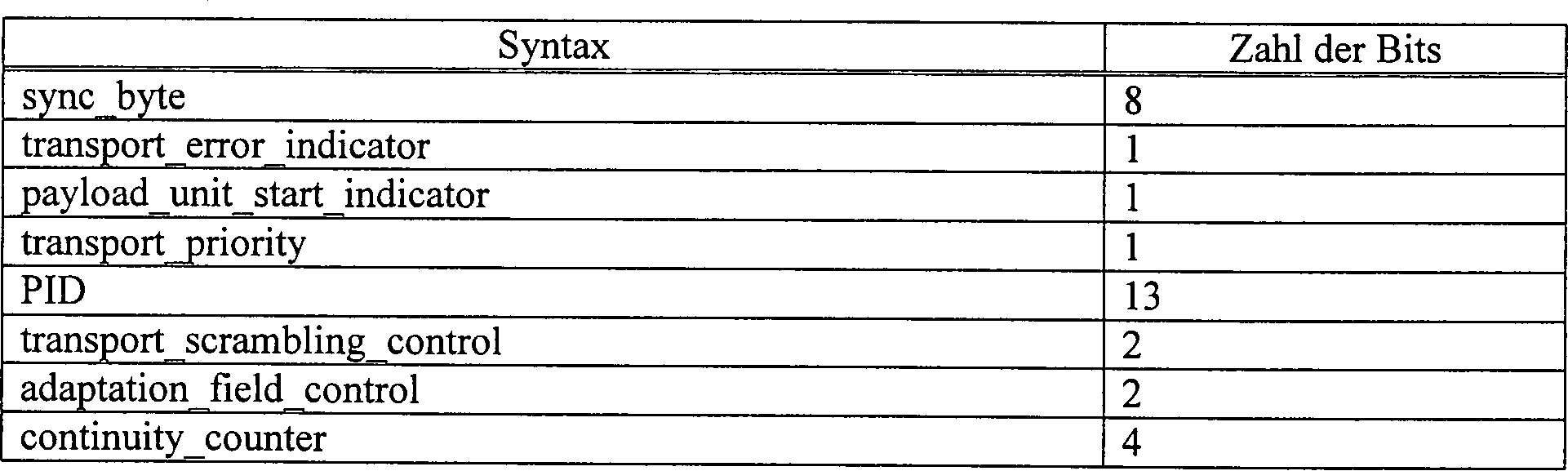
Adaptionsfeld (Adaption Field)Adaptation field (adaptation Field)
Wie
vorhergehend bemerkt, kann der Transportstromkopf optional ein Adaptionsfeld
aufweisen. Die Adaptionsfeldsteuerbits in dem TSH kennzeichnen,
ob es ein Adaptionsfeld und/oder eine Nutzinformation gibt oder
nicht. Die Adaptionsfeldsteuerwerte sind nachfolgend in Tabelle
2 beschrieben: Tabelle
2: Adaptionsfeldsteuerwert 
Das Adaptionsfeld, sofern es vorhanden ist, ist in der nachfolgenden Tabelle 4 beschrieben:The Adaptation field, if it is present, is in the following Table 4 describes:
Tabelle
3: Transportstromadaptionsfeld (teilweise) 
PES-PaketPES packet
Das PES-Paket weist folgende Struktur auf, wie in Tabelle 4 gezeigt:The PES package has the following structure, as shown in Table 4:
Tabelle
4: PES-Paket (teilweise) 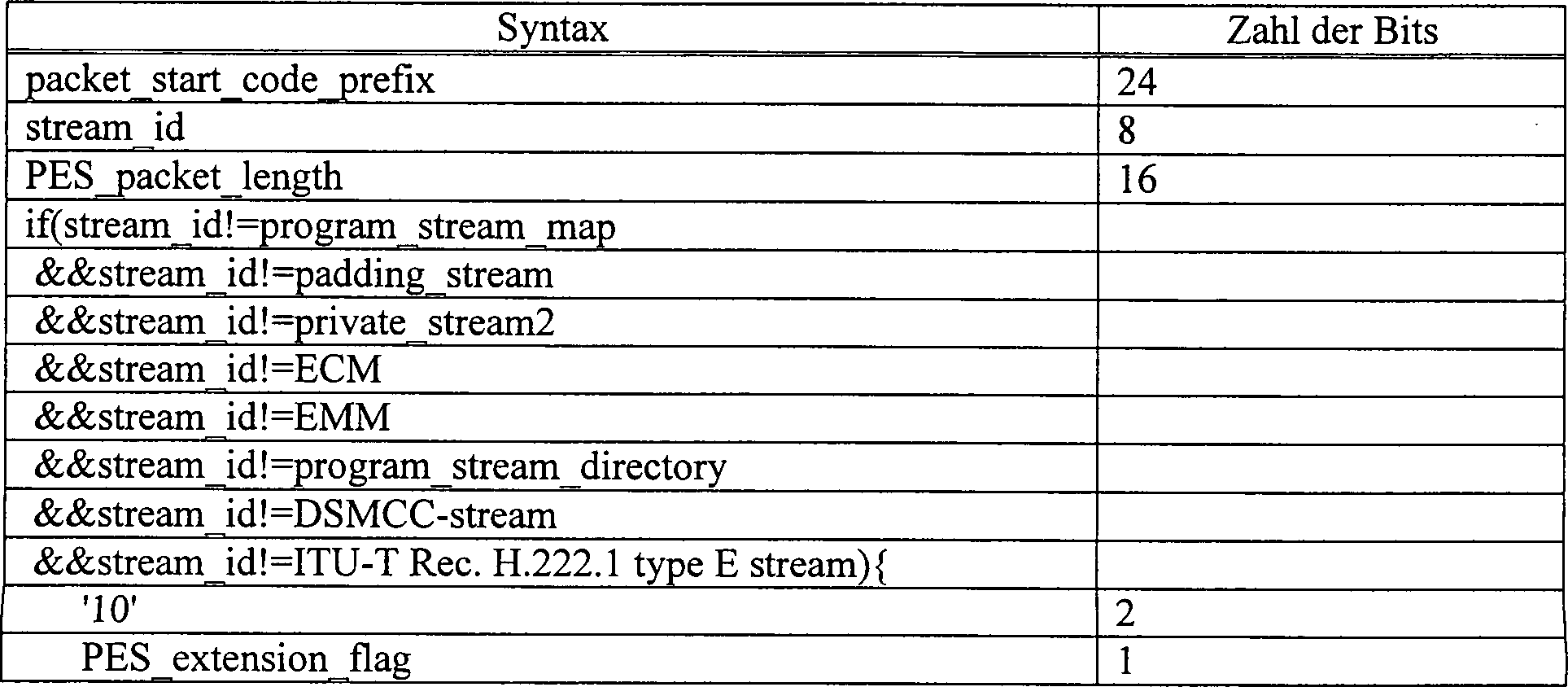

Privatdaten (Private Data)Private data
Der MPEG-2-Transportstrom ist in der Lage, Benutzerdaten zu übertragen. Die Benutzerdaten können als Privatdaten in das Adaptionsfeld des Transportkopfs eines Pakets gefüllt werden. Sie können als ein Privatelementarstrom eines Programms geliefert werden. Sie können auch als Privatdaten in dem PES-Kopf des Transportstroms geliefert werden. MPEG-2 ermöglicht auch, Privatdaten in Transportstrompaketen mit einem PID-Wert zu senden, der als eine Program Map Table PID in der Program Association Table festgelegt ist.The MPEG-2 transport stream is capable of transmitting user data. The user data can as private data in the adaptation field of the transport header of a package. They can be supplied as a private element stream of a program. They can also be delivered as private data in the PES header of the transport stream. MPEG-2 also allows sending private data in transport stream packets with a PID value that is set as a Program Map Table PID in the Program Association Table.
Die vorliegende Erfindung umfaßt Ausführungsformen, die auf die Möglichkeit Rücksicht nehmen, Privatdaten in einem Transportstrom zu liefern, um Bytecode zum Liefern einzubetten.The present invention Embodiments, the on the possibility consideration take to provide private data in a transport stream by bytecode to embed to deliver.
Einbetten von BytecodedatenEmbed of bytecode data
Die Übertragung
von Bytecode und anderen Benutzerdaten in dem MPEG-2-Transportstrom
wird durch Einbetten der Daten in unterschiedlicher Abschnitte der
Pakete ausgeführt.
Dies umfaßt
(1) ein Einbetten der Daten als Privatdaten in das Adaptionsfeld
1. Adaptionsfeldverfahren (Adaptation Field Method)1. adaptation field method (Adaptation field method)
Wie
in der
Die PCR PID-Transportstrompakete, welche die PCR-Informationen des Programms enthalten, besitzen eine minimale normative Rate. Dies definiert das maximale Intervall dieser PCRs in dem Strom. Es können jedoch zusätzliche Pakete, welche Bytecodedaten übertragen, als PCR PID-Pakete eingefügt werden. Diese Pakete werden mit einer Rate eingefügt, die unter Verwendung einer Tune-in-Zeit und der Bandbreite, die für den Bytecodedatenstrom benötigt wird, berechnet. Wenn das Adaptionsfeldsteuerflag (adaptation_field_control flag) '10 ist, sollte der Wert der Adaptionsfeldlänge (adaptation_field_length) 183 betragen (4 Bytes für den Rest des Transportstromkopfs und 1 Byte für die Adaptionsfeldlänge). Insgesamt können 181 Bytes Bytecodedaten in einem solchen Paket gesendet werden, da ein Byte für andere Adaptionsfeldflags verwendet wird und die Privatdatenlänge unter Verwendung von einem Byte spezifiziert wird.The PCR PID transport stream packets containing the PCR information of the program contain a minimum normative rate. This defines the maximum interval of these PCRs in the stream. It can, however additional Packets which transmit bytecode data, inserted as PCR PID packets become. These packages are inserted at a rate that using a tune-in time and the bandwidth required for the bytecode stream needed is being computed. If the adaptation field control flag (adaptation_field_control flag) '10 is, should the value of the adaptation field length (adaptation_field_length) is 183 (4 bytes for the remainder the transport stream header and 1 byte for the adaptation field length). All in all can 181 bytes of bytecode data are sent in such a packet, there a byte for other adaptation field flags is used and the private data length is below Use of one byte is specified.
Wieder
Bezug nehmend auf
Version (V) (2 Bits)
Zukünftige Benutzung
(2 Bits)
Nächste
Tune-in-Zeit (64 Bits)
Nächste Übertragungswiederholungszeit
(60 Bits)Again referring to
Version (V) (2 bits)
Future use (2 bits)
Next tune-in time (64 bits)
Next transmission repetition time (60 bits)
Die "nächste Tune-in-Zeit" ist der nächste Tune-in-Punkt, von dem aus ein Decoder mit dem Decodieren beginnen kann. Dies markiert den Beginn der Übertragungswiederholung für alle Klassen/Objekte, die für eine Session notwendig sind. In einer MPEG-2-Implementation wird diese Zeit in Einheiten eines 90 Megahertz-Takts gemessen. Die Zahl der Einheiten werden von dem Beginn der Session gemessen. Dauernullen werden benutzt, um anzuzeigen, daß die Tune-in-Zeit nicht definiert ist.The next tune-in time is the next tune-in point from which a decoder can start decoding. This marks the beginning of the retransmission for all Classes / objects for a Session are necessary. In an MPEG-2 implementation, this becomes Time measured in units of a 90 megahertz clock. The number of Units are measured from the beginning of the session. Be permanent troughs used to indicate that the Tune-in time is not defined.
Die
nächste Übertragungswiederholungszeit
ist die Zeit der nächsten Übertragungswiederholung
für eine)
Klasse/Objekt. Diese Zeit wird in Einheiten eines 90 Megahertz-Takts
gemessen. Dauernullen werden benutzt, um anzuzeigen, daß die Tune-in-Zeit
nicht definiert ist. Dieses Feld ist auf 32 Bit ausgerichtet. Dies gibt
die nächste Übertragungswiederholung
der TS-Nutzinformation
2. Nutzinformationsverfahren (Payload Methode2. User Information Method (Payload method
Die Benutzerdaten können auch als ein Privatelementarstrom eines Programms gesendet werden. MPEG-2 erlaubt zwei Privatelementarstromarten: Privatstrom1/Privatestrom2 (Private_Stream1/Private_Stream2). Diese unterscheiden sich in dem Format des PES-Kopfs, der in diesen Strömen übertragen wird.The User data can also be sent as a private elementary stream of a program. MPEG-2 allows two private elementary stream types: Private Stream1 / Private Stream2 (Private_Stream1 / Private_Stream2). These differ in the format of the PES header transmitting in these streams becomes.
Die
Bytecodedaten können
als Privatdaten des Typs Privatstrom2 mit einem Java-Stromkopf oder
einem beliebigen anderem Äquivalent
als der Privatstrom-PES-Kopf gesendet werden. Wie in
3. PES-Kopfverfahren (PES Header Method)3. PES header method (PES Header method)
Das MPEG-2-TS-Format für die Elementarströme verschiedener Stromarten besitzen Felder für Privatdaten, die in dem PES-Kopf gesendet werden sollen. 16 Bytes der Bytecodedaten können als Privatdaten in jedem PES-Kopf gesendet werden, wenn das PES-Privatendatenflag in dem PES-Kopf gesetzt ist. Die PES-Köpfe erscheinen nur an dem Beginn eines PES-Pakets und jedes PES-Paket wird in mehrere Transportstrompakete aufgespalten. Daher tragen nicht alle Transportstrompakete dieses PID PES-Köpfe. Diese Technik zum Liefern von Benutzerdaten kann benutzt werden, wenn die zu sendende Information nicht viel Bandbreite benötigt. In diesem Fall kann sich die Bitrate etwas ändern.The MPEG-2 TS format for the elementary streams different stream types have fields for private data that are in the PES header to be sent. 16 bytes of the bytecode data can be used as Private data is sent in each PES header if the PES private data flag is set in the PES header. The PES heads appear only at the beginning of a PES packet and each PES packet is split into multiple transport stream packets split. Therefore not all transport packages carry this PID PES heads. This technique for providing user data can be used if the information to be sent does not require much bandwidth. In In this case, the bitrate may change slightly.
Wie
in
PES-Köpfe
4. Hybridverfahren eines Bytecodedatentransports zur Übertragung und Übertragungswiederholung4. Hybrid method of a Byte code data transport for transmission and retransmission
Anstatt die Bytecodedaten nur in PES-Köpfen einzuschließen, kann eine Kombination der zuvor genannten Verfahren verwendet werden. Die Kombinationstechniken stellen eine Möglichkeit zur Übertragungswiederholung von Bytecodedaten zur Verfügung, ohne die Lieferrate der ursprünglich übertragenen Bytecodedaten oder der Mediadaten zu beeinflussen.Instead of the bytecode data only in PES headers include, For example, a combination of the aforementioned methods may be used. The combination techniques provide a way for retransmission of bytecode data available, without the delivery rate of the originally transferred Bytecode data or the media data.
Der Transportstrommultiplexer hält eine konstante Rate aufrecht, mit der die Pakete geliefert werden. Die Transportstrompakete, welche die PES-Pakete und andere Informationen übertragen, werden mit Bytecodedaten unter Verwendung von vordefinierten Stopfbytes in dem Adaptionsfeld aufgefüllt, um eine konstante Bitrate aufrechtzuerhalten. Ein Auffüllen erfolgt auch, wenn nicht genügend PES-Paketdaten vorhanden sind, um die Transportstrompaketnutzinformatinsbytes aufzufüllen. In diesem Verfahren wird die normale Übertragung von Bytecodedaten unter Verwendung des Privatstromverfahrens (vorhergehend beschrieben) ausgeführt, während die Übertragungswiederholung der gleichen Bytecodedaten durch Ersetzen der oben erwähnten Stopfbytes erreicht werden kann. Die Übertragungswiederholung wird damit bei einer nicht erhöhten Bandbreite erzielt und die Bitrate kann konstant gehalten werden.Of the Transport stream multiplexer stops maintain a constant rate at which the packages are delivered. The Transport stream packets that transmit the PES packets and other information are used with bytecode data using predefined stuffing bytes filled in the adaptation field, to maintain a constant bitrate. A refilling takes place even if not enough PES packet data is present to the transport stream packet user information bytes fill. In this procedure, the normal transmission of bytecode data Using the Private Stream Method (previously described) executed while the retransmission the same bytecode data by replacing the above-mentioned stuffing bytes can be achieved. The retransmission so it does not increase Bandwidth achieved and the bitrate can be kept constant.
Eine andere Technik nutzt das Adaptionsfeldverfahren zur normalen Übertragung der Bytecodedaten. Die Übertragungswiederholung der gleichen Bytecodedaten wird als PES-Kopfprivatdaten gesendet. Die normale Übertragung wird in dem Adaptionsfeld ausgeführt, um sicherzustellen, daß alle Daten bei einer festen Rate gesendet werden können. Die Übertragungswiederholung wird unter Verwendung des PES-Kopfs ausgeführt, so daß die Bandbreite nicht wesentlich erhöht wird.A another technique uses the adaptation field method for normal transmission the bytecode data. The retransmission the same bytecode data is sent as PES header private data. The normal transmission is executed in the adaptation field to make sure everyone Data can be sent at a fixed rate. The retransmission becomes performed using the PES header, so that the bandwidth is not essential elevated becomes.
Ein anderes Schema kombiniert die Privatstromtechnik und die PES-Kopftechnik. Die Übertragungswiederholung von Bytecodedaten erfolgt als PES-Kopfprivatdaten, wie in der oben genannten Technik, aber für die normale Übertragung der Bytecodedaten wird das Privatstromverfahren verwendet.One another scheme combines the private power technology and the PES head technology. The retransmission bytecode data is PES header private data as in the above mentioned technique, but for the normal transmission the bytecode data is used as the private stream method.
Fehlerberichtung (Error Correction)Error report (Error Correction)
Die oben beschriebenen Hybridschemata stellen die Möglichkeit für eine Übertragungswiederholung zur Verfügung. Da ein Verlust eines Transportstrompakets zu einer ungewollten Verfälschung der Bytecodedaten führen kann, wird eine Verfahrensweise zur Übertragungswiederholung implementiert, um alle verlorenen Pakete wieder zu übermitteln. Ein möglicher Ansatz umfaßt die Übertragungswiederholung der gesamten Klasse zu regulären Intervallen beim Ausbleiben eines Rückkanals. Dies dient zur Unterstützung von zufälligen Zugriffspunkten im Fall von Medien. Dies ist eventuell jedoch nicht möglich, wenn die Zahl der Clients zu groß ist oder wenn die Klasse (oder das Objekt) sehr groß ist, was die Übertragungswiederholung ausschließt.The The hybrid schemes described above provide the facility for retransmission Available. As a loss of a transport stream package to an unwanted adulteration the bytecode data lead If a repeating procedure is implemented, to retransmit all lost packets. A possible Approach includes the retransmission the entire class to regular Intervals in the absence of a return channel. This is to support random access points in the case of media. However, this may not be possible if the number of clients is too big or if the class (or object) is very large, causing the retransmission excludes.
Wenn ein Rückkanal vorhanden ist, kann ein Paketverlust dem Server angezeigt werden und das verlorene Paket kann wieder übertragen werden. Wenn ein sicheres Multicastschema verwendet wird, können die Daten auch von anderen Orten als dem Server wieder übertragen werden.If a return channel is present, a packet loss may be displayed to the server and the lost packet can be retransmitted. When a secure multicast scheme is used, the data may be shared by others Transfer locations as the server again become.
Es gibt eine Anzahl von Fehlerabfangschemata mit eingebauter Redundanz, die geeignet sind, teilweise verlorene Pakete wieder zu erlangen. Zum Beispiel können Schemata wie Vorwärtsfehlerkorrektur (forward error correction) benutzt werden. Das Paketverlustproblem kann auch teilweise durch Verwendung einiger zuverlässiger Multicastschemata gelöst werden. Ausführungsformen der Erfindung unterstützen die Verwendung beliebiger fehlerabfangender oder beliebiger sicherer Multicastalgorithmen, um den Paketverlust zu beheben.It gives a number of error catch schemes with built-in redundancy, which are suitable to recover partially lost packets. For example, you can Schemes like forward error correction (forward error correction) are used. The packet loss problem can also be partly by using some reliable multicast schemes solved become. embodiments support the invention the use of any error-catching or any safer Multicast algorithms to fix the packet loss.
Die Umgebung, welche die Einrichtungen zum Betreiben der Verfahren dieser Erfindung zur Verfügung stellt, umfaßt Ausführungsformen in Form von Hardwaresystemen, Softwarekomponenten und Datenstrukturen, die beim Betrachten der folgenden Beschreibung verstanden werden können. Nachfolgend werden Überblicke über Hardwareausführungen, objektorientiertes Programmieren und die Programmiersprache JavaTM gegeben.The environment that provides the means for operating the methods of this invention includes embodiments in the form of hardware systems, software components, and data structures that may be understood upon consideration of the following description. The following is an overview of hardware executions, object-oriented programming and the programming language Java TM .
Objektorientiertes Programmierenobject-oriented Program
Objektorientiertes Programmieren ist ein Verfahren zum Erzeugen eines Computerprogramms durch die Kombination verschiedener fundamentaler Bausteine und durch Erzeugen von Beziehungen unter und zwischen den Bausteinen. Die Bausteine in objektorientierten Programmiersystemen werden als "Objekte" bezeichnet. Ein Objekt ist eine Programmeinheit, die eine Datenstruktur (eine oder mehrere Instanzvariablen) und die Operationen (Methoden), welche die Daten benutzen oder beeinflussen können, zusammen gruppieren. Demnach besteht ein Objekt aus Daten und einer oder mehreren Operationen oder Prozeduren, die an den Daten ausgeführt werden können. Das Kombinieren von Daten und Operationen in einen einheitlichen Baustein wird als "Kapselung" ("encapsulation") bezeichnet.object-oriented Programming is a method of creating a computer program through the combination of different fundamental building blocks and by creating relationships among and between the building blocks. The building blocks in object-oriented programming systems are called "objects". One Object is a program unit that has a data structure (an or several instance variables) and the operations (methods) which can use or influence the data, group together. Thus, an object consists of data and one or more operations or procedures that can be performed on the data. The Combining data and operations into a unified building block is referred to as "encapsulation".
Ein Objekt kann angewiesen werden, eine seiner Methoden auszuführen, wenn es eine "Nachricht" erhält. Eine Nachricht ist eine Anweisung oder ein Befehl, die an das Objekt gesendet wird, um eine bestimmte Methode auszuführen. Eine Nachricht besteht aus einer Methodenauswahl (zum Beispiel Methodenname) und mehreren Argumenten. Eine Nachricht teilt dem empfangenden Objekt mit, welche Operationen auszuführen sind.One Object can be instructed to execute one of its methods if it receives a "message". A Message is a statement or a command sent to the object is sent to execute a particular method. A message exists from a method selection (for example method name) and several Arguments. A message tells the receiving object which one Operations are to perform.
Ein Vorteil der objektorientierten Programmierung ist die Art, in der die Methoden aufgerufen werden. Wenn eine Nachricht an ein Objekt gesendet wird, ist es nicht notwendig, daß die Nachricht das Objekt anweist, wie eine bestimmte Methode auszuführen ist. Es ist nur ein Aufruf erforderlich, daß das Objekt die Methode ausführt. Dies vereinfacht die Programmentwicklung erheblich.One The advantage of object-oriented programming is the way in which the methods are called. When a message to an object is sent, it is not necessary that the message is the object instructs how to perform a particular method. It's just a call required that the Object executing the method. This simplifies the program development considerably.
Objektorientierte Programmiersprachen basieren in erster Linie auf einem "Klassen"-Schema. Ein klassenbezogenes objektorientiertes Programmierschema ist allgemein beschrieben in: Liebermann, "Using Prototypical Objects to Implement Shared Behavior in Object-Oriented Systems", OOPSLSA 86 Proceedings, September 1986, S. 214-223.object-oriented Programming languages are based primarily on a "class" scheme. A class related Object-oriented programming scheme is generally described in: Liebermann, "Using Prototypical Objects to Implement Shared Behavior in Object-Oriented Systems ", OOPSLSA 86 Proceedings, September 1986, pp. 214-223.
Eine Klasse definiert eine An eines Objekts, das typischerweise sowohl Variablen als auch Methoden für die Klasse umfaßt. Eine Objektklasse wird benutzt, um eine bestimmte Instanz eines Objekts zu erzeugen. Eine Instanz einer Objektklasse umfaßt die Variablen und Methoden, die für die Klasse definiert sind. Mehrere Instanzen der gleichen Klasse können aus einer Objektklasse erzeugt werden. Jede Instanz, die aus einer Objektklasse erzeugt wird, gilt als von der gleichen An oder Klasse.A Class defines an An of an object, which is typically both Variables as well as methods for the class includes. An object class is used to specify a particular instance of a To create object. An instance of an object class includes the variables and methods for the class are defined. Multiple instances of the same class can be generated from an object class. Each instance, which consists of one Object class is generated, is considered by the same or class.
Zum Beispiel kann eine Arbeitnehmerobjektklasse die Instanzenvariablen "Name" und "Gehalt" und eine Methode "Gehaltsbestimmung" umfassen. Instanzen der Arbeitnehmerobjektklasse können für jeden Arbeitnehmer in einer Organisation erzeugt oder instantiiert werden. Jede Objektinstanz gilt als vom Typ "Arbeitnehmer". Jede Arbeitnehmerobjektinstanz umfaßt "Name"- und "Gehalt"-Instanzvariablen und die "Gehaltsbestimmung"-Methode. Die Werte, die der "Name"- und "Gehalt"-Variable jeder Arbeitnehmerobjektsinstanz zugeordnet sind, enthalten den Namen und das Gehalt eines Arbeitnehmers in der Organisation. Eine Nachricht kann an eine Arbeitnehmerobjektinstanz eines Arbeitnehmers gesendet werden, um die "Gehaltsbestimmung"-Methode aufzurufen, um das Gehalt des Arbeitnehmers zu verändern (d.h. den Wert, welcher der "Gehalt"-Variable in dem Arbeitnehmerobjekt des Arbeitnehmers zugeordnet ist).For example, a worker object class can have the instance variables "name" and "salary" and include a method of "content determination". Instances of the employee object class can be created or instantiated for each employee in an organization. Each object instance is considered a worker type. Each employee object instance includes "name" and "content" instance variables and the "content determination" method. The values associated with each employee object instance's "name" and "salary" variables include the name and salary of an employee in the organization. A message may be sent to a worker object instance of an employee to invoke the "content determination" method to change the employee's salary (ie, the value associated with the "salary" variable in the employee's employee object).
Eine Hierarchie von Klassen kann definiert werden, so daß eine Objektklassendefinition eine oder mehrere Unterklassen besitzt. Eine Unterklasse übernimmt die Definitionen ihrer Eltern (und ihrer Großeltern usw.). Jede Unterklasse in der Hierarchie kann dem Verhalten, das durch seine Elternklasse spezifiziert ist, etwas hinzufügen oder dieses modifizieren. Einige objektorientierte Programmiersprachen unterstützen eine Mehrfachvererbung, wenn eine Unterklasse eine Klassendefinition von mehr als einer Elternklasse erbt. Andere Programmiersprachen unterstützen nur eine Einfachvererbung, wenn eine Unterklasse darauf beschränkt ist, die Klassendefinition nur einer Elternklasse zu erben. Die Programmiersprache JavaTM stellt außerdem einen Mechanismus zur Verfügung, der als eine Schnittstelle (Interface) bekannt ist, die als ein Satz von konstanten und abstrakten Methodendeklarierungen bekannt ist. Eine Objektklasse kann die abstrakten Methoden, die in der Schnittstelle definiert sind, implementieren. Sowohl die Einfach- als auch die Mehrfachvererbung sind für eine Schnittstelle zugänglich. Das heißt, eine Schnittstelle kann eine Schnittstellendefinition von mehr als einer Elternschnittstelle erben.A hierarchy of classes can be defined so that an object class definition has one or more subclasses. A subclass inherits the definitions of their parents (and their grandparents, etc.). Each subclass in the hierarchy can add or modify the behavior specified by its parent class. Some object-oriented programming languages support multiple inheritance when a subclass inherits a class definition from more than one parent class. Other programming languages support single inheritance only if a subclass is restricted to inheriting the class definition of only one parent class. The Java TM programming language also provides a mechanism known as an interface, known as a set of constant and abstract method declarations. An object class can implement the abstract methods defined in the interface. Both single and multiple inheritance are accessible for an interface. That is, an interface may inherit an interface definition from more than one parent interface.
Ein Objekt ist ein generischer Ausdruck, der in der objektorientierten Programmierumgebung benutzt wird, um ein Modul zu bezeichnen, das zugeordneten Code und Variablen enthält. Eine Softwareanwendung kann unter Verwendung einer objektorientierten Programmiersprache geschrieben werden, wobei die Funktionalität des Programms unter Verwendung von Objekten implementiert wird.One Object is a generic expression that is object-oriented Programming environment is used to designate a module that contains associated code and variables. A software application can written using an object-oriented programming language be, with the functionality the program is implemented using objects.
JavaTM-Programmierung und AusführungJava TM programming and execution
Ein JavaTM-Programm setzt sich aus einer Anzahl von Klassen und Schnittstellen zusammen. Im Gegensatz zu vielen Programmiersprachen, in denen ein Programm in einem maschinenabhängigen, ausführbaren Programmcode kompiliert wird, werden JavaTM-Klassen in maschinenunabhängige Bytecodeklassendateien kompiliert. Jede Klasse enthält Code und Daten in einem plattformunabhängigen Format, das als Klassendateiformat bezeichnet wird. Das Computersystem, das als das Ausführungsvehikel agiert, enthält ein Programm, das als virtuelle Maschine bezeichnet wird und für die Ausführung des Codes in JavaTM-Klassen verantwortlich ist. Die virtuelle Maschine stellt ein Abstraktionsniveau zwischen der Maschinenunabhängigkeit der Bytecodeklassen und dem maschinenabhängigen Befehlssatz der zugrunde liegenden Computerhardware zur Verfügung. Ein "Klassenlader" ("class loader") in der virtuellen Maschine ist für das Laden der Bytecodeklassendateien, wie sie benutzt werden, verantwortlich, und entweder führt ein Interpreter die Bytecodes direkt aus oder ein "Just-In-Time" (JIT)-Kompilierer übersetzt die Bytecodes in Maschinencode, so daß sie von dem Prozessor ausgeführt werden können.A Java TM program consists of a number of classes and interfaces. Unlike many programming languages, where a program is compiled into machine-dependent, executable code, Java ™ classes are compiled into machine-independent bytecode class files. Each class contains code and data in a platform-independent format called a class file format. The computer system acting as the execution vehicle contains a program called a virtual machine which is responsible for executing the code in Java ™ classes. The virtual machine provides an abstraction level between the machine independence of the bytecode classes and the machine dependent instruction set of the underlying computer hardware. A "class loader" in the virtual machine is responsible for loading the bytecode class files as they are used, and either an interpreter executes the bytecodes directly or just-in-time (JIT) - The compiler translates the bytecodes into machine code so that they can be executed by the processor.
Beispiel einer JavaTM-NetzanwendungsumgebungExample of a Java TM web application environment
In
Die
Clientplattform
JavaTM-Klassendateien werden oft in Appletags
in einem HTML (Hypertext Markup Language)-Dokument identifiziert.
Eine Webserver-Anwendung
Es ist typisch für die Klassen von JavaTM-Programmen, daß sie so spät wie möglich während der Programmausführung geladen werden. Sie werden nach Aufruf aus dem Netz (gespeichert auf einem Server) geladen oder bilden ein lokales Dateisystem, wenn sie das erste Mal während der Ausführung des JavaTM-Programms verknüpft werden. Die virtuelle Maschine lokalisiert und lädt jede Klassendatei, parst das Klassendateiformat, weist Speicher für die verschiedenen Komponenten der Klasse zu und verknüpft die Klasse mit anderen bereits gelade nen Klassen. Dieses Verfahren macht den Code in der Klasse für die virtuelle Maschine leicht ausführbar.It is typical of the classes of Java ™ programs that they are loaded as late as possible during program execution. They are loaded from the network after being called (stored on a server) or form a local file system when they are first linked during the execution of the Java ™ program. The virtual machine locates and loads each class file, parses the class file format, allocates memory for the various components of the class, and associates the class with other classes already loaded. This method makes the code in the class easily executable for the virtual machine.
Ausführungsform einer Computerausführungsumgebungembodiment a computer execution environment
Eine
Ausführungsform
der Erfindung kann als Computersoftware in Form eines computerlesbaren Programmcodes
implementiert werden, der auf einem Computer für allgemeine Zwecke ausgeführt wird,
wie einem Computer
Der
Computer
In
einer Ausführungsform
der Erfindung ist die CPU
Der
Computer
Die
Netzverknüpfung
Der
Computer
Der
empfangene Code kann von der CPU
Die Computersysteme, die vorhergehend beschrieben wurden, dienen nur als Beispiele. Eine Ausführungsform der Erfindung kann in anderen Arten von Computersystemen oder Programmier- oder Bearbeitungsumgebungen implementiert werden.The Computer systems previously described are for convenience only as examples. An embodiment of the invention may be used in other types of computer systems or programming or editing environments are implemented.
Damit wurde ein Verfahren und Vorrichtung zum zeitlichen Liefern eines Bytecodestroms in Verbindung mit einen oder mehreren speziellen Ausführungsformen beschrieben.In order to has been a method and apparatus for timely delivery of a Bytecode stream in conjunction with one or more special ones embodiments described.
Claims (18)
Applications Claiming Priority (3)
| Application Number | Priority Date | Filing Date | Title |
|---|---|---|---|
| US203551 | 1998-12-01 | ||
| US09/203,551 US6460086B1 (en) | 1998-12-01 | 1998-12-01 | Method and apparatus for delivery of a bytecode embedded within a transport stream |
| PCT/US1999/027722 WO2000033532A2 (en) | 1998-12-01 | 1999-11-22 | Method and apparatus for delivery of a bytecode embedded within a transport stream |
Publications (2)
| Publication Number | Publication Date |
|---|---|
| DE69918571D1 DE69918571D1 (en) | 2004-08-12 |
| DE69918571T2 true DE69918571T2 (en) | 2005-08-25 |
Family
ID=22754450
Family Applications (2)
| Application Number | Title | Priority Date | Filing Date |
|---|---|---|---|
| DE69918571T Expired - Fee Related DE69918571T2 (en) | 1998-12-01 | 1999-11-22 | METHOD AND DEVICE FOR DELIVERING BYTE CODES EMBEDDED IN A TRANSPORT FLOW |
| DE69943358T Expired - Lifetime DE69943358D1 (en) | 1998-12-01 | 1999-11-22 | Method and apparatus for providing byte code embedded in a transport stream |
Family Applications After (1)
| Application Number | Title | Priority Date | Filing Date |
|---|---|---|---|
| DE69943358T Expired - Lifetime DE69943358D1 (en) | 1998-12-01 | 1999-11-22 | Method and apparatus for providing byte code embedded in a transport stream |
Country Status (7)
| Country | Link |
|---|---|
| US (1) | US6460086B1 (en) |
| EP (2) | EP1133862B1 (en) |
| JP (1) | JP4444510B2 (en) |
| AT (1) | ATE270805T1 (en) |
| AU (1) | AU2155100A (en) |
| DE (2) | DE69918571T2 (en) |
| WO (1) | WO2000033532A2 (en) |
Families Citing this family (57)
| Publication number | Priority date | Publication date | Assignee | Title |
|---|---|---|---|---|
| US7099348B1 (en) * | 1998-11-03 | 2006-08-29 | Agere Systems Inc. | Digital audio broadcast system with local information |
| FR2786898B1 (en) * | 1998-12-03 | 2001-08-10 | Cit Alcatel | INTERCONNECTION MANAGEMENT SYSTEM FOR NETWORK ELEMENTS OF AN ANALOG NETWORK |
| US7215671B1 (en) * | 1999-03-16 | 2007-05-08 | Canon Kabushiki Kaisha | Information processing apparatus and method |
| US7188353B1 (en) * | 1999-04-06 | 2007-03-06 | Sharp Laboratories Of America, Inc. | System for presenting synchronized HTML documents in digital television receivers |
| US7458091B1 (en) | 2000-01-20 | 2008-11-25 | Sonic Solutions, A California Corporation | System, method and article of manufacture for a business layer component in a multimedia synchronization framework |
| US7346920B2 (en) | 2000-07-07 | 2008-03-18 | Sonic Solutions, A California Corporation | System, method and article of manufacture for a common cross platform framework for development of DVD-Video content integrated with ROM content |
| US6769130B1 (en) | 2000-01-20 | 2004-07-27 | Interactual Technologies, Inc. | System, method and article of manufacture for late synchronization during the execution of a multimedia event on a plurality of client computers |
| US7178106B2 (en) | 1999-04-21 | 2007-02-13 | Sonic Solutions, A California Corporation | Presentation of media content from multiple media sources |
| CA2388565A1 (en) | 1999-04-21 | 2000-10-26 | Research Investment Network, Inc. | System, method and article of manufacture for updating content stored on a portable storage medium |
| US7188193B1 (en) * | 2000-01-20 | 2007-03-06 | Sonic Solutions, A California Corporation | System, method and article of manufacture for a synchronizer component in a multimedia synchronization framework |
| US7448021B1 (en) | 2000-07-24 | 2008-11-04 | Sonic Solutions, A California Corporation | Software engine for combining video or audio content with programmatic content |
| US6529949B1 (en) | 2000-02-07 | 2003-03-04 | Interactual Technologies, Inc. | System, method and article of manufacture for remote unlocking of local content located on a client device |
| US20050182828A1 (en) | 1999-04-21 | 2005-08-18 | Interactual Technologies, Inc. | Platform specific execution |
| US6453420B1 (en) | 1999-04-21 | 2002-09-17 | Research Investment Network, Inc. | System, method and article of manufacture for authorizing the use of electronic content utilizing a laser-centric medium |
| US6941383B1 (en) | 2000-01-20 | 2005-09-06 | Interactual Technologies, Inc. | System, method and article of manufacture for java/javascript component in a multimedia synchronization framework |
| US7188186B1 (en) * | 1999-09-03 | 2007-03-06 | Meyer Thomas W | Process of and system for seamlessly embedding executable program code into media file formats such as MP3 and the like for execution by digital media player and viewing systems |
| US7392481B2 (en) | 2001-07-02 | 2008-06-24 | Sonic Solutions, A California Corporation | Method and apparatus for providing content-owner control in a networked device |
| DE60109376T2 (en) * | 2000-08-01 | 2006-01-19 | Command Audio Corp., Redwood City | Method and signal for transmitting a broadcast program to a wireless receiver |
| US7689510B2 (en) | 2000-09-07 | 2010-03-30 | Sonic Solutions | Methods and system for use in network management of content |
| JP2002100113A (en) * | 2000-09-25 | 2002-04-05 | Canon Inc | Reproduction device, reproduction method, transmission device, transmission method, and storage medium |
| JP2002100114A (en) * | 2000-09-25 | 2002-04-05 | Canon Inc | Reproduction device, reproduction method, transmission device, transmission method, and storage medium |
| FI110973B (en) * | 2001-05-15 | 2003-04-30 | Digita Oy | Procedure for transmitting applications in a digital broadcast network |
| FR2836317A1 (en) * | 2002-02-19 | 2003-08-22 | Michel Francis Monduc | METHOD FOR TRANSMITTING AUDIO OR VIDEO MESSAGES OVER THE INTERNET NETWORK |
| US20030196113A1 (en) * | 2002-04-10 | 2003-10-16 | Chris Brown | System and method for providing a secure environment for performing conditional access functions for a set top box |
| US7457312B2 (en) * | 2002-06-19 | 2008-11-25 | Microsoft Corporation | Bandwidth sharing in advanced streaming format |
| EP1377034A1 (en) * | 2002-06-27 | 2004-01-02 | Thomson Licensing S.A. | Data processing device and method for interactive television |
| US7290057B2 (en) * | 2002-08-20 | 2007-10-30 | Microsoft Corporation | Media streaming of web content data |
| DE10240363B3 (en) * | 2002-09-02 | 2004-07-29 | Jäger, Rudolf, Dr.rer.nat. | Time synchronization method for synchronizing coded video stream with additional information e.g. for television broadcast or on-demand video stream |
| EP1563503A4 (en) | 2002-11-20 | 2009-08-12 | Lg Electronics Inc | RECORDING MEDIUM HAVING A DATA STRUCTURE FOR REPRODUCING DATA RECORDED THEREIN AND RECORDING AND REPRODUCING METHODS AND APPARATUSES |
| RU2339089C2 (en) * | 2003-01-20 | 2008-11-20 | Эл Джи Электроникс Инк. | Record medium with data organisation for management of reproduction of static images written in it and methods and write-reader system |
| US7729992B2 (en) * | 2003-06-13 | 2010-06-01 | Brilliant Digital Entertainment, Inc. | Monitoring of computer-related resources and associated methods and systems for disbursing compensation |
| US8095500B2 (en) * | 2003-06-13 | 2012-01-10 | Brilliant Digital Entertainment, Inc. | Methods and systems for searching content in distributed computing networks |
| US7720924B2 (en) * | 2003-12-12 | 2010-05-18 | Syniverse Icx Corporation | System providing methodology for the restoration of original media quality in messaging environments |
| KR100640390B1 (en) * | 2004-01-17 | 2006-10-30 | 삼성전자주식회사 | Apparatus and Method for Inserting Additional Data in Transport Stream MPEG-2 System |
| GB0401781D0 (en) * | 2004-01-28 | 2004-03-03 | Koninkl Philips Electronics Nv | Digital broadcasting terminal |
| US7996871B2 (en) | 2004-09-23 | 2011-08-09 | Thomson Licensing | Method and apparatus for using metadata for trick play mode |
| US20060168012A1 (en) * | 2004-11-24 | 2006-07-27 | Anthony Rose | Method and system for electronic messaging via distributed computing networks |
| WO2006066052A2 (en) | 2004-12-16 | 2006-06-22 | Sonic Solutions | Methods and systems for use in network management of content |
| US20060158357A1 (en) * | 2005-01-19 | 2006-07-20 | Visteon Global Technologies, Inc. | Text compression method for multi-level display |
| KR20070057558A (en) * | 2005-12-02 | 2007-06-07 | 삼성전자주식회사 | Digital signal receivers and digital signal transmitters and methods of using them |
| KR100942860B1 (en) * | 2005-12-16 | 2010-02-17 | 돌비 스웨덴 에이비 | Apparatus and methods for generating and interpreting data streams into segments with specified entry points and computer readable media having recorded them |
| US7809018B2 (en) * | 2005-12-16 | 2010-10-05 | Coding Technologies Ab | Apparatus for generating and interpreting a data stream with segments having specified entry points |
| US20070140650A1 (en) * | 2005-12-19 | 2007-06-21 | Matsushita Electric Industrial Co., Ltd. | Broadcast receiving apparatus |
| US7803998B2 (en) * | 2005-12-21 | 2010-09-28 | Pioneer Hi-Bred International, Inc. | Methods and compositions for modifying flower development |
| WO2007079176A2 (en) * | 2005-12-30 | 2007-07-12 | Edda Technology, Inc. | Process sharing among independent systems / applications via data encapsulation in medical imaging |
| BRPI0712835A2 (en) * | 2006-04-24 | 2012-07-24 | Qualcomm Inc | multiplexer for transmitter interface protocol |
| US8005990B2 (en) * | 2008-02-29 | 2011-08-23 | Newport Media, Inc. | Efficient decoding of mobile multimedia multicast system non real-time service files |
| US8763149B1 (en) * | 2008-04-30 | 2014-06-24 | Google Inc. | Site dependent embedded media playback manipulation |
| KR101662843B1 (en) * | 2010-03-05 | 2016-10-14 | 삼성전자주식회사 | Apparatus and method for serving streaming in a data communication network |
| CN102387407A (en) * | 2010-08-31 | 2012-03-21 | 国基电子(上海)有限公司 | System and method for realizing broadcasting network conditional access (CA) |
| CN102594773B (en) * | 2011-01-10 | 2017-03-29 | 中兴通讯股份有限公司 | A kind of method and system for realizing data acquisition |
| KR101995221B1 (en) * | 2011-11-24 | 2019-07-16 | 삼성전자주식회사 | Apparatus and method for transmitting and receiving packet in communication system |
| JP6625431B2 (en) * | 2013-06-21 | 2019-12-25 | サターン ライセンシング エルエルシーSaturn Licensing LLC | Transmitting device, transmitting method, reproducing device, reproducing method, and receiving device |
| US20150033091A1 (en) * | 2013-07-23 | 2015-01-29 | Electronics And Telecommunications Research Institute | Apparatus and method for requesting retransmission of lost packet based on mpeg media transport system |
| US20150032845A1 (en) * | 2013-07-26 | 2015-01-29 | Samsung Electronics Co., Ltd. | Packet transmission protocol supporting downloading and streaming |
| US10075452B2 (en) | 2016-02-18 | 2018-09-11 | Comcast Cable Communications, Llc | Distributed content uploading and validation |
| JP6751053B2 (en) * | 2017-06-05 | 2020-09-02 | 日本電信電話株式会社 | Communication device |
Family Cites Families (6)
| Publication number | Priority date | Publication date | Assignee | Title |
|---|---|---|---|---|
| US5768539A (en) | 1994-05-27 | 1998-06-16 | Bell Atlantic Network Services, Inc. | Downloading applications software through a broadcast channel |
| US5650825A (en) * | 1995-03-31 | 1997-07-22 | Matsushita Electric Corporation Of America | Method and apparatus for sending private data instead of stuffing bits in an MPEG bit stream |
| US5790753A (en) * | 1996-01-22 | 1998-08-04 | Digital Equipment Corporation | System for downloading computer software programs |
| ZA973611B (en) | 1997-03-21 | 1998-03-23 | Canal Plus Sa | Extraction data sections from a transmitted data stream. |
| US6212327B1 (en) * | 1997-11-24 | 2001-04-03 | International Business Machines Corporation | Controlling record/playback devices with a computer |
| US6092120A (en) | 1998-06-26 | 2000-07-18 | Sun Microsystems, Inc. | Method and apparatus for timely delivery of a byte code and serialized objects stream |
-
1998
- 1998-12-01 US US09/203,551 patent/US6460086B1/en not_active Expired - Lifetime
-
1999
- 1999-11-22 AU AU21551/00A patent/AU2155100A/en not_active Abandoned
- 1999-11-22 DE DE69918571T patent/DE69918571T2/en not_active Expired - Fee Related
- 1999-11-22 WO PCT/US1999/027722 patent/WO2000033532A2/en not_active Ceased
- 1999-11-22 EP EP99965871A patent/EP1133862B1/en not_active Expired - Lifetime
- 1999-11-22 EP EP04011290A patent/EP1445914B1/en not_active Expired - Lifetime
- 1999-11-22 AT AT99965871T patent/ATE270805T1/en not_active IP Right Cessation
- 1999-11-22 DE DE69943358T patent/DE69943358D1/en not_active Expired - Lifetime
- 1999-11-22 JP JP2000586061A patent/JP4444510B2/en not_active Expired - Lifetime
Also Published As
| Publication number | Publication date |
|---|---|
| DE69918571D1 (en) | 2004-08-12 |
| EP1445914A2 (en) | 2004-08-11 |
| AU2155100A (en) | 2000-06-19 |
| EP1445914A3 (en) | 2005-11-30 |
| ATE270805T1 (en) | 2004-07-15 |
| JP2002532009A (en) | 2002-09-24 |
| EP1133862B1 (en) | 2004-07-07 |
| EP1445914B1 (en) | 2011-04-13 |
| WO2000033532A2 (en) | 2000-06-08 |
| EP1133862A2 (en) | 2001-09-19 |
| US6460086B1 (en) | 2002-10-01 |
| DE69943358D1 (en) | 2011-05-26 |
| WO2000033532A3 (en) | 2000-08-10 |
| JP4444510B2 (en) | 2010-03-31 |
Similar Documents
| Publication | Publication Date | Title |
|---|---|---|
| EP1133862B1 (en) | Method and apparatus for delivery of a bytecode embedded within a transport stream | |
| DE69925254T2 (en) | METHOD AND APPARATUS FOR MEDIA DATA TRANSMISSION | |
| DE69936570T2 (en) | METHOD AND DEVICE FOR MEDIA DATA TRANSMISSION | |
| US6092120A (en) | Method and apparatus for timely delivery of a byte code and serialized objects stream | |
| DE60220259T2 (en) | DATA REFERENCE SYSTEM | |
| DE69834045T2 (en) | METHOD FOR CONNECTING DATA IN TRANSPORT PACKAGES OF CONSTANT LENGTH | |
| DE60109467T2 (en) | METHOD AND DEVICE FOR TRANSMITTING NETWORK INFORMATION THROUGH SAFE TRANSCODING | |
| DE69919384T2 (en) | METHOD AND DEVICE FOR AUTOMATICALLY OPTIMIZING THE PERFORMANCE OF A COMPUTER PROGRAM | |
| DE69928642T2 (en) | EMULATION OF FLOW ON INTERNET IN A BROADCAST APPLICATION | |
| DE60212339T2 (en) | A DIGITAL TELEVISION APPLICATION PROTOCOL FOR INTERACTIVE TELEVISION | |
| DE69922015T2 (en) | METHOD AND DEVICE FOR TRANSLATING AND EXECUTING AN ARTEY CODE IN AN ENVIRONMENT WITH VIRTUAL MACHINES | |
| DE69418580T2 (en) | Remotely view an image by transmitting compressed video frames that represent its background and foreground | |
| EP1522028B9 (en) | Method and devices for encoding/decoding structured documents, especially xml documents | |
| DE10296790B4 (en) | Method for presenting media objects, multimedia presentation system and computer program product and its use | |
| DE69936157T2 (en) | Authentication of data transmitted in a digital transmission system | |
| DE69907482T2 (en) | DEVICE AND METHOD FOR PERFORMING INTERACTIVE TELEVISION APPLICATIONS ON SET TOP BOXES | |
| DE60310639T2 (en) | CONSISTENT ADAPTATION OF DIGITAL ITEMS IN MPEG-21 MULTIMEDIA SYSTEMS | |
| WO2004021676A1 (en) | Method for the transmission of user data objects according to a profile information object | |
| DE69819507T2 (en) | SET-TOP-BOX DEVICE DRIVER FOR THE IEEE1394 STANDARD | |
| DE10392586T5 (en) | General adjustment layer for JVT video | |
| DE10297520T5 (en) | Transform multimedia data for delivery to multiple heterogeneous devices | |
| DE10392284T5 (en) | Method and apparatus for supporting AVC in MP4 | |
| DE10062514B4 (en) | Method and device for controlling the transmission and reproduction of digital signals | |
| DE60103881T2 (en) | CONTROLLING ACCESS TO DATA FROM A MULTIBAND NETWORK | |
| DE60203808T2 (en) | METHOD AND DEVICE FOR TRANSMITTING APPLICATION DATA INSERTED IN CODED VIDEO SIGNAL |
Legal Events
| Date | Code | Title | Description |
|---|---|---|---|
| 8364 | No opposition during term of opposition | ||
| 8339 | Ceased/non-payment of the annual fee |