DE69918337T2 - PROCESS FOR THE PREPARATION OF 2,6-DIALKYL NAPHTHALES - Google Patents
PROCESS FOR THE PREPARATION OF 2,6-DIALKYL NAPHTHALES Download PDFInfo
- Publication number
- DE69918337T2 DE69918337T2 DE69918337T DE69918337T DE69918337T2 DE 69918337 T2 DE69918337 T2 DE 69918337T2 DE 69918337 T DE69918337 T DE 69918337T DE 69918337 T DE69918337 T DE 69918337T DE 69918337 T2 DE69918337 T2 DE 69918337T2
- Authority
- DE
- Germany
- Prior art keywords
- dialkylnaphthalene
- fraction
- product
- dmn
- metal
- Prior art date
- Legal status (The legal status is an assumption and is not a legal conclusion. Google has not performed a legal analysis and makes no representation as to the accuracy of the status listed.)
- Expired - Fee Related
Links
- 238000000034 method Methods 0.000 title claims description 71
- 230000008569 process Effects 0.000 title claims description 32
- 238000002360 preparation method Methods 0.000 title claims description 17
- UFWIBTONFRDIAS-UHFFFAOYSA-N Naphthalene Chemical compound C1=CC=CC2=CC=CC=C21 UFWIBTONFRDIAS-UHFFFAOYSA-N 0.000 claims description 68
- 239000003054 catalyst Substances 0.000 claims description 50
- 239000007858 starting material Substances 0.000 claims description 35
- 230000029936 alkylation Effects 0.000 claims description 32
- 238000005804 alkylation reaction Methods 0.000 claims description 32
- 238000002425 crystallisation Methods 0.000 claims description 29
- 238000000926 separation method Methods 0.000 claims description 29
- 230000008025 crystallization Effects 0.000 claims description 28
- 238000004821 distillation Methods 0.000 claims description 26
- OKKJLVBELUTLKV-UHFFFAOYSA-N Methanol Chemical compound OC OKKJLVBELUTLKV-UHFFFAOYSA-N 0.000 claims description 24
- 239000000203 mixture Substances 0.000 claims description 23
- 238000006317 isomerization reaction Methods 0.000 claims description 19
- 230000020335 dealkylation Effects 0.000 claims description 17
- 238000006900 dealkylation reaction Methods 0.000 claims description 17
- HNPSIPDUKPIQMN-UHFFFAOYSA-N dioxosilane;oxo(oxoalumanyloxy)alumane Chemical compound O=[Si]=O.O=[Al]O[Al]=O HNPSIPDUKPIQMN-UHFFFAOYSA-N 0.000 claims description 16
- 229930195733 hydrocarbon Natural products 0.000 claims description 16
- 150000002430 hydrocarbons Chemical class 0.000 claims description 16
- 229910021536 Zeolite Inorganic materials 0.000 claims description 15
- 239000010457 zeolite Substances 0.000 claims description 15
- 238000001816 cooling Methods 0.000 claims description 14
- 239000004215 Carbon black (E152) Substances 0.000 claims description 13
- 238000004519 manufacturing process Methods 0.000 claims description 13
- 229910052751 metal Inorganic materials 0.000 claims description 13
- 239000002184 metal Substances 0.000 claims description 13
- PXHVJJICTQNCMI-UHFFFAOYSA-N Nickel Chemical compound [Ni] PXHVJJICTQNCMI-UHFFFAOYSA-N 0.000 claims description 8
- 238000002441 X-ray diffraction Methods 0.000 claims description 8
- 150000004706 metal oxides Chemical class 0.000 claims description 7
- LCGLNKUTAGEVQW-UHFFFAOYSA-N Dimethyl ether Chemical compound COC LCGLNKUTAGEVQW-UHFFFAOYSA-N 0.000 claims description 6
- 239000002168 alkylating agent Substances 0.000 claims description 6
- 229940100198 alkylating agent Drugs 0.000 claims description 6
- VLKZOEOYAKHREP-UHFFFAOYSA-N n-Hexane Chemical compound CCCCCC VLKZOEOYAKHREP-UHFFFAOYSA-N 0.000 claims description 6
- 229910044991 metal oxide Inorganic materials 0.000 claims description 5
- ZOKXTWBITQBERF-UHFFFAOYSA-N Molybdenum Chemical compound [Mo] ZOKXTWBITQBERF-UHFFFAOYSA-N 0.000 claims description 4
- PNEYBMLMFCGWSK-UHFFFAOYSA-N aluminium oxide Inorganic materials [O-2].[O-2].[O-2].[Al+3].[Al+3] PNEYBMLMFCGWSK-UHFFFAOYSA-N 0.000 claims description 4
- 229910052750 molybdenum Inorganic materials 0.000 claims description 4
- 239000011733 molybdenum Substances 0.000 claims description 4
- RXOHFPCZGPKIRD-UHFFFAOYSA-N naphthalene-2,6-dicarboxylic acid Chemical compound C1=C(C(O)=O)C=CC2=CC(C(=O)O)=CC=C21 RXOHFPCZGPKIRD-UHFFFAOYSA-N 0.000 claims description 4
- 229910052759 nickel Inorganic materials 0.000 claims description 4
- 238000007781 pre-processing Methods 0.000 claims description 4
- UCKMPCXJQFINFW-UHFFFAOYSA-N Sulphide Chemical compound [S-2] UCKMPCXJQFINFW-UHFFFAOYSA-N 0.000 claims description 3
- 230000000274 adsorptive effect Effects 0.000 claims description 3
- 229910052783 alkali metal Inorganic materials 0.000 claims description 3
- 150000001340 alkali metals Chemical class 0.000 claims description 3
- 150000004996 alkyl benzenes Chemical class 0.000 claims description 3
- 239000003795 chemical substances by application Substances 0.000 claims description 3
- 238000004140 cleaning Methods 0.000 claims description 3
- 229910000510 noble metal Inorganic materials 0.000 claims description 3
- 229920001225 polyester resin Polymers 0.000 claims description 3
- 239000004645 polyester resin Substances 0.000 claims description 3
- 150000003464 sulfur compounds Chemical class 0.000 claims description 3
- VYZAMTAEIAYCRO-UHFFFAOYSA-N Chromium Chemical compound [Cr] VYZAMTAEIAYCRO-UHFFFAOYSA-N 0.000 claims description 2
- XDTMQSROBMDMFD-UHFFFAOYSA-N Cyclohexane Chemical compound C1CCCCC1 XDTMQSROBMDMFD-UHFFFAOYSA-N 0.000 claims description 2
- 239000003463 adsorbent Substances 0.000 claims description 2
- 229910017052 cobalt Inorganic materials 0.000 claims description 2
- 239000010941 cobalt Substances 0.000 claims description 2
- GUTLYIVDDKVIGB-UHFFFAOYSA-N cobalt atom Chemical compound [Co] GUTLYIVDDKVIGB-UHFFFAOYSA-N 0.000 claims description 2
- TVMXDCGIABBOFY-UHFFFAOYSA-N octane Chemical compound CCCCCCCC TVMXDCGIABBOFY-UHFFFAOYSA-N 0.000 claims description 2
- 239000003960 organic solvent Substances 0.000 claims description 2
- 229910052804 chromium Inorganic materials 0.000 claims 1
- 239000011651 chromium Substances 0.000 claims 1
- 230000001590 oxidative effect Effects 0.000 claims 1
- 238000004064 recycling Methods 0.000 claims 1
- YGYNBBAUIYTWBF-UHFFFAOYSA-N 2,6-dimethylnaphthalene Chemical compound C1=C(C)C=CC2=CC(C)=CC=C21 YGYNBBAUIYTWBF-UHFFFAOYSA-N 0.000 description 108
- 239000000047 product Substances 0.000 description 34
- QPUYECUOLPXSFR-UHFFFAOYSA-N alpha-methyl-naphthalene Natural products C1=CC=C2C(C)=CC=CC2=C1 QPUYECUOLPXSFR-UHFFFAOYSA-N 0.000 description 18
- 206010065579 multifocal motor neuropathy Diseases 0.000 description 17
- 238000000746 purification Methods 0.000 description 17
- 238000006243 chemical reaction Methods 0.000 description 13
- UFHFLCQGNIYNRP-UHFFFAOYSA-N Hydrogen Chemical compound [H][H] UFHFLCQGNIYNRP-UHFFFAOYSA-N 0.000 description 12
- 150000001875 compounds Chemical class 0.000 description 12
- LRQYSMQNJLZKPS-UHFFFAOYSA-N 2,7-dimethylnaphthalene Chemical compound C1=CC(C)=CC2=CC(C)=CC=C21 LRQYSMQNJLZKPS-UHFFFAOYSA-N 0.000 description 11
- 238000009835 boiling Methods 0.000 description 11
- SDDBCEWUYXVGCQ-UHFFFAOYSA-N 1,5-dimethylnaphthalene Chemical compound C1=CC=C2C(C)=CC=CC2=C1C SDDBCEWUYXVGCQ-UHFFFAOYSA-N 0.000 description 10
- 239000013078 crystal Substances 0.000 description 10
- 239000007788 liquid Substances 0.000 description 9
- 229910018072 Al 2 O 3 Inorganic materials 0.000 description 8
- BASFCYQUMIYNBI-UHFFFAOYSA-N platinum Chemical compound [Pt] BASFCYQUMIYNBI-UHFFFAOYSA-N 0.000 description 8
- 238000001179 sorption measurement Methods 0.000 description 8
- 239000000126 substance Substances 0.000 description 8
- CTQNGGLPUBDAKN-UHFFFAOYSA-N O-Xylene Chemical compound CC1=CC=CC=C1C CTQNGGLPUBDAKN-UHFFFAOYSA-N 0.000 description 7
- BMADLDGHUBLVMQ-UHFFFAOYSA-N 1,5-dimethyltetralin Chemical compound C1=CC=C2C(C)CCCC2=C1C BMADLDGHUBLVMQ-UHFFFAOYSA-N 0.000 description 6
- IJGRMHOSHXDMSA-UHFFFAOYSA-N Atomic nitrogen Chemical compound N#N IJGRMHOSHXDMSA-UHFFFAOYSA-N 0.000 description 6
- 238000007796 conventional method Methods 0.000 description 6
- 238000010555 transalkylation reaction Methods 0.000 description 6
- KAKZBPTYRLMSJV-UHFFFAOYSA-N Butadiene Chemical compound C=CC=C KAKZBPTYRLMSJV-UHFFFAOYSA-N 0.000 description 5
- 239000001257 hydrogen Substances 0.000 description 5
- 229910052739 hydrogen Inorganic materials 0.000 description 5
- 229920003207 poly(ethylene-2,6-naphthalate) Polymers 0.000 description 5
- 239000011112 polyethylene naphthalate Substances 0.000 description 5
- 238000004817 gas chromatography Methods 0.000 description 4
- 239000007791 liquid phase Substances 0.000 description 4
- 238000010992 reflux Methods 0.000 description 4
- 239000007787 solid Substances 0.000 description 4
- QMMFVYPAHWMCMS-UHFFFAOYSA-N Dimethyl sulfide Chemical compound CSC QMMFVYPAHWMCMS-UHFFFAOYSA-N 0.000 description 3
- NHTMVDHEPJAVLT-UHFFFAOYSA-N Isooctane Chemical compound CC(C)CC(C)(C)C NHTMVDHEPJAVLT-UHFFFAOYSA-N 0.000 description 3
- NINIDFKCEFEMDL-UHFFFAOYSA-N Sulfur Chemical compound [S] NINIDFKCEFEMDL-UHFFFAOYSA-N 0.000 description 3
- 230000002152 alkylating effect Effects 0.000 description 3
- 238000000998 batch distillation Methods 0.000 description 3
- JVSWJIKNEAIKJW-UHFFFAOYSA-N dimethyl-hexane Natural products CCCCCC(C)C JVSWJIKNEAIKJW-UHFFFAOYSA-N 0.000 description 3
- 239000000463 material Substances 0.000 description 3
- 229910017464 nitrogen compound Inorganic materials 0.000 description 3
- 150000002830 nitrogen compounds Chemical class 0.000 description 3
- 229940078552 o-xylene Drugs 0.000 description 3
- 229910052697 platinum Inorganic materials 0.000 description 3
- 239000002994 raw material Substances 0.000 description 3
- 239000007790 solid phase Substances 0.000 description 3
- 239000011593 sulfur Substances 0.000 description 3
- 229910052717 sulfur Inorganic materials 0.000 description 3
- RQHPYGROUIBUSW-UHFFFAOYSA-N 1,2,3-trimethylnaphthalene Chemical class C1=CC=C2C(C)=C(C)C(C)=CC2=C1 RQHPYGROUIBUSW-UHFFFAOYSA-N 0.000 description 2
- CBMXCNPQDUJNHT-UHFFFAOYSA-N 1,6-dimethylnaphthalene Chemical compound CC1=CC=CC2=CC(C)=CC=C21 CBMXCNPQDUJNHT-UHFFFAOYSA-N 0.000 description 2
- RYGMFSIKBFXOCR-UHFFFAOYSA-N Copper Chemical compound [Cu] RYGMFSIKBFXOCR-UHFFFAOYSA-N 0.000 description 2
- KDLHZDBZIXYQEI-UHFFFAOYSA-N Palladium Chemical compound [Pd] KDLHZDBZIXYQEI-UHFFFAOYSA-N 0.000 description 2
- 125000003118 aryl group Chemical group 0.000 description 2
- 239000006227 byproduct Substances 0.000 description 2
- 238000005336 cracking Methods 0.000 description 2
- 238000003795 desorption Methods 0.000 description 2
- 229910001873 dinitrogen Inorganic materials 0.000 description 2
- 239000000706 filtrate Substances 0.000 description 2
- 239000007789 gas Substances 0.000 description 2
- AUHZEENZYGFFBQ-UHFFFAOYSA-N mesitylene Substances CC1=CC(C)=CC(C)=C1 AUHZEENZYGFFBQ-UHFFFAOYSA-N 0.000 description 2
- 125000001827 mesitylenyl group Chemical group [H]C1=C(C(*)=C(C([H])=C1C([H])([H])[H])C([H])([H])[H])C([H])([H])[H] 0.000 description 2
- 229910052757 nitrogen Inorganic materials 0.000 description 2
- 239000002245 particle Substances 0.000 description 2
- 239000002574 poison Substances 0.000 description 2
- 231100000614 poison Toxicity 0.000 description 2
- 229920002239 polyacrylonitrile Polymers 0.000 description 2
- 201000006292 polyarteritis nodosa Diseases 0.000 description 2
- -1 polyethylene naphthalate Polymers 0.000 description 2
- 239000002243 precursor Substances 0.000 description 2
- 238000012545 processing Methods 0.000 description 2
- 229910052702 rhenium Inorganic materials 0.000 description 2
- WUAPFZMCVAUBPE-UHFFFAOYSA-N rhenium atom Chemical compound [Re] WUAPFZMCVAUBPE-UHFFFAOYSA-N 0.000 description 2
- 239000000243 solution Substances 0.000 description 2
- 239000000725 suspension Substances 0.000 description 2
- 238000012360 testing method Methods 0.000 description 2
- 238000013022 venting Methods 0.000 description 2
- PMPBFICDXLLSRM-UHFFFAOYSA-N 1-propan-2-ylnaphthalene Chemical class C1=CC=C2C(C(C)C)=CC=CC2=C1 PMPBFICDXLLSRM-UHFFFAOYSA-N 0.000 description 1
- GWLLTEXUIOFAFE-UHFFFAOYSA-N 2,6-diisopropylnaphthalene Chemical compound C1=C(C(C)C)C=CC2=CC(C(C)C)=CC=C21 GWLLTEXUIOFAFE-UHFFFAOYSA-N 0.000 description 1
- ZBLNATUBDRHICA-UHFFFAOYSA-N 2-methyl-1-(6-methylnaphthalen-2-yl)propan-1-one Chemical class C1=C(C)C=CC2=CC(C(=O)C(C)C)=CC=C21 ZBLNATUBDRHICA-UHFFFAOYSA-N 0.000 description 1
- QIMMUPPBPVKWKM-UHFFFAOYSA-N 2-methylnaphthalene Chemical compound C1=CC=CC2=CC(C)=CC=C21 QIMMUPPBPVKWKM-UHFFFAOYSA-N 0.000 description 1
- VGGSQFUCUMXWEO-UHFFFAOYSA-N Ethene Chemical compound C=C VGGSQFUCUMXWEO-UHFFFAOYSA-N 0.000 description 1
- 239000005977 Ethylene Substances 0.000 description 1
- 230000009471 action Effects 0.000 description 1
- 150000001298 alcohols Chemical class 0.000 description 1
- 150000001299 aldehydes Chemical class 0.000 description 1
- 150000001336 alkenes Chemical class 0.000 description 1
- 125000000217 alkyl group Chemical group 0.000 description 1
- 230000004888 barrier function Effects 0.000 description 1
- 230000003197 catalytic effect Effects 0.000 description 1
- 229910052802 copper Inorganic materials 0.000 description 1
- 239000010949 copper Substances 0.000 description 1
- 230000007423 decrease Effects 0.000 description 1
- 230000018044 dehydration Effects 0.000 description 1
- 238000006297 dehydration reaction Methods 0.000 description 1
- 238000006477 desulfuration reaction Methods 0.000 description 1
- 230000023556 desulfurization Effects 0.000 description 1
- 238000011161 development Methods 0.000 description 1
- 238000009826 distribution Methods 0.000 description 1
- 238000001035 drying Methods 0.000 description 1
- 150000002170 ethers Chemical class 0.000 description 1
- 230000005496 eutectics Effects 0.000 description 1
- 238000002474 experimental method Methods 0.000 description 1
- 238000001914 filtration Methods 0.000 description 1
- 150000004820 halides Chemical class 0.000 description 1
- 238000002347 injection Methods 0.000 description 1
- 239000007924 injection Substances 0.000 description 1
- 239000012212 insulator Substances 0.000 description 1
- 239000003350 kerosene Substances 0.000 description 1
- 230000007774 longterm Effects 0.000 description 1
- 230000007246 mechanism Effects 0.000 description 1
- 125000002496 methyl group Chemical group [H]C([H])([H])* 0.000 description 1
- 230000004048 modification Effects 0.000 description 1
- 238000012986 modification Methods 0.000 description 1
- 150000002790 naphthalenes Chemical class 0.000 description 1
- 125000001624 naphthyl group Chemical group 0.000 description 1
- 125000003261 o-tolyl group Chemical group [H]C1=C([H])C(*)=C(C([H])=C1[H])C([H])([H])[H] 0.000 description 1
- 229910052763 palladium Inorganic materials 0.000 description 1
- 239000003208 petroleum Substances 0.000 description 1
- 230000000704 physical effect Effects 0.000 description 1
- 229920000642 polymer Polymers 0.000 description 1
- 239000002244 precipitate Substances 0.000 description 1
- 238000004094 preconcentration Methods 0.000 description 1
- 238000003825 pressing Methods 0.000 description 1
- 238000011085 pressure filtration Methods 0.000 description 1
- 239000000376 reactant Substances 0.000 description 1
- 238000002407 reforming Methods 0.000 description 1
- 238000007363 ring formation reaction Methods 0.000 description 1
- 239000002002 slurry Substances 0.000 description 1
- 239000002904 solvent Substances 0.000 description 1
- 238000000638 solvent extraction Methods 0.000 description 1
- 238000003756 stirring Methods 0.000 description 1
- 239000013076 target substance Substances 0.000 description 1
- 238000010977 unit operation Methods 0.000 description 1
- 239000008096 xylene Substances 0.000 description 1
Classifications
-
- C—CHEMISTRY; METALLURGY
- C07—ORGANIC CHEMISTRY
- C07C—ACYCLIC OR CARBOCYCLIC COMPOUNDS
- C07C15/00—Cyclic hydrocarbons containing only six-membered aromatic rings as cyclic parts
- C07C15/20—Polycyclic condensed hydrocarbons
- C07C15/24—Polycyclic condensed hydrocarbons containing two rings
-
- B—PERFORMING OPERATIONS; TRANSPORTING
- B01—PHYSICAL OR CHEMICAL PROCESSES OR APPARATUS IN GENERAL
- B01J—CHEMICAL OR PHYSICAL PROCESSES, e.g. CATALYSIS OR COLLOID CHEMISTRY; THEIR RELEVANT APPARATUS
- B01J29/00—Catalysts comprising molecular sieves
- B01J29/04—Catalysts comprising molecular sieves having base-exchange properties, e.g. crystalline zeolites
- B01J29/06—Crystalline aluminosilicate zeolites; Isomorphous compounds thereof
- B01J29/064—Crystalline aluminosilicate zeolites; Isomorphous compounds thereof containing iron group metals, noble metals or copper
-
- C—CHEMISTRY; METALLURGY
- C07—ORGANIC CHEMISTRY
- C07C—ACYCLIC OR CARBOCYCLIC COMPOUNDS
- C07C4/00—Preparation of hydrocarbons from hydrocarbons containing a larger number of carbon atoms
- C07C4/08—Preparation of hydrocarbons from hydrocarbons containing a larger number of carbon atoms by splitting-off an aliphatic or cycloaliphatic part from the molecule
- C07C4/12—Preparation of hydrocarbons from hydrocarbons containing a larger number of carbon atoms by splitting-off an aliphatic or cycloaliphatic part from the molecule from hydrocarbons containing a six-membered aromatic ring, e.g. propyltoluene to vinyltoluene
- C07C4/14—Preparation of hydrocarbons from hydrocarbons containing a larger number of carbon atoms by splitting-off an aliphatic or cycloaliphatic part from the molecule from hydrocarbons containing a six-membered aromatic ring, e.g. propyltoluene to vinyltoluene splitting taking place at an aromatic-aliphatic bond
- C07C4/18—Catalytic processes
-
- C—CHEMISTRY; METALLURGY
- C07—ORGANIC CHEMISTRY
- C07C—ACYCLIC OR CARBOCYCLIC COMPOUNDS
- C07C5/00—Preparation of hydrocarbons from hydrocarbons containing the same number of carbon atoms
- C07C5/22—Preparation of hydrocarbons from hydrocarbons containing the same number of carbon atoms by isomerisation
- C07C5/27—Rearrangement of carbon atoms in the hydrocarbon skeleton
- C07C5/2729—Changing the branching point of an open chain or the point of substitution on a ring
- C07C5/2732—Catalytic processes
- C07C5/2737—Catalytic processes with crystalline alumino-silicates, e.g. molecular sieves
-
- C—CHEMISTRY; METALLURGY
- C07—ORGANIC CHEMISTRY
- C07C—ACYCLIC OR CARBOCYCLIC COMPOUNDS
- C07C7/00—Purification; Separation; Use of additives
- C07C7/12—Purification; Separation; Use of additives by adsorption, i.e. purification or separation of hydrocarbons with the aid of solids, e.g. with ion-exchangers
- C07C7/13—Purification; Separation; Use of additives by adsorption, i.e. purification or separation of hydrocarbons with the aid of solids, e.g. with ion-exchangers by molecular-sieve technique
-
- C—CHEMISTRY; METALLURGY
- C07—ORGANIC CHEMISTRY
- C07C—ACYCLIC OR CARBOCYCLIC COMPOUNDS
- C07C2521/00—Catalysts comprising the elements, oxides or hydroxides of magnesium, boron, aluminium, carbon, silicon, titanium, zirconium or hafnium
- C07C2521/02—Boron or aluminium; Oxides or hydroxides thereof
- C07C2521/04—Alumina
-
- C—CHEMISTRY; METALLURGY
- C07—ORGANIC CHEMISTRY
- C07C—ACYCLIC OR CARBOCYCLIC COMPOUNDS
- C07C2523/00—Catalysts comprising metals or metal oxides or hydroxides, not provided for in group C07C2521/00
- C07C2523/70—Catalysts comprising metals or metal oxides or hydroxides, not provided for in group C07C2521/00 of the iron group metals or copper
- C07C2523/76—Catalysts comprising metals or metal oxides or hydroxides, not provided for in group C07C2521/00 of the iron group metals or copper combined with metals, oxides or hydroxides provided for in groups C07C2523/02 - C07C2523/36
- C07C2523/84—Catalysts comprising metals or metal oxides or hydroxides, not provided for in group C07C2521/00 of the iron group metals or copper combined with metals, oxides or hydroxides provided for in groups C07C2523/02 - C07C2523/36 with arsenic, antimony, bismuth, vanadium, niobium, tantalum, polonium, chromium, molybdenum, tungsten, manganese, technetium or rhenium
- C07C2523/85—Chromium, molybdenum or tungsten
- C07C2523/88—Molybdenum
- C07C2523/882—Molybdenum and cobalt
-
- C—CHEMISTRY; METALLURGY
- C07—ORGANIC CHEMISTRY
- C07C—ACYCLIC OR CARBOCYCLIC COMPOUNDS
- C07C2523/00—Catalysts comprising metals or metal oxides or hydroxides, not provided for in group C07C2521/00
- C07C2523/70—Catalysts comprising metals or metal oxides or hydroxides, not provided for in group C07C2521/00 of the iron group metals or copper
- C07C2523/76—Catalysts comprising metals or metal oxides or hydroxides, not provided for in group C07C2521/00 of the iron group metals or copper combined with metals, oxides or hydroxides provided for in groups C07C2523/02 - C07C2523/36
- C07C2523/84—Catalysts comprising metals or metal oxides or hydroxides, not provided for in group C07C2521/00 of the iron group metals or copper combined with metals, oxides or hydroxides provided for in groups C07C2523/02 - C07C2523/36 with arsenic, antimony, bismuth, vanadium, niobium, tantalum, polonium, chromium, molybdenum, tungsten, manganese, technetium or rhenium
- C07C2523/85—Chromium, molybdenum or tungsten
- C07C2523/88—Molybdenum
- C07C2523/883—Molybdenum and nickel
-
- C—CHEMISTRY; METALLURGY
- C07—ORGANIC CHEMISTRY
- C07C—ACYCLIC OR CARBOCYCLIC COMPOUNDS
- C07C2529/00—Catalysts comprising molecular sieves
- C07C2529/04—Catalysts comprising molecular sieves having base-exchange properties, e.g. crystalline zeolites, pillared clays
- C07C2529/06—Crystalline aluminosilicate zeolites; Isomorphous compounds thereof
- C07C2529/70—Crystalline aluminosilicate zeolites; Isomorphous compounds thereof of types characterised by their specific structure not provided for in groups C07C2529/08 - C07C2529/65
Landscapes
- Chemical & Material Sciences (AREA)
- Organic Chemistry (AREA)
- Engineering & Computer Science (AREA)
- Chemical Kinetics & Catalysis (AREA)
- Oil, Petroleum & Natural Gas (AREA)
- Crystallography & Structural Chemistry (AREA)
- General Chemical & Material Sciences (AREA)
- Analytical Chemistry (AREA)
- Water Supply & Treatment (AREA)
- Materials Engineering (AREA)
- Organic Low-Molecular-Weight Compounds And Preparation Thereof (AREA)
- Low-Molecular Organic Synthesis Reactions Using Catalysts (AREA)
Description
Gebiet der Erfindung:Field of the invention:
Die vorliegende Erfindung bezieht sich auf ein Verfahren zur Herstellung von 2,6-Dialkylnaphthalin (DAN) und insbesondere von 2,6-Dimethylnaphthalin (2,6-DMN) aus einem Gemisch, das Alkylnapthalin oder Napthalin enthält.The The present invention relates to a method of manufacture of 2,6-dialkylnaphthalene (DAN) and especially of 2,6-dimethylnaphthalene (2,6-DMN) from a mixture containing alkylnapthalene or naphthalene.
Erläuterung des Hintergrunds:Explanation of the background:
Bei der Herstellung von Hochleistungspolyesterharzen, wie Polyethylennaphthalatpolymer (PEN) oder Polybutyrennapthalatpolymer (PBN) wird 2,6-DMN als ein Präkursor von 2,6-Naphthalindicarbonsäure verwendet. Dies ist so, da 2,6-DMN leicht zu 2,6-Naphthalindicarbonsäure im Vergleich zu anderen Präkursoren, wie 2,6-Diisopropylnapthalin oder 2-Methyl-6-isobutyrylnaphthalinen, oxidiert wird. Es gibt viele Anwendungen für PEN, beispielsweise Filme und Flaschen, wie Langzeitaufnahmevideofilme, Advanced Photo System, Heißfüllbehälter, Nachfüllflaschen und Reifenprofile. PEN weist gute physikalische Eigenschaften hinsichtlich der Festigkeit, Wärmebeständigkeit und Gasbarriereeigenschaften auf. Typische PBN-Anwendungen umfassen Elektronik, Isolatoren und Autoteile. PEN und PBN sind bisher jedoch zu teuer gewesen, um ihren Markt aufgrund der begrenzten kommerziell realisierbaren Verfahren zur Herstellung von 2,6-DMN effektiv zu erweitern.at the production of high performance polyester resins such as polyethylene naphthalate polymer (PEN) or Polybutyrennapthalatpolymer (PBN) is 2,6-DMN as a precursor of 2,6-naphthalenedicarboxylic acid used. This is so because 2,6-DMN is easily compared to 2,6-naphthalenedicarboxylic acid to other precursors, like 2,6-diisopropylnaphthalene or 2-methyl-6-isobutyrylnaphthalenes, is oxidized. There are many applications for PEN, such as movies and bottles, such as long-term recording video, Advanced Photo System, hot-fill containers, refill bottles and tire profiles. PEN has good physical properties in terms of Strength, heat resistance and gas barrier properties. Typical PBN applications include Electronics, insulators and auto parts. However, PEN and PBN are so far been too expensive to market their due to the limited commercial feasible process for the production of 2,6-DMN effectively too expand.
Es hat viele Vorschläge zur Herstellung von 2,6-DMN gegeben. US-Pat. Nr. 4,795,847 (Weitkamp et al.) beschreibt ein Verfahren zur Herstellung von 2,6-Dialkylnapthalin durch Alkylieren von Naphthalin oder 2-Alkylnapthalin mit einem Alkylierungsmittel in Gegenwart eines Zeoliths (speziell ZSM-5) als ein Katalysator.It has many suggestions for the preparation of 2,6-DMN. US Pat. No. 4,795,847 (Weitkamp et al.) describes a process for the preparation of 2,6-dialkylnapthalene by alkylating naphthalene or 2-alkylnaphthalene with a Alkylating agent in the presence of a zeolite (especially ZSM-5) as a catalyst.
US-Pat. Nr. 5,001,295 (Angevine et al) beschreibt ein Verfahren zur Herstellung von DMN unter Verwendung von 2-Monomethylnaphthalin (MMN) und Naphthalin als ein Ausgangsmaterial und einem synthetischen Zeolith (MCM-22) als ein Katalysator, und es zeigt, daß der MCM-22-Katalysator effektiver als ZSM-5 bei der Alkylierung von 2-MMN und Naphthalin ist.US Pat. No. 5,001,295 (Angevine et al) describes a process for the preparation of DMN using 2-monomethylnaphthalene (MMN) and naphthalene as a starting material and a synthetic zeolite (MCM-22) as a catalyst, and shows that the MCM-22 catalyst is more effective as ZSM-5 in the alkylation of 2-MMN and naphthalene.
Jedoch stellen die obigen Verfahren nur Einheitsoperation (d. h. diskontinuierlich) zur Alkylierung von 2-MMN bereit, das ein teures Ausgangsmaterial ist und nicht in großen Mengen kommerziell erhältlich ist.however the above methods only represent unit operation (i.e., discontinuous) ready for the alkylation of 2-MMN, which is an expensive starting material is and not in big Quantities commercially available is.
US-Pat. Nr. 4,990,717 (Sikkenga) und 5,073,670 (Sikkenga et al.) beschreibt ein Mehrstufenverfahren, um 2,6-DMN aus o-Xylen und Butadien herzustellen, bestehend aus:
- 1) Herstellung von 5-(o-Tolyl)-penten-2(OTP) durch Alkenylierung von o-Xylen mit Butadien in Gegenwart eines Katalysators, wie ein Alkalimetallkatalysator,
- 2) Herstellung von 1,5-Dimethyltetralin (1,5-DMT) durch Cyclisierung von OTP in Gegenwart eines Katalysators, wie Platin und Kupfer, auf einem ultrastabilen Zeolithkatalysator;
- 3) Herstellung von 1,5-Dimethylnaphthalin (1,5-DMN) durch Dehydrierung von 1,5-DMT in Gegenwart eines Katalysators, wie Platin und Rhenium und Gammaaluminiumoxid; und
- 4) Herstellung eines DMN-Gemisches, das reich an dem gewünschtem 2,6-DMN, 1,6-DMN und 1,5-DMN ist, durch Isomerisierung von 1,5-DMN in Gegenwart eines Katalysators, wie einen beta-Zeolithkatalysator.
- 1) Preparation of 5- (o-tolyl) -pentene-2 (OTP) by alkenylation of o-xylene with butadiene in the presence of a catalyst such as an alkali metal catalyst,
- 2) Preparation of 1,5-dimethyltetralin (1,5-DMT) by cyclization of OTP in the presence of a catalyst such as platinum and copper on an ultrastable zeolite catalyst;
- 3) Preparation of 1,5-dimethylnaphthalene (1,5-DMN) by dehydration of 1,5-DMT in the presence of a catalyst such as platinum and rhenium and gamma-aluminum oxide; and
- 4) Preparation of a DMN mixture rich in the desired 2,6-DMN, 1,6-DMN and 1,5-DMN by isomerization of 1,5-DMN in the presence of a catalyst such as a zeolite beta catalyst ,
Wenn ein Verfahren zum Abtrennen von 2,6-DMN von einem DMN-Gemisch mit den obigen Schritten kombiniert wurde, konnte ein vollständiges Verfahren, um gereinigtes 2,6-DMN herzustellen, bereitgestellt werden.If a method for separating 2,6-DMN from a DMN mixture with combined with the above steps, a complete process to produce purified 2,6-DMN.
Da mehrere Schritte eine Verfahrensanlage verkomplizieren und die Kosten erhöhen, ist es nicht klar, daß die konventionellen Verfahren ein Verfahren bereitstellen könnten, das für eine ökonomische Herstellung von gereinigten 2,6-DMN geeignet ist.There several steps complicate a process plant and the costs increase, it is not clear that the conventional methods could provide a method that for an economic Preparation of purified 2,6-DMN is suitable.
Außerdem ist es sehr schwierig, 2,6-DMN von anderen Isomeren durch konventionelle Abtrennungsverfahren, wie Destillation und Kühlkristallisation, abzutrennen, weil:
- 1) Es gibt sehr kleine Unterschiede in den Siedepunkten von DMN-Isomeren und insbesondere zwischen 2,6-DMN und 2,7-DMN, wobei der Unterschied in den Siedepunkten nur 0,3°C beträgt, und es ist nahezu unmöglich, 2,6-DMN durch Destillation abzutrennen.
- 2) Die Kühlung der DMN-Isomergemischlösung der 2,6-DMN-Reinigung bildet einen Niederschlag von sehr feinen 2,6-DMN-Kristallen in Suspension, und daher ist die Abtrennung des 2,6-DMNs sehr schwierig.
- 1) There are very small differences in the boiling points of DMN isomers and especially between 2,6-DMN and 2,7-DMN, the difference in boiling points being only 0.3 ° C, and it is nearly impossible to obtain 2 To separate 6-DMN by distillation.
- 2) The cooling of the DMN isomer mixture solution of the 2,6-DMN purification forms a precipitate of very fine crystals of 2,6-DMN in suspension, and therefore the separation of the 2,6-DMN is very difficult.
Koide
et al,
Moritoki
et al,
Folglich werden neue und effizientere Verfahren zur kommerziellen Herstellung von Dialkylnaphthalinen gesucht.consequently become new and more efficient methods of commercial production sought by dialkylnaphthalenes.
WO 99/19278, das Stand der Technik gemäß den Artikeln 54(3) und (4) EPÜ ist, offenbart ein Verfahren zur Herstellung eines 2,6-Dialkylnaphthalins, umfassend die Schritte des Alkylierens von Monoalkylnaphthalin mit einem Alkylierungsmittel in einer Alkylierungszone und Transalkylierens von Naphthalin mit einem anderen Dialkylnaphthalin als 2,6-Dialkylnaphthalin in einer Transalkylierungszone.WHERE 99/19278, the state of the art in accordance with Articles 54 (3) and (4) EPC is, discloses a process for producing a 2,6-dialkylnaphthalene, comprising the steps of alkylating monoalkylnaphthalene with an alkylating agent in an alkylation zone and transalkylation of naphthalene with a dialkylnaphthalene other than 2,6-dialkylnaphthalene in a transalkylation zone.
Zusammenfassung der ErfindungSummary of the invention
Gemäß einem Gegenstand der Erfindung wird ein Verfahren zur Herstellung von 2,6-Dialkylnaphthalin bereitgestellt.According to one The invention relates to a process for the preparation of 2,6-dialkylnaphthalene.
Gemäß einem anderen Gegenstand der Erfindung wird ein Verfahren zur Herstellung von 2,6-Dimethylnaphthalin bereitgestellt.According to one Another object of the invention is a process for the preparation of 2,6-dimethylnaphthalene.
Diese und andere Gegenstände der vorliegenden Erfindung werden durch ein Verfahren zur Herstellung von 2,6-Dialkylnaphthalin aus einem Ausgangsmaterial, einschließlich Kohlenwasserstoffe, das mindestens eine Komponente, ausgewählt aus der Gruppe, bestehend aus Dialkylnaphthalinisomeren, Monoalkylnaphthalinisomeren, Polyalkylnaphthalinen und Naphthalin, enthält, möglich gemacht, umfassend die folgenden Schritte:
- I. das Abtrennen eines Produktes, beschickt von Schritt III, und gegebenenfalls des Ausgangsmaterials in eine Naphthalin umfassende Fraktion, eine Monoalkylnaphthalin umfassende Fraktion, eine Dialkylnaphthalin umfassende Fraktion und eine Fraktion, umfassend verbleibende Produkte;
- II. das Abtrennen und Reinigen von 2,6-Dialkylnaphthalin aus der Dialkylnaphthalinfraktion von Schritt I;
- III. das Dealkylieren des Ausgangsmaterials und der verbleibenden Produktfraktion von Schritt I und das Beschicken des Dealkylierungsproduktes zu Schritt I;
- IV. das Alkylieren der Naphthalin und Monoalkylnaphthalin umfassenden Fraktionen von Schritt I, wobei das Kohlenwasserstoff-Ausgangsmaterial zu Schritt III und gegebenenfalls Schritt I beschickt wird.
- I. separating a product fed from step III and optionally the starting material into a fraction comprising naphthalene, a fraction comprising monoalkylnaphthalene, a fraction comprising dialkylnaphthalene and a fraction comprising remaining products;
- II. Separating and purifying 2,6-dialkylnaphthalene from the dialkylnaphthalene fraction of step I;
- III. dealkylating the starting material and the remaining product fraction of step I and charging the dealkylation product to step I;
- IV. The alkylating the naphthalene and monoalkylnaphthalene comprising fractions of step I, wherein the hydrocarbon starting material to step III and optionally step I is charged.
Kurze Beschreibung der ZeichnungenShort description the drawings
Beschreibung der bevorzugten Ausführungsformendescription of the preferred embodiments
Eine vollständigere Einschätzung der Erfindung und viele der damit verbundenen Vorteile werden ohne weiteres erhalten, da diese in bezug auf die folgende ausführliche Beschreibung besser verstanden werden, wenn sie zusammen mit den beiliegenden Zeichnungen betrachtet werden, wobei keine Einschränkung beabsichtigt ist, sofern nichts anderes angegeben.A complete assessment The invention and many of the associated advantages are without Further obtained as these with respect to the following detailed Description better understood when combined with the enclosed drawings, with no limitation intended unless otherwise stated.
Vorzugsweise kann die vorliegende Erfindung auf jedes Ausgangsmaterial von Kohlenwasserstoffen, das Alkylnaphthaline, wie Naphthalin, MMN (Monomethylnaphthalin) und DMN-Isomere, enthält, angewendet werden. Die vorliegende Erfindung stellt ein effektives Herstellungsvertahren von 2,6-Dialkylnaphthalin (DAN), insbesondere 2,6-Dimethylnaphthalin (DMN), als hochwertiges zusätzliches Produkt unter Verwendung eines nicht-wertvollen Ausgangsmaterials bereit.Preferably For example, the present invention can be applied to any starting material of hydrocarbons, the Alkylnaphthalenes, such as naphthalene, MMN (monomethylnaphthalene) and DMN isomers, contains, be applied. The present invention provides an effective Manufacturing processes of 2,6-dialkylnaphthalene (DAN), in particular 2,6-dimethylnaphthalene (DMN), as a high-quality additional Product using a non-valuable source material ready.
Insbesondere ist LCO (leichtes Kreislauföl) und/oder seine Herzschnittfraktion FCC (Flüssigkatalysatorkracken) oder HC (Hydrokracker) ein bevorzugtes Beispiel eines Ausgangsmaterials. Obwohl dieses Ausgangsmaterial Alkylnaphthaline in etwa 20 bis 45 Gew. % des Beschickungsstroms enthält, weist es die folgenden Probleme und Schwierigkeiten zum weiteren Verarbeiten auf:Especially is LCO (light circulation oil) and / or his Herzschnittfraktion FCC (liquid catalyst cracking) or HC (hydrocracker) is a preferred example of a starting material. Although this starting material alkylnaphthalenes in about 20 to 45 Contains wt.% Of the feed stream, it has the following Problems and difficulties for further processing on:
1) Co-siedende Verbindungen1) Co-boiling compounds
Beispielsweise enthält LCO normalerweise viele Komponenten, wie leichte Paraffine und monoaromatische Verbindungen mit langkettigen Alkylgruppen, die ähnliche Siedepunkte wie Naphthalin, MMN und DMN aufweisen (Co-siedende Verbindungen). Es ist sehr schwer, Alkylnaphthaline von ihren co-siedenden Verbindungen durch Destillation allein zum weiteren Verarbeiten, wie einem Alkylierungsschritt, abzutrennen.For example contains LCO normally contains many components, such as light paraffins and monoaromatic ones Compounds with long-chain alkyl groups that have similar boiling points as naphthalene, MMN and DMN have (co-boiling compounds). It's very hard, Alkylnaphthalenes of their co-boiling compounds by distillation solely for further processing, such as an alkylation step, separate.
Deshalb verringern die co-siedenden Verbindungen, wenn unbehandelt, die Wirksamkeit der Reaktoren. In dem schlechtesten Fall sammeln sich die co-siedenden Verbindungen in den Rückführungsströmen in dem Verfahren an.Therefore reduce the co-boiling compounds, if left untreated, the Effectiveness of the reactors. In the worst case, accumulate the co-boiling compounds in the recycle streams in the process.
2) Polyalkylnaphthaline (PAN)2) polyalkylnaphthalenes (PAN)
PANs, wie Tri-methylnaphthaline, Isopropylnaphthaline und Tetra-methylnaphthaline, sind normalerweise in dem Beschickungsstrom bei etwa 10 bis 20 Gew.-% des Beschickungsstroms enthalten; d. h. fast ein Drittel bis eine Hälfte der Alkylnaphthalingehalte. PAN wird ebenso bei anderen Verfahrensschritten, wie Alkylierung und Isomerisierung, als Nebenprodukte hergestellt. In der konventionellen Technik ist kein wirksames Verfahren, um PANs zur Herstellung von 2,6-Dialkylnaphthalinen zu verwenden, vorgeschlagen worden.PANs, such as tri-methylnaphthalenes, isopropylnaphthalenes and tetra-methylnaphthalenes, are normally in the feed stream at about 10 to 20 wt%. the feed stream included; d. H. almost a third to one half the alkylnaphthalene content. PAN is also used in other process steps, such as alkylation and isomerization, produced as by-products. In the conventional technique is not an effective method to PANs for the preparation of 2,6-dialkylnaphthalenes to be used proposed Service.
3) Schwefel- und Stickstoffverbindungen3) sulfur and nitrogen compounds
Der Beschickungsstrom enthält Schwefel- und Stickstoffverbindungen, die den Katalysator zur Alkylierung und Isomerisierung vergiften könnten, und diese Verbindungen sollten aus den Rückführungsströmen und Produkten ausgeschlossen werden.Of the Contains feed stream Sulfur and nitrogen compounds, which are the catalyst for alkylation and could poison isomerization, and these compounds should be excluded from the recycle streams and products become.
Die Erfinder fanden heraus, daß die Dealkylierung (DA), insbesondere Hydrodealkylierung (HDA), (i) nicht nur zum Kracken und/oder Reformieren der co-siedenden Verbindungen zu leichteren Fraktionen wirksam ist, was zur leichteren Abtrennung von Naphthalinen, Monoalkylnaphthalinen und Dialkylnaphthalinen führt; sondern auch (ii) zur Herstellung von 2,6-Dialkylnaphthalin, insbesondere 2,6-DMN, mittels DA, insbesondere HDA, von Polyalkylnaphthalinen (PAN), wie Tri-methylnaphthaline und schwerere Alkylnaphthaline, die in dem Ausgangsmaterial enthalten sind und ebenso bei dem Alkylierungsschritt als unbrauchbares Nebenprodukt hergestellt werden, überraschend wirksam ist; und (iii) zur Herstellung von Naphthalin und Monoalkylnaphthalin, das zur Alkylierung des Ausgangsmaterials geeignet ist, effektiv ist.The Inventors found that the Dealkylation (DA), especially hydrodealkylation (HDA), (i) not only for cracking and / or reforming the co-boiling compounds to lighter fractions is effective, resulting in easier separation of naphthalenes, monoalkylnaphthalenes and dialkylnaphthalenes; but also (ii) for the preparation of 2,6-dialkylnaphthalene, especially 2,6-DMN, by means of DA, in particular HDA, of polyalkylnaphthalenes (PAN), such as Tri-methylnaphthalenes and heavier alkylnaphthalenes found in the Starting material are included and also in the alkylation step produced as an unusable by-product, surprisingly is effective; and (iii) for the preparation of naphthalene and monoalkylnaphthalene, which is suitable for the alkylation of the starting material, effectively is.
Die Entdeckung führt zur effektiveren Herstellung von 2,6-DMN nicht nur bei dem Alkylierungsschritt, sondern auch in dem gesamten Verfahren, da die Erfindung eine wirksame Nutzung von PAN bereitstellt.The Discovery leads for more effective production of 2,6-DMN not only in the alkylation step, but also in the whole process, since the invention is an effective use provided by PAN.
Obwohl eine hohe Ausgangsmaterialumwandlung (beispielsweise Umwandlung von MMN) von rund 50 bis 60 % eine höhere Ausbeute von 2,6-DMN bereitstellt, erhöht sich die PAN-Herstellung ebenso, wie in der Tabelle 4 der konventionellen Verfahren, US-Pat. Nr. 5,744,670 (Motoyuki et al), gezeigt. (Der DMN- und PAN-Gehalt nach der Alkylierung beträgt 35 % bzw. 23 % bei der MMN-Umwandlung mit 58,28 %). Dies verursacht Naphthalin-Ringverlust und geringere Verfahrensausbeuten, wenn PAN nicht erneut in dem rückgeführten Strom verwendet wird. Um daher den Verlust zu minimieren, wird die MMN-Umwandlung auf rund 30 % oder so begrenzt, was sich die 2,6-DMN-Ausbeute verringert.Even though a high starting material conversion (for example, conversion from MMN) of about 50 to 60% provides a higher yield of 2,6-DMN, elevated the PAN production as well as in Table 4 of the conventional Method, US Pat. No. 5,744,670 (Motoyuki et al.). (Of the DMN and PAN content after alkylation is 35% and 23%, respectively, in MMN conversion with 58.28%). This causes naphthalene ring loss and lower Process yields when PAN does not recycle in the recycle stream is used. Therefore, to minimize the loss, the MMN conversion becomes limited to about 30% or so, which reduces the 2,6-DMN yield.
Da die vorliegende Erfindung die effektive Nutzung (eine zusätzliche Herstellung von 2,6-Dialkylnaphthalin aus DA von PAN) von PAN, das aus dem Ausgangsmaterial und vorzugsweise aus dem Ausgangsmaterial und dem Alkylierungsschritt stammt, bereitstellen kann, ermöglicht es höhere Ausgangsmaterialumwandlung bei dem Alkylierungsschritt von rund 50 % oder größer, was ebenso zur höheren Produktion von 2,6-Dialkylnaphthalin führt. Außerdem fanden die Erfinder heraus, daß 2,6-armes Dialkylnaphthalin als die verbleibenden Produkte der Reinigung von 2,6-Dialkylnaphthalin dealkyliert und auf Gleichgewichtsverteilung von Dialkylnaphthalinisomeren oder 2,6-reichem Dialkylnaphthalin durch gleichzeitiges Herstellen von Naphthalin und Monoalkylnaphthalin verändert werden kann.There the present invention the effective use (an additional Preparation of 2,6-dialkylnaphthalene from DA from PAN) of PAN, the from the starting material and preferably from the starting material and the alkylation step higher Feedstock conversion in the alkylation step of about 50% or greater, what as well to the higher one Production of 2,6-dialkylnaphthalene leads. In addition, the inventors found found out that 2,6-poor dialkylnaphthalene as the remaining products of the purification of 2,6-dialkylnaphthalene dealkylated and equilibrium distribution of dialkylnaphthalene isomers or 2,6-rich dialkylnaphthalene by co-production of naphthalene and monoalkylnaphthalene can be changed.
Obwohl angenommen wird, daß der Reaktionsmechanismus von DA von 2,6-Dialkylnaphthalin komplett unterschiedlich ist, sind die Ergebnisse und die Produktzusammensetzung von DA der Transalkylierung und Isomerisierung ähnlich. Dies bedeutet, daß DA die Leistung der Transalkylierung, die in den konventionellen Verfahren, beispielsweise US-Pat. Nr. 5,744,670, gezeigt wird, effektiv übernehmen kann.Even though it is assumed that the Reaction mechanism of DA completely different from 2,6-dialkylnaphthalene is the results and the product composition of DA is the Transalkylation and isomerization similar. This means that DA the Performance of transalkylation, which in conventional methods, For example, US Pat. No. 5,744,670, is effectively incorporated can.
Die vorliegende Erfindung stellt ein effektives Herstellungsverfahren für 2,6-Dialkylnaphthalin als ein hochwertiges zusätzliches Produkt unter Verwendung eines nicht-wertvollen Ausgangsmaterials bereit.The The present invention provides an effective manufacturing process for 2,6-dialkylnaphthalene as a high quality additional Product using a non-valuable source material ready.
Als ein bevorzugtes Ausgangsmaterial für das vorliegende Verfahren kann irgendein Kohlenwasserstoffbeschickungsstrom, enthaltend Alkylnaphthaline, einschließlich mindestens eine Komponente, ausgewählt aus der Gruppe, bestehend aus Dialkylnaphthalinisomeren, Monoalkylnaphthalinisomeren, Polyalkylnaphthalinen und Naphthalin, wie leichtes Kreislauföl (LCO), das aus katalytisch gekracktem Erdöl stammt, verwendet werden. Alternativ wird als Rohmaterial der Kohlenwasserstoff beschickungsstrom, wie LCO, vorverarbeitet, und danach wird sein Produkt vorzugsweise als ein Ausgangsmaterial für das vorliegende Verfahren verwendet. Das Vorverarbeiten umfaßt vorzugsweise Destillation (beispielsweise Herzschnitt), Konzentration, Hydrotreating (HDT), um Schwefel- und Stickstoffverbindungen zu reformieren, die normalerweise in Beschickungsströmen enthalten sind, und die den Katalysator vergiften könnten, Entschwefelung, Denitrogenierung und Entwässerung.When a preferred starting material for the present process may be any hydrocarbon feedstream containing alkylnaphthalenes, including at least one component selected from the group consisting from dialkylnaphthalene isomers, monoalkylnaphthalene isomers, polyalkylnaphthalenes and naphthalene, such as light cycle oil (LCO), which is catalytic Cracked petroleum comes to be used. Alternatively, as a raw material, the hydrocarbon feed stream, such as LCO, preprocessed, and after that will be Product preferably as a starting material for the present process used. The pre-processing preferably comprises distillation (eg, heart cut), concentration, hydrotreating (HDT), to reform sulfur and nitrogen compounds normally in feed streams contained, and which could poison the catalyst, desulfurization, Denitrogenation and drainage.
Bei der Destillation und Konzentration als Vorverarbeitung wird es bevorzugt, leichte Komponenten, wie monoaromatische Verbindungen und nicht-aromatische leichte Paraffine, und schwere Verbindungen, wie triaromatische und schwerere Verbindungen, von den Alkylnaphthalinkomponenten abzutrennen.at of distillation and concentration as preprocessing it is preferred light components, such as monoaromatic compounds and non-aromatic light paraffins, and heavy compounds, such as triaromatic and heavier compounds, to separate from the alkylnaphthalene components.
Die bevorzugten Bedingungen von HDT umfassen eine Temperatur von etwa 200 bis 1.000°C, und stärker bevorzugt 200 bis 500°C, und einen Druck von 0 bis 250 atm (25,3 MPa) und vorzugsweise 5 bis 50 atm (0,5066 bis 5,0663 MPa), eine Wasserstoffumwälzgeschwindigkeit von etwa 500 bis 3000 scf/bbl (89,05 bis 534,3 m3/m3). Die Reaktion wird vorzugsweise unter Verwendung einer Beschikkungsraumgeschwindigkeit von etwa 0,1 bis 10,0 h-1 erreicht.The preferred conditions of HDT include a temperature of about 200 to 1000 ° C, and more preferably 200 to 500 ° C, and a pressure of 0 to 250 atm (25.3 MPa) and preferably 5 to 50 atm (0.5066 to 5.0663 MPa), a hydrogen circulation rate of about 500 to 3000 scf / bbl (89.05 to 534.3 m 3 / m 3 ). The reaction is preferably achieved using a feed space velocity of about 0.1 to 10.0 h -1 .
Ein bevorzugtes Beispiel eines geeigneten Katalysators für HDT ist ein aktivierter Aluminiumoxid-getragener Katalysator, der ein Metalloxid der Gruppe VIII und ein Metalloxid der Gruppe VI-A, vorzugsweise Nickel bzw. Molybdän, umfaßt. Das Oxid kann vorzugsweise bei 600 bis 1200°F (315,6 bis 648,9°C) in Gegenwart von Schwefelverbindungen behandelt werden.One preferred example of a suitable catalyst for HDT is an activated alumina-supported catalyst containing a metal oxide Group VIII and a Group VI-A metal oxide, preferably Nickel or molybdenum, includes. The oxide may preferably be present at 600 to 1200 ° F (315.6 to 648.9 ° C) be treated by sulfur compounds.
Das
Ausgangsmaterial kann zu der Abtrennung von Schritt I sowie zu der
Dealkylierung von Schritt III beschickt werden. In dem Fall, daß das Ausgangsmaterial
zu Schritt I beschickt wird, kann das Abtrennen leichter Komponenten
und schwerer Verbindungen von Alkylnaphthalinkomponenten in Schritt
I durchgeführt werden.
Andererseits werden bei dem Ausgangsmaterial, das zu Schritt III
beschickt wird, PAN-Komponenten in dem Ausgangsmaterial verringert
und zu DMN- oder MMN-Komponenten
vor der Abtrennung von Schritt I verändert. In beiden Fällen wird
die effektive Herstellung erhalten, da die verbleibenden Produkte
von Schritt I zu Schritt III beschickt werden, und das Produkt von
Schritt III wird zu Schritt I beschickt, wie es aus
Für die Abtrennung
von Schritt
Die
Abtrennung und Reinigung von Schritt II reinigt das 2,6-DAN und
trennt das 2,6-arme-DAN
von der DAN-Fraktion von Schritt I ab, wie aus
Die
Abtrennung und Reinigung von 2,6-Dialkylnaphthalin von Schritt II
kann durch konventionelle Verfahren, die dem Fachmann bekannt sind,
wie Kühlkristallisation
und/oder Adsorption, durchgeführt
werden. Beispielsweise kann die Abtrennung und Reinigung unter Verwendung
eines Verfahrens zur Kristallisation unter hohem Druck ausgeführt werden.
Im allgemeinen wird ein flüssiges
Gemisch, das zwei oder mehrere Substanzen enthält, unter Druck gesetzt, und
eine bestimmte Substanz in dem Gemisch wird verfestigt und aus der
restlichen Flüssigkeit
durch die Wirkung des Drucks abgetrennt. Mit anderen Worten umfaßt dieses
Verfahren eine Abtrennungs- und
Reinigungstechnik, wobei ein flüssiges
Gemisch, das zwei oder mehrere Substanzen enthält, in einen festverschlossenen
Druckbehälter
gegeben wird, ein Teil der gewünschten
Substanz, 2,6-Dialkylnaphthalin, verfestigt wird, um einen Fest-Flüssig-co-existierenden
Zustand zu bilden, die Flüssigkeit
aus dem co-existierenden System während des Aufrechterhaltens
des Drucks des Fest-Flüssig-co-existierenden
Systems bei einem höheren
Niveau als der Gleichgewichtsdruck der Zielsubstanz abgelassen wird, dann
der Feststoff, der in dem Behälter
verbleibt, zum Ablassen der restlichen Flüssigkeit zwischen die Feststoffteilchen
gepreßt
wird und die Feststoffteilchen integriert werden. Diese Technik
wird im allgemeinen in
Das Verfahren umfaßt das Einspritzen der Aufschlämmung oder Flüssigkeit der Temperatur von 70 bis 120°C, vorzugsweise 80 bis 100°C, in einen Hochdruckbehälter zum Durchführen einer Kristallisation unter hohem Druck; das adiabatische unter Druck setzen des Behälters auf einen Druck von 300 bis 4000 kgf/cm2 (29,42 bis 392,3 MPa), vorzugsweise 500 bis 2000 kgf/cm2 (49,03 bis 196,1 MPa), um die Menge zu erhöhen, d. h. die Menge der 2,6-Dialkylnaphthalinkristalle, wobei die Coexistenz von Flüssig-Fest-Phasen bei den hohen Druckbedingungen existiert; das Ablassen der Flüssigphasenkomponente aus dem Hochdruckbehälter, wobei das Ablassen unter Druck durchgeführt wird, um das Verhältnis der Festphase in bezug auf die Flüssigphase innerhalb des Behälters zu erhöhen; das Verringern des Drucks der restlichen Flüssigphase, um so das Produkt teilweise zu lösen und zu reinigen; Ablassen der restlichen flüssigen Phase durch Ausüben von Druck auf die Festphase innerhalb des Hochdruckbehälters, wobei ein 2,6-Dialkylnaphthalinkristallblock mit einer hohen Reinheit innerhalb des Hochdruckbehälters erhalten wird. Durch diese Technik kann eine Reinheit von 2,6-Dialkylnaphthalin (beispielsweise 2,6-Dimethylnaphthalin) von 98 Gew.-%, vorzugsweise 99 Gew.-%, erhalten werden.The method comprises injecting the slurry or liquid of the temperature of 70 to 120 ° C, preferably 80 to 100 ° C, into a high-pressure vessel for carrying out high-pressure crystallization; pressurizing the adiabatic vessel to a pressure of 300 to 4000 kgf / cm 2 (29.42 to 392.3 MPa), preferably 500 to 2000 kgf / cm 2 (49.03 to 196.1 MPa), to the Amount increase, ie, the amount of 2,6-dialkylnaphthalene crystals, wherein the coexistence of liquid-solid phases exists under the high pressure conditions; venting the liquid phase component from the high pressure vessel, wherein the venting is performed under pressure to increase the ratio of the solid phase relative to the liquid phase within the vessel; reducing the pressure of the residual liquid phase so as to partially dissolve and purify the product; Discharge the remaining liquid phase by applying pressure to the solid phase within the high-pressure vessel to obtain a 2,6-dialkylnaphthalene crystal block having a high purity within the high-pressure vessel. By this technique, a purity of 2,6-dialkylnaphthalene (e.g., 2,6-dimethylnaphthalene) of 98% by weight, preferably 99% by weight, can be obtained.
Bei der Abtrennung und Reinigung von Schritt II kann vor der Kühlkristallisation und/oder Kristallisation unter hohem Druck 2,6-Dialkylnaphthalin aus dem Dialkylnaphthalingemisch durch das System der adsorptiven Trennung im Festbett vorkonzentriert werden. Wie für die Vorkonzentration von 2,6-DMN ist es bevorzugt, daß die Adsorption ein Adsorptionsmittel eines Zeoliths Y, enthaltend ein Alkalimetall, und ein Desorptionsmittel eines organischen Lösungsmittels, das hauptsächlich aus mindestens einer Komponente, ausgewählt aus der Gruppe, bestehend aus Hexan, Octan, Alkylbenzen und Cyclohexan, besteht, umfaßt. Als Alkylbenzen werden Mesitylen, o-Xylen und n-Xylen bevorzugt.at the separation and purification of step II may be before the cooling crystallization and / or high pressure crystallization of 2,6-dialkylnaphthalene from the dialkylnaphthalene mixture through the system of adsorptive Separation in a fixed bed are preconcentrated. As for the preconcentration of 2,6-DMN, it is preferred that adsorption be an adsorbent a zeolite Y containing an alkali metal and a desorbent an organic solvent, that mainly from at least one component selected from the group consisting hexane, octane, alkylbenzene and cyclohexane. When Alkylbenzenes are preferred mesitylene, o-xylene and n-xylene.
Bei
der Kühlkristallisation
in dem Abtrennungs- und Reinigungsschritt wird, da 2,6-DMN und 2,7-DMN einen
eutektischen Kristall bei dem Gewichtsverhältnis von 0,7 (=2,6-DMN/2,7-DMN)
bilden, nur eine geringe Ausbeute von 2,6-DMN erreicht. Die theoretische
Abtrennungsausbeute von 2,6-DMN wird durch die folgenden Gleichungen
angegeben:
Ausbeute (%) = (1 – 0,7/k) × 100, wo k = 2,6-DMN/2,7-DMN
bei der Beschickung des Kühlungskristallisators.In the cooling crystallization in the separation and purification step, since 2,6-DMN and 2,7-DMN form a eutectic crystal at the weight ratio of 0.7 (= 2,6-DMN / 2,7-DMN), only achieved a low yield of 2,6-DMN. The theoretical separation yield of 2,6-DMN is given by the following equations:
Yield (%) = (1 - 0.7 / k) × 100, where k = 2,6-DMN / 2,7-DMN on charging the cooling crystallizer.
Daher ist es insbesondere bevorzugt, das Verhältnis von 2,6-DMN/2,7-DMN für die höhere Ausbeute von 2,6-DMN zu erhöhen. Die Festbettadsorption kann das Verhältnis von 1,0 bei der Beschickung zu 2,0 und mehr beim Ablauf erhöhen, was zu höheren Abtrennungsausbeuten und geringeren internen Rückführungsmengen des gesamten Verfahrens führt.Therefore it is particularly preferred that the ratio of 2,6-DMN / 2,7-DMN for the higher yield of To increase 2.6 DMN. The fixed bed adsorption can be the ratio of 1.0 at the feed increase to 2.0 and more during expiration, what to higher Separation yields and lower internal recycle rates of the entire process leads.
Vorzugsweise
kann für
effektivere Produktion die Abtrennung und Reinigung von Schritt
II in den Abtrennungsabschnitt Schritt II-1 und den Reinigungsabschnitt
Schritt II-2 unterteilt werden, wie es aus
Beispielsweise kann die Abtrennung von Schritt II-1 vorzugsweise unter Verwendung der Destillation durchgeführt werden, und die Reinigung von Schritt II-2 kann unter Verwendung der Kühlkristallisation und/oder Kristallisation unter hohem Druck durchgeführt werden. Durch ein derartiges System wird das 2,6-arme DAN, das wenig 2,7-DAN enthält, durch Schritt II-1 abgetrennt, und das 2,6-arme DAN, das viel 2,7-DAN enthält, wird durch Schritt II-2 als ein verbleibendes Produkt der Reinigung abgetrennt.For example For example, the separation of step II-1 may preferably be carried out using carried out the distillation and the purification of step II-2 can be carried out using the cooling crystallization and / or Crystallization be carried out under high pressure. By such a System is going through the 2,6-poor DAN, which contains little 2,7-DAN Step II-1 is separated, and the 2,6-poor DAN containing much 2,7-DAN is separated by step II-2 as a remaining product of the purification.
Die Bedingungen von HDA von Schritt III umfassen eine Temperatur von etwa 200 bis 1.000°C und vorzugsweise 300 bis 700°C, und einen Druck von 0 bis 250 atm (25,3 MPa) und vorzugsweise 5 bis 150 atm (0,5066 bis 15,1988 MPa), eine Wasserstoffumwälzgeschwindigkeit von etwa 500 bis 3000 scf/bbl (89,05 bis 534,3 m3/m3). Die Reaktion wird unter Verwendung einer Beschickungsraumgeschwindigkeit von etwa 0,1 bis 10,0 h-1 geeignet erreicht.The conditions of HDA of step III include a temperature of about 200 to 1,000 ° C, and preferably 300 to 700 ° C, and a pressure of 0 to 250 atm (25.3 MPa), and preferably 5 to 150 atm (0.5066 to 15.1988 MPa), a hydrogen circulation rate of about 500 to 3000 scf / bbl (89.05 to 534.3 m 3 / m 3 ). The reaction is suitably achieved using a feed space velocity of about 0.1 to 10.0 h -1 .
Ein Beispiel eines geeigneten Katalysators für HDA ist ein aktivierter Aluminiumoxidgetragener Katalysator, der ein Oxid eines Metalls der Gruppe VIII, vorzugsweise Chrom, umfaßt.One Example of a suitable catalyst for HDA is an activated alumina supported A catalyst containing an Group VIII metal oxide, preferably Chrome, included.
Ein anderes Beispiel eines geeigneten Katalysators für HDA ist ein aktivierter Aluminiumoxid-getragener Katalysator, der ein Oxid eines Metalls der Gruppe VIII und eines Metalls der Gruppe VI, vorzugsweise Cobalt und Molybdän, umfaßt. Das Oxid kann vorzugsweise bei einer Temperatur von 600 bis 1000°F (315,6 bis 537,8°C) in Gegenwart eines organischen Sulfids vorbehandelt werden.One Another example of a suitable catalyst for HDA is an activated alumina-supported one A catalyst comprising an Group VIII metal oxide and a Group VIII metal oxide Group VI metal, preferably cobalt and molybdenum. The Oxide may preferably be at a temperature of 600 to 1000 ° F (315.6 up to 537.8 ° C) pretreated in the presence of an organic sulfide.
Andere
bevorzugte Katalysatoren für
HDA umfassen Katalysatoren, einschließlich ein Metall, ausgewählt aus
der Gruppe, bestehend aus Edelmetall, Nickel und Kombinationen davon,
und einen synthetischen Zeolith, gekennzeichnet durch ein Röntgenbeugungsmuster
einschließlich
einem interplanaren d-Abstand und relativer Intensität I/Io × 100
wie folgt:
Das bevorzugte Edelmetall wird aus der Gruppe, bestehend aus Platin, Palladium und Kombinationen davon, ausgewählt.The preferred noble metal is selected from the group consisting of platinum, Palladium and combinations thereof, selected.
Die Bedingungen der Alkylierung von Schritt IV umfassen vorzugsweise eine Temperatur von etwa 0 bis 500°C, und vorzugsweise 240 bis 450°C, und einen Druck zwischen 0 und 250 atm (25,3 MPa) und vorzugsweise 1 atm bis 50 atm (0,101 bis 5,066 MPa). Das Molverhältnis des Alkylierungsmittels zu der Beschickung von Monoalkylnaphthalin oder Naphthalin kann etwa 20 : 1 bis 1 : 20, vorzugsweise 10 : 1 bis 1 : 10 betragen. Die Reaktion wird unter Verwendung einer Beschickungsraumgeschwindigkeit von etwa 0,1 bis 10,0 h-1 erreicht.The conditions of the alkylation of step IV preferably comprise a temperature of about 0 to 500 ° C, and preferably 240 to 450 ° C, and a pressure between 0 and 250 atm (25.3 MPa) and preferably 1 atm to 50 atm (0.101 to 5.066 MPa). The molar ratio of the alkylating agent to the charge of monoalkylnaphthalene or naphthalene may be about 20: 1 to 1:20, preferably 10: 1 to 1:10. The reaction is achieved using a feed space velocity of about 0.1 to 10.0 h -1 .
Bevorzugte Alkylierungsmittel umfassen Alkohole, Olefine, Aldehyde, Halogenide und Ether. Beispielsweise werden Methanol, Dimethylether und Polyalkylbenzen bevorzugt. Methanol und Dimethylether werden besonders bevorzugt.preferred Alkylating agents include alcohols, olefins, aldehydes, halides and ethers. For example, methanol, dimethyl ether and polyalkylbenzene prefers. Methanol and dimethyl ether are particularly preferred.
Ein
geeigneter Katalysator zur Alkylierung ist ein synthetischer Zeolith,
gekennzeichnet durch ein Röntgenbeugungsmuster
einschließlich
einem interplanaren d-Abstand und relativer Intensität I/Io × 100
wie folgt:
Ein geeigneter Katalysator ist MCM-22 (Exxon Mobil Chemical Company) mit dem obigen Röntgenbeugungsmuster.One suitable catalyst is MCM-22 (Exxon Mobil Chemical Company) with the above X-ray diffraction pattern.
Vorzugsweise kann die Alkylierung in jedem der bekannten Reaktoren, die normalerweise für die Alkylierung eingesetzt werden, durchgeführt werden. Beispielsweise kann ein Rohrreaktor mit einem Abwärtsstrom von Reaktanten über ein Festbett des Katalysators eingesetzt werden.Preferably can alkylation in any of the known reactors, which normally for the Alkylation can be carried out. For example can be a tubular reactor with a downward flow of reactants over a Fixed bed of the catalyst can be used.
Um die hohe Ausgangsmaterialumwandlung aufrechtzuerhalten, kann die Einspritzung von Methanol in den Reaktor vorzugsweise in mehreren Schritten und stärker bevorzugt in zwei Schritten durchgeführt werden. Beispielsweise werden ein Reaktor mit Ober- und Mittel-Methanolbeschickung oder zwei Reaktoren nacheinander mit Ober- und Zwischen-Methanolbeschickung vorzugsweise verwendet.Around To maintain the high starting material conversion, the Injection of methanol into the reactor, preferably in several Steps and stronger preferably be carried out in two steps. For example be a reactor with top and middle methanol feed or two reactors in sequence with top and intermediate methanol feed preferably used.
In
einer bevorzugten Ausführungsform
kann die 2,6-arme DAN-Fraktion aus Schritt II-1 den Isomerisierungsbedingungen
unterzogen werden, um eine Dialkylnaphthalinfraktion bereitzustellen,
die einen größeren Gehalt
an 2,6-Dialkylnaphthalin aufweist, wie aus
Bevorzugte Isomerisierungsbedingungen werden im allgemeinen in der coanhängigen Anmeldung US-Anmeldung Serien-Nr. 08/661,114 offenbart und sind für die gleichzeitige Durchführung der Transalkylierung von Dialkylnaphthalin und Naphthalin und Isomerisierung von Dialkylnaphthalinen geeignet.preferred Isomerization conditions are generally described in co-pending application US application Serial no. 08 / 661,114 and are for the simultaneous implementation of the Transalkylation of dialkylnaphthalene and naphthalene and isomerization of dialkylnaphthalenes.
Ein
bevorzugter Katalysator zur Isomerisierung ist ein synthetischer
Zeolith, gekennzeichnet durch ein Röntgenbeugungsmuster einschließlich interplanarem
d-Abstand und relativer Intensität
I/Io × 100
wie folgt:
Ein geeigneter Katalysator ist MCM-22 (Exxon Mobil Chemical Company) mit dem obigen Röntgenbeugungsmuster.One suitable catalyst is MCM-22 (Exxon Mobil Chemical Company) with the above X-ray diffraction pattern.
Vorzugsweise wird die Isomerisierung bei einer gewichtsstündlichen Raumgeschwindigkeit (WHSV) von Dialkylnaphthalinen von 0,1 bis 10, vorzugsweise 0,5 bis 5 h-1, stärker bevorzugt 0,75 bis 1,5 h-1, durchgeführt.Preferably, the isomerization is carried out at a weight hourly space velocity (WHSV) of dialkylnaphthalenes of 0.1 to 10, preferably 0.5 to 5 h -1 , more preferably 0.75 to 1.5 h -1 .
Vorzugsweise wird die Isomerisierung bei einer Temperatur von 100 bis 500°C, vorzugsweise 150 bis 350°C, stärker bevorzugt 200 bis 300°C, durchgeführt.Preferably Isomerization at a temperature of 100 to 500 ° C, preferably 150 to 350 ° C, stronger preferably 200 to 300 ° C, carried out.
Vorzugsweise wird die Isomerisierung bei einem Druck von atmosphärisch bis 100 kgf/cm2 (9,807 MPa), atmosphärisch bis vorzugsweise 30 kgf/cm2 (2,942 MPa), durchgeführt.Preferably, isomerization is carried out at a pressure of from atmospheric to 100 kgf / cm 2 (9.807 MPa), atmospheric to preferably 30 kgf / cm 2 (2.942 MPa).
Während der Isomerisierung ist es gegebenenfalls bevorzugt, Wasserstoff in einer Menge von 0,1 bis 10 Mol-H2/Mol-Kohlenwasserstoffe co-einzuspeisen.During isomerization, it may be preferable to co-feed hydrogen in an amount of from 0.1 to 10 mole H 2 / mole hydrocarbons.
Gemäß der bevorzugten
Ausführungsform
der
- I. das Abtrennen eines Produktes, beschickt von Schritt III, und gegebenenfalls des Kohlenwasserstoff-Ausgangsmaterials in eine Naphthalin umfassende Fraktion, eine Monoalkylnaphthalin umfassende Fraktion, eine Dialkylnaphthalin umfassende Fraktion und eine Fraktion, umfassend verbleibende Produkte;
- II. das Abtrennen und Reinigen von 2,6-Dialkylnaphthalin aus der Dialkylnaphthalinfraktion von Schritt I;
- IIIa. das Dealkylieren einer Dialkylnaphthalinfraktion, nachdem 2,6-Dialkylnaphthalin davon abgetrennt wurde, in Schritt II und Rückführen eines Dealkylierungsproduktes zu Schritt I;
- IIIb. das Dealkylieren des Ausgangsmaterials und der Fraktion, die verbleibende Produkte enthält, von Schritt I und das Beschicken des Dealkylierungsproduktes zu Schritt I;
- IV. das Alkylieren der Naphthalin und Monoalkylnaphthalin umfassenden Fraktionen von Schritt I.
- I. separating a product fed from step III and optionally the hydrocarbon feedstock to a fraction comprising naphthalene, a fraction comprising monoalkylnaphthalene, a fraction comprising dialkylnaphthalene and a fraction comprising remaining products;
- II. Separating and purifying 2,6-dialkylnaphthalene from the dialkylnaphthalene fraction of step I;
- IIIa. dealkylating a dialkylnaphthalene fraction after 2,6-dialkylnaphthalene has been separated therefrom in step II and returning a dealkylation product to step I;
- IIIb. dealkylating the starting material and the fraction containing residual products from step I and charging the dealkylation product to step I;
- IV. The alkylation of naphthalene and monoalkylnaphthalene fractions from step I.
In diesem Verfahren wird 2,6-armes DAN als verbleibendes Produkt der Abtrennung/Reinigung von Schritt II dealkyliert und zur Abtrennung von Schritt I beschickt. So können 2,6-DAN-Isomere in 2,6-armen DAN zu MMN oder NL verändert werden und können in Schritt IV alkyliert werden.In This method is 2,6-poor DAN as the remaining product of Separation / purification of step II dealkylated and for separation of step I fed. So can 2,6-DAN isomers in 2,6-lean DAN can be changed to MMN or NL and can be alkylated in step IV.
Was
die bevorzugte Ausführungsform
von
Das
Verfahrensschema von
BeispieleExamples
Mit dieser im allgemeinen beschriebenen Erfindung kann ein weiteres Verständnis in bezug auf bestimmte spezielle Beispiele erhalten werden, die hierin nur zum Zweck der Erläuterung bereitgestellt werden, und keine Einschränkung beabsichtigen, sofern nichts anderes angegeben.With This generally described invention may be another understanding with respect to certain specific examples, which herein for the purpose of explanation only provided and not intended to be limiting, provided that nothing else stated.
Beispiel 1: Alkylierung von MMN und Naphthalin:Example 1: Alkylation of MMN and naphthalene:
Eine Menge von 153 g des MCM-22-Katalysators wird in einen Rohreaktor (Volumen: 370 cm3) eingespeist. Als ein Ausgangsmaterial zur Alkylierung werden 1-MMN, 2-MMN und Naphthalin verwendet und bei einem Molverhältnis von 2,2 von 2-MMN/1-MMN und einem Gewichtsverhältnis von 3,0 von MMNs (1-MMN + 2-MMN) / Naphthalin gemischt.An amount of 153 g of the MCM-22 catalyst is fed to a tubular reactor (volume: 370 cm 3 ). As a starting material for alkylation, 1-MMN, 2-MMN and naphthalene are used and at a molar ratio of 2.2 of 2-MMN / 1-MMN and a weight ratio of 3.0 of MMNs (1-MMN + 2-MMN) / Mixed naphthalene.
Daraufhin wird das Ausgangsmaterial dem Reaktor (254°C, 5 kgf/cm2 (0,490 MPa)) bei einer Geschwindigkeit von 153,4 g/h und 1,0 h-1 hinsichtlich der WHSV mit einer Beschickung von Wasserstoff bei einer Geschwindigkeit von 1,8 ft3/h (0,051 m3/h) zugeführt. Vier Stunden später wird Methanol als ein Alkylierungsmittel in den Reaktor bei 25,5 g/h eingebracht und die Alkylierung wird für 20 Stunden durchgeführt. Das erhaltene Produkt wird durch Gaschromatographie analysiert und die Ergebnisse werden in Tabelle 1 zusammengefaßt.Thereafter, the feedstock is charged to the reactor (254 ° C, 5 kgf / cm 2 (0.490 MPa)) at a rate of 153.4 g / hr and 1.0 hr -1 in terms of WHSV with a feed of hydrogen at a rate of 1.8 ft 3 / h (0.051 m 3 / h) fed. Four hours later, methanol is introduced as an alkylating agent into the reactor at 25.5 g / h and the alkylation is carried out for 20 hours. The product obtained is analyzed by gas chromatography and the results are summarized in Table 1.
Tabelle
1 (Alkylierung von Monomethylnaphthalin und Naphthalin) 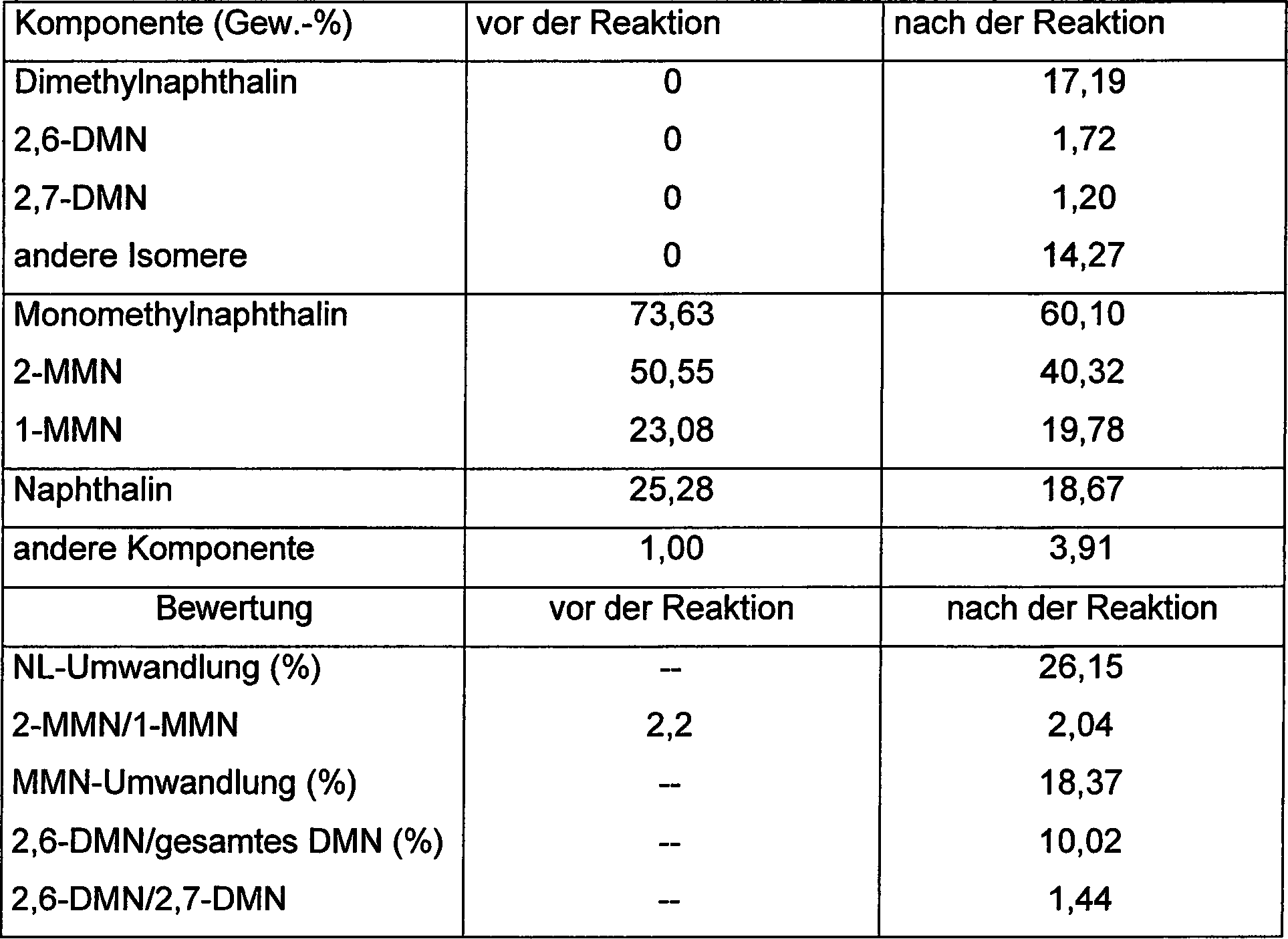
Wie aus Tabelle 1 hervorgeht, liegt das Verhältnis von 2,6-DMN/2,7-DMN über 1,1 und das Verhältnis von 2-MMN/1-MMN liegt über 2,0.As from Table 1, the ratio of 2,6-DMN / 2,7-DMN is above 1.1 and the ratio of 2-MMN / 1-MMN is above 2.0.
Beispiel 2 (Alkylierung)Example 2 (alkylation)
153
g MCM-22 wurden in den Rohrreaktor (Volumen: 370 cm3)
eingespeist. Als ein Ausgangsmaterial zur Alkylierung wurden 1-MMN
(Reinheit 95,5 %) und 2-MMN (Reinheit 96,6 %) verwendet und bei
dem Molverhältnis
von 2,2 von 2-MMN/1-MMN gemischt. Das Ausgangsmaterial wurde dem
Reaktor (350°C)
bei der Geschwindigkeit von 76,7 g/h und 0,5 h-1 WHSV
4 Stunden zugeführt.
Danach wurde mit dem Zuführen
von Methanol in den Reaktor bei der Geschwindigkeit von 17,3 g/h
begonnen und die Reaktion wurde für 20 Stunden fortgesetzt. Das
erhaltene Produkt wurde durch Gaschromatographie analysiert und
das Ergebnis wird in Tabelle 2 zusammengefaßt. Tabelle
2 (Alkylierung) 
Wie aus Tabelle 2 hervorgeht, liegt das Verhältnis von 2,6-DMN/2,7-DMN über 1,1 und das Verhältnis von 2-MMN/1-MMN liegt über 2,0.As from Table 2, the ratio of 2,6-DMN / 2,7-DMN is above 1.1 and the ratio of 2-MMN / 1-MMN is above 2.0.
Beispiel 3 (Alkylierung und Destillation)Example 3 (alkylation and distillation)
Die Alkylierung von MMN und Naphthalin ist für mehrere Monate in derselben Weise, die in Beispiel 1 beschrieben wurde, durchgeführt worden, und etwa 400 kg des Pro duktes werden gesammelt. Die Destillation des Produktes wird unter Verwendung eines Batchdestillationsturmes mit einer gepackten Säule durchgeführt. Es wird erwartet, daß die Anzahl an theoretischen Böden des Turms mindestens 50 beträgt. Der Betriebsdruck an der Spitze der Säule wird zwischen 15 und 36 Torr (2 kPa und 4,8 kPa) kontrolliert und die Destillation bei einem Rückflußverhältnis von 50 bis 75 fortgesetzt.The Alkylation of MMN and naphthalene is in the same for several months Manner described in Example 1, and about 400 kg of the product are collected. The distillation of Product is using a batch distillation tower with a packed column carried out. It is expected that the Number of theoretical plates the tower is at least 50. The operating pressure at the top of the column is between 15 and 36 Torr (2 kPa and 4.8 kPa) and the distillation at a Reflux ratio of 50 to 75 continued.
Das
Produkt wird in 17 Fraktionen durch die Unterschiede in den Siedepunkten
geteilt, wie in Tabelle 3 gezeigt. Tabelle
3 (Alkylierung und Destillation) 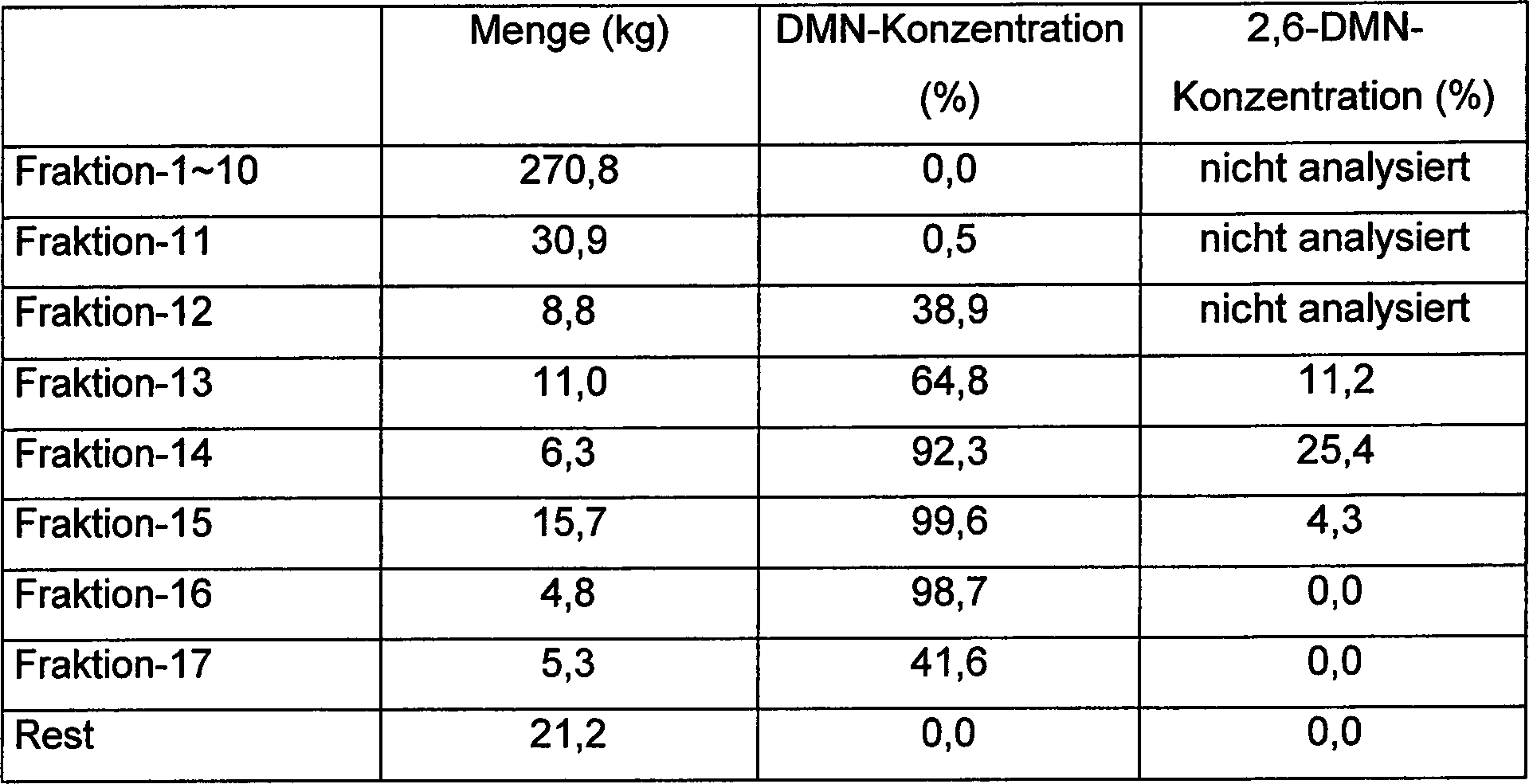
Beispiel 4 (Hydrodealkylierung)Example 4 (Hydrodealkylation)
Ein Teil der Fraktion-17 und dem Rest, die in Tabelle 3 gezeigt werden, werden gemischt, um das Ausgangsmaterial (Blend-A) zur Hydrodealkylierung herzustellen. Eine Menge von 50 g des Cr2O3/Al2O3-Katalysators, hergestellt von Süd-Chemie AG, wird in einen Rohrreaktor eingespeist. Der Reaktor wird allmählich von Umgebungstemperatur auf 662°F (350°C) erwärmt, um den Katalysator während des Zuführens von Wasserstoffgas zu trocknen. Daraufhin wird das Blend-A zu dem Reaktor bei der Geschwindigkeit von 50 g/h und 1,0 h-1 WHSV während des Zuführens von Wasser stoffgas bei 1,2 scf/h (0,034 m3/h) beschickt. Die Hydrodealkylierung wird bei 887°F (475°C) und 854 psig (5,99 MPa) durchgeführt. Das Produkt wird durch GC analysiert und die Ergebnisse der Hydrodealkylierung werden in der nachstehenden Tabelle 4 zusammengefaßt.A portion of Fraction-17 and the remainder shown in Table 3 are mixed to prepare the starting material (Blend-A) for hydrodealkylation. An amount of 50 g of the Cr 2 O 3 / Al 2 O 3 catalyst, manufactured by Süd-Chemie AG, is fed into a tubular reactor. The reactor is gradually heated from ambient to 662 ° F (350 ° C) to dry the catalyst while supplying hydrogen gas. Then, the blend A is charged to the reactor at the rate of 50 g / hr and 1.0 hr -1 WHSV while supplying hydrogen gas at 1.2 scf / hr (0.034 m 3 / hr). Hydrodealkylation is carried out at 887 ° F (475 ° C) and 854 psig (5.99 MPa). The product is analyzed by GC and the results of the hydrodealkylation are summarized in Table 4 below.
Wie
in Tabelle 4 gezeigt, ist der Cr2O3/Al2O3-Katalysator
dahingehend effektiv, 2,6-DMN aus der 2,6-DMN-armen Beschickung
anzureichern. Tabelle
4 (Hydrodealkvlierung) 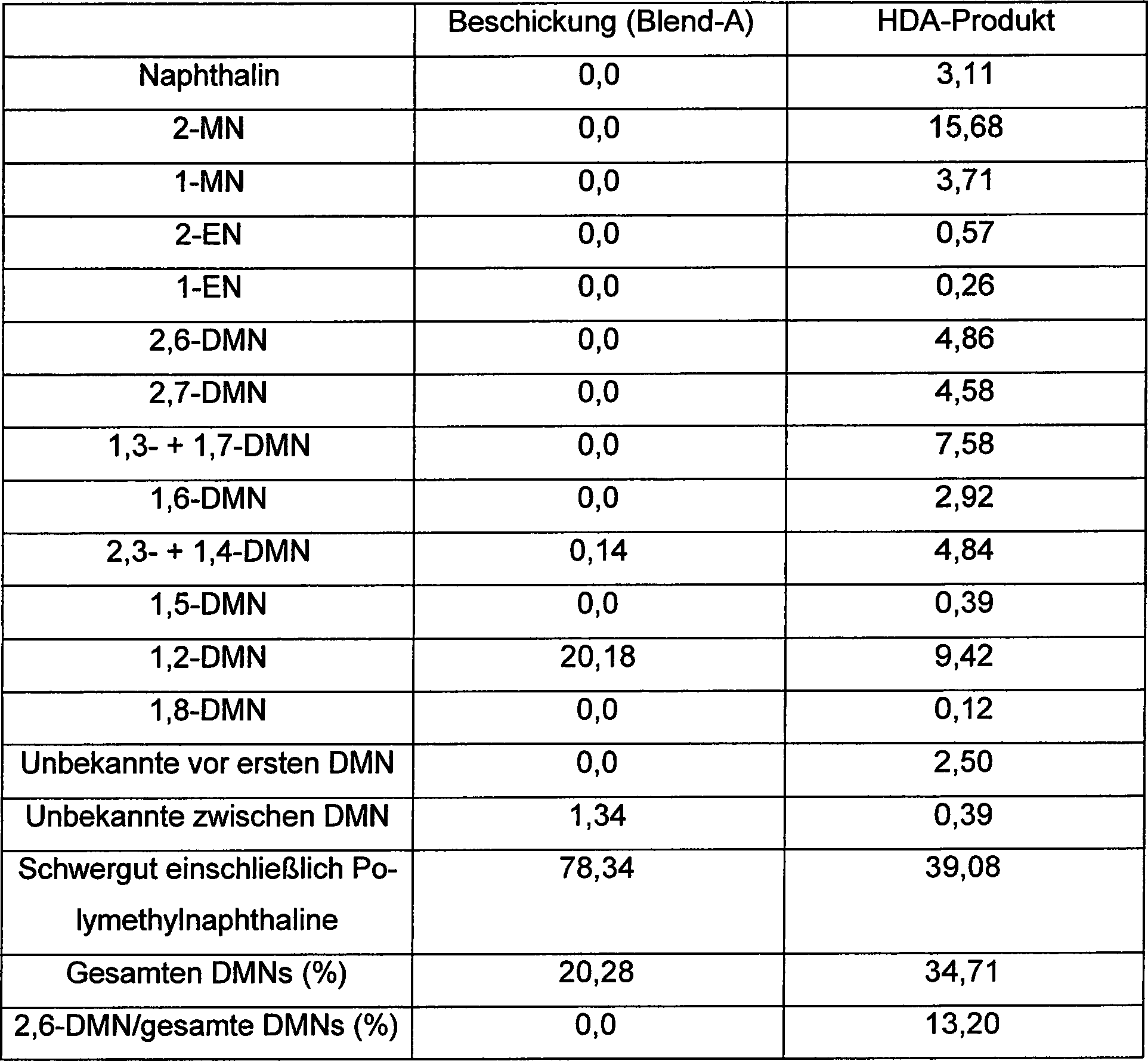
Beispiel 5: IsomerisierungExample 5: Isomerization
Eine
Menge von 25 g des MCM-22-Katalysators wird in den Rohrreaktor (Volumen:
200 cm3) eingespeist. Der Reaktor wird allmählich von
Umgebungstemperatur auf 400°C
erwärmt,
um den Katalysator während
des Zuführens
von Stickstoffgas zu trocknen, und der Strom an Stickstoffgas wird
eingestellt, wenn die Temperatur bei 400°C stabil wird. Daraufhin wird
2,6-armes DMN dem Reaktor bei der Geschwindigkeit von 25 g/h und
1,0 h-1 WHSV zugeführt und die Isomerisierung
von DMN wird für
vier Stunden durchgeführt.
Die Gehalte des erhaltenen Produktes werden durch Gaschromatographie
analysiert und die Ergebnisse werden in Tabelle 5 zusammengefaßt. Tabelle
5 (Isomerisierung) 
Beispiel 6 Abtrennung und Reinigung:Example 6 Separation and cleaning:
(1) Kristallisation unter Hochdruckkristallisation(1) crystallization under High pressure crystallization
Eine Menge von 1.505 g der DMN-Isomere wird dem Hochdruckkristallisator (KOBELCO 1,5L-Typ) zugeführt und 236 g 2,6-DMN-Kristalle (Reinheit 87 %) werden unter der Bedingung von 2000 kgf/cm2 (196,1 MPa) und 45°C abgetrennt.An amount of 1,505 g of the DMN isomers is fed to the high-pressure crystallizer (KOBELCO 1.5L type), and 236 g of 2,6-DMN crystals (purity 87%) are prepared under the condition of 2000 kgf / cm 2 (196.1 MPa) and 45 ° C separated.
(2) Kühlkristallisation(2) cooling crystallization
Unter Verwendung eines Behälters zur Kristallisation (3 Liter) werden 2.001 g DMN-Isomere schnell von 50 auf 40°C unter langsamem Rühren abgekühlt. Dann werden 0,5 g Keimkristalle in den Behälter eingespeist, der bei einer Temperatur bei 40°C für eine Stunde gehalten wurde. Daraufhin wird das Ausgangsmaterial auf 10°C bei 2°C/min abgekühlt. Eine Menge von 360 g 2,6-DMN-Kristallen (Reinheit 68 %) wird durch Filtration unter Druck abgetrennt.Under Use of a container for crystallization (3 liters), 2,001 g of DMN isomers rapidly from 50 to 40 ° C under slow stir cooled. Then 0.5 g of seed crystals are fed into the container, which in a Temperature at 40 ° C for one Hour was held. Then the starting material is cooled to 10 ° C at 2 ° C / min. A Amount of 360 g of 2,6-DMN crystals (purity 68%) by filtration separated under pressure.
Die Ergebnisse der Abtrennung durch sowohl Kristallisation unter hohem Druck als auch Kühlkristallisation werden in Tabelle 6 zusammengefaßt.The Results of the separation by both crystallization under high Pressure as well as cooling crystallization are summarized in Table 6.
Tabelle
6 (Abtrennung und Reinigung) 
„Rückführung von 2,6-DMN" bedeutet der Gehalt an 2,6-DMN in den Kristallen gegenüber dem Gehalt an 2,6-DMN in dem Ausgangsmaterial."Repatriation of 2,6-DMN "means the content of 2,6-DMN in the crystals versus the content of 2,6-DMN in the starting material.
„Ausbeute von 2,6-DMN" bedeutet der Gehalt an 2,6-DMN in dem Kristall gegenüber dem Gesamtgewicht des Ausgangsmaterials."Yield of 2,6-DMN " the content of 2,6-DMN in the crystal versus the total weight of the starting material.
Wie in Tabelle 6 gezeigt, ist die Ausbeute von 2,6-DMN durch Kristallisation unter hohem Druck viel höher als durch Kühlkristallisation. Außerdem beträgt das Verhältnis von 2,6-DMN/gesamt-DMN des Filtrats durch Kristallisation unter hohem Druck weniger als 8 %. Deshalb ist das Filtrat effektiver als ein Ausgangsmaterial zur Transalkylierung und Isomerisierung von 2,6-armen DMN.As shown in Table 6, the yield of 2,6-DMN is by crystallization much higher under high pressure as by cooling crystallization. Furthermore is The relationship of 2,6-DMN / total DMN of the filtrate by crystallization below high pressure less than 8%. Therefore, the filtrate is more effective as a starting material for transalkylation and isomerization of 2,6-lean DMN.
Wenn außerdem ein Versuch gemacht wird, die Reinheit von Kristallen durch Kühlkristallisation zu erhöhen, verringert sich die Ausbeute von 2,6-DMN drastisch.If Furthermore an attempt is made to determine the purity of crystals by cooling crystallization to increase, the yield of 2,6-DMN decreases drastically.
Beispiel 7 (Reinigung)Example 7 (Purification)
Die Vorkondensation von 2,6-DMN aus dem DMN-Gemisch (Tabelle 7) wurde durch Kühlkristallisation versucht, und ein 2,6-DMN-reicher Kuchen, der als Ausgangsmaterial für die Kristallisation unter hohem Druck verwendet werden soll, wurde durch Labordruckfiltrationseinheit abgetrennt.The precondensation of 2,6-DMN from the DMN mixture (Table 7) was attempted by cooling crystallization and a 2,6-DMN rich cake used as the starting material for high pressure crystallization was to be used was separated by laboratory pressure filtration unit.
Die Reinigung von 2,6-DMN aus dem 2,6-DMN-reichen Kuchen wurde durch das Kristallisationsverfahren unter hohem Druck unter Verwendung der HPC-Testmaschine von Kobelco durchgeführt.The Purification of 2,6-DMN from the 2,6-DMN rich cake was performed the crystallization process under high pressure using HPC test machine by Kobelco.
Mehrere
Reihen von Experimenten wurden durchgeführt und die Ergebnisse werden
in
Wie
aus
Tabelle
7 (Zusammensetzung des DMN-Gemisches) 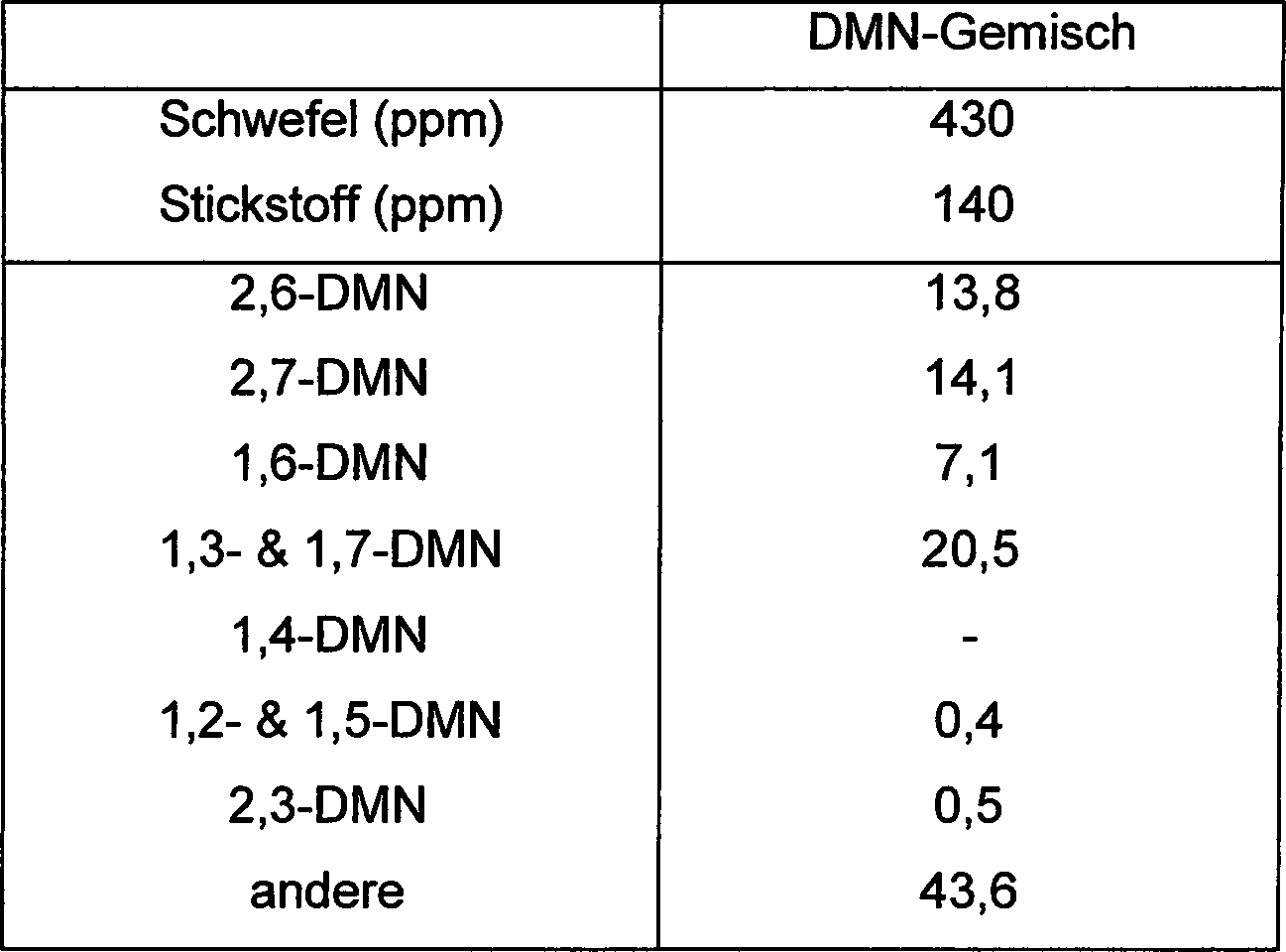
Beispiel 8 (Destillation)Example 8 (Distillation)
Zwei Typen des Batchdestillationsturms werden zur Abtrennung von Alkylnaphthalinen von LCO verwendet. Einer der Destillationstürme (Fractioneer-A) weist eine 167 l (0,167 m3) Destillieranlage und 32 Fuß (9,75 m) lange Säule mit PRO-PAK (Scientific Development Company) auf und der andere Destillationsturm (Fractioneer-B) weist eine 27-Liter-Destillieranlage mit einer 11 Fuß langen Säule mit PRO-PAK auf. 164 kg LCO werden in den Fractioneer-A eingespeist und die Destillation wird bei einem Rückflußverhältnis von 50 und einem Druck von 60 Torr (8,0 kPa) durchgeführt. 80,5 Liter werden als eine Entnahmerate von 0,7 Litern pro Stunde entnommen.Two types of batch distillation tower are used to separate alkylnaphthalenes from LCO. One of the distillation towers (Fractioneer-A) has a 167 l (0.167 m 3 ) still and 32 ft (9.75 m) long column with PRO-PAK (Scientific Development Company) and the other distillation tower (Fractioneer-B) has a 27-liter distillation unit with an 11-foot column with PRO-PAK on. 164 kg of LCO are fed to the Fractioneer-A and the distillation is carried out at a reflux ratio of 50 and a pressure of 60 Torr (8.0 kPa). 80.5 liters are taken as a take-off rate of 0.7 liters per hour.
Dann werden 25 kg des Rests in der Destillieranlage von Fractioneer-A nach der ersten Destillation entnommen und in den Fractioneer-B eingespeist. Eine andere Batchdestillation wird bei einem Rückflußverhältnis von 50 und einem Druck von 50 Torr (6,67 kPa) durchgeführt. 14 Liter werden bei einer Entnahmerate von 125 ml pro Stunde entnommen. Die Komponenten des Produktes (Blend-B), die aus der obengenannten Zweistufendestillation erhalten wurden, werden in Tabelle 8 gezeigt.Then 25 kg of the remainder are used in the distillation unit of Fractioneer-A taken after the first distillation and into the Fractioneer-B fed. Another batch distillation is at a reflux ratio of 50 and a pressure of 50 Torr (6.67 kPa) performed. 14 Liters are withdrawn at a withdrawal rate of 125 ml per hour. The components of the product (Blend-B), from the above-mentioned two-stage distillation are obtained are shown in Table 8.
Beispiel 9 (Hydrodealkylierung)Example 9 (Hydrodealkylation)
Eine Menge von 70 g des Cr2O3/Al2O3-Katalysators, hergestellt von Süd-Chemie AG, wird in einen Rohrreaktor eingespeist. Der Reaktor wird allmählich von Umgebungstemperatur auf 932°F (500°C) erwärmt, um den Katalysator während des Zuführens von Wasserstoffgas zu trocknen. Daraufhin wird das Destillationsprodukt (Blend-B), das aus Beispiel 8 erhalten wurde, dem Reaktor bei der Geschwindigkeit von 70 g/h und 1,0 h-1 WHSV während des Zuführens von Wasserstoffgas bei 0,98 scf/h (0,028 m3/h) zugeführt. Die Hydrodealkylierungsreaktion wird bei 933°F (500,6°C) und 1138 psig (7,95 MPa) durchgeführt. Das Produkt wird durch GC analysiert und die Ergebnisse der Hydrodealkylierung werden in Tabelle 8 zusammengefaßt.An amount of 70 g of the Cr 2 O 3 / Al 2 O 3 catalyst, manufactured by Süd-Chemie AG, is fed into a tubular reactor. The reactor is gradually heated from ambient to 932 ° F (500 ° C) to dry the catalyst while supplying hydrogen gas. Thereafter, the distillation product (blend B) obtained from Example 8 is charged to the reactor at the rate of 70 g / hr and 1.0 hr -1 WHSV while supplying hydrogen gas at 0.98 scf / hr (0.028 m 3 / h). The hydrodealkylation reaction is carried out at 933 ° F (500.6 ° C) and 1138 psig (7.95 MPa). The product is analyzed by GC and the results of the hydrodealkylation are summarized in Table 8.
Beispiel 10 (Hydrodealkylierung)Example 10 (Hydrodealkylation)
Eine Menge von 70 g des CoO/MoO3/Al2O3-Katalysators, hergestellt von Akzo Chemicals Inc, wird in einen Rohrreaktor eingespeist. Der Reaktor wird allmählich von Umgebungstemperatur auf 300°F (148,9°C) mit einem Stickstoffstrom bei 5 scf/h (0,142 m3/h) erwärmt. Dann wird das Fließgas auf Wasserstoff bei 2 scf/h (0,057 m3/h) umgeschaltet und der Druck wird auf 500 psig (3,55 MPa) erhöht. Der Katalysator wird mit einem organischen Sulfid (Kerosin mit 1,0 % Dimethylsulfid) zum Sulfatisieren während des Zuführens von Wasserstoffgas in Kontakt gebracht und dann wird die Temperatur auf 650°F (343,3°C) erhöht. Daraufhin wird das Destillationsprodukt (Blend-B), das aus Beispiel 8 erhalten wurde, zu dem Reaktor bei der Geschwindigkeit von 70 g/h und 1,0 h-1 WHSV während des Zuführens von Wasserstoffgas bei 5 scf/h (0,028 m3/h) beschickt. Die Hydrodealkylierung wird bei 932°F (500°C) und 1425 psig (9,93 MPa) durchgeführt. Das Produkt wird durch GC analysiert und die Ergebnisse der Hydrodealkylierung werden in der nachstehenden Tabelle 8 zusammengefaßt.An amount of 70 g of the CoO / MoO 3 / Al 2 O 3 catalyst, manufactured by Akzo Chemicals Inc, is fed to a tubular reactor. The reactor is heated gradually from ambient temperature to 300 ° F (148.9 ° C) with nitrogen flow at 5 scf / hr (0.142 m 3 / h). The flow gas is then switched to hydrogen at 2 scf / h (0.057 m 3 / h) and the pressure is increased to 500 psig (3.55 MPa). The catalyst is contacted with an organic sulfide (kerosene with 1.0% dimethyl sulfide) to sulfatize while supplying hydrogen gas, and then the temperature is raised to 650 ° F (343.3 ° C). Thereafter, the distillation product (blend B) obtained from Example 8 is added to the reactor at the rate of 70 g / hr and 1.0 hr -1 WHSV while supplying hydrogen gas at 5 scf / hr (0.028 m 3 / h). The hydrodealkylation is carried out at 932 ° F (500 ° C) and 1425 psig (9.93 MPa). The product is analyzed by GC and the results of the hydrodealkylation are summarized in Table 8 below.
Wie in Tabelle 8 gezeigt, sind sowohl der Cr2O3/Al2O3- als auch der CoO/MoO3/Al2O3-Katalysator dahingehend effektiv, DMN-Isomere aus DMN-armer Beschickung anzureichern.As shown in Table 8, both the Cr 2 O 3 / Al 2 O 3 and CoO / MoO 3 / Al 2 O 3 catalysts are effective in enriching DMN isomers from DMN-poor feed.
Tabelle
8 (Hydrodealkylierung) 
Beispiel 11 (Destillation und Hydrotreating)Example 11 (Distillation and hydrotreating)
164 kg LCO werden in den Fractioneer-A eingespeist und die Destillation wird bei einem Rückflußverhältnis von 50 und einem Druck von 60 Torr (8 kPa) durchgeführt. 120 Liter werden bei einer Entnahmerate von 0,7 Litern pro Stunde entnommen und zum Hydrotreating des Ausgangsmaterials als Blend-C hergestellt. NiO/MoO3/Al2O3- Katalysator, hergestellt von Akzo Chemicals Inc., wird als ein Hydrotreating-Katalysator ausgewählt und in den Rohrreaktor eingespeist.164 kg of LCO are fed to the Fractioneer-A and the distillation is carried out at a reflux ratio of 50 and a pressure of 60 Torr (8 kPa). 120 liters are withdrawn at a withdrawal rate of 0.7 liters per hour and prepared for hydrotreating the starting material as Blend-C. NiO / MoO 3 / Al 2 O 3 catalyst, manufactured by Akzo Chemicals Inc., is selected as a hydrotreating catalyst and fed to the tubular reactor.
Nach dem Trocknen und Sulfatisieren des Katalysators wird dann Blend-C zu dem Reaktor bei der Geschwindigkeit von 0,43 h-1 WHSV beschickt und Hydrotreating wird bei 400 psig (2,86 MPa) und 726°F (385,6°C) während des Zuführens von Wasserstoffgas bei 3495 scf/bbl (622,5 m3/m3) durchgeführt. Die Ergebnisse des Hydrotreatings werden in der nachstehenden Tabelle 9 zusammengefaßt.After drying and sulphating the catalyst, Blend-C is then charged to the reactor at the rate of 0.43h- 1 WHSV and hydrotreated at 400 psig (2.86 MPa) and 726 ° F (385.6 ° C). while supplying hydrogen gas at 3495 scf / bbl (622.5 m 3 / m 3 ). The results of the hydrotreating are summarized in Table 9 below.
Wie in Tabelle 9 gezeigt, ist der NiO/MoO3/Al2O3-Katalysator dahingehend effektiv, Stickstoff- und/oder Schwefelverbindungen in LCO mit minimalem Verlust von DMN-Isomeren zu verringern.As shown in Table 9, the NiO / MoO 3 / Al 2 O 3 catalyst is effective in reducing nitrogen and / or sulfur compounds in LCO with minimal loss of DMN isomers.
Tabelle
9 (Destillation und Hydrotreating) 
Beispiel 12 (Adsorption)Example 12 (Adsorption)
2,6-DMN und 2,7-DMN werden gemischt bzw. in iso-Octan bei 2,0 Gew.-% Konzentration gelöst. Dann wird die DMN-Isooctan-Lösung zu der Adsorptionssäule (4,6 mm ID und 500 mm L), gepackt mit K-Y-Zeolith, bei der Geschwindigkeit von 0,50 ml/min beschickt, während die Säulentemperatur bei 158°F (70°C) kontrolliert wird. Die Daten des zeitlichen Verlaufs der DMN-Konzentration in dem Ablauf werden durch GC-Analyse gesammelt und es wird eine Durchbruchskurve in dem Adsorptionsschritt erhalten.2,6-DMN and 2,7-DMN are mixed or in iso-octane at 2.0 wt .-% concentration solved. Then the DMN isooctane solution to the adsorption column (4.6 mm ID and 500 mm L) packed with K-Y zeolite at speed of 0.50 ml / min while charging the column temperature at 158 ° F (70 ° C) controlled becomes. The data of the time course of the DMN concentration in the run is collected by GC analysis and it becomes a breakthrough curve obtained in the adsorption step.
Nach dem Adsorptionsschritt wird die Flüssigbeschickung zu reinem iso-Octan umgeschaltet und der Ablauf wird ebenso analysiert, um die Daten des zeitlichen Verlaufs der DMN-Konzentration in dem Ablauf zu sammeln.To In the adsorption step, the liquid feed becomes pure iso-octane Switched and the process is also analyzed to the data to collect the time course of DMN concentration in the process.
Die
Ergebnisse der Durchbruchskurve und Desorptionskurve werden in
Beispiel 13Example 13
Ein
anderer Adsorptionstest wird in derselben Weise, die in Beispiel
12 beschrieben wird, durchgeführt,
außer
daß Mesitylen
als ein Lösungsmittel
verwendet wird. Die Ergebnisse der Durchbruchskurve und der Desorptionskurve
werden in
Offensichtlich sind zahlreiche Modifikationen und Veränderungen der vorliegenden Erfindung im Licht der obigen Lehren möglich. Es wird daher verstanden, daß innerhalb des Umfangs der beiliegenden Ansprüche die Erfindung anders als hierin speziell beschrieben praktiziert werden kann.Obviously are numerous modifications and changes of the present Invention in the light of the above teachings possible. It is therefore understood that within the scope of the appended claims the invention is different can be practiced herein specifically.
Claims (28)
Applications Claiming Priority (1)
| Application Number | Priority Date | Filing Date | Title |
|---|---|---|---|
| PCT/JP1999/001880 WO2000061529A1 (en) | 1999-04-08 | 1999-04-08 | Process for preparing 2,6-dialkylnaphtalene |
Publications (2)
| Publication Number | Publication Date |
|---|---|
| DE69918337D1 DE69918337D1 (en) | 2004-07-29 |
| DE69918337T2 true DE69918337T2 (en) | 2005-06-30 |
Family
ID=14235431
Family Applications (1)
| Application Number | Title | Priority Date | Filing Date |
|---|---|---|---|
| DE69918337T Expired - Fee Related DE69918337T2 (en) | 1999-04-08 | 1999-04-08 | PROCESS FOR THE PREPARATION OF 2,6-DIALKYL NAPHTHALES |
Country Status (6)
| Country | Link |
|---|---|
| EP (1) | EP1165473B1 (en) |
| JP (1) | JP2002541231A (en) |
| KR (1) | KR100470807B1 (en) |
| CA (1) | CA2368607A1 (en) |
| DE (1) | DE69918337T2 (en) |
| WO (1) | WO2000061529A1 (en) |
Families Citing this family (3)
| Publication number | Priority date | Publication date | Assignee | Title |
|---|---|---|---|---|
| KR100721442B1 (en) * | 2006-06-23 | 2007-05-23 | 주식회사 효성 | Separation and Purification Methods of 2,6-Dimethylnaphthalene Including Isomerization and Crystallization Process |
| KR100894785B1 (en) * | 2006-12-29 | 2009-04-24 | 주식회사 효성 | High purity 2,6-dimethylnaphthalene continuous crystallization separation method and apparatus |
| CN110257101B (en) * | 2019-07-03 | 2021-03-30 | 西北大学 | A device and method for preparing chemicals by reaction-separation-reaction of coal tar fractions |
Family Cites Families (3)
| Publication number | Priority date | Publication date | Assignee | Title |
|---|---|---|---|---|
| US5744670A (en) * | 1996-06-10 | 1998-04-28 | Kobe Steel, Ltd. | Process for preparing dialkylnaphthalene |
| US6011190A (en) * | 1997-07-02 | 2000-01-04 | Kabushiki Kaisha Kobe Seiko Sho | Process for preparing dialkylnaphthalene |
| US6018086A (en) * | 1997-10-10 | 2000-01-25 | Kabushiki Kaisha Kobe Seiko Sho | Process for preparing 2,6-dialkylnaphthalene |
-
1999
- 1999-04-08 JP JP2000610807A patent/JP2002541231A/en not_active Withdrawn
- 1999-04-08 CA CA002368607A patent/CA2368607A1/en not_active Abandoned
- 1999-04-08 KR KR10-2001-7012829A patent/KR100470807B1/en not_active Expired - Fee Related
- 1999-04-08 DE DE69918337T patent/DE69918337T2/en not_active Expired - Fee Related
- 1999-04-08 EP EP99913593A patent/EP1165473B1/en not_active Expired - Lifetime
- 1999-04-08 WO PCT/JP1999/001880 patent/WO2000061529A1/en not_active Ceased
Also Published As
| Publication number | Publication date |
|---|---|
| KR20010108474A (en) | 2001-12-07 |
| EP1165473A1 (en) | 2002-01-02 |
| CA2368607A1 (en) | 2000-10-19 |
| EP1165473B1 (en) | 2004-06-23 |
| JP2002541231A (en) | 2002-12-03 |
| DE69918337D1 (en) | 2004-07-29 |
| WO2000061529A1 (en) | 2000-10-19 |
| KR100470807B1 (en) | 2005-02-21 |
Similar Documents
| Publication | Publication Date | Title |
|---|---|---|
| DE2526887C2 (en) | Process for the production of aromatic hydrocarbons | |
| DE69514834T2 (en) | METHOD FOR PRODUCING ETHYLBENZOL BY ALKYLATION IN THE LIQUID PHASE AND TRANSALKYLATION IN THE GAS PHASE | |
| DE69705958T2 (en) | ALKYLATION PROCEDURE USING ZEOLITE BETA | |
| US3957621A (en) | Production of alkyl aromatic hydrocarbons | |
| DE69711120T2 (en) | Process for the preparation of dialkylnaphthalenes | |
| DE69819816T2 (en) | Catalyst based on bismuth and silica-rich zeolite and its use in the conversion of aromatic hydrocarbons | |
| DE68927717T2 (en) | Process for the isomerization of dimethylnaphthalenes | |
| DE2441516A1 (en) | XYLOL ISOMERIZATION | |
| DE68906570T2 (en) | METHOD FOR PRODUCING NORMALLY LIQUID LIQUID HYDROCARBONS FROM A BATCH OF HYDROCARBON WHICH CONTAINS STRAIGHT-CHAINED AND BRANCHED OLEFINS. | |
| DE69828191T2 (en) | PROCESS FOR THE PREPARATION OF 2,6-DIALKYL NAPHTHALINE | |
| DE2247772C2 (en) | Process for the recovery of alkyl substituted aromatic hydrocarbon distillates by treating alkylated aromatic fractions | |
| DE69514356T2 (en) | CYCLOPENTADIEN OLIGOMERS AND METHOD FOR THE PRODUCTION THEREOF | |
| DE60009729T2 (en) | REVALUATION OF REFORMAT WITH ZEOLIT CATALYSTS | |
| DE3318802A1 (en) | NEW CATALYSTS FOR HYDROCARBON CONVERSION | |
| DE69822711T2 (en) | Verfarhen for the production of dialkylnaphthalene | |
| DE69917123T2 (en) | Process for the preparation of 2,6-dimethylnaphthalene | |
| DE69433800T2 (en) | Process for the crystallization of 2,6-dimethylnaphthalene | |
| DE69805472T2 (en) | Process for reducing the olefin content of an alkylation product | |
| DE69808513T2 (en) | MANUFACTURING METHOD FOR META-XYLOL | |
| DE3876917T2 (en) | METHOD FOR PRODUCING DIMETHYLNAPHTHALEN. | |
| US3691247A (en) | Selectively removing monoalkylbenzenes from mixtures thereof with dialkylbenzenes | |
| DE2261248A1 (en) | METHOD OF HYDROISOMERIZATION | |
| DE69216383T2 (en) | Process for the preparation of unbranched alkylbenzenes | |
| DE69001702T2 (en) | Catalyst composition, process for cracking non-aromatics and process for isomerizing C8 aromatic hydrocarbons. | |
| WO1999019281A1 (en) | Process for preparing 2,6-dimethylnaphtalene |
Legal Events
| Date | Code | Title | Description |
|---|---|---|---|
| 8364 | No opposition during term of opposition | ||
| 8339 | Ceased/non-payment of the annual fee |