DE69918331T2 - LABEL TAPE WITH DIFFERENT INFORMATION AND DEVICE FOR PRINTING AND ATTACHING THE TAPE TO SURFACES - Google Patents
LABEL TAPE WITH DIFFERENT INFORMATION AND DEVICE FOR PRINTING AND ATTACHING THE TAPE TO SURFACES Download PDFInfo
- Publication number
- DE69918331T2 DE69918331T2 DE69918331T DE69918331T DE69918331T2 DE 69918331 T2 DE69918331 T2 DE 69918331T2 DE 69918331 T DE69918331 T DE 69918331T DE 69918331 T DE69918331 T DE 69918331T DE 69918331 T2 DE69918331 T2 DE 69918331T2
- Authority
- DE
- Germany
- Prior art keywords
- tape
- label
- box
- printed
- adhesive
- Prior art date
- Legal status (The legal status is an assumption and is not a legal conclusion. Google has not performed a legal analysis and makes no representation as to the accuracy of the status listed.)
- Expired - Fee Related
Links
- 238000007639 printing Methods 0.000 title description 26
- 239000010410 layer Substances 0.000 claims description 49
- 238000000576 coating method Methods 0.000 claims description 17
- 239000011248 coating agent Substances 0.000 claims description 15
- 239000012790 adhesive layer Substances 0.000 claims description 14
- 239000002390 adhesive tape Substances 0.000 claims description 14
- 238000005299 abrasion Methods 0.000 claims description 13
- 230000001464 adherent effect Effects 0.000 claims description 6
- 238000012856 packing Methods 0.000 claims description 6
- 230000001070 adhesive effect Effects 0.000 description 28
- 239000000853 adhesive Substances 0.000 description 27
- 239000000463 material Substances 0.000 description 23
- 238000012546 transfer Methods 0.000 description 22
- 238000000034 method Methods 0.000 description 14
- 238000010276 construction Methods 0.000 description 13
- 230000000712 assembly Effects 0.000 description 11
- 238000000429 assembly Methods 0.000 description 11
- 239000008199 coating composition Substances 0.000 description 10
- 229920000642 polymer Polymers 0.000 description 10
- 238000012360 testing method Methods 0.000 description 10
- 239000004820 Pressure-sensitive adhesive Substances 0.000 description 8
- 239000000203 mixture Substances 0.000 description 8
- 239000000123 paper Substances 0.000 description 8
- 230000008859 change Effects 0.000 description 7
- -1 polypropylene Polymers 0.000 description 7
- 229920001296 polysiloxane Polymers 0.000 description 7
- 230000007246 mechanism Effects 0.000 description 6
- 238000002310 reflectometry Methods 0.000 description 6
- 229920005989 resin Polymers 0.000 description 6
- 239000011347 resin Substances 0.000 description 6
- 238000010998 test method Methods 0.000 description 6
- 241000283070 Equus zebra Species 0.000 description 5
- 230000000052 comparative effect Effects 0.000 description 5
- 229920001577 copolymer Polymers 0.000 description 5
- 238000005520 cutting process Methods 0.000 description 5
- 239000000843 powder Substances 0.000 description 5
- 239000002904 solvent Substances 0.000 description 5
- 238000005516 engineering process Methods 0.000 description 4
- 238000002372 labelling Methods 0.000 description 4
- 239000000049 pigment Substances 0.000 description 4
- 238000000926 separation method Methods 0.000 description 4
- 238000010023 transfer printing Methods 0.000 description 4
- 238000011282 treatment Methods 0.000 description 4
- 239000004743 Polypropylene Substances 0.000 description 3
- 125000000217 alkyl group Chemical group 0.000 description 3
- 230000005540 biological transmission Effects 0.000 description 3
- 239000003795 chemical substances by application Substances 0.000 description 3
- 239000003086 colorant Substances 0.000 description 3
- 238000011156 evaluation Methods 0.000 description 3
- 238000002474 experimental method Methods 0.000 description 3
- 238000009472 formulation Methods 0.000 description 3
- 229920000728 polyester Polymers 0.000 description 3
- 229920001155 polypropylene Polymers 0.000 description 3
- 229920002635 polyurethane Polymers 0.000 description 3
- 239000004814 polyurethane Substances 0.000 description 3
- 238000000611 regression analysis Methods 0.000 description 3
- 239000000126 substance Substances 0.000 description 3
- 239000000758 substrate Substances 0.000 description 3
- 238000004804 winding Methods 0.000 description 3
- 239000004698 Polyethylene Substances 0.000 description 2
- 229920002396 Polyurea Polymers 0.000 description 2
- 239000003522 acrylic cement Substances 0.000 description 2
- 239000000654 additive Substances 0.000 description 2
- 239000002216 antistatic agent Substances 0.000 description 2
- 239000011127 biaxially oriented polypropylene Substances 0.000 description 2
- 229920001400 block copolymer Polymers 0.000 description 2
- 235000013877 carbamide Nutrition 0.000 description 2
- 238000010586 diagram Methods 0.000 description 2
- 150000004985 diamines Chemical class 0.000 description 2
- 239000000975 dye Substances 0.000 description 2
- 239000004744 fabric Substances 0.000 description 2
- 239000000945 filler Substances 0.000 description 2
- 239000003292 glue Substances 0.000 description 2
- 238000005286 illumination Methods 0.000 description 2
- 230000033001 locomotion Effects 0.000 description 2
- 238000005259 measurement Methods 0.000 description 2
- 229920001194 natural rubber Polymers 0.000 description 2
- 239000002985 plastic film Substances 0.000 description 2
- 229920006255 plastic film Polymers 0.000 description 2
- 229920000573 polyethylene Polymers 0.000 description 2
- 229920000346 polystyrene-polyisoprene block-polystyrene Polymers 0.000 description 2
- 230000037452 priming Effects 0.000 description 2
- 230000008569 process Effects 0.000 description 2
- 238000004064 recycling Methods 0.000 description 2
- 239000002356 single layer Substances 0.000 description 2
- 239000003381 stabilizer Substances 0.000 description 2
- 238000003860 storage Methods 0.000 description 2
- 229920003051 synthetic elastomer Polymers 0.000 description 2
- 239000005061 synthetic rubber Substances 0.000 description 2
- 229920002554 vinyl polymer Polymers 0.000 description 2
- SWRRWODUBVHJBC-UHFFFAOYSA-N 1-(2-piperidin-1-ylpropan-2-yl)piperidine Chemical compound N1(CCCCC1)C(C)(C)N1CCCCC1 SWRRWODUBVHJBC-UHFFFAOYSA-N 0.000 description 1
- ROGIWVXWXZRRMZ-UHFFFAOYSA-N 2-methylbuta-1,3-diene;styrene Chemical compound CC(=C)C=C.C=CC1=CC=CC=C1 ROGIWVXWXZRRMZ-UHFFFAOYSA-N 0.000 description 1
- 239000004593 Epoxy Substances 0.000 description 1
- VGGSQFUCUMXWEO-UHFFFAOYSA-N Ethene Chemical compound C=C VGGSQFUCUMXWEO-UHFFFAOYSA-N 0.000 description 1
- JIGUQPWFLRLWPJ-UHFFFAOYSA-N Ethyl acrylate Chemical compound CCOC(=O)C=C JIGUQPWFLRLWPJ-UHFFFAOYSA-N 0.000 description 1
- 239000005977 Ethylene Substances 0.000 description 1
- 244000043261 Hevea brasiliensis Species 0.000 description 1
- 239000005058 Isophorone diisocyanate Substances 0.000 description 1
- 229920000459 Nitrile rubber Polymers 0.000 description 1
- 239000004952 Polyamide Substances 0.000 description 1
- 229920002367 Polyisobutene Polymers 0.000 description 1
- 239000002174 Styrene-butadiene Substances 0.000 description 1
- 229910010413 TiO 2 Inorganic materials 0.000 description 1
- XSQUKJJJFZCRTK-UHFFFAOYSA-N Urea Chemical compound NC(N)=O XSQUKJJJFZCRTK-UHFFFAOYSA-N 0.000 description 1
- XTXRWKRVRITETP-UHFFFAOYSA-N Vinyl acetate Chemical class CC(=O)OC=C XTXRWKRVRITETP-UHFFFAOYSA-N 0.000 description 1
- 239000002318 adhesion promoter Substances 0.000 description 1
- 125000005250 alkyl acrylate group Chemical group 0.000 description 1
- 238000004458 analytical method Methods 0.000 description 1
- 238000004873 anchoring Methods 0.000 description 1
- 239000003963 antioxidant agent Substances 0.000 description 1
- 229920006378 biaxially oriented polypropylene Polymers 0.000 description 1
- 230000033228 biological regulation Effects 0.000 description 1
- DQXBYHZEEUGOBF-UHFFFAOYSA-N but-3-enoic acid;ethene Chemical compound C=C.OC(=O)CC=C DQXBYHZEEUGOBF-UHFFFAOYSA-N 0.000 description 1
- NTXGQCSETZTARF-UHFFFAOYSA-N buta-1,3-diene;prop-2-enenitrile Chemical compound C=CC=C.C=CC#N NTXGQCSETZTARF-UHFFFAOYSA-N 0.000 description 1
- MTAZNLWOLGHBHU-UHFFFAOYSA-N butadiene-styrene rubber Chemical compound C=CC=C.C=CC1=CC=CC=C1 MTAZNLWOLGHBHU-UHFFFAOYSA-N 0.000 description 1
- 229920005549 butyl rubber Polymers 0.000 description 1
- 239000004202 carbamide Substances 0.000 description 1
- 125000004432 carbon atom Chemical group C* 0.000 description 1
- 239000012876 carrier material Substances 0.000 description 1
- 238000006243 chemical reaction Methods 0.000 description 1
- 238000004140 cleaning Methods 0.000 description 1
- 239000003431 cross linking reagent Substances 0.000 description 1
- 230000003247 decreasing effect Effects 0.000 description 1
- 230000007547 defect Effects 0.000 description 1
- 239000002781 deodorant agent Substances 0.000 description 1
- 230000001419 dependent effect Effects 0.000 description 1
- 229910003460 diamond Inorganic materials 0.000 description 1
- 239000010432 diamond Substances 0.000 description 1
- 150000001993 dienes Chemical class 0.000 description 1
- 239000004205 dimethyl polysiloxane Substances 0.000 description 1
- 238000010017 direct printing Methods 0.000 description 1
- 239000006185 dispersion Substances 0.000 description 1
- 238000009826 distribution Methods 0.000 description 1
- KHAYCTOSKLIHEP-UHFFFAOYSA-N docosyl prop-2-enoate Chemical compound CCCCCCCCCCCCCCCCCCCCCCOC(=O)C=C KHAYCTOSKLIHEP-UHFFFAOYSA-N 0.000 description 1
- 230000000694 effects Effects 0.000 description 1
- 229920001971 elastomer Polymers 0.000 description 1
- 238000004049 embossing Methods 0.000 description 1
- 238000005530 etching Methods 0.000 description 1
- SUPCQIBBMFXVTL-UHFFFAOYSA-N ethyl 2-methylprop-2-enoate Chemical compound CCOC(=O)C(C)=C SUPCQIBBMFXVTL-UHFFFAOYSA-N 0.000 description 1
- 239000005038 ethylene vinyl acetate Substances 0.000 description 1
- 229920006244 ethylene-ethyl acrylate Polymers 0.000 description 1
- 239000005042 ethylene-ethyl acrylate Substances 0.000 description 1
- 210000004905 finger nail Anatomy 0.000 description 1
- 239000003205 fragrance Substances 0.000 description 1
- 238000005470 impregnation Methods 0.000 description 1
- 239000012535 impurity Substances 0.000 description 1
- 239000004615 ingredient Substances 0.000 description 1
- 238000007641 inkjet printing Methods 0.000 description 1
- NIMLQBUJDJZYEJ-UHFFFAOYSA-N isophorone diisocyanate Chemical compound CC1(C)CC(N=C=O)CC(C)(CN=C=O)C1 NIMLQBUJDJZYEJ-UHFFFAOYSA-N 0.000 description 1
- 238000005304 joining Methods 0.000 description 1
- 239000002655 kraft paper Substances 0.000 description 1
- 239000004816 latex Substances 0.000 description 1
- 229920000126 latex Polymers 0.000 description 1
- 230000031700 light absorption Effects 0.000 description 1
- 238000004519 manufacturing process Methods 0.000 description 1
- 239000003550 marker Substances 0.000 description 1
- 239000006224 matting agent Substances 0.000 description 1
- 239000000155 melt Substances 0.000 description 1
- 238000005065 mining Methods 0.000 description 1
- 238000012986 modification Methods 0.000 description 1
- 230000004048 modification Effects 0.000 description 1
- 229920003052 natural elastomer Polymers 0.000 description 1
- HMZGPNHSPWNGEP-UHFFFAOYSA-N octadecyl 2-methylprop-2-enoate Chemical compound CCCCCCCCCCCCCCCCCCOC(=O)C(C)=C HMZGPNHSPWNGEP-UHFFFAOYSA-N 0.000 description 1
- FSAJWMJJORKPKS-UHFFFAOYSA-N octadecyl prop-2-enoate Chemical compound CCCCCCCCCCCCCCCCCCOC(=O)C=C FSAJWMJJORKPKS-UHFFFAOYSA-N 0.000 description 1
- 239000005026 oriented polypropylene Substances 0.000 description 1
- 238000004806 packaging method and process Methods 0.000 description 1
- 239000003973 paint Substances 0.000 description 1
- 239000002245 particle Substances 0.000 description 1
- PNJWIWWMYCMZRO-UHFFFAOYSA-N pent‐4‐en‐2‐one Natural products CC(=O)CC=C PNJWIWWMYCMZRO-UHFFFAOYSA-N 0.000 description 1
- 230000035699 permeability Effects 0.000 description 1
- 239000004014 plasticizer Substances 0.000 description 1
- 229920001084 poly(chloroprene) Polymers 0.000 description 1
- 229920000435 poly(dimethylsiloxane) Polymers 0.000 description 1
- 229920001200 poly(ethylene-vinyl acetate) Polymers 0.000 description 1
- 229920000058 polyacrylate Polymers 0.000 description 1
- 229920013639 polyalphaolefin Polymers 0.000 description 1
- 229920002647 polyamide Polymers 0.000 description 1
- 229920000098 polyolefin Polymers 0.000 description 1
- 229920001451 polypropylene glycol Polymers 0.000 description 1
- 239000004800 polyvinyl chloride Substances 0.000 description 1
- 229920001289 polyvinyl ether Polymers 0.000 description 1
- 229920000036 polyvinylpyrrolidone Polymers 0.000 description 1
- 239000001267 polyvinylpyrrolidone Substances 0.000 description 1
- 235000013855 polyvinylpyrrolidone Nutrition 0.000 description 1
- 239000011148 porous material Substances 0.000 description 1
- 230000009467 reduction Effects 0.000 description 1
- 230000004044 response Effects 0.000 description 1
- 238000012552 review Methods 0.000 description 1
- 238000005096 rolling process Methods 0.000 description 1
- 238000007788 roughening Methods 0.000 description 1
- 239000005060 rubber Substances 0.000 description 1
- 238000006748 scratching Methods 0.000 description 1
- 230000002393 scratching effect Effects 0.000 description 1
- 238000007789 sealing Methods 0.000 description 1
- 239000002689 soil Substances 0.000 description 1
- 239000007787 solid Substances 0.000 description 1
- 238000001228 spectrum Methods 0.000 description 1
- 238000005507 spraying Methods 0.000 description 1
- 239000011115 styrene butadiene Substances 0.000 description 1
- 229920003048 styrene butadiene rubber Polymers 0.000 description 1
- 230000002195 synergetic effect Effects 0.000 description 1
- 230000029305 taxis Effects 0.000 description 1
- 229920001169 thermoplastic Polymers 0.000 description 1
- 229920002725 thermoplastic elastomer Polymers 0.000 description 1
- 229920001187 thermosetting polymer Polymers 0.000 description 1
- 239000004416 thermosoftening plastic Substances 0.000 description 1
- 230000001960 triggered effect Effects 0.000 description 1
- 238000011144 upstream manufacturing Methods 0.000 description 1
- 150000003672 ureas Chemical class 0.000 description 1
- 239000004034 viscosity adjusting agent Substances 0.000 description 1
- XLYOFNOQVPJJNP-UHFFFAOYSA-N water Substances O XLYOFNOQVPJJNP-UHFFFAOYSA-N 0.000 description 1
- 239000000080 wetting agent Substances 0.000 description 1
- 239000012463 white pigment Substances 0.000 description 1
Classifications
-
- B—PERFORMING OPERATIONS; TRANSPORTING
- B65—CONVEYING; PACKING; STORING; HANDLING THIN OR FILAMENTARY MATERIAL
- B65B—MACHINES, APPARATUS OR DEVICES FOR, OR METHODS OF, PACKAGING ARTICLES OR MATERIALS; UNPACKING
- B65B51/00—Devices for, or methods of, sealing or securing package folds or closures; Devices for gathering or twisting wrappers, or necks of bags
- B65B51/04—Applying separate sealing or securing members, e.g. clips
- B65B51/06—Applying adhesive tape
- B65B51/067—Applying adhesive tape to the closure flaps of boxes
-
- B—PERFORMING OPERATIONS; TRANSPORTING
- B65—CONVEYING; PACKING; STORING; HANDLING THIN OR FILAMENTARY MATERIAL
- B65C—LABELLING OR TAGGING MACHINES, APPARATUS, OR PROCESSES
- B65C1/00—Labelling flat essentially-rigid surfaces
- B65C1/02—Affixing labels to one flat surface of articles, e.g. of packages, of flat bands
- B65C1/025—Affixing labels to one flat surface of articles, e.g. of packages, of flat bands the label being picked up by the article to be labelled, i.e. the labelling head remaining stationary
-
- B—PERFORMING OPERATIONS; TRANSPORTING
- B65—CONVEYING; PACKING; STORING; HANDLING THIN OR FILAMENTARY MATERIAL
- B65C—LABELLING OR TAGGING MACHINES, APPARATUS, OR PROCESSES
- B65C9/00—Details of labelling machines or apparatus
- B65C9/08—Label feeding
- B65C9/18—Label feeding from strips, e.g. from rolls
- B65C9/1803—Label feeding from strips, e.g. from rolls the labels being cut from a strip
- B65C9/1807—Label feeding from strips, e.g. from rolls the labels being cut from a strip and transferred directly from the cutting means to an article
-
- B—PERFORMING OPERATIONS; TRANSPORTING
- B65—CONVEYING; PACKING; STORING; HANDLING THIN OR FILAMENTARY MATERIAL
- B65C—LABELLING OR TAGGING MACHINES, APPARATUS, OR PROCESSES
- B65C9/00—Details of labelling machines or apparatus
- B65C9/46—Applying date marks, code marks, or the like, to the label during labelling
-
- C—CHEMISTRY; METALLURGY
- C09—DYES; PAINTS; POLISHES; NATURAL RESINS; ADHESIVES; COMPOSITIONS NOT OTHERWISE PROVIDED FOR; APPLICATIONS OF MATERIALS NOT OTHERWISE PROVIDED FOR
- C09J—ADHESIVES; NON-MECHANICAL ASPECTS OF ADHESIVE PROCESSES IN GENERAL; ADHESIVE PROCESSES NOT PROVIDED FOR ELSEWHERE; USE OF MATERIALS AS ADHESIVES
- C09J7/00—Adhesives in the form of films or foils
- C09J7/20—Adhesives in the form of films or foils characterised by their carriers
-
- B—PERFORMING OPERATIONS; TRANSPORTING
- B65—CONVEYING; PACKING; STORING; HANDLING THIN OR FILAMENTARY MATERIAL
- B65C—LABELLING OR TAGGING MACHINES, APPARATUS, OR PROCESSES
- B65C9/00—Details of labelling machines or apparatus
- B65C2009/0081—Means for forming a label web buffer, e.g. label web loop
-
- Y—GENERAL TAGGING OF NEW TECHNOLOGICAL DEVELOPMENTS; GENERAL TAGGING OF CROSS-SECTIONAL TECHNOLOGIES SPANNING OVER SEVERAL SECTIONS OF THE IPC; TECHNICAL SUBJECTS COVERED BY FORMER USPC CROSS-REFERENCE ART COLLECTIONS [XRACs] AND DIGESTS
- Y10—TECHNICAL SUBJECTS COVERED BY FORMER USPC
- Y10T—TECHNICAL SUBJECTS COVERED BY FORMER US CLASSIFICATION
- Y10T428/00—Stock material or miscellaneous articles
- Y10T428/28—Web or sheet containing structurally defined element or component and having an adhesive outermost layer
-
- Y—GENERAL TAGGING OF NEW TECHNOLOGICAL DEVELOPMENTS; GENERAL TAGGING OF CROSS-SECTIONAL TECHNOLOGIES SPANNING OVER SEVERAL SECTIONS OF THE IPC; TECHNICAL SUBJECTS COVERED BY FORMER USPC CROSS-REFERENCE ART COLLECTIONS [XRACs] AND DIGESTS
- Y10—TECHNICAL SUBJECTS COVERED BY FORMER USPC
- Y10T—TECHNICAL SUBJECTS COVERED BY FORMER US CLASSIFICATION
- Y10T428/00—Stock material or miscellaneous articles
- Y10T428/28—Web or sheet containing structurally defined element or component and having an adhesive outermost layer
- Y10T428/2809—Web or sheet containing structurally defined element or component and having an adhesive outermost layer including irradiated or wave energy treated component
-
- Y—GENERAL TAGGING OF NEW TECHNOLOGICAL DEVELOPMENTS; GENERAL TAGGING OF CROSS-SECTIONAL TECHNOLOGIES SPANNING OVER SEVERAL SECTIONS OF THE IPC; TECHNICAL SUBJECTS COVERED BY FORMER USPC CROSS-REFERENCE ART COLLECTIONS [XRACs] AND DIGESTS
- Y10—TECHNICAL SUBJECTS COVERED BY FORMER USPC
- Y10T—TECHNICAL SUBJECTS COVERED BY FORMER US CLASSIFICATION
- Y10T428/00—Stock material or miscellaneous articles
- Y10T428/28—Web or sheet containing structurally defined element or component and having an adhesive outermost layer
- Y10T428/2843—Web or sheet containing structurally defined element or component and having an adhesive outermost layer including a primer layer
-
- Y—GENERAL TAGGING OF NEW TECHNOLOGICAL DEVELOPMENTS; GENERAL TAGGING OF CROSS-SECTIONAL TECHNOLOGIES SPANNING OVER SEVERAL SECTIONS OF THE IPC; TECHNICAL SUBJECTS COVERED BY FORMER USPC CROSS-REFERENCE ART COLLECTIONS [XRACs] AND DIGESTS
- Y10—TECHNICAL SUBJECTS COVERED BY FORMER USPC
- Y10T—TECHNICAL SUBJECTS COVERED BY FORMER US CLASSIFICATION
- Y10T428/00—Stock material or miscellaneous articles
- Y10T428/28—Web or sheet containing structurally defined element or component and having an adhesive outermost layer
- Y10T428/2848—Three or more layers
Landscapes
- Chemical & Material Sciences (AREA)
- Organic Chemistry (AREA)
- Engineering & Computer Science (AREA)
- Mechanical Engineering (AREA)
- Adhesive Tapes (AREA)
- Labeling Devices (AREA)
- Printers Characterized By Their Purpose (AREA)
- Adhesives Or Adhesive Processes (AREA)
Description
TECHNISCHES GEBIETTECHNICAL TERRITORY
Die vorliegende Erfindung betrifft Bänder. Genauer betrifft die vorliegende Erfindung ein Klebeband, das mit variablen Informationen bedruckt werden kann, um in Kombination mit einer Kiste ein Etikett auszubilden.The The present invention relates to tapes. More particularly, the present invention relates to an adhesive tape, which with Variable information can be printed in combination to form a label with a box.
ALLGEMEINER STAND DER TECHNIKGENERAL STATE OF THE ART
Behälter, Verpackungen, Kartons und Schachteln, (die als "Kisten" bezeichnet werden) zum Aufbewahren und Versenden von Produkten verwenden typischerweise ein Kistenpackband, ein Klebeband, um die Laschen oder Deckel zu befestigen, damit sie sich während des normalen Versands, der Handhabung und der Aufbewahrung nicht unbeabsichtigt öffnen. Das Kistenpackband bewahrt die Integrität einer Kiste über ihren gesamten Verteilungszyklus hinweg. Das Kistenpackband kann an anderen Teilen von Kisten und auf anderen Substraten verwendet werden, und kann verwendet werden, um ähnlich wie Aufkleber zu funktionieren. Diese Bänder können in Rollenform oder in Blockform hergestellt sein. Sie können durchsichtig, durchscheinend oder opak sein, und können Informationen aufweisen, die auf das Band gedruckt oder auf andere Weise darauf aufgebracht sind.Containers, packaging, Boxes and boxes (referred to as "boxes") for storage and shipping products typically use a crate pack, an adhesive tape to attach the tabs or lids to it while normal shipping, handling and storage unintentionally open. The box packing tape preserves the integrity of a box throughout its entirety Distribution cycle. The box packing tape may be on other parts can and can be used by boxes and on other substrates used to be similar how stickers work. These bands can be in roll form or in Be made block shape. They can be transparent, translucent or opaque, and can Have information printed on the tape or on others Manner are applied to it.
Diese Kisten enthalten im Allgemeinen Informationen über die Inhalte. Diese Informationen, die sich am häufigsten auf der Kiste befinden, könnten Losnummern, Datencodes, Produktidentifikationsinformationen und Strichcodes beinhalten. Die Informationen könnten unter Verwendung einer Anzahl von Verfahren auf der Kiste angeordnet werden. Diese könnten das Vorbedrucken der Kiste, wenn sie hergestellt wird, oder das Drucken dieser Informationen am Verwendungspunkt mit einem Tintenstrahlcodierer, der ein Muster von Tintenpunkten versprüht, um das Bild zu formen, oder durch Verwendung eines flexographischen Tintenwalzcodierersystems auf die Kiste beinhalten. Andere Verfahren beinhalten die Verwendung von Aufklebern, typischerweise weißes Papier mit vorgedruckten Informationen, die entweder händisch oder mit einer automatischen on-line Aufkleberaufbringungsvorrichtung aufgebracht werden.These Crates generally contain information about the content. This information, the most common could be on the box Lot numbers, data codes, product identification information and Include barcodes. The information could be made using a Number of procedures can be arranged on the box. These could do that Preprinting the box when it is made or printing this information at the point of use with an ink jet encoder, spraying a pattern of ink dots to form the image or by using a flexographic ink roll encoder system to include the box. Other methods include use of stickers, typically white paper with pre-printed Information that is either manual or with an automatic on-line label applicator be applied.
Ein jüngerer Trend bei der Übermittlung von Informationen, die sich auf das Produkt beziehen, ist die Erfordernis, für jede Kiste spezifisch über Informationen zu verfügen. Zum Beispiel könnte jede Kiste spezifische Informationen über ihre Inhalte und den Endbestimmungsort des Produkts einschließlich Losnummern, Seriennummern und Kundenbestellnummern tragen. Diese Informationen werden typischerweise auf Aufklebern bereitgestellt, die individualisiert ausgeführt sind und am Punkt der Aufbringung an der Kiste auf Anforderung gedruckt werden. Dies ist typischerweise als die Fähigkeit, "variable" Informationen auf einen Aufkleber zu drucken, bevor er auf die Kiste aufgebracht wird, bekannt. Zwei Patente, die gedruckte Etiketten offenbaren, sind US-A-5,292,713 und US-A-5,661,099.One younger Trend in transmission Information related to the product is the requirement for every Box specifically over To dispose of information. For example, could Each box contains specific information about its contents and the final destination including the product Carry lot numbers, serial numbers and customer order numbers. These Information is typically provided on stickers, the individualized executed are printed on request at the point of application to the box become. This is typically called the ability to put "variable" information on a sticker print before it is applied to the box. Two Patents disclosing printed labels are US-A-5,292,713 and US-A-5,661,099.
Ein System zum Drucken variabler Informationen umfaßt das Thermotintentransferdrucken auf Aufkleber unter Verwendung eines Tintenfarbbands und eines besonderen Hitzetransferdruckkopfs. Ein Computer steuert den Druckkopf durch Bereitstellen von Eingangssignalen für den Kopf, welcher diskrete Stellen am Tintenfarbband erhitzt. Das Tintenfarbband steht direkt mit dem Aufkleber in Kontakt, so daß die Tinte schmilzt und zum Aufkleber übertragen wird, wenn ein diskreter Bereich erhitzt wird. Ein anderes Verfahren, das dieses System verwendet, ist, Aufkleber zu verwenden, die ihre Farbe verändern, wenn Hitze ausgeübt wird (Thermoaufkleber). In einem anderen System werden variable Informationen durch einen Tintenstrahlcodierer direkt auf eine Kiste gedruckt. Das auf die Kiste oder auf einen Aufkleber gesprühte Tintenmuster kann durch einen Computer gesteuert werden.One Variable information printing system includes thermal ink transfer printing on labels using an ink ribbon and a special one Heat transfer print head. A computer controls the printhead Providing input signals to the head which is discrete Heat spots on the ink ribbon. The ink ribbon is direct with the sticker in contact, so that the ink melts and the Transfer stickers becomes when a discrete area is heated. Another method Using this system is to use stickers that are theirs Change color, when heat is exercised will (thermal sticker). In another system become variable Information through an inkjet coder directly on a box printed. The ink pattern sprayed on the box or on a sticker can be controlled by a computer.
Sowohl das Thermotransfersystem als auch das Tintenstrahlsystem erzeugt scharfe Bilder. Tintenstrahlsysteme beinhalten Piezosysteme, Thermosysteme, fortlaufende Systeme oder Systeme mit Tröpfchen auf Anforderung. Sowohl beim Tintenstrahlsystem als auch beim Thermotransfersystem hängt die Druckqualität von der Oberfläche ab, auf die die Tinte gesprüht wird. Es scheint, daß das beste System zum Drucken variabler Informationen eines ist, bei dem die Tinte und das Drucksubstrat passend abgestimmt werden können, um ein Bild von wiederholbarer Qualität, insbesondere Strichcodes, die mit einem hohen Grad an Verläßlichkeit durch einen elektronischen Scanner gelesen werden müssen, zu erzeugen.Either generates the thermal transfer system as well as the inkjet system sharp pictures. Inkjet systems include piezo systems, thermal systems, continuous systems or systems with droplets on demand. Either the inkjet system as well as the thermal transfer system hangs the print quality from the surface from which the ink is sprayed becomes. It seems that that best system for printing variable information is one which the ink and the printing substrate can be suitably tuned to an image of repeatable quality, especially barcodes, with a high degree of reliability through an electronic scanner, too produce.
Es ist eine Vielfalt von Aufbringungssystemen verfügbar, die ein Drucksystem, einen computergesteuerten erhitzten Druckkopf, und Führungssysteme für den Thermotransfertintenfarbbandaufkleber und die Decklage enthalten. Die von Diagraph Corp. (Earth City, MO) hergestellte Doppelfeld-Druck- und Aufbringungsvorrichtung PA/4020, die von Label-Aire Inc. (Fullerton, CA) hergestellte Druck- und Aufbringungsvorrichtung 2138 und die von Labeling Systems, Inc. (Oakland, NJ) hergestellte Druck- und Aufbringungseckenaufbringungsvorrichtung 2800 stellen einige Beispiele dar. Diese Systeme drucken auf Aufkleber mit einer Decklage. Die Decklage ist der Träger für das Aufklebermaterial. Diese Systeme drucken diskrete Nachrichten auf den Aufkleber, ziehen den Aufkleber von seiner Decklage ab und übertragen den gedruckten Aufkleber auf eine Kiste. Obwohl andere Materialien wie etwa Polyester verfügbar sind, aus denen Aufkleber hergestellt werden können, ist Papieraufklebermaterial aufgrund seiner bereitwilligen Annahme der Thermotransfertinte und seiner niedrigen Kosten am beliebtesten.A variety of application systems are available including a printing system, a computer-controlled heated printhead, and thermal transfer ink ribbon label and liner liners. Those of Diagraph Corp. (Earth City, MO) manufactured double-field printing and printing PA / 4020, the printing and applying device 2138 manufactured by Label-Aire Inc. (Fullerton, CA), and the printing and application corner applicator 2800 manufactured by Labeling Systems, Inc. (Oakland, NJ) are some examples. These systems print on stickers with a cover layer. The cover layer is the carrier for the sticker material. These systems print discrete messages on the sticker, peel off the sticker, and transfer the printed label to a box. Although other materials are available, such as polyester, from which labels can be made, paper label material is most popular because of its ready acceptance of thermal transfer ink and its low cost.
Das "Aufklebermaterial" ist ein Mehrschichtenprodukt, das ein Frontseitenmaterial aufweist, bei dem es sich typischerweise um Papier im Bereich eines Papiermaterials von 45 bis 50 Pfund handelt. Eine Oberfläche enthält einen Haftklebstoff. Die nichtklebende Oberfläche des Aufklebers ist von jedweder Trennbehandlung frei, um ein dauerhaftes Verankern des Tintenbilds zu gestatten. Da keine Trennbehandlung vorhanden ist, kann die klebende Seite des Aufklebermaterials nicht mit der anderen Seite in Kontakt treten. Um eine Bereitstellung des Material in einem Rollenformat zu gestatten, ist ein Decklagenmaterial, typischerweise Papier, das mit einer Trennschicht behandelt ist, erforderlich. Diese Schicht aus dem Frontseitenmaterial und der Trenndecklage bildet das Aufklebermaterial.The "sticker material" is a multilayer product, which has a front side material, which is typically to paper in the range of a paper material of 45 to 50 pounds. A surface contains a pressure-sensitive adhesive. The non-adhesive surface of the sticker is from any release treatment free to permanently anchor the To allow ink image. Since there is no separation treatment, The adhesive side of the sticker material can not match the other one Contact page. To provide a material in a roll format is a liner material, typically Paper treated with a release layer is required. This layer of the front material and the release liner forms the sticker material.
Um aus dieser fortlaufenden Rolle diskrete Aufkleber bereitzustellen, muß das Aufklebermaterial zuerst an einer Maschine umgewandelt werden, die das Frontseitenmaterial (aber nicht die Trenndecklage) in eine bestimmte Länge und Breite schneidet, wodurch es von der fortlaufenden Bahn getrennt wird. Die Breite des Aufklebers muß schmäler als die Breite des eingegebenen Aufklebermaterials sein. Um eine Abgabe in einer Aufbringungsvorrichtung zu gestatten, muß entlang jedes Rands des Aufklebermaterials eine fortlaufende Länge an ungeschnittenem Frontseitenmaterial oder zumindest eine Länge der Decklage vorhanden sein. Die Länge des Aufklebers hängt von den Aufbringungserfordernissen ab, doch benachbarte Aufkleber müssen die gleiche Größe aufweisen. Wenn für Etikettieranwendungen unterschiedliche Aufklebergrößen benötigt werden, müssen unterschiedliche Zufuhrrollen, die den Aufkleber mit der vorgestanzten Größe enthalten, verwendet werden.Around to provide discrete labels from this continuous roll, that must be Sticker material is first converted to a machine that the front material (but not the release liner) into a particular one Length and Width cuts, making it separated from the continuous web becomes. The width of the sticker must be narrower than the width of the entered Be sticker material. To make a delivery in an applicator to allow, must along each edge of the sticker material has a continuous length of uncut Front side material or at least a length of the cover layer present be. The length of the sticker hangs from the application requirements, but adjacent labels must they have the same size. If for Labeling applications require different sticker sizes, have to separate feed rollers that the pre-punched with the sticker Size included, be used.
Wenn ein Aufkleber auf die Kiste aufgebracht ist und der typischen Versandumgebung ausgesetzt ist (Schrammen an Kisten oder anderen festen Objekten wie Transportbändern, Paletten und Versandlastwagen) können Beschädigungen auftreten. Der Aufkleber kann so beschädigt werden, daß die gedruckte Nachricht nicht gelesen wer den kann und jedwede Strichcodebilder nicht verläßlich scanbar sind. Mit Aufklebern versehene Kisten können auch nicht wiederverwertbar sein und werden während des Wiederverwertungsprozesses nicht leicht von Wellpappenkisten getrennt. Typischerweise verwenden diese Aufkleber einen Acrylklebstoff. Während der Wiederverwertung können der Träger und der Klebstoff nicht immer vom wiederverwerteten Wellpappenkisten-Grundmaterial getrennt werden. Dies erzeugt ein Pulpeprodukt mit Verunreinigungen, die keine Wiederverwendung bei der Herstellung einer neuen Kiste von hoher Qualität gestatten.If A sticker is applied to the box and the typical shipping environment is exposed (scuffs on boxes or other solid objects like conveyor belts, Pallets and shipping trucks) damage occur. The sticker can be damaged so that the printed Message not read who can and any barcode images not reliably scannable are. Labeled boxes may not be recyclable be and be during recycling process is not easy from corrugated boxes separated. Typically, these stickers use an acrylic adhesive. During the Recycling can the carrier and the glue is not always from the recycled corrugated box crumb base material be separated. This creates a pulp product with impurities, no reuse when making a new box of high quality allow.
Die Minnesota Mining and Manufacturing Company aus St. Paul, MN (3M) hat seit 1994 ein automatisches System zum Aufbringen eines vorbedruckten Bands (mit nichtvariablen Informationen) mit Strichcodes verkauft (Modell Nr. TA1340, TA1341 und TA1342). Dieses System kann einen Eckenaufkleber auf eine Kiste aufbringen, während die Kiste durch eine Schachtelverschließvorrichtung befördert wird, oder es kann ein vorbedrucktes Band auf eine flachgelegte Kiste aufbringen, bevor die Kiste geöffnet wird. Dieses System bietet eine billige, einfache Alternative zu Aufklebern mit einer Decklage.The Minnesota Mining and Manufacturing Company of St. Paul, MN (3M) has since 1994 an automatic system for applying a pre-printed Bands (with non-variable information) sold with barcodes (Model No. TA1340, TA1341 and TA1342). This system can have one Apply corner stickers to a box while the box passes through a box case sealer promoted or it can be a pre-printed tape on a flattened Apply box before opening the box. This system offers a cheap, easy alternative to stickers with a top layer.
Bedruckbare Bänder zum Aufbringen auf Kisten wie jene, die in den Dokumenten US-A-4,421,817, US-A-5,242,888, US-A-5,354,588, US-A-5,478,880 und US-A-5,560,293 offenbart sind, sind bekannt. Diese Bänder können jedoch keine Kisten verschließen und keine gedruckten Informationen von sehr hoher Qualität erhalten.printable bands for application to boxes such as those described in US-A-4,421,817, US-A-5,242,888, US-A-5,354,588, US-A-5,478,880 and US-A-5,560,293 are disclosed, are known. These ribbons can but do not close any boxes and did not receive very high quality printed information.
Das Dokument US-A-4,707,211 beschreibt ein decklagenloses wärmeempfindliches Papier, das mit variablen Informationen bedruckt werden kann, um ein Etikett zu bilden, und das auf ein Objekt aufgebracht werden kann, und das eine nicht aus Papier bestehende Trägerschicht mit einer ersten Seite und einer zweiten Seite; und eine auf der ersten Seite der Trägerschicht befindliche Klebeschicht umfaßt.The Document US-A-4,707,211 describes a coverless heat-sensitive fabric Paper that can be printed with variable information to form a label and that will be applied to an object can, and that is a non-paper backing layer with a first page and a second page; and one on the first side of the carrier layer included adhesive layer.
Es ist eine Aufgabe der vorliegenden Erfindung, ein Klebeband bereitzustellen, das über darauf gedruckte variable Informationen von hoher Qualität verfügt und auf Kisten aufgebracht werden kann.It it is an object of the present invention to provide an adhesive tape the above It has high quality variable information printed on it and on Crates can be applied.
KURZDARSTELLUNG DER ERFINDUNGSUMMARY THE INVENTION
Nach der vorliegenden Erfindung wird die oben erwähnte Aufgabe durch ein wie in den unabhängigen Ansprüchen 1 und 8 definiertes Klebeband in Kombination mit einer Kiste gelöst. Die abhängigen Ansprüche beziehen sich auf einzelne Ausführungsformen nach der vorliegenden Erfindung.To the present invention, the above-mentioned object by a in the independent claims 1 and 8 defined adhesive tape in combination with a box solved. The dependent Claims relate on individual embodiments according to the present invention.
Bei der Erfindung handelt es sich um ein Klebeband, das an einem Segment des Bands mit variablen Informationen bedruckt werden kann, und das als ein Etikett auf ein Objekt aufgebracht werden kann. Das Band beinhaltet eine nicht aus Papier bestehende Trägerschicht, die eine erste Seite und eine zweite Seite aufweist. Auf der ersten Seite der Trägerschicht befindet sich eine Klebeschicht. Zumindest die Trägerschicht oder die Klebeschicht ist so gefärbt, daß sich eine Bandopazität von über 60 ergibt.at The invention relates to an adhesive tape which is attached to a segment the band can be printed with variable information, and which can be applied as a label to an object. The ribbon includes a non-paper support layer, which is a first Side and a second side. On the first side of the carrier layer there is an adhesive layer. At least the carrier layer or the adhesive layer is so dyed, that yourself a band opacity from above 60 results.
Die Tinte wird auf die Seite des Bands gedruckt, die der Klebeschicht gegenüberliegt. Die Tinte kann auch zwischen der Trägerschicht und der Klebeschicht oder auf der Oberseite der Trägerschicht flutbeschichtet werden. Die Farbe zumindest der Trägerschicht oder der Klebeschicht kann weiß sein.The Ink is printed on the side of the tape, the adhesive layer opposite. The ink may also be between the carrier layer and the adhesive layer or on top of the carrier layer be flood coated. The color of at least the carrier layer or the adhesive layer may be white.
Das Etikett weist bei Aufbringung auf einem schwarzen Hintergrund eine Scanbewertung von zumindest C und eine Opazität von zumindest 65 auf. Das Etikett weist bei Aufbringung auf einem schwarzen Hintergrund eine Scanbewertung von A und eine Opazität von zumindest 80 auf. Das Etikett kann eine Abriebbeständigkeit von zumindest "gut" aufweisen.The Label has one when applied on a black background Scan rating of at least C and opacity of at least 65. The Label has one when applied on a black background Scan rating of A and an opacity of at least 80 on. The Label can be abrasion resistant of at least "good".
Das Etikett kann als ein Kistenpackband dienen. Die Trägerschicht kann zumindest durch Grundieren, eine Flammbehandlung oder eine Koronaentladung behandelt sein. Das Band kann eine schwach haftende rückseitige Schicht aufweisen, die sich auf der zweiten Seite der Trägerschicht befindet. Die schwach haftende rückseitige Schicht kann ein Silikon, ein Alkyl, fluorchemische Bestandteile und Kombinationen davon beinhalten.The Label can serve as a box packing tape. The carrier layer can at least by priming, a flame treatment or a Corona discharge treated. The band may have a low-adhesion back Layer, which is located on the second side of the carrier layer located. The weakly adherent back Layer can be a silicone, an alkyl, fluorochemical ingredients and combinations thereof.
Das Etikett kann bestimmte Scanbewertungen erreichen, wenn es an Oberflächen geklebt ist, die Farbkoordinaten einschließlich Kombinationen von a*, b* und L*, die in Kombination miteinander gewählt sind, aufweisen.The Label can reach certain scans ratings when glued to surfaces is the color coordinates including combinations of a *, b * and L * selected in combination with each other.
Die Erfindung ist eine Vorrichtung zum Drucken variabler Informationen auf ein Band, um ein Bandsegment zu bilden, zum Schneiden des Bandsegments, um ein Etikett zu bilden, und zum Aufbringen des Etiketts auf ein Objekt. Die Vorrichtung beinhaltet einen Drucker zum Drucken von Informationen auf das Band und eine Steuerung zum Steuern des Druckers als Reaktion auf Eingangssignale, um die auf das Band gedruckten Informationen zu verändern. Das Bandsegment wird zu einer Stelle für die Aufbringung auf das Objekt transportiert, und das Bandsegment wird geschnitten. Schließlich wird das gedruckte Etikett auf das Objekt aufgebracht.The The invention is an apparatus for printing variable information on a tape to form a tape segment, for cutting the tape segment, to form a label, and to apply the label to a Object. The device includes a printer for printing Information on the tape and a controller to control the printer in response to input signals to those printed on the tape Change information. The tape segment becomes a place for application to the object transported, and the tape segment is cut. Finally will the printed label is applied to the object.
Die Vorrichtung kann das aufzubringende Bandsegment transportieren, um eine Aufbringung des nächsten ausgegebenen Etiketts durchzuführen. Die Vorrichtung kann Teil einer Schachtelverschließvorrichtung zum Verschließen von Kisten unter Verwendung von Band sein.The Device can transport the band segment to be applied, to an application of the next to be issued label. The device may be part of a box closure device to close of boxes using tape.
Das Objekt, auf das das Etikett aufzubringen ist, kann eine Kiste sein, die Seiten, Ecken und Nähte aufweist, entlang derer die Kiste verschlossen wird. Das Etikett kann zumindest auf eine der Seiten, der Ecken oder der Nähte der Kiste aufgebracht werden. Das Etikett kann auch entlang zumindest einer der Nähe der Kiste aufgebracht werden, um die Kiste mit einem Etikett zu verschließen, das mit Informationen bedruckt ist, die variabel gedruckt wurden. Dieses Etikett kann die Kiste während des Versands und der Handhabung geschlossen halten.The Object to which the label is to be applied may be a box the sides, corners and seams, along which the box is closed. The label can at least be applied to one of the sides, corners or seams of the box. The label can also be along at least one near the box be applied to seal the box with a label that is printed with information that has been printed variably. This Label can be the crate during kept closed for shipping and handling.
Der Drucker kann den Thermotransferdruck, den Tintenstrahldruck oder den Laserdruck verwenden.Of the Printer can use thermal transfer printing, ink jet printing or use the laser pressure.
KURZE BESCHREIBUNG DER ZEICHNUNGENSHORT DESCRIPTION THE DRAWINGS
AUSFÜHRLICHE BESCHREIBUNGDETAILED DESCRIPTION
Das Klebeband nach der vorliegenden Erfindung kann durch eine Vorrichtung, die ein System zum Bereitstellen von Informationen an einer Oberfläche oder einem Objekt umfaßt, bereitgestellt und auf eine Kiste aufgebracht werden. Das Objekt kann eine Kiste wie etwa eine Kiste oder eine Schachtel sein. Die Vorrichtung beinhaltet auch eine selbstaufgewickelte Rolle eines Bands, aus dem Etiketten hergestellt werden, und ein Druck- und Aufbringungssystem zum Aufbringen der Etiketten auf Kisten. Dies unterscheidet sich von den bekannten Systemen, die vorabgemessene, vorgeschnittene Aufkleber mit einer festen Größe verwenden oder nicht variabel auf Band drucken können.The Adhesive tape according to the present invention may be provided by a device which is a system for providing information to a surface or an object, be prepared and applied to a box. The object may be a box, such as a box or a box. The Device also includes a self-wound roll one Bands from which labels are made, and a printing and application system for applying the labels to boxes. This is different from the known systems, the pre-measured, precut Use stickers of a fixed size or can not print variable to tape.
Über diese Beschreibung hinweg ist der Begriff "Band", wie er hier verwendet wird, auf ein Substrat, das decklagenlos ist; das in einer Rollenform (in der es selbstaufgewickelt ist) oder in einer anderen Form zugeführt werden kann; und das nicht vorgeschnitten ist, beschränkt. Der Begriff "Etikett" wird verwendet werden, um etwas zu bedeuten, das Informationen (wie etwa durch Bedrucken) übermitteln kann, das an einer Oberfläche fixiert werden kann, und das vom Rest des Bands abgetrennt wird. Bevor das Etikett vom Rest des Strangs oder der Rolle des Bands abgetrennt wird, wird der Abschnitt des Bands, der zum Etikett (entweder bedruckt oder nicht bedruckt) werden wird, als ein Bandsegment bezeichnet werden. Etiketten sind daher eine Teilmenge von Bandsegmenten, die wiederum eine Teilmenge von Bändern sind.About these Description is the term "band", as used herein, to a substrate that is blank; in a roll form (in which it is self-wound) or supplied in a different form can be; and that is not precut, limited. Of the Term "label" will be used to mean something that convey information (such as by printing) can that be on a surface can be fixed, and that is separated from the rest of the tape. Before the label from the rest of the strand or the roll of the tape is separated, the portion of the tape that is printed to the label (either or not printed) is referred to as a band segment become. Labels are therefore a subset of band segments that again a subset of bands are.
Etiketten unterscheiden diese Erfindung von bestehenden Produkten und Systemen, die vorgeschnittene Aufkleber verwenden (die Etiketten stellen die gleiche Informationsübermittlungsfunktion wie die bekannten Aufkleber bereit). Es gibt kein bekanntes System, das ein Band als einen Bestandteil eines Systems zum variablen Druck und zur Aufbringung verwendet. Über diese Beschreibung hinweg bedeutet der Begriff "variables Drucken" das Drucken individualisierter Informationen auf Anforderung, um (wie etwa am Punkt der Aufbringung des Etiketts) ein Bandsegment zu bilden. Die Informationen sind alle beliebigen Informationen einschließlich Wörter, Symbole, Grafiken und Strichcodes. Der Begriff "Tinte" beinhaltet Farbstoffe und Pigmente, die einem Medium hinzugefügt werden, und jedes beliebige Druckmedium, das Lösemittel, Nichtlösemittel und Toner beinhalten kann. Die Tinte kann dem Band durch jedes beliebige bekannte Verfahren einschließlich der Verwendung eines Farbbands als Träger bereitgestellt werden.labels distinguish this invention from existing products and systems, use the precut stickers (the labels represent the same information transfer function as the well-known stickers ready). There is no known system a tape as part of a variable pressure system and used for application. about Despite this description, the term "variable printing" means printing individualized information on request to (such as at the point of application of the label) to form a band segment. The information is any Information including words, Icons, graphics and barcodes. The term "ink" includes dyes and pigments that added to a medium and any media, solvents, non-solvents and may include toner. The ink can pass through the tape including known methods the use of a ribbon as a carrier.
Das System erleichtert das Etikettieren von Oberflächen unter Verwendung von Etiketten. Das System druckt Informationen auf ein Band, um ein Bandsegment zu bilden, und kann die Informationen, die auf jedem Bandsegment angeordnet werden, verändern, um einen unendlichen Wechsel des Etiketteninhalts und der Längen, die aus einer Zufuhrrolle des Bands hergestellt werden sollen, zu gestatten. Das System kann das gedruckte Etikett auf die Kiste aufbringen, während die Kiste entweder stationär ist, oder während sich die Kiste bewegt (wie etwa, während die Kiste zugemacht und verschlossen wird). Das System bringt das Etikett entweder auf die Seite der Kiste auf, um nur als ein Übermittlungsmittel für Informationen zu dienen; bringt das Etikett als eine L-förmige Klammer auf die Ecke der Kiste, die Informationen tragen soll, auf, um als eine Kistenverschließvorrichtung (ohne Druck) oder eine Kombination aus einem Informationsübermittlungsmittel und einer Kistenverschließvorrichtung zu dienen; oder bringt das Etikett entlang einer Naht der Kiste auf, um entweder als eine Kistenverschließvorrichtung (ohne Druck) oder eine Kombination aus einem Informationsübermittlungsmittel und einer Kistenverschließvorrichtung zu dienen.The System facilitates labeling of surfaces using labels. The system prints information on a tape to a tape segment form, and can provide the information on each band segment be arranged, change, to an infinite change of label content and lengths, the from a supply roll of the tape to be made to allow. The system can apply the printed label to the box, while the box either stationary is, or while the box moves (like while the box is closed and is closed). The system either puts the label on the Side of the box on, just as a means of transmission of information to serve; brings the label as an L-shaped one Clamp on the corner of the box which is to carry information on as a box closure device (without printing) or a combination of an information transfer agent and a box closure device to serve; or bring the label along a seam of the box to be used either as a crate sealer (without pressure) or a combination of an information transfer agent and a box closure to serve.
Das System verbessert die Wiederverwendbarkeit gebrauchter Kisten, verringert die Menge des Materials, das zur Bereitstellung eines Etiketts, welches veränderliche Informationen trägt, benötigt wird, kann das Verschließen der Kiste und das Bereitstellen von Informationen kombinieren, und ist bei geringeren Kosten als bei gegenwärtigen Etikettiersystemen haltbarer. Das System kann das Etikett wie oben besprochen automatisch auf Kisten aufbringen, oder das gedruckte Etikett kann für eine händische Aufbringung ausgegeben werden.The System improves the reusability of used boxes, reduced the amount of material needed to provide a label, which variable Carries information, needed can, the closing can combining the box and providing information, and is more durable at a lower cost than current labeling systems. The system can automatically open the label as discussed above Apply boxes or the printed label can be for a manual Application are issued.
In Untersuchungen bekannter Bandaufbauten wurde herausgefunden, daß die bestehenden serienmäßig hergestellten Bänder einen Druck von unbeständiger Qualität auf dem fertigen Produkt aufweisen. Die Scanbarkeit ist ein beherrschendes Kriterium für die Annehmbarkeit, da sie einen höheren Standard als die bloße Lesbarkeit mit dem bloßen Auge darstellt und eine objektiv meßbare Größe ist. Selbstverständlich sind Strichcodes nicht die einzige Informationsform, die gedruckt werden kann. Jede beliebige andere Information kann auf Bänder gedruckt werden.In Examinations of known tape constructions have been found that the existing mass-produced bands a pressure of unstable quality on the finished product. Scannability is a dominant one Criterion for the acceptability, as it has a higher standard than mere readability with the bare one Eye and is an objectively measurable size. Of course, barcodes are not the only form of information that can be printed. each Any other information can be printed on tapes.
Die Bandopazität ist eine Eigenschaft, die die Scanbewertungen der gedruckten Informationen beeinflußt. Typischerweise bringt das Band eine um so bessere Leistung, je größer die Opazität ist. Opazitäten, die größer als 60 bis 65 sind, wurden als zufriedenstellend erkannt. Während der Versuche wurde jedoch entdeckt, daß das Band eine Opazität von über 80, vorzugsweise zumindest 83 und insbesondere zumindest 85 aufweisen sollte, um Bewertungen von A zu erzielen. Bekannte Bänder wiesen Scanbewertungen von A bis F auf, wobei die Bewertungen in der Qualität von A zu B zu C zu D zu F abnehmen. Ein durch manche bekannte Bänder erzieltes Ergebnis, das schlechter als F ist, ist "keine Decodierung", was bedeutet, das der Strichcode nicht gelesen werden kann. Obwohl Bewertungen von A bevorzugt sind, sind in manchen Situationen sogar Bewertungen von D und manchmal Bewertungen von F annehmbar.Bandopacity is a property that affects scan scores on the printed information influ-. Typically, the higher the opacity, the better the performance of the tape. Opacities larger than 60 to 65 were found to be satisfactory. During the experiments, however, it was discovered that the tape should have an opacity of over 80, preferably at least 83, and most preferably at least 85 in order to achieve ratings of A. Known tapes have scan ratings from A to F, with ratings decreasing in quality from A to B to C to D to F. A result obtained by some known tapes which is worse than F is "no decoding", meaning that the bar code can not be read. Although ratings of A are preferred, in some situations even ratings of D and sometimes ratings of F are acceptable.
Viele herkömmliche Kistenpackbänder werden auf weißen Kisten und in Umgebungen, in denen eine geringe Abnutzung des Bands (wie etwa Schrammen) besteht, funktionieren. Doch diese Bänder, sogar, wenn sie mit weißem Film und weißem Klebstoff und in Dicken von 0,004 cm (0,0016 Zoll) hergestellt sind, erzielen auf schwarzen Hintergründen keine Scanbewertungen von A und unterliegen deutlich verringerten Scanbewertungen, wenn sie den Bedingungen der wirklichen Welt wie Reiben und Schrammen ausgesetzt sind. Das Prüfen vor schwarzen Hintergründen ist wichtig, da Etiketten auf Kisten verwendet werden, die mit schwarzer Tinte vorbedruckt sind, und die Etiketten nach der Aufbringung über den schwarzen Abschnitten gelesen werden müssen. Die Scanbewertung und die Auflösungseigenschaften werden vor einem schwarzen Hintergrund gemessen, was eine strengere Prüfung als ein Messen vor einem weißen Hintergrund darstellt.Lots conventional Box sealing tapes be on white Crates and in environments where little wear of the tape (like scratches) work. But these bands, even, if you are with white Movie and white Adhesive and are manufactured in thicknesses of 0.004 cm (0.0016 inches), achieve on black backgrounds no scan ratings of A and are significantly reduced Scan ratings if they like the conditions of the real world Rubbing and scratching are exposed. Checking against black backgrounds is important because labels are used on boxes made with black ink are pre-printed, and the labels after application over the black sections have to be read. The scan rating and the resolution properties are measured against a black background, which is a stricter one exam as a measuring in front of a white one Background represents.
Gegenwärtige Kistenpackbänder sind nicht mit genauen Logistikinformationen wie etwa Strichcodes bedruckt; daher ist ihre Opazität nicht von Belang. Die Erfinder haben erkannt, daß die Auflösung des Drucks und ein hoher Kontrast für das Drucken von Strichcodes auf ein Band wichtig sind. Als Reaktion haben die Erfinder neue Bänder entwickelt, die eine ausreichende Opazität und einen ausreichenden Kontrast (einschließlich Helligkeit und Rückstrahlungsvermögen) aufweisen und zu Scanbewertungen von A fähig sind, wenn sie mit Strichcodes bedruckt sind. Diese Bänder sind bekannten Kistenpackbändern und Aufklebern ohne Decklage überlegen.Present box packing tapes are not printed with exact logistics information such as barcodes; therefore, its opacity not relevant. The inventors have recognized that the resolution of the pressure and a high Contrast for Printing barcodes on a tape are important. As reaction the inventors have new ribbons designed to have sufficient opacity and sufficient contrast (including Brightness and reflectivity) and capable of scanning ratings of A. are if they are printed with barcodes. These bands are known box packing tapes and stickers without top layer superior.
Die
Erfinder haben einen Bandaufbau geschaffen, der die Nachteile der
bekannten Bänder überwindet Das
Band
Da bestimmte Trennbeschichtungen an Haftklebebändern nicht dazu bestimmt sind, bedruckt zu werden, kann es sein, daß sich die Tinte nicht fest verankert, da sie schlecht an die Oberfläche der Trennbeschichtung gebunden ist. Die Tinte kann unter normalen Verwendungsbedingungen leicht abgeschrammt, abgekratzt oder verzerrt werden. Die Trennbeschichtung am Band der Erfindung kann Tinte wie etwa von einem flexographischen Verfahren oder von einem Thermotransferverfahren annehmen. Die Trennbeschichtung kann verhindern, daß Schmutz in den Poren der Filmschicht anhaftet und die Scanbarkeit des Bands beeinflußt. Versuche haben gezeigt, daß ein Thermotransferdruck unter Verwendung eines kompatiblen Tintentransferfarbbands auf die Trennbeschichtung ausreichend hohe Verankerungsgrade bereitstellen kann, so daß die Tinte nicht abgeschrammt werden kann. Der in den Beispielen beschriebene Abriebbeständigkeitsversuch ist ein Indikator der Abschrammbeständigkeit. Und dieses Band ist weniger kostspielig als bekannte Aufkleber. Die Trennbeschichtungszusammensetzung sollte mit der Klebstoffzusammensetzung kompatibel sein und vermindert die Klebeeigenschaften des Bands nicht durch eine Übertragung zur Klebstoffzusammensetzung.There certain release coatings on pressure-sensitive adhesive tapes are not intended may be printed, it may be that the ink is not firm anchored because they are poorly bound to the surface of the release coating is. The ink can easily in normal use conditions be scarred, scraped or distorted. The release coating The ribbon of the invention may include ink such as from a flexographic Accept method or by a thermal transfer method. The release coating can prevent dirt adhered in the pores of the film layer and the scannability of the tape affected. Experiments have shown that Thermal transfer printing using a compatible ink transfer ribbon the release coating provide sufficiently high levels of anchoring can, so that the Ink can not be scoured. The one described in the examples Abrasion resistance test is an indicator of scuff resistance. And this band is less expensive than known stickers. The release coating composition should be compatible with the adhesive composition and reduced the adhesive properties of the tape not by a transmission to the adhesive composition.
Trennbeschichtungszusammensetzungen für die LAB-Schicht von Bändern in Rollenform können Silikon, Alkyl oder fluorchemische Bestandteile oder Kombinationen als den Bestandteil enthalten, der die Trennung verleiht. Nützliche Trennbeschichtungszusammensetzungen für die Erfindung beinhalten silikonhaltige Polymere wie etwa Silikonpolyurethane, Silikonpolyharnstoffe und Silikonpolyurethan/Harnstoffe wie die in den Dokumenten US-A-5,214,119, US-A-5,290,615, US-A-5,750,630 und US-A-5,356,706 beschriebenen, und silikonacrylataufgepfropfte Copolymere, die in den Dokumenten US-A-5,032,460, US-A-5,202,190 und US-A-4,728,571 beschrieben sind. An dere nützliche Trennbeschichtungszusammensetzungen beinhalten fluorchemikalienhaltige Polymere wie etwa die im Dokument US-A-3,318,852 beschriebenen, und Polymere, die lange Alkylseitenketten enthalten, wie etwa Polyvinyl-N-Alkylcarbamate (z.B. Polyvinyl-N-Octadecylcarbamat), wie sie im Dokument US-A-2,532,011 beschrieben sind, und Copolymere, die höhere Alkylacrylate (z.B. Octadecylacrylat oder Behenylacrylat) enthalten, wie etwa die im Dokument US-A-2,607,711 beschriebenen, oder Alkylmethacrylate (z.B. Stearylmethacrylat) wie etwa die in den Dokumenten US-A-3,502,497 und US-A-4,241,198 beschriebenen, wobei die alkylseitige Kette von etwa 16 bis 22 Kohlenstoffatome enthält.Release coating compositions for the roll-form LAB layer of ribbons may contain silicone, alkyl or fluorochemical components or combinations as the component imparting the separation. Useful release coating compositions for the invention include silicone-containing polymers such as silicone polyurethanes, silicone polyureas and silicone polyurethane / ureas such as those described in US-A-5,214,119, US-A-5,290,615, US-A-5,750,630 and US-A-5,356,706, and silicone-acrylate grafted copolymers which are described in documents US-A-5,032,460, US-A-5,202,190 and US-A-4,728,571. Other useful release coating compositions include fluorochemical-containing polymers, such as those described in US-A-3,318,852, and polymers, which contain long alkyl side chains such as polyvinyl N-alkyl carbamates (eg, polyvinyl N-octadecyl carbamate) as described in US-A-2,532,011, and copolymers containing higher alkyl acrylates (eg, octadecyl acrylate or behenyl acrylate) such as in US-A-2,607,711, or alkyl methacrylates (eg, stearyl methacrylate) such as those described in US-A-3,502,497 and US-A-4,241,198, wherein the alkyl-side chain contains from about 16 to 22 carbon atoms.
Diese Trennpolymere können miteinander oder mit hitzehärtbaren Harzen oder Polymeren, die einen thermoplastischen Film bilden, vermischt werden, um die Trennbeschichtungszusammensetzung zu bilden. Zusätzlich können in den Trennbeschichtungszusammensetzungen andere Zusatzstoffe wie Füllmittel, Pigmente, Benetzungsmittel, Mittel zur Veränderung der Viskosität, Stabilisierungsmittel, Antioxidationsmittel und Vernetzungsmittel verwendet werden.These Release polymers can with each other or with thermosetting Resins or polymers which form a thermoplastic film, are mixed to form the release coating composition. In addition, in the release coating compositions other additives such as fillers, Pigments, wetting agents, viscosity modifiers, stabilizers, Antioxidants and crosslinking agents are used.
Dem Band können zahlreiche andere Schichten hinzugefügt werden, wie etwa Grundierungen, um die Haftung der Klebeschicht an der Trägerschicht zu steigern. Außerdem kann sich an der ersten Seite der Trägerschicht unter oder über dem Klebstoff oder an der zweiten Seite der Trägerschicht unter oder über jedweder schwach haftenden rückseitigen Schicht gedrucktes Material befinden. Bei diesem gedruckten Material kann es sich um beliebige Informationen wie etwa Werbung oder Anweisungen handeln. Außerdem kann eine zusätzliche Flutschicht von Tinte oder eine ähnliche Beschichtung verwendet werden, um die Opazität des Bands zu verändern. Das Band könnte Desodorisierungsmittel, Duftstoffe, Antistatikmittel und verkapselte Reinigungschemikalien enthalten. Außerdem können die Trenneigenschaften des Trägers so abge ändert werden, daß der Träger und der Klebstoff zusammenwirken, um gewünschte Abwickeleigenschaften zu erzielen. Die Trenneigenschaften des Trägers können durch Aufbringen einer Zusammensetzung mit niedriger Oberflächenenergie, Grundieren, Koronaentladung, Flammbehandlung, Aufrauhen, Ätzen und Kombinationen davon abgeändert werden.the Band can numerous other layers are added, such as primers, to increase the adhesion of the adhesive layer to the carrier layer. In addition, can on the first side of the carrier layer under or over the adhesive or on the second side of the carrier layer below or above any weak adherent back Layer printed material are located. In this printed material It can be any information such as advertising or instructions act. Furthermore can be an extra Flood layer of ink or similar Coating can be used to change the opacity of the tape. The Band could Deodorants, fragrances, antistatic agents and encapsulated Contain cleaning chemicals. In addition, the separation properties of the carrier changed so be that carrier and the adhesive cooperate to achieve desired unwind properties to achieve. The release properties of the carrier can be achieved by applying a Low surface energy composition, priming, corona discharge, Flame treatment, roughening, etching and combinations thereof modified become.
Viele Arten von Klebstoffen können verwendet werden. Der Klebstoff kann heißtauchbeschichtete Formulierungen, übertragungsbeschichtete Formulierungen, lösemittelbeschichtete Formulierungen, wasserbasierende und Latexformulierungen beinhalten. Beispiele für Klebstoffe, die bei der Erfindung nützlich sind, beinhalten jene, die auf allgemeinen Zusammensetzungen von Polyacrylat; Polyvinylether; dienhaltigem Gummi wie etwa Naturkautschuk, Polyisopren und Polyisobutylen; Polychloropren; Butylkautschuk; Butadien-Acrylnitril-Polymer; einem thermoplastischem Elastomer; Blockcopolymeren wie etwa Styren-Isopren- und Styren-Isopren-Styren-Blockcopolymeren; Ethylen-Propylen-Dien-Polymeren und Styren-Butadien-Polymer; Poly-alpha-Olefin; amorphem Polyolefin; Silikon; ethylenhaltigem Copolymer wie etwa Ethylenvinylacetat, Ethylacrylat und Ethylmethacrylat; Polyurethan; Polyamid; Epoxid; Polyvinylpyrrolidon- und Vinylpyrrolidon-Copolymeren; Polyestern; und Gemischen der obigen basieren. Zusätzlich können die Klebstoffe Zusatzstoffe wie Klebrigmacher; Plastifiziermittel, Füllmittel, Antistatikmittel, Stabilisierungsmittel, Pigmente, diffundierende Partikel, Vulkanisationsmittel und Lösemittel enthalten.Lots Types of adhesives can be used. The adhesive can be hot-dip coated, transfer coated Formulations, solvent-coated Formulations, water-based and latex formulations include. examples for Adhesives useful in the invention include those those based on general compositions of polyacrylate; polyvinyl ether; diene-containing rubber such as natural rubber, polyisoprene and polyisobutylene; polychloroprene; butyl rubber; Butadiene-acrylonitrile polymer; one thermoplastic elastomer; Block copolymers such as styrene-isoprene and styrene-isoprene-styrene block copolymers; Ethylene-propylene-diene polymers and styrene-butadiene polymer; Poly-alpha-olefin; amorphous polyolefin; Silicone; ethylene containing Copolymer such as ethylene vinyl acetate, ethyl acrylate and ethyl methacrylate; polyurethane; Polyamide; epoxy; Polyvinylpyrrolidone and vinylpyrrolidone copolymers; polyesters; and mixtures of the above. In addition, the Adhesives Additives such as tackifiers; Plasticizer, filler, Antistatic agents, stabilizers, pigments, diffusing particles, Vulcanizing agents and solvents contain.
Nützliche Klebstoffe nach der vorliegenden Erfindung können Haftklebstoffe sein. Haftklebstoffe sind normalerweise bei Raumtemperatur klebrig und können durch die Ausübung von, höchstens, einem leichten Fingerdruck an eine Oberfläche geklebt werden. Eine allgemeine Beschreibung von nützlichen Haftklebstoffen kann in Encyclopedia of Polymer Science and Engineering, Band 13, Wiley-Interscience Publishers (New York, 1988) gefunden werden. Eine zusätzliche Beschreibung von nützlichen Haftklebstoffen kann in Encyclopedia of Polymer Science and Technology, Band 1, Wiley-Interscience Publishers (New York, 1964) gefunden werden.helpful Adhesives according to the present invention may be pressure-sensitive adhesives. PSAs are usually sticky at room temperature and can through the exercise from, at most, Glued to a surface with a light finger pressure. A general Description of useful Pressure Sensitive Adhesives can be found in Encyclopaedia of Polymer Science and Engineering, Volume 13, Wiley-Interscience Publishers (New York, 1988) become. An additional Description of useful Pressure Sensitive Adhesives can be found in Encyclopaedia of Polymer Science and Technology, Vol. 1, Wiley-Interscience Publishers (New York, 1964) become.
Zusätzlich dazu, daß sie eine Opazität von zumindest 85 und Scanbewertungen von A aufweisen, sollten die Bänder der Erfindung auch andere wünschenswerte Eigenschaften aufweisen. Sie sollten eine wie durch den Sutherland-Abriebversuch gemessene "gute" trockene und feuchte Abriebbeständigkeit aufweisen. Dies bedeutet, daß bei 25 Schlägen mit einem Versuchsblock von 1,8 kg (4 Pfundm) unter Verwendung von Kraftpapier kein Anzeichen einer Tintenübertragung oder eines Abriebs besteht. Sie weisen eine wie durch eine Verwischprüfung gemessene Feuchtverwischbeständigkeit auf. Dies bedeutet, daß bei 25 Schlägen mit einem Versuchsblock von 0,9 kg (2 Pfundm) unter Verwendung eines feuchten Musselinstoffs kein Anzeichen einer Tintenübertragung oder eines Verwischens besteht. Sie weisen auch eine Schmutzbeständigkeit auf, wie durch Aufbringen von Tonerpulver von einem Laserdrucker oder einem Kopiergerät auf einen trockenen Musselinstoff und Schmieren des Tonerpulvers auf das Band gezeigt wird. Das Ergebnis wird visuell beobachtet und als "gut" bewertet, wenn kein Tonerpulver zum Band übertragen wurde, als "durchschnittlich" bewertet, wenn etwas Tonerpulver zum Band übertragen wurde, und als "schlecht" bewertet, wenn viel Tonerpulver zum Band übertragen wurde.In addition to having an opacity of at least 85 and A scan scores, the ribbons of the invention should also have other desirable properties. They should have a "good" dry and wet abrasion resistance as measured by the Sutherland abrasion test. This means that with 25 strokes with a 1.8 kg (4 lb. m ) test block using kraft paper, there is no sign of ink transfer or abrasion. They have a wet wipe resistance as measured by a blur test. This means that for 25 strokes with a 0.9 kg (2 lb. m ) test block using a wet muslin fabric, there is no evidence of ink transfer or blurring. They also exhibit soil resistance, as shown by applying toner powder from a laser printer or copier to a dry muslin and smearing the toner powder onto the belt. The result is visually observed and rated "good" if toner powder was not transferred to the belt, rated "average" if some toner powder was transferred to the belt, and rated "bad" if much toner powder was transferred to the belt.
Die Bänder der Erfindung sollten auch eine gesamte gute Auflösung oder Bildqualität (wie in den Beispielen beschrieben) zeigen. Dies bedeutet ein klares scharfes Bild, ohne daß Fehlstellen oder ausgefranste Ränder sichtbar sind. Dies bedeutet auch, daß zweidimensionale Strichcodes mit der gewünschten Genauigkeit gedruckt werden können (zweidimensionale Strichcodes verwenden sowohl eine waagerechte als auch eine senkrechte Codie rung, um Zeichendichten von bis zu 310 Zeichen/cm2 (2000 Zeichen/Quadratzoll) zu erreichen.The tapes of the invention should also show overall good resolution or image quality (as described in the examples). This means a clear, sharp image without any imperfections or frayed edges visible. This also means that two-dimensional bar codes can be printed with the desired accuracy (two-dimensional bar codes use both horizontal and vertical coding to achieve sign densities of up to 310 characters / cm 2 (2000 characters / square inch)).
Eine gute Auflösung wird, wie beschrieben, dadurch erzielt, daß zumindest die Trägerschicht, die Klebeschicht oder die schwach haftende rückseitige Schicht gefärbt ist. Dies könnte auch durch andere Verfahren einschließlich Steigern des Reflexionsvermögens durch das Band durch Verwenden einer rückstrahlenden Schicht zwischen dem Träger und der schwach haftenden rückseitigen Schicht oder Verwenden einer Schicht von Diamantengüte zwischen dem Träger und der schwach haftenden rückseitigen Schicht; Verringern der Durchlässigkeit durch das Band oder Steuern des Reflexionsvermögens des Bands durch opakeres Ausführen des Bands wie etwa durch Hinzufügen von Pigmenten, dickeres Ausführen des Bands (entweder mit einer einzelnen Schicht oder jeder beliebigen Anzahl von mehreren Schichten) oder Verwenden einer metallisierten Schicht zwischen dem Klebstoff und dem Träger; Verringern der Lichtabsorption des Bands durch Steigern der Opazität; Steuern des Reflexionsvermögens des Bands durch Verwenden eines Mattierungsmittels in der schwach haftenden rückseitigen Schicht oder Prägen des Trägers; oder Steigern des Aufnahmevermögens des Bands hinsichtlich der Tinte durch Verwenden eines Haftungsförderers oder einer Deckschicht an der schwach haftenden rückseitigen Schicht erreicht werden.A good resolution is achieved, as described, characterized in that at least the carrier layer, the adhesive layer or the weakly adherent backing layer is colored. this could also by other methods including increasing the reflectivity through the tape by using a retroreflective layer between the carrier and the weakly back Layer or using a layer of diamond grade between the carrier and the weakly back Layer; Reduce permeability through the tape or controlling the reflectivity of the tape through opaque ones Running the Bands like adding of pigments, thicker running of the tape (either with a single layer or any one Number of multiple layers) or using a metallized layer between the adhesive and the carrier; Decrease the light absorption the tape by increasing the opacity; Controlling the reflectivity of the Bands by using a matting agent in the weak adhesion rear Layer or embossing the carrier; or increasing the capacity of the Bands for the ink by using an adhesion promoter or a cover layer on the weakly adherent back Layer can be achieved.
Eine andere Weise, um die Erfindung zu definieren, ist, die Hintergründe, an denen das Etikett zufriedenstellend tätig sein wird, zu quantifizieren. Eine zufriedenstellende Tätigkeit kann einerseits als solche definiert werden, bei der der Strichcode, falls das Etikett einen solchen aufweist, eine beliebige lesbare Scanbewertung (von zumindest F) aufweist. Die Umgebungen, in denen dies vorkommen kann, können durch die Farbattribute der Oberfläche, an die das Etikett geklebt ist, definiert werden (siehe die Beispiele). Der Farbraum (ein dreidimensionales Farbkoordinatensystem, das alle Farben definiert), der verwendet wurde, um die Farbattribute zu definieren, beinhaltet das System entgegengesetzter Farben, das Farben unter Verwendung der Qualitäten von Schwarz-zu-Grau-zu-Weiß (oder Helligkeit) (L*), Rot-zu-Grün (a*) und Blau-zu-Gelb (b*) mißt (diese Koordinaten werden manchmal als L, a und b bezeichnet und weisen Bereiche von 0 bis 100, –120 bis +120, bzw. –120 bis +120 auf).A another way to define the invention is, the backgrounds which the label will perform satisfactorily. A satisfactory activity on the one hand can be defined as one in which the barcode, if the label has one, any readable one Scan rating (of at least F). The environments in which this can happen by the color attributes of the surface to which the label was glued is to be defined (see the examples). The color space (a three-dimensional Color coordinate system that defines all colors) that uses The system includes, to define the color attributes opposite colors, the colors using the qualities of Black-to-Gray-to-White (or Brightness) (L *), red-to-green (a *) and blue-to-yellow (b *) measures (These coordinates are sometimes referred to as L, a, and b, and range from 0 to 100, -120 to +120, or -120 to +120).
Das Band 14 kann nach dem Bedrucken mit variablen Informationen selbstaufgewickelt werden, um ein Bandsegment zu bilden, und nach dem Abwickeln ist beinahe keine Abnahme vorhanden, wenn eine Einschätzung unter Verwendung des in den Beispielen beschriebenen Prozentabnahmeversuchs erfolgt. Das heißt, es geht keinerlei Tinte auf den Klebstoff über. Das Band kann außerdem entlang eines Teils seiner Breite farbig vorbedruckt sein und kann entlang der verbleibenden Breite selektiv variabel bedruckt werden.The Tape 14 may be self-wound after printing with variable information to form a band segment and after unwinding almost no decrease exists if an assessment is made Use of the percentage decrease experiment described in the examples he follows. This means, there is no ink on the glue. The tape can also be along Part of its width can be preprinted in color and can be along the remaining width can be printed selectively variable.
Ein verwendetes Druckverfahren war das Thermotransferverfahren, das ein tintentragendes Farbband verwendet. Das Direktes Drucken auf ein Band, das eine schwach haftende rückseitige Trennbeschichtung aufweist, und das Erhalten einer abschrammbeständigen Bindung an dieser Trennbeschichtung mit einer Scanbewertung von "A" ist neu. Die Erfinder haben viele Farbbänder zur Verwendung mit einem Thermotransferdrucksystem geprüft (es ist bekannt, das es nötig ist, in der Spender(farbband)komponente und in der Empfänger(band)komponente kompatible Materialien zu wählen, um die Löslichkeitsparameter zu erfüllen). Die meisten würden den gewünschten Grad der Scanbarkeit nicht erreichen. Es wurde festgestellt, daß mehrere im Handel erhältliche Farbbänder zu einem bedruckten Band mit einer Scanbewertung von A wie auch einer guten Abriebbeständigkeit führen. Wie im Dokument US-A-5,242,888 besprochen ist es bekannt, für den Thermodruckkopf, das Thermotransferfarbband und die Tintenempfängerbögen kompatible Materialien zu wählen, um die Leistung zu optimieren.One printing method used was the thermal transfer method, which used an ink-bearing ribbon. Direct printing on a tape having a weakly adherent backside release coating, and obtaining a scuff-resistant bond to this release coating with a scan rating of "A" is new. The inventors have many ribbons tested for use with a thermal transfer printing system (it is it is known that it is necessary is in the donor (ribbon) component and in the receiver (ribbon) component choose compatible materials around the solubility parameters to be fulfilled). Most would the wished Do not reach the degree of scannability. It was found that several in the Commercially available ribbons to a printed tape with a scan rating of A as well a good abrasion resistance to lead. As discussed in US-A-5,242,888, it is known for the thermal print head, the thermal transfer ribbon and the ink receiver sheets compatible materials to choose to optimize the performance.
Durch
das Verwenden einer Zufuhrrolle
Das
Band
Als
nächstes
druckt der Drucker
Ein
Aufbringungsmechanismus
Nach
dem Verlassen des Tänzerarms
Das
Bandsegment wird durch einen Schneidemechanismus
In einer anderen Ausführungsform kann eine flache Oberflächenaufbringungsvorrichtung (FSA) verwendet werden, um Band auf die Seiten von Kisten aufzubringen. Ein Drucker und ein Tänzerarm befinden sich vor der Aufbringungsvorrichtung auf dem Weg der Bahn. Bei diesem System können ein oder mehrere Etiketten mit unterschiedlicher Länge und unterschiedlichen Informationen auf die gleiche Seite einer Kiste aufgebracht werden. Eine Registrierungsmarkierung am Band bestimmt die Länge des Etiketts. Eine Markierung an der Kiste oder ein Zeitgeber beginnt die Aufbringung.In another embodiment may be a flat surface applicator (FSA) can be used to apply tape to the sides of boxes. A printer and a dancer arm are in the path of the web in front of the applicator. In this system can one or more labels of different length and different information on the same side of a box be applied. A registration mark on the band determined the length of the label. A marker on the box or a timer starts the application.
Vakuumband-
und Vakuumradsysteme können
ebenfalls verwendet werden. In einem Vakuumradsystem wird das Band,
nachdem es durch den Drucker
Ein synergistisches Merkmal der Erfindung ist die Fähigkeit, variable Informationen auf das Haftklebeband, das auch die Kiste verschließt, drucken zu lassen. Diese kombinierte Fähigkeit beseitigt die Notwendigkeit eines sekundären informationentragenden Etiketts. Das Band, das die Kiste verschließt, stellt auch die Informationen bereit. Dies verringert die Menge des Bands, das verwendet wird, und beseitigt einen wichtigen Unterbestandteil der Schachtelverschließvorrichtung. Dieses Band muß daher die benötigten Verschließfähigkeiten mit der Fähigkeit, Tinte empfangen und halten zu können, kombinieren. Außerdem können Informationen auf den Abschnitt des Bands aufgebracht werden, der den Schenkel des Verschlusses an der Seite der Kiste bildet, so daß sie gelesen (oder gescannt) werden können, ohne daß man die Oberseite der Kiste sehen muß.One Synergistic feature of the invention is the ability to variable information on the pressure-sensitive tape, which also closes the box, print allow. This combined ability eliminates the need for a secondary information-bearing Label. The tape that closes the box also provides the information ready. This reduces the amount of tape that is used and eliminates an important subcomponent of the box closure device. This band must therefore The necessities Verschließfähigkeiten with the ability To receive and hold ink, combine. Furthermore can Information can be applied to the section of the tape, the forms the leg of the closure on the side of the box, so that she can be read (or scanned), without you must see the top of the box.
Die Vorrichtung könnte mit einem gegebenen Bandsegment tätig sein, das bedruckt wird und nicht unmittelbar auf die nächste Kiste aufgebracht wird. Das Bandsegment wird durch einen Weg wie etwa eine Girlande gewickelt, da es auf eine Kiste aufgebracht werden wird, die sich zum Zeitpunkt, der unmittelbar auf das Drucken folgt, einige Kisten stromaufwärts befindet. Mehrere vorhergehend bedruckte Bandsegmente müssen aufgebracht werden, nachdem das gegebene Bandsegment bedruckt wurde und bevor das gegebene Bandsegment aufgebracht wird. Alternativ kann die Vorrichtung nach einem Protokoll des "nächsten ausgegebenen Etiketts" tätig sein. Das heißt, nachdem die Bandsegmente bedruckt sind, werden sie nicht in eine Reihe gestellt, um zu gestatten, daß ein oder mehrere vorher bedruckte Segmente des Bands aufgebracht werden. Beim System des nächsten ausgegebenen Etiketts wird ein Bandsegment bedruckt und ist es entweder das nächste oder das zweite aufzubringende Segment. Es gibt kein girlandenartiges Aufhängen von gedruckten Etiketten.The Device could operate with a given band segment being printed and not immediately to the next Box is applied. The band segment is going through a path like wrapped around a garland as it is applied to a box at the time immediately following printing, some boxes upstream located. Several previously printed tape segments must be applied after the given band segment has been printed and before the given band segment is applied. Alternatively, the device operate according to a protocol of the "next issued label". This means, After the band segments are printed, they will not be in one Row to allow one or more previously printed Segments of the band are applied. At the system of the next issued Labels are printed on a tape segment and it is either the next or the second segment to be applied. There is no garland-like hanging from printed labels.
BeispieleExamples
Die folgenden Beispiele werden bereitgestellt, um das Verständnis der vorliegenden Erfindung zu unterstützen und sollen nicht als Beschränkung des Umfangs aufgefaßt werden. Sofern nicht anders angegeben beinhaltet "gedruckte Informationen" sowohl Strichcodes, Buchstaben als auch andere Informationen. Alle Beispielsnummern, die ein "C-" aufweisen, das der Nummer vorangeht, sind Vergleichsbeispiele; alle anderen Beispielsnummern sind Beispiele der Erfindung.The The following examples are provided to help understand the to support the present invention and are not intended as a limitation of Scope understood become. Unless otherwise stated, "printed information" includes both bar codes, Letters as well as other information. All sample numbers, which have a "C-" which is the Number precedes are comparative examples; all other example numbers are examples of the invention.
Prüfverfahrentest methods
In den Beispielen wurden die folgenden Prüfverfahren verwendet:In the examples used the following test methods:
Opazitätopacity
Die Opazitätswerte wurden mit einer "LABSCAN 6000"-Prüfvorrichtung unter Verwendung eines HunterLab Master Color Data-Programms (Hunter Associates Laboratory Inc., Reston, VA) erhalten. Die Opazität wird als eine absolute Zahl von 0 bis 100 gemessen. Die Messung der Opazität ist ein Verhältnis des Reflexionsvermögens, wobei ein Reflexionsvermögen von 100 %, das eine Opazität von 100 aufweist, am opaksten ist.The opacity were using a "LABSCAN 6000 "testing apparatus using a HunterLab Master Color Data program (Hunter Associates Laboratory Inc., Reston, VA). The opacity is called an absolute number from 0 to 100 measured. The measurement of opacity is a relationship the reflectivity, being a reflectivity of 100%, that is an opacity of 100, is the most opaque.
Scanbewertungscan review
Die Scanbewertung wurde unter Verwendung eines Symbol Laserchek II Strichcodescanners (Symbol Technologies Inc., Bohemia, NY) bestimmt. Die Scanbewertung wurde wie in ANSI X3.182-1990 beschrieben bestimmt. Die Scanbewertung erfolgt nach einer Skala von A bis F; wobei A die beste Bewertung hinsichtlich der Randbestimmung, des Symbolkontrasts, des Randkontrasts, der Decodierbarkeit, von Mängeln und der Modulation ist.The Scan rating was measured using a Symbol Laserchek II barcode scanner (Symbol Technologies Inc., Bohemia, NY). The scan rating was determined as described in ANSI X3.182-1990. The scan rating takes place according to a scale from A to F; where A is the best rating in terms of boundary determination, symbol contrast, edge contrast, the decodability, of defects and the modulation is.
Prozentabnahmepercent decrease
Die Tintenabnahme wurde durch Untersuchen der Bandprobe mit dem bloßen Auge visuell eingeschätzt und von 0 bis 100 % bewertet. Die Bandprobe wurde durch Zusammenfügen von zwei Bandabschnitten von der gleichen Quelle angefertigt. Die Abschnitte wurden mit dem Klebstoff am Filmträger liegend zusammengefügt und unter Verwendung von mäßigem Handdruck mit einer kleinen Walze abwärtsgewalzt. Ein Rand des oberen Bandabschnitts wurde zur Erleichterung der späteren Trennung abwärtsgefaltet. Die laminierte Bandprobe wurde mit der Filmoberfläche auf der heißen Platte auf einer auf 71 °C vorerhitzten heißen Platte angeordnet und für 10 bis 20 Sekunden auf der heißen Platte behalten. Die Probe wurde von der heißen Platte entfernt und ihr eine Abkühlung auf Raumtemperatur gestattet. Die beiden Bandabschnitte der laminierten Probe wurden mit der Hand auseinandergezogen, wobei der umgefaltete Abschnitt des oberen Bandabschnitts ergriffen wurde. Die getrennte Bandprobe wurde visuell untersucht, um zu bestimmen, wieviel von der Tinte vom unteren Bandabschnitt auf den Klebstoff des oberen Bandabschnitts überging. Die Probe wurde zur Untersuchung 30 bis 60 cm vom bloßen Auge entfernt gehalten und die Prozentabnahme nach einer Skala von 0 bis 100 bewertet, wobei 0 keine Abnahme darstellt.The Ink picking was done by examining the tape sample with the naked eye assessed visually and rated from 0 to 100%. The tape sample was made by joining together made two tape sections from the same source. The sections were put together with the adhesive lying on the film carrier and under Use of moderate hand pressure rolled down with a small roller. An edge of the upper band section was to facilitate the later separation down folded. The laminated tape sample appeared on the film surface the hot ones Plate on one at 71 ° C preheated hot plate arranged and for 10 to 20 seconds on the hot Keep plate. The sample was removed from the hot plate and hers a cool down allowed at room temperature. The two band sections of the laminated Samples were pulled apart by hand, with the folded over Section of the upper band section was taken. The separated Tape sample was visually inspected to determine how much of the ink from the lower band section on the adhesive of the upper Band section passed over. The sample was examined 30 to 60 cm from the naked eye kept away and the percentage decrease according to a scale of 0 rated to 100, where 0 represents no decrease.
Abriebbeständigkeitabrasion resistance
Das gedruckte Bild auf dem Band wurde unter Verwendung von mäßigem Druck mit einem Fingernagel gerieben. Die Abriebbeständigkeit wurde mit "gut" (G) bewertet, wenn kein Druck entfernt wurde, mit "mittel" (M) bewertet, wenn es schwierig war, den Druck zu entfernen, und mit "schlecht" (S) bewertet, wenn es leicht war, den Druck zu entfernen.The Printed image on the tape was printed using moderate pressure rubbed with a fingernail. Abrasion resistance was rated "good" (G) when no pressure was removed, rated "medium" (M) when it was difficult to remove the pressure, and rated "bad" (S) when it was easy to remove the pressure.
Bildqualitätpicture quality
Die
Bildqualität
des gedruckten Bilds auf dem Bandaufbau wurde durch Betrachten des
mit Informationen in TrueType-Schriftarten mit einem Schriftgrad
von 8 bedruckten Bandaufbaus eingeschätzt. Das bedruckte Band wurde
unter Verwendung eines Mikroskops #FF-393 (von Panasonic, Japan)
mit dreißigfacher Vergrößerung betrachtet.
Die Bandprobe wurde wie folgt visuell bewertet:
A = alle gedruckten
Informationen waren scharf und klar (beinahe perfekt);
B =
alle gedruckten Informationen waren leicht unscharf;
C = alle
gedruckten Informationen waren unscharf (schwer zu lesen);
D
= alle gedruckten Informationen waren sehr unscharf, wobei zumindest
eine geringe Menge an Tinte fehlte;
F = die Informationen druckten
sich nicht ab oder viel Tinte fehlte;
S = das im Drucker verwendete
Farbband würde
dem Band aufgrund von zu viel Schlupf des Farbbands an der Filmoberfläche des
Bands nicht folgen.The image quality of the printed image on the tape assembly was estimated by looking at the tape construction printed with information in TrueType fonts with a font size of 8. The printed tape was observed using a microscope # FF-393 (from Panasonic, Japan) at thirty times magnification. The tape sample was visually rated as follows:
A = all printed information was crisp and clear (almost perfect);
B = all printed information was slightly out of focus;
C = all printed information was out of focus (difficult to read);
D = all printed information was very fuzzy, with at least a small amount of ink missing;
F = the information did not print or much ink was missing;
S = the ribbon used in the printer would not follow the ribbon due to too much slippage of the ribbon at the film surface of the ribbon.
Beispiele 1 bis 64Examples 1 to 64
Die Bandaufbauten A bis N in Tabelle 1 wurden an einer Seite des Filmträgers mit einer Trennbeschichtungszusammensetzung und an der Seite des Films, die der trennbeschichteten Seite gegenüberlag, mit einem Synthesekautschukharzklebstoff beschichtet. Die Trennbeschichtungszusammensetzung war ein wie im Dokument US-A-5,290,615 beschriebenes Organopolysiloxan-Polyharnstoff-Blockcopolymer, das in einem Lösemittel aus 15 Gew.% eines Polydimethylsiloxandiamins mit einem Zahlenmittelmolekulargewicht von etwa 5000, 60 Gew.% eines Harnstoffkondensats eines Polypropylenoxiddiamins mit einem Zahlenmittelmolekulargewicht von etwa 900, 4,6 Gew.% Dipiperidylpropan und 20,4 Gew.% Isophorondiisocyanat angefertigt wurde.The Tape assemblies A to N in Table 1 were attached to one side of the film support a release coating composition and at the side of the film, which faced the release-coated side, with a synthetic rubber resin adhesive coated. The release coating composition was as in Document US-A-5,290,615 described organopolysiloxane-polyurea block copolymer, the in a solvent from 15% by weight of a polydimethylsiloxane diamine having a number average molecular weight from about 5000, 60% by weight of a urea condensate of a polypropylene oxide diamine having a number average molecular weight of about 900.4% by weight of dipiperidylpropane and 20.4% by weight of isophorone diisocyanate.
Bei den Bandaufbauten A bis F, M und N wurde entweder ein "durchsichtiger" oder ein "weißer" Klebstoff (der eine Beschichtungsdicke von etwa 17 Mikron aufwies) auf den der trennbeschichteten Seite gegenüberliegenden Filmträger aufgebracht. Der durchsichtige Klebstoff wies eine Opazitätsablesung von etwa 0 auf. Der weiße Klebstoff wurde durch ausreichendes Hinzufügen von TiO2 Stan-Tone HCC-7974 White Pigment Dispersion von Harwick Chemical Corporation (Akron, OH) zum durchsichtigen Klebstoff, um einen Klebstoff mit einer Opazitätsablesung von etwa 50 zu erhalten, angefertigt.For tape assemblies A through F, M and N, either a "clear" or "white" adhesive (having a coating thickness of about 17 microns) was applied to the film backing opposite the release coated side. The clear adhesive had an opacity reading of about zero. The white adhesive was prepared by sufficiently adding TiO 2 Stan-Tone HCC-7974 White Pigment Dispersion from Harwick Chemical Corporation (Akron, OH) to the clear adhesive to obtain an adhesive having an opacity reading of about 50%.
Bei den Bandaufbauten G bis L war die Seite des Filmträgers, die der Trennbeschichtung gegenüberliegt, mit einer 3 bis 4 Mikron dicken Schicht von P-160970 Hochopazitätstinte (von Sun Chemicals, Neenah, WI) beschichtet. Die Flutbeschichtung von Tinte wurde mit einer Handimprägnierwalze aufgebracht. Die Tinte wurde luftgetrocknet. Wenn mehr als eine Beschichtung aufgebracht wurde, wurden nachfolgende Beschichtungen innerhalb von Sekunden nach der vorhergehenden Beschichtung aufgebracht.at the tape assemblies G to L was the side of the film carrier, the facing the release coating, with a 3 to 4 micron thick layer of P-160970 high-opacity ink (from Sun Chemicals, Neenah, WI). The flood coating of ink was applied with a hand impregnation roller. The Ink was air dried. If applied more than one coating was, subsequent coatings were within seconds applied after the previous coating.
Bei den Bandaufbauten G bis L wurde ScotchTM 467 MP-Transferklebstoff mit einer Decklage (3M) an der Seite des Filmträgers, die der Trennbeschichtung gegenüberliegt, auf den flutbeschichteten Film laminiert. Der Klebstoff wurde unter Verwendung einer kleinen Walze mit mäßigem Handdruck auf den Film laminiert.For belt assemblies G through L, Scotch ™ 467 MP transfer adhesive was laminated to the flood coated film with a liner (3M) on the side of the film support opposite the release liner. The adhesive was laminated to the film using a small roller with moderate hand pressure.
Die Bandaufbauten O bis T wurden so verwendet, wie sie vom Hersteller erhalten wurden. Die Bandaufbauten O bis R wiesen an einer Seite des Filmträgers eine Trennbeschichtungszusammensetzung auf. An der Seite des Filmträgers, die der Trennbeschichtungszusammensetzung gegenüberliegt, wiesen die Bandaufbauten O und P einen Acrylklebstoff und die Bandaufbauten Q und R einen Synthesekautschukharzklebstoff auf.The Tape assemblies O to T were used as they were from the manufacturer were obtained. The band assemblies O to R pointed to one side of the film carrier a release coating composition. At the side of the film carrier, the the release coating composition faced the tape constructions O and P an acrylic adhesive and the belt assemblies Q and R a Synthetic rubber resin adhesive on.
Tabelle
1 

In
Tabelle 1 sind die Bandaufbauten C, D, E, F, H, I, J, K, L, M und
N Bänder
Tabelle
2 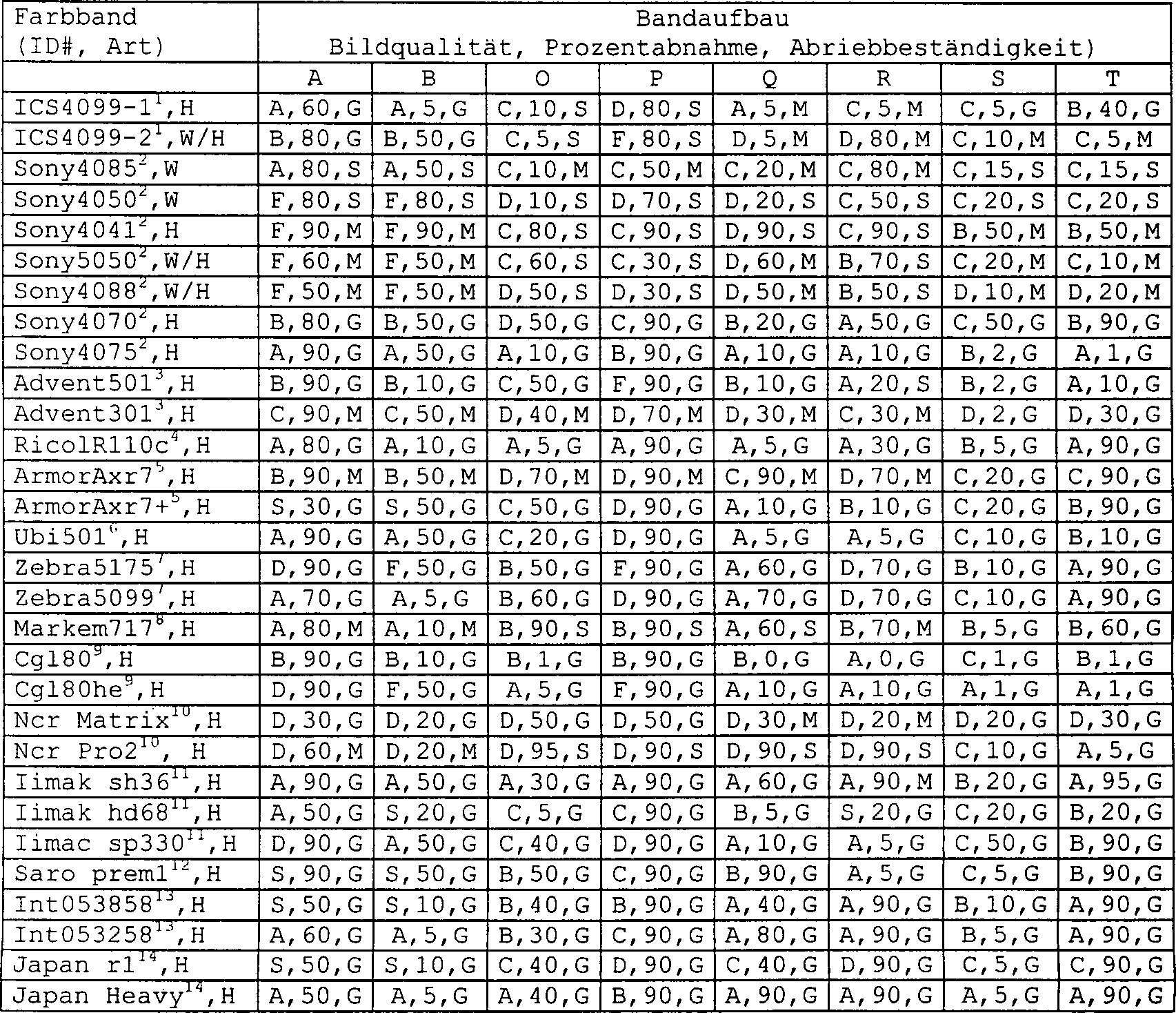

Sechzehn der in Tabelle 1 identifizierten Bandaufbauten wurden unter Verwendung eines Zebra 5099 Harzfarbbands in einem Zebra 170xi Thermotransferdrucker (Zebra Technologies Corporation) mit Informationen bedruckt.Sixteen the band constructions identified in Table 1 were used a Zebra 5099 Resin Ribbon in a Zebra 170xi Thermal Transfer Printer (Zebra Technologies Corporation) printed with information.
Jeder der in Tabelle 3 beschriebenen Bandaufbauten wurde hinsichtlich der Opazität, der Scanbewertung auf einem schwarzen Hintergrund, der Scanbewertung auf einem weißen Hintergrund, der Scanbewertung auf einem gewellten Hintergrund, der Scanbewertung auf einem bedruckten gewellten Hintergrund und der Abriebbeständigkeit eingeschätzt.Everyone the band constructions described in Table 3 were considered the opacity, the scan rating on a black background, the scan rating on a white Background, the scan rating on a wavy background, the scan rating on a printed wavy background and the abrasion resistance estimated.
Jedes
Beispiel wurde nach dem oben ausführlich beschriebenen Scanbewertungs-Prüfverfahren
gescannt. Die Haftung des Drucks am Bandaufbau wurde unter Verwendung
des oben ausführlich
beschriebenen Abriebbeständigkeits-Prüfverfahrens
eingeschätzt.
Für jedes
Beispiel war die Bewertung der Prüfung der Abriebbeständigkeit "gut". In Tabelle 3 sind
die Beispielsnummern 3 bis 6 und 8 bis 14 Bänder
Tabelle
3 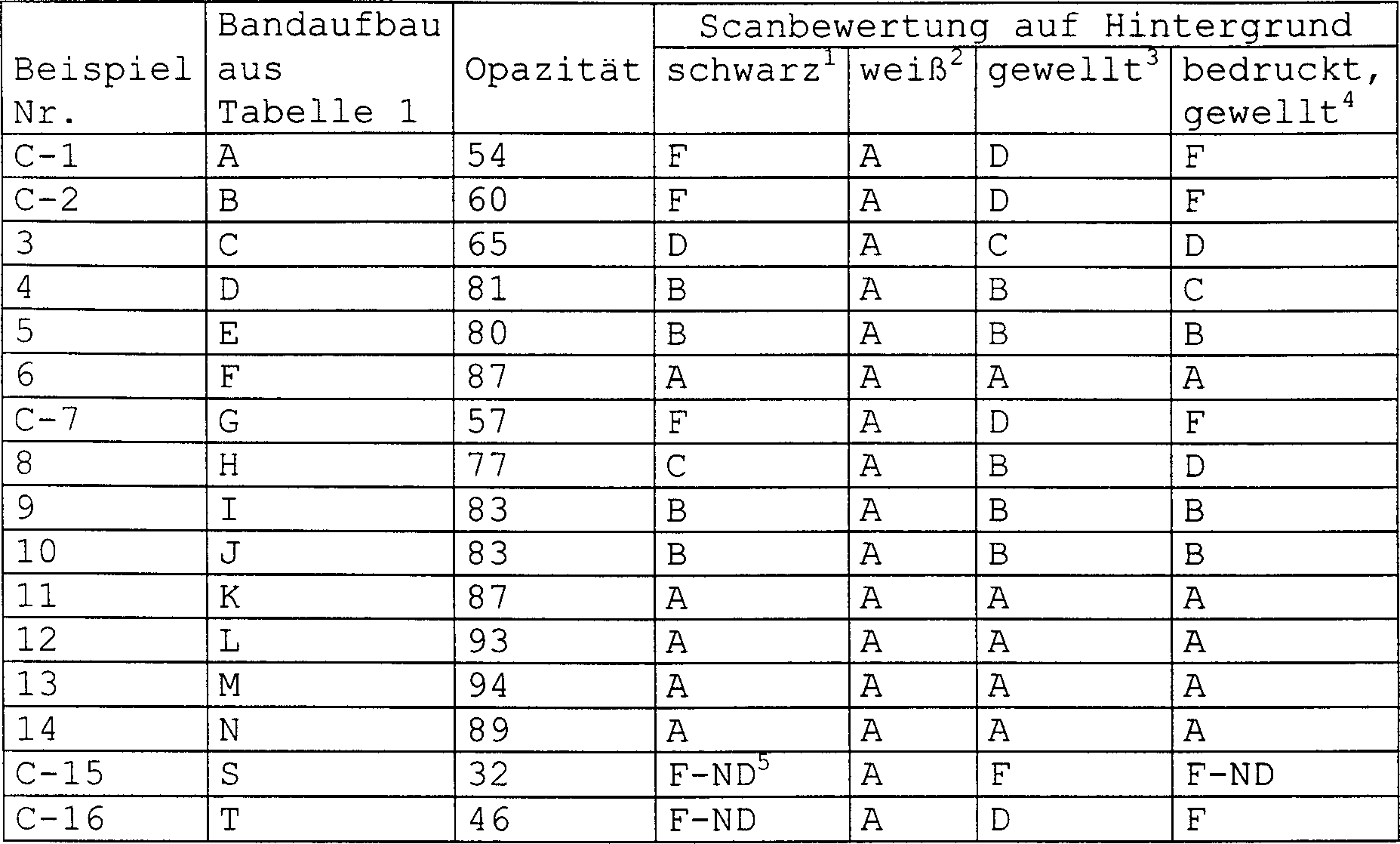
Die Beispiele des Band 14 der Erfindung weisen auf einem schwarzen Hintergrund eine Scanbewertung von D oder besser auf. Wie oben erklärt und wie aus Tabelle 3 offensichtlich ist ein Prüfen auf einem schwarzen Hintergrund strenger als ein Prüfen auf einem weißen Hintergrund.The Examples of volume 14 of the invention are on a black background a scan rating of D or better on. As explained above and how from Table 3 is evident a check on a black background Stricter than a test on a white Background.
Die Vergleichsbeispiele 17 bis 64 in Tabelle 4 geben in einer unterschiedlichen Weise Einzelheiten über die Überlegenheit des Bands der Erfindung. Diese Beispiele zeigen die Hintergründe, auf denen das Band 14 funktionieren wird, und auf denen die Vergleichsbäner nicht funktionieren werden. 48 Farbchipkarten, die in Tabelle 4 identifiziert sind, wurden von Valspar Corporation, Wheeling, IL, erhalten. Die Farbchipkarten reichten für jede Farbe von hell bis dunkel.The Comparative Examples 17 to 64 in Table 4 give a different one Way details about the superiority of the tape of the invention. These examples show the backgrounds which the band 14 will work, and on which the competing bangers will not work will work. 48 color chip cards identified in Table 4 were obtained from Valspar Corporation, Wheeling, IL. The Color chip cards were enough for every color from light to dark.
Die Farbkoordinatenwerte von L*, a* und b* für jede Farbchipkarte wurden nach den in Billmeyer & Saltzman, Principles of Color Technology, 2. Ausgabe, Seite 62 bis 65 (1981) beschriebenen CIE 1976 L*a*b* (CIELAB)-Farbbestimmungsverfahren bestimmt. Die Farbkoordinaten für Standardtageslichtbedingungen (Beleuchtungsstandard D65, nachstehend beschrieben) wurden für jede Farbchipkarte unter Verwendung der "LABSCAN 6000"-Prüfvorrichtung und unter Verwendung eines HunterLab Master Color Data-Programms gemessen. Die Probenöffnung wies einen Durchmesser von 12,7 mm auf, der Beobachter wurde auf D65 eingestellt, und der Beobachterwinkel wurde auf 10 Grad eingestellt. Die Reflexionsfarbkoordinaten von L*, a* und b* wurden durch Anordnen jeder Farbchipkarte in der Probenöffnung erhalten. Die Werte von L*, a* und b* für jede Farbchipkarte sind in Tabelle 4 angegeben.The Color coordinate values of L *, a *, and b * for each color chip card after the ones in Billmeyer & Saltzman, Principles of Color Technology, 2nd edition, pages 62 to 65 (1981) CIE 1976 L * a * b * (CIELAB) color determination method. The Color coordinates for Standard daylight conditions (illumination standard D65, below described) were for each color chip card using the "LABSCAN 6000" Tester and using a HunterLab Master Color Data program measured. The sample opening had a diameter of 12.7 mm, the observer was on D65 was set, and the observer angle was set to 10 degrees. The reflection color coordinates of L *, a * and b * were arranged by arranging each color chip card received in the sample port. The values from L *, a * and b * for each Color chip cards are shown in Table 4.
Die Messungen von L*, a* und b* wurden unter Verwendung des Beleuchtungsstandards D65 vorgenommen. Dieser Standard beinhaltet ein kontinuierliches Spektrum von Licht, das Wellenlängen von 300 nm bis 830 nm aufweist. Dies beinhaltet das für den Menschen sichtbare Licht, beinahe ultraviolettes Licht und beinahe infrarotes Licht. Der Laserscanner verwendet eine einzelne Kompo nente des Lichts, die eine Wellenlänge von 680 mm aufweist. Die Wellenlängenintensität des roten und des infraroten Bereichs ist verhältnismäßig konstant. Dies bedeutet, daß die Ergebnisse in den infraroten Bereichen funktional die gleichen wie in den Bereichen des sichtbaren Lichts sein würden. In den untersuchten Bereichen zeigen die Ablesungen für L*, a* und b*, daß der Laserscanner den Kontrast in Materialien, die für a* negative Werte aufweisen, richtig lesen kann. Die Bereiche, die für a* positive Werte aufweisen, sind jene, bei denen die Scanbewertungen niedrig waren.The measurements of L *, a * and b * were made using the illumination standard D65. This standard includes a continuous spectrum of light that has wavelengths from 300 nm to 830 nm. This includes human visible light, near ultraviolet light, and near infrared light. The laser scanner uses a single component of light that makes waves length of 680 mm. The wavelength intensity of the red and infrared regions is relatively constant. This means that the results in the infrared regions would be functionally the same as in the visible light regions. In the ranges examined, the readings for L *, a *, and b * show that the laser scanner can correctly read the contrast in materials that have a * negative values. The areas that have positive values for a * are those where scan scores were low.
Unter Verwendung eines Datamax PE43-Thermotransferdruckers (Data Max Corp., Orlando, FL) wurde ein einzelner Strichcode auf die der klebstoffbeschichteten Seite gegenüberliegende Seite des Bands gedruckt. Das Band war der Bandaufbau T aus Tabelle 1. Durch Anordnen des bedruckten Bandsegments auf der Farboberfläche jeder Farbchipkarte und Abwärtswalzen des Bands mit einer Walze unter Verwendung von mäßigem Handdruck wurde ein Laminat aus jeder Farbchipkarte und einem strichcodebedruckten Bandsegment gebildet.Under Using a Datamax PE43 Thermal Transfer Printer (Data Max Corp., Orlando, FL) was a single bar code on the adhesive coated Side opposite Side of the ribbon printed. The tape was the tape construction T from the table 1. By placing the printed ribbon segment on the paint surface each Color chip card and rolling down of the tape with a roller using moderate hand pressure became a laminate from each color chip card and a barcode printed tape segment educated.
Jedes Laminat wurde unter Verwendung des obigen Scanbewertungsversuchsverfahrens gescannt. Die Scanbewertung ist in der letzten Spalte von Tabelle 4 verzeichnet. Die Daten in Tabelle 4 wurden unter Verwendung einer Regressionsanalyse der Scanbewertung als eine Funktion der Farbkoordinaten von L*, a* und b* analysiert. Die Scanbewertung wurde in einen numerischen Wert umgewandelt und ein in L*, a* und b* lineares Modell verwendet. Das Verfahren der Regressionsanalyse von Daten ist in N. Draper und H. Smith, Applied Regression Analysis, 2. Ausgabe, Kapitel 2 und 6 (1966) beschrieben. Die Analyse der Regressionsergebnisse zeigte, daß der Koeffizient für b* statistisch nicht von Bedeutung war; die Scanbewertung konnte unabhängig von b* an einem Modell, das auf L* und a* beruhte, vorhergesagt werden. b* ist unbedeutend, da die Fähigkeit, zu scannen, von den blauen und gelben Komponenten der Hintergrundfarbe unabhängig ist. Die Menge an Rot ist jedoch wichtig.each Laminate was made using the above scan evaluation test method scanned. The scan rating is in the last column of the table 4 listed. The data in Table 4 were determined using a Regression analysis of the scan score as a function of the color coordinates analyzed by L *, a * and b *. The scan rating was in a numerical Value converted and used in L *, a * and b * linear model. The procedure of regression analysis of data is in N. Draper and H. Smith, Applied Regression Analysis, 2nd Edition, Chapter 2 and 6 (1966). The analysis of the regression results showed that the Coefficient for b * was not statistically significant; the scan rating could be independent of b * is predicted on a model based on L * and a *. b * is insignificant because of the ability to scan, from the blue and yellow components of the background color independently is. The amount of red, however, is important.
Das
Regressionsmodell lautet: Scanbewertung = –2,1 + 0,054(L*) + 0,033(a*),
wenn die Scanbewertung als A = 4, B = 3, C = 2, D = 1, und F = 0
definiert ist. Das Regressionsmodell weist einen Korrelationskoeffizienten
von 0,87 auf. Aus dem Regressionsmodell muß der Hintergrund zum Beispiel
zum Erhalt einer Scanbewertung von A unter Verwendung des Bandaufbaus
T die Gleichung 4 = –2,1
+ 0,054 (L*) + 0,033(a*) erfüllen.
Eine graphische Konturdarstellung der Scanbewertung als eine Funktion
von L* und a* ist in
Obwohl
Tabelle
4 
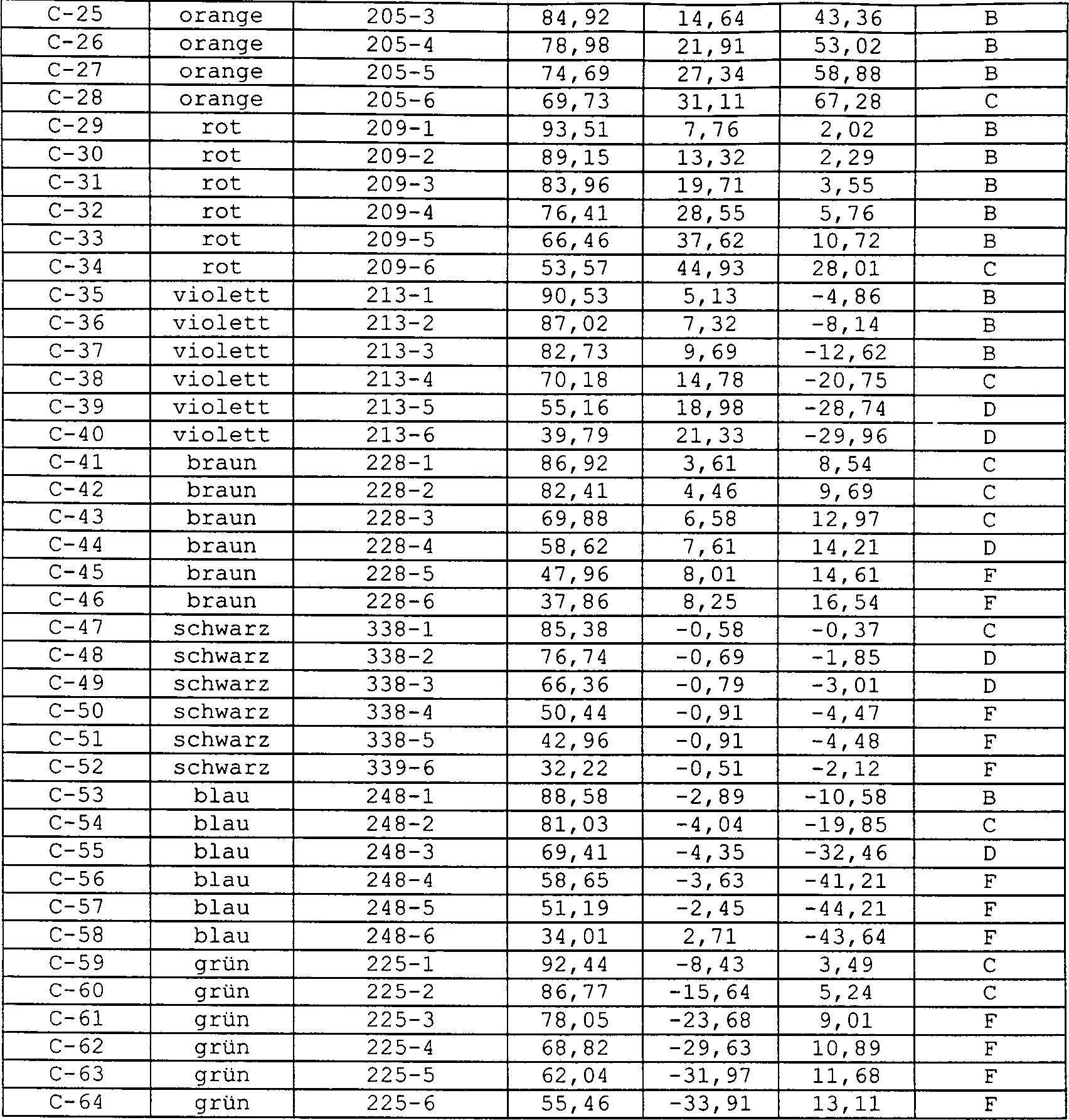
Im Gegensatz zu den Beispielen der Vergleichsbänder, die ausgeprägte, verhältnismäßig enge Bereiche einer zufriedenstellenden Scanbarkeit aufweisen, kann das Klebeband der Erfindung gute Scanbewertungen in einem Bereich von Farbkoordinaten erreichen, in dem Vergleichsbänder keine derartigen Scanbewertungen erreichen konnten.in the Contrary to the examples of the comparison bands, the pronounced, relatively narrow Can have areas of satisfactory scannability Adhesive tape of the invention good scan ratings in a range of Color coordinates reach in the comparison bands no such scan scores could reach.
Prüfungen mehrerer
Bänder
nach der Erfindung zeigen, daß das
Band 14 sogar vor Hintergründen, vor
denen die Vergleichsbänder
(Beispiel Nr. C-1, C-2, C-7, C-15 und C-16) Scanbewertungen von
F aufwiesen (siehe Tabelle 3, in der der schwarze Hintergrund für die Prüfung einen
Wert für
L* von 0 aufwies), zumindest Scanbewertungen von D erreichte, und
die Beispiele 6, 11, 12, 13 und 14 Scanbewertungen von A aufwiesen
(wie in Tabelle 4 gezeigt wies der Bandaufbau T auf viel helleren
Hintergründen
Scanbewertungen von F auf). Dies bedeutet, daß das Band
Um dies auf eine andere Weise zu quantifizieren ist das Band der Erfindung daher ungeachtet der Farbkoordinaten einer bestimmten Oberfläche fähig, eine lesbare Scanbewertung zu erzielen, wenn es auf jede Oberfläche geklebt ist. Das Band kann eine Scanbewertung von zumindest D erzielen, wenn es an Oberflächen geklebt ist, die Farbkoordinaten aufweisen, die die Gleichung 1 > [ –2,1 + 0,054 (L*) + 0,033(a*)] erfüllen; eine Scanbewertung von zumindest C erzielen, wenn es an Oberflächen geklebt ist, die Farbkoordinaten aufweisen, die die Gleichung 2 > [–2,1 + 0,054 (L*) + 0,033(a*)] erfüllen; eine Scanbewertung von zumindest B erzielen, wenn es an Oberflächen geklebt ist, die Farbkoordinaten aufweisen, die die Gleichung 3 > [–2,1 + 0,054 (L*) + 0,033 (a*)] erfüllen; und eine Scanbewertung von A erzielen, wenn es an Oberflächen geklebt ist, die Farbkoordinaten aufweisen, die die Gleichung 4 > [–2,1 + 0,054 (L*) + 0,033 (a*)] erfüllen.Around quantifying this in another way is the band of the invention therefore, regardless of the color coordinates of a particular surface capable, one To achieve readable scan rating when glued to any surface is. The tape can achieve a scan rating of at least D when it comes to surfaces having color coordinates that satisfy equation 1> [-2.1 + 0.054 (L *) + 0.033 (a *)] fulfill; achieve a scan rating of at least C when glued to surfaces having color coordinates that satisfy the equation 2> [-2.1 + 0.054 (L *) + 0.033 (a *)] fulfill; achieve a scan rating of at least B when glued to surfaces that have color coordinates satisfying the equation 3> [-2.1 + 0.054 (L *) + 0.033 (a *)] fulfill; and achieve a scan rating of A when glued to surfaces having color coordinates that satisfies the equation 4> [-2.1 + 0.054 (L *) + 0.033 (a *)] fulfill.
Bei der Erfindung können verschiedenste Veränderungen und Abänderungen vorgenommen werden, ohne vom Umfang der Erfindung abzuweichen. Obwohl die veranschaulichten Ausführungsformen den Thermofarbbanddruck verwenden, könnten zum Beispiel auch Tintenstrahlcodiersysteme und andere Drucksysteme verwendet werden, um die variablen Informationen auf das Klebeband nach der Erfindung zu drucken. Außerdem könnte der Druck am klebenden Ab schnitt des Bands nach der vorliegenden Erfindung erfolgen.at of the invention various changes and amendments be made without departing from the scope of the invention. Even though the illustrated embodiments For example, using thermal dye ribbon printing could also include ink jet encoding systems and other printing systems used to provide the variable information to print on the adhesive tape according to the invention. In addition, the Pressure at the adhesive portion of the tape according to the present invention respectively.
Claims (10)
Applications Claiming Priority (3)
| Application Number | Priority Date | Filing Date | Title |
|---|---|---|---|
| US207801 | 1998-12-09 | ||
| US09/207,801 US6432528B1 (en) | 1998-12-09 | 1998-12-09 | Variably printed tape and system for printing and applying tape onto surfaces |
| PCT/US1999/007063 WO2000034131A1 (en) | 1998-12-09 | 1999-03-31 | Variably printed tape and system for printing and applying tape onto surfaces |
Publications (2)
| Publication Number | Publication Date |
|---|---|
| DE69918331D1 DE69918331D1 (en) | 2004-07-29 |
| DE69918331T2 true DE69918331T2 (en) | 2005-07-21 |
Family
ID=22772052
Family Applications (1)
| Application Number | Title | Priority Date | Filing Date |
|---|---|---|---|
| DE69918331T Expired - Fee Related DE69918331T2 (en) | 1998-12-09 | 1999-03-31 | LABEL TAPE WITH DIFFERENT INFORMATION AND DEVICE FOR PRINTING AND ATTACHING THE TAPE TO SURFACES |
Country Status (11)
| Country | Link |
|---|---|
| US (2) | US6432528B1 (en) |
| EP (2) | EP1137575B1 (en) |
| JP (1) | JP2002531342A (en) |
| KR (1) | KR20010101150A (en) |
| CN (1) | CN1211254C (en) |
| AU (1) | AU756547B2 (en) |
| BR (1) | BR9916078A (en) |
| CA (1) | CA2354259A1 (en) |
| DE (1) | DE69918331T2 (en) |
| NZ (2) | NZ525658A (en) |
| WO (1) | WO2000034131A1 (en) |
Cited By (1)
| Publication number | Priority date | Publication date | Assignee | Title |
|---|---|---|---|---|
| DE102008023939A1 (en) * | 2008-05-16 | 2009-11-19 | Krones Ag | Device for labeling containers with printing unit |
Families Citing this family (52)
| Publication number | Priority date | Publication date | Assignee | Title |
|---|---|---|---|---|
| US6415842B1 (en) | 1999-06-11 | 2002-07-09 | 3M Innovative Properties Company | System for printing and applying tape onto surfaces |
| US7316832B2 (en) | 2001-12-20 | 2008-01-08 | The Procter & Gamble Company | Articles and methods for applying color on surfaces |
| US7709070B2 (en) * | 2001-12-20 | 2010-05-04 | The Procter & Gamble Company | Articles and methods for applying color on surfaces |
| DE10163589A1 (en) * | 2001-12-21 | 2003-08-07 | Tesa Ag | Self-adhesive labels, processes for producing them and their use |
| US7383864B2 (en) | 2002-04-03 | 2008-06-10 | 3M Innovative Properties Company | Radio-frequency identification tag and tape applicator, radio-frequency identification tag applicator, and methods of applying radio-frequency identification tags |
| US6884312B2 (en) | 2002-04-12 | 2005-04-26 | 3M Innovative Properties Company | Apparatus for printing and applying tape and methods of printing and applying tape |
| US20040122733A1 (en) * | 2002-12-24 | 2004-06-24 | 3M Innovative Properties Company | Methods of associating a targeted advertisement with customers, methods of recording information, methods of making labels, and labels |
| US20040161564A1 (en) | 2003-02-14 | 2004-08-19 | Truog Keith L. | Dry paint transfer laminate |
| EP1597092A2 (en) | 2003-02-14 | 2005-11-23 | The Procter & Gamble Company | Article for being applied to a surface and method thereof |
| US20050196607A1 (en) | 2003-06-09 | 2005-09-08 | Shih Frank Y. | Multi-layer dry paint decorative laminate having discoloration prevention barrier |
| US20040247837A1 (en) * | 2003-06-09 | 2004-12-09 | Howard Enlow | Multilayer film |
| US6910820B2 (en) | 2003-07-25 | 2005-06-28 | 3M Innovative Properties Company | Apparatus and method for handling linerless label tape |
| US20050031820A1 (en) * | 2003-08-04 | 2005-02-10 | Gorman Gregory Winfield | Information-bearing pavement tape |
| US8486208B2 (en) * | 2003-08-04 | 2013-07-16 | Parkmarx Advertising, Llc | Cold crack additive on paving advertising and related methods |
| GB0501369D0 (en) * | 2005-01-22 | 2005-03-02 | Stepping Stones Invest Ltd | Improvements to labels and application apparatus therefor |
| US7665498B2 (en) * | 2005-11-15 | 2010-02-23 | 3M Innovative Properties Company | Tape monitoring system |
| US20070150219A1 (en) * | 2005-12-22 | 2007-06-28 | Cawker Gordon M | Method of validating and applying radio frequency tags to an object |
| DE102006019441B4 (en) * | 2006-04-24 | 2013-06-20 | Khs Gmbh | Method and device for printing on containers |
| TW200813101A (en) * | 2006-09-01 | 2008-03-16 | 3M Innovative Properties Co | Protective article and method of making |
| US20080156431A1 (en) * | 2006-12-28 | 2008-07-03 | Daskalakis George H | Customizable notebook panels |
| MX336492B (en) * | 2007-08-03 | 2016-01-21 | Khs Gmbh | Device and method for printing containers. |
| EP2442915A4 (en) * | 2009-06-14 | 2016-07-20 | Nulabel Technologies Inc | Liner-free label and systems |
| CA2690409C (en) * | 2010-01-18 | 2014-09-30 | William Mori | System and process for handling, prepping, tagging and shipping plants |
| EP2542477B1 (en) | 2010-03-04 | 2014-07-30 | SIDEL S.p.A. con Socio Unico | Labelling machine and method thereof |
| IT1402464B1 (en) * | 2010-11-04 | 2013-09-13 | Trade Engineering S R L T | TAPE MACHINE |
| WO2012071617A1 (en) * | 2010-12-03 | 2012-06-07 | Ian Peter Allen | Product labelling/identification |
| KR101200783B1 (en) | 2011-08-22 | 2012-11-13 | 대성전기공업 주식회사 | Label sticking divice |
| US9058753B2 (en) | 2012-03-23 | 2015-06-16 | Documotion Research, Inc. | Paper, labels made therefrom and methods of making paper and labels |
| CN103496486B (en) * | 2013-09-26 | 2015-09-09 | 大进科技(杭州)有限公司 | A kind of labeling fold method of full-automatic adhesive labeling labeling crimping unit |
| US9495888B2 (en) | 2013-12-10 | 2016-11-15 | Iconex Llc | Adhesive label with water-based release coating |
| US10550293B2 (en) * | 2013-12-10 | 2020-02-04 | Iconex Llc | Label with adhesive and silicone-free release coating |
| ITBO20130714A1 (en) * | 2013-12-23 | 2015-06-24 | One Code S R L | TAPING MACHINE OR LABELING MACHINE AND DISPOSABLE COIL OF TAPE MATERIAL FOR SUCH TAPPING MACHINE OR LABELING MACHINE |
| US9956683B2 (en) * | 2015-04-28 | 2018-05-01 | Keith E Rose | Steel work box |
| US20170015453A1 (en) * | 2015-07-14 | 2017-01-19 | Allen Jerome Chase | Tape Head for Sealing Cases |
| US10176731B2 (en) | 2016-08-19 | 2019-01-08 | Iconex Llc | Adhesive label and roll |
| DE102016220691A1 (en) * | 2016-10-21 | 2018-04-26 | Tesa Se | Mehrlagenverklebung |
| DE102016220687A1 (en) | 2016-10-21 | 2018-04-26 | Tesa Se | Plasma treatment of a multi-layer bonding |
| IT201700010772A1 (en) * | 2017-02-01 | 2018-08-01 | Irplast Spa | MULTILAYER ADHESIVE MATERIAL FOR FOOD USE. |
| EP4252983A3 (en) | 2017-05-01 | 2023-11-15 | Avery Dennison Retail Information Services LLC | Method for reducing label waste using a cutting apparatus |
| US10882309B2 (en) | 2017-07-25 | 2021-01-05 | Illinois Tool Works Inc. | Printing system and method |
| CN107640342A (en) * | 2017-11-14 | 2018-01-30 | 广东瑞安杰智能科技有限公司 | A kind of shearing of biomembrane and RFID labelling machines |
| BE1026155B1 (en) * | 2018-03-27 | 2019-10-29 | Mc Industry | ADHESIVE TAPE PRINTED |
| CN108438360A (en) * | 2018-04-23 | 2018-08-24 | 王林华 | Box sealing device for packing plastic bags |
| CN110550288A (en) * | 2018-05-30 | 2019-12-10 | 拓卡奔马机电科技有限公司 | Labeling control method for label output while moving of labeling machine |
| US20200087015A1 (en) * | 2018-09-13 | 2020-03-19 | Avery Dennison Retail Information Services, Llc | Label applicator device |
| JP7253305B2 (en) * | 2018-12-28 | 2023-04-06 | 大阪シーリング印刷株式会社 | Adhesive tape, packaging and packaging method |
| CN110228638B (en) * | 2019-07-09 | 2021-02-09 | 上海含嘉科技有限公司 | Swift processing apparatus to express delivery box surface |
| CN110697185B (en) * | 2019-11-21 | 2021-03-23 | 安徽文王酿酒股份有限公司 | Multi-box type automatic box sealing and labeling device |
| WO2023012969A1 (en) * | 2021-08-05 | 2023-02-09 | 株式会社Fuji | End effector and detaching/affixing device |
| TWI918902B (en) | 2021-12-21 | 2026-03-21 | 美商百美貼有限公司 | Waterproof seams and methods of making the same |
| CN117816771B (en) * | 2024-03-04 | 2024-05-14 | 四川明珠电工材料有限责任公司 | Online flaw detection device of continuous extrusion machine |
| KR102926265B1 (en) | 2025-11-24 | 2026-02-11 | 한진피엘 주식회사 | Door trim sorting system for tag generation |
Family Cites Families (120)
| Publication number | Priority date | Publication date | Assignee | Title |
|---|---|---|---|---|
| US2532011A (en) | 1946-09-07 | 1950-11-28 | Minnesota Mining & Mfg | Liners and adhesive tapes having low adhesion polyvinyl carbamate coatings |
| BE511062A (en) | 1949-10-27 | |||
| US2776068A (en) * | 1950-05-29 | 1957-01-01 | Minnesota Mining & Mfg | Tape applying movement |
| US2788625A (en) * | 1955-09-27 | 1957-04-16 | Minnesota Mining & Mfg | Tape stapling |
| US2990081A (en) * | 1957-09-26 | 1961-06-27 | Minnesota Mining & Mfg | Application of tape to moving objects |
| US3108032A (en) * | 1960-05-31 | 1963-10-22 | Pneumatic Scale Corp | Web feeding mechanism and control means therefor |
| FR1354494A (en) * | 1963-04-10 | 1964-03-06 | Adhesive Tapes Ltd | Improvements to devices for applying pressure-adhering adhesive tapes |
| US3238080A (en) * | 1963-09-30 | 1966-03-01 | Minnesota Mining & Mfg | Labeling machine |
| US3502497A (en) | 1964-08-26 | 1970-03-24 | Johnson & Johnson | Pressure-sensitive adhesive product |
| US3318852A (en) | 1965-04-05 | 1967-05-09 | Minnesota Mining & Mfg | Fluorine-containing polymers |
| US3657051A (en) * | 1969-05-27 | 1972-04-18 | Dymo Industries Inc | Transfer printing addressing maching |
| US3561190A (en) * | 1969-09-15 | 1971-02-09 | Stapling Machines Co | Carton taping machine |
| IT983954B (en) * | 1972-04-20 | 1974-11-11 | Anker Werke Ag | PROCESS OF COMBINATION AND EQUIPMENT FOR MANUFACTURING, CHECKING AND USE OF LABELS FOR PREFERRED GOODS IN CONNECTION WITH AN ELECTRONIC DATA PROCESSING SYSTEM |
| US4072224A (en) * | 1972-05-24 | 1978-02-07 | The General Electric Company Limited | Printing devices |
| US4001072A (en) * | 1972-09-13 | 1977-01-04 | Minnesota Mining And Manufacturing Company | Applicator for pressure-sensitive adhesive fasteners |
| US3963557A (en) * | 1974-05-28 | 1976-06-15 | Minnesota Mining And Manufacturing Company | Article transferring apparatus |
| US3905859A (en) * | 1974-11-29 | 1975-09-16 | Minnesota Mining & Mfg | Vacuum wheel apparatus for applying tabbed strips of adhesive tape |
| DE2651911C3 (en) * | 1976-11-13 | 1983-01-20 | Jagenberg-Werke AG, 4000 Düsseldorf | Device for pressing glued labels or foils onto objects |
| IT1084615B (en) * | 1977-04-01 | 1985-05-25 | Marchetti Augusto | PARALLELEPIPED BOX SEALING MACHINE. |
| JPS6017319B2 (en) | 1977-12-29 | 1985-05-02 | ソニー株式会社 | Peelability treatment agent |
| US4227955A (en) * | 1979-01-08 | 1980-10-14 | Fmc Corporation | Article taping system |
| US4256528A (en) * | 1979-05-23 | 1981-03-17 | Minnesota Mining And Manufacturing Company | Machine for forming openings sealed by manually removable lengths of tape in can ends |
| WO1981000704A1 (en) * | 1979-09-05 | 1981-03-19 | Ezy Wrap Prod Pty Ltd | Plastic film dispenser |
| JPS571150A (en) * | 1980-05-30 | 1982-01-06 | Koyo Jidoki | High speed feeder |
| US4421817A (en) | 1980-08-29 | 1983-12-20 | Felice Pina | Method for making printable self-adhesive tapes and the self-adhesive tapes obtaned thereby |
| US4321103A (en) * | 1980-09-25 | 1982-03-23 | Hi-Speed Checkweigher Co., Inc. | Mechanism for applying merchandising labels to packages/objects of different weights and dimensions |
| DE3041057A1 (en) * | 1980-10-31 | 1982-05-13 | Jagenberg-Werke AG, 4000 Düsseldorf | METHOD AND DEVICE FOR APPLYING RIDER LABELS (BANDEROLS) TO CONTAINER CAPS, IN PARTICULAR BOTTLE CAPS |
| US4676859A (en) * | 1981-09-28 | 1987-06-30 | Labeling Systems, Inc. | Labeling apparatus |
| IT1152962B (en) | 1982-06-11 | 1987-01-14 | Manuli Autoadesivi Spa | IMPROVEMENT OF SELF-ADHESIVE TAPES WITH POLYPROPYLENE OR OTHER POLYMER OR OLEFINIC COPOLYMER AND RELATED MANUFACTURING PROCEDURE |
| US4432830A (en) * | 1983-02-07 | 1984-02-21 | Intermec Corporation | Label printer having selectable label stock paths |
| DE3570318D1 (en) | 1984-07-24 | 1989-06-22 | Siemens Ag | Piezoelectric relay |
| US4717621A (en) | 1984-10-01 | 1988-01-05 | Bemis Associates, Inc. | Lettering material for fabric and the like |
| US4728571A (en) | 1985-07-19 | 1988-03-01 | Minnesota Mining And Manufacturing Company | Polysiloxane-grafted copolymer release coating sheets and adhesive tapes |
| US4707211A (en) | 1986-02-10 | 1987-11-17 | Ricoh Electronics, Inc. | Linerless thermal label printer and applicator |
| US4784714A (en) * | 1986-02-10 | 1988-11-15 | Ricoh Electronics, Inc. | Linerless thermal label printer and applicator |
| US4807177A (en) | 1986-06-06 | 1989-02-21 | Ward Richard J | Multiple format hand held label printer |
| US5214119A (en) | 1986-06-20 | 1993-05-25 | Minnesota Mining And Manufacturing Company | Block copolymer, method of making the same, dimaine precursors of the same, method of making such diamines and end products comprising the block copolymer |
| US4839742A (en) * | 1986-10-13 | 1989-06-13 | Brother Kogyo Kabushiki Kaisha | Reflected-character printing apparatus |
| US4815871A (en) * | 1986-11-14 | 1989-03-28 | Varitronic Systems, Inc. | Head control apparatus |
| US4851383A (en) * | 1987-06-08 | 1989-07-25 | Ricoh Electronics, Inc. | Non-laminate thermosensitive, pressure sensitive label and method of manufacture |
| DE3727667A1 (en) | 1987-08-19 | 1989-03-02 | Ostma Maschinenbau Gmbh | Labelling apparatus |
| FR2622146A1 (en) | 1987-10-26 | 1989-04-28 | Duport Jean Claude | COMPOSITE RIBBON FOR LABEL PRINTING MACHINES AND MACHINE USING SUCH A RIBBON |
| US4857134A (en) | 1987-12-03 | 1989-08-15 | Lin Shuh Chin | Structure of carton sealing sticker and cutter |
| US5193926A (en) * | 1987-12-21 | 1993-03-16 | Brother Kogyo Kabushiki Kaisha | Apparatus for recording image covered by protective medium |
| US4942212A (en) | 1988-01-20 | 1990-07-17 | Dainichiseika Color & Chemicals Mfg. Co., Ltd. | Polyurethane resin and heat-sensitive recording medium |
| US5188469A (en) * | 1988-10-14 | 1993-02-23 | Brother Kogyo Kabushiki Kaisha | Tape feed cassette with tape cutter and guide |
| US5053436A (en) | 1988-11-30 | 1991-10-01 | Minnesota Mining And Manufacturing Company | Hollow acrylate polymer microspheres |
| US4975313A (en) | 1989-05-11 | 1990-12-04 | Mitsui Toatsu Chemicals, Inc. | Heat-shrinkable polyolefin composite sheet |
| US5202190A (en) | 1989-08-14 | 1993-04-13 | Minnesota Mining And Manufacturing Company | Method of making vinyl-silicone copolymers using mercapto functional silicone chain-transfer agents and release coatings made therewith |
| US5032460A (en) | 1989-08-14 | 1991-07-16 | Minnesota Mining And Manufacturing Company | Method of making vinyl-silicone copolymers using mercapto functional silicone chain-transfer agents and release coatings made therewith |
| US5040461A (en) * | 1989-11-17 | 1991-08-20 | Avery International Corporation | Label printing and dispensing apparatus |
| DE3938410A1 (en) * | 1989-11-18 | 1991-05-23 | Focke & Co | DEVICE FOR APPLYING AN ADHESIVE STRIP TO A FOLDING CARDBOARD OR THE LIKE |
| US5242888A (en) | 1990-01-25 | 1993-09-07 | Arkwright, Incorporated | Polymeric matrix for thermal transfer recording |
| DE69108443T2 (en) * | 1990-05-17 | 1995-09-21 | Seiko Epson Corp | Strip printer. |
| US5425823A (en) * | 1990-08-30 | 1995-06-20 | B.C.E. Technologies | Combination label printer and application device |
| US5286332A (en) * | 1990-09-10 | 1994-02-15 | Minnesota Mining And Manufacturing Company | Apparatus for applying an L clip tape to a cartridge |
| WO1992007347A1 (en) | 1990-10-16 | 1992-04-30 | Clopay Corporation | Scored synthetic in-mold labels and molded substrates labeled therewith |
| US5261996A (en) * | 1991-01-25 | 1993-11-16 | Minnesota Mining And Manufacturing Company | Guiding system for a vacuum wheel applicator |
| US5317074A (en) | 1991-02-07 | 1994-05-31 | Minnesota Mining And Manufacturing Company | Stain-resistant elastomeric orthodontic force module |
| US5209808A (en) * | 1991-02-26 | 1993-05-11 | Imtec, Inc. | Corner label applicator system and method |
| EP0555888B2 (en) * | 1991-05-03 | 2000-07-05 | Brother Kogyo Kabushiki Kaisha | Printing device for printing image on tape like member |
| JP2551876Y2 (en) * | 1991-09-06 | 1997-10-27 | ローム株式会社 | Tape printer using portable printer |
| CZ104394A3 (en) | 1991-11-04 | 1994-10-19 | Minnesota Mining & Mfg | Combination of a foil coated with adhesive sensitive to pressure and plasticized polyvinyl chloride substrate |
| US5379962A (en) * | 1992-01-21 | 1995-01-10 | Minnesota Mining And Manufacturing Company | Heated web knife |
| US5328754A (en) | 1992-02-13 | 1994-07-12 | Ricoh Company, Ltd. | Thermosensitive image transfer ink sheet |
| US5227002A (en) * | 1992-02-14 | 1993-07-13 | Minnesota Mining And Manufacturing Company | Apparatus for applying tape to an object |
| US5286682A (en) | 1992-02-19 | 1994-02-15 | Minnesota Mining And Manufacturing Company | Yellow retroreflective pavement markings |
| US5399228A (en) * | 1992-02-21 | 1995-03-21 | Best Label Co., Inc. | Apparatus and method for automatically applying adhesive-backed labels to moving articles |
| US5879507A (en) * | 1992-02-21 | 1999-03-09 | Apax Corporation | Apparatus for automatically applying adhesive-backed labels to moving articles |
| US5674345A (en) * | 1992-07-01 | 1997-10-07 | Moore Business Forms, Inc. | Linerless label printer applicator |
| US5354588A (en) | 1992-07-13 | 1994-10-11 | Moore Business Forms, Inc. | Linerless labels with tie coat |
| US5292713A (en) | 1992-07-15 | 1994-03-08 | Stenzel Herbert J | Linerless thermal and thermal transfer labels |
| JPH06255275A (en) | 1993-03-05 | 1994-09-13 | Toyo Ink Mfg Co Ltd | Image-receiving sheet for thermal transfer |
| US5431763A (en) * | 1992-11-19 | 1995-07-11 | Boss Systems, L.L.C. | Linerless labeling system |
| US5356706A (en) | 1992-12-14 | 1994-10-18 | Shores A Andrew | Release coating for adhesive tapes and labels |
| JP3066555B2 (en) * | 1993-01-29 | 2000-07-17 | ブラザー工業株式会社 | Tape winding mechanism |
| US5571617A (en) | 1993-04-23 | 1996-11-05 | Minnesota Mining And Manufacturing Company | Pressure sensitive adhesive comprising tacky surface active microspheres |
| JP2768211B2 (en) * | 1993-04-30 | 1998-06-25 | マックス株式会社 | Tape printer |
| US5585193A (en) | 1993-07-16 | 1996-12-17 | Avery Dennison Corporation | Machine-direction oriented label films and die-cut labels prepared therefrom |
| US5376418A (en) | 1993-09-13 | 1994-12-27 | Uarco Incorporated | Image protected pressure sensitive label |
| JP3394572B2 (en) * | 1993-10-22 | 2003-04-07 | 株式会社サトー | Heat seal label printing method and printer |
| JPH07125374A (en) * | 1993-11-02 | 1995-05-16 | King Jim Co Ltd | Layout display device |
| US5540369A (en) | 1993-12-07 | 1996-07-30 | Moore Business Forms, Inc. | Detaching linerless labels |
| US5437228A (en) * | 1994-01-11 | 1995-08-01 | Datasouth Computer Corporation | Method and apparatus for printing adhesive backed media |
| US5478880A (en) | 1994-02-01 | 1995-12-26 | Moore Business Forms, Inc. | Printable release |
| US5750630A (en) | 1994-02-04 | 1998-05-12 | Minnesota Mining And Manufacturing Company | Water-based polyurethane polymer, release coating, adhesive tape and process of preparation |
| US5661099A (en) | 1994-02-28 | 1997-08-26 | Media Solutions, Inc. | Self-wound direct thermal printed labels |
| US5482593A (en) * | 1994-04-05 | 1996-01-09 | Minnesota Mining And Manufacturing Company | High speed applicator for adhesive tape |
| CA2147535A1 (en) * | 1994-04-29 | 1995-10-30 | Albert Wurz | Label applicator for articles of varying dimensions detected and processed by sensors and a cpu |
| US5587214A (en) | 1994-05-13 | 1996-12-24 | Media Solutions, Inc. | Laminated thermal transfer printable labels |
| US5497701A (en) | 1994-05-16 | 1996-03-12 | Datasouth Computer Corporation | Method and apparatus for printing linerless media having an adhesive backing |
| US5487337A (en) | 1994-05-16 | 1996-01-30 | Datasouth Computer Corporation | Method and apparatus for printing linerless media having an adhesive backing |
| EP0688008A1 (en) | 1994-06-14 | 1995-12-20 | LINTEC Corporation | Printed label, method and apparatus for manufacturing printed labels, and method and apparatus for attaching printed labels |
| US5569515A (en) | 1994-09-12 | 1996-10-29 | Moore Business Forms, Inc. | Printable linerless label and method for making same |
| US5560293A (en) | 1994-09-26 | 1996-10-01 | Moore Business Forms, Inc. | Linerless label printer and transport system |
| US5531853A (en) * | 1994-10-31 | 1996-07-02 | Booth Manufacturing Company | Linerless label applicator |
| US5524996A (en) | 1994-11-22 | 1996-06-11 | Grand Rapids Label Company | Linerless label printing apparatus |
| US5940107A (en) * | 1995-01-09 | 1999-08-17 | Intermec Corporation | Method and apparatus for printing on a linerless media using a temporary liner in the print zone |
| US5692896A (en) | 1995-03-15 | 1997-12-02 | Minnesota Mining And Manufacturing Co. | Light-transmissive orthodontic bracket wth alignment and indentification marking |
| US5675369A (en) * | 1995-06-05 | 1997-10-07 | Astro-Med, Inc. | Two-sided color printing apparatus and reversible print head mounting assembly therefor |
| BR9609401A (en) | 1995-06-07 | 1999-06-15 | Moore Business Forms Inc | Method for printing on unlined thermal transfer labels having a silicone release agent |
| US5658647A (en) | 1995-06-07 | 1997-08-19 | Avery Dennison Corporation | Garment labeling system, equipment and method and elastomeric label for use therewith |
| US5619416A (en) | 1995-09-14 | 1997-04-08 | Ncr Corporation | Labeling system and method for an electronic price label |
| US5782496A (en) | 1995-11-03 | 1998-07-21 | Moore Business Forms, Inc. | Linerless label identification |
| EP0874756A1 (en) * | 1996-01-05 | 1998-11-04 | Werner Hermann | Device and process for labelling goods |
| DE29602534U1 (en) | 1996-02-14 | 1996-04-18 | Esselte N.V., St. Niklaas | Tape printer with the ability to print bar codes |
| DE19609431C2 (en) | 1996-03-11 | 2002-08-14 | Espera Werke Gmbh | Method for weighing and labeling goods packages and device for carrying out the method |
| DE29708409U1 (en) | 1996-05-10 | 1997-09-11 | Nordenia Technologies Gmbh | Stick-on label section |
| CA2228476C (en) | 1996-06-03 | 2003-12-23 | Ascom Hasler Mailing Systems Inc. | Printing apparatus |
| US5621020A (en) | 1996-06-19 | 1997-04-15 | Moore Business Forms, Inc. | Release composition for printable linerless labels |
| US5674626A (en) | 1996-06-19 | 1997-10-07 | Moore Business Forms, Inc. | Release composition for printable linerless labels |
| US5804023A (en) * | 1996-09-20 | 1998-09-08 | Grand Rapids Label Company | Label cutting and applying apparatus |
| US5833803A (en) * | 1996-12-03 | 1998-11-10 | Esco Electronics Corporation | Low pressure actuated labeling apparatus |
| EP0854051B1 (en) | 1997-01-17 | 2001-04-04 | Nitto Denko Corporation | Printable adhesive sheet and label |
| US6067103A (en) | 1997-03-07 | 2000-05-23 | J.I.T. Technologies, Inc. | Apparatus and process for variable image printing on tape |
| US6049347A (en) | 1997-10-23 | 2000-04-11 | J.I.T. Technologies, Inc. | Apparatus for variable image printing on tape |
| US6080937A (en) * | 1997-08-08 | 2000-06-27 | Espera-Werke Gmbh | Method and device for weighing and labeling packages of goods |
| BR9812158A (en) | 1997-09-05 | 2000-07-18 | Moore Business Forms Inc | Siloxane block copolymers for printable release liner |
| US6077611A (en) | 1997-09-30 | 2000-06-20 | General Electric Company | Printable paper release compositions |
| US6415842B1 (en) * | 1999-06-11 | 2002-07-09 | 3M Innovative Properties Company | System for printing and applying tape onto surfaces |
-
1998
- 1998-12-09 US US09/207,801 patent/US6432528B1/en not_active Expired - Fee Related
-
1999
- 1999-03-31 DE DE69918331T patent/DE69918331T2/en not_active Expired - Fee Related
- 1999-03-31 EP EP99915153A patent/EP1137575B1/en not_active Expired - Lifetime
- 1999-03-31 KR KR1020017007156A patent/KR20010101150A/en not_active Ceased
- 1999-03-31 WO PCT/US1999/007063 patent/WO2000034131A1/en not_active Ceased
- 1999-03-31 CN CNB998143219A patent/CN1211254C/en not_active Expired - Fee Related
- 1999-03-31 BR BR9916078-1A patent/BR9916078A/en active Search and Examination
- 1999-03-31 NZ NZ525658A patent/NZ525658A/en unknown
- 1999-03-31 AU AU33739/99A patent/AU756547B2/en not_active Ceased
- 1999-03-31 JP JP2000586592A patent/JP2002531342A/en active Pending
- 1999-03-31 EP EP03019123A patent/EP1386842A1/en not_active Withdrawn
- 1999-03-31 CA CA002354259A patent/CA2354259A1/en not_active Abandoned
- 1999-03-31 NZ NZ512195A patent/NZ512195A/en unknown
-
2002
- 2002-06-18 US US10/175,028 patent/US20030124345A1/en not_active Abandoned
Cited By (1)
| Publication number | Priority date | Publication date | Assignee | Title |
|---|---|---|---|---|
| DE102008023939A1 (en) * | 2008-05-16 | 2009-11-19 | Krones Ag | Device for labeling containers with printing unit |
Also Published As
| Publication number | Publication date |
|---|---|
| WO2000034131A1 (en) | 2000-06-15 |
| DE69918331D1 (en) | 2004-07-29 |
| EP1386842A1 (en) | 2004-02-04 |
| NZ512195A (en) | 2004-01-30 |
| BR9916078A (en) | 2001-11-06 |
| AU3373999A (en) | 2000-06-26 |
| US6432528B1 (en) | 2002-08-13 |
| EP1137575A1 (en) | 2001-10-04 |
| US20030124345A1 (en) | 2003-07-03 |
| KR20010101150A (en) | 2001-11-14 |
| AU756547B2 (en) | 2003-01-16 |
| EP1137575B1 (en) | 2004-06-23 |
| CN1211254C (en) | 2005-07-20 |
| CA2354259A1 (en) | 2000-06-15 |
| NZ525658A (en) | 2004-11-26 |
| CN1330599A (en) | 2002-01-09 |
| JP2002531342A (en) | 2002-09-24 |
Similar Documents
| Publication | Publication Date | Title |
|---|---|---|
| US6432528B1 (en) | Variably printed tape and system for printing and applying tape onto surfaces | |
| DE69929257T2 (en) | Device for printing and applying adhesive tape to an object. | |
| DE69002703T2 (en) | Unauthorized opening indicating tape. | |
| DE69300800T2 (en) | Stock of sticker-free stickers. | |
| DE69110422T2 (en) | Thermal transfer layer. | |
| DE3925130C2 (en) | ||
| DE69708094T2 (en) | METHOD AND DEVICE FOR APPLYING STRAPLESS MULTIPLE-USE LABELS ON ARTICLES | |
| DE69520674T2 (en) | LABEL AND METHOD FOR PRODUCING LABELS FROM DOUBLE-COATED ADHESIVE TAPE AND STRIP | |
| DE69918043T2 (en) | Composite foil with sticker for packaging bag | |
| DE69605465T2 (en) | Labeling method and apparatus | |
| DE69708077T2 (en) | MULTIPLE-WAY PLASTIC BOX WITH LABEL | |
| BE1028637B1 (en) | THERMAL TRANSFER RIBBONS AND DIRECT THERMAL MEDIA ΜΙΤ AMBIENT EXPOSURE INDICATOR MATERIAL | |
| AU671147B2 (en) | Clear window label | |
| DE69504419T2 (en) | Label carrier with readable information and method for its production | |
| DE69605039T2 (en) | BUSINESS FORM WITH INTEGRATED LABEL COATED WITH A COMPOSITION THAT CAN TAKE TONER AND METHOD FOR PRODUCING IT | |
| DE10146270A1 (en) | Use of a security tape to indicate unauthorized attempts to open shipping packages | |
| DE102015226317B4 (en) | Transfer tape with security features for the side edge of an adhesive tape | |
| EP0383989A2 (en) | Method for marking the reverse side of a picture carrier coated with a thermoplastic polymer, and picture carrier produced thereby | |
| CH645853A5 (en) | METHOD FOR PRODUCING A PRESSURE-SENSITIVE TRANSMISSION ELEMENT. | |
| DE69034038T2 (en) | Labels and their manufacture | |
| DE69308565T2 (en) | THERMAL TRANSMISSION PRESSURE RECEIVER | |
| DE19738540C2 (en) | Sealing tape | |
| AU2002301912B2 (en) | Variably printed tape and system for printing and applying tape onto surfaces | |
| EP1167436A1 (en) | Disconnectable film, layered product and process for its preparation | |
| MXPA01005830A (en) | Variably printed tape and system for printing and applying tape onto surfaces |
Legal Events
| Date | Code | Title | Description |
|---|---|---|---|
| 8339 | Ceased/non-payment of the annual fee |