DE69918281T2 - PROCESS FOR THE PRODUCTION OF LIGHT BIN INCINERATE - Google Patents
PROCESS FOR THE PRODUCTION OF LIGHT BIN INCINERATE Download PDFInfo
- Publication number
- DE69918281T2 DE69918281T2 DE69918281T DE69918281T DE69918281T2 DE 69918281 T2 DE69918281 T2 DE 69918281T2 DE 69918281 T DE69918281 T DE 69918281T DE 69918281 T DE69918281 T DE 69918281T DE 69918281 T2 DE69918281 T2 DE 69918281T2
- Authority
- DE
- Germany
- Prior art keywords
- methanol
- catalyst
- crystalline material
- dimethyl ether
- porous crystalline
- Prior art date
- Legal status (The legal status is an assumption and is not a legal conclusion. Google has not performed a legal analysis and makes no representation as to the accuracy of the status listed.)
- Expired - Fee Related
Links
Classifications
-
- C—CHEMISTRY; METALLURGY
- C07—ORGANIC CHEMISTRY
- C07C—ACYCLIC OR CARBOCYCLIC COMPOUNDS
- C07C1/00—Preparation of hydrocarbons from one or more compounds, none of them being a hydrocarbon
- C07C1/20—Preparation of hydrocarbons from one or more compounds, none of them being a hydrocarbon starting from organic compounds containing only oxygen atoms as heteroatoms
-
- C—CHEMISTRY; METALLURGY
- C07—ORGANIC CHEMISTRY
- C07C—ACYCLIC OR CARBOCYCLIC COMPOUNDS
- C07C1/00—Preparation of hydrocarbons from one or more compounds, none of them being a hydrocarbon
-
- B—PERFORMING OPERATIONS; TRANSPORTING
- B01—PHYSICAL OR CHEMICAL PROCESSES OR APPARATUS IN GENERAL
- B01J—CHEMICAL OR PHYSICAL PROCESSES, e.g. CATALYSIS OR COLLOID CHEMISTRY; THEIR RELEVANT APPARATUS
- B01J29/00—Catalysts comprising molecular sieves
- B01J29/005—Mixtures of molecular sieves comprising at least one molecular sieve which is not an aluminosilicate zeolite, e.g. from groups B01J29/03 - B01J29/049 or B01J29/82 - B01J29/89
-
- B—PERFORMING OPERATIONS; TRANSPORTING
- B01—PHYSICAL OR CHEMICAL PROCESSES OR APPARATUS IN GENERAL
- B01J—CHEMICAL OR PHYSICAL PROCESSES, e.g. CATALYSIS OR COLLOID CHEMISTRY; THEIR RELEVANT APPARATUS
- B01J29/00—Catalysts comprising molecular sieves
- B01J29/04—Catalysts comprising molecular sieves having base-exchange properties, e.g. crystalline zeolites
- B01J29/06—Crystalline aluminosilicate zeolites; Isomorphous compounds thereof
- B01J29/061—Crystalline aluminosilicate zeolites; Isomorphous compounds thereof containing metallic elements added to the zeolite
-
- B—PERFORMING OPERATIONS; TRANSPORTING
- B01—PHYSICAL OR CHEMICAL PROCESSES OR APPARATUS IN GENERAL
- B01J—CHEMICAL OR PHYSICAL PROCESSES, e.g. CATALYSIS OR COLLOID CHEMISTRY; THEIR RELEVANT APPARATUS
- B01J29/00—Catalysts comprising molecular sieves
- B01J29/04—Catalysts comprising molecular sieves having base-exchange properties, e.g. crystalline zeolites
- B01J29/06—Crystalline aluminosilicate zeolites; Isomorphous compounds thereof
- B01J29/40—Crystalline aluminosilicate zeolites; Isomorphous compounds thereof of the pentasil type, e.g. types ZSM-5, ZSM-8 or ZSM-11, as exemplified by patent documents US3702886, GB1334243 and US3709979, respectively
-
- C—CHEMISTRY; METALLURGY
- C07—ORGANIC CHEMISTRY
- C07C—ACYCLIC OR CARBOCYCLIC COMPOUNDS
- C07C2/00—Preparation of hydrocarbons from hydrocarbons containing a smaller number of carbon atoms
- C07C2/86—Preparation of hydrocarbons from hydrocarbons containing a smaller number of carbon atoms by condensation between a hydrocarbon and a non-hydrocarbon
- C07C2/862—Preparation of hydrocarbons from hydrocarbons containing a smaller number of carbon atoms by condensation between a hydrocarbon and a non-hydrocarbon the non-hydrocarbon contains only oxygen as hetero-atoms
- C07C2/864—Preparation of hydrocarbons from hydrocarbons containing a smaller number of carbon atoms by condensation between a hydrocarbon and a non-hydrocarbon the non-hydrocarbon contains only oxygen as hetero-atoms the non-hydrocarbon is an alcohol
-
- B—PERFORMING OPERATIONS; TRANSPORTING
- B01—PHYSICAL OR CHEMICAL PROCESSES OR APPARATUS IN GENERAL
- B01J—CHEMICAL OR PHYSICAL PROCESSES, e.g. CATALYSIS OR COLLOID CHEMISTRY; THEIR RELEVANT APPARATUS
- B01J2229/00—Aspects of molecular sieve catalysts not covered by B01J29/00
- B01J2229/30—After treatment, characterised by the means used
- B01J2229/36—Steaming
-
- B—PERFORMING OPERATIONS; TRANSPORTING
- B01—PHYSICAL OR CHEMICAL PROCESSES OR APPARATUS IN GENERAL
- B01J—CHEMICAL OR PHYSICAL PROCESSES, e.g. CATALYSIS OR COLLOID CHEMISTRY; THEIR RELEVANT APPARATUS
- B01J2229/00—Aspects of molecular sieve catalysts not covered by B01J29/00
- B01J2229/30—After treatment, characterised by the means used
- B01J2229/40—Special temperature treatment, i.e. other than just for template removal
-
- B—PERFORMING OPERATIONS; TRANSPORTING
- B01—PHYSICAL OR CHEMICAL PROCESSES OR APPARATUS IN GENERAL
- B01J—CHEMICAL OR PHYSICAL PROCESSES, e.g. CATALYSIS OR COLLOID CHEMISTRY; THEIR RELEVANT APPARATUS
- B01J2229/00—Aspects of molecular sieve catalysts not covered by B01J29/00
- B01J2229/30—After treatment, characterised by the means used
- B01J2229/42—Addition of matrix or binder particles
-
- B—PERFORMING OPERATIONS; TRANSPORTING
- B01—PHYSICAL OR CHEMICAL PROCESSES OR APPARATUS IN GENERAL
- B01J—CHEMICAL OR PHYSICAL PROCESSES, e.g. CATALYSIS OR COLLOID CHEMISTRY; THEIR RELEVANT APPARATUS
- B01J29/00—Catalysts comprising molecular sieves
- B01J29/82—Phosphates
-
- C—CHEMISTRY; METALLURGY
- C07—ORGANIC CHEMISTRY
- C07C—ACYCLIC OR CARBOCYCLIC COMPOUNDS
- C07C2527/00—Catalysts comprising the elements or compounds of halogens, sulfur, selenium, tellurium, phosphorus or nitrogen; Catalysts comprising carbon compounds
- C07C2527/14—Phosphorus; Compounds thereof
- C07C2527/16—Phosphorus; Compounds thereof containing oxygen
-
- C—CHEMISTRY; METALLURGY
- C07—ORGANIC CHEMISTRY
- C07C—ACYCLIC OR CARBOCYCLIC COMPOUNDS
- C07C2529/00—Catalysts comprising molecular sieves
- C07C2529/04—Catalysts comprising molecular sieves having base-exchange properties, e.g. crystalline zeolites, pillared clays
- C07C2529/06—Crystalline aluminosilicate zeolites; Isomorphous compounds thereof
- C07C2529/40—Crystalline aluminosilicate zeolites; Isomorphous compounds thereof of the pentasil type, e.g. types ZSM-5, ZSM-8 or ZSM-11
-
- Y—GENERAL TAGGING OF NEW TECHNOLOGICAL DEVELOPMENTS; GENERAL TAGGING OF CROSS-SECTIONAL TECHNOLOGIES SPANNING OVER SEVERAL SECTIONS OF THE IPC; TECHNICAL SUBJECTS COVERED BY FORMER USPC CROSS-REFERENCE ART COLLECTIONS [XRACs] AND DIGESTS
- Y02—TECHNOLOGIES OR APPLICATIONS FOR MITIGATION OR ADAPTATION AGAINST CLIMATE CHANGE
- Y02P—CLIMATE CHANGE MITIGATION TECHNOLOGIES IN THE PRODUCTION OR PROCESSING OF GOODS
- Y02P20/00—Technologies relating to chemical industry
- Y02P20/50—Improvements relating to the production of bulk chemicals
- Y02P20/52—Improvements relating to the production of bulk chemicals using catalysts, e.g. selective catalysts
-
- Y—GENERAL TAGGING OF NEW TECHNOLOGICAL DEVELOPMENTS; GENERAL TAGGING OF CROSS-SECTIONAL TECHNOLOGIES SPANNING OVER SEVERAL SECTIONS OF THE IPC; TECHNICAL SUBJECTS COVERED BY FORMER USPC CROSS-REFERENCE ART COLLECTIONS [XRACs] AND DIGESTS
- Y02—TECHNOLOGIES OR APPLICATIONS FOR MITIGATION OR ADAPTATION AGAINST CLIMATE CHANGE
- Y02P—CLIMATE CHANGE MITIGATION TECHNOLOGIES IN THE PRODUCTION OR PROCESSING OF GOODS
- Y02P20/00—Technologies relating to chemical industry
- Y02P20/50—Improvements relating to the production of bulk chemicals
- Y02P20/582—Recycling of unreacted starting or intermediate materials
-
- Y—GENERAL TAGGING OF NEW TECHNOLOGICAL DEVELOPMENTS; GENERAL TAGGING OF CROSS-SECTIONAL TECHNOLOGIES SPANNING OVER SEVERAL SECTIONS OF THE IPC; TECHNICAL SUBJECTS COVERED BY FORMER USPC CROSS-REFERENCE ART COLLECTIONS [XRACs] AND DIGESTS
- Y02—TECHNOLOGIES OR APPLICATIONS FOR MITIGATION OR ADAPTATION AGAINST CLIMATE CHANGE
- Y02P—CLIMATE CHANGE MITIGATION TECHNOLOGIES IN THE PRODUCTION OR PROCESSING OF GOODS
- Y02P30/00—Technologies relating to oil refining and petrochemical industry
- Y02P30/20—Technologies relating to oil refining and petrochemical industry using bio-feedstock
-
- Y—GENERAL TAGGING OF NEW TECHNOLOGICAL DEVELOPMENTS; GENERAL TAGGING OF CROSS-SECTIONAL TECHNOLOGIES SPANNING OVER SEVERAL SECTIONS OF THE IPC; TECHNICAL SUBJECTS COVERED BY FORMER USPC CROSS-REFERENCE ART COLLECTIONS [XRACs] AND DIGESTS
- Y02—TECHNOLOGIES OR APPLICATIONS FOR MITIGATION OR ADAPTATION AGAINST CLIMATE CHANGE
- Y02P—CLIMATE CHANGE MITIGATION TECHNOLOGIES IN THE PRODUCTION OR PROCESSING OF GOODS
- Y02P30/00—Technologies relating to oil refining and petrochemical industry
- Y02P30/40—Ethylene production
Landscapes
- Chemical & Material Sciences (AREA)
- Organic Chemistry (AREA)
- Engineering & Computer Science (AREA)
- Materials Engineering (AREA)
- Chemical Kinetics & Catalysis (AREA)
- Crystallography & Structural Chemistry (AREA)
- Organic Low-Molecular-Weight Compounds And Preparation Thereof (AREA)
- Catalysts (AREA)
- Low-Molecular Organic Synthesis Reactions Using Catalysts (AREA)
Description
Die vorliegende Erfindung betrifft ein Verfahren zur Herstellung von leichten Olefinen, die reich an Ethylen sind, aus Methanol und Dimethylether.The The present invention relates to a process for the preparation of light olefins rich in ethylene, from methanol and dimethyl ether.
In den letzten Jahrzehnten hat bei der Herstellung von synthetischen Fasern, Kunststoffen und Kautschuk ein beachtliches Wachstum stattgefunden. Dieses Wachstum beruht zu einem sehr großen Maße und wird gefördert durch das sich vergrößernde Angebot an billigen petrolchemischen Rohmaterialien wie Ethylen, Propylen und anderen Olefinen mit 4 und 5 Kohlenstoffatomen. Mit diesem Wachstum geht ein steigender Bedarf an Alkylat einher, das durch Umsetzung von Olefinen mit Isobutan hergestellt wird, zur Verwendung als Komponente von Benzin mit hoher Oktanzahl.In The past few decades has been in the production of synthetic Fibers, plastics and rubber, a considerable growth took place. This growth is based to a very large extent and is promoted by the increasing supply on cheap petrochemical raw materials like ethylene, propylene and other olefins having 4 and 5 carbon atoms. With this growth an increasing demand for alkylate is accompanied by the reaction of olefins with isobutane, for use as a component of high octane gasoline.
Der aufkeimende Bedarf an Olefinen, insbesondere Ethylen, Propylen und Butenen, hat natürlich zu Zeiträumen der Verknappung geführt, was zu wesentlichen Preiserhöhungen bei den Einsatzmaterialien für die kommerzialisierten Technologien geführt hat. Diese Einsatzmaterialien sind vornehmlich C2- bis C4-Paraffine, die zusammen mit Erdgas und/oder paraffinischem Straight Run-Naphtha hergestellt werden. Diese Einsatzmaterialien können wesentlich teurer als Methan sein, was es wünschenswert macht, wirksame Mittel zur Umsetzung von Methan in Olefine bereitzustellen.The burgeoning demand for olefins, especially ethylene, propylene and butenes has, of course, led to periods of scarcity, which has resulted in substantial increases in the cost of the commercialized technology feeds. These feedstocks are predominantly C 2 to C 4 paraffins, which are produced together with natural gas and / or paraffinic straight run naphtha. These feedstocks can be much more expensive than methane, making it desirable to provide effective means of converting methane to olefins.
Die Umsetzung von Methan zu Methanol gefolgt von der Umsetzung von Methanol zu leichten Olefinen gehört zu den ökonomischsten Wegen zur Herstellung von leichten Olefinen aus Methan. Dabei ist bekannt, dass Methanol oder Methylether durch Kontakt bei bestimmten Bedingungen mit bestimmten Typen von kristallinen Zeolithmaterialien katalytisch zu olefinhaltigen Kohlenwasserstoffmischungen umgesetzt werden können. Die US-A-4 025 575 und US-A-4 038 889 offenbaren z.B. Verfahren, durch die Methanol und/oder Methylether über einem Zeolithkatalysator mit einem Einschränkungsindex (Constraint Index) 1-12, insbesondere ZSM-5, zu einem olefinhaltigen Produkt umgesetzt werden können. Tatsächlich setzt ZSM-5 mit einer verlängerten Katalysatorlebensdauer, bevor eine Katalysatorregenerierung notwendig wird, Methanol und/oder Methylether zu Kohlenwasserstoffen um, die eine relativ hohe Konzentration an leichten Olefinen enthalten.The Reaction of methane to methanol followed by the reaction of methanol belongs to light olefins the most economical Because of the production of light olefins from methane. It is known that methanol or methyl ether by contact at certain Conditions with certain types of crystalline zeolite materials catalytically converted to olefin-containing hydrocarbon mixtures can be. US-A-4,025,575 and US-A-4 038 889 disclose e.g. Process by which methanol and / or methyl ethers a zeolite catalyst with a Constraint Index 1-12, in particular ZSM-5, converted to an olefin-containing product can be. Indeed sets ZSM-5 with a lengthened Catalyst life before a catalyst regeneration necessary Methanol, and / or methyl ether to hydrocarbons, the contain a relatively high concentration of light olefins.
Es ist auch berichtet worden, dass andere Typen von Zeolithkatalysatoren verwendet werden können, um Methanol und/oder Methylether zu olefinhaltigen Kohlenwasserstoffprodukten umzusetzen, die noch höhere Anteile an leichten Olefinen enthalten, als sie bereits mit ZSM-5 erhalten wurden. Zum Beispiel offenbart die US-A-4 079 095, dass Zeolithe des Erionit-Offretit-Chabazit-Typs und insbesondere ZSM-34 brauchbar eingesetzt werden können, um die Umsetzung von Methanol und/oder Methylether zu Produkten zu fördern, die eine größere Menge von Ethylen und Propylen umfassen. Obwohl Katalysatoren vom Typ Erionit-Offretit-Chabazit für die Herstellung von leichten Olefinen hoch selektiv sind, neigen Zeolithe mit kleineren Poren dazu, im Vergleich mit ZSM-5 schnell zu altern, wenn sie für die Methanol/Methylether-Umsetzung verwendet werden.It It has also been reported that other types of zeolite catalysts can be used to Methanol and / or methyl ether to olefin-containing hydrocarbon products implement, the even higher Contain shares of light olefins, as they already with ZSM-5 were obtained. For example, US-A-4 079 095 discloses that Zeolites of the erionite-offretite-chabazite type and in particular ZSM-34 can be usefully used to the conversion of methanol and / or methyl ether to products promote, the greater amount of ethylene and propylene. Although catalysts of the type Erionite offretite chabazite for the production of light olefins are highly selective Zeolites with smaller pores, compared to ZSM-5 fast to age when they are for the methanol / methyl ether reaction can be used.
Die US-A-4 677 242 und die US-A-4 752 651 offenbaren die Umsetzung von Methanol zu C2- bis C4-Olefinen über verschiedenen Silicoaluminophosphaten und "nicht-zeolithischen Molekularsieben" (wie Metallaluminophosphaten) und lehren, dass die Zugabe von Verdünnungsmitteln, wie aromatischen Materialien, die eine kinetischen Durchmesser größer die Porengröße des Molekularsiebs haben, das Ethylen-zu-Propylen-Verhältnis in dem Produkt erhöht.US-A-4,677,242 and US-A-4,752,651 disclose the conversion of methanol to C 2 to C 4 olefins over various silicoaluminophosphates and "non-zeolitic molecular sieves" (such as metal aluminophosphates) and teach that the Addition of diluents, such as aromatic materials having a kinetic diameter greater than the pore size of the molecular sieve, increases the ethylene to propylene ratio in the product.
T. Mole, G. Bett und D.J. Seddon, Journal of Catalysis 84, 435 (1983) offenbaren, dass die Gegenwart von aromatischen Verbindungen die Zeolith-katalysierte Umsetzung von Methanol zu Kohlenwasserstoffen beschleunigen kann. Der Artikel berichtet von Ethylenausbeuten von 5 bis 22 %, wenn Methanol katalytisch in der Gegenwart von Benzol oder Toluol über ZSM-5 bei Subatmos phärendruck, 279 bis 350 °C und 100%igem Methanolumsatz umgesetzt wird.T. Mole, G. Bett and D.J. Seddon, Journal of Catalysis 84, 435 (1983) disclose that the presence of aromatic compounds the Zeolite-catalyzed conversion of methanol to hydrocarbons can accelerate. The article reports on ethylene yields of 5 to 22% when methanol catalytically in the presence of benzene or toluene over ZSM-5 at subatmospheric pressure, 279 to 350 ° C and 100% methanol conversion is reacted.
Die US-A-4 499 314 offenbart, dass die Zugabe von verschiedenen Promotoren, einschließlich aromatischen Verbindungen wie Toluol, die Umsetzung von Methanol zu Kohlenwasserstoffen über Zeolithen wie ZSM-5, die eine ausreichende Porengröße haben, um die Sorption und Diffusion des Promotors zu ermöglichen, beschleunigt. Insbesondere lehrt die US-A-4 499 314, dass der erhöhte Umsatz, der sich aus der Zugabe des Promotors ergibt, die Verwendung von weniger strengen Bedingungen ermöglicht, insbesondere niedrigeren Temperaturen, die die Ausbeute an niederen Olefinen erhöhen (Spalte 4, Zeilen 17 bis 22). Somit vermindert in Beispiel 1 der Patentschrift die Zugabe von Toluol als Promotor die Temperatur, die notwendig ist, um einen vollständigen Umsatz von Methanol zu erreichen, von 295 auf 288 °C, während die Ethylenausbeute von 11 auf 18 Gew.-% erhöht wird. In den Beispielen der US-A-4 499 314 wird das Methanoleinsatzmaterial mit Wasser und Stickstoff so verdünnt, dass der Methanolpartialdruck kleiner als 2 psia (13,8 kPa) ist.The US-A-4,499,314 discloses that the addition of various promoters, including aromatic compounds such as toluene, the reaction of methanol to hydrocarbons over Zeolites such as ZSM-5, which have a sufficient pore size, to allow sorption and diffusion of the promoter, accelerated. In particular, US-A-4,499,314 teaches that the increased sales, which results from the addition of the promoter, the use of less severe conditions, especially lower temperatures, which lower the yield Increase olefins (Column 4, lines 17 to 22). Thus, in Example 1, the Patent the addition of toluene as a promoter the temperature, which is necessary to complete sales of methanol reach from 295 to 288 ° C, while the ethylene yield is increased from 11 to 18% by weight. In the examples US-A-4,499,314 discloses the methanol feed with water and Nitrogen diluted so the methanol partial pressure is less than 2 psia (13.8 kPa).
Trotz der Kenntnis von Methanolumsetzungsverfahren, die eine Vielzahl von Zeolithkatalysatoren und Verfahrensbedingungen einsetzen, besteht ein anhaltender Bedarf an der Entwicklung neuer Verfahren, die zur selektiven Umsetzung einer organischen Charge, die Methanol und/oder Dimethylether umfasst, zu Leichtolefinprodukten und insbesondere Ethylen geeignet sind. Eine Aufgabe der vorliegenden Erfindung besteht darin, diesen Bedarf zu befriedigen.In spite of the knowledge of methanol conversion processes that a variety use of zeolite catalysts and process conditions exists a continuing need for the development of new processes that contribute to selective conversion of an organic batch, the methanol and / or Includes dimethyl ether, to Leichtolefinprodukten and in particular Ethylene are suitable. An object of the present invention is in satisfying this need.
Die vorliegende Erfindung besteht in einem Verfahren zur Umsetzung von Methanol oder Dimethylether im Gemisch mit Methanol zu einem Produkt, das C2- bis C4-Olefine enthält, das den Schritt umfasst, bei dem Einsatzmaterial, das Methanol oder Dimethylether im Gemisch mit Methanol umfasst, mit Katalysator in Kontakt gebracht wird, der poröses kristallines Material umfasst, wobei der Kontaktierschritt in Anwesenheit von co-zuge führter aromatischer Verbindung bei Umsetzungsbedingungen durchgeführt wird, die eine Temperatur von 350 bis 480 °C und einen Methanolpartialdruck über 10 psia (70 kPa) einschließen, das poröse kristalline Material eine Porengröße größer als der kritische Durchmesser der aromatischen Verbindung hat und die aromatische Verbindung der Alkylierung durch Methanol oder Dimethylether im Gemisch mit Methanol bei den Umsetzungsbedingungen zugänglich ist.The present invention is a process for reacting methanol or dimethyl ether mixed with methanol to produce a product containing C 2 to C 4 olefins comprising the step of the feed comprising methanol or dimethyl ether mixed with methanol , is contacted with catalyst comprising porous crystalline material, wherein the contacting step is carried out in the presence of co-added aromatic compound at reaction conditions having a temperature of 350 to 480 ° C and a methanol partial pressure above 10 psia (70 kPa). include, the porous crystalline material has a pore size greater than the critical diameter of the aromatic compound and the aromatic compound of the alkylation by methanol or dimethyl ether in admixture with methanol is accessible under the reaction conditions.
Vorzugsweise ist das molare Verhältnis von Methanol oder Dimethylether im Gemisch mit Methanol zu aromatischer Verbindung größer als 5 : 1 und kleiner als 300 : 1. Bevorzugter ist das molare Verhältnis von Methanol oder Dimethylether im Gemisch mit Methanol zu aromatischer Verbindung von 5 : 1 bis 250 : 1. Insbesondere ist das molare Verhältnis von Methanol oder Dimethylether im Gemisch mit Methanol zu aromatischer Verbindung von 10 : 1 bis 150 : 1.Preferably is the molar ratio of methanol or dimethyl ether mixed with methanol to aromatic Connection greater than 5: 1 and less than 300: 1. More preferred is the molar ratio of methanol or dimethyl ether in admixture with methanol to aromatic compound from 5: 1 to 250: 1. In particular, the molar ratio of Methanol or dimethyl ether mixed with methanol to aromatic Compound from 10: 1 to 150: 1.
Vorzugsweise schließen die Umsetzungsbedingungen eine Temperatur von 400 bis 480 °C ein.Preferably shut down the reaction conditions a temperature of 400 to 480 ° C.
Vorzugsweise sind die Umsetzungsbedingungen so, dass die Methanolumsatzrate kleiner als 90 % und bevorzugter kleiner als 80 % ist.Preferably the reaction conditions are such that the methanol conversion rate is lower than 90% and more preferably less than 80%.
Vorzugsweise weist das poröse kristalline Material eine Porengröße von 5 bis 7 Å auf.Preferably has the porous one crystalline material has a pore size of 5 to 7 Å.
Vorzugsweise ist das poröse kristalline Material ein Alumosilikatzeolith und insbesondere ZSM-5. Vorzugsweise hat der Katalysator einen α-Wert von weniger als 10 und bevorzugter weniger als 2.Preferably is the porous one crystalline material is an aluminosilicate zeolite and in particular ZSM-5. Preferably, the catalyst has an alpha value of less than 10 and more preferably less than 2.
Vorzugsweise hat das poröse kristalline Material einen Diffusionsparameter für 2,2-Dimethylbutan von 0,1 bis 20 s–1, bestimmt bei einer Temperatur von 120 °C und einem 2,2-Dimethylbutandruck von 60 Torr (8 kPa).Preferably, the porous crystalline material has a diffusion parameter for 2,2-dimethylbutane of 0.1 to 20 s -1 , determined at a temperature of 120 ° C and a 2,2-dimethylbutane pressure of 60 Torr (8 kPa).
Vorzugsweise hat das poröse kristalline Material einen Diffusionsparameter von 0,2 bis 5 s–1.Preferably, the porous crystalline material has a diffusion parameter of 0.2 to 5 s -1 .
Vorzugsweise enthält der Katalysator Koks oder Oxidmodifizierungsmittel ausgewählt aus Oxiden von Bor, Magnesium, Silicium und insbesondere Phosphor.Preferably contains the catalyst is selected from coke or oxide modifier Oxides of boron, magnesium, silicon and in particular phosphorus.
Vorzugsweise enthält der Katalysator 0,05 bis 20 Gew.-% und bevorzugter 1 bis 10 Gew.-% des Koks oder des Oxidmodifizierungsmittels auf elementarer Basis.Preferably contains the catalyst is 0.05 to 20% by weight, and more preferably 1 to 10% by weight coke or oxide modifier on an elemental basis.
Die vorliegende Erfindung stellt ein Verfahren zur selektiven Umsetzung von Methanol oder Dimethylether im Gemisch mit Methanol zu C2- bis C4-Olefinen, insbesondere Ethylen, über porösem kristallinem Katalysator und in Anwesenheit von co-zugeführter aromatischer Verbindung, die einen kritischen Durchmesser kleiner als die Porengröße des Katalysators hat und die der Alkylierung durch das Methanol oder den Dimethylether im Gemisch mit Methanol bei den Umsetzungsbedingungen zugänglich ist, als Co-Einsatzmaterial. Das erfindungsgemäße Verfahren unterscheidet sich von dem in der US-A-4 499 314 oben diskutierten dadurch, dass ein im Wesentlichen wasserfreies Methanoleinsatzmaterial mit einem Zeolithkatalysator wie ZSM-5 in Anwesenheit von reaktiver aromatischer Verbindung bei einer relativ hohen Temperatur von 350 bis 480 °C und einem relativ hohen Methanolpartialdruck über 10 psia (70 kPa) in Kontakt gebracht wird. Das Methanol kann verschiedene Mengen Wasser enthalten, im Gegensatz zu anderen Verfahren ist aber Dampf als Co-Einsatzmaterial nicht notwendig und hat keine schädliche Wirkung. Außerdem werden die Verfahrensbedingungen vorzugsweise so eingestellt, dass der Methanolumsatz kleiner als 90 % und bevorzugter kleiner als 80 ist. Auf diese Weise ist gefunden worden, dass Ethylenselektivitäten über 30 Gew.-% erreicht werden können, im Vergleich mit den in der US-A-4 499 314 beschriebenen Ethylenselektivitäten von 18 bis 25 Gew.-%.The present invention provides a process for the selective conversion of methanol or dimethyl ether mixed with methanol to C 2 to C 4 olefins, in particular ethylene, over porous crystalline catalyst and in the presence of co-supplied aromatic compound having a critical diameter smaller than has the pore size of the catalyst and which is the alkylation by the methanol or dimethyl ether in admixture with methanol in the reaction conditions accessible as a co-feed. The process of the present invention differs from that discussed in US-A-4,499,314 above in that a substantially anhydrous methanol feed with a zeolite catalyst such as ZSM-5 in the presence of a reactive aromatic compound at a relatively high temperature of 350 to 480 ° C and a relatively high methanol partial pressure above 10 psia (70 kPa). The methanol may contain various amounts of water, but unlike other methods, steam is not necessary as a co-feed and has no deleterious effect. In addition, the process conditions are preferably adjusted so that the methanol conversion is less than 90% and more preferably less than 80. In this way, it has been found that ethylene selectivities in excess of 30% by weight can be achieved compared to the ethylene selectivities of 18 to 25% by weight described in US-A-4,499,314.
Ohne an eine beliebige Theorie der Betriebsweise gebunden sein zu wollen, scheint sich die Ethylenselektivität des erfindungsgemäßen Verfahrens gemäß unserer Beobachtung dadurch zu ergeben, dass praktisch das gesamte Ethylen, das über den katalytischen partiellen Umsatz von Methanol zu leichten Olefinen unter Verwendung von Zeolithkatalysatoren hergestellt wird, durch Backcracking von ethylaromatischen Intermediaten abgeleitet ist. Es wird angenommen, dass die Bildung von solchen ethylaromatischen Intermediaten bei dem vorliegenden Verfahren durch einen Mechanismus gefördert wird, bei dem die aromatische Verbindung quasi als Katalysator bei der Umsetzung von zwei Molekülen Methanol in ein Molekül Ethylen wirkt. Somit ist die Methylierung von Aromaten mit Methanol in Zeolithen wie ZSM-5 eine gut bekannte, schnelle Reaktion. Die Produktpolymethylbenzole sind stabil, jedoch zu groß, um die Poren des Katalysators leicht zu verlassen. Obwohl sie relativ langsam ist, ist die nächste erwartete Reaktion eines Polymethylaromaten die Skelettisomerisierung zu einem gemischten Methyl-Ethyl-Aromaten. Sobald sie gebildet sind, unterliegen Ethylaromaten einer schnellen Crackreaktion unter Bildung von Ethylen und dem co-katalytischen aromatischen Ring.Without wishing to be bound by any theory of operation, the ethylene In our experience, the selectivity of the process of the present invention is achieved by virtually all of the ethylene produced via the catalytic partial conversion of methanol to light olefins using zeolite catalysts is derived by backcracking of ethyl aromatic intermediates. It is believed that the formation of such ethyl aromatic intermediates in the present process is promoted by a mechanism in which the aromatic compound acts as a quasi catalyst in the reaction of two molecules of methanol into one molecule of ethylene. Thus, the methylation of aromatics with methanol in zeolites such as ZSM-5 is a well-known, rapid reaction. The product polymethylbenzenes are stable but too large to easily leave the pores of the catalyst. Although relatively slow, the next expected reaction of a polymethyl aromatic is skeletal isomerization to a mixed methyl-ethyl aromatic. Once formed, ethyl aromatics undergo a rapid cracking reaction to produce ethylene and the co-catalytic aromatic ring.
In dem in der US-A-4 499 314 beschriebenen Verfahren ist das Toluol-Co-Einsatzmaterial lediglich ein Promotor, um die Reaktion zu starten. Wenn Methanol über dem gleichen Katalysator bei 288 °C in Anwesenheit oder in Abwesenheit von Toluol umgesetzt wird, gibt es wenig Unterschied in der erhaltenen Ethylenselektivität. Außerdem ergibt ein Verfahren, das den gleichen Katalysator, wie er in der US-A-4 499 314 verwendet wird, bei der gleichen Temperatur (288 bis 295 °C), bei hohem Druck (90 psia, 620 kPa) und größer 50 % Methanolumsatz verwendet, wenig oder keine Olefine. Im Gegensatz dazu hält das erfindungsgemäße Verfahren infolge Reaktordrücken nahe 100 psia (690 kPa) unerwarteterweise eine fast konstante Ethylenselektivität bei 80 % Methanolumsatz aufrecht.In The process described in US-A-4,499,314 is the toluene-co-feedstock just a promoter to start the reaction. If methanol is above the same catalyst at 288 ° C. in the presence or absence of toluene There is little difference in the ethylene selectivity obtained. It also gives a process comprising the same catalyst as used in US-A-4 499 314 is used at the same temperature (288 to 295 ° C), at high Pressure (90 psia, 620 kPa) and greater than 50% Methanol conversion uses little or no olefins. In contrast holds to it the inventive method due reactor pressures near 100 psia (690 kPa), unexpectedly, an almost constant ethylene selectivity at 80 % Methanol conversion upright.
Zusätzlich zeigt die hier beschriebene Erfindung unerwarteterweise, dass Co-Zufuhrmaterialaromaten als neuartige Kontrollmechanismen für die Ethylenausbeute verwendet werden können. Eine Erhöhung der Menge von Co-Zufuhrmaterialaromaten von 0 auf 5 Gew.-% erhöht die Selektivität zu Ethylen bei konstanten Bedingungen und konstantem Umsatz. Weil nur eine geringe Menge notwendig ist, wird mit geringen Kosten für den Betreiber die Verwendung eines aromatischen Co-Einsatzmaterials als Kontrollmechanismus einfach erreicht.Additionally shows the invention described herein unexpectedly that co-feed aromatics as novel control mechanisms for the ethylene yield can be used. An increase in the amount of co-feed aromatics from 0 to 5 wt% increases the selectivity to ethylene at constant conditions and constant sales. Because only one small amount is necessary, with low cost to the operator the use of an aromatic co-feed as a control mechanism just reached.
Jedes beliebige Methanoleinsatzmaterial, das mindestens 60 Gew.-% Methanol enthält, kann verwendet werden, um Methanol zur erfindungsgemäßen Verwendung bereitzustellen. Im Wesentlichen reines Methanol, wie wasserfreies Methanol mit Industriereinheit, ist in hohem Grade geeignet. Rohmethanol, das üblicherweise 12 bis 20 Gew.-% Wasser enthält, oder eine noch verdünntere Lösung, könnte ebenfalls verwendet werden. Die Anwesenheit von Wasser als Verdünnungsmittel, um den Methanolpartialdruck zu vermindern, ist jedoch nicht notwendig. Spurenmengen (< 1 Gew.-%) von nicht-aromatischen organischen Verunreinigungen, wie höheren Alkoholen, Aldehyden oder anderen sauerstoffhaltigen Verbindungen haben eine geringe Wirkung auf die erfindungsgemäße Umsetzungsreaktion und können in dem Methanoleinsatzmaterial enthalten sein.each Any methanol feed containing at least 60 wt .-% methanol contains can be used to methanol for use in the invention provide. Essentially pure methanol, such as anhydrous Methanol with industrial unit, is highly suitable. crude methanol, that usually Contains 12 to 20% by weight of water, or an even thinner one Solution, could also be used. The presence of water as a diluent, however, to reduce the methanol partial pressure is not necessary. Trace amounts (<1 Wt .-%) of non-aromatic organic impurities, such as higher Alcohols, aldehydes or other oxygenated compounds have a low effect on the reaction of the invention and can in be included in the methanol feed.
Neben Methanol kann das nicht-aromatische Reaktanteinsatzmaterial Dimethylether umfassen. Wenn diese Komponente anwesend ist, kann sie bis 100% des nicht-aromatischen organischen Reaktanteinsatzmaterials ausmachen, oder Dimethylether kann mit Methanol gemischt werden, um das nicht-aromatische Reaktanteinsatzmaterial zu bilden. Für die Zwecke dieser Erfindung ist vorgesehen, Methanol oder Dimethylether im Gemisch mit Methanol in dem Einsatzmaterial direkt zu einer Kohlenwasserstoffmischung umzusetzen, die durch einen hohen Gehalt an leichten Olefinen, insbesondere Ethylen, gekennzeichnet ist. Mengen von Dimethylether, die bei der Umsetzungsreaktion gebil det werden, können jedoch auch gewonnen und mit frischem organischen Reaktanteinsatzmaterial zurückgeführt werden.Next Methanol may be the non-aromatic reactant feedstock dimethyl ether include. If this component is present, it can reach 100% of the non-aromatic organic reactant feed, or dimethyl ether can be mixed with methanol to give the non-aromatic Reactant feed to form. For the purposes of this invention is provided, methanol or dimethyl ether mixed with methanol in the feed directly to a hydrocarbon mixture implemented by a high content of light olefins, in particular Ethylene, is characterized. Amounts of dimethyl ether used in the Reaction reaction can be gebil det, but can also be won and be recycled with fresh organic reactant feed.
Das aromatische Co-Einsatzmaterial kann aus einer Vielzahl von Quellen stammen, und selbst wesentliche Mengen von nicht-aromatischen organischen Komponenten haben einen geringen Einfluss auf die katalytische Rolle des aromatischen Co-Einsatzmaterials. Aus diesem Grunde ist jeder beliebige organische Einsatzmaterialstrom, der > 10 Gew.-% Aromaten enthält, die einen kritischen Durchmesser kleiner als die Porengröße des Katalysators haben, um so in der Lage zu sein, leicht in die Katalysatorporen zu diffundieren, zur Verwendung als das aromatische Co-Einsatzmaterial bei dem erfindungsgemäßen Verfahren geeignet. Diese schließen ein, sind jedoch nicht beschränkt auf, Benzol, Toluol, Xylol, C9 +-Reformatströme, leichte Reformate, Vollbereichsreformate oder jede beliebige destillierte Fraktion derselben, Coker-Naphtha oder jede beliebige destillierte Fraktion desselben, FCC-Naphtha oder jede beliebige destillierte Fraktion desselben, und von Kohle abgeleitete Aromaten. Ein Teil der notwendigen aromatischen Verbindung kann auch in-situ durch Aromatisierung des Methanol-Einsatzmaterials hergestellt werden. Die Gegenwart von Verunreinigungen, wie Stickstoff- und Schwefelverbindungen, Dienen und Styrolen in der aromatischen Komponente kann mit geringem Einfluss toleriert werden, wenn Wirbel- oder Bewegtbettausführungen der Erfindung eingesetzt werden.The aromatic co-feed can be from a variety of sources, and even substantial amounts of non-aromatic organic components have little effect on the catalytic role of the aromatic co-feed. For this reason, any organic feedstream containing> 10% by weight of aromatics having a critical diameter smaller than the pore size of the catalyst so as to be able to easily diffuse into the catalyst pores is for use as the aromatic co-feedstock suitable in the process of the invention. These include, but are not limited to, benzene, toluene, xylene, C 9 + reformate streams, light reformates, full range reforms, or any distilled fraction thereof, coker naphtha, or any distilled fraction thereof, FCC naphtha, or any distilled Fraction thereof, and derived from coal aromatics. Part of the necessary aromatic compound can also be prepared in-situ by aromatization of the methanol feedstock. The presence of impurities such as nitrogen and sulfur compounds, dienes and styrenes in the aromatic component can be tolerated with little impact when employing fluid or moving bed designs of the invention.
In einer bevorzugten Ausführungsform macht Toluol etwas von dem oder den gesamten aromatischen Anteil des Einsatzmaterials aus.In a preferred embodiment makes toluene some or all of the aromatic content of the feedstock.
Das molare Verhältnis von Methanol oder Dimethylether im Gemisch mit Methanol zu aromatischer Verbindung ist normalerweise größer als 5 : 1, weil höhere Konzentrationen an aromatischer Verbindung zu übermäßigem Verkoken, erhöhten Volumina der Abtrenn- und Rückführströme und minimalem Gewinn der chemischen Gesamtselektivitäten führen. Darüber hinaus wird das molare Verhältnis von Methanol oder Dimethylether im Gemisch mit Methanol zu aromatischer Verbindung normalerweise unter 300 : 1 gehalten, weil geringere Konzentrationen von aromatischer Verbindung zu einer sehr geringen oder keiner spürbaren Verbesserung der Ethylenselektivität des Verfahrens führen. Die notwendige Menge von aromatischer Verbindung verringert sich jedoch mit höherem Druck, sodass es bei hohem Druck möglich ist, eine signifikante Verbesserung der Ethylenselektivität mit molaren Verhältnissen von Methanol oder Dimethylether im Gemisch mit Methanol zu aromatischer Verbindung oberhalb von 300 : 1 zu erreichen. Vorzugsweise ist das molare Verhältnis von Methanol oder Dimethylether im Gemisch mit Methanol zu aromatischer Verbindung von 5 : 1 bis 250 : 1, bevorzugter von 10 : 1 bis 150 : 1.The molar ratio of methanol or dimethyl ether in admixture with methanol to aromatic compound is usually larger than 5: 1, because higher Concentrations of aromatic compound to excessive coking, increased volumes the separation and recycle streams and minimal Profit of total chemical selectivity. In addition, the molar relationship of methanol or dimethyl ether mixed with methanol to aromatic Connection normally kept below 300: 1 because lower Concentrations of aromatic compound to a very low or no one noticeable Improve the ethylene selectivity of the process. The however, the necessary amount of aromatic compound decreases with higher Pressure, so that it is possible at high pressure, a significant Improvement of the ethylene selectivity with molar ratios of methanol or dimethyl ether mixed with methanol to aromatic Reach connection above 300: 1. Preferably that is molar ratio of Methanol or dimethyl ether mixed with methanol to aromatic Compound from 5: 1 to 250: 1, more preferably from 10: 1 to 150 : 1.
Der bei dem erfindungsgemäßen Verfahren eingesetzte Katalysator ist ein porösen kristallines Material, das eine Porengröße größer als der der kritische Durchmesser der aromatischen Verbindung als Co-Einsatzmaterial hat. Bevorzugte Katalysatoren sind poröse kristalline Materialien mit einer Porengröße von 5 bis 7 Å, und insbesondere Aluminosilikatzeolithe mit mittlerer Porengröße. Eine übliche Definition für Zeolithe mit mittlerer Porengröße ist der Constraint Index-Test, der in der US-A-4 016 218 beschrieben ist. Dabei haben Zeolithe mit mittleren Poren eine Constraint Index von 1 bis 12, bestimmt bei dem Zeolithen allein ohne die Einführung von Modifizierungsmitteln und vor jedweder Behandlung, um die Diffusionsfähigkeit des Katalysators einzustellen. Neben Aluminosilikaten mit mittlerer Porengröße können andere saure Metallosilikate mit mittlerer Porengröße, wie Silicoaluminophosphate (SAPOs) bei dem erfindungsgemäßen Verfahren verwendet werden.Of the in the method according to the invention used catalyst is a porous crystalline material, the one pore size larger than the critical diameter of the aromatic compound as a co-feed Has. Preferred catalysts are porous crystalline materials with a pore size of 5 up to 7 Å, and especially medium pore size aluminosilicate zeolites. A common definition for zeolites with average pore size is the Constraint Index Test described in US-A-4,016,218. There are zeolites with middle pores a constraint index of 1 to 12, determined in the zeolite alone without the introduction of modifiers and before any treatment to adjust the diffusivity of the catalyst. In addition to medium pore size aluminosilicates, other acidic metallosilicates with medium pore size, like Silicoaluminophosphates (SAPOs) in the inventive method be used.
Besondere Beispiele für geeignete Zeolithe mit mittlerer Porengröße schließen ZSM-5, ZSM-11, ZSM-12, ZSM-22, ZSM-23, ZSM-35, ZSM-48 und MCM-22 ein, wobei ZSM-5 und ZSM-11 besonders bevorzugt sind.Special examples for suitable medium pore size zeolites include ZSM-5, ZSM-11, ZSM-12, ZSM-22, ZSM-23, ZSM-35, ZSM-48 and MCM-22, with ZSM-5 and ZSM-11 are particularly preferred.
Der Zeolith ZSM-5 und dessen konventionelle Herstellung sind in der US-A-3 702 886 beschrieben. Zeolith ZSM-11 und dessen konventionelle Herstellung sind in der US-A-3 709 979 beschrieben. Zeolith ZSM-12 und dessen konventionelle Herstellung sind in der US-A-3 832 449 beschrieben. Zeolith ZSM-23 und dessen konventionelle Herstellung sind in der US-A-4 076 842 beschrieben. Zeolith ZSM-35 und dessen konventionelle Herstellung sind in der US-A-4 016 245 beschrieben. ZSM-48 und dessen konventionelle Herstellung werden in der US-A-4 375 573 gelehrt. MCM-22 ist in den US-A-5 304 698, US-A-5 250 277, US-A-5 095 167 und US-A-5 043 503 offenbart.Of the Zeolite ZSM-5 and its conventional preparation are in the US-A-3,702,886. Zeolite ZSM-11 and its conventional Preparation are described in US-A-3,709,979. Zeolite ZSM-12 and its conventional preparation are disclosed in US-A-3,832,449 described. Zeolite ZSM-23 and its conventional preparation are described in US-A-4 076 842. Zeolite ZSM-35 and its Conventional preparation is described in US-A-4,016,245. ZSM-48 and its conventional preparation are described in US-A-4 375 573 taught. MCM-22 is disclosed in US-A-5 304 698, US-A-5 250 277, US-A-5 095 167 and US-A-5 043 503.
Um die Konzentration von Aromaten in den Katalysatorporen ohne eine Erhöhung des molaren Verhältnisses von Aromat zu Methanol zu erhöhen, kann es gewünscht sein, einen Katalysator mit erhöhtem Diffusionswiderstand zu verwenden. Insbesondere kann es gewünscht sein, einen Katalysator einzusetzen, der ein poröses kristallines Material mit einem Diffusionsparameter für 2,2-Dimethylbutan von 0,1 bis 20 s–1 hat, vorzugsweise 0,1 bis 15 s–1 und insbesondere 0, 2 bis 5 s–1, bestimmt bei einer Temperatur von 120 °C und einem 2,2-Dimethylbutan-Druck von 60 Torr (8 kPa).In order to increase the concentration of aromatics in the catalyst pores without increasing the molar ratio of aromatics to methanol, it may be desirable to use a catalyst with increased diffusion resistance. In particular, it may be desirable to use a catalyst having a porous crystalline material having a diffusion parameter for 2,2-dimethylbutane of from 0.1 to 20 s -1 , preferably from 0.1 to 15 s -1 and especially from 0 to 2 5 s -1 , determined at a temperature of 120 ° C and a 2,2-dimethylbutane pressure of 60 Torr (8 kPa).
Der Diffusionsparameter des bestimmten porösen kristallinen Materials ist hier definiert als D/r2 × 106, wobei D der Diffusionskoeffizient (cm2/sec) ist und r der Kristallradius (cm) ist. Die notwendigen Diffusionsparameter können durch Sorptionsmessungen abgeleitet werden, wenn man von der Annahme ausgeht, dass das Glattlagenmodell das Diffusionsverfahren beschreibt. Das heißt für eine angegebene Sorbatbeladung Q der Wert Q/Q∞, wobei Q∞ die Gleichgewichtssorbatbeladung ist und mathematisch mit (Dt/r2)½) in Beziehung steht, wobei t die Zeit (sec) ist, die notwendig ist, um die Sorbatbeladung Q zu erreichen. Graphische Lösungen für das Glattlagenmodell werden von J. Crank in "Mathematics of Diffusion", Oxford University Press, Ely House, London, 1967 angegeben.The diffusion parameter of the particular porous crystalline material is defined here as D / r 2 × 10 6 , where D is the diffusion coefficient (cm 2 / sec) and r is the crystal radius (cm). The necessary diffusion parameters can be derived by sorption measurements, assuming that the smooth-lay model describes the diffusion process. That is for a given sorbate loading Q, the value Q / Q ∞, where Q ∞ is the Gleichgewichtssorbatbeladung and mathematically relates to (Dt / r 2) ½) in relation where t is the time (sec) is necessary in order to To reach sorbate loading Q. Graphical solutions to the smooth-lay model are given by J. Crank in "Mathematics of Diffusion," Oxford University Press, Ely House, London, 1967.
Die oben als für das erfindungsgemäße Verfahren bevorzugt beschriebenen Zeolithe mit mittlerer Porengröße können Diffusionsparameterwerte über dem notwendigen Bereich von 0,1 bis 20 sec–1 haben. Der Diffusionsparameter kann jedoch durch eine Vielzahl von Methoden auf den notwendigen Wert eingestellt oder modifiziert werden. Zum Beispiel kann der notwendige Diffusionskoeffizient durch Verwendung von großen Kristallformen (größer als 1 μm) des porösen kristallinen Materials erreicht werden, indem vor der Verwendung in dem Verfahren Koks auf dem Material abgelagert wird (wie in der US-A-4 097 543 beschrieben) und/oder indem das Material mit mindestens einem Oxidmodifizierungsmittel kombiniert wird, vorzugsweise ausgewählt aus der Gruppe bestehend aus Oxiden von Bor, Magnesium, Calcium, Silicium, Lanthan und insbesondere Phosphor. Die Gesamtmenge an Koks oder Oxidmodifizierungsmittel, bestimmt auf elementarer Basis, kann bei 0,5 bis 20 Gew.-% liegen, vorzugsweise 1 bis 10 Gew.-%, bezogen auf das Gewicht des Endkatalysators.The intermediate pore size zeolites described above as preferred for the process of this invention may have diffusion parameter values over the necessary range of 0.1 to 20 sec -1 . However, the diffusion parameter can be adjusted or modified to the necessary value by a variety of methods. For example, the necessary diffusion coefficient can be achieved by using large crystal forms (greater than 1 μm) of the porous crystalline material prior to use in which coke is deposited on the material (as described in US-A-4 097 543) and / or by combining the material with at least one oxide modifier, preferably selected from the group consisting of oxides of boron, magnesium, calcium, Silicon, lanthanum and in particular phosphorus. The total amount of coke or oxide modifier, determined on an elemental basis, may be from 0.5 to 20% by weight, preferably from 1 to 10% by weight, based on the weight of the final catalyst.
Alternativ kann die notwendige Diffusionsgrenze erreicht werden, indem der Katalysator so stark dampfbehandelt wird, dass eine kontrollierte Verminderung des Mikroporenvolumens des Katalysators auf nicht weniger als 50 % und vorzugsweise 50 bis 90% desjenigen des nicht dampfbehandelten Katalysators bewirkt wird. Die Verminderung des Mikroporenvolumens wird bestimmt, indem die n-Hexan-Adsorptionskapazität des Katalysators vor und nach Dampfbehandlung bei 90 °C und 75 Torr (10 kPa) n-Hexan-Druck gemessen wird. Die Dampfbehandlung des porösen kristallinen Materials wird bei einer Temperatur von mindestens 850 °C, vorzugsweise 950 °C bis 1075 °C und insbesondere 1000 bis 1050 °C für 10 Minuten bis 10 Stunden, vorzugsweise 30 Minuten bis 5 Stunden bewirkt. Um die gewünschte kontrollierte Verminderung des Diffusionskoeffizienten und des Mikroporenvolumens zu bewirken, kann es gewünscht sein, das poröse kristalline Material vor der Dampfbehandlung mit Phosphormodifizierungsmittel zu kombinieren. Die Gesamtmenge von Phosphormodifizierungsmittel, die normalerweise in dem Katalysator in Oxidform vorhanden ist, bestimmt auf elementarer Basis, kann von 0,05 bis 20 Gew.-% betragen, vorzugsweise 1 bis 10 Gew.-%, bezogen auf das Gewicht des Endkatalysators.alternative the necessary diffusion limit can be achieved by the Catalyst is so heavily steamed that a controlled Reduction of the micropore volume of the catalyst to not less than 50% and preferably 50 to 90% of that of the non-steamed Catalyst is effected. The reduction of the micropore volume is determined by the n-hexane adsorption capacity of the catalyst before and after steaming at 90 ° C and 75 torr (10 kPa) n-hexane pressure is measured. The steaming of the porous crystalline material is at a temperature of at least 850 ° C, preferably 950 ° C to 1075 ° C and in particular 1000 to 1050 ° C for 10 Minutes to 10 hours, preferably 30 minutes to 5 hours causes. To the desired Controlled reduction of the diffusion coefficient and the micro pore volume it may be desired to effect be that porous crystalline material before steaming with phosphorus modifier to combine. The total amount of phosphorus modifier, normally present in the catalyst in oxide form, determined on an elemental basis, may be from 0.05 to 20% by weight, preferably 1 to 10 wt .-%, based on the weight of the final catalyst.
Wenn das Modifizierungsmittel Phosphor ist, wird ein Einschluss des Modifizierungsmittels in den erfindungsgemäßen Katalysator einfach durch die in den US-A-4 356 338, US-A-5 110 776 und US-A-5 231 064 beschriebenen Methoden erreicht. Ähnliche in der Technik bekannte Verfahren können verwendet werden, um andere modifizierende Oxide in den erfindungsgemäßen Katalysator einzuschließen.If the modifier is phosphorus becomes an inclusion of the modifier in the catalyst according to the invention simply by the methods disclosed in US-A-4,356,338, US-A-5,110,776 and US-A-5 231 064 methods described. Similar in the art known Procedures can be used to other modifying oxides in the catalyst of the invention include.
Das bei dem erfindungsgemäßen Verfahren eingesetzte poröse kristalline Material kann mit einer Vielzahl von Bindemittel- oder Matrixmaterialien kombiniert werden, die gegenüber den bei dem Verfahren eingesetzten Temperaturen und anderen Bedingungen beständig sind. Solche Materialien schließen aktive und inaktive Materialien ein, wie Tone, Siliciumdioxid und/oder Metalloxide wie Aluminiumoxid. Die Letztgenannten können entweder natürlich vorkommend oder in Form von gallertartigen Niederschlägen oder Gelen sein, einschließlich Mischungen von Siliciumdioxid und Metalloxiden. Die Verwendung eines Materials, das aktiv ist, neigt dazu, den Umsatz und/oder die Selektivität des Katalysators zu verändern und ist demzufolge im Allgemeinen nicht bevorzugt. Inaktive Materialien dienen geeigneterweise als Verdünnungsmittel, um das Ausmaß der Umsetzung bei einem bestimmten Verfahren so zu steuern, dass Produkte ökonomisch und gleichmäßig erhalten werden können, ohne andere Mittel zur Steuerung der Geschwindigkeit der Reaktion einzusetzen. Diese Materialien können in natürlich vorkommende Tone, z.B. Bentonit und Kaolin, eingeschlossen werden, um die Druckfestigkeit des Katalysators bei kommerziellen Betriebsbedingungen zu verbessern. Diese Materialien, d.h. Tone, Oxide etc., wirken als Bindemittel für den Katalysator. Es ist bevorzugt, einen Katalysator mit guter Druckfestigkeit bereitzustellen, weil es bei der kommerziellen Verwendung verhindert werden soll, dass der Katalysator zu pulverartigen Materialien zerbricht. Diese Ton- und/oder Oxidbin demittel sind normalerweise nur zum Zwecke der Verbesserung der Druckfestigkeit des Katalysators eingesetzt worden.The in the method according to the invention used porous crystalline material can be made with a variety of binder or matrix materials be combined, the opposite the temperatures used in the process and other conditions resistant are. Close such materials active and inactive materials, such as clays, silica and / or Metal oxides such as alumina. The latter can either Naturally occurring or in the form of gelatinous precipitates or Be gels, including Mixtures of silica and metal oxides. The use of a Materials that are active tend to increase the conversion and / or the selectivity of the catalyst to change and thus is generally not preferred. Inactive materials suitably serve as diluents, to the extent of Implementation in a particular process so as to control products economically and obtained evenly can be without other means of controlling the rate of reaction use. These materials can in course occurring clays, e.g. Bentonite and kaolin, to be included the compressive strength of the catalyst under commercial operating conditions to improve. These materials, i. Clays, oxides, etc., act as a binder for the catalyst. It is preferable to use a catalyst having good compression strength because it prevents commercial use is to be that the catalyst breaks into powdery materials. These clay and / or Oxidbin demittel are usually only for the purpose used to improve the pressure resistance of the catalyst Service.
Natürlich vorkommende Tone, die mit dem porösen kristallinen Material in Verbund gebracht werden können, schließen die Familie Montmorillonit und Kaolin ein, wobei diese Familien die Subbentonite einschließen, und die Kaoline, die üblicherweise als Dixie-, McNamee-, Georgia- und Florida-Tone bekannt sind, oder andere, bei denen der Hauptmineralbestandteil Halloysit, Kaolinit, Dickit, Nakrit oder Anauxit ist. Solche Tone können im Rohzustand wie ursprünglich bergmännisch gewonnen verwendet werden oder eingangs Calcinierung, Säurebehandlung oder chemischer Modifizierung unterworfen werden.Naturally occurring Tone that with the porous crystalline material can be brought together, close the Family montmorillonite and kaolin, these families the Include subbentonites, and the kaolins, usually known as Dixie, McNamee, Georgia and Florida clays, or others, where the main mineral constituent is halloysite, kaolinite, dickite, Nakrit or anauxite is. Such clays can be obtained in the raw state as originally mined be used or initially calcination, acid treatment or chemical Be subjected to modification.
Neben den genannten Materialien kann das poröse kristalline Material in Verbund mit porösem Matrixmaterial wie Siliciumdioxid-Aluminiumoxid, Siliciumdioxid-Magnesiumoxid, Siliciumdioxid-Zirkondioxid, Siliciumdioxid-Thoriumoxid, Siliciumdioxid-Berylloxid, Siliciumdioxid-Titandioxid als auch ternären Zusammensetzungen wie Siliciumdioxid-Aluminiumoxid-Thoriumoxid, Siliciumdioxid-Aluminiumoxid-Zirkondioxid, Siliciumdioxid-Aluminiumoxid-Magnesiumoxid und Siliciumdioxid-Magnesiumoxid-Zirkondioxid gebracht werden.Next the said materials, the porous crystalline material in Composite with porous Matrix material such as silica-alumina, silica-magnesia, Silica zirconia, silica thoria, silica beryl oxide, silica titania as well as ternary Compositions such as silica-alumina-thoria, Silica-alumina zirconia, silica-alumina-magnesia and silica-magnesia-zirconia.
Die relativen Anteile von porösem kristallinen Material und anorganischer Oxidmatrix variieren breit, wobei der Gehalt an dem Erstgenannten im Bereich von 1 bis 90 Gew.-% und mehr liegt, und normalerweise, insbesondere wenn der Verbund in Form von Perlen hergestellt wird, im Bereich von 2 bis 80 Gew.-% des Verbunds.The relative proportions of porous crystalline material and inorganic oxide matrix vary widely, wherein the content of the former in the range of 1 to 90 wt .-% and more, and usually, especially if the composite is in Form of beads is made, in the range of 2 to 80 wt .-% of the composite.
Vorzugsweise umfasst das Bindemittelmaterial Siliciumdioxid oder Kaolinton.Preferably For example, the binder material comprises silica or kaolin clay.
Verfahren zur Herstellung von Siliciumdioxid-gebundenen Zeolithen wie ZSM-5 sind in den US-A-4 582 815, US-A-5 053 374 und US-A-5 182 242 beschrieben. Ein besonderes Verfahren zur Verbindung von ZSM-5 mit Siliciumdioxidbindemittel schließt ein Extrudierverfahren ein.method for the preparation of silica-bound zeolites such as ZSM-5 are described in US-A-4,582,815, US-A-5,053,374 and US-A-5,182,242. A special method for combining ZSM-5 with silica binder includes an extrusion process.
Das porösen kristalline Material kann mit Bindemittel in Form eines Wirbelbettkatalysators kombiniert werden. Dieser Wirbelbettkatalysator kann Ton in dessen Bindemittel umfassen und kann durch ein Sprühtrocknungsverfahren gebildet werden, um Katalysatorteilchen mit einer Teilchengröße von 20 bis 200 μm zu bilden.The porous crystalline material can with binder in the form of a fluidized bed catalyst be combined. This fluidized bed catalyst can clay in the Binder and may be formed by a spray-drying process be to 20 particles of catalyst to 200 microns too form.
Der erfindungsgemäß eingesetzte Katalysator hat vorzugsweise eine sehr niedrige Säureaktivität. Unter Verwendung des in Journal of Catalysis, Band 61, Seite 395 (1980) offenbarten α-Tests für die Säureaktivität hat der erfindungsgemäße Katalysator einen α-Wert von weniger als 10, vorzugsweise weniger als 2.Of the used according to the invention Catalyst preferably has a very low acid activity. Under Use of the in Journal of Catalysis, Volume 61, page 395 (1980) revealed α-tests for the Acid activity has the catalyst according to the invention an α value of less than 10, preferably less than 2.
Das erfindungsgemäße Verfahren wird vorzugsweise in einem Bewegt- oder Wirbelkatalysatorbett mit kontinuierlicher oxidativer Regenerierung durchgeführt. Das Ausmaß der Koksbeladung kann dann kontinuierlich gesteuert werden, indem die Schärfe und/oder die Häufigkeit der Regenerierung variiert werden.The inventive method is preferably in a moving or fluidized bed with continuous oxidative regeneration performed. The extent of coke loading can then be continuously controlled by the sharpness and / or the frequency the regeneration can be varied.
Das erfindungsgemäße Verfahren wird bei eine relativ hohen Temperatur von 350 bis 500 °C durchgeführt, vorzugsweise 400 bis 480 °C, weil, wie in den nachfolgenden Beispielen entgegen der Lehre der US-A-4 499 314 gezeigt ist, gefunden wurde, dass ein solcher Temperaturbereich für die selektive Herstellung von niederen Olefinen entscheidend ist. Ohne an eine beliebige Theorie der Wirkweise gebunden sein zu wollen, glauben wir, dass eine relativ hohe Temperatur für die Skelettisomerisierung und das Cracken des hergestellten Polymethylbenzolintermediats wichtig ist, während höhere Temperaturen zu übermäßigem Verkoken führen.The inventive method is carried out at a relatively high temperature of 350 to 500 ° C, preferably 400 to 480 ° C, because, as in the following examples contrary to the teaching of US-A-4 499,314, it has been found that such a temperature range for the Selective production of lower olefins is crucial. Without to be bound by any theory of action, We believe that a relatively high temperature for skeletal isomerization and cracking the produced polymethylbenzene intermediate is while higher Temperatures lead to excessive coking.
Das erfindungsgemäße Verfahren ist dadurch vorteilhaft, dass gefunden wurde, dass die Selektivität zu niederem Olefin des Produkts im Allgemeinen vom Methanolpartialdruck unabhängig ist, sodass die Notwendigkeit von Verfahren des Standes der Technik, den Methanoldruck durch die Zugabe von Verdünnungsmittel oder durch einen Betrieb bei vermindertem Druck zu vermindern, vermieden werden kann. Die Möglichkeit, bei höherem Methanolpartialdruck vorzugehen, ermöglicht auch, dass die absolute Ausbeute pro Durchgang des Olefinprodukts erhöht werden kann. Ein geeigneter Methanolpartialdruck zum Einsetzen bei dem erfindungsgemäßen Verfahren liegt über 10 psia (70 kPa), vorzugsweise 15 bis 150 psia (103 kPa bis 1030 kPa).The inventive method is advantageous in that it has been found that the selectivity to lower Olefin of the product is generally independent of partial pressure of methanol, so that the need for prior art methods, the methanol pressure by the addition of diluent or by a Operation at reduced pressure to reduce, can be avoided. The possibility, at higher Methanol partial pressure to proceed, also allows the absolute Yield per pass of the olefin product can be increased. A suitable one Methanol partial pressure for use in the inventive method is over 10 psia (70 kPa), preferably 15 to 150 psia (103 kPa to 1030 kPa).
Außerdem ist gewünscht, dass die Umsetzungsbedingungen so gesteuert werden, dass das Methanolumsatzniveau niedriger als 90 % und vorzugsweise niedriger als 80 % ist, weil bei höheren Umsatzniveaus Konkurrenzreaktionen zur Aromatenmethylierung, wie Olefinalkylierung und/oder Oligomerisierung unter Herstellung von C5+-Isoolefinen und/oder Olefinumsatz zu Aromaten und Paraffinen die Selektivität zu Ethylen und Propylen vermindert. Eine geeignete Steuerung des Methanolumsatzes kann natürlich durch Variation des stündlichen Massendurchsatzes erreicht werden, der typischerweise von 0,1 bis 100, vorzugsweise 0,1 bis 10 variiert werden kann.In addition, it is desired that the reaction conditions be controlled so that the methanol conversion level is lower than 90% and preferably lower than 80%, because at higher conversion levels, competing reactions to aromatic methylation such as olefin alkylation and / or oligomerization to produce C 5 + isoolefins and / or or olefin conversion to aromatics and paraffins reduces the selectivity to ethylene and propylene. Appropriate control of methanol conversion can of course be achieved by varying the hourly mass flow rate, which can typically be varied from 0.1 to 100, preferably 0.1 to 10.
Das erfindungsgemäße Verfahren setzt Methanol oder Dimethylether im Gemisch mit Methanol zu einem Leichtolefinstrom um, in dem Ethylen über 40 Gew.-% und typischerweise über 50 Gew.-% der C2- bis C4-Olefine ausmacht und in dem Ethylen mehr als 90 Gew.-%, vorzugsweise mehr als 95 Gew.-% der C2-Komponente ausmacht. Neben den Leichtolefinen ist ein Produkt des Verfahrens Xylole, die einen hohen Anteil des p-Isomers umfassen, insbesondere wenn ein diffusionsbeschränkter Katalysator wie oben beschrieben eingesetzt wird.The process of this invention converts methanol or dimethyl ether mixed with methanol to a light olefin stream in which ethylene is greater than 40 weight percent and typically greater than 50 weight percent of the C 2 to C 4 olefins and more than 90 in the ethylene Wt .-%, preferably more than 95 wt .-% of the C 2 component. In addition to the light olefins, a product of the process is xylenes, which comprise a high proportion of the p-isomer, especially when a diffusion-limited catalyst is used as described above.
Die Erfindung wird nun genauer in den folgenden Beispielen und den angefügten Zeichnungen beschrieben, wobei:The The invention will now be more fully understood in the following examples and the attached drawings described, wherein:
In den Beispielen wurden Mikroporenvolumen (n-Hexan)-Messungen auf einem Computer-gesteuerten (Vista/Fortran) thermogravimetrischen Analysegerät duPont 951 durchgeführt. Isothermen wurden bei 90 °C gemessen und Adsorptionswerte bei 75 Torr (10 kPa) n-Hexan genommen. Die Diffusionsmessungen wurden auf einem thermogravimetrischen Analysegerät TA Instruments 2950 durchgeführt, das mit einer Thermal Analysis 2000-Steuerung, einer Gasumschaltvorrichtung und einem automatischen Probenwechsler ausgerüstet war. Diffusionsmessungen wurden bei 120 °C und 60 Torr (8 kPa) 2,2-Dimethylbutan durchgeführt. Die Daten wurden als die Aufnahme gegen die Quadratwurzel der Zeit aufgetragen. Das Testen mit Festbettkatalyse wurde unter Verwendung eines Reaktors mit Strömung nach unten und 3/8" (0,95 cm) Außendurchmesser durchgeführt, der mit einem Thermoelement ausgerüstet war. Methanol, Wasser und Aromaten wurden mittels eines Verdampfers, der mit einem statischen Mischer ausgerüstet war, um die Einsatzmaterialien stromaufwärts von dem Reaktor sorgfältig zu vergasen und zu mischen, zu dem Reaktor gepumpt. Der Reaktor war mit einem Gegendruckregler ausgerüstet, um eine Untersuchung der Produkte bei einer breiten Vielzahl von Temperaturen, Drücken und WHSVs zu ermöglichen. Der Gesamtreaktorausfluss wurde online durch Gaschromatographie analysiert. Der Methanolumsatz wurde nur auf der Basis von Kohlenwasserstoffbildung berechnet. Selektivitäten zu Kohlenwasserstoffprodukt wurden auf "wasserfreier" Basis berechnet.In In the examples, micropore volume (n-hexane) measurements were made a computer-controlled (Vista / Fortran) thermogravimetric analyzer duPont 951 performed. Isotherms were at 90 ° C and adsorption values were taken at 75 torr (10 kPa) n-hexane. The diffusion measurements were carried out on a TA Instruments thermogravimetric analyzer 2950 performed, that with a Thermal Analysis 2000 controller, a gas switching device and an automatic sample changer. diffusion measurements were at 120 ° C and 60 Torr (8 kPa) of 2,2-dimethylbutane. The data was called the Recording plotted against the square root of time. The testing with fixed bed catalysis was followed by using a flow reactor bottom and 3/8 "(0.95 cm) outside diameter, the equipped with a thermocouple was. Methanol, water and aromatics were removed by means of an evaporator, which was equipped with a static mixer to the feeds upstream from the reactor carefully to gas and mix, pumped to the reactor. The reactor was equipped with a back pressure regulator for an investigation of the products at a wide variety of temperatures, pressures and To enable WHSVs. The total reactor effluent was analyzed online by gas chromatography analyzed. The methanol conversion was based only on hydrocarbon formation calculated. selectivities to hydrocarbon product were calculated on an "anhydrous" basis.
Beispiel 1example 1
Phosphorsäure, Kaolinton und 450 : 1 SiO2/Al2O3-ZSM-5 wurden in Wasser aufgeschlämmt und sprühgetrocknet, um einen typischen wirbelbettkatalysator herzustellen. Der Katalysator wurde in Luft bei 510 °C calciniert. Der fertige Katalysator enthielt 40 Gew.-% ZSM-5 und 4,5 Gew.-% Phosphor. Dieses Material hatte eine n-Hexan-Sorption von 33,5, eine Diffusionsparameter von 27 und einen α-Wert von 7. Der Katalysator wurde dann bei 1050 °C 0,75 Stunden lang in 1 Atmosphäre (101,3 kPa) Dampf mit Dampf behandelt, um einen Endkatalysator mit einem Diffusionsparameter von 0,46 s–1 und einer n-Hexan-Sorption von 30,6 mg/g herzustellen.Phosphoric acid, kaolin clay and 450: 1 SiO 2 / Al 2 O 3 -ZSM-5 were slurried in water and spray dried to produce a typical fluidized bed catalyst. The catalyst was calcined in air at 510 ° C. The finished catalyst contained 40 wt% ZSM-5 and 4.5 wt% phosphorus. This material had an n-hexane sorption of 33.5, a diffusion parameter of 27, and an alpha value of 7. The catalyst was then co-fired at 1050 ° C for 0.75 hours in 1 atmosphere (101.3 kPa) steam Steam to produce a final catalyst with a diffusion parameter of 0.46 s -1 and an n-hexane sorption of 30.6 mg / g.
Beispiel 2Example 2
Eine
erste Probe (0,5 g) des mit Dampf behandelten Katalysators von Beispiel
1 wurde verwendet, um ein reines Methanoleinsatzmaterial bei 0,5
bis 10 WHSV, 430 °C
und 1 atm (101,3 kPa) Druck umzusetzen. Ein breiter Bereich von
Methanolumsätzen
wurde erhalten. Kohlenwasserstoffproduktethylenselektivität ist in
Eine
zweite Probe (0,5 g) des mit Dampf behandelten Katalysators von
Beispiel 1 wurde zur Umsetzung eines Einsatzmaterials mit 3 : 1
mol Methanol zu Wasser bei 0,5 bis 10 WHSV, 430 °C und 1 atm (101,3 kPa) Druck
verwendet. Ein breiter Bereich von Methanolumsätzen wurde erhalten. Kohlenwasserstoffproduktethylenselektivität ist in
Eine
dritte Probe (0,5 g) des mit Dampf behandelten Katalysators von
Beispiel 1 wurde verwendet, um ein Einsatzmaterial mit 26 : 1 mol
Methanol zu Toluol bei 0,5 bis 5 WHSV, 430 °C und 1 atm (101,3 kPa) Druck umzusetzen.
Ein breiter Bereich von Methanolumsätzen wurde erhalten. Kohlenwasserstoffproduktethylenselektivität ist in
Eine
vierte Probe (0,5 g) des mit Dampf behandelten Katalysators von
Beispiel 1 wurde verwendet, um ein Einsatzmaterial mit 3 : 1 mol
Methanol zu Toluol bei 0,5 bis 5 WHSV, 430 °C und 1 atm (101,3 kPa) Druck
umzusetzen. Ein breiter Bereich von Methanolumsätzen wurde erhalten. Kohlenwasserstoffproduktethylenselektivität ist in
Beispiel 3Example 3
Eine
weitere Probe (0,5 g) des mit Dampf behandelten Katalysators von
Beispiel 1 wurde verwendet, um ein Einsatzmaterial mit 12 : 1 mol
Methanol zu Toluol bei 1 atm (101,3 kPa) Druck, 0,5 bis 5 WHSV und unterschiedlichen
Temperaturen von 380 bis 480 °C
umzusetzen. Ein breiter Bereich von Methanolumsätzen wurde erhalten. Aus diesen
Daten wurden Ethylenselektivität,
Toluolumsatz und Gew.-% Ethylen/p-Xylol bei 70 % Methanolumsatz
bei jeder Temperatur berechnet, und die Ergebnisse sind in den
Die
Beispiel 4Example 4
Eine
Probe des Phosphor-behandelten, nicht mit Dampf behandelten Katalysators
von Beispiel 1 wurde bei 870 °C
6 Stunden lang in 1 atm (101,3 kPa) Dampf mit Dampf behandelt, um
einen Katalysator mit einem Diffusionsparameter von 31 s–1 und
einer n-Hexan-Sorption von 34,9 mg/g herzustellen. 0,5 g dieses
Katalysators wurden zur Umsetzung eines Einsatzmaterials mit 26
: 1 mol Methanol zu Toluol bei 0,5 bis 10 WHSV, 430 °C und 1 atm
(101,3 kPa) Druck verwendet. Ein breiter Bereich von Methanolumsätzen wurde
erhalten, und Ethylenselektivität
des Kohlenwasserstoffprodukts ist in
Zum
Vergleich wurde eine weitere Probe des mit Dampf behandelten Katalysators
von Beispiel 1 verwendet, um ein Einsatzmaterial mit 55 : 1 mol
Methanol zu Toluol bei den gleichen Bedingungen umzusetzen, und
wiederum ist die in
Beispiel 5Example 5
Ein
kommerziell erhältlicher
FCC-Additivkatalysator, der 25 Gew.-% ZSM-5 mit einem Silicium-zu-Aluminium-Molverhältnis von
26 : 1 und 3 Gew.-% Phosphor enthielt, wurde bei diesem Beispiel
verwendet. Der Katalysator war bei 1450 °F (790 °C) 4 Stunden lang mit Dampf
vorbehandelt worden und besaß einen α-Wert von
3, einen Diffusionsparameter von 25 und eine n-Hexan-Sorption von 25 mg/g.
Der Katalysator wurde verwendet, um eine Mischung von 90 Gew.-%
Methanol und 10 Gew.-% Toluol (Methanol zu Toluol-Molverhältnis von
26 : 1) bei Methanolpartialdrücken
von 15 psia (103 kPa) und 90 psia (620 kPa) und bei einem Methanolumsatzniveau
von 80 % umzusetzen. Verschiedene Temperaturen von 210 bis 490 °C wurden
verwendet, und die Ergebnisse sind in
Beispiel 6 (Vergleich)Example 6 (comparison)
Bei diesem Beispiel wurde ein Aluminiumoxid-gebundener ZSM-5-Katalysator verwendet, der 65 Gew.-% ZSM-5 mit einem Siliciumdioxid-zu-Aluminiumoxid-Molverhältnis von 26 : 1 enthielt, der bei 515 °C 1 Stunde lang dampfbehandelt worden war. Der Katalysator besaß einen α-Wert von 100, einen Diffusionsparameter von 1000 und eine n-Hexan-Sorption von 77 mg/g. Der Katalysator wurde verwendet, um (a) eine Mischung von 90 Gew.-% Methanol und 10 Gew.-% Toluol (Methanol:Toluol-Molverhältnis von 26 : 1) und (b) reines Methanol bei einer Temperatur von 270 °C und einem Methanolumsatzniveau von 50% umzusetzen, und die Ergebnisse sind in Tabelle 1 aufgelistet. Aus Tabelle 1 ist ersichtlich, dass die Leichtolefinausbeute bei dieser niedrigen Temperatur mit dem Toluol-Co-Einsatzmaterial nur wenig geringer ist als mit dem reinen Methanoleinsatzmaterial.at This example was an alumina-bound ZSM-5 catalyst used, the 65 wt .-% ZSM-5 with a silica to alumina molar ratio of 26: 1 at 515 ° C Had been steamed for 1 hour. The catalyst had an α value of 100, a diffusion parameter of 1000 and an n-hexane sorption of 77 mg / g. The catalyst was used to form (a) a mixture of 90 wt .-% methanol and 10 wt .-% toluene (methanol: toluene molar ratio of 26: 1) and (b) pure methanol at a temperature of 270 ° C and a Methanol conversion level of 50%, and the results are listed in Table 1. From Table 1 it can be seen that the Leichtolefinausbeute at this low temperature with the toluene-co-feed only slightly lower than with the pure methanol feed.
Tabelle
1 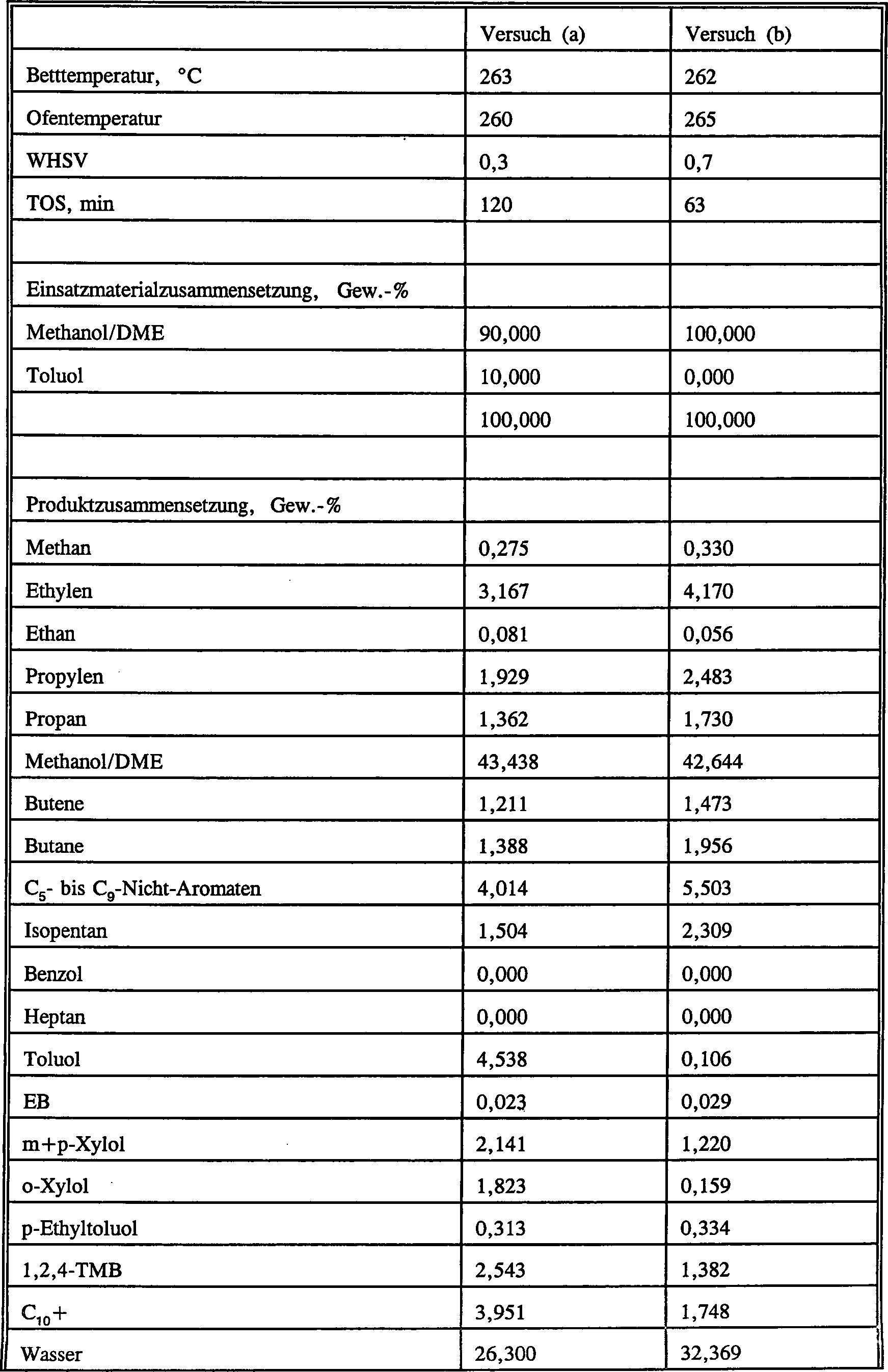
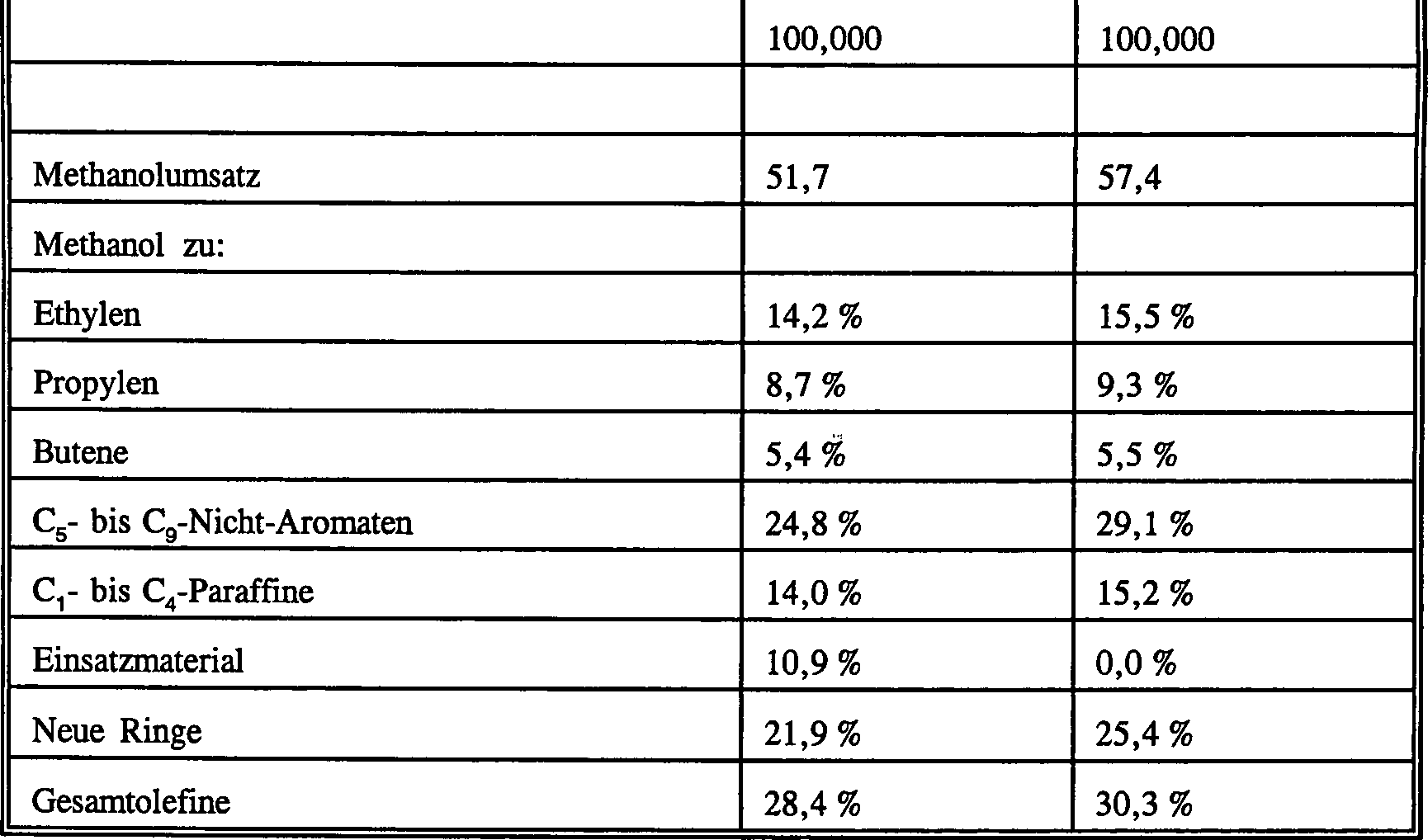
Beispiel 7Example 7
Der
Katalysator von Beispiel 5 wurde verwendet, um eine Mischung von
90 Gew.-% Methanol und 10 Gew.-% Toluol (Methanol:Toluol-Molverhältnis von
26 : 1) bei verschiedenen Temperaturen und Drücken umzusetzen. Die Gesamtolefinselektivität bei jeder
Bedingung bei einem Methanolumsatzniveau von 80 % ist in
Claims (12)
Applications Claiming Priority (3)
| Application Number | Priority Date | Filing Date | Title |
|---|---|---|---|
| US55486 | 1993-04-30 | ||
| US09/055,486 US6046372A (en) | 1996-10-02 | 1998-04-06 | Process for producing light olefins |
| PCT/US1999/007311 WO1999051548A1 (en) | 1998-04-06 | 1999-04-01 | Process for producing light olefins |
Publications (2)
| Publication Number | Publication Date |
|---|---|
| DE69918281D1 DE69918281D1 (en) | 2004-07-29 |
| DE69918281T2 true DE69918281T2 (en) | 2005-07-07 |
Family
ID=21998167
Family Applications (1)
| Application Number | Title | Priority Date | Filing Date |
|---|---|---|---|
| DE69918281T Expired - Fee Related DE69918281T2 (en) | 1998-04-06 | 1999-04-01 | PROCESS FOR THE PRODUCTION OF LIGHT BIN INCINERATE |
Country Status (16)
| Country | Link |
|---|---|
| US (1) | US6046372A (en) |
| EP (1) | EP1070032B1 (en) |
| JP (1) | JP2002510659A (en) |
| KR (1) | KR20010042501A (en) |
| CN (1) | CN1157351C (en) |
| AR (1) | AR015749A1 (en) |
| AT (1) | ATE269839T1 (en) |
| AU (1) | AU751094B2 (en) |
| BR (1) | BR9909463A (en) |
| CA (1) | CA2327246A1 (en) |
| DE (1) | DE69918281T2 (en) |
| ES (1) | ES2224629T3 (en) |
| ID (1) | ID28632A (en) |
| MX (1) | MXPA00009797A (en) |
| NO (1) | NO20005021L (en) |
| WO (1) | WO1999051548A1 (en) |
Families Citing this family (56)
| Publication number | Priority date | Publication date | Assignee | Title |
|---|---|---|---|---|
| US6538167B1 (en) | 1996-10-02 | 2003-03-25 | Exxonmobil Chemical Patents Inc. | Process for producing light olefins |
| US6613951B1 (en) * | 1999-09-23 | 2003-09-02 | Mobil Oil Corporation | Process for converting methanol to olefins |
| US6743747B1 (en) * | 2000-02-24 | 2004-06-01 | Exxonmobil Chemical Patents Inc. | Catalyst pretreatment in an oxgenate to olefins reaction system |
| WO2001077046A1 (en) * | 2000-04-11 | 2001-10-18 | Exxonmobil Chemical Patents, Inc. | Process for producing chemicals from oxygenate |
| US6506954B1 (en) | 2000-04-11 | 2003-01-14 | Exxon Mobil Chemical Patents, Inc. | Process for producing chemicals from oxygenate |
| AU2002220152A1 (en) * | 2000-11-21 | 2002-06-03 | Exxonmobil Chemical Patents Inc | Process for producing light olefins |
| US6632971B2 (en) * | 2001-08-30 | 2003-10-14 | Exxonmobil Chemical Patents Inc. | Process for converting natural gas to higher value products using a methanol refinery remote from the natural gas source |
| US6906233B2 (en) * | 2002-12-12 | 2005-06-14 | Exxon Mobil Chemical Patents Inc. | Modified metalloaluminophosphate molecular sieves |
| US7045672B2 (en) * | 2003-11-12 | 2006-05-16 | Exxonmobil Chemical Patents Inc. | Catalyst pretreatment with dimethyl ether in an oxygenate to olefins reaction system |
| US7057083B2 (en) * | 2003-11-12 | 2006-06-06 | Exxonmobil Chemical Patents Inc. | Catalyst pretreatment with C4-C7 olefins in an oxygenate to olefins reaction system |
| US7132581B2 (en) | 2003-11-12 | 2006-11-07 | Exxonmobil Chemical Patents Inc. | Catalyst pretreatment with aldehyde in an oxygenate to olefins reaction system |
| US7199277B2 (en) * | 2004-07-01 | 2007-04-03 | Exxonmobil Chemical Patents Inc. | Pretreating a catalyst containing molecular sieve and active metal oxide |
| EA011844B1 (en) * | 2004-09-08 | 2009-06-30 | Бп Корпорейшн Норт Америка Инк. | Method for transporting carbon-containing feed material |
| US7465845B2 (en) * | 2004-12-22 | 2008-12-16 | Exxonmobil Chemical Patents Inc. | Increasing ethylene and/or propylene production in an oxygenate to olefins reaction systems |
| CN101448766A (en) * | 2006-05-19 | 2009-06-03 | 国际壳牌研究有限公司 | Process for the preparation of C5 and/or C6 olefins |
| WO2007135058A1 (en) * | 2006-05-19 | 2007-11-29 | Shell Internationale Research Maatschappij B.V. | Process for the preparation of propylene from a hydrocarbon feed |
| WO2007135052A1 (en) * | 2006-05-19 | 2007-11-29 | Shell Internationale Research Maatschappij B.V. | Process for the preparation of an olefin |
| CA2650560A1 (en) * | 2006-05-19 | 2007-11-29 | Shell Internationale Research Maatschappij B.V. | Process for the alkylation of a cycloalkene |
| CA2651444A1 (en) * | 2006-05-19 | 2007-11-29 | Leslie Andrew Chewter | Process for the preparation of an olefin |
| US20090105434A1 (en) * | 2006-05-19 | 2009-04-23 | Leslie Andrew Chewter | Process for the preparation of propylene |
| US20090187056A1 (en) * | 2006-05-19 | 2009-07-23 | Leslie Andrew Chewter | Process for the preparation of an olefin |
| US7834227B2 (en) * | 2006-12-29 | 2010-11-16 | Uop Llc | Aromatics co-production in a methanol-to-propylene unit |
| CN101157593B (en) | 2007-03-07 | 2010-09-22 | 中国科学院大连化学物理研究所 | Method for producing light olefins from methanol or/and dimethyl ether |
| US7629498B2 (en) * | 2007-06-28 | 2009-12-08 | Exxonmobil Chemical Patents, Inc. | Process of manufacturing para-xylene |
| AU2008327862B2 (en) * | 2007-11-19 | 2011-06-02 | Shell Internationale Research Maatschappij B.V. | Process for converting an oxygenate into an olefin-containing product, and reactor system |
| CA2705068A1 (en) * | 2007-11-19 | 2009-05-28 | Shell Internationale Research Maatschappij B.V. | Process for the preparation of an olefin |
| JP2011503156A (en) * | 2007-11-19 | 2011-01-27 | シエル・インターナシヨナル・リサーチ・マートスハツペイ・ベー・ヴエー | Process for the preparation of olefin products |
| EA020083B1 (en) | 2008-02-07 | 2014-08-29 | Тотал Петрокемикалс Рисерч Фелюй | Dehydration of alcohols on crystalline silicates |
| CN102046566B (en) * | 2008-04-24 | 2014-10-01 | 国际壳牌研究有限公司 | Process for the preparation of olefin-containing products or gasoline products |
| EP2303806B1 (en) * | 2008-06-25 | 2019-08-07 | Total Research & Technology Feluy | Process to make olefins from oxygenates |
| AU2009331847B2 (en) | 2008-12-22 | 2012-06-07 | Air Products And Chemicals, Inc. | Process to prepare methanol and/or dimethylether |
| US8252967B2 (en) | 2009-04-14 | 2012-08-28 | Exxonmobil Chemical Patents Inc. | Process for the purification of paraxylene |
| US9139929B2 (en) * | 2010-01-22 | 2015-09-22 | Total Research & Technology Feluy | Dehydration of alcohols on a crystalline silicate of low Si/Al ratio |
| WO2012005864A1 (en) | 2010-07-09 | 2012-01-12 | Dow Global Technologies Llc | Production of olefins from a mixed alcohols feed |
| JP2012045505A (en) * | 2010-08-27 | 2012-03-08 | Idemitsu Kosan Co Ltd | Catalyst for producing light olefin, method for producing the catalyst, and method for producing light olefin by using the catalyst |
| CN103228357B (en) | 2010-11-30 | 2016-03-23 | 埃克森美孚化学专利公司 | Method for regenerating zeolite catalysts |
| CN102531821B (en) * | 2010-12-28 | 2015-03-25 | 中国科学院大连化学物理研究所 | Method for catalyzing catalytic cracking reaction of methanol coupled with naphtha using modified ZSM-5 molecular sieve based catalyst |
| TWI495511B (en) | 2011-07-27 | 2015-08-11 | Exxonmobil Chem Patents Inc | Fluid bed reactor with staged baffles |
| US9108892B2 (en) * | 2011-08-30 | 2015-08-18 | Shell Oil Company | Process for the preparation of olefins |
| TWI623511B (en) * | 2011-12-08 | 2018-05-11 | Gtc科技美國有限責任公司 | Production of xylenes by methylation of aromatic compounds |
| EP2796197B1 (en) * | 2011-12-19 | 2020-04-08 | Dalian Institute Of Chemical Physics, Chinese Academy of Sciences | Method for preparing ethylene and propylene by using methyl alcohol and/or dimethyl ether, |
| US9353024B2 (en) | 2013-02-06 | 2016-05-31 | Exxonmobil Chemical Patents Inc. | Selective hydrogenation of styrene to ethylbenzene |
| RU2544017C1 (en) | 2014-01-28 | 2015-03-10 | Ольга Васильевна Малова | Catalyst and method for aromatisation of c3-c4 gases, light hydrocarbon fractions of aliphatic alcohols, as well as mixtures thereof |
| RU2550354C1 (en) | 2014-03-28 | 2015-05-10 | Общество С Ограниченной Ответственностью "Новые Газовые Технологии-Синтез" | Method for producing aromatic hydrocarbon concentrate of light aliphatic hydrocarbons and device for implementing it |
| RU2544241C1 (en) | 2014-01-22 | 2015-03-20 | Общество С Ограниченной Ответственностью "Новые Газовые Технологии-Синтез" | Method of producing aromatic hydrocarbons from natural gas and apparatus therefor |
| RU2558955C1 (en) | 2014-08-12 | 2015-08-10 | Общество С Ограниченной Ответственностью "Новые Газовые Технологии-Синтез" | Method of producing aromatic hydrocarbon concentrate from liquid hydrocarbon fractions and apparatus therefor |
| WO2016032639A1 (en) | 2014-08-29 | 2016-03-03 | Exxonmobil Chemical Patents Inc. | Treatment of aromatic alkylation feedstock |
| WO2017155424A1 (en) | 2016-03-09 | 2017-09-14 | Limited Liability Company "New Gas Technologies-Synthesis" (Llc "Ngt-Synthesis") | Method and plant for producing high-octane gasolines |
| EP3433223A4 (en) | 2016-03-25 | 2019-12-25 | ExxonMobil Chemical Patents Inc. | Catalyst and process for the production of para-xylene |
| CN107266279B (en) * | 2016-04-06 | 2020-05-19 | 中国石油化工股份有限公司 | A kind of method for preparing light olefin from oxygen-containing compound |
| US10961168B2 (en) | 2016-09-22 | 2021-03-30 | Exxonmobil Chemical Patents Inc. | Use of light gas by-products in the production of paraxylene by the methylation of toluene and or benzene |
| WO2018057125A2 (en) | 2016-09-22 | 2018-03-29 | Exxonmobil Chemical Patents Inc. | Use of light gas by-products in the production of paraxylene by the methylation of toluene and/or benzene |
| USD903268S1 (en) | 2019-02-06 | 2020-12-01 | S. C. Johnson & Son, Inc. | Insole |
| USD906658S1 (en) | 2019-02-19 | 2021-01-05 | S. C. Johnson & Son, Inc. | Insole |
| RU2747869C1 (en) | 2020-06-29 | 2021-05-17 | Общество С Ограниченной Ответственностью "Новые Газовые Технологии-Синтез" (Ооо "Нгт-Синтез") | Method of producing benzines or concentrates of aromatic compounds with different distribution of oxygenate and olefin-containing streams |
| EP4610244A1 (en) * | 2022-10-25 | 2025-09-03 | Korea Research Institute of Chemical Technology | Method for preparing raw material for plastics by using steel by-product gas |
Family Cites Families (7)
| Publication number | Priority date | Publication date | Assignee | Title |
|---|---|---|---|---|
| US4025575A (en) * | 1975-04-08 | 1977-05-24 | Mobil Oil Corporation | Process for manufacturing olefins |
| US4079095A (en) * | 1976-11-04 | 1978-03-14 | Mobil Oil Corporation | Manufacture of light olefins |
| US4499314A (en) * | 1982-03-31 | 1985-02-12 | Imperial Chemical Industries Plc | Methanol conversion to hydrocarbons with zeolites and cocatalysts |
| US4677242A (en) * | 1982-10-04 | 1987-06-30 | Union Carbide Corporation | Production of light olefins |
| NZ207523A (en) * | 1983-04-22 | 1986-03-14 | Mobil Oil Corp | Catalytic production of olefin mixtures from alcohols and/or ethers |
| US4752651A (en) * | 1986-06-16 | 1988-06-21 | Union Carbide Corporation | Production of light olefins |
| US5278345A (en) * | 1992-05-27 | 1994-01-11 | Exxon Chemical Patents Inc. | Use of ECR-1, mazmorite and ECR-18 in the conversion of oxygenates to hydrocarbons |
-
1998
- 1998-04-06 US US09/055,486 patent/US6046372A/en not_active Expired - Fee Related
-
1999
- 1999-04-01 CA CA002327246A patent/CA2327246A1/en not_active Abandoned
- 1999-04-01 WO PCT/US1999/007311 patent/WO1999051548A1/en not_active Ceased
- 1999-04-01 AU AU33793/99A patent/AU751094B2/en not_active Ceased
- 1999-04-01 AT AT99915233T patent/ATE269839T1/en not_active IP Right Cessation
- 1999-04-01 EP EP99915233A patent/EP1070032B1/en not_active Expired - Lifetime
- 1999-04-01 MX MXPA00009797A patent/MXPA00009797A/en not_active Application Discontinuation
- 1999-04-01 CN CNB99806355XA patent/CN1157351C/en not_active Expired - Fee Related
- 1999-04-01 ES ES99915233T patent/ES2224629T3/en not_active Expired - Lifetime
- 1999-04-01 BR BR9909463-0A patent/BR9909463A/en not_active IP Right Cessation
- 1999-04-01 JP JP2000542272A patent/JP2002510659A/en not_active Withdrawn
- 1999-04-01 KR KR1020007011127A patent/KR20010042501A/en not_active Withdrawn
- 1999-04-01 ID IDW20002278A patent/ID28632A/en unknown
- 1999-04-01 DE DE69918281T patent/DE69918281T2/en not_active Expired - Fee Related
- 1999-04-06 AR ARP990101552A patent/AR015749A1/en unknown
-
2000
- 2000-10-05 NO NO20005021A patent/NO20005021L/en not_active Application Discontinuation
Also Published As
| Publication number | Publication date |
|---|---|
| KR20010042501A (en) | 2001-05-25 |
| CA2327246A1 (en) | 1999-10-14 |
| ATE269839T1 (en) | 2004-07-15 |
| NO20005021L (en) | 2000-12-06 |
| ES2224629T3 (en) | 2005-03-01 |
| CN1302283A (en) | 2001-07-04 |
| EP1070032A4 (en) | 2001-06-13 |
| MXPA00009797A (en) | 2002-08-12 |
| AU751094B2 (en) | 2002-08-08 |
| BR9909463A (en) | 2001-10-02 |
| US6046372A (en) | 2000-04-04 |
| EP1070032A1 (en) | 2001-01-24 |
| EP1070032B1 (en) | 2004-06-23 |
| NO20005021D0 (en) | 2000-10-05 |
| DE69918281D1 (en) | 2004-07-29 |
| JP2002510659A (en) | 2002-04-09 |
| WO1999051548A1 (en) | 1999-10-14 |
| AR015749A1 (en) | 2001-05-16 |
| AU3379399A (en) | 1999-10-25 |
| CN1157351C (en) | 2004-07-14 |
| ID28632A (en) | 2001-06-21 |
Similar Documents
| Publication | Publication Date | Title |
|---|---|---|
| DE69918281T2 (en) | PROCESS FOR THE PRODUCTION OF LIGHT BIN INCINERATE | |
| DE60003840T2 (en) | ONE-STEP PROCESS FOR CONVERTING OXYGENATES INTO GASOLINE AND MEDIUM DISTILLATES IN THE PRESENCE OF A ONE-DIMENSIONAL TEN-RING ATOMIC ZEOLITE | |
| DE2615150C2 (en) | Process for converting alcohols and / or ethers into olefins | |
| DE69918451T2 (en) | METHOD FOR THE PRODUCTION OF OLEFINES USING A PENTASIL ZEOLITE-CONTAINING CATALYST | |
| DE2463418C2 (en) | Process for the preparation of reaction products comprising essentially aliphatic, oxygen-free hydrocarbons | |
| DE69729797T2 (en) | Zeolitic catalyst and its use in hydrocarbon conversion | |
| DE69520592T2 (en) | ISOMERIZATION OF XYLENE IN TWO BEDS | |
| DE2912068C2 (en) | Process for the production of light olefinic hydrocarbons | |
| DE69612279T2 (en) | TREATING HEAVY FLAVORS | |
| DE69731291T2 (en) | CATALYST FOR THE CONVERSION OF HYDROCARBONS AND ITS USE | |
| DE2714239C2 (en) | ||
| DE69218616T2 (en) | COMBINED PARAFFINISOMERIZATION / RING OPENING METHOD | |
| DE69511575T2 (en) | METHOD FOR CONVERTING HYDROCARBONS USING A ZEOLITE CATALYZER TIED BY ZEOLITH | |
| DE69404981T2 (en) | SKELETIC ISOMERIZATION OF N-PENTENES | |
| DE2633881A1 (en) | CATALYST FOR THE CONVERSION OF ORGANIC COMPOUNDS AND PRODUCTION AND USE OF THE CATALYST | |
| DE69529286T2 (en) | PARA-XYLENE SELECTIVE REFORM / FLAVOR | |
| DE69515034T2 (en) | N-OLEFIN ISOMERIZATION METHOD | |
| DE69802417T2 (en) | CATALYTIC PROCEDURE WITH DIOLEFINES WITH IMPROVED OLEFIN YIELD | |
| DE2829756A1 (en) | METHOD FOR AETHYLATING MONOALKYLBENZENE | |
| US4808295A (en) | Two stage process for the production of a high benzene aromatic product | |
| DE3873000T2 (en) | METHOD FOR PRODUCING OLIGOMERS FROM OLEFINS USING A MODIFIED MORDENITE CATALYST. | |
| DE112012001227T5 (en) | Improved process for the preparation of a zeolite based catalyst for the conversion of methanol to olefins | |
| DE69108535T2 (en) | Oligomerization of propylene in the presence of silica-modified zeolites. | |
| DE69201485T2 (en) | Process for the isomerization of N-olefins. | |
| DE3524890A1 (en) | Process for the preparation of low-molecular-weight olefins |
Legal Events
| Date | Code | Title | Description |
|---|---|---|---|
| 8339 | Ceased/non-payment of the annual fee |