DE69918229T2 - Hydrofluoroalkylvinylether and their production process - Google Patents
Hydrofluoroalkylvinylether and their production process Download PDFInfo
- Publication number
- DE69918229T2 DE69918229T2 DE69918229T DE69918229T DE69918229T2 DE 69918229 T2 DE69918229 T2 DE 69918229T2 DE 69918229 T DE69918229 T DE 69918229T DE 69918229 T DE69918229 T DE 69918229T DE 69918229 T2 DE69918229 T2 DE 69918229T2
- Authority
- DE
- Germany
- Prior art keywords
- unsaturated
- ether
- saturated
- perfluoro
- branched
- Prior art date
- Legal status (The legal status is an assumption and is not a legal conclusion. Google has not performed a legal analysis and makes no representation as to the accuracy of the status listed.)
- Expired - Lifetime
Links
Classifications
-
- C—CHEMISTRY; METALLURGY
- C07—ORGANIC CHEMISTRY
- C07C—ACYCLIC OR CARBOCYCLIC COMPOUNDS
- C07C43/00—Ethers; Compounds having groups, groups or groups
- C07C43/02—Ethers
- C07C43/03—Ethers having all ether-oxygen atoms bound to acyclic carbon atoms
- C07C43/14—Unsaturated ethers
- C07C43/17—Unsaturated ethers containing halogen
-
- C—CHEMISTRY; METALLURGY
- C07—ORGANIC CHEMISTRY
- C07C—ACYCLIC OR CARBOCYCLIC COMPOUNDS
- C07C43/00—Ethers; Compounds having groups, groups or groups
- C07C43/02—Ethers
- C07C43/18—Ethers having an ether-oxygen atom bound to a carbon atom of a ring other than a six-membered aromatic ring
- C07C43/192—Ethers having an ether-oxygen atom bound to a carbon atom of a ring other than a six-membered aromatic ring containing halogen
-
- C—CHEMISTRY; METALLURGY
- C08—ORGANIC MACROMOLECULAR COMPOUNDS; THEIR PREPARATION OR CHEMICAL WORKING-UP; COMPOSITIONS BASED THEREON
- C08F—MACROMOLECULAR COMPOUNDS OBTAINED BY REACTIONS ONLY INVOLVING CARBON-TO-CARBON UNSATURATED BONDS
- C08F214/00—Copolymers of compounds having one or more unsaturated aliphatic radicals, each having only one carbon-to-carbon double bond, and at least one being terminated by a halogen
- C08F214/18—Monomers containing fluorine
- C08F214/26—Tetrafluoroethene
- C08F214/262—Tetrafluoroethene with fluorinated vinyl ethers
-
- C—CHEMISTRY; METALLURGY
- C07—ORGANIC CHEMISTRY
- C07C—ACYCLIC OR CARBOCYCLIC COMPOUNDS
- C07C2601/00—Systems containing only non-condensed rings
- C07C2601/06—Systems containing only non-condensed rings with a five-membered ring
- C07C2601/10—Systems containing only non-condensed rings with a five-membered ring the ring being unsaturated
Landscapes
- Chemical & Material Sciences (AREA)
- Organic Chemistry (AREA)
- Health & Medical Sciences (AREA)
- Chemical Kinetics & Catalysis (AREA)
- Medicinal Chemistry (AREA)
- Polymers & Plastics (AREA)
- Organic Low-Molecular-Weight Compounds And Preparation Thereof (AREA)
- Addition Polymer Or Copolymer, Post-Treatments, Or Chemical Modifications (AREA)
- Low-Molecular Organic Synthesis Reactions Using Catalysts (AREA)
Description
Die vorliegende Erfindung betrifft Fluoralkylvinylether, die eine hohe Reaktivität in Polymerisationsverfahren mit vollständig oder teilweise fluorierten, ethylenisch ungesättigten Monomeren zeigen.The The present invention relates to fluoroalkyl vinyl ethers having a high molecular weight Reactivity in polymerization processes with fully or partially fluorinated, ethylenically unsaturated Monomers show.
Insbesondere betrifft die vorliegende Erfindung Hydrofluoralkylvinylether, die TFE-Polymere ergeben, die thermisch stabiler sind als die bekannten Hydrofluoralkylvinylether, bei denen die Wasserstoffatome gleich sind. Ferner sind die Fluoralkylvinylether der Erfindung in Vergleich mit bekannten Verfahren mit hohen Ausbeuten durch ein industriell einfacheres Verfahren erhältlich, da es sehr milde Reaktionsbedingungen erfordert.Especially The present invention relates to hydrofluoroalkyl vinyl ethers which TFE polymers give, which are thermally stable than the known Hydrofluoroalkyl vinyl ethers in which the hydrogen atoms are the same. Further, the fluoroalkyl vinyl ethers of the invention are in comparison with known methods with high yields by an industrial simpler method available, since it requires very mild reaction conditions.
Es ist bekannt, dass teilweise oder vollständig fluorierte Fluoralkylvinylether verwendet werden, um thermoplastische oder elastomere fluorierte Polymere zu erhalten, deren wirtschaftliche Bedeutung auf ihrer einzigartigen Eigenschaftskombination beruht, darunter der hohen thermischen und chemischen Stabilität.It it is known that partially or fully fluorinated fluoroalkyl vinyl ethers used to thermoplastic or elastomeric fluorinated To obtain polymers whose economic importance is based on their unique Property combination is based, including the high thermal and chemical stability.
Es ist bekannt, dass einige Fluorpolymere, wie z.B. Polytetrafluorethylen, schwer verarbeitbar sind, da sie eine sehr hohe Schmelzviskosität aufweisen. In der Technik wird die Tetrafluorethylen (TFE)-Polymer-Verarbeitbarkeit durch TFE-Copolymerisation mit anderen ethylenisch ungesättigten Molekülen, wie z.B. (Per)fluorvinylethern, verbessert.It it is known that some fluoropolymers, e.g. polytetrafluoroethylene, difficult to process because they have a very high melt viscosity. In the art, the tetrafluoroethylene (TFE) polymer processability becomes by TFE copolymerization with other ethylenically unsaturated molecules such as. (Per) fluorovinylethers, improved.
Die vollständig fluorierten Vinylether zeigen eine geringe Reaktivität im Polymerisationsverfahren. In diesen Verfahren ist es notwendig, den nicht umgesetzten Vinylether zurückzugewinnen, was die Kosten des Polymererzeugnisses erhöht.The Completely fluorinated vinyl ethers show low reactivity in the polymerization process. In these processes, it is necessary to use the unreacted vinyl ether recover, which increases the cost of the polymer product.
Die Syntheseverfahren, die zur Erlangung der Hydrofluoralkylvinylether verwendet werden, sind nicht zufriedenstellend, da sie eine wasserfreie Reaktionsumgebung, hohe TFE-Drücke und hohe Reaktionstemperaturen um etwa 80 bis 100°C erfordern.The Synthetic methods used to obtain the hydrofluoroalkyl vinyl ethers are not satisfactory because they are an anhydrous Reaction environment, high TFE pressures and require high reaction temperatures of about 80 to 100 ° C.
Das GB-Patent 812116 betrifft Hydrofluorvinylether mit der Formel CF2=CF-O-RT, worin RT Alkyl oder ein fluoriertes Alkyl ist, deren Synthese und Polymerisation. Diese Vinylether besitzen eine hohe Reaktivität und sie copolymerisieren leicht. Das Verfahren zur Herstellung der beschriebenen Vinylether wird durch Umsetzung eines Alkoholats RT-CH2-O– mit TFE durchgeführt, was Ausbeuten von etwa 40% ergibt, es erfordert aber ziemlich drastische Reaktionsbedingungen: hohe Wasserfreiheit, hohe TFE-Drücke (p > 20 atm) und hohe Reaktionstemperaturen im Bereich von 85 bis 90°C.GB patent 812116 relates to hydrofluorovinyl ethers having the formula CF 2 = CF-OR T , wherein R T is alkyl or a fluorinated alkyl, their synthesis and polymerization. These vinyl ethers have a high reactivity and they easily copolymerize. The process for preparing the described vinylethers is prepared by reacting an alcoholate R T -CH 2 -O - carried out with TFE, which yields yields of about 40%, but it requires rather drastic reaction conditions: high water freedom, high TFE pressures (p> 20 atm) and high reaction temperatures in the range of 85 to 90 ° C.
Das EP-Patent 338755 betrifft ein Verfahren zur Herstellung von perfluorierten Copolymeren, umfassend 99,5 Mol-% bis 50 Mol-% TFE und 0,5 Mol-% bis 50 Mol-% eines Hydrovinylethers der Formel CF2=CFOCH2Cn·FpX'mH(2n'+1-p-m)(X' = Cl, Br, n' ist eine ganze Zahl umfassend 0, p liegt im Bereich von 0 bis (2n' + 1), m = 0, 1, p + m ≤ 1n' + 1). Die Copolymere, die durch Reaktion der beiden Monomere erhalten werden, sind fluoriert mit elementarem Fluor, wodurch stabilere Polymere erhalten werden. Bei den Copolymeren, die durch TFE und CF2=CF-O-CH2-CF2-CF3 gebildet werden, beträgt die thermische Zersetzungstemperatur des nicht fluorierten Polymers 380°C, wenn der molare Prozentanteil von Fluorvinylether 5,8% beträgt, und sie ist 330°C, wenn der molare Prozentanteil 25% ist. Die thermische Zersetzungstemperaturen der entsprechenden fluorierten Polymere sind um 60°C bzw. 80°C höher. Dieses Patent zeigt, dass die thermische Stabilität dieser Copolymere von der Vinylethermenge abhängt und dass die Stabilität sich mit steigendem molarem Prozentgehalt verringert.EP patent 338755 relates to a process for the preparation of perfluorinated copolymers comprising 99.5 mol% to 50 mol% TFE and 0.5 mol% to 50 mol% of a hydrovinyl ether of the formula CF 2 = CFOCH 2 C n F p X ' m H (2n' + 1-pm) (X '= Cl, Br, n' is an integer comprising 0, p ranges from 0 to (2n '+ 1), m = 0, 1, p + m ≤ 1n '+ 1). The copolymers obtained by reaction of the two monomers are fluorinated with elemental fluorine to give more stable polymers. In the copolymers formed by TFE and CF 2 = CF-O-CH 2 -CF 2 -CF 3 , the thermal decomposition temperature of the non-fluorinated polymer is 380 ° C when the molar percentage of fluorovinyl ether is 5.8%, and it is 330 ° C when the molar percentage is 25%. The thermal decomposition temperatures of the respective fluorinated polymers are higher by 60 ° C and 80 ° C, respectively. This patent shows that the thermal stability of these copolymers depends on the amount of vinyl ether and that stability decreases with increasing molar percentage.
In
der Patentanmeldung WO 96/41823 werden elastomere Polymere beschrieben,
die durch TFE-Copolymerisation mit Hydrovinylethern der Formel CF2=CF-O-RB, worin
RB eine C1-C6-Alkylgruppe ist, beschrieben. Die thermische
Stabilität
der entsprechenden Polymere mit TFE ähnelt der der nicht fluorierten
Copolymere von
Es bestand das Bedürfnis nach der Verfügbarkeit von Hydrofluorvinylethern, die es gestatten, Polymere mit einer verbesserten thermischen Stabilität zu erhalten.It was the need according to availability of hydrofluorovinyl ethers which permit polymers with a to obtain improved thermal stability.
Es bestand das Bedürfnis nach der Verfügbarkeit eines einfacheren Verfahrens unter Einsatz milderer Reaktionsbedingungen und mit hohen Ausbeuten bezüglich denen des Standes der Technik, um Hydrofluorvinylether zu erhalten.It was the need according to availability a simpler process using milder reaction conditions and in high yields those of the prior art to obtain hydrofluorovinyl ether.
Es
ist nun überraschenderweise
und unerwarteterweise festgestellt worden, dass es möglich ist,
diese Anforderungen mit neuen Hydrofluorvinylethern zu erfüllen, die
TFE-Polymere mit einer verbesserten thermischen Stabilität im Vergleich mit
den Hydrofluorvinylethern des Standes des Technik ergeben (siehe
z.B.
Ein
Ziel der vorliegenden Erfindung ist Hydro-2,2-difluoralkylvinylether
mit der Formel
- – einer linearen oder verzweigten, gesättigten oder ungesättigten C2-C20-Fluoralkylgruppe;
- – einer gesättigten oder ungesättigten, fluorierten, cyclischen C4-C6-Gruppe; worin gegebenenfalls 1 bis 2 Kohlenstoffatome durch Sauerstoffatome unter Bildung von Etherbindungen substituiert sein können;
- – einer linearen, verzweigten, gesättigten oder ungesättigten C3-C15-Fluoroxyalkylgruppe, die ein oder mehrere, Etherbindungen bildende Sauerstoffatome enthält.
- A linear or branched, saturated or unsaturated C 2 -C 20 fluoroalkyl group;
- A saturated or unsaturated, fluorinated, cyclic C 4 -C 6 group; wherein optionally 1 to 2 carbon atoms may be substituted by oxygen atoms to form ether bonds;
- A linear, branched, saturated or unsaturated C 3 -C 15 fluorooxyalkyl group which contains one or more ether atoms forming oxygen atoms.
Vorzugsweise hat der RA-Rest die folgenden Bedeutungen:
- –
- –
- -
- -
RA enthält gegebenenfalls stabile funktionelle Gruppen bei den Reaktionsbedingungen zur Herstellung von Vinylether (I), z.B. CN, COOR', CON(R')2, SO2OR', worin R' lineares oder verzweigtes C1-C5-Alkyl ist.R A optionally contains stable functional groups at the reaction conditions for the preparation of vinyl ether (I), for example CN, COOR ', CON (R') 2 , SO 2 OR ', wherein R' is linear or branched C 1 -C 5 alkyl ,
Die Hydrofluoralkylvinylether der Erfindung ermöglichen bei gleichem prozentualem Gewichtsgehalt des enthaltenen Wasserstoffs den Erhalt von Polymeren mit einer höheren thermischen Stabilität als die der Polymere der Hydrofluoralkylvinylether des Standes der Technik. Siehe Tabelle 1 für die TFE-Polymere.The Hydrofluoroalkyl vinyl ethers of the invention allow for the same percentage Weight content of the hydrogen contained the receipt of polymers with a higher one thermal stability than those of the polymers of the hydrofluoroalkyl vinyl ethers of the prior art Technology. See Table 1 for the TFE polymers.
Die Hydrofluoralkylvinylether der Erfindung zeigen in der Polymerisation eine höhere Reaktivität als die Perfluorvinylether nach dem Stand der Technik. Siehe die Beispiele.The Hydrofluoroalkyl vinyl ethers of the invention show in the polymerization a higher one Reactivity as the perfluorovinyl ethers of the prior art. See the Examples.
Polymere und Copolymere können durch Copolymerisieren von vollständig oder teilweise fluorierten und nicht fluorierten Comonomeren mit mindestens einer ethylenischen Ungesättigtheit mit Hydrofluoralkylvinylethern der vorliegenden Erfindung erhalten werden.polymers and copolymers can by copolymerizing fully or partially fluorinated and non-fluorinated comonomers with at least one ethylenic unsaturation with hydrofluoroalkyl vinyl ethers of the present invention become.
Von den einsetzbaren Comonomeren können die folgenden aufgeführt werden:
- – C2-C8-Perfluorolefine, wie Tetrafluorethylen (TFE), Hexafluorpropen (HFP), Hexafluorisobuten;
- – hydrierte C2-C8-Fluorolefine, wie Vinylfluorid (VF), Trifluorethylen, Perfluoralkylethylen CH2=CH-Rf, worin Rf ein C1-C6-Perfluoralkyl ist;
- – C2-C8-Chlor- und/oder -Brom- und/oder -Iodfluorolefine, wie Bromtrifluorethylen;
- – (Per)fluoralkylvinylether (PAVE) CF2=CFORf, worin Rf C1-C6-(Per)fluoralkyl ist, wie Trifluormethyl, Bromdifluormethyl oder Heptafluorpropyl;
- – CF2=CFOX'' (Per)fluoroxyalkylvinylether, worin X'' C1-C12-Alkyl oder C1-C12-Oxyalkyl oder C1-C12-(Per)fluoroxyalkyl mit einer oder mehreren Ethergruppen ist, z.B. Perfluor-2-propoxypropyl;
- – Perfluordioxol (PD), Perfluor-(2,2-dimethyl)-1,3-dioxol (PDD), Perfluor-4-methoxy-1,3-dioxol (TTD);
- – CF2=CF-O-CF2-O-CF=CF2 (Bisvinyloxymethan, BVOM);
- – CF2=CF-O-CF2-CF2-SO2F.
- C 2 -C 8 perfluoroolefins, such as tetrafluoroethylene (TFE), hexafluoropropene (HFP), hexafluoroisobutene;
- Hydrogenated C 2 -C 8 fluoroolefins such as vinyl fluoride (VF), trifluoroethylene, perfluoroalkylethylene CH 2 = CH-R f , wherein R f is a C 1 -C 6 perfluoroalkyl;
- C 2 -C 8 chloro and / or bromo and / or iodo-fluoroolefins, such as bromotrifluoroethylene;
- - (per) fluoroalkylvinylether (PAVE) CF 2 = CFOR f , wherein R f is C 1 -C 6 - (per) fluoroalkyl, such as trifluoromethyl, bromodifluoromethyl or heptafluoropropyl;
- - CF 2 = CFOX '' (per) fluorooxyalkyl vinyl ether, wherein X "is C 1 -C 12 alkyl or C 1 -C 12 oxyalkyl or C 1 -C 12 - (per) fluoro oxyalkyl having one or more ether groups, eg perfluoro-2-propoxy-propyl;
- Perfluorodioxole (PD), perfluoro (2,2-dimethyl) -1,3-dioxole (PDD), perfluoro-4-methoxy-1,3-dioxole (TTD);
- CF 2 = CF-O-CF 2 -O-CF = CF 2 (bisvinyloxymethane, BVOM);
- - CF 2 = CF-O-CF 2 -CF 2 -SO 2 F.
Optionale Comonomere, die copolymerisiert werden können, sind nicht fluorierte C2-C6-Olefine, wie Ethylen, Propylen und Isobutylen.Optional comonomers that can be copolymerized are non-fluorinated C 2 -C 6 olefins, such as ethylene, propylene and isobutylene.
Die Copolymerisationsprodukte können hergestellt werden durch radikalische Polymerisationen, sowohl im wässrigen als auch im organischen Medium.The Copolymerization products can be prepared by free radical polymerizations, both in aqueous as well as in the organic medium.
Bei
den Polymerisationen im wässrigen
Medium kann es sich bei dem Polymerisationsinitiator um jede Substanz
handeln, die in der Lage ist, Radikale zu erzeugen, wie z.B. Peroxide,
Persulfate oder Azoverbindungen. Gegebenenfalls kann auch ein Reduktionsmittel
verwendet werden, wie z.B. ein Eisensalz, um die Initiatorzersetzung
zu begünstigen.
Gegebenenfalls wird ein Kettenübertragungsmittel
verwendet, um das gewünschte
Molekulargewicht zu erhalten. Die Polymerisation in wässriger
Umgebung erfordert die Anwesenheit eines Emulgators. Siehe z.B.
Alternativ können Polymerisationen in einem organischen Lösungsmittel durchgeführt werden, wie z.B. im US-Patent 3642742 beschrieben. Jeder für die TFE-Polymerisation in organischem Lösungsmittel geeignete Initiator kann verwendet werden. Beispiele für Initiatoren sind Alkylpercarbonate, Perfluoracylperoxide, Benzoylperoxid und Azobis(isobutyronitril).alternative can Polymerizations are carried out in an organic solvent, such as. in US Pat. No. 3,642,742. Everyone for the TFE polymerization in organic solvent suitable initiator can be used. Examples of initiators are alkyl percarbonates, perfluoroacyl peroxides, benzoyl peroxide and Azobis (isobutyronitrile).
Es können auch Redoxsysteme verwendet werden. Siehe Prog. Polym. Sci., 8, 61 (1982). Das Lösungsmittel wird im allgemeinen ausgewählt aus Hydrofluorkohlenstoffen, Hydrochlorfluorkohlenstoffen und Perfluorpolyethern, die gegebenenfalls ein oder mehrere Wasserstoffatome in den Endgruppen enthalten.It can also redox systems are used. See prog. Polym. Sci., 8, 61 (1982). The solvent is generally selected hydrofluorocarbons, hydrochlorofluorocarbons and perfluoropolyethers, optionally one or more hydrogen atoms in the end groups contain.
Die Hydrofluoralkylvinylether der Erfindung sind wie gesagt brauchbar, um thermoplastische und elastomere, fluorierte Polymere zu erhalten, die für Anwendungen verwendet werden, die in der Technik wohlbekannt sind, aber im Vergleich mit entsprechenden Polymeren unter Verwendung der Hydrofluoralkylvinylether des Standes der Technik zeigen sie, bei gleicher Zahl von Wasserstoffatomen, eine höhere thermische Stabilität.The Hydrofluoroalkyl vinyl ethers of the invention are useful as stated, to obtain thermoplastic and elastomeric fluorinated polymers, the for Applications that are well known in the art, but in comparison with corresponding polymers using the hydrofluoroalkyl vinyl ethers of the prior art show them with the same number of hydrogen atoms, a higher thermal stability.
Ein weiteres Ziel der vorliegenden Erfindung ist ein Verfahren zur Herstellung der neuen Hydrofluoralkylvinylether, worin einer der Ausgangsreaktanten ein 2-Hal-2,2-difluorethylalkohol ist, worin Hal = Cl, Br, bevorzugt GI, erhältlich durch Verfahren nach dem Stand der Technik, z.B. wie von O. Paleta, J. Fluorine Chem., 45, 331-348 (1989) beschrieben, wobei das Verfahren folgende Schritte umfasst:
- A) Herstellung eines 2-Hal-2,2-difluorethylfluoralkylethers durch Reaktion des 2-Hal-2,2-difluorethylalkohols in Anwesenheit eines Alkali- oder Erdalkalimetallhydroxids in einem Molverhältnis bezüglich des Alkohols im Bereich von 0,2 bis 1 mit einer ungesättigten Verbindung ausgewählt aus:
- A1) einer ungesättigten
Fluoralkylverbindung mit der Formel worin: die Gesamtanzahl von Kohlenstoffatomen von -CFX-CYZH wie für RA definiert ist; X = F, R'fX, OR'fX, vorzugsweise F; Y = F, H, Cl, Br, I, R'fY, OR'fY; Z = F, H, Cl, Br, I, R'fZ, OR'fZ; wenn eine oder mehrere Fluoroxyalkylgruppen vorhanden sind, muss die Gesamtzahl an Sauerstoffatomen gleich der von RA sein; R'fX, R'fY, R'fZ, die gleich oder verschieden voneinander sind, fluorierte Alkylgruppen sind, die gegebenenfalls ein oder mehrere Sauerstoffatome, die Etherbindungen bilden, und/oder ein oder mehrere Halogenatome, wie Cl, Br, I, enthalten; R'fX, R'fY, R'fZ gegebenenfalls eine oder mehrere funktionelle Gruppen enthalten wie CN, COOR', CON(R')2, worin R' wie vorstehend definiert ist;

- A2) einer perfluorierten, cyclischen C4-C6-Verbindung mit einer Doppelbindung, in
der gegebenenfalls 1 bis 2 Kohlenstoffatome mit Sauerstoffatomen
substituiert sein können
(Verbindung III); wenn kein Sauerstoff direkt an die Ungesättigtheit
gebunden ist, ist das Reaktionsschema wie folgt: worin n eine ganze Zahl zwischen 2 und 4 ist; ansonsten findet die Reaktion wie in A1) statt und eine gesättigte Verbindung wird erhalten;

- A3) einem disubstituierten Perfluoralkin mit der Formel: worin: R''f und R'''f F oder C1-C2-Perfluoralkyl, vorzugsweise C1, sind, mit der Maßgabe, dass R''f und R'''f nicht gleichzeitig F sind; das Lösungsmittel ein organisches Lösungsmittel ist, das sich für nucleophile Angriffsreaktionen eignet, und die Temperatur im Bereich von 0 bis 50°C liegt; die Reaktionsmischung dann mit leicht saurem Wasser verdünnt, die organische Phase getrennt und das Reaktionsprodukt gewonnen wird;

- B) Dehydrohalogenierung der Fluoralkyl-Hal-difluorethylether, der im vorigen Schritt erhalten wurde, in Anwesenheit von organischen oder anorganischen Basen in einem wässrigen oder organischen Lösungsmittel oder Mischungen davon und Gewinnen des Endprodukts nach den im Stand der Technik bekannten Verfahren, um Fluoralkylvinylether zu erhalten.
- A) Preparation of a 2-halo-2,2-difluoroethyl fluoroalkyl ether by reacting the 2-halo-2,2-difluoroethyl alcohol in the presence of an alkali or alkaline earth metal hydroxide in a molar ratio with respect to the alcohol in the range 0.2 to 1 with an unsaturated compound selected from:
- A1) an unsaturated fluoroalkyl compound having the formula wherein: the total number of carbon atoms of -CFX-CYZH is as defined for R A ; X = F, R'f X , OR'f X , preferably F; Y = F, H, Cl, Br, I, R'f Y , OR'f Y ; Z = F, H, Cl, Br, I, R'f Z , OR'f Z ; when one or more fluorooxyalkyl groups are present, the total number of oxygen atoms must be equal to that of R A ; R'f X , R'f Y , R'f Z , which are the same or different from each other, are fluorinated alkyl groups optionally containing one or more oxygen atoms which form ether bonds, and / or one or more halogen atoms, such as Cl, Br, I, included; R'f X , R'f Y , R'f Z optionally contain one or more functional groups such as CN, COOR ', CON (R') 2 , wherein R 'is as defined above;
- A2) a perfluorinated, cyclic C 4 -C 6 compound having a double bond in which optionally 1 to 2 carbon atoms may be substituted by oxygen atoms (compound III); if oxygen is not directly attached to the unsaturation, the reaction scheme is as follows: wherein n is an integer between 2 and 4; otherwise the reaction takes place as in A1) and a saturated compound is obtained;
- A3) a disubstituted perfluoroalkyne of the formula: wherein: R''f and R'''f are F or C 1 -C 2 perfluoroalkyl, preferably C 1 , with the proviso that R''f and R '''f are not simultaneously F; the solvent is an organic solvent suitable for nucleophilic attack reactions and the temperature is in the range of 0 to 50 ° C; then dilute the reaction mixture with slightly acidic water, separate the organic phase and recover the reaction product;
- B) Dehydrohalogenation of the fluoroalkyl-halo-difluoroethyl ethers obtained in the previous step in the presence of organic or inorganic bases in an aqueous or organic solvent or mixtures thereof and recovering the final product by the methods known in the art to obtain fluoroalkyl vinyl ethers ,
In Schritt A) kann das organische Lösungsmittel polar oder unpolar, vorzugsweise polar, sein und ist z.B. Ethylether, Dioxan, Dimethylsulfoxid, Dimethylformamid, Diglyme, tert.-Butylalkohol, Aceton, Methylenchlorid; Hydroxid ist vorzugsweise von einem Alkalimetall, bevorzugt KOH oder NaOH, die Temperatur liegt im Bereich von 10 bis 40°C und die Reaktion wird bei einem Druck durchgeführt, der vom Olefin oder eingesetzten Alkin abhängt und er kann im Bereich zwischen 1 und 10 atm liegen.In Step A) may be the organic solvent polar or non-polar, preferably polar, and is e.g. ethyl ether, Dioxane, dimethyl sulfoxide, dimethylformamide, diglyme, tert-butyl alcohol, Acetone, methylene chloride; Hydroxide is preferably of an alkali metal, preferably KOH or NaOH, the temperature is in the range of 10 up to 40 ° C and the reaction is carried out at a pressure of the olefin or alkyne employed depends and it can range between 1 and 10 atm.
In Schritt B) wird die Dehydrohalogenierung vorzugsweise ausgeführt unter Phasentransferbedingungen durch Verwendung eines Phosphoniumsalzes oder eines quaternären Ammoniumsalzes als Phasentransfermittel; das Alkali ist bevorzugt wässrig und weist eine Konzentration im Bereich von 20% bis 60% Gew./ Gew., bevorzugt 30% bis 50% Gew./Gew. auf und das Alkali ist KOH, NaOH oder K2CO3; die Temperatur liegt im Bereich von 20 bis 100°C, bevorzugt 30 bis 80°C.In step B), the dehydrohalogenation is preferably conducted under phase transfer conditions by using a phosphonium salt or a quaternary ammonium salt as a phase transfer agent; the alkali is preferably aqueous and has a concentration in the range of 20% to 60% w / w, preferably 30% to 50% w / w. and the alkali is KOH, NaOH or K 2 CO 3 ; the temperature is in the range of 20 to 100 ° C, preferably 30 to 80 ° C.
Am Ende wird die Mischung mit leicht saurem Wasser verdünnt, die organische Phase wird abgetrennt und das Reaktionsprodukt gewonnen.At the At the end, the mixture is diluted with slightly acidic water, which organic phase is separated and the reaction product recovered.
Die Produkte, die gewonnen werden, besitzen im allgemeinen eine Reinheit von mehr als 90%. Der Reinheitsgrad kann durch bekannte Verfahren erhöht werden (z.B. Destillation).The Products that are obtained generally have a purity of more than 90%. The degree of purity can be determined by known methods elevated (e.g., distillation).
Das erfindungsgemäße Verfahren kann weiter vereinfacht werden und es ist möglich, durch eine einzige Reaktion die Hydrofluoralkylvinylether der vorliegenden Erfindung durch Umsetzung bei einer Temperatur im Bereich von 50 bis 80°C des 2-Hal-2,2-difluorethylalkohols, worin Hal wie vorstehend definiert ist, mit einer der ungesättigten Verbindungen (II), (III), (IV) (wie in Schritt A) definiert), wobei als Lösungsmittel tert.-Butylalkohol verwendet wird, in Anwesenheit eines Alkali- oder Erdalkalimetallhydroxids in solchen Mengen, dass das Molverhältnis mit dem 2-Hal-2,2-difluorethylalkohol im Bereich von 2 bis 5 liegt, zu erhalten, wobei am Ende mit leicht saurem Wasser verdünnt wird, die organische Phase getrennt wird und das Reaktionsprodukt gewonnen wird. Das Hydroxid ist bevorzugt KOH.The inventive method It can be further simplified and it is possible by a single reaction the hydrofluoroalkyl vinyl ethers of the present invention by reaction at a temperature in the range of 50 to 80 ° C of the 2-halo-2,2-difluoroethyl alcohol, wherein Hal is as defined above, with one of the unsaturated Compounds (II), (III), (IV) (as defined in step A), wherein as a solvent tertiary butyl alcohol is used in the presence of an alkali metal or alkaline earth metal hydroxide in such amounts that the molar ratio with the 2-halo-2,2-difluoroethyl alcohol in the range of 2 to 5, to obtain, being at the end with easy diluted in acidic water is separated, the organic phase and the reaction product is won. The hydroxide is preferably KOH.
In dem erfindungsgemäßen Verfahren hängt der Druck vom Olefin oder dem verwendeten Alkin ab und liegt im Bereich von 1 bis 10 atm.In the method according to the invention depends on that Pressure from the olefin or the alkyne used and is in the range from 1 to 10 atm.
Ein weiterer Vorteil der Verfahren nach der vorliegenden Erfindung beruht auf der Tatsache, dass die Abfallstoffe wässrige Lösungen von anorganischen Salzen, wie z.B. KCl oder NaCl sind, und leicht entsorgt werden können.Another advantage of the methods of the present invention is based on the fact that the Waste agents are aqueous solutions of inorganic salts, such as KCl or NaCl, and can be easily disposed of.
Die folgenden Beispiele bezwecken die Erläuterung der Erfindung und sollen nicht für den Umfang derselben beschränkend sein.The The following examples are intended to illustrate the invention and are intended to be not for limiting its scope be.
BEISPIEL 1EXAMPLE 1
Herstellung von Pertluor-2,5-dihydro-3-oxa-1-penten CF2=CHOCF2CF2HPreparation of pertluoro-2,5-dihydro-3-oxa-1-pentene CF 2 = CHOCF 2 CF 2 H
BEISPIEL 1AEXAMPLE 1A
Herstellung von Perfluor-1-chlor-2.2,5-trihydro-3-oxapentan ClCF2-CH2-O-CF2CF2HPreparation of perfluoro-1-chloro-2,2,5-trihydro-3-oxapentane ClCF 2 -CH 2 -O-CF 2 CF 2 H
In einen Stahlreaktor mit einem Volumen von 370 ml, der mit einer magnetischen Rührung versehen ist, werden 22,3 g (0,19 Mol) ClCF2-CH2-OH, 45 ml tert.-Butylalkohol und 10,6 g (0,19 mol) KOH eingeleitet. Der Autoklav wird dann mit flüssigem Stickstoff bei –196°C gekühlt, evakuiert und dann durch Kondensieren von 24,2 g (0,24 mol) TFE beschickt. Man lässt die Reaktionsmischung langsam auf Raumtemperatur aufwärmen und hält dann bei dieser Temperatur 8 h, wobei die Reaktionsmischung weiter gerührt wird. Während dieser Zeit verringert sich der Reaktor-Innendruck von 10 atm auf 2 atm.Into a 370 ml volume steel reactor provided with magnetic stirring are added 22.3 g (0.19 mol) of ClCF 2 -CH 2 -OH, 45 ml of tert-butyl alcohol and 10.6 g (0 , 19 mol) KOH initiated. The autoclave is then cooled with liquid nitrogen at -196 ° C, evacuated, and then charged by condensing 24.2 g (0.24 mol) of TFE. The reaction mixture is allowed to warm slowly to room temperature and then kept at this temperature for 8 h, during which the reaction mixture is stirred further. During this time, the reactor internal pressure decreases from 10 atm to 2 atm.
TFE im Überschuss wird aus dem Reaktor entfernt und die organische Phase mit Wasser verdünnt, dann gesammelt und zweimal mit durch HCl leicht saurem Wasser gewaschen und dann wasserfrei gemacht. Es werden 30 g Produkt erhalten, was eine Ausbeute von 73% zeigt.TFE in excess is removed from the reactor and the organic phase with water diluted, then collected and washed twice with slightly acidic HCl and then made anhydrous. It will receive 30 g of product, which shows a yield of 73%.
Charakterisierung Perfluor-1-chlor-2,2,5-trihydro-3-oxapentanCharacterization perfluoro-1-chloro-2,2,5-trihydro-3-oxapentane
- Siedepunkt: 83°CBoiling point: 83 ° C
- 19F-NMR in ppm, bezogen auf CFCl3= 0; 19 F-NMR in ppm, based on CFCl 3 = 0;
- –63,1 (2F, -ClCF2); –92 (2F, -OCF2-); –137,1 (2F, -CF2H).-63.1 (2F, -ClCF 2 ); -92 (2F, -OCF 2 -); -137.1 (2F, -CF 2 H).
- 1H-NMR in ppm, bezogen auf TMS = 0: 1 H-NMR in ppm, based on TMS = 0:
- 4,33 (2H, CH2); 5,8 (1H, CF2H).4.33 (2H, CH 2 ); 5.8 (1H, CF 2 H).
- Massenspektrum (EI), Hauptpeaks und Zuordnungen:Mass spectrum (EI), main peaks and assignments:
- 181 (M+ – Cl); 131 (C3F4H3O+); 101 (C2F4H+, 100%); 51 (CF2H+).181 (M + - Cl); 131 (C 3 F 4 H 3 O + ); 101 (C 2 F 4 H + , 100%); 51 (CF 2 H + ).
- IR, Hauptbanden (cm–1):IR, major bands (cm -1 ):
- 2.980, 1.283, 1.198, 1.132, 975, 931, 775.2,980, 1,283,1988, 1,132,975,931,775.
BEISPIEL 1BEXAMPLE 1B
Erhalt von Perfluor-2,5-dihydro-3-oxa-1-penten CF2=CHOCF2CF2HObtaining perfluoro-2,5-dihydro-3-oxa-1-pentene CF 2 = CHOCF 2 CF 2 H
In einen 50 ml Dreihalsglaskolben, der mit einem Magnetrührer, einem Thermometer, einem Tropftrichter und einer Kühlfalle (flüssiger N2), direkt mit dem Kolben durch eine Retorte verbunden, versehen war, wurden 3,9 g (0,018 mol) ClCF2-CH2-O-CF2CF2H und 1,5 g (0,0009 mol) Tetrabutylammoniumhydroxid eingeleitet. Die Reaktionsmischung wird auf bis zu 70°C erwärmt und unter starkem Rühren werden 2,5 ml einer 50% wässrigen KOH-Lösung (Äquivalent mit 1,9 g – 0,034 mol KOH) Tropfen für Tropfen zugegeben. Man lässt 30 min reagieren und der Druck wird auf 100 mm Hg verringert. In der Kühlfalle werden auf diese Weise 2,61 g Produkt gesammelt. Die durch Dehydrochlorierung erhaltene Produktausbeute, definiert als Verhältnis zwischen dem Produkt in mol und ClCF2-CH2-O-CF2CF2H in mol ist 80,5%. Der Reaktionsumsatz betrug 81 % mit einer Selektivität von 99%.Into a 50 ml three-neck glass flask equipped with a magnetic stirrer, thermometer, dropping funnel and cold trap (liquid N 2 ) directly connected to the flask through a retort, 3.9 g (0.018 mol) of ClCF 2 -CH 2 -O-CF 2 CF 2 H and 1.5 g (0.0009 mol) of tetrabutylammonium hydroxide were introduced. The reaction mixture is heated up to 70 ° C and with vigorous stirring 2.5 ml of a 50% aqueous KOH solution (equivalent to 1.9 g - 0.034 mol KOH) is added drop by drop. The mixture is allowed to react for 30 minutes and the pressure is reduced to 100 mm Hg. In the cold trap, 2.61 g of product are collected in this way. The product yield obtained by dehydrochlorination, defined as the ratio between the product in moles and ClCF 2 -CH 2 -O-CF 2 CF 2 H in moles, is 80.5%. The reaction conversion was 81% with a selectivity of 99%.
Charakterisierung Perfluor-2,5-dihydro-3-oxa-1-pentenCharacterization of perfluoro-2,5-dihydro-3-oxa-1-pentene
- Siedepunkt: 39,7°CBoiling point: 39.7 ° C
- 19F-NMR in ppm, bezogen auf CFCl3= 0; 19 F-NMR in ppm, based on CFCl 3 = 0;
- –137,4 (2F, -CF2H); –110,4 (1F, C=CF); –96,6 (1F, C=CF); –92,3 (2F, -OCF2-);-137.4 (2F, -CF 2 H); -110.4 (1F, C = CF); -96.6 (1F, C = CF); -92.3 (2F, -OCF 2 -);
- 1H-NMR in ppm, bezogen auf TMS = 0: 1 H-NMR in ppm, based on TMS = 0:
- 5,82 (1H, CF2H); 6,7 (1H, C=CH).5.82 (1H, CF 2 H); 6.7 (1H, C = CH).
- Massenspektrum (EI), Hauptpeaks und Zuordnungen:Mass spectrum (EI), main peaks and assignments:
- 180 (M+); 129 (M+ – CF2H); 101 (C2F4H+, 100%); 51 (CF2H+); 29 (CHO+).180 (M + ); 129 (M + -CF 2 H); 101 (C 2 F 4 H + , 100%); 51 (CF 2 H + ); 29 (CHO + ).
- IR, Hauptbanden (cm–1):IR, major bands (cm -1 ):
- 2.980, 2.869, 1.779, 1.368, 1.293, 1.262, 1.208, 1.150, 939, 750.2,980, 2,869, 1,779, 1,368, 1,293, 1,262, 1,208, 1,150, 939, 750th
BEISPIEL 2EXAMPLE 2
Herstellung von Perfluor-5-brom-2 5-dihydro-3-oxa-1-penten CF2=CH-O-CF2CFH-BrPreparation of perfluoro-5-bromo-2 5-dihydro-3-oxa-1-pentene CF 2 = CH-O-CF 2 CFH-Br
BEISPIEL 2AEXAMPLE 2A
Herstellung von Perfluor-1-brom-5-chlor-1,4,4-trihydro-3-oxapentan ClCF2-CH2-O-CF2CFHBrPreparation of perfluoro-1-bromo-5-chloro-1,4,4-trihydro-3-oxapentane ClCF 2 -CH 2 -O-CF 2 CFHBr
In einen 50 ml Glasreaktor, der mit einem PTFE-Ventil und Magnetrührung versehen war, wurden 2,4 g (0,02 mol) ClCF2-CH2-OH, 5 ml tert.-Butylalkohol, 1,1 g (0,02 mol) KOH und 3,5 g CF2=CFBr (0,022 mol) zugegeben. Die Reaktionsmischung wurde bei Raumtemperatur unter Rühren 3 h stehen gelassen. Die organische Phase wird dann mit Wasser verdünnt, abgetrennt, zweimal mit durch HCl leicht saurem Wasser gewaschen und wasserfrei gemacht. 5 g einer Mischung mit der folgenden Zusammensetzung werden erhalten: 89% ClCF2-CH2-O-CF2CFHBr und 11% CF2=CH-O-CF2CFHBr.Into a 50 ml glass reactor fitted with a PTFE valve and magnetic stirring, 2.4 g (0.02 mol) of ClCF 2 -CH 2 -OH, 5 ml of tert-butyl alcohol, 1.1 g (0, 02 mol) of KOH and 3.5 g of CF 2 = CFBr (0.022 mol). The reaction mixture was allowed to stand at room temperature with stirring for 3 hours. The organic phase is then diluted with water, separated, washed twice with slightly acidic HCl, and made anhydrous. 5 g of a mixture having the following composition are obtained: 89% ClCF 2 -CH 2 -O-CF 2 CFHBr and 11% CF 2 = CH-O-CF 2 CFHBr.
Charakterisierung Perfluor-1-brom-5-chlor-1,4,4-trihydro-3-oxapentanCharacterization of perfluoro-1-bromo-5-chloro-1,4,4-trihydro-3-oxapentane
- Siedepunkt: 58°C (150 mm Hg)Boiling point: 58 ° C (150 mm Hg)
- 19F-NMR in ppm, bezogen auf CFCl3= 0; 19 F-NMR in ppm, based on CFCl 3 = 0;
- –63,2 (2F, -ClCF2); –86,4 (2F, -OCF2-); –158,4 (1F, -CFHBr).-63.2 (2F, -ClCF 2 ); -86.4 (2F, -OCF 2 -); -158.4 (1F, -CFHBr).
- 1H-NMR in ppm, bezogen auf TMS = 0: 1 H-NMR in ppm, based on TMS = 0:
- 4,4 (2H, CH2); 6,4 (1H, CFHBr).4.4 (2H, CH 2 ); 6.4 (1H, CFHBr).
- Massenspektrum (EI), Hauptpeaks und Zuordnungen:Mass spectrum (EI), main peaks and assignments:
- 278 (M+); 241 (M – Cl+); 193 (C3H3F3OBr+); 165 (C3H2F4OCl+); 99 (C2H2F2Cl+, 100%);278 (M + ); 241 (M - Cl + ); 193 (C 3 H 3 F 3 OBr + ); 165 (C 3 H 2 F 4 OCl + ); 99 (C 2 H 2 F 2 Cl + , 100%);
- IR, Hauptbanden (cm–1): IR, major bands (cm -1 ):
- 2.976, 2.874, 1.455, 1.409, 1.363, 1.277, 1.229, 1.082, 974, 746, 559.2,976, 2,874, 1,455, 1,409, 1,363, 1,277, 1,229, 1,082, 974, 746, 559.
BEISPIEL 2BEXAMPLE 2B
Erhalt von Perfluor-5-brom-2,5-dihydro-3-oxa-1-penten CF2=CH-O-CF2CFHBrObtaining perfluoro-5-bromo-2,5-dihydro-3-oxa-1-pentene CF 2 = CH-O-CF 2 CFHBr
In einen Glaskolben, der wie im vorhergehenden Beispiel 1B beschrieben ausgerüstet war, wurden 4 g (0,014 mol) ClCF2-CH2-O-CF2CFHBr und 1,5 g (0,0009 mol) Tetrabutylammoniumhydroxid gegeben. Die Reaktionsmischung wurde auf 70°C erwärmt und unter heftigem Rühren wurden 1,6 ml einer 50 gew.-%igen wässrigen KOH-Lösung (Äquivalent mit 1,22 g – 0,022 mol KOH) Tropfen für Tropfen zugegeben und man ließ die Reaktion 30 min reagieren. Am Ende wird der Innendruck auf 100 mm Hg verringert, in der Kühlfalle haben sich 3,42 g einer Mischung mit der folgenden Zusammensetzung gesammelt: 70% CF2=CH-O-CF2CFHBr, 30% ClCF2-CH2-O-CF2CFHBr. Die Produktausbeute der Dehydrochlorierung beträgt 68,8% und der Reaktionsumsatz 74,3% mit einer Selektivität entsprechend 92,5%.Into a glass flask equipped as described in Example 1B above were added 4 g (0.014 mol) of ClCF 2 -CH 2 -O-CF 2 CFHBr and 1.5 g (0.0009 mol) of tetrabutylammonium hydroxide. The reaction mixture was heated to 70 ° C and with vigorous stirring 1.6 ml of a 50 wt% aqueous KOH solution (equivalent to 1.22 g - 0.022 mol KOH) was added drop by drop and the reaction was allowed to stand 30 react min. At the end, the internal pressure is reduced to 100 mm Hg, in the cold trap, 3.42 g of a mixture having the following composition has been collected: 70% CF 2 = CH-O-CF 2 CFHBr, 30% ClCF 2 -CH 2 -O -CF 2 CFHBr. The product yield of the dehydrochlorination is 68.8% and the reaction conversion 74.3% with a selectivity corresponding to 92.5%.
Charakterisierung Perfluor-5-brom-2,5-dihydro-3-oxa-1-pentenCharacterization of perfluoro-5-bromo-2,5-dihydro-3-oxa-1-pentene
- 19F-NMR in ppm, bezogen auf CFCl3= 0; 19 F-NMR in ppm, based on CFCl 3 = 0;
- –86,7 (2F, CF2O); –92,7 (1F, C=CF); –110,6 (1F, C=CF); –158,4 (1F, -CFHBr).-86.7 (2F, CF 2 O); -92.7 (1F, C = CF); -110.6 (1F, C = CF); -158.4 (1F, -CFHBr).
- 1H-NMR in ppm, bezogen auf TMS = 0: 1 H-NMR in ppm, based on TMS = 0:
- 6,1 (1H, C=CH); 6,4 (1H, CFHBr).6.1 (1H, C = CH); 6.4 (1H, CFHBr).
- Massenspektrum (EI), Hauptpeaks und Zuordnungen:Mass spectrum (EI), main peaks and assignments:
- 240 (M+); 163 (C2H2F3Br+), 100%); 111 (CFHBr+); 80 (Br+).240 (M + ); 163 (C 2 H 2 F 3 Br + ), 100%); 111 (CFHBr + ); 80 (Br + ).
- IR, Hauptbanden (cm–1):IR, major bands (cm -1 ):
3.149, 3.099, 2.978, 1.774, 1.364, 1.279, 1.174, 1.086.3,149, 3.099, 2.978, 1.774, 1.364, 1.279, 1.174, 1.086.
BEISPIEL 3EXAMPLE 3
Herstellung
von Perfluor-2-chlor-1,1-dihydroethyl-1-cypentenylether 
Man lässt 0,8 g (0,007 mol) ClCF2-CH2-OH mit 3 ml tert.-Butylalkohol, 0,4 g (0,007 mol) KOH und 2,2 g (0,007 mol) Perfluorcyclopenten unter den in dem vorher gehenden Beispiel 2 beschriebenen Bedingungen reagieren. 1,7 g Produkt sind erhalten worden. Ausbeute: 80%.0.8 g (0.007 mol) of ClCF 2 -CH 2 -OH are mixed with 3 ml of tert-butyl alcohol, 0.4 g (0.007 mol) of KOH and 2.2 g (0.007 mol) of perfluorocyclopentene in the manner previously described Example 2 conditions react. 1.7 g of product has been obtained. Yield: 80%.
Charakterisierung Perfluor-2-chlor-1,1-dihydroethyl-1-cyclopentenyletherCharacterization Perfluoro-2-chloro-1,1-dihydroethyl-1-cyclopentenyl ether
- 19F-NMR in ppm, bezogen auf CFCl3= 0; 19 F-NMR in ppm, based on CFCl 3 = 0;
- –64,2 (2F, ClCF2); –116,3 (4F, C=C-CF2); –130,2 (2F, CF2); –157,2 (1F, C=CF).-64.2 (2F, ClCF 2); -116.3 (4F, C = C-CF 2 ); -130.2 (2F, CF 2 ); -157.2 (1F, C = CF).
- 1H-NMR in ppm, bezogen auf TMS = 0: 1 H-NMR in ppm, based on TMS = 0:
- 4,7 (2H, CH2).4.7 (2H, CH 2 ).
- Massenspektrum (EI), Hauptpeaks und Zuordnungen:Mass spectrum (EI), main peaks and assignments:
- 308 (M+); 273 (M – Cl+); 223 (M – CF2Cl+); 193 (C5F7 +, 100%); 143 (C4F5 +); 99 (C2H2F2Cl).308 (M + ); 273 (M - Cl + ); 223 (M - CF 2 Cl + ); 193 (C 5 F 7 + , 100%); 143 (C 4 F 5 + ); 99 (C 2 H 2 F 2 Cl).
- IR, Hauptbanden (cm–1):IR, major bands (cm -1 ):
- 2.973, 2.894, 1.733, 1.456, 1.426, 1.396, 1.356, 1.284, 1.208, 1.156, 984, 792, 697, 609.2,973, 2,894, 1,733, 1,456, 1,426, 1,396, 1,356, 1,284, 1,208, 1,156, 984, 792, 697, 609.
BEISPIEL 4EXAMPLE 4
Herstellung von Perfluor-2,5-dihydro-3,6-dioxa-1-hepten CF2=CH-O-CF2CFHOCF3 Preparation of perfluoro-2,5-dihydro-3,6-dioxa-1-heptene CF 2 = CH-O-CF 2 CFHOCF 3
BEISPIEL 4AEXAMPLE 4A
Herstellung von Perfluor-1-chlor-2,2,5-trihydro-3,6-dioxaheptan ClCF2-CH2-O-CF2CFHOCF3 Preparation of perfluoro-1-chloro-2,2,5-trihydro-3,6-dioxaheptane ClCF 2 -CH 2 -O-CF 2 CFHOCF 3
Man lässt 2,4 g (0,02 mol) ClCF2-CH2-OH mit 5 ml tert.-Butylalkohol, 1,1 g (0,02 Mol) KOH und 3,7 g (0,023 mol) Perfluormethylvinylether unter den im vorstehenden Beispiel 2 beschriebenen Bedingungen reagieren. 5,3 g einer Mischung von 86% ClCF2-CH2-O-CF2CFHOCF3 und 14% CF2=CH-O-CF2CFHOCF3 werden erhalten.2.4 g (0.02 mol) of ClCF 2 -CH 2 -OH are admixed with 5 ml of tert-butyl alcohol, 1.1 g (0.02 mol) of KOH and 3.7 g (0.023 mol) of perfluoromethyl vinyl ether react in conditions described in Example 2 above. 5.3 g of a mixture of 86% ClCF 2 -CH 2 -O-CF 2 CFHOCF 3 and 14% CF 2 = CH-O-CF 2 CFHOCF 3 are obtained.
Charakterisierung Perfluor-1-chlor-2,2,5-trihydro-3,6-dioxaheptanCharacterization of perfluoro-1-chloro-2,2,5-trihydro-3,6-dioxaheptane
- 19F-NMR in ppm, bezogen auf CFCl3= 0; 19 F-NMR in ppm, based on CFCl 3 = 0;
- –60,7 (3F, CF3O); –63,6 (2F, -ClCF2); –90,4 (2F, -OCF2-); –145,8 (1F, -OCFH).-60.7 (3F, CF 3 O); -63.6 (2F, -ClCF 2 ); -90.4 (2F, -OCF 2 -); -145.8 (1F, -OCFH).
- 1H-NMR in ppm, bezogen auf TMS = 0: 1 H-NMR in ppm, based on TMS = 0:
- 4,4 (2H, CH2); 6,4 (1H, OCFH).4.4 (2H, CH 2 ); 6.4 (1H, OCFH).
- Massenspektrum (EI), Hauptpeaks und Zuordnungen:Mass spectrum (EI), main peaks and assignments:
- 197 (M – CF2Cl+); 181 (CaH3F6O+); 99 (C2H2F2Cl+, 100%).197 (M - CF 2 Cl + ); 181 (CaH 3 F 6 O + ); 99 (C 2 H 2 F 2 Cl + , 100%).
- IR, Hauptbanden (cm–1):IR, major bands (cm -1 ):
- 2.979, 1.291, 1.202, 1.128, 977, 678.2.979, 1.291, 1.202, 1.128, 977, 678.
BEISPIEL 4BEXAMPLE 4B
Erhalt von Perfluor-2,5-dihydro-3,6-dioxa-1-hepten CF2=CH-O-CF2CFHOCF3 Obtaining perfluoro-2,5-dihydro-3,6-dioxa-1-heptene CF 2 = CH-O-CF 2 CFHOCF 3
In einen Glaskolben, der wie in dem vorstehenden Beispiel 1B beschrieben ausgerüstet war, werden 4,35 g (0,0154 mol) ClCF2-CH2-O-CF2CFHOCF3 und 1,5 g (0,0009 mol) Tetrabutylammoniumhydroxid gegeben. Man bringt die Temperatur auf 70°C und unter heftigem Rühren werden 1,7 ml einer 50% wässrigen KOH-Lösung (Äquivalent mit 1,3 g – 0,023 mol) Tropfen für Tropfen zugegeben. Man lässt für 30 min reagieren. Am Ende verringert sich der Systemdruck auf 100 mm Hg. 3,47 g (0,014 mol) Produkt werden in der Kühlfalle gesammelt. Die Ausbeute, definiert als Verhältnis zwischen dem Produkt in mol und ClCF2-CH2-O-CF2CFHOCF3 in mol beträgt 91,6%.Into a glass flask equipped as described in Example 1B above are added 4.35 g (0.0154 mol) of ClCF 2 -CH 2 -O-CF 2 CFHOCF 3 and 1.5 g (0.0009 mol) of tetrabutylammonium hydroxide given. The temperature is brought to 70 ° C and with vigorous stirring, 1.7 ml of a 50% aqueous KOH solution (equivalent to 1.3 g - 0.023 mol) added drop by drop. It is allowed to react for 30 min. At the end, the system pressure decreases to 100 mm Hg. 3.47 g (0.014 mol) of product are collected in the cold trap. The yield, defined as the ratio between the product in moles and ClCF 2 -CH 2 -O-CF 2 CFHOCF 3 in moles is 91.6%.
Charakterisierung Perfluor-2,5-dihydro-3,6-dioxa-1-heptenCharacterization of perfluoro-2,5-dihydro-3,6-dioxa-1-heptene
- 19F-NMR in ppm, bezogen auf CFCl3= 0; 19 F-NMR in ppm, based on CFCl 3 = 0;
- –60,7 (3F, CF3O); –90,7 (2F, -OCF2-); –92,8 (1F, -C=CF); –110,6 (1F, C=CF); –145,9 (1F, -CFH).-60.7 (3F, CF 3 O); -90.7 (2F, -OCF 2 -); -92.8 (1F, -C = CF); -110.6 (1F, C = CF); -145.9 (1F, -CFH).
- 1H-NMR in ppm, bezogen auf TMS = 0: 1 H-NMR in ppm, based on TMS = 0:
- 6,4 (1H, OCFH); 6,08 (1H, C=CH).6.4 (1H, OCFH); 6.08 (1H, C = CH).
- Massenspektrum (EI), Hauptpeaks und Zuordnungen:Mass spectrum (EI), main peaks and assignments:
- 246 (M+); 129 (C3HF4O+); 69 (CF3 +).246 (M + ); 129 (C 3 HF 4 O +); 69 (CF 3 + ).
- IR, Hauptbanden (cm–1):IR, major bands (cm -1 ):
- 2.979, 1.773, 1.291, 1.202, 1.128, 977, 932, 788, 678.2.979, 1.773, 1.291, 1.202, 1.128, 977, 932, 788, 678.
BEISPIEL 5EXAMPLE 5
Herstellung von Perfluor-2,5-dihydro-3,6,9-trioxa-1-decen CF2=CH-O-CF2CFHOCF2CF2OCF3 Preparation of perfluoro-2,5-dihydro-3,6,9-trioxa-1-decene CF 2 = CH-O-CF 2 CFHOCF 2 CF 2 OCF 3
BEISPIEL 5AEXAMPLE 5A
Herstellung von Perfluor-1-chlor-2,2,5-trihydro-3,6,9-trioxadecan ClCF2-CH2-O-CF2CFHOCF2CF2OCF3 Preparation of perfluoro-1-chloro-2,2,5-trihydro-3,6,9-trioxadecane ClCF 2 -CH 2 -O-CF 2 CFHOCF 2 CF 2 OCF 3
Man lässt 2,4 g (0,02 mol) ClCF2-CH2-OH mit 5 ml tert.-Butylalkohol, 1,6 g (0,028 mol) KOH und 6,2 g (0,022 mol) Perfluor-3,6-dioxa-1-hepten CF2=CFOCF2CF2OCF3 unter den in dem vorhergehenden Beispiel 2 beschriebenen Bedingungen reagieren. 7,1 g einer Mischung von 80% ClCF2-CH2-O-CF2CFHO-CF2CF2OCF3 und 20% CF2=CH-O-CF2CFHOCF2CF2OCF3 werden erhalten.2.4 g (0.02 mol) of ClCF 2 -CH 2 -OH are left with 5 ml of tert-butyl alcohol, 1.6 g (0.028 mol) of KOH and 6.2 g (0.022 mol) of perfluoro-3.6 dioxa-1-heptene CF 2 = CFOCF 2 CF 2 OCF 3 under the conditions described in Example 2 above. 7.1 g of a mixture of 80% ClCF 2 -CH 2 -O-CF 2 CFHO-CF 2 CF 2 OCF 3 and 20% CF 2 = CH-O-CF 2 CFHOCF 2 CF 2 OCF 3 are obtained.
Charakterisierung Perfluor-1-chlor-2,2,5-trihydro-3,6,9-trioxadecanCharacterization of perfluoro-1-chloro-2,2,5-trihydro-3,6,9-trioxadecane
- 19F-NMR in ppm, bezogen auf CFCl3= 0; 19 F-NMR in ppm, based on CFCl 3 = 0;
- –55,7 (3F, CF3O); –63,4 (2F, -ClCF2); –89,5, –91,1 (2F, -OCF2, AB-System); –90,8 (4F, -OCF2); –144,7 (1F, -CFH).-55.7 (3F, CF 3 O); -63.4 (2F, -ClCF 2 ); -89.5, -91.1 (2F, -OCF 2 , AB system); -90.8 (4F, -OCF 2); -144.7 (1F, -CFH).
- 1H-NMR in ppm, bezogen auf TMS = 0: 1 H-NMR in ppm, based on TMS = 0:
- 4,4 (2H, CH2); 5,9 (1H, CFH).4.4 (2H, CH 2 ); 5.9 (1H, CFH).
- Massenspektrum (EI), Hauptpeaks und Zuordnungen:Mass spectrum (EI), main peaks and assignments:
- 363 (M+ – Cl); 313 (M – CF2Cl+); 119 (C2F5); 99 (C2H2F2Cl+, 100%), 69 (CF3 +).363 (M + - Cl); 313 (M - CF 2 Cl + ); 119 (C 2 F 5 ); 99 (C 2 H 2 F 2 Cl + , 100%), 69 (CF 3 + ).
- IR, Hauptbanden (cm–1):IR, major bands (cm -1 ):
- 2.980, 1.363, 1.209, 1.140, 936, 889, 717.2,980, 1,363, 1,209, 1,140, 936, 889, 717.
BEISPIEL 5BEXAMPLE 5B
Erhalt von Perfluor-2,5-dihydro-3,6,9-trioxa-1-decen CF2=CH-O-CF2CFHOCF2CF2OCF3 Obtaining perfluoro-2,5-dihydro-3,6,9-trioxa-1-decene CF 2 = CH-O-CF 2 CFHOCF 2 CF 2 OCF 3
In einen Glaskolben, der wie in vorhergehendem Beispiel 1B beschrieben ausgerüstet ist, aber ohne Kühlfalle, werden 6,72 g (0,017 mol) ClCF2-CH2-O-CF2CFHOCF2CF2OCF3 und 0,45 g (0,0009 mol) Tetrabutylammoniumhydroxid eingeleitet. Die Temperatur wird auf 70°C gebracht und unter heftigem Rühren werden 1,9 ml einer 50% wässrigen KOH-Lösung (Äquivalent mit 1,4 g – 0,025 mol) Tropfen für Tropfen zugegeben. Man lässt die Mischung 30 min reagieren. Am Ende wird Wasser zur Reaktionsmischung gegeben, die organische Phase wird getrennt, sie wird gewaschen mit durch HCl schwach saurem Wasser und wasserfrei gemacht. 5,5 g Produkt werden erhalten mit einer Ausbeute von 89,4% (Produkt in mol/ClCF2-CH2-O-CF2CFHOCF2CF2OCF3 in mol).In a glass flask equipped as described in Example 1B above but without a cold trap, 6.72 g (0.017 mol) of ClCF 2 -CH 2 -O-CF 2 CFHOCF 2 CF 2 OCF 3 and 0.45 g (0 , 0009 mol) of tetrabutylammonium hydroxide introduced. The temperature is brought to 70 ° C and with vigorous stirring, 1.9 ml of a 50% aqueous KOH solution (equivalent to 1.4 g - 0.025 mol) added drop by drop. The mixture is allowed to react for 30 minutes. At the end, water is added to the reaction mixture, the organic phase is separated, washed with weakly acidic HCl and made anhydrous. 5.5 g of product are obtained with a yield of 89.4% (product in mol / ClCF 2 -CH 2 -O-CF 2 CFHOCF 2 CF 2 OCF 3 in mol).
Charakterisierung Perfluor-2,5-dihydro-3,6,9-trioxa-1-decenCharacterization of perfluoro-2,5-dihydro-3,6,9-trioxa-1-decene
- 19F-NMR in ppm, bezogen auf CFCl3= 0; 19 F-NMR in ppm, based on CFCl 3 = 0;
- S–55,5 (3F, CF3O); –89,5, –91,1 (2F, -OCF2, AB-System); –90,8 (4F, -OCF2); –91,4 (1F, C=CF); –110,2 (1F, C=CF); –144,9 (1F, -CFH).S-55.5 (3F, CF 3 O); -89.5, -91.1 (2F, -OCF 2 , AB system); -90.8 (4F, -OCF 2); -91.4 (1F, C = CF); -110.2 (1F, C = CF); -144.9 (1F, -CFH).
- 1H-NMR in ppm, bezogen auf TMS = 0: 1 H-NMR in ppm, based on TMS = 0:
- 6,06 (1H, C=CH); 5,95 (1H, CFHO).6.06 (1H, C = CH); 5.95 (1H, CFHO).
- Massenspektrum (EI), Hauptpeaks und Zuordnungen:Mass spectrum (EI), main peaks and assignments:
- 362 (M+); 161 (CaH2F5O+); 119 (C2F5 +, 100%); 101 (C2F4 +) 69 (CF3 +); 51 (CF2H+); 29 (CHO+).362 (M + ); 161 (CaH 2 F 5 O + ); 119 (C 2 F 5 + , 100%); 101 (C 2 F 4 + ) 69 (CF 3 + ); 51 (CF 2 H + ); 29 (CHO + ).
- IR, Hauptbanden (cm–1):IR, major bands (cm -1 ):
- 3.153, 3.105, 3.002, 1.774, 1.364, 1.148.3.153, 3.105, 3.002, 1.774, 1.364, 1.148.
BEISPIEL 6EXAMPLE 6
Herstellung von Perfluor-2,5-dihydro-3,6,9-trioxa-1-decen CF2=CH-O-CF2CFHOCF2-CF2OCF3 durch Umsetzung von 2-Chlor-2,2-difluorethylalkohol mit der Verbindung CF2=CFOCF2CF2OCF3 in tert.-Butylalkohol in Anwesenheit von SodaPreparation of perfluoro-2,5-dihydro-3,6,9-trioxa-1-decene CF 2 = CH-O-CF 2 CFHOCF 2 -CF 2 OCF 3 by reaction of 2-chloro-2,2-difluoroethyl alcohol with the compound CF 2 = CFOCF 2 CF 2 OCF 3 in tert-butyl alcohol in the presence of soda
In einen Glasreaktor mit einem Volumen von 50 ml, der mit einem PTFE-Ventil und magnetischer Rührung versehen ist, werden 0,8 g (0,007 mol) 2-Chlor-2,2-difluorethylalkohol, 2,5 ml tert.-Butylalkohol, 1,5 g (0,027 mol) KOH und 2,8 g (0,01 mol) des Olefins eingeleitet. Man lässt die Mischung unter Rühren bei Raumtemperatur 2 h stehen. Am Ende wird die Temperatur auf 70°C erhöht und man lässt für weitere 2 h reagieren. Die Reaktionsmischung wird mit Wasser verdünnt, die organische Phase wird gewonnen, zweimal mit durch HCl leicht saurem Wasser gewaschen und dann wasserfrei gemacht. 1,5 g Produkt werden erhalten. Die Reaktionsausbeute, berechnet unter Bezugnahme auf 2-Chlor-2,2-difluorethylalkohol in mol, beträgt 60%.In a glass reactor with a volume of 50 ml, which is equipped with a PTFE valve and magnetic stirring 0.8 g (0.007 mol) of 2-chloro-2,2-difluoroethyl alcohol, 2.5 ml of tert-butyl alcohol, 1.5 g (0.027 mol) of KOH and 2.8 g (0.01 mol) of the olefin is introduced. The mixture is added with stirring Room temperature for 2 h stand. At the end, the temperature is raised to 70 ° C and one leaves for more React for 2 hours. The reaction mixture is diluted with water, the organic phase is recovered, twice with HCl slightly acidic Washed water and then made anhydrous. 1.5 g of product receive. The reaction yield calculated with reference to 2-Chloro-2,2-difluoroethyl alcohol in mol, is 60%.
BEISPIEL 7EXAMPLE 7
Homopolymer CF2=CHOCF2CF2HHomopolymer CF 2 = CHOCF 2 CF 2 H
In einen 50 ml Stahlreaktor, der mit magnetischer Rührung und einem Einlass für die Reaktantenzugabe und die Entnahme versehen ist, werden 100 μl Perfluorpropionylperoxid mit 6 Gew.-% in CCl2FCF2Cl und 1 g (5,5 mmol) CF2=CHOCF2CF2H (Bsp. 1) eingeleitet. Der Reaktor wird auf –196°C gebracht und entgast. Nach diesem Arbeitsschritt wird die Temperatur auf 30°C erhöht und die Reaktionsmischung 8 h gerührt. Am Ende wird nicht umgesetztes Monomer abdestilliert und das Polymer im Vakuum bei einer Temperatur von 120°C für 5 h gestrippt. 0,063 g amorphes Homopolymer mit einer Tg (DSC) von –9,2°C werden getrennt.Into a 50 ml steel reactor provided with magnetic agitation and an inlet for reactant addition and removal are added 100 μl perfluoropropionyl peroxide at 6 wt% in CCl 2 FCF 2 Cl and 1 g (5.5 mmol) CF 2 = CHOCF 2 CF 2 H (Ex 1). The reactor is brought to -196 ° C and degassed. After this operation, the temperature is raised to 30 ° C and the reaction mixture is stirred for 8 h. At the end unreacted monomer is distilled off and the polymer stripped in vacuo at a temperature of 120 ° C for 5 h. 0.063 g of amorphous homopolymer with a Tg (DSC) of -9.2 ° C are separated.
BEISPIEL 8EXAMPLE 8
Copolymer CF2=CHOCF2H/TFE 19/81 (Molverhältnis)Copolymer CF 2 = CHOCF 2 H / TFE 19/81 (molar ratio)
In einen 50 ml Stahlreaktor, der mit magnetischer Rührung und einem Einlass für die Reaktantenzugabe und die Entnahme, einer Kühlfalle (flüssiger N2) versehen ist, werden 500 μl Perfluorpropionylperoxid mit 6 Gew.-% in CCl2FCF2Cl, 2,8 mmol CF2=CHOCF2CF2H (Bsp. 1) und 17 mmol TFE eingeleitet. Der Reaktor wird auf –196°C gekühlt und entgast. Nach diesem Arbeitsschritt wird die Temperatur auf 30°C erhöht und die Reaktionsmischung wird 8 h gerührt.Into a 50 ml steel reactor equipped with magnetic agitation and an inlet for reactant addition and removal, a cold trap (liquid N 2 ), are added 500 μl perfluoropropionyl peroxide at 6 wt% in CCl 2 FCF 2 Cl, 2.8 mmol CF 2 = CHOCF 2 CF 2 H (Ex 1) and 17 mmol TFE. The reactor is cooled to -196 ° C and degassed. After this operation, the temperature is raised to 30 ° C and the reaction mixture is stirred for 8 h.
Nach Abdestillation des Lösungsmittels und der nicht umgesetzten Monomere im Vakuum und Strippen des Polymers im Vakuum bei einer Temperatur von 150°C für 5 h werden 1,7 g Polymer getrennt. Die Gewichtsbilanz, die mittels GLC-Analyse des Fallengehalts und 19F-NMR und 1H-NMR-Analysen des Polymers, das durch Erwärmen in Hexafluorbenzol gelöst ist, durchgeführt wird, ermöglicht es zu bestimmen, dass der molare Prozentgehalt des Vinylethers im Polymer 19% ist. Die DSK-Analyse zeigt einen Übergang zweiter Ordnung bei einer Temperatur von –56,1 °C. Die TGA zeigt einen Gewichtsverlust von 10% bei 470°C. ΔH und der zweite Schmelzpunkt, bestimmt durch DSK, betragen 8,4 Kal/g bzw. 282°C. Das Polymer ist somit teilkristallin.After distilling off the solvent and the unreacted monomers in vacuo and stripping the polymer in vacuo at a temperature of 150 ° C for 5 h, 1.7 g of polymer are separated. The weight balance, which is carried out by GLC analysis of the trap content and 19 F-NMR and 1 H-NMR analyzes of the polymer dissolved in hexafluorobenzene by heating, makes it possible to determine that the molar percentage of vinyl ether in polymer 19 % is. The DSK analysis shows a second-order transition at a temperature of -56.1 ° C. The TGA shows a weight loss of 10% at 470 ° C. ΔH and the second melting point, determined by DSC, are 8.4 cal / g and 282 ° C, respectively. The polymer is thus semicrystalline.
BEISPIEL 9EXAMPLE 9
Copolymer CF2=CHOCF2CF2H/TFE 8/92Copolymer CF 2 = CHOCF 2 CF 2 H / TFE 8/92
In einen 50 ml Stahlreaktor, der mit magnetischer Rührung und einem Einlass für die Reaktantenzugabe und -entnahme und einer Kühlfalle (flüssiger N2) versehen ist, werden 500 μl Perfluorpropionylperoxid mit 6 Gew.-% in CCl2FCF2Cl, 1,8 mmol CF2=CHOCF2CF2H (Bsp. 1) und 17 mmol TFE eingeleitet.Into a 50 ml steel reactor equipped with magnetic agitation and an inlet for reactant addition and removal and a cold trap (liquid N 2 ) are added 500 μl of perfluoropropionyl peroxide at 6 wt% in CCl 2 FCF 2 Cl, 1.8 mmol CF 2 = CHOCF 2 CF 2 H (Ex 1) and 17 mmol TFE.
Der Reaktor wird auf –196°C gekühlt und entgast. Nach diesem Arbeitsschritt wird die Temperatur auf 30°C erhöht und bei dieser Temperatur gelassen, bis der Druck im Reaktor von 4,2 atm auf 2,1 atm sinkt. Die Reaktion wird durch Kühlen des Reaktors gestoppt. Nach Destillation im Vakuum des Lösungsmittels und der nicht umgesetzten Monomere und Strippen des Polymers im Vakuum bei einer Temperatur von 150°C für 5 h werden 1 g Polymer gewonnen. Die Gewichtsbilanz, die mittels GLC-Analyse des Fallengehalts erfolgt, ermöglicht es zu bestimmen, dass der molare Prozentgehalt an im Polymer vorhandenem Vinylether 8% ist. Die DSK-Analyse zeigt einen Übergang zweiter Ordnung bei einer Temperatur von –46°C. Die TGA zeigt einen Gewichtsverlust von 10% bei 482°C.Of the Reactor is cooled to -196 ° C and degassed. After this step, the temperature is increased to 30 ° C and at this temperature is left until the pressure in the reactor of 4.2 atm drops to 2.1 atm. The reaction is stopped by cooling the reactor. After distillation in a vacuum of the solvent and not reacted monomers and stripping the polymer in vacuo at Temperature of 150 ° C for 5 h 1 g of polymer recovered. The weight balance, by means of GLC analysis the trap content is enabled to determine that the molar percentage of polymer present Vinyl ether is 8%. The DSK analysis shows a transition second order at a temperature of -46 ° C. The TGA shows a weight loss of 10% at 482 ° C.
ΔH und der zweite Schmelzpunkt, bestimmt durch DSK, sind 9,9 Kal/g bzw. 293,5°C. Das Polymer ist somit teilkristallin.ΔH and the second melting points, determined by DSK, are 9.9 cal / g and 293.5 ° C, respectively. The polymer is thus partially crystalline.
BEISPIEL 10EXAMPLE 10
Amorphes Copolymer CF2=CH-O-CF2CFHOCF2CF2OCF3/TFE 21/79Amorphous copolymer CF 2 = CH-O-CF 2 CFHOCF 2 CF 2 OCF 3 / TFE 21/79
In einen 50 ml Stahlreaktor, der mit magnetischer Rührung und einem Einlass für die Reaktantenzugabe und die Entnahme und einer Kühlfalle (flüssiger N2) versehen ist, werden 100 μl Perfluorpropionylperoxid mit 6 Gew.-% in CCl2FCF2Cl und 1,67 g (4,6 mmol) CF2=CH-O-CF2CFHOCF2CF2OCF3 eingeleitet.Into a 50 ml stirred steel reactor equipped with an inlet for reactant addition and withdrawal and a cold trap (liquid N 2 ) is added 100 μl perfluoropropionyl peroxide at 6 wt% in CCl 2 FCF 2 Cl and 1.67 g (4.6 mmol) CF 2 = CH-O-CF 2 CFHOCF 2 CF 2 OCF 3 initiated.
Der Reaktor wird auf –196°C gekühlt und entgast. 14 mmol TFE werden zugegeben. Der anfängliche Reaktor-Innendruck beträgt 5,1 atm. Man lässt die Mischung 2,5 h reagieren. Der Enddruck beträgt 4,2. Die Reaktion wird gestoppt (20% Umsatz), indem der Reaktor auf die Temperatur von flüssigem Stickstoff gebracht wird, wobei mit einer Vakuumrampe, die bei einem Druck von 10–3 mbar gehalten wird, verbunden wird. Die Innentemperatur lässt man auf Raumtemperatur ansteigen und der Dampf wird in einer bei –196°C gekühlten Falle gewonnen.The reactor is cooled to -196 ° C and degassed. 14 mmol TFE are added. The initial reactor internal pressure is 5.1 atm. The mixture is allowed to react for 2.5 h. The final pressure is 4.2. The reaction is stopped (20% conversion) by bringing the reactor to the temperature of liquid nitrogen, being connected to a vacuum ramp maintained at a pressure of 10 -3 mbar. The internal temperature is allowed to rise to room temperature and the steam is recovered in a cooled at -196 ° C trap.
Nach Destillation im Vakuum des Lösungsmittels und der nicht umgesetzten Monomere und Strippen des Polymers im Vakuum bei einer Temperatur von 150°C für 5 h werden 604 mg Polymer getrennt. Die 19F-NMR- und 1H-NMR-Analysen des in Hexafluorbenzol gelösten Polymers ermöglichen zu bestimmen, dass der molare Prozentgehalt von Ether 21 % ist. Das Polymer ist amorph und zeigt eine Tg, bestimmt durch DSK, bei –24,7°C. Die TGA zeigt einen Gewichtsverlust von 10% bei 473°C.After distillation in vacuo of the solvent and unreacted monomers and stripping the polymer in vacuo at a temperature of 150 ° C for 5 hours, 604 mg of polymer are separated. The 19 F NMR and 1 H NMR analyzes of the polymer dissolved in hexafluorobenzene make it possible to determine that the molar percentage of ether is 21%. The polymer is amorphous and shows a Tg as determined by DSK at -24.7 ° C. The TGA shows a weight loss of 10% at 473 ° C.
BEISPIEL 11EXAMPLE 11
Amorphes Terpolymer CF2=CFOCF2CF2CF3/CF2=CHOCF2CF2H/TFE 12/13/75Amorphous terpolymer CF 2 = CFOCF 2 CF 2 CF 3 / CF 2 = CHOCF 2 CF 2 H / TFE 12/13/75
In einen 50 ml Stahlreaktor, der mit magnetischer Rührung und einem Einlass für die Reaktantenzugabe und die Entnahme versehen ist, werden 100 μl Perfluorpropionylperoxid von 6 Gew.-% in CCl2FCF2Cl, 1 ml TFE und 0,9 g (5 mmol) CF2=CHOCF2CF2H (Bsp. 1) und 1,33 g (5 mmol) CF2=CFOCF2CF2CF3 eingeleitet.Into a 50 ml steel reactor equipped with magnetic stirring and an inlet for reactant addition and removal are added 100 μl perfluoropropionyl peroxide of 6% by weight in CCl 2 FCF 2 Cl, 1 ml TFE and 0.9 g (5 mmol ) CF 2 = CHOCF 2 CF 2 H (Ex. 1) and 1.33 g (5 mmol) of CF 2 = CFOCF 2 CF 2 CF 3 .
Der Reaktor wird auf –196°C gekühlt und entgast. 9 mmol TFE werden zugegeben und die Temperatur auf 40°C erhöht. Man lässt die Mischung reagieren und lässt den Reaktorinnendruck von 5,1 atm auf 3,13 atm sinken. Die Reaktion wird unterbrochen (48% Umsatz) und der Reaktor wird auf die Temperatur von flüssigem Stickstoff gekühlt, wobei mit einer Vakuumrampe verbunden wird, die bei einem Druck von 10–3 mbar gehalten wird. Die Reaktorinnentemperatur lässt man auf Raumtemperatur ansteigen und der Dampf wird in einer auf –196°C gekühlten Falle gewonnen.The reactor is cooled to -196 ° C and degassed. Add 9 mmol of TFE and raise the temperature to 40 ° C. The mixture is allowed to react and the internal reactor pressure is lowered from 5.1 atm to 3.13 atm. The reaction is stopped (48% conversion) and the reactor is cooled to the temperature of liquid nitrogen, being connected to a vacuum ramp maintained at a pressure of 10 -3 mbar. The internal temperature of the reactor is allowed to rise to room temperature and the steam is recovered in a cooled to -196 ° C trap.
Nach Destillation des Lösungsmittels und der nicht umgesetzten Monomere im Vakuum und Strippen des Polymers im Vakuum bei einer Temperatur von 150°C für 5 h werden 645 mg Polymer gewonnen. Die molare Polymerzusammensetzung wird durch 19F-NMR- und 1H-NMR-Analyse ermittelt, wobei die Substanz in Hexafluorbenzol gelöst wird.After distillation of the solvent and unreacted monomers in vacuo and stripping the polymer in vacuo at a temperature of 150 ° C for 5 h, 645 mg of polymer are recovered. The molar polymer composition is determined by 19 F-NMR and 1 H-NMR analysis, whereby the substance is dissolved in hexafluorobenzene.
Es
ergibt sich folgende molare Zusammensetzung:
CF2=CFOCF2CF2CF3,
12%, CF2=CHOCF2CF2H 13%, TFE 75%. Das Polymer ist amorph und
zeigt eine Tg bei 8°C
(bestimmt durch DSK). Die TGA zeigt einen Gewichtsverlust von 10%
bei 452°C.The result is the following molar composition:
CF 2 = CFOCF 2 CF 2 CF 3 , 12%, CF 2 = CHOCF 2 CF 2 H 13%, TFE 75%. The polymer is amorphous and shows a Tg at 8 ° C (determined by DSK). The TGA shows a weight loss of 10% at 452 ° C.
BEISPIEL 12EXAMPLE 12
Herstellung von Perfluor-2 5-dihydro-3 6,9,11,13,15,17-heptaoxaoctadecan-1-en CF2=CH-O-CF2CFHOCF2CF2O(CF2O)4CF3 Preparation of Perfluoro-2 5-dihydro-3,6,9,11,13,15,17-heptaoxaoctadecane-1-ene CF 2 = CH-O-CF 2 CFHOCF 2 CF 2 O (CF 2 O) 4 CF 3
BEISPIEL 12AEXAMPLE 12A
Herstellung von Perfluor-1-chlor-2,2,5-trihydro-3,6,9,11,13,15,17-heptaoxaoctadecan ClCF2CH2-O-CF2CFHOCF2CF2O(CF2O)4CF3 Preparation of perfluoro-1-chloro-2,2,5-trihydro-3,6,9,11,13,15,17-heptaoxo-octadecane ClCF 2 CH 2 -O-CF 2 CFHOCF 2 CF 2 O (CF 2 O) 4 CF 3
Das in Beispiel 2A beschriebene Verfahren wird verfolgt. 10,8 g (0,103 mol) ClCF2CH2OH, 30 ml tert.-Butylalkohol, 4 g (0,07 mol) KOH und 40 g (0,07 mol) CF2=CFOCF2CF2O(CF2O)4CF3, das nach dem US-Patent 3817960 erhalten wird, werden verwendet.The procedure described in Example 2A is followed. 10.8 g (0.103 mol) of ClCF 2 CH 2 OH, 30 ml of tert-butyl alcohol, 4 g (0.07 mol) of KOH and 40 g (0.07 mol) of CF 2 = CFOCF 2 CF 2 O (CF 2 O) 4 CF 3 , which after the U.S. Patent 3,817,960 is used.
Am Ende werden 37 g der Verbindung mit einer Ausbeute von 80% erhalten.At the At the end, 37 g of the compound are obtained with a yield of 80%.
Charakterisierung Perfluor-1-chlor-2,2,5-trihydro-3,6,9,11,13,15,17-heptaoxaoctadecanCharacterization of perfluoro-1-chloro-2,2,5-trihydro-3,6,9,11,13,15,17-heptaoxaoctadecane
- 19F-NMR in ppm, bezogen auf CFCl3 = 0; 19 F-NMR in ppm, based on CFCl 3 = 0;
- –55,6 (3F, OCF3); von –53 bis –57 (8F, -OCF2Cl); –63,3 (2F, -CF2Cl); von –85 bis –90 (6F, CF2O); –144,5 (1F, -CFH).-55.6 (3F, OCF 3); from -53 to -57 (8F, -OCF 2 Cl); -63.3 (2F -CF 2 Cl); from -85 to -90 (6F, CF 2 O); -144.5 (1F, -CFH).
- 1H-NMR in ppm, bezogen auf TMS = 0: 1 H-NMR in ppm, based on TMS = 0:
- 4,3 (2H, CH2); 5,9 (1H, CFH).4.3 (2H, CH 2 ); 5.9 (1H, CFH).
- IR, Hauptbanden (cm–1):IR, major bands (cm -1 ):
- 2.978, von 1.400 bis 1.050, 730, 692, 5472,978, from 1,400 to 1,050, 730, 692, 547
BEISPIEL 12BEXAMPLE 12B
Erhalt von Perfluor-2 5-dihydro-3,6,9,11,13,15,17-heptaoxaoctadecan-1-en CF2=CH-O-CF2CFHOCF2CF2O(CF2O)4CF3 Obtaining Perfluoro-2 5-dihydro-3,6,9,11,13,15,17-heptaoxaoctadecane-1-ene CF 2 = CH-O-CF 2 CFHOCF 2 CF 2 O (CF 2 O) 4 CF 3
In einen 250 ml Dreihalsglaskolben, der mit einem magnetischen Rührer, einem Thermometer und einem Tropftrichter versehen ist, werden 47,2 g (0,076 mol) der in Beispiel 12A erhaltenen Verbindung und 4 g (0,015 mol) Tetrabutylammoniumhydroxid eingeleitet. Zu dieser Mischung werden 10 g (0,18 mol) festes KOH gegeben. Die Mischung wird dann auf 50°C erwärmt und für 3 h umgesetzt. Sie wird auf Raumtemperatur gekühlt und durch HCl leicht saures Wasser wird zugegeben. Die organische Phase wird getrennt und getrocknet. Die Masse wird destilliert, wobei 42 g des Produkts mit einer Ausbeute von 93% erhalten werden.In a 250 ml three-necked glass flask equipped with a magnetic stirrer, a Thermometer and a dropping funnel are 47.2 g (0.076 mol) of the compound obtained in Example 12A and 4 g (0.015 Mol) initiated tetrabutylammonium hydroxide. To this mixture 10 g (0.18 mol) of solid KOH are added. The mixture then becomes to 50 ° C heated and for 3 h implemented. It is cooled to room temperature and slightly acidic by HCl Water is added. The organic phase is separated and dried. The Mass is distilled giving 42 g of the product in a yield of 93%.
Charakterisierung Perfluor-2,5-dihydro-3,6,9,11,13,15,17-heptaoxaoctadecan-1-enCharacterization of perfluoro-2,5-dihydro-3,6,9,11,13,15,17-heptaoxaoctadecane-1-ene
- 19F-NMR in ppm, bezogen auf CFCl3 = 0; 19 F-NMR in ppm, based on CFCl 3 = 0;
- –54,4 (2F, OCF2O); –56,1 (4F, OCF2O); –56,8 (2F, OCF2O); –58,8 (3F, CF3); –90,8 (2F, CF2); –91,8 (2F, CF2); –90,4, –92,0 (2F, –CF2, AB System); –92,2 (1F, C=CF2); –108,7 (1F, C=CF2); – (1F, -CFH).-54.4 (2F, OCF 2 O); -56.1 (4F, OCF 2 O); -56.8 (2F, OCF 2 O); -58.8 (3F, CF 3); -90.8 (2F, CF 2); -91.8 (2F, CF 2 ); -90.4, -92.0 (2F, -CF 2 , AB System); -92.2 (1F, C = CF 2 ); -108.7 (1F, C = CF 2); - (1F, -CFH).
- 1H-NMR in ppm, bezogen auf TMS = 0: 1 H-NMR in ppm, based on TMS = 0:
- 6,04 (1H, C=CH); 5,94 (1H, CFHO).6.04 (1H, C = CH); 5.94 (1H, CFHO).
- IR, Hauptbanden (cm–1):IR, major bands (cm -1 ):
- 3.152, 3.106, 3.002, 1.774, 1.350 – 1.050, 730, 693.3.152, 3.106, 3.002, 1.774, 1.350 - 1.050, 730, 693.
BEISPIEL 13EXAMPLE 13
Herstellung von Perfluor-4-hydro-4-methoxy-5-(1-hydrovinyloxy)-1,3-dioxolanPreparation of perfluoro-4-hydro-4-methoxy-5- (1-hydrovinyloxy) -1,3-dioxolane
BEISPIEL 13AEXAMPLE 13A
Herstellung
von Perfluor-4-hydro-4-methoxy-5-(2-chlor-1,1-dihydroethoxy)-1,3-dioxolan 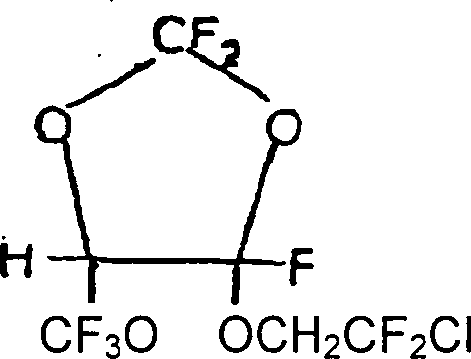
Das
Produkt wird nach dem Verfahren erhalten, das in Beispiel 2A beschrieben
ist, wobei 5,5 g (0,048 mol) ClCF2CH2OH, 15 ml tert.-Butylalkohol, 2,7 g (0,048
mol) KOH und 10 g (0,048 mol) Perfluor-4-methoxy-1,3-dioxol, erhalten
nach
Charakterisierung Perfluor-4-hydro-4-methoxy-5-(2-chlor-1,1-dihydroethoxy)-1,3-dioxolanCharacterization of perfluoro-4-hydro-4-methoxy-5- (2-chloro-1,1-dihydroethoxy) -1,3-dioxolane
- 19F-NMR in ppm, bezogen auf CFCl3= 0; 19 F-NMR in ppm, based on CFCl 3 = 0;
- Isomer syn:Isomer syn:
- –53,7, –58 (2F, -OCF2O, AB-System); –59,8 (3F, OCF3); –63,6 (2F, CF2Cl); –77,9 (1F, CF).-53,7, -58 (2F, -OCF 2 O, AB system); -59.8 (3F, OCF 3); -63.6 (2F, CF 2 Cl); -77.9 (1F, CF).
- Isomer anti:Isomer anti:
- –52,7, –58,1 (2F, -OCF2O, AB-System); –59,9 (3F, OCF3); –63,4 (2F, CF2Cl); –78,7 (1F, CF).-52.7, -58.1 (2F, -OCF 2 O, AB system); -59.9 (3F, OCF 3); -63.4 (2F, CF 2 Cl); -78.7 (1F, CF).
- 1H-NMR in ppm, bezogen auf TMS = 0: 1 H-NMR in ppm, based on TMS = 0:
- Isomer syn: 4,4 (2H, CH2); 5,88 (1H, CH).Isomer syn: 4.4 (2H, CH 2 ); 5.88 (1H, CH).
- Isomer anti: 4,35 (2H, CH2); 5,86 (1H, CH).Isomer anti: 4.35 (2H, CH 2 ); 5.86 (1H, CH).
- Massenspektrum (EI), Hauptpeaks und Zuordnungen:Mass spectrum (EI), main peaks and assignments:
- 241 (M+ – CF3Cl).241 (M + -CF 3 Cl).
- IR, Hauptbanden (cm–1):IR, major bands (cm -1 ):
- 3.030, 2.975, 1.422, 1.360, 1.320, 1.198, 1.051, 982, 892, 754, 677.3.030, 2.975, 1.422, 1.360, 1.320, 1.198, 1.051, 982, 892, 754, 677th
BEISPIEL 13BEXAMPLE 13B
Erhalt von Perfluor-4-hydro-4-methoxy-5-(1-hydrovinyloxy)-1,3-dioxolanObtaining perfluoro-4-hydro-4-methoxy-5- (1-hydrovinyloxy) -1,3-dioxolane
In einen 100 ml Dreihalsglaskolben, der mit einem Magnetrührer, einem Thermometer, einem Tropftrichter und einem Rückfluss versehen ist, werden 13,2 g (0,031 mol) der in Beispiel 13A erhaltenen Verbindung, 55 g einer 40 gew.-%igen wässrigen K2CO3-Lösung (Äquivalent mit 22 g – 0,065 mol Carbonat) und 2 g (0,008 mol) Tetrabutylammoniumhydroxid zugegeben. Man lässt die Mischung bei 60°C für 5 h unter heftigem Rühren reagieren. Sie wird gekühlt und durch HCl leicht saures Wasser wird zugegeben. Die organische Phase wird abgetrennt und getrocknet. 8,6 g Produkt mit einer Ausbeute von 95% werden erhalten.Into a 100 ml three-necked glass flask equipped with a magnetic stirrer, thermometer, dropping funnel and reflux are added 13.2 g (0.031 mol) of the compound obtained in Example 13A, 55 g of a 40% by weight aqueous K 2 CO 3 solution (equivalent to 22 g - 0.065 mol carbonate) and 2 g (0.008 mol) tetrabutylammonium hydroxide added. The mixture is allowed to react at 60 ° C for 5 h with vigorous stirring. It is cooled and slightly acidic water is added by HCl. The organic phase is separated and dried. 8.6 g of product are obtained with a yield of 95%.
Charakterisierung Perfluor-4-hydro-4-methoxy-5-(1-hydrovinyloxy)-1,3-dioxolanCharacterization of perfluoro-4-hydro-4-methoxy-5- (1-hydrovinyloxy) -1,3-dioxolane
- 19F-NMR in ppm, bezogen auf CFCl3= 0; 19 F-NMR in ppm, based on CFCl 3 = 0;
- Isomer syn: Isomer syn:
- –53,6, –58,1 (2F, -OCF2O, AB-System); -59,78 (3F, CF3); –78,6 (1F, CF); –91,8 (1F, C=CF2); –110,7 (1F, C=CF2).-53.6, -58.1 (2F, -OCF 2 O, AB system); -59.78 (3F, CF 3); -78.6 (1F, CF); -91.8 (1F, C = CF 2 ); -110.7 (1F, C = CF 2 ).
- Isomer anti:Isomer anti:
- –52,8, –58,2 (2F, -OCF2O, AB-System); –59,82 (3F, CF2); –92,2 (1F, C=CF2); –94,2 (1F, CF); –109,8 (1F, C=CF2).-52.8, -58.2 (2F, -OCF 2 O, AB system); -59.82 (3F, CF 2 ); -92.2 (1F, C = CF 2 ); -94.2 (1F, CF); -109.8 (1F, C = CF 2 ).
- 1H-NMR in ppm, bezogen auf TMS = 0: 1 H-NMR in ppm, based on TMS = 0:
- Isomer syn: 5,9 (1H, CH); 6,08 (1H, C=CH).Isomer syn: 5.9 (1H, CH); 6.08 (1H, C = CH).
- Isomer anti: 5,8 (1H, CH); 6,04 (1H, C=CH).Isomer anti: 5.8 (1H, CH); 6.04 (1H, C = CH).
- Massenspektrum (EI), Hauptpeaks und Zuordnungen:Mass spectrum (EI), main peaks and assignments:
- 290 (M+); 224 (M+ – COF2) 145 (C3HF4O2 +); 69 (CF3 +, 100%); 29 (CHO+).290 (M + ); 224 (M + - COF 2 ) 145 (C 3 HF 4 O 2 + ); 69 (CF 3 + , 100%); 29 (CHO + ).
- IR, Hauptbanden (cm–1):IR, major bands (cm -1 ):
- 3.153, 3.104, 3.031, 1.774, 1.360, 1.320, 1.198, 1.051, 936, 892, 790, 754, 677, 621, 543.3.153, 3.104, 3.031, 1.774, 1.360, 1.320, 1.198, 1.051, 936, 892, 790, 754, 677, 621, 543.
BEISPIEL 14EXAMPLE 14
Amorphes Copolymer CF2=CH-O-CF2CFHOCF3 und TFE 20/80Amorphous copolymer CF 2 = CH-O-CF 2 CFHOCF 3 and TFE 20/80
In einen 50 ml Stahlreaktor, der mit einer magnetischen Rührung und einem Einlass für die Reaktantenzugabe und die Entnahme und einer Kühlfalle (flüssiger N2) versehen ist, werden 100 μl Perfluorpropionylperoxid mit 6 Gew.-% in CCl2FCF2Cl, 0,98 g (4 mmol) CF2=CH-O-CF2CFHOCF3 (Bsp: 4) eingeleitet.Into a 50 ml steel reactor equipped with a magnetic stir and inlet for reactant addition and withdrawal and a cold trap (liquid N 2 ) is added 100 μl of perfluoropropionyl peroxide at 6% by weight in CCl 2 FCF 2 Cl, O, 98 g (4 mmol) CF 2 = CH-O-CF 2 CFHOCF 3 (Ex: 4) initiated.
Der Reaktor wird auf –196°C gekühlt und entgast. 12 mmol TFE werden zugegeben und der Reaktor wird im Innern auf 30°C erwärmt. Die Reaktion wird nach 5 h durch Erniedrigung der Temperatur auf die des flüssigen Stickstoffs gestoppt, wobei der Reaktor mit einer Vakuumrampe verbunden ist, die bei einem Druck von 10–3 mbar gehalten wird. Man lässt dann Raumtemperatur erreichen und gewinnt den Dampf in der auf –196°C gekühlten Falle.The reactor is cooled to -196 ° C and degassed. 12 mmol of TFE are added and the reactor is heated to 30 ° C. in the interior. The reaction is stopped after 5 hours by lowering the temperature to that of the liquid nitrogen, the reactor being connected to a vacuum ramp maintained at a pressure of 10 -3 mbar. It is then allowed to reach room temperature and the steam is recovered in the cooled to -196 ° C trap.
Nach Destillation des Lösungsmittels und der nicht umgesetzten Monomere und Strippen des Polymers im Vakuum bei 150°C für 5 h werden 432 mg Polymer gewonnen. Die Gewichtsbilanz, bestimmt durch GLC der Fallen, die nicht umgesetzte Monomere enthalten, ermöglicht es zu bestimmen, dass der molare Prozentsatz des Vinylethers im Polymer 20% beträgt. Das erhaltene Polymer ist amorph und zeigt eine Tg, bestimmt durch DSK, bei –6,4°C. Die TGA zeigt einen Gewichtsverlust von 10% bei 469°C.To Distillation of the solvent and the unreacted monomers and stripping the polymer in the Vacuum at 150 ° C for 5 h 432 mg of polymer are recovered. The weight balance, determined by GLC Traps containing unreacted monomers make it possible to determine that the molar percentage of vinyl ether in the polymer 20%. The resulting polymer is amorphous and shows a Tg determined by DSK, at -6.4 ° C. The TGA shows a weight loss of 10% at 469 ° C.
BEISPIEL 15EXAMPLE 15
Amorphes Copolymer Perfluor-4-hydro-4-methoxy-5-(1-hydrovinyloxy)-1,3-dioxolan und TFE 10/90Amorphous copolymer perfluoro-4-hydro-4-methoxy-5- (1-hydrovinyloxy) -1,3-dioxolane and TFE 10/90
In einen 50 ml Stahlreaktor, der mit magnetischer Rührung und einem Einlass für die Reaktantenzugabe und die Entnahme und mit einer Kühlfalle (flüssiger N2) versehen ist, werden 200 μl Perfluorpropionylperoxid von 6 Gew.-% in CCl2FCF2Cl, 1,45 g (5 mmol) Perfluor-4-hydro-4-methoxy-5-(1-hydrovinyloxy)-1,3-dioxolan (Bsp. 13) eingeleitet. Der Reaktor wird auf –196°C gekühlt und entgast. TFE (12 mmol) werden zugegeben und das Innere des Reaktors wird auf eine Temperatur von 35°C erwärmt. Die Reaktion wird nach 5 h gestoppt (60% TFE-Umsatz), wobei der Reaktor auf die Temperatur von flüssigem Stickstoff gekühlt und mit einer Vakuumrampe verbunden, die den Druck bei 10–3 mbar hält, verbunden wird. Man lässt dann Raumtemperatur erreichen, wobei der Dampf in der auf –196°C gekühlten Falle gewonnen wird.Into a 50 ml steel reactor equipped with magnetic agitation and an inlet for reactant addition and withdrawal and with a cold trap (liquid N 2 ), 200 μl perfluoropropionyl peroxide of 6% by weight in CCl 2 FCF 2 Cl, 1, 45 g (5 mmol) of perfluoro-4-hydro-4-methoxy-5- (1-hydrovinyloxy) -1,3-dioxolane (Ex. 13). The reactor is cooled to -196 ° C and degassed. TFE (12 mmol) is added and the inside of the reactor is heated to a temperature of 35 ° C. The reaction is stopped after 5 h (60% TFE conversion), the reactor cooled to the temperature of liquid nitrogen and connected to a vacuum ramp holding the pressure at 10 -3 mbar. The temperature is then allowed to reach room temperature, the steam being recovered in the trap cooled to -196 ° C.
Nach Destillation des Lösungsmittels und der nicht umgesetzten Monomere und Strippen des Polymers im Vakuum bei 150°C für 5 h werden 981 g Polymer gewonnen. Durch die Gewichtsbilanz, ausgeführt durch GLC, wird ermittelt, dass der molare Prozentsatz von Vinylether im Polymer 10% beträgt. Das Polymer ist amorph und zeigt eine TG, bestimmt durch DSK, bei 7,3°C. Die TGA zeigt einen Gewichtsverlust von 10% bei 448°C.To Distillation of the solvent and the unreacted monomers and stripping the polymer in the Vacuum at 150 ° C for 5 h 981 g of polymer are recovered. Through the weight balance, performed by GLC, it is determined that the molar percentage of vinyl ether in the polymer is 10%. The polymer is amorphous and indicates a TG as determined by DSK 7.3 ° C. The TGA shows a weight loss of 10% at 448 ° C.
BEISPIEL 16EXAMPLE 16
Copolymer CF2=CH-O-CF2CFHOCF2CF2O(CF2O)4CF3/TFE 15/85Copolymer CF 2 = CH-O-CF 2 CFHOCF 2 CF 2 O (CF 2 O) 4 CF 3 / TFE 15/85
In einen 50 ml Stahlreaktor, der mit magnetischer Rührung und einem Einlass für die Reaktantenzugabe und die Entnahme und mit einer Kühlfalle (flüssiger N2) versehen ist, werden 200 μl Perfluorpropionylperoxid von 6 Gew.-% in CCl2FCF2Cl eingeleitet, wobei 1,56 g (2,5 mmol) CF2=CH-O-CF2CFHOCF2CF2O(CF2O)4CF3 (Bsp. 12) zugegeben werden. TFE (12 mmol) wird zugegeben und die Temperatur im Reaktor wird auf 35°C erhöht. Die Reaktion wird gestoppt, wenn der TFE-Umsatz 70% beträgt, wobei der Reaktor auf die Temperatur von flüssigem Stickstoff gekühlt wird und mit einer Vakuumrampe verbunden wird, die bei einem Druck von 10–3 mbar gehalten wird. Man lässt dann Raumtemperatur erreichen, wobei der Dampf in der auf –196°C gekühlten Falle gewonnen wird.Into a 50 ml steel reactor equipped with magnetic agitation and an inlet for the addition and withdrawal of reactants and with a cold trap (liquid N 2 ) are introduced 200 μl perfluoropropionyl peroxide of 6% by weight in CCl 2 FCF 2 Cl, 1.56 g (2.5 mmol) CF 2 = CH-O-CF 2 CFHOCF 2 CF 2 O (CF 2 O) 4 CF 3 (Ex 12). TFE (12 mmol) is added and the temperature in the reactor is raised to 35 ° C. The reaction is stopped when the TFE conversion is 70%, the reactor being cooled to the liquid nitrogen temperature and connected to a vacuum ramp maintained at a pressure of 10 -3 mbar. The temperature is then allowed to reach room temperature, the steam being recovered in the trap cooled to -196 ° C.
Das Lösungsmittel und die nicht umgesetzten Monomere werden destilliert und dann wird das Polymer im Vakuum bei 150°C für 5 h gestrippt.The solvent and the unreacted monomers are distilled and then the polymer in vacuo at 150 ° C. for 5 h stripped.
Aus der Gewichtsbilanz, bestimmt durch GLC auf Basis des Gehalts an nicht umgesetztem Monomer in der Falle, ergibt sich, dass der Vinyletherprozentsatz im Polymer 15% beträgt. Das erhaltene Polymer ist amorph und zeigt eine Tg, bestimmt durch DSK, von –80°C.Out the weight balance, determined by GLC on the basis of the salary unreacted monomer in the trap, it follows that the vinyl ether percentage in the polymer is 15%. The resulting polymer is amorphous and shows a Tg determined by DSK, from -80 ° C.
BEISPIEL 17EXAMPLE 17
Copolymer CF2=CH-O-CF2CFHOCF2CF2O(CF2O)4CF2/TFE 28/72Copolymer CF 2 = CH-O-CF 2 CFHOCF 2 CF 2 O (CF 2 O) 4 CF 2 / TFE 28/72
In einen 50 ml Reaktor, der mit magnetischer Rührung und einem Einlass für die Reaktantenzugabe und die Entnahme und einer Kühlfalle (flüssiger N2) versehen ist, werden 200 μl Perfluorpropionylperoxid mit 6 Gew.-% in CCl2FCF2Cl, 3,13 g (5 mmol) CF2=CH-O-CF2CFHOCF2CF2O(CF2O)4CF3 (Bsp. 12) eingeleitet. Der Reaktor wird auf –196°C gekühlt und entgast. TFE (12 mmol) wird zugegeben und die Temperatur im Reaktor wird auf 35°C erhöht. Die Reaktion wird gestoppt, wenn der TFE-Umsatz 65% beträgt, indem der Reaktor auf die Temperatur von flüssigem Stickstoff gekühlt wird, wobei mit einer Vakuumrampe verbunden wird, die bei einem Druck von 10–3 mbar gehalten wird. Man lässt dann Raumtemperatur erreichen, wobei der Dampf in der auf –196°C gekühlten Falle gewonnen wird.Into a 50 ml reactor provided with magnetic agitation and an inlet for reactant addition and withdrawal and a cold trap (liquid N 2 ) are added 200 μl of perfluoropropionyl peroxide at 6% by weight in CCl 2 FCF 2 Cl, 3.13 g (5 mmol) CF 2 = CH-O-CF 2 CFHOCF 2 CF 2 O (CF 2 O) 4 CF 3 (Ex. 12). The reactor is cooled to -196 ° C and degassed. TFE (12 mmol) is added and the temperature in the reactor is raised to 35 ° C. The reaction is stopped when the TFE conversion is 65% by cooling the reactor to the temperature of liquid nitrogen, which is connected to a vacuum ramp maintained at a pressure of 10 -3 mbar. The temperature is then allowed to reach room temperature, the steam being recovered in the trap cooled to -196 ° C.
Nach Destillation des Lösungsmittels und der nicht umgesetzten Monomere und Strippen des Polymers im Vakuum bei 150°C für 5 h ergibt sich aus der Gewichtsbilanz, bestimmt durch GLC auf Basis des Gehalts an nicht umgesetztem Monomer in der Falle, dass der Vinyletherprozentsatz im Polymer 28% beträgt.To Distillation of the solvent and the unreacted monomers and stripping the polymer in the Vacuum at 150 ° C for 5 h results from the weight balance, determined by GLC on basis the content of unreacted monomer in the case that the Vinyl ether percentage in the polymer is 28%.
BEISPIEL 18 (Vergleich)EXAMPLE 18 (comparative)
Copolymer CF2=CF-O-CF2CF2OCF2CF2O(CF2O)4CF3/TFE 18/72Copolymer CF 2 = CF-O-CF 2 CF 2 OCF 2 CF 2 O (CF 2 O) 4 CF 3 / TFE 18/72
Durch
Wiederholen von Beispiel 17, wobei aber statt CF2=CH-O-CF2CFHO-CF2CF2O(CF2O)4CF3 der Perfluorvinylether
CF2=CF-O-CF2CF2OCF2CF2O(CF2O)4-CF3,
erhalten nach dem US-Patent 3817960, in den gleichen Molmengen verwendet
wird, ergibt sich, dass der Prozentsatz an Perfluorvinylether im
Polymer 18% ist. Das Polymer ist amorph und zeigt eine Tg, bestimmt
durch DSK, bei –72,5°C. TABELLE
1 
Claims (10)


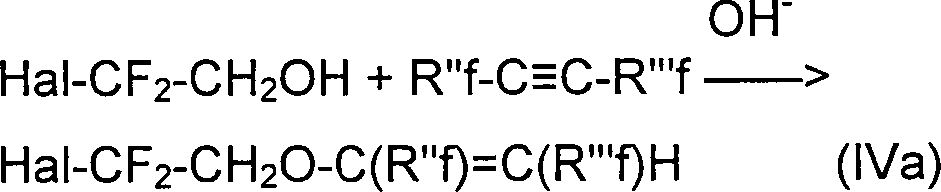
Applications Claiming Priority (2)
| Application Number | Priority Date | Filing Date | Title |
|---|---|---|---|
| IT1998MI001792A IT1301973B1 (en) | 1998-07-31 | 1998-07-31 | HYDRO-FLUOROALKYLVINYLETERS AND PROCEDURE FOR THEIR OBTAINING |
| ITMI981792 | 1998-07-31 |
Publications (2)
| Publication Number | Publication Date |
|---|---|
| DE69918229D1 DE69918229D1 (en) | 2004-07-29 |
| DE69918229T2 true DE69918229T2 (en) | 2005-07-21 |
Family
ID=11380576
Family Applications (1)
| Application Number | Title | Priority Date | Filing Date |
|---|---|---|---|
| DE69918229T Expired - Lifetime DE69918229T2 (en) | 1998-07-31 | 1999-07-29 | Hydrofluoroalkylvinylether and their production process |
Country Status (5)
| Country | Link |
|---|---|
| US (1) | US6300526B1 (en) |
| EP (1) | EP0976706B1 (en) |
| JP (1) | JP4441015B2 (en) |
| DE (1) | DE69918229T2 (en) |
| IT (1) | IT1301973B1 (en) |
Families Citing this family (15)
| Publication number | Priority date | Publication date | Assignee | Title |
|---|---|---|---|---|
| JP4492764B2 (en) * | 1999-05-24 | 2010-06-30 | 日本ゼオン株式会社 | Plasma reaction gas and method for producing the same |
| IT1318488B1 (en) * | 2000-04-21 | 2003-08-25 | Ausimont Spa | FLUOROVINYLETERS AND POLYMERS THAT CAN BE OBTAINED. |
| IT1318487B1 (en) * | 2000-04-21 | 2003-08-25 | Ausimont Spa | FLUORO-ELASTOMERS. |
| US7534845B2 (en) | 2000-04-21 | 2009-05-19 | Solvay Solexis S.P.A. | Fluorovinyl ethers and polymers obtainable therefrom |
| CA2328433A1 (en) * | 2000-12-20 | 2002-06-20 | Hydro-Quebec | Cross-linkable low tg fluorosulfonated nitrile elastomers with a vinylidene fluoride base and not containing either tetrafluoroethylene or the siloxane group |
| EP1239003B1 (en) * | 2001-03-09 | 2005-08-03 | Asahi Glass Company, Limited | Process for recovering fluoropolymers |
| ATE366755T1 (en) * | 2001-05-07 | 2007-08-15 | Solvay Solexis Spa | AMORPHOUS PERFLUORINATED POLYMERS |
| EP2303817B1 (en) * | 2008-06-09 | 2012-12-05 | Solvay Specialty Polymers Italy S.p.A. | Method for manufacturing perfluorovinylethers |
| EP3046964B1 (en) | 2013-09-20 | 2021-01-13 | 3M Innovative Properties Company | Polymer processing additive, compositions, and methods |
| US10453675B2 (en) | 2013-09-20 | 2019-10-22 | Versum Materials Us, Llc | Organoaminosilane precursors and methods for depositing films comprising same |
| JP2017538833A (en) | 2014-12-19 | 2017-12-28 | スリーエム イノベイティブ プロパティズ カンパニー | Poly (oxyalkylene) polymer processing additives, compositions and methods |
| CN111094256A (en) * | 2017-10-05 | 2020-05-01 | 株式会社艾迪科 | Compound, latent ultraviolet absorber, composition, cured product, and manufacturing method of cured product |
| JP7148787B2 (en) * | 2018-07-10 | 2022-10-06 | ダイキン工業株式会社 | New fluorine-containing compound |
| JP7729484B2 (en) * | 2022-05-17 | 2025-08-26 | Dic株式会社 | Hydroxyl group-containing compounds, curable resin compositions, cured products and laminates |
| WO2023224824A1 (en) * | 2022-05-17 | 2023-11-23 | Dupont Specialty Products Usa, Llc | Method of making halo (alkyl vinyl) ether monomers and fluorinated polymers made with the halo (alkyl vinyl) ether monomer |
Family Cites Families (7)
| Publication number | Priority date | Publication date | Assignee | Title |
|---|---|---|---|---|
| US3159609A (en) | 1956-10-26 | 1964-12-01 | Du Pont | Copolymers of perfluorovinyl ethers |
| US3642742A (en) | 1969-04-22 | 1972-02-15 | Du Pont | Tough stable tetrafluoroethylene-fluoroalkyl perfluorovinyl ether copolymers |
| CA950923A (en) | 1971-03-29 | 1974-07-09 | E. I. Du Pont De Nemours And Company | Polymers of perfluorovinyl ethers |
| US4621116A (en) | 1984-12-07 | 1986-11-04 | E. I. Du Pont De Nemours And Company | Process for copolymerization of tetrafluoroethylene in the presence of a dispersing agent comprising a perfluoroalkoxybenzene sulfonic acid or salt |
| US4948844A (en) * | 1988-04-16 | 1990-08-14 | Tokuyama Soda Kabushiki Kaisha | Process for preparation of perfluorinated copolymer |
| JP3327016B2 (en) * | 1994-12-06 | 2002-09-24 | ダイキン工業株式会社 | Fluororubber copolymer excellent in low-temperature sealability and its curing composition |
| EP0865452B1 (en) | 1995-06-08 | 2000-03-01 | E.I. Du Pont De Nemours And Company | Base resistant fluorinated polymers |
-
1998
- 1998-07-31 IT IT1998MI001792A patent/IT1301973B1/en active IP Right Grant
-
1999
- 1999-07-29 EP EP99114822A patent/EP0976706B1/en not_active Expired - Lifetime
- 1999-07-29 US US09/362,706 patent/US6300526B1/en not_active Expired - Lifetime
- 1999-07-29 JP JP21514799A patent/JP4441015B2/en not_active Expired - Fee Related
- 1999-07-29 DE DE69918229T patent/DE69918229T2/en not_active Expired - Lifetime
Also Published As
| Publication number | Publication date |
|---|---|
| ITMI981792A1 (en) | 2000-01-31 |
| ITMI981792A0 (en) | 1998-07-31 |
| JP2000063313A (en) | 2000-02-29 |
| DE69918229D1 (en) | 2004-07-29 |
| JP4441015B2 (en) | 2010-03-31 |
| US6300526B1 (en) | 2001-10-09 |
| EP0976706A1 (en) | 2000-02-02 |
| IT1301973B1 (en) | 2000-07-20 |
| EP0976706B1 (en) | 2004-06-23 |
Similar Documents
| Publication | Publication Date | Title |
|---|---|---|
| DE69402473T2 (en) | Perfluorodioxoles, their production and their homopolymers and copolymers | |
| DE69304515T2 (en) | Hydrofluorocarbon solvent for the polymerisation of fluorinated monomers | |
| DE69704815T2 (en) | Fluorosurfactant containing hydrogen and its use in polymerization | |
| KR100791504B1 (en) | Fluorovinyl ether and polymers obtained therefrom | |
| DE1645126C3 (en) | Homopolymers and copolymers of perfluoro (2-methylene-4-methyl-1,3-dioxolane) and processes for their preparation | |
| DE69110664T2 (en) | HYDROXYLATED FLUORVINYL COMPOUNDS AND THEIR POLYMERS. | |
| DE60205841T2 (en) | perfluoroelastomers | |
| EP1367071B1 (en) | Fluorine-containing compounds and polymers and processes for producing the same | |
| US4515989A (en) | Preparation decarboxylation and polymerization of novel acid flourides and resulting monomers | |
| DE69509489T2 (en) | Thermally processable tetrafluoroethylene copolymers | |
| DE69901852T2 (en) | Perfluorodioxolen | |
| DE69315593T2 (en) | FLUORINATED MONOMERS AND POLYMERS | |
| EP0976706B1 (en) | Hydro-fluoroalkylvinylethers and process for obtaining them | |
| DE60123947T2 (en) | NEW FLUOR CONNECTION, PROCESS FOR THEIR MANUFACTURE, AND YOUR POLYMER | |
| DE69403692T2 (en) | Radical (co) polymerization process of fluorine-containing olefinic monomers | |
| RU2271368C2 (en) | Fluoroelastomers | |
| US4687821A (en) | Preparation, decarboxylation and polymerization of novel acid fluorides and resulting monomers | |
| US6469185B1 (en) | Perfluorodioxoles | |
| DE69202764T2 (en) | PERFLUORED CYCLIC POLYETHER, USED AS LUBRICANTS AND HEAT TRANSFER LIQUIDS. | |
| DE69011337T2 (en) | POLYHALODIHYDRODIOXINES AND POLYHALODIOXOLES. | |
| DE69106705T2 (en) | FUNCTIONALIZED TRIFLUORVINYL ETHERS AND POLYMERS THEREOF. | |
| DE69720082T2 (en) | METHOD FOR PRODUCING FLUORINATED SULFINATES | |
| EP0613485B1 (en) | Thermoplastic fluorocopolymers, and method of preparing fluoromonomer for use in the manufacture of the fluorocopolymer | |
| DE2411170A1 (en) | PERFLUOROMETHYLENE CYCLOPROPANE POLYMERISATE | |
| DE2708677B2 (en) | Process for the preparation of alkoxycarbonyl perfluoroalkyl perfluorovinyl ethers |
Legal Events
| Date | Code | Title | Description |
|---|---|---|---|
| 8364 | No opposition during term of opposition |