DE69918170T2 - COATING COMPOSITION WITH MODIFIED CARBAMATE FUNCTIONAL ACRYLIC BINDING AGENT - Google Patents
COATING COMPOSITION WITH MODIFIED CARBAMATE FUNCTIONAL ACRYLIC BINDING AGENT Download PDFInfo
- Publication number
- DE69918170T2 DE69918170T2 DE69918170T DE69918170T DE69918170T2 DE 69918170 T2 DE69918170 T2 DE 69918170T2 DE 69918170 T DE69918170 T DE 69918170T DE 69918170 T DE69918170 T DE 69918170T DE 69918170 T2 DE69918170 T2 DE 69918170T2
- Authority
- DE
- Germany
- Prior art keywords
- carbamate
- group
- groups
- acrylic resin
- coating composition
- Prior art date
- Legal status (The legal status is an assumption and is not a legal conclusion. Google has not performed a legal analysis and makes no representation as to the accuracy of the status listed.)
- Expired - Lifetime
Links
- 239000008199 coating composition Substances 0.000 title claims description 38
- 239000011230 binding agent Substances 0.000 title description 3
- 150000004657 carbamic acid derivatives Chemical class 0.000 title 1
- 125000002887 hydroxy group Chemical group [H]O* 0.000 claims description 58
- KXDHJXZQYSOELW-UHFFFAOYSA-N Carbamic acid Chemical group NC(O)=O KXDHJXZQYSOELW-UHFFFAOYSA-N 0.000 claims description 46
- 238000000034 method Methods 0.000 claims description 40
- 229920000178 Acrylic resin Polymers 0.000 claims description 37
- 239000004925 Acrylic resin Substances 0.000 claims description 37
- 238000006243 chemical reaction Methods 0.000 claims description 35
- -1 alkyl carbamate Chemical compound 0.000 claims description 29
- 150000001875 compounds Chemical class 0.000 claims description 26
- 239000000203 mixture Substances 0.000 claims description 26
- XSQUKJJJFZCRTK-UHFFFAOYSA-N urea group Chemical group NC(=O)N XSQUKJJJFZCRTK-UHFFFAOYSA-N 0.000 claims description 25
- 239000004971 Cross linker Substances 0.000 claims description 24
- 229920003180 amino resin Polymers 0.000 claims description 23
- 239000000178 monomer Substances 0.000 claims description 23
- 238000000576 coating method Methods 0.000 claims description 22
- QGZKDVFQNNGYKY-UHFFFAOYSA-N Ammonia Chemical compound N QGZKDVFQNNGYKY-UHFFFAOYSA-N 0.000 claims description 14
- 239000012948 isocyanate Substances 0.000 claims description 14
- 238000006116 polymerization reaction Methods 0.000 claims description 14
- 239000011248 coating agent Substances 0.000 claims description 13
- 125000002947 alkylene group Chemical group 0.000 claims description 12
- 150000002513 isocyanates Chemical class 0.000 claims description 11
- 125000000217 alkyl group Chemical group 0.000 claims description 10
- 229920000877 Melamine resin Polymers 0.000 claims description 9
- 150000005676 cyclic carbonates Chemical group 0.000 claims description 8
- 239000000126 substance Substances 0.000 claims description 8
- 150000001735 carboxylic acids Chemical class 0.000 claims description 7
- 238000005809 transesterification reaction Methods 0.000 claims description 7
- JOYRKODLDBILNP-UHFFFAOYSA-N Ethyl urethane Chemical compound CCOC(N)=O JOYRKODLDBILNP-UHFFFAOYSA-N 0.000 claims description 6
- 229910021529 ammonia Inorganic materials 0.000 claims description 6
- 125000002993 cycloalkylene group Chemical group 0.000 claims description 6
- GTCAXTIRRLKXRU-UHFFFAOYSA-N methyl carbamate Chemical compound COC(N)=O GTCAXTIRRLKXRU-UHFFFAOYSA-N 0.000 claims description 6
- 239000000758 substrate Substances 0.000 claims description 6
- 238000001321 HNCO Methods 0.000 claims description 5
- OWIKHYCFFJSOEH-UHFFFAOYSA-N Isocyanic acid Chemical compound N=C=O OWIKHYCFFJSOEH-UHFFFAOYSA-N 0.000 claims description 5
- 125000000732 arylene group Chemical group 0.000 claims description 5
- OHJMTUPIZMNBFR-UHFFFAOYSA-N biuret Chemical group NC(=O)NC(N)=O OHJMTUPIZMNBFR-UHFFFAOYSA-N 0.000 claims description 4
- AVWRKZWQTYIKIY-UHFFFAOYSA-N urea-1-carboxylic acid Chemical group NC(=O)NC(O)=O AVWRKZWQTYIKIY-UHFFFAOYSA-N 0.000 claims description 4
- BSBQJOWZSCCENI-UHFFFAOYSA-N 3-hydroxypropyl carbamate Chemical compound NC(=O)OCCCO BSBQJOWZSCCENI-UHFFFAOYSA-N 0.000 claims description 3
- 150000008065 acid anhydrides Chemical class 0.000 claims description 3
- 150000008064 anhydrides Chemical class 0.000 claims description 3
- OZDFMZUKOBBNHM-UHFFFAOYSA-N 2-ethylhexyl carbamate Chemical compound CCCCC(CC)COC(N)=O OZDFMZUKOBBNHM-UHFFFAOYSA-N 0.000 claims description 2
- BTDQXGUEVVTAMD-UHFFFAOYSA-N 2-hydroxyethyl carbamate Chemical compound NC(=O)OCCO BTDQXGUEVVTAMD-UHFFFAOYSA-N 0.000 claims description 2
- SKKTUOZKZKCGTB-UHFFFAOYSA-N butyl carbamate Chemical compound CCCCOC(N)=O SKKTUOZKZKCGTB-UHFFFAOYSA-N 0.000 claims description 2
- VPKDCDLSJZCGKE-UHFFFAOYSA-N carbodiimide group Chemical group N=C=N VPKDCDLSJZCGKE-UHFFFAOYSA-N 0.000 claims description 2
- 239000011247 coating layer Substances 0.000 claims description 2
- AUELWJRRASQDKI-UHFFFAOYSA-N cyclohexyl carbamate Chemical compound NC(=O)OC1CCCCC1 AUELWJRRASQDKI-UHFFFAOYSA-N 0.000 claims description 2
- 125000000623 heterocyclic group Chemical group 0.000 claims description 2
- YNTOKMNHRPSGFU-UHFFFAOYSA-N n-Propyl carbamate Chemical compound CCCOC(N)=O YNTOKMNHRPSGFU-UHFFFAOYSA-N 0.000 claims description 2
- HNHVTXYLRVGMHD-UHFFFAOYSA-N n-butyl isocyanate Chemical compound CCCCN=C=O HNHVTXYLRVGMHD-UHFFFAOYSA-N 0.000 claims description 2
- BSCCSDNZEIHXOK-UHFFFAOYSA-N phenyl carbamate Chemical compound NC(=O)OC1=CC=CC=C1 BSCCSDNZEIHXOK-UHFFFAOYSA-N 0.000 claims description 2
- OVPLZYJGTGDFNB-UHFFFAOYSA-N propan-2-yl carbamate Chemical compound CC(C)OC(N)=O OVPLZYJGTGDFNB-UHFFFAOYSA-N 0.000 claims description 2
- 150000001348 alkyl chlorides Chemical class 0.000 claims 1
- 150000001350 alkyl halides Chemical class 0.000 claims 1
- 239000002184 metal Substances 0.000 claims 1
- 229920000058 polyacrylate Polymers 0.000 description 21
- KXDHJXZQYSOELW-UHFFFAOYSA-M Carbamate Chemical compound NC([O-])=O KXDHJXZQYSOELW-UHFFFAOYSA-M 0.000 description 15
- OKKJLVBELUTLKV-UHFFFAOYSA-N Methanol Chemical class OC OKKJLVBELUTLKV-UHFFFAOYSA-N 0.000 description 14
- 229920005989 resin Polymers 0.000 description 14
- 239000011347 resin Substances 0.000 description 14
- 239000002253 acid Chemical group 0.000 description 13
- 239000003054 catalyst Substances 0.000 description 13
- 238000001723 curing Methods 0.000 description 13
- 239000002904 solvent Substances 0.000 description 11
- 230000007613 environmental effect Effects 0.000 description 10
- 238000005886 esterification reaction Methods 0.000 description 10
- 230000015572 biosynthetic process Effects 0.000 description 9
- 229920000642 polymer Polymers 0.000 description 9
- 125000004432 carbon atom Chemical group C* 0.000 description 8
- 239000002131 composite material Substances 0.000 description 8
- RTZKZFJDLAIYFH-UHFFFAOYSA-N ether Substances CCOCC RTZKZFJDLAIYFH-UHFFFAOYSA-N 0.000 description 8
- 235000013877 carbamide Nutrition 0.000 description 7
- 230000032050 esterification Effects 0.000 description 7
- 239000003973 paint Substances 0.000 description 7
- 239000011541 reaction mixture Substances 0.000 description 7
- DNIAPMSPPWPWGF-UHFFFAOYSA-N Propylene glycol Chemical compound CC(O)CO DNIAPMSPPWPWGF-UHFFFAOYSA-N 0.000 description 6
- 239000004202 carbamide Substances 0.000 description 6
- 230000000052 comparative effect Effects 0.000 description 5
- 238000005530 etching Methods 0.000 description 5
- VOZRXNHHFUQHIL-UHFFFAOYSA-N glycidyl methacrylate Chemical compound CC(=C)C(=O)OCC1CO1 VOZRXNHHFUQHIL-UHFFFAOYSA-N 0.000 description 5
- IQPQWNKOIGAROB-UHFFFAOYSA-N isocyanate group Chemical group [N-]=C=O IQPQWNKOIGAROB-UHFFFAOYSA-N 0.000 description 5
- 150000002924 oxiranes Chemical group 0.000 description 5
- 238000003786 synthesis reaction Methods 0.000 description 5
- OZAIFHULBGXAKX-UHFFFAOYSA-N 2-(2-cyanopropan-2-yldiazenyl)-2-methylpropanenitrile Chemical compound N#CC(C)(C)N=NC(C)(C)C#N OZAIFHULBGXAKX-UHFFFAOYSA-N 0.000 description 4
- CURLTUGMZLYLDI-UHFFFAOYSA-N Carbon dioxide Chemical compound O=C=O CURLTUGMZLYLDI-UHFFFAOYSA-N 0.000 description 4
- VZCYOOQTPOCHFL-OWOJBTEDSA-N Fumaric acid Chemical compound OC(=O)\C=C\C(O)=O VZCYOOQTPOCHFL-OWOJBTEDSA-N 0.000 description 4
- CERQOIWHTDAKMF-UHFFFAOYSA-N Methacrylic acid Chemical compound CC(=C)C(O)=O CERQOIWHTDAKMF-UHFFFAOYSA-N 0.000 description 4
- LRHPLDYGYMQRHN-UHFFFAOYSA-N N-Butanol Chemical compound CCCCO LRHPLDYGYMQRHN-UHFFFAOYSA-N 0.000 description 4
- PPBRXRYQALVLMV-UHFFFAOYSA-N Styrene Chemical compound C=CC1=CC=CC=C1 PPBRXRYQALVLMV-UHFFFAOYSA-N 0.000 description 4
- BVKZGUZCCUSVTD-UHFFFAOYSA-N carbonic acid Chemical compound OC(O)=O BVKZGUZCCUSVTD-UHFFFAOYSA-N 0.000 description 4
- 125000000524 functional group Chemical group 0.000 description 4
- 150000004820 halides Chemical class 0.000 description 4
- 150000002596 lactones Chemical class 0.000 description 4
- 238000002360 preparation method Methods 0.000 description 4
- LLHKCFNBLRBOGN-UHFFFAOYSA-N propylene glycol methyl ether acetate Chemical compound COCC(C)OC(C)=O LLHKCFNBLRBOGN-UHFFFAOYSA-N 0.000 description 4
- 239000000376 reactant Substances 0.000 description 4
- 239000007787 solid Substances 0.000 description 4
- VZCYOOQTPOCHFL-UHFFFAOYSA-N trans-butenedioic acid Natural products OC(=O)C=CC(O)=O VZCYOOQTPOCHFL-UHFFFAOYSA-N 0.000 description 4
- ZWEHNKRNPOVVGH-UHFFFAOYSA-N 2-Butanone Chemical compound CCC(C)=O ZWEHNKRNPOVVGH-UHFFFAOYSA-N 0.000 description 3
- GOXQRTZXKQZDDN-UHFFFAOYSA-N 2-Ethylhexyl acrylate Chemical compound CCCCC(CC)COC(=O)C=C GOXQRTZXKQZDDN-UHFFFAOYSA-N 0.000 description 3
- QTBSBXVTEAMEQO-UHFFFAOYSA-N Acetic acid Chemical compound CC(O)=O QTBSBXVTEAMEQO-UHFFFAOYSA-N 0.000 description 3
- WFDIJRYMOXRFFG-UHFFFAOYSA-N Acetic anhydride Chemical compound CC(=O)OC(C)=O WFDIJRYMOXRFFG-UHFFFAOYSA-N 0.000 description 3
- OFOBLEOULBTSOW-UHFFFAOYSA-N Propanedioic acid Natural products OC(=O)CC(O)=O OFOBLEOULBTSOW-UHFFFAOYSA-N 0.000 description 3
- UKLDJPRMSDWDSL-UHFFFAOYSA-L [dibutyl(dodecanoyloxy)stannyl] dodecanoate Chemical compound CCCCCCCCCCCC(=O)O[Sn](CCCC)(CCCC)OC(=O)CCCCCCCCCCC UKLDJPRMSDWDSL-UHFFFAOYSA-L 0.000 description 3
- 230000002378 acidificating effect Effects 0.000 description 3
- 150000007513 acids Chemical class 0.000 description 3
- NIXOWILDQLNWCW-UHFFFAOYSA-N acrylic acid group Chemical group C(C=C)(=O)O NIXOWILDQLNWCW-UHFFFAOYSA-N 0.000 description 3
- 239000000654 additive Substances 0.000 description 3
- KQWGXHWJMSMDJJ-UHFFFAOYSA-N cyclohexyl isocyanate Chemical compound O=C=NC1CCCCC1 KQWGXHWJMSMDJJ-UHFFFAOYSA-N 0.000 description 3
- 239000012975 dibutyltin dilaurate Substances 0.000 description 3
- 238000011156 evaluation Methods 0.000 description 3
- 239000000945 filler Substances 0.000 description 3
- 238000004519 manufacturing process Methods 0.000 description 3
- 239000000463 material Substances 0.000 description 3
- 150000002734 metacrylic acid derivatives Chemical class 0.000 description 3
- 125000000466 oxiranyl group Chemical group 0.000 description 3
- 125000000391 vinyl group Chemical group [H]C([*])=C([H])[H] 0.000 description 3
- XLYOFNOQVPJJNP-UHFFFAOYSA-N water Substances O XLYOFNOQVPJJNP-UHFFFAOYSA-N 0.000 description 3
- ARXJGSRGQADJSQ-UHFFFAOYSA-N 1-methoxypropan-2-ol Chemical compound COCC(C)O ARXJGSRGQADJSQ-UHFFFAOYSA-N 0.000 description 2
- SMZOUWXMTYCWNB-UHFFFAOYSA-N 2-(2-methoxy-5-methylphenyl)ethanamine Chemical compound COC1=CC=C(C)C=C1CCN SMZOUWXMTYCWNB-UHFFFAOYSA-N 0.000 description 2
- HGINCPLSRVDWNT-UHFFFAOYSA-N Acrolein Chemical compound C=CC=O HGINCPLSRVDWNT-UHFFFAOYSA-N 0.000 description 2
- SOGAXMICEFXMKE-UHFFFAOYSA-N Butylmethacrylate Chemical compound CCCCOC(=O)C(C)=C SOGAXMICEFXMKE-UHFFFAOYSA-N 0.000 description 2
- FERIUCNNQQJTOY-UHFFFAOYSA-N Butyric acid Chemical compound CCCC(O)=O FERIUCNNQQJTOY-UHFFFAOYSA-N 0.000 description 2
- 239000004640 Melamine resin Substances 0.000 description 2
- VVQNEPGJFQJSBK-UHFFFAOYSA-N Methyl methacrylate Chemical compound COC(=O)C(C)=C VVQNEPGJFQJSBK-UHFFFAOYSA-N 0.000 description 2
- BLRPTPMANUNPDV-UHFFFAOYSA-N Silane Chemical compound [SiH4] BLRPTPMANUNPDV-UHFFFAOYSA-N 0.000 description 2
- 229920001807 Urea-formaldehyde Polymers 0.000 description 2
- 230000001133 acceleration Effects 0.000 description 2
- WDJHALXBUFZDSR-UHFFFAOYSA-N acetoacetic acid Chemical group CC(=O)CC(O)=O WDJHALXBUFZDSR-UHFFFAOYSA-N 0.000 description 2
- 230000000996 additive effect Effects 0.000 description 2
- GZCGUPFRVQAUEE-SLPGGIOYSA-N aldehydo-D-glucose Chemical compound OC[C@@H](O)[C@@H](O)[C@H](O)[C@@H](O)C=O GZCGUPFRVQAUEE-SLPGGIOYSA-N 0.000 description 2
- 125000001931 aliphatic group Chemical group 0.000 description 2
- 125000005907 alkyl ester group Chemical group 0.000 description 2
- 150000001412 amines Chemical class 0.000 description 2
- 229940072049 amyl acetate Drugs 0.000 description 2
- 239000012298 atmosphere Substances 0.000 description 2
- VSKFADHADUWCCL-UHFFFAOYSA-N carbamoperoxoic acid Chemical compound NC(=O)OO VSKFADHADUWCCL-UHFFFAOYSA-N 0.000 description 2
- 239000001569 carbon dioxide Substances 0.000 description 2
- 229910002092 carbon dioxide Inorganic materials 0.000 description 2
- 230000015556 catabolic process Effects 0.000 description 2
- 238000004132 cross linking Methods 0.000 description 2
- KBLWLMPSVYBVDK-UHFFFAOYSA-N cyclohexyl prop-2-enoate Chemical compound C=CC(=O)OC1CCCCC1 KBLWLMPSVYBVDK-UHFFFAOYSA-N 0.000 description 2
- 238000006731 degradation reaction Methods 0.000 description 2
- 125000004185 ester group Chemical group 0.000 description 2
- 239000001530 fumaric acid Substances 0.000 description 2
- 239000004922 lacquer Substances 0.000 description 2
- 239000010410 layer Substances 0.000 description 2
- VZCYOOQTPOCHFL-UPHRSURJSA-N maleic acid Chemical compound OC(=O)\C=C/C(O)=O VZCYOOQTPOCHFL-UPHRSURJSA-N 0.000 description 2
- 239000011976 maleic acid Substances 0.000 description 2
- 150000007974 melamines Chemical class 0.000 description 2
- 238000010422 painting Methods 0.000 description 2
- 239000000049 pigment Substances 0.000 description 2
- 239000004848 polyfunctional curative Substances 0.000 description 2
- 239000005056 polyisocyanate Substances 0.000 description 2
- 229920001228 polyisocyanate Polymers 0.000 description 2
- 229920002635 polyurethane Polymers 0.000 description 2
- 239000004814 polyurethane Substances 0.000 description 2
- 125000002924 primary amino group Chemical group [H]N([H])* 0.000 description 2
- 239000000047 product Substances 0.000 description 2
- 238000010992 reflux Methods 0.000 description 2
- 229910000077 silane Inorganic materials 0.000 description 2
- ISXSCDLOGDJUNJ-UHFFFAOYSA-N tert-butyl prop-2-enoate Chemical compound CC(C)(C)OC(=O)C=C ISXSCDLOGDJUNJ-UHFFFAOYSA-N 0.000 description 2
- 238000005979 thermal decomposition reaction Methods 0.000 description 2
- JOXIMZWYDAKGHI-UHFFFAOYSA-N toluene-4-sulfonic acid Chemical compound CC1=CC=C(S(O)(=O)=O)C=C1 JOXIMZWYDAKGHI-UHFFFAOYSA-N 0.000 description 2
- 229920002554 vinyl polymer Polymers 0.000 description 2
- 230000000007 visual effect Effects 0.000 description 2
- 229920002818 (Hydroxyethyl)methacrylate Polymers 0.000 description 1
- JYEUMXHLPRZUAT-UHFFFAOYSA-N 1,2,3-triazine Chemical compound C1=CN=NN=C1 JYEUMXHLPRZUAT-UHFFFAOYSA-N 0.000 description 1
- ZVEMLYIXBCTVOF-UHFFFAOYSA-N 1-(2-isocyanatopropan-2-yl)-3-prop-1-en-2-ylbenzene Chemical class CC(=C)C1=CC=CC(C(C)(C)N=C=O)=C1 ZVEMLYIXBCTVOF-UHFFFAOYSA-N 0.000 description 1
- UDJZTGMLYITLIQ-UHFFFAOYSA-N 1-ethenylpyrrolidine Chemical compound C=CN1CCCC1 UDJZTGMLYITLIQ-UHFFFAOYSA-N 0.000 description 1
- DYQFCTCUULUMTQ-UHFFFAOYSA-N 1-isocyanatooctane Chemical compound CCCCCCCCN=C=O DYQFCTCUULUMTQ-UHFFFAOYSA-N 0.000 description 1
- OQURWGJAWSLGQG-UHFFFAOYSA-N 1-isocyanatopropane Chemical compound CCCN=C=O OQURWGJAWSLGQG-UHFFFAOYSA-N 0.000 description 1
- QBDAFARLDLCWAT-UHFFFAOYSA-N 2,3-dihydropyran-6-one Chemical compound O=C1OCCC=C1 QBDAFARLDLCWAT-UHFFFAOYSA-N 0.000 description 1
- CFTDUTRNVMVVSA-UHFFFAOYSA-N 2,6,8,8-tetramethylnon-2-enoic acid Chemical class CC(C)(C)CC(C)CCC=C(C)C(O)=O CFTDUTRNVMVVSA-UHFFFAOYSA-N 0.000 description 1
- STMDPCBYJCIZOD-UHFFFAOYSA-N 2-(2,4-dinitroanilino)-4-methylpentanoic acid Chemical compound CC(C)CC(C(O)=O)NC1=CC=C([N+]([O-])=O)C=C1[N+]([O-])=O STMDPCBYJCIZOD-UHFFFAOYSA-N 0.000 description 1
- XSCRXCDDATUDLB-UHFFFAOYSA-N 2-(2-methylpropoxymethyl)prop-2-enamide Chemical group CC(C)COCC(=C)C(N)=O XSCRXCDDATUDLB-UHFFFAOYSA-N 0.000 description 1
- JAHNSTQSQJOJLO-UHFFFAOYSA-N 2-(3-fluorophenyl)-1h-imidazole Chemical compound FC1=CC=CC(C=2NC=CN=2)=C1 JAHNSTQSQJOJLO-UHFFFAOYSA-N 0.000 description 1
- NQBXSWAWVZHKBZ-UHFFFAOYSA-N 2-butoxyethyl acetate Chemical compound CCCCOCCOC(C)=O NQBXSWAWVZHKBZ-UHFFFAOYSA-N 0.000 description 1
- WBIQQQGBSDOWNP-UHFFFAOYSA-N 2-dodecylbenzenesulfonic acid Chemical compound CCCCCCCCCCCCC1=CC=CC=C1S(O)(=O)=O WBIQQQGBSDOWNP-UHFFFAOYSA-N 0.000 description 1
- WDQMWEYDKDCEHT-UHFFFAOYSA-N 2-ethylhexyl 2-methylprop-2-enoate Chemical compound CCCCC(CC)COC(=O)C(C)=C WDQMWEYDKDCEHT-UHFFFAOYSA-N 0.000 description 1
- IEVADDDOVGMCSI-UHFFFAOYSA-N 2-hydroxybutyl 2-methylprop-2-enoate Chemical compound CCC(O)COC(=O)C(C)=C IEVADDDOVGMCSI-UHFFFAOYSA-N 0.000 description 1
- OMIGHNLMNHATMP-UHFFFAOYSA-N 2-hydroxyethyl prop-2-enoate Chemical compound OCCOC(=O)C=C OMIGHNLMNHATMP-UHFFFAOYSA-N 0.000 description 1
- RUMACXVDVNRZJZ-UHFFFAOYSA-N 2-methylpropyl 2-methylprop-2-enoate Chemical compound CC(C)COC(=O)C(C)=C RUMACXVDVNRZJZ-UHFFFAOYSA-N 0.000 description 1
- CFVWNXQPGQOHRJ-UHFFFAOYSA-N 2-methylpropyl prop-2-enoate Chemical compound CC(C)COC(=O)C=C CFVWNXQPGQOHRJ-UHFFFAOYSA-N 0.000 description 1
- KGIGUEBEKRSTEW-UHFFFAOYSA-N 2-vinylpyridine Chemical compound C=CC1=CC=CC=N1 KGIGUEBEKRSTEW-UHFFFAOYSA-N 0.000 description 1
- DXIJHCSGLOHNES-UHFFFAOYSA-N 3,3-dimethylbut-1-enylbenzene Chemical compound CC(C)(C)C=CC1=CC=CC=C1 DXIJHCSGLOHNES-UHFFFAOYSA-N 0.000 description 1
- FIXKCCRANLATRP-UHFFFAOYSA-N 3,5,5-trimethylhexyl prop-2-enoate Chemical class CC(C)(C)CC(C)CCOC(=O)C=C FIXKCCRANLATRP-UHFFFAOYSA-N 0.000 description 1
- GNSFRPWPOGYVLO-UHFFFAOYSA-N 3-hydroxypropyl 2-methylprop-2-enoate Chemical compound CC(=C)C(=O)OCCCO GNSFRPWPOGYVLO-UHFFFAOYSA-N 0.000 description 1
- QZPSOSOOLFHYRR-UHFFFAOYSA-N 3-hydroxypropyl prop-2-enoate Chemical compound OCCCOC(=O)C=C QZPSOSOOLFHYRR-UHFFFAOYSA-N 0.000 description 1
- ULYIFEQRRINMJQ-UHFFFAOYSA-N 3-methylbutyl 2-methylprop-2-enoate Chemical compound CC(C)CCOC(=O)C(C)=C ULYIFEQRRINMJQ-UHFFFAOYSA-N 0.000 description 1
- ZVYGIPWYVVJFRW-UHFFFAOYSA-N 3-methylbutyl prop-2-enoate Chemical compound CC(C)CCOC(=O)C=C ZVYGIPWYVVJFRW-UHFFFAOYSA-N 0.000 description 1
- KFDVPJUYSDEJTH-UHFFFAOYSA-N 4-ethenylpyridine Chemical compound C=CC1=CC=NC=C1 KFDVPJUYSDEJTH-UHFFFAOYSA-N 0.000 description 1
- NDWUBGAGUCISDV-UHFFFAOYSA-N 4-hydroxybutyl prop-2-enoate Chemical compound OCCCCOC(=O)C=C NDWUBGAGUCISDV-UHFFFAOYSA-N 0.000 description 1
- COCLLEMEIJQBAG-UHFFFAOYSA-N 8-methylnonyl 2-methylprop-2-enoate Chemical compound CC(C)CCCCCCCOC(=O)C(C)=C COCLLEMEIJQBAG-UHFFFAOYSA-N 0.000 description 1
- LVGFPWDANALGOY-UHFFFAOYSA-N 8-methylnonyl prop-2-enoate Chemical compound CC(C)CCCCCCCOC(=O)C=C LVGFPWDANALGOY-UHFFFAOYSA-N 0.000 description 1
- QTBSBXVTEAMEQO-UHFFFAOYSA-M Acetate Chemical compound CC([O-])=O QTBSBXVTEAMEQO-UHFFFAOYSA-M 0.000 description 1
- NIXOWILDQLNWCW-UHFFFAOYSA-M Acrylate Chemical compound [O-]C(=O)C=C NIXOWILDQLNWCW-UHFFFAOYSA-M 0.000 description 1
- NLHHRLWOUZZQLW-UHFFFAOYSA-N Acrylonitrile Chemical compound C=CC#N NLHHRLWOUZZQLW-UHFFFAOYSA-N 0.000 description 1
- BVKZGUZCCUSVTD-UHFFFAOYSA-L Carbonate Chemical group [O-]C([O-])=O BVKZGUZCCUSVTD-UHFFFAOYSA-L 0.000 description 1
- JIGUQPWFLRLWPJ-UHFFFAOYSA-N Ethyl acrylate Chemical compound CCOC(=O)C=C JIGUQPWFLRLWPJ-UHFFFAOYSA-N 0.000 description 1
- 239000005977 Ethylene Substances 0.000 description 1
- WOBHKFSMXKNTIM-UHFFFAOYSA-N Hydroxyethyl methacrylate Chemical compound CC(=C)C(=O)OCCO WOBHKFSMXKNTIM-UHFFFAOYSA-N 0.000 description 1
- 239000005058 Isophorone diisocyanate Substances 0.000 description 1
- 239000002841 Lewis acid Substances 0.000 description 1
- STNJBCKSHOAVAJ-UHFFFAOYSA-N Methacrolein Chemical compound CC(=C)C=O STNJBCKSHOAVAJ-UHFFFAOYSA-N 0.000 description 1
- NTIZESTWPVYFNL-UHFFFAOYSA-N Methyl isobutyl ketone Chemical compound CC(C)CC(C)=O NTIZESTWPVYFNL-UHFFFAOYSA-N 0.000 description 1
- UIHCLUNTQKBZGK-UHFFFAOYSA-N Methyl isobutyl ketone Natural products CCC(C)C(C)=O UIHCLUNTQKBZGK-UHFFFAOYSA-N 0.000 description 1
- GYCMBHHDWRMZGG-UHFFFAOYSA-N Methylacrylonitrile Chemical compound CC(=C)C#N GYCMBHHDWRMZGG-UHFFFAOYSA-N 0.000 description 1
- VGGLHLAESQEWCR-UHFFFAOYSA-N N-(hydroxymethyl)urea Chemical compound NC(=O)NCO VGGLHLAESQEWCR-UHFFFAOYSA-N 0.000 description 1
- SECXISVLQFMRJM-UHFFFAOYSA-N N-Methylpyrrolidone Chemical compound CN1CCCC1=O SECXISVLQFMRJM-UHFFFAOYSA-N 0.000 description 1
- CTQNGGLPUBDAKN-UHFFFAOYSA-N O-Xylene Chemical compound CC1=CC=CC=C1C CTQNGGLPUBDAKN-UHFFFAOYSA-N 0.000 description 1
- 239000004793 Polystyrene Substances 0.000 description 1
- AWMVMTVKBNGEAK-UHFFFAOYSA-N Styrene oxide Chemical compound C1OC1C1=CC=CC=C1 AWMVMTVKBNGEAK-UHFFFAOYSA-N 0.000 description 1
- ATJFFYVFTNAWJD-UHFFFAOYSA-N Tin Chemical class [Sn] ATJFFYVFTNAWJD-UHFFFAOYSA-N 0.000 description 1
- 239000007983 Tris buffer Substances 0.000 description 1
- ISKQADXMHQSTHK-UHFFFAOYSA-N [4-(aminomethyl)phenyl]methanamine Chemical compound NCC1=CC=C(CN)C=C1 ISKQADXMHQSTHK-UHFFFAOYSA-N 0.000 description 1
- 239000006096 absorbing agent Substances 0.000 description 1
- WETWJCDKMRHUPV-UHFFFAOYSA-N acetyl chloride Chemical compound CC(Cl)=O WETWJCDKMRHUPV-UHFFFAOYSA-N 0.000 description 1
- 239000012346 acetyl chloride Substances 0.000 description 1
- 239000003377 acid catalyst Substances 0.000 description 1
- 125000005396 acrylic acid ester group Chemical group 0.000 description 1
- 229920006397 acrylic thermoplastic Polymers 0.000 description 1
- 239000002318 adhesion promoter Substances 0.000 description 1
- 125000003158 alcohol group Chemical group 0.000 description 1
- 150000007824 aliphatic compounds Chemical group 0.000 description 1
- 125000004466 alkoxycarbonylamino group Chemical group 0.000 description 1
- 229920000180 alkyd Polymers 0.000 description 1
- XYLMUPLGERFSHI-UHFFFAOYSA-N alpha-Methylstyrene Chemical compound CC(=C)C1=CC=CC=C1 XYLMUPLGERFSHI-UHFFFAOYSA-N 0.000 description 1
- AZDRQVAHHNSJOQ-UHFFFAOYSA-N alumane Chemical class [AlH3] AZDRQVAHHNSJOQ-UHFFFAOYSA-N 0.000 description 1
- XAGFODPZIPBFFR-UHFFFAOYSA-N aluminium Chemical compound [Al] XAGFODPZIPBFFR-UHFFFAOYSA-N 0.000 description 1
- 229910052782 aluminium Inorganic materials 0.000 description 1
- SMZOGRDCAXLAAR-UHFFFAOYSA-N aluminium isopropoxide Chemical compound [Al+3].CC(C)[O-].CC(C)[O-].CC(C)[O-] SMZOGRDCAXLAAR-UHFFFAOYSA-N 0.000 description 1
- 150000001408 amides Chemical class 0.000 description 1
- PGMYKACGEOXYJE-UHFFFAOYSA-N anhydrous amyl acetate Natural products CCCCCOC(C)=O PGMYKACGEOXYJE-UHFFFAOYSA-N 0.000 description 1
- 150000004945 aromatic hydrocarbons Chemical class 0.000 description 1
- 239000003849 aromatic solvent Substances 0.000 description 1
- 125000003118 aryl group Chemical group 0.000 description 1
- 230000000903 blocking effect Effects 0.000 description 1
- CQEYYJKEWSMYFG-UHFFFAOYSA-N butyl acrylate Chemical compound CCCCOC(=O)C=C CQEYYJKEWSMYFG-UHFFFAOYSA-N 0.000 description 1
- UTOVMEACOLCUCK-PLNGDYQASA-N butyl maleate Chemical compound CCCCOC(=O)\C=C/C(O)=O UTOVMEACOLCUCK-PLNGDYQASA-N 0.000 description 1
- DVECBJCOGJRVPX-UHFFFAOYSA-N butyryl chloride Chemical compound CCCC(Cl)=O DVECBJCOGJRVPX-UHFFFAOYSA-N 0.000 description 1
- 239000006227 byproduct Substances 0.000 description 1
- NDWWLJQHOLSEHX-UHFFFAOYSA-L calcium;octanoate Chemical compound [Ca+2].CCCCCCCC([O-])=O.CCCCCCCC([O-])=O NDWWLJQHOLSEHX-UHFFFAOYSA-L 0.000 description 1
- 125000005587 carbonate group Chemical group 0.000 description 1
- 239000007795 chemical reaction product Substances 0.000 description 1
- 239000003153 chemical reaction reagent Substances 0.000 description 1
- 150000001805 chlorine compounds Chemical class 0.000 description 1
- 238000007334 copolymerization reaction Methods 0.000 description 1
- 239000006184 cosolvent Substances 0.000 description 1
- LDHQCZJRKDOVOX-NSCUHMNNSA-N crotonic acid Chemical compound C\C=C\C(O)=O LDHQCZJRKDOVOX-NSCUHMNNSA-N 0.000 description 1
- 150000003983 crown ethers Chemical class 0.000 description 1
- 238000007766 curtain coating Methods 0.000 description 1
- OIWOHHBRDFKZNC-UHFFFAOYSA-N cyclohexyl 2-methylprop-2-enoate Chemical compound CC(=C)C(=O)OC1CCCCC1 OIWOHHBRDFKZNC-UHFFFAOYSA-N 0.000 description 1
- GTBGXKPAKVYEKJ-UHFFFAOYSA-N decyl 2-methylprop-2-enoate Chemical compound CCCCCCCCCCOC(=O)C(C)=C GTBGXKPAKVYEKJ-UHFFFAOYSA-N 0.000 description 1
- FWLDHHJLVGRRHD-UHFFFAOYSA-N decyl prop-2-enoate Chemical compound CCCCCCCCCCOC(=O)C=C FWLDHHJLVGRRHD-UHFFFAOYSA-N 0.000 description 1
- 210000003298 dental enamel Anatomy 0.000 description 1
- JGFBRKRYDCGYKD-UHFFFAOYSA-N dibutyl(oxo)tin Chemical compound CCCC[Sn](=O)CCCC JGFBRKRYDCGYKD-UHFFFAOYSA-N 0.000 description 1
- ZXDVQYBUEVYUCG-UHFFFAOYSA-N dibutyltin(2+);methanolate Chemical compound CCCC[Sn](OC)(OC)CCCC ZXDVQYBUEVYUCG-UHFFFAOYSA-N 0.000 description 1
- 239000002270 dispersing agent Substances 0.000 description 1
- 239000006185 dispersion Substances 0.000 description 1
- PYBNTRWJKQJDRE-UHFFFAOYSA-L dodecanoate;tin(2+) Chemical compound [Sn+2].CCCCCCCCCCCC([O-])=O.CCCCCCCCCCCC([O-])=O PYBNTRWJKQJDRE-UHFFFAOYSA-L 0.000 description 1
- GMSCBRSQMRDRCD-UHFFFAOYSA-N dodecyl 2-methylprop-2-enoate Chemical compound CCCCCCCCCCCCOC(=O)C(C)=C GMSCBRSQMRDRCD-UHFFFAOYSA-N 0.000 description 1
- 229940060296 dodecylbenzenesulfonic acid Drugs 0.000 description 1
- 230000000694 effects Effects 0.000 description 1
- 150000002148 esters Chemical class 0.000 description 1
- 125000001033 ether group Chemical group 0.000 description 1
- RJUVPCYAOBNZAX-VOTSOKGWSA-N ethyl (e)-3-(dimethylamino)-2-methylprop-2-enoate Chemical compound CCOC(=O)C(\C)=C\N(C)C RJUVPCYAOBNZAX-VOTSOKGWSA-N 0.000 description 1
- DUVOZUPPHBRJJO-UHFFFAOYSA-N ethyl 2-isocyanatoacetate Chemical compound CCOC(=O)CN=C=O DUVOZUPPHBRJJO-UHFFFAOYSA-N 0.000 description 1
- SUPCQIBBMFXVTL-UHFFFAOYSA-N ethyl 2-methylprop-2-enoate Chemical compound CCOC(=O)C(C)=C SUPCQIBBMFXVTL-UHFFFAOYSA-N 0.000 description 1
- RIFGWPKJUGCATF-UHFFFAOYSA-N ethyl chloroformate Chemical compound CCOC(Cl)=O RIFGWPKJUGCATF-UHFFFAOYSA-N 0.000 description 1
- 239000012467 final product Substances 0.000 description 1
- SLGWESQGEUXWJQ-UHFFFAOYSA-N formaldehyde;phenol Chemical class O=C.OC1=CC=CC=C1 SLGWESQGEUXWJQ-UHFFFAOYSA-N 0.000 description 1
- VANNPISTIUFMLH-UHFFFAOYSA-N glutaric anhydride Chemical compound O=C1CCCC(=O)O1 VANNPISTIUFMLH-UHFFFAOYSA-N 0.000 description 1
- MNWFXJYAOYHMED-UHFFFAOYSA-M heptanoate Chemical compound CCCCCCC([O-])=O MNWFXJYAOYHMED-UHFFFAOYSA-M 0.000 description 1
- LNCPIMCVTKXXOY-UHFFFAOYSA-N hexyl 2-methylprop-2-enoate Chemical compound CCCCCCOC(=O)C(C)=C LNCPIMCVTKXXOY-UHFFFAOYSA-N 0.000 description 1
- LNMQRPPRQDGUDR-UHFFFAOYSA-N hexyl prop-2-enoate Chemical compound CCCCCCOC(=O)C=C LNMQRPPRQDGUDR-UHFFFAOYSA-N 0.000 description 1
- 125000002768 hydroxyalkyl group Chemical group 0.000 description 1
- 230000001771 impaired effect Effects 0.000 description 1
- 150000002484 inorganic compounds Chemical class 0.000 description 1
- 229910010272 inorganic material Inorganic materials 0.000 description 1
- LDHQCZJRKDOVOX-IHWYPQMZSA-N isocrotonic acid Chemical compound C\C=C/C(O)=O LDHQCZJRKDOVOX-IHWYPQMZSA-N 0.000 description 1
- NIMLQBUJDJZYEJ-UHFFFAOYSA-N isophorone diisocyanate Chemical compound CC1(C)CC(N=C=O)CC(C)(CN=C=O)C1 NIMLQBUJDJZYEJ-UHFFFAOYSA-N 0.000 description 1
- 150000002576 ketones Chemical group 0.000 description 1
- PBOSTUDLECTMNL-UHFFFAOYSA-N lauryl acrylate Chemical compound CCCCCCCCCCCCOC(=O)C=C PBOSTUDLECTMNL-UHFFFAOYSA-N 0.000 description 1
- 150000007517 lewis acids Chemical class 0.000 description 1
- 239000007788 liquid Substances 0.000 description 1
- FPYJFEHAWHCUMM-UHFFFAOYSA-N maleic anhydride Chemical compound O=C1OC(=O)C=C1 FPYJFEHAWHCUMM-UHFFFAOYSA-N 0.000 description 1
- KKHUSADXXDNRPW-UHFFFAOYSA-N malonic anhydride Chemical compound O=C1CC(=O)O1 KKHUSADXXDNRPW-UHFFFAOYSA-N 0.000 description 1
- RBQRWNWVPQDTJJ-UHFFFAOYSA-N methacryloyloxyethyl isocyanate Chemical compound CC(=C)C(=O)OCCN=C=O RBQRWNWVPQDTJJ-UHFFFAOYSA-N 0.000 description 1
- LVHBHZANLOWSRM-UHFFFAOYSA-N methylenebutanedioic acid Natural products OC(=O)CC(=C)C(O)=O LVHBHZANLOWSRM-UHFFFAOYSA-N 0.000 description 1
- 239000010445 mica Substances 0.000 description 1
- 229910052618 mica group Inorganic materials 0.000 description 1
- 150000002762 monocarboxylic acid derivatives Chemical class 0.000 description 1
- 239000012860 organic pigment Substances 0.000 description 1
- 239000003960 organic solvent Substances 0.000 description 1
- 125000002524 organometallic group Chemical group 0.000 description 1
- RPQRDASANLAFCM-UHFFFAOYSA-N oxiran-2-ylmethyl prop-2-enoate Chemical compound C=CC(=O)OCC1CO1 RPQRDASANLAFCM-UHFFFAOYSA-N 0.000 description 1
- GYDSPAVLTMAXHT-UHFFFAOYSA-N pentyl 2-methylprop-2-enoate Chemical compound CCCCCOC(=O)C(C)=C GYDSPAVLTMAXHT-UHFFFAOYSA-N 0.000 description 1
- ULDDEWDFUNBUCM-UHFFFAOYSA-N pentyl prop-2-enoate Chemical compound CCCCCOC(=O)C=C ULDDEWDFUNBUCM-UHFFFAOYSA-N 0.000 description 1
- PNJWIWWMYCMZRO-UHFFFAOYSA-N pent‐4‐en‐2‐one Natural products CC(=O)CC=C PNJWIWWMYCMZRO-UHFFFAOYSA-N 0.000 description 1
- 150000002978 peroxides Chemical class 0.000 description 1
- CMPQUABWPXYYSH-UHFFFAOYSA-N phenyl phosphate Chemical compound OP(O)(=O)OC1=CC=CC=C1 CMPQUABWPXYYSH-UHFFFAOYSA-N 0.000 description 1
- 239000003495 polar organic solvent Substances 0.000 description 1
- 229920003229 poly(methyl methacrylate) Polymers 0.000 description 1
- 229920000515 polycarbonate Polymers 0.000 description 1
- 239000004417 polycarbonate Substances 0.000 description 1
- 229920000728 polyester Polymers 0.000 description 1
- 230000000379 polymerizing effect Effects 0.000 description 1
- 229920001296 polysiloxane Polymers 0.000 description 1
- 229920002223 polystyrene Polymers 0.000 description 1
- 159000000001 potassium salts Chemical class 0.000 description 1
- 239000000843 powder Substances 0.000 description 1
- 150000003141 primary amines Chemical class 0.000 description 1
- BAVIDSCVXNQEBA-UHFFFAOYSA-N prop-2-enoyl prop-2-eneperoxoate Chemical class C=CC(=O)OOC(=O)C=C BAVIDSCVXNQEBA-UHFFFAOYSA-N 0.000 description 1
- FBCQUCJYYPMKRO-UHFFFAOYSA-N prop-2-enyl 2-methylprop-2-enoate Chemical compound CC(=C)C(=O)OCC=C FBCQUCJYYPMKRO-UHFFFAOYSA-N 0.000 description 1
- HJWLCRVIBGQPNF-UHFFFAOYSA-N prop-2-enylbenzene Chemical compound C=CCC1=CC=CC=C1 HJWLCRVIBGQPNF-UHFFFAOYSA-N 0.000 description 1
- BOQSSGDQNWEFSX-UHFFFAOYSA-N propan-2-yl 2-methylprop-2-enoate Chemical compound CC(C)OC(=O)C(C)=C BOQSSGDQNWEFSX-UHFFFAOYSA-N 0.000 description 1
- LYBIZMNPXTXVMV-UHFFFAOYSA-N propan-2-yl prop-2-enoate Chemical compound CC(C)OC(=O)C=C LYBIZMNPXTXVMV-UHFFFAOYSA-N 0.000 description 1
- RZWZRACFZGVKFM-UHFFFAOYSA-N propanoyl chloride Chemical compound CCC(Cl)=O RZWZRACFZGVKFM-UHFFFAOYSA-N 0.000 description 1
- NHARPDSAXCBDDR-UHFFFAOYSA-N propyl 2-methylprop-2-enoate Chemical compound CCCOC(=O)C(C)=C NHARPDSAXCBDDR-UHFFFAOYSA-N 0.000 description 1
- QQKDTTWZXHEGAQ-UHFFFAOYSA-N propyl carbonochloridate Chemical compound CCCOC(Cl)=O QQKDTTWZXHEGAQ-UHFFFAOYSA-N 0.000 description 1
- PNXMTCDJUBJHQJ-UHFFFAOYSA-N propyl prop-2-enoate Chemical compound CCCOC(=O)C=C PNXMTCDJUBJHQJ-UHFFFAOYSA-N 0.000 description 1
- 230000009257 reactivity Effects 0.000 description 1
- 238000006798 ring closing metathesis reaction Methods 0.000 description 1
- 238000007363 ring formation reaction Methods 0.000 description 1
- 238000007142 ring opening reaction Methods 0.000 description 1
- 150000003839 salts Chemical group 0.000 description 1
- 238000007086 side reaction Methods 0.000 description 1
- 239000007921 spray Substances 0.000 description 1
- 238000005507 spraying Methods 0.000 description 1
- 239000003381 stabilizer Substances 0.000 description 1
- 150000003462 sulfoxides Chemical class 0.000 description 1
- 239000004094 surface-active agent Substances 0.000 description 1
- SJMYWORNLPSJQO-UHFFFAOYSA-N tert-butyl 2-methylprop-2-enoate Chemical compound CC(=C)C(=O)OC(C)(C)C SJMYWORNLPSJQO-UHFFFAOYSA-N 0.000 description 1
- 150000003512 tertiary amines Chemical class 0.000 description 1
- 125000001302 tertiary amino group Chemical group 0.000 description 1
- 238000012360 testing method Methods 0.000 description 1
- DDFYFBUWEBINLX-UHFFFAOYSA-M tetramethylammonium bromide Chemical compound [Br-].C[N+](C)(C)C DDFYFBUWEBINLX-UHFFFAOYSA-M 0.000 description 1
- 229920001169 thermoplastic Polymers 0.000 description 1
- 229920001187 thermosetting polymer Polymers 0.000 description 1
- 239000004416 thermosoftening plastic Substances 0.000 description 1
- 150000003606 tin compounds Chemical class 0.000 description 1
- KSBAEPSJVUENNK-UHFFFAOYSA-L tin(ii) 2-ethylhexanoate Chemical compound [Sn+2].CCCCC(CC)C([O-])=O.CCCCC(CC)C([O-])=O KSBAEPSJVUENNK-UHFFFAOYSA-L 0.000 description 1
- LDHQCZJRKDOVOX-UHFFFAOYSA-N trans-crotonic acid Natural products CC=CC(O)=O LDHQCZJRKDOVOX-UHFFFAOYSA-N 0.000 description 1
- STCOOQWBFONSKY-UHFFFAOYSA-N tributyl phosphate Chemical compound CCCCOP(=O)(OCCCC)OCCCC STCOOQWBFONSKY-UHFFFAOYSA-N 0.000 description 1
- 239000002966 varnish Substances 0.000 description 1
- 239000000080 wetting agent Substances 0.000 description 1
- 239000008096 xylene Substances 0.000 description 1
- 150000003751 zinc Chemical class 0.000 description 1
- 150000003752 zinc compounds Chemical class 0.000 description 1
Classifications
-
- C—CHEMISTRY; METALLURGY
- C08—ORGANIC MACROMOLECULAR COMPOUNDS; THEIR PREPARATION OR CHEMICAL WORKING-UP; COMPOSITIONS BASED THEREON
- C08F—MACROMOLECULAR COMPOUNDS OBTAINED BY REACTIONS ONLY INVOLVING CARBON-TO-CARBON UNSATURATED BONDS
- C08F8/00—Chemical modification by after-treatment
- C08F8/30—Introducing nitrogen atoms or nitrogen-containing groups
-
- C—CHEMISTRY; METALLURGY
- C09—DYES; PAINTS; POLISHES; NATURAL RESINS; ADHESIVES; COMPOSITIONS NOT OTHERWISE PROVIDED FOR; APPLICATIONS OF MATERIALS NOT OTHERWISE PROVIDED FOR
- C09D—COATING COMPOSITIONS, e.g. PAINTS, VARNISHES OR LACQUERS; FILLING PASTES; CHEMICAL PAINT OR INK REMOVERS; INKS; CORRECTING FLUIDS; WOODSTAINS; PASTES OR SOLIDS FOR COLOURING OR PRINTING; USE OF MATERIALS THEREFOR
- C09D133/00—Coating compositions based on homopolymers or copolymers of compounds having one or more unsaturated aliphatic radicals, each having only one carbon-to-carbon double bond, and at least one being terminated by only one carboxyl radical, or of salts, anhydrides, esters, amides, imides, or nitriles thereof; Coating compositions based on derivatives of such polymers
- C09D133/04—Homopolymers or copolymers of esters
- C09D133/06—Homopolymers or copolymers of esters of esters containing only carbon, hydrogen and oxygen, the oxygen atom being present only as part of the carboxyl radical
- C09D133/062—Copolymers with monomers not covered by C09D133/06
-
- C—CHEMISTRY; METALLURGY
- C08—ORGANIC MACROMOLECULAR COMPOUNDS; THEIR PREPARATION OR CHEMICAL WORKING-UP; COMPOSITIONS BASED THEREON
- C08L—COMPOSITIONS OF MACROMOLECULAR COMPOUNDS
- C08L61/00—Compositions of condensation polymers of aldehydes or ketones; Compositions of derivatives of such polymers
- C08L61/20—Condensation polymers of aldehydes or ketones with only compounds containing hydrogen attached to nitrogen
-
- Y—GENERAL TAGGING OF NEW TECHNOLOGICAL DEVELOPMENTS; GENERAL TAGGING OF CROSS-SECTIONAL TECHNOLOGIES SPANNING OVER SEVERAL SECTIONS OF THE IPC; TECHNICAL SUBJECTS COVERED BY FORMER USPC CROSS-REFERENCE ART COLLECTIONS [XRACs] AND DIGESTS
- Y10—TECHNICAL SUBJECTS COVERED BY FORMER USPC
- Y10T—TECHNICAL SUBJECTS COVERED BY FORMER US CLASSIFICATION
- Y10T428/00—Stock material or miscellaneous articles
- Y10T428/31504—Composite [nonstructural laminate]
- Y10T428/31551—Of polyamidoester [polyurethane, polyisocyanate, polycarbamate, etc.]
-
- Y—GENERAL TAGGING OF NEW TECHNOLOGICAL DEVELOPMENTS; GENERAL TAGGING OF CROSS-SECTIONAL TECHNOLOGIES SPANNING OVER SEVERAL SECTIONS OF THE IPC; TECHNICAL SUBJECTS COVERED BY FORMER USPC CROSS-REFERENCE ART COLLECTIONS [XRACs] AND DIGESTS
- Y10—TECHNICAL SUBJECTS COVERED BY FORMER USPC
- Y10T—TECHNICAL SUBJECTS COVERED BY FORMER US CLASSIFICATION
- Y10T428/00—Stock material or miscellaneous articles
- Y10T428/31504—Composite [nonstructural laminate]
- Y10T428/31551—Of polyamidoester [polyurethane, polyisocyanate, polycarbamate, etc.]
- Y10T428/31605—Next to free metal
-
- Y—GENERAL TAGGING OF NEW TECHNOLOGICAL DEVELOPMENTS; GENERAL TAGGING OF CROSS-SECTIONAL TECHNOLOGIES SPANNING OVER SEVERAL SECTIONS OF THE IPC; TECHNICAL SUBJECTS COVERED BY FORMER USPC CROSS-REFERENCE ART COLLECTIONS [XRACs] AND DIGESTS
- Y10—TECHNICAL SUBJECTS COVERED BY FORMER USPC
- Y10T—TECHNICAL SUBJECTS COVERED BY FORMER US CLASSIFICATION
- Y10T428/00—Stock material or miscellaneous articles
- Y10T428/31504—Composite [nonstructural laminate]
- Y10T428/31678—Of metal
- Y10T428/31688—Next to aldehyde or ketone condensation product
-
- Y—GENERAL TAGGING OF NEW TECHNOLOGICAL DEVELOPMENTS; GENERAL TAGGING OF CROSS-SECTIONAL TECHNOLOGIES SPANNING OVER SEVERAL SECTIONS OF THE IPC; TECHNICAL SUBJECTS COVERED BY FORMER USPC CROSS-REFERENCE ART COLLECTIONS [XRACs] AND DIGESTS
- Y10—TECHNICAL SUBJECTS COVERED BY FORMER USPC
- Y10T—TECHNICAL SUBJECTS COVERED BY FORMER US CLASSIFICATION
- Y10T428/00—Stock material or miscellaneous articles
- Y10T428/31504—Composite [nonstructural laminate]
- Y10T428/31678—Of metal
- Y10T428/31692—Next to addition polymer from unsaturated monomers
- Y10T428/31699—Ester, halide or nitrile of addition polymer
-
- Y—GENERAL TAGGING OF NEW TECHNOLOGICAL DEVELOPMENTS; GENERAL TAGGING OF CROSS-SECTIONAL TECHNOLOGIES SPANNING OVER SEVERAL SECTIONS OF THE IPC; TECHNICAL SUBJECTS COVERED BY FORMER USPC CROSS-REFERENCE ART COLLECTIONS [XRACs] AND DIGESTS
- Y10—TECHNICAL SUBJECTS COVERED BY FORMER USPC
- Y10T—TECHNICAL SUBJECTS COVERED BY FORMER US CLASSIFICATION
- Y10T428/00—Stock material or miscellaneous articles
- Y10T428/31504—Composite [nonstructural laminate]
- Y10T428/31855—Of addition polymer from unsaturated monomers
- Y10T428/31935—Ester, halide or nitrile of addition polymer
-
- Y—GENERAL TAGGING OF NEW TECHNOLOGICAL DEVELOPMENTS; GENERAL TAGGING OF CROSS-SECTIONAL TECHNOLOGIES SPANNING OVER SEVERAL SECTIONS OF THE IPC; TECHNICAL SUBJECTS COVERED BY FORMER USPC CROSS-REFERENCE ART COLLECTIONS [XRACs] AND DIGESTS
- Y10—TECHNICAL SUBJECTS COVERED BY FORMER USPC
- Y10T—TECHNICAL SUBJECTS COVERED BY FORMER US CLASSIFICATION
- Y10T428/00—Stock material or miscellaneous articles
- Y10T428/31504—Composite [nonstructural laminate]
- Y10T428/31942—Of aldehyde or ketone condensation product
Landscapes
- Chemical & Material Sciences (AREA)
- Organic Chemistry (AREA)
- Chemical Kinetics & Catalysis (AREA)
- Health & Medical Sciences (AREA)
- Medicinal Chemistry (AREA)
- Polymers & Plastics (AREA)
- General Chemical & Material Sciences (AREA)
- Life Sciences & Earth Sciences (AREA)
- Engineering & Computer Science (AREA)
- Materials Engineering (AREA)
- Wood Science & Technology (AREA)
- Paints Or Removers (AREA)
- Addition Polymer Or Copolymer, Post-Treatments, Or Chemical Modifications (AREA)
- Application Of Or Painting With Fluid Materials (AREA)
- Phenolic Resins Or Amino Resins (AREA)
Description
Die vorliegende Erfindung betrifft härtbare Beschichtungszusammensetzungen, insbesondere Zusammensetzungen für Hochglanz-Decklacke, insbesondere für Klarlacke von Farblack-Klarlack-Verbundbeschichtungen.The The present invention relates to curable ones Coating compositions, in particular compositions for high-gloss topcoats, especially for Clearcoats of color-plus-clear composite coatings.
Härtbare bzw. warmhärtbare Beschichtungszusammensetzungen sind auf dem Gebiet der Beschichtungen weit verbreitet, insbesondere für Decklacke im Bereich der Autolackierung und der technischen Lackierung. Basislack-Klarlack-Verbundbeschichtungen sind Decklacke, die außergewöhnliche Glanz-, Farbtiefe- und Abbildungsschärfewerte oder Metallic-Spezialeffekte bieten. In der Automobilindustrie wird von Basislack-Klarlack-Verbundbeschichtungen für Autokarosseriebleche ausgiebig Gebrauch gemacht. Damit der gewünschte visuelle Effekt auch erzielt wird, müssen einschichtige Decklacke und die Klarlacke von Farblack-Klarlack-Verbundbeschichtungen jedoch eine sehr hohe Klarheit und einen sehr hohen Glanz aufweisen. Bei derartigen Lacken ist zur Erzielung des gewünschten hohen Glanzes und der gewünschten hohen Abbildungsschärfe (DOI) ein geringes Maß an visuellen Fehlstellen an der Oberfläche des Überzugs erforderlich.Hardenable or thermosetting Coating compositions are in the field of coatings widely used, especially for Topcoats in the field of car painting and technical painting. Basecoat-clearcoat composite coatings are topcoats that are exceptional Gloss, color depth and image sharpness values or metallic special effects Offer. In the automotive industry, basecoat-clearcoat composite coatings are used for car body panels extensively used. So that the desired visual effect too achieved single-coat topcoats and the clearcoats of color-plus-clear composite coatings but have a very high clarity and a very high gloss. In such paints is to achieve the desired high gloss and the desired high picture sharpness (DOI) a small amount visual imperfections on the surface of the coating required.
Da Fehler in den für diese Überzüge erforderlichen glatten, glänzenden Oberflächen so augenfällig sind, sind sie besonders anfällig gegenüber der sogenannten Umweltätzung, einer Art von Bewitterungsdegradation, die sich in Form von Flecken auf dem oder im Finish der Lackierung bemerkbar macht, die sich häufig nicht wegreiben lassen. Es hat sich als schwierig erwiesen, eine Vorhersage darüber zu treffen, wie groß die Beständigkeit einer Hochglanzlackierung oder einer Farblack-Klarlack-Verbundbeschichtung gegen Umweltätzung sein wird. Viele Beschichtungszusammensetzungen, die bei Verwendung in Außenanstrichfarben für ihre Standfestigkeit und/oder Witterungsbeständigkeit bekannt sind, wie z.B. feststoffreiche Einbrennlacke, in denen ein hydroxyfunktionelles Acrylpolymer mit einem Melamin-Formaldehyd-Harz vernetzt wird, liefern bei Verwendung in Hochglanzlacken, wie z.B. dem Klarlack einer Farblack-Klarlack-Verbundbeschichtung, nicht den gewünschten Grad an Beständigkeit gegen Umweltätzung. Während die von Aminoplastharz-Vernetzern, wie dem Melamin-Formaldehyd-Harz, mit hydroxyfunktionellen Harzen gebildeten Etherbindungen vom Standpunkt der Beständigkeit gegenüber Umweltätzung nicht wünschenswert sind, sind Aminoplastvernetzer aus anderen Gründen wünschenswert, beispielsweise da sie feststoffreiche Überzüge mit hervorragendem Aussehen liefern, die unter moderaten Bedingungen aushärten.There Mistake in the for these coatings required smooth, shiny surfaces are so obvious they are particularly vulnerable across from the so-called environmental etching, a kind of weathering degradation, resulting in the form of stains on or in the finish of the paint makes itself felt often not let drift away. It has proved difficult to make a prediction about that how big the resistance a high gloss finish or a color-clearcoat composite coating against environmental etching will be. Many coating compositions when used in exterior paints for their stability and / or weather resistance are known, such as solid-rich stoving enamels in which a hydroxy-functional acrylic polymer with a melamine-formaldehyde resin when used in high gloss paints, e.g. the clearcoat of a color-plus-clear composite coating, not the wished Degree of permanence against environmental etching. While those of aminoplast resin crosslinkers, such as the melamine-formaldehyde resin, Etherbindungen formed with hydroxy-functional resins from the standpoint the resistance across from Environmental etch not desirable Aminoplast crosslinkers are desirable for other reasons, for example because they are solid coatings with excellent Provide appearance that cure under moderate conditions.
In letzter Zeit hat sich gezeigt, daß Autolackzusammensetzungen auf Basis von carbamatfunktionellen Acrylharzen gegenüber Schäden durch Umweltätzung beständiger sind. Härtbare Beschichtungszusammensetzungen, in denen carbamatfunktionelle Acrylharze zum Einsatz kommen, werden beispielsweise in den US-Patentschriften 5,356,699, 5,474,811, 5,552,497, 5,559,195, 5,605,965, 5,639,554, 5,639,828 und 5,726,246 beschrieben. Carbamatgruppen können bei moderaten Temperaturen mit Melamin-Formaldehyd-Harzen oder anderen Aminoplastharzen vernetzt werden. Diese Beschichtungszusammensetzungen nutzen somit viele der Vorteile von Aminoplastharzen, bilden aber gleichzeitig Überzüge, die gegenüber Degradation durch Umweltätzung beständig sind.In Lately, it has been shown that car paint compositions based on carbamate-functional acrylic resins against damage due to Environmental etch stable are. curable Coating compositions in which carbamate-functional acrylic resins are used, for example, in the US patents 5,356,699, 5,474,811, 5,552,497, 5,559,195, 5,605,965, 5,639,554, 5,639,828 and 5,726,246. Carbamate groups can be added moderate temperatures with melamine-formaldehyde resins or others Aminoplastharzen be crosslinked. These coating compositions thus use many of the benefits of aminoplast resins, but form at the same time coatings that across from Degradation by environmental etching resistant are.
So werden beispielsweise in der US-PS 5,356,669 Verfahren zur Herstellung eines Acrylpolymers mit Carbamatfunktionalität beschrieben. Bei einem vorgeschlagenen Verfahren setzt man eine Acrylverbindung mit cyclischer Carbonatfunktionalität mit Ammoniak zu der Carbamatgruppe bzw. den Carbamatgruppen um. Man kann auch ein carbonatfunktionelles Monomer in ein carbamatfunktionelles Monomer umwandeln und dieses wiederum bei der Polymerisation des carbamatfunktionellen Acrylpolymers verwenden. Diese Syntheserouten zur Ausbildung der Carbamtfunktionalität weisen Vorteile auf. Nachteilig ist bei der Synthese unter Öffnung des Carbonatrings, daß bei der Reaktion auch eine Hydroxylgruppe entsteht, die dann mit einem Aminoplastvernetzer (wie in den herkömmlichen Einbrennzusammensetzungen) unter Ausbildung unerwünschter Etherbindungen reagieren kann.So For example, US Pat. No. 5,356,669 discloses methods of preparation of an acryl polymer with carbamate functionality. At a proposed Method is an acrylic compound with cyclic carbonate functionality with ammonia to the carbamate group or carbamate groups. One can also a carbonate-functional monomer in a carbamate-functional monomer and this in turn in the polymerization of the carbamate functional Use acrylic polymer. These synthesis routes to the training of the Carbamtfunktionalität have advantages. A disadvantage is the synthesis under opening of the Carbonatrings that at the reaction also produces a hydroxyl group, which then with a Aminoplast crosslinkers (as in the conventional stoving compositions) under formation of undesired ether bonds can react.
Andere zur Herstellung eines carbamatfunktionellen Acrylpolymers vorgeschlagene Methoden führen bzw. führen potentiell zu einem Acrylpolymer, das neben der gewünschten Carbamatfunktionalität auch Hydroxylfunktionalität aufweist. In der US-PS 5,553,497 wird ein Verfahren zur Umesterung einer hydroxyfunktionellen Acrylverbindung mit einer Carbamatverbindung zur Herstellung eines carbamatfunktionellen Acrylpolymers beschrieben. Auch in diesem Fall kann das Acrylpolymer wieder neben den Carbamatgruppen Hydroxylgruppen aufweisen, da zu erwarten ist, daß ein Teil der Hydroxylgruppen nicht umgesetzt bleibt. Bei einer anderen Synthese wird in der US-PS 5,552,497 durch gleichzeitige Polymerisation von hydroxyfunktionellem Acrylmonomer und Veresterung mit einem Alkylcarbamat, wie Methylcarbamat, ein carbamatfunktionelles Acrylpolymer hergestellt. Durch die gleichzeitige Polymerisation und Veresterung werden mit der Unverträglichkeit von carbamatgruppenhaltigem Monomer in der Polymerisationsmischung und der unerwünschten Molekulargewichtszunahme bei der Umesterung eines vorher hergestellten hydroxyfunktionellen Acrylpolymers verbundene Probleme vermieden. Das Acrylpolymer kann jedoch Hydroxylgruppen aufweisen, wenn die Veresterungsreaktion nicht vollständig ist. Bei einer weiteren Methode zur Ausbildung von Carbamatfunktionalität setzt man eine Hydroxylgruppe mit HNCO, das durch thermische Zersetzung von Harnstoff erzeugt wird, um, wie in der US-PS 5,605,965 beschrieben. Wenn weniger als eine stöchiometrische Menge des HNCO abreagiert, bleibt am Acrylpolymer Hydroxylfunktionalität zurück.Other methods proposed for making a carbamate functional acrylic polymer potentially result in an acrylic polymer which also has hydroxyl functionality in addition to the desired carbamate functionality. U.S. Patent 5,553,497 discloses a process for transesterifying a hydroxy-functional acrylic compound with a carbamate compound to produce a carbamate-functional acrylic polymer. In this case too, the acrylic polymer may again have hydroxyl groups in addition to the carbamate groups since it is to be expected that some of the hydroxyl groups will remain unreacted. In another synthesis, US Pat. No. 5,552,497 produces a carbamate functional acrylic polymer by simultaneous polymerization of hydroxy-functional acrylic monomer and esterification with an alkyl carbamate, such as methyl carbamate. Due to the simultaneous polymerization and esterification with the incompatibility of carbamate group-containing monomer in the polymerization mixture and the undesirable increase in molecular weight in the transesterification of a previously prepared hydroxy-functional acrylic polymer associated problems avoided. However, the acrylic polymer may have hydroxyl groups if the esterification reaction is not complete. In another method of forming carbamate functionality, a hydroxyl group is reacted with HNCO generated by thermal decomposition of urea, as described in U.S. Patent No. 5,605,965. When less than a stoichiometric amount of HNCO is consumed, hydroxyl functionality remains on the acrylic polymer.
Alle gerade beschriebenen Methoden kommen zwar zur Herstellung von Acrylpolymeren mit Carbamatgruppen in Betracht, jedoch können restliche Hydroxylgruppen mit Aminoplastvernetzern unerwünschte Etherbindungen ergeben. Es wäre daher wünschenswert, die Hydroxylfunktionalität gegenüber dem Aminoplastvernetzer reaktionsunfähig zu machen, so daß bei der Härtung des Acrylharzes nur die Carbamatgruppen Vernetzungen ausbilden, wodurch die Beständigkeit des gehärteten Überzugs gegenüber Umweltätzung maximiert wird.All Although the methods just described come for the production of acrylic polymers with carbamate groups, however, residual hydroxyl groups undesired ether linkages with aminoplast crosslinkers result. It would be therefore desirable the hydroxyl functionality across from the Aminoplastvernetzer incapable of reacting, so that in the hardening of the acrylic resin, only the carbamate groups form crosslinks, whereby the resistance of the hardened coating across from Environmental etch is maximized.
Kurze Darstellung der ErfindungShort illustration the invention
Gegenstand
der vorliegenden Erfindung ist ein Verfahren zur Herstellung eines
prim.-carbamatfunktionellen Acrylpolymers für eine härtbare Beschichtungszusammensetzung,
bei dem man alle Hydroxylgruppen eines Acrylharzes mit Hydroxylgruppen
und primären
Carbamatgruppen in neue Gruppen umwandelt, welche bei der Härtung einer
das umgewandelte Acrylharz und einen Aminoplastvernetzer enthaltenden
Beschichtungszusammensetzung nicht mit dem Aminoplastvernetzer reagieren.
Durch die Umwandlung der Hydroxylgruppen wird die Reaktion der Hydroxylgruppen
mit den Aminoplastvernetzern unter Ausbildung von Etherbindungen
bei der Härtung
des Überzugs
verhindert. Somit ist die Aussage, daß die Gruppen aus der Umwandlung
nicht mit dem Aminoplastvernetzer reagieren, so zu verstehen, daß die Gruppen
unter den Bedingungen, unter denen die Reaktion mit Carbamatgruppen
erfolgt, gegenüber
dem Aminoplastvernetzer unreaktiv sind. Im Rahmen der vorliegenden
Erfindung bezieht sich der Begriff "primäre
Carbamatgruppe" auf
eine Gruppe der Struktur 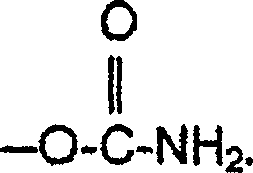
Gegenstand der Erfindung ist ferner eine nach dem erfindungsgemäßen Verfahren hergestellte Beschichtungszusammensetzung und ein Gegenstand mit einem Substrat, auf dem sich ein gehärteter Überzug, der sich von einer erfindungsgemäßen Beschichtungszusammensetzung ableitet, befindet.object the invention is also a method according to the invention prepared coating composition and an article with a substrate bearing a hardened coating extending from one coating composition according to the invention derives.
Nähere BeschreibungMore detailed description
Bei dem erfindungsgemäßen Verfahren wandelt man in einem ersten Schritt die Hydroxylgruppen eines Acrylharzes mit Hydroxylgruppen und primären Carbamatgruppen in neue, gegenüber einem Aminoplastvernetzer unreaktive Gruppen um, insbesondere durch Umsetzung der Hydroxylgruppen mit einer Verbindung dafür; vereinigt in einem zweiten Schritt das Acrylharz mit den neuen Gruppen mit mindestens einem Aminoplastvernetzer, wobei man eine Beschichtungszusammensetzung erhält; und bringt die Beschichtungszusammensetzung auf ein Substrat auf und härtet die aufgebrachte Überzugsschicht weitgehend ohne Ausbildung von Etherbindungen.at the method according to the invention In a first step, the hydroxyl groups of an acrylic resin are converted with hydroxyl groups and primary Carbamate groups in new, opposite a Aminoplastvernetzer unreactive groups to, in particular by Reaction of the hydroxyl groups with a compound therefor; united in a second step, the acrylic resin with the new groups with at least one aminoplast crosslinker, wherein a coating composition obtained; and apply the coating composition to a substrate and hardens the applied coating layer largely without formation of ether bonds.
Das Acrylharz mit Hydroxylgruppen und primären Carbamatgruppen kann auf einer Reihe von Wegen hergestellt werden. Bei einem Verfahren zur Einführung von primärer Carbamatfunktionalität in ein Acrylpolymer setzt man zur Ausbildung der Carbamatgruppen eine Acrylverbindung mit cyclischer Carbonatfunktionalität mit Ammoniak um. Acrylpolymere mit cyclischer Carbonatfunktionalität sind an sich bekannt und werden beispielsweise in der US-PS 2,979,514 beschrieben. Bei der Ringöffnungsreaktion bildet sich auch eine Hydroxylgruppe in beta-Stellung zur primären Carbamatgruppe.The Acrylic resin with hydroxyl groups and primary carbamate groups can on be made in a number of ways. In a method for introduction from primary carbamate an acrylic polymer is used to form the carbamate groups an acrylic compound with cyclic carbonate functionality with ammonia around. Acrylic polymers with cyclic carbonate functionality are on are known and described for example in US Patent 2,979,514. In the ring opening reaction Also forms a hydroxyl group in beta position to the primary carbamate group.
Man kann auch auf ähnliche Art und Weise ein carbonatfunktionelles Monomer in ein beta-hydroxy-prim.-carbamatfunktionelles Monomer umwandeln und dieses dann bei der Polymerisation des Acrylharzes mit Hydroxylgruppen und primären Carbamatgruppen verwenden. Außerdem kann man durch Umsetzung eines Monomers mit einer Oxirangruppe (bwz. Epoxidgruppe) mit CO2 Carbonatfunktionalität erhalten. Hierbei arbeitet man bei einem beliebigen Druck von Normaldruck bis zu überkritischen CO2-Drücken, vorzugsweise jedoch unter erhöhtem Druck (z.B. 60-150 psi). Die Reaktionstemperatur beträgt hierbei vorzugsweise 60-150°C. Als Katalysatoren eignen sich u.a. alle Katalysatoren, die einen Oxiranring aktivieren, wie z.B. ein tertiäres Amin oder quartäre Salze (z.B. Tetramethylammoniumbromid), Kombinationen von komplexen Organozinnhalogeniden und Alkylphosphoniumhalogeniden (z.B. (CH3)3SnI, Bu3SnI, Bu4PI und (CH3)4PI), Kaliumsalze (z.B. K2CO3, KI), vorzugsweise in Kombination mit Kronenethern, Zinnoctoat, Calciumoctoat und dergleichen. Danach kann man die cyclische Carbonatgruppe wie oben beschrieben in eine Carbamatgruppe überführen. Wie im Fall eines carbonatfunktionellen Monomers kann die Umwandlung einer Oxirangruppe in eine Carbamatgruppe vor, während oder nach der Polymerisationsreaktion durchgeführt werden. Beispiele für geeignete oxiranfunktionelle Monomere sind Glycidylacrylat, Glycidylmethacrylat und Allylglycidylether. Ungesättigte Bindungen können ebenfalls in Carbamatgruppen überführt werden, indem man sie zunächst durch Umsetzung mit Peroxid in eine Epoxidgruppe, dann mit CO2 in ein cyclisches Carbonat und dann mit Ammoniak oder einem primären Amin in das Carbamat überführt. Aufgrund der Reaktionsfreudigkeit der ethylenischen Ungesättigtheit der reaktiven Monomere sollte die Synthese der Carbamatfunktionalität nach der Polymerisation durch geführt werden. Beispielsweise kann man eine ungesättigte Bindung in das Acrylpolymer einführen, indem man bei der Polymerisation Allylmethacrylat mitverwendet oder die Ungesättigtheit in das gebildete Acrylpolymer einführt, wie z.B. durch Umsetzung von Hydroxylgruppen des Polymers mit Isocyanatoethylmethacrylat.It is also possible to convert a carbonate-functional monomer to a beta-hydroxy-prim. Carbamate-functional monomer in a similar manner and then use it in the polymerization of the acrylic resin having hydroxyl groups and primary carbamate groups. In addition, carbonate functionality can be obtained by reacting a monomer having an oxirane group (or epoxide group) with CO 2 . Here, one works at any pressure from normal pressure to supercritical CO 2 pressures, but preferably under elevated pressure (eg 60-150 psi). The reaction temperature is preferably 60-150 ° C. Suitable catalysts include all catalysts which activate an oxirane ring, such as a tertiary amine or quaternary salts (eg tetramethylammonium bromide), combinations of complex organotin halides and alkylphosphonium halides (eg (CH 3 ) 3 SnI, Bu 3 SnI, Bu 4 PI and ( CH 3 ) 4 PI), potassium salts (eg K 2 CO 3 , KI), preferably in combination with crown ethers, stannous octoate, calcium octoate and the like. Thereafter, the cyclic carbonate group can be converted into a carbamate group as described above. As in the case of a carbonate-functional monomer, the conversion of an oxirane group to a carbamate group may be carried out before, during or after the polymerization reaction. Examples of suitable oxirane-functional monomers are glycidyl acrylate, glycidyl methacrylate and allyl glycidyl ether. Unsaturated bonds can also be converted to carbamate groups by first converting them into an epoxide group by reaction with peroxide, then into a cyclic carbonate with CO 2, and then into the carbamate with ammonia or a primary amine. Due to the reactivity of the ethylenic unsaturation of the reactive monomers, the synthesis of the carbamate functionality should be carried out after the polymerization. For example, one may introduce an unsaturated bond into the acrylic polymer by including allyl methacrylate in the polymerization or introducing the unsaturation into the formed acrylic polymer, such as by reacting hydroxyl groups of the polymer with isocyanatoethyl methacrylate.
Bei einem anderen Verfahren kann man eine hydroxyfunktionelle Acrylverbindung mit einer primären Alkylcarbamatverbindung zu einem prim.-carbamatfunktionellen Acrylpolymer umestern. Wenn nicht alle Hydroxylgruppen verestert werden, weist das Acrylpolymer auch Hydroxylgruppen auf. Zwar kann man durch Verwendung eines Überschusses der veresternden Carbamatverbindung in der Regel die Veresterungsreaktion bis zu vollständigem Umsatz treiben, aber die Verwendung von überschüssiger Carbamatverbindung könnte zu unerwünschten Nebenreaktionen führen und/oder die Entfernung des restlichen Überschusses der Carbamatverbindung nach Vervollständigung der Veresterung erforderlich machen. Daher verwendet man vorzugsweise keinen Überschuß an Carbamatverbindung, sondern läßt lieber einen Teil der Hydroxylgruppen zurück. Als Beispiele für primäre Alkylcarbamate, die für die Umesterung geeignet sind, sind u.a. Methylcarbamat, Ethylcarbamat, Propylcarbamat, Isopropylcarbamat, Butylcarbamat, 2-Ethylhexylcarbamat, Cyclohexylcarbamat, Phenylcarbamat, Hydroxypropylcarbamat, Hydroxyethylcarbamat usw. Die Umesterung kann mit einem Katalysator, wie beispielsweise metallorganischen Komplexen einschließlich Zinnverbindungen, wie Dibutylzinnoxid, Dibutylzinndilaurat, Dibutylzinndiacetat und Dibutylzinndimethoxid, Aluminiumverbindungen, wie Aluminiumisopropoxid, Zinkverbindungen und Titanaten, und stark sauren Katalysatoren, durchgeführt werden. Die Menge eines solchen Veresterungskatalysators kann im Bereich von etwa 0,05 bis etwa 5 Gewichtsprozent, bezogen auf das Gewicht der Reaktanten, liegen. In der Regel liegt der Veresterungskatalysator in einer Menge von etwa 0,1 bis etwa 1 Gew.-%, bezogen auf die Reaktanten, vor.at Another method can be a hydroxy-functional acrylic compound with a primary alkyl carbamate compound to transesterify to a prim. carbamate-functional acrylic polymer. If not all hydroxyl groups are esterified, the acrylic polymer has also hydroxyl groups. Although you can by using a surplus the esterifying carbamate compound usually the esterification reaction up to complete Driving sales, but the use of excess carbamate compound might increase undesirable Cause side reactions and / or the removal of the residual excess of the carbamate compound after completion make esterification necessary. Therefore, it is preferable to use no excess of carbamate compound, but rather lets a portion of the hydroxyl groups back. As examples of primary alkyl carbamates, the for the transesterification are suitable, i.a. Methyl carbamate, ethyl carbamate, Propyl carbamate, isopropyl carbamate, butyl carbamate, 2-ethylhexyl carbamate, Cyclohexyl carbamate, phenyl carbamate, hydroxypropyl carbamate, hydroxyethyl carbamate etc. The transesterification can be carried out with a catalyst, such as organometallic complexes including tin compounds, such as Dibutyltin oxide, dibutyltin dilaurate, dibutyltin diacetate and dibutyltin dimethoxide, Aluminum compounds, such as aluminum isopropoxide, zinc compounds and titanates, and strongly acidic catalysts. The amount of such an esterification catalyst may be in the range from about 0.05 to about 5 percent by weight, by weight the reactants, lie. In general, the esterification catalyst is in an amount of about 0.1 to about 1% by weight, based on the reactants, in front.
In der US-PS 5,552,497 wird ein anderes Verfahren zur Herstellung eines Acrylharzes mit Hydroxylgruppen und primären Carbamatgruppen beschrieben. Die Polymerisation des Acrylpolymers wird mit einem hydroxyfunktionellen Monomer durchgeführt. Gleichzeitig wird die Hydroxylgruppe dieses Monomers durch Mitverwendung eines Alkylcarbamats, wie eines der oben beschriebenen, in der Reaktionsmischung verestert. Bei dem Versuch, die Reaktion bis zum vollständigen Umsatz zu treiben, ergeben sich die gleichen Probleme, wie sie bereits für das gerade beschriebene Verfahren mit sequentieller Polymerisation und Veresterung diskutiert worden sind. Das resultierende Polymer enthält Hydroxylgruppen, wenn die Veresterung der Hydroxylgruppen nicht vollständig ist, und zwar unabhängig davon, ob dies auf einen stöchiometrischen Überschuß an Hydroxylgruppen oder auf die Reaktionsbedingungen zurückzuführen ist. Wiederum kann man einen Umesterungskatalysator in Anteilen von etwa 0,05 bis etwa 5 Gewichtsprozent und vorzugsweise von etwa 0,1 bis etwa 1 Gew.-%, bezogen auf die Reaktanten (bei denen es sich in diesem Fall um die Monomere handelt), verwendet werden. Der Umesterungskatalysator kann zu Beginn der Umsetzung in einem Guß zugegeben werden, wird aber vorzugsweise in zwei Portionen aufgeteilt, von denen die eine zu Beginn der Umsetzung und die andere nach Abschluß der Polymerisationsreaktion zugegeben wird.In U.S. Patent 5,552,497 discloses another method of making a Acrylic resin with hydroxyl groups and primary carbamate groups described. The polymerization of the acrylic polymer is carried out with a hydroxy-functional Monomer performed. At the same time, the hydroxyl group of this monomer is co-used an alkyl carbamate, such as one of those described above, in the reaction mixture esterified. In trying to complete the reaction until complete to drive, the same problems arise as they already are for the just described method with sequential polymerization and Esterification have been discussed. The resulting polymer contains hydroxyl groups, if the esterification of the hydroxyl groups is not complete, and independently of whether this is due to a stoichiometric excess of hydroxyl groups or due to the reaction conditions. Again you can a transesterification catalyst in proportions of about 0.05 to about 5 weight percent, and preferably from about 0.1 to about 1 weight percent, based on the reactants (which are in this case the monomers are) can be used. The transesterification catalyst can be added at the beginning of the reaction in one pour, but will preferably divided into two portions, of which one to Start of the reaction and the other after completion of the polymerization reaction is added.
Ein weiteres Beispiel für ein Verfahren zur Ausbildung von primärer Carbamatfunktionalität ist die Umsetzung einer Hydroxylgruppe mit HNCO, das durch thermische Zersetzung von Harnstoff erzeugt wird, wie in der US-PS 5,605,965 beschrieben. Wenn weniger als eine stöchiometrische Menge des HNCO abreagiert oder die Umsetzung nicht bis zum vollständigen Umsatz durchgeführt wird, bleibt am Acrylpolymer Hydroxylfunktionalität zurück.One another example of a method of forming primary carbamate functionality is the Reaction of a hydroxyl group with HNCO by thermal decomposition urea, as described in U.S. Patent 5,605,965. If less than a stoichiometric Amount of HNCO abreacted or the reaction is not until complete conversion carried out At the acrylic polymer, hydroxyl functionality remains.
Das Acrylharz hat vorzugsweise ein Molekulargewicht von 500 bis 1.000.000 und besonders bevorzugt von 1500 bis 50.000. Unter "Molekulargewicht" ist im Rahmen der vorliegenden Erfindung das zahlenmittlere Molekulargewicht zu verstehen, das nach der GPC-Methode unter Verwendung eines Polystyrol-Standards bestimmt werden kann. Die eine primäre Carbamatgruppe tragende Monomereinheit kann etwa 10 bis etwa 90 Gewichtsprozent des Acrylharzes ausmachen und macht vorzugsweise etwa 40 bis etwa 60 Gewichtsprozent des Acrylharzes aus.The acrylic resin preferably has a molecular weight of 500 to 1,000,000, and more preferably from 1,500 to 50,000. By "molecular weight" is meant in the context of the present invention, the number average molecular weight, which can be determined by the GPC method using a polystyrene standard. The monomer unit carrying a primary carbamate group may be about 10 to about 90 weight percent of the acrylic resin and preferably constitutes about 40 to about 60 weight percent of the acrylic resin.
Bei allen Verfahren, bei denen das Acrylharz mit Hydroxylgruppen und primären Carbamatgruppen aus einem hydroxyfunktionellen Acrylharz hergestellt wird, kann man das hydroxyfunktionelle Acrylharz durch Verwendung eines hydroxyfunktionellen ethylenisch ungesättigten Monomers bei der Polymerisation des Acrylharzes herstellen. Beispiele für brauchbare hydroxyfunktionelle ethylenisch ungesättigte Monomere sind Hydroxyethylmethacrylat, Hydroxyethylacrylat, Hydroxypropylacrylat, Hydroxypropylmethacrylat, Hydroxybutylacrylat, Hydroxybutylmethacrylat, das Produkt der Umsetzung von Methacrylsäure mit Styroloxid usw. Bevorzugte Hydroxylmonomere sind Methacrylsäure- oder Acrylsäureester, in denen es sich bei dem die Hydroxylgruppe tragenden Alkoholteil der Verbindung um eine lineare oder verzweigte Hydroxyalkylgruppierung mit 1 bis etwa 8 Kohlenstoffatomen handelt.at all processes in which the acrylic resin with hydroxyl groups and primary Carbamate groups made from a hydroxy-functional acrylic resin can be, you can use the hydroxy-functional acrylic resin by use a hydroxy-functional ethylenically unsaturated monomer in the polymerization of the acrylic resin. Examples of useful hydroxy functional ethylenically unsaturated Monomers are hydroxyethyl methacrylate, hydroxyethyl acrylate, hydroxypropyl acrylate, Hydroxypropyl methacrylate, hydroxybutyl acrylate, hydroxybutyl methacrylate, the product of the reaction of methacrylic acid with styrene oxide, etc. Preferred Hydroxyl monomers are methacrylic acid or acrylic acid ester, in which it is in the hydroxyl-carrying alcohol part the compound is a linear or branched hydroxyalkyl moiety with 1 to about 8 carbon atoms.
Das die Hydroxylgruppe, Carbamatgruppe, Epoxidgruppe, nicht polymerisierende Ungesättigtheit oder Carbonatgruppe tragende Monomer kann mit einem oder mehreren ethylenisch ungesättigten Monomeren polymerisiert werden. Derartige Monomere für die Copolymerisation sind an sich bekannt. Als Beispiele seien im einzelnen genannt: Alkylester von Acryl- oder Methacrylsäure, z.B. Methylmethacrylat, Ethylacrylat, Ethylmethacrylat, Propylacrylat, Propylmethacrylat, Isopropylacrylat, Isopropylmethacrylat, Butylacrylat, Butylmethacrylat, Isobutylacrylat, Isobutylmethacrylat, t-Butylacrylat, t-Butylmethacrylat, Amylacrylat, Amylmethacrylat, Isoamylacrylat, Isoamylmethacrylat, Hexylacrylat, Hexylmethacrylat, 2-Ethylhexylacrylat, Decylacrylat, Decylmethacrylat, Isodecylacrylat, Isodecylmethacrylat, Dodecylacrylat, Dodecylmethacrylat, Cyclohexylacrylat, Cyclohexylmethacrylat , substituierte Cyclohexylacrylate und -methacrylate, 3,5,5-Trimethylhexylacrylat, 3,5,5-Trimethylhexylmethacrylat, die entsprechenden, Maleinsäure-, Fumarsäure-, Crotonsäure-, Isocrotonsäure-, Vinylessigsäure- und Itaconsäureester und dergleichen sowie Vinylmonomere, wie ungesättigtes m-Tetramethylxylolisocyanat, Styrol, t-Butylstyrol, alpha-Methylstyrol, Vinyltoluol und dergleichen. Beispiele für andere brauchbare polymerisierbare Comonomere sind Alkoxyethylacrylate und -methacrylate, Acryloxyacrylate und -methacrylate, ethylenisch ungesättigte Carbonsäuren, wie Acrylsäure, Methacrylsäure, Itaconsäure, Crotonsäure, Maleinsäure und Fumarsäure, ethylenisch ungesättigte tertiäre Aminoverbindungen, wie N,N'-Dimethylaminoethylmethacrylat, 2-Vinylpyridin, 4-Vinylpyridin und Vinylpyrrolidin, und Verbindungen wie Acrylnitril, Methacrylnitril, Acrolein und Methacrolein. In der Regel werden Kombinationen davon verwendet.The the hydroxyl group, carbamate group, epoxide group, non-polymerizing Unsaturation or Carbonate group-carrying monomer may be one or more ethylenic unsaturated Monomers are polymerized. Such monomers for the copolymerization are known per se. As examples may be mentioned in detail: Alkyl esters of acrylic or methacrylic acid, e.g. methyl methacrylate, Ethyl acrylate, ethyl methacrylate, propyl acrylate, propyl methacrylate, Isopropyl acrylate, isopropyl methacrylate, butyl acrylate, butyl methacrylate, Isobutyl acrylate, isobutyl methacrylate, t-butyl acrylate, t-butyl methacrylate, Amyl acrylate, amyl methacrylate, isoamyl acrylate, isoamyl methacrylate, Hexyl acrylate, hexyl methacrylate, 2-ethylhexyl acrylate, decyl acrylate, Decyl methacrylate, isodecyl acrylate, isodecyl methacrylate, dodecyl acrylate, Dodecyl methacrylate, cyclohexyl acrylate, cyclohexyl methacrylate, substituted Cyclohexyl acrylates and methacrylates, 3,5,5-trimethylhexyl acrylate, 3,5,5-Trimethylhexylmethacrylat, the corresponding maleic acid, fumaric acid, crotonic, Isocrotonsäure-, Vinylessigsäure- and itaconic acid ester and the like, and vinyl monomers such as unsaturated m-tetramethylxylene isocyanate, Styrene, t-butylstyrene, alpha-methylstyrene, vinyltoluene and the like. examples for other useful polymerizable comonomers are alkoxyethyl acrylates and methacrylates, acryloxy acrylates and methacrylates, ethylenic unsaturated Carboxylic acids, like acrylic acid, methacrylic acid, itaconic, crotonic, maleic and fumaric acid, ethylenically unsaturated tertiary Amino compounds, such as N, N'-dimethylaminoethyl methacrylate, 2-vinylpyridine, 4-vinylpyridine and vinylpyrrolidine, and compounds such as acrylonitrile, methacrylonitrile, acrolein and methacrolein. In usually combinations of them are used.
Bei dem erfindungsgemäßen Verfahren wandelt man in einem Schritt die Hydroxylgruppen eines Acrylharzes mit Hydroxylgruppen und primären Carbamatgruppen in neue Gruppen um, vorzugsweise durch Umsetzung mit einer Substanz, die die Hydroxylgruppen in eine neue Gruppierung umwandelt, die bei der Härtung der Beschichtungszusammensetzung nicht mit dem Aminoplastvernetzer reagiert. Durch die Vermeidung von Etherbindungen, die durch Reaktion von Aminoplastvernetzern mit Hydroxylgruppen gebildet werden könnten, wird die Beständigkeit des gehärteten Überzugs gegenüber Umweltätzung verbessert. Außerdem wird im Fall von beta-Hydroxycarbamaten durch die Entfernung der beta-Hydroxylgruppe die Stabilität des Acrylharzes verbessert, da beta-Hydroxycarbamatgruppen unter bestimmten Bedingungen Ringschlußreaktionen eingehen können. Der Ringschluß könnte womöglich die vollständige Aushärtung der Beschichtungszusammensetzung verhindern.at the method according to the invention If one converts the hydroxyl groups of an acrylic resin in one step with hydroxyl groups and primary Carbamate groups in new groups, preferably by reaction with a substance that converts the hydroxyl groups into a new grouping converts when curing the coating composition not with the Aminoplastvernetzer responding. By avoiding ether bonds by reaction of aminoplast crosslinkers having hydroxyl groups the durability of the hardened coating across from Environmental etch improved. In addition, will in the case of beta-hydroxycarbamates by the removal of the beta-hydroxyl group the stability of the acrylic resin, since beta-hydroxycarbamate groups under certain conditions can undergo ring closure reactions. Of the Ring closure could possibly be the full curing prevent the coating composition.
Zur Umwandlung der Hydroxylgruppen in neue Gruppen kann man eine Reihe verschiedener Substanzen mit den Hydroxylgruppen des Acrylharzes mit Hydroxylgruppen und primären Carbamatgruppen umsetzen. Vorzugsweise wird die Substanz unter monofunktionellen Isocyanaten, Säureanhydriden difunktioneller Carbonsäuren, Säureanhydriden monofunktioneller Carbonsäuren, monofunktionellen Carbonsäuren, Alkylhalogeniden einschließlich Alkylchloriden und Kombinationen davon ausgewählt.to Conversion of the hydroxyl groups into new groups can be a number various substances with the hydroxyl groups of the acrylic resin with hydroxyl groups and primary React carbamate groups. Preferably, the substance becomes monofunctional Isocyanates, acid anhydrides difunctional carboxylic acids, anhydrides monofunctional carboxylic acids, monofunctional carboxylic acids, Including alkyl halides Alkyl chlorides and combinations thereof.
Die monofunktionellen Isocyanate können aromatisch, arylaliphatisch oder aliphatisch sein. Vorzugsweise enthält die monofunktionelle Isocyanatsubstanz eine monofunktionelle Isocyanatverbindung, bei der es sich um eine aliphatische Verbindung einschließlich cycloaliphatischer Verbindungen handelt. Die monofunktionelle Isocyanatverbindung kann andere, bei der Reaktion inerte Gruppen, wie Estergruppen oder Säuregruppen, enthalten. Beispiele für geeignete monofunktionelle Isocyanatverbindungen sind Butylisocyanat, Propylisocyanat, Octylisocyanat, Cyclohexylisocyanat, Isocyanatoessigsäurealkylester, wie Isocyanatoessigsäureethylester, und Kombinationen davon.The monofunctional isocyanates can be aromatic, arylaliphatic or aliphatic. Preferably contains the monofunctional isocyanate substance is a monofunctional isocyanate compound, it is an aliphatic compound including cycloaliphatic Compounds is. The monofunctional isocyanate compound can other groups inert in the reaction, such as ester groups or acid groups, contain. examples for suitable monofunctional isocyanate compounds are butyl isocyanate, Propyl isocyanate, octyl isocyanate, cyclohexyl isocyanate, isocyanatoacetic acid alkyl ester, such as isocyanatoacetic acid ethyl ester, and combinations thereof.
Bei Umsetzung der Hydroxylgruppen mit einem Säureanhydrid einer Monocarbonsäure oder einer Dicarbonsäure ist nicht zu erwarten, daß die verbleibende Säuregruppe bei der Härtungstemperatur für die Reaktion der Carbamatgruppen mit dem Aminoplastvernetzer in beträchtlichem Maße mit dem Aminoplastvernetzer reagiert. In jedem Fall würde die Reaktion nicht zu einer Ethergruppe führen. Beispiele für geeignete Anhydridverbindungen sind Essigsäureanhydrid, Maleinsäureanhydrid, Malonsäureanhydrid, Glutarsäureanhydrid und Kombinationen davon.When reacting the hydroxyl groups with an acid anhydride of a monocarboxylic acid or a dicarboxylic acid, it is not expected that the remaining acid group at the curing temperature for the reaction of the carbamate groups with the aminoplast crosslinker will substantially react with the aminoplast crosslinker. In any case, the reaction would not lead to an ether group. Examples of suitable An hydride compounds are acetic anhydride, maleic anhydride, malonic anhydride, glutaric anhydride and combinations thereof.
Die Hydroxylgruppen des Acrylharzes mit Hydroxylgruppen und primären Carbamatgruppen können auch mit monofunktionellen Säuren in einer Veresterungsreaktion umgesetzt werden. Beispiele für geeignete monofunktionelle Säuren sind Essigsäure, Buttersäure, Octansäure, Neosäuren (von denen viele im Handel von Exxon erhältlich sind) und Kombinationen davon. Die Hydroxylgruppen können auch mit Säurehalogeniden, vorzugsweise Säurechloriden, umgesetzt werden, wobei die Hydroxylgruppe verestert wird. Beispiele für geeignete Säurehalogenide sind Acetylchlorid, Propionylchlorid, Butyrylchlorid usw.The Hydroxyl groups of the acrylic resin having hydroxyl groups and primary carbamate groups can also with monofunctional acids be reacted in an esterification reaction. Examples of suitable monofunctional acids are acetic acid, butyric acid, octanoic neo acids (many of which are commercially available from Exxon) and combinations from that. The hydroxyl groups can also with acid halides, preferably acid chlorides, be reacted, wherein the hydroxyl group is esterified. Examples for suitable halides are acetyl chloride, propionyl chloride, butyryl chloride, etc.
Bei einem anderen Verfahren zur Umwandlung der Hydroxylgruppen in neue Gruppen, die bei der Härtung der Beschichtungszusammensetzung mit dem Aminoplastvernetzer keine Etherbindung bilden, kann man das Acrylharz mit Hydroxylgruppen und primären Carbamatgruppen mit einem Halogenameisensäurealkylester, insbesondere einem Chlorameisensäurealkylester, umsetzen. Dabei bildet sich eine Estergruppe sowie HCl als Nebenprodukt. Beispiele für geeignete Halogenameisensäurealkylester sind Chlorameisensäureethylester, Chlorameisensäurepropylester und Kombinationen davon.at another method of converting the hydroxyl groups into new ones Groups involved in curing the coating composition with the Aminoplastvernetzer no Make ether bond, you can the acrylic resin with hydroxyl groups and primary Carbamate groups with a Haloformensäurealkylester, in particular a chloroformic acid alkyl ester, implement. This forms an ester group and HCl as a byproduct. examples for suitable haloformic acid alkyl esters are ethyl chloroformate, propyl chloroformate and combinations thereof.
In einem weiteren Schritt des erfindungsgemäßen Verfahrens wird das Acrylharzreaktionsprodukt, das primäre Carbamatgruppen und aus der Umwandlung der Hydroxylgruppen hervorgegangene neue Gruppen enthält, mit mindestens einem Aminoplastvernetzer vereinigt, wobei man eine Beschichtungszusammensetzung erhält. Der Aminoplastvernetzer weist durchschnittlich mindestens zwei gegenüber dem Acrylharz reaktive Gruppen auf. Aminoplastvernetzer, unter denen hier auch Phenol-Formaldehyd-Addukte zu verstehen sind, sind durch aktive Methylol- oder Methylalkoxygruppen gekennzeichnet. Beispiele für bevorzugte Härterverbindungen sind Melamin-Formaldehyd-Harz (einschließlich monomerem oder polymerem Melaminharz und teil- oder vollalkyliertem Melaminharz), Harnstoffharze (z.B. Methylolharnstoffe, wie Harnstoff-Formaldehyd-Harz, Alkoxyharnstoffe, wie butyliertes Harnstoff-Formaldehyd-Harz) und Harze mit einpolymerisierten Isobutoxymethylacrylamidgruppen. Bei dem Härter kann es sich um Kombinationen davon handeln. Kombinationen von Tris(alkoxycarbonylamino)triazin wie mit einem Melamin-Formaldehyd-Harz und/oder einem blockierten Isocyanathärter sind ebenfalls geeignet und wünschenswert.In a further step of the process according to the invention is the acrylic resin reaction product, the primary one Carbamate groups and from the conversion of the hydroxyl groups emerged contains new groups, combined with at least one Aminoplastvernetzer, wherein one Coating composition receives. The Aminoplastvernetzer has on average at least two opposite Acrylic resin reactive groups on. Aminoplast crosslinkers, among which here also phenol-formaldehyde adducts are to be understood by active methylol or methylalkoxy groups characterized. examples for preferred hardener compounds are melamine-formaldehyde resin (including monomeric or polymeric Melamine resin and partially or fully alkylated melamine resin), urea resins (e.g., methylol ureas such as urea-formaldehyde resin, alkoxy ureas, such as butylated urea-formaldehyde resin) and resins having copolymerized isobutoxymethylacrylamide groups. At the hardener they can be combinations of them. Combinations of tris (alkoxycarbonylamino) triazine as with a melamine-formaldehyde resin and / or a blocked one isocyanate are also suitable and desirable.
Die
Beschichtungszusammensetzung kann auch noch andere Substanzen mit
Carbamat- oder Harnstoffgruppen enthalten. Erstens kann die Beschichtungszusammensetzung
eine Komponente (a) mit mindestens einer Carbamatgruppe oder Harnstoffgruppe
und einer Lacton- oder
Hydroxycarbonsäuregruppierung enthalten.
Im Rahmen der vorliegenden Erfindung bezieht sich der Begriff "Carbamatgruppe" auf eine Gruppe der
Struktur 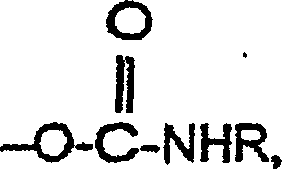

Bevorzugte
Verbindungen (a) können
durch die Strukturen 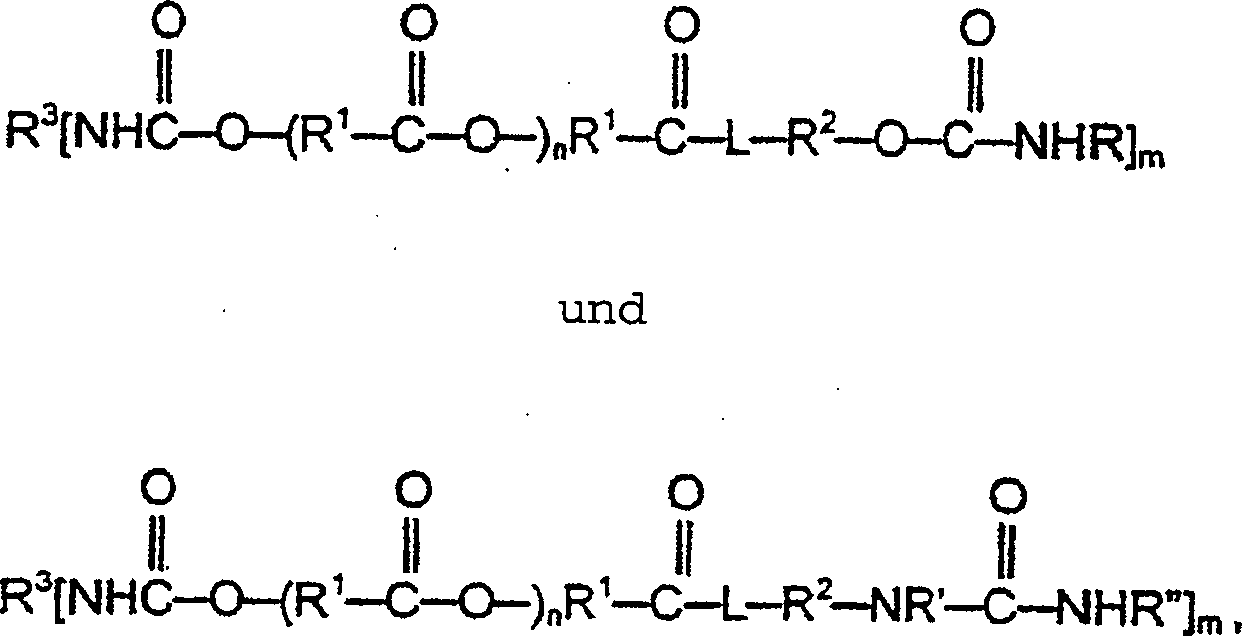
Die Verbindung (a) kann man nach einem Verfahren herstellen, bei dem man ein Lacton oder eine Hydroxycarbonsäure mit einer Verbindung mit einer Carbamatgruppe oder Harnstoffgruppe oder einer in eine Carbamatgruppe oder Harnstoffgruppe überführbaren Gruppe und, einer gegenüber dem Lacton bzw. der Hydroxycarbonsäure reaktiven Gruppe umsetzt. Im Fall einer in eine Carbamat- oder Harnstoffgruppe überführbare Gruppe kann die Überführung der Gruppe in die Carbamat- oder Harnstoffgruppe während oder nach der Umsetzung mit dem Lacton oder der Hydroxycarbonsäure erfolgen. Bei dem Verfahren zur Herstellung von Verbindung (a) kann man in einem weiteren Schritt ein hydroxyfunktionelles Produkt aus dem ersten Schritt mit einer Verbindung mit mindestens zwei Isocyanatgruppen umsetzen.The Compound (a) can be prepared by a process in which a lactone or a hydroxycarboxylic acid with a compound with a carbamate group or urea group or one into a carbamate group or urea group convertible Group and, one opposite the lactone or hydroxycarboxylic acid reactive group. In the case of a group convertible to a carbamate or urea group can the overpass of the Group in the carbamate or urea group during or after the reaction with the lactone or hydroxycarboxylic acid. In the process for the preparation of compound (a), in a further step a hydroxyfunctional product from the first step with a Reactivate compound with at least two isocyanate groups.
Die
Beschichtungszusammensetzung kann eine Komponente (b) mit mindestens
einer erfindungsgemäßen Carbamatgruppe
oder endständigen
Harnstoffgruppe und mindestens zwei Brückengruppen, bei denen es sich
um Urethan oder Harnstoff handelt, enthalten. Bevorzugte Verbindungen
(b) können
durch eine der Strukturen 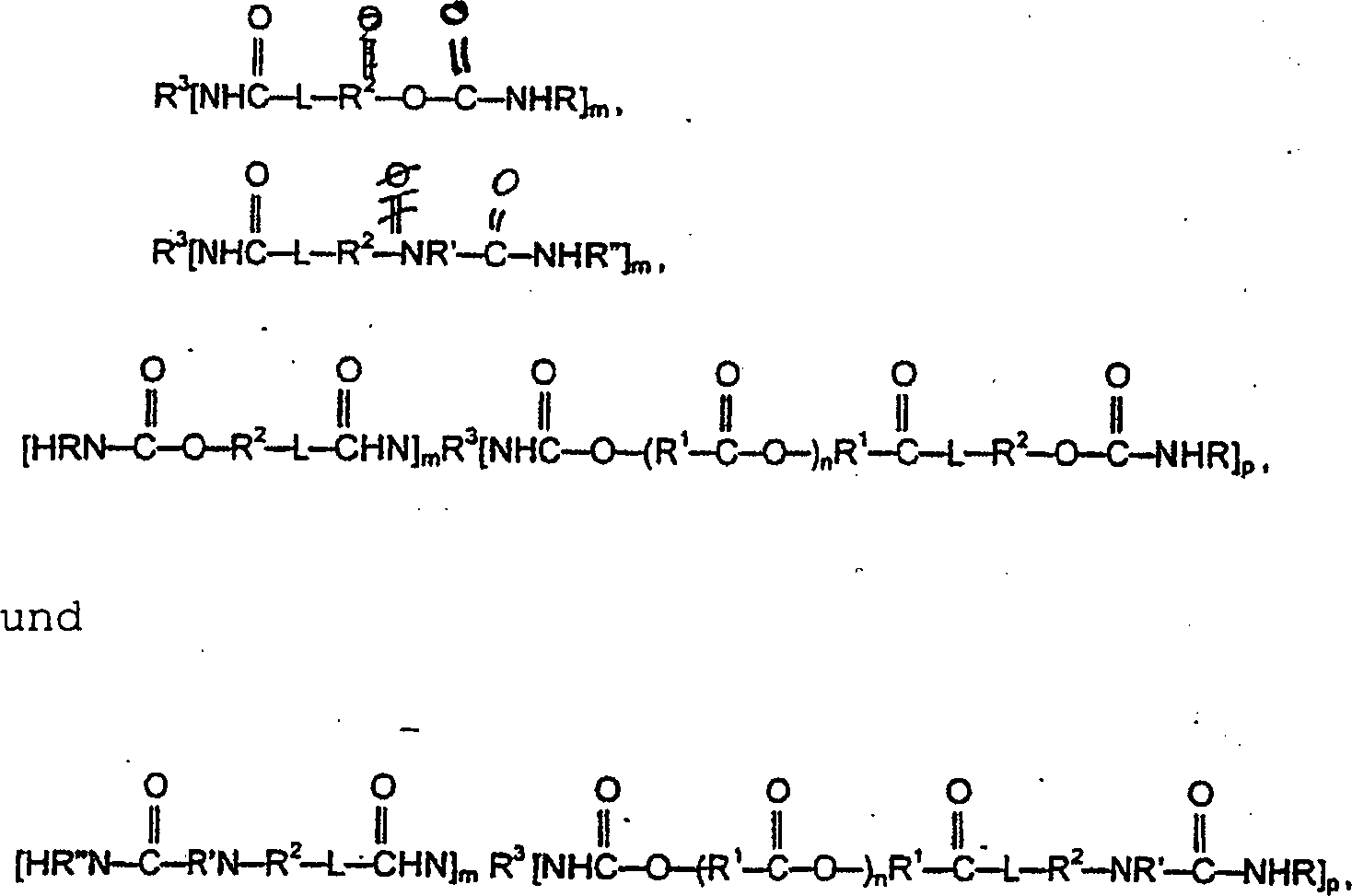
Die Verbindung (b) kann nach einem Verfahren hergestellt werden, bei dem man ein Polyisocyanat (b)(2) mit einer Verbindung (b)(1) mit einer Carbamatgruppe oder endständigen Harnstoffgruppe oder einer in eine Carbamatgruppe oder endständige Harnstoffgruppe überführbaren Gruppe sowie einer gegenüber Isocyanatfunktionalitäten reaktiven Gruppe umsetzt. Im Fall einer in Carbamat oder endständigen Harnstoff überführbaren Gruppe kann die Überführung in die Carbamatgruppe oder endständige Harnstoffgruppe zur Bildung der zweiten Komponente gleichzeitig mit oder nach der Umsetzung mit dem Polyisocyanat erfolgen.The Compound (b) can be prepared by a method of which comprises a polyisocyanate (b) (2) with a compound (b) (1) a carbamate group or terminal Urea group or one convertible into a carbamate group or terminal urea group Group as well as one opposite isocyanate reactive group. In the case of carbamate or terminal urea convertible Group can overpass in the carbamate group or terminal Urea group to form the second component at the same time with or after the reaction with the polyisocyanate.
Schließlich kann
die Beschichtungszusammensetzung eine Komponente (c) mit mindestens
zwei unter Carbamatgruppen, endständigen Harnstoffgruppen oder Kombinationen
davon ausgewählten
Gruppen und mindestens vier Urethan- oder Harnstoff-Brückengruppen
enthalten. Bevorzugte Verbindungen (c) können durch eine der Strukturen 
Die Verbindung (c) kann nach einer Synthese hergestellt werden, bei der man eine Verbindung (c)(1) mit einer Carbamatgruppe oder endständigen Harnstoffgruppe oder einer in eine Carbamatgruppe oder endständige Harnstoffgruppe überführbaren Gruppe sowie einer Isocyanatgruppe mit einer Verbindung (c)(2) mit mindestens zwei gegenüber Isocyanatfunktionalitäten reaktiven Gruppen umsetzt. Wenn die Verbindung (c)(1) eine in eine Carbamatgruppe oder endständige Harnstoffgruppe überführbare Gruppe enthält, kann die Überführung in Carbamat- oder Harnstoffgruppe zur Bildung der Komponente (c) gleichzeitig mit oder nach Abschluß der Umsetzung mit der Verbindung mit mindestens zwei gegenüber Isocyanatfunktionalitäten reaktiven Gruppen erfolgen. Weitere Einzelheiten zu den Komponenten (a), (b) und (c) werden in der am 2. November 1998 eingereichten US-Patentanmeldung 09/184,195 beschrieben.The Compound (c) can be prepared after synthesis, at the compound (c) (1) having a carbamate group or terminal urea group or one convertible to a carbamate group or terminal urea group Group and an isocyanate group with a compound (c) (2) with at least two opposite isocyanate reactive groups. If the compound (c) (1) one in one Carbamate group or terminal Urea group convertible group contains can the overpass in Carbamate or urea group to form the component (c) simultaneously with or after completion of the Reaction with the compound having at least two groups reactive toward isocyanate functionalities respectively. Further details of components (a), (b) and (c) in US patent application filed on November 2, 1998 09 / 184,195.
In der Beschichtungszusammensetzung kann man gegebenenfalls ein Lösungsmittel mitverwenden. Zwar kann die Beschichtungszusammensetzung beispielsweise in Form eines weitgehend festen Pulvers oder einer Dispersion eingesetzt werden, jedoch ist es häufig wünschenswert, daß die Zusammensetzung in weitgehend flüssigem Zustand vorliegt, was man durch den Einsatz eines Lösungsmittels erreichen kann. Im allgemeinen kann es sich bei dem Lösungsmittel um ein beliebiges organisches Lösungsmittel und/oder Wasser handeln. Nach einer bevorzugten Ausführungsform handelt es sich bei dem Lösungsmittel um ein polares organisches Lösungsmittel. Besonders bevorzugt handelt es sich bei dem Lösungsmittel um ein polares aliphatisches Lösungsmittel oder ein polares aromatisches Lösungsmittel. Noch weiter bevorzugt handelt es sich bei dem Lösungsmittel um ein Keton, einen Ester, ein Acetat, ein aprotisches Amid, ein aprotisches Sulfoxid, ein aprotisches Amin oder eine Kombination aus beliebigen dieser Lösungsmittel. Als Lösungsmittel eignen sich beispielsweise Methylethylketon, Methylisobutylketon, m-Amylacetat, Ethylenglykolbutyletheracetat, Propylenglykolmonomethyletheracetat, Xylol, N-Methylpyrrolidon, Mischungen aromatischer Kohlenwasserstoffe und Gemische davon. Nach einer anderen bevorzugten Ausführungsform handelt es sich bei dem Lösungsmittel um Wasser oder ein Gemisch aus Wasser mit geringen Mengen an Cosolventien.In The coating composition may optionally be a solvent concomitantly. Although the coating composition, for example, used in the form of a substantially solid powder or a dispersion but it is common desirable, that the Composition in largely liquid Condition is what you get by using a solvent can reach. In general, the solvent may be to any organic solvent and / or water. According to a preferred embodiment it is the solvent a polar organic solvent. Most preferably, the solvent is a polar one aliphatic solvent or a polar aromatic solvent. Still more preferably, the solvent is a ketone, a Ester, an acetate, an aprotic amide, an aprotic sulfoxide, an aprotic amine or a combination of any of these Solvent. As a solvent For example, methyl ethyl ketone, methyl isobutyl ketone, m-amyl acetate, ethylene glycol butyl ether acetate, propylene glycol monomethyl ether acetate, Xylene, N-methylpyrrolidone, mixtures of aromatic hydrocarbons and Mixtures thereof. According to another preferred embodiment it is the solvent water or a mixture of water with small amounts of cosolvents.
Nach einer bevorzugten Ausführungsform liegt das Lösungsmittel in der Beschichtungszusammensetzung in einer Menge von etwa 0,01 Gewichtsprozent bis etwa 99 Gewichtsprozent, vorzugsweise von etwa 10 Gewichtsprozent bis etwa 60 Gewichtsprozent und besonders bevorzugt von etwa 30 Gewichtsprozent bis etwa 50 Gewichtsprozent vor.To a preferred embodiment is the solvent in the coating composition in an amount of about 0.01 Percent by weight to about 99 percent by weight, preferably about 10 weight percent to about 60 weight percent, and more preferably from about 30% to about 50% by weight.
Die bei der Ausübung der Erfindung verwendete Beschichtungszusammensetzung kann zur Beschleunigung der Härtungsreaktion einen Katalysator enthalten. Bei Verwendung von Aminoplastverbindungen, insbesondere von monomeren Melaminen, kann man beispielsweise zur Beschleunigung der Härtungsreaktion einen stark sauren Katalysator einsetzen. Zu derartigen Katalysatoren, die an sich gut bekannt sind, gehören beispielsweise p-Toluolsulfonsäure, Dinonylnaphthalindisulfonsäure, Dodecylbenzolsulfonsäure, saures Phenylphosphat, Maleinsäuremonobutylester, Butylphosphat und Hydroxyphosphatester. Stark saure Katalysatoren sind häufig blockiert, z.B. mit einem Amin. Andere Katalysatoren, die sich zur Verwendung in der erfindungsgemäßen Zusammensetzung eignen, sind u.a. Lewis-Säuren, Zinksalze und Zinnsalze.The when exercising The coating composition used in the invention may be used for acceleration the curing reaction contain a catalyst. When using aminoplast compounds, in particular of monomeric melamines, it is possible, for example, to Acceleration of the curing reaction use a strong acid catalyst. To such catalysts, which are well known in the art include, for example, p-toluenesulfonic acid, dinonylnaphthalenedisulfonic acid, dodecylbenzenesulfonic acid, acid Phenyl phosphate, monobutyl maleate, Butyl phosphate and hydroxy phosphate ester. Strongly acidic catalysts are common blocked, e.g. with an amine. Other catalysts that are used to Use in the composition according to the invention are suitable, are u.a. Lewis acids, Zinc salts and tin salts.
In die Beschichtungszusammensetzung können auch zusätzliche Reagentien eingearbeitet werden, beispielsweise Tenside, Füllstoffe, Stabilisatoren, Netzmittel, Dispergiermittel, Haftvermittler, UV-Absorber, HALS-Verbindungen usw. Zwar sind derartige Additive an sich gut bekannt, jedoch muß man die Einsatzmenge genau bemessen, damit die Beschichtungseigenschaften nicht beeinträchtigt werden.In The coating composition may also contain additional Reagents are incorporated, for example, surfactants, fillers, Stabilizers, wetting agents, dispersants, adhesion promoters, UV absorbers, HALS compounds, etc. Although such additives are well known per se, but you have the Use quantity precisely, so that the coating properties not impaired become.
Die erfindungsgemäße Beschichtungszusammensetzung wird vorzugsweise in einem Hochglanzlack und/oder als Klarlack einer Farblack-Klarlack-Verbundbeschichtung verwendet. Unter Hochglanzlacken sind im Rahmen der vorliegenden Erfindung Lacke mit einem 20°-Glanz (ASTM D523-89) oder einem DOI (ASTM E430-91) von mindestens 80 zu verstehen.The coating composition according to the invention is preferably in a high gloss lacquer and / or as a clearcoat Paint-clearcoat composite coating used. Under high gloss paints In the context of the present invention, lacquers with a 20 ° gloss (ASTM D523-89) or a DOI (ASTM E430-91) of at least 80.
Bei Verwendung der erfindungsgemäßen Beschichtungszusammensetzung als pigmentierter Hochglanzlack kann man als Pigment beliebige organische oder anorganische Verbindungen oder farbige Materialien, Füllstoffe, metallische oder andere anorganische plättchenförmige Materialien, wie z.B. Glimmer- oder Aluminiumplättchen, und andere Materialien dieser Art, die gemäß dem Stand der Technik in derartigen Beschichtungen normalerweise mitverwendet werden, verwenden. Pigmente und andere unlösliche teilchenförmige Verbindungen, wie z.B. Füllstoffe, werden in der Zusammensetzung für gewöhnlich in einer Menge von 1% bis 100%, bezogen auf das Feststoffgesamtgewicht der Bindemittelkomponenten, verwendet (d.h. das Pigment-Bindemittel-Verhältnis beträgt 0,1 bis 1).at Use of the coating composition according to the invention As a pigmented high gloss varnish one can use any organic pigment or inorganic compounds or colored materials, fillers, metallic or other inorganic plate-like materials, e.g. Mica or aluminum flakes, and other materials of this type, which according to the prior art in such coatings are normally used. Pigments and other insoluble ones particulate Compounds, such as e.g. fillers, be in the composition for usually in an amount of 1% to 100%, based on the total weight of the solid the binder component (i.e., the pigment to binder ratio is 0.1 to 1).
Bei Verwendung der erfindungsgemäßen Beschichtungszusammensetzung als Klarlack einer Farblack-Klarlack-Verbundbeschichtung kann man eine beliebige aus einer ganzen Reihe von Typen pigmentierter Basislackzusammensetzungen verwenden, welche an sich gut bekannt sind und hier nicht näher erläutert zu werden brauchen. Als Polymere, die sich bekanntlich zur Verwendung in Basislackzusammensetzungen eignen, seien Acrylverbindungen, Vinylverbindungen, Polyurethane, Polycarbonate, Polyester, Alkyde und Polysiloxane genannt. Zu den bevorzugten Polymeren gehören Acrylverbindungen und Polyurethane. Nach einer bevorzugten Ausführungsform der Erfindung enthält die Basislackzusammensetzung auch ein carbamatfunktionelles Acrylpolymer. Basislackpolymere können thermoplastisch sein, sind aber vorzugsweise vernetzbar und enthalten somit einen oder mehrere Typen vernetzbarer funktioneller Gruppen. Als Beispiele für derartige Gruppen seien Hydroxyl-, Isocyanat-, Amino-, Epoxid-, Acrylat-, Vinyl-, Silan- und Acetoacetatgruppen genannt. Diese Gruppen können so maskiert bzw. blockiert sein, daß sie erst unter den gewünschten Härtungsbedingungen, im allgemeinen bei erhöhten Temperaturen, entblockt werden und für die Vernetzungsreaktion zur Verfügung stehen. Als vernetzbare funktionelle Gruppen eignen sich u.a. Hydroxyl-, Epoxid-, Säure-, Anhydrid-, Silan- und Acetoacetatgruppen. Zu den bevorzugten vernetzbaren funktionellen Gruppen gehören Hydroxy- und Aminofunktionalitäten.at Use of the coating composition according to the invention As a clearcoat of a color coat clearcoat composite coating can be any from a whole range of types of pigmented basecoat compositions use, which are well known and not explained here will need. As polymers, which are known to be used in basecoat compositions are acrylic compounds, vinyl compounds, Polyurethanes, polycarbonates, polyesters, alkyds and polysiloxanes called. Preferred polymers include acrylics and polyurethanes. According to a preferred embodiment of the invention the basecoat composition is also a carbamate functional acrylic polymer. Basecoat polymers can be thermoplastic, but are preferably crosslinkable and contain thus one or more types of crosslinkable functional groups. As examples of such groups are hydroxyl, isocyanate, amino, epoxide, Called acrylate, vinyl, silane and acetoacetate groups. These groups can be masked or blocked so that they are only below the desired curing conditions, generally at elevated temperatures, unblocked and for the crosslinking reaction available stand. Suitable crosslinkable functional groups are i.a. hydroxyl, Epoxide, acid, anhydride, Silane and acetoacetate groups. Among the preferred crosslinkable functional Groups include hydroxy and amino functionalities.
Basislackpolymere können selbstvernetzend sein oder einen separaten Vernetzer erfordern, welcher gegenüber den funktionellen Gruppen des Polymers reaktiv ist. Enthält das Polymer beispielsweise Hydroxyfunktionalitäten, so kann es sich bei dem Vernetzer um ein Aminoplastharz, Isocyanat und blockierte Isocyanate (einschließlich Isocyanuraten) sowie säure- oder anhydridfunktionelle Vernetzer handeln.Basecoat polymers can self-crosslinking or require a separate crosslinker, which opposite the functional groups of the polymer is reactive. Contains the polymer For example, hydroxy functionalities, it may be in the Crosslinker to an aminoplast resin, isocyanate and blocked isocyanates (including Isocyanurates) and acidic or anhydride-functional crosslinkers.
Die Beschichtungszusammensetzungen können nach einer Reihe von an sich wohlbekannten Methoden auf den Gegenstand aufgebracht werden. Dazu gehören u.a. Spritz-, Tauch-, Walzen-, Vorhangbeschichtung und dergleichen. Für Autokarosseriebleche ist die Spritzbeschichtung bevorzugt.The Coating compositions can according to a number of well-known methods on the subject be applied. This includes et al Spray, dip, roller, curtain coating and the like. For car body panels the spray coating is preferred.
Die hier beschriebenen Beschichtungszusammensetzungen werden vorzugsweise Bedingungen unterworfen, bei denen die Lackschichten aushärten. Zwar kommen verschiedene Härtungsmethoden in Betracht, jedoch ist die Warmhärtung bevorzugt. Dazu setzt man den lackierten Gegenstand im allgemeinen erhöhten Temperaturen aus, die hauptsächlich von Strahlungswärmequellen geliefert werden. Die Härtungstemperaturen variieren dabei je nach den jeweiligen in den Vernetzern verwendeten Blockierungsgruppen, liegen jedoch im allgemeinen im Bereich zwischen 90°C und 180°C. Die ersten erfindungsgemäßen Verbindungen sind schon bei verhältnismäßig niedrigen Härtungstemperaturen härtbar. So liegt die Härtungstemperatur für ein blockiertes, sauer katalysiertes System nach einer bevorzugten Ausführungsform vorzugsweise zwischen 115°C und 150°C und besonders bevorzugt zwischen 115°C und 140°C. Für ein unblockiertes, sauer katalysiertes System liegt die Härtungstemperatur vorzugsweise zwischen 80°C und 100°C. Die Härtungszeit variiert je nach den jeweils eingesetzten Komponenten und physikalischen Parametern, wie z.B. der Dicke der Schichten. Typische Härtungszeiten liegen jedoch im Bereich von 15 bis 60 Minuten, für blockierte, sauer katalysierte Systeme bevorzugt bei 15-25 Minuten und für unblockierte, sauer katalysierte Systeme vorzugsweise bei 10-20 Minuten.The coating compositions described herein are preferably subjected to conditions in which the paint layers cure. Although different curing methods come into consideration, however, the hot curing is preferred. For this purpose, the painted article is generally exposed to elevated temperatures, which are mainly supplied by radiant heat sources. The curing temperatures vary depending on the particular blocking groups used in the crosslinkers, but are generally in the range between 90 ° C and 180 ° C. The first compounds according to the invention are curable even at relatively low curing temperatures. So is the cure temperature for a blocked, acid-catalyzed system according to a preferred embodiment, preferably between 115 ° C and 150 ° C and more preferably between 115 ° C and 140 ° C. For an unblocked, acid catalyzed system, the cure temperature is preferably between 80 ° C and 100 ° C. The curing time varies depending on the particular components used and physical parameters, such as the thickness of the layers. However, typical cure times are in the range of 15 to 60 minutes, for blocked, acid catalyzed systems preferably 15 to 25 minutes, and for unblocked, acid catalyzed systems, preferably 10 to 20 minutes.
Die Erfindung wird nun anhand der folgenden Beispiele näher erläutert. Alle Teileangaben beziehen sich auf das Gewicht, sofern nicht anders vermerkt.The Invention will now be explained in more detail with reference to the following examples. All Parts are by weight unless otherwise stated noted.
BEISPIELE Vergleichsbeispiel AEXAMPLES Comparative Example A
Eine Mischung von 824,5 Gewichtsteilen des cyclischen Carbonats von Glycidylmethacrylat (hergestellt durch Umsetzung von Glycidylmethacrylat mit Kohlendioxid unter Druck), 762,6 Gewichtsteilen 2-Ethylhexylacrylat und 129,8 Gewichtsteilen VAZO® 67 (von Dupont erhältlich) wurde über einen Zeitraum von 4 Stunden zu 995,3 Teilen refluxierendem Propylenglykolmonomethyletheracetat gegeben. Danach wurde eine Mischung von 76,4 Gewichtsteilen Propylenglykolmonomethyletheracetat und 24,3 Gewichtsteilen VAZO® 67 zugegeben. Dann wurde die Reaktionsmischung auf Raumtemperatur abgekühlt und mit 850,1 Gewichtsteilen Methanol versetzt. Danach wurde Ammoniakgas in die Reaktionsmischung geleitet, bis die Hydroxycarbamatbildung abgeschlossen war. Dann wurden überschüssiges Ammoniak und Methanol unter Vakuum abdestilliert. Der letztendliche nichtflüchtige Anteil für dieses Harz betrug 60 Gew.-%.A mixture of 824.5 parts by weight of the cyclic carbonate of glycidyl methacrylate (prepared by reacting glycidyl methacrylate with carbon dioxide under pressure), 762.6 parts by weight of 2-ethylhexyl acrylate and 129.8 parts by weight of VAZO ® 67 (available from Dupont) was added over a period of 4 Added hours to 995.3 parts of refluxing propylene glycol monomethyl ether. Thereafter, a mixture of 76.4 parts by weight of propylene glycol and 24.3 parts by weight of VAZO ® was added 67th Then the reaction mixture was cooled to room temperature and treated with 850.1 parts by weight of methanol. Thereafter, ammonia gas was passed into the reaction mixture until hydroxycarbamate formation was complete. Then, excess ammonia and methanol were distilled off under vacuum. The final non-volatile content for this resin was 60% by weight.
Beispiel 1example 1
Eine Mischung von 1164 Gewichtsteilen des Harzes aus Vergleichsbeispiel A und 0,4 Gewichtsteilen Dibutylzinndilaurat wurde unter Inertatmosphäre auf 47°C erhitzt. Dann wurden 226 Gewichtsteile Cyclohexylisocyanat zugegeben. Nach Beendigung der Isocyanatzugabe wurde die Temperatur der Reaktionsmischung langsam auf 100°C erhöht. Nach Beedingung der Reaktion wurden 206,8 Gewichtsteile Propylenglykolmonomethyletheracetat und 10 Gewichtsteile n-Butanol zugegeben. Der letztendliche nichtflüchtige Anteil für dieses Harz betrug 60,1 Gew.-%.A Mixture of 1164 parts by weight of the resin of Comparative Example A and 0.4 parts by weight of dibutyltin dilaurate were heated to 47 ° C under an inert atmosphere. Then, 226 parts by weight of cyclohexyl isocyanate were added. To Upon completion of the isocyanate addition, the temperature of the reaction mixture became slow at 100 ° C elevated. Upon condition of the reaction, 206.8 parts by weight of propylene glycol monomethyl ether acetate and 10 parts by weight of n-butanol was added. The final non-volatile share for this Resin was 60.1% by weight.
Vergleichsbeispiel BComparative example B
Eine Mischung von 549,6 Gewichtsteilen des cyclischen Carbonats von Glycidylmethacrylat (hergestellt durch Umsetzung von Glycidylmethacrylat mit Kohlendioxid unter Druck), 339,5 Gewichtsteilen 2-Ethylhexylacrylat, 322,5 Gewichtsteilen Styrol, 93,4 Gewichtsteilen 2-Ethylhexylmethacrylat, 342,9 Gewichtsteilen Methylmethacrylat und 131,7 Gewichtsteilen VAZO® 67 (von Dupont erhältlich) wurde über einen Zeitraum von 4 Stunden zu 995,3 Teilen refluxierendem Propylenglykolmonomethyletheracetat gegeben. Danach wurde eine Mischung von 77,6 Gewichtsteilen Propylenglykolmonomethyletheracetat und 24,7 Gewichtsteilen VAZO® 67 zugegeben. Dann wurde die Reaktionsmischung auf Raumtemperatur abgekühlt und mit 863 Gewichtsteilen Methanol versetzt. Danach wurde Ammoniakgas in die Reaktionsmischung geleitet, bis die Hydroxycarbamatbildung abgeschlossen war. Dann wurden überschüssiges Ammoniak und Methanol unter Vakuum abdestilliert. Der letztendliche nichtflüchtige Anteil für dieses Harz betrug 56,7 Gew.-%.A mixture of 549.6 parts by weight of the cyclic carbonate of glycidyl methacrylate (prepared by reacting glycidyl methacrylate with carbon dioxide under pressure), 339.5 parts by weight of 2-ethylhexyl acrylate, 322.5 parts by weight of styrene, 93.4 parts by weight of 2-ethylhexyl methacrylate, 342.9 parts by weight methyl methacrylate and 131.7 parts by weight of VAZO ® (available from Dupont) 67 was added over a period of 4 hours to refluxing 995.3 parts of propylene glycol monomethyl ether. Thereafter, a mixture of 77.6 parts by weight of propylene glycol and 24.7 parts by weight of VAZO ® was added 67th Then, the reaction mixture was cooled to room temperature and added with 863 parts by weight of methanol. Thereafter, ammonia gas was passed into the reaction mixture until hydroxycarbamate formation was complete. Then, excess ammonia and methanol were distilled off under vacuum. The final nonvolatile content for this resin was 56.7 wt%.
Beispiel 2Example 2
Eine Mischung von 1350 Gewichtsteilen des Harzes aus Vergleichsbeispiel B und 0,4 Gewichtsteilen Dibutyl zinndilaurat wurde unter Inertatmosphäre auf 65°C erhitzt. Dann wurden 156,3 Gewichtsteile Cyclohexylisocyanat zugegeben. Nach Beendigung der Isocyanatzugabe wurde die Temperatur der Reaktionsmischung langsam auf 100°C erhöht. Nach Beedingung der Reaktion wurden 20 Gewichtsteile Propylenglykolmonomethyletheracetat und 10 Gewichtsteile n-Butanol zugegeben. Der letztendliche nichtflüchtige Anteil für dieses Harz betrug 62,8 Gew.-%.A Mixture of 1350 parts by weight of the resin of Comparative Example B and 0.4 parts by weight of dibutyltin dilaurate was heated to 65 ° C under an inert atmosphere. Then 156.3 parts by weight of cyclohexyl isocyanate were added. To Termination of isocyanate addition became the temperature of the reaction mixture slowly to 100 ° C elevated. After condition of the reaction, 20 parts by weight of propylene glycol monomethyl ether acetate and 10 parts by weight of n-butanol was added. The final non-volatile share for this Resin was 62.8% by weight.
Herstellung eines Additivharzesmanufacturing an additive resin
Zur Herstellung eines Additivharzes für die Beurteilung der Beschichtungszusammensetzung werden 51,7 Gewichtsteile Hydroxypropylcarbamat und 48,3 Gewichtsteile Isophorondiisocyanat in einem Gemisch aus Propylenglykolmonomethyletheracetat und Amylacetat im Gewichtsverhältnis 50:50 mit Dibtulyzinndilaurat als Katalysator nach der Verfahrensweise gemäß US-PS 5,373,069 (ohne den Reaktanten 2-Ethyl-1,3-hexandiol) miteinander zur Reaktion gebracht. Das Endprodukt hat einen nichtflüchtigen Anteil von 65,4 Gew.-%.For the preparation of an additive resin for the evaluation of the coating composition 51.7 parts by weight of hydroxypropyl carbamate and 48.3 parts by weight of isophorone diisocyanate in a mixture of propylene glycol monomethyl ether acetate and amyl acetate in a weight ratio of 50:50 with dmittyl tin dilaurate as a catalyst according to the procedure of US Patent 5,373,069 (without the reactant ethyl-1,3-hey xandiol) reacted with each other. The final product has a non-volatile content of 65.4 wt .-%.
Beurteilung der Beschichtungszusammensetzungevaluation the coating composition
Gemäß den Angaben in der folgenden Tabelle wurden Klarlackzusammensetzungen mit den Harzen gemäß den Beispielen 1 und 2 und den Vergleichsbeispielen A und B hergestellt. Zur Beurteilung der Klarlackzusammensetzungen wurden grundierte Bleche mit einem schwarzen Basislack und dann naß-in-naß mit einer der Klarlackzusammensetzungen versehen. Die lackierten Bleche wurden durch 30 Minuten Brennen bei 120°C gehärtet. Die gehärteten Klarlackfilme waren etwa 1,8 bis 2,0 Millizoll (45,7 bis 50,8 μm) dick. Die lackierten Bleche wurden einer 14 Wochen dauernden Freibewitterungsprüfung in einem Umweltätzungsprüfprogramm in Jacksonville, FL, USA, unterzogen. Das Ausmaß der Umweltätzung wurde auf einer Skala von 1 bis 10 bewertet, wobei 1 keine oder nur geringe Filmschäden und 10 starke Filmschäden bedeutet.According to the information in the following table, clearcoat compositions were used Resins according to the examples 1 and 2 and Comparative Examples A and B produced. For evaluation The clearcoat compositions were primed sheets with a black basecoat and then wet-in-wet with one the clearcoat compositions provided. The painted sheets were by burning for 30 minutes at 120 ° C hardened. The hardened ones Clearcoat films were about 1.8 to 2.0 mils (45.7 to 50.8 μm) thick. The painted sheets were subjected to a 14 weeks outdoor weathering test in an environmental etch testing program in Jacksonville, FL, USA. The extent of environmental etching was rated on a scale of 1 to 10, with 1 not or only slightly film damage and 10 major film damage means.

Die Erfindung wurde anhand von bevorzugten Ausführungsformen näher erläutert.The The invention has been explained in more detail with reference to preferred embodiments.
Claims (18)

Applications Claiming Priority (3)
| Application Number | Priority Date | Filing Date | Title |
|---|---|---|---|
| US09/198,472 US6106951A (en) | 1998-11-24 | 1998-11-24 | Curable coating compositions containing carmamate-functional compounds |
| US198472 | 1998-11-24 | ||
| PCT/US1999/025881 WO2000031195A1 (en) | 1998-11-24 | 1999-11-03 | Coating compositions containing modified carbamate-functional polyacrylic binders |
Publications (2)
| Publication Number | Publication Date |
|---|---|
| DE69918170D1 DE69918170D1 (en) | 2004-07-22 |
| DE69918170T2 true DE69918170T2 (en) | 2005-07-07 |
Family
ID=22733527
Family Applications (1)
| Application Number | Title | Priority Date | Filing Date |
|---|---|---|---|
| DE69918170T Expired - Lifetime DE69918170T2 (en) | 1998-11-24 | 1999-11-03 | COATING COMPOSITION WITH MODIFIED CARBAMATE FUNCTIONAL ACRYLIC BINDING AGENT |
Country Status (9)
| Country | Link |
|---|---|
| US (1) | US6106951A (en) |
| EP (1) | EP1141149B1 (en) |
| JP (1) | JP2002530508A (en) |
| AU (1) | AU1465100A (en) |
| BR (1) | BR9914106B1 (en) |
| CA (1) | CA2345746C (en) |
| DE (1) | DE69918170T2 (en) |
| ES (1) | ES2224754T3 (en) |
| WO (1) | WO2000031195A1 (en) |
Families Citing this family (15)
| Publication number | Priority date | Publication date | Assignee | Title |
|---|---|---|---|---|
| US6512069B1 (en) * | 1999-09-30 | 2003-01-28 | Basf Corporation | Durable refinish coating |
| US6639016B2 (en) * | 2000-12-31 | 2003-10-28 | Basf Corporation | Method of making a graft polymer |
| US6838530B2 (en) * | 2001-11-29 | 2005-01-04 | Basf Corporation | Method of preparing various multifunctional materials using limited starting reactants |
| US6825286B2 (en) * | 2001-11-29 | 2004-11-30 | Basf Corporation | Method for determining the water solubility or water dispersibility of waterborne beta-hydroxy primary carbamate functional graft materials |
| US7122605B2 (en) * | 2001-11-29 | 2006-10-17 | Basf Corporation | Method for selective graft polymerization |
| US6812300B2 (en) * | 2001-11-29 | 2004-11-02 | Basf Corporation | Method for making multifunctional materials |
| DE10246139A1 (en) * | 2002-10-01 | 2004-04-15 | Basf Ag | Alkylglycidol carbonates as co-surfactants |
| DE10305119B4 (en) * | 2003-02-07 | 2007-02-22 | Basf Coatings Ag | Coating materials, process for their preparation and their use |
| US6939592B2 (en) * | 2003-05-08 | 2005-09-06 | Ppg Industries Ohio, Inc. | Carbamated polyols, and compositions and methods using the same |
| US20050032978A1 (en) * | 2003-08-06 | 2005-02-10 | O'dwyer James B. | Etherified carbamate functional copolymers of isobutylene type monomers, and their use in curable compositions |
| DE102005033622A1 (en) * | 2005-07-19 | 2007-01-25 | Basf Coatings Ag | Lateral carbamate groups and actinic radiation activatable groups containing copolymers, processes for their preparation and their use |
| CA2675576A1 (en) * | 2007-02-13 | 2008-08-21 | Basf Corporation | Coating system for achieving excellent mvss adhesion |
| US20110097482A1 (en) * | 2009-10-27 | 2011-04-28 | Basf Coatings Ag | Compact coating system and process |
| WO2021078492A1 (en) | 2019-10-23 | 2021-04-29 | Evonik Operations Gmbh | Process for preparing glycerol carbonate (meth)acrylate |
| CN110894273A (en) * | 2019-12-05 | 2020-03-20 | 江苏长顺高分子材料研究院有限公司 | Melamine aldehyde-based adhesive resin with good storage stability and preparation method thereof |
Family Cites Families (3)
| Publication number | Priority date | Publication date | Assignee | Title |
|---|---|---|---|---|
| US5356669A (en) * | 1992-10-23 | 1994-10-18 | Basf Corporation | Composite color-plus-clear coating utilizing carbamate-functional polymer composition in the clearcoat |
| US5552497A (en) * | 1994-12-29 | 1996-09-03 | Basf Corporation | Method of preparing carbamate-functional polymer |
| US5922475A (en) * | 1997-04-29 | 1999-07-13 | Ppg Industries Ohio, Inc. | Color-plus-clear composite coating compositions containing alkylolated or etherified carbanate functional polymers |
-
1998
- 1998-11-24 US US09/198,472 patent/US6106951A/en not_active Expired - Lifetime
-
1999
- 1999-11-03 CA CA002345746A patent/CA2345746C/en not_active Expired - Fee Related
- 1999-11-03 DE DE69918170T patent/DE69918170T2/en not_active Expired - Lifetime
- 1999-11-03 ES ES99972664T patent/ES2224754T3/en not_active Expired - Lifetime
- 1999-11-03 JP JP2000584012A patent/JP2002530508A/en active Pending
- 1999-11-03 WO PCT/US1999/025881 patent/WO2000031195A1/en not_active Ceased
- 1999-11-03 BR BRPI9914106-0A patent/BR9914106B1/en not_active IP Right Cessation
- 1999-11-03 EP EP99972664A patent/EP1141149B1/en not_active Expired - Lifetime
- 1999-11-03 AU AU14651/00A patent/AU1465100A/en not_active Abandoned
Also Published As
| Publication number | Publication date |
|---|---|
| JP2002530508A (en) | 2002-09-17 |
| BR9914106B1 (en) | 2009-08-11 |
| ES2224754T3 (en) | 2005-03-01 |
| DE69918170D1 (en) | 2004-07-22 |
| BR9914106A (en) | 2001-10-16 |
| EP1141149B1 (en) | 2004-06-16 |
| EP1141149A1 (en) | 2001-10-10 |
| US6106951A (en) | 2000-08-22 |
| WO2000031195A1 (en) | 2000-06-02 |
| CA2345746A1 (en) | 2000-06-02 |
| CA2345746C (en) | 2007-09-25 |
| AU1465100A (en) | 2000-06-13 |
Similar Documents
| Publication | Publication Date | Title |
|---|---|---|
| DE69904641T2 (en) | CURABLE COATING COMPOSITIONS CONTAINING CARBAMATE FUNCTIONAL COMPOUNDS | |
| DE69814302T2 (en) | Dual thermosetting high solids compositions | |
| DE69604804T2 (en) | COATING COMPOSITIONS CONTAINING ACRYLIC POLYMERS WITH CARBAMATE GROUPS | |
| DE69411221T2 (en) | Tri-carbamate functional crosslinker | |
| DE60111865T2 (en) | CARBAMATE FUNCTIONAL RESINS AND THEIR USE IN HIGH SOLIDS CONTENT COMPOSITION COMPOSITION | |
| DE60009523T2 (en) | CARBAMATE FUNCTIONAL RESINS WITH IMPROVED ADHESION, METHOD FOR THE PRODUCTION THEREOF, AND METHOD FOR IMPROVING INTERCONNECTION | |
| DE69610805T2 (en) | Environmental influences etching-resistant aqueous coating composition | |
| DE69529720T2 (en) | Curable coating compositions containing carbamate additives | |
| DE69532744T2 (en) | Polyurethane with carbamate side groups, process for its preparation and coating composition | |
| DE69904638T2 (en) | CURABLE COATING COMPOSITIONS CONTAINING CARBAMATE FUNCTIONAL COMPOUNDS | |
| DE69617157T2 (en) | Curable compositions for coatings | |
| DE69506834T2 (en) | Crosslinkable coating compositions containing carbamate resin and additives | |
| DE60220090T2 (en) | KLARLACK | |
| DE69603678T2 (en) | Curable coating compositions | |
| DE69905927T2 (en) | CURABLE COATING COMPOSITIONS CONTAINING CARBAMATE FUNCTIONAL COMPOUNDS | |
| US6106951A (en) | Curable coating compositions containing carmamate-functional compounds | |
| DE60038628T2 (en) | HARDENABLE COATING COMPOSITIONS CONTAINING CARBAMATE FUNCTIONAL REACTIVE ADDITIVES | |
| DE69417532T2 (en) | Chain extended isocyanurates for use as curing agents in coating compositions | |
| DE60217403T2 (en) | PROCESS FOR PREPARING COATINGS WITH A REDUCED CONTENT OF VOLATILE ORGANIC SUBSTANCES | |
| DE69804313T2 (en) | FILM-FORMING COMPOSITION | |
| DE60207751T2 (en) | WATER AND ORGANIC SOLUBLE CARBAMATE MATERIALS | |
| EP1362074B1 (en) | Carbamate functional polymers and oligomers | |
| DE69730032T2 (en) | CARBAMATE FUNCTIONAL POLYESTERS AND COATINGS COMPRISING THE SAME | |
| EP1590385B1 (en) | Coating materials, method for their production and use of said materials | |
| US6391968B1 (en) | Curable coating compositions containing carbamate functional polymers and carbamate functional reactive additives |
Legal Events
| Date | Code | Title | Description |
|---|---|---|---|
| 8364 | No opposition during term of opposition |