DE69918136T2 - 6-Fluorobicyclo [3.1.0] hexane derivatives - Google Patents
6-Fluorobicyclo [3.1.0] hexane derivatives Download PDFInfo
- Publication number
- DE69918136T2 DE69918136T2 DE69918136T DE69918136T DE69918136T2 DE 69918136 T2 DE69918136 T2 DE 69918136T2 DE 69918136 T DE69918136 T DE 69918136T DE 69918136 T DE69918136 T DE 69918136T DE 69918136 T2 DE69918136 T2 DE 69918136T2
- Authority
- DE
- Germany
- Prior art keywords
- group
- hexane
- fluoro
- amino
- pharmaceutically acceptable
- Prior art date
- Legal status (The legal status is an assumption and is not a legal conclusion. Google has not performed a legal analysis and makes no representation as to the accuracy of the status listed.)
- Expired - Lifetime
Links
- 0 C*C1(C(*2)C1C*C2(C)O)N Chemical compound C*C1(C(*2)C1C*C2(C)O)N 0.000 description 3
Classifications
-
- C—CHEMISTRY; METALLURGY
- C07—ORGANIC CHEMISTRY
- C07D—HETEROCYCLIC COMPOUNDS
- C07D317/00—Heterocyclic compounds containing five-membered rings having two oxygen atoms as the only ring hetero atoms
- C07D317/08—Heterocyclic compounds containing five-membered rings having two oxygen atoms as the only ring hetero atoms having the hetero atoms in positions 1 and 3
- C07D317/72—Heterocyclic compounds containing five-membered rings having two oxygen atoms as the only ring hetero atoms having the hetero atoms in positions 1 and 3 spiro-condensed with carbocyclic rings
-
- C—CHEMISTRY; METALLURGY
- C07—ORGANIC CHEMISTRY
- C07C—ACYCLIC OR CARBOCYCLIC COMPOUNDS
- C07C229/00—Compounds containing amino and carboxyl groups bound to the same carbon skeleton
- C07C229/46—Compounds containing amino and carboxyl groups bound to the same carbon skeleton having amino or carboxyl groups bound to carbon atoms of rings other than six-membered aromatic rings of the same carbon skeleton
- C07C229/50—Compounds containing amino and carboxyl groups bound to the same carbon skeleton having amino or carboxyl groups bound to carbon atoms of rings other than six-membered aromatic rings of the same carbon skeleton with amino groups and carboxyl groups bound to carbon atoms being part of the same condensed ring system
-
- C—CHEMISTRY; METALLURGY
- C07—ORGANIC CHEMISTRY
- C07D—HETEROCYCLIC COMPOUNDS
- C07D339/00—Heterocyclic compounds containing rings having two sulfur atoms as the only ring hetero atoms
- C07D339/02—Five-membered rings
- C07D339/06—Five-membered rings having the hetero atoms in positions 1 and 3, e.g. cyclic dithiocarbonates
-
- C—CHEMISTRY; METALLURGY
- C07—ORGANIC CHEMISTRY
- C07C—ACYCLIC OR CARBOCYCLIC COMPOUNDS
- C07C2602/00—Systems containing two condensed rings
- C07C2602/02—Systems containing two condensed rings the rings having only two atoms in common
- C07C2602/14—All rings being cycloaliphatic
- C07C2602/18—All rings being cycloaliphatic the ring system containing six carbon atoms
Landscapes
- Chemical & Material Sciences (AREA)
- Organic Chemistry (AREA)
- Organic Low-Molecular-Weight Compounds And Preparation Thereof (AREA)
- Acyclic And Carbocyclic Compounds In Medicinal Compositions (AREA)
- Pharmaceuticals Containing Other Organic And Inorganic Compounds (AREA)
- Filling Or Discharging Of Gas Storage Vessels (AREA)
- Fertilizers (AREA)
Abstract
Description
Technologisches GebietTechnological area
Diese Erfindung betrifft 6-Fluorbicyclo[3.1.0]hexanderivate, die als Arzneimittel verwendbar sind. Insbesondere betrifft sie neue 2-Amino-6-fluorbicyclo[3.1.0]hexan-2,6-dicarbonsäurederivate, die zur Behandlung und Vorbeugung von psychiatrischen Störungen verwendbar sind, wie z.B. Schizophrenie, Angst und damit verbundene Krankheiten, Depression, bipolare Störung und Epilepsie; und neurologische Krankheiten wie Drogenabhängigkeit, kognitive Störungen, Alzheimer-Krankheit, Chorea Huntington, Parkinson-Krankheit, Dyskinesie, verbunden mit Muskelversteifung, zerebrale Ischämie, zerebrales Versagen, Myelopathie und Kopftrauma.These This invention relates to 6-fluorobicyclo [3.1.0] hexane derivatives useful as pharmaceuticals are usable. In particular, it relates to novel 2-amino-6-fluorobicyclo [3.1.0] hexane-2,6-dicarboxylic acid derivatives, suitable for the treatment and prevention of psychiatric disorders are such as Schizophrenia, anxiety and related diseases, Depression, bipolar disorder and epilepsy; and neurological diseases like drug addiction, cognitive disorders, Alzheimer's disease, Huntington's disease, Parkinson's disease, dyskinesia, associated with muscle stiffening, cerebral ischemia, cerebral failure, myelopathy and head trauma.
Stand der TechnikState of the art
In letzten Jahren ist mit dem wiederholten Klonieren von Glutamatrezeptorgenen klar geworden, dass es überraschend viele Untertypen an Glutamatrezeptoren gibt. Gegenwärtig werden Glutamatrezeptoren grob in zwei Typen unterteilt: der "ionotrope Typ", in dem der Rezeptor eine Ionenkanalstruktur hat, und der "metabotrope Typ", in dem der Rezeptor an G-Proteine gekoppelt ist. Ionotrope Rezeptoren werden pharmakologisch in drei Typen unterteilt: N-Methyl-D-asparaginsäure (NMDA), α-Amino-3-hydroxy-5-methylisoxazol-4-propionat (AMPA) und Kynat (Science, 258, 597–603, 1992). Metabotrope Rezeptoren werden in acht Typen, Typ 1 bis Typ 8, unterteilt (J. Neurosci., 13, 1372–1378, 1993; Neuropharmacol., 34, 1–26, 1995).In Recent years have seen the repeated cloning of glutamate receptor genes it has become clear that it is surprising There are many subtypes of glutamate receptors. Becoming present Glutamate receptors roughly divided into two types: the "ionotropic type" in which the receptor has an ion channel structure, and the "metabotropic type" in which the receptor binds to G proteins is coupled. Ionotropic receptors become pharmacologically in three Types divided: N-methyl-D-aspartic acid (NMDA), α-amino-3-hydroxy-5-methylisoxazole-4-propionate (AMPA) and Kynat (Science, 258, 597-603, 1992). Metabotropic receptors are divided into eight types, type 1 to type 8 (J. Neurosci., 13, 1372-1378, 1993; Neuropharmacol., 34, 1-26, 1995).
Die metabotropen Glutamatrezeptoren werden pharmakologisch in drei Gruppen eingeteilt. Unter diesen bindet Gruppe 2 (mGluR2/mGluR3) mit Adenylcyclase und inhibiert die Akkumulierung der Forskolinstimulation von cyclischem Adenosinmonophosphat (cAMP) (Trends Pharmacol. Sci., 14, 13 (1993)), was darauf hinweist, dass Verbindungen, die auf metabotrope Glutamatrezeptoren der Gruppe 2 wirken, für die Behandlung oder Vorbeugung von akuten oder chronischen psychiatrischen und neurologischen Krankheiten nützlich sein sollten. Als Substanzen, die auf metabotrope Glutamatrezeptoren der Gruppe 2 wirken, wurde (+)-(1S,2S,5R,6S)-2-Aminobicyclo[3.1.0]hexan-2,6-dicarbonsäure in der ungeprüften Japanischen Patentveröffentlichung, 1. Veröffentlichungsnummer Hei 8-188561 [1996] offenbart. Und (1S*,2S*,5R*,6R*)-2-Amino-4-oxobicyclo[3.1.0]hexan-2,6-dicarbonsäure, (1S*,2S*,4S*,5R*,6R*)-2-Amino-4-hydroxybicyclo[3.1.0]hexan-2,6-dicarbonsäure und (1S*,2R*,4S*,5S*,6S*)-2-Amino-4-fluorbicyclo[3.1.0]hexan-2,6-dicarbonsäure wurden in EP-A-878,463 offenbart.The Metabotropic glutamate receptors are pharmacologically divided into three groups assigned. Among them, group 2 (mGluR2 / mGluR3) binds with adenyl cyclase and inhibits the accumulation of forskolin stimulation of cyclic Adenosine monophosphate (cAMP) (Trends Pharmacol Sci., 14, 13 (1993)), indicating that compounds based on metabotropic glutamate receptors the group 2 act, for the treatment or prevention of acute or chronic psychiatric and neurological diseases should. As substances acting on metabotropic glutamate receptors of Group 2, (+) - (1S, 2S, 5R, 6S) -2-aminobicyclo [3.1.0] hexane-2,6-dicarboxylic acid in the unaudited Japanese Patent Publication, 1. Publication number Hei 8-188561 [1996]. And (1S *, 2S *, 5R *, 6R *) - 2-amino-4-oxobicyclo [3.1.0] hexane-2,6-dicarboxylic acid, (1S *, 2S *, 4S *, 5R *, 6R * ) -2-amino-4-hydroxybicyclo [3.1.0] hexane-2,6-dicarboxylic acid and (1S *, 2R *, 4S *, 5S *, 6S *) - 2-amino-4-fluorbicyclo [3.1.0] hexane-2,6-dicarboxylic acid in EP-A-878,463.
Fluoratome neigen dazu, stark elektronenanziehend zu sein und hohe Fettlöslichkeit zu verleihen, so dass Verbindungen, in denen Fluoratome eingebaut sind, ihre physikalischen Eigenschaften stark ändern. Daher kann der Einbau von Fluoratomen die Absorptionsfähigkeit, Stoffwechselstabilität und pharmakologischen Wirkungen einer Verbindung stark beeinflussen. Aber es ist keineswegs einfach, Fluoratome einzubauen. Tatsächlich diskutiert die ungeprüfte Japanische Patentveröffentlichung, 1. Veröffentlichungsnummer Hei 8-188561 [1996] nicht einmal den Einbau von Fluoratomen in (+)-(1S,2S,5R,6S)-2-Aminobicyclo[3.1.0]hexan-2,6-dicarbonsäure. Ferner wurde (1S*,2R*,4S*,5S*,6S*)-2-Amino-4-fluorbicyclo[3.1.0]hexan-2,6-dicarbonsäure, die in EP-A-O 878 463 offenbart wurde, durch lediglich eine Substituierung einer Hydroxylgruppe in (1S*,2S*,4S*,5R*,6R*)-2-Amino-4-hydroxybicyclo[3.1.0]hexan-2,6-dicarbonsäure mit einem Fluoratom unter Verwendung normaler Fluorierungsmittel hergestellt.fluorine atoms tend to be highly electron-attracting and high in fat-solubility to confer such that compounds incorporating fluorine atoms are, their physical properties change greatly. Therefore, the installation of fluorine atoms the absorption capacity, Metabolic stability and pharmacological effects of a compound. But it is by no means easy to incorporate fluorine atoms. Actually discussed the unaudited Japanese Patent Publication, 1. Publication number Hei 8-188561 [1996] did not even suggest incorporation of fluorine atoms into (+) - (1S, 2S, 5R, 6S) -2-aminobicyclo [3.1.0] hexane-2,6-dicarboxylic acid. Further was (1S *, 2R *, 4S *, 5S *, 6S *) - 2-amino-4-fluorbicyclo [3.1.0] hexane-2,6-dicarboxylic acid, the in EP-A-0 878 463, by only one substitution a hydroxyl group in (1S *, 2S *, 4S *, 5R *, 6R *) - 2-amino-4-hydroxybicyclo [3.1.0] hexane-2,6-dicarboxylic acid with a fluorine atom using normal fluorinating agents.
Offenbarung der ErfindungDisclosure of the invention
Im Hinblick auf den oben genannten gegenwärtigen Stand der Technik ist der Zweck dieser Erfindung, Arzneimittel bereitzustellen, die für die Behandlung und Vorbeugung psychiatrischer Störungen wirksam sind, wie z.B. Schizophrenie, Angst und damit verbundene Krankheiten, Depression, bipolare Störung und Epilepsie; und neurologische Krankheiten wie Drogenabhängigkeit, kognitive Störungen, Alzheimer-Krankheit, Chorea Huntington, Parkinson-Krankheit, Dyskinesie, verbunden mit Muskelversteifung, zerebrale Ischämie, zerebrales Versagen, Myelopathie und Kopftrauma; insbesondere orale Arzneimittel, die auf metabotrope Glutamatrezeptoren der Gruppe 2 wirken.in the In view of the above-mentioned current state of the art the purpose of this invention is to provide medicines for treatment and prevention of psychiatric disorders, e.g. Schizophrenia, anxiety and related diseases, depression, bipolar disorder and epilepsy; and neurological diseases like drug addiction, cognitive disorders, Alzheimer's disease, Huntington's disease, Parkinson's disease, dyskinesia, associated with muscle stiffening, cerebral ischemia, cerebral failure, myelopathy and head trauma; In particular, oral drugs based on metabotropic Glutamate receptors of group 2 act.
Die Erfinder der vorliegenden Erfindung, die eine sorgfältige Studie an 2-Amino-6-fluorbicyclo[3.1.0]hexan-2,6-dicarbonsäurederivaten, worin ein Fluoratom in der 6-Position von (+)-(1S,2S,5R,6S)-2-Aminobicyclo[3.1.0]hexan-2,6-dicarbonsäure, (1S*,2S*,5R*,6R*)-2-Amino-4-oxobicyclo[3.1.0]hexan-2,6-dicarbonsäure und (1S*,2S*,4S*,5R*,6R*)-2-Amino-4-hydroxybicyclo[3.1.0]hexan-2,6-dicarbonsäure eingebaut ist, durchgeführt haben, haben neue 2-Amino-6-fluorbicyclo[3.1.0]hexan-2,6-dicarbonsäurederivate entdeckt, die, wenn sie oral eingenommen werden, metabotrope Glutamatrezeptoren der Gruppe 2 beeinflussen, wodurch diese Erfindung vollendet wurde.The inventors of the present invention conducted a careful study of 2-amino-6-fluorobicyclo [3.1.0] hexane-2,6-dicarboxylic acid derivatives wherein a fluorine atom in the 6-position of (+) - (1S, 2S, 5R , 6S) -2-aminobicyclo [3.1.0] hexane-2,6-dicarboxylic acid, (1S *, 2S *, 5R *, 6R *) - 2-amino-4-oxobicyclo [3.1.0] hexane-2, 6-dicarboxylic acid and (1S *, 2S *, 4S *, 5R *, 6R *) - 2-amino-4-hydroxybicyclo [3.1.0] hexane-2,6-dicarboxylic acid has been incorporated, have new 2- amino-6-fluorobicyclo [3.1.0] hexane-2,6-dicarboxylic when ingested orally, affect metabotropic glutamate receptors of Group 2, completing this invention.
Das
heißt,
die vorliegende Erfindung betrifft 6-Fluorbicyclo[3.1.0]hexan-2,6-dicarbonsäurederivate, dargestellt
durch die Formel [I] 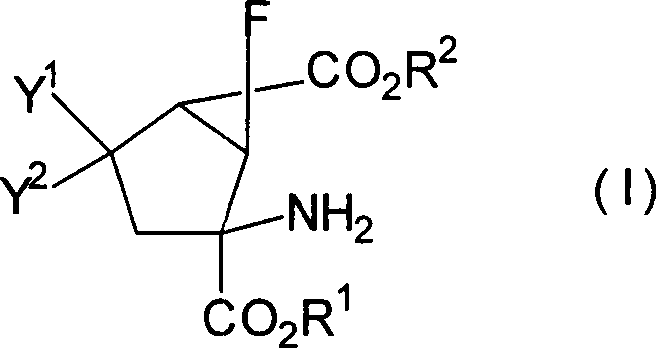
In der vorliegenden Erfindung bedeutet die C1-10-Alkylgruppe eine geradkettige oder verzweigte Alkylgruppe, deren Beispiele beinhalten eine Methylgruppe, eine Ethylgruppe, eine Propylgruppe, eine Isopropylgruppe, eine Butylgruppe, eine Isobutylgruppe, eine t-Butylgruppe, eine Pentylgruppe, eine Isopentylgruppe, eine 1-Ethylpropylgruppe, eine Hexylgruppe, eine Isohexylgruppe, eine 1-Ethylbutylgruppe, eine Heptylgruppe, eine Isoheptylgruppe, eine Octylgruppe, eine Nonylgruppe und eine Decylgruppe. Die C3-8-Cycloalkylgruppe bedeutet z.B. eine Cyclopropylgruppe, eine Cyclobutylgruppe, eine Cyclopentylgruppe, eine Cyclohexylgruppe, usw.. Die C3-8-Cycloalkyl-C1-5-alkyl-Gruppe bedeutet z.B. eine Cyclopropylmethylgruppe, eine Cyclobutylmethylgruppe, eine Cyclopentylmethylgruppe, eine Cyclohexylmethylgruppe, usw.. Die C1-10-Alkylthiogruppe bedeutet eine geradkettige oder verzweigte Alkylthiogruppe, deren Beispiele beinhalten eine Methylthiogruppe, eine Ethylthiogruppe, eine Propylthiogruppe, eine Isopropylgruppe, eine Butylthiogruppe, eine Isobutylthiogruppe, eine t-Butylthiogruppe, eine Pentylthiogruppe, eine Isopentylthiogruppe, eine 1-Ethylpropylthiogruppe, eine Hexylthiogruppe, eine Isohexylthiogruppe, eine 1-Ethylbutylthiogruppe, eine Heptylthiogruppe, eine Isoheptylthiogruppe, eine Octylthiogruppe, eine Nonylthiogruppe und eine Decylthiogruppe. Die C3-8-Cycloalkylthiogruppe bedeutet z.B. eine Cyclopropylthiogruppe, eine Cyclobutylthiogruppe, eine Cyclopentylthiogruppe, eine Cyclohexylthiogruppe, usw.. Die C3-8-Cycloalkyl-C1-5-alkylthio-Gruppe bedeutet z.B. eine Cyclopropylmethylthiogruppe, eine Cyclobutylmethylthiogruppe, eine Cyclopentylmethylthiogruppe, eine Cyclohexylmethylthiogruppe, usw.. Die C1-5-Alkoxygruppe bedeutet eine geradkettige oder verzweigte Alkoxygruppe, deren Beispiele beinhalten eine Methoxygruppe, eine Ethoxygruppe, eine Propoxygruppe, eine Isopropoxygruppe, eine Butoxygruppe, eine Isobutoxygruppe, eine t-Butoxygruppe, eine Pentoxygruppe, eine Isopentoxygruppe und eine 1-Ethylpropoxygruppe. Die C3-8-Cycloalkoxygruppe bedeutet z.B. eine Cyclopropoxygruppe, eine Cyclobutoxygruppe, eine Cyclopentoxygruppe, usw.. Die C3-8-Cycloalkyl-C1-5-alkoxygruppe bedeutet z.B. eine Cyclopropylmethoxygruppe, eine Cyclobutylmethoxygruppe, eine Cyclopropylethoxygruppe, usw..In the present invention, the C 1-10 alkyl group means a straight-chain or branched alkyl group, examples of which include a methyl group, an ethyl group, a propyl group, an isopropyl group, a butyl group, an isobutyl group, a t-butyl group, a pentyl group, an isopentyl group, 1-ethylpropyl group, hexyl group, isohexyl group, 1-ethylbutyl group, heptyl group, isoheptyl group, octyl group, nonyl group and decyl group. The C 3-8 cycloalkyl group means, for example, a cyclopropyl group, a cyclobutyl group, a cyclopentyl group, a cyclohexyl group, etc. The C 3-8 cycloalkyl-C 1-5 alkyl group means, for example, a cyclopropylmethyl group, a cyclobutylmethyl group, a cyclopentylmethyl group a C 1-10 alkylthio group means a straight-chain or branched alkylthio group, examples of which include methylthio group, ethylthio group, propylthio group, isopropyl group, butylthio group, isobutylthio group, t-butylthio group, pentylthio group, an isopentylthio group, a 1-ethylpropylthio group, a hexylthio group, an isohexylthio group, a 1-ethylbutylthio group, a heptylthio group, an isoheptylthio group, an octylthio group, a nonylthio group, and a decylthio group. The C 3-8 cycloalkylthio group means, for example, a cyclopropylthio group, a cyclobutylthio group, a cyclopentylthio group, a cyclohexylthio group, etc. The C 3-8 -cycloalkyl-C 1-5 -alkylthio group means, for example, a cyclopropylmethylthio group, a cyclobutylmethylthio group, a cyclopentylmethylthio group a C 1-5 alkoxy group means a straight-chain or branched alkoxy group, examples of which include methoxy group, ethoxy group, propoxy group, isopropoxy group, butoxy group, isobutoxy group, t-butoxy group, pentoxy group, an isopentoxy group and a 1-ethylpropoxy group. The C 3-8 cycloalkoxy group means, for example, a cyclopropoxy group, a cyclobutoxy group, a cyclopentoxy group, etc. The C 3-8 cycloalkylC 1-5 alkoxy group means, for example, a cyclopropylmethoxy group, a cyclobutylmethoxy group, a cyclopropylethoxy group, etc.
Als pharmazeutisch annehmbares Salz in dieser Erfindung kann z.B. genannt werden ein Salz mit einer anorganischen Säure wie Schwefelsäure, Salzsäure und Phosphorsäure; ein Salz mit einer organischen Säure wie Essigsäure, Oxalsäure, Milchsäure, Weinsäure, Fumarsäure, Maleinsäure, Methansulfonsäure und Benzolsulfonsäure; ein Salz mit einem Amin wie Trimethylamin und Methylamin; oder ein Salz mit einem Metallion wie Natriumion, Kaliumion und Calciumion. Die Verbindungen der vorliegenden Erfindung können als unterschiedliche Solvate existieren, aber im Hinblick auf die Anwendbarkeit als Arzneimittel sind Hydrate bevorzugt.When pharmaceutically acceptable salt in this invention may e.g. called Be a salt with an inorganic acid such as sulfuric acid, hydrochloric acid and Phosphoric acid; a salt with an organic acid like acetic acid, oxalic acid, Lactic acid, Tartaric acid, fumaric acid, maleic acid, methane and benzenesulfonic acid; a salt with an amine such as trimethylamine and methylamine; or a Salt with a metal ion such as sodium ion, potassium ion and calcium ion. The compounds of the present invention may be considered as different solvates exist, but in view of the applicability as a medicine hydrates are preferred.
In Verbindungen der Formel [I] sind, wenn sowohl Y1 als auch Y2 Wasserstoffatome oder zusammen ein Sauerstoffatom oder -X(CH2)nX- (X ist ein Sauerstoffatom oder ein Schwefelatom: n ist 2 oder 3), darstellen, oder wenn sowohl Y1 als auch Y2 eine C1-10-Alkylthiogruppe, eine C3-8-Cycloalkylthiogruppe, eine C3-8-Cycloalkyl-C1-5-alkylthiogruppe, eine C1-5-Alkoxygruppe, eine C3-8-Cycloalkoxygruppe oder eine C3-8-Cycloalkyl-C1-5-alkoxygruppe darstellen, asymmetrische Kohlenstoffatome in der 1, 2, 5 und 6 Position anwesend. Daher können die Verbindungen der vorliegenden Erfindung in den obigen Fällen als optisch aktive Substanzen, Enantiomere davon oder racemischer Stoff davon vorliegen.In compounds of the formula [I], when both Y 1 and Y 2 are hydrogen atoms or together are an oxygen atom or -X (CH 2 ) n X- (X is an oxygen atom or a sulfur atom: n is 2 or 3), or when both Y 1 and Y 2 are C 1-10 alkylthio, C 3-8 cycloalkylthio, C 3-8 cycloalkylC 1-5 alkylthio, C 1-5 alkoxy, C 3-8 -cycloalkoxy group or a C 3-8 -cycloalkyl-C 1-5 -alkoxy group, asymmetric carbon atoms in the 1, 2, 5 and 6 position present. Therefore, in the above cases, the compounds of the present invention can be used as optically active substances, Enantiomers thereof or racemic material thereof.
Wenn ferner Y1 und Y2 unterschiedlich voneinander ein Wasserstoffatom, eine C1-10-Alkylthiogruppe, eine C3-8-Cycloalkylthiogruppe, eine C3-8-Cycloalkyl-C1-5-alkylthiogruppe, eine C1-5-Alkoxygruppe, eine C3-8-Cycloalkoxygruppe oder eine C3-8-Cycloalkyl-C1-5-alkoxygruppe darstellen, oder wenn eines von Y1 und Y2 ein Wasserstoffatom darstellt und das andere eine Hydroxylgruppe, eine C1-5-Alkoxygruppe, eine C3-8-Cycloalkoxygruppe oder eine C3-8-Cycloalkyl-C1-5-alkoxygruppe darstellt, sind asymmetrische Kohlenstoffatome in den Positionen 1, 2, 4, 5 und 6 vorhanden. Daher können die Verbindungen der vorliegenden Erfindung in den obigen Fällen optisch aktive Substanzen, Enantiomere davon, racemischer Stoff oder eine Mischung aus Diastereomeren, basierend auf Y1 und Y2 in der 4-Position, sein.Further, when Y 1 and Y 2 are different from each other, a hydrogen atom, a C 1-10 -alkylthio group, a C 3-8 -cycloalkylthio group, a C 3-8 -cycloalkyl-C 1-5 -alkylthio group, a C 1-5 -alkoxy group , a C 3-8 cycloalkoxy group or a C 3-8 cycloalkyl C 1-5 alkoxy group, or when one of Y 1 and Y 2 represents a hydrogen atom and the other represents a hydroxyl group, a C 1-5 alkoxy group represents a C 3-8 cycloalkoxy group or a C 3-8 cycloalkyl C 1-5 alkoxy group, asymmetric carbon atoms are present at positions 1, 2, 4, 5 and 6. Therefore, in the above cases, the compounds of the present invention may be optically active substances, enantiomers thereof, racemic substance or a mixture of diastereomers based on Y 1 and Y 2 in the 4-position.
Es
ist bevorzugt, dass die Verbindungen, dargestellt in der Formel
[I], die folgende relative stereochemische Konfiguration aufweisen,
die durch die Formel [I']
dargestellt ist: 
Eine (+)- oder (–)-(1R*,2S*,6S*)-2-Amino-6-fluor-4-substituiertebicyclo[3.1.0]hexan-2,6-dicarbonsäure kann als spezielles Beispiel für besonders bevorzugte Verbindungen der Formel [I'] genannt werden.A (+) - or (-) - (1R *, 2S *, 6S *) - 2-amino-6-fluoro-4-substituted bicyclo [3.1.0] hexane-2,6-dicarboxylic acid as a special example of particularly preferred compounds of the formula [I '] can be mentioned.
Die anderen bevorzugten Kombinationen von Y1 und Y2 in den Verbindungen, dargestellt durch die Formel [I], beinhalten die Fälle, in denen beide Wasserstoffatome darstellen, in denen sie zusammen ein Sauerstoffatom darstellen und worin eines von ihnen ein Wasserstoffatom darstellt und das andere eine Hydroxylgruppe darstellt, wobei diese durch die folgenden Formeln [II], [III] bzw. [IV] gezeigt werden können.The other preferred combinations of Y 1 and Y 2 in the compounds represented by the formula [I] include the cases where both represent hydrogen atoms in which they together represent an oxygen atom and one of them represents a hydrogen atom and the other represents a hydroxyl group, which can be shown by the following formulas [II], [III] and [IV], respectively.
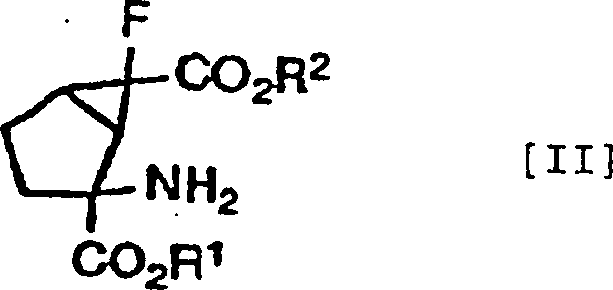
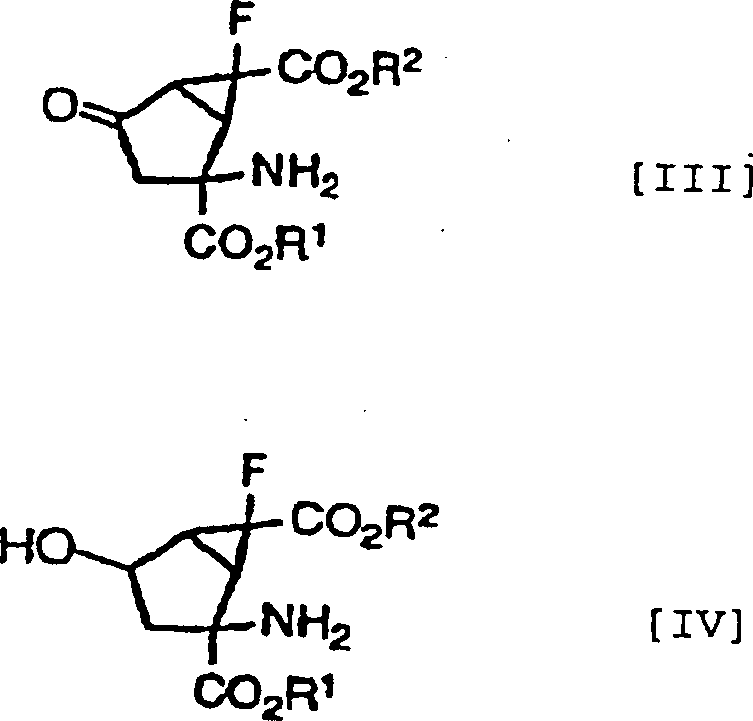
Ferner ist es noch bevorzugter, dass die Verbindungen der obigen Formeln [II], [III] und [IV] die folgenden relativen stereochemischen Konfigurationen aufweisen, die durch die Formeln [II'], [III'] bzw. [IV'] dargestellt sind.Further it is even more preferred that the compounds of the above formulas [II], [III] and [IV] the following relative stereochemical configurations have, which are represented by the formulas [II '], [III'] and [IV '].
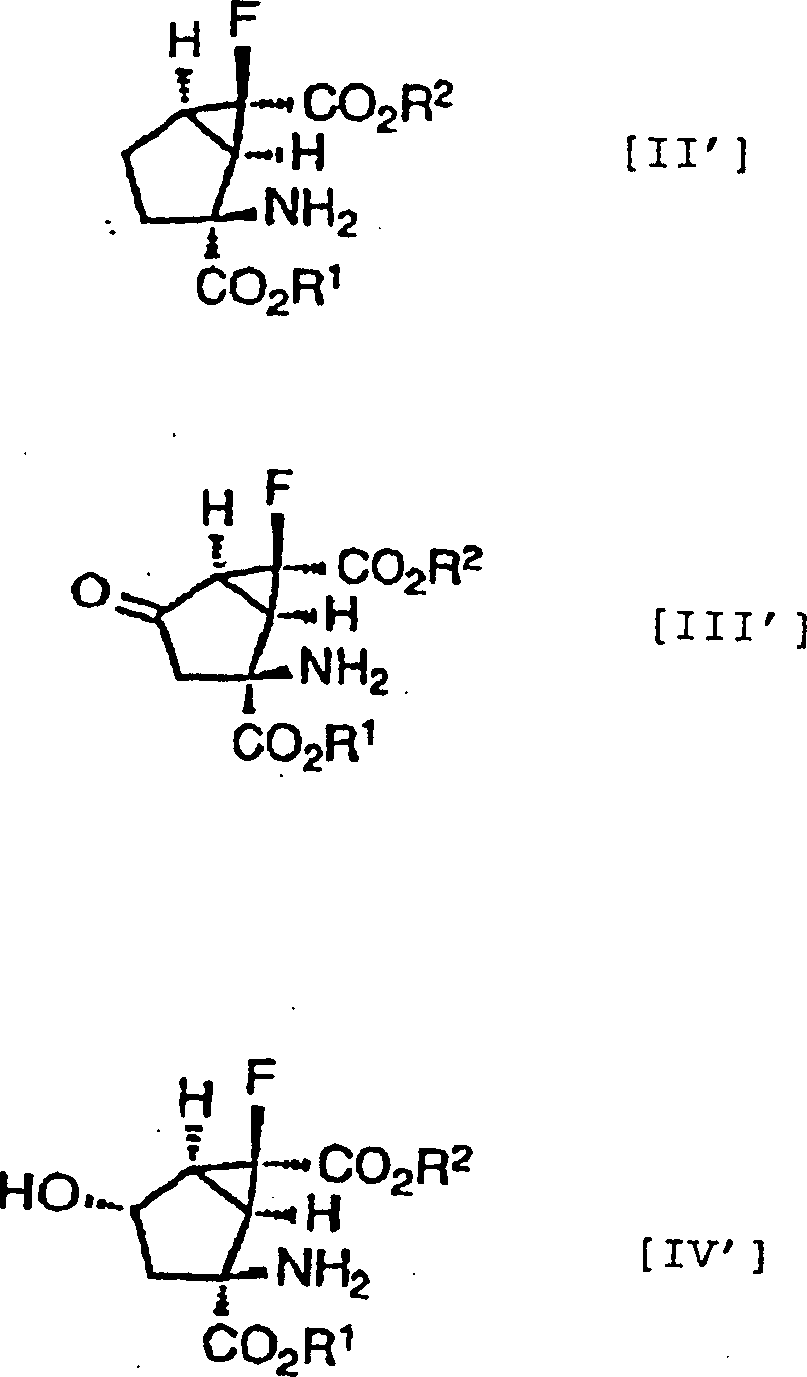
(–)-(1R*,2S*,5R*,6R*)-2-Amino-6-fluorbicyclo[3.1.0]hexan-2,6-dicarbonsäure, (+)-(1R*,2S*,5S*,6S*)-2-Amino-6-fluor-4-oxobicyclo [3.1.0]hexan-2,6-dicarbonsäure und (+)- oder (–)-(1R*,2S*,4S*,5S*,6S*)-2-Amino-6-fluor-4-hydroxybicyclo[3.1.0]hexan-2,6-dicarbonsäure, die alle optisch aktive Substanzen sind, können als besonders bevorzugte Verbindungen unter den Verbindungen, die durch die Formeln [II'], [III'] bzw. [IV'] dargestellt sind, genannt werden.(-) - (1R *, 2S *, 5R *, 6R *) - 2-Amino-6-fluorbicyclo [3.1.0] hexane-2,6-dicarboxylic acid, (+) - (1R *, 2S *, 5S *, 6S *) - 2-amino-6-fluoro-4-oxobicyclo [3.1.0] hexane-2,6-dicarboxylic acid and (+) - or (-) - (1R *, 2S *, 4S *, 5S *, 6S *) - 2-amino-6-fluoro-4-hydroxybicyclo [3.1.0] hexane-2,6-dicarboxylic acid, the all are optically active substances, may be particularly preferred Compounds among the compounds represented by the formulas [II '], [III'] and [IV '], to be named.
Wenn in den Formeln [I], [II], [III] und [IV] (einschließlich der Fälle von [I'], [II'], [III'] und [IV']) ein oder beide von R1 und R2 etwas anderes als ein Wasserstoffatom darstellen, hat dies zur Folge, dass die Esterformen keine Wirkung auf die metabotropen Glutamatrezeptoren der Gruppe 2 haben werden. Aber diese Esterformen werden in vivo hydrolysiert und in eine Carbonsäure umgewandelt, die eine Wirkung auf die metabotropen Glutamatrezeptoren der Gruppe 2 hat. Auf diese Weise sind die Esterformen der Verbindungen, die von der vorliegenden Erfindung umfasst werden, sehr nützlich, weil sie als Pro-Arzneimittel wirken.When in the formulas [I], [II], [III] and [IV] (including the cases of [I '], [II'], [III '] and [IV']), one or both of R 1 As R 2 and R 2 are other than a hydrogen atom, the result is that the ester forms will have no effect on the group 2 metabotropic glutamate receptors. However, these ester forms are hydrolyzed in vivo and converted to a carboxylic acid that has an effect on Group 2 metabotropic glutamate receptors. In this way, the ester forms of the compounds encompassed by the present invention are very useful because they act as prodrugs.
Die Verbindungen der Formel [I] können gemäß den folgenden Reaktionen hergestellt werden. In den folgenden Reaktionsformeln sind R1, R2, Y1 und Y2 dieselben wie oben, R3 und R4 stellen abgesehen von einem Wasserstoffatom R2 und R1 dar. X' stellt ein Chloratom, ein Bromatom oder ein Iodatom dar. Y3 und Y4 stellen zusammen -X(CH2)nX- dar (X stellt ein Sauerstoffatom oder ein Schwefelatom dar: n ist 2 oder 3), oder sie stellen identisch oder unterschiedlich voneinander eine C1-10-Alkylthiogruppe, eine C3-8-Cycloalkylthiogruppe, eine C3-8-Cycloalkyl-C1-5-alkylthiogruppe, eine C1-5-Alkoxygruppe, eine C3-8-Cycloalkoxygruppe oder eine C3-8-Cycloalkyl-C1-5-alkoxygruppe dar. Ar stellt eine Arylgruppe dar, wie eine Phenylgruppe, eine 4-Chlorphenylgruppe und eine 4-Methoxyphenylgruppe. Z1 stellt eine bekannte Schutzgruppe für eine Hydroxylgruppe dar. Z2 stellt eine bekannte Schutzgruppe für eine Hydroxylgruppe dar oder ist ein Wasserstoffatom. Z3 stellt eine bekannte Schutzgruppe für eine Aminogruppe dar. Bekannte Schutzgruppen für Hydroxyl- und Aminogruppen sind im Detail beschrieben in "Protective Groups in Organic Synthesis", von Theodora W. Greene und Peter G. M. Wuts, dessen Inhalte hiermit durch das Zitat eingeschlossen sind.The compounds of the formula [I] can be prepared according to the following reactions. In the following reaction formulas, R 1 , R 2 , Y 1 and Y 2 are the same as above, R 3 and R 4 are R 2 and R 1 except for a hydrogen atom. X 'represents a chlorine atom, a bromine atom or an iodine atom. Y 3 and Y 4 together represent -X (CH 2) n X- (X represents an oxygen atom or a sulfur atom: n is 2 or 3), or they represent identically or differently from each other a C 1-10 alkylthio group, a C 3-8 cycloalkylthio group, a C 3-8 cycloalkylC 1-5 alkylthio group, a C 1-5 alkoxy group, a C 3-8 cycloalkoxy group or a C 3-8 cycloalkylC 1-5 alkoxy group Ar represents an aryl group such as a phenyl group, a 4-chlorophenyl group and a 4-methoxyphenyl group. Z 1 represents a known protective group for a hydroxyl group. Z 2 represents a known protective group for a hydroxyl group or is a hydrogen atom. Z 3 represents a known protecting group for an amino group. Known protecting groups for hydroxyl and amino groups are described in detail in Protective Groups in Organic Synthesis, by Theodora W. Greene and Peter GM Wuts, the contents of which are hereby incorporated by reference.
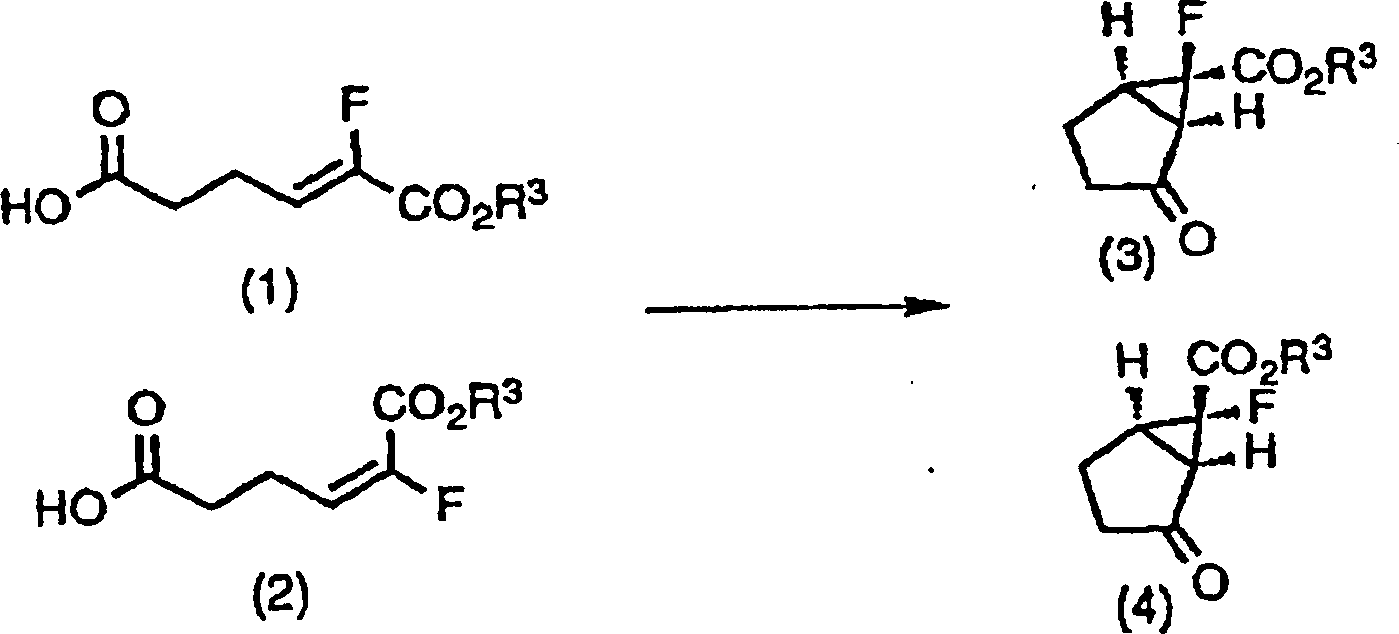
Wie in dem obigen Reaktionsschema gezeigt, kann das racemische Keton (3) oder (4) oder eine Mischung von Diastereomeren aus beiden erhalten werden durch zuerst Umwandeln eines Carbonsäurerests der Z-Form (1) oder E-Form (2) des obigen Fluoracrylsäurederivats oder einer Mischung aus beiden in eine aktive Form und dann Umsetzen mit Diazomethan, gefolgt von der Umsetzung in einem inerten Lösungsmittel in Gegenwart eines Metallkatalysators.As Shown in the above reaction scheme, the racemic ketone (3) or (4) or a mixture of diastereomers obtained from both are prepared by first converting a carboxylic acid radical of Z-form (1) or E-form (2) of the above fluoroacrylic acid derivative or a mixture from both into an active form and then reacting with diazomethane, followed by reaction in an inert solvent in the presence of a Metal catalyst.
Die hier erwähnte aktive Form bedeutet ein Säurehalogenid oder ein gemischtes Anhydrid. Das Säurehalogenid kann erhalten werden durch Umsetzen bekannter Halogenierungsmittel für eine Hydroxylgruppe in einer Carbonsäure, wie z.B. Thionylchlorid, Oxalylchlorid und Carbontetrachloridtriphenylphosphin, mit der Z-Form (1) oder der E-Form (2) des Fluoracrylsäurederivats oder mit einer Mischung aus beiden. Das gemischte Anhydrid kann erhalten werden durch Umsetzen von Halocarbonaten, wie Isobutylchlorcarbonat und Ethylchlorcarbonat, oder organischen Anhydriden, wie Essigsäureanhydrid und Trifluoressigsäureanhydrid, mit der Z-Form (1) oder der E-Form (2) des Fluoracrylsäurederivats oder einer Mischung aus beiden, mit oder ohne Anwesenheit von organischen Basen, wie Triethylamin, N-Methylmorpholin, Diisopropylethylamin und Pyridin, oder anorganische Basen, wie Kaliumcarbonat, Natriumhydrogencarbonat und Natriumhydrid.The mentioned here active form means an acid halide or a mixed anhydride. The acid halide can be obtained are prepared by reacting known halogenating agents for a hydroxyl group in a carboxylic acid, such as. Thionyl chloride, oxalyl chloride and carbon tetrachloride triphenylphosphine, with the Z-form (1) or the E-form (2) of the fluoroacrylic acid derivative or with a mixture of both. The mixed anhydride can can be obtained by reacting halocarbonates, such as isobutyl chlorocarbonate and ethyl chlorocarbonate, or organic anhydrides such as acetic anhydride and trifluoroacetic anhydride, with the Z-form (1) or the E-form (2) of the fluoroacrylic acid derivative or a mixture of both, with or without the presence of organic Bases such as triethylamine, N-methylmorpholine, diisopropylethylamine and pyridine, or inorganic bases such as potassium carbonate, sodium bicarbonate and sodium hydride.
Der Metallkatalysator kann z.B. Kupferagenzien sein, wie Kupfer(I)-iodid, Kupfer(II)-sulfat, Kupfer(II)-acetat, Kupfer(II)-bis(acetylacetonat) und Kupfer(II)-bis(N-t-butylsalicylaldiimidat); Rhodiumagenzien, wie Rhodium(II)-acetat und Rhodium(II)-trifluoracetat; und Palladiumagenzien, wie Palladium(II)-acetat und Bis(benzonitril)dichlorpalladium(II).Of the Metal catalyst may e.g. Copper, such as copper (I) iodide, copper (II) sulfate, Cupric acetate, cupric bis (acetylacetonate) and cupric bis (N-t-butylsalicylaldiimidate); Rhodium agents such as rhodium (II) acetate and rhodium (II) trifluoroacetate; and palladium agents such as palladium (II) acetate and bis (benzonitrile) dichloropalladium (II).
Beispiele für das inerte Lösungsmittel können beinhalten Ether, wie Tetrahydrofuran, Dioxan und Diethylether; Kohlenwasserstoffe, wie Toluol und Benzol; Lösungsmittel vom Halogentyp, wie Methylenchlorid, Chloroform und 1,2-Dichlorethan; N,N-Dimethylformamid; und Acetonitril.Examples for the inert solvent can include ethers, such as tetrahydrofuran, dioxane and diethyl ether; Hydrocarbons, such as toluene and benzene; Halogen type solvent, such as methylene chloride, chloroform and 1,2-dichloroethane; N, N-dimethylformamide; and acetonitrile.
Das
racemische Keton (3) oder das racemische Keton (4) kann direkt optisch
getrennt werden durch die Anwendung des HPLC-Verfahrens, bei dem
chirale Träger,
wie Cellulosecarbamatderivate und Amylosecarbamatderivate, verwendet
werden. Sie können
auch optisch getrennt werden, indem sie in Salze mit optisch aktiven
Aminen umgewandelt werden, wie (+)- oder (–)-1-Phenylethylamin, (+)-
oder (–)-2-Amino-1-butanol,
(+)- oder (–)-Alaninol,
Brucin, Cinchonidin, Cinchonin, Chinin, Chinidin und Dehydroabiethylamin,
nachdem ein Esterrest des racemischen Ketons (3) oder des racemischen
Ketons (4) in eine Carbonsäure
unter normalen Hydrolysebedingungen umgewandelt wurde. Ferner können sie
getrennt werden, nachdem sie in Amidoformen durch die Verwendung
eines primären
oder sekundären
optisch aktiven Amins, wie (+)- oder (–)-1-Phenylethylamin, (+)-
oder (–)-2-Amino-1-butanol
und (+)- oder (–)-Alaninol,
und normalen Amidierungsmitteln wie Dicyclohexylcarbodiimid (DCC)
umgewandelt wurden. 
Wie in dem obigen Reaktionsschema gezeigt, kann das Keton (3), das als eine optisch aktive Substanz, ein Enantiomer oder racemischer Stoff vorliegt, in das Enon (5) umgewandelt werden, das als eine optische aktive Substanz, ein Enantiomer oder racemischer Stoff vorliegt, durch seine Umsetzung mit z.B. Silylierungsmitteln in Gegenwart von Basen, wodurch der Silylenolether gebildet wird, gefolgt von seiner Umsetzung mit z.B. Palladium(II)-acetat. Das Enon (5) kann in den Keto-Alkohol (7), der eine optisch aktive Substanz, ein Enantiomer oder racemischer Stoff ist, umgewandelt werden, indem es zuerst in die Epoxyform (6) mittels der Umsetzung mit Peroxiden, wie t-Butylhydroperoxid und m-Chlorperoxybenzoesäure, geändert wird und dann mit z.B. Diphenyldiselenid in Gegenwart von Thiolen reduziert wird (J. Org. Chem. 59, 5179–5183 (1994)).As shown in the above reaction scheme, the ketone (3), which as an optically active substance, an enantiomer or racemic substance is converted into the enone (5), which as an optical active substance, an enantiomer or racemic substance, by its reaction with e.g. Silylating agents in the presence of bases, thereby forming the silyl enol ether, followed by its implementation with e.g. Palladium (II) acetate. The enon (5) can in the keto-alcohol (7), which is an optically active substance, an enantiomer or racemic matter, is converted by first into the epoxy form (6) by reaction with peroxides such as t-butyl hydroperoxide and m-chloroperoxybenzoic acid, changed and then with e.g. Diphenyl diselenide in the presence of thiols is reduced (J. Org. Chem. 59, 5179-5183 (1994)).
Hier können Amine, wie Triethylamin und Diisopropylethylamin, Amidbasen, wie Lithiumdiisopropylamid und Kaliumbis(trimethylsilyl)amid, und anorganische Basen, wie Natriumhydrid, als Basen verwendet werden. Silanverbindungen, wie Trimethylsilylchlorid, Trimethylsilyliodid und t-Butyldimethylsilylchlorid, können als Silylierungsmittel verwendet werden. Als Reaktionslösungsmittel können inerte Lösungsmittel, wie Benzol, Toluol, Tetrahydrofuran und Acetonitril, genannt werden.Here can Amines, such as triethylamine and diisopropylethylamine, amide bases, such as Lithium diisopropylamide and potassium bis (trimethylsilyl) amide, and inorganic Bases, such as sodium hydride, are used as bases. silane compounds, such as trimethylsilyl chloride, trimethylsilyl iodide and t-butyldimethylsilyl chloride, can be used as silylating agent. As a reaction solvent can inert solvents, such as benzene, toluene, tetrahydrofuran and acetonitrile.
Der Keto-Alkohol (7), der eine optisch aktive Substanz, ein Enantiomer oder ein racemischer Stoff ist, kann in die Verbindung (9) umgewandelt werden, indem er direkt oder wenn notwendig nach dem Schützen einer Hydroxylgruppe des Keto-Alkohols (7) mit einer bekannten Schutzgruppe für eine Hydroxylgruppe in die Ketonform (8), die eine optisch aktive Substanz, ein Enantiomer oder ein racemischer Stoff ist, geändert wird, gefolgt von seiner Umsetzung mit z.B. Alkohol oder Thiol in Gegenwart von Lewis-Säuren, wie Bortrifluorid-Diethylether-Komplex. Der Keto-Alkohol (7) und sein Hydroxylgruppe-geschützter Typ sind zusammen durch die Formel (8) dargestellt. Dann ist es möglich, ihn in das Ketal oder Thioketal (9), das eine optisch aktive Substanz, ein Enantiomer oder ein racemischer Stoff ist, zu ändern, wenn Z2 ein Wasserstoffatom ist, und durch Entschützen, wenn Z2 die bekannte Schutzgruppe für die Hydroxylgruppe ist. Das Ketal oder Thioketal (9) mit Z2 als Wasserstoffatom kann in die Verbindung (10), die eine optisch aktive Substanz, ein Enantiomer oder ein racemischer Stoff ist, durch Oxidation der Hydroxylgruppe umgewandelt werden.The keto-alcohol (7) which is an optically active substance, an enantiomer or a racemic substance can be converted to the compound (9) by directly or if necessary after protecting a hydroxyl group of the keto-alcohol (7) with a known protecting group for a hydroxyl group in the ketone form (8), which is an optically active substance, an enantiomer or a racemic substance, followed by its reaction with, for example, alcohol or thiol in the presence of Lewis acids, such as boron trifluoride diethyl ether complex. The keto alcohol (7) and its hydroxyl group-protected type are together represented by the formula (8). Then it is possible to change it into the ketal or thioketal (9), which is an optically active substance, an enantiomer or a racemic substance, when Z 2 is a hydrogen atom, and by deprotecting, when Z 2 is the known protecting group for the hydroxyl group is. The ketal or thioketal (9) having Z 2 as a hydrogen atom can be converted to the compound (10) which is an optically active substance, an enantiomer or a racemic material by oxidation of the hydroxyl group.
Die Verfahren, die in "Protective Groups in Organic Synthesis", von Theodora W. G. Reene und Peter G. M. Wuts beschrieben sind, können zum Schützen und Entschützen der Hydroxylgruppe und Ketalierung und Thioketalierung der Carbonylgruppe verwendet werden. Oxidation bedeutet, dass mit z.B. Oxdationsmittel vom Chromtyp, verkörpert durch Jones- und Collins-Oxidationen; Oxidationsmittel vom Mangantyp, wie Kaliumpermanganat und Mangandioxid; Oxidationsmittel vom Dimethylsulfoxidtyp unter Verwendung von Oxalylchlorid, Essigsäureanhydrid, Phosphorpentoxid, Schwefeltrioxid-Pyridin, Dicyclohexylcarbodiimid (DCC) usw. als ein Aktivierungsmittel; Oxidationsmittel vom Certyp, wie Cerdiammoniumnitrat und Cersulfat; Oxidationsmittel vom Rutheniumtyp, wie Tetrapropylammoniumperrutheniumat und Rutheniumoxid; und ein Dess-Martin-Mittel (siehe "Oxidations in Organic Chemistry", American Chemical Society, Washington, D.C., 1990, Milos Hudlicky) oxidiert wird oder dass mit Sauerstoff in Gegenwart eines Katalysators, wie Palladium und Platin, oxidiert wird. Sie kann z.B. in inerten Lösungsmitteln, wie Ethern, wie Tetrahydrofuran und Diethylether, Kohlenwasserstoffen, wie Toluol und Benzol, Lösungsmitteln vom Halogentyp, wie Dichlormethan und Chloroform, Lösungsmitteln vom Ketontyp, wie Aceton und Ethylmethylketon, Acetonitril, N,N-Dimethylformamid, Essigsäure, Pyridin, Wasser und Mischungen davon, durchgeführt werden.The methods described in "Protective Groups in Organic Synthesis" by Theodora WG Reene and Peter GM Wuts can be used to protect and deprotect the hydroxyl group and ketalization and thioketalation of the carbonyl group. Oxidation means that with, for example, chromium-type oxidants represented by Jones and Collins oxidations; Manganese type oxidants such as potassium permanganate and manganese dioxide; Dimethylsulfoxide type oxidant using oxalyl chloride, acetic anhydride, phosphorus pentoxide, sulfur trioxide-pyridine, dicyclohexylcarbodiimide (DCC), etc. as an activating agent; Cerium type oxidants such as cerium ammonium nitrate and cerium sulfate; Ruthenium-type oxidizing agents such as tetrapropylammonium perrutenate and ruthenium oxide; and a Dess-Martin agent (see "Oxidations in Organic Chemistry", American Chemical Society, Washington, DC, 1990, Milos Hudlicky) or that is oxidized with oxygen in the presence of a catalyst such as palladium and platinum. It can be used, for example, in inert solvents such as ethers such as tetrahydrofuran and diethyl ether, hydrocarbons such as toluene and benzene, halogen-type solvents such as dichloromethane and chloroform, ketone-type solvents such as acetone and ethyl methyl ketone, acetonitrile, N, N-dimethylformamide, acetic acid. Pyridine, water and mixtures thereof.
Die racemischen Stoffe (5), (6), (7), (8), (9) oder (10) können direkt optisch getrennt werden durch die Anwendung des HPLC-Verfahrens, bei dem chirale Träger, wie Cellulosecarbamatderivate und Amylosecarbamatderivate, verwendet werden. Sie können auch optisch getrennt werden, indem sie mit optisch aktiven Aminen, wie (+)- oder (–)-1-Phenylethylamin, (+)- oder (–)-2-Amino-1-butanol, (+)- oder (–)-Alaninol, Brucin, Cinchonidin, Cinchonin, Chinin, Chinidin und Dehydroabiethylamin, in Salze umgewandelt werden, nachdem ein Esterrest des racemischen Stoffes (5), (6), (7), (8), (9) oder (10) in eine Carbonsäure durch Hydrolyse unter normalen basischen oder sauren Esterhydrolysebedingungen überführt worden war. Ferner können sie getrennt werden, nachdem sie in Amidoformen durch die Verwendung von primären oder sekundären optisch aktiven Aminen, wie (+)- oder (–)-1-Phenylethylamin, (+)- oder (–)-2-Amino-1-butanol und (+)- oder (–)-Alaninol, und normalen Amidierungsmitteln, wie Dicyclohexylcarbodiimid (DCC), umgewandelt wurden.The racemic substances (5), (6), (7), (8), (9) or (10) can be used directly be optically separated by the application of the HPLC method, at the chiral carrier, such as cellulose carbamate derivatives and amylose carbamate derivatives become. You can also be optically separated by reacting with optically active amines, such as (+) - or (-) - 1-phenylethylamine, (+) - or (-) - 2-amino-1-butanol, (+) - or (-) - alaninol, Brucine, cinchonidine, cinchonine, quinine, quinidine and dehydroabiethylamine, be converted into salts after an ester radical of racemic Substance (5), (6), (7), (8), (9) or (10) in a carboxylic acid Hydrolysis under normal basic or acidic ester hydrolysis conditions was. Furthermore, can they are separated after being used in amido forms by use from primary or secondary optically active amines, such as (+) - or (-) - 1-phenylethylamine, (+) - or (-) - 2-amino-1-butanol and (+) - or (-) - alaninol, and normal amidating agents, such as dicyclohexylcarbodiimide (DCC), were converted.
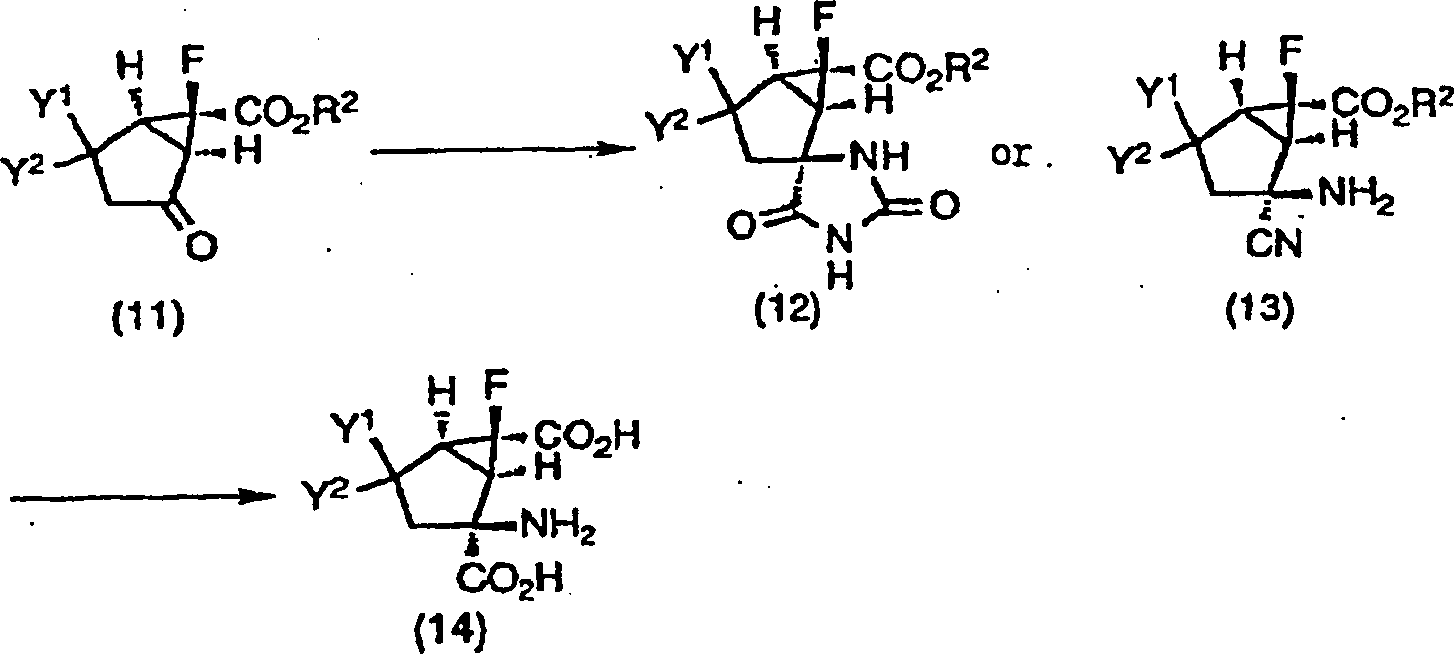
Die Ketone (11) einschließlich der Verbindungen (3), (7) und (10) sind nützlich als Intermediate, um die Verbindungen gemäß der vorliegenden Erfindung zu synthetisieren. Die Ketone (11), die optisch aktive Substanzen, Enantiomere oder racemische Stoffe sind, können in Hydantoinderivate (12) oder Aminocyanidderivate (13) durch die Strecker-Aminosäuresynthese (Ann., 75, 27 (1850); 91, 349 (1850)), die Bucherer-Bergs-Reaktion (J. Prakt. Chem., 140, 69 (1934)) oder Variationen davon umgesetzt werden. Die Hydantoinderivate (12) und die Aminocyanidderivate (13) können in die Verbindungen der vorliegenden Erfindung, die optisch aktive Substanzen, Enantiomere oder racemische Stoffe, 4-substituierte-2-Amino-6-fluorbicyclo[3.1.0]hexan-2,6-dicarbonsäuren (14), durch basische Hydrolyse mit z.B. Natriumhydroxid, Bariumhydroxid, usw. umgesetzt werden. Wenn z.B. Y1 und Y2 in den Hydantoinderivaten (12) oder den Cyanidderivaten (13) zusammen -S(CH2)nS- darstellen oder identisch oder unterschiedlich voneinander eine C1-10-Alkylthiogruppe, eine C3-8-Cycloalkylthiogruppe oder eine C3-8-Cycloalkyl-C1-5-alkylthiogruppe darstellen, kann eine der Verbindungen (14) gemäß der vorliegenden Erfindung, 2-Amino-6-fluor-4,4-dialkylthiobicyclo[3.1.0]hexan-2,6-dicarbonsäure, die eine optisch aktive Substanz, ein Enantiomer oder ein racemischer Stoff ist, hergestellt werden, indem für die Verbindungen (12) oder (13) basische Hydrolyse mit Natriumhydroxid, Bariumhydroxid usw. durchgeführt wird. Andererseits können aus den Hydantoinderivaten (12) und den Aminocyanidderivaten (13) durch Hydrolyse unter sauren Bedingungen unter Verwendung von z.B. Schwefelsäure oder dergleichen eine der Verbindungen (14) gemäß der vorliegenden Erfindung, 2-Amino-6-fluor-4-oxobicyclo[3.1.0]hexan-2,6-dicarbonsäure, die eine optisch aktive Substanz, ein Enantiomer oder ein racemischer Stoff ist, hergestellt werden. Ferner kann auch 2-Amino-6-fluor-4-oxobicyclo[3.1.0]hexan-2,6-dicarbonsäure, die eine optisch aktive Substanz, ein Enantiomer oder ein racemischer Stoff ist, erhalten werden durch Entfernen einer Dialkylthiogruppe aus 2-Amino-6-fluor-4,4-dialkylthiobicyclo[3.1.0]hexan-2,6-dicarbonsäure, die eine optisch aktive Substanz, ein Enantiomer oder ein racemischer Stoff ist (siehe "Protective Groups in organic Synthesis", Theodora W. Greene und Peter G. M. Wuts). Ferner kann 2-Amino-6-fluor-4-oxobicyclo[3.1.0]hexan-2,6-dicarbonsäure, die eine optisch aktive Substanz, ein Enantiomer oder ein racemischer Stoff ist, auch erhalten werden durch z.B. Oxidation einer Hydroxylgruppe von 2-Amino-6-fluor-4-hydroxybicyclo[3.1.0]hexan-2,6-dicarbonsäure, die eine optisch aktive Substanz, ein Enantiomer oder ein racemischer Stoff ist (siehe "Oxidation in Organic Chemistry", American Chemical Society, Washington D.C., 1990, Milos Hudlicky). Währendessen ist es bevorzugt, die Carboxyl- und Aminogruppen der Verbindungen (14), wenn notwendig, zu schützen (siehe "Protecting Groups in Organic Synthesis", Theodora W. Greene, John Wiley & Sons Inc.).The ketones (11) including the compounds (3), (7) and (10) are useful as intermediates to synthesize the compounds according to the present invention. The ketones (11), which are optically active substances, enantiomers or racemic substances, can be synthesized in hydantoin derivatives (12) or aminocyanide derivatives (13) by Strecker amino acid synthesis (Ann., 75, 27 (1850); 91, 349 (1850). ), the Bucherer-Bergs reaction (J. Prakt. Chem., 140, 69 (1934)), or variations thereof. The hydantoin derivatives (12) and the aminocyanide derivatives (13) can be incorporated in the compounds of the present invention containing optically active substances, enantiomers or racemic compounds, 4-substituted-2-amino-6-fluorobicyclo [3.1.0] hexane-2,6 dicarboxylic acids (14), by basic hydrolysis with, for example, sodium hydroxide, barium hydroxide, etc. are reacted. For example, when Y 1 and Y 2 in the hydantoin derivatives (12) or the cyanide derivatives (13) together represent -S (CH 2 ) n S- or identically or different from each other a C 1-10 alkylthio group, a C 3-8 cycloalkylthio group or a C 3-8 cycloalkylC 1-5 alkylthio group, one of the compounds (14) according to the present invention may be 2-amino-6-fluoro-4,4-dialkylthiobicyclo [3.1.0] hexane-2 , 6-dicarboxylic acid, which is an optically active substance, an enantiomer or a racemic substance, by performing basic hydrolysis with sodium hydroxide, barium hydroxide, etc. for compounds (12) or (13). On the other hand, from the hydantoin derivatives (12) and the aminocyanide derivatives (13) by hydrolysis under acidic conditions using, for example, sulfuric acid or the like, one of the compounds (14) according to the present invention, 2-amino-6-fluoro-4-oxobicyclo [3.1 .0] hexane-2,6-dicarboxylic acid which is an optically active substance, an enantiomer or a racemic substance. Further, 2-amino-6-fluoro-4-oxobicyclo [3.1.0] hexane-2,6-dicarboxylic acid, which is an optically active substance, an enantiomer or a racemic material, can also be obtained by removing a dialkylthio group from 2-amino-2-dicarboxylic acid. Amino-6-fluoro-4,4-dialkylthiobicyclo [3.1.0] hexane-2,6-dicarboxylic acid which is an optically active substance, an enantiomer or a racemic substance (see "Protective Groups in Organic Synthesis", Theodora W. Greene and Peter GM Wuts). Further, 2-amino-6-fluoro-4-oxobicyclo [3.1.0] hexane-2,6-dicarboxylic acid which is an optically active substance, an enantiomer or a racemic substance can also be obtained by, for example, oxidation of a hydroxyl group of 2 -Amino-6-fluoro-4-hydroxybicyclo [3.1.0] hexane-2,6-dicarboxylic acid, which is an optically active substance, an enantiomer or a racemic material (see "Oxidation in Organic Chemistry", American Chemical Society, Washington DC, 1990, Milos Hudlicky). Meanwhile, it is preferred to protect the carboxyl and amino groups of the compounds (14), if necessary (see "Protecting Groups in Organic Synthesis", Theodora W. Greene, John Wiley & Sons Inc.).
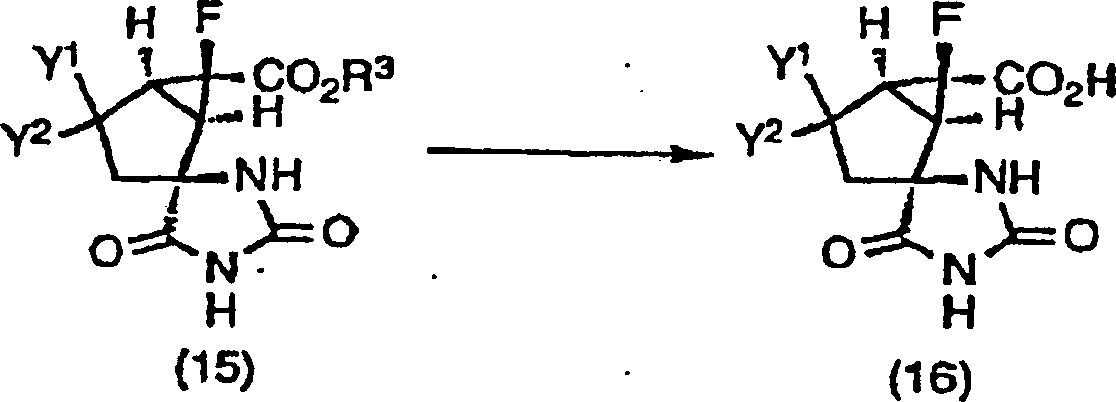
Der racemische Stoff der Formel (15) kann direkt optisch getrennt werden durch Anwendung des HPLC-Verfahrens, bei dem chirale Träger, wie Cellulosecarbamatderivate und Amylosecarbamatderivate, verwendet werden. Der racemische Stoff (15) kann auch optisch getrennt werden, indem er mit optisch aktiven Aminen, wie (+)- oder (–)-1-Phenylethylamin, (+)- oder (–)-2-Amino-1-butanol, (+)- oder (–)-Alaninol, Brucin, Cinchonidin, Cinchonin, Chinin, Chinidin und Dehydroabiethylamin, in Salze umgewandelt wird, nachdem ein Esterrest des racemischen Stoffes (15) durch Hydrolyse unter normal basischen oder sauren Esterhydrolysebedingungen hydrolysiert wurde, um eine Carbonsäure (16) zu bilden. Ferner kann er getrennt werden, nachdem er durch Verwendung von primären und sekundären optisch aktiven Aminen, wie (+)- oder (–)-1-Phenylethylamin, (+)- oder (–)-2-Amino-1-butanol und (+)- oder (–)-Alaninol, und normalen Amidationsmitteln, wie Dicyclohexylcarbodiimid (DCC), in eine Amidoform umgewandelt wurde.Of the racemic substance of formula (15) can be optically separated directly by using the HPLC method in which chiral supports, such as Cellulosecarbamatderivate and amylose carbamate derivatives used become. The racemic material (15) can also be optically separated, by reacting with optically active amines, such as (+) - or (-) - 1-phenylethylamine, (+) - or (-) - 2-amino-1-butanol, (+) - or (-) - alaninol, Brucine, cinchonidine, cinchonine, quinine, quinidine and dehydroabiethylamine, is converted into salts after an ester radical of the racemic Stoffes (15) by hydrolysis under normal basic or acidic Ester hydrolysis conditions was hydrolyzed to give a carboxylic acid (16) to build. Further, it can be separated after being used from primary and secondary optically active amines, such as (+) - or (-) - 1-phenylethylamine, (+) - or (-) - 2-amino-1-butanol and (+) - or (-) - alaninol, and normal amidating agents, such as dicyclohexylcarbodiimide (DCC), was converted to an amido form.
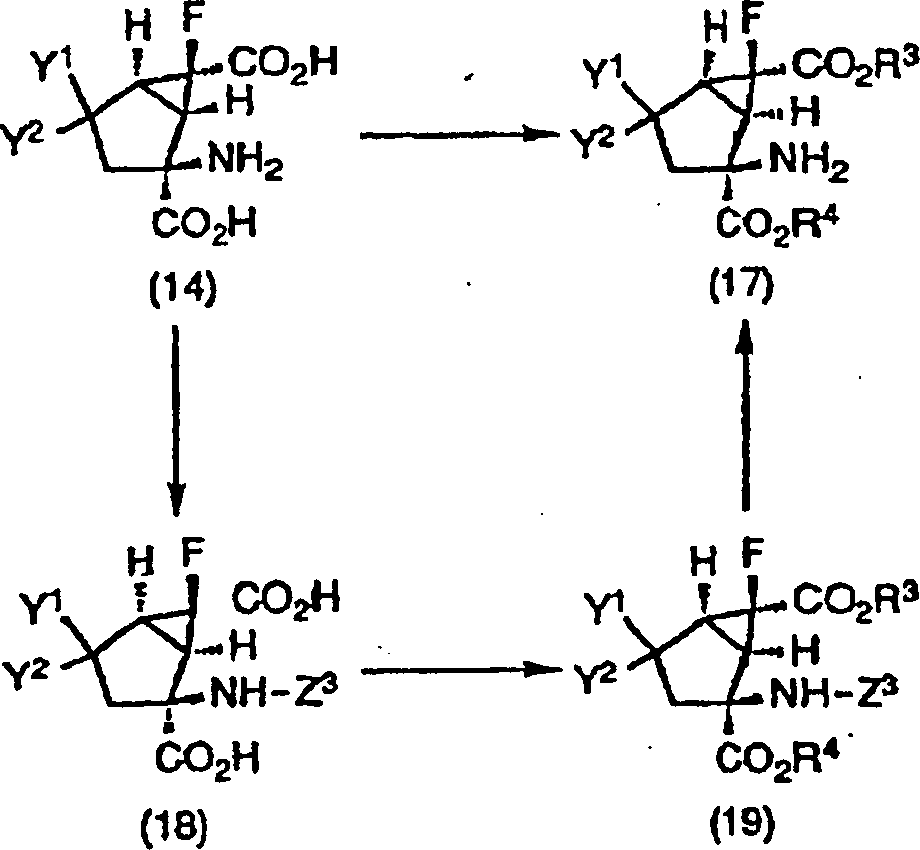
Wie in dem obigen Reaktionsschema gezeigt, kann die 4-substituierte-2-Amino-6-fluorbicyclo[3.1.0]hexan-2,6-dicarbonsäure (14), die eine Verbindung gemäß der vorliegenden Erfindung ist und als eine optisch aktive Substanz, ein Enantiomer oder racemischer Stoff vorliegt, in die Verbindung gemäß der vorliegenden Erfindung, dargestellt durch die Formel (17), der Esterform der 4-substituierten-2-Amino-6-fluorbicyclo[3.1.0]hexan-2,6-dicarbonsäure, die als eine optisch aktive Substanz, ein Enantiomer oder ein racemischer Stoff vorliegt, durch Veresterung mit bekannten Verfahren unter Verwendung von Alkoholen, dargestellt durch R3-OH oder R4-OH, umgewandelt werden; oder durch Umwandlung in die Verbindung der Formel (19) durch Veresterung mit bekannten Verfahren unter Verwendung von Alkylhalogeniden, dargestellt durch R3-X' oder R4-X' oder Alkoholen, dargestellt durch R3-OH oder R4-OH, nachdem sie in die Verbindung (18) durch Schützen einer Aminogruppe mit einer Schutzgruppe, dargestellt durch Z3, umgewandelt worden war, gefolgt von Entschützen der Schutzgruppe Z3 für die Aminogruppe.As shown in the above reaction scheme, the 4-substituted-2-amino-6-fluorobicyclo [3.1.0] hexane-2,6-dicarboxylic acid (14) which is a compound according to the present invention and as an optically active substance , an enantiomer or racemic substance, in the compound according to the present invention represented by the formula (17), the ester form of the 4-substituted-2-amino-6-fluorobicyclo [3.1.0] hexane-2,6-dicarboxylic acid which is present as an optically active substance, an enantiomer or a racemic substance, are converted by esterification by known methods using alcohols represented by R 3 -OH or R 4 -OH; or by conversion to the compound of formula (19) by esterification with known methods using alkyl halides represented by R 3 -X 'or R 4 -X' or alcohols represented by R 3 -OH or R 4 -OH, after it was converted to the compound (18) by protecting an amino group having a protective group represented by Z 3 , followed by deprotection of the protective group Z 3 for the amino group.
Schützen, Verestern und Entschützen der Aminogruppe im obigen Fall kann gemäß normalen Verfahren durchgeführt werden ("Protective Groups in Organic Synthesis", von Theodora W. Greene und Peter G. M. Wuts).Protect, esterify and deprotect the amino group in the above case can be carried out according to normal methods ("Protective Groups in Organic Synthesis ", by Theodora W. Greene and Peter G. M. Wuts).
Wenn die Verbindung (17) ein racemischer Stoff ist, kann er durch eine allgemeine optische Trennung unter Verwendung eines sauren chiralen Trennmittels optisch getrennt werden. Wenn die Verbindung (18) ein racemischer Stoff ist, kann er durch eine allgemeine optische Trennung unter Verwendung eines basischen chiralen Trennmittels optisch getrennt werden.If the compound (17) is a racemic substance, it can by a general optical separation using an acidic chiral Release agent to be optically separated. When the compound (18) is a racemic Fabric is, he can by a general optical separation under Using a basic chiral release agent optically separated become.
Hier kann man als das saure chirale Trennmittel optisch aktive organische Säuren, wie (+)- oder (–)-Di-p-Toluoylweinsäure, (+)- oder (–)-Dibenzoylweinsäure, (+)- oder (–)-Weinsäure, (+)- oder (–)-Mandelsäure, (+)- oder (–)-Camphersäure und (+)- oder (–)-Camphersulfonsäure, verwenden. Als das basische chirale Trennmittel kann man z.B. optisch aktive Amine, wie (+)- oder (–)-1-Phenylethylamin, (+)- oder (–)-2-Amino-1-butanol, (+)- oder (–)-Alaninol, Brucin, Cinchonidin, Cinchonin, Chinin, Chinidin, Dehydroabiethylamin, usw. verwenden.Here, as the acidic chiral resolving agent, optically active organic acids, such as (+) - or (-) - di-p-toluoyltartaric, (+) - or (-) - dibenzoyltartaric, (+) - or (-) - tartaric, (+) - or (-) - mandelic, (+) - or (- Use camphoric acid and (+) or (-) camphorsulfonic acid. As the basic chiral resolving agent it is possible to use, for example, optically active amines, such as (+) - or (-) - 1-phenylethylamine, (+) - or (-) - 2-amino-1-butanol, (+) - or (- ) -Alaninol, brucine, cinchonidine, cinchonine, quinine, quinidine, dehydroabiethylamine, etc. use.

Wie in dem obigen Reaktionsschema gezeigt, können die Z-Form (1) und E-Form (2) des Fluoracrylsäurederivats oder eine Mischung aus den Z- und E-Formen, dargestellt durch die Formel (23), erhalten werden, indem die Verbindung (22) durch die Umsetzung von γ-Butyrolactol (20) mit dem Phosphonoessigsäurederivat (21) hergestellt wird, gefolgt von Oxidation einer Hydroxylgruppe zu einer Carbonsäure, direkt oder nach Schützen der Hydroxylgruppe dargestellt.As Shown in the above reaction scheme, the Z-form (1) and E-form (2) the fluoroacrylic acid derivative or a mixture of the Z and E forms represented by the Formula (23) can be obtained by the compound (22) by the Reaction of γ-butyrolactol (20) with the phosphonoacetic acid derivative (21), followed by oxidation of a hydroxyl group to a carboxylic acid, directly or after shooters represented the hydroxyl group.
Das Schützen der Hydroxylgruppe kann gemäß normalen Schutzverfahren für eine Hydroxylgruppe durchgeführt werden ("Protective Groups in Organic Synthesis", Theodora W. G. Greene und Peter G. M. Wuts). Als spezielle Ausführungsformen für die Oxidation können z.B. genannt werden die Direktoxidation zu einer Carbonsäure unter Verwendung von Oxidationsmitteln vom Chromtyp, wie Jones-Reagens, Pyridindichromat (PDC) oder Oxidationsmittel vom Mangantyp, wie Kaliumpermanganat; oder durch stufenweise Oxidation zu einer Carbonsäure durch z.B. Natriumchlorit usw. nach der Umwandlung in ein Aldehyd durch Oxidation mit z.B. Dimethylsulfoxid, wie Swern-Oxidation ("Oxidations in Organic Chemistry", American Chemical Society, Washington D.C., 1990, Milos Hudlicky).The Protect the hydroxyl group may be normal Protection method for a hydroxyl group performed ("Protective Groups in Organic Synthesis ", Theodora W.G. Greene and Peter G. M. Wuts). As special embodiments for the Oxidation can e.g. called the direct oxidation to a carboxylic acid under Use of chromium type oxidants such as Jones reagent, Pyridine dichromate (PDC) or manganese type oxidant such as potassium; or by stepwise oxidation to a carboxylic acid e.g. Sodium chlorite, etc. after conversion to an aldehyde Oxidation with e.g. Dimethyl sulfoxide, such as Swern oxidation ("Oxidations in Organic Chemistry ", American Chemical Society, Washington D.C., 1990, Milos Hudlicky).
Die Verbindungen (22), worin Z2 eine t-Butyldimethylsilylgruppe, eine t-Butyldiphenylsilylgruppe oder dergleichen ist, können in zwei Isomere der Z- und E-Form durch Anwendung von Silikagel-Säulenchromatographie usw. aufgetrennt werden.The compounds (22) wherein Z 2 is a t-butyldimethylsilyl group, a t-butyldiphenylsilyl group or the like can be separated into two isomers of the Z and E forms by use of silica gel column chromatography and so on.
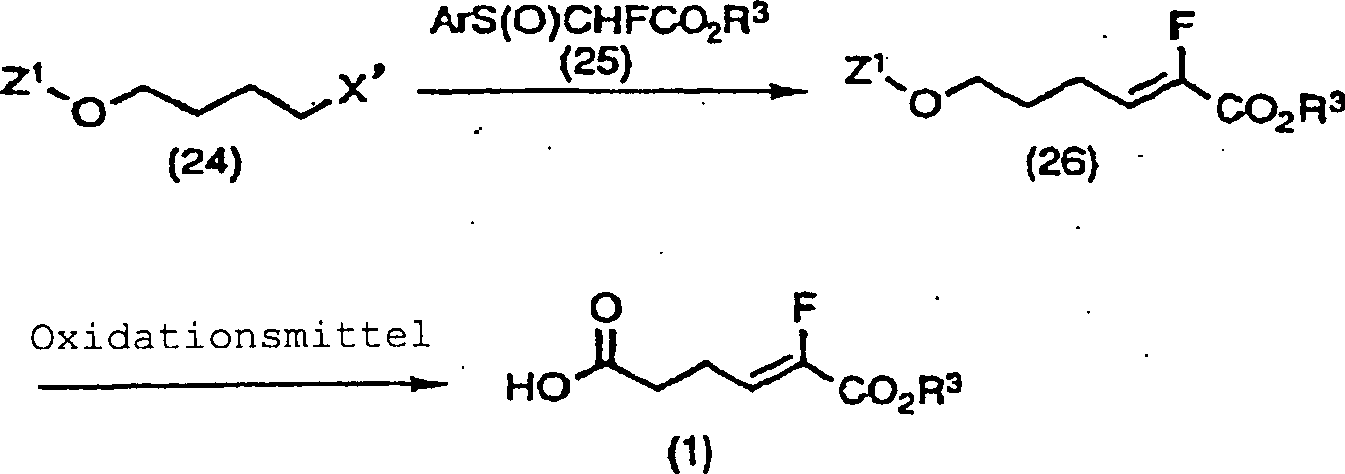
Wie in dem obigen Reaktionsschema gezeigt, kann ferner die Z-Form (1) des Fluoracrylsäurederivats erhalten werden durch Oxidation mit oder ohne Entschützen der Schutzgruppe Z1 einer Hydroxylgruppe nach Herstellung der Verbindung (26) durch Umsetzung des Halogenids der Formel (24) und des Sulfoxidderivats (25).Further, as shown in the above reaction scheme, the Z-form (1) of the fluoroacrylic acid derivative can be obtained by oxidation with or without deprotecting the protective group Z 1 of a hydroxyl group after preparation of the compound (26) by reacting the halide of the formula (24) and Sulfoxide derivative (25).
Das Entschützen der Schutzgruppe Z1 kann gemäß normalen Verfahren durchgeführt werden (siehe "Protective Groups in Organic Synthesis", Theodora W. Greene und Peter G. M. Wuts). Als spezielle Ausführungsformen für die Oxidation können z.B. genannt werden Direktoxidation zu Carbonsäure unter Verwendung von Oxidationsmitteln vom Chromtyp, wie Jones-Reagens, Pyridindichromat (PDC) oder Oxidationsmitteln vom Mangantyp, wie Kaliumpermanganat; oder stufenweise Oxidation zu einer Carbonsäure durch z.B. Natriumchlorit usw. nach dem Umwandeln in ein Aldehyd durch Oxidation, wie z.B. Dimethylsulfoxid, wie Swern-Oxidation.Deprotection of Z 1 can be carried out according to standard procedures (see Protective Groups in Organic Synthesis, Theodora W. Greene and Peter GM Wuts). As specific embodiments for the oxidation, there may be mentioned, for example, direct oxidation to carboxylic acid using chromium-type oxidizing agents such as Jones reagent, pyridine dichromate (PDC) or manganese type oxidizing agents such as potassium permanganate; or stepwise oxidation to a carboxylic acid by, for example, sodium chlorite, etc. after conversion to an aldehyde by oxidation such as dimethylsulfoxide such as Swern oxidation.
Aus den Verbindungen gemäß der vorliegenden Erfindung können pharmazeutische Präparate hergestellt werden, indem sie mit ein oder mehreren pharmazeutisch annehmbaren Trägern, Arzneistoffträgern oder Verdünnungsmitteln kombiniert werden. Beispiele für diese Träger, Arzneistoffträger und Verdünnungsmittel beinhalten Wasser, Lactose, Dextrose, Fructose, Saccharose, Sorbit, Mannit, Polyethylenglykol, Propylenglykol, Stärke, Gummi, Gelatine, Arginat, Calciumsilikat, Calciumphosphat, Cellulose, Wasser, Sirup, Methylcellulose, Polyvinylpyrrolidon, Alkylparahydroxybenzoat, Talk, Magnesiumstearat, Stearinsäure, Glycerin und Öle, wie Sesamöl, Olivenöl und Sojabohnenöl.From the compounds according to the present invention, pharmaceutical preparations can be produced by combining with one or more pharmaceutically acceptable carriers, excipients or diluents. Examples of these carriers, excipients and diluents include water, lactose, dextrose, fructose, sucrose, sorbitol, mannitol, polyethylene glycol, propylene glycol, starch, gum, gelatin, arginate, calcium silicate, calcium phosphate, cellulose, water, syrup, methyl cellulose, polyvinylpyrrolidone, alkyl parahydroxybenzoate , Talc, magnesium stearate, stearic acid, glycerol and oils such as sesame oil, olive oil and soybean oil.
Die Verbindungen gemäß der vorliegenden Erfindung können, nachdem sie mit diesen Trägern, Arzneistoffträgern oder Verdünnungsmitteln und wenn notwendig mit Additiven, wie gewöhnlich verwendete Füllstoffe, Bindemittel, Abbaumittel, pH-Regulatoren und Lösungsvermittler, vermischt wurden, mittels gewöhnlicher Formulierungstechnologie als pharmazeutische Präparate zur oralen oder parenteralen Verabreichung, insbesondere als Präparate, die auf metabotrope Glutamatrezeptoren der Gruppe 2 wirken (metabotrope Glutamatrezeptoragonisten der Gruppe 2) und die psychiatrische oder neurologische Krankheiten verhindern oder behandeln, in solchen Formen, wie Tabletten, Pillen, Kapseln, Körner, Pulver, Flüssigkeiten, Emulsionen, Suspensionen, Salben, Injektionen und Hauptpflaster, hergestellt werden. Die Verbindungen gemäß dieser Erfindung können einem erwachsenen Patienten in einer Menge von 0,01 bis 500 mg als einzelne Dosis oder aufgeteilt in mehrere Dosen pro Tag oral oder parenteral verabreicht werden. Diese Dosis kann unter Berücksichtigung des zu behandelnden Krankheitstyps und des Alters, Gewicht und der Symptome des Patienten geeignet erhöht oder verringert werden.The Compounds according to the present invention Invention can, after using these straps, Excipients or diluents and if necessary, with additives, as commonly used fillers, Binders, disintegrating agents, pH regulators and solubilizers, mixed were, by means of ordinary Formulation technology as pharmaceutical preparations for oral or parenteral Administration, especially as preparations based on metabotropic Glutamate receptors of group 2 act (metabotropic glutamate receptor agonists group 2) and psychiatric or neurological diseases prevent or treat, in such forms as tablets, pills, Capsules, grains, Powders, liquids, Emulsions, suspensions, ointments, injections and main patches, getting produced. The compounds according to this invention can one adult patients in an amount of 0.01 to 500 mg as a single Dose or divided into several doses per day orally or parenterally be administered. This dose may take into account the treatment to be treated Disease type and the age, weight and symptoms of the patient appropriately increased or reduced.
Beste Weise zur Durchführung der ErfindungBest way to carry out the invention
Im Folgenden beschreiben wir diese Erfindung speziell durch die Darstellung von Arbeitsbeispielen und experimentellen Beispielen. Diese Erfindung ist jedoch dadurch nicht auf diese Beispiele limitiert.in the Below we describe this invention specifically by way of illustration of working examples and experimental examples. This invention However, this is not limited to these examples.
Beispiel 1example 1
Synthese von (1RS,5RS,6RS)Ethyl-6-fluor-2-oxobicyclo[3.1.0]hexan-6-carboxylatSynthesis of (1RS, 5RS, 6RS) Ethyl 6-fluoro-2-oxobicyclo [3.1.0] hexane-6-carboxylate
(1) Unter einem Stickstofffluss mit Eiskühlung wurden 78,0 ml einer 1,00 M Tetrahydrofuranlösung aus Natrium-bis(trimethylsilyl)amid tropfenweise über 40 min zu einer Lösung aus 18,9 g Ethyldiethylphosphonofluoracetat in 75 ml Tetrahydrofuran zugetropft, und dann wurde die Mischung ferner für 45 min gerührt. Eine vorpräparierte Lösung aus γ-Butyrolactol (bei –78°C, unter einem Stickstofffluss, wurden 70,3 ml einer 1,01 M Toluollösung aus Aluminiumdiisobutylhydrid über 1,5 h tropfenweise zu 6,1 g γ-Butyrolacton in 75 ml Tetrahydrofuran zugegeben, und dann wurde die Mischung ferner bei dieser Temperatur für weitere 1,5 h gerührt) wurde tropfenweise über 30 min zu dieser Reaktionslösung zugegeben. Das Eisbad wurde nach der Zugabe weggenommen. Die Reaktionslösung wurde mit 120 ml 6 N Salzsäure gequencht, nachdem sie für 2 h bei Raumtemperatur und dann für 3 h bei 30°C gerührt worden war. Die Reaktionslösung wurde 2 Mal mit Ethylacetat extrahiert. Die erhaltenen organischen Schichten wurden vereinigt und über wasserfreiem Natriumsulfat getrocknet, nachdem sie mit einer gesättigten wässrigen Lösung aus Natriumchlorid gewaschen worden waren. Nach dem Abfiltrieren des Trocknungsmittels wurde die Konzentration des Filtrats unter reduziertem Druck durchgeführt. Der Rückstand wurde durch Säulenchromatographie gereinigt (Silikagel: Wako Gel C200 (hergestellt von Wako Pure Chemical Industries Ltd.), Eluent: Hexan-Ethylacetat = 4:1 bis 2:1), wodurch sich 7,9 g einer Mischung der Z- und E-Formen mit dem Verhältnis von etwa 1:3 von Ethyl-2-fluor-6-hydroxy-2-hexenoat ergaben.(1) Under a nitrogen flow with ice cooling, 78.0 ml of a 1.00 M tetrahydrofuran solution from sodium bis (trimethylsilyl) amide dropwise over 40 min to a solution from 18.9 g Ethyldiethylphosphonofluoracetat in 75 ml of tetrahydrofuran was added dropwise, and then the mixture was further stirred for 45 minutes. A pre-prepared solution from γ-butyrolactol (at -78 ° C, under a flow of nitrogen, 70.3 ml of a 1.01 M toluene solution Aluminum diisobutyl hydride over 1.5 g dropwise to 6.1 g of γ-butyrolactone in 75 ml of tetrahydrofuran, and then the mixture became further at this temperature for stirred for another 1.5 h) was dropwise over 30 min to this reaction solution added. The ice bath was removed after the addition. The reaction solution became with 120 ml of 6N hydrochloric acid after being quenched for 2 h at room temperature and then stirred for 3 h at 30 ° C. was. The reaction solution was extracted twice with ethyl acetate. The obtained organic Layers were united and over dried anhydrous sodium sulfate, after saturated with a saturated aqueous solution were washed from sodium chloride. After filtering off of the drying agent, the concentration of the filtrate was below performed reduced pressure. The residue was purified by column chromatography purified (silica gel: Wako Gel C200 (manufactured by Wako Pure Chemical Industries Ltd.), eluent: hexane-ethyl acetate = 4: 1 to 2: 1), whereby 7.9 g of a mixture of Z and E forms with the ratio of about 1: 3 of ethyl 2-fluoro-6-hydroxy-2-hexenoate.
Die
Protonen-NMR-Daten der erhaltenen Verbindungen sind unten gezeigt.
1H-NMR (CDCl3) δ (ppm): 1,34
(3H*1/4, t, J = 7,1 Hz), 1,36 (3H*3/4, t, J = 7,1 Hz), 1,73 (2H,
quint., J = 6,6 Hz), 2,01 (1H, br. s), 2,30–2,41 (2H*1/4, m), 2,56–2,68 (2H*3/4,
m), 3,63–3,73
(2H, m), 4,30 (2H*1/4, q, J = 7,1 Hz), 4,32 (2H*3/4, q, J = 7,1
Hz), 5,94 (1H*3/4, dt, J = 21,3, 8,7 Hz), 6,16 (1H*1/4, dt, J =
33,2, 8,1 Hz)The proton NMR data of the obtained compounds are shown below.
1 H-NMR (CDCl3) δ (ppm): 1.34 (3H * 1/4, t, J = 7.1 Hz), 1.36 (3H * 3/4, t, J = 7.1 Hz), 1.73 (2H, quint., J = 6.6 Hz), 2.01 (1H, br.s), 2.30-2.41 (2H * 1/4, m), 2, 56-2.68 (2H * 3/4, m), 3.63-3.73 (2H, m), 4.30 (2H * 1/4, q, J = 7.1 Hz), 4, 32 (2H * 3/4, q, J = 7.1 Hz), 5.94 (1H * 3/4, dt, J = 21.3, 8.7 Hz), 6.16 (1H * 1 / 4, dt, J = 33.2, 8.1 Hz)
(2) 7,8 g der Mischung aus den Z- und E-Formen mit dem Verhältnis von etwa 1:3 von Ethyl-2-fluor-6-hydroxy-2-hexenoat und 14,6 g t-Butyldiphenylchlorsilan wurden in 40 ml N,N-Dimethylformamid gelöst, und dann wurden 4,5 g Imidazol unter Eiskühlung zugegeben. Die Reaktionslösung wurde auf Raumtemperatur erwärmt und dann mit Ethylacetat verdünnt. Nach dem aufeinanderfolgenden Waschen der organischen Schicht mit Wasser, einer gesättigten wässrigen Lösung von Ammoniumchlorid, einer gesättigten wässrigen Lösung von Natriumhydrogencarbonat und einer gesättigten wässrigen Lösung von Natriumchlorid wurde sie mit wasserfreiem Natriumsulfat getrocknet. Nach dem Abfiltrieren des Trocknungsmittels wurde Konzentration des Filtrats unter reduziertem Druck durchgeführt. Der Rückstand wurde in das jeweilige geometrische Isomer aufgetrennt und durch Säulenchromatographie gereinigt (Silikagel: MSG D-40-60A (hergestellt von Dokai Chemicals Ltd.), Eluent: Hexan-Ethylacetat = 50:1), wodurch sich 2,4 g Ethyl-2-fluor-6-t-butyldiphenylsilyloxy-2(Z)-hexenoat und 7,1 g Ethyl-2-fluor-6-t-butyldiphenylsilyloxy-2(E)-hexenoat ergaben.(2) 7.8 g of the mixture of the Z and E forms having the ratio of about 1: 3 of ethyl 2-fluoro-6-hydroxy-2-hexenoate and 14.6 g of t-butyldiphenylchlorosilane were used in 40 N, N-dimethylformamide was dissolved, and then 4.5 g of imidazole was added under ice-cooling. The reaction solution was warmed to room temperature and then diluted with ethyl acetate. After successively washing the organic layer with water, a saturated aqueous solution of ammonium chloride, a saturated aqueous solution of sodium hydrogencarbonate and a saturated aqueous solution of sodium chloride, it was dried with anhydrous sodium sulfate. After filtering off the drying agent, concentration of the filtrate was carried out under reduced pressure. The residue was separated into the respective geometric isomer and purified by column chromatography (silica gel: MSG D-40-60A (manufactured by Dokai Che micals Ltd.), eluent: hexane-ethyl acetate = 50: 1) to give 2.4 g of ethyl 2-fluoro-6-t-butyldiphenylsilyloxy-2 (Z) -hexenoate and 7.1 g of ethyl 2-fluoro 6-t-butyldiphenylsilyloxy-2 (E) -hexenoate.
Die
Protonen-NMR- und massenspektroskopischen Daten von Ethyl-2-fluor-6-t-butyldiphenylsilyloxy-2(Z)-hexenoat
sind unten gezeigt.
1H-NMR (CDCl3) δ (ppm):
1,05 (9H, s), 1,33 (3H, t, J = 7,1 Hz), 1,61–1,76 (2H, m), 2,31–2,43 (2H,
m), 3,68 (2H, t, J = 6,2 Hz), 4,27 (2H, q, J = 7,1 Hz), 6,14 (1H,
dt, J = 33,4, 7,8 Hz), 7,33–7,48
(6H, m), 7,62–7,70
(4H, m), MS (Cl) (Pos) m/e: 415 (M++1),
357 (M+–57),
337 (M+–77,
100%)The proton NMR and mass spectral data of ethyl 2-fluoro-6-t-butyldiphenylsilyloxy-2 (Z) -hexenoate are shown below.
1 H-NMR (CDCl3) δ (ppm): 1.05 (9H, s), 1.33 (3H, t, J = 7.1 Hz), 1.61 to 1.76 (2H, m) , 2.31-2.43 (2H, m), 3.68 (2H, t, J = 6.2Hz), 4.27 (2H, q, J = 7.1Hz), 6.14 ( 1H, dt, J = 33.4, 7.8 Hz), 7.33-7.48 (6H, m), 7.62-7.70 (4H, m), MS (Cl) (Pos) m / e: 415 (M + +1), 357 (M + -57), 337 (M + -77, 100%)
Die
Protonen-NMR- und massenspektroskopischen Daten von Ethyl-2-fluor-6-t-butyldiphenylsilyloxy-2(E)-hexanoat
sind unten gezeigt.
1H-NMR (CDCl3) δ (ppm):
1,05 (9H, s), 1,32 (3H, t, J = 7,1 Hz), 1,61–1,77 (2H, m), 2,56–2,69 (2H,
m), 3,69 (2H, t, J = 6,3 Hz), 4,28 (2H, q, J = 7,1 Hz), 5,92 (1H,
dt, J = 21,8, 8,1 Hz), 7,33–7,48
(6H, m), 7,62–7,70
(4H, m) MS (Cl) (Pos) m/e: 415 (M++1), 357
(M+–57),
337 (M+–77,
100%)The proton NMR and mass spectroscopic data of ethyl 2-fluoro-6-t-butyldiphenylsilyloxy-2 (E) -hexanoate are shown below.
1 H-NMR (CDCl3) δ (ppm): 1.05 (9H, s), 1.32 (3H, t, J = 7.1 Hz), 1.61 to 1.77 (2H, m) , 2.56-2.69 (2H, m), 3.69 (2H, t, J = 6.3 Hz), 4.28 (2H, q, J = 7.1 Hz), 5.92 ( 1H, dt, J = 21.8, 8.1 Hz), 7.33-7.48 (6H, m), 7.62-7.70 (4H, m) MS (Cl) (Pos) m / e: 415 (M + +1), 357 (M + -57), 337 (M + -77, 100%)
(3) 2,3 g Ethyl-2-fluor-6-t-butyldiphenylsilyloxy-2(Z)-hexenoat wurden in 12 ml Aceton gelöst, und dann wurden 9 ml 8 N Jones-Reagens unter Eiskühlung zugegeben. Nach dem Rühren der Reaktionslösung bei Raumtemperatur für 2,5 h wurde das überschüssige Reagens durch Zugabe von 2-Propanol zu der Reaktionslösung unter Eiskühlung gequencht. Die Reaktionsmischung wurde mit Ethylacetat verdünnt und dann mit Wasser gewaschen. Die wässrige Schicht wurde mit Ethylacetat extrahiert und die organische Schicht wurde insgesamt 2 Mal mit Wasser und mit einer gesättigten wässrigen Lösung von Natriumchlorid gewaschen, und dann wurde sie über wasserfreiem Natriumsulfat getrocknet. Nach dem Abfiltrieren des Trocknungsmittels wurde die Konzentration des Filtrats unter reduziertem Druck durchgeführt. Der Rückstand wurde durch Säulenchromatographie gereinigt (Silikagel: Wako Gel C200 (hergestellt von Wako Chemical Industries Ltd.), Eluent: Hexan-Ethylacetat = 3:1), wodurch sich 970 mg Ethyl-2-fluor-5-carboxy-2(Z)-pentenoat ergaben.(3) 2.3 g of ethyl 2-fluoro-6-t-butyldiphenylsilyloxy-2 (Z) -hexenoate dissolved in 12 ml of acetone, and then 9 ml of 8N Jones reagent was added under ice-cooling. After stirring the reaction solution at room temperature for 2.5 h became the excess reagent quenched by adding 2-propanol to the reaction solution under ice-cooling. The reaction mixture was diluted with ethyl acetate and then washed with water. The watery Layer was extracted with ethyl acetate and the organic layer was a total of 2 times with water and with a saturated aqueous solution washed with sodium chloride, and then it became anhydrous Dried sodium sulfate. After filtering off the drying agent The concentration of the filtrate was carried out under reduced pressure. Of the Residue was purified by column chromatography purified (silica gel: Wako Gel C200 (manufactured by Wako Chemical Industries Ltd.), eluent: hexane-ethyl acetate = 3: 1), resulting in 970 mg of ethyl 2-fluoro-5-carboxy-2 (Z) -pentenoate resulted.
Die
Protonen-NMR- und massenspektroskopischen Daten sind unten gezeigt.
1H-NMR (CDCl3) δ (ppm): 1,34
(3H, t, J = 7,1 Hz), 2,46–2,60
(4H, m), 4,29 (2H, q, J = 7,1 Hz), 6,03–6,27 (1H, m)
MS (Cl)
(Pos) m/e: 191 (M++1, 100%).The proton NMR and mass spectroscopic data are shown below.
1 H-NMR (CDCl3) δ (ppm): 1.34 (3H, t, J = 7.1 Hz), 2.46 to 2.60 (4H, m), 4.29 (2H, q, J = 7.1 Hz), 6.03-6.27 (1H, m)
MS (Cl) (Pos) m / e: 191 (M + +1, 100%).
Ebenso
wurde Ethyl-2-fluor-5-carboxy-2(E)-pentenoat erhalten. Die Protonen-NMR-
und massenspektroskopischen Daten sind unten gezeigt.
1H-NMR (CDCl3) δ (ppm): 1,36
(3H, t, J = 7,1 Hz), 2,54 (2H, t, J = 7, 3 Hz), 2, 78–2,90 (2H,
m), 4,32 (2H, q, J = 7,1 Hz), 5,98 (1H, dt, J = 20,5, 8,2 Hz)
MS
(Cl) (Pos) m/e: 191 (M++1), 173 (M+–17,
100%)Also, ethyl 2-fluoro-5-carboxy-2 (E) -pentenoate was obtained. The proton NMR and mass spectroscopic data are shown below.
1 H-NMR (CDCl3) δ (ppm): 1.36 (3H, t, J = 7.1 Hz), 2.54 (2H, t, J = 7, 3 Hz), 2, 78-2 , 90 (2H, m), 4.32 (2H, q, J = 7.1 Hz), 5.98 (1H, dt, J = 20.5, 8.2 Hz)
MS (Cl) (Pos) m / e: 191 (M + 1), 173 (M + -17, 100%)
(4) 920 mg Ethyl-2-fluor-5-carboxy-2(Z)-pentenoat und 1,3 ml Oxalylchlorid wurden in Hexan unter Rückfluss für 3 h erwärmt. Die Reaktionslösung wurde unter reduziertem Druck konzentriert und unter Verwendung einer Vakuumpumpe getrocknet. Eine Etherlösung mit einem Überschuss an Diazomethan wurde tropfenweise zu dem erhaltenen Rückstand unter Eiskühlung zugegeben, dies wurde bei Raumtemperatur für 1 h gerührt. Nach Filtration der Reaktionslösung wurde das Filtrat unter reduziertem Druck konzentriert. Der erhaltene Rückstand wurde in 10 ml Benzol gelöst, und dies wurde tropfenweise über 30 min zu 120 ml Benzollösung von 40 mg Kupfer(II)-bis(N-t-butylsalicylaldiimidat) unter Wärmerefluxieren zugegeben. Die Reaktionslösung wurde auf Raumtemperatur abgekühlt und unter reduziertem Druck konzentriert. Der Rückstand wurde durch Säulenchromatographie gereinigt (Silikagel: Wako Gel C200 (hergestellt von Wako Chemical Industries Ltd.), Eluent: Hexan-Aceton = 9:1), wodurch sich 263 mg (1RS,5RS,6RS)-Ethyl-6-fluor-2-oxobicyclo[3.1.0]hexan-6-carboxylat ergaben.(4) 920 mg of ethyl 2-fluoro-5-carboxy-2 (Z) -pentenoate and 1.3 ml of oxalyl chloride were refluxed in hexane for 3 h heated. The reaction solution was concentrated under reduced pressure and used dried a vacuum pump. An ether solution with an excess of diazomethane was added dropwise to the resulting residue under ice-cooling added, this was stirred at room temperature for 1 h. After filtration of the reaction solution was the filtrate concentrated under reduced pressure. The obtained Residue was dissolved in 10 ml of benzene, and this was dropwise over 30 min to 120 ml of benzene solution of 40 mg of copper (II) bis (N-t-butylsalicylaldiimidate) under heat refluxing added. The reaction solution was cooled to room temperature and concentrated under reduced pressure. The residue was purified by column chromatography purified (silica gel: Wako Gel C200 (manufactured by Wako Chemical Industries Ltd.), eluent: hexane-acetone = 9: 1), giving rise to 263 mg (1RS, 5RS, 6RS) -Ethyl-6-fluoro-2-oxobicyclo [3.1.0] hexane-6-carboxylate revealed.
Die
Protonen-NMR- und massenspektroskopischen Daten sind unten gezeigt.
1H-NMR (CDCl3) δ (ppm): 1,33
(3H, t, J = 7,1 Hz), 2,05–2,55
(4H, m), 2,59 (1H, d, J = 6,6 Hz), 2,70–2,77 (1H, m); 4,30 (2H, q,
J = 7,1 Hz)
MS (IonSpray) (Pos) m/e: 187 (M++1),
204 (M++18), 209 (M++23,
100%)The proton NMR and mass spectroscopic data are shown below.
1 H-NMR (CDCl3) δ (ppm): 1.33 (3H, t, J = 7.1 Hz), 2.05 to 2.55 (4H, m), 2.59 (1H, d, J = 6.6 Hz), 2.70-2.77 (1H, m); 4.30 (2H, q, J = 7.1 Hz)
MS (Ion Spray) (Pos) m / e: 187 (M + 1), 204 (M + + 18), 209 (M + +23, 100%)
Genauso
wurde (1RS,5RS,6RS)Ethyl-6-fluor-2-oxobicyclo[3.1.0]hexan-6-carboxylat erhalten.
Die Protonen-NMR- und massenspektroskopischen Daten sind unten gezeigt.
1H-NMR (CDCl3) δ (ppm): 1,36
(3H, t, J = 7,1 Hz), 2,00–2,80
(6H, m), 4,32 (2H, q, J = 7,1 Hz)
MS (IonSpray) (Pos) m/e:
187 (M++1, 100%)Similarly, (1RS, 5RS, 6RS) ethyl 6-fluoro-2-oxobicyclo [3.1.0] hexane-6-carboxylate was obtained. The proton NMR and mass spectroscopic data are shown below.
1 H-NMR (CDCl3) δ (ppm): 1.36 (3H, t, J = 7.1 Hz), 2.00 to 2.80 (6H, m), 4.32 (2H, q, J = 7.1 Hz)
MS (Ion Spray) (Pos) m / e: 187 (M + +1, 100%)
Beispiel 2Example 2
Synthese von (1RS,5RS,6RS)Ethyl-6-fluor-2-oxobicyclo[3.1.0]hexan-6-carboxylatSynthesis of (1RS, 5RS, 6RS) Ethyl 6-fluoro-2-oxobicyclo [3.1.0] hexane-6-carboxylate
(1) 3,7 g 60%iges Natriumhydrid (ölig) wurden in 85 ml N,N-Dimethylformamid suspendiert und dann wurden 19,6 g Ethylphenylsulfinylfluoracetat in 35 ml N,N-Dimethylformamid tropfenweise über 30 min unter Eiskühlung zugegeben. Nach der Zugabe wurde das Rühren für 30 min unter Eiskühlung fortgesetzt, und dann wurde weiteres Rühren für 30 min bei Raumtemperatur fortgesetzt. Unter Eiskühlung wurden 20,2 g 1-Brom-4-tetrahydropyranyloxybutan auf einmal dazugegeben, und dann wurde das Rühren bei Raumtemperatur für 4 h und bei 95 bis 110°C für 1 h fortgesetzt. Nach dem Abkühlen der Reaktionslösung auf Raumtemperatur wurde sie in Eiswasser gefüllt und mit 10%igem Hexan-Ethylacetat extrahiert. Die erhaltenen organischen Schichten wurden über wasserfreiem Natriumsulfat getrocknet, nachdem sie mit Wasser und einer gesättigten wässrigen Natriumchlorid-Lösung gewaschen worden waren. Nach dem Abfiltrieren des Trocknungsmittels wurde Konzentration des Filtrats unter reduzierten Druck durchgeführt. Der Rückstand wurde durch Säulenchromatographie gereinigt (Silikagel: Wako Gel C200 (hergestellt von Wako Pure Chemical Industries Ltd.), Eluent: Hexan- Ethylacetat = 15:1) und (Silikagel: MSG D-40-60A (hergestellt von Dokai Chemicals Ltd.), Eluent: Hexan-Aceton = 20:1), wodurch sich 7,4 g Ethyl-2-fluor-6-tetrahydropyranyloxy-2(Z)-hexenoat ergaben.(1) 3.7 g of 60% sodium hydride (oily) were in 85 ml of N, N-dimethylformamide and then 19.6 g of ethyl phenylsulfinyl fluoroacetate was added in 35 ml of N, N-dimethylformamide was added dropwise over 30 minutes under ice cooling. After the addition, the stirring was for 30 min with ice cooling and then continued stirring for 30 minutes at room temperature continued. Under ice cooling were 20.2 g of 1-bromo-4-tetrahydropyranyloxybutane was added at once, and then stirring at room temperature for 4 h and at 95 to 110 ° C for 1 h continued. After cooling the reaction solution at room temperature, it was filled in ice-water and with 10% hexane-ethyl acetate extracted. The resulting organic layers were over anhydrous Sodium sulfate dried after mixing with water and a saturated aqueous Sodium chloride solution washed had been. After filtering off the drying agent was Concentration of the filtrate was carried out under reduced pressure. Of the Residue was purified by column chromatography purified (silica gel: Wako Gel C200 (manufactured by Wako Pure Chemical Industries Ltd.), eluent: hexane-ethyl acetate = 15: 1) and (silica gel: MSG D-40-60A (manufactured by Dokai Chemicals Ltd.), eluent: hexane-acetone = 20: 1), yielding 7.4 g of ethyl 2-fluoro-6-tetrahydropyranyloxy-2 (Z) -hexenoate revealed.
Die
Protonen-NMR- und massenspektroskopischen Daten sind unten gezeigt.
1H-NMR (CDCl3) δ (ppm): 1,33
(3H, t, J = 7,1 Hz), 1,46–1,90
(8H, m), 2,30–2,41
(2H, m), 3,33–3,57
(2H, m), 3,72–3,90
(2H, m), 4,28 (2H, q, J = 7,1 Hz), 4,57–4,60 (1H, m), 6,17 (1H, dt,
J = 33,3, 7,8 Hz)
MS (CI) (Pos) m/e: 261 (M++1),
85 (M+–175,
100%)The proton NMR and mass spectroscopic data are shown below.
1 H-NMR (CDCl3) δ (ppm): 1.33 (3H, t, J = 7.1 Hz), 1.46-1.90 (8H, m), 2.30 to 2.41 ( 2H, m), 3.33-3.57 (2H, m), 3.72-3.90 (2H, m), 4.28 (2H, q, J = 7.1Hz), 4.57 -4.60 (1H, m), 6.17 (1H, dt, J = 33.3, 7.8 Hz)
MS (CI) (Pos) m / e: 261 (M + +1), 85 (M + -175, 100%)
(2) 4,7 g Ethyl-2-fluor-5-carboxy-2(Z)-pentenoat wurden gemäß Schritt (3) aus Beispiel 1 erhalten.(2) 4.7 g of ethyl 2-fluoro-5-carboxy-2 (Z) -pentenoate were prepared according to step (3) obtained from Example 1.
Die
Protonen-NMR- und massenspektroskopischen Daten sind unten gezeigt.
1H-NMR (CDCl3) δ (ppm): 1,34
(3H, t, J = 7,1 Hz), 2,46–2,60
(4H, m), 4,29 (2H, q, J = 7, 1 Hz), 6,03–6,27 (1H, m)
MS (CI)
(Pos) m/e: 191 (M++1, 100%)The proton NMR and mass spectroscopic data are shown below.
1 H-NMR (CDCl3) δ (ppm): 1.34 (3H, t, J = 7.1 Hz), 2.46 to 2.60 (4H, m), 4.29 (2H, q, J = 7, 1 Hz), 6.03-6.27 (1H, m)
MS (CI) (Pos) m / e: 191 (M + +1, 100%)
(3) 2,8 g (1RS,5RS,6RS)Ethyl-6-fluor-2-oxobicyclo[3.1.0]hexan-6-carboxylat wurden gemäß Schritt (4) aus Beispiel 1 erhalten.(3) 2.8 g (1RS, 5RS, 6RS) of ethyl 6-fluoro-2-oxobicyclo [3.1.0] hexane-6-carboxylate according to step (4) obtained from Example 1.
Die
Protonen-NMR- und massenspektrometrischen Daten sind unten gezeigt.
1H-NMR (CDCl3) δ (ppm): 1,33
(3H, t, J = 7,1 Hz), 2,05–2,55
(4H, m), 2,59 (1H, d, J = 6,6 Hz), 2,70–2,77 (1H, m), 4,30 (2H, q,
J = 7,1 Hz)
MS (IonSpray) (Pos) m/e: 187 (M++1),
204 (M++18), 209 (M++23,
100%)The proton NMR and mass spectrometric data are shown below.
1 H-NMR (CDCl3) δ (ppm): 1.33 (3H, t, J = 7.1 Hz), 2.05 to 2.55 (4H, m), 2.59 (1H, d, J = 6.6 Hz), 2.70-2.77 (1H, m), 4.30 (2H, q, J = 7.1 Hz)
MS (Ion Spray) (Pos) m / e: 187 (M + 1), 204 (M + + 18), 209 (M + +23, 100%)
Beispiel 3Example 3
Synthese von (1R*,5R*,6R*)Ethyl-6-fluor-2-oxobicyclo[3.1.0]hexan-6-carboxylatSynthesis of (1R *, 5R *, 6R *) ethyl 6-fluoro-2-oxobicyclo [3.1.0] hexane-6-carboxylate
919
mg (1RS,5RS,6RS)Ethyl-6-fluor-2-oxobicyclo[3.1.0]hexan-6-carboxylat, das gemäß Schritt
(4) aus Beispiel 1 erhalten wurde, wurde unter Verwendung von HPLC
mit CHIRALPAK AD (hergestellt von Daicel Chemicals Industries Ltd.,
2,0·25
cm, Eluent: n-Hexan/2-Propanol = 3:1, Flussrate: 5,0 ml/min, Temp.:
Raumtemperatur, Nachweis: UV 210 nm) getrennt, wodurch sich 423
mg (+)-(1R*,5R*,6R*)Ethyl-6-fluor-2-oxobicyclo[3.1.0]hexan-6-carboxylat
und 405 mg (–)-(1R*,5R*,6R*)Ethyl-6-fluor-2-oxobicyclo[3.1.0]hexan-6-carboxylat ergaben.
(+)-(1R*,5R*,6R*)Ethyl-6-fluor-2-oxobicyclo[3.1.0]hexan-6-carboxylat
1H-NMR (CDCl3) δ (ppm): 1,33
(3H, t, J = 7,1 Hz), 2,05–2,55
(4H, m), 2,59 (1H, d, J = 6,6 Hz), 2,70–2,77 (1H, m), 4,30 (2H, q,
J = 7,1 Hz)
MS (IonSpray) (Pos) m/e: 187 (M++1),
204 (M++18), 209 (M++23,
100%
TR = 5,65 min (CHIRALPAK AD 0,46·25 cm,
Eluent: n-Hexan/2-Propanol = 3:1, Flussrate: 1,0 ml/min, Temperatur:
Raumtemperatur, Nachweis: UV 210 nm) [α]D 27 = +27,98 (c = 0,13, CHCl3)
(–)-(1R*,5R*,6R*)Ethyl-6-fluor-2-oxobicyclo[3.1.0]hexan-6-carboxylat
1H-NMR (CDCl3) δ (ppm): 1,33
(3H, t, J = 7,1 Hz), 2,05–2,55
(4H, m), 2,59 (1H, d, J = 6,6 Hz), 2,70–2,77 (1H, m), 4,30 (2H, q,
J = 7,1 Hz)
MS (IonSpray) (Pos) m/e: 187 (M++1),
204 (M++18), 209 (M++23,
100%
TR = 9,13 min (CHIRALPAK AD 0,46·25 cm,
Eluent: n-Hexan/2-Propanol = 3:1, Flussrate: 1,0 ml/min, Temperatur:
Raumtemperatur, Nachweis: UV 210 nm)
[α]D 27 = –30,33
(c = 0,16, CHCl3)919 mg (1RS, 5RS, 6RS) Ethyl 6-fluoro-2-oxobicyclo [3.1.0] hexane-6-carboxylate, obtained according to step (4) from Example 1, was purified by HPLC using CHIRALPAK AD ( manufactured by Daicel Chemicals Industries Ltd., 2.0 x 25 cm, eluent: n-hexane / 2-propanol = 3: 1, flow rate: 5.0 ml / min, temp .: room temperature, detection: UV 210 nm) to give 423 mg of (+) - (1R *, 5R *, 6R *) ethyl 6-fluoro-2-oxobicyclo [3.1.0] hexane-6-carboxylate and 405 mg of (-) - (1R *, 5R *, 6R *) gave ethyl 6-fluoro-2-oxobicyclo [3.1.0] hexane-6-carboxylate.
(+) - (1R *, 5R *, 6R *) ethyl 6-fluoro-2-oxobicyclo [3.1.0] hexane-6-carboxylate
1 H-NMR (CDCl3) δ (ppm): 1.33 (3H, t, J = 7.1 Hz), 2.05 to 2.55 (4H, m), 2.59 (1H, d, J = 6.6 Hz), 2.70-2.77 (1H, m), 4.30 (2H, q, J = 7.1 Hz)
MS (ion spray) (Pos) m / e: 187 (M + +1), 204 (M + + 18), 209 (M + +23, 100%
T R = 5.65 min (CHIRALPAK AD 0.46 x 25 cm, eluent: n-hexane / 2-propanol = 3: 1, flow rate: 1.0 ml / min, temperature: room temperature, detection: UV 210 nm) [α] D 27 = + 27.98 (c = 0.13, CHCl 3 ) (-) - (1R *, 5R *, 6R *) ethyl 6-fluoro-2-oxobicyclo [3.1.0] hexane 6-carboxylate
1 H-NMR (CDCl3) δ (ppm): 1.33 (3H, t, J = 7.1 Hz), 2.05 to 2.55 (4H, m), 2.59 (1H, d, J = 6.6 Hz), 2.70-2.77 (1H, m), 4.30 (2H, q, J = 7.1 Hz)
MS (ion spray) (Pos) m / e: 187 (M + +1), 204 (M + + 18), 209 (M + +23, 100%
T R = 9.13 min (CHIRALPAK AD 0.46 x 25 cm, eluent: n-hexane / 2-propanol = 3: 1, flow rate: 1.0 ml / min, Tempe temperature: room temperature, detection: UV 210 nm)
[α] D 27 = -30.33 (c = 0.16, CHCl 3 )
Beispiel 4Example 4
Synthese von (1RS,2SR,5RS,6RS)-2-Spiro-5'-hydantoin-6-fluorbicyclo[3.1.0]hexan-6-carbonsäureSynthesis of (1RS, 2SR, 5RS, 6RS) -2-spiro-5'-hydantoin-6-fluorbicyclo [3.1.0] hexane-6-carboxylic acid
256
mg (1RS,5RS,6RS)Ethyl-6-fluor-2-oxobicyclo[3.1.0]hexan-6-carboxylat wurden
in 2,5 ml Ethanol gelöst.
1,4 ml wässrige
1 N Natriumhydroxidlösung
wurden tropfenweise unter Eiskühlung
dazugegebe, und dann wurde das Rühren
bei dieser Temperatur für
10 min fortgesetzt. Nach dem Ansäuern
der Reaktionslösung
mit 1 N Salzsäure
(pH war fast gleich 1) wurde mit Ethylacetat verdünnt und
mit einer gesättigten
wässrigen
Natriumchloridlösung
gewaschen. Die wässrige
Schicht wurde 2 Mal mit Ethylacetat extrahiert und die erhaltenen
organischen Schichten wurden vereinigt, um sie über wasserfreiem Natriumsulfat
zu trocknen. Nach dem Abfiltrieren des Trocknungsmittels wurde Konzentration
des Filtrats unter reduziertem Druck durchgeführt. Der erhaltene Rückstand
wurde in 2 ml einer Mischung aus Wasser und Ethanol (1:1) gelöst, und
dann wurde er bei 55°C
für 8,5
h gerührt,
nachdem 796 mg Ammoniumcarbonat und 277 mg Kaliumcyanid dazugegeben
worden waren. Die Reaktionsmischung wurde eisgekühlt und dann wurde sie durch
Zugabe von konzentrierter Salzsäure
neutralisiert. Sie wurde durch Ionenaustauschchromatographie gereinigt
(AG50W-X8 Kationenaustauschharz (Bio-Rad), Eluent: Wasser), wodurch
sich 320 mg (1RS,2SR,5RS,6RS)-2-Spiro-5'-hydantoin-6-fluorbicyclo[3.1.0]hexan-6-carbonsäure ergaben.
Die Protonen-NMR- und massenspektroskopischen Daten sind unten gezeigt.
1H-NMR (DMSO-d6) δ (ppm): 1,49–1,70 (1H,
m), 1,93–2,40
(5H, m), 8,08 (1H, s), 10,71 (1H, s)
MS (CI) (Pos) m/e: 229
(M++1, 100%)256 mg (1RS, 5RS, 6RS) of ethyl 6-fluoro-2-oxobicyclo [3.1.0] hexane-6-carboxylate were dissolved in 2.5 ml of ethanol. 1.4 ml of 1N aqueous sodium hydroxide solution was added dropwise under ice-cooling, and then stirring was continued at this temperature for 10 minutes. After acidifying the reaction solution with 1N hydrochloric acid (pH was almost equal to 1), it was diluted with ethyl acetate and washed with a saturated sodium chloride aqueous solution. The aqueous layer was extracted twice with ethyl acetate, and the resulting organic layers were combined to dry over anhydrous sodium sulfate. After filtering off the drying agent, concentration of the filtrate was carried out under reduced pressure. The obtained residue was dissolved in 2 ml of a mixture of water and ethanol (1: 1), and then it was stirred at 55 ° C for 8.5 hours after adding 796 mg of ammonium carbonate and 277 mg of potassium cyanide. The reaction mixture was ice-cooled and then neutralized by the addition of concentrated hydrochloric acid. It was purified by ion exchange chromatography (AG50W-X8 cation exchange resin (Bio-Rad), eluent: water) to give 320 mg (1RS, 2SR, 5RS, 6RS) -2-spiro-5'-hydantoin-6-fluorobicyclo [3.1. 0] hexane-6-carboxylic acid. The proton NMR and mass spectroscopic data are shown below.
1 H-NMR (DMSO-d 6 ) δ (ppm): 1.49-1.70 (1H, m), 1.93-2.40 (5H, m), 8.08 (1H, s), 10.71 (1H, s)
MS (CI) (Pos) m / e: 229 (M + +1, 100%)
Genauso
wurden die folgenden Verbindungen erhalten. Die Daten der physikalischen
Eigenschaften für
jede sind unten zusammen gezeigt.
(1RS,2SR,5RS,6SR)-2-Spiro-5'-hydantoin-6-fluorbicyclo[3.1.0]hexan-6-carbonsäure
1H-NMR (DMSO-d6) δ (ppm): 1,80–2,38 (6H,
m), 7,34 (1H, s), 10,74 (1H, s)
MS (CI) (Pos) m/e: 229 (M++1, 100%)
(+)-(1R*,2S*,6R*)-2-Spiro-5'-hydantoin-6-fluorbicyclo[3.1.0]hexan-6-carbonsäure
1H-NMR (DMSO-d6) δ (ppm): 1,49–1,70 (1H,
m), 1,93–2,40
(5H, m), 8,08 (1H, s), 10,71 (1H, s)
MS (CI) (Pos) m/e: 229
(M++1, 100%)
[α]D 25,5 = + 77,87 (c = 0,43, 1 N NaOH)
(–)-(1R*,2S*,5R*,6R*)-2-Spiro-5'-hydantoin-6-fluorbicyclo[3.1.0]hexan-6-carbonsäure
1H-NMR (DMSO-d6) δ (ppm): 1,49–1,70 (1H,
m), 1,93–2,40
(5H, m), 8,08 (1H, s), 10,71 (1H, s)
MS (CI) (Pos) m/e: 229
(M++1, 100%)
[α]D 25,5 = –77,30
(c = 0,41, 1 N NaOH)Likewise, the following compounds were obtained. The physical property data for each are shown below together.
(1RS, 2SR, 5RS, 6SR) -2-spiro-5'-hydantoin-6-fluorobicyclo [3.1.0] hexane-6-carboxylic acid
1 H-NMR (DMSO-d 6 ) δ (ppm): 1.80-2.38 (6H, m), 7.34 (1H, s), 10.74 (1H, s)
MS (CI) (Pos) m / e: 229 (M + +1, 100%)
(+) - (1R *, 2S *, 6R *) - 2-spiro-5'-hydantoin-6-fluorobicyclo [3.1.0] hexane-6-carboxylic acid
1 H-NMR (DMSO-d 6 ) δ (ppm): 1.49-1.70 (1H, m), 1.93-2.40 (5H, m), 8.08 (1H, s), 10.71 (1H, s)
MS (CI) (Pos) m / e: 229 (M + +1, 100%)
[α] D 25.5 = + 77.87 (c = 0.43, 1 N NaOH)
(-) - (1R *, 2S *, 5R *, 6R *) - 2-spiro-5'-hydantoin-6-fluorobicyclo [3.1.0] hexane-6-carboxylic acid
1 H-NMR (DMSO-d 6 ) δ (ppm): 1.49-1.70 (1H, m), 1.93-2.40 (5H, m), 8.08 (1H, s), 10.71 (1H, s)
MS (CI) (Pos) m / e: 229 (M + +1, 100%)
[α] D 25.5 = -77.30 (c = 0.41, 1 N NaOH)
Beispiel 5Example 5
Synthese von (1RS,2SR,5RS,6RS)-2-Amino-6-fluorbicyclo[3.1.0]hexan-2,6-dicarbonsäureSynthesis of (1RS, 2SR, 5RS, 6RS) -2-amino-6-fluorbicyclo [3.1.0] hexane-2,6-dicarboxylic acid
200
mg (1RS,2SR,5RS,6RS)-2-Spiro-5'-hydantoin-6-fluorbicyclo[3.1.0]hexan-6-carbonsäure wurden in
3,0 ml einer 60%igen Schwefelsäure
bei 140°C
für 6 Tage
gerührt.
Nach Eiskühlung
und Neutralisierung der Reaktionslösung mit wässriger 5 N Natriumhydroxidlösung wurde
sie durch Ionenaustauschchromatographie gereinigt (AG50W-X8 Kationenaustauschharz
(Bio-Rad), Eluent: Wasser-50% THF/Wasser-10% Pyridin/Wasser), wodurch
sich 61 mg (1RS,2SR,5RS,6RS)-2-Amino-6-fluorbicyclo[3.1.0]hexan-2,6-dicarbonsäure ergaben.
Die Protonen-NMR- und massenspektroskopischen Daten sind unten gezeigt.
1H-NMR (TFA-d) δ (ppm): 2,15–2,28 (1H, m), 2,57 (1H, dd,
J = 13,5, 8,6 Hz), 2,67–2,94
(4H, m)
MS (IonSpray) (Nega) m/e: 202 (M+–1, 100%)200 mg (1RS, 2SR, 5RS, 6RS) -2-spiro-5'-hydantoin-6-fluorbicyclo [3.1.0] hexane-6-carboxylic acid were dissolved in 3.0 ml of a 60% sulfuric acid at 140 ° C for Stirred for 6 days. After cooling with ice and neutralizing the reaction solution with aqueous 5 N sodium hydroxide solution, it was purified by ion exchange chromatography (AG50W-X8 cation exchange resin (Bio-Rad), eluent: water-50% THF / water-10% pyridine / water) to give 61 mg (1RS , 2SR, 5RS, 6RS) -2-amino-6-fluorobicyclo [3.1.0] hexane-2,6-dicarboxylic acid. The proton NMR and mass spectroscopic data are shown below.
1 H-NMR (TFA-d) δ (ppm): 2.15-2.28 (1H, m), 2.57 (1H, dd, J = 13.5, 8.6 Hz), 2.67 -2.94 (4H, m)
MS (ion spray) (Nega) m / e: 202 (M + -1, 100%)
Genauso
wurden die folgenden Verbindungen erhalten. Die Daten der physikalischen
Eigenschaften für
jede sind zusammen gezeigt. (1RS,2SR,5RS,6SR)-2-Amino-6-fluorbicyclo[3.1.0]hexan-2,6-dicarbonsäure
1H-NMR (TFA-d) δ (ppm): 2,36–2,54 (2H, m), 2,58–2,87 (4H,
m)
MS (CI) (IonSpray) (Nega) m/e: 202 (M+–1, 100%)
(–)-(1R*,2S*,5R*,6R*)-2-Amino-6-fluorbicyclo[3.1.0]hexan-2,6-dicarbonsäure
1H-NMR (TFA-d) δ (ppm): 2,15–2,28 (1H, m), 2,57 (1H, dd,
J = 13,5, 8,6 Hz), 2,67–2,99
(4H, m)
MS (IonSpray) (Nega) m/e: 202 (M+–1, 100%)
[α]D 26 = –58,81 (c
= 0,14, H2O)
(+)-(1R*,2S*,5R*,6R*)-2-Amino-6-fluorbicyclo[3.1.0]hexan-2,6-dicarbonsäure
1H-NMR (TFA-d) δ (ppm): 2,15–2,28 (1H, m), 2,57 (1H, dd,
J = 13,5, 8,6 Hz), 2,67–2,94
(4H, m)
MS (IonSpray) (Nega) m/e: 202 (M+–1, 100%)
[α]D 26 = +57,49 (c =
0,16, H2O)Likewise, the following compounds were obtained. The physical property data for each are shown together. (1RS, 2SR, 5RS, 6SR) -2-amino-6-fluorobicyclo [3.1.0] hexane-2,6-dicarboxylic acid
1 H-NMR (TFA-d) δ (ppm): 2.36-2.54 (2H, m), 2.58-2.87 (4H, m)
MS (CI) (Ion Spray) (Nega) m / e: 202 (M + -1, 100%)
(-) - (1R *, 2S *, 5R *, 6R *) - 2-amino-6-fluorobicyclo [3.1.0] hexane-2,6-dicarboxylic acid
1 H-NMR (TFA-d) δ (ppm): 2.15-2.28 (1H, m), 2.57 (1H, dd, J = 13.5, 8.6 Hz), 2.67 -2.99 (4H, m)
MS (ion spray) (Nega) m / e: 202 (M + -1, 100%)
[α] D 26 = -58.81 (c = 0.14, H 2 O)
(+) - (1R *, 2S *, 5R *, 6R *) - 2-amino-6-fluorobicyclo [3.1.0] hexane-2,6-dicarboxylic acid
1 H-NMR (TFA-d) δ (ppm): 2.15-2.28 (1H, m), 2.57 (1H, dd, J = 13.5, 8.6 Hz), 2.67 -2.94 (4H, m)
MS (ion spray) (Nega) m / e: 202 (M + -1, 100%)
[α] D 26 = + 57.49 (c = 0.16, H 2 O)
Beispiel 6Example 6
Synthese von (1RS,5RS,6RS)Ethyl-6-fluor-2-oxobicyco[3.1.0]hex-3-en-6-carboxylatSynthesis of (1RS, 5RS, 6RS) Ethyl 6-fluoro-2-oxobicyco [3.1.0] hex-3-ene-6-carboxylate
Unter einer Stickstoffatmosphäre wurden 19,5 g (1RS,5RS,6RS)Ethyl-6-fluor-2-oxobicyclo[3.1.0]hexan-6-carboxylat, gelöst in 230 ml Tetrahydrofuran, bei –78°C tropfenweise zu 230 ml einer Tetrahydrofuranlösung von Lithium-bis(trimethylsilyl)amid, die aus 78 ml n-Butyllithium (1,61 M Hexanlösung) und 20,3 g 1,1,1,3,3,3-Hexamethyldisilazan hergestellt wurde, zugegeben. Nach Rühren bei dieser Temperatur für 1 h wurden 19,8 ml Chlortrimethylsilan zugegeben, und dies wurde bei Raumtemperatur für 1,5 h gerührt. Nach dem Durchführen von Konzentration der Reaktionslösung unter reduziertem Druck wurde wasserfreies Hexan zu dem Rückstand zugegeben. Das resultierende anorganische Salz wurde abfiltriert und das Filtrat wurde weiter unter reduziertem Druck konzentriert. Nachdem der Rückstand in 240 ml Acetonitril gelöst worden war, wurden 25,9 g Palladiumacetat zugegeben, und dann wurde dies bei Raumtemperatur für 1 Tag gerührt. Die Reaktionslösung wurde mit 240 ml Diethylether verdünnt, das Palladium wurde unter Verwendung von Celite abfiltriert und das Filtrat wurde unter reduziertem Druck konzentriert. Der Rückstand wurde durch Säulenchromatographie (Silikagel: Wako Gel C200 (hergestellt von Wako Pure Chemical Industries Ltd.), Eluent: Hexan-Ethylacetat = 9:1 bis 5:1) gereinigt, wodurch sich 17,1 g (1RS,5RS,6RS)Ethyl-6-fluor-2-oxobicyclo[3.1.0]hex-3-en-6-carboxylat ergaben.Under a nitrogen atmosphere were 19.5 g (1RS, 5RS, 6RS) ethyl 6-fluoro-2-oxobicyclo [3.1.0] hexane-6-carboxylate, solved in 230 ml of tetrahydrofuran, dropwise at -78 ° C to 230 ml of a tetrahydrofuran solution of lithium bis (trimethylsilyl) amide, which consists of 78 ml of n-butyllithium (1.61 M hexane solution) and 20.3 g of 1,1,1,3,3,3-hexamethyldisilazane was prepared, added. After stirring at this temperature were for 1 h 19.8 ml of chlorotrimethylsilane was added, and this was allowed at room temperature for 1.5 h stirred. After performing of concentration of the reaction solution Under reduced pressure, anhydrous hexane became the residue added. The resulting inorganic salt was filtered off and the filtrate was further concentrated under reduced pressure. After the residue dissolved in 240 ml of acetonitrile 25.9 g of palladium acetate were added and then became this at room temperature for 1 day stirred. The reaction solution was diluted with 240 ml of diethyl ether, the palladium was under Using celite, the filtrate was filtered off under reduced pressure Concentrated pressure. The residue was purified by column chromatography (Silica gel: Wako Gel C200 (manufactured by Wako Pure Chemical Industries Ltd.), eluent: hexane-ethyl acetate = 9: 1 to 5: 1), whereby 17.1 g (1RS, 5RS, 6RS) ethyl 6-fluoro-2-oxobicyclo [3.1.0] hex-3-ene-6-carboxylate revealed.
Die
Protonen-NMR- und massenspektroskopischen Daten sind unten gezeigt.
1H-NMR (CDCl3) δ (ppm): 1,39
(3H, t, J = 7,3 Hz), 2,78 (1H, dt, J = 0,6, 5,8 Hz), 3,22 (1H, dd,
J = 2,9, 5,8 Hz), 4,31 (2H, q, J = 7,3 Hz), 6,07 (1H, dd, J = 0,6,
5,6 Hz), 7,42 (1H, ddd, J = 0,6, 2,9, 5,6 Hz)
MS (CI) (Pos)
m/e: 185 (M++1, 100%)The proton NMR and mass spectroscopic data are shown below.
1 H-NMR (CDCl3) δ (ppm): 1.39 (3H, t, J = 7.3 Hz), 2.78 (1H, dt, J = 0.6, 5.8 Hz), 3 , 22 (1H, dd, J = 2.9, 5.8 Hz), 4.31 (2H, q, J = 7.3 Hz), 6.07 (1H, dd, J = 0.6, 5 , 6 Hz), 7.42 (1H, ddd, J = 0.6, 2.9, 5.6 Hz)
MS (CI) (Pos) m / e: 185 (M + +1, 100%)
Beispiel 7Example 7
Synthese von (1RS,3RS,4RS,5SR,6RS)Ethyl-3,4-epoxy-6-fluor-2-oxobicyclo[3.1.0]hexan-6-carboxylatSynthesis of (1RS, 3RS, 4RS, 5SR, 6RS) Ethyl 3,4-epoxy-6-fluoro-2-oxobicyclo [3.1.0] hexane-6-carboxylate
19,6 g (1RS,5RS,6RS)Ethyl-6-fluor-2-oxobicyco[3.1.0]hex-3-en-6-carboxylat wurden in 100 ml Toluol gelöst: 30,6 ml einer wässrigen 70%igen t-Butylhydroxyperoxidlösung und 11,5 ml einer 10%igen Benzyltrimethylammoniumhydroxid/Methanol-Lösung wurden dazugegeben, und dies wurde bei Raumtemperatur für 4 h gerührt. Nachdem die Reaktionslösung in Wasser gefüllt worden war, wurde sie 2 Mal mit Ethylacetat extrahiert. Die erhaltenen organischen Schichten wurden vereinigt, um sie mit einer gesättigten wässrigen Natriumchloridlösung zu waschen und wurden über wasserfreiem Natriumsulfat getrocknet. Nach dem Abfiltrieren des Trocknungsmittels wurde Konzentration des Filtrats unter reduziertem Druck durchgeführt. Der Rückstand wurde durch Säulenchromatographie (Silikagel: Wako Gel C200 (hergestellt von Wako Pure Chemical Industries Ltd.), Eluent: Hexan-Ethylacetat = 8:1 bis 6:1) gereinigt, wodurch sich 13,4 g (1RS,3RS,4RS,5SR,6RS)Ethyl-3,4-epoxy-6-fluor-2-oxobicyco[3.1.0]hexan-6-carboxylat ergaben.19.6 g (1RS, 5RS, 6RS) ethyl 6-fluoro-2-oxobicyco [3.1.0] hex-3-ene-6-carboxylate dissolved in 100 ml of toluene: 30.6 ml of an aqueous 70% t-butylhydroxyperoxide solution and 11.5 ml of a 10% benzyltrimethylammonium hydroxide / methanol solution was added and this was stirred at room temperature for 4 h. After the reaction solution in Filled with water was extracted twice with ethyl acetate. The obtained Organic layers were combined to give them a saturated aqueous Sodium chloride solution to wash and were over dried anhydrous sodium sulfate. After filtering off the drying agent Concentration of the filtrate was carried out under reduced pressure. Of the Residue was purified by column chromatography (Silica gel: Wako Gel C200 (manufactured by Wako Pure Chemical Industries Ltd.), Eluent: hexane-ethyl acetate = 8: 1 to 6: 1), resulting in 13.4 g (1RS, 3RS, 4RS, 5SR, 6RS) of ethyl 3,4-epoxy-6-fluoro-2-oxobicyco [3.1.0] hexane-6-carboxylate.
Die
Protonen-NMR- und massenspektroskopischen Daten sind unten gezeigt.
1H-NMR (CDCl3) δ (ppm): 1,34
(3H, t, J = 7,3 Hz), 2,50 (1H, ddt, J = 0,8, 2,4 6,0 Hz), 3,19 (1H,
dt, J = 0,8, 6,0 Hz), 3,53 (1H, dt, J = 0,8, 2,4 Hz), 4,02 (1H,
tt, J = 0,8, 2,4 Hz), 4,32 (2H, q, J = 7,3 Hz)
MS (EI) (Pos)
m/e: 99 (M+–101, 100%), 200 (M+)The proton NMR and mass spectroscopic data are shown below.
1 H-NMR (CDCl3) δ (ppm): 1.34 (3H, t, J = 7.3 Hz), 2.50 (1H, ddt, J = 0.8, 2.4 Hz 6.0 ), 3.19 (1H, dt, J = 0.8, 6.0 Hz), 3.53 (1H, dt, J = 0.8, 2.4 Hz), 4.02 (1H, tt, J = 0.8, 2.4 Hz), 4.32 (2H, q, J = 7.3 Hz)
MS (EI) (Pos) m / e: 99 (M + -101, 100%), 200 (M + )
Beispiel 8Example 8
Synthese von (1RS,4SR,5SR,6RS)Ethyl-6-fluor-4-hydroxy-2-oxobicyclo[3.1.0]hexan-6-carboxylatSynthesis of (1RS, 4SR, 5SR, 6RS) Ethyl 6-fluoro-4-hydroxy-2-oxobicyclo [3.1.0] hexane-6-carboxylate
Unter einer Stickstoffatmosphäre wurden 23,2 g N-Acetyl-L-cystein, 54,3 g Natriumtetraboratdecahydrat und 0,7 g Diphenyldiselenid in 450 ml einer Wasser-Ethanol(1:1)-Mischlösung, die entgast worden war, suspendiert. 9,5 g (1RS,3RS,4RS,5SR,6RS)Ethyl-3,4-epoxy-6-fluor-2-oxobicyclo[3.1.0]hexan-6-carboxylat, gelöst in 225 ml Tetrahydrofuran, wurden dazugegeben, und dies wurde bei Raumtemperatur für 1 Tag bei 38°C für 12 h und bei 85°C für 5 h gerührt. Nachdem die Reaktionslösung auf Raumtemperatur abgekühlt worden war, wurde sie in Wasser gefüllt und 3 Mal mit Diethylether extrahiert. Die erhaltenen organischen Schichten wurden vereinigt und über wasserfreiem Natriumsulfat getrocknet. Nach Abfiltration des Trocknungsmittels wurde Konzentration des Filtrats unter reduziertem Druck durchgeführt. Der Rückstand wurde durch Säulenchromatographie (Silikagel: Wako Gel (hergestellt von Wako Pure Chemical Industries Ltd.), Eluent: Hexan-Ethylacetat = 3:1 bis 1:1) gereinigt, wodurch sich 3,9 g (1RS,4SR,5SR,6RS)Ethyl-6-fluor-4-hydroxy-2-oxobicyclo[3.1.0]hexan-6-carboxylat ergaben.Under a nitrogen atmosphere, 23.2 g of N-acetyl-L-cysteine, 54.3 g of sodium tetraborate decahydrate and 0.7 g of diphenyl diselenide were suspended in 450 ml of a water-ethanol (1: 1) mixed solution which had been degassed. 9.5 g (1RS, 3RS, 4RS, 5SR, 6RS) Ethyl 3,4-epoxy-6-fluoro-2-oxobicyclo [3.1.0] hexane-6-carboxylate dissolved in 225 ml of tetrahydrofuran was added, and this was stirred at room temperature for 1 day at 38 ° C for 12 h and at 85 ° C for 5 h. After the reaction solution was cooled to room temperature, it was filled in water and extracted 3 times with diethyl ether. The obtained organic layers were combined and dried over anhydrous sodium sulfate. After filtering off the drying agent, concentration of the filtrate was carried out under reduced pressure. The residue was purified by columns chromatography (silica gel: Wako Gel (manufactured by Wako Pure Chemical Industries Ltd.), eluent: hexane-ethyl acetate = 3: 1 to 1: 1) to give 3.9 g (1RS, 4SR, 5SR, 6RS) of ethyl 6-fluoro-4-hydroxy-2-oxobicyclo [3.1.0] hexane-6-carboxylate.
Die
Protonen-NMR- und massenspektroskopischen Daten sind unten gezeigt.
1-NMR (CDCl3) δ (ppm): 1,34
(3H, t, J = 7,1 Hz), 2,05 (1H, d, J = 5,1 Hz), 2,30 (1H, dd, J =
3,5, 19,2 Hz), 2,63 (1H, dt, J = 5,9, 19,2 Hz), 2,72 (1H, d, J =
5,9 Hz), 2,85 (1H, dd, J = 2,1, 5,9 Hz), 4,31 (2H, q, J = 7,1 Hz),
4,76 (1H, t, J = 5,1 Hz)
MS (EI) (Pos) m/e: 129 (M+–73, 100%),
202 (M+)The proton NMR and mass spectroscopic data are shown below.
1- NMR (CDCl 3 ) δ (ppm): 1.34 (3H, t, J = 7.1 Hz), 2.05 (1H, d, J = 5.1 Hz), 2.30 (1H, dd, J = 3.5, 19.2 Hz), 2.63 (1H, dt, J = 5.9, 19.2 Hz), 2.72 (1H, d, J = 5.9 Hz), 2.85 (1H, dd, J = 2.1, 5.9Hz), 4.31 (2H, q, J = 7.1Hz), 4.76 (1H, t, J = 5.1Hz )
MS (EI) (Pos) m / e: 129 (M + -73, 100%), 202 (M + )
Beispiel 9Example 9
Synthese von (1RS,4SR,5SR,6RS)Ethyl-6-fluor-4-t-butyldimethylsilyloxy-2-oxobicyclo[3.1.0]hexan-6-carboxylatSynthesis of (1RS, 4SR, 5SR, 6RS) Ethyl 6-fluoro-4-t-butyldimethylsilyloxy-2-oxobicyclo [3.1.0] hexane-6-carboxylate
2,8
g (1RS,4SR,5SR,6RS)Ethyl-6-fluor-4-hydroxy-2-oxobicyco[3.1.0]hexan-6-carboxylat
und 2,5 g t-Butyldimethylchlorsilan wurden in 14 ml N,N-Dimethylformamid
gelöst.
1,0 g Imidazol wurde ferner unter Eiskühlung dazugegeben, und dies
wurde bei Raumtemperatur für
1 Tag gerührt.
Die Reaktionslösung
wurde in Wasser gefüllt
und mit n-Hexan-Ethylacetat (1:9) extrahiert. Die erhaltene organische
Schicht wurde nacheinander mit Wasser und einer gesättigten
wässrigen
Natriumchloridlösung
gewaschen und dann über
wasserfreiem Natriumsulfat getrocknet. Nach Abfiltration des Trocknungsmittels
wurde Konzentration des Filtrats unter einem reduziertem Druck durchgeführt. Der
Rückstand
wurde durch Säulenchromatographie
(Silikagel: Wako Gel (hergestellt von Wako Pure Chemical Industries
Ltd.), Eluent: Hexan-Ethylacetat = 15:1) gereinigt, wodurch sich
3,8 g (1RS,4SR,5SR,6RS)Ethyl-6-fluor-4-t-butyldimethylsilyloxy-2-oxobicyclo[3.1.0]hexan-6-carboxylat
ergaben. Die Protonen-NMR- und massenspektroskopischen Daten sind
unten gezeigt.
1-NMR (CDCl3) δ (ppm): 0,11
(3H, s), 0,13 (3H, s), 0,90 (9H, s), 1,33 (3H, t, J = 7,1 Hz), 2,21
(1H, dd, J = 9,0, 19,1 Hz), 2,57 (1H, dt, J = 5,6, 19,1 Hz), 2,60–2,72 (4H,
m), 4,31 (2H, q, J = 7,1 Hz), 4,66 (1H, d, J = 5,6 Hz)
MS (CI)
(Pos) m/e: 259 (M+–57, 100%), 317 (M++1)2.8 g (1RS, 4SR, 5SR, 6RS) of ethyl 6-fluoro-4-hydroxy-2-oxobicyco [3.1.0] hexane-6-carboxylate and 2.5 g of t-butyldimethylchlorosilane were dissolved in 14 ml of N, Dissolved N-dimethylformamide. 1.0 g of imidazole was further added thereto under ice-cooling, and it was stirred at room temperature for 1 day. The reaction solution was filled in water and extracted with n-hexane-ethyl acetate (1: 9). The obtained organic layer was washed successively with water and a saturated sodium chloride aqueous solution and then dried over anhydrous sodium sulfate. After the drying agent was filtered off, concentration of the filtrate was carried out under a reduced pressure. The residue was purified by column chromatography (silica gel: Wako Gel (manufactured by Wako Pure Chemical Industries Ltd.), eluent: hexane-ethyl acetate = 15: 1) to give 3.8 g (1RS, 4SR, 5SR, 6RS) of ethyl 6-fluoro-4-t-butyldimethylsilyloxy-2-oxobicyclo [3.1.0] hexane-6-carboxylate. The proton NMR and mass spectroscopic data are shown below.
1 -NMR (CDCl 3) δ (ppm): 0.11 (3H, s), 0.13 (3H, s), 0.90 (9H, s), 1.33 (3H, t, J = 7 , 1 Hz), 2.21 (1H, dd, J = 9.0, 19.1 Hz), 2.57 (1H, dt, J = 5.6, 19.1 Hz), 2.60-2 , 72 (4H, m), 4.31 (2H, q, J = 7.1 Hz), 4.66 (1H, d, J = 5.6 Hz)
MS (CI) (Pos) m / e: 259 (M + -57, 100%), 317 (M + +1)
Beispiel 10Example 10
Synthese von (1RS,4RS,5RS,6SR)Ethyl-2,2-ethylendithio-6-fluor-4-hydroxybicyclo[3.1.0]hexan-6-carboxylatSynthesis of (1RS, 4RS, 5RS, 6SR) Ethyl 2,2-ethylenedithio-6-fluoro-4-hydroxybicyclo [3.1.0] hexane-6-carboxylate
3,7
g (1RS,4SR,5SR,6RS)Ethyl-6-fluor-4-t-butyldimethylsilyloxy-2-oxobicyclo[3.1.0]hexan-6-carboxylat
und 1,2 ml 1,2-Ethandithiol wurden in 37 ml Chloroform gelöst. Trifluorboran-Diethylether-Komplex
wurde tropfenweise zugegeben, und dies wurde bei Raumtemperatur
für 1 Tag
gerührt.
Die Reaktionslösung
wurde nacheinander mit einer gesättigten
wässrigen
Natriumhydrogencarbonatlösung
und einer gesättigten
wässrigen
Natriumchloridlösung
gewaschen und dann über
wasserfreiem Natriumsulfat getrocknet. Nach Abfiltration des Trocknungsmittels
wurde Konzentration des Filtrats unter reduziertem Druck durchgeführt. Der
Rückstand wurde
durch Säulenchromatographie
(Silikagel: Wako Gel (hergestellt von Wako Pure Chemical Industries Ltd.),
Eluent: Hexan-Ethylacetat = 2:1) gereinigt, wodurch sich 3,2 g (1RS,4RS,5RS,6SR)Ethyl-2,2-ethylendithio-6-fluor-4-hydroxybicyclo[3.1.0]hexan-6-carboxylat
ergaben. Die Protonen-NMR- und massenspektroskopischen Daten sind
unten gezeigt.
1-NMR (CDCl3) δ (ppm): 1,32
(3H, t, J = 7,1 Hz), 2,07 (1H, d, J = 7,1 Hz), 2,38–2,69 (4H,
m), 3,33–3,45
(4H, m), 4,27 (2H, q, J = 7,1 Hz), 4,50 (1H, dd, J = 5,5, 7,1 Hz)
MS
(EI) (Pos) m/e: 131 (M+–147, 100%), 278 (M+)3.7 g (1RS, 4SR, 5SR, 6RS) Ethyl 6-fluoro-4-t-butyldimethylsilyloxy-2-oxobicyclo [3.1.0] hexane-6-carboxylate and 1.2 ml of 1,2-ethanedithiol were added in Dissolve 37 ml of chloroform. Trifluoroborane diethyl ether complex was added dropwise and this was stirred at room temperature for 1 day. The reaction solution was washed successively with a saturated sodium hydrogencarbonate aqueous solution and a saturated sodium chloride aqueous solution, and then dried over anhydrous sodium sulfate. After filtering off the drying agent, concentration of the filtrate was carried out under reduced pressure. The residue was purified by column chromatography (silica gel: Wako Gel (manufactured by Wako Pure Chemical Industries Ltd.), eluent: hexane-ethyl acetate = 2: 1) to give 3.2 g (1RS, 4RS, 5RS, 6SR) of ethyl 2,2-ethylenedithio-6-fluoro-4-hydroxybicyclo [3.1.0] hexane-6-carboxylate. The proton NMR and mass spectroscopic data are shown below.
1- NMR (CDCl 3 ) δ (ppm): 1.32 (3H, t, J = 7.1 Hz), 2.07 (1H, d, J = 7.1 Hz), 2.38-2, 69 (4H, m), 3.33-3.45 (4H, m), 4.27 (2H, q, J = 7.1 Hz), 4.50 (1H, dd, J = 5.5, 7.1 Hz)
MS (EI) (Pos) m / e: 131 (M + -147, 100%), 278 (M + )
Beispiel 11Example 11
Synthese von (1RS,5RS,6SR)Ethyl-4,4-ethylendithio-6-fluor-2-oxobicyclo[3.1.0]hexan-6-carboxylatSynthesis of (1RS, 5RS, 6SR) Ethyl 4,4-ethylenedithio-6-fluoro-2-oxobicyclo [3.1.0] hexane-6-carboxylate
3,1
g (1RS,4RS,5RS,6SR)Ethyl-2,2-ethylendithio-6-fluor-4-hydroxybicyclo[3.1.0]hexan-6-carboxylat und
9,0 g Dicyclohexylcarbodiimid wurden in 116 ml Dimethylsulfoxid
gelöst.
Nacheinander wurden 1,2 ml Pyridin und 0,6 ml Trifluoressigsäure tropfenweise
zugegeben, und dies wurde bei Raumtemperatur für 1 Tag gerührt. Nach Abfiltration des
resultierenden Harnstoffs wurde er mit Ethylacetat gewaschen. Das
Filtrat wurde mit Ethylacetat verdünnt, 3 Mal mit Wasser und mit
einer gesättigten
wässrigen
Natriumchloridlösung
gewaschen und dann über
wasserfreiem Natriumsulfat getrocknet. Nach Abfiltration des Trocknungsmittels
wurde Konzentration des Filtrats unter reduziertem Druck durchgeführt. Der
Rückstand
wurde durch Säulenchromatographie
(Silikagel: Wako Gel (hergestellt vgon Wako Pure Chemical Industries
Ltd.), Eluent: Hexan-Ethylacetat
= 5:1) gereinigt, wodurch sich 2,6 g (1RS,5RS,6SR)Ethyl-4,4- ethylendithio-6-fluor-2-oxobicyclo[3.1.0]hexan-6-carboxylat
ergaben. Die Protonen-NMR- und massenspektroskopischen Daten sind
unten gezeigt.
1-NMR (CDCl3) δ (ppm): 1,35
(3H, t, J = 7,1 Hz), 2,79 (1H, d, J = 6,3 Hz), 2,86–3,08 (2H,
m), 3,18 (1H, dd, J = 1,9, 6,3 Hz), 3,38–3,53 (4H, m), 4,31 (2H, q,
J = 7,1 Hz)
MS (EI) (Pos) m/e: 131 (M+–145, 100%),
276 (M+)3.1 g (1RS, 4RS, 5RS, 6SR) Ethyl 2,2-ethylenedithio-6-fluoro-4-hydroxybicyclo [3.1.0] hexane-6-carboxylate and 9.0 g of dicyclohexylcarbodiimide were dissolved in 116 ml of dimethyl sulfoxide , Successively, 1.2 ml of pyridine and 0.6 ml of trifluoroacetic acid were added dropwise and this was stirred at room temperature for 1 day. After filtering off the resulting urea, it was washed with ethyl acetate. The filtrate was diluted with ethyl acetate, washed with water 3 times and with a saturated sodium chloride aqueous solution, and then dried over anhydrous sodium sulfate. After filtering off the drying agent, concentration of the filtrate was carried out under reduced pressure. The residue was purified by column chromatography (silica gel: Wako gel (manufactured by Wako Pure Chemical Industries Ltd.), eluent: hexane-ethyl acetate = 5: 1) to give 2.6 g (1RS, 5RS, 6SR) ethyl-4, 4-ethylenedithio-6-fluoro-2-oxobicyclo [3.1.0] he xan-6-carboxylate. The proton NMR and mass spectroscopic data are shown below.
1- NMR (CDCl 3 ) δ (ppm): 1.35 (3H, t, J = 7.1 Hz), 2.79 (1H, d, J = 6.3 Hz), 2.86-3, 08 (2H, m), 3.18 (1H, dd, J = 1.9, 6.3 Hz), 3.38-3.53 (4H, m), 4.31 (2H, q, J = 7.1 Hz)
MS (EI) (Pos) m / e: 131 (M + -145, 100%), 276 (M + )
Beispiel 12Example 12
Synthese von (1R*,2S*,5R*,65*)-2-Spiro-5'-hydantoin-4,4-ethylendithio-6-fluor-N-((R)-1-phenylethyl)bicyclo[3.1.0]hexan-6-carboxyamidSynthesis of (1R *, 2S *, 5R *, 65 *) - 2-spiro-5'-hydantoin-4,4-ethylenedithio-6-fluoro-N - ((R) -1-phenylethyl) bicyclo [3.1. 0] hexane-6-carboxyamide
(1)
1,3 g (1RS,5RS,6SR)Ethyl-4,4-ethylendithio-6-fluor-2-oxobicyclo[3.1.0]hexan-6-carboxylat
wurden in 5,0 ml Ethanol gelöst.
Unter Eiskühlung
wurden 5,0 ml wässrige
1 N Natriumhydroxidlösung
tropfenweise zugegeben, und dies wurde bei Raumtemperatur für 15 min
gerührt.
Nach Erwärmen
der Reaktionslösung
auf Raumtemperatur wurden 1,1 g Ammoniumcarbonat und 350 mg Kaliumcyanid
zugegeben, und dann wurde dies bei 37°C für 3 Tage gerührt. Nach
Eiskühlung
und Einstellen des pHs der Reaktionsmischung auf 1 durch Zugabe
von konzentrierter Salzsäure
wurden 5 ml Ethanol zugegeben und Rühren bei dieser Temperatur
für 1 h
fortgesetzt. Nach Abfiltrieren der resultierenden Kristalle und
Waschen mit einer Mischlösung
aus Ethanol/Wasser (2:1) wurde dies bei 80°C getrocknet, wodurch sich 1,1
g (1RS,2SR,5RS,6SR)-2-Spiro-5'-hydantoin-4,4-ethylendithio-6-fluorbicyclo[3.1.0]hexan-6-carbonsäure ergaben.
Die Protonen-NMR- und massenspektroskopischen Daten sind unten gezeigt.
1H-NMR (DMSO-d6) δ (ppm): 2,37–2,50 (2H,
m), 2,68 (1H, dd, J = 1,9, 6,9 Hz), 2,76 (1H, dd, J = 4,2, 15,4
Hz), 3,28–3,50
(4H, m), 8,10 (1H, s), 10,78 (1H, s).
MS (ES) (Nega) m/e: 317
(M+–1,
100%)(1) Ethyl-4,4-ethylenedithio-6-fluoro-2-oxobicyclo [3.1.0] hexane-6-carboxylate 1.3 g (1RS, 5RS, 6SR) was dissolved in 5.0 ml of ethanol. Under ice-cooling, 5.0 ml of 1N aqueous sodium hydroxide solution was dropwise added, and this was stirred at room temperature for 15 minutes. After heating the reaction solution to room temperature, 1.1 g of ammonium carbonate and 350 mg of potassium cyanide were added, and then it was stirred at 37 ° C for 3 days. After cooling with ice and adjusting the pH of the reaction mixture to 1 by adding concentrated hydrochloric acid, 5 ml of ethanol was added and stirring continued at this temperature for 1 h. After filtering off the resulting crystals and washing with a mixed solution of ethanol / water (2: 1), this was dried at 80 ° C, whereby 1.1 g (1RS, 2SR, 5RS, 6SR) -2-Spiro-5'- hydantoin-4,4-ethylenedithio-6-fluorobicyclo [3.1.0] hexane-6-carboxylic acid. The proton NMR and mass spectroscopic data are shown below.
1 H-NMR (DMSO-d 6 ) δ (ppm): 2.37-2.50 (2H, m), 2.68 (1H, dd, J = 1.9, 6.9 Hz), 2, 76 (1H, dd, J = 4.2, 15.4 Hz), 3.28-3.50 (4H, m), 8.10 (1H, s), 10.78 (1H, s).
MS (ES) (Nega) m / e: 317 (M + -1, 100%)
(2) 5,7 g (1RS,2SR,5RS,6SR)-2-Spiro-5'-hydantoin-4,4-ethylendithio-6-fluorbicyclo[3.1.0]hexan-6-carbonsäure und 2,6 g (R)-(+)-1-Phenylethylamin wurden in 240 ml Dimethylformamid gelöst. 3,4 g 1-Hydroxybenzotriazol-Monohydrat und 4,1 g 1-Ethyl-3-(3-dimethylaminopropyl)carbodiimid-Hydrochlorid wurden unter Eiskühlung dazugegeben, und Rühren wurde bei Raumtemperatur für 1 Tag fortgesetzt. Nach Zugeben von 1 N Salzsäure zu der Reaktionslösung und 4-maligem Extrahieren mit Ethylacetat wurde sie über wasserfreiem Natriumsulfat getrocknet. Nach Abfiltrieren des Trocknungsmittels wurde Konzentration unter reduziertem Druck durchgeführt. Der Rückstand wurde durch Chromatographie behandelt (Silikagel: MSG D-40-60A (hergestellt von Dokai Chemicals Ltd.), Eluent: Chloroform-Methanol = 50:1), wodurch sich 3,5 g eines niedrigpolaren Diastereomers (1R*,2S*,5R*,6S*)-2-Spiro-5'-hydantoin-4,4-ethylendithio-6-fluor-N-((R)-1-phenylethyl)bicyclo[3.1.0]hexan-6-carboxyamid ergaben (Rf-Wert 0,74 (TLC: Silikagel 60 F254 (hergestellt von Merck), Eluent: Chloroform-Methanol = 9:1)), und 3,5 g eines polaren Diastereomers (1R*,2S*,5R*,6S*)-2-Spiro-5'-hydantoin-4,4-ethylendithio-6-fluor-N-((R)-1-phenylethyl)bicyclo[3.1.0]hexan-6-carboxyamid (Rf-Wert 0,69 (TLC: Silikagel 60 F254 (hergestellt von Merck), Eluent: Chloroform-Methanol = 9:1)). Der Schmelzpunkt und der spezifische optische Rotationswert jeder Verbindung sind unten gezeigt.(2) 5.7 g of (1RS, 2SR, 5RS, 6SR) -2-spiro-5'-hydantoin-4,4-ethylenedithio-6-fluorbicyclo [3.1.0] hexane-6-carboxylic acid and 2.6 g (R) - (+) - 1-Phenylethylamine were dissolved in 240 ml of dimethylformamide. 3.4 g of 1-hydroxybenzotriazole monohydrate and 4.1 g of 1-ethyl-3- (3-dimethylaminopropyl) carbodiimide hydrochloride were added thereto under ice-cooling, and stirring was continued at room temperature for 1 day. After adding 1N hydrochloric acid to the reaction solution and extracting with ethyl acetate 4 times, it was dried over anhydrous sodium sulfate. After filtering off the drying agent, concentration was carried out under reduced pressure. The residue was treated by chromatography (silica gel: MSG D-40-60A (manufactured by Dokai Chemicals Ltd.), eluent: chloroform-methanol = 50: 1) to give 3.5 g of a low polarity diastereomer (1R *, 2S * , 5R *, 6S *) - 2-spiro-5'-hydantoin-4,4-ethylenedithio-6-fluoro-N - ((R) -1-phenylethyl) bicyclo [3.1.0] hexane-6-carboxyamide (Rf value 0.74 (TLC: silica gel 60 F 254 (manufactured by Merck), eluent: chloroform-methanol = 9: 1)), and 3.5 g of a polar diastereomer (1R *, 2S *, 5R *, 6S *) - 2-spiro-5'-hydantoin-4,4-ethylenedithio-6-fluoro-N - ((R) -1-phenylethyl) bicyclo [3.1.0] hexane-6-carboxyamide (Rf value 0 , 69 (TLC: silica gel 60 F254 (manufactured by Merck), eluent: chloroform-methanol = 9: 1)). The melting point and the specific optical rotation value of each compound are shown below.
Das
niedrigpolare Diastereomer
Schmelzpunkt 288–289°C
[α]D 26 = +62,55 (c = 0,21, MeOH)The low-polarity diastereomer
Melting point 288-289 ° C
[α] D 26 = + 62.55 (c = 0.21, MeOH)
Das
polare Diastereomer
Schmelzpunkt 315–316°C
[α]D 26 = +52,58 (c = 0,24, MeOH)The polar diastereomer
Melting point 315-316 ° C
[α] D 26 = +52.58 (c = 0.24, MeOH)
Beispiel 13Example 13
Synthese von (1RS,2SR,5SR,6SR)-2-Amino-6-fluor-4-oxobicyclo[3.1.0]hexan-2,6-dicarbonsäureSynthesis of (1RS, 2SR, 5SR, 6SR) -2-amino-6-fluoro-4-oxobicyclo [3.1.0] hexane-2,6-dicarboxylic acid
500
mg (1RS,2SR,5RS,6SR)-2-Spiro-5'-hydantoin-4,4-ethylendithio-6-fluorbicyclo[3.1.0]hexan-6-carbonsäure wurden
in 12 ml 60%ige Schwefelsäure
(W/V%) bei 145°C
für 4 Tage
gerührt.
Nach Eiskühlung
und Neutralisierung der Reaktionslösung mit wässriger 5 N Natriumhydroxidlösung wurde
sie durch Ionenaustauschchromatographie gereinigt (AG50W-X8 Kationenaustauschharz
(Bio-Rad), H+-Typ, Eluent: Wasser-50% THF/Wasser-Wasser-10%
Pyridin/Wasser). Die erhaltenen Kristalle wurden mit einer Mischlösung aus
Tetrahydrofuran-Wasser gewaschen, wodurch sich 41 mg (1RS,2SR,5SR,6SR)-2-Amino-6-fluor-4-oxobicylo[3.1.0]hexan-2,6-dicarbonsäure ergaben.
Die Protonen-NMR- und massenspektroskopischen Daten sind unten gezeigt.
1H-NMR (TFA-d) δ (ppm): 3,16 (1H, dd, J = 4,6,
19,5 Hz), 3,45 (1H, dd, J = 4,6, 19,5 Hz), 3,46 (1H, d, J = 6,6 Hz),
3,67 (1H, d, J = 6,6 Hz)
MS (ES) (Nega) m/e): 216 (M+–1)500 mg of (1RS, 2SR, 5RS, 6SR) -2-spiro-5'-hydantoin-4,4-ethylenedithio-6-fluorbicyclo [3.1.0] hexane-6-carboxylic acid were dissolved in 12 ml of 60% sulfuric acid (W / V%) at 145 ° C for 4 days. After cooling with ice and neutralizing the reaction solution with aqueous 5 N sodium hydroxide solution, it was purified by ion exchange chromatography (AG50W-X8 cation exchange resin (Bio-Rad), H + type, eluent: water-50% THF / water-water-10% pyridine / water). , The resulting crystals were washed with a mixed solution of tetrahydrofuran-water to give 41 mg of (1RS, 2SR, 5SR, 6SR) -2-amino-6-fluoro-4-oxobicyclo [3.1.0] hexane-2,6-dicarboxylic acid revealed. The proton NMR and mass spectroscopic data are shown below.
1 H-NMR (TFA-d) δ (ppm): 3.16 (1H, dd, J = 4.6, 19.5 Hz), 3.45 (1H, dd, J = 4.6, 19, 5 Hz), 3.46 (1H, d, J = 6.6 Hz), 3.67 (1H, d, J = 6.6 Hz)
MS (ES) (Nega) m / e): 216 (M + -1)
Genauso
wurden die folgenden Verbindungen aus dem niedrigpolaren Diastereomer
und dem polaren Diastereomer von (1R*,2S*,5R*,6S*)-2-Spiro-5'-hydantoin-4,4-ethylendithio-6-fluor-N-((R)-1-phenylethyl)bicyclo[3.1.0]hexan-6-carboxyamid
erhalten. Die Daten der physikalischen Eigenschaften jeder Verbindung
sind unten gezeigt.
(–)-(1R*,2S*,5S*,6S*)-2-Amino-6-fluor-4-oxobicyclo[3.1.0]hexan-2,6-dicarbonsäure
Schmelzpunkt
175°C (zersetzt)
1H-NMR (TFA-d) δ (ppm): 3,16 (1H, dd, J = 4,6,
19,5 Hz), 3,45 (1H, dd, J = 4,6, 19,5 Hz), 3,46 (1H, d, J = 6,6 Hz),
3,67 (1H, d, J = 6,6 Hz)
MS (ES) (Nega) m/e: 216 (M+–1)
[α]D 26 = –97,01 (c
= 0,16, H2O)
(+)-(1R*,2S*,5S*,6S*)-2-Amino-6-fluor-4-oxobicyclo[3.1.0]hexan-2,6-dicarbonsäure
Schmelzpunkt
175°C (zersetzt)
1H-NMR (TFA-d) δ (ppm): 3,16 (1H, dd, J = 4,6,
19,5 Hz), 3,45 (1H, dd, J = 4,6, 19,5 Hz), 3,96 (1H, d, J = 6,6 Hz),
3,67 (1H, d, J = 6,6 Hz)
MS (ES) (Nega) m/e: 216 (M+–1)
[α]D 26 = +99,84 (c =
0,13, H2O)Likewise, the following compounds have been prepared from the lower polar diastereomer and the polar diastereomer of (1R *, 2S *, 5R *, 6S *) - 2-spiro-5'-hydantoin-4,4-ethylenedithio-6-fluoro-N- ( (R) -1-phenylethyl) bicyclo [3.1.0] hexane-6-carboxyamide. The physical property data of each compound are shown below.
(-) - (1R *, 2S *, 5S *, 6S *) - 2-amino-6-fluoro-4-oxobicyclo [3.1.0] hexane-2,6-dicarboxylic acid
Melting point 175 ° C (decomposes)
1 H-NMR (TFA-d) δ (ppm): 3.16 (1H, dd, J = 4.6, 19.5 Hz), 3.45 (1H, dd, J = 4.6, 19, 5 Hz), 3.46 (1H, d, J = 6.6 Hz), 3.67 (1H, d, J = 6.6 Hz)
MS (ES) (Nega) m / e: 216 (M + -1)
[α] D 26 = -97.01 (c = 0.16, H 2 O)
(+) - (1R *, 2S *, 5S *, 6S *) - 2-amino-6-fluoro-4-oxobicyclo [3.1.0] hexane-2,6-dicarboxylic acid
Melting point 175 ° C (decomposes)
1 H-NMR (TFA-d) δ (ppm): 3.16 (1H, dd, J = 4.6, 19.5 Hz), 3.45 (1H, dd, J = 4.6, 19, 5 Hz), 3.96 (1H, d, J = 6.6 Hz), 3.67 (1H, d, J = 6.6 Hz)
MS (ES) (Nega) m / e: 216 (M + -1)
[α] D 26 = +99.84 (c = 0.13, H 2 O)
Beispiel 14Example 14
Synthese von (1RS,2SR,5RS,6SR)-2-Amino-4,4-ethylendithio-6-fluorbicyclo[3.1.0]hexan-2,6-dicarbonsäureSynthesis of (1RS, 2SR, 5RS, 6SR) -2-amino-4,4-ethylenedithio-6-fluorobicyclo [3.1.0] hexane-2,6-dicarboxylic acid
120
mg (1RS,2SR,5RS,6SR)-2-Spiro-5'-hydantoin-4,4-ethylendithio-6-fluorbicyclo[3.1.0]hexan-6-carbonsäure in 1,4
ml wässrige
2 N Natriumhydroxidlösung
wurden unter Reflux für
1,5 Tage behandelt. Nachdem sie abgekühlt wurde, wurde sie durch
Ionenaustauschchromatographie gereinigt (AG50W-X8 Kationenaustauschharz
(Bio-Rad), H+-Typ, Eluent: Wasser-50% THF/Wasser-Wasser-10%
Pyridin/Wasser), wodurch sich 75 mg (1RS,2SR,5RS,6SR)-2-Amino-4,4-ethylendithio-6-fluorbicyclo[3.1.0]hexan-2,6-dicarbonsäure ergaben. Die
Daten der physikalischen Eigenschaften sind unten gezeigt.
Schmelzpunkt
230°C (zersetzt)
1H-NMR (TFA-d) δ (ppm): 3,07 (1H, dd, J = 5,5,
16,1 Hz), 3,16 (1H, d, J = 5,5 Hz), 3,25 (1H, dd, J = 2,7, 7,1 Hz),
3,38–3,51
(5H, m)
MS (ES) (Nega) m/e: 292 (M+–1, 100%)120 mg of (1RS, 2SR, 5RS, 6SR) -2-spiro-5'-hydantoin-4,4-ethylenedithio-6-fluorbicyclo [3.1.0] hexane-6-carboxylic acid in 1.4 ml of aqueous 2N sodium hydroxide solution treated under reflux for 1.5 days. After being cooled, it was purified by ion exchange chromatography (AG50W-X8 cation exchange resin (Bio-Rad), H + type, eluent: water-50% THF / water-water-10% pyridine / water) to give 75 mg ( 1RS, 2SR, 5RS, 6SR) -2-amino-4,4-ethylenedithio-6-fluorobicyclo [3.1.0] hexane-2,6-dicarboxylic acid. The physical property data is shown below.
Melting point 230 ° C (decomposes)
1 H-NMR (TFA-d) δ (ppm): 3.07 (1H, dd, J = 5.5, 16.1 Hz), 3.16 (1H, d, J = 5.5 Hz), 3.25 (1H, dd, J = 2.7, 7.1 Hz), 3.38-3.51 (5H, m)
MS (ES) (Nega) m / e: 292 (M + -1, 100%)
Beispiel 15Example 15
Synthese of (1RS,2SR,4SR,5SR,6SR)Ethyl-2-spiro-5'-hydantoin-6-fluor-4-hydroxybicyclo[3.1.0]hexan-6-carboxylatSynthesis of (1RS, 2SR, 4SR, 5SR, 6SR) Ethyl 2-spiro-5'-hydantoin-6-fluoro-4-hydroxybicyclo [3.1.0] hexane-6-carboxylate
1,3
g (1RS,4SR,5SR,6RS)Ethyl-6-fluor-4-hydroxy-2-oxobicyclo[3.1.0]hexan-6-carboxylat
wurden in 3,7 ml Ethanol gelöst.
Unter Eiskühlung
wurden 3,7 ml wässrige
1 N Natriumhydroxidlösung
tropfenweise zugegeben, und Rühren
wurde bei dieser Temperatur für
15 min fortgesetzt. Nach Erhöhen
der Reaktionslösungstemperatur
auf Raumtemperatur wurden 860 mg Ammoniumcarbonat und 260 mg Kaliumcyanid
zugegeben, und dies wurde bei 37°C
für 3 Tage
gerührt.
Nach Abkühlen
der Reaktionsmischung wurde der pH auf 1 durch Zugeben von konzentrierter
Salzsäure
eingestellt. Diese Lösung
wurde durch Ionenaustauschchromatographie behandelt (AG50W-X8 Kationenaustauschharz
(Bio-Rad), H+-Typ, Eluent: Wasser), wodurch
sich 450 mg rohe (1RS,2SR,4SR,5SR,6SR)-2-Spiro-5'-hydantoin-6-fluor-4-hydroxybicyclo[3.1.0]hexan-6-carbonsäure ergaben.
450 mg dieser (1RS,2SR,4SR,5SR,6SR)-2-Spiro-5'-hydantoin-6-fluor-hydroxybicyclo[3.1.0]-hexan-6-carbonsäure, 90
mg Ethanol und 20 mg 4-Dimethylaminopyridin wurden in 3,9 ml Dimethylformamid
gelöst.
Ferner wurden 380 mg 1-(3-dimethylaminopropyl)-3-ethylcarbodiimid-Hydrochlorid unter
Eiskühlung
zugegeben, und dies wurde für
1 Tag gerührt.
Die Reaktionslösung
wurde in 1 N Salzsäure
gefüllt,
mit Chloroform 6 Mal extrahiert und über wasserfreiem Natriumsulfat
getrocknet, nachdem die erhaltenen organischen Schichten vereinigt
worden waren. Nach Abfiltrieren des Trocknungsmittels wurde das
Filtrat unter reduziertem Druck konzentriert. Der Rückstand
wurde durch Säulenchromatographie
(Silikagel: MSGD75-60A (hergestellt von Dokai Chemicals Ltd.), Eluent:
Ethylacetat = 50:1) gereinigt, wodurch sich 198 mg (1RS,2SR,4SR,5SR,6SR)Ethyl-2-spiro-5'-hydantoin-6-fluor-4-hydroxybicyclo[3.1.0]hexan-6-carboxylat
ergaben. Die Protonen-NMR- und massenspektroskopischen Daten sind
unten gezeigt.
1H-NMR (DMSO-d6) δ (ppm):
1,21 (3H, t, J = 7,2 Hz), 1,90–2,08
(2H, m), 2,26 (1H, dd, J = 1,8, 7,2 Hz), 2,45 (1H, dd, J = 1,8,
7, Hz), 4,17 (2H, q, J = 7,2 Hz), 4,33 (dd, J = 5,6, 8,8 Hz), 4,75
(1H, d, J = 8,8 Hz), 8,13 (1H, s), 11,00 (1H, s)
MS (ES) (Nega)
m/e: 271 (M+–1, 100%)1.3 g (1RS, 4SR, 5SR, 6RS) Ethyl 6-fluoro-4-hydroxy-2-oxobicyclo [3.1.0] hexane-6-carboxylate was dissolved in 3.7 ml of ethanol. Under ice-cooling, 3.7 ml of 1N aqueous sodium hydroxide solution was added dropwise, and stirring was continued at this temperature for 15 minutes. After raising the reaction solution temperature to room temperature, 860 mg of ammonium carbonate and 260 mg of potassium cyanide were added, and this was stirred at 37 ° C for 3 days. After cooling the reaction mixture, the pH was adjusted to 1 by adding concentrated hydrochloric acid. This solution was treated by ion exchange chromatography (AG50W-X8 cation exchange resin (Bio-Rad), H + type, eluent: water) to give 450 mg crude (1RS, 2SR, 4SR, 5SR, 6SR) -2-spiro-5 '. hydantoin-6-fluoro-4-hydroxybicyclo [3.1.0] hexane-6-carboxylic acid. 450 mg of this (1RS, 2SR, 4SR, 5SR, 6SR) -2-spiro-5'-hydantoin-6-fluoro-hydroxybicyclo [3.1.0] hexane-6-carboxylic acid, 90 mg of ethanol and 20 mg of 4-dimethylaminopyridine were dissolved in 3.9 ml of dimethylformamide. Further, 380 mg of 1- (3-dimethylaminopropyl) -3-ethylcarbodiimide hydrochloride was added under ice-cooling, and it was stirred for 1 day. The reaction solution was filled in 1N hydrochloric acid, extracted with chloroform 6 times, and dried over anhydrous sodium sulfate after combining the obtained organic layers. After filtering off the drying agent, the filtrate was concentrated under reduced pressure. The residue was purified by column chromatography (silica gel: MSGD75-60A (manufactured by Dokai Chemicals Ltd.), eluent: ethyl acetate = 50: 1) to give 198 mg (1RS, 2SR, 4SR, 5SR, 6SR) ethyl-2-spiro 5'-hydantoin-6-fluoro-4-hydroxybicyclo [3.1.0] hexane-6-carboxylate. The proton NMR and mass spectroscopic data are shown below.
1 H-NMR (DMSO-d 6 ) δ (ppm): 1.21 (3H, t, J = 7.2 Hz), 1.90-2.08 (2H, m), 2.26 (1H, dd, J = 1.8, 7.2 Hz), 2.45 (1H, dd, J = 1.8, 7, Hz), 4.17 (2H, q, J = 7.2 Hz), 4 , 33 (dd, J = 5.6, 8.8 Hz), 4.75 (1H, d, J = 8.8 Hz), 8.13 (1H, s), 11.00 (1H, s)
MS (ES) (Nega) m / e: 271 (M + -1, 100%)
Beispiel 16Example 16
Synthese von (1RS,2SR,4SR,5SR,6SR)-2-Amino-6-fluor-4-hydroxybicyclo[3.1.0]hexan-2,6-dicarbonsäureSynthesis of (1RS, 2SR, 4SR, 5SR, 6SR) -2-amino-6-fluoro-4-hydroxybicyclo [3.1.0] hexane-2,6-dicarboxylic acid
140
mg (1RS,2SR,4SR,5SR,6SR)Ethyl-2-spiro-5'-hydantoin-6-fluor-4-hydroxybicyclo[3.1.0]hexan-6-carboxylat
wurden in 4 ml 60%ige Schwefelsäure
(W/V%) bei 145°C
für 2,5
Tage gerührt.
Nach Eiskühlung
und Neutralisieren der Reaktionslösung mit wässriger 5 N Natriumhydroxidlösung wurde
sie durch Ionenaustauschchromatographie (AG50W-X8 Kationenaustauschharz
Bio-Rad), H+-Typ, Eluent: Wasser-50% THF/Wasser-Wasser-10%
Pyridin/Wasser) gereinigt. Die erhaltenen Kristalle wurden mit einer
gemischten Lösung
aus Aceton-Tetrahydrofuran gewaschen, wodurch sich 17 mg (1RS,2SR,4SR,5SR,6SR)-2-Amino-6-fluor-4-hydroxybicyclo[3.1.0]hexan-2,6-dicarbonsäure ergaben.
Die Daten der physikalischen Eigenschaften sind unten gezeigt.
Schmelzpunkt
220°C (zersetzt)
1H-NMR (Pyridin-d6/D2O = 1/1) δ (ppm):
2,56–2,75
(3H, m), 2,92 (1H, dd, J = 1,2, 6,9 Hz), 4,56 (1H, d, J = 5,9 Hz)
MS
(ES) (Nega) m/e: 218 (M+–1, 100%)140 mg (1RS, 2SR, 4SR, 5SR, 6SR) ethyl 2-spiro-5'-hydantoin-6-fluoro-4-hydroxybicyclo [3.1.0] hexane-6-carboxylate were dissolved in 4 ml of 60% sulfuric acid ( W / V%) at 145 ° C for 2.5 days. After cooling with ice and neutralizing the reaction solution with aqueous 5N sodium hydroxide solution, it was purified by ion exchange chromatography (Bio-Rad AG50W-X8 cation exchange resin, H + type, eluent: water-50% THF / water-water-10% pyridine / water). The resulting crystals were washed with a mixed solution of acetone-tetrahydrofuran to give 17 mg (1RS, 2SR, 4SR, 5SR, 6SR) -2-amino-6-fluoro-4-hydroxybicyclo [3.1.0] hexane-2, 6-dicarboxylic acid. The physical property data is shown below.
Melting point 220 ° C (decomposes)
1 H-NMR (pyridine-d 6 / D 2 O = 1/1) δ (ppm): 2.56-2.75 (3H, m), 2.92 (1H, dd, J = 1.2, 6.9 Hz), 4.56 (1H, d, J = 5.9 Hz)
MS (ES) (Nega) m / e: 218 (M + -1, 100%)
Experimentelle Beispiele (Wirkung von Testverbindungen auf cAMP-Akkumulation)Experimental examples (Effect of test compounds on cAMP accumulation)
CHO-Zellen,
die metabotrope Glutamatrezeptoren mGluR2 stabil exprimieren, wurden
in eine 96-Wellplatte (1,26·104 Zellen/Vertiefung (0,32 cm2/150 μl) in einem
Dulbecco-modifizierten Eagle-Medium [1% Prolin, 50 Einheiten/ml
Penicillin, 50 μg/ml
Streptomycin, 2 mM L-Glutamin (bei der Verwendung zugegeben)], das 10%
dialysiertes fötales
Rinderserum enthielt, ausgesät
und für
2 Tage bei 37°C
unter einer Atmosphäre
von 5% CO2 kultiviert. Nachdem das Medium
durch ein L-Glutamin-freies Medium ersetzt worden war, wurden es für 4 h kultiviert
und die Überstandsflüssigkeit
abgesaugt. Nach der Zugabe von 150 μl PBS(+)-IBMX (10 mM PBS(–), 1 mM
MgCl2, 1 mM CaCl2,
1 mM IBMX) wurde die Inkubation bei 37°C in Gegenwart von 5% CO2 für 20
Minuten durchgeführt.
Noch einmal wurde die Überstandsflüssigkeit
abgesaugt, 60 μl
10–5 M
Forskolin und PBS(+)-IBMX, die in den Proben in Tabelle 1 zwischen
10–10 und
10–4 M
enthalten waren, wurden zugegeben, Inkubation wurde für 15 min
bei 37°C
in Gegenwart von 5% CO2 durchgeführt, und
eine Untersuchung im Hinblick auf die Inhibitionswirkung der Agonisten
auf die Forskolin-Stimulierungs-cAMP-Akkumulationsmenge wurde durchgeführt [zur
Kontrolle wurden die Bedingungen auf Forskolin, ohne die Zugabe
der Verbindungen eingestellt (Tanabe et al., Neuron 8, 169–179 (1992))].
Die Reaktionen wurden durch die Zugabe von 100 μl eisgekühltem Ethanol unterbrochen,
die gesamte Menge der Überstandsflüssigkeit
wurde in einer separaten Platte gesammelt, dann wurde sie bei Normaltemperatur
mit einem Evaporator getrocknet und bei –20°C gehalten. In den getrockneten
Proben wurde die Menge an cAMP unter Verwendung eines cAMP EIA-Kits
(von der Amasham Company) gemessen. Der Kontrollwert wurde von jeder
cAMP-Menge abgezogen. Der Konzentrationswert der Testverbindungen
bei der cAMP-Akkumulation, der um 50% inhibiert wurde, wenn Stimulation durch
10–5 M
Forskolin bewirkt wurde, wurde als ED50 bestimmt.
Die Ergebnisse sind in Tabelle 1 dargestellt. Tabelle
1 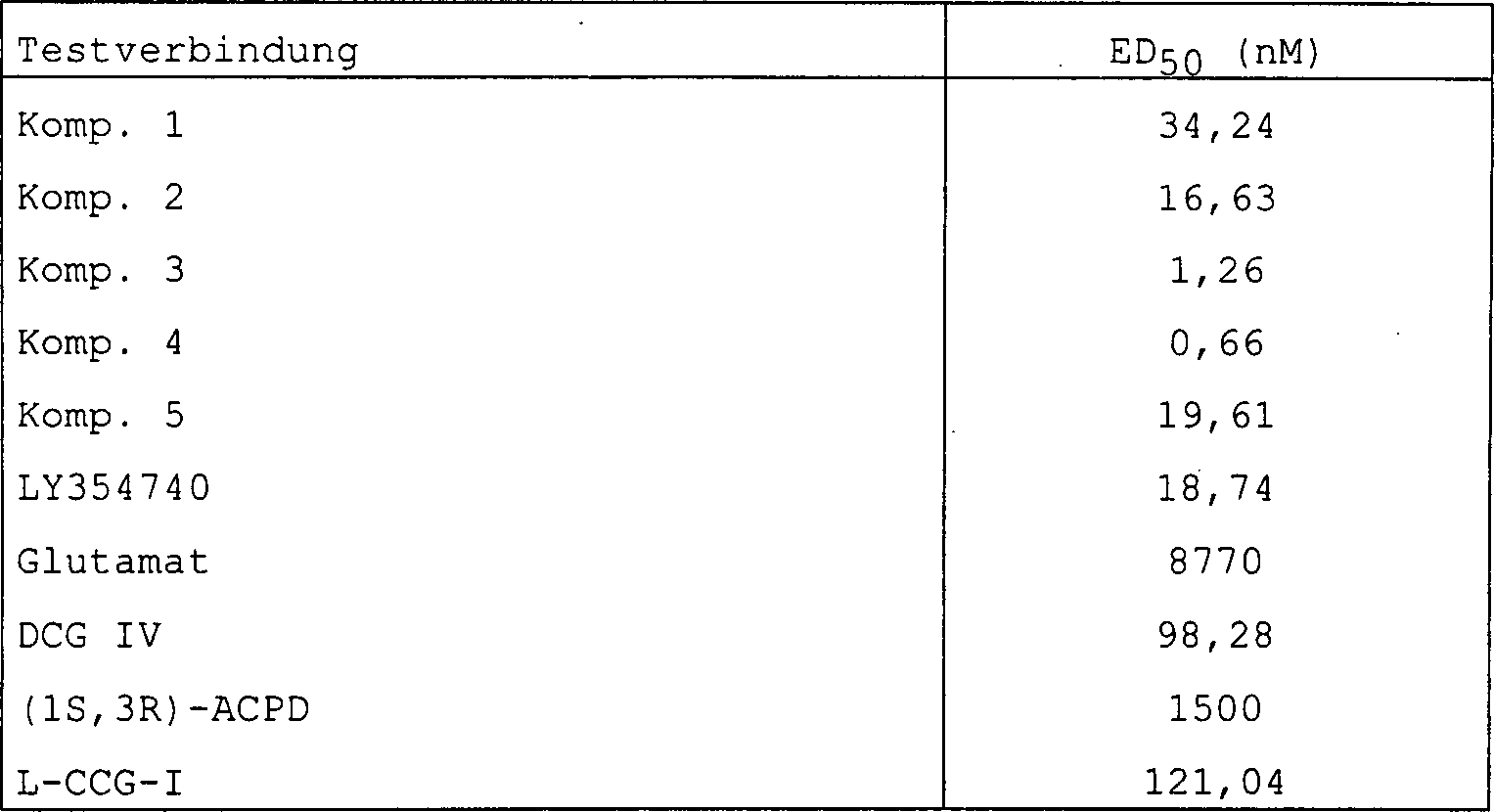
- Komp. 1: (1RS,2SR,5RS,6RS)-2-Amino-6-fluorbicyclo[3.1.0]hexan-2,6-dicarbonsäure
- Komp. 2: (–)-(1R*,2S*,5R*,6R*)-2-Amino-6-fluorbicyclo[3.1.0]hexan-2,6-dicarbonsäure
- Komp. 3: (1RS,2SR,5SR,6SR)-2-Amino-6-fluorbicyclo[3.1.0]hexan-2,6-dicarbonsäure
- Komp. 4: (+)-(1R*,2S*,5S*,6S*)-2-Amino-6-fluor-4-oxobicyclo[3.1.0]hexan-2,6-dicarbonsäure
- Komp. 5: (1RS,2SR,45R,5SR,6SR)-2-Amino-6-fluor-4-hydroxybicyclo[3.1.0]hexan-2,6-dicarbonsäure
- LY354740: (+)-(1S,2S,5R,6S)-2-Aminobicyclo[3.1.0]hexan-2,6-dicarbonsäure
- DCG IV: (2S,1'R,2'R,3'R)-2-(2',3'-Dicarboxycyclopropyl)glycin
- (1S,3R)-ACPD (1S,3R)-1-Aminocyclopentan-1,3-dicarbonsäure
- L-CCG-I: (2S,1'S,2'S)-2-(Carboxycyclopropyl)glycin
- Comp. 1: (1RS, 2SR, 5RS, 6RS) -2-amino-6-fluorobicyclo [3.1.0] hexane-2,6-dicarboxylic acid
- Comp. 2: (-) - (1R *, 2S *, 5R *, 6R *) - 2-amino-6-fluorobicyclo [3.1.0] hexane-2,6-dicarboxylic acid
- Comp. 3: (1RS, 2SR, 5SR, 6SR) -2-amino-6-fluorobicyclo [3.1.0] hexane-2,6-dicarboxylic acid
- Comp. 4: (+) - (1R *, 2S *, 5S *, 6S *) - 2-amino-6-fluoro-4-oxobicyclo [3.1.0] hexane-2,6-dicarboxylic acid
- Comp. 5: (1RS, 2SR, 45R, 5SR, 6SR) -2-amino-6-fluoro-4-hydroxybicyclo [3.1.0] hexane-2,6-dicarboxylic acid
- LY354740: (+) - (1S, 2S, 5R, 6S) -2-aminobicyclo [3.1.0] hexane-2,6-dicarboxylic acid
- DCG IV: (2S, 1'R, 2'R, 3'R) -2- (2 ', 3'-dicarboxycyclopropyl) glycine
- (1S, 3R) -ACPD (1S, 3R) -1-aminocyclopentane-1,3-dicarboxylic acid
- L-CCG-I: (2S, 1'S, 2'S) -2- (carboxycyclopropyl) glycine
Industrielle AnwendbarkeitIndustrial applicability
Die 6-Fluorbicyclo[3.1.0]hexan-Derivate gemäß der vorliegenden Erfindung sind als Arzneistoffe nützlich. Insbesondere sind sie als Agonisten nützlich, die auf metabotrope Glutamatrezeptoren wirken. Daher kann diese Erfindung zur Behandlung und Vorbeugung psychiatrischer Störungen, wie z.B. Schizophrenie, Angst, damit verbundene Krankheiten, Depression, bipolare Störung und Epilepsie sowie neurologische Krankheiten, wie z.B. Drogenabhängigkeit, kognitive Störung, Alzheimer-Krankheit, Chorea Huntington, Parkinson-Krankheit, Dyskinesie, verbunden mit Muskelversteifung, zerebrale Ischämie, zerbrales Versagen, Myelopathie und Kopftrauma verwendet werden.The 6-Fluoro-bicyclo [3.1.0] hexane derivatives according to the present invention are useful as drugs. In particular, they are useful as agonists on metabotropic Glutamate receptors act. Therefore, this invention can be used for treatment and prevention of psychiatric disorders, such as Schizophrenia, fear, related diseases, depression, bipolar disorder and Epilepsy as well as neurological diseases, e.g. Drug addiction, cognitive disorder, Alzheimer's disease, Huntington's disease, Parkinson's disease, dyskinesia, associated with muscle stiffening, cerebral ischemia, brittle failure, myelopathy and head trauma are used.
Claims (16)
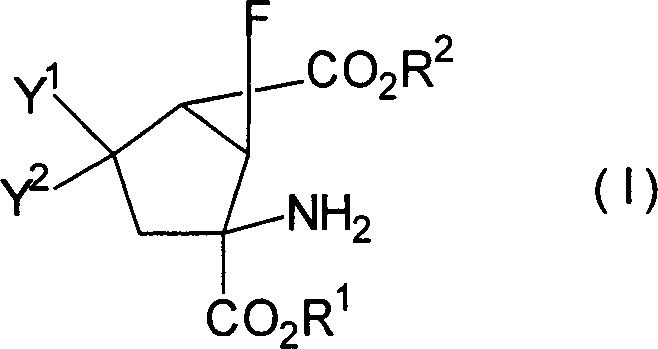
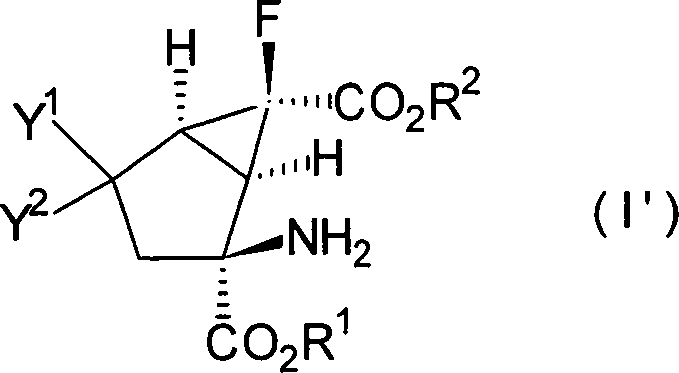
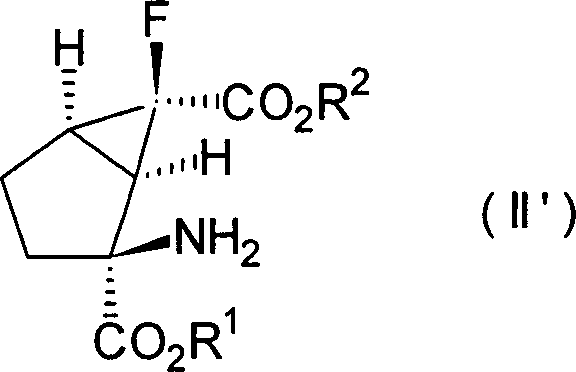
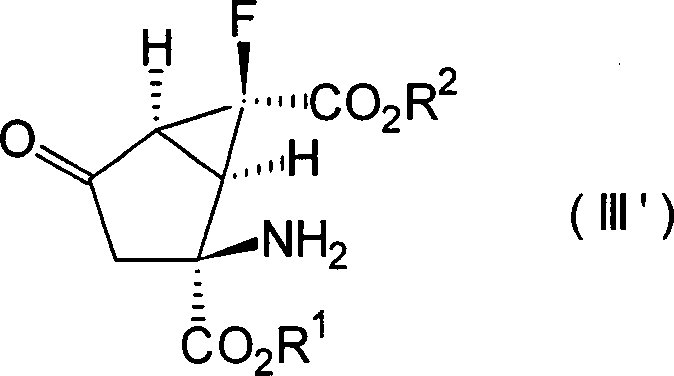
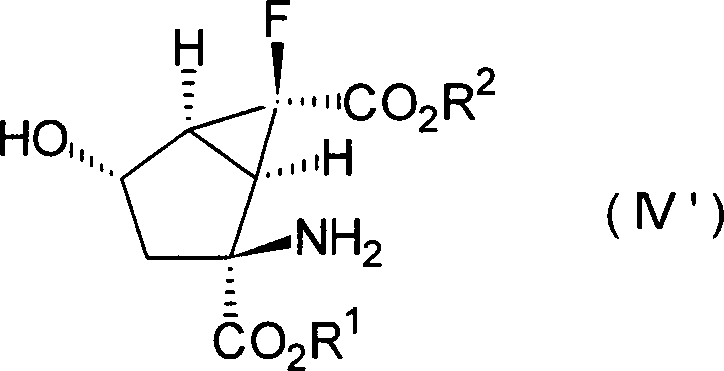
Applications Claiming Priority (5)
| Application Number | Priority Date | Filing Date | Title |
|---|---|---|---|
| JP24634398 | 1998-08-31 | ||
| JP24634398 | 1998-08-31 | ||
| JP8260799 | 1999-03-25 | ||
| JP8260799 | 1999-03-25 | ||
| PCT/JP1999/003984 WO2000012464A1 (en) | 1998-08-31 | 1999-07-26 | 6-fluorobicyclo[3. 1.0]hexane derivatives |
Publications (2)
| Publication Number | Publication Date |
|---|---|
| DE69918136D1 DE69918136D1 (en) | 2004-07-22 |
| DE69918136T2 true DE69918136T2 (en) | 2005-07-07 |
Family
ID=26423636
Family Applications (1)
| Application Number | Title | Priority Date | Filing Date |
|---|---|---|---|
| DE69918136T Expired - Lifetime DE69918136T2 (en) | 1998-08-31 | 1999-07-26 | 6-Fluorobicyclo [3.1.0] hexane derivatives |
Country Status (12)
| Country | Link |
|---|---|
| US (1) | US6333428B1 (en) |
| EP (1) | EP1110943B1 (en) |
| KR (1) | KR100469182B1 (en) |
| CN (1) | CN1247527C (en) |
| AT (1) | ATE269293T1 (en) |
| AU (1) | AU746806B2 (en) |
| CA (1) | CA2341865C (en) |
| DE (1) | DE69918136T2 (en) |
| DK (1) | DK1110943T3 (en) |
| ES (1) | ES2222715T3 (en) |
| PT (1) | PT1110943E (en) |
| WO (1) | WO2000012464A1 (en) |
Families Citing this family (48)
| Publication number | Priority date | Publication date | Assignee | Title |
|---|---|---|---|---|
| US6313159B1 (en) | 1999-08-20 | 2001-11-06 | Guilford Pharmaceuticals Inc. | Metabotropic glutamate receptor ligand derivatives as naaladase inhibitors |
| CA2412587A1 (en) * | 2000-06-28 | 2002-12-13 | Taisho Pharmaceutical Co., Ltd. | Intermediate and process for producing fluorinated carboxylic acid derivative from the same |
| CN1216038C (en) | 2000-06-28 | 2005-08-24 | 大正制药株式会社 | Novel Dicarboxylic Acid Derivatives |
| EP1423411A2 (en) * | 2001-07-09 | 2004-06-02 | Eli Lilly And Company | Prodrugs of excitatory amino acids |
| AU2002353845A1 (en) * | 2001-11-23 | 2003-06-10 | Eli Lilly And Company | Prodrugs of excitatory amino acids |
| AU2002361611A1 (en) * | 2001-12-21 | 2003-07-24 | Eli Lilly And Company | Prodrugs of excitatory amino acids |
| PL208123B1 (en) * | 2001-12-27 | 2011-03-31 | Taisho Pharmaceutical Co Ltd | 6-fluorobicyclo[3.1.0]hexane derivatives |
| HRP20041179B1 (en) * | 2002-06-11 | 2012-11-30 | Eli Lilly And Company | Prodrugs of excitatory amino acids |
| WO2004004706A1 (en) * | 2002-07-05 | 2004-01-15 | Eli Lilly And Company | Prodrugs of excitatory amino acids |
| EP2123630B1 (en) * | 2003-06-26 | 2012-07-25 | Taisho Pharmaceutical Co., Ltd | 2-Amino-bicyclo[3.1.0]hexane-2,6-dicarboxylic ester derivative |
| RU2349580C2 (en) * | 2003-06-26 | 2009-03-20 | Таишо Фармасьютикал Ко., Лтд | Ester derivative of 2-amino-bicyclo[3,1,0]hexane-2,6-dicarboxylic acid, with antagonistic properties towards p-group metabotropic glutamate receptors |
| US7786314B2 (en) * | 2003-11-07 | 2010-08-31 | Taisho Pharmaceutical Co., Ltd | Processes for preparing bicyclo [3.1.0] hexane derivatives, and intermediates thereto |
| US20070043100A1 (en) | 2005-08-16 | 2007-02-22 | Hagen Eric J | Novel polymorphs of azabicyclohexane |
| EP2258357A3 (en) | 2005-08-26 | 2011-04-06 | Braincells, Inc. | Neurogenesis with acetylcholinesterase inhibitor |
| EP2275096A3 (en) | 2005-08-26 | 2011-07-13 | Braincells, Inc. | Neurogenesis via modulation of the muscarinic receptors |
| WO2007047978A2 (en) | 2005-10-21 | 2007-04-26 | Braincells, Inc. | Modulation of neurogenesis by pde inhibition |
| EP2314289A1 (en) | 2005-10-31 | 2011-04-27 | Braincells, Inc. | Gaba receptor mediated modulation of neurogenesis |
| US20100216734A1 (en) | 2006-03-08 | 2010-08-26 | Braincells, Inc. | Modulation of neurogenesis by nootropic agents |
| AR059898A1 (en) | 2006-03-15 | 2008-05-07 | Janssen Pharmaceutica Nv | DERIVATIVES OF 3-CIANO-PIRIDONA 1,4-DISUSTITUTED AND ITS USE AS ALLOSTERIC MODULATORS OF MGLUR2 RECEIVERS |
| US20080045725A1 (en) | 2006-04-28 | 2008-02-21 | Murry Jerry A | Process For The Synthesis of (+) And (-)-1-(3,4-Dichlorophenyl)-3-Azabicyclo[3.1.0]Hexane |
| EP2021000A2 (en) | 2006-05-09 | 2009-02-11 | Braincells, Inc. | Neurogenesis by modulating angiotensin |
| US7678808B2 (en) | 2006-05-09 | 2010-03-16 | Braincells, Inc. | 5 HT receptor mediated neurogenesis |
| WO2008030651A1 (en) * | 2006-09-08 | 2008-03-13 | Braincells, Inc. | Combinations containing a 4-acylaminopyridine derivative |
| US20100184806A1 (en) | 2006-09-19 | 2010-07-22 | Braincells, Inc. | Modulation of neurogenesis by ppar agents |
| TW200845978A (en) * | 2007-03-07 | 2008-12-01 | Janssen Pharmaceutica Nv | 3-cyano-4-(4-tetrahydropyran-phenyl)-pyridin-2-one derivatives |
| TW200900065A (en) | 2007-03-07 | 2009-01-01 | Janssen Pharmaceutica Nv | 3-cyano-4-(4-pyridinyloxy-phenyl)-pyridin-2-one derivatives |
| BRPI0816970A2 (en) * | 2007-09-14 | 2015-03-24 | Ortho Mcneil Janssen Pharm | 1,3-disubstituted-4-phenyl-1h-pyridin-2-ones |
| TW200922566A (en) | 2007-09-14 | 2009-06-01 | Ortho Mcneil Janssen Pharm | 1,3 disubstituted 4-(aryl-X-phenyl)-1H-pyridin-2-ones |
| EA017648B1 (en) | 2007-09-14 | 2013-02-28 | Орто-Макнейл-Янссен Фармасьютикалз, Инк. | 1',3'-disubstituted-4-phenyl-3,4,5,6-tetrahydro-2h,1'h-[1,4']bipyridinyl-2'-ones |
| CA2704436C (en) * | 2007-11-14 | 2016-01-05 | Ortho-Mcneil-Janssen Pharmaceuticals, Inc. | Imidazo[1,2-a]pyridine derivatives and their use as positive allosteric modulators of mglur2 receptors |
| EP2298755A4 (en) * | 2008-05-21 | 2012-12-05 | Taisho Pharmaceutical Co Ltd | PROCESS FOR THE PREPARATION OF BICYCLO [3.1.0] HEXENE DERIVATIVES USING AN ENZYME |
| JP5547194B2 (en) | 2008-09-02 | 2014-07-09 | ジャンセン ファーマシューティカルズ, インコーポレイテッド. | 3-Azabicyclo [3.1.0] hexyl derivatives as modulators of metabotropic glutamate receptors |
| WO2010043396A1 (en) | 2008-10-16 | 2010-04-22 | Ortho-Mcneil-Janssen Pharmaceuticals, Inc. | Indole and benzomorpholine derivatives as modulators of metabotropic glutamate receptors |
| JP5690277B2 (en) | 2008-11-28 | 2015-03-25 | ジャンセン ファーマシューティカルズ, インコーポレイテッド. | Indole and benzoxazine derivatives as modulators of metabotropic glutamate receptors |
| US20100216805A1 (en) | 2009-02-25 | 2010-08-26 | Braincells, Inc. | Modulation of neurogenesis using d-cycloserine combinations |
| WO2010111080A2 (en) | 2009-03-27 | 2010-09-30 | Eli Lilly And Company | Optimized treatment of schizophrenia |
| MY153913A (en) | 2009-05-12 | 2015-04-15 | Janssen Pharmaceuticals Inc | 7-aryl-1,2,4-triazolo[4,3-a]pyridine derivatives and their use as positive allosteric modulators of mglur2 receptors |
| HRP20131122T1 (en) | 2009-05-12 | 2013-12-20 | Janssen Pharmaceuticals, Inc. | 1,2,3-triazolo [4,3-a]pyridine derivatives and their use for the treatment or prevention of neurological and psychiatric disorders |
| CN102439015B (en) | 2009-05-12 | 2015-05-13 | 杨森制药有限公司 | 1,2,4-Triazolo[4,3-a]pyridine derivatives and their use as positive allosteric modulators of mGluR2 receptors |
| EP2661435B1 (en) | 2010-11-08 | 2015-08-19 | Janssen Pharmaceuticals, Inc. | 1,2,4-TRIAZOLO[4,3-a]PYRIDINE DERIVATIVES AND THEIR USE AS POSITIVE ALLOSTERIC MODULATORS OF MGLUR2 RECEPTORS |
| ES2536433T3 (en) | 2010-11-08 | 2015-05-25 | Janssen Pharmaceuticals, Inc. | 1,2,4-Triazolo [4,3-a] pyridine derivatives and their use as positive allosteric modulators of mGluR2 receptors |
| JP5852664B2 (en) | 2010-11-08 | 2016-02-03 | ジヤンセン・フアーマシユーチカルズ・インコーポレーテツド | 1,2,4-Triazolo [4,3-a] pyridine derivatives and their use as positive allosteric modulators of the mGluR2 receptor |
| KR101598679B1 (en) | 2011-06-17 | 2016-02-29 | 일라이 릴리 앤드 캄파니 | Bicyclo(3.1.0)hexane-2,6-dicarboxylic acid derivatives as mglu2 receptor agonist |
| AR089718A1 (en) * | 2012-02-01 | 2014-09-10 | Lilly Co Eli | MGlu2 / 3 AGONISTS |
| JO3368B1 (en) | 2013-06-04 | 2019-03-13 | Janssen Pharmaceutica Nv | 6, 7- dihydropyrazolu [5,1-a] pyrazine-4 (5 hands) -on compounds and their use as negative excretory regulators of Miglore 2 receptors. |
| JO3367B1 (en) | 2013-09-06 | 2019-03-13 | Janssen Pharmaceutica Nv | 1,2,4-TRIAZOLO[4,3-a]PYRIDINE COMPOUNDS AND THEIR USE AS POSITIVE ALLOSTERIC MODULATORS OF MGLUR2 RECEPTORS |
| PL3096790T3 (en) | 2014-01-21 | 2020-01-31 | Janssen Pharmaceutica, N.V. | COMBINATIONS CONTAINING POSITIVE ALLOSTERIC MODULATORS OR ORTOSTERIC AGONISTS OF THE METABOTROPIC GLUTAMINERGIC SUB-TYPE 2 RECEPTOR AND THEIR USE |
| ME03518B (en) | 2014-01-21 | 2020-04-20 | Janssen Pharmaceutica Nv | COMBINATIONS INCLUDING POSITIVE ALOSTERIC MODULATORS OR ORTHOSTERIC AGONISTS OF METABOTROPIC GLUTAMATERGIC RECEPTOR SUBTYPE 2 AND THEIR APPLICATIONS |
Family Cites Families (11)
| Publication number | Priority date | Publication date | Assignee | Title |
|---|---|---|---|---|
| US5750566A (en) | 1994-08-12 | 1998-05-12 | Eli Lilly And Company | Synthetic excitatory amino acids |
| PL182285B1 (en) | 1994-08-12 | 2001-12-31 | Lilly Co Eli | Synthetic amino acids and their esters and pharmaceutical preparations containing them. PL PL PL PL PL PL PL |
| IL118727A (en) * | 1995-06-29 | 2003-01-12 | Lilly Co Eli | (-)-2-spiro-5-hydantoinbicyclo [3.1.0] hexane-6-carboxylic acid, salts thereof and use thereof for the preparation of (+)-(2) aminobicyclo [3.1.0] hexane-2,6-dicarboxylic acid |
| GB9605429D0 (en) | 1995-11-16 | 1996-05-15 | Lilly Co Eli | Excitatory amino acid receptor antagonists |
| ZA969485B (en) | 1995-11-16 | 1998-05-12 | Lilly Co Eli | Excitatory amino acid receptor antagonists. |
| US5912248A (en) * | 1995-11-16 | 1999-06-15 | Eli Lilly And Company | Excitatory amino acid receptor antagonists |
| WO1997017950A1 (en) * | 1995-11-16 | 1997-05-22 | Eli Lilly And Company | Shoulder prosthesis |
| ZA983930B (en) * | 1997-05-14 | 1999-11-08 | Lilly Co Eli | Excitatory amino acid receptor modulators. |
| JP3727791B2 (en) | 1998-01-08 | 2005-12-14 | ファイザー・プロダクツ・インク | Bicyclic [3.1.0] hexane and related compounds |
| JP4171549B2 (en) | 1998-01-28 | 2008-10-22 | 大正製薬株式会社 | Fluorine-containing amino acid derivatives |
| CN1182105C (en) | 1998-01-28 | 2004-12-29 | 大正制药株式会社 | Fluorinated Amino Acid Derivatives |
-
1999
- 1999-07-26 DE DE69918136T patent/DE69918136T2/en not_active Expired - Lifetime
- 1999-07-26 CN CNB998101834A patent/CN1247527C/en not_active Expired - Fee Related
- 1999-07-26 ES ES99931532T patent/ES2222715T3/en not_active Expired - Lifetime
- 1999-07-26 DK DK99931532T patent/DK1110943T3/en active
- 1999-07-26 EP EP99931532A patent/EP1110943B1/en not_active Expired - Lifetime
- 1999-07-26 WO PCT/JP1999/003984 patent/WO2000012464A1/en not_active Ceased
- 1999-07-26 AT AT99931532T patent/ATE269293T1/en active
- 1999-07-26 AU AU48007/99A patent/AU746806B2/en not_active Ceased
- 1999-07-26 US US09/763,408 patent/US6333428B1/en not_active Expired - Lifetime
- 1999-07-26 CA CA002341865A patent/CA2341865C/en not_active Expired - Fee Related
- 1999-07-26 KR KR10-2001-7002530A patent/KR100469182B1/en not_active Expired - Fee Related
- 1999-07-26 PT PT99931532T patent/PT1110943E/en unknown
Also Published As
| Publication number | Publication date |
|---|---|
| CA2341865A1 (en) | 2000-03-09 |
| AU4800799A (en) | 2000-03-21 |
| ES2222715T3 (en) | 2005-02-01 |
| CA2341865C (en) | 2006-01-17 |
| PT1110943E (en) | 2004-08-31 |
| US6333428B1 (en) | 2001-12-25 |
| KR100469182B1 (en) | 2005-02-02 |
| DE69918136D1 (en) | 2004-07-22 |
| AU746806B2 (en) | 2002-05-02 |
| EP1110943A4 (en) | 2002-07-10 |
| DK1110943T3 (en) | 2004-10-11 |
| WO2000012464A1 (en) | 2000-03-09 |
| ATE269293T1 (en) | 2004-07-15 |
| KR20010092268A (en) | 2001-10-24 |
| CN1247527C (en) | 2006-03-29 |
| EP1110943A1 (en) | 2001-06-27 |
| CN1383423A (en) | 2002-12-04 |
| EP1110943B1 (en) | 2004-06-16 |
| HK1049996A1 (en) | 2003-06-06 |
Similar Documents
| Publication | Publication Date | Title |
|---|---|---|
| US6333428B1 (en) | 6-fluorobicyclo[3.1.0]hexane derivatives | |
| DE69906492T2 (en) | FLUORINE AMINO ACID DERIVATIVES | |
| DE69208496T2 (en) | Succinic acid derivatives | |
| DE69908535T2 (en) | Modulators of excitatory amino acid receptors | |
| DE2923815C2 (en) | ||
| DE69818538T2 (en) | Cyclopropyl derivatives with pharmaceutical properties | |
| JP4783967B2 (en) | Pharmaceuticals containing fluorine-containing amino acid derivatives as active ingredients | |
| JP2000072731A (en) | 4-Substituted-2-aminobicyclo [3.1.0] hexane-2,6-dicarboxylic acid derivative and pharmaceutical composition | |
| JPH08188561A (en) | Synthetic excitatory amino acids | |
| DE3826439A1 (en) | SULPHONAMIDOTHIENYLCARBONIC ACID COMPOUNDS | |
| EP0571870B1 (en) | Cyclopentane- and -pentene-beta-amino-acids | |
| DE69635886T2 (en) | Excitatory amino acid derivatives | |
| JP2000336071A (en) | 6-fluorobicyclo [3.1.0] hexane derivative | |
| EP0539803B1 (en) | Triazospirodecanone-methyl-chromans for the treatment of central nervous system illnesses | |
| DE69804212T2 (en) | PROCESS AND INTERMEDIATE PRODUCTS FOR THE PRODUCTION OF SUBSTITUTED INDAZOL DERIVATIVES | |
| DE69202173T2 (en) | Phenylethanolamino- and phenylethanolaminomethyltetralins, processes for their preparation, intermediates thereof and pharmaceutical compositions containing them. | |
| JPH11279129A (en) | Fluorine-containing amino acid derivative | |
| EP0083335B1 (en) | Optically active chiral compounds, process for their preparation and use of these compounds in the protection of functional -oh, -sh, -nh- groups, in the separation of racemates, in the preparation of optically active imidoester hydrochlorides and of optically active esters, in the preparation of optically enriched alcohols and in the preparation of optically active compounds by asymmetric induction | |
| DE69100897T2 (en) | N-PHENYL-N-ALKOXYCARBONYLALKYL-GLYCINAMIDES, THEIR PRODUCTION AND MEDICINAL PRODUCTS CONTAINING THEM. | |
| DE69919402T2 (en) | INTERMEDIATES AND METHOD FOR THE PRODUCTION OF FLUOROUS AMINO ACID DERIVATIVES BY THEIR USE | |
| EP0758648A1 (en) | Substituted 4H-pyrans with a modulating effect on calcium channels | |
| DE60007599T2 (en) | Process for the preparation of cyclic piperidinylaminomethyl-trifluoromethyl ether derivatives | |
| EP1334086A1 (en) | Phenoxyphenyl alkane sulfonates | |
| DE4134755A1 (en) | USE OF PARTLY KNOWN SUBSTITUTED TETRAHYDROTHIOPHENES AS A MEDICINAL PRODUCT, NEW ACTIVE SUBSTANCES AND METHOD FOR THE PRODUCTION THEREOF | |
| EP0538692A1 (en) | Use of partly known substituted pyrrolidine derivatives as pharmaceuticals, new compounds and process for their preparation |
Legal Events
| Date | Code | Title | Description |
|---|---|---|---|
| 8364 | No opposition during term of opposition |