DE69918111T2 - MIXTURES OF NICKEL-CLEANER WITH BENZOPHENONE AND METHOD FOR THE PRODUCTION THEREOF - Google Patents
MIXTURES OF NICKEL-CLEANER WITH BENZOPHENONE AND METHOD FOR THE PRODUCTION THEREOF Download PDFInfo
- Publication number
- DE69918111T2 DE69918111T2 DE69918111T DE69918111T DE69918111T2 DE 69918111 T2 DE69918111 T2 DE 69918111T2 DE 69918111 T DE69918111 T DE 69918111T DE 69918111 T DE69918111 T DE 69918111T DE 69918111 T2 DE69918111 T2 DE 69918111T2
- Authority
- DE
- Germany
- Prior art keywords
- group
- formula
- nickel
- tetramethylpiperidin
- acid
- Prior art date
- Legal status (The legal status is an assumption and is not a legal conclusion. Google has not performed a legal analysis and makes no representation as to the accuracy of the status listed.)
- Expired - Lifetime
Links
- 0 N**12Oc(ccc(N)c3)c3N1C(C=C(CC1)N)=C1O2 Chemical compound N**12Oc(ccc(N)c3)c3N1C(C=C(CC1)N)=C1O2 0.000 description 4
- ZPUGRBLSXXFONA-UHFFFAOYSA-N CC(C[NH+]([O-])O)C#C Chemical compound CC(C[NH+]([O-])O)C#C ZPUGRBLSXXFONA-UHFFFAOYSA-N 0.000 description 1
- NHYDBUMMPNKPEJ-UHFFFAOYSA-N CCC(C)(CC)N=C=C Chemical compound CCC(C)(CC)N=C=C NHYDBUMMPNKPEJ-UHFFFAOYSA-N 0.000 description 1
Classifications
-
- C—CHEMISTRY; METALLURGY
- C08—ORGANIC MACROMOLECULAR COMPOUNDS; THEIR PREPARATION OR CHEMICAL WORKING-UP; COMPOSITIONS BASED THEREON
- C08K—Use of inorganic or non-macromolecular organic substances as compounding ingredients
- C08K5/00—Use of organic ingredients
- C08K5/04—Oxygen-containing compounds
- C08K5/13—Phenols; Phenolates
- C08K5/132—Phenols containing keto groups, e.g. benzophenones
-
- C—CHEMISTRY; METALLURGY
- C08—ORGANIC MACROMOLECULAR COMPOUNDS; THEIR PREPARATION OR CHEMICAL WORKING-UP; COMPOSITIONS BASED THEREON
- C08K—Use of inorganic or non-macromolecular organic substances as compounding ingredients
- C08K5/00—Use of organic ingredients
- C08K5/0008—Organic ingredients according to more than one of the "one dot" groups of C08K5/01 - C08K5/59
- C08K5/005—Stabilisers against oxidation, heat, light, ozone
-
- C—CHEMISTRY; METALLURGY
- C08—ORGANIC MACROMOLECULAR COMPOUNDS; THEIR PREPARATION OR CHEMICAL WORKING-UP; COMPOSITIONS BASED THEREON
- C08K—Use of inorganic or non-macromolecular organic substances as compounding ingredients
- C08K5/00—Use of organic ingredients
- C08K5/0091—Complexes with metal-heteroatom-bonds
-
- Y—GENERAL TAGGING OF NEW TECHNOLOGICAL DEVELOPMENTS; GENERAL TAGGING OF CROSS-SECTIONAL TECHNOLOGIES SPANNING OVER SEVERAL SECTIONS OF THE IPC; TECHNICAL SUBJECTS COVERED BY FORMER USPC CROSS-REFERENCE ART COLLECTIONS [XRACs] AND DIGESTS
- Y02—TECHNOLOGIES OR APPLICATIONS FOR MITIGATION OR ADAPTATION AGAINST CLIMATE CHANGE
- Y02A—TECHNOLOGIES FOR ADAPTATION TO CLIMATE CHANGE
- Y02A40/00—Adaptation technologies in agriculture, forestry, livestock or agroalimentary production
- Y02A40/10—Adaptation technologies in agriculture, forestry, livestock or agroalimentary production in agriculture
- Y02A40/25—Greenhouse technology, e.g. cooling systems therefor
Landscapes
- Chemical & Material Sciences (AREA)
- Health & Medical Sciences (AREA)
- Chemical Kinetics & Catalysis (AREA)
- Medicinal Chemistry (AREA)
- Polymers & Plastics (AREA)
- Organic Chemistry (AREA)
- Compositions Of Macromolecular Compounds (AREA)
- Organic Low-Molecular-Weight Compounds And Preparation Thereof (AREA)
Description
Die vorliegende Erfindung betrifft eine granuläre Form einer Mischung aus einem Nickel-Löscher und einem Benzophenon.The The present invention relates to a granular form of a mixture of a nickel extinguisher and a benzophenone.
Insbesondere betrifft die vorliegende Erfindung eine granuläre Form einer Mischung eines Nickel-Löschers und eines 2-Hydroxy-4-alkyloxybenzophenons, ein Verfahren zu deren Herstellung sowie deren Verwendung als Lichtstabilisator für Agrofilme auf der Basis von Polyolefinen oder olefinischen Copolymeren.Especially The present invention relates to a granular form of a mixture of a Nickel-extinguisher and a 2-hydroxy-4-alkyloxybenzophenone, a process for the same Production and its use as light stabilizer for agricultural films based on polyolefins or olefinic copolymers.
Die vorliegende Erfindung betrifft des weiteren Agrofilme auf der Basis von Polyolefinen oder olefinischen Copolymeren, die mit der vorstehend beschriebenen granulären Form stabilisiert sind, sowie Gewächshäuser, die mit diesen Filmen überzogen sind.The The present invention further relates to agricultural films on the basis of polyolefins or olefinic copolymers containing the above described granular Forms are stabilized, as well as greenhouses covered with these films are.
Zur Zeit werden Nickel-Löscher (nickel-quencher) in Feinpulverform vertrieben und deren Verwendung verursacht Probleme im Hinblick auf die Umweltverschmutzung, Gesundheit und Sicherheit von Benutzern während der Zufuhr- und Handhabungsphase.to Time will be nickel-extinguishers (quencher nickel) in fine powder form and causes their use Problems with regard to pollution, health and Security of users during the supply and handling phase.
Im allgemeinen wird bei der Stabilisierung von Agrofilmen auch ein Benzophenon eingesetzt, zusammen mit Nickel-Löschern.in the In general, the stabilization of agricultural films is also a Benzophenone used together with nickel quencher.
Konventionelle Verfahren zum Erhalten einer physikalischen Form eines Nickel-Löschers mit einem geringen Pulvergehalt (z. B. Kompaktieren der Pulver unter Druck), die sowohl für den Nickel-Löscher allein als auch für Mischungen aus Nickel-Löschern und Benzophenonen untersucht wurden, erwiesen sich als unbrauchbar oder ergaben keine zufriedenstellenden Ergebnisse.conventional A method of obtaining a physical form of a low-powder nickel extinguisher (For example, compaction of the powder under pressure), both for the nickel extinguisher alone as also for Mixtures of nickel quenchers and Benzophenones were found to be unusable or did not give satisfactory results.
Der Anmelder hat nun eine granuläre Form einer Mischung eines Nickel-Löschers und eines Benzophenons gefunden, die fähig ist, die Nachteile des bekannten Standes der Technik zu überwinden.Of the Applicant now has a granular Form of a mixture of a nickel extinguisher and a benzophenone found that capable is to overcome the disadvantages of the known prior art.
Die vorliegende Erfindung betrifft folglich eine granuläre Form einer Mischung umfassend:
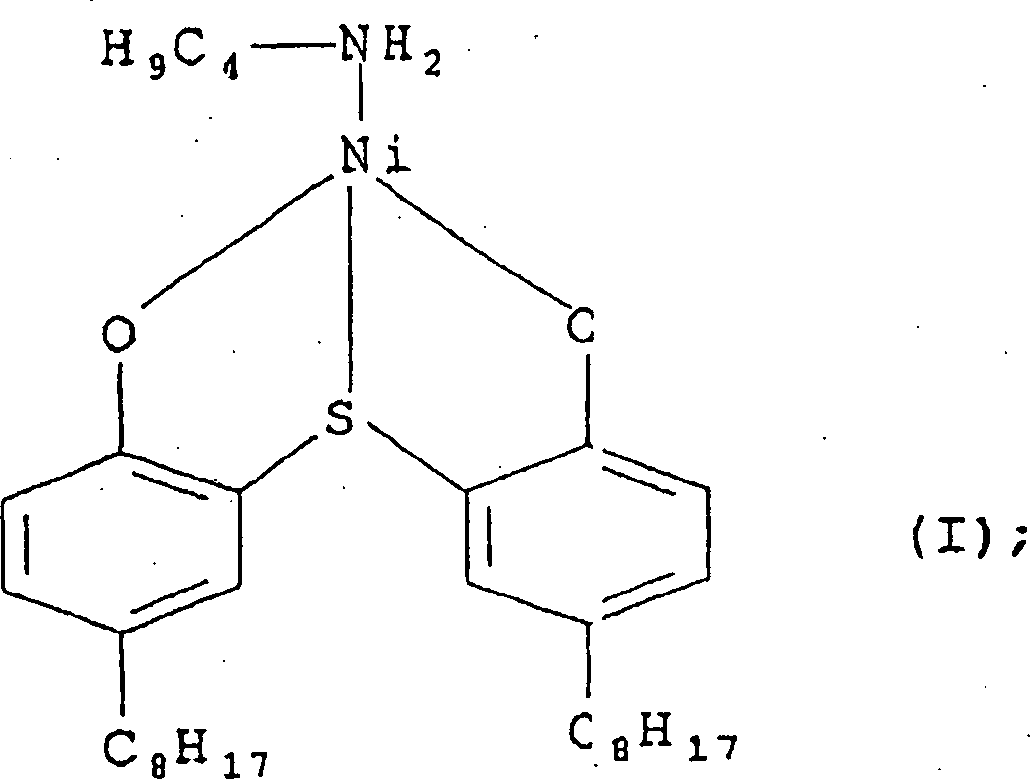
- (a) einen Nickel-Löscher, der
[2,2'-Thiobis(4-t-octyl-phenolat)-n-butylamin-Nickel(II)] mit der
Formel (I) entspricht:

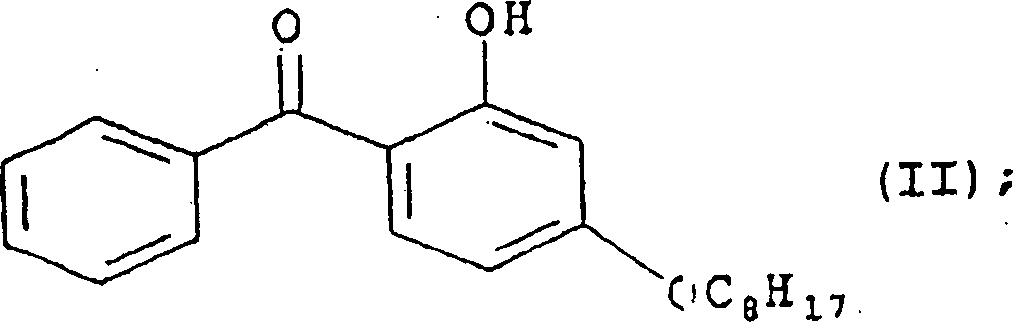
- (b) ein 2-Hydroxy-4-alkyloxybenzophenon, das 2-Hydroxy-4-n-octyloxybenzophenon
mit der Formel (II) entspricht:
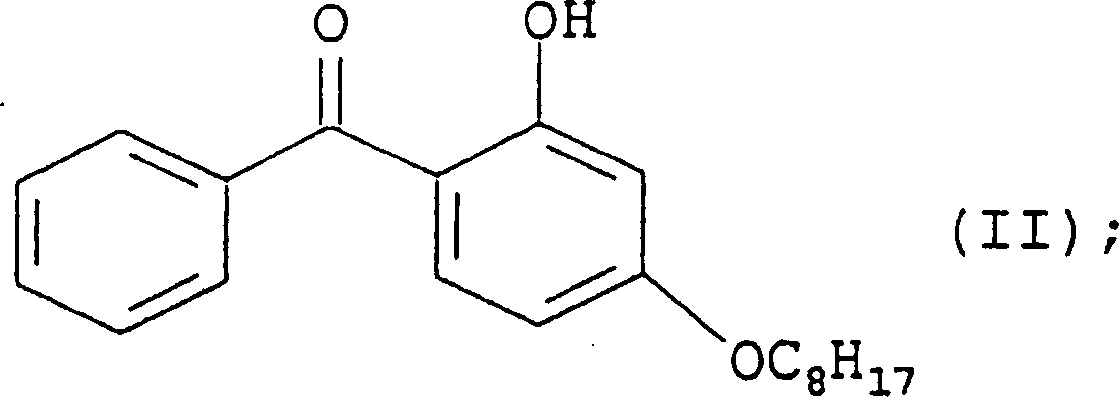
- (a) a nickel quencher corresponding to [2,2'-thiobis (4-t-octylphenolate) -n-butylamine-nickel (II)] having the formula (I):
- (b) a 2-hydroxy-4-alkyloxybenzophenone corresponding to 2-hydroxy-4-n-octyloxybenzophenone having the formula (II):
Das Röntgenbeugungsspektrum für Pulver wird unter Verwendung einer Cu-Kα-Strahlung durchgeführt (λ = 1,54178).The powder X-ray diffraction spectrum is carried out using Cu-K α radiation (λ = 1.54178).
In der granulären Form der vorliegenden Erfindung werden der Nickel-Löscher (a) mit der Formel (I) und das Benzophenon (b) mit der Formel (II) in einem Verhältnis im Bereich von 0,4 bis 3 eingesetzt, bevorzugt in einem Verhältnis im Bereich von 1 bis 2.In the granular Form of the present invention are the nickel quencher (a) of the formula (I) and the benzophenone (b) of the formula (II) in a relationship used in the range of 0.4 to 3, preferably in a ratio of Range from 1 to 2.
Der Nickel-Löscher (a) mit der Formel (I) ist unter den folgenden Markennamen bekannt: Cyasorb UV 1084 von Cytec oder Chimassorb N-705 von Ciba.Of the Nickel quenchers (a) having the formula (I) is known by the following brand names: Cyasorb UV 1084 from Cytec or Chimassorb N-705 from Ciba.
Das Benzophenon (b) mit der Formel (II) ist unter den folgenden Markennamen bekannt: Lowilite 22 von Great Lakes, Chimassorb 81 von Ciba oder Cyasorb UV 531 von Cytec.The Benzophenone (b) having the formula (II) is available under the following brand names known: Lowilite 22 from Great Lakes, Chimassorb 81 from Ciba or Cyasorb UV 531 from Cytec.
Die granuläre Form gemäß der vorliegenden Erfindung kann nach dem folgenden Verfahren erhalten werden.The granular Shape according to the present Invention can be obtained by the following method.
Ein Verfahren zur Herstellung der granulären Form gemäß der vorliegenden Erfindung umfasst:
- (1) Auflösen des Nickel-Löschers (a) mit der Formel (I) in dem Benzophenon (b) mit der Formel (II), das zuvor bei 50°C geschmolzen worden ist, unter Rühren;
- (2) Kühlen der wie unter Punkt (1) beschrieben erhaltenen Lösung.
- (1) dissolving the nickel-type quencher (a) having the formula (I) in the benzophenone (b) of the formula (II) previously melted at 50 ° C with stirring;
- (2) cooling the solution as described in item (1).
Der Schritt (1) des vorstehend angegebenen Verfahrens wird in Abhängigkeit des verwendeten Verhältnisses zwischen dem Nickel-Löscher (a) mit der Formel (I) und dem Benzophenon (b) mit der Formel (II) bei unterschiedlichen Temperaturen durchgeführt: Schritt (1) der vorliegenden Erfindung wird im allgemeinen bei einer Temperatur im Bereich von 50°C bis 150°C durchgeführt, bevorzugt zwischen 50°C und 120°C.Of the Step (1) of the above-mentioned method is dependent the ratio used between the nickel extinguisher (a) having the formula (I) and the benzophenone (b) having the formula (II) at different temperatures carried out: step (1) of the present Invention is generally at a temperature in the range of 50 ° C to 150 ° C carried out, preferably between 50 ° C and 120 ° C.
Das Kühlen gemäß dem Schritt (2) des vorstehend beschriebenen Verfahrens, das geeignet ist, eine Verfestigung der wie unter Punkt (1) beschrieben erhaltenen Lösung zu verursachen, kann nach einem beliebigen Verfahren aus dem Stand der Technik erhalten werden.The Cool according to the step (2) the method described above, which is suitable solidification the solution obtained as described in item (1) can after Any method of the prior art.
Die bevorzugten Verfahren bestehen aus:
- – Gießen der Lösung auf eine kalte Metallplatte, die z. B. bei einer Temperatur von Raumtemperatur oder geringer gehalten wird: in diesem Fall muss der erhaltene Feststoff granuliert werden, um Granulate mit den gewünschten Dimensionen zu erhalten;
- – Tröpfeln der Lösung auf eine kalte Metallplatte, die z. B. bei einer Temperatur von gleich Raumtemperatur oder weniger gehalten wird: in diesem Fall werden Tropfen erhalten, die bereits die gewünschten Dimensionen aufweisen.
- - Pour the solution on a cold metal plate, the z. At a temperature of room temperature or lower: in this case, the resulting solid must be granulated to obtain granules of the desired dimensions;
- - Drop the solution onto a cold metal plate, the z. B. is maintained at a temperature equal to room temperature or less: in this case, drops are obtained, which already have the desired dimensions.
Die Pulver von Nickel-Löscher (a) und Benzophenon (b) und die wie vorstehend beschrieben erhaltenen Granulate werden einer Röntgenbeugung unterzogen und die erhaltenen Spektren sind in den folgenden Figuren dargestellt:The Powder of nickel quencher (a) and benzophenone (b) and those obtained as described above Granules are X-ray diffraction and the spectra obtained are shown in the following figures shown:
Es
ist festzuhalten, dass die
Die granuläre Form gemäß der vorliegenden Erfindung weist einen Schmelzbereich zwischen 47°C und 50°C auf, gemessen mittels einem Büchi-Instrument (Röhrchen mit einem Durchmesser von 1 mm). Da ein Additiv mit einem niedrigeren Schmelzpunkt im allgemeinen eine kürzere Homogenisierungszeit in dem Polymer, zu dem es zugegeben wird, aufweist, ist es offensichtlich, dass die granuläre Form gemäß der vorliegenden Erfindung zusätzlich zu dem Vorteil der Überwindung der vorstehend beschriebenen Nachteile aus dem Stand der Technik ferner auch eine schnellere Homogenisierung der Additive innerhalb des Polymers gewährleistet. Da das Verfahren zur Herstellung der granulären Form gemäß der vorliegenden Erfindung im Schritt (a) eine Phase umfasst, in der die beiden Verbindungen (a) und (b) in einem flüssigen Zustand vorliegen, tritt ferner auch eine perfekte homogene Verteilung der beiden Additive darin auf (z. B. führt mechanisches Vermischen, der beiden Pulver nicht zu einer Mischung mit dem gleichen Homogenitätsgrad).The granular Shape according to the present Invention has a melting range between 47 ° C and 50 ° C, measured by means of a Buchi instrument (Tube with a diameter of 1 mm). As an additive with a lower Melting point generally a shorter homogenization time in the polymer to which it is added, it is obvious that the granular Shape according to the present Invention in addition to the advantage of overcoming the above-described disadvantages of the prior art Furthermore, a faster homogenization of the additives within of the polymer ensured. Since the method for producing the granular form according to the present Invention in step (a) comprises a phase in which the two compounds (a) and (b) in a liquid State, also occurs a perfect homogeneous distribution of the two additives therein (eg, mechanical mixing, the two powders not to a mixture with the same degree of homogeneity).
Wie bereits vorstehend angegeben, kann die granuläre Form gemäß der vorliegenden Erfindung als Lichtstabilisator für Agrofilme auf der Basis von Polyolefinen und olefinischen Copolymeren verwendet werden.As already stated above, the granular form according to the present invention as a light stabilizer for Agricultural films based on polyolefins and olefinic copolymers be used.
Polyofefine
und olefinische Copolymere, die für diesen Zweck verwendet werden
können,
sind:
(1) Polymere von Monoolefinen und Diolefinen wie z. B.
Polypropylen, Polyisobutylen, Poly-1-buten, Poly-4-methyl-1-penten,
Polyisopren oder Polybutadien; wie auch Polymere von Cycloolefinen
wie z. B. Cyclopenten oder Norbornen; Polyethylen (das gegebenenfalls
quervernetzt sein kann) wie z. B. Polyethylen hoher Dichte (HDPE),
Polyethylen niedriger Dichte (LDPE), lineares Polyethylen niedriger
Dichte (LLDPE), verzweigtes Polyethylen niedriger Dichte (BLDPE).Polyofefins and olefinic copolymers that can be used for this purpose are:
(1) Polymers of monoolefins and diolefins such. Polypropylene, polyisobutylene, poly-1-butene, poly-4-methyl-1-pentene, polyisoprene or polybutadiene; as well as polymers of cycloolefins such. Cyclopentene or norbornene; Polyethylene (which may optionally be crosslinked) such. High density polyethylene (HDPE), low density polyethylene (LDPE), linear low density polyethylene (LLDPE), branched low density polyethylene (BLDPE).
Polyofefine als solche wie z. B. die im vorstehend Absatz angegebenen Monoolefine, bevorzugt Polyethylen und Polypropylen, können mit verschiedenen aus der Literatur bekannten Verfahren hergestellt werden, bevorzugt unter Verwendung der folgenden Verfahren:
- (a) radikalische Polymerisation (im allgemeinen unter einem hohen Druck und hoher Temperatur durchgeführt);
- (b) katalytische Polymerisation unter Verwendung eines Katalysators, der im allgemeinen ein oder mehrere Metalle der Gruppen IVb, Vb, VIb oder VIII des periodischen Systems der Elemente enthält. Diese Metalle besitzen im allgemeinen einen oder mehrere Liganden wie z. B. Oxide, Halogenide, Alkoholate, Ether, Amine, Alkyle, Alkenyle und/oder Aryle, die n oder σ-koordiniert sein können. Diese Metallkomplexe können in freier Form oder auf Substraten wie z. B. aktiviertem Magnesiumchlorid, Titan(III-Chlorid), Alumina oder Siliciumoxid geträgert sein. Diese Katalysatoren können in dem Polymerisationsmedium löslich oder unlöslich sein. Die Katalysatoren können allein oder in Gegenwart von weiteren Aktivierungsmitteln wie z. B. Metallalkylen, Metallhydriden, Halogeniden von Metallalkylen, Oxiden von Metallalkylen oder Metallalkyloxanen verwendet werden, wobei diese Metalle Elemente darstellen, die zu den Gruppen Ia, IIa und/oder IIIa des periodischen Systems der Elemente gehören. Diese Aktivierungsmittel können geeigneterweise mit weiteren Ester-, Ether-, Amin- oder Silylether-Gruppen modifiziert sein. Diese katalytischen Systeme werden im allgemeinen Phillips, Standard Oil Indiana, Ziegler (-Natta), TNZ (Du-Pont), Metallocen oder "Single-Site-Cataiyst" (SSC) genannt.
- (a) free-radical polymerization (generally carried out under a high pressure and temperature);
- (B) catalytic polymerization using a catalyst which generally contains one or more metals of groups IVb, Vb, VIb or VIII of the periodic table of the elements. These metals generally have one or more ligands such as. For example, oxides, halides, alcoholates, ethers, amines, alkyls, alkenyls and / or aryls, which may be n or σ-coordinated. These metal complexes can be in free form or on substrates such. Activated magnesium chloride, titanium (III chloride), alumina or silica. These catalysts may be soluble or insoluble in the polymerization medium. The catalysts may be used alone or in the presence of other activating agents such. As metal alkyls, metal hydrides, halides of metal alkyls, oxides of metal alkyls or Metallalkyloxanen be used, these metals represent elements belonging to the groups Ia, IIa and / or IIIa of the periodic table of the elements. These activators may suitably be modified with other ester, ether, amine or silyl ether groups. These catalytic systems are commonly referred to as Phillips, Standard Oil Indiana, Ziegler (-Natta), TNZ (DuPont), metallocene, or single site catalytic (SSC).
(2) Mischungen der unter Punkt (1) beschriebenen Polymere wie z. B. Mischungen von Polypropylen mit Polyisobutylen; Mischungen von Polypropylen mit Polyethylen (z. B. PP/HDPE, PP/LDPE); Mischungen von verschiedenen Arten von Polyethylen (z. B. LDPE/HDPE).(2) Mixtures of the described in item (1) polymers such. B. Blends of polypropylene with polyisobutylene; Blends of polypropylene with polyethylene (eg PP / HDPE, PP / LDPE); Mixtures of different Types of polyethylene (eg LDPE / HDPE).
(3) Copolymere von Monoolefinen und Diolefinen miteinander oder mit weiteren Vinylmonomeren wie z. B. Ethylen-Propylen-Copolymere, lineares Polyethylen niedriger Dichte (LLDPE) und dessen Mischungen mit Polyethylen niedriger Dichte (LDPE), Propylen/1-Buten-Copolymere, Propylen/Isobutylen-Copolymere, Ethylen/1-Buten-Copolymere, Ethylen/Hexen-Copolymere, Ethylen/Methylpenten-Copolymere, Ethylen/Hepten-Copolymere, Ethylen/Octen-Copolymere, Propylen/Butadien-Copolymere, Isobutylen/Isopren-Copolymere, Ethylen/Alkylacrylat-Copolymere, Ethylen/Alkylmethacrylat-Copolymere, Ethylen/Vinylacetat-Copolymere und deren Copolymere mit Kohlenmonoxid oder Ethylen/Acrylsäure-Copolymere und deren Salze (Ionomere) sowie Terpofymere von Ethylen mit Polypropylen und einem Dien wie z. B. Hexadien, Dicyclopentadien oder Ethyliden-Norbornen; und Mischungen dieser Copolymere miteinander oder mit den im Absatz (1) aufgeführten Polymeren wie z. B. Polypropylen/Ethylen-Propylen-Copolymere, LDPE/Ethylen-Vinylacetat(EVA)-Copolymere, LDPE/Ethylen-Acrylsäure(EAA)-Copolymere, LLDPE/EVA, LLDPE/EAA und alternierende oder statistische Polyalkylen/Kohlenmonoxid-Copolymere und deren Mischungen mit weiteren Polymeren wie z. B. Polyamiden.(3) Copolymers of monoolefins and diolefins with each other or with other vinyl monomers such. B. ethylene-propylene copolymers, linear Low density polyethylene (LLDPE) and its blends with polyethylene low density (LDPE), propylene / 1-butene copolymers, propylene / isobutylene copolymers, ethylene / 1-butene copolymers, ethylene / hexene copolymers, Ethylene / methylpentene copolymers, ethylene / heptene copolymers, ethylene / octene copolymers, Propylene / butadiene copolymers, isobutylene / isoprene copolymers, ethylene / alkyl acrylate copolymers, Ethylene / alkyl methacrylate copolymers, ethylene / vinyl acetate copolymers and their copolymers with carbon monoxide or ethylene / acrylic acid copolymers and their salts (ionomers) and terpofymers of ethylene with polypropylene and a diene such. Hexadiene, dicyclopentadiene or ethylidene norbornene; and mixtures of these copolymers with each other or with the in the paragraph (1) listed Polymers such as. Polypropylene / ethylene-propylene copolymers, LDPE / ethylene-vinyl acetate (EVA) copolymers, LDPE / ethylene-acrylic acid (EAA) copolymers, LLDPE / EVA, LLDPE / EAA and alternating or random polyalkylene / carbon monoxide copolymers and mixtures thereof with other polymers such. B. polyamides.
Für die Anwendung bevorzugt sind Polymere von Monoolefinen, vorzugsweise α-Monoolefinen wie z. B. Polypropylen, Polyisobutylen, Poly-1-buten, Poly-4-methyl-1-penten, wie auch Polymere von Cycloolefinen, Polyethylen (das gegebenenfalls quervernetzt sein kann) wie z. B. Polyethylen hoher Dichte (HDPE), Polyethylen niedriger Dichte (LDPE), lineares Polyethylen niedriger Dichte (LLDPE), verzweigtes Polyethylen niedriger Dichte (BLDPE) und Copolymere dieser Monomeren mit Vinylacetat.Preferred for use are polymers of monoolefins, preferably α-monoolefins such. Polypropylene, polyisobutylene, poly-1-butene, poly-4-methyl-1-pentene, as well as polymers of cycloolefins, Polyethylene (which may optionally be crosslinked) such. High density polyethylene (HDPE), low density polyethylene (LDPE), linear low density polyethylene (LLDPE), branched low density polyethylene (BLDPE), and copolymers of these monomers with vinyl acetate.
Noch bevorzugter sind Polyethylen, Ethylen/Propylen-Copolymer, Ethylen/Vinylacetat-Copolymer und Polypropylen, insbesondere Polyethylen, beworzugt Polyethylen niedriger Dichte (LDPE).Yet more preferred are polyethylene, ethylene / propylene copolymer, ethylene / vinyl acetate copolymer and polypropylene, especially polyethylene, preferably polyethylene low density (LDPE).
Eine weitere Aufgabe der vorliegenden Erfindung betrifft Agrofilme auf der Basis von Polyolefinen oder olefinischen Copolymeren, die eine wirksame Menge der granulären Form, die vorstehend beschrieben worden ist, enthalten.A Another object of the present invention relates to agricultural films on the basis of polyolefins or olefinic copolymers containing a effective amount of granular Form described above.
Die granuläre Form gemäß der vorliegenden Erfindung kann als solche oder in Kombination mit weiteren Stabilisatoren in den vorstehend genannten Polymer-Agrofilmen eingesetzt werden.The granular Shape according to the present Invention may be used as such or in combination with other stabilizers be used in the aforementioned polymer Agrofilmen.
Die granuläre Form gemäß der vorliegenden Erfindung wird im allgemeinen in einer Menge im Bereich von etwa 0,1% bis etwa 2%, bezogen auf das Gewicht der Filme, die stabilisiert werden sollen, eingesetzt, bevorzugt zwischen etwa 0,2% und etwa 1%.The granular Shape according to the present Invention will generally be in the range of about 0.1% to about 2%, based on the weight of the films stabilized are used, preferably between about 0.2% and about 1%.
Die granuläre Form gemäß der vorliegenden Erfindung, gegebenenfalls in Anwesenheit von weiteren Additiven, kann einfach in die zu stabilisierenden Polymere unter Verwendung von konventionellen Techniken eingeführt werden.The granular Shape according to the present Invention, if appropriate in the presence of further additives, can be easily incorporated into the polymers to be stabilized introduced by conventional techniques.
Die resultierenden Polymerzusammensetzungen können gemäß konventionellen Techniken zu Filmen transformiert werden.The resulting polymer compositions can be prepared according to conventional techniques be transformed into films.
Die vorstehend genannten Filme auf der Basis von Polyolefinen oder olefinischen Copolymeren können Metalloxide oder -hydroxide wie z. B. Oxide von Zink, Aluminium, Calcium oder Magnesium oder Hydroxide von Zink, Aluminium oder Calcium, vorzugsweise Zinkoxid (ZnO), Zinkhydroxid [Zn(OH)2], ortho- oder meta-Aluminiumhydroxid ([Al(OH)3], α- oder γ-Aluminiumoxid, Magnesiumoxid (MgO), enthalten. Zinkoxide oder -hydroxide sind bevorzugt, wobei Zinkoxid noch bevorzugter ist.The above-mentioned films based on polyolefins or olefinic copolymers can be metal oxides or hydroxides such. As oxides of zinc, aluminum, calcium or magnesium or hydroxides of zinc, aluminum or calcium, preferably zinc oxide (ZnO), zinc hydroxide [Zn (OH) 2 ], ortho- or meta-aluminum hydroxide ([Al (OH) 3 ], α- or γ-alumina, magnesia (MgO), etc. Zinc oxides or hydroxides are preferred, with zinc oxide being more preferred.
Die vorstehend genannten Metalloxide oder -hydroxide werden im allgemeinen in einer Menge im Bereich von 0,005 Gew.-% bis 3 Gew.-% bezogen auf das Gewicht der zu stabilisierenden Filme zugegeben, vorzugsweise zwischen 0,005 Gew.-% und 1 Gew.-%, noch bevorzugter zwischen 0,025 Gew.-% und 0,5 Gew.-%.The The above-mentioned metal oxides or hydroxides are generally in an amount ranging from 0.005% to 3% by weight added to the weight of the films to be stabilized, preferably between 0.005 wt.% and 1 wt.%, more preferably between 0.025 Wt .-% and 0.5 wt .-%.
In vielen Fällen enthalten die vorstehend genannten Filme ein Salz einer C1-C30 Carbonsäure, bevorzugt ein Salz einer C8-C22 Carbonsäure, noch beworzugter ein Salz einer C8-C18 Carbonsäure.In many cases, the aforementioned films contain a salt of a C 1 -C 30 carboxylic acid, preferably a salt of a C 8 -C 22 carboxylic acid, more preferably a salt of a C 8 -C 18 carboxylic acid.
Bevorzugte Filme sind jene, die eine oder mehrere Komponenten enthalten, gewählt aus Salzen von Erdalkalimetallen, Zinksalzen und Aluminiumsalzen einer C1-C30 Carbonsäure, Hydrotalciten und sterisch gehinderten Aminen.Preferred films are those containing one or more components selected from salts of alkaline earth metals, zinc salts and aluminum salts of a C 1 -C 30 carboxylic acid, hydrotalcites and hindered amines.
Filme auf der Basis von Polyolefinen oder olefinischen Copolymeren, die Salze einer C1-C30 Carbonsäure enthalten, sind für die Anwendung von größtem Interesse. Bei Metallcarboxylaten, die gegebenenfalls zugegeben werden können, handelt es sich hauptsächlich um Salze von Al, Ba, Ca, Mg, Sr oder Zn. Salze von Al, Ca, Mg oder Zn, insbesondere von C12-C18 Carbonsäuren, sind bevorzugt. Calciumsalze wie z. B. Calciumstearat sind noch bevorzugter.Films based on polyolefins or olefinic copolymers containing salts of a C 1 -C 30 carboxylic acid are of great interest to the application. Metal carboxylates, which may optionally be added, are mainly salts of Al, Ba, Ca, Mg, Sr or Zn. Salts of Al, Ca, Mg or Zn, especially C 12 -C 18 carboxylic acids, are preferred. Calcium salts such. For example, calcium stearate is even more preferred.
Die Metallcarboxylate werden in einer Menge im Bereich von 0,05 Gew.-% bis 2 Gew.-%, bezogen auf das Gewicht der zu stabilisierenden Filme, eingesetzt, vorzugsweise zwischen 0,1 Gew.-% und 1 Gew.-%.The Metal carboxylates are used in an amount in the range of 0.05% by weight. up to 2% by weight, based on the weight of the films to be stabilized, used, preferably between 0.1 wt .-% and 1 wt .-%.
Die sterisch gehinderten Amine werden in einer Menge im Bereich von etwa 0,01 Gew.-% bis 5 Gew.-%, bezogen auf das Gewicht der zu stabilisierenden Filme, zugegeben, bevorzugt zwischen 0,025 Gew.-% und 2 Gew.-%, noch bevorzugter zwischen 0,05 Gew.-% und 1 Gew.-%.The sterically hindered amines are present in an amount ranging from about 0.01 wt .-% to 5 wt .-%, based on the weight of the stabilized Films added, preferably between 0.025% by weight and 2% by weight, more preferably between 0.05% and 1% by weight.
Die
vorstehend beschriebenen Filme können
vorzugsweise ein Hydrotalcit enthalten. Hydrotalcite, die für die Anwendung
eingesetzt werden können,
sind aus jenen ausgewählt,
die die folgende allgemeine Formel (III) aufweisen:
- – M2+ für Mg, Ca, Sr, Ba, Zn, Pb, Sn und/oder Ni steht;
- – M3+ für Al, B oder Bi steht;
- – An- für ein Anion mit der Wertigkeit 1 steht;
- – n für eine Zahl zwischen 1 und 4 steht, einschließlich der Grenzen;
- – x für eine Zahl zwischen 0 und 0,5 steht, einschließlich der Grenzen;
- – p für eine Zahl zwischen 0 und 2 steht, einschließlich der Grenzen;
- – A für OH+, Cl-, Br-, I-, ClO4 -, HCO3 -, CH3COO-, C6H5COO-, CO3 2-, SO4 2-, (COO)2 2-, (CHOHCOO)2 2-, (CHOH)4CH2OHCOO-, C2H4(COO)2 2-, (CH2COO)2 2-, CH3CHOHCOO-, SiO3 2-, SiO4 4-, Fe(CN)6 3-, Fe(CN)6 4-, BO3 3-, PO3 3- oder HPO4 2- steht.
- M 2+ is Mg, Ca, Sr, Ba, Zn, Pb, Sn and / or Ni;
- - M 3+ is Al, B or Bi;
- - A n- is an anion of valency 1;
- - n is a number between 1 and 4, including the limits;
- - x is a number between 0 and 0.5, including the limits;
- - p is a number between 0 and 2, including the boundaries;
- A is OH + , Cl - , Br - , I - , ClO 4 - , HCO 3 - , CH 3 COO - , C 6 H 5 COO - , CO 3 2- , SO 4 2- , (COO) 2 2 -, (CHOHCOO) 2 2-, (CHOH) 4 CH 2 OHCOO -, C 2 H 4 (COO) 2 2-, (CH 2 COO) 2 2-, CH 3 CHOHCOO -, SiO 3 2-, SiO 4 4- , Fe (CN) 6 3- , Fe (CN) 6 4- , BO 3 3- , PO 3 3- or HPO 4 2- .
Bevorzugte Hydrotalcite der allgemeinen Formel (III) sind jene, worin M2+ für Ca2+, Mg2+ oder eine Mischung von Mg2+ und Zn2+ steht, An- für CO3 2-, BO3 3- oder PO3 3- steht, x für eine Zahl zwischen 0 und 0,5 steht, einschließlich der Grenzen, und p für eine Zahl zwischen 0 und 2 steht, einschließlich der Grenzen.Preferred hydrotalcites of the general formula (III) are those in which M 2+ is Ca 2+ , Mg 2+ or a mixture of Mg 2+ and Zn 2+ , A n- is CO 3 2- , BO 3 3- or PO 3 3- , x is a number between 0 and 0.5, including the limits, and p is a number between 0 and 2, including the limits.
Weitere
Hydrotalcite, die vorzugsweise verwendet werden können, sind
jene der allgemeinen Formel (IIIa):
- – M2+ für Mg oder Zn steht, vorzugsweise für Mg;
- – An- für Anion steht, ausgewählt aus CO3 2-, (COO)2 2-, OH- und S2-, worin n für die Wertigkeit des Anions steht;
- – p für eine positive Zahl steht, vorzugsweise zwischen 0 und 5, einschließlich der Grenzen, z. B. zwischen 0,5 und 5 einschließlich der Grenzen;
- – x für eine positive Zahl steht, bevorzugt zwischen 2 und 6, einschließlich der Grenzen;
- – z für eine positive Zahl von weniger als 2 steht.
- - M 2+ is Mg or Zn, preferably Mg;
- - A n- stands for anion selected from CO 3 2-, (COO) 2 2-, OH - and S 2-, where n is the valence of the anion;
- P is a positive number, preferably between 0 and 5, including the limits, e.g. Between 0.5 and 5, including the limits;
- X is a positive number, preferably between 2 and 6, including the boundaries;
- - z stands for a positive number of less than 2.
Bevorzugte
Hydrotalcite mit der allgemeinen Formel (IIIa) sind jene, die durch
die folgenden Formeln (IIIb) bis (IIIh) dargestellt werden:
Die Hydrotalcite können vorzugsweise in einer Menge im Bereich von 0,01 Gew.-% bis 5 Gew.-%, bezogen auf das Gewicht der zu stabilisierenden Filme, verwendet werden, vorzugsweise zwischen 0,2 Gew.-% und 3 Gew.-%.The Hydrotalcites can preferably in an amount in the range of 0.01% by weight to 5% by weight, based on the weight of the films to be stabilized be, preferably between 0.2 wt .-% and 3 wt .-%.
Bei sterisch gehinderten Aminen, die zu den vorstehend beschriebenen Filmen zugegeben werden können, kann es sich um einzelne Verbindungen oder Mischungen von Verbindungen handeln. Im Fall von Mischungen beziehen sich die vorstehend angegebenen Mengenangaben auf die Gesamtmenge von verwendeten sterisch gehinderten Aminen.at sterically hindered amines to those described above Films can be added These may be individual compounds or mixtures of compounds act. In the case of mixtures, the above refer to Quantities on the total amount of sterically hindered used Amines.
Sterisch
gehinderte Amine beziehen sich auf Verbindungen, die eine oder mehrere
trivalente Gruppen enthalten, mit der allgemeinen Formel (IV): 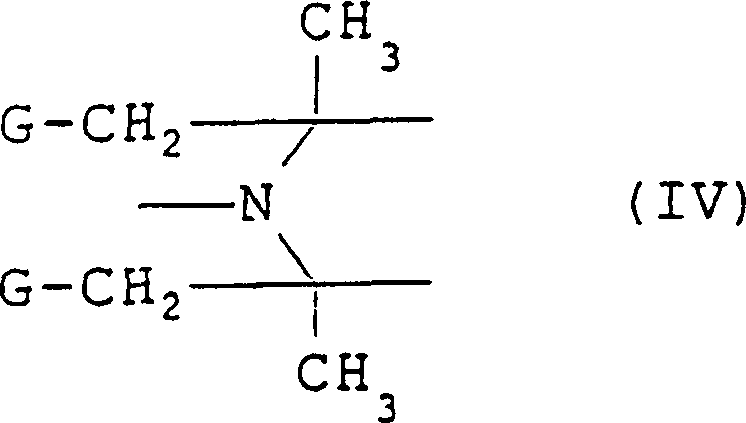
Beispiele
für die
vorstehend genannten sterisch gehinderten Amine sind z. B. in den
US Patenten 4,086,204, 4,108,829, 4,263,434, 4,23,412, 4,288,593,
4,315,859, 4,321,374, 4,331,586, 4,413,093, 4,435,555, 4,477,615,
4,335,242, 4,378,836, 4,433,145, 4,459,395, 4,477,615, 4,533,688,
4,540,728, 4,547,548 und 4,740,544; in den europäischen Patentanmeldungen
In
vielen Fällen
sind die sterisch gehinderten Amine cyclisch, insbesondere handelt
es sich um Verbindungen, ausgewählt
aus Polyalkylpiperidin-Derivaten enthaltend wenigstens eine Gruppe
mit der allgemeinen Formel (V): 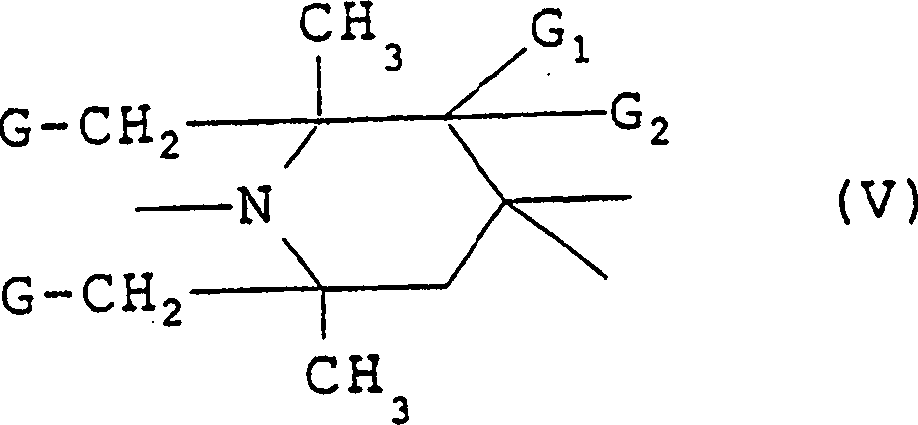
Von besonderer Bedeutung sind cyclische sterisch gehinderte Amine enthaltend wenigstens eine Gruppe der allgemeinen Formel (V), worin G für Wasserstoff steht und G1 und G2 für Wasserstoff stehen oder zusammen den Substituenten =0 bilden.Of particular importance are cyclic sterically hindered amines containing at least one group of general formula (V) wherein G is hydrogen and G 1 and G 2 are hydrogen or together form the substituent = 0.
Vorzugsweise werden insbesondere Derivate von 2,2,6,6-Tetramethylpiperidin eingesetzt.Preferably In particular, derivatives of 2,2,6,6-tetramethylpiperidine are used.
Von besonderer Bedeutung ist die Verwendung von Verbindungen, die der Gruppe von Polyalkylpiperidin angehören, die wenigstens eine Gruppe der allgemeinen Formel (V) im Molekül tragen, ausgewählt aus den im folgenden unter den Punkten (a) bis (i) aufgelisteten.From Of particular importance is the use of compounds that the Group of polyalkylpiperidine belong, the at least one group of the general formula (V) in the molecule selected from listed below under (a) to (i).
(a)
Verbindungen der allgemeinen Formel (VI): 
Die Reste von Tetracarbonsäuren umfassen auf jeden Fall Reste mit der Formel (-CO)nR, worin n die gleiche Bedeutung wie vorstehend angegeben aufweist und R einfach von den vorstehend angegebenen Definitionen abgeleitet werden kann.The radicals of tetracarboxylic acids in any case include radicals having the formula (-CO) n R, wherein n has the same meaning as stated above, and R can be easily derived from the definitions given above.
Beispiele für C1-C12 Alkylgruppen sind: Methyl, Ethyl, n-Propyl, n-Butyl, sec-Butyl, t-Butyl, n-Hexyl, n-Octyl, 2-Ethylhexyl, n-Nonyl, n-Decyl, n-Undecyl, n-Dodecyl, etc.Examples of C 1 -C 12 alkyl groups are: methyl, ethyl, n-propyl, n-butyl, sec-butyl, t-butyl, n-hexyl, n-octyl, 2-ethylhexyl, n-nonyl, n-decyl, n-undecyl, n-dodecyl, etc.
Beispiele für G11- und G12-Substituenten sind, wenn es sich um eine C1-C18 Alkylgruppe handelt, zusätzlich zu den vorstehend angegebenen Gruppen: n-Tridecyl, n-Tetradecyl, n-Hexadecyl, n-Octadecyl, etc.Examples of G 11 and G 12 substituents are, in the case of a C 1 -C 18 alkyl group, in addition to the groups indicated above: n-tridecyl, n-tetradecyl, n-hexadecyl, n-octadecyl, etc.
Beispiele für den Substituenten G11 sind, wenn es sich um eine C3-C8 Alkenylgruppe handelt: 1-Propyl, Allyl, Methallyl, 2-Butenyl, 2-Pentenyl, 2-Hexenyl, 2-Octenyl, 4-t-Butyl-2-butenyl, etc.Examples of the substituent G 11 are, when it is a C 3 -C 8 alkenyl group: 1-propyl, allyl, methallyl, 2-butenyl, 2-pentenyl, 2-hexenyl, 2-octenyl, 4-t-butyl -2-butenyl, etc.
Wenn es sich bei dem Substituent G11 um eine C3-C8 Alkinylgruppe handelt, so ist es bevorzugt Propargyl.When the substituent G 11 is a C 3 -C 8 alkynyl group, it is preferably propargyl.
Wenn der Substituent G11 für eine C7-C12 Aralkylgruppe steht, handelt es sich insbesondere um Phenethyl, vorzugsweise um Benzyl.When the substituent G 11 is a C 7 -C 12 aralkyl group, it is in particular phenethyl, preferably benzyl.
Beispiele für den Substituenten G11 sind, wenn es sich um eine C1-C8 Alkanoylgruppe handelt: Formyl, Propionyl, Butyryl, Octanoyl, vorzugsweise Acetyl und, wenn es sich um eine C3-C5 Alkenoylgruppe handelt, vorzugsweise Acryloyl.Examples of the substituent G 11 are, when it is a C 1 -C 8 alkanoyl group: formyl, propionyl, butyryl, octanoyl, preferably acetyl and, when it is a C 3 -C 5 alkenoyl, preferably acryloyl.
Beispiele für den Substituenten G12 sind, wenn er für einen monovalenten Rest einer Carbonsäure steht: Reste der folgenden Säuren: Essigsäure, Capronsäure, Stearinsäure, Acrylsäure, Methacrylsäure, Benzoesäure, β-(3,5-di-tert-Butyl-4-hydroxyphenyl)propionsäure, etc.Examples of the substituent G 12 are, if it is a monovalent radical of a carboxylic acid: radicals of the following acids: acetic acid, caproic acid, stearic acid, acrylic acid, methacrylic acid, benzoic acid, β- (3,5-di-tert-butyl-4- hydroxyphenyl) propionic acid, etc.
Beispiele für den Substituenten G12 sind, wenn es sich um einen monovalenten Silylrest handelt: ein Rest der allgemeinen Formel -(CjH2j)-Si(Z')2Z'' worin j für eine ganze Zahl zwischen 2 und 5 steht, einschließlich der Grenzen, und Z' und Z" unabhängig voneinander für eine C1-C4 Alkylgruppe oder eine C1-C4 Alkoxygruppe stehen.Examples of the substituent G 12 , when it is a monovalent silyl radical: a radical of the general formula - (C j H 2j ) -Si (Z ') 2 Z "' wherein j is an integer between 2 and 5 , including the boundaries, and Z 'and Z "independently represent a C 1 -C 4 alkyl group or a C 1 -C 4 alkoxy group.
Beispiele für den Substituenten G12 sind, wenn es sich um einen divalenten Rest einer Dicarbonsäure handelt, Reste der folgenden Säuren: Malonsäure, Succinsäure, Glutarsäure, Adipinsäure, Suberinsäure, Sebacinsäure, Maleinsäure, Itaconsäure, Phthalsäure, Dibutylmalonsäure, Dibenzylmalonsäure, Butyl(3,5-di-tert-butyl-4-hydroxybenzyl)malonsäure, Bicycloheptendicarbonsäure, etc.Examples of the substituent G 12 are, if it is a divalent radical of a dicarboxylic acid, radicals of the following acids: malonic acid, succinic acid, glutaric acid, adipic acid, suberic acid, sebacic acid, maleic acid, itaconic acid, phthalic acid, dibutylmalonic acid, dibenzylmalonic acid, butyl (3, 5-di-tert-butyl-4-hydroxybenzyl) malonic acid, bicycloheptane dicarboxylic acid, etc.
Beispiele für den Substituenten G12 sind, wenn es sich um einen trivalenten Rest einer Tricarbonsäure handelt, Reste der folgenden Säuren: Trimellinsäure, Zitronensäure, Nitrilotriessigsäure usw.Examples of the substituent G 12 , when it is a trivalent radical of a tricarboxylic acid, are radicals of the following acids: trimellinic acid, citric acid, nitrilotriacetic acid, etc.
Beispiele für den Substituenten G12 sind, wenn es sich um einen tetravalenten Rest einer Tetracarbonsäure handelt, Reste der folgenden Säuren: Butan-1,2,3,4-tetra-carbonsäure, Pyromellitinsäure, etc.Examples of the substituent G 12 are, if it is a tetravalent radical of a tetracarboxylic acid, radicals of the following acids: butane-1,2,3,4-tetracarboxylic acid, pyromellitic acid, etc.
Beispiele für den Substituenten G12 sind, wenn es sich um einen divalenten Rest einer Dicarbaminsäure handelt, Reste der folgenden Säuren: Hexamethylendicarbaminsäure, 2,4-Toluylendicarbaminsäure, usw.Examples of the substituent G 12 , when it is a divalent radical of a dicarbamic acid, are radicals of the following acids: hexamethylenedicarbamic acid, 2,4-toluenedicarbamic acid, etc.
Verbindungen der allgemeinen Formel (VI) sind bevorzugt, in denen G für Wasserstoff steht, G12 für Wasserstoff oder Methyl steht, n für 2 steht und G12 für einen Diacylrest einer aliphatischen Dicarbonsäure mit 4 bis 12 Kohlenstoffatomen steht.Compounds of the general formula (VI) are preferred in which G is hydrogen, G 12 is hydrogen or methyl, n is 2 and G 12 is a diacyl radical of an aliphatic dicarboxylic acid having 4 to 12 carbon atoms.
Spezifische Beispiele für Polyalkylpiperidine der allgemeinen Formel (VI) sind:
- 1) 4-Hydroxy-2,2,6,6-tetramethylpiperidin;
- 2) 1-Allyl-4-hydroxy-2,2,6,6-tetramethylpiperidin;
- 3) 1-Benzyl-4-hydroxy-tetramethylpiperidin;
- 4) 1-(4-t-Butyl-2-butenyl)-4-hydroxy-2,2,6,6-tetramethylpiperidin;
- 5) 4-Stearyloxy-2,2,6,6-tetramethylpiperidin;
- 6) 1-Ethyl-4-salicyloyloxy-2,2,6,6-tetramethylpiperidin;
- 7) 4-Methacryloyloxy-1,2,2,6,6-pentamethylpiperidin;
- 8) 1,2,2,6,6-Pentamethylpiperidin-4-yl-β-(3,5-di-t-butyl-4-hydroxyphenyl)-propionate;
- 9) Di(1-benzyl-2,2,6,6-tetramethylpiperidin-4-yl)maleat;
- 10) Di(2,2,6,6-tetramethylpiperidin-4-yl)succinat;
- 11) Di(2,2,6,6-tetramethylpiperidin-4-yl)glutarat;
- 12) Di(2,2,6,6-tetramethylpiperidin-4-yl)adipat;
- 13) Di(2,2,6,6-tetramethylpineridin-4-yl)sebacat;
- 14) Di(1,2,2,6,6-pentamethylpiperidin-4-yl)sebacat;
- 15) Di(1,2,3,6-tetramethyl-2,6-diethylpiperidin-4-yl)sebacat;
- 16) Di(1-allyl-2,2,6,6-tetramethylpiperiding-4-yl)phthalat;
- 17) (1-Acetyl-2,2,6,6-tetramethylpiperidin-4-yl)acetat;
- 18) Ester von Tri(2,2,6,6-tetramethylpiperidin-4-yl)trimellinsäure;
- 19) 1-Acryloyl-4-benzyloxy-2,2,6,6-tetramethylpiperidin;
- 20) Di(2,2,6,6-tetramethylpiperidin-4-yl)diethylmalonat;
- 21) Di(1,2,2,6,6-pentamethylpiperidin-4-yl)dibutylmalonat;
- 22) Di(1,2,2,6,6-pentamethylpiperidin-4-yl)butyl-(3,5-di-tert-butyl-4-hydroxybenzyl)malonat;
- 23) Hexan-1',6'-bis(4-carbamoyloxy-1-n-butyl-2,2,6,6-tetramethylpiperidin;
- 24) Toluen-2',4'-bis(4-carbamoyloxy-1-n-propyl-2,2,6,6-tetramethylpiperidin;
- 25) Dimethyl-bis(2,2,6,6-tetramethylpiperidin-4-oxy)silan;
- 26) Phenyl-tris(2,2,6,6-tetramethylpiperidin-4-oxy)silan;
- 27) Tris(1-propyl-2,2,6,6-tetramethylpiperidin-4-yl)phosphit;
- 28) Tris(1-Propyl-2,2,6,6-tetramethylpiperidin-4-yl)phosphat;
- 29) Bis(1,2,2,6,6-pentamethylpiperidin-4-yl)phenylphosphonat;
- 30) 4-Hydroxy-1,2,2,6,6-pentamethylpiperidin;
- 31) 4-Hydroxy-N-hydroxyethyl-2,2,6,6-tetramethylpiperidin;
- 32) 4-Hydroxy-N-(2-hydroxypropyl)-2,2,6,6-tetramethylpiperidin;
- 33) 1-Glycidyl-4-hydroxy-2,2,6,6-tetramethylpiperidin.
- 1) 4-hydroxy-2,2,6,6-tetramethylpiperidine;
- 2) 1-allyl-4-hydroxy-2,2,6,6-tetramethylpiperidine;
- 3) 1-benzyl-4-hydroxy-tetramethylpiperidine;
- 4) 1- (4-t-butyl-2-butenyl) -4-hydroxy-2,2,6,6-tetramethylpiperidine;
- 5) 4-stearyloxy-2,2,6,6-tetramethylpiperidine;
- 6) 1-ethyl-4-salicyloyloxy-2,2,6,6-tetramethylpiperidine;
- 7) 4-methacryloyloxy-1,2,2,6,6-pentamethylpiperidine;
- 8) 1,2,2,6,6-pentamethylpiperidin-4-yl-β- (3,5-di-t-butyl-4-hydroxyphenyl) -propionate;
- 9) di (1-benzyl-2,2,6,6-tetramethylpiperidin-4-yl) maleate;
- 10) di (2,2,6,6-tetramethylpiperidin-4-yl) succinate;
- 11) di (2,2,6,6-tetramethylpiperidin-4-yl) glutarate;
- 12) di (2,2,6,6-tetramethylpiperidin-4-yl) adipate;
- 13) di (2,2,6,6-tetramethylpineridin-4-yl) sebacate;
- 14) di (1,2,2,6,6-pentamethylpiperidin-4-yl) sebacate;
- 15) di (1,2,3,6-tetramethyl-2,6-diethyl-piperidin-4-yl) sebacate;
- 16) di (1-allyl-2,2,6,6-tetramethylpiperiding-4-yl) phthalate;
- 17) (1-acetyl-2,2,6,6-tetramethylpiperidin-4-yl) acetate;
- 18) esters of tri (2,2,6,6-tetramethylpiperidin-4-yl) trimellinic acid;
- 19) 1-acryloyl-4-benzyloxy-2,2,6,6-tetramethylpiperidine;
- 20) di (2,2,6,6-tetramethylpiperidin-4-yl) diethylmalonate;
- 21) di (1,2,2,6,6-pentamethylpiperidin-4-yl) dibutylmalonate;
- 22) Di (1,2,2,6,6-pentamethylpiperidin-4-yl) butyl- (3,5-di-tert-butyl-4-hydroxybenzyl) malonate;
- 23) hexane-1 ', 6'-bis (4-carbamoyloxy-1-n-butyl-2,2,6,6-tetramethylpiperidine;
- 24) toluene-2 ', 4'-bis (4-carbamoyloxy-1-n-propyl-2,2,6,6-tetramethylpiperidine;
- 25) dimethylbis (2,2,6,6-tetramethylpiperidin-4-oxy) silane;
- 26) phenyltris (2,2,6,6-tetramethylpiperidine-4-oxy) silane;
- 27) tris (1-propyl-2,2,6,6-tetramethylpiperidin-4-yl) phosphite;
- 28) tris (1-propyl-2,2,6,6-tetramethylpiperidin-4-yl) phosphate;
- 29) bis (1,2,2,6,6-pentamethylpiperidin-4-yl) phenylphosphonate;
- 30) 4-hydroxy-1,2,2,6,6-pentamethylpiperidine;
- 31) 4-hydroxy-N-hydroxyethyl-2,2,6,6-tetramethylpiperidine;
- 32) 4-hydroxy-N- (2-hydroxypropyl) -2,2,6,6-tetramethylpiperidine;
- 33) 1-Glycidyl-4-hydroxy-2,2,6,6-tetramethylpiperidine.
(b)
Verbindungen der allgemeinen Formel (VII): 

Der Ausdruck Aryl bezieht sich auf einen aromatischen Kohlenwasserstoff wie z. B. Phenyl oder Naphthyl. Der Ausdruck Aralkyl bezieht sich auf ein Alkyl, substituiert mit einem aromatischen Kohlenwasserstoff, z. B. einem Kohlenwasserstoff mit 6 bis 10 Kohlenstoffatomen, Beispiele für Aralkyle sind Benzyl, α-Methylbenzyl usw.Of the Expression Aryl refers to an aromatic hydrocarbon such as As phenyl or naphthyl. The term aralkyl refers to an alkyl substituted with an aromatic hydrocarbon, z. Example, a hydrocarbon having 6 to 10 carbon atoms, examples for Aralkyle are benzyl, α-methylbenzyl, etc.
C1-C12 Alkyl oder C1-C18 Alkylgruppen wurden bereits vorstehend unter Punkt (a) definiert.C 1 -C 12 alkyl or C 1 -C 18 alkyl groups have already been defined in item (a) above.
Bei C5-C7 Cycloalkylgruppen handelt es sich bevorzugt um Cyclohexyl.C 5 -C 7 cycloalkyl groups are preferably cyclohexyl.
Wenn G13 für eine C7-C8 Aralkylgruppe steht, handelt es sich um Phenylethyl, vorzugsweise um Benzyl.When G 13 is a C 7 -C 8 aralkyl group, it is phenylethyl, preferably benzyl.
Wenn G13 für eine C2-C5 Hydroxyalkylgruppe steht, handelt es sich um 2-Hydroxyethyl, Hydroxypropyl, usw.When G 13 is a C 2 -C 5 hydroxyalkyl group, it is 2-hydroxyethyl, hydroxypropyl, etc.
Beispiele für G13 sind, wenn es sich um eine C2-C18 Alkanoylgruppe handelt: Propionyl, Butyryl, Oktanoyl, Dodecanoyl, Hexadecanoyl, Octadecanoyl, usw., vorzugsweise Acetyl und, wenn es sich um eine C3-C5 Alkenoylgruppe handelt, bevorzugt Acryloyl.Examples of G 13 , when it is a C 2 -C 18 alkanoyl group: propionyl, butyryl, octanoyl, dodecanoyl, hexadecanoyl, octadecanoyl, etc., preferably acetyl and, when it is a C 3 -C 5 alkenoyl group , preferably acryloyl.
Beispiele für G14 sind, wenn es sich um eine C2-C8 Alkenylgruppe handelt: Allyl, Methallyl, 2-Butenyl, 2-Pentenyl, 2-Hexenyl, 2-Octenyl, usw.Examples of G 14 are, when it is a C 2 -C 8 alkenyl group: allyl, methallyl, 2-butenyl, 2-pentenyl, 2-hexenyl, 2-octenyl, etc.
Beispiele für G14 sind, wenn es sich um eine C1-C4 Alkylgruppe handelt, substituiert mit einer Hydroxylgruppe, einer Cyanogruppe, einer Alkoxycarbonylgruppe oder einer Carbamidgruppe: 2-Hydraxyethyl, 2-Hydroxypropyl, 2-Cyanoethyl, Methoxycarbonylmethyl, 2-Ethoxycarbonylethyl, 2-Aminocarbonylpropyl, 2-(Dimethylaminocarbonyl)ethyl, usw.Examples of G 14 , when it is a C 1 -C 4 alkyl group, substituted with a hydro xyl group, a cyano group, an alkoxycarbonyl group or a carbamide group: 2-hydroxyethyl, 2-hydroxypropyl, 2-cyanoethyl, methoxycarbonylmethyl, 2-ethoxycarbonylethyl, 2-aminocarbonylpropyl, 2- (dimethylaminocarbonyl) ethyl, etc.
Beispiele für C2-C12 Alkylengruppen sind: Ethylen, Propylen, 2,2-Dimethylpropylen, Tetramethylen, Hexamethylen, Octamethylen, Decamethylen, Dodecamethylen, usw.Examples of C 2 -C 12 alkylene groups are: ethylene, propylene, 2,2-dimethylpropylene, tetramethylene, hexamethylene, octamethylene, decamethylene, dodecamethylene, etc.
Beispiele für C6-C15 Arylengruppen sind: o-, m-, oder p-Phenylen, 1,4-Naphthylen, 4,4'-Diphenylen, usw.Examples of C 6 -C 15 arylene groups are: o-, m- or p-phenylene, 1,4-naphthylene, 4,4'-diphenylene, etc.
Beispiele für C6-C12 Cycloalkylengruppen sind vorzugsweise Cyclohexylen.Examples of C 6 -C 12 cycloalkylene groups are preferably cyclohexylene.
Bevorzugte
Verbindungen der allgemeinen Formel (VIII) sind jene, worin n für 1 oder
2 steht, G für Wasserstoff
steht, G11 für Wasserstoff oder Methyl steht,
G13 für
Wasserstoff, eine C1-C12 Alkylgruppe
oder eine Gruppe mit der folgenden Formel steht: 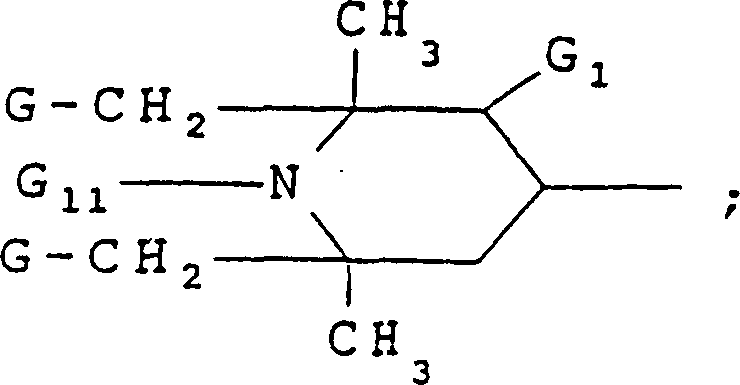
Spezifische Beispiele für Polyalkylpiperidine mit der allgemeinen Formel (VII) sind:
- 1) N,N'-Bis(2,2,6,6-tetramethylpiperidin-4-yl)hexamethylen-1,6-diamin;
- 2) N,N'-Bis(2,2,6,6-tetramethylpiperidin-4-yl)hexamethylen-1,6-diacetamid;
- 3) Bis(2,2,6,6-tetramethylpiperidin-4-yl)amin;
- 4) 4-Benzoylamino-2,2,6,6-tetramethylpiperidin;
- 5) N,N'-Bis(2,2,6,6-tetramethylpiperidin-4-yl)-N,N'-dibutyladipamid;
- 6) N,N'-Bis(2,2,6,b-tetramethylpiperidin-4-yl)-N,N'-dicyclohexyl-2-hydroxypropylen-1,3-diamin;
- 7) N,N'-Bis(2,2,6,6-tetramethylpiperidin-4-yl)-p-xylylendiamin;
- 8) N,N'-Bis(2,2,6,6-tetramethylpiperidin-4-yl)-succindiamid;
- 9) N,N'-Bis(2,2,6,6-tetramethylpiperidin-4-yl)-N-(2,2,6,b-tetramethylpiperidin-4-yl)-β-aminodipropionat;
- 10) Verbindungen der Formel:
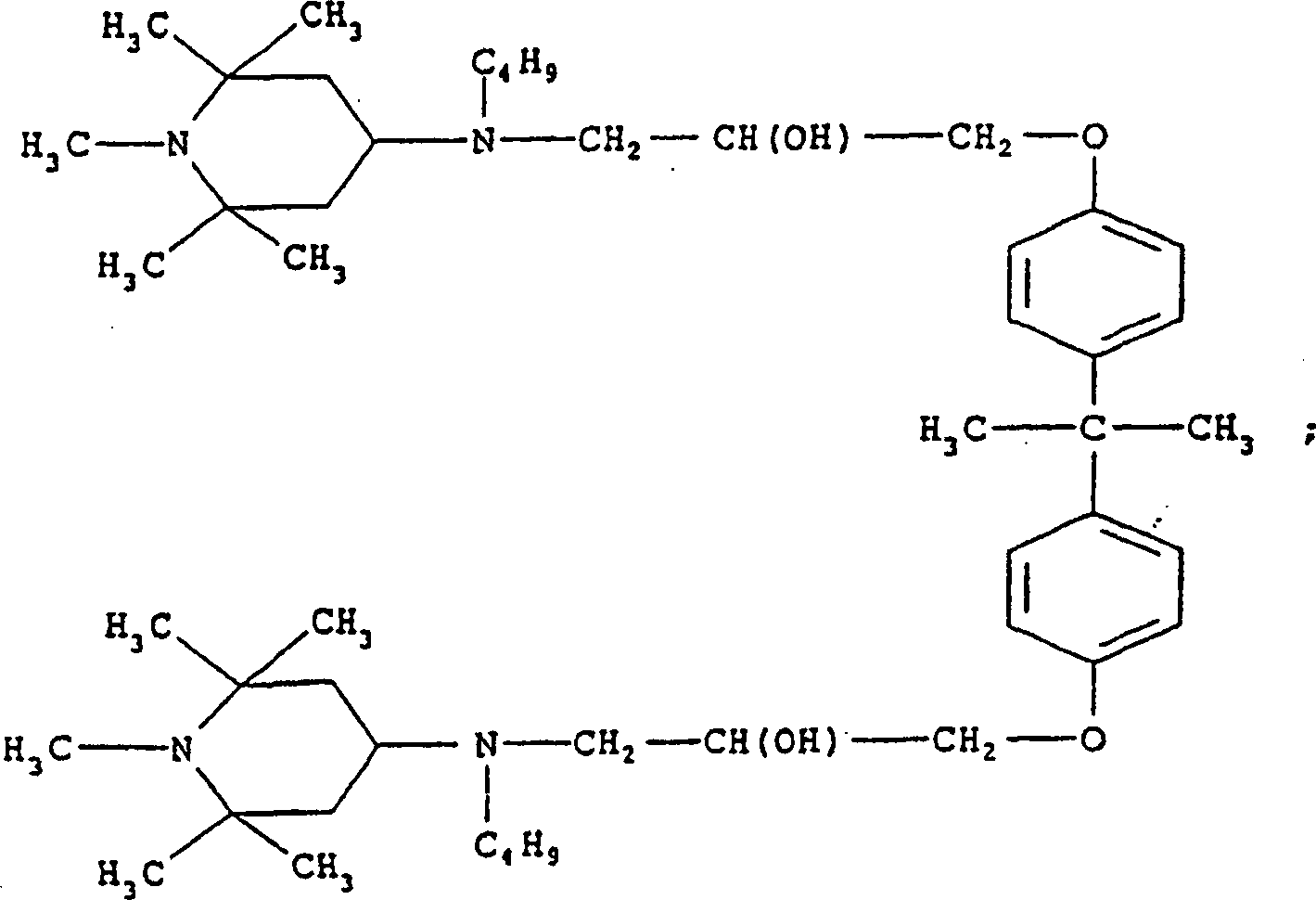
- 11) 4-[Bis(2-hydroxyethyl)amino]1,2,2,6,6-pentamethylpiperidin;
- 12) 4-(3-Methyl-4-hydroxy-5-tert-butylbenzamido)-2,2,6,6-tetramethylpiperidin;
- 13) 4-Methacrylamido-1,2,2,6,6-pentamethylpiperidin.
- 1) N, N'-bis (2,2,6,6-tetramethylpiperidin-4-yl) hexamethylene-1,6-diamine;
- 2) N, N'-bis (2,2,6,6-tetramethylpiperidin-4-yl) hexamethylene-1,6-diacetamide;
- 3) bis (2,2,6,6-tetramethylpiperidin-4-yl) amine;
- 4) 4-benzoylamino-2,2,6,6-tetramethylpiperidine;
- 5) N, N'-bis (2,2,6,6-tetramethyl-piperidin-4-yl) -N, N'-dibutyl-adipamide;
- 6) N, N'-bis (2,2,6, b-tetramethylpiperidin-4-yl) -N, N'-dicyclohexyl-2-hydroxypropylene-1,3-diamine;
- 7) N, N'-bis (2,2,6,6-tetramethylpiperidin-4-yl) -p-xylylenediamine;
- 8) N, N'-bis (2,2,6,6-tetramethyl-piperidin-4-yl) -succin-diamide;
- 9) N, N'-bis (2,2,6,6-tetramethylpiperidin-4-yl) -N- (2,2,6, b-tetramethylpiperidin-4-yl) -β-aminodipropionate;
- 10) Compounds of the formula:
- 11) 4- [bis (2-hydroxyethyl) amino] 1,2,2,6,6-pentamethylpiperidine;
- 12) 4- (3-methyl-4-hydroxy-5-tert-butylbenzamido) -2,2,6,6-tetramethylpiperidine;
- 13) 4-Methacrylamido-1,2,2,6,6-pentamethylpiperidine.
(c)
Verbindungen der allgemeinen Formel (VIII): 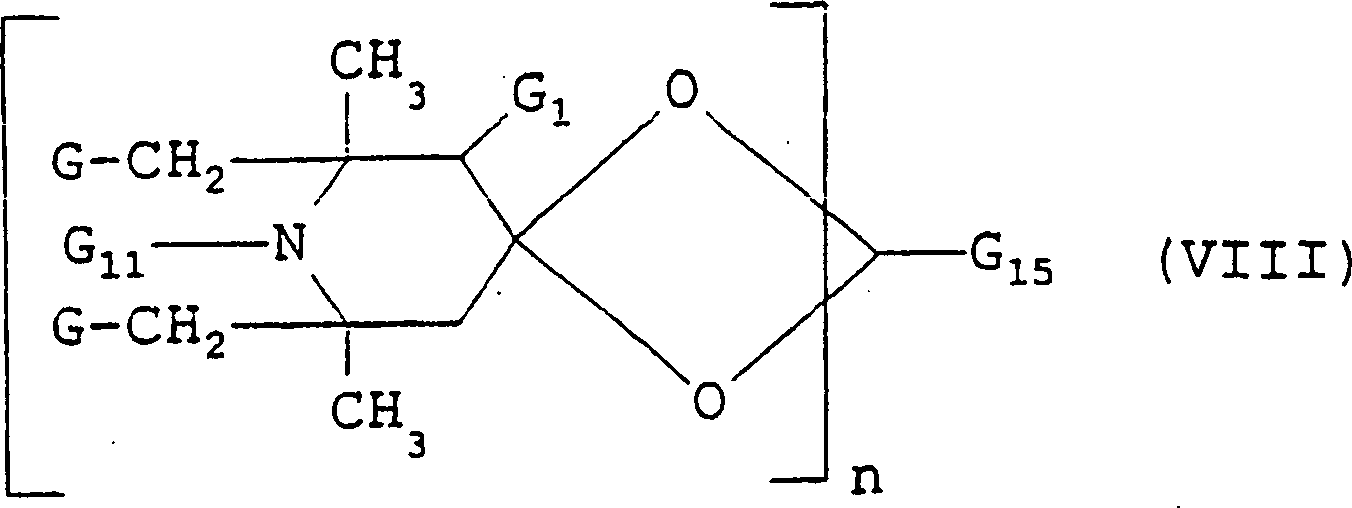
Beispiele für G15 sind, wenn es für eine C2-C8 Alkylengruppe oder Hydroxyalkylengruppe steht: Ethylen, 1-Methylethylen, Propylen, 2-Ethylpropylen, 2-Ethyl-2-hydroxymethylpropylen, usw.Examples of G 15 are, when it is a C 2 -C 8 alkylene group or hydroxyalkylene group: ethylene, 1-methylethylene, propylene, 2-ethylpropylene, 2-ethyl-2-hydroxymethylpropylene, etc.
Ein Beispiel für G15 ist, wenn es sich um eine C4-C22 Acyloxyalkylengruppe handelt, 2-Ethyl-2-acetoxymethylpropylen.An example of G 15 , when it is a C 4 -C 22 acyloxyalkylene group, is 2-ethyl-2-acetoxymethylpropylene.
Spezifische Beispiele für Polyalkylpiperidine der allgemeinen Formel (VIII) sind:
- 1) 9-Aza-8,8,10,10-tetramethyl-1,5-dioxaspiro[5.5]undecan;
- 2) 9-Aza-8,8,10,10-tetramethyl-3-ethyl-1,5-dioxaspiro[5.5]undecan;
- 3) 8-Aza-2,7,7,8,9,9-hexamethyl-1,4-dioxaspiro[4.5)decan;
- 4) 9-Aza-3-hydroxymethyl-3-ethyl-8,8,9,10,10-pentamethyl-1,5-dioxaspiro[5.5]undecan;
- 5) 9-Aza-3-ethyl-acetoxymethyl-9-acetyl-8,8,10,10-tetramethyl-1,5-dioxaspiro[5.5]undecan;
- 6) 2,2,6,6-Tetramethylpiperidin-4-spiro-2'-(1'-3'-dioxan)-5'-spiro-5''-(1'',3''-dioxan)-2''-spiro-4'''-(2''',2''',6''',6'''-tetramethylpiperidin).
- 1) 9-aza-8,8,10,10-tetramethyl-1,5-dioxaspiro [5.5] undecane;
- 2) 9-aza-8,8,10,10-tetramethyl-3-ethyl-1,5-dioxaspiro [5.5] undecane;
- 3) 8-aza-2,7,7,8,9,9-hexamethyl-1,4-dioxaspiro [4.5] decane;
- 4) 9-aza-3-hydroxymethyl-3-ethyl-8,8,9,10,10-pentamethyl-1,5-dioxaspiro [5.5] undecane;
- 5) 9-aza-3-ethyl-acetoxymethyl-9-acetyl-8,8,10,10-tetramethyl-1,5-dioxaspiro [5.5] undecane;
- 6) 2,2,6,6-Tetramethylpiperidine-4-spiro-2 '- (1'-3'-dioxane) -5'-spiro-5''-(1'',3''- dioxane) - 2 '' - spiro-4 '''-(2''', 2 ''',6''', 6 '''- tetramethylpiperidine).
(d)
Verbindungen der allgemeinen Formeln (IXA), (IXB) und (IXC), wobei
die Verbindungen der allgemeinen Formel (IXC) bevorzugt sind: 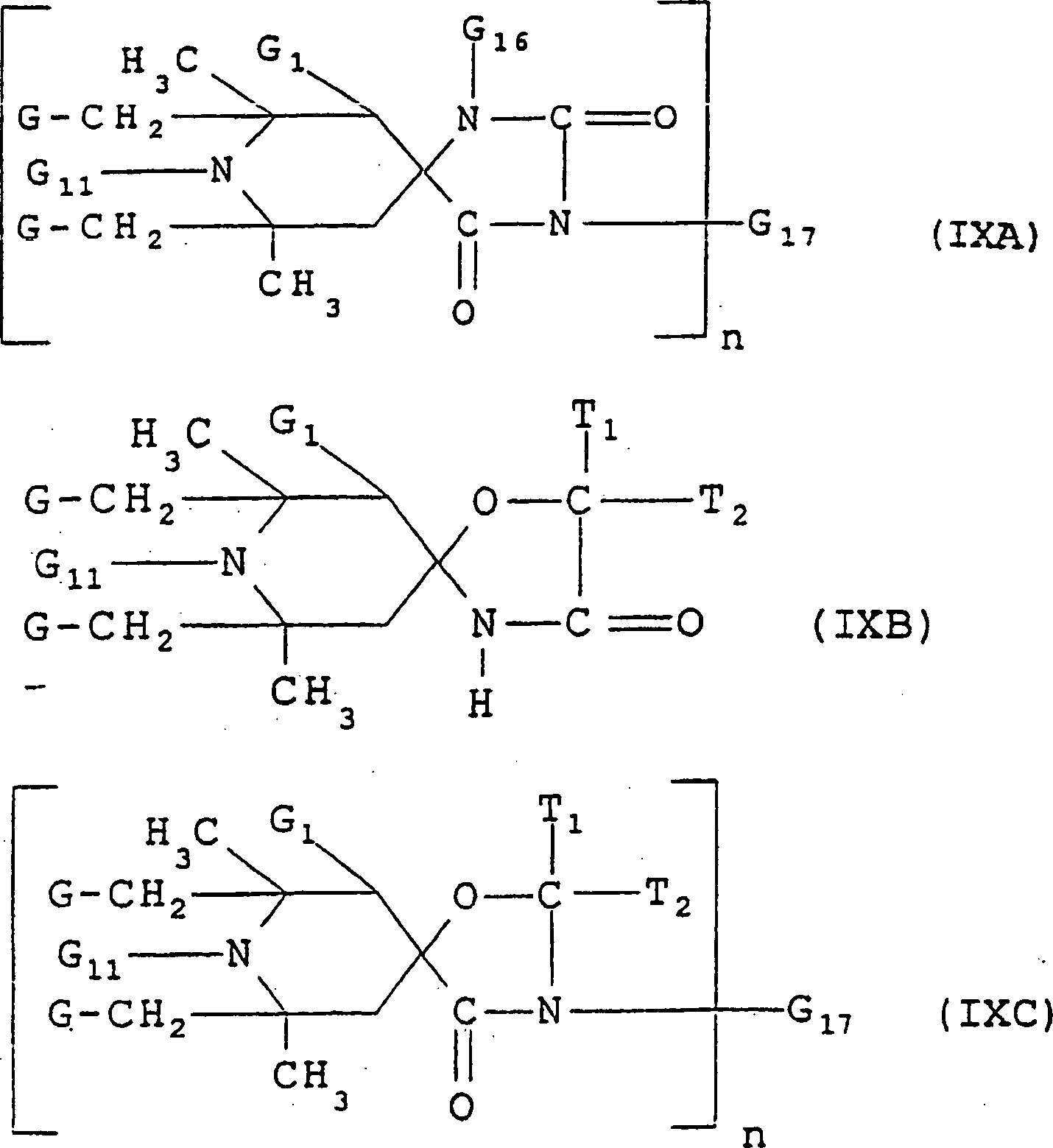
Beispiele für C1-C12 Alkylgruppen sind: Methyl, Ethyl, n-Propyl, n-Butyl, sec-Butyl, tert-Butyl, n-Hexyl, n-Octyl, 2-Ethylhexyl, n-Nonyl, n-Decyl, n-Undecyl, n-Dodecyl, usw.Examples of C 1 -C 12 alkyl groups are: methyl, ethyl, n-propyl, n-butyl, sec-butyl, tert-butyl, n-hexyl, n-octyl, 2-ethylhexyl, n-nonyl, n-decyl, n-undecyl, n-dodecyl, etc.
Beispiele für C1-C18 Alkylgruppen sind zusätzlich zu den vorstehend genannten: n-Tridecyl, n-Tetradecyl, n-Hexadecyl, n-Octadecyl, usw.Examples of C 1 -C 18 alkyl groups are in addition to those mentioned above: n-tridecyl, n-tetradecyl, n-hexadecyl, n-octadecyl, etc.
Beispiele für C2-C6 Alkoxyalkylgruppen sind: Methoxymethyl, Ethoxymethyl, Propoxymethyl, t-Butoxymethyl, Ethoxyethyl, Ethoxypropyl, n-Butoxyethyl, t-Butoxyethyl, Isopropoxyethyl, Propoxypropyl, usw.Examples of C 2 -C 6 alkoxyalkyl groups are: methoxymethyl, ethoxymethyl, propoxymethyl, t-butoxymethyl, ethoxyethyl, ethoxypropyl, n-butoxyethyl, t-butoxyethyl, isopropoxyethyl, propoxypropyl, etc.
Beispiele für G17 sind, wenn es sich um eine C3-C5 alkenylische Gruppe handelt: 1-Propenyl, Allyl, Methallyl, 2-Butenyl, 2-Pentenyl, usw.Examples of G 17 are, if it is a C 3 -C 5 alkenylic group: 1-propenyl, allyl, methallyl, 2-butenyl, 2-pentenyl, etc.
Beispiele für G17, T1 und T7 sind, wenn sie eine C7-C9 Aralkylgruppe darstellen: Phenethyl, bevorzugt Benzyl.Examples of G 17 , T 1 and T 7 , when they represent a C 7 -C 9 aralkyl group: phenethyl, are preferred Benzyl.
Beispiele für Cycloalkanringe, die durch T1 und T2 gebildet werden, sind bei Betrachtung dieser Substituenten zusammen mit dem Kohlenstoffatom, an das sie gebunden sind: Cyclopentan, Cyclohexan, Cyclooctan, Cyclododecan usw.Examples of cycloalkane rings formed by T 1 and T 2 are when considering these substituents together with the carbon atom to which they are attached: cyclopentane, cyclohexane, cyclooctane, cyclododecane, etc.
Beispiele für G17 sind, wenn es sich um eine C2-C4 Hydroxyalkylgruppe handelt: 2-Hydroxyethyl, 2-Hydroxypropyl, 2-Hydroxybutyl, 4-Hydroxybutyl, usw.Examples of G 17 are, when it is a C 2 -C 4 hydroxyalkyl group: 2-hydroxyethyl, 2-hydroxypropyl, 2-hydroxybutyl, 4-hydroxybutyl, etc.
Beispiele für G17, T1 und T2 sind, wenn es sich um eine C6-C10 Arylgruppe handelt: α- oder β-Naphthyl, gegebenenfalls mit einem Halogenatom oder einer C1-C4 Alkylgruppe substituiert, usw.Examples of G 17 , T 1 and T 2 are, when it is a C 6 -C 10 aryl group: α- or β-naphthyl, optionally substituted with a halogen atom or a C 1 -C 4 alkyl group, etc.
Beispiele für G17 sind, wenn es sich um eine C2-C12 Alkylengruppe handelt: Ethylen, Propylen, 2,2-Dimethylpropylen, Tetramethylen, Hexamethylen, Octamethylen, Decamethylen, Dodecamethylen, usw.Examples of G 17 are, when it is a C 2 -C 12 alkylene group: ethylene, propylene, 2,2-dimethylpropylene, tetramethylene, hexamethylene, octamethylene, decamethylene, dodecamethylene, etc.
Beispiele für G17 sind, wenn es sich um eine C4-C12 Alkenylengruppe handelt: 2-Butenylen, 2-Pentenylen, 3-Hexenylen, usw.Examples of G 17 are, if it is a C 4 -C 12 alkenylene group: 2-butenylene, 2-pentenylene, 3-hexenylene, etc.
Beispiele für G17 sind, wenn es sich um eine C6-C12 Arylengruppe handelt, o-, m- oder p-Phenylen, 1,4-Naphthylen, 4,4'-Diphenylen, usw.Examples of G 17 are, when it is a C 6 -C 12 arylene group, o-, m- or p-phenylene, 1,4-naphthylene, 4,4'-diphenylene, etc.
Beispiele für Z' sind, wenn es sich um eine C2-C12 Alkanoylgruppe handelt: Propionyl, Butyryl, Octanoyl, Dodecanoyl, vorzugsweise Acetyl.Examples of Z 'are, when it is a C 2 -C 12 alkanoyl group: propionyl, butyryl, octanoyl, dodecanoyl, preferably acetyl.
Beispiele für D sind, wenn es sich um eine C2-C10 Alkylengruppe, eine C6-C15 Arylengruppe oder eine C6-C12 Cycloalkylengruppe handelt, wie vorstehend unter Punkt (b) definiert.Examples of D are, when it is a C 2 -C 10 alkylene group, a C 6 -C 15 arylene group or a C 6 -C 12 cycloalkylene group, as defined in item (b) above.
Spezifische Beispiele für Polyalkylpiperidine mit der allgemeinen Formel (IX) sind:
- 1) 3-Benzyl-1,3,8-triaza-7,7,9,9-tetramethylspiro[4.5]decan-2,4-dion;
- 2) 3-n-Octyl-1,3,8-triaza-7,7,9,9-tetramethylspiro[4.5]decan-2,4-dion;
- 3) 3-Allyl-1,3,8-triaza-1,7,7,9,9-pentamethylspiro[4.5]decan-2,4-dion;
- 4) 3-Glycidyl-1,3,8-triaza-7,7,8,9,9-pentamethylspiro[4.5]decan-2,4-dion;
- 5) 1,3,7,7,8,9,9-Heptamethyl-1,3,8-triazaspiro[4.5]decan-2,4-dion;
- 6) 2-Isopropyl-7,7,9,9-tetramethyl-1-oxa-3,8-diaza-4-oxospiro[4.5]decan;
- 7) 2,2-Dibutyl-7,7,9,9-tetramethyl-1-oxa-3,8-diaza-4-oxospiro[4.5]decan;
- 8) 2,2,4,4-Tetramethyl-7-oxa-3,20-diaza-21-oxodispiro[4.1.11.2]heneicosan;
- 9) 2-Butyl-7,7,9,9-tetramethyl-1-oxa-4,8-diaza-3-oxospiro[4.5]decan; und, bevorzugt
- 10) 8-Acetyl-3-dodecyl-1,3,8-triaza-7,7,9,9-tetramethylspiro[4.5]decan-2,4-dion;
oder eine Verbindung mit den folgenden Formeln:

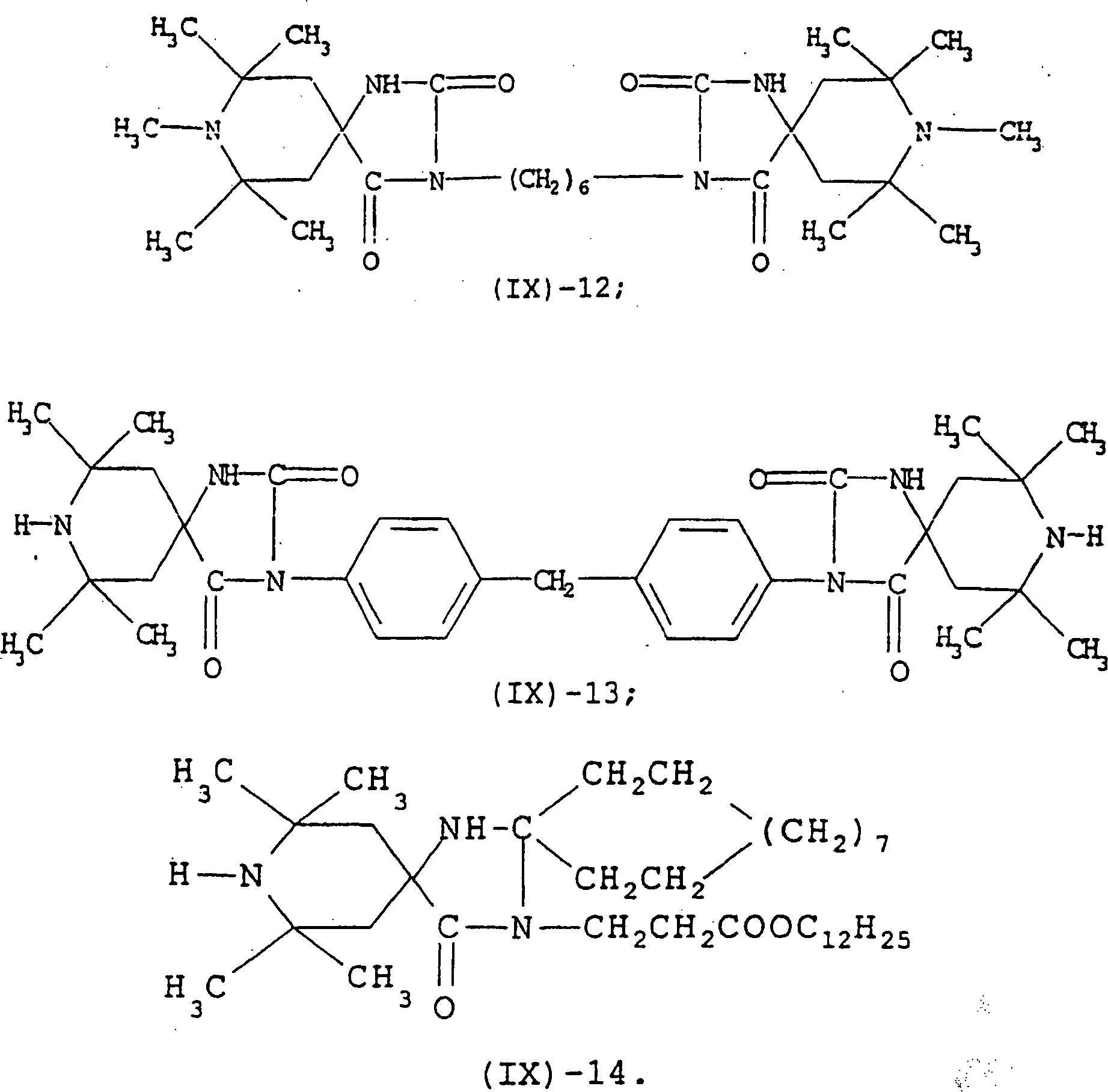
- 1) 3-Benzyl-1,3,8-triaza-7,7,9,9-tetramethylspiro [4.5] decane-2,4-dione;
- 2) 3-n-octyl-1,3,8-triaza-7,7,9,9-tetramethylspiro [4.5] decane-2,4-dione;
- 3) 3-allyl-1,3,8-triaza-1,7,7,9,9-pentamethylspiro [4.5] decane-2,4-dione;
- 4) 3-glycidyl-1,3,8-triaza-7,7,8,9,9-pentamethylspiro [4.5] decane-2,4-dione;
- 5) 1,3,7,7,8,9,9-heptamethyl-1,3,8-triazaspiro [4.5] decane-2,4-dione;
- 6) 2-isopropyl-7,7,9,9-tetramethyl-1-oxa-3,8-diaza-4-oxospiro [4.5] decane;
- 7) 2,2-dibutyl-7,7,9,9-tetramethyl-1-oxa-3,8-diaza-4-oxospiro [4.5] decane;
- 8) 2,2,4,4-tetramethyl-7-oxa-3,20-diaza-21-oxodispiro [4.1.11.2] heneicosane;
- 9) 2-butyl-7,7,9,9-tetramethyl-1-oxa-4,8-diaza-3-oxospiro [4.5] decane; and, preferably
- 10) 8-acetyl-3-dodecyl-1,3,8-triaza-7,7,9,9-tetramethylspiro [4.5] decane-2,4-dione; or a compound with the following formulas:
e)
Verbindungen mit der allgemeinen Formel (X): 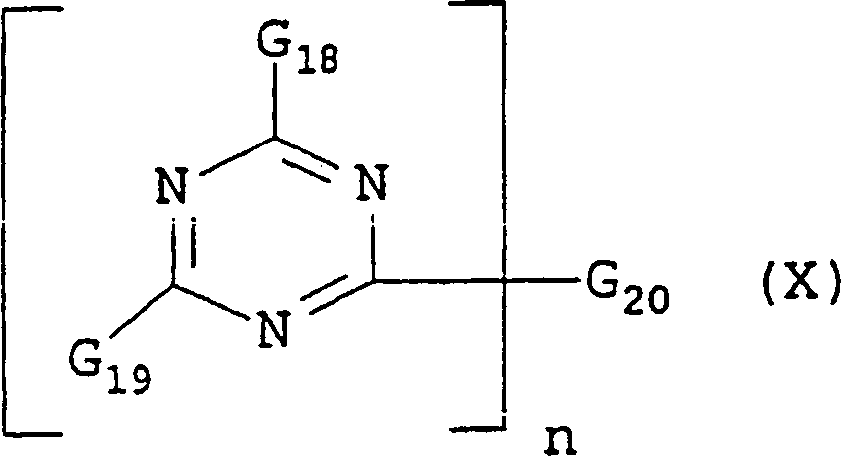


G22 steht für eine C1-C12 Alkylgruppe, eine Cyclohexylgruppe, ein
Benzyl, eine C1-C4 Hydroxyalkylgruppe;
G23 steht für Wasserstoff, eine C1-C12 Alkylgruppe,
ein Phenyl, oder G21 und G22 bilden
zusammen eine C4-C5 Alkylengruppe
oder Oxyalkylengruppe, z. B. 
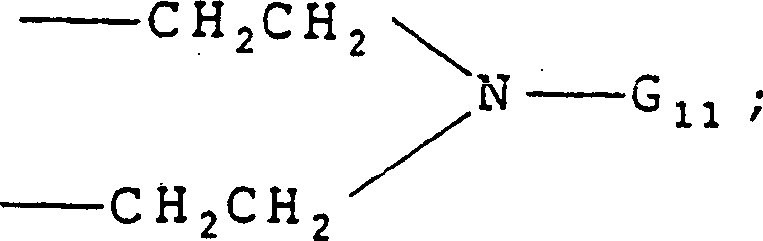
G21 ist eine Gruppe mit der allgemeinen Formel: 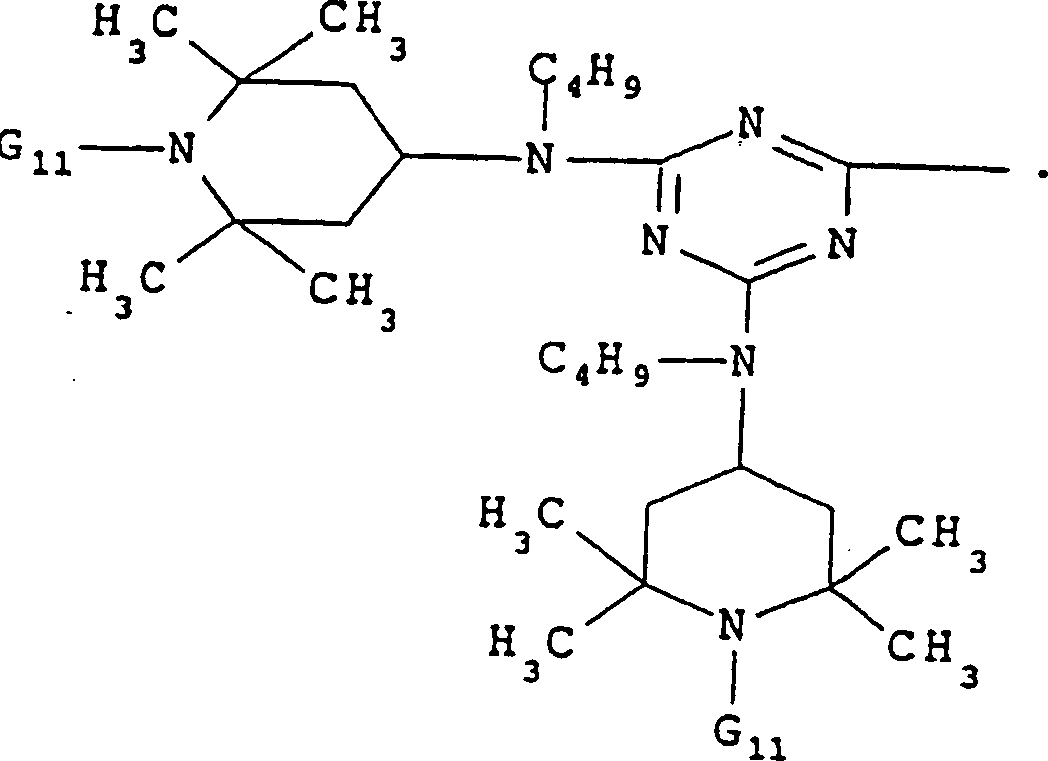
Beispiele für C1-C12 Alkylgruppen sind: Methyl, Ethyl, n-Propyl, n-Butyl, sec-Butyl, t-Butyl, n-Hexyl, n-Octyl, 2-Ethylhexyl, n-Nonyl, n-Decyl, n-Undecyl, n-Dodecyl, usw. Beispiele für C1-C4 Hydroxyalkylgruppen sind: 2-Hydroxyethyl, 2-Hydroxypropyl, 3-Hydroxypropyl, 2-Hydroxybutyl, 4-Hydroxybutyl, usw.Examples of C 1 -C 12 alkyl groups are: methyl, ethyl, n-propyl, n-butyl, sec-butyl, t-butyl, n-hexyl, n-octyl, 2-ethylhexyl, n-nonyl, n-decyl, n-undecyl, n-dodecyl, etc. Examples of C 1 -C 4 hydroxyalkyl groups are: 2-hydroxyethyl, 2-hydroxypropyl, 3-hydroxypropyl, 2-hydroxybutyl, 4-hydroxybutyl, etc.
Beispiele für A sind, wenn es sich um eine C2-C6 Alkylengruppe handelt: Ethylen, Propylen, 2,2-Dimethylpropylen, Tetramethylen, Hexamethylen, usw.Examples of A are, when it is a C 2 -C 6 alkylene group: ethylene, propylene, 2,2-dimethylpropylene, tetramethylene, hexamethylene, etc.
Beispiele für G21 und G22 sind, wenn sie zusammen eine C4-C5 Alkylen- oder Oxyalkylengruppe bilden: Tetramethylen, Pentamethylen, 3-Oxapentamethylen, usw.Examples of G 21 and G 22 are when they together form a C 4 -C 5 alkylene or oxyalkylene group: tetramethylene, pentamethylene, 3-oxapentamethylene, etc.
Spezifische
Beispiele für
Polyalkylpiperidine mit der allgemeinen Formel (X) sind: 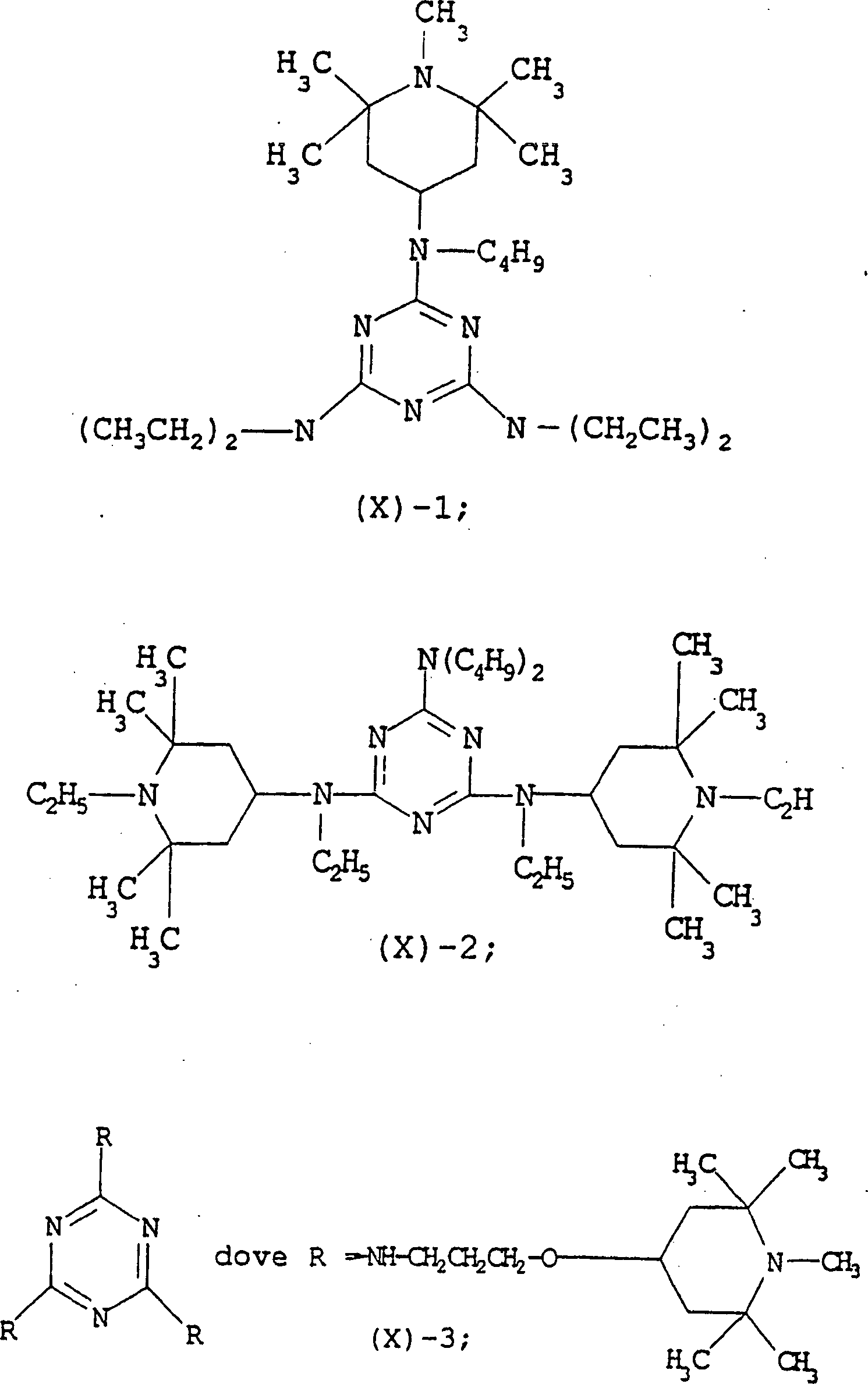
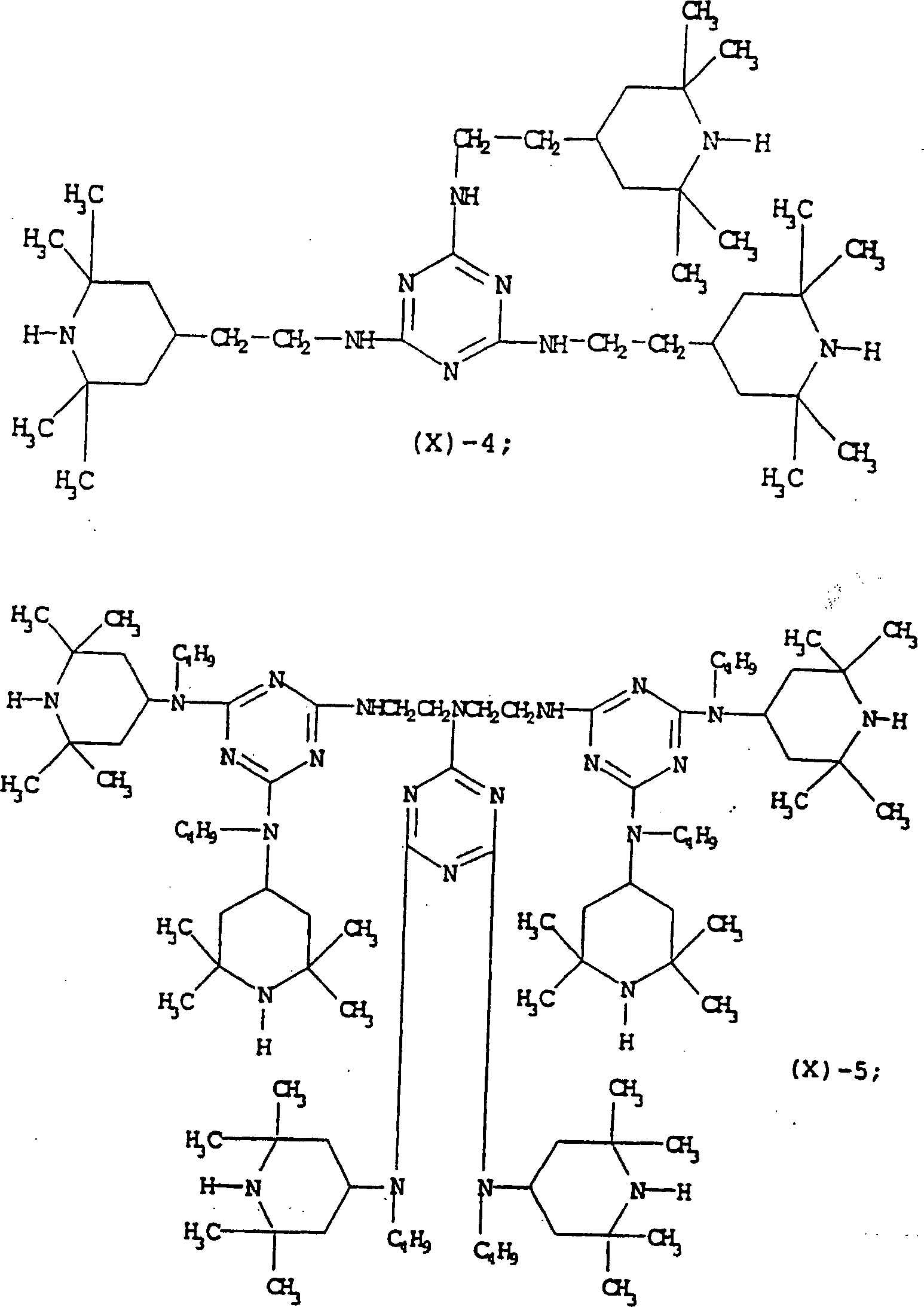


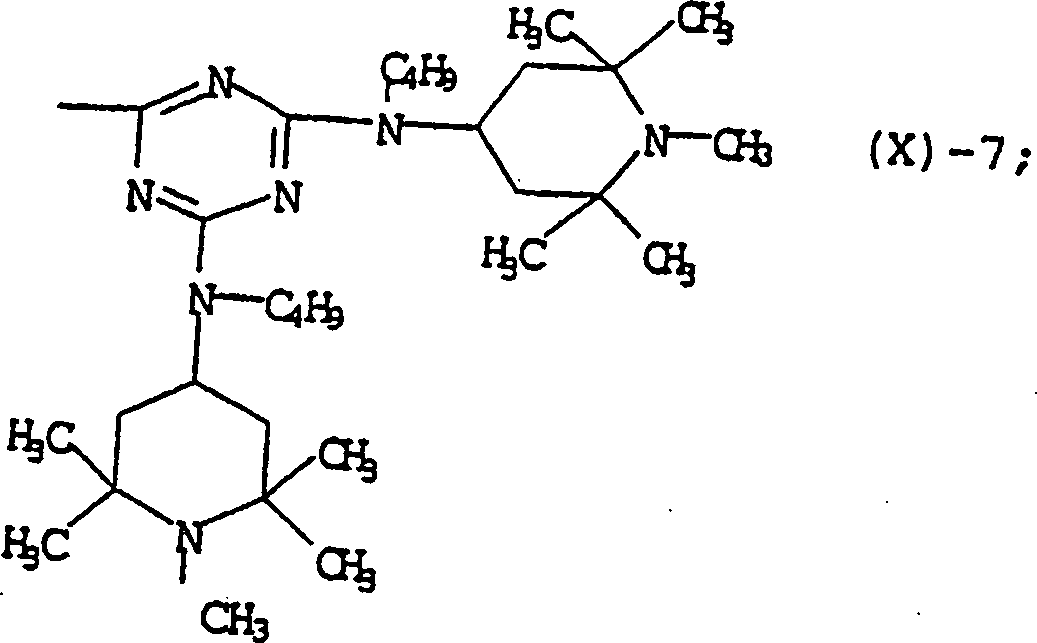


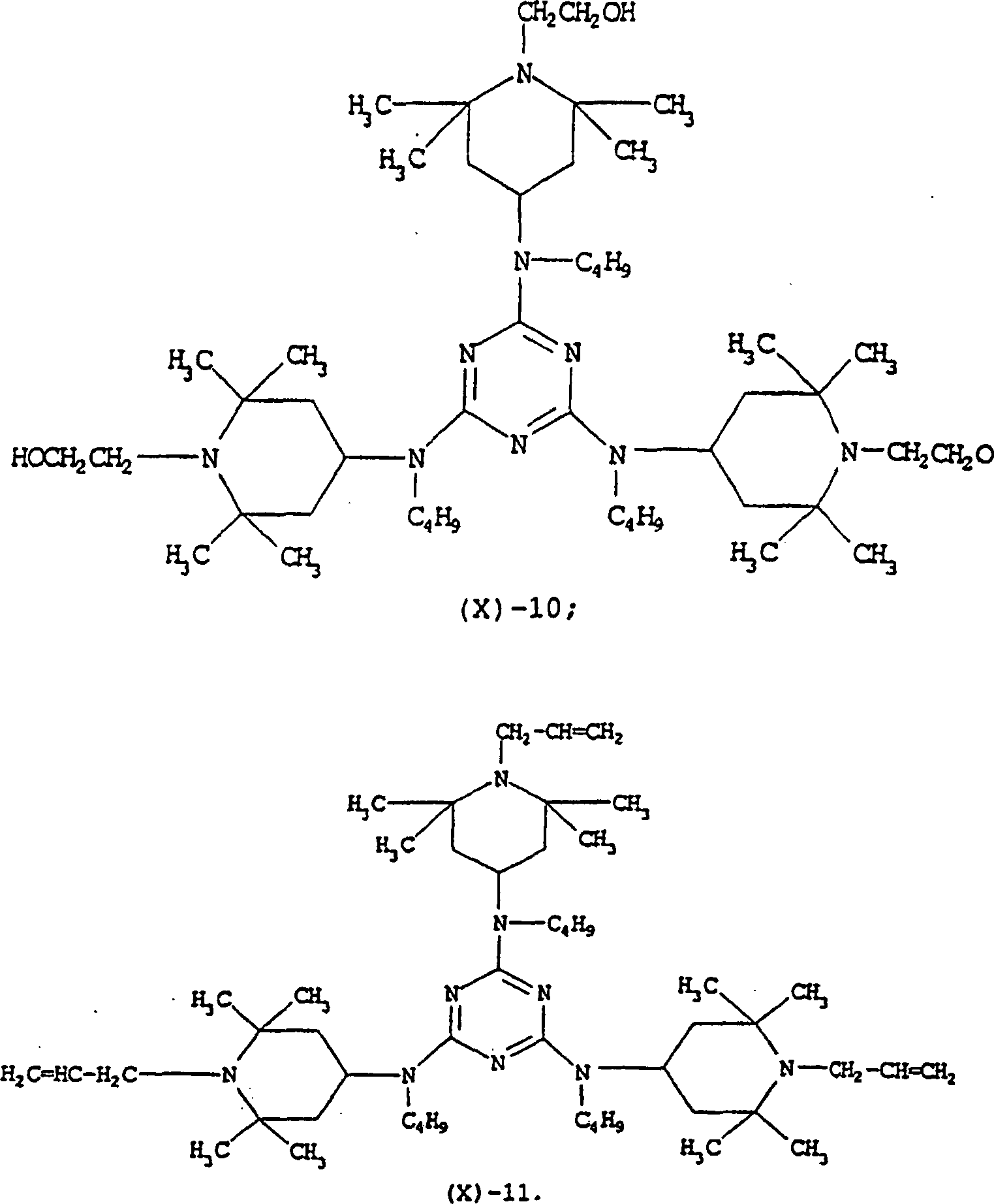
(f) Oligomere oder polymere Verbindungen, deren wiederkehrende Struktureinheit einen 2,2,6,6-Tetramethylpiperidin-Rest der allgemeinen Formel (V) enthält, insbesondere Polyester, Polyether, Polyamide, Polyamine, Polyurethane, Polyharnstoffe, Polyaminotriazine, Poly(meth)acrylate, Poly(meth)acrylamide und deren Copolymere, die diesen Rest enthalten.(F) Oligomeric or polymeric compounds whose recurring structural unit a 2,2,6,6-tetramethylpiperidine radical of the general formula (V) contains especially polyesters, polyethers, polyamides, polyamines, polyurethanes, Polyureas, polyaminotriazines, poly (meth) acrylates, poly (meth) acrylamides and their copolymers containing this radical.
Spezifische
Beispiele für
die vorstehend genannten 2,2,6,6-Polyalkylpiperidine werden durch
die folgenden Formeln dargestellt, worin m für eine Zahl zwischen 2 und
200 Steht: 
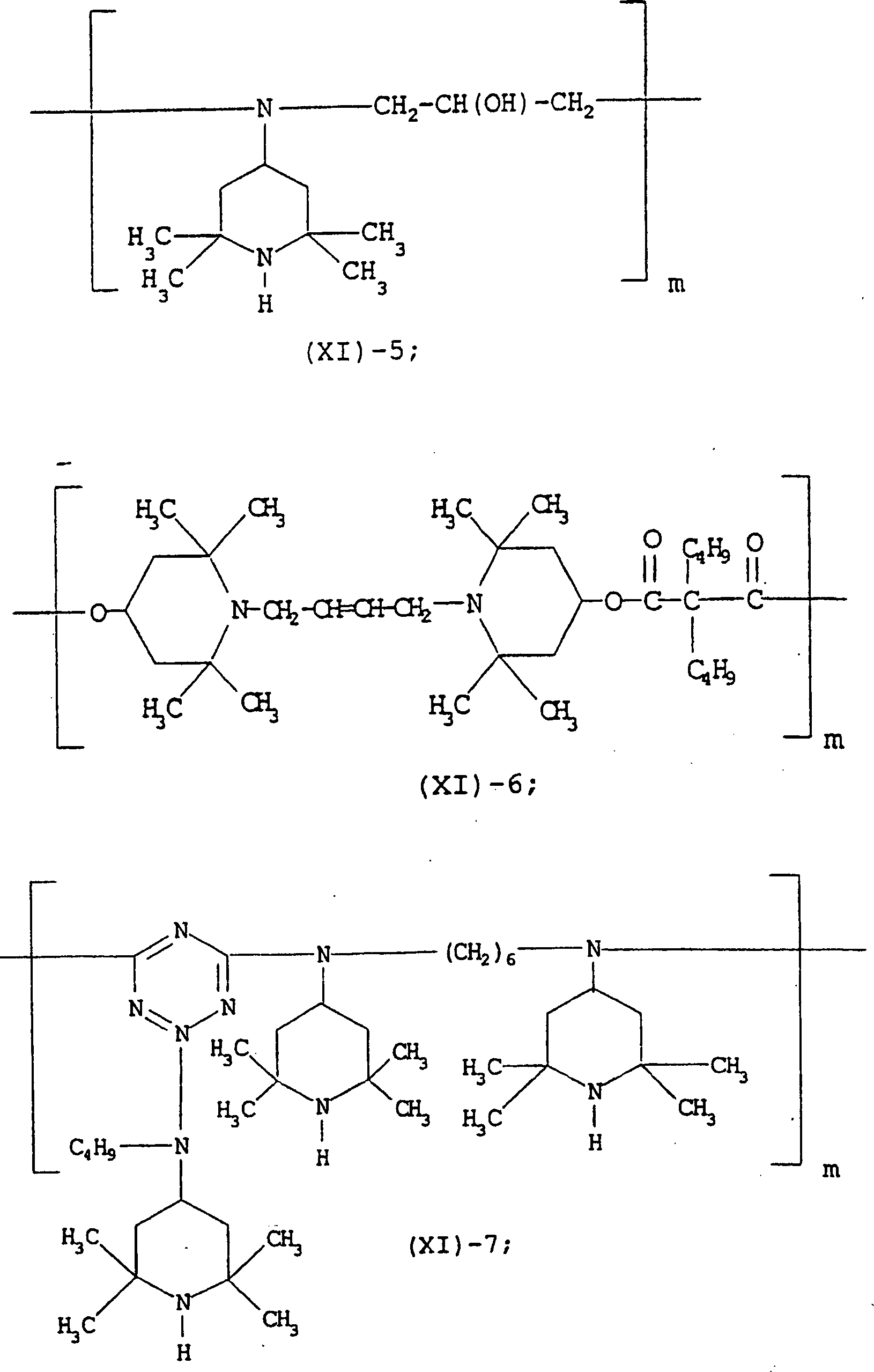

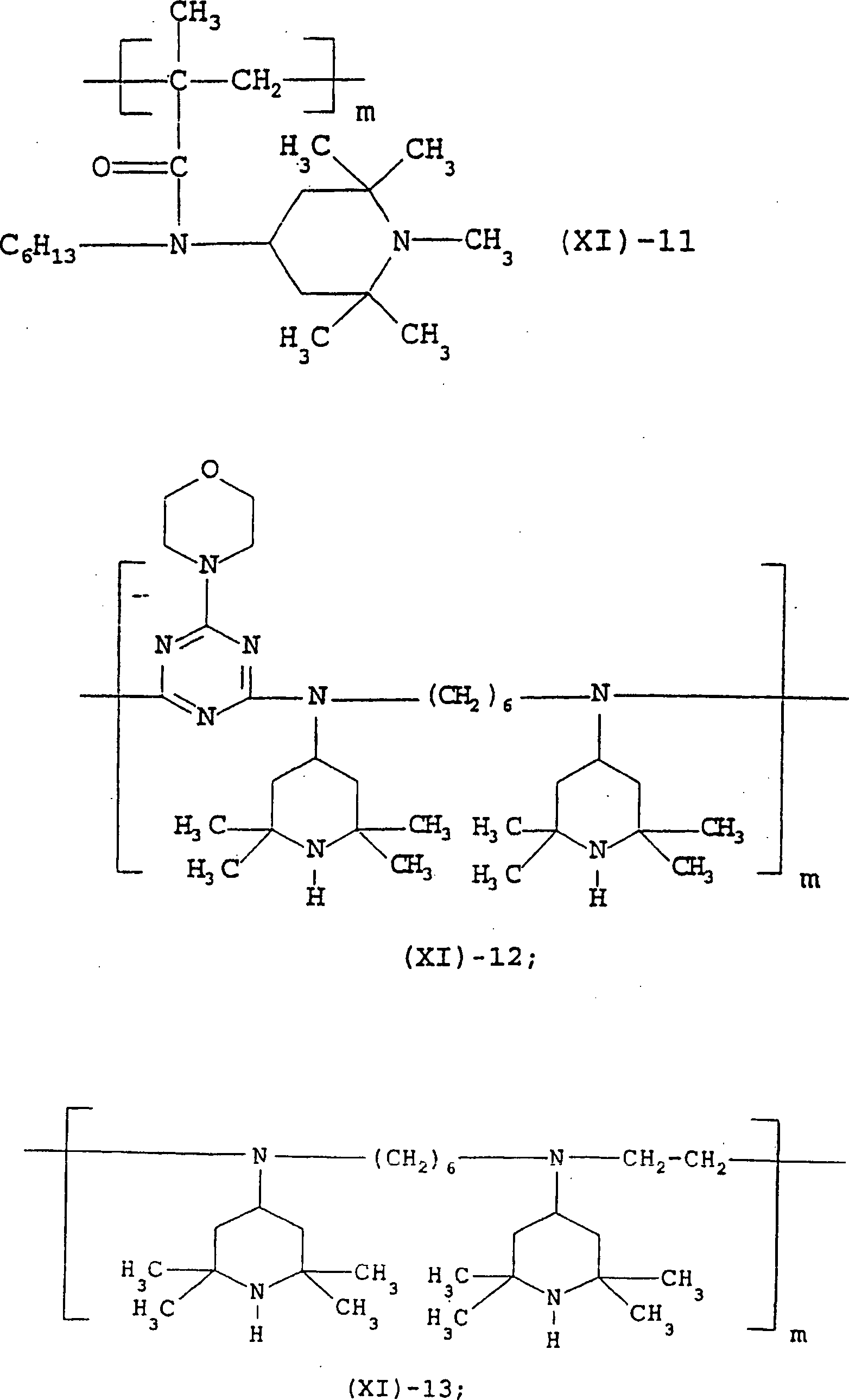
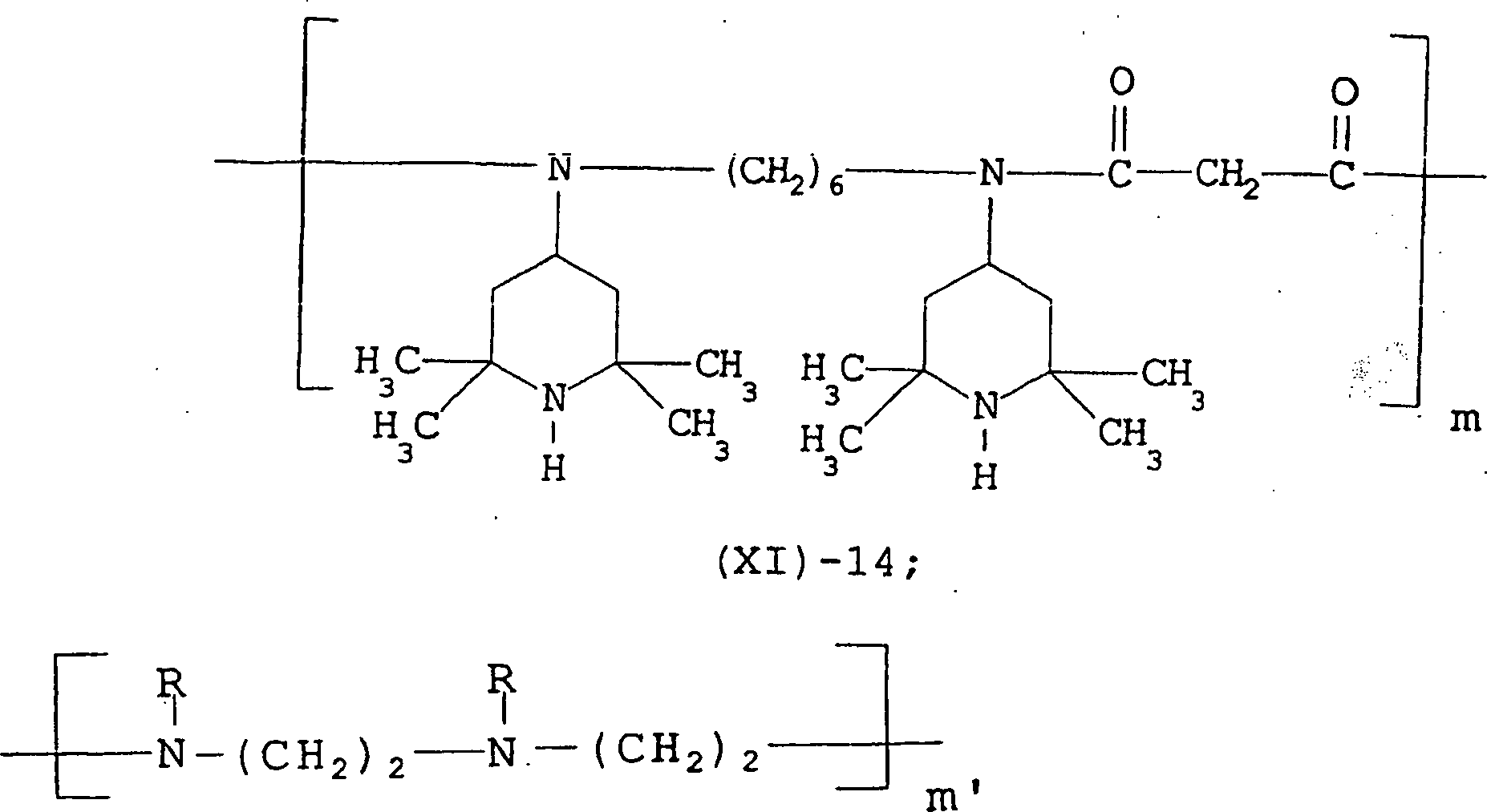
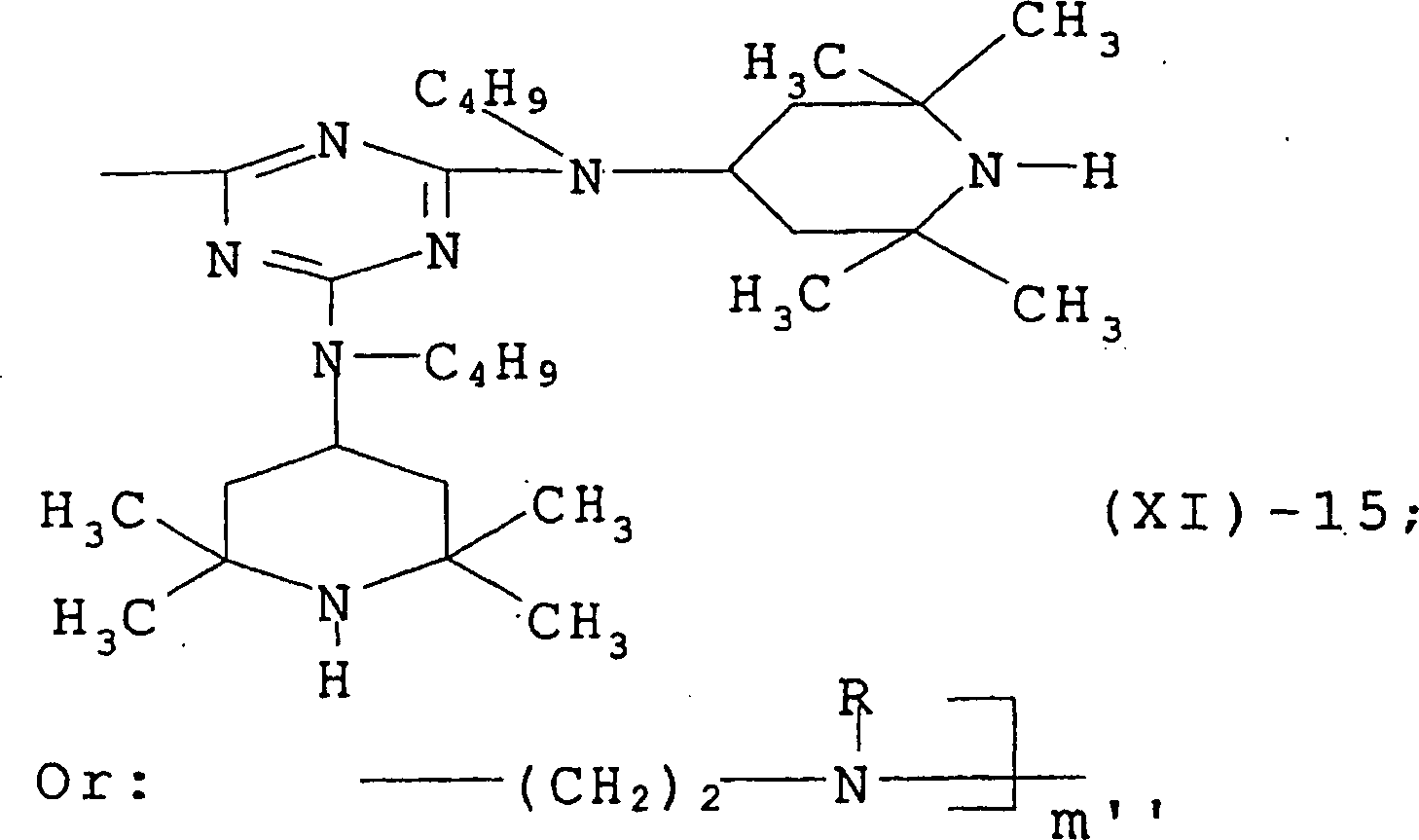
Weitere Beispiele von Lichtstabilisatoren, die für diese Anwendung eingesetzt werden können, umfassen:
- – die
Reaktionsprodukte zwischen Verbindungen der Formel (XII): und Epichlorhydrin;
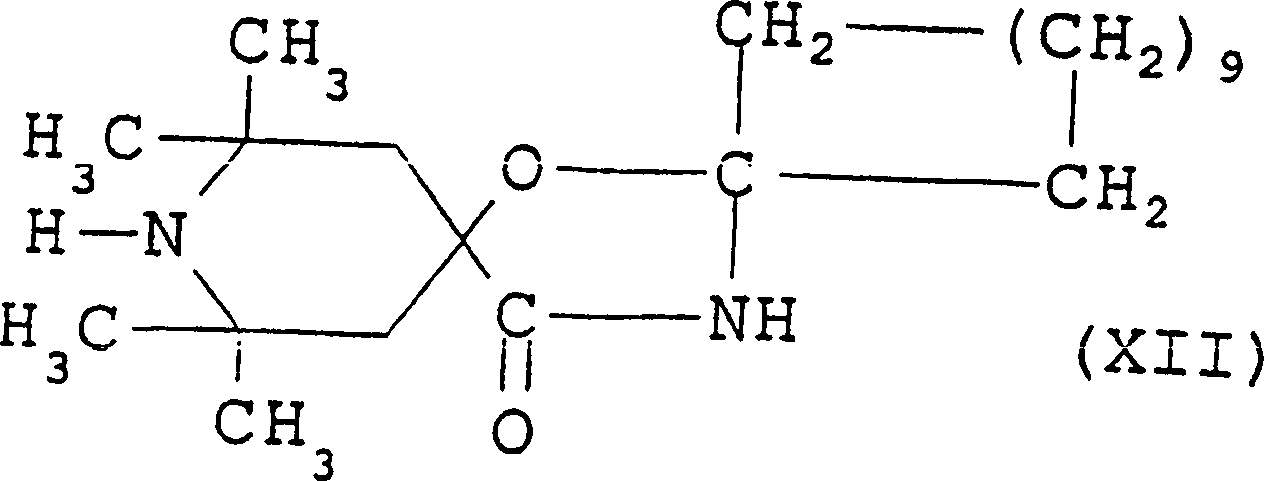
- – Polyester,
erhalten durch Reaktion von Butan-1,2,3,4-tetracarbonsäure mit
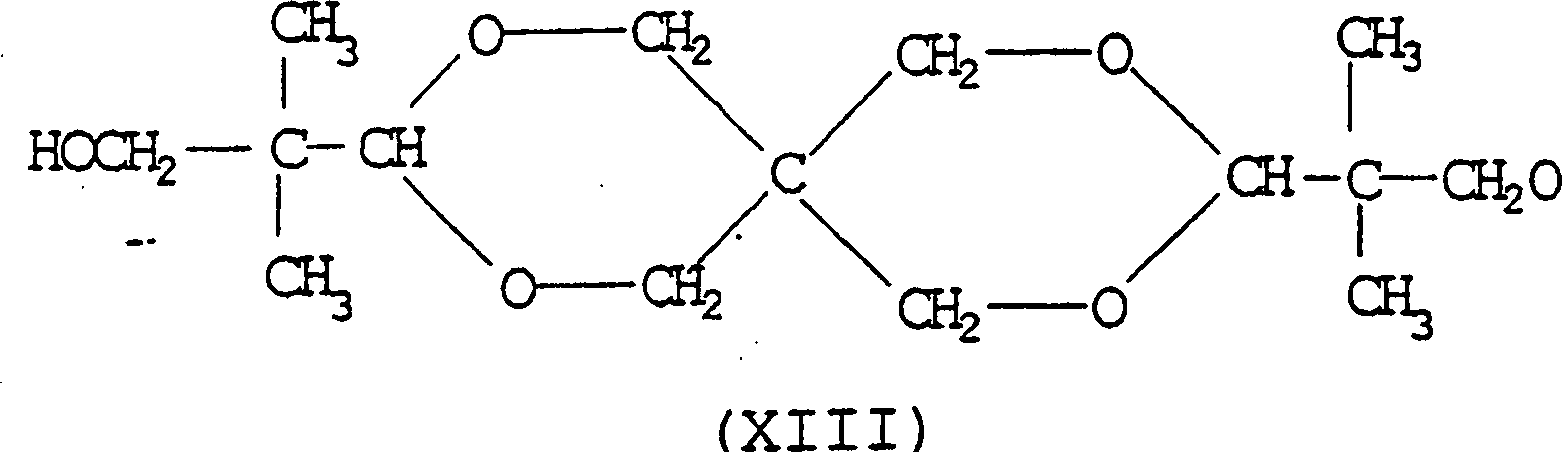
einem bifunktionellen Alkohol der Formel (XIII): deren Carbonsäureterminus, erzeugt durch die Tetracarbonsäure, mit einer 2,2,6,6-Tetramethyl-4-hydroxypiperidingruppe verestert worden ist;
- – Verbindungen
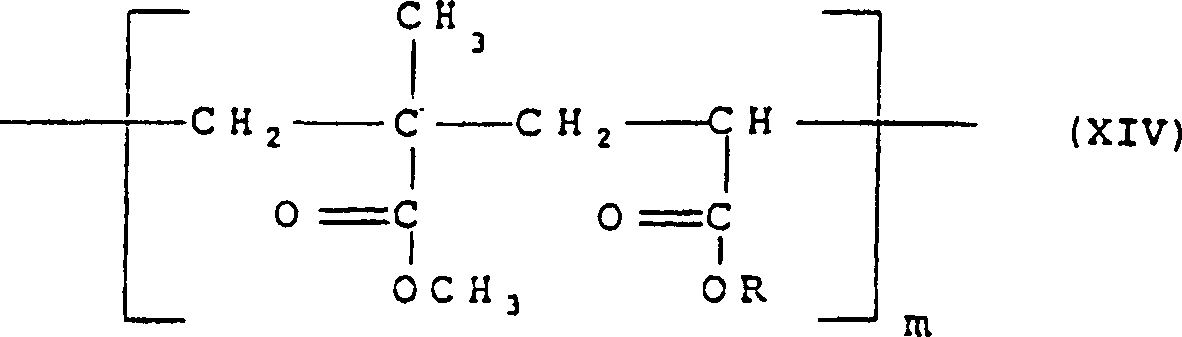
mit der allgemeinen Formel (XIV): worin etwa ein Drittel der R-Reste eine -C2H5-Gruppe darstellen und die übrigen für eine Gruppe mit der folgenden Formel stehen:
 und m für eine Zahl zwischen 2 und 200 steht, einschließlich der Grenzen;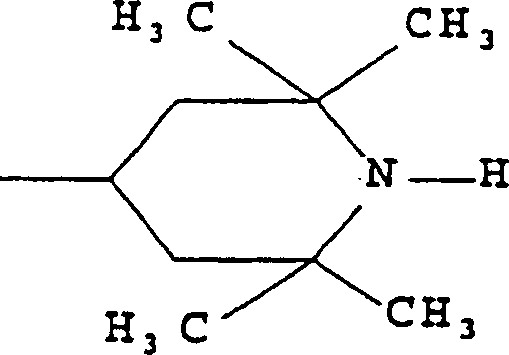
- – Copolymere,
deren Wiederholungseinheit aus zwei Einheiten der Formel: einer Einheit der Formel:
 und einer Einheit der Formel:
 besteht.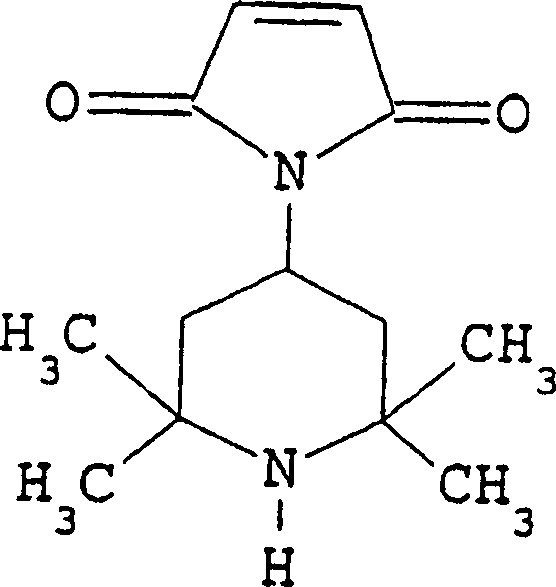
- The reaction products between compounds of the formula (XII): and epichlorohydrin;
- - Polyester, obtained by reaction of butane-1,2,3,4-tetracarboxylic acid with a bifunctional alcohol of the formula (XIII): whose carboxylic acid terminus, generated by the tetracarboxylic acid, has been esterified with a 2,2,6,6-tetramethyl-4-hydroxypiperidine group;
- Compounds of general formula (XIV): wherein about one third of the R radicals represent a -C 2 H 5 group and the remainder are a group having the formula:and m is a number between 2 and 200, including the boundaries;
- Copolymers whose repeat unit consists of two units of the formula: a unit of the formula:and a unit of the formula:consists.
(g)
Verbindungen der allgemeinen Formel (XVIII): 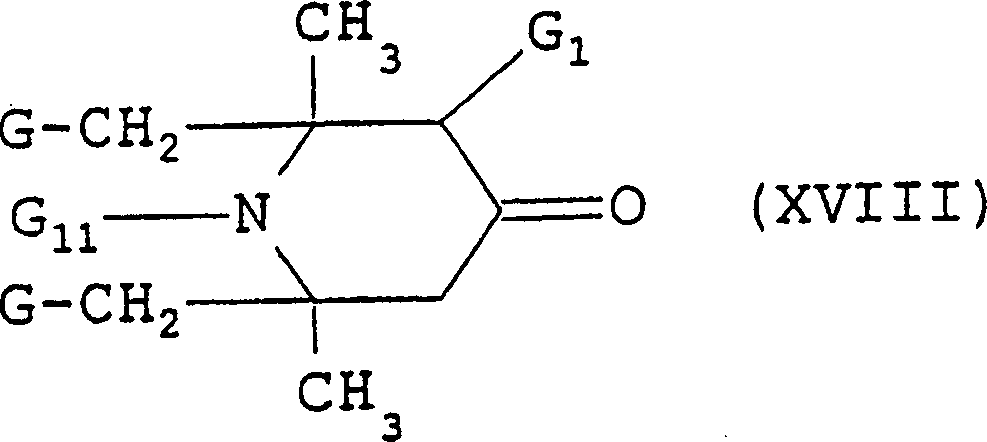
Spezifische Beispiele für Verbindungen der allgemeinen Formel (XVIII) sind:
- – 2,2,6,6-Tetramethyl-4-piperidon(triacetonamin);
- – 1,2,2,6,6-Pentamethyl-4-piperidon;
- – 2,3,6-Trimethyl-2,6-diethyl-4-piperidon.
- 2,2,6,6-tetramethyl-4-piperidone (triacetoneamine);
- 1,2,2,6,6-pentamethyl-4-piperidone;
- 2,3,6-trimethyl-2,6-diethyl-4-piperidone.
(h)
Verbindungen mit der allgemeinen Formel (XIX): 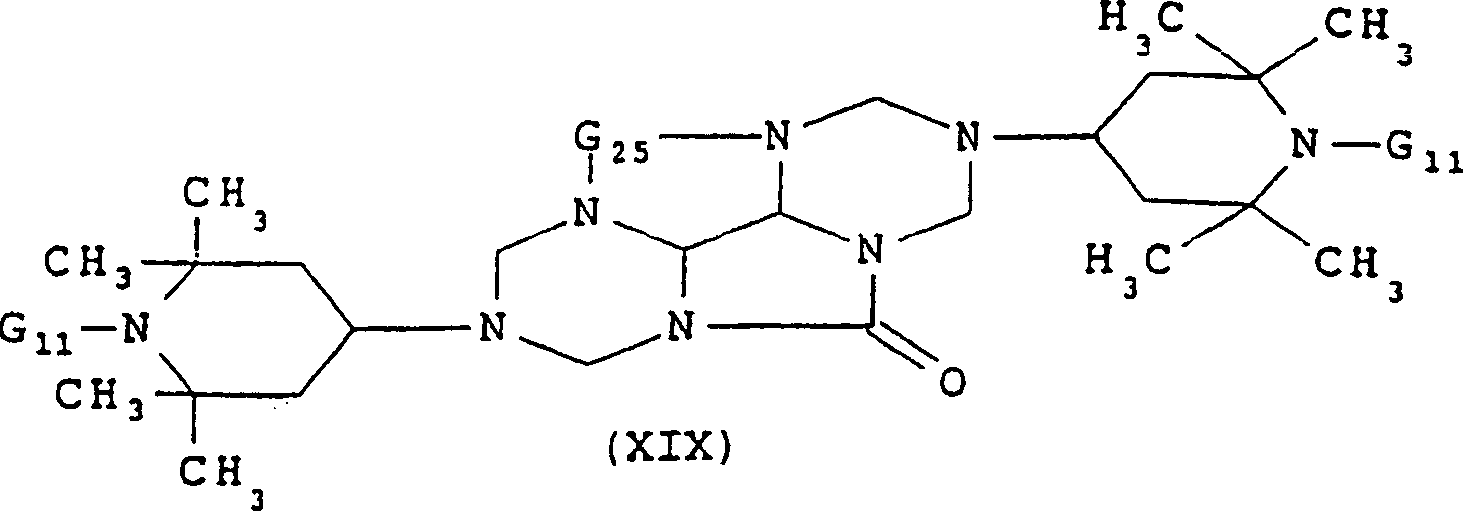
(i)
Verbindungen mit der allgemeinen Formel (XX): 
Spezifische Beispiele für Verbindungen der allgemeinen Formel (XX) sind:
- (1) Polymethylpropyl-3-oxy-[4-(2,2,6,6-tetramethyl)-piperidinyl]siloxan, bekannt unter dem Markennamen UVASIL 299 von Great Lakes;
- (2) Polymethylpropyl-3-oxy[4-(1,2,2,6,6-pentamethyl)-piperidinyl]siloxan.
- (1) polymethylpropyl-3-oxy- [4- (2,2,6,6-tetramethyl) -piperidinyl] siloxane, known under the trade name UVASIL 299 from Great Lakes;
- (2) Polymethylpropyl-3-oxy [4- (1,2,2,6,6-pentamethyl) piperidinyl] siloxane.
Die granuläre Form gemäß der vorliegenden Erfindung kann wie vorstehend angegeben mit weiteren konventionellen Additiven oder deren Mischungen kombiniert werden. Diese Additive werden in einer Menge im Bereich von etwa 0,1 Gew.-% bis 5 Gew.-%, bezogen auf das Gewicht der Filme auf der Basis von Polyolefinen oder olefinischen Copolymeren, die stabilisiert werden sollen, vorzugsweise zwischen 0,5 Gew.-% und etwa 3 Gew.-% dazugegeben.The granular Shape according to the present Invention may be as indicated above with other conventional Additives or mixtures thereof are combined. These additives are present in an amount ranging from about 0.1% to 5% by weight, based on the weight of the films based on polyolefins or olefinic copolymers to be stabilized, preferably between 0.5% by weight and about 3% by weight.
Beispiele für weitere konventionelle Additive, die verwendet werden können, umfassen: Antioxidationsmittel (wie z. B. alkylierte Monophenole, Alkylthiomethylphenole, Hydrochinone und alkylierte Hydrochinone, Tocopherole, hydroxylierte Thiophenylether, Alkyliden-Bisphenole, Benzylverbindungen, die 0, N oder S enthalten, hydroxybenzylierte Malonate, aromatische Hydroxybenzylverbindungen, Triazinverbindungen, Benzylphosphonate, Acylaminophenole, Ester von β-(3,5-Di-t-butyl-4-hydroxyphenyl)propionsäure mit einwertigen oder mehrwertigen Alkoholen, Ester von β-(5-t-Butyl-4-hydroxyphenyl)propionsäure mit einwertigen oder mehrwertigen Alkoholen, Ester von β-(3,5-Dicylcohexyl-4-hydroxyphenyl)propionsäure mit einwertigen oder mehrwertigen Alkoholen, Ester von (3,5-Di-t-butyl-4-hydroxyphenyl)essigsäure mit einwertigen oder mehrwertigen Alkoholen, Amiden von β-(3,5-Di-t-butyl-4-hydroxyphenyl)propionsäure; weitere UV- und Licht-Stabilisatoren (wie z. B. Derivate von 2-(2'-Hydroxyphenyl)benzotriazolen, Ester von Benzoesäuren, Acrylate, Oxamide, 2-(2-Hydroxyphenyl)-1,3,5-triazin); "Metall-Deaktivierungsmittel"; Phosphite und Phosphonite; Mittel, die fähig sind, Peroxide zu zerstören; Basen-Costabilisatoren, keimbildende Mittel, Füllstoffe und Verstärkungsmaterialien; weitere Additive (wie z. B. Weichmacher, Emulgiermittel, Pigmente, optische Aufheller, flammhemmende Mittel, antistatische Mittel, Treibmittel, thiosynergetische Mittel); Benzofuranone und Indolinone.Examples for further Conventional additives that may be used include: antioxidants (such as alkylated monophenols, alkylthiomethylphenols, hydroquinones and alkylated hydroquinones, tocopherols, hydroxylated thiophenyl ethers, Alkylidene bisphenols, benzyl compounds containing 0, N or S, hydroxybenzylated malonates, hydroxybenzyl aromatic compounds, Triazine compounds, benzylphosphonates, acylaminophenols, esters of β- (3,5-di-t-butyl-4-hydroxyphenyl) propionic acid monohydric or polyhydric alcohols, esters of β- (5-t-butyl-4-hydroxyphenyl) propionic acid with monohydric or polyhydric alcohols, esters of β- (3,5-dicyclohexyl-4-hydroxyphenyl) propionic acid with monohydric or polyhydric alcohols, esters of (3,5-di-t-butyl-4-hydroxyphenyl) acetic acid with monohydric or polyhydric alcohols, amides of β- (3,5-di-t-butyl-4-hydroxyphenyl) propionic acid; Further UV and light stabilizers (such as, for example, derivatives of 2- (2'-hydroxyphenyl) benzotriazoles, Esters of benzoic acids, Acrylates, oxamides, 2- (2-hydroxyphenyl) -1,3,5-triazine); "Metal deactivators"; Phosphites and phosphonites; Means that capable are to destroy peroxides; Base co-stabilizers, nucleating agents, fillers and reinforcing materials; other additives (such as plasticizers, emulsifiers, pigments, optical brighteners, flame retardants, antistatic agents, Propellants, thiosynergic agents); Benzofuranones and indolinones.
Die vorliegende Erfindung betrifft ferner ein Verfahren zur Stabilisierung von Agrofilmen (agricultural films) auf der Basis von Polyolefinen oder olefinischen Copolymeren, die insbesondere für Gewächshäuser geeignet sind, umfassend den Einbau der granulären Form gemäß der vorliegenden Erfindung in die Polyolefine oder olefinischen Copolymere, die anschließend in die vorstehend beschriebenen Filme transformiert werden. Gewächshäuser, die mit den vorstehend beschriebenen Agrofilmen überzogen sind, stellen einen weiteren Gegenstand der vorliegenden Erfindung dar.The The present invention further relates to a method for stabilization agricultural films based on polyolefins or olefinic copolymers which are particularly suitable for greenhouses comprising the incorporation of the granular form according to the present invention Invention in the polyolefins or olefinic copolymers, which subsequently in the above-described films are transformed. Greenhouses, the coated with the above-described agrofoils, provide a Another object of the present invention.
Im folgenden werden einige anschauliche, aber nicht beschränkende Beispiele für ein besseres Verständnis der vorliegenden Erfindung und deren Ausführungsform bereitgestellt.in the The following are some illustrative but non-limiting examples for a better understanding of the present invention and its embodiment.
BEISPIEL 1EXAMPLE 1
50 g der Verbindung (b), die 2-Hydroxy-4-n-octoxybenzophenon entspricht, werden in einen 250 ml Kolben gegeben, der mit einem Magnetrührer versehen ist und extern mit einem Ölbad beheizt wird. Die Verbindung wird geschmolzen (bei 50°C) und anschließend auf etwa 100°C erhitzt; 100 g der Verbindung (a), die [2,2'-Thiobis(4-t-butyloctylphenolat)-n-butylamin-Nickel(II)] entspricht, werden anschließend schrittweise dazugegeben.50 g of compound (b) corresponding to 2-hydroxy-4-n-octoxybenzophenone are added to a 250 ml Flask provided with a magnetic stirrer and heated externally with an oil bath. The compound is melted (at 50 ° C) and then heated to about 100 ° C; 100 g of the compound (a) corresponding to [2,2'-thiobis (4-t-butyloctylphenolate) -n-butylamine-nickel (II)] are then gradually added thereto.
Die Verbindung (a) löst sich in der Verbindung (b) und beim Erhitzen auf 120°C wird eine flüssige Masse erhalten, die auf eine auf etwa 0°C abgekühlte Aluminiumplatte gegossen wird.The Compound (a) dissolves in the compound (b) and when heated to 120 ° C becomes a liquid Mass, which was poured onto an aluminum plate cooled to about 0 ° C becomes.
Nach etwa 1 Stunde wird das verfestige Produkt mittels Vermahlen granuliert, wobei Granulate der gewünschten Dimensionen erhalten werden.To about 1 hour, the solidified product is granulated by grinding, wherein granules of the desired Dimensions are obtained.
BEISPIEL 2EXAMPLE 2
50 g der Verbindung (b), die 2-Hydroxy-4-n-octoxybenzophenon entspricht, werden in einen 250 ml Kolben gegeben, der mit einem Magnetrührer versehen ist und extern mit einem Ölbad beheizt wird. Die Verbindung wird geschmolzen (bei 50°C) und anschließend auf etwa 70°C erhitzt; 100 g der Verbindung (a), die [2,2'-Thiobis(4-t-butyloctylphenolat)-n-butylamin-Nickel(II)] entspricht, werden anschließend schrittweise dazugegeben.50 g of the compound (b) corresponding to 2-hydroxy-4-n-octoxybenzophenone, are placed in a 250 ml flask equipped with a magnetic stirrer is and externally with an oil bath is heated. The compound is melted (at 50 ° C) and then on about 70 ° C heated; 100 g of compound (a), the [2,2'-thiobis (4-t-butyloctylphenolate) -n-butylamine-nickel (II)] corresponds, then become Gradually added.
Die Verbindung (a) löst sich in der Verbindung (b) und unter Beibehaltung einer Temperatur von 70°C wird eine flüssige Masse erhalten, die auf eine auf etwa 0°C gekühlte Aluminiumplatte getröpfelt wird. Nach 10 bis 15 Minuten verfestigen sich die Tropfen und Granulate der gewünschten Dimensionen werden erhalten.The Compound (a) dissolves in the compound (b) and while maintaining a temperature from 70 ° C a liquid Mass that is trickled onto an aluminum plate cooled to about 0 ° C. After 10 to 15 minutes, the drops and granules solidify the desired Dimensions are preserved.
Claims (9)
Applications Claiming Priority (3)
| Application Number | Priority Date | Filing Date | Title |
|---|---|---|---|
| IT98MI000752A IT1299050B1 (en) | 1998-04-09 | 1998-04-09 | GRANULAR FORM OF A MIXTURE OF A NICKEL-QUENCHER AND A BENZOPHENONE AND PROCEDURE FOR ITS PREPARATION |
| ITMI980752 | 1998-04-09 | ||
| PCT/EP1999/002366 WO1999052977A1 (en) | 1998-04-09 | 1999-03-31 | Granular form of a mixture of a nickel-quencher and a benzophenone and process for its preparation |
Publications (2)
| Publication Number | Publication Date |
|---|---|
| DE69918111D1 DE69918111D1 (en) | 2004-07-22 |
| DE69918111T2 true DE69918111T2 (en) | 2005-07-07 |
Family
ID=11379709
Family Applications (1)
| Application Number | Title | Priority Date | Filing Date |
|---|---|---|---|
| DE69918111T Expired - Lifetime DE69918111T2 (en) | 1998-04-09 | 1999-03-31 | MIXTURES OF NICKEL-CLEANER WITH BENZOPHENONE AND METHOD FOR THE PRODUCTION THEREOF |
Country Status (9)
| Country | Link |
|---|---|
| US (1) | US6403679B1 (en) |
| EP (1) | EP1084183B1 (en) |
| AR (1) | AR019038A1 (en) |
| AU (1) | AU3706699A (en) |
| DE (1) | DE69918111T2 (en) |
| IL (1) | IL135721A (en) |
| IT (1) | IT1299050B1 (en) |
| TN (1) | TNSN99057A1 (en) |
| WO (1) | WO1999052977A1 (en) |
Families Citing this family (1)
| Publication number | Priority date | Publication date | Assignee | Title |
|---|---|---|---|---|
| IT1300058B1 (en) * | 1998-04-23 | 2000-04-05 | Great Lakes Chemical Italia | CRYSTALLINE MODIFICATION OF MIXTURES OF A NICKEL-QUENCHER AND A BENZOPHENONE AND PROCEDURE FOR ITS PREPARATION |
Family Cites Families (3)
| Publication number | Priority date | Publication date | Assignee | Title |
|---|---|---|---|---|
| US4623480A (en) * | 1984-01-05 | 1986-11-18 | Ciba-Geigy Corporation | Synergistic mixtures of nickel-containing 2,2'-thiobis(alkylphenols) and pyrazolates |
| EP0214507B1 (en) * | 1985-09-10 | 1992-01-15 | American Cyanamid Company | Outdoor films stabilized against chemical attack |
| IT1258271B (en) * | 1992-04-06 | 1996-02-22 | Enichem Sintesi | PROCESS FOR OBTAINING GRANULAR FORMS OF ADDITIVES FOR ORGANIC POLYMERS. |
-
1998
- 1998-04-09 IT IT98MI000752A patent/IT1299050B1/en active IP Right Grant
-
1999
- 1999-03-31 US US09/622,045 patent/US6403679B1/en not_active Expired - Fee Related
- 1999-03-31 WO PCT/EP1999/002366 patent/WO1999052977A1/en not_active Ceased
- 1999-03-31 DE DE69918111T patent/DE69918111T2/en not_active Expired - Lifetime
- 1999-03-31 AU AU37066/99A patent/AU3706699A/en not_active Abandoned
- 1999-03-31 EP EP99919210A patent/EP1084183B1/en not_active Expired - Lifetime
- 1999-03-31 IL IL13572199A patent/IL135721A/en not_active IP Right Cessation
- 1999-04-08 TN TNTNSN99057A patent/TNSN99057A1/en unknown
- 1999-04-09 AR ARP990101621A patent/AR019038A1/en unknown
Also Published As
| Publication number | Publication date |
|---|---|
| IL135721A0 (en) | 2001-05-20 |
| AR019038A1 (en) | 2001-12-26 |
| TNSN99057A1 (en) | 2001-12-31 |
| IT1299050B1 (en) | 2000-02-07 |
| WO1999052977A1 (en) | 1999-10-21 |
| AU3706699A (en) | 1999-11-01 |
| EP1084183A1 (en) | 2001-03-21 |
| DE69918111D1 (en) | 2004-07-22 |
| US6403679B1 (en) | 2002-06-11 |
| IL135721A (en) | 2004-07-25 |
| EP1084183B1 (en) | 2004-06-16 |
| ITMI980752A1 (en) | 1999-10-11 |
Similar Documents
| Publication | Publication Date | Title |
|---|---|---|
| DE69532484T2 (en) | Polyolefin or olefin copolymer films with improved light stability and pesticide resistance | |
| EP0905180B1 (en) | Dust free stabiliser granules containing epoxide and process of their preparation | |
| EP0351360B1 (en) | Process for preparing thermally stabilized polyolefins | |
| EP0755948A2 (en) | Process for the manufacture of stabilised olefin polymers | |
| EP0290391A2 (en) | Polyolefines stabilized against light degradation | |
| JP4950371B2 (en) | Stabilizer mixture | |
| EP0710677A2 (en) | Process for producing stabilized olefin polymers | |
| EP0592363B1 (en) | Storage stability improvement of organic phosphites and phosphonites | |
| JP3755110B2 (en) | Improved storage stability of organic phosphites and phosphonites | |
| EP1084183B1 (en) | Granular form of a mixture of a nickel-quencher and a benzophenone and process for its preparation | |
| EP1084175B1 (en) | Crystalline modification of mixtures of a nickel-quencher and a benzophenone and process for its preparation | |
| DE3888158T2 (en) | Process for the preparation of pre-expanded particles of a polyolefin. | |
| KR100449438B1 (en) | Stabilization method of stabilized polyolefin composition and polyolefin molding | |
| HK1005693B (en) | Use of sterically hindered amines in combination with a metal oxide or hydroxide to improve the light stabilitiy and pesticide resistance of polyolefin or olefin copolymer films | |
| CH688878GA3 (en) | Commercial forms of sterically hindered amine and their use. | |
| DE3503136A1 (en) | Process for increasing the whiteness in optically brightened polyolefins and polystyrene | |
| EP0517128B1 (en) | Use of a carboxylic acid anhydride to manufacture a polyolefin moulding composition |
Legal Events
| Date | Code | Title | Description |
|---|---|---|---|
| 8364 | No opposition during term of opposition |