DE69918108T2 - intraocular lens - Google Patents
intraocular lens Download PDFInfo
- Publication number
- DE69918108T2 DE69918108T2 DE69918108T DE69918108T DE69918108T2 DE 69918108 T2 DE69918108 T2 DE 69918108T2 DE 69918108 T DE69918108 T DE 69918108T DE 69918108 T DE69918108 T DE 69918108T DE 69918108 T2 DE69918108 T2 DE 69918108T2
- Authority
- DE
- Germany
- Prior art keywords
- copolymer
- intraocular lens
- monomer
- weight
- methacrylate
- Prior art date
- Legal status (The legal status is an assumption and is not a legal conclusion. Google has not performed a legal analysis and makes no representation as to the accuracy of the status listed.)
- Expired - Lifetime
Links
- 229920001577 copolymer Polymers 0.000 claims abstract description 96
- 239000000178 monomer Substances 0.000 claims abstract description 80
- -1 alkoxyalkyl methacrylate Chemical compound 0.000 claims abstract description 33
- 239000000017 hydrogel Substances 0.000 claims abstract description 15
- XLYOFNOQVPJJNP-UHFFFAOYSA-N water Substances O XLYOFNOQVPJJNP-UHFFFAOYSA-N 0.000 claims abstract description 15
- 230000003287 optical effect Effects 0.000 claims description 43
- WOBHKFSMXKNTIM-UHFFFAOYSA-N Hydroxyethyl methacrylate Chemical compound CC(=C)C(=O)OCCO WOBHKFSMXKNTIM-UHFFFAOYSA-N 0.000 claims description 19
- SFPNZPQIIAJXGL-UHFFFAOYSA-N 2-ethoxyethyl 2-methylprop-2-enoate Chemical compound CCOCCOC(=O)C(C)=C SFPNZPQIIAJXGL-UHFFFAOYSA-N 0.000 claims description 10
- 125000004432 carbon atom Chemical group C* 0.000 claims description 10
- 125000000217 alkyl group Chemical group 0.000 claims description 8
- 239000004971 Cross linker Substances 0.000 claims description 7
- 238000004519 manufacturing process Methods 0.000 claims description 7
- 238000012545 processing Methods 0.000 claims description 7
- CERQOIWHTDAKMF-UHFFFAOYSA-M Methacrylate Chemical compound CC(=C)C([O-])=O CERQOIWHTDAKMF-UHFFFAOYSA-M 0.000 claims description 6
- 229920002818 (Hydroxyethyl)methacrylate Polymers 0.000 claims description 3
- DJKKWVGWYCKUFC-UHFFFAOYSA-N 2-butoxyethyl 2-methylprop-2-enoate Chemical compound CCCCOCCOC(=O)C(C)=C DJKKWVGWYCKUFC-UHFFFAOYSA-N 0.000 claims description 2
- YXYJVFYWCLAXHO-UHFFFAOYSA-N 2-methoxyethyl 2-methylprop-2-enoate Chemical compound COCCOC(=O)C(C)=C YXYJVFYWCLAXHO-UHFFFAOYSA-N 0.000 claims description 2
- NSIWGZFZGMIPEC-UHFFFAOYSA-N 2-propoxyethyl 2-methylprop-2-enoate Chemical compound CCCOCCOC(=O)C(C)=C NSIWGZFZGMIPEC-UHFFFAOYSA-N 0.000 claims description 2
- GNSFRPWPOGYVLO-UHFFFAOYSA-N 3-hydroxypropyl 2-methylprop-2-enoate Chemical compound CC(=C)C(=O)OCCCO GNSFRPWPOGYVLO-UHFFFAOYSA-N 0.000 claims description 2
- 229920001480 hydrophilic copolymer Polymers 0.000 claims 2
- 241000219739 Lens Species 0.000 description 37
- 239000000463 material Substances 0.000 description 24
- 229920000642 polymer Polymers 0.000 description 18
- DBCAQXHNJOFNGC-UHFFFAOYSA-N 4-bromo-1,1,1-trifluorobutane Chemical compound FC(F)(F)CCCBr DBCAQXHNJOFNGC-UHFFFAOYSA-N 0.000 description 12
- STVZJERGLQHEKB-UHFFFAOYSA-N ethylene glycol dimethacrylate Substances CC(=C)C(=O)OCCOC(=O)C(C)=C STVZJERGLQHEKB-UHFFFAOYSA-N 0.000 description 12
- 239000000203 mixture Substances 0.000 description 11
- 239000002131 composite material Substances 0.000 description 9
- 102100026735 Coagulation factor VIII Human genes 0.000 description 7
- 101000911390 Homo sapiens Coagulation factor VIII Proteins 0.000 description 7
- 238000000034 method Methods 0.000 description 7
- WYGWHHGCAGTUCH-UHFFFAOYSA-N 2-[(2-cyano-4-methylpentan-2-yl)diazenyl]-2,4-dimethylpentanenitrile Chemical compound CC(C)CC(C)(C#N)N=NC(C)(C#N)CC(C)C WYGWHHGCAGTUCH-UHFFFAOYSA-N 0.000 description 5
- 238000005520 cutting process Methods 0.000 description 5
- 238000013461 design Methods 0.000 description 5
- 125000001495 ethyl group Chemical group [H]C([H])([H])C([H])([H])* 0.000 description 5
- 238000003780 insertion Methods 0.000 description 5
- 230000037431 insertion Effects 0.000 description 5
- 238000006116 polymerization reaction Methods 0.000 description 5
- 229920001296 polysiloxane Polymers 0.000 description 5
- 238000002360 preparation method Methods 0.000 description 5
- 150000005690 diesters Chemical class 0.000 description 4
- 238000000227 grinding Methods 0.000 description 4
- 230000002209 hydrophobic effect Effects 0.000 description 4
- 239000003999 initiator Substances 0.000 description 4
- 238000003756 stirring Methods 0.000 description 4
- 230000008901 benefit Effects 0.000 description 3
- 150000001875 compounds Chemical class 0.000 description 3
- 230000036571 hydration Effects 0.000 description 3
- 238000006703 hydration reaction Methods 0.000 description 3
- 239000011159 matrix material Substances 0.000 description 3
- VVQNEPGJFQJSBK-UHFFFAOYSA-N Methyl methacrylate Chemical class COC(=O)C(C)=C VVQNEPGJFQJSBK-UHFFFAOYSA-N 0.000 description 2
- 238000009472 formulation Methods 0.000 description 2
- 229920001519 homopolymer Polymers 0.000 description 2
- 238000012986 modification Methods 0.000 description 2
- 230000004048 modification Effects 0.000 description 2
- 230000002093 peripheral effect Effects 0.000 description 2
- 230000008569 process Effects 0.000 description 2
- 239000007779 soft material Substances 0.000 description 2
- VHSHLMUCYSAUQU-UHFFFAOYSA-N 2-hydroxypropyl methacrylate Chemical compound CC(O)COC(=O)C(C)=C VHSHLMUCYSAUQU-UHFFFAOYSA-N 0.000 description 1
- NUXLDNTZFXDNBA-UHFFFAOYSA-N 6-bromo-2-methyl-4h-1,4-benzoxazin-3-one Chemical compound C1=C(Br)C=C2NC(=O)C(C)OC2=C1 NUXLDNTZFXDNBA-UHFFFAOYSA-N 0.000 description 1
- XFOFBPRPOAWWPA-UHFFFAOYSA-N 6-hydroxyhexyl 2-methylprop-2-enoate Chemical compound CC(=C)C(=O)OCCCCCCO XFOFBPRPOAWWPA-UHFFFAOYSA-N 0.000 description 1
- NIXOWILDQLNWCW-UHFFFAOYSA-M Acrylate Chemical compound [O-]C(=O)C=C NIXOWILDQLNWCW-UHFFFAOYSA-M 0.000 description 1
- 208000002177 Cataract Diseases 0.000 description 1
- 240000004322 Lens culinaris Species 0.000 description 1
- 241000882901 Moema Species 0.000 description 1
- 230000006750 UV protection Effects 0.000 description 1
- 239000006096 absorbing agent Substances 0.000 description 1
- 238000010521 absorption reaction Methods 0.000 description 1
- 150000001252 acrylic acid derivatives Chemical class 0.000 description 1
- NIXOWILDQLNWCW-UHFFFAOYSA-N acrylic acid group Chemical group C(C=C)(=O)O NIXOWILDQLNWCW-UHFFFAOYSA-N 0.000 description 1
- 230000006978 adaptation Effects 0.000 description 1
- 238000013459 approach Methods 0.000 description 1
- 125000003118 aryl group Chemical group 0.000 description 1
- 230000002301 combined effect Effects 0.000 description 1
- 238000007906 compression Methods 0.000 description 1
- 230000006835 compression Effects 0.000 description 1
- 238000004132 cross linking Methods 0.000 description 1
- 230000007423 decrease Effects 0.000 description 1
- 238000006073 displacement reaction Methods 0.000 description 1
- 238000001035 drying Methods 0.000 description 1
- 230000001771 impaired effect Effects 0.000 description 1
- 239000004615 ingredient Substances 0.000 description 1
- 230000000977 initiatory effect Effects 0.000 description 1
- 230000010354 integration Effects 0.000 description 1
- 125000001449 isopropyl group Chemical group [H]C([H])([H])C([H])(*)C([H])([H])[H] 0.000 description 1
- 239000007788 liquid Substances 0.000 description 1
- 238000005259 measurement Methods 0.000 description 1
- 125000002496 methyl group Chemical group [H]C([H])([H])* 0.000 description 1
- 238000003801 milling Methods 0.000 description 1
- QYZFTMMPKCOTAN-UHFFFAOYSA-N n-[2-(2-hydroxyethylamino)ethyl]-2-[[1-[2-(2-hydroxyethylamino)ethylamino]-2-methyl-1-oxopropan-2-yl]diazenyl]-2-methylpropanamide Chemical compound OCCNCCNC(=O)C(C)(C)N=NC(C)(C)C(=O)NCCNCCO QYZFTMMPKCOTAN-UHFFFAOYSA-N 0.000 description 1
- 125000004108 n-butyl group Chemical group [H]C([H])([H])C([H])([H])C([H])([H])C([H])([H])* 0.000 description 1
- 230000006855 networking Effects 0.000 description 1
- 230000004962 physiological condition Effects 0.000 description 1
- 239000004033 plastic Substances 0.000 description 1
- 229920002492 poly(sulfone) Polymers 0.000 description 1
- 239000004417 polycarbonate Substances 0.000 description 1
- 229920000515 polycarbonate Polymers 0.000 description 1
- 239000002861 polymer material Substances 0.000 description 1
- FVSKHRXBFJPNKK-UHFFFAOYSA-N propionitrile Chemical compound CCC#N FVSKHRXBFJPNKK-UHFFFAOYSA-N 0.000 description 1
- 125000001436 propyl group Chemical group [H]C([*])([H])C([H])([H])C([H])([H])[H] 0.000 description 1
- 210000001747 pupil Anatomy 0.000 description 1
- 230000009467 reduction Effects 0.000 description 1
- 238000004904 shortening Methods 0.000 description 1
- 239000002210 silicon-based material Substances 0.000 description 1
- 229920005573 silicon-containing polymer Polymers 0.000 description 1
- 230000006641 stabilisation Effects 0.000 description 1
- 238000011105 stabilization Methods 0.000 description 1
- 231100000331 toxic Toxicity 0.000 description 1
- 230000002588 toxic effect Effects 0.000 description 1
Classifications
-
- A—HUMAN NECESSITIES
- A61—MEDICAL OR VETERINARY SCIENCE; HYGIENE
- A61L—METHODS OR APPARATUS FOR STERILISING MATERIALS OR OBJECTS IN GENERAL; DISINFECTION, STERILISATION OR DEODORISATION OF AIR; CHEMICAL ASPECTS OF BANDAGES, DRESSINGS, ABSORBENT PADS OR SURGICAL ARTICLES; MATERIALS FOR BANDAGES, DRESSINGS, ABSORBENT PADS OR SURGICAL ARTICLES
- A61L27/00—Materials for grafts or prostheses or for coating grafts or prostheses
- A61L27/14—Macromolecular materials
- A61L27/16—Macromolecular materials obtained by reactions only involving carbon-to-carbon unsaturated bonds
-
- A—HUMAN NECESSITIES
- A61—MEDICAL OR VETERINARY SCIENCE; HYGIENE
- A61F—FILTERS IMPLANTABLE INTO BLOOD VESSELS; PROSTHESES; DEVICES PROVIDING PATENCY TO, OR PREVENTING COLLAPSING OF, TUBULAR STRUCTURES OF THE BODY, e.g. STENTS; ORTHOPAEDIC, NURSING OR CONTRACEPTIVE DEVICES; FOMENTATION; TREATMENT OR PROTECTION OF EYES OR EARS; BANDAGES, DRESSINGS OR ABSORBENT PADS; FIRST-AID KITS
- A61F2/00—Filters implantable into blood vessels; Prostheses, i.e. artificial substitutes or replacements for parts of the body; Appliances for connecting them with the body; Devices providing patency to, or preventing collapsing of, tubular structures of the body, e.g. stents
- A61F2/02—Prostheses implantable into the body
- A61F2/14—Eye parts, e.g. lenses or corneal implants; Artificial eyes
- A61F2/16—Intraocular lenses
-
- A—HUMAN NECESSITIES
- A61—MEDICAL OR VETERINARY SCIENCE; HYGIENE
- A61F—FILTERS IMPLANTABLE INTO BLOOD VESSELS; PROSTHESES; DEVICES PROVIDING PATENCY TO, OR PREVENTING COLLAPSING OF, TUBULAR STRUCTURES OF THE BODY, e.g. STENTS; ORTHOPAEDIC, NURSING OR CONTRACEPTIVE DEVICES; FOMENTATION; TREATMENT OR PROTECTION OF EYES OR EARS; BANDAGES, DRESSINGS OR ABSORBENT PADS; FIRST-AID KITS
- A61F2/00—Filters implantable into blood vessels; Prostheses, i.e. artificial substitutes or replacements for parts of the body; Appliances for connecting them with the body; Devices providing patency to, or preventing collapsing of, tubular structures of the body, e.g. stents
- A61F2/02—Prostheses implantable into the body
- A61F2/14—Eye parts, e.g. lenses or corneal implants; Artificial eyes
- A61F2/16—Intraocular lenses
- A61F2/1613—Intraocular lenses having special lens configurations, e.g. multipart lenses; having particular optical properties, e.g. pseudo-accommodative lenses, lenses having aberration corrections, diffractive lenses, lenses for variably absorbing electromagnetic radiation, lenses having variable focus
- A61F2/1616—Pseudo-accommodative, e.g. multifocal or enabling monovision
-
- C—CHEMISTRY; METALLURGY
- C08—ORGANIC MACROMOLECULAR COMPOUNDS; THEIR PREPARATION OR CHEMICAL WORKING-UP; COMPOSITIONS BASED THEREON
- C08L—COMPOSITIONS OF MACROMOLECULAR COMPOUNDS
- C08L33/00—Compositions of homopolymers or copolymers of compounds having one or more unsaturated aliphatic radicals, each having only one carbon-to-carbon double bond, and only one being terminated by only one carboxyl radical, or of salts, anhydrides, esters, amides, imides or nitriles thereof; Compositions of derivatives of such polymers
- C08L33/04—Homopolymers or copolymers of esters
- C08L33/06—Homopolymers or copolymers of esters of esters containing only carbon, hydrogen and oxygen, which oxygen atoms are present only as part of the carboxyl radical
- C08L33/10—Homopolymers or copolymers of methacrylic acid esters
- C08L33/12—Homopolymers or copolymers of methyl methacrylate
-
- G—PHYSICS
- G02—OPTICS
- G02B—OPTICAL ELEMENTS, SYSTEMS OR APPARATUS
- G02B1/00—Optical elements characterised by the material of which they are made; Optical coatings for optical elements
- G02B1/04—Optical elements characterised by the material of which they are made; Optical coatings for optical elements made of organic materials, e.g. plastics
- G02B1/041—Lenses
- G02B1/043—Contact lenses
-
- A—HUMAN NECESSITIES
- A61—MEDICAL OR VETERINARY SCIENCE; HYGIENE
- A61L—METHODS OR APPARATUS FOR STERILISING MATERIALS OR OBJECTS IN GENERAL; DISINFECTION, STERILISATION OR DEODORISATION OF AIR; CHEMICAL ASPECTS OF BANDAGES, DRESSINGS, ABSORBENT PADS OR SURGICAL ARTICLES; MATERIALS FOR BANDAGES, DRESSINGS, ABSORBENT PADS OR SURGICAL ARTICLES
- A61L2430/00—Materials or treatment for tissue regeneration
- A61L2430/16—Materials or treatment for tissue regeneration for reconstruction of eye parts, e.g. intraocular lens, cornea
-
- Y—GENERAL TAGGING OF NEW TECHNOLOGICAL DEVELOPMENTS; GENERAL TAGGING OF CROSS-SECTIONAL TECHNOLOGIES SPANNING OVER SEVERAL SECTIONS OF THE IPC; TECHNICAL SUBJECTS COVERED BY FORMER USPC CROSS-REFERENCE ART COLLECTIONS [XRACs] AND DIGESTS
- Y10—TECHNICAL SUBJECTS COVERED BY FORMER USPC
- Y10S—TECHNICAL SUBJECTS COVERED BY FORMER USPC CROSS-REFERENCE ART COLLECTIONS [XRACs] AND DIGESTS
- Y10S623/00—Prosthesis, i.e. artificial body members, parts thereof, or aids and accessories therefor
- Y10S623/901—Method of manufacturing prosthetic device
-
- Y—GENERAL TAGGING OF NEW TECHNOLOGICAL DEVELOPMENTS; GENERAL TAGGING OF CROSS-SECTIONAL TECHNOLOGIES SPANNING OVER SEVERAL SECTIONS OF THE IPC; TECHNICAL SUBJECTS COVERED BY FORMER USPC CROSS-REFERENCE ART COLLECTIONS [XRACs] AND DIGESTS
- Y10—TECHNICAL SUBJECTS COVERED BY FORMER USPC
- Y10S—TECHNICAL SUBJECTS COVERED BY FORMER USPC CROSS-REFERENCE ART COLLECTIONS [XRACs] AND DIGESTS
- Y10S623/00—Prosthesis, i.e. artificial body members, parts thereof, or aids and accessories therefor
- Y10S623/924—Material characteristic
- Y10S623/926—Synthetic
Landscapes
- Health & Medical Sciences (AREA)
- Chemical & Material Sciences (AREA)
- Ophthalmology & Optometry (AREA)
- Life Sciences & Earth Sciences (AREA)
- Veterinary Medicine (AREA)
- Oral & Maxillofacial Surgery (AREA)
- Transplantation (AREA)
- Public Health (AREA)
- General Health & Medical Sciences (AREA)
- Animal Behavior & Ethology (AREA)
- Physics & Mathematics (AREA)
- Biomedical Technology (AREA)
- Chemical Kinetics & Catalysis (AREA)
- Heart & Thoracic Surgery (AREA)
- Medicinal Chemistry (AREA)
- Engineering & Computer Science (AREA)
- Cardiology (AREA)
- Vascular Medicine (AREA)
- General Physics & Mathematics (AREA)
- Optics & Photonics (AREA)
- Dermatology (AREA)
- Epidemiology (AREA)
- Polymers & Plastics (AREA)
- Organic Chemistry (AREA)
- Prostheses (AREA)
- Materials For Medical Uses (AREA)
Abstract
Description
Hintergrund der ErfindungBackground of the invention
1. Gebiet der Erfindung1. Field of the invention
Die vorliegende Erfindung bezieht sich auf intraokulare Linsen. Die Erfindung bezieht sich ebenfalls auf Verfahren zur Herstellung solcher Linsen und auf Copolymere zur Verwendung beispielsweise in intraokularen Linsen.The The present invention relates to intraocular lenses. The The invention also relates to methods of making such Lenses and copolymers for use, for example, in intraocular Lenses.
2. Stand der Technik2. Stand the technology
Es
sind verschiedene Arten von intraokularen Linsen (IOL) bekannt.
Beispielsweise sind einstückige IOL
und Verbund-IOL mit mehreren Teilen bekannt. Bei einstückigen IOL
bestehen die optischen und die nicht-optischen Teile aus einem Werkstoff.
Die nicht-optischen Teile werden als haptische Teile bezeichnet
und dienen zur Befestigung. Zwei allgemeine Ausführungen der Haptik sind der "Platten-Typ" und der "C-Haptik-Typ", beide in unterschiedlichen Formen.
Eine plattenförmige
Ausführung
ist in
Eine Verringerung der Länge des zur Einführung der IOL ins Auge erforderlichen Schnitts ist wünschbar. Die Verkürzung des Einschnitts bedingt die Verwendung eines sehr weichen Materials für die Linse, welches genügend weich ist, um die Linse zusammenfalten zu können, sie durch den Einschnitt einzuführen und loszulassen. Intraokulare Linsen sind also vorzugsweise faltbar, damit sie einfach ins Auge einführbar sind. Ansätze für die Herstellung faltbarer Materialien beinhalten die Verwendung von Linsen aus hydrophoben Silikonpolymeren, bestimmten hydrophilen 2-HEMA-Homopolymeren sowie Verbundmaterialien aus einem hydrophilen optischen Kern mit Haptik auf der Grundlage hydrophober Poly(methyl)methacrylaten.A Reduction in length of introduction the IOL required for the eye is desirable. The shortening of the Incision requires the use of a very soft material for the Lens enough is soft to be able to fold the lens, she through the incision introduce and let go. Intraocular lenses are therefore preferably foldable, make them easy to insert into the eye are. approaches for the Manufacture of foldable materials involves the use of Lenses of hydrophobic silicone polymers, certain hydrophilic 2-HEMA homopolymers and composite materials of a hydrophilic optical core with Haptics based on hydrophobic poly (methyl) methacrylates.
IOL mit mechanisch angebrachter Haptik sind Linsen, bei welchen der optische Teil und der haptische Teil getrennt hergestellt werden, gewöhnlich aus unterschiedlichen Materialien, und miteinander verbunden werden. Beispielsweise kann der Linsenteil aus einem Hydrogel oder einem Material auf Silikonbasis und die C-förmige Haptik aus einem starren Material wie p-MMA bestehen. Die Haptik aus p-MMA wird an Bohrungen im optischen Teil fixiert.IOL with mechanically attached haptics are lenses in which the optical part and the haptic part are made separately, usually made of different materials, and linked together. For example, the lens part of a hydrogel or a Silicone-based material and the C-shaped feel of a rigid Material like p-MMA exist. The haptics from p-MMA will be applied to holes in the fixed optical part.
Herkömmliche hydrophobe IOL sind zwar aus P-MMA; sie sind jedoch nicht gut faltbar und benötigen zur Einführung einen relativ grossen Einschnitt. Um hydrophobe Materialien faltbar zu machen, wurden gummiartige Materialien, beispielsweise Silikonderivate, in die starre Polymermatrix eingebracht, oder es wurden Materialien verwendet, welche vorwiegend aus Silikonderivaten bestehen. Obwohl die Weichheit eines vorwiegend aus Silikonderivaten bestehenden Materials für das Zusammenfalten vor der Einführung ideal ist, bereitet die richtige Positionierung der Linse im Auge durch den Chirurgen Schwierigkeiten bei der Entfaltung der Linse und der Haptik wegen der beinahe gelartigen Weichheit der Linse. Ausserdem gewährleisten Silikonlinsen oft keine genügende Steifigkeit der Linse nach der Einführung, und die kombinierte Wirkung der Deformation durch Kompressionskräfte und von Verschiebungen der Linse kann zur Verformung derselben führen und die optische Integrität der Linse beeinträchtigen.conventional hydrophobic IOLs are indeed from P-MMA; however, they are not foldable well and need to introduction a relatively large incision. Foldable around hydrophobic materials rubbery materials, such as silicone derivatives, introduced into the rigid polymer matrix, or it were materials used, which consist mainly of silicone derivatives. Even though the softness of a predominantly composed of silicone derivatives Materials for the folding before the introduction ideal, prepares the correct positioning of the lens in the eye by the surgeon difficulty in unfolding the lens and the feel because of the almost gel-like softness of the lens. Moreover guarantee Silicone lenses are often not enough Stiffness of the lens after insertion, and the combined Effect of deformation due to compression forces and displacements the lens may cause it to deform and the optical integrity of the lens affect.
Auf Grund seiner Eigenschaften wurde p-Hydroxyethylmethacrylat (ein Homopolymer aus HEMA) als faltbares Material für IOL verwendet. Der niedrige Brechungskoeffizient von p-HEMA im hydratisierten Zustand führt jedoch zu Einschränkungen bezüglich der Gestaltung des optischen Zentrums und zu einem Kompromiss zwischen Faltbarkeit und optischen Anforderungen.On Reason of its properties was p-hydroxyethyl methacrylate (a Homopolymer from HEMA) used as foldable material for IOL. The low one However, the refractive index of p-HEMA in the hydrated state results to restrictions in terms of the design of the optical center and a compromise between Foldability and optical requirements.
Eine der Einschränkungen von einstückigen Linsen aus P-HEMA besteht darin, dass der haptische Teil nicht die gewünschte Formstabilität aufweist und die Positionierung der Linse beeinträchtigen kann. Um dieses Problem zu lösen, wurden Polymere zu einer weichen, faltbaren Verbund-Intraokularlinse kombiniert, beispielsweise P-HEMA oder ein anderes weiches Acrylmaterial für die optische Zone und eine starre Struktur um die Aussenseite der Linse aus einem harten Kunststoff wie P-MMA. Die US-Patente Nr. 4 718 906 und 5 326 506 beschreiben solche Verbund-IOL. Diese Mehrkomponentenmaterialien werden durch Einbetten eines Materials in das andere oder durch gemeinsames Extrudieren hergestellt, durch Aushärten des harten Materials auf dem weichen Material oder durch Bildung eines Netzwerks aus der starren Komponente, welches einen vorgeformten hydrophilen Kern durchdringt.A the restrictions from one piece Lenses made of P-HEMA is that the haptic part is not the desired dimensional stability and affect the positioning of the lens can. To solve this problem, polymers have become a soft, foldable composite intraocular lens combined, for example P-HEMA or another soft acrylic material for the optical zone and a rigid structure around the outside of the lens made of a hard plastic like P-MMA. U.S. Patent Nos. 4,718 906 and 5,326,506 describe such composite IOLs. These multi-component materials be by embedding one material in the other or by coextruded by curing the hard material the soft material or by forming a network from the rigid component, which is a preformed hydrophilic core penetrates.
Das US-Patent 5 326 506 offenbart eine intraokulare Verbundlinse mit einer weichen, biegsamen inneren Linsenoptik mit starrer Haptik. Das Material der Linsenoptik ist ein Material mit niedrigem Wassergehalt, beispielsweise ein Copolymer aus 2-HEMA und Hydroxyhexylmethacrylat, welches auf Grund seines niedrigen Wassergehalts einen hohen Brechungskoeffizienten aufweist. Die harte, jedoch biegsame Haptik aus P-MMA besteht aus einem ineinandergreifenden Netzwerk.US Pat. No. 5,326,506 discloses an intraocular composite lens having a soft, flexible in neren lens optics with a rigid feel. The material of the lens optic is a low water content material, for example, a copolymer of 2-HEMA and hydroxyhexyl methacrylate, which has a high refractive index due to its low water content. The hard but flexible feel of P-MMA consists of an interlocking network.
Im Artikel J. Cataract Refract. Surf., Chirila et al., S. 154-162, Vol. 17, März 1991 werden die toxischen Wirkungen von Restmonomeren wie 2-Hydroxyethylmethacrylat, Methylmethacrylat und 2-Ethoxyethylmethacrylat in IOL besprochen. Einstückige IOL werden nicht vorgeschlagen.in the Article J. Cataract Refract. Surf., Chirila et al., Pp. 154-162, Vol. 17, March In 1991, the toxic effects of residual monomers such as 2-hydroxyethyl methacrylate, Methyl methacrylate and 2-ethoxyethyl methacrylate discussed in IOL. one-piece IOLs are not suggested.
Das US-Patent Nr. 4 764 196 offenbart eine Verbund-Intraokularlinse mit einer kleinen, harten inneren Linsenoptik und einem weichen, biegsamen Rand, der die Linsenoptik umgibt. Das Material der Linsenoptik ist ein relativ hartes Material, beispielsweise P-MMA, Polysulfon oder Polycarbonat. Der weiche, biegsame Rand ist ein Silikon- oder Hydrogelmaterial oder dergleichen.The U.S. Patent No. 4,764,196 discloses a compound intraocular lens having a small, hard inner lens optics and a soft, flexible edge that surrounds the lens optics. The material of the lens optics is a relative one hard material, for example P-MMA, polysulfone or polycarbonate. The soft, flexible edge is a silicone or hydrogel material or similar.
Übersicht der ErfindungOverview the invention
Ein Ziel vorliegender Erfindung besteht darin, eine einstückige IOL zu schaffen, welche die Nachteile der bekannten einstückigen IOL und Verbund-IOL behebt.One The aim of the present invention is to provide a one-piece IOL to create the disadvantages of the known one-piece IOL and composite IOL fixes.
Ein Ziel vorliegender Erfindung besteht darin, eine Intraokularlinse zu schaffen, welche faltbar ist, so dass sie durch einen kleinen Einschnitt im Auge einführbar ist.One The aim of the present invention is an intraocular lens to create, which is foldable, so that they are small Incision in the eye insertable is.
Ein weiteres Ziel vorliegender Erfindung ist die Schaffung einer einstückigen Intraokularlinse mit einem weichen, faltbaren optischen Teil und einem haptischen Teil, wobei der optische und der haptische Teil aus dem gleichen weichen Hydrogel-Material bestehen, welches das Gewebe des Auges beim Berührungspunkt schützt, ohne die Positionierungseigenschaften der Linse einzubüssen.One Another object of the present invention is to provide a one-piece intraocular lens with a soft, foldable optical part and a haptic Part, wherein the optical and the haptic part of the same soft hydrogel material which is the tissue of the eye protects at the touch point, without to lose the positioning properties of the lens.
Ein weiteres Ziel der Erfindung ist die Schaffung einer einstückigen Intraokularlinse mit einem weichen, faltbaren optischen Teil und einem haptischen Teil, der eine ausgezeichnete biologische Verträglichkeit mit dem Auge des Patienten bietet.One Another object of the invention is to provide a one-piece intraocular lens with a soft, foldable optical part and a haptic Part that has excellent biocompatibility with the eye of the Patient offers.
Ein weiteres Ziel der Erfindung ist die Schaffung eines Materials, welches sowohl für den optischen als auch für den haptischen Teil der IOL geeignet ist.One Another object of the invention is to provide a material which as well as the optical as well as for the haptic part of the IOL is suitable.
Diesen und weiteren Zielen entsprechend wird erfindungsgemäss eine einstückige Intraokularlinse aus einem Copolymer aus einem hydrophilen Monomer und einem Alkoxyalkyl-Methacrylat angegeben.this and further goals according to the invention is a one-piece Intraocular lens made of a copolymer of a hydrophilic monomer and an alkoxyalkyl methacrylate.
Diesen Zielen entsprechend wird ebenfalls eine einstückige Intraokularlinse angegeben, bei welcher sowohl der optische als auch der haptische Teil aus einem Copolymer aus einem Monomer der Formel HO-R1-MA und einem Monomer der Formel R2-O-R3-MA bestehen, worin R1, R2 und R3 unabhängig voneinander aus Alkylgruppen mit 1 bis 6 Kohlenstoffatomen ausgewählt sind und MA Methacrylat ist.In accordance with these objectives, there is also provided a one-piece intraocular lens in which both the optical and haptic portions consist of a copolymer of a monomer of the formula HO-R 1 -MA and a monomer of the formula R 2 -OR 3 -MA, wherein R 1 , R 2 and R 3 are independently selected from alkyl groups of 1 to 6 carbon atoms and MA is methacrylate.
Erfindungsgemäss wird ebenfalls eine Intraokularlinse mit einem haptischen Teil und einem optischen Teil angegeben, wobei der haptische Teil und der optische Teil aus dem selben Copolymer oder aus unterschiedlichen Copolymeren aus einem hydrophilen Monomer und einem Alkoxyalkyl-Methacrylat gebildet sind.According to the invention also an intraocular lens with a haptic part and a indicated optical part, wherein the haptic part and the optical Part of the same copolymer or of different copolymers of a hydrophilic monomer and an alkoxyalkyl methacrylate are formed.
Erfindungsgemäss wird weiter ein Hydrogel-Copolymer aus einem hydrophilen Monomer und einem Alkoxyalkyl-Methacrylat einer Formel angegeben, wobei das hydrophile Monomer die Formel HO-R1-MA aufweist und das Alkoxyalkyl-Methacrylat die Formel R2-O-R3-MA, worin R1, R2 und R3 unabhängig voneinander aus Alkylgruppen mit 1 bis 6 Kohlenstoffatomen ausgewählt sind und MA Methacrylat ist, und wobei das Hydrogel bezogen auf das Gewicht des Copolymers einen Wassergehalt von ca. 10 bis ca. 38 Gewichtsprozenten aufweist.The invention further provides a hydrogel copolymer of a hydrophilic monomer and an alkoxyalkyl methacrylate of a formula wherein the hydrophilic monomer has the formula HO-R 1 -MA and the alkoxyalkyl methacrylate has the formula R 2 -OR 3 -MA, wherein R 1 , R 2 and R 3 are independently selected from alkyl groups of 1 to 6 carbon atoms and MA is methacrylate, and wherein the hydrogel has a water content of about 10 to about 38 weight percent based on the weight of the copolymer.
Weitere Aufgaben, Merkmale und Vorteile der vorliegenden Erfindung gehen aus der nachfolgenden ausführlichen Beschreibung bevorzugter Ausführungsformen hervor.Other objects, features and advantages of the present invention will become apparent from the following detailed description of preferred embodiments.
Kurzbeschreibung der FigurenSummary the figures
Ausführliche Beschreibung bevorzugter AusführungsformenFull Description of preferred embodiments
Die erfindungsgemässe Intraokularlinse ist eine einstückige Linse mit einem weichen, faltbaren optischen Bereich und einem äusseren peripheren Bereich (Haptik-Bereich). Beide Bereiche bestehen aus einem Copolymer aus einem hydrophilen Monomer und einem Alkoxyalkyl-Methacrylat-Monomer. Im allgemeinen bestehen die Optik und die Haptik aus dem selben Copolymer. Im Gegensatz zu den im Stand der Technik beschriebenen Verbundmaterialien, bei welchen der optische und der haptische Bereich aus verschiedenartigen Polymeren bestehen, sind der optische und der haptische Bereich bei der vorliegenden IOL aus dem gleichen Copolymer gebildet, und zwar aus einem Copolymer aus einem hydrophilen Monomer und einem Alkoxyalkyl-Methacrylat. Der optische und der haptische Bereich bestehen vorzugsweise aus dem selben Copolymer.The invention Intraocular lens is a one-piece Lens with a soft, foldable optical area and an outer one peripheral area (haptic area). Both areas consist of a copolymer of a hydrophilic monomer and an alkoxyalkyl methacrylate monomer. In general, the look and the feel of the same Copolymer. In contrast to those described in the prior art Composite materials in which the optical and the haptic area consist of various polymers, the optical and the haptic area in the present IOL of the same copolymer formed from a copolymer of a hydrophilic monomer and an alkoxyalkyl methacrylate. The optical and the haptic Range are preferably made of the same copolymer.
Sowohl die optische Zone in der Mitte der IOL als auch deren Haptik sind aus einem Copolymer gefertigt, welches faltbar ist, so dass die Intraokularlinse durch einen kleinen Einschnitt einführbar ist. Obwohl er aus dem gleichen Copolymer besteht wie der optische Teil, sorgt der haptische Teil der Linse für den nötigen Halt der Linse im Auge nach dem Einsetzen und der Entfaltung derselben und für die Stabilisierung der Linse in ihrer Lage nach dem Einsetzen und dem Verschliessen des Einschnitts. Der haptische Teil kann eine beliebige Gestaltung aufweisen, beispielsweise plattenförmig oder mit spiralförmigen Filamenten abgestufter Dicke, ebenfalls bekannt als C-Schleife.Either the optical zone in the middle of the IOL as well as their feel are made of a copolymer which is foldable, so that the Intraocular lens is insertable through a small incision. Although it is made of the same copolymer as the optical part, The haptic part of the lens ensures the necessary hold of the lens in the eye after insertion and deployment thereof and for stabilization the lens in its position after insertion and closure of the incision. The haptic part can be any design have, for example, plate-shaped or spiral filaments graduated thickness, also known as C-loop.
Die
Der
Durchmesser des optischen Teils
Die
Intraokularlinse besitzt eine oder mehrere nichtoptische, haptische
Komponenten
Die erfindungsgemässen IOL können auf bekannte Weise ins Auge eingesetzt werden. Beispielsweise kann die IOL vor dem Einsetzen ins Auge mit einer kleinen, dünnen Zange zusammengefaltet werden, wie sie normalerweise vom Augenchirurgen verwendet wird. Wenn sich die Linse an der gewünschten Stelle befindet, wird sie losgelassen und entfaltet sich. Die erfindungsgemässe IOL besteht aus einem physiologisch inerten, weichen Polymermaterial, welches auch nach dem Zusammenfalten und der Entfaltung noch einen klaren, transparenten, lichtbrechenden Linsenkörper bildet.The invention IOL can be used in a known manner in the eye. For example, can the IOL before insertion into the eye with a small, thin pliers They are folded together as they are normally used by the eye surgeon is used. When the lens is in the desired location, will she lets go and unfolds. The inventive IOL consists of a physiologically inert, soft polymer material, which even after folding and unfolding one more clear, transparent, refractive lens body forms.
Der optische und der haptische Teil der erfindungsgemässen IOL bestehen aus dem gleichen oder aus unterschiedlichen, vorzugsweise aus dem gleichen Copolymer aus einem hydrophilen Monomer und einem Alkoxyalkyl-Methacrylat. Das hydrophile Monomer kann aus beliebigen bekannten hydrophilen Monomeren ausgewählt werden, beispielsweise ein Monomer der Formel HO-R1-MA, worin R1 eine Alkylgruppe mit 1 bis 6 Kohlenstoffatomen ist, vorzugsweise mit 1 bis 4 Kohlenstoffatomen. Das Alkoxyalkyl-Methacrylat kann aus beliebigen solchen Monomeren bestehen, beispielsweise ein Monomer der Formel R2-O-R3-MA, worin R2 und R3 unabhängig voneinander aus Alkylgruppen mit 1 bis 6 Kohlenstoffatomen ausgewählt sind, vorzugsweise mit 1 bis 4 Kohlenstoffatomen. Bezogen auf das Gesamtgewicht des Copolymers enthält das Copolymer insgesamt vorzugsweise mindestens ca. 90 Gewichtsprozente, vorzugsweise mindestens ca. 95 Gewichtsprozente des hydrophilen Monomers bzw. der hydrophilen Monomere und des Alkoxyalkyl-Methacrylats bzw. der Alkoxyalkyl-Methacrylate.The optical and the haptic part of the inventive IOL consist of the same or different, preferably from the same copolymer of a hydrophilic monomer and an alkoxyalkyl methacrylate. The hydrophilic monomer can be selected from any known hydrophilic monomers, for example, a monomer of the formula HO-R 1 -MA, wherein R 1 is an alkyl group having 1 to 6 Carbon atoms, preferably having 1 to 4 carbon atoms. The alkoxyalkyl methacrylate may consist of any such monomers, for example, a monomer of the formula R 2 -OR 3 -MA, wherein R 2 and R 3 are independently selected from alkyl groups of 1 to 6 carbon atoms, preferably of 1 to 4 carbon atoms. Based on the total weight of the copolymer, the copolymer as a whole preferably contains at least about 90 percent by weight, preferably at least about 95 percent by weight, of the hydrophilic monomer (s) and of the alkoxyalkyl methacrylate or alkoxyalkyl methacrylates.
Der Anteil des hydrophilen Monomers und des Alkoxyalkyl-Methacrylat-Monomers im Copolymer kann in einem weiten Bereich verändert werden, um die gewünschten Eigenschaften der IOL zu erzielen. Im allgemeinen liegt der Anteil des hydrophilen Monomers zwischen ca. 40 und ca. 95 Gewichtsprozenten, vorzugsweise zwischen ca. 50 und ca. 90 Prozent, weiter bevorzugt zwischen ca. 60 und ca. 80 Prozent des Gesamtgewichts des Copolymers. Geeignete hydrophile Monomere sind beispielsweise Hydroxyethylmethacrylat (HEMA = HO-R1-MA, worin R1 Ethyl ist) oder Hydroxypropylmethacrylat (HPMA = HO-R1-MA, worin R1 Propyl ist).The proportion of the hydrophilic monomer and the alkoxyalkyl methacrylate monomer in the copolymer can be varied in a wide range to achieve the desired properties of the IOL. In general, the proportion of the hydrophilic monomer is between about 40 and about 95 weight percent, preferably between about 50 and about 90 percent, more preferably between about 60 and about 80 percent of the total weight of the copolymer. Suitable hydrophilic monomers are, for example, hydroxyethyl methacrylate (HEMA = HO-R 1 -MA, wherein R 1 is ethyl) or hydroxypropyl methacrylate (HPMA = HO-R 1 -MA, wherein R 1 is propyl).
Die Alkoxyalkyl-Methacrylat-Monomere enthalten im allgemeinen zwischen ca. 5 und ca. 60 Prozent, bevorzugt zwischen ca. 10 und ca. 50 Prozent, weiter bevorzugt zwischen ca. 20 und ca. 40 Prozent der Copolymere. Geeignete Alkoxyalkyl-Methacrylat-Monomere sind beispielsweise Ethoxyethylmethacrylat (EOEMA = R2-O-R3-MA, worin R2 und R3 Ethyl sind), Methoxyethylmethacrylat (MOEMA = R2-O-R3-MA, worin R2 Methyl und R3 Ethyl sind), Propoxyethylmethacrylat (n-POEMA = R2-O-R3-MA, worin R2 Isopropyl und R3 Ethyl sind) und Butoxyethylmethacrylat (n-BuOEMA = R2-O-R3-MA, worin R2 n-Butyl und R3 Ethyl sind).The alkoxyalkyl methacrylate monomers generally contain between about 5 and about 60 percent, preferably between about 10 and about 50 percent, more preferably between about 20 and about 40 percent of the copolymers. Suitable alkoxyalkyl methacrylate monomers are, for example, ethoxyethyl methacrylate (EOEMA = R 2 -OR 3 -MA, wherein R 2 and R 3 are ethyl), methoxyethyl methacrylate (MOEMA = R 2 -OR 3 -MA, wherein R 2 is methyl and R 3 is ethyl are), propoxyethyl methacrylate (n-POEMA = R 2 -OR 3 -MA, wherein R 2 is isopropyl and R 3 is ethyl) and butoxyethyl methacrylate (n-BuOEMA = R 2 -OR 3 -MA, wherein R 2 is n-butyl and R 3 are ethyl).
Die Copolymere können unter Verwendung herkömmlicher Polymerisationsverfahren hergestellt werden, welche dem Fachmann auf dem Gebiet der Polymerchemie bekannt sind. Während der Polymerisation können auf bekannte Weise Crosslinker zugegeben werden. Beispielsweise kann ein beliebiges bekanntes vernetzendes oder difunktionales Monomer wie Ehtylenglycoldimethacrylat (EGDMA) in wirksamer Menge zugegeben werden, um die gewünschte Vernetzung zu erzielen, beispielsweise in einem Anteilbereich von 0 bis ca. 10 Prozent, d.h. ca. 0,01 bis ca. 0,4 Gewichtsprozente bezogen auf das Gewicht des Polymers.The Copolymers can using conventional Be prepared polymerization, which the person skilled in the art are known in the field of polymer chemistry. During the polymerization can on known way crosslinkers are added. For example, can any known crosslinking or difunctional monomer such as ethylene glycol dimethacrylate (EGDMA) added in an effective amount be to the desired To achieve networking, for example in a share range of 0 to about 10 percent, i. about 0.01 to about 0.4 weight percent based on the weight of the polymer.
Falls erwünscht, kann bei der Polymerisation auch ein Initiator verwendet werden. Es kann ein beliebiger, an sich bekannter Initiator verwendet werden, beispielsweise Azo-Derivate wie 2,2-Azobis (2,4-Dimethylvaleronitril) und Propannitril,2-Methy1,2,2'-Azobis. Der Initiator wird in einer für die Initiation wirksamen Menge verwendet, im allgemeinen 0,01 bis 1,0 Gew.-% bezogen auf das Gewicht des Copolymers.If he wishes, An initiator may also be used in the polymerization. Any initiator known per se can be used, for example azo derivatives such as 2,2-azobis (2,4-dimethylvaleronitrile) and propanenitrile, 2-methyl-1,2,2'-azobis. The initiator will be in a for the initiation effective amount used, generally 0.01 to 1.0 wt .-% based on the weight of the copolymer.
Ausser einem hydrophilen Monomer und einem Alkoxyalkyl-Methacrylat kann das in der vorliegenden Erfindung verwendete Copolymer noch zusätzliche Monomere enthalten, beispielsweise zusätzliche hydrophile Monomere oder Acrylate sowie Monomere, welche eine UV-Absorption des Copolymers bewirken. Wahlweise können beliebige Monomere verwendet werden, welche mit dem hydrophilen Monomer und den Alkoxyalkyl-Methacrylat-Monomeren copolymerisierbar sind, solange dies die grundlegenden Eigenschaften der IOL materiell nicht beeinträchtigt. Beispiele geeigneter zusätzlicher Monomere, welche verwendet werden können, sind im US-Patent Nr. 5 326 506 beschrieben, welches eine Verbund-IOL betrifft, und welches hiermit in die vorliegende Beschreibung einbezogen wird. Insbesondere können als wahlweise zusätzliche Monomere in den erfindungsgemässen Copolymeren diejenigen Monomere verwendet werden, welche im erwähnten Patent für den optischen Linsenteil der dort offenbarten IOL als mit HEMA copolymerisierbar angegeben sind. Vorzugsweise machen diese wahlweise vorhandenen zusätzlichen Monomere bezogen auf das Gesamtgewicht des Copolymers insgesamt nicht mehr als 10 Gewichtsprozente aus, im allgemeinen weniger als 5 Gewichtsprozente. Folglich bedeutet der Ausdruck Copolymer im Rahmen dieser Anmeldung, dass das Polymer aus zwei oder mehreren unterschiedlichen polymerisierbaren Monomeren besteht.Except a hydrophilic monomer and an alkoxyalkyl methacrylate can be used in the present invention copolymer used additional Contain monomers, for example, additional hydrophilic monomers or acrylates and monomers which have a UV absorption of the copolymer cause. Optionally, you can any monomers which are compatible with the hydrophilic Monomer and the alkoxyalkyl methacrylate monomers copolymerizable are, as long as this is the basic characteristics of the IOL material not impaired. Examples of suitable additional Monomers which may be used are described in US Pat. 5,326,506 which relates to a composite IOL and which is hereby incorporated into the present specification. Especially can as optional additional Monomers in the novel Copolymers are those monomers used in the aforementioned patent for the optical Lens part of the disclosed therein IOL as copolymerizable with HEMA are indicated. Preferably, these make optional additional Total monomers based on the total weight of the copolymer not more than 10% by weight, generally less than 5 weight percent. Consequently, the term copolymer in the As part of this application that the polymer of two or more different polymerizable monomers.
Wie oben erwähnt, kann die Zugabe von Crosslinkern wie beispielsweise Ethylenglycoldimethacrylat (EGDMA) von Vorteil sein, beispielsweise zur Erhöhung der Formstabilität des hergestellten Copolymers. Ebenfalls kann die Zugabe von UV-absorbierenden Verbindungen mit den Linsen-Monomeren vor der Polymerisation zur Integration derselben in das erhaltene Polymer in an sich bekannter Weise von Vorteil sein. Der UV-Absorber sollte vorzugsweise in die Linsenmatrix polymerisierbar sein, so dass er unter physiologischen Bedingungen nicht extrahiert wird. Das W-absorbierende Monomer wird in einer Menge zugegeben, welche die erwünschten W-absorbierenden Eigenschaften bewirkt, im allgemeinen weniger als 4 Gewichtsprozente des Copolymers, beispielsweise zwischen 0,01 und ca. 1 Gew.-% des Copolymers.As mentioned above, may be the addition of crosslinkers such as ethylene glycol dimethacrylate (EGDMA) be advantageous, for example, to increase the dimensional stability of the produced Copolymer. Likewise, the addition of UV-absorbing compounds with the lens monomers before polymerization for integration the same in the resulting polymer in a conventional manner from Be an advantage. The UV absorber should preferably be in the lens matrix be polymerizable, allowing it under physiological conditions not extracted. The W-absorbing Monomer is added in an amount containing the desired W-absorbing properties generally causes less than 4% by weight of the copolymer, for example between 0.01 and about 1% by weight of the copolymer.
In der unten stehenden Tabelle 1 sind geeignete Bestandteile zur Herstellung des Copolymers für die erfindungsgemässe IOL zusammengefasst.In Table 1 below, suitable ingredients for the preparation of the copolymer for the Inventive IOL summarized.
Tabelle
1 
Beispiele von spezifischen, für die Erfindung geeigneten Copolymeren sind nachstehend in Tabelle 2 angegeben.Examples of specific, for The invention suitable copolymers are shown in Table below 2 indicated.
Tabelle
2 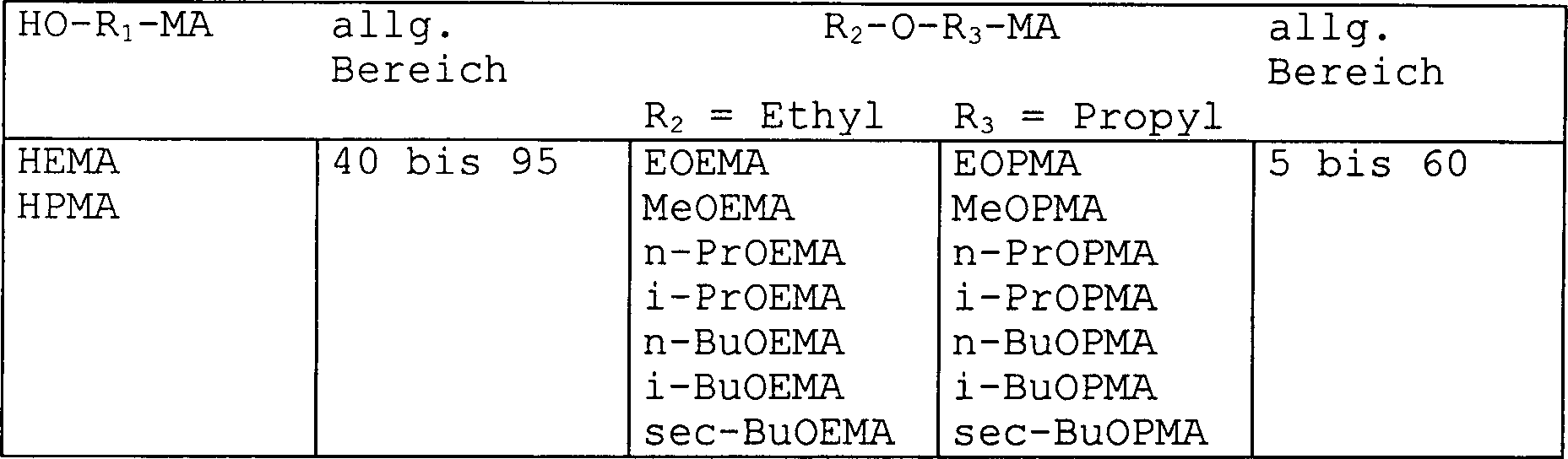
Die in den IOL verwendeten Copolymere weisen vorzugsweise einen Brechungskoeffizienten (BK) von über ca. 1,4 auf, allgemein zwischen ca. 1,4 und ca. 1,5. Dieser ist deutlich höher als der BK von p-HEMA. Ein Vorteil der erfindungsgemässen Hydrogel-Copolymere besteht darin, dass sie vor dem Einsetzen zusammengefaltet werden können und damit einen kleineren Einschnitt ermöglichen. Im allgemeinen nimmt der BK eines Hydrogels mit zunehmendem Wassergehalt progressiv ab. Der Brechwert eines Materials beeinflusst die Gestaltung und die Parameter einer IOL. Folglich wäre eine ideale IOL nebst der biologischen Verträglichkeit faltbar, würde nach dem Einsetzen schnell wieder ihre ursprüngliche Form und optische Qualität annehmen und einen hohen Brechwert aufweisen. Es konnte festgestellt werden, dass die erfindungsgemässen IOL diese gewünschten Merkmale aufweisen, d.h. die erfindungsgemässen IOL erfüllen die Anforderungen an eine hochwertige Intraokularlinse und weisen hervorragende Falteigenschaften, einen relativ hohen Brechungskoeffizienten und hervorragende Entfaltungseigenschaften auf.The Copolymers used in the IOL preferably have a refractive index (BK) of about about 1.4 on, generally between about 1.4 and about 1.5. This is significantly higher as the BK of p-HEMA. An advantage of the hydrogel copolymers according to the invention is that they are folded together before insertion can and thus allow a smaller incision. In general, takes the BK of a hydrogel progressively decreases with increasing water content. The refractive index of a material influences the design and the Parameters of an IOL. Consequently, would be An ideal IOL plus biocompatibility would be foldable quickly replace their original shape and optical quality and have a high refractive index. It could be determined that the inventive IOL this desired Have features, i. the inventive IOL meet the Requirements for a high quality intraocular lens and have excellent Folding properties, a relatively high refractive index and excellent deployment characteristics.
Ein bevorzugtes Material sowohl für den optischen als auch für den haptischen Bereich der IOL ist ein Copolymer aus 2-Hydroxyethylmethacrylat (2-HEMA) und Ethoxyethylmethacrylat (EOEMA).One preferred material for both the optical as well as for The haptic region of the IOL is a copolymer of 2-hydroxyethyl methacrylate (2-HEMA) and ethoxyethyl methacrylate (EOEMA).
Die Hydrogele der Copolymere haben einen niedrigen Wassergehalt, im allgemeinen zwischen ca. 10 und ca. 38 %, vorzugsweise zwischen 18 und 32 Gew.-% bezogen auf das Gesamtgewicht des Copolymers.The Hydrogels of the copolymers have a low water content, in the generally between about 10 and about 38%, preferably between 18 and 32 wt .-% based on the total weight of the copolymer.
Die erfindungsgemässen IOL sind mittels bekannter Verfahren herstellbar. So werden in einem beispielhaften Verfahren beispielsweise zunächst die Monomere, aus welchen das Copolymer gebildet wird, zu einem Polymerstab polymerisiert, aus dem Stab Rohlinge oder Scheiben hergestellt, und dann die Rohlinge beispielsweise auf einer Drehmaschine zur Intraokularlinse bearbeitet. Die Stangen können in einem Verfahren hergestellt werden, bei welchem zunächst in einer rohrförmigen oder zylindrischen Form ein flüssiges Gemisch aus einem Initiator und Co-Monomeren wie 2-HEMA und EOEMA polymerisiert wird, um einen optisch klaren, weichen Linsenkörper zu erhalten. Wie oben beschrieben, kann die Zugabe von Crosslinkern und W-absorbierenden Verbindungen während der Polymerisation oder zur erhaltenen Polymermatrix erwünscht sein. Die Polymerstangen werden dann auf einer Drehmaschine zu Rohlingen des gewünschten Durchmessers und der gewünschten Dicke geschnitten und spitzenlos geschliffen und danach auf herkömmliche Weise maschinell zu einer Intraokularlinse gefräst.The invention IOLs can be prepared by known methods. So be in one exemplary methods, for example, first the monomers from which the copolymer is formed, polymerized to a polymer rod, made blanks or discs from the bar, and then the blanks, for example processed on a lathe to the intraocular lens. The bars can be prepared in a process in which first in a tubular or cylindrical form a liquid Mixture of an initiator and co-monomers such as 2-HEMA and EOEMA is polymerized to an optically clear, soft lens body receive. As described above, the addition of crosslinkers and W-absorbing compounds during the polymerization or be desired for the resulting polymer matrix. The polymer rods then become blanks on a lathe of the desired Diameter and the desired Thick cut and centerless ground and then on conventional Machine milled to an intraocular lens.
Im allgemeinen wird die Stange aus Verbundmaterial auf der Drehmaschine auf einen Durchmesser zugeschnitten oder geschliffen, der 0,5 bis 2,0 mm grösser ist als der benötigte Abstand vom Mittelpunkt des Linsenkörpers zum äussersten Rand der Schenkel oder der Haptik. Die Stange wird daraufhin in Rohlinge gleichbleibender Dicke zersägt oder anderweitig zerschnitten. Danach werden die Rohlinge wärmebehandelt und geschliffen und poliert, bis sie den geeigneten Durchmesser und die geeignete Dicke aufweisen für das herkömmliche Schneiden auf der Drehmaschine und das maschinelle Fräsen zur erfindungsgemässen Intraokularlinse. Eine allgemeine Beschreibung eines schrittweisen Verfahrens zur Herstellung von IOL aus Rohlingen geht aus dem nachfolgenden Flussdiagramm hervor. Die vorliegende Beschreibung ermöglicht dem Fachmann mit dem allgemeinen Fachwissen auf dem Gebiet der Herstellung von IOL die Herstellung von IOL.in the Generally, the rod is made of composite material on the lathe cut to a diameter or ground, the 0.5 to 2,0 mm larger is as needed Distance from the center of the lens body to the outermost edge of the legs or the feel. The rod is then consistent in blanks Thick sawed or otherwise cut up. Thereafter, the blanks are heat treated and sanded and polished until they have the appropriate diameter and have the appropriate thickness for the conventional one Cutting on the lathe and the machine milling to invention Intraocular lens. A general description of a gradual Process for the preparation of IOL from blanks goes from the following Flowchart. The present description enables the person skilled in the art with the general knowledge in the field of production of IOL the production of IOL.

Die Erfindung bezieht sich weiter auf ein Hydrogel-Copolymer aus einem hydrophilen Monomer und einem Alkoxyalkyl-Methacrylat, wobei das hydrophile Monomer der Formel HO-R1-MA entspricht und das Alkoxyalkyl-Methacrylat der Formel R2-O-R3-MA, worin R1, R2 und R3 unabhängig voneinander aus Alkylgruppen mit 1 bis 6 Kohlenstoffatomen ausgewählt sind, und wobei das Hydrogel bezogen auf das Gewicht des Copolymers einen Wassergehalt von ca. 10 bis ca. 38 Gewichtsprozenten aufweist. Das hydrophile Monomer und das Alkoxyalkyl-Methacrylat-Monomer können aus den oben erwähnten Monomeren ausgewählt sein, und das Copolymer kann die oben beschriebenen Anteile an Monomeren und wahlweise vorhandenen anderen Monomeren enthalten. Das Copolymer kann wie oben beschrieben hergestellt werden.The invention further relates to a hydrogel copolymer of a hydrophilic monomer and an alkoxyalkyl methacrylate, wherein the hydrophilic monomer of the formula HO-R 1 corresponds to -MA and the alkoxyalkyl methacrylate of the formula R 2 -OR 3 -MA, wherein R 1 , R 2 and R 3 are independently selected from alkyl groups of 1 to 6 carbon atoms, and wherein the hydrogel has a water content of about 10 to about 38 weight percent, based on the weight of the copolymer. The hydrophilic monomer and the alkoxyalkyl methacrylate monomer may be selected from the above-mentioned monomers, and the copolymer may contain the above-described contents of monomers and optional other monomers. The copolymer can be prepared as described above.
Diese Copolymere können in zahlreichen Anwendungen verwendet werden, beispielsweise in Kontaktlinsen, als optischer Teil von IOL, als haptischer Teil einer IOL und, wie oben beschrieben, als optischer und zugleich als haptischer Teil der IOL.These Copolymers can used in numerous applications, for example in contact lenses, as an optical part of IOL, as a haptic part of an IOL and how described above, as an optical and at the same time as a haptic part the IOL.
Die Erfindung wird durch die folgenden Beispiele veranschaulicht. Die Beispiele dienen nur zur Veranschaulichung der Erfindung, beschränken diese jedoch nicht.The Invention is illustrated by the following examples. The Examples serve only to illustrate the invention, limit these However not.
BEISPIEL IEXAMPLE I
Herstellung eines HEMA/EOEMA-Copolymers mit 18 WassergehaltPreparation of a HEMA / EOEMA copolymer with 18 water content
548,3 Gramm 2-HEMA wurden mit 446,1 Gramm EOEMA vermischt und 0,7 Gramm 2,2-Azobis (2,4-Dimethylvaleronitril) zugegeben. Der Diestergehalt wurde mit Ethylenglycoldimethacrylat (EGDMA) auf insgesamt 0,3 Gew.-% eingestellt. Die Mischung wurde unter kräftigem Umrühren entgast. Die Mischung wurde in zylindrische Formen gegossen, während 10 Stunden bei 30 °C polymerisiert und während 5 Stunden bei 100 °C nachgehärtet. Das Polymer wurde anschliessend ausgeformt und zu Kontaktlinsenrohlingen verarbeitet. Die mechanische Bearbeitung umfasste das Zerschneiden des Polymers in Zylinder von 0,5 bis 0,65 Inch (1,27 bis 1,65 cm) Durchmesser und 0,1 bis 0,2 Inch (0,25 bis 0,51 cm) Dicke. Die Rohlinge wurden während 5 Stunden bei 100 °C weiter gehärtet. Nach dem Aushärten wurden aus den Rohlingen durch Schleifen und Läppen gerade Zylinder mit den gewünschten Abmessungen hergestellt.548.3 Grams of 2-HEMA were mixed with 446.1 grams of EOEMA and 0.7 grams Added 2,2-azobis (2,4-dimethylvaleronitrile). The diester content was with ethylene glycol dimethacrylate (EGDMA) to a total of 0.3 wt .-% set. The mixture was degassed with vigorous stirring. The mixture was poured into cylindrical molds, polymerized at 30 ° C for 10 hours and while 5 hours at 100 ° C cured. The polymer was then molded and made into contact lens blanks processed. The mechanical processing involved cutting of the polymer in cylinders of 0.5 to 0.65 inches (1.27 to 1.65 cm) Diameter and 0.1 to 0.2 inches (0.25 to 0.51 cm) thick. The blanks were during 5 Hours at 100 ° C further hardened. After curing were made from the blanks by grinding and lapping straight cylinder with the desired Dimensions produced.
BEISPIEL IIEXAMPLE II
Herstellung eines HEMA/EOEMA-Copolymers mit 25 Wassergehalt 707,8 Gramm 2-HEMA wurden mit 287,0 Gramm EOEMA vermischt und 0,7 Gramm 2,2-Azobis (2,4-Dimethylvaleronitril) zugegeben. Der Diestergehalt wurde mit Ethylenglycoldimethacrylat (EGDMA) auf insgesamt 0,3 Gew.-% eingestellt. Die Mischung wurde unter kräftigem Umrühren entgast. Die Mischung wurde in zylindrische Formen gegossen, während 10 Stunden bei 30 °C polymerisiert und während 5 Stunden bei 100 °C nachgehärtet. Das Polymer wurde anschliessend ausgeformt und zu Kontaktlinsenrohlingen verarbeitet. Die mechanische Bearbeitung umfasste das Zerschneiden des Polymers in Zylinder von 0,5 bis 0,65 Inch (1,27 bis 1,65 cm) Durchmesser und 0,1 bis 0,2 Inch (0,25 bis 0,51 cm) Dicke. Die Rohlinge wurden während 5 Stunden bei 100 °C weiter gehärtet. Nach dem Aushärten wurden aus den Rohlingen durch Schleifen und Läppen gerade Zylinder mit den gewünschten Abmessungen hergestellt.manufacturing of a HEMA / EOEMA copolymer having 25 water content 707.8 grams of 2-HEMA were mixed with 287.0 grams of EOEMA and 0.7 grams of 2,2-azobis (2,4-dimethylvaleronitrile) was added. The diester content was with Ethylene glycol dimethacrylate (EGDMA) adjusted to a total of 0.3 wt .-%. The mixture was under vigorous Stir degassed. The mixture was poured into cylindrical molds while 10 Hours at 30 ° C polymerized and while 5 hours at 100 ° C cured. The polymer was then molded and made into contact lens blanks processed. The mechanical processing involved cutting of the polymer in cylinders of 0.5 to 0.65 inches (1.27 to 1.65 cm) Diameter and 0.1 to 0.2 inches (0.25 to 0.51 cm) thick. The blanks were during 5 hours at 100 ° C further hardened. After curing were made from the blanks by grinding and lapping straight cylinder with the desired dimensions produced.
BEISPIEL IIIEXAMPLE III
Herstellung eines HEMA/EOEMA-Copolymers mit 24 Wassergehalt und UV-SchutzPreparation of a HEMA / EOEMA copolymer with 24 water content and UV protection
1770,4 Gramm 2-HEMA wurden mit 717,6 Gramm EOEMA vermischt und 12,5 Gramm Methacryloxysiloxan-2-Hydroxybenzophenon und 1,75 Gramm 2,2-Azobis (2,4-Dimethylvaleronitril) zugegeben.1,770.4 Grams of 2-HEMA were mixed with 717.6 grams of EOEMA and 12.5 grams Methacryloxysiloxane-2-hydroxybenzophenone and 1.75 grams of 2,2-azobis (2,4-dimethylvaleronitrile) was added.
Der Diestergehalt wurde mit Ethylenglycoldimethacrylat (EGDMA) auf insgesamt 0,25 Gew.-% eingestellt. Die Mischung wurde unter kräftigem Umrühren entgast. Die Mischung wurde in zylindrische Formen gegossen, während 10 Stunden bei 30 °C polymerisiert und während 5 Stunden bei 100 °C nachgehärtet. Das Polymer wurde anschliessend ausgeformt und zu Kontaktlinsenrohlingen verarbeitet. Die mechanische Bearbeitung umfasste das Zerschneiden des Polymers in Zylinder von 0,5 bis 0,65 Inch (1,27 bis 1,65 cm) Durchmesser und 0,1 bis 0,2 Inch (0,25 bis 0,51 cm) Dicke. Die Rohlinge wurden während 5 Stunden bei 100 °C weiter gehärtet. Nach dem Aushärten wurden aus den Rohlingen durch Schleifen und Läppen gerade Zylinder mit den gewünschten Abmessungen hergestellt.Of the Diester content was combined with ethylene glycol dimethacrylate (EGDMA) to total Adjusted to 0.25 wt .-%. The mixture was degassed with vigorous stirring. The mixture was poured into cylindrical molds while 10 Hours at 30 ° C polymerized and while 5 hours at 100 ° C cured. The polymer was then molded and made into contact lens blanks processed. The mechanical processing involved cutting of the polymer in cylinders of 0.5 to 0.65 inches (1.27 to 1.65 cm) Diameter and 0.1 to 0.2 inches (0.25 to 0.51 cm) thick. The blanks were during 5 hours at 100 ° C on hardened. After curing were made from the blanks by grinding and lapping straight cylinder with the desired Dimensions produced.
BEISPIEL IVEXAMPLE IV
Herstellung eines HEMA/EOEMA-Copolymers mit 28 % WassergehaltPreparation of a HEMA / EOEMA copolymer with 28% water content
763,1 Gramm 2-HEMA wurden mit 231,9 Gramm EOEMA vermischt und 0,7 Gramm 2,2-Azobis (2,4-Dimethylvaleronitril) zugegeben. Der Diestergehalt wurde mit Ethylenglycoldimethacrylat (EGDMA) auf insgesamt 0,3 Gew.-% eingestellt. Die Mischung wurde unter kräftigem Umrühren entgast. Die Mischung wurde in zylindrische Formen gegossen, während 10 Stunden bei 30 °C polymerisiert und während 5 Stunden bei 100 °C nachgehärtet. Das Polymer wurde anschliessend ausgeformt und zu Kontaktlinsenrohlingen verarbeitet. Die mechanische Bearbeitung umfasste das Zerschneiden des Polymers in Zylinder von 0,5 bis 0,65 Inch (1,27 bis 1,65 cm) Durchmesser und 0,1 bis 0,2 Inch (0,25 bis 0,51 cm) Dicke. Die Rohlinge wurden während 5 Stunden bei 100 °C weiter gehärtet. Nach dem Aushärten wurden aus den Rohlingen durch Schleifen und Läppen gerade Zylinder mit den gewünschten Abmessungen hergestellt.763.1 Grams of 2-HEMA were mixed with 231.9 grams of EOEMA and 0.7 grams Added 2,2-azobis (2,4-dimethylvaleronitrile). The diester content was with ethylene glycol dimethacrylate (EGDMA) to a total of 0.3 wt .-% set. The mixture was degassed with vigorous stirring. The mixture was poured into cylindrical molds, polymerized at 30 ° C for 10 hours and while 5 hours at 100 ° C cured. The polymer was then molded and made into contact lens blanks processed. The mechanical processing involved cutting of the polymer in cylinders of 0.5 to 0.65 inches (1.27 to 1.65 cm) Diameter and 0.1 to 0.2 inches (0.25 to 0.51 cm) thick. The blanks were during 5 Hours at 100 ° C further hardened. After curing were made from the blanks by grinding and lapping straight cylinder with the desired Dimensions produced.
Aus den in den vorangehenden Beispielen hergestellten Rohlingen können mit wohlbekannten, herkömmlichen Verfahren einstückige IOL hergestellt werden. Vorzugsweise, aber nicht notwendigerweise, bestehen sowohl der optische als auch der haptische Teil aus dem selben Copolymer.Out The blanks produced in the preceding examples can with well-known, conventional Procedure in one piece IOL are produced. Preferably, but not necessarily, Both the optical and the haptic part consist of the same copolymer.
Die Formulierungen der Beispiele sind in der nachfolgenden Tabelle 3 zusammengefasst.The Formulations of the examples are shown in Table 3 below summarized.
Tabelle
3 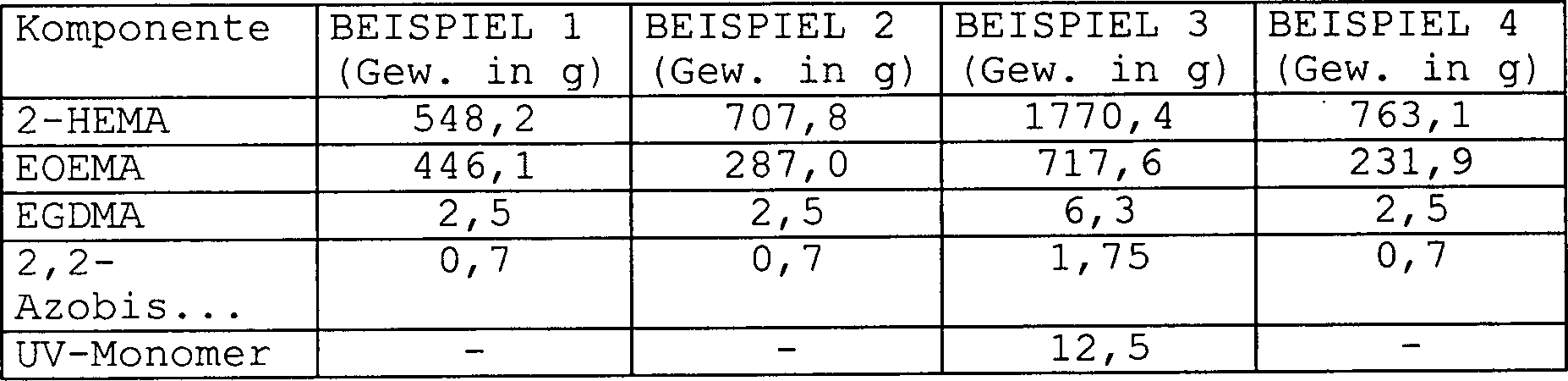
Die
Eigenschaften der beispielhaften Formulierungen gehen aus der unten
stehenden Tabelle 4 hervor. Tabelle
4 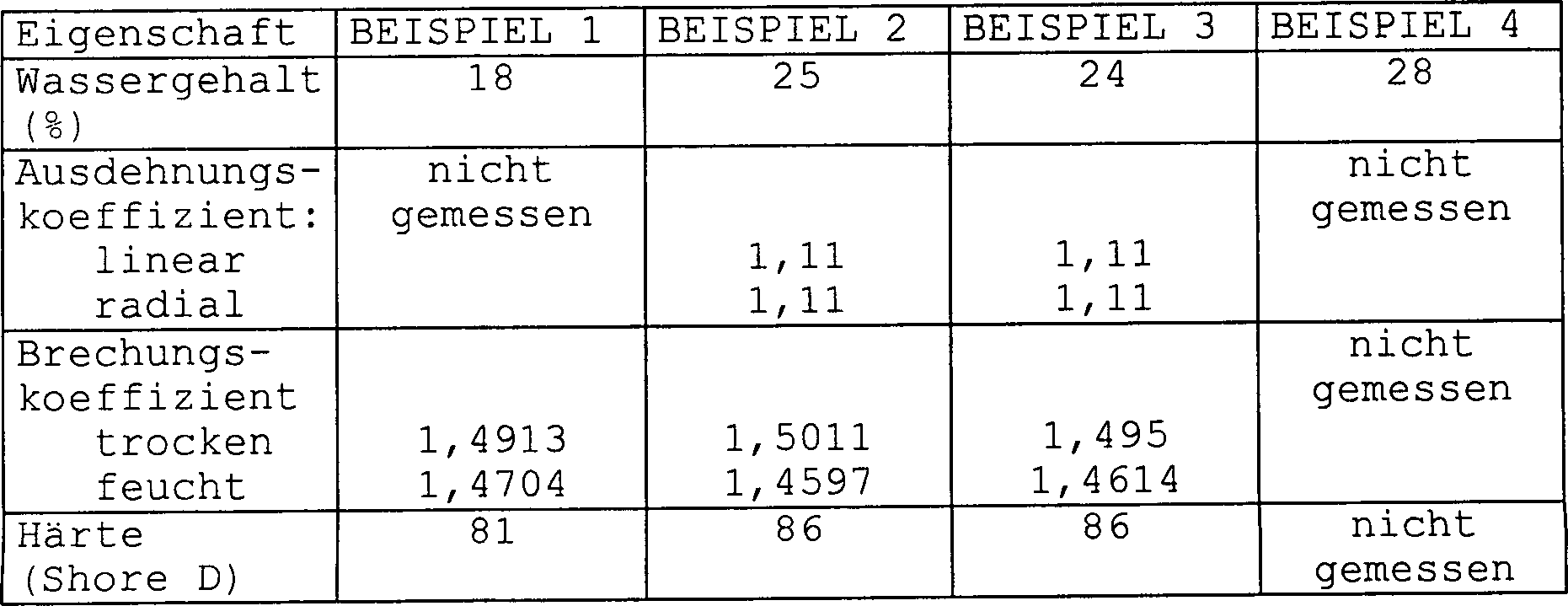
- (1) Der Wassergehalt und Abweichungen wurden mit einem gravimetrischen Verfahren ermittelt, bei welchem das Trocken- und das Feuchtgewicht einer Anzahl Probenscheiben über 2 Hydratisierungs- und Trocknungszyklen aufgezeichnet wird.
- (2) Die Ausdehnungskoeffizienten (radial und linear) werden unter Verwendung eines Herstellungsverfahrens ermittelt, welches Linsen gleichmässiger Dicke liefert. Sowohl die linearen als auch die radialen Abmessungen der Linse werden im trockenen Zustand gemessen, mit anschliessender Hydratisierung und Wiederholung der Messung der linearen und radialen Abmessungen. Die Koeffizienten entsprechen dem Verhältnis zwischen feucht und trocken.
- (3) Der Brechungskoeffizient wird sowohl bei trockenen als auch bei hydratisierten Rohlingen mit einem mit 1-Bromnaphtalin kalibrierten Abbe 3L Refraktometer ermittelt.
- (4) Die Shore-D-Härte wird unter Verwendung eines Shore D Durometers (Serien-Nr. 9075) mit einem kalibrierten Referenzblock D34 ermittelt.
- (1) The water content and deviations were determined by a gravimetric method in which the dry and wet weights of a number of sample disks are recorded over 2 hydration and drying cycles.
- (2) Coefficients of expansion (radial and linear) are determined using a manufacturing method which provides lenses of uniform thickness. Both the linear and radial dimensions of the lens are measured in the dry state, followed by hydration and repetition of the measurement of the linear and radial dimensions. The coefficients correspond to the ratio between wet and dry.
- (3) The refractive index is determined on both dry and hydrated blanks with a 1-bromonaphthalene-calibrated Abbe 3L refractometer.
- (4) The Shore D hardness is determined using a Shore D Durometer (Serial No. 9075) with a Calibrated Reference Block D34.
Während mehrere Ausführungen der Erfindung beschrieben wurden, sind weitere Abänderungen derselben selbstverständlich möglich, und die vorliegende Anmeldung soll alle Abwandlungen, Anwendungen, Verwendungen oder Anpassungen der Erfindung umfassen, welche allgemein den erfindungsgemässen Prinzipien entsprechen, einschliesslich jenen Abweichungen von der vorliegenden Beschreibung, welche innerhalb des Wissensstands oder der gewohnten Praxis des Fachgebiets der Erfindung liegen und auf die vorangehend dargelegten, im Umfang der Erfindung oder im Umfang der nachfolgenden Ansprüche enthaltenen wesentlichen Merkmale anwendbar sind.While several versions of the invention are further modifications same of course possible, and the present application is intended to cover all modifications, applications, uses or adaptations of the invention which generally correspond to the inventive principles including those deviations from the present one Description, which within the knowledge or the usual Practice of the field of the invention lie and on the foregoing set forth, within the scope of the invention or to the extent of the following claims essential characteristics are applicable.
Claims (20)
Applications Claiming Priority (3)
| Application Number | Priority Date | Filing Date | Title |
|---|---|---|---|
| US70771 | 1998-05-01 | ||
| US09/070,771 US6267784B1 (en) | 1998-05-01 | 1998-05-01 | Intraocular lens and haptics made of a copolymer |
| PCT/US1999/000040 WO1999056672A1 (en) | 1998-05-01 | 1999-01-06 | Intraocular lens |
Publications (2)
| Publication Number | Publication Date |
|---|---|
| DE69918108D1 DE69918108D1 (en) | 2004-07-22 |
| DE69918108T2 true DE69918108T2 (en) | 2005-07-07 |
Family
ID=22097302
Family Applications (1)
| Application Number | Title | Priority Date | Filing Date |
|---|---|---|---|
| DE69918108T Expired - Lifetime DE69918108T2 (en) | 1998-05-01 | 1999-01-06 | intraocular lens |
Country Status (6)
| Country | Link |
|---|---|
| US (2) | US6267784B1 (en) |
| EP (1) | EP1083844B1 (en) |
| AT (1) | ATE269039T1 (en) |
| AU (1) | AU2025299A (en) |
| DE (1) | DE69918108T2 (en) |
| WO (1) | WO1999056672A1 (en) |
Cited By (2)
| Publication number | Priority date | Publication date | Assignee | Title |
|---|---|---|---|---|
| DE102008038390A1 (en) | 2008-08-19 | 2010-02-25 | *Acri.Tec Gmbh | New copolymer comprising structural units derived from a hydrophilic monomer and structural units derived from an olefin monomer unit, useful to prepare an ophthalmic lens, which is useful as intraocular lens and/or in ophthalmic implants |
| US8329842B2 (en) | 2007-12-11 | 2012-12-11 | Arcltec GmbH | Ophthalmological composition and use thereof |
Families Citing this family (29)
| Publication number | Priority date | Publication date | Assignee | Title |
|---|---|---|---|---|
| US6267784B1 (en) * | 1998-05-01 | 2001-07-31 | Benz Research And Development Corporation | Intraocular lens and haptics made of a copolymer |
| FR2779940B1 (en) * | 1998-06-19 | 2000-11-03 | Ioltechnologie Production | IMPLANT FORMING INTRAOCULAR MONOBLOCK BI-MATERIAL |
| US6329485B1 (en) * | 1998-12-11 | 2001-12-11 | Bausch & Lomb Incorporated | High refractive index hydrogel compositions for ophthalmic implants |
| US6398809B1 (en) * | 2000-04-12 | 2002-06-04 | Bausch & Lomb Incorporated | Intraocular lens |
| US6419697B1 (en) * | 2000-07-07 | 2002-07-16 | Charles David Kelman | Clip-on optic assembly |
| US20030223954A1 (en) * | 2002-05-31 | 2003-12-04 | Ruscio Dominic V. | Polymeric materials for use as photoablatable inlays |
| US7160888B2 (en) | 2003-08-22 | 2007-01-09 | Warner Lambert Company Llc | [1,8]naphthyridin-2-ones and related compounds for the treatment of schizophrenia |
| WO2005032427A1 (en) * | 2003-09-30 | 2005-04-14 | Bausch & Lomb Incorporated | Intraocular lens for inhibiting pco and aco |
| ES2441245T3 (en) | 2003-11-05 | 2014-02-03 | Benz Research And Development Corporation | Materials for the manufacture of hydrophobic intraocular lenses |
| US20050187621A1 (en) * | 2004-02-24 | 2005-08-25 | Brady Daniel G. | Foldable unitary intraocular lens |
| US7569073B2 (en) * | 2004-12-29 | 2009-08-04 | Bausch & Lomb Incorporated | Small incision intraocular lens with anti-PCO feature |
| WO2006113290A1 (en) | 2005-04-13 | 2006-10-26 | Benz Research & Development Corporation | Polymers for intraocular lenses |
| US20080081851A1 (en) * | 2006-09-01 | 2008-04-03 | Benz Patrick H | Optical polymers with higher refractive index |
| WO2008041683A1 (en) * | 2006-10-04 | 2008-04-10 | Hoya Corporation | Intraocular lens |
| MX2009009484A (en) | 2007-03-05 | 2010-06-01 | Benz Res & Dev Corp | Light filters comprising a naturally occurring chromophore and derivatives thereof. |
| EP2150588A2 (en) * | 2007-04-27 | 2010-02-10 | Benz Research and Development Corporation | Polymeric dyes based on polymerizable vinyl-group containig p-nitrophenyl-azo salicylic acid derivatives |
| US20090176909A1 (en) * | 2007-10-10 | 2009-07-09 | Benz Research And Development Corp. | Hydrogel with high water content and stability |
| US9107747B2 (en) | 2009-02-20 | 2015-08-18 | Hoya Corporation | Soft intraocular lens and method of manufacturing the same |
| CA2797404A1 (en) * | 2010-05-03 | 2011-11-10 | Massachusetts Institute Of Technology | Drug delivery coating and devices |
| TWI572630B (en) | 2011-09-16 | 2017-03-01 | 班茲研發公司 | Hydrophobic intraocular lens |
| CA2848980C (en) * | 2011-09-16 | 2020-01-14 | Benz Research And Development Corp. | Ultraviolet light absorbing materials for intraocular lens and uses thereof |
| WO2013163234A1 (en) | 2012-04-23 | 2013-10-31 | Massachusetts Institute Of Technology | Stable layer-by-layer coated particles |
| US10196470B2 (en) | 2016-05-16 | 2019-02-05 | Benz Research And Development Corp. | Hydrophobic intraocular lens |
| US10894111B2 (en) | 2016-12-16 | 2021-01-19 | Benz Research And Development Corp. | High refractive index hydrophilic materials |
| WO2018213240A1 (en) | 2017-05-16 | 2018-11-22 | Benz Research And Development Corp. | Micro injectable, low chromatic aberration intraocular lens materials |
| US11419947B2 (en) | 2017-10-30 | 2022-08-23 | Massachusetts Institute Of Technology | Layer-by-layer nanoparticles for cytokine therapy in cancer treatment |
| IL275569B2 (en) * | 2018-01-31 | 2023-11-01 | Menicon Co Ltd | Material for intraocular lenses |
| US10716875B2 (en) * | 2018-01-31 | 2020-07-21 | Menicon Co., Ltd | Intraocular lens |
| WO2021002984A1 (en) | 2019-05-30 | 2021-01-07 | Massachusetts Institute Of Technology | Peptide nucleic acid functionalized hydrogel microneedles for sampling and detection of interstitial fluid nucleic acids |
Family Cites Families (28)
| Publication number | Priority date | Publication date | Assignee | Title |
|---|---|---|---|---|
| JPS4942917B1 (en) * | 1969-12-11 | 1974-11-18 | ||
| US4028295A (en) * | 1976-01-08 | 1977-06-07 | Wesley-Jessen Inc. | Hydrophilic polymer and contact lens |
| US4174543A (en) * | 1978-06-01 | 1979-11-20 | Kelman Charles D | Intraocular lenses |
| US4379864A (en) | 1979-02-09 | 1983-04-12 | Syntex (U.S.A.) Inc. | Polymeric compositions and hydrogels formed therefrom |
| DE3169818D1 (en) * | 1980-08-05 | 1985-05-15 | Choyce David P | Intraocular lens |
| US4388448A (en) | 1981-02-23 | 1983-06-14 | E. I. Du Pont De Nemours And Company | Glycidyl methacrylate polymers, their preparation and solvolysis products |
| US5507805A (en) * | 1982-05-03 | 1996-04-16 | American Cyanamid Company | Intraocular lens and method of retaining in place |
| US4664666A (en) * | 1983-08-30 | 1987-05-12 | Ezekiel Nominees Pty. Ltd. | Intraocular lens implants |
| US4582884A (en) | 1984-08-31 | 1986-04-15 | Paragon Optical, Inc. | Lens composition, article and method of manufacture |
| US4769431A (en) | 1984-12-04 | 1988-09-06 | Paragon Optical Inc. | Polyacryloxyalkylsilanol lens composition, articles and method of manufacture |
| DE3445093A1 (en) | 1984-12-11 | 1986-06-19 | Bayer Ag, 5090 Leverkusen | HYDROPHILIC COPOLYMERS, THEIR USE AS BIOMEDICAL MATERIALS AND CONTACT OPTICAL OBJECTS MADE THEREOF |
| US4718906A (en) | 1986-03-11 | 1988-01-12 | Mackool Richard J | Intraocular lens |
| CS257979B1 (en) | 1986-06-24 | 1988-07-15 | Otto Wichterle | Hydrophilic copolymer and method of its production |
| US4764169A (en) | 1986-12-04 | 1988-08-16 | Grendahl Dennis T | Intraocular lens |
| CS267858B1 (en) * | 1987-01-12 | 1990-02-12 | Sulc Jiri | Contact,if need be,intra-ocular lens and method of its production |
| GB8902799D0 (en) | 1989-02-08 | 1989-03-30 | Isis Innovation | Composite membranes and method of making the same |
| US4997442A (en) * | 1989-05-04 | 1991-03-05 | Alcon Laboratories, Inc. | Bicomposite intraocular lenses |
| US5330911A (en) | 1989-09-28 | 1994-07-19 | Board Of Regents, The University Of Texas System | Surfaces having desirable cell adhesive effects |
| US5476514A (en) * | 1990-04-27 | 1995-12-19 | Cumming; J. Stuart | Accommodating intraocular lens |
| EP0485197B1 (en) | 1990-11-07 | 1996-10-02 | Nestle S.A. | Polymers and their use for ophthalmic lenses |
| JP2685980B2 (en) | 1990-11-26 | 1997-12-08 | 株式会社メニコン | UV absorbing intraocular lens |
| US5217491A (en) | 1990-12-27 | 1993-06-08 | American Cyanamid Company | Composite intraocular lens |
| US5480950A (en) | 1992-09-28 | 1996-01-02 | Kabi Pharmacia Ophthalmics, Inc. | High refractive index hydrogels and uses thereof |
| US6011081A (en) * | 1995-04-14 | 2000-01-04 | Benz Research And Development Corp. | Contact lens having improved dimensional stability |
| US5532289A (en) | 1995-04-14 | 1996-07-02 | Benz Research And Development Corp. | Contact lens having improved dimensional stability |
| JP2991655B2 (en) * | 1996-03-19 | 1999-12-20 | ホーヤ株式会社 | Intraocular lens and manufacturing method thereof |
| US5891932A (en) * | 1997-11-24 | 1999-04-06 | Benz Research And Development Corporation | Terpolymer for contact lens |
| US6267784B1 (en) * | 1998-05-01 | 2001-07-31 | Benz Research And Development Corporation | Intraocular lens and haptics made of a copolymer |
-
1998
- 1998-05-01 US US09/070,771 patent/US6267784B1/en not_active Expired - Lifetime
-
1999
- 1999-01-06 AT AT99900736T patent/ATE269039T1/en not_active IP Right Cessation
- 1999-01-06 EP EP99900736A patent/EP1083844B1/en not_active Expired - Lifetime
- 1999-01-06 AU AU20252/99A patent/AU2025299A/en not_active Abandoned
- 1999-01-06 DE DE69918108T patent/DE69918108T2/en not_active Expired - Lifetime
- 1999-01-06 WO PCT/US1999/000040 patent/WO1999056672A1/en not_active Ceased
-
2001
- 2001-06-06 US US09/874,015 patent/US6517750B2/en not_active Expired - Lifetime
Cited By (2)
| Publication number | Priority date | Publication date | Assignee | Title |
|---|---|---|---|---|
| US8329842B2 (en) | 2007-12-11 | 2012-12-11 | Arcltec GmbH | Ophthalmological composition and use thereof |
| DE102008038390A1 (en) | 2008-08-19 | 2010-02-25 | *Acri.Tec Gmbh | New copolymer comprising structural units derived from a hydrophilic monomer and structural units derived from an olefin monomer unit, useful to prepare an ophthalmic lens, which is useful as intraocular lens and/or in ophthalmic implants |
Also Published As
| Publication number | Publication date |
|---|---|
| US6517750B2 (en) | 2003-02-11 |
| EP1083844A1 (en) | 2001-03-21 |
| WO1999056672A1 (en) | 1999-11-11 |
| DE69918108D1 (en) | 2004-07-22 |
| US6267784B1 (en) | 2001-07-31 |
| EP1083844B1 (en) | 2004-06-16 |
| AU2025299A (en) | 1999-11-23 |
| ATE269039T1 (en) | 2004-07-15 |
| US20020027302A1 (en) | 2002-03-07 |
Similar Documents
| Publication | Publication Date | Title |
|---|---|---|
| DE69918108T2 (en) | intraocular lens | |
| DE60104191T2 (en) | METHOD FOR THE PRODUCTION OF AN ACCOMODABLE INTRAOCULAR LENS | |
| DE69128703T2 (en) | Multi-part intraocular lens and process for its manufacture | |
| DE69122471T2 (en) | Polymers and their use for ophthalmic lenses | |
| DE60005660T2 (en) | WATER PLASTICIZED POLYMER WITH HIGH BREAKING INDEX FOR OPHTHALMIC USE | |
| DE2556658C2 (en) | Combined contact lens and its manufacture | |
| DE69328359T2 (en) | THIN INTRA-Ocular lens | |
| EP2225293B1 (en) | Copolymer and ophthalmological composition | |
| DE69618764T2 (en) | SOFT INTRAOCULAR LENS | |
| DE69331583T2 (en) | POLYMERIC COMPOSITIONS AND INTRA-OCULAR LENSES MADE THEREOF | |
| DE69912766T2 (en) | POLYMERIZABLE HYDROPHOBIC MONOMERS THAT ABSORB ULTRAVIOLET LIGHT | |
| DE60124420T2 (en) | Fastening components for adaptive intraocular lenses | |
| DE60031861T2 (en) | WITH A TRANSLATION ZONE EQUIPPED INTRAOCULAR LENS | |
| DE69926496T2 (en) | INTRAOCULAR LENSES WHICH ALLOW THE DETERMINATION OF THE AXIAL SHIFT AFTER IMPLANTATION | |
| DE2949951A1 (en) | TWO-PIECE SHAPE AND METHOD FOR PRODUCING A CONTACT LENS | |
| DE69126169T2 (en) | One-piece intraocular lenses | |
| EP0033141B2 (en) | Soft contact lens | |
| DE69727705T2 (en) | POLYMERS FOR EYE LENSES | |
| DE69722490T2 (en) | Intraocular lens formed from crosslinked polymethylmethacrylate and process for its preparation | |
| DE68916299T2 (en) | Intraocular lens with shape memory and its manufacture. | |
| DE69926747T2 (en) | SOFT CONTACT LENSES WITH HIGH WATER CONTENT AND HIGH WATER BALANCE | |
| DE69718254T2 (en) | Soft contact lens with high water content and process for its production | |
| DE69812254T2 (en) | Ultraviolet absorbing base material | |
| DE69926364T2 (en) | MATERIAL FOR OPHTHALMOLOGICAL DEVICES WITH HIGH BREAKING INDEX MADE IN A PROCESS WITH NETWORKING THROUGH REVOLUTIONARYIZATION | |
| DE69531769T2 (en) | Water-absorbing contact lens |
Legal Events
| Date | Code | Title | Description |
|---|---|---|---|
| 8364 | No opposition during term of opposition |