DE69730833T2 - PHOTOCHROME HETEROCYCLIC ANNELED INDENONAPHTHOPYRANEES - Google Patents
PHOTOCHROME HETEROCYCLIC ANNELED INDENONAPHTHOPYRANEES Download PDFInfo
- Publication number
- DE69730833T2 DE69730833T2 DE69730833T DE69730833T DE69730833T2 DE 69730833 T2 DE69730833 T2 DE 69730833T2 DE 69730833 T DE69730833 T DE 69730833T DE 69730833 T DE69730833 T DE 69730833T DE 69730833 T2 DE69730833 T2 DE 69730833T2
- Authority
- DE
- Germany
- Prior art keywords
- alkyl
- mono
- alkoxy
- group
- phenyl
- Prior art date
- Legal status (The legal status is an assumption and is not a legal conclusion. Google has not performed a legal analysis and makes no representation as to the accuracy of the status listed.)
- Expired - Lifetime
Links
- -1 Indenonaphthopyran compound Chemical class 0.000 claims description 78
- 150000001875 compounds Chemical class 0.000 claims description 40
- 239000001257 hydrogen Substances 0.000 claims description 40
- 229910052739 hydrogen Inorganic materials 0.000 claims description 40
- 239000000178 monomer Substances 0.000 claims description 37
- 239000000463 material Substances 0.000 claims description 34
- 125000001997 phenyl group Chemical class [H]C1=C([H])C([H])=C(*)C([H])=C1[H] 0.000 claims description 31
- 239000000126 substance Substances 0.000 claims description 27
- 125000001424 substituent group Chemical group 0.000 claims description 23
- 125000000623 heterocyclic group Chemical group 0.000 claims description 21
- 125000003118 aryl group Chemical group 0.000 claims description 20
- 150000002431 hydrogen Chemical class 0.000 claims description 20
- 125000001624 naphthyl group Chemical group 0.000 claims description 20
- PXGOKWXKJXAPGV-UHFFFAOYSA-N Fluorine Chemical compound FF PXGOKWXKJXAPGV-UHFFFAOYSA-N 0.000 claims description 19
- UFHFLCQGNIYNRP-UHFFFAOYSA-N Hydrogen Chemical compound [H][H] UFHFLCQGNIYNRP-UHFFFAOYSA-N 0.000 claims description 17
- 229920001577 copolymer Chemical compound 0.000 claims description 17
- ZAMOUSCENKQFHK-UHFFFAOYSA-N Chlorine atom Chemical compound [Cl] ZAMOUSCENKQFHK-UHFFFAOYSA-N 0.000 claims description 16
- 239000000460 chlorine Substances 0.000 claims description 16
- 229910052801 chlorine Inorganic materials 0.000 claims description 16
- 229910052731 fluorine Inorganic materials 0.000 claims description 16
- 229910052799 carbon Inorganic materials 0.000 claims description 15
- 239000011737 fluorine Substances 0.000 claims description 15
- 229920000642 polymer Polymers 0.000 claims description 15
- 150000002430 hydrocarbons Chemical group 0.000 claims description 12
- UEOGLANRPZAEAC-UHFFFAOYSA-N indeno-naphthopyran Chemical class O1C=CC=C2C3=C4C=C(C=CC=C5)C5=C4C=CC3=CC=C21 UEOGLANRPZAEAC-UHFFFAOYSA-N 0.000 claims description 12
- QVGXLLKOCUKJST-UHFFFAOYSA-N atomic oxygen Chemical group [O] QVGXLLKOCUKJST-UHFFFAOYSA-N 0.000 claims description 10
- 125000001309 chloro group Chemical group Cl* 0.000 claims description 10
- 229910052760 oxygen Chemical group 0.000 claims description 10
- 239000001301 oxygen Chemical group 0.000 claims description 10
- 125000001153 fluoro group Chemical group F* 0.000 claims description 9
- IJGRMHOSHXDMSA-UHFFFAOYSA-N nitrogen Substances N#N IJGRMHOSHXDMSA-UHFFFAOYSA-N 0.000 claims description 9
- XFCMNSHQOZQILR-UHFFFAOYSA-N 2-[2-(2-methylprop-2-enoyloxy)ethoxy]ethyl 2-methylprop-2-enoate Chemical compound CC(=C)C(=O)OCCOCCOC(=O)C(C)=C XFCMNSHQOZQILR-UHFFFAOYSA-N 0.000 claims description 8
- OKTJSMMVPCPJKN-UHFFFAOYSA-N Carbon Chemical group [C] OKTJSMMVPCPJKN-UHFFFAOYSA-N 0.000 claims description 8
- 125000002490 anilino group Chemical group [H]N(*)C1=C([H])C([H])=C([H])C([H])=C1[H] 0.000 claims description 8
- GDTBXPJZTBHREO-UHFFFAOYSA-N bromine Substances BrBr GDTBXPJZTBHREO-UHFFFAOYSA-N 0.000 claims description 8
- 229910052794 bromium Inorganic materials 0.000 claims description 8
- 125000003754 ethoxycarbonyl group Chemical group C(=O)(OCC)* 0.000 claims description 8
- 239000000203 mixture Substances 0.000 claims description 8
- 230000003287 optical effect Effects 0.000 claims description 8
- 125000002924 primary amino group Chemical group [H]N([H])* 0.000 claims description 8
- 229920006395 saturated elastomer Polymers 0.000 claims description 8
- 125000003003 spiro group Chemical group 0.000 claims description 8
- 125000001544 thienyl group Chemical group 0.000 claims description 8
- JHQVCQDWGSXTFE-UHFFFAOYSA-N 2-(2-prop-2-enoxycarbonyloxyethoxy)ethyl prop-2-enyl carbonate Chemical compound C=CCOC(=O)OCCOCCOC(=O)OCC=C JHQVCQDWGSXTFE-UHFFFAOYSA-N 0.000 claims description 7
- WKBOTKDWSSQWDR-UHFFFAOYSA-N Bromine atom Chemical compound [Br] WKBOTKDWSSQWDR-UHFFFAOYSA-N 0.000 claims description 7
- SIKJAQJRHWYJAI-UHFFFAOYSA-N Indole Chemical compound C1=CC=C2NC=CC2=C1 SIKJAQJRHWYJAI-UHFFFAOYSA-N 0.000 claims description 7
- 229910052757 nitrogen Inorganic materials 0.000 claims description 7
- 125000004172 4-methoxyphenyl group Chemical group [H]C1=C([H])C(OC([H])([H])[H])=C([H])C([H])=C1* 0.000 claims description 6
- 238000010521 absorption reaction Methods 0.000 claims description 6
- 125000004244 benzofuran-2-yl group Chemical group [H]C1=C(*)OC2=C([H])C([H])=C([H])C([H])=C12 0.000 claims description 6
- 125000004534 benzothien-2-yl group Chemical group S1C(=CC2=C1C=CC=C2)* 0.000 claims description 6
- JKJWYKGYGWOAHT-UHFFFAOYSA-N bis(prop-2-enyl) carbonate Chemical compound C=CCOC(=O)OCC=C JKJWYKGYGWOAHT-UHFFFAOYSA-N 0.000 claims description 6
- QIWKUEJZZCOPFV-UHFFFAOYSA-N phenyl 2-methylprop-2-enoate Chemical class CC(=C)C(=O)OC1=CC=CC=C1 QIWKUEJZZCOPFV-UHFFFAOYSA-N 0.000 claims description 6
- 125000000587 piperidin-1-yl group Chemical class [H]C1([H])N(*)C([H])([H])C([H])([H])C([H])([H])C1([H])[H] 0.000 claims description 6
- 125000004309 pyranyl group Chemical class O1C(C=CC=C1)* 0.000 claims description 6
- CYRMSUTZVYGINF-UHFFFAOYSA-N trichlorofluoromethane Chemical class FC(Cl)(Cl)Cl CYRMSUTZVYGINF-UHFFFAOYSA-N 0.000 claims description 6
- 125000004890 (C1-C6) alkylamino group Chemical group 0.000 claims description 5
- NIXOWILDQLNWCW-UHFFFAOYSA-M Acrylate Chemical compound [O-]C(=O)C=C NIXOWILDQLNWCW-UHFFFAOYSA-M 0.000 claims description 5
- 150000001562 benzopyrans Chemical class 0.000 claims description 5
- 229920005862 polyol Polymers 0.000 claims description 5
- 150000003077 polyols Chemical class 0.000 claims description 5
- 239000004814 polyurethane Substances 0.000 claims description 5
- 229920002635 polyurethane Polymers 0.000 claims description 5
- 125000002733 (C1-C6) fluoroalkyl group Chemical group 0.000 claims description 4
- HIACAHMKXQESOV-UHFFFAOYSA-N 1,2-bis(prop-1-en-2-yl)benzene Chemical compound CC(=C)C1=CC=CC=C1C(C)=C HIACAHMKXQESOV-UHFFFAOYSA-N 0.000 claims description 4
- 125000004171 alkoxy aryl group Chemical group 0.000 claims description 4
- 125000004104 aryloxy group Chemical group 0.000 claims description 4
- QUZSUMLPWDHKCJ-UHFFFAOYSA-N bisphenol A dimethacrylate Chemical class C1=CC(OC(=O)C(=C)C)=CC=C1C(C)(C)C1=CC=C(OC(=O)C(C)=C)C=C1 QUZSUMLPWDHKCJ-UHFFFAOYSA-N 0.000 claims description 4
- 125000001246 bromo group Chemical group Br* 0.000 claims description 4
- STVZJERGLQHEKB-UHFFFAOYSA-N ethylene glycol dimethacrylate Chemical compound CC(=C)C(=O)OCCOC(=O)C(C)=C STVZJERGLQHEKB-UHFFFAOYSA-N 0.000 claims description 4
- 125000002541 furyl group Chemical group 0.000 claims description 4
- 150000002829 nitrogen Chemical class 0.000 claims description 4
- 229920002037 poly(vinyl butyral) polymer Polymers 0.000 claims description 4
- 229920001223 polyethylene glycol Polymers 0.000 claims description 4
- 239000004926 polymethyl methacrylate Substances 0.000 claims description 4
- 229920002689 polyvinyl acetate Polymers 0.000 claims description 4
- 239000011118 polyvinyl acetate Substances 0.000 claims description 4
- 239000011347 resin Substances 0.000 claims description 4
- 229920005989 resin Polymers 0.000 claims description 4
- 229920001169 thermoplastic Polymers 0.000 claims description 4
- 239000004416 thermosoftening plastic Substances 0.000 claims description 4
- GTELLNMUWNJXMQ-UHFFFAOYSA-N 2-ethyl-2-(hydroxymethyl)propane-1,3-diol;prop-2-enoic acid Chemical class OC(=O)C=C.OC(=O)C=C.OC(=O)C=C.CCC(CO)(CO)CO GTELLNMUWNJXMQ-UHFFFAOYSA-N 0.000 claims description 3
- XVIMXPFMJNJACY-UHFFFAOYSA-N 6-oxapentacyclo[12.7.0.02,7.08,13.015,20]henicosa-1(21),2,4,7,9,11,13,15,17,19-decaene Chemical compound C1=CC=CC2=C3C4=CC=CC=C4C=C3C3=CC=COC3=C21 XVIMXPFMJNJACY-UHFFFAOYSA-N 0.000 claims description 3
- JYUCUBBIDFTEQV-UHFFFAOYSA-N C1=CC=C2C(=C1)C3=C(O2)C=CC4=C3C=C5C4=C6C=CC=CC6=C7C5=CC=CO7 Chemical compound C1=CC=C2C(=C1)C3=C(O2)C=CC4=C3C=C5C4=C6C=CC=CC6=C7C5=CC=CO7 JYUCUBBIDFTEQV-UHFFFAOYSA-N 0.000 claims description 3
- CERQOIWHTDAKMF-UHFFFAOYSA-M Methacrylate Chemical compound CC(=C)C([O-])=O CERQOIWHTDAKMF-UHFFFAOYSA-M 0.000 claims description 3
- 239000004793 Polystyrene Substances 0.000 claims description 3
- 229920002301 cellulose acetate Polymers 0.000 claims description 3
- 229920006217 cellulose acetate butyrate Polymers 0.000 claims description 3
- 125000004435 hydrogen atom Chemical group [H]* 0.000 claims description 3
- 229920003229 poly(methyl methacrylate) Polymers 0.000 claims description 3
- 229920000515 polycarbonate Polymers 0.000 claims description 3
- 239000004417 polycarbonate Substances 0.000 claims description 3
- 229920000728 polyester Polymers 0.000 claims description 3
- 229920002223 polystyrene Polymers 0.000 claims description 3
- 239000007787 solid Substances 0.000 claims description 3
- 125000005913 (C3-C6) cycloalkyl group Chemical group 0.000 claims description 2
- FAQVDANXTSFXGA-UHFFFAOYSA-N 2,3-dihydro-1h-benzo[g]indole Chemical compound C1=CC=CC2=C(NCC3)C3=CC=C21 FAQVDANXTSFXGA-UHFFFAOYSA-N 0.000 claims description 2
- OOXMQACSWCZQLX-UHFFFAOYSA-N 3,9-bis(ethenyl)-2,4,8,10-tetraoxaspiro[5.5]undecane Chemical compound C1OC(C=C)OCC21COC(C=C)OC2 OOXMQACSWCZQLX-UHFFFAOYSA-N 0.000 claims description 2
- UIYCIISWTDMWTR-UHFFFAOYSA-N C(C=C)(=O)OBrOC(C(=C)C)=O Chemical compound C(C=C)(=O)OBrOC(C(=C)C)=O UIYCIISWTDMWTR-UHFFFAOYSA-N 0.000 claims description 2
- 229920008347 Cellulose acetate propionate Polymers 0.000 claims description 2
- 229920002284 Cellulose triacetate Polymers 0.000 claims description 2
- 229920001328 Polyvinylidene chloride Polymers 0.000 claims description 2
- NNLVGZFZQQXQNW-ADJNRHBOSA-N [(2r,3r,4s,5r,6s)-4,5-diacetyloxy-3-[(2s,3r,4s,5r,6r)-3,4,5-triacetyloxy-6-(acetyloxymethyl)oxan-2-yl]oxy-6-[(2r,3r,4s,5r,6s)-4,5,6-triacetyloxy-2-(acetyloxymethyl)oxan-3-yl]oxyoxan-2-yl]methyl acetate Chemical compound O([C@@H]1O[C@@H]([C@H]([C@H](OC(C)=O)[C@H]1OC(C)=O)O[C@H]1[C@@H]([C@@H](OC(C)=O)[C@H](OC(C)=O)[C@@H](COC(C)=O)O1)OC(C)=O)COC(=O)C)[C@@H]1[C@@H](COC(C)=O)O[C@@H](OC(C)=O)[C@H](OC(C)=O)[C@H]1OC(C)=O NNLVGZFZQQXQNW-ADJNRHBOSA-N 0.000 claims description 2
- 125000004532 benzofuran-3-yl group Chemical group O1C=C(C2=C1C=CC=C2)* 0.000 claims description 2
- 125000004197 benzothien-3-yl group Chemical group [H]C1=C(*)C2=C([H])C([H])=C([H])C([H])=C2S1 0.000 claims description 2
- 125000000609 carbazolyl group Chemical group C1(=CC=CC=2C3=CC=CC=C3NC12)* 0.000 claims description 2
- 150000008371 chromenes Chemical class 0.000 claims description 2
- 125000000753 cycloalkyl group Chemical group 0.000 claims description 2
- 125000004986 diarylamino group Chemical group 0.000 claims description 2
- 125000004988 dibenzothienyl group Chemical group C1(=CC=CC=2SC3=C(C21)C=CC=C3)* 0.000 claims description 2
- 125000003983 fluorenyl group Chemical group C1(=CC=CC=2C3=CC=CC=C3CC12)* 0.000 claims description 2
- 125000004407 fluoroaryl group Chemical group 0.000 claims description 2
- AQYSYJUIMQTRMV-UHFFFAOYSA-N hypofluorous acid Chemical compound FO AQYSYJUIMQTRMV-UHFFFAOYSA-N 0.000 claims description 2
- 229910052751 metal Inorganic materials 0.000 claims description 2
- 239000002184 metal Substances 0.000 claims description 2
- 125000002496 methyl group Chemical group [H]C([H])([H])* 0.000 claims description 2
- 150000004893 oxazines Chemical class 0.000 claims description 2
- 125000005702 oxyalkylene group Chemical group 0.000 claims description 2
- 229920003251 poly(α-methylstyrene) Polymers 0.000 claims description 2
- 229920000139 polyethylene terephthalate Polymers 0.000 claims description 2
- 239000005020 polyethylene terephthalate Substances 0.000 claims description 2
- 229920002451 polyvinyl alcohol Polymers 0.000 claims description 2
- 239000004800 polyvinyl chloride Substances 0.000 claims description 2
- 229920000915 polyvinyl chloride Polymers 0.000 claims description 2
- 150000005846 sugar alcohols Polymers 0.000 claims description 2
- 125000002887 hydroxy group Chemical group [H]O* 0.000 claims 5
- 125000006615 aromatic heterocyclic group Chemical group 0.000 claims 3
- 125000006559 (C1-C3) alkylamino group Chemical group 0.000 claims 2
- 125000002877 alkyl aryl group Chemical group 0.000 claims 2
- 125000003282 alkyl amino group Chemical group 0.000 claims 1
- 125000000217 alkyl group Chemical group 0.000 claims 1
- 125000000000 cycloalkoxy group Chemical group 0.000 claims 1
- CUILPNURFADTPE-UHFFFAOYSA-N hypobromous acid Chemical compound BrO CUILPNURFADTPE-UHFFFAOYSA-N 0.000 claims 1
- 238000006243 chemical reaction Methods 0.000 description 19
- 238000000034 method Methods 0.000 description 8
- 230000007935 neutral effect Effects 0.000 description 8
- 239000012780 transparent material Substances 0.000 description 7
- 125000004356 hydroxy functional group Chemical group O* 0.000 description 6
- 150000004880 oxines Chemical class 0.000 description 6
- 125000004169 (C1-C6) alkyl group Chemical group 0.000 description 5
- 239000003086 colorant Substances 0.000 description 5
- 150000002148 esters Chemical class 0.000 description 5
- GFSXWQUSLTVUBW-UHFFFAOYSA-N 10bh-benzo[h]chromene Chemical compound C1=CC=C2C3OC=CC=C3C=CC2=C1 GFSXWQUSLTVUBW-UHFFFAOYSA-N 0.000 description 4
- VCMLCMCXCRBSQO-UHFFFAOYSA-N 3h-benzo[f]chromene Chemical class C1=CC=CC2=C(C=CCO3)C3=CC=C21 VCMLCMCXCRBSQO-UHFFFAOYSA-N 0.000 description 4
- 241000569510 Spino Species 0.000 description 4
- WYURNTSHIVDZCO-UHFFFAOYSA-N Tetrahydrofuran Chemical compound C1CCOC1 WYURNTSHIVDZCO-UHFFFAOYSA-N 0.000 description 4
- XTXRWKRVRITETP-UHFFFAOYSA-N Vinyl acetate Chemical compound CC(=O)OC=C XTXRWKRVRITETP-UHFFFAOYSA-N 0.000 description 4
- 239000002253 acid Substances 0.000 description 4
- 239000002585 base Substances 0.000 description 4
- 230000008859 change Effects 0.000 description 4
- 150000002576 ketones Chemical class 0.000 description 4
- WFDIJRYMOXRFFG-UHFFFAOYSA-N Acetic anhydride Chemical compound CC(=O)OC(C)=O WFDIJRYMOXRFFG-UHFFFAOYSA-N 0.000 description 3
- 0 C(C1)CC1C1C*CC1 Chemical compound C(C1)CC1C1C*CC1 0.000 description 3
- QGJOPFRUJISHPQ-UHFFFAOYSA-N Carbon disulfide Chemical compound S=C=S QGJOPFRUJISHPQ-UHFFFAOYSA-N 0.000 description 3
- YMWUJEATGCHHMB-UHFFFAOYSA-N Dichloromethane Chemical compound ClCCl YMWUJEATGCHHMB-UHFFFAOYSA-N 0.000 description 3
- HEMHJVSKTPXQMS-UHFFFAOYSA-M Sodium hydroxide Chemical compound [OH-].[Na+] HEMHJVSKTPXQMS-UHFFFAOYSA-M 0.000 description 3
- YXFVVABEGXRONW-UHFFFAOYSA-N Toluene Chemical compound CC1=CC=CC=C1 YXFVVABEGXRONW-UHFFFAOYSA-N 0.000 description 3
- 230000004913 activation Effects 0.000 description 3
- 238000000576 coating method Methods 0.000 description 3
- 230000000295 complement effect Effects 0.000 description 3
- 239000000975 dye Substances 0.000 description 3
- 229920001519 homopolymer Polymers 0.000 description 3
- 229920003023 plastic Polymers 0.000 description 3
- 239000004033 plastic Substances 0.000 description 3
- 239000002904 solvent Substances 0.000 description 3
- 238000001228 spectrum Methods 0.000 description 3
- SJJCQDRGABAVBB-UHFFFAOYSA-N 1-hydroxy-2-naphthoic acid Chemical class C1=CC=CC2=C(O)C(C(=O)O)=CC=C21 SJJCQDRGABAVBB-UHFFFAOYSA-N 0.000 description 2
- MGADZUXDNSDTHW-UHFFFAOYSA-N 2H-pyran Chemical compound C1OC=CC=C1 MGADZUXDNSDTHW-UHFFFAOYSA-N 0.000 description 2
- 238000005727 Friedel-Crafts reaction Methods 0.000 description 2
- VEXZGXHMUGYJMC-UHFFFAOYSA-N Hydrochloric acid Chemical compound Cl VEXZGXHMUGYJMC-UHFFFAOYSA-N 0.000 description 2
- UFWIBTONFRDIAS-UHFFFAOYSA-N Naphthalene Chemical compound C1=CC=CC2=CC=CC=C21 UFWIBTONFRDIAS-UHFFFAOYSA-N 0.000 description 2
- NBIIXXVUZAFLBC-UHFFFAOYSA-N Phosphoric acid Chemical compound OP(O)(O)=O NBIIXXVUZAFLBC-UHFFFAOYSA-N 0.000 description 2
- PPBRXRYQALVLMV-UHFFFAOYSA-N Styrene Chemical compound C=CC1=CC=CC=C1 PPBRXRYQALVLMV-UHFFFAOYSA-N 0.000 description 2
- VSCWAEJMTAWNJL-UHFFFAOYSA-K aluminium trichloride Chemical compound Cl[Al](Cl)Cl VSCWAEJMTAWNJL-UHFFFAOYSA-K 0.000 description 2
- IISBACLAFKSPIT-UHFFFAOYSA-N bisphenol A Chemical compound C=1C=C(O)C=CC=1C(C)(C)C1=CC=C(O)C=C1 IISBACLAFKSPIT-UHFFFAOYSA-N 0.000 description 2
- 125000004432 carbon atom Chemical group C* 0.000 description 2
- 230000000694 effects Effects 0.000 description 2
- 238000010438 heat treatment Methods 0.000 description 2
- 238000004020 luminiscence type Methods 0.000 description 2
- QSHDDOUJBYECFT-UHFFFAOYSA-N mercury Chemical compound [Hg] QSHDDOUJBYECFT-UHFFFAOYSA-N 0.000 description 2
- UHOVQNZJYSORNB-UHFFFAOYSA-N monobenzene Natural products C1=CC=CC=C1 UHOVQNZJYSORNB-UHFFFAOYSA-N 0.000 description 2
- 238000006053 organic reaction Methods 0.000 description 2
- 239000006223 plastic coating Substances 0.000 description 2
- 229920006254 polymer film Polymers 0.000 description 2
- TVDSBUOJIPERQY-UHFFFAOYSA-N prop-2-yn-1-ol Chemical compound OCC#C TVDSBUOJIPERQY-UHFFFAOYSA-N 0.000 description 2
- 230000005855 radiation Effects 0.000 description 2
- 230000002441 reversible effect Effects 0.000 description 2
- YLQBMQCUIZJEEH-UHFFFAOYSA-N tetrahydrofuran Natural products C=1C=COC=1 YLQBMQCUIZJEEH-UHFFFAOYSA-N 0.000 description 2
- FYSNRJHAOHDILO-UHFFFAOYSA-N thionyl chloride Chemical compound ClS(Cl)=O FYSNRJHAOHDILO-UHFFFAOYSA-N 0.000 description 2
- 238000012795 verification Methods 0.000 description 2
- 125000004178 (C1-C4) alkyl group Chemical group 0.000 description 1
- 125000004191 (C1-C6) alkoxy group Chemical group 0.000 description 1
- LBUJPTNKIBCYBY-UHFFFAOYSA-N 1,2,3,4-tetrahydroquinoline Chemical class C1=CC=C2CCCNC2=C1 LBUJPTNKIBCYBY-UHFFFAOYSA-N 0.000 description 1
- ITHGKFNFXCDUDC-UHFFFAOYSA-N 2,3-dihydro-1h-benzo[g]indole;2h-pyrido[2,3-h][1,2]benzoxazine Chemical class C1=CC=CC2=C(NCC3)C3=CC=C21.C1=CC2=NC=CC=C2C2=C1C=CNO2 ITHGKFNFXCDUDC-UHFFFAOYSA-N 0.000 description 1
- WBIQQQGBSDOWNP-UHFFFAOYSA-N 2-dodecylbenzenesulfonic acid Chemical compound CCCCCCCCCCCCC1=CC=CC=C1S(O)(=O)=O WBIQQQGBSDOWNP-UHFFFAOYSA-N 0.000 description 1
- 125000003903 2-propenyl group Chemical group [H]C([*])([H])C([H])=C([H])[H] 0.000 description 1
- 125000001494 2-propynyl group Chemical group [H]C#CC([H])([H])* 0.000 description 1
- VCDAWCBLCCVSKE-UHFFFAOYSA-N 2h-benzo[h]chromene Chemical class C1=CC2=CC=CC=C2C2=C1C=CCO2 VCDAWCBLCCVSKE-UHFFFAOYSA-N 0.000 description 1
- WGKGXTCSZHEWRU-UHFFFAOYSA-N 2h-naphtho[2,1-h]chromene Chemical class C1=CC2=CC=C3C=CC=CC3=C2C2=C1C=CCO2 WGKGXTCSZHEWRU-UHFFFAOYSA-N 0.000 description 1
- 125000003682 3-furyl group Chemical group O1C([H])=C([*])C([H])=C1[H] 0.000 description 1
- QXXOQHRPPIEPBG-UHFFFAOYSA-N 3h-naphtho[1,2-h]chromene Chemical class C1=CC2=CC=CC=C2C(C=C2)=C1C1=C2C=CCO1 QXXOQHRPPIEPBG-UHFFFAOYSA-N 0.000 description 1
- 150000000565 5-membered heterocyclic compounds Chemical class 0.000 description 1
- NLHHRLWOUZZQLW-UHFFFAOYSA-N Acrylonitrile Chemical compound C=CC#N NLHHRLWOUZZQLW-UHFFFAOYSA-N 0.000 description 1
- 241000272517 Anseriformes Species 0.000 description 1
- KYNSBQPICQTCGU-UHFFFAOYSA-N Benzopyrane Chemical compound C1=CC=C2C=CCOC2=C1 KYNSBQPICQTCGU-UHFFFAOYSA-N 0.000 description 1
- 229920002799 BoPET Polymers 0.000 description 1
- GEUYPZMYEBVITI-UHFFFAOYSA-N C1=CC2=CC=COC2=C2C1=CC=C1C3=CC=CC=C3C=C21 Chemical class C1=CC2=CC=COC2=C2C1=CC=C1C3=CC=CC=C3C=C21 GEUYPZMYEBVITI-UHFFFAOYSA-N 0.000 description 1
- BVKZGUZCCUSVTD-UHFFFAOYSA-L Carbonate Chemical compound [O-]C([O-])=O BVKZGUZCCUSVTD-UHFFFAOYSA-L 0.000 description 1
- DQEFEBPAPFSJLV-UHFFFAOYSA-N Cellulose propionate Chemical compound CCC(=O)OCC1OC(OC(=O)CC)C(OC(=O)CC)C(OC(=O)CC)C1OC1C(OC(=O)CC)C(OC(=O)CC)C(OC(=O)CC)C(COC(=O)CC)O1 DQEFEBPAPFSJLV-UHFFFAOYSA-N 0.000 description 1
- MUXOBHXGJLMRAB-UHFFFAOYSA-N Dimethyl succinate Chemical compound COC(=O)CCC(=O)OC MUXOBHXGJLMRAB-UHFFFAOYSA-N 0.000 description 1
- DGAQECJNVWCQMB-PUAWFVPOSA-M Ilexoside XXIX Chemical compound C[C@@H]1CC[C@@]2(CC[C@@]3(C(=CC[C@H]4[C@]3(CC[C@@H]5[C@@]4(CC[C@@H](C5(C)C)OS(=O)(=O)[O-])C)C)[C@@H]2[C@]1(C)O)C)C(=O)O[C@H]6[C@@H]([C@H]([C@@H]([C@H](O6)CO)O)O)O.[Na+] DGAQECJNVWCQMB-PUAWFVPOSA-M 0.000 description 1
- 238000006000 Knoevenagel condensation reaction Methods 0.000 description 1
- 229920004142 LEXAN™ Polymers 0.000 description 1
- 239000004418 Lexan Substances 0.000 description 1
- VVQNEPGJFQJSBK-UHFFFAOYSA-N Methyl methacrylate Chemical compound COC(=O)C(C)=C VVQNEPGJFQJSBK-UHFFFAOYSA-N 0.000 description 1
- 239000005041 Mylar™ Substances 0.000 description 1
- YGYAWVDWMABLBF-UHFFFAOYSA-N Phosgene Chemical compound ClC(Cl)=O YGYAWVDWMABLBF-UHFFFAOYSA-N 0.000 description 1
- 229920005372 Plexiglas® Polymers 0.000 description 1
- 238000006680 Reformatsky reaction Methods 0.000 description 1
- KEAYESYHFKHZAL-UHFFFAOYSA-N Sodium Chemical compound [Na] KEAYESYHFKHZAL-UHFFFAOYSA-N 0.000 description 1
- 238000006600 Stobbe condensation reaction Methods 0.000 description 1
- KDYFGRWQOYBRFD-UHFFFAOYSA-N Succinic acid Natural products OC(=O)CCC(O)=O KDYFGRWQOYBRFD-UHFFFAOYSA-N 0.000 description 1
- NINIDFKCEFEMDL-UHFFFAOYSA-N Sulfur Chemical group [S] NINIDFKCEFEMDL-UHFFFAOYSA-N 0.000 description 1
- ATJFFYVFTNAWJD-UHFFFAOYSA-N Tin Chemical class [Sn] ATJFFYVFTNAWJD-UHFFFAOYSA-N 0.000 description 1
- 229910021627 Tin(IV) chloride Inorganic materials 0.000 description 1
- 150000001266 acyl halides Chemical class 0.000 description 1
- 230000010933 acylation Effects 0.000 description 1
- 238000005917 acylation reaction Methods 0.000 description 1
- DCBMHXCACVDWJZ-UHFFFAOYSA-N adamantylidene Chemical group C1C(C2)CC3[C]C1CC2C3 DCBMHXCACVDWJZ-UHFFFAOYSA-N 0.000 description 1
- 229910000147 aluminium phosphate Inorganic materials 0.000 description 1
- 150000001412 amines Chemical class 0.000 description 1
- 150000008064 anhydrides Chemical class 0.000 description 1
- HOPRXXXSABQWAV-UHFFFAOYSA-N anhydrous collidine Natural products CC1=CC=NC(C)=C1C HOPRXXXSABQWAV-UHFFFAOYSA-N 0.000 description 1
- 239000012965 benzophenone Substances 0.000 description 1
- 150000008366 benzophenones Chemical class 0.000 description 1
- PASDCCFISLVPSO-UHFFFAOYSA-N benzoyl chloride Chemical class ClC(=O)C1=CC=CC=C1 PASDCCFISLVPSO-UHFFFAOYSA-N 0.000 description 1
- OOSCHYDNHHSIKU-UHFFFAOYSA-N bicyclo[4.3.2]undecane Chemical compound C1CC2CCCC1CCCC2 OOSCHYDNHHSIKU-UHFFFAOYSA-N 0.000 description 1
- 230000005540 biological transmission Effects 0.000 description 1
- KDYFGRWQOYBRFD-NUQCWPJISA-N butanedioic acid Chemical compound O[14C](=O)CC[14C](O)=O KDYFGRWQOYBRFD-NUQCWPJISA-N 0.000 description 1
- 230000003197 catalytic effect Effects 0.000 description 1
- 229920001727 cellulose butyrate Polymers 0.000 description 1
- 229920006218 cellulose propionate Polymers 0.000 description 1
- 239000012320 chlorinating reagent Substances 0.000 description 1
- QZHPTGXQGDFGEN-UHFFFAOYSA-N chromene Chemical compound C1=CC=C2C=C[CH]OC2=C1 QZHPTGXQGDFGEN-UHFFFAOYSA-N 0.000 description 1
- 239000011248 coating agent Substances 0.000 description 1
- 239000008199 coating composition Substances 0.000 description 1
- UTBIMNXEDGNJFE-UHFFFAOYSA-N collidine Natural products CC1=CC=C(C)C(C)=N1 UTBIMNXEDGNJFE-UHFFFAOYSA-N 0.000 description 1
- 238000004040 coloring Methods 0.000 description 1
- 230000000052 comparative effect Effects 0.000 description 1
- 230000008878 coupling Effects 0.000 description 1
- 238000010168 coupling process Methods 0.000 description 1
- 238000005859 coupling reaction Methods 0.000 description 1
- 238000002425 crystallisation Methods 0.000 description 1
- 230000008025 crystallization Effects 0.000 description 1
- 238000006210 cyclodehydration reaction Methods 0.000 description 1
- 125000004386 diacrylate group Chemical group 0.000 description 1
- 238000010586 diagram Methods 0.000 description 1
- 229940060296 dodecylbenzenesulfonic acid Drugs 0.000 description 1
- 239000000428 dust Substances 0.000 description 1
- 230000005670 electromagnetic radiation Effects 0.000 description 1
- 238000005516 engineering process Methods 0.000 description 1
- 208000030533 eye disease Diseases 0.000 description 1
- 230000004438 eyesight Effects 0.000 description 1
- 238000005562 fading Methods 0.000 description 1
- YLQWCDOCJODRMT-UHFFFAOYSA-N fluoren-9-one Chemical compound C1=CC=C2C(=O)C3=CC=CC=C3C2=C1 YLQWCDOCJODRMT-UHFFFAOYSA-N 0.000 description 1
- 239000011521 glass Substances 0.000 description 1
- 150000002390 heteroarenes Chemical class 0.000 description 1
- 150000002391 heterocyclic compounds Chemical class 0.000 description 1
- 238000007654 immersion Methods 0.000 description 1
- 238000011065 in-situ storage Methods 0.000 description 1
- 239000004615 ingredient Substances 0.000 description 1
- 239000000976 ink Substances 0.000 description 1
- 239000011159 matrix material Substances 0.000 description 1
- 230000007246 mechanism Effects 0.000 description 1
- 229910052753 mercury Inorganic materials 0.000 description 1
- 125000000325 methylidene group Chemical group [H]C([H])=* 0.000 description 1
- VGKONPUVOVVNSU-UHFFFAOYSA-N naphthalen-1-yl acetate Chemical class C1=CC=C2C(OC(=O)C)=CC=CC2=C1 VGKONPUVOVVNSU-UHFFFAOYSA-N 0.000 description 1
- QJGQUHMNIGDVPM-UHFFFAOYSA-N nitrogen group Chemical group [N] QJGQUHMNIGDVPM-UHFFFAOYSA-N 0.000 description 1
- 239000011368 organic material Substances 0.000 description 1
- 238000010422 painting Methods 0.000 description 1
- 230000035515 penetration Effects 0.000 description 1
- 239000002985 plastic film Substances 0.000 description 1
- 229920006255 plastic film Polymers 0.000 description 1
- 229920005668 polycarbonate resin Polymers 0.000 description 1
- 239000004431 polycarbonate resin Substances 0.000 description 1
- 238000006116 polymerization reaction Methods 0.000 description 1
- 229920001451 polypropylene glycol Polymers 0.000 description 1
- LPNYRYFBWFDTMA-UHFFFAOYSA-N potassium tert-butoxide Chemical compound [K+].CC(C)(C)[O-] LPNYRYFBWFDTMA-UHFFFAOYSA-N 0.000 description 1
- 230000008569 process Effects 0.000 description 1
- 125000006239 protecting group Chemical group 0.000 description 1
- 239000000376 reactant Substances 0.000 description 1
- 125000006413 ring segment Chemical group 0.000 description 1
- 239000011734 sodium Substances 0.000 description 1
- 229910052708 sodium Inorganic materials 0.000 description 1
- 229910000104 sodium hydride Inorganic materials 0.000 description 1
- 239000012312 sodium hydride Substances 0.000 description 1
- 241000894007 species Species 0.000 description 1
- 229910052717 sulfur Chemical group 0.000 description 1
- 239000011593 sulfur Chemical group 0.000 description 1
- GFYHSKONPJXCDE-UHFFFAOYSA-N sym-collidine Natural products CC1=CN=C(C)C(C)=C1 GFYHSKONPJXCDE-UHFFFAOYSA-N 0.000 description 1
- 230000002194 synthesizing effect Effects 0.000 description 1
- 150000003512 tertiary amines Chemical class 0.000 description 1
- 239000004753 textile Substances 0.000 description 1
- HPGGPRDJHPYFRM-UHFFFAOYSA-J tin(iv) chloride Chemical compound Cl[Sn](Cl)(Cl)Cl HPGGPRDJHPYFRM-UHFFFAOYSA-J 0.000 description 1
- 125000000391 vinyl group Chemical group [H]C([*])=C([H])[H] 0.000 description 1
- 238000001429 visible spectrum Methods 0.000 description 1
Classifications
-
- C—CHEMISTRY; METALLURGY
- C07—ORGANIC CHEMISTRY
- C07D—HETEROCYCLIC COMPOUNDS
- C07D493/00—Heterocyclic compounds containing oxygen atoms as the only ring hetero atoms in the condensed system
- C07D493/02—Heterocyclic compounds containing oxygen atoms as the only ring hetero atoms in the condensed system in which the condensed system contains two hetero rings
- C07D493/04—Ortho-condensed systems
-
- C—CHEMISTRY; METALLURGY
- C09—DYES; PAINTS; POLISHES; NATURAL RESINS; ADHESIVES; COMPOSITIONS NOT OTHERWISE PROVIDED FOR; APPLICATIONS OF MATERIALS NOT OTHERWISE PROVIDED FOR
- C09B—ORGANIC DYES OR CLOSELY-RELATED COMPOUNDS FOR PRODUCING DYES, e.g. PIGMENTS; MORDANTS; LAKES
- C09B57/00—Other synthetic dyes of known constitution
- C09B57/02—Coumarine dyes
-
- C—CHEMISTRY; METALLURGY
- C09—DYES; PAINTS; POLISHES; NATURAL RESINS; ADHESIVES; COMPOSITIONS NOT OTHERWISE PROVIDED FOR; APPLICATIONS OF MATERIALS NOT OTHERWISE PROVIDED FOR
- C09K—MATERIALS FOR MISCELLANEOUS APPLICATIONS, NOT PROVIDED FOR ELSEWHERE
- C09K9/00—Tenebrescent materials, i.e. materials for which the range of wavelengths for energy absorption is changed as a result of excitation by some form of energy
- C09K9/02—Organic tenebrescent materials
-
- G—PHYSICS
- G02—OPTICS
- G02B—OPTICAL ELEMENTS, SYSTEMS OR APPARATUS
- G02B5/00—Optical elements other than lenses
- G02B5/20—Filters
- G02B5/22—Absorbing filters
- G02B5/23—Photochromic filters
Landscapes
- Chemical & Material Sciences (AREA)
- Organic Chemistry (AREA)
- Physics & Mathematics (AREA)
- Optics & Photonics (AREA)
- Materials Engineering (AREA)
- General Physics & Mathematics (AREA)
- Engineering & Computer Science (AREA)
- Pyrane Compounds (AREA)
- Heterocyclic Carbon Compounds Containing A Hetero Ring Having Oxygen Or Sulfur (AREA)
- Compositions Of Macromolecular Compounds (AREA)
- Plural Heterocyclic Compounds (AREA)
- Nitrogen And Oxygen Or Sulfur-Condensed Heterocyclic Ring Systems (AREA)
- Nitrogen Condensed Heterocyclic Rings (AREA)
Description
Die vorliegende Erfindung betrifft bestimmte neue Naphthopyranverbindungen. Genauer gesagt betrifft die Erfindung neue fotochrome heterocyclisch fusionierte Indenonapthopyran-Verbindungen und Zusammensetzungen und Gegenstände, die solche neuen Indenonaphthopyran-Verbindungen enthalten. Wenn sie elektromagnetischer Strahlung, die ultraviolette Strahlen enthält, wie beispielweise ultravioletter Strahlung im Sonnenlicht oder dem Licht einer Quecksilberdampflampe, ausgesetzt werden, zeigen viele fotochrome Verbindungen eine reversible Änderung in ihrer Farbe. Wenn die ultraviolette Strahlung unterbrochen wird, wird eine solche fotochrome Verbindung zum Zustand ihrer ursprünglichen Farbe oder Farblosigkeit zurückkehren.The The present invention relates to certain novel naphthopyran compounds. More specifically, the invention relates to novel photochromic heterocyclic fused indenonapthopyran compounds and compositions and objects, containing such new indenonaphthopyran compounds. If they electromagnetic radiation that contains ultraviolet rays, such as For example, ultraviolet radiation in sunlight or light exposed to a mercury vapor lamp, many show photochromic Compounds a reversible change in their color. When the ultraviolet radiation is interrupted, Such a photochromic compound becomes the state of its original Return color or colorlessness.
Verschiedene Klassen von fotochromen Verbindungen wurden synthetisiert und zur Verwendung in Anwendungen vorgeschlagen, in welchen eine von Sonnenlicht induzierte reversible Farbänderung oder Verdunkelung gewünscht wird. US-Patent 3,567,605 (Becker) beschreibt eine Serie von Pyranderivaten, die bestimmte Benzopyrane und Napthopyrane einschließen. Diese Verbindungen werden als Derivate von Chromen beschrieben und es wird beschrieben, dass sie einer Farbänderung, z. B. von Farblos nach Gelb-Orange infolge von Bestrahlung durch ultraviolettes Licht bei Temperaturen unterhalb von –30°C unterzogen werden. Bestrahlung der Verbindungen mit sichtbarem Licht oder Anstieg der Temperatur auf etwa 0°C bringt die Färbung – wie berichtet – in einen farblosen Zustand zurück.Various Classes of photochromic compounds have been synthesized and assigned to Use proposed in applications in which one of sunlight induced reversible color change or darkening desired becomes. US Pat. No. 3,567,605 (Becker) describes a series of pyran derivatives, which include certain benzopyrans and napthopyrans. These Compounds are described as derivatives of chromene and it is described as having a color change, e.g. B. of colorless to yellow-orange as a result of ultraviolet light irradiation subjected to temperatures below -30 ° C. become. Irradiation of the compounds with visible light or increase the temperature to about 0 ° C brings the coloring - as reported - in one colorless state back.
US-Patent 5,066,818 beschreibt verschiedene 3,3-Diaryl-3H-naphtho[2,1-b]pyrane als die gewünschten fotochromen Eigenschaften aufweisend, d. h. hohe Färbbarkeit und akzeptables Verblassen, für die Behandlung von Augenkrankheiten und andere Anwendungen. Im Rahmen eines Vergleichsbeispiels in dem '818-Patent werden auch die Isomeren 2,2-Diaryl-2H-naphtho[1,2-b]pyrane, von denen berichtet wird, dass sie unakzeptabel lange Zeiträume benötigen, um nach der Aktivierung zu verblassen, offenbart.US Patent 5,066,818 describes various 3,3-diaryl-3H-naphtho [2,1-b] pyrans than the desired ones having photochromic properties, d. H. high dyeability and acceptable fading, for the treatment of eye diseases and other applications. As part of a comparative example in the '818 patent also become the isomers 2,2-diaryl-2H-naphtho [1,2-b] pyrans, which are reported to be they are unacceptably long periods of time need, to fade after activation, disclosed.
US-Patent 3,627,690 beschreibt fotochrome 2,2-disubstituierte 2H-Naphtho[1,2-b]pyranverbindungen, die kleinere Mengen entweder einer Base oder einer schwachen bis mittelstarken Säure enthalten. Die Zugabe entweder einer Säure oder einer Base zu der Naphthopyranverbindung – so wird beschrieben – vergrößert die Verblassungsrate der gefärbten Naphthopyrane, was sie sinnvoll in Anwendungen zum Augenschutz, beispielsweise für Sonnenbrillen, macht. Es wird dort des Weiteren berichtet, dass die Verblassungsrate von 2H-Naphtho[1,2-b]pyranen ohne die zuvor genannten Additiva von mehreren Stunden bis mehrere Tage dauert, um vollständige Zurückbildung zu erlangen.US Patent 3,627,690 describes photochromic 2,2-disubstituted 2H-naphtho [1,2-b] pyran compounds, the smaller amounts of either a base or a weak to medium strength Contain acid. The addition of either an acid or a base to the naphthopyran compound - it is described - increases the Fade rate of the stained Naphthopyrans, which makes sense in eye protection applications, for example Sunglasses, power. It is further reported there that the fade rate of 2H-naphtho [1,2-b] pyrans without the previously mentioned Additiva lasts from several hours to several days, to complete back Education to get.
US-Patent 4,818,096 offenbart purpur-/blaufarbene fotochrome Benzo- oder Naphthopyrane, die an der α-Position zum Sauerstoff des Pyranrings eine Vinylgruppe aufweisen mit einem Stickstoff- enthaltenden Substituenten in der ortho- bzw. para-Position. WO 96/14596 beschreibt neue fotochrome indenofusionierte Naphthopyranverbindungen, wobei die 2,1-Positionen der Indenogruppe an die f-Seite des Naphthopyrans fusioniert ist.US Patent U.S. 4,818,096 discloses magenta / blue photochromic benzo- or naphthopyrans, those at the α position to the oxygen of the pyran ring have a vinyl group with a Nitrogen-containing substituents in the ortho or para position. WO 96/14596 describes new photochromic indenofused naphthopyran compounds, the 2,1-positions of the indeno group being at the f-side of the naphthopyran is merged.
Die vorliegende Erfindung betrifft neu Indenonaphtho[1,2-b]pyranverbindungen, die einen substituierten oder unsubstituierten heterocyclischen Ring aufweisen, dessen 2,3- oder 3,2-Positionen mit der d-, h-, i-, n-, o- oder p-Seite des Indenonaphthopyrans fusioniert sind, und bestimmte Substituenten an der 3-Position des Pyranrings. Es hat sich unerwarteterweise herausgestellt, dass diese Verbindungen einen bathochromen Shift der Wellenlänge in das sichtbare Spektrum zeigen, in welchem die maximale Absorption der aktivierten (farbigen) Form der fotochromen Verbindung, d. h. der λmax-Wert (Vis), auftritt, was dann in aktivierten Farben, die von Orange zu Blau/Grau reichen, resultiert.The present invention relates to indenonaphtho [1,2-b] pyran compounds which have a substituted or unsubstituted heterocyclic ring whose 2,3- or 3,2-positions with the d-, h-, i-, n-, o or p-side of the indenonaphthopyran are fused, and certain substituents on the 3-position of the pyran ring. It has unexpectedly been found that these compounds show a bathochromic shift of the wavelength into the visible spectrum, in which the maximum absorption of the activated (colored) form of the photochromic compound, ie the λ max value (Vis), occurs, which then results in activated colors ranging from orange to blue / gray results.
Detaillierte Beschreibung der Erfindungdetailed Description of the invention
In jüngster Zeit waren fotochrome Materialien aus Plastik, insbesondere Materialien aus Plastik für optische Anwendungen Gegenstand von merklicher Aufmerksamkeit. Speziell fotochrome Brillengläser aus Plastik wurden untersucht, da sie Gewichtsvorteile bieten im Vergleich zu Brillengläser aus Glas. Darüber hinaus waren fotochrome transparente Materialien für Fahrzeuge, wie z. B. Autos und Flugzeuge, wegen ihren potenziellen Sicherheitseigenschaften, die solche transparente Materialien bieten von Interesse.In recently, Time was photochromic plastic materials, especially materials made of plastic for optical applications subject of noticeable attention. specially photochromic lenses made of plastic were studied because they offer weight advantages in the Comparison to spectacle lenses of glass. About that In addition, there were photochromic transparent materials for vehicles, such as Cars and planes, because of their potential safety features, Such transparent materials are of interest.
In Übereinstimmung mit der vorliegenden Erfindung wurde nun festgestellt, dass bestimmte neue Indeno[2,1-f]naphtho[1,2-b]pyrane aktivierte Farben aufweisen, die von Orange nach Blau/Grau reichen, hergestellt werden können. Diese Verbindungen können als Indenonaphthopyrane beschrieben werden, die einen unsubstituierten, monosubstituierten oder disubstituierten heterocyclischen Ring, dessen 2,3- oder 3,2-Positionen mit den g-, h-, i-, n-, o- oder p-Seiten des Indenonaphthopyrans fusioniert sind und bestimmte Substituenten an der 3-Position des Pyranrings aufweisen. Bestimmte Substituenten können auch an den Nr. 5, 6, 7 oder 8 Kohlenstoffatomen der Naphthopyran-Verbindung vorhanden sein, wenn der heterocyclische Ring an die n-, o- oder p-Seite des Indenonaphthopyrans fusioniert wird; oder an den 9, 10, 11 oder 12 Kohlenstoffatomen der Naphthopyranverbindung, wenn der heterocyclische Ring an die g-, h- oder i-Seite des Indenonaphthopyrans fusioniert wird.In accordance with the present invention, it has now been found that certain novel indeno [2,1-f] naphtho [1,2-b] pyrans can have activated colors ranging from orange to blue / gray. These compounds can be described as indenonaphthopyrans having an unsubstituted, monosubstituted or disubstituted heterocyclic ring, its 2,3 or 3,2 positions with the g, h, i, n, o or p sides of the Indenonaphthopyrans are fused and have certain substituent have ducks at the 3-position of the pyran ring. Certain substituents may also be present on the Nos. 5, 6, 7 or 8 carbon atoms of the naphthopyran compound when the heterocyclic ring is fused to the n, o or p side of the indenonaphthopyran; or at the 9, 10, 11 or 12 carbon atoms of the naphthopyran compound when the heterocyclic ring is fused to the g, h or i side of the indenonaphthopyran.
Die oben beschriebenen Indenonaphthopyran-Verbindungen können durch die folgenden grafischen Formeln I und I', in welchen die Buchstaben a bis p die Seiten oder Flächen der verschiedenen molekularen Ringe, welche die Verbindung umfassen, repräsentieren, repräsentiert werden und die Zahlen 1 bis 13 identifizieren die Ringatome des heterocyclisch fusionierten Indenonaphthopyrans. In der Definition der Substituenten, die in Formeln I und I' gezeigt sind, haben gleiche Symbole die gleiche Bedeutung, solange nichts anderes angegeben wird.The Indenonaphthopyran compounds described above can by the following graphic formulas I and I ', in which the letters a to p the sides or surfaces the various molecular rings that comprise the compound, represent, represents and the numbers 1 to 13 identify the ring atoms of the heterocyclic fused indenonaphthopyrans. In the definition the substituents shown in formulas I and I 'have the same symbols the same meaning unless otherwise specified.
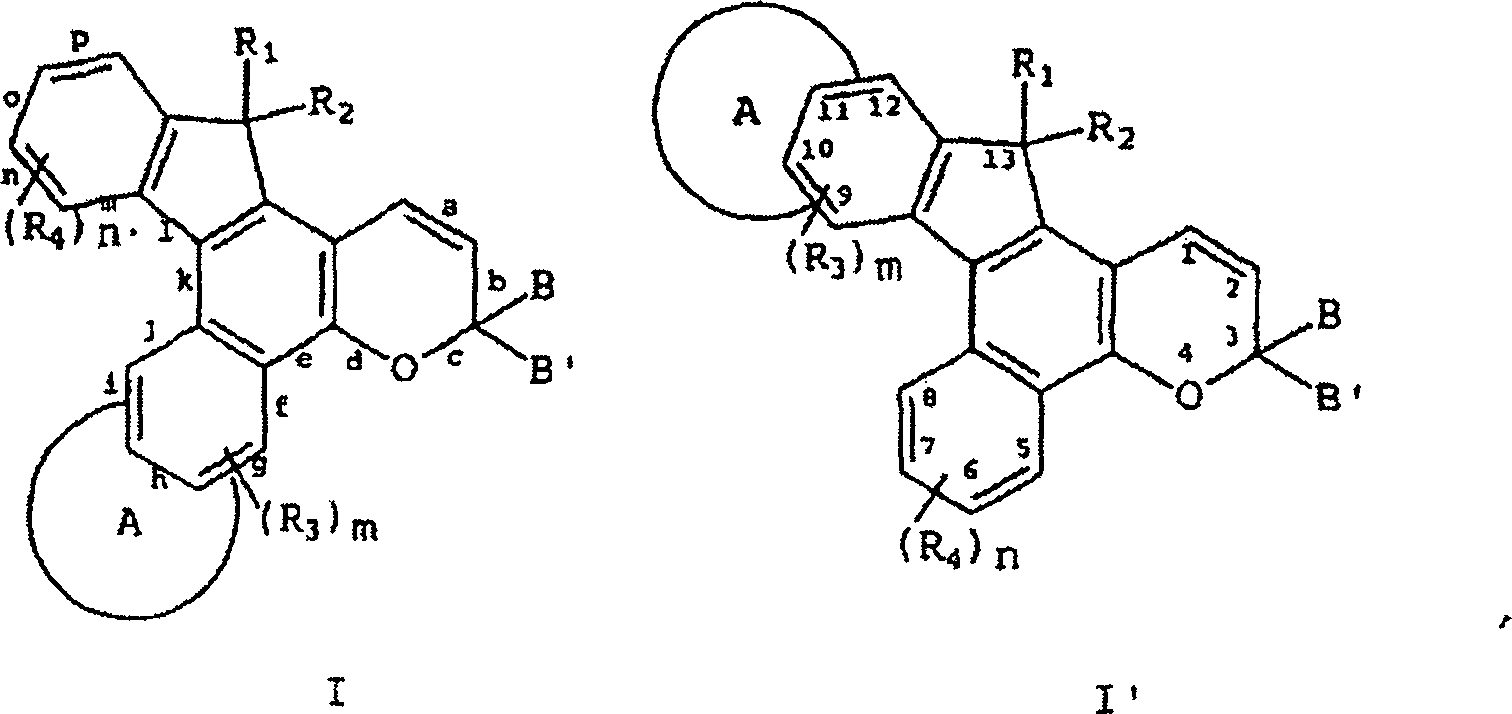
In den grafischen Formeln I und I' kann A ein unsubstituierter, monosubstituierter oder disubstituierter oder heterocyclischer Ring sein, ausgewählt aus der Gruppe bestehend aus Benzothieno, Benzofurano und Indolo, wobei die 2,3- oder 3,2-Positionen des heterocyclischen Rings an die g-, h-, i-, n-, o- oder p-Seite des Indenonaphthopyrans fusioniert sind. Jeder der oben beschriebenen heterocyclischen Ringsubstituenten kann C1-C6-Alkyl, C5-C7-Cycloalkyl, C1-C6-Alkoxy, Brom, Chlor oder Fluor sein. Vorzugsweise ist der heterocyclische Ring A unsubstituiert oder monosubstituiert und die heterocyclischen Ringsubstituenten sind C1-C4-Alkyl oder C1-C4-Alkoxy. Am meisten bevorzugt ist der heterocyclische Ring A unsubstituiert oder monosubstituiert, die 2,3- oder 3,2-Position des heterocyclischen Rings ist an die g- oder p-Seite des Indenonaphthopyrans fusioniert und die heterocyclischen Ringsubstituenten sind C1-C3-Alkyl oder C1-C3-Alkoxy.In the graphic formulas I and I ', A may be an unsubstituted, monosubstituted or disubstituted or heterocyclic ring selected from the group consisting of benzothieno, benzofurano and indolo wherein the 2,3 or 3,2-positions of the heterocyclic ring are attached to the g-, h-, i-, n-, o- or p-side of indenonaphthopyran are fused. Any of the heterocyclic ring substituents described above may be C 1 -C 6 alkyl, C 5 -C 7 cycloalkyl, C 1 -C 6 alkoxy, bromine, chlorine or fluorine. Preferably, the heterocyclic ring A is unsubstituted or monosubstituted and the heterocyclic ring substituents are C 1 -C 4 alkyl or C 1 -C 4 alkoxy. Most preferably, the heterocyclic ring A is unsubstituted or monosubstituted, the 2,3- or 3,2-position of the heterocyclic ring is fused to the g- or p-side of the indenonaphthopyran, and the heterocyclic ring substituents are C 1 -C 3 -alkyl or C 1 -C 3 alkoxy.
In der grafischen Formel I kann R1 Wasserstoff, Hydroxy, Brom, Fluor oder Chlor sein, und R2 kann die Gruppe CH(V)2 sein, worin V gleich -CN oder -COOR5 ist, und jedes R5 stellt Wasserstoff, C1-C6-Alkyl, Phenyl-(C1-C3)-alkyl, mono-(C1-C6)-alkylsubsituiertes Phenyl-(C1-C3)-alkyl, mono-(C1-C6)-alkoxysubstituiertes Phenyl-(C1-C3)-alkyl oder die unsubstituierten, mono- oder disubstituierten Arylgruppen Phenyl oder Naphthyl dar, oder R2 kann die Gruppe -CH(R6)Y sein, worin R6 Wasserstoff, C1-C6-Alkyl oder die unsubstituierte, mono- oder disubstituierte Arylgruppen Phenyl oder Naphthyl darstellt, und Y -COOR5, -COR7 oder -CH2OR11 ist, worin R7 Wasserstoff, C1-C6-Alkyl, die unsubstituierten, mono- oder disubstituierten Arylgruppen Phenyl oder Naphthyl, Amino, Mono-C1-C6-alkylamino, Di-(C1-C6)-alkylamino, beispielsweise Dimethylamino, Methylpropylamino, etc., Phenylamino, Mono- oder Di-(C1-C6)-alkyl-substituiertes Phenylamino, mono- oder di-(C1-C6)-alkoxy es Phenylamino, Diphenylamino, mono- oder di-(C1-C6)-alkyl-substituiertes Diphenylamino darstellt, d. h. jedes Phenyl weist einen oder zwei C1-C6-Alkylsubsituenten auf, mono- oder di-(C1-C6)-alkoxy-substituiertes Diphenylamino, Morpholino oder Piperidino darstellt; R11 Wasserstoff, -COR5, C1-C6-Alkyl, C1-C3-Alkoxy-(C1-C6)-alkyl, Phenyl-(C1-C3)-alkyl, mono-(C1-C6)-alkylsubsituiertes Phenyl-(C1-C3)-alkyl, mono-(C1-C6)-alkoxy-substituiertes Phenyl-(C1-C3)-alkyl oder die unsubstituierten, mono- oder disubstituierten Arylgruppen Phenyl oder Naphthyl darstellt, wobei alle der oben genannten Arylgruppen Substituenten C1-C6-Alkyl oder C1-C6-Alkoxy sind. Alternativ können R1 und R2 zusammen die Gruppen =C(V)2 oder =C(R6)W ausbilden, wobei W gleich -COOR5 oder -COR7 ist.In graphic formula I, R 1 may be hydrogen, hydroxy, bromo, fluoro or chloro, and R 2 may be the group CH (V) 2 wherein V is -CN or -COOR 5 , and each R 5 is hydrogen, C 1 -C 6 alkyl, phenyl (C 1 -C 3 ) alkyl, mono- (C 1 -C 6 ) alkyl substituted phenyl (C 1 -C 3 ) alkyl, mono (C 1 -C 6 ) -alkoxy-substituted phenyl (C 1 -C 3 ) -alkyl or the unsubstituted, mono- or disubstituted aryl groups phenyl or naphthyl, or R 2 may be the group -CH (R 6 ) Y, where R 6 is hydrogen, C C 1 -C 6 -alkyl or the unsubstituted, mono- or disubstituted aryl groups is phenyl or naphthyl, and Y is -COOR 5 , -COR 7 or -CH 2 OR 11 , in which R 7 is hydrogen, C 1 -C 6 -alkyl, the unsubstituted, mono- or disubstituted aryl groups phenyl or naphthyl, amino, mono-C 1 -C 6 alkylamino, di (C 1 -C 6 ) alkylamino, for example dimethylamino, methylpropylamino, etc., phenylamino, mono- or di - (C 1 -C 6 ) -alkyl-substituted phenylamino, mono-o the di (C 1 -C 6 ) alkoxy is phenylamino, diphenylamino, mono- or di- (C 1 -C 6 ) alkyl-substituted diphenylamino, ie each phenyl has one or two C 1 -C 6 alkyl substituents represents mono- or di (C 1 -C 6 ) alkoxy-substituted diphenylamino, morpholino or piperidino; R 11 is hydrogen, -COR 5 , C 1 -C 6 alkyl, C 1 -C 3 alkoxy (C 1 -C 6 ) alkyl, phenyl (C 1 -C 3 ) alkyl, mono- (C 1 -C 6) -alkylsubsituiertes phenyl- (C 1 -C 3 alkyl), mono- (C 1 -C 6) alkoxy substituted phenyl (C 1 -C 3) alkyl or the unsubstituted, mono- or disubstituted aryl groups is phenyl or naphthyl, wherein all of the abovementioned aryl groups are substituents C 1 -C 6 -alkyl or C 1 -C 6 -alkoxy. Alternatively, R 1 and R 2 may together form the groups = C (V) 2 or = C (R 6 ) W, where W is -COOR 5 or -COR 7 .
Vorzugsweise ist R1 Wasserstoff, Hydroxy, Fluor oder Chlor und R2 ist die Gruppe -CH(V)2, worin V gleich -CN oder gleich -COOR5 ist und jedes R5 stellt Wasserstoff, C1-C4-Alkyl, Phenyl-(C1-C2)-alkyl, mono-(C1-C4)-alkylsubsituiertes Phenyl-(C1-C2)-alkyl, mono-(C1-C4)-alkoxysubsituiertes Phenyl-(C1-C2)-alkyl oder die unsubsituierten oder mono-substituierten Alkylgruppen Phenyl oder Naphthyl dar oder R2 ist die Gruppe -CH(R6)Y, worin R6 Wasserstoff, C1-C4-Alkyl oder die unsubstituierten oder mono-substituierten Arylgruppen Phenyl oder Naphthyl und Y gleich -COOR5, -COR7 oder -CH2OR11 darstellt, wobei R7 Wasserstoff, C1-C4-Alkyl, die unsubstituierten oder mono-substituierten Arylgruppen Phenyl oder Naphthyl, Amino, Mono-(C1-C4)-alkylamino, Di-(C1-C4)-alkylamino, Phenylamino, mono- oder di-(C1-C4)-alkyl-substituiertes Phenylamino, mono- oder di-(C1-C4)-alkoxy-substituiertes Phenylamino, Diphenylamino, mono- oder di-(C1-C4)-alkylsubsituiertes Diphenylamino, mono- oder di-(C1-C4)-alkoxy-substituiertes Diphenylamino, Morpholino oder Piperidino ist; R11 stellt Wasserstoff, -COR5, C1-C4-Alkyl, C1-C2-Alkoxy-(C1-C4)-alkyl, Phenyl-(C1-C2)-alkyl, mono-(C1-C4)-alkyl-substituiertes Phenyl-(C1-C2)-alkyl, mono-(C1-C4)-alkoxy-substituiertes Phenyl-(C1-C2)-alkyl oder die unsubstituierten oder mono-substituierten Alkylgruppen Phenyl oder Naphthyl dar, wobei alle der oben genannten Arylgruppensubstituenten C1-C4-Alkyl oder C1-C4-Alkoxy sind.Preferably R 1 is hydrogen, hydroxy, fluorine or chlorine and R 2 is the group -CH (V) 2 wherein V is -CN or -COOR 5 and each R 5 is hydrogen, C 1 -C 4 -alkyl, Phenyl (C 1 -C 2 ) alkyl, mono- (C 1 -C 4 ) alkyl-substituted phenyl (C 1 -C 2 ) alkyl, mono- (C 1 -C 4 ) alkoxy-substituted phenyl (C C 1 -C 2 ) -alkyl or the unsubstituted or mono-substituted alkyl groups phenyl or naphthyl or R 2 is the group -CH (R 6 ) Y, wherein R 6 is hydrogen, C 1 -C 4 alkyl or the unsubstituted or mono-substituted aryl groups phenyl or naphthyl and Y is -COOR 5 , -COR 7 or -CH 2 OR 11 , wherein R 7 is hydrogen, C 1 -C 4 -alkyl, the unsubstituted or monosubstituted aryl groups phenyl or naphthyl, amino, mono- (C 1 -C 4 ) -alkylamino, di- (C 1 -C 4 ) -alkylamino, phenylamino , mono- or di- (C 1 -C 4 ) -alkyl-substituted phenylamino, mono- or di- (C 1 -C 4 ) -alkoxy-substituted phenylamino, diphenylamino, mono- or di- (C 1 -C 4 ) -alkyl-substituted diphenylamino, mono- or di- (C 1 -C 4 ) -alkoxy-substituted diphenylamino, morpholino or piperidino; R 11 represents hydrogen, -COR 5 , C 1 -C 4 alkyl, C 1 -C 2 alkoxy (C 1 -C 4 ) alkyl, phenyl (C 1 -C 2 ) alkyl, mono- (C 1 -C 4 ) alkyl, C 1 -C 4 ) -alkyl-substituted phenyl (C 1 -C 2 ) -alkyl, mono- (C 1 -C 4 ) -alkoxy-substituted phenyl (C 1 -C 2 ) -alkyl or the unsubstituted or mono-substituted alkyl groups phenyl or naphthyl, all of the abovementioned aryl group substituents being C 1 -C 4 -alkyl or C 1 -C 4 -alkoxy.
Mehr bevorzugt ist R1 Wasserstoff, Hydroxy oder Chlor und R2 ist die Gruppe -CH(V)2, worin V gleich CN ist, oder R2 ist die Gruppe -CH(R6)Y, worin R6 Wasserstoff oder C1-C4-Alkyl darstellt und Y -COOR5 oder -CH2OR11 ist, worin R5 Wasserstoff oder C1-C4-Alkyl darstellt, und R11 Wasserstoff, -COR5 oder C1-C4-Alkyl ist. Alternativ bilden R1 und R2 die Gruppe =C(V)2 oder =C(R6)W aus, worin W gleich -COOR5 ist.More preferably R 1 is hydrogen, hydroxy or chloro and R 2 is the group -CH (V) 2 wherein V is CN or R 2 is the group -CH (R 6 ) Y wherein R 6 is hydrogen or C 1 C 4 alkyl and Y is -COOR 5 or -CH 2 OR 11 , wherein R 5 is hydrogen or C 1 -C 4 alkyl, and R 11 is hydrogen, -COR 5 or C 1 -C 4 alkyl , Alternatively, R 1 and R 2 form the group = C (V) 2 or = C (R 6 ) W, where W is -COOR 5 .
In den grafischen Formeln I und I' können R3 und R4 jeweils C1-C6-Alkyl, C1-C6-Alkoxy, Brom, Chlor oder Fluor sein, und m und n sind ganze Zahlen 0, 1 oder 2. Vorzugsweise sind R1 und R2 jeweils C1-C4-Alkyl, C1-C4-Alkoxy, Chlor oder Fluor, und m und n sind jeweils ganze Zahlen 0 oder 1. Am meisten bevorzugt sind R3 und R4 jeweils C1-C3-Alkyl und C1-C3-Alkoxy, und m und n sind die ganzen Zahlen 0 oder 1.In graphic formulas I and I ', R 3 and R 4 may each be C 1 -C 6 alkyl, C 1 -C 6 alkoxy, bromine, chlorine or fluorine, and m and n are integers 0, 1 or 2 Preferably, R 1 and R 2 are each C 1 -C 4 alkyl, C 1 -C 4 alkoxy, chloro or fluoro, and m and n are each integers 0 or 1. Most preferably, R 3 and R 4 are each C 1 -C 3 alkyl and C 1 -C 3 alkoxy, and m and n are the integers 0 or 1.
B
und B' in den grafischen
Formeln I und I' können jeweils
ausgewählt
sein aus der Gruppe bestehend aus: (I) den unsubstituierten mono-,
di- und trisubsubstituierten Arylgruppen Phenyl und Naphthyl; (II)
den unsubstituierten, mono- und disubstituierten aromatischen heterocyclischen
Gruppen Pyridyl, Furanyl, Benzofuran-2-yl, Benzofuran-3-yl, Thienyl,
Benzothien-2-yl, Benzothien-3-yl, Dibenzofuranyl, Dibenzothienyl,
Carbazolyl und Fluorenyl, wobei ein jeder von den besagten Aryl-
und aromatischen heterocyclischen Substituenten in den Teilen (I)
und (II) ausgewählt
ist aus der Gruppe bestehend aus Hydroxy, Aryl, Mono-(C1-C6)-alkoxyaryl, Di-(C1-C6)-alkoxyaryl, Mono-(C1-C6)-alkylaryl, Di-(C1-C6)-alkylaryl, Bromoaryl, Chloroaryl, Fluoroaryl,
C3-C7-Cycloalkylaryl,
C3-C7-Cycloalkyl,
C3-C7-Cycloalkyloxy,
C3-C7-Cycloalkyloxy-(C1-C6)-alkyl, C3-C7-Cycloalkyloxy-(C1-C6)-alkyl, C3-C7-Cycloalkyloxy-(C1-C6)-alkoxy, Aryl-(C1-C6)-alkyl, Aryl-(C1-C6)-alkoxy, Aryloxy, Aryloxy-(C1-C6)-alkyl, Aryloxy-(C1-C6)-alkoxy,
Mono- und Di-(C1-C6)-alkylaryl-(C1-C6)-alkyl, Mono-
und Di-(C1-C6)-alkoxyaryl-(C1-C6)-alkyl, Mono-
und Di-(C1-C6)-alkylaryl-(C1-C6)-alkoxy, Mono-
und Di-(C1-C6)-alkoxyaryl-(C1-C6)-alkoxy, Amino,
Mono-(C1-C6)-alkylamino,
Di-(C1-C6)-alkylamino, Diarylamino,
N-(C1-C6)-Alkylpiperazino,
N-Arylpiperazino, Aziridino, Indolino, Piperidino, Arylpiperidino,
Morpholino, Thiomorpholino, Tetrahydrochinolino, Tetrahydroisochinolino,
Pyrryl, C1-C6-Alkyl,
C1-C6-Bromoalkyl,
C1-C6-Chloroalkyl,
C1-C6-Fluoroalkyl, C1-C6-Alkoxy, Mono-(C1-C6)-alkoxy-(C1-C4)-alkyl, Acryloxy,
Methacryloxy, Brom, Chlor und Fluor; (III) den Gruppen, repräsentiert
durch folgende grafischen Formeln: 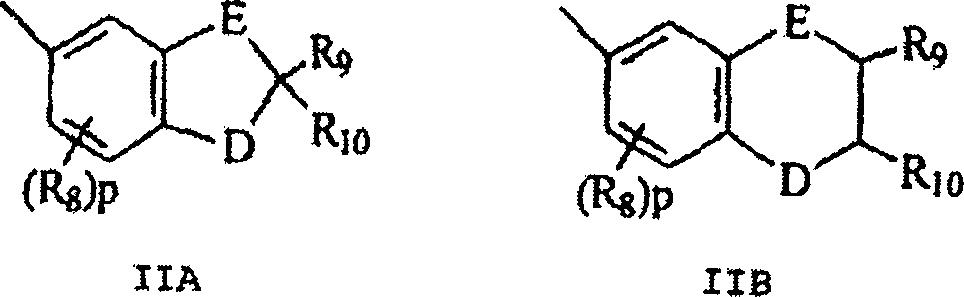
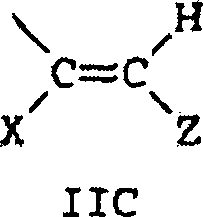
Mehr bevorzugt sind B und B' jeweils ausgewählt aus der Gruppe bestehend aus: (I) Phenyl, mono-substituierter Phenyl und disubstituiertes Phenyl, vorzugsweise substituiert in der meta- und/oder para-Position; (II) den unsubstituierten mono- und disubstituierten aromatischen heterocyclischen Gruppen Furanyl, Benzofuran-2-yl, Thienyl, Benzothien-2-yl, Dibenzofuran-2-yl und Dibenzothien-2-yl, wobei jeder der besagten Phenyl- und aromatischen heterocyclischen Substituenten in (I) und (II) ausgewählt ist aus der Gruppe bestehend aus Hydroxy, Aryl, Aryloxy, Aryl-(C1-C3)-alkyl, Amino, Mono-(C1-C3)-alkylamino, Di-(C1-C3)-alkylamino, N-(C1-C3)-Alkylpiperazino, Indolino, Piperidino, Morpholino, Pyrryl, C1-C3-Alkyl, C1-C3-Chloralkyl, C1-C3-Fluoralkyl, C1-C3-Alkoxy, Mono-(C1-C3)-akoxy-(C1-C3)-alkyl, Fluor und Chlor; (III) der Gruppe repräsentiert durch die grafischen Formeln IIA und IIB, worin E Kohlenstoff und D Sauerstoff ist, R8 C1-C3-Alkyl oder C1-C3-Alkoxy ist, R9 und R10 jeweils Wasserstoff oder C1-C4-Alkyl sind; und p die ganze Zahl 0 oder 1 ist; (IV) C1-C4-Alkyl; und (V) der Gruppe repräsentiert durch die grafische Formel IIC, worin X Wasserstoff oder Methyl ist und Z Phenyl oder monosubstituiertes Phenyl ist, wobei besagter Phenylsubstituent ausgewählt ist aus der Gruppe bestehend aus C1-C3-Alkyl, C1-C3-Alkoxy und Fluor ist; oder (VI) B und B' gemeinsam genommen Fluoren-9-yliden ausbilden, monosubstituiertes Fluoren-9-yliden oder ein Mitglied, ausgewählt aus der Gruppe bestehend aus gesättigten C3-C8-spiro-monocyclischen Kohlenwasserstoffringen, gesättigten C7-C10-spiro-bicyclischen Kohlenwasserstoffringen und gesättigten C7-C10-spiro-bicyclischen Kohlenwasserstoffringen, wobei besagter Fluoren-9-yliden-Substituent ausgewählt ist aus der Gruppe bestehend aus C1-C3-Alkyl, C1-C3-Alkoxy, Fluor und Chlor.More preferably, B and B 'are each selected from the group consisting of: (I) phenyl, mono-substituted phenyl and disubstituted phenyl, preferably substituted in the meta and / or para position; (II) the unsubstituted mono- and di-substituted aromatic heterocyclic groups furanyl, benzofuran-2-yl, thienyl, benzothien-2-yl, dibenzofuran-2-yl and dibenzothien-2-yl, each of said phenyl and aromatic heterocyclic substituents in (I) and (II) is selected from the group consisting of hydroxy, aryl, aryloxy, aryl- (C 1 -C 3 ) -alkyl, amino, mono- (C 1 -C 3 ) -alkylamino, di- ( C 1 -C 3 ) -alkylamino, N- (C 1 -C 3 ) -alkylpiperazino, indolino, piperidino, morpholino, pyrryl, C 1 -C 3 -alkyl, C 1 -C 3 -chloroalkyl, C 1 -C 3 Fluoroalkyl, C 1 -C 3 alkoxy, mono (C 1 -C 3 ) alkoxy (C 1 -C 3 ) alkyl, fluoro and chloro; (III) the group represented by the graphic formulas IIA and IIB, wherein E is carbon and D is oxygen, R 8 is C 1 -C 3 alkyl or C 1 -C 3 alkoxy, R 9 and R 10 are each hydrogen or C C 1 -C 4 alkyl; and p is the integer 0 or 1; (IV) C 1 -C 4 alkyl; and (V) the group represented by the graphic formula IIC wherein X is hydrogen or methyl and Z is phenyl or monosubstituted phenyl, said phenyl substituent being selected from the group consisting of C 1 -C 3 alkyl, C 1 -C 3 Alkoxy and fluorine; or (VI) B and B 'taken together form fluoren-9-ylidene, monosubstituted fluoren-9-ylidene or a member selected from the group consisting of saturated C 3 -C 8 -spiro-monocyclic hydrocarbon rings, saturated C 7 -C 10- spiro-bicyclic hydrocarbon rings and saturated C 7 -C 10 -spiro-bicyclic hydrocarbon rings, wherein said fluoren-9-ylidene substituent is selected from the group consisting of C 1 -C 3 -alkyl, C 1 -C 3 -alkoxy , Fluorine and chlorine.
Am meisten bevorzugt sind B und B' ausgewählt aus der Gruppe bestehend aus (I) Phenyl, mono- und disubstituiertem Phenyl; (II) den unsubstituierten, mono- und disubstituierten aromatischen heterocyclischen Gruppen Furanyl, Benzofuran-2-yl, Thienyl und Benzothien-2-yl, wobei jeder von besagten Phenyl- und aromatischen heterocyclischen Substituenten in (II) und (II) ausgewählt ist aus der Gruppe bestehend aus Hydroxy, C1-C3-Alkyl, C1-C3-Alkoxy, Aryl, Indolino, Fluoro und Chloro ist; und (III) der Gruppe repräsentiert durch die grafische Formel IIA, worin E Kohlenstoff und D Sauerstoff ist, R8 C1-C3-Alkyl oder C1-C3-Alkoxy ist; R9 und R10 jeweils Wasserstoff oder C1-C3-Alkyl sind; und p die ganze Zahl 0 oder 1 ist; oder (IV) B und B', gemeinsam genommen, Fluoren-9-yliden, Adamantyliden, Bomyliden, Norbornyliden oder Bicyclo[3.3.1]nonan-9-yliden ausbilden.Most preferably, B and B 'are selected from the group consisting of (I) phenyl, mono- and disubstituted phenyl; (II) the unsubstituted, mono- and di-substituted aromatic heterocyclic groups furanyl, benzofuran-2-yl, thienyl and benzothien-2-yl, each of which is selected from said phenyl and aromatic heterocyclic substituents in (II) and (II) the group consisting of hydroxy, C 1 -C 3 alkyl, C 1 -C 3 alkoxy, aryl, indolino, fluoro and chloro; and (III) the group represented by the graphic formula IIA wherein E is carbon and D is oxygen, R 8 is C 1 -C 3 alkyl or C 1 -C 3 alkoxy; R 9 and R 10 are each hydrogen or C 1 -C 3 alkyl; and p is the integer 0 or 1; or (IV) B and B ', taken together, form fluoren-9-ylidene, adamantylidene, bomylidene, norbornylidene or bicyclo [3.3.1] nonan-9-ylidene.
Verbindungen repräsentiert durch die grafischen Formeln I und I', die die Substituenten R3 und R4, wie hier zuvor beschrieben, aufweisen, können durch die im Folgenden beschriebenen Reaktionen A bis E hergestellt werden. Verbindungen repräsentiert durch die grafischen Formeln V oder VA (wie in den Reaktionen A bzw. B gezeigt) werden durch Friedel-Crafts-Verfahren, wie in Reaktion A gezeigt, unter Verwendung eines geeignet substituierten oder unsubstituierten Benzoylchlorides der grafischen Formel IV mit einer kommerziell verfügbaren substituierten oder unsubstituierten heterocyclischen Verbindung der grafischen Formel III hergestellt. Siehe die Veröffentlichung Friedel-Crafts and Related Reactions, George A. Olah, Interscience Publishers, 1964, Vol. 3, Chapter XXXI (Aromatic Crafts Acylation of 1,2,3,4-Tetrahydroquinoline and Related Nitrogen Heterocycles: Effect on NH Protective Groups and Ring Size" bei Ishihara, Yugi et al., J. Chem. Soc., Perkin Trans. 1, Seiten 3401 bis 3406, 1992.Compounds represented by the graphic formulas I and I 'having the substituents R 3 and R 4 as described hereinbefore can be prepared by the reactions A to E described below. Compounds represented by graphic formulas V or VA (as shown in reactions A and B, respectively) are prepared by Friedel-Crafts methods as shown in Reaction A using a suitably substituted or unsubstituted benzoyl chloride of graphic formula IV with a commercially available one substituted or unsubstituted heterocyclic compound of graphic formula III. See the publication Friedel-Crafts and Related Reactions, George A. Olah, Interscience Publishers, 1964, Vol. 3, Chapter XXXI (Aromatic Crafts Acylation of 1,2,3,4-Tetrahydroquinolines and Related Nitrogen Heterocycles: Effect on NH Protective Groups and Ring Size "in Ishihara, Yugi et al., J. Chem. Soc., Perkin Trans. 1, pp. 3401-4406, 1992.
In Reaktion A werden die Verbindungen repräsentiert durch die grafischen Formeln III (wobei X Sauerstoff, Stickstoff oder Schwefel ist) und IV in einem Solvens aufgelöst, beispielsweise in Schwefelkohlenstoff oder Methylenchlorid, und in der Gegenwart einer Lewissäule, wie z. B. Aluminiumchlorid oder Zinntetrachlorid, umgesetzt, um das korrespondierende substituierte Benzophenon repräsentiert durch die grafische Formel V auszubilden.In Reaction A, the compounds are represented by the graphical Formulas III (wherein X is oxygen, nitrogen or sulfur) and IV dissolved in a solvent, for example, in carbon disulfide or methylene chloride, and in the presence of a Lewis column, such as As aluminum chloride or tin tetrachloride reacted to represents the corresponding substituted benzophenone through the graphic formula V.
REAKTION
A 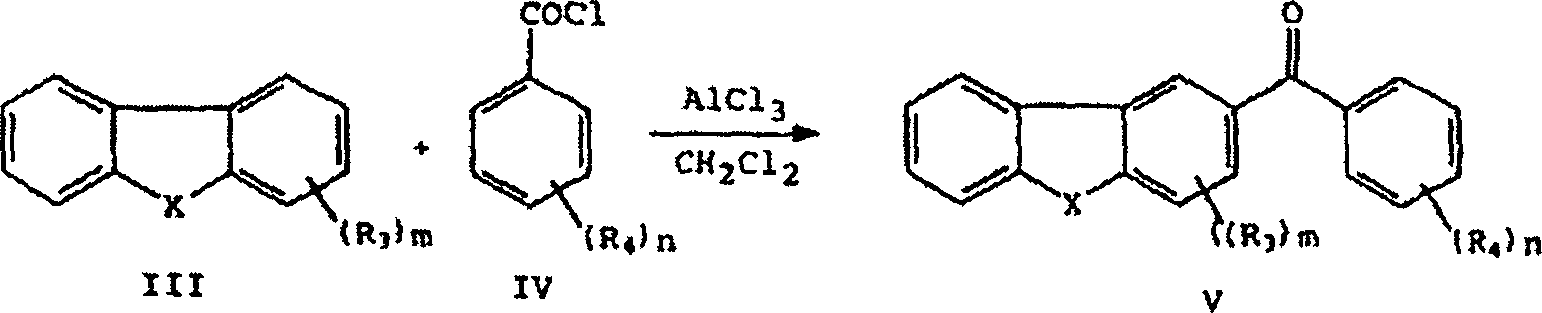
In Reaktion B wird das substituierte oder unsubstituierte Keton, repräsentiert durch die grafische Formel VA mit Natriumazetylid in einem geeigneten Solvens, wie z. B. anhydridischem Tetrahydrofuran (THF), umgesetzt, um den korrespondierenden Propargylalkohol, repräsentiert durch die grafische Formel VI auszubilden. Propargylalkohole, welche B- oder B'-Gruppen aufweisen, die sich von substituiertem und unsubstituiertem Phenyl unterscheiden, können aus kommerziell verfügbaren Ketonen oder Ketonen hergestellt durch die Reaktion eines Acylhalogenides mit einem substituierten oder unsubstituierten Benzol, Naphthalin oder einer heteroaromatischen Verbindung hergestellt werden. Propargylalkohole, welche eine B- oder B'-Gruppe aufweisen und repräsentiert durch die grafische Formel IIC wären, können durch die Verfahren wie in US-Patent 5,274,132, Spalte 2, Zeilen 40 bis 68 beschrieben, hergestellt werden.In Reaction B is the substituted or unsubstituted ketone by the graphic formula VA with sodium azetylide in a suitable Solvency, such as As anhydride tetrahydrofuran (THF), implemented, around the corresponding propargyl alcohol, represented by the graphic To train Formula VI. Propargyl alcohols having B or B 'groups, which differ from substituted and unsubstituted phenyl, can from commercially available Ketones or ketones produced by the reaction of an acyl halide with a substituted or unsubstituted benzene, naphthalene or a heteroaromatic compound. propargyl, which is a B or B 'group have and represent by the graphic formula IIC, can by the methods described in U.S. Patent 5,274,132, column 2, lines 40 to 68 described.
REAKTION
B 
In Reaktion C wird das substituierte oder unsubstituierte Keton repräsentiert durch die grafische Formel V mit einem Ester von Succinsäure, wie z. B. Dimethylsuccinat, repräsentiert durch die grafische Formel VII umgesetzt. Die Addition der Reaktanten, an ein Solvens, beispielsweise Toluol, welches tert-Butoxykalium oder Natriumhydrid als die Base enthält, führt zu dem halben Ester der Stobbe-Kondensation, repräsentiert durch die grafische Formel VIII. Der halbe Ester (VIII) vollzieht eine Cyclodehydratation in der Gegenwart von Acetanhydrid, um die heterofusionierten Acetoxynaphthaline, repräsentiert durch die grafischen Formeln IXA und IXB auszubilden. Die Verbindung IXA und IXB können durch Kristallisation getrennt werden, in einer wässrig alkoholischen Lösung einer Base hydrolysiert werden, beispielsweise in Natriumhydroxid, gefolgt von einer Behandlung in einer wässrigen Salzsäure (H+), um die Carboxynaphthole, repräsentiert durch die grafischen Formeln XA bzw. XB auszubilden.In reaction C, the substituted or unsubstituted ketone is represented by the graphic formula V with an ester of succinic acid, such as e.g. As dimethyl succinate, represented by the graphic formula VII implemented. The addition of the reactants to a solvent, for example, toluene containing tert-butoxy-potassium or sodium hydride as the base, results in half the ester of the Stobbe condensation represented by graphic formula VIII. Half ester (VIII) undergoes cyclodehydration in the presence of acetic anhydride to form the heterofused acetoxynaphthalenes represented by the graphic formulas IXA and IXB. The compound IXA and IXB can be separated by crystallization, hydrolyzed in an aqueous-alcoholic solution of a base, for example in sodium hydroxide, followed by treatment in an aqueous hydrochloric acid (H + ) to give the carboxy naphthols represented by the graphic formulas XA and XA, respectively. To train XB.
REAKTION
C 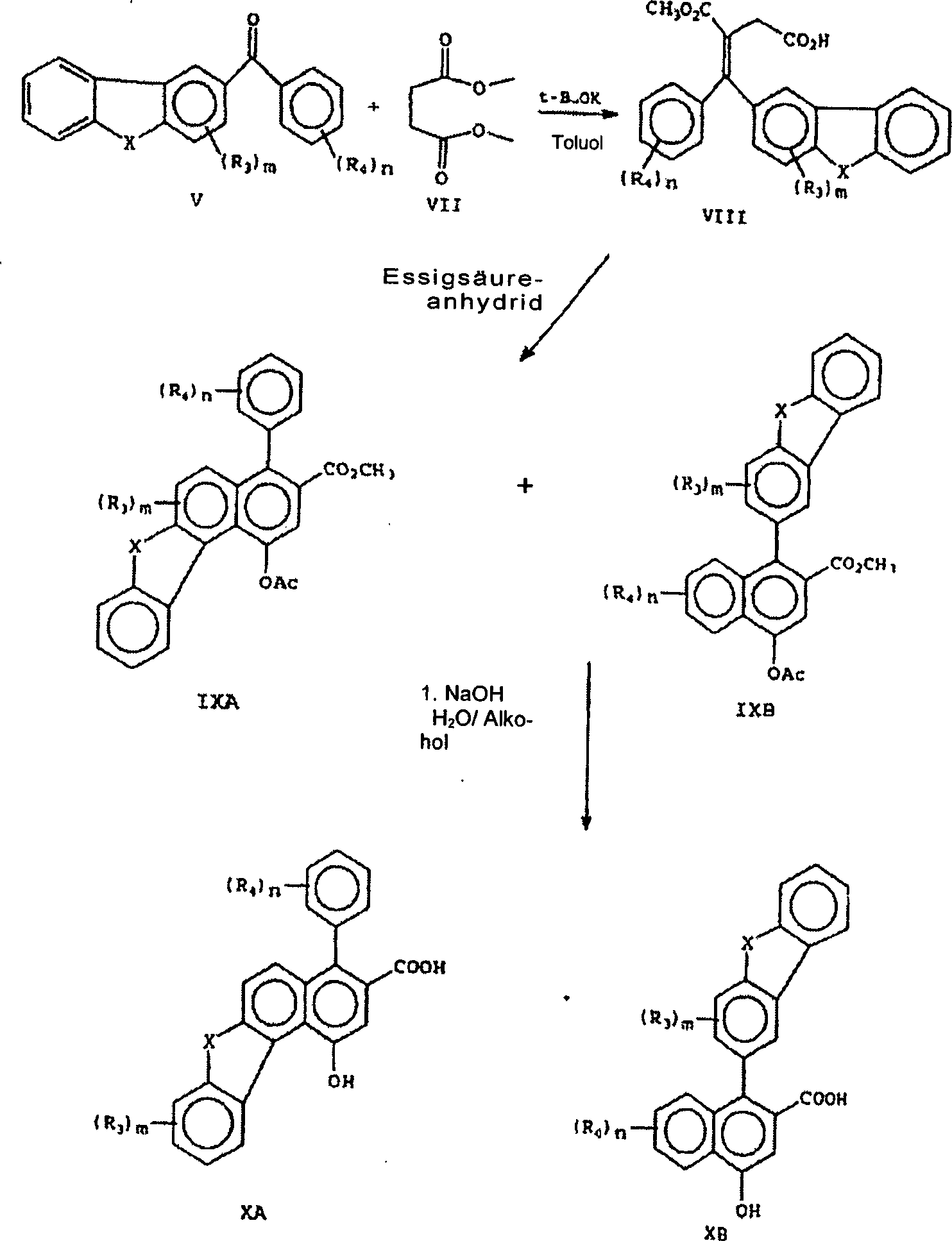
In Reaktion D werden Carboxynaphthole repräsentiert durch die grafischen Formeln XA und XB durch Erhitzen cyclisiert, z. B. von etwa 160°C auf etwa 220°C in der Gegenwart einer Säure, wie z. B. Phosphorsäure, um ein hydroxy-substituiertes benzfusioniertes Fluorenon repräsentiert durch die grafischen Formeln XIA und XIB auszubilden. Siehe den Artikel von F. G. Baddar et al. in J. Chem. Soc., Seite 986, 1958. Ein alternatives Verfahren zur Synthese der Verbindung repräsentiert durch die grafische Formel XIB wird von C. F. Koelsch in der Journal of Organic Chemistry, Volume 26, Seite 2590, 1961, beschrieben.In Reaction D, carboxynaphthols are represented by the graphic Formulas XA and XB are cyclized by heating, e.g. B. from about 160 ° C to about 220 ° C in the presence of an acid, such as B. phosphoric acid, represents a hydroxy-substituted benzofused fluorenone through the graphical formulas XIA and XIB. See the Article by F. G. Baddar et al. in J. Chem. Soc., page 986, 1958. An alternative method of synthesizing the compound represents through the graphical formula XIB is by C. F. Koelsch in the Journal of Organic Chemistry, Volume 26, page 2590, 1961.
Das Koppeln der Verbindungen repräsentiert durch die grafischen Formeln XIA und XIB mit Propargylalkohol repräsentiert durch die grafischen Formel VI in der Gegenwart einer katalytischen Menge einer Säure, beispielsweise Dodecylbenzolsulfonsäure (DBSA, dodecylbenzene sulfonic acid), resultiert in dem indeno-fusionierten Naphthopyran repräsentiert durch die grafischen Formeln IA und IB.The Coupling of the compounds represents represented by the graphic formulas XIA and XIB with propargyl alcohol through the graphical formula VI in the presence of a catalytic Amount of an acid, for example dodecylbenzenesulfonic (DBSA, dodecylbenzene sulfonic acid) results in the indeno-fused Naphthopyran represents through graphic formulas IA and IB.
REAKTION
D 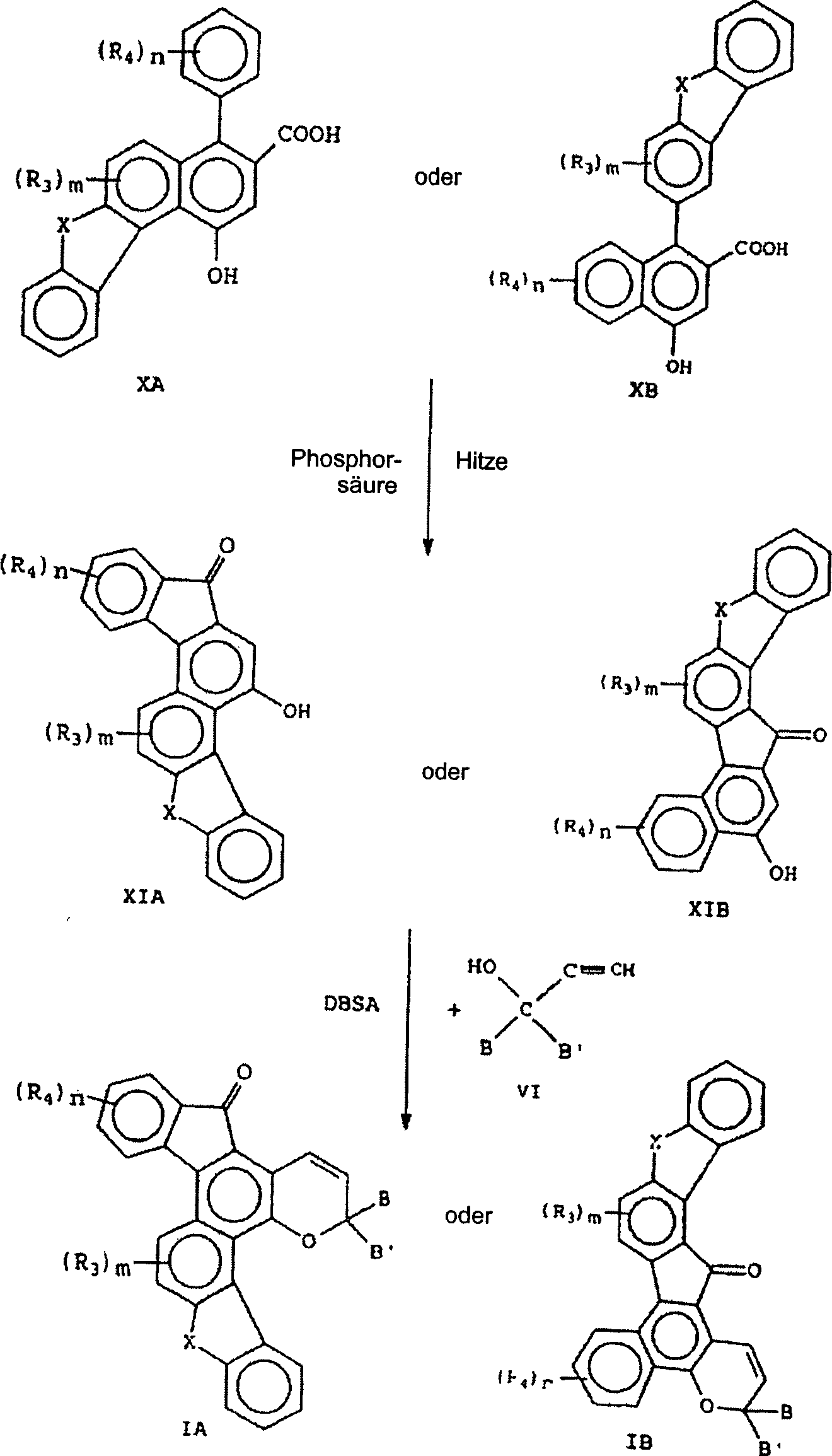
In Reaktion E werden weitere Verfahren zum Herstellen von Verbindungen repräsentiert durch die grafische Formel I', die eine Vielzahl von R1- und R2-Substituenten aufweist, beschrieben. Beginnend mit der Verbindung repräsentiert mit der grafischen Formel I'C führt die Behandlung mit einem α-Bromoester der grafischen Formel XII in der Gegenwart von aktiviertem Zinnstaub zu der Verbindung repräsentiert durch die grafische Formel I'D. Diese Reaktion, die man als Reformatsky-Reaktion bezeichnet, wird von R. L. Shriner in Organic Reactions, Vol. 1, Seiten 1–37, 1942, gereviewt. Die Verbindung repräsentiert durch die grafische Formel I'D kann des Weiteren mit chlorierenden Reagenzien umgesetzt werden, beispielsweise mit Thionylchlorid, um Derivate, repräsentiert durch die grafische Formel I'E herzustellen. Die Verbindung repräsentiert die grafische Formel I'E kann dehydrohalogeniert werden durch Erhitzen in der Gegenwart eines tertiären Amins, beispielsweise Collidin, um α,β-ungesättigte Ester der grafischen Formel I'F zu erhalten.In Reaction E, other methods of preparing compounds represented by the graphic formula I 'having a plurality of R 1 and R 2 substituents are described. Beginning with the compound represented by the graphic formula I'C, treatment with an α-bromoester of graphic formula XII in the presence of activated tin dust results in the compound represented by the graphic formula I'D. This reaction, called the Reformatsky reaction, is reviewed by RL Shriner in Organic Reactions, Vol. 1, pp. 1-37, 1942. The compound represented by the graphic formula I 'D can be further reacted with chlorinating reagents, for example with thionyl chloride, to produce derivatives represented by the graphic formula I'E. The compound represents the graphic formula I'E can be dehydrohalogenated by heating in the presence of a tertiary amine, for example collidine, to obtain α, β-unsaturated esters of the graphic formula I'F.
Alternativ kann die Verbindung repräsentiert durch die grafische Formel I'C mit einer Verbindung kondensiert werden, die ein aktives Methylen repräsentiert durch die grafische Formel XIII enthält, und zwar in der Gegenwart eines Amins, um die Verbindung repräsentiert durch die grafische Formel I'G herzustellen. Diese Reaktion, die man als die Knoevenagel-Kondensation bezeichnet, wird von G. Jones in Organic Reactions, Vol. 15, Seiten 204–599, 1967, gereviewt.alternative can represent the connection through the graphic formula I'C be condensed with a compound that is an active methylene represents through graphic formula XIII, in the presence of an amine, represented by the graphical connection Formula I'G produce. This reaction, known as the Knoevenagel condensation, is reviewed by G. Jones in Organic Reactions, Vol. 15, pp. 204-599, 1967, gereviewt.
Alle die Schritte der Reaktion E können auch mit einer Verbindung durchgeführt werden, welche analog zu der Verbindung repräsentiert durch die grafische Formel I'C ist, jedoch die A-Gruppe in der Position aufweist, wie in der grafischen Formel I repräsentiert.All the steps of the reaction E can also be carried out with a compound which analogous to represents the connection through the graphic formula I'C is, however, having the A group in the position as in the graphic Formula I represents.
REAKTION
E 
Verbindungen repräsentiert durch die grafische Formel I, I', IA, IB, I'C, I'D, I'E, I'F und I'G können in denjenigen Anwendungen verwendet werden, in welchen organische fotochrome Substanzen eingesetzt werden können, wie z. B. für optische Linsen, z. B. die Sehkraft korrigierenden Brillengläser und Planlinsen, Gesichtsschilde, Schutzbrillen, Visiere, Kameralinsen, Fenster, Auto-Windschutzscheiben, transparente Materialien in Flugzeugen und Autos, z. B. T-Roofs, Seiten- und Rücklichter, Filme aus Plastik und Beschichtungen, Textilien und Coatings, beispielsweise Coating-Zusammensetzungen, wie z. B. Lackierungen und Verifikationsmarkierungen auf Sicherheitsdokumenten, beispielsweise Dokumenten, wie Banknoten, Pässen und Führerscheinen, für welche Authentifikation oder Verifikation der Authentizität gewünscht sein können. Heterocyclisch fusionierte Indenonaphthopyrane repräsentiert durch die oben beschriebenen grafischen Formeln zeigen Farbveränderungen von Farblos zu Farben, die von Orange bis Blau/Grau reichen.links represents by graphic formula I, I ', IA, IB, I'C, I'D, I'E, I'F and I'G may be in those Applications are used in which organic photochromic substances can be used such as For example optical lenses, z. As the eyesight correcting lenses and Plan lenses, face shields, goggles, visors, camera lenses, Windows, car windshields, transparent materials in aircraft and cars, z. T-Roofs, side and rear lights, plastic films and coatings, textiles and coatings, for example, coating compositions, such as z. Painting and verification marks on security documents, For example, documents such as banknotes, passports and driver's licenses, for which Authentication or verification of authenticity may be desired can. Heterocyclic fused indenonaphthopyrans represented through the graphical formulas described above show color changes from colorless to colors ranging from orange to blue / gray.
Beispiele von in Erwägung gezogenen Indenonaphthopyranverbindungen innerhalb des Umfangs der Erfindung schließen die Folgenden ein:
- (a) 3,3-Di(4-methoxyphenyl)-16-(ethoxycarbonyl)methyl-16-hydroxy-3,16-di[H]-benzofuro[2',3':3,4]naptho[1,2-b]pyran;
- (b) 3-(4-Methoxyphenyl)-3-(4-morpholinophenyl)-16-(ethoxycarbonyl)methyl-16-hydroxy-3,16-di[H]-benzofuro[2',3':7,8]indeno[2',3':3,4]naphtho[1,2-b]pyran;
- (c) 3-Phenyl-3-(4-methoxyphenyl)-16-(ethoxycarbonyl)methyl-16-hydroxy-3,16-di[H]-benzofuro[2'',3'':6',7']indeno[3',2':4,3]naphtho[1,2-b]pyran; und
- (d) 3-Phenyl-3-(4-morpholinophenyl)-16-(ethoxycarbonyl)methyl-16-hydroxy-3,16-di[H]-benzofuro[2'',3'':6',7']ideno[3',2':4,3]naphtho[1,2-b]pyran.
- (a) 3,3-di (4-methoxyphenyl) -16- (ethoxycarbonyl) methyl-16-hydroxy-3,16-di [H] benzofuro [2 ', 3': 3,4] naptho [1, 2-b] pyran;
- (b) 3- (4-Methoxyphenyl) -3- (4-morpholinophenyl) -16- (ethoxycarbonyl) methyl-16-hydroxy-3,16-di [H] -benzofuro [2 ', 3': 7,8 ] indeno [2 ', 3': 3,4] naphtho [1,2-b] pyran;
- (c) 3-phenyl-3- (4-methoxyphenyl) -16- (ethoxycarbonyl) methyl-16-hydroxy-3,16-di [H] benzofuro [2 '', 3 '': 6 ', 7' ] indeno [3 ', 2': 4,3] naphtho [1,2-b] pyran; and
- (d) 3-phenyl-3- (4-morpholinophenyl) -16- (ethoxycarbonyl) methyl-16-hydroxy-3,16-di [H] benzofuro [2 '', 3 '': 6 ', 7' ] ideno [3 ', 2': 4,3] naphtho [1,2-b] pyran.
Es ist in Erwägung gezogen worden, dass die organisch fotochromen Idenonaphthopyrane der vorliegenden Erfindung allein, in Kombination mit anderen Idenonaphthopyranen der vorliegenden Erfindung oder in Kombination mit einem oder mehreren anderen geeigneten komplementären organischen fotochromen Materialien, d. h. organisch fotochromen Verbindungen, die zumindest ein aktiviertes Absorptionsmaximum innerhalb des Bereiches zwischen ungefähr 400 und 700 Nanometer aufweisen, oder mit Substanzen, die solche enthalten, verwendet werden können und eingebracht, d. h. in einem polymerischen organischen Wirtsmaterial aufgelöst oder dispergiert werden können, das verwendet wird, um fotochrome Artikel herzustellen und dessen Farbe bei Aktivierung einen geeigneten Farbton einnimmt.It is under consideration been drawn that the organic photochromic Idenonaphthopyrane of the present invention alone, in combination with other idenonaphthopyrans of the present invention or in combination with one or more other suitable complementary organic photochromic materials, d. H. organic photochromes Compounds having at least one activated absorption maximum within of the area between about 400 and 700 nanometers, or with substances containing such can be used and introduced, d. H. dissolved in a polymeric organic host material or can be dispersed, used to make photochromic articles and their color when activated occupies a suitable color.
Außer dort, wo es anders angezeigt wird, verstehen sich alle Zahlen, die Wellenlängen ausdrücken, Mengen von Bestandteilen oder Reaktionsbedingungen, die hier verwendet werden, als modifiziert in allen Fällen um die Bezeichnung "ungefähr".Except there, where indicated otherwise, all numbers expressing wavelengths are quantities of ingredients or reaction conditions used here be modified as in all cases to the term "about".
Beispiele von komplementären organischen fotochromen Verbindungen schließen andere Indenonaphthopyrane, Chromene und Oxazine, beispielsweise Naphthopyrane, welche die 2,1-Position einer Indenogruppe fusioniert an die f-Seite des Naphtho-Teils aufweisen, und bestimmte Substituenten an der 3-Position des Pyranrings, substituierte 2H-Phenanthro[4,3-b]pyran- und 3H-Phenanthro[1,2-b]pyranverbindungen, Benzopyranverbindungen, die Substituenten an der 2-Position des Pyranrings aufweisen, einschließend eine dibenzofusionierte 5-gliedrige heterocyclische Verbindung und einen substituierten oder unsubstituierten heterocyclischen Ring, wie z. B. einen Benzothieno- oder Benzufuranoring fusioniert an den Benzolteil des Benzopyrans, Spino(benzindolin)napththopyrane, Spiro(indolin)benzopyrane, Spino(indolin)naphthopyrane, Spiro(indolin)chinopyrane, Spiro(indolin)pyrane, Spino(indolin)napthoxazine, Spiro(indolin)pyridobenzoxazine, Spino(benzindolin)pyridobenzoxazine, Spiro(benzindolin)naphthoxazine, Spiro(indolin)benzoxazine und Mischung solcher fotochromer Verbindungen ein. Viele solcher fotochromer Verbindungen werden in der breiten Literatur beschrieben, beispielsweise in den US-Patenten Nr. 3,562,172; 3,567,605; 3,578,602; 4,215,010; 4,342,668; 4,816,584; 4,818,096; 4,826,977; 4,880,667; 4,931,219; 5,066,818; 5,238,931; 5,274,132; 5,384,077; 5,405,958; 5,429,774; 5,466,398; 5,514,817; 5,552,090; 5,552,091; 5,565,146; 5,573,712; 5,578,252; WO 96 14596 und in der japanische Patentveröffentlichung 62/195383. Spiro(indolin)pyrane werden auch in dem Text Techniques in Chemistry, Volume III, "Photochromism", Chapter 3, Glenn H. Brown, Editor, John Wiley and Sons, Inc., New York, 1971, beschrieben.Examples of complementary organic photochromic compounds include other indenonaphthopyrans, Chromene and oxazines, for example naphthopyrans, which are the 2,1-position having an indeno group fused to the f-side of the naphtho part, and certain substituents at the 3-position of the pyran ring, substituted 2H-phenanthro [4,3-b] pyran and 3H-phenanthro [1,2-b] pyran compounds, benzopyran compounds, which have substituents at the 2-position of the pyran ring, including a dibenzofusionierte 5-membered heterocyclic compound and a substituted or unsubstituted heterocyclic ring, such as. B. a Benzothieno- or Benzufuranoring fused to the benzene part of benzopyran, spino (benzindoline) naphthoopyranes, Spiro (indoline) benzopyrans, spino (indoline) naphthopyrans, spiro (indolino) quinopyrans, Spiro (indoline) pyranes, spino (indoline) napthoxazines, spiro (indoline) pyridobenzoxazines, spino (benzindoline) pyridobenzoxazines, Spiro (benzindoline) naphthoxazines, spiro (indoline) benzoxazines and mixtures such photochromic compounds. Many such photochromes Compounds are described in the broad literature, for example in U.S. Patent Nos. 3,562,172; 3,567,605; 3,578,602; 4,215,010; 4,342,668; 4,816,584; 4,818,096; 4,826,977; 4,880,667; 4,931,219; 5,066,818; 5,238,931; 5,274,132; 5,384,077; 5,405,958; 5,429,774; 5,466,398; 5,514,817; 5,552,090; 5,552,091; 5,565,146; 5,573,712; 5,578,252; WO 96 14596 and Japanese Patent Publication 62/195383. Spiro (indoline) pyrans are also mentioned in the text Techniques in Chemistry, Volume III, "Photochromism", Chapter 3, Glenn H. Brown, Editor, John Wiley and Sons, Inc., New York, 1971.
Andere fotochrome Substanzen, die in Erwägung gezogen sind, sind fotochrome Metalldithizonate, beispielsweise Quecksilberdithizonate, die beispielsweise in US-Patent 3,361,706 beschrieben sind, Fulgide und Fulgimide, wie z. B. die 3-Furyl- und 3-Thienylfulgide und Fulgimide, welche in US-Patent Nr. 4,931,220 in Spalte 20, Zeile 5 bis Spalte 21, Zeile 38 beschrieben werden.Other Photochromic substances that are considered are photochromic Metal dithizonates, for example mercury dithizonates, for example in U.S. Patent 3,361,706, fulgides and fulgimides, such as For example, the 3-furyl and 3-Thienylfulgide and fulgimides, which in US Pat. No. 4,931,220 at column 20, line 5 to column 21, Line 38 will be described.
Die Offenbarungen, die sich auf solche fotochrome Verbindungen in den oben genannten Patenten beziehen, sind in ihrer Gesamtheit per Verweis eingeschlossen. Die fotochromen Artikel der vorliegenden Erfindungen können eine fotochrome Verbindung oder eine Mischung von fotochromen Verbindungen je nach Bedarf enthalten.The Revelations referring to such photochromic compounds in the referenced above are incorporated by reference in their entirety locked in. The photochromic articles of the present invention can a photochromic compound or a mixture of photochromic compounds included as needed.
Jede der fotochromen Verbindungen, die hier beschrieben wird, kann in Mengen (oder in einem Anteil) verwendet werden, so dass ein organisches Wirtsmaterial, auf welches die fotochromen Verbindungen oder die Mischung der Verbindungen angewandt wird oder in welchen sie enthalten sind, eine gewünschte resultierende Farbe zeigt, beispielsweise eine substanziell neutrale Farbe, wenn sie mit ungefiltertem Sonnenlicht aktiviert wird, d. h. so nahe einer neutralen wie möglich, geht man von den Farben der aktivierten fotochromen Verbindungen aus. Neutrale graue und neutrale braune Farben sind bevorzugt.Any of the photochromic compounds described herein may be used in amounts (or in proportion) such that an organic host material to which the photochromic compounds or the mixture of the compounds are incorporated or in which they are contained, is a desired resultant Color shows, for example, a substantially neutral color, when activated with unfiltered sunlight, ie as close to a neutral as possible, one goes from the colors of the activated photochromes Connections off. Neutral gray and neutral brown colors are preferred.
Eine neutrale graue Farbe zeigt ein Spektrum, das eine relativ gleichmäßige Absorption im sichtbaren Bereich zwischen 400 und 700 Nanometern aufweist. Eine neutrale braune Farbe zeigt ein Spektrum, in welchem die Absorption in den Bereich zwischen 400 und 550 Nanometer moderat größer als in dem 550 bis 700 Nanometerbereich ist. Ein alternativer Weg, Farbe zu beschreiben, ist mit Hilfe ihrer chromatografischer Koordinaten, welche die Qualität einer Farbe zusätzlich zu ihrem Lumineszenzfaktor, d. h. ihre Chromatizität, beschreiben. In dem CIE-System werden die Chromatizitätskoordinaten dadurch erhalten, dass man die Verhältnisse der Tristimuluswerte zu ihrer Summe nimmt, beispielsweise x = X/(X + Y + Z) und y = Y/(X + Y + Z). Farbe, wie in dem CIE-System beschrieben, kann auf einem Chromatizitätsdiagramm geplottet werden, üblicherweise ein Plott der Chromatizitätskoordinaten x und y. Siehe Seiten 47 bis 52 von Principles of Color Technology, bei F. W. Billmeyer, Jr., und Max Saltzman, Second Edition, John Wiley and Sons, N.Y. (1981). Wie hier verwendet, ist eine annähernd neutrale Farbe eine, in welchem die Chromatizitätskoordinatenwerte von "x" und "y" für die Farbe innerhalb der folgenden Bereiche (D65 Selbstleuchtner) liegen: x = 0,260 bis 0,400, y = 0,280 bis 0,400 infolge der Aktivierung auf 40% Lumineszenztransmission infolge von Exposition an Sonneneinstrahlung (Luftmasse 1 oder 2).A neutral gray color shows a spectrum that has a relatively even absorption in the visible range between 400 and 700 nanometers. A neutral brown color indicates a spectrum in which the absorption in the range between 400 and 550 nanometers moderately larger than in the 550 to 700 nanometer range. An alternative way, color to describe is by means of their chromatographic coordinates, which the quality a color in addition to their luminescence factor, d. H. describe their chromaticity. In the CIE system, the chromaticity coordinates are obtained by that one the conditions takes the tristimulus values to their sum, for example x = X / (X + Y + Z) and y = Y / (X + Y + Z). Color as described in the CIE system, can on a chromaticity diagram be plotted, usually one Plot the chromaticity coordinates x and y. See pages 47 to 52 of Principles of Color Technology, by F. W. Billmeyer, Jr., and Max Saltzman, Second Edition, John Wiley and Sons, N.Y. (1981). As used herein, an approximately neutral Color one in which the chromaticity coordinate values of "x" and "y" for the color within the following ranges (D65 self illuminant) are: x = 0.260-0.400, y = 0.280-0.400 due to activation 40% luminescence transmission due to exposure to sunlight (Air mass 1 or 2).
Die Menge der fotochromen Substanz oder Zusammensetzung, die selbige enthält, angewandt auf oder eingebracht in ein Wirtsmaterial, ist nicht kritisch unter der Vorausset zung, dass eine hinreichende Menge verwendet wird, um einen fotochromen Effekt, der erkennbar mit dem bloßen Auge nach Aktivierung ist, zu erzeugen. Generell kann solch eine Menge als fotochrome Menge bezeichnet werden. Die besondere Menge, welche verwendet wird, hängt oft von der gewünschten Intensität der Farbe nach ihrer Bestrahlung ab sowie von dem Verfahren, welches verwendet wird, um die fotochromen Substanzen einzubringen oder anzuwenden. Üblicherweise ist die Farbintensität bis zu einer bestimmten Grenze größer, je mehr fotochrome Substanz appliziert oder eingebracht wird.The Amount of the photochromic substance or composition, the same contains applied to or incorporated into a host material is not critical provided that a sufficient amount is used becomes a photochromic effect that can be seen with the naked eye after activation is to generate. Generally, such a lot be referred to as a photochromic amount. The special amount, which is used depends often of the desired intensity the color after their irradiation and from the process which is used to introduce the photochromic substances or apply. Usually is the color intensity up to a certain limit, the more photochromic substance is applied or introduced.
Die relativen Mengen der oben genannten verwendeten fotochromen Verbindungen werden variieren und hängen zum Teil von den relativen Intensitäten der Farbe der aktivierten Spezies solcher Verbindungen ab und von der letztendlich gewünschten Farbe. Im Allgemeinen kann die Menge der insgesamt auf ein fotochromes optisches Wirtsmaterial eingebrachten oder darauf applizierten fotochromen Substanz von 0,05 bis 1,0, beispielsweise von 0,1 bis 0,45, Milligramm pro Quadratzentimeter Oberfläche reichen, auf welche die fotochrome Substanz (die fotochrome Substanzen) eingebracht oder appliziert wird (werden).The relative amounts of the above-mentioned photochromic compounds used will vary and hang partly from the relative intensities of the color of the activated Species of such compounds from and ultimately desired Colour. In general, the amount of total on a fotochromes optical host material introduced or applied photochromic Substance from 0.05 to 1.0, for example from 0.1 to 0.45, milligrams per square centimeter surface range to which the photochromic substance (the photochromic substances) introduced or applied is (are).
Die fotochromen Substanzen der vorliegenden Erfindung können auf ein Wirtsmaterial, wie z. B. ein polymerisches organisches Wirtsmaterial, appliziert werden oder in selbiges mit Hilfe verschiedener Verfahren eingebracht werden, die im Stand der Technik beschrieben werden. Solche Verfahren schließen Auflösen oder Dispergieren der fotochromen Substanz innerhalb des Wirtsmaterials ein, z. B. dessen Eingießen an Ort und Stelle, durch Zugabe der fotochromen Substanz zu dem monomerischen Wirtsmaterial vor der Polymerisation; das Aufsaugen von fotochromen Substanzen in das Wirtsmaterial durch Eintauchen des Wirtsmaterials in eine heiße Lösung der fotochromen Substanz oder durch thermalen Transfer; das Bereitstellen der fotochromen Substanz als separate Schicht zwischen benachbarten Schichten des Wirtsmaterials, beispielsweise als ein Teil eines Polymerfilms; und das Applizieren der fotochromen Substanz als Teil eines Coatings oder Films platziert an der Oberfläche des Wirtsmaterials. Die Bezeichnung "Aufsaugen" oder "aufsaugen" soll das Eindringen der fotochromen Substanz allein in das Wirtsmaterial, den von einem Lösungsmittel unterstützten Transfer der fotochromen Substanz in ein poröses Polymer, Gasphasentransfer sowie andere derartige Transfermechanismen bedeuten bzw. einschließen.The Photochromic substances of the present invention can be applied to a host material, such. A polymeric organic host material, be administered or incorporated into selbiges using various methods be described in the prior art. Such procedures shut down Dissolve or dispersing the photochromic substance within the host material a, z. B. its pouring in situ, by adding the photochromic substance to the monomeric host material prior to polymerization; the sucking of photochromic substances in the host material by immersion of the host material in a hot solution the photochromic substance or by thermal transfer; providing the photochromic substance as a separate layer between adjacent ones Layers of the host material, for example as part of a Polymer film; and applying the photochromic substance as part of a coating or film placed on the surface of the Host material. The term "absorb" or "absorb" is intended to denote penetration of the photochromic substance alone in the host material, that of a solvent supported Transfer of the photochromic substance into a porous polymer, gas-phase transfer as well as other such transfer mechanisms mean or include.
Kompatible (chemische und farbartige) Tinten, d. h. Farbstoffe, können auf das Wirtsmaterial appliziert werden, um ein ästhetischeres Resultat zu erzielen, aus medizinischen Gründen oder aus modischen Gründen. Der spezielle ausgewählte Farbstoff wird variieren und von dem oben genannten Bedarf bzw. dem erreichenden Ergebnis abhängen. In einer anderen Ausführungsform kann der Farbstoff so ausgewählt werden, dass er das Komplement der Farbe darstellt, die sich aus den aktivierten fotochromen Substanzen ergibt, z. B. um eine eher neutrale Farbe zu erreichen oder eine spezielle Wellenlänge des einfallenden Lichts. In einer anderen Ausführungsform kann der Farbstoff so ausgewählt werden, dass er der Wirtsmatrix eine gewünschte Färbung verleiht, wenn die fotochromen Substanzen in einem nicht-aktivierten Zustand sind.compatible (chemical and color) inks, d. H. Dyes, can on the host material is applied to achieve a more aesthetic result, for medical reasons or for fashionable reasons. The special selected Dye will vary and will be affected by the above depend on the result to be achieved. In another embodiment the dye can be selected so be that he represents the complement of color that is made up the activated photochromic substances, z. B. one more to achieve neutral color or a specific wavelength of the incident light. In another embodiment, the dye so selected be that it gives the host matrix a desired color when the photochromic Substances are in a non-activated state.
Das Wirtsmaterial wird üblicherweise transparent sein, kann aber durchscheinend oder gar opak sein. Das Wirtsmaterial muss nur insofern transparent sein, als der Teil des elektromagnetischen Spektrums, welcher die fotochromen Substanzen aktiviert, d. h. die Wellenlänge des ultravioletten (UV-)Lichts, welche die freie Form der Substanz erzeugt bzw. der Teil des sichtbaren Lichts, der das Maximum der Absorptionswellenlänge der Substanz in seiner UV-aktivierten Form einschließt, d. h. in der freien Form, betroffen ist. Vorzugsweise sollte die Wirtsfarbe nicht so sein, dass sie die Farbe der aktivierten Form der fotochromen Substanz maskiert, d. h., so dass die Veränderung der Farbe sofort dem Betrachter offensichtlich ist. Mehr bevorzugt stellt der Wirtsmaterialartikel ein festes transparentes Material oder ein optisch klares Material dar, beispielsweise ein Material, geeignet für optische Anwendungen, wie z. B. plane Linsen und Brillengläser, Fenster, Auto-Transparent-Materialien, z. B. Windschutzscheiben, Flugzeug-Transparent-Materialien, Plastikbeschichtungen, Polymerfilme, etc.The host material will usually be transparent, but may be translucent or even opaque. The host material need only be transparent insofar as the part of the electromagnetic spectrum which activates the photochromic substances, ie the wavelength of the ultraviolet (UV) light which produces the free form of the substance or the part of the visible light which produces the maximum the absorption wavelength the substance in its UV-activated form, ie in the free form, is affected. Preferably, the host color should not be such as to mask the color of the activated form of the photochromic substance, ie, so that the change in color is immediately apparent to the viewer. More preferably, the host material article is a solid, transparent material or optically clear material, such as a material suitable for optical applications, such as e.g. B. plane lenses and lenses, windows, auto-transparent materials, eg. As windshields, aircraft transparent materials, plastic coatings, polymer films, etc.
Beispiele von polymerischen organischen Wirtsmaterialien, die mit den fotochromen Substanzen oder Zusammensetzungen, wie sie hier beschrieben werden, verwendet werden können, schließen ein: Polymere, d. h. Homopolymere und Copolymere, von Polyol(allylcarbonat)monomeren, Diethylenglycoldimethacrylatmonomeren, Diisopropenylbenzenmonomeren, ethoxylierten Bisphenol A-dimethacrylatmonomeren, Ethylenglycolbismethacrylatmonomeren, Poly(ethlyenglycol)bismethacrylatmonomeren, ethoxylierten Phenolmethacrylatmonomeren und alkoxylierten polyhydrierten Alkoholacrylatmonomeren, wie z. B. ethoxylierten Trimethylolpropantriacrylatmonomeren; Polyme re, d. h. Homopolymere und Copolymere, von polyfunktionalen, beispielsweise mono-, di- oder multifunktionalen Acrylat- und/oder Methacrylatmonomeren, poly(C1-C12-alkylmethacrylaten), wie z. B. Poly(methylmethacrylat), Poly(oxyalkylendimethacrylat), poly(alkoxylierten Phenolmethacrylat), Celluloseacetat, Cellulosetriacetat, Celluloseacetatpropionat, Celluloseacetatbutyrat, Poly(vinylacetat), Poly(vinylalkohol), Poly(vinylchlorid), Poly(vinylidenchlorid), Polyurethane, thermoplastische Polycarbonate, Polyester, Poly(ethlyenterephthalat), Polystyrol, Poly(alphamethylstyrol), Copoly(styrolmethylmethacrylat), Copoly(styrolacrylonitril), Polyvinylbutyral; und Polymere, d. h. Homopolymere und Copolymere, von Diallylidenpentaerythritol, insbesondere Copolymere mit Polyol(allylcarbonat)monomeren, beispielsweise Diethylenglycolbis(allylcarbonat) und Acrylatmonomeren.Examples of polymeric organic host materials that can be used with the photochromic substances or compositions as described herein include polymers, ie, homopolymers and copolymers, of polyol (allyl carbonate) monomers, diethylene glycol dimethacrylate monomers, diisopropenyl benzene monomers, ethoxylated bisphenol A dimethacrylate monomers , Ethylene glycol bismethacrylate monomers, poly (ethylene glycol) bismethacrylate monomers, ethoxylated phenol methacrylate monomers and alkoxylated polyhydric alcohol acrylate monomers, such as e.g. Ethoxylated trimethylolpropane triacrylate monomers; Polyme re, ie homopolymers and copolymers of polyfunctional, for example, mono-, di- or multifunctional acrylate and / or methacrylate monomers, poly (C 1 -C 12 -alkyl methacrylates), such as. Poly (methyl methacrylate), poly (oxyalkylene dimethacrylate), poly (alkoxylated phenol methacrylate), cellulose acetate, cellulose triacetate, cellulose acetate propionate, cellulose acetate butyrate, poly (vinyl acetate), poly (vinyl alcohol), poly (vinyl chloride), poly (vinylidene chloride), polyurethanes, thermoplastic polycarbonates , Polyester, poly (ethylene terephthalate), polystyrene, poly (alphamethylstyrene), copoly (styrenemethyl methacrylate), copoly (styrene-acrylonitrile), polyvinyl butyral; and polymers, ie, homopolymers and copolymers, of diallylidene pentaerythritol, especially copolymers with polyol (allyl carbonate) monomers, for example, diethylene glycol bis (allyl carbonate) and acrylate monomers.
Transparente Copolymere und Mischungen von transparenten Polymeren sind auch als Wirtsmaterial geeignet. Vorzugsweise wird das Wirtsmaterial ein optisch klares polymerisiertes organisches Material hergestellt aus einem thermoplastischen Polycarbonatharz enthalten, wie z. B. das Carbonat-verknüpfte Harz, erhalten aus Bisphenol A und Phosgen, das unter dem Warenzeichen LEXAN verkauft wird; ein Polyester, wie z. B. das Material, das unter dem Warenzeichen MYLAR verkauft wird; ein Poly(methylmethacrylat), wie z. B. das Material, das unter dem Warenzeichen PLEXIGLAS verkauft wird; Polymerisate eines Polyol(allylcarbonat)monomers, speziell Diethylenglycolbis(allylcarbonat), das unter dem Warenzeichen CR-39 verkauft wird und Polymerisate von Copolymeren eines Polyol(allylcarbonats), beispielsweise Diethylenglycolbis(allylcarbonat), mit anderen copolymerisierbaren monomerischen Materialien, wie z. B. Copolymere mit Vinylacetat, z. B. Copolymere von 80 bis 90% Diethylenglycolbis(allylcarbonat) und 10 bis 20% Vinylacetat, insbesondere 80 bis 85% des Bis(allylcarbonats) und 15 bis 20% Vinylacetat, und Copolymere mit einem Polyurethan, das endständige Diacrylatfunktionalität aufweist, wie in den US-Patenten 4,360,653 und 4,994,208 beschrieben; und Copolymere mit aliphatischen Urethanen, deren endständige Einheiten allyl- oder acrylylfunktionelle Gruppen enthalten, wie in US-Patent 5,200,483 beschrieben; Poly(vinylacetat), Polyvinylbutyral, Polyurethan, Polymere von Mitgliedern der Gruppe bestehend aus Diethylenglycoldimethacrylatmonomeren, Diisopropenylbenzolmonomere, ethoxylierten Bisphenol A-dimethacrylatmonomeren, Ethylenglycolbismethacrylatmonomeren, Poly(ethlyenglycol)bismethacrylatmonomeren, ethoxylierten Phenolmethacrylatmonomeren und ethoxy lierten Trimethylolpropantriacrylatmonomeren; Celluloseacetat, Cellulosepropionat, Cellulosebutyrat, Celluloseacetatbutyrat, Polystyrol und Copolymere von Styrol mit Methylmethacrylat, Vinylacetat und Acrylonitril.transparent Copolymers and blends of transparent polymers are also suitable as host material. Preferably, the host material becomes made an optically clear polymerized organic material from a thermoplastic polycarbonate resin, such as. B. the carbonate-linked Resin obtained from bisphenol A and phosgene, under the trademark LEXAN is sold; a polyester, such as. B. the material that sold under the trademark MYLAR; a poly (methyl methacrylate), such as For example, the material sold under the PLEXIGLAS trademark becomes; Polymers of a polyol (allyl carbonate) monomers, especially Diethylene glycol bis (allyl carbonate) sold under the trademark CR-39 is sold and polymers of copolymers of a polyol (allyl carbonate), for example, diethylene glycol bis (allyl carbonate) with other copolymerizable monomeric materials, such as. B. copolymers with vinyl acetate, z. B. Copolymers of 80 to 90% diethylene glycol bis (allyl carbonate) and 10 to 20% vinyl acetate, especially 80 to 85% of the bis (allyl carbonate) and 15 to 20% vinyl acetate, and copolymers with a polyurethane, the terminal one diacrylate as described in U.S. Patents 4,360,653 and 4,994,208; and copolymers with aliphatic urethanes, their terminal units allyl or acrylyl functional groups as described in U.S. Patent 5,200,483; Poly (vinyl acetate), polyvinyl butyral, polyurethane, Polymers of members of the group consisting of diethylene glycol dimethacrylate monomers, Diisopropenylbenzene monomers, ethoxylated bisphenol A dimethacrylate monomers, Ethylene glycol bismethacrylate monomers, poly (ethylene glycol) bismethacrylate monomers, ethoxylated phenol methacrylate monomers and ethoxylated trimethylolpropane triacrylate monomers; Cellulose acetate, cellulose propionate, cellulose butyrate, cellulose acetate butyrate, Polystyrene and copolymers of styrene with methyl methacrylate, vinyl acetate and acrylonitrile.
Besonders in Erwägung gezogen ist die Verwendung der fotochromen Indenonaphthopyranen der vorliegenden Erfindung zusammen mit optischen organischen Harzmonomeren, die verwendet werden, um optisch klare Polymerisate herzustellen, d. h., Materialien, geeignet für optische Anwendungen, wie z. B. plane Linsen und Brillengläser, Fenster und transparente Materialien in Automobilen. Solche optisch klaren Polymerisate können einen refraktiven Index aufweisen, der von ungefähr 1,48 bis 1,75 reicht, beispielsweise von 1,495 bis 1,66. Speziell in Erwägung gezogen sind optische Harze verkauft von PPG Industries, Inc., unter der Bezeichnung CR-307 und CR-407.Especially considering the use of the photochromic indenonaphthopyrans is preferred of the present invention together with optical organic resin monomers, used to prepare optically clear polymers, d. h., materials suitable for optical applications, such. B. plane lenses and lenses, windows and transparent materials in automobiles. Such optically clear Polymers can have a refractive index ranging from about 1.48 to 1.75, for example from 1.495 to 1.66. Specifically considered are optical Resins sold by PPG Industries, Inc., under the designation CR-307 and CR-407.
Obwohl die vorliegende Erfindung unter Verweis auf spezielle Details von ihren besonderen Ausführungsformen beschrieben wurde, ist es nicht beabsichtigt, dass solche Details als Limitierungen für den Umfang der Erfindung betrachtet werden, ausgenommen, dass und in dem Umfang dass sie in den beigefügten Ansprüchen enthalten sind.Even though the present invention with reference to specific details of their particular embodiments has been described, it is not intended that such details as limitations for the scope of the invention are considered, except that and to the extent that they are included in the appended claims.
Claims (15)
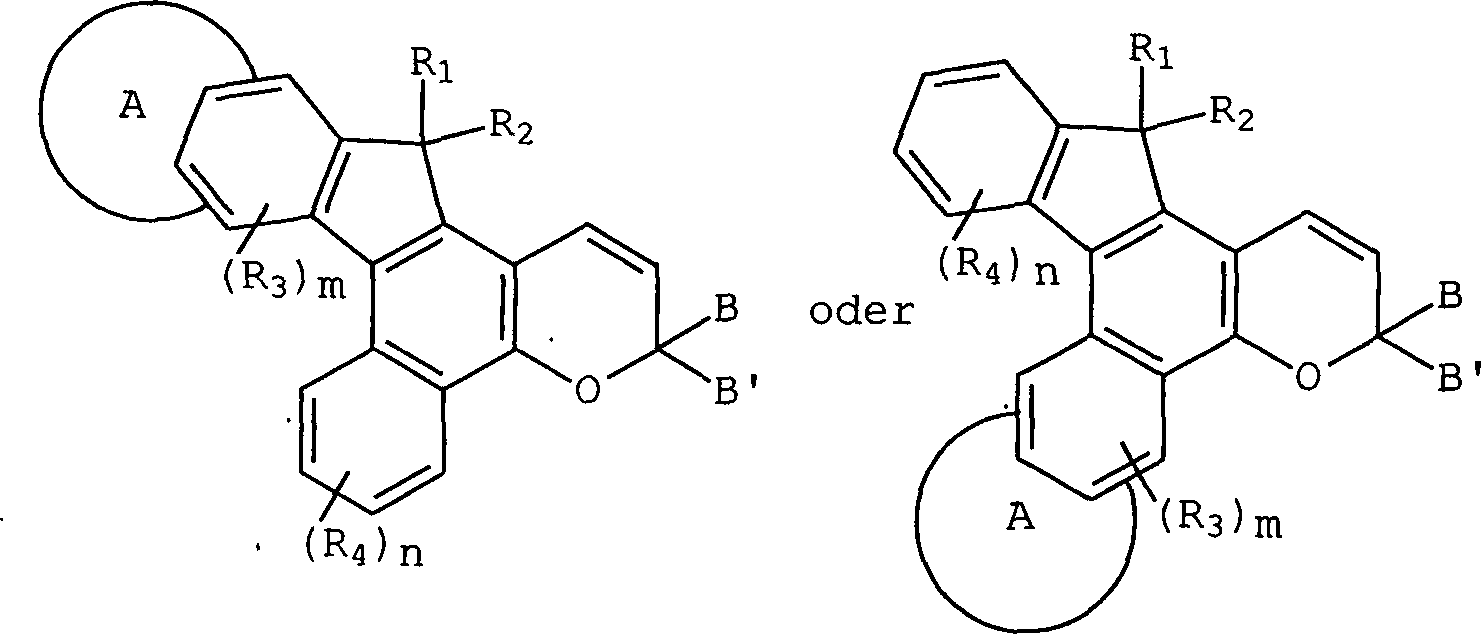
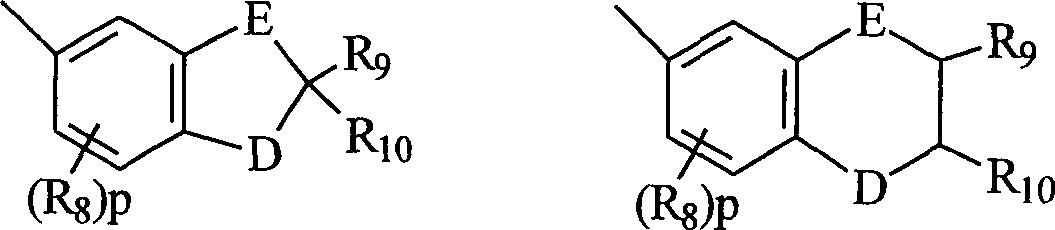
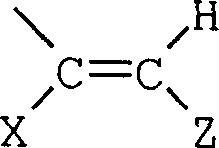
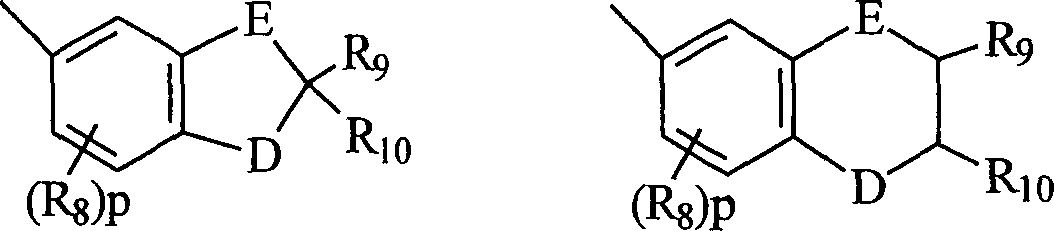

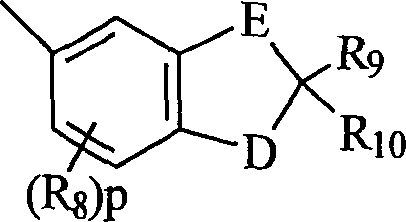
Applications Claiming Priority (7)
| Application Number | Priority Date | Filing Date | Title |
|---|---|---|---|
| US66694296A | 1996-06-17 | 1996-06-17 | |
| US666942 | 1996-06-17 | ||
| US08/783,343 US5698141A (en) | 1996-06-17 | 1997-01-16 | Photochromic heterocyclic fused indenonaphthopyrans |
| US783343 | 1997-01-16 | ||
| US08/819,969 US5723072A (en) | 1996-06-17 | 1997-03-18 | Photochromic heterocyclic fused indenonaphthopyrans |
| US819969 | 1997-03-18 | ||
| PCT/US1997/009686 WO1997048993A1 (en) | 1996-06-17 | 1997-06-04 | Novel photochromic heterocyclic fused indenonaphthopyrans |
Publications (2)
| Publication Number | Publication Date |
|---|---|
| DE69730833D1 DE69730833D1 (en) | 2004-10-28 |
| DE69730833T2 true DE69730833T2 (en) | 2005-09-29 |
Family
ID=27418157
Family Applications (1)
| Application Number | Title | Priority Date | Filing Date |
|---|---|---|---|
| DE69730833T Expired - Lifetime DE69730833T2 (en) | 1996-06-17 | 1997-06-04 | PHOTOCHROME HETEROCYCLIC ANNELED INDENONAPHTHOPYRANEES |
Country Status (11)
| Country | Link |
|---|---|
| US (1) | US5723072A (en) |
| EP (1) | EP0912908B1 (en) |
| JP (1) | JP2000504031A (en) |
| CN (1) | CN1226319A (en) |
| AU (1) | AU709675B2 (en) |
| BR (1) | BR9709811A (en) |
| CA (1) | CA2256479C (en) |
| DE (1) | DE69730833T2 (en) |
| ES (1) | ES2229367T3 (en) |
| IL (1) | IL127169A0 (en) |
| WO (1) | WO1997048993A1 (en) |
Families Citing this family (100)
| Publication number | Priority date | Publication date | Assignee | Title |
|---|---|---|---|---|
| US6018059A (en) * | 1996-12-23 | 2000-01-25 | Corning Incorporated | (Benzofuran) naphthopyrans, the compositions and (co)polymer matrices containing them |
| EP0987260B1 (en) * | 1998-05-29 | 2004-03-03 | Rodenstock GmbH | Photochromic spirofluorenopyrans |
| JP2002518494A (en) * | 1998-06-19 | 2002-06-25 | オプティッシェ、ベルケ、ゲー.ローデンシュトック | Photochromic naphthopyran |
| WO2000002883A2 (en) * | 1998-07-10 | 2000-01-20 | Transitions Optical, Inc. | Photochromic six-membered heterocyclic-fused naphthopyrans |
| US6022495A (en) * | 1998-07-10 | 2000-02-08 | Transitions Optical, Inc. | Photochromic benzopyrano-fused naphthopyrans |
| FR2783249B1 (en) * | 1998-09-11 | 2001-06-22 | Flamel Tech Sa | C5-C6 ANNELED NAPHTHOPYRANS, THEIR PREPARATION AND THE POLYMERIC COMPOSITIONS AND (CO) MATRICES CONTAINING THEM |
| DE50009644D1 (en) | 1999-11-10 | 2005-04-07 | Rodenstock Gmbh | HETEROCYCLICALLY ANNELATED INDENOCHROMENE DERIVATIVES |
| US6736998B2 (en) * | 2000-12-29 | 2004-05-18 | Transitions Optical, Inc. | Indeno-fused photochromic naphthopyrans |
| US7008568B2 (en) * | 2001-11-20 | 2006-03-07 | Vision-Ease Lens, Inc. | Photochromic naphthopyran compounds: compositions and articles containing those naphthopyran compounds |
| US7452611B2 (en) * | 2001-12-27 | 2008-11-18 | Transitions Optical, Inc. | Photochromic optical article |
| JP2005289812A (en) * | 2002-04-01 | 2005-10-20 | Tokuyama Corp | Chromene compounds |
| US20040186241A1 (en) * | 2003-03-20 | 2004-09-23 | Gemert Barry Van | Photochromic ocular devices |
| US7320826B2 (en) * | 2003-03-20 | 2008-01-22 | Ppg Industries Ohio, Inc. | Photochromic articles with reduced temperature dependency and methods for preparation |
| US7262295B2 (en) | 2003-03-20 | 2007-08-28 | Transitions Optical, Inc. | Indeno-fused photochromic naphthopyrans, naphthols and photochromic articles |
| US7632540B2 (en) | 2003-07-01 | 2009-12-15 | Transitions Optical, Inc. | Alignment facilities for optical dyes |
| US7256921B2 (en) * | 2003-07-01 | 2007-08-14 | Transitions Optical, Inc. | Polarizing, photochromic devices and methods of making the same |
| US8698117B2 (en) | 2003-07-01 | 2014-04-15 | Transitions Optical, Inc. | Indeno-fused ring compounds |
| US8545015B2 (en) | 2003-07-01 | 2013-10-01 | Transitions Optical, Inc. | Polarizing photochromic articles |
| US7342112B2 (en) | 2003-07-01 | 2008-03-11 | Ppg Industries Ohio, Inc. | Photochromic compounds |
| US8211338B2 (en) | 2003-07-01 | 2012-07-03 | Transitions Optical, Inc | Photochromic compounds |
| US8089678B2 (en) * | 2003-07-01 | 2012-01-03 | Transitions Optical, Inc | Clear to circular polarizing photochromic devices and methods of making the same |
| US8518546B2 (en) | 2003-07-01 | 2013-08-27 | Transitions Optical, Inc. | Photochromic compounds and compositions |
| US8582192B2 (en) | 2003-07-01 | 2013-11-12 | Transitions Optical, Inc. | Polarizing photochromic articles |
| US20110140056A1 (en) * | 2003-07-01 | 2011-06-16 | Transitions Optical, Inc. | Indeno-fused ring compounds |
| US7978391B2 (en) * | 2004-05-17 | 2011-07-12 | Transitions Optical, Inc. | Polarizing, photochromic devices and methods of making the same |
| US8545984B2 (en) * | 2003-07-01 | 2013-10-01 | Transitions Optical, Inc. | Photochromic compounds and compositions |
| US9096014B2 (en) | 2003-07-01 | 2015-08-04 | Transitions Optical, Inc. | Oriented polymeric sheets exhibiting dichroism and articles containing the same |
| US7097303B2 (en) * | 2004-01-14 | 2006-08-29 | Ppg Industries Ohio, Inc. | Polarizing devices and methods of making the same |
| US20050168689A1 (en) * | 2004-01-30 | 2005-08-04 | Knox Carol L. | Photochromic optical element |
| US20070159594A9 (en) * | 2004-05-13 | 2007-07-12 | Jani Dharmendra M | Photochromic blue light filtering materials and ophthalmic devices |
| US8563212B2 (en) | 2004-07-16 | 2013-10-22 | Transitions Optical, Inc. | Methods for producing photosensitive microparticles, non-aqueous dispersions thereof and articles prepared therewith |
| US8563213B2 (en) | 2004-07-16 | 2013-10-22 | Transitions Optical, Inc. | Methods for producing photosensitive microparticles |
| US8153344B2 (en) * | 2004-07-16 | 2012-04-10 | Ppg Industries Ohio, Inc. | Methods for producing photosensitive microparticles, aqueous compositions thereof and articles prepared therewith |
| ES2338579T3 (en) * | 2004-10-21 | 2010-05-10 | Rodenstock Gmbh | PHOTOCROMIC DERIVATIVES OF BENZO (F) CHROMENE H-RINGS. |
| US20060093844A1 (en) * | 2004-10-29 | 2006-05-04 | Conklin Jeanine A | Photochromic coating compositions, methods of making coated articles and articles thereof |
| US9028728B2 (en) | 2005-04-08 | 2015-05-12 | Transitions Optical, Inc. | Photochromic materials that include indeno-fused naphthopyrans |
| US20060228557A1 (en) * | 2005-04-08 | 2006-10-12 | Beon-Kyu Kim | Photochromic materials having extended pi-conjugated systems and compositions and articles including the same |
| US9139552B2 (en) | 2005-04-08 | 2015-09-22 | Transitions Optical, Inc. | Indeno-fused naphthopyrans having ethylenically unsaturated groups |
| US7556750B2 (en) | 2005-04-08 | 2009-07-07 | Transitions Optical, Inc. | Photochromic materials with reactive substituents |
| US9052438B2 (en) | 2005-04-08 | 2015-06-09 | Johnson & Johnson Vision Care, Inc. | Ophthalmic devices comprising photochromic materials with reactive substituents |
| US8647538B2 (en) | 2005-04-08 | 2014-02-11 | Transitions Optical, Inc. | Photochromic compounds having at least two photochromic moieties |
| US8158037B2 (en) | 2005-04-08 | 2012-04-17 | Johnson & Johnson Vision Care, Inc. | Photochromic materials having extended pi-conjugated systems and compositions and articles including the same |
| US8147725B2 (en) | 2005-04-08 | 2012-04-03 | Transitions Optical, Inc | Photochromic materials having extended pi-conjugated systems and compositions and articles including the same |
| US20060226402A1 (en) * | 2005-04-08 | 2006-10-12 | Beon-Kyu Kim | Ophthalmic devices comprising photochromic materials having extended PI-conjugated systems |
| CA2628501C (en) * | 2005-11-10 | 2014-06-10 | Rodenstock Gmbh | Photochromic spirodihydrophenanthropyrans |
| US7553925B2 (en) | 2006-05-05 | 2009-06-30 | Ppg Industries Ohio, Inc. | Thioether functional oligomeric polythiols and articles prepared therefrom |
| US7907346B2 (en) | 2007-03-16 | 2011-03-15 | Transitions Optical, Inc. | Photochromic materials and photochromic compositions and articles including the same |
| US7892296B2 (en) * | 2007-11-26 | 2011-02-22 | Rodenstock Gmbh | Photochromic benzopyrans |
| DE102008060096A1 (en) | 2007-12-20 | 2009-06-25 | Rodenstock Gmbh | New photochromic spirocyclic benzopyranobenzopyran derivatives especially useful in ophthalmic lenses |
| ES2396483T3 (en) | 2008-05-09 | 2013-02-21 | Tokuyama Corporation | Chromene compound |
| US8110127B2 (en) | 2008-06-19 | 2012-02-07 | Essilor International (Compagnie Generale D'optique) | Photochromic coating exhibiting improved performance |
| US20100014010A1 (en) * | 2008-06-27 | 2010-01-21 | Transitions Optical, Inc. | Formulations comprising mesogen containing compounds |
| US20090326186A1 (en) * | 2008-06-27 | 2009-12-31 | Transitions Optical, Inc. | Mesogen containing compounds |
| US8349210B2 (en) | 2008-06-27 | 2013-01-08 | Transitions Optical, Inc. | Mesogenic stabilizers |
| US8613868B2 (en) | 2008-06-27 | 2013-12-24 | Transitions Optical, Inc | Mesogenic stabilizers |
| US8623238B2 (en) | 2008-06-27 | 2014-01-07 | Transitions Optical, Inc. | Mesogenic stabilizers |
| US7910019B2 (en) * | 2008-06-27 | 2011-03-22 | Transitions Optical, Inc. | Mesogen containing compounds |
| US8628685B2 (en) | 2008-06-27 | 2014-01-14 | Transitions Optical, Inc | Mesogen-containing compounds |
| US7910020B2 (en) * | 2008-06-27 | 2011-03-22 | Transitions Optical, Inc. | Liquid crystal compositions comprising mesogen containing compounds |
| US8431039B2 (en) | 2008-06-27 | 2013-04-30 | Transitions Optical, Inc. | Mesogenic stabilizers |
| EP2145936A3 (en) * | 2008-07-14 | 2010-03-17 | Gracel Display Inc. | Fluorene and pyrene derivatives and organic electroluminescent device using the same |
| DE102009058906A1 (en) | 2008-12-18 | 2010-06-24 | Rodenstock Gmbh | New photochromic naphthopyran compounds useful as synthetic material such as ophthalmic lens and in sun glasses |
| US8518305B2 (en) | 2009-10-28 | 2013-08-27 | Transitions Optical, Inc. | Photochromic materials |
| US8920928B2 (en) | 2010-12-16 | 2014-12-30 | Transitions Optical, Inc. | Photochromic compounds and compositions |
| US9034219B2 (en) | 2010-12-16 | 2015-05-19 | Transitions Optical, Inc. | Photochromic compounds and compositions |
| JP5855678B2 (en) | 2010-12-23 | 2016-02-09 | ローデンストック.ゲゼルシャフト.ミット.ベシュレンクテル.ハフツング | Photochromic fused naphthopyran with a benzene ring adjacent to the pyran oxygen and attached to the para substituent by both meta positions |
| WO2012121997A1 (en) | 2011-03-04 | 2012-09-13 | Ppg Industries Ohio, Inc. | Polythiourethan based composite articles |
| US8641933B2 (en) | 2011-09-23 | 2014-02-04 | Ppg Industries Ohio, Inc | Composite crystal colloidal array with photochromic member |
| WO2013045086A1 (en) | 2011-09-26 | 2013-04-04 | Rodenstock Gmbh | Photochromic doubly-fused naphthopyrans |
| WO2013083282A1 (en) | 2011-12-09 | 2013-06-13 | Rodenstock Gmbh | Photochromic bis-indenofused naphthopyrans |
| ES2578007T3 (en) | 2012-07-12 | 2016-07-20 | Rodenstock Gmbh | Photochromic fluorenopyranos with Dibenzo [b, d] -pirano ring |
| US9133362B2 (en) | 2012-07-16 | 2015-09-15 | Ppg Industries Ohio, Inc. | Coating composition having mechanochromic crystals |
| US9145383B2 (en) | 2012-08-10 | 2015-09-29 | Hallstar Innovations Corp. | Compositions, apparatus, systems, and methods for resolving electronic excited states |
| US9765051B2 (en) | 2012-08-10 | 2017-09-19 | Hallstar Innovations Corp. | Compositions, apparatus, systems, and methods for resolving electronic excited states |
| US9867800B2 (en) | 2012-08-10 | 2018-01-16 | Hallstar Innovations Corp. | Method of quenching singlet and triplet excited states of pigments, such as porphyrin compounds, particularly protoporphyrin IX, with conjugated fused tricyclic compounds have electron withdrawing groups, to reduce generation of reactive oxygen species, particularly singlet oxygen |
| US9926289B2 (en) | 2012-08-10 | 2018-03-27 | Hallstar Innovations Corp. | Compositions, apparatus, systems, and methods for resolving electronic excited states |
| US9125829B2 (en) | 2012-08-17 | 2015-09-08 | Hallstar Innovations Corp. | Method of photostabilizing UV absorbers, particularly dibenzyolmethane derivatives, e.g., Avobenzone, with cyano-containing fused tricyclic compounds |
| JP6071398B2 (en) * | 2012-10-05 | 2017-02-01 | キヤノン株式会社 | Indeno [1,2-b] phenanthrene compound and organic light-emitting device having the same |
| US20140264979A1 (en) | 2013-03-13 | 2014-09-18 | Transitions Opticals, Inc. | Method of preparing photochromic-dichroic films having reduced optical distortion |
| JP6328751B2 (en) | 2013-06-17 | 2018-05-23 | ローデンシュトック ゲーエムベーハー | UV curable compatible photochromic condensed naphthopyran |
| EP3055123B1 (en) | 2013-10-11 | 2021-06-23 | Transitions Optical, Inc. | Spin coater for applying multiple coatings to an optical substrate |
| KR102289075B1 (en) * | 2014-05-07 | 2021-08-11 | 미츠비시 가스 가가쿠 가부시키가이샤 | Resin produced by polycondensation, and resin composition |
| WO2016053662A1 (en) | 2014-09-30 | 2016-04-07 | Transitions Optical, Inc. | Ultraviolet light absorbers |
| EP3268375B1 (en) | 2015-03-10 | 2022-06-15 | Transitions Optical, Inc. | Photochromic thienochromene compounds |
| WO2018054507A1 (en) | 2016-09-26 | 2018-03-29 | Rodenstock Gmbh | Photochromic multiple ring-fused naphthopyrans having extreme longwave absorption extending far into the visible wavelength range |
| CN110114703B (en) | 2016-12-30 | 2022-01-11 | 光学转变有限公司 | Polarized article and method of forming a polarized article |
| US11453654B2 (en) * | 2017-05-10 | 2022-09-27 | Transitions Optical, Ltd. | Photochromic indeno fused phenanthrenopyran compounds |
| US10866455B2 (en) | 2017-10-19 | 2020-12-15 | Ppg Industries Ohio, Inc. | Display devices including photochromic-dichroic compounds and dichroic compounds |
| DE102018004790A1 (en) | 2018-06-14 | 2019-12-19 | Rodenstock Gmbh | Photochromic annealed naphthopyran systems with special substituents to achieve very fast lightening speeds |
| US20210284778A1 (en) | 2020-03-11 | 2021-09-16 | Alcon Inc. | Photochromic polydiorganosiloxane vinylic crosslinkers |
| CN111519469B (en) * | 2020-05-18 | 2021-12-24 | 湖南翰坤实业有限公司 | Anti-patting paper material and preparation method thereof |
| WO2021245551A1 (en) | 2020-06-02 | 2021-12-09 | Alcon Inc. | Method for making photochromic contact lenses |
| EP4237232B1 (en) | 2020-10-28 | 2024-11-27 | Alcon Inc. | Method for making photochromic contact lenses |
| HUE069913T2 (en) | 2020-11-04 | 2025-04-28 | Alcon Inc | Method for making photochromic contact lenses |
| HUE070248T2 (en) | 2020-11-04 | 2025-05-28 | Alcon Inc | Method for making photochromic contact lenses |
| EP4304842B1 (en) | 2021-03-08 | 2026-05-06 | Alcon Inc. | Method for making photofunctional contact lenses |
| US11833771B2 (en) | 2021-04-01 | 2023-12-05 | Alcon Inc. | Method for making photochromic contact lenses |
| WO2023034402A1 (en) | 2021-08-31 | 2023-03-09 | Quadratic 3D, Inc. | Photoinitiators, photohardenable compositions, and methods for forming an object in a volume |
| WO2023209631A1 (en) | 2022-04-28 | 2023-11-02 | Alcon Inc. | Method for making uv and hevl-absorbing ophthalmic lenses |
| DE102023109737A1 (en) | 2023-04-18 | 2024-10-24 | Rodenstock Gmbh | Higher molecular weight photochromic dyes with at least one and a maximum of four naphthopyran subunits and several polyether chains |
Family Cites Families (40)
| Publication number | Priority date | Publication date | Assignee | Title |
|---|---|---|---|---|
| US3361706A (en) * | 1964-03-06 | 1968-01-02 | American Cyanamid Co | Control of the photochromic return rate of (arylazo) thioformic arylhydrazidates |
| US3567605A (en) * | 1966-03-30 | 1971-03-02 | Ralph S Becker | Photochemical process |
| GB1186987A (en) * | 1967-08-30 | 1970-04-08 | Fuji Photo Film Co Ltd | Photochromic Compounds |
| JPS4948631B1 (en) * | 1968-10-28 | 1974-12-23 | ||
| US3627690A (en) * | 1969-10-01 | 1971-12-14 | Itek Corp | Photochromic naphthopyran compositions |
| US4342668A (en) * | 1978-09-08 | 1982-08-03 | American Optical Corporation | Photochromic compounds |
| US4215010A (en) * | 1978-09-08 | 1980-07-29 | American Optical Corporation | Photochromic compounds |
| US4360653A (en) * | 1981-10-23 | 1982-11-23 | Ppg Industries, Inc. | Polymerizate of (allyl carbonate) and aliphatic polyurethane having acrylic unsaturation |
| US4720356A (en) * | 1982-03-22 | 1988-01-19 | American Optical Corporation | Photochromic composition resistant to fatigue |
| DE3300004A1 (en) * | 1983-01-03 | 1984-07-12 | Bayer Ag, 5090 Leverkusen | SUBSTITUTED 4-AMINOMETHYLENE CHROMANE OR CHROME, METHOD FOR THE PRODUCTION THEREOF AND THEIR USE IN MEDICINAL PRODUCTS |
| US4637698A (en) * | 1983-11-04 | 1987-01-20 | Ppg Industries, Inc. | Photochromic compound and articles containing the same |
| US4880667A (en) * | 1985-09-24 | 1989-11-14 | Ppg Industries, Inc. | Photochromic plastic article and method for preparing same |
| JPS62195383A (en) * | 1986-02-21 | 1987-08-28 | Toray Ind Inc | Novel spironaphthopyran compound |
| GB8611837D0 (en) * | 1986-05-15 | 1986-06-25 | Plessey Co Plc | Photochromic spiropyran compounds |
| GB8614680D0 (en) * | 1986-06-17 | 1986-07-23 | Plessey Co Plc | Photoreactive lenses |
| US4816584A (en) * | 1986-11-12 | 1989-03-28 | Ppg Industries, Inc. | Photochromic spiro(indoline)benzoxazines |
| GB8712210D0 (en) * | 1987-05-22 | 1987-06-24 | Pilkington Brothers Plc | Photochromic articles |
| US4931219A (en) * | 1987-07-27 | 1990-06-05 | Ppg Industries, Inc. | Photochromic compound and articles containing the same |
| US4931220A (en) * | 1987-11-24 | 1990-06-05 | Ppg Industries, Inc. | Organic photochromic pigment particulates |
| JPH0745490B2 (en) * | 1988-09-05 | 1995-05-17 | 株式会社トクヤマ | Spiropyran compound and method for producing the same |
| US4931221A (en) * | 1988-12-30 | 1990-06-05 | Ppg Industries, Inc. | Photochromic spiropyran compounds |
| US4994208A (en) * | 1989-04-18 | 1991-02-19 | Ppg Industries, Inc. | Photochromic polymeric article |
| US5066818A (en) * | 1990-03-07 | 1991-11-19 | Ppg Industries, Inc. | Photochromic naphthopyran compounds |
| US5244602A (en) * | 1990-12-03 | 1993-09-14 | Ppg Industries, Inc. | Photochromic naphthopyrans |
| US5200483A (en) * | 1991-11-07 | 1993-04-06 | Ppg Industries, Inc. | Polyol(allyl carbonate) composiitons and articles prepared there from |
| US5238981A (en) * | 1992-02-24 | 1993-08-24 | Transitions Optical, Inc. | Photochromic naphthopyrans |
| US5585042A (en) * | 1992-02-24 | 1996-12-17 | Transitions Optical, Inc. | Photochromic naphthopyrans |
| US5274132A (en) * | 1992-09-30 | 1993-12-28 | Transitions Optical, Inc. | Photochromic naphthopyran compounds |
| US5405958A (en) * | 1992-12-21 | 1995-04-11 | Transitions Optical, Inc. | Photochromic spiro(indoline)naphthoxazine compounds |
| WO1994020869A1 (en) * | 1993-03-12 | 1994-09-15 | Ppg Industries, Inc. | Novel benzopyrans |
| US5552090A (en) * | 1993-06-21 | 1996-09-03 | Ppg Industries, Inc. | Photochromic naphthopyran compounds |
| US5578252A (en) * | 1993-06-21 | 1996-11-26 | Transitions Optical, Inc. | Photochromic substituted naphthopyran compounds |
| US5384077A (en) * | 1993-06-21 | 1995-01-24 | Transitions Optical, Inc. | Photochromic naphthopyran compounds |
| US5466398A (en) * | 1993-06-21 | 1995-11-14 | Transitions Optical, Inc. | Photochromic substituted naphthopyran compounds |
| US5458814A (en) * | 1993-12-09 | 1995-10-17 | Transitions Optical, Inc. | Substituted naphthopyrans |
| US5451344A (en) * | 1994-04-08 | 1995-09-19 | Transitions Optical, Inc. | Photochromic naphthopyran compounds |
| US5395567A (en) * | 1994-04-18 | 1995-03-07 | Ppg Industries, Inc. | Photochromic spironaphthopyran compounds |
| US5514817A (en) * | 1994-08-04 | 1996-05-07 | Ppg Industries, Inc. | Substituted phenanthropyrans |
| US5645767A (en) * | 1994-11-03 | 1997-07-08 | Transitions Optical, Inc. | Photochromic indeno-fused naphthopyrans |
| IL115803A (en) * | 1994-11-03 | 2000-02-17 | Ppg Industries Inc | Indeno-naphthopyran derivatives useful for photochromic articles |
-
1997
- 1997-03-18 US US08/819,969 patent/US5723072A/en not_active Expired - Lifetime
- 1997-06-04 WO PCT/US1997/009686 patent/WO1997048993A1/en not_active Ceased
- 1997-06-04 IL IL12716997A patent/IL127169A0/en unknown
- 1997-06-04 DE DE69730833T patent/DE69730833T2/en not_active Expired - Lifetime
- 1997-06-04 ES ES97929796T patent/ES2229367T3/en not_active Expired - Lifetime
- 1997-06-04 BR BR9709811A patent/BR9709811A/en not_active IP Right Cessation
- 1997-06-04 CN CN97195587.5A patent/CN1226319A/en active Pending
- 1997-06-04 AU AU33772/97A patent/AU709675B2/en not_active Ceased
- 1997-06-04 CA CA002256479A patent/CA2256479C/en not_active Expired - Fee Related
- 1997-06-04 EP EP97929796A patent/EP0912908B1/en not_active Expired - Lifetime
- 1997-06-04 JP JP10503038A patent/JP2000504031A/en active Pending
Also Published As
| Publication number | Publication date |
|---|---|
| IL127169A0 (en) | 1999-09-22 |
| CA2256479C (en) | 2004-04-20 |
| EP0912908A1 (en) | 1999-05-06 |
| CA2256479A1 (en) | 1997-12-24 |
| EP0912908B1 (en) | 2004-09-22 |
| DE69730833D1 (en) | 2004-10-28 |
| WO1997048993A1 (en) | 1997-12-24 |
| US5723072A (en) | 1998-03-03 |
| EP0912908A4 (en) | 2000-03-22 |
| AU709675B2 (en) | 1999-09-02 |
| AU3377297A (en) | 1998-01-07 |
| BR9709811A (en) | 1999-08-10 |
| JP2000504031A (en) | 2000-04-04 |
| ES2229367T3 (en) | 2005-04-16 |
| CN1226319A (en) | 1999-08-18 |
Similar Documents
| Publication | Publication Date | Title |
|---|---|---|
| DE69523779T2 (en) | NEW SUBSTITUTED PHENANTHROPYRANS | |
| DE69804498T2 (en) | NEW WATER-SOLUBLE PHOTOCHROMIC COMPOUNDS | |
| US5723072A (en) | Photochromic heterocyclic fused indenonaphthopyrans | |
| DE60112811T2 (en) | NEW PHOTOCHROME INDENONAPHTHOPYRANE COMPOUNDS | |
| DE69732372T2 (en) | NOVEL PHOTOCHROMIC HETEROCYCLIC MELTED INDENONAPHTHOPYRANEES | |
| DE69726574T2 (en) | NEW PHOTOCHROME INDENOCONDENSED NAPHTHOPYRANS | |
| DE60019770T2 (en) | PHOTOCHROME NAPHTOPYRANES | |
| DE69802439T2 (en) | PHOTOCHROME INDENO-CONDENSED NAPHTHO [2,1-B] PYRANE | |
| DE69903309T2 (en) | PHOTOCHROME BENZOPYRANE-CONDENSED NAPHTHOPYRANS | |
| DE69809584T2 (en) | PHOTOCHROME, CARBOCYCLIC CONDENSED NAPHTHOPYRANE DERIVATIVES | |
| DE69903042T2 (en) | PHOTOCHROME SIX-LINKED HETEROCYCLIC-CONDENSED NAPHTHOPYRANE | |
| DE69526246T2 (en) | INNOVATIVE PHOTOCHROME, INDENO-CONDENSED NAPHTHOPYRAN | |
| DE69631765T2 (en) | Photochromic substituted naphthopyran derivatives | |
| DE69821525T2 (en) | PHOTOCHROME PYRANO-CONDENSED NAPHTHOPYRANEES | |
| DE69322403T2 (en) | PHOTOCHROME NAPHTHOPYRAN DERIVATIVES | |
| US5578252A (en) | Photochromic substituted naphthopyran compounds | |
| DE69635284T2 (en) | NEW SUBSTITUTED NAPTHOPYRANEES | |
| DE69425749T2 (en) | PHOTOCHROME-SUBSTITUTED NAPHTOPYRANE COMPOUNDS | |
| DE69324350T3 (en) | PHOTOCHROME NAPHTHOPYRANE | |
| DE69711640T2 (en) | NAPHTHOPYRANS, COMPOSITIONS AND ARTICLES CONTAINING THEM | |
| US5552090A (en) | Photochromic naphthopyran compounds | |
| EP0958288B1 (en) | Photochromic naphtopyrane colorants, method for the production and use thereof, photochromic object | |
| DE69810954T2 (en) | 7-METHYLIDES-5-OXO-CONDENSED NAPHTOPYRANS | |
| EP1194424B1 (en) | Photochromic pyran derivatives | |
| DE60103847T2 (en) | SUBSTITUTED PHOTOCHROMIC 2H-NAPHTHO [1,2-B] PYRAN COMPOUNDS |
Legal Events
| Date | Code | Title | Description |
|---|---|---|---|
| 8364 | No opposition during term of opposition |