DE60128936T2 - AZA AND POLYAZA NAPHTHALENYL ACID ACID AMIDE AS HIV INTEGRASE INHIBITORS - Google Patents
AZA AND POLYAZA NAPHTHALENYL ACID ACID AMIDE AS HIV INTEGRASE INHIBITORS Download PDFInfo
- Publication number
- DE60128936T2 DE60128936T2 DE60128936T DE60128936T DE60128936T2 DE 60128936 T2 DE60128936 T2 DE 60128936T2 DE 60128936 T DE60128936 T DE 60128936T DE 60128936 T DE60128936 T DE 60128936T DE 60128936 T2 DE60128936 T2 DE 60128936T2
- Authority
- DE
- Germany
- Prior art keywords
- alkyl
- substituted
- halogen
- fluoroalkyl
- phenyl
- Prior art date
- Legal status (The legal status is an assumption and is not a legal conclusion. Google has not performed a legal analysis and makes no representation as to the accuracy of the status listed.)
- Expired - Lifetime
Links
- DKDBYFWQABBOTE-BQYBEJQRSA-N C/C=C1/NCC=CN/C1=C/C Chemical compound C/C=C1/NCC=CN/C1=C/C DKDBYFWQABBOTE-BQYBEJQRSA-N 0.000 description 1
- WFDUOXJKEHADRT-UHFFFAOYSA-N C1CNc(cccc2)c2NC1 Chemical compound C1CNc(cccc2)c2NC1 WFDUOXJKEHADRT-UHFFFAOYSA-N 0.000 description 1
- MZBVNYACSSGXID-UHFFFAOYSA-N C1Cc(cccc2)c2NCC1 Chemical compound C1Cc(cccc2)c2NCC1 MZBVNYACSSGXID-UHFFFAOYSA-N 0.000 description 1
- GGXLVXHATLABGX-UHFFFAOYSA-N C1Cc2ccccc2N=CC1 Chemical compound C1Cc2ccccc2N=CC1 GGXLVXHATLABGX-UHFFFAOYSA-N 0.000 description 1
- WJPQEGAMOUAEOF-UHFFFAOYSA-N C1N=CC=Nc2c1cccc2 Chemical compound C1N=CC=Nc2c1cccc2 WJPQEGAMOUAEOF-UHFFFAOYSA-N 0.000 description 1
- GWVMLCQWXVFZCN-UHFFFAOYSA-N C1NCc2ccccc12 Chemical compound C1NCc2ccccc12 GWVMLCQWXVFZCN-UHFFFAOYSA-N 0.000 description 1
- MXMZCLLIUQEKSN-UHFFFAOYSA-N C1Nc2ccccc2N1 Chemical compound C1Nc2ccccc2N1 MXMZCLLIUQEKSN-UHFFFAOYSA-N 0.000 description 1
- YRLORWPBJZEGBX-UHFFFAOYSA-N C1Nc2ccccc2OC1 Chemical compound C1Nc2ccccc2OC1 YRLORWPBJZEGBX-UHFFFAOYSA-N 0.000 description 1
- LPAGFVYQRIESJQ-UHFFFAOYSA-N C1c2ccccc2NC1 Chemical compound C1c2ccccc2NC1 LPAGFVYQRIESJQ-UHFFFAOYSA-N 0.000 description 1
- AGKMOVOIQDXZOJ-UHFFFAOYSA-N Oc1c2ncccc2cnc1C(NCc1ncccc1)=O Chemical compound Oc1c2ncccc2cnc1C(NCc1ncccc1)=O AGKMOVOIQDXZOJ-UHFFFAOYSA-N 0.000 description 1
- SMWDFEZZVXVKRB-UHFFFAOYSA-N c1cc2cccnc2cc1 Chemical compound c1cc2cccnc2cc1 SMWDFEZZVXVKRB-UHFFFAOYSA-N 0.000 description 1
- AWJUIBRHMBBTKR-UHFFFAOYSA-N c1ccc(cncc2)c2c1 Chemical compound c1ccc(cncc2)c2c1 AWJUIBRHMBBTKR-UHFFFAOYSA-N 0.000 description 1
- BAXOFTOLAUCFNW-UHFFFAOYSA-N c1n[nH]c2ccccc12 Chemical compound c1n[nH]c2ccccc12 BAXOFTOLAUCFNW-UHFFFAOYSA-N 0.000 description 1
- BCMCBBGGLRIHSE-UHFFFAOYSA-N c1nc2ccccc2[o]1 Chemical compound c1nc2ccccc2[o]1 BCMCBBGGLRIHSE-UHFFFAOYSA-N 0.000 description 1
Classifications
-
- C—CHEMISTRY; METALLURGY
- C07—ORGANIC CHEMISTRY
- C07D—HETEROCYCLIC COMPOUNDS
- C07D471/00—Heterocyclic compounds containing nitrogen atoms as the only ring hetero atoms in the condensed system, at least one ring being a six-membered ring with one nitrogen atom, not provided for by groups C07D451/00 - C07D463/00
- C07D471/02—Heterocyclic compounds containing nitrogen atoms as the only ring hetero atoms in the condensed system, at least one ring being a six-membered ring with one nitrogen atom, not provided for by groups C07D451/00 - C07D463/00 in which the condensed system contains two hetero rings
- C07D471/04—Ortho-condensed systems
-
- A—HUMAN NECESSITIES
- A61—MEDICAL OR VETERINARY SCIENCE; HYGIENE
- A61K—PREPARATIONS FOR MEDICAL, DENTAL OR TOILETRY PURPOSES
- A61K31/00—Medicinal preparations containing organic active ingredients
- A61K31/33—Heterocyclic compounds
- A61K31/395—Heterocyclic compounds having nitrogen as a ring hetero atom, e.g. guanethidine or rifamycins
- A61K31/435—Heterocyclic compounds having nitrogen as a ring hetero atom, e.g. guanethidine or rifamycins having six-membered rings with one nitrogen as the only ring hetero atom
- A61K31/44—Non condensed pyridines; Hydrogenated derivatives thereof
-
- A—HUMAN NECESSITIES
- A61—MEDICAL OR VETERINARY SCIENCE; HYGIENE
- A61K—PREPARATIONS FOR MEDICAL, DENTAL OR TOILETRY PURPOSES
- A61K31/00—Medicinal preparations containing organic active ingredients
- A61K31/33—Heterocyclic compounds
- A61K31/395—Heterocyclic compounds having nitrogen as a ring hetero atom, e.g. guanethidine or rifamycins
- A61K31/435—Heterocyclic compounds having nitrogen as a ring hetero atom, e.g. guanethidine or rifamycins having six-membered rings with one nitrogen as the only ring hetero atom
- A61K31/47—Quinolines; Isoquinolines
-
- A—HUMAN NECESSITIES
- A61—MEDICAL OR VETERINARY SCIENCE; HYGIENE
- A61K—PREPARATIONS FOR MEDICAL, DENTAL OR TOILETRY PURPOSES
- A61K31/00—Medicinal preparations containing organic active ingredients
- A61K31/33—Heterocyclic compounds
- A61K31/395—Heterocyclic compounds having nitrogen as a ring hetero atom, e.g. guanethidine or rifamycins
- A61K31/495—Heterocyclic compounds having nitrogen as a ring hetero atom, e.g. guanethidine or rifamycins having six-membered rings with two or more nitrogen atoms as the only ring heteroatoms, e.g. piperazine or tetrazines
-
- A—HUMAN NECESSITIES
- A61—MEDICAL OR VETERINARY SCIENCE; HYGIENE
- A61K—PREPARATIONS FOR MEDICAL, DENTAL OR TOILETRY PURPOSES
- A61K31/00—Medicinal preparations containing organic active ingredients
- A61K31/33—Heterocyclic compounds
- A61K31/395—Heterocyclic compounds having nitrogen as a ring hetero atom, e.g. guanethidine or rifamycins
- A61K31/495—Heterocyclic compounds having nitrogen as a ring hetero atom, e.g. guanethidine or rifamycins having six-membered rings with two or more nitrogen atoms as the only ring heteroatoms, e.g. piperazine or tetrazines
- A61K31/50—Pyridazines; Hydrogenated pyridazines
-
- A—HUMAN NECESSITIES
- A61—MEDICAL OR VETERINARY SCIENCE; HYGIENE
- A61K—PREPARATIONS FOR MEDICAL, DENTAL OR TOILETRY PURPOSES
- A61K31/00—Medicinal preparations containing organic active ingredients
- A61K31/33—Heterocyclic compounds
- A61K31/395—Heterocyclic compounds having nitrogen as a ring hetero atom, e.g. guanethidine or rifamycins
- A61K31/54—Heterocyclic compounds having nitrogen as a ring hetero atom, e.g. guanethidine or rifamycins having six-membered rings with at least one nitrogen and one sulfur as the ring hetero atoms, e.g. sulthiame
-
- A—HUMAN NECESSITIES
- A61—MEDICAL OR VETERINARY SCIENCE; HYGIENE
- A61K—PREPARATIONS FOR MEDICAL, DENTAL OR TOILETRY PURPOSES
- A61K45/00—Medicinal preparations containing active ingredients not provided for in groups A61K31/00 - A61K41/00
- A61K45/06—Mixtures of active ingredients without chemical characterisation, e.g. antiphlogistics and cardiaca
-
- A—HUMAN NECESSITIES
- A61—MEDICAL OR VETERINARY SCIENCE; HYGIENE
- A61P—SPECIFIC THERAPEUTIC ACTIVITY OF CHEMICAL COMPOUNDS OR MEDICINAL PREPARATIONS
- A61P31/00—Antiinfectives, i.e. antibiotics, antiseptics, chemotherapeutics
-
- A—HUMAN NECESSITIES
- A61—MEDICAL OR VETERINARY SCIENCE; HYGIENE
- A61P—SPECIFIC THERAPEUTIC ACTIVITY OF CHEMICAL COMPOUNDS OR MEDICINAL PREPARATIONS
- A61P31/00—Antiinfectives, i.e. antibiotics, antiseptics, chemotherapeutics
- A61P31/12—Antivirals
- A61P31/14—Antivirals for RNA viruses
- A61P31/18—Antivirals for RNA viruses for HIV
-
- A—HUMAN NECESSITIES
- A61—MEDICAL OR VETERINARY SCIENCE; HYGIENE
- A61P—SPECIFIC THERAPEUTIC ACTIVITY OF CHEMICAL COMPOUNDS OR MEDICINAL PREPARATIONS
- A61P37/00—Drugs for immunological or allergic disorders
- A61P37/02—Immunomodulators
-
- A—HUMAN NECESSITIES
- A61—MEDICAL OR VETERINARY SCIENCE; HYGIENE
- A61P—SPECIFIC THERAPEUTIC ACTIVITY OF CHEMICAL COMPOUNDS OR MEDICINAL PREPARATIONS
- A61P43/00—Drugs for specific purposes, not provided for in groups A61P1/00-A61P41/00
-
- C—CHEMISTRY; METALLURGY
- C07—ORGANIC CHEMISTRY
- C07D—HETEROCYCLIC COMPOUNDS
- C07D401/00—Heterocyclic compounds containing two or more hetero rings, having nitrogen atoms as the only ring hetero atoms, at least one ring being a six-membered ring with only one nitrogen atom
- C07D401/02—Heterocyclic compounds containing two or more hetero rings, having nitrogen atoms as the only ring hetero atoms, at least one ring being a six-membered ring with only one nitrogen atom containing two hetero rings
- C07D401/12—Heterocyclic compounds containing two or more hetero rings, having nitrogen atoms as the only ring hetero atoms, at least one ring being a six-membered ring with only one nitrogen atom containing two hetero rings linked by a chain containing hetero atoms as chain links
Landscapes
- Health & Medical Sciences (AREA)
- Chemical & Material Sciences (AREA)
- Life Sciences & Earth Sciences (AREA)
- Animal Behavior & Ethology (AREA)
- Pharmacology & Pharmacy (AREA)
- Medicinal Chemistry (AREA)
- General Health & Medical Sciences (AREA)
- Public Health (AREA)
- Veterinary Medicine (AREA)
- Organic Chemistry (AREA)
- Epidemiology (AREA)
- Nuclear Medicine, Radiotherapy & Molecular Imaging (AREA)
- General Chemical & Material Sciences (AREA)
- Chemical Kinetics & Catalysis (AREA)
- Communicable Diseases (AREA)
- Oncology (AREA)
- Virology (AREA)
- Immunology (AREA)
- Engineering & Computer Science (AREA)
- Bioinformatics & Cheminformatics (AREA)
- Molecular Biology (AREA)
- Tropical Medicine & Parasitology (AREA)
- AIDS & HIV (AREA)
- Pharmaceuticals Containing Other Organic And Inorganic Compounds (AREA)
- Nitrogen Condensed Heterocyclic Rings (AREA)
- Medicines That Contain Protein Lipid Enzymes And Other Medicines (AREA)
- Nitrogen And Oxygen Or Sulfur-Condensed Heterocyclic Ring Systems (AREA)
- Compression Or Coding Systems Of Tv Signals (AREA)
- Pyrrole Compounds (AREA)
- Decoration By Transfer Pictures (AREA)
- Plural Heterocyclic Compounds (AREA)
Abstract
Description
GEBIET DER ERFINDUNGFIELD OF THE INVENTION
Die vorliegende Erfindung betrifft Aza- und Polyazanaphthalinylcarboxamide und pharmazeutisch annehmbare Salze davon, deren Synthese und deren Verwendung als Inhibitoren des HIV-Integrase-Enzyms. Die Verbindungen der vorliegenden Erfindung umfassen 7-(N-Substituiert.-Carboxamido)-8-hydroxy-1,6-naphthyridine und Chinoxaline. Die Verbindungen und deren pharmazeutisch annehmbare Salze der vorliegenden Erfindung eignen sich zur Prävention oder Behandlung einer HIV-Infektion und zur Behandlung von AIDS.The The present invention relates to aza- and polyazanaphthalenylcarboxamides and pharmaceutically acceptable salts thereof, their synthesis and their Use as inhibitors of the HIV integrase enzyme. The compounds of the present The invention includes 7- (N-substituted-carboxamido) -8-hydroxy-1,6-naphthyridines and quinoxalines. The compounds and their pharmaceutically acceptable Salts of the present invention are useful for prevention or treatment of HIV infection and for the treatment of AIDS.
Innerhalb dieser Anmeldung wird auf verschiedene veröffentlichte Dokumente Bezug genommen, um den Stand der Technik, auf den sich diese Erfindung bezieht, vollständiger zu beschreiben. Die Offenbarungen dieser Druckschriften sind hiermit durch Bezugnahme in ihrer Gesamtheit aufgenommen.Within This application is related to various published documents Taken to the state of the art on which this invention is based refers, more complete to describe. The disclosures of these documents are hereby incorporated by reference in their entirety.
HINTERGRUND DER ERFINDUNGBACKGROUND OF THE INVENTION
Ein als humanes Immunschwächevirus (HIV) bezeichnetes Retrovirus ist der Krankheitserreger der komplexen Erkrankung, welche die progressive Zerstörung des Immunsystems (erworbenes Immundefektsyndrom; AIDS) und die Degenerierung des zentralen und peripheren Nervensystems umfasst. Dieses Virus war früher als LAV, HTLV-III oder ARV bekannt. Ein übliches Kennzeichen der Retrovirusreplikation ist der Einbau von proviraler DNA in das Genom der Wirtzelle mit Hilfe von viral kodierter Integrase, ein bei der HIV-Replikation in menschlichen T-Lymphzellen und monozytoiden Zellen notwendiger Schritt. Man nimmt an, dass die Integration durch Integrase in drei Stufen vermittelt wird: Zusammensetzung eines stabilen Nukleoproteinkomplexes mit viralen DNA-Sequenzen; Abspaltung von zwei Nucleotiden von den 3'-Enden der linearen proviralen DNA; kovalente Verbindung der freien 3'-OH-Enden der proviralen DNA an einem an der Zielstelle des Wirts erzeugten versetzten Schnitt. Der vierte Schritt des Verfahrens, die Reparatursynthese des resultierenden Spalts, kann von den Zellenzymen durchgeführt werden.One as a human immunodeficiency virus (HIV) designated retrovirus is the causative agent of the complex Disease involving the progressive destruction of the immune system (acquired Immune deficiency syndrome; AIDS) and the degeneration of the central and includes peripheral nervous system. This virus was earlier than LAV, HTLV-III or ARV known. A common hallmark of retrovirus replication is the incorporation of proviral DNA into the host cell genome Help of virally encoded integrase, one in HIV replication more necessary in human T lymphoid cells and monocytoid cells Step. Integration by integrase is thought to be in three Stages: Composition of a stable nucleoprotein complex with viral DNA sequences; Cleavage of two nucleotides from the 3 'ends of the linear proviral DNA; covalent linkage of the free 3'-OH ends of the proviral DNA at a staggered cut produced at the target site of the host. The fourth step of the process, the repair synthesis of the resulting gap, can be done by cell enzymes.
Die Nucleotid-Sequenzierung von HIV zeigt die Anwesenheit eines Polymerasegens in einem offenen Leserahmen [Ratner, L. et al., Nature, 313, 277 (1985)]. Die Aminosäuresequenzhomologie liefert den Beweis, dass die Polymerasesequenz reverse Transkriptase, Integrase und eine HIV-Protease kodiert [Toh H. et al., EMBO J. 4, 1267 (1985); Power, M. D. et al., Science, 231, 1567 (1986); Pearl, L. H. et al., Nature 329, 351 (1987)]. Es wurde gezeigt, dass alle drei Enzyme für die HIV-Replikation essentiell sind.The Nucleotide sequencing of HIV demonstrates the presence of a polymerase gene in an open reading frame [Ratner, L. et al., Nature, 313, 277 (1985)]. The amino acid sequence homology provides proof that the polymerase sequence is reverse transcriptase, Integrase and an HIV protease [Toh H. et al., EMBO J. 4, 1267 (1985); Power, M.D. et al., Science, 231, 1567 (1986); Pearl, L.H. et al., Nature 329, 351 (1987)]. It was shown, that all three enzymes for HIV replication is essential.
Es ist bekannt, dass einige Antivirusverbindungen, die als Inhibitoren der HIV-Replikation dienen, wirksame Mittel bei der Behandlung von AIDS und ähnlichen Erkrankungen sind, einschließlich Reverse-Transkriptase-Inhibitoren, wie z.B. Azidothymidin (AZT) und Efavirenz, und Proteaseinhibitoren, wie z.B. Indinavir und Nelfinavir. Die Verbindungen dieser Erfindung sind Inhibitoren von HIV-Integrase und Inhibitoren der HIV-Replikation. Die Inhibierung von Integrase in vitro und der HIV-Replikation in Zellen ist eine direkte Folge der Inhibierung der Strangtransferreaktion, katalysiert durch die rekombinante Integrase in vitro in HIV-infizierten Zellen. Der besondere Vorteil der vorliegenden Erfindung ist die hochspezifische Inhibierung von HIV-Integrase und der HIV-Replikation.It It is known that some antiviral compounds act as inhibitors HIV replication, effective agents in the treatment of AIDS and similar Diseases are, including Reverse transcriptase inhibitors, such as. Azidothymidine (AZT) and efavirenz, and protease inhibitors, such as. Indinavir and Nelfinavir. The compounds of this invention are inhibitors of HIV integrase and inhibitors of HIV replication. The inhibition of integrase in vitro and HIV replication in Cells is a direct consequence of inhibition of the strand transfer reaction, catalyzed by the recombinant integrase in vitro in HIV-infected Cells. The particular advantage of the present invention is the highly specific inhibition of HIV integrase and HIV replication.
Die folgenden Druckschriften sind als Hintergrund von Interesse: Chemical Abstracts Nr. 33-2525 offenbart die Herstellung von 5-Chlor-8-hydroxy-1,6-naphthyridin-7-carbonsäureamid aus dem entsprechenden Methylester.The The following references are of interest as background: Chemical Abstracts No. 33-2525 discloses the preparation of 5-chloro-8-hydroxy-1,6-naphthyridine-7-carboxylic acid amide from the corresponding methyl ester.
Derwent
Abstract Nr. 97-048296 ist eine Zusammenfassung der veröffentlichten
Die
Die
Die
ZUSAMMENFASSUNG DER ERFINDUNGSUMMARY OF THE INVENTION
Die
vorliegende Erfindung betrifft neue Aza- und Polyazanaphthalinylcarboxamide.
Diese Verbindungen eignen sich zur Inhibierung von HIV-Integrase,
zur Prävention
einer HIV-Infektion, zur Behandlung einer HIV-Infektion und zur
Prävention,
Behandlung und Verzögerung
des Ausbruchs von AIDS und/oder ARC sowohl als Verbindungen als
auch als pharmazeutisch annehmbare Salze oder Hydrate davon (falls
zutreffend) oder als Bestandteile pharmazeutischer Zusammensetzungen,
gleichgültig
ob in Kombination mit anderen antiviralen HIV/AIDS-Mitteln, Antiinfektiva,
Immunmodulatoren, Antibiotika oder Impfstoffen oder nicht. Insbesondere
stellt die vorliegende Erfindung die Verwendung einer Verbindung
der Formel (I-A): 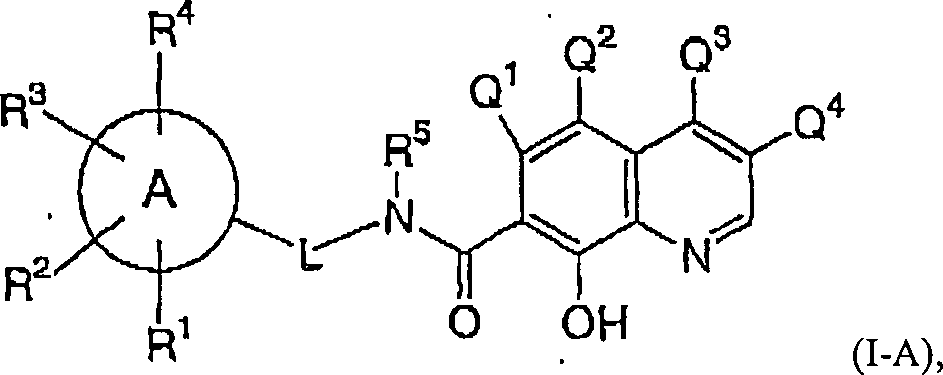
A durch R1, R2,
R3 und R4 substituiert
ist,
L ein Linker ist, der ein Ringatom von A mit dem Stickstoff
des -N(R5)-Restes verknüpft,
wobei L ist
- (i) eine Einfachbindung,
- (ii) -(C1-6-Alkyl)-,
- (iii) -(C2-6-Alkenyl)-,
- (iv) -(C0-6-Alkyl)-(C3-6-cycloalkyl)-(C0-6-alkyl)- oder
- (v) -(C0-6-Alkyl)-M-(C0-6-alkyl)-, wobei M -N(Ra)-, -OC(=O)- oder -C(=O)O- ist, wobei das Alkenyl in (iii) und die Alkyle in (ii), (iv) und (v) unabhängig und gegebenenfalls substituiert sind mit 1, 2 oder 3 Substituenten, unabhängig ausgewählt aus der Gruppe, bestehend aus Halogen, -OH, -C1-6-Alkyl, -O-C1-6-Alkyl, -CO2Ra, -CO2(CH2)1-2Rk, -C1-6-Alkyl-ORa, -Rk, -(CH2)1-2Rk, -CH(ORa)-Rk und -CH(N(Ra)2)-Rk,
- (1) -H,
- (2) -C1-6-Alkyl,
- (3) -C1-6-Halogenalkyl,
- (4) -O-C1-6-Alkyl,
- (5) -O-C1-6-Halogenalkyl,
- (6) Halogen,
- (7) -CN,
- (8) -C1-6-Alkyl-ORa,
- (9) -C0-6-Alkyl-C(=O)Ra,
- (10) -C0-6-Alkyl-CO2Ra,
- (11) -C0-6-Alkyl-SRa,
- (12) -N(Ra)2,
- (13) -C1-6-Alkyl-N(Ra)2,
- (14) -C0-6-Alkyl-C(=O)N(Ra)2,
- (15) -C0-6-Alkyl-G-C1-6-alkyl-C(=O)N(Ra)2, wobei G O, S, N(Ra) oder N(SO2Ra) ist,
- (16) -N(Ra)-C(Ra)=O,
- (17) -C1-6-Alkyl-N(Ra)-C(Ra)=O,
- (18) -C(=O)-N(Ra)-C1-6-Alkyl-[C(=O)]0-1-N(Ra)2,
- (19) -C(=O)-N(Ra)-C1-6-Alkyl, substituiert mit 1 oder 2 -ORa,
- (20) -C0-6-Alkyl-SO2Ra,
- (21) -C0-6-Alkyl-N(Ra)SO2Ra,
- (22) -C2-6-Alkenyl,
- (23) -C2-6-Alkenyl-C(=O)-N(Ra)2,
- (24) -C2-5-Alkinyl,
- (25) -C2-5-Alkinyl-CH2N(Ra)2,
- (26) -C2-5-Alkynyl-CH2ORa,
- (27) -C2-5-Alkinyl-CH2S(O)n-Ra oder
- (28)
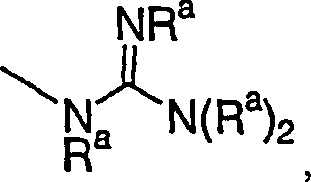
- (29)

- (30) -C(=NRa)-N(Ra)2,
- (31) -N(Ra)-C1-6-Alkyl-S(O)nRa,
- (32) -N(Ra)-C1-6-Alkyl-ORa,
- (33) -N(Ra)-C1-6-Alkyl-N(Ra)2,
- (34) -N(Ra)-C1-6-Alkyl-N(Ra)-C(Ra)=O,
- (35) -N(Ra)-C0-6-Alkyl-[C(=O)]1-2N(Ra)2,
- (36) -N(Ra)-C1-6-Alkyl-CO2Ra,
- (37) -N(Ra)C(=O)N(Ra)-C1-6-Alkyl-C(=O)N(Ra)2,
- (38) -N(Ra)C(=O)-C1-6-Alkyl-N(Ra)2,
- (39) -N(Ra)-SO2-N(Ra)2,
- (40) -Rk,
- (41) -C1-6-Alkyl, substituiert mit Rk,
- (42) -C1-6-Halogenalkyl, substituiert mit Rk,
- (43) -C2-5-Alkenyl-Rk,
- (44) -C2-5-Alkinyl-Rk,
- (45) -C0-6-Alkyl-O-Rk,
- (46) -C0-6-Alkyl-O-C1-6-alkyl-Rk,
- (47) -C0-6-Alkyl-S(O)n-Rk,
- (48) -C0-6-Alkyl-S(O)n-C1-6-alkyl-Rk,
- (49) -O-C1-6-Alkyl-ORk,
- (50) -O-C1-6-Alkyl-O-C1-6-alkyl-Rk,
- (51) -O-C1-6-Alkyl-S(O)nRk,
- (52) -C0-6-Alkyl-N(Rc)-Rk,
- (53) -C0-6-Alkyl-N(Rc)-C1-6-alkyl, substituiert mit einer oder zwei Rk-Gruppen,
- (54) -C0-6-Alkyl-N(Rc)-C1-6-alkyl-ORk,
- (55) -C0-6-Alkyl-C(=O)-Rk,
- (56) -C0-6-Alkyl-C(=O)N(Ra)-Rk,
- (57) -C0-6-Alkyl-N(Ra)C(=O)-Rk,
- (58) -C0-6-Alkyl-C(=O)N(Ra)-C1-6-alkyl-Rk oder
- (59) -C0-6-Alkyl-N(Ra)-C0-6-alkyl-S(O)nRk,
- (1) -H,
- (2) -C1-6-Alkyl,
- (3) -C1-6-Halogenalkyl,
- (4) -O-C1-6-Alkyl,
- (5) -O-C1-6-Halogenalkyl,
- (6) -OH,
- (7) Halogen,
- (8) -NO2,
- (9) -CN,
- (10) -C1-6-Alkyl-ORa,
- (11) -C0-6-Alkyl-C(=O)Ra,
- (12) -C0-6-Alkyl-CO2Ra,
- (13) -C0-6-Alkyl-SRa,
- (14) N(Ra)2,
- (15) -C1-6-Alkyl-N(Ra)2,
- (16) -C0-6-Alkyl-C(=O)N(Ra)2,
- (17) -C1-6-Alkyl-N(Ra)-C(Ra)=O,
- (18) -SO2Ra,
- (19) -N(Ra)SO2Ra,
- (20) -C2-5-Alkenyl,
- (21) -O-C1-6-Alkyl-ORa,
- (22) -O-C1-6-Alkyl-SRa,
- (23) -O-C1-6-Alkyl-NH-CO2Ra,
- (24) -O-C2-6-Alkyl-N(Ra)2,
- (25) -N(Ra)-C1-6-Alkyl-SRa,
- (26) -N(Ra)-C1-6-Alkyl-ORa,
- (27) -N(Ra)-C1-6-Alkyl-N(Ra)2,
- (28) -N(Ra)-C1-6-Alkyl-N(Ra)-C(Ra)=O,
- (29) -Rk,
- (30) -C1-6-Alkyl, substituiert mit 1 oder 2 Rk-Gruppen,
- (31) -C1-6-Halogenalkyl, substituiert mit 1 oder 2 Rk-Gruppen,
- (32) -C2-5-Alkenyl-Rk,
- (33) -C2-5-Alkinyl-Rk,
- (34) -O-Rk,
- (35) -O-C1-6-Alkyl-Rk,
- (36) -S(O)n-Rk,
- (37) -S(O)nC1-6-Alkyl-Rk,
- (38) -O-C1-6-Alkyl-ORk,
- (39) -O-C1-6-Alkyl-O-C1-6-alkyl-Rk,
- (40) -O-C1-6-Alkyl-S(O)nRk,
- (41) -C1-6-Alkyl(ORb)(Rk),
- (42) -C1-6-Alkyl(ORb)(-C1-6-alkyl-Rk),
- (43) -C0-6-Alkyl-N(Rb)(Rk),
- (44) -C0-6-Alkyl-N(Rb)(-C1-6-alkyl-Rk),
- (45) -C1-6-Alkyl-S(O)n-Rk,
- (46) -C1-6-Alkyl-S(O)n-C1-6-alkyl-Rk,
- (47) -C0-6-Alkyl-C(O)-Rk oder
- (48) -C0-6-Alkyl-C(O)-C1-6-alkyl-Rk,
- (1) -H,
- (2) Halogen,
- (3) -CN,
- (4) -NO2,
- (5) -OH,
- (6) C1-6-Alkyl,
- (7) C1-6-Halogenalkyl,
- (8) -O-C1-6-Alkyl,
- (9) -O-C1-6-Halogenalkyl,
- (10) -C1-6-Alkyl-ORa,
- (11) -C0-6-Alkyl-C(=O)Ra,
- (12) -C0-6-Alkyl-CO2Ra,
- (13) -C0-6-Alkyl-SRa,
- (14) N(Ra)2,
- (15) -C1-6-Alkyl-N(Ra)2,
- (16) -C0-6-Alkyl-C(=O)N(Ra)2,
- (17) -SO2Ra,
- (18) -N(Ra)SO2Ra,
- (19) -C2-5-Alkenyl,
- (20) -O-C1-6-Alkyl-ORa,
- (21) -O-C1-6-Alkyl-SRa,
- (22) -O-C1-6-Alkyl-NH-CO2Ra,
- (23) -O-C2-6-Alkyl-N(Ra)2 oder (24) Oxo,
- (1) -H,
- (2) -C1-6-Alkyl, gegebenenfalls substituiert mit 1 bis 5 Substituenten, unabhängig ausgewählt aus Halogen, -O-C1-6-Alkyl, -O-C1-6-Halogenalkyl, -N(Ra)2 und -CO2Ra,
- (3) Aryl, gegebenenfalls substituiert mit 1 bis 5 Substituenten, unabhängig ausgewählt aus Halogen, C1-6-Alkyl, C1-6-Halogenalkyl, -O-C1-6-Alkyl, -O-C1-6-Halogenalkyl, -S-C1-6-Alkyl, -CN und -OH, oder
- (4) -C1-6-Alkyl, substituiert mit Rk,
jedes Rb unabhängig ist:
- (1) -H,
- (2) -C1-4-Alkyl,
- (3) -C1-4-Halogenalkyl,
- (4) -Rk,
- (5) -C2-3-Alkenyl,
- (6) -C1-4-Alkyl-Rk,
- (7) -C2-3-Alkenyl-Rk,
- (8) -S(O)n-Rk oder
- (9) -C(O)Rk,
- (1) -H,
- (2) -C1-6-Alkyl,
- (3) -C1-6-Alkyl, substituiert mit -N(Ra)2, oder
- (4) -C1-4-Alkylaryl, wobei Aryl gegebenenfalls substituiert ist mit 1 bis 5 Substituenten, unabhängig ausgewählt aus Halogen, C1-6-Alkyl, C1-6-Halogenalkyl, -O-C1-6-Alkyl, -O-C1-6-Halogenalkyl, -S-C1-6-Alkyl, -CN und -OH,
- (a) Halogen,
- (b) -C1-6-Alkyl,
- (c) -C1-6-Halogenalkyl,
- (d) -O-C1-6-Alkyl,
- (e) -O-C1-6-Halogenalkyl,
- (f) -S-C1-6-Alkyl,
- (g) -CN,
- (h) -OH,
- (i) Oxo,
- (j) -C0-6-Alkyl-C(=O)N(Ra)2,
- (k) -C0-6-Alkyl-C(=O)Ra,
- (l) -N(Ra)-C(=O)Ra,
- (m) -N(Ra)-CO2Ra,
- (n) -C
- (o) -N(Ra)2,
- (p) -C1-6-Alkyl-N(Ra)2,
- (q) -C1-6-Alkyl-ORa,
- (r) -C0-6-Alkyl-CO2Ra,
- (s) -C0-6-Alkyl-O-C1-6-alkyl-ORa,
- (t) -SO2Ra,
- (u) -SO2N(Ra)2,
- (v) -C0-6-Alkyl-CO2-C2-5-alkenyl,
- (w) Aryl,
- (x) Aryloxy-,
- (y) -C1-4-Alkyl, substituiert mit Aryl,
- (z) Heteromonocyclus,
- (aa) -C1-4-Alkyl, substituiert mit einem Heteromonocyclus,
- (bb) Heteromonocyclylcarbonyl-C0-6-alkyl- und
- (cc) N-Heteromonocyclyl-N-C1-6-alkylamino-,
jedes n unabhängig eine ganze Zahl gleich 0, 1 oder 2 ist,
oder eines pharmazeutisch annehmbaren Salzes davon zur Herstellung eines Medikaments zur Inhibierung von HIV, zur Prävention oder Behandlung einer HIV-Infektion oder zur Behandlung oder Verzögerung des Ausbruchs von AIDS zur Verfügung.The present invention relates to novel aza- and polyazanaphthalenylcarboxamides. These compounds are useful for inhibiting HIV integrase, preventing HIV infection, treating HIV infection and preventing, treating and delaying the onset of AIDS and / or ARC both as compounds and as pharmaceutically acceptable salts or hydrates thereof (if applicable) or as components of pharmaceutical compositions, whether or not in combination with other HIV / AIDS antiviral agents, anti-infective agents, immunomodulators, antibiotics or vaccines. In particular, the present invention provides the use of a compound of formula (IA):
A is substituted by R 1 , R 2 , R 3 and R 4 ,
L is a linker linking a ring atom of A to the nitrogen of the -N (R 5 ) radical,
where L is
- (i) a single bond,
- (ii) - (C 1-6 alkyl) -,
- (iii) - (C 2-6 alkenyl) -,
- (iv) - (C 0-6 -alkyl) - (C 3-6 -cycloalkyl) - (C 0-6 -alkyl) - or
- (v) - (C 0-6 alkyl) -M- (C 0-6 alkyl) -, wherein M is -N (R a ) -, -OC (= O) - or -C (= O) O - wherein the alkenyl in (iii) and the alkyls in (ii), (iv) and (v) are independently and optionally substituted with 1, 2 or 3 substituents independently selected from the group consisting of halogen, -OH C 1-6 -alkyl, -OC 1-6 -alkyl, -CO 2 R a , -CO 2 (CH 2 ) 1-2 R k , -C 1-6 -alkyl-OR a , -R k , - (CH 2 ) 1-2 R k , -CH (OR a ) -R k and -CH (N (R a ) 2 ) -R k ,
- (1) -H,
- (2) -C 1-6 alkyl,
- (3) -C 1-6 haloalkyl,
- (4) -OC 1-6 -alkyl,
- (5) -OC 1-6 -haloalkyl,
- (6) halogen,
- (7) CN,
- (8) -C 1-6 -alkyl-OR a ,
- (9) -C 0-6 -alkyl-C (= O) R a ,
- (10) -C 0-6 -alkyl-CO 2 R a ,
- (11) -C 0-6 -alkyl-SR a ,
- (12) -N (R a ) 2 ,
- (13) -C 1-6 -alkyl-N (R a ) 2 ,
- (14) -C 0-6 -alkyl-C (= O) N (R a ) 2 ,
- (15) -C 0-6 alkyl-GC 1-6 alkyl-C (= O) N (R a) 2, where GO, S, N (R a) or N (SO 2 R a),
- (16) -N (R a ) -C (R a ) = O,
- (17) -C 1-6 -alkyl-N (R a ) -C (R a ) = O,
- (18) -C (= O) -N (R a ) -C 1-6 -alkyl- [C (= O)] 0-1 -N (R a ) 2 ,
- (19) -C (= O) -N (R a ) -C 1-6 -alkyl substituted with 1 or 2 -OR a ,
- (20) -C 0-6 -alkyl-SO 2 R a ,
- (21) -C 0-6 -alkyl-N (R a ) SO 2 R a ,
- (22) -C 2-6 alkenyl,
- (23) -C 2-6 alkenyl-C (= O) -N (R a ) 2 ,
- (24) C 2-5 alkynyl,
- (25) -C 2-5 alkynyl-CH 2 N (R a ) 2 ,
- (26) -C 2-5 -alkynyl-CH 2 OR a ,
- (27) C 2-5 alkynyl-CH 2 S (O) n -R a or
- (28)
- (29)
- (30) -C (= NR a ) -N (R a ) 2 ,
- (31) -N (R a ) -C 1-6 -alkyl-S (O) n R a ,
- (32) -N (R a ) -C 1-6 -alkyl-OR a ,
- (33) -N (R a ) -C 1-6 -alkyl-N (R a ) 2 ,
- (34) -N (R a ) -C 1-6 -alkyl-N (R a ) -C (R a ) = O,
- (35) -N (R a ) -C 0-6 -alkyl- [C (= O)] 1-2 N (R a ) 2 ,
- (36) -N (R a ) -C 1-6 -alkyl-CO 2 R a ,
- (37) -N (R a ) C (= O) N (R a ) -C 1-6 -alkyl-C (= O) N (R a ) 2 ,
- (38) -N (R a ) C (= O) -C 1-6 -alkyl-N (R a ) 2 ,
- (39) -N (R a ) -SO 2 -N (R a ) 2 ,
- (40) -R k ,
- (41) -C 1-6 alkyl substituted with R k ,
- (42) -C 1-6 -haloalkyl substituted with R k ,
- (43) C 2-5 alkenyl R k ,
- (44) C 2-5 alkynyl R k ,
- (45) -C 0-6 -alkyl-OR k ,
- (46) -C 0-6 -alkyl-OC 1-6 -alkyl-R k ,
- (47) -C 0-6 -alkyl-S (O) n -R k ,
- (48) -C 0-6 alkyl-S (O) n -C 1-6 alkyl-R k,
- (49) -OC 1-6 -alkyl-OR k ,
- (50) -OC 1-6 -alkyl-OC 1-6 -alkyl-R k ,
- (51) -OC 1-6 -alkyl-S (O) n R k ,
- (52) -C 0-6 -alkyl-N (R c ) -R k ,
- (53) -C 0-6 -alkyl-N (R c ) -C 1-6 -alkyl substituted with one or two R k groups,
- (54) -C 0-6 -alkyl-N (R c ) -C 1-6 -alkyl-OR k ,
- (55) -C 0-6 -alkyl-C (= O) -R k ,
- (56) -C 0-6 -alkyl-C (= O) N (R a ) -R k ,
- (57) -C 0-6 -alkyl-N (R a ) C (= O) -R k ,
- (58) -C 0-6 -alkyl-C (= O) N (R a ) -C 1-6 -alkyl-R k or
- (59) -C 0-6 -alkyl-N (R a ) -C 0-6 -alkyl-S (O) n R k ,
- (1) -H,
- (2) -C 1-6 alkyl,
- (3) -C 1-6 haloalkyl,
- (4) -OC 1-6 -alkyl,
- (5) -OC 1-6 -haloalkyl,
- (6) -OH,
- (7) halogen,
- (8) NO 2 ,
- (9) CN,
- (10) -C 1-6 -alkyl-OR a ,
- (11) -C 0-6 -alkyl-C (= O) R a ,
- (12) -C 0-6 -alkyl-CO 2 R a ,
- (13) -C 0-6 -alkyl-SR a ,
- (14) N (R a ) 2 ,
- (15) -C 1-6 -alkyl-N (R a ) 2 ,
- (16) -C 0-6 -alkyl-C (= O) N (R a ) 2 ,
- (17) -C 1-6 -alkyl-N (R a ) -C (R a ) = O,
- (18) -SO 2 R a ,
- (19) -N (R a ) SO 2 R a ,
- (20) -C 2-5 alkenyl,
- (21) -OC 1-6 -alkyl-OR a ,
- (22) -OC 1-6 -alkyl-SR a ,
- (23) -OC 1-6 -alkyl-NH-CO 2 R a ,
- (24) -OC 2-6 -alkyl-N (R a ) 2 ,
- (25) -N (R a ) -C 1-6 -alkyl-SR a ,
- (26) -N (R a ) -C 1-6 -alkyl-OR a ,
- (27) -N (R a ) -C 1-6 -alkyl-N (R a ) 2 ,
- (28) -N (R a ) -C 1-6 -alkyl-N (R a ) -C (R a ) = O,
- (29) -R k ,
- (30) -C 1-6 alkyl substituted with 1 or 2 R k groups,
- (31) -C 1-6 -haloalkyl substituted with 1 or 2 R k groups,
- (32) -C 2-5 alkenyl R k ,
- (33) -C 2-5 alkynyl R k ,
- (34) -OR k ,
- (35) -OC 1-6 alkyl R k ,
- (36) -S (O) n -R k ,
- (37) -S (O) n C 1-6 alkyl R k ,
- (38) -OC 1-6 -alkyl-OR k ,
- (39) -OC 1-6 -alkyl-OC 1-6 -alkyl-R k ,
- (40) -OC 1-6 -alkyl-S (O) n R k ,
- (41) -C 1-6 -alkyl (OR b ) (R k ),
- (42) -C 1-6 -alkyl (OR b ) (--C 1-6 -alkyl-R k ),
- (43) -C 0-6 -alkyl-N (R b ) (R k ),
- (44) -C 0-6 -alkyl-N (R b ) (--C 1-6 -alkyl-R k ),
- (45) -C 1-6 -alkyl-S (O) n -R k ,
- (46) -C 1-6 -alkyl-S (O) n -C 1-6 -alkyl-R k ,
- (47) -C 0-6 -alkyl-C (O) -R k or
- (48) -C 0-6 -alkyl-C (O) -C 1-6 -alkyl-R k ,
- (1) -H,
- (2) halogen,
- (3) CN,
- (4) NO 2 ,
- (5) -OH,
- (6) C 1-6 alkyl,
- (7) C 1-6 haloalkyl,
- (8) -OC 1-6 alkyl,
- (9) -OC 1-6 -haloalkyl,
- (10) -C 1-6 -alkyl-OR a ,
- (11) -C 0-6 -alkyl-C (= O) R a ,
- (12) -C 0-6 -alkyl-CO 2 R a ,
- (13) -C 0-6 -alkyl-SR a ,
- (14) N (R a ) 2 ,
- (15) -C 1-6 -alkyl-N (R a ) 2 ,
- (16) -C 0-6 -alkyl-C (= O) N (R a ) 2 ,
- (17) -SO 2 R a ,
- (18) -N (R a ) SO 2 R a ,
- (19) -C 2-5 alkenyl,
- (20) -OC 1-6 -alkyl-OR a ,
- (21) -OC 1-6 -alkyl-SR a ,
- (22) -OC 1-6 -alkyl-NH-CO 2 R a ,
- (23) -OC 2-6 -alkyl-N (R a ) 2 or (24) oxo,
- (1) -H,
- (2) -C 1-6 alkyl optionally substituted with 1 to 5 substituents independently selected from halogen, -OC 1-6 alkyl, -OC 1-6 haloalkyl, -N (R a ) 2 and -CO 2 R a ,
- (3) Aryl optionally substituted with 1 to 5 substituents independently selected from halogen, C 1-6 alkyl, C 1-6 haloalkyl, -OC 1-6 alkyl, -OC 1-6 haloalkyl, -SC 1-6 alkyl, -CN and -OH, or
- (4) -C 1-6 alkyl substituted with R k ,
each R b is independent:
- (1) -H,
- (2) C 1-4 alkyl,
- (3) C 1-4 -haloalkyl,
- (4) -R k ,
- (5) C 2-3 alkenyl,
- (6) C 1-4 alkyl R k ,
- (7) C 2-3 alkenyl R k ,
- (8) -S (O) n -R k or
- (9) -C (O) R k ,
- (1) -H,
- (2) -C 1-6 alkyl,
- (3) -C 1-6 alkyl substituted with -N (R a ) 2 , or
- (4) C 1-4 alkylaryl, wherein aryl is optionally substituted with 1 to 5 substituents independently selected from halogen, C 1-6 alkyl, C 1-6 haloalkyl, -OC 1-6 alkyl, OC 1-6 -haloalkyl, -SC 1-6 -alkyl, -CN and -OH,
- (a) halogen,
- (b) -C 1-6 alkyl,
- (c) -C 1-6 haloalkyl,
- (d) -OC 1-6 -alkyl,
- (e) -OC 1-6 -haloalkyl,
- (f) -SC 1-6 alkyl,
- (g) -CN,
- (h) -OH,
- (i) oxo,
- (j) -C 0-6 -alkyl-C (= O) N (R a ) 2 ,
- (k) -C 0-6 -alkyl-C (= O) R a ,
- (I) -N (R a ) -C (= O) R a ,
- (m) -N (R a ) -CO 2 R a ,
- (n) -C
- (o) -N (R a ) 2 ,
- (p) -C 1-6 -alkyl-N (R a ) 2 ,
- (q) -C 1-6 -alkyl-OR a ,
- (R) -C 0-6 -alkyl-CO 2 R a ,
- (s) -C 0-6 alkyl-OC 1-6 alkyl-OR a,
- (t) -SO 2 R a ,
- (u) -SO 2 N (R a ) 2 ,
- (v) -C 0-6 -alkyl-CO 2 -C 2-5 -alkenyl,
- (w) aryl,
- (x) aryloxy,
- (y) C 1-4 alkyl substituted with aryl,
- (z) heteromonocycle,
- (aa) C 1-4 -alkyl substituted with a heteromonocycle,
- (bb) heteromonocyclylcarbonyl-C 0-6 -alkyl- and
- (cc) N-heteromonocyclyl-NC 1-6 -alkylamino,
each n is independently an integer equal to 0, 1 or 2,
or a pharmaceutically acceptable salt thereof for the manufacture of a medicament for inhibiting HIV, preventing or treating HIV infection, or treating or delaying the onset of AIDS.
Die vorliegende Erfindung umfasst auch pharmazeutische Zusammensetzungen, die eine Verbindung der vorliegenden Erfindung enthalten, und Verfahren zur Herstellung solcher pharmazeutischer Zusammensetzungen. Die vorliegende Erfindung offenbart ferner Verfahren zur Behandlung von AIDS, Verfahren zur Verzögerung des Ausbruchs von AIDS, Verfahren zur Prävention von AIDS, Verfahren zur Prävention einer HIV-Infektion und Verfahren zur Behandlung einer HIV-Infektion.The present invention also encompasses pharmaceutical compositions, containing a compound of the present invention, and methods for the preparation of such pharmaceutical compositions. The The present invention further discloses methods of treatment of AIDS, delaying procedure the outbreak of AIDS, AIDS prevention, procedures for prevention HIV infection and methods of treating HIV infection.
Andere Ausführungsformen, Aspekte und Merkmale der vorliegenden Erfindung sind entweder näher beschrieben in oder werden offensichtlich sein aus der nachfolgenden Beschreibung, den nachfolgenden Beispielen und den anhängenden Ansprüchen.Other Embodiments, Aspects and features of the present invention are either further described in or will be apparent from the description below, the following examples and the appended claims.
DETAILLIERTE BESCHREIBUNG DER ERFINDUNGDETAILED DESCRIPTION OF THE INVENTION
Die vorliegende Erfindung umfasst die Verwendung von Aza- und Polyazanaphthalinylcarboxamiden der obigen Formel (I-A). Diese Verbindungen und die pharmazeutisch annehmbaren Salze davon sind HIV-Integrase-Inhibitoren.The The present invention encompasses the use of aza- and polyazanaphthalenylcarboxamides of the above formula (I-A). These compounds and the pharmaceutically acceptable Salts thereof are HIV integrase inhibitors.
Eine
erste Ausführungsform
der vorliegenden Erfindung ist die Verwendung einer Verbindung der
Formel I-A, wobei
Q1, Q2,
Q3 und Q4 jeweils
unabhängig
sind
- (1) -H,
- (2) -C1-6-Alkyl,
- (3) -C1-6-Fluoralkyl,
- (4) -O-C1-6-Alkyl,
- (5) -O-C1-6-Fluoralkyl,
- (6) Halogen,
- (7) -CN,
- (8) -C1-6-Alkyl-ORa,
- (9) -C0-6-Alkyl-C(=O)Ra,
- (10) -C0-6-Alkyl-CO2Ra,
- (11) -C0-6-Alkyl-SRa,
- (12) -N(Ra)2,
- (13) -C1-6-Alkyl-N(Ra)2,
- (14) -C0-6-Alkyl-C(=O)N(Ra)2,
- (15) -C1-6-Alkyl-N(Ra)-C(Ra)=O,
- (16) -SO2Ra,
- (17) -N(Ra)SO2Ra,
- (18) -C2-5-Alkinyl,
- (19) -C2-5-Alkinyl-CH2N(Ra)2,
- (20) -C2-5-Alkinyl-CH2ORa,
- (21)
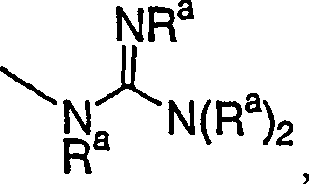
- (22) -N(Ra)-C1-6-Alkyl-SRa,
- (23) -N(Ra)-C1-6-Alkyl-ORa,
- (24) -N(Ra)-C1-6-Alkyl-N(Ra)2,
- (25) -N(Ra)-C1-6-Alkyl-N(Ra)-C(Ra)=O,
- (26) -Rk,
- (27) -C1-6-Alkyl, substituiert mit Rk,
- (28) -C1-6-Fluoralkyl, substituiert mit Rk,
- (29) -C2-5-Alkenyl-Rk,
- (30) -C2-5-Alkinyl-Rk,
- (31) -O-Rk,
- (32) -O-C1-4-Alkyl-Rk,
- (33) -S(O)n-Rk,
- (34) -S(O)n-C1-4-Alkyl-Rk,
- (35) -O-C1-6-Alkyl-ORk,
- (36) -O-C1-6-Alkyl-O-C1-4-alkyl-Rk,
- (37) -O-C1-6-Alkyl-SRk,
- (38) -N(Rc)-Rk,
- (39) -N(Rc)-C1-6-Alkyl, substituiert mit einer oder zwei Rk-Gruppen,
- (40) -N(Rc)-C1-6-Alkyl-ORk,
- (41) -C(=O)N-C1-6-Alkyl-Rk,
- (42) oder
- (43) -C(=NRa)-N(Ra)2,
- (1) -H,
- (2) -C1-6-Alkyl,
- (3) -C1-6-Fluoralkyl,
- (4) -O-C1-6-Alkyl,
- (5) -O-C1-6-Fluoralkyl,
- (6) -OH,
- (7) Halogen,
- (8) -NO2,
- (9) -CN,
- (10) -C1-6-Alkyl-ORa,
- (11) -C0-6-Alkyl-C(=O)R2,
- (12) -C0-6-Alkyl-CO2Ra,
- (13) -C0-6-Alkyl-SRa,
- (14) -N(Ra)2,
- (15) -C1-6-Alkyl-N(Ra)2,
- (16) -C0-6-Alkyl-C(=O)N(Ra)2,
- (17) -C1-6-Alkyl-N(Ra)-C(Ra)=O,
- (18) -SO2Ra,
- (19) -N(Ra)SO2Ra,
- (20) -C2-5-Alkenyl,
- (21) -O-C1-6-Alkyl-ORa,
- (22) -O-C1-6-Alkyl-SRa,
- (23) -O-C1-6-Alkyl-NH-CO2Ra,
- (24) -O-C2-6-Alkyl-N(Ra)2,
- (25) -N(Ra)-C1-6-Alkyl-SRa,
- (26) -N(Ra)-C1-6-Alkyl-ORa,
- (27) -N(Ra)-C1-6-Alkyl-N(Ra)2,
- (28) -N(Ra)-C1-6-Alkyl-N(Ra)-C(Ra)=O,
- (29) -Rk,
- (30) -C1-6-Alkyl, substituiert mit 1 oder 2 Rk-Gruppen,
- (31) -C1-6-Fluoralkyl, substituiert mit 1 oder 2 Rk-Gruppen,
- (32) -C2-5-Alkenyl-Rk,
- (33) -C2-5-Alkinyl-Rk,
- (34) -O-Rk,
- (35) -O-C1-4-Alkyl-Rk,
- (36) -S(O)Rk,
- (37) -S(O)n-C1-4-Alkyl-Rk,
- (38) -O-C1-6-Alkyl-ORk,
- (39) -O-C1-6-Alkyl-O-C1-4-alkyl-Rk,
- (40) -O-C1-6-Alkyl-SRk,
- (41) -C1-6-Alkyl(ORb)(Rk),
- (42) -C1-6-Alkyl(ORb)(-C1-4-alkyl-Rk),
- (43) -C0-6-Alkyl-N(Rb)(Rk),
- (44) -C0-6-Alkyl-N(Rb)(-C1-4-alkyl-Rk),
- (45) -C1-6-Alkyl-S(O)n-Rk,
- (46) -C1-6-Alkyl-S(O)n-C1-4-alkyl-Rk,
- (47) -C0-6-Alkyl-C(O)-Rk oder
- (48) -C0-6-Alkyl-C(O)-C1-4-alkyl-Rk,
- (1) -H,
- (2) Halogen,
- (3) -CN,
- (4) NO2,
- (5) -OH,
- (6) C1-6-Alkyl,
- (7) C1-6-Fluoralkyl,
- (8) -O-C1-6-Alkyl,
- (9) -O-C1-6-Fluoralkyl,
- (10) -C1-6-Alkyl-ORa,
- (11) -C0-6-Alkyl-C(=O)Ra,
- (12) -C0-6-Alkyl-CO2Ra,
- (13) -C0-6-Alkyl-SRa,
- (14) N(Ra)2,
- (15) -C1-6-Alkyl-N(Ra)2,
- (16) -C0-6-Alkyl-C(=O)N(Ra)2,
- (17) -SO2Ra,
- (18) -N(Ra)SO2Ra,
- (19) -C2-5-Alkenyl,
- (20) -O-C1-6-Alkyl-ORa,
- (21) -O-C1-6-Alkyl-SRa,
- (22) -O-C1-6-Alkyl-NH-CO2Ra,
- (23) -O-C2-6-Alkyl-N(Ra)2 oder
- (24) Oxo,
- (1) -H,
- (2) -C1-6-Alkyl, gegebenenfalls substituiert mit 1 bis 3 Substituenten, unabhängig ausgewählt aus Halogen, -O-C1-6-Alkyl, -O-C1-6-Fluoralkyl, -N(Ra)2 und -CO2Ra,
- (3) Aryl, gegebenenfalls substituiert mit 1 bis 5 Substituenten, unabhängig ausgewählt aus Halogen, C1-6-Alkyl, C1-6-Fluoralkyl, -O-C1-6-Alkyl, -O-C1-6-Fluoralkyl, -S-C1-6-Alkyl, -CN und -OH, oder
- (4) -C1-6-Alkyl, substituiert mit Rk,
jedes Rb unabhängig ist:
- (1) -H,
- (2) -C1-4-Alkyl,
- (3) -C1-4-Fluoralkyl,
- (4) -Rk,
- (5) -C2-3-Alkenyl,
- (6) -C1-4-Alkyl-Rk,
- (7) -C2-3-Alkenyl-Rk,
- (8) S(O)n-Rk oder
- (9) C(O)Rk,
- (1) -H,
- (2) -C1-6-Alkyl,
- (3) -C1-6-Alkyl, substituiert mit -N(Ra)2, oder
- (4) -C1-4-Alkylaryl, wobei Aryl gegebenenfalls substituiert ist mit 1 bis 5 Substituenten, unabhängig ausgewählt aus Halogen, C1-6-Alkyl, C1-6-Fluoralkyl, -O-C1-6-Alkyl, -O-C1-6-Fluoralkyl, -S-C1-6-Alkyl, -CN und -OH,
- (a) Halogen,
- (b) C1-6-Alkyl,
- (c) C1-6-Fluoralkyl,
- (d) -O-C1-6-Alkyl,
- (e) -O-C1-6-Fluoralkyl,
- (f) -S-C1-6-Alkyl,
- (g) -CN,
- (h) -OH,
- (i) Oxo,
- (j) -(CH2)0-3C(=O)N(Ra)2,
- (k) -(CH2)0-3C(=O)Ra,
- (l) -N(Ra)-C(=O)Ra,
- (m) -N(Ra)-C(=O)ORa,
- (n) -(CH2)1-3N(Ra)-C(=O)Ra,
- (o) -N(Ra)2,
- (p) -C1-6-Alkyl-N(Ra)2,
- (q) Aryl,
- (r) Aryloxy-,
- (s) -C1-4-Alkyl, substituiert mit Aryl,
- (t) Heteromonocyclus,
- (u) -C1-4-Alkyl, substituiert mit einem Heteromonocyclus,
- (v) Heteromonocyclylcarbonyl-C0-6-alkyl- und
- (w) N-Heteromonocyclyl-N-C1-6-alkylamino-,
alle anderen Variablen wie ursprünglich oben definiert sind,
oder eines pharmazeutisch annehmbaren Salzes davon.A first embodiment of the present invention is the use of a compound of the formula IA, wherein
Q 1 , Q 2 , Q 3 and Q 4 are each independent
- (1) -H,
- (2) -C 1-6 alkyl,
- (3) -C 1-6 fluoroalkyl,
- (4) -OC 1-6 -alkyl,
- (5) -OC 1-6 fluoroalkyl,
- (6) halogen,
- (7) CN,
- (8) -C 1-6 -alkyl-OR a ,
- (9) -C 0-6 -alkyl-C (= O) R a ,
- (10) -C 0-6 -alkyl-CO 2 R a ,
- (11) -C 0-6 -alkyl-SR a ,
- (12) -N (R a ) 2 ,
- (13) -C 1-6 -alkyl-N (R a ) 2 ,
- (14) -C 0-6 -alkyl-C (= O) N (R a ) 2 ,
- (15) -C 1-6 -alkyl-N (R a ) -C (R a ) = O,
- (16) -SO 2 R a ,
- (17) -N (R a ) SO 2 R a ,
- (18) -C 2-5 alkynyl,
- (19) -C 2-5 alkynyl-CH 2 N (R a ) 2 ,
- (20) -C 2-5 alkynyl-CH 2 OR a ,
- (21)
- (22) -N (R a ) -C 1-6 -alkyl-SR a ,
- (23) -N (R a ) -C 1-6 -alkyl-OR a ,
- (24) -N (R a ) -C 1-6 -alkyl-N (R a ) 2 ,
- (25) -N (R a ) -C 1-6 -alkyl-N (R a ) -C (R a ) = O,
- (26) -R k ,
- (27) -C 1-6 alkyl substituted with R k ,
- (28) -C 1-6 fluoroalkyl substituted with R k ,
- (29) C 2-5 alkenyl R k ,
- (30) -C 2-5 alkynyl R k ,
- (31) -OR k ,
- (32) -OC 1-4 -alkyl-R k ,
- (33) -S (O) n -R k ,
- (34) -S (O) n -C 1-4 -alkyl-R k ,
- (35) -OC 1-6 -alkyl-OR k ,
- (36) -OC 1-6 -alkyl-OC 1-4 -alkyl-R k ,
- (37) -OC 1-6 -alkyl-SR k ,
- (38) -N (R c) -R k,
- (39) -N (R c ) -C 1-6 alkyl substituted with one or two R k groups,
- (40) -N (R c ) -C 1-6 -alkyl-OR k ,
- (41) -C (= O) NC 1-6 alkyl R k ,
- (42) or
- (43) -C (= NR a ) -N (R a ) 2 ,
- (1) -H,
- (2) -C 1-6 alkyl,
- (3) -C 1-6 fluoroalkyl,
- (4) -OC 1-6 -alkyl,
- (5) -OC 1-6 fluoroalkyl,
- (6) -OH,
- (7) halogen,
- (8) NO 2 ,
- (9) CN,
- (10) -C 1-6 -alkyl-OR a ,
- (11) -C 0-6 -alkyl-C (= O) R 2 ,
- (12) -C 0-6 -alkyl-CO 2 R a ,
- (13) -C 0-6 -alkyl-SR a ,
- (14) -N (R a ) 2 ,
- (15) -C 1-6 -alkyl-N (R a ) 2 ,
- (16) -C 0-6 -alkyl-C (= O) N (R a ) 2 ,
- (17) -C 1-6 -alkyl-N (R a ) -C (R a ) = O,
- (18) -SO 2 R a ,
- (19) -N (R a ) SO 2 R a ,
- (20) -C 2-5 alkenyl,
- (21) -OC 1-6 -alkyl-OR a ,
- (22) -OC 1-6 -alkyl-SR a ,
- (23) -OC 1-6 -alkyl-NH-CO 2 R a ,
- (24) -OC 2-6 -alkyl-N (R a ) 2 ,
- (25) -N (R a ) -C 1-6 -alkyl-SR a ,
- (26) -N (R a ) -C 1-6 -alkyl-OR a ,
- (27) -N (R a ) -C 1-6 -alkyl-N (R a ) 2 ,
- (28) -N (R a ) -C 1-6 -alkyl-N (R a ) -C (R a ) = O,
- (29) -R k ,
- (30) -C 1-6 alkyl substituted with 1 or 2 R k groups,
- (31) -C 1-6 fluoroalkyl substituted with 1 or 2 R k groups,
- (32) -C 2-5 alkenyl R k ,
- (33) -C 2-5 alkynyl R k ,
- (34) -OR k ,
- (35) -OC 1-4 -alkyl-R k ,
- (36) -S (O) R k ,
- (37) -S (O) n -C 1-4 -alkyl-R k ,
- (38) -OC 1-6 -alkyl-OR k ,
- (39) -OC 1-6 -alkyl-OC 1-4 -alkyl-R k ,
- (40) -OC 1-6 alkyl SR k ,
- (41) -C 1-6 -alkyl (OR b ) (R k ),
- (42) -C 1-6 -alkyl (OR b ) (-C 1-4 -alkyl-R k ),
- (43) -C 0-6 -alkyl-N (R b ) (R k ),
- (44) -C 0-6 -alkyl-N (R b ) (- C 1-4 -alkyl-R k ),
- (45) -C 1-6 -alkyl-S (O) n -R k ,
- (46) -C 1-6 -alkyl-S (O) n -C 1-4 -alkyl-R k ,
- (47) -C 0-6 -alkyl-C (O) -R k or
- (48) -C 0-6 -alkyl-C (O) -C 1-4 -alkyl-R k ,
- (1) -H,
- (2) halogen,
- (3) CN,
- (4) NO 2 ,
- (5) -OH,
- (6) C 1-6 alkyl,
- (7) C 1-6 fluoroalkyl,
- (8) -OC 1-6 alkyl,
- (9) -OC 1-6 fluoroalkyl,
- (10) -C 1-6 -alkyl-OR a ,
- (11) -C 0-6 -alkyl-C (= O) R a ,
- (12) -C 0-6 -alkyl-CO 2 R a ,
- (13) -C 0-6 -alkyl-SR a ,
- (14) N (R a ) 2 ,
- (15) -C 1-6 -alkyl-N (R a ) 2 ,
- (16) -C 0-6 -alkyl-C (= O) N (R a ) 2 ,
- (17) -SO 2 R a ,
- (18) -N (R a ) SO 2 R a ,
- (19) -C 2-5 alkenyl,
- (20) -OC 1-6 -alkyl-OR a ,
- (21) -OC 1-6 -alkyl-SR a ,
- (22) -OC 1-6 -alkyl-NH-CO 2 R a ,
- (23) -OC 2-6 -alkyl-N (R a ) 2 or
- (24) oxo,
- (1) -H,
- (2) -C 1-6 alkyl optionally substituted with 1 to 3 substituents independently selected from halogen, -OC 1-6 alkyl, -OC 1-6 fluoroalkyl, -N (R a ) 2 and -CO 2 R a ,
- (3) aryl optionally substituted with 1 to 5 substituents independently selected from halogen, C 1-6 alkyl, C 1-6 fluoroalkyl, -OC 1-6 alkyl, -OC 1-6 fluoroalkyl, -SC 1-6 alkyl, -CN and -OH, or
- (4) -C 1-6 alkyl substituted with R k ,
each R b is independent:
- (1) -H,
- (2) C 1-4 alkyl,
- (3) C 1-4 fluoroalkyl,
- (4) -R k ,
- (5) C 2-3 alkenyl,
- (6) C 1-4 alkyl R k ,
- (7) C 2-3 alkenyl R k ,
- (8) S (O) n -R k or
- (9) C (O) R k ,
- (1) -H,
- (2) -C 1-6 alkyl,
- (3) -C 1-6 alkyl substituted with -N (R a ) 2 , or
- (4) C 1-4 alkylaryl wherein aryl is optionally substituted with 1 to 5 substituents independently selected from halogen, C 1-6 -alkyl, C 1-6 -fluoroalkyl, -OC 1-6 -alkyl, -OC 1-6 -fluoroalkyl, -SC 1-6 -alkyl, -CN and -OH,
- (a) halogen,
- (b) C 1-6 alkyl,
- (c) C 1-6 fluoroalkyl,
- (d) -OC 1-6 -alkyl,
- (e) -OC 1-6 fluoroalkyl,
- (f) -SC 1-6 alkyl,
- (g) -CN,
- (h) -OH,
- (i) oxo,
- (j) - (CH 2 ) 0-3 C (= O) N (R a ) 2 ,
- (k) - (CH 2 ) 0-3 C (= O) R a ,
- (I) -N (R a ) -C (= O) R a ,
- (m) -N (R a ) -C (= O) OR a ,
- (n) - (CH 2 ) 1-3 N (R a ) -C (= O) R a ,
- (o) -N (R a ) 2 ,
- (p) -C 1-6 -alkyl-N (R a ) 2 ,
- (q) aryl,
- (r) aryloxy,
- (s) C 1-4 alkyl substituted with aryl,
- (t) heteromonocycle,
- (u) C 1-4 -alkyl substituted with a heteromonocycle,
- (v) heteromonocyclylcarbonyl-C 0-6 alkyl and
- (w) N-heteromonocyclyl-NC 1-6 -alkylamino,
all other variables are as originally defined above,
or a pharmaceutically acceptable salt thereof.
Eine
zweite Ausführungsform
der vorliegenden Erfindung ist die Verwendung einer Verbindung der Formel
(I-A), wobei
A ist
- (i) ein 4- bis 7-gliedriger gesättigter oder ungesättigter monocyclischer Heterocyclus, der 1 bis 4 Stickstoffatome, null bis 2 Heteroatome, ausgewählt aus Sauerstoff und Schwefel, und als Rest Kohlenstoffatome enthält, wobei wenigstens eines der Ringatome Kohlenstoff ist,
- (ii) ein 7- bis 11-gliedriger kondensierter bicyclischer Heterocyclus, wobei jeder Ring davon gesättigt oder ungesättigt ist, wobei der kondensierte bicyclische Heterocyclus 1 bis 6 Heteroatome, ausgewählt aus Stickstoff, Sauerstoff und Schwefel, und als Rest Kohlenstoffatome enthält, wobei wenigsters zwei der Ringatome Kohlenstoff sind, oder
- (iii) ein 11- bis 15-gliedriger kondensierter tricyclischer Heterocyclus, wobei jeder Ring davon gesättigt oder ungesättigt ist, wobei der kondensierte tricyclische Heterocyclus 1 bis 6 Stickstoffatome, null bis 3 Heteroatome, ausgewählt aus Sauerstoff und Schwefel, und als Rest Kohlenstoffatome enthält, wobei wenigstens drei der Ringatome Kohlenstoff sind,
- (i) eine Einfachbindung,
- (ii) -(CH2)1-5-, gegebenenfalls substituiert mit 1 oder 2 Substituenten, unabhängig ausgewählt aus der Gruppe, bestehend aus Halogen, -OH, -C1-6-Alkyl, -O-C1-6-Alkyl, -CO2Ra, -CO2(CH2)1-2-Rk, -C1-6-Alkyl-ORa, -Rk, -(CH2)1-2Rk, -CH(ORa)-Rk und -CH(N(Ra)2)-Rk,
- (iii) -(CH2)0-2-CH=CH-(CH2)1-2-, das gegebenenfalls substituiert ist mit 1 oder 2 Substituenten, unabhängig ausgewählt aus der Gruppe, bestehend aus Halogen, -OH, -C1-6-Alkyl und -O-C1-6-Alkyl, oder
- (iv)wobei u und v jeweils ganze Zahlen mit einem Wert von 0 bis 4 sind, mit der Maßgabe, dass die Summe aus u + v 1, 2, 3 oder 4 ist,
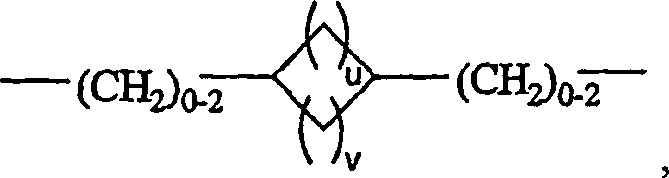
- (1) -H,
- (2) -C1-4-Alkyl, gegebenenfalls substituiert mit 1 bis 3 Substituenten, unabhängig ausgewählt aus Halogen, -O-C1-6-Alkyl, -O-C1-6-Fluoralkyl, -N(Ra)2 und -CO2Ra,
- (3) Phenyl, gegebenenfalls substituiert mit 1 bis 5 Substituenten, unabhängig ausgewählt aus Halogen, C1-6-Alkyl, C1-6-Fluoralkyl, -O-C1-6-Alkyl, -O-C1-6-Fluoralkyl, -S-C1-6-Alkyl, -CN und -OH, oder
- (4) -C1-4-Alkyl, substituiert mit Rk,
jedes Rc unabhängig ist:
- (1) -H,
- (2) -C1-4-Alkyl,
- (3) -C1-4-Alkyl, substituiert mit -N(Ra)2, oder
- (4) -C1-4-Alkylphenyl, wobei das Phenyl gegebenenfalls substituiert ist mit 1 bis 5 Substituenten, unabhängig ausgewählt aus Halogen, C1-6-Alkyl, C1-6-Fluoralkyl, -O-C1-6-Alkyl, O-C1-6-Fluoralkyl, -SC1-6-Alkyl, -CN und -OH,
- (1) Aryl, ausgewählt aus Phenyl und Naphthyl, wobei Aryl unsubstituiert oder substituiert ist mit 1 bis 5 Substituenten, unabhängig ausgewählt aus: (a) Halogen, (b) C1-6-Alkyl, (c) C1-6-Fluoralkyl, (d) -O-C1-6-Alkyl, (e) -O-C1-6-Fluoralkyl, (f) Phenyl, (g) -S-C1-6-Alkyl, (h) -CN, (i) -OH, (j) Phenyloxy, unsubstituiert oder substituiert mit 1 bis 3 Substituenten, unabhängig ausgewählt aus: (i) Halogen, (ii) C1-6-Alkyl, (iii) C1-6-Fluoralkyl und (iv) -OH, (k) -N(Ra)2, (l) -C1-6-Alkyl-N(Ra)2, (m) -Rt, (p) -(CH2)0-3C(=O)N(Ra)2 und (q) -(CH2)0-3C(=O)Ra,
- (2) -C3-7-Cycloalkyl, unsubstituiert oder substituiert mit 1 bis 3 Substituenten, unabhängig ausgewählt aus: (a) Halogen, (b) C1-6-Alkyl, (c) -O-C1-6-Alkyl, (d) C1-6-Fluoralkyl, (e) -O-C1-6-Fluoralkyl, (f) -CN, (h) Phenyl und (j) -OH,
- (3) -C3-7-Cycloalkyl, kondensiert mit einem Phenylring, unsubstituiert oder substituiert mit 1 bis 5 Substituenten, unabhängig ausgewählt aus: (a) Halogen, (b) C1-6-Alkyl, (c) -O-C1-6-Alkyl, (d) C1-6-Fluoralkyl, (e) -O-C1-6-Fluoralkyl, (f) -CN und (g) -OH,
- (4) ein 5- oder 6-gliedriger heteroaromatischer Ring, der 1 bis 4 Heteroatome enthält, unabhängig ausgewählt aus Sauerstoff, Stickstoff und Schwefel, wobei der heteroaromatische Ring am Stickstoff oder Kohlenstoff unsubstituiert oder substituiert ist mit 1 bis 5 Substituenten, unabhängig ausgewählt aus: (a) Halogen, (b) C1-6-Alkyl, (c) C1-6-Fluoralkyl, (d) -O-C1-6-Alkyl, (e) -O-C1-6-Fluoralkyl, (f) Phenyl, (g) -S-C1-6-Alkyl, (h) -CN, (i) -OH, (j) Phenyloxy, unsubstituiert oder substituiert mit 1 bis 3 Substituenten, unabhängig ausgewählt aus: (i) Halogen, (ii) C1-6-Alkyl, (iii) C1-6-Fluoralkyl und (iv) -OH, (k) -N(Ra)2, (l) -C1-6-Alkyl-N(Ra)2, (m) -Rt, (n) Oxo, (o) -(CH2)0-3C(=O)N(Ra)2 und (p) -(CH2)0-3C(=O)Ra,
- (5) ein 5- oder 6-gliedriger gesättigter heterocyclischer Ring, der 1 oder 2 Heteroatome enthält, unabhängig ausgewählt aus Sauerstoff, Stickstoff und Schwefel, wobei der heterocyclische Ring unsubstituiert oder substituiert ist mit 1 bis 4 Substituenten, unabhängig ausgewählt aus: (a) Halogen, (b) C1-6-Alkyl, (c) -O-C1-6-Alkyl, (d) C1-6-Fluoralkyl, (e) -O-C1-6-Fluoralkyl, (f) -CN, (g) Oxo, (h) Phenyl, (i) Benzyl, (j) Phenylethyl, (k) -OH, (l) -(CH2)0-3C(=O)N(Ra)2, (m) -(CH2)0-3C(=O)Ra, (n) -N(Ra)-C(=O)Ra, (o) -N(Ra)-C(=O)ORa, (p) -(CH2)1-3N(Ra)-C(=O)Ra, (q) N(Ra)2, (r) -(CH2)1-3N(Ra)2, (s) -(CH2)0-3C(=O)Rt, (t) -Rt, (u) -N(Ra)Rt und (v) -(CH2)1-3Rt, oder
- (6) ein 8- bis 10-gliedriger heterobicyclischer Ring, der 1 bis 4 Heteroatome enthält, unabhängig ausgewählt aus Sauerstoff, Stickstoff und Schwefel, wobei der heterobicyclische Ring gesättigt oder ungesättigt ist und unsubstituiert oder substituiert ist mit 1 bis 5 Substituenten, unabhängig ausgewählt aus: (a) Halogen, (b) C1-6-Alkyl, (c) -O-C1-6-Alkyl, (d) C1-6-Fluoralkyl, (e) -O-C1-6-Fluoralkyl, (f) -CN, (g) =O und (h) -OH, und
und alle anderen Variablen wie in der ersten Ausführungsform definiert sind,
oder eines pharmazeutisch annehmbaren Salzes davon.A second embodiment of the present invention is the use of a compound of formula (IA) wherein
A is
- (i) a 4- to 7-membered saturated or unsaturated monocyclic heterocycle containing 1 to 4 nitrogen atoms, zero to 2 heteroatoms selected from oxygen and sulfur, and the balance carbon atoms, at least one of the ring atoms being carbon,
- (ii) a 7- to 11-membered fused bicyclic heterocycle, each ring of which is saturated or unsaturated, wherein the fused bicyclic heterocycle contains from 1 to 6 heteroatoms selected from nitrogen, oxygen and sulfur and the balance carbon atoms, with least two the ring atoms are carbon, or
- (iii) an 11- to 15-membered fused tricyclic heterocycle, each ring thereof being saturated or unsaturated, wherein the fused tricyclic heterocycle contains 1 to 6 nitrogen atoms, zero to 3 heteroatoms selected from oxygen and sulfur, and the remainder carbon atoms; wherein at least three of the ring atoms are carbon,
- (i) a single bond,
- (ii) - (CH 2 ) 1-5 -, optionally substituted with 1 or 2 substituents independently selected from the group consisting of halogen, -OH, -C 1-6 alkyl, -OC 1-6 alkyl, -CO 2 R a , -CO 2 (CH 2 ) 1-2 -R k , -C 1-6 -alkyl-OR a , -R k , - (CH 2 ) 1-2 R k , -CH (OR a ) -R k and -CH (N (R a ) 2 ) -R k ,
- (iii) - (CH 2 ) 0-2 -CH = CH- (CH 2 ) 1-2 - optionally substituted with 1 or 2 substituents independently selected from the group consisting of halogen, -OH, -C 1-6 alkyl and -OC 1-6 alkyl, or
- (Iv) where u and v are each integers having a value of 0 to 4, with the proviso that the sum of u + v is 1, 2, 3 or 4,
- (1) -H,
- (2) C 1-4 alkyl optionally substituted with 1 to 3 substituents independently selected from halogen, -OC 1-6 alkyl, -OC 1-6 fluoroalkyl, -N (R a ) 2 and -CO 2 R a ,
- (3) phenyl optionally substituted with 1 to 5 substituents independently selected from halogen, C 1-6 alkyl, C 1-6 fluoroalkyl, -OC 1-6 alkyl, -OC 1-6 fluoroalkyl, -SC 1-6 alkyl, -CN and -OH, or
- (4) C 1-4 alkyl substituted with R k ,
each R c is independent:
- (1) -H,
- (2) C 1-4 alkyl,
- (3) C 1-4 alkyl substituted with -N (R a ) 2 , or
- (4) C 1-4 alkylphenyl wherein the phenyl is optionally substituted with 1 to 5 substituents independently selected from halo, C 1-6 alkyl, C 1-6 fluoroalkyl, -OC 1-6 alkyl, OC 1-6 fluoroalkyl, -SC 1-6 alkyl, -CN and -OH,
- (1) aryl selected from phenyl and naphthyl, wherein aryl is unsubstituted or substituted with 1 to 5 substituents independently selected from: (a) halogen, (b) C 1-6 alkyl, (c) C 1-6 - Fluoroalkyl, (d) -OC 1-6 -alkyl, (e) -OC 1-6 -fluoroalkyl, (f) phenyl, (g) -SC 1-6 -alkyl, (h) -CN, (i) - OH, (j) phenyloxy, unsubstituted or substituted with 1 to 3 substituents independently selected from: (i) halogen, (ii) C 1-6 alkyl, (iii) C 1-6 fluoroalkyl and (iv) -OH , (k) -N (R a ) 2 , (l) -C 1-6 -alkyl-N (R a ) 2 , (m) -R t , (p) - (CH 2 ) 0-3 C ( = O) N (R a ) 2 and (q) - (CH 2 ) 0-3 C (= O) R a ,
- (2) -C 3-7 -cycloalkyl, unsubstituted or substituted with 1 to 3 substituents independently selected from: (a) halogen, (b) C 1-6 -alkyl, (c) -OC 1-6 -alkyl, (d) C 1-6 fluoroalkyl, (e) -OC 1-6 fluoroalkyl, (f) -CN, (h) phenyl and (j) -OH,
- (3) -C 3-7 -cycloalkyl fused to a phenyl ring unsubstituted or substituted by 1 to 5 substituents independently selected from: (a) halogen, (b) C 1-6 -alkyl, (c) -OC 1 -6- alkyl, (d) C 1-6 fluoroalkyl, (e) -OC 1-6 fluoroalkyl, (f) -CN and (g) -OH,
- (4) a 5- or 6-membered heteroaromatic ring containing 1 to 4 heteroatoms independently selected from oxygen, nitrogen and sulfur wherein the heteroaromatic ring on the nitrogen or carbon is unsubstituted or substituted with 1 to 5 substituents independently selected from : (a) halogen, (b) C 1-6 alkyl, (c) C 1-6 fluoroalkyl, (d) -OC 1-6 alkyl, (e) -OC 1-6 fluoroalkyl, (f ) Phenyl, (g) -SC 1-6 alkyl, (h) -CN, (i) -OH, (j) phenyloxy, unsubstituted or substituted with 1 to 3 substituents independently selected from: (i) halogen, ( ii) C 1-6 alkyl, (iii) C 1-6 fluoroalkyl and (iv) -OH, (k) -N (R a ) 2 , (l) -C 1-6 alkyl-N (R a ) 2 , (m) -R t , (n) oxo, (o) - (CH 2 ) 0-3 C (= O) N (R a ) 2 and (p) - (CH 2 ) 0-3 C (= O) R a ,
- (5) a 5- or 6-membered saturated heterocyclic ring containing 1 or 2 heteroatoms independently selected from oxygen, nitrogen and sulfur, said heterocyclic ring being unsubstituted or substituted with 1 to 4 substituents independently selected from: (a ) Halogen, (b) C 1-6 -alkyl, (c) -OC 1-6 -alkyl, (d) C 1-6 -fluoroalkyl, (e) -OC 1-6 -fluoroalkyl, (f) -CN , (g) oxo, (h) phenyl, (i) benzyl, (j) phenylethyl, (k) -OH, (1) - (CH 2 ) 0-3 C (= O) N (R a ) 2 , (m) - (CH 2 ) 0-3 C (= O) R a , (n) -N (R a ) -C (= O) R a , (o) -N (R a ) -C (= O) OR a , (p) - (CH 2 ) 1-3 N (R a ) -C (= O) R a , (q) N (R a ) 2 , (r) - (CH 2 ) 1- 3 N (R a ) 2 , (s) - (CH 2 ) 0-3 C (= O) R t , (t) -R t , (u) -N (R a ) R t and (v) - (CH 2 ) 1-3 R t , or
- (6) an 8 to 10 membered heterobicyclic ring containing 1 to 4 heteroatoms independently selected from oxygen, nitrogen and sulfur, said heterobicyclic ring being saturated or unsaturated and being unsubstituted or substituted with 1 to 5 substituents independently selected (a) halogen, (b) C 1-6 -alkyl, (c) -OC 1-6 -alkyl, (d) C 1-6 -fluoroalkyl, (e) -OC 1-6 -fluoroalkyl, (f) -CN, (g) = O and (h) -OH, and
and all other variables are defined as in the first embodiment,
or a pharmaceutically acceptable salt thereof.
Eine dritte Ausführungsform der vorliegenden Erfindung ist die Verwendung einer Verbindung der Formel I-A, wobei jedes Rk unabhängig ist:
- (1) Aryl, ausgewählt aus Phenyl und Naphthyl, wobei Aryl unsubstituiert oder substituiert ist mit 1 bis 4 Substituenten, unabhängig ausgewählt aus: (a) Halogen, (b) C1-6-Alkyl, (c) C1-6-Fluoralkyl, (d) -O-C1-6-Alkyl, (e) -O-C1-6-Fluoralkyl, (f) Phenyl, (g) -S-C1-6-Alkyl, (h) -CN, (i) -OH, (j) Phenyloxy, unsubstituiert oder substituiert mit 1 bis 3 Substituenten, unabhängig ausgewählt aus: (i) Halogen, (ii) -C1-6-Alkyl, (iii) C1-6-Fluoralkyl und (iv) -OH, (k) -N(Ra)2, (l) -C1-6-Alkyl-N(Ra)2, (m) -Rt, (p) -(CH2)0-3C(=O)N(Ra)2 und (q) -(CH2)0-3C(=O)Ra,
- (2) -C3-6-Cycloalkyl, unsubstituiert oder substituiert mit 1 bis 3 Substituenten, unabhängig ausgewählt aus: (a) Halogen, (b) C1-6-Alkyl, (c) -O-C1-6Alkyl, (d) C1-6-Fluoralkyl, (e) -O-C1-6-Fluoralkyl, (f) -CN, (h) Phenyl und (j) -OH,
- (3) -C3-6-Cycloalkyl, kondensiert mit einem Phenylring, unsubstituiert oder substituiert mit 1 bis 4 Substituenten, unabhängig ausgewählt aus: (a) Halogen, (b) C1-6-Alkyl, (c) -O-C1-6-Alkyl, (d) C1-6-Fluoralkyl, (e)- O-C1-6-Fluoralkyl, (f) -CN und (g) -OH,
- (4) ein 5- oder 6-gliedriger heteroaromatischer Ring, ausgewählt aus Thienyl, Pyridyl, Imidazolyl, Pyrrolyl, Pyrazolyl, Thiazolyl, Isothiazolyl, Oxazolyl, Isooxazolyl, Pyrazinyl, Pyrimidinyl, Triazolyl, Tetrazolyl, Furanyl und Pyridazinyl, wobei der heteroaromatische Ring am Stickstoff oder Kohlenstoff unsubstituiert oder substituiert ist mit 1 bis 4 Substituenten, unabhängig ausgewählt aus: (a) Halogen, (b) C1-6-Alkyl, (c) C1-6-Fluoralkyl, (d) -O-C1-6-Alkyl, (e) -O-C1-6-Fluoralkyl, (f) Phenyl, (g) -S-C1-6-Alkyl, (h) -CN, (i) -OH, (j) Phenyloxy, unsubstituiert oder substituiert mit 1 bis 3 Substituenten, unabhängig ausgewählt aus: (i) Halogen, (ii) C1-6-Alkyl, (iii) C1-6-Fluoralkyl und (iv) -OH, (k) -N(Ra)2, (l) -C1-6-Alkyl-N(Ra)2, (m) -Rt, (n) Oxo, (o) -(CH2)0-3C(=O)N(Ra)2 und (p) -(CH2)0-3C(=O)Ra,
- (5) ein 5- oder 6-gliedriger gesättigter heterocyclischer Ring, ausgewählt aus Piperidinyl, Morpholinyl, Thiomorpholinyl, Thiazolidinyl, Oxazolidinyl, Isooxazolidinyl, Isothiazolidinyl, Pyrrolidinyl, Imidazolidinyl, Piperazinyl, Tetrahydrofuranyl und Pyrazolidinyl, wobei der heterocyclische Ring unsubstituiert oder substituiert ist mit 1 bis 3 Substituenten, unabhängig ausgewählt aus: (a) Halogen, (b) C1-6-Alkyl, (c) -O-C1-6-Alkyl, (d) C1-6-Fluoralkyl, (e) -O-C1-6-Fluoralkyl, (f) -CN, (g) =O, (h) Phenyl, (i) Benzyl, (j) Phenylethyl, (k) -OH, (l) -(CH2)0-3C(=O)N(Ra)2, (m) -(CH2)0-3C(=O)Ra, (n) -N(Ra)-C(=O)Ra, (o) -N(Ra)-C(=O)ORa, (p) -(CH2)1-3N(Ra)-C(=O)Ra, (q) -N(Ra)2, (r) -(CH2)1-3N(Ra)2, (s) -(CH2)0-3C(=O)Rt, (t) -Rt, (u) -N(Ra)Rt und (v) -(CH2)1-3Rt, oder
- (6) ein 8- bis 10-gliedriger heterobicyclischer Ring, ausgewählt aus Indolyl, Benzotriazolyl, Benzoimidazolyl, Imidazo[4.5-b]pyridinyl, Dihydroimidazo[4,5-b]pyridinyl, Pyrazolo[4,3-c]pyridinyl, Dihydropyrazolo[4,3-c]pyridinyl, Tetrahydropyrazolo[4,3-c]pyridinyl, Pyrrolo[1,2-a]pyrazinyl, Dihydropyrrolo[1,2-a]pyrazinyl, Tetrahydropyrrolo[1,2-a]pyrazinyl, Octahydropyrrolo[1,2-a]pyrazinyl, Isoindolyl, Indazolyl, Indolinyl, Isoindolinyl, Chinolinyl, Isochinolinyl, Chinoxalinyl, Chinazolinyl, Cinnolinyl, Chromanyl und Isochromanyl, wobei der bicyclische Ring unsubstituiert oder substituiert ist mit 1 oder 2 Substituenten, unabhängig ausgewählt aus: (a) Halogen, (b) C1-6-Alkyl, (c) -O-C1-6-Alkyl, (d) C1-6-Fluoralkyl, (e) -O-C1-6-Fluoralkyl, (f) -CN, (g) =O und (h) -OH, und
und alle anderen Variablen wie in der zweiten Ausführungsform definiert sind,
oder eines pharmazeutisch annehmbaren Salzes davon.A third embodiment of the present invention is the use of a compound of formula IA wherein each R k is independent:
- (1) aryl selected from phenyl and naphthyl, wherein aryl is unsubstituted or substituted with 1 to 4 substituents independently selected from: (a) halogen, (b) C 1-6 alkyl, (c) C 1-6 - Fluoroalkyl, (d) -OC 1-6 -alkyl, (e) -OC 1-6 -fluoroalkyl, (f) phenyl, (g) -SC 1-6 -alkyl, (h) -CN, (i) - OH, (j) phenyloxy, unsubstituted or substituted with 1 to 3 substituents independently selected from: (i) halogen, (ii) -C 1-6 alkyl, (iii) C 1-6 fluoroalkyl and (iv) - OH, (k) -N (R a ) 2 , (l) -C 1-6 -alkyl-N (R a ) 2 , (m) -R t , (p) - (CH 2 ) 0-3 C (= O) N (R a ) 2 and (q) - (CH 2 ) 0-3 C (= O) R a ,
- (2) -C 3-6 -cycloalkyl, unsubstituted or substituted with 1 to 3 substituents independently selected from: (a) halogen, (b) C 1-6 -alkyl, (c) -OC 1-6- alkyl, ( d) C 1-6 fluoroalkyl, (e) -OC 1-6 fluoroalkyl, (f) -CN, (h) phenyl and (j) -OH,
- (3) -C 3-6 -cycloalkyl fused to a phenyl ring unsubstituted or substituted by 1 to 4 substituents independently selected from: (a) halogen, (b) C 1-6 -alkyl, (c) -OC 1 -6- alkyl, (d) C 1-6 -fluoroalkyl, (e) - OC 1-6 -fluoroalkyl, (f) -CN and (g) -OH,
- (4) a 5- or 6-membered heteroaromatic ring selected from thienyl, pyridyl, imidazolyl, pyrrolyl, pyrazolyl, thiazolyl, isothiazolyl, oxazolyl, isooxazolyl, pyrazinyl, pyrimidinyl, triazolyl, tetrazolyl, furanyl and pyridazinyl, wherein the heteroaromatic ring is on the Nitrogen or carbon is unsubstituted or substituted with 1 to 4 substituents independently selected from: (a) halogen, (b) C 1-6 alkyl, (c) C 1-6 fluoroalkyl, (d) -OC 1-6 alkyl, (e) -OC 1-6 fluoroalkyl, (f) phenyl, (g) -SC 1-6 alkyl, (h) -CN, (i) -OH, (j) phenyloxy, unsubstituted or substituted with 1 to 3 substituents independently selected from: (i) halogen, (ii) C 1-6 alkyl, (iii) C 1-6 fluoroalkyl and (iv) -OH, (k) -N (R a ) 2 , ( l) -C 1-6 -alkyl-N (R a ) 2 , (m) -R t , (n) oxo, (o) - (CH 2 ) 0-3 C (= O) N (R a ) 2 and (p) - (CH 2 ) 0-3 C (= O) R a ,
- (5) a 5- or 6-membered saturated heterocyclic ring selected from piperidinyl, morpholinyl, thiomorpholinyl, thiazolidinyl, oxazolidinyl, isooxazolidinyl, isothiazolidinyl, pyrrolidinyl, imidazolidinyl, piperazinyl, tetrahydrofuranyl and pyrazolidinyl wherein the heterocyclic ring is unsubstituted or substituted with 1 to 3 substituents independently selected from: (a) halogen, (b) C 1-6 alkyl, (c) -OC 1-6 alkyl, (d) C 1-6 fluoroalkyl, (e) -OC 1 -6- fluoroalkyl, (f) -CN, (g) = O, (h) phenyl, (i) benzyl, (j) phenylethyl, (k) -OH, (l) - (CH 2 ) 0-3 C (= O) N (R a ) 2 , (m) - (CH 2 ) 0-3 C (= O) R a , (n) -N (R a ) -C (= O) R a , (o ) -N (R a ) -C (= O) OR a , (p) - (CH 2 ) 1-3 N (R a ) -C (= O) R a , (q) -N (R a ) 2 , (r) - (CH 2 ) 1-3 N (R a ) 2 , (s) - (CH 2 ) 0-3 C (= O) R t , (t) -R t , (u) - N (R a ) R t and (v) - (CH 2 ) 1-3 R t , or
- (6) an 8 to 10 membered heterobicyclic ring selected from indolyl, benzotriazolyl, benzoimidazolyl, imidazo [4.5-b] pyridinyl, dihydroimidazo [4,5-b] pyridinyl, pyrazolo [4,3-c] pyridinyl, dihydropyrazolo [4,3-c] pyridinyl, tetrahydropyrazolo [4,3-c] pyridinyl, pyrrolo [1,2-a] pyrazinyl, dihydropyrrolo [1,2-a] pyrazinyl, tetrahydropyrrolo [1,2-a] pyrazinyl, octahydropyrrolo [1,2-a] pyrazinyl, isoindolyl, indazolyl, indolinyl, isoindolinyl, quinolinyl, isoquinolinyl, quinoxalinyl, quinazolinyl, cinnolinyl, chromanyl and isochromanyl, wherein the bicyclic ring is unsubstituted or substituted with 1 or 2 substituents independently selected from: ( a) halogen, (b) C 1-6 -alkyl, (c) -OC 1-6 -alkyl, (d) C 1-6 -fluoroalkyl, (e) -OC 1-6 -fluoroalkyl, (f) - CN, (g) = O and (h) -OH, and
and all other variables are defined as in the second embodiment,
or a pharmaceutically acceptable salt thereof.
Eine vierte Ausführungsform der vorliegenden Erfindung ist die Verwendung einer Verbindung der Formel I-A, wobei:
- A (i) ein 5- oder 6-gliedriger gesättigter oder ungesättigter monocyclischer Heterocyclus ist, der 1 bis 4 Stickstoffatome, null bis 2 Heteroatome, ausgewählt aus Sauerstoff und Schwefel, und als Rest Kohlenstoffatome enthält, wobei wenigstens eines der Ringatome Kohlenstoff ist,
- (ii) ein 8- bis 11-gliedriger kondensierter bicyclischer Heterocyclus, wobei jeder Ring davon gesättigt oder ungesättigt ist, wobei der kondensierte bicyclische Heterocyclus 1 bis 5 Stickstoffatome, null bis 3 Heteroatome, ausgewählt aus Stickstoff und Schwefel, und als Rest Kohlenstoffatome enthält, wobei wenigstens zwei der Ringatome Kohlenstoff sind, oder
- (iii) ein 12- bis 14-gliedriger kondensierter tricyclischer Heterocyclus ist, wobei jeder Ring davon gesättigt oder ungesättigt ist, wobei der kondensierte tricyclische Heterocyclus 1 bis 6 Stickstoffatome, null bis 3 Heteroatome, ausgewählt aus Sauerstoff und Schwefel, und als Rest Kohlenstoffatome enthält, wobei wenigstens drei der Ringatome Kohlenstoff sind,
oder eines pharmazeutisch annehmbaren Salzes davon.A fourth embodiment of the present invention is the use of a compound of the formula IA, wherein:
- A (i) is a 5- or 6-membered saturated or unsaturated monocyclic heterocycle containing 1 to 4 nitrogen atoms, zero to 2 heteroatoms selected from oxygen and sulfur, and the balance carbon atoms, at least one of the ring atoms being carbon,
- (ii) an 8 to 11 membered fused bicyclic heterocycle, each ring thereof being saturated or unsaturated, wherein the fused bicyclic heterocycle contains 1 to 5 nitrogen atoms, zero to 3 heteroatoms selected from nitrogen and sulfur, and the balance carbon atoms, wherein at least two of the ring atoms are carbon, or
- (iii) a 12- to 14-membered fused tricyclic heterocycle, each ring thereof being saturated or unsaturated, wherein the fused tricyclic heterocycle contains 1 to 6 nitrogen atoms, zero to 3 heteroatoms selected from oxygen and sulfur, and the remainder carbon atoms wherein at least three of the ring atoms are carbon,
or a pharmaceutically acceptable salt thereof.
Eine fünfte Ausführungsform der vorliegenden Erfindung ist die Verwendung einer Verbindung der Formel I-A, wobei:
- A (i) ein monocyclischer Heterocyclus, ausgewählt aus der Gruppe, bestehend aus Pyrrolyl, Pyrazolyl, Imidazolyl, Triazolyl, Tetrazolyl, Pyridyl, Pyrazinyl, Pyrimidinyl, Pyrazidinyl, Oxazolyl, Isoxazolyl, Thiazolyl, Isothiazolyl, Pyrrolidinyl, Pyrazolidinyl, Imidazolinyl, Piperidinyl, Piperazinyl, Thiazolidinyl, Isothiazolidinyl und Morpholinyl,
- (ii) ein kondensierter bicyclischer Heterocyclus, ausgewählt aus der Gruppe, bestehend aus Indolyl, Isoindolyl, Phthalazinyl, Purinyl, Chinoxalinyl, Chinazolinyl, Cinnolinyl, 1,6-Naphthyridinyl, 1,8-Naphthyridinyl, Benzimidazolyl, Chinolinyl, Isochinolinyl, Indazolyl, Dihydroindolyl, Dihydroisoindolyl, Tetrahydrochinolyl, Tetrahydroisochinolyl, Imidazo[1,2-a]pyrimidinyl, 2,3-Dihydroimidazo[2,1-b][1,3]thiazolyl, Benzazepinyl, Dihydrobenzazepinyl, Benzodiazepinyl, Dihydrobenzodiazepinyl, Tetrahydrobenzodiazepinyl und Benzothiazolyl, oder
- (iii) ein kondensierter tricyclischer Heterocyclus ist, ausgewählt aus der Gruppe, bestehend aus Phenothiazinyl, Carbazolyl, beta-Carbolinyl, Tetrahydro-beta-carbolinyl, Acridinyl, Phenazinyl und Phenoxazinyl,
oder eines pharmazeutisch annehmbaren Salzes davon.A fifth embodiment of the present invention is the use of a compound of the formula IA, wherein:
- A (i) a monocyclic heterocycle selected from the group consisting of pyrrolyl, pyrazolyl, imidazolyl, triazolyl, tetrazolyl, pyridyl, pyrazinyl, pyrimidinyl, pyrazidinyl, oxazolyl, isoxazolyl, thiazolyl, isothiazolyl, pyrrolidinyl, pyrazolidinyl, imidazolinyl, piperidinyl, piperazinyl , Thiazolidinyl, isothiazolidinyl and morpholinyl,
- (ii) a fused bicyclic heterocycle selected from the group consisting of indolyl, isoindolyl, phthalazinyl, purinyl, quinoxalinyl, quinazolinyl, cinnolinyl, 1,6-naphthyridinyl, 1,8-naphthyridinyl, benzimidazolyl, quinolinyl, isoquinolinyl, indazolyl, dihydroindolyl , Dihydroisoindolyl, tetrahydroquinolyl, tetrahydroisoquinolyl, imidazo [1,2-a] pyrimidinyl, 2,3-dihydroimidazo [2,1-b] [1,3] thiazolyl, benzazepinyl, dihydrobenzazepinyl, benzodiazepinyl, dihydrobenzodiazepinyl, tetrahydrobenzodiazepinyl and benzothiazolyl, or
- (iii) a fused tricyclic heterocycle selected from the group consisting of phenothiazinyl, carbazolyl, beta-carbolinyl, tetrahydro-beta-carbolinyl, acridinyl, phenazinyl and phenoxazinyl,
or a pharmaceutically acceptable salt thereof.
Eine
sechste Ausführungsform
der vorliegenden Erfindung ist die Verwendung einer Verbindung der Formel
I-A, wobei:
Q2 ist
- (1) -H,
- (2) -C1-6-Alkyl,
- (3) -C1-6-Fluoralkyl,
- (4) -O-C1-4-Alkyl,
- (5) -O-C1-6-Fluoralkyl,
- (6) Halogen,
- (7) -CN,
- (8) -C1-6-Alkyl-ORa,
- (9) -C0-6-Alkyl-C(=O)Ra,
- (10) -C0-6-Alkyl-CO2Ra,
- (11) -C0-6-Alkyl-SRa,
- (12) -N(Ra)2,
- (13) -C1-6-Alkyl-N(Ra)2,
- (14) -C0-6-Alkyl-C(=O)N(Ra)2,
- (15) -C1-6-Alkyl-N(Ra)-C(Ra)=O,
- (16) -SO2Ra,
- (17) -N(Ra)SO2Ra,
- (18) -C2-5-Alkinyl,
- (19) -C2-5-Alkinyl-CH2N(Ra)2,
- (20) -C2-5-Alkinyl-CH2ORa,
- (21)

- (22) -N(Ra)-C1-6-Alkyl-SRa,
- (23) -N(Ra)-C1-6-Alkyl-ORa,
- (24) -N(Ra)-C1-6-Alkyl-N(Ra)2,
- (25) -N(Ra)-C1-6-Alkyl-N(Ra)-C(Ra)=O,
- (26) -Rk,
- (27) -C1-6-Alkyl, substituiert mit Rk,
- (28) -C1-6-Fluoralkyl, substituiert mit Rk,
- (29) -C2-5-Alkenyl-Rk,
- (30) -C2-5-Alkinyl-Rk,
- (31) -O-Rk,
- (32) -O-C1-4-Alkyl-Rk,
- (33) S(O)n-Rk,
- (34) -S(O)n-C1-4-Alkyl-Rk,
- (35) -O-C1-6-Alkyl-ORk,
- (36) -O-C1-6-Alkyl-O-C1-4-alkyl-Rk,
- (37) -O-C1-6-Alkyl-SRk,
- (39) -N(Rc)-C1-6-Alkyl, substituiert mit einer oder zwei Rk-Gruppen,
- (40) -N(Rc)-C1-6-Alkyl-ORk,
- (41) -C(=O)N-C1-6-Alkyl-Rk,
- (42) -C2-5-Alkinyl-CH2S(O)n-Ra oder
- (43) -C(=NRa)-N(Ra)2,
- (1) -H,
- (2) -C1-6-Alkyl,
- (3) -C1-6-Fluoralkyl,
- (4) -O-C1-6-Alkyl,
- (5) -O-C1-6-Fluoralkyl,
- (6) Halogen,
- (7) -CN,
- (8) -C1-6-Alkyl-ORa,
- (9) -C0-6-Alkyl-C(=O)Ra,
- (10) -C0-6-Alkyl-CO2Ra,
- (11) -SRa,
- (12) -N(Ra)2,
- (13) -C1-6-Alkyl-N(Ra)2,
- (14) -C0-6-Alkyl-C(=O)N(Ra)2,
- (15) -SO2Ra,
- (16) -N(Ra)SO2Ra,
- (17) -Rk oder
- (18) -C1-6-Alkyl, substituiert mit Rk,
oder eines pharmazeutisch annehmbaren Salzes davon.A sixth embodiment of the present invention is the use of a compound of formula IA wherein:
Q is 2
- (1) -H,
- (2) -C 1-6 alkyl,
- (3) -C 1-6 fluoroalkyl,
- (4) -OC 1-4 -alkyl,
- (5) -OC 1-6 fluoroalkyl,
- (6) halogen,
- (7) CN,
- (8) -C 1-6 -alkyl-OR a ,
- (9) -C 0-6 -alkyl-C (= O) R a ,
- (10) -C 0-6 -alkyl-CO 2 R a ,
- (11) -C 0-6 -alkyl-SR a ,
- (12) -N (R a ) 2 ,
- (13) -C 1-6 -alkyl-N (R a ) 2 ,
- (14) -C 0-6 -alkyl-C (= O) N (R a ) 2 ,
- (15) -C 1-6 -alkyl-N (R a ) -C (R a ) = O,
- (16) -SO 2 R a ,
- (17) -N (R a ) SO 2 R a ,
- (18) -C 2-5 alkynyl,
- (19) -C 2-5 alkynyl-CH 2 N (R a ) 2 ,
- (20) -C 2-5 alkynyl-CH 2 OR a ,
- (21)
- (22) -N (R a ) -C 1-6 -alkyl-SR a ,
- (23) -N (R a ) -C 1-6 -alkyl-OR a ,
- (24) -N (R a ) -C 1-6 -alkyl-N (R a ) 2 ,
- (25) -N (R a ) -C 1-6 -alkyl-N (R a ) -C (R a ) = O,
- (26) -R k ,
- (27) -C 1-6 alkyl substituted with R k ,
- (28) -C 1-6 fluoroalkyl substituted with R k ,
- (29) C 2-5 alkenyl R k ,
- (30) -C 2-5 alkynyl R k ,
- (31) -OR k ,
- (32) -OC 1-4 -alkyl-R k ,
- (33) S (O) n -R k ,
- (34) -S (O) n -C 1-4 -alkyl-R k ,
- (35) -OC 1-6 -alkyl-OR k ,
- (36) -OC 1-6 -alkyl-OC 1-4 -alkyl-R k ,
- (37) -OC 1-6 -alkyl-SR k ,
- (39) -N (R c ) -C 1-6 alkyl substituted with one or two R k groups,
- (40) -N (R c ) -C 1-6 -alkyl-OR k ,
- (41) -C (= O) NC 1-6 alkyl R k ,
- (42) C 2-5 alkynyl-CH 2 S (O) n -R a or
- (43) -C (= NR a ) -N (R a ) 2 ,
- (1) -H,
- (2) -C 1-6 alkyl,
- (3) -C 1-6 fluoroalkyl,
- (4) -OC 1-6 -alkyl,
- (5) -OC 1-6 fluoroalkyl,
- (6) halogen,
- (7) CN,
- (8) -C 1-6 -alkyl-OR a ,
- (9) -C 0-6 -alkyl-C (= O) R a ,
- (10) -C 0-6 -alkyl-CO 2 R a ,
- (11) -SR a ,
- (12) -N (R a ) 2 ,
- (13) -C 1-6 -alkyl-N (R a ) 2 ,
- (14) -C 0-6 -alkyl-C (= O) N (R a ) 2 ,
- (15) -SO 2 R a ,
- (16) -N (R a ) SO 2 R a ,
- (17) -R k or
- (18) -C 1-6 alkyl substituted with R k ,
or a pharmaceutically acceptable salt thereof.
Eine siebte Ausführungsform ist identisch mit der sechsten Ausführungsform, außer dass alle anderen Variablen wie in der ersten Ausführungsform definiert sind, anstatt wie ursprünglich definiert zu sein.A seventh embodiment is identical to the sixth embodiment, except that all other variables are defined as in the first embodiment, instead of as originally to be defined.
Eine
achte Ausführungsform
der vorliegenden Erfindung ist die Verwendung einer Verbindung der
Formel I-A, wobei:
Q3 ist:
- (1) -H,
- (2) -C1-6-Alkyl,
- (3) -C1-6-Fluoralkyl,
- (4) -O-C1-6-Alkyl,
- (5) -O-C1-6-Fluoralkyl,
- (6) Halogen,
- (7) -CN,
- (8) -C1-6-Alkyl-ORa,
- (9) -C0-6-Alkyl-C(=O)Ra,
- (10) -C0-6-Alkyl-CO2Ra,
- (11) -SRa,
- (12) -N(Ra)2,
- (13) -C1-6-Alkyl-N(Ra)2,
- (14) -C0-6-Alkyl-C(=O)N(Ra)2,
- (15) -SO2Ra,
- (16) -N(Ra)SO2Ra,
- (17) -Rk oder
- (18) -C1-6-Alkyl, substituiert mit Rk,
- (1) -H,
- (2) -C1-6-Alkyl,
- (3) -C1-6-Fluoralkyl,
- (4) -O-C1-6-Alkyl,
- (5) -O-C1-6-Fluoralkyl,
- (6) Halogen,
- (7) -CN,
- (8) -C1-6-Alkyl-ORa,
- (9) -C0-6-Alkyl-C(=O)Ra,
- (10) -C0-6-Alkyl-CO2Ra,
- (11) -SRa,
- (12) -N(Ra)2,
- (13) -C1-6-Alkyl-N(Ra)2,
- (14) -C0-6-Alkyl-C(=O)N(Ra)2,
- (15) -SO2Ra oder
- (16) -N(Ra)SO2Ra,
oder eines pharmazeutisch annehmbaren Salzes davon.An eighth embodiment of the present invention is the use of a compound of formula IA, wherein:
Q 3 is:
- (1) -H,
- (2) -C 1-6 alkyl,
- (3) -C 1-6 fluoroalkyl,
- (4) -OC 1-6 -alkyl,
- (5) -OC 1-6 fluoroalkyl,
- (6) halogen,
- (7) CN,
- (8) -C 1-6 -alkyl-OR a ,
- (9) -C 0-6 -alkyl-C (= O) R a ,
- (10) -C 0-6 -alkyl-CO 2 R a ,
- (11) -SR a ,
- (12) -N (R a ) 2 ,
- (13) -C 1-6 -alkyl-N (R a ) 2 ,
- (14) -C 0-6 -alkyl-C (= O) N (R a ) 2 ,
- (15) -SO 2 R a ,
- (16) -N (R a ) SO 2 R a ,
- (17) -R k or
- (18) -C 1-6 alkyl substituted with R k ,
- (1) -H,
- (2) -C 1-6 alkyl,
- (3) -C 1-6 fluoroalkyl,
- (4) -OC 1-6 -alkyl,
- (5) -OC 1-6 fluoroalkyl,
- (6) halogen,
- (7) CN,
- (8) -C 1-6 -alkyl-OR a ,
- (9) -C 0-6 -alkyl-C (= O) R a ,
- (10) -C 0-6 -alkyl-CO 2 R a ,
- (11) -SR a ,
- (12) -N (R a ) 2 ,
- (13) -C 1-6 -alkyl-N (R a ) 2 ,
- (14) -C 0-6 -alkyl-C (= O) N (R a ) 2 ,
- (15) -SO 2 R a or
- (16) -N (R a ) SO 2 R a ,
or a pharmaceutically acceptable salt thereof.
In einem Aspekt einer jeden der sechsten, siebten und achten Ausführungsformen sind Q3 und Q4 beide H.In one aspect of each of the sixth, seventh and eighth embodiments, Q 3 and Q 4 are both H.
Eine
neunte Ausführungsform
der vorliegenden Erfindung ist eine Verbindung der Formel (II): 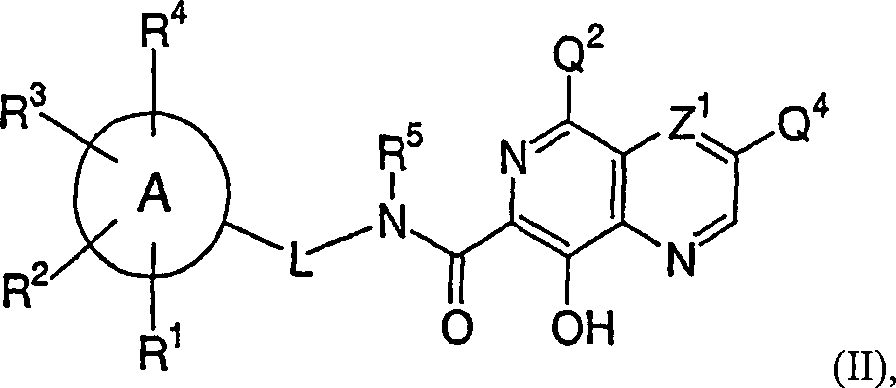
A ist
- (i) ein 4- bis 7-gliedriger gesättigter oder ungesättigter monocyclischer Heterocyclus, der 1 bis 4 Stickstoffatome, null bis 2 Heteroatome, ausgewählt aus Sauerstoff und Schwefel, und als Rest Kohlenstoffatome enthält, wobei wenigstens eines der Ringatome Kohlenstoff ist,
- (ii) ein 7- bis 11-gliedriger kondensierter bicyclischer Heterocyclus, wobei jeder Ring davon gesättigt oder ungesättigt ist, wobei der kondensierte bicyclische Heterocyclus 1 bis 6 Heteroatome, ausgewählt aus Stickstoff, Sauerstoff und Schwefel, und als Rest Kohlenstoffatome enthält, wobei wenigstens zwei der Ringatome Kohlenstoff sind, oder
- (iii) ein 11- bis 15-gliedriger kondensierter tricyclischer Heterocyclus, wobei jeder Ring davon gesättigt oder ungesättigt ist, wobei der kondensierte tricyclische Heterocyclus 1 bis 6 Stickstoffatome, null bis 3 Heteroatome, ausgewählt aus Sauerstoff und Schwefel, und als Rest Kohlenstoffatome enthält, wobei wenigstens drei der Ringatome Kohlenstoff sind,
- (i) eine Einfachbindung,
- (ii) -(CH2)1-3-, gegebenenfalls substituiert mit 1 oder 2 Substituenten, unabhängig ausgewählt aus der Gruppe, bestehend aus -OH, C1-4-Alkyl, -O-C1-4 Alkyl, -CO2CH3, -CO2CH2-Phenyl, Phenyl, Benzyl, -(CH2)1-2OH, -CH(OH)-Phenyl und -CH(NH2)-Phenyl,
- (iii) -(CH2)0-1-CH=CH-(CH2)-, das gegebenenfalls substituiert ist mit 1 oder 2 Substituenten, unabhängig ausgewählt aus der Gruppe, bestehend aus Halogen, -OH, -C1-4-Alkyl und -O-C1-4-Alkyl, oder
- (iv) wobei u und v jeweils ganze Zahlen mit einem Wert von 0 bis 4 sind, mit der Maßgabe, dass die Summe aus u + v 1, 2, 3 oder 4 ist, Z1 N oder C-Q3 ist,

- (1) -H,
- (2) -C1-4-Alkyl,
- (3) -C1-4-Fluoralkyl,
- (4) -O-C1-4-Alkyl,
- (5) -O-C1-4-Fluoralkyl,
- (6) Halogen,
- (7) -CN,
- (8) -C1-4-Alkyl-ORa,
- (9) -(CH2)0-2C(=O)Ra,
- (10) -(CH2)0-2CO2Ra,
- (11) -(CH2)0-2SRa,
- (12) -N(Ra)2,
- (13) -C1-4-Alkyl-N(Ra)2,
- (14) -(CH2)0-2C(=O)N(Ra)2,
- (15) -SO2Ra,
- (16) -N(Ra)SO2Ra,
- (17) -C2-3-Alkinyl,
- (18) -C≡C-CH2N(Ra)2,
- (19) -C≡C-CH2ORa,
- (20) -N(Ra)-C1-4-Alkyl-SRa,
- (21) -N(Ra)-C1-4-Alkyl-ORa,
- (22) -N(Ra)-C1-4-Alkyl-N(Ra)2,
- (23) -N(Ra)-C1-4-Alkyl-N(Ra)-C(Ra)=O,
- (24) -Rk,
- (25) -C1-4-Alkyl, substituiert mit Rk,
- (26) -C1-4-Fluoralkyl, substituiert mit Rk,
- (27) -C2-5-Alkenyl-Rk,
- (28) -C2-5-Alkinyl-Rk,
- (29) -O-Rk,
- (30) -O-C1-4-Alkyl-Rk,
- (31) -S(O)n-Rk,
- (32) -N(Rc)-Rk,
- (33) -N(Rc)-C1-4-Alkyl, substituiert mit einer oder zwei Rk-Gruppen,
- (34) -N(Rc)-C1-4-Alkyl-ORk,
- (35) -C(=O)N-C1-4-Alkyl-Rk,
- (36) -C≡C-CH2SRa oder
- (37) -C≡C-CH2SO2Ra,
- (1) -H,
- (2) -C1-4-Alkyl,
- (3) -C1-4-Fluoralkyl,
- (4) -O-C1-4-Alkyl,
- (5) -O-C1-4-Fluoralkyl,
- (6) Halogen, ausgewählt aus -F, -Cl und -Br,
- (7) -CN,
- (8) -C1-4-Alkyl-ORa oder
- (9) -C1-4-Alkyl, substituiert mit Rk,
- (1) -H,
- (2) -C1-4-Alkyl,
- (3) -C1-4-Fluoralkyl,
- (4) -O-C1-4-Alkyl,
- (5) -O-C1-4-Fluoralkyl,
- (6) Halogen, ausgewählt aus -F, -Cl und -Br,
- (7) -CN,
- (8) -C1-6-Alkyl-ORa,
- (9) -N(Ra)2 oder
- (10) -C1-6-Alkyl-N(Ra)2,
- (1) -H,
- (2) -C1-4-Alkyl,
- 3) -C1-4-Fluoralkyl,
- (4) -O-C1-4-Alkyl,
- 5) -O-C1-4-Fluoralkyl,
- (6) -OH,
- (7) Halogen,
- (8) -CN,
- (9) -C1-4-Alkyl-ORa,
- (10) -(CH2)0-2C(=O)Ra,
- (11) -(CH2)0-2CO2Ra,
- (12) -(CH2)0-2SRa,
- (13) N(Ra)2,
- (14) -C1-4-Alkyl-N(Ra)2,
- (15) -(CH2)0-2C(=O)N(Ra)2,
- (16) -C1-4-Alkyl-N(Ra)C(Ra)=O,
- (17) -SO2Ra,
- (18) -N(Ra)SO2Ra,
- (19) -O-C1-4-Alkyl-ORa,
- (20) -O-C1-4-Alkyl-SRa,
- (21) -O-C1-4-Alkyl-NH-CO2Ra,
- (22) -O-C2-4-Alkyl-N(Ra)2,
- (23) -N(Ra)-C1-4-Alkyl-SRa,
- (24) -N(Ra)-C1-4-Alkyl-ORa,
- (25) -N(Ra)-C1-4-Alkyl-N(Ra)2,
- (26) -N(Ra)-C1-4-Alkyl-N(Ra)-C(Ra)=O,
- (27) -Rk,
- (28) -C1-4-Alkyl, substituiert mit 1 oder 2 Rk-Gruppen,
- (29) -C1-4-Fluoralkyl, substituiert mit 1 oder 2 Rk-Gruppen,
- (30) -O-Rk,
- (31) -O-C1-4-Alkyl-Rk,
- (32) -S(O)n-Rk,
- (33) -S(O)n-C1-4-Alkyl-Rk,
- (34) -O-C1-4-Alkyl-ORk,
- (35) -O-C1-4-Alkyl-O-C1-4-alkyl-Rk,
- (36) -O-C1-4-Alkyl-SRk oder
- (37) -C0-4-Alkyl-N(Rb)(Rk),
- (1) -H,
- (2) Halogen,
- (3) -CN,
- (4) -OH,
- (5) C1-4-Alkyl,
- (6) C1-4-Fluoralkyl,
- (7) -O-C1-4-Alkyl,
- (8) -O-C1-4-Fluoralkyl,
- (9) -C1-4-Alkyl-ORa,
- (10) -O-C1-4-Alkyl-ORa,
- (11) -O-C1-4-Alkyl-SRa,
- (12) -O-C1-4-Alkyl-NH-CO2Ra oder
- (13) -O-C2-4-Alkyl-N(Ra)2,
- (1) -H,
- (2) -C1-4-Alkyl, gegebenenfalls substituiert mit 1 oder 2 Substituenten, unabhängig ausgewählt aus Halogen, -O-C1-4-Alkyl, -O-C1-4-Fluoralkyl, -N(Ra)2 und -CO2Ra,
- (3) Phenyl, gegebenenfalls substituiert mit 1 bis 3 Substituenten, unabhängig ausgewählt aus Halogen, C1-4-Alkyl, C1-4-Fluoralkyl, -O-C1-4-Alkyl, -O-C1-4-Fluoralkyl, -S-C1-4-Alkyl, -CN und -OH, oder
- (4) -C1-4-Alkyl, substituiert mit Phenyl,
jedes Rb unabhängig ist:
- (1) -H,
- (2) -C1-4-Alkyl,
- (3) -C1-4-Fluoralkyl,
- (4) -Rk,
- (5) -C1-4-Alkyl-Rk,
- (6) S(O)n-Rk oder
- (7) -C(=O)-Rk,
- (1) -H,
- (2) -C1-4-Alkyl,
- (3) -C1-4-Alkyl, substituiert mit -N(Ra)2, oder
- (4) -C1-4-Alkylphenyl, wobei das Phenyl gegebenenfalls substituiert ist mit 1 bis 3 Substituenten, unabhängig ausgewählt aus Halogen, C1-4-Alkyl, C1-4-Fluoralkyl, -O-C1-4-Alkyl, O-C1-4-Fluoralkyl, -S-C1-4-Alkyl, -CN und -OH,
- (1) Aryl, ausgewählt aus Phenyl und Naphthyl, wobei Aryl unsubstituiert oder substituiert ist mit 1 bis 5 Substituenten, unabhängig ausgewählt aus: (a) Halogen, (b) C1-6-Alkyl, (c) C1-6-Fluoralkyl, (d) -O-C1-6-Alkyl, (e) -O-C1-6-Fluoralkyl, (f) Phenyl, (g) -S-C1-6-Alkyl, (h) -CN, (i) -OH, (j) Phenyloxy, unsubstituiert oder substituiert mit 1 bis 3 Substituenten, unabhängig ausgewählt aus: (i) Halogen, (ii) C1-6-Alkyl, (iii) C1-6-Fluoralkyl und (iv) -OH, (k) -N(Ra)2, (l) -C1-6-Alkyl-N(Ra)2, (m) -Rt, (p) -(CH2)0-3C(=O)N(Ra)2 und (q) -(CH2)0-3C(=O)Ra,
- (2) -C3-7-Cycloalkyl, unsubstituiert oder substituiert mit 1 bis 3 Substituenten, unabhängig ausgewählt aus: (a) Halogen, (b) C1-6-Alkyl, (c) -O-C1-6-Alkyl, (d) C1-6-Fluoralkyl, (e) -O-C1-6-Fluoralkyl, (f) -CN, (h) Phenyl und (j) -OH,
- (3) -C3-7-Cycloalkyl, kondensiert mit einem Phenylring, unsubstituiert oder substituiert mit 1 bis 5 Substituenten, unabhängig ausgewählt aus: (a) Halogen, (b) C1-6-Alkyl, (c) -O-C1-6-Alkyl, (d) C1-6-Fluoralkyl, (e) -O-C1-6-Fluoralkyl, (f) -CN und (g) -OH,
- (4) ein 5- oder 6-gliedriger heteroaromatischer Ring, der 1 bis 4 Heteroatome enthält, unabhängig ausgewählt aus Sauerstoff, Stickstoff und Schwefel, wobei der heteroaromatische Ring am Stickstoff oder Kohlenstoff unsubstituiert oder substituiert ist mit 1 bis 5 Substituenten, unabhängig ausgewählt aus: (a) Halogen, (b) C1-6-Alkyl, (c) C1-6-Fluoralkyl, (d) -O-C1-6-Alkyl, (e) -O-C1-6-Fluoralkyl, (f) Phenyl, (g) -S-C1-6-Alkyl, (h) -CN, (i) -OH, (j) Phenyloxy, unsubstituiert oder substituiert mit 1 bis 3 Substituenten, unabhängig ausgewählt aus: (i) Halogen, (ii) C1-6-Alkyl, (iii) C1-6-Fluoralkyl und (iv) -OH, (k) -N(Ra)2, (l) -C1-6-Alkyl-N(Ra)2, (m) -Rt, (n) Oxo, (o) -(CH2)0-3C(=O)N(Ra)2 und (p) -(CH2)0-3C(=O)Ra,
- (5) ein 5- oder 6-gliedriger gesättigter heterocyclischer Ring, der 1 oder 2 Heteroatome enthält, unabhängig ausgewählt aus Sauerstoff, Stickstoff und Schwefel, wobei der heterocyclische Ring unsubstituiert oder substituiert ist mit 1 bis 4 Substituenten, unabhängig ausgewählt aus: (a) Halogen, (b) C1-6-Alkyl, (c) -O-C1-6-Alkyl, (d) C1-6-Fluoralkyl, (e) -O-C1-6-Fluoralkyl, (f) -CN, (g) Oxo, (h) Phenyl, (i) Benzyl, (j) Phenylethyl, (k) -OH, (l) -(CH2)0-3C(=O)N(Ra)2, (m) -(CH2)0-3C(=O)Ra, (n) -N(Ra)-C(=O)Ra, (o) -N(Ra)-C(=O)ORa, (p) -(CH2)1-3N(Ra)-C(=O)Ra, (q) -N(Ra)2, (r) -(CH2)1-3N(Ra)2, (s) -(CH2)0-3C(=O)R`, (t) -Rt, (u) -N(Ra)Rt und (v) -(CH2)1-3Rt, oder
- (6) ein 8- bis 10-gliedriger heterobicyclischer Ring, der 1 bis 4 Heteroatome enthält, unabhängig ausgewählt aus Sauerstoff, Stickstoff und Schwefel, wobei der heterobicyclische Ring gesättigt oder ungesättigt ist und unsubstituiert oder substituiert ist mit 1 bis 5 Substituenten, unabhängig ausgewählt aus: (a) Halogen, (b) C1-6-Alkyl, (c) -O-C1-6-Alkyl, (d) C1-6-Fluoralkyl, (e) -O-C1-6-Fluoralkyl, (f) -CN, (g) =O und (h) -OH,
n eine ganze Zahl gleich 0, 1 oder 2 ist,
oder ein pharmazeutisch annehmbares Salz davon.A ninth embodiment of the present invention is a compound of the formula (II):
A is
- (i) a 4- to 7-membered saturated or unsaturated monocyclic heterocycle containing 1 to 4 nitrogen atoms, zero to 2 heteroatoms selected from oxygen and sulfur, and the balance carbon atoms, at least one of the ring atoms being carbon,
- (ii) a 7- to 11-membered fused bicyclic heterocycle, each ring thereof being saturated or unsaturated, wherein the fused bicyclic heterocycle has 1 to 6 heteroatoms selected from Nitrogen, oxygen and sulfur, and as the remainder carbon atoms, wherein at least two of the ring atoms are carbon, or
- (iii) an 11- to 15-membered fused tricyclic heterocycle, each ring thereof being saturated or unsaturated, wherein the fused tricyclic heterocycle contains 1 to 6 nitrogen atoms, zero to 3 heteroatoms selected from oxygen and sulfur, and the remainder carbon atoms; wherein at least three of the ring atoms are carbon,
- (i) a single bond,
- (ii) - (CH 2 ) 1-3 - optionally substituted with 1 or 2 substituents independently selected from the group consisting of -OH, C 1-4 alkyl, -OC 1-4 alkyl, -CO 2 CH 3 , -CO 2 CH 2 -phenyl, phenyl, benzyl, - (CH 2 ) 1-2 OH, -CH (OH) -phenyl and -CH (NH 2 ) -phenyl,
- (iii) - (CH 2 ) 0-1 -CH = CH- (CH 2 ) - optionally substituted with 1 or 2 substituents independently selected from the group consisting of halogen, -OH, -C 1-4 Alkyl and -OC 1-4 alkyl, or
- (Iv) where u and v are each integers having a value of 0 to 4, with the proviso that the sum of u + v is 1, 2, 3 or 4, Z 1 is N or CQ 3 ,
- (1) -H,
- (2) C 1-4 alkyl,
- (3) C 1-4 fluoroalkyl,
- (4) -OC 1-4 -alkyl,
- (5) -OC 1-4 fluoroalkyl,
- (6) halogen,
- (7) CN,
- (8) C 1-4 -alkyl-OR a ,
- (9) - (CH 2 ) 0-2 C (= O) R a ,
- (10) - (CH 2 ) 0-2 CO 2 R a ,
- (11) - (CH 2 ) 0-2 SR a ,
- (12) -N (R a ) 2 ,
- (13) C 1-4 alkyl-N (R a ) 2 ,
- (14) - (CH 2 ) 0-2 C (= O) N (R a ) 2 ,
- (15) -SO 2 R a ,
- (16) -N (R a ) SO 2 R a ,
- (17) C 2-3 alkynyl,
- (18) -C≡C-CH 2 N (R a ) 2 ,
- (19) -C≡C-CH 2 OR a ,
- (20) -N (R a ) -C 1-4 -alkyl-SR a ,
- (21) -N (R a ) -C 1-4 -alkyl-OR a ,
- (22) -N (R a ) -C 1-4 -alkyl-N (R a ) 2 ,
- (23) -N (R a ) -C 1-4 -alkyl-N (R a ) -C (R a ) = O,
- (24) -R k ,
- (25) C 1-4 alkyl substituted with R k ,
- (26) C 1-4 fluoroalkyl substituted with R k ,
- (27) C 2-5 alkenyl R k ,
- (28) C 2-5 alkynyl R k ,
- (29) -OR k ,
- (30) -OC 1-4 -alkyl-R k ,
- (31) -S (O) n -R k ,
- (32) -N (R c) -R k,
- (33) -N (R c ) -C 1-4 -alkyl substituted with one or two R k groups,
- (34) -N (R c ) -C 1-4 -alkyl-OR k ,
- (35) -C (= O) N-C 1-4 -alkyl-R k ,
- (36) -C≡C-CH 2 SR a or
- (37) -C≡C-CH 2 SO 2 R a ,
- (1) -H,
- (2) C 1-4 alkyl,
- (3) C 1-4 fluoroalkyl,
- (4) -OC 1-4 -alkyl,
- (5) -OC 1-4 fluoroalkyl,
- (6) halogen selected from -F, -Cl and -Br,
- (7) CN,
- (8) C 1-4 alkyl OR a or
- (9) C 1-4 alkyl substituted with R k ,
- (1) -H,
- (2) C 1-4 alkyl,
- (3) C 1-4 fluoroalkyl,
- (4) -OC 1-4 -alkyl,
- (5) -OC 1-4 fluoroalkyl,
- (6) halogen selected from -F, -Cl and -Br,
- (7) CN,
- (8) -C 1-6 -alkyl-OR a ,
- (9) -N (R a ) 2 or
- (10) -C 1-6 -alkyl-N (R a ) 2 ,
- (1) -H,
- (2) C 1-4 alkyl,
- 3) C 1-4 fluoroalkyl,
- (4) -OC 1-4 -alkyl,
- 5) -OC 1-4 fluoroalkyl,
- (6) -OH,
- (7) halogen,
- (8) CN,
- (9) C 1-4 -alkyl-OR a ,
- (10) - (CH 2 ) 0-2 C (= O) R a ,
- (11) - (CH 2 ) 0-2 CO 2 R a ,
- (12) - (CH 2 ) 0-2 SR a ,
- (13) N (R a ) 2 ,
- (14) C 1-4 alkyl-N (R a ) 2 ,
- (15) - (CH 2 ) 0-2 C (= O) N (R a ) 2 ,
- (16) C 1-4 -alkyl-N (R a ) C (R a ) = O,
- (17) -SO 2 R a ,
- (18) -N (R a ) SO 2 R a ,
- (19) -OC 1-4 -alkyl-OR a ,
- (20) -OC 1-4 -alkyl-SR a ,
- (21) -OC 1-4 -alkyl-NH-CO 2 R a ,
- (22) -OC 2-4 -alkyl-N (R a ) 2 ,
- (23) -N (R a ) -C 1-4 -alkyl-SR a ,
- (24) -N (R a ) -C 1-4 -alkyl-OR a ,
- (25) -N (R a ) -C 1-4 -alkyl-N (R a ) 2 ,
- (26) -N (R a ) -C 1-4 -alkyl-N (R a ) -C (R a ) = O,
- (27) -R k ,
- (28) C 1-4 alkyl substituted with 1 or 2 R k groups,
- (29) C 1-4 fluoroalkyl substituted with 1 or 2 R k groups,
- (30) -OR k ,
- (31) -OC 1-4 -alkyl-R k ,
- (32) -S (O) n -R k ,
- (33) -S (O) n -C 1-4 -alkyl-R k ,
- (34) -OC 1-4 -alkyl-OR k ,
- (35) -OC 1-4 -alkyl-OC 1-4 -alkyl-R k ,
- (36) -OC 1-4 -alkyl-SR k or
- (37) -C 0-4 -alkyl-N (R b ) (R k ),
- (1) -H,
- (2) halogen,
- (3) CN,
- (4) -OH,
- (5) C 1-4 alkyl,
- (6) C 1-4 fluoroalkyl,
- (7) -OC 1-4 alkyl,
- (8) -OC 1-4 fluoroalkyl,
- (9) C 1-4 -alkyl-OR a ,
- (10) -OC 1-4 -alkyl-OR a ,
- (11) -OC 1-4 -alkyl-SR a ,
- (12) -OC 1-4 -alkyl-NH-CO 2 R a or
- (13) -OC 2-4 -alkyl-N (R a ) 2 ,
- (1) -H,
- (2) C 1-4 alkyl optionally substituted with 1 or 2 substituents independently selected from halogen, -OC 1-4 -alkyl, -OC 1-4 -fluoroalkyl, -N (R a ) 2 and -CO 2 R a ,
- (3) phenyl optionally substituted with 1 to 3 substituents independently selected from halogen, C 1-4 alkyl, C 1-4 fluoroalkyl, -OC 1-4 alkyl, -OC 1-4 fluoroalkyl, -SC 1-4 alkyl, -CN and -OH, or
- (4) C 1-4 alkyl substituted with phenyl,
each R b is independent:
- (1) -H,
- (2) C 1-4 alkyl,
- (3) C 1-4 fluoroalkyl,
- (4) -R k ,
- (5) C 1-4 -alkyl-R k ,
- (6) S (O) n -R k or
- (7) -C (= O) -R k ,
- (1) -H,
- (2) C 1-4 alkyl,
- (3) C 1-4 alkyl substituted with -N (R a ) 2 , or
- (4) C 1-4 alkylphenyl wherein the phenyl is optionally substituted with 1 to 3 substituents independently selected from halo, C 1-4 alkyl, C 1-4 fluoroalkyl, -OC 1-4 alkyl, OC 1-4 -fluoroalkyl, -SC 1-4 -alkyl, -CN and -OH,
- (1) aryl selected from phenyl and naphthyl, wherein aryl is unsubstituted or substituted with 1 to 5 substituents independently selected from: (a) halogen, (b) C 1-6 alkyl, (c) C 1-6 - Fluoroalkyl, (d) -OC 1-6 -alkyl, (e) -OC 1-6 -fluoroalkyl, (f) phenyl, (g) -SC 1-6 -alkyl, (h) -CN, (i) - OH, (j) phenyloxy, unsubstituted or substituted with 1 to 3 substituents independently selected from: (i) halogen, (ii) C 1-6 -alkyl, (iii) C 1-6 -fluoroalkyl and (iv) -OH, (k) -N (R a ) 2 , (l) -C 1-6 -alkyl-N ( R a ) 2 , (m) -R t , (p) - (CH 2 ) 0-3 C (= O) N (R a ) 2 and (q) - (CH 2 ) 0-3 C (= O R a ,
- (2) -C 3-7 -cycloalkyl, unsubstituted or substituted with 1 to 3 substituents independently selected from: (a) halogen, (b) C 1-6 -alkyl, (c) -OC 1-6 -alkyl, (d) C 1-6 fluoroalkyl, (e) -OC 1-6 fluoroalkyl, (f) -CN, (h) phenyl and (j) -OH,
- (3) -C 3-7 -cycloalkyl fused to a phenyl ring unsubstituted or substituted by 1 to 5 substituents independently selected from: (a) halogen, (b) C 1-6 -alkyl, (c) -OC 1 -6- alkyl, (d) C 1-6 -fluoroalkyl, (e) -OC 1-6 -fluoroalkyl, (f) -CN and (g) -OH,
- (4) a 5- or 6-membered heteroaromatic ring containing 1 to 4 heteroatoms independently selected from oxygen, nitrogen and sulfur wherein the heteroaromatic ring on the nitrogen or carbon is unsubstituted or substituted with 1 to 5 substituents independently selected from : (a) halogen, (b) C 1-6 alkyl, (c) C 1-6 fluoroalkyl, (d) -OC 1-6 alkyl, (e) -OC 1-6 fluoroalkyl, (f ) Phenyl, (g) -SC 1-6 alkyl, (h) -CN, (i) -OH, (j) phenyloxy, unsubstituted or substituted with 1 to 3 substituents independently selected from: (i) halogen, ( ii) C 1-6 alkyl, (iii) C 1-6 fluoroalkyl and (iv) -OH, (k) -N (R a ) 2 , (l) -C 1-6 alkyl-N (R a ) 2 , (m) -R t , (n) oxo, (o) - (CH 2 ) 0-3 C (= O) N (R a ) 2 and (p) - (CH 2 ) 0-3 C (= O) R a ,
- (5) a 5- or 6-membered saturated heterocyclic ring containing 1 or 2 heteroatoms independently selected from oxygen, nitrogen and sulfur, said heterocyclic ring being unsubstituted or substituted with 1 to 4 substituents independently selected from: (a ) Halogen, (b) C 1-6 -alkyl, (c) -OC 1-6 -alkyl, (d) C 1-6 -fluoroalkyl, (e) -OC 1-6 -fluoroalkyl, (f) -CN , (g) oxo, (h) phenyl, (i) benzyl, (j) phenylethyl, (k) -OH, (1) - (CH 2 ) 0-3 C (= O) N (R a ) 2 , (m) - (CH 2 ) 0-3 C (= O) R a , (n) -N (R a ) -C (= O) R a , (o) -N (R a ) -C (= O) OR a , (p) - (CH 2 ) 1-3 N (R a ) -C (= O) R a , (q) -N (R a ) 2 , (r) - (CH 2 ) 1-3 N (R a ) 2 , (s ) - (CH 2 ) 0-3 C (= O) R ', (t) -R t , (u) -N (R a ) R t and (v) - (CH 2 ) 1-3 R t , or
- (6) an 8 to 10 membered heterobicyclic ring containing 1 to 4 heteroatoms independently selected from oxygen, nitrogen and sulfur, said heterobicyclic ring being saturated or unsaturated and being unsubstituted or substituted with 1 to 5 substituents independently selected (a) halogen, (b) C 1-6 alkyl, (c) -OC 1-6 alkyl, (d) C 1-6 fluoroalkyl, (e) -OC 1-6 fluoroalkyl, ( f) -CN, (g) = O and (h) -OH,
n is an integer equal to 0, 1 or 2,
or a pharmaceutically acceptable salt thereof.
Eine
zehnte Ausführungsform
der vorliegenden Erfindung ist eine Verbindung der Formel II, wobei
Z1 CH ist,
Q2 ist
- (1) -H,
- (2) -C1-4-Alkyl,
- (3) -(CH2)0-2CF3,
- (4) -O-C1-4-Alkyl,
- (5) -O-(CH2)0-2CF3,
- (6) Halogen, ausgewählt aus -F, -Cl und -Br,
- (7) -CN,
- (8) -(CH2)1-3ORa,
- (9) -(CH2)0-2C(=O)Ra,
- (10) -(CH2)0-2CO2Ra,
- (11) -(CH2)0-2SRa,
- (12) -N(Ra)2,
- (13) -(CH2)1-3N(Ra)2,
- (14) -(CH2)0-2C(=O)N(Ra)2,
- (15) -SO2Ra,
- (16) -N(Ra)SO2Ra,
- (17) -C≡C-CH2ORa,
- (18) -N(Ra)-(CH2)1-4SRa,
- (19) -N(Ra)-(CH2)1-4ORa,
- (20) -N(Ra)-(CH2)1-4-N(Ra)2,
- (21) -N(Ra)-(CH2)1-4N(Ra)-C(Ra)=O,
- (22) -Rk,
- (23) -(CH2)1-4Rk,
- (24) -C≡C-CH2Rk,
- (25) -O-Rk,
- (26) S(O)Rk,
- (27) -N(Rc)-Rk,
- (28) -N(Rc)-(CH2)1-4H, substituiert mit einer oder zwei Rk-Gruppen,
- (29) -N(Rc)-(CH2)1-4ORk,
- (30) -C(=O)N-(CH2)1-4Rk,
- (31) -C≡C-CH2SRa oder
- (32) -C≡C-CH2SO2Ra,
R1 und R2 jeweils unabhängig sind:
- (1) -H,
- (2) -C1-4-Alkyl,
- (3) -(CH2)0-2CF3,
- (4) -O-C1-4-Alkyl,
- (5) -O-(CH2)0-2CF3,
- (6) -OH,
- (7) Halogen, ausgewählt aus -F, -Cl und -Br,
- (8) -CN,
- (9) -(CH2)1-3ORa,
- (10) -(CH2)0-2C(=O)Ra,
- (11) -(CH2)0-2CO2Ra,
- (12) -(CH2)0-2SRa,
- (13) -N(Ra)2,
- (14) -(CH2)1-3N(Ra)2,
- (15) -(CH2)0-2C(=O)N(Ra)2,
- (16) -C1-4-Alkyl-N(Ra)-C(Ra)=O,
- (17) -SO2Ra,
- (18) -N(Ra)SO2Ra,
- (19) -O-(CH2)1-4ORa,
- (20) -O-(CH2)1-4SRa,
- (21) -O-(CH2)1-4NH-CO2Ra,
- (22) -O-(CH2)2-4N(Ra)2,
- (23) -N(Ra)-(CH2)1-4SRa,
- (24) -N(Ra)-(CH2)1-4ORa,
- (25) -N(Ra)-(CH2)1-4N(Ra)2,
- (26) -N(Ra)-(CH2)1-4N(Ra)-C(Ra)=O,
- (27) -Rk,
- (28) -(CH2)1-4H, substituiert mit 1 oder 2 Rk-Gruppen,
- (29) -O-Rk,
- (30) -O-(CH2)1-4Rk,
- (31) S(O)n-Rk,
- (32) -S(O)n-(CH2)1-4Rk,
- (33) -O-(CH2)1-4ORk,
- (34) -O-(CH2)1-4-O-(CH2)1-4Rk,
- (35) -O-(CH2)1-4SRk oder
- (36) -(CH2)0-4N(Rb)(Rk),
- (1) -H,
- (2) Halogen, ausgewählt aus -F, -Cl und -Br,
- (3) -CN,
- (4) -OH,
- (5) C1-4-Alkyl,
- (6) -(CH2)0-2CF3,
- (7) -O-C1-4-Alkyl oder
- (8) -O(CH2)0-2CF3,
- (1) -H,
- (2) -C1-4-Alkyl,
- (3) -(CH2)1-4N(Ra)2,
- (4) -(CH2)1-4CO2R2,
- (5) Phenyl, gegebenenfalls substituiert mit 1 bis 3 Substituenten, unabhängig ausgewählt aus Halogen, C1-4-Alkyl, -(CH2)0-2CF3, -O-C1-4-Alkyl, -O(CH2)0-2CF3, -S-C1-4-Alkyl, -CN und -OH, oder
- (6) -(CH2)1-4-Phenyl,
jedes Rb unabhängig ist:
- (1) -H,
- (2) -C1-4-Alkyl,
- (3) -CF3,
- (4) -Rk oder
- (5) -(CH2)1-4-Rk,
- (1) -H,
- (2) -C1-4-Alkyl,
- (3) -(CH2)1-4N(Ra)2 oder
- (4) -(CH2)1-4-Phenyl, wobei das Phenyl gegebenenfalls substituiert ist mit 1 bis 3 Substituenten, unabhängig ausgewählt aus Halogen, C1-4-Alkyl, C1-4-Fluoralkyl, O-C1-4-Alkyl, -O-C1-4-Fluoralkyl, -S-C1-4-Alkyl, -CN und -OH, und
- (1) Aryl, ausgewählt aus Phenyl und Naphthyl, wobei Aryl unsubstituiert oder substituiert ist mit 1 bis 4 Substituenten, unabhängig ausgewählt aus: (a) Halogen, (b) C1-4-Alkyl, (c) C1-4-Fluoralkyl, (d) O-C1-4-Alkyl, (e) -O-C1-4-Fluoralkyl, (f) Phenyl, (g) -S-C1-4-Alkyl, (h) -CN, (i) -OH, (j) Phenyloxy, unsubstituiert oder substituiert mit 1 bis 3 Substituenten, unabhängig ausgewählt aus: (i) Halogen, (ii) C1-4-Alkyl, (iii) C1-4-Fluoralkyl und (iv) -OH, (k) -N(Ra)2, (l) -C1-4-Alkyl-N(Ra)2, (m) -Rt, (p) -(CH2)0-3C(=O)N(Ra)2 und (q) -(CH2)0-3C(=O)Ra,
- (2) -C3-6-Cycloalkyl, unsubstituiert oder substituiert mit 1 bis 3 Substituenten, unabhängig ausgewählt aus: (a) Halogen, (b) C1-4-Alkyl, (c) -O-C1-4-Alkyl, (d) C1-4-Fluoralkyl, (e) -O-C1-4-Fluoralkyl, (f) -CN, (h) Phenyl und (j) -OH,
- (3) -C3-6-Cycloalkyl, kondensiert mit einem Phenylring, unsubstituiert oder substituiert mit 1 bis 4 Substituenten, unabhängig ausgewählt aus: (a) Halogen, (b) C1-4-Alkyl, (c) -O-C1-4-Alkyl, (d) C1-4-Fluoralkyl, (e) -O-C1-4-Fluoralkyl, (f) -CN und (g) -OH,
- (4) ein 5- oder 6-gliedriger heteroaromatischer Ring, ausgewählt aus Thienyl, Pyridyl, Imidazolyl, Pyrrolyl, Pyrazolyl, Thiazolyl, Isothiazolyl, Oxazolyl, Isoxazolyl, Pyrazinyl, Pyrimidinyl, Triazolyl, Tetrazolyl, Furanyl und Pyridazinyl, wobei der heteroaromatische Ring am Stickstoff oder Kohlenstoff unsubstituiert oder substituiert ist mit 1 bis 4 Substituenten, unabhängig ausgewählt aus: (a) Halogen, (b) C1-4-Alkyl, (c) C1-4-Fluoralkyl, (d) -O-C1-4-Alkyl, (e) -O-C1-4-Fluoralkyl, (f) Phenyl, (g) -S-C1-6-Alkyl, (h) -CN, (i) -OH, (j) Phenyloxy, unsubstituiert oder substituiert mit 1 bis 3 Substituenten, unabhängig ausgewählt aus: (i) Halogen, (ii) C1-4-Alkyl, (iii) C1-4-Fluoralkyl und (iv) -OH, (k) -N(Ra)2, (l) -C1-4-Alkyl-N(Ra)2, (m) -Rt, (n) Oxo, (o) -(CH2)0-3C(=O)N(Ra)2 und (p) -(CH2)0-3C(=O)Ra,
- (5) ein 5- oder 6-gliedriger gesättigter heterocyclischer Ring, ausgewählt aus Piperidinyl, Morpholinyl, Thiomorpholinyl, Thiazolidinyl, Isothiazolidinyl, Oxazolidinyl, Isoxazolidinyl, Pyrrolidinyl, Imidazolidinyl, Piperazinyl, Tetrahydrofuranyl und Pyrazolidinyl, wobei der heterocyclische Ring unsubstituiert oder substituiert ist mit 1 bis 3 Substituenten, unabhängig ausgewählt aus: (a) Halogen, (b) C1-4-Alkyl, (c) O-C1-4-Alkyl, (d) C1-4-Fluoralkyl, (e) -O-C1-4-Fluoralkyl, (f) -CN, (g) =O, (h) Phenyl, (i) Benzyl, (j) Phenylethyl, (k) -OH, (l) -(CH2)0-3C(=O)N(Ra)2, (m) -(CH2)0-3C(=O)Ra, (n) -N(Ra)-C(=O)Ra, (o) -N(Ra)-C(=O)ORa, (p) -(CH2)1-3N(Ra)-C(=O)Ra, (q) -N(Ra)2, (r) -(CH2)1-3N(Ra)2, (s) -(CH2)0-3C(=O)Rt, (t) -Rt, (u) -N(Ra)Rt und (v) -(CH2)1-3Rt, oder
- (6) ein 8- bis 10-gliedriger heterobicyclischer Ring, ausgewählt aus Indolyl, Benzotriazolyl, Benzoimidazolyl, Imidazo[4.5-b]pyridinyl, Dihydroimidazo[4,5-b]pyridinyl, Pyrazolo[4,3-c]pyridinyl, Dihydropyrazolo[4,3-c]pyridinyl, Tetrahydropyrazolo[4,3-c]pyridinyl, Pyrrolo[1,2-a]pyrazinyl, Dihydropyrrolo[1,2-a]pyrazinyl, Tetrahydropyrrolo[1,2-a]pyrazinyl, Octahydropyrrolo[1,2-a]pyrazinyl, Isoindolyl, Indazolyl, Indolinyl, Isoindolinyl, Chinolinyl, Isochinolinyl, Chinoxalinyl, Chinazolinyl, Cinnolinyl, Chromanyl und Isochromanyl, wobei der bicyclische Ring unsubstituiert oder substituiert ist mit 1 oder 2 Substituenten, unabhängig ausgewählt aus: (a) Halogen, (b) C1-4-Alkyl, (c) -O-C1-4-Alkyl, (d) C1-4-Fluoralkyl, (e) -O-C1-4-Fluoralkyl, (f) -CN, (g) =O und (h) -OH,
und alle anderen Variablen wie in der neunten Ausführungsform definiert sind,
oder ein pharmazeutisch annehmbares Salz davon.A tenth embodiment of the present invention is a compound of the formula II wherein
Z 1 is CH,
Q is 2
- (1) -H,
- (2) C 1-4 alkyl,
- (3) - (CH 2 ) 0-2 CF 3 ,
- (4) -OC 1-4 -alkyl,
- (5) -O- (CH 2 ) 0-2 CF 3 ,
- (6) halogen selected from -F, -Cl and -Br,
- (7) CN,
- (8) - (CH 2 ) 1-3 OR a ,
- (9) - (CH 2 ) 0-2 C (= O) R a ,
- (10) - (CH 2 ) 0-2 CO 2 R a ,
- (11) - (CH 2 ) 0-2 SR a ,
- (12) -N (R a ) 2 ,
- (13) - (CH 2 ) 1-3 N (R a ) 2 ,
- (14) - (CH 2 ) 0-2 C (= O) N (R a ) 2 ,
- (15) -SO 2 R a ,
- (16) -N (R a ) SO 2 R a ,
- (17) -C≡C-CH 2 OR a ,
- (18) -N (R a ) - (CH 2 ) 1-4 SR a ,
- (19) -N (R a ) - (CH 2 ) 1-4 OR a ,
- (20) -N (R a ) - (CH 2 ) 1-4 -N (R a ) 2 ,
- (21) -N (R a ) - (CH 2 ) 1-4 N (R a ) -C (R a ) = O,
- (22) -R k ,
- (23) - (CH 2 ) 1-4 R k ,
- (24) -C≡C-CH 2 R k ,
- (25) -OR k ,
- (26) S (O) R k ,
- (27) -N (R c) -R k,
- (28) -N (R c ) - (CH 2 ) 1-4 H, substituted with one or two R k groups,
- (29) -N (R c ) - (CH 2 ) 1-4 OR k ,
- (30) -C (= O) N- (CH 2 ) 1-4 R k ,
- (31) -C≡C-CH 2 SR a or
- (32) -C≡C-CH 2 SO 2 R a ,
Each of R 1 and R 2 is independently:
- (1) -H,
- (2) C 1-4 alkyl,
- (3) - (CH 2 ) 0-2 CF 3 ,
- (4) -OC 1-4 -alkyl,
- (5) -O- (CH 2 ) 0-2 CF 3 ,
- (6) -OH,
- (7) halogen selected from -F, -Cl and -Br,
- (8) CN,
- (9) - (CH 2 ) 1-3 OR a ,
- (10) - (CH 2 ) 0-2 C (= O) R a ,
- (11) - (CH 2 ) 0-2 CO 2 R a ,
- (12) - (CH 2 ) 0-2 SR a ,
- (13) -N (R a ) 2 ,
- (14) - (CH 2 ) 1-3 N (R a ) 2 ,
- (15) - (CH 2 ) 0-2 C (= O) N (R a ) 2 ,
- (16) C 1-4 -alkyl-N (R a ) -C (R a ) = O,
- (17) -SO 2 R a ,
- (18) -N (R a ) SO 2 R a ,
- (19) -O- (CH 2 ) 1-4 OR a ,
- (20) -O- (CH 2 ) 1-4 SR a ,
- (21) -O- (CH 2 ) 1-4 NH-CO 2 R a ,
- (22) -O- (CH 2 ) 2-4 N (R a ) 2 ,
- (23) -N (R a ) - (CH 2 ) 1-4 SR a ,
- (24) -N (R a ) - (CH 2 ) 1-4 OR a ,
- (25) -N (R a ) - (CH 2 ) 1-4 N (R a ) 2 ,
- (26) -N (R a ) - (CH 2 ) 1-4 N (R a ) -C (R a ) = O,
- (27) -R k ,
- (28) - (CH 2 ) 1-4 H, substituted with 1 or 2 R k groups,
- (29) -OR k ,
- (30) -O- (CH 2 ) 1-4 R k ,
- (31) S (O) n -R k ,
- (32) -S (O) n - (CH 2 ) 1-4 R k ,
- (33) -O- (CH 2 ) 1-4 OR k ,
- (34) -O- (CH 2 ) 1-4 -O- (CH 2 ) 1-4 R k ,
- (35) -O- (CH 2 ) 1-4 SR k or
- (36) - (CH 2 ) 0-4 N (R b ) (R k ),
- (1) -H,
- (2) halogen selected from -F, -Cl and -Br,
- (3) CN,
- (4) -OH,
- (5) C 1-4 alkyl,
- (6) - (CH 2 ) 0-2 CF 3 ,
- (7) -OC 1-4 alkyl or
- (8) -O (CH 2 ) 0-2 CF 3 ,
- (1) -H,
- (2) C 1-4 alkyl,
- (3) - (CH 2 ) 1-4 N (R a ) 2 ,
- (4) - (CH 2 ) 1-4 CO 2 R 2 ,
- (5) phenyl optionally substituted with 1 to 3 substituents independently selected from halogen, C 1-4 alkyl, - (CH 2 ) 0-2 CF 3 , -OC 1-4 alkyl, -O (CH 2 ) 0-2 CF 3 , -SC 1-4 alkyl, -CN and -OH, or
- (6) - (CH 2 ) 1-4 -phenyl,
each R b is independent:
- (1) -H,
- (2) C 1-4 alkyl,
- (3) -CF 3 ,
- (4) -R k or
- (5) - (CH 2 ) 1-4 -R k ,
- (1) -H,
- (2) C 1-4 alkyl,
- (3) - (CH 2 ) 1-4 N (R a ) 2 or
- (4) - (CH 2 ) 1-4 -phenyl wherein the phenyl is optionally substituted with 1 to 3 substituents independently selected from halo, C 1-4 alkyl, C 1-4 fluoroalkyl, OC 1-4 Alkyl, -OC 1-4 -fluoroalkyl, -SC 1-4 -alkyl, -CN and -OH, and
- (1) Aryl selected from phenyl and naphthyl, wherein aryl is unsubstituted or substituted with 1 to 4 substituents independently selected from: (a) halogen, (b) C 1-4 alkyl, (c) C 1-4 Fluoroalkyl, (d) OC 1-4 alkyl, (e) -OC 1-4 fluoroalkyl, (f) phenyl, (g) -SC 1-4 alkyl, (h) -CN, (i) -OH (j) phenyloxy unsubstituted or substituted with 1 to 3 substituents independently selected from: (i) halogen, (ii) C 1-4 alkyl, (iii) C 1-4 fluoroalkyl and (iv) -OH, (k) -N (R a ) 2 , (l) -C 1-4 alkyl-N (R a ) 2 , (m) -R t , (p) - (CH 2 ) 0-3 C (= O) N (R a ) 2 and (q) - (CH 2 ) 0-3 C (= O) R a ,
- (2) -C 3-6 -cycloalkyl, unsubstituted or substituted with 1 to 3 substituents independently selected from: (a) halogen, (b) C 1-4 alkyl, (c) -O-C 1-4 -alkyl, (d) C 1-4 fluoroalkyl, (e) -OC 1-4 fluoroalkyl, (f) -CN, (h) phenyl and (j) -OH,
- (3) -C 3-6 cycloalkyl fused to a phenyl ring unsubstituted or substituted by 1 to 4 substituents independently selected from: (a) halogen, (b) C 1-4 alkyl, (c) -OC 1 -4- alkyl, (d) C 1-4 -fluoroalkyl, (e) -OC 1-4 -fluoroalkyl, (f) -CN and (g) -OH,
- (4) a 5- or 6-membered heteroaromatic ring selected from thienyl, pyridyl, imidazolyl, pyrrolyl, pyrazolyl, thiazolyl, isothiazolyl, oxazolyl, isoxazolyl, pyrazinyl, pyrimidinyl, triazolyl, tetrazolyl, furanyl and pyridazinyl, wherein the heteroaromatic ring on the Nitrogen or carbon is unsubstituted or substituted with 1 to 4 substituents independently selected from: (a) halogen, (b) C 1-4 alkyl, (c) C 1-4 fluoroalkyl, (d) -OC 1-4 -Alkyl, (e) -OC 1-4 -fluoroalkyl, (f) phenyl, (g) -SC 1-6 -alkyl, (h) -CN, (i) -OH, (j) phenyloxy, unsubstituted or substituted having 1 to 3 substituents independently selected from: (i) halogen, (ii) C 1-4 alkyl, (iii) C 1-4 fluoroalkyl and (iv) -OH, (k) -N (R a ) 2 , (I) C 1-4 alkyl-N (R a ) 2 , (m) -R t , (n) oxo, (o) - (CH 2 ) 0-3 C (= O) N ( R a ) 2 and (p) - (CH 2 ) 0-3 C (= O) R a ,
- (5) a 5- or 6-membered saturated heterocyclic ring selected from piperidinyl, morpholinyl, thiomorpholinyl, thiazolidinyl, isothiazolidinyl, oxazolidinyl, isoxazolidinyl, pyrrolidinyl, imidazolidinyl, piperazinyl, tetrahydrofuranyl and pyrazolidinyl wherein the heterocyclic ring is unsubstituted or substituted with 1 to 3 substituents independently selected from: (a) halogen, (b) C 1-4 alkyl, (c) OC 1-4 alkyl, (d) C 1-4 fluoroalkyl, (e) -OC 1- 4- fluoroalkyl, (f) -CN, (g) = O, (h) phenyl, (i) benzyl, (j) phenylethyl, (k) -OH, (l) - (CH 2 ) 0-3 C ( = O) N (R a ) 2 , (m) - (CH 2 ) 0-3 C (= O) R a , (n) -N (R a ) -C (= O) R a , (o) -N (R a ) -C (= O) OR a , (p) - (CH 2 ) 1-3 N (R a ) -C (= O) R a , (q) -N (R a ) 2 , (r) - (CH 2 ) 1-3 N (R a ) 2 , (s) - (CH 2 ) 0-3 C (= O) R t , (t) -R t , (u) -N (R a ) R t and (v) - (CH 2 ) 1-3 R t , or
- (6) an 8 to 10 membered heterobicyclic ring selected from indolyl, benzotriazolyl, benzoimidazolyl, imidazo [4.5-b] pyridinyl, dihydroimidazo [4,5-b] pyridinyl, pyrazolo [4,3-c] pyridinyl, dihydropyrazolo [4,3-c] pyridinyl, tetrahydropyrazolo [4,3-c] pyridinyl, pyrrolo [1,2-a] pyrazinyl, dihydropyrrolo [1,2-a] pyrazinyl, tetrahydropyrrolo [1,2-a] pyrazinyl, octahydropyrrolo [1,2-a] pyrazinyl, isoindolyl, indazolyl, indolinyl, isoindolinyl, quinolinyl, isoquinolinyl, quinoxalinyl, quinazolinyl, cinnolinyl, chromanyl and isochromanyl, wherein the bicyclic ring is unsubstituted or substituted with 1 or 2 substituents independently selected from: ( a) halogen, (b) C 1-4 alkyl, (c) -OC 1-4 alkyl, (d) C 1-4 fluoroalkyl, (e) -OC 1-4 fluoroalkyl, (f) -CN, (g ) = O and (h) -OH,
and all other variables are defined as in the ninth embodiment,
or a pharmaceutically acceptable salt thereof.
Eine
erste Klasse der vorliegenden Erfindung bilden Verbindungen der
Formel (III): 
A ist
- (i) ein 4- bis 7-gliedriger gesättigter oder ungesättigter monocyclischer Heterocyclus, der 1 bis 4 Stickstoffatome, null bis 2 Heteroatome, ausgewählt aus Sauerstoff und Schwefel, und als Rest Kohlenstoffatome enthält, wobei wenigstens eines der Ringatome Kohlenstoff ist,
- (ii) ein 7- bis 11-gliedriger kondensierter bicyclischer Heterocyclus, wobei jeder Ring davon gesättigt oder ungesättigt ist, wobei der kondensierte bicyclische Heterocyclus 1 bis 6 Heteroatome, ausgewählt aus Stickstoff, Sauerstoff und Schwefel, und als Rest Kohlenstoffatome enthält, wobei wenigstens zwei der Ringatome Kohlenstoff sind, oder
- (iii) ein 11- bis 15-gliedriger kondensierter tricyclischer Heterocyclus, wobei jeder Ring davon gesättigt oder ungesättigt ist, wobei der kondensierte tricyclische Heterocyclus 1 bis 6 Stickstoffatome, null bis 3 Heteroatome, ausgewählt aus Sauerstoff und Schwefel, und als Rest Kohlenstoffatome enthält, wobei wenigstens drei der Ringatome Kohlenstoff sind,
- (i) eine Einfachbindung oder
- (ii) -(CH2)1-3-, gegebenenfalls substituiert mit 1 oder 2 Substituenten, unabhängig ausgewählt aus der Gruppe, bestehend aus -OH, Methyl, Ethyl, -CO2CH3, -CO2CH2-Phenyl, Phenyl, Benzyl, -(CH2)1-2OH, -CH(OH)-Phenyl und -CH(NH2)-Phenyl,
- (1) -H,
- (2) Methyl,
- (3) Ethyl,
- (4) CF3,
- (5) Methoxy,
- (6) Ethoxy,
- (7) -OCF3,
- (8) Halogen, ausgewählt aus -F, -Cl und -Br,
- (9) -CN,
- (10) -CH2OH,
- (11) -CH2OCH3,
- (12) -(CH2)0-2-CO2CH3,
- (13) -SRa,
- (14) -N(Ra)2,
- (15) -SO2Ra,
- (16) -C≡C-CH2ORa,
- (17) -N(Ra)-(CH2)1-3SRa,
- (18) -N(Ra)-(CH2)1-3ORa,
- (19) -N(Ra)-(CH2)1-3N(Ra)2,
- (20) -N(Ra)-(CH2)1-3N(Ra)-C(Ra)=O,
- (21) -Rk,
- (22) -(CH2)1-4Rk,
- (23) -C≡–C-CH2Rk,
- (24) -O-Rk,
- (25) -S-Rk,
- (26) -SO2-Rk,
- (27) -N(Rc)-Rk,
- (28) -N(Rc)-(CH2)1-4H, substituiert mit einer oder zwei Rk-Gruppen,
- (29) -N(Rc)-(CH2)1-4ORk,
- (30) -C(=O)N-(CH2)1-4Rk,
- (31) -C≡C-CH2SRa oder
- (32) -C≡C-CH2SO2Ra,
- (1) -H,
- (2) Methyl,
- (3) Ethyl,
- (4) CF3,
- (5) Methoxy,
- (6) Ethoxy,
- (7) -OCF3,
- (8) Halogen, ausgewählt aus -F, -Cl und -Br,
- (9) -CN,
- (10) -CH2ORa,
- (11) -CO2Ra,
- (12) -SRa,
- (13) -N(Ra)2,
- (14) -(CH2)1-3N(Ra)2,
- (15) -SO2Ra,
- (16) -(CH2)1-2N(Ra)-C(Ra)=O,
- (17) -Rk,
- (18) -(CH2)1-3H, substituiert mit 1 oder 2 Rk-Gruppen,
- (19) -O-Rk oder
- (20) -O-(CH2)1-3Rk,
- (1) -H,
- (2) Methyl,
- (3) -(CH2)1-2N(Ra)2,
- (4) -(CH2)1-2CO2CH3 oder
- (5) -(CH2)1-2CO2CH2CH3,
- (6) Phenyl oder
- (7) Benzyl,
jedes Rc unabhängig -H, -C1-4-Alkyl oder -(CH2)1-3N(Ra)2 ist,
jedes Rk unabhängig ist:
- (1) Phenyl, unsubstituiert oder substituiert mit 1 bis 4 Substituenten, unabhängig ausgewählt aus: (a) Halogen, ausgewählt aus -F, -Cl und -Br, (b) Methyl, (c) -CF3, (d) Methoxy, (e) -OCF3, (f) Phenyl, (g) -S-CH3, (h) -CN, (i) -OH, (j) Phenyloxy, unsubstituiert oder substituiert mit 1 bis 3 Substituenten, unabhängig ausgewählt aus: (i) Halogen, ausgewählt aus -F, -Cl und -Br, (ii) Methyl, (iii) -CF3 und (iv) -OH, (k) -N(Ra)2, (l) -(CH2)1-3N(Ra)2, (m) -Rt, (p) -(CH2)0-3C(=O)N(Ra)2 und (q) -(CH2)0-3C(=O)Ra,
- (2) -C3-6-Cycloalkyl, unsubstituiert oder substituiert mit 1 bis 3 Substituenten, unabhängig ausgewählt aus (a) Halogen, ausgewählt aus -F, -Cl und -Br, (b) Methyl, (c) -CF3, (d) Methoxy, (e) -OCF3, (f) -CN, (h) Phenyl und (j) -OH,
- (3) ein 5- oder 6-gliedriger heteroaromatischer Ring, ausgewählt aus Thienyl, Pyridyl, Imidazolyl, Pyrrolyl, Pyrazolyl, Thiazolyl, Isothiazolyl, Oxazolyl, Isoxazolyl, Pyrazinyl, Pyrimidinyl, Triazolyl, Tetrazolyl, Furanyl und Pyridazinyl, wobei der heteroaromatische Ring am Stickstoff oder Kohlenstoff unsubstituiert oder substituiert ist mit 1 oder 2 Substituenten, unabhängig ausgewählt aus: (a) Halogen, ausgewählt aus -F, -Cl und -Br, (b) Methyl, (c) -CF3, (d) Methoxy, (e) -OCF3, (f) Phenyl, (g) -S-C1-6-Alkyl, (h) -CN, (i) -OH, (j) Phenyloxy, unsubstituiert oder substituiert mit 1 bis 3 Substituenten, unabhängig ausgewählt aus: (i) Halogen, ausgewählt aus -F, -Cl und -Br, (ii) Methyl, (iii) -CF3 und (iv) -OH, (k) N(Ra)2, (l) -C1-6-Alkyl-N(Ra)2, (m) -Rt, (n) Oxo, (o) -(CH2)0-3C(=O)N(Ra)2 und (p) -(CH2)0-3C(=O)Ra,
- (4) ein 5- oder 6-gliedriger gesättigter heterocyclischer Ring, ausgewählt aus Piperidinyl, Morpholinyl, Thiomorpholinyl, Thiazolidinyl, Isothiazolidinyl, Oxazolidinyl, Isoxazolidinyl, Pyrrolidinyl, Imidazolidinyl, Piperazinyl, Tetrahydrofuranyl und Pyrazolidinyl, wobei der heterocyclische Ring unsubstituiert oder substituiert ist mit 1 oder 2 Substituenten, unabhängig ausgewählt aus: (a) Halogen, ausgewählt aus -F, -Cl und -Br, (b) Methyl, (c) -CF3, (d) Methoxy, (e) -OCF3, (f) -CN, (g) =O, (h) Phenyl, (i) Benzyl, (j) Phenylethyl, (k) -OH, (l) -(CH2)0-3C(=O)N(Ra)2, (m) -(CH2)0-3C(=O)Ra, (n) N(Ra)-C(=O)Ra, (o) N(Ra)-C(=O)ORa, (p) (CH2)1-3N(Ra)-C(=O)Ra, (q) N(Ra)2, (r) (CH2)1-3N(Ra)2, (s) -(CH2)0-3C(=O)Rt, (t) -Rt, (u) -N(Ra)Rt und (v) -(CH2)1-3Rt, und
- (5) ein 8- bis 10-gliedriger heterobicyclischer Ring, ausgewählt aus Indolyl, Benzotriazolyl, Benzoimidazolyl, Imidazo[4,5-b]pyridinyl, Dihydroimidazo[4,5-b]pyridinyl, Pyrazolo[4,3-c]pyridinyl, Dihydropyrazolo[4,3-c]pyridinyl, Tetrahydropyrazolo[4,3-c]pyridinyl, Pyrrolo[1,2-a]pyrazinyl, Dihydropyrrolo[1,2-a]pyrazinyl, Tetrahydropyrrolo[1,2-a]pyrazinyl, Octahydropyrrolo[1,2-a]pyrazinyl, Isoindolyl, Indazolyl, Indolinyl, Isoindolinyl, Chinolinyl, Isochinolinyl, Chinoxalinyl, Chinazolinyl, Cinnolinyl, Chromanyl und Isochromanyl, wobei der bicyclische Ring unsubstituiert oder substituiert ist mit 1 oder 2 Substituenten, unabhängig ausgewählt aus: (a) Halogen, ausgewählt aus -F, -Cl und -Br, (b) Methyl, (c) -CF3, (d) Methoxy, (e) -OCF3, (f) -CN, (g) =O und (h) -OH,
oder ein pharmazeutisch annehmbares Salz davon.A first class of the present invention form compounds of the formula (III):
A is
- (i) a 4- to 7-membered saturated or unsaturated monocyclic heterocycle containing 1 to 4 nitrogen atoms, zero to 2 heteroatoms selected from oxygen and sulfur, and the balance carbon atoms, at least one of the ring atoms being carbon,
- (ii) a 7- to 11-membered fused bicyclic heterocycle, each ring thereof being saturated or unsaturated, wherein the fused bicyclic heterocycle contains from 1 to 6 heteroatoms selected from nitrogen, oxygen and sulfur and the balance carbon atoms, at least two the ring atoms are carbon, or
- (iii) an 11- to 15-membered fused tricyclic heterocycle, each ring thereof being saturated or unsaturated, wherein the fused tricyclic heterocycle contains 1 to 6 nitrogen atoms, zero to 3 heteroatoms selected from oxygen and sulfur, and the remainder carbon atoms; wherein at least three of the ring atoms are carbon,
- (i) a single bond or
- (ii) - (CH 2 ) 1-3 - optionally substituted with 1 or 2 substituents independently selected from the group consisting of -OH, methyl, ethyl, -CO 2 CH 3 , -CO 2 CH 2 -phenyl, Phenyl, benzyl, - (CH 2 ) 1-2 OH, -CH (OH) -phenyl and -CH (NH 2 ) -phenyl,
- (1) -H,
- (2) methyl,
- (3) ethyl,
- (4) CF 3 ,
- (5) methoxy,
- (6) ethoxy,
- (7) -OCF 3 ,
- (8) halogen selected from -F, -Cl and -Br,
- (9) CN,
- (10) -CH 2 OH,
- (11) -CH 2 OCH 3 ,
- (12) - (CH 2 ) 0-2 -CO 2 CH 3 ,
- (13) -SR a ,
- (14) -N (R a ) 2 ,
- (15) -SO 2 R a ,
- (16) -C≡C-CH 2 OR a ,
- (17) -N (R a ) - (CH 2 ) 1-3 SR a ,
- (18) -N (R a ) - (CH 2 ) 1-3 OR a ,
- (19) -N (R a ) - (CH 2 ) 1-3 N (R a ) 2 ,
- (20) -N (R a ) - (CH 2 ) 1-3 N (R a ) -C (R a ) = O,
- (21) -R k ,
- (22) - (CH 2 ) 1-4 R k ,
- (23) -C≡-C-CH 2 R k ,
- (24) -OR k ,
- (25) -SR k ,
- (26) -SO 2 -R k ,
- (27) -N (R c) -R k,
- (28) -N (R c ) - (CH 2 ) 1-4 H, substituted with one or two R k groups,
- (29) -N (R c ) - (CH 2 ) 1-4 OR k ,
- (30) -C (= O) N- (CH 2 ) 1-4 R k ,
- (31) -C≡C-CH 2 SR a or
- (32) -C≡C-CH 2 SO 2 R a ,
- (1) -H,
- (2) methyl,
- (3) ethyl,
- (4) CF 3 ,
- (5) methoxy,
- (6) ethoxy,
- (7) -OCF 3 ,
- (8) halogen selected from -F, -Cl and -Br,
- (9) CN,
- (10) -CH 2 OR a ,
- (11) -CO 2 R a ,
- (12) -SR a ,
- (13) -N (R a ) 2 ,
- (14) - (CH 2 ) 1-3 N (R a ) 2 ,
- (15) -SO 2 R a ,
- (16) - (CH 2 ) 1-2 N (R a ) -C (R a ) = O,
- (17) -R k ,
- (18) - (CH 2 ) 1-3 H, substituted with 1 or 2 R k groups,
- (19) -OR k or
- (20) -O- (CH 2 ) 1-3 R k ,
- (1) -H,
- (2) methyl,
- (3) - (CH 2 ) 1-2 N (R a ) 2 ,
- (4) - (CH 2 ) 1-2 CO 2 CH 3 or
- (5) - (CH 2 ) 1-2 CO 2 CH 2 CH 3 ,
- (6) phenyl or
- (7) benzyl,
each R c is independently -H, -C 1-4 alkyl or - (CH 2 ) 1-3 N (R a ) 2 ,
each R k is independent:
- (1) phenyl unsubstituted or substituted with 1 to 4 substituents independently selected from: (a) halogen selected from -F, -Cl and -Br, (b) methyl, (c) -CF 3 , (d) methoxy , (e) -OCF 3 , (f) phenyl, (g) -S-CH3, (h) -CN, (i) -OH, (j) phenyloxy, unsubstituted or substituted with 1 to 3 substituents independently selected from: (i) halogen selected from -F, - Cl and -Br, (ii) methyl, (iii) -CF 3 and (iv) -OH, (k) -N (R a ) 2 , (l) - (CH 2 ) 1-3 N (R a ) 2 , (m) -R t , (p) - (CH 2 ) 0-3 C (= O) N (R a ) 2 and (q) - (CH 2 ) 0-3 C (= O) R a .
- (2) -C 3-6 -cycloalkyl, unsubstituted or substituted with 1 to 3 substituents independently selected from (a) halogen selected from -F, -Cl and -Br, (b) methyl, (c) -CF 3 , (d) methoxy, (e) -OCF 3 , (f) -CN, (h) phenyl and (j) -OH,
- (3) a 5- or 6-membered heteroaromatic ring selected from thienyl, pyridyl, imidazolyl, pyrrolyl, pyrazolyl, thiazolyl, isothiazolyl, oxazolyl, isoxazolyl, pyrazinyl, pyrimidinyl, triazolyl, tetrazolyl, furanyl and pyridazinyl, wherein the heteroaromatic ring on the Nitrogen or carbon is unsubstituted or substituted with 1 or 2 substituents independently selected from: (a) halogen selected from -F, -Cl and -Br, (b) methyl, (c) -CF 3 , (d) methoxy, (e) -OCF 3 , (f) phenyl, (g) -SC 1-6 alkyl, (h) -CN, (i) -OH, (j) phenyloxy, unsubstituted or substituted with 1 to 3 substituents, independently selected from: (i) halogen selected from -F, -Cl and -Br, (ii) methyl, (iii) -CF 3 and (iv) -OH, (k) N (R a ) 2 , (l) -C 1-6 alkyl-N (R a ) 2 , (m) -R t , (n) oxo, (o) - (CH 2 ) 0-3 C (= O) N (R a ) 2 and (p) - (CH 2 ) 0-3 C (= O) R a ,
- (4) a 5- or 6-membered saturated heterocyclic ring selected from piperidinyl, morpholinyl, thiomorpholinyl, thiazolidinyl, isothiazolidinyl, oxazolidinyl, isoxazolidinyl, pyrrolidinyl, imidazolidinyl, piperazinyl, tetrahydrofuranyl and pyrazolidinyl wherein the heterocyclic ring is unsubstituted or substituted with 1 or 2 substituents independently selected from: (a) halogen selected from -F, -Cl and -Br, (b) methyl, (c) -CF 3 , (d) methoxy, (e) -OCF 3 , (f ) -CN, (g) = O, (h) phenyl, (i) benzyl, (j) phenylethyl, (k) -OH, (1) - (CH 2 ) 0-3 C (= O) N (R a ) 2 , (m) - (CH 2 ) 0-3 C (= O) R a , (n ) N (R a ) -C (= O) R a , (o) N (R a ) -C (= O) OR a , (p) (CH 2 ) 1-3 N (R a ) -C ( = O) R a , (q) N (R a ) 2 , (r) (CH 2 ) 1-3 N (R a ) 2 , (s) - (CH 2 ) 0-3 C (= O) R t , (t) -R t , (u) -N (R a ) R t and (v) - (CH 2 ) 1-3 R t , and
- (5) an 8 to 10 membered heterobicyclic ring selected from indolyl, benzotriazolyl, benzoimidazolyl, imidazo [4,5-b] pyridinyl, dihydroimidazo [4,5-b] pyridinyl, pyrazolo [4,3-c] pyridinyl , Dihydropyrazolo [4,3-c] pyridinyl, tetrahydropyrazolo [4,3-c] pyridinyl, pyrrolo [1,2-a] pyrazinyl, dihydropyrrolo [1,2-a] pyrazinyl, tetrahydropyrrolo [1,2-a] pyrazinyl , Octahydropyrrolo [1,2-a] pyrazinyl, isoindolyl, indazolyl, indolinyl, isoindolinyl, quinolinyl, isoquinolinyl, quinoxalinyl, quinazolinyl, cinnolinyl, chromanyl and isochromanyl, wherein the bicyclic ring is unsubstituted or substituted with 1 or 2 substituents independently selected from (a) halogen selected from -F, -Cl and -Br, (b) methyl, (c) -CF 3 , (d) methoxy, (e) -OCF 3 , (f) -CN, (g) = O and (h) -OH,
or a pharmaceutically acceptable salt thereof.
Eine
zweite Klasse der vorliegenden Erfindung sind Verbindungen der Formel
(IV): 
A ist
- (i) ein monocyclischer Heterocyclus, ausgewählt aus der Gruppe, bestehend aus Pyrrolyl, Pyrazolyl, Imidazolyl, Triazolyl, Tetrazolyl, Pyridyl, Pyrazinyl, Pyrimidinyl, Pyrazidinyl, Oxazolyl, Isoxazolyl, Thiazolyl, Isothiazolyl, Pyrrolidinyl, Pyrazolidinyl, Imidazolinyl, Piperidinyl, Piperazinyl, Thiazolidinyl, Isothiazolidinyl und Morpholinyl,
- (ii) ein kondensierter bicyclischer Heterocyclus, ausgewählt aus der Gruppe, bestehend aus Indolyl, Isoindolyl, Phthalazinyl, Purinyl, Chinoxalinyl, Chinazolinyl, Cinnolinyl, 1,6-Naphthyridinyl, 1,8-Naphthyridinyl, Benzimidazolyl, Chinolinyl, Isochinolinyl, Indazolyl, Dihydroindolyl, Dihydroisoindolyl, Tetrahydrochinolyl, Tetrahydroisochinolyl, Imidazo[1,2- a]pyrimidinyl, 2,3-Dihydroimidazo[2,1-b][1,3]thiazolyl, Benzazepinyl, Dihydrobenzazepinyl, Benzodiazepinyl, Dihydrobenzodiazepinyl, Tetrahydrobenzodiazepinyl und Benzothiazolyl, oder
- (iii) ein kondensierter tricyclischer Heterocyclus, ausgewählt aus der Gruppe, bestehend aus Phenothiazinyl, Carbazolyl, beta-Carbolinyl, Tetrahydro-beta-carbolinyl, Acridinyl, Phenazinyl und Phenoxazinyl,
- (1) Phenyl, das unsubstituiert oder substituiert ist mit 1 bis 2 Substituenten, unabhängig ausgewählt aus: (a) Halogen, ausgewählt aus -F, -Cl und -Br, (b) Methyl, (c) -CF3, (d) Methoxy, (e) -OCF3, (f) Phenyl, (g) -S-CH3, (h) -CN, (i) -OH, (j) Phenyloxy, (k) -N(Ra)2, (l) -(CH2)1-3N(Ra)2, (m) -Rt, (p) -(CH2)0-3C(=O)N(Ra)2 und (q) -(CH2)0-3C(=O)Ra,
- (2) -C3-6-Cycloalkyl,
- (3) ein 5- oder 6-gliedriger heteroaromatischer Ring, ausgewählt aus Thienyl, Pyridyl, Imidazolyl, Pyrrolyl, Pyrazolyl, Thiazolyl, Isothiazolyl, Pyrazinyl, Pyrimidinyl, Triazolyl und Tetrazolyl, wobei der heteroaromatische Ring am Stickstoff oder Kohlenstoff unsubstituiert oder substituiert ist mit 1 oder 2 Substituenten, unabhängig ausgewählt aus: (a) Halogen, ausgewählt aus -F, -Cl und -Br, (b) Methyl, (c) -CF3, (d) Methoxy, (e) -OCF3, (f) -S-C1-6-Alkyl, (g) -CN, (h) -OH, (i) -N(Ra)2, (j) -C1-6-Alkyl-N(Ra)2, (k) -Rt, (l) Oxo, (m) -(CH2)0-3C(=O)N(Ra)2 und (n) -(CH2)0-3C(=O)Ra,
- (4) ein 5- oder 6-gliedriger gesättigter heterocyclischer Ring, ausgewählt aus Piperidinyl, Morpholinyl, Thiomorpholinyl, Thiazolidinyl, Isothiazolidinyl, Oxazolidinyl, Isoxazolidinyl, Pyrrolidinyl, Imidazolidinyl und Piperazinyl, wobei der heterocyclische Ring unsubstituiert oder substituiert ist mit 1 oder 2 Substituenten, unabhängig ausgewählt aus: (a) Halogen, ausgewählt aus -F, -Cl und -Br, (b) Methyl, (c) -CF3, (d) Methoxy, (e) -OCF3, (f) -CN, (g) =O, (h) Phenyl, (i) Benzyl, (j) Phenylethyl, (k) -OH, (l) -(CH2)0-3C(=O)N(Ra)2, (m) -(CH2)0-3C(=O)Ra, (n) N(Ra)-C(=O)Ra, (o) N(Ra)-C(=O)ORa, (p) (CH2)1-3N(Ra)-C(=O)Ra, (q) N(Ra)2, (r) (CH2)1-3N(Ra)2, (s) -(CH2)0-3C(=O)Rt, (t) -Rt, (u) -N(Ra)Rt und (v) -(CH2)1-3Rt, und
- (5) ein 8- bis 10-gliedriger heterobicyclischer Ring, ausgewählt aus Indolyl, Imidazo[4,5-b]pyridinyl, Dihydroimidazo[4,5-b]pyridinyl, Pyrazolo[4,3-c]pyridinyl, Dihydropyrazolo[4,3-c]pyridinyl, Tetrahydropyrazolo[4,3-c]pyridinyl, Pyrrolo[1,2-a]pyrazinyl, Dihydropyrrolo[1,2-a]pyrazinyl, Tetrahydropyrrolo[1,2-a]pyrazinyl, Octahydropyrrolo[1,2-a]pyrazinyl, Isoindolyl, Indazolyl, Indolinyl, Isoindolinyl, Chinolinyl, Isochinolinyl, Chinoxalinyl und Chinazolinyl, wobei der bicyclische Ring unsubstituiert oder substituiert ist mit 1 oder 2 Substituenten, unabhängig ausgewählt aus: (a) Halogen, ausgewählt aus -F, -Cl und -Br, (b) Methyl, (c) -CF3, (d) Methoxy, (e) -OCF3, (f) -CN, (g) =O und (h) -OH, und
und alle anderen Variablen wie in der ersten Klasse definiert sind,
oder ein pharmazeutisch annehmbares Salz davon.A second class of the present invention are compounds of formula (IV):
A is
- (i) a monocyclic heterocycle selected from the group consisting of pyrrolyl, pyrazolyl, imidazolyl, triazolyl, tetrazolyl, pyridyl, pyrazinyl, pyrimidinyl, pyrazidinyl, oxazolyl, isoxazolyl, thiazolyl, isothiazolyl, pyrrolidinyl, pyrazolidinyl, imidazolinyl, piperidinyl, piperazinyl, Thiazolidinyl, isothiazolidinyl and morpholinyl,
- (ii) a fused bicyclic heterocycle selected from the group consisting of indolyl, isoindolyl, phthalazinyl, purinyl, quinoxalinyl, quinazolinyl, cinnolinyl, 1,6-naphthyridinyl, 1,8-naphthyridinyl, benzimidazolyl, quinolinyl, isoquinolinyl, indazolyl, dihydroindolyl , Dihydroisoindolyl, tetrahydroquinolyl, tetrahydroisoquinolyl, imidazo [1,2-a] pyrimidinyl, 2,3-dihydroimidazo [2,1-b] [1,3] thiazolyl, benzazepinyl, dihydrobenzazepinyl, benzodiazepinyl, dihydrobenzodiazepinyl, tetrahydrobenzodiazepinyl and benzothiazolyl, or
- (iii) a fused tricyclic heterocycle selected from the group consisting of phenothiazinyl, carbazolyl, beta-carbolinyl, tetrahydro-beta-carbolinyl, acridinyl, phenazinyl and phenoxazinyl,
- (1) phenyl which is unsubstituted or substituted with 1 to 2 substituents independently selected from: (a) halogen selected from -F, -Cl and -Br, (b) methyl, (c) -CF 3 , (d) methoxy, (e) -OCF 3 , (f) phenyl, (g) -S-CH 3 , (h) -CN, (i) -OH, (j) Phenyloxy, (k) -N (R a ) 2 , (l) - (CH 2 ) 1-3 N (R a ) 2 , (m) -R t , (p) - (CH 2 ) o -3 C (= O) N (R a ) 2 and (q) - (CH 2 ) 0-3 C (= O) R a ,
- (2) -C 3-6 -cycloalkyl,
- (3) a 5- or 6-membered heteroaromatic ring selected from thienyl, pyridyl, imidazolyl, pyrrolyl, pyrazolyl, thiazolyl, isothiazolyl, pyrazinyl, pyrimidinyl, triazolyl and tetrazolyl, wherein the heteroaromatic ring on nitrogen or carbon is unsubstituted or substituted with 1 or 2 substituents independently selected from: (a) halogen selected from -F, -Cl and -Br, (b) methyl, (c) -CF 3 , (d) methoxy, (e) -OCF 3 , ( f) -SC 1-6 -alkyl, (g) -CN, (h) -OH, (i) -N (R a ) 2 , (j) -C 1-6 -alkyl-N (R a ) 2 , (k) -R t , (l) oxo, (m) - (CH 2 ) 0-3 C (= O) N (R a ) 2 and (n) - (CH 2 ) 0-3 C (= O) R a ,
- (4) a 5- or 6-membered saturated heterocyclic ring selected from piperidinyl, morpholinyl, thiomorpholinyl, thiazolidinyl, isothiazolidinyl, oxazolidinyl, isoxazolidinyl, pyrrolidinyl, imidazolidinyl and piperazinyl wherein the heterocyclic ring is unsubstituted or substituted with 1 or 2 substituents, independently selected from: (a) halogen selected from -F, -Cl and -Br, (b) methyl, (c) -CF 3 , (d) methoxy, (e) -OCF 3 , (f) -CN, (g) = O, (h) phenyl, (i) benzyl, (j) phenylethyl, (k) -OH, (1) - (CH 2 ) 0-3 C (= O) N (R a ) 2 , (m) - (CH 2 ) 0-3 C (= O) R a , (n) N (R a ) -C (= O) R a , (o) N (R a ) -C (= O) OR a , (p) (CH 2 ) 1-3 N (R a ) -C (= O) R a , (q) N (R a ) 2 , (r) (CH 2 ) 1-3 N (R a ) 2 , (s) - (CH 2 ) 0-3 C (= O) R t , (t) -R t , (u) -N (R a ) R t and (v) - (CH 2 ) 1-3 R t , and
- (5) an 8 to 10 membered heterobicyclic ring selected from indolyl, imidazo [4,5-b] pyridinyl, dihyd roimidazo [4,5-b] pyridinyl, pyrazolo [4,3-c] pyridinyl, dihydropyrazolo [4,3-c] pyridinyl, tetrahydropyrazolo [4,3-c] pyridinyl, pyrrolo [1,2-a] pyrazinyl, Dihydropyrrolo [1,2-a] pyrazinyl, tetrahydropyrrolo [1,2-a] pyrazinyl, octahydropyrrolo [1,2-a] pyrazinyl, isoindolyl, indazolyl, indolinyl, isoindolinyl, quinolinyl, isoquinolinyl, quinoxalinyl and quinazolinyl, the bicyclic ring unsubstituted or substituted with 1 or 2 substituents independently selected from: (a) halogen selected from -F, -Cl and -Br, (b) methyl, (c) -CF 3 , (d) methoxy, (e) -OCF 3 , (f) -CN, (g) = O and (h) -OH, and
and all other variables are defined as in the first class,
or a pharmaceutically acceptable salt thereof.
Eine
erste Unterklasse der vorliegenden Erfindung sind Verbindungen der
Formel IV, wobei:
A ist
- (i) ein monocyclischer Heterocyclus, ausgewählt aus der Gruppe, bestehend aus Pyrrolyl, Pyrazolyl, Imidazolyl, Triazolyl, Tetrazolyl, Pyridyl, Oxazolyl, Isoxazolyl, Thiazolyl, Pyrrolidinyl, Piperidinyl, Piperazinyl, Thiazolidinyl und Morpholinyl,
- (ii) ein kondensierter bicyclischer Heterocyclus, ausgewählt aus der Gruppe, bestehend aus Indolyl, Isoindolyl, Phthalazinyl, Benzimidazolyl, Chinolinyl, Isochinolinyl, Dihydroindolyl, Dihydroisoindolyl, Tetrahydrochinolyl, Tetrahydroisochinolyl, Imidazo[1,2-a]pyrimidinyl, 2,3-Dihydroimidazo[2,1-b][1,3]thiazolyl, Benzazepinyl, Dihydrobenzazepinyl, Benzodiazepinyl, Dihydrobenzodiazepinyl, Benzothiazolyl und Tetrahydrobenzodiazepinyl, oder
- (iii) ein kondensierter tricyclischer Heterocyclus, ausgewählt aus der Gruppe, bestehend aus Phenothiazinyl, beta-Carbolinyl und Tetrahydro-beta-carbolinyl,
A is
- (i) a monocyclic heterocycle selected from the group consisting of pyrrolyl, pyrazolyl, imidazolyl, triazolyl, tetrazolyl, pyridyl, oxazolyl, isoxazolyl, thiazolyl, pyrrolidinyl, piperidinyl, piperazinyl, thiazolidinyl and morpholinyl,
- (ii) a fused bicyclic heterocycle selected from the group consisting of indolyl, isoindolyl, phthalazinyl, benzimidazolyl, quinolinyl, isoquinolinyl, dihydroindolyl, dihydroisoindolyl, tetrahydroquinolyl, tetrahydroisoquinolyl, imidazo [1,2-a] pyrimidinyl, 2,3-dihydroimidazo [2,1-b] [1,3] thiazolyl, benzazepinyl, dihydrobenzazepinyl, benzodiazepinyl, dihydrobenzodiazepinyl, benzothiazolyl and tetrahydrobenzodiazepinyl, or
- (iii) a fused tricyclic heterocycle selected from the group consisting of phenothiazinyl, beta-carbolinyl and tetrahydro-beta-carbolinyl,
Bei einem Aspekt der ersten Unterklasse ist A ausgewählt aus der Gruppe, bestehend aus Indolyl, Phenothiazinyl, Benzimidazolyl, Phthalazinyl und Dihydroimidazothiazolyl.at In one aspect of the first subclass, A is selected from the group consisting from indolyl, phenothiazinyl, benzimidazolyl, phthalazinyl and dihydroimidazothiazolyl.
Bei einem weiteren Aspekt der ersten Unterklasse ist A Indolyl.at another aspect of the first subclass is A indolyl.
Beispielhafte
Verbindungen der Erfindung sind u.a. Verbindungen, ausgewählt aus
der Gruppe, bestehend aus
2-({[(8-Hydroxy-1,6-naphthyridin-7-yl)carbonyl]amino}methyl)-1H-benzimidazol,
8-Hydroxy-N-[2-(1H-indol-3-yl)ethyl]-1,6-naphthyridin-7-carboxamid,
N-{2-[2-(3,4-Dimethoxyphenyl)-1H-indol-3-yl]ethyl}-8-hydroxy-1,6-naphthyridin-7-carboxamid,
8-Hydroxy-N-[(2-oxo-2,3-dihydro-1H-indol-3-yl)methyl]-1,6-naphthyridin-7-carboxamid,
8-Hydroxy-N-[2-(10H-phenothiazin-10-yl)ethyl]-1,6-naphthyridin-7-carboxamid,
8-Hydroxy-N-[2-(2-methyl-1-phenyl-1H-indol-3-yl)ethyl]-1,6-naphthyridin-7-carboxamid,
8-Hydroxy-N-(1H-indol-6-ylmethyl)-1,6-naphthyridin-7-carboxamid,
8-Hydroxy-N-(1H-indol-2-ylmethyl)-1,6-naphthyridin-7-carboxamid,
8-Hydroxy-N-[(4-oxo-3,4-dihydrophthalazin-1-yl)methyl]-1,6-naphthyridin-7-carboxamid,
tert.-Butyl-3-({[(8-hydroxy-1,6-naphthyridin-7-yl)carbonyl]amino}methyl)-1H-indol-1-carboxylat,
8-Hydroxy-N-(1H-indol-3-ylmethyl)-1,6-naphthyridin-7-carboxamid,
6-({[(8-Hydroxy-1,6-naphthyridin-7-yl)carbonyl]amino}methyl)-2,3-dihydroimidazo[2,1-b][1,3]thiazol,
8-Hydroxy-N-(4-pyridinylmethyl)[1,6]naphthyridin-7-carboxamid,
8-Hydroxy-N-(2-pyridinylmethyl)[1,6]naphthyridin-7-carboxamid,
und
pharmazeutisch annehmbare Salze davon.Exemplary compounds of the invention include compounds selected from the group consisting of
2 - ({[(8-hydroxy-1,6-naphthyridin-7-yl) carbonyl] amino} methyl) -1H-benzimidazole,
8-hydroxy-N- [2- (1H-indol-3-yl) ethyl] -1,6-naphthyridine-7-carboxamide,
N- {2- [2- (3,4-dimethoxyphenyl) -1H-indol-3-yl] ethyl} -8-hydroxy-1,6-naphthyridine-7-carboxamide,
8-hydroxy-N - [(2-oxo-2,3-dihydro-1H-indol-3-yl) methyl] -1,6-naphthyridine-7-carboxamide,
8-hydroxy-N- [2- (10H-phenothiazin-10-yl) ethyl] -1,6-naphthyridine-7-carboxamide,
8-hydroxy-N- [2- (2-methyl-1-phenyl-1H-indol-3-yl) ethyl] -1,6-naphthyridine-7-carboxamide,
8-hydroxy-N- (1H-indol-6-ylmethyl) -1,6-naphthyridine-7-carboxamide,
8-hydroxy-N- (1H-indol-2-ylmethyl) -1,6-naphthyridine-7-carboxamide,
8-hydroxy-N - [(4-oxo-3,4-dihydrophthalazin-1-yl) methyl] -1,6-naphthyridine-7-carboxamide,
tert-butyl 3 - ({[(8-hydroxy-1,6-naphthyridin-7-yl) carbonyl] amino} methyl) -1H-indole-1-carboxylate,
8-hydroxy-N- (1H-indol-3-ylmethyl) -1,6-naphthyridine-7-carboxamide,
6 - ({[(8-hydroxy-1,6-naphthyridin-7-yl) carbonyl] amino} methyl) -2,3-dihydro-imidazo [2,1-b] [1,3] thiazole,
8-hydroxy-N- (4-pyridinylmethyl) [1,6] naphthyridine-7-carboxamide,
8-hydroxy-N- (2-pyridinylmethyl) [1,6] naphthyridine-7-carboxamide,
and pharmaceutically acceptable salts thereof.
Weitere Ausführungsformen der Erfindung sind u.a. Verbindungen der Formel (I), (II), (III) oder (IV), wobei jede Variable unabhängig wie in irgendeiner/m der vorhergehenden Ausführungsformen, Klassen, Unterklassen oder Aspekte definiert ist.Further embodiments of the invention are i.a. Compounds of the formula (I), (II), (III) or (IV), where each variable is independent as in any of the previous embodiments, Classes, subclasses or aspects is defined.
Weitere Ausführungsformen der vorliegenden Erfindung sind u.a. die folgenden:
- (a) Eine pharmazeutische Zusammensetzung, die eine Verbindung der Formel (I) und einen pharmazeutisch annehmbaren Träger enthält.
- (b) Die pharmazeutische Zusammensetzung (a), die ferner wenigstens ein antivirales Mittel enthält, ausgewählt aus der Gruppe, bestehend aus HIV-Protease-Inhibitoren, Nichtnukleosid-HIV-Reverse-Transkriptase-Inhibitoren und Nukleosid-HIV-Reverse-Transkriptase-Inhibitoren.
- (c) Ein Verfahren zur Inhibierung von HIV-Integrase bei einem Subjekt, das diese benötigt, umfassend die Verabreichung einer therapeutisch wirksame Menge einer Verbindung der Formel (I) an das Subjekt.
- (d) Ein Verfahren zur Prävention oder Behandlung einer HIV-Infektion bei einem Subjekt, das diese benötigt, umfassend die Verabreichung einer therapeutisch wirksamen Menge einer Verbindung der Formel (I) an das Subjekt.
- (e) Das Verfahren (d), wobei die Verbindung der Formel (I) in Kombination mit einer therapeutisch wirksamen Menge von wenigstens einem antiviralen Mittel, ausgewählt aus der Gruppe, bestehend aus HIV-Protease-Inhibitoren, Nichtnukleosid-HIV-Reverse-Transkriptase-Inhibitoren und Nukleosid-HIV-Reverse-Transkriptase-Inhibitoren, verabreicht wird.
- (f) Ein Verfahren zur Prävention, Behandlung oder Verzögerung des Ausbruchs von AIDS bei einem Subjekt, das diese benötigt, umfassend die Verabreichung einer therapeutisch wirksamen Menge einer Verbindung der Formel (I) an das Subjekt.
- (g) Das Verfahren (f), wobei die Verbindung in Kombination mit einer therapeutisch wirksamen Menge von wenigstens einem antiviralen Mittel, ausgewählt aus der Gruppe, bestehend aus HIV-Protease-Inhibitoren, Nichtnukleosid-HIV-Reverse-Transkriptase-Inhibitoren und Nukleosid-HIV-Reverse-Transkriptase-Inhibitoren, verabreicht wird.
- (h) Ein Verfahren zur Inhibierung von HIV-Integrase bei einem Subjekt, das diese benötigt, umfassend die Verabreichung einer therapeutisch wirksamen Menge der Zusammensetzung (a) oder (b) an das Subjekt.
- (i) Ein Verfahren zur Prävention oder Behandlung einer HIV-Infektion bei einem Subjekt, das diese benötigt, umfassend die Verabreichung einer therapeutisch wirksamen Menge der Zusammensetzung (a) oder (b) an das Subjekt.
- (j) Ein Verfahren zur Prävention, Behandlung oder Verzögerung des Ausbruchs von AIDS bei einem Subjekt, das diese benötigt, umfassend die Verabreichung einer therapeutisch wirksamen Menge der Zusammensetzung (a) oder (b) an das Subjekt. Noch weitere Ausführungsformen der vorliegenden Erfindung sind u.a. die folgenden:
- (k) Eine pharmazeutische Zusammensetzung, die das Produkt enthält, das durch Kombination (z.B. Vermischen) einer wirksamen Menge einer Verbindung der Formel (I) und eines pharmazeutisch annehmbaren Trägers hergestellt wird.
- (l) Eine Kombination, die zur Inhibierung von HIV-Integrase, zur Behandlung oder Prävention einer HIV-Infektion oder zur Prävention, Behandlung oder Verzögerung de Ausbruchs von AIDS geeignet ist, welche eine therapeutisch wirksame Menge einer Verbindung der Formel (I) und eine therapeutisch wirksame Menge eines Mittels zur Behandlung von HIV-Infektion/AIDS, ausgewählt aus der Gruppe, bestehend aus antiviralen HIV/AIDS-Mitteln, Immunmodulatoren und Antiinfektiva, ist.
- (m) Die Kombination (l), wobei das Mittel zur Behandlung von HIV-Infektion/AIDS ein antivirales Mittel ist, ausgewählt aus der Gruppe, bestehend aus HIV-Protease-Inhibitoren, Nichtnukleosid-HIV-Reverse-Transkriptase-Inhibitoren und Nukleosid-HIV-Reverse-Transkriptase-Inhibitoren.
- (a) A pharmaceutical composition containing a compound of formula (I) and a pharmaceutically acceptable carrier.
- (b) The pharmaceutical composition (a) further containing at least one antiviral agent selected from the group consisting of HIV protease inhibitors, non-nucleoside HIV reverse transcriptase inhibitors, and nucleoside HIV reverse transcriptase inhibitors ,
- (c) A method of inhibiting HIV integrase in a subject in need thereof comprising administering to the subject a therapeutically effective amount of a compound of formula (I).
- (d) A method of preventing or treating HIV infection in a subject in need thereof comprising administering to the subject a therapeutically effective amount of a compound of formula (I).
- (e) the method (d), wherein the compound of formula (I) in combination with a therapeutically effective amount of at least one antiviral agent selected from the group consisting of HIV protease inhibitors, non-nucleoside HIV reverse transcriptase Inhibitors and nucleoside HIV reverse transcriptase inhibitors.
- (f) A method of preventing, treating or delaying the onset of AIDS in a subject in need thereof comprising administering to the subject a therapeutically effective amount of a compound of formula (I).
- (g) the method (f), wherein the compound is in combination with a therapeutically effective amount of at least one antiviral agent selected from the group consisting of HIV protease inhibitors, non-nucleoside HIV reverse transcriptase inhibitors, and nucleoside HIV reverse transcriptase inhibitors.
- (h) A method of inhibiting HIV integrase in a subject in need thereof comprising administering to the subject a therapeutically effective amount of the composition (a) or (b).
- (i) A method of preventing or treating HIV infection in a subject in need thereof comprising administering to the subject a therapeutically effective amount of the composition (a) or (b).
- (j) A method of preventing, treating or delaying the onset of AIDS in a subject in need thereof comprising administering to the subject a therapeutically effective amount of the composition (a) or (b). Still other embodiments of the present invention include the following:
- (k) A pharmaceutical composition containing the product prepared by combining (eg, mixing) an effective amount of a compound of formula (I) and a pharmaceutically acceptable carrier.
- (l) A combination suitable for inhibiting HIV integrase, treating or preventing HIV infection or for preventing, treating or delaying the onset of AIDS, which comprises a therapeutically effective amount of a compound of formula (I) and a therapeutically effective amount of an agent for the treatment of HIV infection / AIDS selected from the group consisting of HIV / AIDS antiviral agents, immunomodulators and anti-infective agents.
- (m) The combination (I), wherein the HIV infection / AIDS treatment agent is an antiviral agent selected from the group consisting of HIV protease inhibitors, non-nucleoside HIV reverse transcriptase inhibitors, and nucleoside HIV reverse transcriptase inhibitors.
Weitere Ausführungsform der Erfindung sind u.a. die pharmazeutischen Zusammensetzungen und Verfahren, die in den obigen Punkten (a)–(j) angegeben sind, und die Zusammensetzungen und Kombinationen, die in (k)–(m) angegeben sind, wobei die darin verwendete Verbindung eine Verbindung nach einer der Ausführungsformen, Klassen, Unterklassen oder Aspekte der oben beschriebenen Verbindung ist. Bei allen diesen Ausführungsformen kann die Verbindung gegebenenfalls in Form eines pharmazeutisch annehmbaren Salzes verwendet werden.Further embodiment of the invention are i.a. the pharmaceutical compositions and methods in the above points (a) - (j) and the compositions and combinations which in (k) - (m) wherein the compound used therein is a compound according to one of the embodiments, Classes, subclasses, or aspects of the connection described above is. In all of these embodiments The compound may optionally be in the form of a pharmaceutical acceptable salt.
Wie
zuvor erwähnt,
umfasst die vorliegende Erfindung auch die Verwendung einer Verbindung
der Formel (I-A): 
Die vorliegende Erfindung umfasst auch Ausführungsformen für Verbindungen der Formel (I-A), die analog zu den Ausführungsformen (a)–(m) für Verbindungen der Formel (I) sind.The The present invention also includes embodiments for joints of formula (I-A), analogous to embodiments (a) - (m) for compounds of the formula (I).
So wie hierin verwendet, bedeutet die Bezeichnung "C1-6-Alkyl" (oder "C1-C6-Alkyl") lineare oder verzweigtkettige Alkylgruppen mit 1 bis 6 Kohlenstoffatomen und umfasst sämtliche Hexyl-Alkyl- und Pentyl-Alkylisomere sowie n-, Iso-, sek.- und t-Butyl, n- und Isopropyl, Ethyl und Methyl. "C1-4-Alkyl" bedeutet n-, Iso-, sek.- und t-Butyl, n- und Isopropyl, Ethyl und Methyl.As used herein, the term "C 1-6 alkyl" (or "C 1 -C 6 alkyl") linear or branched alkyl groups having 1 to 6 carbon atoms and includes all of the hexyl alkyl and pentyl alkyl isomers as well as n- -, iso-, sec- and t-butyl, n- and isopropyl, ethyl and methyl. "C 1-4 alkyl" means n-, iso-, sec- and t-butyl, n- and isopropyl, ethyl and methyl.
Die Bezeichnung "C0", wie sie in Ausdrücken wie "C0-6-Alkyl" verwendet wird, bedeutet eine direkte kovalente Bindung.The term "C 0 " as used in terms such as "C 0-6 -alkyl" means a direct covalent bond.
Die Bezeichnung "C2-5-Alkenyl" oder ("C2-C5-Alkenyl") bedeutet lineare oder verzweigtkettige Alkenylgruppen mit 2 bis 5 Kohlenstoffatomen und umfasst alle Pentenylisomere sowie 1-Butenyl, 2- Butenyl, 3-Butenyl, Isobutenyl, 1-Propenyl, 2-Propenyl und Ethenyl (oder Vinyl). Ähnliche Bezeichnungen, wie z.B. "C2-3-Alkenyl" haben eine analoge Bedeutung.The term "C 2-5 alkenyl" or ("C 2 -C 5 alkenyl") means straight or branched chain alkenyl groups of 2 to 5 carbon atoms and includes all pentenyl isomers as well as 1-butenyl, 2-butenyl, 3-butenyl, isobutenyl , 1-propenyl, 2-propenyl and ethenyl (or vinyl). Similar terms, such as "C 2-3 alkenyl" have an analogous meaning.
Die Bezeichnung "C2-5-Alkinyl" oder ("C2-C5-Alkinyl") bedeutet lineare oder verzweigtkettige Alkinylgruppen mit 2 bis 5 Kohlenstoffatomen und umfasst alle Pentinylisomere sowie 1-Butinyl, 2-Butinyl, 3-Butinyl, 1-Propinyl, 2-Propinyl und Ethinyl (oder Acetylenyl). Ähnliche Bezeichnungen, wie z.B. "C2-3-Alkinyl" haben eine analoge Bedeutung.The term "C 2-5 alkynyl" or ("C 2 -C 5 alkynyl") means straight or branched chain alkynyl groups of from 2 to 5 carbon atoms and includes all pentynyl isomers as well as 1-butynyl, 2-butynyl, 3-butynyl, 1 Propynyl, 2-propynyl and ethynyl (or acetylenyl). Similar terms, such as "C 2-3 alkynyl" have an analogous meaning.
Die Bezeichnung "C3-7-Cycloalkyl" (oder "C3-C7-Cycloalkyl") bedeutet einen cyclischen Ring eines Alkan mit insgesamt drei bis sieben Kohlenstoffatomen (d.h. Cyclopropyl, Cyclobutyl, Cyclopentyl, Cyclohexyl oder Cycloheptyl). Die Bezeichnung "C3-6-Cycloalkyl" bedeutet einen cyclischen Ring, ausgewählt aus Cyclopropyl, Cyclobutyl, Cyclopentyl und Cyclohexyl. Bezeichnungen wie "C3-C5-Cycloalkyl" haben eine analoge Bedeutung.The term "C 3-7 cycloalkyl" (or "C 3 -C 7 cycloalkyl") means a cyclic ring of an alkane having a total of three to seven carbon atoms (ie, cyclopropyl, cyclobutyl, cyclopentyl, cyclohexyl or cycloheptyl). The term "C 3-6 cycloalkyl" means a cyclic ring selected from cyclopropyl, cyclobutyl, cyclopentyl and cyclohexyl. Terms such as "C 3 -C 5 -cycloalkyl" have an analogous meaning.
Die Bezeichnung "Halogen" (oder "Halo") bedeutet Fluor, Chlor, Brom und Iod (alternativ Fluoro, Chloro, Bromo und Iodo).The Designation "halogen" (or "halo") means fluorine, Chlorine, bromine and iodine (alternatively fluoro, chloro, bromo and iodo).
Die Bezeichnung "Thio" (die auch "Thioxo" lauten kann) bedeutet zweiwertigen Schwefel, d.h. =S.The Term "Thio" (which may also be "thioxo") means divalent sulfur, i. = S.
Die Bezeichnung "C1-6-Halogenalkyl" (die alternativ "C1-C6-Haloalkyl" oder "halogeniertes C1-C6-Alkyl" lauten kann) bedeutet eine wie oben definierte lineare oder verzweigte C1- bis C6-Alkylgruppe mit einem oder mehreren Halogen-Substituenten. Die Bezeichnung "C1-4-Halogenalkyl" hat eine analoge Bedeutung.The term "C 1-6 haloalkyl" (alternatively "C 1 -C 6 haloalkyl" or "halogenated C 1 -C 6 alkyl" may be) is as hereinbefore defined, linear or branched C 1 - to C 6 Alkyl group having one or more halogen substituents. The term "C 1-4 -haloalkyl" has an analogous meaning.
Die Bezeichnung "C1-6-Fluoralkyl" (die alternativ "C1-C6-Fluoralkyl" oder "fluoriertes C1-C6-Alkyl" lauten kann) bedeutet eine wie oben definierte lineare oder verzweigte C1- bis C6-Alkylgruppe mit einem oder mehreren Fluorsubstituenten. Die Bezeichnung "C1-4-Fluoralkyl" (oder "C1-C4-Fluoralkyl" oder "fluoriertes C1-C4-Alkyl) hat eine analoge Bedeutung. Repräsentative Beispiele für geeignete Fluoralkyle sind u.a. die Reihe (CH2)0-4CF3 (d.h. Trifluormethyl, 2,2,2-Trifluorethyl, 3,3,3-Trifluor-n-propyl usw.), 1-Fluorethyl, 2-Fluorethyl, 2,2-Difluorethyl, 3,3,3-Trifluorisopropyl, 1,1,1,3,3,3-Hexafluorisopropyl und Perfluorhexyl.The term "C 1-6 fluoroalkyl" (alternatively "C 1 -C 6 fluoroalkyl" or "fluorinated C 1 -C 6 alkyl" may be) is as hereinbefore defined, linear or branched C 1 - to C 6 Alkyl group having one or more fluorine substituents. The term "C 1-4 -fluoroalkyl" (or "C 1 -C 4 -fluoroalkyl" or "fluorinated C 1 -C 4 -alkyl) has an analogous meaning." Representative examples of suitable fluoroalkyl include the series (CH 2 ) 0-4 CF 3 (ie, trifluoromethyl, 2,2,2-trifluoroethyl, 3,3,3-trifluoro-n-propyl, etc.), 1-fluoroethyl, 2-fluoroethyl, 2,2-difluoroethyl, 3,3, 3-trifluoroisopropyl, 1,1,1,3,3,3-hexafluoroisopropyl and perfluorohexyl.
Die
Bezeichnung "Carbocyclus" (und Varianten davon,
wie z.B. "carbocyclisch" oder "Carbocyclyl"), so wie sie hierin
allgemein verwendet wird, bedeutet einen monocyclischen gesättigten
oder ungesättigten
C3- bis C8-Ring
oder ein bicyclisches C7- bis C12-Ringsystem,
bei dem die Ringe unabhängig
oder kondensiert sind und wobei jeder Ring gesättigt oder ungesättigt ist.
Der Carbocyclus kann an ein beliebiges Kohlenstoffatom gebunden
sein, wenn dabei eine stabile Verbindung resultiert. Die kondensierten
bicyclischen Carbocyclen sind eine Unterklasse der Carbocyclen,
d.h., die Bezeichnung "kondensierter
bicyclischer Carbocyclus" bedeutet
im Allgemeinen ein bicyclisches C7- bis
C10-Ringsystem,
wobei jeder Ring gesättigt
oder ungesättigt
ist und zwei benachbarte Kohlenstoffatome von jedem der Ringe in
dem Ringsystem geteilt werden. Eine Unterklasse der kondensierten
bicyclischen Carbocyclen sind diejenigen kondensierten bicyclischen
Carbocyclen, bei denen ein Ring ein Benzolring ist und der andere
Ring gesättigt
oder ungesättigt
ist, mit Bindung über
ein beliebiges Kohlenstoffatom, wobei eine stabile Verbindung resultiert.
Repräsentative
Beispiele für
diese Unterklasse sind die folgenden: 
So
wie hierin verwendet, bedeutet die Bezeichnung "kondensiertes carbocyclisches Ringsystem" einen wie oben definierten
Carbocyclus, der an einen Phenylring kondensiert ist. Repräsentative
Beispiele sind u.a.: 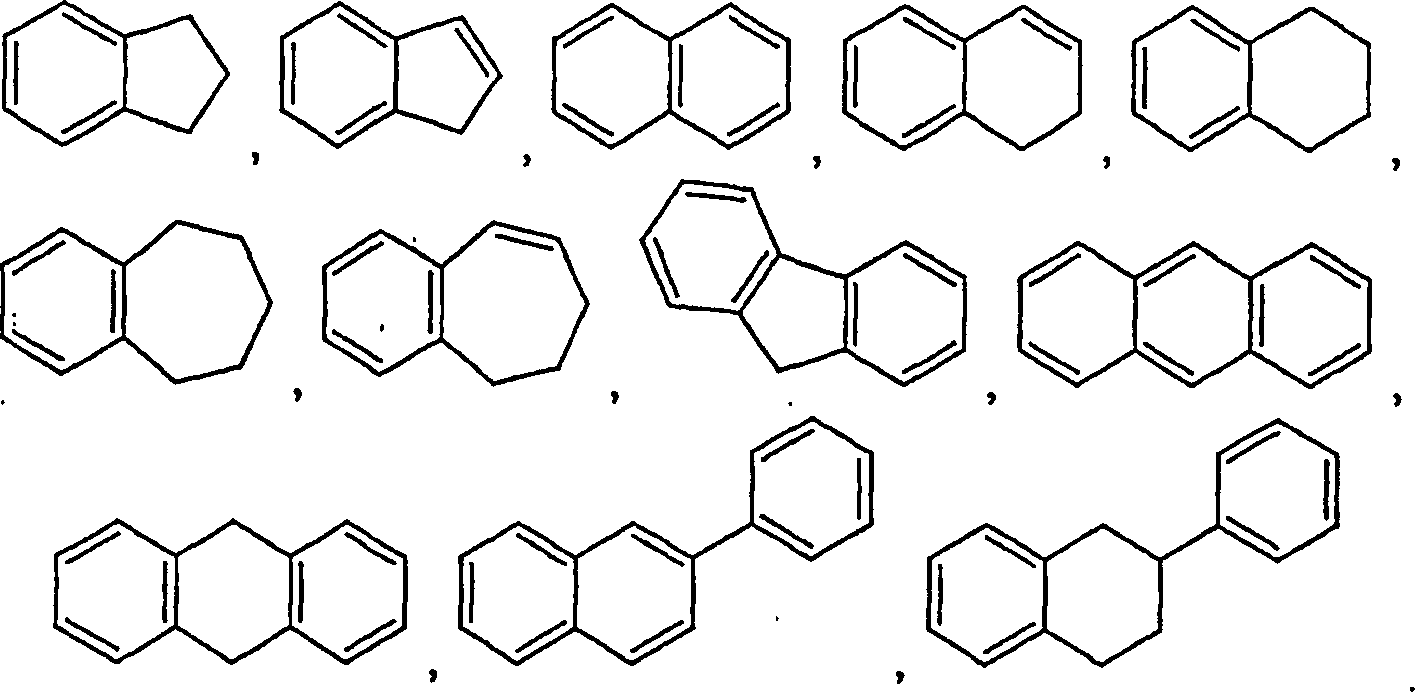
Die Bezeichnung "Aryl" bedeutet aromatische mono- und polycarbocyclische Ringsysteme, wobei die einzelnen carbocyclischen Ringe in den Polyringsystemen kondensiert oder durch eine Einfachbindung miteinander verbunden sein können. Geeignete Arylgruppen sind u.a. Phenyl, Naphthyl und Biphenyl, ohne jedoch darauf beschränkt zu sein.The Designation "Aryl" means aromatic mono- and polycarbocyclic ring systems, wherein the individual carbocyclic Rings in the polyrene systems condensed or by a single bond can be connected to each other. Suitable aryl groups include i.a. Phenyl, naphthyl and biphenyl, without but limited thereto to be.
Die Bezeichnung "Heterocyclus" (und Varianten davon, wie z.B. "heterocyclisch" oder "Heterocyclyl") bedeutet allgemein einen 4- bis 8-gliedrigen monocyclischen Ring, ein 7- bis 12-gliedriges bicyclisches Ringsystem oder ein 11- bis 16-gliedriges tricyclisches Ringsystem, wobei jeder dieser Ringe gesättigt oder ungesättigt ist und aus Kohlenstoffatomen und einem oder mehreren Heteroatomen, ausgewählt aus N, O und S, besteht und wobei die Stickstoff- und Schwefel-Heteroatome gegebenenfalls oxidiert sein können und das Stickstoff-Heteroatom gegebenenfalls quaternisiert sein kann. Der heterocyclische Ring kann an ein beliebiges Heteroatom oder Kohlenstoffatom gebunden sein, mit der Maßgabe, dass die Bindung zur Erzeugung einer stabilen Struktur führt. Wenn der heterocyclische Ring Substituenten trägt, ist es zu verstehen, dass die Substituenten an ein beliebiges Atom im Ring gebunden sein können, egal ob Heteroatom oder Kohlenstoffatom, mit der Maßgabe, dass eine stabile chemische Struktur resultiert. Repräsentative Beispiele für Heterocyclen sind u.a. Piperidinyl, Piperazinyl, Azepinyl, Pyrrolyl, Pyrrolidinyl, Pyrazolyl, Pyrazolidinyl, Imidazolyl, Imidazolidinyl, Triazolyl, Tetrazolyl, Imidazolinyl, Pyridyl (oder Pyridinyl), Pyrazinyl, Pyrimidinyl, Pyridazinyl, Oxazolyl, Oxazolidinyl, Isoxazolyl, Isoxazolidinyl, Morpholinyl, Thiomorpholinyl, Thiazolyl, Thiazolidinyl, Isothiazolyl, Chinoxazolinyl, Isothiazolidinyl, Chinolinyl, Isochinolinyl, Benzimidazolyl, Thiadiazolyl, Benzopyranyl, Benzothiazolyl, Benzoazolyl, Furyl (oder Furanyl), Tetrahydrofuryl (oder Tetrahydrofuranyl), Tetrahydropuranyl, Thienyl (alternativ Thiophenyl), Benzothiophenyl, Oxadiazolyl und Benzo-1,3-dioxacyclopentyl (alternativ 1,3-Benzodioxolyl). Repräsentative Beispiele für Heterocyclen sind u.a. auch Tetrahydrothienyl, Tetrahydrodioxothienyl, Thiadiazinanyl, Dioxothiadiazinanyl, Thiazinanyl, Dioxothiazinanyl, Dioxothiazolidinyl und Isodioxothiazolidinyl. Repräsentative Beispiele für Heterocyclen sind auch u.a. die folgenden Bicyclen: Indolyl, Benzotriazolyl, Imidazo[4.5-b]pyridinyl, Dihydroimidazo[4,5-b]pyridinyl, Pyrazolo[4.3-c]pyridinyl, Dihydropyrazolo[4,3-c]pyridinyl, Tetrahydropyrazolo[4,3-c]pyridinyl, Pyrrolo[1,2-a]pyrazinyl, Dihydropyrrolo[1,2-a]pyrazinyl, Tetrahydropyrrolo[1,2-a]pyrazinyl, Octahydropyrrolo[1,2-a]pyrazinyl, isoindolyl, Indazolyl, Indolinyl, Isoindolinyl, Chinoxalinyl, Chinazolinyl, Cinnolinyl, Chromanyl und Isochromanyl. Weitere repräsentative Beispiele für Bicyclen sind u.a. die folgenden: Phthalazinyl, Purinyl, 1,6-Naphthyridinyl, 1,8-Naphthyridinyl, Dihydroindolyl, Dihydroisoindolyl, Tetrahydrochinolyl, Tetrahydroisochinolyl, Imidazo[1,2-a]pyrimidinyl, 2,3-Dihydroimidazo[1,2-b][1,3]thiazolyl, Benzazepinyl, Dihydrobenzazepinyl, Benzodiazepinyl, Dihydrobenzodiazepinyl und Tetrahydrobenzodiazepinyl. Repräsentative Beispiele für Heterocyclen sind u.a. auch die folgenden Tricyclen: Phenothiazinyl, Carbazolyl, beta-Carbolinyl, Tetrahydro-beta-carbolinyl, Acridinyl, Phenazinyl und Phenoxazinyl.The term "heterocycle" (and variants thereof, such as "heterocyclic" or "heterocyclyl") generally means a 4- to 8-membered monocyclic ring, a 7- to 12-membered bicyclic ring system or an 11- to 16-membered tricyclic A ring system wherein each of said rings is saturated or unsaturated and consists of carbon atoms and one or more heteroatoms selected from N, O and S, and wherein the nitrogen and sulfur heteroatoms may optionally be oxidized and the nitrogen heteroatom may optionally be quaternized , The heterocyclic ring may be attached to any heteroatom or carbon atom, provided that the bond results in the formation of a stable structure. When the heterocyclic ring bears substituents, it is to be understood that the substituents may be attached to any atom in the ring, whether heteroatom or carbon atom, provided that a stable chemical structure results. Representative examples of heterocycles include piperidinyl, piperazinyl, azepinyl, pyrrolyl, pyrrolidinyl, pyrazolyl, pyrazolidinyl, imidazolyl, imidazolidinyl, triazolyl, tetrazolyl, imidazolinyl, pyridyl (or pyridinyl), pyrazinyl, pyrimidinyl, pyridazinyl, oxazolyl, oxazolidinyl, isoxazolyl, isoxazolidinyl, Morpholinyl, thiomorpholinyl, thiazolyl, thiazolidinyl, isothiazolyl, quinoxazolinyl, isothiazolidinyl, quinolinyl, isoquinolinyl, benzimidazolyl, thiadiazolyl, benzopyranyl, benzothiazolyl, benzoazolyl, furyl (or furanyl), tetrahydrofuryl (or tetrahydrofuranyl), tetrahydropuryl, thienyl (alternatively thiophenyl), benzothiophenyl, Oxadiazolyl and benzo-1,3-dioxacyclopentyl (alternatively 1,3-benzodioxolyl). Representative examples of heterocycles include tetrahydrothienyl, tetrahydrodioxothienyl, thiadiazinanyl, dioxothiadiazinanyl, thiazinanyl, dioxothiazinanyl, dioxothiazolidinyl and isodioxothiazolidinyl. Representative examples of heterocycles include the following bicyclics: indolyl, benzotriazolyl, Imidazo [4,5-b] pyridinyl, dihydroimidazo [4,5-b] pyridinyl, pyrazolo [4,3-c] pyridinyl, dihydropyrazolo [4,3-c] pyridinyl, tetrahydropyrazolo [4,3-c] pyridinyl, pyrrolo [1, 2-a] pyrazinyl, dihydropyrrolo [1,2-a] pyrazinyl, tetrahydropyrrolo [1,2-a] pyrazinyl, octahydropyrrolo [1,2-a] pyrazinyl, isoindolyl, indazolyl, indolinyl, isoindolinyl, quinoxalinyl, quinazolinyl, cinnolinyl, Chromanyl and isochromanyl. Other representative examples of bicyclics include the following: phthalazinyl, purinyl, 1,6-naphthyridinyl, 1,8-naphthyridinyl, dihydroindolyl, dihydroisoindolyl, tetrahydroquinolyl, tetrahydroisoquinolyl, imidazo [1,2-a] pyrimidinyl, 2,3-dihydroimidazo [ 1,2-b] [1,3] thiazolyl, benzazepinyl, dihydrobenzazepinyl, benzodiazepinyl, dihydrobenzodiazepinyl and tetrahydrobenzodiazepinyl. Representative examples of heterocycles include the following tricyclene: phenothiazinyl, carbazolyl, beta-carbolinyl, tetrahydro-beta-carbolinyl, acridinyl, phenazinyl and phenoxazinyl.
Repräsentative Beispiele für Heterocyclen sind u.a. auch die folgenden ungesättigten Monocyclen: Hexahydropyrimidinyl, Thiazinanyl (z.B. 1,2-Thiazinanyl, alternativ Tetrahydro-1,2-thiazinyl genannt), Thiazepanyl (z.B. 1,4-Thiazepanyl, alternativ Hexahydro-1,4-thiazepinyl genannt), Azepanyl (alternativ Hexahydroazepinyl), Thiadiazepanyl (z.B. 1,2,5-Thiadiazepanyl), Dithiazepanyl (z.B. 1,5,2-Dithiazepanyl), Diazepanyl (z.B. 1,4-Diazepanyl) und Thiadiazinanyl (z.B. 1,2,6-Thiadiazinanyl).Representative examples for Heterocycles are u.a. also the following unsaturated monocycles: hexahydropyrimidinyl, Thiazinanyl (e.g., 1,2-thiazinanyl, alternatively tetrahydro-1,2-thiazinyl thiazepanyl (e.g., 1,4-thiazepanyl, alternatively hexahydro-1,4-thiazepinyl called), azepanyl (alternatively hexahydroazepinyl), thiadiazepanyl (e.g., 1,2,5-thiadiazepanyl), dithiazepanyl (e.g., 1,5,2-dithiazepanyl), Diazepanyl (e.g., 1,4-diazepanyl) and thiadiazinanyl (e.g., 1,2,6-thiadiazinanyl).
Ein
repräsentativer
ungesättigter
Heterocyclus ist 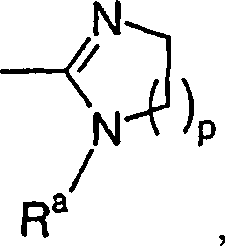
Repräsentative Beispiele für Heterocyclen umfassen auch die folgenden Bicyclen: Hexahydropyrazolo[4,3-c]pyridinyl (z.B. 3a,4,5,6,7,7a-Hexahydro-1H-pyrazolo[4,3-c]pyridinyl), Hexahydropurinyl (z.B. 2,3,4,5,6,7-Hexahydro-1H-purinyl), Hexahydrooxazolo[3,4-a]pyrazinyl und 1,2,3,4-Tetrahydro-1,8-naphthyridinyl.Representative examples for Heterocycles also include the following bicyclics: hexahydropyrazolo [4,3-c] pyridinyl (e.g., 3a, 4,5,6,7,7a-hexahydro-1H-pyrazolo [4,3-c] pyridinyl), hexahydropurinyl (e.g., 2,3,4,5,6,7-hexahydro-1H-purinyl), hexahydrooxazolo [3,4-a] pyrazinyl and 1,2,3,4-tetrahydro-1,8-naphthyridinyl.
Heterocyclen
mit kondensierten Ringen bilden einer Unterklasse der oben definierten
Heterocyclen; z.B. bedeutet die Bezeichnung "kondensierter bicyclischer Heterocyclus" ein heteroatomhaltiges
bicyclisches Ringsystem, wie es in dem vorhergehenden Abschnitt
definiert ist, bei dem sich beide Ringe zwei benachbarte Atome teilen.
Eine Unterklasse der Heterocyclen mit kondensierten Ringen bilden
die kondensierten bicyclischen Heterocyclen, die Kohlenstoffatome
und ein oder mehrere Heteroatome enthalten, ausgewählt aus Stickstoff,
Sauerstoff und Schwefel, wobei ein Ring ein Benzolring ist und der
andere ein gesättigter
oder ungesättigter
heteroatomhaltiger Ring ist. Repräsentative Beispiele für diese
Unterklasse sind u.a., ohne jedoch darauf beschränkt zu sein, die folgenden: 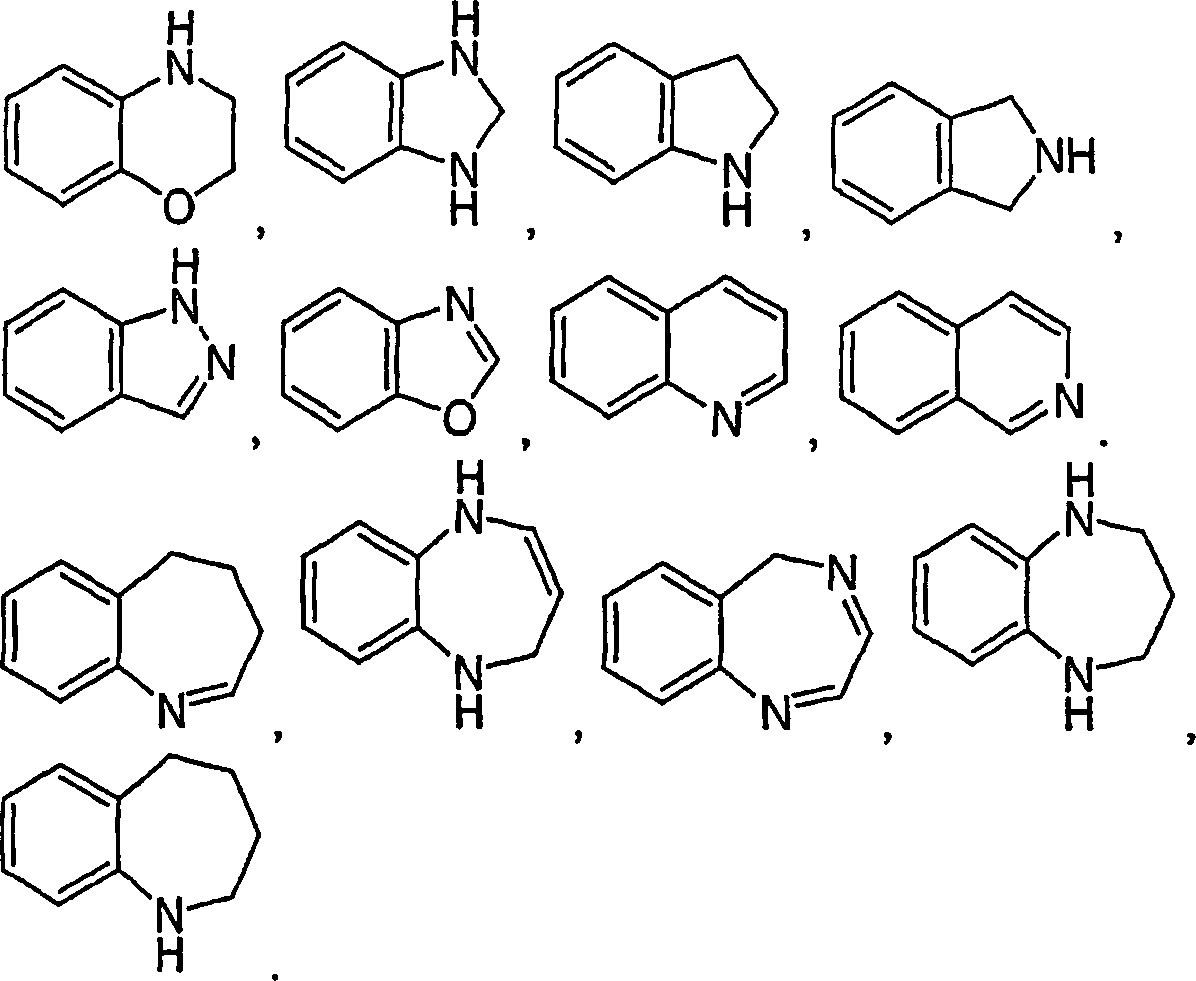
Die Bezeichnung "Heteromonocyclus" (und Varianten davon, wie z.B. "Heteromonocyclyl" oder "heteromonocyclisch") bedeutet einen 4- bis 8-gliedrigen monocyclischen Ring, der gesättigt oder ungesättigt ist und aus Kohlenstoffatomen und ein oder mehreren Heteroatomen, ausgewählt aus N, O und S, besteht, und wobei die Stickstoff- und Schwefel-Heteroatome gegebenenfalls oxidiert sein können und wobei das Stickstoff-Heteroatom gegebenenfalls quaternisiert sein kann. Der heterocyclische Ring kann an ein Heteroatom oder ein Kohlenstoffatom gebunden sein, mit der Maßgabe, dass die Bindung zur Bildung einer stabilen Struktur führt. Repräsentative Beispiele für Monoheterocyclen sind oben offenbart.The term "heteromonocyclic" (and variants thereof, such as "heteromonocyclyl" or "hete romonocyclic ") means a 4- to 8-membered monocyclic ring which is saturated or unsaturated and consists of carbon atoms and one or more heteroatoms selected from N, O and S, and wherein the nitrogen and sulfur heteroatoms are optionally oxidized and wherein the nitrogen heteroatom may optionally be quaternized The heterocyclic ring may be attached to a heteroatom or a carbon atom, provided that the bond results in formation of a stable structure Representative examples of monoheterocycles are disclosed above.
Heteroaromaten bilden eine weitere Unterklasse der wie oben definierten Heterocyclen, d.h., die Bezeichnung "heteroaromatisch" (alternativ "Heteroaryl") bedeutet allgemein einen wie oben definierten Heterocyclus, bei dem das Ringsystem (egal ob mono- oder polycyclisch) ein aromatisches Ringsystem ist. Die Bezeichnung "heteroaromatischer Ring" bedeutet einen monocyclischen Heterocyclus, wie er oben definiert ist, welcher ein aromatischer Heterocyclus ist. Repräsentative Beispiele für Heteroaromaten sind u.a. Pyridyl, Pyrrolyl, Pyrazinyl, Pyrimidinyl, Pyridazinyl, Thienyl (oder Thiophenyl), Thiazolyl, Furanyl, Imidazolyl, Pyrazolyl, Triazolyl, Tetrazolyl, Oxazolyl, Isooxazolyl, Oxadiazolyl, Thiazolyl, Isothiazolyl und Thiadiazolyl.heteroaromatics form another subclass of the heterocycles as defined above, that is, the term "heteroaromatic" (alternatively, "heteroaryl") means generally a heterocycle as defined above, wherein the ring system (whether mono- or polycyclic) is an aromatic ring system. The term "heteroaromatic Ring "means one monocyclic heterocycle as defined above which is an aromatic heterocycle. Representative examples of heteroaromatics are u.a. Pyridyl, pyrrolyl, pyrazinyl, pyrimidinyl, pyridazinyl, Thienyl (or thiophenyl), thiazolyl, furanyl, imidazolyl, pyrazolyl, triazolyl, Tetrazolyl, oxazolyl, isooxazolyl, oxadiazolyl, thiazolyl, isothiazolyl and thiadiazolyl.
Sofern nicht das Gegenteil angegeben ist, ist ein "ungesättigter" Ring ein teilweise oder vollständig ungesättigter Ring. Zum Beispiel bedeutet ein "ungesättigter monocyclischer C6-Carbocyclus" Cyclohexen, Cyclohexadien und Benzol.Unless indicated otherwise, an "unsaturated" ring is a partially or fully unsaturated ring. For example, an "unsaturated monocyclic C" 6 "carbocycle" means cyclohexene, cyclohexadiene and benzene.
Die vorliegende Erfindung umfasst pharmazeutische Zusammensetzungen, die sich zur Inhibierung von HIV-Integrase eignen und die eine wirksame Menge einer Verbindung dieser Erfindung und einen pharmazeutisch annehmbaren Träger enthalten. Pharmazeutische Zusammensetzungen, die sich zur Behandlung einer HIV-Infektion oder zur Behandlung von AIDS und ARC eignen, sind ebenfalls von der vorliegenden Erfindung umfasst, ebenso ein Verfahren zur Inhibierung von HIV-Integrase und ein Verfahren zur Behandlung einer HIV-Infektion oder zur Behandlung von AIDS oder ARC. Ferner betrifft die vorliegende Erfindung eine pharmazeutische Zusammensetzung, die eine therapeutisch wirksame Menge einer Verbindung der vorliegenden Erfindung in Kombination mit einer therapeutisch wirksamen Menge eines Mittels zur Behandlung einer HIV-Infektion oder AIDS, ausgewählt aus:
- (1) einem antiviralen Mittel, das sich zur Behandlung oder Prävention einer HIV-Infektion oder zur Behandlung von AIDS eignet (hierin auch als HIV/AIDS-Antivirusmittel bezeichnet),
- (2) einem Antiinfektivum und
- (3) einem Immunmodulator,
- (1) an antiviral agent suitable for the treatment or prevention of HIV infection or for the treatment of AIDS (also referred to herein as HIV / AIDS antiviral agent),
- (2) an antiinfective and
- (3) an immunomodulator,
Die vorliegende Erfindung umfasst auch eine Verbindung der vorliegenden Erfindung zur Verwendung zur (a) Inhibierung von HIV-Protease, (b) Prävention oder Behandlung einer HIV-Infektion oder (c) Prävention, Behandlung oder Verzögerung des Ausbruchs von AIDS oder ARC. Die vorliegende Erfindung umfasst auch die Verwendung einer Verbindung der vorliegenden Erfindung, wie sie oben beschrieben ist, als ein Medikament zur (a) Inhibierung von HIV-Integrase, (b) Prävention oder Behandlung einer HIV-Infektion oder (c) Prävention, Behandlung oder Verzögerung des Ausbruchs von AIDS oder ARC. Die vorliegende Erfindung umfasst ferner die Verwendung von irgendwelchen der oben beschriebenen HIV-Integrase inhibierenden Verbindungen der vorliegenden Erfindung in Kombination mit einem oder mehreren HIV/AIDS-Behandlungsmitteln, ausgewählt aus einem antiviralen HIV/AIDS-Mittel, einem Antiinfektivum und einem Immunmodulator, als ein Medikament zur (a) Inhibierung von HIV-Integrase, (b) Prävention oder Behandlung einer HIV-Infektion oder (c) Prävention, Behandlung oder Verzögerung des Ausbruchs von AIDS oder ARC, wobei das Medikament eine wirksame Menge der HIV-Integraseinhibitorverbindung und eine wirksame Menge des/der ein oder mehreren Behandlungsmittel enthält.The The present invention also includes a compound of the present invention Invention for use in (a) inhibiting HIV protease, (b) prevention or treatment of HIV infection or (c) prevention, treatment or delay of the Outbreak of AIDS or ARC. The present invention also includes the Use of a compound of the present invention as it is described above as a medicament for (a) inhibiting HIV integrase, (b) prevention or treatment of HIV infection or (c) prevention, treatment or delay of the Outbreak of AIDS or ARC. The present invention further includes the use of any of the HIV integrase described above inhibiting compounds of the present invention in combination with one or more HIV / AIDS treatment agents selected from an antiviral HIV / AIDS drug, an anti-infective drug and a Immunomodulator, as a drug for (a) inhibiting HIV integrase, (b) prevention or treatment of HIV infection or (c) prevention, treatment or delay of the Outbreak of AIDS or ARC, the drug being an effective Amount of HIV integrase inhibitor compound and an effective amount of the one or more treating agents contains.
Die vorliegende Erfindung umfasst auch die Verwendung einer oben beschriebenen Verbindung der vorliegenden Erfindung bei der Herstellung eines Medikaments zur (a) Inhibierung von HIV-Integrase, (b) Prävention oder Behandlung einer HIV-Infektion oder (c) Prävention, Behandlung oder Verzögerung des Ausbruchs von AIDS oder ARC.The The present invention also includes the use of one described above Compound of the present invention in the preparation of a Drug for (a) inhibiting HIV integrase, (b) prevention or treatment of HIV infection or (c) prevention, treatment or delay of the Outbreak of AIDS or ARC.
Die vorliegende Erfindung umfasst ferner die Verwendung von irgendwelchen der oben beschriebenen HIV-Integrase inhibierenden Verbindungen der vorliegenden Erfindung in Kombination mit einem oder mehreren HIV/AIDS-Behandlungsmitteln, ausgewählt aus einem antiviralen HIV/AIDS-Mittel, einem Antiinfektivum und einem Immunmodulator, zur Herstellung eines Medikaments zur (a) Inhibierung von HIV-Integrase, (b) Prävention oder Behandlung einer HIV-Infektion oder (c) Prävention, Behandlung oder Verzögerung des Ausbruchs von AIDS oder ARC, wobei das Medikament eine wirksame Menge der HIV-Integraseinhibitorverbindung und eine wirksame Menge des/der ein oder mehreren Behandlungsmittel enthält.The present invention further encompasses the use of any of the above-described HIV integrase inhibiting compounds of the present invention in combination with one or more HIV / AIDS treatment agents selected from an HIV / AIDS antiviral agent, an anti-infective agent and an immunomodulator for production a medicament for (a) inhibiting HIV integrase, (b) preventing or treating HIV infection, or (c) preventing, treating or delaying the onset of AIDS or ARC, wherein the medicament comprises an effective amount of the HIV integrase inhibitor and an effective amount of the one or more treating agents.
Die Verbindungen der vorliegenden Erfindung können Asymmetriezentren besitzen und, außer wenn es speziell vermerkt ist, als Mischungen aus Stereoisomeren oder als einzelne Diastereomere oder Enantiomere auftreten, wobei alle isomeren Formen von der vorliegenden Erfindung umfasst sind.The Compounds of the present invention may possess centers of asymmetry and, except if specifically noted, as mixtures of stereoisomers or occur as single diastereomers or enantiomers, wherein all isomeric forms are encompassed by the present invention.
Wenn irgendeine Variable (z.B. Ra, Rb, Rc, Rk usw.) mehr als einmal in irgendeinem Bestandteil oder in Formel I oder in irgendeiner anderen Formel, die Verbindungen der Erfindung darstellt oder beschreibt, auftritt, ist ihre Definition bei jedem Auftreten unabhängig von ihrer Definition bei jedem weiteren Auftreten. Auch sind Kombinationen von Substituenten und/oder Variablen nur zulässig, wenn solche Kombinationen zu stabilen Verbindungen führen.If any variable (eg, R a , R b , R c , R k , etc.) occurs more than once in any ingredient or formula I or in any other formula that represents or describes compounds of the invention, their definition is at each Occurrence regardless of its definition at each subsequent occurrence. Also, combinations of substituents and / or variables are permissible only if such combinations result in stable compounds.
Die Bezeichnung "substituiert" (z.B. wie in "Phenyl, unsubstituiert oder substituiert mit 1 bis 5 Substituenten...") umfasst die Mono- und Polysubstitution durch einen genannten Substituenten in dem Maße, wie eine solche einzelne und mehrfache Substitution chemisch erlaubt ist. Zum Beispiel kann ein Carbocyclus oder Heterocyclus, der mit mehr als einem Substituenten substituiert ist, mehrere Substituenten an demselben Ringatom bis zu dem Maße besitzen, wie es chemisch erlaubt ist. Ein Ring-Schwefelatom in einem gesättigten Heterocyclus kann zum Beispiel typischerweise mit 1 (-S(=O)-) oder mit 2 Oxogruppen (-SO2-) substituiert sein.The term "substituted" (eg as in "phenyl, unsubstituted or substituted with 1 to 5 substituents ...") encompasses the mono- and poly-substitution by said substituent to the extent that such single and multiple substitution is chemically permitted. For example, a carbocycle or heterocycle substituted with more than one substituent may have multiple substituents on the same ring atom to the extent that is chemically permitted. For example, a ring sulfur atom in a saturated heterocycle may typically be substituted with 1 (-S (= O) -) or with 2 oxo groups (-SO 2 -).
Die Verbindungen der vorliegenden Erfindung sind zur Inhibierung von HIV-Integrase, zur Prävention oder Behandlung einer Infektion durch das humane Immunschwächevirus (HIV) und zur Behandlung von pathologischen Folgezuständen, wie z.B. AIDS, geeignet. Die Behandlung von AIDS oder die Prävention oder Behandlung einer HIV-Infektion ist derart definiert, dass sie, ohne jedoch darauf beschränkt zu sein, die Behandlung eines großen Bereichs an HIV-Infektionszuständen umfasst: AIDS, ARC (AIDS-bezogener Komplex), sowohl symptomatisch als auch asymptomatisch, und die tatsächliche oder potentielle HIV-Aussetzung. Zum Beispiel sind die Verbindungen dieser Erfindung zur Behandlung einer HIV-Infektion nach einem vermuteten früheren Inberührungkommen mit HIV, z.B. durch Bluttransfusion, Austausch von Körperflüssigkeiten, Bissen, versehentlichem Nadelstich oder Inberührungkommen mit Patientenblut während einer Operation, geeignet.The Compounds of the present invention are for the inhibition of HIV integrase, for prevention or Treatment of infection by the human immunodeficiency virus (HIV) and for the treatment of pathological sequelae, such as e.g. AIDS, suitable. The treatment of AIDS or prevention or treatment of HIV infection is defined as: but not limited thereto To be treated treating a wide range of HIV infection conditions includes: AIDS, ARC (AIDS-related complex), both symptomatic and asymptomatic, and the actual or potential HIV exposure. For example, the links are of this invention for the treatment of HIV infection after a suspected earlier past exposure with HIV, e.g. through blood transfusion, exchange of body fluids, bites, accidental needle stick or contact with patient blood while an operation, suitable.
Die Verbindungen dieser Erfindung eignen sich zur Herstellung und Durchführung von Screening-Assays für Antivirusverbindungen. Zum Beispiel sind die Verbindungen dieser Erfindung zur Isolierung von Enzymmutanten, die hervorragende Screening-Werkzeuge für stärkere Antivirusverbindungen sind, geeignet. Ferner sind die Verbindungen dieser Erfindung zur Feststellung oder Ermittlung der Bindungsstelle anderer antiviraler Mittel an HIV-Integrase geeignet, z.B. durch kompetitive Inhibierung. Somit sind die Verbindungen dieser Erfindung kommerzielle Produkte, die für diese Zwecke verkauft werden sollen.The Compounds of this invention are useful in the preparation and practice of Screening Assays for antivirus compounds. For example, the compounds of this invention are for isolation of enzyme mutants, which are excellent screening tools for stronger antiviral compounds are suitable. Furthermore, the compounds of this invention are for Finding or identifying the binding site of other antiviral Agent suitable for HIV integrase, e.g. through competitive inhibition. Thus, the compounds of this invention are commercial products, the for these purposes should be sold.
Die vorliegende Erfindung offenbart auch die Verwendung einer Verbindung der Formel (I-A) zur Herstellung einer pharmazeutischen Zusammensetzung, die zur Inhibierung von HIV-Integrase und zur Behandlung von AIDS oder ARC geeignet ist.The The present invention also discloses the use of a compound of the formula (I-A) for the preparation of a pharmaceutical composition, for the inhibition of HIV integrase and for the treatment of AIDS or ARC is suitable.
Die Verbindungen der vorliegenden Erfindung können in Form von pharmazeutisch annehmbaren Salzen verabreicht werden. Die Bezeichnung "pharmazeutisch annehmbares Salz" soll alle annehmbaren Salze umfassen, wie z.B. Acetat, Lactobionat, Benzolsulfonat, Laurat, Benzoat, Malst, Hydrogencarbonat, Malest, Hydrogensulfat, Mandelat, Bitartrat, Mesylat, Borat, Methylbromid, Bromid, Methylnitrat, Calciumedetat, Methylsulfat, Caprylat, Mucat, Carbonat, Napsylat, Chlorid, Nitrat, Clavulanat, N- Methylglucamin, Citrat, Ammoniumsalz, Dihydrochiorid, Oleat, Edetat, Oxalat, Edisylat, Pamoat (Embonat), Estolat, Palmitat, Esylat, Pantothenat, Fumarat, Phosphat/Diphosphat, Gluceptat, Polygalacturonat, Gluconat, Salicylat, Glutamat, Stearat, Glycollylarsanilat, Sulfat, Hexylresorcinat, Subacetat, Hydrabamin, Succinat, Hydrobromid, Tannst, Hydrochlorid, Tartrat, Hydroxynaphthoat, Teoclat, Iodid, Tosylat, Isothionat, Triethiodid, Lactat, Pamoat, Valerat und dergleichen, die als Dosisform zur Modifizierung der Löslichkeits- oder Hydrolyseeigenschaften verwendet werden können oder in Formulierung mit verzögerter Freisetzung oder in Prodrug-Formulierungen verwendet werden können. In Abhängigkeit von der speziellen Funktionalität der Verbindung der vorliegenden Erfindung sind pharmazeutisch annehmbare Salze der Verbindungen dieser Erfindung u.a. diejenigen Salze, die aus Kationen, wie z.B. Natrium, Kalium, Aluminium, Calcium, Lithium, Magnesium, Zink, und aus Basen, wie z.B. Ammoniak, Ethylendiamin, N-Methylglutamin, Lysin, Arginin, Ornithin, Cholin, N,N'-Dibenzylethylendiamin, Chiorprocain, Diethanolamin, Procain, N-Benzylphenethylamin, Diethylamin, Piperazin, Tris(hydroxymethyl)aminomethan und Tetramethylammoniumhydroxid, gebildet werden. Diese Salze können durch Standardverfahren hergestellt werden, z.B. durch Umsetzung einer freien Säure mit einer geeigneten organischen oder anorganischen Base. Wenn eine basische Gruppe vorliegt, wie z.B. Amino, kann ein saures Salz, d.h. Hydrochlorid, Hydrobromid, Acetat, Pamoat und dergleichen, als die Dosisform verwendet werden.The compounds of the present invention may be administered in the form of pharmaceutically acceptable salts. The term "pharmaceutically acceptable salt" is intended to include all acceptable salts such as acetate, lactobionate, benzenesulfonate, laurate, benzoate, malt, bicarbonate, malite, hydrogensulfate, mandelate, bitartrate, mesylate, borate, methyl bromide, bromide, methyl nitrate, calcium edetate, methylsulfate , Caprylate, Mucate, Carbonate, Napsylate, Chloride, Nitrate, Clavulanate, N-Methylglucamine, Citrate, Ammonium Salt, Dihydrochloride, Oleate, Edetate, Oxalate, Edisylate, Pamoate (Embonate), Estolate, Palmitate, Esylate, Pantothenate, Fumarate, Phosphate / Diphosphate, gluceptate, polygalacturonate, gluconate, salicylate, glutamate, stearate, glycolylarsaranate, sulphate, hexylresorcinate, subacetate, hydrabamine, succinate, hydrobromide, tannin, hydrochloride, tartrate, hydroxynaphthoate, teoclate, iodide, tosylate, isothionate, triethiodide, lactate, pamoate, Valerate and the like, which may be used as a dosage form for modifying solubility or hydrolysis properties or in sustained release formulation g or in prodrug formulations can be used. Depending on the particular functionality of the compound of the present invention, pharmaceutically acceptable salts of the compounds of this invention include those salts selected from cations such as sodium, potassium, aluminum, calcium, lithium, magnesium, zinc, and bases such as ammonia , Ethylenediamine, N-methylglutamine, lysine, arginine, ornithine, choline, N, N'-dibenzylethylenediamine, chloroprocaine, diethanolamine, procaine, N-benzylphenethylamine, diethylamine, piperazine, tris (hydroxymethyl) aminomethane and tetramethylammonium hydroxide. These salts can be prepared by standard methods, for example by reacting a free acid with a suitable organic or inorganic base. If a basic group is present, such as amino, an acid salt, ie hydrochloride, Hydrobromide, acetate, pamoate and the like can be used as the dosage form.
Im Falle einer vorliegenden Säure-(-COOH-)- oder Alkoholgruppe können auch pharmazeutisch annehmbare Ester, z.B. Acetat, Malest, Pivaloyloxymethyl und dergleichen und diejenigen Ester, die im Stand der Technik zur Modifizierung der Löslichkeits- oder Hydrolyseeigenschaften bekannt sind, zur Verwendung als Formulierungen mit verzögerter Freisetzung oder Prodrug-Formulierungen eingesetzt werden.in the Case of an acid present - (- COOH -) - or alcohol group can also pharmaceutically acceptable esters, e.g. Acetate, malest, pivaloyloxymethyl and the like and those esters known in the art for Modification of the solubility or hydrolysis properties are known, for use as formulations with delayed Release or prodrug formulations are used.
Für diese Zwecke können die Verbindungen der vorliegenden Erfindung oral, parenteral (einschließlich subkutaner Injektionen, intravenöser, intramuskulärer, intrasternaler Injektion- oder Infusionstechniken), durch ein Inhalationsspray oder rektal in Form von Einheitsdosisformulierungen, die herkömmliche nichttoxische pharmazeutisch annehmbare Träger, Hilfsstoffe oder Vehikel enthalten, verabreicht werden.For this Purposes can the compounds of the present invention are administered orally, parenterally (including subcutaneous Injections, intravenous, intramuscular, intrasternal injection or infusion techniques), by inhalation spray or rectally in the form of unit dose formulations, the conventional ones non-toxic pharmaceutically acceptable carriers, adjuvants or vehicles contained, administered.
Die Bezeichnung "Verabreichung" und Varianten davon (z.B. "Verabreichen" einer Verbindung) in Bezug auf eine Verbindung der Erfindung bedeuten jeweils die Bereitstellung der Verbindung oder eines Prodrugs der Verbindung dem Individuum, das eine Behandlung benötigt. Wenn eine Verbindung der Erfindung oder ein Prodrug davon in Kombination mit einem oder mehreren anderen Wirkstoffen (z.B. antiviralen Mitteln, die sich zur Behandlung einer HIV-Infektion oder AIDS eignen) zur Verfügung gestellt wird, sind "Verabreichung" und seine Varianten jeweils so zu verstehen, dass sie die gleichzeitige und sequentielle Bereitstellung der Verbindung oder des Prodrugs davon und anderer Mittel umfassen.The Name "Administration" and variants thereof (e.g., "administering" a compound) with respect to a compound of the invention, respectively Providing the compound or a prodrug of the compound the individual who needs treatment. When a connection the invention or a prodrug thereof in combination with one or several other agents (e.g., antiviral agents, which are known for Treatment of HIV infection or AIDS) is "administration" and its variants each to be understood as being simultaneous and sequential Providing the compound or prodrug thereof and others Means include.
Daher wird gemäß der vorliegenden Erfindung ferner ein Behandlungsverfahren und eine pharmazeutisch annehmbare Zusammensetzung zur Behandlung einer HIV-Infektion und AIDS zur Verfügung gestellt. Die Behandlung umfasst die Verabreichung einer pharmazeutischen Zusammensetzung, die einen pharmazeutischen Träger und eine therapeutisch wirksame Menge einer Verbindung der vorliegenden Erfindung enthält, an ein Subjekt, das eine solche Behandlung benötigt.Therefore is in accordance with the present Invention further a treatment method and a pharmaceutical acceptable composition for the treatment of HIV infection and AIDS available posed. The treatment involves the administration of a pharmaceutical Composition containing a pharmaceutical carrier and a therapeutic effective amount of a compound of the present invention, to a Subject who needs such treatment.
So wie hierin verwendet, soll die Bezeichnung "Zusammensetzung" ein Produkt umfassen, das die angegebenen Bestandteile in den angegebenen Mengen enthält, sowie jegliches Produkt, das direkt oder indirekt aus der Kombination der angegebenen Bestandteile in den angegebenen Mengen resultiert.So As used herein, the term "composition" is intended to encompass a product having the indicated Contains ingredients in the quantities indicated, as well as any product directly or indirectly from the combination of the specified ingredients results in the specified amounts.
Mit "pharmazeutisch annehmbar" ist gemeint, dass der Träger, das Verdünnungsmittel oder der Hilfsstoff mit den anderen Bestandteilen der Formulierung verträglich sein muss und für den Empfänger nicht schädlich sein darf.By "pharmaceutically acceptable" is meant that the carrier, the diluent or the excipient with the other ingredients of the formulation compatible must be and for the recipient not harmful may be.
Die Bezeichnung "Subjekt" (alternativ hierin als "Patient" bezeichnet), so wie sie hier verwendet wird, bezieht sich auf ein Tier, vorzugsweise einen Säuger, besonders bevorzugt einen Menschen, das/der das Objekt der Behandlung, Beobachtung oder des Versuchs ist.The Term "subject" (alternatively herein as "patient"), so as used herein refers to an animal, preferably a mammal, particularly preferred a human, the / the object of treatment, Observation or attempt.
Die Bezeichnung "therapeutisch wirksame Menge", so wie sie hier verwendet wird, bedeutet die Menge der Wirkverbindung oder des pharmazeutischen Mittels, die die biologische oder medizinische Reaktion in einem Gewebe, System, Tier oder Menschen hervorruft, welche von einem Forscher, Tiermediziner, Mediziner oder einem anderen Kliniker erwünscht wird, wobei die Linderung der Symptome der behandelten Krankheit umfasst ist.The Term "therapeutic effective amount ", as used herein means the amount of the active compound or the pharmaceutical agent containing the biological or medical Causes reaction in a tissue, system, animal or human, which of a researcher, veterinarian, physician or another Clinicians welcome which includes alleviating the symptoms of the disease being treated is.
Diese pharmazeutischen Zusammensetzungen können in Form von oral verabreichbaren Suspensionen oder Tabletten oder Kapseln, Nasensprays, sterilen injizierbaren Präparaten, zum Beispiel als sterile injizierbare wässrige oder ölige Suspensionen oder Zäpfchen, vorliegen.These Pharmaceutical compositions may be administered orally Suspensions or tablets or capsules, nasal sprays, sterile injectable preparations, for example as sterile injectable aqueous or oily suspensions or suppositories, available.
Wenn sie oral als eine Suspension verabreicht werden, werden diese Zusammensetzungen gemäß im Fachgebiet der pharmazeutischen Formulierung gut bekannter Verfahren hergestellt und können als Massebildner mikrokristalline Cellulose, Alginsäure oder Natriumalginat als Suspensionsmittel, Methylcellulose als Viskositätsverstärker und im Stand der Technik bekannte Süßstoffe/Aromastoffe enthalten. Als Tabletten mit sofortiger Freisetzung können diese Zusammensetzungen mikrokristalline Cellulose, Dicalciumphosphat, Stärke, Magnesiumstearat und Lactose und/oder andere im Stand der Technik bekannte Hilfsstoffe, Bindemittel, Streckmittel, Sprengmittel, Verdünnungsmittel und Gleitmittel enthalten.If when administered orally as a suspension, these compositions become according to the art the pharmaceutical formulation of well-known methods and can as a mass former microcrystalline cellulose, alginic acid or Sodium alginate as a suspending agent, methyl cellulose as a viscosity booster and sweeteners / flavorings known in the art contain. As immediate release tablets, these can Compositions microcrystalline cellulose, dicalcium phosphate, starch, magnesium stearate and lactose and / or other excipients known in the art, Binders, extenders, disintegrants, diluents and lubricants contain.
Wenn sie durch ein Nasenaerosol oder durch Inhalation verabreicht werden, werden diese Zusammensetzungen gemäß Verfahren, die auf dem Gebiet der pharmazeutischen Formulierung gut bekannt sind, hergestellt und können als Kochsalzlösungen hergestellt werden, wobei Benzylalkohol oder andere geeignete Konservierungsstoffe, Absorptionsfördermittel zur Steigerung der Bioverfügbarkeit, Fluorkohlenstoffe und/oder andere im Stand der Technik bekannte Löslichmachungs- oder Dispersionsmittel eingesetzt werden.When administered by a nasal aerosol or by inhalation, these compositions are prepared according to methods well known in the pharmaceutical formulating art and can be prepared as saline solutions, with benzyl alcohol or other suitable preservatives, absorption enhancers to increase bioavailability, fluorocarbons and or other solubilizing or dispersing agents known in the art are used.
Die injizierbaren Lösungen oder Suspensionen können wie im Stand der Technik bekannt formuliert werden, wobei geeignete nichttoxische, parenteral annehmbare Verdünnungsmittel oder Lösungsmittel, wie z.B. Mannit, 1,3-Butandiol, Wasser, Ringer-Lösung oder isotonische Natriumchloridlösung, oder geeignete Dispersions- oder Benetzungs- und Suspendiermittel, wie z.B. sterile milde nichtflüssige Öle, einschließlich synthetischer Mono- oder Diglyceride, und Fettsäuren, einschließlich Ölsäure, verwendet werden.The injectable solutions or suspensions can as are known in the art, with suitable non-toxic, parenterally-acceptable diluents or solvents, such as. Mannitol, 1,3-butanediol, water, Ringer's solution or isotonic sodium chloride solution, or suitable dispersing or wetting and suspending agents, such as e.g. sterile mild non-liquid oils, including synthetic ones Mono- or diglycerides, and fatty acids, including oleic acid become.
Wenn sie rektal in Form von Zäpfchen verabreicht werden, können diese Zusammensetzungen durch Vermischen des Arzneistoffes mit einem geeigneten nichtreizenden Hilfsstoff, wie z.B. Kakaobutter, synthetischen Glyceridestern von Polyethylenglycolen, welche bei normalen Temperaturen fest sind, sich jedoch im After verflüssigen und/oder auflösen, um den Arzneistoff freizusetzen, hergestellt werden.If she rectally in the form of suppositories can be administered these compositions by mixing the drug with a suitable non-irritating excipient, e.g. Cocoa butter, synthetic Glyceride esters of polyethylene glycols, which are at normal temperatures are solid, however, liquefy and / or dissolve in the anus to to release the drug.
Die Verbindungen dieser Erfindung können oral in einem Dosisbereich von 0,1 bis 1000 mg/kg Körpergewicht in Teildosen verabreicht werden. Ein bevorzugter Dosisbereich ist 0,1 bis 200 mg/kg Körpergewicht oral in Teildosen. Ein weiterer bevorzugter Dosisbereich ist 0,5 bis 100 mg/kg Körpergewicht oral in Teildosen. Zur oralen Verabreichung können die Zusammensetzungen vorzugsweise in Form von Tabletten, die 1,0 bis 1000 Milligramm des Wirkstoffs, speziell 1,0, 5,0, 10,0, 15,0, 20,0, 25,0, 50,0, 75,0, 100,0, 150,0, 200,0, 250,0, 300,0, 400,0, 500,0, 600,0, 750,0, 800,0, 900,0 und 1000,0 Milligramm des Wirkstoffs enthalten, zur symptomatischen Einstellung der Dosis auf den zu behandelnden Patienten bereitgestellt werden. Es ist jedoch zu verstehen, dass die spezielle Dosismenge und Dosierungshäufigkeit für einen speziellen Patienten variiert werden kann und von einer Vielzahl von Faktoren abhängen wird, einschließlich der Wirksamkeit der speziellen eingesetzten Verbindung, der metabolischen Stabilität und der Wirkungsdauer dieser Verbindung, des Alters, Körpergewichts, allgemeinen Gesundheitszustandes, Geschlechts, der Nahrung, des Verabreichungsweges und der Verabreichungszeit, der Ausscheidungsrate, der Arzneistoffkombination, der Schwere des speziellen Zustandes und des Wirts, der sich einer Therapie unterzieht.The Compounds of this invention can orally in a dose range of 0.1 to 1000 mg / kg body weight be administered in divided doses. A preferred dose range is 0.1 to 200 mg / kg of body weight orally in partial doses. Another preferred dose range is 0.5 to 100 mg / kg body weight orally in divided doses. For oral administration, the compositions preferably in the form of tablets containing 1.0 to 1000 milligrams of the active ingredient, especially 1.0, 5.0, 10.0, 15.0, 20.0, 25.0, 50.0, 75.0, 100.0, 150.0, 200.0, 250.0, 300.0, 400.0, 500.0, 600.0, 750.0, 800.0, 900.0 and 1000.0 milligrams of the active ingredient, to symptomatic adjustment of the dose to the patient to be treated to be provided. However, it is understood that the special Dose quantity and dosage frequency for one Special patients can be varied and of a variety depend on factors will, including the effectiveness of the particular compound used, the metabolic stability and the duration of this compound, the age, body weight, general health, sex, nutrition, diet Route of administration and the time of administration, the excretion rate, the drug combination, the severity of the special condition and the host undergoing therapy.
Die
vorliegende Erfindung betrifft auch Kombinationen der HIV-Integrase-Inhibitorverbindungen
mit einem oder mehreren Mitteln, die sich zur Behandlung einer HIV-Infektion
oder AIDS eignen. Zum Beispiel können
die Verbindungen dieser Erfindung, egal ob in Perioden vor und/oder
nach dem Inberührungkommen, wirksam
in Kombination mit wirksamen Mengen der antiviralen HIV/AIDS-Mittel,
Immunmodulatoren, Antiinfektiva oder Impfstoffe, die zur Behandlung
einer HIV-Infektion oder von AIDS geeignet sind, wie z.B. diejenigen, die
in der nachfolgenden Tabelle aufgeführt sind, verabreicht werden. ANTIVIRALE
MITTEL
Man wird verstehen, dass der Umfang der Kombinationen der Verbindungen dieser Erfindung mit antiviralen HIV/AIDS-Mitteln, Immunmodulatoren, Antiinfektiva oder Impfstoffen nicht auf die Liste in der obigen Tabelle beschränkt ist, sondern im Prinzip jede Kombination mit einer beliebigen pharmazeutischen, zur Behandlung einer HIV-Infektion oder von AIDS geeigneten Zusammensetzung umfasst. Wenn sie in Kombination mit den Verbindungen der Erfindung eingesetzt werden, werden die antiviralen HIV/AIDS-Mittel und die anderen Mittel typischerweise in ihren herkömmlichen Dosisbereichen und -regimes eingesetzt, wie es im Stand der Technik beschrieben ist, einschließlich der in der Physicians' Desk Reference, 54. Auflage, Medical Economics Company, 2000, beschriebenen Dosen. Die Dosisbereiche für eine Verbindung der Erfindung in diesen Kombinationen sind die gleichen wie die, die oben unmittelbar vor der Tabelle genannt sind.you will understand that the scope of the combinations of compounds of this invention with antiviral HIV / AIDS agents, immunomodulators, Antiinfectives or vaccines are not on the list in the table above limited but in principle any combination with any pharmaceutical, for the treatment of HIV infection or AIDS suitable composition includes. When combined with the compounds of the invention used, the HIV / AIDS antiviral agents and the other agents typically in their conventional dose ranges and -regimes used, as described in the prior art, including in the Physicians' Desk Reference, 54th edition, Medical Economics Company, 2000 Cans. The dose ranges for a compound of the invention in these combinations are the same like those mentioned above just before the table.
Bevorzugte
Kombinationen sind gleichzeitige oder sequenzielle Behandlungen
mit einer Verbindung der vorliegenden Erfindung und einem Inhibitor
von HIV-Protease und/oder einem nichtnukleosiden Inhibitor von HIV-Reverse-Transkriptase.
Eine optionale vierte Komponente bei der Kombination ist ein nukleosider
Inhibitor von HIV-Reverse-Transkriptase, wie z.B. AZT, 3TC, ddC
oder ddI. Ein bevorzugter Inhibitor von HIV-Protease ist das Sulfatsalz
von Indinavir, das N-(2(R)-Hydroxy-1(S)-indanyl)-2(R)-phenylmethyl-4-(S)-hydroxy-5-(1-(4-(3-pyridylmethyl)-2(S)-N'-(t-butylcarboxamido)piperazinyl))pentanamidethanolat
ist und gemäß
Eine weitere bevorzugte Kombination ist eine Verbindung der vorliegenden Erfindung mit Indinavir und Verbindung A und gegebenenfalls mit einem oder mehreren von Efavirenz, ATZ, 3TC, ddI und ddC. Bei einer Ausführungsform dieser Kombination beträgt das Gewichtsverhältnis von Indinavir zu Verbindung A etwa 1:1 bis etwa 1:2, wobei die Menge an eingesetztem Indinavir im Bereich von etwa 200 bis etwa 1000 mg liegt. Indinavir und Verbindung A können gleichzeitig oder der Reihe nach in beliebiger Reihenfolge ein bis drei Mal pro Tag verabreicht werden.A another preferred combination is a compound of the present invention Invention with indinavir and compound A and optionally with one or more of Efavirenz, ATZ, 3TC, ddI and ddC. In one embodiment this combination is the weight ratio from indinavir to compound A about 1: 1 to about 1: 2, with the amount on indinavir used in the range of about 200 to about 1000 mg is. Indinavir and Compound A can be used simultaneously or Sequentially administered in any order one to three times a day become.
Bei solchen Kombinationen kann die Verbindung der vorliegenden Erfindung und andere Wirkstoffe zusammen oder getrennt verabreicht werden. Darüber hinaus kann die Verabreichung eines Mittels vor, gleichzeitig mit oder im Anschluss an die Verabreichung des/der anderen Mittel(s) erfolgen.at Such combinations may include the compound of the present invention and other drugs are administered together or separately. About that In addition, the administration of an agent may be contemporaneous with, simultaneously with or following the administration of the other agent (s) respectively.
Abkürzungen, die in der vorliegenden Beschreibung, insbesondere in den Schemata und Beispielen, verwendet werden, sind u.a. die folgenden:
- DEAD
- = Diethylazodicarboxylat
- DMF
- = N,N-Dimethylformamid
- DMPU
- = 1,3-Dimethyl-3,4,5,6-tetrahydro-2(1H)-pyrimidinon
- DMSO
- = Dimethylsulfoxid
- EDC
- = 1-Ethyl-3-(3-dimethylaminopropyl)carbodiimid
- ES MS
- = Elektrospray-Massenspektrometrie
- Et
- = Ethyl
- FAB HRMS
- = Fast-Atom-Bombardment-High-Resulution-Massenspektroskopie
- FAB MS
- = Fast-Atom-Bombardment-Massenspektroskopie
- HOBt
- = 1-Hydroxybenzotriazolhydrat
- HPLC
- = Hochleistungsflüssigchromatographie
- i-Pr
- = Isopropyl
- Me
- = Methyl
- MsCl
- = Methansulfonylchlorid (oder Mesylchlorid)
- NBS
- = N-Bromsuccinimid
- NIS
- = N-Iodsuccinimid
- NMR
- = Magnetische Kernresonanz
- Ph
- = Phenyl
- PMBCl
- = p-Methoxybenzylchlorid
- RT
- = Raumtemperatur
- TFA
- = Trifluoressigsäure
- THF
- = Tetrahydrofuran
- DEAD
- = Diethyl azodicarboxylate
- DMF
- = N, N-dimethylformamide
- DMPU
- = 1,3-dimethyl-3,4,5,6-tetrahydro-2 (1H) -pyrimidinone
- DMSO
- = Dimethyl sulfoxide
- EDC
- = 1-ethyl-3- (3-dimethylaminopropyl) carbodiimide
- ES MS
- = Electrospray mass spectrometry
- et
- = Ethyl
- FAB HRMS
- Fast atom bombardment high resolution mass spectroscopy
- FAB MS
- Fast atom bombardment mass spectroscopy
- HOBt
- = 1-hydroxybenzotriazole hydrate
- HPLC
- = High performance liquid chromatography
- i-Pr
- = Isopropyl
- me
- = Methyl
- MsCl
- = Methanesulfonyl chloride (or mesyl chloride)
- NBS
- = N-bromosuccinimide
- NIS
- = N-iodosuccinimide
- NMR
- = Magnetic nuclear resonance
- Ph
- = Phenyl
- PMBCl
- = p-methoxybenzyl chloride
- RT
- = Room temperature
- TFA
- = Trifluoroacetic acid
- THF
- = Tetrahydrofuran
Die Verbindungen der vorliegenden Erfindung können leicht gemäß den folgenden Reaktionsschemata und Beispielen oder Modifizierungen davon unter Verwendung von leicht erhältlichen Ausgangsmaterialien, Reagenzien und herkömmlichen Syntheseverfahren hergestellt werden. Bei diesen Reaktionen ist es auch möglich, von Varianten Gebrauch zu machen, die ihrerseits den Durchschnittsfachleuten bekannt sind, die jedoch nicht detaillierter genannt werden. Darüber hinaus werden dem Durchschnittsfachmann anhand der folgenden Reaktionsschemata und Beispiele andere Verfahren zur Herstellung von Verbindungen der Erfindung sofort offensichtlich sein. Sofern nichts anderes angegeben ist, sind alle Variablen wie oben definiert.The compounds of the present invention can be readily prepared according to the following reaction schemes and examples or modifications thereof using readily available starting materials, reagents and conventional synthetic methods. In these reactions, it is also possible to make use of variants, which in turn are known to those of ordinary skill in the art, but which are not mentioned in more detail. In addition, the average person skilled in the art will be described on the basis of The following reaction schemes and examples of other methods of preparing compounds of the invention will be readily apparent. Unless otherwise indicated, all variables are as defined above.
Die Verbindungen der vorliegenden Erfindung können durch Kuppeln geeigneter substituierter (Poly)azanaphthenylcarbonsäuren (oder Säurederivaten, wie z.B. Säurehalogeniden oder Ester) mit den passenden Aminen wie in dem nachstehenden allgemeinen Schema dargestellt hergestellt werden. In den folgenden Schemata ist X N oder CQ1, Y ist CQ2, Z ist CQ4 und Z3 ist CH.The compounds of the present invention can be prepared by coupling suitable substituted (poly) azanaphthenylcarboxylic acids (or acid derivatives such as acid halides or esters) with the appropriate amines as illustrated in the general scheme below. In the following schemes XN or CQ is 1 , Y is CQ 2 , Z is CQ 4 and Z 3 is CH.
SCHEMA
1 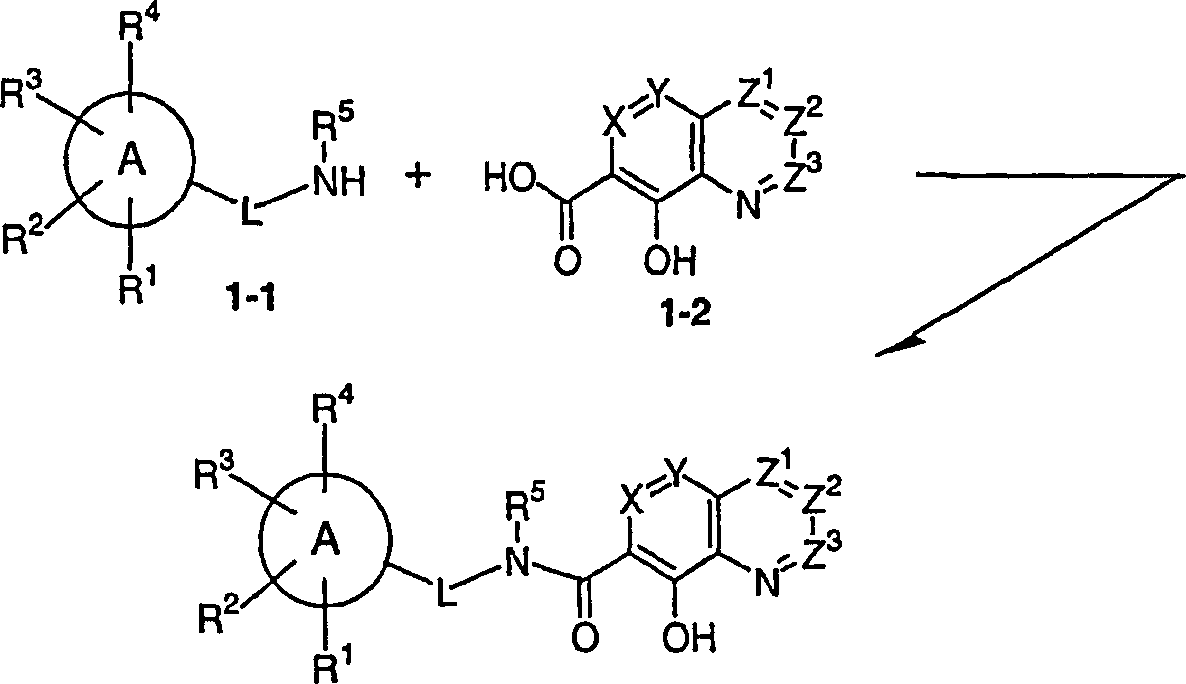
Verfahren zur Kupplung von Carbonsäuren mit Aminen, um Carboxamide zu bilden, sind im Stand der Technik gut bekannt. Geeignete Verfahren sind zum Beispiel bei Jerry March, Advanced Organic Chemistry, 3. Aufl., John Wiley & Sons, 1985, S. 370–376, beschrieben. Amine der Formel 1-1 können durch Anwendung der bei Richard Larock, Comprehensive Organic Transformation, VCH Publishers Inc, 1989, S. 385–438, beschriebenen Verfahren oder durch Routine-Varianten davon hergestellt werden. Azanaphthenyl- und Polyazanaphthenylcarbonsäuren der Formel 1-2 können mittels den bei Ochiai et al., Chem. Ber. 1937, 70:2018, 2023; Albert et al., J. Chem. Soc. 1952, 4985, 4991; und Barlin et al., Aust. J. Chem. 1990, 43: 1175–1181; beschriebenen Verfahren oder Routine-Varianten davon hergestellt werden. Die nachstehenden Schemata 2–16 veranschaulichen und erweitern die in Schema 1 vorgestellte Chemie.method for the coupling of carboxylic acids with amines to form carboxamides are in the art well known. Suitable methods are, for example, Jerry March, Advanced Organic Chemistry, 3rd ed., John Wiley & Sons, 1985, p. 370-376, described. Amines of formula 1-1 can be obtained by application of Richard Larock, Comprehensive Organic Transformation, VCH Publishers Inc, 1989, pp. 385-438, described method or by routine variants thereof become. Azanaphthenyl- and Polyazanaphthenylcarbonsäuren the Formula 1-2 can by the method described by Ochiai et al., Chem. Ber. 1937, 70: 2018, 2023; Albert et al., J. Chem. Soc. 1952, 4985, 4991; and Barlin et al., Aust. J. Chem. 1990, 43: 1175-1181; described method or routine variants thereof become. Illustrate and extend the following schemes 2-16 the chemistry presented in Scheme 1.
In Schema 2 kann durch Nacharbeiten des bei Ornstein et al., J. Med. Chem. 1989, 32: 827–833, beschriebenen Verfahrens ein cyclisches Anhydrid, wie z.B. ein Chinolinsäureanhydrid (z.B. Z1 = Z2 = Z3 = CH in 2-1) mit Isopropanol geöffnet werden, um die Monosäure 2-2 zu ergeben, die (z.B. durch Refluxieren in Thionylchlorid) in das entsprechende Acylchlorid 2-3 umgewandelt werden kann. Acylchlorid 2-3 kann dann (z.B. mit NaBH4 oder LiBH4) zum entsprechenden Alkohol 2-4 reduziert werden, welcher durch die Wirkung von Brom in Gegenwart von Triphenylphosphin in das entsprechende Bromid umgewandelt werden kann. Die Alkylierung des Bromids mit dem Natriumanion von Phenylsulfonamid 2-5 in einem polaren aprotischen Lösungsmittel wie DMF kann Sulfonamid 2-6 erzeugen, welches mit einer Base (z.B. Alkalimetallalkoxid, wie z.B. Natriummethoxid) behandelt werden kann, um durch eine Dieckmann-Cyclisierung den bicyclischen Ester 2-7 zu ergeben. Die Verseifung des Esters (z.B. mit wässrigem NaOH am Rückfluss) wird die Säure 2-8 ergeben. Die Säure 2-8 kann mit Triphosgen aktiviert und mit einer Reihe von Aminen gekuppelt werden, um die Verbindungen der Erfindung 2-9 zu ergeben.In Scheme 2, by following the procedure described in Ornstein et al., J. Med. Chem. 1989, 32: 827-833, a cyclic anhydride such as a quinolinic anhydride (eg, Z 1 = Z 2 = Z 3 = CH in 2-1) with isopropanol to give the monoacid 2-2, which can be converted (eg by refluxing in thionyl chloride) to the corresponding acyl chloride 2-3. Acyl chloride 2-3 can then be reduced (eg, with NaBH 4 or LiBH 4 ) to the corresponding alcohol 2-4, which can be converted to the corresponding bromide by the action of bromine in the presence of triphenylphosphine. Alkylation of the bromide with the sodium anion of phenylsulfonamide 2-5 in a polar aprotic solvent such as DMF can produce sulfonamide 2-6, which can be treated with a base (eg, alkali metal alkoxide such as sodium methoxide) to give the bicyclic compound by Dieckmann cyclization To give ester 2-7. Saponification of the ester (eg with aqueous NaOH at reflux) will give the acid 2-8. The acid 2-8 can be activated with triphosgene and coupled with a series of amines to give the compounds of the invention 2-9.
Die Ausgangs-Anhydride der Formel 2-1 können durch Verfahren hergestellt werden, die bei Philips et al., Justus Liebigs Ann. chem. 1895, 288: 2535; Bemthsen et al., Chem. Ber. 1887; 20, 1209; Bly et al., J. Org. Chem. 1964, 29: 2128–2135; und Krapcho et al., J. Heterocycl. Chem. 1993, 30: 1597–1606, beschrieben sind, oder durch Routine-Varianten davon.The Starting anhydrides of formula 2-1 can be prepared by methods Philips et al., Justus Liebigs Ann. chem. 1895 288: 2535; Bemthsen et al., Chem. Ber. 1887; 20, 1209; Bly et al. J. Org. Chem. 1964, 29: 2128-2135; and Krapcho et al., J. Heterocycl. Chem. 1993, 30: 1597-1606 are, or by routine variants of it.
SCHEMA
2 
Schema 3 beschreibt eine alternative Synthese, bei der der Alkohol 2-4 die Mitsunobu-Reaktion mit dem Phenylsulfonamid von Glycinmethylester eingehen kann, um 3-1 zu ergeben. Das Sulfonamid 3-1 kann wiederum behandelt werden, um die Säure 2-8 zu ergeben, die mit einer Reihe von Aminen unter Verwendung von Standard-Reagenzien gekuppelt werden kann, um die Verbindungen der Erfindung 2-9 zu ergeben.scheme Figure 3 describes an alternative synthesis in which the alcohol is 2-4 the Mitsunobu reaction with the phenylsulfonamide of glycine methyl ester can go down to give 3-1. The sulfonamide 3-1 can turn be treated to the acid 2-8, with a series of amines using Standard reagents can be coupled to the compounds of the To give invention 2-9.
SCHEMA
3 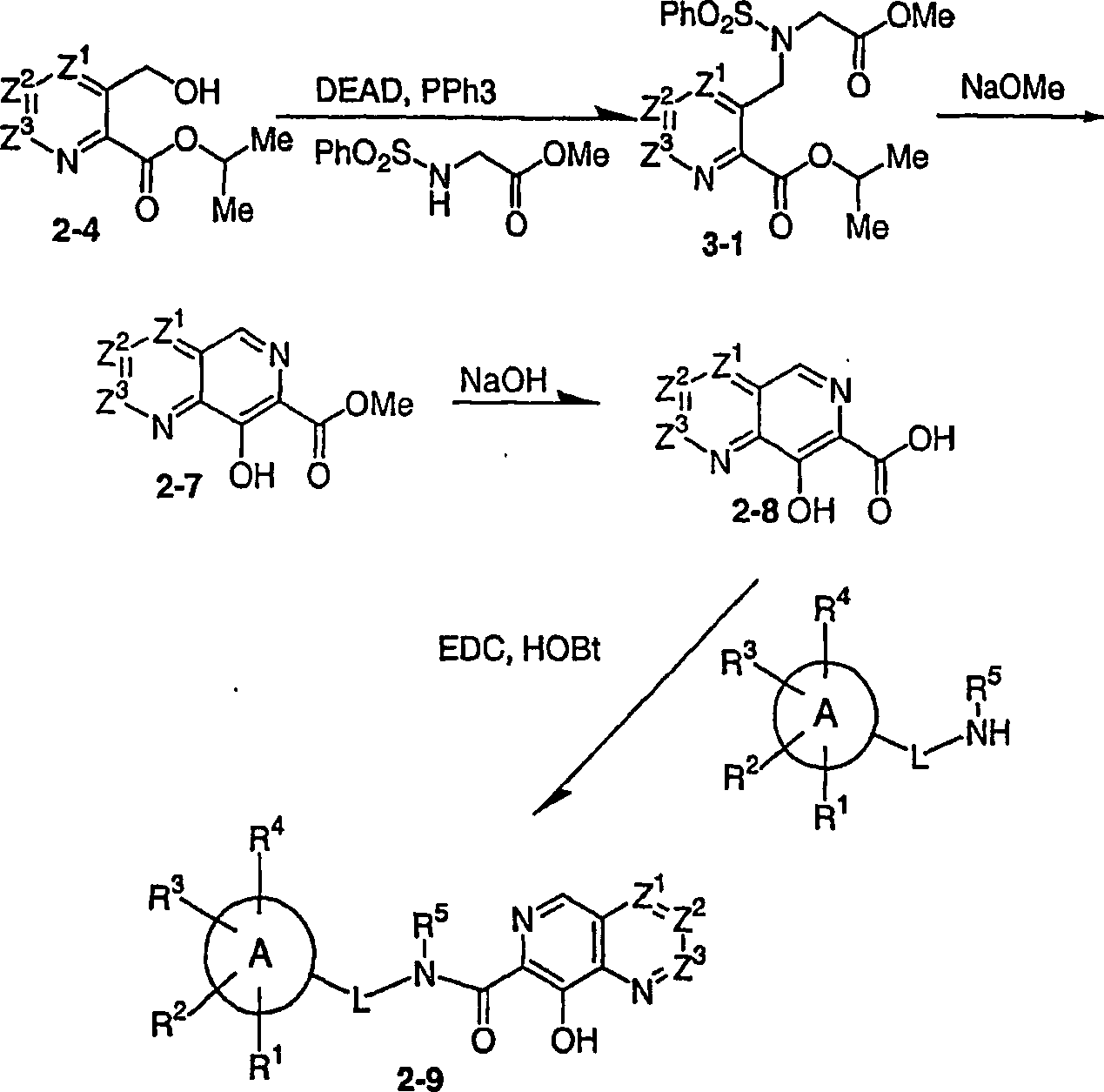
Schema 3A beschreibt (für einen Naphthyridin-Kern) eine Variante der in Schema 3 gezeigten Synthese, wobei die Säure 3A-2 mit Ethylchlorformiat umgesetzt wird, um das gemischte Anhydrid 3A-3 zu ergeben, das zum Alkohol 3A-4 reduziert wird.scheme 3A describes (for a naphthyridine nucleus) a variant of that shown in Scheme 3 Synthesis, the acid 3A-2 is reacted with ethyl chloroformate to give the mixed anhydride 3A-3 which is reduced to Alcohol 3A-4.

Halogensubstituierte Verbindungen der vorliegenden Erfindung können wie in Schema 4 gezeigt hergestellt werden. Das Säurechlorid 2-3 kann mit Glycinmethylester umgesetzt werden, um das Amid 4-1 zu ergeben. Die Dieckmann-Cyclisierung des Esters 4-1 mit einer Natriumalkoxidbase in einem alkoholischen Lösungsmittel, wie z.B. Methanol, wird Phenol 4-2 ergeben, welches mit Phosphoroxychlorid umgesetzt werden kann, gefolgt von der Methanolyse des intermediären Phosphonatesters, um 4-3 zu ergeben. Die Esterbindung von 4-3 kann selektiv mit geeigneten Aminen (z.B. ist 1-(1H-Indol-2-yl)methanamin in Schema 4 gezeigt) umgesetzt werden, um das entsprechende halogenierte Derivat 4-4 zu ergeben.Halogen substituted compounds of the present invention can be prepared as shown in Scheme 4 be put. The acid chloride 2-3 can be reacted with glycine methyl ester to give the amide 4-1. The Dieckmann cyclization of ester 4-1 with a sodium alkoxide base in an alcoholic solvent, such as methanol, will give phenol 4-2, which can be reacted with phosphorus oxychloride, followed by methanolysis of the intermediate phosphonate ester to give 4-3. The ester linkage of 4-3 can be selectively reacted with suitable amines (eg, 1- (1H-indol-2-yl) methanamine is shown in Scheme 4) to give the corresponding halogenated derivative 4-4.
SCHEMA
4 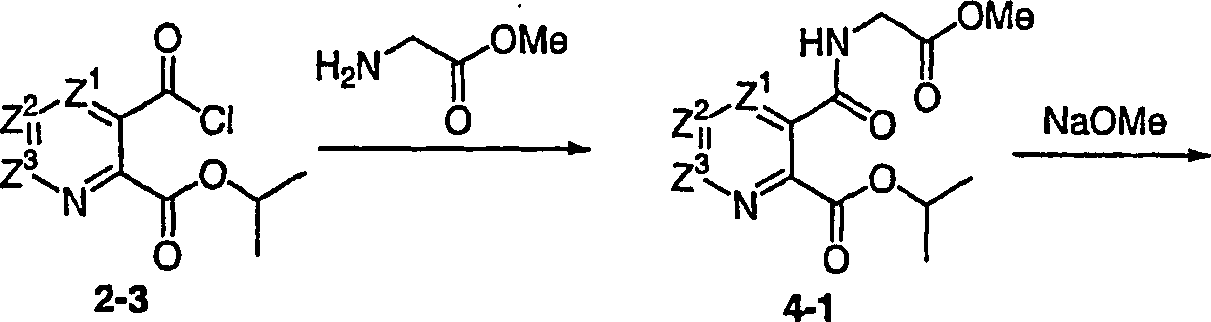

Die Herstellung von Verbindungen, die zusätzliche Substituenten tragen, kann wie in Schema 5 gezeigt erzielt werden. Die Oxidation des Alkohols 2-4 mit Mangandioxid in einem inerten Lösungsmittel, wie z.B. Methylenchlorid, wird den Aldehyd 5-1 ergeben. Die Addition von Grignard-Reagenzien (wie z.B. Phenylmagnesiumbromid) zum Aldehydrest 5-1 kann regioselektiv stattfinden, um den Alkohol 5-2 zu ergeben, der dann in die Verbindungen der Erfindung 5-6 umgewandelt werden kann.The Preparation of compounds bearing additional substituents can be achieved as shown in Scheme 5. The oxidation of the alcohol 2-4 with manganese dioxide in an inert solvent, e.g. Methylene chloride, will give the aldehyde 5-1. The addition of Grignard reagents (such as phenylmagnesium bromide) to aldehyde residue 5-1 may be regioselective take place to give the alcohol 5-2, which is then in the compounds of the invention 5-6 can be converted.
SCHEMA
5 

Ein weiterer Syntheseweg zur Herstellung von Verbindungen, die Gegenstand der Erfindung sind, ist in Schema 6 gezeigt. Dieses Verfahren ermöglicht den Zugang zu Naphthyridinderivaten, die in den 2-, 3-, 4- und 5-Positionen substituiert sind. Kurz gesagt kann ein 2-substituiertes 5-Hydroxypyridinderivat 6-1 mit Brom behandelt werden, damit es in der 6-Position eine Bromierung eingeht und 6-2 ergibt, welches in das Methoxypyridin 6-3 umgewandelt und anschließend zum entsprechenden N-Oxid 6-4 oxidiert werden kann. Das N-Oxid kann nitriert werden, um 6-5 zu ergeben. Die Reduktion von 6-5 mit Eisen in Gegenwart von Ammoniumchlorid kann das Anilin 6-6 ergeben, welches mit einem alpha,beta-ungesättigten Aldehyd oder Keton in Gegenwart eines Säurekatalysators, wie z.B. Schwefelsäure, umgesetzt werden kann, um durch eine Ringbildung 6-7 zu ergeben. Das Bromid 6-7 kann durch eine Reihe von Carbonylierungs- und Amidierungsreaktionen in das Amid 6-9 umgewandelt werden.One Another synthetic route for the preparation of compounds, the subject of the invention are shown in Scheme 6. This procedure allows the Access to naphthyridine derivatives in the 2-, 3-, 4-, and 5-positions are substituted. In short, a 2-substituted 5-hydroxypyridine derivative Be treated with bromine 6-1 so that it is in the 6-position, a bromination and 6-2, which is converted to methoxypyridine 6-3 and subsequently can be oxidized to the corresponding N-oxide 6-4. The N-oxide can nitrated to give 6-5. The reduction of 6-5 with iron in the presence of ammonium chloride, the aniline can give 6-6, which with an alpha, beta-unsaturated Aldehyde or ketone in the presence of an acid catalyst, e.g. Sulfuric acid, reacted can be to give by ringing 6-7. The bromide 6-7 can be triggered by a series of carbonylation and amidation reactions be converted into the amide 6-9.
2-Substituierte 5-Hydroxypyridinderivate der Formel 6-1 können durch Verfahren hergestellt werden, die bei Sorm et al., Collect. Czech. Chem. Commun. 1949, 14: 331, 342; und Saksena et al., Tetrahedron Lett. 1993, 34: 3267–3270, beschrieben sind, oder durch Routine-Varianten davon.2-Substituted 5-Hydroxypyridine derivatives of formula 6-1 can be prepared by methods Sorm et al. Collect. Czech. Chem. Commun. 1949 14: 331, 342; and Saksena et al., Tetrahedron Lett. 1993, 34: 3267-3270 are, or by routine variants of it.
SCHEMA
6 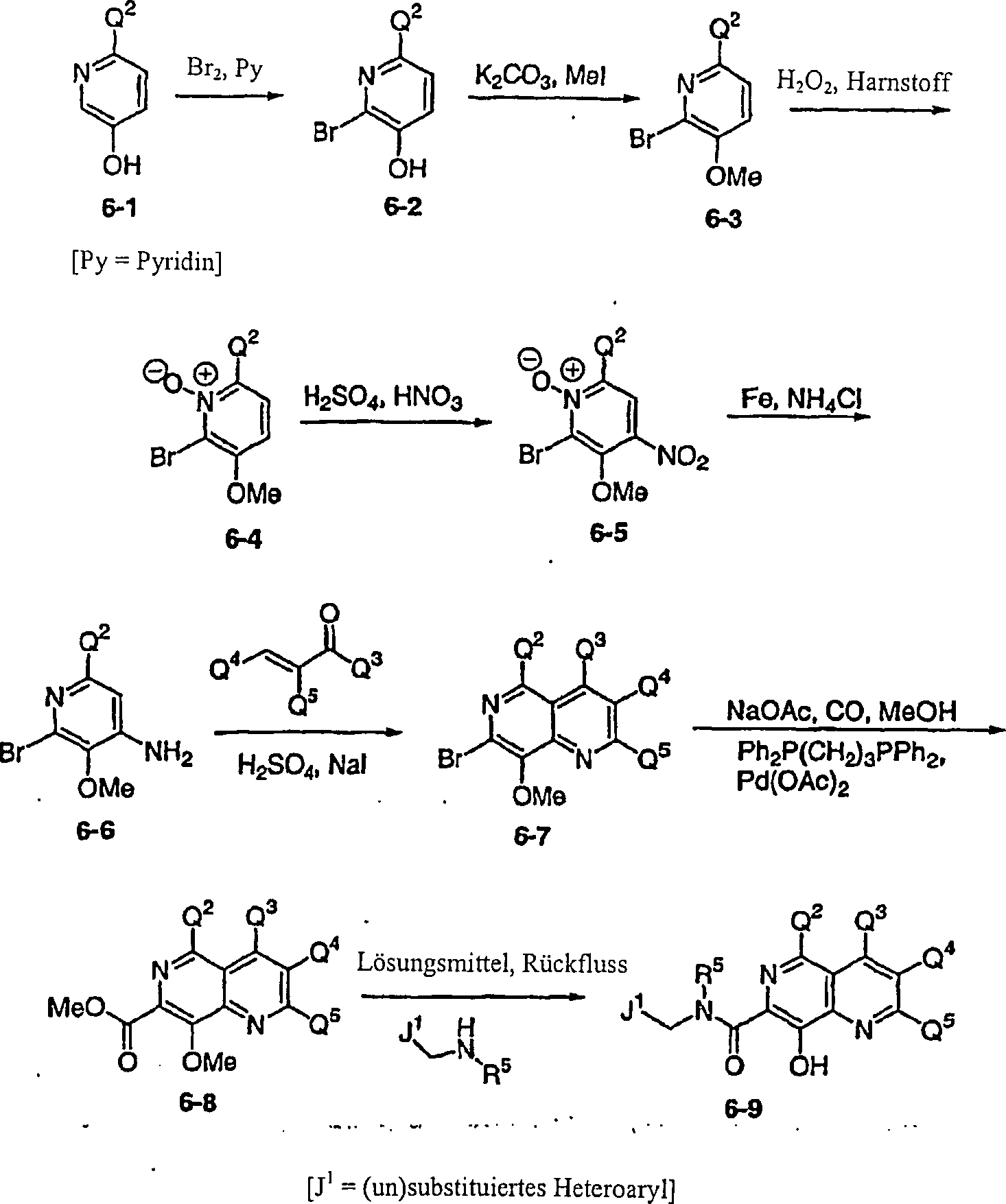
Verbindungen der Erfindung, die einen Aminosubstituenten in der 5-Position enthalten, können auf die in den Schemata 7 und 8 angegebene Weise hergestellt werden. Die Bromierung des Phenols 7-1 findet bei der Behandlung mit NBS in einem inerten Lösungsmittel, wie z.B. Methylenchlorid, regioselektiv statt, um 7-2 zu ergeben. Die Reaktion dieses Bromids mit einem Amin bei erhöhten Temperaturen in Gegenwart eines polaren Lösungsmittels, wie z.B. DMPU, ergibt Verbindungen der Erfindung 7-3. Ähnlich wird die Umsetzung des Bromids 7-2 (Schema 8) mit einem Diamin, wie z.B. Ethylendiamin, in DMF als Lösungsmittel das formylierte Derivat 8-1 zusätzlich zu dem erwarteten Diaminoethanderivat ergeben.links of the invention containing an amino substituent in the 5-position, can be prepared in the manner indicated in Schemes 7 and 8. The bromination of phenol 7-1 takes place upon treatment with NBS in an inert solvent, such as. Methylene chloride, regioselective to give 7-2. The reaction of this bromide with an amine at elevated temperatures in the presence of a polar solvent, such as. DMPU gives compounds of the invention 7-3. Similarly the reaction of bromide 7-2 (Scheme 8) with a diamine, e.g. Ethylenediamine, in DMF as a solvent the formylated derivative 8-1 in addition to give the expected diaminoethane derivative.
SCHEMA
7 
SCHEMA
8 
Die Herstellung von Aryl- und Heteroarylderivaten durch Palladium-Querkupplung des Chlorids 9-1 und der erforderlichen Boronsäuren ist in Schema 9 dargestellt.The Preparation of aryl and heteroaryl derivatives by palladium cross-coupling of the chloride 9-1 and the required boronic acids is shown in Scheme 9.
SCHEMA
9 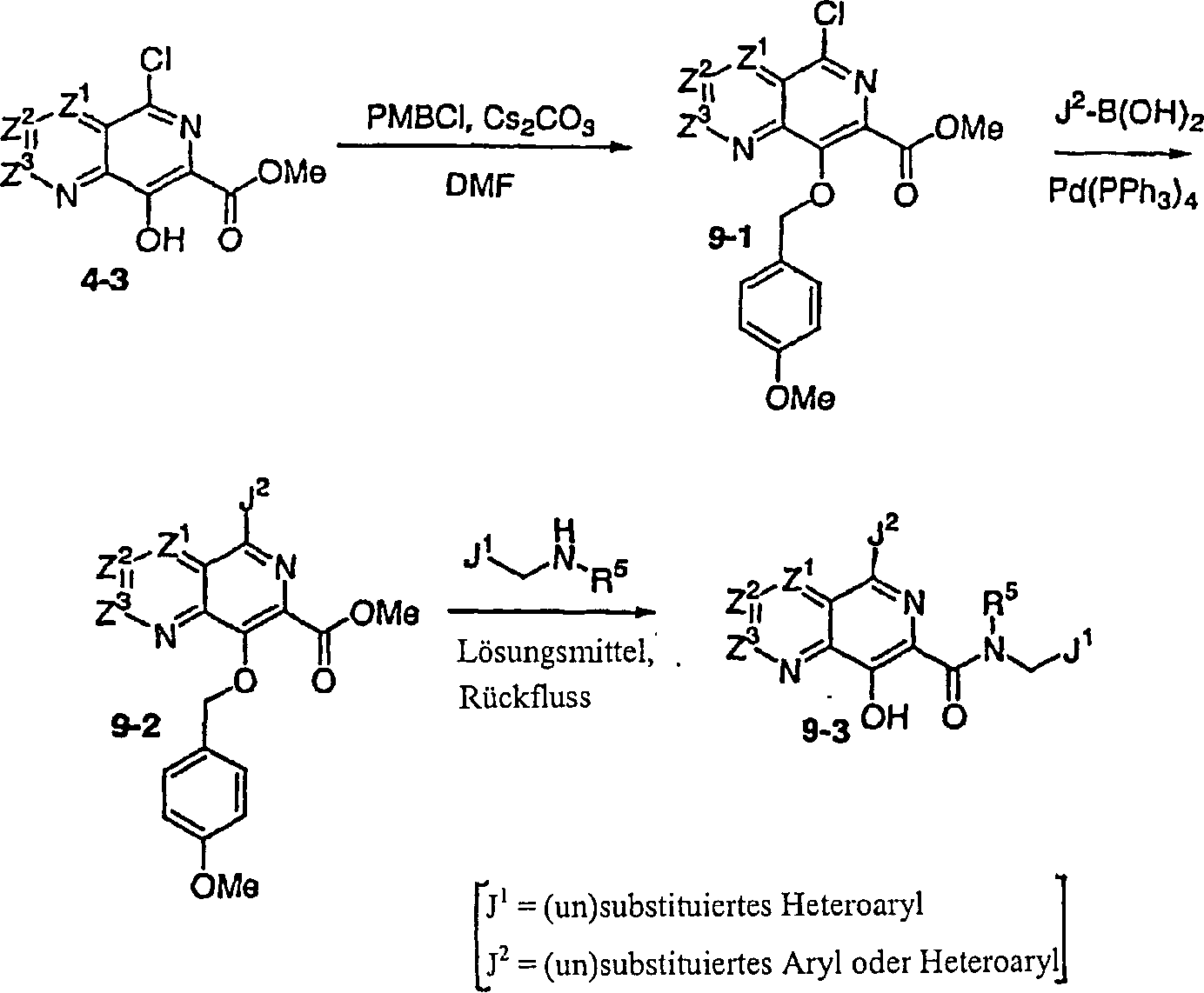
Die (Hetero)aryloxy-, (Hetero)arylamino- und (Heteroaryl)thioxyderivate 10-2, 11-2 bzw. 12-2 können wie in den Schemata 10 bis 12, welche das Verfahren für den Naphthyridin-Kern veranschaulichen, gezeigt hergestellt werden. Die entsprechenden Sulfonderivate 12-2 können durch Oxidation der Sulfide 12-1 mit entweder Ozon oder 3-Chlorperbenzoesäure wie in Schema 12 gezeigt erhalten werden.The (Hetero) aryloxy, (hetero) arylamino and (heteroaryl) thioxy derivatives 10-2, 11-2 or 12-2 can be like in Schemes 10 to 12 which illustrate the process for the naphthyridine nucleus illustrate, shown. The corresponding Sulfone derivatives 12-2 can by oxidation of the sulfides 12-1 with either ozone or 3-chloroperbenzoic acid such as can be obtained in Scheme 12.
SCHEMA
10 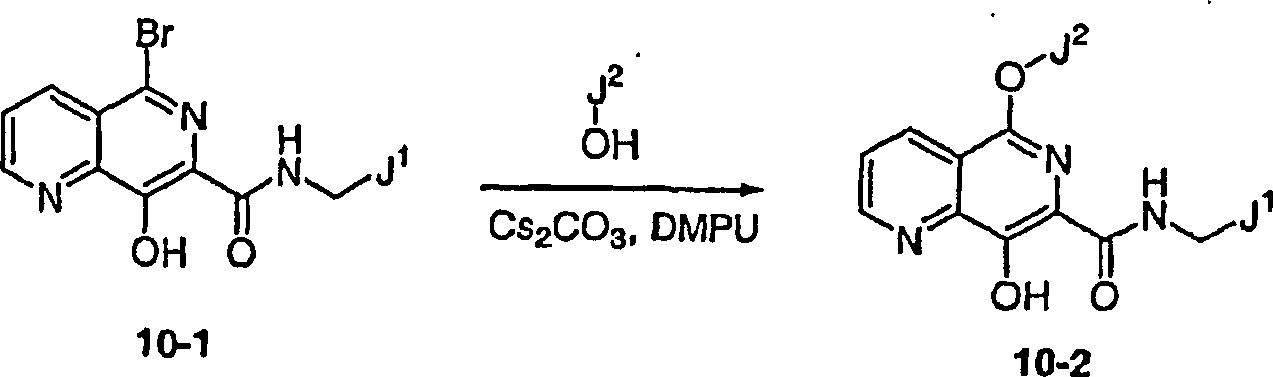
SCHEMA
11 
SCHEMA
12 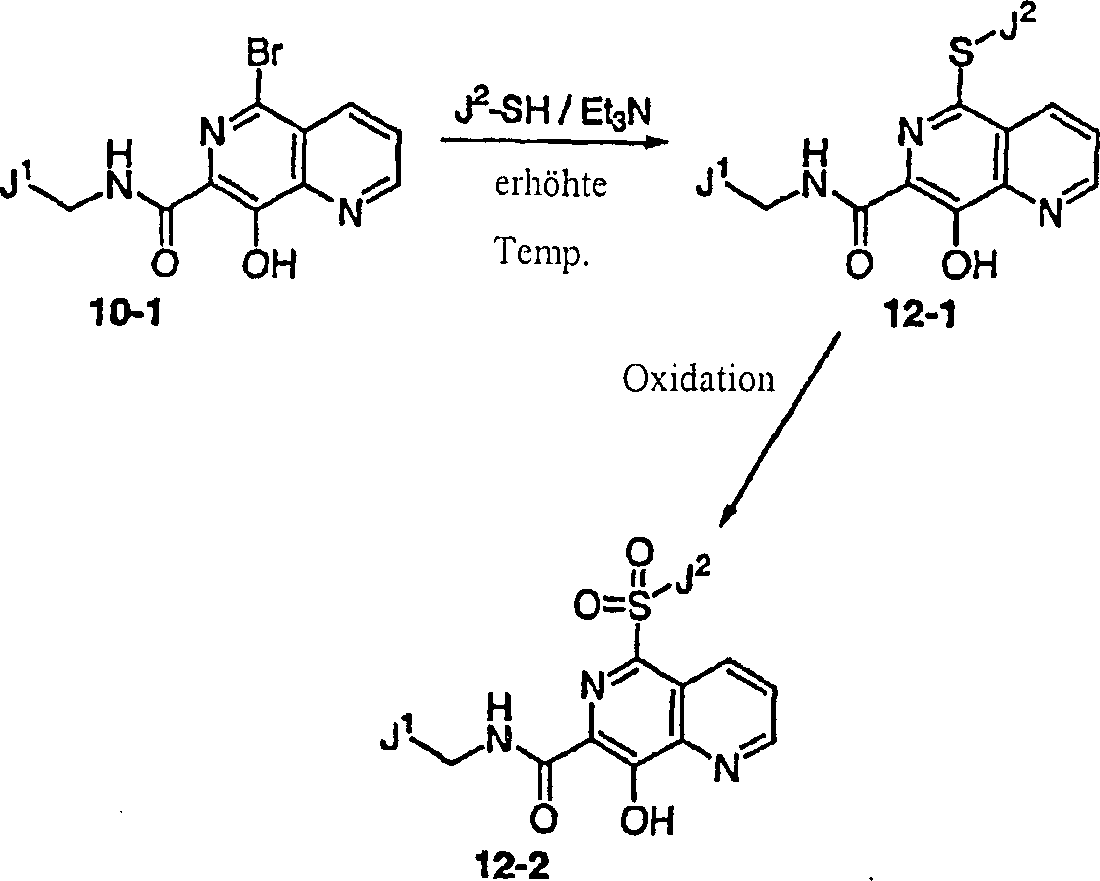
Die Herstellung von Verbindungen der Erfindung, die mit einem Acetylen substituiert sind, kann gemäß Schema 13 erfolgen, welches das Verfahren für den Naphthyridinkem veranschaulicht. Nach dem Schutz des Iodids 13-2 als dessen Benzoat 13-3 kann die acetylenische Gruppe (zum Beispiel Propinol) durch Einsatz eines geeigneten Palladiumkatalysators in Gegenwart von Kupferiodid angehängt werden. Die Aminolyse des Esters 13-4 wird das Amid 13-5 ergeben, mit einhergehender Entfernung der Schutzgruppe vom Benzoatester. Alternativ kann der Ester 13-4 in das entsprechende Amin und die Sulfonderivat umgewandelt werden, wie es in den Schemata 14 und 15 gezeigt ist. Schema 16 zeigt, dass die Herstellung des Nitrilderivats 16-2 durch eine palladiumkatalysierte Cyanierung des Iodids 14-4 erreicht werden kann.The Preparation of compounds of the invention containing an acetylene may be substituted according to Scheme 13, which illustrates the process for the Naphthyridinkem. After protection of iodide 13-2 as its benzoate 13-3, the acetylenic group (for example, propynol) by using a suitable palladium catalyst in the presence of copper iodide are attached. Aminolysis of ester 13-4 will give amide 13-5, with concomitant Removal of the benzoate ester protecting group. Alternatively, the Ester 13-4 converted to the corresponding amine and the sulfone derivative as shown in Schemes 14 and 15. Scheme 16 shows that the preparation of the nitrile derivative 16-2 by a palladium-catalyzed Cyanation of iodide 14-4 can be achieved.
SCHEMA
13 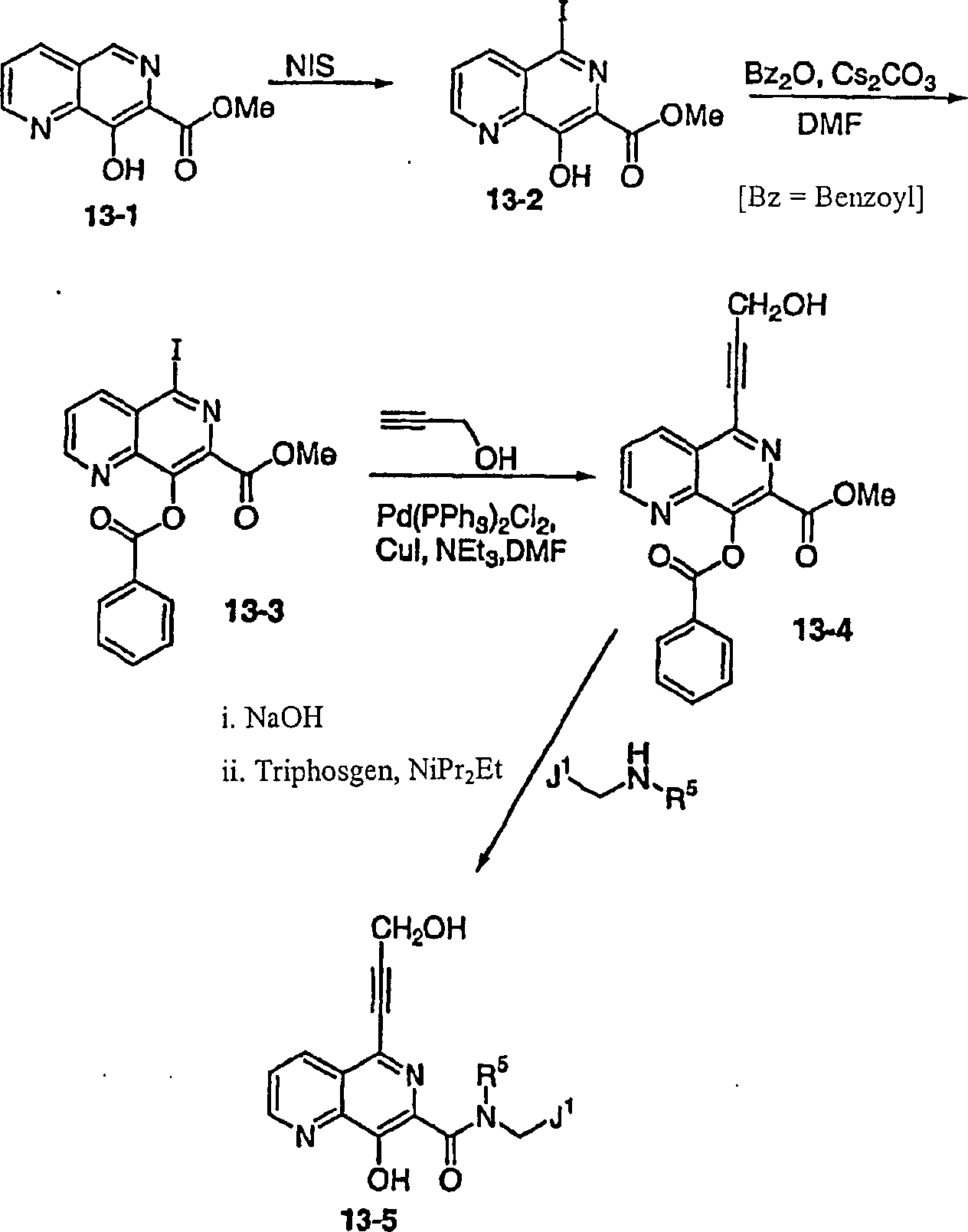
SCHEMA
14 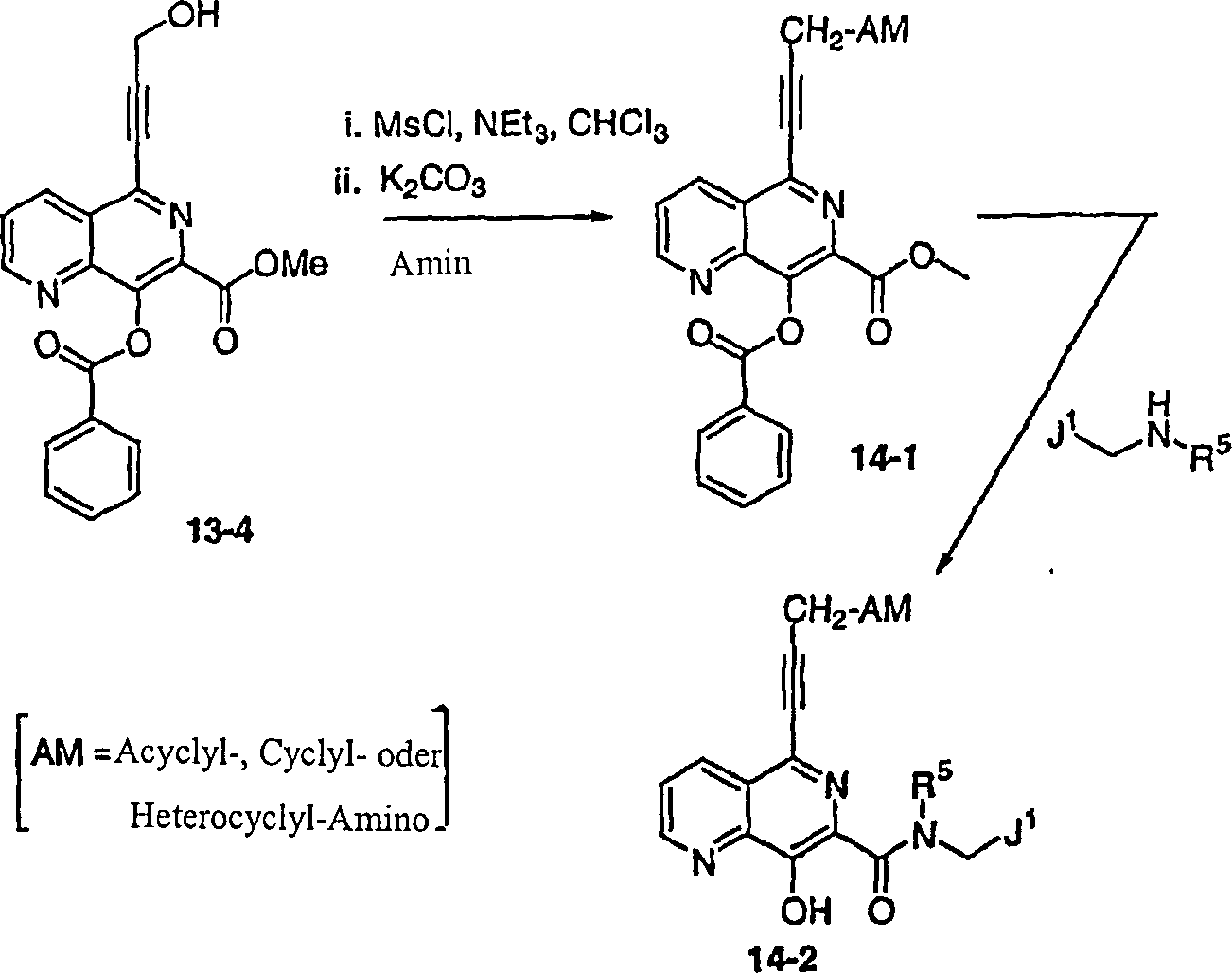
SCHEMA
15 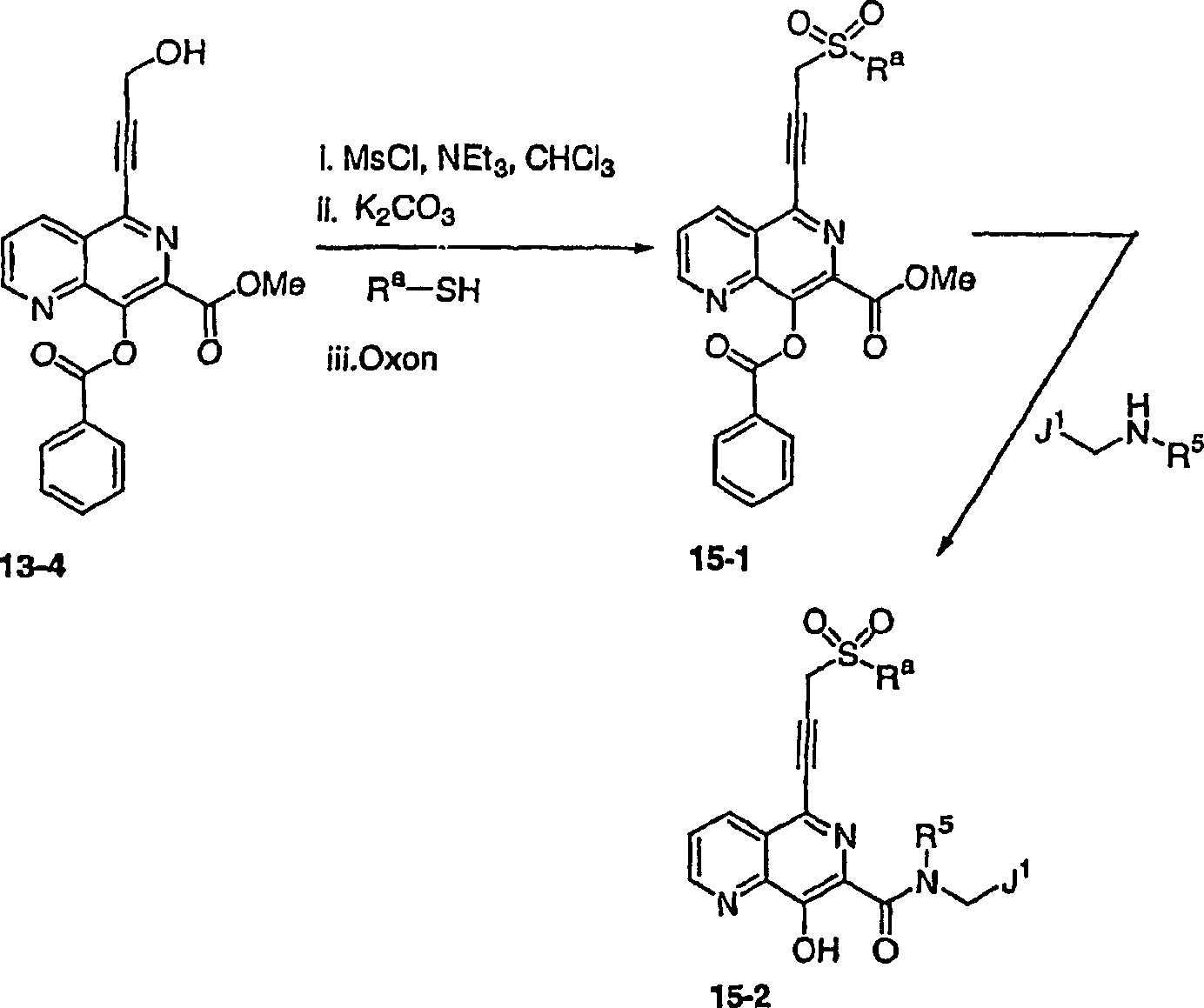
SCHEMA
16 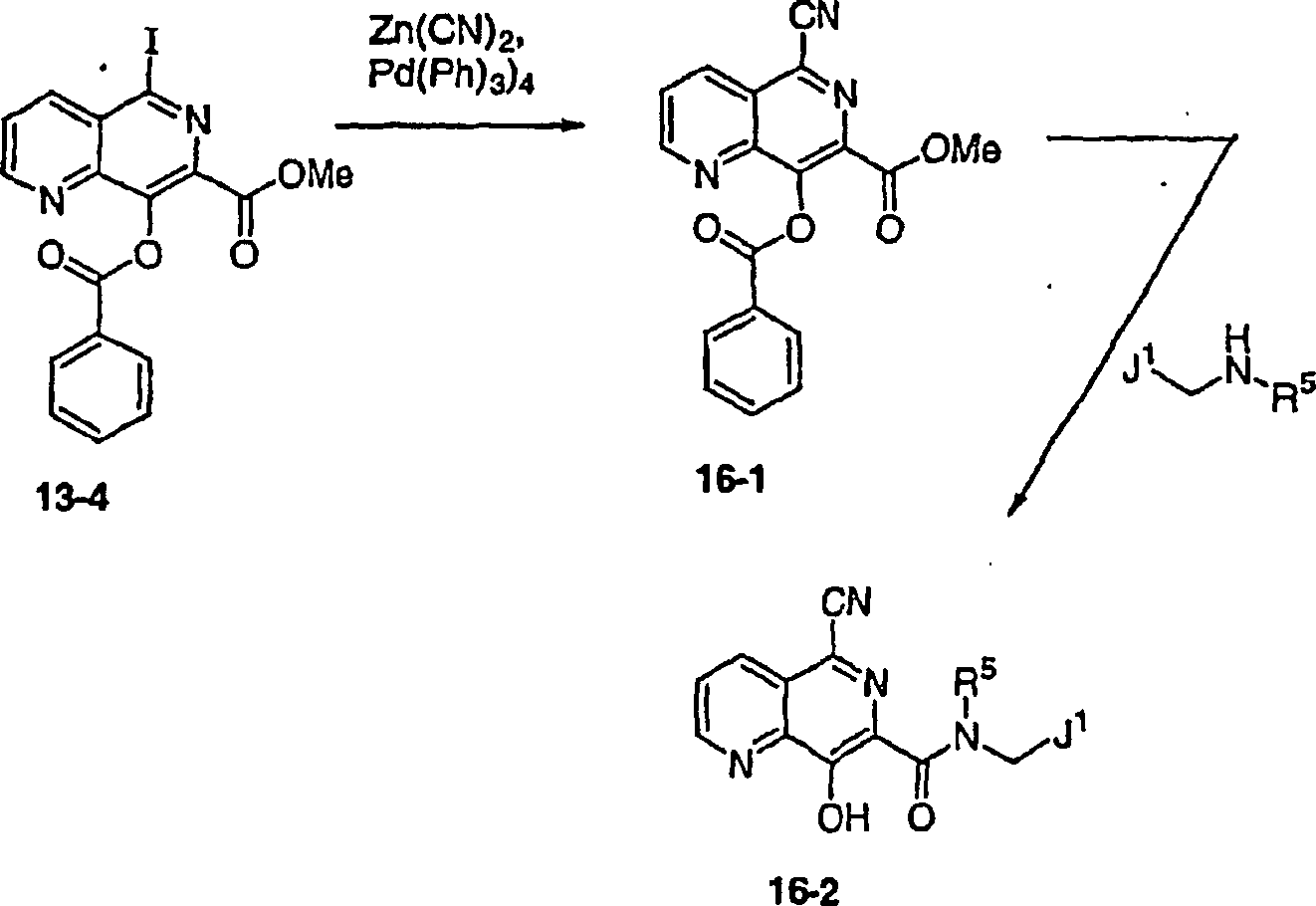
Bei den in den obigen Schemata gezeigten Verfahren zur Herstellung von Verbindungen der vorliegenden Erfindung können funktionelle Gruppen in verschiedenen Resten und Substituenten unter den eingesetzten Reaktionsbedingungen und/oder in Gegenwart der eingesetzten Reagenzien empfindlich oder reaktiv sein. Eine solche Empfindlichkeit/Reaktivität kann den Fortschritt der erwünschten Reaktion stören, wobei die Ausbeute an dem erwünschten Produkt verringert oder möglicherweise sogar dessen Bildung verhindert werden kann. Demgemäß kann es notwendig oder wünschenswert sein, empfindliche oder reaktive Gruppen an irgendwelchen der betroffenen Moleküle zu schützen. Der Schutz kann mittels herkömmlicher Schutzgruppen erfolgen, wie z.B. derjenigen, die in Protective Groups in Organic Chemistry, Hrsg. J.F.W. McOmie, Plenum Press, 1973, und in T.W. Greene & P.G.M. Wuts, Protective Groups in Organic Synthesis, John Wiley & Sons, 1991, beschrieben sind. Die Schutzgruppen können an einer zweckmäßigen nachfolgenden Stufe durch Anwendung von im Fachgebiet bekannten Verfahren entfernt werden. Alternativ kann die Störgruppe nach dem betreffenden Reaktionsschritt in das Molekül eingebracht werden. Wenn zum Beispiel einer oder mehrere der Substituenten R1, R2, R3 und R4 in Verbindung 1-1 die Kupplungsreaktion zwischen den Verbindungen 1-1 und 1-2 von Schema 1 stören können, kann der Substituent in einem Schritt nach der Kupplung in das Molekül eingebracht werden, um Verbindung I zu ergeben.In the methods of preparing compounds of the present invention shown in the above schemes, functional groups in various groups and substituents may be sensitive or reactive under the reaction conditions employed and / or in the presence of the reagents employed. Such sensitivity / reactivity may interfere with the progress of the desired reaction whereby the yield of the desired product may be reduced or even prevented from being formed. Accordingly, it may be necessary or desirable to protect sensitive or reactive groups on any of the molecules involved. Protection may be by conventional protecting groups, such as those described in Protective Groups in Organic Chemistry, ed. JFW McOmie, Plenum Press, 1973, and TW Greene & PGM Wuts, Protective Groups in Organic Synthesis, John Wiley & Sons, 1991 , are described. The protecting groups may be removed at a convenient subsequent stage using methods known in the art. Alternatively, the impurity group can be introduced into the molecule after the relevant reaction step. For example, when one or more of the substituents R 1 , R 2 , R 3 and R 4 in compound 1-1, the coupling reaction between the compounds 1-1 and 1-2 of Scheme 1, the substituent may be introduced into the molecule in a step after coupling to give compound I.
Die folgenden Beispiele dienen lediglich der Veranschaulichung der Erfindung und ihrer Durchführung. Die Beispiele sollen nicht als Einschränkungen der Erfindung aufgefasst werden.The The following examples are merely illustrative of the invention and their implementation. The Examples are not to be construed as limitations of the invention become.
BEISPIEL 1EXAMPLE 1
2-({[(8-Hydroxy-1,6-naphthyridin-7-yl)carbonyl]amino}methyl)-1H-benzimidazol 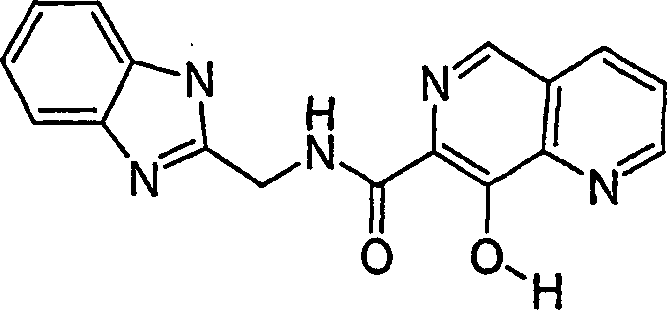
Schritt 1: Herstellung von 3-{[Methoxycarbonylmethyl(toluol-4-sulfonyl)amino]methyl}pyridin-2-carbonsäureisopropylesterStep 1: Preparation of 3 - {[methoxycarbonylmethyl (toluene-4-sulfonyl) amino] methyl} pyridine-2-carboxylic acid isopropyl ester
Isopropyl-3-(hydroxymethyl)pyridin-2-carboxylat (hergestellt gemäß P. Ornstein et al., J. Med. Chem. 1989, 32, 827) (200 g, 1,02 mol), Methyl-N-[(4-Methylphenyl)sulfonyl]glycinat (249 g, 1,02 mol) und Triphenylphosphin (403 g, 1,5 mol) wurden in trockenem THF (3000 ml) gelöst und unter N2 auf 0°C abgekühlt. Das Diethylazodicarboxylat (DEAD) (267,6 g, 1,5 mol) wurde in trockenem THF (250 ml) gelöst und in einen 500-ml-Zugabetrichter gegeben. Das DEAD wurde tropfenweise innerhalb von 1 Stunde zugegeben. Das Eisbad wurde entfernt, und man ließ die Reaktion langsam auf RT erwärmen. nach 2 Stunden wurde die Reaktion durch HPLC (obige Bedingungen) geprüft, und es verblieb etwas Glycinat. Weitere Ausgangsreagenzien wurden zugegeben, und man ließ die Reaktion bei RT rühren. Nach 30 Minuten wurde die Reaktion erneut überprüft, und es wurde eine sehr kleine verbliebene Menge des Glycinats festgestellt. Die Reaktion wurde zu einem rötlich orangenfarbenen Öl eingeengt und dieses im nächsten Schritt verwendet.Isopropyl-3- (hydroxymethyl) pyridine-2-carboxylate (manufactured according to P. Ornstein et al., J. Med. Chem. 1989, 32, 827) (200 g, 1.02 mol), methyl N - [(4-methylphenyl) sulfonyl] glycinate (249 g, 1.02 mol) and triphenylphosphine (403 g, 1.5 mol) dissolved in dry THF (3000 ml) and below N2 to 0 ° C cooled. The diethyl azodicarboxylate (DEAD) (267.6 g, 1.5 mol) was dissolved in dry THF (250 ml) dissolved and placed in a 500 ml addition funnel. The DEAD was drop by drop added within 1 hour. The ice bath was removed, and they left the Heat reaction slowly to RT. after 2 hours, the reaction was by HPLC (above conditions) checked, and some glycinate remained. Other starting reagents were admitted, and they let the Stir reaction at RT. After 30 minutes the reaction was checked again and it became a very small remaining amount of glycinate detected. The reaction became reddish orange-colored oil narrowed down and this in the next Step used.
Schritt 2: Herstellung von Methyl-8-hydroxy-1,6-naphthyridin-7-carboxylat 3-{[Methoxycarbonylmethyl(toluol-4-sulfonyl)amino]methyl}pyridin-2-carbonsäureisopropylesterStep 2: Preparation of methyl 8-hydroxy-1,6-naphthyridine-7-carboxylate 3 - {[methoxycarbonylmethyl (toluene-4-sulfonyl) amino] methyl} pyridin-2-carboxylic acid
(1,02
mol) wurde in trockenem Methanol (4000 ml) gelöst und unter Stickstoff auf
0°C abgekühlt. Anschließend wurde
durch einen Zugabetrichter Natriummethoxid (137,8 g, 2,5 mol) langsam
zugegeben, um eine Exotherme zu vermeiden. Die Reaktion wurde bei
0°C gerührt und
nach 1,5 Stunden durch HPLC geprüft und
als beendet befunden. Das Lösungsmittel
wurde im Vakuum entfernt, um ein rötlich orangenfarbenes Öl zu ergeben,
das zwischen Wasser (1 l) und Ethylacetat (1 l) aufgetrennt wurde.
Die organische Schicht wurde mit gesättigter Natriumhydrogencarbonatlösung rückextrahiert.
Der pH-Wert der wässrigen
Schicht wurde auf 7 eingestellt und die Schicht bei diesem pH-Wert
gehalten, während
mit Methylenchlorid extrahiert wurde. Die organische Schicht wurde
mit Na2SO4 getrocknet,
filtriert und das Lösungsmittel
im Vakuum eingeengt, um einen gelbbraunen Feststoff zu ergeben.
Der Feststoff wurde in heißem
Ethylacetat gelöst
und die Lösung
heiß filtriert,
um jegliches unlösliches
Material durch Filtration zu entfernen. Das Produkt fiel beim Abkühlen aus. Der
Niederschlag wurde anschließend
filtriert und im Vakuumofen getrocknet. Das Filtrat wurde umkristallisiert, indem
es eingeengt der resultierende Feststoff in einer minimalen Menge
Methylenchlorid wieder gelöst
wurde. Ausreichend Ethylacetat wurde zugegeben, um die Lösung leicht
trüb werden
zu lassen, wonach die Lösung zum
Sieden erhitzt wurde, um das Volumen zu verringern, man ließ sie abkühlen, und
die resultierenden Kristalle wurden abfiltriert und in einem Vakuumofen
getrocknet.
1H-NMR (CDCl3,
500 MHz) δ 11,794
(5H, s), 9,2 (1H, dd, J = 1,7 und 6,1 Hz), 8,8 (1H, s), 8,3 (1H,
dd, J = 1,5 und 9,7 Hz), 7,7 (1H, dd, J = 4,2 und 12,4 Hz), 4,1
(3H, s) ppm.
Exakte ES-MS-Masse berechnet für C10H8N2O3 204,1869
(MH+), gefunden 205,1.(1.02 mol) was dissolved in dry methanol (4000 ml) and cooled to 0 ° C under nitrogen. Then sodium methoxide (137.8 g, 2.5 mol) was added slowly through an addition funnel to avoid an exotherm. The reaction was stirred at 0 ° C and, after 1.5 hours, checked by HPLC and found to be complete. The solvent was removed in vacuo to give a reddish orange oil which was partitioned between water (1 L) and ethyl acetate (1 L). The organic layer was back-extracted with saturated sodium bicarbonate solution. The pH of the aqueous layer was adjusted to 7 and the layer was maintained at this pH while being extracted with methylene chloride. The organic layer was dried with Na 2 SO 4 , filtered and the solvent was concentrated in vacuo to give a tan solid. The solid was dissolved in hot ethyl acetate and the solution filtered hot to remove any insoluble material by filtration. The product precipitated on cooling. The precipitate was then filtered and dried in a vacuum oven. The filtrate was recrystallized by concentrating it concentrated the resulting solid was redissolved in a minimum amount of methylene chloride. Sufficient ethyl acetate was added to make the solution slightly cloudy, after which the solution was boiled to reduce the volume, allowed to cool, and the resulting crystals were filtered off and dried in a vacuum oven.
1 H-NMR (CDCl 3, 500 MHz) δ 11.794 (5H, s), 9.2 (1H, dd, J = 1.7 and 6.1 Hz), 8.8 (1H, s), 8, 3 (1H, dd, J = 1.5 and 9.7 Hz), 7.7 (1H, dd, J = 4.2 and 12.4 Hz), 4.1 (3H, s) ppm.
Exact ES-MS mass calculated for C 10 H 8 N 2 O 3 204.1869 (MH + ), found 205.1.
Schritt 3: Herstellung von 8-Hydroxyl-1,6-naphthyridin-7-carbonsäureStep 3: Preparation of 8-Hydroxyl-1,6-naphthyridine-7-carboxylic acid
Zu
einer Aufschlämmung
von Methyl-8-hydroxy-1,6-naphthyridin-7-carboxylat von Beispiel
1, Schritt 2, (1,50 g, 7,35 mmol) in Methanol (45 ml) wurde Lithiumhydroxid
(22,0 ml einer 1M wässrig.
Lösung,
22,0 mmol) zugegeben und die Reaktion 7 Stunden auf 100°C erhitzt.
Nach dem Abkühlen
auf Raumtemperatur wurde Salzsäure
(22,0 ml einer 1M wässrig.
Lösung,
22,0 mmol) zugegeben und die Reaktion 16 Stunden gerührt. Die
Mischung wurde auf ein Volumen von 50 ml eingeengt und mit verdünntem NaHCO3 (pH = 7) neutralisiert. Der resultierende
Niederschlag wurde durch Filtration gesammelt und mit Wasser gewaschen
und im Vakuum getrocknet, um die Titelverbindung zu ergeben.
FAB-MS
berechn. für
C9H6N2O3 191 (MH+), gefunden
191.
1H-NMR (d6-DMSO,
400 MHz) δ 9,20
(1H, m), 8,72 (1H, s), 8,58 (1H, m), 7,80 (1H, dd, J = 8,3 und 4,2
Hz) ppm.To a slurry of methyl 8-hydroxy-1,6-naphthyridine-7-carboxylate of Example 1, Step 2, (1.50 g, 7.35 mmol) in methanol (45 mL) was added lithium hydroxide (22.0 mL 1M aqueous solution, 22.0 mmol) was added and the reaction heated to 100 ° C for 7 hours. After cooling to room temperature, hydrochloric acid (22.0 ml of a 1M aqueous solution, 22.0 mmol) was added and the reaction stirred for 16 hours. The mixture was concentrated to a volume of 50 ml and reconstituted with dilute NaHCO 3 (pH = 7) neutralized. The resulting precipitate was collected by filtration and washed with water and dried in vacuo to give the title compound.
FAB-MS calc. for C 9 H 6 N 2 O 3 191 (MH + ), found 191.
1 H NMR (d 6 -DMSO, 400 MHz) δ 9.20 (1H, m), 8.72 (1H, s), 8.58 (1H, m), 7.80 (1H, dd, J = 8.3 and 4.2 Hz) ppm.
Schritt 4: Herstellung von 2-({[(8-Hydroxy-1,6-naphthyridin-7-yl)carbonyl]amino}methyl)-1H-benzimidazol-1-iumtrifluoracetatStep 4: Preparation of 2 - ({[(8-Hydroxy-1,6-naphthyridin-7-yl) carbonyl] amino} methyl) -1H-benzimidazol-1-ium trifluoroacetate
Triphosgen
(0,556 g, 1,87 mmol) wurde innerhalb von 20 Minuten zu einer Lösung der
Säule von Schritt
1 (0,89 g, 4,68 mmol) und Diisopropylethylamin (3,26 ml, 18,7 mmol)
in DMF (22 ml) bei 0°C
zugegeben. Die dunkle Lösung
ließ man
auf Raumtemperatur erwärmen
und 1 weitere Stunde rühren.
2-(Ammoniummethyl)-1H-benzimidazol-1-iumdichlorid-Hydrat
(25,0 mg, 1,05 mmol) wurde mit einer Portion der obigen Lösung (0,58
ml, 0,07 mmol) behandelt und die resultierende Mischung 16 Stunden
bei Raumtemperatur gerührt. Die
Lösung
wurde mit TFA (0,025 ml) behandelt und durch präparative HPLC (halbpräparatives
Gilson-HPLC-System und eine YMC-Combiprep-Pro-Säule (50 × 20 mm ID, C18, S-5 um, 120A)
(erhältlich
von Waters) mit 5–95%
Acetonitril/Wasser (0,1% TFA) als Elutionsmittel bei 15 ml/Minute)
gereinigt, um nach der Gefriertrocknung das Trifluoracetatsalz der
Titelverbindung zu ergeben.
1H-NMR
(d6-DMSO, 400 MHz) δ 10,03 (1H, m), 9,21 (1H, d,
J = 4,2 Hz), 9,00 (1H, s), 8,66 (1H, d, J = 8,3 Hz), 7,85 (1H, dd,
J = 8,3 und 4,2 Hz), 7,80–7,65
(2H, m), 7,60–7,40
(2H, m), 5,05 (2H, d, J = 4,9 Hz) ppm.
FAB-MS berechn. für C17H13N5O2 320 (MH+), gefunden
320.
Exakte FAB-HRMS-Masse berechn. für C17H13N5O2 320,1142
(MH+), gefunden 320,1145.Triphosgene (0.556 g, 1.87 mmol) was added over 20 min to a solution of the column from Step 1 (0.89 g, 4.68 mmol) and diisopropylethylamine (3.26 mL, 18.7 mmol) in DMF ( 22 ml) at 0 ° C was added. The dark solution was allowed to warm to room temperature and stirred for an additional 1 hour. 2- (Ammoniummethyl) -1H-benzimidazole-1-dichloride hydrate (25.0 mg, 1.05 mmol) was treated with a portion of the above solution (0.58 mL, 0.07 mmol) and the resulting mixture 16 Stirred hours at room temperature. The solution was treated with TFA (0.025 ml) and purified by preparative HPLC (Gilson semi-preparative HPLC system and YMC Combiprep Pro column (50 x 20 mm ID, C18, S-5 μm, 120A) (available from Waters ) with 5-95% acetonitrile / water (0.1% TFA) as eluent at 15 ml / minute) to give, after lyophilization, the trifluoroacetate salt of the title compound.
1 H NMR (d 6 -DMSO, 400 MHz) δ 10.03 (1H, m), 9.21 (1H, d, J = 4.2 Hz), 9.00 (1H, s), 8, 66 (1H, d, J = 8.3 Hz), 7.85 (1H, dd, J = 8.3 and 4.2 Hz), 7.80-7.65 (2H, m), 7.60 -7.40 (2H, m), 5.05 (2H, d, J = 4.9 Hz) ppm.
FAB-MS calc. for C 17 H 13 N 5 O 2 320 (MH + ), found 320.
Exact FAB HRMS mass calculated. for C 17 H 13 N 5 O 2 320.1142 (MH + ), found 320.1145.
BEISPIEL 2EXAMPLE 2
8-Hydroxy-N-[2-(1H-indol-3-yl)ethyl]-1,6-naphthyridin-7-carboxamid 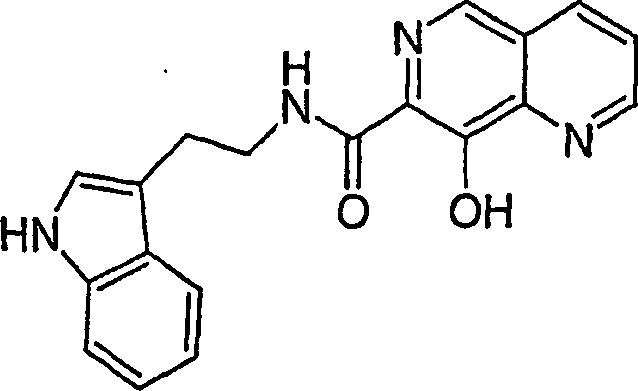
Die
Titelverbindung wurde durch Anwendung des in Beispiel 1, Schritt
4, beschriebenen Verfahrens hergestellt, wobei 2-(Ammoniummethyl)-1H-benzimidazol-1-iumdichlorid-Hydrat
durch 2-(1H-Indol-3-yl)ethanamin
ersetzt wurde.
1H-NMR (d6-DMSO,
400 MHz) δ 10,85
(1H, s), 9,40 (1H, m), 9,16 (1H, dd, J = 4,3 und 1,6 Hz), 8,90 (1H,
s), 8,61 (1H, dd, J = 8,2 und 1,6 Hz), 7,83 (1H, dd, J = 8,2 und
4,2 Hz), 7,62 (1H, d, J = 8,1 Hz), 7,34 (1H, d, J = 7,8 Hz), 7,23
(1H, s), 7,07 (1H, t, J = 7,5 Hz), 7,00 (1H, t, J = 6,5 Hz), 3,66
(2H, m), 3,03 (2H, t, J = 7,7 Hz) ppm.
FAB-MS berechn. für C19H16N4O2 333 (MH+), gefunden
333.The title compound was prepared using the procedure described in Example 1, Step 4, substituting 2- (1H-indol-3-yl) ethanamine for 2- (ammonium methyl) -1H-benzimidazole-1-dichloride hydrate.
1 H-NMR (d 6 -DMSO, 400 MHz) δ 10.85 (1H, s), 9.40 (1H, m), 9.16 (1H, dd, J = 4.3 and 1.6 Hz ), 8.90 (1H, s), 8.61 (1H, dd, J = 8.2 and 1.6 Hz), 7.83 (1H, dd, J = 8.2 and 4.2 Hz) , 7.62 (1H, d, J = 8.1 Hz), 7.34 (1H, d, J = 7.8 Hz), 7.23 (1H, s), 7.07 (1H, t, J = 7.5 Hz), 7.00 (1H, t, J = 6.5 Hz), 3.66 (2H, m), 3.03 (2H, t, J = 7.7 Hz) ppm.
FAB-MS calc. for C 19 H 16 N 4 O 2 333 (MH + ), found 333.
BEISPIEL 3EXAMPLE 3
N-{2-[2-(3,4-Dimethoxyphenyl)-1H-indol-3-yl]ethyl}-8-hydroxy-1,6-naphthyridin-7-carboxamid 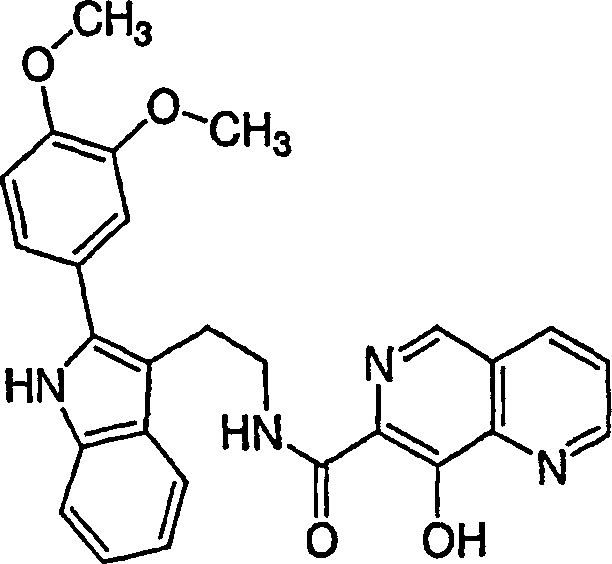
Die
Titelverbindung wurde durch Anwendung des in Beispiel 1, Schritt
4, beschriebenen Verfahrens hergestellt, wobei 2-(Ammoniummethyl)-1H-benzimidazol-1-iumdichlorid-Hydrat
durch 3-(2-Aminoethyl)-2-(3,4-dimethoxyphenylindol)
ersetzt wurde.
1H-NMR (d6-DMSO,
400 MHz) δ 11,1
(1H, s), 9,55 (1H, m), 9,17 (1H, d, J = 4,2 Hz), 8,89 (1H, s), 8,61
(1H, d, J = 8,2 Hz), 7,84 (1H, dd, J = 8,2 und 4,2 Hz), 7,74 (1H,
d, J = 8,1 Hz), 7,36 (1H, d, J = 7,9 Hz), 7,26 (1H, d, J = 8,2 Hz),
7,22 (1H, s), 7,10 (1H, t, J = 7,6 Hz), 7,10–7,00 (2H, m), 3,73 (3H, s),
3,70–3,40
(2H, m), 3,18 (2H, t, J = 7,9 Hz) ppm.
FAB-MS, berechn. für C27H24N4O4 469 (MH+) gefunden
469.
Exakte FAB-HRMS-Masse berechn. für C27H24N4O4 469,1870317
(MH+), gefunden 469,1871720.The title compound was prepared by using the method described in Example 1, Step 4 to replace 2- (ammonium methyl) -1H-benzimidazole-1-dichloride hydrate with 3- (2-aminoethyl) -2- (3,4-dimethoxyphenylindole).
1 H-NMR (d 6 -DMSO, 400 MHz) δ 11.1 (1H, s), 9.55 (1H, m), 9.17 (1H, d, J = 4.2 Hz), 8, 89 (1H, s), 8.61 (1H, d, J = 8.2 Hz), 7.84 (1H, dd, J = 8.2 and 4.2 Hz), 7.74 (1H, d , J = 8.1 Hz), 7.36 (1H, d, J = 7.9 Hz), 7.26 (1H, d, J = 8.2 Hz), 7.22 (1H, s), 7.10 (1H, t, J = 7.6Hz), 7.10-7.00 (2H, m), 3.73 (3H, s), 3.70-3.40 (2H, m) , 3.18 (2H, t, J = 7.9 Hz) ppm.
FAB-MS, calc. for C 27 H 24 N 4 O 4 469 (MH + ) found 469.
Exact FAB HRMS mass calculated. for C 27 H 24 N 4 O 4 469.1870317 (MH + ), found 469.1871720.
BEISPIEL 4EXAMPLE 4
8-Hydroxy-N-[(2-oxo-2,3-dihydro-1H-indol-3-yl)methyl]-1,6-naphthyridin-7-carboxamid 
Die
Titelverbindung wurde durch Anwendung des in Beispiel 1, Schritt
4, beschriebenen Verfahrens hergestellt, wobei 2-(Ammoniummethyl)-1H-benzimidazol-1-iumdichlorid-Hydrat
durch 3-(Aminomethyl)-1,3-dihydro-2H-indol-2-on
ersetzt wurde.
1H-NMR (d6-DMSO,
400 MHz) δ 10,4
(1H, s), 9,54 (1H, m), 9,18 (1H, d, J = 4,3 Hz), 8,92 (1H, s), 8,63
(1H, d, J = 8,3 Hz), 7,84 (1H, dd, J = 8,3 und 4,3 Hz), 7,22 (2H,
t, J = 7,4 Hz), 6,96 (2H, t, J = 7,4 Hz), 5,48 (1H, m), 3,03 (1H,
dd, J = 16,0 und 10,3 Hz), 2,75 (1H, dd, J = 16,0 und 6,0 Hz) ppm.
FAB-MS
berechn. für
C18H14N4O3 335 (MH+), gefunden
335.
Exakte FAB-HRMS-Masse berechn. für C18H14N4O3 335,1139
(MH+), gefunden 335,1143.The title compound was prepared using the procedure described in Example 1, Step 4, whereby 2- (ammonium methyl) -1H-benzimidazole-1-dichloride hydrate was replaced by 3- (aminomethyl) -1,3-dihydro-2H-indole 2-on was replaced.
1 H NMR (d 6 -DMSO, 400 MHz) δ 10.4 (1H, s), 9.54 (1H, m), 9.18 (1H, d, J = 4.3 Hz), 8, 92 (1H, s), 8.63 (1H, d, J = 8.3 Hz), 7.84 (1H, dd, J = 8.3 and 4.3 Hz), 7.22 (2H, t , J = 7.4 Hz), 6.96 (2H, t, J = 7.4 Hz), 5.48 (1H, m), 3.03 (1H, dd, J = 16.0 and 10, 3 Hz), 2.75 (1H, dd, J = 16.0 and 6.0 Hz) ppm.
FAB-MS calc. for C 18 H 14 N 4 O 3 335 (MH + ), found 335.
Exact FAB HRMS mass calculated. for C 18 H 14 N 4 O 3 335.1139 (MH +), found 335.1143.
BEISPIEL 5EXAMPLE 5
8-Hydroxy-N-[2-(10H-phenothiazin-10-yl)ethyl]-1,6-naphthyridin-7-carboxamid 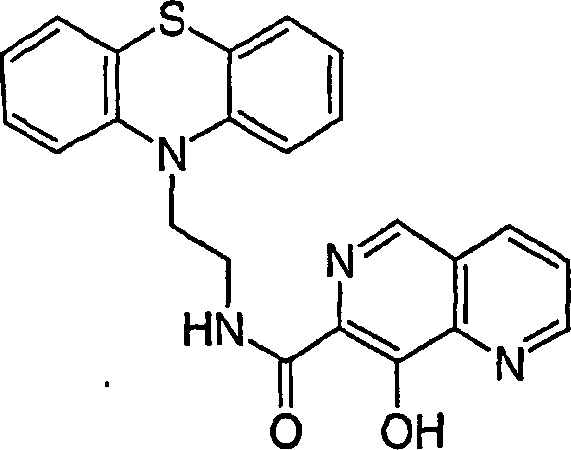
Die
Titelverbindung wurde durch Anwendung des in Beispiel 1, Schritt
4, beschriebenen Verfahrens hergestellt, wobei 2-(Ammoniummethyl)-1H-benzimidazol-1-iumdichlorid-Hydrat
durch 2-(10H-Phenothiazin-10-yl)ethanamin
ersetzt wurde.
1H-NMR(d6-DMSO,
400 MHz) δ 9,55
(1H, t, J = 6,2 Hz), 9,18 (1H, dd, J = 4,2 und 1,6 Hz), 8,93 (1H,
s), 8,62 (1H, dd, J = 8,4 und 1,6 Hz), 7,84 (1H, dd, J = 8,4 und
4,2 Hz), 7,65–7,40
(4H, m), 7,15 (2H, m), 6,96 (2H, m), 4,09 (2H, m), 3,74 (2H, m)
ppm. FAB-MS berechn. für
C23H18N4O2S 415 (MH+), gefunden
415.
Exakte FAB-HRMS-Masse berechn. für C23H18N4O2S
415,1223 (MH+), gefunden 415,1224.The title compound was prepared using the procedure described in Example 1, Step 4, substituting 2- (10H-phenothiazin-10-yl) ethanamine for 2- (ammonium methyl) -1H-benzimidazole-1-dichloride hydrate.
1 H-NMR (d 6 -DMSO, 400 MHz) δ 9.55 (1H, t, J = 6.2 Hz), 9.18 (1H, dd, J = 4.2 and 1.6 Hz), 8.93 (1H, s), 8.62 (1H, dd, J = 8.4 and 1.6 Hz), 7.84 (1H, dd, J = 8.4 and 4.2 Hz), 7 , 65-7.40 (4H, m), 7.15 (2H, m), 6.96 (2H, m), 4.09 (2H, m), 3.74 (2H, m) ppm. FAB-MS calc. for C 23 H 18 N 4 O 2 S 415 (MH + ), found 415.
Exact FAB HRMS mass calculated. for C 23 H 18 N 4 O 2 S 415.1223 (MH + ), found 415.1224.
BEISPIEL 6EXAMPLE 6
8-Hydroxy-N-[2-(2-methyl-1-phenyl-1H-indol-3-yl)ethyl]-1,6-naphthyridin-7-carboxamid 
Die
Titelverbindung wurde durch Anwendung des in Beispiel 1, Schritt
4, beschriebenen Verfahrens hergestellt, wobei 2-(Ammoniummethyl)-1H-benzimidazol-1-iumdichlorid-Hydrat
durch 2-(2-Methyl-1-phenyl-1H-indol-3-yl)ethanamin
ersetzt wurde.
1H-NMR (d6-DMSO,
400 MHz) δ 9,47
(1H, t, J = 6,01 Hz), 9,17 (1H, dd, J = 4,2 und 1,6 Hz), 8,92 (1H,
s), 8,62 (1H, dd, J = 8,4 und 1,6 Hz), 7,84 (1H, dd, J = 8,4 und
4,2 Hz), 7,67 (1H, d, J = 6,9 Hz), 7,59 (2H, t, J = 7,8 Hz), 7,48
(1H, t, J = 7,2 Hz), 7,41 (2H, d, J = 7,2 Hz), 7,20–6,95 (3H,
m), 3,80–3,20
(2H, m), 3,08 (2H, t, J = 7,3 Hz), 2,24 (3H, s) ppm.
FAB-MS
berechn. für
C26H22N4O2 423 (MH+) gefunden
423.
Exakte FAB-HRMS-Masse berechn. für C26H22N4O2 423,1804
(MH+), gefunden 423,1804.The title compound was prepared using the procedure described in Example 1, Step 4, wherein 2- (ammonium methyl) -1H-benzimidazole-1-dichloride hydrate was replaced by 2- (2-methyl-1-phenyl-1H-indole-3 -yl) ethanamine.
1 H-NMR (d 6 -DMSO, 400 MHz) δ 9.47 (1H, t, J = 6.01 Hz), 9.17 (1H, dd, J = 4.2 and 1.6 Hz), 8.92 (1H, s), 8.62 (1H, dd, J = 8.4 and 1.6 Hz), 7.84 (1H, dd, J = 8.4 and 4.2 Hz), 7 , 67 (1H, d, J = 6.9 Hz), 7.59 (2H, t, J = 7.8 Hz), 7.48 (1H, t, J = 7.2 Hz), 7.41 (2H, d, J = 7.2Hz), 7.20-6.95 (3H, m), 3.80-3.20 (2H, m), 3.08 (2H, t, J = 7 , 3 Hz), 2.24 (3H, s) ppm.
FAB-MS calc. for C 26 H 22 N 4 O 2 423 (MH + ) found 423.
Exact FAB HRMS mass calculated. for C 26 H 22 N 4 O 2 423.1804 (MH +), found 423.1804.
BEISPIEL 7EXAMPLE 7
8-Hydroxy-N-(1H-indol-6-ylmethyl)-1,6-naphthyridin-7-carboxamid 
Die
Titelverbindung wurde durch Anwendung des in Beispiel 1, Schritt
4, beschriebenen Verfahrens hergestellt, wobei 2-(Ammoniummethyl)-1H-benzimidazol-1-iumdichlorid-Hydrat
durch 1-(1H-Indol-6-yl)methanamin
ersetzt wurde.
1H-NMR (d6-DMSO,
400 MHz) δ 11,02
(1H, s), 9,79 (1H, m), 9,17 (1H, d, J = 4,2 Hz), 8,91 (1H, s), 8,61
(1H, d, J = 8,3 Hz), 7,83 (1H, dd, J = 8,3 und 4,2 Hz), 7,49 (1H,
d, J = 8,3 Hz), 7,42 (1H, s), 7,30 (1H, s), 7,06 (1H, d, J = 8,1
Hz), 6,38 (1H, s), 4,64 (2H, d, J = 6,3 Hz) ppm.
FAB-MS berechn.
für C18H14N4O2 319 (MH+), gefunden
319.The title compound was prepared using the procedure described in Example 1, Step 4, replacing 2- (ammonium methyl) -1H-benzimidazole-1-dichloride hydrate with 1- (1H-indol-6-yl) methanamine.
1 H-NMR (d 6 -DMSO, 400 MHz) δ 11.02 (1H, s), 9.79 (1H, m), 9.17 (1H, d, J = 4.2 Hz), 8, 91 (1H, s), 8.61 (1H, d, J = 8.3Hz), 7.83 (1H, dd, J = 8.3 and 4.2Hz), 7.49 (1H, d , J = 8.3 Hz), 7.42 (1H, s), 7.30 (1H, s), 7.06 (1H, d, J = 8.1 Hz), 6.38 (1H, s ), 4.64 (2H, d, J = 6.3 Hz) ppm.
FAB-MS calc. for C 18 H 14 N 4 O 2 319 (MH + ), found 319.
BEISPIEL 8EXAMPLE 8
8-Hydroxy-N-(1H-indol-2-ylmethyl)-1,6-naphthyridin-7-carboxamid 
Die
Titelverbindung wurde durch Nacharbeiten des in Beispiel 1, Schritt
4, beschriebenen Verfahrens hergestellt, wobei 2-(Ammoniummethyl)-1H-benzimidazol-1-iumdichlorid-Hydrat
durch 1-(1H-Indol-2-yl)methanamin
ersetzt wurde.
1H-NMR (d6-DMSO,
400 MHz) δ 11,0
(1H, s), 9,73 (1H, m), 9,17 (1H, m), 8,94 (1H, s), 8,61 (1H, d,
J = 8,2 Hz), 7,84 (1H, dd, J = 8,2 und 4,2 Hz), 7,46 (1H, d, 7,9
Hz), 7,36 (1H, d, J = 8,1 Hz), 7,04 (1H, t, J = 8,0 Hz), 6,95 (1H,
t, J = 7,4 Hz), 6,33 (1H, s), 4,73 (2H, d, J = 6,2 Hz) ppm.
FAB-MS
berechn. für
C18H14N4O2 319 (MH+), gefunden
319.The title compound was prepared by following the procedure described in Example 1, Step 4, replacing 2- (ammonium methyl) -1H-benzimidazole-1-dichloride hydrate with 1- (1H-indol-2-yl) methanamine.
1 H NMR (d 6 -DMSO, 400 MHz) δ 11.0 (1H, s), 9.73 (1H, m), 9.17 (1H, m), 8.94 (1H, s), 8.61 (1H, d, J = 8.2 Hz), 7.84 (1H, dd, J = 8.2 and 4.2 Hz), 7.46 (1H, d, 7.9 Hz), 7.36 (1H, d, J = 8.1 Hz), 7.04 (1H, t, J = 8.0 Hz), 6.95 (1H, t, J = 7.4Hz), 6.33 (1H, s), 4.73 (2H, d, J = 6.2Hz) ppm.
FAB-MS calc. for C 18 H 14 N 4 O 2 319 (MH + ), found 319.
BEISPIEL 9EXAMPLE 9
8-Hydroxy-N-[(4-oxo-3,4-dihydrophthalazin-1-yl)methyl]-1,6-naphthyridin-7-carboxamid 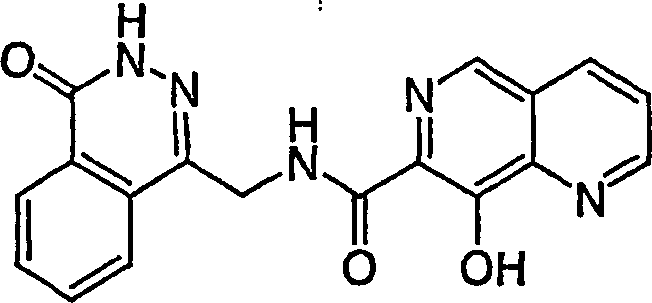
Die
Titelverbindung wurde durch Anwendung des in Beispiel 1, Schritt
4, beschriebenen Verfahrens hergestellt, wobei 2-(Ammoniummethyl)-1H-benzimidazol-1-iumdichlorid-Hydrat
durch 4-(Aminomethyl)phthalazin-1(2H)-on
ersetzt wurde.
1H-NMR (d6-DMSO,
400 MHz) δ 9,68
(1H, m), 9,18 (1H, dd, J = 1,5 und 4,2 Hz), 8,94 (1H, s), 8,62 (1H,
dd, J = 8,2 und 1,5 Hz), 8,30 (1H, d, J = 7,5 Hz), 8,17 (1H, d,
J = 9,0 Hz), 7,99 (1H, t, J = 7,7 Hz), 7,84 (1H, dd, J = 7,2 und
4,0 Hz), 4,95 (2H, m) ppm. FAB-MS berechn. für C18H13N5O3 319
(MH+), gefunden 348.The title compound was prepared using the procedure described in Example 1, Step 4, substituting 4- (aminomethyl) phthalazine-1 (2H) -one for 2- (ammonium methyl) -1H-benzimidazole-1-dichloride hydrate.
1 H NMR (d 6 -DMSO, 400 MHz) δ 9.68 (1H, m), 9.18 (1H, dd, J = 1.5 and 4.2 Hz), 8.94 (1H, s ), 8.62 (1H, dd, J = 8.2 and 1.5 Hz), 8.30 (1H, d, J = 7.5 Hz), 8.17 (1H, d, J = 9, 0 Hz), 7.99 (1H, t, J = 7.7 Hz), 7.84 (1H, dd, J = 7.2 and 4.0 Hz), 4.95 (2H, m) ppm. FAB-MS calc. for C 18 H 13 N 5 O 3 319 (MH + ), found 348.
BEISPIEL 10EXAMPLE 10
tert.-Butyl-3-({[(8-hydroxy-1,6-naphthyridin-7-yl)carbonyl]amino}methyl)-1H-indol-1-carboxylat 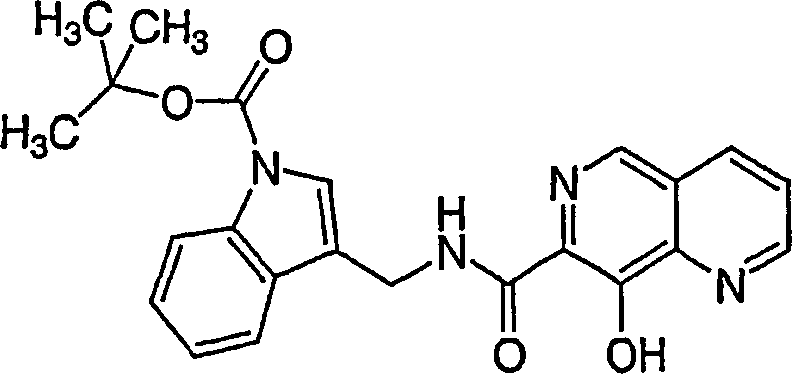
Die
Titelverbindung wurde durch Verwendung des in Beispiel 1, Schritt
4, beschriebenen Verfahrens hergestellt, wobei 2-(Ammoniummethyl)-1H-benzimidazol-1-iumdichlorid-Hydrat
durch tert.-Butyl-3-(aminomethyl)-1H-indol-1-carboxylat
ersetzt wurde.
1H-NMR (d6-DMSO,
400 MHz) δ 9,70
(1H, m), 9,16 (1H, dd, J = 1,7 und 4,3 Hz), 8,90 (1H, s), 8,60 (1H,
dd, J = 8,2 und 1,7 Hz), 8,05 (1H, d, J = 8,3 Hz), 7,85 (1H, d,
J = 9,5 Hz), 7,82 (1H, dd, = 4,2 und 8,3 Hz), 7,66 (1H, s), 7,33
(1H, t, J = 8,4 Hz), 7,20 (1H, t, J = 7,3 Hz), 4,69 (2H, m) ppm.
FAB-MS
berechn. für
C23H22N4O4 319 (MH+), gefunden
419.The title compound was prepared using the procedure described in Example 1, Step 4, wherein 2- (ammonium methyl) -1H-benzimidazole-1-dichloride hydrate was replaced with tert-butyl 3- (aminomethyl) -1H-indole-1 Carboxylate was replaced.
1 H NMR (d 6 -DMSO, 400 MHz) δ 9.70 (1H, m), 9.16 (1H, dd, J = 1.7 and 4.3 Hz), 8.90 (1H, s ), 8.60 (1H, dd, J = 8.2 and 1.7 Hz), 8.05 (1H, d, J = 8.3 Hz), 7.85 (1H, d, J = 9, 5 Hz), 7.82 (1H, dd, = 4.2 and 8.3 Hz), 7.66 (1H, s), 7.33 (1H, t, J = 8.4 Hz), 7, 20 (1H, t, J = 7.3 Hz), 4.69 (2H, m) ppm.
FAB-MS calc. for C 23 H 22 N 4 O 4 319 (MH + ), found 419.
BEISPIEL 11EXAMPLE 11
8-Hydroxy-N-(1H-indol-3-ylmethyl)-1,6-naphthyridin-7-carboxamid 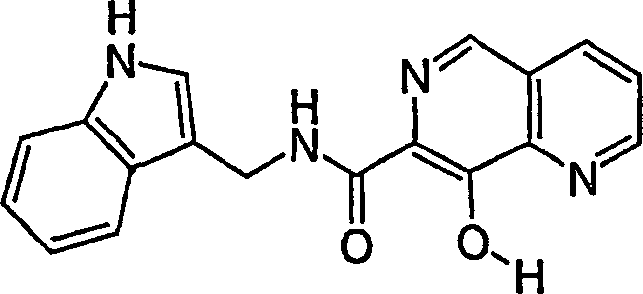
Eine
Lösung
von tert.-Butyl-3-({[(8-hydroxy-1,6-naphthyridin-7-yl)carbonyl]amino}methyl)-1H-indol-1-carboxylat
von Beispiel 10 (12,0 mg, 0,0029 mmol) in CH2Cl2 (1 ml) wurde mit Trifluoressigsäure (TFA) (1
ml) behandelt und die resultierende Mischung 1 Stunde bei Raumtemperatur
gerührt
und dann das Lösungsmittel
im Vakuum eingedampft. Das resultierende Material wurde in DMSO
(1 ml) gelöst
und 24 Stunden bei Raumtemperatur gealtert. Diese Lösung wurde
durch präparative
HPLC gereinigt (halbpräparatives
Gilson-HPLC-System und eine YMC-Combiprep-Pro-Säule (50 × 20 mm ID, C18, S-5 um, 120A)
mit 5–95%
Acetonitril/Wasser (0,1% TFA) als Elutionsmittel bei 15 ml/Minute),
um nach der Gefriertrocknung die Titelverbindung zu ergeben.
1H-NMR (d6-DMSO,
400 MHz) δ 10,98
(1H, s), 9,49 (1H, m), 9,15 (1H, d, J = 4,2 Hz), 8,85 (1H, s), 8,58
(1H, d, J = 8,3 Hz), 7,81 (1H, dd, J = 8,3 und 4,2 Hz), 7,75 (1H,
dd, J = 7,7 Hz), 7,40–7,30
(2H, m), 7,08 (1H, t, J = 7,0 Hz), 7,00 (1H, t, J = 7,0 Hz), 4,71
(2H, d, J = 6,0 Hz) ppm.
FAB-MS berechnet für C18H14N4O2 319
(MH+), gefunden 319.A solution of tert -butyl 3 - ({[(8-hydroxy-1,6-naphthyridin-7-yl) carbonyl] amino} methyl) -1H-indole-1-carboxylate from Example 10 (12.0 mg , 0.0029 mmol) in CH 2 Cl 2 (1 mL) was treated with trifluoroacetic acid (TFA) (1 mL) and the resulting mixture stirred at room temperature for 1 h and then the solvent was evaporated in vacuo. The resulting material was dissolved in DMSO (1 ml) and aged at room temperature for 24 hours. This solution was purified by preparative HPLC (semi-preparative Gilson HPLC system and a YMC Combiprep Pro column (50 x 20 mm ID, C18, S-5 μm, 120A) with 5-95% acetonitrile / water (0, 1% TFA) as eluent at 15 ml / minute) to give the title compound after lyophilization.
1 H NMR (d 6 -DMSO, 400 MHz) δ 10.98 (1H, s), 9.49 (1H, m), 9.15 (1H, d, J = 4.2 Hz), 8, 85 (1H, s), 8.58 (1H, d, J = 8.3Hz), 7.81 (1H, dd, J = 8.3 and 4.2Hz), 7.75 (1H, dd , J = 7.7 Hz), 7.40-7.30 (2H, m), 7.08 (1H, t, J = 7.0 Hz), 7.00 (1H, t, J = 7, 0 Hz), 4.71 (2H, d, J = 6.0 Hz) ppm.
FAB-MS calculated 2319 (MH +) for C 18 H 14 N 4 O found 319th
BEISPIEL 12EXAMPLE 12
6-({[(8-Hydroxy-1,6-naphthyridin-7-yl)carbonyl]amino}methyl)-2,3-dihydroimidazo[2,1-b][1,3]thiazol 
Die
Titelverbindung wurde als das Imidazothiazol-4-iumtrifluoracetatsalz
durch Anwendung des in Beispiel 1, Schritt 4, beschriebenen Verfahrens
hergestellt, wobei 2-(Ammoniummethyl)-1H-benzimidazol-1-iumdichlorid-Hydrat durch
1-(2,3-Dihydroimidazo[2,1-b][1,3]thiazol-6-yl)methanamin ersetzt
wurde.
1H-NMR (d6-DMSO,
400 MHz) δ 9,67
(1H, t, J = 6,9 Hz), 9,17 (1H, dd, J = 4,2 und 1,6 Hz), 8,92 (1H,
s), 8,62 (1H, dd, J = 8,2 und 1,6 Hz), 7,85 (1H, dd, J = 8,2 und
4,2 Hz), 7,47 (1H, s), 4,50 (2H, d, J = 6,0 Hz), 4,32 (2H, t, J
= 7,5 Hz), 4,02 (2H, t, J = 7,5 Hz) ppm.
FAB-MS berechn. für C15H13N5O2S 328 (MH+), gefunden
328.
Exakte FAB-HRMS-Masse berechn. für C15H13N5O2S
328,0863 (MH+), gefunden 328,085.The title compound was prepared as the imidazothiazole-4-trifluoroacetate salt using the procedure described in Example 1, Step 4, whereby 2- (ammonium methyl) -1H-benzimidazole-1-dichloride hydrate was replaced by 1- (2,3-dihydroimidazo [ 2,1-b] [1,3] thiazol-6-yl) methanamine was replaced.
1 H-NMR (d 6 -DMSO, 400 MHz) δ 9.67 (1H, t, J = 6.9 Hz), 9.17 (1H, dd, J = 4.2 and 1.6 Hz), 8.92 (1H, s), 8.62 (1H, dd, J = 8.2 and 1.6 Hz), 7.85 (1H, dd, J = 8.2 and 4.2 Hz), 7 , 47 (1H, s), 4.50 (2H, d, J = 6.0 Hz), 4.32 (2H, t, J = 7.5 Hz), 4.02 (2H, t, J = 7.5 Hz) ppm.
FAB-MS calc. for C 15 H 13 N 5 O 2 S 328 (MH + ), found 328.
Exact FAB HRMS mass calculated. for C 15 H 13 N 5 O 2 S 328.0863 (MH + ), found 328.085.
BEISPIEL 13EXAMPLE 13
8-Hydroxy-N-(4-pyridinylmethyl)[1,6]naphthyridin-7-carboxamid 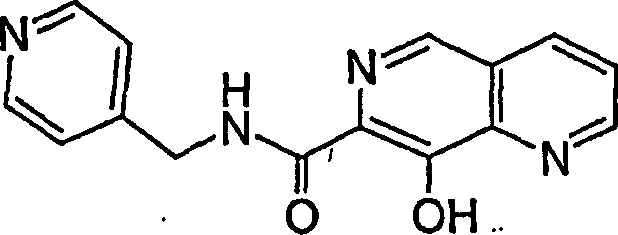
Zu
einer Lösung
von Methyl-8-hydroxy-1,6-naphthyridin-7-carboxylat von Beispiel
1, Schritt 2, (0,05 g, 0,245 mmol) in trockenem Toluol (3 ml) wurde
1-Pyridin-4-ylmethanamin (0,029 g, 0,270 mmol) zugegeben und die
Mischung 16 Stunden zum Rückfluss
erhitzt. Die Lösung
wurde auf ein kleineres Volumen eingeengt und weitere 4 Stunden
refluxiert. Das Lösungsmittel
wurde unter vermindertem Druck entfernt und der Rückstand erneut
in DMF gelöst
und filtriert und die Lösung
durch präparative
HPLC (halbpräparatives
Gilson-HPLC-System und eine YMC-Combiprep-Pro-Säule (50 × 20 mm ID, C18, S-5 um, 120A)
mit 5–95%
Acetonitril/Wasser (0,1% TFA) als Elutionsmittel bei 15 ml/Minute)
gereinigt, um nach der Gefriertrocknung die Titelverbindung zu ergeben.
1H-NMR (d6-DMSO,
400 MHz) δ 10,07
(1H, m), 9,18 (1H, m), 8,97 (1H, d, J = 1,47 Hz), 8,75 (2H, dd,
J = 5,0 Hz), 8,64 (1H, dd, J = 8,3 Hz), 7,86 (1H, m), 7,77 (2H,
d, J = 5,1 Hz), 4,76 (2H, d, J = 4,6 Hz) ppm.
FAB-MS berechn.
für C15H12N4O2 281 (MHO, gefunden 281.
Exakte FAB-HRMS-Masse
berechn. für
C15H12N4O2 281,1033 (MH+),
gefunden 281,1032.
Anal. Berechn. für C15H12N4O2.
1,25 TFA. 1,00 H2O: C, 47,68; H, 3,49; N,
12,71.
Gefunden: C, 47,68; H, 3,70; N, 12,03.To a solution of methyl 8-hydroxy-1,6-naphthyridine-7-carboxylate from Example 1, Step 2, (0.05 g, 0.245 mmol) in dry toluene (3 mL) became 1-pyridin-4-ylmethanamine (0.029 g, 0.270 mmol) was added and the mixture heated at reflux for 16 hours. The solution was concentrated to a smaller volume and refluxed for a further 4 hours. The solvent was removed under reduced pressure and the residue was redissolved in DMF and filtered and the solution was purified by preparative HPLC (Gilson semi-preparative HPLC system and a YMC Combiprep Pro column (50 x 20 mm ID, C18, S-5 at 120A) with 5-95% acetonitrile / water (0.1% TFA) as eluent at 15 ml / minute) to give the title compound after lyophilization.
1 H NMR (d 6 -DMSO, 400 MHz) δ 10.07 (1H, m), 9.18 (1H, m), 8.97 (1H, d, J = 1.47 Hz), 8, 75 (2H, dd, J = 5.0 Hz), 8.64 (1H, dd, J = 8.3 Hz), 7.86 (1H, m), 7.77 (2H, d, J = 5 , 1 Hz), 4.76 (2H, d, J = 4.6 Hz) ppm.
FAB-MS calc. for C 15 H 12 N 4 O 2 281 (MHO, found 281.
Exact FAB HRMS mass calculated. for C 15 H 12 N 4 O 2 281.1033 (MH + ), found 281.1032.
Anal. Calc. for C 15 H 12 N 4 O 2 . 1.25 TFA. 1.00 H 2 O: C, 47.68; H, 3.49; N, 12,71.
Found: C, 47.68; H, 3.70; N, 12.03.
BEISPIEL 14EXAMPLE 14
8-Hydroxy-N-(2-pyridinylmethyl)[1,6]naphthyridin-7-carboxamid 
Zu
einer Lösung
von Methyl-8-hydroxy-1,6-naphthyridin-7-carboxylat von Beispiel
1, Schritt 2, (0,05 g, 0,0245 mmol) in trockenem Toluol (3 ml) wurde
1-Pyridin-2-ylmethanamin (0,029 g, 0,270 mmol) zugegeben und die
Mischung 16 Stunden zum Rückfluss
erhitzt. Die Lösung
wurde auf ein kleineres Volumen eingeengt und weitere 4 Stunden
refluxiert. Das Lösungsmittel
wurde unter vermindertem Druck entfernt und der Rückstand
erneut in DMF gelöst
und filtriert, und die Lösung
wurde durch präparative
HPLC (halbpräparatives
Gilson-HPLC-System und eine YMC-Combiprep-Pro-Säule (50 × 20 mm ID, C18, S-5 um, 120A)
mit 5–95%
Acetonitril/Wasser (0,1% TFA) als Elutionsmittel bei 15 ml/Minute)
gereinigt, um nach der Gefriertrocknung die Titelverbindung zu ergeben.
1H-NMR (d6-DMSO,
400 MHz) δ 9,88
(1H, m), 9,18 (1H, m), 8,96 (1H, d, J = 1,1 Hz), 8,63 (2H, m), 7,96
(1H, dd, J = 7,6 Hz), 7,86 (1H, m), 7,55 (1H, d, J = 7,6 Hz), 7,46
(1H, dd, J = 5,3 Hz), 4,76 (2H, d, J = 4,6 Hz) ppm.
FAB-MS
berechn. für
C15H12N4O2 281 (MH+), gefunden
281.
Exakte FAB-HRMS-Masse berechn. für C15H12N4O2 281,1033
(MH+), gefunden 281,1040.
Anal. Berechn.
für C15H12N4O2. 1,45 TFA. 0,1 H2O:
C, 48,05; H, 3,08; N, 12,52.
Gefunden: C, 48,04; H, 3,29; N,
12,17.To a solution of methyl 8-hydroxy-1,6-naphthyridine-7-carboxylate from Example 1, Step 2, (0.05 g, 0.0245 mmol) in dry toluene (3 mL) became 1-pyridine-2 -ylmethanamine (0.029 g, 0.270 mmol) was added and the mixture heated at reflux for 16 hours. The solution was concentrated to a smaller volume and refluxed for a further 4 hours. The solvent was removed under reduced pressure and the residue was redissolved in DMF and filtered, and the solution was purified by preparative HPLC (Gilson semi-preparative HPLC system and a YMC Combiprep Pro column (50 x 20 mm ID, C18, S -5 μm, 120A) with 5-95% acetonitrile / water (0.1% TFA) as eluent at 15 ml / minute) to give the title compound after lyophilization.
1 H-NMR (d 6 -DMSO, 400 MHz) δ 9.88 (1H, m), 9.18 (1H, m), 8.96 (1H, d, J = 1.1 Hz), 8, 63 (2H, m), 7.96 (1H, dd, J = 7.6 Hz), 7.86 (1H, m), 7.55 (1H, d, J = 7.6 Hz), 7, 46 (1H, dd, J = 5.3 Hz), 4.76 (2H, d, J = 4.6 Hz) ppm.
FAB-MS calc. for C 15 H 12 N 4 O 2 281 (MH + ), found 281.
Exact FAB HRMS mass calculated. for C 15 H 12 N 4 O 2 281.1033 (MH + ), found 281.1040.
Anal. Calc. for C 15 H 12 N 4 O 2 . 1.45 TFA. 0.1 H 2 O: C, 48.05; H, 3.08; N, 12.52.
Found: C, 48.04; H, 3:29; N, 12:17.
BEISPIEL 15EXAMPLE 15
N-[2-(1H-Indol-3
-yl)ethyl]-8-hydroxychinolin-7-carboxamid 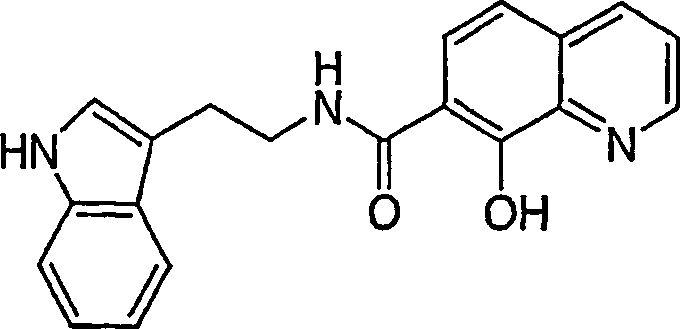
Eine
Mischung aus 8-Hydroxychinolin-7-carbonsäure (0,23 g, 1,25 mmol), 2-(1H-Indol-3-yl)ethylamin (0,20
g, 1,25 mmol), 1-Hydroxybenzotriazol (0,18 g, 1,37 mmol), 1-(3-Dimethylaminopropyl)-3-ethylcarbodiimid-Hydrochlorid
(0,26 g, 1,37 mmol) und Triethylamin (0,7 ml, 4,99 mmol) in DMF
(12 ml) wurde über
Nacht bei Raumtemperatur gerührt.
Die Reaktionsmischung wurde unter Vakuum eingeengt. Der Rückstand
wurde in DMSO gelöst
und der HPLC-Reinigung an einer stationären C-18-Phase mit mobiler
Wasser/Acetonitril/TFA-Phase als Elutionsmittel gereinigt. Durch
Sammeln und Gefriertrocknen von geeigneten Fraktionen wurde die
Titelverbindung als gelber Feststoff erhalten.
1H-NMR
(400 MHz, DMSO-d6) δ 10,82 (s, 1H), 9,08 (br. s,
1H), 8,92 (br. s, 1H), 8,42 (br. d, 1H), 8,02 (d, 1H), 7,70 (br.
m, 1H), 7,61 (d, 1H), 7,46 (d, 1H), 7,34 (d, 1H), 7,22 (d, 1H),
7,07 (t, 1H), 7,00 (t, 1H), 3,67 (q, 2H), 3,02 (t, 2H).A mixture of 8-hydroxyquinoline-7-carboxylic acid (0.23 g, 1.25 mmol), 2- (1H-indol-3-yl) ethylamine (0.20 g, 1.25 mmol), 1-hydroxybenzotriazole ( 0.18 g, 1.37 mmol), 1- (3-dimethylaminopropyl) -3-ethylcarbodiimide hydrochloride (0.26 g, 1.37 mmol) and triethylamine (0.7 mL, 4.99 mmol) in DMF (12 ml) was stirred at room temperature overnight. The reaction mixture was concentrated in vacuo. The residue was dissolved in DMSO and purified on HPLC stationary phase C-18 with mobile water / acetonitrile / TFA phase as eluent. Collecting and freeze-drying suitable fractions gave the title compound as a yellow solid.
1 H-NMR (400 MHz, DMSO-d 6 ) δ 10.82 (s, 1H), 9.08 (br.s, 1H), 8.92 (br.s, 1H), 8.42 (br d, 1H), 8.02 (d, 1H), 7.70 (br, m, 1H), 7.61 (d, 1H), 7.46 (d, 1H), 7.34 (d, 1H), 7.22 (d, 1H), 7.07 (t, 1H), 7.00 (t, 1H), 3.67 (q, 2H), 3.02 (t, 2H).
BEISPIEL 16EXAMPLE 16
OralzusammensetzungOral composition
Als eine spezielle Ausführungsform einer Oralzusammensetzung einer Verbindung dieser Erfindung werden 50 mg der Verbindung von Beispiel 1 mit ausreichend feinteiliger Lactose formuliert, um eine Gesamtmenge von 580 bis 590 mg zu ergeben, die in eine Hartgelatinekapsel der Größe O gefüllt wird.When a special embodiment an oral composition of a compound of this invention 50 mg of the compound of Example 1 with sufficient finely divided Formulated lactose to give a total of 580 to 590 mg, which is filled into a size O hard gelatin capsule.
BEISPIEL 17EXAMPLE 17
HIV-Integrase-Assay: Durch rekombinante Integrase katalysierter StrangtransferHIV Integrase Assay: By recombinant Integrase catalyzed strand transfer
Assays
für die
Strangtransferaktivität
von Integrase wurden gemäß Wolfe,
A.L. et al., J. Virol. 1996, 70: 1424–1432, für rekombinante Integrase durchgeführt, außer dass:
(i) die Assays vorher zusammengesetzte Integrase-Strangtransfer-Komplexe
verwendeten; (ii) die Strangtransferreaktion in Gegenwart von Inhibitor in
2,5 mM MgCl2 unter Verwendung von 0,5 bis
5 nM eines mit 3'-FITC
markierten Ziel-DNA-Substrats durchgeführt wurde (SEQU.-ID. NR.: 1
und SEQU. ID. NR.: 2).
5' TGA
CCA AGG GCT AAT TCA CT fitc 3'
3' fitc ACT GGT TCC
CGA TTA AGT GA 5';
und
(iii) die Strangtransferprodukte mittels eines alkaliphosphatasekonjugierten
Anti-FITC-Antikörpers
und eines chemoluminszierenden Alkaliphosphatasesubstrats erfasst
wurden. Repräsentative
Verbindungen, die in dem Integraseassay getestet wurden, wiesen
IC50-Werte von weniger als etwa 100 Mikromolar
auf.Assays for strand transfer activity of integrase were performed according to Wolfe, AL et al., J. Virol. 1996, 70: 1424-1432, performed for recombinant integrase, except that: (i) the assays used previously assembled integrase-strand transfer complexes; (ii) the strand transfer reaction was carried out in the presence of inhibitor in 2.5 mM MgCl 2 using 0.5 to 5 nM of a 3'-FITC labeled target DNA substrate (SEQU.ID.NO .: 1 and SEQUENT ID NO: 2).
5 'TGA CCA AGG GCT AAT TCA CT fitc 3'
3 'fitc ACT GGT TCC CGA TTA AGT GA 5';
and (iii) the strand transfer products were detected by means of an alkali phosphatase conjugated anti-FITC antibody and a chemiluminescent alkali phosphatase substrate. Representative compounds tested in the integrase assay had IC 50 values less than about 100 micromolar.
Eine weitere Beschreibung der Durchführung des Assays unter Verwendung von vorher zusammengesetzten Komplexen findet sich bei Hazuda et al., J. Virol 1997, 71: 7005–7011; Hazuda et al., Drug Design and Discovery 1997, 15: 17–24; und Hazuda et al., Science 2000, 287: 646–650.A further description of the implementation of the assay using previously assembled complexes is found in Hazuda et al., J. Virol 1997, 71: 7005-7011; Hazuda et al., Drug Design and Discovery 1997, 15: 17-24; and Hazuda et al., Science 2000, 287: 646-650.
BEISPIEL 18EXAMPLE 18
Assay zur Inhibierung der HIV-ReplikationAssay to inhibit HIV replication
Assays zur Inhibierung von akuter HIV-Infektion von T-Lymphzellen wurden gemäß Vacca, J.P. et al., (1994), Proc. Natl. Acad. Sci. USA 91, 4096, durchgeführt. Repräsentative Verbindungen, die bei dem vorliegenden Assay getestet wurden, wiesen IC95-Werte von weniger als etwa 20 Mikromolar auf.Assays for inhibiting acute HIV infection of T lymphocytes were performed according to Vacca, JP et al., (1994), Proc. Natl. Acad. Sci. USA 91, 4096. Representative compounds tested in the present assay had IC 95 values less than about 20 micromolar.
Während die obige Beschreibung die Prinzipien der vorliegenden Erfindung lehrt und für Veranschaulichungszwecke Beispiele angegeben sind, umfasst die Praxis der Erfindung alle üblichen Variationen, Adaptationen und/oder Modifizierungen, die in den Umfang der folgenden Ansprüche fallen.While the above description teaches the principles of the present invention and for For illustrative purposes examples are given which includes practice the invention all the usual Variations, adaptations and / or modifications that are in scope the following claims fall.
Claims (14)
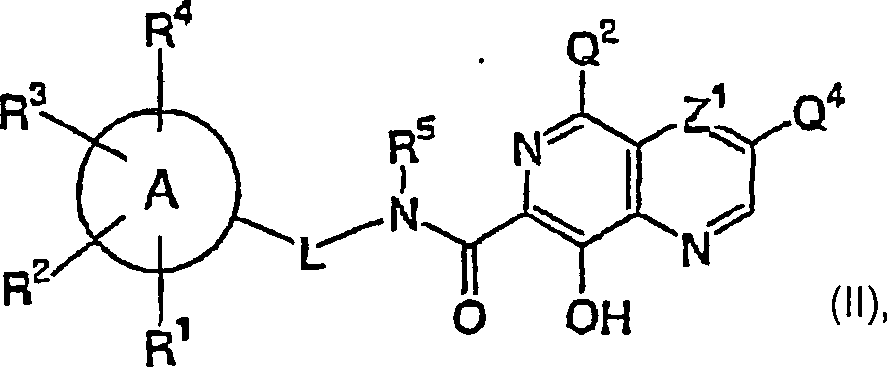
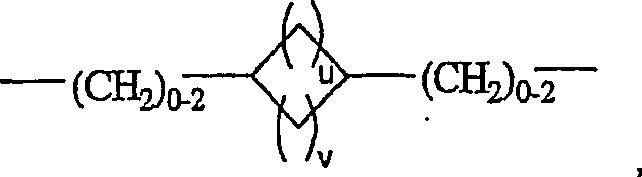

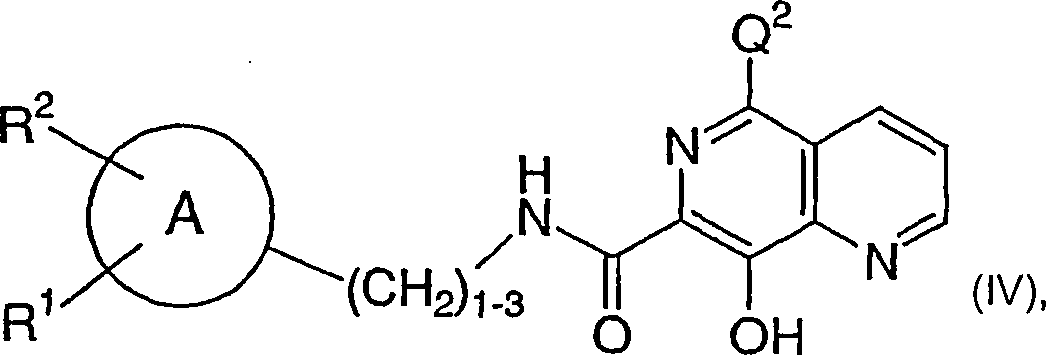


Applications Claiming Priority (3)
| Application Number | Priority Date | Filing Date | Title |
|---|---|---|---|
| US23970800P | 2000-10-12 | 2000-10-12 | |
| US239708P | 2000-10-12 | ||
| PCT/US2001/031550 WO2002030426A1 (en) | 2000-10-12 | 2001-10-09 | Aza- and polyaza-naphthalenyl-carboxamides useful as hiv integrase inhibitors |
Publications (2)
| Publication Number | Publication Date |
|---|---|
| DE60128936D1 DE60128936D1 (en) | 2007-07-26 |
| DE60128936T2 true DE60128936T2 (en) | 2008-04-10 |
Family
ID=22903379
Family Applications (1)
| Application Number | Title | Priority Date | Filing Date |
|---|---|---|---|
| DE60128936T Expired - Lifetime DE60128936T2 (en) | 2000-10-12 | 2001-10-09 | AZA AND POLYAZA NAPHTHALENYL ACID ACID AMIDE AS HIV INTEGRASE INHIBITORS |
Country Status (9)
| Country | Link |
|---|---|
| US (1) | US6919351B2 (en) |
| EP (1) | EP1326611B1 (en) |
| JP (1) | JP4287649B2 (en) |
| AT (1) | ATE364385T1 (en) |
| AU (2) | AU2002215328B2 (en) |
| CA (1) | CA2425395C (en) |
| DE (1) | DE60128936T2 (en) |
| ES (1) | ES2287170T3 (en) |
| WO (1) | WO2002030426A1 (en) |
Families Citing this family (54)
| Publication number | Priority date | Publication date | Assignee | Title |
|---|---|---|---|---|
| CZ20032332A3 (en) | 2001-03-01 | 2003-11-12 | Shionogi & Co., Ltd. | Nitrogen-containing heteroaryl compounds exhibiting inhibition activity against HIV integrase |
| JP4338192B2 (en) | 2001-08-10 | 2009-10-07 | 塩野義製薬株式会社 | Antiviral agent |
| HU230248B1 (en) * | 2001-10-26 | 2015-11-30 | Msd Italia S.R.L. | N-substituted hydroxypyrimidinone carboxamide inhibitors of hiv integrase |
| ATE355064T1 (en) * | 2001-10-26 | 2006-03-15 | Angeletti P Ist Richerche Bio | DIHYDROXYPYRIMIDINE CARBONIC ACID RAMIDE INHIBITORS OF HIV INTEGRASE |
| WO2003077857A2 (en) * | 2002-03-15 | 2003-09-25 | Merck & Co., Inc. | N-(substituted benzyl)-8-hydroxy-1,6-naphthyridine-7- carboxamides useful as hiv integrase inhibitors |
| DE60322920D1 (en) | 2002-08-13 | 2008-09-25 | Shionogi & Co | HETEROCYCLIC COMPOUNDS WITH HIV INTEGRATE-INHIBITOR EFFECT |
| EP1549315A4 (en) * | 2002-09-11 | 2007-05-23 | Merck & Co Inc | 1,6-DIONED DIHYDROXYPYRIDOPYRAZINE COMPOUNDS USEFUL AS INHIBITORS OF HIV INTEGRASE |
| ATE404563T1 (en) | 2002-09-11 | 2008-08-15 | Merck & Co Inc | 8-HYDROXY-1-OXOTETRAHYDROPYRROLOPYRAZINE COMPOUNDS ACTIVE AS INHIBITORS OF HIV INTEGRASE |
| JP2006505571A (en) * | 2002-10-15 | 2006-02-16 | リゲル ファーマシューテイカルズ、インコーポレイテッド | Substituted indoles and their use as HCV inhibitors |
| AU2003301439A1 (en) * | 2002-10-16 | 2004-05-04 | Gilead Sciences, Inc. | Pre-organized tricyclic integrase inhibitor compounds |
| MXPA05007010A (en) | 2002-12-27 | 2005-08-18 | Angeletti P Ist Richerche Bio | Tetrahydro-4h-pyrido[1,2-a]pyrimidines and related compounds useful as hiv integrase inhibitors. |
| JP2006528694A (en) * | 2003-05-13 | 2006-12-21 | スミスクライン ビーチャム コーポレーション | Naphthyridine integrase inhibitor |
| TW200510425A (en) | 2003-08-13 | 2005-03-16 | Japan Tobacco Inc | Nitrogen-containing fused ring compound and use thereof as HIV integrase inhibitor |
| ATE433974T1 (en) * | 2003-09-19 | 2009-07-15 | Gilead Sciences Inc | AZACHINOLINOL PHOSPHONATE COMPOUNDS AS INTEGRAS INHIBITORS |
| AU2004285449A1 (en) | 2003-10-20 | 2005-05-12 | Merck & Co., Inc. | Hydroxy pyridopyrrolopyrazine dione compounds useful as HIV integrase inhibitors |
| EP2284157A1 (en) | 2003-12-12 | 2011-02-16 | Wyeth | Quinolines useful in treating cardiovascular disease |
| WO2005075475A1 (en) * | 2004-02-04 | 2005-08-18 | Shionogi & Co., Ltd. | Naphthylidine derivative having hiv integrase inhibitory activity |
| KR20070002006A (en) | 2004-02-11 | 2007-01-04 | 스미스클라인 비참 코포레이션 | HIV integrase inhibitor |
| JP2007528394A (en) | 2004-03-09 | 2007-10-11 | メルク エンド カムパニー インコーポレーテッド | HIV integrase inhibitor |
| CN101014574A (en) * | 2004-03-09 | 2007-08-08 | 默克公司 | HIV integrase inhibitors |
| EP1725556A1 (en) | 2004-03-09 | 2006-11-29 | Merck & Co., Inc. | Hiv integrase inhibitors |
| WO2005087766A1 (en) | 2004-03-09 | 2005-09-22 | Istituto Di Ricerche Di Biologia Molecolare P Angeletti Spa | Hiv integrase inhibitors |
| JP4824673B2 (en) * | 2004-05-07 | 2011-11-30 | メルク・シャープ・エンド・ドーム・コーポレイション | HIV integrase inhibitor |
| CA2568389A1 (en) | 2004-06-09 | 2005-12-22 | Merck & Co., Inc. | Hiv integrase inhibitors |
| ATE516026T1 (en) * | 2005-02-21 | 2011-07-15 | Shionogi & Co | BICYCLIC CARBAMOYLPYRIDONE DERIVATIVE WITH HIV INTEGRASE INHIBITING EFFECT |
| JP2008531709A (en) | 2005-03-01 | 2008-08-14 | ワイス | Cinnoline compounds and their use as liver X receptor modulators |
| JP5116660B2 (en) * | 2005-03-31 | 2013-01-09 | イステイチユート・デイ・リチエルケ・デイ・ビオロジア・モレコラーレ・ピ・アンジエレツテイ・エツセ・エルレ・エルレ | HIV integrase inhibitor |
| DK1874117T3 (en) | 2005-04-28 | 2013-09-23 | Viiv Healthcare Co | POLYCYCLIC CARBAMOYL PYRIDONE DERIVATIVES WITH HIV INTEGRASE INHIBITIVE ACTIVITY |
| WO2006121831A2 (en) | 2005-05-10 | 2006-11-16 | Merck & Co., Inc. | Hiv integrase inhibitors |
| EP1910356A4 (en) * | 2005-08-04 | 2009-10-21 | Smithkline Beecham Corp | Hiv integrase inhibitors |
| WO2007019100A2 (en) * | 2005-08-04 | 2007-02-15 | Smithkline Beecham Corporation | Hiv integrase inhibitors |
| US20080234231A1 (en) * | 2005-08-04 | 2008-09-25 | Johns Brian A | Hiv Integrase Inhibitors |
| US7939537B2 (en) * | 2005-10-04 | 2011-05-10 | Istituto Di Ricerche Di Biologia Molecolare P. Angeletti S.P.A. | HIV integrase inhibitors |
| JP2009513640A (en) * | 2005-10-27 | 2009-04-02 | メルク エンド カムパニー インコーポレーテッド | HIV integrase inhibitor |
| DE102005059479A1 (en) * | 2005-12-13 | 2007-06-14 | Merck Patent Gmbh | hydroxyquinoline |
| NZ572367A (en) | 2006-05-16 | 2011-09-30 | Gilead Sciences Inc | Fused cyclic compounds as integrase inhibitors |
| JP2009542798A (en) | 2006-07-11 | 2009-12-03 | ファイザー株式会社 | Substituted N-bicyclic alkyl bicyclic carboxamide compounds |
| WO2008010964A1 (en) * | 2006-07-17 | 2008-01-24 | Merck & Co., Inc. | 1-hydroxy naphthyridine compounds as anti-hiv agents |
| WO2008010953A2 (en) | 2006-07-19 | 2008-01-24 | University Of Georgia Research Foundation, Inc. | Pyridinone diketo acids: inhibitors of hiv replication in combination therapy |
| EA016267B1 (en) | 2006-09-29 | 2012-03-30 | Айденикс Фармасьютикалз, Инк. | Enantiomerically pure phosphoindoles as hiv inhibitors |
| US20100216834A1 (en) * | 2006-10-18 | 2010-08-26 | Isaacs Richard C A | Hiv integrase inhibitors |
| AU2009206673B2 (en) | 2008-01-25 | 2015-04-23 | Chimerix, Inc. | Methods of treating viral infections |
| MX351942B (en) | 2008-12-11 | 2017-11-03 | Shionogi & Co | Synthesis of carbamoylpyridone hiv integrase inhibitors and intermediates. |
| NZ598766A (en) | 2009-10-13 | 2013-09-27 | Elanco Animal Health Ireland | Macrocyclic integrase inhibitors |
| AU2010328325B2 (en) | 2009-12-07 | 2015-02-05 | University Of Georgia Research Foundation, Inc. | Pyridinone hydroxycyclopentyl carboxamides: HIV integrase inhibitors with therapeutic applications |
| EP2345641A1 (en) | 2009-12-29 | 2011-07-20 | Polichem S.A. | New secondary 8-hydroxyquinoline-7-carboxamide derivatives |
| EP2345642A1 (en) * | 2009-12-29 | 2011-07-20 | Polichem S.A. | Secondary 8-hydroxyquinoline-7-carboxamide derivatives for use as antifungal agents |
| EP2345643A1 (en) | 2009-12-29 | 2011-07-20 | Polichem S.A. | New tertiary 8-hydroxyquinoline-7-carboxamide derivatives and uses thereof |
| US8283366B2 (en) | 2010-01-22 | 2012-10-09 | Ambrilia Biopharma, Inc. | Derivatives of pyridoxine for inhibiting HIV integrase |
| EP3216789A1 (en) | 2010-02-12 | 2017-09-13 | Chimerix, Inc. | Methods of treating viral infection |
| EP2552923B1 (en) | 2010-04-02 | 2014-03-26 | Janssen R&D Ireland | Macrocyclic integrase inhibitors |
| SI2822954T1 (en) * | 2012-12-21 | 2016-07-29 | Gilead Sciences, Inc. | Polycyclic-carbamoylpyridone compounds and their pharmaceutical use |
| IL313281A (en) * | 2019-09-12 | 2024-08-01 | Mirati Therapeutics Inc | Mta-cooperative prmt5 inhibitors |
| CN111689944B (en) * | 2020-06-10 | 2021-11-16 | 中山大学 | Quinoline tryptamine heterozygote and application thereof in preparation of medicine for treating Alzheimer disease |
Family Cites Families (26)
| Publication number | Priority date | Publication date | Assignee | Title |
|---|---|---|---|---|
| JPS5751837B2 (en) * | 1973-04-05 | 1982-11-04 | ||
| US4416884A (en) * | 1978-04-12 | 1983-11-22 | Otsuka Pharmaceutical Co., Ltd. | Piperazinylbenzoheterocyclic compounds |
| FR2632639B1 (en) * | 1988-06-09 | 1990-10-05 | Sanofi Sa | AMINO-4 CARBOXY-3 NAPHTYRIDINES DERIVATIVES, THEIR PREPARATION AND PHARMACEUTICAL COMPOSITIONS CONTAINING THEM |
| IL101860A0 (en) * | 1991-05-31 | 1992-12-30 | Ici Plc | Heterocyclic derivatives |
| DE69509442T2 (en) * | 1994-06-16 | 1999-09-02 | Lg Chemical Ltd. | Quinoline carboxylic acid derivatives with 7- (4-amino-methyl-3-oxime) pyrrolidine substituents and process for their preparation |
| US5776944A (en) * | 1994-06-16 | 1998-07-07 | Lg Chemical Ltd. | 7-(4-aminomethyl-3-methyloxyiminopyrroplidin-1-yl)-1-cyclopropyl-6-flu oro-4-oxo-1,4-dihydro-1,8-naphthyridine-3-carboxylic acid and the process for the preparation thereof |
| US5681832A (en) | 1995-02-17 | 1997-10-28 | The United States Of America As Represented By The Department Of Health And Human Services | Aroylaniline compounds, pharmaceutical compositions, and methods of using same to inhibit viral activity |
| JPH11510156A (en) * | 1995-08-02 | 1999-09-07 | カイロサイエンス・リミテッド | Quinolones and their medical uses |
| US5945431A (en) * | 1996-03-15 | 1999-08-31 | Biochem Therapeutics Incorporated | Cytomegalovirus inhibiting compounds |
| AU4172197A (en) * | 1996-09-10 | 1998-04-02 | Pharmacia & Upjohn Company | 8-hydroxy-7-substituted quinolines as anti-viral agents |
| WO1998013350A1 (en) | 1996-09-25 | 1998-04-02 | Zeneca Limited | Qinoline derivatives inhibiting the effect of growth factors such as vegf |
| CA2295309A1 (en) * | 1997-06-30 | 1999-01-07 | Nippon Kayaku Kabushiki Kaisha | Novel naphthyridine derivatives or salts thereof |
| US6143760A (en) * | 1997-08-25 | 2000-11-07 | Neurogen Corporation | Substituted 4-oxo-napthyridine-3-carboxamides: GABA brain receptor ligands |
| EP1007526A1 (en) | 1997-08-25 | 2000-06-14 | Neurogen Corporation | Substituted 4-oxo-napthyridine-3-carboxamides as gaba brain receptor ligands |
| GB9720052D0 (en) | 1997-09-19 | 1997-11-19 | Smithkline Beecham Plc | Novel compounds |
| US6525042B1 (en) * | 1997-09-30 | 2003-02-25 | Daiichi Pharmaceutical Co., Ltd. | Sulfonyl derivatives |
| NZ505362A (en) | 1997-12-22 | 2004-12-24 | Upjohn Co | 4-hydroxyquinoline-3-carboxamides and -hydrazides useful as antiviral agents |
| US6380249B1 (en) * | 1998-06-03 | 2002-04-30 | Merck & Co., Inc. | HIV integrase inhibitors |
| US6262055B1 (en) * | 1998-06-03 | 2001-07-17 | Merck & Co., Inc. | HIV integrase inhibitors |
| US6306891B1 (en) * | 1998-06-03 | 2001-10-23 | Merck & Co., Inc. | HIV integrase inhibitors |
| SE9802550D0 (en) | 1998-07-15 | 1998-07-15 | Active Biotech Ab | Quinoline derivatives |
| AU5880600A (en) | 1999-06-25 | 2001-01-31 | Merck & Co., Inc. | 1-(aromatic- or heteroaromatic-substituted)-3-(heteroaromatic substituted)-1,3-propanediones and uses thereof |
| US6730682B2 (en) | 2000-07-12 | 2004-05-04 | Pharmacia & Upjohn Company | Heterocycle carboxamides as antiviral agents |
| GB0017676D0 (en) | 2000-07-19 | 2000-09-06 | Angeletti P Ist Richerche Bio | Inhibitors of viral polymerase |
| HU230248B1 (en) | 2001-10-26 | 2015-11-30 | Msd Italia S.R.L. | N-substituted hydroxypyrimidinone carboxamide inhibitors of hiv integrase |
| ATE355064T1 (en) | 2001-10-26 | 2006-03-15 | Angeletti P Ist Richerche Bio | DIHYDROXYPYRIMIDINE CARBONIC ACID RAMIDE INHIBITORS OF HIV INTEGRASE |
-
2001
- 2001-10-09 DE DE60128936T patent/DE60128936T2/en not_active Expired - Lifetime
- 2001-10-09 ES ES01983939T patent/ES2287170T3/en not_active Expired - Lifetime
- 2001-10-09 WO PCT/US2001/031550 patent/WO2002030426A1/en not_active Ceased
- 2001-10-09 AT AT01983939T patent/ATE364385T1/en not_active IP Right Cessation
- 2001-10-09 CA CA002425395A patent/CA2425395C/en not_active Expired - Fee Related
- 2001-10-09 EP EP01983939A patent/EP1326611B1/en not_active Expired - Lifetime
- 2001-10-09 AU AU2002215328A patent/AU2002215328B2/en not_active Ceased
- 2001-10-09 AU AU1532802A patent/AU1532802A/en active Pending
- 2001-10-09 US US10/399,083 patent/US6919351B2/en not_active Expired - Fee Related
- 2001-10-09 JP JP2002533867A patent/JP4287649B2/en not_active Expired - Fee Related
Also Published As
| Publication number | Publication date |
|---|---|
| US6919351B2 (en) | 2005-07-19 |
| AU2002215328B2 (en) | 2005-11-17 |
| CA2425395C (en) | 2009-06-02 |
| US20040034221A1 (en) | 2004-02-19 |
| EP1326611A4 (en) | 2004-04-07 |
| EP1326611A1 (en) | 2003-07-16 |
| EP1326611B1 (en) | 2007-06-13 |
| ES2287170T3 (en) | 2007-12-16 |
| ATE364385T1 (en) | 2007-07-15 |
| AU1532802A (en) | 2002-04-22 |
| JP4287649B2 (en) | 2009-07-01 |
| CA2425395A1 (en) | 2002-04-18 |
| WO2002030426A1 (en) | 2002-04-18 |
| JP2004510819A (en) | 2004-04-08 |
| DE60128936D1 (en) | 2007-07-26 |
Similar Documents
| Publication | Publication Date | Title |
|---|---|---|
| DE60128936T2 (en) | AZA AND POLYAZA NAPHTHALENYL ACID ACID AMIDE AS HIV INTEGRASE INHIBITORS | |
| DE60315796T2 (en) | HYDROXYNAPHTHYRIDINONCARBOXYL ACID AMIDES SUFFICIENT AS INHIBITORS OF THE HIV INTEGRASE | |
| EP1326610B1 (en) | Aza-and polyaza-naphthalenyl carboxamides useful as hiv integrase inhibitors | |
| CA2425440C (en) | Aza- and polyaza-naphthalenyl carboxamides useful as hiv integrase inhibitors | |
| US20050010048A1 (en) | Aza-and polyaza-naphthalenly ketones useful as hiv integrase inhibitors | |
| AU2002215328A1 (en) | AZA- and polyaza-naphthalenyl-carboxamides useful as HIV integrase inhibitors | |
| AU2002246499A1 (en) | Aza-and polyaza-naphthalenyl carboxamides useful as HIV integrase inhibitors | |
| AU2002211527A1 (en) | Aza- and polyaza-naphthalenyl carboxamides useful as HIV integrase inhibitors | |
| TW200817411A (en) | Pyrimidine derivative as PI3 inhibitor and use thereof | |
| CN101621931A (en) | Heteroaryl amide derivatives | |
| JP2015007100A (en) | Compounds and methods for kinase modulation, and indications therefor | |
| DE10226943A1 (en) | Phenylaminopyrimidines and their use | |
| EP1539714B1 (en) | 8-hydroxy-1-oxo-tetrahydropyrrolopyrazine compounds useful as hiv integrase inhibitors | |
| EP2931716B1 (en) | Pyridone derivatives and uses thereof in the treatment of tuberculosis |
Legal Events
| Date | Code | Title | Description |
|---|---|---|---|
| 8364 | No opposition during term of opposition | ||
| 8327 | Change in the person/name/address of the patent owner |
Owner name: MERCK SHARP & DOHME CORP., RAHWAY, N.J., US |
|
| 8328 | Change in the person/name/address of the agent |
Representative=s name: MARKS & CLERK (LUXEMBOURG) LLP, LUXEMBOURG, LU |