DE19600552B4 - Removal of nitrogen oxides from exhaust gas using a catalyst - Google Patents
Removal of nitrogen oxides from exhaust gas using a catalyst Download PDFInfo
- Publication number
- DE19600552B4 DE19600552B4 DE19600552A DE19600552A DE19600552B4 DE 19600552 B4 DE19600552 B4 DE 19600552B4 DE 19600552 A DE19600552 A DE 19600552A DE 19600552 A DE19600552 A DE 19600552A DE 19600552 B4 DE19600552 B4 DE 19600552B4
- Authority
- DE
- Germany
- Prior art keywords
- mol
- catalyst
- earth metal
- exhaust gas
- inorganic oxide
- Prior art date
- Legal status (The legal status is an assumption and is not a legal conclusion. Google has not performed a legal analysis and makes no representation as to the accuracy of the status listed.)
- Expired - Fee Related
Links
Classifications
-
- B—PERFORMING OPERATIONS; TRANSPORTING
- B01—PHYSICAL OR CHEMICAL PROCESSES OR APPARATUS IN GENERAL
- B01J—CHEMICAL OR PHYSICAL PROCESSES, e.g. CATALYSIS OR COLLOID CHEMISTRY; THEIR RELEVANT APPARATUS
- B01J23/00—Catalysts comprising metals or metal oxides or hydroxides, not provided for in group B01J21/00
- B01J23/38—Catalysts comprising metals or metal oxides or hydroxides, not provided for in group B01J21/00 of noble metals
- B01J23/54—Catalysts comprising metals or metal oxides or hydroxides, not provided for in group B01J21/00 of noble metals combined with metals, oxides or hydroxides provided for in groups B01J23/02 - B01J23/36
- B01J23/56—Platinum group metals
- B01J23/58—Platinum group metals with alkali- or alkaline earth metals
-
- B—PERFORMING OPERATIONS; TRANSPORTING
- B01—PHYSICAL OR CHEMICAL PROCESSES OR APPARATUS IN GENERAL
- B01D—SEPARATION
- B01D53/00—Separation of gases or vapours; Recovering vapours of volatile solvents from gases; Chemical or biological purification of waste gases, e.g. engine exhaust gases, smoke, fumes, flue gases, aerosols
- B01D53/34—Chemical or biological purification of waste gases
- B01D53/92—Chemical or biological purification of waste gases of engine exhaust gases
- B01D53/94—Chemical or biological purification of waste gases of engine exhaust gases by catalytic processes
- B01D53/9404—Removing only nitrogen compounds
- B01D53/9409—Nitrogen oxides
- B01D53/9413—Processes characterised by a specific catalyst
- B01D53/9422—Processes characterised by a specific catalyst for removing nitrogen oxides by NOx storage or reduction by cyclic switching between lean and rich exhaust gases (LNT, NSC, NSR)
-
- B—PERFORMING OPERATIONS; TRANSPORTING
- B01—PHYSICAL OR CHEMICAL PROCESSES OR APPARATUS IN GENERAL
- B01D—SEPARATION
- B01D53/00—Separation of gases or vapours; Recovering vapours of volatile solvents from gases; Chemical or biological purification of waste gases, e.g. engine exhaust gases, smoke, fumes, flue gases, aerosols
- B01D53/34—Chemical or biological purification of waste gases
- B01D53/92—Chemical or biological purification of waste gases of engine exhaust gases
- B01D53/94—Chemical or biological purification of waste gases of engine exhaust gases by catalytic processes
- B01D53/9495—Controlling the catalytic process
-
- F—MECHANICAL ENGINEERING; LIGHTING; HEATING; WEAPONS; BLASTING
- F01—MACHINES OR ENGINES IN GENERAL; ENGINE PLANTS IN GENERAL; STEAM ENGINES
- F01N—GAS-FLOW SILENCERS OR EXHAUST APPARATUS FOR MACHINES OR ENGINES IN GENERAL; GAS-FLOW SILENCERS OR EXHAUST APPARATUS FOR INTERNAL-COMBUSTION ENGINES
- F01N3/00—Exhaust or silencing apparatus having means for purifying, rendering innocuous, or otherwise treating exhaust
- F01N3/08—Exhaust or silencing apparatus having means for purifying, rendering innocuous, or otherwise treating exhaust for rendering innocuous
- F01N3/10—Exhaust or silencing apparatus having means for purifying, rendering innocuous, or otherwise treating exhaust for rendering innocuous by thermal or catalytic conversion of noxious components of exhaust
- F01N3/18—Exhaust or silencing apparatus having means for purifying, rendering innocuous, or otherwise treating exhaust for rendering innocuous by thermal or catalytic conversion of noxious components of exhaust characterised by methods of operation; Control
- F01N3/20—Exhaust or silencing apparatus having means for purifying, rendering innocuous, or otherwise treating exhaust for rendering innocuous by thermal or catalytic conversion of noxious components of exhaust characterised by methods of operation; Control specially adapted for catalytic conversion
-
- B—PERFORMING OPERATIONS; TRANSPORTING
- B01—PHYSICAL OR CHEMICAL PROCESSES OR APPARATUS IN GENERAL
- B01D—SEPARATION
- B01D2255/00—Catalysts
- B01D2255/10—Noble metals or compounds thereof
- B01D2255/102—Platinum group metals
- B01D2255/1021—Platinum
-
- B—PERFORMING OPERATIONS; TRANSPORTING
- B01—PHYSICAL OR CHEMICAL PROCESSES OR APPARATUS IN GENERAL
- B01D—SEPARATION
- B01D2255/00—Catalysts
- B01D2255/10—Noble metals or compounds thereof
- B01D2255/102—Platinum group metals
- B01D2255/1023—Palladium
-
- B—PERFORMING OPERATIONS; TRANSPORTING
- B01—PHYSICAL OR CHEMICAL PROCESSES OR APPARATUS IN GENERAL
- B01D—SEPARATION
- B01D2255/00—Catalysts
- B01D2255/10—Noble metals or compounds thereof
- B01D2255/102—Platinum group metals
- B01D2255/1025—Rhodium
-
- B—PERFORMING OPERATIONS; TRANSPORTING
- B01—PHYSICAL OR CHEMICAL PROCESSES OR APPARATUS IN GENERAL
- B01D—SEPARATION
- B01D2255/00—Catalysts
- B01D2255/20—Metals or compounds thereof
- B01D2255/204—Alkaline earth metals
- B01D2255/2042—Barium
-
- B—PERFORMING OPERATIONS; TRANSPORTING
- B01—PHYSICAL OR CHEMICAL PROCESSES OR APPARATUS IN GENERAL
- B01D—SEPARATION
- B01D2255/00—Catalysts
- B01D2255/20—Metals or compounds thereof
- B01D2255/204—Alkaline earth metals
- B01D2255/2047—Magnesium
-
- B—PERFORMING OPERATIONS; TRANSPORTING
- B01—PHYSICAL OR CHEMICAL PROCESSES OR APPARATUS IN GENERAL
- B01D—SEPARATION
- B01D2255/00—Catalysts
- B01D2255/20—Metals or compounds thereof
- B01D2255/206—Rare earth metals
- B01D2255/2063—Lanthanum
-
- F—MECHANICAL ENGINEERING; LIGHTING; HEATING; WEAPONS; BLASTING
- F01—MACHINES OR ENGINES IN GENERAL; ENGINE PLANTS IN GENERAL; STEAM ENGINES
- F01N—GAS-FLOW SILENCERS OR EXHAUST APPARATUS FOR MACHINES OR ENGINES IN GENERAL; GAS-FLOW SILENCERS OR EXHAUST APPARATUS FOR INTERNAL-COMBUSTION ENGINES
- F01N2330/00—Structure of catalyst support or particle filter
- F01N2330/06—Ceramic, e.g. monoliths
-
- F—MECHANICAL ENGINEERING; LIGHTING; HEATING; WEAPONS; BLASTING
- F01—MACHINES OR ENGINES IN GENERAL; ENGINE PLANTS IN GENERAL; STEAM ENGINES
- F01N—GAS-FLOW SILENCERS OR EXHAUST APPARATUS FOR MACHINES OR ENGINES IN GENERAL; GAS-FLOW SILENCERS OR EXHAUST APPARATUS FOR INTERNAL-COMBUSTION ENGINES
- F01N3/00—Exhaust or silencing apparatus having means for purifying, rendering innocuous, or otherwise treating exhaust
- F01N3/08—Exhaust or silencing apparatus having means for purifying, rendering innocuous, or otherwise treating exhaust for rendering innocuous
- F01N3/10—Exhaust or silencing apparatus having means for purifying, rendering innocuous, or otherwise treating exhaust for rendering innocuous by thermal or catalytic conversion of noxious components of exhaust
- F01N3/24—Exhaust or silencing apparatus having means for purifying, rendering innocuous, or otherwise treating exhaust for rendering innocuous by thermal or catalytic conversion of noxious components of exhaust characterised by constructional aspects of converting apparatus
- F01N3/28—Construction of catalytic reactors
- F01N3/2803—Construction of catalytic reactors characterised by structure, by material or by manufacturing of catalyst support
Landscapes
- Chemical & Material Sciences (AREA)
- Engineering & Computer Science (AREA)
- Chemical Kinetics & Catalysis (AREA)
- Combustion & Propulsion (AREA)
- Health & Medical Sciences (AREA)
- Oil, Petroleum & Natural Gas (AREA)
- Analytical Chemistry (AREA)
- General Chemical & Material Sciences (AREA)
- Environmental & Geological Engineering (AREA)
- Biomedical Technology (AREA)
- Toxicology (AREA)
- Mechanical Engineering (AREA)
- General Engineering & Computer Science (AREA)
- Materials Engineering (AREA)
- Organic Chemistry (AREA)
- Catalysts (AREA)
- Exhaust Gas Treatment By Means Of Catalyst (AREA)
- Exhaust Gas After Treatment (AREA)
Abstract
Verfahren zur Behandlung von Stickstoffoxide enthaltendem Abgas zur Entfernung von Stickstoffoxiden aus einem Gasfluß durch Verwendung eines Katalysators, wobei
die Stickstoffoxide zu Stickstoff reduziert werden durch Kontaktieren des Gasflusses mit dem Katalysator in Gegenwart von mindestens einem von Kohlenwasserstoffen und Kohlenmonoxid,
wobei der Katalysator eine Struktur aufweist, die zusammengesetzt ist aus einem anorganischen Oxidträger, der aktive Komponenten trägt,
wobei die aktiven Komponenten mindestens ein Edelmetall umfassen, ausgewählt aus Rhodium,Platinund Palladium,
mindestens ein Seltene Erdenmetall,
mindestens ein Erdalkalimetall und Magnesium,
wobei das Edelmetall enthalten ist in einem Bereich von 0,05-3,5mol-% pro 100 mol-% des anorganischen Oxidträgers,
das Seltene Erdenmetall enthalten ist in einem Bereich von 0,7-20mol-% pro 100 mol-% des anorganischen Oxidträgers,
das Erdalkalimetall enthalten ist in einem Bereich von 4-16mol-% pro 100 mol-% des anorganischen Oxidträgers,
Rhodium weniger als 1,9mol-% beträgt,
Platin weniger als 2,6 mol-% beträgt,
Palladium weniger als 2,8mol-% beträgt,
das Edelmetall in Metallform oder Oxidform enthalten ist,
das Seltene ErdenmetallinOxidform enthalten ist und das ErdalkalimetallinOxidform oder Carbonatform enthalten ist.A method of treating nitrogen oxides containing exhaust gas to remove nitrogen oxides from a gas flow by using a catalyst, wherein
the nitrogen oxides are reduced to nitrogen by contacting the gas flow with the catalyst in the presence of at least one of hydrocarbons and carbon monoxide,
wherein the catalyst has a structure composed of an inorganic oxide carrier that carries active components,
wherein the active components comprise at least one noble metal selected from rhodium, platinum and palladium,
at least one rare earth metal,
at least one alkaline earth metal and magnesium,
wherein the noble metal is contained in a range of 0.05-3.5 mol% per 100 mol% of the inorganic oxide carrier,
the rare earth metal is contained in a range of 0.7-20 mol% per 100 mol% of the inorganic oxide carrier,
the alkaline earth metal is contained in a range of 4-16 mol% per 100 mol% of the inorganic oxide carrier,
Rhodium is less than 1.9 mol%,
Platinum is less than 2.6 mol%,
Palladium is less than 2.8 mol%,
the precious metal is contained in metal form or oxide form,
the rare earth metal oxide form is included and the alkaline earth metal oxide form or carbonate form is included.
Description
Die vorliegende Erfindung betrifft Verfahren zur wirksamen Entfernung von Stickstoffoxiden aus Abgas, das die Stickstoffoxide enthält, wie Abgas aus Verbrennungsmotoren von Automobilen usw., Abgas aus Verbrauchergeräten, wie Kochvorrichtungen u.a. und Abgas aus Siedekesseln in Fabriken und thermischen Kraftwerken.The present invention relates to Process for the effective removal of nitrogen oxides from exhaust gas, that contains the nitrogen oxides, such as exhaust gas from internal combustion engines of automobiles etc., exhaust gas from consumer devices, such as Cooking devices etc. and exhaust gas from boilers in factories and thermal power plants.
Darüber hinaus betrifft die vorliegende Erfindung Katalysatoren zur Entfernung von Stickstoffoxiden aus dem Abgas. Die Katalysatoren gemäß der vorliegenden Erfindung werden vorzugsweise eingesetzt zur Reinigung von Abgas aus Magergemischmotoren.In addition, the present concerns Invention catalysts for the removal of nitrogen oxides the exhaust gas. The catalysts according to the present Invention are preferably used for cleaning exhaust gas from lean mixed engines.
Stickstoffoxide (NOx) sind enthalten in Abgas, das von Verbrennungsmotoren von Automobilen usw. freigesetzt wird. Die Stickstoffoxide sind schädlich für menschliche Körper und sind eine Quelle der Zerstörung der globalen Umwelt durch sauren Regen usw. Deshalb wurden verschiedene Katalysatoren zur Entfernung der Stickoxide in Abgas untersuch.Nitrogen oxides (NO x ) are contained in exhaust gas that is released by internal combustion engines of automobiles, etc. The nitrogen oxides are harmful to human bodies and are a source of destruction of the global environment by acid rain, etc. Therefore, various catalysts for removing nitrogen oxides in exhaust gas have been investigated.
Die meisten der Katalysatoren zur Reinigung von Abgas aus Automobilen, die gegenwärtig entwickelt werden, zielen auf eine Behandlung von Abgas aus Automobilen ab, wobei ein Verhältnis von Treibstoff zu Luft, d. h. Luft/Treibstoff, auf das Gewicht bezogen, auf ein etwa stöchiometrisches Verhältnis eingestellt wird, das das theoretische Luft zu Treibstoff-Verhältnis ist (Luft/Treibstoff = 14,7 auf das Gewicht bezogen). Eine Verbrennung, unter der stöchiometrischen Bedingung erzeugt und setzt Kohlenwasserstoffe und Kohlenmonoxid frei zusätzlich zu den Stickstoffoxiden. Die Kohlenwasserstoffe und das Kohlenmonoxid sind ebenfalls die Umwelt kontaminierendes Material. Deshalb waren Dreiwegekatalysatoren, die die vorstehenden drei Substanzen simultan behandeln können, eine Hauptaufgabe der Entwicklung gewesen Der Dreiwegekatalysator ist eine allgemeine Bezeichnung für Katalysatoren, die simultan Stickstoffoxide, Kohlenwasserstoff und Kohlenmonoxid in Abgas behandeln können. Die meisten der Dreiwegekatalysatoren enthalten Edelmetalle, wie Rhodium, Palladium und Platin als Hauptbestandteile.Most of the catalysts for Purify exhaust gas from automobiles that are currently being developed on treatment of exhaust gas from automobiles, with a ratio of Fuel to air, d. H. Air / fuel by weight, to an approximately stoichiometric one relationship is set, which is the theoretical air to fuel ratio (Air / fuel = 14.7 by weight). Combustion, under the stoichiometric Condition generates and releases hydrocarbons and carbon monoxide additionally to the nitrogen oxides. The hydrocarbons and carbon monoxide are also environmentally contaminating material. That is why Three-way catalysts, the above three substances simultaneously can treat a main task of development has been the three-way catalyst is a general term for catalysts that operate simultaneously Treat nitrogen oxides, hydrocarbon and carbon monoxide in exhaust gas can. Most of the three-way catalysts contain precious metals such as Rhodium, palladium and platinum as the main components.
Gegenwärtig werden jedoch Magergemischmotoren, die Treibstoff mit einem Treibstoff- zu Luft-Verhältnis (Luft/Treibstoff), das größer ist, als das theoretische Treibstoff- zu Luftverhältnis, ein Hauptanliegen für Automobilmotoren in Anbetracht des abnehmenden Treibstoffverbrauchs. Bei der Magergemischverbrennung nimmt der Sauerstoffgehalt in den Abgasen zu und eine Aktivität von konventionellen Dreiwegekatalysatoren nimmt in Gegenwart des Sauerstoffs ab. Darüber hinaus können Stickstoffoxide in Abgas nicht effektiv entfernt werden. Deshalb wird die Entwicklung von Katalysatoren zur Reinigung von Abgas aus Magergemischmotoren notwendig.Currently, however, lean-burn engines, the fuel with a fuel to air ratio (air / fuel), the bigger one than the theoretical fuel to air ratio, a major concern for automotive engines considering the decreasing fuel consumption. When burning lean mixture takes the oxygen content in the exhaust gases too and an activity of conventional Three-way catalysts decrease in the presence of oxygen. Furthermore can Nitrogen oxides in exhaust gas cannot be removed effectively. Therefore is the development of catalysts for the purification of exhaust gas Lean mixed engines necessary.
Als Katalysator zur Reinigung von Abgas aus Magergemischmotoren werden ein Katalysator, der zusammengesetzt ist aus Kupfer auf eine m Zeolithträger (JP-A-1-130735 (1989), Proceeding of 68th Meeting for discussing catalyst, 3F108, (1991)) und ein Katalysator, der zusammengesetzt ist aus Kobalt und Seltenen Erdenmetallen, auf einem Zeolithträger, und darüber hinaus mindestens einem von Kupfer und Rhodium auf einem Zeolithträger (JP-A-4-219147 (1992)) offenbart.As a catalyst for cleaning Exhaust gas from lean mixed engines become a catalyst that is put together is made of copper on a zeolite support (JP-A-1-130735 (1989), Proceeding of 68th Meeting for discussing catalyst, 3F108, (1991)) and a catalyst composed of cobalt and rare earth metals, on a zeolite support, and above and at least one of copper and rhodium on a zeolite support (JP-A-4-219147 (1992)).
Ein Katalysator, der NOx absorbiert unter Magergemischverbreanungsbedingungen, das absorbierte NOx unter einer stöchiometrischen Verbrennungsbedingung desorbiert und das NOx reduziert, ist offenbart in JP-A-5-261287 (1993). Der Katalysator ist zusammengesetzt aus Bariumoxiden, Lanthanoxiden und Platin, die alle aufgebracht sind auf einen Aluminiumoxidträger.A catalyst which absorbs NOx under Magergemischverbreanungsbedingungen, the absorbed NO x under stoichiometric combustion condition desorbed and the NOx is reduced, is disclosed in JP-A-5-261287 (1993). The catalyst is composed of barium oxides, lanthanum oxides and platinum, all of which are applied to an aluminum oxide support.
Bei den vorstehend beschriebenen konventionellen Katalysatoren zur Reinigung von Abgas aus Magerge mischmotoren tritt das Problem auf daß den Katalysatoren eine lange Lebensdauer fehlt, da alle Katalysatoren Zeolith enthalten. Unter der Magergemischverbrennungsbedingung werden etwa 10 Vol-% Wasser erzeugt durch Kombinieren von Kohlenwasserstoffen und Sauerstoff im Abgas. Zeolith hat die Eigenschaft, daß das Zeolith die Zeolithstruktur verliert, wenn es erhitzt wird unter Bedingungen, bei denen Wasser vorliegt Ist die Zeolithstruktur einmal aufgebrochen, so koagulieren diese Komponenten, die auf dem Zeolith getragen werden, und die katalytische Aktivität nimmt ab.In the above conventional catalytic converters for the purification of exhaust gas from the Mixed motors, the problem arises that the catalysts a long time Lifetime is missing because all catalysts contain zeolite. Under According to the lean mixture combustion condition, about 10% by volume of water is generated by combining hydrocarbons and oxygen in the exhaust gas. Zeolite has the property that the Zeolite loses the zeolite structure when it is heated underneath Conditions where water is present Once the zeolite structure broken up, these components coagulate on the zeolite worn, and the catalytic activity decreases.
Der Katalysator, der zusammengesetzt ist aus Bariumoxiden, Lanthanoxiden und Platin, die alle auf einem Aluminiumoxidträger getragen werden, weist das Problem auf, daß die Bariumoxide, die in einer hohen Konzentration enthalten sind, thermisch verschlechtert bzw. zerstört werden.The catalyst that put together is made of barium oxides, lanthanum oxides and platinum, all in one alumina support the problem arises that the barium oxides contained in a high concentration are contained, thermally deteriorated or destroyed become.
Entsprechend ist es eine der Aufgaben der vorliegenden Endung, ein Verfahren zur Behandlung von Abgas bereitzustellen, um das Abgas aus Magergemischverbrennung wirksam zu reinigen Eine weitere der Aufgaben der vorliegenden Erfindung ist die Bereitstellung eines Katalysators, der das Abgas aus einer Magergemischverbrennung wirksam reinigen kann und eine lange Lebensdauer aufweist.Accordingly, it is one of the tasks the present extension, a method for treating exhaust gas provide to make the exhaust gas from lean mixture combustion effective to clean Another of the objects of the present invention is the provision of a catalytic converter that removes the exhaust gas from a Lean burn can effectively clean and long life having.
Das Verfahren zur Behandlung von Abgas gemäß der vorliegenden Erfindung umfaßt das Verfahren des Kontaktierens des Abgasfluss es, der Stickstoffoxide enthält, mit dem Katalysator in Gegenwart von mindestens einem der Kohlenwasserstoffe und Kohlenmonoxid zur Reduktion der Stickstoffoxide zu Stickstoff.The procedure for the treatment of Exhaust gas according to the present Invention includes the process of contacting the exhaust gas flow, the nitrogen oxides contains with the catalyst in the presence of at least one of the hydrocarbons and carbon monoxide to reduce nitrogen oxides to nitrogen.
Der Katalysator umfaßt eine Struktur, wobei aktive Komponenten von anorganischen Oxidträgern getragen werden, wobei die aktiven Komponenten mindestens eines der Edelmetalle, ausgewählt aus Rhodium, Platin und Palladium, mindestens eines von Seltene Erdenmetallen und mindestens eines von Erdalkalimetallen, und Magnesium umfassen Die Konzentration des Edelmetalls liegt in einem Bereich von 0,05-3,5 mol-%, bezogen auf 100 mol-% des Trägers aus anorganischen Oxiden, das Seltene Erdenmetall legt im Bereich von 0,7-20 mol-%, das Erdalkalimetall liegt im Bereich von 4-16 mol-%, das Rhodium weniger als 1,9 mol-%, Platin weniger als 2,6 mol-%, Palladium weniger als 2,8 mol-%, das Edelmetall ist enthalten in Metallform oder Oxidform, das Seltene Erdenmetall in Oxidform und las Erdaikalimetall ist enthalten in Oxidform oder Carbonsäuresalzform.The catalyst has a structure wherein active components are supported on inorganic oxide supports, the active components of at least one of the noble metals selected from rhodium, platinum and palladium, at least one of rare earth metals and at least one of alkaline earth metal len, and include magnesium The concentration of the noble metal is in a range of 0.05-3.5 mol%, based on 100 mol% of the carrier from inorganic oxides, the rare earth metal lies in the range of 0.7-20 mol -%, the alkaline earth metal is in the range of 4-16 mol%, the rhodium less than 1.9 mol%, platinum less than 2.6 mol%, palladium less than 2.8 mol%, the noble metal Contained in metal form or oxide form, the rare earth metal in oxide form and read alkaline earth metal is contained in oxide form or carboxylic acid salt form.
Als aktive Komponente des Katalysators der vorliegenden Erfindung ist die aktive Komponente, zusammengesetzt aus Rhodium, Platin, Cer und Magnesium am meisten bevorzugt, und die katalytische Aktivität ist maximal.As an active component of the catalyst of the present invention is the active component most preferred from rhodium, platinum, cerium and magnesium, and is the catalytic activity maximum.
Der Katalysator der vorliegenden Erfindung ist vorzugsweise in einer Weise aufgebaut, daß der anorganische Oxidträger das Seltene Erdenmetall trägt, das Seltene Erdenmetall das Edelmetall trägt, und das Edelmetall das Erdalkalimetall trägt. Der Katalysator der vorstehend beschriebenen Struktur hat eine bevorzugte Dispergierbarkeit der Edelmetallkomponenten und eine hohe katalytische Aktivität.The catalyst of the present Invention is preferably constructed in such a way that the inorganic oxide carrier Wearing rare earth metal, the rare earth metal carries the precious metal, and the precious metal carries the Alkaline earth metal carries. The catalyst of the structure described above has a preferred one Dispersibility of the precious metal components and a high catalytic Activity.
Die Edelmetalikomponenten setzen sich zusammen aus Rhodium und Platin, und das Rhodium ist vorzugsweise getragen vom Platin.The precious metal components set composed of rhodium and platinum, and the rhodium is preferred worn by platinum.
Im Katalysator der vorliegenden Erfindung ergibt das Edelmetall ein Reaktionsfeld zur Erzeugung von N2 aus Sticksioffoxid und Kohlenwasserstoff. Durch den Gehalt an Erdalkalimetall und/oder Seltene Erdenmetall wird die Adsorption von Stickstoffoxid an der Oberfläche des Katalysators erhöht. Darüber hinaus haben das Erdalkalimetall und das Seltene Erdenmetall eine stark bindende Aktivität mit Sauerstoff und entsprechend können die Metalle Sauerstoff in NOx absorbieren und die katalytische Reaktion zur Bildung von N2 vorantrei- ben, selbst unter einer Bedingung, bei der Sauerstoff vorliegt.In the catalyst of the present invention, the noble metal provides a reaction field for the generation of N 2 from nitrogen oxide and hydrocarbon. The adsorption of nitrogen oxide on the surface of the catalyst is increased by the content of alkaline earth metal and / or rare earth metal. In addition, the alkaline earth metal and the rare earth metal have a strong binding activity with oxygen, and accordingly, the metals can absorb oxygen in NO x and drive the catalytic reaction to form N 2 even under a condition where oxygen is present.
Magnesium in den aktiven Komponenten hat einen Effekt der Erhöhung der Reduktionsreaktion der Stickstoffoxide durch Erhöhung der Kristallinität des Edelmetalls. Die Kristallinität des Edelmetalls kann erhöht werden durch Auftragen von Magnesium nach dem Auftragen des Edelmetalls auf den Träger.Magnesium in the active components has an effect of increasing the reduction reaction of nitrogen oxides by increasing the crystallinity of the precious metal. The crystallinity of the precious metal can be increased by applying magnesium after applying the precious metal on the carrier.
Wenn der Katalysator ein Gemisch von Partikeln ist, zusammengesetzt aus einem anorganischen Oxidträger, der das Edelmetall, Cer und Magnesium als die aktiven Komponenten trägt und Partikeln, die zusammengesetzt sind aus einem anorganischen Oxidträger, der das Edelmetall, Lanthan und Barium als die aktiven Komponenten trägt, hat der Katalysator eine signifikant hohe katalytische Aktivität unter sowohl stöchiometrischen und Magergemisch-Verbrennungsbeiriebsbedingungen. Die Partikel, die zusammengesetzt sind aus einem anorganischen Oxidträger, der das Edelmetall, Cer und Magnesium trägt, haben eine überlegene Leistungsfähigkeit zur Reinigung des Abgases unte sowohl stöchiometrischen als auch Magergemisch-Verbrennungsbedingungen, und die Partikel, die sich zusammensetzen aus einem anorganischen Oxidträger, der das Edelmetall, Lanthan und Barium trägt, haben die Eigerschaft, NOx unter den Magergemisch-Verbrennungsbedingungen zu absorbieren. Deshalb kann die katalytische Leistungsfähigkeit zur Reinigung des Abgases erhöht werden durch Kombinieren der obigen zwei Arten von Partikeln, da NOx absorbiert wird unter den Magergemisch-Verbrennungsbedingun- gen und das NOx freigesetzt wird unter den stöchiometrischen Verbrennungsbedingungen zur Reduktion zu N2.When the catalyst is a mixture of particles composed of an inorganic oxide carrier carrying the noble metal, cerium and magnesium as the active components and particles composed of an inorganic oxide carrier bearing the noble metal, lanthanum and barium as the active components , the catalyst has a significantly high catalytic activity under both stoichiometric and lean burn operating conditions. The particles which are composed of an inorganic oxide carrier which carries the noble metal, cerium and magnesium have a superior performance for cleaning the exhaust gas under both stoichiometric and lean mixture combustion conditions, and the particles which are composed of an inorganic oxide carrier which bearing the precious metal, lanthanum and barium have the property of absorbing NO x under the lean mixture combustion conditions. Therefore, the catalytic performance for purifying the exhaust gas can be increased by combining the above two kinds of particles, since NO x is absorbed under the lean mixture combustion conditions and the NO x is released under the stoichiometric combustion conditions for reduction to N 2 .
Als anorganischer Oxidträger können poröse Oxide, wie TiO2, SiO2, ZrO2, MgO und ähnliche verwendet werden Insbesondere wird vorzugsweise mindestens eines, ausgewählt aus Kompositoxid von Lanthan und β-Aluminiumoxid (La. β-Al2O3) und umfassen β-Aluminiumoxid (β-Al2O3) verwendet.Porous oxides such as TiO 2 , SiO 2 , ZrO 2 , MgO and the like can be used as the inorganic oxide carrier. In particular, at least one is preferably selected from composite oxide of lanthanum and β-aluminum oxide (La. Β-Al 2 O 3 ) and comprise β -Alumina (β-Al 2 O 3 ) used.
Bei der Behandlung von Abgas mit dem Katalysator gemäß der vorliegenden Erfindung ist es bevorzugt, daß der Katalysatorkontakt altemnierend mit einem Gasfluß mit niedriger Sauerstoffkonzentration, wobei eine Sauerstoffkonzentration, bezogen auf das Volumen, in einem Bereich von 1,0-1,7% eingestellt wird, und einem Gasfluß mit hohem Sauerstoffgehalt, wobei die Sauerstoffkonzentration, bezogen auf das Volumen, höher gesetzt wird als der des Gasflusses mit niedrigem Sauerstoffgehalt, durchgeführt wird. Wird der Katalysator der vorliegenden Erfindung mit dem Gasfluß mit hoher Sauerstoffkonzentration kontinuierlich kontaktiert, wird ein Oxidfilm auf der Oberfläche des Katalysators erzeugt und die Aktivität des Katalysators nimmt schrittweise ab. Deshalb wird der Katalysator nach dem Kontaktieren mit dem Gasfluß mit hoher Sauerstoffkonzentration darauffolgend mit dem Gasfluß mit niedriger Sauerstoffkonzentration kontaktiert, um den Oxidfilm zu eliminieren, der an der Oberfläche des Katalysators durch Reaktion mit Kohlenwasserstoff oder Kohlenmonoxid gebildet wurde. Gemäß dem alternierenden Kontakt mit dem Gasfuß mit hoher Sauerstoffkonzentration und dem Gasfluß mit niedriger Sauerstoffkonzentration kann die Aktivität des Katalysators auf einem bevorzugten Level für eine lange Zeit gehalten werden. Die Zeit zum Kontaktieren des Katalysators mit dem Gasfluß mit hoher Sauerstoffkonzentration oder niedriger Sauerstoffkonzentration kann jeweils von einigen 10 Sekunden bis einigen Minuten betragen.When treating exhaust gas with the catalyst according to the present Invention, it is preferred that the Catalyst contact alternating with a gas flow with low oxygen concentration, where an oxygen concentration, based on the volume, in is set in a range of 1.0-1.7%, and a gas flow with high Oxygen content, the oxygen concentration, based on the volume, higher is set as that of the gas flow with low oxygen content, carried out becomes. The catalyst of the present invention becomes gas flow with high Oxygen concentration is continuously contacted, an oxide film on the surface of the catalyst generated and the activity of the catalyst gradually decreases. Therefore, the catalyst becomes high after contacting the gas flow Oxygen concentration subsequently with the gas flow at lower Oxygen concentration contacted to eliminate the oxide film the one on the surface of the catalyst by reaction with hydrocarbon or carbon monoxide was formed. According to the alternating Contact with the gas foot with high oxygen concentration and the gas flow with low oxygen concentration can the activity of the catalyst is kept at a preferred level for a long time become. The time to contact the catalyst with the gas flow with high oxygen concentration or low oxygen concentration can vary from some 10 seconds to a few minutes.
Der Katalysator der vorliegenden Erfindung hat eine bevorzugte Leistungsfähigkeit zur Reinigung von Abgas unter sowohl stöchiometrischer Bedingung als auch Magergemisch-Verbrennungsbedingung. Konkret ausgedrückt kann der Katalysator der vorliegenden Erfindung Stickstoffoxide, die im Abgas unter den obigen zwei Bedingungen freigesetzt werden, wirksam zu Stickstoff reduzieren unter Verwendung von Kohlenwasserstoffen und Kohlenmonoxid als Reduktionsmittel. Somit können sowohl Kohlenwasserstoffe als auch Kohlenmonoxid simultan behandelt werden.The catalyst of the present invention has a preferred performance for purifying exhaust gas under both stoichiometric and lean mixture combustion conditions. Specifically, the catalyst of the present invention can effectively reduce nitrogen oxides released in the exhaust gas under the above two conditions to nitrogen using hydrocarbons and carbon monoxide as a reducing agent. So both hydrocarbons and coal monoxide can be treated simultaneously.
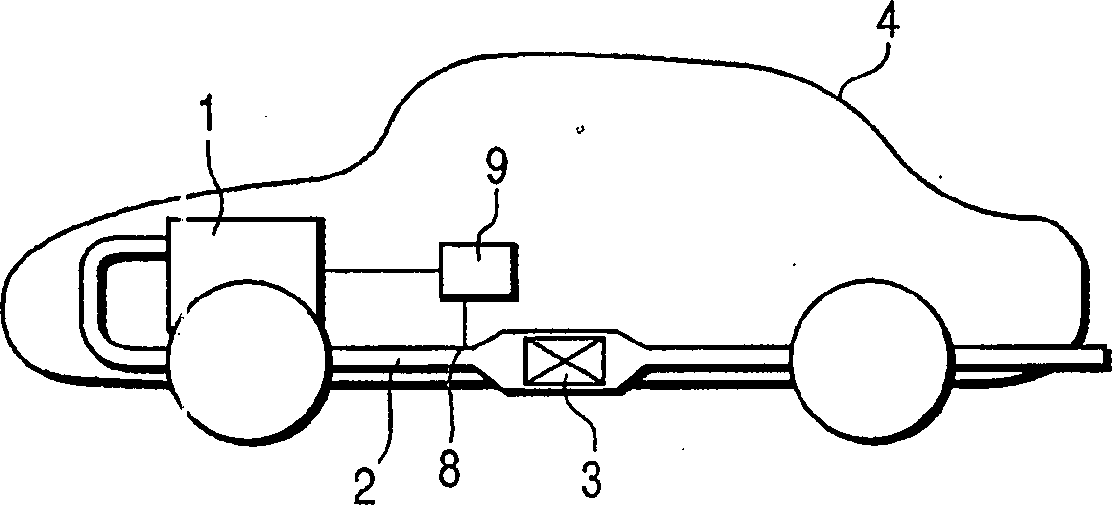
In Verbindung mit der Installation des Katalysators der vorliegenden Erfindung in einem Abgassystem eines Verbrennungsmotors kann die Freisetzung von Stickstoffoxiden außerhalb des Automobils beachtlich unterdrückt werden. Insbesondere wenn Magergemischverbrennung und stöchiometrische Verbrennung alternierend ausgeführt werden, kann die freigesetzte Menge an Stickstoffoxiden auf einen niedrigen Wert unterdrückt werden für eine fange Zeit ohne Wechseln des Katalysators.In connection with the installation of the catalyst of the present invention in an exhaust system Internal combustion engines can release nitrogen oxides outside of the automobile are suppressed considerably. Especially if Lean mixture combustion and stoichiometric Combustion carried out alternately the amount of nitrogen oxides released can be reduced to one suppressed low value be for a long time without changing the catalyst.
Der Katalysator der vorliegenden Erfindung ist ebenfalls wirksam zur Behandlung von Abgas aus Dieselmotoren von Dieselautomobiler und anderen Der Dieselmotor wird mit einem hohem Luft zu Treibstoff-Verhältnis betrieben, d. h, unter Sauerstoffüberschußbedingungen. Der Katalysator der vorliegenden Erfindung hat jedoch eine bevorzugte Aktivität in Gegenwart von Sauerstoff. Deshalb kann der Katalysator der vorliegenden Erfindung Stickstoffoxide wirksam sogar aus dem Abgas, das von einem Dieselmotor freigesetzt wird, entfernen. The catalyst of the present The invention is also effective for treating exhaust gas from diesel engines of diesel automobiles and others The diesel engine is with a high air to fuel ratio operated, d. h, under excess oxygen conditions. The catalyst however, the present invention has preferred activity in the presence of oxygen. Therefore, the catalyst of the present invention can Nitrogen oxides are effective even from the exhaust gas from a diesel engine is released, remove.
Wenn Cer im Katalysator der vorliegenden Erfindung enthalten ist, liegt die enthaltene Menge vorzugsweise in einem Bereich von 0,7 mo-% bis 20 mol-%, bezogen auf 100 mol-% an organischem Träger. Wenn Magnesium im Katalysator der vorliegenden Erfindung enthalten ist, ist die enthaltene Menge vorzugsweise in einem Bereich von 4 mol-% bis 16 mol-%, bezogen auf 100 mol-% anorganischen Träger.If cerium in the catalyst of the present Invention is included, the amount included is preferably in a range from 0.7 mol% to 20 mol%, based on 100 mol% on organic carrier. When contained magnesium in the catalyst of the present invention , the contained amount is preferably in a range of 4 mol% to 16 mol%, based on 100 mol% inorganic carrier.
Der Katalysator der vorliegenden Erfindung kann verwendet werden in verschiedenen Formen, wie als Pulver, Partikel, Pellets, Wabe und anderen. Darüber hinaus kann der Katalysator verwendet werden, getragen auf einer porösen Wabe, wie Cordierit-Waben und Metallwaben.The catalyst of the present Invention can be used in various forms, such as powder, Particles, pellets, honeycomb and others. In addition, the catalyst used on a porous honeycomb such as cordierite honeycomb and metal honeycombs.
Der Katalysator der vorliegenden Erfindung kann hergestellt werden nach verschiedenen Verfahren, wie einem Imprägnierverfahren, Knetverfahren, Coprezipitierverfahren, Sol-Gel-Verfahren und anderen.The catalyst of the present Invention can be made by various methods, such as one impregnation, Kneading process, coprecipitation process, sol-gel process and others.
Wird der Katalysator mit dem Imprägnierverfahren hergestellt, umfaßt das Verfahren vorzugsweise die Schritte des Eintauchens eines anorganischen Oxidträgers in eine Lösung, die Seltene Erdenmetallverbindungen enthält, Calcinieren des imprägnierten Trägers, Eintauchen des calcinierten Trägers in eine Lösung, die Edelmetallverbindungen enthält, Calcinieren des imprägnierten Trägers, Eintauchen des calcinierten Trägers in eine Lösung, die Erdalkalimetallverbindungen enthält, und Calcinieren. Gemäß der vorstehenden Schritte kann der Katalysator hergestellt werden, wobei die Seltene Erdenmetalle auf dem anorganischen Träger getragen werden, die Edelmetalle auf den Seltenen Erdenmetallen getragen werden, und die Erkalkalimetalle auf den Edelmetallen getragen werden.Will the catalyst with the impregnation process manufactured, includes the method preferably includes the steps of immersing an inorganic oxide support into a solution containing rare earth metal compounds, calcining the impregnated support Immerse the calcined support into a solution which contains precious metal compounds, Calcine the impregnated support Immersing the calcined support in a solution, containing alkaline earth metal compounds, and calcining. According to the above Steps, the catalyst can be made, the rare Earth metals are carried on the inorganic carrier, the precious metals worn on the rare earth metals, and the alkaline earth metals be worn on the precious metals.
Als Metallverbindungen können verschiedene Arten von Verbindungen, wie Nitrate, Acetate, Hydrochloride, Sulfate und Carbonate verwendet werden.Various metal compounds can be used Types of compounds such as nitrates, acetates, hydrochlorides, sulfates and carbonates are used.
Der Katalysator der vorliegenden Erfindung hat eine überlegene Aktivität in einem Temperaturbereich von 100°C bis 800°C, insbesondere hat er eine bevorzugte Aktivität in einem Bereich von 200°C bis 500°C. Entsprechend muß die Temperatur, bei der der Katalysator mit dem Gasfluß kontaktiert wird, d. h. die Reaktionstemperatur, im vorstehend beschriebenen Temperaturbereich gesetzt werdenThe catalyst of the present Invention has a superior activity in a temperature range from 100 ° C to 800 ° C, in particular it has one preferred activity in a range of 200 ° C up to 500 ° C. Corresponding must the Temperature at which the catalyst contacts the gas flow will, d. H. the reaction temperature, as described above Temperature range
Ausführungsform 1Embodiment 1
Der Katalysator Nr. 1 der vorliegenden
Ausführungsform
wurde hergestellt nach einem Verfahren, das die nachstehenden Schritte
umfaßt:
Imprägnieren
von γ-Al2O3 mit einer Partikelgröße im Bereich
von 1 mm bis zu weniger als 2 mm mit einer
Lösung, die
eine wäßrige Lösung von
Cernitrat enthält,
Trocknen
bei etwa 100° C
für etwa
2 Stunden,
Calcinieren bei etwa 600°C für 2 Stunden,
darauffolgend
Imprägnieren
des calcinierten Körpers
mit einer Lösung,
die eine wäßrige Lösung von
Magnesiumnitrat enthält,
Trocknen
und Calcinieren in gleicher Weise wie vorstehend,
weiterhin
entsprechend Imprägnieren
mit wäßrigen Lösungen von
Rhodiumnitrat und Dinitrodiaminplatinnitrat, und
Trocknen und
Calcinieren in gleicher Weise wie vorstehendThe catalyst No. 1 of the present embodiment was produced by a process comprising the following steps:
Impregnation of γ-Al 2 O 3 with a particle size in the range from 1 mm to less than 2 mm with a
Solution containing an aqueous solution of cerium nitrate
Drying at about 100 ° C for about 2 hours,
Calcining at about 600 ° C for 2 hours,
subsequently impregnating the calcined body with a solution containing an aqueous solution of magnesium nitrate,
Drying and calcining in the same way as above,
furthermore correspondingly impregnated with aqueous solutions of rhodium nitrate and dinitrodiamine platinum nitrate, and
Drying and calcining in the same way as above
Der Katalysator Nr. 1 der vorliegenden Erfindung, hergestellt nach den vorstehenden Schritten, enthält Rh 0,29 mol-% (0,3 Gew-%), Pt 0,82 mol-% (1,6 Gew-%), Mg 8 mol-% (2 Gew-%) und Ce 16,4 mol-% (23 Gew-%) jeweils bezogen auf 100 mol-% γ-Al2O3.Catalyst No. 1 of the present invention, prepared by the above steps, contains Rh 0.29 mol% (0.3 wt%), Pt 0.82 mol% (1.6 wt%), Mg 8 mol% (2% by weight) and Ce 16.4 mol% (23% by weight) each based on 100 mol% γ-Al 2 O 3 .
Gemäß dem gleichen Verfahren, wobei jedoch Mg durch andere Erdalkalimetalle ersetzt wurde, und Ce durch andere Seltene Erdenmetalle ersetzt wurde, wurden die Katalysatoren Nr. 2 bis 9 der vorliegenden Ausführungsform erhalten.According to the same procedure, whereby however, Mg has been replaced by other alkaline earth metals, and Ce by other rare earth metals were replaced, the catalysts Nos. 2 to 9 of the present embodiment were obtained.
Zusammensetzungen der herrgestellten Katalysatoren sind in Tabelle 1 zusammengefaßt.Compositions of the manufactured Catalysts are summarized in Table 1.
Tabelle
1 
Experiment
Experimente der Leistungsfähigkeit der Entfernung von Stickstoffoxiden der Katalysatoren Nr. 1 bis 9 der vorliegenden Ausführungsform wurden durchgeführt nach dem nachstehenden Verfahren.Performance experiments the removal of nitrogen oxides of catalysts No. 1 to 9 of the present embodiment have been performed following the procedure below.
Experimentelles VerfahrenExperimental procedure
- (1) 3 cm3 des Katalysators wurden in ein Reaktionsrohr gefüllt, das aus Pylex-Glas hergestellt war.(1) 3 cm 3 of the catalyst was placed in a reaction tube made of pylex glass.
- (2) Das Reaktionsrohr wurde in einen elektrischen Ofen eingesetzt und auf 550°C erhitzt mit einer Rate der Temperaturzunahme von 10°C/min. Wenn die Temperatur des Karalysators 150°C erreichte, begann der Fluß eines stöchiometrischen Modellgases (das nachstehend als stöchiometrisches Modellabgas bezeichnet wird). Stickstoffoxide (NOx) im Abgas aus dem Reaktionsrohr wurden bestimmt durch Chemolumineszenzverfahren nach jeweils 30 Sekunden. Als stöchiometrisches Modellabgas wurde ein Gas verwendet, zusammengesetzt aus NO 0,1 Vol-%, C3H6 0,05 Vol-%, CO 0,6 Vol%, O2 0,6 Vol-%, Dampf 10 Vol-%, Rest Stickstoff. Die Raumgeschwindigkeit des Gases betrug 60.000 h-1. Die Bestimmung der Temperatur wurde durchgeführt durch ein Thermoelement, das in der Nachbarschaft der katalytischen Schicht im Reaktionsrohr installiert war.(2) The reaction tube was put in an electric furnace and heated to 550 ° C at a rate of temperature increase of 10 ° C / min. When the temperature of the analyzer reached 150 ° C, the flow of model stoichiometric gas (hereinafter referred to as model stoichiometric exhaust gas) began. Nitrogen oxides (NO x ) in the exhaust gas from the reaction tube were determined by chemiluminescence methods after every 30 seconds. A gas was used as the stoichiometric model exhaust gas, composed of NO 0.1% by volume, C 3 H 6 0.05% by volume, CO 0.6% by volume, O 2 0.6% by volume, steam 10% by volume , Balance nitrogen. The space velocity of the gas was 60,000 h -1 . The temperature was determined using a thermocouple installed in the vicinity of the catalytic layer in the reaction tube.
- (3) Wenn die Temperatur des Katalysators 550°C erreichte, wurde der Fluß des stöchiometrischen Modellabgases gestoppt.(3) When the temperature of the catalyst reached 550 ° C, the flow became stoichiometric Model exhaust stopped.
- (4) Das Heizen mit dem elektrischen Ofen wurde gestoppt und der Katalysator wurde auf 300°C abgekühlt.(4) The electric oven heating was stopped and the catalyst was at 300 ° C cooled.
- (5) Darauffolgend wurde der Fluß von Magergemischverbrennungsmodellgas (nachstehend als Magergemischmodellabgas bezeichnet) gestartet. Stickstoffoxide (NOx) im Abgas aus dem Reaktionsrohr wurden mittels Chemolumineszenzverfahren nach jeweils 30 Sekunden bestimmt Als Magergemischmodellabgas wurde ein Gas verwendet, zusammengesetzt aus NO 0,06 Vol-%, C3H6 0,04 Vol-%, CO 0,1 Vol-%, CO2 10 Vol-%, O2 4 Vol-%, Dampf 10 Vol-%, Rest Stickstoff. Die Raumgeschwindigkeit des Gases betrug 60.000 h-1.(5) Subsequently, the flow of lean mixture combustion model gas (hereinafter referred to as lean mixture model exhaust gas) was started. Nitrogen oxides (NO x ) in the exhaust gas from the reaction tube were determined by chemiluminescence method after every 30 seconds. A gas was used as the lean mixture model exhaust gas, composed of NO 0.06% by volume, C 3 H 6 0.04% by volume, CO 0.1 Vol%, CO 2 10 Vol%, O 2 4 Vol%, steam 10 Vol%, the rest nitrogen. The space velocity of the gas was 60,000 h -1 .
- (6) Nach Fließen des Magergemischmodellabgases für 30 Minuten wurde der Gasfluß gestoppt und das Experiment war beendet. NOx-Entfernungsraten nach Fluß des Magergemischmodellabgases nach 30 Minuten sind in Tabelle 2 angegeben. Die NOx-Entfernungsrate wurde berechnet nach der nachstehenden Gleichung: NOx-Entfernungsrate = (NOx-Konzentration im Gas am Einlaß – NOx-Konzentration im Gas am Auslaß)/(NOx-Konzentration im Gas am Einlaß)(6) After flowing the lean mixture model exhaust gas for 30 minutes, the gas flow was stopped and the experiment was ended. NO x removal rates after the flow of the lean mixture model exhaust gas after 30 minutes are given in Table 2. The NO x removal rate was calculated according to the following equation: NO x removal rate = (NO x concentration in the gas at the inlet - NO x concentration in the gas at the outlet) / (NO x concentration in the gas at the inlet)
Tabelle
2 
Experiment 2Experiment 2
Experimente zur Leistungsfähigkeit der Stickstoffoxidentfernung der Katalysatoren Nr. 1 bis 9 der vorliegenden Ausführungsform wurden durchgeführt nach den nachstehenden Schritten.Performance experiments the nitrogen oxide removal of Catalyst Nos. 1 to 9 of the present embodiment have been performed following the steps below.
- (1) Die gleichen Schritte wie in Experiment 1 wurden durchgeführt, bis der Fluß des stöchiometrischen Modellabgases gestoppt wurde.(1) The same steps as in experiment 1 were done until the flow of the stoichiometric Model exhaust gas was stopped.
- (2) Das Heizen mit dem elektrischen Ofen wurde gestoppt, und der Katalysator wurde auf 150°C abgekühlt.(2) The electric furnace heating was stopped, and the catalyst was at 150 ° C cooled.
- (3) Der Fluß des Magergemischmodellabgases wurde gestartet und das Heizen des elektrischen Ofens wurde simultan erneut gestartet. Stickstoffoxide (NOx) im Abgas aus dem Reaktionsrohr wurden bestimmt mittels Chemolumineszenzverfahren, wenn die Katalysatortemperatur 250°C, 300°C bzw. 400°C erreichte. Für das Magergemischmodellabgas wurde das gleiche Gas verwendet, wie es in Experiment 1 verwendet wurde. Die Raumgeschwindigkeit des Gases betrug 60.000 h-1. Die Temperaturzunahmerate des Reaktionsrohres durch den elektrischen Ofen betrug 10°C/min.(3) The flow of the lean mixture model exhaust gas was started and the heating of the electric furnace was started again simultaneously. Nitrogen oxides (NO x ) in the exhaust gas from the reaction tube were determined by means of chemiluminescence methods when the catalyst temperature reached 250 ° C., 300 ° C. or 400 ° C. The same gas as used in Experiment 1 was used for the lean mixture model exhaust gas. The space velocity of the gas was 60,000 h -1 . The temperature increase rate of the reaction tube through the electric furnace was 10 ° C / min.
- (4) Wenn die Temperatur des Katalysators 550°C erreichte, wurde der Gasfluß gestoppt und das Experiment war beendet. Die NOx-Entfernungsraten bei entsprechenden Meßtemperaturen sind in Tabelle 3 angeführt Die NOx-Entfernungsrate wurde berechnet mit der gleichen Gleichung wie in Experiment 1.(4) When the temperature of the catalyst reached 550 ° C, the gas flow was stopped and the experiment was ended. The NO x -Entfernungsraten at respective measuring temperatures are shown in Table 3, the NOx removal rate was calculated by the same equation as in Experiment. 1
Tabelle
3 
Tabelle
4 
Experiment 3Experiment 3
Um die Wärmewiderstandsfähigkeit des Katalysators der vorliegenden Erfindung zu untersuchen, wurde der Katalysator Nr. 1 der vorliegenden Ausführungsform auf 700°C für 50 Stunden in einem Calcinierofen erhitzt Darauffolgend wurde der Katalysator auf Raumtemperatur abgekühlt und aus dem Ofen genommen. Sodann wurde der Katalysator in ein Reaktionsrohr gefüllt und das Magergemischabgas wurde wie in Experiment 2 fließen gelassen. Die beobachteten NOx-Entfernungsraten sind in Tabelle 4 gezeigt und für die Haltbarkeit des Katalysators gemäß der vorliegenden Erfindung wurde entdeckt, daß sie bei hohen Temperaturen bevorzugt ist.In order to examine the heat resistance of the catalyst of the present invention, the catalyst No. 1 of the present embodiment was heated at 700 ° C for 50 hours in a calcining furnace. Subsequently, the catalyst was cooled to room temperature and taken out of the furnace. The catalyst was then placed in a reaction tube and the lean mixture off-gas was allowed to flow as in Experiment 2. The observed NO x removal rates are shown in Table 4 and the durability of the catalyst according to the present invention has been discovered to be preferred at high temperatures.
Experiment 4Experiment 4
Unter Verwendung des Ausführungsform-Katalysators Nr. 7 wurde ein Experiment zur NO-Freisetzung bei einer erhöhten Temperatur wie nachstehend durchgeführt.Using the embodiment catalyst No. 7 became an experiment for NO release at an elevated temperature as performed below.
Zunächst wurden 2 cm3 des
Katalysators in ein Reaktionsrohr gefüllt, und das Reaktionsrohr
wurde schrittweise auf 640°C
in einem Co-He-Gasfluß erhitzt,
um Sauerstoff zu reduzieren und zu eliminieren, der auf dem Katalysator
adsorbiert war. Da Sauerstoff auf der Oberfläche des Katalysators adsorbiert
war, der gerade hergestellt worden war, war es notwendig, den Sauerstoff
an der Oberfläche
des Katalysators als eine Vorbehandlung zu reduzieren und zu eliminieren.
Nach Halten bei 600°C
im He-Gasfluß für 20 Minuten
wurde das Reaktionsrohr auf 50°C
in einen O2-He-Gasfluß abgekühlt und bei 50°C für mehr als
1 Stunde gehalten zum Kontaktieren des Katalysators mit Sauerstoff.
Darauffolgend wurde NO absorbiert bis zur Sättigung durch Fließenlassen
eines NO-He-Gasflusses, sodann wurde der Katalysator auf 500°C im He-Gasfluß erhitzt
zum Desorbieren des absorbierten Gases. Während der Desorption wurden
Komponenten im Gasfluß im
Auslaß des
Reaktionsrohres bestimmt mittels eines Quadrupol-Massenspektrometers
und ein Ergebnis, wie es in
Bezugnehmend auf
Darüber hinaus wurden Übergangsverhalten-Charakteristiken
bestimmt mit dem vorstehenden Katalysator. Zunächst wurden 0,5 g der Katalysatorprobe
in ein Reaktionsrohr gefüllt,
und das Reaktionsrohr wurde auf 600 °C in einem CO-He-Gasfluß erhitzt
genauso wie beim vorstehenden NO-Freisetzungsexperiment bei einer
erhöhten
Temperatur. Das Reaktionsrohr wurde bei 600°C im He-Gasfluß für 20 Minuten
gehalten, dann auf 300°C
abgekühlt
und bei der Temperatur gehalten. (a) NO 70 ppm, (b) C3H6 250 ppm, (c) NO 70 ppm wurden in den He-Gasfluß in pulsierender
Weise eingeführt,
die Komponenten im Gasfluß am
Auslaß des
Reaktionsrohres wurden bestimmt mittels eines Quadrupol-Massenspektrometers,
und ein Ergebnis wurde erhalten, wie es in
- (a) Nur N2 wurde beobachtet bis zum 27. NO-Puls, kein Sauerstoff (O2) wurde erzeugt. Nach dem 28. NO-Puls wurde NO beobachtet. Somit wurde aufgedeckt, daß die Reduktion des NO zu N2 an diesem Punkt an der Oberfläche des Katalysators startete, der nicht mit Sauerstoff bedeckt ist, und die NO-Entfernungsleistungsfähigkeit des Katalysators nimmt ab in Übereinstimmung mit dem Grad an Sauerstoffanreicherung auf der Oberfläche des Katalysators.(a) Only N 2 was observed until the 27th NO pulse, no oxygen (O 2 ) was generated. NO was observed after the 28th NO pulse. Thus, it was revealed that the reduction of the NO to N 2 started at this point on the surface of the catalyst which is not covered with oxygen, and the NO removal performance of the catalyst decreased in accordance with the degree of acid enrichment on the surface of the catalyst.
- (b) In Übereinstimmung mit dem Eintragen von C3H6 in den He-Gasfluß in einer pulsierenden Weise wurde CO beobachtet. Nach dem 4. Eintrag wurde C3H6 beobachtet. Das beobachtete Ergebnis zeigt an, daß der Oberflächensauerstoff mit Kohlenwasserstoff reagiert und aktive Punkte des Katalysators zurückerhalten werden.(b) In accordance with the introduction of C 3 H 6 into the He gas flow in a pulsating manner, CO was observed. After the 4th entry, C 3 H 6 was observed. The observed result indicates that the surface oxygen reacts with hydrocarbon and active points of the catalyst are recovered.
- (c) Nur Entstehung von N2 wurde beobachtet mit Zusammenhang mit dem Eintrag von NO in pulsierender Weise. Das Ergebnis zeigt, daß eine Reduktionsreaktion von NO zu N2 an der Oberfläche des Katalysators auftritt und N2 wird erzeugt. Gemäß der vorliegender experimentellen Ergebnisse wird entdeckt, daß die Eliminierung von Sauerstoff aus der Oberfläche des Katalysaton wichtig ist zur Entfernung von NOx.(c) Only the formation of N 2 was observed in connection with the entry of NO in a pulsating manner. The result shows that a reduction reaction of NO to N 2 occurs on the surface of the catalyst and N 2 is generated. According to the present experimental results, it is discovered that the elimination of oxygen from the surface of the catalyst is important for the removal of NO x .
Verglechsbeispiel
Vergleichsbeispiel-Katalysator Nr. 1, der Rh 0,29 mol-% (0,3 Gew-%) Pt 0,82 mol-% (1,6 Gew-%) und Ce 16,4 mol-% pro 100 mol-% γ-Al2O3 enthält, wurde nachdem gleichen Verfahren wie Ausführungsform 1 hergestellt.Comparative Example Catalyst No. 1, the Rh 0.29 mol% (0.3 wt%) Pt 0.82 mol% (1.6 wt%) and Ce 16.4 mol% per 100 mol % γ-Al 2 O 3 was prepared by the same method as Embodiment 1.
Die Leistungsfähigkeit der Stickstoffoxidentfernung des Vergleichsbeispiel-Katalysators Nr. 1 wurde bestimmt nach dem gleichen Verfahren wie in Experiment 2 der Ausführungsform 1. Das erhaltene Ergebnis ist in Tabelle 5 angegeben.The efficiency of nitrogen oxide removal of Comparative Example Catalyst No. 1 was determined by the same procedures as in Experiment 2 of embodiment 1. The obtained The result is shown in Table 5.
Ausführungsform 2Embodiment 2
Katalysator Nr. 10 der Ausführungsform wurde hergestellt nach dem gleichen Verfahren wie bei Ausführungsform 1. Die Zusammensetzung des Katalysators war Pd 1,5 mol-% (1,6 Gew-%), Rh 0,29 mol-% (0,3 Gew-%), Mg 8 mol-% (2 Gew-%) und Ce 16,4 mol-% (23 Gew-%). Die Leistungsfähigkeit des Katalysators wurde bestimmt nach dem gleichen Verfahren wie in Experiment 2 der Ausführungsform 1. Das erhaltene Ergebnis ist in Tabelle 6 angegebenCatalyst No. 10 of the embodiment was made by the same method as in the embodiment 1. The composition of the catalyst was Pd 1.5 mol% (1.6% by weight), Rh 0.29 mol% (0.3 wt%), Mg 8 mol% (2 wt%) and Ce 16.4 mol% (23% by weight). The efficiency of the catalyst was determined by the same method as in Experiment 2 of the embodiment 1. The result obtained is given in Table 6
Ausführungsform 3Embodiment 3
Der Katalysator Nr. 11 der vorliegenden
Ausführungsfonn
wurde hergestellt nach einem Verfahren, das die nachstehenden Schritte
umfaßte:
Imprägnieren
von γ-Al2O3 mit einer Partikelgröße im Bereich
von 1 mm bis weniger als 2 mm mit einer Lösung,
die eine wäßrige Lösung von
Cernitrat enthielt,
Trocknen bei etwa 100°C für etwa 2 Stunden,
Calcinieren
bei etwa 600°C
f für 2
Stunden,
Entsprechend Imprägnieren
mit wäßrigen Lösungen von
Rhodiumnitrat und Dinitrodiaminplatinnitrat und
Trocknen und
Calcinieren in gleicher Weise wie vorstehend. The catalyst No. 11 of the present embodiment was produced by a process comprising the following steps:
Impregnating γ-Al 2 O 3 with a particle size in the range from 1 mm to less than 2 mm with a solution,
which contained an aqueous solution of cerium nitrate,
Drying at about 100 ° C for about 2 hours,
Calcining at about 600 ° C f for 2 hours,
Correspondingly impregnated with aqueous solutions of rhodium nitrate and dinitrodiamine platinum nitrate and
Drying and calcining in the same way as above.
Darüber hinaus Imprägnieren
mit einer Lösung,
die eine wäßrige Lösung von
Magnesiumnitrat enthielt,
Trocknen bei etwa 100°C für etwa 2
Stunden, und
Calcinieren bei etwa 600°C für 2 Stunden.In addition, impregnation with a solution containing an aqueous solution of magnesium nitrate
Drying at about 100 ° C for about 2 hours, and
Calcine at about 600 ° C for 2 hours.
D.h, daß Magnesium auf der äußersten Schicht der Komponenten getragen wurde. Der Katalysator Nr. 11 der vorliegenden Ausführungsform, hergestellt nach den vorstehenden Schritten, enthielt Rh 0,29 mol-% (0,3 Gew-%), Pt 0,82 mol-% (1,6 Gew-%), Mg 4 mol-% (Gew-%) und Ce 8,6 mol-% (12 Gew-%), jeweils auf 100 mol-% γ-Al2O3.That is, magnesium was worn on the outermost layer of the components. The catalyst No. 11 of the present embodiment prepared by the above steps contained Rh 0.29 mol% (0.3 wt%), Pt 0.82 mol% (1.6 wt%), Mg 4 mol% (wt%) and Ce 8.6 mol% (12 wt%), each to 100 mol% γ-Al 2 O 3 .
Gemäß dem gleichen Verfahren wie vorstehend wurde Katalysator Nr. 2 des Vergleichsbeispiels hergestellt, der Mg trug nach Ce und 4 mol-% Mg und 8,6 mol-% Ce enthielt (und kein Rh oder Pt enthielt).According to the same procedure as Catalyst No. 2 of the comparative example was prepared above, the Mg contributed to Ce and contained 4 mol% of Mg and 8.6 mol% of Ce (and contained no Rh or Pt).
Die Leistungsfähigkeit der vorstehenden Katalysatoren wurde bestimmt nach dem gleichen Verfahren wie in Experiment 2 der Ausführungsform 1. Die erhaltenen Ergebnisse der NOx-Entfernungsrate sind angegeben in Tabelle 7. Katalysator Nr. 11 der Ausführungsform, wobei Mg nach dem Tragen des Edelmetalls getragen wird, hat eine höhere NOx-Entfernungsrate als der Ausführungsform-Katalysator Nr. 1.The performance of the above catalysts was determined by the same method as in Experiment 2 of Embodiment 1. The results of NO x removal rate obtained are shown in Table 7. Catalyst No. 11 of the embodiment, wherein Mg is carried after the noble metal was worn, has a higher NO x removal rate than the No. 1 embodiment catalyst.
Tabelle
5 
Tabelle
6 
Tabelle
7 
Ausführungsform 4Embodiment 4
Ausführungsform-Katalysator Nr. 12 wurde erhalten durch Waschbeschichten des Ausführungsform-Katalysators Nr. 1 (100 g/l) auf Cordierit-Waben (400 Zellen/in2) und Calcinieren der beschichteten Cordierit-Waben bei 600°C für 2 Stunden.Embodiment Catalyst No. 12 was obtained by washing coating the Embodiment Catalyst No. 1 (100 g / l) on cordierite honeycombs (400 cells / in 2 ) and calcining the coated cordierite honeycombs at 600 ° C. for 2 hours.
Die NOx-Entfernungsrate
des Ausführungsform-Katalysators
Nr. 12 mit einer Fläche
von 6 cm2 (17 mm × 21 mm) wurde bestimmt dun:h
Einsetzen des Katalysators in ein Pylex-Reaktionsrohr mit einem
inneren Durchmesser von 28 mm und Fließenlassen eines stöchiometrischen
Modellabgases und Magergemischverbrennungsmodellabgases alternierend
nach dem gleichen Verfahren wie in Beispiel
Ein Zwischenraum zwischen der äußeren Wand der Waben und dem Reaktionsrohr wurde geschlossen durch Packen mit Quarzwolle. Ein Thermoelement wurde vorgesehen im oberen Abschnitt 1 cm von der oberen Oberfläche der Waben entfernt, zur Messung der Temperatur.A space between the outer wall the honeycomb and the reaction tube were closed by packing with Quartz wool. A thermocouple was provided in the upper section 1 cm from the top surface the honeycomb removed to measure the temperature.
In den vorliegenden Experimenten wurde die Sauerstoffkonzentration im Magergemischverbrennungsmo dellabgas jeweils geändert als 0, 0,5, 1,0, 1,2, 1,5, 1,7, 5,0 Vol-%.In the present experiments the oxygen concentration in the lean mixture combustion mo dellabgas changed in each case as 0, 0.5, 1.0, 1.2, 1.5, 1.7, 5.0 vol%.
Ausführungsform 5Embodiment 5
Ausführungsform-Katalysator Nr. 13 wurde erhalten durch Beschichten von 300 g des Ausführungsform-Katalysators Nr. 1 auf Cordierit-Waben, die ein Volumen von 1,7 1 ausmachten Der Wabenkatalysator wurde installiert unter dem Boden eines Automobils mit einem Motor mit einem Hubraum 3000 cm3, und die NOx-Entfernungsrate wurde bestimmt beim Fahren des Automobils in 10-15 Moden.Embodiment Catalyst No. 13 was obtained by coating 300 g of the Embodiment Catalyst No. 1 on cordierite honeycombs, which made up a volume of 1.7 liters. The honeycomb catalyst was installed under the floor of an automobile with a displacement of 3000 cm 3 , and the NOx removal rate was determined when driving the automobile in 10-15 modes.
Die NOx-Entfernungsrate unter stöchiometrischen Betriebsbedingungen (Luft/Treibstoffverhältnis = 14,7) betrug etwa 100% und die NOx-Entfernungsrate unter Magergemischverbrennungsbetrieb (Luft/Treibstoffverhältnis = 21) betrug etwa 50%.The NO x removal rate under stoichiometric operating conditions (air / fuel ratio = 14.7) was approximately 100% and the NO x removal rate under lean mixture combustion operation (air / fuel ratio = 21) was approximately 50%.
Darauffolgend wurde der Ausführungsform-Katalysator Nr. 13 in ein Reaktionsrohr eingebracht und auf 300°C erhitzt. Die NOx-Entfernungsrate wurde bestimmt unter einer Bedingung, bei der das Reaktionsrohr bei 300°C gehalten wurde und das stöchiometrische Modellabgas fließen gelassen wurde, alternierend mit dem Magergemischverbrennungs modellabgas für 3 Minuten für insgesamt 1 Stunde.Subsequently, the embodiment catalyst No. 13 was placed in a reaction tube and heated to 300 ° C. The NO x removal rate was determined under a condition that the reaction tube was kept at 300 ° C and the stoichiometric model exhaust was allowed to flow alternately with the lean-burn model exhaust for 3 minutes for a total of 1 hour.
Das stöchiometrische Modellabgas bzw. das Magergemischverbrennungsmodellabgas hatten die gleiche Zusammensetzung wie die Gase, die in Experiment 1 verwendet wurden.The stoichiometric model exhaust or the lean mixture combustion model exhaust had the same composition like the gases used in Experiment 1.
Die NOx-Entfernungsrate unter stöchiometrischer Bedingung betrug immer etwa 100% und die NOx-Entfernungsrate unter Magergem schverbrennungsbedingungen war im Bereich von 50-100%. Die NOx-Entfernungsrate bald nach dem Wechsel vom stöchiometrischen Gas zum Magergemischverbrennungsgas betrug etwa 100%, aber die Rate nahm ab auf etwa 50% nach Fortsetzen der Magergemischverbrennungsbedingung für 3 Minuten Während des Experiments für 1 Stunde wiederholte die N0x-Entfernungsrate die vorstehend erläuterte Veränderung, und keine extreme Abnahme der NOx-Entfernungsrate unter der stöchiometrischen Bedingung wurde beobachtet.The NO x removal rate under the stoichiometric condition was always about 100% and the NO x removal rate under the lean burn conditions was in the range of 50-100%. The NO x removal rate soon after the change from the stoichiometric gas to the lean combustion gas was about 100%, but the rate decreased to about 50% by continuing the lean burn condition for 3 minutes during the experiment for 1 hour repeated the N0x removal rate, the above-explained change , and no extreme decrease in the NO x removal rate under the stoichiometric condition was observed.
Ausführungsform 6Embodiment 6
Ausführungsform-Katalysator Nr.
14 wurde hergestellt gemäß dem gleichen
Verfahren wie in Ausführungsform
1, jedoch wurde ein Kompositoxid (La. β-Al2O3)-Träger
verwendet, hergestellt aus β-Al2O3 und Lanthan anstelle
des γ-Al2O3-Trägers. Die
NOx-Entfernungsraten wurden berechnet auf
der Basis von NOx, die bestimmt wurden gemäß dem gleicher.
Verfahren wie in Experiment
Zusammensetzung des Auisführungsform-Katalysators Nr. 14 war Rh 0,29 mol-% (0,3 Gew-%), Pt 0,82 mol-% (1,6 Gew-%), Mg 8 mol% (2 Gew%) und Ce 16,4 mol-% (23 Gew-%). Tabelle 8 zeigt die NOx-Entfernungsraten des Katalysators Nr. 14.Composition of the embodiment catalyst No. 14 was Rh 0.29 mol% (0.3 wt%), Pt 0.82 mol% (1.6 wt%), Mg 8 mol% (2 wt%) and Ce 16.4 mol% (23 wt%). Table 8 shows the NO x removal rates of Catalyst No. 14.
Ausführungsform 7Embodiment 7
Ein Gemisch von γ-Al2O3 mit einem Durchmesser von 1 μm und Cernitrat wurde hergestellt durch die Schritte von Naßkneten, Trocknen bei etwa 100°C für etwa 2 Stunden und Calcinieren bei etwa 600°C für 1 Stunde. Darauffolgend wurden waßrige Lösungen von Rhodiumnitrat bzw. Dinitrodiaminplatin in dieser Reihenfolge in das Gemisch eingetragen, und das Kneten, Trocknen und Calcinieren wurde durchgeführt wie beim vorstehenden Verfahren Schließlich wurde Magnesiumnitrat in das Gemisch eingetragen durch Naßkneten, Trocknen bei etwa 100°C für etwa 2 Stunden und Calcinieren bei etwa 600°C für 1 Stunde. Gemäß der vorstehenden Schritte wurde Ausführungsform-Katalysator Nr. 15 erhalten Die Zusammensetzung des Ausführungsform-Katalysators Nr. 15 war Rh 0,29 mal-% (0,3 Gew-%), Pt 0,82 mol-% (1,6 Gew-%), Mg 4 mol-% (1 Gew-%) und Ce 8,6 mol-% (12 Gew-%) pro 100 mol-% γ-Al2O3.A mixture of γ-Al 2 O 3 with a diameter of 1 μm and cerium nitrate was prepared by the steps of wet kneading, drying at about 100 ° C. for about 2 hours and calcining at about 600 ° C. for 1 hour. Subsequently, aqueous solutions of rhodium nitrate and dinitrodiamine platinum were added to the mixture in this order, and kneading, drying and calcining were carried out as in the above method. Finally, magnesium nitrate was added to the mixture by wet kneading, drying at about 100 ° C for about 2 hours and calcining at about 600 ° C for 1 hour. According to the above steps, Embodiment Catalyst No. 15 was obtained. The composition of Embodiment Catalyst No. 15 was Rh 0.29 times% (0.3% by weight), Pt 0.82 mol% (1.6% by weight) -%), Mg 4 mol% (1 wt%) and Ce 8.6 mol% (12 wt%) per 100 mol% γ-Al 2 O 3 .
Gemäß dem gleichen Verfahren wie beim Ausführungsform-Katalysator Nr. 15 wurde Vergleichsbeispiel-Katalysator Nr. 3 erhalten, wo bei γ-Al2O3 mit einem Durchmesser von 1 μm, Lanthan, Barium und Platin trug. Die Zusammensetzung des Vergleichsbeispiel-Katalysators Nr. 3 war La 0,17 mol-%, Ba 0,08 mol-% und Pt 1,6 mol-%.According to the same procedure as the embodiment catalyst No. 15, comparative example catalyst No. 3 was obtained, where γ-Al 2 O 3 with a diameter of 1 μm, carried lanthanum, barium and platinum. The composition of the comparative example catalyst No. 3 was La 0.17 mol%, Ba 0.08 mol% and Pt 1.6 mol%.
Darüber hinaus wurde Ausführungsform-Katalysator Nr. 16 hergestellt durch die Schritte des Trockenmiscbens des Ausführungsform-Katalysators Nr. 15 und des Vergleichsbeispiel-Katalysators Nr. 3 in einem Verhältnis von 1 : 1, bezogen auf das Gewicht, Herstellen mittels einer Preßmaschine, Granulieren zu Partikeln mit einem Durchmesser von 1 - 2 mm und Calcinieren bei etwa 600° C für 1 Stunde.In addition, embodiment catalyst No. 16 made by the steps of dry mixing the embodiment catalyst No. 15 and Comparative Example Catalyst No. 3 in a ratio of 1: 1, based on the weight, production using a press machine, Granulate into particles with a diameter of 1 - 2 mm and Calcine at around 600 ° C for 1 hour.
Unter Verwendung der 3 Arten der erhaltenen Katalysatoren nach dem vorstehenden Verfahren wurden die Menge NOx bestimmt nach dem gleichen Verfahren wie in Experiment 2, und die NOx-Entfernungsraten wurden berechnet. Die erhaltenen Ergebnisse sind in Tabelle 9 gezeigt.Using the 3 kinds of the obtained catalysts by the above method, the amount of NO x was determined by the same method as in Experiment 2, and the NO x removal rates were calculated. The results obtained are shown in Table 9.
Ausführungsform 8Embodiment 8
Unter Verwendung des Ausführungsform-Katalysators Nr. 11 wurden verschiedene Katalysatoren hergestellt, wobei die Gehalte von Ce, Mg, Pt und Rh verändert wurden in Bereichen von Ce 0-25 mol-%, Mg 0-16 mol-%, Pt 0-1,54 mol-% und Rh 0-0,48 mol-%. Sodann wurden die NOx-Entfernungsraten bestimmt nach dem gleichen Verfahren wie in Experiment 1. Die Ergebnisse sind in Tabelle 10 gezeigt.Various catalysts were produced using the embodiment catalyst No. 11, whereby the contents of Ce, Mg, Pt and Rh were changed in the ranges of Ce 0-25 mol%, Mg 0-16 mol%, Pt 0-1 , 54 mol% and Rh 0-0.48 mol%. Then the NO x removal rates were determined by the same method as in Experiment 1. The results are shown in Table 10.
Tabelle
8 
Tabelle
9 
Tabelle
10 
Claims (17)
Applications Claiming Priority (2)
| Application Number | Priority Date | Filing Date | Title |
|---|---|---|---|
| JP00170495A JP3374569B2 (en) | 1995-01-10 | 1995-01-10 | Exhaust gas purification catalyst and purification method |
| JP7-001704 | 1995-01-10 |
Publications (2)
| Publication Number | Publication Date |
|---|---|
| DE19600552A1 DE19600552A1 (en) | 1996-07-11 |
| DE19600552B4 true DE19600552B4 (en) | 2004-03-18 |
Family
ID=11508946
Family Applications (1)
| Application Number | Title | Priority Date | Filing Date |
|---|---|---|---|
| DE19600552A Expired - Fee Related DE19600552B4 (en) | 1995-01-10 | 1996-01-09 | Removal of nitrogen oxides from exhaust gas using a catalyst |
Country Status (4)
| Country | Link |
|---|---|
| US (2) | US6093377A (en) |
| JP (1) | JP3374569B2 (en) |
| KR (1) | KR100366993B1 (en) |
| DE (1) | DE19600552B4 (en) |
Families Citing this family (14)
| Publication number | Priority date | Publication date | Assignee | Title |
|---|---|---|---|---|
| JP3374569B2 (en) * | 1995-01-10 | 2003-02-04 | 株式会社日立製作所 | Exhaust gas purification catalyst and purification method |
| JP3977883B2 (en) * | 1996-10-03 | 2007-09-19 | 株式会社日立製作所 | Exhaust gas purification catalyst for internal combustion engine |
| DE69826030T2 (en) * | 1997-12-22 | 2005-09-22 | Toyota Jidosha K.K., Toyota | CATALYST FOR CLEANING EXHAUST GAS, METHOD FOR THE PRODUCTION THEREOF AND METHOD FOR CLEANING EXHAUST GAS |
| JP3952617B2 (en) * | 1998-12-11 | 2007-08-01 | 株式会社日立製作所 | Exhaust gas purification device, exhaust gas purification method and exhaust gas purification catalyst for internal combustion engine |
| JP4172272B2 (en) * | 2001-02-02 | 2008-10-29 | 株式会社日立製作所 | Exhaust gas purification catalyst and internal combustion engine provided with the catalyst |
| US6866834B2 (en) * | 2001-03-12 | 2005-03-15 | Nissan Motor Co., Ltd. | NOx reduction catalyst and NOx reduction system |
| JP2003021008A (en) * | 2001-07-11 | 2003-01-24 | Kankyo Kagaku Kk | Air cleaner for gasoline or diesel engine |
| DE10307010B3 (en) * | 2003-02-19 | 2004-05-27 | Siemens Ag | Control unit for adjusting a defined oxygen charge with binary lambda regulation for carrying out catalyst diagnosis is connected to a mixing unit for adjusting the fuel mixture, and a sensor for detecting a lean or rich exhaust gas |
| RU2394065C2 (en) * | 2004-11-02 | 2010-07-10 | В.Р.Грейс Энд Ко.-Конн. | PROCEDURE FOR REDUCING NOx EXHAUSTS IN PROCESSES OF COMPLETE COMBUSTION OF CRACKING PRODUCTS |
| DE102005034344A1 (en) * | 2005-07-22 | 2007-01-25 | Umicore Ag & Co. Kg | Process for the reactivation of thermally aged nitrogen oxide storage catalysts |
| KR101047362B1 (en) * | 2008-05-26 | 2011-07-07 | 한국에너지기술연구원 | Simultaneous Reduction of Nitrous Oxide and Nitrogen Monoxide Using Carbon Monoxide Reductants on Precious Metal Catalysts Supported on Mixed Metal Oxides |
| JP5337930B2 (en) | 2008-10-29 | 2013-11-06 | 三菱自動車工業株式会社 | Exhaust purification method |
| GB201021649D0 (en) * | 2010-12-21 | 2011-02-02 | Johnson Matthey Plc | NOx Absorber catalyst |
| US9266092B2 (en) | 2013-01-24 | 2016-02-23 | Basf Corporation | Automotive catalyst composites having a two-metal layer |
Citations (4)
| Publication number | Priority date | Publication date | Assignee | Title |
|---|---|---|---|---|
| US4906176A (en) * | 1983-07-01 | 1990-03-06 | Hitachi, Ltd. | High temperature stable catalyst, process for preparing same, and process for conducting chemical reaction using same |
| US5260249A (en) * | 1991-04-05 | 1993-11-09 | Nippon Shokubai, Co., Ltd. | Catalyst for purifying automotive exhaust gas |
| EP0573672A1 (en) * | 1991-12-27 | 1993-12-15 | Toyota Jidosha Kabushiki Kaisha | Exhaust emission control device in internal combustion engine |
| EP0613714A2 (en) * | 1993-01-11 | 1994-09-07 | Toyota Jidosha Kabushiki Kaisha | Catalyst and process for purifying exhaust gases |
Family Cites Families (7)
| Publication number | Priority date | Publication date | Assignee | Title |
|---|---|---|---|---|
| JPS6227715A (en) | 1985-07-30 | 1987-02-05 | Asahi Optical Co Ltd | Guide light device of laser irradiating device |
| JPS62277150A (en) * | 1986-05-26 | 1987-12-02 | Toyota Motor Corp | Catalyst for purifying exhaust gas |
| JP2660411B2 (en) * | 1987-11-18 | 1997-10-08 | トヨタ自動車株式会社 | Method for reducing and removing nitrogen oxides in exhaust gas |
| JPH04219147A (en) * | 1990-12-18 | 1992-08-10 | Tosoh Corp | Exhaust gas purification catalyst |
| JP3311012B2 (en) * | 1992-03-23 | 2002-08-05 | 株式会社豊田中央研究所 | Exhaust gas purification catalyst and exhaust gas purification method |
| JP3291086B2 (en) * | 1993-09-24 | 2002-06-10 | トヨタ自動車株式会社 | Exhaust gas purification catalyst and exhaust gas purification method |
| JP3374569B2 (en) * | 1995-01-10 | 2003-02-04 | 株式会社日立製作所 | Exhaust gas purification catalyst and purification method |
-
1995
- 1995-01-10 JP JP00170495A patent/JP3374569B2/en not_active Expired - Fee Related
-
1996
- 1996-01-09 KR KR1019960000243A patent/KR100366993B1/en not_active Expired - Fee Related
- 1996-01-09 DE DE19600552A patent/DE19600552B4/en not_active Expired - Fee Related
- 1996-01-11 US US08/585,055 patent/US6093377A/en not_active Expired - Fee Related
-
2000
- 2000-06-07 US US09/588,711 patent/US6517784B1/en not_active Expired - Fee Related
Patent Citations (4)
| Publication number | Priority date | Publication date | Assignee | Title |
|---|---|---|---|---|
| US4906176A (en) * | 1983-07-01 | 1990-03-06 | Hitachi, Ltd. | High temperature stable catalyst, process for preparing same, and process for conducting chemical reaction using same |
| US5260249A (en) * | 1991-04-05 | 1993-11-09 | Nippon Shokubai, Co., Ltd. | Catalyst for purifying automotive exhaust gas |
| EP0573672A1 (en) * | 1991-12-27 | 1993-12-15 | Toyota Jidosha Kabushiki Kaisha | Exhaust emission control device in internal combustion engine |
| EP0613714A2 (en) * | 1993-01-11 | 1994-09-07 | Toyota Jidosha Kabushiki Kaisha | Catalyst and process for purifying exhaust gases |
Also Published As
| Publication number | Publication date |
|---|---|
| KR960028969A (en) | 1996-08-17 |
| KR100366993B1 (en) | 2003-03-10 |
| US6093377A (en) | 2000-07-25 |
| US6517784B1 (en) | 2003-02-11 |
| DE19600552A1 (en) | 1996-07-11 |
| JPH08187431A (en) | 1996-07-23 |
| JP3374569B2 (en) | 2003-02-04 |
Similar Documents
| Publication | Publication Date | Title |
|---|---|---|
| DE69730539T2 (en) | Emission control system of an internal combustion engine and catalyst for cleaning the exhaust gas of an internal combustion engine | |
| DE60316069T3 (en) | NOx storage catalytic converter | |
| EP0706817B1 (en) | Process for the simultaneous reduction of hydrocarbons, carbon monoxide and nitrogen oxides occurring in the exhaust gas of an internal combustion engine | |
| DE69427744T2 (en) | METHOD FOR REMOVING NITROGEN OXYDES CONTAINED IN EXHAUST GAS | |
| EP1004347B1 (en) | Catalyst for cleaning exhaust gases from diesel engines | |
| DE102012222801B4 (en) | Exhaust system and use of a washcoat | |
| EP0945165B1 (en) | Process for removing sulphur oxides from internal combustion engine exhaust gases | |
| DE102004040032B4 (en) | Exhaust treatment catalyst and exhaust treatment method | |
| DE69725263T2 (en) | Nitrogen oxide trap for an internal combustion engine | |
| DE60223049T2 (en) | Process for the preparation of a used catalyst | |
| DE19807646A1 (en) | Catalyst for the purification of oxygen-rich exhaust gas | |
| DE60127493T2 (en) | Emission control catalyst and emission control system | |
| DE19955456A1 (en) | Process for producing a nitrogen oxide storage material and storage material produced therewith | |
| EP0945608A2 (en) | Process for operating an exhaust gas purification apparatus comprising a sulfur-trap and a nitrogen oxide storage catalytic converter | |
| DE69932387T2 (en) | Nitrogen oxide trap catalyst for internal combustion engines with lean burn combustion | |
| DE69422938T2 (en) | Catalytic converter for cleaning exhaust gases from diesel engines | |
| DE69913089T2 (en) | Storage of nitrogen oxides by metal-zirconium oxide materials during the operation of a motor vehicle engine with excess air | |
| DE19600552A1 (en) | Catalytic denitrification of exhaust esp. from i.c. engine | |
| DE60206145T2 (en) | GAS TREATMENT WITH NOX-SPECIFIC REACTANT | |
| DE69503986T2 (en) | Exhaust gas purifier and method for cleaning it | |
| DE19743194B4 (en) | Process for the preparation of a catalyst for purifying the exhaust gases of internal combustion engines and catalyst produced thereby | |
| DE60036909T2 (en) | Methods for the removal of nitrogen oxides by means of a material with ilmenite structure | |
| EP4373613A1 (en) | Exhaust gas purification system for purifying exhaust gases of internal combustion engines | |
| DE69719957T2 (en) | Sulfur-resistant NOx trap containing tungsten phosphoric acid and precious metals | |
| DE60220868T2 (en) | Emission control catalyst and system |
Legal Events
| Date | Code | Title | Description |
|---|---|---|---|
| OP8 | Request for examination as to paragraph 44 patent law | ||
| 8364 | No opposition during term of opposition | ||
| 8339 | Ceased/non-payment of the annual fee |