DE10340887A1 - Production of disiloxanes with formation of gaseous hydrogen chloride comprises reaction of chlorosilanes with up to one half a mole of water per mole of silicon-chlorine bonds in the chlorosilane - Google Patents
Production of disiloxanes with formation of gaseous hydrogen chloride comprises reaction of chlorosilanes with up to one half a mole of water per mole of silicon-chlorine bonds in the chlorosilane Download PDFInfo
- Publication number
- DE10340887A1 DE10340887A1 DE2003140887 DE10340887A DE10340887A1 DE 10340887 A1 DE10340887 A1 DE 10340887A1 DE 2003140887 DE2003140887 DE 2003140887 DE 10340887 A DE10340887 A DE 10340887A DE 10340887 A1 DE10340887 A1 DE 10340887A1
- Authority
- DE
- Germany
- Prior art keywords
- formula
- disiloxanes
- hydrogen chloride
- water
- chlorosilanes
- Prior art date
- Legal status (The legal status is an assumption and is not a legal conclusion. Google has not performed a legal analysis and makes no representation as to the accuracy of the status listed.)
- Granted
Links
- VEXZGXHMUGYJMC-UHFFFAOYSA-N Hydrochloric acid Chemical compound Cl VEXZGXHMUGYJMC-UHFFFAOYSA-N 0.000 title claims abstract description 56
- XLYOFNOQVPJJNP-UHFFFAOYSA-N water Substances O XLYOFNOQVPJJNP-UHFFFAOYSA-N 0.000 title claims abstract description 39
- 239000005046 Chlorosilane Substances 0.000 title claims abstract description 29
- KOPOQZFJUQMUML-UHFFFAOYSA-N chlorosilane Chemical class Cl[SiH3] KOPOQZFJUQMUML-UHFFFAOYSA-N 0.000 title claims abstract description 29
- 238000006243 chemical reaction Methods 0.000 title claims abstract description 17
- IXCSERBJSXMMFS-UHFFFAOYSA-N hydrogen chloride Substances Cl.Cl IXCSERBJSXMMFS-UHFFFAOYSA-N 0.000 title claims abstract description 17
- 229910000041 hydrogen chloride Inorganic materials 0.000 title claims abstract description 17
- 230000015572 biosynthetic process Effects 0.000 title claims abstract description 7
- 238000004519 manufacturing process Methods 0.000 title abstract description 7
- 238000000034 method Methods 0.000 claims abstract description 30
- 239000004215 Carbon black (E152) Substances 0.000 claims abstract description 4
- 229930195733 hydrocarbon Natural products 0.000 claims abstract description 4
- KPUWHANPEXNPJT-UHFFFAOYSA-N disiloxane Chemical compound [SiH3]O[SiH3] KPUWHANPEXNPJT-UHFFFAOYSA-N 0.000 claims description 23
- BLRPTPMANUNPDV-UHFFFAOYSA-N Silane Chemical compound [SiH4] BLRPTPMANUNPDV-UHFFFAOYSA-N 0.000 claims description 8
- 229910000077 silane Inorganic materials 0.000 claims description 8
- 238000009835 boiling Methods 0.000 claims description 7
- 238000010924 continuous production Methods 0.000 claims description 4
- 125000004435 hydrogen atom Chemical group [H]* 0.000 claims description 4
- 238000002360 preparation method Methods 0.000 claims description 3
- SLLGVCUQYRMELA-UHFFFAOYSA-N chlorosilicon Chemical compound Cl[Si] SLLGVCUQYRMELA-UHFFFAOYSA-N 0.000 abstract 2
- 150000002430 hydrocarbons Chemical class 0.000 abstract 1
- 238000006460 hydrolysis reaction Methods 0.000 description 14
- IJOOHPMOJXWVHK-UHFFFAOYSA-N chlorotrimethylsilane Chemical compound C[Si](C)(C)Cl IJOOHPMOJXWVHK-UHFFFAOYSA-N 0.000 description 12
- -1 siloxanes Chemical class 0.000 description 11
- UQEAIHBTYFGYIE-UHFFFAOYSA-N hexamethyldisiloxane Chemical compound C[Si](C)(C)O[Si](C)(C)C UQEAIHBTYFGYIE-UHFFFAOYSA-N 0.000 description 10
- 230000007062 hydrolysis Effects 0.000 description 9
- 239000002253 acid Substances 0.000 description 8
- 239000005051 trimethylchlorosilane Substances 0.000 description 6
- LIKFHECYJZWXFJ-UHFFFAOYSA-N dimethyldichlorosilane Chemical compound C[Si](C)(Cl)Cl LIKFHECYJZWXFJ-UHFFFAOYSA-N 0.000 description 4
- FFUAGWLWBBFQJT-UHFFFAOYSA-N hexamethyldisilazane Chemical compound C[Si](C)(C)N[Si](C)(C)C FFUAGWLWBBFQJT-UHFFFAOYSA-N 0.000 description 4
- 125000002496 methyl group Chemical group [H]C([H])([H])* 0.000 description 4
- 150000003254 radicals Chemical class 0.000 description 4
- OKTJSMMVPCPJKN-UHFFFAOYSA-N Carbon Chemical compound [C] OKTJSMMVPCPJKN-UHFFFAOYSA-N 0.000 description 2
- 239000007795 chemical reaction product Substances 0.000 description 2
- NEHMKBQYUWJMIP-UHFFFAOYSA-N chloromethane Chemical compound ClC NEHMKBQYUWJMIP-UHFFFAOYSA-N 0.000 description 2
- 239000004205 dimethyl polysiloxane Substances 0.000 description 2
- 235000013870 dimethyl polysiloxane Nutrition 0.000 description 2
- 238000004821 distillation Methods 0.000 description 2
- BITPLIXHRASDQB-UHFFFAOYSA-N ethenyl-[ethenyl(dimethyl)silyl]oxy-dimethylsilane Chemical compound C=C[Si](C)(C)O[Si](C)(C)C=C BITPLIXHRASDQB-UHFFFAOYSA-N 0.000 description 2
- 238000012856 packing Methods 0.000 description 2
- 229920000435 poly(dimethylsiloxane) Polymers 0.000 description 2
- 239000000047 product Substances 0.000 description 2
- 239000000376 reactant Substances 0.000 description 2
- 238000000926 separation method Methods 0.000 description 2
- 230000003068 static effect Effects 0.000 description 2
- 125000000391 vinyl group Chemical group [H]C([*])=C([H])[H] 0.000 description 2
- 238000005406 washing Methods 0.000 description 2
- 125000003903 2-propenyl group Chemical group [H]C([*])([H])C([H])=C([H])[H] 0.000 description 1
- SLRMQYXOBQWXCR-UHFFFAOYSA-N 2154-56-5 Chemical compound [CH2]C1=CC=CC=C1 SLRMQYXOBQWXCR-UHFFFAOYSA-N 0.000 description 1
- HNUALPPJLMYHDK-UHFFFAOYSA-N C[CH]C Chemical compound C[CH]C HNUALPPJLMYHDK-UHFFFAOYSA-N 0.000 description 1
- 238000003747 Grignard reaction Methods 0.000 description 1
- 239000007818 Grignard reagent Substances 0.000 description 1
- 229910019093 NaOCl Inorganic materials 0.000 description 1
- 229910000831 Steel Inorganic materials 0.000 description 1
- BQOWUDKEXDCGQS-UHFFFAOYSA-N [CH]1CCCC1 Chemical compound [CH]1CCCC1 BQOWUDKEXDCGQS-UHFFFAOYSA-N 0.000 description 1
- 238000009825 accumulation Methods 0.000 description 1
- 230000002378 acidificating effect Effects 0.000 description 1
- 150000007513 acids Chemical class 0.000 description 1
- 125000003342 alkenyl group Chemical group 0.000 description 1
- 125000002877 alkyl aryl group Chemical group 0.000 description 1
- 239000008346 aqueous phase Substances 0.000 description 1
- 239000007864 aqueous solution Substances 0.000 description 1
- 150000005840 aryl radicals Chemical class 0.000 description 1
- 125000004104 aryloxy group Chemical group 0.000 description 1
- 238000004061 bleaching Methods 0.000 description 1
- 239000012267 brine Substances 0.000 description 1
- 239000006227 byproduct Substances 0.000 description 1
- 125000004432 carbon atom Chemical group C* 0.000 description 1
- 239000003054 catalyst Substances 0.000 description 1
- 230000003197 catalytic effect Effects 0.000 description 1
- XSDCTSITJJJDPY-UHFFFAOYSA-N chloro-ethenyl-dimethylsilane Chemical compound C[Si](C)(Cl)C=C XSDCTSITJJJDPY-UHFFFAOYSA-N 0.000 description 1
- 238000004140 cleaning Methods 0.000 description 1
- 238000009833 condensation Methods 0.000 description 1
- 230000005494 condensation Effects 0.000 description 1
- 238000001816 cooling Methods 0.000 description 1
- 125000000753 cycloalkyl group Chemical group 0.000 description 1
- 125000001495 ethyl group Chemical group [H]C([H])([H])C([H])([H])* 0.000 description 1
- XEHVFKKSDRMODV-UHFFFAOYSA-N ethynyl Chemical compound C#[C] XEHVFKKSDRMODV-UHFFFAOYSA-N 0.000 description 1
- 150000002222 fluorine compounds Chemical class 0.000 description 1
- 239000007789 gas Substances 0.000 description 1
- 150000004795 grignard reagents Chemical class 0.000 description 1
- 125000005843 halogen group Chemical group 0.000 description 1
- NEXSMEBSBIABKL-UHFFFAOYSA-N hexamethyldisilane Chemical compound C[Si](C)(C)[Si](C)(C)C NEXSMEBSBIABKL-UHFFFAOYSA-N 0.000 description 1
- 239000012535 impurity Substances 0.000 description 1
- 150000002497 iodine compounds Chemical class 0.000 description 1
- 229940050176 methyl chloride Drugs 0.000 description 1
- 239000000203 mixture Substances 0.000 description 1
- 230000004048 modification Effects 0.000 description 1
- 238000012986 modification Methods 0.000 description 1
- 125000004123 n-propyl group Chemical group [H]C([H])([H])C([H])([H])C([H])([H])* 0.000 description 1
- 230000009965 odorless effect Effects 0.000 description 1
- 239000007800 oxidant agent Substances 0.000 description 1
- 125000001997 phenyl group Chemical group [H]C1=C([H])C([H])=C(*)C([H])=C1[H] 0.000 description 1
- 229920001296 polysiloxane Polymers 0.000 description 1
- 239000004810 polytetrafluoroethylene Substances 0.000 description 1
- 229920001343 polytetrafluoroethylene Polymers 0.000 description 1
- 238000007142 ring opening reaction Methods 0.000 description 1
- 229920006395 saturated elastomer Polymers 0.000 description 1
- SUKJFIGYRHOWBL-UHFFFAOYSA-N sodium hypochlorite Chemical compound [Na+].Cl[O-] SUKJFIGYRHOWBL-UHFFFAOYSA-N 0.000 description 1
- HPALAKNZSZLMCH-UHFFFAOYSA-M sodium;chloride;hydrate Chemical compound O.[Na+].[Cl-] HPALAKNZSZLMCH-UHFFFAOYSA-M 0.000 description 1
- 239000000243 solution Substances 0.000 description 1
- 239000010959 steel Substances 0.000 description 1
- 238000003786 synthesis reaction Methods 0.000 description 1
- 238000011144 upstream manufacturing Methods 0.000 description 1
- 229920002554 vinyl polymer Polymers 0.000 description 1
- 239000002351 wastewater Substances 0.000 description 1
Classifications
-
- C—CHEMISTRY; METALLURGY
- C07—ORGANIC CHEMISTRY
- C07F—ACYCLIC, CARBOCYCLIC OR HETEROCYCLIC COMPOUNDS CONTAINING ELEMENTS OTHER THAN CARBON, HYDROGEN, HALOGEN, OXYGEN, NITROGEN, SULFUR, SELENIUM OR TELLURIUM
- C07F7/00—Compounds containing elements of Groups 4 or 14 of the Periodic Table
- C07F7/02—Silicon compounds
- C07F7/08—Compounds having one or more C—Si linkages
- C07F7/0834—Compounds having one or more O-Si linkage
- C07F7/0838—Compounds with one or more Si-O-Si sequences
- C07F7/0872—Preparation and treatment thereof
- C07F7/0874—Reactions involving a bond of the Si-O-Si linkage
Landscapes
- Chemical & Material Sciences (AREA)
- Organic Chemistry (AREA)
- Chemical Kinetics & Catalysis (AREA)
Abstract
Description
Die vorliegende Erfindung beschreibt ein Verfahren zur Herstellung von Disiloxanen durch Umsetzung von Chlorsilanen unter Bildung von gasförmigem Chlorwasserstoff.The present invention describes a process for the preparation of disiloxanes by reacting Chlorosilanes with formation of gaseous hydrogen chloride.
Verfahren zur Herstellung von Siloxanen sind bereits vielfach bekannt, wobei bei diesen Verfahren das Chlorsilan mit einem Überschuss an Wasser reagiert und die gebildete wässrige Salzsäure entsorgt wird.Process for the production of siloxanes are already widely known, the chlorosilane in these processes with a surplus reacted to water and disposed of the aqueous hydrochloric acid formed becomes.
In
In
In
In JP7002876 (SHIN ETSU, 1995) wird ein Verfahren beschrieben, bei dem Dimethylcyclopolysiloxan (n = 3–10) mit Methylgrignards in Anwesenheit von Fluoriden, wie NaF, KF umgesetzt wird (Ringöffnung). Die Ausbeute beträgt nur 75 %.JP7002876 (SHIN ETSU, 1995) described a process in which dimethylcyclopolysiloxane (n = 3-10) implemented with methyl grignards in the presence of fluorides, such as NaF, KF will (ring opening). The yield is only 75%.
Nach JP7126269 (SHIN ETSU, 1995) wird Dimethylpolysiloxan mit einer Grignardreagenz (MeMgX, X = Cl, Br, J) umgesetzt und die Reaktionsprodukte anschließend hydrolysiert. Wie JP7002876 zeichnet sich dieses Verfahren durch hohe Verweilzeiten aus (10 bzw. 5 Stunden).According to JP7126269 (SHIN ETSU, 1995) dimethylpolysiloxane with a Grignard reagent (MeMgX, X = Cl, Br, J) implemented and the reaction products then hydrolyzed. Like JP7002876, this process is characterized by long residence times off (10 or 5 hours).
RU2 032687(1995) beschreibt ein Verfahren, bei dem Hexamethyldisiloxan ausgehend von Hexamethyldisilazan hergestellt wird. Hexamethyldisilazan wird mit HCl und Wasser umgesetzt. Die Hydrolyse erfolgt bei 80–90°C in zwei Stufen, zuerst bei pH 6–7, danach bei pH 4,4–5,5.RU2 032687 (1995) describes a method in the hexamethyldisiloxane prepared starting from hexamethyldisilazane becomes. Hexamethyldisilazane is reacted with HCl and water. The Hydrolysis takes place in two at 80-90 ° C Stages, first at pH 6-7, then at pH 4.4-5.5.
Hexamethyldisilan ist das Ausgangsprodukt des in JP8048690 (SHIN ETSU, 1996) beschriebenen Verfahrens. Hexamethyldisilan wird mit einer wässrigen Lösung eines Oxidationsmittels (z.B. NaOCl) in Anwesenheit katalytischer Mengen einer Iodverbindung umgesetzt. Die Reaktionszeiten sind sehr lang, die Ausbeute liegt bei 94%.Hexamethyldisilane is the starting product the method described in JP8048690 (SHIN ETSU, 1996). hexamethyidisilane is with an aqueous solution an oxidizing agent (e.g. NaOCl) in the presence of catalytic Amounts of an iodine compound reacted. The response times are very long, the yield is 94%.
Das Patent JP146658 (NIPPON, 1998) zeigt, dass es möglich ist, Trimethylchlorsilan mit K2CO3 zu Hexamethyldisiloxan umzusetzen.Patent JP146658 (NIPPON, 1998) shows that it is possible to react trimethylchlorosilane with K 2 CO 3 to hexamethyldisiloxane.
Die Herstellung eines reinen, geruchlosen
Hexamethyldisiloxanes ist nach
Gegenstand der Erfindung ist ein
Verfahren zur Herstellung von Disiloxanen der allgemeinen Formel
Beispiele für Reste R sind Alkylreste, wie der Methyl-, Ethyl-, n-Propyl- und iso-Propylrest; Cycloalkylreste, wie der Cyclopentylrest; Alkenylreste, wie der Vinyl- und der Allylrest; Al-kinylreste, wie der Ethinylrest; Arylreste, wie der Phenyl- und Naphthylrest; Alkarylreste, wie o-, m-, p-Tolylreste; und Aralkylreste, wie der Benzylrest.Examples of radicals R are alkyl radicals, such as the methyl, ethyl, n-propyl and iso-propyl radical; cycloalkyl, like the cyclopentyl radical; Alkenyl groups such as the vinyl and allyl groups; Al-vinyl residues, such as the ethynyl radical; Aryl radicals such as the phenyl and naphthyl radical; alkaryl, such as o-, m-, p-tolyl radicals; and aralkyl radicals, such as the benzyl radical.
Beispiele für substituierte Reste R sind Halogenalkylreste, wie CF3-Rest und der 3,3,3-Trifluor-n-propylrest, sowie alle für R oben genannten Reste, die mit Aryloxygruppen, Acryloxygruppen, Methacryloxygruppen und Halogengruppen substituiert sein können.Examples of substituted radicals R are haloalkyl radicals, such as CF 3 radical and the 3,3,3-trifluoro-n-propyl radical, and also all radicals mentioned above for R, which can be substituted by aryloxy groups, acryloxy groups, methacryloxy groups and halogen groups.
Bevorzugt handelt es sich bei dem Rest R um Wasserstoffatom oder einen einwertigen Kohlenwasserstoffrest mit 1 bis 6 Kohlenstoffatomen, besonders bevorzugt um Wasserstoffatom, Methyloder Vinylrest, insbesondere um Methylrest.It is preferably the R is a hydrogen atom or a monovalent hydrocarbon radical with 1 to 6 carbon atoms, particularly preferably around hydrogen atom, Methyl or vinyl residue, especially around methyl residue.
Bevorzugt handelt es sich bei den erfindungsgemäß hergestellten Disiloxanen der Formel (I) um Hexamethyldisiloxan, Tetramethyldihydrogendisiloxan und Tetramethyldivinyldisiloxan, wobei Hexamethyldisiloxan besonders bevorzugt ist.It is preferably the produced according to the invention Disiloxanes of formula (I) around hexamethyldisiloxane, tetramethyldihydrogen disiloxane and tetramethyldivinyldisiloxane, with hexamethyldisiloxane particularly is preferred.
Bevorzugt handelt es sich bei den erfindungsgemäß eingesetzten Chlorsilanen der Formel (2) um Trimethylchlorsilan, Dimethylhydrogenchlorsilan und Dimethylvinylchlorsilan, wobei Trimethylchlorsilan besonders bevorzugt ist.It is preferably the used according to the invention Chlorosilanes of formula (2) around trimethylchlorosilane, dimethylhydrogenchlorosilane and dimethylvinylchlorosilane, with trimethylchlorosilane especially is preferred.
Das erfindungsgemäße Verfahren wird bevorzugt bei einer Temperatur durchgeführt, die 10 bis 30°C niedriger ist als die Siedetemperatur des Disiloxans der Formel (I) bei dem jeweiligen Reaktionsdruck.The method according to the invention is preferred performed at a temperature the 10 to 30 ° C lower is at the boiling point of the disiloxane of formula (I) respective reaction pressure.
Das erfindungsgemäße Verfahren wird bevorzugt bei einem Druck von 0,1 bis 1,0 bar durchgeführt.The method according to the invention is preferred carried out at a pressure of 0.1 to 1.0 bar.
Das im erfindungsgemäßen Verfahren verwendete Wasser wird besonders bevorzugt in Form von wässriger Salzsäure eingesetzt.That in the method according to the invention Water used is particularly preferred in the form of aqueous hydrochloric acid used.
Das erfindungsgemäße Verfahren kann diskontinuierlich oder kontinuierlich, besonders bevorzugt kontinuierlich, durchgeführt werden.The process according to the invention can be carried out batchwise or continuously, particularly preferably continuously.
Das erfindungsgemäße Verfahren hat den Vorteil, dass auf einfache Weise Disiloxane in sehr hohen Ausbeuten hergestellt werden können.The method according to the invention has the advantage that disiloxanes are easily produced in very high yields can be.
Des weiteren hat das erfindungsgemäße Verfahren den Vorteil, dass der bei der Hydrolyse entstehende Chlorwasserstoff gasförmig, mit hohem Reinheitsgrad für den Wiedereinsatz bei anderen Reaktionen (z.B. Methylchloridherstellung und Chlorsilansynthese) erhalten wird und der Anfall von Abwasser vermieden wird.Furthermore, the method according to the invention the advantage that the hydrogen chloride formed during the hydrolysis gaseous, with high purity for reuse in other reactions (e.g. methyl chloride production and chlorosilane synthesis) and the accumulation of waste water is avoided.
Variante 1version 1
In einer bevorzugten Variante des erfindungsgemäßen Verfahrens (Variante 1) werden Chlorsilane der Formel (II) mit konzentrierter Salzsäure, wie z.B. etwa 36 Gew.-%-iger Salzsäure, in einem Rohrreaktor oder Loop kontinuierlich in einer solchen Menge miteinander umgesetzt, dass höchstens 0,5 mol Wasser pro mol Si-C1 im Silan der Formel (II) vorliegen. Die Reaktion ist unvollständig, wobei höchstens 75 bis 85 Gew.-% Disiloxan entstehen, bezogen auf eingesetzte Chlorsilanmenge. Variante 1 wird bevorzugt bei einer Temperatur durchgeführt, die 10–30°C niedriger ist als die Siedetemperatur des Disiloxanes bei dem jeweiligen Reaktionsdruck, besonders bevorzugt 30 Grad niedriger als die entsprechende Siedetemperatur. Des Weiteren wird die erfindungsgemäße Variante 1 bei einem Druck von bevorzugt 0,1 bis 1,0 bar, besonders bevorzugt von 0,1 bis 0,5 bar, durchgeführt.In a preferred variant of the inventive method (Variant 1) chlorosilanes of the formula (II) with concentrated Hydrochloric acid, such as. about 36% by weight hydrochloric acid, in a tubular reactor or loop continuously implemented in such an amount that at the most 0.5 mol of water per mol of Si-C1 are present in the silane of the formula (II). The reaction is incomplete at most 75 to 85 wt .-% disiloxane arise, based on the amount of chlorosilane used. Variant 1 is preferably carried out at a temperature which 10–30 ° C lower is the boiling temperature of the disiloxane at the respective reaction pressure, particularly preferably 30 degrees lower than the corresponding boiling temperature. Furthermore, variant 1 according to the invention becomes one print from preferably 0.1 to 1.0 bar, particularly preferably from 0.1 to 0.5 cash.
Ein weiterer Gegenstand der Erfindung ist ein Verfahren zur kontinuierlichen Herstellung von Disiloxanen (I) unter Bildung von gasförmigem Chlorwasserstoff durch Umsetzung von Chlorsilanen der Formel (II) mit konzentrierter Salzsäure in einem Rohrreaktor oder Loop, wobei die Menge an Salzsäure so gewählt wird, dass höchstens 0,5 mol Wasser pro mol Si-Cl im Silan der Formel (II) vorliegen.Another object of the invention is a process for the continuous production of disiloxanes (I) to form gaseous Hydrogen chloride by reacting chlorosilanes of the formula (II) with concentrated hydrochloric acid in a tubular reactor or loop, the amount of hydrochloric acid being chosen so that at the most 0.5 mol of water per mol of Si-Cl are present in the silane of the formula (II).
Nach Verlassen des Reaktors entweicht der gasförmige Chlorwasserstoff, und das Hydrolysegemisch, das im Wesentlichen aus Disiloxan, nicht umgesetztem Chlorsilan und Salzsäure besteht, wird in einem Trennbehälter getrennt.Escapes after leaving the reactor the gaseous Hydrogen chloride, and the hydrolysis mixture, which is essentially consists of disiloxane, unreacted chlorosilane and hydrochloric acid, is in a separation container Cut.
Bevorzugt wird das nach dem erfindungsgemäßen Verfahren erhaltene HCl-Gas in einem Reinigungsschritt von vorhandenen Verunreinigungen, wie Chlorsilan, Salzsäure und Disiloxan, getrennt. Hierzu können Wasser- und Solekühler hintereinandergeschaltet werden, deren Kondensate in die Hydrolysereaktion zurückgeführt werden.This is preferred according to the method according to the invention HCl gas obtained in a cleaning step from existing impurities, such as chlorosilane, hydrochloric acid and disiloxane, separately. For this purpose, water and brine coolers can be connected in series are, the condensates are returned to the hydrolysis reaction.
Das den Trennbehälter verlassende erfindungsgemäß hergestellte Disiloxan enthält bis zu 25 Gew.-% nicht umgesetztes Chlorsi-lan, welches vorzugsweise destillativ entfernt und in die Hydrolysereaktion zurückgeführt wird.The one produced according to the invention leaving the separation container Contains disiloxane up to 25% by weight of unreacted chlorosilane, which is preferably distilled removed and returned to the hydrolysis reaction.
Die abgetrennte Salzsäure wird vorteilhafterweise wieder in die erfindungsgemäße Hydrolysereaktion zurückgeführt. Besonders bevorzugt wird diese Salzsäure mit HCl-Dünnsäure verdünnt, die z.B. aus der nachgeschalteten Wäsche erhalten werden kann. Die Schaffung eines größeren Säurekreislaufes erweist sich als sehr günstig, damit die Reaktanten im Reaktionsraum gut durchmischt werden.The separated hydrochloric acid advantageously returned to the hydrolysis reaction according to the invention. Especially this hydrochloric acid is preferred diluted with HCl-thin acid, the e.g. from the downstream laundry can be obtained. The creation of a larger acid cycle is proving as very cheap, so that the reactants are mixed well in the reaction space.
Nach erfolgter Destillation wird nach der erfindungsgemäßen Variante 1 ein Disiloxan erhalten mit einem Gehalt an Triorganochlorsilan von < 3 Gew.-%. Dieses Disiloxan kann mit der für die Hydrolysereaktion notwendigen stöchiometrischen Wassermenge in ein oder zwei Stufen gewaschen werden.After distillation according to the variant according to the invention 1 received a disiloxane containing triorganochlorosilane of <3% by weight. This disiloxane can be used for the stoichiometric amount of water required for the hydrolysis reaction be washed in one or two stages.
Bevorzugt erfolgt diese Wäsche bei einer Temperatur von 15 bis 30°C in einem Loop-Reaktor, wo Disiloxan und Wasser mittels Kreiselpumpe intensiv vermischt und kontinuierlich ausgekreist werden.This wash is preferably carried out at a temperature of 15 to 30 ° C in a loop reactor where disiloxane and water using a centrifugal pump are mixed intensively and continuously removed.
Nach Abtrennung des Waschwassers, welches als HCl-Dünnsäure wieder in den Prozess rückgeführt werden kann, beträgt die Reinheit des Disiloxans > 99,5 Gew.-%.After separating the wash water, which as HCl-thin acid again be returned to the process can, is the purity of the disiloxane> 99.5 Wt .-%.
Variante
Ein weiterer Gegenstand der Erfindung ist ein Verfahren zur kontinuierlichen Herstellung von Disiloxanen (I) unter Bildung von gasförmigem Chlorwasserstoff durch Umsetzung von Chlorsilanen der Formel (II) mit Wasser im oberen Teil einer Reaktionskolonne, wobei die Menge an Wasser so gewählt wird, dass höchstens 0,5 mol Wasser pro mol Si-Cl im Silan der Formel (II) vorliegen.Another object of the invention is a process for the continuous production of disiloxa nen (I) to form gaseous hydrogen chloride by reacting chlorosilanes of the formula (II) with water in the upper part of a reaction column, the amount of water being chosen so that at most 0.5 mol of water per mol of Si-Cl in the silane Formula (II) is present.
Variante 2 wird bevorzugt bei einer Temperatur durchgeführt, die 10–30°C niedriger ist als die Siedetemperatur des Disiloxanes bei dem jeweiligen Reaktionsdruck, besonders bevorzugt 30°C niedriger. Des Weiteren wird die erfindungsgemäße Variante 2 bei einem Druck von bevorzugt 0,1 bis 1,0 bar, besonders bevorzugt 0,1 bis 0,5 bar, durchgeführt.Variant 2 is preferred for one Temperature carried out the 10-30 ° C lower is the boiling temperature of the disiloxane at the respective reaction pressure, particularly preferably 30 ° C. lower. Furthermore, variant 2 according to the invention becomes one print from preferably 0.1 to 1.0 bar, particularly preferably 0.1 to 0.5 bar, carried out.
Dabei gelangt das erfindungsgemäß hergestellte Disiloxan in den Sumpf der Kolonne, wobei der Sumpf Disiloxan auf Siedetemperatur erhitzt enthält. Restliches nicht umgesetztes Chlorsilan sowie gasförmiger Chlorwasserstoff gehen über Kopf ab. Über ein Kühlsystem entweicht die gereinigte HCl; einkondensiertes Chlorsilan und Disiloxan gelangen auf die Reaktionskolonne zurück.The manufactured according to the invention Disiloxane in the bottom of the column, the bottom of disiloxane on Contains boiling temperature heated. Remaining unreacted chlorosilane and gaseous hydrogen chloride go across Chop the head off. about a cooling system the purified HCl escapes; condensed chlorosilane and disiloxane return to the reaction column.
Bevorzugt wird bei der Verfahrensvariante 2 HCl-Dünnsäure in einer Menge eingesetzt, dass 0,4 bis 0,45 mol Wasser pro mol Si-Cl vorliegen. Diese niedrige Wassermenge ist notwendig, damit keine wässrige Salzsäure in den Sumpf gelangt, der Anteil des im Kreis geführten Chlorsilanes jedoch so hoch ist, dass das angebotene Hydrolysewasser immer abreagiert.Preference is given to the process variant 2 HCl thin acid in one Amount used that 0.4 to 0.45 mol of water per mol of Si-Cl are present. This low amount of water is necessary so that no aqueous hydrochloric acid in the Swamp reaches, but the proportion of chlorosilanes circulated in this way What is high is that the hydrolysis water on offer always reacts.
Das den Sumpf verlassende erfindungsgemäß hergestellte Disiloxan enthält < 3 Gew.-% Chlorsilan, welches in einer ein- oder zweistufigen Wäsche noch umgesetzt werden kann.The one produced according to the invention leaving the swamp Disiloxane contains <3 wt .-% chlorosilane, which can still be implemented in a one- or two-stage wash can.
Nach Abtrennung des Waschwassers (HCl-Dünnsäure) erhält man Disiloxan mit einer Reinheit von > 99,5 Gew.-%.After separating the wash water (HCl-thin acid), disiloxane is obtained with a purity of> 99.5 Wt .-%.
In den nachfolgenden Beispielen sind, falls nicht anders angegeben alle Mengen- und Prozentangaben auf das Gewicht bezogen.In the examples below, unless otherwise stated, all quantities and percentages the weight related.
Beispiel 1 (Variante 1)Example 1 (variant 1)
Der folgende Reaktor wird verwendet:
Rohrreaktor (Stahl/PTFE, NW 25), Volumen 750 ml, statischer Mischer
am Eintritt der Reaktanten. Die Hydrolyse wurde unter den in Tabelle
1 angegebenen Bedingungen durchgeführt. 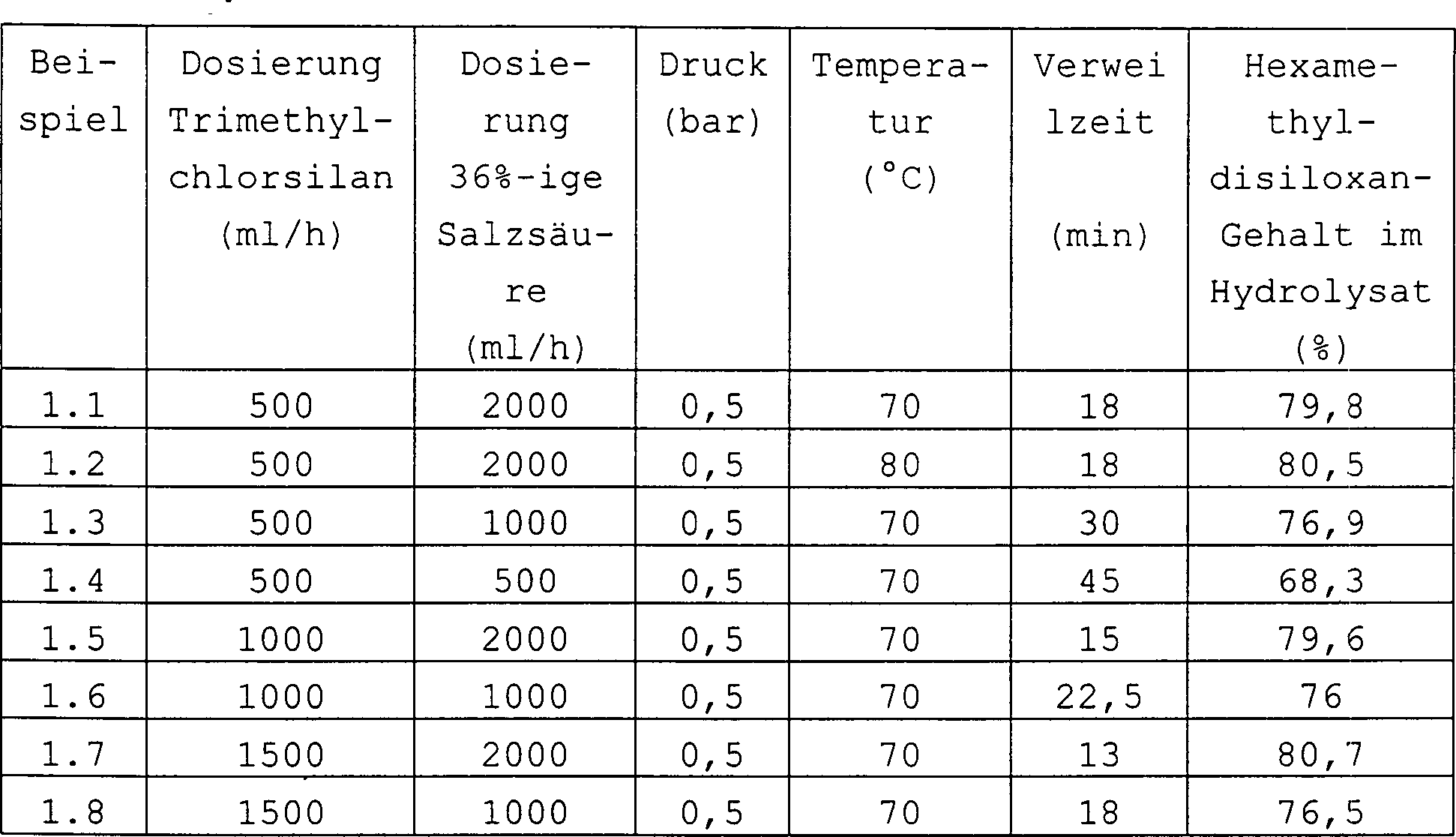
Das so erhaltene Hydrolysat wurde
nun mittels einer Füllkörperkolonne
(h=22,5 cm, d = 2,8 cm, Sumpftemperatur 85 – max. 90 °C) destilliert. Die Ergebnisse
finden sich in Tabelle 2. 
Anschließend wurde das so erhaltene Destillat mittels Loop mit Kreiselpumpe gewaschen, wobei das Verhältnis von Disiloxan (Si2) nach Destillation: Wasser wie nachstehend beschrieben ist.Then it was obtained Distillate washed using a loop with a centrifugal pump, the ratio of Disiloxane (Si2) after distillation: water as described below is.
1-stufige Wäsche: 500 g Si2, 55 g teilentsalztes Wasser 2-stufige Wäsche: 500 g Si2, 1. Stufe 40 g teilentsalztes Wasser, 2. Stufe 15 g teilentsalztes Wasser.1-stage wash: 500 g Si2, 55 g partially desalinated Water 2-stage washing: 500 g Si2, 1st stage 40 g partially demineralized water, 2nd stage 15 g partially demineralized Water.
Nach der Trennung von Disiloxan und
HCl-Dünnsäure wurde
das Si-loxan zur
Entfernung von Wasserspuren über
einen Koaleszer gegeben. Es wird Hexamethyldilsiloxan mit den in
Tabelle 3 angegebenen Eigenschaften erhalten. 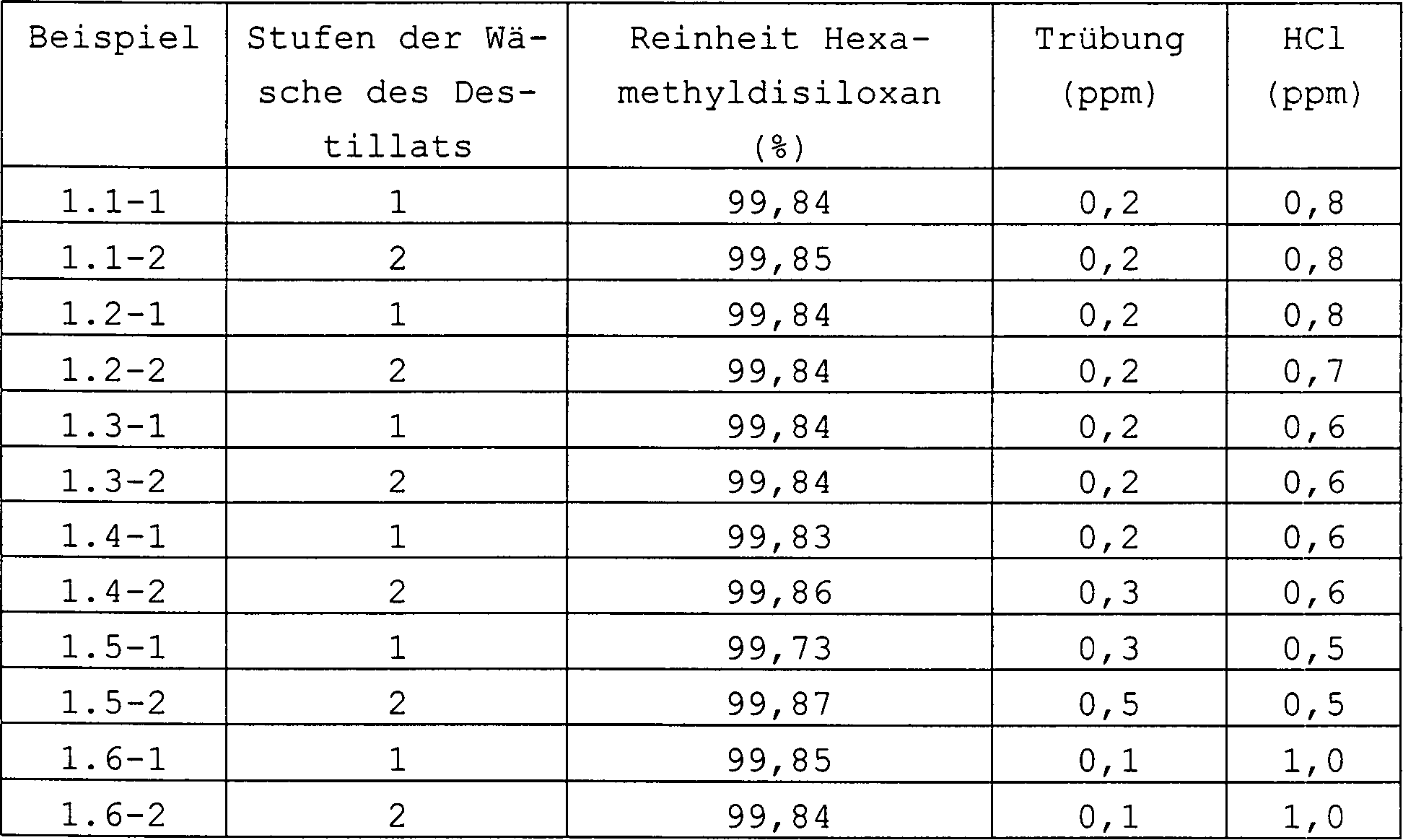
Beispiel 2 (Variante 2)Example 2 (variant 2)
Der folgende Reaktor wird verwendet:
Reaktionskolonne mit Füllkörpern, h
= 90 cm, d = 2,5 cm
Sumpf: 1 kg HexamethyldisiloxanThe following reactor is used: reaction column with packing, h = 90 cm, d = 2.5 cm
Bottom: 1 kg of hexamethyldisiloxane
Das im Sumpf befindliche Hexamethyldisiloxan wurde vor Beginn der Reaktion auf Siedetemperatur erhitzt, ebenso ca. 2/3 der Kolonne.The hexamethyldisiloxane in the sump was heated to boiling temperature before the start of the reaction, likewise about 2/3 of the column.
Die Hydrolyse wurde unter den in
Tabelle 4 angegebenen Bedingungen durchgeführt. 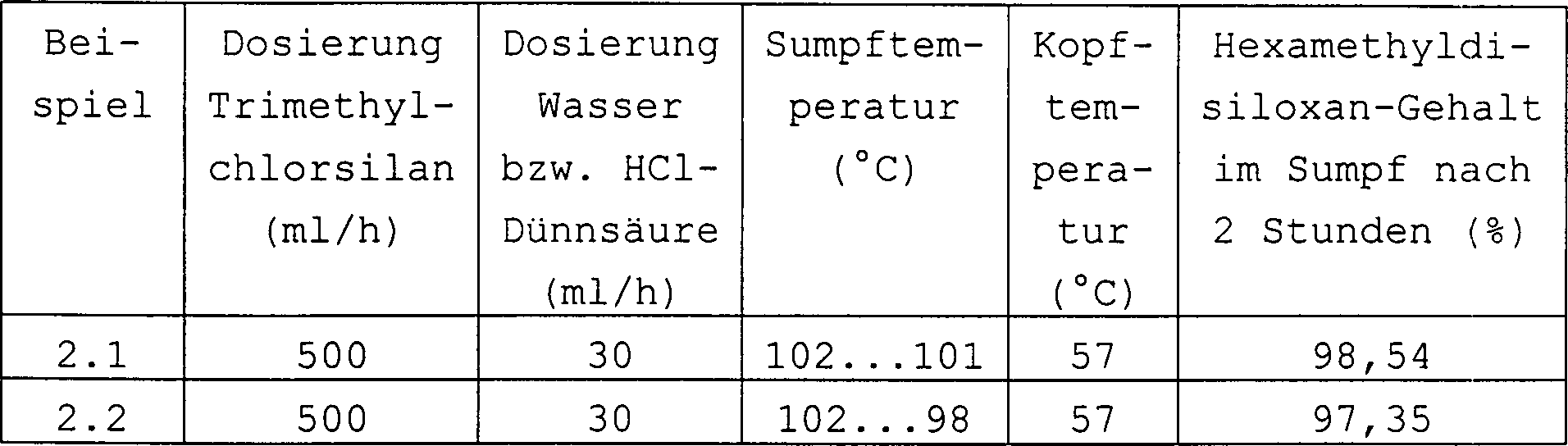
An der Sumpftemperatur ist erkennbar, wenn größere Mengen an Trimethylchlorsilan in den Sumpf durchfallen.The bottom temperature shows that if larger quantities of trimethylchlorosilane fall into the sump.
Das so erhaltene Hexamethyldisiloxan wurde wie in Beispiel 1 beschrieben gewaschen und Wasserspuren entfernt. Die Reinheit betrug in beiden Fällen ebenfalls 99,8%.The hexamethyldisiloxane thus obtained was washed as described in Example 1 and traces of water were removed. The purity was in both cases also 99.8%.
Beispiel 3 (Variante 2)Example 3 (variant 2)
Die in Beispiel 2 beschriebene Verfahrensweise
wird wiederholt mit der folgenden Abänderung: Reaktionskolonne mit
Füllkörpern,
h
= 9 0 cm, d = 2 , 5 cm
Sumpf: 1 kg TetramethyldivinyldisiloxanThe procedure described in Example 2 is repeated with the following modification: reaction column with packing,
h = 90 cm, d = 2.5 cm
Bottom: 1 kg of tetramethyldivinyldisiloxane
Die Hydrolyse wurde unter den in
Tabelle 5 angegebenen Bedingungen durchgeführt. 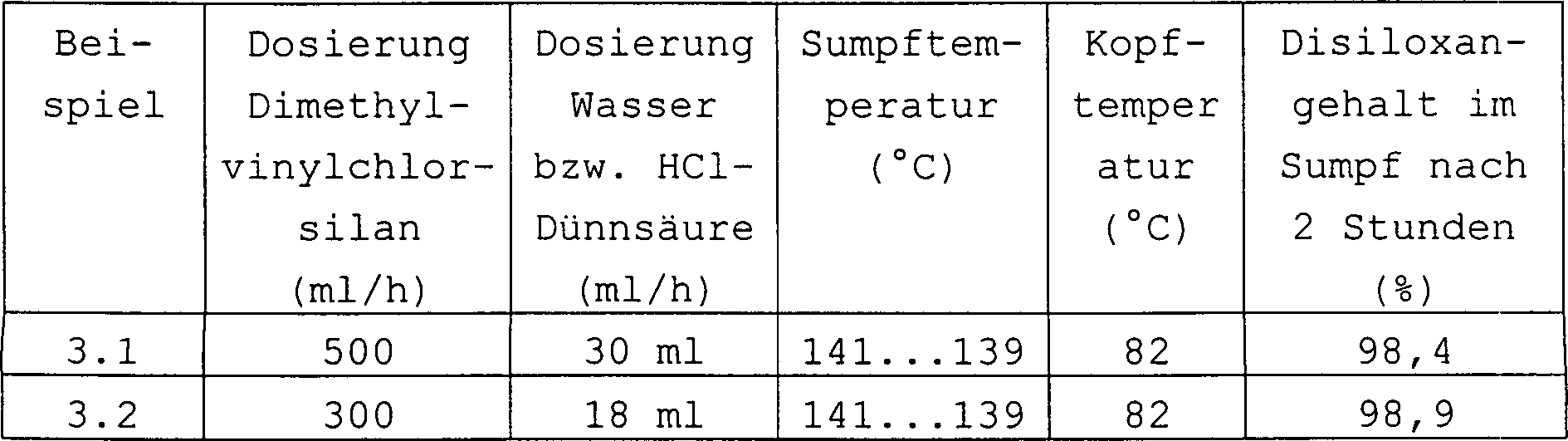
Das so erhaltene Hexamethyldisiloxan wurde wie in Beispiel 1 beschrieben gewaschen und Wasserspuren entfernt. Die Reinheit betrug in beiden Fällen ebenfalls 99,8.The hexamethyldisiloxane thus obtained was washed as described in Example 1 and traces of water were removed. The purity was in both cases also 99.8.
Claims (5)
Priority Applications (1)
| Application Number | Priority Date | Filing Date | Title |
|---|---|---|---|
| DE2003140887 DE10340887B4 (en) | 2003-09-04 | 2003-09-04 | Process for the preparation of disiloxanes |
Applications Claiming Priority (1)
| Application Number | Priority Date | Filing Date | Title |
|---|---|---|---|
| DE2003140887 DE10340887B4 (en) | 2003-09-04 | 2003-09-04 | Process for the preparation of disiloxanes |
Publications (2)
| Publication Number | Publication Date |
|---|---|
| DE10340887A1 true DE10340887A1 (en) | 2004-03-18 |
| DE10340887B4 DE10340887B4 (en) | 2005-01-05 |
Family
ID=31724894
Family Applications (1)
| Application Number | Title | Priority Date | Filing Date |
|---|---|---|---|
| DE2003140887 Expired - Fee Related DE10340887B4 (en) | 2003-09-04 | 2003-09-04 | Process for the preparation of disiloxanes |
Country Status (1)
| Country | Link |
|---|---|
| DE (1) | DE10340887B4 (en) |
Cited By (2)
| Publication number | Priority date | Publication date | Assignee | Title |
|---|---|---|---|---|
| CN102757458A (en) * | 2012-07-30 | 2012-10-31 | 嘉兴联合化学有限公司 | Method and device for preparing tetramethyldihydrodisiloxane |
| CN105061483A (en) * | 2015-08-19 | 2015-11-18 | 湖北兴瑞化工有限公司 | Method for preparing hexamethyldisiloxane by using organic silicon by-product |
Family Cites Families (4)
| Publication number | Priority date | Publication date | Assignee | Title |
|---|---|---|---|---|
| GB2112407B (en) * | 1981-12-14 | 1985-06-19 | Gen Electric | Method of hydrolyzing chlorosilanes |
| US4497942A (en) * | 1983-12-14 | 1985-02-05 | General Electric Company | Process for hydrolyzing chlorosilanes |
| US4695880A (en) * | 1985-07-30 | 1987-09-22 | Postron Corp. | Electronic information dissemination system |
| DE10146390B4 (en) * | 2001-09-20 | 2006-08-10 | Wacker Chemie Ag | Wastewater-free production of polyorganosiloxanes |
-
2003
- 2003-09-04 DE DE2003140887 patent/DE10340887B4/en not_active Expired - Fee Related
Cited By (2)
| Publication number | Priority date | Publication date | Assignee | Title |
|---|---|---|---|---|
| CN102757458A (en) * | 2012-07-30 | 2012-10-31 | 嘉兴联合化学有限公司 | Method and device for preparing tetramethyldihydrodisiloxane |
| CN105061483A (en) * | 2015-08-19 | 2015-11-18 | 湖北兴瑞化工有限公司 | Method for preparing hexamethyldisiloxane by using organic silicon by-product |
Also Published As
| Publication number | Publication date |
|---|---|
| DE10340887B4 (en) | 2005-01-05 |
Similar Documents
| Publication | Publication Date | Title |
|---|---|---|
| EP0600266B1 (en) | Process for the preparation of SiH groups-containing organopolysiloxanes | |
| EP0003285B1 (en) | Process for preparing organopolysiloxanes having functional groups | |
| DE4343033A1 (en) | Process for the preparation of polydimethylsiloxanes | |
| DE2148669C3 (en) | Process for the preparation of organosiloxanes | |
| DE10203914C1 (en) | Recovery of hydrogen chloride, used directly as raw material e.g. in chlorosilane production, involves cooling waste gas from organosilane ester production from chlorosilane and alcohol and/or glycol without condensing hydrogen chloride | |
| JP3241695B2 (en) | Method for producing hydromethylpolysiloxane having trimethylsilyl end groups | |
| DE2630744C3 (en) | Process for the conversion of organosiloxanes | |
| DE3231196A1 (en) | METHOD FOR HYDROLYZING ORGANO CHLORINE SILANES | |
| DE69127344T2 (en) | Catalyzed equilibration of polyorganosiloxanes and process for the preparation of cyclosiloxanes | |
| EP0650968A1 (en) | Process for the continuous preparation of aqueous alkali-alkyl silicate solutions | |
| FR2518099A1 (en) | HYDROLYSIS PROCESS FOR CHLOROSILANES | |
| DE69207068T2 (en) | Process for the production of organopolysiloxane | |
| DE10340887B4 (en) | Process for the preparation of disiloxanes | |
| DE2855927A1 (en) | METHOD FOR PRODUCING SILICON-FUNCTIONAL POLYORGANOSILOXANES | |
| DE2345923C3 (en) | Process for the preparation of halogen-substituted linear or branched organopolysiloxanes | |
| DE2557624C3 (en) | Process for the preparation of organosiloxanes | |
| DE60201037T2 (en) | Preparation of branched siloxanes | |
| DE60205521T2 (en) | Process for the preparation of linear organohydrosiloxanes | |
| EP0524526B1 (en) | Process for the preparation of organosiloxanes | |
| DE1929902A1 (en) | Reduction of halogen-containing silicon compounds | |
| DE60112486T2 (en) | Process for reducing the amount of linear siloxane in a mixture of cyclic and linear siloxanes | |
| DE69727288T2 (en) | Process for the production of high-purity, branched, liquid phenylsiloxanes | |
| JP2008179578A (en) | Sugar-modified cyclic silicone derivatives | |
| JP3616660B2 (en) | Method for producing cyclic tetramer siloxane | |
| DE2141881A1 (en) | Process for the production of chlorosilanes from disiloxanes |
Legal Events
| Date | Code | Title | Description |
|---|---|---|---|
| OAV | Publication of unexamined application with consent of applicant | ||
| OP8 | Request for examination as to paragraph 44 patent law | ||
| 8364 | No opposition during term of opposition | ||
| 8327 | Change in the person/name/address of the patent owner |
Owner name: WACKER CHEMIE AG, 81737 MUENCHEN, DE |
|
| 8339 | Ceased/non-payment of the annual fee |