DE10240350B4 - Apparatus and method for regenerating an electroless plating bath - Google Patents
Apparatus and method for regenerating an electroless plating bath Download PDFInfo
- Publication number
- DE10240350B4 DE10240350B4 DE10240350A DE10240350A DE10240350B4 DE 10240350 B4 DE10240350 B4 DE 10240350B4 DE 10240350 A DE10240350 A DE 10240350A DE 10240350 A DE10240350 A DE 10240350A DE 10240350 B4 DE10240350 B4 DE 10240350B4
- Authority
- DE
- Germany
- Prior art keywords
- concentrate
- liquid
- diluate
- electrodialysis
- regeneration
- Prior art date
- Legal status (The legal status is an assumption and is not a legal conclusion. Google has not performed a legal analysis and makes no representation as to the accuracy of the status listed.)
- Expired - Fee Related
Links
- 230000001172 regenerating effect Effects 0.000 title claims abstract description 13
- 238000007772 electroless plating Methods 0.000 title claims abstract description 8
- 238000000034 method Methods 0.000 title claims description 76
- 239000012141 concentrate Substances 0.000 claims abstract description 195
- 239000007788 liquid Substances 0.000 claims abstract description 135
- 150000001768 cations Chemical class 0.000 claims abstract description 113
- 229910021645 metal ion Inorganic materials 0.000 claims abstract description 39
- 239000003014 ion exchange membrane Substances 0.000 claims abstract description 14
- 238000007747 plating Methods 0.000 claims abstract description 9
- 239000000356 contaminant Substances 0.000 claims abstract description 4
- 238000000909 electrodialysis Methods 0.000 claims description 97
- 230000008929 regeneration Effects 0.000 claims description 83
- 238000011069 regeneration method Methods 0.000 claims description 83
- 239000003011 anion exchange membrane Substances 0.000 claims description 33
- 239000012528 membrane Substances 0.000 claims description 30
- 238000005341 cation exchange Methods 0.000 claims description 25
- 229910052751 metal Inorganic materials 0.000 claims description 23
- 239000002184 metal Substances 0.000 claims description 23
- 238000001465 metallisation Methods 0.000 claims description 15
- 238000003860 storage Methods 0.000 claims description 12
- 239000012530 fluid Substances 0.000 claims description 11
- PXHVJJICTQNCMI-UHFFFAOYSA-N Nickel Chemical group [Ni] PXHVJJICTQNCMI-UHFFFAOYSA-N 0.000 description 56
- ACVYVLVWPXVTIT-UHFFFAOYSA-M phosphinate Chemical compound [O-][PH2]=O ACVYVLVWPXVTIT-UHFFFAOYSA-M 0.000 description 27
- 229910052759 nickel Inorganic materials 0.000 description 26
- 239000000243 solution Substances 0.000 description 25
- 230000008569 process Effects 0.000 description 21
- 150000002500 ions Chemical class 0.000 description 20
- QAOWNCQODCNURD-UHFFFAOYSA-L Sulfate Chemical compound [O-]S([O-])(=O)=O QAOWNCQODCNURD-UHFFFAOYSA-L 0.000 description 18
- 229910001453 nickel ion Inorganic materials 0.000 description 18
- VEQPNABPJHWNSG-UHFFFAOYSA-N Nickel(2+) Chemical compound [Ni+2] VEQPNABPJHWNSG-UHFFFAOYSA-N 0.000 description 17
- 150000001450 anions Chemical class 0.000 description 17
- -1 sulfate Chemical class 0.000 description 17
- 239000003792 electrolyte Substances 0.000 description 16
- 229910001415 sodium ion Inorganic materials 0.000 description 16
- 238000000151 deposition Methods 0.000 description 11
- OAICVXFJPJFONN-UHFFFAOYSA-N Phosphorus Chemical compound [P] OAICVXFJPJFONN-UHFFFAOYSA-N 0.000 description 10
- 239000003638 chemical reducing agent Substances 0.000 description 10
- 230000008021 deposition Effects 0.000 description 10
- 238000012432 intermediate storage Methods 0.000 description 10
- 239000011574 phosphorus Substances 0.000 description 10
- 229910052698 phosphorus Inorganic materials 0.000 description 10
- 239000000126 substance Substances 0.000 description 10
- HEMHJVSKTPXQMS-UHFFFAOYSA-M Sodium hydroxide Chemical compound [OH-].[Na+] HEMHJVSKTPXQMS-UHFFFAOYSA-M 0.000 description 9
- XLYOFNOQVPJJNP-UHFFFAOYSA-N water Substances O XLYOFNOQVPJJNP-UHFFFAOYSA-N 0.000 description 9
- NWUYHJFMYQTDRP-UHFFFAOYSA-N 1,2-bis(ethenyl)benzene;1-ethenyl-2-ethylbenzene;styrene Chemical compound C=CC1=CC=CC=C1.CCC1=CC=CC=C1C=C.C=CC1=CC=CC=C1C=C NWUYHJFMYQTDRP-UHFFFAOYSA-N 0.000 description 8
- 238000000926 separation method Methods 0.000 description 8
- 238000012546 transfer Methods 0.000 description 7
- 239000000463 material Substances 0.000 description 6
- 150000003839 salts Chemical class 0.000 description 6
- 229910052708 sodium Inorganic materials 0.000 description 6
- 239000011734 sodium Substances 0.000 description 6
- DGAQECJNVWCQMB-PUAWFVPOSA-M Ilexoside XXIX Chemical compound C[C@@H]1CC[C@@]2(CC[C@@]3(C(=CC[C@H]4[C@]3(CC[C@@H]5[C@@]4(CC[C@@H](C5(C)C)OS(=O)(=O)[O-])C)C)[C@@H]2[C@]1(C)O)C)C(=O)O[C@H]6[C@@H]([C@H]([C@@H]([C@H](O6)CO)O)O)O.[Na+] DGAQECJNVWCQMB-PUAWFVPOSA-M 0.000 description 5
- 239000012535 impurity Substances 0.000 description 5
- 239000003456 ion exchange resin Substances 0.000 description 5
- 229920003303 ion-exchange polymer Polymers 0.000 description 5
- 239000002699 waste material Substances 0.000 description 5
- 238000004065 wastewater treatment Methods 0.000 description 5
- KDLHZDBZIXYQEI-UHFFFAOYSA-N Palladium Chemical compound [Pd] KDLHZDBZIXYQEI-UHFFFAOYSA-N 0.000 description 4
- 239000002253 acid Substances 0.000 description 4
- 230000008901 benefit Effects 0.000 description 4
- 239000003729 cation exchange resin Substances 0.000 description 4
- 239000008139 complexing agent Substances 0.000 description 4
- BASFCYQUMIYNBI-UHFFFAOYSA-N platinum Chemical compound [Pt] BASFCYQUMIYNBI-UHFFFAOYSA-N 0.000 description 4
- 238000004064 recycling Methods 0.000 description 4
- 239000012492 regenerant Substances 0.000 description 4
- PMZURENOXWZQFD-UHFFFAOYSA-L Sodium Sulfate Chemical compound [Na+].[Na+].[O-]S([O-])(=O)=O PMZURENOXWZQFD-UHFFFAOYSA-L 0.000 description 3
- 125000000129 anionic group Chemical group 0.000 description 3
- 150000001732 carboxylic acid derivatives Chemical class 0.000 description 3
- 239000007795 chemical reaction product Substances 0.000 description 3
- 238000005342 ion exchange Methods 0.000 description 3
- 238000001556 precipitation Methods 0.000 description 3
- 239000010865 sewage Substances 0.000 description 3
- 239000003381 stabilizer Substances 0.000 description 3
- 239000000758 substrate Substances 0.000 description 3
- 229910021653 sulphate ion Inorganic materials 0.000 description 3
- KWSLGOVYXMQPPX-UHFFFAOYSA-N 5-[3-(trifluoromethyl)phenyl]-2h-tetrazole Chemical compound FC(F)(F)C1=CC=CC(C2=NNN=N2)=C1 KWSLGOVYXMQPPX-UHFFFAOYSA-N 0.000 description 2
- RYGMFSIKBFXOCR-UHFFFAOYSA-N Copper Chemical compound [Cu] RYGMFSIKBFXOCR-UHFFFAOYSA-N 0.000 description 2
- QAOWNCQODCNURD-UHFFFAOYSA-N Sulfuric acid Chemical compound OS(O)(=O)=O QAOWNCQODCNURD-UHFFFAOYSA-N 0.000 description 2
- 238000004140 cleaning Methods 0.000 description 2
- 238000000576 coating method Methods 0.000 description 2
- 229910017052 cobalt Inorganic materials 0.000 description 2
- 239000010941 cobalt Substances 0.000 description 2
- GUTLYIVDDKVIGB-UHFFFAOYSA-N cobalt atom Chemical compound [Co] GUTLYIVDDKVIGB-UHFFFAOYSA-N 0.000 description 2
- 229910052802 copper Inorganic materials 0.000 description 2
- 239000010949 copper Substances 0.000 description 2
- 230000006378 damage Effects 0.000 description 2
- 230000005684 electric field Effects 0.000 description 2
- 238000003411 electrode reaction Methods 0.000 description 2
- PCHJSUWPFVWCPO-UHFFFAOYSA-N gold Chemical compound [Au] PCHJSUWPFVWCPO-UHFFFAOYSA-N 0.000 description 2
- 229910052737 gold Inorganic materials 0.000 description 2
- 239000010931 gold Substances 0.000 description 2
- 230000002452 interceptive effect Effects 0.000 description 2
- 238000011068 loading method Methods 0.000 description 2
- 150000002739 metals Chemical class 0.000 description 2
- 238000001139 pH measurement Methods 0.000 description 2
- 229910052763 palladium Inorganic materials 0.000 description 2
- 229910052697 platinum Inorganic materials 0.000 description 2
- 229910001379 sodium hypophosphite Inorganic materials 0.000 description 2
- 229910052938 sodium sulfate Inorganic materials 0.000 description 2
- 235000011152 sodium sulphate Nutrition 0.000 description 2
- 210000002023 somite Anatomy 0.000 description 2
- 238000005406 washing Methods 0.000 description 2
- 239000002351 wastewater Substances 0.000 description 2
- 206010010904 Convulsion Diseases 0.000 description 1
- JPVYNHNXODAKFH-UHFFFAOYSA-N Cu2+ Chemical compound [Cu+2] JPVYNHNXODAKFH-UHFFFAOYSA-N 0.000 description 1
- 241001295925 Gegenes Species 0.000 description 1
- FYYHWMGAXLPEAU-UHFFFAOYSA-N Magnesium Chemical compound [Mg] FYYHWMGAXLPEAU-UHFFFAOYSA-N 0.000 description 1
- PHJJWPXKTFKKPD-UHFFFAOYSA-N [Ni+3].[O-]P([O-])[O-] Chemical compound [Ni+3].[O-]P([O-])[O-] PHJJWPXKTFKKPD-UHFFFAOYSA-N 0.000 description 1
- 239000000654 additive Substances 0.000 description 1
- 230000002411 adverse Effects 0.000 description 1
- 239000003513 alkali Substances 0.000 description 1
- 229910045601 alloy Inorganic materials 0.000 description 1
- 239000000956 alloy Substances 0.000 description 1
- 150000003863 ammonium salts Chemical class 0.000 description 1
- 238000013459 approach Methods 0.000 description 1
- TZCXTZWJZNENPQ-UHFFFAOYSA-L barium sulfate Chemical compound [Ba+2].[O-]S([O-])(=O)=O TZCXTZWJZNENPQ-UHFFFAOYSA-L 0.000 description 1
- 239000002585 base Substances 0.000 description 1
- 230000015572 biosynthetic process Effects 0.000 description 1
- 159000000007 calcium salts Chemical class 0.000 description 1
- 150000001735 carboxylic acids Chemical class 0.000 description 1
- 125000002091 cationic group Chemical group 0.000 description 1
- 238000006243 chemical reaction Methods 0.000 description 1
- 239000000470 constituent Substances 0.000 description 1
- 238000001816 cooling Methods 0.000 description 1
- 239000013256 coordination polymer Substances 0.000 description 1
- 229910001431 copper ion Inorganic materials 0.000 description 1
- 230000007797 corrosion Effects 0.000 description 1
- 238000005260 corrosion Methods 0.000 description 1
- 230000007423 decrease Effects 0.000 description 1
- 238000013461 design Methods 0.000 description 1
- YPTUAQWMBNZZRN-UHFFFAOYSA-N dimethylaminoboron Chemical compound [B]N(C)C YPTUAQWMBNZZRN-UHFFFAOYSA-N 0.000 description 1
- 238000009826 distribution Methods 0.000 description 1
- 238000000454 electroless metal deposition Methods 0.000 description 1
- 239000008151 electrolyte solution Substances 0.000 description 1
- 230000007613 environmental effect Effects 0.000 description 1
- 238000003912 environmental pollution Methods 0.000 description 1
- 238000001704 evaporation Methods 0.000 description 1
- 230000008020 evaporation Effects 0.000 description 1
- 238000002474 experimental method Methods 0.000 description 1
- 230000002349 favourable effect Effects 0.000 description 1
- 239000000835 fiber Substances 0.000 description 1
- GQZXNSPRSGFJLY-UHFFFAOYSA-N hydroxyphosphanone Chemical compound OP=O GQZXNSPRSGFJLY-UHFFFAOYSA-N 0.000 description 1
- 229940005631 hypophosphite ion Drugs 0.000 description 1
- 239000004615 ingredient Substances 0.000 description 1
- 238000009533 lab test Methods 0.000 description 1
- 229910052747 lanthanoid Inorganic materials 0.000 description 1
- 150000002602 lanthanoids Chemical class 0.000 description 1
- 150000002611 lead compounds Chemical class 0.000 description 1
- 239000011777 magnesium Substances 0.000 description 1
- 229910052749 magnesium Inorganic materials 0.000 description 1
- 238000012423 maintenance Methods 0.000 description 1
- 230000003647 oxidation Effects 0.000 description 1
- 238000007254 oxidation reaction Methods 0.000 description 1
- ACVYVLVWPXVTIT-UHFFFAOYSA-N phosphinic acid Chemical compound O[PH2]=O ACVYVLVWPXVTIT-UHFFFAOYSA-N 0.000 description 1
- 239000000047 product Substances 0.000 description 1
- 238000006722 reduction reaction Methods 0.000 description 1
- 239000011347 resin Substances 0.000 description 1
- 229920005989 resin Polymers 0.000 description 1
- 239000008237 rinsing water Substances 0.000 description 1
- 239000012266 salt solution Substances 0.000 description 1
- 239000010802 sludge Substances 0.000 description 1
- 239000012279 sodium borohydride Substances 0.000 description 1
- 229910000033 sodium borohydride Inorganic materials 0.000 description 1
- 238000001179 sorption measurement Methods 0.000 description 1
- 241000894007 species Species 0.000 description 1
- 230000006641 stabilisation Effects 0.000 description 1
- 238000011105 stabilization Methods 0.000 description 1
- 239000013589 supplement Substances 0.000 description 1
- 230000007704 transition Effects 0.000 description 1
- 230000007306 turnover Effects 0.000 description 1
- 239000003643 water by type Substances 0.000 description 1
- 229910052727 yttrium Inorganic materials 0.000 description 1
- VWQVUPCCIRVNHF-UHFFFAOYSA-N yttrium atom Chemical compound [Y] VWQVUPCCIRVNHF-UHFFFAOYSA-N 0.000 description 1
Classifications
-
- C—CHEMISTRY; METALLURGY
- C02—TREATMENT OF WATER, WASTE WATER, SEWAGE, OR SLUDGE
- C02F—TREATMENT OF WATER, WASTE WATER, SEWAGE, OR SLUDGE
- C02F1/00—Treatment of water, waste water, or sewage
- C02F1/42—Treatment of water, waste water, or sewage by ion-exchange
-
- B—PERFORMING OPERATIONS; TRANSPORTING
- B01—PHYSICAL OR CHEMICAL PROCESSES OR APPARATUS IN GENERAL
- B01D—SEPARATION
- B01D61/00—Processes of separation using semi-permeable membranes, e.g. dialysis, osmosis or ultrafiltration; Apparatus, accessories or auxiliary operations specially adapted therefor
- B01D61/42—Electrodialysis; Electro-osmosis ; Electro-ultrafiltration; Membrane capacitive deionization
- B01D61/44—Ion-selective electrodialysis
-
- B—PERFORMING OPERATIONS; TRANSPORTING
- B01—PHYSICAL OR CHEMICAL PROCESSES OR APPARATUS IN GENERAL
- B01D—SEPARATION
- B01D61/00—Processes of separation using semi-permeable membranes, e.g. dialysis, osmosis or ultrafiltration; Apparatus, accessories or auxiliary operations specially adapted therefor
- B01D61/42—Electrodialysis; Electro-osmosis ; Electro-ultrafiltration; Membrane capacitive deionization
- B01D61/44—Ion-selective electrodialysis
- B01D61/52—Accessories; Auxiliary operation
-
- C—CHEMISTRY; METALLURGY
- C23—COATING METALLIC MATERIAL; COATING MATERIAL WITH METALLIC MATERIAL; CHEMICAL SURFACE TREATMENT; DIFFUSION TREATMENT OF METALLIC MATERIAL; COATING BY VACUUM EVAPORATION, BY SPUTTERING, BY ION IMPLANTATION OR BY CHEMICAL VAPOUR DEPOSITION, IN GENERAL; INHIBITING CORROSION OF METALLIC MATERIAL OR INCRUSTATION IN GENERAL
- C23C—COATING METALLIC MATERIAL; COATING MATERIAL WITH METALLIC MATERIAL; SURFACE TREATMENT OF METALLIC MATERIAL BY DIFFUSION INTO THE SURFACE, BY CHEMICAL CONVERSION OR SUBSTITUTION; COATING BY VACUUM EVAPORATION, BY SPUTTERING, BY ION IMPLANTATION OR BY CHEMICAL VAPOUR DEPOSITION, IN GENERAL
- C23C18/00—Chemical coating by decomposition of either liquid compounds or solutions of the coating forming compounds, without leaving reaction products of surface material in the coating; Contact plating
- C23C18/16—Chemical coating by decomposition of either liquid compounds or solutions of the coating forming compounds, without leaving reaction products of surface material in the coating; Contact plating by reduction or substitution, e.g. electroless plating
- C23C18/1601—Process or apparatus
- C23C18/1617—Purification and regeneration of coating baths
-
- C—CHEMISTRY; METALLURGY
- C23—COATING METALLIC MATERIAL; COATING MATERIAL WITH METALLIC MATERIAL; CHEMICAL SURFACE TREATMENT; DIFFUSION TREATMENT OF METALLIC MATERIAL; COATING BY VACUUM EVAPORATION, BY SPUTTERING, BY ION IMPLANTATION OR BY CHEMICAL VAPOUR DEPOSITION, IN GENERAL; INHIBITING CORROSION OF METALLIC MATERIAL OR INCRUSTATION IN GENERAL
- C23C—COATING METALLIC MATERIAL; COATING MATERIAL WITH METALLIC MATERIAL; SURFACE TREATMENT OF METALLIC MATERIAL BY DIFFUSION INTO THE SURFACE, BY CHEMICAL CONVERSION OR SUBSTITUTION; COATING BY VACUUM EVAPORATION, BY SPUTTERING, BY ION IMPLANTATION OR BY CHEMICAL VAPOUR DEPOSITION, IN GENERAL
- C23C18/00—Chemical coating by decomposition of either liquid compounds or solutions of the coating forming compounds, without leaving reaction products of surface material in the coating; Contact plating
- C23C18/16—Chemical coating by decomposition of either liquid compounds or solutions of the coating forming compounds, without leaving reaction products of surface material in the coating; Contact plating by reduction or substitution, e.g. electroless plating
- C23C18/1601—Process or apparatus
- C23C18/1633—Process of electroless plating
-
- C—CHEMISTRY; METALLURGY
- C23—COATING METALLIC MATERIAL; COATING MATERIAL WITH METALLIC MATERIAL; CHEMICAL SURFACE TREATMENT; DIFFUSION TREATMENT OF METALLIC MATERIAL; COATING BY VACUUM EVAPORATION, BY SPUTTERING, BY ION IMPLANTATION OR BY CHEMICAL VAPOUR DEPOSITION, IN GENERAL; INHIBITING CORROSION OF METALLIC MATERIAL OR INCRUSTATION IN GENERAL
- C23C—COATING METALLIC MATERIAL; COATING MATERIAL WITH METALLIC MATERIAL; SURFACE TREATMENT OF METALLIC MATERIAL BY DIFFUSION INTO THE SURFACE, BY CHEMICAL CONVERSION OR SUBSTITUTION; COATING BY VACUUM EVAPORATION, BY SPUTTERING, BY ION IMPLANTATION OR BY CHEMICAL VAPOUR DEPOSITION, IN GENERAL
- C23C18/00—Chemical coating by decomposition of either liquid compounds or solutions of the coating forming compounds, without leaving reaction products of surface material in the coating; Contact plating
- C23C18/16—Chemical coating by decomposition of either liquid compounds or solutions of the coating forming compounds, without leaving reaction products of surface material in the coating; Contact plating by reduction or substitution, e.g. electroless plating
- C23C18/31—Coating with metals
-
- C—CHEMISTRY; METALLURGY
- C02—TREATMENT OF WATER, WASTE WATER, SEWAGE, OR SLUDGE
- C02F—TREATMENT OF WATER, WASTE WATER, SEWAGE, OR SLUDGE
- C02F1/00—Treatment of water, waste water, or sewage
- C02F1/46—Treatment of water, waste water, or sewage by electrochemical methods
- C02F1/469—Treatment of water, waste water, or sewage by electrochemical methods by electrochemical separation, e.g. by electro-osmosis, electrodialysis, electrophoresis
-
- C—CHEMISTRY; METALLURGY
- C02—TREATMENT OF WATER, WASTE WATER, SEWAGE, OR SLUDGE
- C02F—TREATMENT OF WATER, WASTE WATER, SEWAGE, OR SLUDGE
- C02F1/00—Treatment of water, waste water, or sewage
- C02F1/42—Treatment of water, waste water, or sewage by ion-exchange
- C02F2001/425—Treatment of water, waste water, or sewage by ion-exchange using cation exchangers
-
- C—CHEMISTRY; METALLURGY
- C02—TREATMENT OF WATER, WASTE WATER, SEWAGE, OR SLUDGE
- C02F—TREATMENT OF WATER, WASTE WATER, SEWAGE, OR SLUDGE
- C02F2103/00—Nature of the water, waste water, sewage or sludge to be treated
- C02F2103/16—Nature of the water, waste water, sewage or sludge to be treated from metallurgical processes, i.e. from the production, refining or treatment of metals, e.g. galvanic wastes
-
- C—CHEMISTRY; METALLURGY
- C02—TREATMENT OF WATER, WASTE WATER, SEWAGE, OR SLUDGE
- C02F—TREATMENT OF WATER, WASTE WATER, SEWAGE, OR SLUDGE
- C02F2201/00—Apparatus for treatment of water, waste water or sewage
- C02F2201/46—Apparatus for electrochemical processes
- C02F2201/461—Electrolysis apparatus
- C02F2201/46105—Details relating to the electrolytic devices
- C02F2201/46115—Electrolytic cell with membranes or diaphragms
Landscapes
- Chemical & Material Sciences (AREA)
- Engineering & Computer Science (AREA)
- Water Supply & Treatment (AREA)
- Chemical Kinetics & Catalysis (AREA)
- Organic Chemistry (AREA)
- Health & Medical Sciences (AREA)
- General Chemical & Material Sciences (AREA)
- Urology & Nephrology (AREA)
- Life Sciences & Earth Sciences (AREA)
- Metallurgy (AREA)
- Mechanical Engineering (AREA)
- Materials Engineering (AREA)
- Hydrology & Water Resources (AREA)
- Environmental & Geological Engineering (AREA)
- Analytical Chemistry (AREA)
- Molecular Biology (AREA)
- Electrochemistry (AREA)
- Water Treatment By Electricity Or Magnetism (AREA)
- Separation Using Semi-Permeable Membranes (AREA)
- Chemically Coating (AREA)
Abstract
Vorrichtung zum Regenerieren eines stromlosen Metallabscheidebades, umfassend Elektrodialyseeinrichtungen mit jeweiligen Diluaträumen zur Aufnahme des Metallabscheidebades, mit jeweiligen von den Diluaträumen durch Ionenaustauschermembranen getrennten Konzentraträumen zur Aufnahme einer Konzentratflüssigkeit, die zur Aufnahme zu entfernender Störstoffe aus dem Metallabscheidebad dient, sowie mit Anoden und Kathoden, dadurch gekennzeichnet, dass zusätzlich Hauptkationenaustauscher (Ix) zur Entfernung von Metallionen aus der Konzentratflüssigkeit vorgesehen sind, die mit den Konzentraträumen (Koxy) so verbunden sind, dass die Konzentratflüssigkeit durch die Hauptkationenaustauscher (Ix) hindurch geleitet und zu den Konzentraträumen (Koxy) wieder zurückgeleitet werden kann.Apparatus for regenerating an electroless plating bath comprising electrodialysers having respective diluate compartments for receiving the plating bath, respective concentrate compartments separated from the diluate compartments by ion exchange membranes for receiving a concentrate liquid for receiving contaminants to be removed from the plating bath and anodes and cathodes in that there are additionally provided main cation exchangers (Ix) for removing metal ions from the concentrate liquid, which are connected to the concentrate compartments (Koxy) so that the concentrate liquid is passed through the main cation exchangers (I x ) and returned to the concentrate compartments (Koxy) can.
Description
Die Erfindung betrifft eine Vorrichtung und ein Verfahren zum Regenerieren eines stromlosen, insbesondere Hypophosphit enthaltenden Metallabscheidebades. Die Erfindung dient insbesondere zum elektrodialytischen Regenerieren von Bädern zum stromlosen Abscheiden von Nickelschichten, insbesondere Nickel/Phosphor-Schichten.The The invention relates to an apparatus and a method for regeneration an electroless, especially hypophosphite-containing Metallabscheidebades. The invention is used in particular for electrodialytic regeneration from baths to electroless deposition of nickel layers, in particular nickel / phosphorus layers.
Die stromlose Beschichtung von Substraten mit Metallen und Legierungen ist ein autokatalytischer Prozess, bei dem gelöste Metallionen mittels eines in der Lösung befindlichen Reduktionsmittels zum Metall reduziert und auf einem geeigneten Substrat abgeschieden werden. Oft werden dabei noch weitere Komponenten mit in die Schicht eingebaut, beispielsweise Phosphor.The electroless plating of substrates with metals and alloys is an autocatalytic process in which dissolved metal ions by means of a in the solution reduced reducing agent to the metal reduced and on a suitable substrate are deposited. Often there will be more Components incorporated in the layer, for example phosphorus.
Üblicherweise werden mit einem derartigen Verfahren Metalle, wie Nickel, Kupfer, Kobalt, Palladium, Platin und Gold, auf ein Substrat aufgebracht. Als Reduktionsmittel dienen in den meisten Fällen Natriumhypophosphit, Natriumborhydrid oder Dimethylaminoboran.Usually With such a method, metals such as nickel, copper, Cobalt, palladium, platinum and gold, applied to a substrate. When Reducing agents serve in most cases sodium hypophosphite, sodium borohydride or dimethylaminoborane.
Gegenüber den herkömmlichen galvanischen Verfahren zur Metallabscheidung weisen die stromlos abgeschiedenen Schichten eine Reihe von Vorteilen auf, wie homogene Schichtverteilung, günstige mechanische Eigenschaften und hohe Korrosionsbeständigkeit.Compared to the usual galvanic processes for metal deposition have the de-energized deposited layers have a number of advantages, such as homogeneous Layer distribution, favorable mechanical properties and high corrosion resistance.
Im folgenden wird das erfindungsgemäße Verfahren für das Beispiel der Abscheidung von Nickel/Phosphor-Schichten mittels Hypophosphit beschrieben.in the The following is the process of the invention for the Example of the deposition of nickel / phosphorus layers by means of hypophosphite described.
Das
Verfahren lässt
sich aber auch für
andere stromlose Metallisierungsverfahren einsetzen:
Der wesentliche
Prozess bei der stromlosen Nickelabscheidung ist in folgender Gleichung
dargestellt:
The essential process in electroless nickel deposition is shown in the following equation:
Bei der stromlosen Nickelabscheidung werden also ständig gelöste Nickelionen und das Reduktionsmittel Hypophosphit verbraucht, während die Konzentration des Oxidationsprodukts Orthophosphit (H2PO3 –, HPO3 2–) zunimmt. Die Nickel- und Hypophosphit-Konzentration müssen im Bad innerhalb einer schmalen Bandbreite gehalten werden. Daher müssen diese Bestandteile fortwährend ergänzt werden. Die Metallionen werden in Form von Salzen ergänzt, wodurch sich gleichzeitig störende Anionen, wie beispielsweise Sulfat, im Bad anreichern.In the electroless nickel deposition so constantly dissolved nickel ions and the reducing agent hypophosphite are consumed while the concentration of the oxidation product orthophosphite (H 2 PO 3 - , HPO 3 2- ) increases. The nickel and hypophosphite concentrations must be kept within a narrow range in the bath. Therefore, these ingredients have to be continually added. The metal ions are supplemented in the form of salts, whereby at the same time disturbing anions, such as sulfate, accumulate in the bath.
Da das Reduktionsmittel und die die Nickelionen enthaltenden Salze bei der Abscheidereaktion ferner Reaktionsprodukte hinterlassen, die sich in dem Abscheidebad anreichern, ist die Lebensdauer des Bades zwangsläufig begrenzt. Das Alter eines Bades wird üblicherweise in Metall-Turn-Over (MTO) angegeben. Wenn die gesamte Menge der normalen anfänglichen Metallkonzentration aus einer Volumeneinheit abgeschieden worden ist, ist 1 MTO erreicht. Nach üblicherweise 6–10 MTO erreichen die Störstoffe eine so hohe Konzentration, dass die Qualität und die Abscheidegeschwindigkeit des Metalls außerhalb der tolerierbaren Bereiche liegen. Nach dem Stand der Technik werden diese Bäder dann entsorgt, und es muss ein neues Bad angesetzt werden.There the reducing agent and the salts containing the nickel ions leave reaction products in the deposition reaction, which accumulate in the Abscheidebad is the life of the Bades inevitably limited. The age of a bath is usually in metal turn-over (MTO) indicated. If the entire amount of normal initial Metal concentration has been deposited from a volume unit is, 1 MTO is reached. After usually 6-10 MTO reach the impurities such a high concentration that the quality and the deposition rate of the metal outside the tolerable ranges lie. According to the state of the art these baths then disposed of, and it must be set up a new bathroom.
Die notwendige Entsorgung und der erforderliche Neuansatz der Bäder führt zu hohen Kosten und zur Umweltbelastungen. Deshalb wurden verschiedene Verfahren vorgeschlagen, mit denen die Standzeit der Bäder zur stromlosen Metallabscheidung verlängert werden kann.The necessary disposal and the required new approach of the baths leads to high Costs and environmental impact. Therefore, different procedures proposed, with which the service life of the baths for electroless metal deposition extended can be.
In
Von C.D. Iacovangelo wird in "Plating and Surface Finishing", September 1995, Seiten 77 bis 82, vorgeschlagen, die störende Ausfällung von Nickelorthophosphit durch Zugabe von Komplexbildnern zu verhindern. Dadurch wird die Konzentration an gelösten freien Nickelionen verringert.From CD. Iacovangelo is in "Plating and Surface Finishing ", September 1995, pages 77 to 82, proposed the disruptive precipitation of To prevent nickel orthophosphite by addition of complexing agents. This reduces the concentration of dissolved free nickel ions.
Bei dem ENVIRO CP-Verfahren von Firma Martin Marietta, U.S.A. werden die störenden Komponenten im Bad mittels Adsorption an Ionenaustauscherharzen abgetrennt. Zur vollständigen Abtrennung und Regenerierung des Abscheidebades wird ein kompliziertes Verfahren durchgeführt, bei dem mehrere unterschiedliche Ionenaustauschersäulen und Behälter für diverse Prozessflüssigkeiten benötigt werden.at the ENVIRO CP process from Martin Marietta, U.S.A. the disturbing ones Components in the bath by adsorption on ion exchange resins separated. To the complete Separation and regeneration of the precipitation bath becomes a complicated one Procedure performed, in which several different ion exchange columns and container for various process fluids needed become.
Eine weitere Möglichkeit zur Regenerierung von stromlosen Nickelbädern besteht darin, ein elektrodialytisches Verfahren anzuwenden. Beim Elektrodialyseverfahren werden geladene Ionen durch permselektive Ionenaustauschermembranen in einem elektrischen Feld transportiert (überführt), so dass Wertstoffionen von Störstoffionen in geeigneter Weise getrennt werden können.A another possibility for the regeneration of electroless nickel baths is an electrodialytic Apply method. In the electrodialysis process are charged Ions through permselective ion exchange membranes in an electrical Field transported (transferred), so that Valuable substances of contaminant ions can be separated in a suitable manner.
Von Y. Kuboi und R. Takeshita wird ein elektrodialytisches Verfahren zur Abtrennung der unerwünschten Badkomponenten beschrieben (Electroless Nickel Conference 1989, Proceedings, Prod. Finishing Magazine, 1989, Seiten 16-1 bis 16-15). Bei diesem Verfahren wird das stromlose Nickelbad als sogenanntes Diluat durch eine Elektrodialysezelle geleitet. Der Diluatraum in der Elektrodialysezelle ist hierzu anodenseitig durch eine Anionenaustauschermembran von dem mit der Anode in Kontakt stehenden Anodenraum und kathodenseitig durch eine Kationenaustauschermembran von dem mit der Kathode in Kontakt stehenden Kathodenraum getrennt. Diese beiden letztgenannten Räume werden auch als Konzentraträume bezeichnet. Die im Abscheidebad unerwünschten Sulfat- und Orthophosphitionen werden in den Anodenraum und die unerwünschten Natriumionen, die vom eingesetzten Natriumhypophosphit herrühren, in den Kathodenraum überführt. In Laboratoriumsversuchen hat sich jedoch herausgestellt, dass neben den unerwünschten Sulfat-, Orthophosphit- und Natriumionen auch die für das Abscheideverfahren wichtigen Badbestandteile, nämlich die Nickel-, Hypophosphitionen und die organischen Komplexbildner (meist Carbonsäuren bzw. deren Anionen) in die Konzentraträume überführt werden.By Y. Kuboi and R. Takeshita becomes an elek trodialytisches method for the separation of the unwanted bath components described (Electroless Nickel Conference 1989, Proceedings, Prod. Finishing Magazine, 1989, pages 16-1 to 16-15). In this process, the electroless nickel bath is passed as a so-called diluate through an electrodialysis cell. For this purpose, the diluate space in the electrodialysis cell is separated on the anode side by an anode exchange membrane from the anode space in contact with the anode and on the cathode side by a cation exchange membrane from the cathode space in contact with the cathode. These latter two rooms are also referred to as concentrate rooms. The sulphate and orthophosphite ions, which are undesirable in the deposition bath, are transferred into the anode chamber and the undesired sodium ions, which originate from the sodium hypophosphite used, are introduced into the cathode compartment. In laboratory experiments, however, it has been found that in addition to the undesirable sulfate, orthophosphite and sodium ions, the bath constituents which are important for the precipitation process, namely the nickel, hypophosphite ions and the organic complexing agents (usually carboxylic acids or their anions), are transferred into the concentrate compartments.
In
Auch
in
Um
die Nachteile der vorstehend beschriebenen Verfahren zu beheben,
wurde in
In der zweiten Variante, die als einstufiges Verfahren ausgebildet ist, wird die Badlösung in den Kathodenraum einer aus drei Elektrolyträumen bestehenden Elektrodialysezelle gegeben, wobei der mittlere Raum von den anderen Räumen anodenseitig durch eine monoselektive Anionenaustauschermembran und kathodenseitig durch eine monoselektive Kationenaustauschermembran abgetrennt ist. Die Lösung, die in dem Anodenraum enthalten ist, wird in den Kathodenraum geleitet. Die Badlösung wird zunächst in den Kathodenraum eingeleitet. Hypophosphit- und Orthophosphitionen sollen in den mittleren Raum überführt werden. Dies erscheint jedoch unmöglich, da zwischen beiden Räumen eine Kationenaustauschermembran angeordnet ist. Aus diesem Grunde ist nicht erkennbar, wie das Verfahren realisiert werden kann.In the second variant, which is designed as a one-step process, the bath solution is added to the cathode compartment of an electrodialysis cell consisting of three electrolyte spaces, wherein the middle space of the other rooms on the anode side by a monoselective anion exchanger membrane and cathode side is separated by a monoselective cation exchange membrane. The solution contained in the anode compartment is passed into the cathode compartment. The bath solution is first introduced into the cathode compartment. Hypophosphite and orthophosphite ions are to be transferred into the middle space. However, this seems impossible, since a cation exchange membrane is arranged between the two chambers. For this reason, it is not clear how the method can be realized.
In
Die bekannten Verfahren und Vorrichtungen weisen verschiedene Nachteile auf:
- 1. Je nach den verwendeten Membrantypen kann der Verlust an Metallionen vom Wertstoffkreislauf (Diluat) in den Abfallkreislauf (Konzentrat) bis zu 10 der im Metallisierungsbad abgeschiedenen Menge betragen. Somit treten Wertstoffverluste auf.
- 2. Der Abfallstrom enthält einen nicht unbeträchtlichen Gehalt an Metallionen, beispielsweise Nickelionen, was einen entsprechenden Aufwand bei der Abwasserbehandlung erfordert und zu einem entsprechenden Anfall an Metallschlammführt.
- 3. Der größte Nachteil der bekannten Verfahren und Vorrichtung besteht in der Gefahr, dass sich unerwünschte Ausplattierungen innerhalb der Regenerationsvorrichtung bilden. Dies vermindert zum einen die Anlagenverfügbarkeit durch unvermeidliche Reinigungszyklen (Metallstrippen) und führt zum anderen zu Schäden und Effizienzverlusten an der Anlage.
- 1. Depending on the type of membrane used, the loss of metal ions from the recycle (diluate) to the waste cycle (concentrate) may be up to 10% of the amount deposited in the metallization bath. Thus, material losses occur.
- 2. The waste stream contains a not inconsiderable amount of metal ions, such as nickel ions, which requires a corresponding effort in wastewater treatment and leads to a corresponding attack of metal sludge.
- 3. The major disadvantage of the known methods and apparatus is the risk that form unwanted Ausplattierungen within the regeneration device. On the one hand, this reduces system availability through unavoidable cleaning cycles (metal stripping) and, on the other hand, leads to damage and loss of efficiency in the system.
Der vorliegenden Erfindung liegt von daher die Aufgabe zugrunde, die Nachteile der bekannten Verfahren und Vorrichtungen zu vermeiden und insbesondere ein Verfahren und eine Vorrichtung zu finden, mit denen Metallabscheidebäder regeneriert werden können, die insbesondere Hypophosphit als Reduktionsmittel enthalten. Durch die Erfindung soll insbesondere erreicht werden, dass die Wertstoffe (Metallionen, Reduktionsmittel, Komplexbildner) weitgehend im Wertstoffkreislauf erhalten bleiben und dass die Störstoffe (Reaktionsprodukte, Ballaststoffe) möglichst weitgehend aus dem Wertstoffkreislauf entfernt werden.Of the The present invention is therefore based on the object, the Disadvantages of the known methods and devices to avoid and in particular to find a method and a device with which Metallabscheidebäder can be regenerated, which in particular contain hypophosphite as a reducing agent. By the invention is to be achieved in particular that the valuable substances (metal ions, Reducing agent, complexing agent) largely in the recycling cycle Preserve and that the impurities (Reaction products, fiber) as much as possible from the Recyclable material cycle are removed.
Das Problem wird gelöst durch die Vorrichtung zum Regenerieren eines stromlosen Metallabscheidebades gemäß Anspruch 1 und das Verfahren zum Regenerieren eines stromlosen Metallabscheidebades gemäß Anspruch 8. Bevorzugte Ausführungsformen der Erfindung sind in den Unteransprüchen angegeben.The Problem is solved by the apparatus for regenerating an electroless plating bath according to claim 1 and the method for regenerating an electroless plating bath according to claim 8. Preferred embodiments The invention are specified in the subclaims.
Sofern in der nachfolgenden Beschreibung der Erfindung und den Patentansprüchen auf Elektrodialyseeinrichtungen, Diluaträume, Konzentraträume, Hauptkationenaustauscher, Anionenaustauscher, Ionenaustauschermembranen, Kathoden, Anoden, Stromversorgungen, Vorlagebehälter, Regenerierflüssigkeitsbehälter, Zwischenspeicherbehälter bzw. Sicherheitskationenaustauscher Bezug genommen wird, so soll es sich um eine Elektrodialyseeinrichtung oder mehrere Elektrodialyseeinrichtungen, einen Diluatraum oder mehrere Diluaträume, einen Konzentratraum oder mehrere Konzentraträume, einen oder mehrere Hauptkationenaustauscher, einen oder mehrere Anionenaustauscher, eine Ionenaustauschermembran oder mehrere Ionenaustauschermembranen, eine Kathode oder mehrere Kathoden, eine Anode oder mehrere Anoden, eine Stromversorgung oder mehrere Stromversorgungen, einen oder mehrere Vorlagebehälter, einen oder mehrere Regenerierflüssigkeitsbehälter, einen oder mehrere Zwischenspeicherbehälter bzw. einen oder mehrere Sicherheitskationenaustauscher handeln.Provided in the following description of the invention and the claims Electrodialysis equipment, diluate rooms, concentrate rooms, main cation exchanger, Anion exchangers, ion exchange membranes, cathodes, anodes, Power supplies, storage tanks, Regenerierflüssigkeitsbehälter, intermediate storage tank or Safety cation exchanger is referred to, so it should be to an electrodialysis or more electrodialysis, a Diluate or multiple diluate compartments, one or more concentrate rooms, one or more main cation exchangers, one or more anion exchangers, an ion exchange membrane or more ion exchange membranes, one or more cathodes Cathodes, one anode or more anodes, a power supply or multiple power supplies, one or more storage tanks, one or more regeneration liquid containers, one or more intermediate storage containers or one or more safety cation exchangers.
Die erfindungsgemäße Vorrichtung und das Verfahren dienen vor allem zum elektrodialytischen Regenerieren eines stromlosen, insbesondere Hypophosphit enthaltenden Metallabscheidebades, beispielsweise eines Bades zum Abscheiden von Nickel-, Kobalt-, Kupfer-, Palladium-, Platin- oder Goldschichten. Die Vorrichtung und das Verfahren sind insbesondere geeignet zum elektrolytischen Regenerieren von stromlosen Nickelbädern. Die erfindungsgemäß regenerierbaren Bäder können insbesondere Hypophosphit als Reduktionsmittel enthalten. Daher kann Phosphor als Bestandteil der Schicht mit abgeschieden werden. Als Hypophosphit sind alle Hypophosphitsalze sowie die freie Säure, H3PO2, verwendbar. Salze können insbesondere als Alkali-, Erdalkali- und Ammoniumsalze eingesetzt werden.The device and the method according to the invention are primarily used for the electrodialytic regeneration of an electroless, in particular hypophosphite-containing, metal deposition bath, for example a bath for depositing nickel, cobalt, copper, palladium, platinum or gold layers. The apparatus and method are particularly suitable for the electrolytic regeneration of electroless nickel baths. The baths that can be regenerated according to the invention may contain, in particular, hypophosphite as a reducing agent. Therefore, phosphorus can be co-deposited as part of the layer. As Hypophosphit all Hypophosphitsalze and the free acid, H 3 PO 2 , usable. Salts can be used in particular as alkali, alkaline earth and ammonium salts.
Die erfindungsgemäße Vorrichtung umfasst Elektrodialyseeinrichtungen, die jeweils Diluaträume zur Aufnahme des Metallabscheidebades, jeweils von den Diluaträumen durch Ionenaustauschermembranen getrennte Konzentraträume zur Aufnahme einer Konzentratflüssigkeit, die zur Aufnahme zu entfernender Störstoffe aus dem Metallabscheidebad dient, sowie Anoden und Kathoden aufweist. Die Vorrichtung umfasst ferner zusätzlich Hauptkationenaustauscher zur Entfernung von Metallionen aus der Konzentratflüssigkeit, die mit den Konzentraträumen so verbunden sind, dass die Konzentratflüssigkeit durch die Hauptkationenaustauscher hindurch geleitet und zu den Konzentraträumen wieder zurückgeleitet werden kann. Zur elektrodialytischen Behandlung können das Metallabscheidebad durch die Diluaträume in den Elektrodialyseeinrichtungen und die Konzentratflüssigkeit durch die Konzentraträume in den Elektrodialyseeinrichtungen hindurch geleitet werden.The device according to the invention comprises Electrodialysis, each Diluaträume for receiving the Metallabscheidebades, each of the diluate spaces separated by ion exchange membranes concentrate compartments for receiving a concentrate liquid, which serves to accommodate contaminants to be removed from the Metallabscheidebad, and anodes and cathodes. The apparatus further comprises, in addition, main cation exchangers for removing metal ions from the concentrate liquid which are connected to the concentrate compartments so that the concentrate liquid can be passed through the main cation exchangers and recycled back to the concentrate compartments. For electrodialytic treatment, the metal deposition bath may be passed through the diluate compartments in the electrodialysis units and the concentrate liquid through the concentrate compartments into the electrodialysis units.
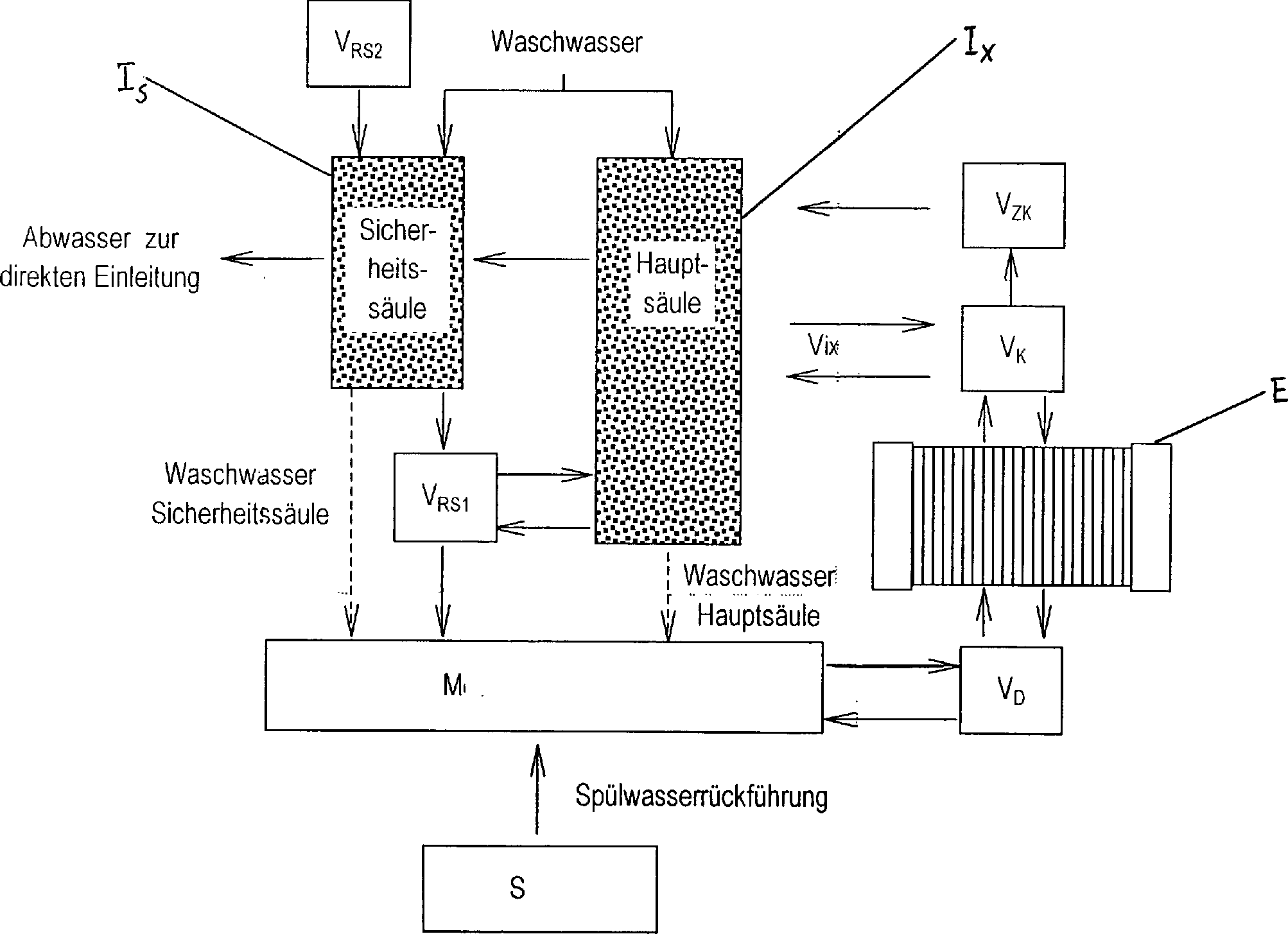
Zusätzlich zu den Elektrodialyseeinrichtungen wird somit in erfindungsgemäßer Weise ein Ionenaustauschersystem (Hauptkationenaustauscher) so an die Regeneriereinrichtung gekoppelt, dass Konzentratflüssigkeit durch den Hauptkationenaustauscher fließen kann. Die Konzentratflüssigkeit wird einer oder mehreren Hauptsäulen (Hauptkationenaustauschern) zugeführt, die das Ionenaustauscherharz enthalten. Das Ionenaustauscherharz ist ein Kationenaustauscherharz. Derartige Harze sind kommerziell erhältlich, beispielsweise von Bayer (Lewatit®-Typen). Das Kationenaustauscherharz bindet die Metallionen, beispielsweise Nickel- oder Kupferionen, und tauscht diese gegen H3O+- oder Natriumionen aus. Die Konzentratflüssigkeit wird nach Durchlaufen des Hauptkationenaustauschers wieder zu den Konzentraträumen der Elektrodialyseeinrichtung zurückgeleitet.In addition to the electrodialysis devices, an ion exchange system (main cation exchanger) is thus coupled to the regeneration device in accordance with the invention such that concentrate fluid can flow through the main cation exchanger. The concentrate liquid is supplied to one or more main columns (main cation exchangers) containing the ion exchange resin. The ion exchange resin is a cation exchange resin. Such resins are commercially available, for example from Bayer (Lewatit ® grades). The cation exchange resin binds the metal ions, for example nickel or copper ions, and exchanges them for H 3 O + or sodium ions. The concentrate liquid is returned to the concentrate compartments of the electrodialysis unit after passing through the main cation exchanger.
Mit der Erfindung wird erreicht, dass ein Verlust an Metallionen vom Wertstoffkreislauf (Diluat) in den Abfallkreislauf (Konzentrat) nicht zu den beschriebenen Nachteilen führt. Durch die Abtrennung der Metallionen aus dem Konzentrat werden nachfolgende Vorteile erreicht:
- 1. Durch Abtrennung der Metallionen aus dem Konzentrat mittels Kationenaustausch findet eine Aufkonzentrierung der Metallionen, beispielsweise Nickelionen, im Hauptkationenaustauscher statt. Dadurch ist eine Wiederaufbereitung der in das Konzentrat überführten Metallionen möglich, die somit in den Wertstoffkreislauf wieder zurückgeführt werden können. Dadurch werden Wertstoffverluste minimiert.
- 2. Weiterhin können durch die Abtrennung der Metallionen aus dem Konzentrat auch die Kosten der Abwasserbehandlung gesenkt werden, da die Behandlung mit dem Hauptkationenaustauscher wesentlich weniger aufwendig ist als eine herkömmliche Abwasserbehandlung, bei der zusätzlich erhebliche Mengen von Chemikalien eingesetzt werden müssen, um die Metallionen aus dem Bad auszufällen. In vielen Fällen ist es überhaupt nicht möglich, die Metallionen aus der Konzentratlösung zu entfernen, da diese gegebenenfalls erhebliche Mengen an Komplexbildnern enthalten. Indem die Metallionen aus dem Konzentrat abgetrennt werden, werden Umweltbelastungen minimiert.
- 3. Durch die Abtrennung der Metallionen aus dem Konzentrat wird ferner vermieden, dass Metall in der Regenerationsvorrichtung ausplattiert. Dadurch wird eine erhebliche Erhöhung der Anlagenverfügbarkeit erreicht, da andernfalls unvermeidliche Reinigungszyklen (Metallstrippen) entfallen. Außerdem wird die Anlage geschont.
- 1. By separation of the metal ions from the concentrate by means of cation exchange, a concentration of the metal ions, for example nickel ions, takes place in the main cation exchanger. This makes it possible to reprocess the metal ions transferred into the concentrate, which can thus be recycled back into the recycling cycle. This minimizes waste material.
- 2. Furthermore, the separation of the metal ions from the concentrate, the cost of wastewater treatment can be reduced, since the treatment with the main cation exchanger is much less expensive than a conventional wastewater treatment, in addition, significant amounts of chemicals must be used to the metal ions to precipitate the bath. In many cases, it is not at all possible to remove the metal ions from the concentrate solution, since these may contain significant amounts of complexing agents. By separating the metal ions from the concentrate, environmental pollution is minimized.
- 3. By separating the metal ions from the concentrate is further avoided that plated metal in the regeneration device. As a result, a considerable increase in plant availability is achieved, since otherwise unavoidable cleaning cycles (metal stripping) are eliminated. In addition, the system is protected.
Zwar wurde auch untersucht, ob das Konzentrat mit Stabilisatoren angereichert werden kann, um ein Ausplattieren in den Elektrodialyseeinrichtungen zumindest zu verzögern. Derartige Stabilisatoren werden stromlosen Metallabscheidebädern üblicherweise zugegeben, um unerwünschte Metallausfällungen im Badbehälter und an dessen Einbauten zu vermeiden. Für Nickelbäder werden beispielsweise Bleiverbindungen in geringer Konzentration verwendet.Though It was also investigated whether the concentrate was enriched with stabilizers may be to plating in the electrodialysis devices at least to delay. Such stabilizers are typically electroless metal plating baths added to unwanted Metallausfällungen in the bath tank and to avoid its internals. For nickel baths, for example, lead compounds used in low concentration.
Die Stabilisierung hat sich aber deshalb als nachteilig herausgestellt, weil ein Teil dieser Stoffe in das Diluat gelangen und dort die Qualität und Abscheideleistung des Bades negativ beeinflussen kann. Dies gilt insbesondere für niedrigstabilisierte Bäder, aus denen Nickelschichten mit hohem Phosphorgehalt abgeschieden werden können. Außerdem ist die Verwendung dieser Stabilisatoren auch deshalb nachteilig, weil sie die Abwasserbehandlung erschweren.The However, stabilization has proved to be disadvantageous, because some of these substances get into the diluate and there the quality and separation efficiency of the bath can adversely affect. This especially applies to low-stabilized baths, from which deposited nickel layers with high phosphorus content can be. Furthermore the use of these stabilizers is therefore also disadvantageous, because they make wastewater treatment more difficult.
Durch die Erfindung gelingt es, auch Bäder mit geringem Durchsatz, wie sie in der Praxis üblich sind, wirtschaftlich mittels Elektrodialyse zu regenerieren. Damit ist es auch in diesen Fällen möglich, die Qualität der Schichten auf einem konstanten und frei wählbaren Niveau zu halten.By the invention succeeds, even with baths low throughput, as they are common in practice, economical regenerate by electrodialysis. So it is in these too make possible, the quality to keep the layers at a constant and freely selectable level.
Das Verfahren kann vorzugsweise kontinuierlich betrieben werden, d.h. die Regeneration wird ohne Unterbrechung für Wartungsarbeiten über einen sehr langen Zeitraum, beispielsweise eine oder mehrere Monate betrieben.The Method can preferably be operated continuously, i. the regeneration is interrupted for maintenance work without interruption very long period of time, for example, one or more months.
Die Konzentratflüssigkeit in der Elektrodialyseeinrichtung wird in erfindungsgemäßer Weise durch den Ionenaustauscher geleitet, um die Metallionen, die in die Konzentratflüssigkeit gelangt sind, zu entfernen. Durch die Größe des Volumenstroms Vix der Konzentratflüssigkeit durch den Hauptkationenaustauscher kann die sich im Konzentratkreislauf einstellende Metallkonzentration gesteuert werden. Um die Konzentration der Metallionen in der Konzentratflüssigkeit auf nahe Null abzusenken, ist theoretisch ein unendlich großer Volumenstrom Vix erforderlich, da ständig Metallionen aus der Diluatflüssigkeit in die Konzentratflüssigkeit überführt werden. Die Konzentration der Metallionen wird daher so eingestellt, dass sicher ausgeschlossen werden kann, dass Metall in der Elektrodialyseeinrichtung nicht mehr ausplattiert. Die Konzentration von Nickelionen liegt im Bereich von weniger als 800 mg/l, wobei die obere Grenze der noch tolerablen Nickelkonzentration von der Temperatur der Konzentratflüssigkeit in der Elektrodialyseeinrichtung, dem pH-Wert, der Konzentration der Reduktionsmittel (Hypophosphit) und von anderen Parametern abhängt und experimentell separat bestimmt werden kann.The concentrate liquid in the electrodialysis device is passed through the ion exchanger in accordance with the invention in order to remove the metal ions that have entered the concentrate liquid. As a result of the size of the volume flow V ix of the concentrate liquid through the main cation exchanger, it is possible to control the concentration of metal in the concentrate cycle. To the concentration of metal ions in the Konzen theoretically, an infinitely large volume flow V ix is required because metal ions are constantly being transferred from the diluate liquid to the concentrate liquid. The concentration of the metal ions is therefore adjusted so that it can be safely ruled out that metal in the electrodialysis no longer plated out. The concentration of nickel ions is in the range of less than 800 mg / l, with the upper limit of the still tolerable nickel concentration depending on the temperature of the concentrate liquid in the electrodialyzer, the pH, the concentration of the reducing agent (hypophosphite) and other parameters, and can be determined experimentally separately.
In einer besonders vorteilhaften Ausführungsform der Erfindung weist die erfindungsgemäße Vorrichtung Vorlagebehälter auf, die mit den Konzentraträumen und den Hauptkationenaustauschern so verbunden sind, dass die Konzentratflüssigkeit in einem ersten Kreislauf zwischen den Konzentraträumen und den Vorlagebehältern und in einem zweiten Kreislauf zwischen den Vorlagebehältern und den Hauptkationenaustauschern zirkulieren kann.In a particularly advantageous embodiment of the invention the device according to the invention storage container on top of that with the concentrate rooms and the main cation exchangers are connected so that the concentrate liquid in a first cycle between the concentrate rooms and the original containers and in a second circuit between the reservoirs and can circulate the main cation exchangers.
Durch diese Anordnung wird erreicht, dass zwei Flüssigkeitskreisläufe gebildet werden, die unabhängig voneinander gesteuert werden können. Zum einen können die Volumenströme, die zwischen Elektrodialyseeinrichtung und Vorlagebehälter einerseits und zwischen Vorlagebehälter und Hauptkationenaustauscher andererseits, letzterer mit Vix bezeichnet, unabhängig voneinander eingestellt werden. Beispielsweise kann Vix wesentlich kleiner eingestellt werden als der Volumenstrom zwischen Elektrodialyseeinrichtung und Vorlagebehälter. Durch Einstellung des Verhältnisses dieser Volumenströme kann die Konzentration der Metallionen in der Konzentratflüssigkeit auf einfache Weise direkt beeinflusst werden. Falls erforderlich, können zum anderen auch die Temperaturen der Volumenströme unterschiedlich eingestellt werden.By this arrangement it is achieved that two fluid circuits are formed, which can be controlled independently. On the one hand, the volume flows between the electrodialysis unit and the storage tank on the one hand and between the storage tank and the main cation exchanger on the other hand, the latter with V ix can be set independently. For example, V ix can be set much smaller than the volume flow between electrodialysis and storage tank. By adjusting the ratio of these volume flows, the concentration of metal ions in the concentrate liquid can be directly influenced in a simple manner. If necessary, on the other hand, the temperatures of the flow rates can be set differently.
Als vorteilhaft hat sich eine erfindungsgemäße Vorrichtung herausgestellt, die folgende Merkmale aufweist:
- a. eine erste Elektrodialyseeinrichtung, die alternierend erste Konzentraträume und erste Diluaträume sowie Kathoden und Anoden aufweist, wobei diese Diluaträume jeweils von einem kathodenseitig benachbarten Konzentratraum durch eine monoselektive Kationenaustauschermembran und von einem anodenseitig benachbarten Konzentratraum durch eine Anionenaustauschermembran getrennt sind,
- b. eine zweite Elektrodialyseeinrichtung, die alternierend zweite Diluaträume und zweite Konzentraträume sowie Kathoden und Anoden aufweist, wobei diese Konzentraträume jeweils von einem kathodenseitig benachbarten Diluatraum durch eine Anionenaustauschermembran und von einem anodenseitig benachbarten Diluatraum durch eine monoselektive Anionenaustauschermembran getrennt sind.
- a. a first electrodialysis device having alternately first concentrate compartments and first diluate compartments and cathodes and anodes, these diluate compartments being separated from a cathode-side adjacent concentrate compartment by a monoselective cation exchange membrane and by an anode-side adjacent concentrate compartment through an anion exchange membrane,
- b. a second electrodialysis device having alternating second diluate compartments and second concentrate compartments as well as cathodes and anodes, these concentrate compartments being separated from a cathodal side adjacent diluate compartment by an anion exchange membrane and from an anode side adjacent diluate compartment by a monoselective anion exchange membrane.
Das Metallabscheidebad wird gleichzeitig durch alle hydraulisch parallel geschalteten ersten und zweiten Diluaträume in beiden Elektrodialyseeinrichtungen hindurch geleitet. Gleichermaßen wird die Konzentratflüssigkeit gleichzeitig durch alle hydraulisch parallel geschalteten ersten und zweiten Konzentraträume in beiden Elektrodialyseeinrichtungen hindurch geleitet.The Metallabscheidebad is simultaneously through all hydraulically parallel switched first and second diluate spaces in both electrodialysis passed through. equally becomes the concentrate liquid at the same time by all hydraulically connected first and second concentrate rooms passed through in both electrodialysis.
Die Konzentraträume und die Diluaträume sind in den beiden Elektrodialyseeinrichtungen jeweils abwechselnd zueinander angeordnet.The concentrate compartments and the diluate rooms are in the two electrodialysis each alternately to each other arranged.
Ferner sind in dieser Vorrichtung
- c. Stromversorgungen für die Kathoden und die Anoden der ersten und der zweiten Elektrodialyseeinrichtung vorgesehen.
- c. Power supplies for the cathodes and the anodes of the first and the second electrodialysis provided.
In einer einfachsten Ausführungsform weist die Elektrodialyseeinrichtung folgende Ausstattungsmerkmale auf:
- a. eine erste Elektrodialyseeinrichtung, enthaltend zwei erste Konzentraträume und einen dazwischen angeordneten ersten Diluatraum als Elektrolyträume, wobei der Diluatraum kathodenseitig von dem einen Konzentratraum durch eine monoselektive Kationenaustauschermembran und anodenseitig von dem anderen Konzentratraum durch eine Anionenaustauschermembran getrennt ist,
- b. eine zweite Elektrodialyseeinrichtung, enthaltend zwei zweite Diluaträume und einen dazwischen angeordneten zweiten Konzentratraum als Elektrolyträume, wobei der Konzentratraum kathodenseitig von dem einen Diluatraum durch eine Anionenaustauschermembran und anoden seitig von dem anderen Diluatraum durch eine monoselektive Anionenaustauschermembran getrennt ist, ferner
- c. in jeder Elektrodialyseeinrichtung mindestens eine Kathode und mindestens eine Anode und
- d. eine Stromversorgung für die Kathoden und die Anoden.
- a. a first electrodialysis device comprising two first concentrate compartments and a first diluate space arranged therebetween as electrolyte compartments, the diluate compartment being separated on the cathode side from the one concentrate compartment by a monoselective cation exchange membrane and on the anode side by the other concentrate compartment through an anion exchange membrane,
- b. a second electrodialysis device comprising two second diluate compartments and a second concentrate compartment arranged therebetween as electrolyte compartments, wherein the concentrate compartment is separated on the cathode side from the one diluate compartment by an anion exchange membrane and anodeside from the other diluate compartment by a monoselective anion exchange membrane;
- c. in each electrodialysis device at least one cathode and at least one anode and
- d. a power supply for the cathodes and the anodes.
Anstelle von lediglich jeweils drei Elektrolyträumen (Diluat-, Konzentraträumen) können vorzugsweise mehr als drei Elektrolyträume in jeder Elektrodialyseeinrichtung vorgesehen sein, wobei die jeweiligen Diluat- und Konzentraträume abwechselnd zueinander angeordnet sind und voneinander durch Ionenaustauschermembranen nach Maßgabe vorgenannter Vorschrift voneinander getrennt sind. Dadurch wird bei vorgegebenen Abmessungen der Ionenaustauschermembranen eine ausreichend große Austauschfläche für das verbrauchte Metallabscheidebad in den Membranen zur Verfügung gestellt. Je größer diese Austauschfläche ist, desto schneller und wirksamer kann auch die Regenerierung des Bades fortschreiten. Daher wird in einer optimalen Konfiguration für die Regenerieranordnung eine Vielzahl von Diluat- und Konzentraträumen in der ersten und eine Vielzahl von Diluat- und Konzentraträumen in der zweiten Elektrodialyseeinrichtung in jeweils alternierenden Abfolgen zueinander angeordnet. Auf diese Weise werden zwei Stapel von Elektrolytzellen geschaffen, durch die die Diluatflüssigkeit durch die Diluaträume und die Konzentratflüssigkeit durch die Konzentraträume hindurch geleitet werden. Grundsätzlich müssen die beiden Elektrodialysestapel nicht gleich viele Elektrolyträume aufweisen. Beispielsweise kann es vorteilhaft sein, eine größere Anzahl von Diluat- und Konzentraträumen in der ersten Elektrodialyseeinrichtung vorzusehen als in der zweiten Elektrodialyseeinrichtung.Instead of only three electrolyte spaces each (diluate, concentrate compartments), preferably more than three electrolyte spaces can be provided in each electrodialysis unit, the respective diluate and concentrate compartments being arranged alternately with each other and being separated from one another by ion exchange membranes in accordance with the aforementioned provision. As a result, given a given dimension of the ion exchange membranes a sufficiently large Exchange surface for the spent Metallabscheidebad provided in the membranes. The larger this exchange surface, the faster and more effective the regeneration of the bath can progress. Therefore, in an optimal configuration for the regenerator assembly, a plurality of diluate and concentrate compartments in the first and a plurality of diluate and concentrate compartments in the second electrodialyzer are arranged in alternating sequences with each other. In this way, two stacks of electrolyte cells are created, through which the diluate liquid is passed through the diluate compartments and the concentrate liquid through the concentrate compartments. Basically, the two electrodialysis stacks do not have to have the same number of electrolyte spaces. For example, it may be advantageous to provide a larger number of diluate and concentrate compartments in the first electrodialysis device than in the second electrodialysis device.
Durch die spezielle Anordnung der Ionenaustauschermembranen ergibt sich, dass die ersten Konzentraträume in der ersten Elektrodialyseeinrichtung kathodenseitig von Anionenaustauschermembranen und anodenseitig von monoselektiven Kationenaustauschermembranen begrenzt sind. An den Stirnseiten des Elektrodialysestapels sind die Anode und die Kathode angeordnet. Die mit der Kathode und der Anode in Kontakt stehenden Elektrolyträume werden, abweichend von der vorgegebenen Folge von Membranen, die die jeweiligen Räume voneinander abgrenzen, von den an diese angrenzenden Elektrolyträumen durch Kationenaustauschermembranen getrennt. In diesen äußeren Elektrolyträumen befindet sich eine im Kreislauf durch beide Räume geförderte elektrochemisch inerte Leitsalzlösung, beispielsweise eine Natriumsulfatlösung. Damit wird gewährleistet, dass keine unerwünschten Elektrodenreaktionen in diesen Räumen stattfinden, die zu einer Zerstörung der Elektroden oder zur Bildung weiterer unerwünschter Reaktionsprodukte an den Elektroden führen würde.By the special arrangement of the ion exchange membranes results, that the first concentrate rooms in the first electrodialysis device on the cathode side of anion exchange membranes and on the anode side of monoselective cation exchange membranes are limited. At the end faces of the electrodialysis stack are arranged the anode and the cathode. The with the cathode and the Anode be in contact electrolyte spaces, different from the predetermined sequence of membranes that separate the respective spaces delimit, from the adjacent to these electrolyte spaces Cation exchange membranes separated. Located in these outer electrolyte spaces is an electrochemically inert in the cycle promoted by both spaces Conducting salt solution, for example a sodium sulfate solution. This will ensure that no unwanted Electrode reactions in these rooms take place, which leads to destruction the electrodes or to form other undesirable reaction products lead the electrodes would.
In gleicher Weise sind die zweiten Konzentraträume in der zweiten Elektrodialyseeinrichtung kathodenseitig von Anionenaustauschermembranen und anodenseitig von monoselektiven Anionenaustauschermembranen begrenzt. Auch in diesem Falle sind an den Stirnseiten dieses zweiten Elektrodialysestapels eine Anode und eine Kathode angeordnet. Die mit der Kathode und der Anode in Kontakt stehenden Elektrolyträume werden, abweichend von der vorgegebenen Folge von Membranen, die die Diluat- und Konzentraträume voneinander abgrenzen, von den an sie angrenzenden Elektrolyträumen durch Kationenaustauschermembranen getrennt. Auch in diesem zweiten Falle befinden sich entsprechende inerte Lösungen im Kathoden- und im Anodenraum, so dass keine unerwünschten Elektrodenreaktionen stattfinden können.In Likewise, the second concentrate compartments are in the second electrodialysis unit on the cathode side of anion exchange membranes and on the anode side limited by monoselective anion exchange membranes. Also in In this case, at the end faces of this second electrodialysis stack an anode and a cathode arranged. The with the cathode and Deviating from the predetermined sequence of membranes containing the diluate and concentrate compartments from each other delimit, from the adjoining electrolyte spaces Cation exchange membranes separated. Also in this second case There are corresponding inert solutions in the cathode and in the Anode space, so no unwanted Electrode reactions can take place.
Das Flächenverhältnis der normalen Anionenaustauschermembranen zu den monoselektiven Anionenaustauschermembranen in beiden Elektrodialysestapeln und der pH-Wert der durch die Konzentraträume hindurch geleiteten Lösung (vorzugsweise etwa 8,5) bestimmen den Grad des Verlustes an anionischen Wertstoffen, also von Hypophosphit- und Carbonsäureanionen.The Area ratio of normal anion exchange membranes to the monoselective anion exchange membranes in both electrodialysis stacks and the pH through the concentrate compartments guided solution (preferably about 8.5) determine the degree of anionic loss Recyclables, that is hypophosphite and carboxylic anions.
Die erste Elektrodialyseeinrichtung und die zweite Elektrodialyseeinrichtung können in einem gemeinsamen Elektrodialysestapel zusammengefasst und so angeordnet sein, dass lediglich an einer Stirnseite des gemeinsamen Elektro dialysestapels eine Kathode und an der anderen eine Anode angeordnet ist. Hierzu sind die jeweiligen Stapel elektrisch nicht gegeneinander isoliert. Vielmehr wird hierzu an den Grenzflächen zwischen den beiden Stapeln zur Abgrenzung des endständigen kathodenseitigen Konzentratraumes der ersten Elektrodialyseeinrichtung von dem endständigen anodenseitigen Diluatraum der zweiten Elektrodialyseeinrichtung eine Anionenaustauschermembran vorgesehen. In diesem Falle entfallen der an den endständigen Elektrolyträumen vorgesehene entsprechende Kathodenraum und der entsprechende Anodenraum sowie die zugehörigen Elektroden. An den Stirnseiten des Stapels sind in diesem Falle also lediglich ein Kathodenraum und ein Anodenraum sowie eine Kathode und eine Anode vorgesehen.The first electrodialysis device and the second electrodialysis device can summarized in a common Elektrodialysestapel and so be arranged that only at one end face of the common Electro-dialysis stack a cathode and at the other an anode is arranged. For this purpose, the respective stacks are not electrically against each other isolated. Rather, this is done at the interfaces between the two stacks to delineate the terminal cathode-side concentrate space of the first electrodialysis device of the terminal anode-side Diluatraum the second electrodialysis an anion exchange membrane provided. In this case omitted the at the terminal Electrolytes provided corresponding cathode compartment and the corresponding anode compartment as well the associated electrodes. On the front sides of the stack are in this case only a cathode compartment and an anode compartment as well as a cathode and a Anode provided.
Weiterhin können die erste Elektrodialyseeinrichtung und die zweite Elektrodialyseeinrichtung in einer weiteren Ausführungsform in einem gemeinsamen Elektrodialysestapel so zusammengefasst werden, dass die zur Kathode hin ausgerichteten Elektrolyträume der einen Elektrodialyseeinrichtung zum jeweils anderen Elektrodialysezellstapel hin ausgerichtet sind. Zwischen den beiden Elektrodialyseeinrichtungen ist eine gemeinsame Kathode und an den beiden Stirnseiten des gemeinsamen Elektrodialysestapels jeweils eine Anode angeordnet. Diese Zusammenfassung hat den Vorteil, dass nur ein Stapel hergestellt werden muss. In diesem Falle sind zwei Stromversorgungen vorgesehen, nämlich eine Stromversorgung für die Kathode und die eine Anode und eine weitere Stromversorgung für die Kathode und die andere Anode. Selbstverständlich können die Stromkreise beider Elektrodialyseeinrichtungen auch parallel geschaltet werden, so dass wiederum eine Stromversorgung ausreicht.Farther can the first electrodialysis device and the second electrodialysis device in a further embodiment be summarized in a common electrodialysis stack so that the electrolyte spaces directed towards the cathode are the an electrodialysis device to the other electrodialysis cell stack are aligned. Between the two electrodialysis devices is a common cathode and at the two end faces of the common Electrodialysis stack each arranged an anode. This summary has the advantage that only one stack has to be made. In In this case, two power supplies are provided, namely a power supply for the Cathode and the one anode and another power supply for the cathode and the other anode. Of course can they Circuits of both electrodialysis devices also connected in parallel so that again a power supply is sufficient.
In einer dazu alternativen Ausführungsform wird die umgekehrte Reihenfolge der einzelnen Elektrolyträume gewählt. In diesem Fall sind die zur Anode hin ausgerichteten Elektrolyträume der einen Elektrodialyseeinrichtung zum jeweils anderen Elektrodialysezellstapel hin ausgerichtet. Zwischen den beiden Elektrodialyseeinrichtungen ist eine gemeinsame Anode und an den beiden Stirn seiten des gemeinsamen Elektrodialysestapels jeweils eine Kathode angeordnet.In an alternative embodiment, the reverse order of the individual electrolyte spaces is chosen. In this case, the electrolyte spaces oriented toward the anode of one electrodialysis device are aligned with the respective other electrodialysis cell stack. Between two electrodialysis devices is a common anode and arranged at the two end sides of the common Elektrodialysestapels each have a cathode.
Die verbrauchte Badlösung, die neben den Wertstoffen des Bades, also Hypophosphit-, Carbonsäure- und Nickelionen, außerdem störende Begleitstoffe, nämlich beispielsweise Orthophosphit-, Sulfat- und Natriumionen, enthält, wird gleichzeitig in alle hydraulisch parallel zueinander geschalteten Diluaträume beider Elektrodialyseeinrichtungen geleitet. Durch Überführung werden in der ersten Elektrodialyseeinrichtung alle Anionen vom Diluatraum in die dazu anodenseitig angeordneten und die Natriumionen in die dazu kathodenseitig angeordneten Konzentraträume überführt, während Nickelionen im Diluatraum verbleiben. In der zweiten Elektrodialyseeinrichtung werden lediglich die einwertigen Anionen, nämlich Hypophosphit- und Carbonsäureionen, von den Konzentraträumen in die anodenseitigen Diluaträume überführt, während in diesem Falle die im Konzentratraum enthaltenen Kationen sowie die zweiwertigen Anionen, nämlich Orthophosphit- und Sulfationen, in diesem Raum verbleiben.The spent bath solution, in addition to the valuable substances of the bath, so hypophosphite, carboxylic acid and Nickel ions, as well disturbing Accompanying substances, namely for example, orthophosphite, sulfate and sodium ions simultaneously in all hydraulic parallel to each other diluate passed both electrodialysis. By overpass all anions from the diluate compartment in the first electrodialysis device in the arranged on the anode side and the sodium ions in the transferred to the cathode side arranged concentrate compartments, while nickel ions in Diluatraum remain. In the second electrodialysis only the monovalent anions, namely Hypophosphite and carboxylic acid ions, from the concentrate rooms transferred into the anode-side diluate compartments while in In this case, the cations contained in the concentrate compartment and the bivalent Anions, namely Orthophosphite and sulfate ions, remain in this room.
Indem in der ersten Elektrodialyseeinrichtung im Diluatraum kathodenseitig eine monoselektive Kationenaustauschermembran eingesetzt wird, werden Natriumionen praktisch selektiv aus dem Diluatraum in den Konzentratraum überführt. Abgesehen von geringen Verlusten können Nickelionen durch die spezielle Anordnung der Membranen aus dem Diluatraum nicht in den Konzentratraum übertreten. Indem ferner in beiden Elektrodialyseeinrichtungen im Diluatraum anodenseitig eine Anionenaustauschermembran eingesetzt wird, wird zwar Hypophosphit, aber auch Orthophosphit und Sulfat aus dem Diluatraum in den Konzentratraum überführt. Der Verlust an Hypophosphit- und Carbonsäureionen aus dem Diluatraum wird selektiv wieder kompensiert, indem in der zweiten Elektrodialyseeinrichtung im Konzentratraum anodenseitig eine monoselektive Anionenaustauschermembran angeordnet ist, so dass diese Ionen aus dem Konzentratraum in den Diluatraum selektiv überführt werden.By doing in the first electrodialysis device in the diluate space on the cathode side a monoselective cation exchange membrane is used Sodium ions practically selectively transferred from the diluate into the concentrate space. apart of low losses Nickel ions by the special arrangement of the membranes from the Do not transfer diluate to the concentrate room. By further in two electrodialysis devices in Diluatraum anodenseitig a Anion exchange membrane is used, while hypophosphite, but also transferred orthophosphite and sulfate from the diluate into the concentrate space. Of the Loss of hypophosphite and carboxylic acid ions from the diluate space is selectively compensated again in the second electrodialysis device in the concentrate compartment on the anode side a monoselective anion exchange membrane is arranged so that these ions from the concentrate space in the Diluatraum be transferred selectively.
In der Bilanz werden also bei kontinuierlichem Durchlauf der Lösung durch beide Elektrodialyseeinrichtungen überwiegend die Natrium-, Orthophosphit- und Sulfationen aus der verbrauchten Lösung entfernt, während die Wertstoffe in der Lösung erhalten bleiben. Mit dem erfindungsgemäßen Verfahren und der Vorrichtung wird folglich der optimale Wirkungsgrad der Abtrennung störender Badbestandteile und damit die Lösung des der Erfindung zugrundeliegenden Problems erreicht.In The balance will therefore be through continuous passage of the solution both electrodialysis devices predominantly the sodium, orthophosphite and sulfate ions removed from the spent solution, while the Receive recyclables in the solution stay. With the method according to the invention and the device will consequently have the optimum efficiency of Separation disturbing Bath components and thus the solution reached the problem underlying the invention.
Indem beide Elektrodialyseeinrichtungen hydraulisch parallel zueinander betrieben werden und nicht in einem sequentiellen Verfahren, muß Elektroneutralität bezüglich der Ionenüberführung lediglich innerhalb der gesamten Einrichtung gewährleistet sein. Das bedeutet, dass nur hinsichtlich der gesamten Einrichtung die Menge von anionischen Stoffen, die in anodischer Richtung die Membranen passieren, gleich der Menge an kationischen Stoffen sein muss, die in kathodischer Richtung die Membranen passieren. Das Metallabscheidebad durchläuft kontinuierlich immer wieder beide Elektrodialyseeinrichtungen, so dass im kontinuierlichen Betrieb ein Gleichgewichtszustand aufrecht erhalten wird, in dem die Störstoffe weitgehend abgetrennt werden.By doing both electrodialysis hydraulically parallel to each other must be operated and not in a sequential procedure, electroneutrality must respect the Ion transfer only within be guaranteed throughout the facility. This means that only with regard to the entire institution the Amount of anionic substances that are in anodic direction the membranes happen to be equal to the amount of cationic substances that needs to be in a cathodic direction the membranes happen. The metal deposition bath goes through continuously both electrodialysis devices, so that maintains a steady state in continuous operation is obtained in which the impurities be largely separated.
Die Konzentraträume werden von der Konzentratflüssigkeit durchströmt. Diese Konzentratflüssigkeit enthält die im wesentlichen durch Anreicherung aus dem verbrauchten Metallabscheidebad entfernten Störstoffe sowie mittransportiertes Wasser. Damit die Konzentration dieser Störstoffe nicht über einen kritischen Wert hinaus ansteigt, wird die Konzentratflüssigkeit fortwährend oder zumindest von Zeit zu Zeit (intermittierend) verdünnt. Außerdem kann dieser Flüssigkeit Natriumhydroxid zugefügt werden. Dieser Zusatz ermöglicht eine wirksame Trennung der Orthophosphit- von den Hypophosphitionen, indem ein optimaler pH-Wert der Konzentratflüssigkeit bei etwa 8,5 eingestellt wird (Bildung von HPO3 2– aus H2PO2 –).The concentrate chambers are flowed through by the concentrate liquid. This concentrate liquid contains the substantially removed by enrichment from the spent Metallabscheidebad impurities and entrained water. So that the concentration of these impurities does not rise above a critical value, the concentrate liquid is diluted continuously or at least from time to time (intermittently). In addition, sodium hydroxide can be added to this liquid. This addition allows for effective separation of the orthophosphite from the hypophosphite ions by adjusting an optimum pH of the concentrate liquid at about 8.5 (formation of HPO 3 2- from H 2 PO 2 - ).
Zu Beginn des Betriebes der Vorrichtung sind die Hauptkationenaustauscher je nach Kationenaustauschertyp mit H3O+- oder Natriumionen beladen. Während des Betriebes werden die Hauptkationenaustauscher nach und nach mit Metallionen beladen. Ist eine bestimmte Beladung der Hauptkationenaustauscher erreicht, die je nach Typ unterschiedlich groß sein kann, nehmen die Hauptkationenaustauscher keine weiteren Metallionen mehr auf, so dass diese aus der Konzentratflüssigkeit nicht mehr entfernt werden können. Daher muss der Betrieb gegebenenfalls unterbrochen werden, um die Hauptkationenaustauscher wieder zu regenerieren.At the beginning of the operation of the device, the main cation exchangers are loaded with H 3 O + or sodium ions, depending on the cation exchanger type. During operation, the main cation exchangers are gradually charged with metal ions. If a certain load of the main cation exchanger is reached, which can be of different sizes depending on the type, the main cation exchangers no longer absorb any further metal ions so that they can no longer be removed from the concentrate liquid. Therefore, if necessary, the operation must be interrupted to regenerate the main cation exchanger.
Zur Regenerierung der Hauptkationenaustauscher sind weiterhin erste Regenerierflüssigkeitsbehälter zur Aufnahme von Regenerierflüssigkeit für die Regeneration der Hauptkationenaustauscher vorgesehen, die mit den Hauptkationenaustauschern verbunden sind. Als Regenerierflüssigkeit wird vorzugsweise eine Säure, insbesondere Schwefelsäure, verwendet. Durch Verwendung einer Säure werden die mit Metallionen beladenen Hauptkationenaustauscher wieder mit H3O+-Ionen beladen, wobei die Metallionen freigesetzt werden und in die Regenerierflüssigkeit übergehen.For regeneration of the main cation exchanger first regeneration liquid container for receiving regeneration liquid for the regeneration of the main cation exchanger are provided, which are connected to the main cation exchangers. The regeneration liquid used is preferably an acid, in particular sulfuric acid. By using an acid, the main cation exchangers loaded with metal ions are again charged with H 3 O + ions, whereby the metal ions are liberated and pass into the regeneration liquid.
Weiterhin sind Zwischenspeicherbehälter für die Konzentratflüssigkeit vorgesehen, die mit den Vorlagebehältern und den Hauptkationenaustauschern verbunden sind. Ferner sind Sicherheitskationenaustauscher vorgesehen, die zur Nachbehandlung der in den Hauptkationenaustauschern behandelten Konzentratflüssigkeit mit den Hauptkationenaustauschern verbunden sind. Schließlich sind zweite Regenerierflüssigkeitsbehälter zur Aufnahme von Regenerierflüssigkeit für die Regeneration der Sicherheitskationenaustauscher vorgesehen.Furthermore, intermediate storage tanks are provided for the concentrate liquid, which with the storage containers and the Hauptcationsaustau are connected. Furthermore, safety cation exchangers are provided which are connected to the main cation exchangers for the after-treatment of the concentrate liquid treated in the main cation exchangers. Finally, second Regenerierflüssigkeitsbehälter are provided for receiving Regenerierflüssigkeit for the regeneration of the safety cation exchanger.
Zur näheren Erläuterung der Erfindung dienen die nachfolgend bezeichneten Figuren: Es zeigen im einzelnen:to closer explanation serve the invention, the following designated figures: It show in detail:
In
Das Metallabscheidebad wird zwischen dem Behälter M und einem Diluatbehälter VD im Kreislauf geführt. Der Volumenstrom beträgt beispielsweise 100 l/h. Weiterhin wird das Bad zwischen dem Diluatbehälter VD und einer Elektrodialyseeinrichtung E im Kreislauf geführt. Dieser Volumenstrom beträgt beispielsweise 8 m3/h. Durch Trennung der Volumenströme vom Badbehälter M zum Diluatbehälter VD und vom Diluatbehälter VD zur Elektrodialyseeinrichtung E kann das meistens sehr warme Metallabscheidebad (beispielsweise T = 90°C) bereits mit geringer Kühlleistung elektrodialysiert werden. Dies wird dadurch erreicht, dass der Volumenstrom zwischen Diluatbehälter VD und Elektrodialyseeinrichtung E wesentlich kleiner ist als der zwischen Badbehälter M und Diluatbehälter VD.The metal deposition bath is circulated between the container M and a diluate container V D. The volume flow is for example 100 l / h. Furthermore, the bath between the Diluatbehälter V D and an electrodialysis E is circulated. This volume flow is for example 8 m 3 / h. By separating the volume flows from the bath tank M to the diluate container V D and from the diluate container V D to the electrodialysis unit E, the usually very warm metal deposition bath (for example T = 90 ° C.) can already be electrodialysed with low cooling power. This is achieved by the volume flow between diluate container V D and electrodialysis device E being substantially smaller than that between bath container M and diluate container V D.
In
der Elektrodialyseeinrichtung E sind schematisch dargestellte Diluaträume und
Konzentraträume
vorgesehen. Dies ist in
Das Bad durchströmt alle Diluaträume gleichzeitig, da die Diluaträume hydraulisch parallel zueinander geschaltet sind. Gleichzeitig werden alle Konzentraträume in der Elektrodialyseeinrichtung E, die ebenfalls hydraulisch parallel zu einander geschaltet sind, gleichzeitig von einer Konzentratflüssigkeit durchströmt, die vorzugsweise schwach alkalisch ist und die während des Betriebes die Stoffe enthält, die aus der Diluatflüssigkeit aufgenommen werden (beispielsweise Orthophosphit-, Sulfat-, Natriumionen). Die Konzentratflüssigkeit enthält auch geringe Mengen an Nickelionen, die durch Überführung aus dem Metallabscheidebad stammen.The Bath flows through all diluate rooms at the same time, there the diluate rooms hydraulically connected in parallel with each other. At the same time all concentrate rooms in the electrodialysis E, which also hydraulically parallel connected to each other, simultaneously from a concentrate liquid flows through which is preferably weakly alkaline and the substances during operation contains those from the diluate fluid be included (for example, orthophosphite, sulfate, sodium ions). The concentrate liquid contains also small amounts of nickel ions by transfer from the Metallabscheidebad come.
In der Elektrodialyseeinrichtung E werden insbesondere Orthophosphit-, Sulfat- und Natriumionen aus dem Metallabscheidebad entfernt und gelangen in die Konzentratflüssigkeit. In geringem Umfange treten auch Nickel- und Hypophosphitionen in die Konzentratflüssigkeit über.In the electrodialysis device E are in particular orthophosphite, Sulfate and sodium ions removed from the Metallabscheidebad and get into the concentrate liquid. To a small extent, nickel and hypophosphite ions also occur the concentrate liquid over.
Die Konzentratflüssigkeit zirkuliert zwischen der Elektrodialyseeinrichtung E und einem Vorlagebehälter VK.The concentrate liquid circulates between the electrodialysis device E and a feed tank V K.
Die in den Vorlagebehälter VK fließende Konzentratflüssigkeit gelangt in einem weiteren Flüssigkeitskreislauf in den Hauptkationenaustauscher IX, der vorzugsweise rohrförmig (säulenförmig) ausgebildet ist.The concentrate liquid flowing into the feed tank V K passes in a further liquid circuit into the main cation exchanger I X , which is preferably tubular (columnar).
Die Hauptkationenaustauschersäule IX ist mit einem Kationenaustauschermaterial befüllt. Der Hauptkationenaustauscher IX wird durch die hindurchfließende Konzentratflüssigkeit mit Nickelionen beladen. Gleichzeitig werden H3O+-Ionen vom Hauptkationenaustauscher IX an die Konzentratflüssigkeit abgegeben. Da der pH-Wert der Konzentratflüssigkeit dadurch fortwährend sinkt, kann dieser eine Base, beispielsweise NaOH, zugegeben werden.The main cation exchange column I X is filled with a cation exchange material. The main cation exchanger I X is loaded with nickel ions by the concentrate liquid flowing through it. At the same time, H 3 O + ions are released from the main cation exchanger I X to the concentrate liquid. As the pH of the concentrate liquid thereby continuously decreases, it can be added to a base, for example NaOH.
Weiterhin sind folgende Vorrichtungen vorgesehen.Farther the following devices are provided.
Die Konzentratflüssigkeit kann in einem separaten Zwischenspeicherbehälter VZK zwischengespeichert werden. Der Zwischenspeicherbehälter VZK ist hierzu mit dem Vorlagebehälter VK und dem Hauptkationenaustauscher IX verbunden. Die Konzentratflüssigkeit kann vom Vorlagebehälter VK in den Zwischenspei cherbehälter VZK und von dort in den Hauptkationenaustauscher IX geleitet werden.The concentrate liquid can be temporarily stored in a separate intermediate storage tank V ZK . The intermediate storage tank V ZK is for this purpose connected to the feed tank V K and the main cation exchanger I X. The concentrate liquid can be passed from the feed tank V K into the intermediate storage tank V ZK and from there into the main cation exchanger I X.
Der Hauptkationenaustauscher IX ist weiterhin mit einem ersten Regenerierflüssigkeitsbehälter VRS1 verbunden. Der Regenerierflüssigkeitsbehälter VRS1 dient zur Aufnahme von Regenerierflüssigkeit. Gegebenenfalls kann die Regenerierflüssigkeit auch direkt in das Metallabscheidebad geleitet werden, beispielsweise wenn der pH-Wert des Bades eingestellt werden muss.The main cation exchanger I X is further connected to a first regeneration liquid container V RS1 . The regeneration liquid tank V RS1 is used to receive regeneration liquid. Optionally, the regeneration liquid can also be passed directly into the metal deposition bath, for example when the pH of the bath has to be adjusted.
Der Hauptkationenaustauscher IX ist ferner mit einem Sicherheitskationenaustauscher IS verbunden. Im Sicherheitskationenaustauscher IS ist ebenso wie im Hauptkationenaustauscher IX Kationenaustauschermaterial enthalten.The main cation exchanger I X is further connected to a safety cation exchanger I S. In the safety cation exchanger I S , as in the main cation exchanger I X, cation exchange material is contained.
Der Sicherheitskationenaustauscher IS ist mit einem zweiten Regenerierflüssigkeitsbehälter VRS2 verbunden. Auch der zweite Regenerierflüssigkeitsbehälter VRS2 dient zur Aufnahme von Regenerierflüssigkeit.The safety cation exchanger I S is connected to a second regeneration liquid container V RS2 . Also, the second Regenerierflüssigkeitsbehälter V RS2 serves to receive Regenerierflüssigkeit.
Waschwasser kann sowohl in den Hauptkationenaustauscher IX als auch in den Sicherheitskationenaustauscher IS geleitet werden. Dieses Waschwasser kann dann in das Metallabscheidebad überführt werden.Wash water can be passed both into the main cation exchanger I X and into the safety cation exchanger I S. This wash water can then be transferred to the metal deposition bath.
Durch Entfernung der Nickelionen aus der Konzentratflüssigkeit bei der Durchströmung durch den Hauptkationenaustauscher IX wird der Ionenaustauscher mit Nickelionen beladen. Sobald die Kapazität des Ionenaustauschers erschöpft ist, muss dieser regeneriert werden. Hierzu kann wie folgt vorgegangen werden:
- Regenerierschritt 1 (Konzentratflüssigkeit verdrängen): In einem ersten Regenerierschritt wird die im Hauptkationenaustauscher IX enthaltene Konzentratflüssigkeit von der Regenerierflüssigkeit verdrängt, die im ersten Regenerierflüssigkeitsbehälter VRS1 gespeichert ist. Die Konzentratflüssigkeit wird dabei in den Vorlagebehälter VK zurückgeführt. Hierzu wird die Regenerierflüssigkeit vom ersten Regenerierflüssigkeitsbehälter VRS1 in den Hauptkationenaustauscher IX überführt. Durch diese Verfahrensweise wird erreicht, dass möglichst wenig Konzentrat in die Regenerierflüssigkeit eingetragen wird. Dieser Verfahrensschritt kann automatisiert ablaufen, indem die Volumenströme vom ersten Regenerierflüssigkeitsbehälter VRS1 zum Hauptkationenaustauscher IX und von dort in den Vorlagebehälter VK durch automatisierte Ventilumschaltung über eine eingestellte Zeit oder beispielsweise durch pH-Wert-Messung am Ausgang des Hauptkationenaustauschers IX zum Vorlagebehälter VK gesteuert wird. Im letzteren Falle wird über pH-Sensoren ermittelt, ob der pH-Wert der aus dem Hauptkationenaustauscher IX in den Vorlagebehälter VK austretenden Konzentratflüssigkeit dadurch unter einen vorgegebenen unteren pH-Sollwert abgesenkt wird, dass die Regenerierflüssigkeit durch den Hauptkationenaustauscher IX "durchbricht", wenn die Konzentratflüssigkeit im Hauptkationenaustauscher IX durch die Regenerierflüssigkeit vollständig verdrängt ist.
- Regenerierschritt 2 (Regenerieren): Die im Ionenaustauscherharz des Hauptkationenaustauschers IX gebundenen Metallionen werden in die Regenerierflüssigkeit aufgenommen. An die Bindungsstellen des Ionenaustauschermaterials für die Metallionen treten wieder H3O+-Ionen, die anstelle der Metallionen vom Kationenaustauscherharz gebunden werden. Zur Regeneration kann die Regenerierflüssigkeit einmal oder mehrfach durch die Hauptsäule IX hindurch geleitet werden. Während die Regenerierflüssigkeit mit dem Kationenaustauschermaterial in der Hauptsäule IX in Kontakt steht, ist der Kreislauf für die Konzentratflüssigkeit zwischen dem Vorlagebehälter VK und dem Hauptkationenaustauscher IX unterbrochen. Um eine möglichst schnelle Regenerierung des Hauptkationenaustauschers IX zu erreichen, kann das Kationenaustauscherharz erwärmt werden.
- Regenerierschritt 3 (Regenerierflüssigkeit verdrängen: Nach Abschluss der Regeneration wird die Regenerierflüssigkeit durch Konzentratflüssigkeit aus dem Vorlagebehälter VK wieder verdrängt, wobei die Regenerierflüssigkeit in den ersten Regenerierflüssigkeitsbehälter VRS1 wieder zurückgeleitet wird. Die se Verfahrensweise hat den Vorteil, dass der pH-Wert der Konzentratflüssigkeit nicht durch Eintrag von Regenerierflüssigkeit unnötig abgesenkt wird. Auch dieser Verfahrensschritt kann wie die anderen Verfahrensschritte automatisiert ablaufen, indem der Volumenstrom der Konzentratflüssigkeit vom Vorlagebehälter VK zum Hauptkationenaustauscher IX (Vix) und von dort in den ersten Regenerierflüssigkeitsbehälter VRS1 durch automatisierte Ventilumschaltung über eine eingestellte Zeit oder beispielsweise auch durch pH-Wert-Messung am Übergang vom Hauptkationenaustauscher IX zum ersten Regenerierflüssigkeitsbehälter VRS1 gesteuert wird. Im letzteren Falle kann auch über pH-Sensoren ermittelt werden, ob der pH-Wert der aus dem Hauptkationenaustauscher IX austretenden Regenerierflüssigkeit dadurch über einen vorgegebenen oberen pH-Sollwert angehoben wird, dass die Konzentratflüssigkeit durch den Hauptkationenaustauscher IX "durchbricht", wenn die Regenerierflüssigkeit im Hauptkationenaustauscher IX durch die Konzentratflüssigkeit vollständig verdrängt ist.
- Regeneration step 1 (displacing concentrate liquid): In a first regeneration step, the concentrate liquid contained in the main cation exchanger I X is displaced by the regeneration liquid stored in the first regeneration liquid container V RS1 . The concentrate liquid is returned to the feed tank V K. For this purpose, the regeneration liquid is transferred from the first regeneration liquid container V RS1 into the main cation exchanger I X. This procedure ensures that as little concentrate as possible is introduced into the regeneration liquid. This process step can be automated by the volume flows from the first Regenerierflüssigkeitsbehälter V RS1 to the main cation exchanger I X and from there into the feed tank V K by automated valve switching over a set time or for example by pH measurement at the output of the main cation exchanger I X to the reservoir V K is controlled. In the latter case, is determined by pH sensors detect whether the pH of the emerging from the main cation exchanger I X in the storage tank V K concentrate fluid is thereby lowered below a predetermined lower pH command value that the regenerant fluid "breaking through" through the main cation exchanger I X when the concentrate liquid in the main cation exchanger I X is completely displaced by the regeneration liquid.
- Regeneration step 2 (regeneration): The metal ions bound in the ion exchange resin of the main cation exchanger I X are taken up in the regeneration liquid. At the binding sites of the ion-exchange material for the metal ions occur again H 3 O + ions, which are bound instead of the metal ions from the cation exchange resin. For regeneration, the regeneration liquid can be passed once or several times through the main column I X. While the regenerating liquid is in contact with the cation exchange material in the main column I X , the cycle for the concentrate liquid between the feed tank V K and the main cation exchanger I X is interrupted. In order to achieve the fastest possible regeneration of the main cation exchanger I X , the cation exchange resin can be heated.
- Regeneration step 3 (Replenishment of the regeneration liquid: after regeneration has ended, the regeneration liquid is displaced again by concentrate liquid from the feed tank V K , the regeneration liquid being returned to the first regeneration liquid tank V RS 1. The procedure has the advantage that the pH of the concentrate liquid This process step, like the other process steps, can also be automated, by the volume flow of the concentrate liquid from the feed tank V K to the main cation exchanger I X (V ix ) and from there into the first regeneration liquid tank V RS1 by automated valve switching a set time or, for example, also by pH measurement at the transition from the main cation exchanger I X to the first regenerating liquid container V RS1 is controlled be determined via pH sensors, whether the pH of the exiting from the main cation exchanger I X regeneration liquid is raised above a predetermined upper pH setpoint that the concentrate liquid through the main cation exchanger I X "breaks" when the regeneration liquid in the main cation exchanger I X is completely displaced by the concentrate liquid.
Um eine kontinuierliche Verfahrensweise zu erreichen, können mehrere Hauptkationenaustauscher IX vorgesehen sein, die zeitversetzt von Konzentratflüssigkeit durchströmt werden. Die jeweils nicht von Konzentratflüssigkeit durchströmten Hauptkationenaustauscher IX werden dann zu deren Regenerierung von Regenerierflüssigkeit durchströmt, wobei vorzugsweise die vorgenannten Verfahrensschritte 1, 2 und 3 durchlaufen werden. Somit können beispielsweise zwei Hauptkationenaustauscher IX vorgesehen sein, von denen der eine zur Entfernung von Metallionen aus der Konzentratflüssigkeit fortwährend von der Konzentratflüssigkeit durchströmt und der andere währenddessen regeneriert wird. Nach Abschluss der Regenerierung kann Konzentratflüssigkeit die Regenerierflüssigkeit in diesem zweiten Hauptkationenaustauscher IX gemäß Verfahrensschritt 3 verdrängen und dabei in die ersten Regenerierflüssigkeitsbehälter VRS1 überführen. Gleichzeitig kann Regenerierflüssigkeit die Konzentratflüssigkeit im ersten Hauptkationenaustauscher IX gemäß Verfahrensschritt 1 verdrängen, so dass dieser anschließend regeneriert werden kann.In order to achieve a continuous procedure, several main cation exchangers I X can be provided, which are flowed through by time delay of concentrate liquid. The main cation exchanger I X, which is not in each case passed through by concentrate liquid, is then flowed through by regeneration liquid for its regeneration, wherein preferably the above-mentioned process steps 1, 2 and 3 are passed through. Thus, for example, two main cation exchangers I X can be provided, one of which continuously flows through the concentrate liquid for removal of metal ions from the concentrate liquid and the other is regenerated in the meantime. After completion of the regeneration, concentrate liquid can displace the regeneration liquid in this second main cation exchanger I X according to method step 3 and thereby transfer it into the first regeneration liquid container V RS1 . At the same time regeneration liquid can concentrate liquid in the first main cation exchanger I displace X according to process step 1, so that it can subsequently be regenerated.
Zur weiteren Optimierung des Verfahrens kann die Metallionenkonzentration in der Konzentratflüssigkeit weiter abgesenkt werden, so dass es ohne weitere Abwasserbehandlung direkt in Abwassersammelsysteme eingeleitet werden kann. Die hierfür erforderliche maximale Konzentration der Metallionen muss im allgemeinen unterhalb von 1 ppm liegen. Hierzu dienen nachfolgende weitere fakultative Verfahrensschritte:
- Verfahrensschritt 4 (Waschen: Durch fortwährende Überführung von Wasser und Ionen aus den Diluaträumen in die Konzentraträume der Elektrodialyseeinrichtung E sowie durch Dosierung von NaOH-Lösung in die Konzentratflüssigkeit steigt deren Volumen stetig an. Anfallende Konzentratflüssigkeit aus der Elektrodialyseeinrichtung E wird daher zumindest im Umfange dieser Volumenzunahme in einem Zwischenspeicherbehälter VZK gesammelt, während der Hauptkationenaustauscher IX beladen (Verfahrensschritt 6) und wieder regeneriert wird (Verfahrenschritte 1, 2 und 3). Dieser Zwischenspeicherbehälter VZK ist mit dem Vorlagebehälter VK und dem Hauptkationenaustauscher IX verbunden.
- Process Step 4 (Washing: As a result of continuous transfer of water and ions from the diluate compartments into the concentrate compartments of the electrodialysis unit E and by metering NaOH solution into the concentrate liquid, its volume increases steadily in a buffer tank V ZK , while the main cation exchanger I X is loaded (process step 6) and regenerated (process steps 1, 2 and 3) .This buffer tank V ZK is connected to the feed tank V K and the main cation exchanger I X.
Um die im Zwischenspeicherbehälter VZK enthaltene Konzentratflüssigkeit so zu behandeln, dass sie in Abwassersammelsysteme unmittelbar eingeleitet werden kann, muss eine Metallkonzentration von unter 1 ppm erreicht werden. Würde die im Zwischenspeicherbehälter VZK gespeicherte Konzentratflüssigkeit unmittelbar im Anschluss an Verfahrensschritt 3 im Hauptkationenaustauscher IX behandelt, so könnte die erforderliche niedrige Metallkonzentration von unter 1 ppm nicht sicher erreicht werden, da der Hauptkationenaustauscher IX durch die Konzentratflüssigkeit aus dem Vorlagebehälter VK noch verunreinigt ist. Um die niedrige Metallionenkonzentration zu erreichen, wird die im Hauptkationenaustauscher IX vorhandene Konzentratflüssigkeit nach dem Regenerieren des Hauptkationenaustauschers IX (Verfahrensschritt 2) und Verdrängen der Regenerierflüssigkeit aus dem Hauptkationenaustauscher IX durch die Konzentratflüssigkeit (Verfahrensschritt 3) durch Waschwasser verdrängt und in den Vorlagebehälter VK überführt.In order to treat the concentrate liquid contained in the intermediate storage tank V ZK so that it can be introduced directly into sewage collection systems, a metal concentration of less than 1 ppm must be achieved. If the concentrate liquid stored in the intermediate storage tank V ZK were treated immediately after step 3 in the main cation exchanger I X , the required low metal concentration of less than 1 ppm could not be achieved with certainty, since the main cation exchanger I X is still contaminated by the concentrate liquid from the feed tank V K is. To achieve the low metal ion concentration present in the main cation exchanger I x concentrate fluid after regeneration of the Hauptkationenaustauschers I X (step 2) and displacing displaces the regenerant fluid in the main cation exchanger I x by the concentrate fluid (method step 3) by the wash water and into the reservoir vessel V K convicted.
Das beim Waschen anfallende Spülwasser kann dem stromlosen Metallabscheidebad zur Volumenergänzung zugegeben oder zusammen mit den Spülwässern im Betrieb weiterbehandelt werden.
- Verfahrensschritt 5 (Endbehandlung der Konzentratflüssigkeit): Die im Zwischenspeicherbehälter VZK gespeicherte Konzentratflüssigkeit wird nach Verfahrensschritt 4 über den Hauptkationenaustauscher IX geführt. Dabei werden Metallionen aus der Konzentratflüssigkeit gegen H3O+-Ionen ausgetauscht.
- Process step 5 (final treatment of the concentrate liquid): The concentrate liquid stored in the intermediate storage tank V ZK is passed to the main cation exchanger I X after process step 4. This metal ions are exchanged from the concentrate liquid for H 3 O + ions.
Weiterhin sind Sicherheitskationenaustauscher IS vorgesehen, die zur Nachbehandlung der im Hauptkationenaustauscher IX behandelten Konzentratflüssigkeit mit dem Hauptkationenaustauscher IX verbunden sind. Nach Passieren des Sicherheitskationenaustauschers IS kann die Konzentratflüssigkeit, die nun Metallionen in einer Konzentration von weniger als 1 ppm enthält, direkt in Abwassersammelsysteme eingeleitet werden.
- Verfahrensschritt 6 (Beladen): Nachdem der Hauptkationenaustauscher IX wieder regeneriert worden ist, kann dieser wieder mit dem Vorlagebehälter VK verschaltet werden. Dieser Verfahrensschritt kann entweder nach Verfahrensschritt 3 – wenn die fakultativen Verfahrensschritte 4 und 5 nicht durchgeführt werden – oder nach Verfahrensschritt 5 durchgeführt werden. Indem Konzentratflüssigkeit aus dem Vorlagebehälter VK wieder durch den Hauptkationenaustauscher IX strömt, wird dieser wieder mit Metallionen beladen. Der Beladevorgang dauert etwa 4–12 Stunden. Der Zeitbedarf richtet sich nach der Auslegung des Hauptkationenaustauschers IX.
- Process step 6 (loading): After the main cation exchanger I X has been regenerated again, it can be reconnected to the feed tank V K. This process step can be carried out either after process step 3 - if the optional process steps 4 and 5 are not carried out - or after process step 5. By concentrate liquid flows from the feed tank V K again through the main cation exchanger I X , this is again loaded with metal ions. The loading process takes about 4-12 hours. The time required depends on the design of the main cation exchanger I X.
Die vorstehende Verfahrensfolge ... – 6 – 1 – 2 – 3 – 6 – ... oder alternativ ... – 6 – 1 – 2 – 3 – 4 – 5 – 6 – ... wird periodisch maximal so oft wiederholt, bis Metallsalze in der Regenerierflüssigkeit gerade nicht mehr auskristallisieren. Durch wiederholte Verwendung der Regenerierflüssigkeit wird diese nämlich mit Metallsalzen angereichert. In diesem Falle liegt eine maximal möglich Metallionenkonzen tration vor. Diese maximale Konzentration kann über die Anzahl der Zyklen oder mittels eines geeigneten Detektors, beispielsweise einer Photozelle oder eines pH-Messgeräts, erfasst werden.The above method sequence ... - 6 - 1 - 2 - 3 - 6 - ... or alternatively ... - 6 - 1 - 2 - 3 - 4 - 5 - 6 - ... Periodically repeated as many times as possible until metal salts in the regeneration liquid just do not crystallize anymore. By repeated use the regeneration liquid this is because with Enriched metal salts. In this case, a maximum possible Metallionenkonzen is tration in front. This maximum concentration can be over the number of cycles or by means of a suitable detector, for example a photocell or a pH meter, be recorded.
Die Regenerierflüssigkeit wird bei Erreichen der maximalen Metallionenkonzentration ganz oder teilweise in den Regenerierflüssigkeitsbehälter VRS1 überführt und von dort in den Metallisierbadbehälter M geleitet. Die verbleibende Regenerierflüssigkeit wird mit frischer Säure angereichert und auf einen geeigneten pH-Wert eingestellt.When the maximum metal ion concentration has been reached, the regeneration liquid is wholly or partly transferred to the regeneration liquid container V RS1 and from there into the metallizing bath container M. The remaining regenerating liquid is enriched with fresh acid and adjusted to a suitable pH.
Der Sicherheitskationenaustauscher IS dient lediglich zur Sicherstellung der Einleitbedingungen in Abwassersammelsysteme und wird deshalb nur in sehr geringem Umfange beladen. Daher sind nur seltene Regenerationszyklen erforderlich bzw. nur eine relativ geringe Menge an Ionenaustauscherharz in dieser Säule nötig.The safety cation exchanger I S serves only to ensure the introduction conditions in sewage collection systems and is therefore loaded only to a very limited extent. Therefore, only rare regeneration cycles are required or only a relatively small amount of ion exchange resin needed in this column.
Die Regeneration des nachgeschalteten Sicherheitskationenaustauschers IS wird analog zur Regeneration des Hauptkationenaustauschers IX durchgeführt. Der einzige Unterschied besteht darin, dass ausschließlich frische Regenerierflüssigkeit aus dem ersten Regenerierflüssigkeitsbehälter VRS1 oder aus dem zweiten Regenerierflüssigkeitsbehälter VRS2 benutzt wird, die unter 1 ppm Nickelionen enthält. Die Regenerierflüssigkeit wird vorzugsweise einmalig durch den Sicherheitskationenaustauscher IS geleitet und anschließend im Behälter VRS1 gesammelt und für den Regenerierprozess des Hauptkationenaustauschers IX weiterverwendet. Die verbleibende Regenerierflüssigkeit im Sicherheitskationenaustauscher IS wird mit Waschwasser verdrängt und ebenfalls in den Behälter VRS1 eingeleitet. Das Waschwasser zum Verdrängen der Regenerierflüssigkeit aus dem Sicherheitskationenaustauscher IS wird in das Metallisierungsbad zurückgeführt, so dass kein zusätzliches Abwasser erzeugt wird.The regeneration of the downstream safety cation exchanger I S is carried out analogously to the regeneration of the main cation exchanger I X. The only difference is that only fresh regeneration liquid from the first regeneration liquid container V RS1 or from the second regeneration liquid container V RS2 is used, which contains less than 1 ppm nickel ions. The Regenerating liquid is preferably passed once through the safety cation exchanger I S and then collected in the container V RS1 and used further for the regeneration process of the main cation exchanger I X. The remaining regeneration liquid in the safety cation exchanger I S is displaced with wash water and also introduced into the container V RS1 . The wash water for displacing the regeneration liquid from the safety cation exchanger I S is returned to the metallization, so that no additional wastewater is generated.
Zur
weiteren Erläuterung
der vorliegenden Erfindung wird die Funktionsweise einer bevorzugt eingesetzten
Elektrodialyseeinrichtung E beispielhaft erläutert. Hierzu wird auf
In
In
Die Anoden- bzw. Kathodenräume sind von den angrenzenden Elektrolyträumen durch Kationenaustauschermembranen K abgetrennt. Derartige Membranen, ebenso wie die übrigen verwendeten Ionenaustauschermembranen sind frei verfügbar und beispielsweise von Firma DuPont de Nemours, U.S.A. erhältlich.The Anode or cathode rooms are from the adjacent electrolyte spaces through cation exchange membranes K severed. Such membranes, as well as the others used Ion exchange membranes are freely available and, for example, from Company DuPont de Nemours, U.S.A.
Die Diluatflüssigkeit durchströmt alle Diluaträume Dixy (Di1a, Di2a, Di2b) und die Konzentratflüssigkeit alle Konzentraträume Koxy (Ko1a, Ko1b, Ko2a), da die Diluaträume Dixy hydraulisch parallel zueinander und die Konzentraträume Koxy ebenfalls hydraulisch parallel zueinander geschaltet sind Dies ist durch die Pfeile schematisch angezeigt.The diluate flows through all diluate rooms Dixy (Di1a, Di2a, Di2b) and the concentrate liquid all concentrate chambers Koxy (Ko1a, Ko1b, Ko2a), since the Diluaträume Dixy hydraulically parallel to each other and the concentrate rooms Koxy are also hydraulically connected in parallel with each other This is indicated schematically by the arrows.
In der Elektrodialyseeinrichtung E1, die im oberen Teil der Figur schematisch dargestellt ist, schließt sich an den Anodenraum AR1 ein erster Konzentratraum Ko1a an. Die beiden Räume sind durch eine Kationenaustauschermembran K voneinander getrennt. Der Konzentratraum Ko1a wird von der Konzentratflüssigkeit durchströmt. Dieser erste Konzentratraum ist kathodenseitig von einer Anionenaustauschermembran A begrenzt. Zur Kathode Ka hin schließt sich an den Konzentratraum Ko1a ein Diluatraum Di1a an, der von der Diluatflüssigkeit durchströmt wird. Kathodenseitig schließt sich an den Diluatraum wieder ein Konzentratraum Ko1b an, der von der Konzentratlösung durchströmt wird. Beide Räume sind durch eine monoselektive Kationenaustauschermembran KS voneinander getrennt. Der Konzentratraum Ko1b ist von dem angrenzenden Kathodenraum KR1 durch eine Kationenaustauschermembran K abgeteilt.In the electrodialysis E1, in the upper part of the figure schematically is shown closes to the anode compartment AR1 a first concentrate space Ko1a. The both rooms are separated by a cation exchange membrane K. The concentrate space Ko1a is from the concentrate liquid flows through. This first concentrate space is on the cathode side of an anion exchange membrane A limited. The cathode Ka closes to the concentrate room Ko1a to a Diluatraum Di1a, which is flowed through by the Diluatflüssigkeit. Close on the cathode side to the diluate room again a concentrate space Ko1b, of the concentrate solution is flowed through. Both rooms are separated from each other by a monoselective cation exchange membrane KS separated. The concentrate space Ko1b is from the adjacent cathode space KR1 separated by a cation exchange membrane K.
Im Konzentratraum Ko1a enthaltene Natriumionen werden nicht in den Diluatraum Di1a überführt. In der Diluatlösung befinden sich im Falle eines typischen Nickel/Phosphor-Abscheidebades Nickel-, Natrium-, Hypophosphit- (H2PO2 –), Orthophosphit- (HPO3 2–), Sulfat- und Carbonsäureionen (RCOO–). Von den sich im Diluatraum Di1a befindenden Ionensorten werden alle Anionen, also Hypophosphit-, Orthophosphit-, Sulfat- und Carbonsäureanionen, durch die Anionenaustauschermembran A in den Konzentratraum Ko1a und von den Kationen die einfach geladenen Natrium- und H3O+-Ionen durch die monoselektive Kationenaustauschermembran KS in den Konzentratraum Ko1b überführt. Dagegen werden die zweifach geladenen Nickelionen nicht in den Konzentratraum Ko1b überführt, sondern verbleiben im Diluatraum. Im Konzentratraum Ko1b gegebenenfalls in geringer Konzentration enthaltene Hydroxidionen können nicht in den Diluatraum übertreten. Dasselbe gilt auch für die Hypophosphit-, Orthophosphit-, Sulfat- und Carbonsäureionen.Sodium ions contained in the concentrate space Ko1a are not transferred to the Diluatraum Di1a. In the diluate solution, in the case of a typical nickel / phosphorus deposition bath, there are nickel, sodium, hypophosphite (H 2 PO 2 - ), orthophosphite (HPO 3 2- ), sulfate and carboxylic acid ions (RCOO - ). Of the ion species located in the Diluatraum Di1a all anions, ie hypophosphite, Orthophosphit-, sulfate and carboxylic anions, through the anion exchange membrane A in the concentrate space Ko1a and of the cations, the singly charged sodium and H 3 O + ions through the monoselective cation exchange membrane KS transferred to the concentrate space Ko1b. In contrast, the doubly charged nickel ions are not transferred to the concentrate space Ko1b, but remain in the diluate space. In the concentrate space Ko1b optionally contained in low concentration hydroxide ions can not pass into the Diluatraum. The same applies to the hypophosphite, orthophosphite, sulphate and carboxylic acid ions.
In der Gesamtbilanz der Elektrodialyseeinrichtung E1 werden daher alle Anionen in den Konzentratraum überführt, während von den Kationen lediglich die Natriumionen und die H3O+-Ionen in den Konzentratraum übertreten, nicht jedoch die Nickelionen.In the overall balance of the electrodialysis E1 therefore all anions are transferred into the concentrate space, while of the cations only the sodium ions and the H 3 O + ions in the concentrate space transgress, but not the nickel ions.
In der Elektrodialyseeinrichtung E2, die im unteren Teil der Figur schematisch dargestellt ist, schließt sich an den Anodenraum AR2 ein erster Diluatraum Di2b an. Der Anodenraum ist kathodenseitig von einer Kationenaustauschermembran K begrenzt. Dieser Diluatraum wird von der Diluatflüssigkeit durchströmt. Der Diluatraum ist kathodenseitig von einer monoselektiven Anionenaustauschermembran AS begrenzt. Kathodenseitig schließt sich ein Konzentratraum Ko2a an, durch den die Konzentratflüssigkeit strömt. Dieser wird von einem benachbarten zweiten Diluatraum Di2a, durch den die Diluatflüssigkeit fließt, durch eine Anionenaustauschermembran A abgeteilt. Dieser zweite Diluatraum Di2a ist kathodenseitig gegen den sich anschließenden Kathodenraum KR2 mittels einer Kationenaustauschermembran K abgeteilt.In the electrodialysis E2, in the lower part of the figure is shown schematically, connects to the anode compartment AR2 a first diluate space Di2b. The anode compartment is on the cathode side bounded by a cation exchange membrane K. This diluate room is from the diluate fluid flows through. The diluate space is on the cathode side of a monoselective anion exchange membrane AS limited. On the cathode side, a concentrate space closes Ko2a, through which the concentrate liquid flows. This is from an adjacent second diluate space Di2a, through which the diluate flows, separated by an anion exchange membrane A. This second one Diluatraum Di2a is the cathode side against the adjoining cathode compartment KR2 separated by means of a cation exchange membrane K.
Aus dem ersten Diluatraum Di2b können Kationen nicht in den angrenzenden Konzentratraum Ko2a übertreten, da beide Räume durch eine monoselektive Anionenaustauschermembran AS voneinander getrennt sind. Gleichfalls können im Konzentratraum enthaltene Natriumionen nicht in den zweiten Diluatraum Di2a übertreten, da in diesem Fall der Überführung der Natriumionen eine Anionenaustauschermembran A entgegensteht. Im zweiten Diluatraum Di2a enthaltene Anionen, nämlich Hypophosphit-, Orthophosphit-, Sulfat-, Carbonsäure- und Hydroxidionen, werden in den mittleren Konzentratraum Ko2a überführt. Von den in den Konzentratraum gelangten Anionen können lediglich die einfach geladenen Anionen durch die monoselektive Anionenaustauschermembran AS in den Diluatraum Di2b übertreten, nämlich Hypophosphit-, Carbonsäure- und Hydroxidionen.From the first diluate space Di2b cations can not pass into the adjacent concentrate space Ko2a, since both spaces are separated from each other by a monoselective anion exchange membrane AS. Likewise, sodium ions contained in the concentrate space can not pass into the second diluate space Di2a, since in this case the transfer of the sodium ions precludes an anion exchange membrane A. Anions contained in the second diluate space Di2a, namely hypophosphite, orthophosphite, sulphate, carboxylic acid and Hy droxidionen, are transferred to the middle concentrate space Ko2a. Of the anions that have entered the concentrate space, only the singly charged anions can pass through the monoselective anion exchange membrane AS into the diluate space Di2b, namely hypophosphite, carboxylic acid and hydroxide ions.
In der Gesamtbilanz der in dieser Elektrodialyseeinrichtung E2 ablaufenden Teilprozesse werden damit die störenden Badbestandteile selektiv in den Konzentratraum Ko2a überführt, während die Wertstoffe nach dem Passieren des Konzentratraumes wieder in die Diluatlösung zurückgeführt werden.In the total balance of running in this electrodialysis E2 Subprocesses are thus the disturbing ones Bath components selectively transferred to the concentrate space Ko2a, while the Recyclables after passing the concentrate room back into the diluate to be led back.
Eine beliebige Anzahl der Räume Ko1y (Ko1a, Ko1b) und Di1y (Di1a) einerseits und Ko2y (Ko2a) und Di2y (Di2a, Di2b) andererseits können bevorzugt in einem Paket angeordnet sein.A any number of rooms Ko1y (Ko1a, Ko1b) and Di1y (Di1a) on the one hand and Ko2y (Ko2a) and Di2y (Di2a, Di2b), on the other hand, may be preferred be arranged in a package.
- MM
- MetallabscheidebadbehälterMetallabscheidebadbehälter
- SS
- Spülekitchen sink
- E, E1, E2e, E1, E2
- ElektrodialyseeinrichtungenElectrodialysis arrangements
- VD V D
- Diluatbehälterdiluate
- VK V K
- Vorlagebehälterstorage container
- IX I X
- HauptkationenaustauscherMain cation exchangers
- IS I S
- SicherheitskationenaustauscherSafety cation exchanger
- VZK V ZK
- ZwischenspeicherbehälterIntermediate storage container
- VRS1 V RS1
- erster Regenerierflüssigkeitsbehälterfirst regenerant
- VRS2 V RS2
- zweiter Regenerierflüssigkeitsbehältersecond regenerant
- Koxy, Ko1y, Ko2y, Ko1a, Ko1b, Ko2a-alkoxy, Ko1y, Ko2y, Ko1a, Ko1b, Ko2a
- Konzentraträumeconcentrate compartments
- Dixy, Di1y, Di2y, Di1a, Di2a, Di2bDixy, Di1y, Di2y, Di1a, Di2a, Di2b
- Diluaträumediluate
- AnAt
- Anodeanode
- Kaka
- Kathodecathode
Claims (14)
Priority Applications (19)
| Application Number | Priority Date | Filing Date | Title |
|---|---|---|---|
| DE10240350A DE10240350B4 (en) | 2002-08-28 | 2002-08-28 | Apparatus and method for regenerating an electroless plating bath |
| ES03790901T ES2256792T3 (en) | 2002-08-28 | 2003-08-14 | DEVICE AND PROCEDURE FOR THE REGENERATION OF AN AUTOCATALITICAL METALLIC COATING BATH. |
| CA2484799A CA2484799C (en) | 2002-08-28 | 2003-08-14 | Device and method for regenerating an electroless metal plating bath |
| EP03790901A EP1532295B1 (en) | 2002-08-28 | 2003-08-14 | Device and method for regenerating an electroless metal plating bath |
| KR1020057002918A KR100982919B1 (en) | 2002-08-28 | 2003-08-14 | Regeneration apparatus and method of electroless metal plating bath |
| HK05105070.7A HK1072446B (en) | 2002-08-28 | 2003-08-14 | Device and method for regenerating an electroless metal plating bath |
| BRPI0311644-1A BR0311644B1 (en) | 2002-08-28 | 2003-08-14 | device and method for regenerating a metal electroplating bath without electrolysis. |
| JP2004532087A JP2005536644A (en) | 2002-08-28 | 2003-08-14 | Apparatus and method for regenerating an electroless metal plating bath |
| MXPA04012038A MXPA04012038A (en) | 2002-08-28 | 2003-08-14 | Device and method for regenerating an electroless metal plating bath. |
| PCT/EP2003/009030 WO2004020698A1 (en) | 2002-08-28 | 2003-08-14 | Device and method for regenerating an electroless metal plating bath |
| DE60303393T DE60303393T2 (en) | 2002-08-28 | 2003-08-14 | DEVICE AND METHOD FOR REGENERATING A BATHROOM FOR ELECTRODE METAL SEPARATION |
| DK03790901T DK1532295T3 (en) | 2002-08-28 | 2003-08-14 | Apparatus and method for regenerating an electrodeposeless metal plating bath |
| AU2003253413A AU2003253413B8 (en) | 2002-08-28 | 2003-08-14 | Device and method for regenerating an electroless metal plating bath |
| AT03790901T ATE316587T1 (en) | 2002-08-28 | 2003-08-14 | DEVICE AND METHOD FOR REGENERATING A BATH FOR ELECTROLESS METAL DEPOSITION |
| US10/524,737 US7662266B2 (en) | 2002-08-28 | 2003-08-14 | Device and method for regenerating an electroless metal plating bath |
| CNB038185512A CN100485087C (en) | 2002-08-28 | 2003-08-14 | Device and method for regenerating an electroless metal plating bath |
| MYPI20033187A MY135541A (en) | 2002-08-28 | 2003-08-21 | Device and method for regenerating an electroless metal plating bath |
| TW092123430A TWI310790B (en) | 2002-08-28 | 2003-08-26 | Device and method for regenerating an electroless metal plating bath |
| ARP030103107A AR041072A1 (en) | 2002-08-28 | 2003-08-27 | DEVICE AND PROCEDURE FOR THE REGENERATION OF A BATH TO DEPOSIT A METAL WITHOUT ELECTRICAL ENERGY |
Applications Claiming Priority (1)
| Application Number | Priority Date | Filing Date | Title |
|---|---|---|---|
| DE10240350A DE10240350B4 (en) | 2002-08-28 | 2002-08-28 | Apparatus and method for regenerating an electroless plating bath |
Publications (2)
| Publication Number | Publication Date |
|---|---|
| DE10240350A1 DE10240350A1 (en) | 2004-03-11 |
| DE10240350B4 true DE10240350B4 (en) | 2005-05-12 |
Family
ID=31502242
Family Applications (2)
| Application Number | Title | Priority Date | Filing Date |
|---|---|---|---|
| DE10240350A Expired - Fee Related DE10240350B4 (en) | 2002-08-28 | 2002-08-28 | Apparatus and method for regenerating an electroless plating bath |
| DE60303393T Expired - Lifetime DE60303393T2 (en) | 2002-08-28 | 2003-08-14 | DEVICE AND METHOD FOR REGENERATING A BATHROOM FOR ELECTRODE METAL SEPARATION |
Family Applications After (1)
| Application Number | Title | Priority Date | Filing Date |
|---|---|---|---|
| DE60303393T Expired - Lifetime DE60303393T2 (en) | 2002-08-28 | 2003-08-14 | DEVICE AND METHOD FOR REGENERATING A BATHROOM FOR ELECTRODE METAL SEPARATION |
Country Status (17)
| Country | Link |
|---|---|
| US (1) | US7662266B2 (en) |
| EP (1) | EP1532295B1 (en) |
| JP (1) | JP2005536644A (en) |
| KR (1) | KR100982919B1 (en) |
| CN (1) | CN100485087C (en) |
| AR (1) | AR041072A1 (en) |
| AT (1) | ATE316587T1 (en) |
| AU (1) | AU2003253413B8 (en) |
| BR (1) | BR0311644B1 (en) |
| CA (1) | CA2484799C (en) |
| DE (2) | DE10240350B4 (en) |
| DK (1) | DK1532295T3 (en) |
| ES (1) | ES2256792T3 (en) |
| MX (1) | MXPA04012038A (en) |
| MY (1) | MY135541A (en) |
| TW (1) | TWI310790B (en) |
| WO (1) | WO2004020698A1 (en) |
Families Citing this family (12)
| Publication number | Priority date | Publication date | Assignee | Title |
|---|---|---|---|---|
| US8177956B2 (en) * | 2008-03-12 | 2012-05-15 | Micyus Nicole J | Method of electrolytically dissolving nickel into electroless nickel plating solutions |
| JP5434188B2 (en) * | 2009-03-26 | 2014-03-05 | 上村工業株式会社 | Regeneration method of electroless plating solution |
| DE102010015361A1 (en) | 2010-04-16 | 2011-10-20 | Atotech Deutschland Gmbh | Membrane electrolysis stack, this containing electrodialysis device and method for regenerating a stromloslos working bath for metal deposition |
| TWI398554B (en) * | 2010-07-29 | 2013-06-11 | Zhen Ding Technology Co Ltd | Plating apparatus |
| PT2532760T (en) * | 2011-06-06 | 2020-06-25 | Atotech Deutschland Gmbh | Device and method for recovering nickel from a nickel plating bath fluid |
| US9010361B2 (en) | 2011-10-27 | 2015-04-21 | Pentair Residential Filtration, Llc | Control valve assembly |
| US8961770B2 (en) | 2011-10-27 | 2015-02-24 | Pentair Residential Filtration, Llc | Controller and method of operation of a capacitive deionization system |
| US9695070B2 (en) | 2011-10-27 | 2017-07-04 | Pentair Residential Filtration, Llc | Regeneration of a capacitive deionization system |
| US9637397B2 (en) | 2011-10-27 | 2017-05-02 | Pentair Residential Filtration, Llc | Ion removal using a capacitive deionization system |
| US8671985B2 (en) | 2011-10-27 | 2014-03-18 | Pentair Residential Filtration, Llc | Control valve assembly |
| FR3066505B1 (en) * | 2017-05-16 | 2021-04-09 | Safran Aircraft Engines | IMPROVED PROCESS AND DEVICE FOR PLATINUM BATH FILTRATION BY ELECTRODIALYSIS |
| DE102018008312A1 (en) * | 2018-10-22 | 2020-04-23 | RIAG Oberflächentechnik AG | Process for coating substrate surfaces, device with coating bath, density measuring device, removal device, adding devices and control |
Citations (4)
| Publication number | Priority date | Publication date | Assignee | Title |
|---|---|---|---|---|
| DE4310366C1 (en) * | 1993-03-30 | 1994-10-13 | Fraunhofer Ges Forschung | Method for regenerating aqueous coating baths operating in an electroless manner |
| US5419821A (en) * | 1993-06-04 | 1995-05-30 | Vaughan; Daniel J. | Process and equipment for reforming and maintaining electroless metal baths |
| EP0787829A1 (en) * | 1996-02-02 | 1997-08-06 | Tredi | A process for the regeneration of a nickel bath used for the coating of metal workpieces |
| DE19849278C1 (en) * | 1998-10-15 | 2000-07-06 | Atotech Deutschland Gmbh | Method and device for the electrodialytic regeneration of an electroless plating bath |
Family Cites Families (8)
| Publication number | Priority date | Publication date | Assignee | Title |
|---|---|---|---|---|
| US3764503A (en) * | 1972-01-19 | 1973-10-09 | Dart Ind Inc | Electrodialysis regeneration of metal containing acid solutions |
| DE2230243B1 (en) * | 1972-06-21 | 1973-10-04 | Hager & Elsaesser, 7000 Stuttgartvaihingen | Process for the recovery of valuable materials from industrial bobbins |
| US5221328A (en) | 1991-11-27 | 1993-06-22 | Mcgean-Rohco, Inc. | Method of controlling orthophosphite ion concentration in hyphophosphite-based electroless plating baths |
| US5328616A (en) * | 1992-11-20 | 1994-07-12 | Monsanto Company | Methods and apparatus for treating electroless plating baths |
| GB2319531B (en) * | 1996-11-21 | 2001-03-07 | Organo Corp | Process for rejuvenation treatment of photoresist development waste |
| WO2004074544A1 (en) | 1996-12-27 | 2004-09-02 | Ken Horikawa | Electroless nickel plating solution circulating system |
| US6294066B1 (en) * | 1997-01-23 | 2001-09-25 | Archer Daniels Midland Company | Apparatus and process for electrodialysis of salts |
| DE19851180C1 (en) * | 1998-11-06 | 2000-04-20 | Guv Ges Fuer Umweltvertraeglic | Chemical reduction metal plating solution is regenerated using a weakly basic anion exchanger for hypophosphite ion recycle to the cathodic chamber of an electrodialysis cell |
-
2002
- 2002-08-28 DE DE10240350A patent/DE10240350B4/en not_active Expired - Fee Related
-
2003
- 2003-08-14 AT AT03790901T patent/ATE316587T1/en active
- 2003-08-14 DE DE60303393T patent/DE60303393T2/en not_active Expired - Lifetime
- 2003-08-14 JP JP2004532087A patent/JP2005536644A/en active Pending
- 2003-08-14 CA CA2484799A patent/CA2484799C/en not_active Expired - Lifetime
- 2003-08-14 WO PCT/EP2003/009030 patent/WO2004020698A1/en not_active Ceased
- 2003-08-14 DK DK03790901T patent/DK1532295T3/en active
- 2003-08-14 BR BRPI0311644-1A patent/BR0311644B1/en not_active IP Right Cessation
- 2003-08-14 AU AU2003253413A patent/AU2003253413B8/en not_active Ceased
- 2003-08-14 ES ES03790901T patent/ES2256792T3/en not_active Expired - Lifetime
- 2003-08-14 KR KR1020057002918A patent/KR100982919B1/en not_active Expired - Fee Related
- 2003-08-14 EP EP03790901A patent/EP1532295B1/en not_active Expired - Lifetime
- 2003-08-14 MX MXPA04012038A patent/MXPA04012038A/en active IP Right Grant
- 2003-08-14 CN CNB038185512A patent/CN100485087C/en not_active Expired - Fee Related
- 2003-08-14 US US10/524,737 patent/US7662266B2/en not_active Expired - Fee Related
- 2003-08-21 MY MYPI20033187A patent/MY135541A/en unknown
- 2003-08-26 TW TW092123430A patent/TWI310790B/en not_active IP Right Cessation
- 2003-08-27 AR ARP030103107A patent/AR041072A1/en not_active Application Discontinuation
Patent Citations (4)
| Publication number | Priority date | Publication date | Assignee | Title |
|---|---|---|---|---|
| DE4310366C1 (en) * | 1993-03-30 | 1994-10-13 | Fraunhofer Ges Forschung | Method for regenerating aqueous coating baths operating in an electroless manner |
| US5419821A (en) * | 1993-06-04 | 1995-05-30 | Vaughan; Daniel J. | Process and equipment for reforming and maintaining electroless metal baths |
| EP0787829A1 (en) * | 1996-02-02 | 1997-08-06 | Tredi | A process for the regeneration of a nickel bath used for the coating of metal workpieces |
| DE19849278C1 (en) * | 1998-10-15 | 2000-07-06 | Atotech Deutschland Gmbh | Method and device for the electrodialytic regeneration of an electroless plating bath |
Also Published As
| Publication number | Publication date |
|---|---|
| DE60303393T2 (en) | 2006-09-28 |
| AU2003253413A1 (en) | 2004-03-19 |
| WO2004020698A1 (en) | 2004-03-11 |
| AR041072A1 (en) | 2005-04-27 |
| KR20050058409A (en) | 2005-06-16 |
| AU2003253413B2 (en) | 2006-07-20 |
| EP1532295A1 (en) | 2005-05-25 |
| HK1072446A1 (en) | 2005-08-26 |
| CA2484799C (en) | 2012-10-16 |
| DE10240350A1 (en) | 2004-03-11 |
| CA2484799A1 (en) | 2004-03-11 |
| CN100485087C (en) | 2009-05-06 |
| DE60303393D1 (en) | 2006-04-13 |
| EP1532295B1 (en) | 2006-01-25 |
| MY135541A (en) | 2008-05-30 |
| KR100982919B1 (en) | 2010-09-20 |
| US7662266B2 (en) | 2010-02-16 |
| AU2003253413B8 (en) | 2007-01-25 |
| US20050241942A1 (en) | 2005-11-03 |
| BR0311644B1 (en) | 2012-05-29 |
| TWI310790B (en) | 2009-06-11 |
| DK1532295T3 (en) | 2006-05-15 |
| JP2005536644A (en) | 2005-12-02 |
| ATE316587T1 (en) | 2006-02-15 |
| MXPA04012038A (en) | 2005-03-07 |
| BR0311644A (en) | 2005-02-22 |
| CN1675408A (en) | 2005-09-28 |
| AU2003253413A2 (en) | 2004-03-19 |
| TW200404913A (en) | 2004-04-01 |
| ES2256792T3 (en) | 2006-07-16 |
Similar Documents
| Publication | Publication Date | Title |
|---|---|---|
| AT401739B (en) | DEVICE FOR TREATING METAL CONTAINING LIQUIDS BY ION EXCHANGE AND SIMULTANEOUSLY OR PERIODICALLY REGENERATING THE ION EXCHANGE RESIN BY ELECTRODIALYSIS | |
| EP0598249B1 (en) | Process and apparatus for desalination of aqueous solutions with ion exchange masses | |
| EP1123424B1 (en) | Method and device for electrodialytic regeneration of an electroless metal deposition bath | |
| EP0878561B1 (en) | Process and apparatus for the regeneration of tin plating solutions | |
| DE102010015361A1 (en) | Membrane electrolysis stack, this containing electrodialysis device and method for regenerating a stromloslos working bath for metal deposition | |
| DE112012004983T5 (en) | Process for regenerating a coating liquid, coating method and coating apparatus | |
| DE2256286A1 (en) | ELECTRODIALYSIS METHOD AND EQUIPMENT | |
| DE60303393T2 (en) | DEVICE AND METHOD FOR REGENERATING A BATHROOM FOR ELECTRODE METAL SEPARATION | |
| EP1239057B1 (en) | System for the electrolytic regeneration of a bath for electroless plating | |
| CH642033A5 (en) | Process and equipment for the treatment of waste waters containing heavy metals | |
| DE112006003830T5 (en) | Fluid quality control method, fluid quality control device, and electric discharge machining apparatus using the same | |
| EP1034027A1 (en) | Method and device for water delsalinization | |
| WO2017203007A1 (en) | Method for cleaning a synthetic surface | |
| EP0746640B1 (en) | Method of electrolytically depositing metals from electrolytes containing organic additives | |
| WO2007115530A1 (en) | Electrodeionization method for treating washwaters resulting from the chemical and/or electrochemical surface treatment of metals | |
| EP0506000A2 (en) | Apparatus for chemical treatment of metal | |
| DE10322120A1 (en) | Methods and devices for extending the service life of a process solution for chemical-reductive metal coating | |
| EP4098627A1 (en) | Device for reducing the oxygen content in the make-up water for heating systems | |
| EP1006213A2 (en) | Process for regenerating a processing solution | |
| DE10107936C2 (en) | Process for the preparation of process fluids in hot-dip galvanizing plants | |
| DE19729493C2 (en) | Method and device for treating rinsing water contaminated with metal ions | |
| WO2002090267A1 (en) | Device and method for removing and/or separating anions and cations of an electrolyte by multi-electrode electrolysis (mee) | |
| DE1808471C3 (en) | Process for the recovery of gold from galvanic washing water | |
| DE3241682A1 (en) | Process and equipment for treating liquids, in particular for desalinating aqueous solutions | |
| DD235626A1 (en) | METHOD AND DEVICE FOR PREPARING GALVANIC WASTE WATER |
Legal Events
| Date | Code | Title | Description |
|---|---|---|---|
| OP8 | Request for examination as to paragraph 44 patent law | ||
| 8364 | No opposition during term of opposition | ||
| R082 | Change of representative | ||
| R119 | Application deemed withdrawn, or ip right lapsed, due to non-payment of renewal fee |