DE102010028362A1 - manufacturing - Google Patents
manufacturing Download PDFInfo
- Publication number
- DE102010028362A1 DE102010028362A1 DE201010028362 DE102010028362A DE102010028362A1 DE 102010028362 A1 DE102010028362 A1 DE 102010028362A1 DE 201010028362 DE201010028362 DE 201010028362 DE 102010028362 A DE102010028362 A DE 102010028362A DE 102010028362 A1 DE102010028362 A1 DE 102010028362A1
- Authority
- DE
- Germany
- Prior art keywords
- formula
- hydrogen
- methyl
- alkyl
- copper
- Prior art date
- Legal status (The legal status is an assumption and is not a legal conclusion. Google has not performed a legal analysis and makes no representation as to the accuracy of the status listed.)
- Withdrawn
Links
- 238000004519 manufacturing process Methods 0.000 title description 4
- 150000001875 compounds Chemical class 0.000 claims abstract description 65
- 238000000034 method Methods 0.000 claims abstract description 60
- 238000002360 preparation method Methods 0.000 claims abstract description 37
- 230000008569 process Effects 0.000 claims abstract description 15
- UFHFLCQGNIYNRP-UHFFFAOYSA-N Hydrogen Chemical compound [H][H] UFHFLCQGNIYNRP-UHFFFAOYSA-N 0.000 claims description 34
- 239000001257 hydrogen Substances 0.000 claims description 34
- 229910052739 hydrogen Inorganic materials 0.000 claims description 34
- 125000002496 methyl group Chemical group [H]C([H])([H])* 0.000 claims description 30
- XLYOFNOQVPJJNP-UHFFFAOYSA-N water Substances O XLYOFNOQVPJJNP-UHFFFAOYSA-N 0.000 claims description 29
- UORVGPXVDQYIDP-UHFFFAOYSA-N borane Chemical compound B UORVGPXVDQYIDP-UHFFFAOYSA-N 0.000 claims description 28
- 150000003839 salts Chemical class 0.000 claims description 23
- 239000003054 catalyst Substances 0.000 claims description 19
- -1 malonic acid ester Chemical class 0.000 claims description 18
- RYGMFSIKBFXOCR-UHFFFAOYSA-N Copper Chemical compound [Cu] RYGMFSIKBFXOCR-UHFFFAOYSA-N 0.000 claims description 14
- 229910000085 borane Inorganic materials 0.000 claims description 14
- 229910052802 copper Inorganic materials 0.000 claims description 14
- 239000010949 copper Substances 0.000 claims description 14
- 239000012453 solvate Substances 0.000 claims description 14
- JPVYNHNXODAKFH-UHFFFAOYSA-N Cu2+ Chemical compound [Cu+2] JPVYNHNXODAKFH-UHFFFAOYSA-N 0.000 claims description 12
- OFOBLEOULBTSOW-UHFFFAOYSA-N Propanedioic acid Natural products OC(=O)CC(O)=O OFOBLEOULBTSOW-UHFFFAOYSA-N 0.000 claims description 11
- LPNYRYFBWFDTMA-UHFFFAOYSA-N potassium tert-butoxide Chemical compound [K+].CC(C)(C)[O-] LPNYRYFBWFDTMA-UHFFFAOYSA-N 0.000 claims description 10
- DGAQECJNVWCQMB-PUAWFVPOSA-M Ilexoside XXIX Chemical group C[C@@H]1CC[C@@]2(CC[C@@]3(C(=CC[C@H]4[C@]3(CC[C@@H]5[C@@]4(CC[C@@H](C5(C)C)OS(=O)(=O)[O-])C)C)[C@@H]2[C@]1(C)O)C)C(=O)O[C@H]6[C@@H]([C@H]([C@@H]([C@H](O6)CO)O)O)O.[Na+] DGAQECJNVWCQMB-PUAWFVPOSA-M 0.000 claims description 8
- 238000005580 one pot reaction Methods 0.000 claims description 7
- 239000011734 sodium Substances 0.000 claims description 7
- SIOXPEMLGUPBBT-UHFFFAOYSA-N Picolinic acid Natural products OC(=O)C1=CC=CC=N1 SIOXPEMLGUPBBT-UHFFFAOYSA-N 0.000 claims description 6
- GBRBMTNGQBKBQE-UHFFFAOYSA-L copper;diiodide Chemical compound I[Cu]I GBRBMTNGQBKBQE-UHFFFAOYSA-L 0.000 claims description 6
- VXKWYPOMXBVZSJ-UHFFFAOYSA-N tetramethyltin Chemical compound C[Sn](C)(C)C VXKWYPOMXBVZSJ-UHFFFAOYSA-N 0.000 claims description 6
- FJDQFPXHSGXQBY-UHFFFAOYSA-L caesium carbonate Chemical compound [Cs+].[Cs+].[O-]C([O-])=O FJDQFPXHSGXQBY-UHFFFAOYSA-L 0.000 claims description 5
- 229910000024 caesium carbonate Inorganic materials 0.000 claims description 5
- 125000003178 carboxy group Chemical group [H]OC(*)=O 0.000 claims description 5
- 238000011065 in-situ storage Methods 0.000 claims description 5
- 229910052708 sodium Inorganic materials 0.000 claims description 5
- XJHCXCQVJFPJIK-UHFFFAOYSA-M caesium fluoride Chemical compound [F-].[Cs+] XJHCXCQVJFPJIK-UHFFFAOYSA-M 0.000 claims description 4
- ORTQZVOHEJQUHG-UHFFFAOYSA-L copper(II) chloride Chemical compound Cl[Cu]Cl ORTQZVOHEJQUHG-UHFFFAOYSA-L 0.000 claims description 4
- QTMDXZNDVAMKGV-UHFFFAOYSA-L copper(ii) bromide Chemical compound [Cu+2].[Br-].[Br-] QTMDXZNDVAMKGV-UHFFFAOYSA-L 0.000 claims description 4
- KHYAFFAGZNCWPT-UHFFFAOYSA-N boron;n,n-diethylaniline Chemical compound [B].CCN(CC)C1=CC=CC=C1 KHYAFFAGZNCWPT-UHFFFAOYSA-N 0.000 claims description 3
- 229910000027 potassium carbonate Inorganic materials 0.000 claims description 3
- 229910021590 Copper(II) bromide Inorganic materials 0.000 claims description 2
- KEAYESYHFKHZAL-UHFFFAOYSA-N Sodium Chemical compound [Na] KEAYESYHFKHZAL-UHFFFAOYSA-N 0.000 claims description 2
- MCQRPQCQMGVWIQ-UHFFFAOYSA-N boron;methylsulfanylmethane Chemical group [B].CSC MCQRPQCQMGVWIQ-UHFFFAOYSA-N 0.000 claims description 2
- UWTDFICHZKXYAC-UHFFFAOYSA-N boron;oxolane Chemical compound [B].C1CCOC1 UWTDFICHZKXYAC-UHFFFAOYSA-N 0.000 claims description 2
- ZDQWVKDDJDIVAL-UHFFFAOYSA-N catecholborane Chemical compound C1=CC=C2O[B]OC2=C1 ZDQWVKDDJDIVAL-UHFFFAOYSA-N 0.000 claims description 2
- ARUVKPQLZAKDPS-UHFFFAOYSA-L copper(II) sulfate Chemical compound [Cu+2].[O-][S+2]([O-])([O-])[O-] ARUVKPQLZAKDPS-UHFFFAOYSA-L 0.000 claims description 2
- 229910000366 copper(II) sulfate Inorganic materials 0.000 claims description 2
- SBTSVTLGWRLWOD-UHFFFAOYSA-L copper(ii) triflate Chemical compound [Cu+2].[O-]S(=O)(=O)C(F)(F)F.[O-]S(=O)(=O)C(F)(F)F SBTSVTLGWRLWOD-UHFFFAOYSA-L 0.000 claims description 2
- 239000011591 potassium Substances 0.000 claims description 2
- 229910000029 sodium carbonate Inorganic materials 0.000 claims description 2
- 239000012312 sodium hydride Substances 0.000 claims description 2
- 229910000104 sodium hydride Inorganic materials 0.000 claims description 2
- CPZIIAHLULQAGX-UHFFFAOYSA-N 3-(2-hydroxyethyl)-1-(4-nitrophenyl)pyridin-2-one Chemical class O=C1C(CCO)=CC=CN1C1=CC=C([N+]([O-])=O)C=C1 CPZIIAHLULQAGX-UHFFFAOYSA-N 0.000 abstract description 2
- 239000003814 drug Substances 0.000 abstract description 2
- YMWUJEATGCHHMB-UHFFFAOYSA-N Dichloromethane Chemical compound ClCCl YMWUJEATGCHHMB-UHFFFAOYSA-N 0.000 description 66
- XEKOWRVHYACXOJ-UHFFFAOYSA-N Ethyl acetate Chemical compound CCOC(C)=O XEKOWRVHYACXOJ-UHFFFAOYSA-N 0.000 description 36
- HEMHJVSKTPXQMS-UHFFFAOYSA-M sodium hydroxide Inorganic materials [OH-].[Na+] HEMHJVSKTPXQMS-UHFFFAOYSA-M 0.000 description 29
- 239000011541 reaction mixture Substances 0.000 description 28
- WEVYAHXRMPXWCK-UHFFFAOYSA-N Acetonitrile Chemical compound CC#N WEVYAHXRMPXWCK-UHFFFAOYSA-N 0.000 description 24
- VEXZGXHMUGYJMC-UHFFFAOYSA-N Hydrochloric acid Chemical compound Cl VEXZGXHMUGYJMC-UHFFFAOYSA-N 0.000 description 24
- 238000004128 high performance liquid chromatography Methods 0.000 description 24
- 239000000243 solution Substances 0.000 description 22
- RYHBNJHYFVUHQT-UHFFFAOYSA-N 1,4-Dioxane Chemical compound C1COCCO1 RYHBNJHYFVUHQT-UHFFFAOYSA-N 0.000 description 19
- 239000000047 product Substances 0.000 description 19
- 239000002585 base Substances 0.000 description 16
- 239000012074 organic phase Substances 0.000 description 16
- 238000005160 1H NMR spectroscopy Methods 0.000 description 15
- OKKJLVBELUTLKV-UHFFFAOYSA-N Methanol Chemical compound OC OKKJLVBELUTLKV-UHFFFAOYSA-N 0.000 description 15
- WYURNTSHIVDZCO-UHFFFAOYSA-N Tetrahydrofuran Chemical compound C1CCOC1 WYURNTSHIVDZCO-UHFFFAOYSA-N 0.000 description 14
- 238000006243 chemical reaction Methods 0.000 description 14
- 239000000203 mixture Substances 0.000 description 14
- RTZKZFJDLAIYFH-UHFFFAOYSA-N Diethyl ether Chemical compound CCOCC RTZKZFJDLAIYFH-UHFFFAOYSA-N 0.000 description 13
- 238000004895 liquid chromatography mass spectrometry Methods 0.000 description 13
- BZLVMXJERCGZMT-UHFFFAOYSA-N Methyl tert-butyl ether Chemical compound COC(C)(C)C BZLVMXJERCGZMT-UHFFFAOYSA-N 0.000 description 12
- VYPSYNLAJGMNEJ-UHFFFAOYSA-N Silicium dioxide Chemical compound O=[Si]=O VYPSYNLAJGMNEJ-UHFFFAOYSA-N 0.000 description 12
- 239000003480 eluent Substances 0.000 description 12
- BDAGIHXWWSANSR-UHFFFAOYSA-N methanoic acid Natural products OC=O BDAGIHXWWSANSR-UHFFFAOYSA-N 0.000 description 12
- 239000002904 solvent Substances 0.000 description 12
- XKRFYHLGVUSROY-UHFFFAOYSA-N Argon Chemical compound [Ar] XKRFYHLGVUSROY-UHFFFAOYSA-N 0.000 description 10
- PMZURENOXWZQFD-UHFFFAOYSA-L Sodium Sulfate Chemical compound [Na+].[Na+].[O-]S([O-])(=O)=O PMZURENOXWZQFD-UHFFFAOYSA-L 0.000 description 10
- FAPWRFPIFSIZLT-UHFFFAOYSA-M Sodium chloride Chemical compound [Na+].[Cl-] FAPWRFPIFSIZLT-UHFFFAOYSA-M 0.000 description 10
- 238000001816 cooling Methods 0.000 description 10
- 229910052938 sodium sulfate Inorganic materials 0.000 description 10
- 235000011152 sodium sulphate Nutrition 0.000 description 10
- CSCPPACGZOOCGX-UHFFFAOYSA-N Acetone Chemical compound CC(C)=O CSCPPACGZOOCGX-UHFFFAOYSA-N 0.000 description 9
- YXFVVABEGXRONW-UHFFFAOYSA-N Toluene Chemical compound CC1=CC=CC=C1 YXFVVABEGXRONW-UHFFFAOYSA-N 0.000 description 9
- 239000007787 solid Substances 0.000 description 9
- 239000012043 crude product Substances 0.000 description 8
- 238000000746 purification Methods 0.000 description 8
- 239000000741 silica gel Substances 0.000 description 8
- 229910002027 silica gel Inorganic materials 0.000 description 8
- MFRIHAYPQRLWNB-UHFFFAOYSA-N sodium tert-butoxide Chemical compound [Na+].CC(C)(C)[O-] MFRIHAYPQRLWNB-UHFFFAOYSA-N 0.000 description 8
- YDUGVOUXNSWQSW-UHFFFAOYSA-N 3-bromo-1h-pyridin-2-one Chemical compound OC1=NC=CC=C1Br YDUGVOUXNSWQSW-UHFFFAOYSA-N 0.000 description 7
- 238000005481 NMR spectroscopy Methods 0.000 description 7
- 239000008346 aqueous phase Substances 0.000 description 7
- 230000015572 biosynthetic process Effects 0.000 description 7
- 238000003786 synthesis reaction Methods 0.000 description 7
- OSWFIVFLDKOXQC-UHFFFAOYSA-N 4-(3-methoxyphenyl)aniline Chemical compound COC1=CC=CC(C=2C=CC(N)=CC=2)=C1 OSWFIVFLDKOXQC-UHFFFAOYSA-N 0.000 description 6
- IAZDPXIOMUYVGZ-UHFFFAOYSA-N Dimethylsulphoxide Chemical compound CS(C)=O IAZDPXIOMUYVGZ-UHFFFAOYSA-N 0.000 description 6
- 235000019253 formic acid Nutrition 0.000 description 6
- 125000000956 methoxy group Chemical group [H]C([H])([H])O* 0.000 description 6
- 238000000825 ultraviolet detection Methods 0.000 description 6
- LTMRRSWNXVJMBA-UHFFFAOYSA-L 2,2-diethylpropanedioate Chemical compound CCC(CC)(C([O-])=O)C([O-])=O LTMRRSWNXVJMBA-UHFFFAOYSA-L 0.000 description 5
- 238000007792 addition Methods 0.000 description 5
- 229910052786 argon Inorganic materials 0.000 description 5
- 239000003153 chemical reaction reagent Substances 0.000 description 5
- 238000006197 hydroboration reaction Methods 0.000 description 5
- 125000004184 methoxymethyl group Chemical group [H]C([H])([H])OC([H])([H])* 0.000 description 5
- 239000003208 petroleum Substances 0.000 description 5
- 239000012071 phase Substances 0.000 description 5
- 238000010992 reflux Methods 0.000 description 5
- 239000011780 sodium chloride Substances 0.000 description 5
- CURLTUGMZLYLDI-UHFFFAOYSA-N Carbon dioxide Chemical compound O=C=O CURLTUGMZLYLDI-UHFFFAOYSA-N 0.000 description 4
- HEDRZPFGACZZDS-UHFFFAOYSA-N Chloroform Chemical compound ClC(Cl)Cl HEDRZPFGACZZDS-UHFFFAOYSA-N 0.000 description 4
- SECXISVLQFMRJM-UHFFFAOYSA-N N-Methylpyrrolidone Chemical compound CN1CCCC1=O SECXISVLQFMRJM-UHFFFAOYSA-N 0.000 description 4
- PCLIMKBDDGJMGD-UHFFFAOYSA-N N-bromosuccinimide Chemical compound BrN1C(=O)CCC1=O PCLIMKBDDGJMGD-UHFFFAOYSA-N 0.000 description 4
- NBIIXXVUZAFLBC-UHFFFAOYSA-N Phosphoric acid Chemical compound OP(O)(O)=O NBIIXXVUZAFLBC-UHFFFAOYSA-N 0.000 description 4
- UIIMBOGNXHQVGW-UHFFFAOYSA-M Sodium bicarbonate Chemical compound [Na+].OC([O-])=O UIIMBOGNXHQVGW-UHFFFAOYSA-M 0.000 description 4
- 238000004587 chromatography analysis Methods 0.000 description 4
- 229920006395 saturated elastomer Polymers 0.000 description 4
- LWIHDJKSTIGBAC-UHFFFAOYSA-K tripotassium phosphate Chemical compound [K+].[K+].[K+].[O-]P([O-])([O-])=O LWIHDJKSTIGBAC-UHFFFAOYSA-K 0.000 description 4
- LESDRPALBUBAQM-UHFFFAOYSA-N 2-[1-(2-methyl-4-nitrophenyl)-2-oxopyridin-3-yl]acetic acid Chemical compound CC1=CC([N+]([O-])=O)=CC=C1N1C(=O)C(CC(O)=O)=CC=C1 LESDRPALBUBAQM-UHFFFAOYSA-N 0.000 description 3
- JWUJQDFVADABEY-UHFFFAOYSA-N 2-methyltetrahydrofuran Chemical compound CC1CCCO1 JWUJQDFVADABEY-UHFFFAOYSA-N 0.000 description 3
- HBAQYPYDRFILMT-UHFFFAOYSA-N 8-[3-(1-cyclopropylpyrazol-4-yl)-1H-pyrazolo[4,3-d]pyrimidin-5-yl]-3-methyl-3,8-diazabicyclo[3.2.1]octan-2-one Chemical class C1(CC1)N1N=CC(=C1)C1=NNC2=C1N=C(N=C2)N1C2C(N(CC1CC2)C)=O HBAQYPYDRFILMT-UHFFFAOYSA-N 0.000 description 3
- WVDDGKGOMKODPV-UHFFFAOYSA-N Benzyl alcohol Chemical compound OCC1=CC=CC=C1 WVDDGKGOMKODPV-UHFFFAOYSA-N 0.000 description 3
- IYXGSMUGOJNHAZ-UHFFFAOYSA-N Ethyl malonate Chemical compound CCOC(=O)CC(=O)OCC IYXGSMUGOJNHAZ-UHFFFAOYSA-N 0.000 description 3
- SJRJJKPEHAURKC-UHFFFAOYSA-N N-Methylmorpholine Chemical compound CN1CCOCC1 SJRJJKPEHAURKC-UHFFFAOYSA-N 0.000 description 3
- KWYUFKZDYYNOTN-UHFFFAOYSA-M Potassium hydroxide Chemical compound [OH-].[K+] KWYUFKZDYYNOTN-UHFFFAOYSA-M 0.000 description 3
- 108090000190 Thrombin Proteins 0.000 description 3
- ZMANZCXQSJIPKH-UHFFFAOYSA-N Triethylamine Chemical compound CCN(CC)CC ZMANZCXQSJIPKH-UHFFFAOYSA-N 0.000 description 3
- 239000002253 acid Substances 0.000 description 3
- 230000002378 acidificating effect Effects 0.000 description 3
- 239000007864 aqueous solution Substances 0.000 description 3
- 238000002290 gas chromatography-mass spectrometry Methods 0.000 description 3
- 230000009467 reduction Effects 0.000 description 3
- 239000000725 suspension Substances 0.000 description 3
- YLQBMQCUIZJEEH-UHFFFAOYSA-N tetrahydrofuran Natural products C=1C=COC=1 YLQBMQCUIZJEEH-UHFFFAOYSA-N 0.000 description 3
- DENPQNAWGQXKCU-UHFFFAOYSA-N thiophene-2-carboxamide Chemical compound NC(=O)C1=CC=CS1 DENPQNAWGQXKCU-UHFFFAOYSA-N 0.000 description 3
- 229960004072 thrombin Drugs 0.000 description 3
- 238000004704 ultra performance liquid chromatography Methods 0.000 description 3
- 239000003643 water by type Substances 0.000 description 3
- RNHDAKUGFHSZEV-UHFFFAOYSA-N 1,4-dioxane;hydrate Chemical compound O.C1COCCO1 RNHDAKUGFHSZEV-UHFFFAOYSA-N 0.000 description 2
- ZWXZPHXGIKHACX-UHFFFAOYSA-N 1-(2,6-dimethyl-4-nitrophenyl)-3-(2-hydroxyethyl)pyridin-2-one Chemical compound CC1=CC([N+]([O-])=O)=CC(C)=C1N1C(=O)C(CCO)=CC=C1 ZWXZPHXGIKHACX-UHFFFAOYSA-N 0.000 description 2
- VUOPPDPBZDVFHW-UHFFFAOYSA-N 1-fluoro-2,5-dimethyl-4-nitrobenzene Chemical compound CC1=CC([N+]([O-])=O)=C(C)C=C1F VUOPPDPBZDVFHW-UHFFFAOYSA-N 0.000 description 2
- XHTOCUBLUPKBTM-UHFFFAOYSA-N 1-fluoro-2-(methoxymethyl)-4-nitrobenzene Chemical compound COCC1=CC([N+]([O-])=O)=CC=C1F XHTOCUBLUPKBTM-UHFFFAOYSA-N 0.000 description 2
- XUCYJGMIICONES-UHFFFAOYSA-N 1-fluoro-2-methyl-4-nitrobenzene Chemical compound CC1=CC([N+]([O-])=O)=CC=C1F XUCYJGMIICONES-UHFFFAOYSA-N 0.000 description 2
- PAMIQIKDUOTOBW-UHFFFAOYSA-N 1-methylpiperidine Chemical compound CN1CCCCC1 PAMIQIKDUOTOBW-UHFFFAOYSA-N 0.000 description 2
- LTMRRSWNXVJMBA-UHFFFAOYSA-N 2,2-diethylpropanedioic acid Chemical class CCC(CC)(C(O)=O)C(O)=O LTMRRSWNXVJMBA-UHFFFAOYSA-N 0.000 description 2
- KQAKOKGCKNKARC-UHFFFAOYSA-N 2-(bromomethyl)-1-fluoro-4-nitrobenzene Chemical compound [O-][N+](=O)C1=CC=C(F)C(CBr)=C1 KQAKOKGCKNKARC-UHFFFAOYSA-N 0.000 description 2
- AGWIJGYYUIHLID-UHFFFAOYSA-N 2-[1-(2,6-dimethyl-4-nitrophenyl)-2-oxopyridin-3-yl]acetic acid Chemical compound CC1=CC([N+]([O-])=O)=CC(C)=C1N1C(=O)C(CC(O)=O)=CC=C1 AGWIJGYYUIHLID-UHFFFAOYSA-N 0.000 description 2
- CZKQIVUIKUDUMW-UHFFFAOYSA-N 2-[1-(2-methoxy-4-nitrophenyl)-2-oxopyridin-3-yl]acetic acid Chemical compound COC1=CC([N+]([O-])=O)=CC=C1N1C(=O)C(CC(O)=O)=CC=C1 CZKQIVUIKUDUMW-UHFFFAOYSA-N 0.000 description 2
- NOIBSWZBFOPUIV-UHFFFAOYSA-N 2-[1-[2-(methoxymethyl)-4-nitrophenyl]-2-oxopyridin-3-yl]acetic acid Chemical compound COCC1=CC([N+]([O-])=O)=CC=C1N1C(=O)C(CC(O)=O)=CC=C1 NOIBSWZBFOPUIV-UHFFFAOYSA-N 0.000 description 2
- DESITXPFDLXJFM-UHFFFAOYSA-N 3-bromo-1-(2,6-dimethyl-4-nitrophenyl)pyridin-2-one Chemical compound CC1=CC([N+]([O-])=O)=CC(C)=C1N1C(=O)C(Br)=CC=C1 DESITXPFDLXJFM-UHFFFAOYSA-N 0.000 description 2
- BPWPWQPUIWSWIQ-UHFFFAOYSA-N 3-bromo-1-(2-methoxy-4-nitrophenyl)pyridin-2-one Chemical compound COC1=CC([N+]([O-])=O)=CC=C1N1C(=O)C(Br)=CC=C1 BPWPWQPUIWSWIQ-UHFFFAOYSA-N 0.000 description 2
- PTAWXTKRYPJWKD-UHFFFAOYSA-N 3-bromo-1-(2-methyl-4-nitrophenyl)pyridin-2-one Chemical compound CC1=CC([N+]([O-])=O)=CC=C1N1C(=O)C(Br)=CC=C1 PTAWXTKRYPJWKD-UHFFFAOYSA-N 0.000 description 2
- BMPDCQVRKDNUAP-UHFFFAOYSA-N 5-chlorothiophene-2-carbonyl chloride Chemical compound ClC(=O)C1=CC=C(Cl)S1 BMPDCQVRKDNUAP-UHFFFAOYSA-N 0.000 description 2
- QGZKDVFQNNGYKY-UHFFFAOYSA-N Ammonia Chemical compound N QGZKDVFQNNGYKY-UHFFFAOYSA-N 0.000 description 2
- IJGRMHOSHXDMSA-UHFFFAOYSA-N Atomic nitrogen Chemical compound N#N IJGRMHOSHXDMSA-UHFFFAOYSA-N 0.000 description 2
- XTHFKEDIFFGKHM-UHFFFAOYSA-N Dimethoxyethane Chemical compound COCCOC XTHFKEDIFFGKHM-UHFFFAOYSA-N 0.000 description 2
- QUSNBJAOOMFDIB-UHFFFAOYSA-N Ethylamine Chemical compound CCN QUSNBJAOOMFDIB-UHFFFAOYSA-N 0.000 description 2
- CSNNHWWHGAXBCP-UHFFFAOYSA-L Magnesium sulfate Chemical compound [Mg+2].[O-][S+2]([O-])([O-])[O-] CSNNHWWHGAXBCP-UHFFFAOYSA-L 0.000 description 2
- PHSPJQZRQAJPPF-UHFFFAOYSA-N N-alpha-Methylhistamine Chemical compound CNCCC1=CN=CN1 PHSPJQZRQAJPPF-UHFFFAOYSA-N 0.000 description 2
- 238000006619 Stille reaction Methods 0.000 description 2
- XSQUKJJJFZCRTK-UHFFFAOYSA-N Urea Chemical compound NC(N)=O XSQUKJJJFZCRTK-UHFFFAOYSA-N 0.000 description 2
- 229910000147 aluminium phosphate Inorganic materials 0.000 description 2
- 239000012062 aqueous buffer Substances 0.000 description 2
- 239000001569 carbon dioxide Substances 0.000 description 2
- 229910002092 carbon dioxide Inorganic materials 0.000 description 2
- PFKFTWBEEFSNDU-UHFFFAOYSA-N carbonyldiimidazole Chemical compound C1=CN=CN1C(=O)N1C=CN=C1 PFKFTWBEEFSNDU-UHFFFAOYSA-N 0.000 description 2
- 238000003776 cleavage reaction Methods 0.000 description 2
- 150000004699 copper complex Chemical class 0.000 description 2
- 239000012045 crude solution Substances 0.000 description 2
- 238000006114 decarboxylation reaction Methods 0.000 description 2
- OHXIIFQWSISIOP-UHFFFAOYSA-N diethyl 2-[1-(2-methoxy-4-nitrophenyl)-2-oxopyridin-3-yl]propanedioate Chemical compound O=C1C(C(C(=O)OCC)C(=O)OCC)=CC=CN1C1=CC=C([N+]([O-])=O)C=C1OC OHXIIFQWSISIOP-UHFFFAOYSA-N 0.000 description 2
- IMLCWDPYXSGVRJ-UHFFFAOYSA-N diethyl 2-[1-[2-(methoxymethyl)-4-nitrophenyl]-2-oxopyridin-3-yl]propanedioate Chemical compound O=C1C(C(C(=O)OCC)C(=O)OCC)=CC=CN1C1=CC=C([N+]([O-])=O)C=C1COC IMLCWDPYXSGVRJ-UHFFFAOYSA-N 0.000 description 2
- 238000010790 dilution Methods 0.000 description 2
- 239000012895 dilution Substances 0.000 description 2
- 230000000694 effects Effects 0.000 description 2
- 238000000605 extraction Methods 0.000 description 2
- 239000000706 filtrate Substances 0.000 description 2
- 238000005187 foaming Methods 0.000 description 2
- 239000007789 gas Substances 0.000 description 2
- 239000000543 intermediate Substances 0.000 description 2
- WMFOQBRAJBCJND-UHFFFAOYSA-M lithium hydroxide Inorganic materials [Li+].[OH-] WMFOQBRAJBCJND-UHFFFAOYSA-M 0.000 description 2
- 238000004949 mass spectrometry Methods 0.000 description 2
- 230000001404 mediated effect Effects 0.000 description 2
- 229910052751 metal Inorganic materials 0.000 description 2
- 239000002184 metal Substances 0.000 description 2
- GBMDVOWEEQVZKZ-UHFFFAOYSA-N methanol;hydrate Chemical compound O.OC GBMDVOWEEQVZKZ-UHFFFAOYSA-N 0.000 description 2
- 229910000402 monopotassium phosphate Inorganic materials 0.000 description 2
- 235000019796 monopotassium phosphate Nutrition 0.000 description 2
- 239000012452 mother liquor Substances 0.000 description 2
- 230000003647 oxidation Effects 0.000 description 2
- 238000007254 oxidation reaction Methods 0.000 description 2
- NFHFRUOZVGFOOS-UHFFFAOYSA-N palladium;triphenylphosphane Chemical compound [Pd].C1=CC=CC=C1P(C=1C=CC=CC=1)C1=CC=CC=C1.C1=CC=CC=C1P(C=1C=CC=CC=1)C1=CC=CC=C1.C1=CC=CC=C1P(C=1C=CC=CC=1)C1=CC=CC=C1.C1=CC=CC=C1P(C=1C=CC=CC=1)C1=CC=CC=C1 NFHFRUOZVGFOOS-UHFFFAOYSA-N 0.000 description 2
- VLTRZXGMWDSKGL-UHFFFAOYSA-N perchloric acid Chemical compound OCl(=O)(=O)=O VLTRZXGMWDSKGL-UHFFFAOYSA-N 0.000 description 2
- PJNZPQUBCPKICU-UHFFFAOYSA-N phosphoric acid;potassium Chemical compound [K].OP(O)(O)=O PJNZPQUBCPKICU-UHFFFAOYSA-N 0.000 description 2
- IOLCXVTUBQKXJR-UHFFFAOYSA-M potassium bromide Chemical compound [K+].[Br-] IOLCXVTUBQKXJR-UHFFFAOYSA-M 0.000 description 2
- BWHMMNNQKKPAPP-UHFFFAOYSA-L potassium carbonate Chemical compound [K+].[K+].[O-]C([O-])=O BWHMMNNQKKPAPP-UHFFFAOYSA-L 0.000 description 2
- UBQKCCHYAOITMY-UHFFFAOYSA-N pyridin-2-ol Chemical compound OC1=CC=CC=N1 UBQKCCHYAOITMY-UHFFFAOYSA-N 0.000 description 2
- 230000009257 reactivity Effects 0.000 description 2
- 230000007017 scission Effects 0.000 description 2
- 229910000030 sodium bicarbonate Inorganic materials 0.000 description 2
- 235000017557 sodium bicarbonate Nutrition 0.000 description 2
- 238000003756 stirring Methods 0.000 description 2
- 231100000331 toxic Toxicity 0.000 description 2
- 230000002588 toxic effect Effects 0.000 description 2
- 238000011144 upstream manufacturing Methods 0.000 description 2
- IFIOUOYJVOSTFH-UHFFFAOYSA-N (2-fluoro-5-nitrophenyl)methanol Chemical compound OCC1=CC([N+]([O-])=O)=CC=C1F IFIOUOYJVOSTFH-UHFFFAOYSA-N 0.000 description 1
- BUHVIAUBTBOHAG-FOYDDCNASA-N (2r,3r,4s,5r)-2-[6-[[2-(3,5-dimethoxyphenyl)-2-(2-methylphenyl)ethyl]amino]purin-9-yl]-5-(hydroxymethyl)oxolane-3,4-diol Chemical compound COC1=CC(OC)=CC(C(CNC=2C=3N=CN(C=3N=CN=2)[C@H]2[C@@H]([C@H](O)[C@@H](CO)O2)O)C=2C(=CC=CC=2)C)=C1 BUHVIAUBTBOHAG-FOYDDCNASA-N 0.000 description 1
- 0 *c1cc([N+]([O-])=O)cc(*)c1N(C=CC=C1CCO)C1=O Chemical compound *c1cc([N+]([O-])=O)cc(*)c1N(C=CC=C1CCO)C1=O 0.000 description 1
- KQPUEANKCFBDPE-UHFFFAOYSA-N 1-(2,6-dimethyl-4-nitrophenyl)-3-ethenylpyridin-2-one Chemical compound CC1=CC([N+]([O-])=O)=CC(C)=C1N1C(=O)C(C=C)=CC=C1 KQPUEANKCFBDPE-UHFFFAOYSA-N 0.000 description 1
- OYSGRBOKYGLEAS-UHFFFAOYSA-N 1-(4-amino-2,6-dimethylphenyl)-3-[2-[tert-butyl(diphenyl)silyl]oxyethyl]pyridin-2-one Chemical compound CC1=CC(N)=CC(C)=C1N1C(=O)C(CCO[Si](C=2C=CC=CC=2)(C=2C=CC=CC=2)C(C)(C)C)=CC=C1 OYSGRBOKYGLEAS-UHFFFAOYSA-N 0.000 description 1
- AZNKKZHZGDZSIF-UHFFFAOYSA-N 1-fluoro-2-methoxy-4-nitrobenzene Chemical compound COC1=CC([N+]([O-])=O)=CC=C1F AZNKKZHZGDZSIF-UHFFFAOYSA-N 0.000 description 1
- YSZJTDBKDUARSQ-UHFFFAOYSA-N 2,2-dibenzylpropanedioic acid Chemical class C=1C=CC=CC=1CC(C(O)=O)(C(=O)O)CC1=CC=CC=C1 YSZJTDBKDUARSQ-UHFFFAOYSA-N 0.000 description 1
- XYVIKUTYMMOQFT-UHFFFAOYSA-N 2,2-ditert-butylpropanedioic acid Chemical class CC(C)(C)C(C(O)=O)(C(O)=O)C(C)(C)C XYVIKUTYMMOQFT-UHFFFAOYSA-N 0.000 description 1
- OZAIFHULBGXAKX-UHFFFAOYSA-N 2-(2-cyanopropan-2-yldiazenyl)-2-methylpropanenitrile Chemical compound N#CC(C)(C)N=NC(C)(C)C#N OZAIFHULBGXAKX-UHFFFAOYSA-N 0.000 description 1
- HZAXFHJVJLSVMW-UHFFFAOYSA-N 2-Aminoethan-1-ol Chemical compound NCCO HZAXFHJVJLSVMW-UHFFFAOYSA-N 0.000 description 1
- IZXIZTKNFFYFOF-UHFFFAOYSA-N 2-Oxazolidone Chemical compound O=C1NCCO1 IZXIZTKNFFYFOF-UHFFFAOYSA-N 0.000 description 1
- MWBIWZOJOHZZKQ-MGBGTMOVSA-N 2-[(2r)-3-[4-[3-[2-[tert-butyl(diphenyl)silyl]oxyethyl]-2-oxopyridin-1-yl]-3,5-dimethylanilino]-2-hydroxypropyl]isoindole-1,3-dione Chemical compound CC1=CC(NC[C@@H](O)CN2C(C3=CC=CC=C3C2=O)=O)=CC(C)=C1N(C1=O)C=CC=C1CCO[Si](C(C)(C)C)(C=1C=CC=CC=1)C1=CC=CC=C1 MWBIWZOJOHZZKQ-MGBGTMOVSA-N 0.000 description 1
- FIGXARKJXUEIQX-UHFFFAOYSA-N 2-ethylpropanedioic acid;potassium Chemical class [K].CCC(C(O)=O)C(O)=O FIGXARKJXUEIQX-UHFFFAOYSA-N 0.000 description 1
- VJEBIHTVWPSCEM-UHFFFAOYSA-N 2-fluoro-1,3-dimethyl-5-nitrobenzene Chemical compound CC1=CC([N+]([O-])=O)=CC(C)=C1F VJEBIHTVWPSCEM-UHFFFAOYSA-N 0.000 description 1
- BPSNETAIJADFTO-UHFFFAOYSA-N 2-pyridinylacetic acid Chemical compound OC(=O)CC1=CC=CC=N1 BPSNETAIJADFTO-UHFFFAOYSA-N 0.000 description 1
- HTOFTRBRKNONRO-UHFFFAOYSA-N 3-(2-hydroxyethyl)-1-(2-methoxy-4-nitrophenyl)pyridin-2-one Chemical compound COC1=CC([N+]([O-])=O)=CC=C1N1C(=O)C(CCO)=CC=C1 HTOFTRBRKNONRO-UHFFFAOYSA-N 0.000 description 1
- PRALLGMPWGZLRJ-UHFFFAOYSA-N 3-(2-hydroxyethyl)-1-(2-methyl-4-nitrophenyl)pyridin-2-one Chemical compound CC1=CC([N+]([O-])=O)=CC=C1N1C(=O)C(CCO)=CC=C1 PRALLGMPWGZLRJ-UHFFFAOYSA-N 0.000 description 1
- AWSROMWUPHKSKF-UHFFFAOYSA-N 3-(2-hydroxyethyl)-1-[2-(methoxymethyl)-4-nitrophenyl]pyridin-2-one Chemical compound COCC1=CC([N+]([O-])=O)=CC=C1N1C(=O)C(CCO)=CC=C1 AWSROMWUPHKSKF-UHFFFAOYSA-N 0.000 description 1
- AMEVHARASXKYHS-UHFFFAOYSA-N 3-[2-[tert-butyl(diphenyl)silyl]oxyethyl]-1-(2,6-dimethyl-4-nitrophenyl)pyridin-2-one Chemical compound CC1=CC([N+]([O-])=O)=CC(C)=C1N1C(=O)C(CCO[Si](C=2C=CC=CC=2)(C=2C=CC=CC=2)C(C)(C)C)=CC=C1 AMEVHARASXKYHS-UHFFFAOYSA-N 0.000 description 1
- MJIHBMHUQKAQIY-UHFFFAOYSA-N 3-bromo-1-[2-(methoxymethyl)-4-nitrophenyl]pyridin-2-one Chemical compound COCC1=CC([N+]([O-])=O)=CC=C1N1C(=O)C(Br)=CC=C1 MJIHBMHUQKAQIY-UHFFFAOYSA-N 0.000 description 1
- 239000004475 Arginine Substances 0.000 description 1
- 108010039209 Blood Coagulation Factors Proteins 0.000 description 1
- 102000015081 Blood Coagulation Factors Human genes 0.000 description 1
- WKBOTKDWSSQWDR-UHFFFAOYSA-N Bromine atom Chemical compound [Br] WKBOTKDWSSQWDR-UHFFFAOYSA-N 0.000 description 1
- COVZYZSDYWQREU-UHFFFAOYSA-N Busulfan Chemical compound CS(=O)(=O)OCCCCOS(C)(=O)=O COVZYZSDYWQREU-UHFFFAOYSA-N 0.000 description 1
- UNSFQPISBBPHMF-UHFFFAOYSA-O COCc1cc([NH+]=O)ccc1N(C=CC=C1CC(O)=O)C1=O Chemical compound COCc1cc([NH+]=O)ccc1N(C=CC=C1CC(O)=O)C1=O UNSFQPISBBPHMF-UHFFFAOYSA-O 0.000 description 1
- OYPRJOBELJOOCE-UHFFFAOYSA-N Calcium Chemical compound [Ca] OYPRJOBELJOOCE-UHFFFAOYSA-N 0.000 description 1
- VFVDLAJALUDQFJ-UHFFFAOYSA-N Cc(cc(cc1)[N+](O)=O)c1N(C=CC=C1CCO)C1=O Chemical compound Cc(cc(cc1)[N+](O)=O)c1N(C=CC=C1CCO)C1=O VFVDLAJALUDQFJ-UHFFFAOYSA-N 0.000 description 1
- 229910021592 Copper(II) chloride Inorganic materials 0.000 description 1
- BWLUMTFWVZZZND-UHFFFAOYSA-N Dibenzylamine Chemical compound C=1C=CC=CC=1CNCC1=CC=CC=C1 BWLUMTFWVZZZND-UHFFFAOYSA-N 0.000 description 1
- XBPCUCUWBYBCDP-UHFFFAOYSA-N Dicyclohexylamine Chemical compound C1CCCCC1NC1CCCCC1 XBPCUCUWBYBCDP-UHFFFAOYSA-N 0.000 description 1
- LFQSCWFLJHTTHZ-UHFFFAOYSA-N Ethanol Chemical compound CCO LFQSCWFLJHTTHZ-UHFFFAOYSA-N 0.000 description 1
- PIICEJLVQHRZGT-UHFFFAOYSA-N Ethylenediamine Chemical compound NCCN PIICEJLVQHRZGT-UHFFFAOYSA-N 0.000 description 1
- 108010029144 Factor IIa Proteins 0.000 description 1
- 108010074860 Factor Xa Proteins 0.000 description 1
- ODKSFYDXXFIFQN-BYPYZUCNSA-P L-argininium(2+) Chemical compound NC(=[NH2+])NCCC[C@H]([NH3+])C(O)=O ODKSFYDXXFIFQN-BYPYZUCNSA-P 0.000 description 1
- KDXKERNSBIXSRK-YFKPBYRVSA-N L-lysine Chemical compound NCCCC[C@H](N)C(O)=O KDXKERNSBIXSRK-YFKPBYRVSA-N 0.000 description 1
- WHXSMMKQMYFTQS-UHFFFAOYSA-N Lithium Chemical compound [Li] WHXSMMKQMYFTQS-UHFFFAOYSA-N 0.000 description 1
- 239000004472 Lysine Substances 0.000 description 1
- KDXKERNSBIXSRK-UHFFFAOYSA-N Lysine Natural products NCCCCC(N)C(O)=O KDXKERNSBIXSRK-UHFFFAOYSA-N 0.000 description 1
- OFOBLEOULBTSOW-UHFFFAOYSA-L Malonate Chemical compound [O-]C(=O)CC([O-])=O OFOBLEOULBTSOW-UHFFFAOYSA-L 0.000 description 1
- JGFZNNIVVJXRND-UHFFFAOYSA-N N,N-Diisopropylethylamine (DIPEA) Chemical compound CCN(C(C)C)C(C)C JGFZNNIVVJXRND-UHFFFAOYSA-N 0.000 description 1
- UEEJHVSXFDXPFK-UHFFFAOYSA-N N-dimethylaminoethanol Chemical compound CN(C)CCO UEEJHVSXFDXPFK-UHFFFAOYSA-N 0.000 description 1
- GSEJCLTVZPLZKY-UHFFFAOYSA-N Triethanolamine Chemical compound OCCN(CCO)CCO GSEJCLTVZPLZKY-UHFFFAOYSA-N 0.000 description 1
- 101150046432 Tril gene Proteins 0.000 description 1
- 229940008309 acetone / ethanol Drugs 0.000 description 1
- 150000007513 acids Chemical class 0.000 description 1
- 229910052783 alkali metal Inorganic materials 0.000 description 1
- 150000008044 alkali metal hydroxides Chemical class 0.000 description 1
- 150000001412 amines Chemical class 0.000 description 1
- 125000004202 aminomethyl group Chemical group [H]N([H])C([H])([H])* 0.000 description 1
- 229910021529 ammonia Inorganic materials 0.000 description 1
- 150000003863 ammonium salts Chemical class 0.000 description 1
- 239000003146 anticoagulant agent Substances 0.000 description 1
- 229940127219 anticoagulant drug Drugs 0.000 description 1
- ODKSFYDXXFIFQN-UHFFFAOYSA-N arginine Natural products OC(=O)C(N)CCCNC(N)=N ODKSFYDXXFIFQN-UHFFFAOYSA-N 0.000 description 1
- 230000008901 benefit Effects 0.000 description 1
- 235000010233 benzoic acid Nutrition 0.000 description 1
- 150000001559 benzoic acids Chemical class 0.000 description 1
- 235000019445 benzyl alcohol Nutrition 0.000 description 1
- 125000001797 benzyl group Chemical group [H]C1=C([H])C([H])=C(C([H])=C1[H])C([H])([H])* 0.000 description 1
- 239000003114 blood coagulation factor Substances 0.000 description 1
- 229940019700 blood coagulation factors Drugs 0.000 description 1
- UORVGPXVDQYIDP-BJUDXGSMSA-N borane Chemical class [10BH3] UORVGPXVDQYIDP-BJUDXGSMSA-N 0.000 description 1
- GDTBXPJZTBHREO-UHFFFAOYSA-N bromine Substances BrBr GDTBXPJZTBHREO-UHFFFAOYSA-N 0.000 description 1
- 229910052794 bromium Inorganic materials 0.000 description 1
- 239000011575 calcium Substances 0.000 description 1
- 229910052791 calcium Inorganic materials 0.000 description 1
- 239000004202 carbamide Substances 0.000 description 1
- 125000004432 carbon atom Chemical group C* 0.000 description 1
- 150000001732 carboxylic acid derivatives Chemical class 0.000 description 1
- 150000001735 carboxylic acids Chemical class 0.000 description 1
- 238000006555 catalytic reaction Methods 0.000 description 1
- 238000000451 chemical ionisation Methods 0.000 description 1
- 239000007795 chemical reaction product Substances 0.000 description 1
- OEYIOHPDSNJKLS-UHFFFAOYSA-N choline Chemical compound C[N+](C)(C)CCO OEYIOHPDSNJKLS-UHFFFAOYSA-N 0.000 description 1
- 229960001231 choline Drugs 0.000 description 1
- KRKNYBCHXYNGOX-UHFFFAOYSA-N citric acid group Chemical group C(CC(O)(C(=O)O)CC(=O)O)(=O)O KRKNYBCHXYNGOX-UHFFFAOYSA-N 0.000 description 1
- 239000000470 constituent Substances 0.000 description 1
- 229960002887 deanol Drugs 0.000 description 1
- 230000005595 deprotonation Effects 0.000 description 1
- 238000010537 deprotonation reaction Methods 0.000 description 1
- 238000001514 detection method Methods 0.000 description 1
- ZBCBWPMODOFKDW-UHFFFAOYSA-N diethanolamine Chemical compound OCCNCCO ZBCBWPMODOFKDW-UHFFFAOYSA-N 0.000 description 1
- QCCBPNJGQPHNHY-UHFFFAOYSA-N diethyl 2-[1-(2,6-dimethyl-4-nitrophenyl)-2-oxopyridin-3-yl]propanedioate Chemical compound O=C1C(C(C(=O)OCC)C(=O)OCC)=CC=CN1C1=C(C)C=C([N+]([O-])=O)C=C1C QCCBPNJGQPHNHY-UHFFFAOYSA-N 0.000 description 1
- 125000004177 diethyl group Chemical group [H]C([H])([H])C([H])([H])* 0.000 description 1
- HPNMFZURTQLUMO-UHFFFAOYSA-N diethylamine Chemical compound CCNCC HPNMFZURTQLUMO-UHFFFAOYSA-N 0.000 description 1
- GGSUCNLOZRCGPQ-UHFFFAOYSA-N diethylaniline Chemical compound CCN(CC)C1=CC=CC=C1 GGSUCNLOZRCGPQ-UHFFFAOYSA-N 0.000 description 1
- UXGNZZKBCMGWAZ-UHFFFAOYSA-N dimethylformamide dmf Chemical compound CN(C)C=O.CN(C)C=O UXGNZZKBCMGWAZ-UHFFFAOYSA-N 0.000 description 1
- 238000004821 distillation Methods 0.000 description 1
- CETRZFQIITUQQL-UHFFFAOYSA-N dmso dimethylsulfoxide Chemical compound CS(C)=O.CS(C)=O CETRZFQIITUQQL-UHFFFAOYSA-N 0.000 description 1
- 238000001035 drying Methods 0.000 description 1
- 230000009977 dual effect Effects 0.000 description 1
- 238000000132 electrospray ionisation Methods 0.000 description 1
- 150000002170 ethers Chemical class 0.000 description 1
- 125000001495 ethyl group Chemical group [H]C([H])([H])C([H])([H])* 0.000 description 1
- 238000001914 filtration Methods 0.000 description 1
- 150000002238 fumaric acids Chemical class 0.000 description 1
- PCHJSUWPFVWCPO-UHFFFAOYSA-N gold Chemical compound [Au] PCHJSUWPFVWCPO-UHFFFAOYSA-N 0.000 description 1
- 229910052737 gold Inorganic materials 0.000 description 1
- 239000010931 gold Substances 0.000 description 1
- 239000001307 helium Substances 0.000 description 1
- 229910052734 helium Inorganic materials 0.000 description 1
- SWQJXJOGLNCZEY-UHFFFAOYSA-N helium atom Chemical compound [He] SWQJXJOGLNCZEY-UHFFFAOYSA-N 0.000 description 1
- 150000004677 hydrates Chemical class 0.000 description 1
- 125000002887 hydroxy group Chemical group [H]O* 0.000 description 1
- 239000003112 inhibitor Substances 0.000 description 1
- 230000002401 inhibitory effect Effects 0.000 description 1
- 229910052500 inorganic mineral Inorganic materials 0.000 description 1
- 238000002955 isolation Methods 0.000 description 1
- 231100001231 less toxic Toxicity 0.000 description 1
- 239000007788 liquid Substances 0.000 description 1
- 238000004811 liquid chromatography Methods 0.000 description 1
- 159000000003 magnesium salts Chemical class 0.000 description 1
- 229910052943 magnesium sulfate Inorganic materials 0.000 description 1
- 235000019341 magnesium sulphate Nutrition 0.000 description 1
- 230000014759 maintenance of location Effects 0.000 description 1
- 150000002689 maleic acids Chemical class 0.000 description 1
- 235000010755 mineral Nutrition 0.000 description 1
- 239000011707 mineral Substances 0.000 description 1
- 230000004048 modification Effects 0.000 description 1
- 238000012986 modification Methods 0.000 description 1
- PEECTLLHENGOKU-UHFFFAOYSA-N n,n-dimethylpyridin-4-amine Chemical compound CN(C)C1=CC=NC=C1.CN(C)C1=CC=NC=C1 PEECTLLHENGOKU-UHFFFAOYSA-N 0.000 description 1
- DMIXCJZXRUAWFJ-HKBQPEDESA-N n-[[(5s)-3-[4-[3-[2-[tert-butyl(diphenyl)silyl]oxyethyl]-2-oxopyridin-1-yl]-3,5-dimethylphenyl]-2-oxo-1,3-oxazolidin-5-yl]methyl]-5-chlorothiophene-2-carboxamide Chemical compound CC1=CC(N2C(O[C@@H](CNC(=O)C=3SC(Cl)=CC=3)C2)=O)=CC(C)=C1N(C1=O)C=CC=C1CCO[Si](C(C)(C)C)(C=1C=CC=CC=1)C1=CC=CC=C1 DMIXCJZXRUAWFJ-HKBQPEDESA-N 0.000 description 1
- 125000000449 nitro group Chemical group [O-][N+](*)=O 0.000 description 1
- 229910052757 nitrogen Inorganic materials 0.000 description 1
- VWBWQOUWDOULQN-UHFFFAOYSA-N nmp n-methylpyrrolidone Chemical compound CN1CCCC1=O.CN1CCCC1=O VWBWQOUWDOULQN-UHFFFAOYSA-N 0.000 description 1
- BSCHIACBONPEOB-UHFFFAOYSA-N oxolane;hydrate Chemical compound O.C1CCOC1 BSCHIACBONPEOB-UHFFFAOYSA-N 0.000 description 1
- 238000005191 phase separation Methods 0.000 description 1
- 125000005543 phthalimide group Chemical group 0.000 description 1
- 231100000614 poison Toxicity 0.000 description 1
- 229910000160 potassium phosphate Inorganic materials 0.000 description 1
- 235000011009 potassium phosphates Nutrition 0.000 description 1
- 159000000001 potassium salts Chemical class 0.000 description 1
- 239000002244 precipitate Substances 0.000 description 1
- MFDFERRIHVXMIY-UHFFFAOYSA-N procaine Chemical compound CCN(CC)CCOC(=O)C1=CC=C(N)C=C1 MFDFERRIHVXMIY-UHFFFAOYSA-N 0.000 description 1
- 229960004919 procaine Drugs 0.000 description 1
- 125000006239 protecting group Chemical group 0.000 description 1
- 238000001953 recrystallisation Methods 0.000 description 1
- 230000001105 regulatory effect Effects 0.000 description 1
- QEVHRUUCFGRFIF-MDEJGZGSSA-N reserpine Chemical compound O([C@H]1[C@@H]([C@H]([C@H]2C[C@@H]3C4=C(C5=CC=C(OC)C=C5N4)CCN3C[C@H]2C1)C(=O)OC)OC)C(=O)C1=CC(OC)=C(OC)C(OC)=C1 QEVHRUUCFGRFIF-MDEJGZGSSA-N 0.000 description 1
- 238000006798 ring closing metathesis reaction Methods 0.000 description 1
- 238000007127 saponification reaction Methods 0.000 description 1
- 238000013341 scale-up Methods 0.000 description 1
- VFWRGKJLLYDFBY-UHFFFAOYSA-N silver;hydrate Chemical compound O.[Ag].[Ag] VFWRGKJLLYDFBY-UHFFFAOYSA-N 0.000 description 1
- 159000000000 sodium salts Chemical class 0.000 description 1
- 238000001228 spectrum Methods 0.000 description 1
- 239000007858 starting material Substances 0.000 description 1
- 150000003460 sulfonic acids Chemical class 0.000 description 1
- 125000000999 tert-butyl group Chemical group [H]C([H])([H])C(*)(C([H])([H])[H])C([H])([H])[H] 0.000 description 1
- MHYGQXWCZAYSLJ-UHFFFAOYSA-N tert-butyl-chloro-diphenylsilane Chemical compound C=1C=CC=CC=1[Si](Cl)(C(C)(C)C)C1=CC=CC=C1 MHYGQXWCZAYSLJ-UHFFFAOYSA-N 0.000 description 1
- WHRNULOCNSKMGB-UHFFFAOYSA-N tetrahydrofuran thf Chemical compound C1CCOC1.C1CCOC1 WHRNULOCNSKMGB-UHFFFAOYSA-N 0.000 description 1
- CZDYPVPMEAXLPK-UHFFFAOYSA-N tetramethylsilane Chemical compound C[Si](C)(C)C CZDYPVPMEAXLPK-UHFFFAOYSA-N 0.000 description 1
- 238000004809 thin layer chromatography Methods 0.000 description 1
- 239000003440 toxic substance Substances 0.000 description 1
- QIWRFOJWQSSRJZ-UHFFFAOYSA-N tributyl(ethenyl)stannane Chemical compound CCCC[Sn](CCCC)(CCCC)C=C QIWRFOJWQSSRJZ-UHFFFAOYSA-N 0.000 description 1
- 229910000404 tripotassium phosphate Inorganic materials 0.000 description 1
- 235000019798 tripotassium phosphate Nutrition 0.000 description 1
- 238000010792 warming Methods 0.000 description 1
- 238000005406 washing Methods 0.000 description 1
Classifications
-
- C—CHEMISTRY; METALLURGY
- C07—ORGANIC CHEMISTRY
- C07D—HETEROCYCLIC COMPOUNDS
- C07D213/00—Heterocyclic compounds containing six-membered rings, not condensed with other rings, with one nitrogen atom as the only ring hetero atom and three or more double bonds between ring members or between ring members and non-ring members
- C07D213/02—Heterocyclic compounds containing six-membered rings, not condensed with other rings, with one nitrogen atom as the only ring hetero atom and three or more double bonds between ring members or between ring members and non-ring members having three double bonds between ring members or between ring members and non-ring members
- C07D213/04—Heterocyclic compounds containing six-membered rings, not condensed with other rings, with one nitrogen atom as the only ring hetero atom and three or more double bonds between ring members or between ring members and non-ring members having three double bonds between ring members or between ring members and non-ring members having no bond between the ring nitrogen atom and a non-ring member or having only hydrogen or carbon atoms directly attached to the ring nitrogen atom
- C07D213/60—Heterocyclic compounds containing six-membered rings, not condensed with other rings, with one nitrogen atom as the only ring hetero atom and three or more double bonds between ring members or between ring members and non-ring members having three double bonds between ring members or between ring members and non-ring members having no bond between the ring nitrogen atom and a non-ring member or having only hydrogen or carbon atoms directly attached to the ring nitrogen atom with hetero atoms or with carbon atoms having three bonds to hetero atoms with at the most one bond to halogen, e.g. ester or nitrile radicals, directly attached to ring carbon atoms
- C07D213/62—Oxygen or sulfur atoms
- C07D213/63—One oxygen atom
- C07D213/64—One oxygen atom attached in position 2 or 6
Landscapes
- Chemical & Material Sciences (AREA)
- Organic Chemistry (AREA)
- Pharmaceuticals Containing Other Organic And Inorganic Compounds (AREA)
- Plural Heterocyclic Compounds (AREA)
- Low-Molecular Organic Synthesis Reactions Using Catalysts (AREA)
- Pyridine Compounds (AREA)
Abstract
Die vorliegende Erfindung betrifft ein Verfahren zur Herstellung von substituierten 3-(2-Hydroxyethyl)-1-[4-nitrophenyl]pyridin-2(1H)-onen, die als wichtige Zwischenverbindungen zur Herstellung von Arzneimitteln dienen.The present invention relates to a process for the preparation of substituted 3- (2-hydroxyethyl) -1- [4-nitrophenyl] pyridin-2 (1H) -ones, which serve as important intermediate compounds for the preparation of medicaments.
Description
Die vorliegende Erfindung betrifft ein Verfahren zur Herstellung von substituierten 3-(2-Hydroxyethyl)-1-[4-nitrophenyl]pyridin-2(1H)-onen, die als wichtige Zwischenverbindungen zur Herstellung von Arzneimitteln dienen.The present invention relates to a process for the preparation of substituted 3- (2-hydroxyethyl) -1- [4-nitrophenyl] pyridine-2 (1H) -ones, which serve as important intermediates for the preparation of medicaments.
Die Verbindung 5-Chlor-N-{[(5S)-3-{4-[3-{2-[(trans-4-hydroxycyclohexyl)-amino]ethyl}-2-oxopyridin-1(2H)-yl]-3,5-dimethylphenyl}-2-oxo-1,3-oxazolidin-5-yl]methyl}thiophen-2-carboxamid ist aus 
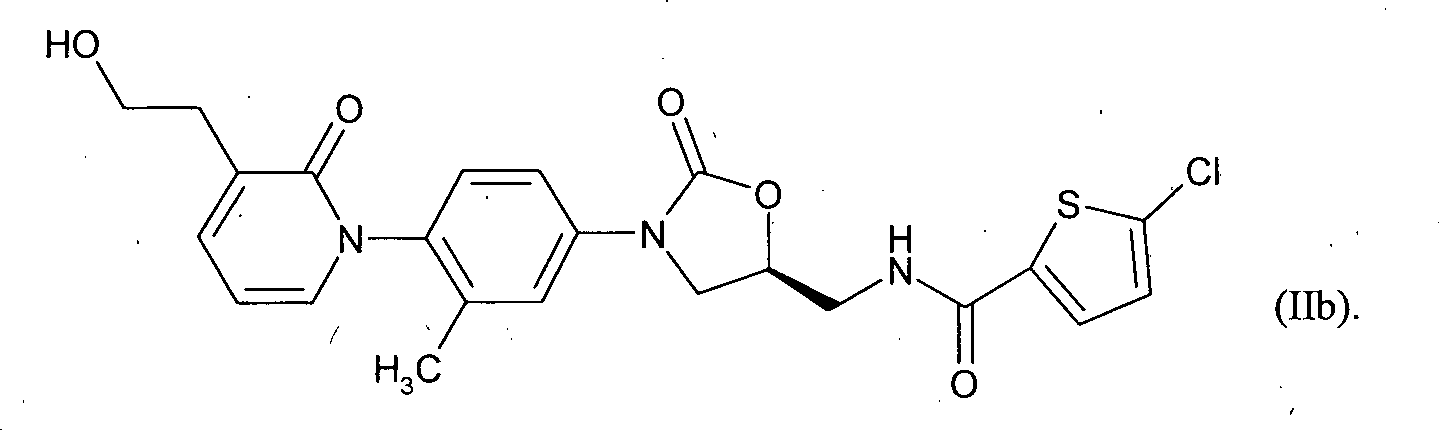
Bei den Verbindungen der Formel (Ia) und (IIb) handelt es sich um duale Inhibitoren der Blutgerinnungsfaktoren Xa und Thrombin (Faktor IIa), die insbesondere als Antikoagulantien wirken. Die Verbindungen hemmen sowohl Thrombin als auch Faktor Xa und verhindern durch Hemmung der Thrombinproduktion und -aktivität auf Gerinnseln deren potentielles Wachstum.The compounds of the formula (Ia) and (IIb) are dual inhibitors of the blood coagulation factors Xa and thrombin (factor IIa), which act in particular as anticoagulants. The compounds inhibit both thrombin and factor Xa and prevent their potential growth by inhibiting thrombin production and activity on clots.
In 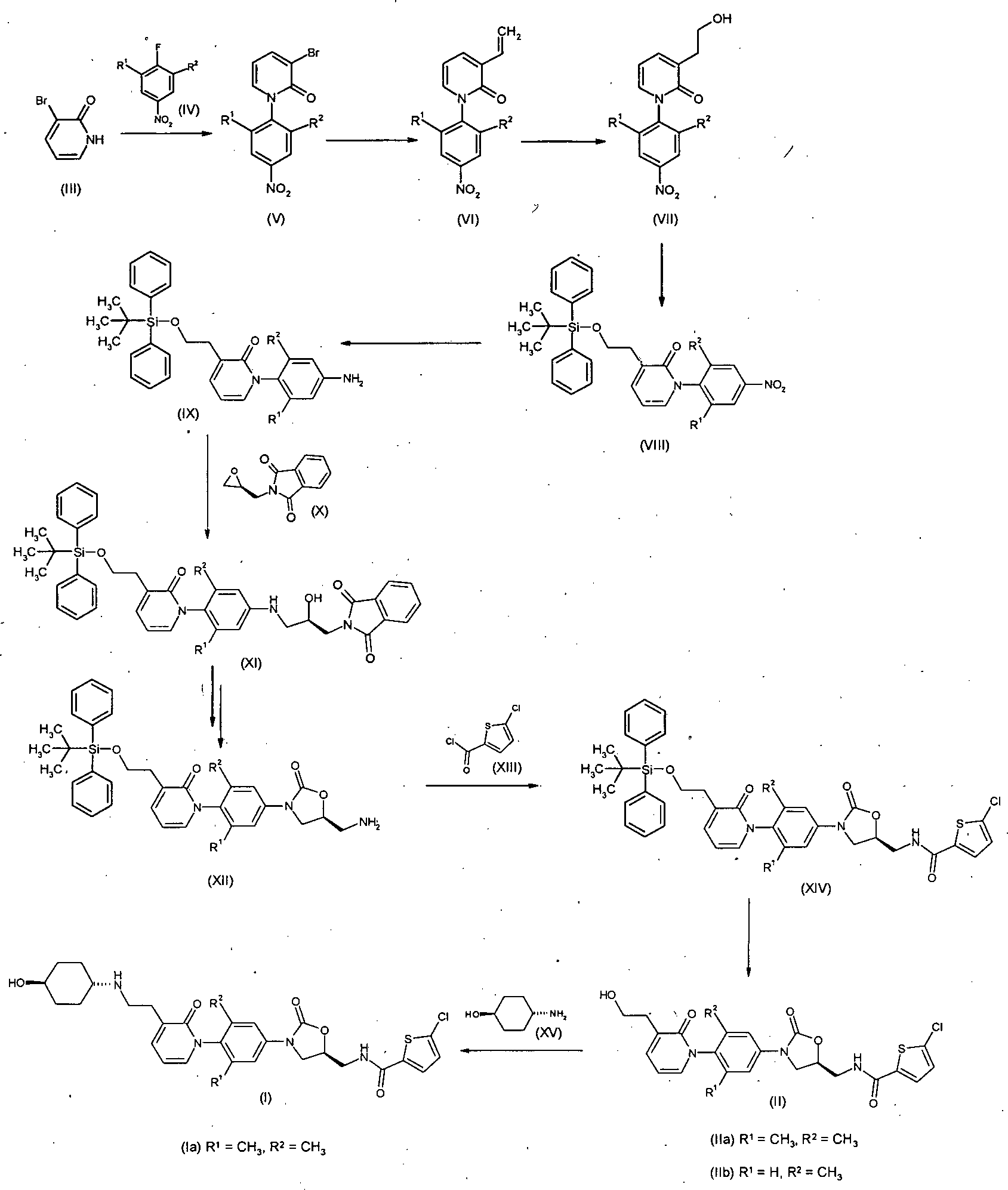
Zur Herstellung der Verbindung der Formel (Ia) wird 3-Brompyridin-2(1H)-on (III) mit 1-Fluor-2,5-dimethyl-4-nitrobenzol (IV) zu 3-Brom-1-(2,6-dimethyl-4-nitrophenyl)pyridin-2(1H)-on (V) umgesetzt. Anschließend wird (V) mit Tributylvinyl-zinn und Tetrakis(triphenyl-phosphin)palladium in 1-(2,6-Dimethyl-4-nitrophenyl)-3-vinylpyridin-2(1H)-on (VI) überführt. Durch Hydroborierung und Oxidation von (VI) gelangt man zu 1-(2,6-Dimethyl-4-nitrophenyl)-3-(2-hydroxyethyl)pyridin-2(1H)-on (VII). Um die Hydroxygruppe zu schützen, wird (VII) mit tert-Butyl(chlor)diphenylsilan in Gegenwart einer Base umgesetzt, und man erhält 3-(2-{[tert-Butyl(diphenyl)silyl]oxy}ethyl)-1-(2,6-dimethyl-4-nitrophenyl)pyridin-2(1H)-on (VIII). Die Reduktion der Nitrogruppe in (VIII) führt zu 1-(4-Amino-2,6-dimethylphenyl)-3-(2-{[tert-butyl(diphenyl)silyl]oxy}ethyl)pyridin-2(1H)-on (IX). Es folgt die Umsetzung von (IX) mit (S)-Epoxyphthalimid (X) zu 2-[(2R)-3-({4-[3-(2-{[tert-Butyl(diphenyl)silyl]oxy}ethyl)-2-oxopyridin-1(2H)-yl]-3,5-dimethyl-phenyl}amino)-2-hydroxypropyl]-1H-isoindol-1,3(2H)-dion (XI). Ringschluss zum Oxazolidinon und die Abspaltung der Phthalimidgruppe liefert ausgehend von (XI) 1-{4-[(5S)-5-(Aminomethyl)-2-oxo-1,3-oxazolidin-3-yl}-2,6-dimethylphenyl}-3-(2-{[tert-butyl-(diphenyl)silyl]oxy}ethyl)pyridin-2(1H)-on (XII), das mit 5-Chlorthiophen-2-carbonylchlorid (XIII) zu N-[((5S)-3-{4-[3-(2-{[tert-Butyl-(diphenyl)silyl]oxy}ethyl)-2-oxopyridin-1(2H)-yl]-3,5-dimethyl-phenyl}-2-oxo-1,3-oxazolidin-5-yl)methyl]-5-chlorthiophen-2-carboxamid (XIV) umgesetzt wird. Abspaltung der Schutzgruppe in (XIV) liefert 5-Chlor-N-[((5S)-3-{4-[3-(2-hydroxyethyl)-2-oxopyridin-1(2H)-yl]-3,5-dimethyl-phenyl} -2-oxo-1,3-oxazolidin-5-yl)methyl]thiophen-2-carboxamid (IIa), das mit trans-4-Aminohexanol (XV) zu 5-Chlor-N-{[(5S)-3-{4-[3-{2-[(trans-4-hydroxycyclohexyl)-amino]ethyl}-2-oxopyridin-1(2H)-yl]-3,5-dimethylphenyl}-2-oxo-1,3-oxazolidin-5-yl]methyl}thiophen-2-carboxamid (Ia) umgesetzt wird.For the preparation of the compound of the formula (Ia), 3-bromopyridine-2 (1H) -one (III) with 1-fluoro-2,5-dimethyl-4-nitrobenzene (IV) is converted into 3-bromo-1- (2, 6-dimethyl-4-nitrophenyl) pyridine-2 (1H) -one (V). Subsequently, (V) is converted with tributylvinyl-tin and tetrakis (triphenyl-phosphine) palladium into 1- (2,6-dimethyl-4-nitrophenyl) -3-vinylpyridin-2 (1H) -one (VI). Hydroboration and oxidation of (VI) give 1- (2,6-dimethyl-4-nitrophenyl) -3- (2-hydroxyethyl) pyridin-2 (1H) -one (VII). To protect the hydroxy group, (VII) is reacted with tert-butyl (chloro) diphenylsilane in the presence of a base to give 3- (2 - {[tert-butyl (diphenyl) silyl] oxy} ethyl) -1- ( 2,6-dimethyl-4-nitrophenyl) pyridine-2 (1H) -one (VIII). Reduction of the nitro group in (VIII) leads to 1- (4-amino-2,6-dimethylphenyl) -3- (2 - {[tert-butyl (diphenyl) silyl] oxy} ethyl) pyridine-2 (1H) - on (IX). Following is the reaction of (IX) with (S) -epoxyphthalimide (X) to give 2 - [(2R) -3- ({4- [3- (2 - {[tert-butyl (diphenyl) silyl] oxy} ethyl ) -2-oxopyridine-1 (2H) -yl] -3,5-dimethylphenyl} amino) -2-hydroxypropyl] -1H-isoindole-1,3 (2H) -dione (XI). Ring closure to the oxazolidinone and cleavage of the phthalimide group provides, starting from (XI), 1- {4 - [(5S) -5- (aminomethyl) -2-oxo-1,3-oxazolidin-3-yl} -2,6-dimethylphenyl } -3- (2 - {[tert-butyl- (diphenyl) silyl] oxy} ethyl) pyridine-2 (1H) -one (XII), which with 5-chlorothiophene-2-carbonyl chloride (XIII) becomes N- [ ((5S) -3- {4- [3- (2 - {[tert-butyl (diphenyl) silyl] oxy} ethyl) -2-oxopyridin-1 (2H) -yl] -3,5-dimethyl- phenyl} -2-oxo-1,3-oxazolidin-5-yl) methyl] -5-chlorothiophene-2-carboxamide (XIV). Cleavage of the protecting group in (XIV) provides 5-chloro-N - [((5S) -3- {4- [3- (2-hydroxyethyl) -2-oxopyridine-1 (2H) -yl] -3,5- dimethylphenyl} -2-oxo-1,3-oxazolidin-5-yl) methyl] thiophene-2-carboxamide (IIa) which is reacted with trans-4-aminohexanol (XV) to form 5-chloro-N - {[( 5 S) -3- {4- [3- {2 - [(trans-4-hydroxycyclohexyl) amino] ethyl} -2-oxopyridin-1 (2H) -yl] -3,5-dimethylphenyl} -2-oxo -1,3-oxazolidin-5-yl] methyl} thiophene-2-carboxamide (Ia).
Dieses aus
So erlaubt eine Durchführung in technischem Maßstab keine toxischen Reagenzien. Dies ist per se von Nachteil, darüber hinaus müssen diese toxischen Substanzen aus dem Endprodukt (I) bzw. (II) bis unterhalb der jeweils im Produkt aus regulatorischen Gründen zulässigen Höchstgrenze entfernt werden, was einen zusätzlichen. Aufwand bedeutet. Weiterhin sollten die Reagenzien einfach und preisgünstig zugänglich sein.Thus, performance on an industrial scale does not allow toxic reagents. This is disadvantageous per se, moreover, these toxic substances must be removed from the end product (I) or (II) to below the maximum permitted in the product for regulatory reasons, which is an additional. Effort means. Furthermore, the reagents should be easy and inexpensive to access.
Daraus ergibt sich die Aufgabe der vorliegenden Erfindung, ein vereinfachtes Verfahren zur Herstellung der Verbindungen der Formeln (I bzw. Ia) und (II bzw. IIb) in technischem Maßstab unter Vermeidung toxischer Reagenzien bereitzustellen.The object of the present invention is therefore to provide a simplified process for preparing the compounds of the formulas (I or Ia) and (II or IIb) on an industrial scale while avoiding toxic reagents.
Überraschenderweise wurde nun gefunden, dass sich durch Modifikation bestimmter Reaktionsparameter bei der aus
Gegenstand der vorliegenden Erfindung ist ein Verfahren zur Herstellung von Verbindungen der Formel 
R1 für Wasserstoff oder C1-C3-Alkyl steht
und
R2 für C1-C3-Alkyl steht,
oder
R1 für Wasserstoff steht
und
R2 für C1-C3-Alkoxy oder C1-C3-Alkoxymethyl steht,
dadurch gekennzeichnet, dass die Carboxyl-Gruppe in Verbindungen der Formel 
R1 für Wasserstoff oder C1-C3-Alkyl steht
und
R2 für C1-C3-Alkyl steht,
oder
für Wasserstoff steht
und
R2 für C1-C3-Alkoxy oder C1-C3-Alkoxymethyl steht,
in Gegenwart eines Boran-Komplexes reduziert wird.The present invention is a process for the preparation of compounds of the formula
R 1 is hydrogen or C 1 -C 3 alkyl
and
R 2 is C 1 -C 3 -alkyl,
or
R 1 is hydrogen
and
R 2 is C 1 -C 3 alkoxy or C 1 -C 3 alkoxymethyl,
characterized in that the carboxyl group in compounds of the formula
R 1 is hydrogen or C 1 -C 3 alkyl
and
R 2 is C 1 -C 3 -alkyl,
or
stands for hydrogen
and
R 2 is C 1 -C 3 alkoxy or C 1 -C 3 alkoxymethyl,
is reduced in the presence of a borane complex.
Bevorzugt ist ein Verfahren zur Herstellung von Verbindungen der Formel (VII), in welcher R1 für Wasserstoff oder Methyl steht und R2 für Methyl steht, oder R1 für Wasserstoff steht und R2 für Methoxy oder Methoxymethyl steht, dadurch gekennzeichnet, dass die Carboxyl-Gruppe in Verbindungen der Formel (XVI), in welcher R1 für Wasserstoff oder Methyl steht und R2 für Methyl steht, oder R1 für Wasserstoff steht und R2 für Methoxy oder Methoxymethyl steht, in Gegenwart eines Boran-Komplexes reduziert wird.Preference is given to a process for the preparation of compounds of the formula (VII) in which R 1 is hydrogen or methyl and R 2 is methyl, or R 1 is hydrogen and R 2 is methoxy or methoxymethyl, characterized in that the Carboxyl group in compounds of formula (XVI), in which R 1 is hydrogen or methyl and R 2 is methyl, or R 1 is hydrogen and R 2 is methoxy or methoxymethyl, is reduced in the presence of a borane complex ,
Ganz besonders bevorzugt ist ein Verfahren zur Herstellung von Verbindungen der Formel (VII), in welcher R1 für Methyl steht und R2 für Methyl steht, dadurch gekennzeichnet, dass die Carboxyl-Gruppe in Verbindungen der Formel (XVI), in welcher R1 für Methyl steht und R2 für Methyl steht, in Gegenwart eines Boran-Komplexes reduziert wird.Very particularly preferred is a process for the preparation of compounds of the formula (VII) in which R 1 is methyl and R 2 is methyl, characterized in that the carboxyl group in compounds of the formula (XVI) in which R 1 is methyl and R 2 is methyl, is reduced in the presence of a borane complex.
Die Reduktion der Carboxyl-Gruppe in Gegenwart eines Boran-Komplexes erfolgt in einem Lösungsmittel, bevorzugt in einem Temperaturbereich von 0°C bis zum Rückfluss des Lösungsmittels bei Normaldruck.The reduction of the carboxyl group in the presence of a borane complex is carried out in a solvent, preferably in a temperature range from 0 ° C to the reflux of the solvent at atmospheric pressure.
Lösungsmittel sind beispielsweise Ether wie Dioxan, Tetrahydrofuran, 2-Methyl-tetrahydrofuran, 1,2-Dimethoxyethan oder Methyl-tert-butylether, oder andere Lösungsmittel wie Dichlormethan oder Toluol, bevorzugt ist 2-Methyl-tetrahydrofuran.Solvents are for example ethers such as dioxane, tetrahydrofuran, 2-methyl-tetrahydrofuran, 1,2-dimethoxyethane or methyl tert-butyl ether, or other solvents such as dichloromethane or toluene, preferred is 2-methyl-tetrahydrofuran.
Boran-Komplexe sind beispielsweise Boran-Dimethylsulfid, Boran-Tetrahydrofuran, Boran-Diethylanilin oder Catecholboran, bevorzugt ist Boran-Diethylanilin.Borane complexes are, for example, borane-dimethyl sulfide, borane-tetrahydrofuran, borane-diethylaniline or catecholborane, borane-diethylaniline being preferred.
Der Boran-Komplex wird im Überschuss eingesetzt, bevorzugt werden 1 bis 5 Äquivalente Boran-Komplex verwendet, besonders bevorzugt werden 2 Äquivalente Boran-Komplex verwendet.The borane complex is used in excess, preferably 1 to 5 equivalents of borane complex are used, more preferably 2 equivalents of borane complex are used.
In einer bevorzugten Ausführungsform der vorliegenden Erfindung beträgt die Reaktionstemperatur 0°C bis 50°C, besonders bevorzugt beträgt die Reaktionstemperatur 15°C bis 25°C.In a preferred embodiment of the present invention, the reaction temperature is 0 ° C to 50 ° C, more preferably, the reaction temperature is 15 ° C to 25 ° C.
Bei der Durchführung des erfindungsgemäßen Verfahrens wird das Diethylanilin vorzugsweise durch Extraktion aus der durch Salzsäure sauer gestellten wässrigen Phase abgetrennt, nachdem Natriumchlorid zugegeben wurde. Die Extraktion erfolgt bevorzugt mit Essigsäureethylester, Dichlormethan oder Toluol.In carrying out the process according to the invention, the diethylaniline is preferably separated by extraction from the aqueous phase acidified by hydrochloric acid, after sodium chloride has been added. The extraction is preferably carried out with ethyl acetate, dichloromethane or toluene.
Auf diese Weise kann die in
Gegenstand der vorliegenden Erfindung ist auch ein Verfahren zur Herstellung von Verbindungen der Formel 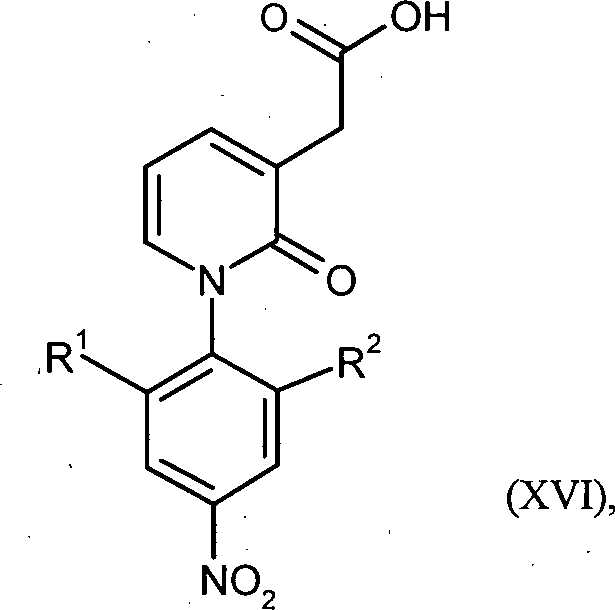
R1 für Wasserstoff oder C1-C3-Alkyl steht
und
R2 für C1-C3-Alkyl steht,
oder
R1 für Wasserstoff steht
und
R2 für C1-C3-Alkoxy oder C1-C3-Alkoxymethyl steht,
dadurch gekennzeichnet, dass Verbindungen der Formel 
R1 für Wasserstoff oder C1-C3-Alkyl steht
und
R2 für C1-C3-Alkyl steht,
oder
R1 für Wasserstoff steht
und
R2 für C1-C3-Alkoxy oder C1-C3-Alkoxymethyl steht,
in einem Eintopfverfahren zunächst in Gegenwart eines Kupferkatalysators mit einem Malonsäureester und einer Base und anschließend mit einer Base und Wasser umgesetzt werden. The present invention also provides a process for the preparation of compounds of the formula
R 1 is hydrogen or C 1 -C 3 alkyl
and
R 2 is C 1 -C 3 -alkyl,
or
R 1 is hydrogen
and
R 2 is C 1 -C 3 alkoxy or C 1 -C 3 alkoxymethyl,
characterized in that compounds of the formula
R 1 is hydrogen or C 1 -C 3 alkyl
and
R 2 is C 1 -C 3 -alkyl,
or
R 1 is hydrogen
and
R 2 is C 1 -C 3 alkoxy or C 1 -C 3 alkoxymethyl,
in a one-pot process, first in the presence of a copper catalyst with a malonic acid ester and a base and then reacted with a base and water.
Bevorzugt ist ein Verfahren zur Herstellung von Verbindungen der Formel (XVI), in welcher R1 für Wasserstoff oder Methyl steht und R2 für Methyl steht, oder R1 für Wasserstoff steht und R2 für Methoxy oder Methoxymethyl steht, dadurch gekennzeichnet, dass Verbindungen der Formel (V), in welcher R1 für Wasserstoff oder Methyl steht und R2 für Methyl steht, oder R1 für Wasserstoff steht und R2 für Methoxy oder Methoxymethyl steht, in einem Eintopfverfahren zunächst in Gegenwart eines Kupferkatalysators mit einem Malonsäureester und anschließend mit einer Base umgesetzt werden.Preference is given to a process for the preparation of compounds of the formula (XVI) in which R 1 is hydrogen or methyl and R 2 is methyl, or R 1 is hydrogen and R 2 is methoxy or methoxymethyl, characterized in that compounds of the formula (V) in which R 1 is hydrogen or methyl and R 2 is methyl, or R 1 is hydrogen and R 2 is methoxy or methoxymethyl, in a one-pot first in the presence of a copper catalyst with a malonic acid ester and then be reacted with a base.
Ganz besonders bevorzugt ist ein Verfahren zur Herstellung von Verbindungen der Formel (XVI), in welcher R1 für Methyl steht und R2 für Methyl steht, dadurch gekennzeichnet, dass Verbindungen der Formel (V), in welcher R1 für Methyl steht und R2 für Methyl steht, in einem Eintopfverfahren zunächst in Gegenwart eines Kupferkatalysators mit einem Malonsäureester und anschließend mit einer Base umgesetzt werden.Very particular preference is given to a process for the preparation of compounds of the formula (XVI) in which R 1 is methyl and R 2 is methyl, characterized in that compounds of the formula (V) in which R 1 is methyl and R 2 is methyl, in a one-pot process, first in the presence of a copper catalyst with a malonic acid ester and then reacted with a base.
Der erste Schritt der Umsetzung mit einem Malonsäureester in Gegenwart eines Kupferkatalysators und einer. Base erfolgt in einem Lösungsmittel, bevorzugt in einem Temperaturbereich von 15°C bis zum Rückfluss des Lösungsmittels bei Normaldruck. The first step of the reaction with a malonic acid ester in the presence of a copper catalyst and a. Base is carried out in a solvent, preferably in a temperature range of 15 ° C until the reflux of the solvent at atmospheric pressure.
Lösungsmittel sind beispielsweise Dioxan, Tetrahydrofuran und 2-Methyl-tetrahydrofuran, bevorzugt ist Dioxan.Solvents are, for example, dioxane, tetrahydrofuran and 2-methyl-tetrahydrofuran, preference is given to dioxane.
Kupferkatalysatoren sind beispielsweise ein vorab hergestellter Bis-(2-Pyridincarboxylato)Kupfer(II)-Komplex oder dessen verschiedene Hydratformen, oder aus Kupferiodid, Kupferchlorid, Kupfer(II)bromid, Kupfer(II)triflat oder Kupfer(II)sulfat, mit 2-Pyridincarbonsäure in situ hergestellte Kupferkatalysatoren, bevorzugt ist vorab hergestellter Bis-(2-Pyridin-carboxylato)Kupfer(II)-Komplex.Examples of copper catalysts are a bis (2-pyridinecarboxylato) copper (II) complex or its various hydrate forms prepared in advance, or copper iodide, copper chloride, copper (II) bromide, copper (II) triflate or copper (II) sulfate, with 2 -Pyridincarbonsäure prepared in situ copper catalysts, preferred is previously prepared bis (2-pyridine-carboxylato) copper (II) complex.
Malonsäureester sind beispielsweise Diethylmalonsäureester, Dibenzylmalonsäureester, Di-tert-butylmalonsäureester oder Kalium-ethylmalonsäureester, bevorzugt ist Diethylmalonsäureester.Malonic acid esters are, for example, diethylmalonic acid esters, dibenzylmalonic acid esters, di-tert-butylmalonic acid esters or potassium ethylmalonic acid esters, preference being given to diethylmalonic acid esters.
Basen sind beispielsweise Natrium- oder Kalium-tert.-butylat, Kalium-, Natrium- oder Cäsiumcarbonat, Cäsiumfluorid oder Natriumhydrid, bevorzugt ist Natrium- oder Kalium-tert.-butylat, besonders bevorzugt ist Natrium-tert.-butylat.Bases are, for example, sodium or potassium tert-butoxide, potassium, sodium or cesium carbonate, cesium fluoride or sodium hydride, preferably sodium or potassium tert-butoxide, particularly preferably sodium tert-butoxide.
In einer bevorzugten Ausführungsform der vorliegenden Erfindung wird der Malonsäureester in einem vorgelagerten Schritt mit der Base deprotoniert und anschließend wird die Verbindung der Formel (V) und der Katalysator zu dem Reaktionsgemisch dazugegeben.In a preferred embodiment of the present invention, the malonic ester is deprotonated with the base in an upstream step and then the compound of formula (V) and the catalyst are added to the reaction mixture.
In einer bevorzugten Ausführungsform der vorliegenden Erfindung wird der Malonsäureester in dem vorgelagerten Schritt der Deprotonierung zu einer Suspension von Kalium-tert.-butylat in Dioxan bei einer Temperatur von 80°C bis 100°C getropft, bevorzugt ist eine Temperatur von 90°C.In a preferred embodiment of the present invention, the malonic ester is added dropwise in the upstream step of the deprotonation to a suspension of potassium tert-butoxide in dioxane at a temperature of 80 ° C to 100 ° C, preferably a temperature of 90 ° C.
In einer bevorzugten Ausführungsform der vorliegenden Erfindung wird bei der Verwendung von Kalium-tert.-butylat als Base die Verbindung der Formel (V) in einer Konzentration von 0.1 bis 0.4 molar verwendet, bevorzugt ist eine Konzentration von 0.15 bis 0.3 molar.In a preferred embodiment of the present invention, when using potassium tert-butoxide as the base, the compound of the formula (V) is used in a concentration of 0.1 to 0.4 molar, preferably a concentration of 0.15 to 0.3 molar.
In einer bevorzugten Ausführungsform der vorliegenden Erfindung wird bei der Verwendung von Natrium-tert.-butylat als Base die Verbindung der Formel (V) in einer Konzentration von 0.2 bis 0.6 molar verwendet, bevorzugt ist eine Konzentration von 0.25 bis 0.4 molar.In a preferred embodiment of the present invention, when sodium tert-butoxide is used as the base, the compound of the formula (V) is used in a concentration of 0.2 to 0.6 molar, preferably a concentration of 0.25 to 0.4 molar.
In einer bevorzugten Ausführungsform der vorliegenden Erfindung wird der Kupferkatalysator getrennt hergestellt und als Kupferkomplex zur Reaktion gegeben. Dazu wird Kupfer(II)chlorid mit 2-Pyridincarbonsäure in einem Aceton/Ethanol-Gemisch und unter Zusatz von einer 0.1%igen Harnstofflösung umgesetzt (
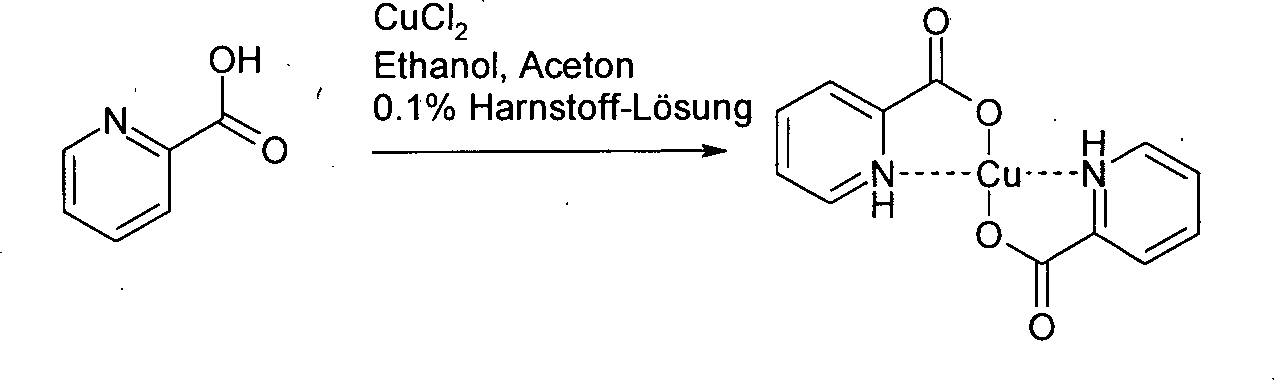
Überraschenderweise wurde bei der Herstellung von [1-(2-Methyl-4-nitrophenyl)-2-oxo-1,2-dihydropyridin-3-yl]-essigsäure festgestellt, dass dieser vorab hergestellte Bis-(2-Pyridincarboxylato)Kupfer(II)-Komplex um Größenordnungen aktiver als der in-situ hergestellte Katalysator aus Kupferiodid und 2-Pyridincarbonsäure ist. Beispielsweise benötigt man bei einem Kalium-tert.-butylat vermittelten Prozess mit in-situ Herstellung des Katalysators 20 mol% Kupferiodid und 40 mol% 2-Pyridincarbonsäure, damit sich die Ausgangsverbindung innerhalb von 8 h vollständig zum Produkt umsetzt. Fährt man denselben Ansatz hingegen mit 10 mol% des getrennt hergestellten Bis-(2-Pyridin-carboxylato)Kupfer(II)-Komplexes, so ist die Reaktion nach 4 h unter sonst identischen Bedingungen vollständig. Noch drastischer zeigt sich dieser Effekt bei den Natrium-tert.-butylat vermittelten Reaktionen. Der Einsatz von 20 mol% Kupferiodid und 40 mol% 2-Pyridincarbonsäure zur in-situ Herstellung des Katalysators führt zu einem Umsatz von lediglich 48% nach 8 Stunden, während 7.5 mol% des Bis-(2-Pyridin-carboxylato)Kupfer(II)-Komplexes einen Umsatz von 99% innerhalb von 3.5 h liefert.Surprisingly, in the preparation of [1- (2-methyl-4-nitrophenyl) -2-oxo-1,2-dihydropyridin-3-yl] acetic acid, it was found that this bis (2-pyridinecarboxylato) pre-prepared copper ( II) complex is orders of magnitude more active than the catalyst prepared in situ from copper iodide and 2-pyridinecarboxylic acid. For example, in the case of a potassium tert-butoxide-mediated process with in-situ preparation of the catalyst, 20 mol% copper iodide and 40 mol% 2-pyridinecarboxylic acid are required so that the starting compound completely converts to the product within 8 h. On the other hand, if the same approach is run with 10 mol% of the bis (2-pyridinecarboxylato) copper (II) complex prepared separately, the reaction is complete after 4 h under otherwise identical conditions. This effect is even more dramatic in the sodium-tert-butylate-mediated reactions. The use of 20 mol% copper iodide and 40 mol% 2-pyridinecarboxylic acid in situ Preparation of the catalyst leads to a conversion of only 48% after 8 hours, while 7.5 mol% of the bis (2-pyridine-carboxylato) copper (II) complex gives a conversion of 99% within 3.5 h.
In einer bevorzugten Ausführungsform der vorliegenden Erfindung werden 3.0 bis 4.0 Äquivalente an Diethylmalonsäureester verwendet, bevorzugt sind 3.5 Äquivalente an Diethylmalonsäureester.In a preferred embodiment of the present invention, 3.0 to 4.0 equivalents of diethylmalonic acid ester are used, preferably 3.5 equivalents of diethylmalonic acid ester.
Der Vorteil dieses Verfahrens gegenüber dem von
Der zweite Schritt der Umsetzung mit einer Base erfolgt in einem Lösungsmittel in Kombination mit Wasser, bevorzugt in einem Temperaturbereich von 15°C bis 40°C bei Normaldruck.The second step of the reaction with a base is carried out in a solvent in combination with water, preferably in a temperature range of 15 ° C to 40 ° C at atmospheric pressure.
Lösungsmittel sind beispielsweise Dioxan-Wasser oder Tetrahydrofuran-Wasser, bevorzugt ist Dioxan-Wasser.Solvents are, for example, dioxane-water or tetrahydrofuran-water, preference is given to dioxane-water.
Basen sind beispielsweise Alkalihydroxide wie Lithium-, Natrium- oder Kaliumhydroxid, bevorzugt ist Natriumhydroxid.Examples of bases are alkali metal hydroxides such as lithium, sodium or potassium hydroxide, sodium hydroxide is preferred.
In einer bevorzugten Ausführungsform der vorliegenden Erfindung wird das erhaltene Reaktionsgemisch nach der kupferkatalysierten Umsetzung mit einem Malonsäureester in der ersten Stufe aufkonzentriert und die unlöslichen Bestandteile werden abfiltriert, bevor das Reaktionsgemisch in der zweiten Stufe mit einer Base umgesetzt wird.In a preferred embodiment of the present invention, the resulting reaction mixture is concentrated after the copper-catalyzed reaction with a malonic ester in the first stage and the insoluble constituents are filtered off before the reaction mixture is reacted with a base in the second stage.
In einer bevorzugten Ausführungsform der vorliegenden Erfindung erfolgt die Aufreinigung der Verbindung der Formel (XVI) durch Waschen der wässrigen Lösung des Natriumsalzes der als Zwischenprodukt entstehenden Dimalonsäure, das anschließende Ansäuern der wässrigen Lösung, um die Decarboxylierung zu ermöglichen, und das Extrahieren der Verbindung der Formel (XVI) aus der wässrigen Lösung mit Methylenchlorid.In a preferred embodiment of the present invention, the purification of the compound of formula (XVI) is carried out by washing the aqueous solution of the sodium salt of the intermediate dimalonic acid, then acidifying the aqueous solution to allow decarboxylation, and extracting the compound of formula (XVI) from the aqueous solution with methylene chloride.
In einer bevorzugten Ausführungsform der vorliegenden Erfindung wird das erhaltene Rohprodukt der Verbindung der Formel (XVI) in einem anschließenden Schritt zur weiteren Reinigung aus einem Gemisch aus Dioxan und Methyl-tert-butylether umkristallisiert.In a preferred embodiment of the present invention, the resulting crude product of the compound of the formula (XVI) is recrystallized in a subsequent step for further purification from a mixture of dioxane and methyl tert-butyl ether.
Die Herstellung der Verbindungen der Formeln (I) bis (V) und (VIII) bis (XV) erfolgt, wie bereits auch in
Die Umsetzung von Verbindungen der Formel (V) zu Verbindungen der Formel (XVI) kann auch in zwei Stufen erfolgen, so dass zunächst Verbindungen der Formel (V) in Gegenwart eines Kupferkatalysators mit einem Malonsäureester und einer Base umgesetzt werden und die Reaktionsmischung zu Verbindungen der Formel 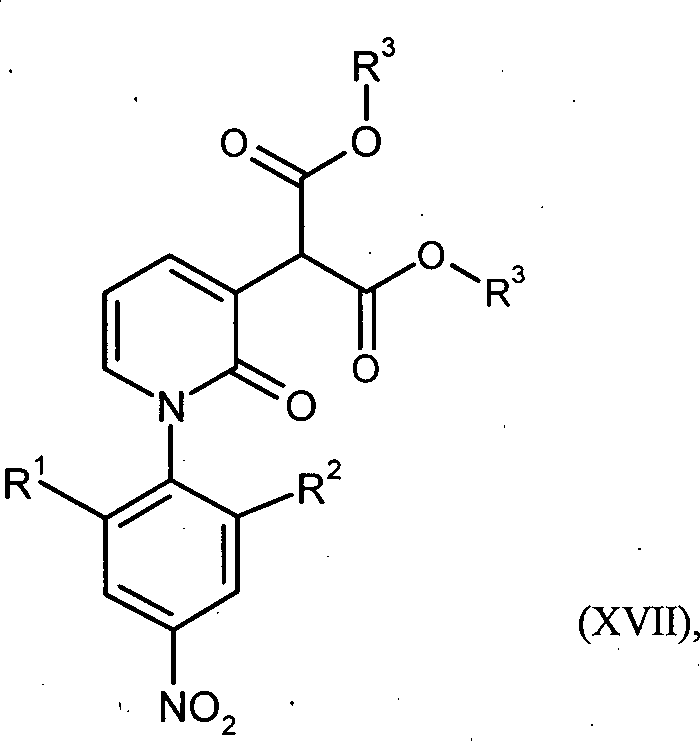
R1 für Wasserstoff oder C1-C3-Alkyl steht
und
R2 für C1-C3-Alkyl steht,
oder
R1 für Wasserstoff steht
und
R2 für C1-C3-Alkoxy oder C1-C3-Alkoxymethyl steht,
und
R3 für Ethyl, tert-Butyl oder Benzyl steht,
umgesetzt und aufgearbeitet wird, und in der zweiten Stufe Verbindungen der Formel (XVII) mit einer Base und Wasser zu Verbindungen der Formel (XVI) umgesetzt werden.The reaction of compounds of the formula (V) to give compounds of the formula (XVI) can also be carried out in two stages, so that first compounds of the formula (V) are reacted in the presence of a copper catalyst with a malonic acid ester and a base and the reaction mixture is converted into compounds of the formula formula
R 1 is hydrogen or C 1 -C 3 alkyl
and
R 2 is C 1 -C 3 -alkyl,
or
R 1 is hydrogen
and
R 2 is C 1 -C 3 alkoxy or C 1 -C 3 alkoxymethyl,
and
R 3 is ethyl, tert-butyl or benzyl,
is reacted and worked up, and in the second stage, compounds of formula (XVII) are reacted with a base and water to give compounds of formula (XVI).
Die Umsetzung der ersten Stufe erfolgt wie die Umsetzung des ersten Schrittes des Eintopfverfahren und die Umsetzung der zweite Stufe erfolgt wie die Umsetzung des zweiten Schrittes des Eintopfverfahren. Syntheseschema: 
Gegenstand der vorliegenden Erfindung sind Verbindungen der Formel 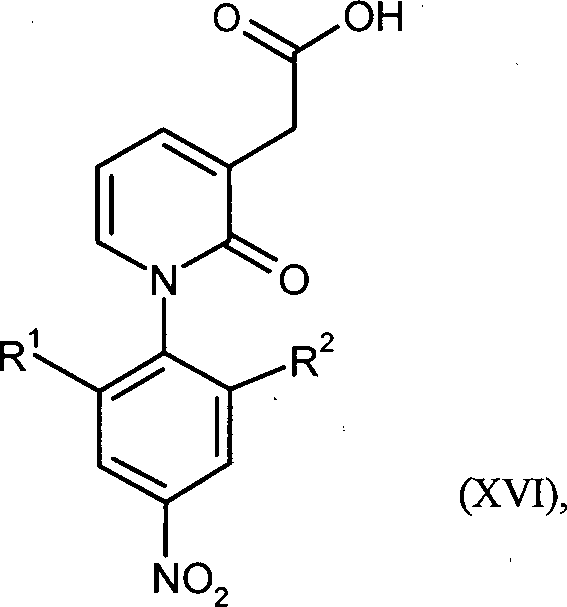
R1 für Wasserstoff oder C1-C3-Alkyl steht
und
R2 für C1-C3-Alkyl steht,
oder
R1 für Wasserstoff steht
und
R2 für C1-C3-Alkoxy oder C1-C3-Alkoxymethyl steht,
und ihre Salze, ihre Solvate und die Solvate ihrer Salze.The present invention relates to compounds of the formula
R 1 is hydrogen or C 1 -C 3 alkyl
and
R 2 is C 1 -C 3 -alkyl,
or
R 1 is hydrogen
and
R 2 is C 1 -C 3 alkoxy or C 1 -C 3 alkoxymethyl,
and their salts, their solvates, and the solvates of their salts.
Gegenstand der vorliegenden Erfindung sind auch Verbindungen der Formel (XVI), in welcher R1 für Wasserstoff oder Methyl steht und R2 für Methyl steht, oder R1 für Wasserstoff steht und R2 für Methoxy oder Methoxymethyl steht. The present invention also relates to compounds of the formula (XVI) in which R 1 is hydrogen or methyl and R 2 is methyl, or R 1 is hydrogen and R 2 is methoxy or methoxymethyl.
Gegenstand der vorliegenden Erfindung sind auch Verbindungen der Formel (XVI), in welcher R1 für Methyl steht und R2 für Methyl steht.The present invention also relates to compounds of the formula (XVI) in which R 1 is methyl and R 2 is methyl.
Erfindungsgemäße Verbindungen sind die Verbindungen der Formel (XVI) und deren Salze, Solvate und Solvate der Salze; die von Formel (XVI) umfassten Verbindungen der nachfolgend genannten Formeln und deren Salze, Solvate und Solvate der Salze sowie die von Formel (XVI) umfassten, nachfolgend als Ausführungsbeispiele genannten Verbindungen und deren Salze, Solvate und Solvate der Salze, soweit es sich bei den von Formel (XVI) umfassten, nachfolgend genannten Verbindungen nicht bereits um Salze, Solvate und Solvate der Salze handelt.Compounds of the invention are the compounds of formula (XVI) and their salts, solvates and solvates of the salts; the compounds of the formula (XVI) below and the salts, solvates and solvates of the salts thereof and the compounds of formula (XVI), hereinafter referred to as examples and their salts, solvates and solvates of the salts, as far as they are of formula (XVI), the following compounds are not already salts, solvates and solvates of the salts.
Die erfindungsgemäßen Verbindungen können in Abhängigkeit von ihrer Struktur in stereoisomeren Formen (Enantiomere, Diastereomere) existieren. Die Erfindung umfasst deshalb die Enantiomeren oder Diastereomeren und ihre jeweiligen Mischungen. Aus solchen Mischungen von Enantiomeren und/oder Diastereomeren lassen sich die stereoisomer einheitlichen Bestandteile in bekannter Weise isolieren.Depending on their structure, the compounds of the invention may exist in stereoisomeric forms (enantiomers, diastereomers). The invention therefore includes the enantiomers or diastereomers and their respective mixtures. From such mixtures of enantiomers and / or diastereomers, the stereoisomerically uniform components can be isolated in a known manner.
Sofern die erfindungsgemäßen Verbindungen in tautomeren Formen vorkommen können, umfasst die vorliegenden Erfindung sämtliche tautomere Formen.If the compounds according to the invention can occur in tautomeric forms, the present invention encompasses all tautomeric forms.
Als Salze sind im Rahmen der vorliegenden Erfindung physiologisch unbedenkliche Salze der erfindungsgemäßen Verbindungen bevorzugt. Umfasst sind aber auch Salze, die für pharmazeutische Anwendungen selbst nicht geeignet sind aber beispielsweise für die Isolierung oder Reinigung der erfindungsgemäßen Verbindungen verwendet werden können.Salts used in the context of the present invention are physiologically acceptable salts of the compounds according to the invention. However, also included are salts which are not suitable for pharmaceutical applications themselves but can be used, for example, for the isolation or purification of the compounds according to the invention.
Physiologisch unbedenkliche Salze der erfindungsgemäßen Verbindungen umfassen Säureadditionssalze von Mineralsäuren, Carbonsäuren und Sulfonsäuren, z. B. Salze der Chlorwasserstoffsäure, Bromwasserstoffsäure, Schwefelsäure, Phosphorsäure, Methansulfonsäure, Ethansulfonsäure, Toluolsulfonsäure, Benzolsulfonsäure, Naphthalindisulfonsäure, Essigsäure, Trifluoressigsäure, Propionsäure, Milchsäure, Weinsäure, Äpfelsäure, Zitronensäure, Fumarsäure, Maleinsäure und Benzoesäure.Physiologically acceptable salts of the compounds of the invention include acid addition salts of mineral acids, carboxylic acids and sulfonic acids, eg. Salts of hydrochloric, hydrobromic, sulfuric, phosphoric, methanesulfonic, ethanesulfonic, toluenesulfonic, benzenesulfonic, naphthalenedisulfonic, acetic, trifluoroacetic, propionic, lactic, tartaric, malic, citric, fumaric, maleic and benzoic acids.
Physiologisch unbedenkliche Salze der erfindungsgemäßen Verbindungen umfassen auch Salze üblicher Basen, wie beispielhaft und vorzugsweise Alkalimetallsalze (z. B. Natrium- und Kaliumsalze), Erdalkalisalze (z. B. Calcium- und Magnesiumsalze) und Ammoniumsalze, abgeleitet von Ammoniak oder organischen Aminen mit 1 bis 16 C-Atomen, wie beispielhaft und vorzugsweise Ethylamin, Diethylamin, Triethylamin, Ethyldiisopropylamin, Monoethanolamin, Diethanolamin, Triethanolamin, Dicyclohexylamin, Dimethylaminoethanol, Prokain, Dibenzylamin, N-Methylmorpholin, Arginin, Lysin, Ethylendiamin, N-Methylpiperidin und Cholin.Physiologically acceptable salts of the compounds according to the invention also include salts of customary bases, such as, by way of example and by way of preference, alkali metal salts (for example sodium and potassium salts), alkaline earth salts (for example calcium and magnesium salts) and ammonium salts derived from ammonia or organic amines with 1 to 16 carbon atoms, such as, by way of example and by way of preference, ethylamine, diethylamine, triethylamine, ethyldiisopropylamine, monoethanolamine, diethanolamine, triethanolamine, dicyclohexylamine, dimethylaminoethanol, procaine, dibenzylamine, N-methylmorpholine, arginine, lysine, ethylenediamine, N-methylpiperidine and choline.
Als Solvate werden im Rahmen der Erfindung solche Formen der erfindungsgemäßen Verbindungen bezeichnet, welche in festem oder flüssigem Zustand durch Koordination mit Lösungsmittelmolekülen einen Komplex bilden. Hydrate sind eine spezielle Form der Solvate, bei denen die Koordination mit Wasser erfolgt.Solvates in the context of the invention are those forms of the compounds according to the invention which form a complex in the solid or liquid state by coordination with solvent molecules. Hydrates are a special form of solvates that coordinate with water.
Die Erfindung wird nachstehend durch bevorzugte Ausführungsbeispiele näher erläutert, auf welche sie jedoch nicht eingeschränkt ist. Soweit nicht anders angegeben, beziehen sich alle Mengenangaben auf Gewichtsprozente.The invention is explained in more detail below by preferred embodiments, to which it is not limited. Unless otherwise indicated, all quantities are by weight.
Ausführungsbeispieleembodiments
AbkürzungenAbbreviations
-
- CDICDI
- Carbonyldiimidazolcarbonyldiimidazole
- dd
- Dublett (bei NMR)Doublet (by NMR)
- DCDC
- Dünnschicht-ChromatographieThin Layer Chromatography
- DCIDCI
- direkte chemische Ionisation (bei MS)direct chemical ionization (in MS)
- dddd
- Doppeltes Dublett (bei NMR)Double doublet (by NMR)
- DMAPDMAP
- 4-Dimethylaminopyridin4-dimethylaminopyridine
- DMFDMF
- N,N-DimethylformamidN, N-dimethylformamide
- DMSODMSO
- Dimethylsulfoxiddimethyl sulfoxide
- dd
- Tag(e)Day (s)
- d. Th.d. Th.
- der Theorie (bei Ausbeute)the theory (at yield)
- eq.eq.
- Äquivalent(e)Equivalent (s)
- ESIIT I
- Elektrospray-Ionisation (bei MS)Electrospray ionization (in MS)
- h H
- Stunde(n)Hour (s)
- HPLCHPLC
- Hochdruck-, HochleistungsflüssigchromatographieHigh pressure, high performance liquid chromatography
- LC-MSLC-MS
- Flüssigchromatographie-gekoppelte MassenspektroskopieLiquid chromatography-coupled mass spectroscopy
- mm
- Multiplett (bei NMR)Multiplet (by NMR)
- minmin
- Minute(n)Minute (n)
- MSMS
- Massenspektroskopiemass spectroscopy
- NMPNMP
- N-MethylpyrrolidonN-methylpyrrolidone
- NMRNMR
- KernresonanzspektroskopieNuclear Magnetic Resonance Spectroscopy
- RPRP
- reverse phase (bei HPLC)reverse phase (on HPLC)
- RTRT
- Raumtemperaturroom temperature
- Rt R t
- Retentionszeit (bei HPLC)Retention time (by HPLC)
- ss
- Singulett (bei NMR)Singlet (by NMR)
- THFTHF
- Tetrahydrofurantetrahydrofuran
- NMR-Spektroskopie: Alle Spektren wurden kalibriert gegen Tetramethylsilan als internen Standard (δ = 0).NMR Spectroscopy: All spectra were calibrated against tetramethylsilane as internal standard (δ = 0).
HPLC-, LC-MS- und GC-MS-Methoden: HPLC, LC-MS and GC-MS methods:
- Methode 1 (HPLC): Säule Zorbax SB-Aq 3 mm × 150 mm, 3.5 μm; Temperatur: 45°C; Eluent A: wässriger Puffer bestehend aus 1.36 g/L Kaliumdihydrogenphosphat und 1.15 g/L Phosphorsäure (85%ig); Eluent B: Acetonitril; Gradient: 0–20 min 95% A auf 20% A, 20–25 min 20% A; Fluß: 0.5 mL/min; UV-Detektion bei 210 nM.Method 1 (HPLC): Zorbax SB-Aq column 3 mm × 150 mm, 3.5 μm; Temperature: 45 ° C; Eluent A: aqueous buffer consisting of 1.36 g / L potassium dihydrogen phosphate and 1.15 g / L phosphoric acid (85%); Eluent B: acetonitrile; Gradient: 0-20 min 95% A to 20% A, 20-25 min 20% A; Flow: 0.5 mL / min; UV detection at 210 nM.
- Methode 2 (HPLC): Säule Zorbax SB-Aq 3 mm × 150 mm, 3.5 μm; Temperatur: 45°C; Eluent A: wässriger Puffer bestehend aus 1.36 g/L Kaliumdihydrogenphosphat und 0.68 mL Phosphorsäure (85%ig)/L Wasser; Eluent B: Acetonitril; Gradient: 0–3 min 80% A auf 45% A, 3–13 min 45% A auf 20% A, 13–25 min 20% A; Fluß: 0.5 mL/min; UV-Detektion bei 220 nM.Method 2 (HPLC): Zorbax SB-Aq column 3 mm × 150 mm, 3.5 μm; Temperature: 45 ° C; Eluent A: aqueous buffer consisting of 1.36 g / L potassium dihydrogen phosphate and 0.68 mL phosphoric acid (85%) / L water; Eluent B: acetonitrile; Gradient: 0-3 min 80% A to 45% A, 3-13 min 45% A to 20% A, 13-25 min 20% A; Flow: 0.5 mL / min; UV detection at 220 nM.
- Methode 3 (HPLC): Instrument: HP 1100 mit DAD-Detektion; Säule: Kromasil 100 RP-18, 60 mm × 2.1 mm, 3.5 μm; Eluent A: 5 ml Perchlorsäure (70%ig)/L Wasser, Eluent B: Acetonitril; Gradient: 0 min 2% B, 0.5 min 2% B, 4.5 min 90% B, 6.5 min 90% B, 6.7 min 2% B, 7.5 min 2% B; Fluß: 0.75 mL/min; Temperatur: 30°C; UV-Detektion bei 210 nm.Method 3 (HPLC): Instrument: HP 1100 with DAD detection; Column: Kromasil 100 RP-18, 60 mm × 2.1 mm, 3.5 μm; Eluent A: 5 ml perchloric acid (70%) / L water, eluent B: acetonitrile; Gradient: 0 min 2% B, 0.5 min 2% B, 4.5 min 90% B, 6.5 min 90% B, 6.7 min 2% B, 7.5 min 2% B; Flow: 0.75 mL / min; Temperature: 30 ° C; UV detection at 210 nm.
- Methode 4 (LC-MS): Instrument: Waters ACQUITY SQD UPLC System; Säule: Waters Acquity UPLC HSS T3 1.8 μ 50 mm × 1 mm; Eluent A: 1 L Wasser + 0.25 mL 99%ige Ameisensäure, Eluent B: 1 L Acetonitril + 0.25 mL 99%ige Ameisensäure; Gradient: 0.0 min 90% A → 1.2 min 5% A → 2.0 min 5% A; Ofen: 50°C; Fluss: 0.40 mL/min; UV-Detektion: 210–400 nm.Method 4 (LC-MS): Instrument: Waters ACQUITY SQD UPLC System; Column: Waters Acquity UPLC HSS T3 1.8 μ 50 mm × 1 mm; Eluent A: 1 L water + 0.25 mL 99% formic acid, eluent B: 1 L acetonitrile + 0.25 mL 99% formic acid; Gradient: 0.0 min 90% A → 1.2 min 5% A → 2.0 min 5% A; Oven: 50 ° C; Flow: 0.40 mL / min; UV detection: 210-400 nm.
- Methode 5 (LC-MS): Instrument: Micromass Quattro Premier mit Waters UPLC Acquity; Säule: Thermo Hypersil GOLD 1.9 μ 50 mm × 1 mm; Eluent A: 1 L Wasser + 0.5 mL 50%ige Ameisensäure, Eluent B: 1 L Acetonitril + 0.5 mL 50%ige Ameisensäure; Gradient: 0.0 min 90% A → 0.1 min 90% A → 1.5 min 10% A → 2.2 min 10% A; Ofen: 50°C; Fluss: 0.33 mL/min; UV-Detektion: 210 nm.Method 5 (LC-MS): Instrument: Micromass Quattro Premier with Waters UPLC Acquity; Column: Thermo Hypersil GOLD 1.9 μ 50 mm × 1 mm; Eluent A: 1 L water + 0.5 mL 50% formic acid, eluent B: 1 L acetonitrile + 0.5 mL 50% formic acid; Gradient: 0.0 min 90% A → 0.1 min 90% A → 1.5 min 10% A → 2.2 min 10% A; Oven: 50 ° C; Flow: 0.33 mL / min; UV detection: 210 nm.
- Methode 6 (LC-MS): Gerätetyp MS: Micromass ZQ; Gerätetyp HPLC: HP 1100 Series; UV DAD; Säule: Phenomenex Gemini 3μ 30 mm × 3.00 mm; Eluent A: 1 L Wasser + 0.5 mL 50%ige Ameisensäure, Eluent B: 1 L Acetonitril + 0.5 mL 50%ige Ameisensäure; Gradient: 0.0 min 90% A 2.5 min 30% A → 3.0 min 5% A → 4.5 min 5% A; Fluss: 0.0 min 1 mL/min, 2.5 min/3.0 min/4.5 min 2 mL/min; Ofen: 50°C; UV-Detektion: 210 nm.Method 6 (LC-MS): Device Type MS: Micromass ZQ; Device type HPLC: HP 1100 Series; UV DAD; Column: Phenomenex Gemini 3μ 30 mm × 3.00 mm; Eluent A: 1 L water + 0.5 mL 50% formic acid, eluent B: 1 L acetonitrile + 0.5 mL 50% formic acid; Gradient: 0.0 min 90% A 2.5 min 30% A → 3.0 min 5% A → 4.5 min 5% A; Flow: 0.0 min 1 mL / min, 2.5 min / 3.0 min / 4.5 min 2 mL / min; Oven: 50 ° C; UV detection: 210 nm.
- Methode 7 (GC-MS): Instrument: Micromass GCT, GC6890; Säule: Restek RTX-35, 15 m × 200 μm × 0.33 μm; konstanter Fluss mit Helium: 0.88 mL/min; Ofen: 70°C; Inlet: 250°C; Gradient: 70°C, 30°C/min → 310°C (3 min halten).Method 7 (GC-MS): Instrument: Micromass GCT, GC6890; Column: Restek RTX-35, 15 m × 200 μm × 0.33 μm; constant flow with helium: 0.88 mL / min; Oven: 70 ° C; Inlet: 250 ° C; Gradient: 70 ° C, 30 ° C / min → 310 ° C (hold for 3 min).
Beispiel 1: Herstellung von 3-Brompyridon 
Zu einer Lösung von 5.0 kg (42.0 mol) Kaliumbromid und 1.60 kg (16.8 mol) 2-Hydroxypyridin wurde innerhalb von 2 Stunden bei 35–40°C 2.69 kg (16.8 mol) Brom dosiert. Es wurde 1 h bei 35°C gerührt und anschließend auf 22°C abgekühlt. Der pH-Wert wurde mit einer 23%igen Natronlauge auf pH 9.5 eingestellt und das Produkt über eine Nutsche isoliert. Es wurde zweimal mit je 2 L Wasser und zweimal mit je 1 L Wasser-Methanol 1:1 gewaschen. Das Produkt wurde im Vakuum bei 40°C bis zur Gewichtskonstanz getrocknet. Man erhielt 1.53 kg (52%) des gewünschten Produkts.
HPLC (Methode 1): Rt = 13.9 min mit 97F1%.
1H-NMR (500 MHz, DMSO-d6): δ [ppm] = 6.14 (t, 1H), 7.46 (dd, 1H), 7.92 (dd, 1H), 11.95–12.29 (m, 1H)
MS (TOF EI+): 173 Beispiel 2: Herstellung von 3-Brom-1-(2-methyl-4-nitrophenyl)pyridin-2(1H)-on 
HPLC (Method 1): R t = 13.9 min with 97 F 1%.
1 H-NMR (500 MHz, DMSO-d 6 ): δ [ppm] = 6.14 (t, 1H), 7.46 (dd, 1H), 7.92 (dd, 1H), 11.95-12.29 (m, 1H)
MS (TOF EI + ): 173 Example 2: Preparation of 3-bromo-1- (2-methyl-4-nitrophenyl) pyridin-2 (1H) -one
Eine Suspension von 125 g (718 mmol) 3-Brompyridon, 106 g (682 mmol) 2-Fluor-5-Nitrotoluol und 183 g (862 mmol) wasserfreies Trikaliumphoshat in 325 mL NMP wurde 4 h auf 120°C erhitzt. Bei 90°C wurde mit 1250 mL Wasser versetzt und es wurde unter Rühren auf 20°C abgekühlt. Es wurde 16 h nachgerührt und über eine Nutsche isoliert. Es wurde zweimal mit je 500 mL Wasser und zweimal mit je 500 mL Wasser/Methanol 1:1 gewaschen. Schließlich wurde im Vakuum bei 40°C bis zur Gewichtskonstanz getrocknet. Man erhielt 178 g (80%) des gewünschten Produkts. Man kann die Reinheit des Produkts durch eine Umkristallisation z. B. aus Dioxan oder Acetonitril weiter erhöhen auf ≥ 99 F1%.
HPLC (Methode 1): Rt = 13.9 min mit 97 F1%.
1H-NMR (500 MHz, DMSO-d6): δ [ppm] = 2.17 (s, 3H), 6.37 (t, 1H), 7.65 (d, 1H), 7.69 (dd, 1H), 8.10 (dd, 1H), 8.21 (dd, 1H), 8.34 (d, 1H).
MS (DCI-NH3): [M+H]+ 309 Beispiel 3: Herstellung von [1-(2-Methyl-4-nitrophenyl}-2-oxo-1,2-dihydropyridin-3-yl]-essigsäure 
HPLC (Method 1): R t = 13.9 min with 97 F1%.
1 H-NMR (500 MHz, DMSO-d 6 ): δ [ppm] = 2.17 (s, 3H), 6.37 (t, 1H), 7.65 (d, 1H), 7.69 (dd, 1H), 8.10 (dd , 1H), 8.21 (dd, 1H), 8.34 (d, 1H).
MS (DCI-NH 3 ): [M + H] + 309 Example 3: Preparation of [1- (2-methyl-4-nitrophenyl) -2-oxo-1,2-dihydropyridin-3-yl] acetic acid
Zu einer Lösung von 110 g (1.14 mmol) Natriumtertbutylat in 700 mL Dioxan wurde innerhalb 15 min 180 g Malonsäurediethylester zugetropft. Es wurde mit 200 mL Dioxan verdünnt und 1 h bei 20°C nachgerührt. Es wurden 7.5 g (24 mmol) Bis-(2-Pyridincarboxylato)Kupfer(II)-Komplex und 100 g (0.32 mol) 3-Brom-1-(2-methyl-4-nitrophenyl)pyridin-2(1H)-on zugegeben und auf 95°C erhitzt. Man destillierte innerhalb 3.5 h ca. 300 mL Dioxan ab, kühlte auf 20°C ab und versetzte mit 900 mL Wasser. Es wurde mit 108 mL konzentrierter Natronlauge versetzt und 1 h bei 45°C gerührt. Bei 20°C wurden 800 mL Dichlormethan zugegeben und es wurde über Kieselgur filtriert. Die organische Phase wurde verworfen, die Wasserphase wurde mit 1 L Dichlormethan versetzt und mit 37%iger Salzsäure auf pH 1 eingestellt. Es wurde 2 h bis zur Beendigung der Gasentwicklung gerührt. Die Wasserphase wurde mit 240 mL Dichlormethan extrahiert und die vereinigten organischen Phasen wurden auf ca. 250 mL aufkonzentriert. Es wurde mit 400 mL Dioxan versetzt und erneut auf ca. 250 mL aufkonzentriert. Dieser Arbeitsschritt wurde wiederholt. Es wurden 500 mL Methyl-tert-butylether zugesetzt und 1 h bei 0–5°C gerührt. Es wurde über eine Nutsche abgesaugt, zweimal mit je 100 mL Methyl-tert-butylether gewaschen und im Vakuum bis zur Gewichtskonstanz getrocknet. Man erhielt 74.3 g (80%) der gewünschten Carbonsäure.
HPLC (Methode 1): Rt = 10.3 min mit 99 F1%.
1H-NMR (400 MHz, DMSO-d6): δ [ppm] = 2.14 (s, 3H), 3.43 (s, 2H)), 6.38 (t, 1H), 7.52 (t, 1H), 7.57 (d, 1H), 8.19 (dd, 1H), 8.31 (d, 1H).
MS (DCI-NH3): [M+H]+ 289. Beispiel 4: Herstellung von 3-(2-Hydroxyethyl)-1-(2-methyl-4-nitrophenyl)pyridin-2(1H)-on 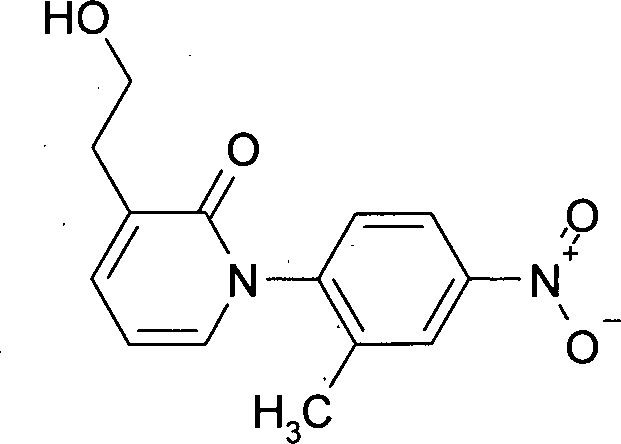
HPLC (Method 1): R t = 10.3 min with 99% F1.
1 H-NMR (400 MHz, DMSO-d 6 ): δ [ppm] = 2.14 (s, 3H), 3.43 (s, 2H)), 6.38 (t, 1H), 7.52 (t, 1H), 7.57 ( d, 1H), 8.19 (dd, 1H), 8.31 (d, 1H).
MS (DCI-NH 3): [M + H] + 289th Example 4: Preparation of 3- (2-hydroxyethyl) -1- (2-methyl-4-nitrophenyl) pyridin-2 (1H) -one
Zu einer Lösung von 50 g (174 mmol) [1-(2-Methyl-4-nitrophenyl)-2-oxo-1,2-dihydropyridin-3-yl]essigsäure in 100 mL 2-Methyl-THF wurden bei 20°C innerhalb von 20 min 56.8 g (348 mmol) Boran-Dimethylanilin Komplex zugetropft. Es wurde 16 h nachgerührt und mit 500 mL Dichlormethan verdünnt. Dieses Gemisch wurde innerhalb von 30 min auf eine Lösung von 50 g Natriumchlorid in 500 mL 1M Salzsäure dosiert. Es wurde 1 h nachgerührt und die organische Phase wurde erneut mit 500 mL einer Lösung von 50 g Natriumchlorid in 500 mL 1M Salzsäure gewaschen. Es wurde mit 500 mL einer gesättigten wässrigen Natriumhydrogencarbonat Lösung gewaschen, über Magnesiumsulfat getrocknet und eingedampft. Es wurden 40 g (84%) des gewünschten Alkohols erhalten.
HPLC (Methode 1): Rt = 11.2 min mit 100 F1%.
1H-NMR (400 MHz, CDCl3): δ [ppm] = 2.27 (s, 3H), 2.89 (t, 2H), 3.89 (t, 2H), 6.34 (t, 4H), 7.11 (dd, 1H), 7.41 (d, 1H), 8.20 (dd, 1H), 8.25 (d, 1H).
MS (DCI-NH3): [M+H]+ 275. Beispiel 5: Herstellung von 3-Brom-1-(2-methoxy-4-nitrophenyl)pyridin-2(1H)-on 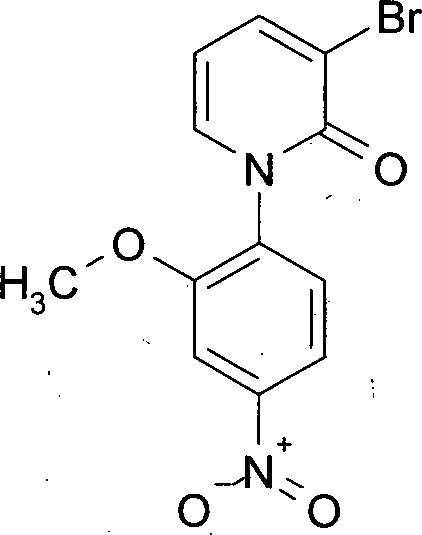
HPLC (Method 1): R t = 11.2 min with 100 F1%.
1 H-NMR (400 MHz, CDCl 3): δ [ppm] = 2.27 (s, 3H), 2.89 (t, 2H), 3.89 (t, 2H), 6:34 (t, 4H), 7.11 (dd, 1H ), 7.41 (d, 1H), 8.20 (dd, 1H), 8.25 (d, 1H).
MS (DCI-NH 3 ): [M + H] + 275. Example 5: Preparation of 3-bromo-1- (2-methoxy-4-nitrophenyl) pyridine-2 (1H) -one
36.2 g 3-Brompyridon (87% Reinheit, 0.18 mol) und 29.4 g 4-Fluor-3-methoxynitrobenzol (0.17 mol) wurden in 180 mL N-Methylpyrrolidon vorgelegt, 46.1 g wasserfreies Kaliumphosphat (0.22 mol) hinzugegeben und das Reaktionsgemisch 6 h bei 120°C gerührt. Nach Abkühlung auf 90°C wurde Wasser hinzugefügt und auf Raumtemperatur abgekühlt. Der Niederschlag wurde abfiltriert, mit Wasser gewaschen und mit einem Methanol-Wasser Gemisch (1:1) verrührt. Der Feststoff wurde abfiltriert, gewaschen und an der Luft getrocknet. Man erhielt 38.7 g (66%) der gewünschten Zielverbindung.
HPLC (Methode 3): Rt = 3.50 min.
LC-MS (Methode 4): Rt = 0.84 min.
1H-NMR (400 MHz, DMSO-d6): δ [ppm] = 3.91 (s, 3H), 6.30 (t, 1H), 7.64 (dd, 1H), 7.70 (d, 1H), 7.96 (dd, 1H), 8.00 (m, 1H), 8.04 (dd, 1H).
MS (ES+): [M+H]+ 327 bzw. 325. Beispiel 6: Herstellung von Diethyl-[1-(2-methoxy-4-nitrophenyl)-2-oxo-1,2-dihydropyridin-3-yl]malonat 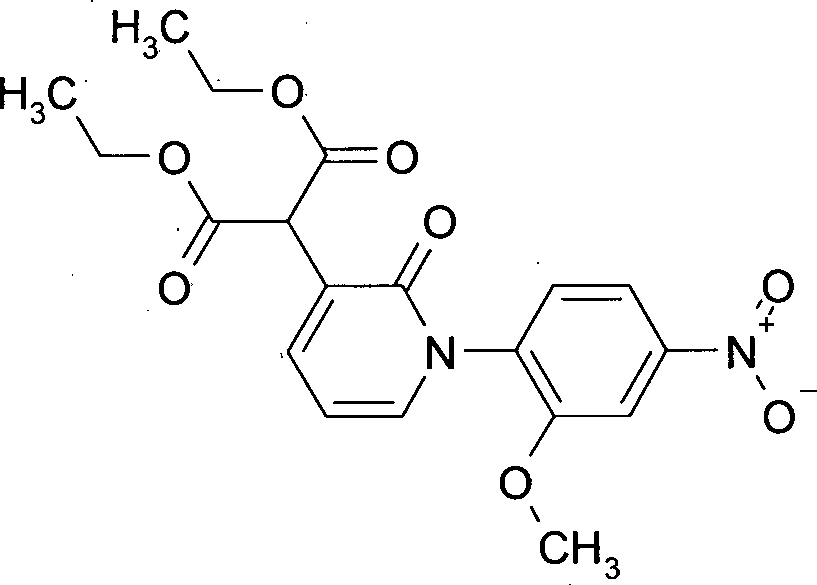
HPLC (Method 3): R t = 3.50 min.
LC-MS (Method 4): R t = 0.84 min.
1 H-NMR (400 MHz, DMSO-d 6 ): δ [ppm] = 3.91 (s, 3H), 6.30 (t, 1H), 7.64 (dd, 1H), 7.70 (d, 1H), 7.96 (dd , 1H), 8.00 (m, 1H), 8.04 (dd, 1H).
MS (ES +): [M + H] + 327 and 325, respectively. Example 6: Preparation of diethyl [1- (2-methoxy-4-nitrophenyl) -2-oxo-1,2-dihydropyridin-3-yl] malonate
39.3 g Natrium-tert.-butylat (0.41 mol) wurden in 300 mL Dioxan vorgelegt und 65.5 g Malonsäurediethylester (0.41 mol) binnen 15 min so zugetropft, dass die Temperatur 30°C nicht überschritt. Nach 1 h wurden 2.70 g (8.8 mmol) Bis-(2-Pyridincarboxylato)Kupfer(II)-Komplex sowie 38.0 g (0.12 mol) 3-Brom-1-(2-methoxy-4-nitrophenyl)pyridin-2(1H)-on hinzugefügt und die Reaktionsmischung 8 h zum Rückfluss erhitzt. Nach Abkühlung auf RT wurde über Nacht weitergerührt. Die Reaktionsmischung wurde vom Feststoff abgesaugt, der Rückstand mit Dioxan nachgewaschen und die vereinten organischen Fraktionen bis auf ca. 300 g am Rotationsverdampfer eingeengt. Die Rohlösung wurde ohne weitere Aufreinigung in die nächste Stufe eingesetzt.
LC-MS (Methode 4): Rt = 1.00 min.
MS (ES+): [M+H]+ 405 Beispiel 7: Herstellung von [1-(2-Methoxy-4-nitrophenyl)-2-oxo-1,2-dihydropyridin-3-yl]essigsäure 
LC-MS (Method 4): R t = 1.00 min.
MS (ES +): [M + H] + 405 Example 7: Preparation of [1- (2-methoxy-4-nitrophenyl) -2-oxo-1,2-dihydropyridin-3-yl] acetic acid
Die Rohproduktlösung von Diethyl-[1-(2-methoxy-4-nitrophenyl)-2-oxo-1,2-dihydropyridin-3-yl]malonat (maximal 0.12 mol) wurde mit 390 mL Wasser verdünnt und langsam 39 mL konzentrierte Natronlauge hinzugegeben. Das Reaktionsgemisch wurde 90 min bei 45°C gerührt, auf RT abgekühlt mit Wasser verdünnt und dreimal mit Dichlormethan extrahiert. Die organische Phase wurde verworfen, die wässrige Phase wurde mit 300 mL Dichlormethan versetzt und bei 15°C mit konzentrierter Salzsäure auf pH 1 gestellt. Bereits im schwach sauren Milieu tritt Kohlendioxid-Entwicklung ein. Nach Erwärmung auf RT wurde 1 h gerührt, dann die Phasen getrennt und die organische Phase über Natriumsulfat getrocknet, filtriert und am Rotationsverdampfer zur Trockne eingeengt. Der Rückstand wurde mit Acetonitril verrührt, abgesaugt, nachgewaschen und im Vakuum getrocknet. Man erhielt 17.4 g (49%) der gewünschten Verbindung. Die Mutterlauge wurde zur Trockne eingeengt, mit Acetontril verrührt und analog aufgearbeitet. Dabei erhielt man weitere 3.6 g (10%) der gewünschten Verbindung.
HPLC (Methode 2): Rt = 3.17 min.
LC-MS (Methode 4): Rt = 0.69 min.
LC-MS (Methode 5): Rt = 0.75 min.
1H-NMR (400 MHz, DMSO-d6): δ [ppm] = 3.40 (s, 2H), 3.90 (s, 3H), 6.31 (t, 1H), 7.45–7.50 (m, 2H), 7.61 (d, 1H), 7.94 (dd, 1H), 7.98 (m, 1H), 12.21 (br. s, 1H).
MS (ES+): [M+H]+ 305. Beispiel 8: Herstellung von 3-(2-Hydroxyethyl)-1-(2-methoxy-4-nitrophenyl)pyridin-2(1H)-on 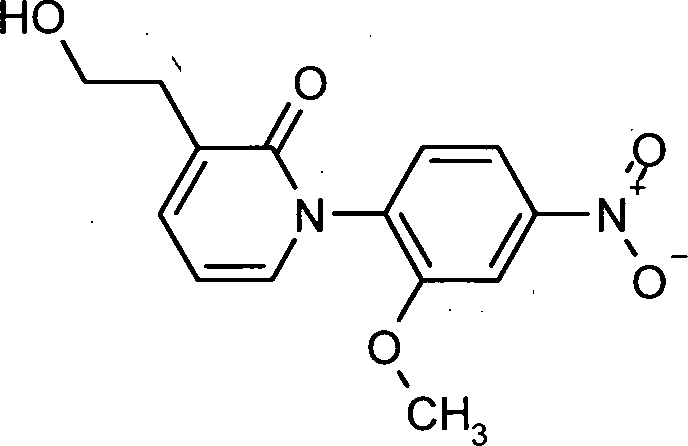
HPLC (Method 2): R t = 3.17 min.
LC-MS (Method 4): R t = 0.69 min.
LC-MS (Method 5): R t = 0.75 min.
1 H-NMR (400 MHz, DMSO-d 6 ): δ [ppm] = 3.40 (s, 2H), 3.90 (s, 3H), 6.31 (t, 1H), 7.45-7.50 (m, 2H), 7.61 (d, 1H), 7.94 (dd, 1H), 7.98 (m, 1H), 12.21 (br, s, 1H).
MS (ES +): [M + H] + 305. Example 8: Preparation of 3- (2-hydroxyethyl) -1- (2-methoxy-4-nitrophenyl) pyridin-2 (1H) -one
21.0 g (69.0 mmol) [1-(2-Methoxy-4-nitrophenyl)-2-oxo-1,2-dihydropyridin-3-yl]essigsäure wurden in 210 mL THF vorgelegt und 104 mL 1M Boran-Lösung in THF bei RT hinzugetropft. Die Temperatur stieg dabei auf 27°C. Das Reaktionsgemisch wurde über Nacht bei RT gerührt. Nach der Verdünnung mit 400 mL Dichlormethan wurden unter Kühlung 400 mL 1N Natronlauge hinzugegeben und 30 min gerührt. Die Phasen wurden getrennt, die organische Phase mit Wasser gewaschen, über Natriumsulfat getrocknet, filtriert und am Rotationsverdampfer zur Trockne eingeengt. Es wurden 17.0 g (85%) Rohprodukt erhalten, die ohne Aufreinigung weiter umgesetzt wurden.
LC-MS (Methode 5): Rt = 0.76 min.
MS (ES+): [M+H]+ 291. Beispiel 9: Herstellung von 2-(Brommethyl)-1-fluor-4-nitrobenzol 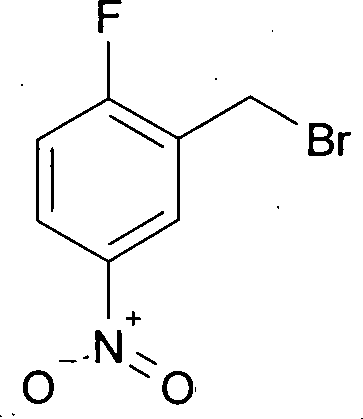
LC-MS (Method 5): R t = 0.76 min.
MS (ES +): [M + H] + 291. Example 9: Preparation of 2- (bromomethyl) -1-fluoro-4-nitrobenzene
Methode Benzylalkohol/PhosphortribromidMethod benzyl alcohol / phosphorus tribromide
70.0 g (0.41 mol) 2-Fluor-5-nitro-benzylalkohol wurden in 470 mL Chloroform vorgelegt und 55.4 g (0.21 mol) Phosphortribromid hinzugegeben. Dabei stieg die Temperatur auf 37°C. Das Reaktionsgemisch wurde 30 min bei 60°C gerührt. Nach Abkühlung auf RT wurde durch Zugabe von gesättigter wässriger Natriumhydrogencarbonat-Lösung neutralisiert (pH = 7). Die organische Phase wurde abgetrennt und die wässrige mit 50 mL Dichlormethan extrahiert. Die vereinten organischen Phasen wurden über Natriumsulfat getrocknet, filtriert und am Rotationsverdampfer zur Trockne eingeengt. Der erhaltene Feststoff wurde im Vakuum getrocknet. Man erhielt 93.7 g (98%) der gewünschten Verbindung, die ohne Aufreinigung weiter umgesetzt wurde.70.0 g (0.41 mol) of 2-fluoro-5-nitro-benzyl alcohol were initially charged in 470 ml of chloroform and 55.4 g (0.21 mol) of phosphorus tribromide were added. The temperature rose to 37 ° C. The reaction mixture was stirred at 60 ° C for 30 min. After cooling to RT, it was neutralized by addition of saturated aqueous sodium bicarbonate solution (pH = 7). The organic phase was separated and the aqueous extracted with 50 mL dichloromethane. The combined organic phases were dried over sodium sulfate, filtered and concentrated to dryness on a rotary evaporator. The resulting solid was dried in vacuo. This gave 93.7 g (98%) of the desired compound, which was reacted further without purification.
Methode N-Bromsuccinimid/ToluolMethod N-bromosuccinimide / toluene
905 g (5.83 mol) 2-Fluor-5-nitrotoluol und 1038 g (5.83 mol) N-Bromsuccinimid wurden in 5.83 L Chloroform vorgelegt, 47.8 g (0.29 mol) 2,2'-Azobis[isobutyronitril] hinzugegeben und das Reaktionsgemisch 18 h zum Rückfluss erhitzt. Nach dem Abkühlen auf RT wurde vom Feststoff abgesaugt und das Filtrat in drei Portionen aufgeteilt. Diese wurden jeweils auf 1.5 kg Kieselgel (0.06–0.2) aufgezogen und an jeweils an 10 kg Kieselgel mit 160 L Essigsäureethylester: Petrolether (2.5:97.5) chromatographisch gereinigt. Die Produktfraktionen wurden vereinigt, am Rotationsverdampfer zur Trockne eingeengt und der Rückstand mit Petrolether 10 min ausgerührt. Der Feststoff wurde abgesaugt, mit Petrolether nachgewaschen und im Vakuum getrocknet. Es wurden 385 g (28%) erhalten.
HPLC (Methode 3): Rt = 3.95 min.
1H-NMR (400 MHz, DMSO-d6): δ [ppm] = 4.82 (s, 2H), 7.57 (t, 1H), 8.30 (ddd, 1H), 8.55 (dd, 1H).
MS (EI+): [M-Br]+ 154. Beispiel 10: Herstellung von 1-Fluor-2-(methoxymethyl)-4-nitrobenzol 
HPLC (Method 3): R t = 3.95 min.
1 H-NMR (400 MHz, DMSO-d 6 ): δ [ppm] = 4.82 (s, 2H), 7.57 (t, 1H), 8.30 (ddd, 1H), 8.55 (dd, 1H).
MS (EI +): [M-Br] + 154. Example 10: Preparation of 1-fluoro-2- (methoxymethyl) -4-nitrobenzene
Unter Argon wurden 250 g (1.07 mol) 2-(Brommethyl)-1-fluor-4-nitrobenzol in 2.51 L Methanol, vorgelegt, 371 g (1.60 mol) Silber-(I)-oxid hinzugefügt und das Reaktionsgemisch 2.5 h bei 52–56°C gerührt. Nach dem Abkühlen auf RT wurde über Kieselgur abgesaugt, mit Methanol nachgewaschen und das Lösemittel am Rotationsverdampfer entfernt. Das Rohprodukt wurde am Kurzwegverdampfer bei 104°C Manteltemperatur und 0.56 mbar destillativ gereinigt. Man erhielt 184.5 g (93%) des gewünschten Produktes.
HPLC (Methode 3): Rt = 3.99 min.
GC-MS (EI) (Methode 7): Rt = 4.52 min.
1H-NMR (400 MHz, DMSO-d6): δ [ppm] = 3.37 (s, 3H), 4.57 (s, 2H), 7.52 (t, 1H), 8.25–8.33 (m, 2H).
MS (EI+): [M]+ 185 (5%), 184 (45%) [M-OMe]+ 154 (90%). Beispiel 11: Herstellung von 3-Brom-1-[2-(methozymethyl)-4-nitrophenyl]pyridin-2(1H)-on 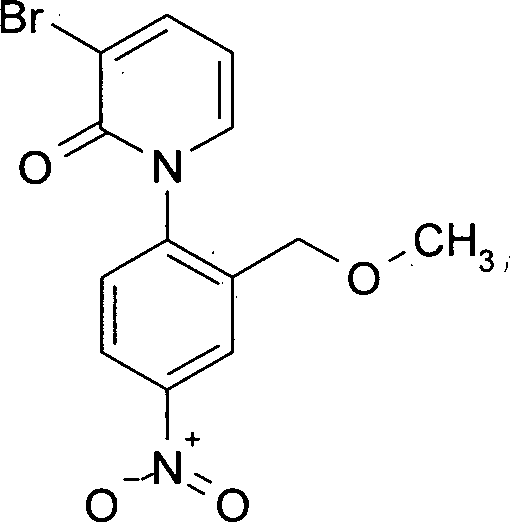
HPLC (Method 3): R t = 3.99 min.
GC-MS (EI) (method 7): R t = 4.52 min.
1 H-NMR (400 MHz, DMSO-d 6 ): δ [ppm] = 3.37 (s, 3H), 4.57 (s, 2H), 7.52 (t, 1H), 8.25-8.33 (m, 2H).
MS (EI +): [M] + 185 (5%), 184 (45%) [M-OMe] + 154 (90%). Example 11: Preparation of 3-bromo-1- [2- (metho-ethyl-ethyl) -4-nitrophenyl] -pyridine-2 (1H) -one
Unter Argon wurden 44.2 g (85% Reinheit, 216 mmol) 3-Brompyridon in 450 mL N-Methylpyrrolidon vorgelegt und 29.1 g Kalium-tert.-butanolat (259 mmol) portionsweise so zugegeben, dass die Temperatur unter 30°C blieb. Es wurde 1 h gerührt und dann 40 g (216 mmol) 1-Fluor-2-(methoxymethyl)-4-nitrobenzol hinzugegeben. Das Reaktionsgemisch wurde 4 h bei 80°C gerührt, auf RT abgekühlt und in eine Eis/Wasser Mischung eingerührt. Der pH-Wert wurde mit halbkonzentrierter Salzsäure auf pH 4 gestellt, mit Essigsäureethylester extrahiert, die organische Phase über Natriumsulfat getrocknet, filtriert und am Rotationsverdampfer zur Trockne eingeengt. Der Rückstand wurde in 2 L Dichlormethan gelöst, auf die fünffache Menge Kieselgel aufgezogen und an Kieselgel mit Essigsäureethylester:Dichlormethan 3:97 und 5:95 chromatographisch gereinigt. Die Produktfraktionen wurden am Rotationsverdampfer zur Trockne eingeengt und der Rückstand im Vakuum getrocknet. Man erhielt 55 g (73%) des gewünschten Produktes.
HPLC (Methode 3): Rt = 3.50 min.
LC-MS (Methode 6): Rt = 1.95 min.
1H-NMR (400 MHz, DMSO-d6): δ [ppm] = 3.26 (s, 3H), 4.27 (d, 1H), 4.34 (d, 1H), 6.35 (t, 1H), 7.69 (dd, 1H), 7.71 (d, 1H), 8.09 (dd, 1H), 8.32 (dd, 1H), 8.37 (d, 1H).
MS (ES+): [M+H]+ 339 bzw. 341. Beispiel 12: Herstellung von Diethyl-{1-[2-(methoxymethyl)-4-nitrophenyl]-2-oxo-1,2-dihydropyridin-3-yl}malonat 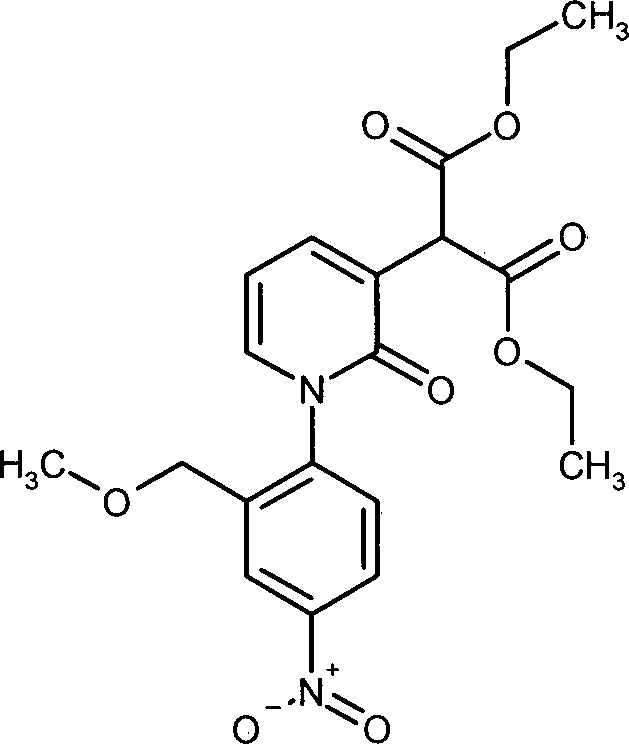
HPLC (Method 3): R t = 3.50 min.
LC-MS (Method 6): R t = 1.95 min.
1 H-NMR (400 MHz, DMSO-d 6 ): δ [ppm] = 3.26 (s, 3H), 4.27 (d, 1H), 4.34 (d, 1H), 6.35 (t, 1H), 7.69 (dd , 1H), 7.71 (d, 1H), 8.09 (dd, 1H), 8.32 (dd, 1H), 8.37 (d, 1H).
MS (ES +): [M + H] + 339 and 341, respectively. Example 12: Preparation of diethyl {1- [2- (methoxymethyl) -4-nitrophenyl] -2-oxo-1,2-dihydropyridin-3-yl} malonate
Unter Argon wurde eine Suspension von 49.3 g (513 mmol) Kalium-tert.-butanolat bei RT in 360 mL Dioxan vorgelegt und 82.2 g (513 mmol) Malonsäurediethylester so zugegeben, dass die Temperatur unter 30°C blieb. Das Reaktionsgemisch wurde 1 h bei RT gerührt, 3.4 g (11.0 mmol) Bis-(2-Pyridincarboxylato)Kupfer(II)-Komplex und 49.7 g (147 mmol) 3-Brom-1-[2-(methoxymethyl)-4-nitrophenyl]pyridin-2(1H)-on hinzugefügt und 4.5 h bei 95°C gerührt. Es wurden weitere 2.0 g (6.5 mmol) Bis-(2-Pyridincarboxylato)Kupfer(II)-Komplex hinzugegeben und das Reaktionsgemisch über Nacht bei 95°C gerührt. Nach dem Abkühlen auf RT wurde mit 0.9 L Essigsäureethylester verdünnt, 1.8 L 3N Salzsäure zugegeben und 15 min bei RT gerührt. Die wässrige Phase wurde mit 0.9 L Essigsäureethylester extrahiert und die vereinten organischen Phasen mit gesättigter wässriger Natriumchloridlösung gewaschen. Nach der Trocknung über Natriumsulfat, Filtration und Entfernen des Lösemittels am Rotationsverdampfer wurde der Rückstand im Vakuum getrocknet. Man erhielt 115 g Rohprodukt, welches ohne Aufreinigung weiter umgesetzt wurde.
HPLC (Methode 3): Rt = 3.96 min.
LC-MS (Methode 4): Rt = 1.01 min
1H-NMR (400 MHz, DMSO-d6): δ [ppm] = 1.18 (t, 3H), 1.20 (t, 3H), 3.24 (s, 3H), 4.11–4.25 (m, 5H), 4.31 (d, 1H), 4.84 (s, 1H), 6.46 (t, 1H), 7.56 (dd, 1H), 7.65 (dd, 1H), 7.67 (d, 1H), 8.30–8.34 (m, 1H), 8.35 (d, 1H).
MS (ES+): [M+H]+ 419. Beispiel 13: Herstellung von {1-[2-(Methoxymethyl)-4-nitrophenyl]-2-oxo-1,2-dihydropyridin-3-yl}essigsäure 
HPLC (Method 3): R t = 3.96 min.
LC-MS (Method 4): R t = 1.01 min
1 H-NMR (400 MHz, DMSO-d 6 ): δ [ppm] = 1.18 (t, 3H), 1.20 (t, 3H), 3.24 (s, 3H), 4.11-4.25 (m, 5H), 4.31 (d, 1H), 4.84 (s, 1H), 6.46 (t, 1H), 7.56 (dd, 1H), 7.65 (dd, 1H), 7.67 (d, 1H), 8.30-8.34 (m, 1H), 8.35 (d, 1H).
MS (ES +): [M + H] + 419. Example 13: Preparation of {1- [2- (methoxymethyl) -4-nitrophenyl] -2-oxo-1,2-dihydropyridin-3-yl} acetic acid
115 g (maximal 147 mmol) des Rohproduktes von Diethyl-{1-[2-(methoxymethyl)-4-nitrophenyl]-2-oxo-1,2-dihydropyridin-3-yl}malonat wurden in 470 mL Dioxan bei RT vorgelegt, 940 mL 2N Natronlauge hinzugegeben und das Reaktionsgemisch 1.5 h bei RT gerührt. Durch Zugabe von 313 mL konzentrierter Salzsäure wurde der pH = 1 eingestellt und das Gemisch anschließend 2 h bei 50°C gerührt. Nach dem Abkühlen auf RT wurde dreimal mit je 1.17 L Essigsäureethylester extrahiert. Die vereinten organischen Phasen wurden dreimal mit je 780 mL gesättigter wässriger Natriumchloridlösung gewaschen, über Natriumsulfat getrocknet, filtriert und am Rotationsverdampfer zur Trockne eingeengt. Der Rückstand wurde in wenig Dichlormethan gelöst und an 1.96 kg Kieselgel (0.04–0.06 mm) mit Methanol:Dichlormethan 5:95 und 1:9 chromatographisch gereinigt. Die Produktfraktionen wurden am Rotationsverdampfer zur Trockne eingeengt. Es wurden 34.9 g (75% über 2 Stufen) des gewünschten Produktes als Öl isoliert.
HPLC (Methode 3): Rt = 3.16 min.
1H-NMR (400 MHz, DMSO-d6): δ [ppm] = 3.25 (s, 3H), 3.43 (s, 2H), 4.21 (d, 1H), 4.31 (d, 1H), 6.37 (t, 1H), 7.53 (m, 2H), 7.64 (d, 1H), 8.30 (dd, 1H), 8.34 (m, 1H), 12.27 (br. s, 1H).
MS (ES+): [M+H]+ 319. Beispiel 14: Herstellung von 3-(2-Hydroxyethyl)-1-[2-(methoxymethyl)-4-nitrophenyl]pyridin-2(1H)-on 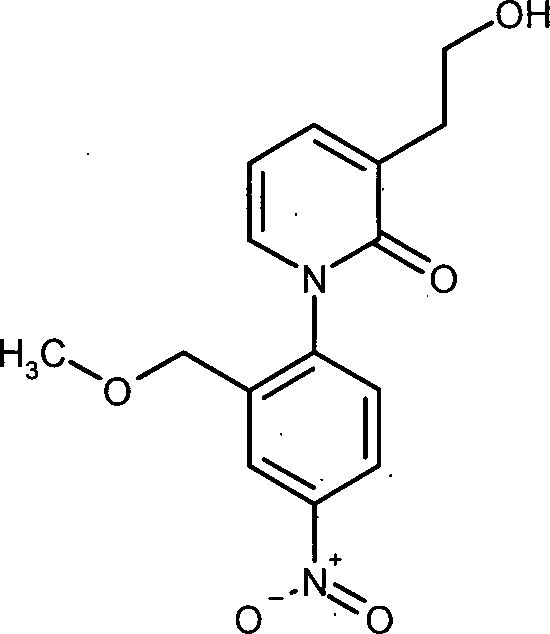
HPLC (Method 3): R t = 3.16 min.
1 H-NMR (400 MHz, DMSO-d 6 ): δ [ppm] = 3.25 (s, 3H), 3.43 (s, 2H), 4.21 (d, 1H), 4.31 (d, 1H), 6.37 (t , 1H), 7.53 (m, 2H), 7.64 (d, 1H), 8.30 (dd, 1H), 8.34 (m, 1H), 12.27 (br, s, 1H).
MS (ES +): [M + H] + 319. Example 14: Preparation of 3- (2-hydroxyethyl) -1- [2- (methoxymethyl) -4-nitrophenyl] pyridine-2 (1H) -one
Unter Argon wurden 37.7 g (109 mmol) {1-[2-(Methoxymethyl)-4-nitrophenyl]-2-oxo-1,2-dihydropyridin-3-yl}essigsäure in 310 mL Tetrahydrofuran bei RT vorgelegt und 53.3 g (327 mmol) Borandiethylanilin-Komplex zunächst vorsichtig dann nach dem Abklingen des starken Schäumen zügig hinzugegeben. Das Reaktionsgemisch wurde über Nacht bei RT gerührt, mit 500 mL Essigsäureethylester verdünnt und mit 1N Salzsäure (1.55 L) zunächst vorsichtig (starke Schaumentwicklung) dann zügig versetzt. Das Reaktionsgemisch wurde 30 min nachgerührt, die organische Phase abgetrennt und die wässrige Phase noch einmal mit 500 mL Essigsäureethylester extrahiert. Die vereinten organischen Phasen wurden zweimal mit je 500 mL 1N Salzsäure gewaschen, einmal mit 200 mL 1N Natronlauge gewaschen, über Natriumsulfat getrocknet, filtriert und am Rotationsverdampfer zur Trockne eingeengt. Der Rückstand wurde zunächst an 500 g Kieselgel (0.04–0.06 mm) mit Methanol:Dichlormethan 5:95 dann 1:9 und nochmals an 500 g Kieselgel (0.04–0.06 mm) mit Aceton:Dichlormethan 3:7 chromatographisch gereinigt. Dabei wurden 14.2 g (43%) des gewünschten Produktes erhalten.
HPLC (Methode 3): Rt = 3.19 min.
1H-NMR (400 MHz, DMSO-d6): δ [ppm] = 2.61 (t, 2H), 3.26 (s, 3H), 3.59 (d, 2H), 4.22 (d, 1H), 4.32 (d, 1H), 4.61 (t, 1H), 6.34 (t, 1H), 7.46 (d, 2H), 7.62 (d, 1H), 8.30 (dd, 1H), 8.35 (m, 1H).
MS (DCI, NH3): [M+H]+ 305. Beispiel 15: Herstellung von 3-Brom-1-(2,6-dimethyl-4-nitrophenyl)pyridin-2(1H)on 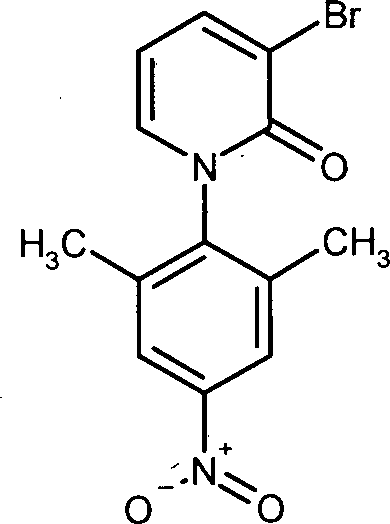
HPLC (Method 3): R t = 3.19 min.
1 H-NMR (400 MHz, DMSO-d 6 ): δ [ppm] = 2.61 (t, 2H), 3.26 (s, 3H), 3.59 (d, 2H), 4.22 (d, 1H), 4.32 (i.e. , 1H), 4.61 (t, 1H), 6.34 (t, 1H), 7.46 (d, 2H), 7.62 (d, 1H), 8.30 (dd, 1H), 8.35 (m, 1H).
MS (DCI, NH 3 ): [M + H] + 305. Example 15: Preparation of 3-bromo-1- (2,6-dimethyl-4-nitrophenyl) pyridin-2 (1H) on
223 g (38%ig, 0.5 mol) 2-Fluor-1,3-dimethyl-5-nitrobenzol und 138 g (1.0 mol) Kaliumcarbonat wurden in 1.95 L DMSO vorgelegt und auf 120°C erwärmt. Bei dieser Temperatur wurde eine Lösung von 100 g (87% Reinheit, 0.5 mol) 3-Brompyridon in DMSO hinzugetropft. Das Reaktionsgemisch wurde 3.5 h bei 120°C gerührt, auf RT abgekühlt, in Wasser eingerührt, mit Salzsäure leicht sauer gestellt und mit Essigsäureethylester extrahiert. Die wässrige Phase wurde. nochmals mit Essigsäureethylester extrahiert, die vereinten organischen Phasen mit Wasser gewaschen, über Natriumsulfat getrocknet, filtriert und am Rotationsverdampfer zur Trockne eingeengt. Das Rohprodukt wurde an Kieselgel mit Dichlormethan dann Essigsäureethylester/Dichlormethan = 1:20 chromatographisch gereinigt. Das isolierte Produkt wurde in Diethylether/Petrolether = 1:1.5 verrührt, abgesaugt und mit Petrolether gewaschen. Man erhielt 75.2 g (47%) des gewünschten Produktes.
HPLC (Methode 3): Rt = 4.17 min.
1H-NMR (400 MHz, DMSO-d6): δ [ppm] = 2.10 (s, 6H), 6.41 (t, 1H), 7.63 (dd, 1H), 8.14 (dd, 1H), 8.18 (s, 2H).
MS (ES+): [M+H]+ 323 bzw. 325. Beispiel 16: Herstellung von Diethyl-[1-(2,6-dimethyl-4-nitrophenyl)-2-oxo-1,2-dihydropyridin-3-yl]malonat 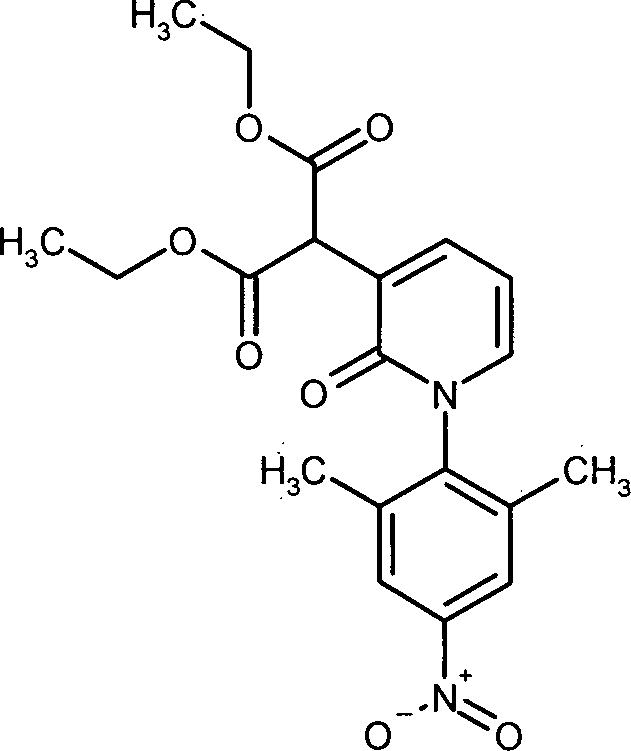
HPLC (Method 3): R t = 4.17 min.
1 H-NMR (400 MHz, DMSO-d 6 ): δ [ppm] = 2.10 (s, 6H), 6.41 (t, 1H), 7.63 (dd, 1H), 8.14 (dd, 1H), 8.18 (s , 2H).
MS (ES +): [M + H] + 323 and 325, respectively. Example 16: Preparation of diethyl [1- (2,6-dimethyl-4-nitrophenyl) -2-oxo-1,2-dihydropyridine-3-one yl] malonate
Unter Argon wurden 42.5 g (379 mmol) Kalium-tert.-Butylat in 530 mL Dioxan suspendiert und auf 55–60°C erwärmt. Bei dieser Temperatur wurde eine Lösung von 607 g (379 mmol) Malonsäurediethylester in 100 mL Dioxan über 20 min addiert. Nach beendeter Zugabe wurde das Reaktionsgemisch 1 h bei 60°C gerührt. Danach wurden 6.72 g (21.7 mmol) Bis-(2-Pyridincarboxylato)Kupfer(II)-Komplex hinzugegeben sowie 35.0 g (108 mmol) 3-Brom-1-(2,6-dimethyl-4-nitrophenyl)pyrtdin-2(1H)-on. Das Reaktionsgemisch wurde 8 h zum Rückfluss erwärmt und danach über Nacht bei RT gerührt. Es wurde vom Feststoff abgesaugt, mit Dioxan nachgewaschen und das Filtrat bis auf 250 g am Rotationsverdampfer eingeengt. Die Rohlösung wurde ohne Aufreinigung weiter umgesetzt.
LC-MS (Methode 5): Rt = 1.18 min.
MS (ES+): [M+H]+ 403. Beispiel 17: Herstellung von [1-(2,6-Dimethyl-4-nitrophenyl)-2-oxo-1,2-dihydropyridin-3-yl]essigsäure 
LC-MS (Method 5): R t = 1.18 min.
MS (ES +): [M + H] + 403. Example 17: Preparation of [1- (2,6-dimethyl-4-nitrophenyl) -2-oxo-1,2-dihydropyridin-3-yl] acetic acid
Die Rohproduktlösung von Diethyl-[1-(2,6-dimethyl-4-nitrophenyl)-2-oxo-1,2-dihydropyridin-3-yl]malonat in Dioxan (maximal 108 mmol) wurde in 350 mL Wasser vorgelegt und 35 mL konzentrierte Natronlauge langsam hinzugegeben. Das Reaktionsgemisch wurde 90 min bei 45°C gerührt. Nach dem Abkühlen auf RT wurden 100 mL Wasser addiert, dreimal mit Dichlormethan gewaschen und die wässrige Phase (pH = 14) mit 270 mL Dichlormethan versetzt. Bei 10–15°C wurden 59.5 mL konzentrierte Salzsäure langsam hinzugegeben bis zum pH = 1. Bereits bei schwach saurem pH setzte die Kohlendioxid-Entwicklung ein. Das Reaktionsgemisch wurde auf RT erwärmt und 1 h, bis zum Ende der Gasentwicklung, gerührt. Nach der Phasentrennung wurde die organische Phase über Natriumsulfat getrocknet, filtriert und am Rotationsverdampfer zur Trockne eingeengt. Der Rückstand wurde mit 200 mL Methyl-tert.-butylether 30 min verrührt. Der kristalline Feststoff wurde abgesaugt, mit Methyl-tert.-butylether gewaschen und im Vakuum getrocknet. Es wurden 14.8 g (47% über 2 Stufen) des gewünschten Produktes erhalten. Die Mutterlauge wurde weitgehend eingeengt, die Nachfällung abgesaugt, nachgewaschen und im Vakuum getrocknet. Es wurden weitere 5.3 g (17% über 2 Stufen) des gewünschten Produktes erhalten.
HPLC (Methode 3): Rt = 3.39 min.
1H-NMR (400 MHz, DMSO-d6): δ [ppm] = 2.09 (s, 6H), 3.44 (s, 2H), 6.41 (t, 1H), 7.42 (dd, 1H), 7.54 (dd, 1H), 8.15 (s, 2H), 12.18 (br. s, 1H).
MS (ES+): [M+H]+ 303. Beispiel 18: Herstellung von 1-(2,6-Dimethyl-4-nitrophenyl)-3-(2-hydroxyethyl)pyridin-2(1H)-on 
HPLC (Methode 3): Rt = 3.88 min.
1H-NMR (400 MHz, DMSO-d6): δ [ppm] = 2.09 (s, 6H), 2.63 (t, 2H), 3.58 (q, 2H), 4.61 (t, 1H), 6.37 (t, 1H), 7.35 (dd, 1H), 7.47 (dd, 1H), 8.15 (s, 2H).
MS (ES+): [M+H]+ 291.The crude product solution of diethyl [1- (2,6-dimethyl-4-nitrophenyl) -2-oxo-1,2-dihydropyridin-3-yl] malonate in dioxane (maximum 108 mmol) was placed in 350 mL of water and 35 mL of concentrated sodium hydroxide added slowly. The reaction mixture was stirred at 45 ° C for 90 minutes. After cooling to RT, 100 ml of water were added, washed three times with dichloromethane, and 270 ml of dichloromethane were added to the aqueous phase (pH = 14). At 10-15 ° C, 59.5 mL of concentrated hydrochloric acid were slowly added to pH = 1. Even at a slightly acidic pH, carbon dioxide evolution began. The reaction mixture was warmed to rt and stirred for 1 hr until gas evolution ceased. After phase separation, the organic phase was dried over sodium sulfate, filtered and concentrated to dryness on a rotary evaporator. The residue was stirred with 200 ml of methyl tert-butyl ether for 30 min. The crystalline solid was filtered off with suction, washed with methyl tert-butyl ether and dried in vacuo. There were obtained 14.8 g (47% over 2 steps) of the desired product. The mother liquor was largely concentrated, the Nachfällung filtered off with suction, washed and dried in vacuo. An additional 5.3 g (17% over 2 steps) of the desired product was obtained.
HPLC (Method 3): R t = 3.39 min.
1 H-NMR (400 MHz, DMSO-d 6 ): δ [ppm] = 2.09 (s, 6H), 3.44 (s, 2H), 6.41 (t, 1H), 7.42 (dd, 1H), 7.54 (dd , 1H), 8.15 (s, 2H), 12.18 (brs s, 1H).
MS (ES +): [M + H] + 303. Example 18: Preparation of 1- (2,6-dimethyl-4-nitrophenyl) -3- (2-hydroxyethyl) pyridin-2 (1H) -one
HPLC (Method 3): R t = 3.88 min.
1 H-NMR (400 MHz, DMSO-d 6 ): δ [ppm] = 2.09 (s, 6H), 2.63 (t, 2H), 3.58 (q, 2H), 4.61 (t, 1H), 6.37 (t , 1H), 7.35 (dd, 1H), 7.47 (dd, 1H), 8.15 (s, 2H).
MS (ES +): [M + H] + 291.
ZITATE ENTHALTEN IN DER BESCHREIBUNG QUOTES INCLUDE IN THE DESCRIPTION
Diese Liste der vom Anmelder aufgeführten Dokumente wurde automatisiert erzeugt und ist ausschließlich zur besseren Information des Lesers aufgenommen. Die Liste ist nicht Bestandteil der deutschen Patent- bzw. Gebrauchsmusteranmeldung. Das DPMA übernimmt keinerlei Haftung für etwaige Fehler oder Auslassungen.This list of the documents listed by the applicant has been generated automatically and is included solely for the better information of the reader. The list is not part of the German patent or utility model application. The DPMA assumes no liability for any errors or omissions.
Zitierte PatentliteraturCited patent literature
- WO 2008/155032 [0002, 0004, 0006, 0006, 0010, 0020, 0043] WO 2008/155032 [0002, 0004, 0006, 0006, 0010, 0020, 0043]
- WO 2008/155033 [0002, 0020, 0043] WO 2008/155033 [0002, 0020, 0043]
Zitierte Nicht-PatentliteraturCited non-patent literature
- Kwong et al., Org. Lett., 2007, 9, 3469–3472 [0009] Kwong et al., Org. Lett., 2007, 9, 3469-3472 [0009]
- Synthesis and Reactivity in Inorganic, Metal-Organic, and Nano-Metal Chemistry, 35(9), 695–702; 2005 [0033] Synthesis and Reactivity in Inorganic, Metal-Organic, and Nano-Metal Chemistry, 35 (9), 695-702; 2005 [0033]
- Kwong et al., Org. Lett., 2007, 9, 3469–3472 [0036] Kwong et al., Org. Lett., 2007, 9, 3469-3472 [0036]
Claims (14)
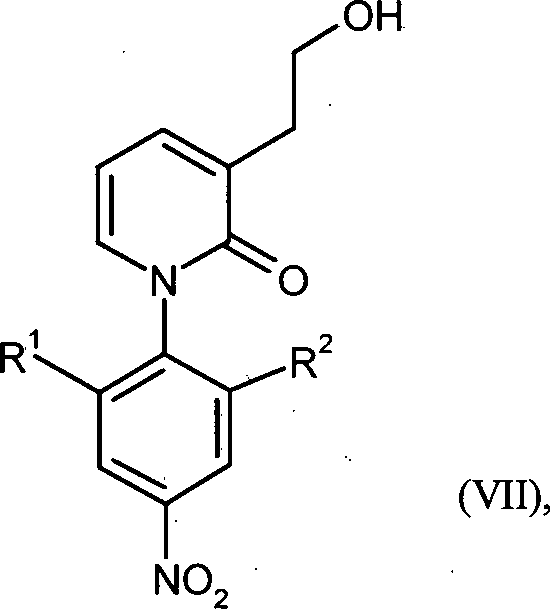


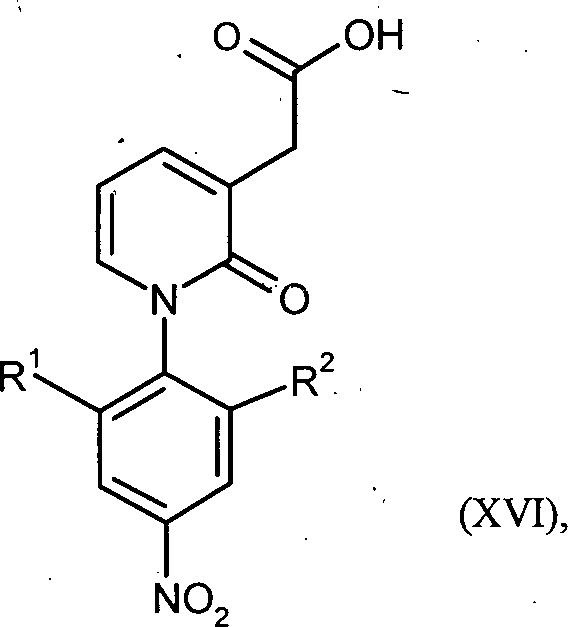

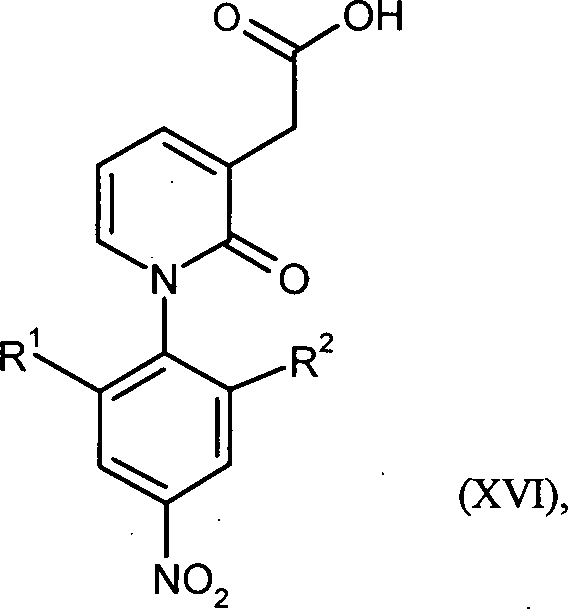
Priority Applications (9)
| Application Number | Priority Date | Filing Date | Title |
|---|---|---|---|
| DE201010028362 DE102010028362A1 (en) | 2010-04-29 | 2010-04-29 | manufacturing |
| HK13108777.7A HK1181384B (en) | 2010-04-29 | 2011-04-26 | Method for producing substituted pyridin-2-one |
| CN201180021480.4A CN102906071B (en) | 2010-04-29 | 2011-04-26 | Method for producing substituted pyridin-2-one |
| EP11717250.2A EP2563762B1 (en) | 2010-04-29 | 2011-04-26 | Method for producing substituted pyridin-2-one |
| US13/643,244 US8802860B2 (en) | 2010-04-29 | 2011-04-26 | Method for producing substituted pyridin-2-one |
| ES11717250.2T ES2547152T3 (en) | 2010-04-29 | 2011-04-26 | Procedure for preparing substituted pyridin-2-ones |
| JP2013506634A JP5776127B2 (en) | 2010-04-29 | 2011-04-26 | Process for producing substituted pyridin-2-ones |
| PCT/EP2011/056588 WO2011134963A1 (en) | 2010-04-29 | 2011-04-26 | Method for producing substituted pyridin-2-one |
| CA2797604A CA2797604A1 (en) | 2010-04-29 | 2011-04-26 | Method for producing substituted pyridin-2-one |
Applications Claiming Priority (1)
| Application Number | Priority Date | Filing Date | Title |
|---|---|---|---|
| DE201010028362 DE102010028362A1 (en) | 2010-04-29 | 2010-04-29 | manufacturing |
Publications (1)
| Publication Number | Publication Date |
|---|---|
| DE102010028362A1 true DE102010028362A1 (en) | 2011-11-03 |
Family
ID=44144779
Family Applications (1)
| Application Number | Title | Priority Date | Filing Date |
|---|---|---|---|
| DE201010028362 Withdrawn DE102010028362A1 (en) | 2010-04-29 | 2010-04-29 | manufacturing |
Country Status (8)
| Country | Link |
|---|---|
| US (1) | US8802860B2 (en) |
| EP (1) | EP2563762B1 (en) |
| JP (1) | JP5776127B2 (en) |
| CN (1) | CN102906071B (en) |
| CA (1) | CA2797604A1 (en) |
| DE (1) | DE102010028362A1 (en) |
| ES (1) | ES2547152T3 (en) |
| WO (1) | WO2011134963A1 (en) |
Citations (2)
| Publication number | Priority date | Publication date | Assignee | Title |
|---|---|---|---|---|
| WO2008155032A1 (en) | 2007-06-20 | 2008-12-24 | Bayer Schering Pharma Aktiengesellschaft | Substituted (oxazolidinon-5-yl-methyl) -2-thiophene-carboxamides and use thereof in the field of blood coagulation |
| WO2008155033A1 (en) | 2007-06-20 | 2008-12-24 | Bayer Schering Pharma Aktiengesellschaft | Substituted (oxazolidinon-5-yl-methyl) -2-thiophene-carboxamides and use thereof in the field of blood coagulation |
Family Cites Families (17)
| Publication number | Priority date | Publication date | Assignee | Title |
|---|---|---|---|---|
| US4789745A (en) * | 1982-07-16 | 1988-12-06 | The Upjohn Company | Certain 3-[3-(3-pyridinyloxy)propoxy or propylthio]-acetic acid derivatives which are useful as synthetase inhibitors |
| EP0099685B1 (en) * | 1982-07-16 | 1988-09-21 | The Upjohn Company | (3-pyridinyl)heteroalkanols and alkanoic acids and esters |
| TWI242011B (en) * | 1997-03-31 | 2005-10-21 | Eisai Co Ltd | 1,4-substituted cyclic amine derivatives |
| JP2002531549A (en) * | 1998-12-04 | 2002-09-24 | ブリストル−マイヤーズ スクイブ カンパニー | 3-Substituted-4-arylquinolin-2-one derivatives as potassium channel modulators |
| DE19962924A1 (en) | 1999-12-24 | 2001-07-05 | Bayer Ag | Substituted oxazolidinones and their use |
| DE10129725A1 (en) | 2001-06-20 | 2003-01-02 | Bayer Ag | Combination therapy of substituted oxazolidinones |
| JP2005520782A (en) | 2001-07-12 | 2005-07-14 | ファルマシア・アンド・アップジョン・カンパニー・エルエルシー | Amide-containing compound having improved water solubility and method for improving water solubility of amide-containing compound |
| US7265140B2 (en) | 2003-09-23 | 2007-09-04 | Pfizer Inc | Acyloxymethylcarbamate prodrugs of oxazolidinones |
| DE10355461A1 (en) | 2003-11-27 | 2005-06-23 | Bayer Healthcare Ag | Solid, high bioavailabilty oral formulations of N-substituted 5-chloro-2-thiophene-carboxamide derivative in hydrophilized form, useful for combating thrombo-embolic diseases |
| DE102004002044A1 (en) | 2004-01-15 | 2005-08-04 | Bayer Healthcare Ag | manufacturing |
| KR101195801B1 (en) | 2004-06-18 | 2012-11-05 | 밀레니엄 파머슈티컬스 인코퍼레이티드 | Factor xa inhibitors |
| US20060069260A1 (en) | 2004-09-28 | 2006-03-30 | Huiping Zhang | Preparation of N-aryl pyridones |
| DE102004062475A1 (en) | 2004-12-24 | 2006-07-06 | Bayer Healthcare Ag | Solid, orally administrable, modified release pharmaceutical dosage forms |
| DE102005047558A1 (en) | 2005-10-04 | 2008-02-07 | Bayer Healthcare Ag | Combination therapy of substituted oxazolidinones for the prophylaxis and treatment of cerebral circulatory disorders |
| DE102006025314A1 (en) | 2006-05-31 | 2007-12-06 | Bayer Healthcare Ag | Aryl-substituted heterocycles and their use |
| DE102006039589A1 (en) | 2006-08-24 | 2008-03-06 | Bayer Healthcare Ag | Aminoacyl prodrugs II |
| DE102007028406A1 (en) | 2007-06-20 | 2008-12-24 | Bayer Healthcare Ag | Substituted oxazolidinones and their use |
-
2010
- 2010-04-29 DE DE201010028362 patent/DE102010028362A1/en not_active Withdrawn
-
2011
- 2011-04-26 CA CA2797604A patent/CA2797604A1/en not_active Abandoned
- 2011-04-26 WO PCT/EP2011/056588 patent/WO2011134963A1/en not_active Ceased
- 2011-04-26 US US13/643,244 patent/US8802860B2/en not_active Expired - Fee Related
- 2011-04-26 ES ES11717250.2T patent/ES2547152T3/en active Active
- 2011-04-26 EP EP11717250.2A patent/EP2563762B1/en active Active
- 2011-04-26 JP JP2013506634A patent/JP5776127B2/en not_active Expired - Fee Related
- 2011-04-26 CN CN201180021480.4A patent/CN102906071B/en not_active Expired - Fee Related
Patent Citations (2)
| Publication number | Priority date | Publication date | Assignee | Title |
|---|---|---|---|---|
| WO2008155032A1 (en) | 2007-06-20 | 2008-12-24 | Bayer Schering Pharma Aktiengesellschaft | Substituted (oxazolidinon-5-yl-methyl) -2-thiophene-carboxamides and use thereof in the field of blood coagulation |
| WO2008155033A1 (en) | 2007-06-20 | 2008-12-24 | Bayer Schering Pharma Aktiengesellschaft | Substituted (oxazolidinon-5-yl-methyl) -2-thiophene-carboxamides and use thereof in the field of blood coagulation |
Non-Patent Citations (2)
| Title |
|---|
| Kwong et al., Org. Lett., 2007, 9, 3469-3472 |
| Synthesis and Reactivity in Inorganic, Metal-Organic, and Nano-Metal Chemistry, 35(9), 695-702; 2005 |
Also Published As
| Publication number | Publication date |
|---|---|
| US8802860B2 (en) | 2014-08-12 |
| EP2563762A1 (en) | 2013-03-06 |
| JP5776127B2 (en) | 2015-09-09 |
| WO2011134963A1 (en) | 2011-11-03 |
| ES2547152T3 (en) | 2015-10-01 |
| CN102906071B (en) | 2015-03-18 |
| CN102906071A (en) | 2013-01-30 |
| CA2797604A1 (en) | 2011-11-03 |
| US20130116443A1 (en) | 2013-05-09 |
| EP2563762B1 (en) | 2015-07-22 |
| JP2013528579A (en) | 2013-07-11 |
| HK1181384A1 (en) | 2013-11-08 |
Similar Documents
| Publication | Publication Date | Title |
|---|---|---|
| EP3421470B1 (en) | Substituted 5-fluoro-1h-pyrazolopyridines in crystalline form | |
| DE69736704T2 (en) | PIPERAZIN AND PIPERIDINE DERIVATIVES | |
| DE69913047T2 (en) | Process for the preparation of benzamide derivatives | |
| DE4219158A1 (en) | Biphenyl derivatives, pharmaceutical compositions containing them and processes for their preparation | |
| DE69408580T2 (en) | 2-AMINO-1,2,3,4-TETRAHYDRONAPHTHALENE DERIVATIVES WITH CARDIOVASCULAR EFFECT | |
| DE2803651C2 (en) | ||
| DE102010040234A1 (en) | Process for the preparation of 5-fluoro-1H-pyrazolo [3,4-b] pyridine-3-carbonitrile | |
| CH617934A5 (en) | ||
| DE2828578C2 (en) | Thiazolidines, their manufacture and use | |
| DE68924221T2 (en) | Imidazole derivatives. | |
| WO2004101540A2 (en) | Method for the production of phenylacetic acid derivatives | |
| EP2563762B1 (en) | Method for producing substituted pyridin-2-one | |
| DE1935404C3 (en) | Process for the manufacture of quinazolines | |
| EP1607090A1 (en) | Asimadoline for the treatment of irritable bowel syndrome | |
| DE3042844A1 (en) | 2- (1H-IMIDAZOL-1-YL) -ETHOXY DERIVATIVES OF CHINOLIN-2- AND 4-METHANOLS, METHOD FOR THEIR PRODUCTION, MEDICINAL PRODUCTS AND THE USE THEREOF | |
| CH638525A5 (en) | 3- (TETRAZOL-5-YL) -1-AZAXANTHONE AND METHOD FOR THE PRODUCTION THEREOF. | |
| EP0299277A2 (en) | Process for the preparation of substituted pyridyl-alkyl ketones | |
| DE2653251A1 (en) | AZABICYCLO SQUARE BRACKET ON 3.1.O SQUARE BRACKET FOR HEXANE DERIVATIVES, THEIR PRODUCTION AND USE | |
| DE60308170T2 (en) | PROCESS FOR THE PREPARATION OF CHINOLINE DERIVATIVES | |
| WO2003095401A1 (en) | Method for the production of substituted trifluoroethylenes | |
| CH620414A5 (en) | ||
| DE19626771C2 (en) | 4- (4-oxocyclohexyl) benzamides | |
| AT364836B (en) | METHOD FOR PRODUCING NEW O-SUBSTITUTED DERIVATIVES OF (+) - CYANIDAN-3-OLS AND THE SALTS THEREOF | |
| DE1470261C (en) | Process for the preparation of 3.5 "disubstituted isoxazole derivatives | |
| AT205968B (en) | Process for the preparation of new benzimidazoles |
Legal Events
| Date | Code | Title | Description |
|---|---|---|---|
| R119 | Application deemed withdrawn, or ip right lapsed, due to non-payment of renewal fee |
Effective date: 20121101 |