DE102010025552B4 - Method and device for parking a motor vehicle - Google Patents
Method and device for parking a motor vehicle Download PDFInfo
- Publication number
- DE102010025552B4 DE102010025552B4 DE102010025552.1A DE102010025552A DE102010025552B4 DE 102010025552 B4 DE102010025552 B4 DE 102010025552B4 DE 102010025552 A DE102010025552 A DE 102010025552A DE 102010025552 B4 DE102010025552 B4 DE 102010025552B4
- Authority
- DE
- Germany
- Prior art keywords
- parking
- parking space
- curb
- environment
- vehicle
- Prior art date
- Legal status (The legal status is an assumption and is not a legal conclusion. Google has not performed a legal analysis and makes no representation as to the accuracy of the status listed.)
- Active
Links
- 238000000034 method Methods 0.000 title claims abstract description 28
- 238000005259 measurement Methods 0.000 claims abstract description 29
- 238000002592 echocardiography Methods 0.000 claims abstract description 25
- 238000001514 detection method Methods 0.000 claims abstract description 10
- 238000002604 ultrasonography Methods 0.000 claims abstract description 10
- 238000012913 prioritisation Methods 0.000 claims description 3
- 230000035945 sensitivity Effects 0.000 description 4
- 239000011159 matrix material Substances 0.000 description 3
- 241001465754 Metazoa Species 0.000 description 1
- 238000012937 correction Methods 0.000 description 1
- 230000001419 dependent effect Effects 0.000 description 1
- 238000011161 development Methods 0.000 description 1
- 230000018109 developmental process Effects 0.000 description 1
- 238000011835 investigation Methods 0.000 description 1
Images
Classifications
-
- G—PHYSICS
- G01—MEASURING; TESTING
- G01S—RADIO DIRECTION-FINDING; RADIO NAVIGATION; DETERMINING DISTANCE OR VELOCITY BY USE OF RADIO WAVES; LOCATING OR PRESENCE-DETECTING BY USE OF THE REFLECTION OR RERADIATION OF RADIO WAVES; ANALOGOUS ARRANGEMENTS USING OTHER WAVES
- G01S15/00—Systems using the reflection or reradiation of acoustic waves, e.g. sonar systems
- G01S15/88—Sonar systems specially adapted for specific applications
- G01S15/93—Sonar systems specially adapted for specific applications for anti-collision purposes
- G01S15/931—Sonar systems specially adapted for specific applications for anti-collision purposes of land vehicles
-
- G—PHYSICS
- G08—SIGNALLING
- G08G—TRAFFIC CONTROL SYSTEMS
- G08G1/00—Traffic control systems for road vehicles
- G08G1/16—Anti-collision systems
- G08G1/165—Anti-collision systems for passive traffic, e.g. including static obstacles, trees
-
- G—PHYSICS
- G08—SIGNALLING
- G08G—TRAFFIC CONTROL SYSTEMS
- G08G1/00—Traffic control systems for road vehicles
- G08G1/16—Anti-collision systems
- G08G1/168—Driving aids for parking, e.g. acoustic or visual feedback on parking space
-
- G—PHYSICS
- G01—MEASURING; TESTING
- G01S—RADIO DIRECTION-FINDING; RADIO NAVIGATION; DETERMINING DISTANCE OR VELOCITY BY USE OF RADIO WAVES; LOCATING OR PRESENCE-DETECTING BY USE OF THE REFLECTION OR RERADIATION OF RADIO WAVES; ANALOGOUS ARRANGEMENTS USING OTHER WAVES
- G01S15/00—Systems using the reflection or reradiation of acoustic waves, e.g. sonar systems
- G01S15/88—Sonar systems specially adapted for specific applications
- G01S15/93—Sonar systems specially adapted for specific applications for anti-collision purposes
- G01S15/931—Sonar systems specially adapted for specific applications for anti-collision purposes of land vehicles
- G01S2015/932—Sonar systems specially adapted for specific applications for anti-collision purposes of land vehicles for parking operations
- G01S2015/933—Sonar systems specially adapted for specific applications for anti-collision purposes of land vehicles for parking operations for measuring the dimensions of the parking space when driving past
- G01S2015/934—Sonar systems specially adapted for specific applications for anti-collision purposes of land vehicles for parking operations for measuring the dimensions of the parking space when driving past for measuring the depth, i.e. width, not length, of the parking space
Landscapes
- Physics & Mathematics (AREA)
- General Physics & Mathematics (AREA)
- Engineering & Computer Science (AREA)
- Radar, Positioning & Navigation (AREA)
- Remote Sensing (AREA)
- Acoustics & Sound (AREA)
- Computer Networks & Wireless Communication (AREA)
- Traffic Control Systems (AREA)
- Measurement Of Velocity Or Position Using Acoustic Or Ultrasonic Waves (AREA)
Abstract
Verfahren zum unterstützten Einparken eines Kraftfahrzeugs mit einer auf Ultraschall basierenden Umfeldsensorik in eine mögliche Parklücke, mit den Schritten:Bestimmen und Ausmessen einer möglichen Parklücke (PL) aus dem durch die Umfeldsensorik erfassten Umfeld, wobeidie Erfassung des Umfeldes auf der Detektion von ersten und zweiten Echos der von der Umfeldsensorik ausgesandten und an Objekten reflektierten Ultraschallwellen basiert,der Empfang nur eines ersten Echos bezüglich einer Messposition als ein niedriges Hindernis und der Empfang von ersten und zweiten Echos bezüglich einer Messposition als hohes Hindernis interpretiert wird und ein niedriges Hindernis als überfahrbarer Bordstein (B) interpretiert und ein hohes Hindernis nicht überfahrbares Objekt interpretiert wird Auswählen eines Parkszenarios aus einer vorgegebenen Vielzahl von Parkszenarios als Funktion der möglichen Parklücke (PL) und deren Umfeld, wobei jedes Parkszenario eine Funktion der Parklückentiefe (t) ist, wobei die Parklückentiefe als der fahrbahnseitige Abstand zum Bordstein definiert ist, undParkszenarien, in welchen Bordsteine (B) als überfahrbar gekennzeichnet sind, als unzulässig bewertet werden, wenn die Umfeldmessung einer Parklücke (PL) ergibt, dass der Bordstein (B) nicht überfahrbar ist.Method for assisted parking of a motor vehicle with an environment sensor system based on ultrasound in a possible parking space, with the steps: determining and measuring a possible parking space (PL) from the environment detected by the environment sensors, the detection of the environment being based on the detection of first and second echoes based on the ultrasonic waves emitted by the environment sensors and reflected by objects, the receipt of only a first echo with regard to a measurement position as a low obstacle and the receipt of first and second echoes with regard to a measurement position as a high obstacle and a low obstacle as a curb that can be driven over (B ) is interpreted and a high obstacle is interpreted that cannot be driven over i the depth of the parking space is defined as the distance to the curb on the roadway side, and parking scenarios in which curbs (B) are marked as negotiable are assessed as inadmissible if the measurement of the surroundings of a parking space (PL) shows that the curb (B) cannot be negotiated.
Description
Die Erfindung betrifft ein Verfahren zum Einparken eines Kraftfahrzeugs in eine Parklücke sowie eine entsprechende Vorrichtung.The invention relates to a method for parking a motor vehicle in a parking space and a corresponding device.
Systeme oder Verfahren zum unterstützten bis hin zum autonomen Ein- oder Ausparken eines Kraftfahrzeugs in eine Parklücke finden immer mehr Eingang in moderne Kraftfahrzeuge. Aktuelle moderne Parkassistenzsysteme ermitteln während der Vorbeifahrt potentielle Parklücken und messen diese aus, berechnen im konkreten Fall eine Einparktrajektorie in die ausgewählte Parklücke und unterstützen den Fahrer beim Einparkvorgang, indem beispielsweise die Lenkung durch das Assistenzsystem übernommen wird.Systems or methods for parking a motor vehicle in or out of a parking space with support or even autonomously are being used more and more in modern motor vehicles. Current modern parking assistance systems determine potential parking spaces while driving past and measure them, calculate a parking trajectory in the specific case in the selected parking space and support the driver during the parking process, for example by the steering being taken over by the assistance system.
Derzeitige, als Sonderzubehör eines Kraftfahrzeugs erhältliche Parkassistenten messen mittels um das Kraftfahrzeug angeordneter Ultraschallsensoren per Ultraschall Längsparklücken aus und unterstützen den Fahrer durch Ausführung des Lenkvorgangs beim Einparken auf der, beispielsweise mittels des Blinkers, ausgewählten Seite. Die nächste Generation von Parkassistenten wird in der Lage sein auch Querparklücken auszumessen und das Einparken in diese zu unterstützten.Current parking assistants available as special accessories of a motor vehicle use ultrasound sensors arranged around the motor vehicle to measure parallel parking spaces by ultrasound and support the driver by executing the steering process when parking on the side selected, for example using the turn signal. The next generation of parking assistants will also be able to measure perpendicular parking spaces and support parking in them.
So offenbart die
Aus der
Die Druckschrift
Die Druckschrift
Die Druckschrift
Die Druckschrift
Der Erfindung liegt daher die Aufgabe zugrunde, ein Verfahren zur Detektion der Überfahrbarkeit eines Objekts, insbesondere eines Bordsteins, zu vereinfachen und ein Verfahren zur Klassifizierung von Parklücken zu schaffen, welches auch das teilweise oder vollständige Parken des Fahrzeugs auf Bordsteinen ermöglicht und das Einparken vereinfacht.The invention is therefore based on the object of simplifying a method for detecting whether an object, in particular a curb, can be driven over, and creating a method for classifying parking spaces, which also allows the vehicle to be partially or completely parked on curbs and simplifies parking.
Die Aufgabe wird durch ein Verfahren zum unterstützten Einparken eines Kraftfahrzeugs mit den Merkmalen des Anspruchs 1 sowie durch einen Parkassistenten mit den Merkmalen des Anspruchs 3 gelöst. Bevorzugte Ausgestaltungen der Erfindung sind Gegenstand der abhängigen Ansprüche.The object is achieved by a method for parking a motor vehicle with the features of claim 1 and by a parking assistant with the features of
Das erfindungsgemäße Verfahren zum unterstützten Einparken eines Kraftfahrzeugs mit einer auf Ultraschall basierenden Umfeldsensorik in eine mögliche Parklücke umfasst die Schritte:
- - Bestimmen und Ausmessen einer möglichen Parklücke aus dem durch die Umfeldsensorik erfassten Umfeld, wobei
- - die Erfassung des Umfeldes auf der Detektion von ersten und zweiten Echos der von der Umfeldsensorik ausgesandten und an Objekten reflektierten Ultraschallwellen basiert,
- - der Empfang nur eines ersten Echos bezüglich einer Messposition als ein niedriges Hindernis und der Empfang von ersten und zweiten Echos bezüglich einer Messposition als hohes Hindernis interpretiert wird und ein niedriges Hindernis als überfahrbarer Bordstein interpretiert und ein hohes Hindernis nicht überfahrbares Objekt interpretiert wird
- - Auswählen eines Parkszenarios aus einer vorgegebenen Vielzahl von Parkszenarios als Funktion der möglichen Parklücke und deren Umfeld, wobei
- - jedes Parkszenario eine Funktion der Parklückentiefe ist, wobei die Parklückentiefe als der fahrbahnseitige Abstand zum Bordstein definiert ist, und
- - Parkszenarien, in welchen Bordsteine als überfahrbar gekennzeichnet sind, als unzulässig bewertet werden, wenn die Umfeldmessung einer Parklücke (PL) ergibt, dass der Bordstein nicht überfahrbar ist.
- - Determining and measuring a possible parking space from the environment detected by the environment sensors, wherein
- - the detection of the environment is based on the detection of first and second echoes of the ultrasonic waves emitted by the environment sensors and reflected by objects,
- - the receipt of only a first echo relative to a measurement position is interpreted as a low obstacle and the receipt of first and second echoes relative to a measurement position is interpreted as a high obstacle and a low obstacle is interpreted as a curb that can be traversed and a high obstacle is interpreted as an object that cannot be traversed
- - Selecting a parking scenario from a predetermined number of parking scenarios as a function of the possible parking space and its environment, where
- - each parking scenario is a function of the parking space depth, where the parking space depth is defined as the roadside distance to the curb, and
- - Parking scenarios in which curbs are marked as traversable are rated as inadmissible if the measurement of the surroundings of a parking space (PL) shows that the kerb cannot be traversed.
Dabei wird das Umfeld eines Kraftfahrzeugs zum Bestimmen möglicher Parklücken mittels einer auf Ultraschall basierenden Umfeldsensorik erfasst, wobei die Erfassung des Umfeldes des Kraftfahrzeugs auf der Detektion von ersten und zweiten Echos der von der Umfeldsensorik ausgesandten und an Objekten reflektierten Ultraschallwellen basiert. Mittels der einfachen Detektion erster und zweiter Echos ist eine genaue Analyse des Kraftfahrzeugumfeldes möglich, ohne dass komplizierte Untersuchungen von beispielsweise des zeitlichen Verlaufs der rückgestreuten Amplitude der Schallwelle notwendig ist, da es sich herausgestellt hat, dass Objekte, die bezüglich eines Messpunktes nur erste Echos erzeugen, eine andere Höhe haben als Objekte, die bezüglich eines Messpunktes erste und zweite Echos erzeugen.The environment of a motor vehicle is detected to determine possible parking spaces by means of an environment sensor system based on ultrasound, the detection of the environment of the motor vehicle being based on the detection of first and second echoes of the ultrasonic waves emitted by the environment sensor system and reflected by objects. By means of the simple detection of first and second echoes, a precise analysis of the vehicle environment is possible without the need for complicated investigations of, for example, the time profile of the backscattered amplitude of the sound wave, since it has been found that objects that only generate first echoes with regard to a measuring point , have a different height than objects that generate first and second echoes with respect to a measuring point.
Der Empfang nur eines ersten Echos bezüglich einer Messposition wird als ein niedriges Hindernis und der Empfang von ersten und zweiten Echos bezüglich einer Messposition als hohes Hindernis interpretiert. Dadurch ist eine einfache Interpretation der Messergebnisse hinsichtlich der Höhe der detektierten Objekte möglich. Ein niedriges Objekt bedeutet in diesem Zusammenhang eine Objekthöhe von kleiner oder gleich 15 cm. Das Vorhandensein eines zweiten Echos deutet auf ein Objekt mit einer Höhe von mehr als 15 cm hin, so dass dessen Befahrbarkeit als nicht gegeben angenommen wird, um beispielsweise eine Beschädigung der Räder des Fahrzeugs zu vermeiden. Dabei sind die Ultraschallsensoren des Kraftfahrzeugs in üblicher Weise seitlich am Kraftfahrzeug, d.h. im Wesentlichen in Höhe des Stoßfängers, angebracht und strahlen seitlich ab.The reception of only a first echo with respect to a measurement position is interpreted as a low obstacle and the reception of first and second echoes with respect to a measurement position as a high obstacle animals. This enables a simple interpretation of the measurement results with regard to the height of the detected objects. In this context, a low object means an object height of less than or equal to 15 cm. The presence of a second echo indicates an object with a height of more than 15 cm, so that its passability is assumed to be non-existent, for example to avoid damaging the vehicle's wheels. The ultrasonic sensors of the motor vehicle are attached in the usual way to the side of the motor vehicle, ie essentially at the level of the bumper, and emit laterally.
Folglich wird ein niedriges Hindernis als ein überfahrbarer Bordstein und ein hohes Hindernis als ein nicht überfahrbares Objekt, insbesondere ein nicht überfahrbarer Bordstein, interpretiert. Durch diese Art der Klassifikation ist es auf einfache Art und Weise möglich ein unterstütztes Einparken auch in solchen Situationen zu bewerkstelligen, in denen ein teilweises oder vollständiges Parken auf dem Bordstein aufgrund der Begebenheiten des Umfeldes bzw. der aufgefundenen Parklücke des Kraftfahrzeugs notwendig ist.Consequently, a low obstacle is interpreted as a traversable curb and a high obstacle as an impassable object, in particular an impassable curb. This type of classification makes it possible to perform assisted parking in a simple manner even in situations in which partial or full parking on the curb is necessary due to the circumstances of the surroundings or the parking space found for the motor vehicle.
Die Parkszenarien sind eine Funktion der Parklückentiefe, wobei die Parklückentiefe mittels des Abstandes zum Bordstein definiert ist. Dabei werden Parkszenarien, in welchen Bordsteinen als überfahrbar gekennzeichnet sind, als unzulässig bewertet, wenn die Umfeldmessung einer Parklücke ergibt, dass der Bordstein in Wirklichkeit nicht überfahrbar ist.The parking scenarios are a function of the parking space depth, where the parking space depth is defined in terms of the distance to the curb. Parking scenarios in which curbs are marked as being able to be driven over are assessed as impermissible if the measurement of the surroundings of a parking space shows that the curb is in fact not drivable.
Ferner können Parkszenarien mit einer Priorisierung versehen sein, so dass bei einer Zulässigkeit zweier Parkszenarien für eine in Betracht kommende Parklücke das Szenario mit höherer Priorisierung gewählt und dem Fahrer vorgeschlagen wird.Furthermore, parking scenarios can be provided with a prioritization, so that if two parking scenarios are permissible for a parking space under consideration, the scenario with the higher prioritization is selected and proposed to the driver.
Ein erfindungsgemäßes Parkassistenzsystem eines Kraftfahrzeugs zur Durchführung des Verfahrens zum unterstützten Einparken eines Kraftfahrzeugs mit einer Umfeldsensorik, umfasst eine auf Ultraschall basierenden Umfeldsensorik zur Bestimmung des Umfeldes des Kraftfahrzeugs und im Umfeld vorhandener Parklücken, sowie eine Einrichtung zur Bestimmung der Überfahrbarkeit von einem in einer detektierten Parklücke angeordnetem Objekt auf der Basis erster und zweiter Echos der ausgesandten Ultraschallwellen der Umfeldsensorik. Auf diese Art ist es möglich dem Fahrer ein unterstütztes Einparken anzubieten, das auch ein teilweises oder vollständiges Parken auf dem Bordstein ermöglicht.A parking assistance system according to the invention of a motor vehicle for carrying out the method for assisted parking of a motor vehicle with an environment sensor system, comprises an environment sensor system based on ultrasound for determining the environment of the motor vehicle and parking spaces present in the environment, as well as a device for determining the ability to be driven over by a vehicle located in a detected parking space Object based on first and second echoes of the ultrasonic waves emitted by the environment sensors. In this way it is possible to offer the driver assisted parking, which also allows partial or complete parking on the curb.
Vorzugsweise weist das Parkassistenzsystem eine Einrichtung zur Auswahl eines Parkszenarios aus einer Vielzahl vorgegebener Parkszenarios als Funktion einer detektierten Parklücke und deren Umfeld auf. Mit anderen Worten, die Parklücke mit deren Umfeld und Begebenheiten bezüglich eines Bordsteins werden mit vorgegebenen Parkszenarien verglichen und es wird das Parkszenario ausgewählt und dem Fahrer vorgeschlagen, welches mit der vermessenen Parklücke übereinstimmt.The parking assistance system preferably has a device for selecting a parking scenario from a large number of predefined parking scenarios as a function of a detected parking space and its surroundings. In other words, the parking space with its surroundings and events with regard to a curb are compared with predefined parking scenarios and the parking scenario that matches the measured parking space is selected and suggested to the driver.
Vorzugsweise sind die Parkszenarien eine Funktion der durch die Ultraschallmessung bestimmten Parklückentiefe, wobei die Parklückentiefe definiert ist als der von der Fahrbahnseite gesehene Abstand zum Bordstein.The parking scenarios are preferably a function of the parking space depth determined by the ultrasonic measurement, the parking space depth being defined as the distance from the curb seen from the side of the road.
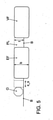
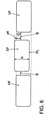
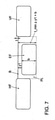
Eine bevorzugte Ausgestaltung der Erfindung wird anhand der Zeichnungen erläutert. Dabei zeigt
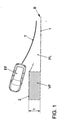
-
1 ein Einparken hinter einem stehenden Fahrzeug vor einem Bordstein, -
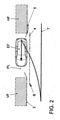
2 ein Einparken zwischen zwei Fahrzeugen auf einem befahrbaren Bordstein, -
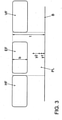
3 ein erstes Einparkszenario, -
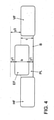
4 ein zweites Einparkszenario, -
5 ein drittes Einparkszenario, -
6 ein viertes Einparkszenario, und -
7 ein fünftes Einparkszenario.
-
1 parking behind a stationary vehicle in front of a curb, -
2 parking between two vehicles on an accessible curb, -
3 a first parking scenario, -
4 a second parking scenario, -
5 a third parking scenario, -
6 a fourth parking scenario, and -
7 a fifth parking scenario.
Im Folgenden werden beispielhaft verschiedene Einparkszenarien erläutert, wobei die Aufzählung der Szenarien nicht vollständig ist. Eine grundsätzliche Unterteilung der Einparkszenarien richtet sich nach der Tiefe der Parklücke vor einem Bordstein, wobei von einer Überfahrbarkeit des Bordsteins ausgegangen wird. Kann der Bordstein nicht überfahren werden, obwohl dies aufgrund der Parklückentiefe notwendig wäre, so liegt keine zulässige Parklücke vor. Die folgende Übersicht gibt die Zielposition und die Ausrichtung des Egofahrzeugs als Funktion der Parklückentiefe wieder, wobei eine Fahrzeugbreite von b = 1,75 m angenommen wird. Weist das Egofahrzeug eine andere Breite auf, so kann die Parklückentiefe t entsprechend angepasst werden. Ferner kann die Einteilung als Funktion der Parklückentiefe t andere Werte aufweisen. Tabelle 1.
Der Nominalabstand y1 zum Bordstein wird dabei definiert als die Endposition des Fahrzeugs relativ zum Bordstein. Der Abstand ist parametrierbar und wird beispielsweise auf einen Wert von 15 cm festgelegt. Die zulässige Toleranz der Fahrzeugendposition bezüglich y1 wird in der bevorzugten Ausführungsform auf +/- 10 cm. Der innere Versatz y2 wird definiert als der maximal erlaubte innere Versatz in die Parklücke und beschreibt, wie weit der fahrbahnnächste Punkt der Fahrzeugflanke (ohne Außenspiegel) in der Fahrzeugendposition von der hinteren, der Fahrbahn zugewandten Ecke des vorderen geparkten Fahrzeugs aus gemessen von der Fahrbahn entfernt ist. Der innere Versatz y2 ist ebenfalls parametrierbar und wird beispielsweise auf 50 cm festgelegt.The nominal distance y1 to the curb is defined as the final position of the vehicle relative to the curb. The distance can be parameterized and is set to a value of 15 cm, for example. The allowable tolerance of the final vehicle position with respect to y1 is set to +/- 10 cm in the preferred embodiment. The inner offset y2 is defined as the maximum permitted inner offset into the parking space and describes how far the vehicle side closest to the lane (without exterior mirrors) in the vehicle end position is from the lane-facing rear corner of the parked vehicle in front, measured from the lane is. The inner offset y2 can also be parameterized and is set to 50 cm, for example.
Ist die Parklückentiefe t kleiner als die Breite b des Egofahrzeugs EF und der vorgegeben Nominalabstand y1, also t < b +y1, und das Fahrzeug ragt nicht mehr als der maximale äußere Versatz y3 von beispielsweise 50 cm auf die Fahrbahn hinaus, d.h. y3 > b + y1 -t, so richtet sich das Egofahrzeug EF unter Einhaltung des Nominalabstands y1 am Bordstein B aus. Es ist auch möglich, die Fallunterscheidung im Fall b) der Tabelle 1 nicht zu tätigen und das Egofahrzeug EF immer am Bordstein B unter Einhaltung des Nominalabstands y1 auszurichten.If the parking space depth t is less than the width b of the ego vehicle EF and the specified nominal distance y1, ie t<b+y1, and the vehicle does not protrude more than the maximum external offset y3 of the example If 50 cm points out onto the roadway, ie y3>b+y1−t, then the ego vehicle EF aligns itself with the curb B while maintaining the nominal distance y1. It is also possible not to make the case distinction in case b) of Table 1 and always align the host vehicle EF with the curb B while maintaining the nominal distance y1.
Dabei ist y3 definiert als der maximal äußere Versatz, der beschreibt wie weit der fahrbahnnächste Punkt der Egofahrzeugflanke (ohne Außenspiegel) in der Fahrzeugendposition von der hinteren, der Fahrbahn zugewandten Ecke des vorderen geparkten Fahrzeugs aus gemessen wird. Der Wert von y3 kann 50 cm betragen.y3 is defined as the maximum outer offset, which describes how far the closest point of the ego vehicle flank (without exterior mirrors) in the vehicle end position is measured from the rear corner of the front parked vehicle facing the lane. The value of y3 can be 50 cm.
Die oben genannten Parkszenarios a) bis e) sind nur beispielhaft und nicht vollständig. Eine geeignete Verfeinerung an mögliche Situationen ist selbstverständlich möglich, was zu einer Erweiterung der möglichen Parkszenarios führt.The above parking scenarios a) to e) are only examples and not complete. A suitable refinement of possible situations is of course possible, which leads to an expansion of the possible parking scenarios.
BezugszeichenlisteReference List
- BB
- Bordsteincurb
- EFEF
- Egofahrzeugego vehicle
- HFHF
- hinteres Fahrzeugrear vehicle
- VFvf
- vorderes Fahrzeugfront vehicle
- OO
- Objektobject
- PLpl
- Parklückeparking lot
- TT
- Einparktrajektorie parking trajectory
- 11
- Messreihe mit nur ersten EchosSeries of measurements with only first echoes
- 22
- Messreihe mit ersten und zweiten EchosSeries of measurements with first and second echoes
- 33
- Messreihe mit ersten und zweiten EchosSeries of measurements with first and second echoes
- 44
- Messreihe nur mit ersten EchosSeries of measurements with first echoes only
- 55
- Messreihe mit ersten und zweiten Echos Series of measurements with first and second echoes
- y1y1
- Nominalabstand Egofahrzeug zum BordsteinNominal distance of ego vehicle to curb
- y2y2
- innerer Versatzinternal misalignment
- y3y3
- äußerer Versatzouter offset
- y4y4
- Sicherheitsabstandsafety distance
- x_sx_s
- Sicherheitsabstandsafety distance
- bb
- Breite EgofahrzeugWide ego vehicle
- tt
- Parklückentiefeparking space depth
- t_mint_min
- straßenabgewandte Parklückentiefeoff-street parking space depth
Claims (3)
Priority Applications (1)
| Application Number | Priority Date | Filing Date | Title |
|---|---|---|---|
| DE102010025552.1A DE102010025552B4 (en) | 2010-06-29 | 2010-06-29 | Method and device for parking a motor vehicle |
Applications Claiming Priority (1)
| Application Number | Priority Date | Filing Date | Title |
|---|---|---|---|
| DE102010025552.1A DE102010025552B4 (en) | 2010-06-29 | 2010-06-29 | Method and device for parking a motor vehicle |
Publications (2)
| Publication Number | Publication Date |
|---|---|
| DE102010025552A1 DE102010025552A1 (en) | 2011-12-29 |
| DE102010025552B4 true DE102010025552B4 (en) | 2022-03-17 |
Family
ID=45115682
Family Applications (1)
| Application Number | Title | Priority Date | Filing Date |
|---|---|---|---|
| DE102010025552.1A Active DE102010025552B4 (en) | 2010-06-29 | 2010-06-29 | Method and device for parking a motor vehicle |
Country Status (1)
| Country | Link |
|---|---|
| DE (1) | DE102010025552B4 (en) |
Families Citing this family (13)
| Publication number | Priority date | Publication date | Assignee | Title |
|---|---|---|---|---|
| DE102012211637A1 (en) * | 2012-07-04 | 2014-01-09 | Robert Bosch Gmbh | Method for operating driver assistance system of vehicle i.e. motor car, involves generating driving assistance for vehicle driver based on reference side, so that vehicle is approached at reference side to drive |
| US8825292B2 (en) * | 2013-01-10 | 2014-09-02 | Ford Global Technologies, Llc | Suspension control system to facilitate wheel motions during parking |
| DE102013221355A1 (en) * | 2013-10-22 | 2015-04-23 | Robert Bosch Gmbh | Method for parking a vehicle on a curb |
| DE102014111124A1 (en) * | 2014-08-05 | 2016-02-25 | Valeo Schalter Und Sensoren Gmbh | Method for detecting at least one object in an environmental region of a motor vehicle by means of an ultrasonic sensor, driver assistance system and motor vehicle |
| DE102015200522B4 (en) * | 2015-01-15 | 2022-03-31 | Ford Global Technologies, Llc | Method for supporting a maneuvering process of a motor vehicle and driver assistance system |
| DE102016101356A1 (en) * | 2016-01-26 | 2017-07-27 | Valeo Schalter Und Sensoren Gmbh | Method for at least semi-autonomous parking of a motor vehicle in a parking space with a step, driver assistance system and motor vehicle |
| DE102016209810A1 (en) * | 2016-06-03 | 2017-12-07 | Robert Bosch Gmbh | Method for detecting at least one parking space for a vehicle |
| DE102019128023B4 (en) | 2019-10-17 | 2021-09-23 | Valeo Schalter Und Sensoren Gmbh | Method for classifying the height of an object by a driving assistance system |
| DE102022118987A1 (en) | 2022-07-28 | 2024-02-08 | Volkswagen Infotainment Gmbh | Method for checking a parking area for a motor vehicle |
| CN115402344B (en) * | 2022-10-12 | 2025-11-11 | 北京宾理信息科技有限公司 | Parking scene simulation method and device |
| CN118107562B (en) * | 2022-11-29 | 2026-03-10 | 深圳引望智能技术有限公司 | Path planning method and device and vehicle |
| CN115973144A (en) * | 2022-12-20 | 2023-04-18 | 纵目科技(上海)股份有限公司 | A method, device, electronic equipment and medium for automatic parking recognition of obstacles |
| CN115953759B (en) * | 2023-01-03 | 2026-02-24 | 宣城立讯精密工业有限公司 | Method and device for detecting parking space limiter, electronic equipment and storage medium |
Citations (6)
| Publication number | Priority date | Publication date | Assignee | Title |
|---|---|---|---|---|
| DE10339645A1 (en) | 2003-08-28 | 2005-04-14 | Robert Bosch Gmbh | Method and device for determining the size and position of a parking space |
| DE102005044050A1 (en) | 2005-09-15 | 2007-03-22 | Hella Kgaa Hueck & Co. | Method for parking space determination for motor vehicles |
| DE102005044270A1 (en) | 2005-09-16 | 2007-03-29 | Robert Bosch Gmbh | Method and device for supporting a parking process of a vehicle |
| DE102007002261A1 (en) | 2007-01-16 | 2008-08-21 | GM Global Technology Operations, Inc., Detroit | Motor vehicle driver assisting method for use during parking, involves detecting parking spaces by sensors, and collecting and storing parameter of each detected space, and offering parking spaces to driver in order of prioritization |
| DE102007042220A1 (en) | 2007-09-05 | 2009-03-12 | Robert Bosch Gmbh | Object classification method, parking assistance method and parking assistance system |
| DE102008028222A1 (en) | 2008-06-13 | 2009-12-17 | Volkswagen Ag | Method for determining distance of vehicle from barrier and height of barrier, involves emitting signal waves by vehicle in laterally downward manner, where distance and height are determined depending on reflections of signal waves |
-
2010
- 2010-06-29 DE DE102010025552.1A patent/DE102010025552B4/en active Active
Patent Citations (6)
| Publication number | Priority date | Publication date | Assignee | Title |
|---|---|---|---|---|
| DE10339645A1 (en) | 2003-08-28 | 2005-04-14 | Robert Bosch Gmbh | Method and device for determining the size and position of a parking space |
| DE102005044050A1 (en) | 2005-09-15 | 2007-03-22 | Hella Kgaa Hueck & Co. | Method for parking space determination for motor vehicles |
| DE102005044270A1 (en) | 2005-09-16 | 2007-03-29 | Robert Bosch Gmbh | Method and device for supporting a parking process of a vehicle |
| DE102007002261A1 (en) | 2007-01-16 | 2008-08-21 | GM Global Technology Operations, Inc., Detroit | Motor vehicle driver assisting method for use during parking, involves detecting parking spaces by sensors, and collecting and storing parameter of each detected space, and offering parking spaces to driver in order of prioritization |
| DE102007042220A1 (en) | 2007-09-05 | 2009-03-12 | Robert Bosch Gmbh | Object classification method, parking assistance method and parking assistance system |
| DE102008028222A1 (en) | 2008-06-13 | 2009-12-17 | Volkswagen Ag | Method for determining distance of vehicle from barrier and height of barrier, involves emitting signal waves by vehicle in laterally downward manner, where distance and height are determined depending on reflections of signal waves |
Also Published As
| Publication number | Publication date |
|---|---|
| DE102010025552A1 (en) | 2011-12-29 |
Similar Documents
| Publication | Publication Date | Title |
|---|---|---|
| DE102010025552A1 (en) | Method for detecting environment of motor car to determine possible parking spaces using environment sensor system, involves receiving echoes as high obstruction based on measuring position | |
| EP2684070B1 (en) | Method for detecting a parking space, parking assist system and motor vehicle comprising a parking assist system | |
| EP2191293B1 (en) | Object classification method, parking assistance method, and parking assistance system | |
| EP1643271B1 (en) | Method and device for classifying side boundaries of a parking space for a parking assistance system of a motor vehicle | |
| EP3465264B1 (en) | Method for detecting at least one parking space for a vehicle | |
| EP0936476B1 (en) | Vehicle-based obstacle recognition system | |
| EP2507648B1 (en) | Method for adjusting the sensitivity of ultrasonic sensors | |
| DE19501642B4 (en) | Method for contactless distance measurement | |
| EP3413085A1 (en) | Method for assisting a driver of a vehicle combination in manoeuvring with the combination, dead angle system and combination | |
| DE102007035219A1 (en) | Object classification method and parking assistance system | |
| EP1478547A1 (en) | Method for parking a vehicle | |
| EP2698646A1 (en) | Method for classifying moving vehicles by tracking a position size of the vehicle | |
| EP1731922A1 (en) | Method and device for determining free areas in the vicinity of a motor vehicle | |
| DE102009047283A1 (en) | Method and device for assisting a driver of a motor vehicle | |
| EP1755921B1 (en) | Method and device for assisting the performance of a parking maneuver of a vehicle | |
| DE102011080933A1 (en) | Method for assisting a driver when parking | |
| WO2011051101A1 (en) | Collision monitor for a motor vehicle | |
| DE102014116014A1 (en) | Method for operating a driver assistance system of a motor vehicle, driver assistance system and motor vehicle | |
| DE102019207688A1 (en) | Method and driver assistance system for classifying objects in the vicinity of a vehicle | |
| DE102018103560A1 (en) | A method for characterizing an object in an environmental region of a motor vehicle by comparing a received signal of a distance sensor with a predetermined curve, sensor device and driver assistance system | |
| EP1433002B1 (en) | Method for determining the position of a target object and radar system operating with said method | |
| DE102017115457A1 (en) | Detecting a misalignment of a distance sensor based on a ratio of detection features | |
| DE102021001176A1 (en) | Method for the detection of an impending head-on collision between two vehicles | |
| DE102012015517B4 (en) | Method for masking out an irrelevant object when detecting obstacles using an ultrasonic sensor of a motor vehicle, driver assistance device and motor vehicle | |
| DE102018133458A1 (en) | Method for determining position information of objects with a radar device and radar device |
Legal Events
| Date | Code | Title | Description |
|---|---|---|---|
| R163 | Identified publications notified | ||
| R012 | Request for examination validly filed | ||
| R016 | Response to examination communication | ||
| R018 | Grant decision by examination section/examining division | ||
| R020 | Patent grant now final |