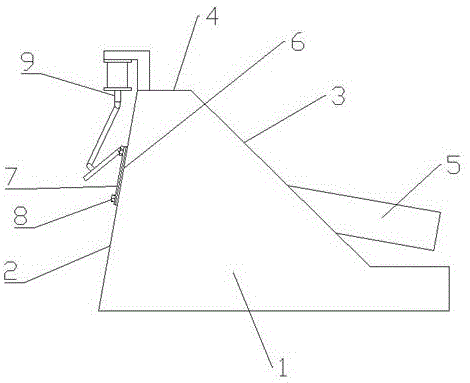
Novel protective facility for dam back slope
Technical Field
The utility model relates to a protective facility, in particular to a novel protective facility for a dam back slope.
Background
The dam refers to a weir for intercepting rivers and blocking water, and a water blocking dam of reservoirs, rivers and the like. The common reservoir dam mainly comprises a main dam, an auxiliary dam, a gravity dam, a normal spillway, an emergency spillway, a smart main canal culvert and a power station. The overflow port of the dam is generally positioned at the top of the dam, so that the garbage on the water surface is inconvenient to salvage when being left at the downstream, and the water flow has large impact on a backwater slope, so that the deep part of a rock seam is corroded, and hidden danger exists.
SUMMERY OF THE UTILITY MODEL
The utility model aims to provide a novel protective facility for a dam back slope, which aims to solve the technical problem.
In order to achieve the purpose, the utility model adopts the following technical scheme:
the utility model provides a novel safeguard of dam back of body slope, includes the dam body, the slope that faces water, dam crest, drain pipe, sealed pad, connecting plate, bolt, gate device, the dam body left side is equipped with the slope that faces water, and the right side is equipped with the slope that faces water, the dam body top surface is equipped with the horizontally dam crest, the drain pipe is run through the slope that faces water downwards by the slope that faces water, the connecting plate is fixed with the drain pipe, install sealed the pad between connecting plate and the slope that faces water, the connecting plate passes through the bolt fastening with the slope that faces water, the gate device is installed outward to the connecting plate.
On the basis of the technical scheme, the gate device comprises a gate plate, a connecting seat, a connecting rod seat, a hydraulic cylinder connecting seat, a hydraulic cylinder and a connecting rod, wherein the gate plate is located at the left end of the drain pipe, the gate plate is hinged to the connecting plate through the connecting seat, the connecting rod seat is fixed on the outer wall of the gate plate, the hydraulic cylinder connecting seat is fixed to the top of the dam, the hydraulic cylinder is fixed to the bottom of the hydraulic cylinder connecting seat, the output end of the hydraulic cylinder is hinged to the connecting rod, and the tail end of the connecting rod is hinged to the connecting rod seat.
On the basis of the technical scheme, the closed gate plate is in sealing fit with the left end of the drain pipe.
Compared with the prior art, the utility model has the following advantages: the water outlet pipe penetrates through the left side and the right side of the dam body, water flows through the water outlet pipe, erosion of the water flow to rock seams in the dam body is avoided, the water outlet pipe is low in replacement cost and convenient to assemble and disassemble, the service life of a back water slope is prolonged, a water inlet of the water outlet pipe is located in the middle of a water-facing slope, pollutants on the water surface are effectively prevented from entering the water outlet pipe, and centralized collection and cleaning are facilitated.
Drawings
FIG. 1 is a front view of the present invention.
Fig. 2 is a cross-sectional view of the present invention.
FIG. 3 is a schematic view of the exterior structure of the lock gate device of the present invention.
In the figure: 1. dam body, 2, water-facing slope, 3, water-backing slope, 4, dam crest, 5, drain pipe, 6, sealing gasket, 7, connecting plate, 8, bolt, 9, gate device, 10, flashboard, 11, connecting seat, 12, connecting rod seat, 13, hydraulic cylinder connecting seat, 14, hydraulic cylinder, 15, connecting rod.
Detailed Description
The utility model is explained in further detail below with reference to the figures and the specific embodiments.
As shown in fig. 1-3, a novel protective device for a dam back slope, including dam body 1, upstream slope 2, back slope 3, dam crest 4, drain pipe 5, sealed pad 6, connecting plate 7, bolt 8, gate device 9, dam body 1 left side is equipped with upstream slope 2, and the right side is equipped with back slope 3, dam body 1 top surface is equipped with horizontally dam crest 4, drain pipe 5 runs through downstream slope 3 downwards by upstream slope 2 slope, connecting plate 7 is fixed with drain pipe 5, install sealed pad 6 between connecting plate 7 and the upstream slope 2, connecting plate 7 passes through bolt 8 with upstream slope 2 and fixes, gate device 9 is installed outward to connecting plate 7.
Gate device 9 includes flashboard 10, connecting seat 11, connecting rod seat 12, pneumatic cylinder connecting seat 13, pneumatic cylinder 14, connecting rod 15, flashboard 10 is located drain pipe 5 left end, flashboard 10 is articulated through connecting seat 11 and connecting plate 7, the flashboard 10 outer wall is fixed with connecting rod seat 12, pneumatic cylinder connecting seat 13 is fixed with dam crest 4, pneumatic cylinder 14 is fixed in pneumatic cylinder connecting seat 13 bottom, 14 output of pneumatic cylinder articulates there is connecting rod 15, 15 terminal and the articulated connecting rod seat 12 of connecting rod are articulated.
The gate plate 10 is in sealing fit with the left end of the drain pipe 5 after being closed.
The working principle of the utility model is as follows: the pneumatic cylinder drives the connecting rod and realizes opening and closing of flashboard, and rivers pass through the drain pipe and arrange downstream, and the effectual horizontal floating garbage that avoids flows into the drain pipe, and rivers and drain pipe contact have avoided the erosion to dam body and back water slope.
The foregoing is a preferred embodiment of the present invention, and it will be apparent to those skilled in the art that variations, modifications, substitutions and alterations can be made in the embodiment without departing from the principles and spirit of the utility model.