CN202492436U - Segmented water-inflowing moving bed biofilm reactor (MBBR) denitriding phosphorus removal device - Google Patents
Segmented water-inflowing moving bed biofilm reactor (MBBR) denitriding phosphorus removal device Download PDFInfo
- Publication number
- CN202492436U CN202492436U CN2012200845343U CN201220084534U CN202492436U CN 202492436 U CN202492436 U CN 202492436U CN 2012200845343 U CN2012200845343 U CN 2012200845343U CN 201220084534 U CN201220084534 U CN 201220084534U CN 202492436 U CN202492436 U CN 202492436U
- Authority
- CN
- China
- Prior art keywords
- reactor
- fluidized bed
- bed biofilm
- stage
- anoxic
- Prior art date
- Legal status (The legal status is an assumption and is not a legal conclusion. Google has not performed a legal analysis and makes no representation as to the accuracy of the status listed.)
- Expired - Lifetime
Links
Images

Classifications
-
- Y—GENERAL TAGGING OF NEW TECHNOLOGICAL DEVELOPMENTS; GENERAL TAGGING OF CROSS-SECTIONAL TECHNOLOGIES SPANNING OVER SEVERAL SECTIONS OF THE IPC; TECHNICAL SUBJECTS COVERED BY FORMER USPC CROSS-REFERENCE ART COLLECTIONS [XRACs] AND DIGESTS
- Y02—TECHNOLOGIES OR APPLICATIONS FOR MITIGATION OR ADAPTATION AGAINST CLIMATE CHANGE
- Y02W—CLIMATE CHANGE MITIGATION TECHNOLOGIES RELATED TO WASTEWATER TREATMENT OR WASTE MANAGEMENT
- Y02W10/00—Technologies for wastewater treatment
- Y02W10/10—Biological treatment of water, waste water, or sewage
Landscapes
- Purification Treatments By Anaerobic Or Anaerobic And Aerobic Bacteria Or Animals (AREA)
Abstract
一种分段进水MBBR脱氮除磷的装置属于污水处理领域,第一、二、三段流化床生物膜反应器分3部分,底部为砂盘曝气器,曝气器上方有承托层,承托层之上为填料区;填料所用材质为空心球,规格

A segmented MBBR nitrogen and phosphorus removal device belongs to the field of sewage treatment. The first, second, and third-stage fluidized bed biofilm reactors are divided into three parts. The bottom is a sand tray aerator, and there is a supporting layer above the aerator. , above the supporting layer is the filler area; the material used for the filler is hollow ball, the specification
Description
技术领域 technical field
本实用新型涉及一种改良分段进水生物脱氮除磷装置,属于生化法污水生物处理技术领域,它将改良分段进水装置与MBBR相结合,活性污泥和流化床生物膜的联用使得该装置同时具有了抗冲击负荷、强化SND脱氮、节能降耗的优点,适用于大、中、小型城镇生活污水及工业废水深度脱氮除磷领域。 The utility model relates to an improved segmented water inlet biological denitrification and phosphorus removal device, which belongs to the technical field of biochemical sewage biological treatment. It combines the improved segmented water inlet device with MBBR, and the combined use of activated sludge and fluidized bed biofilm makes the device The device also has the advantages of anti-shock load, enhanced SND denitrification, energy saving and consumption reduction, and is suitable for deep denitrification and dephosphorization of domestic sewage and industrial wastewater in large, medium and small cities. the
背景技术 Background technique
连续流分段进水工艺是一种高效的污水生物脱氮工艺,是近年来国内外新开发的生物脱氮工艺,它耦合传统AO工艺、UCT工艺,采用多点进水的方式在各段厌氧区、缺氧区进水,是采用活性污泥法的生物处理工艺。 The continuous flow segmental water inflow process is an efficient sewage biological denitrification process. It is a newly developed biological denitrification process at home and abroad in recent years. It couples the traditional AO process and UCT process. The influent water in the zone and anoxic zone is a biological treatment process using activated sludge method. the
随着排放标准的日益严格,单一的工艺已经远远不能满足时代需求,耦合工艺的串联、协同变得越来越重要。本实用新型涉及活性污泥法和流化床生物膜法的联合作用,结合两者各自优势开发一种对低C/N比城市污水更有利的污水处理工艺。 With the increasingly stringent emission standards, a single process is far from meeting the needs of the times, and the series and synergy of coupled processes are becoming more and more important. The utility model relates to the joint action of activated sludge method and fluidized bed biofilm method, and combines the respective advantages of the two to develop a sewage treatment process which is more beneficial to low C/N ratio urban sewage. the
生物膜法——生物接触氧化反应器,填料外表面与气、液相直接接触而溶解氧较高,微生物群体以好氧菌、硝化菌为主;填料内层由于氧传递受阻以及外部氧被大量消耗形成了缺氧微环境,反硝化菌占优势,这样每个载体都为一个微型反应器,使硝化反应和反硝化反应同时存在,因此通过控制污泥减量装置内部的溶氧环境,使得同步硝化反硝化脱氮作用在接触氧化反应器中得到强化,从而提高了处理效果。该工艺具有高效的处理能力,特征原理分析如下:①传质条件好,在接触氧化法中由于空气的搅动,整个氧化池的污水在填料之间流动,使生物膜和水流之间产生较大的相对速度,加快了细菌表面的介质更新,增强了传质效果,加快了生物代谢速度,缩短了处理时间。②充氧效率高,有机物的氧化速度相应提高。接触氧化法的填料有增进充氧效果的作用,动力效率在3kgO2/kw,比无填料的曝气提高30%。③有较高的生物浓度。一般活性污泥法的污泥浓度为2~3g/L,而接 触氧化法可达10~20g/L。由于微生物浓度高,故大大提高了BOD5容积负荷和处理效率。生物接触氧化法具有许多优点,是一种高效的生化处理构筑物,但也存在着一些缺点:生物膜的厚度随负荷的增高而增大,负荷过高则生物膜过厚,引起填料堵塞,需有防堵塞的冲洗措施。填料及支架等往往导致建设费用增加。 Biofilm method—biological contact oxidation reactor, the outer surface of the filler is in direct contact with the gas and liquid phases, so the dissolved oxygen is relatively high, and the microbial population is dominated by aerobic bacteria and nitrifying bacteria; the inner layer of the filler is blocked by oxygen transfer and the external oxygen is A large amount of consumption forms an anoxic microenvironment, and denitrifying bacteria are dominant, so that each carrier is a micro-reactor, so that nitrification and denitrification can exist at the same time, so by controlling the dissolved oxygen environment inside the sludge reduction device, The simultaneous nitrification and denitrification denitrification effect is strengthened in the contact oxidation reactor, thereby improving the treatment effect. The process has high-efficiency treatment capacity, and the characteristics and principles are analyzed as follows: ①The mass transfer condition is good. In the contact oxidation method, due to the agitation of the air, the sewage in the entire oxidation tank flows between the fillers, causing a large gap between the biofilm and the water flow. The relative speed speeds up the renewal of the medium on the bacterial surface, enhances the mass transfer effect, speeds up the biological metabolism, and shortens the processing time. ② The oxygenation efficiency is high, and the oxidation rate of organic matter is correspondingly increased. The filler of the contact oxidation method can enhance the oxygenation effect, and the power efficiency is 3kgO 2 /kw, which is 30% higher than that of the aeration without filler. ③ Higher biological concentration. Generally, the sludge concentration of the activated sludge method is 2-3g/L, while that of the contact oxidation method can reach 10-20g/L. Due to the high concentration of microorganisms, the BOD 5 volume load and treatment efficiency are greatly improved. The biological contact oxidation method has many advantages and is an efficient biochemical treatment structure, but there are also some disadvantages: the thickness of the biofilm increases with the increase of the load, and if the load is too high, the biofilm will be too thick, causing plugging of the filler. There are anti-clogging flushing measures. Filling and brackets often lead to an increase in construction costs.
活性污泥法——活性污泥都是由各种微生物、有机物和无机物胶体、悬浮物构成的结构复杂的肉眼可见的绒絮状微生物共生体。这样的共生体有很强的吸附能力和降解能力,可以吸附和降解很多的污染物,可以达到处理和净化污水的目的,是最常见的污水处理法。活性污泥法操作简单灵活,适应性广等诸多优点,不过排放剩余污泥产量大、易受外界环境影响、处理效率不高等问题促使研究者们不断探索、开发新工艺。 Activated sludge method - Activated sludge is a macroscopic flocculent microbial symbiont with a complex structure composed of various microorganisms, organic and inorganic colloids, and suspended solids. Such symbionts have strong adsorption and degradation capabilities, can absorb and degrade many pollutants, and can achieve the purpose of treating and purifying sewage. It is the most common sewage treatment method. The activated sludge method has many advantages such as simple and flexible operation and wide adaptability. However, the problems of large excess sludge output, easy to be affected by the external environment, and low treatment efficiency have prompted researchers to continue to explore and develop new processes. the
MBBR---通过向反应器中投加一定数量的悬浮载体,提高反应器中的生物量及生物种类,从而提高反应器的处理效率。由于填料密度接近于水,所以在曝气的时候,与水呈完全混合状态,微生物生长的环境为气、液、固三相。载体在水中的碰撞和剪切作用,使空气气泡更加细小,增加了氧气的利用率。MBBR工艺兼具传统流化床和生物接触氧化法两者的优点,是一种新型高效的污水处理方法,依靠曝气池内的曝气和水流的提升作用使载体处于流化状态,进而形成悬浮生长的活性污泥和附着生长的生物膜,这就使得移动床生物膜使用了整个反应器空间,充分发挥附着相和悬浮相生物两者的优越性,使之扬长避短,相互补充。 MBBR---By adding a certain amount of suspended carrier to the reactor, the biomass and biological species in the reactor are increased, thereby improving the treatment efficiency of the reactor. Since the packing density is close to that of water, it is completely mixed with water during aeration, and the environment for microbial growth is gas, liquid and solid. The collision and shearing action of the carrier in the water makes the air bubbles finer and increases the utilization rate of oxygen. The MBBR process has the advantages of both the traditional fluidized bed and the biological contact oxidation method. It is a new and efficient sewage treatment method. It relies on the aeration in the aeration tank and the lifting effect of the water flow to make the carrier in a fluidized state, and then form a suspension. The growing activated sludge and attached biofilm make the moving bed biofilm use the entire reactor space, give full play to the advantages of both the attached phase and the suspended phase organisms, and make them complement each other. the
同步硝化反硝化现象,可以从微环境理论和生物学两方面加以解释。微环境理论认为:由于微生物种群结构、物质分布和生化反应的不均匀性,在活性污泥菌胶团内部和生物膜内部存在多种微环境类型。由于氧扩散的限制,在微生物絮体或生物膜内产生溶解氧梯度,其外表面溶解氧较高,以好氧菌、硝化菌为主;深人絮体或生物膜内部,氧传递受阻及外部氧的大量消耗,产生缺氧区,甚至厌氧区,反硝化菌占优势。控制反应器内溶解氧的水平,调整缺氧厌氧微环境及好氧环境所占的比例,从而促进反硝化作用,达到脱氮的目的。生物学的解释有别于传统的脱氮理论,已有报道发现了许多异养微生物能 够对有机及无机含氮化合物进行硝化作用。与自养硝化菌相比,异养硝化菌生长快,产量高,能忍受较低的溶解氧浓度和更酸的环境。另有研究表明,大多数异养硝化菌同时也是好氧反硝化菌,好氧反硝化和自养反硝化等概念被相继提出,奠定了同步硝化反硝化反应生物脱氮新技术的理论基础。 Simultaneous nitrification and denitrification can be explained from two aspects of microenvironment theory and biology. The microenvironment theory holds that due to the inhomogeneity of microbial population structure, material distribution and biochemical reactions, there are various types of microenvironment inside the activated sludge micelle and inside the biofilm. Due to the limitation of oxygen diffusion, a dissolved oxygen gradient is generated in the microbial floc or biofilm, and the dissolved oxygen on the outer surface is relatively high, mainly aerobic bacteria and nitrifying bacteria; deep inside the floc or biofilm, oxygen transfer is blocked and The large consumption of external oxygen creates anoxic zone, even anaerobic zone, where denitrifying bacteria dominate. Control the dissolved oxygen level in the reactor, adjust the proportion of anoxic anaerobic microenvironment and aerobic environment, so as to promote denitrification and achieve the purpose of denitrification. The biological explanation is different from the traditional denitrification theory. It has been reported that many heterotrophic microorganisms can nitrify organic and inorganic nitrogen-containing compounds. Compared with autotrophic nitrifiers, heterotrophic nitrifiers grow faster, produce higher yields, and can tolerate lower dissolved oxygen concentrations and more acidic environments. Other studies have shown that most heterotrophic nitrifying bacteria are also aerobic denitrifying bacteria, and the concepts of aerobic denitrification and autotrophic denitrification have been proposed one after another, laying the theoretical foundation for the new technology of simultaneous nitrification and denitrification biological denitrification. the
实用新型内容 Utility model content
连续流分段进水脱氮除磷工艺有较好的反硝化除磷性能和高效脱氮,对于较低碳氮比的生活污水有一定的处理优势。本实用新型将连续流分段进水工艺和MBBR工艺相结合,利用强化同步硝化反硝化脱氮作用来寻求低碳氮比生活污水实现最优化处理效果的耦合工艺。 The continuous-flow segmental feedwater denitrification and phosphorus removal process has better denitrification and phosphorus removal performance and efficient nitrogen removal, and has certain advantages in the treatment of domestic sewage with a lower carbon-to-nitrogen ratio. The utility model combines the continuous flow segmental water inflow process and the MBBR process, and utilizes the enhanced synchronous nitrification and denitrification denitrification to seek a coupling process for realizing the optimal treatment effect of domestic sewage with a low carbon-to-nitrogen ratio. the
一种分段进水MBBR脱氮除磷的装置,其组成如下: A device for denitrification and dephosphorization of the water-inflow MBBR, the composition of which is as follows:
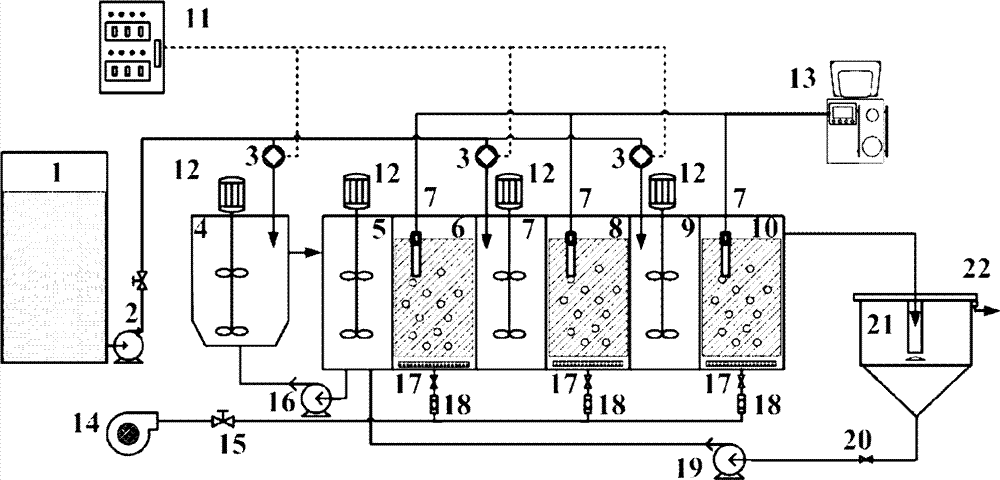
由进水管连接原水箱、进水泵和主体生物反应器,主体生物反应器和沉淀池连接,沉淀池通过回流泵、止回阀与第一段缺氧反应器连接,上清液从出水口排出;开孔隔板将主体生物反应器分为7个区域,隔板设有连通管;沿进水方向分别为厌氧反应器、第一段缺氧反应器、第一段流化床生物膜反应器、第二段缺氧反应器、第二段流化床生物膜反应器、第三段缺氧反应器、第三段流化床生物膜反应器。通过控制系统控制分段进水泵将原水分三段进入系统,分别厌氧反应器、第二段缺氧反应器、第三段缺氧反应器;厌氧反应器、第一段缺氧反应器、第二段缺氧反应器、第三段缺氧反应器中均设置有搅拌器;第一段缺氧反应器通过回流泵与厌氧反应器连通;所述第一段流化床生物膜反应器、第二段流化床生物膜反应器、第三段流化床生物膜反应器各格室底部均设有曝气器,曝气器与进气阀、转子流量计、空气压缩机相连接,构成曝气系统;第一、二、三段流化床生物膜反应器中放置DO传感器,由DO在线监测装置控制,分段进水泵由PID控制器控制。 The raw water tank, the water inlet pump and the main bioreactor are connected by the water inlet pipe, the main bioreactor is connected with the sedimentation tank, the sedimentation tank is connected with the first stage anoxic reactor through the return pump and the check valve, and the supernatant is discharged from the water outlet ; The main bioreactor is divided into 7 areas by the open-hole partition, and the partition is provided with connecting pipes; along the water inlet direction, there are anaerobic reactor, the first section of anoxic reactor, and the first section of fluidized bed biofilm Reactor, the second stage anoxic reactor, the second stage fluidized bed biofilm reactor, the third stage anoxic reactor, the third stage fluidized bed biofilm reactor. Through the control system to control the segmented water inlet pump, the raw water enters the system in three stages, respectively anaerobic reactor, second stage anoxic reactor, third stage anoxic reactor; anaerobic reactor, first stage anoxic reactor , the second section anoxic reactor and the third section anoxic reactor are equipped with stirrers; the first section anoxic reactor communicates with the anaerobic reactor through a reflux pump; the first section fluidized bed biofilm The reactor, the second-stage fluidized bed biofilm reactor, and the third-stage fluidized bed biofilm reactor are all equipped with aerators at the bottom of each cell, and the aerators are connected with inlet valves, rotameters, and air compressors. Connected to form an aeration system; DO sensors are placed in the first, second and third fluidized bed biofilm reactors, which are controlled by DO online monitoring devices, and the segmented water inlet pumps are controlled by PID controllers. the
其特征在于:流化床生物膜反应器内分3部分,底部为砂盘曝气器,曝气器上方有承托层,承托层之上为填料区;填料所用材质为空心球,规格 
一种分段进水MBBR脱氮除磷的方法,特征在于: A method for denitrification and dephosphorization of water-influent MBBR, characterized in that:
(1)控制器来调控流量分配系统,通过进水相位角变化、周期变化、正弦波峰波谷变化控制三段进水泵流量的非稳态变化,在水量冲击下,通过对三段进水不同流量的调配实现污泥流失最小化及生物处理工艺的稳定,实现实时调整运行参数节能。 (1) The controller is used to regulate the flow distribution system, and the unsteady change of the flow rate of the three-stage water inlet pump is controlled by the change of the phase angle of the water inlet, the cycle change, and the change of the sine wave peak and valley. Realize the minimization of sludge loss and the stability of the biological treatment process, and realize real-time adjustment of operating parameters to save energy. the
(2)原水箱的生活污水通过进水泵、分段进水泵在控制系统的调控下分三段依次进入厌氧反应器、第二段缺氧反应器和第三段缺氧反应器。厌氧反应器内聚磷菌释磷,含有大量磷酸盐的出水进入第一段缺氧反应器,第一段缺氧反应器出水进入第一段流化床生物膜反应器,由空气压缩机提供的压缩空气通过转子流量计进入曝气器,为该区域供氧,通过DO传感器和DO在线监测装置监测;第一段流化床生物膜反应器出水进入第二段缺氧反应器,第二段流化床生物膜反应器出水进入第三段缺氧反应器内,在搅拌器的作用下与原水充分混合;第二段缺氧反应器出水进入第二段流化床生物膜反应器,第三段缺氧反应器出水进入第三段流化床生物膜反应器,利用填料上的生物膜“微环境”使得同步硝化反硝化脱氮得以实现;第三段流化床生物膜反应器出水进入沉淀池,一部分从出水口排出,一部分通过回流泵回流至第一段缺氧反应器;第一段缺氧反应器污泥通过回流泵进入厌氧反应器,该系统对C/N的生活污水有着极其优越的适应条件。 (2) The domestic sewage in the raw water tank enters the anaerobic reactor, the second anoxic reactor and the third anoxic reactor successively in three sections through the water inlet pump and the subsection water inlet pump under the control of the control system. The phosphorus-accumulating bacteria in the anaerobic reactor release phosphorus, and the effluent containing a large amount of phosphate enters the first stage of anoxic reactor, and the effluent of the first stage of anoxic reactor enters the first stage of fluidized bed biofilm reactor. The compressed air provided enters the aerator through the rotameter to supply oxygen to the area, and is monitored by the DO sensor and DO online monitoring device; the effluent from the first fluidized bed biofilm reactor enters the second anoxic reactor, and the first The effluent from the second-stage fluidized bed biofilm reactor enters the third-stage anoxic reactor and is fully mixed with the raw water under the action of the agitator; the effluent from the second-stage anoxic reactor enters the second-stage fluidized bed biofilm reactor , the effluent from the third stage anoxic reactor enters the third stage fluidized bed biofilm reactor, using the biofilm "microenvironment" on the filler to realize simultaneous nitrification and denitrification denitrification; the third stage fluidized bed biofilm reaction The effluent of the reactor enters the sedimentation tank, part of it is discharged from the water outlet, and part of it is returned to the first anoxic reactor through the reflux pump; the sludge of the first anoxic reactor enters the anaerobic reactor through the reflux pump. The domestic sewage has extremely superior adaptation conditions. the
(3)原水可降解有机物在缺氧反应器内通过反硝化菌作用,反应后的出水进入流化床生物膜反应器。流化床生物膜反应器内控制DO为0.5-1.0mg/L,下进上出的进水流态使得污水在空气的搅动下与填料充分接触,活性污泥法和生物膜法相结合使得自养硝化菌大量富集,工艺硝化性能得到强化。污泥龄为12-20天,水力停留时间为8-10小时,污泥回流比为70%-100%,内回流比为75%-100%,无硝化液回流。反应器底部设有砂盘曝气器,均匀布气布水,进水流量7-9L/h,温度控制20-24℃,系统在连续正常进水条件下运行,4-6天后即完成挂膜过程。 (3) Degradable organic matter in raw water is denitrified by denitrifying bacteria in the anoxic reactor, and the effluent after the reaction enters the fluidized bed biofilm reactor. The DO in the fluidized bed biofilm reactor is controlled to be 0.5-1.0mg/L, and the flow state of the influent from the bottom to the top makes the sewage fully contact with the filler under the agitation of the air. The combination of the activated sludge method and the biofilm method makes the autotrophic A large number of nitrifying bacteria are enriched, and the nitrifying performance of the process is strengthened. The sludge age is 12-20 days, the hydraulic retention time is 8-10 hours, the sludge reflux ratio is 70%-100%, the internal reflux ratio is 75%-100%, and there is no nitrifying liquid reflux. There is a sand tray aerator at the bottom of the reactor, which distributes air and water evenly. The inflow flow rate is 7-9L/h, and the temperature is controlled at 20-24°C. The system operates under continuous normal water inflow conditions. membrane process. the
一种分段进水MBBR脱氮除磷的装置和方法与现有技术相比具有以下效果: Compared with the prior art, a device and method for denitrification and dephosphorization of MBBR with water inflow have the following effects:
(1)MBBR充氧效率高,载体在水中的碰撞和剪切作用,使空气气泡更加细小,增加了氧气的利用率,动力效率比无填料的曝气提高30%,且不需硝化液回流,节约曝气及泵的动力消耗。 (1) MBBR has high oxygenation efficiency, the collision and shearing action of the carrier in the water makes the air bubbles smaller, increases the utilization rate of oxygen, and the power efficiency is 30% higher than that of the aeration without filler, and does not require the reflux of nitrifying liquid , saving aeration and pump power consumption. the
(2)合理控制接触氧化池的溶解氧浓度,利用空心球上附着的生物膜形成的“微环境”实现同步硝化反硝化脱氮,结合分段进水工艺及反硝化除磷,在充分利用原水碳源基础上进一步扩大了分段进水MBBR耦合工艺对低C/N比生活污水的应用范围。 (2) Reasonably control the dissolved oxygen concentration in the contact oxidation tank, use the "micro-environment" formed by the biofilm attached to the hollow sphere to realize synchronous nitrification and denitrification denitrification, combine the staged water inflow process and denitrification phosphorus removal, and make full use of raw water carbon On the basis of the source, the application range of the sub-influent MBBR coupling process to low C/N ratio domestic sewage has been further expanded. the
(3)多点进水使得系统对溶解氧的需求更加平衡,并有效避免或降低洪峰流量时污泥被冲刷的危险,有较强的抗冲击负荷性能。 (3) Multi-point water intake makes the system's demand for dissolved oxygen more balanced, and effectively avoids or reduces the risk of sludge being washed out during flood peak flow, and has strong impact load resistance. the
附图说明 Description of drawings
图1是本实用新型的装置示意图 Fig. 1 is the device schematic diagram of the present utility model
图中,1-原水箱;2-进水泵;3-分段进水泵;4-厌氧反应器;5-第一段缺氧反应器;6-第一段接触氧化反应器;7-第二段缺氧反应器;8-第二段接触氧化反应器;9-第三段取样反应器;10-第三段接触氧化反应器;11-控制器;12-搅拌器;13-DO在线控制系统;14-空气压缩机;15-空气调节阀;16-混合液回流泵;17-砂盘曝气器;18-转子流量计;19-污泥回流泵;20-调节阀;21-二沉池;22-出水口;23-DO传感器。 In the figure, 1-raw water tank; 2-water inlet pump; 3-section water inlet pump; 4-anaerobic reactor; 5-first anoxic reactor; 6-first contact oxidation reactor; 7-first Two-stage anoxic reactor; 8-second-stage contact oxidation reactor; 9-third-stage sampling reactor; 10-third-stage contact oxidation reactor; 11-controller; 12-stirrer; 13-DO online Control system; 14-air compressor; 15-air regulating valve; 16-mixed liquid return pump; 17-sand aerator; 18-rotameter; 19-sludge return pump; 20-regulating valve; 21- Secondary sedimentation tank; 22-water outlet; 23-DO sensor. the
具体实施方式 Detailed ways
本实用新型由进水管连接原水箱、进水泵和主体生物反应器,主体生物反应器和沉淀池连接,沉淀池通过回流泵、止回阀与第一段缺氧反应器连接,上清液从出水口排出;开孔隔板将主体生物反应器分为7个区域,隔板设有连通管;沿进水方向分别为厌氧反应器、第一段缺氧反应器、第一段流化床生物膜反应器、第二段缺氧反应器、第二段流化床生物膜反应器、第三段缺氧反应器、第三段流化床生物膜反应器。通过控制系统控制分段进水泵将原水分三段进入系统,分别厌氧反应器、第二段缺氧反应器、第三段缺氧反应器;厌氧反应器、 第一段缺氧反应器、第二段缺氧反应器、第三段缺氧反应器中均设置有搅拌器;第一段缺氧反应器通过回流泵与厌氧反应器连通;所述第一段流化床生物膜反应器、第二段流化床生物膜反应器、第三段流化床生物膜反应器各格室底部均设有曝气器,曝气器与进气阀、转子流量计、空气压缩机相连接,构成曝气系统;第一、二、三段流化床生物膜反应器中放置DO传感器,由DO在线监测装置控制,分段进水泵由PID控制器控制。 The utility model connects the raw water tank, the water inlet pump and the main body bioreactor by the water inlet pipe, the main body bioreactor is connected with the sedimentation tank, the sedimentation tank is connected with the first section anoxic reactor through the return pump and the check valve, and the supernatant from The water outlet is discharged; the main bioreactor is divided into 7 areas by the open-hole partition, and the partition is provided with connecting pipes; along the water inlet direction, there are anaerobic reactor, the first anoxic reactor, and the first fluidized reactor. Bed biofilm reactor, second stage anoxic reactor, second stage fluidized bed biofilm reactor, third stage anoxic reactor, third stage fluidized bed biofilm reactor. Through the control system to control the segmented water inlet pump, the raw water enters the system in three stages, respectively anaerobic reactor, second stage anoxic reactor, third stage anoxic reactor; anaerobic reactor, first stage anoxic reactor , the second section anoxic reactor and the third section anoxic reactor are equipped with stirrers; the first section anoxic reactor communicates with the anaerobic reactor through a reflux pump; the first section fluidized bed biofilm The reactor, the second-stage fluidized bed biofilm reactor, and the third-stage fluidized bed biofilm reactor are all equipped with aerators at the bottom of each cell, and the aerators are connected with inlet valves, rotameters, and air compressors. Connected to form an aeration system; DO sensors are placed in the first, second and third fluidized bed biofilm reactors, which are controlled by DO online monitoring devices, and the segmented water inlet pumps are controlled by PID controllers. the
本实用新型提供一种改良分段进水生物接触氧化脱氮除磷的方法,特征在于: The utility model provides an improved method for segmented influent biological contact oxidation denitrification and dephosphorization, which is characterized in that:
(1)控制器来调控流量分配系统,通过进水相位角变化、周期变化、正弦波峰波谷变化控制三段进水泵流量的非稳态变化,在水量冲击下,通过对三段进水不同流量的调配实现污泥流失最小化及生物处理工艺的稳定,实现实时调整运行参数节能。 (1) The controller is used to regulate the flow distribution system, and the unsteady change of the flow rate of the three-stage water inlet pump is controlled by the change of the phase angle of the water inlet, the cycle change, and the change of the sine wave peak and valley. Realize the minimization of sludge loss and the stability of the biological treatment process, and realize real-time adjustment of operating parameters to save energy. the
(2)原水箱的生活污水通过进水泵、分段进水泵在控制系统的调控下分三段依次进入厌氧反应器、第二段缺氧反应器和第三段缺氧反应器。厌氧反应器内聚磷菌释磷,含有大量磷酸盐的出水进入第一段缺氧反应器,第一段缺氧反应器出水进入第一段流化床生物膜反应器,由空气压缩机提供的压缩空气通过转子流量计进入曝气器,为该区域供氧,通过DO传感器和DO在线监测装置监测;第一段流化床生物膜反应器出水进入第二段缺氧反应器,第二段流化床生物膜反应器出水进入第三段缺氧反应器内,在搅拌器的作用下与原水充分混合;第二段缺氧反应器出水进入第二段流化床生物膜反应器,第三段缺氧反应器出水进入第三段流化床生物膜反应器,利用填料上的生物膜“微环境”使得同步硝化反硝化脱氮得以实现;第三段流化床生物膜反应器出水进入沉淀池,一部分从出水口排出,一部分通过回流泵回流至第一段缺氧反应器;第一段缺氧反应器污泥通过回流泵进入厌氧反应器,该系统对C/N的生活污水有着极其优越的适应条件。 (2) The domestic sewage in the raw water tank enters the anaerobic reactor, the second anoxic reactor and the third anoxic reactor successively in three sections through the water inlet pump and the subsection water inlet pump under the control of the control system. The phosphorus-accumulating bacteria in the anaerobic reactor release phosphorus, and the effluent containing a large amount of phosphate enters the first stage of anoxic reactor, and the effluent of the first stage of anoxic reactor enters the first stage of fluidized bed biofilm reactor. The compressed air provided enters the aerator through the rotameter to supply oxygen to the area, and is monitored by the DO sensor and DO online monitoring device; the effluent from the first fluidized bed biofilm reactor enters the second anoxic reactor, and the first The effluent from the second-stage fluidized bed biofilm reactor enters the third-stage anoxic reactor and is fully mixed with the raw water under the action of the agitator; the effluent from the second-stage anoxic reactor enters the second-stage fluidized bed biofilm reactor , the effluent from the third stage anoxic reactor enters the third stage fluidized bed biofilm reactor, using the biofilm "microenvironment" on the filler to realize simultaneous nitrification and denitrification denitrification; the third stage fluidized bed biofilm reaction The effluent of the reactor enters the sedimentation tank, part of it is discharged from the water outlet, and part of it is returned to the first anoxic reactor through the reflux pump; the sludge of the first anoxic reactor enters the anaerobic reactor through the reflux pump. The domestic sewage has extremely superior adaptation conditions. the
(3)原水可降解有机物在缺氧反应器内通过反硝化菌作用,反应后的出水进入流化床生物膜反应器。流化床生物膜反应器内控制DO为0.5-1.0mg/L,下进上出的进水流态使得污水在空气的搅动下与填料充分接触,活性污泥法和生物膜法相结合使得自养硝化菌大量 富集,工艺硝化性能得到强化。污泥龄为12-20天,水力停留时间为8-10小时,污泥回流比为70%-100%,内回流比为75%-100%,无硝化液回流。反应器底部设有砂盘曝气器,均匀布气布水,进水流量7-9L/h,温度控制20-24℃,系统在连续正常进水条件下运行,4-6天后即完成挂膜过程。 (3) Degradable organic matter in raw water is denitrified by denitrifying bacteria in the anoxic reactor, and the effluent after the reaction enters the fluidized bed biofilm reactor. The DO in the fluidized bed biofilm reactor is controlled to be 0.5-1.0mg/L, and the flow state of the influent from the bottom to the top makes the sewage fully contact with the filler under the agitation of the air. The combination of the activated sludge method and the biofilm method makes the autotrophic A large number of nitrifying bacteria are enriched, and the nitrifying performance of the process is strengthened. The sludge age is 12-20 days, the hydraulic retention time is 8-10 hours, the sludge reflux ratio is 70%-100%, the internal reflux ratio is 75%-100%, and there is no nitrifying liquid reflux. There is a sand tray aerator at the bottom of the reactor, which distributes air and water evenly. The inflow flow rate is 7-9L/h, and the temperature is controlled at 20-24°C. The system operates under continuous normal water inflow conditions. membrane process. the
案例1 Case 1
以北京某家属区实际生活污水为处理对象,COD=180-245mg/L,TN=27-77mg/L,TP=4.01-5.32mg/L,C/N=1.63-6.23,水力停留时间8h,污泥龄13-20d,经过6天流化床生物膜反应器挂膜成功,15d系统运行稳定。平均污泥浓度3100±150mg/L,DO控制在0.5-1.0mg/L,污泥回流比100%,内回流比75%,温度控制在22℃左右。启动稳定后连续运行3个月,试验结果表明,出水COD=27-43mg/L,TN=9.07-14.1mg/L,TP=0.29-0.48mg/L,NH4 +-N小于1mg/L。系统对TN、TP去除效果稳定,试验结果达到城镇污水一级A排放标准。 Taking the actual domestic sewage of a family area in Beijing as the treatment object, COD=180-245mg/L, TN=27-77mg/L, TP=4.01-5.32mg/L, C/N=1.63-6.23, hydraulic retention time 8h, The sludge age is 13-20 days. After 6 days, the fluidized bed biofilm reactor successfully formed the film, and the system operated stably after 15 days. The average sludge concentration is 3100±150mg/L, DO is controlled at 0.5-1.0mg/L, the sludge reflux ratio is 100%, the internal reflux ratio is 75%, and the temperature is controlled at about 22°C. After starting and running continuously for 3 months, the test results show that the effluent COD=27-43mg/L, TN=9.07-14.1mg/L, TP=0.29-0.48mg/L, NH 4 + -N is less than 1mg/L. The system has a stable removal effect on TN and TP, and the test results meet the first-class A discharge standard of urban sewage.
案例2 Case 2
以北京某污水处理厂初沉池出水为处理对象,COD=180-453mg/L,TN=33-71mg/L,TP=1.01-7.32mg/L,C/N=2.01-7.20,水力停留时间9h,污泥龄13-20d,平均污泥浓度4500±150mg/L,DO控制在0.5-1.0mg/L,污泥回流比100%,内回流比75%,温度控制在20℃左右。启动稳定后连续运行3个月,试验结果表明,出水COD=22-48mg/L,TN=6.3-13.9mg/L,TP=0.14-0.38mg/L,NH4 +-N小于1mg/L。系统对TN、TP去除效果稳定,试验结果达到城镇污水一级A排放标准。 Taking the effluent from the primary sedimentation tank of a sewage treatment plant in Beijing as the treatment object, COD=180-453mg/L, TN=33-71mg/L, TP=1.01-7.32mg/L, C/N=2.01-7.20, hydraulic retention time 9h, sludge age 13-20d, average sludge concentration 4500±150mg/L, DO controlled at 0.5-1.0mg/L, sludge reflux ratio 100%, internal reflux ratio 75%, temperature control at around 20°C. After starting and running continuously for 3 months, the test results show that the effluent COD=22-48mg/L, TN=6.3-13.9mg/L, TP=0.14-0.38mg/L, NH 4 + -N is less than 1mg/L. The system has a stable removal effect on TN and TP, and the test results meet the first-class A discharge standard of urban sewage.
Claims (1)

Priority Applications (1)
| Application Number | Priority Date | Filing Date | Title |
|---|---|---|---|
| CN2012200845343U CN202492436U (en) | 2012-03-08 | 2012-03-08 | Segmented water-inflowing moving bed biofilm reactor (MBBR) denitriding phosphorus removal device |
Applications Claiming Priority (1)
| Application Number | Priority Date | Filing Date | Title |
|---|---|---|---|
| CN2012200845343U CN202492436U (en) | 2012-03-08 | 2012-03-08 | Segmented water-inflowing moving bed biofilm reactor (MBBR) denitriding phosphorus removal device |
Publications (1)
| Publication Number | Publication Date |
|---|---|
| CN202492436U true CN202492436U (en) | 2012-10-17 |
Family
ID=46998672
Family Applications (1)
| Application Number | Title | Priority Date | Filing Date |
|---|---|---|---|
| CN2012200845343U Expired - Lifetime CN202492436U (en) | 2012-03-08 | 2012-03-08 | Segmented water-inflowing moving bed biofilm reactor (MBBR) denitriding phosphorus removal device |
Country Status (1)
| Country | Link |
|---|---|
| CN (1) | CN202492436U (en) |
-
2012
- 2012-03-08 CN CN2012200845343U patent/CN202492436U/en not_active Expired - Lifetime
Similar Documents
| Publication | Publication Date | Title |
|---|---|---|
| CN103693738B (en) | Composite semi-nitration-anaerobic ammonia oxidation autotrophic denitrification device and operating method thereof | |
| CN104986923B (en) | A kind of apparatus and method of the multistage A/O biological denitrificaions based on municipal sewage short distance nitration Anammox | |
| CN102583900A (en) | Method for removing nitrogen and phosphorus by MBBRs (Moving Bed Biofilm Reactors) with sectionalized water inflow | |
| CN114180715B (en) | Device and method for enriching continuous flow short-cut denitrification coupling anaerobic ammonia oxidation strengthening flora | |
| CN103601341B (en) | SBR (Sequencing Batch Reactor) and SBBR (Sequencing Biofilm Batch Reactor) municipal sewage high-efficiency biological treatment method and device based on anaerobic ammonia oxidation | |
| CN102964035B (en) | Device for autotrophic nitrogen removal of composite biological membrane and operation method | |
| CN105130128B (en) | The short distance nitrations for the treatment of of advanced stage landfill leachate A/O half and UASB Anammox combined denitrification apparatus and method | |
| CN104058551B (en) | A kind of municipal effluent autotrophic denitrification bioremediation of efficient energy-saving and device | |
| CN107253762B (en) | Rapid starting method for coupling short-cut denitrification dephosphorization with anaerobic ammonia oxidation | |
| CN107162186B (en) | Device and method for urban sewage anaerobic ammonia oxidation autotrophic nitrogen removal based on granular sludge | |
| CN101628772A (en) | Short distance denitrifying dephosphatation double-sludge technique taking granular sludge as medium and device thereof | |
| CN101538104B (en) | Improved A2N denitrification dephosphorization and deep denitrification device and method | |
| CN110104774A (en) | Continuous flow segmental influent, sludge and fermented sludge segment reflux part denitrification/Anammox Treating Municipal Sewage device | |
| CN103613196B (en) | Integrated biological denitrification device and method for treating wastewater by using same | |
| CN107162193A (en) | Hypoxemia nitrification coupling short-cut denitrification Anammox handles the device and method of sanitary sewage | |
| CN107010727A (en) | A kind of whole low-oxygen aeration SBMBBR synchronous denitrification and dephosphorization methods | |
| CN101580297A (en) | Method for hanging membrane in sludge internal circulation biological filter | |
| CN103951059A (en) | Multi-cycle composite bioreactor and process thereof | |
| CN105621615B (en) | Inversion A2/ O segmental influents coupling aerobic particle mud strengthens synchronous nitration denitrification denitrogenation dephosphorization apparatus | |
| CN106277357A (en) | Autotrophic denitrification system start-up that a kind of floc sludge and granule sludge coexist and Effec-tive Function method | |
| CN114262058A (en) | A dual-circulation dual-sedimentation tank integrated biological treatment device and method | |
| CN202688093U (en) | Improved A/O (anoxic/oxic) four-point section-water supply high-efficiency synchronous nitrogen and phosphorus removal device | |
| CN115028265A (en) | Device and method for treating urban sewage by continuous flow sectional water inlet coupling pretreatment and fermented sludge sectional backflow reinforcement PD/A | |
| CN201952333U (en) | Internal-circulation AAO-MBR (Anaerobic-Anoxic-Oxic-Membrane Bio-Reactor) sewage-processing reaction-tank system | |
| CN103896453A (en) | Device and method for treatment of domestic sewage with DPR-MABR coupling reactor |
Legal Events
| Date | Code | Title | Description |
|---|---|---|---|
| C14 | Grant of patent or utility model | ||
| GR01 | Patent grant | ||
| CX01 | Expiry of patent term | ||
| CX01 | Expiry of patent term |
Granted publication date: 20121017 |