CN202492412U - Device for realizing short-range denitrification through phenol suppresses coupling - Google Patents
Device for realizing short-range denitrification through phenol suppresses coupling Download PDFInfo
- Publication number
- CN202492412U CN202492412U CN2012200845358U CN201220084535U CN202492412U CN 202492412 U CN202492412 U CN 202492412U CN 2012200845358 U CN2012200845358 U CN 2012200845358U CN 201220084535 U CN201220084535 U CN 201220084535U CN 202492412 U CN202492412 U CN 202492412U
- Authority
- CN
- China
- Prior art keywords
- phenol
- concentration
- sensor
- short
- denitrification
- Prior art date
- Legal status (The legal status is an assumption and is not a legal conclusion. Google has not performed a legal analysis and makes no representation as to the accuracy of the status listed.)
- Expired - Lifetime
Links
Images


Classifications
-
- Y—GENERAL TAGGING OF NEW TECHNOLOGICAL DEVELOPMENTS; GENERAL TAGGING OF CROSS-SECTIONAL TECHNOLOGIES SPANNING OVER SEVERAL SECTIONS OF THE IPC; TECHNICAL SUBJECTS COVERED BY FORMER USPC CROSS-REFERENCE ART COLLECTIONS [XRACs] AND DIGESTS
- Y02—TECHNOLOGIES OR APPLICATIONS FOR MITIGATION OR ADAPTATION AGAINST CLIMATE CHANGE
- Y02W—CLIMATE CHANGE MITIGATION TECHNOLOGIES RELATED TO WASTEWATER TREATMENT OR WASTE MANAGEMENT
- Y02W10/00—Technologies for wastewater treatment
- Y02W10/10—Biological treatment of water, waste water, or sewage
Landscapes
- Purification Treatments By Anaerobic Or Anaerobic And Aerobic Bacteria Or Animals (AREA)
- Activated Sludge Processes (AREA)
Abstract
本实用新型提供一种苯酚抑制耦合低温实现短程脱氮的装置,原水箱(12)通过进水泵(3)与反应器(13)相连接,鼓风机(4)与曝气器(8)相连,反应器(13)内有DO传感器(6)、pH传感器(7)和温控装置(5),在线监测装置(11)与DO传感器(6)、鼓风机(4)连接,控制装置(1)与连接有药箱的加药泵(2)、进水泵(3)、磁力搅拌器(9)的电器阀门设备相连,控制阀门的开启。本实用新型是低温条件下实现短程脱氮装置,适用于北方较寒冷地区的工业废水处理和城镇污水酚类化合物毒性抑制的技术参考。
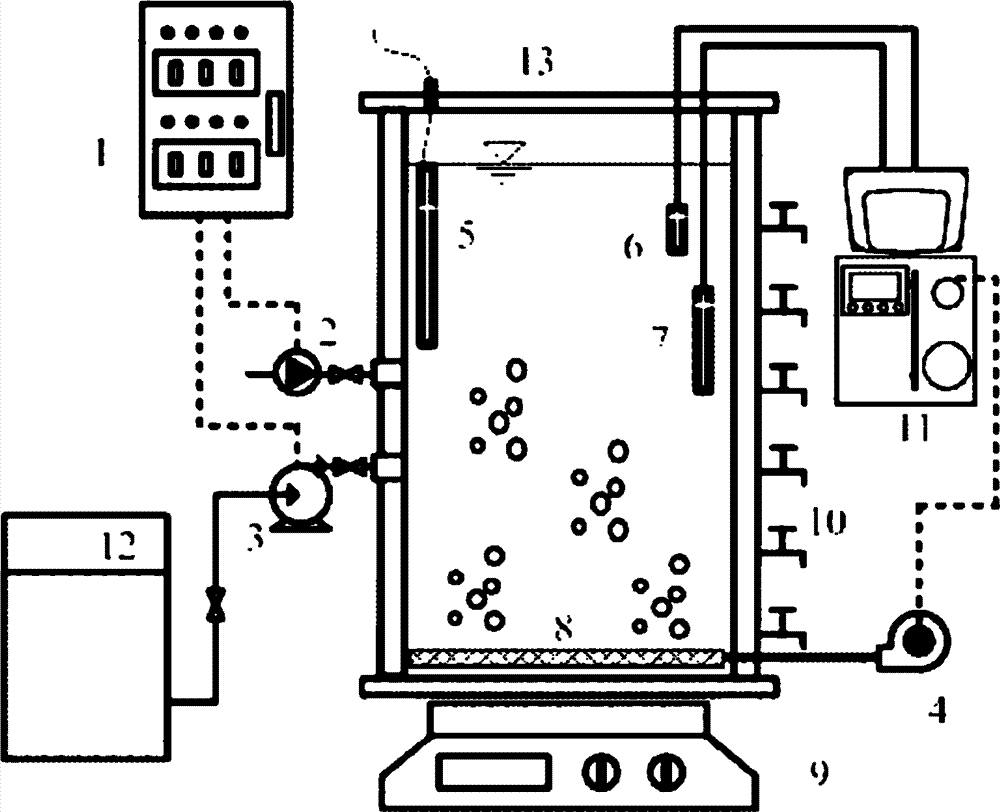
The utility model provides a device for short-range denitrification by coupling low temperature with phenol suppression. The raw water tank (12) is connected with the reactor (13) through the water inlet pump (3), and the blower (4) is connected with the aerator (8). There are DO sensor (6), pH sensor (7) and temperature control device (5) in the reactor (13), on-line monitoring device (11) is connected with DO sensor (6), blower (4), control device (1) It is connected with the electrical valve equipment of the dosing pump (2), the water inlet pump (3) and the magnetic force stirrer (9) connected with the medicine box to control the opening of the valve. The utility model is a short-range denitrification device under low temperature conditions, and is suitable for technical reference of industrial waste water treatment and urban sewage phenol compound toxicity suppression in colder northern regions.
Description
技术领域 technical field
本实用新型属于污水处理技术领域,具体地说涉及一种含酚含氮废水短程硝化的启动装置,尤其是低温条件下实现短程脱氮装置,适用于北方较寒冷地区的工业废水处理和城镇污水酚类化合物毒性抑制的技术参考。 The utility model belongs to the technical field of sewage treatment, in particular to a start-up device for short-range nitrification of wastewater containing phenol and nitrogen, especially a device for realizing short-range denitrification under low temperature conditions, which is suitable for industrial wastewater treatment and urban sewage in colder northern regions Technical reference for toxicity inhibition of phenolic compounds. the
背景技术 Background technique
污水生物处理脱氮过程,分为全程硝化反硝化和短程硝化反硝化。其中,短程硝化反硝化以其独特的优势受到越来越多的关注:能耗降低25%、有机碳源减少40%、反应时间缩短63%、污泥产量低减少50%、反硝化的容积可减少30~40%、减少投加碱度和外加碳源的量等。 The denitrification process of sewage biological treatment is divided into whole-process nitrification and denitrification and short-term nitrification and denitrification. Among them, short-cut nitrification and denitrification has attracted more and more attention due to its unique advantages: energy consumption is reduced by 25%, organic carbon source is reduced by 40%, reaction time is shortened by 63%, sludge production is reduced by 50%, and the volume of denitrification It can be reduced by 30-40%, reducing the amount of added alkalinity and added carbon source, etc. the
短程硝化反硝化的两个主要反应步骤中,反硝化技术容易控制,关键在于将NH4 +-N氧化控制在NO2 --N阶段,阻止其进一步氧化。短程硝化反应的控制取决于对两种硝化菌的控制。两种细菌在生理机制及动力学特征上存在的固有差异,导致了某些影响因素对两种硝化菌存在不同的抑制作用,从而影响硝化形式。经过研究,能够抑制亚硝化氧化菌,造成氨氧化菌在硝化系统中占优势的因素主要有:高游离氨浓度、游离HNO2浓度、高pH、高温、低DO、从缺氧状态到好氧状态的滞后时间、游离羟氨浓度以及投加硝化反应选择性化学抑制剂。氨氧化菌和亚硝酸氧化菌均为自养菌,生长缓慢世代周期长。如何快速有效启动短程硝化反硝化过程,并长期保持稳定运行效果是科研工作者亟待解决的问题。 Among the two main reaction steps of short-cut nitrification and denitrification, the denitrification technology is easy to control, and the key is to control the NH 4 + -N oxidation in the NO 2 - -N stage to prevent its further oxidation. The control of short-cut nitrification depends on the control of two kinds of nitrifying bacteria. The inherent differences in the physiological mechanism and kinetic characteristics of the two kinds of bacteria lead to the different inhibitory effects of certain factors on the two kinds of nitrifying bacteria, thus affecting the nitrification form. After research, the main factors that can inhibit nitrosating oxidizing bacteria and cause ammonia oxidizing bacteria to dominate in the nitrification system are: high free ammonia concentration, free HNO 2 concentration, high pH, high temperature, low DO, from anoxic state to aerobic state The lag time of the state, the concentration of free hydroxylamine and the addition of selective chemical inhibitors of nitrification reaction. Ammonia oxidizing bacteria and nitrite oxidizing bacteria are autotrophic bacteria with slow growth and long generation cycle. How to quickly and effectively start the short-cut nitrification and denitrification process and maintain a long-term stable operation effect is an urgent problem to be solved by scientific researchers.
含酚废水是一种污染范围广,危害性大的工业废水。如不经处理直接排放会对水体、鱼类、农作物、环境等带来严重危害。苯酚是工业废水中常见毒性物质,目前,我国很多水体都受到含酚废水的严重污染,是当前我国急需解决的三废治理对象之一。目前虽然化工厂有设置相应的苯酚水处理工艺,如吸附法、萃取法、膜过滤、电化学催 化、厌氧处理等等,但处理效果、有无新污染、运行是否稳定都是有待考虑的问题。因此,生物法短程硝化反硝化处理含酚含氮废水的启动维持变得很重要。 Phenol-containing wastewater is a kind of industrial wastewater with a wide range of pollution and great harm. If it is discharged directly without treatment, it will cause serious harm to water bodies, fish, crops, and the environment. Phenol is a common toxic substance in industrial wastewater. At present, many water bodies in my country are seriously polluted by phenol-containing wastewater. At present, although chemical plants have set up corresponding phenol water treatment processes, such as adsorption method, extraction method, membrane filtration, electrochemical catalysis, anaerobic treatment, etc., the treatment effect, whether there is new pollution, and whether the operation is stable still need to be considered. The problem. Therefore, the start-up and maintenance of biological short-cut nitrification and denitrification treatment of phenolic and nitrogenous wastewater has become very important. the
实用新型内容 Utility model content
本实用新型的目的在于寻求一种含酚工业废水能够稳定实现短程深度脱氮的方法,尤其是对于北方季节温度变化较明显地区,是一种简单便捷操作灵活的生物发发。利用苯酚对微生物抑制程度的不同,选择性的影响氨氧化菌(AOB)和亚硝酸盐氧化菌(NOB)新陈代谢速率,富集AOB,不断抑制NOB,从而达到稳定短程硝化反硝化。 The purpose of this utility model is to seek a method for stably realizing short-range deep denitrification of phenolic industrial wastewater, especially for areas with obvious seasonal temperature changes in the north. It is a simple, convenient and flexible biological method. Utilizing the difference in the degree of inhibition of microorganisms by phenol, it selectively affects the metabolic rate of ammonia oxidizing bacteria (AOB) and nitrite oxidizing bacteria (NOB), enriches AOB, and continuously inhibits NOB, thereby achieving stable short-range nitrification and denitrification. the
苯酚抑制耦合低温实现短程脱氮的装置,包括原水箱12、进水泵3、连接有药箱的加药泵2、鼓风机4、温控装置5、磁力搅拌器9、曝气器8、取样口和出水口10、DO传感器6、pH传感器7、在线监测装置11、控制装置1;
A device for short-range denitrification by phenol suppression coupled with low temperature, including
其特征在于:原水箱12通过进水泵3与反应器13相连接,鼓风机4与曝气器8相连,反应器13内有DO传感器6、pH传感器7和温控装置5,在线监测装置11与DO传感器6、鼓风机4连接,控制装置1与连接有药箱的加药泵2、进水泵3、磁力搅拌器9的电器阀门设备相连,控制阀门的开启。
It is characterized in that: the
应用上述装置进行苯酚抑制耦合低温实现短程脱氮的方法,包括以下内容: The method for realizing short-range denitrification by coupling low temperature with phenol suppression by applying the above-mentioned device includes the following contents:
(1)接种污泥为城市污水处理厂剩余活性污泥,启动污泥浓度为3000-3500mg/L;原水为生活污水,pH在7.02-8.14,氨氮初始浓度50-70mg/L,COD浓度在180-270mg/L; (1) The inoculum sludge is the remaining activated sludge of the urban sewage treatment plant, the starting sludge concentration is 3000-3500mg/L; the raw water is domestic sewage, the pH is 7.02-8.14, the initial concentration of ammonia nitrogen is 50-70mg/L, and the COD concentration is at 180-270mg/L;
(2)1-15天:温度从初始25℃线性下降为23℃; (2) 1-15 days: the temperature drops linearly from the initial 25°C to 23°C;
(3)16-30天:加药泵向反应器内投加苯酚,反应器初始苯酚浓度为15mg/L;温度从23℃线性下降为21℃; (3) 16-30 days: the dosing pump feeds phenol into the reactor, and the initial phenol concentration in the reactor is 15mg/L; the temperature drops linearly from 23°C to 21°C;
(4)31-45天:加药泵向反应器内投加苯酚,反应器初始苯酚浓度为30mg/L;温度从21℃线性下降为19℃; (4) 31-45 days: the dosing pump feeds phenol into the reactor, and the initial phenol concentration in the reactor is 30mg/L; the temperature drops linearly from 21°C to 19°C;
(5)46-60天:加药泵向反应器内投加苯酚,反应器初始苯酚浓 度为60mg/L;温度从19℃线性下降为17℃;系统排泥维持污泥浓度4000mg/L; (5) 46-60 days: the dosing pump feeds phenol into the reactor, and the initial phenol concentration in the reactor is 60mg/L; the temperature drops linearly from 19°C to 17°C; the system discharges sludge to maintain a sludge concentration of 4000mg/L ;
(6)61-75天:药泵向反应器内投加苯酚,反应器初始苯酚浓度为90mg/L;温度从17℃线性下降为15℃;系统排泥维持污泥浓度5000mg/L; (6) 61-75 days: the drug pump feeds phenol into the reactor, and the initial phenol concentration of the reactor is 90mg/L; the temperature drops linearly from 17°C to 15°C; the system discharges sludge to maintain a sludge concentration of 5000mg/L;
反应器每隔6小时进水,缺氧搅拌后,通过曝气和排水维持DO为0.5-1.3mg/L。 The reactor was fed with water every 6 hours, and after anoxic stirring, the DO was maintained at 0.5-1.3 mg/L by aeration and drainage. the
3、本实用新型主要特征在于: 3. The main features of this utility model are:
(1)系统为SBR反应器前置反硝化运行方式,充分原水和苯酚化合物作为碳源,不投加外加碳源,通过进水、缺氧搅拌、好氧曝气、沉淀、排水和静置五个步骤实现对污水的生物处理。 (1) The system adopts the SBR reactor pre-denitrification operation mode, fully raw water and phenolic compounds as carbon sources, without adding additional carbon sources, through water intake, anoxic stirring, aerobic aeration, sedimentation, drainage and standing Five steps to realize the biological treatment of sewage. the
(2)苯酚浓度为1-30mg/L时,系统不排泥;苯酚浓度60mg/L时,系统排泥维持污泥浓度4000mg/L;苯酚浓度90mg/L时,维持污泥浓度5000mg/L。 (2) When the phenol concentration is 1-30mg/L, the system does not discharge sludge; when the phenol concentration is 60mg/L, the system discharges sludge to maintain a sludge concentration of 4000mg/L; when the phenol concentration is 90mg/L, maintain a sludge concentration of 5000mg/L . the
(3)低浓度苯酚(0-30mg/L),亚硝积累率增长较缓慢,0mg/L时小于5%,30mg/L末期达到22%;60mg/L末期为43%;高浓度苯酚(90mg/L)对系统污泥组成结构影响较大,末期亚硝积累率达91%,并稳定维持在90%以上。 (3) Low-concentration phenol (0-30mg/L), the growth rate of nitrous accumulation is slow, less than 5% at 0mg/L, 22% at the end of 30mg/L; 43% at the end of 60mg/L; high-concentration phenol ( 90mg/L) has a great influence on the composition and structure of the system sludge, and the accumulation rate of nitrous acid in the final stage reaches 91%, and it is stable at more than 90%. the
4、本实用新型中启动并维持短程硝化的特点为: 4. The characteristics of starting and maintaining short-range nitrification in this utility model are:
(1)系统温度由25℃下降至15℃时,在既定步骤下系统性能不但没有降低,硝化作用反而稍有增强的趋势,污泥沉降性变得良好。这为冬季短程脱氮的实现维持提供了技术支持。 (1) When the system temperature drops from 25°C to 15°C, the system performance does not decrease under the given steps, but the nitrification tends to increase slightly, and the sludge settleability becomes better. This provides technical support for the realization and maintenance of short-range denitrification in winter. the
(2)AOB比NOB具有更强的抗冲击特性。本实用新型采用序批式活性污泥法,间歇曝气使得系统内的溶解氧呈现周期性的波动,而AOB“饱食饥饿”的性质使其能够经受住溶解氧的更替变换,逐渐成为优势菌种。 (2) AOB has stronger impact resistance than NOB. The utility model adopts the sequence batch activated sludge method, intermittent aeration makes the dissolved oxygen in the system fluctuate periodically, and the nature of AOB "satiating and hungry" makes it able to withstand the replacement of dissolved oxygen, which gradually becomes an advantage strains. the
(3)在不同浓度苯酚梯度下,运行时间不变,然而污泥浓度在不同阶段呈现不同的数值:苯酚浓度为0mg/L、15mg/L和30mg/L时系 统不排泥,该阶段对硝化细菌的富集有着至关重要的作用。硝化菌属于自养菌,生长周期较长,较长的污泥龄保证了系统生物量的同时强化了系统去除有机物和脱氮的效果。 (3) Under the gradient of different concentrations of phenol, the running time remains the same, but the sludge concentration presents different values at different stages: when the phenol concentration is 0mg/L, 15mg/L and 30mg/L, the system does not discharge sludge. It plays a vital role in the enrichment of nitrifying bacteria. Nitrifying bacteria are autotrophic bacteria with a long growth cycle. The long sludge age ensures the biomass of the system and strengthens the effect of the system on removing organic matter and denitrification. the
(4)酚是一种中等强度的化学毒物,可与细胞原浆中的蛋白质发生化学反应,低浓度时使细胞变性,高浓度时使蛋白质凝固。研究表明,苯酚对硝化细菌的抑制作用为非竞争抑制,抑制解除后可恢复至原来活性。苯酚可作为碳源被不断利用,一方面为微生物提供充足的可降解物质,另一方面苯酚降解减小了对系统微生物的抑制作用。高浓度梯度下生物增殖较快,通过排泥控制污泥浓度,苯酚的选择作用使得微生物组成结构发生变化,AOB在系统逐渐富集。 (4) Phenol is a medium-strength chemical poison, which can chemically react with the protein in the cell plasma, denature the cell at low concentration, and coagulate the protein at high concentration. Studies have shown that the inhibitory effect of phenol on nitrifying bacteria is non-competitive inhibition, and the original activity can be restored after the inhibition is removed. Phenol can be continuously utilized as a carbon source. On the one hand, it provides sufficient degradable substances for microorganisms, and on the other hand, the degradation of phenol reduces the inhibitory effect on system microorganisms. The biological proliferation is faster under high concentration gradient, and the sludge concentration is controlled by sludge discharge. The selective effect of phenol changes the composition and structure of microorganisms, and AOB gradually enriches in the system. the
(5)前置反硝化的设置为反硝化菌提供可降解有机物的同时也为硝化细菌提供了一个缓冲的平台,自身降解与抑制的解除保证了系统的污水处理性能。 (5) The pre-denitrification setting not only provides denitrifying bacteria with degradable organic matter, but also provides a buffer platform for nitrifying bacteria, and the release of self-degradation and inhibition ensures the sewage treatment performance of the system. the
附图说明: Description of drawings:
图1是苯酚投加梯度及温度变化示意图; Figure 1 is a schematic diagram of phenol dosing gradient and temperature change;
图2装置示意图; Fig. 2 device schematic diagram;
图中,1-控制系统;2-进水泵;3-加药泵;4-鼓风机;5-温控装置;6-pH传感器;7-DO传感器;8-砂盘曝气器;9-磁力搅拌器;10-出水口及进样口;11-pH/DO在线监测系统;12-加药箱。 In the figure, 1-control system; 2-inlet pump; 3-dosing pump; 4-blower; 5-temperature control device; 6-pH sensor; 7-DO sensor; 8-sand aerator; 9-magnetic force Stirrer; 10-water outlet and sample inlet; 11-pH/DO online monitoring system; 12-dosing box. the
具体实施方式 Detailed ways
1、苯酚浓度为0mg/L:采用前置反硝化模式,先缺氧搅拌75min后曝气180min,DO维持在0.5-1.3mg/L。接种污泥浓度为3000mg/L,温度为25℃。每周期测定进出水水质变化,监测NO2 --N/NO3 --N比例。该运行周期为15天,温度由25℃逐渐变为23℃。 1. The concentration of phenol is 0 mg/L: the pre-denitrification mode is adopted, and the oxygen is first stirred for 75 minutes and then aerated for 180 minutes, and the DO is maintained at 0.5-1.3 mg/L. The inoculum sludge concentration is 3000mg/L, and the temperature is 25°C. Measure the change of influent and effluent water quality every cycle, and monitor the ratio of NO 2 - -N/NO 3 - -N. The operation period is 15 days, and the temperature is gradually changed from 25°C to 23°C.
2、苯酚浓度15mg/L:采用前置反硝化模式,先缺氧搅拌75min后曝气180min,DO维持在0.5-1.3mg/L。进水的同时使用加药泵调整系统苯酚初始浓度为15mg/L。每周期测定进出水水质变化和NO2 --N/NO3 --N比例,并在典型周期中测定苯酚浓度变化。该运行周 期为15天,温度由23℃逐渐变为21℃。 2. The concentration of phenol is 15mg/L: the pre-denitrification mode is adopted, and the oxygen is first stirred for 75 minutes and then aerated for 180 minutes, and the DO is maintained at 0.5-1.3mg/L. While entering the water, use the dosing pump to adjust the initial concentration of phenol in the system to 15mg/L. The change of influent and effluent water quality and the ratio of NO 2 - -N/NO 3 - -N were measured every cycle, and the change of phenol concentration was measured in a typical cycle. The operation cycle is 15 days, and the temperature is gradually changed from 23°C to 21°C.
3、苯酚浓度30mg/L:采用前置反硝化模式,先缺氧搅拌75min后曝气180min,DO维持在0.5-1.3mg/L。进水的同时使用加药泵调整系统苯酚初始浓度为30mg/L。每周期测定进出水水质变化和NO2 --N/NO3 --N比例,并在典型周期中测定苯酚浓度变化。该运行周期为15天,温度由21℃逐渐变为19℃。 3. The concentration of phenol is 30mg/L: the pre-denitrification mode is adopted, and the anoxic stirring is performed for 75 minutes, followed by aeration for 180 minutes, and the DO is maintained at 0.5-1.3mg/L. While entering the water, use the dosing pump to adjust the initial concentration of phenol in the system to 30mg/L. The change of influent and effluent water quality and the ratio of NO 2 - -N/NO 3 - -N were measured every cycle, and the change of phenol concentration was measured in a typical cycle. The operation period is 15 days, and the temperature is gradually changed from 21°C to 19°C.
4、苯酚浓度60mg/L:采用前置反硝化模式,先缺氧搅拌75min后曝气180min,DO维持在0.5-1.3mg/L。进水的同时使用加药泵调整系统苯酚初始浓度为60mg/L。每周期测定进出水水质变化和NO2 --N/NO3 --N比例,并在典型周期中测定苯酚浓度变化。通过规律性排泥控制污泥浓度在4000mg/L。该运行周期为15天,温度由19℃逐渐变为17℃。 4. The concentration of phenol is 60mg/L: adopt the pre-denitrification mode, first stir with anoxic for 75min, then aerate for 180min, and DO is maintained at 0.5-1.3mg/L. While entering the water, use the dosing pump to adjust the initial concentration of phenol in the system to 60mg/L. The change of influent and effluent water quality and the ratio of NO 2 - -N/NO 3 - -N were measured every cycle, and the change of phenol concentration was measured in a typical cycle. Control the sludge concentration at 4000mg/L through regular sludge discharge. The operation cycle is 15 days, and the temperature is gradually changed from 19°C to 17°C.
5、苯酚浓度90mg/L:采用前置反硝化模式,先缺氧搅拌75min后曝气180min,DO维持在0.5-1.3mg/L。进水的同时使用加药泵调整系统苯酚初始浓度为90mg/L。每周期测定进出水水质变化和NO2 --N/NO3 --N比例,并在典型周期中测定苯酚浓度变化。通过规律性排泥控制污泥浓度在5000mg/L。该运行周期为15天,温度由17℃逐渐变为15℃。 5. The concentration of phenol is 90mg/L: the pre-denitrification mode is adopted, and the oxygen is first stirred for 75 minutes and then aerated for 180 minutes, and the DO is maintained at 0.5-1.3mg/L. While entering the water, use the dosing pump to adjust the initial concentration of phenol in the system to 90mg/L. The change of influent and effluent water quality and the ratio of NO 2 - -N/NO 3 - -N were measured every cycle, and the change of phenol concentration was measured in a typical cycle. Control the sludge concentration at 5000mg/L through regular sludge discharge. The operation period is 15 days, and the temperature is gradually changed from 17°C to 15°C.
实施案例 Implementation case
实施案例1: Implementation case 1:
反应器容积为5L,原水来自某生活小区生活污水。 The volume of the reactor is 5L, and the raw water comes from domestic sewage in a living quarter. the
COD=190-270mg/L,NH4 +-N=50~69mg/L,pH=7.20-7.80。接种污泥取自北京市某城市污水处理厂二沉池回流污泥,属全程硝化性能良好的污泥。各阶段通过排泥控制系统内污泥浓度保持在设定水平,DO维持在0.5-1.3mg/L,实施过程中温度随着气温的降低由25℃逐渐降低为15℃。 COD=190-270 mg/L, NH 4 + -N=50-69 mg/L, pH=7.20-7.80. The inoculum sludge was taken from the return sludge of the secondary settling tank of an urban sewage treatment plant in Beijing, which is a sludge with good nitrification performance throughout the process. At each stage, the sludge concentration in the sludge control system is maintained at the set level, and the DO is maintained at 0.5-1.3mg/L. During the implementation process, the temperature gradually decreases from 25°C to 15°C as the temperature decreases.
1、苯酚浓度为0mg/L、15mg/L、30mg/L:接种污泥浓度为3000mg/L,运行15天后,温度由25℃逐渐变为19℃,出水COD=32-54mg/L,NH4 +-N<1mg/L,NO2 --N=2-4mg/L; NO3 --N=15-20mg/L;NO2 --N/NO3 --N值维持在9%-22%之间,没有太大的明显变化。 1. The concentration of phenol is 0mg/L, 15mg/L, 30mg/L: the concentration of inoculated sludge is 3000mg/L, after 15 days of operation, the temperature gradually changes from 25°C to 19°C, and the effluent COD=32-54mg/L, NH 4 + -N<1mg/L, NO 2 - -N=2-4mg/L; NO 3 - -N=15-20mg/L; NO 2 - -N/NO 3 - -N value maintained at 9%- 22%, there is not much noticeable change.
2、苯酚浓度60mg/L:运行15天后,温度由19℃逐渐变为17℃,出水COD=34.5-58mg/L,NH4 +-N<1mg/L,NO2 --N=6-9mg/L;NO3 --N=11-14mg/L;NO2 --N/NO3 --N值由22%增至55%。 2. Phenol concentration 60mg/L: After 15 days of operation, the temperature gradually changed from 19°C to 17°C, effluent COD=34.5-58mg/L, NH 4 + -N<1mg/L, NO 2 - -N=6-9mg /L; NO 3 - -N=11-14mg/L; NO 2 - -N/NO 3 - -N value increased from 22% to 55%.
3、苯酚浓度90mg/L:运行15天后,温度由17℃逐渐变为15℃,出水COD=47-64mg/L,NH4 +-N<1mg/L,NO2 --N=16-20mg/L;NO3 --N=2-6mg/L;NO2 --N/NO3 --N值由55%增至91%。 3. Phenol concentration 90mg/L: After 15 days of operation, the temperature gradually changes from 17°C to 15°C, effluent COD=47-64mg/L, NH 4 + -N<1mg/L, NO 2 - -N=16-20mg /L; NO 3 - -N=2-6mg/L; NO 2 - -N/NO 3 - -N value increased from 55% to 91%.
4、系统稳定短程后,对系统进行短时间的过曝气冲击,亚硝积累率稳定保持在90%以上。 4. After the system is stabilized for a short period of time, the system is subjected to a short-term over-aeration shock, and the nitrous accumulation rate remains above 90%. the
实施案例2: Implementation case 2:
反应器容积为10L,原水来自某居民生活区生活污水。COD=206~260mg/L,NH4 +-N=51~70mg/L,pH=7.43-8.13。接种污泥取自某脱氮效果良好的中试反应器二沉污泥。各阶段通过排泥控制系统内污泥浓度保持在设定水平,DO维持在0.5-1.3mg/L,实施过程中控制温度由25℃逐渐降低为15℃。 The volume of the reactor is 10L, and the raw water comes from domestic sewage in a residential area. COD=206~260mg/L, NH 4 + -N=51~70mg/L, pH=7.43-8.13. The inoculum sludge was taken from the secondary sedimentation sludge of a pilot reactor with good denitrification effect. At each stage, the sludge concentration in the sludge control system is maintained at the set level, DO is maintained at 0.5-1.3mg/L, and the temperature is gradually reduced from 25°C to 15°C during the implementation process.
1、苯酚浓度为0-30mg/L:接种污泥浓度为3000mg/L,运行15天后,温度由25℃逐渐变为19℃,出水COD=39-51mg/L,NH4 +-N<1mg/L,NO2 --N=1-5mg/L;NO3 --N=17-23mg/L;NO2 --N/NO3 --N值为5%-15%之间,亚硝积累率变化较小。 1. The concentration of phenol is 0-30mg/L: the concentration of inoculated sludge is 3000mg/L, after 15 days of operation, the temperature gradually changes from 25°C to 19°C, the effluent COD=39-51mg/L, NH 4 + -N<1mg /L, NO 2 - -N=1-5mg/L; NO 3 - -N=17-23mg/L; NO 2 - -N/NO 3 - -N value is between 5% and 15%, nitrous The accumulation rate changes little.
2、苯酚浓度60mg/L:运行15天后,温度由19℃逐渐变为17℃,出水COD=44-65mg/L,NH4 +-N<1mg/L,NO2 --N=8-14mg/L;NO3 --N=10-14mg/L;NO2 --N/NO3 --N值增至43%。 2. Phenol concentration 60mg/L: After 15 days of operation, the temperature gradually changes from 19°C to 17°C, effluent COD=44-65mg/L, NH 4 + -N<1mg/L, NO 2 - -N=8-14mg /L; NO 3 - -N=10-14 mg/L; NO 2 - -N/NO 3 - -N value increased to 43%.
3、苯酚浓度90mg/L:运行15天后,温度继续降低,由17℃逐渐变为15℃,出水COD=52-68mg/L,NH4 +-N<1mg/L,NO2 --N=16-20mg/L;NO3 --N=1-6mg/L;NO2 --N/NO3 --N值由43%增至94%。 3. Phenol concentration 90mg/L: After 15 days of operation, the temperature continued to drop from 17°C to 15°C gradually, effluent COD=52-68mg/L, NH 4 + -N<1mg/L, NO 2 - -N= 16-20mg/L; NO 3 - -N=1-6mg/L; NO 2 - -N/NO 3 - -N value increased from 43% to 94%.
4、系统稳定短程后,对系统进行短时间的过曝气冲击,亚硝积累率稳定保持在90%以上。 4. After the system is stabilized for a short period of time, the system is subjected to a short-term over-aeration shock, and the nitrous accumulation rate remains above 90%. the
Claims (1)
Priority Applications (1)
| Application Number | Priority Date | Filing Date | Title |
|---|---|---|---|
| CN2012200845358U CN202492412U (en) | 2012-03-08 | 2012-03-08 | Device for realizing short-range denitrification through phenol suppresses coupling |
Applications Claiming Priority (1)
| Application Number | Priority Date | Filing Date | Title |
|---|---|---|---|
| CN2012200845358U CN202492412U (en) | 2012-03-08 | 2012-03-08 | Device for realizing short-range denitrification through phenol suppresses coupling |
Publications (1)
| Publication Number | Publication Date |
|---|---|
| CN202492412U true CN202492412U (en) | 2012-10-17 |
Family
ID=46998648
Family Applications (1)
| Application Number | Title | Priority Date | Filing Date |
|---|---|---|---|
| CN2012200845358U Expired - Lifetime CN202492412U (en) | 2012-03-08 | 2012-03-08 | Device for realizing short-range denitrification through phenol suppresses coupling |
Country Status (1)
| Country | Link |
|---|---|
| CN (1) | CN202492412U (en) |
Cited By (1)
| Publication number | Priority date | Publication date | Assignee | Title |
|---|---|---|---|---|
| CN110921820A (en) * | 2019-12-25 | 2020-03-27 | 北京工业大学 | Method for quickly starting normal-temperature short-cut nitrification of municipal sewage by using benzethonium chloride |
-
2012
- 2012-03-08 CN CN2012200845358U patent/CN202492412U/en not_active Expired - Lifetime
Cited By (2)
| Publication number | Priority date | Publication date | Assignee | Title |
|---|---|---|---|---|
| CN110921820A (en) * | 2019-12-25 | 2020-03-27 | 北京工业大学 | Method for quickly starting normal-temperature short-cut nitrification of municipal sewage by using benzethonium chloride |
| CN110921820B (en) * | 2019-12-25 | 2021-12-03 | 北京工业大学 | Method for quickly starting normal-temperature short-cut nitrification of municipal sewage by using benzethonium chloride |
Similar Documents
| Publication | Publication Date | Title |
|---|---|---|
| CN108178302B (en) | Device and method for integrating rapid start and stable maintenance of shortcut nitrification/anaerobic ammonia oxidation based on hydroxylamine | |
| CN115893655B (en) | Method for performing microbial anaerobic ammonia oxidation denitrification by taking biochar as filler | |
| CN113200600B (en) | Device and method for treating high-ammonia-nitrogen organic matter wastewater by semi-shortcut nitrification anaerobic ammonia oxidation and serial shortcut denitrification anaerobic ammonia oxidation | |
| CN108439595A (en) | A Method of Using Sludge Fermentation to Realize Partial Short-cut Nitrification of Sewage-Anammox/Denitrification | |
| CN102583895B (en) | High-ammonia-nitrogen wastewater treatment method | |
| CN105236573B (en) | A kind of fast culture process of municipal sewage SNAD biomembranes | |
| CN110002591B (en) | A device and method for realizing short-range nitrification coupled with denitrification and phosphorus removal in urban domestic sewage under anoxic/aerobic alternating conditions | |
| CN102344198B (en) | Aerobic biomembrane A for treating low C/N sewage2Real-time control device and method for O process | |
| CN101264978B (en) | A method for quickly realizing short-range deep denitrification by SBR method | |
| CN103663697B (en) | Free ammonia (FA) suppresses the method in conjunction with pH value fast realizing short range biological denitrogenation | |
| CN103382049B (en) | Sequencing batch activated sludge reactor for sewage treatment and treatment process | |
| CN107473382B (en) | Biological treatment method for realizing simultaneous removal of carbon and nitrogen in sewage by controlling dissolved oxygen | |
| CN107574117B (en) | Preparation device and method of penicillin-resistant ammoniation bacterial agent | |
| CN109867352B (en) | A method for realizing autotrophic deep denitrification of nitrogenous wastewater by using anaerobic MBR | |
| CN108862585B (en) | A device and method for starting and stably maintaining short-range nitrification of urban sewage | |
| CN105198168B (en) | A2/O-MBR-biological contact oxidation pond dual-sludge high-efficiency denitrifying phosphorus removal device and method | |
| CN104355515B (en) | A kind of method of ferment based on sludge anaerobic enhanced biological nitrogen removal and mud decrement | |
| CN113929210A (en) | Device and method for enhancing carbon source utilization and deep denitrification in mainstream municipal sewage by fermenting and producing acid through side flow sludge | |
| CN102531175A (en) | Phenol inhibition-coupled low temperature short-cut denitrification method | |
| CN110697905B (en) | Device and method for rapidly culturing short-range denitrifying bacteria and producing NO2- using fermentation sludge as carbon source | |
| CN215798704U (en) | Sequencing batch sewage treatment device | |
| CN202492412U (en) | Device for realizing short-range denitrification through phenol suppresses coupling | |
| CN111675426B (en) | A kind of polyurethane sewage treatment system and method using composite bacterial agent | |
| CN113415899A (en) | Device and method for coupling adsorption hydrolysis with short-range denitrification and series anaerobic ammonia oxidation deep denitrification based on slow degradation of organic matters | |
| CN104909452B (en) | A kind of utilize the method for biodegradation COD degradation at a slow speed during electron acceptor promotes sludge-digestion liquid during ammoxidation |
Legal Events
| Date | Code | Title | Description |
|---|---|---|---|
| C14 | Grant of patent or utility model | ||
| GR01 | Patent grant | ||
| CX01 | Expiry of patent term | ||
| CX01 | Expiry of patent term |
Granted publication date: 20121017 |