CN1190373C - Method of processing lignocellulosic material - Google Patents
Method of processing lignocellulosic material Download PDFInfo
- Publication number
- CN1190373C CN1190373C CNB018081150A CN01808115A CN1190373C CN 1190373 C CN1190373 C CN 1190373C CN B018081150 A CNB018081150 A CN B018081150A CN 01808115 A CN01808115 A CN 01808115A CN 1190373 C CN1190373 C CN 1190373C
- Authority
- CN
- China
- Prior art keywords
- reactor
- fermentation
- ethanol
- husks
- acid
- Prior art date
- Legal status (The legal status is an assumption and is not a legal conclusion. Google has not performed a legal analysis and makes no representation as to the accuracy of the status listed.)
- Expired - Lifetime
Links
Images


Classifications
-
- C—CHEMISTRY; METALLURGY
- C12—BIOCHEMISTRY; BEER; SPIRITS; WINE; VINEGAR; MICROBIOLOGY; ENZYMOLOGY; MUTATION OR GENETIC ENGINEERING
- C12P—FERMENTATION OR ENZYME-USING PROCESSES TO SYNTHESISE A DESIRED CHEMICAL COMPOUND OR COMPOSITION OR TO SEPARATE OPTICAL ISOMERS FROM A RACEMIC MIXTURE
- C12P5/00—Preparation of hydrocarbons or halogenated hydrocarbons
- C12P5/02—Preparation of hydrocarbons or halogenated hydrocarbons acyclic
- C12P5/023—Methane
-
- C—CHEMISTRY; METALLURGY
- C02—TREATMENT OF WATER, WASTE WATER, SEWAGE, OR SLUDGE
- C02F—TREATMENT OF WATER, WASTE WATER, SEWAGE, OR SLUDGE
- C02F9/00—Multistage treatment of water, waste water or sewage
-
- C—CHEMISTRY; METALLURGY
- C12—BIOCHEMISTRY; BEER; SPIRITS; WINE; VINEGAR; MICROBIOLOGY; ENZYMOLOGY; MUTATION OR GENETIC ENGINEERING
- C12P—FERMENTATION OR ENZYME-USING PROCESSES TO SYNTHESISE A DESIRED CHEMICAL COMPOUND OR COMPOSITION OR TO SEPARATE OPTICAL ISOMERS FROM A RACEMIC MIXTURE
- C12P7/00—Preparation of oxygen-containing organic compounds
- C12P7/02—Preparation of oxygen-containing organic compounds containing a hydroxy group
- C12P7/04—Preparation of oxygen-containing organic compounds containing a hydroxy group acyclic
- C12P7/06—Ethanol, i.e. non-beverage
- C12P7/08—Ethanol, i.e. non-beverage produced as by-product or from waste or cellulosic material substrate
- C12P7/10—Ethanol, i.e. non-beverage produced as by-product or from waste or cellulosic material substrate substrate containing cellulosic material
-
- C—CHEMISTRY; METALLURGY
- C02—TREATMENT OF WATER, WASTE WATER, SEWAGE, OR SLUDGE
- C02F—TREATMENT OF WATER, WASTE WATER, SEWAGE, OR SLUDGE
- C02F11/00—Treatment of sludge; Devices therefor
- C02F11/06—Treatment of sludge; Devices therefor by oxidation
- C02F11/08—Wet air oxidation
-
- C—CHEMISTRY; METALLURGY
- C02—TREATMENT OF WATER, WASTE WATER, SEWAGE, OR SLUDGE
- C02F—TREATMENT OF WATER, WASTE WATER, SEWAGE, OR SLUDGE
- C02F3/00—Biological treatment of water, waste water, or sewage
- C02F3/28—Anaerobic digestion processes
- C02F3/286—Anaerobic digestion processes including two or more steps
-
- C—CHEMISTRY; METALLURGY
- C02—TREATMENT OF WATER, WASTE WATER, SEWAGE, OR SLUDGE
- C02F—TREATMENT OF WATER, WASTE WATER, SEWAGE, OR SLUDGE
- C02F3/00—Biological treatment of water, waste water, or sewage
- C02F3/34—Biological treatment of water, waste water, or sewage characterised by the microorganisms used
-
- C—CHEMISTRY; METALLURGY
- C12—BIOCHEMISTRY; BEER; SPIRITS; WINE; VINEGAR; MICROBIOLOGY; ENZYMOLOGY; MUTATION OR GENETIC ENGINEERING
- C12P—FERMENTATION OR ENZYME-USING PROCESSES TO SYNTHESISE A DESIRED CHEMICAL COMPOUND OR COMPOSITION OR TO SEPARATE OPTICAL ISOMERS FROM A RACEMIC MIXTURE
- C12P2201/00—Pretreatment of cellulosic or lignocellulosic material for subsequent enzymatic treatment or hydrolysis
-
- Y—GENERAL TAGGING OF NEW TECHNOLOGICAL DEVELOPMENTS; GENERAL TAGGING OF CROSS-SECTIONAL TECHNOLOGIES SPANNING OVER SEVERAL SECTIONS OF THE IPC; TECHNICAL SUBJECTS COVERED BY FORMER USPC CROSS-REFERENCE ART COLLECTIONS [XRACs] AND DIGESTS
- Y02—TECHNOLOGIES OR APPLICATIONS FOR MITIGATION OR ADAPTATION AGAINST CLIMATE CHANGE
- Y02E—REDUCTION OF GREENHOUSE GAS [GHG] EMISSIONS, RELATED TO ENERGY GENERATION, TRANSMISSION OR DISTRIBUTION
- Y02E50/00—Technologies for the production of fuel of non-fossil origin
- Y02E50/10—Biofuels, e.g. bio-diesel
-
- Y—GENERAL TAGGING OF NEW TECHNOLOGICAL DEVELOPMENTS; GENERAL TAGGING OF CROSS-SECTIONAL TECHNOLOGIES SPANNING OVER SEVERAL SECTIONS OF THE IPC; TECHNICAL SUBJECTS COVERED BY FORMER USPC CROSS-REFERENCE ART COLLECTIONS [XRACs] AND DIGESTS
- Y02—TECHNOLOGIES OR APPLICATIONS FOR MITIGATION OR ADAPTATION AGAINST CLIMATE CHANGE
- Y02E—REDUCTION OF GREENHOUSE GAS [GHG] EMISSIONS, RELATED TO ENERGY GENERATION, TRANSMISSION OR DISTRIBUTION
- Y02E50/00—Technologies for the production of fuel of non-fossil origin
- Y02E50/30—Fuel from waste, e.g. synthetic alcohol or diesel
-
- Y—GENERAL TAGGING OF NEW TECHNOLOGICAL DEVELOPMENTS; GENERAL TAGGING OF CROSS-SECTIONAL TECHNOLOGIES SPANNING OVER SEVERAL SECTIONS OF THE IPC; TECHNICAL SUBJECTS COVERED BY FORMER USPC CROSS-REFERENCE ART COLLECTIONS [XRACs] AND DIGESTS
- Y02—TECHNOLOGIES OR APPLICATIONS FOR MITIGATION OR ADAPTATION AGAINST CLIMATE CHANGE
- Y02W—CLIMATE CHANGE MITIGATION TECHNOLOGIES RELATED TO WASTEWATER TREATMENT OR WASTE MANAGEMENT
- Y02W10/00—Technologies for wastewater treatment
- Y02W10/10—Biological treatment of water, waste water, or sewage
Landscapes
- Organic Chemistry (AREA)
- Chemical & Material Sciences (AREA)
- Engineering & Computer Science (AREA)
- Life Sciences & Earth Sciences (AREA)
- Zoology (AREA)
- Wood Science & Technology (AREA)
- Health & Medical Sciences (AREA)
- Genetics & Genomics (AREA)
- General Chemical & Material Sciences (AREA)
- Chemical Kinetics & Catalysis (AREA)
- Biotechnology (AREA)
- Biochemistry (AREA)
- Bioinformatics & Cheminformatics (AREA)
- General Engineering & Computer Science (AREA)
- General Health & Medical Sciences (AREA)
- Microbiology (AREA)
- Hydrology & Water Resources (AREA)
- Environmental & Geological Engineering (AREA)
- Water Supply & Treatment (AREA)
- Processing Of Solid Wastes (AREA)
- Preparation Of Compounds By Using Micro-Organisms (AREA)
- Compounds Of Unknown Constitution (AREA)
- Polysaccharides And Polysaccharide Derivatives (AREA)
Abstract
Description
技术领域technical field
从广义上说,这是一个将木质纤维素生物物质转化成可燃燃料产品的发明。具体的说,该发明提供了一个连续的发酵转换过程,即通过这一过程把生物物质转化为乙醇,并使全部或部分乙醇发酵的工艺废水得到回用,从而在很大程度上减少了工艺水的消耗。Broadly speaking, this is an invention that converts lignocellulosic biomass into a combustible fuel product. Specifically, the invention provides a continuous fermentation conversion process, that is, through this process, biomass is converted into ethanol, and all or part of the ethanol fermentation process wastewater is reused, thereby reducing the process to a large extent. water consumption.
背景技术Background technique
全球能源需求的日益增加和人们环境意识的提高,导致了人们对化石燃料的替代能源的广泛关注。人类在生产和生活活动燃烧化石燃料的过程中,导致了大气中二氧化碳排放总量的显著增加。二氧化碳被认定是一种所谓的“温室气体”,因此它会导致全球变暖。The increasing global energy demand and growing environmental awareness have led to widespread interest in energy alternatives to fossil fuels. The burning of fossil fuels in human production and living activities has led to a significant increase in the total amount of carbon dioxide emissions in the atmosphere. Carbon dioxide is considered a so-called "greenhouse gas" and as such contributes to global warming.
与燃烧化石燃料所产生的能量相比,燃烧当前的生物物质(主要以收割的植物物质形式存在)或者从这些生物物质中获得的燃料被称为“二氧化碳中和燃料”。因为燃烧一定量的生物物质所排放的二氧化碳量与这些生物在最初形成的时候从大气中所吸收的二氧化碳的量是相同的。Combustion of current biomass (mainly in the form of harvested plant matter) or fuel obtained from such biomass compared to the energy produced by burning fossil fuels are referred to as "CO2 neutral fuels". Because burning a given amount of biomass emits the same amount of carbon dioxide that those organisms took up from the atmosphere when they first formed.
在所有从植物物质获得的燃料中,乙醇尤其受到人们的关注,因为它有潜力替代或补充那些从石油中炼制出来的液体碳氢产品。为了降低用生物物质生产乙醇(以下也被称为生物乙醇)的成本,就应该重点使用低成本的园艺、农业、森林、木材工业等的副产品,如稻草、玉米茎、森林废物(木屑、树皮、树干、树枝等)、锯屑和木头碎片等材料均可以用来生产生物乙醇。Of all the fuels derived from plant matter, ethanol is of particular interest because of its potential to replace or supplement liquid hydrocarbon products derived from petroleum refining. In order to reduce the cost of producing ethanol from biomass (hereinafter also referred to as bioethanol), it should focus on the use of low-cost by-products of horticulture, agriculture, forestry, wood industries, etc., such as straw, corn stems, forest waste (sawdust, tree Materials such as bark, trunks, branches, etc.), sawdust and wood chips can be used to produce bioethanol.
然而从总的来说,生物乙醇的价格与传统化石燃料的价格相比尚不具备竟争力。因此,需要通过优化或改进生物乙醇的生产技术来尽可能的降低生物乙醇的生产成本。However, in general, the price of bioethanol is not yet competitive with the price of traditional fossil fuels. Therefore, it is necessary to reduce the production cost of bioethanol as much as possible by optimizing or improving the production technology of bioethanol.
影响的生物乙醇商业化规模生产的一个重要因素是工艺用水的费用。一般说来,如果回用采用传统工艺用上述生物物质生产生物乙醇的生产废水,废水中所含有的一些物质会降低木质纤维素材料预处理的生产效率,抑制预处理后物质的水解以及水解之后糖类的发酵。所以,目前生物乙醇的生产情况是排掉这些生产废水,用新鲜水取而代之。An important factor affecting the commercial-scale production of bioethanol is the cost of process water. Generally speaking, if the production wastewater of bioethanol produced from the above-mentioned biomass by the traditional process is reused, some substances contained in the wastewater will reduce the production efficiency of the lignocellulosic material pretreatment, inhibit the hydrolysis of the pretreated substance and the post-hydrolysis Fermentation of sugars. Therefore, the current situation of bioethanol production is to discharge these production wastewater and replace them with fresh water.
因此,工业上需要设计一套可以使全部或者部分工艺水可以得到回用的生物乙醇生产装置。Therefore, the industry needs to design a set of bioethanol production devices that can reuse all or part of the process water.
US5,221,357描述了一个处理纤维、半纤维和木质纤维素等多糖物质的装置,它通过一个两步酸化水解过程生产单糖,通过湿法氧化木质素等固体生产有机酸等可溶产品,接下来将发酵单糖来生产乙醇。湿法氧化和发酵过程的残渣将被用来生产甲烷。然而,为了能够把剩下在液体和固体都回用到系统中去,必须在生产甲烷后再增加一个二级湿法氧化过程,这又额外提高了乙醇的生产成本。US5,221,357 describes a device for processing polysaccharide substances such as fibers, hemifibres and lignocellulose, which produces monosaccharides through a two-step acidification hydrolysis process, and produces soluble products such as organic acids by wet oxidation of solids such as lignin, followed by Down will ferment the simple sugars to produce ethanol. The residue from the wet oxidation and fermentation process will be used to produce methane. However, in order to be able to recycle the remaining liquid and solids into the system, a secondary wet oxidation process must be added after methane production, which additionally increases the production cost of ethanol.
所以,该技术并不能够回用废水并连续生产可燃产品,因此根本不是一个具有商业吸引力的工艺过程。Therefore, the technology does not enable the reuse of wastewater and continuous production of combustible products, so it is not a commercially attractive process at all.
因此,本发明的显著意义在于它能提供一个将木质纤维素加工成有价值的燃料产品的连续生产过程。在这一过程当中,乙醇的发酵废水通过厌氧发酵过程被进一步生产出燃料,同时废水中那些潜在的抑制性物质浓度会被降低,使得厌氧发酵的排水可以全部或者部分地被回用。It is therefore significant that the present invention provides a continuous process for the processing of lignocellulose into valuable fuel products. In this process, the ethanol fermentation wastewater is further produced into fuel through the anaerobic fermentation process, and the concentration of those potential inhibitory substances in the wastewater will be reduced, so that the anaerobic fermentation wastewater can be fully or partially reused.
因而本发明的工艺过程具有的优点是能够1)最大限度地把起始于木质纤维素生物物质中的碳转化为有用的产品,2)减少生产过程中水的消耗,3)最大限度地减少生产过程中产生的剩余废物。Thus the process of the present invention has the advantages of being able to 1) maximize carbon conversion from lignocellulosic biomass into useful products, 2) reduce water consumption during production, and 3) minimize Residual waste generated during production.
因此,本发明的工艺过程不仅由于进一步提高了燃料产品的产量而提高了经济效益,而且也比传统的生产工艺更加有利于环境保护。Therefore, the technical process of the present invention not only improves the economic benefit due to the further improvement of the output of the fuel product, but also is more beneficial to environmental protection than the traditional production process.
发明内容Contents of the invention
本发明属于一个连续地将固体的木质纤维素生物物质转化为乙醇的工艺过程,因此它包含的步骤有:The present invention belongs to a process that continuously converts solid lignocellulosic biomass into ethanol, so the steps it comprises include:
(I)提供一种生物物质的液浆;(I) providing a slurry of biological material;
(II)在一个反应器中,通过提升该液浆的温度并且/或者加大氧气的压力,来获得至少部分纤维素、半纤维素和木质素被分离的液浆;(II) in a reactor, by raising the temperature of the slurry and/or increasing the pressure of oxygen to obtain a slurry in which at least part of the cellulose, hemicellulose and lignin are separated;
(III)经过处理由步骤II产生的液浆或它的液相以至少使部分纤维素和半纤维素得到水解,从而获得含有一定量的可以被微生物发酵的糖类的液浆或液体,从而使这些液浆或液体成为可用做乙醇发酵的中间介质;(III) treating the slurry or its liquid phase produced by step II to hydrolyze at least part of the cellulose and hemicellulose to obtain a slurry or liquid containing a certain amount of carbohydrates fermentable by microorganisms, thereby Make these slurries or liquids available as intermediate media for ethanol fermentation;
(IV)将从步骤III获得的液浆或液体进行最后的乙醇发酵;(IV) subjecting the slurry or liquid obtained from step III to final ethanol fermentation;
(V)将乙醇从步骤IV中获得的发酵介质中分离出来,同时排放出含有一定量抑制性物质的发酵废水。如果用这些废水进行步骤II至步骤IV中任何一步的生产,其中的抑制性物质都会限制或者抑制这些步骤;(V) ethanol is separated from the fermentation medium obtained in step IV, and the fermentation wastewater containing a certain amount of inhibitory substances is discharged simultaneously. If the waste water is used for the production of any step from step II to step IV, the inhibitory substances therein will limit or inhibit these steps;
(VI)通过处理这些排放的废水来降低其中抑制物质的含量,以便使如果用这些废水进行步骤II至步骤IV中任何一个步骤的生产,其中的抑制性物质都不会限制或者抑制这些步骤;(VI) reduce the content of inhibitory substances therein by treating the discharged wastewater so that if the wastewater is used for the production of any one of steps II to IV, the inhibitory substances therein will not limit or inhibit these steps;
(VII)将部分或者全部处理后的废水用于进行步骤I至步骤IV中任何一步的生产;(VII) using part or all of the treated waste water for the production of any step from step I to step IV;
(VIII)连续重复进行步骤I至步骤VII。(VIII) Repeat step I to step VII continuously.
如此看来,该工艺包含了湿法氧化或蒸汽爆炸的高温处理、酶促水解、乙醇发酵和最后的废水处理等过程,这就使它能够提供一个完全可操作的连续转化固体木质纤维素生物物质的工艺过程。该发明的一个有趣儿的特点是,整个工艺过程不必结合任何消除中毒的步骤,因为任何步骤的产物都是下一个步骤中微生物的食物。As such, the process incorporates wet oxidation or high temperature treatment with steam explosion, enzymatic hydrolysis, ethanol fermentation and final wastewater treatment, which makes it possible to provide a fully operational continuous conversion of solid lignocellulosic biomass material process. An interesting feature of this invention is that the entire process does not have to incorporate any detoxification steps, since the product of any step is food for the microorganisms in the next step.
如上所述,木质纤维素生物物质在步骤II中需要经过一个湿法氧化或者蒸汽爆炸的高温预处理过程,在该步骤中使用的氧化剂的量应该有效地从根本上防止或者最大限度地减少糠醛和糠醛的衍生物等不希望产生的还原性产品的形成。氧气本身是最合适的氧化剂,本发明目前首选的工艺是在使反应器中氧气的分压等于或者高于环境中氧气的分压的情况下来完成的。As mentioned above, lignocellulosic biomass needs to undergo a high temperature pretreatment process of wet oxidation or steam explosion in step II, and the amount of oxidant used in this step should effectively prevent or minimize furfural And the formation of undesired reducing products such as furfural derivatives. Oxygen itself is the most suitable oxidizing agent, and the present preferred process of the present invention is accomplished under the condition that the partial pressure of oxygen in the reactor is equal to or higher than the partial pressure of oxygen in the environment.
经过了步骤II的湿法氧化或者蒸汽爆炸处理后而留下的不溶固体残渣中存在的纤维素和半纤维素,同没有经过该发明的方法处理的木质纤维素中的纤维素和半纤维素相比,更容易被化学水解和酶促水解而生成各种成份的单糖体(纤维素生成D-葡萄糖,绝大多数半纤维最初素生成D-木糖或者其它戊糖),因此促进了将葡萄糖或者木糖转化成乙醇的发酵过程,或者将木糖转化成木糖醇或者乳糖的过程。The cellulose and hemicellulose present in the insoluble solid residue left after the wet oxidation or steam explosion treatment of step II are the same as the cellulose and hemicellulose in the lignocellulose that has not been processed by the method of the invention In comparison, it is easier to be chemically hydrolyzed and enzymatically hydrolyzed to generate monosaccharides of various components (cellulose generates D-glucose, and most hemicelluloses initially generate D-xylose or other pentose sugars), thus promoting The fermentation process that converts glucose or xylose into ethanol, or xylose into xylitol or lactose.
与上面提到的酶促处理和发酵过程相关,使用本发明的工艺会促成去除大量的微生物和乙酸、2-糖醛,或者5-羟基甲基-2-糖醛等酶的抑制性物质,以及香草醛、香草酸、高香草酸、乙酸丁香酮、丁香酸、丁香醛、丁香醇等酚类物质。否则,由于工艺第一步中木质素和其它物质降解的结果,这些抑制性物质会富集在工艺水中,从而抑制微生物或者抑制为了促进纤维素水解成葡萄糖或者已经溶解的半纤维素中木糖、甘露聚糖或者阿拉伯糖水解成相应的单糖所添加的酶的催化作用。Related to the above-mentioned enzymatic treatment and fermentation process, the use of the process of the present invention will contribute to the removal of a large amount of microorganisms and acetic acid, 2-furaldehyde, or 5-hydroxymethyl-2-furaldehyde and other enzyme inhibitory substances, And vanillin, vanillic acid, homovanillic acid, syringone acetate, syringic acid, syringaldehyde, syringyl alcohol and other phenolic substances. Otherwise, as a result of the degradation of lignin and other substances in the first step of the process, these inhibitory substances will be enriched in the process water, thereby inhibiting microorganisms or inhibiting the xylose in the hydrolysis of cellulose to glucose or already dissolved hemicellulose. , mannan or arabinose hydrolysis to the corresponding monosaccharide catalyzed by the added enzyme.
为此人们现在已经发现,为了避免因湿法氧化或者蒸汽爆炸来使木质纤维素的结构破裂,以及在乙醇发酵过程中而产生的羧基酸和其它潜在的发酵抑制剂等成分在工艺水中积累,可以通过好氧或者厌氧处理,应用一种或者多种能够单独或者共同以羧基酸或者其它发酵抑制剂为食物的微生物来使其减少,从而将其去除或者至少将其量降到抑制水平以下。For this reason, it has now been found that in order to avoid the breakdown of the lignocellulose structure due to wet oxidation or steam explosion, and the accumulation of components such as carboxylic acids and other potential fermentation inhibitors produced during ethanol fermentation in the process water, Carboxylic acids or other fermentation inhibitors can be reduced by aerobic or anaerobic treatment using one or more microorganisms capable of feeding on carboxylic acids or other fermentation inhibitors, either alone or in combination, so that they are removed or at least reduced below inhibitory levels .
用这种方法处理乙醇发酵的出水时,可以产生甲烷或者其它可燃的生物气体和经过处理的废水。这些废水如果用于对木质纤维素生物物质的湿法氧化和蒸汽爆炸来得到至少部分生物物质的分离,或者是用于接下来的水解或者糖的发酵,其中的抑制物质会限制或者抑制这些分离、水解和发酵。因此,“抑制性物质”一词在这里指的是如羧基酸这样的抑制木质纤维素生物物质预处理或者如呋喃、苯酚和羧基酸这些抑制乙醇发酵的物质。乙醇发酵后剩余的有机物,也被称作化学需氧量(COD)可以呈现以相当高的百分比(通常约80%或者更高)被转化为沼气,因此,大大减少了整个过程中废物的发生量。When the effluent from ethanol fermentation is treated in this way, methane or other combustible biogas and treated wastewater can be produced. If the wastewater is used for wet oxidation and steam explosion of lignocellulosic biomass to obtain at least partial separation of biomass, or for subsequent hydrolysis or sugar fermentation, inhibitory substances in it will limit or inhibit these separations , hydrolysis and fermentation. Thus, the term "inhibitory substances" herein refers to substances that inhibit lignocellulosic biomass pretreatment, such as carboxylic acids, or substances that inhibit ethanol fermentation, such as furans, phenols, and carboxylic acids. The organic matter remaining after ethanol fermentation, also known as chemical oxygen demand (COD), can appear to be converted to biogas at a fairly high percentage (usually about 80% or higher), thus greatly reducing the amount of waste generated throughout the process quantity.
如前所述,本发明的工艺的步骤II中包含湿法氧化或者高温处理,即木质纤维素物质的蒸汽爆炸过程。这里所用“湿法氧化”或者“湿法氧化的”一词指的是发生在含水介质中,也就是在液态水或者至少含有相当一部分液态水的液态介质中,并且存在以某种方式并在某种程度上与介质中的一种或多种组分或者类别(一种固体或者几种固体,或者以溶解的形式)发生氧化反应的氧化剂。这一过程一般在高温下进行,即温度明显高于室内温度或者正常的环境温度(通常至少在100摄氏度),并且在至少等于该温度下含水液态介质上面水的蒸汽分压加上其它气体,如氧气的分压。如果用空气,则主要是氧气和氮气的分压。所采用的反应条件(温度和压强)不应使含水介质沸腾。湿法氧化和下面讨论的蒸汽爆炸可以把生物物质转化成二氧化碳、水和更简单、更高氧化态的有机化合物,主要是低分子量的羧基酸类有机化合物。As mentioned above, step II of the process of the present invention involves wet oxidation or high temperature treatment, ie a steam explosion process of lignocellulosic material. The term "wet oxidation" or "wet oxidized" as used herein means that which takes place in an aqueous medium, that is, in liquid water or a liquid medium containing at least a substantial An oxidizing agent that reacts in some way with one or more components or species (a solid or solids, or in dissolved form) in a medium. This process is generally carried out at high temperature, that is, the temperature is significantly higher than the room temperature or normal ambient temperature (usually at least 100 degrees Celsius), and at least equal to the partial pressure of water vapor above the aqueous liquid medium at this temperature plus other gases, Like the partial pressure of oxygen. If air is used, it is mainly the partial pressure of oxygen and nitrogen. The reaction conditions employed (temperature and pressure) should not bring about boiling of the aqueous medium. Wet oxidation and steam explosion, discussed below, can convert biomass into carbon dioxide, water, and simpler, higher oxidation state organic compounds, primarily low molecular weight carboxylic acids.
蒸汽爆炸(Puls,1993)或者蒸汽法是比较为人所知的湿法氧化的替代方法,可成功用于本发明的工艺中。蒸汽爆炸或者蒸汽法均可以在170--220摄氏度的温度范围内操作,例如在180--210摄氏度范围内时,反应时间为2--20分钟,但是所用化学药剂不同,在使用弱酸或者弱碱溶液浸泡处理生物物质前所添加的水也是非强制性的。蒸汽法在饱和蒸汽中操作,事先是否添加氧气、二氧化碳、硫化氢、或者硫酸作为催化剂均可以(Saddler等)。Steam explosion (Puls, 1993) or steaming is a better known alternative to wet oxidation and can be successfully used in the process of the present invention. Steam explosion or steam method can be operated in the temperature range of 170-220 degrees Celsius, for example, in the range of 180-210 degrees Celsius, the reaction time is 2-20 minutes, but the chemicals used are different, when using weak acid or weak The addition of water prior to immersion in the alkaline solution to treat the biomass is also optional. The steam method operates in saturated steam with or without prior addition of oxygen, carbon dioxide, hydrogen sulfide, or sulfuric acid as a catalyst (Saddler et al.).
如前所述,本发明的工艺过程以利用的是起源于植物的木质纤维素物质,即木质纤维素,它是植物的主要组成物质,通常主要由纤维素、半纤维素和木质素构成。As mentioned above, the process of the present invention utilizes lignocellulosic substances originating from plants, ie lignocellulose, which is the main component of plants, usually mainly composed of cellulose, hemicellulose and lignin.
纤维素是一个由脱水D-葡萄糖单元构成的β-葡聚糖,它是植物细胞壁的主要的结构成分,通常约占木质纤维素物质重量的35--60%(%W/W)。Cellulose is a β-glucan composed of anhydrous D-glucose units, which is the main structural component of plant cell walls, usually accounting for about 35-60% (%W/W) of lignocellulosic matter by weight.
半纤维素指的是与植物组织中纤维素相连结的非纤维多糖,通常约占木质纤维素物质的20--35%(%W/W),绝大多数的半纤维素主要由以基于D-木糖、D-树胶醛糖为单位的戊糖(五碳)糖聚合体组成,但通常也存在非常少量的己糖(六碳)单体,如D-葡萄糖和D-甘露糖。Hemicellulose refers to non-fibrous polysaccharides linked to cellulose in plant tissues, usually accounting for about 20--35% (%W/W) of lignocellulosic matter, and the vast majority of hemicellulose is mainly composed of It is composed of pentose (five-carbon) sugar polymers with D-xylose and D-albumin as units, but there are usually very small amounts of hexose (six-carbon) monomers, such as D-glucose and D-mannose.
木质素是以各种被取代的p-为基本单位的交叉结合的复杂的聚合体,通常占木质纤维素物质重量的10--30%(%W/W)。木质素的功能被认为是在对木质纤维素物质进行某种预处理(可能非常适合应用本发明中的湿法氧化过程)而破坏其木质纤维素结构前抵御木质纤维素物质中的纤维素和半纤维素被直接生物转化(例如被发酵细菌)的天然防碍物。Lignin is a cross-linked complex polymer with various substituted p- as the basic unit, usually accounting for 10-30% (%W/W) of the weight of lignocellulosic matter. The function of lignin is thought to be to resist the cellulose and Natural barriers to direct biotransformation of hemicellulose (eg by fermenting bacteria).
为了最大限度地降低利用生物物质生产乙醇的生产成本,应重点选用低成本的副产品,例如园艺中花园丢弃的东西和由农业、森林和木材等工业产生的废物。因此,相关的物质包括植物的梗、茎、灌木、叶、皮、根、荚、坚果、外壳、纤维、藤、稻草、干草、草、竹子或芦苇等形式存在的木本的或非木本的植物物质。To minimize the production costs of ethanol from biomass, emphasis should be placed on low-cost by-products such as garden discards from horticulture and waste from industries such as agriculture, forestry and timber. Thus, relevant matter includes woody or non-woody plants in the form of stalks, stems, bushes, leaves, bark, roots, pods, nuts, husks, fibers, vines, straw, hay, grass, bamboo or reeds. of plant matter.
在本发明中首选的木质纤维素物质包括木材(软木和硬木)、稻草、秸秆和所谓的荚壳。本发明所选用的木材一般指从落叶或常青的树木或者灌木中获得的中部木质(心材)、外部木质(次木质部)。从这些树木或者灌木的根部获得的木材也是有价值的。Lignocellulosic materials preferred in the present invention include wood (softwood and hardwood), straw, straw and so-called pod shells. The wood used in the present invention generally refers to middle wood (heartwood) and outer wood (subxylem) obtained from deciduous or evergreen trees or shrubs. Wood obtained from the roots of these trees or shrubs is also valuable.
重要的木材来源包括品种众多的各类针叶和阔叶的乔木和灌木。针叶类可提及下面各类:包括松树的柏类、银冷杉类、云杉类、落叶松类、道格拉斯冷杉类。阔叶类可提及下面各类:华树类、榉类和橡树类。Important sources of wood include a wide variety of coniferous and broad-leaved trees and shrubs. The following classes of conifers may be mentioned: cypresses including pine trees, silver firs, spruces, larches, Douglas firs. As the broad-leaved class the following classes may be mentioned: sinensis, beech and oak.
重要的秸秆来源特别包括壳类植物(壳类禾本植物),即产出可食的谷物或种子的禾科植物。例如,从燕麦、大麦、小麦、黑麦、稻、小米、高粱、荞麦和玉米的秸秆都适合本发明的处理工艺。Important sources of straw include in particular shellfish (shell grasses), ie grasses that produce edible grains or seeds. For example, straw from oats, barley, wheat, rye, rice, millet, sorghum, buckwheat and corn are suitable for the treatment process of the present invention.
这里所说的“荚壳”一词通常指所有果实或者种子的外皮、外壳、荚和果托,但此词在此也包括例如玉米穗的外皮。有关的荚壳包括下列荚壳:The term "husk" as used herein generally refers to all fruit or seed husks, husks, pods and receptacles, but the term also includes, for example, the husks of ears of corn. Relevant pods include the following pods:
燕麦、大麦、小麦、黑麦、稻、小米、高粱、荞麦、玉米及玉米穗、油菜籽、棉花籽、杏仁和向日葵籽的荚壳。Husks of oats, barley, wheat, rye, rice, millet, sorghum, buckwheat, corn and its cobs, rapeseed, cottonseed, almonds and sunflower seeds.
上面这些壳类植物的荚壳中,从总体上说本发明更为注重的是这类植物中燕麦和大麦的壳。与此相关的例子是生产加工燕麦片、燕麦粥和燕麦卷等的过程中而产生的大量的廉价副产品。在丹麦、挪威、瑞典和北部德国,每年因加工燕麦而产生的副产品—燕麦壳大约75,000吨。Among the shells of the above shell plants, generally speaking, the present invention pays more attention to the shells of oats and barley in this type of plants. A related example is the abundance of cheap by-products produced during the production of processed oatmeal, oatmeal, and rolled oats. In Denmark, Norway, Sweden and northern Germany, about 75,000 tons of oat husks are produced annually as a by-product of oat processing.
与本发明相关的其他荚壳还包括椰子的外壳、花生壳、可可的壳及皮、坚果壳等待。应当注意到,木材、秸杆和干草等木质纤维素物质的自身形状、体积或尺寸必须适中,或者至少能够(例如,通过碾磨、研磨、捣磨、挤压、劈砍或者切削等等)将这些物质破碎,在某种程度上获得这些物质的尺寸足够小或者比表面积足够大的颗粒、碎片、纤维、细条、薄片和碎削等,以便使这些物质的降解能够顺利而有效地进行。对于锯木厂、林业和其它大规模木材产业产生的锯末、木削、刨花、树枝等木材的废物来说,其合适的尺寸往往很容易就可以得到。Other pod shells related to the present invention also include coconut shells, peanut shells, cocoa shells and skins, nut shells, etc. It should be noted that lignocellulosic materials such as wood, straw and hay must be of moderate shape, volume or size, or at least capable of These substances are broken up to some extent to obtain particles, fragments, fibers, thin strips, flakes, and shreds of these substances that are sufficiently small in size or large in specific surface area, so that the degradation of these substances can proceed smoothly and efficiently. Suitable sizes are often readily available for sawdust, wood chips, wood shavings, twigs and other wood waste from sawmills, forestry and other large-scale timber industries.
相反,例如壳类谷物或者种子荚壳的多种荚壳,包括该发明的生产范例所采用的燕麦壳,其自身的尺寸足够小并且比表面积足够大,一般不必对其进行破碎就可以作为木质纤维素物质加以应用。On the contrary, various pod shells such as shell grains or seed pod shells, including the oat husks used in the production example of this invention, are small enough in size and large in specific surface area, and generally do not need to be crushed to be used as woody shells. Cellulosic substances are used.
在湿法氧化反应器中,木质纤维素物质的与液态含水介质的最初比例一般为0.02--1千克/升,通常为0.05--0.35千克/升,例如可以为0.05--0.2千克/升。这要根据被处理的木质纤维素物质的形状、体积和尺寸而定。在工业化规模的生产中,在以可行范围内的最高的木质纤维素物质与液态含水介质比率运行本发明的工艺装置时,其经济效益最高。因为高比率时,可以使木质纤维素物质与含有氧化剂的液态含水介质得以充分混合,从而得到木质纤维素物质的令人满意的高降解率。In the wet oxidation reactor, the initial ratio of lignocellulosic material to liquid aqueous medium is generally 0.02-1 kg/liter, usually 0.05-0.35 kg/liter, for example may be 0.05-0.2 kg/liter . This depends on the shape, volume and size of the lignocellulosic material being treated. On an industrial scale, the economics of the process unit of the present invention are maximized when operating at the highest ratio of lignocellulosic material to liquid aqueous medium feasible. Because when the ratio is high, the lignocellulosic substance can be thoroughly mixed with the liquid aqueous medium containing the oxidizing agent, thereby obtaining a satisfactorily high degradation rate of the lignocellulosic substance.
通过采用本发明所推荐的材料和提出的方法,在工业化规模的生产上就可以省去耗时、耗能因而昂贵的破碎工序。破碎工序既需要对破碎机器极其附属设施投资,又需要对这些破碎机器极其附属设施进行维护。By adopting the recommended materials and the proposed method of the present invention, the time-consuming, energy-consuming and thus expensive crushing process can be omitted in industrial scale production. The crushing process not only requires investment in crushing machines and their ancillary facilities, but also requires maintenance of these crushing machines and their ancillary facilities.
尽管如此,在处理前某些木质纤维素物质(例如某些坚果的壳),最好还是使其经过一道破碎处理的工序(例如通过碾磨、研磨、捣磨、挤压、劈砍或者切削等等),通过提高这些物质的流动性、可混合性、比表面积等来强化其全部反应性能。However, some lignocellulosic materials (such as the shells of certain nuts) are preferably subjected to a crushing process (such as by grinding, grinding, pounding, pressing, chopping or chipping) before processing etc.), by improving the fluidity, miscibility, specific surface area, etc. of these substances to enhance their overall reactivity.
木质纤维素物质的预处理(本发明工艺的步骤I和步骤II)Pretreatment of lignocellulosic material (steps I and II of the process of the invention)
如前所述,将固体木质纤维素物质连续地转化为乙醇的工艺的第一个步骤是产生木质纤维素生物物质的含水液浆。由此得到的液浆在工艺的第二个步骤将被加压或者加氧,使这些生物物质中至少部分的纤维素、半纤维素和木质素被分离出来。As previously stated, the first step in the process of continuously converting solid lignocellulosic matter to ethanol is to produce an aqueous slurry of lignocellulosic biomass. The resulting slurry is pressurized or oxygenated in the second step of the process to separate at least some of the cellulose, hemicellulose and lignin from the biomass.
具体方法之一是将步骤II中的含水液浆经过前面介绍过的湿法氧化处理。具体方法之二的是将步骤II中的含水液浆经过前面也介绍过的蒸汽爆炸处理。湿法氧化处理和蒸汽爆炸处理在此被称为预处理。不难理解,蒸汽爆炸处理也可以在木质纤维素生物物质不以含水液浆的形态存在时进行。One of the specific methods is to subject the aqueous slurry in step II to the wet oxidation treatment described above. The second specific method is to subject the aqueous liquid slurry in step II to the steam explosion treatment also introduced above. Wet oxidation treatment and steam explosion treatment are referred to herein as pretreatment. It is not difficult to understand that steam explosion treatment can also be carried out when the lignocellulosic biomass is not in the form of an aqueous slurry.
氧化剂oxidizing agent
前文已经提到过,如果在预处理过程中使用氧化剂,本发明工艺的首选的氧化剂是氧气本身。关于其它氧化剂,在适当的浓度、温度和停留时间等条件下,尤其适合本发明湿法氧化处理工艺的是过氧化氢。过氧化氢很容易溶于水,它的商品化的水溶液,无论是稀释的(过氧化氢浓度约3%W/W)还是浓稠的(过氧化氢浓度约30--35%W/W),均可以购买得到。和氢气一样,从环保的角度来讲,它也是一种非常可以接受的氧化剂。As mentioned above, if an oxidizing agent is used in the pretreatment process, the preferred oxidizing agent for the process of the present invention is oxygen itself. Regarding other oxidizing agents, hydrogen peroxide is especially suitable for the wet oxidation treatment process of the present invention under conditions of appropriate concentration, temperature and residence time. Hydrogen peroxide is easily soluble in water, and its commercial aqueous solutions, whether dilute (hydrogen peroxide concentration about 3% W/W) or thick (hydrogen peroxide concentration about 30--35% W/W ), are available for purchase. Like hydrogen, it is also a very acceptable oxidizing agent from an environmental point of view.
因此,从总体上说,过氧化氢是一种非常适合在上述液态含水介质中选用的氧化剂,既可以单独使用,又可以与氧气等其它一种或者多种氧化剂联合使用。在这些情况下,过氧化氢在液态含水介质中的适宜起始浓度范围一般为0.5--10%W/W。Therefore, generally speaking, hydrogen peroxide is a very suitable oxidizing agent for use in the above-mentioned liquid aqueous medium, and it can be used alone or in combination with one or more other oxidizing agents such as oxygen. In these cases, suitable initial concentrations of hydrogen peroxide in the liquid aqueous medium generally range from 0.5 to 10% w/w.
本发明工艺不宜选用作为氧化剂的氧化性物质包括具有氧化性的酸,例如浓稠或者稀释的硝酸。The process of the present invention is unsuitable to select the oxidizing substances as the oxidizing agent to include oxidizing acids, such as concentrated or diluted nitric acid.
如前所述,当选用氧气作为氧化剂时,工艺过程最好在所加入的氧气的起始浓度等于或者高于外界环境中氧气的分压(即在周围空气中氧气的分压,它在海平面时一般为0.2×10⁵帕斯卡,典型值约0.21×10⁵帕斯卡)的情况下进行。氧气的起始分压在0.2--35×105帕斯卡时,一般较为适宜。然而通常采用的氧气的分压应至少为0.5×10⁵帕斯卡,通常在0.5--35×105帕斯卡范围内。氧气的起始分压的典型值在1--15×105帕斯卡的范围内,例如3--12×105帕斯卡范围内的5--12×105帕斯卡。在本发明的工艺中,氧气在水中在相关温度下的溶解度随着氧气的分压而升高,因此提升氧气的分压有利于获得足够的溶解氧。As previously mentioned, when oxygen is selected as the oxidizing agent, the initial concentration of the added oxygen is preferably equal to or higher than the partial pressure of oxygen in the external environment (i.e. the partial pressure of oxygen in the surrounding air, which is in the sea) It is generally 0.2×10 5 Pascal when it is flat, and the typical value is about 0.21×10 5 Pascal). The initial partial pressure of oxygen is generally suitable when it is 0.2--35×10 5 Pascal. Usually, however, the partial pressure of oxygen used should be at least 0.5 x 10 5 Pascals, usually in the range of 0.5 - 35 x 10 5 Pascals. Typical values for the initial partial pressure of oxygen are in the range of 1 - 15 x 10 5 Pascals, for example 5 - 12 x 10 5 Pascals in the range of 3 - 12 x 10 5 Pascals. In the process of the present invention, the solubility of oxygen in water at the relevant temperature increases with the partial pressure of oxygen, so increasing the partial pressure of oxygen is conducive to obtaining sufficient dissolved oxygen.
所加氧气既可以是基本纯净的氧气,也可以是含有氧气的混合气体(例如空气),其中除了含有氧气以外,还含有一种或者多种其它不危害本发明工艺操作的气体(例如氮气或氩气等某种惰性气体)。然而,通常选用接近纯净的氧气(例如纯度大于或者等于99%的氧气,已经是可以买到的装在常规加压气瓶中的商品了)更为有利。Added oxygen can be substantially pure oxygen, also can be the mixed gas (for example air) that contains oxygen, wherein, except containing oxygen, also contain one or more other do not endanger the gas (such as nitrogen or some inert gas such as argon). However, it is usually more advantageous to select near-pure oxygen (for example oxygen with a purity greater than or equal to 99%, which is already commercially available in conventional pressurized gas cylinders).
当选用氧气作为氧化剂时,尤其在批式操作过程中,氧气(或者是含有氧气的混合气体)将以一定适当的起始压强,作为唯一的添加物质被加入密封的、有时还可能是加压的并装有选好的适量的木质纤维素物质的反应器中。When oxygen is selected as the oxidant, especially in batch operation, oxygen (or a mixed gas containing oxygen) will be added to the sealed, sometimes pressurized and equipped with a selected amount of lignocellulosic material in the reactor.
用于本发明湿法氧化处理的批式操作反应器,除了装有一定体积含有待处理木质纤维素物质固体的含水液体外,通常在液相的上面还留有一定体积的自由空间。很明显,如果不考虑其它因素,自由空间体积与液相体积的比率越高,为了确保反应器中有足量的氧气所需要的氧气的起始压强(分压)就越低。在反应器或者反应装置内起始温度下测得氧气在反应器内部的分压,在工艺操作进行的过程中会由于内部发生的氧化反应对氧气的消耗而降低。The batch-operated reactors used in the wet oxidation treatment according to the invention usually contain a certain volume of free space above the liquid phase in addition to a certain volume of aqueous liquid containing the solids of the lignocellulosic material to be treated. Clearly, the higher the ratio of free space volume to liquid phase volume, the lower the initial pressure (partial pressure) of oxygen required to ensure sufficient oxygen in the reactor, if no other factors are considered. The partial pressure of oxygen in the reactor is measured at the initial temperature in the reactor or reaction device, and will decrease due to the consumption of oxygen by the oxidation reaction occurring inside during the process operation.
这里只用一个批式可密封和加压的反应器(此处以一个闭路的反应器为例)作为例子。如果在运行时它每升的液相中含有60克的木质纤维素物质,自由空间的体积与液相体积的比率为1∶1,那么当氧气的起始压力范围为0.2--12×105帕斯卡时,就可以保证其最典型的氧气量。此外,因为在适用范围内的某一分压值,氧气在水中的溶解度(和其它一些气体,包括氮气)在100摄氏度以上时会随着温度而增加,在140摄氏度以上时会随温度增加得更快。为了液相中溶解氧的浓度足够高选用高于后者的温度,不仅对于这里所举的批式密封反应器有利,对于其它形式的反应器也是有利的。同样道理,为了能够使用分压相对较低的氧气,可以进一步升高温度来确保含水液态介质中溶解氧的浓度仍然满足需要。Here, only a batch-type sealable and pressurized reactor (here, a closed-circuit reactor is taken as an example) is used as an example. If it contains 60 grams of lignocellulosic matter per liter of liquid phase during operation, and the ratio of the volume of free space to the volume of the liquid phase is 1:1, then when the initial pressure of oxygen is in the range of 0.2-12×10 At 5 Pascals, the most typical amount of oxygen can be guaranteed. In addition, the solubility of oxygen (and some other gases, including nitrogen) in water increases with temperature above 100°C and increases significantly above 140°C for certain partial pressure values within the applicable range. faster. The selection of a temperature higher than the latter for a sufficiently high concentration of dissolved oxygen in the liquid phase is advantageous not only for the batch-type sealed reactor mentioned here, but also for other types of reactors. By the same token, in order to be able to use oxygen with a relatively low partial pressure, the temperature can be further increased to ensure that the concentration of dissolved oxygen in the aqueous liquid medium is still sufficient.
在另一种情况下(即最常用的连续或近似连续的反应装置,木质纤维素物质基本上是连续进入湿法氧化反应器的,而工艺的产物也是基本连续排除或者被排除的),氧气或者含有氧气的混合气体是在某一合适压力下基本连续地(或至少以某一适当频率的间隔)被加入反应器的,这样就保证了足够的氧化剂得到不断的供给。In another case (i.e. the most commonly used continuous or near-continuous reaction device, the lignocellulosic material is basically continuously fed into the wet oxidation reactor, and the product of the process is also basically continuously removed or excluded), oxygen Alternatively, the mixed gas containing oxygen is fed into the reactor substantially continuously (or at least at intervals of a suitable frequency) at a suitable pressure so as to ensure a continuous supply of sufficient oxidant.
反应器皿Reaction vessel
用于进行本发明步骤II中湿法氧化处理或者蒸汽爆炸的反应容器通常为罐或者类似罐的容器,一般是密封(不与周围空气相连通)的,也可以是可加压的反应器皿。前面已经提到过一些尤其适合本发明批式湿法氧化处理的密封可加压反应器皿。本发明的一个具体情形是步骤II以批式反应在一个密封可加压的并留有可容纳含氧气体或者水蒸汽的自由体积反应器中进行。The reaction vessel used for wet oxidation treatment or steam explosion in step II of the present invention is usually a tank or a container similar to a tank, which is generally sealed (not connected to the surrounding air), and can also be a pressurizable reaction vessel. Some of the sealed pressurizable reaction vessels which are particularly suitable for the batch wet oxidation process of the present invention have already been mentioned. A specific situation of the present invention is that step II is carried out in a sealed pressurizable reactor with a free volume capable of containing oxygen-containing gas or water vapor as a batch reaction.
适合进行批式或者连续式湿法氧化或者蒸汽爆炸的反应器皿包括基本竖直放置的反应器。使用这样的反应器时,液态含水介质和木质纤维素物质被放入其中后,氧气或者含有氧气的混合气体(适合用空气)可以通过一个或者多个位于反应器底部或者位于反应器装有木质纤维素物质的含水液浆部分的长方向的入口、孔口或者阀门等,连续地或者间隔地被加入反应器。这类反应器可以是圆柱状、管状或者其它合适的形状。本发明适合采用的立塔式反应器在GB706,686和GB812,832中有描述。Reactor vessels suitable for batch or continuous wet oxidation or steam explosion include substantially vertical reactors. When using such a reactor, after the liquid aqueous medium and the lignocellulosic material are put into it, oxygen or a mixed gas containing oxygen (air is suitable) can be passed through one or more reactors located at the bottom of the reactor or located at the reactor equipped with wood. The longitudinal inlets, orifices or valves, etc., of the aqueous slurry portion of the cellulosic material are fed continuously or intermittently into the reactor. Such reactors may be cylindrical, tubular or other suitable shapes. Vertical tower reactors suitable for use in the present invention are described in GB706,686 and GB812,832.
适合进行本发明的连续式或者基本连续式湿法氧化或者蒸汽爆炸的反应器,也可以是管状或者接近关状的反应器。这种反应器非常适合水平放置,液相物质是通过泵吸入或者打压进去的。原则上,它的上部是没有或者仅有一点自由空间可以容纳气态的氧气。这类反应器通常安装有一个或多个定位合适的注射孔、注射口或者注射阀门等将氧气(注入含有氧气的混合气体是次选的)或者蒸汽直接注入液相。例如这些将这些注射孔、注射口或者注射阀门等安装在接近反应器开始一端,或者沿反应器的长方向安装一个或者多个,使注入的氧气或者水蒸汽至少大致均匀地溶解在液态介质中,使其充分与要处理的木质纤维素物质接触,以使注入的氧气的氧化效率最高,使高温蒸气对降解的影响作用最大。A reactor suitable for carrying out the continuous or substantially continuous wet oxidation or steam explosion of the present invention may also be a tubular or nearly closed reactor. This kind of reactor is very suitable for horizontal placement, and the liquid phase material is pumped or pressed into it. In principle, its upper part has no or only a little free space for gaseous oxygen. Such reactors are usually equipped with one or more appropriately positioned injection holes, injection ports or injection valves to inject oxygen (injection of a mixed gas containing oxygen is less preferred) or steam directly into the liquid phase. For example, these injection holes, injection ports or injection valves are installed near the beginning of the reactor, or one or more are installed along the long direction of the reactor, so that the injected oxygen or water vapor is at least roughly uniformly dissolved in the liquid medium , so that it is fully in contact with the lignocellulosic material to be treated, so that the oxidation efficiency of the injected oxygen is the highest, and the high-temperature steam has the greatest effect on the degradation.
对本发明的连续湿法氧化和高温处理工艺来说,在可能的情况下应尽量使液浆与反应器中的气相自身相混合。这虽然可以通过转动整个反应器或者其它可行的方法来达到,但是最好还是通过机械搅拌液浆来达到。当选用下文描述的普通型再循环反应器(“环路反应器”中液相在反应器的管状截面内被泵、叶轮等循环)进行批式处理时,通过以适当的流量回流液相(含有木质纤维素物质),通常可以确保混合充分。因此,本发明的一个手选的具体方法是,步骤II在一个密闭可加压反应器中进行批式反应时,回流反应的混合物。同样地,当在一个大致管状、圆柱状或者类似形状的反应器中进行基本连续式的反应时,通过提高液相(含有木质纤维素物质)在管状、圆柱状或者类似形状的反应器中的流速,可以达到充分混合的目的。For the continuous wet oxidation and high temperature treatment process of the present invention, the slurry should be mixed with the gas phase itself in the reactor as much as possible. This is best achieved by mechanically agitating the slurry, although this can be achieved by rotating the entire reactor or other feasible means. When selecting the ordinary type recirculation reactor described below (the liquid phase in the "loop reactor" is circulated by pumps, impellers, etc. in the tubular section of the reactor) to carry out batch processing, by refluxing the liquid phase with an appropriate flow rate ( containing lignocellulosic material), usually ensures adequate mixing. Therefore, a hand-selected concrete method of the present invention is, when step II carries out batch reaction in a closed pressurized reactor, the mixture of the reflux reaction. Likewise, when a substantially continuous reaction is carried out in a substantially tubular, cylindrical or similar shaped reactor, by increasing the liquid phase (containing lignocellulosic material) in the tubular, cylindrical or similar shaped reactor The flow rate can achieve the purpose of thorough mixing.
温度temperature
如上所述,本发明步骤II的最佳温度条件是在接近或者超过100摄氏度。一般来说,在120--240摄氏度的温度范围内,例如180--220摄氏度的温度范围内,更具体地说,在180--210摄氏度的温度范围内时,均适合本发明在大多数情况下的生产工艺。如果所选用的木质纤维素物质非常合适,所设定的温度可以在160--210摄氏度的温度范围内,例如可以选用180--210摄氏度的温度范围。在185--195摄氏度的温度范围内或者在170--190摄氏度的温度范围内时,可以得到很好的效果。前面已经提到,这里所选用的温度应当是在给定的压力条件下含水液态介质不至沸腾的温度。然而,步骤II的更为适合的具体操作温度是低于220摄氏度,包括低于200摄氏度,低于195摄氏度,包括低于190摄氏度,低于185摄氏度,包括低于180摄氏度和175摄氏度。As mentioned above, the optimum temperature condition of step II of the present invention is close to or exceeds 100 degrees Celsius. Generally speaking, in the temperature range of 120--240 degrees Celsius, for example, in the temperature range of 180--220 degrees Celsius, more specifically, in the temperature range of 180--210 degrees Celsius, the present invention is suitable for most case of production process. If the selected lignocellulosic material is very suitable, the set temperature can be in the temperature range of 160--210 degrees Celsius, for example, the temperature range of 180--210 degrees Celsius can be selected. Good results can be obtained in the temperature range of 185-195 degrees Celsius or in the temperature range of 170-190 degrees Celsius. As mentioned above, the temperature selected here should be the temperature at which the aqueous liquid medium does not boil under the given pressure conditions. However, more suitable specific operating temperatures for step II are below 220°C, including below 200°C, below 195°C, including below 190°C, below 185°C, including below 180°C and 175°C.
然而,所设定的温度应适宜木质纤维素物质同产生的纤维素、半纤维素和木质素的有效分离,同时不至破坏太多的多糖分子,因为这些多糖分子是下一道工序中生产乙醇的微生物直接的营养物质。如下面表2.2中的例子所示,停留时间与反应器中的温度存在着一个相关关系。从总体上说,为了达到木质纤维素物质在某种程度上的分离,反应时间越段,所需温度就越高。However, the set temperature should be suitable for effective separation of the lignocellulosic material from the produced cellulose, hemicellulose and lignin without destroying too many polysaccharide molecules, which are needed for the production of ethanol in the next process. direct nutrients for microorganisms. As shown in the example in Table 2.2 below, there is a correlation between the residence time and the temperature in the reactor. Generally speaking, in order to achieve a certain degree of separation of lignocellulosic substances, the longer the reaction time, the higher the temperature required.
可以采用任何合适的方法向反应混合物(明显是液相和木质纤维素物质)供热。例如,把反应器浸没在适当的(装有油、熔化盐或者熔化的金属)热浴箱中,或者通过将导热管(通常为金属的)缠绕在反应器的外面或者浸没在反应器内部,使适当热的油或者过热水蒸汽等在其中通过。同样,也可以将一种或者多种阻电加热元素缠绕或者缠绕在反应介质中。其它可用于加热的方法包括电磁感应加热(当反应器是金属的时候)和微波加热。Heat can be supplied to the reaction mixture (apparently the liquid phase and the lignocellulosic material) by any suitable method. For example, by immersing the reactor in a suitable (oil, molten salt or molten metal) thermal bath, or by wrapping a heat pipe (usually metallic) around the outside of the reactor or submerging it inside the reactor, Appropriately hot oil or superheated steam, etc. are passed through it. Likewise, one or more resistive heating elements may be wound or entangled in the reaction medium. Other methods that can be used for heating include electromagnetic induction heating (when the reactor is metallic) and microwave heating.
应当注意到,本发明工艺的可取特点在湿法氧化处理或者蒸汽爆炸处理时会发生降解反应,这通常会导致一定比例的木质纤维素物质的氧化降解或者热降解,特别是木质素和一些半纤维素的降解,但也有果胶(通常在某中程度是以在木质纤维素物质的形式存在)。从总体上说,这些由氧化或者由加热引起的反应都是放热的,产生的热量可以用于减少向反应器中反应混合物加热所需的热能,因此有利于保持反应所需要的理想温度。It should be noted that a desirable feature of the process of the present invention is the degradation reactions that occur during wet oxidation or steam explosion treatment, which generally result in the oxidative or thermal degradation of a proportion of lignocellulosic matter, especially lignin and some semi- Degradation of cellulose, but also pectin (usually to some extent in the form of lignocellulosic substances). Generally speaking, these reactions caused by oxidation or heating are exothermic, and the heat generated can be used to reduce the heat energy required for heating the reaction mixture in the reactor, so it is beneficial to maintain the ideal temperature required for the reaction.
停留时间dwell time
在对本发明所采用的湿法氧化或者蒸汽爆炸过程的含水液态介质中的木质纤维素物质加热时,加热时间一般为大约1分钟至大约1小时(即1--60分钟),这不仅依赖于其它反应条件(例如反应温度、氧化剂的种类和浓度),而且依赖于木质纤维素物质的反应性能(反应率)。本发明的具体经验是,步骤II的反应时间范围是5--30分钟,通常是5--15分钟。当其它反应条件都在适宜的范围内时,例如氧气的(分)压力在3--12×105帕斯卡范围内,例如3--10×105帕斯卡,温度大约在160--210摄氏度范围内时,适宜的反应时间通常大约在大约10分钟至大约15分钟范围内。When the lignocellulosic material in the wet oxidation or steam explosion process used in the present invention is heated, the heating time is generally about 1 minute to about 1 hour (i.e. 1--60 minutes), which not only depends on Other reaction conditions (such as reaction temperature, type and concentration of oxidizing agent), but also depend on the reaction properties (reaction rate) of the lignocellulosic material. The specific experience of the present invention is that the reaction time range of step II is 5--30 minutes, usually 5--15 minutes. When other reaction conditions are within the appropriate range, for example, the (partial) pressure of oxygen is in the range of 3-12×10 5 Pascals, such as 3--10×10 5 Pascals, and the temperature is about 160-210 degrees Celsius. Suitable reaction times are generally in the range of about 10 minutes to about 15 minutes.
反应物中pH值的调节Adjustment of pH in reactants
在很多情况下,因为液浆在反应前和反应进行过程中是中性的,所以在步骤II不必对其PH值进行调整就可以得到令人满意的反应效果。然而,对本发明相关的一些种类的木质纤维素物质来说,在反应前或者反应进行过程中调整反应物的pH值是有必要的。pH值会降低,即呈酸性,但是通过加入适量的碱或者碱类化合物(例如,氢氧化钠、氢氧化钾等碱金属的氢氧化物,氢氧化钙等碱土金属的氢氧化物,碳酸钠、碳酸钾等碱金属的碳酸盐,氨等其它碱性化合物)或者缓冲系统,可以提高反应物的pH值。因此,本发明的具体操作是使步骤II的中的液浆处于碱性条件中。In many cases, because the liquid slurry is neutral before and during the reaction, a satisfactory reaction effect can be obtained without adjusting its pH value in step II. However, for some types of lignocellulosic substances relevant to the present invention, it is necessary to adjust the pH value of the reactants before or during the reaction. The pH value will decrease, that is, it is acidic, but by adding an appropriate amount of alkali or alkali compounds (for example, hydroxides of alkali metals such as sodium hydroxide and potassium hydroxide, hydroxides of alkaline earth metals such as calcium hydroxide, sodium carbonate , potassium carbonate and other alkali metal carbonates, ammonia and other basic compounds) or a buffer system can increase the pH value of the reactant. Therefore, the specific operation of the present invention is to make the liquid slurry in step II in alkaline conditions.
如上所述,步骤II的主要目的就是使木质纤维素物质的结构破裂而得到半纤维素和纤维素。因为溶解的多聚糖,即纤维素和半纤维素和预处理过程中产生的糖类与羧基酸分别是接下来用于乙醇发酵和甲烷发酵两类微生物各自的营养来源,所以破裂过程应尽量柔和,以免多聚糖被破坏。因此,本工艺的一个很重要的具体做法是,当液浆被送到步骤II中进行预处理后,至少使液浆内木质纤维素物质中60%、70%、80%或者90%的多聚糖得以保留。As mentioned above, the main purpose of step II is to break the structure of lignocellulosic material to obtain hemicellulose and cellulose. Because the dissolved polysaccharides, namely cellulose and hemicellulose, and the sugars and carboxylic acids produced in the pretreatment process are the nutrient sources for the two types of microorganisms in ethanol fermentation and methane fermentation, respectively, the breakdown process should be as far as possible. Be gentle so that the polysaccharides are not destroyed. Therefore, a very important specific practice of this process is, when the slurry is sent to step II for pretreatment, at least make more than 60%, 70%, 80% or 90% of the lignocellulosic matter in the slurry Glycans are preserved.
已经表明,本发明步骤II剩下的不溶固体残渣非常适合用作动物食料,或者动物食料的补充物,尤其适合牛、绵羊、山羊和鹿等对农牧业非常重要的瘤胃动物。该步骤剩下的固体残渣一般富含纤维素纤维,可应用于植物生长介质领域(例如在栽培土或堆肥领域,在泥炭沼泽类有机介质等)、土壤改良剂(加入后可以改善土壤的蓄水性、土壤的通风性和适于根的穿透性等)和复合材料(将该固体残渣以适当的比率与一种或者多种其它材料(例如聚乙烯和聚丙烯塑料等)结合而生产的建筑材料,它改变了某些与后者有关的性能)。It has been shown that the insoluble solid residue left in step II of the present invention is very suitable for use as animal food, or as a supplement to animal food, especially for rumen animals that are very important to agriculture and animal husbandry such as cattle, sheep, goats and deer. The solid residue left in this step is generally rich in cellulose fibers, and can be applied to the field of plant growth medium (for example, in the field of cultivation soil or compost, in peat swamp organic media, etc.), soil conditioner (after adding, it can improve the storage capacity of the soil. Water-based, soil ventilation and suitable for root penetration, etc.) and composite materials (combining the solid residue with one or more other materials (such as polyethylene and polypropylene plastics, etc.) in an appropriate ratio to produce material of construction, which alters certain properties related to the latter).
浆液(抑或含水相)的水解(本发明工艺的步骤III)Hydrolysis of the slurry (or aqueous phase) (step III of the process of the invention)
经过步骤II的处理后,液浆将经过下一步处理。在这里,至少部分的纤维素和半纤维素被水解,从而得到含有一定量可以被微生物发酵的糖类,因此,这些液浆可以被用作酒精发酵介质。After the treatment of step II, the slurry will be processed in the next step. Here, at least part of the cellulose and hemicellulose is hydrolyzed to obtain a certain amount of sugars fermentable by microorganisms, so that these slurries can be used as alcoholic fermentation medium.
水解处理的目的是水解步骤II中由纤维素抑或半纤维素通过湿发氧化或者蒸气爆炸所得到的寡聚糖和多聚糖,来形成发酵糖(例如葡萄糖、木糖或者其它可能的单糖)。这些处理既可以是化学反应,也可以是酶促反应。然而,根据此发明所得到的纤维素,如果不用来将其转化为葡萄糖,也可以用作造纸工业的纤维。The purpose of the hydrolysis treatment is to hydrolyze the oligosaccharides and polysaccharides obtained from cellulose or hemicellulose by wet hair oxidation or steam explosion in step II to form fermentable sugars (such as glucose, xylose or other possible monosaccharides ). These treatments can be either chemical or enzymatic. However, the cellulose obtained according to this invention can also be used as fiber in the paper industry if it is not used to convert it to glucose.
化学水解通常可以通过众所周知的方法,即用酸处理,可以非常容易地达到。例如,用稀释的硫酸水溶液(例如2--10%WW,通常4--7%WW)在100--150摄氏度的温度范围内,例如在大约120摄氏度,处理5--15分钟,例如大约5--10分钟。用大约4%WW的硫酸处理,通常在120摄氏度经过5--10分钟较为适宜。Chemical hydrolysis can usually be achieved very easily by well-known methods, namely treatment with acids. For example, with dilute sulfuric acid aqueous solution (such as 2--10%WW, usually 4--7%WW) in the temperature range of 100--150 degrees Celsius, such as at about 120 degrees Celsius, for 5--15 minutes, such as about 5--10 minutes. Treat with sulfuric acid of about 4% WW, usually at 120 degrees Celsius for 5-10 minutes.
酶促水解同样地也可以用一个众所周知方法,即用一种或多种适宜的糖酶(糖元酶,EC3.2)处理,就可以达到。适宜的水具体做法是,在解纤维素或者纤维素片段时,糖酶从由纤维素水解酶(EC3.2.1.4)组成的组中选取。在水解木聚糖时,选用一种木聚糖水解酶(例如内-1,4-β-木聚糖水解酶,EC3.2.1.8)。在水解可溶的纤维素片段转化为葡萄糖时,选择包括葡聚糖-1,3-β-糖元水解酶(外-1,3-β-葡聚糖水解酶,EC3.2.1.58)或者内-1,3(4)-β-葡聚糖酶EC3.2.1.6在内的β-葡萄糖水解酶。在水解果胶或者其它乳胶时,选用果胶酶(聚乳胶酶,EC3.2.1.15)与此相关的酶的商业化产品,包括CelluclastTM,均可以从地处丹麦的巴格斯瓦市的(Bagsvaerd)的诺和诺德公司(Nordisk A/S)购买得到,例如CelluclastTM1.5L(液体准备)。Celluclast既能水解水解纤维素(将纤维素降解为葡萄糖,纤维胶和更高的葡萄糖聚合物),在一定程度上又能水解木糖。Enzymatic hydrolysis can likewise be achieved in a well known manner by treatment with one or more suitable carbohydrases (glycogenases, EC 3.2). Suitably, the carbohydrase is selected from the group consisting of cellulolytic enzymes (EC 3.2.1.4) when decomposing cellulose or cellulose fragments. When hydrolyzing xylan, a xylan hydrolase (such as endo-1,4-β-xylan hydrolase, EC3.2.1.8) is selected. In hydrolysis of soluble cellulose fragments into glucose, selection includes glucan-1,3-β-glycogenohydrolase (exo-1,3-β-glucanohydrolase, EC 3.2.1.58) Or a β-glucohydrolase including endo-1,3(4)-β-glucanase EC 3.2.1.6. When hydrolyzing pectin or other latex, select the commercial products of pectinase (polylactase, EC3.2.1.15) and this related enzyme, including Celluclast TM , all can be located in Bagsva city, Denmark Commercially available from Novo Nordisk A/S in Bagsvaerd, eg Celluclast ™ 1.5 L (liquid preparation). Celluclast hydrolyzes both cellulose (degradation of cellulose into glucose, viscose and higher glucose polymers) and to some extent xylose.
由水解得到的发酵糖,尤其是寡聚糖等产品,对进一步转化很有用,因为它们能够生成有用的产品(例如乙醇或木糖醇)。因而,通过应用这里描述的微生物,可以将葡萄糖(由纤维素得来)和木糖(由半纤维素中的木聚糖得来)转化成乙醇。通过设定的方法(例如通过催化加氢或者通过发酵),木糖还可以转化为木糖醇。The fermentable sugars obtained from hydrolysis, especially products such as oligosaccharides, are useful for further transformation as they lead to useful products such as ethanol or xylitol. Thus, glucose (derived from cellulose) and xylose (derived from xylan in hemicellulose) can be converted to ethanol by using the microorganisms described here. Xylose can also be converted into xylitol by established methods, such as by catalytic hydrogenation or by fermentation.
比较好的情形是,如果按总碳氢含量计算,从步骤III获得的液浆或含水相至少包含40%可以被微生物发酵的糖,例如至少含有50%、60%、70%微生物发酵的糖。A better situation is that if the liquid slurry or aqueous phase obtained from step III contains at least 40% sugars that can be fermented by microorganisms, such as at least 50%, 60%, and 70% sugars that are fermentable by microorganisms, if calculated on the basis of total hydrocarbon content .
乙醇发酵(本发明的工艺的步骤IV)Ethanol fermentation (step IV of the process of the invention)
本发明工艺的下一个工艺步骤是采用一种或者多种能够将步骤III产生的液浆(或含水相)中的寡聚糖抑或单糖降解为乙醇的发酵微生物,对该液浆(或含水相)至少进行一次发酵。The next process step of the process of the present invention is to adopt one or more fermentation microorganisms that can degrade the oligosaccharides or monosaccharides in the liquid slurry (or aqueous phase) produced by step III into ethanol, to the liquid slurry (or aqueous phase) phase) at least one fermentation.
可以看出,如果希望将步骤III和步骤IV和在一起在同一个反应器中进行,也是可以的。这样,在对可被微生物发酵的糖类进行水解的同时,应用一种或者多种微生物将其发酵成乙醇。It can be seen that if it is desired to combine step III and step IV in the same reactor, it is also possible. In this way, while hydrolyzing the fermentable sugars by microorganisms, one or more microorganisms are used to ferment them into ethanol.
关于用葡萄糖来产生乙醇的发酵,在本发明的工艺中可以使用任何可将葡萄糖转化为乙醇的微生物。例如,合适的微生物包括嗜温微生物(即最适合生长的温度范围是20--40摄氏度的微生物)和酵母。酵母也称被为“面包酵母”,即啤酒糖酵母(Saccharomyces cerevisiae)。With regard to the fermentation of glucose to produce ethanol, any microorganism that can convert glucose to ethanol can be used in the process of the invention. For example, suitable microorganisms include mesophilic microorganisms (ie, microorganisms that grow optimally in the temperature range of 20-40 degrees Celsius) and yeast. Yeast is also known as "baker's yeast", namely Saccharomyces cerevisiae.
关于用木糖来生产乙醇的发酵,在本发明的工艺中可以使用任何可将葡木糖转化为乙醇的微生物。有用的微生物包括某些嗜热微生物(即最适合在高温时生长的的微生物,温度一般高于50摄氏度)和通过基因工程从那里得到的微生物。Regarding the fermentation of xylose to produce ethanol, any microorganism that can convert xylose to ethanol can be used in the process of the invention. Useful microorganisms include certain thermophilic microorganisms (ie microorganisms that grow best at high temperatures, generally above 50 degrees Celsius) and microorganisms derived therefrom by genetic engineering.
更为适宜的情形是,从由包括迈氏热厌氧杆菌(Thermoanaerobactermathranii)在内的热厌氧杆菌属和由包括运动发酵单胞菌在内的发酵单胞菌属属组成的类中,或者从毕赤氏酵母属等酵母中,选取合适的微生物用于乙醇发酵。例如,Sonne-Hansen等或者1993Ahring等1996中所描述的迈氏热厌氧杆菌中有一个用并被命名为A3M4的族。More suitably, from the class consisting of Thermoanaerobacter, including Thermoanaerobactermathranii, and Zymomonas, including Zymomonas mobilis, or Select suitable microorganisms from Pichia and other yeasts for ethanol fermentation. For example, Sonne-Hansen et al. 1993 or Ahring et al. 1996 described a family named A3M4 among the Thermoanaerobacter micheni.
通常所希望的是,从上述有用微生物中与其相关的某一微生物通过基因修饰而得到的某一有用的乙醇发酵微生物,能够具有提高或者增强了的乙醇发酵活性。这里所用的是“基因修饰的细菌”一词的传统意义,即通过使某一有机体通过传统意义上的基因突变处理而得到的菌株。这些基因突变处理包括使用EMS(黄酸化乙烷甲烷)或者NTG(N-乙基l-N1-硝基-N-硝胍)的化学突变剂、紫外线、包括经典突变在内的自然突变而进行的处理。而且,由于基因修饰细菌可以通过自由突变或者选择性自然突变即不需要重组DNA技术来得到。所以可以拟想,上述有机体的基因突变可以通过现场直接突变技术、聚合酶链式反应(PCR)技术获得,或者一旦某些特殊DNA排序已经被确认和分离,再应用其它内外技术来获得。Generally, it is desired that a certain useful ethanol-fermenting microorganism obtained by genetically modifying a certain microorganism related to it among the above-mentioned useful microorganisms can have improved or enhanced ethanol fermentation activity. The term "genetically modified bacteria" is used here in the traditional sense, ie a strain obtained by subjecting an organism to genetic mutations in the traditional sense. These gene mutagenesis treatments include chemical mutagens using EMS (ethanolated ethane methane) or NTG (N-ethyllN 1 -nitro-N-nitroguanidine), ultraviolet rays, and natural mutations including classical mutations. deal with. Moreover, since genetically modified bacteria can be obtained through free mutation or selective natural mutation, recombinant DNA technology is not required. Therefore, it is conceivable that the genetic mutations of the above-mentioned organisms can be obtained through on-site direct mutation technology, polymerase chain reaction (PCR) technology, or other internal and external techniques once certain special DNA sequences have been confirmed and isolated.
在应用对最佳生长温度要求不同的微生物分别将葡萄糖和木糖发酵而产生乙醇时,将该发酵过程分两步进行效果会更好。这时,经过步骤III后获得的液浆(或含水液相)首先在适宜的条件下与某一微生物接触(例如,在大约30摄氏度时与啤酒糖酵母接触),接下来再在另一适宜条件下与另一微生物接触(例如,在大约70摄氏度时与迈氏热厌氧杆菌接触)。这两步适宜在独立的反应器中进行,也可以在同一个反应器中以连续的方式进行。When using microorganisms with different requirements for optimal growth temperature to ferment glucose and xylose to produce ethanol, it will be better to divide the fermentation process into two steps. At this time, the liquid slurry (or aqueous liquid phase) obtained after step III is first contacted with a certain microorganism under suitable conditions (for example, contacted with Saccharomyces cerevisiae at about 30 degrees Celsius), and then in another suitable condition. contact with another microorganism under conditions (for example, contact with Thermoanaerobacter meizii at about 70 degrees Celsius). These two steps are suitably carried out in separate reactors, and can also be carried out continuously in the same reactor.
已知适用的各种发酵反应器(发酵罐)均可以用来进行这样的一步或者多步发酵。如果想进一步详细了解如何选用合适的反应器,可参阅J.E.Bailey and D.F.Ollis,1986等文献或手册。不论是用于批式发酵还是用于连续发酵的,在这里均可以查到合适的。All known suitable fermentation reactors (fermentors) can be used for such one-step or multi-step fermentation. If you want to learn more about how to choose a suitable reactor, you can refer to J.E.Bailey and D.F.Ollis, 1986 and other documents or manuals. Whether for batch or continuous fermentation, find suitable ones here.
乙醇发酵的下一步,是将乙醇从步骤IV中获得的发酵介质中分离出来,同时产生含有一定含量抑制性物质的发酵废水。如果将这些发酵废水用于步骤II至步骤IV,其中抑制性物质会限制生物物质的部分分离、糖类的游离和乙醇的发酵的进行。这里所说的“会限制生物物质的部分分离、糖类的游离和乙醇的发酵的进行”的抑制性物质,是指在步骤II的湿法氧化和蒸汽爆炸过程中,或者在步骤IV中由乙醇发酵细菌产生的物质。这些物质有包括醋酸和乳酸在内的羟基酸类,包括5-羧基糖醛、2-糖酸和2-呋喃甲酸在内的呋喃类,包括愈创木酸、丁香醇、4-羟基苯甲醛、香草醛、丁香醛、3,4,5-三甲氧基苯甲醛、4-羟基苯乙酮、香兰醛甲基酮、乙酰丁香酮、3,4,5-三甲氧基苯乙酮、4-羟基苯甲酸、香草酸、丁香酸、P-香豆酸和阿魏酸在内的苯酚类。The next step of ethanol fermentation is to separate the ethanol from the fermentation medium obtained in step IV, and produce fermentation waste water containing a certain amount of inhibitory substances at the same time. If these fermentation wastewaters are used in Step II to Step IV, the inhibitory substances will limit the partial separation of biological substances, the dissociation of sugars and the fermentation of ethanol. The inhibitory substances that "can limit the partial separation of biological substances, the dissociation of sugars and the fermentation of ethanol" mentioned here refer to the wet oxidation and steam explosion process in step II, or in step IV by A substance produced by ethanol-fermenting bacteria. These substances are hydroxyacids including acetic and lactic acids, furans including 5-carboxyfurfural, 2-sugaric and 2-furancarboxylic acids, guaiacic acid, syringyl alcohol, 4-hydroxybenzaldehyde , vanillin, syringaldehyde, 3,4,5-trimethoxybenzaldehyde, 4-hydroxyacetophenone, vanillin methyl ketone, acetosyringone, 3,4,5-trimethoxyacetophenone, Phenols including 4-hydroxybenzoic acid, vanillic acid, syringic acid, p-coumaric acid and ferulic acid.
另外,这里所说的“一定含量”是指上述抑制性物质的在能够抑制或者降低预处理、水解和乙醇发酵时的浓度。如果湿法氧化和蒸汽爆炸在羟基酸等有机酸浓度不断升高,即所使用的是有机酸含量很高的工艺回流水时,纤维素和半纤维素的蒸馏就会受到影响。而且,预处理会产生更多的有机酸和呋喃,达到一定浓度时就会抑制微生物的生长。In addition, the "certain content" mentioned here refers to the concentration of the above-mentioned inhibitory substances that can inhibit or reduce pretreatment, hydrolysis and ethanol fermentation. Distillation of cellulose and hemicellulose is affected if wet oxidation and steam explosion occur at increasing concentrations of organic acids such as hydroxy acids, i.e. process reflux water with a high organic acid content is used. Moreover, pretreatment will produce more organic acids and furans, which will inhibit the growth of microorganisms when reaching a certain concentration.
废水处理(本发明步骤VI的工艺)Waste water treatment (the technique of step VI of the present invention)
前面已经指出,本发明工艺最后是将步骤V和步骤VI产生的废水进行处理,例如进行生物处理,由此在一定程度上减少了所产生抑制性物质的量,如果将废水引入前面从步骤(II)到步骤(IV),既不会限制预处理反应速率,也不会抑制水解和乙醇的发酵过程。It has been pointed out above that the process of the present invention is to treat the waste water produced by step V and step VI at last, such as carrying out biological treatment, thus reducing the amount of produced inhibitory substances to a certain extent, if the waste water is introduced into the front from the step ( II) to step (IV), neither limiting the pretreatment reaction rate nor inhibiting the hydrolysis and ethanol fermentation process.
这种处理的首选方案是选用一种或多种能够降解或转化存在于上述废水中的抑制性物质的厌氧发酵微生物,对其进行厌氧发酵,同时产生甲烷等可燃燃料。The preferred solution for this treatment is to select one or more anaerobic fermentation microorganisms capable of degrading or transforming the inhibitory substances present in the above-mentioned wastewater, and perform anaerobic fermentation on them to produce combustible fuels such as methane at the same time.
微生物microorganism
本发明的一个很有用的方案即步骤(VI)的处理是由甲烷微生物(也叫做产甲烷菌)来完成的,这种甲烷微生物是原核生物中的一个独特种群,它能够在厌氧条件下从某一有机质、含甲基物质(甲醇、甲胺、二甲胺、三甲胺、甲硫醇及二甲基硫)或乙酸(有时被称做乙酸分裂性物质)中获得甲烷。A very useful scheme of the present invention, that is, the treatment of step (VI) is accomplished by methanogens (also called methanogens), which are a unique population of prokaryotes that can survive under anaerobic conditions. Methane is obtained from an organic substance, a methyl-containing substance (methanol, methylamine, dimethylamine, trimethylamine, methylmercaptan, and dimethylsulfide), or acetic acid (sometimes called an acetic acid-splitting substance).
甲烷微生物存在于不同的菌属中,此发明在本文中提到的相关产甲烷细菌包括甲烷杆菌属、甲烷短杆菌属、甲烷嗜热菌属、甲烷球菌属、甲烷微菌属、产甲烷菌属、甲烷螺菌属、甲烷盘菌属、甲烷球形菌属、甲烷八叠球菌属、甲烷叶菌属、甲烷袋状菌属、甲烷丝菌属、鬃毛甲烷菌属、甲烷嗜高热菌属或甲烷粒菌属等菌属。其中值得一提的是菌属甲烷嗜高热菌属,它为高度嗜热菌属,能够在超过100摄氏度的温度下生存。只有三种产甲烷菌属即甲烷八叠球菌属、鬃毛甲烷菌属和甲烷丝菌属及能够进行乙酸分解反应,即将乙酸转化为甲烷(和二氧化碳)。如果可利用的产甲烷细菌可以从以上这些可利用的微生物或从这些微生物中获得的相关衍生物中的某种细菌经基因修饰后筛选出来,微生物的产甲烷活性就会增加或被改善。这种基因修饰微生物可以通过以上讨论的方法获得。Methanogens exist in different genera, and the relevant methanogens referred to herein in this invention include Methanobacterium, Methanobrevibacterium, Methanothermophilus, Methanococcus, Methanobacteria, Methanogens Genus, Methanospirillum, Methanopsis, Methanococcus, Methanosarcina, Methanolobus, Methanosarcoidium, Methanotrichum, Methanosarcina, Methanothermophilus Or Methanogenus and other genera. Among them, the genus Methanothermophilus is worth mentioning, which is a highly thermophilic genus that can survive at temperatures exceeding 100 degrees Celsius. Only three genera of methanogens, Methanosarcina, Methanosarcina and Methanothrix, are capable of acetolysis, the conversion of acetic acid to methane (and carbon dioxide). If the available methanogenic bacteria can be selected from the above available microorganisms or related derivatives obtained from these microorganisms after genetic modification, the methanogenic activity of the microorganisms will be increased or improved. Such genetically modified microorganisms can be obtained by the methods discussed above.
此发明除了对一种或几种甲烷微生物非常有效以外,普遍适用于大部分其它种类的一种微生物或几种微生物的合体,这些微生物能够降解在本发明工艺中厌氧发酵步骤所处理材料当中的有机物质,但是它们在厌氧发酵步骤中并不能直接用来作为生产甲烷的物质。这些其它种类的微生物包括具有转化能力的特定发酵厌氧菌,例如将葡萄糖转化为像乙酸、丙酸、丁酸、氢气和二氧化碳的发酵厌氧菌和所谓的能够把丙酸、丁酸和乙醇转化为乙酸、甲酸、氢气和二氧化碳的产乙酸菌。In addition to being very effective against one or a few methane microorganisms, this invention is generally applicable to most other types of microorganisms or combinations of microorganisms capable of degrading the material processed in the anaerobic fermentation step of the process of the present invention. organic matter, but they cannot be used directly as methane-producing substances in the anaerobic fermentation step. These other classes of microorganisms include specific fermentative anaerobes that have the ability to transform, for example, glucose into, for example, acetate, propionate, butyrate, hydrogen and carbon dioxide and the so-called Acetogens that convert acetic acid, formic acid, hydrogen, and carbon dioxide.
但是,废液的处理也可以用好氧菌处理来完成,所利用的好氧微生物能够利用上面提到的抑制性物质而把这些物质的量减少到一定程度,如果将废水引入前面从步骤(II)到步骤(IV)既不会限制反应速率。But, the treatment of waste liquid can also be finished with aerobic bacteria treatment, and the aerobic microorganisms of utilization can utilize above-mentioned inhibitory substance and the amount of these substances is reduced to a certain degree, if waste water is introduced into front from step ( Neither II) to step (IV) limit the reaction rate.
反应器类型Reactor type
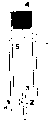
本发明工艺中步骤(VI)的处理工艺可以用一种叫做“上流式厌氧污泥床”(UASB反应器)的反应器来完成,如在Schmidt and Ahring(1996)当中描述的那样。这种类型反应器通常的形状为直立圆桶,如图1所示。The treatment process of step (VI) in the process of the present invention can be carried out with a reactor called "upflow anaerobic sludge bed" (UASB reactor), as described in Schmidt and Ahring (1996). Reactors of this type are usually shaped as vertical drums, as shown in Figure 1.
处理废液的回用(本发明步骤VII和步骤VIII的工艺)Treat the recycling of waste liquid (the technique of step VII and step VIII of the present invention)
如前所述,此发明的一个非常重要的特点是能够全部或部分处理过的发酵废水在经过步骤(VI)处理以后被回用作为此发明工艺中的含水液相,因此,减少了水的浪费并把处理过程中出现的废物量降到最低限度。在此发明工艺的任何一个步骤中,都有可能利用处理过的废水连续重复从步骤(I)到步骤(VII),因此能够连续把固体木质纤维素材料转化为乙醇和甲烷。例如,通过把处理过的废液引入步骤(II)或步骤(III)到(IV)中而在这些步骤中获得含水液浆。As previously mentioned, a very important feature of this invention is that the fermented wastewater that can be fully or partly treated is reused as the aqueous liquid phase in the process of this invention after being treated in step (VI), thus reducing the amount of water Waste and minimize the amount of waste that occurs during disposal. In any step of the inventive process, it is possible to continuously repeat steps (I) to (VII) using the treated waste water, thus enabling continuous conversion of solid lignocellulosic materials into ethanol and methane. For example, an aqueous slurry is obtained in these steps by introducing the treated waste liquor into step (II) or steps (III) to (IV).
因此,首选方案即从步骤(V)当中所产生废水里至少5%被引入此发明工艺当中的任何一个步骤中,引入的废液量可以是10%、20%、30%、40%、50%、60%、70%、80%、90%甚至可以是100%。处理过的废水被大量的引入前面的工艺步骤当中而不会降低前面步骤当中乙醇或甲烷的产量。Therefore, the preferred solution is that at least 5% of the waste water produced from step (V) is introduced into any step in the process of the invention, and the amount of waste liquid introduced can be 10%, 20%, 30%, 40%, 50% %, 60%, 70%, 80%, 90% can even be 100%. The treated wastewater is introduced in large quantities into the previous process steps without reducing the production of ethanol or methane in the previous steps.
因此,本发明步骤(VI)中废水处理的目的即是减少存在于废水当中的有机物质(COD)如羧酸、呋喃和酚类化合物等抑制性物质,这样,当处理过的废液被重新引入到工艺流程当中后就会保证抑制性物质不会限制或制约生物物质的部分分解、水解和乙醇发酵。相应地,很大一部分剩余有机物(COD)在经过乙醇发酵后可以被转化为生物沼气。因此,首先方案即为至少50%的COD剩余物在经过乙醇发酵后被转化为生物沼气,其中包括60%、70%、80%甚至85%的COD。以下所举的例子就会说明步骤(VI)的完成会减少存在于该步骤发酵废液里至少80%的抑制性物质,其中包括85%、90%、95%甚至达到100%。Therefore, the purpose of wastewater treatment in the step (VI) of the present invention is to reduce inhibitory substances such as carboxylic acid, furan and phenolic compounds, such as organic substances (COD) present in the middle of the wastewater, so that when the treated waste liquid is re- The introduction into the process ensures that the inhibitory substances do not limit or restrict the partial decomposition, hydrolysis and ethanol fermentation of the biomass. Correspondingly, a large part of residual organic matter (COD) can be converted into biogas after ethanol fermentation. Therefore, the first plan is that at least 50% of the COD residue is converted into biogas after ethanol fermentation, including 60%, 70%, 80% or even 85% of COD. The examples given below will illustrate that the completion of step (VI) will reduce at least 80% of the inhibitory substances present in the fermentation waste liquid of this step, including 85%, 90%, 95% or even 100%.
本发明将在以下非限制性的例子当中作进一步的阐述,这些例子都是在实验室中试规模下进行的,并阐述了本发明工艺的具体方案,如图所示。The present invention will be further illustrated in the following non-limiting examples, which were carried out on a pilot scale in the laboratory, and illustrate the specific scheme of the process of the present invention, as shown in the figure.
附图说明Description of drawings
图1展示了“上流式厌氧污泥床”反应器(UASB反应器)的简图,这种反应器对于发明工艺中步骤(VI)的厌氧发酵处理很有效。UASB反应器利用了反应底部固定的呈层状的污泥颗粒1中的生物物质。待处理的液相经过反应器底部一个或者更多的孔口A进入并经过这个污泥生物物质颗粒层。在反应器的顶部是一个处理后的上流液相和厌氧发酵过程中产生的气体可以通过,但是菌胶团不可以通过的筛子。厌氧发酵过程中产生的一些气体(例如甲烷和本发明中有可能产生的二氧化碳)会暂时吸附在微生物污泥的颗粒上,使2中颗粒的浮力增加而上浮穿过液相。当这些颗粒碰到了筛子3,其中使其上浮的气体被碰掉后,这些颗粒就会重新沉淀回到反应器底部。经过处理并通过筛子的液相在一个或者多个液相出口L被抽出,气相在一个或者多个气相出口G被抽出。在有含甲烷气体(本发明工艺就是这样)产生时,这些气体可以贮存在贮气柜里,或被大致连续地抽出来用于生产热电。Figure 1 shows a schematic diagram of an "upflow anaerobic sludge bed" reactor (UASB reactor), which is effective for the anaerobic fermentation treatment of step (VI) of the inventive process. The UASB reactor utilizes the biomass in the layered sludge particles 1 fixed at the bottom of the reaction. The liquid phase to be treated enters through one or more orifices A at the bottom of the reactor and passes through this layer of sludge biomass particles. At the top of the reactor is a sieve through which the treated upper liquid phase and the gas produced during the anaerobic fermentation can pass, but the bacteria micelles cannot pass through. Some gases produced during anaerobic fermentation (such as methane and carbon dioxide that may be produced in the present invention) will be temporarily adsorbed on the particles of the microbial sludge, increasing the buoyancy of the particles in 2 to float through the liquid phase. When these particles hit the
图2展示了本发明用于对木质纤维素物质进行有效预处理的湿法氧化反应器(“闭路反应器”)的简图。该闭路反应器的详细描述可以参见Bjerre等(1996)。该反应器包括一个内直径为11厘米、高18厘米的桶状钢制容器和一个长160厘米、内直径22毫米的外挂钢管。钢管的一端绕在容器底的外部,另一端绕在容器下部的外面。在容器底部,连接管的上部是一个可以提供待处理悬浮物或溶液回流的离心力推动轮,此推动轮由外在容器上磁偶电马达驱动。容器顶部装有钢制的盖子,它可以被凸缘装置紧紧锁住。这盖子装有可以引入空气、氧气或者其它适当的含氧气体(通常来自高压气瓶)或者其它到达闭路反应器液相上部气室(自由体积)气体或者水蒸气的入口阀门。闭路反应器有1升液体悬浮物的空间,并且气室(自由体积)的体积为1升。Figure 2 shows a schematic diagram of a wet oxidation reactor ("closed loop reactor") according to the invention for efficient pretreatment of lignocellulosic material. A detailed description of the closed loop reactor can be found in Bjerre et al. (1996). The reactor consists of a barrel-shaped steel vessel with an inner diameter of 11 cm and a height of 18 cm and an external steel pipe with a length of 160 cm and an inner diameter of 22 mm. One end of the steel pipe is wound around the outside of the bottom of the container, and the other end is wound around the outside of the lower part of the container. At the bottom of the container, the upper part of the connecting pipe is a centrifugal force push wheel that can provide the reflux of the suspension or solution to be treated, and the push wheel is driven by an electric motor with a magnetic couple on the external container. The container is topped with a steel lid which can be tightly locked by the flange device. This cover is fitted with inlet valves to allow the introduction of air, oxygen or other suitable oxygen-containing gas (usually from high pressure cylinders) or other gas or water vapor to the upper chamber (free volume) of the liquid phase of the closed-loop reactor. The closed loop reactor has room for 1 liter of liquid suspension and the volume of the gas chamber (free volume) is 1 liter.
图3展示了实施例1当中使用的实验室规模玻璃反应器的简图。该反应器有200毫升的空间,并被热罩1所包裹,恒温水浴中的水通过它可以被环流。一个通入反应器并穿过热罩下部的入流管,包括一个螺旋部分2。该螺旋部分可以避免固体生物物质由于待处理来料迅速被暴露在的达到热罩中介质的实际温度而造成的温度休克。位于反应器底部入口处的密封球3的作用相当于一个不可转动阀门,阻挡反应器内部物质通过入口管而泄漏出来。反应器系统作为一个整体与12毫米氯丁二烯橡胶相隔离。反应器顶部装有可以直接从反应器出口处抽取气体或液体样本的管子4。位于反应器上部的一个孔口为1毫米的网筛5可以阻止悬浮的固定的生物物质从反应器中被冲洗出来。Figure 3 shows a schematic diagram of the laboratory scale glass reactor used in Example 1. The reactor has a space of 200 ml and is surrounded by a heat shield 1 through which water in a constant temperature water bath can be circulated. An inflow tube leading into the reactor and passing through the lower part of the heat shield, comprising a helical part 2 . This helical section avoids temperature shock of the solid biological matter due to the rapid exposure of the incoming material to be processed to the actual temperature of the medium in the heat shield. The function of the sealing
图4为甲烷的生产。乙酸、潜在的发酵抑制性物质和未发酵的碳水化合物在55摄氏度时,通过嗜热厌氧废水处理过程,被一族产甲烷古细菌转化为甲烷。Figure 4 shows the production of methane. Acetic acid, potentially fermentation-inhibiting substances, and unfermented carbohydrates were converted to methane by a family of methanogenic archaea through a thermophilic anaerobic wastewater treatment process at 55 °C.
具体实施方式Detailed ways
实施例1Example 1
处理木质纤维素物质单步结果评价Single-step result evaluation for processing lignocellulosic matter
1.1材料与方法1.1 Materials and methods
1.1.1试剂1.1.1 Reagents
除非特殊注明,下面所使用的试剂均可以从实验室试剂供应商那里得到。Unless otherwise noted, all reagents used below were obtained from laboratory reagent suppliers.
1.1.2木质纤维素物质的来源1.1.2 Sources of lignocellulosic material
下面实验所采用的木质纤维素物质均来自于1997年在Forskningscenter Ris(瑞索国家实验室)收获的麦草。The lignocellulosic materials used in the following experiments all come from wheat straw harvested in Forskningscenter Ris (Risso National Laboratory) in 1997.
1.1.3木质纤维素物质湿法氧化预处理反应器1.1.3 Lignocellulosic material wet oxidation pretreatment reactor
湿法氧化反应器是一个循环的实验室规模的反应器(以下称为“闭路反应器”),它可以承受气体压力(图2)。该闭路反应器已在Bierre等(1996)中描述过。The wet oxidation reactor is a circulating laboratory-scale reactor (hereinafter referred to as "closed-loop reactor") that can withstand gas pressure (Fig. 2). This closed loop reactor has been described in Bierre et al. (1996).
该闭路反应器是通过被沉浸在一个溶解盐的恒温浴中被加热的,这些溶解盐可以是1∶1(W/W)无水硝酸钠和无水亚硝酸钠的混合物,接下来再通过浸没在冷水中被冷却。在加热时,一般在3分钟以内达到理想温度,在冷却时,大约需要1分钟达到气力平衡。The closed-loop reactor is heated by being immersed in a constant temperature bath of dissolved salt, which can be a 1:1 (W/W) mixture of anhydrous sodium nitrate and anhydrous sodium nitrite, followed by Cool by submersion in cold water. When heating, it generally reaches the ideal temperature within 3 minutes, and when cooling, it takes about 1 minute to reach the gas balance.
在盖子阀门关掉的时候,这个闭路反应器就成了一个封闭的系统。在这里,反应混合物以悬浮的木质生物物质的形态存在于有氧的含水介质中,被注入容器后再在选定的时间内和选定的压力下被回流。When the lid valve is closed, the closed-loop reactor becomes a closed system. Here, the reaction mixture in the form of suspended woody biomass in an aerobic aqueous medium is injected into a vessel and then refluxed for a selected time and pressure.
1.1.4麦草湿法氧化的预处理1.1.4 Pretreatment of wheat straw wet oxidation
在进行湿法氧化之前,干草被辗成最大长度为5毫米的碎末,与去离子水(每60克草1升水)混合,并加入碳酸钠。一升的混合物被传到闭路反应器后,将闭路反应器用氧气瓶中的氧加压使压力达到12×105帕斯卡(起始压力)。然后,反应物在195摄氏度时被湿法氧化10分钟,冷却后,反应器中的物质被注进一个5升的塑料容器中并被储藏在零下20摄氏度。Before wet oxidation, hay was crushed to a maximum length of 5 mm, mixed with deionized water (1 liter of water per 60 g of grass) and added with sodium carbonate. After one liter of the mixture was passed to the closed-loop reactor, the closed-loop reactor was pressurized with oxygen from an oxygen cylinder to a pressure of 12 x 105 Pascal (starting pressure). The reactants were then wet-oxidized at 195°C for 10 minutes. After cooling, the contents of the reactor were poured into a 5-liter plastic container and stored at -20°C.
1.1.5生长介质1.1.5 Growth medium
1)BA介质(合成介质):BA介质准备了1升,下列成分被混合在一个锥形烧瓶里:1) BA medium (synthetic medium): 1 liter of BA medium was prepared, and the following components were mixed in an Erlenmeyer flask:
无离子水(Milli-QTM) 916毫升Deionized water (Milli-Q TM ) 916ml
溶液A 10毫升Solution A 10ml
溶液B 2毫升Solution B 2ml
溶液C 1毫升Solution C 1 ml
溶液D 1毫升Solution D 1 ml
碳酸氢钠溶液 50毫升Sodium bicarbonate solution 50ml
酵母提取液1克Yeast extract 1 g
用80%体积氮气和20%体积的混合气体对该混合物吹脱10分钟使其厌氧。测得的pH值为6.9到7.0。该混合物在140摄氏度时被高温消毒20分钟,然后在厌氧条件下加入下列物质:The mixture was anaerobic by sparging with 80% nitrogen by volume and 20% by volume a mixture of gases for 10 minutes. The measured pH was 6.9 to 7.0. The mixture was autoclaved at 140°C for 20 minutes, then the following substances were added under anaerobic conditions:
维生素溶液(0.1毫升溶液每10毫升介质)Vitamin solution (0.1 ml solution per 10 ml medium)
硫酸钠溶液(0.1毫升溶液每10毫升介质)Sodium sulfate solution (0.1 ml solution per 10 ml medium)
所使用的各种溶液的组成分别为:The compositions of the various solutions used are:
溶液A(克每升去离子水溶液):氯化铵(100克/升)、氯化钠(10克/升)、六水氯化镁(10克/升)、二水氯化钙(5克/升)。Solution A (grams per liter of deionized water): ammonium chloride (100 g/l), sodium chloride (10 g/l), magnesium chloride hexahydrate (10 g/l), calcium chloride dihydrate (5 g/l Lift).
溶液B(在去离子水中):三水磷酸氢二钾(200克/升)。Solution B (in deionized water): Dipotassium hydrogen phosphate trihydrate (200 g/L).
溶液C(在去离子水中):刃天青钠盐(0.5克/升)。Solution C (in deionized water): resazurin sodium salt (0.5 g/l).
溶液D:按照给定的顺序和给定的量,将下列组分填加到一个1000毫升的容量烧瓶中:Solution D: According to the given order and the given amount, add the following components into a 1000ml volumetric flask:
去离子水(500毫升)、硼酸(50毫克)、氯化锌(50毫克)、脱水氯化铜II(38毫克)、脱水氯化锰II(41毫克)、四水钼铵(50毫克)、六水氯化铝(90毫克)、六水氯化钴II(50毫克)、六水氯化镍II(92毫克)、乙二胺四乙酸钠盐(EDTA钠,500毫克)、五水亚硒酸盐(100毫克)。Deionized Water (500ml), Boric Acid (50mg), Zinc Chloride (50mg), Dehydrated Copper II Chloride (38mg), Dehydrated Manganese Chloride II (41mg), Molybdenum Ammonium Tetrahydrate (50mg) , Aluminum Chloride Hexahydrate (90mg), Cobalt II Chloride Hexahydrate (50mg), Nickel II Chloride Hexahydrate (92mg), Sodium Ethylenediaminetetraacetic Acid (Sodium EDTA, 500mg), Pentahydrate Selenite (100 mg).
然后,把事先准备好的溶液加入容量瓶当中,该溶液是把二次蒸馏水(1毫升)、盐酸(1毫升)以及四水氯化铁(2000毫克)混合在一起直到该混合物中的氯化铁溶解为止,再把去离子水添入容量瓶中的画记号处。Then, add the previously prepared solution into the volumetric flask. The solution is to mix double distilled water (1 ml), hydrochloric acid (1 ml) and ferric chloride tetrahydrate (2000 mg) until the chloride in the mixture Add deionized water to the marked place in the volumetric flask until the iron is dissolved.
碳酸氢钠溶液(在去离子水中):无水碳酸氢钠(52克/升)Sodium bicarbonate solution (in deionized water): Anhydrous sodium bicarbonate (52 g/L)
维生素溶液(在去离子水当中,溶液以毫克/升计算)(从Sigma购买的材料):生物锡(维生素H,2毫克/升)、叶酸(2毫克/升)、吡哆醇(维生素B6,10毫克/升)、核黄素(维生素B2,5毫克/升)、盐酸硫胺素(维生素B1,5毫克/升)、氰钴胺素(维生素B12,0.1毫克/升)、烟酸(5毫克/升)、对氨基苯甲酸(5毫克/升)、硫锌酸(5毫克/升)、DL-泛酸(5毫克/升)。由于这种溶液在140摄氏度下进行高温消毒的时候不稳定,所以先要用氢气吹脱使其脱氧后再过滤到厌氧条件下经过高温消毒的药水瓶中贮存以备用。Vitamin solution (solution in mg/l in deionized water) (material purchased from Sigma): biotin (vitamin H, 2 mg/l), folic acid (2 mg/l), pyridoxine (vitamin B 6 , 10 mg/L), riboflavin (vitamin B 2 , 5 mg/L), thiamine hydrochloride (vitamin B 1 , 5 mg/L), cyanocobalamin (vitamin B 12 , 0.1 mg/L ), niacin (5 mg/L), p-aminobenzoic acid (5 mg/L), sulfur zinc acid (5 mg/L), DL-pantothenic acid (5 mg/L). Because this solution is unstable when it is sterilized at 140 degrees Celsius, it should be deoxygenated by blowing off with hydrogen, and then filtered into a high-temperature sterilized liquid medicine bottle under anaerobic conditions for storage for subsequent use.
硫化钠:一个Erlenmeyer烧瓶中的一升去离子水用氢气吹脱后使其脱去氧。一部分25克的硫化钠(NaS·7-9H2O)被称出来后加入到烧瓶(顶盖部)中继续用氢气吹脱。然后,溶液中20毫升的等分试样在厌氧条件下被转移到100毫升的药水瓶中并使药水瓶在140摄氏度下进行高温消毒。Sodium Sulfide: One liter of deionized water in an Erlenmeyer flask was deoxygenated by purging with hydrogen. A portion of 25 grams of sodium sulfide (NaS·7-9H 2 O) was weighed out and added to the flask (top) to continue stripping with hydrogen. Then, 20 mL aliquots of the solution were transferred under anaerobic conditions into 100 mL vials and the vials were autoclaved at 140°C.
2)酵母生长介质(YM):这种介质包括被添加其它维生素、痕量金属、酵母提取物以及吐温TM80/麦角固醇溶液的BA介质。以下为准备好的包含有维生素、痕量元素以及麦角固醇/吐温TM80的储存溶液:2) Yeast Growth Medium (YM): This medium includes BA medium to which other vitamins, trace metals, yeast extract, and
维生素溶液(100毫升):Vitamin solution (100ml):
(i)在1毫升0.1M的氢氧化钠克生物锡;(i) gram biotin in 1 ml of 0.1M NaOH;
(ii)在溶液(i)添加约80毫升的水;(ii) adding about 80 ml of water to solution (i);
(iii)通过再加入1M盐酸/1M氢氧化钠把溶液(ii)的pH值调至6.5;(iii) adjust the pH value of solution (ii) to 6.5 by further adding 1M hydrochloric acid/1M sodium hydroxide;
(iv)按指定的顺序在每次添加后使其pH值调至6.5的溶液(iii)中一次性溶解下列维生素:(iv) Dissolve the following vitamins at once in the order specified in solution (iii) adjusted to pH 6.5 after each addition:
泛酸钙 0.1克Calcium pantothenate 0.1g
烟酸 0.1克Niacin 0.1g
肌醇 2.5克Inositol 2.5 grams
盐酸硫胺素 0.1克Thiamine Hydrochloride 0.1g
吡哆醇 0.1克Pyridoxine 0.1g
对氨基苯甲酸 0.02克p-aminobenzoic acid 0.02g
(v)加入总量为100毫升的水;(v) adding a total of 100 milliliters of water;
(vi)像前面那样把pH值调至6.5;(vi) Adjust the pH to 6.5 as before;
(vii)经过无菌过滤后再把其分为5至10毫升的不同等份并储存在冰箱里。(vii) Sterile filtered and then divided into different aliquots of 5 to 10 ml and stored in the refrigerator.
痕量元素(100毫升):Trace Elements (100ml):
(i)在50毫升水中溶解1.5克的EDTA钠;(i) Dissolving 1.5 grams of sodium EDTA in 50 milliliters of water;
(ii)在溶液(i)中加0.45克四水硫化锌;(ii) add 0.45 gram of zinc sulfide tetrahydrate in solution (i);
(iii)溶液(ii)通过每次添加以下物质使其pH值调至6.0:(iii) Solution (ii) was brought to pH 6.0 by each addition of:
二水氯化锰 0.1克Manganese chloride dihydrate 0.1 g
六水氯化钴 0.03克Cobalt chloride hexahydrate 0.03 g
五水硫酸铜 0.03克Copper sulfate pentahydrate 0.03 g
二水高锰酸钠 0.04克Sodium permanganate dihydrate 0.04 g
二水氯化钙 0.45克Calcium chloride dihydrate 0.45 g
七水硫酸铁 0.3克Ferric sulfate heptahydrate 0.3 g
硼酸 0.1克Boric acid 0.1 g
碘化钾 0.01克Potassium iodide 0.01 g
(iv)添入总量为100毫升的水;(iv) adding a total of 100 milliliters of water;
(v)把pH值调至4.0;(v) adjusting the pH to 4.0;
(vi)经过无菌过滤后再把其分为5至10毫升的不同等份并储存在冰箱里。(vi) Sterile filtered and then divided into different aliquots of 5 to 10 ml and stored in the refrigerator.
麦角固醇/吐温MT80溶液(200毫升):Ergosterol/
(i)在64毫升煮沸的纯乙醇中溶解1.5克的麦角固醇;(i) dissolving 1.5 grams of ergosterol in 64 milliliters of boiled pure ethanol;
(ii)在溶液中加入67.2克吐温MT80并通过加入纯乙醇把该溶液容量调至200毫升;(ii) 67.2 grams of
(iii)进行无菌过滤。(iii) Perform sterile filtration.
1.1.6.酶促水解1.1.6. Enzymatic hydrolysis
酶促水解是在1升液体总量为500毫升的浸制瓶里完成的。在接下来的发酵处理过程中,为了给微生物提供最佳的生长条件(在同样的瓶中进行),湿法氧化的麦草(以下有时也被称为WOS)与BA介质中的各种成分混合,混合以用WOS液体来替代在准备BA介质所利用的去离子水的方式进行。每个瓶子都用一个橡皮隔膜和一个铝制密封圈来密封并使该瓶在120摄氏度的温度下进行高温消毒一个小时。接下来在厌氧无菌条件下用皮下针插入橡皮隔膜加入或者抽出瓶中的物质。Enzymatic hydrolysis is done in 1 liter infusion bottles with a total liquid volume of 500 ml. During the subsequent fermentation process, wet oxidized wheat straw (sometimes referred to below as WOS) is mixed with various components in the BA medium in order to provide optimal growth conditions for the microorganisms (in the same bottle) , the mixing was performed in such a way that WOS liquid was used instead of the deionized water utilized in the preparation of the BA medium. Each bottle was sealed with a rubber septum and an aluminum seal and the bottle was autoclaved at 120°C for one hour. The contents of the vial are then added or withdrawn under anaerobic aseptic conditions with a hypodermic needle inserted through the rubber septum.
为了酶促水解,3.5毫升的CelluclastTM 1.5升(丹麦巴格斯瓦市的诺和诺德公司应其要求提供了CelluclastTM详细资料的手册供参考)每500毫升WOS被加入瓶中并在pH值为6.1和温度为40摄氏度的条件下培养9天。For enzymatic hydrolysis, 3.5 ml of Celluclast TM 1.5 liters (Novo Nordisk, Bagsva, Denmark, provided upon request a brochure with Celluclast TM details for reference) per 500 ml of WOS was added to the bottle and adjusted at pH The value was 6.1 and the temperature was 40 degrees Celsius for 9 days.
1.1.7糖类发酵1.1.7 Sugar fermentation
在经过水解处理以后,酵母提取物、其它维生素、痕量元素以及麦角固醇/吐温MT80溶液加入瓶中以提供在发酵过程中糖类发酵微生物(即啤酒糖酵母和迈氏热厌氧杆菌A3M4)最佳的生存条件。After the hydrolysis treatment, yeast extract, other vitamins, trace elements and ergosterol/
微生物:酵母啤酒糖酵母(一种嗜温微生物)用来发酵葡萄糖。啤酒糖酵母的细胞从一包面包酵母的中心取出并使装有附加YM介质的20毫升血清瓶在30摄氏度的温度下培养24个小时。在经过培养之后,培养皿在5摄氏度的温度下被储存起来直到菌落被拿出用于发酵实验。Microorganisms: The yeast Saccharomyces cerevisiae (a mesophilic microorganism) is used to ferment glucose. Cells of Saccharomyces cerevisiae were removed from the center of a packet of baker's yeast and 20 ml serum bottles filled with additional YM medium were incubated at 30°C for 24 hours. After incubation, the dishes were stored at 5 °C until the colonies were taken out for fermentation experiments.
木糖的发酵通过一系列嗜热菌迈氏热厌氧杆菌,即迈氏热厌氧杆菌A3M4(Ahring等1996)来完成的。Fermentation of xylose is carried out by a series of thermophilic bacteria, Thermoanaerobacillus meiiii A3M4 (Ahring et al. 1996).
发酵过程:把啤酒糖酵母加入到瓶中并在30摄氏度的温度下培养14天,然后加热此瓶至70摄氏度,加入迈氏热厌氧杆菌A3M4并使此瓶在70摄氏度的温度下培养10天。为了监控其发酵过程,瓶内的压力要每天用压力计来测量。当瓶内的压力稳定时,发酵过程就会由微生物来完成。为了分别确定挥发性脂肪酸(VFA)的成分、乙醇成分及整个糖类成分(通过标准方法),在酵母发酵与A3M4发酵完成后,样品即被取出。Fermentation process: Saccharomyces cerevisiae was added to the bottle and cultivated at a temperature of 30 degrees Celsius for 14 days, then heated the bottle to 70 degrees Celsius, added Thermoanaerobic bacteria A3M4 and allowed the bottle to be cultivated at a temperature of 70 degrees Celsius for 10 days sky. In order to monitor the fermentation process, the pressure in the bottle is measured daily with a manometer. When the pressure inside the bottle stabilizes, the fermentation process is completed by the microorganisms. Samples were taken after completion of yeast and A3M4 fermentations in order to determine volatile fatty acid (VFA) composition, ethanol composition and total sugar composition (by standard methods), respectively.
在发酵过程完成以后取出适量的样品,打开瓶口并使各种成分[发酵后的经湿法氧化处理后的草(FWOS)]以13200xG并在4摄氏度的温度下被离心分离出来(以成批的形式),这样就会除去尚未降解的草和其它悬浮物质。把来自于不同批离心分离出来的上清液集中起来搅拌倒入容量为1升的塑料瓶中并在零下20摄氏度的温度下冷冻储存起来;这个上清液相在下文有时也被称为FWOSs。把来自于不同批离心分离出来的沉淀物(粒状沉淀)用同样的方式进行处理(产生FWOSp的产物)。After the fermentation process is completed, an appropriate amount of sample is taken out, the bottle is opened and the various components [fermented wet oxidized grass (FWOS)] are centrifuged at 13200xG at a temperature of 4 degrees Celsius (in order to form batch form), which removes undegraded grass and other suspended matter. The supernatants from different batches of centrifugation were pooled, stirred, poured into 1-liter plastic bottles and stored frozen at -20°C; this supernatant phase is sometimes referred to hereinafter as FWOS s . The precipitate (pellet) from the centrifugation of different batches was treated in the same way (yielding the product of FWOS p ).
1.1.8“上流式厌氧污泥床”(UASB)反应器实验1.1.8 "Upflow Anaerobic Sludge Bed" (UASB) Reactor Experiment
这些实验由容量为200毫升的实验室规模的玻璃反应器来完成,图3阐述了该反应器的具体结构。反应器per se通过被热罩包裹就可以使恒温水浴中的水通过它被环流。该实验利用水温为37摄氏度的水。一个通入反应器并穿过热罩下部的入流管,包括一个螺旋部分2。该螺旋部分可以避免固体生物物质[包含在本明步骤(VI)的工艺中合成甲烷的厌氧有机体]由于待处理来料迅速被暴露在的达到热罩中介质的实际温度而造成的温度休克。位于反应器底部入口处的密封球3的作用相当于一个不可转动阀门,阻挡反应器内部物质通过入口管而泄漏出来。反应器系统作为一个整体与12毫米氯丁二烯橡胶相隔离。These experiments were carried out in a laboratory-scale glass reactor with a capacity of 200 ml, and the specific structure of the reactor is illustrated in Fig. 3 . The reactor per se can circulate the water in the constant temperature water bath through it by being wrapped by the heat shield. The experiment utilizes water with a water temperature of 37 degrees Celsius. An inflow tube leading into the reactor and passing through the lower part of the heat shield, comprising a helical part 2 . This helical part can avoid the temperature shock caused by the solid biomass [comprising the anaerobic organisms that synthesize methane in the process of step (VI) of the present invention] due to the rapid exposure of the incoming material to be treated to reach the actual temperature of the medium in the heat shield . The function of the sealing
把离开反应器的废液(处理后的物质)收集在一个媒介储存容器中,把其中的废液与待处理的新材料按4∶1的比例回流到反应器当中。用一个装有不同直径泵管(即具有不同的抽吸容量)的蠕动泵(Waston-Marlow)把回流处理后的材料以及新加入的材料抽出来并确保回流材料与新加材料的连续比例而不用考虑蠕动泵的转速。The waste liquid (processed material) leaving the reactor is collected in a medium storage container, and the waste liquid and fresh material to be treated are returned to the reactor in a ratio of 4:1. Use a peristaltic pump (Waston-Marlow) equipped with pump tubes of different diameters (that is, with different suction capacities) to pump out the refluxed material and the newly added material and ensure a continuous ratio of the refluxed material to the newly added material. Regardless of the speed of the peristaltic pump.
反应器顶部装有可以直接从反应器出口处抽取气体或液体样本的管子4。位于反应器上部的一个孔口为1毫米的网筛5可以阻止悬浮的固定的生物物质从反应器中被冲洗出来。The top of the reactor is equipped with a
这些实验所利用的固体生物物质(颗粒体)是由荷兰的EerbeekBV公司提供并从用于净化造纸厂废水的嗜中温完全规模的反应器中提取出来的。本实验中的生物物质储存在反应器5摄氏度的温度中为最佳。The solid biomass (granules) used for these experiments was supplied by Eerbeek BV, The Netherlands and extracted from a mesophilic full-scale reactor used to purify paper mill wastewater. Biomass storage in this experiment was optimal at a temperature of 5 °C in the reactor.
如果反应器流出来的废液气压超出了流进该反应器的气压,里面的气体和液体就会分开。气压的体积可以用基于液体转移原理的测量表(Angelidaki等.,1992)来测量。分离出来的气体可以不用收集。用来确定反应器中所产生气体成分的气体样品可以在反应器顶部的液体平面上方用抽气管4迅速抽取出来。这样做是因为废液容器中也会产生甲烷产物。If the pressure of the waste liquid coming out of the reactor exceeds the pressure of the flow into the reactor, the gas and liquid inside will be separated. The volume under pressure can be measured with a gauge based on the principle of liquid transfer (Angelidaki et al., 1992). The separated gas may not be collected. A gas sample for determining the composition of the gas produced in the reactor can be drawn quickly with the
在开始使用反应器以前,要把脱氧BA介质装入反应器系统中。把100毫升的固体生物物质引入到反应器当中并加入3毫升硫化钠(25克/升)以减少反应器中存在的氧气。为了避免固体生物物质的抑制性,反应器在开始使用时要用BA介质把FWOSs稀释至25%(v/v)(看下面)并把其滞留时间定为每天100毫升。微生物在生物物质中的适配性可以首先通过测量反应器顶部VFA的浓度进行监控。一旦VFA成分得到了稳定,新进材料FWOSs的浓度就会以每次递增20%(相对的)的速度而最终获取升至100%FWOSs。同样,根据VFA的浓度使其滞留时间逐渐减少直到反应器中的滞留时间达到每天200毫升。Before commencing operation of the reactor, the deoxygenated BA medium was loaded into the reactor system. 100 ml of solid biomass was introduced into the reactor and 3 ml of sodium sulfide (25 g/l) was added to reduce the oxygen present in the reactor. In order to avoid inhibition by solid biomass, the reactor was initially used by diluting FWOSs to 25% (v/v) with BA medium (see below) and with a residence time of 100 ml per day. The fitness of microorganisms in the biomass can first be monitored by measuring the concentration of VFA at the top of the reactor. Once the VFA composition has been stabilized, the concentration of the incoming material FWOS s is increased by 20% (relative) increments until eventually 100% FWOS s is achieved. Also, the residence time was gradually decreased according to the VFA concentration until the residence time in the reactor reached 200 ml per day.
反应器开始时及操作过程中FWOSs准备:把待处理材料放在1升与抽吸管一起经过高温消毒的浸制瓶中准备好。FWOSs的稀释液是通过用BA介质把其浓度稀释到理想状态;加热温度至85摄氏度使FWOSs融解并把乙醇除去。使该液体在回流以减少其蒸发条件下用空气吹脱4个小时。在除去乙醇过程中每间隔一段时间测量一次剩余浓度;当液体乙醇的剩余浓度为5至10mM时,蒸发即停止。通过其重量的减轻与去离子(Milli-QTM)水的增加所代替的失去的液体容积可以估计出其蒸发的程度。把去掉乙醇后用BA介质稀释过的FWOSs进行无菌过滤穿过0.2μm的过滤器后进入一个经过高温消毒后的浸制瓶。然后,瓶内的成分在经过80/20(v/v)的氮气/二氧化碳的气体混合物吹脱15分钟后使其脱去氧气。为了确定VFA、乙醇成分、化学需氧量(COD)以及氮气含量,在无菌条件下把40毫升的样品提取出来并测定其pH值。用一个新瓶来代替几乎空了的浸制瓶并把新瓶中的剩余介质提取出来进行分析。把浸制瓶中的样品取出来在零下20摄氏度的温度下储存以备分析。Preparation of the FWOS at the start of the reactor and during operation: The material to be treated was prepared in a 1 liter autoclaved infusion bottle together with the suction line. The dilution of FWOS s was obtained by diluting its concentration to an ideal state with BA medium; heating the temperature to 85 degrees Celsius to melt the FWOS s and remove the ethanol. The liquid was stripped with air for 4 hours at reflux to reduce its evaporation. The residual concentration was measured at intervals during the removal of ethanol; evaporation ceased when the residual concentration of liquid ethanol was 5 to 10 mM. The extent of evaporation can be estimated by the loss of liquid volume replaced by the loss of its weight and the addition of deionized (Milli-Q ™ ) water. FWOS s diluted with BA medium after removal of ethanol was sterile filtered through a 0.2 μm filter into a pasteurized infusion bottle. The contents of the bottle were then deoxygenated after being stripped with an 80/20 (v/v) nitrogen/carbon dioxide gas mixture for 15 minutes. For the determination of VFA, ethanol composition, chemical oxygen demand (COD) and nitrogen content, 40 ml samples were extracted under aseptic conditions and their pH values were measured. Replace the nearly empty infusion bottle with a new bottle and extract the remaining medium in the new bottle for analysis. Samples from the infusion bottles were removed and stored at minus 20 degrees Celsius until analysis.
监测:在反应器的起始和接下来的操作过程当中,除了要把VFA等级测出来,还要把气体产物、气体成分以及COD的降低也测出来。除此以外,在经过至少4个最大有机负荷的滞留期后,把样品从反应器顶部的入口处取出作气相层析以测定不同芳香族混合物的降解程度。把样品储存在零下20摄氏度的温度下以备用分析。Monitoring: During the initial and subsequent operation of the reactor, in addition to measuring the VFA level, the reduction of gas products, gas components and COD should also be measured. In addition, after at least 4 residence periods of maximum organic load, samples were taken from the inlet at the top of the reactor for gas chromatography to determine the degree of degradation of the different aromatic compounds. Samples were stored at minus 20 degrees Celsius until analysis.
分析方法:按照Greenberg等,1992.测定干燥物质、有机物质、COD和凯氏氮。用FID检测器进行气相层析来测定其甲烷浓度。用热传导检测器进行气相层析来测定反应器中产生的生物气体中的氮气、二氧化碳以及甲烷的浓度。Analytical methods: According to Greenberg et al., 1992. Determination of dry matter, organic matter, COD and Kjeldahl nitrogen. The methane concentration was determined by gas chromatography with FID detector. Gas chromatography with a thermal conductivity detector was used to determine the concentrations of nitrogen, carbon dioxide and methane in the biogas produced in the reactor.
用FID检测器进行气相层析来测定乙醇和VFA的浓度(醋酸盐、丙酸盐、丁酸盐、异丁酸盐);通过加入每毫升30μl的磷酸(17%)样品使其酸化并以每分钟11000转的转速进行离心分离10分钟来测定VFA。The concentrations of ethanol and VFA (acetate, propionate, butyrate, isobutyrate) were determined by gas chromatography with FID detector; the sample was acidified by adding 30 μl per ml of phosphoric acid (17%) and VFA was determined by centrifugation at 11,000 rpm for 10 minutes.
用固相提取及FID检测器进行气相层析来测定像芳香族化合物以及相关假芳香族化合物这类微生物(比如糖类发酵微生物)的抑制剂如2-呋喃甲酸、苯酚、香草酸、高香草酸、加拿大麻素、4-水杨酸以及其它酸类;固相提取在pH值为2至7的条件下进行。Gas chromatography with solid-phase extraction and FID detection for the determination of inhibitors of microorganisms such as aromatic compounds and related pseudoaromatic compounds (such as sugar fermenting microorganisms) such as 2-furanoic acid, phenol, vanillic acid, vanillin acid, cannabinoid, 4-salicylic acid, and other acids; solid-phase extraction at pH 2 to 7.
整个糖类在经过水解后的以标准方式用强酸(72%硫酸)来进行测定;然后,还原糖的浓度以木糖作为校准物并由著名的二硝基水杨酸(DNS)法来进行测定。Whole sugars are determined in a standard manner after hydrolysis with strong acid (72% sulfuric acid); then, the concentration of reducing sugars is determined by the well-known dinitrosalicylic acid (DNS) method with xylose as calibrator Determination.
钾、硝酸氮以及磷酸P的标准在丹麦商业种植协会(“DanskErhvervsgartnerforenig”)来测定。The standards for potassium, nitrate nitrogen and phosphoric acid P were determined at the Danish Commercial Growers Association ("Dansk Erhvervsgartnerforenig").
1.2结果1.2 Results
1.2.1糖类发酵结果1.2.1 Results of sugar fermentation
在上面提到过的麦草的湿法氧化预处理中,所利用的草的浓度为每升水60克干草,这与理论上干燥物质成分在重量上(w/w)要占6%相符。在实施发酵实验以前,样品被取出对WOS进行分类测定。结果如下:In the wet oxidation pretreatment of wheat straw mentioned above, a grass concentration of 60 g hay per liter of water was used, which corresponds to a theoretical dry matter content of 6% by weight (w/w). Before carrying out fermentation experiments, samples were taken for WOS classification determination. The result is as follows:
图表1.1.用于发酵实验中WOS的分类测定Diagram 1.1. Classification determination of WOS used in fermentation experiments
*根据强酸水解和木糖为标准来确定的。 * Based on strong acid hydrolysis and xylose as standards.
**标准偏差是根据两次测量值来确定的。 ** Standard deviation is based on two measurements.
尽管明显产生了醋酸,但是由于其浓度太底而不能引起有效的酵母抑制,(1997年的Taherzadeh等)指出酵母只有在pH值为4.5醋酸浓度达到每升10克的浓度时才能生长。Although acetic acid was clearly produced, its concentration was too low to cause effective yeast inhibition, (Taherzadeh et al., 1997) indicated that yeast could only grow at a pH of 4.5 at a concentration of 10 grams per liter of acetic acid.
根据WOS中的葡萄糖与木糖成分为基础,“理论上的”(化学计量的)乙醇的产量可以像下面这样计算出来:Based on the glucose and xylose content of WOS, the "theoretical" (stoichiometric) ethanol yield can be calculated as follows:
葡萄糖
木糖:
每克糖所产生的乙醇量用克表示与其“在理论上的”每克葡萄糖产0.51克乙醇,每克木糖产0.51克乙醇相符。起始糖类总量的浓度为31.8±0.5克/升(表1.1)与其理论上每升WOS产生的乙醇最大量16.2±0.3克相符。The amount of ethanol produced per gram of sugar is expressed in grams, which is consistent with its "theoretical" 0.51 gram of ethanol per gram of glucose and 0.51 gram of ethanol per gram of xylose. The initial concentration of total carbohydrates was 31.8±0.5 g/L (Table 1.1), which was consistent with the theoretical maximum amount of ethanol produced per liter of WOS of 16.2±0.3 g.
表1.2展示了用二种糖类发酵微生物在经过WOS发酵后的平均乙醇浓度Table 1.2 shows the average ethanol concentration after WOS fermentation with two sugar fermenting microorganisms
表1.2.在麦草湿法氧化(WOS)发酵过程中乙醇的合成Table 1.2. Ethanol synthesis during wheat straw wet oxidation (WOS) fermentation
表1.2的结果与理论上乙醇产量的对比显示了在本实验的WOS中大约糖类总量的35%转化为乙醇。以这种方式产生的乙醇(生物乙醇)如前面所述可以被分离出来用来作为燃料、溶剂或用于其它用途。A comparison of the results in Table 1.2 with theoretical ethanol yields shows that approximately 35% of the total carbohydrates were converted to ethanol in the WOS in this experiment. The ethanol produced in this way (bio-ethanol) can be separated as described above and used as fuel, solvent or for other purposes.
1.2.2 UASB反应器中有机物的降解1.2.2 Degradation of organic matter in UASB reactor
表1.3展示了用4种FWOSs的不同样品(指R1-R4)在经过实验室规模反应器70多天的处理后所得到的结果。Table 1.3 presents the results obtained with four different samples of FWOSs (referred to as R1-R4) after more than 70 days of treatment in a laboratory-scale reactor.
表1.3用4种不同经过发酵与湿法氧化后的麦草(FWOSs)的样本在实验室规模的反应器中处理后得到的结果
*天数从反应器开启后开始计算 * Days are counted from the moment the reactor is turned on
从表中可以看出反应器中有机质的降解(用COD的减少量来表示)并不受以进入时COD含量(以克/升表示)之间的比例与滞留时间(以天数表示)来表示的有机物负荷(从R1到R4)翻一倍的影响,这个比例在以下指OLR。It can be seen from the table that the degradation of organic matter in the reactor (expressed by the reduction of COD) is not expressed by the ratio between the COD content (expressed in grams/liter) and the residence time (expressed in days) at the time of entry The effect of doubling the organic matter load (from R1 to R4), this ratio is hereinafter referred to as OLR.
反应器中气体(沼气)的发展也处于监控中。在经过大约60天(53到110天)对反应器的操作使其转化的一系列测量中,每天产生出来的生物气体含量与OLR的紧密关系得到观测。因此,每天每个引入反应器的COD单位(例如:克COD/升/天)所产生出来的生物气体含量(升/天)大约为0.1。所产生气体当中的甲烷成分在实验中不断的产生出来,平均为58.6±0.8%(v/v)的甲烷。The development of gas (biogas) in the reactor was also monitored. In a series of measurements over approximately 60 days (53 to 110 days) of operation of the reactor for conversion, a close relationship between the amount of biogas produced per day and the OLR was observed. Therefore, the biogas content (liter/day) produced by each unit of COD introduced into the reactor (for example: gram COD/liter/day) per day is about 0.1. The methane component in the generated gas was continuously produced in the experiment, with an average of 58.6±0.8% (v/v) methane.
1.2.3微生物抑制物质的降解1.2.3 Degradation of microbial inhibitory substances
为了研究不同种类产甲烷微生物的潜在抑制物的芳香族或假芳香族物质的降解,在UASB反应器处理前和处理后对与表3有关的样品R1-R4的一些物质浓度进行了分析。In order to study the degradation of aromatic or pseudoaromatic substances that are potential inhibitors of different species of methanogenic microorganisms, the concentrations of some substances in samples R1-R4 related to Table 3 were analyzed before and after treatment in the UASB reactor.
表1.4 UASB净化步骤中抑制物质的清除Table 1.4 Removal of inhibitory substances in UASB purification steps
如图表1.4所示,香草酸、高香草酸、乙酰香兰酮的平均起始浓度分别为大约60ppm、大约25ppm和大约5ppm。在反应器中经过处理以后,这三种类型的浓度减少到接近于或低于进行分析的识别底线(1-2ppm)。丁香酸、乙酰丁兰酮及丁香醇也可As shown in Table 1.4, the average starting concentrations of vanillic acid, homovanillic acid, and acetyl vanillin were about 60 ppm, about 25 ppm, and about 5 ppm, respectively. After processing in the reactor, the concentrations of these three types were reduced to near or below the identification threshold for analysis (1-2 ppm). Syringic acid, acetylbutanone and syringyl alcohol can also
获得同样的结果,其平均起始浓度分别为大约45ppm、大约28ppm和大约7ppm,在反应器中经过处理以后,其浓度也达到接近于或低于1--2ppm的分析识别底线。Obtain the same result, its average initial concentration is about 45ppm, about 28ppm and about 7ppm, respectively, and after being processed in the reactor, its concentration also reaches close to or lower than the analytical identification bottom line of 1--2ppm.
很明显,这种反应器类型通过本发明工艺中液相回流的再利用进行的厌氧过程能够使物质的降解(I)达到很高的程度,否则的话就会导致这种方式所描述的糖类发酵的抑制,并且进入反应器中的物质中的COD(通常为有机质)在很大程度上会被除去(II)以及可利用的生物气体也会形成,比如,以燃料的形式存在。It is clear that the anaerobic process of this reactor type through the reuse of the liquid phase reflux in the process of the invention enables the degradation of substances (I) to a high degree which would otherwise lead to the sugars described in this way Fermentation is inhibited and COD (usually organic matter) is largely removed from the feed to the reactor (II) and usable biogas is also formed, for example, in the form of fuel.
上面所描述的实验及其结果充分说明了本发明工艺方案的可行性及有效性。The experiments and results described above have fully demonstrated the feasibility and effectiveness of the process scheme of the present invention.
尽管上面的例子所描述的是用湿法氧化法对木质纤维素生物物质进行预处理,但本发明也可以采用蒸气爆炸法进行预处理。表1.5所示的是对湿法氧化的麦草(WSWO)和蒸汽爆炸的麦草(WWSE)在经过乙醇发酵后的水解产物中理论甲烷势的计算。Although the above examples describe the pretreatment of lignocellulosic biomass by wet oxidation, the present invention can also be pretreated by steam explosion. Table 1.5 shows the calculation of the theoretical methane potential in the hydrolyzate of wet oxidized wheat straw (WSWO) and steam exploded wheat straw (WWSE) after ethanol fermentation.
以上这些计算的根据如下:麦草的起始含量为60克每升。经过湿法氧化处理的麦草的COD/TS关系和COD去除率由丹麦技术大学生物中心(BioCentrum,DTU)确定。经过和蒸汽爆炸处理的麦草的COD去出率是在丹麦技术大学生物中心(BioCentrum,DTU)通过批式反应试验测得。比甲烷产量,木糖与半纤维素的关系,葡萄糖与纤维素的关系是化学平衡的固定值。糖的组成和回收率由丹麦瑞索国家实验室(RisNational Laboratory)确定。The above calculations are based on the following: the starting content of wheatgrass is 60 grams per liter. The COD/TS relationship and COD removal rate of wheat straw treated by wet oxidation were determined by the Biocentre of Technical University of Denmark (BioCentrum, DTU). The COD removal rate of wheat straw treated with steam explosion was measured by batch reaction test at the Biocentre of Technical University of Denmark (BioCentrum, DTU). The specific methane production, the relationship between xylose and hemicellulose, and the relationship between glucose and cellulose are fixed values of chemical equilibrium. Sugar composition and recovery were determined by RisNational Laboratory, Denmark.
计算甲烷产量所根据的是乙醇发酵后仍可以转化为甲烷的剩余COD的量和表1.5所确定的转化产率。根据糖的产率可以计算乙醇发酵后COD的损失量,这一部份应该从水解产物的COD总量中减去。甲烷的产量就可以根据剩余COD和已经确定的COD转化率和比甲烷产率来计算。The calculation of methane production is based on the amount of remaining COD that can still be converted to methane after ethanol fermentation and the conversion yields determined in Table 1.5. According to the yield of sugar, the loss of COD after ethanol fermentation can be calculated, and this part should be subtracted from the total COD of the hydrolyzate. The production of methane can be calculated according to the remaining COD and the determined COD conversion rate and specific methane production rate.
表1.5理论甲烷势的计算和假定Table 1.5 Calculation and assumptions of theoretical methane potential
实施例2Example 2
木质纤维素物质湿法氧化法降解产物的评估Evaluation of Degradation Products in Wet Oxidation of Lignocellulosic Materials
2.1简介2.1 Introduction
这个例子展示的是对糖产率以及木质纤维素物质湿法氧化法降解产物的定性和定量的研究,并且对纤维素和半纤维素分离的评估。This example demonstrates the qualitative and quantitative study of sugar yields and wet oxidation degradation products of lignocellulosic materials and the evaluation of cellulose and hemicellulose separation.
2.2实验的总结2.2 Summary of experiments
麦草的湿法氧化通过4个参数的8种组合来进行的:温度、时间、碳酸盐和氧气。其中的两个实验在从固体部分中获得半纤维素和木质素的溶解方面占优势,半纤维素的回收率高达52.0--56.5%,纤维素高达99.7--99.8%。固体部份包括67.5--65.8%的纤维素,7.6--10.4%的半纤维素,4.8--5.6%木质素。从纤维素到葡萄糖的酶转化能力为62.1--67.7%。液体部份包括可溶的半纤维素和低分子量的降解产物,例如羧基酸、单体酚、呋喃。固体和液体部份中的降解产物与湿法氧化的具体条件有关:反应时间,温度和所加入的碳酸盐和氧气的量。碱性湿法氧化,例如加入氧气和碳酸盐,对于固体部份中的木质素和半纤维素的溶解很重要。固体部份中的木质素的含量越低,纤维素的酶转化率就越高。The wet oxidation of wheat straw was carried out by 8 combinations of 4 parameters: temperature, time, carbonate and oxygen. Two of the experiments were superior in obtaining the dissolution of hemicellulose and lignin from the solid fraction, with recovery rates as high as 52.0-56.5% for hemicellulose and 99.7-99.8% for cellulose. The solid part includes 67.5-65.8% cellulose, 7.6-10.4% hemicellulose, 4.8-5.6% lignin. The enzyme conversion ability from cellulose to glucose is 62.1--67.7%. The liquid fraction consists of soluble hemicelluloses and low molecular weight degradation products such as carboxylic acids, monomeric phenols, and furans. The degradation products in the solid and liquid fractions are related to the specific conditions of the wet oxidation: reaction time, temperature and the amount of carbonate and oxygen added. Alkaline wet oxidation, eg addition of oxygen and carbonate, is important for the dissolution of lignin and hemicellulose in the solid fraction. The lower the lignin content in the solid fraction, the higher the enzymatic conversion of cellulose.
2.3材料与方法2.3 Materials and methods
2.3.1材料2.3.1 Materials
所选用的是一九九七年在瑞索国家实验室种植并收获的一种叫做Husar的麦子(小麦属aestivum L.)。麦草干燥后被剪至5毫米。溶剂和化学药剂都是从Fischer,Merck,Aldrich和Fluka购买的,并且都是分析纯的。The wheat (Triticum aestivum L.) planted and harvested in 1997 at Resor National Laboratory was selected as Husar. Wheat straw is cut to 5mm after drying. Solvents and chemicals were purchased from Fischer, Merck, Aldrich and Fluka and were of analytical grade.
2.3.2湿法氧化预处理2.3.2 Wet oxidation pretreatment
湿法氧化是在与前面所描述的相同的环路反应器中完成的。在提高氧的压力和加热前,将60克的麦草与1升水和碳酸钠混合。在大约冷却至25--30摄氏度时,再将预处理后的麦草通过过滤分为固体纤维部份和液体部份。Wet oxidation is accomplished in the same loop reactor as previously described. 60 g of wheat straw were mixed with 1 liter of water and sodium carbonate before increasing the oxygen pressure and heating. When it is cooled to about 25--30 degrees Celsius, the pretreated wheat straw is divided into solid fiber part and liquid part by filtration.
2.3.3固体纤维部份的分析2.3.3 Analysis of solid fiber fraction
在20摄氏度和65%的相对湿度时,将固体部份干燥至恒重。根据Goering和Soest(1970),分析固体部份的纤维素、半纤维素、木质素和无细胞壁物质(NCWM)的含量。The solid portion was dried to constant weight at 20°C and 65% relative humidity. The solid fraction was analyzed for cellulose, hemicellulose, lignin and non-cell wall material (NCWM) content according to Goering and Soest (1970).
从纤维素到葡萄糖的酶转化能力是通过Celluclast和Novozym188(两者都来自Novo Nordisk,Bagsvaerd)纤维素酶的混合物来确定的(Schmidt andThomsen,1998)。The enzymatic conversion capacity from cellulose to glucose was determined by a mixture of Celluclast and Novozym 188 (both from Novo Nordisk, Bagsvaerd) cellulases (Schmidt and Thomsen, 1998).
2.3.4液体部份的分析2.3.4 Analysis of the liquid part
滤液在被随即加以分析其pH值,总有机碳(TOC)和呋喃后,被冷冻贮藏(零下20摄氏度)以便用于进一步分析。总有机碳是在680摄氏度燃烧后(以铂做催化剂),用IR探测在Shimadzu TOC-5000上测得的。无机碳的补偿是采用盐酸酸化实现的。5-羧基-2甲基糖醛(5-HMF)和2-糖醛是通过使用可靠的化合物作为校正标准,在pH值为3时,用甲醇线性梯度洗提液(10-90%)的高压液体层析(Nucleosil 5C-18,25毫米柱高)对新鲜滤液进行分析来确定的(Bjerre等,1996a)。半纤维素是作为葡萄糖,木糖和阿拉伯糖等溶解糖,在经过硫酸水解,过滤,以及离子交换提纯后,在63摄氏度时用4毫摩尔的硫酸作为洗提液,以每分钟0.6毫升的流量的高压液体层析(Aminex HPX-87H)来确定的(Bjerre等,1996b)。梭基酸是通过Dionex4000iIC系统的离子层析Ionpac ICE-AS-6柱和0.4毫摩尔庚氟基丁酸作为洗提液在1.0毫升每分钟用联合传导率和UV(204nm)检测来确定的。草酸是通过使用同样的系统来确定的,但是使用的是AS12A柱,流量为1.5毫升每分钟的2.7毫摩尔的碳酸钠和0.3毫摩尔的碳酸氢洗提液。The filtrate was immediately analyzed for pH, total organic carbon (TOC) and furans and stored frozen (minus 20°C) for further analysis. Total organic carbon was measured on a Shimadzu TOC-5000 with IR detection after combustion at 680°C (using platinum as a catalyst). Compensation of inorganic carbon is achieved by acidification with hydrochloric acid. 5-Carboxy-2-methylfurfural (5-HMF) and 2-furaldehyde were eluted with a linear gradient of methanol (10-90%) at
2.3.5液体部分中酚的分析2.3.5 Analysis of phenols in the liquid fraction
在4摄氏度时,将液体部分或发酵液以每分钟10,000转的转速离心分离10分钟。用1摩尔的氢氧化钠和1摩尔的盐酸将上清液的PH值分别调至6.9--7.1和1.9--2.1。在pH值为6.9--7.1的状态下,通过固相提取把酚和呋喃甲酸从液体部分中分离出来,然后分别用乙酸乙酯(Isolute ENV+100mg/1mL.IST)进行洗提。酚醛和酚酮通过PH值为7的提取液来定量的。酚酸和2-呋喃甲酸是通过分析pH值为2的提取液中的三甲基硅烷衍生物来定量的。pH值为7的提取液的样品是用乙腈稀释的。pH值为2的提取液是用乙腈稀释并用硫酸钠干燥的。在70摄氏度时,用BSTFA(N,O-Bis(三甲基硅烷)三氟乙酰胺和乙腈(1∶5)将上清液烷基化30分钟。酚类是用可靠的标准,通过DC-MS和GC-FID,在罩有0.25微米的苯基交叉键的熔合硅毛细管(HP-5,Agilent Technologies,USA或XTI-S,Restek Corp.,USA)上分析来定量的。The liquid fraction or broth was centrifuged at 10,000 rpm for 10 minutes at 4°C. Use 1 mole of sodium hydroxide and 1 mole of hydrochloric acid to adjust the pH of the supernatant to 6.9--7.1 and 1.9--2.1, respectively. In the state of pH 6.9--7.1, phenol and furanic acid were separated from the liquid part by solid-phase extraction, and then eluted with ethyl acetate (Isolute ENV+100mg/1mL.IST). Phenolics and phenolic ketones were quantified by extracts at a pH of 7. Phenolic acids and 2-furancarboxylic acid were quantified by analyzing trimethylsilane derivatives in the pH 2 extract. A sample of the extract at pH 7 was diluted with acetonitrile. The extract at pH 2 was diluted with acetonitrile and dried over sodium sulfate. The supernatant was alkylated with BSTFA (N,O-Bis(trimethylsilane) trifluoroacetamide and acetonitrile (1:5) for 30 min at 70 °C. Phenols were detected using a reliable standard by DC - MS and GC-FID, quantified by analysis on a fused silica capillary (HP-5, Agilent Technologies, USA or XTI-S, Restek Corp., USA) covered with 0.25 micron phenyl cross-bonds.
2.4结果与讨论2.4 Results and discussion
湿法氧化wet oxidation
本研究是通过8个实验(24-1因子设计)来优化麦草(60克/升)硷性湿法氧化的产糖率和对纤维素和半纤维素的分馏的。温度、反应时间、碳酸钠和氧气是在两种不同程度下测定的反应参数(见表2.1)。湿法氧化法获得的水解产物通过过滤被分成两部分:液体可溶部分和固体纤维部分。液体部分包括单体酚、羧基酸和呋喃等半纤维素产物,而固体部分包括纤维素、半纤维素、木质素和无细胞壁物质。In this study, 8 experiments (2 4-1 factorial design) were used to optimize the sugar yield and fractionation of cellulose and hemicellulose in alkaline wet oxidation of wheat straw (60 g/L). Temperature, reaction time, sodium carbonate and oxygen were the reaction parameters measured at two different levels (see Table 2.1). The hydrolyzate obtained by the wet oxidation method is separated into two fractions by filtration: a liquid soluble fraction and a solid fibrous fraction. The liquid fraction includes hemicellulose products such as monomeric phenols, carboxylic acids, and furans, while the solid fraction includes cellulose, hemicellulose, lignin, and cell-wall-free material.
表2.1应用湿法氧化加工麦草的统计24-1因子设计(60克/升麦草)。
至于起始原料--麦草,其固体纤维部分包括84--95.9%的纤维素,5.5--45.5%的半纤维素,28.1--67.5%的木质素,以及25.9--44.7%无细胞壁物质。当固体部分的纤维素含量高,木质素含量低,并且酶的转化能力很高的时候,实验的状态为最佳。此时纤维素和半纤维素的回收率也很高。在所有的实验当中,纤维素的回收率均高于90%,但是半纤维素的回收率从42%到70%不等。因此在其中的四个实验当中,纤维素和半纤维素的分馏率很高,并且纤维素转化为葡萄糖的效率也很高。但是有关糖的回收,在湿法氧化状态下只有两个实验为最佳:反应在加入12×105帕斯卡氧气和6.5克/升碳酸钠后分别在185摄氏度下进行15分钟及在195摄氏度下进行10分钟。可溶解糖的总量不会改变太多,也不会因为固体部分中半纤维素的减少而改变。As for the starting material - wheat straw, its solid fiber part includes 84--95.9% cellulose, 5.5--45.5% hemicellulose, 28.1--67.5% lignin, and 25.9--44.7% free cell wall material . The state of the experiment was optimal when the solid fraction was high in cellulose, low in lignin, and high in the conversion capacity of the enzyme. The recovery of cellulose and hemicellulose is also high at this time. In all experiments, the recovery of cellulose was higher than 90%, but the recovery of hemicellulose varied from 42% to 70%. Thus, in four of the experiments, the fractionation rates of cellulose and hemicellulose were high, and the conversion efficiency of cellulose to glucose was also high. However, regarding the recovery of sugar, there are only two experiments that are the best in the wet oxidation state: the reaction is carried out at 185 degrees Celsius for 15 minutes and at 195 degrees Celsius after adding 12 × 10 Pascal oxygen and 6.5 g/L sodium carbonate. Do this for 10 minutes. The total amount of soluble sugars does not change much, nor does it change due to the reduction of hemicellulose in the solid fraction.
经过湿法氧化处理后的麦草的可溶部分由可水解糖(7.1--9.2克/升)、羧基酸(1.9--7.2克/升)、酚(大约0.14--0.20克/升)和呋喃(0--0.09克/升)(见表2.3)。主要的酚类包括香草醛、丁香醛、乙酸丁香酮(4-羟基-3,5-二甲基苯乙酮)、香草酸和丁香酸,它们的浓度在10--90毫克/升范围内。在加热和酸性条件下,木糖将会分解为2-糖醛,葡萄糖将会分解为5-HMF。当加入少量的碳酸盐时,实验就会产生这两种呋喃,当加入多量的碳酸盐时,则不能。在195摄氏度和12巴的氧气条件下,加入2克/升碳酸盐并反应15分钟时,实验产生大量的呋喃,此时的PH值也最低(见表2.3)。结果表明,糖的降解产物2-糖醛和5-HMF在加入少量的碳酸盐、高温、长反应时间进行预处理时,更容易获得。其中,碳酸盐是最重要的因素。The soluble fraction of wheat straw after wet oxidation is composed of hydrolyzable sugars (7.1-9.2 g/L), carboxylic acids (1.9-7.2 g/L), phenols (about 0.14-0.20 g/L) and Furan (0--0.09 g/L) (see Table 2.3). The main phenols include vanillin, syringaldehyde, syringone acetate (4-hydroxy-3,5-dimethylacetophenone), vanillic acid, and syringic acid, and their concentrations range from 10 to 90 mg/L . Under heating and acidic conditions, xylose will be decomposed into 2-furaldehyde, and glucose will be decomposed into 5-HMF. The experiment produced both furans when small amounts of carbonate were added, but not when large amounts were added. At 195°C and 12 bars of oxygen, when 2 g/L of carbonate was added and reacted for 15 minutes, a large amount of furan was produced in the experiment, and the pH value was also the lowest at this time (see Table 2.3). The results showed that the sugar degradation products 2-furfural and 5-HMF were more easily obtained when pretreated with a small amount of carbonate, high temperature and long reaction time. Among them, carbonate is the most important factor.
所有的实验的羧基酸的产生量都很高,甲酸和乙酸为主要的梭基酸类。羧基酸的形成与固体部分中的半纤维素和木质素的去除有关(见表2.2和2.3)。因此,羧基酸的产生看上去为木质和半纤维素降解的结果(Bjerre等,1996)。许多不可挥发的羧基酸是通过用GC-MS分析其冻干的液体部分中的三甲基硅烷的衍生物来鉴别的,例如琥珀酸、乙醇酸、乳酸、苹果酸、马来酸、延胡索酸、2,3-二羟基丙酸和2,4-二羟基丁酸。Carboxylic acids were produced in high amounts in all experiments, with formic and acetic acids being the main shuttle acids. The formation of carboxylic acids was associated with the removal of hemicellulose and lignin in the solid fraction (see Tables 2.2 and 2.3). Thus, the production of carboxylic acids appears to be a consequence of the degradation of wood and hemicellulose (Bjerre et al., 1996). Many nonvolatile carboxylic acids are identified by GC-MS analysis of trimethylsilane derivatives in their lyophilized liquid fractions, such as succinic, glycolic, lactic, malic, maleic, fumaric, 2,3-dihydroxypropionic acid and 2,4-dihydroxybutyric acid.
表2.2化学成分、可溶解糖、可转化纤维素和经过湿法氧化后的麦草中的糖类回收物(60克/升)Table 2.2 Chemical composition, soluble sugars, convertible cellulose and sugar recovery in wheat straw after wet oxidation (60 g/L)
表2.3经过湿法氢化处理麦草(60克/升)的液体部分中化合物的定量(克或毫克/100克-麦草)Table 2.3 Quantification (g or mg/100 g-wheat straw) of compounds in the liquid fraction of wet-hydrogenated wheat straw (60 g/L)
除了4-羟基-3-甲氧基苯酚乙二醇以外,没有发现带有脂肪醇的苯类。硅烷的提取物当中,有些化合物可以被鉴定。例如酚、愈创木酚、丁香醇、4-羟基苯甲醛、香草醛、丁香醛、2-呋喃甲酸、4-苯甲酸、香草酸、丁香酸、P-香豆酸、阿魏酸和4-羟基-3-甲氧基苯酚乙二醇可以通过物质光谱和(可能时)可靠标准类证明。由于酚酮类的酮-烯醇异构化作用和用BSTFA对TMS-乙醚处理时而形成烯醇,SPE提取物在pH值为7时,通过GC-MS进行无衍生化分析。因此,4-羟基乙酸酚、乙酸香草酮和4-羟基-3,5-二甲基乙酸酚可以被鉴定出来。3,4,5-三甲基-乙酸酚和3,4,5-三甲基苯甲醛不能被鉴定出来。Except for 4-hydroxy-3-methoxyphenol glycol, no benzenes with fatty alcohols were found. Among the silane extracts, some compounds could be identified. For example, phenol, guaiacol, syringyl alcohol, 4-hydroxybenzaldehyde, vanillin, syringaldehyde, 2-furanoic acid, 4-benzoic acid, vanillic acid, syringic acid, p-coumaric acid, ferulic acid and 4 -Hydroxy-3-methoxyphenol glycol can be demonstrated by material spectra and (where possible) reliable standard classes. SPE extracts were analyzed for derivatization by GC-MS at pH 7 due to keto-enol isomerization of phenolic ketones and enol formation upon treatment of TMS-ether with BSTFA. Thus, phenol 4-hydroxyacetate, vanillone acetate and 4-hydroxy-3,5-dimethylacetate could be identified. 3,4,5-Trimethyl-acetic acid phenol and 3,4,5-trimethylbenzaldehyde could not be identified.
如果在下列条件下比较两个实验,就会有重要的发现:在低水平和高水平时分别加入氧和碳酸盐,在195摄氏度时反应10分钟。当在高水平时加入氧气和碳酸盐,固体部分中的半纤维素和木质量素成分就会很低,而在低水平时加入氧气和碳酸盐,固体部分中的半纤维素和木质量素成分就会很高(见表2.2)。酚类的总含量大致相同,但是在加入大量的氧气和碳酸盐时,羧基酸的总含量也非常高。这表明在湿法氧化过程中,酚类在某种程度上转化为羧基酸。像酚和喹啉等典型的芳香族化合物在湿法氧化过程中会产生大量降解为羧基酸的物质。Important findings emerge if the two experiments are compared under the following conditions: Oxygen and carbonate were added at low and high levels, respectively, and the reaction was carried out at 195 degrees Celsius for 10 minutes. When oxygen and carbonate are added at high levels, the hemicellulose and lignin components in the solid fraction will be low, while at low levels, the hemicellulose and lignin components in the solid fraction will be low. Quality ingredients will be high (see Table 2.2). The total content of phenols is about the same, but the total content of carboxylic acids is also very high when a large amount of oxygen and carbonate are added. This indicates that during the wet oxidation process, phenols are converted to carboxylic acids to some extent. Typical aromatic compounds like phenols and quinolines produce a large number of species that degrade to carboxylic acids during wet oxidation.
实施例3Example 3
木质纤维素生物物质转化过程各个步骤中潜在的抑制物的评估 Evaluation of Potential Inhibitors in Various Steps of Lignocellulosic Biomass Conversion Process
3.1材料与方法3.1 Materials and methods
3.1.1预处理--湿法氧化3.1.1 Pretreatment - wet oxidation
湿法氧化(WO)是在建在瑞索国家实验室(Ris National Laboratory)中的2-L环路反应器中进行的(Bjerre等,1996)。发酵物的预处理条件为195摄氏度,6.5克/升碳酸钠和12×105帕斯卡的氧气,反应时间为10分钟。在增加氧气的压力和加热悬浮物之前,将磨碎的麦草(5mm)(60g)与1升水和碳酸钠混合。将全部预处理的麦草泥浆冷却至30摄氏度以下后,再将其从反应器中吸出。麦草的成分用如前所述的方法鉴别(Ahring等,1996)。经过预处理的麦草由34.6克/升纤维素组成,其中20.8克/升可以通过CelluClast和纤维素酶Novozymo 188的混合物被转化为葡萄糖(67%酶转化率)(Schmidt等,1998),这些酶由丹麦的诺和诺德公司(Novo Nordisk A/S,Denmark)提供。经过湿法氧化后没有发现单体木糖。在用(Ahring等,1996)描述的方法用弱酸对麦草进行水解预处理时,单体木糖的浓度为6克/升。Wet oxidation (WO) was carried out in a 2-L loop reactor built in Ris National Laboratory (Bjerre et al., 1996). The pretreatment conditions of the fermented product are 195 degrees Celsius, 6.5 g/L sodium carbonate and 12×10 5 Pascal oxygen, and the reaction time is 10 minutes. Ground wheat straw (5 mm) (60 g) was mixed with 1 liter of water and sodium carbonate before increasing the pressure of oxygen and heating the suspension. After cooling all the pretreated wheat straw slurry to below 30°C, it is sucked out from the reactor. Components of wheatgrass were identified as described previously (Ahring et al., 1996). Pretreated wheat straw consisted of 34.6 g/l cellulose, of which 20.8 g/l could be converted to glucose (67% enzymatic conversion) by a mixture of CelluClast® and cellulase Novozymo 188 (Schmidt et al., 1998), these Enzymes were supplied by Novo Nordisk A/S, Denmark. No monomeric xylose was found after wet oxidation. The concentration of monomeric xylose was 6 g/L during hydrolytic pretreatment of wheat straw with mild acid as described (Ahring et al., 1996).
3.1.2酶促水解3.1.2 Enzymatic hydrolysis
如前面所示((Ahring等,1998),经过CelluClast处理的半纤维素水解酶可以获得更多的半纤维素基质。因此,用迈氏热厌氧杆菌A3可以大大提高乙醇的产量。在经过湿法氧化处理后的麦草介质中,在高温消毒之前把pH值调至7.0。然后向该介质中加入1%v/v CelluClast(相当于17.5 FPU/克纤维素,FPU为Filter Paper Units缩写,意思为滤纸单位)。CelluClast是一种源于Trichoderma reesei.可以购买到的广泛的天然的纤维素酶。将该混合物在40摄氏度和pH值为7.0的条件下培养24小时。As previously shown ((Ahring et al., 1998), hemicellulolytic enzymes treated with CelluClast® can obtain more hemicellulose substrates. Therefore, the production of ethanol can be greatly improved with Thermoanaerobacter maimii A3. In In the wheat straw medium after the wet oxidation treatment, the pH value is adjusted to 7.0 before high-temperature sterilization. Then add 1% v/v CelluClast ® (equivalent to 17.5 FPU/gram cellulose in this medium, FPU is Filter Paper Units Abbreviation, meaning filter paper unit). CelluClast® is a broad range of natural cellulase derived from Trichoderma reesei. The mixture was incubated at 40°C and pH 7.0 for 24 hours.
3.1.3乙醇发酵--所用的微生物和介质3.1.3 Ethanol fermentation – microorganisms and media used
迈氏热厌氧杆菌A3M4Thermoanaerobacter meizii A3M4
根据(Sonne-Hansen等,1993)的描述,该实验所用的迈氏热厌氧杆菌A3的变异菌株最初是从冰岛的温泉中分离出来的。(Larsen等,1997)对迈氏热厌氧杆菌A3M4曾经进行过描述。所有发酵均在70摄氏度和pH值为7.0的条件下进行的。A3M4大致可以如(Ahring等,1996)所描述的那样获得。According to (Sonne-Hansen et al., 1993), the mutant strain of Thermoanaerobacillus miesi A3 used in this experiment was originally isolated from a hot spring in Iceland. (Larsen et al., 1997) has previously been described for Thermoanaerobacter meizii A3M4. All fermentations were carried out at 70°C and pH 7.0. A3M4 can be obtained approximately as described (Ahring et al., 1996).
啤酒糖酵母Saccharomyces cerevisiae
面包酵母可以从丹麦酒精制造厂(The Danish Alcohol Producer)购得。酵母细胞取自成套试剂的内部,转移到一个20毫升盛有YM的血浆瓶中,培养24小时后涂在培养皿的标准琼脂糖上面。所有的酵母培养均在30摄氏度和pH值为6.0的条件下进行。Baker's yeast can be purchased from The Danish Alcohol Producer. Yeast cells were taken from the inside of the reagent kit, transferred to a 20 ml plasma bottle containing YM, incubated for 24 hours and spread on top of standard agarose in a petri dish. All yeast cultures were performed at 30°C and pH 6.0.
啤酒糖酵母介质Saccharomyces cerevisiae medium
以下为基本的酵母介质(YM)成分:(NH4)2SO4 5.0克/升、MgSO47H2O 0.5克/升、KH2PO4 3.0克/升。维生素0.050毫克/升、泛酸钙1.0毫克/升、肌醇25.0毫克/升、维生素B11.0毫克/升,维生素B61.0毫克/升、对氨基苯甲酸0.2毫克/升。痕量金属EDTA 15.0毫克、ZnSO4·7H2O 4.5毫克、MnCl22H2O 1.0毫克,CoCl26H2O 0.3毫克、CuSO45H2O0.3毫克、Na2MoO42H2O 0.4毫克、CaCl22H2O 4.5毫克、FeSO47H2O 3.0毫克、H3BO3 1.0毫克、KI 0.1毫克。麦角固醇10毫克/升、吐温80 84毫克/升。在高温消毒前,将介质用N2/CO2(4∶1)气体吹脱20分钟,并将pH值调至6.0。The following are the basic yeast medium (YM) components: (NH 4 ) 2 SO 4 5.0 g/L, MgSO 4 7H 2 O 0.5 g/L, KH 2 PO 4 3.0 g/L. Vitamin 0.050 mg/L, calcium pantothenate 1.0 mg/L, inositol 25.0 mg/L, vitamin B 1 1.0 mg/L, vitamin B 6 1.0 mg/L, p-aminobenzoic acid 0.2 mg/L. Trace metals EDTA 15.0 mg, ZnSO 4 7H 2 O 4.5 mg, MnCl 2 2H 2 O 1.0 mg, CoCl 2 6H 2 O 0.3 mg, CuSO 4 5H 2 O 0.3 mg, Na 2 MoO 4 2H 2 O 0.4 mg , CaCl 2 2H 2 O 4.5 mg, FeSO 4 7H 2 O 3.0 mg, H 3 BO 3 1.0 mg, KI 0.1 mg. Ergosterol 10 mg/L,
原液溶液stock solution
将维生素和痕量金属溶液按照1000x原液准备好。将麦角固醇和吐温80按照溶解在96%乙醇中的1250x原液准备好。将所有用N2/CO2(4∶1)气体吹脱20分钟,并在高温消毒后无菌过滤添加。Prepare vitamin and trace metal solutions as 1000x stock solutions. Ergosterol and
在培养时,选择新生的菌落并转移到盛有YM的血浆瓶中,该瓶为密封状态,在一个水平的搅拌器上以每分钟200转的转速,在30摄氏度时培养一夜。将培养了一夜的10%的培养物转移到厌氧YM中并再培养一夜。将该培养物作为接种物用于发酵实验。用于接种的瓶的光密度OD578为2.0。When cultivating, newborn colonies were selected and transferred to a plasma bottle containing YM, which was in a sealed state and cultivated overnight at 30°C on a horizontal stirrer at a speed of 200 revolutions per minute. 10% of the culture grown overnight was transferred to anaerobic YM and grown another night. This culture was used as an inoculum for fermentation experiments. The optical density OD578 of the bottle used for inoculation was 2.0.
迈氏热厌氧杆菌A3M4介质Thermoanaerobic bacteria A3M4 medium
用于培养迈氏热厌氧杆菌菌株A3M4的是前面(Angelidaki等,1990)描述的BA介质,但是要用不含半胱氨酸的1克/升的酵母提取物修正。将该介质用0.25克/升硫化钠还原。起始D-木糖浓度为5克/升并将其在70摄氏度和PH值为6.8的条件下培养。将培养一夜生长在带有55克/升木糖的BA培养物用作发酵实验中的接种物。瓶内用于接种的OD578值为0.8。The BA medium described previously (Angelidaki et al., 1990) was used for the cultivation of T. micheni strain A3M4, but amended with 1 g/L yeast extract without cysteine. The medium was reduced with 0.25 g/l sodium sulfide. The initial D-xylose concentration was 5 g/L and cultured at 70°C and pH 6.8. Cultures grown overnight on BA cultures with 55 g/L xylose were used as inoculum in fermentation experiments. The OD578 value in the bottle for inoculation was 0.8.
混合介质mixed media
该混合合成介质(用于啤酒糖酵母和迈氏热厌氧杆菌的培养),CSM,包括BA介质加上原液来用作酵母介质:痕量金属、维生素和麦角固醇/吐温80。向介质中添入12克/升葡萄糖和5克/升木糖。用光密度(OD578)对其生长状况进行评诂。混合麦草介质(CWSM)包含经过湿法氧化处理后的麦草并加入同样浓度的盐、痕量金属、维生素和麦角固醇/吐温80作为CSM,而不添加葡萄糖和木糖。The mixed synthetic medium (for the cultivation of Saccharomyces cerevisiae and Thermoanaerobacter meizii), CSM, including BA medium plus stock solution to be used as yeast medium: trace metals, vitamins and ergosterol/
乙醇发酵ethanol fermentation
乙醇发酵是在盛有100毫升介质的300毫升血浆瓶中进行的。将经过湿法氧化处理混合后的麦草介质(CWSM)用前面所描述的CelluClast进行预处理。将pH值调至6.0,用啤酒糖酵母进行培养使其ODS78的计算值达到0.05,并在一个水平的搅拌器上以每分钟200转的转速,在30摄氏度时培养五天。在酵母发酵结束后,在加入5%迈氏热厌氧杆菌A3M4(最终浓度)接种培养物之前,用1%的氢氧化钠将取自无菌厌氧原夜的悬浮物的pH值调至6.8。在70摄氏度并且没有搅拌的情况下,对其进行为期五天的嗜热发酵。Ethanolic fermentations were performed in 300 ml plasma bottles containing 100 ml of medium. Wet oxidized mixed wheat straw media (CWSM) were pretreated with CelluClast as previously described. The pH was adjusted to 6.0, Saccharomyces cerevisiae was cultured to a calculated ODS78 of 0.05, and cultured on a horizontal stirrer at 200 rpm at 30°C for five days. At the end of the yeast fermentation, the pH of the suspension taken from the sterile anaerobic night was adjusted to 6.8. It undergoes a five-day thermophilic fermentation at 70°C without stirring.
3.1.4蒸馏3.1.4 Distillation
在用迈氏热厌氧杆菌A3M4进行发酵后,将取自盛有用CelluClast酶促水解后的CWSM的乙醇蒸馏出来。为了确保将乙醇蒸馏出来,安装一个30厘米垂直水冷却系统,将其加热到70摄氏度,并用N2/CO2(4∶1)气体吹脱1.5小时。After fermentation with Thermoanaerobacter meiii A3M4, the ethanol taken from the CWSM enzymatically hydrolyzed with CelluClast was distilled. To ensure that ethanol was distilled out, a 30 cm vertical water cooling system was installed, heated to 70 °C and stripped with N2 / CO2 (4:1) gas for 1.5 h.
3.1.5甲烷的生产3.1.5 Production of methane
甲烷细菌接种物用生活垃圾作为基质在55摄氏度下连续搅拌的厌氧反应器。Methane bacterial inoculum in a continuously stirred anaerobic reactor at 55 °C using domestic waste as the substrate.
接下来将剩余的悬浮物用10%v/v的厌氧接种物接种,并在55摄氏度下无搅拌培养。The remaining suspension was next inoculated with a 10% v/v anaerobic inoculum and incubated at 55 °C without agitation.
3.1.6分析方法3.1.6 Analysis method
将发酵液的样品(1毫升)用30微升17%的磷酸酸化以确定乙醇和乙酸的含量。在HP5890系列II带有火焰离子探测和硅毛细管柱的气相色谱仪上分析(交叉联合聚乙烯乙二醇-TPA,30m,0.53mm)。按照(Angelidaki,L,1990)所描述的方法测量甲烷。按照美国的标准测量COD。在578nm时,用光谱仪(Milton Ron)测量OD578。用通过数据点的中间对数增长(4至12小时之间)线性回归所表示的mM EtOH来确定乙醇的体积产率。A sample (1 ml) of the fermentation broth was acidified with 30 microliters of 17% phosphoric acid to determine the ethanol and acetic acid content. Analysis was performed on a HP5890 Series II gas chromatograph with flame ion detection and a silicon capillary column (cross-joined polyethylene glycol-TPA, 30 m, 0.53 mm). Methane was measured as described (Angelidaki, L, 1990). COD was measured according to US standards. OD578 was measured with a spectrometer (Milton Ron) at 578 nm. Volumetric ethanol yields were determined using mM EtOH represented by linear regression of the median logarithmic growth of the data points (between 4 and 12 hours).
3.1.7酚类水解酶的分析3.1.7 Analysis of phenol hydrolases
在4摄氏度时,将液体部分或者发酵液以每分钟10000转的转速离心分离10分钟。用1摩尔的氢氧化钠和1摩尔的盐酸将上清液的pH值分别调至6.9--7.1和1.9--2.1。在pH值为7和2时,用固相的提取物将酚类和2-呋喃甲酸从液体部分中分离,并用乙酸乙酯(Isolute ENV+100毫克/毫升,IST)分别将他们提取出来。用pH值为7时的萃取物确定苯类酚醛和酚酮的量。用pH值为7时的萃取物以三甲基定苯类酚醛和酚酮的量。用pH值为2的萃取物以三甲基硅烷的衍生物来确定苯酸和2-呋喃甲酸的量。将pH值为7时的萃取物用乙腈稀释并用硫酸钠干燥。在70摄氏度时用BSTFA(N,O-Bis(三甲基硅烷)三服-乙酰胺)和乙腈(1∶5)的混合物硅烷化30分钟。酚类是用可靠的标准,通过DC-MS和GC-FID,在罩有0.25微米的苯基交叉键的熔合硅毛细管(HP-5,AgilentTechnologies,USA或XTI-S,Restek Corp.,USA)上分析来定量的。The liquid fraction or broth was centrifuged at 10,000 rpm for 10 minutes at 4°C. Use 1 mole of sodium hydroxide and 1 mole of hydrochloric acid to adjust the pH of the supernatant to 6.9--7.1 and 1.9--2.1, respectively. Phenols and 2-furanic acid were separated from the liquid fraction by solid-phase extraction at pH 7 and 2, and they were extracted separately with ethyl acetate (Isolute ENV + 100 mg/ml, IST). The extracts at pH 7 were used to determine the amount of phenolic novolacs and phenolic ketones. The extract with a pH value of 7 was used to determine the amount of trimethylphenidyl phenolic aldehydes and phenolic ketones. The extracts at pH 2 were used to determine the amount of benzoic acid and 2-furancarboxylic acid as derivatives of trimethylsilane. The extract at pH 7 was diluted with acetonitrile and dried over sodium sulfate. Silanization was performed with a mixture of BSTFA (N,O-Bis(trimethylsilane) tris-acetamide) and acetonitrile (1:5) at 70° C. for 30 minutes. Phenols were detected using reliable standards by DC-MS and GC-FID in fused silica capillaries (HP-5, Agilent Technologies, USA or XTI-S, Restek Corp., USA) covered with 0.25 μm phenyl cross-bonds. Quantitative analysis.
3.3.结果3.3. Results
将经过湿法氧化处理后的麦草进行发酵产生乙醇,60克/升麦草会产生138.7mM的乙醇。其中,110mM乙醇是由啤酒糖酵母产生的,28.7mM乙醇是由迈氏热厌氧杆菌.产生的。除此以外,在嗜热木糖发酵步骤中会产生10.1mM的乙酸。乙醇生产所产生的废液在经过蒸馏之后通过嗜热甲烷生成菌的聚生物Archaea.转化为甲烷。每吨麦草会产生77.6m3的甲烷(见表4)并且在甲烷产生步骤中71%的COD被除去。The wheat straw after wet oxidation treatment is fermented to produce ethanol, 60 g/L wheat straw will produce 138.7mM ethanol. Among them, 110mM ethanol is produced by Saccharomyces cerevisiae, and 28.7mM ethanol is produced by Thermoanaerobacter meizii. In addition, 10.1 mM acetic acid was produced during the thermophilic xylose fermentation step. Ethanol production effluents are distilled and converted to methane by the thermophilic methanogenetic polybacteria Archaea. Each ton of wheat straw produces 77.6 m 3 of methane (see Table 4) and 71% of COD is removed in the methane generation step.
麦草湿法氧化过程中所产生的潜在发酵抑制物质可以在乙醇生产过程的重要时刻检测到。从表3.1中可以看出,几乎所有的酚醛(4-羟基苯甲醛)和香草醛都被啤酒糖酵母所代谢,部分的丁香酸也被啤酒糖酵母所代谢。但是丁香酸的浓度转回到木糖被迈氏热厌氧杆菌发酵前的水平,这表明嗜热微生物合成了丁香酸。除此以外,经过嗜热发酵后,4-羟基苯甲酸的浓度也有所增加。其它酚类化合物,酒精类,醛类,戊糖的降解产物,酮类和酸类均没有被啤酒糖酵母或者迈氏热厌氧杆菌所代谢。由于啤酒糖酵母对4-羟基苯甲醛和香草醛的转化,在中温己糖发酵过程中所测得的酚类化合物的总浓度会有所下降。在所有的小分子羧基酸中,其中23.5mM的乙酸是在麦草的预处理过程中产生的,另外有10.1mM的乙酸是由迈氏热厌氧杆菌对混合酸发酵时形成的。在嗜热厌氧废水处理过程中酚类化合物,戊糖的降解产物和乙酸都被转化为甲烷。在起始浓度为158.8毫克/升的酚类化合物当中,有4.0毫克/升仍然残留在处理后的废水当中。在起始浓度为33.2mM的乙酸当中,1.8mM没有被代谢。这相当于去除了97%的酚类,去除了94%的乙酸。Potential fermentation-inhibiting substances produced during wet oxidation of wheat straw can be detected at critical points in the ethanol production process. It can be seen from Table 3.1 that almost all phenolic (4-hydroxybenzaldehyde) and vanillin are metabolized by Saccharomyces cerevisiae, and part of syringic acid is also metabolized by Saccharomyces cerevisiae. However, the concentration of syringic acid returned to the level before xylose was fermented by T. meizii, indicating that the thermophilic microorganism synthesized syringic acid. In addition, the concentration of 4-hydroxybenzoic acid also increased after thermophilic fermentation. Other phenolic compounds, alcohols, aldehydes, pentose sugar degradation products, ketones and acids were not metabolized by Saccharomyces cerevisiae or T. meizii. The total concentration of phenolic compounds measured during mesophilic hexose fermentation decreased due to the conversion of 4-hydroxybenzaldehyde and vanillin by Saccharomyces cerevisiae. Among all the small molecule carboxylic acids, 23.5mM acetic acid was produced during the pretreatment of wheat straw, and 10.1mM acetic acid was formed by the fermentation of mixed acids by Thermoanaerobacter meisi. Phenolic compounds, pentose sugar degradation products and acetic acid are all converted to methane during thermophilic anaerobic wastewater treatment. Of the phenolic compounds at an initial concentration of 158.8 mg/L, 4.0 mg/L remained in the treated wastewater. Of the acetic acid starting at a concentration of 33.2 mM, 1.8 mM was not metabolized. This corresponds to 97% removal of phenols and 94% removal of acetic acid.
这些结果清楚的表明乙醇发酵废水中的抑制性物质可以被降低到一个很低的水平,以使得部分或者全部处理后的废水可以回用到工艺当中去,而其中的抑制性物质既不会抑制木质纤维素生物物质的预处理,也不会抑制接下来的水解和糖类的发酵。These results clearly show that inhibitory substances in ethanol fermentation wastewater can be reduced to a level so low that some or all of the treated wastewater can be reused in the process without inhibitory substances Pretreatment of lignocellulosic biomass also does not inhibit subsequent hydrolysis and fermentation of sugars.
表3.1乙醇发酵过程的重要时刻所测得的潜在的发酵抑制物质
参考文献references
Ahring,B.K.,Jensen,K.,Nielsen,P.,Bjerre,A.B.& Schmidt,A.S.1996.Pretreatment of wheat straw and conversion of xylose and xylan toethanol by thermophilic anaerobic bacteria.58:107-113.Ahring, B.K., Jensen, K., Nielsen, P., Bjerre, A.B. & Schmidt, A.S. 1996. Pretreatment of wheat straw and conversion of xylose and xylan toethanol by thermophilic anaerobic bacteria. 58:107-113.
Angelidaki等,1992,Biotechnology and Bioengineering 39:351-353.Angelidaki et al., 1992, Biotechnology and Bioengineering 39: 351-353.
Angelidaki,I.,Petersen,S.P.& Ahring,B.K.1990.Effects of lipids on theanaerobic digestion and reduction of lipid inhibition upon addition ofbentonite.Applied Microbiology Biotechnology 33:469-472.Angelidaki, I., Petersen, S.P. & Ahring, B.K. 1990. Effects of lipids on theanaerobic digestion and reduction of lipid inhibition upon addition of bentonite. Applied Microbiology Biotechnology 33: 469-472.
Bailey & Ollis.1986.Biochemical Engineering Fundamentals,Bailey & Ollis.1986.Biochemical Engineering Fundamentals,
McGraw-Hill,International Edition,Chemical Engineering Series.McGraw-Hill, International Edition, Chemical Engineering Series.
Goering and Soest.1970.Forage fiber analyses(apparatus,reagents,procedures,and som applications).pp.1-20.In:Agricultural handbookNo.379.Agricultural Research Services,USDA,Washington DC.Goering and Soest. 1970. Forage fiber analyzes (apparatus, reagents, procedures, and som applications). pp.1-20. In: Agricultural handbook No. 379. Agricultural Research Services, USDA, Washington DC.
Larsen,L.,Nielsen,P.,& Ahring,B.K.1997.Thermoanaerobactermathranii sp.Larsen, L., Nielsen, P., & Ahring, B.K. 1997. Thermoanaerobactermathranii sp.
nov.,an ethanol producing extremely thermophilic bacterium from ahot-spring in Iceland.Arch Microbiol 168:114-119.nov., an ethanol producing extremely thermophilic bacterium from ahot-spring in Iceland. Arch Microbiol 168: 114-119.
Puls,J.1993.Substrate analysis of forest and agricultural wastes,pp.13-32.In:J.N.Saddler(ed.),Bioconversion of forest and agriculturalplant residues.CAB International,Wallingford,UK.Puls, J.1993. Substrate analysis of forest and agricultural wastes, pp.13-32. In: J.N. Saddler (ed.), Bioconversion of forest and agricultural plant residues. CAB International, Wallingford, UK.
Saddler,J.N.,Ramos,L.P.,Breul,C.1993. Steam pre-treatment oflignocellulosic residues,pp.73-91.In:J.N.Saddler(ed.),Bioconversion offorest and agricultural plant residues.CAB International,Wallingford,UK.Saddler, J.N., Ramos, L.P., Breul, C. 1993. Steam pre-treatment offlignocellular residues, pp.73-91. In: J.N. Saddler (ed.), Bioconversion offorest and agricultural plant residues. CAB International, Wallingford, UK.
Schmidt,A.S.& Ahring,B.K.1996.Biotechnology and Bioengineering49(3):229-246.Schmidt, A.S. & Ahring, B.K. 1996. Biotechnology and Bioengineering 49(3): 229-246.
Schmidt,A.S.& Thomsen,A.B.1998.Optimization of wet oxidationpretreatment of wheat straw.Biores.Biotechnol. 64:139-151.Schmidt, A.S. & Thomsen, A.B. 1998. Optimization of wet oxidation pretreatment of wheat straw. Biores. Biotechnol. 64: 139-151.
Sonne-Hansen,J.,Mathrani,I.M.& Ahring,B.K.1993.Xylanolyticanaerobic thermophiles from Icelandic hot-springs.AppliedMicrobiology and Biotechnology,38:537-541.Sonne-Hansen, J., Mathrani, I.M. & Ahring, B.K. 1993. Xylanolyticanaerobic thermophiles from Icelandic hot-springs. Applied Microbiology and Biotechnology, 38: 537-541.
Taherzadeh,M.J.,Niklasson,C.,& Lidén,G.1997.Acetic acid-friend orfoe inTaherzadeh, M.J., Niklasson, C., & Lidén, G.1997. Acetic acid-friend orfoe in
anaerobic batch conversion of glucose to ethanol by Saccharomycescerevisiae.Chem Eng Sci 52:2653-2659.Anaerobic batch conversion of glucose to ethanol by Saccharomycescerevisiae. Chem Eng Sci 52: 2653-2659.
Claims (26)
Applications Claiming Priority (4)
| Application Number | Priority Date | Filing Date | Title |
|---|---|---|---|
| DKPA200000256 | 2000-02-17 | ||
| DKPA200000256 | 2000-02-17 | ||
| DKPA200000427 | 2000-03-15 | ||
| DKPA200000427 | 2000-03-15 |
Publications (2)
| Publication Number | Publication Date |
|---|---|
| CN1443141A CN1443141A (en) | 2003-09-17 |
| CN1190373C true CN1190373C (en) | 2005-02-23 |
Family
ID=26068770
Family Applications (1)
| Application Number | Title | Priority Date | Filing Date |
|---|---|---|---|
| CNB018081150A Expired - Lifetime CN1190373C (en) | 2000-02-17 | 2001-02-19 | Method of processing lignocellulosic material |
Country Status (10)
| Country | Link |
|---|---|
| US (1) | US6555350B2 (en) |
| EP (1) | EP1259466B1 (en) |
| CN (1) | CN1190373C (en) |
| AT (1) | ATE411971T1 (en) |
| AU (1) | AU2001233621A1 (en) |
| CA (1) | CA2400336C (en) |
| DE (1) | DE60136267D1 (en) |
| DK (1) | DK1259466T3 (en) |
| ES (1) | ES2315272T3 (en) |
| WO (1) | WO2001060752A1 (en) |
Cited By (4)
| Publication number | Priority date | Publication date | Assignee | Title |
|---|---|---|---|---|
| CN103102036A (en) * | 2011-11-10 | 2013-05-15 | 中国石油化工股份有限公司 | Cellulose ethanol production wastewater treatment method |
| US8449773B2 (en) | 2009-07-06 | 2013-05-28 | Brigham Young University | Method for pretreatment of cellulosic and lignocellulosic materials for conversion into bioenergy |
| CN104661986A (en) * | 2012-09-19 | 2015-05-27 | 安德里兹有限公司 | Method and apparatus for adding steam for a steam explosion pretreatment process |
| CN106636219A (en) * | 2010-01-20 | 2017-05-10 | 希乐克公司 | Methods and systems for saccharifying and fermenting biomass feedstock |
Families Citing this family (212)
| Publication number | Priority date | Publication date | Assignee | Title |
|---|---|---|---|---|
| US7537826B2 (en) | 1999-06-22 | 2009-05-26 | Xyleco, Inc. | Cellulosic and lignocellulosic materials and compositions and composites made therefrom |
| CZ303844B6 (en) * | 2000-08-22 | 2013-05-22 | Gfe Patent A/S | Method of reducing number of viable microbial microorganisms or BSE prions present in organic material, system for carrying out the method and use of such system or such method |
| US6692578B2 (en) * | 2001-02-23 | 2004-02-17 | Battelle Memorial Institute | Hydrolysis of biomass material |
| US6835560B2 (en) * | 2001-10-18 | 2004-12-28 | Clemson University | Process for ozonating and converting organic materials into useful products |
| MXPA04012614A (en) * | 2002-06-14 | 2005-12-14 | Diversa Corp | Xylanases, nucleic adics encoding them and methods for making and using them. |
| US20040231060A1 (en) * | 2003-03-07 | 2004-11-25 | Athenix Corporation | Methods to enhance the activity of lignocellulose-degrading enzymes |
| DE10327954C5 (en) * | 2003-06-20 | 2008-06-26 | Wilkening, Carl Ludwig, Dr. | Improved processes for the production of ethanol and methane from cereals |
| PT3219806T (en) | 2004-03-25 | 2020-06-30 | Novozymes Inc | Methods for degrading or converting plant cell wall polysaccharides |
| EP2301557A1 (en) * | 2004-09-09 | 2011-03-30 | Warburton Technology Limited | Trace elements |
| DK176540B1 (en) * | 2004-09-24 | 2008-07-21 | Cambi Bioethanol Aps | Process for the treatment of biomass and organic waste in order to extract desired biologically based products |
| US7503981B2 (en) * | 2004-12-02 | 2009-03-17 | The Trustees Of Dartmouth College | Removal of minerals from cellulosic biomass |
| JP2008523788A (en) * | 2004-12-17 | 2008-07-10 | アイオゲン エナジー コーポレイション | Upflow precipitation reactor for enzymatic hydrolysis of cellulose |
| WO2006083605A2 (en) * | 2005-01-28 | 2006-08-10 | Board Of Regents University Of Nebraska-Lincoln | High quality and long natural cellulose fibers from rice straw and method of producing rice straw fibers |
| US20100048595A1 (en) * | 2005-03-23 | 2010-02-25 | Washington University In St. Louis | Use of archaea to modulate the nutrient harvesting functions of the gastrointestinal microbiota |
| US20150328347A1 (en) | 2005-03-24 | 2015-11-19 | Xyleco, Inc. | Fibrous materials and composites |
| US7708214B2 (en) | 2005-08-24 | 2010-05-04 | Xyleco, Inc. | Fibrous materials and composites |
| CN104109983A (en) | 2005-05-24 | 2014-10-22 | 国际纸业公司 | Modified kraft fibers |
| CA2615844C (en) * | 2005-07-19 | 2015-04-21 | Holm Christensen Biosystemer Aps | Method and apparatus for conversion of cellulosic material to ethanol |
| AU2013273692B2 (en) * | 2005-07-19 | 2015-05-28 | Inbicon A/S | Method and apparatus for conversion of cellulosic material to ethanol |
| CN100519733C (en) | 2005-07-20 | 2009-07-29 | 安琪酵母股份有限公司 | Composite yeast suitable for alcohol thick mash fermentation |
| FI120045B (en) | 2005-12-22 | 2009-06-15 | Roal Oy | Treatment of cellulose materials and enzymes useful therein |
| US7651615B2 (en) * | 2005-12-23 | 2010-01-26 | Clemson University Research Foundation | Process for reducing waste volume |
| US7682811B2 (en) * | 2006-01-27 | 2010-03-23 | University Of Massachusetts | Systems and methods for producing biofuels and related materials |
| ES2682284T3 (en) * | 2006-02-14 | 2018-09-19 | Bp Corporation North America Inc. | Xylanases, nucleic acids that encode them and methods to make and use them |
| BRPI0621525B1 (en) * | 2006-03-29 | 2016-06-14 | Virginia Tech Intell Prop | processes for fractionating cellulose-solvent-based lignocellulosic biomssa with moderate reaction conditions and reagent recycling |
| EP1847621B1 (en) * | 2006-04-21 | 2017-06-07 | AMBIENTE E NUTRIZIONE S.r.l. | Process and plant for the production of fermentable sugars from cellulose material |
| JP5324430B2 (en) | 2006-05-22 | 2013-10-23 | バイオガソル・イーペーエア・アンパルトセルスカブ | Thermoanaerobacter Maslani BG1 |
| CN1896254B (en) * | 2006-06-19 | 2011-07-20 | 哈尔滨工业大学 | Production of alcohol from mixed bacterial population degradable fermented bastose substance |
| CA2657879A1 (en) * | 2006-07-17 | 2008-01-24 | Bioecon International Holding N.V. | Catalytic pyrolysis of fine particulate biomass, and method for reducing the particle size of solid biomass particles |
| CA2657804C (en) * | 2006-07-18 | 2016-01-05 | Hyperthermics Holding As | Energy production with hyperthermophilic organisms |
| US8278087B2 (en) * | 2006-07-18 | 2012-10-02 | The University of Regensburg | Energy production with hyperthermophilic organisms |
| CN101517086A (en) | 2006-07-21 | 2009-08-26 | 希乐克公司 | Biomass conversion system |
| US8907150B2 (en) | 2006-07-27 | 2014-12-09 | Swift Fuels, Llc | Biogenic fuel and method of making same |
| US8556999B2 (en) | 2007-07-27 | 2013-10-15 | Swift Fuels, Llc | Renewable engine fuel and method of producing same |
| US8552232B2 (en) * | 2006-07-27 | 2013-10-08 | Swift Fuels, Llc | Biogenic turbine and diesel fuel |
| WO2008017145A1 (en) * | 2006-08-07 | 2008-02-14 | Emicellex Energy Corporation | Process for recovery of holocellulose and near-native lignin from biomass |
| US9499635B2 (en) | 2006-10-13 | 2016-11-22 | Sweetwater Energy, Inc. | Integrated wood processing and sugar production |
| US8323923B1 (en) | 2006-10-13 | 2012-12-04 | Sweetwater Energy, Inc. | Method and system for producing ethanol |
| CA2823264C (en) * | 2006-10-26 | 2014-06-17 | Marshall Medoff | Methods of processing biomass comprising electron-beam radiation |
| US20100124583A1 (en) | 2008-04-30 | 2010-05-20 | Xyleco, Inc. | Processing biomass |
| US9309528B2 (en) * | 2006-11-21 | 2016-04-12 | The Samuel Roberts Noble Foundation, Inc. | Biofuel production methods and compositions |
| JP4135760B2 (en) * | 2006-11-28 | 2008-08-20 | 富士ゼロックス株式会社 | Lignophenol derivative, polymer, resin composition and resin molding |
| AU2008223375B2 (en) * | 2007-03-05 | 2011-06-30 | Archer-Daniels-Midland Company | Method of preparing more digestible animal feed |
| DE102007012104A1 (en) * | 2007-03-13 | 2008-09-18 | Stirl Anlagentechnik Gmbh | Process for the hybrid digestion of lignocellulosic biomass |
| DE102007017184A1 (en) * | 2007-04-12 | 2008-10-16 | Evonik Degussa Gmbh | Process for integrated utilization of the energy and substance contents of hydrolysates |
| US20080299628A1 (en) * | 2007-05-31 | 2008-12-04 | Lignol Energy Corporation | Continuous counter-current organosolv processing of lignocellulosic feedstocks |
| US8193324B2 (en) | 2007-05-31 | 2012-06-05 | Lignol Innovations Ltd. | Continuous counter-current organosolv processing of lignocellulosic feedstocks |
| NZ580751A (en) * | 2007-05-31 | 2012-08-31 | Lignol Innovations Ltd | Continuous counter-current organosolv processing of lignocellulosic feedstocks |
| WO2008144903A1 (en) * | 2007-05-31 | 2008-12-04 | Lignol Innovations Ltd. | Concurrent anaerobic digestion and fermentation of lignocellulosic feedstocks |
| DE102007029700A1 (en) * | 2007-06-27 | 2009-01-08 | Michael Feldmann | Biomass power plant |
| US8999701B2 (en) * | 2007-06-28 | 2015-04-07 | The United States Of America, As Represented By The Secretary Of Agriculture | Inhibitor tolerant Saccharomyces cerevisiae strain |
| PL2185734T3 (en) * | 2007-07-25 | 2011-09-30 | Haarslev As | A method and a system for the pretreatment of lignocellulosic material |
| US9145566B2 (en) | 2007-07-27 | 2015-09-29 | Swift Fuels, Llc | Renewable engine fuel and method of producing same |
| US8980599B2 (en) * | 2007-08-02 | 2015-03-17 | Iogen Energy Corporation | Method for the production of alcohol from a pretreated lignocellulosic feedstock |
| US8617281B2 (en) * | 2007-08-13 | 2013-12-31 | Applied Cleantech, Inc | Methods and systems for feedstock production from sewage and product manufacturing therefrom |
| CN101796247B (en) | 2007-09-03 | 2014-01-22 | 诺维信公司 | Detoxification and recycling of washing solutions used in the pretreatment of lignocellulose-containing materials |
| WO2009043012A1 (en) * | 2007-09-27 | 2009-04-02 | Mascoma Corporation | Progressive fermentation of lignocellulosis biomass |
| AU2008313142B2 (en) * | 2007-10-17 | 2013-05-23 | Nippon Steel & Sumikin Chemical Co., Ltd. | Production methods for solubilized lignin, saccharide raw material and monosaccharide raw material, and solubilized lignin |
| WO2009052500A1 (en) | 2007-10-18 | 2009-04-23 | Novozymes A/S | Processes of producing fermentation products |
| EP2060635A1 (en) * | 2007-11-16 | 2009-05-20 | Syngenta Participations AG | An improved process for providing ethanol from plant material |
| US8187849B2 (en) | 2007-12-21 | 2012-05-29 | Inbicon A/S | Non-sterile fermentation of bioethanol |
| US7960153B2 (en) * | 2007-12-31 | 2011-06-14 | Church & Dwight Co., Inc. | Glucose conversion to ethanol via yeast cultures and bicarbonate ions |
| DE102008004971A1 (en) | 2008-01-17 | 2009-07-30 | Desmet Ballestra Ethanol Gmbh | Substantially and energetically optimized bioethanol production process |
| US8114644B1 (en) * | 2008-01-22 | 2012-02-14 | Resodyn Corporation | Process for producing short chain alcohols from lignin |
| WO2009094614A1 (en) * | 2008-01-25 | 2009-07-30 | Novozymes A/S | Producing fermentation products in the presence of aldehyde dehydrogenase |
| AU2009219150A1 (en) * | 2008-02-27 | 2009-09-03 | Qteros, Inc. | Methods for the conversion of plant materials into fuels and chemicals by sequential action of two microorganisms |
| US20110104773A1 (en) * | 2008-02-27 | 2011-05-05 | Green Resources Technology Limited | Processing method for fractionally converting pennisetum hydridum into fuel ethanol with co-production of electricity generation and paper pulp |
| EP2625967B1 (en) | 2008-03-17 | 2015-07-01 | Givaudan SA | Enzymatic process for the provision of salt-enhancing ingredient |
| WO2009121058A1 (en) * | 2008-03-28 | 2009-10-01 | Novozymes A/S | Producing fermentation products in the presence of trehalase |
| US20090286294A1 (en) * | 2008-04-04 | 2009-11-19 | University Of Massachusetts | Methods and Compositions for Improving the Production of Fuels in Microorganisms |
| CN101264991B (en) * | 2008-04-08 | 2010-06-16 | 大连工业大学 | A kind of malting sewage resource treatment method |
| US9090915B2 (en) * | 2008-04-22 | 2015-07-28 | Wisconsin Alumni Research Foundation | Sulfite pretreatment for biorefining biomass |
| EP3480217A1 (en) | 2008-04-30 | 2019-05-08 | Xyleco, Inc. | Processing biomass |
| CN101580323B (en) * | 2008-05-14 | 2011-04-20 | 中国石油化工股份有限公司 | Treatment method of cellulose ethanol production wastewater |
| CN102046762A (en) * | 2008-06-04 | 2011-05-04 | 因比肯公司 | Apparatus and method for discharging pretreated biomass from an area of high pressure to an area of low pressure |
| WO2009152362A2 (en) * | 2008-06-11 | 2009-12-17 | University Of Massachusetts | Methods and compositions for regulating sporulation |
| WO2009156464A2 (en) * | 2008-06-25 | 2009-12-30 | Kior, Inc. | Biomass pretreatment process |
| EP2321494A4 (en) | 2008-07-02 | 2012-10-10 | Ciris Energy Inc | METHOD FOR OPTIMIZING IN SITU BIOCONVERSION OF CARBON-CONTAINING FORMATIONS |
| DE102008032409A1 (en) * | 2008-07-10 | 2010-01-14 | Rietzler, Johann, Dr. | Process for the production of methane from process waters and biogenic material |
| US8546560B2 (en) * | 2008-07-16 | 2013-10-01 | Renmatix, Inc. | Solvo-thermal hydrolysis of cellulose |
| US8282738B2 (en) * | 2008-07-16 | 2012-10-09 | Renmatix, Inc. | Solvo-thermal fractionation of biomass |
| CN102239184B (en) * | 2008-07-16 | 2014-07-23 | 瑞恩麦特克斯股份有限公司 | Method for extracting furfural and glucose from biomass using one or more supercritical fluids |
| WO2010011957A2 (en) * | 2008-07-25 | 2010-01-28 | The Regents Of The University Of California | Enzymatic hydrolysis of cellulosic biomass through enhanced removal of oligomers |
| US20100044210A1 (en) * | 2008-08-20 | 2010-02-25 | The Board Of Regents Of The University Of Texas System | METHOD OF DIGESTING CELLULOSE TO GLUCOSE USING SALTS AND MICROWAVE (muWAVE) ENERGY |
| CN101348804B (en) * | 2008-09-17 | 2011-06-15 | 北京林业大学 | A Method for Separating Principal Components of Shrub Stems by Low Intensity Steam Explosion |
| WO2010034055A1 (en) * | 2008-09-23 | 2010-04-01 | Licella Pty Ltd | Fractionation of lignocellulosic matter |
| EP2169074A1 (en) * | 2008-09-30 | 2010-03-31 | Sekab E-Technology AB | Fermentation process starting from cellulosic biomass and involving the recirculation of detoxified stillage into the process |
| US20120108798A1 (en) * | 2008-10-17 | 2012-05-03 | Mascoma Corporation | Production Of Pure Lignin From Lignocellulosic Biomass |
| WO2010060052A2 (en) * | 2008-11-21 | 2010-05-27 | North Carolina State University | Production of ethanol from lignocellulosic biomass using green liquor pretreatment |
| BRPI0921332A2 (en) * | 2008-11-28 | 2015-12-29 | Kior Inc | comminution and densification of biomass particles |
| CA2781862C (en) * | 2008-12-09 | 2018-02-13 | Sweetwater Energy, Inc. | Ensiling biomass for biofuels production and multiple phase apparatus for hydrolyzation of ensiled biomass |
| US8304213B2 (en) * | 2008-12-19 | 2012-11-06 | E I Du Pont De Nemours And Company | Organic solvent pretreatment of biomass to enhance enzymatic saccharification |
| US8278070B2 (en) * | 2008-12-19 | 2012-10-02 | E I Du Pont De Nemours And Company | Organic solvent pretreatment of biomass to enhance enzymatic saccharification |
| US8241873B2 (en) | 2008-12-19 | 2012-08-14 | E I Du Pont De Nemours And Company | Organic solvent pretreatment of biomass to enhance enzymatic saccharification |
| US8192854B2 (en) * | 2009-02-06 | 2012-06-05 | Ut-Battelle, Llc | Microbial fuel cell treatment of ethanol fermentation process water |
| ES2699912T3 (en) | 2009-02-11 | 2019-02-13 | Xyleco Inc | Biomass processing by ionizing radiation |
| US20100206499A1 (en) * | 2009-02-13 | 2010-08-19 | Zilkha Biomass Acquisitions Company L.L.C. | Methods for Producing Biomass-Based Fuel With Pulp Processing Equipment |
| HUE025623T2 (en) | 2009-03-03 | 2016-04-28 | Poet Res Inc | Method for fermentation of biomass for the production of ethanol |
| WO2010104794A2 (en) * | 2009-03-09 | 2010-09-16 | Novozymes A/S | Improved method for methane generation |
| US20100086981A1 (en) * | 2009-06-29 | 2010-04-08 | Qteros, Inc. | Compositions and methods for improved saccharification of biomass |
| WO2010114481A1 (en) * | 2009-04-02 | 2010-10-07 | Agency For Science, Technology And Research | Methods for improving biogas production in the presence of hard substrates |
| DE102009003780B4 (en) * | 2009-04-11 | 2014-07-10 | Schmack Biogas Gmbh | Methanogenic microorganisms for the production of biogas |
| CN102985550A (en) * | 2009-04-20 | 2013-03-20 | 奎特罗斯公司 | Compositions and methods for fermentation of biomass |
| WO2010124147A1 (en) * | 2009-04-22 | 2010-10-28 | Qteros, Inc. | Compositions and methods for methane production |
| EP2246437A1 (en) * | 2009-04-28 | 2010-11-03 | Sekab E-Technology AB | Fermentation |
| FR2945039B1 (en) * | 2009-04-30 | 2012-12-14 | Ondeo Ind Solutions | PROCESS FOR HIGH-YIELD METHANIZATION FROM A LIQUID PHASE WHICH IS A COPRODUCT FROM THE EXTRACTION OF A MAIN PRODUCT |
| WO2010135806A1 (en) | 2009-05-28 | 2010-12-02 | Lignol Innovations Ltd. | Derivatives of native lignin from softwood feedstocks |
| US8378020B1 (en) | 2009-05-28 | 2013-02-19 | Lignol Innovations Ltd. | Processes for recovery of derivatives of native lignin |
| CN102459293A (en) | 2009-05-28 | 2012-05-16 | 丽格诺创新有限公司 | Resin composition comprising lignin derivative |
| DE102010005818A1 (en) * | 2009-06-02 | 2010-12-09 | Verbio Vereinigte Bioenergie Ag | Energetically optimized process for operating a bioethanol production plant |
| US8814961B2 (en) | 2009-06-09 | 2014-08-26 | Sundrop Fuels, Inc. | Various methods and apparatuses for a radiant-heat driven chemical reactor |
| CA2789199A1 (en) | 2009-06-30 | 2011-01-06 | Novozymes A/S | Biomass hydrolysis process |
| US20110088311A1 (en) * | 2009-09-18 | 2011-04-21 | Swift Enterprises, Ltd. | Mesitylene As An Octane Enhancer For Automotive Gasoline, Additive For Jet Fuel, And Method Of Enhancing Motor Fuel Octane And Lowering Jet Fuel Carbon Emissions |
| DK2483331T3 (en) | 2009-09-29 | 2017-08-28 | Nova Pangaea Tech Ltd | PROCEDURE AND SYSTEM FOR FRACTING LIGNOCELLULOSE BIOMAS |
| CA2776718C (en) * | 2009-10-13 | 2017-11-14 | Purdue Research Foundation | Ethanol production from lignocellulosic biomass with recovery of combustible fuel materials |
| SI3168308T1 (en) * | 2009-10-14 | 2018-05-31 | Xyleco, Inc. | Producing edible residues from ethanol production |
| CA2778818A1 (en) * | 2009-10-26 | 2011-05-05 | University Of Maine System Board Of Trustees | Production of lactic acid from hemicellulose extracts |
| US8618280B2 (en) * | 2009-11-30 | 2013-12-31 | Applied Biorefinery Sciences Llc | Biorefinery process for extraction, separation, and recovery of fermentable saccharides, other useful compounds, and yield of improved lignocellulosic material from plant biomass |
| US20110183382A1 (en) * | 2009-12-15 | 2011-07-28 | Qteros, Inc. | Methods and compositions for producing chemical products from c. phytofermentans |
| US8846992B2 (en) * | 2009-12-15 | 2014-09-30 | Philips 66 Company | Process for converting biomass to hydrocarbons and oxygenates |
| CN102822346A (en) * | 2009-12-18 | 2012-12-12 | 西里斯能源公司 | Biogasification of coal to methane and other useful products |
| WO2011080155A2 (en) * | 2009-12-21 | 2011-07-07 | Novozymes A/S | Method for producing fermentation products from lignocellulose-containing material |
| US20120270277A1 (en) | 2009-12-21 | 2012-10-25 | Coftco Corporation | Biomass Hydrolysis Process |
| CN102869780A (en) * | 2009-12-21 | 2013-01-09 | 诺维信公司 | Method for producing fermentation product from lignocellulosic material |
| US20120309065A1 (en) | 2009-12-22 | 2012-12-06 | Biogasol Ipr Aps | Thermophilic thermoanaerobacter italicus subsp. marato having high alcohol productivity |
| FI122937B (en) | 2009-12-30 | 2012-09-14 | Roal Oy | Method for treating cellulosic material and CBH II / Cel6A enzymes useful herein |
| RU2597588C2 (en) | 2010-01-19 | 2016-09-10 | Ренмэтикс, Инк. | Production of fermentable sugars and lignin from biomass using supercritical fluids |
| WO2011100272A1 (en) * | 2010-02-09 | 2011-08-18 | Syngenta Participations Ag | Systems and processes for producing biofuels from biomass |
| CN102959033B (en) | 2010-02-15 | 2016-10-12 | 丽格诺新创有限公司 | Adhesive composition containing modified lignin |
| JP5909840B2 (en) | 2010-02-15 | 2016-04-27 | フィブリア イノヴェイションズ インコーポレイテッド | Carbon fiber composition containing lignin derivative |
| US10533203B2 (en) | 2010-03-19 | 2020-01-14 | Poet Research, Inc. | System for the treatment of biomass |
| GB2478791A (en) * | 2010-03-19 | 2011-09-21 | Qteros Inc | Ethanol production by genetically-modified bacteria |
| EP2547779A1 (en) | 2010-03-19 | 2013-01-23 | POET Research, Inc. | System for treatment of biomass to facilitate the production of ethanol |
| EP2596109A1 (en) * | 2010-07-19 | 2013-05-29 | Xyleco, Inc. | Processing biomass |
| US8815561B2 (en) | 2010-08-23 | 2014-08-26 | Wisconsin Alumni Research Foundation | Metal compounds to eliminate nonproductive enzyme adsorption and enhance enzymatic saccharification of lignocellulose |
| JP2013541950A (en) * | 2010-09-29 | 2013-11-21 | ベータ リニューアブルス エス・ピー・エー | Pretreated biomass with high enzyme accessibility |
| HUE049112T2 (en) * | 2010-12-08 | 2020-09-28 | Pravansu S Mohanty | Depolymerization process |
| EP2665823A1 (en) | 2011-01-18 | 2013-11-27 | POET Research, Inc. | Systems and methods for hydrolysis of biomass |
| CA2825336A1 (en) * | 2011-01-21 | 2012-07-26 | Poet Research, Inc. | Systems and methods for improving fermentation |
| WO2012126099A1 (en) | 2011-03-24 | 2012-09-27 | Lignol Innovations Ltd. | Compositions comprising lignocellulosic biomass and organic solvent |
| KR20140039215A (en) | 2011-05-04 | 2014-04-01 | 렌매틱스, 인코포레이티드. | Lignin production from lignocellulosic biomass |
| US8801859B2 (en) | 2011-05-04 | 2014-08-12 | Renmatix, Inc. | Self-cleaning apparatus and method for thick slurry pressure control |
| US10612048B2 (en) | 2011-06-28 | 2020-04-07 | Iogen Energy Corporation | Method for reducing water usage in a cellulosic conversion process |
| CA2840995A1 (en) | 2011-07-07 | 2013-01-10 | Poet Research Incorporated | Systems and methods for acid recycle |
| LU91846B1 (en) * | 2011-07-22 | 2013-01-23 | Ct De Rech Public Gabriel Lippmann | Process for controlling and monitoring the production of biogas |
| US20140370571A1 (en) | 2011-10-07 | 2014-12-18 | Direvo Industrial Biotechnology Gmbh | Versatile extremely thermophilic bacteria for the conversion of biomass |
| US11248241B2 (en) | 2011-10-07 | 2022-02-15 | Hangzou Dehong Technology Co., Ltd. | Methods of producing lactic acid or a salt or an ester thereof by using a versatile extremely thermophilic bacteria |
| US8759498B2 (en) | 2011-12-30 | 2014-06-24 | Renmatix, Inc. | Compositions comprising lignin |
| CN109081437A (en) | 2012-01-12 | 2018-12-25 | 布雷高有限公司 | Anaerobic cultural methods |
| US8765430B2 (en) | 2012-02-10 | 2014-07-01 | Sweetwater Energy, Inc. | Enhancing fermentation of starch- and sugar-based feedstocks |
| US8871051B2 (en) | 2012-03-21 | 2014-10-28 | Los Alamos National Security, Llc | Process for decomposing lignin in biomass |
| US9126173B2 (en) | 2012-03-26 | 2015-09-08 | Sundrop Fuels, Inc. | Pretreatment of biomass using thermo mechanical methods before gasification |
| US8961628B2 (en) | 2012-06-22 | 2015-02-24 | Sundrop Fuels, Inc. | Pretreatment of biomass using steam explosion methods |
| CA2869047C (en) | 2012-03-30 | 2022-11-01 | Novozymes North America, Inc. | Processes of producing fermentation products |
| ES2935920T3 (en) | 2012-03-30 | 2023-03-13 | Novozymes North America Inc | Production processes of fermentation products |
| US8563277B1 (en) | 2012-04-13 | 2013-10-22 | Sweetwater Energy, Inc. | Methods and systems for saccharification of biomass |
| EP2836602B1 (en) | 2012-04-13 | 2018-10-03 | Sweetwater Energy, Inc. | Methods and systems for saccharification of biomass |
| US8975058B2 (en) | 2012-05-24 | 2015-03-10 | Roal Oy | Endoglucanases for treatment of cellulosic material |
| US9447326B2 (en) | 2012-06-22 | 2016-09-20 | Sundrop Fuels, Inc. | Pretreatment of biomass using steam explosion methods before gasification |
| US9944956B2 (en) | 2012-07-10 | 2018-04-17 | Direvo Industrial Biotechnology Gmbh | Methods and microbial cultures for improved conversion of lignocellulosic biomass |
| CN102718369A (en) * | 2012-07-12 | 2012-10-10 | 哈尔滨工业大学 | Method for recycling wastewater obtained from cellulosic ethanol production |
| KR20140022694A (en) * | 2012-08-14 | 2014-02-25 | 삼성전자주식회사 | Process of biologically producing a p-hydroxybenzoic acid |
| GB201215505D0 (en) | 2012-08-31 | 2012-10-17 | C5 Labs Aps | Process for the production of ethanol |
| CN108913733A (en) | 2012-10-10 | 2018-11-30 | 希乐克公司 | Treatment of biomass |
| PH12018500546A1 (en) | 2012-10-10 | 2019-04-01 | Xyleco Inc | Equipment protecting enclosures |
| MY176707A (en) | 2012-11-09 | 2020-08-19 | Dsm Ip Assets Bv | Process for enzymatic hydrolysis of lignocellulosic material and fermentation of sugars |
| DK2917359T3 (en) | 2012-11-09 | 2019-09-23 | Dsm Ip Assets Bv | PROCEDURE FOR ENZYMATIC HYDROLYSE OF LIGNOCELLULOS MATERIALS USING OXYGEN |
| BR112015011252B1 (en) | 2012-11-16 | 2021-08-10 | Blaygow Limited | PROCESS TO PRODUCE BIOGAS AND/OR METHANE AND ANAEROBIC DIGESTION SYSTEM |
| DE102012112898A1 (en) * | 2012-12-21 | 2014-06-26 | Verbio Vereinigte Bioenergie Ag | Process and plant for the production of biogas from lignocellulosic biomass |
| NZ743055A (en) | 2013-03-08 | 2020-03-27 | Xyleco Inc | Equipment protecting enclosures |
| CA2906917A1 (en) | 2013-03-15 | 2014-09-18 | Sweetwater Energy, Inc. | Carbon purification of concentrated sugar streams derived from pretreated biomass |
| JP6734009B2 (en) * | 2013-05-08 | 2020-08-05 | アクテイブ株式会社 | Glucose production method |
| US20160115503A1 (en) * | 2013-05-24 | 2016-04-28 | Valicor, Inc. | Process and method for improving fermentation by the addition of hydrothermally treated stillage |
| CN103316890B (en) * | 2013-06-05 | 2015-07-29 | 胜利油田胜利动力机械集团有限公司 | Living beings negative pressure degradation pretreatment device |
| WO2015050809A1 (en) * | 2013-10-01 | 2015-04-09 | Novozymes A/S | Processes of producing fermentation products |
| WO2015054682A2 (en) | 2013-10-13 | 2015-04-16 | Cornerstone Resources, Llc | Methods and apparatus utilizing vacuum for breaking organic cell walls |
| WO2015085168A1 (en) * | 2013-12-05 | 2015-06-11 | Earnest Stuart | Finely ground biomass |
| US9816041B2 (en) | 2013-12-09 | 2017-11-14 | Swift Fuels, Llc | Aviation gasolines containing mesitylene and isopentane |
| DE102013226991A1 (en) | 2013-12-20 | 2015-06-25 | Verbio Vereinigte Bioenergie Ag | Process for the removal of contaminants from aqueous media |
| US9194012B2 (en) | 2014-02-02 | 2015-11-24 | Edward Brian HAMRICK | Methods and systems for producing sugars from carbohydrate-rich substrates |
| EP2905301B1 (en) * | 2014-02-06 | 2018-12-12 | Stephane Bidault | Agricultural implement made using a composite material and method for obtaining said agricultural implement |
| US20150259619A1 (en) | 2014-03-11 | 2015-09-17 | Swift Fuels, Llc | Motor fuel formulation |
| MX2016012798A (en) * | 2014-04-03 | 2016-12-09 | Dsm Ip Assets Bv | Process and apparatus for enzymatic hydrolysis of lignocellulosic material and fermentation of sugars. |
| EA035212B1 (en) | 2014-04-30 | 2020-05-18 | ДСМ АйПи АССЕТС Б.В. | Process for enzymatic hydrolysis of lignocellulosic material and fermentation of sugars |
| JPWO2015174520A1 (en) * | 2014-05-15 | 2017-04-20 | 株式会社Ihi環境エンジニアリング | Plant processing system |
| SG11201701740VA (en) | 2014-09-26 | 2017-04-27 | Renmatix Inc | Cellulose-containing compositions and methods of making same |
| MY182510A (en) | 2014-10-29 | 2021-01-25 | Cambi Tech As | Method and device for treating biomass and organic waste |
| CN104450805A (en) * | 2014-11-21 | 2015-03-25 | 湖南大学 | Short-chain volatile fatty acid and preparation method thereof |
| DK3230463T4 (en) | 2014-12-09 | 2025-09-15 | Apalta Patents Oue | Quick Pretreatment |
| EP3234168A1 (en) | 2014-12-19 | 2017-10-25 | DSM IP Assets B.V. | Process for enzymatic hydrolysis of lignocellulosic material and fermentation of sugars |
| SG10202107085TA (en) | 2015-04-10 | 2021-08-30 | Comet Biorefining Inc | Methods and compositions for the treatment of cellulosic biomass and products produced thereby |
| EP3088368A1 (en) * | 2015-04-29 | 2016-11-02 | SCW Systems B.V. | Apparatus for and method of processing a slurry containing organic components |
| CA2998414C (en) * | 2015-09-24 | 2022-09-20 | Iogen Corporation | Wet oxidation of biomass |
| CN105463031A (en) * | 2015-11-11 | 2016-04-06 | 首都师范大学 | Method for cooperatively producing ethyl alcohol and methane through energy grass |
| PL3241907T3 (en) | 2016-05-03 | 2019-07-31 | Versalis S.P.A. | Process for producing a bio-product |
| DE102017005627A1 (en) | 2016-10-07 | 2018-04-12 | Lennart Feldmann | Method and system for improving the greenhouse gas emission reduction performance of biogenic fuels, heating fuels and / or for enrichment of agricultural land with Humus-C |
| CN106754824A (en) * | 2017-01-16 | 2017-05-31 | 深圳市龙城生物科技股份有限公司 | A kind of method of complex enzyme and its solution degrading straw |
| US11821047B2 (en) | 2017-02-16 | 2023-11-21 | Apalta Patent OÜ | High pressure zone formation for pretreatment |
| US20200055762A1 (en) * | 2017-05-01 | 2020-02-20 | Board Of Regents Of The Nevada System Of Higher Education, On Behalf Of The University Of Nevada, Re | Method for conversion of wet biomass to energy |
| US10858607B2 (en) | 2017-05-18 | 2020-12-08 | Active Energy Group Plc | Process for beneficiating and cleaning biomass |
| CN109852638A (en) * | 2017-12-15 | 2019-06-07 | 凌受明 | A method of using cotton stalk core biorefinery ethyl alcohol |
| CN120092937A (en) | 2018-05-10 | 2025-06-06 | 彗星生物炼制公司 | Composition containing glucose and hemicellulose and use thereof |
| PH12021552859A1 (en) | 2019-05-10 | 2022-12-19 | Comet Biorefining Inc | Materials and methods for producing arabinoxylan compositions |
| CN110468169A (en) * | 2019-09-04 | 2019-11-19 | 吉林省农业科学院 | A kind of method of corncob production L-arabinose |
| US11306113B2 (en) * | 2019-11-13 | 2022-04-19 | American Process International LLC | Process for the production of cellulose, lignocellulosic sugars, lignosulfonate, and ethanol |
| US11118017B2 (en) | 2019-11-13 | 2021-09-14 | American Process International LLC | Process for the production of bioproducts from lignocellulosic material |
| BR112022012348A2 (en) | 2019-12-22 | 2022-09-13 | Sweetwater Energy Inc | METHODS OF MAKING SPECIALIZED LIGIN AND BIOMASS LIGIN PRODUCTS |
| CN110974915A (en) * | 2019-12-30 | 2020-04-10 | 好当家集团有限公司 | Method for preparing oral liquid for preventing and treating gout by using alkali-grown rice alkaloids |
| CN110934964A (en) * | 2019-12-30 | 2020-03-31 | 好当家集团有限公司 | Method for extracting alkaloid from alkaline rice |
| CN111233537B (en) * | 2020-03-13 | 2020-11-17 | 广东新会和越生物科技有限公司 | Fermenting installation is used in organic fertilizer preparation of agricultural waste comprehensive utilization |
| CN112504910B (en) * | 2020-11-03 | 2023-02-07 | 上海应用技术大学 | Evaluation device and evaluation method for anaerobic biochemical effect of wastewater |
| CN115651830A (en) * | 2022-11-04 | 2023-01-31 | 湖南鸿鹰生物科技有限公司 | Acid cellulase warming equipment |
Family Cites Families (12)
| Publication number | Priority date | Publication date | Assignee | Title |
|---|---|---|---|---|
| GB812832A (en) | 1955-12-30 | 1959-05-06 | Sterling Drug Inc | Method for continuous self-sustaining flameless oxidation of combustible materials |
| GB706686A (en) | 1950-06-15 | 1954-04-07 | Stirling Drug Inc | Process for the destructive oxidation of organic materials in aqueous media |
| US3562319A (en) * | 1966-06-20 | 1971-02-09 | Univ California | Oxidation of cellulosic material to produce organic acids |
| GB2033366A (en) * | 1978-10-12 | 1980-05-21 | Sterling Drug Inc | Process for Producing Energy from Low Grade Fuels |
| US5221357A (en) | 1979-03-23 | 1993-06-22 | Univ California | Method of treating biomass material |
| AU8203182A (en) | 1982-03-08 | 1983-10-18 | Sunds Defibrator A.B. | Method for wet combustion of organic material |
| CA1224891A (en) | 1984-03-28 | 1987-07-28 | Kenox Corporation | Wet oxidation system |
| US4966850A (en) | 1987-01-21 | 1990-10-30 | Forintek Canada Corp. | Production of thermostable xylanase and cellulase |
| US5342524A (en) | 1991-05-24 | 1994-08-30 | Gaddy James L | Performance of anaerobic digesters |
| US5932456A (en) * | 1995-06-07 | 1999-08-03 | Ingram-Howell, L.L.C. | Production of ethanol and other fermentation products from biomass |
| DE19637909A1 (en) * | 1996-09-18 | 1998-03-19 | Infan Ingenieurgesellschaft Fu | Scrap wood processing by multistage chemical decomposition, saccharification and fermentation |
| WO2000014120A1 (en) | 1998-09-09 | 2000-03-16 | Forskningscenter Risø | A process for solubilizing hemicellulose present in a lignocellulosic material |
-
2001
- 2001-02-19 WO PCT/DK2001/000114 patent/WO2001060752A1/en not_active Ceased
- 2001-02-19 DE DE60136267T patent/DE60136267D1/en not_active Expired - Lifetime
- 2001-02-19 CN CNB018081150A patent/CN1190373C/en not_active Expired - Lifetime
- 2001-02-19 EP EP20010905633 patent/EP1259466B1/en not_active Expired - Lifetime
- 2001-02-19 AU AU2001233621A patent/AU2001233621A1/en not_active Abandoned
- 2001-02-19 ES ES01905633T patent/ES2315272T3/en not_active Expired - Lifetime
- 2001-02-19 US US09/763,449 patent/US6555350B2/en not_active Expired - Lifetime
- 2001-02-19 CA CA 2400336 patent/CA2400336C/en not_active Expired - Lifetime
- 2001-02-19 AT AT01905633T patent/ATE411971T1/en not_active IP Right Cessation
- 2001-02-19 DK DK01905633T patent/DK1259466T3/en active
Cited By (4)
| Publication number | Priority date | Publication date | Assignee | Title |
|---|---|---|---|---|
| US8449773B2 (en) | 2009-07-06 | 2013-05-28 | Brigham Young University | Method for pretreatment of cellulosic and lignocellulosic materials for conversion into bioenergy |
| CN106636219A (en) * | 2010-01-20 | 2017-05-10 | 希乐克公司 | Methods and systems for saccharifying and fermenting biomass feedstock |
| CN103102036A (en) * | 2011-11-10 | 2013-05-15 | 中国石油化工股份有限公司 | Cellulose ethanol production wastewater treatment method |
| CN104661986A (en) * | 2012-09-19 | 2015-05-27 | 安德里兹有限公司 | Method and apparatus for adding steam for a steam explosion pretreatment process |
Also Published As
| Publication number | Publication date |
|---|---|
| DE60136267D1 (en) | 2008-12-04 |
| US6555350B2 (en) | 2003-04-29 |
| CA2400336A1 (en) | 2001-08-23 |
| ATE411971T1 (en) | 2008-11-15 |
| DK1259466T3 (en) | 2009-01-05 |
| EP1259466B1 (en) | 2008-10-22 |
| WO2001060752A1 (en) | 2001-08-23 |
| CA2400336C (en) | 2010-04-27 |
| AU2001233621A1 (en) | 2001-08-27 |
| US20020192774A1 (en) | 2002-12-19 |
| CN1443141A (en) | 2003-09-17 |
| EP1259466A1 (en) | 2002-11-27 |
| ES2315272T3 (en) | 2009-04-01 |
Similar Documents
| Publication | Publication Date | Title |
|---|---|---|
| CN1443141A (en) | Method of processing lignocellulosic material | |
| Dionisi et al. | The potential of microbial processes for lignocellulosic biomass conversion to ethanol: a review | |
| Talebnia et al. | Production of bioethanol from wheat straw: an overview on pretreatment, hydrolysis and fermentation | |
| US8481295B2 (en) | Fungi cultivation on alcohol fermentation stillage for useful products and energy savings | |
| US10513714B2 (en) | Lignocellulosic conversion process comprising sulfur dioxide and/or sulfurous acid pretreatment | |
| JP5498642B2 (en) | Method for producing cellulose-degradable and hemicellulose-degradable enzymes using distillation residues from ethanol fermentation of hydrolysates by enzymes of (ligno) cellulose materials | |
| Chandran et al. | Sustainable biohydrogen production from lignocellulosic biomass sources—metabolic pathways, production enhancement, and challenges | |
| Ai et al. | Effect of pH and buffer on butyric acid production and microbial community characteristics in bioconversion of rice straw with undefined mixed culture | |
| MX2012010670A (en) | Biofuel and electricity producing fuel cells and systems and methods related to same. | |
| Salakkam et al. | Bio-hydrogen and Methane Production from Lignocellulosic | |
| CN101544990A (en) | Method for producing gas fuel and byproduct cellulase by using biomass containing lignocellulose through fermentation | |
| Krishnan et al. | A renewable natural resource for ferulic acid; An efficient precursor in biotechnological production of vanillin and strategies to enhance the yield of bio-vanillin from ferulic acid-Review | |
| Jin et al. | Wine industry residues | |
| US20220000144A1 (en) | Protein concentration with hyperthermophilic organisms | |
| US20090170174A1 (en) | Glucose conversion to ethanol via yeast cultures and bicarbonate ions | |
| US9611492B2 (en) | Use of vinasse in the process of saccharification of lignocellulosic biomass | |
| Chamoli et al. | Recent advances in the processing of Napier grass (Pennisetum purpureum Schumach) as a potential bioenergy crop for bioethanol production | |
| WO2010114481A1 (en) | Methods for improving biogas production in the presence of hard substrates | |
| Ghosh et al. | Technological advancement for biohydrogen production from agricultural waste | |
| WO2017112471A1 (en) | Methods, systems, and compositions for propagation of a fermentation microorganism | |
| Abd-Alla et al. | Progress in liquid biofuel and biohydrogen from agro-industrial wastes by clostridia | |
| KR101599997B1 (en) | A novel thermostable yeast Pichia guilliermondii Y-2 and use thereof | |
| CN101955889B (en) | Cadmium salt resistant Candida tropicalis and application thereof | |
| Ramprakash et al. | Hydrogen production from wastewater by biochemical methods | |
| Jasni et al. | Advancing Sustainable Lactic Acid Production: A Mini Review of Biomass Substrates, Fermentation Techniques, and Industrial Applications: English |
Legal Events
| Date | Code | Title | Description |
|---|---|---|---|
| C06 | Publication | ||
| PB01 | Publication | ||
| C10 | Entry into substantive examination | ||
| SE01 | Entry into force of request for substantive examination | ||
| C14 | Grant of patent or utility model | ||
| GR01 | Patent grant | ||
| ASS | Succession or assignment of patent right |
Owner name: ROOM #, LISUOGUOJIASHIYAN; BIOT CASTLE IPR CO., L Free format text: FORMER OWNER: ROOM #, LISUOGUOJIASHIYAN; DIERMA KESILEI HESSHOLM Effective date: 20061222 |
|
| C41 | Transfer of patent application or patent right or utility model | ||
| TR01 | Transfer of patent right |
Effective date of registration: 20061222 Address after: Roskilde Co-patentee after: Biogasol IPR APS Patentee after: Forskningsct Risoe Address before: Roskilde Co-patentee before: Berget Kyle Allin Patentee before: Forskningsct Risoe |
|
| ASS | Succession or assignment of patent right |
Owner name: DENMARK UNIVERSITY OF SCIENCE AND TECHNOLOGY; BIO Free format text: FORMER OWNER: ROOM #, LISUOGUOJIASHIYAN; BIOT CASTLE IPR CO., LTD. Effective date: 20080905 |
|
| C41 | Transfer of patent application or patent right or utility model | ||
| TR01 | Transfer of patent right |
Effective date of registration: 20080905 Address after: Denmark spirit ratio Co-patentee after: Biogasol IPR APS Patentee after: Technical University of Denmark Address before: Roskilde Co-patentee before: Biogasol IPR APS Patentee before: National Laboratory of the rope |
|
| CX01 | Expiry of patent term |
Granted publication date: 20050223 |
|
| CX01 | Expiry of patent term |