CN116324310A - Ultra-low temperature refrigerator and monitoring method for ultra-low temperature refrigerator - Google Patents

Ultra-low temperature refrigerator and monitoring method for ultra-low temperature refrigerator Download PDF

Info

Publication number
CN116324310A
CN116324310A CN202180063640.5A CN202180063640A CN116324310A CN 116324310 A CN116324310 A CN 116324310A CN 202180063640 A CN202180063640 A CN 202180063640A CN 116324310 A CN116324310 A CN 116324310A
Authority
CN
China
Prior art keywords
motor
expander
current
expander motor
value
Prior art date
Legal status (The legal status is an assumption and is not a legal conclusion. Google has not performed a legal analysis and makes no representation as to the accuracy of the status listed.)
Pending
Application number
CN202180063640.5A
Other languages
Chinese (zh)
Inventor
森江孝明
Current Assignee (The listed assignees may be inaccurate. Google has not performed a legal analysis and makes no representation or warranty as to the accuracy of the list.)
Sumitomo Heavy Industries Ltd
Original Assignee
Sumitomo Heavy Industries Ltd
Priority date (The priority date is an assumption and is not a legal conclusion. Google has not performed a legal analysis and makes no representation as to the accuracy of the date listed.)
Filing date
Publication date
Application filed by Sumitomo Heavy Industries Ltd filed Critical Sumitomo Heavy Industries Ltd
Publication of CN116324310A publication Critical patent/CN116324310A/en
Pending legal-status Critical Current

Links

Images

Classifications

    • FMECHANICAL ENGINEERING; LIGHTING; HEATING; WEAPONS; BLASTING
    • F25REFRIGERATION OR COOLING; COMBINED HEATING AND REFRIGERATION SYSTEMS; HEAT PUMP SYSTEMS; MANUFACTURE OR STORAGE OF ICE; LIQUEFACTION SOLIDIFICATION OF GASES
    • F25BREFRIGERATION MACHINES, PLANTS OR SYSTEMS; COMBINED HEATING AND REFRIGERATION SYSTEMS; HEAT PUMP SYSTEMS
    • F25B9/00Compression machines, plants or systems, in which the refrigerant is air or other gas of low boiling point
    • F25B9/06Compression machines, plants or systems, in which the refrigerant is air or other gas of low boiling point using expanders
    • FMECHANICAL ENGINEERING; LIGHTING; HEATING; WEAPONS; BLASTING
    • F25REFRIGERATION OR COOLING; COMBINED HEATING AND REFRIGERATION SYSTEMS; HEAT PUMP SYSTEMS; MANUFACTURE OR STORAGE OF ICE; LIQUEFACTION SOLIDIFICATION OF GASES
    • F25BREFRIGERATION MACHINES, PLANTS OR SYSTEMS; COMBINED HEATING AND REFRIGERATION SYSTEMS; HEAT PUMP SYSTEMS
    • F25B49/00Arrangement or mounting of control or safety devices
    • F25B49/02Arrangement or mounting of control or safety devices for compression type machines, plants or systems
    • FMECHANICAL ENGINEERING; LIGHTING; HEATING; WEAPONS; BLASTING
    • F25REFRIGERATION OR COOLING; COMBINED HEATING AND REFRIGERATION SYSTEMS; HEAT PUMP SYSTEMS; MANUFACTURE OR STORAGE OF ICE; LIQUEFACTION SOLIDIFICATION OF GASES
    • F25BREFRIGERATION MACHINES, PLANTS OR SYSTEMS; COMBINED HEATING AND REFRIGERATION SYSTEMS; HEAT PUMP SYSTEMS
    • F25B49/00Arrangement or mounting of control or safety devices
    • F25B49/005Arrangement or mounting of control or safety devices of safety devices
    • FMECHANICAL ENGINEERING; LIGHTING; HEATING; WEAPONS; BLASTING
    • F25REFRIGERATION OR COOLING; COMBINED HEATING AND REFRIGERATION SYSTEMS; HEAT PUMP SYSTEMS; MANUFACTURE OR STORAGE OF ICE; LIQUEFACTION SOLIDIFICATION OF GASES
    • F25BREFRIGERATION MACHINES, PLANTS OR SYSTEMS; COMBINED HEATING AND REFRIGERATION SYSTEMS; HEAT PUMP SYSTEMS
    • F25B9/00Compression machines, plants or systems, in which the refrigerant is air or other gas of low boiling point
    • F25B9/14Compression machines, plants or systems, in which the refrigerant is air or other gas of low boiling point characterised by the cycle used, e.g. Stirling cycle
    • F25B9/145Compression machines, plants or systems, in which the refrigerant is air or other gas of low boiling point characterised by the cycle used, e.g. Stirling cycle pulse-tube cycle
    • FMECHANICAL ENGINEERING; LIGHTING; HEATING; WEAPONS; BLASTING
    • F25REFRIGERATION OR COOLING; COMBINED HEATING AND REFRIGERATION SYSTEMS; HEAT PUMP SYSTEMS; MANUFACTURE OR STORAGE OF ICE; LIQUEFACTION SOLIDIFICATION OF GASES
    • F25BREFRIGERATION MACHINES, PLANTS OR SYSTEMS; COMBINED HEATING AND REFRIGERATION SYSTEMS; HEAT PUMP SYSTEMS
    • F25B2309/00Gas cycle refrigeration machines
    • F25B2309/14Compression machines, plants or systems characterised by the cycle used 
    • F25B2309/1427Control of a pulse tube
    • FMECHANICAL ENGINEERING; LIGHTING; HEATING; WEAPONS; BLASTING
    • F25REFRIGERATION OR COOLING; COMBINED HEATING AND REFRIGERATION SYSTEMS; HEAT PUMP SYSTEMS; MANUFACTURE OR STORAGE OF ICE; LIQUEFACTION SOLIDIFICATION OF GASES
    • F25BREFRIGERATION MACHINES, PLANTS OR SYSTEMS; COMBINED HEATING AND REFRIGERATION SYSTEMS; HEAT PUMP SYSTEMS
    • F25B2500/00Problems to be solved
    • F25B2500/26Problems to be solved characterised by the startup of the refrigeration cycle
    • FMECHANICAL ENGINEERING; LIGHTING; HEATING; WEAPONS; BLASTING
    • F25REFRIGERATION OR COOLING; COMBINED HEATING AND REFRIGERATION SYSTEMS; HEAT PUMP SYSTEMS; MANUFACTURE OR STORAGE OF ICE; LIQUEFACTION SOLIDIFICATION OF GASES
    • F25BREFRIGERATION MACHINES, PLANTS OR SYSTEMS; COMBINED HEATING AND REFRIGERATION SYSTEMS; HEAT PUMP SYSTEMS
    • F25B2600/00Control issues
    • F25B2600/02Compressor control
    • F25B2600/025Compressor control by controlling speed
    • F25B2600/0253Compressor control by controlling speed with variable speed
    • FMECHANICAL ENGINEERING; LIGHTING; HEATING; WEAPONS; BLASTING
    • F25REFRIGERATION OR COOLING; COMBINED HEATING AND REFRIGERATION SYSTEMS; HEAT PUMP SYSTEMS; MANUFACTURE OR STORAGE OF ICE; LIQUEFACTION SOLIDIFICATION OF GASES
    • F25BREFRIGERATION MACHINES, PLANTS OR SYSTEMS; COMBINED HEATING AND REFRIGERATION SYSTEMS; HEAT PUMP SYSTEMS
    • F25B2700/00Sensing or detecting of parameters; Sensors therefor
    • F25B2700/15Power, e.g. by voltage or current
    • FMECHANICAL ENGINEERING; LIGHTING; HEATING; WEAPONS; BLASTING
    • F25REFRIGERATION OR COOLING; COMBINED HEATING AND REFRIGERATION SYSTEMS; HEAT PUMP SYSTEMS; MANUFACTURE OR STORAGE OF ICE; LIQUEFACTION SOLIDIFICATION OF GASES
    • F25BREFRIGERATION MACHINES, PLANTS OR SYSTEMS; COMBINED HEATING AND REFRIGERATION SYSTEMS; HEAT PUMP SYSTEMS
    • F25B2700/00Sensing or detecting of parameters; Sensors therefor
    • F25B2700/15Power, e.g. by voltage or current
    • F25B2700/151Power, e.g. by voltage or current of the compressor motor
    • YGENERAL TAGGING OF NEW TECHNOLOGICAL DEVELOPMENTS; GENERAL TAGGING OF CROSS-SECTIONAL TECHNOLOGIES SPANNING OVER SEVERAL SECTIONS OF THE IPC; TECHNICAL SUBJECTS COVERED BY FORMER USPC CROSS-REFERENCE ART COLLECTIONS [XRACs] AND DIGESTS
    • Y02TECHNOLOGIES OR APPLICATIONS FOR MITIGATION OR ADAPTATION AGAINST CLIMATE CHANGE
    • Y02BCLIMATE CHANGE MITIGATION TECHNOLOGIES RELATED TO BUILDINGS, e.g. HOUSING, HOUSE APPLIANCES OR RELATED END-USER APPLICATIONS
    • Y02B30/00Energy efficient heating, ventilation or air conditioning [HVAC]
    • Y02B30/70Efficient control or regulation technologies, e.g. for control of refrigerant flow, motor or heating

Landscapes

  • Engineering & Computer Science (AREA)
  • Physics & Mathematics (AREA)
  • Mechanical Engineering (AREA)
  • Thermal Sciences (AREA)
  • General Engineering & Computer Science (AREA)
  • Control Of Positive-Displacement Pumps (AREA)
  • Compressors, Vaccum Pumps And Other Relevant Systems (AREA)

Abstract

超低温制冷机(10)能够执行稳态运行和稳态运行之前的冷却运行。超低温制冷机(10)具备:膨胀机马达(42),使超低温制冷机(10)的膨胀机(14)动作;变频器(90),构成为控制膨胀机马达(42)的运行频率,且其能够以在稳态运行中以低于冷却运行的运行频率的运行频率驱动膨胀机马达(42)的方式动作;电流传感器(50),测量从变频器(90)供给至膨胀机马达(42)的电流,并输出表示电流的马达电流信号;及处理部(100),至少根据稳态运行中的马达电流信号来监控膨胀机马达(42)。
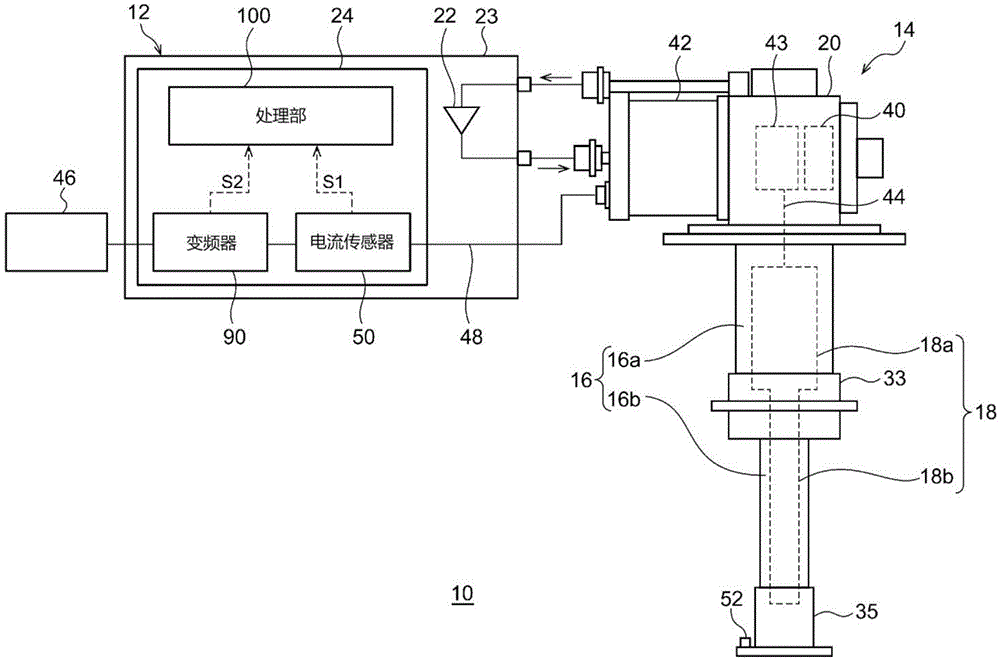
Figure 202180063640

The ultra-low temperature refrigerator (10) is capable of performing a steady state operation and a cooling operation before the steady state operation. The cryogenic refrigerator (10) is provided with: an expander motor (42) for operating the expander (14) of the cryogenic refrigerator (10); a frequency converter (90) configured to control the operating frequency of the expander motor (42), and It can act in such a way that in steady state operation it drives the expander motor (42) at an operating frequency lower than that of cooling operation; a current sensor (50), measuring the ), and output a motor current signal representing the current; and a processing unit (100) monitors the expander motor (42) at least according to the motor current signal in steady state operation.

Figure 202180063640

Description

超低温制冷机及超低温制冷机的监控方法Ultra-low temperature refrigerator and monitoring method for ultra-low temperature refrigerator

技术领域technical field

本发明涉及一种超低温制冷机及超低温制冷机的监控方法。The invention relates to an ultra-low temperature refrigerator and a monitoring method for the ultra-low temperature refrigerator.

背景技术Background technique

以往,已知如下技术:为了在启动超低温制冷机时缩短冷却下降时间而通过变频器使膨胀机的驱动马达的转速增加的技术。在该启动运行中,在马达电流中检测出了异常变动时马达转速会降低,从而保护驱动马达。Conventionally, a technique is known in which the rotational speed of the drive motor of the expander is increased by an inverter in order to shorten the cooling down time when the cryogenic refrigerator is started. In this startup operation, when abnormal fluctuations are detected in the motor current, the motor rotation speed is reduced to protect the drive motor.

以往技术文献Previous technical literature

专利文献patent documents

专利文献1:日本特开平3-152353号公报Patent Document 1: Japanese Patent Application Laid-Open No. 3-152353

发明内容Contents of the invention

发明要解决的技术课题The technical problem to be solved by the invention

在长期运行超低温制冷机时,施加于膨胀机的驱动马达的负载会逐渐增加。超过马达的规格上的极限的负载可能会成为产生马达失控等异常动作或故障、超低温制冷机的异常噪音、或者妨碍超低温制冷机的正常运行的原因。During long-term operation of the cryogenic refrigerator, the load applied to the drive motor of the expander gradually increases. A load exceeding the limit on the specification of the motor may cause abnormal operation or failure such as motor runaway, abnormal noise of the cryogenic refrigerator, or prevent normal operation of the cryogenic refrigerator.

本发明的一种实施方式的示例性的目的之一在于提供一种有助于预测或提前预防长期运行引起的膨胀机马达的异常动作或故障的超低温制冷机及其监控方法。One of the exemplary purposes of an embodiment of the present invention is to provide a cryogenic refrigerator and a monitoring method thereof that help predict or prevent in advance the abnormal operation or failure of the expander motor caused by long-term operation.

用于解决技术课题的手段Means for solving technical problems

根据本发明的一种实施方式,提供一种能够执行稳态运行和稳态运行之前的冷却运行的超低温制冷机。超低温制冷机具备:膨胀机马达,使超低温制冷机的膨胀机动作;变频器,构成为控制膨胀机马达的运行频率,且其能够以在稳态运行中以低于冷却运行的运行频率的运行频率驱动膨胀机马达的方式动作;电流传感器,测量从变频器供给至膨胀机马达的电流,并输出表示电流的马达电流信号;及处理部,至少根据稳态运行中的马达电流信号来监控膨胀机马达。According to an embodiment of the present invention, there is provided a cryogenic refrigerator capable of performing a steady-state operation and a cooling operation before the steady-state operation. The ultra-low temperature refrigerator includes: an expander motor for operating the expander of the ultra-low temperature refrigerator; The frequency drives the motor of the expander to operate; the current sensor measures the current supplied from the inverter to the motor of the expander, and outputs a motor current signal representing the current; and the processing part monitors the expansion based on at least the motor current signal in steady-state operation machine motor.

根据本发明的一种实施方式,提供一种超低温制冷机的监控方法。超低温制冷机能够执行稳态运行和稳态运行之前的冷却运行,并且具备:膨胀机马达,使超低温制冷机的膨胀机动作;及变频器,构成为控制膨胀机马达的运行频率,且其能够以在稳态运行中以低于冷却运行的运行频率的运行频率驱动膨胀机马达的方式动作。该方法包括如下工序:测量从变频器供给至膨胀机马达的电流;及至少根据稳态运行中的膨胀机马达的电流来监控膨胀机马达。According to an embodiment of the present invention, a method for monitoring an ultra-low temperature refrigerator is provided. The ultra-low temperature refrigerator is capable of performing steady-state operation and cooling operation before the steady-state operation, and has: an expander motor for operating the expander of the ultra-low temperature refrigerator; and an inverter configured to control the operating frequency of the expander motor, and capable of Operates in such a manner that the expander motor is driven at an operating frequency lower than that of the cooling operation during steady-state operation. The method includes the steps of: measuring a current supplied from a frequency converter to the expander motor; and monitoring the expander motor based on at least the current of the expander motor in steady state operation.

根据本发明的一种实施方式,提供一种超低温制冷机,其具备:膨胀机马达,使超低温制冷机的膨胀机动作;变频器,构成为控制膨胀机马达的运行频率;及处理部,根据表示变频器或膨胀机马达的消耗电力的消耗电力信号来监控膨胀机马达。According to one embodiment of the present invention, there is provided a cryogenic refrigerator, which includes: an expander motor for operating the expander of the cryogenic refrigerator; a frequency converter configured to control the operating frequency of the expander motor; and a processing unit configured according to The expander motor is monitored with a power consumption signal indicating the power consumption of the inverter or the expander motor.

根据本发明的一种实施方式,提供一种超低温制冷机的监控方法。超低温制冷机具备:膨胀机马达,使超低温制冷机的膨胀机动作;及变频器,构成为控制膨胀机马达的运行频率。该方法包括如下工序:获取变频器或膨胀机马达的消耗电力;及根据所获取的消耗电力来监控膨胀机马达。According to an embodiment of the present invention, a method for monitoring an ultra-low temperature refrigerator is provided. The cryogenic refrigerator includes: an expander motor for operating the expander of the cryogenic refrigerator; and an inverter configured to control the operating frequency of the expander motor. The method includes the steps of: obtaining the power consumption of the inverter or the motor of the expander; and monitoring the motor of the expander according to the obtained power consumption.

另外,以上构成要件的任意组合或讲本发明的构成要件或表述在方法、装置、系统等之间相互置换的方式也同样作为本发明的实施方式而有效。In addition, arbitrary combinations of the above-mentioned constituent elements, or forms in which the constituent elements or expressions of the present invention are replaced with each other among methods, apparatuses, systems, etc. are also effective as embodiments of the present invention.

发明效果Invention effect

根据本发明,能够提供一种有助于预测或提前预防长期运行引起的膨胀机马达的异常动作或故障的超低温制冷机及其监控方法。According to the present invention, it is possible to provide a cryogenic refrigerator and a monitoring method thereof that contribute to prediction or early prevention of abnormal operation or failure of an expander motor caused by long-term operation.

附图说明Description of drawings

图1是概略地表示实施方式所涉及的超低温制冷机的图。FIG. 1 is a diagram schematically showing a cryogenic refrigerator according to an embodiment.

图2是概略地表示实施方式所涉及的超低温制冷机的图。FIG. 2 is a diagram schematically showing a cryogenic refrigerator according to the embodiment.

图3是表示针对多个运行频率的值而测量了流过膨胀机马达的电流的有效值和负载占空比之间的关系而得的结果的图表。3 is a graph showing the results of measuring the relationship between the effective value of the current flowing through the expander motor and the load duty ratio for a plurality of operating frequency values.

图4表示实施方式所涉及的膨胀机马达的运行频率与电流阈值之间的关系的一例。FIG. 4 shows an example of the relationship between the operating frequency of the expander motor and the current threshold according to the embodiment.

图5是实施方式所涉及的马达监控装置的框图。FIG. 5 is a block diagram of the motor monitoring device according to the embodiment.

图6是表示实施方式所涉及的超低温制冷机的监控方法的流程图。FIG. 6 is a flowchart illustrating a method of monitoring a cryogenic refrigerator according to the embodiment.

图7是实施方式所涉及的马达监控装置的框图。FIG. 7 is a block diagram of a motor monitoring device according to the embodiment.

图8是表示多个运行频率的值下的变频器的消耗电力与负载占空比之间的关系的图表。FIG. 8 is a graph showing the relationship between the power consumption of the inverter and the load duty ratio at a plurality of operating frequency values.

图9是另一实施方式所涉及的马达监控装置的框图。FIG. 9 is a block diagram of a motor monitoring device according to another embodiment.

图10是表示另一实施方式所涉及的超低温制冷机的监控方法的流程图。FIG. 10 is a flowchart showing a method of monitoring a cryogenic refrigerator according to another embodiment.

具体实施方式Detailed ways

以下,参考附图对本发明的实施方式进行详细说明。在以下说明及附图中,对相同或等同的构成要件、部件及处理标注相同的符号,并适当省略重复说明。为了便于说明,在各附图中,适当设定各部的缩尺或形状,除非另有特别说明,否则其并不作限定性解释。实施方式是例示,其并不对本发明的范围作任何限定。实施方式中所记载的所有特征或其组合并不一定是发明的本质。Hereinafter, embodiments of the present invention will be described in detail with reference to the drawings. In the following description and drawings, the same or equivalent constituents, components, and processes are given the same reference numerals, and repeated descriptions are appropriately omitted. For convenience of description, in each drawing, the scale or shape of each part is appropriately set, and unless otherwise specified, it is not limitedly interpreted. The embodiments are illustrative and do not limit the scope of the present invention in any way. All of the features described in the embodiments or combinations thereof do not necessarily constitute the essence of the invention.

图1及图2是概略地表示实施方式所涉及的超低温制冷机10的图。图1中示出了超低温制冷机10的外观,图2中示出了超低温制冷机10的内部结构。作为一例,超低温制冷机10为二级式的吉福德-麦克马洪(Gifford-McMahon;GM)制冷机。1 and 2 are diagrams schematically showing a cryogenic refrigerator 10 according to an embodiment. FIG. 1 shows the appearance of the cryogenic refrigerator 10 , and FIG. 2 shows the internal structure of the cryogenic refrigerator 10 . As an example, the cryogenic refrigerator 10 is a two-stage Gifford-McMahon (Gifford-McMahon; GM) refrigerator.

超低温制冷机10具备压缩机12和膨胀机14。超低温制冷机10还具备监控使膨胀机14动作的膨胀机马达42的监控装置,该监控装置具备电流传感器50和处理部100(详细内容将在后面叙述)。The cryogenic refrigerator 10 includes a compressor 12 and an expander 14 . The cryogenic refrigerator 10 further includes a monitoring device that monitors the expander motor 42 that operates the expander 14, and the monitoring device includes a current sensor 50 and a processing unit 100 (details will be described later).

压缩机12构成为从膨胀机14回收超低温制冷机10的工作气体,并使回收的工作气体升压后再次将工作气体供给至膨胀机14。工作气体又被称为制冷剂气体,通常为氦气,但也可以使用其他适当的气体。The compressor 12 is configured to recover the working gas of the cryogenic refrigerator 10 from the expander 14 , increase the pressure of the recovered working gas, and supply the working gas to the expander 14 again. The working gas, also known as refrigerant gas, is usually helium, but other suitable gases may also be used.

另外,通常,从压缩机12供给至膨胀机14的工作气体的压力和从膨胀机14回收至压缩机12的工作气体的压力均比大气压高很多,可以分别称为第1高压及第2高压。为了便于说明,将第1高压及第2高压分别简称为高压及低压。典型地,高压例如为2~3MPa。低压例如为0.5~1.5MPa,例如约为0.8MPa。为了便于理解,利用箭头表示工作气体的流动方向。In addition, generally, the pressure of the working gas supplied from the compressor 12 to the expander 14 and the pressure of the working gas recovered from the expander 14 to the compressor 12 are both much higher than the atmospheric pressure, which can be referred to as a first high pressure and a second high pressure, respectively. . For convenience of description, the first high pressure and the second high pressure are simply referred to as high pressure and low pressure, respectively. Typically, the high pressure is, for example, 2 to 3 MPa. The low pressure is, for example, 0.5 to 1.5 MPa, for example about 0.8 MPa. For ease of understanding, arrows are used to indicate the flow direction of the working gas.

压缩机12具备压缩机主体22和容纳压缩机主体22的压缩机框体23。压缩机12又被称为压缩机单元。The compressor 12 includes a compressor body 22 and a compressor housing 23 that accommodates the compressor body 22 . The compressor 12 is also referred to as a compressor unit.

压缩机主体22构成为在内部压缩从其吸入口吸入的工作气体并将其从吐出口吐出。压缩机主体22例如可以为涡旋式泵、回转式泵或使工作气体升压的其他泵。压缩机主体22也可以构成为吐出恒定的工作气体流量。或者,压缩机主体22也可以构成为使吐出的工作气体流量可变。压缩机主体22有时又被称为压缩仓。The compressor main body 22 is configured to internally compress the working gas sucked in from the suction port and discharge it from the discharge port. The compressor main body 22 may be, for example, a scroll pump, a rotary pump, or other pumps that boost the pressure of the working gas. The compressor main body 22 may be configured to discharge a constant flow rate of the working gas. Alternatively, the compressor main body 22 may be configured such that the flow rate of the discharged working gas is variable. The compressor body 22 is sometimes referred to as a compression chamber.

压缩机12也可以具备控制压缩机12的压缩机控制器24。压缩机控制器24不仅仅控制压缩机12,也可以集中控制超低温制冷机10,例如也可以控制膨胀机14(例如,膨胀机马达42)。压缩机控制器24可以安装于压缩机12,例如可以设置于压缩机框体23的外表面,也可以容纳于压缩机框体23中。或者,压缩机控制器24还可以配置在与压缩机12分开的位置,并且例如通过控制信号线与压缩机12连接。The compressor 12 may also include a compressor controller 24 that controls the compressor 12 . The compressor controller 24 not only controls the compressor 12, but also can centrally control the ultra-low temperature refrigerator 10, for example, can also control the expander 14 (for example, the expander motor 42). The compressor controller 24 can be installed on the compressor 12 , for example, can be arranged on the outer surface of the compressor frame 23 , or can be accommodated in the compressor frame 23 . Alternatively, the compressor controller 24 may also be disposed at a location separate from the compressor 12 and connected to the compressor 12 through a control signal line, for example.

膨胀机14具备制冷机缸体16和置换器组件18。制冷机缸体16引导置换器组件18的直线往复运动,并且在与置换器组件18之间形成工作气体的膨胀室32、34。并且,膨胀机14具备压力切换阀40,所述压力切换阀40确定向膨胀室供给工作气体的进气开始时刻及从膨胀室排出工作气体的排气开始时刻。The expander 14 includes a refrigerator cylinder 16 and a displacer assembly 18 . The refrigerator cylinder 16 guides the linear reciprocating motion of the displacer assembly 18 and forms expansion chambers 32 , 34 therebetween for the working gas. Further, the expander 14 includes a pressure switching valve 40 that determines the intake start timing of supplying the working gas to the expansion chamber and the exhaust start timing of discharging the working gas from the expansion chamber.

在本说明书中,为了说明超低温制冷机10的构成要件之间的位置关系,为了方便起见,将靠近置换器的轴向往复移动的上止点的一侧标记为“上”,将靠近下止点的一侧标记为“下”。上止点为膨胀空间的容积成为最大的置换器的位置,下止点为膨胀空间的容积成为最小的置换器的位置。在超低温制冷机10运行时,产生温度从轴向上方朝向下方下降的温度梯度,因此也可以将上侧称为高温侧,将下侧称为低温侧。In this specification, in order to illustrate the positional relationship between the components of the cryogenic refrigerator 10, for the sake of convenience, the side close to the top dead center of the axial reciprocating movement of the displacer is marked as "up", and the side close to the bottom dead center is marked as "up". One side of the point is marked "down". The top dead center is the position of the displacer at which the volume of the expansion space becomes the largest, and the bottom dead center is the position of the displacer at which the volume of the expansion space becomes the smallest. When the cryogenic refrigerator 10 is in operation, a temperature gradient occurs in which the temperature drops from the upper side to the lower side in the axial direction. Therefore, the upper side may also be referred to as the high temperature side, and the lower side may be referred to as the low temperature side.

制冷机缸体16具有第1缸体16a和第2缸体16b。作为一例,第1缸体16a和第2缸体16b为具有圆筒形状的部件,第2缸体16b的直径小于第1缸体16a的直径。第1缸体16a和第2缸体16b同轴配置,第1缸体16a的下端与第2缸体16b的上端刚性地连结在一起。The refrigerator cylinder 16 has a first cylinder 16a and a second cylinder 16b. As an example, the 1st cylinder 16a and the 2nd cylinder 16b are members which have a cylindrical shape, and the diameter of the 2nd cylinder 16b is smaller than the diameter of the 1st cylinder 16a. The first cylinder 16a and the second cylinder 16b are arranged coaxially, and the lower end of the first cylinder 16a is rigidly connected to the upper end of the second cylinder 16b.

置换器组件18具备彼此连结在一起的第1置换器18a和第2置换器18b,它们一体地移动。作为一例,第1置换器18a和第2置换器18b为具有圆筒形状的部件,第2置换器18b的直径小于第1置换器18a的直径。第1置换器18a和第2置换器18b同轴配置。The displacer unit 18 includes a first displacer 18 a and a second displacer 18 b connected to each other, and these displacers move integrally. As an example, the first displacer 18a and the second displacer 18b are members having a cylindrical shape, and the diameter of the second displacer 18b is smaller than the diameter of the first displacer 18a. The first displacer 18a and the second displacer 18b are arranged coaxially.

第1置换器18a容纳于第1缸体16a中,第2置换器18b容纳于第2缸体16b中。第1置换器18a能够沿着第1缸体16a在轴向上往复移动,第2置换器18b能够沿着第2缸体16b在轴向上往复移动。The first displacer 18a is accommodated in the first cylinder 16a, and the second displacer 18b is accommodated in the second cylinder 16b. The first displacer 18a can reciprocate in the axial direction along the first cylinder 16a, and the second displacer 18b can reciprocate in the axial direction along the second cylinder 16b.

如图2所示,第1置换器18a容纳第1蓄冷器26。第1蓄冷器26通过在第1置换器18a的筒状的主体部中填充例如铜等的金属丝网或其他适当的第1蓄冷材料而形成。第1置换器18a的上盖部及下盖部可以为与第1置换器18a的主体部不同的部件,第1置换器18a的上盖部及下盖部可以通过紧固、焊接等适当的方法固定于主体,由此第1蓄冷材料容纳于第1置换器18a中。As shown in FIG. 2 , the first displacer 18 a accommodates a first regenerator 26 . The 1st regenerator 26 is formed by filling the cylindrical main body part of the 1st displacer 18a, for example with wire mesh, such as copper, or other suitable 1st regenerator materials. The upper cover part and the lower cover part of the first displacer 18a can be parts different from the main body part of the first displacer 18a, and the upper cover part and the lower cover part of the first displacer 18a can be fastened, welded, etc. The method is fixed to the main body, whereby the first regenerator material is accommodated in the first displacer 18a.

同样地,第2置换器18b容纳第2蓄冷器28。第2蓄冷器28通过在第2置换器18b的筒状的主体部中填充例如铋等非磁性蓄冷材料、HoCu2等磁性蓄冷材料或其他适当的第2蓄冷材料而形成。第2蓄冷材料也可以形成为粒状。第2置换器18b的上盖部及下盖部可以为与第2置换器18b的主体部不同的部件,第2置换器18b的上盖部及下盖部可以通过紧固、焊接等适当的方法固定于主体,由此第2蓄冷材料容纳于第2置换器18b中。Similarly, the second displacer 18b accommodates the second regenerator 28 . The second regenerator 28 is formed by filling the cylindrical main body of the second displacer 18b with, for example, a nonmagnetic regenerator such as bismuth, a magnetic regenerator such as HoCu 2 , or another appropriate second regenerator. The second regenerator material may be formed in granular form. The upper cover and the lower cover of the second displacer 18b can be parts different from the main body of the second displacer 18b, and the upper cover and the lower cover of the second displacer 18b can be properly fixed by fastening, welding, etc. The method is fixed to the main body, whereby the second cool storage material is accommodated in the second displacer 18b.

置换器组件18在制冷机缸体16的内部形成室温室30、第1膨胀室32及第2膨胀室34。为了与应通过超低温制冷机10冷却的所期望的物体或介质进行热交换,膨胀机14具备第1冷却台33和第2冷却台35。室温室30形成于第1置换器18a的上盖部与第1缸体16a的上部之间。第1膨胀室32形成于第1置换器18a的下盖部与第1冷却台33之间。第2膨胀室34形成于第2置换器18b的下盖部与第2冷却台35之间。第1冷却台33以包围第1膨胀室32的方式固定于第1缸体16a的下部,第2冷却台35以包围第2膨胀室34的方式固定于第2缸体16b的下部。The displacer unit 18 forms a room temperature chamber 30 , a first expansion chamber 32 , and a second expansion chamber 34 inside the refrigerator cylinder 16 . The expander 14 includes a first cooling stage 33 and a second cooling stage 35 in order to exchange heat with a desired object or medium to be cooled by the cryogenic refrigerator 10 . The room temperature chamber 30 is formed between the upper cover portion of the first displacer 18a and the upper portion of the first cylinder 16a. The first expansion chamber 32 is formed between the lower cover portion of the first displacer 18 a and the first cooling stage 33 . The second expansion chamber 34 is formed between the lower cover portion of the second displacer 18 b and the second cooling stage 35 . The first cooling stage 33 is fixed to the lower portion of the first cylinder 16 a so as to surround the first expansion chamber 32 , and the second cooling stage 35 is fixed to the lower portion of the second cylinder 16 b so as to surround the second expansion chamber 34 .

第1蓄冷器26通过形成于第1置换器18a的上盖部的工作气体流路36a与室温室30连接,并且通过形成于第1置换器18a的下盖部的工作气体流路36b与第1膨胀室32连接。第2蓄冷器28通过从第1置换器18a的下盖部向第2置换器18b的上盖部形成的工作气体流路36c与第1蓄冷器26连接。并且,第2蓄冷器28通过形成于第2置换器18b的下盖部的工作气体流路36d与第2膨胀室34连接。The first regenerator 26 is connected to the room temperature chamber 30 through the working gas flow path 36a formed on the upper cover portion of the first displacer 18a, and is connected to the second cold storage chamber 30 through the working gas flow path 36b formed on the lower cover portion of the first displacer 18a. 1 expansion chamber 32 is connected. The second regenerator 28 is connected to the first regenerator 26 through a working gas flow path 36c formed from the lower cover portion of the first displacer 18a to the upper cover portion of the second displacer 18b. Furthermore, the second regenerator 28 is connected to the second expansion chamber 34 through the working gas flow path 36d formed in the lower cover portion of the second displacer 18b.

为了不让第1膨胀室32、第2膨胀室34与室温室30之间的工作气流导入制冷机缸体16与置换器组件18之间的间隙而导入第1蓄冷器26及第2蓄冷器28,可以设置第1密封件38a及第2密封件38b。第1密封件38a可以以配置于第1置换器18a与第1缸体16a之间的方式安装于第1置换器18a的上盖部。第2密封件38b可以以配置于第2置换器18b与第2缸体16b之间的方式安装于第2置换器18b的上盖部。In order to prevent the working air flow between the first expansion chamber 32, the second expansion chamber 34 and the room temperature chamber 30 from being introduced into the gap between the refrigerator cylinder 16 and the displacer assembly 18, it is introduced into the first regenerator 26 and the second regenerator. 28. A first sealing member 38a and a second sealing member 38b may be provided. The first packing 38a may be attached to the upper cover portion of the first displacer 18a so as to be disposed between the first displacer 18a and the first cylinder 16a. The second packing 38b can be attached to the upper cover portion of the second displacer 18b so as to be arranged between the second displacer 18b and the second cylinder 16b.

如图1所示,膨胀机14具备容纳压力切换阀40的制冷机壳体20。制冷机壳体20与制冷机缸体16结合在一起,由此构成容纳压力切换阀40及置换器组件18的气密容器。As shown in FIG. 1 , the expander 14 includes a refrigerator housing 20 that accommodates a pressure switching valve 40 . The refrigerator casing 20 is combined with the refrigerator cylinder 16 to constitute an airtight container for accommodating the pressure switching valve 40 and the displacer assembly 18 .

如图2所示,压力切换阀40构成为具备高压阀40a和低压阀40b并且在制冷机缸体16内产生周期性压力变动。压缩机12的工作气体吐出口经由高压阀40a与室温室30连接,压缩机12的工作气体吸入口经由低压阀40b与室温室30连接。高压阀40a和低压阀40b构成为选择性地交替开闭(即,在其中一个阀打开的情况下,另一个阀处于关闭状态)。As shown in FIG. 2 , the pressure switching valve 40 includes a high-pressure valve 40 a and a low-pressure valve 40 b, and generates periodic pressure fluctuations in the refrigerator cylinder 16 . The working gas discharge port of the compressor 12 is connected to the room temperature chamber 30 through the high pressure valve 40a, and the working gas suction port of the compressor 12 is connected to the room temperature chamber 30 through the low pressure valve 40b. The high-pressure valve 40a and the low-pressure valve 40b are configured to selectively open and close alternately (that is, when one of the valves is open, the other valve is closed).

压力切换阀40也可以采用回转阀的形式。即,压力切换阀40也可以构成为通过使阀盘相对于静止的阀主体进行旋转滑动来交替地开闭高压阀40a和低压阀40b。此时,膨胀机马达42可以以使压力切换阀40的阀盘进行旋转的方式连结于压力切换阀40。例如,压力切换阀40配置成阀旋转轴与膨胀机马达42的旋转轴同轴。The pressure switching valve 40 may also take the form of a rotary valve. That is, the pressure switching valve 40 may be configured to alternately open and close the high-pressure valve 40a and the low-pressure valve 40b by rotating and sliding the valve disc relative to the stationary valve body. At this time, the expander motor 42 may be connected to the pressure switching valve 40 so as to rotate the valve disc of the pressure switching valve 40 . For example, the pressure switching valve 40 is arranged such that the valve rotation axis is coaxial with the rotation axis of the expander motor 42 .

或者,高压阀40a和低压阀40b也可以为能够分别单独控制的阀,此时,压力切换阀40可以不与膨胀机马达42连结。Alternatively, the high-pressure valve 40 a and the low-pressure valve 40 b may be individually controllable valves, and in this case, the pressure switching valve 40 may not be connected to the expander motor 42 .

膨胀机14具备膨胀机马达42和运动转换机构43。膨胀机马达42安装于制冷机壳体20。与压力切换阀40同样地,运动转换机构43也容纳于制冷机壳体20中。The expander 14 includes an expander motor 42 and a motion conversion mechanism 43 . The expander motor 42 is attached to the refrigerator housing 20 . Similar to the pressure switching valve 40 , the motion converting mechanism 43 is housed in the refrigerator case 20 .

膨胀机马达42例如经由止转棒轭机构等运动转换机构43与置换器驱动轴44连结。运动转换机构43将膨胀机马达42所输出的旋转运动转换为置换器驱动轴44的直线往复运动。置换器驱动轴44从运动转换机构43朝向室温室30内延伸,并固定于第1置换器18a的上盖部。膨胀机马达42的旋转被运动转换机构43转换为置换器驱动轴44的轴向往复运动,由此置换器组件18在制冷机缸体16内沿轴向进行直线往复运东。The expander motor 42 is connected to a displacer drive shaft 44 via a motion conversion mechanism 43 such as a Scotch yoke mechanism, for example. The motion conversion mechanism 43 converts the rotational motion output by the expander motor 42 into the linear reciprocating motion of the displacer drive shaft 44 . The displacer drive shaft 44 extends from the motion conversion mechanism 43 toward the interior of the chamber 30 and is fixed to the upper cover of the first displacer 18a. The rotation of the expander motor 42 is converted by the motion conversion mechanism 43 into the axial reciprocating motion of the displacer drive shaft 44 , so that the displacer assembly 18 reciprocates axially in a straight line in the refrigerator cylinder 16 .

此外,超低温制冷机10从商用电源(三相交流电源)等电源46供电。电源46通过供电配线48与压缩机12及膨胀机马达42连接。由于膨胀机马达42经由压缩机12与电源46连接,因此也可以将压缩机12视为膨胀机马达42的电源。另外,压缩机12和膨胀机马达42也可以分别与单独的电源连接。In addition, the cryogenic refrigerator 10 is powered from a power source 46 such as a commercial power source (three-phase AC power source). The power supply 46 is connected to the compressor 12 and the expander motor 42 through a power supply wiring 48 . Since the expander motor 42 is connected to a power source 46 via the compressor 12 , the compressor 12 can also be considered as a power source for the expander motor 42 . In addition, the compressor 12 and the expander motor 42 may be connected to separate power sources.

膨胀机马达42例如为由三相交流电驱动的永久磁铁式马达。膨胀机马达42的运行频率被变频器90控制。变频器90设置于供电配线48上。膨胀机马达42能够以与等同于逆变器90的输出频率的膨胀机马达42的运行频率相对应的转速动作。作为一例,变频器90的输出频率可以在30Hz至100Hz的范围内变化,或在40Hz至70Hz的范围内变化。The expander motor 42 is, for example, a permanent magnet motor driven by three-phase alternating current. The operating frequency of the expander motor 42 is controlled by a frequency converter 90 . The inverter 90 is installed on the power supply wiring 48 . The expander motor 42 can operate at a rotational speed corresponding to the operating frequency of the expander motor 42 which is equivalent to the output frequency of the inverter 90 . As an example, the output frequency of the inverter 90 can be changed within the range of 30 Hz to 100 Hz, or within the range of 40 Hz to 70 Hz.

电流传感器50与膨胀机马达42连接,从而测量在超低温制冷机10的至少稳态运行中从变频器90供给至膨胀机马达42的电流。电流传感器50设置在变频器90与膨胀机马达42之间的供电配线48上。A current sensor 50 is connected to the expander motor 42 to measure the current supplied from the frequency converter 90 to the expander motor 42 during at least steady state operation of the cryogenic refrigerator 10 . The current sensor 50 is provided on the power supply wiring 48 between the inverter 90 and the expander motor 42 .

并且,电流传感器50构成为将表示所测量的电流的马达电流信号S1输出至处理部100。马达电流信号S1可以为表示供给至膨胀机马达42的电流的有效值的信号。电流传感器50通过有线或无线方式与处理部100通信连接。电流传感器50也可以为分别同时测量流过膨胀机马达42的三相电流的三相电流表,或者,也可以为测量流过膨胀机马达42的电流的其他形式的电流传感器。例如,电流传感器50也可以构成为,分别同时测量从变频器90输出至膨胀机马达42的三相电流,并将例如表示所测量的三相电流各自的大小的电压信号作为马达电流信号S1而输出至处理部100。马达电流信号S1可以为表示超低温制冷机10的运行中流过膨胀机马达42的电流的时间变化的电流波形数据。Furthermore, the current sensor 50 is configured to output a motor current signal S1 indicating the measured current to the processing unit 100 . The motor current signal S1 may be a signal representing the effective value of the current supplied to the expander motor 42 . The current sensor 50 communicates with the processing unit 100 by wire or wirelessly. The current sensor 50 may also be a three-phase ammeter that simultaneously measures the three-phase currents flowing through the expander motor 42 , or may be another type of current sensor that measures the current flowing through the expander motor 42 . For example, the current sensor 50 may be configured to simultaneously measure the three-phase currents output from the inverter 90 to the expander motor 42, and to provide, for example, voltage signals representing the respective magnitudes of the measured three-phase currents as the motor current signal S1. output to the processing unit 100. The motor current signal S1 may be current waveform data representing the temporal change of the current flowing through the expander motor 42 during the operation of the cryogenic refrigerator 10 .

变频器90构成为将表示变频器90的输出频率(即,膨胀机马达42的运行频率)的输出频率信息S2输出至处理部100。或者,处理部100也可以根据从电流传感器50输入的马达电流信号S1运算出输出频率信息S2从而代替处理部100从变频器90接收输出频率信息S2。例如,处理部100可以根据流过膨胀机马达42的电流的波形来对每单位时间的电流峰的数量进行计数从而运算出膨胀机马达42的运行频率。或者,变频器90也可以具备电流传感器50(变频器90也可以具有测量输出电流的功能),处理部100可以从变频器90获取马达电流信号S1。作为马达电流信号S1,使用为了控制膨胀机马达42而由变频器90输出的电流的有效值的信号。The inverter 90 is configured to output output frequency information S2 indicating the output frequency of the inverter 90 (that is, the operating frequency of the expander motor 42 ) to the processing unit 100 . Alternatively, the processing unit 100 may calculate the output frequency information S2 from the motor current signal S1 input from the current sensor 50 to receive the output frequency information S2 from the inverter 90 instead of the processing unit 100 . For example, the processing unit 100 may calculate the operating frequency of the expander motor 42 by counting the number of current peaks per unit time according to the waveform of the current flowing through the expander motor 42 . Alternatively, the inverter 90 may include a current sensor 50 (the inverter 90 may also have a function of measuring output current), and the processing unit 100 may acquire the motor current signal S1 from the inverter 90 . As the motor current signal S1, a signal of an effective value of the current output from the inverter 90 to control the expander motor 42 is used.

处理部100构成为从电流传感器50(或变频器90)接收马达电流信号S1,并根据超低温制冷机10的至少稳态运行中的马达电流信号S1来监控膨胀机马达42。处理部100的详细内容将在后面叙述。The processing unit 100 is configured to receive the motor current signal S1 from the current sensor 50 (or the inverter 90 ), and monitor the expander motor 42 according to the motor current signal S1 in at least steady-state operation of the cryogenic refrigerator 10 . Details of the processing unit 100 will be described later.

在图示的例子中,电流传感器50、变频器90及处理部100内置于压缩机控制器24中,并设置于压缩机12上,但并不只限于此。电流传感器50、变频器90及处理部100也可以设置于膨胀机14(例如,搭载于膨胀机马达42等),或者也可以设置于供电配线48上的其他部位。In the illustrated example, the current sensor 50, the inverter 90, and the processing unit 100 are built in the compressor controller 24 and installed on the compressor 12, but the present invention is not limited thereto. The current sensor 50 , the inverter 90 , and the processing unit 100 may be installed in the expander 14 (for example, mounted on the expander motor 42 , etc.), or may be installed in other places on the power supply wiring 48 .

在压缩机12及膨胀机马达42运行时,超低温制冷机10在第1膨胀室32及第2膨胀室34中产生周期性的容积变动及与其同步的工作气体的压力变动。典型地,在进气工序中,通过使低压阀40b关闭且使高压阀40a打开,使高压的工作气体从压缩机12经过高压阀40a流入室温室30,并且经过第1蓄冷器26供给至第1膨胀室32,接着经过第2蓄冷器28供给至第2膨胀室34。由此,第1膨胀室32及第2膨胀室34从低压升压至高压。此时,置换器组件18从下止点朝向上止点移动,第1膨胀室32与第2膨胀室34的容积增大。若使高压阀40a关闭,则进气工序结束。When the compressor 12 and the expander motor 42 are operating, the cryogenic refrigerator 10 generates periodic volume fluctuations in the first expansion chamber 32 and the second expansion chamber 34 and pressure fluctuations of the working gas in synchronization therewith. Typically, in the air intake process, by closing the low-pressure valve 40b and opening the high-pressure valve 40a, the high-pressure working gas flows from the compressor 12 into the room temperature chamber 30 through the high-pressure valve 40a, and is supplied to the first cold accumulator 26. 1 expansion chamber 32 is then supplied to the second expansion chamber 34 via the second regenerator 28. Thereby, the first expansion chamber 32 and the second expansion chamber 34 are boosted from low pressure to high pressure. At this time, the displacer assembly 18 moves from the bottom dead center toward the top dead center, and the volumes of the first expansion chamber 32 and the second expansion chamber 34 increase. When the high-pressure valve 40a is closed, the intake process ends.

在排气工序中,通过使高压阀40a关闭且使低压阀40b打开,使高压的第1膨胀室32及第2膨胀室34与压缩机12的低压的工作气体吸入口连通,因此工作气体在第1膨胀室32及第2膨胀室34中膨胀,其结果,变为低压的工作气体从第1膨胀室32及第2膨胀室34经过第1蓄冷器26及第2蓄冷器28朝向室温室30排出。此时,置换器组件18从上止点朝向下止点移动,第1膨胀室32与第2膨胀室34的容积减小。工作气体从膨胀机14经过低压阀40b后回收至压缩机12。若使低压阀40b关闭,则排气工序结束。In the exhaust process, by closing the high-pressure valve 40a and opening the low-pressure valve 40b, the high-pressure first expansion chamber 32 and the second expansion chamber 34 communicate with the low-pressure working gas suction port of the compressor 12, so that the working gas flows The first expansion chamber 32 and the second expansion chamber 34 expand, and as a result, the low-pressure working gas passes through the first regenerator 26 and the second regenerator 28 from the first expansion chamber 32 and the second expansion chamber 34 toward the room temperature chamber. 30 discharge. At this time, the displacer assembly 18 moves from the top dead center toward the bottom dead center, and the volumes of the first expansion chamber 32 and the second expansion chamber 34 decrease. The working gas is recovered from the expander 14 to the compressor 12 after passing through the low-pressure valve 40b. When the low-pressure valve 40b is closed, the exhaust process ends.

由此,形成制冷循环(例如,GM循环等),第1冷却台33及第2冷却台35被冷却至所期望的超低温。第1冷却台33能够被冷却至第1冷却温度(例如,在约20K~约40K的范围内)。第2冷却台35能够被冷却至低于第1冷却温度的第2冷却温度(例如,约1K~约4K)。Thereby, a refrigeration cycle (for example, GM cycle etc.) is formed, and the 1st cooling stage 33 and the 2nd cooling stage 35 are cooled to a desired ultralow temperature. The first cooling stage 33 can be cooled to a first cooling temperature (for example, in the range of about 20K to about 40K). The second cooling stage 35 can be cooled to a second cooling temperature (for example, about 1K to about 4K) lower than the first cooling temperature.

超低温制冷机10能够执行稳态运行和稳态运行之前的冷却运行。冷却运行为在启动超低温制冷机10时从室温急速冷却至超低温的运行模式,稳态运行为维持通过冷却运行冷却至超低温的状态的超低温制冷机10的运行模式。超低温制冷机10通过冷却运行被冷却至标准冷却温度,并在稳态运行中维持在包含该标准冷却温度的超低温的容许温度范围内。标准冷却温度根据超低温制冷机10的用途与设定而不同,例如在超导装置的冷却用途中,典型的标准冷却温度是约4.2K以下。在其他某一冷却用途中,标准冷却温度例如可以为约10K~20K,或10K以下。The cryogenic refrigerator 10 is capable of performing a steady-state operation and a cooling operation before the steady-state operation. The cooling operation is an operation mode in which the cryogenic refrigerator 10 is rapidly cooled from room temperature to an ultralow temperature when the cryogenic refrigerator 10 is started, and the steady-state operation is an operation mode in which the cryogenic refrigerator 10 is kept cooled to an ultralow temperature by the cooling operation. The cryogenic refrigerator 10 is cooled to the standard cooling temperature by the cooling operation, and is maintained within the allowable temperature range of the cryogenic temperature including the standard cooling temperature in the steady-state operation. The standard cooling temperature varies depending on the application and setting of the cryogenic refrigerator 10 , for example, in the application of cooling a superconducting device, the typical standard cooling temperature is about 4.2K or less. In some other cooling application, the standard cooling temperature may be, for example, about 10K to 20K, or 10K or less.

从冷却运行向稳态运行的切换可以由控制超低温制冷机10的控制器(例如压缩机控制器24)进行控制。超低温制冷机10也可以具备温度传感器52,所述温度传感器52测量第2冷却台35(和/或第1冷却台33)的温度,并输出表示测量温度的测量温度信号。压缩机控制器24根据来自温度传感器52的测量温度信号将第2冷却台35的测量温度与标准冷却温度(或上述的容许温度范围)进行比较并在测量温度高于标准冷却温度时执行冷却运行,而在测量温度为标准冷却温度以下时将冷却运行切换为稳态运行。Switching from cooling operation to steady state operation may be controlled by a controller controlling ultra-low temperature refrigerator 10 (eg, compressor controller 24 ). The cryogenic refrigerator 10 may include a temperature sensor 52 that measures the temperature of the second cooling stage 35 (and/or the first cooling stage 33 ) and outputs a measured temperature signal indicating the measured temperature. The compressor controller 24 compares the measured temperature of the second cooling stage 35 with the standard cooling temperature (or the above-mentioned allowable temperature range) based on the measured temperature signal from the temperature sensor 52 and performs cooling operation when the measured temperature is higher than the standard cooling temperature , and the cooling operation is switched to steady-state operation when the measured temperature is below the standard cooling temperature.

变频器90能够如下动作:在稳态运行中以相较于冷却运行更低的运行频率驱动膨胀机马达42。例如,变频器90可以在控制器(例如,压缩机控制器24)的控制下在冷却运行中以预先设定的第1运行频率驱动膨胀机马达42,在稳态运行中以预先设定的第2运行频率驱动膨胀机马达42。但是,第2运行频率低于第1运行频率。控制器可以根据来自温度传感器52的测量温度信号及预先设定的运行频率曲线控制膨胀机马达42,运行频率曲线可以设定为测量温度越高施以越高的运行频率。The frequency converter 90 is capable of driving the expander motor 42 at a lower operating frequency in steady state operation than in cooling operation. For example, the frequency converter 90 can drive the expander motor 42 at a preset first operating frequency in cooling operation and at a preset first operating frequency in steady state operation under the control of a controller (for example, compressor controller 24). The second operating frequency drives the expander motor 42 . However, the second operating frequency is lower than the first operating frequency. The controller can control the expander motor 42 according to the measured temperature signal from the temperature sensor 52 and the preset operating frequency curve. The operating frequency curve can be set to be higher when the measured temperature is higher.

或者,控制器(例如,压缩机控制器24)可以根据来自温度传感器52的测量温度信号来控制变频器90的输出频率以使测量温度与标准冷却温度之间偏差最小化(例如,根据PID控制等反馈控制)。因此,在温度传感器52的测量温度高于标准冷却温度的情况下,膨胀机马达42的运行频率增加,在温度传感器52的测量温度低于标准冷却温度情况下,膨胀机马达42的运行频率减少。因此,在冷却运行中,最初的测量温度为室温,此时膨胀机马达42的运行频率很高,由此能够实现急速冷却。运行频率随着向标准冷却温度降温而下降。在稳态运行中,例如在从周围入侵的热量等外部干扰导致测量温度变得高于标准冷却温度时,膨胀机马达42的运行频率增加,从而再次冷却至标准冷却温度。相反,例如在伴随热负载的减少等而测量温度变得低于标准冷却温度时,膨胀机马达42的运行频率减少,从而返回到标准冷却温度。由此,能够避免过度冷却,从而能够维持标准冷却温度。Alternatively, the controller (e.g., compressor controller 24) may control the output frequency of frequency converter 90 based on the measured temperature signal from temperature sensor 52 to minimize the deviation between the measured temperature and the standard cooling temperature (e.g., based on PID control and other feedback control). Therefore, when the temperature measured by the temperature sensor 52 is higher than the standard cooling temperature, the operating frequency of the expander motor 42 is increased, and when the temperature measured by the temperature sensor 52 is lower than the standard cooling temperature, the operating frequency of the expander motor 42 is decreased. . Therefore, in the cooling operation, the first measured temperature is room temperature, and at this time, the operating frequency of the expander motor 42 is high, whereby rapid cooling can be realized. The frequency of operation decreases as the temperature decreases towards the standard cooling temperature. In steady-state operation, when the measured temperature becomes higher than the standard cooling temperature due to external disturbances such as heat intrusion from the surroundings, the operating frequency of the expander motor 42 is increased to cool down to the standard cooling temperature again. Conversely, for example, when the measured temperature becomes lower than the standard cooling temperature accompanying a decrease in heat load or the like, the operating frequency of the expander motor 42 is reduced to return to the standard cooling temperature. Thereby, overcooling can be avoided, and a standard cooling temperature can be maintained.

此外,在超低温制冷机10长期运行的过程中,施加于膨胀机马达42的负载趋于逐渐增加。作为其原因,例如可举出:来自压缩机12内的润滑油或蓄冷材料等的各种微粒会积蓄在膨胀机14内,这会导致膨胀机14内的压力损耗变大,因此,随着工作气体相对于膨胀室的流出/流入而施加于膨胀机马达42的负载会逐渐增加。另外,还可以举出:水分被膨胀机14内的置换器吸收,导致置换器在膨胀机14内稍微膨胀使得其与缸体之间的间隙变小,这会导致置换器的滑动阻力变高。In addition, the load applied to the expander motor 42 tends to gradually increase during long-term operation of the cryogenic refrigerator 10 . As the cause, for example, various fine particles such as lubricating oil or cold storage material from the compressor 12 are accumulated in the expander 14, and this increases the pressure loss in the expander 14. Therefore, as The load on the expander motor 42 gradually increases due to the outflow/inflow of the working gas into the expansion chamber. In addition, it can also be cited that moisture is absorbed by the displacer in the expander 14, causing the displacer to slightly expand in the expander 14 so that the gap between it and the cylinder body becomes smaller, which causes the sliding resistance of the displacer to become higher .

如此,若膨胀机马达42的驱动负载变高,则超过马达的规格上的极限(例如,瞬时最大转矩或其他的额定转矩)的负载转矩施加于膨胀机马达42的风险会变高。超过膨胀机马达42的规格上的极限的负载可能会成为膨胀机马达42失控等异常动作或故障、膨胀机14的异常噪音、或者妨碍膨胀机14的正常运行的原因。In this way, when the driving load of the expander motor 42 increases, the risk that a load torque exceeding the motor specification limit (for example, instantaneous maximum torque or other rated torque) is applied to the expander motor 42 increases. . A load exceeding the specification limit of the expander motor 42 may cause abnormal operation or failure such as runaway of the expander motor 42 , abnormal noise of the expander 14 , or hinder normal operation of the expander 14 .

通过监控流过膨胀机马达42的电流并检测伴随膨胀机马达42的异常的电流的异常变动,能够掌握膨胀机马达42的异常发生。然而,在通过变频器90来控制膨胀机马达42的运行频率(转速)的情况下,不仅在膨胀机马达42出现异常时马达电流会变动,在正常动作中运行频率发生了变更时,马达电流也会变动。并且,在将膨胀机14设置于强磁场环境的情况下,若外部磁场作用于膨胀机马达42,则马达电流也会根据磁场的大小而变动。在变频器90的输入电压发生了变动时,马达电流也会变动。马达电流可以根据膨胀机马达42的各种动作条件而变动,因此区分伴随膨胀机马达42的异常的电流的异常变动及膨胀机马达42的正常动作中的基于动作条件的变化而引起的电流的变动并不容易。The occurrence of an abnormality in the expander motor 42 can be grasped by monitoring the current flowing through the expander motor 42 and detecting the abnormal fluctuation of the electric current accompanying the abnormality of the expander motor 42 . However, when the operating frequency (rotational speed) of the expander motor 42 is controlled by the inverter 90, the motor current fluctuates not only when the expander motor 42 is abnormal, but also when the operating frequency is changed during normal operation, the motor current will also change. Furthermore, when the expander 14 is installed in a strong magnetic field environment, if an external magnetic field acts on the expander motor 42, the motor current also fluctuates according to the magnitude of the magnetic field. When the input voltage of the inverter 90 fluctuates, the motor current also fluctuates. Since the motor current can fluctuate according to various operating conditions of the expander motor 42, it is possible to distinguish between abnormal fluctuations in current accompanying abnormalities of the expander motor 42 and fluctuations in current due to changes in operating conditions during normal operation of the expander motor 42. Change is not easy.

图3是表示针对多个运行频率的值而测量了流过膨胀机马达42的电流的有效值与负载占空比之间的关系而得的结果的图表。纵轴表示从变频器90供给至膨胀机马达42并被电流传感器50测量的电流的有效值。横轴所示的负载占空比表示实际作用于膨胀机马达42的负载转矩相对于膨胀机马达42所容许的最大负载转矩(例如,瞬时最大转矩)的比(%)。因此,在负载占空比超过100%时,在膨胀机马达42中实际会产生失控等异常动作,或者产生异常动作的可能性高。FIG. 3 is a graph showing the results of measuring the relationship between the effective value of the current flowing through the expander motor 42 and the load duty ratio for a plurality of operating frequency values. The vertical axis represents the effective value of the current supplied from the inverter 90 to the expander motor 42 and measured by the current sensor 50 . The load duty ratio shown on the horizontal axis represents the ratio (%) of the load torque actually acting on the expander motor 42 to the allowable maximum load torque (for example, instantaneous maximum torque) of the expander motor 42 . Therefore, when the duty ratio exceeds 100%, abnormal operation such as runaway actually occurs in the expander motor 42 , or there is a high possibility that abnormal operation occurs.

由图3可知,在所给予的某一负载占空比(可以为任意值,例如90%)下,在运行频率为40Hz的情况和50Hz的情况下,变频器以使马达电流值几乎相同的方式进行控制。如此,在运行频率的值比较低的情况下,几乎看不到马达电流值对运行频率的依赖性。另一方面,在图3的例子中,在运行频率在50Hz至70Hz的范围,随着运行频率的值变高,马达电流值变小。如此,在运行频率的值比较高的情况下,马达电流值存在运行频率依赖性,马达电流值有时会根据运行频率的值而不同。It can be seen from Figure 3 that under a given load duty cycle (which can be any value, such as 90%), the inverter can make the motor current value almost the same when the operating frequency is 40Hz and 50Hz. way to control. In this way, when the value of the operating frequency is relatively low, the dependence of the motor current value on the operating frequency is hardly observed. On the other hand, in the example of FIG. 3 , in the range of the operating frequency from 50 Hz to 70 Hz, the value of the motor current becomes smaller as the value of the operating frequency becomes higher. Thus, when the value of the operating frequency is relatively high, the motor current value is dependent on the operating frequency, and the motor current value may differ depending on the value of the operating frequency.

接着,针对所给予的某一运行频率,观察负载占空比变化时的马达电流值的变化。可知,不管在哪个运行频率的值,马达电流值虽不同,但随着负载占空比变大,马达电流值均趋于增加。Next, for a given operating frequency, the change in the motor current value when the load duty cycle is changed is observed. It can be seen that, regardless of the value of the operating frequency, the motor current value is different, but as the load duty ratio becomes larger, the motor current value tends to increase.

因此,在某一运行频率的值(例如,60Hz)中,可以将负载占空比小于100%且充分大(例如,90%~98%)时的马达电流值用作电流阈值。在超过该电流阈值的电流流过膨胀机马达42时(即,被电流传感器50测量时),与该负载占空比相应的大的负载施加于膨胀机马达42。可以将此视为预测到了膨胀机马达42的异常动作,从而能够采取提前预防异常动作的产生的对策,例如,发出警告、降低运行频率、停止超低温制冷机10的运行等。Therefore, in a certain operating frequency value (for example, 60 Hz), a motor current value when the load duty ratio is less than 100% and sufficiently large (for example, 90% to 98%) can be used as the current threshold value. When a current exceeding the current threshold flows through the expander motor 42 (ie, when measured by the current sensor 50 ), a large load corresponding to the load duty ratio is applied to the expander motor 42 . This can be regarded as predicting the abnormal operation of the expander motor 42 , so that countermeasures can be taken to prevent the abnormal operation in advance, such as issuing a warning, reducing the operating frequency, and stopping the operation of the cryogenic refrigerator 10 .

然而,在膨胀机马达42以更高的运行频率的值(例如,70Hz)驱动时,马达电流值相比上述60Hz时变得相当小,达不到设定为60Hz用的电流阈值。因此,将膨胀机马达42的70Hz运行中的马达电流值与60Hz用的阈值进行比较,也得不到对预测膨胀机马达42的异常有效的结果。相反,在膨胀机马达42以更低的运行频率的值(例如,50Hz)驱动时,马达电流值相比上述60Hz时变得相当大,即使为相当小的负载占空比,也会导致超过设定为60Hz用的电流阈值。将膨胀机马达42的50Hz运行中的马达电流值与60Hz用的阈值进行比较,也依然得不到对预测膨胀机马达42的异常有效的结果。However, when the expander motor 42 is driven at a higher operating frequency (for example, 70 Hz), the motor current value becomes considerably smaller than that at 60 Hz, and does not reach the current threshold set for 60 Hz. Therefore, comparison of the motor current value during the 70 Hz operation of the expander motor 42 with the threshold value for 60 Hz does not yield a result that is effective for predicting abnormality of the expander motor 42 . Conversely, when the expander motor 42 is driven at a lower operating frequency value (for example, 50 Hz), the motor current value becomes considerably larger than the above-mentioned 60 Hz value, resulting in exceeding Set as the current threshold for 60Hz. Comparing the motor current value during the 50 Hz operation of the expander motor 42 with the threshold value for 60 Hz also does not yield a result that is effective for predicting abnormality of the expander motor 42 .

因此,在膨胀机马达42的运行频率被变频器90控制的情况下,若仅设定一个电流阈值,则通过监控流过膨胀机马达42的电流难以预测或提前预防膨胀机马达42的异常动作或故障。因此,在实施方式中,针对膨胀机马达42的运行频率的多个值分别设定电流阈值。图4中例示了这种多个电流阈值。Therefore, when the operating frequency of the expander motor 42 is controlled by the frequency converter 90, if only one current threshold is set, it is difficult to predict or prevent the abnormal operation of the expander motor 42 by monitoring the current flowing through the expander motor 42 or malfunction. Therefore, in the embodiment, the current thresholds are individually set for a plurality of values of the operating frequency of the expander motor 42 . Such multiple current thresholds are illustrated in FIG. 4 .

图4表示实施方式所涉及的膨胀机马达42的运行频率与电流阈值之间的关系的一例。在图4中示出了在特定的负载占空比的值(具体而言,负载占空比90%与95%)下的与图3所示的运行频率相对应的马达电流值与负载占空比之间的关系。因此,如上所述,在运行频率比较低时(图4中在40Hz至50Hz的运行频率范围中),马达电流值大致恒定。在运行频率比较高时(图4中在50Hz至70Hz的运行频率范围中),随着运行频率的值增加,马达电流值会降低。由图4可知,若负载占空比的值增加,则马达电流值增加。FIG. 4 shows an example of the relationship between the operating frequency of the expander motor 42 and the current threshold value according to the embodiment. In FIG. 4, the motor current value and the load duty cycle corresponding to the operating frequency shown in FIG. The relationship between void ratios. Therefore, as described above, when the operating frequency is relatively low (in the operating frequency range of 40 Hz to 50 Hz in FIG. 4 ), the motor current value is substantially constant. When the operating frequency is relatively high (in the operating frequency range of 50 Hz to 70 Hz in FIG. 4 ), as the value of the operating frequency increases, the value of the motor current decreases. It can be seen from FIG. 4 that if the value of the load duty cycle increases, the motor current value increases.

图4所示的膨胀机马达42的运行频率与电流阈值之间的关系也可以用作后述的运行频率/电流阈值表62的一例子。在运行频率的值与所测量的马达电流值的组合位于比图表更靠上侧的区域的情况下(即,在膨胀机马达42以该运行频率驱动,此时由电流传感器50测量的电流值超过与该运行频率相对应的电流阈值的情况下),能够视为预测到了膨胀机马达42的异常动作。在运行频率的值与所测量的马达电流值的组合位于比图表更靠下侧的区域的情况下,由于所测量的电流值并未超过电流阈值,因此能够视为不会出现异常。The relationship between the operating frequency and the current threshold value of the expander motor 42 shown in FIG. 4 can also be used as an example of the operating frequency/current threshold value table 62 described later. In the case where the combination of the value of the operating frequency and the measured motor current value is located in an area on the upper side of the graph (that is, the current value measured by the current sensor 50 when the expander motor 42 is driven at the operating frequency When exceeding the current threshold value corresponding to the operation frequency), it can be considered that abnormal operation of the expander motor 42 is predicted. When the combination of the operating frequency value and the measured motor current value is in the lower region than the graph, it can be considered that there is no abnormality since the measured current value does not exceed the current threshold value.

由此,通过将多个电流阈值分别与膨胀机马达42的运行频率的多个值建立对应关联,即使在由变频器90控制膨胀机马达42的运行频率的情况下,也能够良好地判定失控等异常动作在现实中产生的情况或者产生的可能性高的情况。因此,能够采取提前预防膨胀机马达42的这种异常动作的对策。Thus, by associating a plurality of current thresholds with a plurality of values of the operating frequency of the expander motor 42 , even when the operating frequency of the expander motor 42 is controlled by the inverter 90 , it is possible to satisfactorily determine runaway. Such as the case where the abnormal operation occurs in reality or the possibility of occurrence is high. Therefore, it is possible to take measures to prevent such abnormal operation of the expander motor 42 in advance.

根据超低温制冷机10的用途(例如,用于超导电磁体的冷却等),有时将膨胀机14设置于强磁场环境中使用。在这种情况下,作用于膨胀机马达42的外部磁场会影响膨胀机马达42的动作,可能会使流过膨胀机马达42的电流变动。根据本发明人的研究,在所给予的运行频率且所给予的负载占空比下,马达电流值具有随着外部磁场的增加而增加的趋势。尤其,在膨胀机马达42为永久磁铁式马达的情况下,有这样的趋势。作为示例性的动作条件,在运行频率为50Hz或60Hz并且负载占空比为90%以上时,与外部磁场为0高斯的情况相比,在外部磁场为500高斯的情况下,马达电流值例如会增加大约5%~10%。Depending on the application of the cryogenic refrigerator 10 (for example, for cooling superconducting electromagnets, etc.), the expander 14 is sometimes installed in a strong magnetic field environment for use. In this case, the external magnetic field acting on the expander motor 42 may affect the operation of the expander motor 42 and may cause fluctuations in the current flowing through the expander motor 42 . According to the research of the present inventors, under a given operating frequency and a given load duty cycle, the motor current value has a tendency to increase as the external magnetic field increases. This tends to be the case especially when the expander motor 42 is a permanent magnet motor. As an exemplary operating condition, when the operating frequency is 50 Hz or 60 Hz and the load duty ratio is 90% or more, in the case of an external magnetic field of 500 Gauss, the motor current value such as It will increase by about 5% to 10%.

并且,典型地,在超低温制冷机10的规格上,从电源46流向变频器90的输入电压容许某种程度(例如,±10%程度)的变动。在流向变频器90的输入电压发生变动的情况下,流过膨胀机马达42的电流也会变动。根据本发明人的研究,在所给予的运行频率且所给予的负载占空比下,随着输入电压从低于电源46的规定电压值(例如200V)的电压值增加至该规定的电压值,马达电流值趋于增加。Furthermore, typically, the input voltage from the power supply 46 to the inverter 90 is allowed to fluctuate to some extent (for example, about ±10%) in the specification of the cryogenic refrigerator 10 . When the input voltage to the inverter 90 fluctuates, the current flowing to the expander motor 42 also fluctuates. According to the inventor's research, under the given operating frequency and the given load duty cycle, as the input voltage increases from a voltage value lower than the specified voltage value (for example, 200V) of the power supply 46 to the specified voltage value , the motor current value tends to increase.

因此,不仅仅是膨胀机马达42的运行频率,针对外部磁场或输入电压等膨胀机马达42的其他动作条件,也将多个电流阈值分别与该动作条件的多个值建立对应关联,从而能够良好地判断膨胀机马达42可能会产生异常动作的情况,能够采取提前预防异常动作的产生的对策。Therefore, not only the operating frequency of the expander motor 42, but also other operating conditions of the expander motor 42 such as external magnetic fields or input voltages, multiple current thresholds are associated with multiple values of the operating conditions, so that It is well judged that the expander motor 42 may have abnormal operation, and it is possible to take countermeasures to prevent the abnormal operation in advance.

图5是实施方式所涉及的马达监控装置的框图。该监控装置具备处理部100,处理部100具备电流阈值设定部60和比较部70。电流阈值设定部60具备运行频率/电流阈值表62、外部磁场/电流阈值表64及输入电压/电流阈值表66。监控装置还可以具备以视觉方式通知表示监控结果的信息的通知机构80,通知机构80例如可以包括显示器82。通知机构80也可以以声音方式通知诊断结果(例如,扬声器等)。通知机构80也可以经由因特网等网络向远程的机器发送诊断结果。FIG. 5 is a block diagram of the motor monitoring device according to the embodiment. This monitoring device includes a processing unit 100 , and the processing unit 100 includes a current threshold setting unit 60 and a comparing unit 70 . The current threshold setting unit 60 includes an operating frequency/current threshold table 62 , an external magnetic field/current threshold table 64 , and an input voltage/current threshold table 66 . The monitoring device may further include a notification unit 80 for visually notifying information indicating the monitoring result, and the notification unit 80 may include, for example, a display 82 . The notification mechanism 80 may also notify the diagnosis result by sound (for example, a speaker, etc.). The notification means 80 may transmit the diagnosis result to a remote device via a network such as the Internet.

处理部100构成为至少根据稳态运行中的马达电流信号S1来监控膨胀机马达42。因此,处理部100可以从控制器(例如,压缩机控制器24)获取表示超低温制冷机10的当前的运行模式的信息或者也可以根据来自温度传感器52的测量温度信号S3来判定当前的运行模式,并在当前的运行模式为稳态运行时可以根据马达电流信号S1来监控膨胀机马达42。除此之外或者取而代之,处理部100也可以在当前的运行模式为冷却运行时根据马达电流信号S1来监控膨胀机马达42。The processing unit 100 is configured to monitor the expander motor 42 based at least on the motor current signal S1 in steady state operation. Therefore, the processing unit 100 may obtain information indicating the current operation mode of the ultra-low temperature refrigerator 10 from the controller (for example, the compressor controller 24 ), or may determine the current operation mode based on the measured temperature signal S3 from the temperature sensor 52. , and the expander motor 42 can be monitored according to the motor current signal S1 when the current operation mode is steady-state operation. In addition or instead, the processing unit 100 can also monitor the expander motor 42 according to the motor current signal S1 when the current operation mode is the cooling operation.

处理部100构成为根据膨胀机马达42的动作条件来获取电流阈值Th,并根据马达电流信号S1将膨胀机马达42的电流(例如,电流的有效值)与电流阈值Th进行比较,从而监控膨胀机马达42。因此,电流阈值设定部60使用运行频率/电流阈值表62、外部磁场/电流阈值表64及输入电压/电流阈值表66中的至少一个电流阈值表并根据膨胀机马达42的动作条件(例如,马达电流信号S1、输出频率信息S2、外部磁场的大小及流向变频器90的输入电压等)来获取电流阈值Th。The processing unit 100 is configured to obtain the current threshold Th according to the operating conditions of the expander motor 42, and compare the current (for example, the effective value of the current) of the expander motor 42 with the current threshold Th according to the motor current signal S1, thereby monitoring the expansion. machine motor 42. Therefore, the current threshold setting unit 60 uses at least one current threshold table among the operating frequency/current threshold table 62, the external magnetic field/current threshold table 64, and the input voltage/current threshold table 66 according to the operating conditions of the expander motor 42 (for example, , the motor current signal S1, the output frequency information S2, the magnitude of the external magnetic field and the input voltage to the inverter 90, etc.) to obtain the current threshold Th.

运行频率/电流阈值表62为将多个电流阈值分别与膨胀机马达42的运行频率的多个值建立对应关联的表,外部磁场/电流阈值表64为将多个电流阈值分别与施加于膨胀机马达42的外部磁场的多个值建立对应关联的表,输入电压/电流阈值表66为将多个电流阈值分别与流向变频器90的输入电压的多个值建立对应关联的表。运行频率/电流阈值表62、外部磁场/电流阈值表64及输入电压/电流阈值表66被预先设定并保存于处理部100中。这些电流阈值表能够根据设计者的经验或设计者的实验或模拟试验等而适当设定。The operating frequency/current threshold table 62 is a table that associates multiple current thresholds with multiple values of the operating frequency of the expander motor 42, and the external magnetic field/current threshold table 64 is a table that associates multiple current thresholds with the values applied to the expander motor 42, respectively. A table for establishing correspondences between multiple values of the external magnetic field of the motor 42 , and the input voltage/current threshold table 66 is a table for establishing correspondences between multiple current thresholds and multiple values of the input voltage flowing to the inverter 90 . The operating frequency/current threshold table 62 , the external magnetic field/current threshold table 64 and the input voltage/current threshold table 66 are preset and stored in the processing unit 100 . These current threshold tables can be appropriately set based on the designer's experience, or the designer's experiments or simulation tests.

例如,电流阈值设定部60构成为,根据运行频率/电流阈值表62与膨胀机马达42的运行频率的值来获取与该运行频率的值相对应的电流阈值Th。For example, the current threshold setting unit 60 is configured to acquire the current threshold Th corresponding to the operating frequency value based on the operating frequency/current threshold table 62 and the operating frequency value of the expander motor 42 .

例如,如图4所示,运行频率/电流阈值表62可以以在通过变频器90能够控制的膨胀机马达42的运行频率的范围中的至少一部分(例如,该范围中的高频率侧的区域)中运行频率越增加电流阈值越减少的方式将多个电流阈值分别与膨胀机马达42的运行频率的多个值建立对应关联。For example, as shown in FIG. 4 , the operating frequency/current threshold table 62 may be in at least a part of the range of the operating frequency of the expander motor 42 that can be controlled by the inverter 90 (for example, an area on the high frequency side of the range). In ), multiple current thresholds are respectively associated with multiple values of the operating frequency of the expander motor 42 in a way that the operating frequency increases and the current threshold decreases.

并且,运行频率/电流阈值表62也可以针对膨胀机马达42的运行频率的多个值的每一个值将比膨胀机马达42所容许的最大负载转矩小规定量的负载转矩作用于膨胀机马达42时(即,规定值的负载占空比时)在该运行频率的值下的膨胀机马达42的电流值作为电流阈值与该运行频率的值建立对应关联。规定值的负载占空比例如可以选自80%以上且小于100%的范围、或90%以上且98%以下的范围。In addition, the operating frequency/current threshold table 62 may apply a load torque smaller than the maximum load torque allowed by the expander motor 42 to the expander for each value of the operating frequency of the expander motor 42 . The current value of the expander motor 42 at the value of the operating frequency when the expander motor 42 (that is, the load duty ratio of a specified value) is used as the current threshold to establish a corresponding relationship with the value of the operating frequency. The load duty ratio of the predetermined value can be selected from, for example, a range of 80% or more and less than 100%, or a range of 90% or more and 98% or less.

多个运行频率/电流阈值表62可以被预先设定,这些多个运行频率/电流阈值表62也可以分别与多个不同的负载占空比的值建立对应关联。电流阈值设定部60也可以根据选自多个运行频率/电流阈值表62中的运行频率/电流阈值表62与膨胀机马达42的运行频率的值来获取与该运行频率的值相对应的电流阈值Th。Multiple operating frequency/current threshold tables 62 can be preset, and these multiple operating frequency/current threshold tables 62 can also be associated with multiple values of different load duty ratios. The current threshold setting unit 60 can also obtain the value corresponding to the value of the operating frequency according to the operating frequency/current threshold table 62 selected from a plurality of operating frequency/current threshold tables 62 and the value of the operating frequency of the expander motor 42 . Current threshold Th.

电流阈值设定部60可以构成为根据外部磁场/电流阈值表64与施加于膨胀机马达42的外部磁场的值来获取与该外部磁场的值相对应的电流阈值Th。外部磁场的值可以通过搭载于超低温制冷机10(例如,膨胀机14)或设置于其附近的磁场传感器54来测量,并且可以将该所测量的外部磁场的值输入到处理部100供电流阈值设定部60使用。The current threshold setting unit 60 may be configured to acquire the current threshold Th corresponding to the value of the external magnetic field based on the external magnetic field/current threshold table 64 and the value of the external magnetic field applied to the expander motor 42 . The value of the external magnetic field can be measured by the magnetic field sensor 54 mounted on or near the cryogenic refrigerator 10 (for example, the expander 14), and the measured value of the external magnetic field can be input to the processing unit 100 to supply the current threshold The setting unit 60 is used.

或者,处理部100可以构成为根据马达电流信号S1来获取施加于膨胀机马达42的外部磁场的估计值,并根据外部磁场/电流阈值表64与施加于膨胀机马达42的外部磁场的估计值来获取与外部磁场的估计值相对应的电流阈值Th。根据本发明人的研究,只要外部磁场不起作用或者外部磁场充分小,则流过膨胀机马达42的三相电流波形具有对称性,与此相对,随着外部磁场增加,三相电流波形的非对称性有扩大的趋势。作为该非对称性,例如可举出三相(U相、V相、W相)之间的电流波形的峰值的偏差。尤其,膨胀机马达42的线圈配线为星形联结的情况下,会产生不平衡电流,因此与外部磁场相对应的电流波形的非对称性的扩大傾向变得显著。例如,根据可以从马达电流信号S1运算出的外部磁场起因参数(U相、V相、W相的电流波形的峰中的最大值或最小值或者最大值与最小值的差等),能够从马达电流信号S1获取膨胀机马达42的外部磁场的估计值。Alternatively, the processing unit 100 may be configured to acquire the estimated value of the external magnetic field applied to the expander motor 42 according to the motor current signal S1, and obtain the estimated value of the external magnetic field applied to the expander motor 42 according to the external magnetic field/current threshold value table 64 and the estimated value of the external magnetic field applied to the expander motor 42 to obtain the current threshold Th corresponding to the estimated value of the external magnetic field. According to the research of the present inventors, as long as the external magnetic field does not work or the external magnetic field is sufficiently small, the three-phase current waveform flowing through the expander motor 42 has symmetry. On the other hand, as the external magnetic field increases, the three-phase current waveform Asymmetry tends to widen. As this asymmetry, for example, the variation in the peak value of the current waveform among the three phases (U phase, V phase, W phase) is mentioned. In particular, when the coil wiring of the expander motor 42 is star-connected, an unbalanced current is generated, so that the asymmetry of the current waveform corresponding to the external magnetic field tends to increase significantly. For example, based on the external magnetic field-causing parameters (the maximum value or minimum value or the difference between the maximum value and the minimum value, etc.) The motor current signal S1 captures an estimate of the external magnetic field of the expander motor 42 .

电流阈值设定部60可以构成为根据输入电压/电流阈值表66与流向变频器90的输入电压的值来获取与该输入电压的值相对应的电流阈值Th。表示流向变频器90的输入电压的值的信息可以从变频器90输入到处理部100供电流阈值设定部60使用。The current threshold setting unit 60 may be configured to obtain the current threshold Th corresponding to the value of the input voltage from the input voltage/current threshold table 66 and the value of the input voltage to the inverter 90 . Information representing the value of the input voltage to the inverter 90 may be input from the inverter 90 to the processing section 100 for use by the current threshold setting section 60 .

多个外部磁场/电流阈值表64可以被预先设定,这些多个外部磁场/电流阈值表64也可以分别与多个不同的运行频率的值建立对应关联。即,例如,也可以预先设定第1及第2外部磁场/电流阈值表64,并在以第1运行频率的值(例如,70Hz)驱动膨胀机马达42时使用第1外部磁场/电流阈值表64,在以与第1运行频率的值不同的第2运行频率的值(例如,60Hz)驱动膨胀机马达42时使用第2外部磁场/电流阈值表64。同样地,多个输入电压/电流阈值表66也可以被预先设定,这些多个输入电压/电流阈值表66也可以分别与多个不同的运行频率的值建立对应关联。Multiple external magnetic field/current threshold tables 64 can be preset, and these multiple external magnetic field/current threshold tables 64 can also be associated with multiple values of different operating frequencies. That is, for example, the first and second external magnetic field/current threshold tables 64 may be preset, and the first external magnetic field/current threshold value may be used when the expander motor 42 is driven at the value of the first operating frequency (for example, 70 Hz). The table 64 uses the second external magnetic field/current threshold table 64 when the expander motor 42 is driven at a value of the second operating frequency (for example, 60 Hz) different from the value of the first operating frequency. Likewise, multiple input voltage/current threshold tables 66 can also be preset, and these multiple input voltage/current threshold tables 66 can also be associated with multiple values of different operating frequencies.

比较部70根据马达电流信号S1将膨胀机马达42的电流(例如,电流的有效值)与所获取的电流阈值Th进行比较,并且根据比较结果来生成监控结果数据D1。监控结果数据D1被发送到通知机构80,监控结果例如显示在显示器82上从而通知给使用者。在预测到膨胀机马达42的异常动作的情况下,通知机构80也可以通过警报音通知使用者。代替这样的立即通知(或,除了这样的立即通知以外),也可以将监控结果数据D1存储于处理部100中以便能够根据需要向使用者提示。The comparison unit 70 compares the current (for example, the effective value of the current) of the expander motor 42 with the acquired current threshold Th according to the motor current signal S1 , and generates monitoring result data D1 according to the comparison result. The monitoring result data D1 is sent to the notification means 80, and the monitoring result is displayed on, for example, a display 82 to notify the user. When abnormal operation of the expander motor 42 is predicted, the notification mechanism 80 may notify the user with an alarm sound. Instead of (or in addition to) such immediate notification, the monitoring result data D1 may be stored in the processing unit 100 so that it can be presented to the user as necessary.

处理部100的内部结构在硬件结构方面通过以计算机的CPU或存储器为代表的元件或电路来实现,在软件结构方面则通过计算机程序等来实现,但在图中,适当地描绘了通过它们的协作来实现的功能框。本领域技术人员应当可以理解,这些功能框能够通过硬件及软件的组合以各种形式实现。The internal structure of the processing unit 100 is realized by elements or circuits represented by a CPU or a memory of a computer in terms of hardware structure, and is realized by a computer program or the like in terms of software structure. Collaborate to implement functional boxes. It should be understood by those skilled in the art that these functional blocks can be implemented in various forms through a combination of hardware and software.

例如,处理部100可以通过CPU(Central Processing Unit:中央处理器)、微型计算机等处理器(硬件)和由处理器(硬件)执行的软件程序的组合来实现。这样的硬件处理器例如可以由FPGA(Field Programmable Gate Array:现场可编程门阵列)等可编程逻辑设备构成,也可以为像可编程逻辑控制器(PLC)那样的控制电路。软件程序也可以为用于使处理部100执行超低温制冷机10的监控的计算机程序。For example, the processing unit 100 can be realized by a combination of a processor (hardware) such as a CPU (Central Processing Unit) or a microcomputer, and a software program executed by the processor (hardware). Such a hardware processor may be constituted by a programmable logic device such as FPGA (Field Programmable Gate Array: Field Programmable Gate Array), or may be a control circuit such as a programmable logic controller (PLC). The software program may be a computer program for causing the processing unit 100 to monitor the cryogenic refrigerator 10 .

图6是表示实施方式所涉及的超低温制冷机10的监控方法的流程图。首先,如图6所示,在超低温制冷机10的运行中(例如,稳态运行中),利用电流传感器50测量从变频器90供给至膨胀机马达42的电流(S10)。接着,至少根据稳态运行中的膨胀机马达42的电流来监控膨胀机马达42(S20)。FIG. 6 is a flowchart showing a monitoring method of the cryogenic refrigerator 10 according to the embodiment. First, as shown in FIG. 6 , the current supplied from the inverter 90 to the expander motor 42 is measured by the current sensor 50 during operation of the cryogenic refrigerator 10 (for example, during steady state operation) ( S10 ). Next, the expander motor 42 is monitored based on at least the current of the expander motor 42 in steady state operation (S20).

在S20中,根据膨胀机马达42的动作条件(例如,马达电流信号S1、输出频率信息S2、外部磁场的大小及流向变频器90的输入电压等)来获取电流阈值Th(S21)。将所测量的膨胀机马达42的电流值与所获取的电流阈值Th进行比较(S22)。若测量电流值超过了电流阈值Th(S22的是),则比较部70判定为预测到膨胀机马达42的异常动作(S23),并输出表示该n内容的监控结果数据D1。若测量电流值为电流阈值Th以下(S22的否),比较部70判定为没有预测到膨胀机马达42的异常动作(S24),并输出表示该内容的监控结果数据D1。由此,本监控方法结束。In S20, the current threshold Th is acquired based on the operating conditions of the expander motor 42 (for example, the motor current signal S1, the output frequency information S2, the magnitude of the external magnetic field, and the input voltage to the inverter 90) (S21). The measured current value of the expander motor 42 is compared with the acquired current threshold value Th (S22). If the measured current value exceeds the current threshold value Th (YES in S22), the comparison unit 70 determines that abnormal operation of the expander motor 42 is predicted (S23), and outputs monitoring result data D1 indicating the content of n. If the measured current value is equal to or less than the current threshold Th (NO in S22 ), the comparison unit 70 determines that abnormal operation of the expander motor 42 is not expected ( S24 ), and outputs monitoring result data D1 indicating this. Thus, the monitoring method ends.

另外,在预测到膨胀机马达42的异常动作的情况下,超低温制冷机10的控制器(例如,压缩机控制器24)例如可以采取提前预防异常动作的产生的对策,例如,发出警告、降低膨胀机马达42的运行频率、停止超低温制冷机10的运行等。In addition, when the abnormal operation of the expander motor 42 is predicted, the controller of the cryogenic refrigerator 10 (for example, the compressor controller 24 ) can take countermeasures to prevent the abnormal operation in advance, such as issuing a warning, reducing the The operating frequency of the expander motor 42, stopping the operation of the cryogenic refrigerator 10, and the like.

处理部100定期反复执行上述监控。膨胀机马达42的驱动负载的增加为长时间逐渐进展的长期现象,因此只要在超低温制冷机10的运行中(例如,稳态运行中)偶尔进行该监控方法则实用上是充分的。或者,也可以在超低温制冷机10的运行中始终重复进行监控方法。The processing unit 100 periodically repeats the above monitoring. The increase in the drive load of the expander motor 42 is a long-term phenomenon that gradually develops over a long period of time, so it is practically sufficient to occasionally perform this monitoring method during operation of the cryogenic refrigerator 10 (for example, during steady-state operation). Alternatively, the monitoring method may be repeated throughout the operation of the cryogenic refrigerator 10 .

在超低温制冷机10长期连续运行的情况下,运行时间的大部分成为稳态运行。通过在稳态运行中进行监控,能够掌握超低温制冷机10的构成要件经时劣化导致的膨胀机马达42的负载转矩的逐渐增加。When the cryogenic refrigerator 10 is continuously operated for a long period of time, most of the operating time is steady-state operation. By monitoring during the steady-state operation, it is possible to grasp the gradual increase in the load torque of the expander motor 42 caused by the deterioration of the components of the cryogenic refrigerator 10 over time.

如上所述,根据实施方式,测量从变频器90供给至膨胀机马达42的电流,并至少根据稳态运行中的膨胀机马达42的电流(例如,电流的有效值)来监控膨胀机马达42,从而能够预测或提前预防长期运行引起的膨胀机马达42的异常动作或故障。As described above, according to an embodiment, the current supplied to the expander motor 42 from the frequency converter 90 is measured and the expander motor 42 is monitored based on at least the current (eg, the effective value of the current) of the expander motor 42 in steady state operation. , so that abnormal operation or failure of the expander motor 42 caused by long-term operation can be predicted or prevented in advance.

若放任膨胀机马达42的负载增大,则最终会导致超低温制冷机10出现故障。若出现故障,则不得不停止利用超低温制冷机10的超低温系统(例如,超导机器或MRI系统等)的运转,直至超低温制冷机的修理或更换新品等维护完成。在突发故障的情况下,修复所需的时间往往相对较长。If the load on the expander motor 42 is allowed to increase, the cryogenic refrigerator 10 will eventually fail. If a failure occurs, the operation of the cryogenic system using the cryogenic refrigerator 10 (for example, a superconducting machine or an MRI system, etc.) has to be stopped until maintenance such as repairing or replacing the cryogenic refrigerator is completed. In the case of a sudden failure, the time required for repair is often relatively long.

然而,根据实施方式,能够监控膨胀机马达42,并向超低温制冷机10的使用者或对超低温制冷机10进行维护的技术人员通知监控结果。根据监控结果,能够将对超低温系统的运转带来的影响降低为最小。However, according to an embodiment, it is possible to monitor the expander motor 42 and notify a user of the cryogenic refrigerator 10 or a technician performing maintenance on the cryogenic refrigerator 10 of the monitoring result. According to the monitoring results, the impact on the operation of the ultra-low temperature system can be minimized.

此外,在一种实施方式中,有时存在来自变频器90的输出电压(即,流向膨胀机马达42的输入电压)与流向变频器90的输入电压不同的情况。例如,变频器90可以具有在输入电压超过了规定的电压值(例如200V)时将输出电压限制在该规定的电压值的功能。但是,变频器90也可以不具有升压功能。此时,若输入电压小于规定的电压值,则输入电压与输出电压相等,但是,若输入电压超过了规定的电压值,则输入电压与输出电压不同(输出电压变得比输入电压小)。并且,作为另一例子,根据变频器90对马达运行频率的控制方式,输入电压与输出电压有可能会不同。例如,在典型的Vf控制中,即使输入电压为规定的电压值,根据运行频率,输出电压有时也会低于该规定的电压值。In addition, in one embodiment, the output voltage from the inverter 90 (that is, the input voltage to the expander motor 42 ) may differ from the input voltage to the inverter 90 . For example, the inverter 90 may have a function of limiting the output voltage to a predetermined voltage value when the input voltage exceeds the predetermined voltage value (for example, 200V). However, the inverter 90 does not need to have a boost function. At this time, if the input voltage is less than a predetermined voltage value, the input voltage and the output voltage are equal, but if the input voltage exceeds the predetermined voltage value, the input voltage and the output voltage are different (the output voltage becomes smaller than the input voltage). Moreover, as another example, according to the control method of the frequency converter 90 on the running frequency of the motor, the input voltage and the output voltage may be different. For example, in typical Vf control, even if the input voltage is a predetermined voltage value, the output voltage may fall below the predetermined voltage value depending on the operating frequency.

因此,作为为了设定电流阈值而参考的参数的例子,除了可以使用运行频率等上述的马达动作条件以外(或代替这些动作条件中的任一参数),还可以使用输出电压。Therefore, as an example of a parameter referred to for setting the current threshold, the output voltage may be used in addition to (or in place of any parameter of) the above-mentioned motor operating conditions such as operating frequency.

图7是实施方式所涉及的马达监控装置的框图。监控装置具备处理部100,所述处理部100构成为根据来自电流传感器50的马达电流信号S1来监控膨胀机马达42。处理部100可以在超低温制冷机10的至少稳态运行中监控膨胀机马达42。监控装置也可以具备通知表示监控结果的信息的通知机构80,通知机构80例如可以包括显示器82。FIG. 7 is a block diagram of a motor monitoring device according to the embodiment. The monitoring device includes a processing unit 100 configured to monitor the expander motor 42 based on the motor current signal S1 from the current sensor 50 . The processing section 100 can monitor the expander motor 42 during at least steady state operation of the cryogenic refrigerator 10 . The monitoring device may include a notification unit 80 for notifying information indicating the monitoring result, and the notification unit 80 may include a display 82 , for example.

处理部100构成为根据膨胀机马达42的动作条件来获取电流阈值Th,并根据马达电流信号S1将膨胀机马达42的电流(例如,电流的有效值)与电流阈值Th进行比较,从而监控膨胀机马达42。The processing unit 100 is configured to obtain the current threshold Th according to the operating conditions of the expander motor 42, and compare the current (for example, the effective value of the current) of the expander motor 42 with the current threshold Th according to the motor current signal S1, thereby monitoring the expansion. machine motor 42.

处理部100具备电流阈值设定部60和比较部70。电流阈值设定部60具备运行频率/电流阈值表62及输出电压/电流阈值表68。运行频率/电流阈值表62为将多个电流阈值分别与膨胀机马达42的运行频率的多个值建立对应关联的表,输出电压/电流阈值表68为将多个电流阈值分别与来自变频器90的输出电压的多个值建立对应关联的表。这些电流阈值表被预先设定并保存于处理部100中。这些电流阈值表可以根据设计者的经验或设计者的实验或模拟试验等而适当设定。The processing unit 100 includes a current threshold setting unit 60 and a comparing unit 70 . The current threshold setting unit 60 includes an operating frequency/current threshold table 62 and an output voltage/current threshold table 68 . The operating frequency/current threshold table 62 is a table that associates multiple current thresholds with multiple values of the operating frequency of the expander motor 42, and the output voltage/current threshold table 68 is a table that associates multiple current thresholds with the values from the frequency converter. Multiple values of the output voltage of 90 establish a corresponding associated table. These current threshold tables are preset and stored in the processing unit 100 . These current threshold tables can be appropriately set based on the designer's experience, or the designer's experiments or simulation tests.

例如,电流阈值设定部60构成为,根据运行频率/电流阈值表62与膨胀机马达42的运行频率的值来获取与该运行频率的值相对应的电流阈值Th。变频器90构成为将表示变频器90的输出频率(即,膨胀机马达42的运行频率)的值的输出频率信息S2输出至处理部100。For example, the current threshold setting unit 60 is configured to acquire the current threshold Th corresponding to the operating frequency value based on the operating frequency/current threshold table 62 and the operating frequency value of the expander motor 42 . The inverter 90 is configured to output output frequency information S2 indicating a value of the output frequency of the inverter 90 (that is, the operating frequency of the expander motor 42 ) to the processing unit 100 .

电流阈值设定部60可以构成为根据输出电压/电流阈值表68与来自变频器90的输出电压的值来获取与该输出电压的值相对应的电流阈值Th。表示来自变频器90的输出电压的值的信息可以从变频器90输入到处理部100供电流阈值设定部60使用。例如,变频器90可以构成为除了将输出频率信息S2输出到处理部100以外,还将表示变频器90的输出电压(即,流向膨胀机马达42的输入电压)的值的输出电压信号S4输出到处理部100。The current threshold setting unit 60 may be configured to obtain the current threshold Th corresponding to the value of the output voltage from the output voltage/current threshold table 68 and the value of the output voltage from the inverter 90 . Information representing the value of the output voltage from the inverter 90 may be input from the inverter 90 to the processing section 100 for use by the current threshold setting section 60 . For example, the inverter 90 may be configured to output the output voltage signal S4 indicating the value of the output voltage of the inverter 90 (that is, the input voltage to the expander motor 42 ) in addition to the output frequency information S2 to the processing unit 100. to the processing section 100.

多个输出电压/电流阈值表68可以被预先设定,这些多个输出电压/电流阈值表68也可以分别与多个不同的运行频率的值建立对应关联。例如,也可以预先设定第1及第2输出电压/电流阈值表68,并在以第1运行频率的值(例如,70Hz)驱动膨胀机马达42时使用第1输出电压/电流阈值表68,在以与第1运行频率的值不同的第2运行频率的值(例如,60Hz)驱动膨胀机马达42时使用第2输出电压/电流阈值表68。Multiple output voltage/current threshold tables 68 can be preset, and these multiple output voltage/current threshold tables 68 can also be associated with multiple values of different operating frequencies. For example, the first and second output voltage/current threshold tables 68 may be preset, and the first output voltage/current threshold table 68 may be used when the expander motor 42 is driven at the value of the first operating frequency (for example, 70 Hz). , the second output voltage/current threshold table 68 is used when the expander motor 42 is driven at a value of the second operating frequency (for example, 60 Hz) different from the value of the first operating frequency.

比较部70根据马达电流信号S1将膨胀机马达42的电流(例如,电流的有效值)与所获取的电流阈值Th进行比较,并且根据比较结果来生成监控结果数据D1。与参考图5进行说明的实施方式同样地,监控结果数据D1被输送到通知机构80,监控结果例如显示在显示器82上从而通知给使用者。The comparison unit 70 compares the current (for example, the effective value of the current) of the expander motor 42 with the acquired current threshold Th according to the motor current signal S1 , and generates monitoring result data D1 according to the comparison result. Similar to the embodiment described with reference to FIG. 5 , monitoring result data D1 is sent to notification means 80 , and the monitoring result is displayed on, for example, display 82 to notify the user.

由此,通过根据膨胀机马达42的电流(例如,电流的有效值)来监控膨胀机马达42,也能够预测或提前预防长期运行引起的膨胀机马达42的异常动作或故障。Therefore, by monitoring the expander motor 42 based on the current of the expander motor 42 (for example, the effective value of the current), abnormal operation or failure of the expander motor 42 due to long-term operation can also be predicted or prevented in advance.

在上述实施方式中,对基于马达电流进行监控的例子进行了说明,但同样也可以基于变频器90或膨胀机马达42的消耗电力进行监控。以下对这样的实施方式进行叙述。In the above-mentioned embodiment, an example of monitoring based on the motor current has been described, but monitoring based on the power consumption of the inverter 90 or the expander motor 42 may be similarly performed. Such an embodiment will be described below.

图8是表示多个运行频率的值下的变频器90的消耗电力与负载占空比之间的关系的图表。该图表基于本发明人的测量结果。纵轴表示变频器90的消耗电力的值。与图3同样地,横轴表示膨胀机马达42的负载占空比。FIG. 8 is a graph showing the relationship between the power consumption of the inverter 90 and the load duty ratio at a plurality of operating frequency values. The graph is based on the inventor's measurement results. The vertical axis represents the value of the power consumption of the inverter 90 . As in FIG. 3 , the horizontal axis represents the duty ratio of the expander motor 42 .

由图8可知,随着负载占空比变大,消耗电力值趋于增加。因此,针对某一运行频率的值(例如,60Hz),可以将负载占空比小于100%且充分大时(例如,90%~98%)的消耗电力值用作消耗电力阈值。在变频器90(或膨胀机马达42)的消耗电力超过了该消耗电力阈值时,与该负载占空比相应的大负载施加于膨胀机马达42。可以将此视为预测到了膨胀机马达42的异常动作,从而能够采取提前预防异常动作的产生的对策,例如发出警告、降低运行频率及停止超低温制冷机10的运行等。It can be seen from FIG. 8 that as the load duty ratio becomes larger, the power consumption value tends to increase. Therefore, for a certain operating frequency value (for example, 60 Hz), the power consumption value when the load duty ratio is less than 100% and sufficiently large (for example, 90% to 98%) can be used as the power consumption threshold. When the power consumption of the inverter 90 (or the expander motor 42 ) exceeds the power consumption threshold, a large load corresponding to the load duty ratio is applied to the expander motor 42 . This can be regarded as predicting the abnormal operation of the expander motor 42 , so that countermeasures can be taken to prevent the abnormal operation in advance, such as issuing a warning, reducing the operating frequency, and stopping the operation of the cryogenic refrigerator 10 .

消耗电力值依赖于膨胀机马达42的运行频率。如图8所示,在运行频率为50Hz和60Hz的情况下,表示相同负载占空比的消耗电力值是不同的。因此,在实施方式中,针对膨胀机马达42的运行频率的多个值分别设定消耗电力阈值。The power consumption value depends on the operating frequency of the expander motor 42 . As shown in FIG. 8 , the power consumption values representing the same load duty are different in the case of operating frequencies of 50 Hz and 60 Hz. Therefore, in the embodiment, the power consumption thresholds are respectively set for a plurality of values of the operating frequency of the expander motor 42 .

与上述的基于马达电流的监控相比,基于消耗电力的膨胀机马达42的监控有以下优点:能够减少外部磁场的影响带来的误预测的可能性。如上所述,外部磁场有时使流过膨胀机马达42的电流增减。外部磁场有时还对消耗电力带来同样的增减。然而,根据本发明人的测量及研究,负载占空比变化了某单位量(例如1%)时的消耗电力值的变化量有大于负载占空比变化了单位量时的马达电流的变化量的趋势。换言之,图8的图表的斜度有大于图3的图表的斜度的趋势。因此,与由某大小的外部磁场引起的消耗电力值的变化相当的外观上的负载占空比变化有小于与由相同大小的外部磁场引起的马达电流的变化相当的外观上的负载占空比变化的趋势。因此,在基于消耗电力的膨胀机马达42的监控中,能够相对降低外部磁场的影响。Compared with the above-mentioned monitoring based on the motor current, the monitoring based on the power consumption of the expander motor 42 has the following advantages: the possibility of misprediction caused by the influence of the external magnetic field can be reduced. As mentioned above, the external magnetic field sometimes increases or decreases the current flowing through the expander motor 42 . An external magnetic field may also cause the same increase or decrease in power consumption. However, according to the inventor's measurement and research, the amount of change in the power consumption value when the load duty ratio is changed by a certain unit amount (for example, 1%) is greater than the change amount of the motor current when the load duty ratio is changed by a unit amount. the trend of. In other words, the slope of the graph in FIG. 8 tends to be larger than the slope of the graph in FIG. 3 . Therefore, the apparent change in load duty corresponding to a change in power consumption value due to an external magnetic field of a certain magnitude is smaller than the apparent change in load duty corresponding to a change in motor current caused by an external magnetic field of the same magnitude changing trends. Therefore, in monitoring the expander motor 42 based on power consumption, the influence of the external magnetic field can be relatively reduced.

并且,与图3所示的马达电流值与负载占空比之间的关系相比,如图8所示,消耗电力值与负载占空比之间的关系更靠近直线。因此,还有容易监控负载占空比比较小的区域中的运行状况的优点。Furthermore, as shown in FIG. 8 , the relationship between the power consumption value and the load duty ratio is closer to a straight line than the relationship between the motor current value and the load duty ratio shown in FIG. 3 . Therefore, there is also an advantage that it is easy to monitor the operating conditions in a region where the load duty ratio is relatively small.

图9是另一实施方式所涉及的马达监控装置的框图。监控装置具备根据表示变频器90的消耗电力的消耗电力信号S5来监控膨胀机马达42的处理部100。变频器90可以构成为除了将输出频率信息S2及输出电压信号S4输出到处理部100以外,还将表示变频器90的消耗电力的消耗电力信号S5输出到处理部100,处理部100根据从变频器90输出的消耗电力信号S5来监控膨胀机马达42。监控装置也可以具备通知表示监控结果的信息的通知机构80,通知机构80例如可以包括显示器82。FIG. 9 is a block diagram of a motor monitoring device according to another embodiment. The monitoring device includes a processing unit 100 that monitors the expander motor 42 based on the power consumption signal S5 indicating the power consumption of the inverter 90 . The inverter 90 may be configured to output the power consumption signal S5 indicating the power consumption of the inverter 90 to the processing unit 100 in addition to outputting the output frequency information S2 and the output voltage signal S4 to the processing unit 100. The expander motor 42 is monitored by the power consumption signal S5 output by the controller 90 . The monitoring device may include a notification unit 80 for notifying information indicating the monitoring result, and the notification unit 80 may include a display 82 , for example.

处理部100根据膨胀机马达42的动作条件来获取消耗电力阈值Th2,并根据消耗电力信号S5将变频器90的消耗电力值与消耗电力阈值Th2进行比较,从而监控膨胀机马达42。The processing unit 100 acquires the power consumption threshold Th2 according to the operating conditions of the expander motor 42 , and compares the power consumption value of the inverter 90 with the power consumption threshold Th2 according to the power consumption signal S5 to monitor the expander motor 42 .

处理部100具备消耗电力阈值设定部61和比较部70。消耗电力阈值设定部61具备运行频率/消耗电力阈值表63及输出电压/消耗电力阈值表69。运行频率/消耗电力阈值表63为将多个消耗电力阈值分别与膨胀机马达42的运行频率的多个值建立对应关联的表,输出电压/消耗电力阈值表69为将多个消耗电力阈值分别与来自变频器90的输出电压的多个值建立对应关联的表。这些消耗电力阈值表被预先设定,并保存于处理部100。这些消耗电力阈值表可以根据设计者的经验或设计者的实验或模拟试验等而适当设定。The processing unit 100 includes a power consumption threshold setting unit 61 and a comparing unit 70 . The power consumption threshold setting unit 61 includes an operating frequency/power consumption threshold table 63 and an output voltage/power consumption threshold table 69 . The operating frequency/power consumption threshold table 63 is a table that associates multiple power consumption thresholds with multiple values of the operating frequency of the expander motor 42, and the output voltage/power consumption threshold table 69 is a table that associates the multiple power consumption thresholds with each other. A table associated with a plurality of values of the output voltage from the inverter 90 . These power consumption threshold tables are set in advance and stored in the processing unit 100 . These power consumption threshold tables can be appropriately set based on the designer's experience, or the designer's experiments or simulation tests.

例如,消耗电力阈值设定部61构成为根据运行频率/消耗电力阈值表63与膨胀机马达42的运行频率的值来获取与该运行频率的值相对应的消耗电力阈值Th2。变频器90构成为将表示变频器90的输出频率(即,膨胀机马达42的运行频率)的值的输出频率信息S2输出至处理部100。For example, the power consumption threshold setting unit 61 is configured to acquire the power consumption threshold Th2 corresponding to the value of the operating frequency from the operating frequency/power consumption threshold table 63 and the value of the operating frequency of the expander motor 42 . The inverter 90 is configured to output output frequency information S2 indicating a value of the output frequency of the inverter 90 (that is, the operating frequency of the expander motor 42 ) to the processing unit 100 .

运行频率/消耗电力阈值表63也可以针对膨胀机马达42的运行频率的多个值的每一个值将比膨胀机马达42所容许的最大的负载转矩小规定量的负载转矩作用于膨胀机马达42时(即,规定值的负载占空比时)在该运行频率的值下的变频器90(或膨胀机马达42)的消耗电力值作为消耗电力阈值与该运行频率的值建立对应关联。规定值的负载占空比例如可以选自80%以上且小于100%的范围、或90%以上且98%以下的范围。The operating frequency/power consumption threshold table 63 may apply a load torque smaller than the maximum load torque allowed by the expander motor 42 to the expander for each of a plurality of values of the operating frequency of the expander motor 42 . The power consumption value of the inverter 90 (or the expander motor 42) at the value of the operating frequency when the motor 42 is used (that is, when the load duty ratio of a specified value) is used as the power consumption threshold value to establish correspondence with the value of the operating frequency associated. The load duty ratio of the predetermined value can be selected, for example, from a range of 80% to less than 100%, or a range of 90% to 98%.

多个运行频率/消耗电力阈值表63可以被预先设定,这些多个运行频率/消耗电力阈值表63也可以分别与多个不同的负载占空比的值建立对应关联。消耗电力阈值设定部61也可以根据选自多个运行频率/消耗电力阈值表63的运行频率/消耗电力阈值表63与膨胀机马达42的运行频率的值来获取与该运行频率的值相对应的消耗电力阈值Th2。Multiple operating frequency/power consumption threshold tables 63 may be preset, and these multiple operating frequency/power consumption threshold tables 63 may also be associated with multiple values of different load duty ratios. The power consumption threshold setting unit 61 may also acquire a value corresponding to the operating frequency based on the operating frequency/power consumption threshold table 63 selected from a plurality of operating frequency/power consumption threshold tables 63 and the operating frequency value of the expander motor 42 . Corresponding power consumption threshold Th2.

消耗电力阈值设定部61可以构成为根据输出电压/消耗电力阈值表69与来自变频器90的输出电压的值来获取与该输出电压的值相对应的消耗电力阈值Th2。变频器90可以构成为除了将输出频率信息S2输出到处理部100以外,还将表示变频器90的输出电压(即,流向膨胀机马达42的输入电压)的值的输出电压信号S4输出到处理部100。The power consumption threshold setting unit 61 may be configured to acquire the power consumption threshold Th2 corresponding to the value of the output voltage from the output voltage/power consumption threshold table 69 and the value of the output voltage from the inverter 90 . The inverter 90 may be configured to output the output voltage signal S4 indicating the value of the output voltage of the inverter 90 (that is, the input voltage to the expander motor 42 ) to the processing unit 100 in addition to the output frequency information S2 . Department 100.

多个输出电压/消耗电力阈值表69可以被预先设定,这些多个输出电压/消耗电力阈值表69也可以分别与多个不同的运行频率的值建立对应关联。例如,也可以预先设定第1及第2输出电压/消耗电力阈值表69,并在以第1运行频率的值(例如,70Hz)驱动膨胀机马达42时使用第1输出电压/消耗电力阈值表69,在以与第1运行频率的值不同的第2运行频率的值(例如,60Hz)驱动膨胀机马达42时使用第2输出电压/消耗电力阈值表69。A plurality of output voltage/power consumption threshold tables 69 can be preset, and these multiple output voltage/power consumption threshold tables 69 can also be associated with a plurality of values of different operating frequencies. For example, the first and second output voltage/power consumption threshold tables 69 may be preset, and the first output voltage/power consumption threshold may be used when the expander motor 42 is driven at a value of the first operating frequency (for example, 70 Hz). Table 69 is used when the expander motor 42 is driven at a value of the second operating frequency (for example, 60 Hz) different from the value of the first operating frequency. The second output voltage/power consumption threshold table 69 is used.

比较部70根据消耗电力信号S5将变频器90的消耗电力值与所获取的消耗电力阈值Th2进行比较,并根据比较结果来生成监控结果数据D1。与参考图5进行说明的实施方式同样地,监控结果数据D1被输送到通知机构80,监控结果例如显示在显示器82上从而通知给使用者。The comparison unit 70 compares the power consumption value of the inverter 90 with the acquired power consumption threshold value Th2 based on the power consumption signal S5, and generates monitoring result data D1 based on the comparison result. Similar to the embodiment described with reference to FIG. 5 , monitoring result data D1 is sent to notification means 80 , and the monitoring result is displayed on, for example, display 82 to notify the user.

另外,处理部100可以在超低温制冷机10的至少稳态运行中执行基于这种消耗电力的膨胀机马达42的监控。与图5所示的实施方式同样地,处理部100可以从控制器(例如,压缩机控制器24)获取表示超低温制冷机10的当前的运行模式的信息或者也可以根据来自温度传感器52的测量温度信号S3来判定当前的运行模式。处理部100可以在当前的运行模式为稳态运行时根据消耗电力信号S5来监控膨胀机马达42。除此之外或者取而代之,处理部100也可以在当前的运行模式为冷却运行时根据消耗电力信号S5来监控膨胀机马达42。In addition, the processing unit 100 may perform monitoring of the expander motor 42 based on such power consumption during at least steady-state operation of the cryogenic refrigerator 10 . Similar to the embodiment shown in FIG. 5 , the processing unit 100 may obtain information indicating the current operating mode of the ultra-low temperature refrigerator 10 from a controller (for example, the compressor controller 24 ) or may obtain information based on measurements from the temperature sensor 52 . The temperature signal S3 is used to determine the current operating mode. The processing unit 100 may monitor the expander motor 42 according to the power consumption signal S5 when the current operation mode is steady-state operation. In addition or instead, the processing unit 100 may also monitor the expander motor 42 according to the power consumption signal S5 when the current operation mode is the cooling operation.

处理部100也可以根据表示膨胀机马达42的消耗电力的消耗电力信号S5来监控膨胀机马达42,从而代替变频器90的消耗电力。此时,处理部100可以获取供给至膨胀机马达42的电流及电压,并根据这些电流及电压运算出膨胀机马达42的消耗电力。处理部100也可以根据从电流传感器50输入过来的马达电流信号S1来获取膨胀机马达42的电流。处理部100也可以根据从变频器90输入过来的输出电压信号S4来获取膨胀机马达42的电压。或者,可以设置用于测量供给至膨胀机马达42的电压的电压传感器,处理部100可以根据从电压传感器输入过来的马达电压信号来获取膨胀机马达42的电压。处理部100可以根据消耗电力信号S5将膨胀机马达42的消耗电力与所获取的消耗电力阈值Th2进行比较,并根据比较结果生成监控结果数据D1。The processing unit 100 may monitor the expander motor 42 based on the power consumption signal S5 indicating the power consumption of the expander motor 42 instead of the power consumption of the inverter 90 . At this time, the processing unit 100 can acquire the current and voltage supplied to the expander motor 42 and calculate the power consumption of the expander motor 42 based on these currents and voltages. The processing unit 100 may also acquire the current of the expander motor 42 according to the motor current signal S1 input from the current sensor 50 . The processing unit 100 may also acquire the voltage of the expander motor 42 according to the output voltage signal S4 input from the inverter 90 . Alternatively, a voltage sensor for measuring the voltage supplied to the expander motor 42 may be provided, and the processing unit 100 may acquire the voltage of the expander motor 42 according to the motor voltage signal input from the voltage sensor. The processing unit 100 may compare the power consumption of the expander motor 42 with the acquired power consumption threshold Th2 based on the power consumption signal S5, and generate monitoring result data D1 based on the comparison result.

图10是表示另一实施方式所涉及的超低温制冷机10的监控方法的流程图。首先,如图10所示,在超低温制冷机10的运行中(例如,稳态运行中),获取变频器90(或膨胀机马达42)的消耗电力(S30)。并且,根据所获取的消耗电力来监控膨胀机马达42(S40)。FIG. 10 is a flowchart showing a monitoring method of the cryogenic refrigerator 10 according to another embodiment. First, as shown in FIG. 10 , the power consumption of the inverter 90 (or the expander motor 42 ) is acquired during operation of the cryogenic refrigerator 10 (for example, during steady-state operation) ( S30 ). Then, the expander motor 42 is monitored based on the acquired power consumption (S40).

在S40中,根据膨胀机马达42的动作条件(例如,输出频率信息S2、输出电压信号S4等)来获取消耗电力阈值Th2(S41)。将所获取的变频器90的消耗电力的值与消耗电力阈值Th2进行比较(S42)。若消耗电力值超过了消耗电力阈值Th2(S42的是),则比较部70判定为预测到了膨胀机马达42的异常动作(S43),并输出表示该内容的监控结果数据D1。若消耗电力值为消耗电力阈值Th2以下(S42的否),则比较部70判定为没有预测到膨胀机马达42的异常动作(S44),并输出表示该内容的监控结果数据D1。如此,本监控方法结束。In S40 , the power consumption threshold Th2 is acquired based on the operating conditions of the expander motor 42 (for example, output frequency information S2 , output voltage signal S4 , etc.) ( S41 ). The acquired value of the power consumption of the inverter 90 is compared with the power consumption threshold value Th2 (S42). If the power consumption value exceeds the power consumption threshold value Th2 (YES in S42 ), the comparison unit 70 determines that abnormal operation of the expander motor 42 is predicted ( S43 ), and outputs monitoring result data D1 indicating this. If the power consumption value is less than or equal to the power consumption threshold Th2 (No in S42 ), the comparison unit 70 determines that abnormal operation of the expander motor 42 is not predicted ( S44 ), and outputs monitoring result data D1 indicating this. In this way, the monitoring method ends.

另外,在预测到了膨胀机马达42的异常动作的情况下,超低温制冷机10的控制器(例如,压缩机控制器24)可以采取提前预防异常动作的对策,例如发出警告、降低膨胀机马达42的运行频率、停止超低温制冷机10的运行等。In addition, when the abnormal operation of the expander motor 42 is predicted, the controller of the cryogenic refrigerator 10 (for example, the compressor controller 24 ) can take countermeasures to prevent the abnormal operation in advance, such as issuing a warning, lowering the expander motor 42 operating frequency, stop the operation of the ultra-low temperature refrigerator 10, and the like.

如此,根据实施方式,基于变频器90(或膨胀机马达42)的消耗电力来监控膨胀机马达42,因此能够预测或提前预防长期运行引起的膨胀机马达42的异常动作或故障。Thus, according to the embodiment, since the expander motor 42 is monitored based on the power consumption of the inverter 90 (or the expander motor 42 ), abnormal operation or failure of the expander motor 42 due to long-term operation can be predicted or prevented in advance.

以上,根据实施例对本发明进行了说明。本领域技术人员应当可以理解,本发明并不只限于上述实施方式,可以进行各种设计变更,可以存在各种变形例,并且这样的变形例也在本发明的范围内。在一种实施方式中进行说明的各种特征也可以应用于另一实施方式中。通过组合而产生的新的实施方式兼具所组合的实施方式各自的效果。As mentioned above, this invention was demonstrated based on an Example. Those skilled in the art should understand that the present invention is not limited to the above-mentioned embodiments, and various design changes and modification examples are possible, and such modification examples are also within the scope of the present invention. Features described in one embodiment may also be applied in another embodiment. A new embodiment produced by combination has the respective effects of the combined embodiments.

在上述实施方式中,为了根据膨胀机马达42的动作条件来获取电流阈值,处理部100具备运行频率/电流阈值表62、外部磁场/电流阈值表64及输入电压/电流阈值表66这三个的电流阈值表。然而,这些三个表并不是必须的。例如,处理部100也可以仅具备运行频率/电流阈值表62。In the above-mentioned embodiment, in order to obtain the current threshold value according to the operating conditions of the expander motor 42, the processing unit 100 has three operating frequency/current threshold value tables 62, an external magnetic field/current threshold value table 64, and an input voltage/current threshold value table 66. The current threshold table. However, these three tables are not required. For example, the processing unit 100 may include only the operating frequency/current threshold table 62 .

或者,处理部100也可以不具备运行频率/电流阈值表62。此时,处理部100可以具备外部磁场/电流阈值表64和/或输入电压/电流阈值表66,外部磁场/电流阈值表64(或输入电压/电流阈值表66)可以被预先设定为用于监控用的特定的运行频率。此时,处理部100可以根据输出频率信息S2来判定膨胀机马达42是否处于监控用的特定的运行频率下的运行中,并根据在该特定的运行频率下的运行中所得到的马达电流信号S1将膨胀机马达42的电流与电流阈值进行比较,从而监控膨胀机马达42。Alternatively, the processing unit 100 may not include the operating frequency/current threshold table 62 . At this time, the processing unit 100 can be provided with an external magnetic field/current threshold table 64 and/or an input voltage/current threshold table 66, and the external magnetic field/current threshold table 64 (or input voltage/current threshold table 66) can be preset as A specific operating frequency for monitoring purposes. At this time, the processing unit 100 can determine whether the expander motor 42 is operating at a specific operating frequency for monitoring according to the output frequency information S2, and based on the motor current signal obtained during operation at the specific operating frequency S1 monitors the expander motor 42 by comparing the current to the expander motor 42 with a current threshold.

并且,处理部100可以构成为使变频器90以监控用的运行频率驱动膨胀机马达42的方式动作,并根据以监控用的运行频率驱动膨胀机马达42时的马达电流信号S1将膨胀机马达42的电流与电流阈值进行比较,从而监控膨胀机马达42。由此,在膨胀机马达42的电流与电流阈值的比较中,能够使用与监控用的运行频率相对应的固定的电流阈值。另外,在该情况下,还可以根据外部磁场等的马达动作条件来调整电流阈值。Furthermore, the processing unit 100 may be configured to operate the inverter 90 to drive the expander motor 42 at the operating frequency for monitoring, and to control the expander motor according to the motor current signal S1 when the expander motor 42 is driven at the operating frequency for monitoring. The current at 42 is compared to a current threshold to monitor the expander motor 42 . Thereby, a fixed current threshold corresponding to the operating frequency for monitoring can be used in the comparison between the current of the expander motor 42 and the current threshold. In addition, in this case, the current threshold may be adjusted according to motor operating conditions such as an external magnetic field.

在一种实施方式中,超低温制冷机10可以为单级式的GM制冷机,或者也可以为具备用于使膨胀机14动作的膨胀机马达42的其他的形式的超低温制冷机。In one embodiment, the cryogenic refrigerator 10 may be a single-stage GM refrigerator, or may be another type of cryogenic refrigerator including an expander motor 42 for operating the expander 14 .

在一种实施方式中,处理部100也可以不构成超低温制冷机10的一部分,可以是搭载有超低温制冷机10的超低温系统(例如,超导机器或MRI系统)的一部分。In one embodiment, the processing unit 100 may not constitute a part of the cryogenic refrigerator 10, but may be a part of a cryogenic system (for example, a superconducting machine or an MRI system) equipped with the cryogenic refrigerator 10 .

以上,根据实施方式并使用具体的语句对本发明进行了说明,但是,实施方式仅表示本发明的原理、应用的一个侧面,在不脱离技术方案所限定的本发明的思想的范围内,实施方式可以存在诸多变形例或配置的变更。Above, the present invention has been described based on the embodiment and using specific sentences. However, the embodiment only shows one side of the principle and application of the present invention. There may be many modifications or changes in configuration.

产业上的可利用性Industrial availability

本发明可以利用于超低温制冷机及超低温制冷机的监控方法的领域中。The present invention can be utilized in the field of cryogenic refrigerators and monitoring methods for cryogenic refrigerators.

符号说明Symbol Description

10-超低温制冷机,14-膨胀机,42-膨胀机马达,50-电流传感器,62-运行频率/电流阈值表,64-外部磁场/电流阈值表,90-变频器,100-处理部。10-ultra-low temperature refrigerator, 14-expander, 42-expander motor, 50-current sensor, 62-operating frequency/current threshold table, 64-external magnetic field/current threshold table, 90-inverter, 100-processing department.

Claims (16)

1. An ultralow temperature refrigerator capable of performing a steady-state operation and a cooling operation before the steady-state operation, comprising:
an expander motor for operating the expander of the cryogenic refrigerator;
a frequency converter configured to control an operation frequency of the expander motor, and to be operable to drive the expander motor at an operation frequency lower than an operation frequency of the cooling operation in the steady-state operation;
a current sensor that measures a current supplied from the inverter to the expander motor and outputs a motor current signal representing the current; and
A processing portion monitors the expander motor based at least on the motor current signal in the steady state operation.
2. The cryogenic refrigerator of claim 1, wherein,
The processing unit acquires a current threshold value according to an operation condition of the expander motor, and compares a current of the expander motor with the current threshold value according to the motor current signal, thereby monitoring the expander motor.
3. The cryogenic refrigerator according to claim 1 or 2, characterized in that,
the processing unit is provided with an operation frequency/current threshold table in which a plurality of current thresholds are associated with a plurality of values of an operation frequency of the expander motor, acquires a current threshold corresponding to the value of the operation frequency from the operation frequency/current threshold table and the value of the operation frequency of the expander motor, and compares the current of the expander motor with the corresponding current threshold according to the motor current signal, thereby monitoring the expander motor.
4. The cryogenic refrigerator of claim 3, wherein,
in the operating frequency/current threshold value table, the plurality of current threshold values are respectively associated with the plurality of values of the operating frequency of the expander motor in such a manner that the current threshold value decreases as the operating frequency increases in at least a part of a range of the operating frequency of the expander motor that can be controlled by the inverter.
5. The cryogenic refrigerator of claim 3 or 4, characterized in that,
in the operating frequency/current threshold value table, for each of the plurality of values of the operating frequency of the expander motor, a current value of the expander motor at the value of the operating frequency when a load torque smaller than a maximum load torque allowable in the expander motor by a prescribed amount acts on the expander motor is associated as a current threshold value with the value of the operating frequency.
6. The cryogenic refrigerator according to any one of claims 1 to 5, characterized in that,
the processing unit is provided with an external magnetic field/current threshold table in which a plurality of current thresholds are associated with a plurality of values of an external magnetic field applied to the expander motor, obtains a current threshold corresponding to the value of the external magnetic field from the external magnetic field/current threshold table and the value of the external magnetic field applied to the expander motor, and compares the current of the expander motor with the corresponding current threshold based on the motor current signal, thereby monitoring the expander motor.
7. The cryogenic refrigerator of claim 6, wherein the refrigerator further comprises a heat exchanger,
The processing unit acquires an estimated value of an external magnetic field applied to the expander motor from the motor current signal, and acquires a current threshold value corresponding to the estimated value of the external magnetic field from the external magnetic field/current threshold table and the estimated value of the external magnetic field applied to the expander motor.
8. The cryogenic refrigerator according to any one of claims 1 to 7,
the processing unit is provided with an input voltage/current threshold table in which a plurality of current thresholds are associated with a plurality of values of an input voltage flowing to the inverter, acquires a current threshold corresponding to the value of the input voltage from the input voltage/current threshold table and the value of the input voltage flowing to the inverter, and compares the current of the expander motor with the corresponding current threshold based on the motor current signal, thereby monitoring the expander motor.
9. The cryogenic refrigerator according to any one of claims 1 to 7,
the processing unit is provided with an output voltage/current threshold table in which a plurality of current thresholds are associated with a plurality of values of the output voltage from the inverter, acquires a current threshold corresponding to the value of the output voltage from the inverter based on the output voltage/current threshold table and the value of the output voltage from the inverter, and compares the current of the expander motor with the corresponding current threshold based on the motor current signal, thereby monitoring the expander motor.
10. A monitoring method of an ultralow temperature refrigerator is characterized in that,
the cryogenic refrigerator is capable of executing steady-state operation and cooling operation before steady-state operation, and is provided with: an expander motor for operating the expander of the cryogenic refrigerator; and a frequency converter configured to control an operation frequency of the expander motor, and to be operable to drive the expander motor at an operation frequency lower than an operation frequency of the cooling operation in the steady-state operation,
the monitoring method comprises the following steps:
measuring the current supplied from the inverter to the expander motor; and
The expander motor is monitored based at least on the current of the expander motor in the steady state operation.
11. An ultralow temperature refrigerator, comprising:
an expander motor for operating an expander of the cryogenic refrigerator;
a frequency converter configured to control an operating frequency of the expander motor; and
And a processing unit configured to monitor the expander motor based on a power consumption signal indicating power consumption of the inverter or the expander motor.
12. The cryogenic refrigerator of claim 11, wherein the refrigerator further comprises a heat exchanger,
The processing unit monitors the expander motor based on a power consumption signal indicating power consumption of the inverter output from the inverter.
13. The cryogenic refrigerator of claim 12, wherein the refrigerator further comprises a heat exchanger,
the processing unit acquires a power consumption threshold value according to an operation condition of the expander motor, and compares the power consumption of the inverter with the power consumption threshold value according to the power consumption signal, thereby monitoring the expander motor.
14. The cryogenic refrigerator of claim 12 or 13, characterized in that,
the processing unit is provided with an operation frequency/power consumption threshold table in which a plurality of power consumption thresholds are associated with a plurality of values of the operation frequency of the expander motor, acquires a power consumption threshold corresponding to the value of the operation frequency from the operation frequency/power consumption threshold table and the value of the operation frequency of the expander motor, and compares the power consumption of the inverter with the corresponding power consumption threshold from the power consumption signal, thereby monitoring the expander motor.
15. The cryogenic refrigerator according to any one of claims 12 to 14,
The processing unit is provided with an output voltage/power consumption threshold table in which a plurality of power consumption thresholds are associated with a plurality of values of the output voltage from the inverter, acquires a power consumption threshold corresponding to the value of the output voltage from the inverter based on the output voltage/power consumption threshold table and the value of the output voltage from the inverter, and compares the power consumption of the inverter with the corresponding power consumption threshold based on the power consumption signal, thereby monitoring the expander motor.
16. A monitoring method of an ultralow temperature refrigerator is characterized in that,
the cryogenic refrigerator comprises: an expander motor for operating an expander of the cryogenic refrigerator; and a frequency converter configured to control an operating frequency of the expander motor,
the monitoring method comprises the following steps:
acquiring the power consumption of the frequency converter or the expander motor; the expander motor is monitored according to the obtained power consumption.
CN202180063640.5A 2020-09-25 2021-09-02 Ultra-low temperature refrigerator and monitoring method for ultra-low temperature refrigerator Pending CN116324310A (en)

Applications Claiming Priority (3)

Application Number Priority Date Filing Date Title
JP2020160484 2020-09-25
JP2020-160484 2020-09-25
PCT/JP2021/032255 WO2022064989A1 (en) 2020-09-25 2021-09-02 Ultra-low-temperature freezer and monitoring method for ultra-low-temperature freezer

Publications (1)

Publication Number Publication Date
CN116324310A true CN116324310A (en) 2023-06-23

Family

ID=80846495

Family Applications (1)

Application Number Title Priority Date Filing Date
CN202180063640.5A Pending CN116324310A (en) 2020-09-25 2021-09-02 Ultra-low temperature refrigerator and monitoring method for ultra-low temperature refrigerator

Country Status (5)

Country Link
US (1) US20230228472A1 (en)
EP (1) EP4220037A4 (en)
JP (2) JP7796659B2 (en)
CN (1) CN116324310A (en)
WO (1) WO2022064989A1 (en)

Families Citing this family (1)

* Cited by examiner, † Cited by third party
Publication number Priority date Publication date Assignee Title
CN116710716B (en) * 2020-12-24 2025-10-21 莱宝德累斯顿有限責任公司 Cryogenic refrigeration systems and cryogenic pumps

Citations (5)

* Cited by examiner, † Cited by third party
Publication number Priority date Publication date Assignee Title
JPH03152353A (en) * 1989-11-08 1991-06-28 Aisin Seiki Co Ltd Cryogenic temperature refrigerator
JP2000297968A (en) * 1999-04-14 2000-10-24 Mitsubishi Electric Corp Control device for air conditioner
CN105715510A (en) * 2014-12-17 2016-06-29 住友重机械工业株式会社 Cryopump, control method of cryopump, and cryocooler
CN106123416A (en) * 2015-05-08 2016-11-16 江森自控日立空调技术(香港)有限公司 Air conditioner
CN108627711A (en) * 2017-03-16 2018-10-09 开利公司 Fault detection system and method and refrigeration system for refrigeration system

Family Cites Families (11)

* Cited by examiner, † Cited by third party
Publication number Priority date Publication date Assignee Title
US5651667A (en) * 1991-10-11 1997-07-29 Helix Technology Corporation Cryopump synchronous motor load monitor
JP3609514B2 (en) * 1995-11-16 2005-01-12 三洋電機株式会社 Inverter control device
JP3755582B2 (en) 2001-02-08 2006-03-15 三菱電機株式会社 Electric motor control device
JP2008101860A (en) * 2006-10-20 2008-05-01 Mitsubishi Electric Corp Refrigeration cycle equipment
JP4842855B2 (en) 2007-02-22 2011-12-21 シャープ株式会社 Air conditioner
US8794016B2 (en) * 2008-08-14 2014-08-05 Raytheon Company Monitoring the health of a cryocooler
JP2012159270A (en) 2011-02-02 2012-08-23 Daikin Industries Ltd Control device, and heat pump device
JP6180349B2 (en) * 2014-03-18 2017-08-16 住友重機械工業株式会社 Cryogenic refrigerator and control method of cryogenic refrigerator
JP6534358B2 (en) 2016-03-22 2019-06-26 住友重機械工業株式会社 Cryopump, cryopump control apparatus and cryopump control method
JP6715945B2 (en) * 2016-10-17 2020-07-01 三菱電機株式会社 Air conditioner
KR20220079525A (en) * 2019-10-15 2022-06-13 스미도모쥬기가이고교 가부시키가이샤 Cryogenic freezer, diagnostic device and diagnostic method for cryogenic freezer

Patent Citations (5)

* Cited by examiner, † Cited by third party
Publication number Priority date Publication date Assignee Title
JPH03152353A (en) * 1989-11-08 1991-06-28 Aisin Seiki Co Ltd Cryogenic temperature refrigerator
JP2000297968A (en) * 1999-04-14 2000-10-24 Mitsubishi Electric Corp Control device for air conditioner
CN105715510A (en) * 2014-12-17 2016-06-29 住友重机械工业株式会社 Cryopump, control method of cryopump, and cryocooler
CN106123416A (en) * 2015-05-08 2016-11-16 江森自控日立空调技术(香港)有限公司 Air conditioner
CN108627711A (en) * 2017-03-16 2018-10-09 开利公司 Fault detection system and method and refrigeration system for refrigeration system

Also Published As

Publication number Publication date
EP4220037A1 (en) 2023-08-02
EP4220037A4 (en) 2024-03-27
JPWO2022064989A1 (en) 2022-03-31
JP2026042088A (en) 2026-03-10
US20230228472A1 (en) 2023-07-20
WO2022064989A1 (en) 2022-03-31
JP7796659B2 (en) 2026-01-09

Similar Documents

Publication Publication Date Title
CN114585867B (en) Ultra-low temperature refrigerator, diagnosis device and diagnosis method of ultra-low temperature refrigerator
JP4686572B2 (en) Cryopump, vacuum exhaust system, and diagnostic method thereof
JP6180349B2 (en) Cryogenic refrigerator and control method of cryogenic refrigerator
JP2026042088A (en) Cryogenic refrigerator and method for monitoring the same
CN114459166B (en) Ultra-low temperature refrigerator and method for starting the same
US11846458B2 (en) Cryocooler and control method of cryocooler
US12516858B2 (en) Cryocooler and method for operating cryocooler
EP4350249A2 (en) Method for operating cryocooler and cryocooler
EP4542134A1 (en) Superconducting equipment cooling device and operating method for superconducting equipment cooling device
US11384755B2 (en) Linear compressor and method for controlling linear compressor
CN117413149B (en) Ultralow temperature refrigerator and operation method thereof
JP4146770B2 (en) Power storage device
KR101948563B1 (en) Apparatus for controlling compressor and refrigerator having the same

Legal Events

Date Code Title Description
PB01 Publication
PB01 Publication
SE01 Entry into force of request for substantive examination