Disclosure of Invention
The invention aims to overcome the defects and provide a dense video subtitle generating method based on global video characteristics, which can improve the calculation efficiency as much as possible on the premise of ensuring the accuracy of the generated video subtitle.
In order to achieve the above object, the present invention comprises the steps of:
extracting primary coding features of the video by using a pre-trained motion recognition network;
processing the primary coding features, determining a visual center and a weight, and stacking a plurality of layers to obtain a global feature code;
and taking global feature coding as a guide, and performing event number prediction, event positioning and subtitle generation by using a parallel multi-head decoder to finally generate the video subtitle.
Extracting the primary coding features of the video through a C3D model, a dual-stream network structure or a time sensitive video encoder.
The specific method for obtaining the global feature code is as follows:
processing the video features in the primary coding features by using a locality sensitive hashing method, and determining the visual center of the video features;
inquiring each group of video features to obtain the first k video feature keys with the highest attention and determining the weight;
and repeating the steps to give weights to all the coded video features to obtain the global feature codes.
The specific method for processing the video features in the primary coding features by using the locality sensitive hashing method is as follows:
calculating a hash value of the video feature query in each primary coding feature;
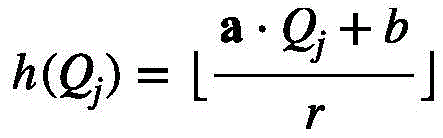
the euclidean locality sensitive hash is taken as the hash function:
wherein Q is
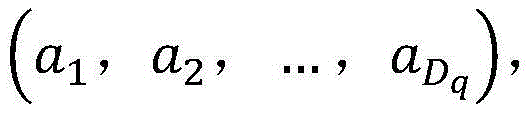
j Is the component of Q, r is a hyperparameter, a and b are random variables, satisfy
And is provided with
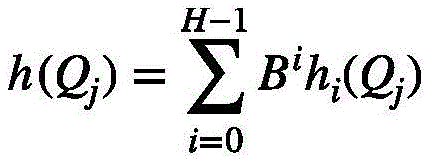
Applied to H LSHs, the hash value for each video component is obtained:
wherein B is a constant;
is provided with
Is the center of video feature queries with the same hash value, I
i Is a category index, represents the video feature query component Q
i To which group belongs, the jth group of visual centers Q
c(j) Represented by the formula:
corresponding cluster attention moment array
Obtained as follows:
the specific method for obtaining the top k video feature keys with the highest attention and determining the weight is as follows:
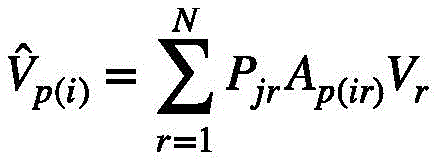
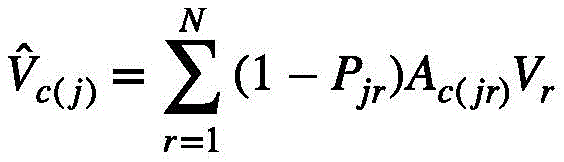
let P be an element {0,1} U×C Is a set of indicator vectors, where P ji =1 if and only if the ith video feature key is one of the keys of the jth group whose attention is on the top k, otherwise it is 0;
in this way, the key ranked k first in the jth group for attention and the other keys are separated and the following attention coefficients are calculated for them:
the attention matrix after modification in the above manner is represented as:
wherein i represents the ith video feature query contained in the jth video feature group;
new video feature values
Can be divided into two parts:
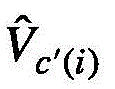
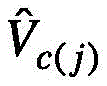
wherein,
wherein
By
The broadcast is obtained.
The specific method for obtaining the global feature code is as follows:
extracting final global feature coding S = { S } of the video from J-layer stacked coding layers containing self-adaptive clustering attention 1 ,...,s N The obtained global video features not only contain the background information of the whole video, but also have object sensitivity and event sensitivity.
The event number prediction adopts an event number prediction head, and the specific method comprises the following steps:
querying events for features
Compressing into vectors and then predicting a fixed-length vector using the full-link layer
Wherein each element represents the probability that the number of events is that value;
in the inference phase, the selection confidence level is at the top L inf As a final event partitioning result, the confidence score of each event for generating subtitles can be obtained by the following formula:
wherein,
which represents the probability of generating the t-th target word in the i-th event, gamma is a modulation factor and mu is a balance factor to attenuate the effect of caption length on confidence score.
The event positioning adopts an event proposal positioning head, and the specific method is as follows:
the event proposal positioning head is used for generating frame prediction and carrying out secondary classification on each event-level feature, wherein the frame prediction is used for predicting the initial position of each event-level feature; two-classification predicts the foreground confidence for each event query, and both predictions use a multi-layer perceptron for event-level features
The above results obtained:
obtaining a group of tuples through the event proposal positioning head
To indicate a detected event, wherein
Represents the start-stop time of the event proposal,
representing features for events
The confidence of the positioning.
The caption generation adopts a caption generation head, and the specific method is as follows:
for the primary feature F of the preliminarily coded video, inputting F into ResNet and extracting the network C in order to extract features of different scales of the primary feature F
3 To C
5 Output of the stage, noted
Where M =4, the video feature map of the mth scale is obtained by applying a convolution kernel of 3 × 3 with a step size of 2 to C
5 The output of the stage is obtained;
querying the semantics h
i,t-1 And event level features
Concatenation as query, h
i,t-1 Representing hidden features in subtitle generation LSTM, generating D reference points for the primary features of each scale, the basic flow is as follows:
wherein g is
i Acting on queries directly by linear mapping and sigmoid activation functions
Obtained above, which represents the coordinates of the normalized reference point, i.e. g
i ∈[0,1]
2 ,φ
m Mapping the normalized reference points onto a feature map of the corresponding scale, Δ
gidm Denotes the offset of the sample, A
imd Representing the attention of the sample point d on the m-scale for the ith semantic event query.
Compared with the prior art, the method encodes the global characteristics of the video under the condition of only inputting the whole video by the self-adaptive clustering method, further guides event positioning and subtitle generation in an end-to-end mode, omits the step of dividing the event proposal by utilizing the prior threshold value by the prior model, and greatly reduces the calculation complexity under the condition of ensuring the accuracy of subtitle generation. The invention can adaptively cluster the similar characteristic queries when processing the long sequence characteristics, thereby reducing redundancy and saving memory. Meanwhile, as a fast approximation of the complete self-attention mechanism in the conventional Transformer, the method also has excellent performance in terms of encoding accuracy.
Detailed Description
The invention is further described below with reference to the accompanying drawings.
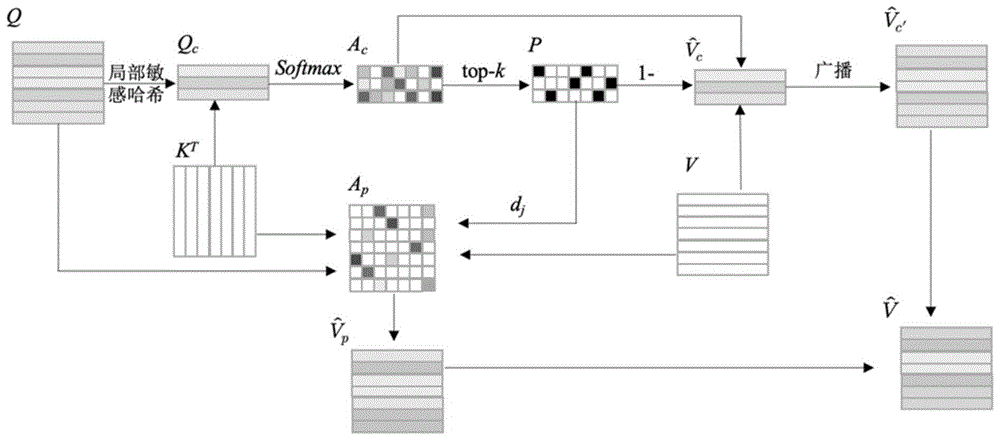
Referring to fig. 1, global video feature extraction based on adaptive clustering:
the global characteristics of the video are coded by a self-adaptive clustering method under the condition that only the whole video is input, so that the event positioning and the subtitle generation are guided in an end-to-end mode, and the step of event proposal division by using a prior threshold value of a previous model is omitted, so that the calculation complexity is greatly reduced under the condition of ensuring the subtitle generation accuracy.
First, a pre-trained motion recognition network (C3D, TSN, TSP) is applied to extract primary coding features { v } of a video 1 ,...,v N }. This primary coding feature is then processed to obtain a representative global video feature.
Time dimension of video features is rescaled to N by interpolation, and primary features of the video are obtained
Then, flattening and embedding the primary features into the position codes, and using the position codes as input of a Transformer model comprising an adaptive clustering coder:
F=CNN(v 1 ,...,v N ) (1)
S=ACTAtt(FW Q ,FW K ,FW V ) (2)
wherein
Are learnable parameters that map the primary features of the video to the input space of the encoder. For convenience, the obtained video feature query is not set to
Video feature key
Video feature value
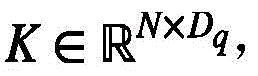
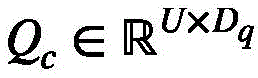
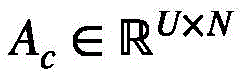
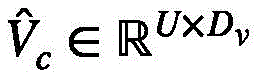
ACTAtt (·) in formula (2) is central herein: an adaptive clustering attention based encoder. The main idea is to first divide the video feature query into U video feature groups, where U < N. Only these groups of attention are then calculated and the same attention weight is assigned to video feature queries of the same group. Further, it is characterized by thatIn order to make some video feature keys which should obtain higher attention gain high attention, attention re-calculation is also needed to be carried out on the keys with the attention degrees ranked at the top k. In general, to obtain the global video feature S according to the formula (2), the specific steps are as follows (the following is a specific explanation of the formula (2), wherein FW
Q Represents Q, FW
K Represents K, FW
V Represents V):
to determine the set of video features, a video feature query is first processed using a Locality Sensitive Hashing (LSH) method. Considering that LSH is a powerful tool to solve the nearest neighbor search problem: the hash scheme is said to be locally sensitive if nearby vectors can get the same hash value with high probability, i.e. fall into the same hash bucket, while distant vectors have different hash values. Therefore, by controlling the relevant parameters and the number of rounds of the hash function, all video feature queries with distances smaller than epsilon can be classified into the same video feature group (hash bucket) with a probability larger than p according to the hash value. Specifically, a hash value for each video feature query is first computed, where a euclidean locality sensitive hash is chosen as the hash function:
wherein Q
j Is the component of Q, r is a hyperparameter, a and b are random variables, satisfy
And is
Applying H LSHs, the resulting hash value of each video component is as follows:
where B is a constant. From equation (3), it can be seen that the hash function can be actually seen as a set of hyperplanes with random normal vector a and offset b, and the hyperplane pitch is controlled by the hyperplane parameter r, and the larger the r is, the larger the pitch is. And equation (3) shows that the H hash functions divide the space into several cells, and vectors falling into the same cell will obtain the same hash value.
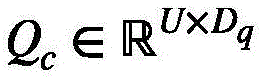
To obtain the center of vision, let
Is the center of the video feature query with the same hash value, I
i Is a category index, represents a video feature query component Q
i To which group it belongs. Thus, group j visual center Q
c(j) Can be expressed as follows:
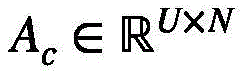
based on this, the corresponding cluster attention moment array
And video feature value
Can be obtained as follows:
furthermore, the first k video feature keys with the highest attention degree are found for each group of video feature query, the weight of the part is calculated in detail, and the weight of the rest part is still calculated according to the clustering mode.
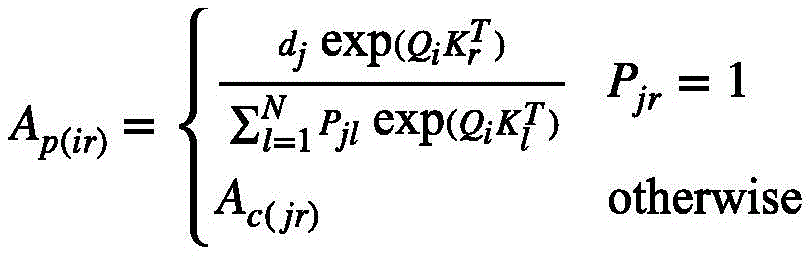
Specifically, let P ∈ {0,1} U×C Is a set of indicator vectors, where P ji =1 if and only if the ith video feature key is one of the keys of the jth group whose attention lies on the top k, otherwise it is 0. In this way, the first k keys and other keys in the jth group that are ranked in focus can be separated and the following attention coefficients can be calculated for them (this is done to ensure that the first k video feature keys and the remaining video feature keys correspond to each other)The attention sum of the values of (1):
equation (8) is actually the total probability that the attention is located in the top k video feature keys in the jth video feature group. The attention matrix after modification in the above manner can be expressed as:
where i represents the ith video feature query contained in the jth video feature set. In other words, the video feature key with the attention degree of the first k video feature groups is selected according to the formula (6), and the query Q is compared with each video feature in the video feature group under the scaling of the attention coefficient
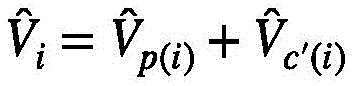
i And performing dot product, and performing fine calculation again by using softmax to obtain a new weight value. For video feature keys not belonging to the above, weights are calculated only at the visual centers of each video feature group, still according to equation (6). In general, new video feature values
Can be divided into two parts:
wherein,
wherein
By
The broadcast is obtained.
Based on the above, the model performs the above operations on the coded video features in each coding layer, so as to obtain a representative video global feature.
If the coding layers containing adaptive clustering attention are stacked by J layers, the model can extract the final global feature code S = { S } of the video 1 ,...,s N }. The obtained global video features not only contain background information of the whole video, but also have object sensitivity and event sensitivity.
Referring to FIG. 2 (see also the overall model diagram, supplementary one), a parallel multi-headed decoder
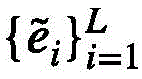
And taking the global video characteristics S obtained above as a guide, and simultaneously performing three downstream subtasks of event number prediction, event positioning and subtitle generation by using a parallel multi-head decoder, thereby promoting the interaction of the subtasks and finally generating accurate dense video subtitle description for the video. Specifically, the decoder herein does not perform sequential recursive processing on the input event queries, but processes L learnable event queries in parallel, aiming to directly query event-level features from global video features with rich clustering information conditioned on L learnable embeddings. If initialized, the learnable event query is expressed as
The attention calculation flow in each decoding layer can be expressed as:
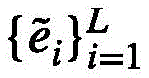
wherein Att (-) is a self-attention mechanism. It should be noted that the key and the value in equation (14) are both from the global video feature S output from the encoder, and the output from attention in the decoding layer is used as a query, and this attention mechanism is referred to herein as a cross attention mechanism. For simplicity, only the attention part of one decoding layer is described here, and the output of the transform decoder obtained through iterative refinement of J decoding layers is taken as the output
I.e. an event-level feature guided by the global video features.
Positioning head for event proposal
The event proposal positioning header is intended to generate a box prediction and perform a binary classification for each event-level feature. Specifically, the role of the box prediction is to predict for each event-level feature its starting position; and the two-classification predicts the foreground confidence coefficient of each event query, and the two-part prediction applies a multi-layer perception machine to the event-level features
The above results obtained:
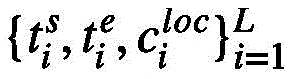
thus, through the event proposal positioning head, the model can obtain a group of tuples
To indicate a detected event, wherein
Represents the start-stop time of the event proposal,
representing features for events
The confidence of the positioning.
Referring to fig. 2, a subtitle generating head
For the primary feature F of the preliminarily coded video, inputting F into ResNet and extracting the network C in order to extract features of different scales of the primary feature F
3 To C
5 Output of the stage, note
Where M =4, the video feature map of the mth scale is obtained by applying a convolution kernel of 3 × 3 with a step size of 2 to C
5 The output of the stage is obtained. Although the resolution of the feature maps of different scales is different, their channel numbers can be converted to 256 by a convolution operation of 1 × 1. Thus, the primary characteristics of the multi-scale video for supplementing visual information to the subtitle generation head are obtained and recorded as
It should be noted that the global video features processed by the adaptive clustering coder are not selected as the visual information supplement, because richer visual information can be sampled on the features that are not clustered.
Further, when generating the t word of the ith event query, D sampling points need to be generated for the features of each scale first, and the basic flow is as follows:
wherein,
in particular, a semantic query h
i, t
-1 And event level features
Concatenate as query, here h
i,t-1 Representing hidden features in the subtitle generation LSTM. Then, D reference points are generated for the primary feature of each scale according to equation (17), where g
i Acting on queries directly by linear mapping and sigmoid activation functions
Obtained above, which represents the coordinates of the normalized reference point, i.e. g
i ∈[0,1]
2 。φ
m Directly mapping the normalized reference points to a feature map of the corresponding scale, Δ g
idm Denotes the offset of the sample, A
imd Representing the attention of the sampling point d on the m scale for the ith semantic event query, both of which are obtained by applying a linear projection to the semantic event query.
Thus, the text can be supplemented with video visual information sampled on primary video features of different scales according to semantic and event query
Next, according to the idea of soft attention, these visual information sampling points can be weighted according to semantic and event queries:
α it =softmax(a it ) (20)
wherein w
a ,W
x ,W
ha Are all parameters that can be learned and,
each component representing supplemental visual information. The weighted visual context feature can then be expressed as:
next, contextual visual feature z, which will be supplemented herein
it Event level characterization
And preceding word embedding w
i,t-1 Inputting the data into LSTM to obtain the hidden state h of time step t
it And further using the full link layer to the next word w
it And (6) performing prediction. Then query e for the ith event
i Then the corresponding caption can be obtained
Wherein B is
i Indicating the length of the subtitles.
Event number prediction header
Considering that the number L of event queries is a manually set hyper-parameter, in an actual dense video caption generation task, captions do not need to be generated for all L event queries. Because too many events will result in a large number of repetitions in the generated subtitles, lacking readability; and too few events can result in the loss of important information. Therefore, this subsection designs an event number prediction head, aiming to predict an appropriate event number for each video.
Specifically, the event number prediction header comprises a maximum pooling header and a full link layer with softmax activation. First, the event is queried for features
Compressing into vectors and then predicting a fixed-length vector using the full-link layer
Where each element represents the probability that the number of events is that value. In the inference phase, the selection confidence level is at the top L
inf As a final event partitioning result, the confidence score of each event for generating the caption can be obtained byObtaining the formula:
wherein,
which represents the probability of generating the t-th target word at the i-th event, gamma is a modulation factor and mu is a balance factor to attenuate the effect of caption length on confidence score.
In order to prove the superiority of the model, the subsection compares the model with some classical dense video subtitle generation models in the aspects of event positioning accuracy, subtitle generation quality and reasoning time.
Evaluation of event positioning accuracy: in early work, event proposals were generated in advance by pre-trained models, not end-to-end structures. Therefore, in this section, the present invention is compared with the classical two-stage model, i.e. the pipeline-type structure model using "location-selection-description" to show the advantages of the sub-task parallel strategy. Specifically, the method comprises the following steps:
1, MT: as a baseline model for this document, which is also based on the transform's codec structure, the video is first encoded into an appropriate representation, an event proposal decoder decodes the encoded video with different anchor points to generate an event proposal, and a caption decoder generates captions from the output of the proposal decoder;
2.MFT: the event proposal generation and the caption generation are designed into a circulating network, so that the current event proposal division can be guided by the previous caption description;
3, SDVC: the time dependency of the events is considered, and a reinforced learning means is used for carrying out two-stage reward in terms of both event and plot continuity.
The accuracy, recall, and F1 results of the model event location are then shown in the following table:
TABLE 1ActivityNet validation set event location results (using C3D coding)
The method is different from the serial connection scheme of event positioning-caption generation adopted by the existing method, the method is abandoned, and the event proposal positioning is output in a parallel mode, so that the setting of prior threshold values in the scheme can be greatly reduced, and the method is more effective than the serial connection scheme. It can be seen from the figure that the event proposal positioning result of the invention far exceeds the MFT and MT, and can be compared with the SDVC which is not an end-to-end model and has more parameter quantity. In particular, both versions of the model of the present invention show more competitive results and more accurate positioning performance when the IOU threshold is higher. In addition, when the model uses a finer caption generation head, the average accuracy of event proposal positioning is improved, which also shows that the corresponding subtasks of the two parallel heads are mutually influenced and mutually promoted.
In order to analyze the effect of global video characteristics in guiding decoding operation, video segments are selected in the experiment and are standardized to be output with frame-level importance through a full connection layer, different events and different frames in the events have different weights, and therefore important guidance is provided for a downstream decoder to generate an event proposal and generate subtitles.
Considering that ActivityNet data set contains 203 action classes in total and that the performance of subtitles may be related to the categories of actions, we continue to explore the representation of GDC models across different categories. Specifically, 10 representative categories were selected, above which the METEOR index of GDC-generated subtitles was evaluated and compared with the performance on real event proposals and predicted event proposals, and the experimental results are shown in table 2:
TABLE 2 METEOR indices for subtitling on different categories of actions
As can be seen from the above table, the present invention behaves differently on different types of motion video data. In particular, the caption generated by the invention is quite competitive for large-scale actions or activities with certain specificity on the action background, such as opening a bumper car, hitting a squash ball, skating and the like. But for some more compact and detailed activities, such as karate, tianba, etc. videos, the performance of the present invention is slightly degraded. However, as can be seen from the results in table 2, the GDC is expected to achieve greater performance improvement by capturing more fine-grained features when the video is primarily encoded by a more advanced video feature extraction model. It should be noted that, although modifying part of the hyper-parameters will improve the accuracy of the subtitles for the method of extracting global video features by using adaptive clustering, the memory consumption will also increase, which will be further analyzed in the following ablation experiments.
In conclusion, based on the results of quantitative analysis and qualitative analysis, the GDC has a very competitive expression on both data sets, which is significantly improved compared with the existing dense video caption generation model in terms of both event localization and caption generation tasks, which further proves the effectiveness of the GDC.
Compared with the existing dense video subtitle generation method on an activityNet data set and a YouCookII data set, experimental results show that the model of the invention is advanced in terms of event positioning, subtitle generation and reasoning efficiency. The method and the device ensure the accuracy of generating the subtitles on the prediction proposal and the real proposal. These observations further confirm the validity of the model of the invention. In addition, the behavior of the global video features in downstream tasks was further analyzed by ablation experiments. The visualized video feature set further demonstrates the guiding effect of the global video features and increases the interpretability of the model. And finally, analyzing the influence of the hyperparameters H and r of the encoder and the event query quantity L in the decoder on the experimental result, and finally, well balancing the performance of the model in each index by selecting the hyperparameters.