CN115073727A - Polymeric materials - Google Patents
Polymeric materials Download PDFInfo
- Publication number
- CN115073727A CN115073727A CN202210692648.4A CN202210692648A CN115073727A CN 115073727 A CN115073727 A CN 115073727A CN 202210692648 A CN202210692648 A CN 202210692648A CN 115073727 A CN115073727 A CN 115073727A
- Authority
- CN
- China
- Prior art keywords
- component
- polymer
- formula
- units
- mole
- Prior art date
- Legal status (The legal status is an assumption and is not a legal conclusion. Google has not performed a legal analysis and makes no representation as to the accuracy of the status listed.)
- Pending
Links
- 239000000463 material Substances 0.000 title description 11
- 229920000642 polymer Polymers 0.000 claims abstract description 75
- 229910052751 metal Inorganic materials 0.000 claims abstract description 41
- 239000002184 metal Substances 0.000 claims abstract description 41
- 125000000843 phenylene group Chemical group C1(=C(C=CC=C1)*)* 0.000 claims abstract description 14
- 239000000203 mixture Substances 0.000 claims description 45
- 238000000034 method Methods 0.000 claims description 24
- 229910052782 aluminium Inorganic materials 0.000 claims description 20
- XAGFODPZIPBFFR-UHFFFAOYSA-N aluminium Chemical compound [Al] XAGFODPZIPBFFR-UHFFFAOYSA-N 0.000 claims description 20
- 238000009472 formulation Methods 0.000 claims description 16
- 239000000945 filler Substances 0.000 claims description 15
- 238000011282 treatment Methods 0.000 claims description 14
- 239000002243 precursor Substances 0.000 claims description 12
- 150000001875 compounds Chemical class 0.000 claims description 10
- 239000003365 glass fiber Substances 0.000 claims description 10
- 239000000126 substance Substances 0.000 claims description 8
- 229910000831 Steel Inorganic materials 0.000 claims description 7
- 239000007800 oxidant agent Substances 0.000 claims description 7
- 239000010959 steel Substances 0.000 claims description 7
- 229920000049 Carbon (fiber) Polymers 0.000 claims description 6
- 239000004917 carbon fiber Substances 0.000 claims description 6
- 229910052742 iron Inorganic materials 0.000 claims description 6
- 238000005530 etching Methods 0.000 claims description 5
- 239000004760 aramid Substances 0.000 claims description 3
- 229920006231 aramid fiber Polymers 0.000 claims description 3
- NBVXSUQYWXRMNV-UHFFFAOYSA-N fluoromethane Chemical compound FC NBVXSUQYWXRMNV-UHFFFAOYSA-N 0.000 claims description 3
- 230000003993 interaction Effects 0.000 claims description 3
- 238000004519 manufacturing process Methods 0.000 claims description 3
- 230000001590 oxidative effect Effects 0.000 claims description 3
- 239000011347 resin Substances 0.000 claims description 3
- 229920005989 resin Polymers 0.000 claims description 3
- 239000006229 carbon black Substances 0.000 claims description 2
- 238000000227 grinding Methods 0.000 claims description 2
- UONOETXJSWQNOL-UHFFFAOYSA-N tungsten carbide Chemical compound [W+]#[C-] UONOETXJSWQNOL-UHFFFAOYSA-N 0.000 claims description 2
- 238000002203 pretreatment Methods 0.000 claims 1
- XLYOFNOQVPJJNP-UHFFFAOYSA-N water Substances O XLYOFNOQVPJJNP-UHFFFAOYSA-N 0.000 description 15
- CSCPPACGZOOCGX-UHFFFAOYSA-N Acetone Chemical compound CC(C)=O CSCPPACGZOOCGX-UHFFFAOYSA-N 0.000 description 14
- 239000004696 Poly ether ether ketone Substances 0.000 description 14
- XEEYBQQBJWHFJM-UHFFFAOYSA-N iron Substances [Fe] XEEYBQQBJWHFJM-UHFFFAOYSA-N 0.000 description 14
- 229920002530 polyetherether ketone Polymers 0.000 description 14
- QAOWNCQODCNURD-UHFFFAOYSA-N Sulfuric acid Chemical compound OS(O)(=O)=O QAOWNCQODCNURD-UHFFFAOYSA-N 0.000 description 13
- 239000000835 fiber Substances 0.000 description 11
- 238000012360 testing method Methods 0.000 description 11
- 239000000853 adhesive Substances 0.000 description 8
- 230000001070 adhesive effect Effects 0.000 description 8
- 229920001577 copolymer Polymers 0.000 description 7
- 239000012765 fibrous filler Substances 0.000 description 7
- 239000011888 foil Substances 0.000 description 7
- 238000002844 melting Methods 0.000 description 7
- 230000008018 melting Effects 0.000 description 7
- 239000008367 deionised water Substances 0.000 description 6
- 238000000113 differential scanning calorimetry Methods 0.000 description 6
- 230000004927 fusion Effects 0.000 description 6
- QAOWNCQODCNURD-UHFFFAOYSA-L sulfate group Chemical group S(=O)(=O)([O-])[O-] QAOWNCQODCNURD-UHFFFAOYSA-L 0.000 description 6
- VYPSYNLAJGMNEJ-UHFFFAOYSA-N Silicium dioxide Chemical compound O=[Si]=O VYPSYNLAJGMNEJ-UHFFFAOYSA-N 0.000 description 5
- 229910021641 deionized water Inorganic materials 0.000 description 5
- 239000000243 solution Substances 0.000 description 5
- 229910021653 sulphate ion Inorganic materials 0.000 description 5
- 239000000454 talc Substances 0.000 description 5
- 229910052623 talc Inorganic materials 0.000 description 5
- IJGRMHOSHXDMSA-UHFFFAOYSA-N Atomic nitrogen Chemical compound N#N IJGRMHOSHXDMSA-UHFFFAOYSA-N 0.000 description 4
- GRYLNZFGIOXLOG-UHFFFAOYSA-N Nitric acid Chemical compound O[N+]([O-])=O GRYLNZFGIOXLOG-UHFFFAOYSA-N 0.000 description 4
- CDBYLPFSWZWCQE-UHFFFAOYSA-L Sodium Carbonate Chemical compound [Na+].[Na+].[O-]C([O-])=O CDBYLPFSWZWCQE-UHFFFAOYSA-L 0.000 description 4
- 239000004411 aluminium Substances 0.000 description 4
- 229910052799 carbon Inorganic materials 0.000 description 4
- 238000004140 cleaning Methods 0.000 description 4
- 229910017604 nitric acid Inorganic materials 0.000 description 4
- 238000002360 preparation method Methods 0.000 description 4
- 239000001117 sulphuric acid Substances 0.000 description 4
- 235000011149 sulphuric acid Nutrition 0.000 description 4
- 230000000052 comparative effect Effects 0.000 description 3
- 238000001746 injection moulding Methods 0.000 description 3
- 150000002506 iron compounds Chemical class 0.000 description 3
- 150000002739 metals Chemical class 0.000 description 3
- 238000010791 quenching Methods 0.000 description 3
- 230000000171 quenching effect Effects 0.000 description 3
- 238000003756 stirring Methods 0.000 description 3
- QIGBRXMKCJKVMJ-UHFFFAOYSA-N Hydroquinone Chemical compound OC1=CC=C(O)C=C1 QIGBRXMKCJKVMJ-UHFFFAOYSA-N 0.000 description 2
- RTAQQCXQSZGOHL-UHFFFAOYSA-N Titanium Chemical compound [Ti] RTAQQCXQSZGOHL-UHFFFAOYSA-N 0.000 description 2
- MCMNRKCIXSYSNV-UHFFFAOYSA-N Zirconium dioxide Chemical compound O=[Zr]=O MCMNRKCIXSYSNV-UHFFFAOYSA-N 0.000 description 2
- 239000002253 acid Substances 0.000 description 2
- PNEYBMLMFCGWSK-UHFFFAOYSA-N aluminium oxide Inorganic materials [O-2].[O-2].[O-2].[Al+3].[Al+3] PNEYBMLMFCGWSK-UHFFFAOYSA-N 0.000 description 2
- 239000000356 contaminant Substances 0.000 description 2
- 238000002425 crystallisation Methods 0.000 description 2
- 230000008025 crystallization Effects 0.000 description 2
- USIUVYZYUHIAEV-UHFFFAOYSA-N diphenyl ether Chemical compound C=1C=CC=CC=1OC1=CC=CC=C1 USIUVYZYUHIAEV-UHFFFAOYSA-N 0.000 description 2
- KZTYYGOKRVBIMI-UHFFFAOYSA-N diphenyl sulfone Chemical compound C=1C=CC=CC=1S(=O)(=O)C1=CC=CC=C1 KZTYYGOKRVBIMI-UHFFFAOYSA-N 0.000 description 2
- 239000002657 fibrous material Substances 0.000 description 2
- 229920006258 high performance thermoplastic Polymers 0.000 description 2
- 239000000155 melt Substances 0.000 description 2
- 238000000465 moulding Methods 0.000 description 2
- 229910052757 nitrogen Inorganic materials 0.000 description 2
- 239000003960 organic solvent Substances 0.000 description 2
- TWNQGVIAIRXVLR-UHFFFAOYSA-N oxo(oxoalumanyloxy)alumane Chemical compound O=[Al]O[Al]=O TWNQGVIAIRXVLR-UHFFFAOYSA-N 0.000 description 2
- BWHMMNNQKKPAPP-UHFFFAOYSA-L potassium carbonate Chemical compound [K+].[K+].[O-]C([O-])=O BWHMMNNQKKPAPP-UHFFFAOYSA-L 0.000 description 2
- 238000005480 shot peening Methods 0.000 description 2
- 239000000377 silicon dioxide Substances 0.000 description 2
- 229910000029 sodium carbonate Inorganic materials 0.000 description 2
- 229920001169 thermoplastic Polymers 0.000 description 2
- 239000004416 thermosoftening plastic Substances 0.000 description 2
- 239000010936 titanium Substances 0.000 description 2
- 229910052719 titanium Inorganic materials 0.000 description 2
- RXNYJUSEXLAVNQ-UHFFFAOYSA-N 4,4'-Dihydroxybenzophenone Chemical compound C1=CC(O)=CC=C1C(=O)C1=CC=C(O)C=C1 RXNYJUSEXLAVNQ-UHFFFAOYSA-N 0.000 description 1
- 101100013482 Arabidopsis thaliana FRS5 gene Proteins 0.000 description 1
- 229910052582 BN Inorganic materials 0.000 description 1
- ZOXJGFHDIHLPTG-UHFFFAOYSA-N Boron Chemical compound [B] ZOXJGFHDIHLPTG-UHFFFAOYSA-N 0.000 description 1
- PZNSFCLAULLKQX-UHFFFAOYSA-N Boron nitride Chemical compound N#B PZNSFCLAULLKQX-UHFFFAOYSA-N 0.000 description 1
- 102100021202 Desmocollin-1 Human genes 0.000 description 1
- 101000968043 Homo sapiens Desmocollin-1 Proteins 0.000 description 1
- 101000880960 Homo sapiens Desmocollin-3 Proteins 0.000 description 1
- 238000004566 IR spectroscopy Methods 0.000 description 1
- 239000005569 Iron sulphate Substances 0.000 description 1
- 229910052581 Si3N4 Inorganic materials 0.000 description 1
- NINIDFKCEFEMDL-UHFFFAOYSA-N Sulfur Chemical compound [S] NINIDFKCEFEMDL-UHFFFAOYSA-N 0.000 description 1
- 229920004695 VICTREX™ PEEK Polymers 0.000 description 1
- 238000002441 X-ray diffraction Methods 0.000 description 1
- 150000001450 anions Chemical class 0.000 description 1
- 239000010425 asbestos Substances 0.000 description 1
- QVGXLLKOCUKJST-UHFFFAOYSA-N atomic oxygen Chemical compound [O] QVGXLLKOCUKJST-UHFFFAOYSA-N 0.000 description 1
- 238000005422 blasting Methods 0.000 description 1
- 229910052796 boron Inorganic materials 0.000 description 1
- 150000001768 cations Chemical class 0.000 description 1
- 238000006243 chemical reaction Methods 0.000 description 1
- 238000007906 compression Methods 0.000 description 1
- 230000006835 compression Effects 0.000 description 1
- 238000000748 compression moulding Methods 0.000 description 1
- 230000007797 corrosion Effects 0.000 description 1
- 238000005260 corrosion Methods 0.000 description 1
- NJLLQSBAHIKGKF-UHFFFAOYSA-N dipotassium dioxido(oxo)titanium Chemical compound [K+].[K+].[O-][Ti]([O-])=O NJLLQSBAHIKGKF-UHFFFAOYSA-N 0.000 description 1
- 238000005516 engineering process Methods 0.000 description 1
- 230000009477 glass transition Effects 0.000 description 1
- 239000004519 grease Substances 0.000 description 1
- 238000010438 heat treatment Methods 0.000 description 1
- 230000036571 hydration Effects 0.000 description 1
- 238000006703 hydration reaction Methods 0.000 description 1
- 238000010348 incorporation Methods 0.000 description 1
- 238000002347 injection Methods 0.000 description 1
- 239000007924 injection Substances 0.000 description 1
- BAUYGSIQEAFULO-UHFFFAOYSA-L iron(2+) sulfate (anhydrous) Chemical compound [Fe+2].[O-]S([O-])(=O)=O BAUYGSIQEAFULO-UHFFFAOYSA-L 0.000 description 1
- 238000005304 joining Methods 0.000 description 1
- 238000005259 measurement Methods 0.000 description 1
- 238000010295 mobile communication Methods 0.000 description 1
- 239000002121 nanofiber Substances 0.000 description 1
- 238000007254 oxidation reaction Methods 0.000 description 1
- 229910052760 oxygen Inorganic materials 0.000 description 1
- 239000001301 oxygen Substances 0.000 description 1
- 229920006260 polyaryletherketone Polymers 0.000 description 1
- 229920006254 polymer film Polymers 0.000 description 1
- 229910000027 potassium carbonate Inorganic materials 0.000 description 1
- 239000000843 powder Substances 0.000 description 1
- 238000012545 processing Methods 0.000 description 1
- 239000011541 reaction mixture Substances 0.000 description 1
- 238000003303 reheating Methods 0.000 description 1
- 229910052895 riebeckite Inorganic materials 0.000 description 1
- 238000007788 roughening Methods 0.000 description 1
- 239000004576 sand Substances 0.000 description 1
- HQVNEWCFYHHQES-UHFFFAOYSA-N silicon nitride Chemical compound N12[Si]34N5[Si]62N3[Si]51N64 HQVNEWCFYHHQES-UHFFFAOYSA-N 0.000 description 1
- 239000007787 solid Substances 0.000 description 1
- 239000002904 solvent Substances 0.000 description 1
- 229910001220 stainless steel Inorganic materials 0.000 description 1
- 239000010935 stainless steel Substances 0.000 description 1
- 229910052717 sulfur Inorganic materials 0.000 description 1
- 239000011593 sulfur Substances 0.000 description 1
- 238000010998 test method Methods 0.000 description 1
Classifications
-
- C—CHEMISTRY; METALLURGY
- C08—ORGANIC MACROMOLECULAR COMPOUNDS; THEIR PREPARATION OR CHEMICAL WORKING-UP; COMPOSITIONS BASED THEREON
- C08G—MACROMOLECULAR COMPOUNDS OBTAINED OTHERWISE THAN BY REACTIONS ONLY INVOLVING UNSATURATED CARBON-TO-CARBON BONDS
- C08G65/00—Macromolecular compounds obtained by reactions forming an ether link in the main chain of the macromolecule
- C08G65/34—Macromolecular compounds obtained by reactions forming an ether link in the main chain of the macromolecule from hydroxy compounds or their metallic derivatives
- C08G65/38—Macromolecular compounds obtained by reactions forming an ether link in the main chain of the macromolecule from hydroxy compounds or their metallic derivatives derived from phenols
- C08G65/40—Macromolecular compounds obtained by reactions forming an ether link in the main chain of the macromolecule from hydroxy compounds or their metallic derivatives derived from phenols from phenols (I) and other compounds (II), e.g. OH-Ar-OH + X-Ar-X, where X is halogen atom, i.e. leaving group
- C08G65/4012—Other compound (II) containing a ketone group, e.g. X-Ar-C(=O)-Ar-X for polyetherketones
-
- B—PERFORMING OPERATIONS; TRANSPORTING
- B32—LAYERED PRODUCTS
- B32B—LAYERED PRODUCTS, i.e. PRODUCTS BUILT-UP OF STRATA OF FLAT OR NON-FLAT, e.g. CELLULAR OR HONEYCOMB, FORM
- B32B15/00—Layered products comprising a layer of metal
- B32B15/04—Layered products comprising a layer of metal comprising metal as the main or only constituent of a layer, which is next to another layer of the same or of a different material
- B32B15/08—Layered products comprising a layer of metal comprising metal as the main or only constituent of a layer, which is next to another layer of the same or of a different material of synthetic resin
-
- B—PERFORMING OPERATIONS; TRANSPORTING
- B32—LAYERED PRODUCTS
- B32B—LAYERED PRODUCTS, i.e. PRODUCTS BUILT-UP OF STRATA OF FLAT OR NON-FLAT, e.g. CELLULAR OR HONEYCOMB, FORM
- B32B27/00—Layered products comprising a layer of synthetic resin
- B32B27/28—Layered products comprising a layer of synthetic resin comprising synthetic resins not wholly covered by any one of the sub-groups B32B27/30 - B32B27/42
- B32B27/285—Layered products comprising a layer of synthetic resin comprising synthetic resins not wholly covered by any one of the sub-groups B32B27/30 - B32B27/42 comprising polyethers
-
- B—PERFORMING OPERATIONS; TRANSPORTING
- B29—WORKING OF PLASTICS; WORKING OF SUBSTANCES IN A PLASTIC STATE IN GENERAL
- B29C—SHAPING OR JOINING OF PLASTICS; SHAPING OF MATERIAL IN A PLASTIC STATE, NOT OTHERWISE PROVIDED FOR; AFTER-TREATMENT OF THE SHAPED PRODUCTS, e.g. REPAIRING
- B29C43/00—Compression moulding, i.e. applying external pressure to flow the moulding material; Apparatus therefor
- B29C43/003—Compression moulding, i.e. applying external pressure to flow the moulding material; Apparatus therefor characterised by the choice of material
-
- B—PERFORMING OPERATIONS; TRANSPORTING
- B29—WORKING OF PLASTICS; WORKING OF SUBSTANCES IN A PLASTIC STATE IN GENERAL
- B29C—SHAPING OR JOINING OF PLASTICS; SHAPING OF MATERIAL IN A PLASTIC STATE, NOT OTHERWISE PROVIDED FOR; AFTER-TREATMENT OF THE SHAPED PRODUCTS, e.g. REPAIRING
- B29C43/00—Compression moulding, i.e. applying external pressure to flow the moulding material; Apparatus therefor
- B29C43/02—Compression moulding, i.e. applying external pressure to flow the moulding material; Apparatus therefor of articles of definite length, i.e. discrete articles
-
- B—PERFORMING OPERATIONS; TRANSPORTING
- B29—WORKING OF PLASTICS; WORKING OF SUBSTANCES IN A PLASTIC STATE IN GENERAL
- B29C—SHAPING OR JOINING OF PLASTICS; SHAPING OF MATERIAL IN A PLASTIC STATE, NOT OTHERWISE PROVIDED FOR; AFTER-TREATMENT OF THE SHAPED PRODUCTS, e.g. REPAIRING
- B29C69/00—Combinations of shaping techniques not provided for in a single one of main groups B29C39/00 - B29C67/00, e.g. associations of moulding and joining techniques; Apparatus therefore
- B29C69/001—Combinations of shaping techniques not provided for in a single one of main groups B29C39/00 - B29C67/00, e.g. associations of moulding and joining techniques; Apparatus therefore a shaping technique combined with cutting, e.g. in parts or slices combined with rearranging and joining the cut parts
-
- B—PERFORMING OPERATIONS; TRANSPORTING
- B32—LAYERED PRODUCTS
- B32B—LAYERED PRODUCTS, i.e. PRODUCTS BUILT-UP OF STRATA OF FLAT OR NON-FLAT, e.g. CELLULAR OR HONEYCOMB, FORM
- B32B15/00—Layered products comprising a layer of metal
- B32B15/18—Layered products comprising a layer of metal comprising iron or steel
-
- B—PERFORMING OPERATIONS; TRANSPORTING
- B32—LAYERED PRODUCTS
- B32B—LAYERED PRODUCTS, i.e. PRODUCTS BUILT-UP OF STRATA OF FLAT OR NON-FLAT, e.g. CELLULAR OR HONEYCOMB, FORM
- B32B15/00—Layered products comprising a layer of metal
- B32B15/20—Layered products comprising a layer of metal comprising aluminium or copper
-
- B—PERFORMING OPERATIONS; TRANSPORTING
- B32—LAYERED PRODUCTS
- B32B—LAYERED PRODUCTS, i.e. PRODUCTS BUILT-UP OF STRATA OF FLAT OR NON-FLAT, e.g. CELLULAR OR HONEYCOMB, FORM
- B32B27/00—Layered products comprising a layer of synthetic resin
- B32B27/18—Layered products comprising a layer of synthetic resin characterised by the use of special additives
- B32B27/20—Layered products comprising a layer of synthetic resin characterised by the use of special additives using fillers, pigments, thixotroping agents
-
- B—PERFORMING OPERATIONS; TRANSPORTING
- B32—LAYERED PRODUCTS
- B32B—LAYERED PRODUCTS, i.e. PRODUCTS BUILT-UP OF STRATA OF FLAT OR NON-FLAT, e.g. CELLULAR OR HONEYCOMB, FORM
- B32B27/00—Layered products comprising a layer of synthetic resin
- B32B27/28—Layered products comprising a layer of synthetic resin comprising synthetic resins not wholly covered by any one of the sub-groups B32B27/30 - B32B27/42
- B32B27/288—Layered products comprising a layer of synthetic resin comprising synthetic resins not wholly covered by any one of the sub-groups B32B27/30 - B32B27/42 comprising polyketones
-
- B—PERFORMING OPERATIONS; TRANSPORTING
- B32—LAYERED PRODUCTS
- B32B—LAYERED PRODUCTS, i.e. PRODUCTS BUILT-UP OF STRATA OF FLAT OR NON-FLAT, e.g. CELLULAR OR HONEYCOMB, FORM
- B32B33/00—Layered products characterised by particular properties or particular surface features, e.g. particular surface coatings; Layered products designed for particular purposes not covered by another single class
-
- B—PERFORMING OPERATIONS; TRANSPORTING
- B32—LAYERED PRODUCTS
- B32B—LAYERED PRODUCTS, i.e. PRODUCTS BUILT-UP OF STRATA OF FLAT OR NON-FLAT, e.g. CELLULAR OR HONEYCOMB, FORM
- B32B37/00—Methods or apparatus for laminating, e.g. by curing or by ultrasonic bonding
- B32B37/06—Methods or apparatus for laminating, e.g. by curing or by ultrasonic bonding characterised by the heating method
-
- B—PERFORMING OPERATIONS; TRANSPORTING
- B32—LAYERED PRODUCTS
- B32B—LAYERED PRODUCTS, i.e. PRODUCTS BUILT-UP OF STRATA OF FLAT OR NON-FLAT, e.g. CELLULAR OR HONEYCOMB, FORM
- B32B7/00—Layered products characterised by the relation between layers; Layered products characterised by the relative orientation of features between layers, or by the relative values of a measurable parameter between layers, i.e. products comprising layers having different physical, chemical or physicochemical properties; Layered products characterised by the interconnection of layers
- B32B7/04—Interconnection of layers
- B32B7/12—Interconnection of layers using interposed adhesives or interposed materials with bonding properties
-
- C—CHEMISTRY; METALLURGY
- C08—ORGANIC MACROMOLECULAR COMPOUNDS; THEIR PREPARATION OR CHEMICAL WORKING-UP; COMPOSITIONS BASED THEREON
- C08G—MACROMOLECULAR COMPOUNDS OBTAINED OTHERWISE THAN BY REACTIONS ONLY INVOLVING UNSATURATED CARBON-TO-CARBON BONDS
- C08G65/00—Macromolecular compounds obtained by reactions forming an ether link in the main chain of the macromolecule
- C08G65/34—Macromolecular compounds obtained by reactions forming an ether link in the main chain of the macromolecule from hydroxy compounds or their metallic derivatives
- C08G65/38—Macromolecular compounds obtained by reactions forming an ether link in the main chain of the macromolecule from hydroxy compounds or their metallic derivatives derived from phenols
- C08G65/40—Macromolecular compounds obtained by reactions forming an ether link in the main chain of the macromolecule from hydroxy compounds or their metallic derivatives derived from phenols from phenols (I) and other compounds (II), e.g. OH-Ar-OH + X-Ar-X, where X is halogen atom, i.e. leaving group
- C08G65/4012—Other compound (II) containing a ketone group, e.g. X-Ar-C(=O)-Ar-X for polyetherketones
- C08G65/4018—(I) or (II) containing halogens other than as leaving group (X)
- C08G65/4025—(I) or (II) containing fluorine other than as leaving group (X)
-
- C—CHEMISTRY; METALLURGY
- C08—ORGANIC MACROMOLECULAR COMPOUNDS; THEIR PREPARATION OR CHEMICAL WORKING-UP; COMPOSITIONS BASED THEREON
- C08K—Use of inorganic or non-macromolecular organic substances as compounding ingredients
- C08K3/00—Use of inorganic substances as compounding ingredients
- C08K3/34—Silicon-containing compounds
-
- C—CHEMISTRY; METALLURGY
- C08—ORGANIC MACROMOLECULAR COMPOUNDS; THEIR PREPARATION OR CHEMICAL WORKING-UP; COMPOSITIONS BASED THEREON
- C08K—Use of inorganic or non-macromolecular organic substances as compounding ingredients
- C08K7/00—Use of ingredients characterised by shape
- C08K7/02—Fibres or whiskers
- C08K7/04—Fibres or whiskers inorganic
- C08K7/14—Glass
-
- C—CHEMISTRY; METALLURGY
- C08—ORGANIC MACROMOLECULAR COMPOUNDS; THEIR PREPARATION OR CHEMICAL WORKING-UP; COMPOSITIONS BASED THEREON
- C08L—COMPOSITIONS OF MACROMOLECULAR COMPOUNDS
- C08L71/00—Compositions of polyethers obtained by reactions forming an ether link in the main chain; Compositions of derivatives of such polymers
-
- B—PERFORMING OPERATIONS; TRANSPORTING
- B29—WORKING OF PLASTICS; WORKING OF SUBSTANCES IN A PLASTIC STATE IN GENERAL
- B29K—INDEXING SCHEME ASSOCIATED WITH SUBCLASSES B29B, B29C OR B29D, RELATING TO MOULDING MATERIALS OR TO MATERIALS FOR MOULDS, REINFORCEMENTS, FILLERS OR PREFORMED PARTS, e.g. INSERTS
- B29K2071/00—Use of polyethers, e.g. PEEK, i.e. polyether-etherketone or PEK, i.e. polyetherketone or derivatives thereof, as moulding material
-
- B—PERFORMING OPERATIONS; TRANSPORTING
- B29—WORKING OF PLASTICS; WORKING OF SUBSTANCES IN A PLASTIC STATE IN GENERAL
- B29L—INDEXING SCHEME ASSOCIATED WITH SUBCLASS B29C, RELATING TO PARTICULAR ARTICLES
- B29L2007/00—Flat articles, e.g. films or sheets
- B29L2007/008—Wide strips, e.g. films, webs
-
- B—PERFORMING OPERATIONS; TRANSPORTING
- B32—LAYERED PRODUCTS
- B32B—LAYERED PRODUCTS, i.e. PRODUCTS BUILT-UP OF STRATA OF FLAT OR NON-FLAT, e.g. CELLULAR OR HONEYCOMB, FORM
- B32B2262/00—Composition or structural features of fibres which form a fibrous or filamentary layer or are present as additives
- B32B2262/02—Synthetic macromolecular fibres
- B32B2262/0261—Polyamide fibres
- B32B2262/0269—Aromatic polyamide fibres
-
- B—PERFORMING OPERATIONS; TRANSPORTING
- B32—LAYERED PRODUCTS
- B32B—LAYERED PRODUCTS, i.e. PRODUCTS BUILT-UP OF STRATA OF FLAT OR NON-FLAT, e.g. CELLULAR OR HONEYCOMB, FORM
- B32B2262/00—Composition or structural features of fibres which form a fibrous or filamentary layer or are present as additives
- B32B2262/10—Inorganic fibres
- B32B2262/101—Glass fibres
-
- B—PERFORMING OPERATIONS; TRANSPORTING
- B32—LAYERED PRODUCTS
- B32B—LAYERED PRODUCTS, i.e. PRODUCTS BUILT-UP OF STRATA OF FLAT OR NON-FLAT, e.g. CELLULAR OR HONEYCOMB, FORM
- B32B2262/00—Composition or structural features of fibres which form a fibrous or filamentary layer or are present as additives
- B32B2262/10—Inorganic fibres
- B32B2262/106—Carbon fibres, e.g. graphite fibres
-
- B—PERFORMING OPERATIONS; TRANSPORTING
- B32—LAYERED PRODUCTS
- B32B—LAYERED PRODUCTS, i.e. PRODUCTS BUILT-UP OF STRATA OF FLAT OR NON-FLAT, e.g. CELLULAR OR HONEYCOMB, FORM
- B32B2307/00—Properties of the layers or laminate
- B32B2307/50—Properties of the layers or laminate having particular mechanical properties
- B32B2307/54—Yield strength; Tensile strength
-
- B—PERFORMING OPERATIONS; TRANSPORTING
- B32—LAYERED PRODUCTS
- B32B—LAYERED PRODUCTS, i.e. PRODUCTS BUILT-UP OF STRATA OF FLAT OR NON-FLAT, e.g. CELLULAR OR HONEYCOMB, FORM
- B32B2307/00—Properties of the layers or laminate
- B32B2307/70—Other properties
- B32B2307/702—Amorphous
-
- B—PERFORMING OPERATIONS; TRANSPORTING
- B32—LAYERED PRODUCTS
- B32B—LAYERED PRODUCTS, i.e. PRODUCTS BUILT-UP OF STRATA OF FLAT OR NON-FLAT, e.g. CELLULAR OR HONEYCOMB, FORM
- B32B2311/00—Metals, their alloys or their compounds
- B32B2311/18—Titanium
-
- B—PERFORMING OPERATIONS; TRANSPORTING
- B32—LAYERED PRODUCTS
- B32B—LAYERED PRODUCTS, i.e. PRODUCTS BUILT-UP OF STRATA OF FLAT OR NON-FLAT, e.g. CELLULAR OR HONEYCOMB, FORM
- B32B2457/00—Electrical equipment
-
- C—CHEMISTRY; METALLURGY
- C08—ORGANIC MACROMOLECULAR COMPOUNDS; THEIR PREPARATION OR CHEMICAL WORKING-UP; COMPOSITIONS BASED THEREON
- C08G—MACROMOLECULAR COMPOUNDS OBTAINED OTHERWISE THAN BY REACTIONS ONLY INVOLVING UNSATURATED CARBON-TO-CARBON BONDS
- C08G2650/00—Macromolecular compounds obtained by reactions forming an ether link in the main chain of the macromolecule
- C08G2650/28—Macromolecular compounds obtained by reactions forming an ether link in the main chain of the macromolecule characterised by the polymer type
- C08G2650/38—Macromolecular compounds obtained by reactions forming an ether link in the main chain of the macromolecule characterised by the polymer type containing oxygen in addition to the ether group
- C08G2650/40—Macromolecular compounds obtained by reactions forming an ether link in the main chain of the macromolecule characterised by the polymer type containing oxygen in addition to the ether group containing ketone groups, e.g. polyarylethylketones, PEEK or PEK
-
- C—CHEMISTRY; METALLURGY
- C08—ORGANIC MACROMOLECULAR COMPOUNDS; THEIR PREPARATION OR CHEMICAL WORKING-UP; COMPOSITIONS BASED THEREON
- C08K—Use of inorganic or non-macromolecular organic substances as compounding ingredients
- C08K2201/00—Specific properties of additives
- C08K2201/002—Physical properties
- C08K2201/003—Additives being defined by their diameter
-
- C—CHEMISTRY; METALLURGY
- C08—ORGANIC MACROMOLECULAR COMPOUNDS; THEIR PREPARATION OR CHEMICAL WORKING-UP; COMPOSITIONS BASED THEREON
- C08K—Use of inorganic or non-macromolecular organic substances as compounding ingredients
- C08K2201/00—Specific properties of additives
- C08K2201/002—Physical properties
- C08K2201/004—Additives being defined by their length
Landscapes
- Chemical & Material Sciences (AREA)
- Health & Medical Sciences (AREA)
- Chemical Kinetics & Catalysis (AREA)
- Medicinal Chemistry (AREA)
- Polymers & Plastics (AREA)
- Organic Chemistry (AREA)
- Engineering & Computer Science (AREA)
- Mechanical Engineering (AREA)
- Compositions Of Macromolecular Compounds (AREA)
- Injection Moulding Of Plastics Or The Like (AREA)
Abstract
A component comprising a first portion and a second portion, wherein the second portion is in contact with the first portion, wherein: (i) the first part comprises a polymer having repeating units of the formula: -O-Ph-CO-Ph-I and a repeat unit of the formula: -O-Ph-O-Ph-CO-Ph-II wherein Ph represents a phenylene moiety; and (ii) the second portion comprises a metal.
Description
The present invention relates to polymeric materials. The preferred embodiment relates to a component comprising a first and a second part in direct contact with each other, wherein one of the parts comprises a metal. For example, the first portion may be overmolded onto the second portion.
Alternatively, a polymeric material may be used to bond the two metal portions together.
A number of structures are fabricated that include a metal bonded to a polymeric material. For example, in mobile phone technology, the housing may be made of aluminum and the portion made of polymeric material may be bonded to the housing. There are many other industries in which it is desirable to bond metals to polymeric materials.
Preferred thermoplastics for overmolding onto metal or for use as adhesives for joining metal parts should be crystalline so that the thermoplastics have high chemical resistance, should have excellent mechanical properties and should have high bond strength to metal.
Polyetheretherketone (PEEK) is a well-established high performance thermoplastic with excellent chemical and mechanical properties. However, while it bonds fairly well to metal, it is also desirable that the high performance thermoplastic bond more strongly to metal. An object of the present invention is to solve the aforementioned problems.
According to a first aspect of the present invention there is provided a component comprising a first portion and a second portion, wherein the second portion is in contact with the first portion, wherein:
(i) the first part comprises a polymer having repeating units of the formula:
-O-Ph-O-Ph-CO-Ph- I
and a repeat unit of the formula:
-O-Ph-Ph-O-Ph-CO-Ph- II
wherein Ph represents a phenylene moiety; and
(ii) the second portion comprises a metal.
The second portion may comprise a metal selected from the group consisting of aluminum, steel, and titanium. In the component, the polymer may be in contact with the aluminum, steel, or titanium.
The second part preferably comprises (e.g. consists essentially of) a metal selected from aluminium and steel, for example stainless steel. Preferably, in the component, the polymer is in contact with the aluminium or steel. The polymer may be in contact with less than 95%, for example less than 85% of the total surface area of the second part. Thus, at least 5% or at least 15% of the total surface area of the second part may not be in contact with the first part or the polymer. At least 5% or at least 15% of the total surface area of the second portion may be exposed.
The second portion may have a non-circular cross-section.
The% crystallinity described herein can be measured as described in example 22.
Preferably, the relative molar ratio I: II of the recurring units I and II is from 65:35 to 95: 5.
Preferably, in the polymer, the following relationship applies:
log 10 (X%)>1.50-0.26MV;
wherein X% refers to the crystallinity measured as described in example 22, and MV refers to the use of a capillary rheometer with a circular cross-section tungsten carbide die of 0.5mm (capillary diameter) X3.175mm (capillary length) for 1000s -1 Shear rate the measured melt viscosity was run at 340 ℃. MV measurements were taken 5 minutes after the polymer had melted sufficiently, which is considered 5 minutes after the polymer was loaded into the barrel of the rheometer.
The phenylene moieties (Ph) in each of the repeat units I and II can independently have a 1, 4-para bond, or a 1, 3-meta bond, to the atom to which it is bonded. When the phenylene moiety includes a 1, 3-linkage, the moiety will be in the amorphous phase of the polymer. The crystalline phase will comprise phenylene moieties having 1, 4-linkages. In many applications, it is preferred that the polymeric material is highly crystalline, and thus the polymeric material preferably comprises a high content of phenylene moieties having 1, 4-linkages.
In a preferred embodiment, at least 95%, preferably at least 99% of the number of phenylene moieties (Ph) in the repeat unit of formula I have 1, 4-linkages to moieties to which they are bonded. It is especially preferred that each phenylene moiety in the repeat unit of formula I has a 1, 4-bond to the moiety to which it is bonded.
In a preferred embodiment, at least 95%, preferably at least 99% of the number of phenylene moieties (Ph) in the repeat unit of formula II have 1, 4-linkages to moieties to which it is bonded. It is especially preferred that each phenylene moiety in the repeat unit of formula II has a 1, 4-bond to the moiety to which it is bonded.
Preferably, the phenylene moieties in the repeat units of formula I are unsubstituted. Preferably, the phenylene moieties in the repeat units of formula II are unsubstituted.
The repeat unit of formula I suitably has the structure:

the repeat unit of formula II suitably has the structure:

the polymer may comprise at least 68 mole%, preferably at least 71 mole% of the repeat unit of formula III. Particularly advantageous polymers may comprise at least 72 mol%, or in particular at least 74 mol%, of recurring units of the formula III. The polymer may comprise less than 90 mole%, suitably 82 mole% or less of repeat units of formula III. The polymer may comprise from 68 to 82 mole%, preferably from 70 to 80 mole%, more preferably from 72 to 77 mole% of units of formula III.
The polymer may comprise at least 10 mole%, preferably at least 18 mole% of recurring units of formula IV. The polymer may comprise less than 32 mole%, preferably less than 29 mole%, of repeat units of formula IV. Particularly advantageous polymers may comprise 28 mole% or less; or 26 mole% or less of the recurring unit of formula IV. The polymer may comprise from 18 to 32 mole%, preferably from 20 to 30 mole%, more preferably from 23 to 28 mole% of units of formula IV.
The sum of the mole% of the units of formulae III and IV in the polymer is suitably at least 95 mole%, preferably at least 98 mole%, more preferably at least 99 mole%, and especially about 100 mole%.
The ratio defined as the mole% of units of formula III divided by the mole% of units of formula IV may be in the range 1.8 to 5.6, suitably in the range 2.3 to 4, and preferably in the range 2.6 to 3.3.
The Tm of the polymer may be below 330 ℃, suitably below 320 ℃, preferably below 310 ℃. In some embodiments, the Tm may be less than 306 ℃. The Tm can be above 280 ℃, or above 290 ℃, 295 ℃ or 300 ℃. The Tm is preferably in the range of 300 ℃ to 310 ℃.
In one preferred embodiment, the polymer has a Tg in the range of 145 ℃ to 155 ℃, a Tm in the range of 300 ℃ to 310 ℃, and the difference between Tm and Tg is in the range of 145 ℃ to 165 ℃.
The polymer has a crystallinity of at least 25% as measured in example 22.
The polymer suitably has a Melt Viscosity (MV) of at least 0.10kNsm -2 Preferably the MV is at least 0.15kNsm -2 More preferably at least 0.20kNsm -2 In particular at least 0.25kNsm -2 。
The polymer may be part of a composition that may include the polymer and a filler. In this case, the composition is suitably in contact with the metal. The filler may comprise a fibrous filler or a non-fibrous filler. The filler may include both fibrous and non-fibrous fillers.
The fibrous filler may be selected from inorganic fibrous materials, non-fusible and high melting point organic fibrous materials, such as aramid fibers and carbon fibers.
The fibrous filler may be selected from glass fibers, carbon fibers, asbestos fibers, silica fibers, alumina fibers, zirconia fibers, boron nitride fibers, silicon nitride fibers, boron fibers, fluorocarbon resin fibers, and potassium titanate fibers. Preferred fibrous fillers are glass fibers and carbon fibers.
The fibrous filler may comprise nanofibers.
Preferably, the filler comprises one or more fillers selected from glass fibers, carbon fibers, aramid fibers, carbon black and fluorocarbon resins. More preferably, the filler comprises glass fibers or carbon fibers. Most preferably, the filler is glass fiber.
The composition as described may comprise from 20 to 99.9 wt% (e.g. from 20 to 70 wt%) of said polymeric material and from 0.1 to 80 wt% (e.g. from 30 to 80 wt%) of filler. Preferred embodiments include greater than 10 wt%, more preferably greater than 20 wt% filler.
Suitably the member comprises said first and second portions in direct contact, and suitably the bond between said portions is extremely strong. Preferably, the first and second moieties are immobilized by chemical interaction between the polymer and the metal, although there may be a mechanical connection between the first and second moieties. Thus, the force required to separate the first and second portions is suitably greater (e.g., at least 10%, 25%, or 50% greater) than the force required to separate the same first and second portions when there is only a mechanical (and no chemical) interaction between the first and second portions.
The area of the first portion in contact with the second portion may be at least 1cm 2 At least 10cm 2 Or at least 25cm 2 。
The thickness of the first portion measured perpendicular to the interface between the first and second portions may be at least 1mm or at least 2 mm. The thickness may be less than 20mm, less than 15mm or less than 10 mm.
The thickness of the second portion measured perpendicular to the interface between the first and second portions may be at least 1mm or at least 2 mm. The thickness may be less than 20mm, less than 15mm or less than 10 mm.
The volume of the part may be at least 5cm 3 E.g. at least 25cm 3 Or at least 100cm 3 。
The largest dimension of the component may be at least 5cm, at least 10cm or at least 25 cm.
In a first embodiment, the first portion overlies the second portion. The first portion may include an overmolded region on the second portion.
The components may be part of an electronic device, such as a mobile electronic device (e.g., a device for connecting to the world wide web or for communicating). The component may be a mobile phone. The first and second portions may comprise a frame enclosure or housing of such an electronic device. Alternatively, the component may be used in aerospace or automotive applications. For example, it may be part of an aircraft or a vehicle.
In one embodiment, the component may comprise only one portion in contact with the first portion comprising a metal selected from the group consisting of aluminum and steel (i.e. only one second portion). In a second embodiment, the component may comprise two of the second portions secured together by the polymer defining the first portion. That is, the first part is in contact with two second parts, which second parts each comprise a metal suitably selected from aluminium and steel (and preferably the two second parts comprise the same metal).
According to a second aspect of the present invention there is provided a method of manufacturing a component (e.g. as described according to the first aspect), the method comprising:
(a) selecting a second portion comprising a metal;
(b) selecting a first part comprising the polymer of the first aspect or a precursor comprising the first part of the polymer;
(c) contacting the second portion with the first portion or the precursor.
The polymer and the metal may have any of the features of the polymer and the metal described in the first aspect.
When the polymer is part of a composition, step (c) may comprise contacting the composition with the second part.
Preferably in the method, the first part or the precursor of the first part is at a temperature above ambient temperature in step (c). It may be at a temperature of at least 50 ℃, at least 150 ℃, at least 250 ℃ or at least 300 ℃. In step (c), the polymer may be at a temperature above its Tm. In this case, the method may comprise moulding a precursor of the first part (e.g. molten polymer, optionally including filler) on and/or around the second part. The second part may have a preformed (suitably solid) shape immediately prior to contact with the first part or precursor in step (c). Further preferably, the shape remains substantially unchanged during the method. The method preferably comprises introducing the second part into an apparatus, for example a mould (such as a mould for injection moulding), and contacting the second part with a precursor (e.g. molten polymer, optionally including filler) of the first part in the apparatus. Thus, the forming of the first portion may comprise injection molding, for example using a precursor of the first portion. In step (c), preferably, the precursor of the first part is overmoulded on the second part.
Prior to step (c) of the method, the second portion is preferably treated to alter its surface in contact with the first portion or precursor. For example, the surface may be treated to remove contaminants and/or remove grease and/or chemically alter the surface and/or alter the surface profile. The treatment of the surface may be selected from flame treatment, mechanical grinding (e.g. shot peening) and chemical treatment (e.g. etching).
Preferably the treatment comprises etching. The treatment may comprise a first step comprising the use of a composition comprising Fe 3+ The oxidizing formulation of the compound treats the second fraction.
Said Fe 3+ The compound may participate in an oxidation reaction of the metal surface with which it is in contact, specifically where the metal is aluminum.
Said Fe 3+ The compound suitably comprises a sulphate moiety. Said Fe 3+ The only cation in the compound is preferably Fe 3+ . Said Fe 3+ The only anion in the compound is preferably SO 4 2- . Said Fe 3+ The compound is preferably iron sulphate. The ferric sulphate may be dehydrated or hydrated ferric sulphate.
The oxidising formulation suitably comprises at least 6 wt%, preferably at least 10 wt%, more preferably at least 13 wt% Fe on a dry matter basis (i.e. does not contain any water of hydration that may have been included in the ferric sulphate prior to incorporation into the oxidising formulation) 2 (SO 4 ) 3 . On the same basis, the oxygenThe chemical formulation may include less than 30 wt%, less than 25 wt%, or less than 20 wt% Fe 2 (SO 4 ) 3 。
The oxidizing agent preferably comprises a strong acid. The formulation suitably has a pH of less than 1, preferably less than 0.5, more preferably less than 0.1.
The oxidising agent preferably comprises sulphuric acid, suitably having a concentration of at least 95%, preferably at least 96%. The concentration may be less than 100% or less than 99.5%. The formulation suitably comprises 10 to 40 wt% sulphuric acid having a concentration in the range 95% to 99.5%. Preferably, the oxidising formulation comprises 10 to 30 wt% sulphuric acid at a concentration of 96% to 99%.
The oxidising formulation may include other components in amounts ranging from 0 to 5 wt%, for example 0 to 2 wt%. The remainder of the formulation is preferably water. The formulation may comprise from 40 to 84 wt%, preferably from 60 to 80 wt%, for example from 70 to 80 wt% water.
The oxidising agent may comprise 6 to 30 wt% (preferably 6 to 15 wt%) Fe 2 (SO 4 ) 3 10 to 40% (preferably 10 to 20%) by weight of sulfuric acid having a concentration in the range of 95% to 100% (preferably 96% to 99.5%) by weight, and 30 to 84% (preferably 65 to 84%) by weight of water.
Treating the second portion preferably at a temperature above ambient temperature, for example at a temperature above 40 ℃ or above 50 ℃; it may be carried out at a temperature in the range of 50 to 70 ℃. In a first step, at least one surface of a second portion (said surface to be in contact with said first portion) (hereinafter referred to as "adhesive surface" of the second portion) is contacted with said oxidizing agent, suitably for at least 5 minutes; and suitably for less than 60 minutes or less than 25 minutes. The second portion may be immersed in the oxidizing formulation.
The time between the end of the first step (suitably after removal of the first component by contact with the bulk of the oxidising agent) is suitably less than 3 hours or less than 2 hours. After the first step, steps may be taken to limit contact of the first component with ambient oxygen.
After the first step of the process and before step (c), said first part (especially the adhesive surface thereof) may suitably be washed with a solvent comprising or essentially consisting of water.
Preferably, before the first step, the method comprises step (a) * . Step (a) * Suitably comprises treating the second portion, especially the adhesive surface thereof, to clean it, remove contaminants or remove oxides and/or oxide layers. Removal of the oxide layer (e.g., aluminum oxide layer) may be particularly important, where the metal comprises aluminum.
Treating the second portion to clean it may comprise contacting the second portion with a cleaning formulation comprising an acid. The cleaning formulation preferably comprises sulfuric acid; it preferably also comprises nitric acid (e.g. having a concentration in the range 10% to 50% or 20% to 35%). The sulfuric acid may be concentrated, suitably having a concentration in the range of 95% to 99.5%.
In step (a) * Preferably at a temperature above ambient temperature, for example above 40 ℃ or above 50 ℃; it may be carried out at a temperature in the range of 50 to 70 ℃.
In step (a) * At least one surface of the second part (which surface will be in contact with the first part) is contacted with the cleaning formulation, suitably for at least 5 minutes; and suitably for less than 60 minutes or less than 25 minutes. The second portion may be immersed in the cleaning formulation.
In step (a) * Previously, the second part (especially the adhesive surface of the second part) may be cleaned with an organic solvent, such as acetone.
Prior to step (a), the second part (in particular the adhesive surface of the second part) may be cleaned with an organic solvent, such as acetone.
Can be evaluated to include Fe as described 3+ The oxidizing agent treated component of (a). Accordingly, the invention of the first aspect extends to the component of the first aspect, wherein the remaining iron-containing compound is associated with the assembly, for example between the first and second portions. The iron compound may compriseThe residue remaining after having been subjected to the process of the second aspect. The iron compound may comprise Fe 2+ . The iron compound may be FeSO 4 。
Preferably, a sulfur-containing compound (e.g. containing SO) 4 2- Compound) is associated with the component, e.g., between the first and second portions.
When the metal preferably comprises aluminum, the aluminum suitably comprises a continuous aluminum oxide layer that is corrosion resistant. The oxide layer is suitably pitted and the polymer of the first aspect is preferably present in the pits. Thus, in the process of the first aspect, the Melt Viscosity (MV) of the polymer is preferably MV at which the polymer can flow into the pits, suitably "wedging" the polymer into the aluminium during the process.
The component of the first aspect is preferably part of an electronic device, such as a housing of an electronic device, such as a mobile communication device. The component may be a housing of a mobile phone. Alternatively, the component may be used in aerospace or automotive applications. For example, it may be part of an aircraft or a vehicle.
Any feature described in accordance with the first aspect may be combined with any feature described in accordance with the second aspect, mutatis mutandis.
Specific embodiments of the present invention will now be described by way of example.
The following materials are mentioned in the following:
Talc-D50 <10 μm Jetfine (trade Mark) 3 CA.
Polymer composition A-PEEK 90G-having 0.09KNsm -2 Polyetheretherketone (PEEK) of Melt Viscosity (MV) (measured as described herein) available from Victrex manufacturing ltd.
Polymer composition B-PEEK-PEDEK-copolymer prepared as described in example 1, with 0.15KNsm -2 MV (measured as described herein).
Polymer composition C-PEEK-PEDEK TL 20-composition comprising 80 wt% of the copolymer of example 1 and 20 wt% of talc.
Polymer composition D-PEEK 90G TL 20-a composition comprising 80 wt% PEEK 90G and 20 wt% talc.
Polymer composition E-PEEK 90G TL20GL 15-composition comprising 65 wt.% PEEK 90G, 20 wt.% talc and 15 wt.% chopped glass fibers (3 to 6 μm strand length and 10 μm fiber diameter).
Polymer composition F-PEEK-PEDEK TL20GL 15-a composition comprising 65 wt% of polymer composition B, 20 wt% of talc and 15 wt% of chopped glass fibers (3 to 6 μm strand length and 10 μm fiber diameter).
Polymer composition G-PEEK-PEDEK TL20GL 30-a composition comprising 50 wt% of polymer composition B, 20% of talc and 30 wt% of chopped glass fibers.
The copolymers used in polymer compositions B, C, F and G were prepared as follows:
EXAMPLE 1 preparation of a Polyetheretherketone (PEEK) -polyetheretherketone diphenyl ether (PEDEK) copolymer
A 300 liter vessel equipped with a lid, stirrer/stirrer guide, nitrogen inlet and outlet was charged with diphenylsulfone (125.52kg) and heated to 150 ℃. After sufficient melting, 4 '-difluorobenzophenone (44.82kg, 205.4mol), 1, 4-dihydroxybenzene (16.518kg, 150mol) and 4,4' -dihydroxybenzophenone (9.311kg, 50mol) were charged into a container. The contents were then heated to 160 ℃. While maintaining a nitrogen blanket, dry sodium carbonate (21.368kg, 201.6mol) and potassium carbonate (1.106kg, 8mol), both sieved through a sieve with 500 micron mesh, were added. D of sodium carbonate 50 It was 98.7 μm. The temperature was raised to 180 ℃ at 1 ℃/min and held for 100 minutes. The temperature was raised to 200 ℃ at 1 ℃/min and held for 20 minutes. The temperature was increased to 305 ℃ at 1 ℃/min and held until the desired melt viscosity was reached, as determined by the increase in torque of the stirrer. The required torque rise is determined from a calibration map of torque rise versus MV. The reaction mixture was poured into a water bath via a tape caster, allowed to cool, ground and washed with acetone and water. The resulting polymer powder was dried in a tumble dryer until the content temperature was measured to be 112 ℃.
The following processing is mentioned hereinafter.
The metal samples were degreased by wiping with acetone.
Treatment 1-flame treatment
This involves a light swipe on the surface of the metal specimen with an open flame.
Treatment 2-shot peening
The metal samples were grit blasted with virgin white alumina for several minutes to ensure uniform roughening of the surface.
Process 3-etch method 1
A0.125 μm gauge strip of metal foil (75 mm. times.200 mm) was swabbed with acetone. Concentrated sulfuric acid (270ml) and 30% nitric acid (85ml) were slowly added to 1.5L of deionized water with stirring. The solution is maintained at a temperature of 60 to 65 ℃, the metal foil strip is immersed therein for 30 minutes, subsequently washed with deionized water and dried in a hot air stream. Preparation of the test samples was then carried out within two hours.
Process 4-etch method 2
A0.125 μm gauge strip of metal foil (75 mm. times.200 mm) was swabbed with acetone. 98.5% concentrated sulfuric acid (270ml) and 30% nitric acid (85ml) were slowly added to 1.5L of deionized water with stirring, and the solution was maintained at a temperature of 60 to 65 ℃. Ferric sulphate (122.5g, 0.3mol) was dissolved in 185ml 98.5% concentrated sulphuric acid and added slowly to 1L of deionised water with stirring; and the solution is maintained at a temperature of 60 to 65 ℃. The metal foil strip was immersed in a sulfuric/nitric acid solution for 30 minutes, then washed with deionized water and dried in a hot air stream. Wiped with acetone again and then immersed in a ferric sulphate solution for 8 minutes, then washed with deionized water and dried in a circulating air oven at 110 ℃. The foil strips were stored in a desiccator until glued. Preparation of the test samples was then carried out within two hours.
The following test procedure was used.
EXAMPLE 2 preparation of test samples
The polymer (7g) was melt dried and compression molded at 400 ℃ and 5 tons for 2 minutes, followed by quenching in cold water to produce an amorphous film having a thickness of 0.2 to 0.3 mm. The film was cut into 75mm x 150mm strips. A laminate was made by sandwiching a strip of polymer film between two strips of metal foil (75mm x 200mm) treated by one of treatments 1 to 5. The laminate was then heated in a press to 400 ℃ to melt the polymer, followed by quenching in cold water to make a test sample comprising two strips of foil bonded together by the polymer; this sample was cut into 3 equal strips (25mm x 200mm) for testing of the T-peel test as described in example 3.
Example 3T-Peel test
Samples prepared as described previously were tested for adhesive bond strength using the T-peel test at a peel rate of 50mm/min and a peel extension of 200mm using a 30KN dynamometer operating according to ISO 113399 on an Instron 2736-015-tensile tester.
Results
Data generated from T-peel testing of triplicate samples were averaged and the results are described in table 1.
And (4) supplementary notes: in the table, "C" represents a comparative example.


TABLE 1
The results show that the adhesive strength between polymer composition B (PEEK-PEDEK) copolymer) and metal is better when the same pretreatment has been applied to the metal, as illustrated by:
-comparing example 4 with example C4;
-comparing example 5 with example C5;
-comparing example 6 with example C6;
comparative example 7 with example C7
-comparing example 8 with example C8;
comparative examples 9 and C9
-comparing example 10 with example C10;
-comparing example 11 with example C11;
-comparing example 12 with example C12;
-comparing example 13 with example C13;
-comparing example 14 with example C14;
-comparing example 15 with example C15;
as illustrated by the following examples, metals can be advantageously overmolded using compositions comprising PEEK-PEDEK copolymers.
Examples 18 to 21 and C18 to C21-overmolded aluminum
The aluminum ingot (50mm x 25mm x 4mm) was pre-treated using treatment 4 above (and over-molded within 4 hours of etching) or by grit blasting using silica sand to produce 5 surfaces Ra.
Samples were molded on a BOY12A injection molding machine with an instrument temperature of 180 ℃ using molding conditions as described in the data sheet for the manufacturer of polymer composition D. The following conditions were used for polymer compositions C and G: 325 ℃ to 335 ℃ barrel temperature, 340 ℃ nozzle temperature, 30bar dwell pressure, 140bar injection pressure and screw speed of 45 rpm. For each sample, a surface treated aluminum ingot was placed in a tool and brought to the tool temperature, and then a polymer layer (4mm thick) was molded onto the surface of the aluminum.
The overmolded samples were subjected to a lap shear test in a 3 point bend test at a span of 64mm at a speed of 2mm/min and the maximum load before breaking was determined. The results are provided in table 2.
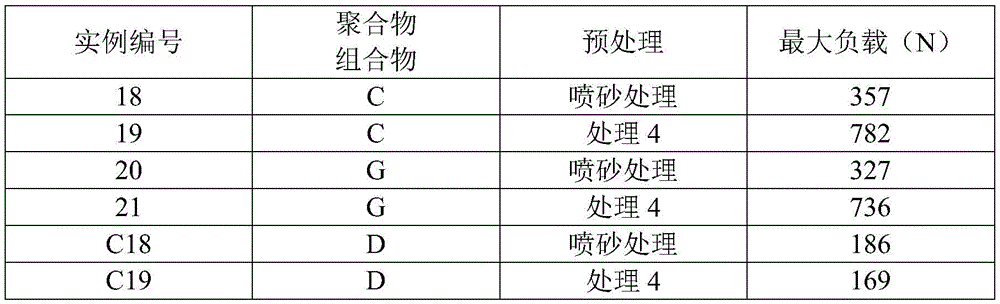
TABLE 2
The maximum load strength indicates a significant improvement in the adhesion strength of aluminum to PEEK-PEDEK compared to the adhesion strength of aluminum to PEEK.
Thus, it should now be appreciated that PEEK-PEDEK copolymers unexpectedly and/or unexpectedly bond better to metals as compared to PEEK.
The crystallinity referred to herein can be evaluated as described in the examples below.
Example 22-differential scanning calorimetry of the polyaryletherketones of example 1
Crystallinity can be assessed by several methods, for example by density, by IR spectroscopy, by x-ray diffraction or by Differential Scanning Calorimetry (DSC). The DSC method has been used to evaluate the crystallinity produced in the polymer of example 1 using a Mettler Toledo DSC1 star system with an FRS5 sensor.
The glass transition temperature (Tg), melting temperature (Tm), and heat of fusion of melting (Δ Hm) of the polymer of example 1 were measured using the following DSC method.
Compression molding a dried sample of the polymer into an amorphous film by: 7g of polymer were heated in a mould at 400 ℃ under a pressure of 50bar for 2 minutes, followed by quenching in cold water to produce a film with dimensions 120X120mm and a thickness in the region of 0.20 mm. 8mg plus or minus 3mg samples of each film were scanned by DSC as follows:
step 1 a preliminary thermal cycle was performed and recorded by heating the sample from 30 ℃ to 400 ℃ at 20 ℃/min.
Step 2 was held for 5 minutes.
Step 3 was cooled to 30 ℃ at 20 ℃/min and held for 5 minutes.
And 4, reheating the mixture from 30 ℃ to 400 ℃ at the speed of 20 ℃/min, and recording Tg, Tn, Tm, delta Hn and delta Hm.
From the DSC trace resulting from the scan in step 4, the onset of Tg is obtained when the lines plotted along the pre-inversion baseline intersect, and the line plotted along the maximum slope is obtained during the inversion. Tn is the temperature at which the main peak of the cold crystallization exotherm reaches a maximum. The Tm is the temperature at which the main peak of the melting endotherm reaches a maximum.
The heat of fusion (Δ Hm) of melting is obtained by connecting two points at which the melting endothermic curve deviates from the straight base line. The integral area under the endotherm as a function of time yields the enthalpy of fusion conversion (mJ): the mass normalized heat of fusion (J/g) was calculated by dividing the enthalpy by the sample mass. The crystallization level (%) was determined by dividing the heat of fusion of the sample by the heat of fusion of the fully crystalline polymer (130J/g for the polymer).
The invention is not restricted to the details of the foregoing embodiments. The invention extends to any novel one, or any novel combination, of the features disclosed in this specification (including any accompanying claims, abstract and drawings), or to any novel one, or any novel combination, of the steps of any method or process so disclosed.
Claims (23)
1. A component comprising a first portion and a second portion, wherein the second portion is in contact with the first portion, and wherein a surface of the second portion in contact with the first portion is pre-treated with a treatment selected from the group consisting of flame treatment, mechanical grinding, and chemical treatment, wherein:
(i) the first part comprises a polymer having repeating units of the formula:
-O-Ph-O-Ph-CO-Ph- I
and a repeat unit of the formula:
-O-Ph-Ph-O-Ph-CO-Ph- II
wherein Ph represents a phenylene moiety; and
(ii) the second portion comprises a metal;
wherein, in the polymer, the following relationship applies:
log 10 (X%)>1.50-0.26MV;
wherein X% refers to the crystallinity measured as described in example 22, and MV refers to the use of a capillary rheometer with a tungsten carbide die of circular cross-section of 0.5mm (capillary diameter) X3.175mm (capillary length) at 1000s -1 Shear rate the measured melt viscosity was run at 340 ℃.
2. The component of claim 1, wherein the second portion comprises a metal selected from the group consisting of aluminum and steel.
3. The component of claim 1 or 2, wherein the second portion comprises aluminum.
4. The component of any preceding claim, wherein the pre-treatment is a chemical treatment.
5. The component of claim 4, wherein the pretreatment is etching.
6. The component of claim 5, wherein the etching comprises an oxidizing agent comprising Fe 3+ A compound is provided.
7. The component of any preceding claim, wherein the polymer is in contact with less than 95% of the total surface area of the second portion.
8. The component according to any one of the preceding claims, wherein the relative molar ratio I: II of the recurring units I and II is from 65:35 to 95: 5.
9. The component according to any one of the preceding claims, wherein the repeat unit of formula I has the structure:

and the repeat unit of formula II has the structure:

10. the component of claim 9, wherein the polymer comprises 68 to 82 mol% (e.g., 72 to 77 mol%) of units of formula III and 18 to 32 mol% (e.g., 23 to 28 mol%) of units of formula IV.
11. The part of claim 9 or 10, wherein the sum of the mole% of formula III and IV units in the polymer is at least 95 mole%, and is defined as the ratio of the mole% of formula III units divided by the mole% of formula IV units is in the range of 1.8 to 5.6.
12. The component of any preceding claim, wherein the polymer has a Tm in the range of 290 to 310 ℃.
13. The component of any of the preceding claims, wherein the polymer is part of a composition comprising the polymer and a filler.
14. The component of claim 13, wherein the filler is selected from glass fibers, carbon fibers, aramid fibers, carbon black, and fluorocarbon resins, and preferably the filler is glass fibers.
15. The component of claim 13 or claim 14, wherein the composition comprises greater than 10 wt% filler.
16. A component according to any one of the preceding claims, wherein the force required to separate the first and second parts is greater than the force that would be required to separate the same first and second parts when there is only a mechanical interaction between the first and second parts.
17. A component according to any of the preceding claims, wherein the area of the first portion in contact with the second portion is at least 1cm 2 (preferably at least 25 cm) 2 ) (ii) a The thickness of the first portion, measured perpendicular to the interface between the first and second portions, is at least 1mm (preferably at least 2mm) and less than 20 mm; and the thickness of the second portion measured perpendicular to the interface between the first and second portions is at least 1mm and less than 20 mm.
18. A component according to any preceding claim, wherein the first portion overlies the second portion, and preferably the first portion comprises an overmoulded region on the second portion.
19. The component according to any of the preceding claims, wherein the component is part of a mobile electronic device, such as a device for connecting to the world wide web or for communication.
20. A method of manufacturing a component (e.g., a component as claimed in any one of claims 1 to 19), the method comprising:
(a) selecting a second portion comprising a metal;
(b) selecting a first moiety comprising a polymer or selecting a precursor comprising the first moiety of the polymer, wherein the first moiety comprises a polymer having a repeat unit of the formula:
-O-Ph-O-Ph-CO-Ph- I
and a repeat unit of the formula:
-O-Ph-Ph-O-Ph-CO-Ph- II
wherein Ph represents a phenylene moiety; and
(c) contacting the second portion with the first portion or the precursor.
21. The method of claim 20, wherein the polymer and the metal are as in any one of claims 1-19.
22. A method according to claim 20 or 21, wherein prior to step (c), the second portion is treated to modify the surface of the second portion which is subsequently contacted with the first portion or the precursor.
23. The method of claim 22, wherein said treating comprises a step comprising treating with a composition comprising Fe 3+ Oxidizing formulation of a compound treating said secondAnd (4) partial.
Applications Claiming Priority (4)
| Application Number | Priority Date | Filing Date | Title |
|---|---|---|---|
| GBGB1410221.4A GB201410221D0 (en) | 2014-06-09 | 2014-06-09 | Polymeric materials |
| GB1410221.4 | 2014-06-09 | ||
| PCT/GB2015/051599 WO2015189567A1 (en) | 2014-06-09 | 2015-06-02 | Polymeric materials |
| CN201580030246.6A CN106459402A (en) | 2014-06-09 | 2015-06-02 | Polymeric materials |
Related Parent Applications (1)
| Application Number | Title | Priority Date | Filing Date |
|---|---|---|---|
| CN201580030246.6A Division CN106459402A (en) | 2014-06-09 | 2015-06-02 | Polymeric materials |
Publications (1)
| Publication Number | Publication Date |
|---|---|
| CN115073727A true CN115073727A (en) | 2022-09-20 |
Family
ID=51266924
Family Applications (2)
| Application Number | Title | Priority Date | Filing Date |
|---|---|---|---|
| CN202210692648.4A Pending CN115073727A (en) | 2014-06-09 | 2015-06-02 | Polymeric materials |
| CN201580030246.6A Pending CN106459402A (en) | 2014-06-09 | 2015-06-02 | Polymeric materials |
Family Applications After (1)
| Application Number | Title | Priority Date | Filing Date |
|---|---|---|---|
| CN201580030246.6A Pending CN106459402A (en) | 2014-06-09 | 2015-06-02 | Polymeric materials |
Country Status (6)
| Country | Link |
|---|---|
| US (1) | US10981365B2 (en) |
| EP (1) | EP3152247B1 (en) |
| KR (2) | KR20170016836A (en) |
| CN (2) | CN115073727A (en) |
| GB (1) | GB201410221D0 (en) |
| WO (1) | WO2015189567A1 (en) |
Families Citing this family (11)
| Publication number | Priority date | Publication date | Assignee | Title |
|---|---|---|---|---|
| GB2543362A (en) * | 2015-10-16 | 2017-04-19 | Victrex Mfg Ltd | Polymeric materials |
| CN108779365B (en) | 2016-03-09 | 2021-07-09 | 索尔维特殊聚合物美国有限责任公司 | Polyaryletherketone composition and method for coating metal surface |
| US11352480B2 (en) | 2016-03-18 | 2022-06-07 | Ticona Llc | Polyaryletherketone composition |
| EP3494163B1 (en) | 2016-08-02 | 2020-10-07 | Solvay Specialty Polymers USA, LLC | Poly(aryl ether ketone) (paek) compositions including a low molecular weight aromatic compound |
| FR3070979B1 (en) * | 2017-09-08 | 2019-08-30 | Arkema France | CETONE CETONE POLYETHER PIECES HAVING ENHANCED DIMENSIONAL STABILITY |
| JP7284153B2 (en) * | 2017-09-14 | 2023-05-30 | ソルベイ スペシャルティ ポリマーズ ユーエスエー, エルエルシー | Polymer-metal bonding |
| US11267938B2 (en) * | 2017-12-20 | 2022-03-08 | Solvay Specialty Polymers Usa, Inc | Method of making a shaped article comprising printing layers of a polymer composition comprising at least one PEEK-PEmEK copolymer |
| US11118053B2 (en) | 2018-03-09 | 2021-09-14 | Ticona Llc | Polyaryletherketone/polyarylene sulfide composition |
| WO2019215304A1 (en) * | 2018-05-11 | 2019-11-14 | Solvay Specialty Polymers Usa, Llc | Polymer compositions |
| US11999113B2 (en) | 2018-05-31 | 2024-06-04 | Victrex Manufacturing Limited | Composite parts and processes of manufacture |
| GB2600905A (en) * | 2020-06-18 | 2022-05-18 | Victrex Mfg Ltd | Polymeric material and use thereof |
Citations (1)
| Publication number | Priority date | Publication date | Assignee | Title |
|---|---|---|---|---|
| EP0184458B1 (en) * | 1984-12-05 | 1989-10-18 | Imperial Chemical Industries Plc | Thermoplastic aromatic polyetherketones |
Family Cites Families (22)
| Publication number | Priority date | Publication date | Assignee | Title |
|---|---|---|---|---|
| US4767838A (en) | 1985-06-12 | 1988-08-30 | Amoco Corporation | Chain-extended poly(aryl ether ketones) |
| US4829143A (en) | 1986-10-28 | 1989-05-09 | Amoco Corporation | Modified poly(aryl ether ketones) derived from biphenol |
| US5869130A (en) | 1997-06-12 | 1999-02-09 | Mac Dermid, Incorporated | Process for improving the adhesion of polymeric materials to metal surfaces |
| US6712948B1 (en) * | 1998-11-13 | 2004-03-30 | Enthone Inc. | Process for metallizing a plastic surface |
| JP2000272049A (en) | 1999-03-23 | 2000-10-03 | Nikken Toso Kogyo Kk | Method for forming peek resin film and peek resin film |
| US6489616B2 (en) * | 2001-03-19 | 2002-12-03 | The Board Of Governors Of Southwest Missouri State University | Doped, organic carbon-containing sensor for infrared detection and a process for the preparation thereof |
| US6929705B2 (en) * | 2001-04-30 | 2005-08-16 | Ak Steel Corporation | Antimicrobial coated metal sheet |
| CN1400094A (en) | 2001-08-01 | 2003-03-05 | 中国科学院兰州化学物理研究所 | Plastics steel back self-lubricating wear-resisting composite material and its preparation method |
| JP2004140018A (en) * | 2002-10-15 | 2004-05-13 | Denso Corp | Method for manufacturing multilayer substrate, multilayer substrate, and mobile device using the same |
| KR100750586B1 (en) * | 2003-12-26 | 2007-08-20 | 한국전자통신연구원 | Microfluidic heating system |
| JP2006073763A (en) * | 2004-09-01 | 2006-03-16 | Denso Corp | Multilayer substrate manufacturing method |
| DE102004048625A1 (en) * | 2004-10-06 | 2006-04-20 | Forschungszentrum Karlsruhe Gmbh | Thermoplastic plastic and metal component joining method involves use of plastic containing ketone molecules and metal containing iron, aluminum or chrome and metal is heated at interface between components |
| US8455557B2 (en) * | 2006-05-24 | 2013-06-04 | Ben Gurion University Of The Negev R&D Authority | Membranes, coatings and films and methods for their preparation |
| WO2009058362A1 (en) | 2007-11-02 | 2009-05-07 | Polymics, Ltd. | High temperature substrate protective structure |
| GB0818967D0 (en) * | 2008-10-16 | 2008-11-26 | Victrex Mfg Ltd | Polymeric materials |
| GB2471508A (en) * | 2009-07-02 | 2011-01-05 | Invibio Ltd | Composite enclosure with specific WVTR and impact strength, used in an implantable device |
| US8858854B2 (en) | 2010-04-01 | 2014-10-14 | Flextronics Ap, Llc | System and method for plastic overmolding on a metal surface |
| GB201117796D0 (en) * | 2011-10-14 | 2011-11-30 | Victrex Mfg Ltd | Polymeric materials |
| JP6339020B2 (en) | 2011-12-21 | 2018-06-06 | ソルベイ スペシャルティ ポリマーズ ユーエスエー, エルエルシー | High performance polymer compositions for portable electronic devices |
| CN102602080B (en) | 2012-03-13 | 2015-04-08 | 大连路阳科技开发有限公司 | Steel-base polyether-ether-ketone composite plate and manufacturing method thereof |
| WO2014037374A1 (en) | 2012-09-04 | 2014-03-13 | Solvay Specialty Polymers Usa, Llc | High melt flow peak compositions |
| GB201314321D0 (en) | 2013-08-09 | 2013-09-25 | Victrex Mfg Ltd | Polymeric materials |
-
2014
- 2014-06-09 GB GBGB1410221.4A patent/GB201410221D0/en not_active Ceased
-
2015
- 2015-06-02 EP EP15728917.4A patent/EP3152247B1/en active Active
- 2015-06-02 KR KR1020167033276A patent/KR20170016836A/en not_active Ceased
- 2015-06-02 CN CN202210692648.4A patent/CN115073727A/en active Pending
- 2015-06-02 KR KR1020237009703A patent/KR20230042764A/en not_active Ceased
- 2015-06-02 WO PCT/GB2015/051599 patent/WO2015189567A1/en not_active Ceased
- 2015-06-02 US US15/314,619 patent/US10981365B2/en active Active
- 2015-06-02 CN CN201580030246.6A patent/CN106459402A/en active Pending
Patent Citations (1)
| Publication number | Priority date | Publication date | Assignee | Title |
|---|---|---|---|---|
| EP0184458B1 (en) * | 1984-12-05 | 1989-10-18 | Imperial Chemical Industries Plc | Thermoplastic aromatic polyetherketones |
Non-Patent Citations (5)
| Title |
|---|
| 徐湘湘: "《实用防腐蚀工程施工手册 第1版》", 30 April 2000, 化学工业出版社, pages: 1223 * |
| 李子东等: "《《塑料标准汇编:1995第1版》", 28 February 1997, 北京:国防工业出版社, pages: 217 - 230 * |
| 李子东等: "《实用胶粘技术 第2版》", 北京:国防工业出版社, pages: 217 - 230 * |
| 汪多仁: "《绿色纳米化学品 第1版》", 31 July 2007, 科学技术文出版社, pages: 271 * |
| 马之庚等: "《现代工程材料手册 第1版》", 31 May 2005, 国防工业出版社, pages: 627 * |
Also Published As
| Publication number | Publication date |
|---|---|
| CN106459402A (en) | 2017-02-22 |
| WO2015189567A1 (en) | 2015-12-17 |
| EP3152247A1 (en) | 2017-04-12 |
| KR20230042764A (en) | 2023-03-29 |
| US10981365B2 (en) | 2021-04-20 |
| KR20170016836A (en) | 2017-02-14 |
| GB201410221D0 (en) | 2014-07-23 |
| EP3152247B1 (en) | 2019-10-30 |
| US20170197393A1 (en) | 2017-07-13 |
Similar Documents
| Publication | Publication Date | Title |
|---|---|---|
| CN115073727A (en) | Polymeric materials | |
| CN101547779B (en) | Process for production of highly corrosion-resistant composite | |
| EP0125816B1 (en) | Method of increasing molecular weight of poly(aryl ethers) | |
| JP6725889B2 (en) | Metal/resin composite structure and manufacturing method thereof | |
| JP2011173353A (en) | Composite structure | |
| JPWO2011148929A1 (en) | Resin composition for blow hollow molded article, blow hollow molded article and production method | |
| JP6558030B2 (en) | Polyarylene sulfide resin composition and sealing member for secondary battery sealing plate comprising the same | |
| US11440996B2 (en) | Preparation method of polyphenylene sulfide resin, and polyphenylene sulfide resin prepared thereby | |
| JP6241175B2 (en) | COMPOSITE MOLDED ARTICLE WITH MOLDED ARTICLE COMPOSED OF POLYPHENYLENE SULFIDE RESIN COMPOSITION AND METAL Foil | |
| KR20110110217A (en) | Chromium-free method of conditioning and etching of thermoplastic substrates for metal plating | |
| JP5038844B2 (en) | Poly (arylene sulfide) composition with improved processability | |
| WO2018010206A1 (en) | Aromatic polyamide composite for use in electroplating treatment and preparation method therefor | |
| TWI250078B (en) | Metal covering molding article and its manufacturing method | |
| CN114762065A (en) | Conductive member, method for manufacturing conductive member, power conversion device, motor, secondary battery module, and secondary battery pack | |
| JP6809199B2 (en) | Metal member-polyarylene sulfide resin member composite | |
| JP7379974B2 (en) | Method for manufacturing metal component-polyarylene sulfide resin component composite | |
| JP2018030349A (en) | Composite structure and method for producing the same | |
| JP7844870B2 (en) | Metal component-polyarylene sulfide resin component composite and method for manufacturing the same | |
| JP7753718B2 (en) | Metal member-polyarylene sulfide resin member composite and manufacturing method thereof | |
| JP7753717B2 (en) | Metal member-polyarylene sulfide member composite and manufacturing method thereof | |
| JP2016215630A (en) | Surface-treated aluminum material and method for producing the same, and composite molding and method for producing the same | |
| CN113272129A (en) | Bonded structure and method for manufacturing same | |
| CN111386361B (en) | Etchant, roughened base material and method for producing the same, and base material-resin cured product combination and method for producing the same | |
| JP2024079998A (en) | Method for manufacturing polyarylene sulfide resin molded article and composite structure | |
| WO2023017762A1 (en) | Metal member–polyarylene sulfide member complex and production method therefor |
Legal Events
| Date | Code | Title | Description |
|---|---|---|---|
| PB01 | Publication | ||
| PB01 | Publication | ||
| SE01 | Entry into force of request for substantive examination | ||
| SE01 | Entry into force of request for substantive examination |