CN115035552B - Fall detection method and device, equipment terminal and readable storage medium - Google Patents
Fall detection method and device, equipment terminal and readable storage medium Download PDFInfo
- Publication number
- CN115035552B CN115035552B CN202210958234.1A CN202210958234A CN115035552B CN 115035552 B CN115035552 B CN 115035552B CN 202210958234 A CN202210958234 A CN 202210958234A CN 115035552 B CN115035552 B CN 115035552B
- Authority
- CN
- China
- Prior art keywords
- human
- image
- layer
- target image
- target
- Prior art date
- Legal status (The legal status is an assumption and is not a legal conclusion. Google has not performed a legal analysis and makes no representation as to the accuracy of the status listed.)
- Active
Links
Images


Classifications
-
- G—PHYSICS
- G06—COMPUTING OR CALCULATING; COUNTING
- G06V—IMAGE OR VIDEO RECOGNITION OR UNDERSTANDING
- G06V40/00—Recognition of biometric, human-related or animal-related patterns in image or video data
- G06V40/10—Human or animal bodies, e.g. vehicle occupants or pedestrians; Body parts, e.g. hands
- G06V40/103—Static body considered as a whole, e.g. static pedestrian or occupant recognition
-
- G—PHYSICS
- G06—COMPUTING OR CALCULATING; COUNTING
- G06N—COMPUTING ARRANGEMENTS BASED ON SPECIFIC COMPUTATIONAL MODELS
- G06N3/00—Computing arrangements based on biological models
- G06N3/02—Neural networks
- G06N3/08—Learning methods
-
- G—PHYSICS
- G06—COMPUTING OR CALCULATING; COUNTING
- G06V—IMAGE OR VIDEO RECOGNITION OR UNDERSTANDING
- G06V10/00—Arrangements for image or video recognition or understanding
- G06V10/20—Image preprocessing
- G06V10/34—Smoothing or thinning of the pattern; Morphological operations; Skeletonisation
-
- G—PHYSICS
- G06—COMPUTING OR CALCULATING; COUNTING
- G06V—IMAGE OR VIDEO RECOGNITION OR UNDERSTANDING
- G06V10/00—Arrangements for image or video recognition or understanding
- G06V10/40—Extraction of image or video features
- G06V10/44—Local feature extraction by analysis of parts of the pattern, e.g. by detecting edges, contours, loops, corners, strokes or intersections; Connectivity analysis, e.g. of connected components
-
- G—PHYSICS
- G06—COMPUTING OR CALCULATING; COUNTING
- G06V—IMAGE OR VIDEO RECOGNITION OR UNDERSTANDING
- G06V10/00—Arrangements for image or video recognition or understanding
- G06V10/70—Arrangements for image or video recognition or understanding using pattern recognition or machine learning
- G06V10/764—Arrangements for image or video recognition or understanding using pattern recognition or machine learning using classification, e.g. of video objects
-
- G—PHYSICS
- G06—COMPUTING OR CALCULATING; COUNTING
- G06V—IMAGE OR VIDEO RECOGNITION OR UNDERSTANDING
- G06V10/00—Arrangements for image or video recognition or understanding
- G06V10/70—Arrangements for image or video recognition or understanding using pattern recognition or machine learning
- G06V10/82—Arrangements for image or video recognition or understanding using pattern recognition or machine learning using neural networks
-
- G—PHYSICS
- G06—COMPUTING OR CALCULATING; COUNTING
- G06V—IMAGE OR VIDEO RECOGNITION OR UNDERSTANDING
- G06V20/00—Scenes; Scene-specific elements
- G06V20/50—Context or environment of the image
- G06V20/52—Surveillance or monitoring of activities, e.g. for recognising suspicious objects
Landscapes
- Engineering & Computer Science (AREA)
- Theoretical Computer Science (AREA)
- Physics & Mathematics (AREA)
- General Physics & Mathematics (AREA)
- Multimedia (AREA)
- Evolutionary Computation (AREA)
- Health & Medical Sciences (AREA)
- General Health & Medical Sciences (AREA)
- Software Systems (AREA)
- Computing Systems (AREA)
- Computer Vision & Pattern Recognition (AREA)
- Artificial Intelligence (AREA)
- Medical Informatics (AREA)
- Databases & Information Systems (AREA)
- Life Sciences & Earth Sciences (AREA)
- Biomedical Technology (AREA)
- Biophysics (AREA)
- Computational Linguistics (AREA)
- Data Mining & Analysis (AREA)
- Molecular Biology (AREA)
- General Engineering & Computer Science (AREA)
- Mathematical Physics (AREA)
- Human Computer Interaction (AREA)
- Image Analysis (AREA)
Abstract
The application relates to a fall detection method, a device, an equipment terminal and a readable storage medium, wherein the fall detection method comprises the following steps: detecting pedestrians in the input video frame image data based on a YOLOv5 target detection model to output a human-shaped target image; inputting a preset number of human-shaped target data frame images into a preset time period network for judgment to obtain corresponding human body action category information; according to the human body action category information, whether the corresponding human body is in a falling state or not is judged, and the falling detection method can accurately judge the falling state of the human body under different scene coverage conditions.
Description
Technical Field
The present application relates to the field of image data processing, and in particular, to a fall detection method, apparatus, device terminal, and readable storage medium.
Background
OpenPose is a key point identification technology based on skeletal point identification, wherein OpenPose relies on PAF channel output, and in a complex scene, when a human body falls, for example, in a dark scene, a background disorder and other scenes, misjudgment is easily caused, and an umbrella stand or a table leg is easily identified as a part of the human body, so that the identification accuracy of the falling behavior of the human body is influenced.
Disclosure of Invention
In view of this, the application provides a fall detection method, a fall detection device, an apparatus terminal, and a readable storage medium, which can improve the accuracy of identifying a fall behavior of a human body in a complex scene.
A fall detection method comprising:
detecting pedestrians in the input video frame image data based on a YOLOv5 target detection model to output and obtain a human-shaped target image;
inputting a preset number of human-shaped target data frame images into a preset time period network for judgment to obtain corresponding human body action category information;
and judging whether the corresponding human body is in a falling state or not according to the human body action category information.
In one embodiment, the YOLOv5 target detection model includes an input layer, a feature extraction layer, a prediction output layer and an image output processing layer which are connected in sequence, and the step of detecting pedestrians in the input video frame image data based on the YOLOv5 target detection model to output a human-shaped target image includes:
detecting pedestrians in the input video frame image data based on the input layer, the feature extraction layer and the prediction output layer to obtain a preliminary human-shaped target image;
and adjusting the size of the preliminary human-shaped target image based on the image output processing layer to obtain a square human-shaped target image.
In one embodiment, the step of resizing the preliminary human-shaped target image based on the image output processing layer to obtain a square human-shaped target image comprises:
acquiring a preliminary human-shaped target image based on the image output processing layer, and judging whether the preliminary human-shaped target image is square or not;
if not, acquiring the longest edge in the preliminary humanoid target image;
calculating a scaling coefficient according to the longest edge in the preliminary humanoid target image, and scaling the preliminary humanoid target image according to the scaling coefficient to obtain a scaled preliminary humanoid target image;
and outputting the square humanoid target image by taking the longest edge of the zoomed preliminary humanoid target image as the reference edge length.
In one embodiment, the step of outputting the square human-shaped target image with the longest side of the scaled preliminary human-shaped target image as the reference side length comprises:
generating a corresponding black square background image by taking the longest edge of the zoomed preliminary human-shaped target image as the reference edge length;
and aligning the longest edge in the scaled preliminary human-shaped target image with one edge in the black square background image to generate and output a square human-shaped target image.
In one embodiment, a smoothing network layer is arranged between the feature extraction layer and the prediction output layer,
a smooth network layer is arranged between the characteristic extraction layer and the prediction output layer, and the step of detecting pedestrians in the input video frame image data based on a Yolov5 target detection model to output a human-shaped target image comprises the following steps:
processing the input video frame image data based on the input layer and the feature extraction layer, and extracting to obtain an intermediate feature map of a corresponding target;
acquiring intermediate characteristic graphs corresponding to the same target in image data of adjacent video frames;
smoothing each input intermediate feature map based on a smoothing network layer to obtain the change information of speed, position, acceleration and area between the intermediate feature maps corresponding to the same target in the image data of adjacent video frames;
inputting the change information into a prediction output layer for feature fusion so as to output and obtain a preliminary humanoid target image;
and adjusting the size of the preliminary human-shaped target image based on the image output processing layer to obtain a square human-shaped target image.
In one embodiment, the corresponding loss function in the YOLOv5 target detection model is:
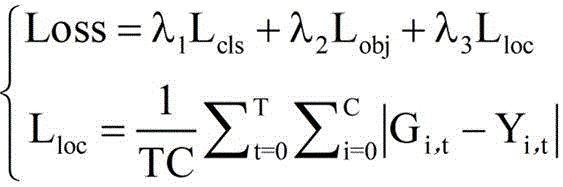
wherein, loss is a corresponding Loss function in a Yolov5 target detection model, L cls In order to classify the loss in question, is L cls Corresponding coefficient of (A), L obj In order to target the loss of the material,
 is L obj Corresponding coefficient of (A), L loc In order to smooth the losses that are lost,
 is L loc C is the number of key coordinate points in the target detection frame, T is the total frame number of the video frame image data corresponding to the intermediate feature map, T is the frame variable,
 representing the predicted value of the target detection frame corresponding to the image data of the t-th frame video frame after the smoothing treatment, i represents a key coordinate point variable, and Y represents a key coordinate point variable i,t And the real value of the target detection frame corresponding to the image data of the t-th frame video frame is represented.
In one embodiment, the feature extraction layer includes a backbone unit, a spatial efficiency measurement unit and a hack unit, the input layer and the feature extraction layer are based on processing input video frame image data, and the step of extracting the intermediate feature map of the corresponding target includes:
based on an input layer and a backbone unit, carrying out slicing operation and convolution operation on input video frame image data to obtain an initial feature map;
based on the spatial efficiency measurement unit, carrying out spatial characteristic enhancement processing on the initial characteristic diagram to obtain a corresponding enhanced characteristic diagram;
and performing secondary feature extraction on the enhanced feature map based on the Neck unit to obtain an intermediate feature map of the corresponding target.
Furthermore, there is provided a fall detection apparatus comprising:
the image generation unit is used for detecting pedestrians in the input video frame image data based on a YOLOv5 target detection model so as to output a humanoid target image;
the category information generation unit is used for inputting a preset number of human-shaped target data frame images into a preset time period network for judgment so as to obtain corresponding human body action category information;
and the state judgment unit is used for judging whether the corresponding human body is in a falling state or not according to the human body action category information.
Furthermore, a device terminal is provided, the device terminal comprising a processor and a memory for storing a computer program, the processor running the computer program to cause the device terminal to perform the fall detection method described above.
Furthermore, a readable storage medium is provided, which stores a computer program which, when executed by a processor, implements the fall detection method described above.
The fall detection method detects pedestrians in input video frame image data based on a YOLOv5 target detection model so as to output and obtain a human-shaped target image; inputting a preset number of human-shaped target data frame images into a preset time period network for judgment to obtain corresponding human body action category information; judging whether the corresponding human body is in a falling state or not according to the human body action type information, combining a YOLOv5 target detection model with a preset time period network, directly detecting and identifying pedestrians in input video frame image data by using the YOLOv5 target detection model to obtain a human-shaped target image, and then further inputting the human-shaped target image into the preset time period network for further judgment and identification.
Drawings
In order to more clearly illustrate the technical solutions in the embodiments of the present application, the drawings required to be used in the description of the embodiments are briefly introduced below, and it is obvious that the drawings in the description below are only some embodiments of the present application, and it is obvious for those skilled in the art to obtain other drawings based on these drawings without creative efforts.
Fig. 1 is a schematic flowchart of a fall detection method provided in an embodiment of the present application;
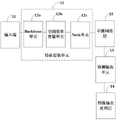
fig. 2 is a block diagram of a YOLOv5 target detection model provided in an embodiment of the present application;
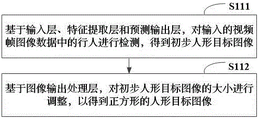
FIG. 3 is a schematic flow chart of obtaining a square human-shaped target image according to an embodiment of the present disclosure;
FIG. 4 is a schematic diagram of another process for obtaining a square human-shaped target image according to an embodiment of the present disclosure;
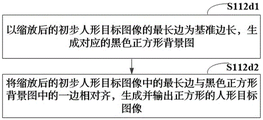
FIG. 5 is a schematic flow chart of obtaining a square human-shaped target image according to an embodiment of the present disclosure;
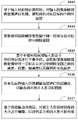
FIG. 6 is a schematic flow chart of obtaining a preliminary human-shaped target image according to an embodiment of the present disclosure;
FIG. 7 is a flowchart illustrating an intermediate feature map for obtaining a corresponding target according to an embodiment of the present application;
fig. 8 is a block diagram of a fall detection apparatus according to an embodiment of the present application.
Detailed Description
The technical solutions in the embodiments of the present application are clearly and completely described below with reference to the accompanying drawings, and it is obvious that the described embodiments are only some embodiments of the present application, and not all embodiments. Based on the embodiments in the present application. The embodiments described below and their technical features may be combined with each other without conflict.
As shown in fig. 1, there is provided a fall detection method comprising:
step S110, detecting a pedestrian in the input video frame image data based on the YOLOv5 target detection model, so as to output a human-shaped target image.
The Yolov5 target detection model is a pre-trained target model, in the training process, a training data set usually adopts COCO2017, wherein the training is only performed on the pedestrian part, and random amplification is performed on images at 90 degrees clockwise and counterclockwise in the training process in an image rotating mode, so that the detection capability of the Yolov5 target detection model on a falling human body is enhanced.
In the input video frame image data, based on a Yolov5 target detection model, a pedestrian in each input video frame image is detected, so as to output and obtain a corresponding human-shaped target image.
And step S120, inputting a preset number of human-shaped target data frame images into a preset time period network for judgment so as to obtain corresponding human body action category information.
The network in the preset time period is TSN (Temporal Segment Networks), the TSN samples a series of short segments, each Segment gives out initial prediction of the Segment for behavior category, and the video-level prediction result is obtained from the common knowledge of the segments.
In this embodiment, the preset number of human-shaped target data frame images are input into the preset time period network for judgment, so as to obtain corresponding human body action category information.
And step S130, judging whether the corresponding human body is in a falling state or not according to the human body action type information.
The human body action category information comprises human body posture information, and whether the human body falls down can be judged according to the change degree of the human body posture information.
In one embodiment, the YOLOv5 target detection model detects pedestrians in the input video frame image data, detects a preset number of frames of video frame images (for example, 30 frames of video frame images per second) per second, obtains a corresponding human-shaped target image, further inputs the corresponding human-shaped target image into a preset time period network for judgment, obtains human motion category information, and finally judges whether the corresponding human body is in a falling state according to the human motion category information.
In one embodiment, the backbone network in the preset time period network may adopt a Mobilenetv3 network modified to be more lightweight, so as to improve the detection speed of the fall detection method as a whole.
The fall detection method detects pedestrians in input video frame image data based on a YOLOv5 target detection model so as to output and obtain a human-shaped target image; inputting a preset number of human-shaped target data frame images into a preset time period network for judgment to obtain corresponding human body action category information; according to the human body action type information, whether a corresponding human body is in a falling state is judged, a YOLOv5 target detection model is combined with a preset time period network, pedestrians in input video frame image data are directly detected and identified by the YOLOv5 target detection model to obtain a human-shaped target image, and then the human-shaped target image is further input into the preset time period network for further judgment and identification.
In one embodiment, as shown in fig. 2, the YOLOv5 target detection model includes an input layer 11, a feature extraction layer 12, a prediction output layer 13, and an image output processing layer 14, which are connected in sequence, as shown in fig. 3, and step S110 includes:
and step S111, detecting pedestrians in the input video frame image data based on the input layer, the feature extraction layer and the prediction output layer to obtain a preliminary human-shaped target image.
The input feature maps corresponding to the respective targets are compared to obtain the change information of the current video frame, which usually includes the position, velocity and acceleration information of the corresponding targets.
And step S112, adjusting the size of the preliminary human-shaped target image based on the image output processing layer to obtain a square human-shaped target image.
In one embodiment, as shown in fig. 4, step S112 includes:
and S112a, acquiring a preliminary human-shaped target image based on the image output processing layer, judging whether the preliminary human-shaped target image is square or not, and if not, entering the step S112b.
In step S112b, the longest side in the preliminary human-shaped target image is acquired.
And step S112c, calculating a scaling coefficient according to the longest edge in the preliminary humanoid target image, and scaling the preliminary humanoid target image according to the scaling coefficient to obtain the scaled preliminary humanoid target image.
And step S112d, outputting the square human-shaped target image by taking the longest edge of the scaled preliminary human-shaped target image as the reference side length.
In one embodiment, as shown in fig. 5, step S112d includes:
and step S112d1, generating a corresponding black square background image by taking the longest edge of the zoomed preliminary human-shaped target image as the reference edge length.
And step S112d2, aligning the longest edge in the scaled preliminary human-shaped target image with one edge in the black square background image, and generating and outputting a square human-shaped target image.
In one embodiment, as shown in fig. 3, a smoothing network layer 14 is further disposed between the feature extraction layer 12 and the prediction output layer 13, and as shown in fig. 6, step S110 includes:
and S113, processing the input video frame image data based on the input layer and the feature extraction layer, and extracting to obtain an intermediate feature map of the corresponding target.
And step S114, acquiring intermediate characteristic maps corresponding to the same target in the image data of the adjacent video frames.
And step S115, smoothing each input intermediate feature map based on the smoothing network layer, and acquiring the change information of speed, position, acceleration and area between the intermediate feature maps corresponding to the same target in the image data of adjacent video frames. However, when a pedestrian falls, the video frame images tend to have larger jitter, and dynamic detection on whether the pedestrian falls also needs to further consider the morphological change of the pedestrian target, i.e. improve a general smooth network, and add morphological change parameter detection, for example, by comparing the areas of the respective intermediate feature maps (i.e. detection frames) to determine the morphological change of the pedestrian target.
And step S116, inputting the change information into a prediction output layer for feature fusion so as to output and obtain a preliminary humanoid target image.
When the change information is input to the prediction output Layer, the change information is usually fused in a Fusion Layer (Fusion Layer) in the prediction output Layer.
And step S117, adjusting the size of the preliminary human-shaped target image based on the image output processing layer to obtain a square human-shaped target image.
Step S112 in fig. 3 and 4 is the same as step S117, and step S117 is not described again here.
In this embodiment, a corresponding smooth network layer is constructed from changes in the position, speed, acceleration, and area information of the detection frame of the target, so that the accuracy of detecting pedestrians in the video frame image can be further improved, and a more accurate square human-shaped target image can be obtained.
In one embodiment, the corresponding loss function in the YOLOv5 target detection model is:

wherein, loss is a corresponding Loss function in a Yolov5 target detection model, L cls In order to classify the loss in question, is L cls Corresponding coefficient of (A), L obj In order to target the loss of the material,
 is L obj Corresponding coefficient of (A), L loc In order to smooth the losses that are lost,
 is L loc C is the number of key coordinate points in the target detection frame, T is the total frame number of the video frame image data corresponding to the intermediate feature map, T is the frame variable,
 representing the predicted value of the target detection frame corresponding to the image data of the t-th frame video frame after the smoothing treatment, i represents a key coordinate point variable, and Y represents a key coordinate point variable i,t And the real value of the target detection frame corresponding to the image data of the t-th frame video frame is represented.
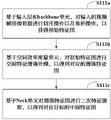
In one embodiment, as shown in fig. 3, the feature extraction layer 12 includes a backbone unit 12a, a spatial efficiency metric unit 12b, and a hack unit 12c, as shown in fig. 7, and step S111 includes:
in step S111a, based on the input layer and the backbone unit, a slicing operation and a convolution operation are performed on the input video frame image data to obtain an initial feature map.
And step S111b, carrying out spatial feature enhancement processing on the initial feature map based on the spatial efficiency measurement unit to obtain a corresponding enhanced feature map.
And step S111c, performing secondary feature extraction on the enhanced feature map based on the Neck unit to obtain an intermediate feature map of the corresponding target.
In this embodiment, by further providing a spatial efficiency measurement unit, that is, by performing spatial characteristic enhancement processing on the feature branch (that is, the corresponding initial feature map) extracted from each trunk network by using the spatial efficiency measurement unit, the receptive field of the detection network can be enlarged as a whole, and the accuracy of the fall detection method can be improved as a whole.
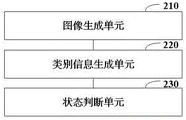
Further, as shown in fig. 8, there is also provided a fall detection apparatus 200 including:
an image generating unit 210, configured to detect a pedestrian in the input video frame image data based on the YOLOv5 target detection model, so as to output a human-shaped target image;
the category information generating unit 220 is configured to input a preset number of human-shaped target data frame images into a preset time period network for judgment to obtain corresponding human body motion category information;
a state determining unit 230, configured to determine whether the corresponding human body is in a falling state according to the human body motion category information.
Furthermore, an apparatus terminal is provided, the apparatus terminal comprising a processor and a memory, the memory being used for storing a computer program, the processor running the computer program to cause the apparatus terminal to execute the fall detection method described above.
Furthermore, a readable storage medium is provided, which stores a computer program that, when executed by a processor, implements the fall detection method described above.
The division of the units in the fall detection apparatus 200 is merely for illustration, and in other embodiments, the fall detection apparatus 200 can be divided into different units as needed to complete all or part of the functions of the fall detection apparatus 200. For the above-mentioned specific definition of the fall detection apparatus 200, reference may be made to the above definition of the method, which is not described herein again.
That is, the above are only embodiments of the present application, and not intended to limit the scope of the present application, and all equivalent structures or equivalent flow transformations made by using the contents of the specification and the drawings of the present application, such as the combination of technical features between various embodiments, or the direct or indirect application to other related technical fields, are all included in the scope of the present application.
In addition, structural elements having the same or similar characteristics may be identified by the same or different reference numerals. Furthermore, the terms "first", "second" and "first" are used for descriptive purposes only and are not to be construed as indicating or implying relative importance or to implicitly indicate the number of technical features indicated. Thus, a feature defined as "first" or "second" may explicitly or implicitly include one or more features. In the description of the present application, "a plurality" means two or more unless specifically limited otherwise.
In this application, the word "for example" is used to mean "serving as an example, instance, or illustration. Any embodiment described herein as "for example" is not necessarily to be construed as preferred or advantageous over other embodiments. The previous description is provided to enable any person skilled in the art to make and use the present application. In the foregoing description, various details have been set forth for the purpose of explanation.
It will be apparent to one of ordinary skill in the art that the present application may be practiced without these specific details. In other instances, well-known structures and processes are not shown in detail to avoid obscuring the description of the present application with unnecessary detail. Thus, the present application is not intended to be limited to the embodiments shown, but is to be accorded the widest scope consistent with the principles and features disclosed herein.
Claims (8)
1. A fall detection method, comprising:
detecting pedestrians in the input video frame image data based on a YOLOv5 target detection model to output and obtain a human-shaped target image;
inputting a preset number of human-shaped target data frame images into a preset time period network for judgment to obtain corresponding human body action category information;
judging whether the corresponding human body is in a falling state or not according to the human body action category information;
the YOLOv5 target detection model comprises an input layer, a feature extraction layer, a prediction output layer and an image output processing layer which are sequentially connected;
a smoothing network layer is further arranged between the feature extraction layer and the prediction output layer, and the step of detecting pedestrians in the input video frame image data based on the YOLOv5 target detection model to output a human-shaped target image comprises the following steps:
processing the input video frame image data based on the input layer and the feature extraction layer, and extracting to obtain an intermediate feature map of a corresponding target;
acquiring intermediate characteristic graphs corresponding to the same target in image data of adjacent video frames;
based on the smoothing network layer, smoothing each input intermediate feature map to obtain the change information of speed, position, acceleration and area between the intermediate feature maps corresponding to the same target in the image data of adjacent video frames;
inputting the change information into the prediction output layer for feature fusion so as to output and obtain a preliminary humanoid target image;
and adjusting the size of the preliminary human-shaped target image based on the image output processing layer to obtain a square human-shaped target image.
2. The fall detection method according to claim 1, wherein the step of resizing the preliminary human-shaped target image based on the image output processing layer to obtain a square human-shaped target image comprises:
acquiring the preliminary human-shaped target image based on the image output processing layer, and judging whether the preliminary human-shaped target image is square or not;
if not, acquiring the longest edge in the preliminary humanoid target image;
calculating a scaling coefficient according to the longest edge in the preliminary human-shaped target image, and scaling the preliminary human-shaped target image according to the scaling coefficient to obtain a scaled preliminary human-shaped target image;
and outputting a square humanoid target image by taking the longest edge of the zoomed preliminary humanoid target image as the reference edge length.
3. A fall detection method as claimed in claim 2, wherein the step of outputting a square human-shaped target image with the longest side of the scaled preliminary human-shaped target image as a reference side length comprises:
generating a corresponding black square background image by taking the longest edge of the zoomed preliminary humanoid target image as a reference edge length;
and aligning the longest edge in the scaled preliminary human-shaped target image with one edge in the black square background image to generate and output a square human-shaped target image.
4. Fall detection method according to claim 1, wherein the corresponding loss function in the YOLOv5 target detection model is:

wherein, loss is a corresponding Loss function in a Yolov5 target detection model, L cls In order to classify the loss in question, is L cls Corresponding coefficient of (A), L obj In order to target the loss of the material,
 is L obj Corresponding coefficient of (a), L loc In order to smooth the losses that are lost,
 is L loc C is the number of key coordinate points in the target detection frame, T is the total frame number of the video frame image data corresponding to the intermediate feature map, T is a frame variable,
 representing the predicted value of the target detection frame corresponding to the image data of the t-th frame video frame after the smoothing treatment, i represents a key coordinate point variable, and Y represents a key coordinate point variable i,t And the real value of the target detection frame corresponding to the image data of the t-th frame video frame is represented.
5. The fall detection method according to claim 1, wherein the feature extraction layer comprises a backbone unit, a spatial efficiency measurement unit, and a hack unit, and the step of processing the input video frame image data based on the input layer and the feature extraction layer to obtain the intermediate feature map of the corresponding target comprises:
based on the input layer and the backbone unit, carrying out slicing operation and convolution operation on input video frame image data to obtain an initial feature map;
based on the spatial efficiency measurement unit, carrying out spatial characteristic enhancement processing on the initial characteristic diagram to obtain a corresponding enhanced characteristic diagram;
and performing secondary feature extraction on the enhanced feature map based on the Neck unit to obtain an intermediate feature map of the corresponding target.
6. A fall detection apparatus, comprising:
the image generation unit is used for detecting pedestrians in the input video frame image data based on a YOLOv5 target detection model so as to output and obtain a human-shaped target image;
the category information generation unit is used for inputting a preset number of human-shaped target data frame images into a preset time period network for judgment so as to obtain corresponding human body action category information;
the state judging unit is used for judging whether the corresponding human body is in a falling state or not according to the human body action type information;
the YOLOv5 target detection model comprises an input layer, a feature extraction layer, a prediction output layer and an image output processing layer which are sequentially connected;
a smoothing network layer is further provided between the feature extraction layer and the prediction output layer, and the image generation unit includes:
the first feature extraction subunit is used for processing the input video frame image data based on the input layer and the feature extraction layer and extracting an intermediate feature map of a corresponding target;
the second feature extraction subunit is used for acquiring intermediate feature maps corresponding to the same target in the image data of the adjacent video frames;
the smoothing processing subunit is used for smoothing each input intermediate feature map based on the smoothing network layer to acquire the change information of speed, position, acceleration and area between the intermediate feature maps corresponding to the same target in the image data of adjacent video frames;
the characteristic fusion subunit is used for inputting the change information into the prediction output layer to perform characteristic fusion so as to output and obtain a preliminary human-shaped target image;
and the image adjusting subunit is used for adjusting the size of the preliminary human-shaped target image based on the image output processing layer so as to obtain a square human-shaped target image.
7. A device terminal, characterized in that the device terminal comprises a processor and a memory for storing a computer program, the processor running the computer program to cause the device terminal to perform a fall detection method as claimed in any one of claims 1 to 5.
8. A readable storage medium, characterized in that the readable storage medium stores a computer program which, when executed by a processor, implements a fall detection method as claimed in any one of claims 1 to 5.
Priority Applications (1)
| Application Number | Priority Date | Filing Date | Title |
|---|---|---|---|
| CN202210958234.1A CN115035552B (en) | 2022-08-11 | 2022-08-11 | Fall detection method and device, equipment terminal and readable storage medium |
Applications Claiming Priority (1)
| Application Number | Priority Date | Filing Date | Title |
|---|---|---|---|
| CN202210958234.1A CN115035552B (en) | 2022-08-11 | 2022-08-11 | Fall detection method and device, equipment terminal and readable storage medium |
Publications (2)
| Publication Number | Publication Date |
|---|---|
| CN115035552A CN115035552A (en) | 2022-09-09 |
| CN115035552B true CN115035552B (en) | 2023-01-17 |
Family
ID=83129959
Family Applications (1)
| Application Number | Title | Priority Date | Filing Date |
|---|---|---|---|
| CN202210958234.1A Active CN115035552B (en) | 2022-08-11 | 2022-08-11 | Fall detection method and device, equipment terminal and readable storage medium |
Country Status (1)
| Country | Link |
|---|---|
| CN (1) | CN115035552B (en) |
Families Citing this family (2)
| Publication number | Priority date | Publication date | Assignee | Title |
|---|---|---|---|---|
| CN117315777B (en) * | 2023-09-20 | 2026-03-31 | 四川弘和数智集团有限公司 | A real-time method for detecting employee falls during oil unloading on trains |
| CN117953306B (en) * | 2024-02-23 | 2024-11-15 | 深圳职业技术大学 | Tumble detection method, tumble detection system, electronic equipment and medium |
Citations (4)
| Publication number | Priority date | Publication date | Assignee | Title |
|---|---|---|---|---|
| AU2019101142A4 (en) * | 2019-09-30 | 2019-10-31 | Dong, Qirui MR | A pedestrian detection method with lightweight backbone based on yolov3 network |
| CN112580778A (en) * | 2020-11-25 | 2021-03-30 | 江苏集萃未来城市应用技术研究所有限公司 | Job worker mobile phone use detection method based on YOLOv5 and Pose-animation |
| CN113255797A (en) * | 2021-06-02 | 2021-08-13 | 通号智慧城市研究设计院有限公司 | Dangerous goods detection method and system based on deep learning model |
| CN113744262A (en) * | 2021-09-17 | 2021-12-03 | 浙江工业大学 | Target segmentation detection method based on GAN and YOLO-v5 |
Family Cites Families (3)
| Publication number | Priority date | Publication date | Assignee | Title |
|---|---|---|---|---|
| IL251519A0 (en) * | 2017-04-02 | 2017-06-29 | Fst21 Ltd | Identification systems and methods |
| CN109145696B (en) * | 2017-06-28 | 2021-04-09 | 安徽清新互联信息科技有限公司 | Old people falling detection method and system based on deep learning |
| CN111553212B (en) * | 2020-04-16 | 2022-02-22 | 中国科学院深圳先进技术研究院 | Remote sensing image target detection method based on smooth frame regression function |
-
2022
- 2022-08-11 CN CN202210958234.1A patent/CN115035552B/en active Active
Patent Citations (4)
| Publication number | Priority date | Publication date | Assignee | Title |
|---|---|---|---|---|
| AU2019101142A4 (en) * | 2019-09-30 | 2019-10-31 | Dong, Qirui MR | A pedestrian detection method with lightweight backbone based on yolov3 network |
| CN112580778A (en) * | 2020-11-25 | 2021-03-30 | 江苏集萃未来城市应用技术研究所有限公司 | Job worker mobile phone use detection method based on YOLOv5 and Pose-animation |
| CN113255797A (en) * | 2021-06-02 | 2021-08-13 | 通号智慧城市研究设计院有限公司 | Dangerous goods detection method and system based on deep learning model |
| CN113744262A (en) * | 2021-09-17 | 2021-12-03 | 浙江工业大学 | Target segmentation detection method based on GAN and YOLO-v5 |
Non-Patent Citations (2)
| Title |
|---|
| "基于光流场的时间分段网络行为识别";焦红虹等;《云南大学学报( 自然科学版)》;20190110;第41卷(第1期);第36-45页 * |
| "基于复杂场景的跌倒行为检测研究";朱泽宇;《中国优秀硕士学位论文全文数据库(信息科技辑)》;20210915;I138-376 * |
Also Published As
| Publication number | Publication date |
|---|---|
| CN115035552A (en) | 2022-09-09 |
Similar Documents
| Publication | Publication Date | Title |
|---|---|---|
| CN109255352B (en) | Target detection method, device and system | |
| CN112348117B (en) | Scene recognition method, device, computer equipment and storage medium | |
| JP6942488B2 (en) | Image processing equipment, image processing system, image processing method, and program | |
| CN112381104B (en) | Image recognition method, device, computer equipment and storage medium | |
| CN108875676B (en) | Living body detection method, device and system | |
| CN109829398B (en) | A method for object detection in video based on 3D convolutional network | |
| US10872262B2 (en) | Information processing apparatus and information processing method for detecting position of object | |
| US10452893B2 (en) | Method, terminal, and storage medium for tracking facial critical area | |
| JP6332937B2 (en) | Image processing apparatus, image processing method, and program | |
| CN110222686B (en) | Object detection method, apparatus, computer equipment and storage medium | |
| CN108986152B (en) | Foreign matter detection method and device based on difference image | |
| JP6397379B2 (en) | CHANGE AREA DETECTION DEVICE, METHOD, AND PROGRAM | |
| CN113762249B (en) | Image attack detection and image attack detection model training method and device | |
| CN113065379B (en) | Image detection method and device integrating image quality and electronic equipment | |
| CN110569731A (en) | A face recognition method, device and electronic equipment | |
| CN109299658B (en) | Face detection method, face image rendering device and storage medium | |
| CN115049731A (en) | Visual mapping and positioning method based on binocular camera | |
| CN112560857B (en) | Character area boundary detection method, equipment, storage medium and device | |
| CN113544701B (en) | Related object detection method and device, electronic device and storage medium | |
| CN108875500B (en) | Pedestrian re-identification method, device and system and storage medium | |
| CN115797735A (en) | Target detection method, device, equipment and storage medium | |
| CN111814846B (en) | Training method and recognition method of attribute recognition model and related equipment | |
| CN115035552A (en) | Fall detection method and device, equipment terminal and readable storage medium | |
| CN114758124B (en) | Target object occlusion detection method, device, equipment and computer readable medium | |
| CN107977948B (en) | A Saliency Map Fusion Method for Community Images |
Legal Events
| Date | Code | Title | Description |
|---|---|---|---|
| PB01 | Publication | ||
| PB01 | Publication | ||
| SE01 | Entry into force of request for substantive examination | ||
| SE01 | Entry into force of request for substantive examination | ||
| GR01 | Patent grant | ||
| GR01 | Patent grant | ||
| TR01 | Transfer of patent right |
Effective date of registration: 20230705 Address after: 13C-18, Caihong Building, Caihong Xindu, No. 3002, Caitian South Road, Gangsha Community, Futian Street, Futian District, Shenzhen, Guangdong 518033 Patentee after: Core Computing Integrated (Shenzhen) Technology Co.,Ltd. Address before: 518000 1001, building G3, TCL International e city, Shuguang community, Xili street, Nanshan District, Shenzhen City, Guangdong Province Patentee before: Shenzhen Aishen Yingtong Information Technology Co.,Ltd. |
|
| TR01 | Transfer of patent right |