CN114638552B - Impact load identification method based on reference day-minute-scale curve and sliding window - Google Patents

Impact load identification method based on reference day-minute-scale curve and sliding window Download PDF

Info

Publication number
CN114638552B
CN114638552B CN202210519474.1A CN202210519474A CN114638552B CN 114638552 B CN114638552 B CN 114638552B CN 202210519474 A CN202210519474 A CN 202210519474A CN 114638552 B CN114638552 B CN 114638552B
Authority
CN
China
Prior art keywords
impact load
load
minute
sliding window
percentage
Prior art date
Legal status (The legal status is an assumption and is not a legal conclusion. Google has not performed a legal analysis and makes no representation as to the accuracy of the status listed.)
Active
Application number
CN202210519474.1A
Other languages
Chinese (zh)
Other versions
CN114638552A (en
Inventor
沈百强
李磊
王朝亮
芦鹏飞
肖涛
叶菁
李亦龙
张军达
麻吕斌
徐耀辉
弓静强
潘一洲
郁春雷
Current Assignee (The listed assignees may be inaccurate. Google has not performed a legal analysis and makes no representation or warranty as to the accuracy of the list.)
State Grid Zhejiang Electric Power Co Ltd
Marketing Service Center of State Grid Zhejiang Electric Power Co Ltd
Original Assignee
State Grid Zhejiang Electric Power Co Ltd
Marketing Service Center of State Grid Zhejiang Electric Power Co Ltd
Priority date (The priority date is an assumption and is not a legal conclusion. Google has not performed a legal analysis and makes no representation as to the accuracy of the date listed.)
Filing date
Publication date
Application filed by State Grid Zhejiang Electric Power Co Ltd, Marketing Service Center of State Grid Zhejiang Electric Power Co Ltd filed Critical State Grid Zhejiang Electric Power Co Ltd
Publication of CN114638552A publication Critical patent/CN114638552A/en
Application granted granted Critical
Publication of CN114638552B publication Critical patent/CN114638552B/en
Active legal-status Critical Current
Anticipated expiration legal-status Critical

Links

Images

Classifications

    • GPHYSICS
    • G06COMPUTING OR CALCULATING; COUNTING
    • G06QINFORMATION AND COMMUNICATION TECHNOLOGY [ICT] SPECIALLY ADAPTED FOR ADMINISTRATIVE, COMMERCIAL, FINANCIAL, MANAGERIAL OR SUPERVISORY PURPOSES; SYSTEMS OR METHODS SPECIALLY ADAPTED FOR ADMINISTRATIVE, COMMERCIAL, FINANCIAL, MANAGERIAL OR SUPERVISORY PURPOSES, NOT OTHERWISE PROVIDED FOR
    • G06Q10/00Administration; Management
    • G06Q10/06Resources, workflows, human or project management; Enterprise or organisation planning; Enterprise or organisation modelling
    • G06Q10/063Operations research, analysis or management
    • G06Q10/0631Resource planning, allocation, distributing or scheduling for enterprises or organisations
    • G06Q10/06315Needs-based resource requirements planning or analysis
    • GPHYSICS
    • G06COMPUTING OR CALCULATING; COUNTING
    • G06FELECTRIC DIGITAL DATA PROCESSING
    • G06F17/00Digital computing or data processing equipment or methods, specially adapted for specific functions
    • G06F17/10Complex mathematical operations
    • G06F17/18Complex mathematical operations for evaluating statistical data, e.g. average values, frequency distributions, probability functions, regression analysis
    • GPHYSICS
    • G06COMPUTING OR CALCULATING; COUNTING
    • G06QINFORMATION AND COMMUNICATION TECHNOLOGY [ICT] SPECIALLY ADAPTED FOR ADMINISTRATIVE, COMMERCIAL, FINANCIAL, MANAGERIAL OR SUPERVISORY PURPOSES; SYSTEMS OR METHODS SPECIALLY ADAPTED FOR ADMINISTRATIVE, COMMERCIAL, FINANCIAL, MANAGERIAL OR SUPERVISORY PURPOSES, NOT OTHERWISE PROVIDED FOR
    • G06Q10/00Administration; Management
    • G06Q10/06Resources, workflows, human or project management; Enterprise or organisation planning; Enterprise or organisation modelling
    • G06Q10/063Operations research, analysis or management
    • G06Q10/0631Resource planning, allocation, distributing or scheduling for enterprises or organisations
    • G06Q10/06313Resource planning in a project environment
    • GPHYSICS
    • G06COMPUTING OR CALCULATING; COUNTING
    • G06QINFORMATION AND COMMUNICATION TECHNOLOGY [ICT] SPECIALLY ADAPTED FOR ADMINISTRATIVE, COMMERCIAL, FINANCIAL, MANAGERIAL OR SUPERVISORY PURPOSES; SYSTEMS OR METHODS SPECIALLY ADAPTED FOR ADMINISTRATIVE, COMMERCIAL, FINANCIAL, MANAGERIAL OR SUPERVISORY PURPOSES, NOT OTHERWISE PROVIDED FOR
    • G06Q50/00Information and communication technology [ICT] specially adapted for implementation of business processes of specific business sectors, e.g. utilities or tourism
    • G06Q50/06Energy or water supply
    • H02J3/17
    • H02J2105/61
    • YGENERAL TAGGING OF NEW TECHNOLOGICAL DEVELOPMENTS; GENERAL TAGGING OF CROSS-SECTIONAL TECHNOLOGIES SPANNING OVER SEVERAL SECTIONS OF THE IPC; TECHNICAL SUBJECTS COVERED BY FORMER USPC CROSS-REFERENCE ART COLLECTIONS [XRACs] AND DIGESTS
    • Y04INFORMATION OR COMMUNICATION TECHNOLOGIES HAVING AN IMPACT ON OTHER TECHNOLOGY AREAS
    • Y04SSYSTEMS INTEGRATING TECHNOLOGIES RELATED TO POWER NETWORK OPERATION, COMMUNICATION OR INFORMATION TECHNOLOGIES FOR IMPROVING THE ELECTRICAL POWER GENERATION, TRANSMISSION, DISTRIBUTION, MANAGEMENT OR USAGE, i.e. SMART GRIDS
    • Y04S10/00Systems supporting electrical power generation, transmission or distribution
    • Y04S10/50Systems or methods supporting the power network operation or management, involving a certain degree of interaction with the load-side end user applications

Landscapes

  • Business, Economics & Management (AREA)
  • Engineering & Computer Science (AREA)
  • Human Resources & Organizations (AREA)
  • Physics & Mathematics (AREA)
  • General Physics & Mathematics (AREA)
  • Economics (AREA)
  • Strategic Management (AREA)
  • Theoretical Computer Science (AREA)
  • Entrepreneurship & Innovation (AREA)
  • Data Mining & Analysis (AREA)
  • Tourism & Hospitality (AREA)
  • Marketing (AREA)
  • Operations Research (AREA)
  • General Business, Economics & Management (AREA)
  • Quality & Reliability (AREA)
  • Educational Administration (AREA)
  • Computational Mathematics (AREA)
  • Development Economics (AREA)
  • Mathematical Physics (AREA)
  • Health & Medical Sciences (AREA)
  • Pure & Applied Mathematics (AREA)
  • Mathematical Optimization (AREA)
  • Mathematical Analysis (AREA)
  • Life Sciences & Earth Sciences (AREA)
  • Game Theory and Decision Science (AREA)
  • Bioinformatics & Cheminformatics (AREA)
  • Bioinformatics & Computational Biology (AREA)
  • Primary Health Care (AREA)
  • Evolutionary Biology (AREA)
  • General Health & Medical Sciences (AREA)
  • Water Supply & Treatment (AREA)
  • Probability & Statistics with Applications (AREA)
  • Public Health (AREA)
  • Algebra (AREA)
  • Biodiversity & Conservation Biology (AREA)
  • Databases & Information Systems (AREA)
  • Software Systems (AREA)
  • General Engineering & Computer Science (AREA)
  • Management, Administration, Business Operations System, And Electronic Commerce (AREA)

Abstract

本发明属于电网需求侧管理技术领域,具体涉及基于参考日分钟级曲线与滑动窗口的冲击性负荷识别方法。针对现有需求响应运行过程中不能对冲击性负荷进行识别的不足,本发明采用如下技术方案:基于参考日分钟级曲线与滑动窗口的冲击性负荷识别方法,包括:步骤S1、获取可调资源在参考日对应的需求响应时间段范围内的分钟级负荷曲线;步骤S2、基于滑动窗口计算可调资源的加权功率和功率偏移百分比;步骤S3、得到冲击负荷点数量;步骤S4、计算冲击负荷百分比;步骤S5、判断是否为冲击性负荷。本发明的有益效果是:可以对用户的负荷冲击性与否进行判定,有效解决了需求响应过程中对用户负荷的判定难题。

Figure 202210519474

The invention belongs to the technical field of power grid demand side management, and in particular relates to an impact load identification method based on a reference daily-minute-level curve and a sliding window. Aiming at the deficiency that the impact load cannot be identified in the existing demand response operation process, the present invention adopts the following technical scheme: an impact load identification method based on a reference day-minute level curve and a sliding window, including: step S1, obtaining adjustable resources The minute-level load curve within the demand response time period corresponding to the reference day; Step S2, calculate the weighted power and power offset percentage of the adjustable resource based on the sliding window; Step S3, obtain the number of impact load points; Step S4, calculate the impact Load percentage; Step S5, determine whether it is an impact load. The beneficial effect of the invention is that it can judge whether the user's load is impactful or not, and effectively solves the difficult problem of judging the user's load in the process of demand response.

Figure 202210519474

Description

Impact load identification method based on reference day-minute-scale curve and sliding window
Technical Field
The invention belongs to the technical field of power grid demand side management, and particularly relates to an impact load identification method based on a reference daily-minute level curve and a sliding window.
Background
The impact load is a load which periodically or aperiodically takes out rapid variation power from a power grid in the production or operation process, and generally refers to electric equipment with large rated capacity (more than 30% of the capacity of a system power supply transformer) and frequent switching requirements. With the development of industrial technology, more and more high-capacity impact loads are connected into a power grid from traditional steel plants, electrolytic aluminum fields, ports and wharfs to emerging subways and high-speed rails, and the loads have the characteristics of large power change, high load lifting speed and short intervals, so that the load fluctuation of a power supply system is easily caused.
In the process of demand response, since the impact load itself has large fluctuation, a situation may occur in which the self fluctuation of the impact load is erroneously determined as that the impact load is responding. To reduce or avoid this, it is necessary to determine whether the user is an impact load.
The Chinese patent application with the publication number of CN114186781A discloses an impact load identification method and system based on a sampling interval load curve, wherein the sampling interval load curve, a user base line and a judgment index model are constructed, the average daily ratio percentage of daily average intersection points, peak-valley difference and daily average intersection points and the average deviation percentage of sampling points are used as judgment indexes, and reasonable judgment rules and threshold values of the judgment indexes are set simultaneously, so that the impact load identification method and system can be applied to complicated and variable user response requirements. However, in the prior scheme, the 15-minute load curve is acquired, and the accuracy rate is low; the processing of the data is also complex.
Disclosure of Invention
Aiming at the defect that the existing demand response operation process cannot identify the impact load, the invention provides the impact load identification method based on the reference daily-minute level curve and the sliding window, so that whether the user is the impact load or not is accurately judged, and whether the user is the effective response or not is accurately judged.
In order to achieve the purpose, the invention adopts the following technical scheme: the impact load identification method based on the reference daily minute-scale curve and the sliding window comprises the following steps:
step S1, acquiring a minute-level load curve of the adjustable resource in a demand response time period range corresponding to the reference day;
step S2, calculating the weighted power and the power offset percentage of the adjustable resource based on a sliding window according to the minute-level load curve;
step S3, obtaining the number of impact load points according to the power deviation percentage and a preset sliding window power deviation percentage threshold;
step S4, calculating the impact load percentage according to the number of the impact load points and the total number of the load points;
and step S5, judging whether the load is impact load according to the impact load percentage and a preset impact load percentage threshold.
The impact load identification method based on the reference daily minute-scale curve and the sliding window disclosed by the invention is combined with the minute-scale acquisition and reporting characteristics of the demand response terminal, deeply observes the characteristic curve of the user accessing the adjustable resource pool, designs the impact load user judgment rule, judges whether the load of the user is impact or not, and effectively solves the problem of judging the user load in the demand response process.
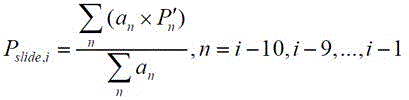
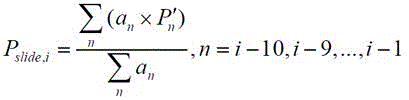
More specifically, in step S2, the power is weightedP slide,i The calculation formula of (a) is as follows:
Figure 392986DEST_PATH_IMAGE001
wherein:P slide,i ithe sliding window of time instants weights the power,kW
Figure 575706DEST_PATH_IMAGE002
nthe time of day may adjust the weight of the resource minute-level load,na value range ofiThe time is 10 times before the time of day,
Figure 558706DEST_PATH_IMAGE003
values of 0.1, 0.2, …, 1.0 are assigned from far to near, respectively, as a function of time;
Figure 422756DEST_PATH_IMAGE004
nthe power value of the resource minute-level load curve can be adjusted at the moment,kW
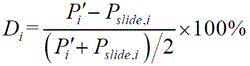
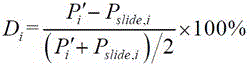
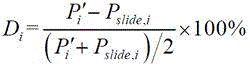
more specifically, in step S2, the power offset percentageD i The calculation formula of (a) is as follows:
Figure 502708DEST_PATH_IMAGE005
wherein,
Figure 528433DEST_PATH_IMAGE006
ithe power value of the resource minute-level load curve can be adjusted at the moment,kW
more specifically, in step S3, the sliding window power offset percentage thresholdD limit The content was 5%.
More specifically, in step S3, when the power offset percentage is higher than the predetermined thresholdD i Greater than a sliding window power offset percentage thresholdD limit Number of impact load pointsN cj The count is increased by 1.
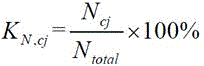
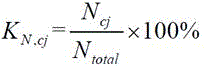
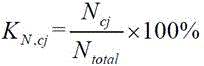
More specifically, in step S4, the impact load percentageK N,cj The calculation formula of (c) is as follows:
Figure 264308DEST_PATH_IMAGE007
wherein,N total -total number of load points within the counted reference daily demand response time period.
More specifically, in step S5, the impact load percentage threshold is not less than 30%.
More specifically, in step S5, when the obtained impact load percentage is greater than a preset impact load percentage threshold value, it is determined as an impact load.
More specifically, the impact load identification method further includes: and step S6, correcting the judgment result of the step S5 according to the average total load of the user and/or the proportion of the relative total response load, and correcting whether the load is impact load.
More specifically, if the average total load of the users judged to be non-impact load is greater than a preset maximum threshold, the average total load is corrected to be impact load; and if the average total load of the users judged to be the impact load is smaller than a preset minimum threshold value, the users are corrected to be non-impact users.
The impact load identification method based on the reference daily minute-scale curve and the sliding window has the advantages that: by combining the minute-level acquisition and reporting characteristics of the demand response terminal, the characteristic curve of the user accessing the adjustable resource pool is deeply observed, an impact load user judgment rule is designed, whether the load impact of the user exists or not is judged, and the problem of judging the user load in the demand response process is effectively solved. Through the verification and display of the load data of 30 users, the identification method has good judgment correctness, and the result is in line with expectation.
Drawings
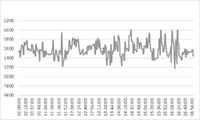
Figures 1-6 are multi-day minute-level adjustable resource load curves for user 2080 (where the abscissa is time, the ordinate is power, and the power is in kW).
Fig. 7-12 are multi-day minute-level adjustable resource load curves (where the abscissa is time, the ordinate is power, and the power unit is kW) for user 3570.
Detailed Description
The technical solutions of the embodiments of the present invention are explained and illustrated below, but the following embodiments are only preferred embodiments of the present invention, and not all embodiments of the present invention. Other embodiments obtained by persons skilled in the art without any inventive work based on the embodiments in the embodiment belong to the protection scope of the invention.
The impact load identification method based on the reference daily minute-scale curve and the sliding window comprises the following steps:
step S1, acquiring a minute-level load curve of the adjustable resource within the demand response time period range of the reference day;
step S2, calculating the weighted power and the power offset percentage of the adjustable resource based on a sliding window according to the minute-level load curve;
step S3, obtaining the number of impact load points according to the power deviation percentage and a preset sliding window power deviation percentage threshold;
step S4, calculating the impact load percentage according to the number of the impact load points and the total number of the load points;
and step S5, judging whether the load is an impact load according to the impact load percentage and a preset impact load percentage threshold.
The prior art cannot visually display the characteristics of the impact load minute-scale curve, and is difficult to set indexes in a targeted manner for identifying the impact load. The invention benefits from the characteristics of the minute-level acquisition and reporting of the demand response terminal, and can observe the characteristic curve of the load of the user accessing the adjustable resource pool. Compared with a 15-minute load curve, the characteristics that the adjustable resource load curve of the impact load user has obvious minute-level severe fluctuation, slope mutation and the like can be obviously observed.
Based on the visual performance characteristic of the minute-scale curve of the impact load and the load characteristic that the power demand response terminal only collects the adjustable resources, the load characteristic is not completely the user gateway load characteristic, so that indexes can be set in a targeted mode within a demand response time period range to identify the impact load, and the situation that when a demand response system operates, the fluctuation of impact load users is judged to be effective response is reduced or avoided.
Sliding window is a flow control technique applied in network communication, and refers to sliding a set of fixed-length windows from the start to the end of a long sequence, and recording the values in the windows every time the window is slid forward by one step.
In step S2, in step S2, the power is weightedP slide,i The calculation formula of (a) is as follows:
Figure 728787DEST_PATH_IMAGE001
wherein:P slide,i ithe sliding window of time instants weights the power,kW
Figure 600928DEST_PATH_IMAGE002
nthe time of day may adjust the weight of the resource minute-level load,nhas a value range ofiThe time is 10 times before the time of day,
Figure 859871DEST_PATH_IMAGE003
values of 0.1, 0.2, …, 1.0 are assigned from far to near, respectively, as a function of time;
Figure 817463DEST_PATH_IMAGE004
nthe power value of the resource minute-level load curve can be adjusted at the moment,kW
in step S2, in step S2, the power offset percentageD i The calculation formula of (a) is as follows:
Figure 37965DEST_PATH_IMAGE005
wherein,
Figure 826929DEST_PATH_IMAGE006
ithe power value of the resource minute-level load curve can be adjusted at the moment,kW
in step S3, in step S3, the sliding window power offset percentage threshold is setD limit The content was 5%.
In step S3, step S3 shows the percentage of power offsetD i Greater than the sliding window powerOffset percentage thresholdD limit Number of impact load pointsN cj The count is increased by 1.
Percentage of impact load in step S4K N,cj The calculation formula of (a) is as follows:
Figure 460036DEST_PATH_IMAGE007
wherein,N total -total number of load points within the counted reference daily demand response time period.
In step S5, the impact load percentage threshold is not less than 30%.
In step S5, when the obtained impact load percentage is greater than a preset impact load percentage threshold, it is determined as an impact load.
The following describes and verifies the process of origin of the impact load identification method based on the reference daily minute-scale curve and the sliding window. The generation process comprises the following steps: selecting a sample; determining a judgment index; calculating and counting the judgment indexes of each user in the index induction groupD i AndK N,cj (ii) a Summarizing and selecting proper values of the judgment indexes, combining proper judgment rules, enabling the load types of the users to be effectively distinguished by utilizing the determined index threshold values and the judgment rules, and enabling the judgment results to correspond to the user labels of 'impact load'/'non-impact load' marked artificially; and (4) counting and judging by using the index threshold value determined in the previous step and the judgment rule, and determining the effectiveness of the rule.
When the sample is selected, 28 users, namely 8 users of users who can be artificially judged to be impact loads and 22 users of users who are not impact loads, are selected from the demand response system platform to serve as a total sample, and the sample data comprises adjustable resource minute-level load curve data of each user within 11 months in 2020 and 6 days and accumulated electric quantity data of a corresponding time interval relation table, and is used for calculating and summarizing subsequent index parameters. The users are divided into two groups, respectively: summarizing and grouping indexes: the method comprises the steps of randomly selecting 4 impact load users and 11 non-impact load users; data validation set: comprising another 4 users with impact load and 11 users with non-impact load.
Wherein, whether the user is the impact load is only in the range of the demand response time period. Impact-loaded users may also be non-impact outside of the demand-responsive time period.
The calculation and statistical results of the generalized set of indices are shown below.
Figure 170503DEST_PATH_IMAGE008
According to the statistical result analysis of the table, various index characteristics can be found:
user minute-level adjustable resource load curve sliding window power offset percentageD i
(1) Percentage power offset from sliding windowD i Average value of (2)D i,ave And the median is that the impact load users and non-impact load users which are manually identified have larger difference, the impact load is higher than 4.75 percent in total, and the non-impact load users are generally lower than 3 percent; therefore, the foregoing will describeD limit Taking 5% of the sample to be reasonable;
(2) percentage power offset from sliding windowD i Maximum value ofD i,max The impact load user and the non-impact load user which are manually determined can have the condition of severe load mutation within a certain period of time, because the value is influenced by the load characteristics when the equipment of the user adjustable resource is started, shut down and adjusted, the reference of the value is small;
(II) user minute-level adjustable resource load curve impact load percentageK N,cj
(1) At the above characteristic parametersD i On the basis of the analysis, based on the currentD limit Value, impact load user and non-impact nature of manual identificationThe load users have great difference, the total impact load is higher than 30%, and the non-impact load users are generally lower than 30%;
(2) this index can be regarded as a discrimination index for discriminating an impact load since it can discriminate an impact load user from a non-impact load when evaluating the user load characteristics.
Combining the statistics and analysis induction of the indexes, bringing the indexes into an impact load judgment rule based on a minute-level adjustable resource load curve, and inducing and summarizing the threshold values:
Figure 711205DEST_PATH_IMAGE009
and (3) expressing the overall judgment rule: when the characteristic index of the minute-level adjustable resource load curve in the reference day reference period of the user meets the condition, the user can be judged as the impact load user.
And (6) data verification.
And judging whether the load impact of the user is achieved or not by using the sample data of the data verification group and combining the judgment rule. The data verification group sample comprises 4 impact load users and 11 non-impact load users which are randomly selected and not repeated with the index induction group, and adjustable resource load data of each user in 11 months of 2020 and 6 days and 15 minutes. The results of the discrimination of the data validation set samples using the impact load identification method based on the reference daily minute scale curve and the sliding window are shown in the table below.
The results of the impact discrimination of the data validation set samples are shown below.
Figure 557939DEST_PATH_IMAGE010
In order to further verify the reliability of the discrimination rule, the data-verified samples are expanded, the index induction group and the data verification group are linked, namely, the impact characteristics of all samples are discriminated, and the statistical result is shown in the table below.
Figure 361947DEST_PATH_IMAGE011
And (4) analyzing the misjudgment of the user with the impact load.
Referring to fig. 1 to 6, a user 2080 is an artificial user with an impact load, and as can be seen from the multi-day and minute-level adjustable resource load curve, the user load is actually in a fluctuating state at any moment, but compared with the total load (greater than 5000 kW), the fluctuation range is relatively small, the multi-day load is overall stable, and the characteristic is close to that of a non-impact load user.
And (4) carrying out misjudgment analysis on the non-impact load user.
Referring to fig. 7 to 12, a user 3570 is an artificially determined non-impact load user, and as can be seen from the multi-day and minute-level adjustable resource load curve, the user load is frequently represented by staggering peaks and valleys, but the relative change amount caused by small fluctuation of the load is large due to small overall load amount (< 300 kW).
And the method is further improved aiming at the condition that the occurring impact load is missed and the non-impact load is misjudged as the impact load. The impact load identification method further includes: and a step S6, correcting the judgment result of the step S5 according to the average total load of the user, and correcting whether the load is an impact load.
Specifically, if the average total load of the users judged to be non-impact load is greater than a preset maximum threshold, the average total load is corrected to be impact load; and if the average total load of the users judged to be the impact load is smaller than a preset minimum threshold value, the users are corrected to be non-impact users.
If the maximum threshold is 4000kW and the minimum threshold is 200kW, the user 2080 will be corrected to be an impact load user and the user 2570 will be corrected to be a non-impact load user, and the results will match the human determination.
And applying the method with the correction step to subsequent judgment, and further correcting or refining the minimum threshold and the maximum threshold if the missed judgment or the misjudgment still occurs.
The invention creatively develops an impact load identification method based on a reference daily minute-scale curve and a sliding window, which comprises the selection of related judgment indexes and the setting of a threshold value, combines the minute-scale acquisition and reporting characteristics of a demand response terminal, provides a response impact load user judgment rule, judges whether the load of a user is impact or not, and effectively solves the problem of judging the load of the user in the demand response process. Through the verification and display of the load data of 30 users, the judgment rule has good judgment correctness, and the result is in accordance with the expectation.
While the invention has been described with reference to specific embodiments thereof, it will be understood by those skilled in the art that the invention is not limited thereto but is intended to cover all modifications and equivalents as may be included within the spirit and scope of the invention. Any modification which does not depart from the functional and structural principles of the invention is intended to be included within the scope of the following claims.

Claims (8)

1. The impact load identification method based on the reference daily minute-scale curve and the sliding window is characterized in that: the impact load identification method comprises the following steps:
step S1, acquiring a minute-level load curve of the adjustable resource in a demand response time period range corresponding to the reference day;
step S2, calculating the weighted power and the power offset percentage of the adjustable resource based on a sliding window according to the minute-level load curve;
step S3, obtaining the number of impact load points according to the power deviation percentage and a preset sliding window power deviation percentage threshold;
step S4, calculating the impact load percentage according to the number of the impact load points and the total number of the load points;
step S5, judging whether the load is an impact load according to the impact load percentage and a preset impact load percentage threshold; in step S2, the power is weightedP slide,i The calculation formula of (a) is as follows:
Figure DEST_PATH_IMAGE001
wherein:P slide,i ithe sliding window of time instants weights the power,kW
Figure DEST_PATH_IMAGE002
nthe time of day may adjust the weight of the resource minute-level load,na value range ofiThe time is 10 times before the time of day,
Figure DEST_PATH_IMAGE003
values of 0.1, 0.2, …, 1.0 are assigned from far to near, respectively, as a function of time;
Figure DEST_PATH_IMAGE004
nthe power value of the resource minute-level load curve can be adjusted at the moment,kW
in step S2, power offset percentageD i The calculation formula of (a) is as follows:
Figure DEST_PATH_IMAGE005
wherein,
Figure DEST_PATH_IMAGE006
ithe power value of the resource minute-level load curve can be adjusted at the moment,kW
2. the method of claim 1, wherein the impact load is identified based on a reference daily minute-scale curve and a sliding window, and the method comprises the following steps: in step S3, the sliding window power offset percentage thresholdD limit The content was found to be 5%.
3. The reference-based daily score of claim 1The impact load identification method of the clock level curve and the sliding window is characterized in that: in step S3, when the power offset percentage is greaterD i Greater than a sliding window power offset percentage thresholdD limit Number of impact load pointsN cj The count is increased by 1.
4. The method of claim 3, wherein the impact load is identified based on a reference daily minute-scale curve and a sliding window, and the method comprises the following steps: percentage of impact load in step S4K N,cj The calculation formula of (a) is as follows:
Figure DEST_PATH_IMAGE007
wherein,N total -total number of load points within the counted reference daily demand response time period.
5. The method of claim 4, wherein the impact load is identified based on the reference daily minute-scale curve and the sliding window, and the method comprises the following steps: in step S5, the impact load percentage threshold is not less than 30%.
6. The method of claim 1, wherein the impact load is identified based on a reference daily minute-scale curve and a sliding window, and the method comprises the following steps: in step S5, when the obtained impact load percentage is greater than a preset impact load percentage threshold, it is determined as an impact load.
7. The method of claim 6, wherein the impact load is identified based on a reference daily minute-scale curve and a sliding window, and the method comprises the following steps: the impact load identification method further includes: and step S6, correcting the judgment result of step S5 according to the average total load of the user and/or the proportion of the relative total response load, and correcting whether the load is an impact load.
8. The method of claim 7, wherein the impact load is identified based on a reference daily minute-scale curve and a sliding window, and the method comprises the following steps: if the average total load of the users judged to be the non-impact load is larger than a preset maximum threshold value, the average total load is corrected to be the impact load; and if the average total load of the users judged to be the impact load is smaller than a preset minimum threshold value, the users are corrected to be non-impact users.
CN202210519474.1A 2022-04-22 2022-05-13 Impact load identification method based on reference day-minute-scale curve and sliding window Active CN114638552B (en)

Applications Claiming Priority (2)

Application Number Priority Date Filing Date Title
CN2022104248320 2022-04-22
CN202210424832 2022-04-22

Publications (2)

Publication Number Publication Date
CN114638552A CN114638552A (en) 2022-06-17
CN114638552B true CN114638552B (en) 2022-09-02

Family

ID=81953179

Family Applications (1)

Application Number Title Priority Date Filing Date
CN202210519474.1A Active CN114638552B (en) 2022-04-22 2022-05-13 Impact load identification method based on reference day-minute-scale curve and sliding window

Country Status (1)

Country Link
CN (1) CN114638552B (en)

Citations (6)

* Cited by examiner, † Cited by third party
Publication number Priority date Publication date Assignee Title
CN103197184A (en) * 2013-04-03 2013-07-10 河海大学 Fault wave recording device with impact load considered
JP2018157649A (en) * 2017-03-16 2018-10-04 東邦瓦斯株式会社 Negawatt calculation method and negative wattage calculation program
CN109146183A (en) * 2018-08-24 2019-01-04 广东工业大学 Short-term impact load forecasting model method for building up based on signal decomposition and intelligent optimization algorithm
CN111539654A (en) * 2020-05-26 2020-08-14 国网湖南省电力有限公司 A big data-based identification method for impact-type electric power customers
CN113034002A (en) * 2021-03-26 2021-06-25 国网江苏省电力有限公司电力科学研究院 Method for analyzing small-disturbance voltage stability of power system by geomagnetic storm
CN114186781A (en) * 2021-11-04 2022-03-15 国网浙江省电力有限公司 Impact load identification method and system based on sampling interval load curve

Family Cites Families (2)

* Cited by examiner, † Cited by third party
Publication number Priority date Publication date Assignee Title
CN107238756B (en) * 2017-06-14 2019-10-25 扬州万泰电子科技有限公司 A Harmonic Source Identification Method for Impact Load of Intelligent Distribution Transformer Terminal
CN112928739A (en) * 2021-01-27 2021-06-08 南京国电南自电网自动化有限公司 Line protection starting method and system suitable for impact load

Patent Citations (6)

* Cited by examiner, † Cited by third party
Publication number Priority date Publication date Assignee Title
CN103197184A (en) * 2013-04-03 2013-07-10 河海大学 Fault wave recording device with impact load considered
JP2018157649A (en) * 2017-03-16 2018-10-04 東邦瓦斯株式会社 Negawatt calculation method and negative wattage calculation program
CN109146183A (en) * 2018-08-24 2019-01-04 广东工业大学 Short-term impact load forecasting model method for building up based on signal decomposition and intelligent optimization algorithm
CN111539654A (en) * 2020-05-26 2020-08-14 国网湖南省电力有限公司 A big data-based identification method for impact-type electric power customers
CN113034002A (en) * 2021-03-26 2021-06-25 国网江苏省电力有限公司电力科学研究院 Method for analyzing small-disturbance voltage stability of power system by geomagnetic storm
CN114186781A (en) * 2021-11-04 2022-03-15 国网浙江省电力有限公司 Impact load identification method and system based on sampling interval load curve

Non-Patent Citations (2)

* Cited by examiner, † Cited by third party
Title
An Improved Solution for Degradation-Shock Dependence Models Considering a Specific Shock Load Level;Cao ShiHao;《2021 3rd International Conference on System Reliability and Safety Engineering (SRSE)》;20211128;全文 *
基于用户日负荷曲线的用电行业分类与综合方法;李欣然等;《电力系统自动化》;20100525(第10期);全文 *

Also Published As

Publication number Publication date
CN114638552A (en) 2022-06-17

Similar Documents

Publication Publication Date Title
CN112505549B (en) New energy automobile battery abnormity detection method based on isolated forest algorithm
CN106055918B (en) A method for identification and correction of power system load data
CN110119948B (en) Power user credit evaluation method and system based on dynamic combination of time-varying weights
CN107576853B (en) Distribution Network Harmonics impedance computation method based on canonical correlation analysis
CN105117810A (en) Residential electricity consumption mid-term load prediction method under multistep electricity price mechanism
CN104680261A (en) Power load operation control method based on load curve clustering of major clients
CN113705710B (en) Method and device for identifying electricity usage violations of electric vehicle charging facilities
CN107609783A (en) The method and system that a kind of intelligent electric energy meter combination property based on data mining is assessed
CN109283293B (en) Power Transformer Fault Diagnosis Method Based on Coefficient of Variation and TOPSIS Method
CN112488738B (en) Method and equipment for identifying vacant residents based on electric power big data
CN111797887A (en) An anti-electricity stealing early warning method and system based on density screening and K-means clustering
CN110137947A (en) Severity method temporarily drops in a kind of network voltage based on ITIC curve
CN114638552B (en) Impact load identification method based on reference day-minute-scale curve and sliding window
CN118644143A (en) Distribution network fault training evaluation method based on information similarity
CN116739829B (en) Big data-based power data analysis method, system and medium
CN114186781B (en) A method and system for identifying impact load based on sampling interval load curve
CN115659369B (en) A unified user management system based on user operating habits
CN114238861B (en) Method for extracting voltage sag characteristic indexes and comprehensively evaluating sag severity
CN110321520B (en) Transformer state evaluation method based on weighted distance discrimination method
CN107832928B (en) Equivalent comprehensive line loss evaluation method based on wind power generation characteristic curve
CN112865078B (en) A method for identifying the corresponding relationship between medium voltage user access points and medium voltage dedicated transformer users
CN120218666A (en) A method for evaluating equipment energy efficiency in smart stations
CN116070885B (en) User course learning progress monitoring system for online learning platform
CN110969539A (en) Method and system for photovoltaic power theft detection based on curve shape analysis
CN118137663A (en) A misalignment monitoring system based on power collection platform

Legal Events

Date Code Title Description
PB01 Publication
PB01 Publication
SE01 Entry into force of request for substantive examination
GR01 Patent grant
GR01 Patent grant