CN114088788A - Sweat composition detection device - Google Patents
Sweat composition detection device Download PDFInfo
- Publication number
- CN114088788A CN114088788A CN202111371360.9A CN202111371360A CN114088788A CN 114088788 A CN114088788 A CN 114088788A CN 202111371360 A CN202111371360 A CN 202111371360A CN 114088788 A CN114088788 A CN 114088788A
- Authority
- CN
- China
- Prior art keywords
- enzymatic electrochemical
- sweat
- enzymatic
- electrochemical sensor
- detection device
- Prior art date
- Legal status (The legal status is an assumption and is not a legal conclusion. Google has not performed a legal analysis and makes no representation as to the accuracy of the status listed.)
- Granted
Links
Images


Classifications
-
- G—PHYSICS
- G01—MEASURING; TESTING
- G01N—INVESTIGATING OR ANALYSING MATERIALS BY DETERMINING THEIR CHEMICAL OR PHYSICAL PROPERTIES
- G01N27/00—Investigating or analysing materials by the use of electric, electrochemical, or magnetic means
- G01N27/26—Investigating or analysing materials by the use of electric, electrochemical, or magnetic means by investigating electrochemical variables; by using electrolysis or electrophoresis
- G01N27/28—Electrolytic cell components
- G01N27/30—Electrodes, e.g. test electrodes; Half-cells
- G01N27/327—Biochemical electrodes, e.g. electrical or mechanical details for in vitro measurements
- G01N27/3271—Amperometric enzyme electrodes for analytes in body fluids, e.g. glucose in blood
- G01N27/3272—Test elements therefor, i.e. disposable laminated substrates with electrodes, reagent and channels
Landscapes
- Life Sciences & Earth Sciences (AREA)
- Health & Medical Sciences (AREA)
- Chemical & Material Sciences (AREA)
- Physics & Mathematics (AREA)
- Molecular Biology (AREA)
- Hematology (AREA)
- Chemical Kinetics & Catalysis (AREA)
- Electrochemistry (AREA)
- Biophysics (AREA)
- Analytical Chemistry (AREA)
- Biochemistry (AREA)
- General Health & Medical Sciences (AREA)
- General Physics & Mathematics (AREA)
- Immunology (AREA)
- Pathology (AREA)
- Measurement Of The Respiration, Hearing Ability, Form, And Blood Characteristics Of Living Organisms (AREA)
Abstract
The sweat component detection device integrates a plurality of single-point sensing enzyme-free electrochemical sensors, utilizes the electrochemical sensors to have reaction intensity (sensitivity) on one substance or one kind of substances larger than that on other substances, makes a plurality of different electrochemical materials into array sensing, and carries out cross validation on the content of the single substance in the mixed substance so as to quickly and accurately obtain the content information of each component of sweat in a complex system, solves the problem that the electrochemical sensors have poor specificity and cannot be applied in the complex system, and can be applied to the fields of environment, consumption, industry and the like.
Description
Technical Field
The invention relates to the technical field of sweat detection, in particular to a sweat component detection device.
Background
Sweat is an important way to regulate temperature within the physiological mechanisms of the human body. During a large amount of physical activities, the metabolic rate of the human body rises suddenly, so that the temperature of the conductor rises, and the physiological reaction can increase the sweating rate of the human body. Detection of sweat components allows certain physiological information to be obtained in a non-invasive manner. Therefore, the analysis of sweat is one of the valuable diagnostic tools, and the advantages of non-invasive, easy obtaining, stable components and the like of sweat are utilized.
The component content of sweat is closely related to the health of the human body. Typically including glucose, lactic acid, ascorbic acid, uric acid, electrolytes (sodium, potassium, calcium, heavy metal ions), and the like. The concentration of components in sweat is directly proportional to the sweating rate, and the content of electrolytes is closely related to hypertension. The content of glucose is closely related to blood sugar, and the excessive accumulation of lactic acid can cause that cells can not smoothly absorb nutrition and oxygen, thus causing poor blood circulation. Therefore, component content detection of sweat is very important.
Enzyme sensors are the earliest type of sensor used for analysis of biological substances. An enzyme sensor is constructed from a system of devices that catalyze a reaction of a substrate to change the amount of a specific substance and convert the change in the amount into an electrical signal. The enzyme has very good specificity, and one enzyme can only react to one substance or a class of substances with similar structures, so that the accuracy of the sensor is ensured. However, the enzyme is very fragile and can only be used in a specific temperature range, and once the enzyme is separated from the corresponding temperature range, the enzyme loses activity and loses catalytic reaction function; the price of the enzyme is high, which is not beneficial to large-scale use;
electrochemical sensors are made on the basis of ionic conduction. The substance to be measured enters the sensor and generates electrochemical reaction in the sensor, so that the content of the substance to be measured is converted into a current (or voltage) signal to be output. There are generally three electrodes, a reference electrode RE, a working electrode WE, and an auxiliary electrode RE, with a fixed voltage applied between the reference electrode and the working electrode to produce a reactive current output at the working electrode. The enzyme sensor has simple structure, low cost and greatly improved service life compared with the enzyme sensor, so that the enzyme sensor is more and more popular in the fields of industry and consumption. However, the electrochemical sensor has poor specificity, can react with multiple substances, and is difficult to distinguish the content of a certain substance in a mixed substance, which also limits the application of the electrochemical sensor in a complex environment.
Disclosure of Invention
In order to solve the problems in the prior art, the invention provides a sweat component detection device which can realize the rapid and accurate measurement of the content of sweat components.
In order to achieve the purpose, the invention provides the following scheme:
a sweat component detection device comprising: a plurality of non-enzymatic electrochemical sensors, a substrate, and a detector;
a plurality of the non-enzymatic electrochemical sensors are arranged on the substrate in an array; the sweat component measurement sensitivity is different among the non-enzymatic electrochemical sensors; a plurality of the non-enzymatic electrochemical sensors are each connected to the detector.
Preferably, the non-enzymatic electrochemical sensor comprises: a reference electrode, a working electrode and an auxiliary electrode;
the working electrode is connected with the detector through a current channel; the reference electrode and the auxiliary electrode are both connected with the back end circuit of the detector.
Preferably, the reference electrode is a circular arc-shaped structure with a specific line width.
Preferably, the working electrode is a circular structure with a specific area.
Preferably, the auxiliary electrode is a circular arc structure with a specific line width.
Preferably, the non-enzymatic electrochemical sensor is prepared from a non-enzymatic electrochemical material.
Preferably, the substrate is made of polyimide.
Preferably, an insulating layer is adhered between a plurality of the non-enzymatic electrochemical sensors.
According to the specific embodiment provided by the invention, the invention discloses the following technical effects:
the sweat component detection device integrates a plurality of single-point sensing enzyme-free electrochemical sensors, utilizes the electrochemical sensors to have reaction intensity (sensitivity) on one substance or one kind of substances larger than that on other substances, makes a plurality of different electrochemical materials into array sensing, and carries out cross validation on the content of the single substance in the mixed substance so as to quickly and accurately obtain the content information of each component of sweat in a complex system, solves the problem that the electrochemical sensors have poor specificity and cannot be applied in the complex system, and can be applied to the fields of environment, consumption, industry and the like.
Drawings
In order to more clearly illustrate the embodiments of the present invention or the technical solutions in the prior art, the drawings needed to be used in the embodiments will be briefly described below, and it is obvious that the drawings in the following description are only some embodiments of the present invention, and it is obvious for those skilled in the art to obtain other drawings without inventive exercise.
FIG. 1 is a schematic diagram of a sweat component detection device according to the present invention;
FIG. 2 is a block diagram of a process for preparing an enzyme-free electrochemical sensor according to an embodiment of the present invention;
FIG. 3 is a block diagram of a process for performing sweat component detection according to an embodiment of the present invention.
Description of the symbols:
1-reference electrode, 2-working electrode, 3-auxiliary electrode, 4-substrate, 5-insulating layer.
Detailed Description
The technical solutions in the embodiments of the present invention will be clearly and completely described below with reference to the drawings in the embodiments of the present invention, and it is obvious that the described embodiments are only a part of the embodiments of the present invention, and not all of the embodiments. All other embodiments, which can be derived by a person skilled in the art from the embodiments given herein without making any creative effort, shall fall within the protection scope of the present invention.
The invention aims to provide a sweat component detection device which can realize the rapid and accurate measurement of the sweat component content.
In order to make the aforementioned objects, features and advantages of the present invention comprehensible, embodiments accompanied with figures are described in further detail below.
As shown in FIG. 1, a sweat component detection device of the present invention includes: a plurality of non-enzymatic electrochemical sensors, a substrate 4 and a detector (not shown in fig. 1).
A plurality of non-enzymatic electrochemical sensors are arrayed on the substrate 4. The sweat component measurement sensitivity varies among the plurality of non-enzymatic electrochemical sensors. A plurality of non-enzymatic electrochemical sensors are each connected to a detector. In this embodiment, the non-enzymatic electrochemical sensor is made from a non-enzymatic electrochemical material. The substrate 4 is made of polyimide. The total number of the sensor arrays used in particular is determined by the number of types of the components to be measured. And (3) for the obtained original non-enzymatic electrochemical sensing array detection data, carrying out data processing by using a specific calculation method to obtain the content of each substance in the mixed substance.
Wherein, non-enzyme electrochemical sensor includes: reference electrode 1, working electrode 2, and auxiliary electrode 3.
The working electrode 2 is connected to the detector via a current path. The reference electrode 1 and the auxiliary electrode 3 are both connected to the back end of the detector. In this embodiment, the reference electrode 1 has a circular arc-shaped structure with a specific line width. The working electrode 2 is a circular structure of a specific area. The auxiliary electrode 3 is a circular arc structure with a specific line width. The line width or area of each electrode can be set according to actual measurement needs. Specifically, a plurality of electrochemical sensors are packaged on the same plane in an array manner, and an auxiliary electrode 3, a working electrode 2 and a reference electrode 1 of each electrochemical sensor are led out.
In this embodiment, a plurality of electrochemical sensors are packaged at regular intervals on the same polyimide substrate 4. Further, in order to ensure that the non-enzymatic electrochemical sensors do not interfere with each other, the insulating layer 5 is adhered to the surface to form a sandwich structure, and the polyimide substrate 4, the non-enzymatic electrochemical sensors and the electric connecting wires thereof, and the insulating layer 5 are sequentially arranged from the bottom to the top. A split dielectric layer 5 is employed between each non-enzymatic electrochemical sensor, each of which exposes only the reference electrode 1(RE), working electrode 2(WE) and auxiliary electrode 3(CE) from the surface for reaction with sweat.
In order to enable the non-enzymatic electrochemical sensor provided by the invention to accurately detect sweat components, as shown in fig. 2, the non-enzymatic electrochemical sensor adopted by the invention is prepared by the following method:
(1) the components in the sweat to be detected are numbered as a, b, c, … and n. The sensitivity of the individual electrochemical membrane materials numbered 1 to the components contained in sweat was measured and is denoted Ka1, Kb1, Kc1, …, Kn 1.
(2) Repeat step (1) by replacing the single electrochemical thin film material numbered 2 and label the sensitivities Ka2, Kb2, Kc2, …, Kn 2.
(3) And (3) replacing the single electrochemical thin film material with the number n to repeat the steps (1) and (2) so as to obtain the sensitivity of a plurality of different electrochemical thin film materials to the components contained in the sweat.
(4) And (4) carrying out array packaging on all the electrochemical thin film induction surfaces measured in the step (3) on the same plane, and leading out each electrode.
(5) And manufacturing a current sensing circuit of which the rear end corresponds to the array number of channels, and connecting all the sensor electrodes to the corresponding current channels.
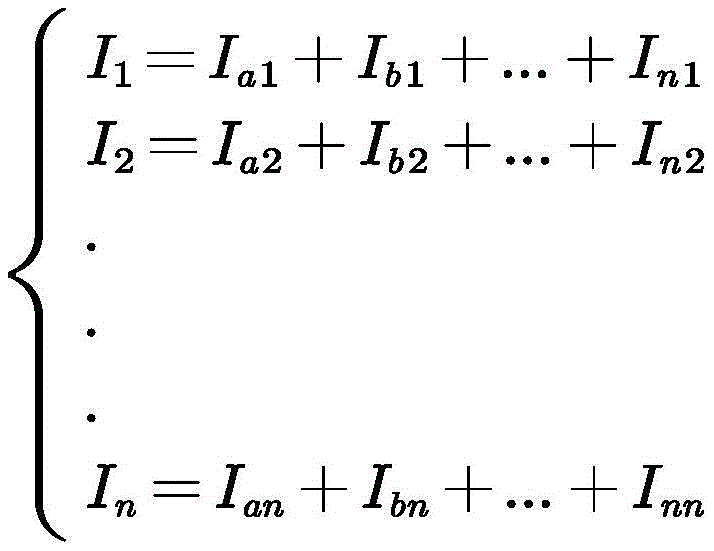
(6) And sweat needing to be observed is uniformly transferred onto the array type non-enzymatic electrochemical film, and current values I1, I2, I3, … and In of corresponding channels are output from the rear-end current calculating circuit.
(7) And (4) calculating the current value obtained in the step (6) according to the following formula so as to obtain the content of each component in the sweat. The data processing method in the sweat detection process is shown in fig. 3.

In conclusion, the non-enzymatic electrochemical sensor adopted by the invention has the advantages of simple preparation method, high success rate, short period, long service life and low environmental requirement. The content of sweat components can be measured efficiently and conveniently in real time. Avoids the disadvantages of short service life of the sensor containing enzyme, high environmental requirement, difficult preparation and the like. The method improves the capacity that the electrochemical sensor has poor specificity and cannot distinguish single substances in the composite component, and greatly reduces the complexity and high difficulty of sweat component content detection. In addition, the non-enzymatic electrochemical sensor adopted by the invention can also be applied to real-time detection, early warning and the like of components of human sweat in medical and consumption industries, and can also be used for observing compound biological substances.
The advantages of the sweat component detection device provided by the present invention are described below with reference to the preparation of a 2x2 non-enzymatic electrochemical sensor array.
The 4 electrochemical sensors were numbered: the upper left is a No. 1 non-enzymatic electrochemical sensor, the upper right is a No. 2 non-enzymatic electrochemical sensor, the lower left is a No. 3 non-enzymatic electrochemical sensor, and the lower right is a No. 4 non-enzymatic electrochemical sensor. The measured components were glucose, lactic acid, ascorbic acid and uric acid in sweat. The glucose, lactic acid, ascorbic acid and uric acid were numbered as a, c and d, respectively.
The first non-enzymatic electrochemical material reacts with the substances (glucose, lactic acid, ascorbic acid and uric acid) in sweat to generate current, but the reaction current of the first non-enzymatic electrochemical material to glucose at the same concentration is far larger than that of the first non-enzymatic electrochemical material to lactic acid, ascorbic acid and uric acid. The second non-enzymatic electrochemical material reacts with the substances in sweat to generate current, but the current for the same concentration of lactic acid is far larger than that of glucose, ascorbic acid and uric acid. The third non-enzymatic electrochemical material can react with the substances in sweat to generate current, but the reaction current to the ascorbic acid at the same concentration is far larger than that of glucose, lactic acid and uric acid. The fourth non-enzymatic electrochemical material reacts with the substances in sweat to generate current, but the current for uric acid at the same concentration is far larger than that of glucose, lactic acid and ascorbic acid.
The concentrations of glucose in 6 groups were 5. mu. mol/L, 50. mu. mol/L, 100. mu. mol/L, 150. mu. mol/L, 200. mu. mol/L and 250. mu. mol/L, respectively. Preparation of 6 groups of lactic acid, the concentrations of which were 5mmol/L, 10mmol/L, 15mmol/L, 20mmol/L, 25mmol/L and 30mmol/L, respectively, from low to high. The concentration of ascorbic acid in 6 groups was 5. mu. mol/L, 10. mu. mol/L, 15. mu. mol/L, 20. mu. mol/L, 25. mu. mol/L, and 30. mu. mol/L, respectively. 6 groups were prepared, and the uric acid concentrations were 0.5mmol/L, 1.5mmol/L, 2.5mmol/L, 3.5mmol/L, 4.5mmol/L, and 5.5mmol/L, respectively, from low to high.
Manufacturing a first non-enzymatic electrochemical material into a No. 1 non-enzymatic electrochemical sensor, connecting three electrodes of the No. 1 non-enzymatic electrochemical sensor with an electrochemical workstation (or a detector), putting the No. 1 non-enzymatic electrochemical sensor into a solution with a glucose concentration of 5umol/L for 30 seconds, reading the current displayed by the electrochemical workstation to be 0.3uA, putting the No. 1 non-enzymatic electrochemical sensor into the solution with the glucose concentration of 50umol/L for 30 seconds, reading the current displayed by the electrochemical workstation to be 3.6uA, putting the No. 1 non-enzymatic electrochemical sensor into the solution with the glucose concentration of 100umol/L for 30 seconds, reading the current displayed by the electrochemical workstation to be 7.5uA, putting the No. 1 non-enzymatic electrochemical sensor into the solution with the glucose concentration of 150umol/L for 30 seconds, reading the current displayed by the electrochemical workstation to be 11.8uA, after being placed in a solution with a glucose concentration of 200umol/L for 30 seconds, the No. 1 non-enzyme electrochemical sensor reads that the current displayed by the electrochemical workstation is 15.3uA, and after being placed in a solution with a glucose concentration of 250umol/L for 30 seconds, the No. 1 non-enzyme electrochemical sensor reads that the current displayed by the electrochemical workstation is 19.6 uA.
The 10 groups of data are expressed in a coordinate system, wherein the abscissa is glucose concentration M, the unit is umol/L, the ordinate is current value I, the unit is uA, linear fitting is carried out by matlab to obtain the slope of a straight line which is current/concentration and the linear correlation rate R is more than 0.98, and the sensitivity Ka1 of the non-enzymatic electrochemical sensor No. 1 to glucose is set as the slope, namely Ka1 is more than 3.88.
The current displayed by the electrochemical workstation is read to be 1.7uA after the No. 1 non-enzymatic electrochemical sensor is put into a solution with the lactic acid concentration of 5mmol/L and kept for 30 seconds, the current displayed by the electrochemical workstation is read to be 2.6uA after the No. 1 non-enzymatic electrochemical sensor is put into a solution with the lactic acid concentration of 10mmol/L and kept for 30 seconds, the current displayed by the electrochemical workstation is read to be 3.7uA after the No. 1 non-enzymatic electrochemical sensor is put into a solution with the lactic acid concentration of 15mmol/L and kept for 30 seconds, the current displayed by the electrochemical workstation is read to be 4.2uA after the No. 1 non-enzymatic electrochemical sensor is put into a solution with the lactic acid concentration of 25mmol/L and kept for 30 seconds, the current displayed by the electrochemical workstation is read to be 4.9uA after the No. 1 non-enzymatic electrochemical sensor is put into a solution with the lactic acid concentration of 30mmol/L and kept for 30 seconds, the current displayed by the electrochemical workstation is read after the No. 1 non-enzymatic electrochemical sensor is put into a solution with the lactic acid concentration of 30mmol/L and kept for 30 seconds The flow was 5.8 uA.
The 10 sets of data are expressed in a coordinate system, the abscissa is the lactic acid concentration M, the unit is mmol/L, the ordinate is the current value I, the unit is uA, and linear fitting is carried out by MatLab to obtain the slope of a straight line, the slope is the current/concentration, the linear correlation rate R is more than 0.98, and the sensitivity Kb1 of the non-enzymatic electrochemical sensor No. 1 to the lactic acid is set, namely Kb1 is 0.18.
The current displayed by the reading electrochemical workstation is 0.3uA after the No. 1 non-enzymatic electrochemical sensor is placed in a solution with ascorbic acid concentration of 5umol/L and is kept for 30 seconds, the current displayed by the reading electrochemical workstation is 0.5uA after the No. 1 non-enzymatic electrochemical sensor is placed in a solution with ascorbic acid concentration of 10umol/L and is kept for 30 seconds, the current displayed by the reading electrochemical workstation is 0.8uA after the No. 1 non-enzymatic electrochemical sensor is placed in a solution with ascorbic acid concentration of 15umol/L and is kept for 30 seconds, the current displayed by the reading electrochemical workstation is 1.3uA after the No. 1 non-enzymatic electrochemical sensor is placed in a solution with ascorbic acid concentration of 20mol/L and is kept for 30 seconds, the current displayed by the reading electrochemical workstation is 1.6uA after the No. 1 non-enzymatic electrochemical sensor is placed in a solution with ascorbic acid concentration of 25mol/L and is kept for 30 seconds, and the No. 1 non-enzymatic electrochemical sensor is placed in a solution with ascorbic acid concentration of 30mol/L and is kept for 30 seconds The readout electrochemical workstation showed a current of 1.7 uA.
The 10 sets of data are represented in a coordinate system, wherein the abscissa represents the ascorbic acid concentration M in mmol/L, the ordinate represents the current value I in uA, and the slope of a straight line obtained by linear fitting using MatLab is 0.30, i.e., the current/concentration, the linear correlation rate R is >0.98, and the sensitivity Kc1, i.e., Kc1, of the No. 1 non-enzymatic electrochemical sensor to ascorbic acid is 0.30.
The current displayed by the reading electrochemical workstation is 1.2uA after the No. 1 non-enzymatic electrochemical sensor is placed in a solution with the anti-uric acid concentration of 0.5mmol/L and is kept for 30 seconds, the current displayed by the reading electrochemical workstation is 1.8uA after the No. 1 non-enzymatic electrochemical sensor is placed in a solution with the uric acid concentration of 1.5mmol/L and is kept for 30 seconds, the current displayed by the reading electrochemical workstation is 2.2uA after the No. 1 non-enzymatic electrochemical sensor is placed in a solution with the uric acid concentration of 2.5mmol/L and is kept for 30 seconds, the current displayed by the reading electrochemical workstation is 2.7uA after the No. 1 non-enzymatic electrochemical sensor is placed in a solution with the uric acid concentration of 4.5mmol/L and is kept for 30 seconds, the current displayed by the reading electrochemical workstation is 3.2uA after the No. 1 non-enzymatic electrochemical sensor is placed in a solution with the uric acid concentration of 5.5mmol/L and is kept for 30 seconds, the current displayed by the reading electrochemical workstation is kept for 30 seconds The current was 3.9 uA.
The 10 sets of data are expressed in a coordinate system, wherein the abscissa is the uric acid concentration M, the unit is mmol/L, the ordinate is the current value I, the unit is uA, and the slope of a straight line obtained by linear fitting with MatLab is 0.52, i.e., the current/concentration, the linear correlation rate R >0.98, and the sensitivity Kd1 of the No. 1 non-enzymatic electrochemical sensor to uric acid, i.e., Kd1, is 0.52.
Thus, the sensitivities Ka1, Kb1, Kc1 and Kd1 of the No. 1 non-enzymatic electrochemical sensor made of the first non-enzymatic electrochemical material to glucose, lactic acid, ascorbic acid and uric acid in sweat are respectively 3.88, 0.18, 0.30 and 0.52, and it can be seen that the sensitivity of the No. 1 non-enzymatic electrochemical sensor made of the first non-enzymatic electrochemical material to glucose is much higher than those of the other three components.
Similarly, the second non-enzymatic electrochemical material is made into a No. 2 non-enzymatic electrochemical sensor, three electrodes of the No. 2 non-enzymatic electrochemical sensor are connected with a rear end reading circuit, and the sensitivity Ka2, Kb2, Kc2 and Kd2 of the No. 2 non-enzymatic electrochemical sensor made of the second non-enzymatic electrochemical material to glucose, lactic acid, ascorbic acid and uric acid in sweat can be respectively measured to be 0.76, 3.24, 0.32 and 0.17 by repeating the measurement sensitivity steps, so that the sensitivity of the No. 2 non-enzymatic electrochemical sensor made of the second non-enzymatic electrochemical material to lactic acid is far higher than that of the other three components.
Similarly, the third non-enzymatic electrochemical material is made into a No. 3 non-enzymatic electrochemical sensor, the three electrodes are connected with the rear end reading circuit, and the sensitivity Ka3, Kb3, Kc3 and Kd3 of the No. 3 non-enzymatic electrochemical sensor made of the first non-enzymatic electrochemical material to glucose, lactic acid, ascorbic acid and uric acid in sweat are respectively 0.45, 0.76, 4.13 and 0.61 by repeating the measuring sensitivity steps, so that the sensitivity of the No. 3 non-enzymatic electrochemical sensor made of the third non-enzymatic electrochemical material to ascorbic acid is far higher than that of the other three components.
Similarly, the fourth non-enzymatic electrochemical material is made into a No. 4 non-enzymatic electrochemical sensor, three electrodes of the No. 4 non-enzymatic electrochemical sensor are connected with a rear end reading circuit, the sensitivity of the No. 4 non-enzymatic electrochemical sensor made of the fourth non-enzymatic electrochemical material to glucose, lactic acid, ascorbic acid and uric acid in sweat can be measured by repeating the measurement sensitivity steps, and the sensitivities Ka4, Kb4, Kc4 and Kd4 of the No. 4 non-enzymatic electrochemical sensor made of the fourth non-enzymatic electrochemical material to uric acid are respectively 0.26, 0.32, 0.94 and 2.69, so that the sensitivity of the No. 4 non-enzymatic electrochemical sensor made of the fourth non-enzymatic electrochemical material to uric acid is far greater than that of the other three components.
Preparing a mixed solution consisting of glucose, lactic acid, ascorbic acid and uric acid, wherein the concentrations of the glucose, the lactic acid, the ascorbic acid and the uric acid in the solution are respectively Ma=150umol/L、Mb=10mmol/L、Mc=20umol/L、Md3.5 mmol/L. And packaging No. 1-4 non-enzymatic electrochemical sensors on the front surface of the same polyimide packaging layer according to the numbering rule. In this embodiment, the thickness of the polyimide is 20.54um, the size of the auxiliary electrode 3 is a circular arc with a line width of 1.5mm, the size of the working electrode 2 is a circular arc with a diameter of 5mm, and the size of the reference electrode 1 is a circular arc with a line width of 1.5 mm.
Connecting auxiliary electrodes 3 of four sensors together, leading out the auxiliary electrodes from the lowest side of a plane of a packaging layer by using a copper wire, leading out a reference electrode 1 from the lowest side of the packaging layer by using a copper wire, leading out a working electrode 2 from the lowest side of the packaging layer by using a copper wire alone, exposing the whole surface except for the electrode part of the sensor, and carrying out insulation sealing treatment on the rest part, connecting a working electrode 2 of a No. 1 non-enzymatic electrochemical sensor to a No. 1 current channel of a rear-end sensing circuit, connecting a working electrode 2 of a No. 2 non-enzymatic electrochemical sensor to a No. 2 current channel of the rear-end sensing circuit, connecting a working electrode 2 of the No. 3 non-enzymatic electrochemical sensor to a No. 3 current channel of the rear-end sensing circuit, connecting a working electrode 2 of a No. 4 non-enzymatic electrochemical sensor to a No. 4 current channel of the rear-end sensing circuit, leading out the auxiliary electrodes 3, The reference electrodes 1 are connected to the rear end circuits, respectively. And then the back end circuit and the sensor are integrated into a fusion circuit to be built.
The prepared mixed solution is uniformly transferred to an array plane (a circular structure of a working electrode 2), and the current I of the No. 1 non-enzymatic electrochemical sensor can be read out by a back-end circuit (namely a detector)1No. 19.3uA, No. 2 non-enzymatic electrochemical sensor current I2No. 3 non-enzymatic electrochemical sensor current I ═ 21.7mA316.7mA, No. 4 non-enzyme electrochemical sensor I423.4 mA. Current I1Is the sum of the reaction currents of the No. 1 non-enzymatic electrochemical sensor to glucose, lactic acid, ascorbic acid and uric acid, namely I1=Ia1+Ib1+Ic1+Id1. Current I2Is the sum of the reaction currents of No. 2 non-enzymatic electrochemical sensor to glucose, lactic acid, ascorbic acid and uric acid, namely I2=Ia2+Ib2+Ic2+Id2. Current I3Is the sum of the reaction currents of the No. 3 non-enzymatic electrochemical sensor to glucose, lactic acid, ascorbic acid and uric acid, namely I3=Ia3+Ib3+Ic3+Id3. Current I4Is the sum of the reaction currents of the No. 4 non-enzymatic electrochemical sensor to glucose, lactic acid, ascorbic acid and uric acid, namely I4=Ia4+Ib4+Ic4+Id4。
To Ia1Analysis is carried out to obtain Ia1=Ka1*Ma′,Ma' i.e. the glucose concentration of the mixed solution measured by the sensor, and the concentration M can be actually prepared after the algorithm is solvedaAnd carrying out error comparison. Can be processed by the same method to obtain Ib1=Kb1*Mb′。Ic1=Kc1*Mc′。Id1=Kd1*Md', there are:

m can be obtained by the above calculation methoda′=146.7umol/L,Mb′=10.3mmol/L,Mc′=19.3umol/L,Md' -3.3 mmol/L. Error comparison is carried out on the real content concentration M and the measured content concentration, so that the error value can be calculated to be within 5%, and the correlation R between the measured error and the real concentration is more than 0.97 after the error is integrated.
In contrast, in the case where this calculation method is not used, since the sensitivity of the No. 1 non-enzymatic electrochemical sensor to glucose is the greatest, the result is represented by I1Calculated to obtain Ma' -171.9 umol/L. Since the No. 2 non-enzymatic electrochemical sensor has the greatest sensitivity to lactic acid, the sensor is composed of2Calculated to obtain Mb' -18.9 mmol/L. Since the non-enzymatic electrochemical sensor No. 3 has the greatest sensitivity to ascorbic acid, the sensor is composed of3Calculated to obtain Mc' -26.7 umol/L. Since the No. 4 non-enzymatic electrochemical sensor has the maximum sensitivity to uric acid, the sensor is composed of I4Calculated to obtain Md' -6.9 mmol/L. The real content concentration M is compared with the set of measured content concentrations to calculate an error value which is more than 20 percent, and the correlation R between the measured error and the real concentration is less than 0.73.
It can be seen from the comparison that the single non-enzymatic electrochemical sensor can not distinguish the component concentration in the mixed solution, and the array type non-enzymatic electrochemical sensor can be well used.
The embodiments in the present description are described in a progressive manner, each embodiment focuses on differences from other embodiments, and the same and similar parts among the embodiments are referred to each other.
The principles and embodiments of the present invention have been described herein using specific examples, which are provided only to help understand the method and the core concept of the present invention; meanwhile, for a person skilled in the art, according to the idea of the present invention, the specific embodiments and the application range may be changed. In view of the above, the present disclosure should not be construed as limiting the invention.
Claims (8)
1. A sweat component detection device, comprising: a plurality of non-enzymatic electrochemical sensors, a substrate, and a detector;
a plurality of the non-enzymatic electrochemical sensors are arranged on the substrate in an array; the sweat component measurement sensitivity is different among the non-enzymatic electrochemical sensors; a plurality of the non-enzymatic electrochemical sensors are each coupled to the detector.
2. The sweat composition detection device of claim 1, wherein the non-enzymatic electrochemical sensor includes: a reference electrode, a working electrode and an auxiliary electrode;
the working electrode is connected with the detector through a current channel; the reference electrode and the auxiliary electrode are both connected with the back end circuit of the detector.
3. A sweat composition testing device according to claim 2, wherein the reference electrode is a circular arc shaped structure with a specific line width.
4. The sweat component detection device of claim 2, wherein the working electrode is a circular structure of a specific area.
5. The sweat composition detection device of claim 2, wherein the auxiliary electrodes are circular arc structures of a specific line width.
6. The sweat composition detection device of claim 1, wherein the non-enzymatic electrochemical sensor is fabricated from a non-enzymatic electrochemical material.
7. The sweat component detection device of claim 1, wherein the substrate is made of polyimide.
8. A sweat composition testing device according to claim 2, wherein an insulating layer is adhered between a plurality of said non-enzymatic electrochemical sensors.
Priority Applications (1)
| Application Number | Priority Date | Filing Date | Title |
|---|---|---|---|
| CN202111371360.9A CN114088788B (en) | 2021-11-18 | 2021-11-18 | Sweat composition detection device |
Applications Claiming Priority (1)
| Application Number | Priority Date | Filing Date | Title |
|---|---|---|---|
| CN202111371360.9A CN114088788B (en) | 2021-11-18 | 2021-11-18 | Sweat composition detection device |
Publications (2)
| Publication Number | Publication Date |
|---|---|
| CN114088788A true CN114088788A (en) | 2022-02-25 |
| CN114088788B CN114088788B (en) | 2023-03-17 |
Family
ID=80302059
Family Applications (1)
| Application Number | Title | Priority Date | Filing Date |
|---|---|---|---|
| CN202111371360.9A Active CN114088788B (en) | 2021-11-18 | 2021-11-18 | Sweat composition detection device |
Country Status (1)
| Country | Link |
|---|---|
| CN (1) | CN114088788B (en) |
Citations (5)
| Publication number | Priority date | Publication date | Assignee | Title |
|---|---|---|---|---|
| CN103196977A (en) * | 2013-04-12 | 2013-07-10 | 中国科学院上海应用物理研究所 | Multichannel printing electrode array chip as well as preparation method and application thereof |
| US20130288378A1 (en) * | 2010-10-21 | 2013-10-31 | Carnegie Mellon University | Two-Dimensional Electron Gas (2DEG)-Based Chemical Sensors |
| CN105445339A (en) * | 2014-07-31 | 2016-03-30 | 天津大学 | Flexible differential array electrochemical glucose sensor and use method thereof |
| CN109540984A (en) * | 2018-11-23 | 2019-03-29 | 苏州麦米医疗科技有限公司 | A kind of human sweat's real-time monitoring sensor-based system |
| US20210204878A1 (en) * | 2019-11-19 | 2021-07-08 | Jung-Tang Huang | Percutaneous microneedle monitoring system |
-
2021
- 2021-11-18 CN CN202111371360.9A patent/CN114088788B/en active Active
Patent Citations (5)
| Publication number | Priority date | Publication date | Assignee | Title |
|---|---|---|---|---|
| US20130288378A1 (en) * | 2010-10-21 | 2013-10-31 | Carnegie Mellon University | Two-Dimensional Electron Gas (2DEG)-Based Chemical Sensors |
| CN103196977A (en) * | 2013-04-12 | 2013-07-10 | 中国科学院上海应用物理研究所 | Multichannel printing electrode array chip as well as preparation method and application thereof |
| CN105445339A (en) * | 2014-07-31 | 2016-03-30 | 天津大学 | Flexible differential array electrochemical glucose sensor and use method thereof |
| CN109540984A (en) * | 2018-11-23 | 2019-03-29 | 苏州麦米医疗科技有限公司 | A kind of human sweat's real-time monitoring sensor-based system |
| US20210204878A1 (en) * | 2019-11-19 | 2021-07-08 | Jung-Tang Huang | Percutaneous microneedle monitoring system |
Non-Patent Citations (1)
| Title |
|---|
| YONGCHAO YU ET.AL: "Laser-Induced Carbon-Based Smart Flexible Sensor Array for Multiflavors Detection", 《APPL. MATER. INTERFACES》 * |
Also Published As
| Publication number | Publication date |
|---|---|
| CN114088788B (en) | 2023-03-17 |
Similar Documents
| Publication | Publication Date | Title |
|---|---|---|
| Yang et al. | based sandwich-structured wearable sensor with sebum filtering for continuous detection of sweat pH | |
| CN102116752B (en) | Use the filling time to improve system, the apparatus and method of the accuracy of biology sensor | |
| EP2333542B1 (en) | Fill sufficiency method and system | |
| ES2630225T3 (en) | Method for rapid electrochemical analysis | |
| EP2565638B1 (en) | Electrochemical analyte measurement system and method | |
| CA2772738C (en) | Analyte measurement method and system | |
| CN103237897A (en) | Analyte measurement methods and systems with error trapping | |
| CN205548571U (en) | Biochemical parameter monitoring system of wearing formula body surface physiology | |
| Lai et al. | Carbon fiber-based multichannel solid-contact potentiometric ion sensors for real-time sweat electrolyte monitoring | |
| KR101357134B1 (en) | Method for Measuring Analytes in Blood Samples Using Electrochemical Biosensor and a Portable Analyzer | |
| CN105241930A (en) | Multiparameter all-solid-state blood analysis sensor | |
| Seker et al. | Decentralized touch-based micronutrition sensor towards personalized nutrition: Parallel detection of sweat ascorbic acid and zinc ions | |
| CN118614915A (en) | A wearable sensing device for dynamic detection of sweat metabolites | |
| CN215263243U (en) | Microelectrode integrated sensing chip | |
| KR102083979B1 (en) | Sensor strip and Apparatus for measuring biomaterial using the sensor strip | |
| AU2013322547A1 (en) | System and method for determining hematocrit insensitive glucose concentration | |
| CN215493305U (en) | Electrodes, test strips and biosensors for electrochemical detection of creatinine | |
| CN114088788B (en) | Sweat composition detection device | |
| Uemura et al. | Development of Small-sized Lysine Enzyme Sensor for Clinical Use. | |
| CN113520381A (en) | A Microfluidic Channel for Differential Admittance Measurement of Sweat Rate | |
| Wang et al. | Multi Parameter Sweat Detection System Based on Screen Printed Electrodes | |
| US10788441B2 (en) | Measuring method of sensor using interdigitated array electrode, measuring apparatus and computer readable medium storing measuring program | |
| Kuo et al. | Analysis of EGFET Based on Static Measurements and Microfluidic System for the RuO_2 Lactic Acid Biosensor | |
| TW202514107A (en) | Multiple electrochemical reaction block test strip | |
| HK1157866A (en) | Fill sufficiency method and system |
Legal Events
| Date | Code | Title | Description |
|---|---|---|---|
| PB01 | Publication | ||
| PB01 | Publication | ||
| SE01 | Entry into force of request for substantive examination | ||
| SE01 | Entry into force of request for substantive examination | ||
| GR01 | Patent grant | ||
| GR01 | Patent grant |