CN113687968A - A SIL4 stack detection method suitable for general operating systems - Google Patents

A SIL4 stack detection method suitable for general operating systems Download PDF

Info

Publication number
CN113687968A
CN113687968A CN202110835650.8A CN202110835650A CN113687968A CN 113687968 A CN113687968 A CN 113687968A CN 202110835650 A CN202110835650 A CN 202110835650A CN 113687968 A CN113687968 A CN 113687968A
Authority
CN
China
Prior art keywords
stack
array
sil4
detection method
operating system
Prior art date
Legal status (The legal status is an assumption and is not a legal conclusion. Google has not performed a legal analysis and makes no representation as to the accuracy of the status listed.)
Granted
Application number
CN202110835650.8A
Other languages
Chinese (zh)
Other versions
CN113687968B (en
Inventor
严光明
胡明明
陈小杰
Current Assignee (The listed assignees may be inaccurate. Google has not performed a legal analysis and makes no representation or warranty as to the accuracy of the list.)
Unittec Co Ltd
Original Assignee
Unittec Co Ltd
Priority date (The priority date is an assumption and is not a legal conclusion. Google has not performed a legal analysis and makes no representation as to the accuracy of the date listed.)
Filing date
Publication date
Application filed by Unittec Co Ltd filed Critical Unittec Co Ltd
Priority to CN202110835650.8A priority Critical patent/CN113687968B/en
Publication of CN113687968A publication Critical patent/CN113687968A/en
Application granted granted Critical
Publication of CN113687968B publication Critical patent/CN113687968B/en
Active legal-status Critical Current
Anticipated expiration legal-status Critical

Links

Images

Classifications

    • GPHYSICS
    • G06COMPUTING OR CALCULATING; COUNTING
    • G06FELECTRIC DIGITAL DATA PROCESSING
    • G06F11/00Error detection; Error correction; Monitoring
    • G06F11/07Responding to the occurrence of a fault, e.g. fault tolerance
    • G06F11/0703Error or fault processing not based on redundancy, i.e. by taking additional measures to deal with the error or fault not making use of redundancy in operation, in hardware, or in data representation
    • G06F11/0706Error or fault processing not based on redundancy, i.e. by taking additional measures to deal with the error or fault not making use of redundancy in operation, in hardware, or in data representation the processing taking place on a specific hardware platform or in a specific software environment
    • G06F11/073Error or fault processing not based on redundancy, i.e. by taking additional measures to deal with the error or fault not making use of redundancy in operation, in hardware, or in data representation the processing taking place on a specific hardware platform or in a specific software environment in a memory management context, e.g. virtual memory or cache management
    • YGENERAL TAGGING OF NEW TECHNOLOGICAL DEVELOPMENTS; GENERAL TAGGING OF CROSS-SECTIONAL TECHNOLOGIES SPANNING OVER SEVERAL SECTIONS OF THE IPC; TECHNICAL SUBJECTS COVERED BY FORMER USPC CROSS-REFERENCE ART COLLECTIONS [XRACs] AND DIGESTS
    • Y02TECHNOLOGIES OR APPLICATIONS FOR MITIGATION OR ADAPTATION AGAINST CLIMATE CHANGE
    • Y02PCLIMATE CHANGE MITIGATION TECHNOLOGIES IN THE PRODUCTION OR PROCESSING OF GOODS
    • Y02P90/00Enabling technologies with a potential contribution to greenhouse gas [GHG] emissions mitigation
    • Y02P90/02Total factory control, e.g. smart factories, flexible manufacturing systems [FMS] or integrated manufacturing systems [IMS]

Landscapes

  • Engineering & Computer Science (AREA)
  • Theoretical Computer Science (AREA)
  • Quality & Reliability (AREA)
  • Physics & Mathematics (AREA)
  • General Engineering & Computer Science (AREA)
  • General Physics & Mathematics (AREA)
  • Debugging And Monitoring (AREA)
  • Executing Machine-Instructions (AREA)

Abstract

本发明公开了一种适用通用操作系统SIL4栈检测方法,包括如下步骤:步骤S1、安全程序运行时,入口函数main声明栈保护区段StackGuard1数组;步骤S2、main调用函数Finit;Finit在内部声明整个安全程序最大使用的栈空间Stack数组以及栈保护区段StackGuard2数组;步骤S3、根据同一个栈数组的起始、结束位置判定运行环境在栈上是使用地址向上生长还是向下生长;步骤S4、按栈数组的大小排序,main函数将安全程序所使用的栈空间写入特定的值并对全栈数组进行内存检测;步骤S5、检测结束后,周期调用安全业务程序Fsafety以及栈检测算法Fcheck;步骤S6、栈检测算法Fcheck对安全程序所使用的栈空间进行检测。栈检测方法通用性强,动态适应各种CPU、操作系统、编译器,从而实现SIL4级栈内存检测。

Figure 202110835650

The invention discloses a SIL4 stack detection method applicable to a general-purpose operating system, comprising the following steps: step S1, when the safety program is running, the entry function main declares the stack protection section StackGuard1 array; step S2, the main calls the function Finit; Finit declares internally The stack space Stack array and the stack protection section StackGuard2 array that the entire safety program uses the most; Step S3, according to the start and end position of the same stack array, determine whether the operating environment uses the address to grow upward or downward on the stack; Step S4 , Sort by the size of the stack array, the main function writes the stack space used by the safety program into a specific value and performs memory detection on the full stack array; Step S5, after the detection is completed, periodically call the safety business program Fsafety and the stack detection algorithm Fcheck Step S6, the stack detection algorithm Fcheck detects the stack space used by the safety program. The stack detection method has strong versatility and is dynamically adapted to various CPUs, operating systems, and compilers, so as to achieve SIL4 level stack memory detection.

Figure 202110835650

Description

SIL4 stack detection method applicable to general operating system
Technical Field
The invention relates to the technical field of computer data structures, in particular to a SIL4 stack detection method applicable to a general operating system.
Background
A stack, as a data structure, is a special linear table that can only perform insert and delete operations at one end. The method stores data according to the principle of last-in first-out, the first-in data is pressed to the bottom of a stack, the last data is on the top of the stack, data is popped from the top of the stack when data needs to be read, and the last data is read out firstly. The stack has a memory function, and a stack bottom pointer does not need to be changed in the inserting and deleting operation of the stack; some embedded operating systems provide a fixed stack space size and a stack detection function, and stack overflow is used as an important detection item of stack detection, because the C language series has no built-in check mechanism to ensure that the data copied to the buffer area is not larger than the size of the buffer area, when the data is large enough, the range of the buffer area will be overflowed; when the system is abnormal, the SIL4 safety program is informed without an interface; for a closed source operating system, it cannot sense whether its processing meets SIL4 requirements; in addition, some operating systems do not have a stack detection function, and can randomly allocate more stack spaces under the condition of enough resources, however, the SIL4 security program cannot sense whether the stack is out of range or not.
Disclosure of Invention
In view of the above disadvantages, the present invention provides a method for detecting a SIL4 stack applicable to a general operating system, which dynamically adapts to various CPUs, operating systems, and compilers by the fact that stacks grow only in one direction and are pre-allocated, thereby implementing SIL4 level stack memory detection.
In order to achieve the above technical object, a technical solution provided by the present invention is a method for detecting a SIL4 stack applicable to a general operating system, comprising the following steps:
step S1, when the security program runs, the entry function main declares a stack protection section Stackguard1 array;
step S2, main calls the function Finit; finit internally declares the Stack space Stack array which is used most by the whole security program, and the Stack protection section StackGuard2 array;
step S3, judging whether the operating environment grows upwards or downwards on the stack by using the address according to the starting position and the ending position of the same stack array; simultaneously, whether the distribution of the stack variables grows upwards or downwards is known according to the sequence of the three stack arrays;
step S4, sorting according to the size of the stack array, and writing the stack space used by the security program into a specific value by the main function; and performing memory detection conforming to SIL4 standard on the full stack array;
step S5, after the detection is finished, the safety service program Fsecurity and the stack detection algorithm Fcheck are called periodically;
step S6, detecting the stack space used by the security program by a stack detection algorithm Fcheck, and comparing and judging whether the value is still a preset specific value; if not, judging that the stack is abnormal, and performing guiding safety processing; if yes, the stack is abnormal and no alarm is given.
Preferably, step S1 further includes: the start position of the array of StackGuard1 is recorded with global variable P3 and the end position of the array of StackGuard1 is recorded with global variable P4.
Preferably, step S2 further includes: the start position of the Stack array is recorded using global variable P1 and the end position of the Stack array is recorded using global variable P2 and then returned.
Preferably, step S2 further includes: the start position of the array of the StackGuard2 is recorded by using a global variable P5 and the end position of the array of the StackGuard2 is recorded by using a global variable P6, and then returned.
Preferably, the same Stack array is any one of a Stack array, a Stack guard1 array, and a Stack guard2 array.
Preferably, the Stack used by Fsafety is the same memory space as the Stack array of the finish declaration.
Preferably, the size ordering by stack array is expressed as: p1< P2< P3< P4< P5< P6, where sections [ P1, P2] and [ P5, P6] are stack spaces used by security programs and sections [ P3, P4] are stack spaces protected by stacks.
The invention has the beneficial effects that: the method for detecting the SIL4 stack suitable for the general operating system has strong universality, does not depend on an operating system operated by a safety program, does not depend on a target CPU, and does not depend on the distribution of a used compiler to the stack growth direction. The SIL4 security program can adjust the space size of stack protection as required, select a specific value, detect the stack space used by the security program through a stack detection algorithm Fcheck, and determine abnormal conditions by comparing the similarities and differences of characteristic values.
Drawings
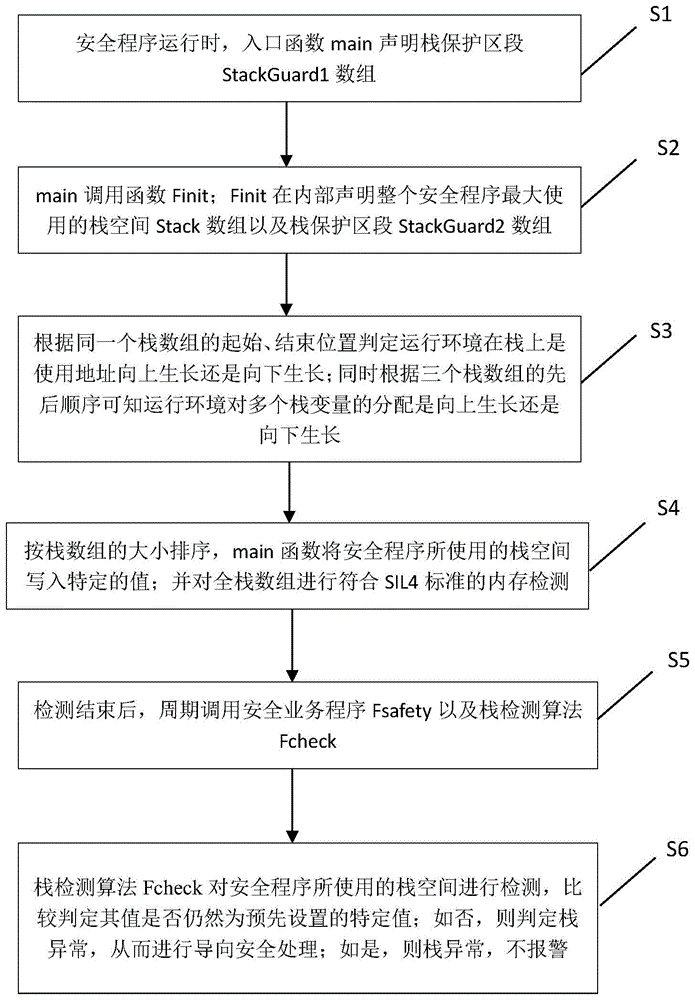
Fig. 1 is a flowchart of a method for detecting a SIL4 stack in a general operating system according to the present invention.
Detailed Description
For the purpose of better understanding the objects, technical solutions and advantages of the present invention, the following detailed description of the present invention with reference to the accompanying drawings and examples should be understood that the specific embodiment described herein is only a preferred embodiment of the present invention, and is only used for explaining the present invention, and not for limiting the scope of the present invention, and all other embodiments obtained by a person of ordinary skill in the art without making creative efforts shall fall within the scope of the present invention.
Example (b): as shown in fig. 1, a flowchart of a method for detecting a stack of a general operating system SIL4 is provided, which includes the following steps;
step S1, when the security program runs, the entry function main declares a stack protection section Stackguard1 array; the start position of the array of StackGuard1 is recorded with global variable P3 and the end position of the array of StackGuard1 is recorded with global variable P4.
Step S2, main calls the function Finit; finish internally declares a Stack space Stack array which is used most by the whole security program and a Stack protection section Stack guard2 array; recording the starting position of the Stack array by using a global variable P1 and the ending position of the Stack array by using a global variable P2, and then returning; the start position of the array of the StackGuard2 is recorded by using a global variable P5 and the end position of the array of the StackGuard2 is recorded by using a global variable P6, and then returned.
Step S3, determining whether the operating environment grows upwards (the memory address becomes larger) or downwards (the memory address becomes smaller) on the Stack by using the address according to the starting and ending positions of the same Stack array (any one of the Stack array, the Stack guard1 array, or the Stack guard2 array); and simultaneously, whether the distribution of the running environment to the stack variables grows upwards (the memory address is increased) or downwards (the memory address is decreased) is known according to the sequence of the three stack arrays.
Step S4, sorting by stack array size, expressed as: p1< P2< P3< P4< P5< P6, where sections [ P1, P2] and [ P5, P6] are stack spaces used by security programs and sections [ P3, P4] are stack spaces protected by stacks; the main function writes the stack space used by the security program to a specific value; and performing memory detection conforming to the SIL4 standard on the full stack array.
Step S5, after the detection is finished, the safety service program Fsecurity and the stack detection algorithm Fcheck are called periodically; the Stack used by Fsecurity is the same memory space as the Stack array declared by Finit.
Step S6, detecting the stack space used by the security program by a stack detection algorithm Fcheck, and comparing and judging whether the value is still a preset specific value; if not, judging that the stack is abnormal (the stack overflows or is damaged by the OS), and conducting guiding safety processing; if yes, the stack is abnormal and no alarm is given.
The above-mentioned embodiments are preferred embodiments of the present invention, but not limited thereto, for a method for detecting the SIL4 stack in the common operating system, and the scope of the present invention includes and is not limited to the embodiments, and all equivalent changes in shape and structure according to the present invention are within the scope of the present invention.

Claims (7)

1.一种适用通用操作系统SIL4栈检测方法,其特征在于:包括如下步骤:1. an applicable general-purpose operating system SIL4 stack detection method, is characterized in that: comprise the steps: 步骤S1、安全程序运行时,入口函数main声明栈保护区段StackGuard1数组;Step S1, when the safety program is running, the entry function main declares the stack protection section StackGuard1 array; 步骤S2、main调用函数Finit;Finit在内部声明整个安全程序最大使用的栈空间Stack数组以及栈保护区段StackGuard2数组;Step S2, the main call function Finit; Finit internally declares the stack space Stack array and the stack protection section StackGuard2 array that the entire safety program uses most; 步骤S3、根据同一个栈数组的起始、结束位置判定运行环境在栈上是使用地址向上生长还是向下生长;同时根据三个栈数组的先后顺序获知运行环境对多个栈变量的分配是向上生长还是向下生长;Step S3, according to the start and end positions of the same stack array, determine whether the operating environment uses the address to grow upward or downward on the stack; at the same time, according to the sequence of the three stack arrays, it is known whether the allocation of the operating environment to multiple stack variables is grow up or down; 步骤S4、按栈数组的大小排序,main函数将安全程序所使用的栈空间写入特定的值;并对全栈数组进行符合SIL4标准的内存检测;Step S4, sorting according to the size of the stack array, the main function writes the stack space used by the safety program into a specific value; and performs memory detection that conforms to the SIL4 standard for the full stack array; 步骤S5、检测结束后,周期调用安全业务程序Fsafety以及栈检测算法Fcheck;Step S5, after the detection ends, periodically call the safety service program Fsafety and the stack detection algorithm Fcheck; 步骤S6、栈检测算法Fcheck对安全程序所使用的栈空间进行检测,比较判定其值是否仍然为预先设置的特定值;如否,则判定栈异常,从而进行导向安全处理;如是,则栈异常,不报警。Step S6, the stack detection algorithm Fcheck detects the stack space used by the safety program, and compares and determines whether its value is still a preset specific value; if not, it is determined that the stack is abnormal, thereby conducting guided security processing; if so, the stack is abnormal. , do not call the police. 2.根据权利要求1所述的一种适用通用操作系统SIL4栈检测方法,其特征在于:2. a kind of applicable general-purpose operating system SIL4 stack detection method according to claim 1, is characterized in that: 步骤S1还包括:利用全局变量P3记录StackGuard1数组的起始位置以及利用全局变量P4记录StackGuard1数组结束位置。Step S1 further includes: using the global variable P3 to record the start position of the StackGuard1 array and using the global variable P4 to record the end position of the StackGuard1 array. 3.根据权利要求1或2所述的一种适用通用操作系统SIL4栈检测方法,其特征在于:3. a kind of applicable general-purpose operating system SIL4 stack detection method according to claim 1 and 2, is characterized in that: 步骤S2还包括:利用全局变量P1记录Stack数组的起始位置以及利用全局变量P2记录Stack数组结束位置,然后返回。Step S2 further includes: using the global variable P1 to record the start position of the Stack array and using the global variable P2 to record the end position of the Stack array, and then returning. 4.根据权利要求3所述的一种适用通用操作系统SIL4栈检测方法,其特征在于:4. a kind of applicable general-purpose operating system SIL4 stack detection method according to claim 3, is characterized in that: 步骤S2还包括:利用全局变量P5记录StackGuard2数组起始位置以及利用全局变量P6记录StackGuard2数组结束位置,然后返回。Step S2 also includes: using the global variable P5 to record the starting position of the StackGuard2 array and using the global variable P6 to record the ending position of the StackGuard2 array, and then returning. 5.根据权利要求或1或2所述的一种适用通用操作系统SIL4栈检测方法,其特征在于:5. a kind of applicable general-purpose operating system SIL4 stack detection method according to claim or 1 or 2, is characterized in that: 同一个栈数组为Stack数组、StackGuard1数组或者StackGuard2数组三者任一一个。The same stack array is any one of Stack array, StackGuard1 array, or StackGuard2 array. 6.根据权利要求1所述的一种适用通用操作系统SIL4栈检测方法,其特征在于:6. a kind of applicable general-purpose operating system SIL4 stack detection method according to claim 1, is characterized in that: Fsafety所使用的栈与Finit声明的Stack数组为相同的内存空间。The stack used by Fsafety is the same memory space as the Stack array declared by Finit. 7.根据权利要求4所述的一种适用通用操作系统SIL4栈检测方法,其特征在于:7. a kind of applicable general-purpose operating system SIL4 stack detection method according to claim 4, is characterized in that: 按栈数组的大小排序表示为:P1<P2<P3<P4<P5<P6,其中区段[P1,P2]和[P5,P6]为安全程序所使用的栈空间,区段[P3,P4]为栈保护的栈空间。Sorted by the size of the stack array, it is expressed as: P1<P2<P3<P4<P5<P6, where the sections [P1, P2] and [P5, P6] are the stack space used by the safety program, and the sections [P3, P4] ] is the stack space protected by the stack.
CN202110835650.8A 2021-07-23 2021-07-23 A SIL4 stack detection method applicable to general operating systems Active CN113687968B (en)

Priority Applications (1)

Application Number Priority Date Filing Date Title
CN202110835650.8A CN113687968B (en) 2021-07-23 2021-07-23 A SIL4 stack detection method applicable to general operating systems

Applications Claiming Priority (1)

Application Number Priority Date Filing Date Title
CN202110835650.8A CN113687968B (en) 2021-07-23 2021-07-23 A SIL4 stack detection method applicable to general operating systems

Publications (2)

Publication Number Publication Date
CN113687968A true CN113687968A (en) 2021-11-23
CN113687968B CN113687968B (en) 2024-11-26

Family

ID=78577750

Family Applications (1)

Application Number Title Priority Date Filing Date
CN202110835650.8A Active CN113687968B (en) 2021-07-23 2021-07-23 A SIL4 stack detection method applicable to general operating systems

Country Status (1)

Country Link
CN (1) CN113687968B (en)

Citations (8)

* Cited by examiner, † Cited by third party
Publication number Priority date Publication date Assignee Title
US6578094B1 (en) * 2000-03-02 2003-06-10 International Business Machines Corporation Method for preventing buffer overflow attacks
JP2010198147A (en) * 2009-02-24 2010-09-09 Mitsubishi Heavy Ind Ltd Protection method for data in stack area in computer memory
CN103294517A (en) * 2012-02-22 2013-09-11 国际商业机器公司 Stack overflow protection device, stack protection method, related compiler and calculation device
CN106547606A (en) * 2016-10-25 2017-03-29 交控科技股份有限公司 Storehouse self checking method and device
CN108268770A (en) * 2018-02-05 2018-07-10 烽火通信科技股份有限公司 A kind of stack overflow detecting system and method
CN109214169A (en) * 2017-06-30 2019-01-15 芜湖美的厨卫电器制造有限公司 Stack overflow detection method, device and household electrical appliance
CN112286684A (en) * 2020-10-29 2021-01-29 苏州浪潮智能科技有限公司 Memory usage control method, device, equipment and medium
CN112631510A (en) * 2020-12-02 2021-04-09 海光信息技术股份有限公司 Method and device for expanding stack area and hardware platform

Patent Citations (8)

* Cited by examiner, † Cited by third party
Publication number Priority date Publication date Assignee Title
US6578094B1 (en) * 2000-03-02 2003-06-10 International Business Machines Corporation Method for preventing buffer overflow attacks
JP2010198147A (en) * 2009-02-24 2010-09-09 Mitsubishi Heavy Ind Ltd Protection method for data in stack area in computer memory
CN103294517A (en) * 2012-02-22 2013-09-11 国际商业机器公司 Stack overflow protection device, stack protection method, related compiler and calculation device
CN106547606A (en) * 2016-10-25 2017-03-29 交控科技股份有限公司 Storehouse self checking method and device
CN109214169A (en) * 2017-06-30 2019-01-15 芜湖美的厨卫电器制造有限公司 Stack overflow detection method, device and household electrical appliance
CN108268770A (en) * 2018-02-05 2018-07-10 烽火通信科技股份有限公司 A kind of stack overflow detecting system and method
CN112286684A (en) * 2020-10-29 2021-01-29 苏州浪潮智能科技有限公司 Memory usage control method, device, equipment and medium
CN112631510A (en) * 2020-12-02 2021-04-09 海光信息技术股份有限公司 Method and device for expanding stack area and hardware platform

Non-Patent Citations (2)

* Cited by examiner, † Cited by third party
Title
GANG CHEN ET AL: "SafeStack: Automatically Patching Stack-based Buffer Overflow Vulnerabilities", 《IEEE TRANSACTIONS ON DEPENDABLE AND SECURE COMPUTING》, vol. 10, no. 6, 30 November 2013 (2013-11-30), pages 1 - 14, XP011535818, DOI: 10.1109/TDSC.2013.25 *
刘勇 等: "一种简便的栈式片上内存动态管理方法", 《计算机工程与科学》, vol. 32, no. 9, 30 September 2010 (2010-09-30), pages 111 - 114 *

Also Published As

Publication number Publication date
CN113687968B (en) 2024-11-26

Similar Documents

Publication Publication Date Title
US8001273B2 (en) Parallel processing of input data to locate landmarks for chunks
US7167881B2 (en) Method for heap memory management and computer system using the same method
CN109271343B (en) A data merging method and device applied in a key-value storage system
US20160034262A1 (en) Transmission point pattern extraction from executable code in message passing environments
CN103839007B (en) A kind of method and system detecting abnormal thread
US20110145536A1 (en) Memory leak detection during dynamic memory allocation
US11144227B2 (en) Content-based post-process data deduplication
CN107025230B (en) Processing method and device for web crawler
CN103150260A (en) Method and device for deleting repeating data
CN104102695A (en) Data processing method and smart device in startup process of smart device
US8914381B2 (en) Correlation filter
CN108710475B (en) Method and device for enhancing low-temperature robustness of solid state disk and computer equipment
CN117725035A (en) A file merging method and related equipment for LSM trees
CN107193498B (en) Method and device for carrying out de-duplication processing on data
EP0604310B1 (en) Information system and method for cache memory management
CN113687968A (en) A SIL4 stack detection method suitable for general operating systems
WO2024078122A1 (en) Database table scanning method and apparatus, and device
US11789899B2 (en) High-performance data lake system and data storage method
KR20170131374A (en) After Disabling Memory Corruption Root Cause Identification Techniques
CN120144594B (en) Key value database near storage computing system based on computing storage device
CN108520178B (en) An Android platform intrusion detection method based on CFSFDP clustering
EP3001312A1 (en) Method, device and computer program product for detecting data dependencies within a program
CN115469796A (en) Data storage method, device, equipment and storage medium
US8381234B2 (en) System and method for managing applications having logical pointer and flag
WO2012081165A1 (en) Database management device and database management method

Legal Events

Date Code Title Description
PB01 Publication
PB01 Publication
SE01 Entry into force of request for substantive examination
GR01 Patent grant
GR01 Patent grant