CN113684466A - Method for reducing diamond film crack - Google Patents
Method for reducing diamond film crack Download PDFInfo
- Publication number
- CN113684466A CN113684466A CN202111224661.9A CN202111224661A CN113684466A CN 113684466 A CN113684466 A CN 113684466A CN 202111224661 A CN202111224661 A CN 202111224661A CN 113684466 A CN113684466 A CN 113684466A
- Authority
- CN
- China
- Prior art keywords
- column
- cooling
- substrate
- diamond film
- substrate column
- Prior art date
- Legal status (The legal status is an assumption and is not a legal conclusion. Google has not performed a legal analysis and makes no representation as to the accuracy of the status listed.)
- Granted
Links
- 229910003460 diamond Inorganic materials 0.000 title claims abstract description 102
- 239000010432 diamond Substances 0.000 title claims abstract description 102
- 238000000034 method Methods 0.000 title claims abstract description 37
- 238000001816 cooling Methods 0.000 claims abstract description 152
- 239000011159 matrix material Substances 0.000 claims abstract description 63
- 230000008569 process Effects 0.000 claims abstract description 9
- 239000000758 substrate Substances 0.000 claims description 124
- XKRFYHLGVUSROY-UHFFFAOYSA-N Argon Chemical compound [Ar] XKRFYHLGVUSROY-UHFFFAOYSA-N 0.000 claims description 30
- 238000004140 cleaning Methods 0.000 claims description 17
- 229910052786 argon Inorganic materials 0.000 claims description 15
- 238000000926 separation method Methods 0.000 claims description 15
- VNWKTOKETHGBQD-UHFFFAOYSA-N methane Chemical compound C VNWKTOKETHGBQD-UHFFFAOYSA-N 0.000 claims description 14
- OKTJSMMVPCPJKN-UHFFFAOYSA-N Carbon Chemical compound [C] OKTJSMMVPCPJKN-UHFFFAOYSA-N 0.000 claims description 10
- 229910052799 carbon Inorganic materials 0.000 claims description 10
- UFHFLCQGNIYNRP-UHFFFAOYSA-N Hydrogen Chemical compound [H][H] UFHFLCQGNIYNRP-UHFFFAOYSA-N 0.000 claims description 7
- 230000003247 decreasing effect Effects 0.000 claims description 7
- 230000005284 excitation Effects 0.000 claims description 7
- 239000001257 hydrogen Substances 0.000 claims description 7
- 229910052739 hydrogen Inorganic materials 0.000 claims description 7
- 238000005336 cracking Methods 0.000 claims description 5
- 230000000087 stabilizing effect Effects 0.000 claims description 2
- 230000008859 change Effects 0.000 abstract description 4
- 230000035882 stress Effects 0.000 description 15
- CSCPPACGZOOCGX-UHFFFAOYSA-N Acetone Chemical compound CC(C)=O CSCPPACGZOOCGX-UHFFFAOYSA-N 0.000 description 10
- 239000013078 crystal Substances 0.000 description 8
- 238000009826 distribution Methods 0.000 description 7
- 230000009467 reduction Effects 0.000 description 7
- 230000017525 heat dissipation Effects 0.000 description 6
- 238000001035 drying Methods 0.000 description 5
- 210000001503 joint Anatomy 0.000 description 5
- 239000000843 powder Substances 0.000 description 5
- ZOKXTWBITQBERF-UHFFFAOYSA-N Molybdenum Chemical compound [Mo] ZOKXTWBITQBERF-UHFFFAOYSA-N 0.000 description 4
- 229910052750 molybdenum Inorganic materials 0.000 description 4
- 239000011733 molybdenum Substances 0.000 description 4
- 238000005229 chemical vapour deposition Methods 0.000 description 3
- 238000005516 engineering process Methods 0.000 description 3
- 238000004880 explosion Methods 0.000 description 2
- 230000000630 rising effect Effects 0.000 description 2
- RYGMFSIKBFXOCR-UHFFFAOYSA-N Copper Chemical compound [Cu] RYGMFSIKBFXOCR-UHFFFAOYSA-N 0.000 description 1
- 239000000498 cooling water Substances 0.000 description 1
- 229910052802 copper Inorganic materials 0.000 description 1
- 239000010949 copper Substances 0.000 description 1
- 238000009792 diffusion process Methods 0.000 description 1
- 238000012986 modification Methods 0.000 description 1
- 230000004048 modification Effects 0.000 description 1
- 230000006911 nucleation Effects 0.000 description 1
- 238000010899 nucleation Methods 0.000 description 1
- 238000002360 preparation method Methods 0.000 description 1
- 230000005855 radiation Effects 0.000 description 1
- 239000000126 substance Substances 0.000 description 1
- 230000008646 thermal stress Effects 0.000 description 1
- 235000012431 wafers Nutrition 0.000 description 1
- XLYOFNOQVPJJNP-UHFFFAOYSA-N water Substances O XLYOFNOQVPJJNP-UHFFFAOYSA-N 0.000 description 1
Images


Classifications
-
- C—CHEMISTRY; METALLURGY
- C23—COATING METALLIC MATERIAL; COATING MATERIAL WITH METALLIC MATERIAL; CHEMICAL SURFACE TREATMENT; DIFFUSION TREATMENT OF METALLIC MATERIAL; COATING BY VACUUM EVAPORATION, BY SPUTTERING, BY ION IMPLANTATION OR BY CHEMICAL VAPOUR DEPOSITION, IN GENERAL; INHIBITING CORROSION OF METALLIC MATERIAL OR INCRUSTATION IN GENERAL
- C23C—COATING METALLIC MATERIAL; COATING MATERIAL WITH METALLIC MATERIAL; SURFACE TREATMENT OF METALLIC MATERIAL BY DIFFUSION INTO THE SURFACE, BY CHEMICAL CONVERSION OR SUBSTITUTION; COATING BY VACUUM EVAPORATION, BY SPUTTERING, BY ION IMPLANTATION OR BY CHEMICAL VAPOUR DEPOSITION, IN GENERAL
- C23C16/00—Chemical coating by decomposition of gaseous compounds, without leaving reaction products of surface material in the coating, i.e. chemical vapour deposition [CVD] processes
- C23C16/22—Chemical coating by decomposition of gaseous compounds, without leaving reaction products of surface material in the coating, i.e. chemical vapour deposition [CVD] processes characterised by the deposition of inorganic material, other than metallic material
- C23C16/26—Deposition of carbon only
- C23C16/27—Diamond only
-
- C—CHEMISTRY; METALLURGY
- C23—COATING METALLIC MATERIAL; COATING MATERIAL WITH METALLIC MATERIAL; CHEMICAL SURFACE TREATMENT; DIFFUSION TREATMENT OF METALLIC MATERIAL; COATING BY VACUUM EVAPORATION, BY SPUTTERING, BY ION IMPLANTATION OR BY CHEMICAL VAPOUR DEPOSITION, IN GENERAL; INHIBITING CORROSION OF METALLIC MATERIAL OR INCRUSTATION IN GENERAL
- C23C—COATING METALLIC MATERIAL; COATING MATERIAL WITH METALLIC MATERIAL; SURFACE TREATMENT OF METALLIC MATERIAL BY DIFFUSION INTO THE SURFACE, BY CHEMICAL CONVERSION OR SUBSTITUTION; COATING BY VACUUM EVAPORATION, BY SPUTTERING, BY ION IMPLANTATION OR BY CHEMICAL VAPOUR DEPOSITION, IN GENERAL
- C23C16/00—Chemical coating by decomposition of gaseous compounds, without leaving reaction products of surface material in the coating, i.e. chemical vapour deposition [CVD] processes
- C23C16/44—Chemical coating by decomposition of gaseous compounds, without leaving reaction products of surface material in the coating, i.e. chemical vapour deposition [CVD] processes characterised by the method of coating
- C23C16/46—Chemical coating by decomposition of gaseous compounds, without leaving reaction products of surface material in the coating, i.e. chemical vapour deposition [CVD] processes characterised by the method of coating characterised by the method used for heating the substrate
- C23C16/463—Cooling of the substrate
Landscapes
- Chemical & Material Sciences (AREA)
- General Chemical & Material Sciences (AREA)
- Chemical Kinetics & Catalysis (AREA)
- Engineering & Computer Science (AREA)
- Materials Engineering (AREA)
- Mechanical Engineering (AREA)
- Metallurgy (AREA)
- Organic Chemistry (AREA)
- Inorganic Chemistry (AREA)
- Crystals, And After-Treatments Of Crystals (AREA)
- Carbon And Carbon Compounds (AREA)
Abstract
The invention provides a method for reducing diamond film cracks, which comprises the following steps: and in the cooling process after the growth is finished, when the temperature of the matrix column is reduced to a set temperature, controlling the matrix column to be separated from a cooling table arranged below the matrix column until the cooling is finished. The method for reducing the cracks of the diamond film can reduce the cooling speed of the diamond film, thereby slowing down the change amplitude of the diamond film and delaying the cooling time, fully releasing the internal stress, reducing the cracks of the diamond film and improving the whole film rate of the diamond film to more than 65 percent.
Description
Technical Field
The invention belongs to the technical field of diamond growth and preparation, and particularly relates to a method for reducing diamond film cracks.
Background
Diamond has excellent physicochemical properties such as extremely high thermal conductivity, low thermal expansion coefficient, high chemical inertness and the like, so that the diamond is widely concerned. The Chemical Vapor Deposition (CVD) technology is one of the main technologies for preparing high-quality diamond films, wherein the dc arc CVD diamond technology can grow diamond polycrystalline wafers of more than 3 inches, has the characteristics of high wear ratio, high thermal conductivity and the like, and is widely applied to the superhard tool industry. Especially in the heat conduction field, mainly used chip heat dissipation, 5G base station heat dissipation other thermal management devices, have very big market prospect.
However, in the market, the larger the diamond size required by customers is, the better the diamond size is, and actually, in the process of cooling the diamond growth, because the molybdenum matrix column and the cooling table are continuously contacted for cooling, but the different expansion coefficients of the components in the diamond film cause different stress release degrees during cooling, a complete piece without cracks is difficult to obtain, so that the whole film rate of the diamond film is reduced, and the utilization rate of a finished product is not high.
Meanwhile, the continuously circulating cold water is directly cooled through the molybdenum substrate column with strong heat conductivity, heat dissipation in the diamond film can be further accelerated, so that the stress in the diamond film is contracted when the stress is not in time to diffuse outwards, a large amount of stress concentration is generated in the diamond film, the probability of crack occurrence can be further enlarged after cooling is finished, the overall utilization rate of the product is reduced to a great extent, and the product cost is increased.
How to control the temperature diffusion speed inside the diamond film during temperature reduction to slow down the temperature cooling change amplitude, so that the internal stress can be diffused outwards sufficiently in time, thereby improving the stress distribution and reducing the occurrence of cracks of the diamond film, and the method is the key for improving the whole film rate and the whole sheet utilization rate of the diamond film.
Disclosure of Invention
The invention provides a method for reducing cracks of a diamond film, and solves the technical problems that in the prior art, the cracks are easy to appear when the diamond film is cooled due to an unreasonable cooling method, so that the whole film rate and the whole sheet utilization rate of the diamond film are low.
In order to solve the technical problems, the invention adopts the technical scheme that:
a method of reducing cracking of a diamond film, the steps comprising: and in the cooling process after the growth is finished, when the temperature of the matrix column is reduced to a set temperature, controlling the matrix column to be separated from a cooling table arranged below the matrix column until the cooling is finished.
Further, the step of controlling the separation of the substrate column from the cooling stage includes:
when the temperature of the substrate column is 700-800 ℃, the power supply is turned off;
controlling the cooling table to descend, and enabling the base body column to be erected on a cylinder column arranged on the outer side of the cooling table;
stabilizing the substrate column and the cooling stage with the substrate column positioned above the cooling stage.
Further, the separation height between the stabilized substrate column and the cooling stage is not less than 5 mm.
Further, the separation height between the substrate column and the cooling stage is 10 mm.
Further, after the base column is controlled to be separated from the cooling table, the step of vacuumizing the furnace chamber is further included, so that the base column and the cooling table are isolated in vacuum until the temperature reduction is finished.
Further, the vacuum degree in the furnace cavity is less than 0.1 Pa.
Further, before controlling the substrate column to be separated from the cooling stage, the method further includes:
controlling the cooling stage to be in direct contact with the substrate column;
vacuumizing and cleaning the furnace chamber and checking the air leakage rate;
controlling current and nucleating growth on the surface of the matrix column.
Further, the controlling the cooling stage to be in direct contact with the substrate column specifically includes:
the height of the position where the cooling table is contacted with the substrate column is higher than the height of a cylinder column which is arranged outside the cooling table and used for supporting the substrate column when cooling; or,
the position where the cooling table is brought into contact with the substrate column is the same as the height of a column for supporting the substrate column when placed outside the cooling table and used for cooling.
Further, the step of controlling the current and nucleating and growing on the surface of the matrix column specifically comprises:
when the air leakage rate is below 0-0.5Pa/min, firstly introducing argon and controlling the flow of the argon within 2-5L/min;
when the air pressure in the furnace chamber reaches 3000-5000Pa, introducing hydrogen with the flow rate of 8-10L/min into the furnace chamber until the base column arcs;
adjusting the current to be 0.3-1.0A to stabilize the arc of the substrate column;
growing a diamond film on the surface of the substrate column when the substrate column temperature reaches a growth condition;
after the diamond film grows for 72 hours, methane is closed; and the excitation current is decreased at a rate of 5A/10 min. Further, the step of nucleating growth of a diamond film on the surface of the substrate column when the substrate column temperature reaches the growth condition includes:
adding a carbon source when the temperature of the matrix column reaches 900-;
nucleating and growing on the surface of the matrix column for 10-30 min;
increasing the current, and when the temperature is 900-1000 ℃, the diamond film grows normally.
Compared with the prior art, the method has the advantages that the substrate column is separated from the cooling table during cooling, so that the rapid cooling of the substrate column is avoided, and the stress is slowly released. Reduce the generation of cracks on the diamond film. After the substrate column and the cooling platform are separated, the furnace body is vacuumized, so that no circulating medium capable of transferring temperature exists in the space with the separation height, the heat dissipation speed of the substrate column can be further reduced, the cooling time of the diamond film is shortened, the temperature on the diamond film is slowly reduced to the room temperature, the stress in the diamond film is fully released, and the cracks and even the risk of explosion of the diamond film caused by rapid cooling are reduced.
The method for reducing the cracks of the diamond film can reduce the cooling speed of the diamond film, thereby slowing down the change amplitude of the diamond film and delaying the cooling time, fully releasing the internal stress, reducing the cracks of the diamond film and improving the whole film rate of the diamond film to more than 65 percent.
Drawings
FIG. 1 is a schematic view illustrating an operation state of a cooling apparatus during cooling according to an embodiment of the present invention;
FIG. 2 is a schematic view of the operation of a cooling apparatus during growth according to an embodiment of the present invention;
FIG. 3 is a schematic view showing the operation of a cooling apparatus during growth according to another embodiment of the present invention.
In the figure:
10. a base column 20, a cooling table 30, a cylinder column 40 and a furnace body bottom.
Detailed Description
The invention is described in detail below with reference to the figures and specific embodiments.
A method of reducing cracking of a diamond film, the steps comprising:
s1, the cooling stage 20 is controlled to be in direct contact with the substrate column 10.
In this embodiment, the substrate column 10 is a molybdenum-based column, and the edge of the substrate column 10 is a rounded arc angle, so as to improve the temperature uniformity of the substrate column 10, and facilitate diamond demolding. The outer side of the cooling platform 20 is provided with a cylinder column 30 with a straight arm type structure, the lower end of the cylinder column 30 is directly fixed on the bottom 40 of the furnace body, the cooling platform 20 is made of red copper with high heat conductivity, circulating cooling water is filled in the cooling platform, and the cooling platform can be controlled by an external driving piece to vertically lift and move along the axial direction of the cooling platform. The column 30 is made of molybdenum, and the height of the column 30 is required to be higher than the minimum height of the cooling platform 20 in order to ensure that the substrate column 10 can be suspended above the cooling platform 20.
Grinding the matrix column 10 by using diamond micro powder, cleaning the ground matrix column by using acetone, and drying the washed matrix column in an oven for later use;
the cylinder 30 is fixed in the positioning groove of the furnace bottom 40 in advance.
The processed substrate column 10 is placed on the cooling table 20, and the bottom groove of the substrate column 10 is in positioning butt joint with the upper end face of the cooling table 20.
Wherein the direct contact of the cooling stage 20 with the substrate column 10 comprises: the cooling stage 20 is in contact with the substrate column 10 at a position higher than the height of the column 30, as shown in FIG. 2; or the position where the cooling stage 20 is brought into contact with the substrate column 10 is performed at the same height as the column 30, as shown in fig. 3. No matter what way the cylinder 30 is arranged, the growth quality of the subsequent diamond film can be ensured as long as the upper end surface of the cooling platform 20 is directly contacted with the lower end surface of the matrix column 10 when the diamond film grows.
And S2, vacuumizing and cleaning the furnace cavity and checking the air leakage rate.
Closing the furnace door, vacuumizing, cleaning the furnace body for 2 times by using argon, and testing the air leakage rate until the air leakage rate is below 0-0.5Pa/min, so that the temperature rise condition can be met.
And S3, controlling the current and nucleating and growing on the surface of the matrix column 10.
The exciting current of the coil with the current as the moment specifically comprises the following steps:
when the air leakage rate in the furnace is below 0-0.5Pa/min, firstly introducing argon and controlling the flow of the argon within 2-5L/min.
When the air pressure in the furnace chamber reaches 3000-5000Pa, introducing hydrogen with the flow rate of 8-10L/min into the furnace chamber.
The exciting current is adjusted to 0.3-1.0A to stabilize the arc of the base column 10.
When the temperature of the matrix column 10 reached 900-.
Nucleation and growth are carried out on the surface of the matrix column 10 for 10-30 min.
Increasing the current at the temperature rising rate of 5A/10min, and when the current reaches 140-170A and the temperature is 900-1000 ℃, the diamond film normally grows.
After the diamond film grows for 72 hours, closing the methane; and the excitation current is decreased at a rate of 5A/10 min.
S4, in the cooling process after the growth is completed, when the temperature of the matrix column 10 is reduced to the set temperature, controlling the matrix column 10 to separate from the cooling stage 20 disposed below the matrix column 10 until the cooling is completed.
When the temperature of the substrate column 10 is 700 ℃ and 800 ℃, the power supply is turned off.
The cooling stage 20 is controlled to descend, and the substrate column 10 is mounted on the column 30.
The substrate column 10 and the cooling stage 20 are stabilized, and the substrate column 10 is located directly above the cooling stage 20, i.e., the substrate column 10 is at a certain distance height H from the cooling stage 20.
Further, the separation height H between the stabilized substrate column 10 and the cooling stage 20 is not less than 5 mm. This is because, when the thickness is less than 5mm, the gap between the cooling stage 20 and the substrate column 10 is too small, and the heat radiation also causes the substrate column 10 to be cooled too quickly, which causes stress in the diamond film to be released quickly, and may also cause the film to crack.
Preferably, the substrate column 10 and the cooling table 20 are separated from each other, and the gap height H is 10mm, so that the cooling table 20 is retracted to reduce the contact area between the substrate column 10 and the substrate column, and then the heat conduction and dissipation speed of the substrate column 10 is reduced, and further the cooling speed of the substrate column is reduced, so that the cooling speed of the diamond film arranged on the upper end surface of the substrate column is reduced, more time is left for gradually releasing the thermal stress in the diamond film outwards, the temperature is slowly reduced, the stress concentration is avoided, the number of cracks of the diamond film can be reduced, and the whole film rate of the diamond film is improved.
S5, the substrate column 10 is isolated from the cooling stage 20 by vacuum, and this vacuum state is continued until the temperature reduction is completed.
Preferably, the vacuum degree in the furnace cavity is less than 0.1Pa, and no medium flows through the cavity. The vacuum space is arranged between the matrix column 10 and the cooling platform 20, and then no circulating medium capable of transferring temperature exists between the matrix column 10 and the cooling platform 20, so that the heat dissipation speed of the matrix column 10 can be further reduced, the cooling time of the diamond film is shortened, the temperature on the diamond film is slowly reduced to the room temperature, the stress in the diamond film is fully released, and the risk of cracks and even burst of the diamond film due to rapid cooling is reduced.
The first embodiment is as follows:
s1, the cooling stage 20 is controlled to be in direct contact with the substrate column 10.
Firstly, grinding the substrate column 10 by using diamond micro powder, cleaning the substrate column by using acetone, and drying the substrate column in an oven for later use.
The cylinder 30 is fixed in the positioning groove of the furnace bottom 40 in advance.
The processed substrate column 10 is placed on the cooling table 20, and the bottom groove of the substrate column 10 is in positioning butt joint with the upper end face of the cooling table 20.
The cooling stage 20 moves up against the substrate column 10 to separate the column 30 from the substrate column 10, as shown in FIG. 2.
And S2, vacuumizing and cleaning the furnace cavity and checking the air leakage rate.
Closing the furnace door, vacuumizing, cleaning the furnace body for 2 times by using argon, and testing the air leakage rate until the air leakage rate is below 0-0.5Pa/min, so that the temperature rise condition can be met.
And S3, controlling the current and nucleating and growing on the surface of the matrix column 10.
When the air leakage rate in the furnace is 0.4Pa/min, firstly introducing argon with the flow rate of 5L/min into the furnace.
When the air pressure in the furnace chamber reaches 5000Pa, hydrogen with the flow rate of 8L/min is introduced into the furnace chamber until the arc of the upper end surface of the base column is started.
Rapidly adjusting the exciting current to 1.0A to stabilize the arc of the upper end surface of the base column 10; the current was slowly increased to bring the temperature of the matrix column 10 to 940 ℃.
Adding carbon source 200ml/min, and nucleating and growing on the surface of the matrix column 10 for 10-30 min. The carbon source was then lowered to 100 ml/min.
The current was increased at a rate of 5A/10min, and when the current reached 145A and the temperature was stabilized at 980 ℃, the diamond film grew normally.
After the diamond film grows for 72 hours, closing the methane; and the excitation current is decreased at a rate of 5A/10 min.
S4, in the cooling process after the growth is completed, when the temperature of the matrix column 10 is reduced to the set temperature, controlling the matrix column 10 to separate from the cooling stage 20 disposed below the matrix column 10 until the cooling is completed.
When the temperature of the substrate column 10 is 700 ℃, the arc power supply is first turned off.
The height of the cooling stage 20 was lowered, the substrate column 10 was mounted on the column 30, the substrate column 10 and the cooling stage 20 were separated, and the separation height H between the substrate column 10 and the cooling stage 20 was stabilized at 5 mm.
And S5, adjusting the vacuum degree in the furnace cavity to be 0Pa until the temperature reduction is finished.
And vacuumizing the furnace body to 0Pa to slowly cool the matrix column 10 in the furnace body, and cooling the matrix column 10 to room temperature after about 1 h.
And opening the furnace body air release valve to release air from the furnace body.
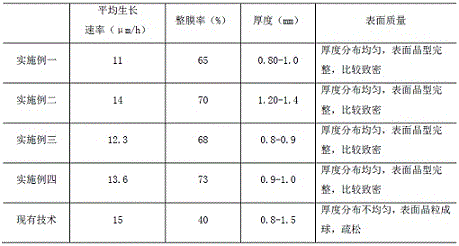
Opening the furnace body and taking out the diamond film from the substrate column 10, wherein the whole film rate reaches 65%, the surface thickness distribution is uniform, the crystal form is complete, no crack exists, the crystal lattice is compact, and the thickness is 0.8-1.0 mm; the average growth rate finally measured was 11 μm/h.
Example two:
s1, the cooling stage 20 is controlled to be in direct contact with the substrate column 10.
Firstly, grinding the substrate column 10 by using diamond micro powder, cleaning the substrate column by using acetone, and drying the substrate column in an oven for later use.
The cylinder 30 is fixed in the positioning groove of the furnace bottom 40 in advance.
The processed substrate column 10 is placed on the cooling table 20, and the bottom groove of the substrate column 10 is in positioning butt joint with the upper end face of the cooling table 20.
The cooling stage 20 moves up against the substrate column 10 to separate the column 30 from the substrate column 10, as shown in FIG. 2.
And S2, vacuumizing and cleaning the furnace cavity and checking the air leakage rate.
Closing the furnace door, vacuumizing, cleaning the furnace body for 2 times by using argon, and testing the air leakage rate until the air leakage rate is below 0-0.5Pa/min, so that the temperature rise condition can be met.
And S3, controlling the current and nucleating and growing on the surface of the matrix column 10.
When the air leakage rate in the furnace is below 0.3Pa/min, firstly introducing argon with the flow rate of 2L/min into the furnace.
When the air pressure in the furnace chamber reaches 3000Pa, hydrogen with the flow rate of 10L/min is introduced into the furnace chamber until the arc of the upper end surface of the base column is started.
Rapidly adjusting the exciting current to 0.3A to stabilize the arc of the upper end surface of the base column 10; the current was slowly increased to bring the temperature of the matrix column 10 to 900 ℃.
Adding carbon source 200ml/min, and nucleating and growing on the surface of the matrix column 10 for 10-30 min. The carbon source was then lowered to 100 ml/min.
The current was increased at a rate of 5A/10min, and when the current reached 150A and the temperature was stabilized at 950 ℃, the diamond film grew normally.
After the diamond film grows for 72 hours, closing the methane; and the excitation current is decreased at a rate of 5A/10 min.
S4, in the cooling process after the growth is completed, when the temperature of the matrix column 10 is reduced to the set temperature, controlling the matrix column 10 to separate from the cooling stage 20 disposed below the matrix column 10 until the cooling is completed.
When the temperature of the substrate column 10 is 800 ℃, the arc power supply is first turned off.
The height of the cooling stage 20 was lowered, the substrate column 10 was mounted on the column 30, the substrate column 10 and the cooling stage 20 were separated, and the separation height H between the substrate column 10 and the cooling stage 20 was stabilized at 10 mm.
And S5, adjusting the vacuum degree in the furnace cavity to be 0Pa until the temperature reduction is finished.
And vacuumizing the furnace body to 0Pa to slowly cool the matrix column 10 in the furnace body, and cooling the matrix column 10 to room temperature after about 1 h.
And opening the furnace body air release valve to release air from the furnace body.
Opening the furnace body and taking out the diamond film from the substrate column 10, wherein the film forming rate can reach 70 percent, the surface has no cracks, the thickness is 1.2-1.4mm, the distribution is uniform, and the crystal form is complete and compact; the average growth rate finally measured was 14 μm/h.
Example three:
s1, the cooling stage 20 is controlled to be in direct contact with the substrate column 10.
Firstly, grinding the substrate column 10 by using diamond micro powder, cleaning the substrate column by using acetone, and drying the substrate column in an oven for later use.
The cylinder 30 is fixed in the positioning groove of the furnace bottom 40 in advance.
The processed substrate column 10 is placed on the cooling table 20, and the bottom groove of the substrate column 10 is in positioning butt joint with the upper end face of the cooling table 20.
The substrate column 10 is placed on the barrel column 30 and the lower end face of the substrate column 10 is in direct contact with the upper end face of the cooling stage 20, as shown in fig. 3.
And S2, vacuumizing and cleaning the furnace cavity and checking the air leakage rate.
Closing the furnace door, vacuumizing, cleaning the furnace body for 2 times by using argon, and testing the air leakage rate until the air leakage rate is below 0-0.5Pa/min, so that the temperature rise condition can be met.
And S3, controlling the current and nucleating and growing on the surface of the matrix column 10.
When the air leakage rate in the furnace is 0.5Pa/min, firstly introducing argon with the flow rate of 4L/min into the furnace.
When the air pressure in the furnace chamber reaches 4000Pa, introducing hydrogen with the flow rate of 9L/min into the furnace chamber until the arc of the upper end surface of the base column is started.
Rapidly adjusting the exciting current to 0.8A to stabilize the arc of the upper end surface of the base column 10; the current was slowly increased to bring the temperature of the matrix column 10 to 930 ℃.
Adding carbon source 200ml/min, and nucleating and growing on the surface of the matrix column 10 for 10-30 min. The carbon source was then lowered to 100 ml/min.
The current was increased at a rate of 5A/10min, and when the current reached 155A and the temperature was stabilized at 970 deg.C, the diamond film grew normally.
After the diamond film grows for 72 hours, closing the methane; and the excitation current is decreased at a rate of 5A/10 min.
S4, in the cooling process after the growth is completed, when the temperature of the matrix column 10 is reduced to the set temperature, controlling the matrix column 10 to separate from the cooling stage 20 disposed below the matrix column 10 until the cooling is completed.
When the temperature of the substrate column 10 is 750 ℃, the arc power supply is first turned off.
The cooling stage 20 is lowered and the substrate column 10 is still fixed to the column 30, the substrate column 10 and the cooling stage 20 are separated, and the separation height H between the substrate column 10 and the cooling stage 20 is stabilized to 8 mm.
And S5, adjusting the vacuum degree in the furnace cavity to be 0Pa until the temperature reduction is finished.
And vacuumizing the furnace body to 0Pa to slowly cool the matrix column 10 in the furnace body, and cooling the matrix column 10 to room temperature after about 1 h.
And opening the furnace body air release valve to release air from the furnace body.
Opening the furnace body and taking out the diamond film from the substrate column 10, wherein the whole film rate reaches 68 percent, the surface thickness distribution is uniform, the crystal form is complete, no crack exists, the crystal lattice is compact, and the thickness is 0.8-0.9 mm; the average growth rate finally measured was 12.3 μm/h.
Example four:
s1, the cooling stage 20 is controlled to be in direct contact with the substrate column 10.
Firstly, grinding the substrate column 10 by using diamond micro powder, cleaning the substrate column by using acetone, and drying the substrate column in an oven for later use.
The cylinder 30 is fixed in the positioning groove of the furnace bottom 40 in advance.
The processed substrate column 10 is placed on the cooling table 20, and the bottom groove of the substrate column 10 is in positioning butt joint with the upper end face of the cooling table 20.
The substrate column 10 is placed on the barrel column 30 and the lower end face of the substrate column 10 is in direct contact with the upper end face of the cooling stage 20, as shown in fig. 3.
And S2, vacuumizing and cleaning the furnace cavity and checking the air leakage rate.
Closing the furnace door, vacuumizing, cleaning the furnace body for 2 times by using argon, and testing the air leakage rate until the air leakage rate is below 0-0.5Pa/min, so that the temperature rise condition can be met.
And S3, controlling the current and nucleating and growing on the surface of the matrix column 10.
When the air leakage rate in the furnace is below 0.4Pa/min, firstly introducing argon with the flow rate of 3L/min into the furnace.
When the air pressure in the furnace chamber reaches 3000Pa, introducing hydrogen with the flow rate of 8L/min into the furnace chamber until the arc of the upper end surface of the base column is started.
Rapidly adjusting the exciting current to 0.5A to stabilize the arc of the upper end surface of the base column 10; the current was slowly increased to bring the temperature of the matrix column 10 to 920 ℃.
Adding carbon source 200ml/min, and nucleating and growing on the surface of the matrix column 10 for 10-30 min. The carbon source was then lowered to 100 ml/min.
The current was increased at a temperature rising rate of 5A/10min, and when the current reached 160A and the temperature was stabilized at 960 deg.C, the diamond film grew normally.
After the diamond film grows for 72 hours, closing the methane; and the excitation current is decreased at a rate of 5A/10 min.
S4, in the cooling process after the growth is completed, when the temperature of the matrix column 10 is reduced to the set temperature, controlling the matrix column 10 to separate from the cooling stage 20 disposed below the matrix column 10 until the cooling is completed.
When the temperature of the substrate column 10 is 780 ℃, the arc power supply is first turned off.
The height of the cooling stage 20 was lowered, the substrate column 10 was mounted on the column 30, the substrate column 10 and the cooling stage 20 were separated, and the separation height H between the substrate column 10 and the cooling stage 20 was stabilized at 9 mm.
And S5, adjusting the vacuum degree in the furnace cavity to be 0Pa until the temperature reduction is finished.
And vacuumizing the furnace body to 0Pa to slowly cool the matrix column 10 in the furnace body, and cooling the matrix column 10 to room temperature after about 1 h.
And opening the furnace body air release valve to release air from the furnace body.
Opening the furnace body and taking out the diamond film from the substrate column 10, wherein the film forming rate can reach 73 percent, the surface has no cracks, the thickness is 0.9-1.0mm, the distribution is uniform, and the crystal form is complete and compact; the average growth rate finally measured was 13.6 μm/h.
Compared with the prior art, the method in the two embodiments respectively shows that the whole film rate, the average growth rate, the average thickness and the surface quality of the obtained diamond film are respectively shown in table 1, and as can be seen from table 1, for the diamond film with the same specification, the whole film rate of the diamond film obtained by the method is more than 1.5 times of that of the diamond film obtained by the prior art, and the minimum film rate is 65%; the average growth rate and the deviation of the whole film thickness range are lower than those of the prior art; the diamond film obtained by the method has uniform thickness distribution and complete and compact surface crystal form; the surface of the diamond film obtained by the prior art has uneven thickness distribution, and the surface crystal grains are spherical and loose.
Table 1 comparison of technical parameters of diamond whole films obtained in examples one to four compared with the prior art
The method mainly separates the substrate column from the cooling table during cooling, thereby avoiding rapid cooling of the substrate column and slowly releasing stress. Reduce the generation of cracks on the diamond film. After the substrate column and the cooling platform are separated, the furnace body is vacuumized, so that no circulating medium capable of transferring temperature exists in the space with the separation height, the heat dissipation speed of the substrate column can be further reduced, the cooling time of the diamond film is shortened, the temperature on the diamond film is slowly reduced to the room temperature, the stress in the diamond film is fully released, and the cracks and even the risk of explosion of the diamond film caused by rapid cooling are reduced.
The method for reducing the cracks of the diamond film can reduce the cooling speed of the diamond film, thereby slowing down the change amplitude of the diamond film and delaying the cooling time, fully releasing the internal stress, reducing the cracks of the diamond film and improving the whole film rate of the diamond film to more than 65 percent.
The embodiments of the present invention have been described in detail, and the description is only for the preferred embodiments of the present invention and should not be construed as limiting the scope of the present invention. All equivalent changes and modifications made within the scope of the present invention shall fall within the scope of the present invention.
Claims (10)
1. A method of reducing cracking of a diamond film, comprising the steps of: and in the cooling process after the growth is finished, when the temperature of the matrix column is reduced to a set temperature, controlling the matrix column to be separated from a cooling table arranged below the matrix column until the cooling is finished.
2. The method of claim 1, wherein the step of controlling the separation of the substrate column from the cooling stage comprises:
when the temperature of the substrate column is 700-800 ℃, the power supply is turned off;
controlling the cooling table to descend, and enabling the base body column to be erected on a cylinder column arranged on the outer side of the cooling table;
stabilizing the substrate column and the cooling stage with the substrate column positioned above the cooling stage.
3. The method of claim 2, wherein the separation height between the stabilized substrate column and the cooling stage is not less than 5 mm.
4. A method of reducing cracking of a diamond film according to claim 3, wherein the separation height between the substrate column and the cooling stage is 10 mm.
5. The method of any one of claims 1-2 and 4, further comprising the step of evacuating the furnace chamber after controlling the separation of the substrate column from the cooling stage, so that the substrate column is vacuum isolated from the cooling stage until the cooling is finished.
6. The method of claim 5, wherein the vacuum in the furnace chamber is less than 0.1 Pa.
7. A method of reducing cracking of a diamond film according to any one of claims 1-2, 4 and 6, wherein before controlling the separation of the substrate column from the cooling stage, the method further comprises:
controlling the cooling stage to be in direct contact with the substrate column;
vacuumizing and cleaning the furnace chamber and checking the air leakage rate;
controlling current and nucleating growth on the surface of the matrix column.
8. The method for reducing cracks in a diamond film according to claim 7, wherein the controlling the cooling stage to be in direct contact with the substrate column comprises:
the height of the position where the cooling table is contacted with the substrate column is higher than the height of a cylinder column which is arranged outside the cooling table and used for supporting the substrate column when cooling; or,
the position where the cooling table is brought into contact with the substrate column is the same as the height of a column for supporting the substrate column when placed outside the cooling table and used for cooling.
9. The method for reducing cracks of the diamond film according to claim 7, wherein the step of controlling the current and nucleating the growth on the surface of the matrix column specifically comprises:
when the air leakage rate is below 0-0.5Pa/min, firstly introducing argon and controlling the flow of the argon within 2-5L/min;
when the air pressure in the furnace chamber reaches 3000-5000Pa, introducing hydrogen with the flow rate of 8-10L/min into the furnace chamber until the base column arcs;
adjusting the current to be 0.3-1.0A to stabilize the arc of the substrate column;
growing a diamond film on the surface of the substrate column when the substrate column temperature reaches a growth condition;
after the diamond film grows for 72 hours, methane is closed; and the excitation current is decreased at a rate of 5A/10 min.
10. The method of claim 9, wherein the step of nucleating the growth of the diamond film on the surface of the substrate column when the substrate column temperature reaches the growth condition comprises:
adding a carbon source when the temperature of the matrix column reaches 900-;
nucleating and growing on the surface of the matrix column for 10-30 min;
increasing the current, and when the temperature is 900-1000 ℃, the diamond film grows normally.
Priority Applications (1)
| Application Number | Priority Date | Filing Date | Title |
|---|---|---|---|
| CN202111224661.9A CN113684466B (en) | 2021-10-21 | 2021-10-21 | Method for reducing diamond film crack |
Applications Claiming Priority (1)
| Application Number | Priority Date | Filing Date | Title |
|---|---|---|---|
| CN202111224661.9A CN113684466B (en) | 2021-10-21 | 2021-10-21 | Method for reducing diamond film crack |
Publications (2)
| Publication Number | Publication Date |
|---|---|
| CN113684466A true CN113684466A (en) | 2021-11-23 |
| CN113684466B CN113684466B (en) | 2022-01-25 |
Family
ID=78587654
Family Applications (1)
| Application Number | Title | Priority Date | Filing Date |
|---|---|---|---|
| CN202111224661.9A Active CN113684466B (en) | 2021-10-21 | 2021-10-21 | Method for reducing diamond film crack |
Country Status (1)
| Country | Link |
|---|---|
| CN (1) | CN113684466B (en) |
Citations (5)
| Publication number | Priority date | Publication date | Assignee | Title |
|---|---|---|---|---|
| US4992082A (en) * | 1989-01-12 | 1991-02-12 | Ford Motor Company | Method of toughening diamond coated tools |
| CN1539593A (en) * | 2003-10-29 | 2004-10-27 | 哈尔滨理工大学 | Welding Method of Chemical Vapor Deposition Diamond Thick Film |
| US20160177441A1 (en) * | 2014-12-17 | 2016-06-23 | Ii-Vi Incorporated | Apparatus and Method of Manufacturing Free Standing CVD Polycrystalline Diamond Films |
| CN108396308A (en) * | 2018-05-03 | 2018-08-14 | 广东鼎泰高科精工科技有限公司 | A kind of cvd diamond coating apparatus with multiple hot-wire devices |
| CN111005065A (en) * | 2020-01-07 | 2020-04-14 | 北京科技大学 | Plasma arc deposition device and method for diamond film |
-
2021
- 2021-10-21 CN CN202111224661.9A patent/CN113684466B/en active Active
Patent Citations (5)
| Publication number | Priority date | Publication date | Assignee | Title |
|---|---|---|---|---|
| US4992082A (en) * | 1989-01-12 | 1991-02-12 | Ford Motor Company | Method of toughening diamond coated tools |
| CN1539593A (en) * | 2003-10-29 | 2004-10-27 | 哈尔滨理工大学 | Welding Method of Chemical Vapor Deposition Diamond Thick Film |
| US20160177441A1 (en) * | 2014-12-17 | 2016-06-23 | Ii-Vi Incorporated | Apparatus and Method of Manufacturing Free Standing CVD Polycrystalline Diamond Films |
| CN108396308A (en) * | 2018-05-03 | 2018-08-14 | 广东鼎泰高科精工科技有限公司 | A kind of cvd diamond coating apparatus with multiple hot-wire devices |
| CN111005065A (en) * | 2020-01-07 | 2020-04-14 | 北京科技大学 | Plasma arc deposition device and method for diamond film |
Also Published As
| Publication number | Publication date |
|---|---|
| CN113684466B (en) | 2022-01-25 |
Similar Documents
| Publication | Publication Date | Title |
|---|---|---|
| TWI723579B (en) | Large-size and high-purity silicon carbide single crystal, base material, and preparation method and device for preparation thereof | |
| CN109280976B (en) | Large-size high-purity silicon carbide single crystal, single crystal substrate and preparation method thereof | |
| JP2019528233A (en) | Silicon carbide single crystal production equipment | |
| CN111074348B (en) | Annealing treatment method and device for reducing internal stress of crystal | |
| CN113622022B (en) | In-cavity gas flow field regulating device for MPCVD equipment and use method thereof | |
| KR102737238B1 (en) | Method and device for synchronous growth of silicon carbide crystals in multiple crucibles | |
| CN107058962A (en) | A kind of method that low temperature magnetic sputtering prepares low-resistivity titanium nitride membrane | |
| CN107557872A (en) | A kind of large size silicon carbide crystals situ heat treatment method | |
| CN111807405B (en) | A kind of preparation method of high crystalline quality pure phase cuprous oxide film | |
| CN118390002A (en) | Evaporation source suitable for advanced compound film preparation | |
| CN113684466B (en) | Method for reducing diamond film crack | |
| CN112609240B (en) | Method for improving heterogeneous epitaxial large-size nucleation uniformity of diamond based on composite structure sample platform | |
| CN113957541B (en) | A seed crystal high-temperature bonding equipment and method for aluminum nitride crystal growth | |
| JPH05140771A (en) | Etching apparatus | |
| CN113584585A (en) | Production method of heavily As-doped silicon single crystal capable of reducing head resistivity | |
| CN114395804B (en) | Processing method of conductive silicon carbide substrate | |
| CN111933514B (en) | Method for preparing Ir(111) composite substrate for epitaxial single crystal diamond by electron beam evaporation process | |
| CN103382553B (en) | The cool-down method of processing system | |
| CN119753620B (en) | Methods to reduce stress in large-size DC arc plasma CVD diamond thick films | |
| CN104057088B (en) | A kind of preparation method of ultra-large type carefully brilliant molybdenum flat target | |
| CN116971034B (en) | Silicon carbide and annealing device and annealing method thereof | |
| TWI789915B (en) | Method for Improving Yield Rate of SiC Single Crystal Growth | |
| CN107059119A (en) | A kind of method that polycrystalline SiC films are prepared by Sapphire Substrate | |
| CN105002561A (en) | Method for preparing ZnTe extension thick membrane on (100) GaAs substrate | |
| CN221522863U (en) | Aluminum nitride double-sided crystal growth device |
Legal Events
| Date | Code | Title | Description |
|---|---|---|---|
| PB01 | Publication | ||
| PB01 | Publication | ||
| SE01 | Entry into force of request for substantive examination | ||
| SE01 | Entry into force of request for substantive examination | ||
| GR01 | Patent grant | ||
| GR01 | Patent grant | ||
| TR01 | Transfer of patent right |
Effective date of registration: 20230327 Address after: Room 2-5849, Building A, No. 6 Huafeng Road, Huaming High tech Industrial Zone, Dongli District, Tianjin, 300300 Patentee after: Tianjin Zhengwei Semiconductor Technology Co.,Ltd. Address before: 300380 102, R & D building, Digital Science Park, No. 27, Xingguang Road, Zhongbei Town, Xiqing District, Tianjin Patentee before: Tianjin benzuan Technology Co.,Ltd. |
|
| TR01 | Transfer of patent right |