CN113563243A - Synthesis method of 2, 5-pyrrolidine dimethanol and derivatives thereof - Google Patents
Synthesis method of 2, 5-pyrrolidine dimethanol and derivatives thereof Download PDFInfo
- Publication number
- CN113563243A CN113563243A CN202110856335.3A CN202110856335A CN113563243A CN 113563243 A CN113563243 A CN 113563243A CN 202110856335 A CN202110856335 A CN 202110856335A CN 113563243 A CN113563243 A CN 113563243A
- Authority
- CN
- China
- Prior art keywords
- aqueous solution
- synthesizing
- pyrrolidine
- reaction
- dimethanol
- Prior art date
- Legal status (The legal status is an assumption and is not a legal conclusion. Google has not performed a legal analysis and makes no representation as to the accuracy of the status listed.)
- Granted
Links
- ITNFYTQOVXXQNN-UHFFFAOYSA-N [5-(hydroxymethyl)pyrrolidin-2-yl]methanol Chemical compound OCC1CCC(CO)N1 ITNFYTQOVXXQNN-UHFFFAOYSA-N 0.000 title claims abstract description 54
- 238000001308 synthesis method Methods 0.000 title description 20
- 238000006243 chemical reaction Methods 0.000 claims abstract description 60
- 239000003054 catalyst Substances 0.000 claims abstract description 42
- 238000000034 method Methods 0.000 claims abstract description 31
- 238000005984 hydrogenation reaction Methods 0.000 claims abstract description 26
- 230000002194 synthesizing effect Effects 0.000 claims abstract description 23
- 229940125782 compound 2 Drugs 0.000 claims abstract description 6
- -1 p-methoxybenzyl Chemical group 0.000 claims abstract description 5
- 125000001797 benzyl group Chemical group [H]C1=C([H])C([H])=C(C([H])=C1[H])C([H])([H])* 0.000 claims abstract description 3
- 125000001584 benzyloxycarbonyl group Chemical group C(=O)(OCC1=CC=CC=C1)* 0.000 claims abstract description 3
- 229940125904 compound 1 Drugs 0.000 claims abstract description 3
- UYWQUFXKFGHYNT-UHFFFAOYSA-N phenylmethyl ester of formic acid Natural products O=COCC1=CC=CC=C1 UYWQUFXKFGHYNT-UHFFFAOYSA-N 0.000 claims abstract description 3
- 125000002221 trityl group Chemical group [H]C1=C([H])C([H])=C([H])C([H])=C1C([*])(C1=C(C(=C(C(=C1[H])[H])[H])[H])[H])C1=C([H])C([H])=C([H])C([H])=C1[H] 0.000 claims abstract description 3
- 239000007864 aqueous solution Substances 0.000 claims description 72
- QTBSBXVTEAMEQO-UHFFFAOYSA-N Acetic acid Chemical compound CC(O)=O QTBSBXVTEAMEQO-UHFFFAOYSA-N 0.000 claims description 48
- BDAGIHXWWSANSR-UHFFFAOYSA-N methanoic acid Natural products OC=O BDAGIHXWWSANSR-UHFFFAOYSA-N 0.000 claims description 36
- KDLHZDBZIXYQEI-UHFFFAOYSA-N Palladium Chemical compound [Pd] KDLHZDBZIXYQEI-UHFFFAOYSA-N 0.000 claims description 30
- 239000000654 additive Substances 0.000 claims description 30
- 230000000996 additive effect Effects 0.000 claims description 30
- CDBYLPFSWZWCQE-UHFFFAOYSA-L Sodium Carbonate Chemical compound [Na+].[Na+].[O-]C([O-])=O CDBYLPFSWZWCQE-UHFFFAOYSA-L 0.000 claims description 25
- IAZDPXIOMUYVGZ-UHFFFAOYSA-N Dimethylsulphoxide Chemical compound CS(C)=O IAZDPXIOMUYVGZ-UHFFFAOYSA-N 0.000 claims description 24
- HEMHJVSKTPXQMS-UHFFFAOYSA-M Sodium hydroxide Chemical compound [OH-].[Na+] HEMHJVSKTPXQMS-UHFFFAOYSA-M 0.000 claims description 24
- BASFCYQUMIYNBI-UHFFFAOYSA-N platinum Chemical group [Pt] BASFCYQUMIYNBI-UHFFFAOYSA-N 0.000 claims description 24
- OSWFIVFLDKOXQC-UHFFFAOYSA-N 4-(3-methoxyphenyl)aniline Chemical compound COC1=CC=CC(C=2C=CC(N)=CC=2)=C1 OSWFIVFLDKOXQC-UHFFFAOYSA-N 0.000 claims description 18
- KWYUFKZDYYNOTN-UHFFFAOYSA-M Potassium hydroxide Chemical compound [OH-].[K+] KWYUFKZDYYNOTN-UHFFFAOYSA-M 0.000 claims description 18
- ZMANZCXQSJIPKH-UHFFFAOYSA-N Triethylamine Chemical compound CCN(CC)CC ZMANZCXQSJIPKH-UHFFFAOYSA-N 0.000 claims description 18
- 235000019253 formic acid Nutrition 0.000 claims description 18
- KJTLSVCANCCWHF-UHFFFAOYSA-N Ruthenium Chemical compound [Ru] KJTLSVCANCCWHF-UHFFFAOYSA-N 0.000 claims description 14
- MHOVAHRLVXNVSD-UHFFFAOYSA-N rhodium atom Chemical compound [Rh] MHOVAHRLVXNVSD-UHFFFAOYSA-N 0.000 claims description 14
- NPXOKRUENSOPAO-UHFFFAOYSA-N Raney nickel Chemical compound [Al].[Ni] NPXOKRUENSOPAO-UHFFFAOYSA-N 0.000 claims description 12
- UIIMBOGNXHQVGW-UHFFFAOYSA-M Sodium bicarbonate Chemical compound [Na+].OC([O-])=O UIIMBOGNXHQVGW-UHFFFAOYSA-M 0.000 claims description 12
- BWHMMNNQKKPAPP-UHFFFAOYSA-L potassium carbonate Chemical compound [K+].[K+].[O-]C([O-])=O BWHMMNNQKKPAPP-UHFFFAOYSA-L 0.000 claims description 12
- 229910000029 sodium carbonate Inorganic materials 0.000 claims description 10
- 229920006395 saturated elastomer Polymers 0.000 claims description 9
- 150000001875 compounds Chemical class 0.000 claims description 8
- 229910052979 sodium sulfide Inorganic materials 0.000 claims description 8
- GRVFOGOEDUUMBP-UHFFFAOYSA-N sodium sulfide (anhydrous) Chemical compound [Na+].[Na+].[S-2] GRVFOGOEDUUMBP-UHFFFAOYSA-N 0.000 claims description 8
- 229910052961 molybdenite Inorganic materials 0.000 claims description 7
- 229910052982 molybdenum disulfide Inorganic materials 0.000 claims description 7
- 239000012429 reaction media Substances 0.000 claims description 7
- 150000001298 alcohols Chemical class 0.000 claims description 6
- 235000015497 potassium bicarbonate Nutrition 0.000 claims description 6
- 229910000028 potassium bicarbonate Inorganic materials 0.000 claims description 6
- 239000011736 potassium bicarbonate Substances 0.000 claims description 6
- 229910000027 potassium carbonate Inorganic materials 0.000 claims description 6
- 235000011181 potassium carbonates Nutrition 0.000 claims description 6
- TYJJADVDDVDEDZ-UHFFFAOYSA-M potassium hydrogencarbonate Chemical compound [K+].OC([O-])=O TYJJADVDDVDEDZ-UHFFFAOYSA-M 0.000 claims description 6
- DPLVEEXVKBWGHE-UHFFFAOYSA-N potassium sulfide Chemical compound [S-2].[K+].[K+] DPLVEEXVKBWGHE-UHFFFAOYSA-N 0.000 claims description 6
- 229910000030 sodium bicarbonate Inorganic materials 0.000 claims description 6
- 235000017557 sodium bicarbonate Nutrition 0.000 claims description 6
- 229940126214 compound 3 Drugs 0.000 claims description 2
- 125000003754 ethoxycarbonyl group Chemical group C(=O)(OCC)* 0.000 claims description 2
- 125000001160 methoxycarbonyl group Chemical group [H]C([H])([H])OC(*)=O 0.000 claims description 2
- 125000005931 tert-butyloxycarbonyl group Chemical group [H]C([H])([H])C(OC(*)=O)(C([H])([H])[H])C([H])([H])[H] 0.000 claims description 2
- 238000004519 manufacturing process Methods 0.000 abstract description 9
- 239000002994 raw material Substances 0.000 abstract description 4
- 238000003786 synthesis reaction Methods 0.000 abstract description 4
- MKVBQBLIGAFRIY-UHFFFAOYSA-N 1h-pyrrole-2,5-dicarbaldehyde Chemical compound O=CC1=CC=C(C=O)N1 MKVBQBLIGAFRIY-UHFFFAOYSA-N 0.000 abstract description 2
- 238000010189 synthetic method Methods 0.000 abstract description 2
- LFQSCWFLJHTTHZ-UHFFFAOYSA-N Ethanol Chemical compound CCO LFQSCWFLJHTTHZ-UHFFFAOYSA-N 0.000 description 20
- 239000000243 solution Substances 0.000 description 16
- 238000003756 stirring Methods 0.000 description 11
- 150000002500 ions Chemical class 0.000 description 7
- 239000000047 product Substances 0.000 description 7
- KAESVJOAVNADME-UHFFFAOYSA-N 1H-pyrrole Natural products C=1C=CNC=1 KAESVJOAVNADME-UHFFFAOYSA-N 0.000 description 6
- OKKJLVBELUTLKV-UHFFFAOYSA-N Methanol Chemical compound OC OKKJLVBELUTLKV-UHFFFAOYSA-N 0.000 description 6
- RWRDLPDLKQPQOW-UHFFFAOYSA-N Pyrrolidine Chemical compound C1CCNC1 RWRDLPDLKQPQOW-UHFFFAOYSA-N 0.000 description 6
- 238000001914 filtration Methods 0.000 description 5
- BBMCTIGTTCKYKF-UHFFFAOYSA-N 1-heptanol Chemical compound CCCCCCCO BBMCTIGTTCKYKF-UHFFFAOYSA-N 0.000 description 4
- OKTJSMMVPCPJKN-UHFFFAOYSA-N Carbon Chemical compound [C] OKTJSMMVPCPJKN-UHFFFAOYSA-N 0.000 description 4
- KFZMGEQAYNKOFK-UHFFFAOYSA-N Isopropanol Chemical compound CC(C)O KFZMGEQAYNKOFK-UHFFFAOYSA-N 0.000 description 4
- LRHPLDYGYMQRHN-UHFFFAOYSA-N N-Butanol Chemical compound CCCCO LRHPLDYGYMQRHN-UHFFFAOYSA-N 0.000 description 4
- AMQJEAYHLZJPGS-UHFFFAOYSA-N N-Pentanol Chemical compound CCCCCO AMQJEAYHLZJPGS-UHFFFAOYSA-N 0.000 description 4
- NINIDFKCEFEMDL-UHFFFAOYSA-N Sulfur Chemical compound [S] NINIDFKCEFEMDL-UHFFFAOYSA-N 0.000 description 4
- DKGAVHZHDRPRBM-UHFFFAOYSA-N Tert-Butanol Chemical compound CC(C)(C)O DKGAVHZHDRPRBM-UHFFFAOYSA-N 0.000 description 4
- KBPLFHHGFOOTCA-UHFFFAOYSA-N caprylic alcohol Natural products CCCCCCCCO KBPLFHHGFOOTCA-UHFFFAOYSA-N 0.000 description 4
- 239000007805 chemical reaction reactant Substances 0.000 description 4
- MWKFXSUHUHTGQN-UHFFFAOYSA-N decan-1-ol Chemical compound CCCCCCCCCCO MWKFXSUHUHTGQN-UHFFFAOYSA-N 0.000 description 4
- 230000000694 effects Effects 0.000 description 4
- ZSIAUFGUXNUGDI-UHFFFAOYSA-N hexan-1-ol Chemical compound CCCCCCO ZSIAUFGUXNUGDI-UHFFFAOYSA-N 0.000 description 4
- ZWRUINPWMLAQRD-UHFFFAOYSA-N nonan-1-ol Chemical compound CCCCCCCCCO ZWRUINPWMLAQRD-UHFFFAOYSA-N 0.000 description 4
- BDERNNFJNOPAEC-UHFFFAOYSA-N propan-1-ol Chemical compound CCCO BDERNNFJNOPAEC-UHFFFAOYSA-N 0.000 description 4
- 238000012216 screening Methods 0.000 description 4
- 229910052717 sulfur Inorganic materials 0.000 description 4
- 239000011593 sulfur Substances 0.000 description 4
- XLYOFNOQVPJJNP-UHFFFAOYSA-N water Chemical compound O XLYOFNOQVPJJNP-UHFFFAOYSA-N 0.000 description 4
- VYPSYNLAJGMNEJ-UHFFFAOYSA-N Silicium dioxide Chemical compound O=[Si]=O VYPSYNLAJGMNEJ-UHFFFAOYSA-N 0.000 description 3
- 239000006227 byproduct Substances 0.000 description 3
- 238000004440 column chromatography Methods 0.000 description 3
- 239000003814 drug Substances 0.000 description 3
- 238000011049 filling Methods 0.000 description 3
- 239000000706 filtrate Substances 0.000 description 3
- 239000007789 gas Substances 0.000 description 3
- 238000002360 preparation method Methods 0.000 description 3
- 125000006239 protecting group Chemical group 0.000 description 3
- 239000000376 reactant Substances 0.000 description 3
- 238000000926 separation method Methods 0.000 description 3
- 238000005406 washing Methods 0.000 description 3
- WSFSSNUMVMOOMR-UHFFFAOYSA-N Formaldehyde Chemical compound O=C WSFSSNUMVMOOMR-UHFFFAOYSA-N 0.000 description 2
- LSDPWZHWYPCBBB-UHFFFAOYSA-N Methanethiol Chemical compound SC LSDPWZHWYPCBBB-UHFFFAOYSA-N 0.000 description 2
- GRYLNZFGIOXLOG-UHFFFAOYSA-N Nitric acid Chemical compound O[N+]([O-])=O GRYLNZFGIOXLOG-UHFFFAOYSA-N 0.000 description 2
- 241000191967 Staphylococcus aureus Species 0.000 description 2
- YTPLMLYBLZKORZ-UHFFFAOYSA-N Thiophene Chemical compound C=1C=CSC=1 YTPLMLYBLZKORZ-UHFFFAOYSA-N 0.000 description 2
- YLEIFZAVNWDOBM-ZTNXSLBXSA-N ac1l9hc7 Chemical compound C([C@H]12)C[C@@H](C([C@@H](O)CC3)(C)C)[C@@]43C[C@@]14CC[C@@]1(C)[C@@]2(C)C[C@@H]2O[C@]3(O)[C@H](O)C(C)(C)O[C@@H]3[C@@H](C)[C@H]12 YLEIFZAVNWDOBM-ZTNXSLBXSA-N 0.000 description 2
- 230000015572 biosynthetic process Effects 0.000 description 2
- 229910052799 carbon Inorganic materials 0.000 description 2
- 239000003638 chemical reducing agent Substances 0.000 description 2
- 230000006837 decompression Effects 0.000 description 2
- 229940079593 drug Drugs 0.000 description 2
- DNJIEGIFACGWOD-UHFFFAOYSA-N ethanethiol Chemical compound CCS DNJIEGIFACGWOD-UHFFFAOYSA-N 0.000 description 2
- 239000008098 formaldehyde solution Substances 0.000 description 2
- 238000010438 heat treatment Methods 0.000 description 2
- TVMXDCGIABBOFY-UHFFFAOYSA-N n-Octanol Natural products CCCCCCCC TVMXDCGIABBOFY-UHFFFAOYSA-N 0.000 description 2
- 229910017604 nitric acid Inorganic materials 0.000 description 2
- 238000007142 ring opening reaction Methods 0.000 description 2
- 239000007787 solid Substances 0.000 description 2
- 239000002351 wastewater Substances 0.000 description 2
- FANCTJAFZSYTIS-IQUVVAJASA-N (1r,3s,5z)-5-[(2e)-2-[(1r,3as,7ar)-7a-methyl-1-[(2r)-4-(phenylsulfonimidoyl)butan-2-yl]-2,3,3a,5,6,7-hexahydro-1h-inden-4-ylidene]ethylidene]-4-methylidenecyclohexane-1,3-diol Chemical compound C([C@@H](C)[C@@H]1[C@]2(CCCC(/[C@@H]2CC1)=C\C=C\1C([C@@H](O)C[C@H](O)C/1)=C)C)CS(=N)(=O)C1=CC=CC=C1 FANCTJAFZSYTIS-IQUVVAJASA-N 0.000 description 1
- GHKCSRZBNZQHKW-UHFFFAOYSA-N 1-sulfanylethanol Chemical compound CC(O)S GHKCSRZBNZQHKW-UHFFFAOYSA-N 0.000 description 1
- DKIDEFUBRARXTE-UHFFFAOYSA-N 3-mercaptopropanoic acid Chemical compound OC(=O)CCS DKIDEFUBRARXTE-UHFFFAOYSA-N 0.000 description 1
- 206010006187 Breast cancer Diseases 0.000 description 1
- 208000026310 Breast neoplasm Diseases 0.000 description 1
- DRSHXJFUUPIBHX-UHFFFAOYSA-N COc1ccc(cc1)N1N=CC2C=NC(Nc3cc(OC)c(OC)c(OCCCN4CCN(C)CC4)c3)=NC12 Chemical compound COc1ccc(cc1)N1N=CC2C=NC(Nc3cc(OC)c(OC)c(OCCCN4CCN(C)CC4)c3)=NC12 DRSHXJFUUPIBHX-UHFFFAOYSA-N 0.000 description 1
- QMMFVYPAHWMCMS-UHFFFAOYSA-N Dimethyl sulfide Chemical compound CSC QMMFVYPAHWMCMS-UHFFFAOYSA-N 0.000 description 1
- 241000194032 Enterococcus faecalis Species 0.000 description 1
- 206010028980 Neoplasm Diseases 0.000 description 1
- 229930189077 Rifamycin Natural products 0.000 description 1
- 239000002262 Schiff base Substances 0.000 description 1
- 150000004753 Schiff bases Chemical class 0.000 description 1
- 241000193996 Streptococcus pyogenes Species 0.000 description 1
- JOXFRTIMRUMHML-UHFFFAOYSA-N [1-(hydroxymethyl)pyrrolidin-2-yl]methanol Chemical compound OCC1CCCN1CO JOXFRTIMRUMHML-UHFFFAOYSA-N 0.000 description 1
- 150000008065 acid anhydrides Chemical class 0.000 description 1
- 125000003172 aldehyde group Chemical group 0.000 description 1
- 125000003277 amino group Chemical group 0.000 description 1
- KCXMKQUNVWSEMD-UHFFFAOYSA-N benzyl chloride Chemical compound ClCC1=CC=CC=C1 KCXMKQUNVWSEMD-UHFFFAOYSA-N 0.000 description 1
- 229940073608 benzyl chloride Drugs 0.000 description 1
- 238000009903 catalytic hydrogenation reaction Methods 0.000 description 1
- 239000003795 chemical substances by application Substances 0.000 description 1
- 238000001816 cooling Methods 0.000 description 1
- 239000008367 deionised water Substances 0.000 description 1
- 229910021641 deionized water Inorganic materials 0.000 description 1
- 238000001212 derivatisation Methods 0.000 description 1
- ZKKLPDLKUGTPME-UHFFFAOYSA-N diazanium;bis(sulfanylidene)molybdenum;sulfanide Chemical compound [NH4+].[NH4+].[SH-].[SH-].S=[Mo]=S ZKKLPDLKUGTPME-UHFFFAOYSA-N 0.000 description 1
- LJSQFQKUNVCTIA-UHFFFAOYSA-N diethyl sulfide Chemical compound CCSCC LJSQFQKUNVCTIA-UHFFFAOYSA-N 0.000 description 1
- 238000001035 drying Methods 0.000 description 1
- 230000008030 elimination Effects 0.000 description 1
- 238000003379 elimination reaction Methods 0.000 description 1
- 238000002474 experimental method Methods 0.000 description 1
- 239000012634 fragment Substances 0.000 description 1
- 125000002887 hydroxy group Chemical group [H]O* 0.000 description 1
- 238000007654 immersion Methods 0.000 description 1
- 230000002147 killing effect Effects 0.000 description 1
- 229940124302 mTOR inhibitor Drugs 0.000 description 1
- 239000003628 mammalian target of rapamycin inhibitor Substances 0.000 description 1
- 238000010907 mechanical stirring Methods 0.000 description 1
- 125000002496 methyl group Chemical group [H]C([H])([H])* 0.000 description 1
- 238000002156 mixing Methods 0.000 description 1
- GVOISEJVFFIGQE-YCZSINBZSA-N n-[(1r,2s,5r)-5-[methyl(propan-2-yl)amino]-2-[(3s)-2-oxo-3-[[6-(trifluoromethyl)quinazolin-4-yl]amino]pyrrolidin-1-yl]cyclohexyl]acetamide Chemical compound CC(=O)N[C@@H]1C[C@H](N(C)C(C)C)CC[C@@H]1N1C(=O)[C@@H](NC=2C3=CC(=CC=C3N=CN=2)C(F)(F)F)CC1 GVOISEJVFFIGQE-YCZSINBZSA-N 0.000 description 1
- 239000012299 nitrogen atmosphere Substances 0.000 description 1
- 239000002574 poison Substances 0.000 description 1
- 231100000614 poison Toxicity 0.000 description 1
- 150000003233 pyrroles Chemical class 0.000 description 1
- 125000000168 pyrrolyl group Chemical group 0.000 description 1
- 125000001453 quaternary ammonium group Chemical group 0.000 description 1
- 230000009257 reactivity Effects 0.000 description 1
- 229960003292 rifamycin Drugs 0.000 description 1
- HJYYPODYNSCCOU-ODRIEIDWSA-N rifamycin SV Chemical compound OC1=C(C(O)=C2C)C3=C(O)C=C1NC(=O)\C(C)=C/C=C/[C@H](C)[C@H](O)[C@@H](C)[C@@H](O)[C@@H](C)[C@H](OC(C)=O)[C@H](C)[C@@H](OC)\C=C\O[C@@]1(C)OC2=C3C1=O HJYYPODYNSCCOU-ODRIEIDWSA-N 0.000 description 1
- 238000002791 soaking Methods 0.000 description 1
- 239000007858 starting material Substances 0.000 description 1
- VBQFMICMBHKUSL-UHFFFAOYSA-N tert-butyl 2,5-bis(hydroxymethyl)pyrrolidine-1-carboxylate Chemical compound CC(C)(C)OC(=O)N1C(CO)CCC1CO VBQFMICMBHKUSL-UHFFFAOYSA-N 0.000 description 1
- 150000003512 tertiary amines Chemical class 0.000 description 1
- YODZTKMDCQEPHD-UHFFFAOYSA-N thiodiglycol Chemical compound OCCSCCO YODZTKMDCQEPHD-UHFFFAOYSA-N 0.000 description 1
- 229930192474 thiophene Natural products 0.000 description 1
- ZEMGGZBWXRYJHK-UHFFFAOYSA-N thiouracil Chemical compound O=C1C=CNC(=S)N1 ZEMGGZBWXRYJHK-UHFFFAOYSA-N 0.000 description 1
- 229950000329 thiouracil Drugs 0.000 description 1
- DGVVWUTYPXICAM-UHFFFAOYSA-N β‐Mercaptoethanol Chemical compound OCCS DGVVWUTYPXICAM-UHFFFAOYSA-N 0.000 description 1
- 229910003158 γ-Al2O3 Inorganic materials 0.000 description 1
Classifications
-
- C—CHEMISTRY; METALLURGY
- C07—ORGANIC CHEMISTRY
- C07D—HETEROCYCLIC COMPOUNDS
- C07D207/00—Heterocyclic compounds containing five-membered rings not condensed with other rings, with one nitrogen atom as the only ring hetero atom
- C07D207/02—Heterocyclic compounds containing five-membered rings not condensed with other rings, with one nitrogen atom as the only ring hetero atom with only hydrogen or carbon atoms directly attached to the ring nitrogen atom
- C07D207/04—Heterocyclic compounds containing five-membered rings not condensed with other rings, with one nitrogen atom as the only ring hetero atom with only hydrogen or carbon atoms directly attached to the ring nitrogen atom having no double bonds between ring members or between ring members and non-ring members
- C07D207/08—Heterocyclic compounds containing five-membered rings not condensed with other rings, with one nitrogen atom as the only ring hetero atom with only hydrogen or carbon atoms directly attached to the ring nitrogen atom having no double bonds between ring members or between ring members and non-ring members with hydrocarbon radicals, substituted by hetero atoms, attached to ring carbon atoms
-
- Y—GENERAL TAGGING OF NEW TECHNOLOGICAL DEVELOPMENTS; GENERAL TAGGING OF CROSS-SECTIONAL TECHNOLOGIES SPANNING OVER SEVERAL SECTIONS OF THE IPC; TECHNICAL SUBJECTS COVERED BY FORMER USPC CROSS-REFERENCE ART COLLECTIONS [XRACs] AND DIGESTS
- Y02—TECHNOLOGIES OR APPLICATIONS FOR MITIGATION OR ADAPTATION AGAINST CLIMATE CHANGE
- Y02P—CLIMATE CHANGE MITIGATION TECHNOLOGIES IN THE PRODUCTION OR PROCESSING OF GOODS
- Y02P20/00—Technologies relating to chemical industry
- Y02P20/50—Improvements relating to the production of bulk chemicals
- Y02P20/55—Design of synthesis routes, e.g. reducing the use of auxiliary or protecting groups
Landscapes
- Chemical & Material Sciences (AREA)
- Organic Chemistry (AREA)
- Pyrrole Compounds (AREA)
Abstract
The invention provides a synthetic method of 2, 5-pyrrolidine dimethanol and derivatives thereof, belonging to the field of organic synthesis. The invention provides a method for synthesizing 2, 5-pyrrolidine dimethanol, which is characterized in that the reaction equation is as follows: in the formula, PG1 is selected from any one of H, benzyl, benzyloxycarbonyl, triphenylmethyl or p-methoxybenzyl, Cat is a hydrogenation catalyst, and the reaction steps are as follows: step 1, reacting Compound 1, a hydrogenation catalyst and H2Contacting with each other to obtain the compound 2. The invention selects the 2, 5-diformylpyrrole as the initial raw material of the reaction and selects the specific hydrogenation catalyst, so the invention can obtain the 2, 5-pyrrolidine dimethanol with high yield by one-step reduction, and effectively reduces the production cost.
Description
Technical Field
The invention relates to the field of organic synthesis, in particular to a synthetic method of 2, 5-pyrrolidine dimethanol and derivatives thereof.
Background
The 2, 5-pyrrolidine dimethanol and derivatives thereof are common drug molecular fragments and can be applied to synthesis and derivatization of various drugs. As reported in the literature, 2, 5-pyrrolidine dimethanol can be modified in rifamycin to obtain a medicament (compound I) with good killing effect on streptococcus hemolyticus (streptococcus faecalis) and Micrococcus aureus (Micrococcus aureus); hewlett-packard, usa developed a highly active, selective ATP-competitive mTOR inhibitor (compound II) containing a 2, 5-pyrrolidine dimethanol fragment, which can be used to treat a variety of cancers, including breast cancer.

In addition, 2, 5-pyrrolidinedimethanol is also an important intermediate in the synthesis of bridged ring compounds, and a series of diaza-bridged ring compounds can be synthesized generally by the method shown in formula I:

in the prior art, 2, 5-pyrrolidinedimethanol is generally synthesized by the methods shown in formula II or formula III:

the method shown in formula II, on the one hand, increases the production cost due to the difficulty in obtaining the starting materials, and on the other hand, the step-wise reduction not only lengthens the process route and increases the production time, but also generates more wastewater containing the reducing agent, and the wastewater containing the reducing agent is often treated by special means and then discharged, which further increases the production cost.
The method shown in the formula III also needs step-by-step reduction, because pyrrole N atom lone pair electrons participate in forming a large pi bond, the alkalinity is weak, the stability is poor, the pyrrole ring cannot be catalytically hydrogenated by using a catalyst with weak reducibility, and hydroxyl can be directly reduced into methyl and even opened by using a catalyst with strong reducibility, so that a large amount of byproducts are generated.
Disclosure of Invention
The present invention has been made to solve the above problems, and an object of the present invention is to provide a method for synthesizing 2, 5-pyrrolidinedimethanol and derivatives thereof, which efficiently produces fewer by-products.
As used herein, the following definitions shall apply unless otherwise indicated.
The term "contacting" as used herein is to be understood broadly and can be any means that enables a chemical reaction of at least two reactants, such as mixing the two reactants under appropriate conditions. The reactants to be contacted may be mixed with stirring as necessary, and thus, the type of stirring is not particularly limited, and may be, for example, mechanical stirring, that is, stirring under the action of a mechanical force.
The sulfided Pt/C referred to herein is a partially sulfur poisoned Pt/C catalyst, which is preferably prepared as follows: adding activated carbon into nitric acid solution, stirring, adding Pt ion-containing solution (such as PtCl)2Solution), continuously stirring for a certain time, adding a vulcanizing agent (such as methyl sulfide, ethyl sulfide, methyl mercaptan, ethyl mercaptan, hydroxyethyl mercaptan, thiodiethanol, mercaptopropionic acid, thiophene and derivatives thereof or thiouracil and derivatives thereof), continuously stirring for a certain time, adding a formaldehyde solution, stirring for a certain time, adjusting the pH value to 8-10, filtering, and taking a solid to obtain the catalyst.
The sulfided Pd/C referred to herein is a partially sulfur poisoned Pd/C catalyst that is preferably prepared in a similar manner to sulfided Pt/C except that a Pd ion-containing solution is used instead of a Pt ion-containing solution.
The sulfided Ru/C referred to herein is a partially sulfur poisoned Ru/C catalyst that is preferably prepared in a similar manner to sulfided Pt/C except that a solution containing Ru ions is used instead of a solution containing Pt ions.
The sulfided Rh/C referred to herein is a partially sulfur poisoned Rh/C catalyst that is preferably prepared in a similar manner to sulfided Pt/C except that a Rh ion-containing solution is used instead of a Pt ion-containing solution.
The invention provides a method for synthesizing 2, 5-pyrrolidine dimethanol, which is characterized in that the reaction equation is as follows:

in the formula, PG1 is selected from any one of H, benzyl, benzyloxycarbonyl, triphenylmethyl or p-methoxybenzyl, Cat is a hydrogenation catalyst,
the reaction steps are as follows:
step 1, reacting Compound 1, a hydrogenation catalyst and H2Contacting with each other to obtain the compound 2.
The synthesis method of the 2, 5-pyrrolidine dimethanol provided by the invention can also have the following characteristics: wherein the hydrogenation catalyst is Pt/C, Pd/C, Raney Ni, Rh/C, Ru/C, sulfided Pt/C, sulfided Pd/C, sulfided Rh/C, sulfided Ru/C, supported MoS2Or any one or more of supported Ni-Mo-S.
The synthesis method of the 2, 5-pyrrolidine dimethanol provided by the invention can also have the following characteristics: wherein, the step 1 is carried out in a reaction medium, the reaction medium is one or more saturated alcohols, preferably C1-C10 saturated alcohols, more preferably any one or more of methanol, ethanol, n-propanol, isopropanol, n-butanol, tert-butanol, n-pentanol, n-hexanol, n-heptanol, n-octanol, n-nonanol or n-decanol.
The synthesis method of the 2, 5-pyrrolidine dimethanol provided by the invention can also have the following characteristics: wherein, in the step 1, an additive is further added, and the additive is any one of sodium sulfide aqueous solution, potassium sulfide aqueous solution, sodium carbonate aqueous solution, potassium carbonate aqueous solution, sodium bicarbonate aqueous solution, potassium bicarbonate aqueous solution, triethylamine, DMSO, sodium hydroxide aqueous solution, potassium hydroxide aqueous solution, formic acid aqueous solution, acetic acid aqueous solution, formic acid or acetic acid.
The synthesis method of the 2, 5-pyrrolidine dimethanol provided by the invention can also have the following characteristics: wherein, in the step 1, the additive is added in an amount of 0.5-5% by volume of the reaction medium.
The synthesis method of the 2, 5-pyrrolidine dimethanol provided by the invention can also have the following characteristics: wherein the reaction temperature of the step 1 is 50-200 ℃.
The synthesis method of the 2, 5-pyrrolidine dimethanol provided by the invention can also have the following characteristics: wherein, in step 1, H2The initial partial pressure of (A) is 0.1MPa-1 MPa.
The synthesis method of the 2, 5-pyrrolidine dimethanol provided by the invention can also have the following characteristics: wherein, in the step 1, the hydrogenation catalyst is any one of Pt/C, Pd/C, Rh/C, Ru/C, the reaction temperature is 50-120 ℃, and H is2The initial partial pressure of the additive is 0.1Mpa-0.5Mpa, and the additive is any one of sodium sulfide aqueous solution, potassium sulfide aqueous solution, DMSO, formic acid aqueous solution, acetic acid aqueous solution, formic acid or acetic acid.
The synthesis method of the 2, 5-pyrrolidine dimethanol provided by the invention can also have the following characteristics: wherein, in the step 1, the hydrogenation catalyst is vulcanized Pt/C, vulcanized Pd/C, vulcanized Rh/C, vulcanized Ru/C, supported MoS2Or any one of load type Ni-Mo-S, the reaction temperature is 50-150 ℃, and H2The initial partial pressure of the additive is 0.1Mpa-0.6Mpa, and the additive is any one of aqueous solution of formic acid, aqueous solution of acetic acid, formic acid or acetic acid.
The synthesis method of the 2, 5-pyrrolidine dimethanol provided by the invention can also have the following characteristics: wherein, in the step 1, the hydrogenation catalyst is Raney Ni, the reaction temperature is 50-180 ℃, and H2The initial partial pressure of the additive is 0.1Mpa-0.9Mpa, and the additive is any one of sodium carbonate aqueous solution, potassium carbonate aqueous solution, sodium bicarbonate aqueous solution, potassium bicarbonate aqueous solution, triethylamine, sodium hydroxide aqueous solution and potassium hydroxide aqueous solution.
The invention also provides a synthesis method of the 2, 5-pyrrolidine dimethanol derivative, which can be characterized in that the reaction equation is as follows:

in the formula, PG2 is selected from any one of tert-butyloxycarbonyl, methoxycarbonyl or ethoxycarbonyl, Cat is a hydrogenation catalyst,
the reaction steps are as follows:
step a, reacting compound 3, a hydrogenation catalyst and H2Contacting with each other to obtain the compound 4.
The method for synthesizing the 2, 5-pyrrolidine dimethanol derivative provided by the invention can also have the following characteristics: wherein the hydrogenation catalyst is Pt/C, Pd/C, Raney Ni, Rh/C, Ru/C, sulfided Pt/C, sulfided Pd/C, sulfided Rh/C, sulfided Ru/C, supported MoS2Or any one or more of supported Ni-Mo-S.
The method for synthesizing the 2, 5-pyrrolidine dimethanol derivative provided by the invention can also have the following characteristics: wherein, the step a is carried out in a reaction medium, the reaction medium is one or more saturated alcohols, preferably C1-C10 saturated alcohols, more preferably any one or more of methanol, ethanol, n-propanol, isopropanol, n-butanol, tert-butanol, n-pentanol, n-hexanol, n-heptanol, n-octanol, n-nonanol or n-decanol.
The method for synthesizing the 2, 5-pyrrolidine dimethanol derivative provided by the invention can also have the following characteristics: wherein, in the step a, an additive is further added, and the additive is any one of sodium sulfide aqueous solution, potassium sulfide aqueous solution, sodium carbonate aqueous solution, potassium carbonate aqueous solution, sodium bicarbonate aqueous solution, potassium bicarbonate aqueous solution, triethylamine, DMSO, sodium hydroxide aqueous solution, potassium hydroxide aqueous solution, formic acid aqueous solution, acetic acid aqueous solution, formic acid or acetic acid.
The method for synthesizing the 2, 5-pyrrolidine dimethanol derivative provided by the invention can also have the following characteristics: wherein the reaction temperature of the step a is 50-200 ℃.
Process for preparing 2, 5-pyrrolidine dimethanol derivativesThe synthesis method may further have the following characteristics: wherein, in step 1, H2The initial partial pressure of (A) is 0.1MPa-1 MPa.
The method for synthesizing the 2, 5-pyrrolidine dimethanol derivative provided by the invention can also have the following characteristics: wherein, in the step a, the hydrogenation catalyst is any one of Pt/C, Pd/C, Rh/C, Ru/C, the reaction temperature is 50-120 ℃, and H is2The initial partial pressure of the additive is 0.1Mpa-0.5Mpa, and the additive is any one of sodium sulfide aqueous solution, potassium sulfide aqueous solution, DMSO, formic acid aqueous solution, acetic acid aqueous solution, formic acid or acetic acid.
The method for synthesizing the 2, 5-pyrrolidine dimethanol derivative provided by the invention can also have the following characteristics: wherein, in the step a, the hydrogenation catalyst is vulcanized Pt/C, vulcanized Pd/C, vulcanized Rh/C, vulcanized Ru/C and supported MoS2Or any one of load type Ni-Mo-S, the reaction temperature is 50-150 ℃, and H2The initial partial pressure of the additive is 0.1Mpa-0.6Mpa, and the additive is any one of aqueous solution of formic acid, aqueous solution of acetic acid, formic acid or acetic acid.
The method for synthesizing the 2, 5-pyrrolidine dimethanol derivative provided by the invention can also have the following characteristics: wherein, in the step a, the hydrogenation catalyst is Raney Ni, the reaction temperature is 50-180 ℃, and H2The initial partial pressure of the additive is 0.1Mpa-0.9Mpa, and the additive is any one of sodium carbonate aqueous solution, potassium carbonate aqueous solution, sodium bicarbonate aqueous solution, potassium bicarbonate aqueous solution, triethylamine, sodium hydroxide aqueous solution and potassium hydroxide aqueous solution.
Action and Effect of the invention
According to the synthesis method of the 2, 5-pyrrolidine dimethanol, 2, 5-diformaldehyde pyrrole is selected as a reaction starting material, and a specific hydrogenation catalyst is selected, so that the 2, 5-pyrrolidine dimethanol can be obtained in a high yield by one-step reduction, and the production cost is effectively reduced.
According to the synthesis method of the 2, 5-pyrrolidine dimethanol derivative, the 2, 5-dicarboxaldehyde pyrrole derivative with a protective group on N is selected as a reaction starting material, and a specific hydrogenation catalyst is selected, so that the 2, 5-pyrrolidine dimethanol derivative can be obtained in one-step reduction at high yield, and the production cost is effectively reduced.
Detailed Description
In order to make the technical means, the creation features, the achievement purposes and the effects of the invention easy to understand, the invention is specifically described with the embodiment below.
In the following examples, the respective raw materials are commercially available products unless otherwise noted.
In the following examples, sulfided Pt/C was prepared as follows:
15g of activated carbon was added to 120mL of a 2mol/L nitric acid solution, stirred at 80 ℃ for 1 hour, and 20mL of 0.015g/mL of PtCl was added2And (3) continuously stirring the aqueous solution for 3 hours, cooling to 40 ℃, adding 1mL of hydroxy ethanethiol, stirring for 10 minutes, adding 15mL of 36% formaldehyde solution, stirring for 30 minutes, dropwise adding 1mol/L of NaOH aqueous solution until the pH value of the system is between 8 and 9, heating to 80 ℃, heating and stirring for 2 hours, filtering, taking the solid, washing with deionized water, and drying at 80 ℃ to obtain the catalyst.
In the following examples, the load type MoS2The preparation method comprises the following steps: dissolving ammonium tetrathiomolybdate in ethanol by an isometric immersion method, and adding gamma-Al2O3Adding into the solution, soaking at room temperature for 12h, and roasting at 300 deg.C under nitrogen atmosphere for 4 h.
In the following examples, the Pt/C catalyst was commercially available with a Pt content of 5%.
In the following examples, the Pd/C catalyst was commercially available with a Pd content of 5%.
In the following examples, compounds 1a and 3a were prepared by reacting compound 2a with benzyl chloride and Boc, respectively
The preparation method is characterized in that the preparation method is obtained by reacting acid anhydride, and the specific reaction method and the post-treatment method are all technical means commonly used in the field.
In the following examples, the saturated aqueous sodium carbonate solution was a saturated aqueous sodium carbonate solution prepared at 25 ℃.
< example 1>
Synthesis method of 2, 5-pyrrolidine dimethanol
This example provides a method for synthesizing 2, 5-pyrrolidine dimethanol, the reaction equation is as follows:

the specific reaction steps are as follows:
dissolving 10g of compound 1a in 400mL of ethanol, adding the ethanol into a high-pressure reaction kettle, sequentially adding 3g of Raney Ni and 10mL of saturated sodium carbonate aqueous solution, replacing gas, vacuumizing the high-pressure reaction kettle, and filling H2To the high-pressure reaction kettle H2The partial pressure of the reaction solution is 0.3Mpa, the reaction is stirred for 5 hours at the temperature of 110 ℃, diatomite is used for filtration, the filtrate is taken, washed by water, decompressed and concentrated, and the fast column chromatography is carried out, thus obtaining 5.93g of the compound 2, and the separation yield is 96.4%.
< example 2>
Synthesis method of 2, 5-pyrrolidine dimethanol
This example provides a method for synthesizing 2, 5-pyrrolidine dimethanol, the reaction equation is as follows:
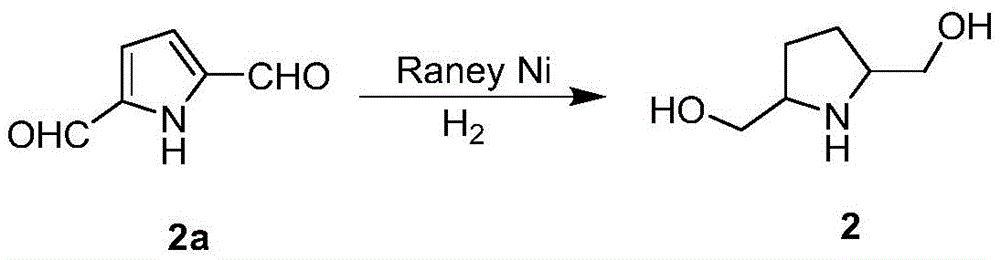
the specific reaction steps are as follows:
dissolving 10g of compound 2a in 400mL of ethanol, adding the ethanol into a high-pressure reaction kettle, sequentially adding 3g of Raney Ni and 10mL of saturated sodium carbonate aqueous solution, replacing gas, vacuumizing the high-pressure reaction kettle, and filling H2To the high-pressure reaction kettle H2The partial pressure of the reaction solution is 0.3MPa, the reaction is stirred for 5 hours at the temperature of 110 ℃, diatomite is used for filtration, filtrate is taken, water washing, decompression concentration and fast column chromatography are carried out, 10.1g of compound 2 is obtained, and the separation yield is 94.8%.
< example 3>
Screening of reaction conditions
In this example, reaction conditions were selected with reference to example 1, and the results of the selection are shown in Table 1, wherein the reaction conditions except for the reaction conditions indicated in the schemes in the table were the same as those in example 1, the amount of the additive added was 3mL, and the reaction conditions were the same as those in example 1.
TABLE 12, 5-Pyrrolidinedimethanol reaction conditions screening Table

As can be seen from the above table, when Pt/C is used as a catalyst and no additive is added, the yield is low, especially at high temperature and high pressure, because pyrrole is excessively reduced and opened to form a series of chain compounds at high temperature and high pressure; after the temperature and the pressure are reduced, the yield is improved to a certain extent, but a certain amount of aldehyde groups in the raw materials and target products form Schiff bases in a reaction system and then are reduced into tertiary amine as a byproduct.
When Pt/C is used as the catalyst and formic acid is used as the additive, the yield is rather reduced, probably because formic acid protonates the amine groups of the target product to form quaternary ammonium ionic compounds, which can break the C-N bond and further cause Hoffman elimination to decompose the entire pyrrolidine, and the specific reason needs further experimental demonstration.
When Pt/C is used as the catalyst and sodium sulfide or DMSO is used as the additive, the yield is slightly improved compared with that when the additive is not used, which is probably because the sodium sulfide or DMSO can partially poison the Pt/C catalyst, thereby reducing the reactivity of the Pt/C catalyst, and further enabling the reduction product to stay in pyrrolidine without further ring opening.
When Raney Ni is selected as a catalyst and sodium hydroxide or sodium carbonate is simultaneously used as an additive, the target product has better yield, which is probably that the reducibility of Raney Ni can be properly enhanced under a proper alkaline environment, and an alkaline system can avoid the target product from forming a quaternary ammonium ion compound and a ring-opening product from being generated to a certain extent, so that the yield of the reaction is improved.
< example 4>
Synthesis method of N-Boc-2, 5-pyrrolidine dimethanol
This example provides a method for synthesizing N-Boc-2, 5-pyrrolidinedimethanol, the reaction equation is as follows:

the specific reaction steps are as follows:
dissolving 10g of compound 3a in 400mL of ethanol, adding the ethanol into a high-pressure reaction kettle, sequentially adding 3g of Raney Ni and 10mL of saturated sodium carbonate aqueous solution, replacing gas, vacuumizing the high-pressure reaction kettle, and filling H2To the high-pressure reaction kettle H2The partial pressure of the reaction solution is 0.2Mpa, the reaction is stirred for 5 hours at the temperature of 100 ℃, diatomite is used for filtration, filtrate is taken, water washing, decompression concentration and fast column chromatography are carried out, 10.1g of compound 2 is obtained, and the separation yield is 97.5%.
< example 5>
Screening of reaction conditions
In this example, reaction conditions were selected with reference to example 4, and the results of the selection are shown in Table 2, in which the reaction conditions except for the reaction conditions indicated in the schemes in the table were the same as in example 1 except for the reaction raw materials and the reaction conditions added in the table were 3 mL.
TABLE 2N-Boc-2, 5-pyrrolidinedimethanol reaction conditions screening Table

As can be seen from Table 2, similarly to the catalytic hydrogenation of 2, 5-pyrrolidinedimethanol, the yield was the best in the case of using Raney Ni as a catalyst and a saturated aqueous solution of sodium carbonate as an additive, and it was found that the hydrogenation reduction of the pyrrole compound having a protective group on N was facilitated by appropriately lowering the reaction pressure and lowering the reaction temperature as compared with the experiment in example 4.
Effects and effects of the embodiments
According to the synthesis method of the 2, 5-pyrrolidine dimethanol, 2, 5-diformylpyrrole is selected as a reaction starting material, a Ranry Ni hydrogenation catalyst is selected, and a saturated sodium carbonate aqueous solution is selected as an additive, so that the 2, 5-pyrrolidine dimethanol can be obtained in one-step reduction at a high yield, and the production cost is effectively reduced.
According to the synthesis method of the 2, 5-pyrrolidine dimethanol derivative, the 2, 5-dialdehyde pyrrole derivative with a protective group on N is selected as a reaction starting material, the Ranry Ni hydrogenation catalyst is selected, and the saturated sodium carbonate aqueous solution is selected as an additive, so that the 2, 5-pyrrolidine dimethanol derivative can be obtained in one-step reduction at high yield, and the production cost is effectively reduced.
The above embodiments are preferred examples of the present invention, and are not intended to limit the scope of the present invention.
Claims (10)
1. A method for synthesizing 2, 5-pyrrolidine dimethanol is characterized in that the reaction equation is as follows:

in the formula, PG1 is selected from any one of H, benzyl, benzyloxycarbonyl, triphenylmethyl or p-methoxybenzyl, Cat is a hydrogenation catalyst,
the reaction steps are as follows:
step 1, reacting Compound 1, a hydrogenation catalyst and H2Contacting with each other to obtain the compound 2.
2. The method of synthesizing 2, 5-pyrrolidinedimethanol according to claim 1, wherein:
wherein the hydrogenation catalyst is Pt/C, Pd/C, Raney Ni, Rh/C, Ru/C, sulfided Pt/C, sulfided Pd/C, sulfided Rh/C, sulfided Ru/C, supported MoS2Or any one or more of supported Ni-Mo-S.
3. The method of synthesizing 2, 5-pyrrolidinedimethanol according to claim 1, wherein:
wherein step 1 is carried out in a reaction medium which is one or more saturated alcohols.
4. The method of synthesizing 2, 5-pyrrolidinedimethanol according to claim 1, wherein:
in the step 1, an additive is further added, wherein the additive is any one of a sodium sulfide aqueous solution, a potassium sulfide aqueous solution, a sodium carbonate aqueous solution, a potassium carbonate aqueous solution, a sodium bicarbonate aqueous solution, a potassium bicarbonate aqueous solution, triethylamine, DMSO, a sodium hydroxide aqueous solution, a potassium hydroxide aqueous solution, a formic acid aqueous solution, an acetic acid aqueous solution, formic acid or acetic acid.
5. The method of synthesizing 2, 5-pyrrolidinedimethanol according to claim 1, wherein:
wherein the reaction temperature of the step 1 is 50-200 ℃.
6. The method of synthesizing 2, 5-pyrrolidinedimethanol according to claim 1,
wherein, in step 1, H2The initial partial pressure of (A) is 0.1MPa-1 MPa.
7. A method for synthesizing 2, 5-pyrrolidine dimethanol derivatives is characterized in that the reaction equation is as follows:

in the formula, PG2 is selected from any one of tert-butyloxycarbonyl, methoxycarbonyl or ethoxycarbonyl, Cat is a hydrogenation catalyst,
the reaction steps are as follows:
step a, reacting compound 3, a hydrogenation catalyst and H2Contacting with each other to obtain the compound 4.
8. The method of synthesizing a 2, 5-pyrrolidinedimethanol derivative according to claim 7,
wherein the hydrogenation catalyst is Pt/C, Pd/C, Raney Ni, Rh/C, Ru/C, sulfided Pt/C, sulfided Pd/C, sulfided Rh/C, sulfided Ru/C, supported MoS2Or any one or more of supported Ni-Mo-S.
9. The method of synthesizing a 2, 5-pyrrolidinedimethanol derivative according to claim 7,
wherein step a is carried out in a reaction medium which is one or more saturated alcohols.
10. The method of synthesizing a 2, 5-pyrrolidinedimethanol derivative according to claim 7,
in the step a, an additive is further added, wherein the additive is any one of a sodium sulfide aqueous solution, a potassium sulfide aqueous solution, a sodium carbonate aqueous solution, a potassium carbonate aqueous solution, a sodium bicarbonate aqueous solution, a potassium bicarbonate aqueous solution, triethylamine, DMSO, a sodium hydroxide aqueous solution, a potassium hydroxide aqueous solution, a formic acid aqueous solution, an acetic acid aqueous solution, formic acid or acetic acid.
Priority Applications (1)
| Application Number | Priority Date | Filing Date | Title |
|---|---|---|---|
| CN202110856335.3A CN113563243B (en) | 2021-07-28 | 2021-07-28 | Synthesis method of 2, 5-pyrrolidine dimethanol and derivatives thereof |
Applications Claiming Priority (1)
| Application Number | Priority Date | Filing Date | Title |
|---|---|---|---|
| CN202110856335.3A CN113563243B (en) | 2021-07-28 | 2021-07-28 | Synthesis method of 2, 5-pyrrolidine dimethanol and derivatives thereof |
Publications (2)
| Publication Number | Publication Date |
|---|---|
| CN113563243A true CN113563243A (en) | 2021-10-29 |
| CN113563243B CN113563243B (en) | 2023-05-02 |
Family
ID=78168357
Family Applications (1)
| Application Number | Title | Priority Date | Filing Date |
|---|---|---|---|
| CN202110856335.3A Active CN113563243B (en) | 2021-07-28 | 2021-07-28 | Synthesis method of 2, 5-pyrrolidine dimethanol and derivatives thereof |
Country Status (1)
| Country | Link |
|---|---|
| CN (1) | CN113563243B (en) |
Citations (1)
| Publication number | Priority date | Publication date | Assignee | Title |
|---|---|---|---|---|
| CN105061282A (en) * | 2015-07-28 | 2015-11-18 | 黑龙江省科学院石油化学研究院 | Method for hydrogenolysis synthesis of alpha,alpha-diphenyl-2-pyrrolidine methanol |
-
2021
- 2021-07-28 CN CN202110856335.3A patent/CN113563243B/en active Active
Patent Citations (1)
| Publication number | Priority date | Publication date | Assignee | Title |
|---|---|---|---|---|
| CN105061282A (en) * | 2015-07-28 | 2015-11-18 | 黑龙江省科学院石油化学研究院 | Method for hydrogenolysis synthesis of alpha,alpha-diphenyl-2-pyrrolidine methanol |
Also Published As
| Publication number | Publication date |
|---|---|
| CN113563243B (en) | 2023-05-02 |
Similar Documents
| Publication | Publication Date | Title |
|---|---|---|
| EP2649040B1 (en) | Process for homogeneously catalyzed, highly selective direct amination of primary alcohols with ammonia to primary amines with a high volume ratio of liquid phase to gas phase and/or high pressures | |
| KR20140095472A (en) | Sulfur-containing palladium/carbon catalyst, preparation method therefor, and method for preparing p-phenylenediamine antioxidant | |
| CN109467535B (en) | Preparation method of fenbendazole | |
| CN115093386A (en) | Production method of colorless, tasteless and borate-free vitreous chromogen | |
| TW201024322A (en) | Preparation method for nitrogen containing heterocyclic hexapeptide with high conversion rate | |
| CN114308027B (en) | A supported carbon-wrapped bimetallic catalyst and its application | |
| CN107698697B (en) | Claw-type 1, 4-triazole poly-cyclodextrin molecule and preparation method and application thereof | |
| CN109879813A (en) | A kind of new process synthetic method of 2- sulfydryl -5- methoxybenzimidazol | |
| CN113563243B (en) | Synthesis method of 2, 5-pyrrolidine dimethanol and derivatives thereof | |
| CN120943886A (en) | A method for synthesizing the tripeptide Fmoc-Pro-Pro-Pro-OH | |
| CN114044756B (en) | Preparation method of mequindox | |
| CN101735073A (en) | Method for preparing chloroaniline by catalysis hydrogenation | |
| EP2524909A2 (en) | Preparation method of 4-aminomethylbenzoic acid | |
| JPH06227813A (en) | Noble metallic ion collector and its production | |
| KR20010057570A (en) | Modification of a hydrogenation catalyst | |
| US8921612B2 (en) | Supported noble metal catalyst | |
| CN103111323A (en) | Chirality N, N-dialkyl-1, 2-diaminocyclohexane catalyst as well as preparation method and application thereof | |
| CS203958B2 (en) | Method of producing asymetric n-phenyl-n'-substituted p-phenylene diamines | |
| CN104892427A (en) | Preparation method of p-aminophenylethylamine | |
| CN110963946A (en) | A kind of preparation method of sodium methyl taurine | |
| EP1731501A1 (en) | Method of amidocarbonylation reaction | |
| CZ281735B6 (en) | Process for preparing optionally substituted cyclohexylamine and optionally substituted dicyclohexylamine | |
| CN117088790A (en) | Synthetic method of 4-azido-L-phenylalanine | |
| CN101920196A (en) | A kind of hydrogenation catalyst for synthesizing neotame and preparation method thereof | |
| CN105418438A (en) | Method for preparing p-phenylenediamine |
Legal Events
| Date | Code | Title | Description |
|---|---|---|---|
| PB01 | Publication | ||
| PB01 | Publication | ||
| SE01 | Entry into force of request for substantive examination | ||
| SE01 | Entry into force of request for substantive examination | ||
| GR01 | Patent grant | ||
| GR01 | Patent grant |