CN113380552B - Preparation method and application of P-doped FeS/Co3S4/Co9S8 composites - Google Patents
Preparation method and application of P-doped FeS/Co3S4/Co9S8 composites Download PDFInfo
- Publication number
- CN113380552B CN113380552B CN202110547956.3A CN202110547956A CN113380552B CN 113380552 B CN113380552 B CN 113380552B CN 202110547956 A CN202110547956 A CN 202110547956A CN 113380552 B CN113380552 B CN 113380552B
- Authority
- CN
- China
- Prior art keywords
- fes
- doped
- composite material
- temperature
- sample
- Prior art date
- Legal status (The legal status is an assumption and is not a legal conclusion. Google has not performed a legal analysis and makes no representation as to the accuracy of the status listed.)
- Active
Links
- 238000002360 preparation method Methods 0.000 title claims abstract description 9
- 239000002131 composite material Substances 0.000 title claims description 37
- PXHVJJICTQNCMI-UHFFFAOYSA-N Nickel Chemical compound [Ni] PXHVJJICTQNCMI-UHFFFAOYSA-N 0.000 claims abstract description 16
- DDFHBQSCUXNBSA-UHFFFAOYSA-N 5-(5-carboxythiophen-2-yl)thiophene-2-carboxylic acid Chemical compound S1C(C(=O)O)=CC=C1C1=CC=C(C(O)=O)S1 DDFHBQSCUXNBSA-UHFFFAOYSA-N 0.000 claims abstract description 12
- 229910052979 sodium sulfide Inorganic materials 0.000 claims abstract description 10
- GRVFOGOEDUUMBP-UHFFFAOYSA-N sodium sulfide (anhydrous) Chemical compound [Na+].[Na+].[S-2] GRVFOGOEDUUMBP-UHFFFAOYSA-N 0.000 claims abstract description 10
- 239000003795 chemical substances by application Substances 0.000 claims abstract description 9
- XSQUKJJJFZCRTK-UHFFFAOYSA-N Urea Chemical compound NC(N)=O XSQUKJJJFZCRTK-UHFFFAOYSA-N 0.000 claims abstract description 8
- 239000004202 carbamide Substances 0.000 claims abstract description 8
- 229910052759 nickel Inorganic materials 0.000 claims abstract description 8
- 150000001868 cobalt Chemical class 0.000 claims abstract description 7
- 239000003792 electrolyte Substances 0.000 claims abstract description 6
- KWSLGOVYXMQPPX-UHFFFAOYSA-N 5-[3-(trifluoromethyl)phenyl]-2h-tetrazole Chemical compound FC(F)(F)C1=CC=CC(C2=NNN=N2)=C1 KWSLGOVYXMQPPX-UHFFFAOYSA-N 0.000 claims abstract description 5
- 229910001379 sodium hypophosphite Inorganic materials 0.000 claims abstract description 5
- XLYOFNOQVPJJNP-UHFFFAOYSA-N water Chemical compound O XLYOFNOQVPJJNP-UHFFFAOYSA-N 0.000 claims description 19
- XKRFYHLGVUSROY-UHFFFAOYSA-N Argon Chemical compound [Ar] XKRFYHLGVUSROY-UHFFFAOYSA-N 0.000 claims description 14
- 238000006243 chemical reaction Methods 0.000 claims description 10
- 239000008367 deionised water Substances 0.000 claims description 9
- 229910021641 deionized water Inorganic materials 0.000 claims description 9
- 238000001035 drying Methods 0.000 claims description 9
- 229910052786 argon Inorganic materials 0.000 claims description 7
- 229910001220 stainless steel Inorganic materials 0.000 claims description 7
- 239000010935 stainless steel Substances 0.000 claims description 7
- LFQSCWFLJHTTHZ-UHFFFAOYSA-N Ethanol Chemical compound CCO LFQSCWFLJHTTHZ-UHFFFAOYSA-N 0.000 claims description 6
- 239000003990 capacitor Substances 0.000 claims description 4
- 229920001343 polytetrafluoroethylene Polymers 0.000 claims description 4
- 239000004810 polytetrafluoroethylene Substances 0.000 claims description 4
- -1 polytetrafluoroethylene Polymers 0.000 claims description 3
- 238000003756 stirring Methods 0.000 claims description 3
- 238000004506 ultrasonic cleaning Methods 0.000 claims description 2
- 238000007789 sealing Methods 0.000 claims 2
- 239000012300 argon atmosphere Substances 0.000 claims 1
- 238000001816 cooling Methods 0.000 claims 1
- 239000000203 mixture Substances 0.000 claims 1
- 238000004321 preservation Methods 0.000 claims 1
- 239000010453 quartz Substances 0.000 claims 1
- 150000003839 salts Chemical class 0.000 claims 1
- VYPSYNLAJGMNEJ-UHFFFAOYSA-N silicon dioxide Inorganic materials O=[Si]=O VYPSYNLAJGMNEJ-UHFFFAOYSA-N 0.000 claims 1
- 238000011144 upstream manufacturing Methods 0.000 claims 1
- 238000005406 washing Methods 0.000 claims 1
- 241001506047 Tremella Species 0.000 abstract description 18
- 230000014759 maintenance of location Effects 0.000 abstract description 13
- 239000002114 nanocomposite Substances 0.000 abstract description 13
- 150000002505 iron Chemical class 0.000 abstract description 5
- 239000000463 material Substances 0.000 abstract description 4
- 238000000034 method Methods 0.000 abstract description 4
- OAICVXFJPJFONN-UHFFFAOYSA-N Phosphorus Chemical compound [P] OAICVXFJPJFONN-UHFFFAOYSA-N 0.000 abstract description 2
- 238000005229 chemical vapour deposition Methods 0.000 abstract description 2
- 239000002184 metal Substances 0.000 abstract description 2
- 229910052751 metal Inorganic materials 0.000 abstract description 2
- 229910052698 phosphorus Inorganic materials 0.000 abstract description 2
- 239000011574 phosphorus Substances 0.000 abstract description 2
- 230000001376 precipitating effect Effects 0.000 abstract description 2
- 239000000758 substrate Substances 0.000 abstract description 2
- 239000007772 electrode material Substances 0.000 description 10
- OKTJSMMVPCPJKN-UHFFFAOYSA-N Carbon Chemical compound [C] OKTJSMMVPCPJKN-UHFFFAOYSA-N 0.000 description 8
- 238000001000 micrograph Methods 0.000 description 8
- 238000002484 cyclic voltammetry Methods 0.000 description 7
- 238000002441 X-ray diffraction Methods 0.000 description 6
- 239000007789 gas Substances 0.000 description 6
- 229910052799 carbon Inorganic materials 0.000 description 4
- XEEYBQQBJWHFJM-UHFFFAOYSA-N iron Substances [Fe] XEEYBQQBJWHFJM-UHFFFAOYSA-N 0.000 description 4
- 239000002086 nanomaterial Substances 0.000 description 4
- 239000010405 anode material Substances 0.000 description 3
- 239000003575 carbonaceous material Substances 0.000 description 3
- 239000006260 foam Substances 0.000 description 3
- 238000001027 hydrothermal synthesis Methods 0.000 description 3
- UCKMPCXJQFINFW-UHFFFAOYSA-N Sulphide Chemical compound [S-2] UCKMPCXJQFINFW-UHFFFAOYSA-N 0.000 description 2
- 238000010586 diagram Methods 0.000 description 2
- VCJMYUPGQJHHFU-UHFFFAOYSA-N iron(3+);trinitrate Chemical compound [Fe+3].[O-][N+]([O-])=O.[O-][N+]([O-])=O.[O-][N+]([O-])=O VCJMYUPGQJHHFU-UHFFFAOYSA-N 0.000 description 2
- 238000006479 redox reaction Methods 0.000 description 2
- 238000003860 storage Methods 0.000 description 2
- 241000233866 Fungi Species 0.000 description 1
- HBBGRARXTFLTSG-UHFFFAOYSA-N Lithium ion Chemical compound [Li+] HBBGRARXTFLTSG-UHFFFAOYSA-N 0.000 description 1
- 239000011149 active material Substances 0.000 description 1
- 230000009286 beneficial effect Effects 0.000 description 1
- 230000015572 biosynthetic process Effects 0.000 description 1
- 238000004140 cleaning Methods 0.000 description 1
- UFMZWBIQTDUYBN-UHFFFAOYSA-N cobalt dinitrate Chemical compound [Co+2].[O-][N+]([O-])=O.[O-][N+]([O-])=O UFMZWBIQTDUYBN-UHFFFAOYSA-N 0.000 description 1
- 229910001981 cobalt nitrate Inorganic materials 0.000 description 1
- 230000008602 contraction Effects 0.000 description 1
- 238000007796 conventional method Methods 0.000 description 1
- 230000001351 cycling effect Effects 0.000 description 1
- 238000000354 decomposition reaction Methods 0.000 description 1
- 230000007547 defect Effects 0.000 description 1
- 238000009792 diffusion process Methods 0.000 description 1
- 238000007599 discharging Methods 0.000 description 1
- 238000004146 energy storage Methods 0.000 description 1
- 230000007613 environmental effect Effects 0.000 description 1
- 238000002474 experimental method Methods 0.000 description 1
- 238000010438 heat treatment Methods 0.000 description 1
- 238000009413 insulation Methods 0.000 description 1
- 229910001416 lithium ion Inorganic materials 0.000 description 1
- 238000003760 magnetic stirring Methods 0.000 description 1
- 238000004519 manufacturing process Methods 0.000 description 1
- 239000007774 positive electrode material Substances 0.000 description 1
- 238000004073 vulcanization Methods 0.000 description 1
Images
Classifications
-
- H—ELECTRICITY
- H01—ELECTRIC ELEMENTS
- H01G—CAPACITORS; CAPACITORS, RECTIFIERS, DETECTORS, SWITCHING DEVICES, LIGHT-SENSITIVE OR TEMPERATURE-SENSITIVE DEVICES OF THE ELECTROLYTIC TYPE
- H01G11/00—Hybrid capacitors, i.e. capacitors having different positive and negative electrodes; Electric double-layer [EDL] capacitors; Processes for the manufacture thereof or of parts thereof
- H01G11/22—Electrodes
- H01G11/30—Electrodes characterised by their material
-
- H—ELECTRICITY
- H01—ELECTRIC ELEMENTS
- H01G—CAPACITORS; CAPACITORS, RECTIFIERS, DETECTORS, SWITCHING DEVICES, LIGHT-SENSITIVE OR TEMPERATURE-SENSITIVE DEVICES OF THE ELECTROLYTIC TYPE
- H01G11/00—Hybrid capacitors, i.e. capacitors having different positive and negative electrodes; Electric double-layer [EDL] capacitors; Processes for the manufacture thereof or of parts thereof
- H01G11/22—Electrodes
- H01G11/24—Electrodes characterised by structural features of the materials making up or comprised in the electrodes, e.g. form, surface area or porosity; characterised by the structural features of powders or particles used therefor
-
- H—ELECTRICITY
- H01—ELECTRIC ELEMENTS
- H01G—CAPACITORS; CAPACITORS, RECTIFIERS, DETECTORS, SWITCHING DEVICES, LIGHT-SENSITIVE OR TEMPERATURE-SENSITIVE DEVICES OF THE ELECTROLYTIC TYPE
- H01G11/00—Hybrid capacitors, i.e. capacitors having different positive and negative electrodes; Electric double-layer [EDL] capacitors; Processes for the manufacture thereof or of parts thereof
- H01G11/22—Electrodes
- H01G11/26—Electrodes characterised by their structure, e.g. multi-layered, porosity or surface features
-
- H—ELECTRICITY
- H01—ELECTRIC ELEMENTS
- H01G—CAPACITORS; CAPACITORS, RECTIFIERS, DETECTORS, SWITCHING DEVICES, LIGHT-SENSITIVE OR TEMPERATURE-SENSITIVE DEVICES OF THE ELECTROLYTIC TYPE
- H01G11/00—Hybrid capacitors, i.e. capacitors having different positive and negative electrodes; Electric double-layer [EDL] capacitors; Processes for the manufacture thereof or of parts thereof
- H01G11/84—Processes for the manufacture of hybrid or EDL capacitors, or components thereof
- H01G11/86—Processes for the manufacture of hybrid or EDL capacitors, or components thereof specially adapted for electrodes
-
- Y—GENERAL TAGGING OF NEW TECHNOLOGICAL DEVELOPMENTS; GENERAL TAGGING OF CROSS-SECTIONAL TECHNOLOGIES SPANNING OVER SEVERAL SECTIONS OF THE IPC; TECHNICAL SUBJECTS COVERED BY FORMER USPC CROSS-REFERENCE ART COLLECTIONS [XRACs] AND DIGESTS
- Y02—TECHNOLOGIES OR APPLICATIONS FOR MITIGATION OR ADAPTATION AGAINST CLIMATE CHANGE
- Y02E—REDUCTION OF GREENHOUSE GAS [GHG] EMISSIONS, RELATED TO ENERGY GENERATION, TRANSMISSION OR DISTRIBUTION
- Y02E60/00—Enabling technologies; Technologies with a potential or indirect contribution to GHG emissions mitigation
- Y02E60/13—Energy storage using capacitors
Landscapes
- Engineering & Computer Science (AREA)
- Power Engineering (AREA)
- Microelectronics & Electronic Packaging (AREA)
- Chemical & Material Sciences (AREA)
- Materials Engineering (AREA)
- Manufacturing & Machinery (AREA)
- Electric Double-Layer Capacitors Or The Like (AREA)
- Battery Electrode And Active Subsutance (AREA)
- Secondary Cells (AREA)
Abstract
本发明公开了一种P掺杂FeS/Co3S4/Co9S8纳米复合材料的制备方法及在高电压水系对称超级电容器中的应用。以泡沫镍为基底,铁盐、钴盐为金属源,氟化铵和尿素为沉淀剂,硫化钠为硫化剂,次磷酸钠为无机磷源。首先获得均匀生长在泡沫镍基底上的FeS/Co3S4/Co9S8三相纳米复合材料;再使用化学气相沉积法获得具有银耳结构的P掺杂FeS/Co3S4/Co9S8纳米复合材料。将制备的P掺杂FeS/Co3S4/Co9S8纳米复合材料组装成三电极体系,在1M KOH电解液中进行电化学性能评价,在‑1~0V电位区间,最大容量高达531 F/g(10A/g),2万次循环后容量保持率为71.36%;在0~0.55V电位区间内,初始容量为1028.78F/g(10A/g),20000次循环后容量上升至2492.73F/g,即容量保持率为242.3%。
The invention discloses a preparation method of a P-doped FeS/Co 3 S 4 /Co 9 S 8 nanocomposite material and its application in a high-voltage aqueous symmetric supercapacitor. Taking foamed nickel as the base, iron salt and cobalt salt as the metal source, ammonium fluoride and urea as the precipitating agent, sodium sulfide as the vulcanizing agent, and sodium hypophosphite as the inorganic phosphorus source. Firstly, the FeS/Co 3 S 4 /Co 9 S 8 three-phase nanocomposites uniformly grown on the foamed nickel substrate were obtained; then the P-doped FeS/Co 3 S 4 /Co 9 with Tremella structure was obtained by chemical vapor deposition method. S 8 nanocomposites. The prepared P-doped FeS/Co 3 S 4 /Co 9 S 8 nanocomposites were assembled into a three-electrode system, and the electrochemical performance was evaluated in 1M KOH electrolyte. The maximum capacity was as high as 531 in the potential range of ‑1~0V F/g (10A/g), the capacity retention rate after 20,000 cycles is 71.36%; in the potential range of 0~0.55V, the initial capacity is 1028.78F/g (10A/g), and the capacity increases to 20,000 cycles after 20,000 cycles. 2492.73F/g, that is, the capacity retention rate is 242.3%.
Description
技术领域technical field
本发明属于水系超级电容器领域,具体涉及一种具有银耳结构的P掺杂 FeS/Co3S4/Co9S8纳米复合材料的制备方法及在高电压水系对称超级电容器中的应用。The invention belongs to the field of aqueous supercapacitors, and in particular relates to a preparation method of a P - doped FeS / Co3S4 / Co9S8 nanocomposite material with a tremella structure and its application in a high-voltage aqueous symmetric supercapacitor.
背景技术Background technique
高效且低成本的能源转换和储存系统是环保和可再生能源的重要组成部分。在各种能量储存装置中,超级电容器由于制造成本低、能快速充放电、循环寿命长等优点是理想的候选者。然而,超级电容器的能量密度低于锂离子电池,这限制了其广泛的商业应用。Efficient and low-cost energy conversion and storage systems are an important part of environmental protection and renewable energy. Among various energy storage devices, supercapacitors are ideal candidates due to their low manufacturing cost, fast charge and discharge, and long cycle life. However, the energy density of supercapacitors is lower than that of lithium-ion batteries, which limits their widespread commercial applications.
由E=0.5CV2(E为能量密度,C为比容量,V为工作电压)可知,构造高能量密度超级电容器的关键在于获得高比电容和高工作电压。在比电容方面,赝电容或电池型电极材料利用活性材料表面或体相中的法拉第反应储存电荷,能克服碳材料的双电荷层存储限制,获得高出碳材料10倍以上的比容量。在工作电压方面,由于水的分解电压为1.23V,对称水系超级电容器(即正、负极采用相同电极)的工作电压一般不超过1.2V,难以获得高能量密度器件。大量研究表明,以电位窗口匹配的赝电容或电池型材料为正极,碳材料(如活性炭AC)为负极,构建非对称超级电容器,能突破水分解电压(标准状态下为1.23V)限制,将器件的工作电压拓宽至1.6~2V甚至超过2V。然而,非对称超级电容器器件容量C 与正、负极容量C正、C负存在以下关系:1/C=1/C正+1/C负,显然,碳负极较低的比容量制约了器件的容量,从而限制了器件的能量密度。因此,开发一种在正、负电位区间均具有较大容量的新型电极材料,构建水系对称超级电容器,不仅能突破水分解电压的限制,获得高器件工作电压;还能避免传统碳负极材料对非对称水系超级电容器容量的限制。From E=0.5CV 2 (E is the energy density, C is the specific capacity, and V is the working voltage), it can be known that the key to constructing a high-energy-density supercapacitor is to obtain high specific capacity and high working voltage. In terms of specific capacitance, pseudocapacitors or battery-type electrode materials use the Faradaic reaction on the surface of the active material or in the bulk to store charges, which can overcome the double-layer storage limitation of carbon materials and obtain a specific capacity more than 10 times higher than that of carbon materials. In terms of working voltage, since the decomposition voltage of water is 1.23V, the working voltage of symmetrical water-based supercapacitors (that is, the positive and negative electrodes use the same electrode) generally does not exceed 1.2V, and it is difficult to obtain high energy density devices. A large number of studies have shown that using pseudocapacitors or battery-type materials with matching potential windows as the positive electrode and carbon materials (such as activated carbon AC) as the negative electrode to construct asymmetric supercapacitors can break through the water splitting voltage (1.23V in the standard state) limit. The operating voltage of the device is widened to 1.6-2V or even more than 2V. However, the device capacity C of asymmetric supercapacitors has the following relationship with the positive and negative electrode capacities C positive and C negative : 1/C = 1/C positive + 1/C negative . Obviously, the lower specific capacity of the carbon negative electrode restricts the performance of the device. capacity, thereby limiting the energy density of the device. Therefore, developing a new type of electrode material with large capacity in both positive and negative potential ranges and constructing water-based symmetric supercapacitors can not only break through the limitation of water splitting voltage and obtain high device operating voltage, but also avoid the traditional carbon anode materials. Capacitance limitations of asymmetric aqueous supercapacitors.
发明内容SUMMARY OF THE INVENTION
本发明的目的是针对传统对称超级电容器工作电压低和传统非对称超级电容器容量低的问题,提出一种在正、负电位区间均有较大容量的P掺杂FeS/Co3S4/Co9S8复合材料,并以其作为电极材料构造高电压对称型水系超级电容器。本发明的创新点如下:(1)制备出的P掺杂FeS/Co3S4/Co9S8为三相复合材料,形貌为类似于银耳的纳米结构,这种结构既有利于电荷的有效转移,又有利于电解液的扩散,缓解纳米结构的体积膨胀或收缩造成的结构坍塌,可以有效保持纳米结构在反复充放电过程中的稳定性,使电极具有优异的循环稳定性。(2)制备出的P掺杂FeS/Co3S4/Co9S8,在正电位区间具有Co2+/Co3+/Co4+和Fe2+/Fe3+多对氧化还原反应,在10A/g的大电流密度下充放电,初始容量为1028.78F/g,20000次后,容量高达2492.73F/g,即容量保持率达到了242.3%;负电位区间具有Co0/Co2+、Fe0/Fe2+多对氧化还原反应,在10A/g的大电流密度大获得了高达531F/g的比电容,2万次后容量保持率为71.36%。(3)将制备出的P掺杂FeS/Co3S4/Co9S8作为电极材料,1M的KOH作为电解液,组装成水系对称超级电容器,电位窗口达到1.6V~1.75V。以工作电压为1.6V为例,构建的对称水系超级电容器最大能量密度和功率密度分别可以达到147Wh/kg和8000W/kg,大于目前报道的绝大多数以活性炭作为负极的水系非对称超级电容器,说明以本发明制备的P掺杂FeS/Co3S4/Co9S8复合材料构建的水系对称超级电容器有望克服传统对称水系超级电容器工作电压低,及传统非对称水系超级电容器容量低的缺陷,实现高能量密度、高功率密度水系超级电容器。The purpose of the present invention is to propose a P-doped FeS/Co 3 S 4 /Co with large capacity in the positive and negative potential intervals, aiming at the problems of low operating voltage of the traditional symmetric super capacitor and low capacity of the traditional asymmetric super capacitor. The 9S8 composite material was used as the electrode material to construct a high-voltage symmetrical aqueous supercapacitor. The innovations of the present invention are as follows: (1) The prepared P-doped FeS/Co 3 S 4 /Co 9 S 8 is a three-phase composite material with a nanostructure similar to Tremella, which is beneficial to the charge The effective transfer of the nanostructure is also conducive to the diffusion of the electrolyte, alleviating the structure collapse caused by the volume expansion or contraction of the nanostructure, and can effectively maintain the stability of the nanostructure during repeated charge and discharge processes, so that the electrode has excellent cycle stability. (2) The prepared P-doped FeS/Co 3 S 4 /Co 9 S 8 has multiple pairs of redox reactions of Co 2+ /Co 3+ /Co 4+ and Fe 2+ /Fe 3+ in the positive potential range , charging and discharging at a high current density of 10A/g, the initial capacity is 1028.78F/g, and after 20,000 times, the capacity is as high as 2492.73F/g, that is, the capacity retention rate reaches 242.3%; the negative potential range has Co 0 /Co 2 + , Fe 0 /Fe 2+ pairs of redox reactions, a specific capacitance as high as 531F/g was obtained at a large current density of 10A/g, and the capacity retention rate was 71.36% after 20,000 cycles. (3) Using the prepared P-doped FeS/Co 3 S 4 /Co 9 S 8 as the electrode material and 1M KOH as the electrolyte, the aqueous symmetric supercapacitor was assembled, and the potential window reached 1.6V-1.75V. Taking the working voltage of 1.6V as an example, the maximum energy density and power density of the constructed symmetric aqueous supercapacitor can reach 147Wh/kg and 8000W/kg, respectively, which are larger than most of the currently reported aqueous asymmetric supercapacitors using activated carbon as the negative electrode. It is indicated that the aqueous symmetric supercapacitor constructed with the P-doped FeS/Co 3 S 4 /Co 9 S 8 composite material prepared by the present invention is expected to overcome the defects of low operating voltage and low capacity of traditional symmetrical aqueous supercapacitors and traditional asymmetric aqueous supercapacitors. , to achieve high energy density, high power density water-based supercapacitors.
本发明的技术方案为:以泡沫镍为基底,利用两步水热法,得到一种具有银耳结构的FeS/Co3S4/Co9S8复合材料,再用化学气相沉积法进行P掺杂。The technical scheme of the present invention is as follows: using foamed nickel as a base, a two-step hydrothermal method is used to obtain a FeS/Co 3 S 4 /Co 9 S 8 composite material with a Tremella structure, and then a chemical vapor deposition method is used to carry out P doping. miscellaneous.
本发明对具有银耳结构的P掺杂FeS/Co3S4/Co9S8复合材料的具体制备方法步骤:The specific preparation method steps of the present invention to the P-doped FeS/Co 3 S 4 /Co 9 S 8 composite material with Tremella structure:
(1)将钴盐和铁盐溶于去离子水中,搅拌得透明溶液,再加入氟化铵和尿素,溶解后倒入聚四氟乙烯内衬,并放入清洗干净的泡沫镍,将内衬放入不锈钢外套密封好,放入110℃- 160℃的恒温干燥箱中,保温反应8-15h,反应完成后自然冷却至室温;(1) Dissolve cobalt salt and iron salt in deionized water, stir to obtain a transparent solution, then add ammonium fluoride and urea, pour into PTFE lining after dissolving, and put in cleaned foam nickel, put the inner The lining is placed in a stainless steel jacket and sealed, and then placed in a constant temperature drying oven at 110°C-160°C for 8-15 hours of insulation reaction, and then cooled to room temperature naturally after the reaction is completed;
步骤(1)中,氟化铵,铁盐,钴盐和尿素的摩尔浓度比为:0.75-0.85:0.01-0.04:0.01- 0.04:0.08-0.12。In step (1), the molar concentration ratio of ammonium fluoride, iron salt, cobalt salt and urea is: 0.75-0.85: 0.01-0.04: 0.01-0.04: 0.08-0.12.
进一步优选方案,氟化铵,铁盐,钴盐和尿素的摩尔浓度比为:0.8:0.02:0.02:0.1。水热反应温度为120℃,时间为12h。In a further preferred solution, the molar concentration ratio of ammonium fluoride, iron salt, cobalt salt and urea is: 0.8:0.02:0.02:0.1. The hydrothermal reaction temperature was 120°C and the time was 12h.
(2)取出步骤(1)得到的样品,依次在去离子和无水乙醇中超声清洗后,自然条件下晾干;(2) taking out the sample obtained in step (1), after ultrasonic cleaning in deionized and absolute ethanol successively, and drying under natural conditions;
(3)将硫化剂溶于去离子水中,充分溶解后加入步骤(2)得到的样品,再在不锈钢水热釜中,密封,于100-150℃的恒温干燥箱中,保温8-15h,反应结束后取出样品,用去离子和无水乙醇反复冲洗,烘干,即可得到具有银耳结构的FeS/Co3S4/Co9S8复合材料。所述的硫化剂为硫化钠,浓度为0.4-0.6M,硫化温度为100~150℃,保温8~15h。进一步优选方案中所述的硫化钠浓度为0.5M,温度为120℃,时间为8h。(3) Dissolve the vulcanizing agent in deionized water, add the sample obtained in step (2) after fully dissolving, then seal it in a stainless steel hydrothermal kettle, and keep it in a constant temperature drying box at 100-150°C for 8-15h, After the reaction, the sample was taken out, washed repeatedly with deionized and absolute ethanol, and dried to obtain the FeS/Co 3 S 4 /Co 9 S 8 composite material with Tremella structure. The vulcanizing agent is sodium sulfide, the concentration is 0.4-0.6M, the vulcanization temperature is 100-150 DEG C, and the temperature is kept for 8-15 hours. In a further preferred solution, the sodium sulfide concentration is 0.5M, the temperature is 120°C, and the time is 8h.
(4)将次磷酸钠放在管式炉靠近气源的一侧,将步骤(3)得到的具有银耳结构的FeS/Co3S4/Co9S8复合硫化物放在管式炉远离气源的一侧,通入氩气后将炉膛内的温度升高到 250℃-350℃,保持一段时间后,在氩气气氛下使炉内温度降到室温,即可获得具有银耳结构的P掺杂FeS/Co3S4/Co9S8复合材料,进一步优选方案中入氩气后将炉膛内的温度升高到300℃。(4) place sodium hypophosphite on the side of the tube furnace close to the gas source, and place the FeS/Co 3 S 4 /Co 9 S 8 composite sulfide with tremella structure obtained in step (3) on the tube furnace away from On one side of the gas source, after passing argon gas, the temperature in the furnace is raised to 250 ° C - 350 ° C, and after maintaining for a period of time, the temperature in the furnace is lowered to room temperature under an argon gas atmosphere, and a white fungus structure can be obtained. P-doped FeS/Co 3 S 4 /Co 9 S 8 composite material, in a further preferred solution, the temperature in the furnace is increased to 300° C. after argon is introduced.
本发明公开了一种具有银耳结构的P掺杂FeS/Co3S4/Co9S8纳米复合材料的制备方法及在高电压水系对称超级电容器中的应用。以泡沫镍为基底,铁盐、钴盐为金属源,氟化铵和尿素为沉淀剂,硫化钠为硫化剂,次磷酸钠为无机磷源。使用两步水热法,首先获得均匀生长在泡沫镍基底上的FeS/Co3S4/Co9S8三相纳米复合材料;再使用化学气相沉积法获得具有银耳结构的P掺杂FeS/Co3S4/Co9S8纳米复合材料。将制备的P掺杂FeS/Co3S4/Co9S8纳米复合材料组装成三电极体系,在1M KOH电解液中进行电化学性能评价,在-1~0V电位区间,最大容量高达531F/g(10A/g),2万次循环后容量保持率为71.36%;在0~0.55V电位区间内,初始容量为1028.78F/g(10A/g),20000次循环后容量上升至2492.73F/g,即容量保持率为242.3%。由于该电极材料在正(0~0.55V)和负(-1~0V)电位区间内均具有优异的电容性能,将其作为电极材料,与1M的KOH电解液即可组成对称型水系超级电容器,当工作电压为1.6V时,最大能量密度和功率密度分别可以达到147Wh/kg和8000W/kg,远高于常用的碳负极材料构成的水系超级电容器,说明具有银耳结构的P掺杂FeS/Co3S4/Co9S8纳米复合材料是一种极具应用前景的超级电容器电极材料。The invention discloses a preparation method of a P-doped FeS/Co 3 S 4 /Co 9 S 8 nanocomposite material with Tremella structure and its application in a high-voltage aqueous symmetric supercapacitor. Taking foamed nickel as the base, iron salt and cobalt salt as the metal source, ammonium fluoride and urea as the precipitating agent, sodium sulfide as the vulcanizing agent, and sodium hypophosphite as the inorganic phosphorus source. Using a two-step hydrothermal method, the FeS/Co 3 S 4 /Co 9 S 8 three-phase nanocomposites uniformly grown on the nickel foam substrate were firstly obtained; Co 3 S 4 /Co 9 S 8 nanocomposites. The prepared P-doped FeS/Co 3 S 4 /Co 9 S 8 nanocomposites were assembled into a three-electrode system, and the electrochemical performance was evaluated in 1M KOH electrolyte. /g (10A/g), the capacity retention rate after 20,000 cycles is 71.36%; in the 0-0.55V potential range, the initial capacity is 1028.78F/g (10A/g), and the capacity increases to 2492.73 after 20,000 cycles F/g, that is, the capacity retention rate was 242.3%. Since the electrode material has excellent capacitance performance in both positive (0~0.55V) and negative (-1~0V) potential ranges, it can be used as an electrode material to form a symmetrical aqueous supercapacitor with 1M KOH electrolyte , when the working voltage is 1.6V, the maximum energy density and power density can reach 147Wh/kg and 8000W/kg, respectively, which are much higher than the water-based supercapacitors composed of commonly used carbon anode materials. Co 3 S 4 /Co 9 S 8 nanocomposite is a promising supercapacitor electrode material.
附图说明Description of drawings
图1为实施例1所得到的具有银耳结构的P掺杂FeS/Co3S4/Co9S8复合材料的XRD图。1 is the XRD pattern of the P-doped FeS/Co 3 S 4 /Co 9 S 8 composite material with Tremella structure obtained in Example 1.
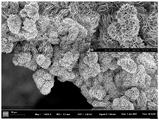
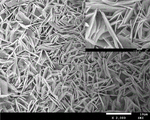
图2为实施例1所得到的具有银耳结构的P掺杂FeS/Co3S4/Co9S8复合材料扫描电子显微镜图像,插图为局部放大图。FIG. 2 is a scanning electron microscope image of the P-doped FeS/Co 3 S 4 /Co 9 S 8 composite material with Tremella structure obtained in Example 1, and the inset is a partial enlarged view.
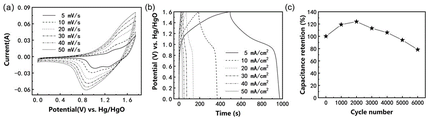
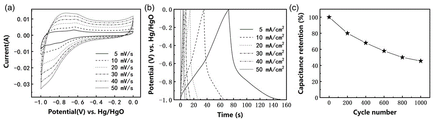
图3为实施例1所得到的具有银耳结构的P掺杂FeS/Co3S4/Co9S8复合材料在-1~0V电位区间的电化学性能:(a)为不同扫描速率下的循环伏安曲线,(b)为不同电流密度下的充放电曲线,(c)10m A/cm2循环稳定性曲线。Figure 3 shows the electrochemical properties of the P-doped FeS/Co 3 S 4 /Co 9 S8 composite material with Tremella structure obtained in Example 1 in the potential range of -1 to 0 V: (a) is the electrochemical performance at different scan rates. Cyclic voltammetry curves, (b) charge-discharge curves at different current densities, (c) 10 mA/cm 2 cycle stability curves.
图4为实施例1所得到的具有银耳结构的P掺杂FeS/Co3S4/Co9S8复合材料在0~0.55 V电位区间的电化学性能:(a)为不同扫描速率下的循环伏安曲线,(b)为不同电流密度下的充放电曲线,(c)10m A/cm2循环稳定性曲线。Figure 4 shows the electrochemical properties of the P-doped FeS/Co 3 S 4 /Co 9 S 8 composite material with Tremella structure obtained in Example 1 in the potential range of 0-0.55 V: (a) is the electrochemical performance at different scan rates. Cyclic voltammetry curves, (b) charge-discharge curves at different current densities, (c) 10 mA/cm 2 cycle stability curves.
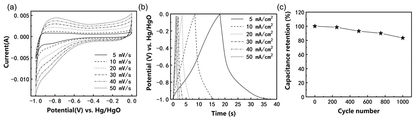
图5为实施例1所得到的具有银耳结构的P掺杂FeS/Co3S4/Co9S8复合材料组成的对称型水系超级电容器电化学性能:(a)为不同扫描速率下的循环伏安曲线,(b)为不同电流密度下的充放电曲线,(c)10m A/cm2循环稳定性曲线。Figure 5 shows the electrochemical performance of the symmetric aqueous supercapacitor composed of the P-doped FeS/Co 3 S 4 /Co 9 S8 composite material with Tremella structure obtained in Example 1: (a) Cycling at different scan rates Voltammetric curves, (b) charge-discharge curves at different current densities, (c) 10 mA/cm 2 cycle stability curves.
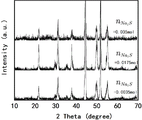
图6为实施例1,2,3,4所得到样品的XRD图。FIG. 6 is the XRD patterns of the samples obtained in Examples 1, 2, 3, and 4. FIG.
图7为实施例2所得到的P掺杂FeS/Co3S4/Co9S8复合材料扫描电子显微镜图像,插图为局部放大图。FIG. 7 is a scanning electron microscope image of the P-doped FeS/Co 3 S 4 /Co 9 S 8 composite material obtained in Example 2, and the inset is a partial enlarged view.
图8为实施例2所得到的P掺杂FeS/Co3S4/Co9S8复合材料在-1~0V电位区间的电化学性能:(a)为不同扫描速率下的循环伏安曲线,(b)为不同电流密度下的充放电曲线, (c)10m A/cm2循环稳定性曲线。Figure 8 shows the electrochemical performance of the P-doped FeS/Co 3 S 4 /Co 9 S 8 composite material obtained in Example 2 in the potential range of -1 to 0 V: (a) is the cyclic voltammetry curve at different scan rates , (b) is the charge-discharge curve at different current densities, (c) is the cycle stability curve of 10 mA/cm 2 .
图9为实施例3所得到的P掺杂FeS/Co3S4/Co9S8复合材料扫描电子显微镜图像,插图为局部放大图。9 is a scanning electron microscope image of the P-doped FeS/Co 3 S 4 /Co 9 S 8 composite material obtained in Example 3, and the inset is a partial enlarged view.
图10为实施例3所得到的P掺杂FeS/Co3S4/Co9S8复合材料在-1~0V电位区间的电化学性能:(a)为不同扫描速率下的循环伏安曲线,(b)为不同电流密度下的充放电曲线,(c)10m A/cm2循环稳定性曲线。Figure 10 shows the electrochemical properties of the P-doped FeS/Co 3 S 4 /Co 9 S 8 composite material obtained in Example 3 in the potential range of -1 to 0 V: (a) is the cyclic voltammetry curve at different scan rates , (b) the charge-discharge curves at different current densities, (c) the 10 mA/cm 2 cycle stability curve.
图11为实施例4所得到的P掺杂FeS/Co3S4/Co9S8复合材料扫描电子显微镜图像,插图为局部放大图。11 is a scanning electron microscope image of the P-doped FeS/Co 3 S 4 /Co 9 S 8 composite material obtained in Example 4, and the inset is a partial enlarged view.
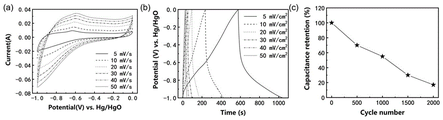
图12为实施例4所得到的P掺杂FeS/Co3S4/Co9S8复合材料在-1~0V电位区间的电化学性能:(a)为不同扫描速率下的循环伏安曲线,(b)为不同电流密度下的充放电曲线,(c)10m A/cm2循环稳定性曲线。Figure 12 shows the electrochemical performance of the P-doped FeS/Co 3 S 4 /Co 9 S 8 composite material obtained in Example 4 in the potential range of -1 to 0 V: (a) is the cyclic voltammetry curve at different scan rates , (b) the charge-discharge curves at different current densities, (c) the 10 mA/cm 2 cycle stability curve.
图13为实例为实施例1,5,6所得到样品的XRD图。13 is an example of the XRD patterns of the samples obtained in Examples 1, 5, and 6. FIG.
图14为实施例5所得到的P掺杂FeS/Co3S4/Co9S8复合材料扫描电子显微镜图像,插图为局部放大图。14 is a scanning electron microscope image of the P-doped FeS/Co 3 S 4 /Co 9 S 8 composite material obtained in Example 5, and the inset is a partial enlarged view.
图15为实施例5所得到的P掺杂FeS/Co3S4/Co9S8复合材料在-1~0V电位区间的电化学性能:(a)为不同扫描速率下的循环伏安曲线,(b)为不同电流密度下的充放电曲线,(c)10m A/cm2循环稳定性曲线。Figure 15 shows the electrochemical performance of the P-doped FeS/Co 3 S 4 /Co 9 S 8 composite material obtained in Example 5 in the potential range of -1 to 0 V: (a) is the cyclic voltammetry curve at different scan rates , (b) the charge-discharge curves at different current densities, (c) the 10 mA/cm 2 cycle stability curve.
图16为实施例6所得到的P掺杂FeS/Co3S4/Co9S8复合材料扫描电子显微镜图像,插图为局部放大图。16 is a scanning electron microscope image of the P-doped FeS/Co 3 S 4 /Co 9 S 8 composite material obtained in Example 6, and the inset is a partial enlarged view.
图17为实施例6所得到的P掺杂FeS/Co3S4/Co9S8复合材料在-1~0V电位区间的电化学性能:(a)为不同扫描速率下的循环伏安曲线,(b)为不同电流密度下的充放电曲线,(c)10m A/cm2循环稳定性曲线。Figure 17 shows the electrochemical performance of the P-doped FeS/Co 3 S 4 /Co 9 S 8 composite material obtained in Example 6 in the potential range of -1 to 0 V: (a) is the cyclic voltammetry curve at different scan rates , (b) the charge-discharge curves at different current densities, (c) the 10 mA/cm 2 cycle stability curve.
具体实施方式:Detailed ways:
为进一步了解本发明的发明内容与特点,下面给出本发明的6个实施例,但本发明所保护范围不限于此。In order to further understand the content and characteristics of the present invention, six embodiments of the present invention are given below, but the protection scope of the present invention is not limited thereto.
下述实施例中的实验方法,如无特别说明,均为常规方法。The experimental methods in the following examples are conventional methods unless otherwise specified.
实施例1Example 1
第一步:称取0.7mmol硝酸铁和0.7mmol硝酸钴溶于35mL去离子水中,搅拌10min,获得透明溶液,在磁力搅拌下,加入3.5mmol尿素和0.028mol氟化铵,使其溶于透明溶液中,将所得溶液装入50mL聚四氟乙烯内衬中,放入一块2cm×3cm泡沫镍,再将内衬放入不锈钢水热釜并密封好,放入120℃的恒温干燥箱中,保温8h,反应完成后自然冷却至室温。The first step: Weigh 0.7 mmol of ferric nitrate and 0.7 mmol of cobalt nitrate and dissolve it in 35 mL of deionized water, stir for 10 min to obtain a transparent solution, under magnetic stirring, add 3.5 mmol of urea and 0.028 mol of ammonium fluoride to dissolve in transparent In the solution, put the obtained solution into a 50mL polytetrafluoroethylene liner, put a piece of 2cm × 3cm nickel foam, and then put the liner into a stainless steel hydrothermal kettle and seal it well, put it into a constant temperature drying box at 120 ° C, Incubate for 8h, and naturally cool to room temperature after the reaction is completed.
第二步:取出样品,在去离子水和无水乙醇中分别超声清洗1次,每次10min,清洗干净后在自然条件下晾干备用。The second step: take out the sample, ultrasonically clean it in deionized water and absolute ethanol for 10 minutes each time, and dry it under natural conditions after cleaning.
第三步:称取0.0175mol硫化钠溶于35mL去离子水中,充分溶解后装入聚四氟乙烯内衬中,放入第二步得到的样品,再将内衬放入不锈钢水热釜密封好,放入120℃的恒温干燥箱中,保温8h,反应结束后取出样品,用去离子和无水乙醇反复冲洗干净,并在60℃条件下烘干,即可得到具有银耳结构的FeS/Co3S4/Co9S8三相复合电极材料。The third step: Weigh 0.0175mol of sodium sulfide and dissolve it in 35mL of deionized water. After fully dissolving, put it into a polytetrafluoroethylene lining, put the sample obtained in the second step, and then put the lining into a stainless steel hydrothermal kettle to seal Well, put it in a constant temperature drying oven at 120 °C, keep it warm for 8 hours, take out the sample after the reaction, rinse it with deionized and absolute ethanol repeatedly, and dry it at 60 °C, to obtain FeS/Tremella structure. Co 3 S 4 /Co 9 S 8 three-phase composite electrode material.
第四步:将次磷酸钠放在管式炉靠近气源的一侧,将第三步得到的FeS/Co3S4/Co9S8三相复合硫化物放在管式炉远离气源的一侧,加热前,先通入30min流量为100sccm的氩气排除空气,然后将炉膛内的温度以2℃/min的速率升高到300℃,保持2h后,在氩气气氛下使炉内温度降到室温,即可获得具有银耳结构的P掺杂FeS/Co3S4/Co9S8三相复合材料。The fourth step: place sodium hypophosphite on the side of the tube furnace close to the gas source, and place the FeS/Co 3 S 4 /Co 9 S 8 three-phase composite sulfide obtained in the third step in the tube furnace away from the gas source On the side of the furnace, before heating, first pass argon with a flow rate of 100sccm for 30min to remove the air, and then increase the temperature in the furnace to 300℃ at a rate of 2℃/min. When the inner temperature drops to room temperature, a P-doped FeS/Co 3 S 4 /Co 9 S 8 three-phase composite material with Tremella structure can be obtained.
附图1为样品的的X射线衍射图像,说明为FeS/Co3S4/Co9S8三相复合材料。Figure 1 is an X-ray diffraction image of the sample, which is described as FeS/Co 3 S 4 /Co 9 S 8 three-phase composite material.
附图2为样品的扫描电子显微镜图像,插图为高放大倍数的扫描电子显微镜图像,说明形成了一种银耳状结构。附图3(-1~0V)与附图4(0~0.55V)为样品的电化学性能图,由比电容计算公式(I、t、g、V数值见附表1),在-1~0V电位区间,最大容量高达531F/g,2万次循环后容量保持率为71.36%,在0~0.55V电位区间内,初始容量为1028.78F/g,20000次后,容量升高至2492.73F/g,容量保持率为242.3%。说明该电极材料在正(0~0.55V)和负(-1~0V)电位区间内均具有优异的电容性能和循环稳定性。附图5 为样品组成的对称型水系超级电容器电化学性能图,由能量密度计算公式E=0.5CV2,功率密度计算公式当工作电压为1.6V时,最大能量密度和功率密度分别可以达到 147Wh/kg和8000W/kg,远高于常用的碳负极材料构成的水系超级电容器,说明具有银耳结构的P掺杂FeS/Co3S4/Co9S8纳米复合材料是一种极具应用前景的超级电容器电极材料。2 is a scanning electron microscope image of the sample, and the inset is a high magnification scanning electron microscope image, illustrating the formation of a Tremella-like structure. Figure 3 (-1 ~ 0V) and Figure 4 (0 ~ 0.55V) are the electrochemical performance diagrams of the samples, calculated from the specific capacitance formula (See attached table 1 for I, t, g, and V values.) In the potential range of -1 to 0V, the maximum capacity is as high as 531F/g, and the capacity retention rate after 20,000 cycles is 71.36%. In the potential range of 0 to 0.55V , the initial capacity was 1028.78F/g, and after 20,000 cycles, the capacity increased to 2492.73F/g, and the capacity retention rate was 242.3%. It shows that the electrode material has excellent capacitance performance and cycle stability in both positive (0-0.55V) and negative (-1-0V) potential ranges. Figure 5 is the electrochemical performance diagram of the symmetrical water-based supercapacitor composed of the sample, which is calculated by the energy density formula E=0.5CV 2 , and the power density calculation formula When the working voltage is 1.6V, the maximum energy density and power density can reach 147Wh/kg and 8000W/kg, respectively, which are much higher than the water-based supercapacitors composed of commonly used carbon anode materials, indicating that the P-doped FeS/Co has a tremella structure. 3 S 4 /Co 9 S 8 nanocomposite is a promising electrode material for supercapacitors.
实施例2Example 2
与实施例1相比,实施例2用0.0014mol氟化铵,其余与实施例1相同。附图8为样品的电化学性能图,在-1~0V电位区间,容量为202.72F/g,3000次循环后容量保持率仅为43.76%。Compared with Example 1, Example 2 used 0.0014 mol of ammonium fluoride, and the rest were the same as Example 1. Figure 8 is a graph of the electrochemical performance of the sample. In the potential range of -1 to 0V, the capacity is 202.72 F/g, and the capacity retention rate after 3000 cycles is only 43.76%.
实施例3Example 3
与实施例1相比,实施例3用0.014mol氟化铵,其余与实施例1相同。附图10为样品的电化学性能图,在-1~0V电位区间,容量为287.67F/g,3000次循环后容量保持率仅为17.02%。Compared with Example 1, Example 3 used 0.014 mol of ammonium fluoride, and the rest were the same as Example 1. Figure 10 shows the electrochemical performance of the sample. In the potential range of -1 to 0V, the capacity is 287.67 F/g, and the capacity retention rate after 3000 cycles is only 17.02%.
实施例4Example 4
与实施例1相比,实施例4用0.042mol氟化铵,其余与实施例1相同。附图12为样品的电化学性能图,在-1~0V电位区间,容量为273.7F/g(1cm2),3000次循环后容量保持率仅为 13.86%。Compared with Example 1, Example 4 used 0.042 mol of ammonium fluoride, and the rest were the same as Example 1. Figure 12 is a graph of the electrochemical performance of the sample. In the potential range of -1 to 0V, the capacity is 273.7 F/g (1 cm 2 ), and the capacity retention rate after 3000 cycles is only 13.86%.
附图6为实施例1,2,3,4所得样品的X射线衍射对比图像,说明使用不同物质的量的氟化铵,不会引起物相的变化。附图7,9,11说明在使用0.028mol氟化铵时,才形成一种银耳状结构。附图3,8,10,12说明具有银耳结构的P掺杂FeS/Co3S4/Co9S8纳米复合材料在-1~0V电位区间,具有优异的电容性能和循环稳定性。FIG. 6 is the X-ray diffraction contrast images of the samples obtained in Examples 1, 2, 3, and 4, illustrating that the use of different amounts of ammonium fluoride will not cause phase changes. Figures 7, 9, and 11 illustrate that a tremella-like structure was formed when 0.028 mol of ammonium fluoride was used. Figures 3, 8, 10, and 12 illustrate that the P-doped FeS/Co 3 S 4 /Co 9 S8 nanocomposite with Tremella structure has excellent capacitance performance and cycle stability in the potential range of -1 to 0V.
实施例5Example 5
与实施例1相比,实施例5用0.0035mol硫化钠,其余与实施例1相同。附图15为样品的电化学性能图,在-1~0V电位区间,容量为220F/g,1000次循环后容量保持率仅为45.53%。Compared with Example 1, Example 5 used 0.0035 mol of sodium sulfide, and the rest were the same as Example 1. Figure 15 is a graph of the electrochemical performance of the sample. In the potential range of -1 to 0V, the capacity is 220 F/g, and the capacity retention rate after 1000 cycles is only 45.53%.
实施例6Example 6
与实施例1相比,实施例6用0.035mol硫化钠,其余与实施例1相同。附图17为样品的电化学性能图,在-1~0V电位区间,容量仅为76.67F/g,3000次循环后容量保持率为68.79%。Compared with Example 1, Example 6 uses 0.035 mol of sodium sulfide, and the rest are the same as Example 1. Figure 17 is a graph of the electrochemical performance of the sample. In the potential range of -1 to 0V, the capacity is only 76.67 F/g, and the capacity retention rate after 3000 cycles is 68.79%.
附图13为实施例1,5,6所得样品的X射线衍射对比图像,说明使用不同物质的量的硫化钠,不会引起物相的变化。附图2,14,16说明在使用0.0175mol硫化钠时,才形成一种银耳状结构。附图3,15,17说明具有银耳结构的P掺杂FeS/Co3S4/Co9S8纳米复合材料在 -1~0V电位区间,具有优异的电容性能和循环稳定性。Figure 13 is the X-ray diffraction contrast images of the samples obtained in Examples 1, 5, and 6, illustrating that the use of sodium sulfide in different amounts will not cause changes in the phase. Figures 2, 14, and 16 illustrate that a tremella-like structure was formed when 0.0175 mol of sodium sulfide was used. Figures 3, 15, and 17 illustrate that the P-doped FeS/Co 3 S 4 /Co 9 S 8 nanocomposite with Tremella structure has excellent capacitance performance and cycle stability in the potential range of -1 to 0V.
表1为实施例1-6得到的复合材料的作为超级电容器的性能Table 1 shows the properties of the composite materials obtained in Examples 1-6 as supercapacitors
Claims (4)
Priority Applications (1)
| Application Number | Priority Date | Filing Date | Title |
|---|---|---|---|
| CN202110547956.3A CN113380552B (en) | 2021-05-19 | 2021-05-19 | Preparation method and application of P-doped FeS/Co3S4/Co9S8 composites |
Applications Claiming Priority (1)
| Application Number | Priority Date | Filing Date | Title |
|---|---|---|---|
| CN202110547956.3A CN113380552B (en) | 2021-05-19 | 2021-05-19 | Preparation method and application of P-doped FeS/Co3S4/Co9S8 composites |
Publications (2)
| Publication Number | Publication Date |
|---|---|
| CN113380552A CN113380552A (en) | 2021-09-10 |
| CN113380552B true CN113380552B (en) | 2022-10-21 |
Family
ID=77571360
Family Applications (1)
| Application Number | Title | Priority Date | Filing Date |
|---|---|---|---|
| CN202110547956.3A Active CN113380552B (en) | 2021-05-19 | 2021-05-19 | Preparation method and application of P-doped FeS/Co3S4/Co9S8 composites |
Country Status (1)
| Country | Link |
|---|---|
| CN (1) | CN113380552B (en) |
Families Citing this family (2)
| Publication number | Priority date | Publication date | Assignee | Title |
|---|---|---|---|---|
| CN115094476B (en) * | 2022-07-11 | 2023-09-22 | 南京师范大学 | Co (cobalt) 9 S 8 /Co 3 S 4 /Cu 2 S-hybridized nano material and preparation method and application thereof |
| CN117512656B (en) * | 2023-09-27 | 2024-09-10 | 暨南大学 | Integrated metal-phosphorus Co-doped Co9S8Catalyst, preparation method and application thereof |
Family Cites Families (4)
| Publication number | Priority date | Publication date | Assignee | Title |
|---|---|---|---|---|
| CN106076377B (en) * | 2016-06-06 | 2018-12-11 | 复旦大学 | A kind of cobalt sulfide nickel carbon nanotube-carbon nano-fiber composite material of phosphorus doping and preparation method thereof |
| CN106340396B (en) * | 2016-11-02 | 2018-03-09 | 信阳师范学院 | A kind of nickel foam is the CdCo of substrate2S4The preparation method of nanostructured electrode material for super capacitor |
| CN109411239B (en) * | 2018-08-22 | 2023-10-03 | 浙江师范大学 | Cu doped Co for super capacitor 9 S 8 Simple preparation method of nanotube array |
| CN110767466B (en) * | 2019-10-08 | 2021-07-06 | 电子科技大学 | A kind of preparation method of supercapacitor electrode material Ni-doped CoP3/foamed nickel |
-
2021
- 2021-05-19 CN CN202110547956.3A patent/CN113380552B/en active Active
Also Published As
| Publication number | Publication date |
|---|---|
| CN113380552A (en) | 2021-09-10 |
Similar Documents
| Publication | Publication Date | Title |
|---|---|---|
| CN106531456B (en) | A kind of super capacitor material and its preparation and application based on CuCo2S4 | |
| CN105957728B (en) | A kind of nickel cobalt double-hydroxide/NiCo2S4Composite nano materials, its preparation method and the application as electrode material for super capacitor | |
| CN111029160B (en) | A kind of zinc-cobalt bimetallic selenide nanosheet electrode and preparation method thereof | |
| CN106601500A (en) | Vulcanized modification method for Ni-Fe LDH electrode material | |
| CN106340396B (en) | A kind of nickel foam is the CdCo of substrate2S4The preparation method of nanostructured electrode material for super capacitor | |
| CN109616331B (en) | A core-shell type nickel hydroxide nanosheet/manganese cobalt oxide composite electrode material and preparation method thereof | |
| CN113380552B (en) | Preparation method and application of P-doped FeS/Co3S4/Co9S8 composites | |
| CN108010736A (en) | NiCo is constructed based on nickel foam template2S4@Ni(OH)2@PPy materials are used for the method for ultracapacitor | |
| CN110098068A (en) | A kind of preparation method of ternary nickel cobalt manganese sulfide fake capacitance super capacitor material | |
| CN111268745A (en) | NiMoO4@Co3O4Core-shell nano composite material, preparation method and application | |
| CN102874882B (en) | A kind of preparation method of porous Co3O4 nano sheet | |
| CN109962229A (en) | A kind of preparation method of molybdenum-doped sheet cobalt diselenide/graphene composite electrode material | |
| CN109817475B (en) | Preparation method and application of bismuth-nickel sulfide positive electrode material | |
| CN102436936A (en) | Manganese dioxide thin-film electrode with double 3D structure and preparation method thereof | |
| CN107146711A (en) | A kind of conductive substrates growth nano lamellar metal compound electrode material and its preparation and application | |
| CN102897849A (en) | Method of preparing super-capacitor electrode material | |
| CN105957723A (en) | Method for preparing cobaltous selenide super-capacitor material through chemical vapor deposition method | |
| CN111646510A (en) | High-rate titanium niobium oxide microsphere and preparation method and application thereof | |
| CN115376835A (en) | Reticular copper-iron sulfide nano-flake electrode material and preparation method and application thereof | |
| CN108448073B (en) | Lithium ion battery C @ TiO2Composite negative electrode material and preparation method thereof | |
| CN107720822B (en) | A kind of preparation method of sea urchin-shaped lithium ion battery cathode material | |
| CN108305790B (en) | A method for preparing Ni-Co-S electrode material in eutectic ionic liquid | |
| CN110853933B (en) | In-situ synthesis of tungsten trioxide/vanadium pentoxide composite electrode material based on carbon cloth and preparation method thereof | |
| CN108265283A (en) | The In-situ sulphiding preparation Ni of Ni substrate in eutectic type ionic liquid3S2Method | |
| CN117423553B (en) | Calcium-sheet-shaped Cu2S-Ni7S6Composite anode material and preparation method and application thereof |
Legal Events
| Date | Code | Title | Description |
|---|---|---|---|
| PB01 | Publication | ||
| PB01 | Publication | ||
| SE01 | Entry into force of request for substantive examination | ||
| SE01 | Entry into force of request for substantive examination | ||
| GR01 | Patent grant | ||
| GR01 | Patent grant | ||
| EE01 | Entry into force of recordation of patent licensing contract | ||
| EE01 | Entry into force of recordation of patent licensing contract |
Application publication date: 20210910 Assignee: Hubei Yuchu Zhuxing Building Materials Co.,Ltd. Assignor: CHINA THREE GORGES University Contract record no.: X2023980054569 Denomination of invention: Preparation method and application of P-doped FeS/Co3S4/Co9S8composite materials Granted publication date: 20221021 License type: Common License Record date: 20240103 |
|
| EE01 | Entry into force of recordation of patent licensing contract | ||
| EE01 | Entry into force of recordation of patent licensing contract |
Application publication date: 20210910 Assignee: Hubei Fengwei Project Management Co.,Ltd. Assignor: CHINA THREE GORGES University Contract record no.: X2025980003464 Denomination of invention: Preparation method and application of P-doped FeS/Co3S4/Co9S8composite materials Granted publication date: 20221021 License type: Common License Record date: 20250219 |