Detailed Description
According to the invention, the organic colorant is a coloured substance different from the salts of metals belonging to groups 1 to 12 of the periodic Table of the elements (Iiupac version), which contains at least C-H bonds in its structure.
In a particular embodiment, the organic colorant is dissolved OR dispersed in a liquid medium comprising the formula Ti (OR 1 ) q-y Cl y Wherein q is the valence of titanium, y is a number between 1 and q, and R 1 Is C 1 -C 20 A hydrocarbon group.
Among them, particularly preferred are polyhalogenated titanium compounds such as titanium tetrahalides or haloalkoxides. The preferred specific titanium compound is TiCl 4 And Ti (OEt) Cl 3 。
The liquid medium comprising the Ti compound may be a mixture of Ti compounds in another liquid diluent. Preferred diluents are hydrocarbons which are liquid at room temperature, optionally chlorinated. In a very preferred embodiment, the liquid medium consists of a liquid titanium compound.
The magnesium-based compound used as starting compound in the first step of one or more steps (a) is preferably selected from the group consisting of MgCl's of formula (I) 2 ·nR 1 Adducts of OH, where n is a number between 0.1 and 6, R 1 Is a hydrocarbon group having 1 to 18 carbon atoms. n is preferably in the range of 1 to 5, more preferably 1.5 to 4.5.
The adducts may be suitably prepared by mixing the alcohol and the magnesium chloride by operating under stirring at the melting temperature of the adduct (100 ℃ C. To 130 ℃ C.). The adduct is then mixed with an inert hydrocarbon which is immiscible with the adduct, thereby forming an emulsion which is rapidly quenched, thereby causing solidification of the adduct in the form of spherical particles. Examples of spherical adducts prepared according to this method are described in US 4,399,054 and US 4,469,648.
Another useful method for spheroidization is spray cooling, as described for example in US 5,100,849 and US 4,829,034. Adducts having the desired final alcohol content can be obtained by directly using a selected amount of alcohol during the adduct preparation process.
The above adduct may be directly reacted with the Ti compound, or may be subjected to thermally controlled dealcoholation (80 ℃ to 130 ℃) beforehand, thereby obtaining an adduct in which the number of moles of alcohol is reduced and the porosity thereof is increased. When dealcoholization is carried out, the number of moles of alcohol per mole of Mg is generally made less than 3, preferably between 0.1 and 2.5.
By suspending the Mg-based compound in a large excess of cold TiCl 4 (usually 0 ℃) to perform Mg-based compounds (in particular MgCl) 2 -alcohol adducts) with Ti compounds; the mixture is heated to a temperature of 60 to 140 ℃ and maintained at that temperature for 0.1 to 4 hours, preferably 0.5 to 2 hours. After that, stirring was stopped, and after settling of the solid particles, the liquid phase was removed.
The reaction step (a) may be carried out one or more times under the same or different conditions. For example, the temperature and duration of the process may be varied. In a preferred embodiment, the number of times of step (a) is between 1 and 3.
If an electron donor compound is used, the electron donor compound may be added in the desired amount in one or more reaction steps (a) between the Mg-based compound and the liquid Ti compound.
Preferably, the electron donor compound is added at least during the first reaction step (a) between the Mg-based compound and the Ti compound. In some cases, such a process may be repeated twice more.
In another embodiment, the electron donor compound as described in WO2004/106388 may be added as a fresh reactant to a solid intermediate catalyst component obtained by the reaction between the above-mentioned adducts and Ti compounds.
In a particular embodiment, the liquid Ti compound, preferably TiCl, is fed continuously in the apparatus and under the conditions described in WO02/48208 4 Carrying out the reaction step (a). In this embodiment, the Mg-based compound is fed batchwise while a continuous stream of liquid Ti compound having the desired temperature profile is fed and the liquid phase containing the dissolved reaction product is continuously withdrawn. Under these basic conditions, the organic colorant and optional electron donor may be added at any time during the feeding of the Ti compound.
As described above, in one or more reaction steps (a), the organic colorant is associated with or dispersed in the liquid medium comprising the titanium compound.
Preferably, the organic colorant is dispersed in the liquid medium comprising a titanium compound.
Preferably, the organic colorant is selected from organic pigments selected from azo, phthalocyanine and quinacridone structure derivatives.
Preferred pigments are metal phthalocyanine derivatives, such as copper phthalocyanine.
The amount of the colorant dispersed or dissolved in the titanium compound is 0.001 to 0.1 mol per mol of Mg compound used in the first step, preferably 0.010 to 0.080 mol per mol of Mg compound.
Although the colorant may be added to the reaction system already comprising the Mg-based compound in a liquid medium comprising the Ti compound, it constitutes a preferred embodiment, the preparation of the liquid mixture comprising dissolving or dispersing the colorant in the liquid medium comprising the Ti compound and then reacting the mixture with the Mg-based compound. The reaction conditions described for the above reaction step (a) are also applicable thereto.
The colorant may be used in any one of the one or more reaction steps (a) of the process comprising the present disclosure. However, it is preferred to use it only in one of the steps (a).
At the end of the final step (a), the solid catalyst component is preferably washed with a hydrocarbon solvent until chloride ions can no longer be detected by conventional techniques.
The process for preparing a (co) polymerized solid catalyst component according to the invention allows to obtain a catalyst component having a colorant content such that the molar ratio of colorant to Ti atoms is between 0.01:1 and 0.3:1, preferably between 0.02:1 and 0.2:1.
The particles of the solid catalyst component have a substantially spherical morphology and an average diameter in the range between 5 μm and 150 μm, preferably 20 μm to 100 μm, more preferably 30 μm to 90 μm. As particles having a substantially spherical morphology, it is meant that the ratio between the major axis and the minor axis is equal to or less than 1.5, and preferably less than 1.3.
In general, the amount of Mg is preferably in the range of 8 to 30 wt%, more preferably 10 to 25 wt%, relative to the total weight of the solid catalyst component.
The amount of Ti may be in the range of 0.5 to 5 wt%, more preferably 0.7 to 3 wt%, relative to the total weight of the solid catalyst component.
When used, the internal electron donor is selected from the group consisting of: ethers, amines, silanes, carbamates, ketones, esters of aliphatic acids, alkyl and aryl esters of optionally substituted aromatic polycarboxylic acids, glycol derivatives selected from monoester monocarbamates and monoester monocarbonates, or mixtures thereof.
When the internal donor is selected from the group consisting of alkyl and aryl esters of optionally substituted aromatic polycarboxylic acids, the preferred donor is an ester of phthalic acid. Preferred esters of aliphatic acids are selected from malonic acid, glutaric acid, maleic acid and succinic acid. Specific examples of such esters are n-butyl phthalate, diisobutyl phthalate and di-n-octyl phthalate.
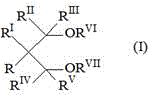
Preferably, the ether may be selected from 1,3 diethers of formula (I):
therein R, R I 、R II 、R III 、R IV And R is V Are identical or different from each other and are hydrogen or hydrocarbon radicals having from 1 to 18 carbon atoms; r is R VI And R is VII Identical or different from each other except for R VI And R is VII Not being hydrogen, with R to R V The same meaning; one or more of R to R VII The groups are joined to form a ring. Wherein R is VI And R is VII Selected from C 1 -C 4 1, 3-diethers of alkyl groups are particularly preferred. Mixtures of the above donors may also be used. Specific mixtures are those composed of esters of succinic acid and 1,3 diethers as disclosed in WO 2011/061134.
Where it is desired to increase the ability of the catalyst to distribute olefin comonomer within the polymer chain, such as in the case of producing ethylene/alpha-olefin copolymers, it is preferred to select the electron donor among the monofunctional donors, the ether of aliphatic monocarboxylic acid and C 1 -C 4 And alkyl esters. Preferred ethers are C 2 -C 20 Aliphatic ethers, in particular cyclic ethers having 3 to 5 carbon atoms, such as tetrahydrofuran, dioxane, are preferred. Preferred esters are ethyl acetate and methyl formate. Of these, tetrahydrofuran and ethyl acetate are most preferred.
In general, the final amount of electron donor compound in the solid catalyst component may be in the range of 0.5 to 40 wt%, preferably 1 to 35 wt%, relative to the total weight of the solid catalyst component.
The solid catalyst component obtained according to the invention preferably has a surface area (by the BET method) of generally from 20 to 500m
2 Between/g, preferably between 50 and 400m
2 Between/g and a total porosity (by BET method) of greater than 0.2cm
3 Preferably at 0.3 and 0.6cm
3 Between/g. Radius up to
The porosity due to the pores (mercury method) is usually in the range of 0.3 to 1.5cm
3 In the range of/g, preferably 0.45 to 1cm
3 /g。
The average particle diameter of the solid catalyst component is preferably in the range of 5 μm to 120 μm, more preferably 10 μm to 100 μm.
The solid catalyst component prepared according to the process of the present invention is converted into a catalyst for olefin polymerization by reacting it with an organoaluminum compound according to a known method.
The organoaluminum compound is preferably selected from trialkylaluminum compounds such as, for example, triethylaluminum, triisobutylaluminum, tri-n-butylaluminum, tri-n-hexylaluminum, tri-n-octylaluminum. Alkylaluminum halides, alkylaluminum hydrides or alkylaluminum sesquichlorides such as AlEt can also be used 2 Cl and Al 2 Et 3 Cl 3 Can be used in combination with the above trialkylaluminum.
The Al/Ti molar ratio is such that an excess of Al is present. In particular, the Al/Ti molar ratio may be between 50: in the range between 1 and 2000:1, preferably between 50:1 and 500:1.
Optionally, an external electron donor compound may be used. It is preferably selected from the group consisting of silicon compounds, ethers, esters, amines, heterocyclic compounds and 2, 6-tetramethylpiperidine and ketones. Another preferred class of external donor compounds is those of formula (R 6 ) a (R 7 ) b Si(OR 8 ) c Wherein a and are integers from 0 to 2, c is an integer from 1 to 4, and (a+b+c) is 4; r is R 6 、R 7 And R is 8 Is an alkyl, cycloalkyl or aryl group having 1 to 18 carbon atoms, optionally containing heteroatoms. Particularly preferred silicon compounds are those wherein a is 1, b is 1 and cIs 2, R 6 And R is 7 At least one of which is selected from branched alkyl, cycloalkyl or aryl groups having 3 to 10 carbon atoms and optionally containing heteroatoms, and R 8 Is C 1 -C 10 Alkyl, especially methyl. Examples of such preferred silicon compounds are methylcyclohexyldimethoxy silane (C donor), diphenyldimethoxy silane, methyl tert-butyldimethoxy silane, dicyclopentyl dimethoxy silane (D donor), diisopropyldimethoxy silane, (2-ethylpiperidinyl) tert-butyldimethoxy silane, (2-ethylpiperidinyl) butyldimethoxy silane, (3, 3-trifluoro-n-propyl) (2-ethylpiperidinyl) dimethoxy silane, methyl (3, 3-trifluoro-n-propyl) dimethoxy silane. In addition, preference is also given to those in which a is 0 and c is 3, R 7 Silicon compounds which are branched alkyl or cycloalkyl groups, optionally containing heteroatoms, and R 8 Is methyl. Examples of such preferred silicon compounds are cyclohexyltrimethoxysilane, t-butyltrimethoxysilane and hexyltrimethoxysilane.
The external electron donor compound is used in an amount such that the molar ratio of the organoaluminum compound to said external electron donor compound is from 0.1:1 to 500:1, preferably from 1:1 to 300:1, more preferably from 3:1 to 100:1.
The catalyst prepared according to the invention can be used for CH 2 In a process for the (co) polymerization of CHR olefins, wherein R is hydrogen or a hydrocarbon radical having 1-12 carbon atoms.
The polymerization process may be carried out according to available techniques, such as slurry polymerization using an inert hydrocarbon solvent as diluent, or bulk polymerization using a liquid monomer (e.g., propylene) as reaction medium. Furthermore, it is possible to carry out the polymerization process in gas phase operation in one or more fluidized-bed or mechanically stirred-bed reactors.
The polymerization is carried out at a temperature of 20℃to 120℃and preferably 40℃to 80 ℃. When the polymerization is carried out in the gas phase, the operating pressure may be in the range between 0.5MPa and 5MPa, preferably between 1MPa and 4 MPa. In bulk polymerization, the operating pressure may be in the range between 1MPa and 8MPa, preferably between 1.5MPa and 5 MPa.
The olefin polymer obtained by using the catalyst of the present invention may contain the colorant in an amount ranging from 0.2ppm to 30ppm, preferably from 0.3ppm to 28ppm, and particularly from 0.3ppm to 25ppm, relative to the weight of the polymer.
The polymers thus obtained have an improved visual appearance. This is shown by the fact that: the yellowness index of the polymer is reduced relative to a polymer that does not contain the colorant. Furthermore, such a reduction in yellow index is obtained in combination with unchanged polymer properties such as tacticity (measured by xylene insolubility), which confirms that the catalyst performance is not degraded.
The following examples are given to better illustrate the invention without limiting it.
Examples
Characteristics of
Determination of Mg, ti
The determination of Mg and Ti content in the solid catalyst component was performed by inductively coupled plasma emission spectrometry on an "i.c.p spectrometer ARL acceris".
Samples were prepared by analytical weighing of 0.1/0.3 g catalyst and 2 g lithium metaborate/lithium tetraborate 1/1 mixture. After adding a few drops of KI solution, the sample burned completely. With 5% v/v HNO 3 The solution was collected for residue and then analyzed by ICP at the following wavelengths: magnesium, 279.08nm; titanium, 368.52nm.
Determination of internal donor content
The content of internal donors in the solid catalytic compounds was determined by gas chromatography. The solid component was dissolved in acetone, an internal standard was added, and a sample of the organic phase was analyzed in a gas chromatograph to determine the amount of donor present at the starting catalyst compound.
And (3) measuring the coloring agent. Depending on the nature of the colorant, this can be achieved by gas chromatography or, for metal-based colorants, by measuring the residual metal on the catalyst.
Determination of X.I
2.5g of polymer and 250ml of o-xylene were placed in a round-bottomed flask equipped with a cooler and reflux condenser and kept under nitrogen. The resulting mixture was heated to 135 ℃ and maintained under stirring for about 60 minutes. The final solution was cooled to 25 ℃ with continuous stirring and the insoluble polymer was filtered. The filtrate was then evaporated to constant weight at 140 ℃ in a nitrogen stream. The content of the xylene soluble fraction is expressed as a percentage of the first 2.5 grams, then the difference is x.i.
Melt flow Rate (MIL)
The melt flow rate (MIL) of the polymer was determined according to ISO 1133 (230 ℃,2.16 Kg).
Yellowness index
The determination of Yellowness Index (YI) is obtained by directly measuring the X, Y and Z tristimulus coordinates on the particles using a tristimulus colorimeter capable of assessing the deviation of the object color from a preset standard white to yellow with a dominant wavelength range between 570 and 580 nm. The geometry of the instrument should allow for perpendicular viewing of light reflected by two rays of light incident on the sample at 45 ° angles (90 ° to each other) from "light source C" according to the CIE standard. After calibration, the glass container was filled with the particles to be tested and X, Y, Z coordinates were obtained to calculate the yellowness index according to the following equation:
YI=100*(1.274976795*X-1.058398178*Z)/Y
general procedure for propylene polymerization
A4 liter steel autoclave equipped with a stirrer, a pressure gauge, a thermometer, a catalyst feed system, a monomer feed line and a constant temperature jacket was purged with a nitrogen stream at 70℃for one hour. Adding a solution containing 75ml of anhydrous hexane and 0.6g of triethylaluminum (AlEt) 3 5.3 mmol) and 0.006 to 0.010g of a solid catalyst component, with 10 wt.% of total AlEt 3 And an amount of dicyclopentyl dimethoxy silane was precontacted for 5 minutes so that the molar ratio between Al/dicyclopentyl dimethoxy silane in the glass pot was 20. The autoclave was closed, and a desired amount of hydrogen gas (4500 cc). Then, 1.2kg of liquid propylene was added with stirring. The temperature was raised to 70℃in about 10 minutes and the polymerization was carried out at this temperature for 2 hours. At the end of the polymerization, unreacted propylene is removed; the polymer was recovered and dried in vacuo at 70℃for 3 hours. The resulting polymer was weighed and characterized.
2 General procedure for preparation of MgCl- (EtOH) m adducts.
Preparation of microspheroidal MgCl according to the method described in example 2 of U.S. Pat. No. 4,399,054 2 ·2.8C 2 H 5 OH. The average particle diameter of the obtained adduct was 25. Mu.m.
Example 1 (comparative)
Preparation of 9, 9-bis (methoxymethyl) fluorene-containing solid catalyst component.
250cc TiCl was introduced into a 0.5L round bottom glass reactor equipped with a mechanical stirrer, cooler, thermometer and filtration device at room temperature under nitrogen atmosphere into the bottom of the reactor 4 . After cooling to-5℃13.6g of MgCl were introduced with stirring 2 And ethanol (prepared according to general procedures). The temperature was then raised from-5 ℃ to 40 ℃ and when this temperature was reached, 9-bis (methoxymethyl) fluorene was introduced (used as an internal electron donor) in an amount to give a molar ratio Mg/9, 9-bis (methoxymethyl) fluorene of 5.
At the end of the addition, the temperature was raised to 100 ℃ and held at that temperature for 30 minutes. Thereafter, the liquid was removed under stirring, and the titanium black slurry was filtered. Then, fresh TiCl is added 4 Without adding any additional amount of donor. The entire slurry mixture was then heated at 109 ℃ and held at that temperature for 30 minutes. The filtration step was repeated again to separate the solid product from the liquid and a third TiCl was introduced at 109 ℃ 4 The treatment lasted 15 minutes.
The solid was washed with anhydrous isohexane five times (5X 250 cc) at 50℃and once (250 cc) at room temperature
The solid was finally dried under vacuum, weighed and analyzed.
Catalyst composition: mg=13.2 wt%; ti=5.1 wt%; i.d. =15.0 wt%.
The catalyst thus obtained was used in the polymerization of propylene according to the general procedure described above. The results are shown in Table 1.
Example 2
The procedure described in example 1 was repeated except that 0.3g of copper phthalocyanine was dissolved in TiCl used in the first reaction step 4 Is a kind of medium. Catalyst composition: mg=13.4 wt%; ti=5.0 wt%; i.d. =15.8 wt%, cu=0.2%.
The catalyst thus obtained was used in the polymerization of propylene according to the general procedure described above. The results are shown in Table 1.
Example 3 (comparative)
The procedure described in example 1 was repeated, except that 0.3g of ultramarine (inorganic pigment) was dissolved in TiCl used in the first reaction step 4 Is a kind of medium. Catalyst composition: mg=13.8 wt%; ti=4.6 wt%; i.d. =16.7 wt%, na=0.25%.
The catalyst thus obtained was used in the polymerization of propylene according to the general procedure described above. The results are shown in Table 1.
TABLE 1