CN112939196A - Coke electrode microbial fuel cell constructed wetland system, operation method and application - Google Patents
Coke electrode microbial fuel cell constructed wetland system, operation method and application Download PDFInfo
- Publication number
- CN112939196A CN112939196A CN202110162213.4A CN202110162213A CN112939196A CN 112939196 A CN112939196 A CN 112939196A CN 202110162213 A CN202110162213 A CN 202110162213A CN 112939196 A CN112939196 A CN 112939196A
- Authority
- CN
- China
- Prior art keywords
- coke
- fuel cell
- pipeline
- microbial fuel
- gravel
- Prior art date
- Legal status (The legal status is an assumption and is not a legal conclusion. Google has not performed a legal analysis and makes no representation as to the accuracy of the status listed.)
- Pending
Links
Images


Classifications
-
- C—CHEMISTRY; METALLURGY
- C02—TREATMENT OF WATER, WASTE WATER, SEWAGE, OR SLUDGE
- C02F—TREATMENT OF WATER, WASTE WATER, SEWAGE, OR SLUDGE
- C02F3/00—Biological treatment of water, waste water, or sewage
- C02F3/005—Combined electrochemical biological processes
-
- C—CHEMISTRY; METALLURGY
- C02—TREATMENT OF WATER, WASTE WATER, SEWAGE, OR SLUDGE
- C02F—TREATMENT OF WATER, WASTE WATER, SEWAGE, OR SLUDGE
- C02F3/00—Biological treatment of water, waste water, or sewage
- C02F3/006—Regulation methods for biological treatment
-
- C—CHEMISTRY; METALLURGY
- C02—TREATMENT OF WATER, WASTE WATER, SEWAGE, OR SLUDGE
- C02F—TREATMENT OF WATER, WASTE WATER, SEWAGE, OR SLUDGE
- C02F3/00—Biological treatment of water, waste water, or sewage
- C02F3/30—Aerobic and anaerobic processes
-
- C—CHEMISTRY; METALLURGY
- C02—TREATMENT OF WATER, WASTE WATER, SEWAGE, OR SLUDGE
- C02F—TREATMENT OF WATER, WASTE WATER, SEWAGE, OR SLUDGE
- C02F3/00—Biological treatment of water, waste water, or sewage
- C02F3/30—Aerobic and anaerobic processes
- C02F3/302—Nitrification and denitrification treatment
-
- C—CHEMISTRY; METALLURGY
- C02—TREATMENT OF WATER, WASTE WATER, SEWAGE, OR SLUDGE
- C02F—TREATMENT OF WATER, WASTE WATER, SEWAGE, OR SLUDGE
- C02F3/00—Biological treatment of water, waste water, or sewage
- C02F3/32—Biological treatment of water, waste water, or sewage characterised by the animals or plants used, e.g. algae
-
- H—ELECTRICITY
- H01—ELECTRIC ELEMENTS
- H01M—PROCESSES OR MEANS, e.g. BATTERIES, FOR THE DIRECT CONVERSION OF CHEMICAL ENERGY INTO ELECTRICAL ENERGY
- H01M8/00—Fuel cells; Manufacture thereof
- H01M8/16—Biochemical fuel cells, i.e. cells in which microorganisms function as catalysts
-
- C—CHEMISTRY; METALLURGY
- C02—TREATMENT OF WATER, WASTE WATER, SEWAGE, OR SLUDGE
- C02F—TREATMENT OF WATER, WASTE WATER, SEWAGE, OR SLUDGE
- C02F2101/00—Nature of the contaminant
- C02F2101/10—Inorganic compounds
- C02F2101/105—Phosphorus compounds
-
- C—CHEMISTRY; METALLURGY
- C02—TREATMENT OF WATER, WASTE WATER, SEWAGE, OR SLUDGE
- C02F—TREATMENT OF WATER, WASTE WATER, SEWAGE, OR SLUDGE
- C02F2101/00—Nature of the contaminant
- C02F2101/10—Inorganic compounds
- C02F2101/16—Nitrogen compounds, e.g. ammonia
-
- C—CHEMISTRY; METALLURGY
- C02—TREATMENT OF WATER, WASTE WATER, SEWAGE, OR SLUDGE
- C02F—TREATMENT OF WATER, WASTE WATER, SEWAGE, OR SLUDGE
- C02F2101/00—Nature of the contaminant
- C02F2101/30—Organic compounds
-
- C—CHEMISTRY; METALLURGY
- C02—TREATMENT OF WATER, WASTE WATER, SEWAGE, OR SLUDGE
- C02F—TREATMENT OF WATER, WASTE WATER, SEWAGE, OR SLUDGE
- C02F2101/00—Nature of the contaminant
- C02F2101/30—Organic compounds
- C02F2101/38—Organic compounds containing nitrogen
-
- C—CHEMISTRY; METALLURGY
- C02—TREATMENT OF WATER, WASTE WATER, SEWAGE, OR SLUDGE
- C02F—TREATMENT OF WATER, WASTE WATER, SEWAGE, OR SLUDGE
- C02F2103/00—Nature of the water, waste water, sewage or sludge to be treated
- C02F2103/007—Contaminated open waterways, rivers, lakes or ponds
-
- C—CHEMISTRY; METALLURGY
- C02—TREATMENT OF WATER, WASTE WATER, SEWAGE, OR SLUDGE
- C02F—TREATMENT OF WATER, WASTE WATER, SEWAGE, OR SLUDGE
- C02F2201/00—Apparatus for treatment of water, waste water or sewage
- C02F2201/002—Construction details of the apparatus
-
- C—CHEMISTRY; METALLURGY
- C02—TREATMENT OF WATER, WASTE WATER, SEWAGE, OR SLUDGE
- C02F—TREATMENT OF WATER, WASTE WATER, SEWAGE, OR SLUDGE
- C02F2203/00—Apparatus and plants for the biological treatment of water, waste water or sewage
- C02F2203/006—Apparatus and plants for the biological treatment of water, waste water or sewage details of construction, e.g. specially adapted seals, modules, connections
-
- C—CHEMISTRY; METALLURGY
- C02—TREATMENT OF WATER, WASTE WATER, SEWAGE, OR SLUDGE
- C02F—TREATMENT OF WATER, WASTE WATER, SEWAGE, OR SLUDGE
- C02F2209/00—Controlling or monitoring parameters in water treatment
- C02F2209/08—Chemical Oxygen Demand [COD]; Biological Oxygen Demand [BOD]
-
- C—CHEMISTRY; METALLURGY
- C02—TREATMENT OF WATER, WASTE WATER, SEWAGE, OR SLUDGE
- C02F—TREATMENT OF WATER, WASTE WATER, SEWAGE, OR SLUDGE
- C02F2209/00—Controlling or monitoring parameters in water treatment
- C02F2209/14—NH3-N
-
- C—CHEMISTRY; METALLURGY
- C02—TREATMENT OF WATER, WASTE WATER, SEWAGE, OR SLUDGE
- C02F—TREATMENT OF WATER, WASTE WATER, SEWAGE, OR SLUDGE
- C02F2209/00—Controlling or monitoring parameters in water treatment
- C02F2209/16—Total nitrogen (tkN-N)
-
- C—CHEMISTRY; METALLURGY
- C02—TREATMENT OF WATER, WASTE WATER, SEWAGE, OR SLUDGE
- C02F—TREATMENT OF WATER, WASTE WATER, SEWAGE, OR SLUDGE
- C02F2209/00—Controlling or monitoring parameters in water treatment
- C02F2209/18—PO4-P
-
- C—CHEMISTRY; METALLURGY
- C02—TREATMENT OF WATER, WASTE WATER, SEWAGE, OR SLUDGE
- C02F—TREATMENT OF WATER, WASTE WATER, SEWAGE, OR SLUDGE
- C02F2303/00—Specific treatment goals
- C02F2303/10—Energy recovery
-
- C—CHEMISTRY; METALLURGY
- C02—TREATMENT OF WATER, WASTE WATER, SEWAGE, OR SLUDGE
- C02F—TREATMENT OF WATER, WASTE WATER, SEWAGE, OR SLUDGE
- C02F3/00—Biological treatment of water, waste water, or sewage
- C02F3/30—Aerobic and anaerobic processes
- C02F3/302—Nitrification and denitrification treatment
- C02F3/305—Nitrification and denitrification treatment characterised by the denitrification
-
- Y—GENERAL TAGGING OF NEW TECHNOLOGICAL DEVELOPMENTS; GENERAL TAGGING OF CROSS-SECTIONAL TECHNOLOGIES SPANNING OVER SEVERAL SECTIONS OF THE IPC; TECHNICAL SUBJECTS COVERED BY FORMER USPC CROSS-REFERENCE ART COLLECTIONS [XRACs] AND DIGESTS
- Y02—TECHNOLOGIES OR APPLICATIONS FOR MITIGATION OR ADAPTATION AGAINST CLIMATE CHANGE
- Y02E—REDUCTION OF GREENHOUSE GAS [GHG] EMISSIONS, RELATED TO ENERGY GENERATION, TRANSMISSION OR DISTRIBUTION
- Y02E60/00—Enabling technologies; Technologies with a potential or indirect contribution to GHG emissions mitigation
- Y02E60/30—Hydrogen technology
- Y02E60/50—Fuel cells
Landscapes
- Life Sciences & Earth Sciences (AREA)
- Chemical & Material Sciences (AREA)
- Engineering & Computer Science (AREA)
- Microbiology (AREA)
- Organic Chemistry (AREA)
- Hydrology & Water Resources (AREA)
- Biodiversity & Conservation Biology (AREA)
- Environmental & Geological Engineering (AREA)
- Water Supply & Treatment (AREA)
- Chemical Kinetics & Catalysis (AREA)
- Health & Medical Sciences (AREA)
- Molecular Biology (AREA)
- Electrochemistry (AREA)
- General Chemical & Material Sciences (AREA)
- Biotechnology (AREA)
- Botany (AREA)
- Biochemistry (AREA)
- Manufacturing & Machinery (AREA)
- Sustainable Development (AREA)
- Sustainable Energy (AREA)
- Fuel Cell (AREA)
- Inert Electrodes (AREA)
Abstract
The invention discloses a coke electrode microbial fuel cell constructed wetland system which comprises a water distribution tank, wherein the water distribution tank is connected with a first valve at the bottom end of a system main body through a first pipeline, a peristaltic pump is installed on the first pipeline, a second valve is arranged at the upper end of the system main body, a gravel substrate layer, a coke anode layer, a gravel barrier layer and a coke cathode layer are sequentially arranged in the system main body from bottom to top in a layered mode, the coke anode layer and the coke cathode layer form a closed loop through an external circuit device, a second pipeline is installed at the upper end of the gravel barrier layer and communicated with an air pump, a rotor flow meter is installed on the second pipeline, and wetland plants are planted above the system main body. The invention selects coke particles as electrode materials, combines with a bioelectrochemical system, has obvious pollutant removal effect, low price and excellent performance, and is suitable for large-scale application. Meanwhile, an operation method is provided, intermittent flow is realized during starting, continuous flow is realized during operation, and the method is practical, convenient and easy to operate.
Description
Technical Field
The invention belongs to the technical field of sewage treatment, and particularly relates to a coke electrode microbial fuel cell constructed wetland system, an operation method and application.
Background
On the basis of natural Wetland, the concept of Constructed Wetland (CW) was first proposed in the 70 th 20 th century and then developed into sewage treatment technology based on the ecological engineering technology principle. Microbial Fuel Cells (MFCs) are devices that utilize electrically active microorganisms to degrade organic matter and simultaneously generate electrical energy. The microbial fuel cell artificial wetland (MFC-CW) is a novel sewage treatment technology based on a bioelectrochemical technology, wherein a conductive filler is added as an electrode, a constant-value resistor is connected in series outside to construct a closed loop, and the coupling is realized by utilizing a redox gradient naturally existing in the artificial wetland. The system not only gives full play to the advantages of low CW technology cost, low energy consumption, easy operation and maintenance, etc., but also can convert the chemical energy contained in the organic matters in the wastewater into electric energy, thereby realizing the dual effects of decontamination and power generation, and the large-scale application of the system can effectively relieve the current situation of shortage of fresh water resources and energy sources in the current society.
A typical MFC-CW system consists of wetland vegetation, conductive fillers and microorganisms. Wetland plants usually adopt emergent aquatic plants such as reeds, canna and the like, the plants have strong tolerance to pollutants, can absorb nutrient salt substances such as inorganic phosphorus, nitrogen and the like in sewage to be used for self growth and development, and simultaneously oxygen and secretion secreted by the rhizosphere effect are beneficial to increasing the abundance of a cathode microbial community and improving the pollutant removal efficiency and electrogenesis efficiency. The conductive filler is generally a material with good conductivity, electrochemical stability and biocompatibility, such as a carbon fiber felt and a graphite felt, and is used for adsorbing inorganic ions in sewage, supporting plant growth and providing an attachment place for functional microorganisms. The electroactive microorganisms are used as a special class in a microbial community, can degrade organic matters in an anaerobic anode area and generate electrons, the electrons are transferred to a cathode along with an external circuit, the oxidation of ammonium salt and nitrite is effectively completed in an aerobic cathode area, and the reduction of nitrate is completed by utilizing the electrons transferred by an external circuit, so that the electroactive microorganisms are used for removing nitrogen.
Just as MFC-CW is an emerging technology with both wastewater purification and electricity generation properties, it currently has some technical deficiencies. For example: the biofilm formation is slow, so that the starting time of the whole system is long; the specific surface area and the porosity of the carbon fiber felt and the graphite felt are small, so that the carbon fiber felt and the graphite felt are not beneficial to the absorption of inorganic ions (particularly phosphate) and the attachment of electroactive microorganisms, and the system is easy to block; the cathode dissolved oxygen level is lower in a natural state, so that the ammonia nitrogen oxidation degree is weaker, and the overall electricity generation performance is poorer.
Disclosure of Invention
The invention aims to provide a safe, efficient and easily-obtained coke electrode microbial fuel cell constructed wetland system and an operation method which is convenient to use and simple to operate.
In order to achieve the purpose, the invention adopts the technical scheme that:
the utility model provides a coke electrode microbial fuel cell constructed wetland system, includes the distribution tank, and the distribution tank installs the peristaltic pump through the first valve of first pipeline connecting system main part bottom on the first pipeline, the second valve has been seted up to system main part upper end, and the inside of system main part is from bottom to top layered in proper order and is provided with gravel stratum basale, coke anode layer, gravel barrier layer and coke cathode layer, and coke anode layer and coke cathode layer constitute closed circuit through outer circuit arrangement, the second pipeline is installed to gravel barrier layer upper end, and second pipeline intercommunication electromagnetic type air pump installs rotameter on the second pipeline, and the wetland plant has been planted to system main part top.
Furthermore, the external circuit device comprises a copper core wire, a fixed value resistor and an electrochemical workstation, wherein the copper core wire and the fixed value resistor are communicated with a coke cathode layer and a coke anode layer, and the electrochemical workstation is connected to two ends of the fixed value resistor in parallel.
Further, an aeration stone is arranged at the upper end of the gravel blocking layer and communicated with the second pipeline.
Furthermore, the system main body is a cylinder with an opening at the top end and a closed bottom end, the system main body is made of organic glass, and black plastic cloth wraps the system main body.
Further, the height of the system body is 400 mm, and the diameter is 200 mm.
Further, the height of the gravel base layer is 50 mm, and the particle size of gravel is 20-40 mm; the height of the coke anode layer is 50 mm, and the particle size is 8-16 mm; the height of the gravel blocking layer is 220 mm, and the particle size of the gravel is 8-16 mm; the height of the coke cathode layer is 50 mm, and the particle size is 8-16 mm.
Further, the first pipeline and the second pipeline are silicone tubes.
A method of operating a coke electrode microbial fuel cell constructed wetland system according to any one of claims 1 to 7, comprising the steps of:
(1) and (3) starting a system: mixing activated sludge and wastewater, injecting the mixture into a system main body, and adopting an intermittent operation mode of feeding the system main body from top to bottom;
(2) and (3) stable operation of the system: the first pipeline is used for connecting the distribution tank, the peristaltic pump and the first valve, the second pipeline is used for connecting the electromagnetic air pump, the rotor flow meter and the aeration stone, and during operation, a continuous flow mode that a system main body enters from bottom to top is adopted.
Further, the system starting time in the step (1) is 1 month, the hydraulic retention time is 3 days, and the volume ratio of the activated sludge to the wastewater is 1: 400; the hydraulic retention time in the step (2) is 3 days.
The application of the coke electrode microbial fuel cell constructed wetland system based on any one of claims 1 to 7 in the purification of domestic sewage and industrial wastewater or the treatment of eutrophic lake and river water bodies.
The invention has the advantages that:
(1) the coke electrode microbial fuel cell constructed wetland system provided by the invention has the advantages that the gravel base layer, the coke anode layer, the gravel barrier layer and the coke cathode layer are sequentially arranged on the system main body from bottom to top. The gravel base layer is characterized by the largest particle size (20-40 mm), the larger porosity effectively prevents the blockage of the water inlet, and the higher mechanical strength is enough to support the whole system, thereby being beneficial to improving the stability of the system main body. The coke anode layer is an anaerobic area, the electroactive microorganisms attached to the surface of the coke anode layer perform biochemical reaction to degrade organic pollutants and generate electrons, and the electrons are transmitted to the coke cathode layer from the coke anode layer through an external circuit formed by a copper core wire and a constant value resistor to form current. The gravel blocking layer separates the two electrodes, the insulating property of the gravel blocking layer prevents the two electrodes from being connected in series, and the enough thickness (220 mm) effectively prevents excessive oxygen generated by aeration from entering the anaerobic coke anode layer, thereby being beneficial to realizing that the system generates a larger redox gradient and promoting the generation of voltage. The coke cathode layer is an aerobic area, after ammonium salt in the area is oxidized, the electroactive microorganism converts nitrate into nitrogen by using electrons transmitted from the coke anode layer, synchronous nitrification/denitrification is realized, the removal of nitrogen by the system is enhanced, meanwhile, oxygen is combined with protons and electrons in water to generate water, the oxygen electrode reaction is completed, and good electricity generating performance is realized.
(2) The coke electrode microbial fuel cell constructed wetland system provided by the invention adopts an intermittent aeration strategy, so that the oxidation of ammonia nitrogen under an aerobic condition is met, the reduction of nitrate under an anoxic/anaerobic condition is met, and the nitrogen removal efficiency of the microbial fuel cell constructed wetland system is improved; the aeration quantity of the coke cathode is regulated and controlled through the rotameter, the operation is simple and convenient, and the concentration of dissolved oxygen and nitrate in the cathode area is reasonably increased to be used as an electron acceptor, so that the improvement of the electrogenesis efficiency is realized. The invention selects the coke particles with low price, easy acquisition and larger specific surface area as the electrode material, combines with the bioelectrochemical system, has obvious pollutant removal effect, low price and excellent performance compared with the prior constructed wetland, and is suitable for large-scale application. In addition, the system main body adopts a shading measure to prevent the excessive growth of algae and provide favorable propagation conditions for the electroactive functional microorganisms.
(3) The operation method of the coke electrode microbial fuel cell constructed wetland system provided by the invention adopts an intermittent flow operation mode during the starting period and a continuous flow mode during the operation period; the activated sludge in the secondary sedimentation tank of the sewage treatment plant is taken as a strain and is inoculated into the main body of the system, so that the starting time of the system is shortened; the dissolved oxygen concentration of the coke cathode layer is regulated and controlled by adopting an intermittent aeration means, so that aerobic/anaerobic alternate conditions are provided for the microbial fuel cell constructed wetland system, synchronous nitrification/denitrification is realized, the nitrogen is removed, the redox gradient of the two electrodes is increased, and the electrogenesis efficiency is improved.
(4) The coke electrode microbial fuel cell constructed wetland system provided by the invention can be applied to the purification of domestic sewage and industrial wastewater or the treatment of eutrophic lake and river water bodies.
Drawings
FIG. 1 is a schematic structural diagram of a constructed wetland system of a coke electrode microbial fuel cell of the invention;
fig. 2 is a diagram of the electrogenesis efficiency of the coke electrode microbial fuel cell constructed wetland system of the invention.
In the figure, 1, a distribution pool; 2. a first conduit; 3. a peristaltic pump; 4. a first valve; 5. a gravel substrate layer; 6. a coke anode layer; 7. a gravel barrier layer; 8. a coke cathode layer; 9. a constant value resistor; 10. an electrochemical workstation; 11. a copper core wire; 12. wetland plants; 13. aerating stones; 14. a second valve; 15. a rotameter; 16. a second conduit; 17. an electromagnetic air pump; 18. a system body.
Detailed Description
In order to make the objects, technical solutions and advantages of the present invention more apparent, the present invention is further described in detail below with reference to examples, and the specific examples described herein are only for explaining the present invention and are not intended to limit the present invention.
As shown in fig. 1-2, the invention discloses a coke electrode microbial fuel cell constructed wetland system, which comprises a distribution tank 1, wherein the distribution tank 1 is connected with a first valve 4 at the bottom end of a system main body 18 through a first pipeline 2, the first pipeline 2 is a silicone tube, a peristaltic pump 3 is arranged on the first pipeline 2, and a second valve 14 is arranged at the upper end of the system main body 18. The system main body 18 is an organic glass cylinder with an opening at the top end, a closed bottom end, a height of 400 mm and a diameter of 200 mm, the volume of the cylinder is about 12.6L, the effective volume is about 3.8L, and black plastic cloth wraps the system main body 18.
The gravel base layer 5, the coke anode layer 6, the gravel barrier layer 7 and the coke cathode layer 8 are sequentially layered from bottom to top in the system main body 18. The height of the 5 layers of the gravel substrate layer is 50 mm, and the particle size of the gravel is 20-40 mm; the height of the coke anode layer 6 layers is 50 mm, and the particle size is 8-16 mm; the height of the gravel blocking layer 7 is 220 mm, and the particle size of the gravel is 8-16 mm; the height of 8 layers of the coke cathode layer is 50 mm, and the particle size is 8-16 mm. Coke anode layer 6 and coke cathode layer 8 constitute closed circuit through outer circuit arrangement, and outer circuit arrangement includes copper core wire 11, definite value resistance 9 and electrochemical workstation 10, through copper core wire 11 and definite value resistance 9 intercommunication coke cathode layer 8 and coke anode layer 6, electrochemical workstation 10 connects in parallel at definite value resistance 9 both ends. The second pipeline 16 is installed on the upper end of the gravel blocking layer 7, the second pipeline 16 is communicated with the electromagnetic air pump 17, the second pipeline 16 is a silicone tube, the rotor flow meter 15 is installed on the second pipeline 16, the aeration stone 13 is arranged on the upper end of the gravel blocking layer 7, and the aeration stone 13 is communicated with the second pipeline 16. The wetland plant 12 reed is planted above the system main body 18.
The aeration time is controlled by a timing switch controller, the electromagnetic air pump 17 provides aeration, the rotor flow meter 15 is used for adjusting aeration quantity, and the electromagnetic air pump 17, the rotor flow meter 15 and the aeration stone 13 are communicated through a second pipeline 16. The aeration time is 0-1 point, 6-7 points, 12-13 points and 18-19 points per day, and the aeration intensity is as follows: 0.4L/min.
An operation method of a coke electrode microbial fuel cell constructed wetland system comprises the following steps:
(1) and (3) starting a system: mixing the activated sludge of the secondary sedimentation tank of the sewage treatment plant and the synthetic wastewater according to the volume ratio of 1:400, injecting the mixture into a system main body 18, adopting an upper inlet and lower outlet intermittent operation mode, wherein the hydraulic retention time is 3 days, and the system starting time is 1 month;
(2) and (3) stable operation of the system: the water distribution tank 1, the peristaltic pump 3 and the first valve 4 are connected through the first pipeline 2, the electromagnetic air pump 17, the rotameter 15 and the aeration stone 13 are connected through the second pipeline 16, during operation, a continuous flow mode of downward inlet and upward outlet is adopted, the peristaltic pump 3 pumps synthetic wastewater from the water distribution tank through the first pipeline 2, the synthetic wastewater flows into the system main body 18 through the first valve 4, sequentially passes through the gravel base layer 5, the coke anode layer 6, the gravel barrier layer 7 and the coke cathode layer 8, and flows out of the system main body 18 from the second valve 14, and the hydraulic retention time is 3 days.
The coke electrode microbial fuel cell constructed wetland system can be applied to the purification of domestic sewage and industrial wastewater or the treatment of eutrophic lake and river water bodies.
According to the pollutant discharge standard of urban sewage treatment plants (GB 18918-2002), the treatment effect of the coke electrode microbial fuel cell constructed wetland system on various pollutants is detected.
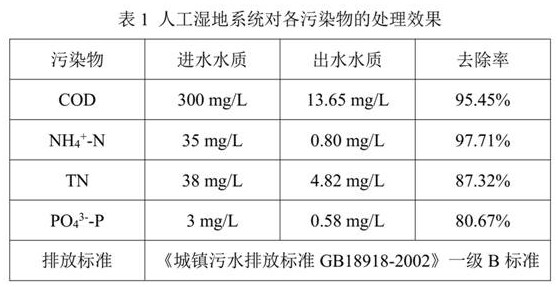
As can be seen from Table 1, the effluent quality of the artificial wetland system of the coke electrode microbial fuel cell is stable, and the removal rate of COD is high95.45% NH4 +The N removal rate can reach 97.71%, the TN removal rate is 87.32%, and the TP removal rate is 80.67%, and reaches the first-class B emission standard in the discharge Standard of pollutants for municipal wastewater treatment plants (GB 18918-2002). Meanwhile, as can be seen from FIG. 2, the maximum voltage value of the constructed wetland system of the coke electrode microbial fuel cell is 864 mV, and the maximum power density is 7.76 mW/m3。
Claims (10)
1. The utility model provides a coke electrode microbial fuel cell constructed wetland system, a serial communication port, including the distribution tank, the distribution tank installs the peristaltic pump through the first valve of first pipeline connected system main part bottom on the first pipeline, the second valve has been seted up to system main part upper end, and the inside of system main part is from bottom to top layered gravel stratum basale, coke anode layer, gravel barrier layer and coke cathode layer in proper order, and coke anode layer and coke cathode layer constitute closed circuit through outer circuit arrangement, the second pipeline is installed to gravel barrier layer upper end, and second pipeline intercommunication electromagnetic type air pump installs rotameter on the second pipeline, and the wetland plant has been planted to system main part top.
2. The coke electrode microbial fuel cell constructed wetland system of claim 1, wherein the external circuit device comprises a copper core wire, a fixed value resistor and an electrochemical workstation, the coke cathode layer and the coke anode layer are communicated through the copper core wire and the fixed value resistor, and the electrochemical workstation is connected in parallel at two ends of the fixed value resistor.
3. The coke electrode microbial fuel cell constructed wetland system of claim 1, wherein the upper end of the gravel blocking layer is provided with an aeration stone, and the aeration stone is communicated with the second pipeline.
4. The coke electrode microbial fuel cell constructed wetland system of claim 1, wherein the system body is a cylinder with an open top end and a closed bottom end, the system body is made of organic glass, and black plastic cloth is wrapped outside the system body.
5. The coke electrode microbial fuel cell constructed wetland system of claim 4, wherein the height of the system body is 400 mm and the diameter is 200 mm.
6. The coke electrode microbial fuel cell constructed wetland system of claim 1, wherein the gravel base layer has a height of 50 mm and a gravel particle size of 20-40 mm; the height of the coke anode layer is 50 mm, and the particle size is 8-16 mm; the height of the gravel blocking layer is 220 mm, and the particle size of the gravel is 8-16 mm; the height of the coke cathode layer is 50 mm, and the particle size is 8-16 mm.
7. The coke electrode microbial fuel cell constructed wetland system of claim 1, wherein the first and second conduits are silicone tubing.
8. A method of operating a coke electrode microbial fuel cell constructed wetland system according to any one of claims 1 to 7, comprising the steps of:
(1) and (3) starting a system: mixing activated sludge and wastewater, injecting the mixture into a system main body, and adopting an intermittent operation mode of feeding the system main body from top to bottom;
(2) and (3) stable operation of the system: the first pipeline is used for connecting the distribution tank, the peristaltic pump and the first valve, the second pipeline is used for connecting the electromagnetic air pump, the rotor flow meter and the aeration stone, and during operation, a continuous flow mode that a system main body enters from bottom to top is adopted.
9. The operation method of the coke electrode microbial fuel cell constructed wetland system of claim 8, wherein the system start-up time in step (1) is 1 month, the hydraulic retention time is 3 days, and the volume ratio of activated sludge to wastewater is 1: 400; the hydraulic retention time in the step (2) is 3 days.
10. The application of the coke electrode microbial fuel cell constructed wetland system based on any one of claims 1 to 7 in the purification of domestic sewage and industrial wastewater or the treatment of eutrophic lake and river water bodies.
Priority Applications (1)
| Application Number | Priority Date | Filing Date | Title |
|---|---|---|---|
| CN202110162213.4A CN112939196A (en) | 2021-02-05 | 2021-02-05 | Coke electrode microbial fuel cell constructed wetland system, operation method and application |
Applications Claiming Priority (1)
| Application Number | Priority Date | Filing Date | Title |
|---|---|---|---|
| CN202110162213.4A CN112939196A (en) | 2021-02-05 | 2021-02-05 | Coke electrode microbial fuel cell constructed wetland system, operation method and application |
Publications (1)
| Publication Number | Publication Date |
|---|---|
| CN112939196A true CN112939196A (en) | 2021-06-11 |
Family
ID=76242702
Family Applications (1)
| Application Number | Title | Priority Date | Filing Date |
|---|---|---|---|
| CN202110162213.4A Pending CN112939196A (en) | 2021-02-05 | 2021-02-05 | Coke electrode microbial fuel cell constructed wetland system, operation method and application |
Country Status (1)
| Country | Link |
|---|---|
| CN (1) | CN112939196A (en) |
Cited By (1)
| Publication number | Priority date | Publication date | Assignee | Title |
|---|---|---|---|---|
| CN116040787A (en) * | 2023-01-12 | 2023-05-02 | 郑州轻工业大学 | Bioelectrochemistry constructed wetland system and application thereof |
Citations (11)
| Publication number | Priority date | Publication date | Assignee | Title |
|---|---|---|---|---|
| US20060076290A1 (en) * | 2004-10-07 | 2006-04-13 | Shockley Chad E | Nitrate removal in a purge stream using constructed wetlands |
| CN105565497A (en) * | 2015-12-15 | 2016-05-11 | 东华大学 | Air cathode microbial fuel cell constructed wetland device of biological carbon matrix anode |
| TWM529283U (en) * | 2016-04-03 | 2016-09-21 | 吳志鴻 | A novel biotrickling filter-microbial fuel cell system for gaseous organic compounds treatment and electricity generation |
| CN108033567A (en) * | 2017-12-20 | 2018-05-15 | 江西科技师范大学 | Artificial swamp and microbiological fuel cell wastewater treatment coupling device |
| CN108147537A (en) * | 2018-01-05 | 2018-06-12 | 桂林理工大学 | Electricity production eversion type flow artificial swamp effluent purification method in a kind of |
| CN108178320A (en) * | 2018-01-12 | 2018-06-19 | 南京工业大学 | Microbial fuel cell artificial wetland device and sewage purification method |
| CN110104874A (en) * | 2019-04-24 | 2019-08-09 | 上海交通大学 | A kind of continuous flow wetland type microbiological fuel cell reactor sewage-treatment plant |
| CN110143720A (en) * | 2019-05-20 | 2019-08-20 | 河海大学 | A kind of the artificial swamp microbiological fuel cell coupling device and its wastewater treatment method of multimedium filtrate |
| CN106745772B (en) * | 2016-12-29 | 2020-06-30 | 东南大学 | Row-array type microbial fuel cell constructed wetland sewage treatment system |
| CN111592115A (en) * | 2020-06-20 | 2020-08-28 | 中冶节能环保有限责任公司 | Microbial fuel cell-constructed wetland coupling system |
| CN112047469A (en) * | 2020-08-26 | 2020-12-08 | 国河环境研究院(南京)有限公司 | Artificial wetland-biofuel cell coupling system of revolving drum fluidized cathode and application |
-
2021
- 2021-02-05 CN CN202110162213.4A patent/CN112939196A/en active Pending
Patent Citations (11)
| Publication number | Priority date | Publication date | Assignee | Title |
|---|---|---|---|---|
| US20060076290A1 (en) * | 2004-10-07 | 2006-04-13 | Shockley Chad E | Nitrate removal in a purge stream using constructed wetlands |
| CN105565497A (en) * | 2015-12-15 | 2016-05-11 | 东华大学 | Air cathode microbial fuel cell constructed wetland device of biological carbon matrix anode |
| TWM529283U (en) * | 2016-04-03 | 2016-09-21 | 吳志鴻 | A novel biotrickling filter-microbial fuel cell system for gaseous organic compounds treatment and electricity generation |
| CN106745772B (en) * | 2016-12-29 | 2020-06-30 | 东南大学 | Row-array type microbial fuel cell constructed wetland sewage treatment system |
| CN108033567A (en) * | 2017-12-20 | 2018-05-15 | 江西科技师范大学 | Artificial swamp and microbiological fuel cell wastewater treatment coupling device |
| CN108147537A (en) * | 2018-01-05 | 2018-06-12 | 桂林理工大学 | Electricity production eversion type flow artificial swamp effluent purification method in a kind of |
| CN108178320A (en) * | 2018-01-12 | 2018-06-19 | 南京工业大学 | Microbial fuel cell artificial wetland device and sewage purification method |
| CN110104874A (en) * | 2019-04-24 | 2019-08-09 | 上海交通大学 | A kind of continuous flow wetland type microbiological fuel cell reactor sewage-treatment plant |
| CN110143720A (en) * | 2019-05-20 | 2019-08-20 | 河海大学 | A kind of the artificial swamp microbiological fuel cell coupling device and its wastewater treatment method of multimedium filtrate |
| CN111592115A (en) * | 2020-06-20 | 2020-08-28 | 中冶节能环保有限责任公司 | Microbial fuel cell-constructed wetland coupling system |
| CN112047469A (en) * | 2020-08-26 | 2020-12-08 | 国河环境研究院(南京)有限公司 | Artificial wetland-biofuel cell coupling system of revolving drum fluidized cathode and application |
Cited By (2)
| Publication number | Priority date | Publication date | Assignee | Title |
|---|---|---|---|---|
| CN116040787A (en) * | 2023-01-12 | 2023-05-02 | 郑州轻工业大学 | Bioelectrochemistry constructed wetland system and application thereof |
| CN116040787B (en) * | 2023-01-12 | 2023-08-08 | 郑州轻工业大学 | Bioelectrochemistry constructed wetland system and application thereof |
Similar Documents
| Publication | Publication Date | Title |
|---|---|---|
| CN102491515B (en) | Three-dimensional electrode bio-membrane system used for processing high-ammonium-nitrogen wastewater with low carbon-nitrogen ratio | |
| CN108178320B (en) | Microbial fuel cell artificial wetland device and sewage purification method | |
| CN113998783B (en) | Low-carbon nitrogen and phosphorus removal device and method for municipal sewage based on partial return sludge deep anaerobic treatment | |
| CN103466801B (en) | Method for improving denitrification of integrated vertical flow constructed wetlands | |
| CN108383232B (en) | Method and device for improving nitrate nitrogen removal efficiency of downward vertical flow constructed wetland | |
| CN105836894B (en) | A kind of sewage disposal system and method for tidal flow artificial wetland coupling microbiological fuel cell | |
| CN105152351A (en) | Photoelectric artificial wetland and application thereof | |
| CN105236576A (en) | Floating-bed plant coupling sediment microbiological fuel cell water purification method | |
| CN108275776B (en) | Anaerobic fluidized bed serial constructed wetland type microbial fuel cell device and method | |
| CN112939195B (en) | Multi-anode microbial fuel cell artificial wetland system, operation method and application | |
| CN103693811B (en) | Movable micro electrolysis wetland sewage treatment method and system | |
| CN109912145B (en) | Aerobic granular sludge power generation device | |
| CN112573667A (en) | Sewage treatment device and method based on phycomycete symbiotic electrochemical system | |
| CN105565494A (en) | Membrane-aerated bio-membrane and bioelectrochemical coupling system and application thereof | |
| CN105217797A (en) | A kind of method of composite vertical current artificial wetland coupling microorganism electrolysis cell strengthened denitrification and device | |
| CN112607864A (en) | Electrochemical performance-enhanced bacteria-algae membrane aeration biomembrane reactor system and application thereof | |
| Shi et al. | Research progress of microbial fuel cell and constructed wetland coupling system | |
| CN112174293A (en) | Electric-enhanced bioretention system for removing low-concentration antibiotics | |
| CN210261492U (en) | Plant floating bed device for repairing urban tidal river black and odorous bottom mud by using microbial fuel cell | |
| CN103496789A (en) | Sewage treatment unit and method using bioelectrochemistry to aid membrane bioreactor | |
| CN112939196A (en) | Coke electrode microbial fuel cell constructed wetland system, operation method and application | |
| CN105366802A (en) | Eco-biofilter apparatus and method for treating sewage by eco-biofilter apparatus | |
| CN205874017U (en) | Tidal flow constructed wetland coupling microbiological fuel cell's sewage treatment system | |
| CN113024039A (en) | Bioelectricity-enhanced subsurface flow wetland system and pollutant treatment method | |
| CN104577171A (en) | Efficient dephosphorization and nitrification microbial fuel cell with external magnetic field |
Legal Events
| Date | Code | Title | Description |
|---|---|---|---|
| PB01 | Publication | ||
| PB01 | Publication | ||
| SE01 | Entry into force of request for substantive examination | ||
| SE01 | Entry into force of request for substantive examination |