CN112618552B - Application of ganoderic acid A or derivative of ganoderic acid A in preparation of medicine for treating autism - Google Patents
Application of ganoderic acid A or derivative of ganoderic acid A in preparation of medicine for treating autism Download PDFInfo
- Publication number
- CN112618552B CN112618552B CN202011608792.2A CN202011608792A CN112618552B CN 112618552 B CN112618552 B CN 112618552B CN 202011608792 A CN202011608792 A CN 202011608792A CN 112618552 B CN112618552 B CN 112618552B
- Authority
- CN
- China
- Prior art keywords
- medicine
- ganoderic acid
- autism
- dosage form
- derivative
- Prior art date
- Legal status (The legal status is an assumption and is not a legal conclusion. Google has not performed a legal analysis and makes no representation as to the accuracy of the status listed.)
- Active
Links
Images

Classifications
-
- A—HUMAN NECESSITIES
- A61—MEDICAL OR VETERINARY SCIENCE; HYGIENE
- A61K—PREPARATIONS FOR MEDICAL, DENTAL OR TOILETRY PURPOSES
- A61K31/00—Medicinal preparations containing organic active ingredients
- A61K31/56—Compounds containing cyclopenta[a]hydrophenanthrene ring systems; Derivatives thereof, e.g. steroids
- A61K31/575—Compounds containing cyclopenta[a]hydrophenanthrene ring systems; Derivatives thereof, e.g. steroids substituted in position 17 beta by a chain of three or more carbon atoms, e.g. cholane, cholestane, ergosterol, sitosterol
-
- A—HUMAN NECESSITIES
- A23—FOODS OR FOODSTUFFS; TREATMENT THEREOF, NOT COVERED BY OTHER CLASSES
- A23L—FOODS, FOODSTUFFS OR NON-ALCOHOLIC BEVERAGES, NOT OTHERWISE PROVIDED FOR; PREPARATION OR TREATMENT THEREOF
- A23L31/00—Edible extracts or preparations of fungi; Preparation or treatment thereof
-
- A—HUMAN NECESSITIES
- A23—FOODS OR FOODSTUFFS; TREATMENT THEREOF, NOT COVERED BY OTHER CLASSES
- A23L—FOODS, FOODSTUFFS OR NON-ALCOHOLIC BEVERAGES, NOT OTHERWISE PROVIDED FOR; PREPARATION OR TREATMENT THEREOF
- A23L33/00—Modifying nutritive qualities of foods; Dietetic products; Preparation or treatment thereof
-
- A—HUMAN NECESSITIES
- A61—MEDICAL OR VETERINARY SCIENCE; HYGIENE
- A61P—SPECIFIC THERAPEUTIC ACTIVITY OF CHEMICAL COMPOUNDS OR MEDICINAL PREPARATIONS
- A61P25/00—Drugs for disorders of the nervous system
-
- A—HUMAN NECESSITIES
- A23—FOODS OR FOODSTUFFS; TREATMENT THEREOF, NOT COVERED BY OTHER CLASSES
- A23V—INDEXING SCHEME RELATING TO FOODS, FOODSTUFFS OR NON-ALCOHOLIC BEVERAGES AND LACTIC OR PROPIONIC ACID BACTERIA USED IN FOODSTUFFS OR FOOD PREPARATION
- A23V2002/00—Food compositions, function of food ingredients or processes for food or foodstuffs
Landscapes
- Health & Medical Sciences (AREA)
- Life Sciences & Earth Sciences (AREA)
- Chemical & Material Sciences (AREA)
- Engineering & Computer Science (AREA)
- General Health & Medical Sciences (AREA)
- Veterinary Medicine (AREA)
- Food Science & Technology (AREA)
- Polymers & Plastics (AREA)
- Medicinal Chemistry (AREA)
- Pharmacology & Pharmacy (AREA)
- Nutrition Science (AREA)
- Animal Behavior & Ethology (AREA)
- Mycology (AREA)
- Public Health (AREA)
- Microbiology (AREA)
- Epidemiology (AREA)
- Bioinformatics & Cheminformatics (AREA)
- Biomedical Technology (AREA)
- Neurology (AREA)
- Neurosurgery (AREA)
- Chemical Kinetics & Catalysis (AREA)
- General Chemical & Material Sciences (AREA)
- Nuclear Medicine, Radiotherapy & Molecular Imaging (AREA)
- Organic Chemistry (AREA)
- Medicinal Preparation (AREA)
Abstract
本发明提供了灵芝酸A或灵芝酸A的衍生物在制备治疗自闭症药物中的应用,特别涉及制药领域。本发明提供了灵芝酸A或灵芝酸A的衍生物在制备治疗自闭症药物中的应用,所述灵芝酸A或灵芝酸A的衍生物可以显著改善动物的社会交互行为且无副作用,因此本发明所述灵芝酸A或灵芝酸A的衍生物能够用于治疗和改善自闭症。
The invention provides the application of Ganoderma A or a derivative of Ganoderma A in the preparation of medicines for treating autism, and particularly relates to the field of pharmacy. The present invention provides the application of Ganoderma A or a derivative of Ganoderma A in the preparation of a drug for treating autism. The Ganoate A or the derivative of Ganoate A can significantly improve the social interaction behavior of animals without side effects, so The Ganoderma A or Ganoderma A derivative of the present invention can be used to treat and improve autism.
Description
Technical Field
The invention relates to the field of pharmacy, in particular to application of ganoderic acid A or derivatives of ganoderic acid A in preparing a medicine for treating autism.
Background
Autism spectrum disorder (ASD, also known as autism) is a neurodevelopmental disorder, which is mainly manifested by a disorder of social functioning, which can be accompanied by marked, stereotyped behaviors and a narrow range of interest. Genetics plays a key role in the etiology of autism and is associated with environmental factors early in development. Autism has become a public health concern.
Unfortunately, no treatment medicine for autism exists in clinic at present, and the patients are mainly controlled by antidepressant drugs or antipsychotic drugs when corresponding symptoms appear, but the side effects are significant, and the life quality of the patients is seriously affected.
Disclosure of Invention
In order to solve the problems, the invention provides application of ganoderic acid A or derivatives of ganoderic acid A in preparing a medicament for treating autism. The ganoderic acid A disclosed by the invention can be used for treating and improving patients with autism, the social interaction behavior of animals is obviously improved, and the side effect is small.
In order to achieve the above purpose, the invention provides the following technical scheme:
the invention provides application of ganoderic acid A or derivatives of ganoderic acid A in preparation of a medicine for treating autism.
Preferably, the derivative of ganoderic acid A comprises ganoderic acid A and pharmaceutically acceptable salt, ester or glycoside synthesized by saccharification.
The invention provides a medicine for treating autism, and the effective component of the medicine comprises ganoderic acid A or derivatives of ganoderic acid A.
Preferably, the dosage form of the medicament comprises tablets, capsules, emulsions or injections.
Preferably, when the dosage form of the medicament is a tablet, the content of the effective component of the medicament is 0.05-200 mg/tablet; when the dosage form of the medicine is a capsule, the content of the effective components of the medicine is 0.05-200 mg/capsule; when the dosage form of the medicine is emulsion, the content of the effective components of the medicine is 0.05-200 mg/ml; when the dosage form of the medicine is injection, the content of the effective components of the medicine is 0.05-200 mg/injection.
Preferably, the medicament also comprises pharmaceutically acceptable auxiliary materials.
The invention provides application of ganoderic acid A or derivatives of ganoderic acid A in preparation of medicinal and edible food with nerve health care effect.
The invention provides a medicine-food homologous food with nerve health care function, wherein the effective component of the medicine-food homologous food comprises ganoderic acid A or derivatives of ganoderic acid A.
Preferably, the medicinal and edible food comprises health-care products.
Has the advantages that: the invention provides an application of ganoderic acid A or derivatives of ganoderic acid A in preparing a medicine for treating autism, the ganoderic acid A or the derivatives of ganoderic acid A can be used for treating and improving patients with autism, social interaction behaviors of animals are obviously improved, the ganoderic acid A is a main component of Ganoderma triterpene in traditional Chinese medicine Ganoderma, one of triterpene compounds separated from Ganoderma lucidum (ganodermatum Karst) of Ganoderma of Ganoderma Karst of Polyporaceae (fungi), can be taken by human beings for a long time, toxic and side effects of the triterpenoid are not reported so far, and the ganoderic acid A has the advantages of high safety and small side effect. The experimental results show that: after the ganoderic acid A is used in the autism rat, the social interaction of the autism rat can be obviously improved.
Drawings
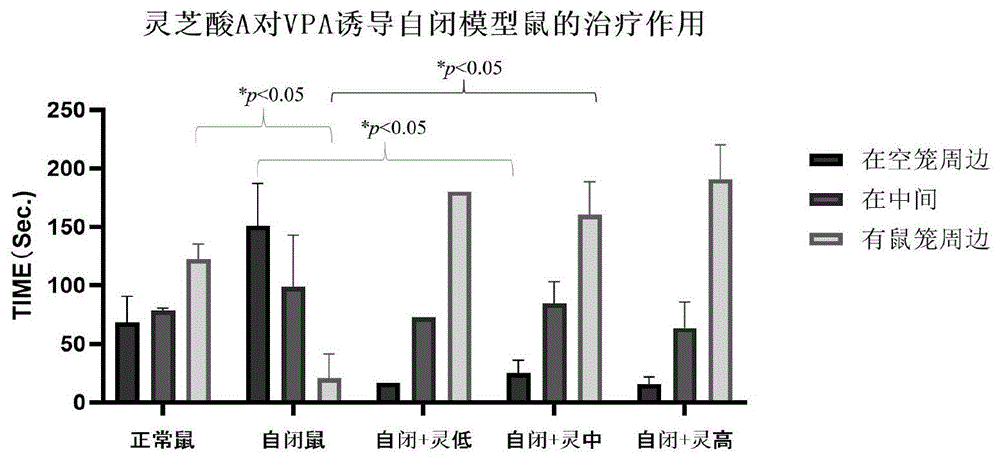
FIG. 1 shows the therapeutic effect of ganoderic acid A on VPA-induced autism model numbers, wherein normal mice were the normal control group, autism mice were the autism control group, autism + Ling Low was the treatment 1 group, autism + Ling Medium was the treatment 2 group, and autism + Ling high was the treatment 3 group.
Detailed Description
The invention provides application of ganoderic acid A or derivatives of ganoderic acid A in preparation of a medicine for treating autism. In the invention, the derivative of ganoderic acid A comprises ganoderic acid A and pharmaceutically acceptable salt, ester or glycoside synthesized by saccharification. In the present invention, the ganoderic acid A is preferably purchased from Shanghai Changyou Kogyo Co., Ltd., product No. CWN 0929; the chemical formula of the ganoderic acid A is preferably shown as the formula 1:

in the embodiment of the invention, animal model experiments prove that the ganoderic acid A can obviously improve the social interaction of the rats with the autism after being used in the rats with the autism, so that the ganoderic acid A obviously improves the social interaction behavior of animals, and has extremely low dosage and small side effect, so that the ganoderic acid A can be used for preparing the medicine for treating the patients with the autism and is used for treating and improving the autism.
The invention provides a medicine for treating autism, and the effective component of the medicine comprises ganoderic acid A or derivatives of ganoderic acid A. In the invention, the content of the active ingredient (ganoderic acid A or derivative of ganoderic acid A) of the medicine is preferably 0.01-100%, more preferably 0.1-99%, and most preferably 1-95%. In the present invention, the dosage form of the drug preferably includes a tablet, a capsule, an emulsion, or an injection. In the invention, when the dosage form of the medicament is a tablet, the content of the active ingredients of the medicament is preferably 0.05-200 mg/tablet, more preferably 0.5-150 mg/tablet, and most preferably 1-100 mg/tablet; when the dosage form of the medicine is a capsule, the content of the effective components of the medicine is 0.05-200 mg/capsule, more preferably 0.5-150 mg/capsule, and most preferably 1-100 mg/capsule; when the dosage form of the medicine is emulsion, the content of the effective components of the medicine is 0.05-200 mg/ml, more preferably 0.5-150 mg/ml, and most preferably 1-100 mg/ml; when the dosage form of the medicament is injection, the content of the active ingredients of the medicament is 0.05-200 mg/injection, more preferably 0.5-150 mg/injection, and most preferably 1-100 mg/injection. In the present invention, the medicament preferably further comprises pharmaceutically acceptable excipients.
When the medicine is used for treating autism, the recommended dosage is 0.05-200 mg/kg, more preferably 0.5-150 mg/kg and most preferably 1-100 mg/kg of ganoderic acid A or a derivative of ganoderic acid A per day by weight of a human body.
The invention provides application of ganoderic acid A or derivatives of ganoderic acid A in preparation of medicinal and edible food with nerve health care effect.
The invention provides a medicine-food homologous food with nerve health care function, wherein the effective component of the medicine-food homologous food comprises ganoderic acid A or derivatives of ganoderic acid A. In the invention, the medicinal and edible food preferably comprises health-care products.
For further illustration of the present invention, the following detailed description of the application of ganoderic acid a or derivatives of ganoderic acid a in the preparation of drugs for treating autism will be provided with reference to the drawings and examples, but they should not be construed as limiting the scope of the present invention.
Example 1
Establishment of adult female VPA-induced autism rat animal model
With reference to A Systematic Review of the Valproic-Acid-Induced cadent Model of Autotism (Chaliha D, Albrecht M, Vaccarezza M, et al, development neuroscience, 2020, 42(1):1-37), 600mg/kg of Valproic Acid (VPA) was injected 12.5 days after the eight-week old female Wistar Kyoto, and the born mice were VPA-Induced autistic mice; normal pregnant rats, normal rats without VPA injection.
Example 2
Reference is made to Behavioural phenotyping models for animals of the society (Silverman J L, Yang M, Lord C, et al. Nature Reviews Neuroscience, 2010, 11(7):490-502), Wistar Kyoto eight-week old female mice injected with 600mg/kg valproic acid (VPA) 12.5d after conception. Rats began injection of ganoderic acid a at 25d postnatal (approximately equivalent to 4 years of age in humans) in the following amounts: a low dose of 1.25mg/kg, a medium dose of 2.5mg/kg and a high dose of 5 mg/kg. And (3) carrying out three-box social interaction animal experiments after continuously injecting for 7d, sequentially recording as a treatment group 1, a treatment group 2 and a treatment group 3, simultaneously setting a self-closing control group and a normal control group, injecting normal saline and 1% DMSO (DMSO with the volume concentration ratio of 1% at normal temperature) into rats of the self-closing control group and the normal control group, and determining the regulating effect of the ganoderic acid A on the social behaviors of the self-closing animals.
The first stage is as follows: the test rat is habituated for 5min and enters all 3 empty rooms, namely, the test rat is gently placed into the middle chamber under the state that the inlets on the two sides are opened, and the test rat freely moves in the three chambers for 5min to adapt to and habituate to the environment. If an innate preference for the right or left chamber is detected during habituation, the test environment will be reorganized to equalize light levels, nearby objects, etc.
And a second stage: an empty and a squirrel cage were placed in the two side chambers, the rats to be tested being briefly confined in the middle chamber. Both side doors were then lifted simultaneously and the test rats could enter all three rooms for 4.5min and video recorded. The time around and in the middle of each cage was calculated automatically.
In this study, adult male rats were considered to exhibit social competence if the second phase of the test rats spent longer in the vicinity of the old and new mouse cages than in the vicinity of the empty ones.
The test rats were investigated at each cage and intermediate time and the data are shown in table 1 and figure 1.
TABLE 1 second stage experimental data

As can be seen from table 1 and fig. 1, in the second phase, the time (160.25 ± 43.9s, N ═ 4) spent by the rats injected with ganoderic acid a dose around the mouse cage is significantly increased (p <0.01) compared to the normal control group, and both the low dose and the high dose have a good tendency to treat autism.
The data in table 1 were analyzed for variance, and the results are shown in tables 2 and 3.
TABLE 2 analysis of contact time with squirrel cage between normal control group and self-closed control group

As can be seen from the data presented in table 2, at 32d after birth, the time taken by VPA-induced autism rats around the mouse cage filled with new and old rats (20.67 ± 20.67s, N ═ 3) was significantly reduced (p <0.05) compared to (122.67 ± 12.785s, N ═ 6) of normal rats born with 32d (born at the same time as VPA-induced autism rats), i.e., the autism molding was successful.
TABLE 3 analysis of squirrel cage contact time between treatment 2 and self-closing control
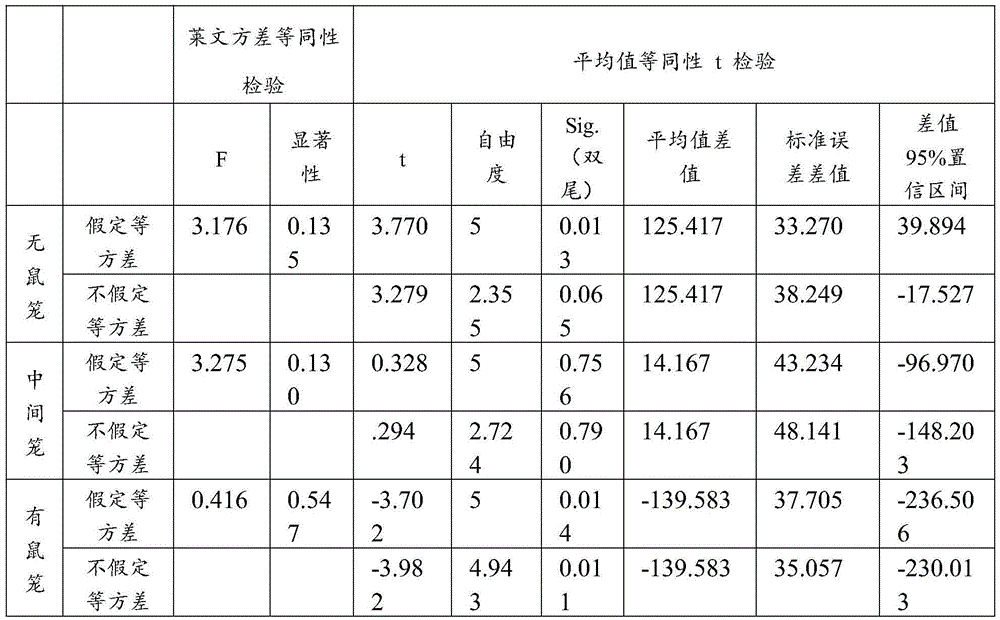
As can be seen from the data shown in table 3, the time taken for the rats injected with the ganoderic acid a dose to surround the new and old mouse cages (160.25 ± 28.318s, N ═ 4) was significantly increased (p ═ 0.014<0.05) compared to the self-imposed control group, and significantly decreased (p ═ 0.013<0.05) compared to the time taken without mouse cage contact (25.25 ± 10.873s) and the self-imposed control group (150.67 ± 36.671s), indicating that the dose of ganoderic acid a had a good therapeutic effect on the self-imposed syndrome. According to the above description, the ganoderic acid A can remarkably improve social interaction behaviors of animals, and has extremely low dosage and small side effect, so that the ganoderic acid A can be used for preparing a medicine for treating patients with autism, and can be used for treating and improving the autism.
Although the present invention has been described with reference to the preferred embodiments, it should be understood that various changes and modifications can be made therein by those skilled in the art without departing from the spirit and scope of the invention as defined in the appended claims.
Claims (6)
Priority Applications (2)
| Application Number | Priority Date | Filing Date | Title |
|---|---|---|---|
| CN202011608792.2A CN112618552B (en) | 2020-12-30 | 2020-12-30 | Application of ganoderic acid A or derivative of ganoderic acid A in preparation of medicine for treating autism |
| PCT/CN2021/107795 WO2022142290A1 (en) | 2020-12-30 | 2021-07-22 | Use of ganoderic acid a or derivative of ganoderic acid a in preparation of medicament for treating autism |
Applications Claiming Priority (1)
| Application Number | Priority Date | Filing Date | Title |
|---|---|---|---|
| CN202011608792.2A CN112618552B (en) | 2020-12-30 | 2020-12-30 | Application of ganoderic acid A or derivative of ganoderic acid A in preparation of medicine for treating autism |
Publications (2)
| Publication Number | Publication Date |
|---|---|
| CN112618552A CN112618552A (en) | 2021-04-09 |
| CN112618552B true CN112618552B (en) | 2021-11-23 |
Family
ID=75286881
Family Applications (1)
| Application Number | Title | Priority Date | Filing Date |
|---|---|---|---|
| CN202011608792.2A Active CN112618552B (en) | 2020-12-30 | 2020-12-30 | Application of ganoderic acid A or derivative of ganoderic acid A in preparation of medicine for treating autism |
Country Status (2)
| Country | Link |
|---|---|
| CN (1) | CN112618552B (en) |
| WO (1) | WO2022142290A1 (en) |
Families Citing this family (4)
| Publication number | Priority date | Publication date | Assignee | Title |
|---|---|---|---|---|
| CN112618552B (en) * | 2020-12-30 | 2021-11-23 | 首都医科大学 | Application of ganoderic acid A or derivative of ganoderic acid A in preparation of medicine for treating autism |
| CN113384605B (en) * | 2021-06-28 | 2022-09-06 | 广东康盾制药有限公司 | Medicament for treating infantile autism caused by hypoxic-ischemic brain injury and preparation method thereof |
| CN116444598B (en) * | 2023-03-02 | 2024-11-01 | 中国医学科学院药用植物研究所 | Ganoderic acid A derivative, synthesis method thereof and use thereof in treating tumors |
| CN118059109B (en) * | 2024-03-06 | 2026-03-27 | 首都医科大学附属北京安定医院 | Application of ganoderic acid A in the preparation of anti-anxiety drugs |
Family Cites Families (8)
| Publication number | Priority date | Publication date | Assignee | Title |
|---|---|---|---|---|
| CN101077357A (en) * | 2006-05-25 | 2007-11-28 | 北京大学 | Application for extration of glossy ganoderma in preparing medicine and health products for treating and improving depression symptoms a variety of causes resulting sleep disorder |
| TW201420108A (en) * | 2012-11-26 | 2014-06-01 | Univ Nat Yang Ming | Composition comprising Ganoderma lucidum extract and use thereof |
| CN105012356B (en) * | 2014-04-30 | 2018-10-16 | 北京冠瑞金生物科技有限公司 | Purposes of the ganoderic acid A in depression |
| US10092609B2 (en) * | 2015-01-16 | 2018-10-09 | James A. Wieser | Process for preparing medicinal mycological preparations |
| CN108478714A (en) * | 2018-05-22 | 2018-09-04 | 新乡医学院 | A kind of paediatrics self-closing disease rehabilitation auxiliary Chinese medicine composition |
| CN112043715A (en) * | 2020-09-15 | 2020-12-08 | 广东省微生物研究所(广东省微生物分析检测中心) | Application of ganoderic acid A in preparation of medicine for improving GABAergic neuron system dysfunction |
| CN111991402A (en) * | 2020-09-15 | 2020-11-27 | 广东省微生物研究所(广东省微生物分析检测中心) | Application of ganoderic acid A in preparation of medicine for activating brain CD4+ T cells to inhibit neuroinflammation |
| CN112618552B (en) * | 2020-12-30 | 2021-11-23 | 首都医科大学 | Application of ganoderic acid A or derivative of ganoderic acid A in preparation of medicine for treating autism |
-
2020
- 2020-12-30 CN CN202011608792.2A patent/CN112618552B/en active Active
-
2021
- 2021-07-22 WO PCT/CN2021/107795 patent/WO2022142290A1/en not_active Ceased
Also Published As
| Publication number | Publication date |
|---|---|
| WO2022142290A1 (en) | 2022-07-07 |
| CN112618552A (en) | 2021-04-09 |
Similar Documents
| Publication | Publication Date | Title |
|---|---|---|
| CN112618552A (en) | Application of ganoderic acid A or derivative of ganoderic acid A in preparation of medicine for treating autism | |
| US10660872B2 (en) | Methods for treatment of cognitive decline | |
| Meng et al. | Metformin improves the glucose and lipid metabolism via influencing the level of serum total bile acids in rats with streptozotocin-induced type 2 diabetes mellitus. | |
| US20120214779A1 (en) | Application of 20(s)-protopanaxadiol in preparation of antidepressants | |
| CA2892084C (en) | Methods and compositions for treating neurodegenerative diseases | |
| Rastogi et al. | Novel treatment modalities for painful diabetic neuropathy | |
| CN102274227B (en) | Application of tetrandrine in preparation of drug for prevention and/or treatment of depression | |
| CN107951869A (en) | Pharmaceutical preparation and its application containing cannabidiol | |
| Holmberg et al. | Ubiquinol (reduced coenzyme Q10) as a metabolic resuscitator in post-cardiac arrest: a randomized, double-blind, placebo-controlled trial | |
| JP2022551679A (en) | Combination product containing a limonoid compound and an α-glucosidase inhibitor | |
| CN102511821A (en) | Composite lipid-lowering soft capsule preparation prepared by lycopene and grapestone extracts and preparation method of composite lipid-lowering soft capsule preparation | |
| CN105919991A (en) | Application of euparin to preparation of medicine for treating depression | |
| Zhang et al. | Emulsified isoflurane postconditioning improves survival and neurological outcomes in a rat model of cardiac arrest | |
| Kalra et al. | Epidemiologic surveillance of glycemic response to a scored, breakable, extended release, fixed dose combination of gliclazide and metformin in persons with type 2 diabetes | |
| CN101933919A (en) | Uses of palm cyanidin | |
| Chen et al. | Exploiting Lactic Acid Bacteria for Regulating Autophagy to Improve Health in Foods and Supplements: A Recent Update | |
| Jia et al. | Impact on L‐carnitine homeostasis of short‐term treatment with the pivalate prodrug tenofovir dipivoxil | |
| JP2010168399A (en) | Pharmaceutical for controlling elevation of blood sugar | |
| KR20240022647A (en) | Reishi spore oil and application of reishi spore oil in manufacturing anti-cancer fatigue drugs | |
| CN114469967B (en) | Application of atractyloside A and its derivatives in the preparation of anti-anxiety and antidepressant drugs | |
| CN105748460B (en) | A kind of drug for treating senile dementia | |
| AU2018101586A4 (en) | Uses of polydatin | |
| CN106138168A (en) | Cortex Eucommiae extract application in preparation prevention and treatment senile dementia | |
| CN115869301B (en) | Application of a coumarin compound in the preparation of a drug for treating hepatitis | |
| JP3186365B2 (en) | Liver disease drug |
Legal Events
| Date | Code | Title | Description |
|---|---|---|---|
| PB01 | Publication | ||
| PB01 | Publication | ||
| SE01 | Entry into force of request for substantive examination | ||
| SE01 | Entry into force of request for substantive examination | ||
| GR01 | Patent grant | ||
| GR01 | Patent grant |