CN112422250A - Method and system for multi-reference signal joint measurement time offset - Google Patents
Method and system for multi-reference signal joint measurement time offset Download PDFInfo
- Publication number
- CN112422250A CN112422250A CN202011231126.1A CN202011231126A CN112422250A CN 112422250 A CN112422250 A CN 112422250A CN 202011231126 A CN202011231126 A CN 202011231126A CN 112422250 A CN112422250 A CN 112422250A
- Authority
- CN
- China
- Prior art keywords
- time offset
- measurement result
- offset measurement
- reference signal
- determining
- Prior art date
- Legal status (The legal status is an assumption and is not a legal conclusion. Google has not performed a legal analysis and makes no representation as to the accuracy of the status listed.)
- Granted
Links
- 238000005259 measurement Methods 0.000 title claims abstract description 199
- 238000000034 method Methods 0.000 title claims abstract description 17
- 238000004891 communication Methods 0.000 claims abstract description 10
- 230000000737 periodic effect Effects 0.000 claims abstract description 8
- 238000001514 detection method Methods 0.000 claims description 6
- 238000005516 engineering process Methods 0.000 description 4
- 238000010586 diagram Methods 0.000 description 2
- 238000001914 filtration Methods 0.000 description 2
- 230000003044 adaptive effect Effects 0.000 description 1
- 230000000694 effects Effects 0.000 description 1
- 230000000750 progressive effect Effects 0.000 description 1
- 235000019527 sweetened beverage Nutrition 0.000 description 1
Images


Classifications
-
- H—ELECTRICITY
- H04—ELECTRIC COMMUNICATION TECHNIQUE
- H04L—TRANSMISSION OF DIGITAL INFORMATION, e.g. TELEGRAPHIC COMMUNICATION
- H04L5/00—Arrangements affording multiple use of the transmission path
- H04L5/003—Arrangements for allocating sub-channels of the transmission path
- H04L5/0048—Allocation of pilot signals, i.e. of signals known to the receiver
-
- H—ELECTRICITY
- H04—ELECTRIC COMMUNICATION TECHNIQUE
- H04J—MULTIPLEX COMMUNICATION
- H04J3/00—Time-division multiplex systems
- H04J3/02—Details
- H04J3/06—Synchronising arrangements
- H04J3/0602—Systems characterised by the synchronising information used
- H04J3/0605—Special codes used as synchronising signal
- H04J3/0608—Detectors therefor, e.g. correlators, state machines
Landscapes
- Engineering & Computer Science (AREA)
- Signal Processing (AREA)
- Computer Networks & Wireless Communication (AREA)
- Mobile Radio Communication Systems (AREA)
Abstract
The invention relates to a method and a system for jointly measuring time offset by multiple reference signals. The method comprises the following steps: detecting the presence PDSCH DMRS; if yes, judging PDSCH DMRS whether the resource meets the requirement; if yes, PDSCH DMRS is adopted to measure the time offset, and a final time offset measurement result is obtained; when PDSCH DMRS does not meet the requirement or does not exist PDSCH DMRS, carrying out periodic time offset measurement on the NR wireless communication system based on SSB to obtain a first time offset measurement result; detecting whether CSI-RS exists; if so, measuring the time offset by adopting the CSI-RS to obtain a second time offset measurement result; determining a final time offset measurement result according to the first time offset result and the second time offset result; and if not, determining the first time offset measurement result as a final time offset measurement result. The invention can improve the accuracy and reliability of time offset measurement.
Description
Technical Field
The present invention relates to the field of communications, and in particular, to a method and system for jointly measuring time offset by multiple reference signals.
Background
In the conventional NR (5 new Radio access technology, 5G new Radio access technology) wireless communication technology, downlink Reference signals include a System Synchronization Block (SSB), a Channel State Information Reference Signal (CSI-RS), a demodulation Reference Signal (DMRS), and the like. The User Equipment (UE) may use the above downlink reference signals to make time offset measurement, but the time offset result of each of the above downlink reference signal measurements is not accurate.
Disclosure of Invention
The invention aims to provide a method and a system for jointly measuring time offset by multiple reference signals so as to improve the accuracy of time offset measurement.
In order to achieve the purpose, the invention provides the following scheme:
a method for jointly measuring time offset by multiple reference signals comprises the following steps:
detecting whether a demodulation reference signal of a physical downlink shared channel exists or not;
when the demodulation reference signal of the physical downlink shared channel exists, judging whether the resource of the demodulation reference signal of the physical downlink shared channel meets the requirement;
when the demodulation reference signal of the physical downlink shared channel meets the requirement, measuring the time offset by adopting the demodulation reference signal of the physical downlink shared channel to obtain a final time offset measurement result;
when the demodulation reference signal of the physical downlink shared channel does not meet the requirement or does not exist, performing periodic time offset measurement on the NR wireless communication system based on a system synchronization block to obtain a first time offset measurement result;
detecting whether a channel quality information reference signal exists;
when the channel quality information reference signal exists, measuring time offset by adopting the channel quality information reference signal to obtain a second time offset measurement result;
determining a final time offset measurement result according to the first time offset result and the second time offset result;
and when the channel quality information reference signal does not exist, determining the first time offset measurement result as a final time offset measurement result.
Optionally, when the demodulation reference signal of the physical downlink shared channel exists, determining whether the resource of the demodulation reference signal of the physical downlink shared channel meets the requirement includes:
acquiring the number M of resource blocks for scheduling the physical downlink shared channel and the number N of OFDM symbols occupied by a demodulation reference signal of the physical downlink shared channel in a time slot;
judging whether M.N is more than or equal to THdmrs(ii) a Wherein TH isdmrsIs a first threshold value;
when M.N is more than or equal to THdmrsThen, determining that the resource of the demodulation reference signal of the physical downlink shared channel meets the requirement;
when M.N is not more than or equal to THdmrsAnd then determining that the resource of the demodulation reference signal of the physical downlink shared channel does not meet the requirement.
Optionally, the determining a final time offset measurement result according to the first time offset result and the second time offset result specifically includes:
judging whether the second time offset measurement result is superior to the first time offset measurement result;
if the second time offset measurement result is better than the first time offset measurement result, determining the second time offset measurement result as a final time offset measurement result;
and if the second time offset measurement result is not superior to the first time offset measurement result, determining the first time offset measurement result as a final time offset measurement result.
Optionally, the determining whether the second time offset measurement result is better than the first time offset measurement result specifically includes:
judging whether the requirements are met Wherein, A is the parameter that can be used for time offset measurement in one system synchronization block periodConsidering the number of effective resource units; THcsiIs a second threshold value; x is the number of channel quality information reference signal resource units on each channel quality information reference signal symbol in a channel quality information reference signal period; y is the number of OFDM symbols occupied by the channel quality information reference signal;
when it is satisfied with Determining that the second time offset measurement result is better than the first time offset measurement result;
when it is not satisfied And determining that the second time offset measurement result is not superior to the first time offset measurement result.
A system for multiple reference signals to jointly measure time offset, comprising:
a demodulation reference signal detection module of the physical downlink shared channel, configured to detect whether a demodulation reference signal of the physical downlink shared channel exists;
a resource judging module, configured to judge whether a resource of a demodulation reference signal of the physical downlink shared channel meets a requirement when the demodulation reference signal of the physical downlink shared channel exists;
a first time offset measurement result determining module, configured to measure a time offset by using the demodulation reference signal of the physical downlink shared channel when the demodulation reference signal of the physical downlink shared channel meets a requirement, so as to obtain a final time offset measurement result;
the first time offset measurement module is used for measuring the periodic time offset of the NR wireless communication system based on the system synchronization block when the demodulation reference signal of the physical downlink shared channel does not meet the requirement or does not exist, so as to obtain a first time offset measurement result;
a channel quality information reference signal detection module for detecting whether a channel quality information reference signal exists;
the second time offset measurement module is used for measuring time offset by adopting the channel quality information reference signal when the channel quality information reference signal exists to obtain a second time offset measurement result;
a second time offset measurement result determining module, configured to determine a final time offset measurement result according to the first time offset result and the second time offset result;
a third time offset measurement result determining module, configured to determine the first time offset measurement result as a final time offset measurement result when the channel quality information reference signal does not exist.
Optionally, the resource determining module specifically includes:
a resource parameter obtaining unit, configured to obtain the number M of resource blocks of a scheduled physical downlink shared channel, and the number N of OFDM symbols occupied by a demodulation reference signal of the physical downlink shared channel in a time slot;
a resource judging unit for judging whether M.N ≧ TH is satisfieddmrs(ii) a Wherein TH isdmrsIs a first threshold value;
a resource satisfaction requirement determination unit for determining whether M.N.gtoreq.TH is satisfieddmrsThen, determining that the resource of the demodulation reference signal of the physical downlink shared channel meets the requirement;
a resource unsatisfied requirement determining unit for determining TH when M.N ≧ TH is unsatisfieddmrsAnd then determining that the resource of the demodulation reference signal of the physical downlink shared channel does not meet the requirement.
Optionally, the second time offset measurement result determining module specifically includes:
a measurement result judging unit, configured to judge whether the second time offset measurement result is better than the first time offset measurement result;
a second time offset measurement result determining unit, configured to determine the second time offset measurement result as a final time offset measurement result when the second time offset measurement result is better than the first time offset measurement result; and when the second time offset measurement result is not superior to the first time offset measurement result, determining the first time offset measurement result as a final time offset measurement result.
Optionally, the measurement result determining unit specifically includes:
a judging subunit for judging whether the condition is satisfied Wherein, A is the number of reference effective resource units which can be used for time offset measurement in a system synchronization block period; THcsiIs a second threshold value; x is the number of channel quality information reference signal resource units on each channel quality information reference signal symbol in a channel quality information reference signal period; y is the number of OFDM symbols occupied by the channel quality information reference signal;
a first determining subunit for determining if satisfied Determining that the second time offset measurement result is better than the first time offset measurement result;
a second determining subunit for determining if it is not satisfied And determining that the second time offset measurement result is not superior to the first time offset measurement result.
According to the specific embodiment provided by the invention, the invention discloses the following technical effects:
according to the invention, the time offset is measured by combining three reference signals SSB, TRS and PDSCH DMRS, and finally the optimal measurement result is determined as the final time offset measurement result, so that the reliability and accuracy of time offset measurement are improved, accurate data are provided for subsequent time offset adjustment, and the accuracy of time offset adjustment is further improved.
Drawings
In order to more clearly illustrate the embodiments of the present invention or the technical solutions in the prior art, the drawings needed to be used in the embodiments will be briefly described below, and it is obvious that the drawings in the following description are only some embodiments of the present invention, and it is obvious for those skilled in the art to obtain other drawings without inventive exercise.
FIG. 1 is a schematic flow chart of a method for jointly measuring time offsets by multiple reference signals according to the present invention;
fig. 2 is a schematic structural diagram of a system for jointly measuring time offset by multiple reference signals according to the present invention.
Detailed Description
The technical solutions in the embodiments of the present invention will be clearly and completely described below with reference to the drawings in the embodiments of the present invention, and it is obvious that the described embodiments are only a part of the embodiments of the present invention, and not all of the embodiments. All other embodiments, which can be derived by a person skilled in the art from the embodiments given herein without making any creative effort, shall fall within the protection scope of the present invention.
In order to make the aforementioned objects, features and advantages of the present invention comprehensible, embodiments accompanied with figures are described in further detail below.
Fig. 1 is a schematic flow chart of a method for jointly measuring time offset by multiple reference signals according to the present invention, and as shown in fig. 1, the method for jointly measuring time offset by multiple reference signals according to the present invention includes the following steps:
step 100: and detecting whether a demodulation reference signal of the physical downlink shared channel exists or not. If yes, go to step 200; if not, step 400 is performed. In the NR wireless communication System, time offset measurement may be performed based on a System Synchronization Block (SSB), a Channel quality Information Reference Signal (CSI-RS), a demodulation Reference Signal (DMRS) of a Physical Downlink Shared Channel (PDSCH), and the like, where PDSCH DMRS is transmitted using narrow beams, is most adaptive to the current Channel condition of the UE, but if there is no scheduling, there may be no PDSCH DMRS Reference Signal. Therefore, it is first detected PDSCH DMRS as to whether it is present.
Step 200: and judging whether the resource of the demodulation reference signal of the physical downlink shared channel meets the requirement. If yes, go to step 300; if not, step 400 is performed. When PDSCH DMRS is present, the time offset measured based on PDSCH DMRS is unreliable if the scheduled PDSCH DMRS resources are insufficient. Therefore, PDSCH DMRS scheduling resources need to be judged first, and PDSCH DMRS can be used to measure the time offset only when PDSCH DMRS scheduling resources meet the requirement. Judging PDSCH DMRS whether the scheduling resource meets the requirement, and judging from the following points of view, specifically as follows:
let M be the number of Resource Blocks (RBs) scheduling PDSCH, and N be the number of OFDM symbols occupied by PDSCH DMRS in one slot (slot). By judging whether M.N is more than or equal to THdmrsA determination PDSCH DMRS is made as to whether the scheduled resources meet the requirements. Wherein TH isdmrsThe first threshold may be 40. When M.N is more than or equal to THdmrsWhen the resource of PDSCH DMRS meets the requirement, the subsequent time offset measurement can be carried out; when M.N is not more than or equal to THdmrsAnd determining that the resource of PDSCH DMRS does not meet the requirement, and not performing subsequent time offset measurement.
Step 300: and measuring the time offset by adopting the demodulation reference signal of the physical downlink shared channel to obtain a final time offset measurement result. Unit is Tc,TcRepresenting the minimum interval of time-domain sample points in NR, corresponding to And second.
Step 400: and carrying out periodic time offset measurement on the NR wireless communication system based on the system synchronization block to obtain a first time offset measurement result. The System Synchronization Block (SSB) is composed of a Primary Synchronization Signal (PSS), a Secondary Synchronization Signal (SSS), and PBCH, and it is a mature technology in the prior art to use SSB for periodic time offset measurement, and specifically, reference may be made to related descriptions of websites https:// block.csdn.net/qq _ 33206497/alarm/details/99209559.
Step 500: detecting whether a channel quality information reference signal exists. If yes, executing step 600-step 700; if not, step 800 is performed. If the CSI-RS exists, more CSI-RS resources are generally available for time offset measurement than SSBs, so that the CSI-RS is preferentially used for time offset measurement.
Step 600: and measuring the time offset by adopting the channel quality information reference signal to obtain a second time offset measurement result. The second time offset measurement is also in units of Tc。
Step 700: and determining a final time offset measurement result according to the first time offset result and the second time offset result. Specifically, whether the second time offset measurement result is better than the first time offset measurement result is judged. If the second time offset measurement result is better than the first time offset measurement result, determining the second time offset measurement result as a final time offset measurement result; and if the second time offset measurement result is not superior to the first time offset measurement result, determining the first time offset measurement result as a final time offset measurement result.
When judging whether the second time offset measurement result is better than the first time offset measurement result, whether the second time offset measurement result is better than the first time offset measurement result is judged by whether the second time offset measurement result is better than the first time offset measurement result To judge. THcsiIs a second threshold, which may be 1; x is the number of channel quality information reference signal resource units on each channel quality information reference signal symbol in a channel quality information reference signal period; y is the number of OFDM symbols occupied by the channel quality information reference signal; a is the number of reference effective resource elements available for time offset measurement in one system synchronization block period, in the NR protocol, in one SSB, where PSS has 127 REs, SSS has 127 REs, and PBCH DMRS has 84 REs, there are 338 reference effective REs available for time offset measurement in one SSB, that is, a is 338. When it is satisfied with
 The second time deviation measurement result is superior to the first time deviation measurement result if the second time deviation measurement result is not satisfied
 The second time offset measurement result is not superior to the second time offset measurement resultThe first time offset measurement result.
Step 800: and determining the first time offset measurement result as a final time offset measurement result.
And after the final time offset measurement result is obtained, filtering and other processing are carried out, so that the final time offset adjustment quantity can be obtained. Assuming that the currently reported measurement result is T and the time offset measurement result of the history record is H, filtering is performed to obtain a final time offset adjustment quantity J ═ α · T + (1- α) · H, where α ∈ (0, 1).
Based on the scheme shown in fig. 1, the present invention further provides a system for jointly measuring time offset by multiple reference signals, and fig. 2 is a schematic structural diagram of the system for jointly measuring time offset by multiple reference signals. As shown in fig. 2, the system for jointly measuring time offset by multiple reference signals of the present invention includes:
a demodulation reference signal detection module 201 of the physical downlink shared channel, configured to detect whether a demodulation reference signal of the physical downlink shared channel exists;
a resource determining module 202, configured to determine whether a resource of a demodulation reference signal of the physical downlink shared channel meets a requirement when the demodulation reference signal of the physical downlink shared channel exists;
a first time offset measurement result determining module 203, configured to measure a time offset by using the demodulation reference signal of the physical downlink shared channel when the demodulation reference signal of the physical downlink shared channel meets a requirement, so as to obtain a final time offset measurement result;
a first time offset measurement module 204, configured to, when the demodulation reference signal of the physical downlink shared channel does not meet the requirement or does not exist, perform periodic time offset measurement on the NR wireless communication system based on the system synchronization block to obtain a first time offset measurement result;
a channel quality information reference signal detection module 205, configured to detect whether a channel quality information reference signal exists;
a second time offset measurement module 206, configured to measure a time offset by using the channel quality information reference signal when the channel quality information reference signal exists, so as to obtain a second time offset measurement result;
a second time offset measurement result determining module 207, configured to determine a final time offset measurement result according to the first time offset result and the second time offset result;
a third time offset measurement result determining module 208, configured to determine the first time offset measurement result as a final time offset measurement result when the channel quality information reference signal is not present.
As a specific embodiment, in the system for jointly measuring time offset by multiple reference signals according to the present invention, the resource determining module 202 specifically includes:
a resource parameter obtaining unit, configured to obtain the number M of resource blocks of a scheduled physical downlink shared channel, and the number N of OFDM symbols occupied by a demodulation reference signal of the physical downlink shared channel in a time slot;
a resource judging unit for judging whether M.N ≧ TH is satisfieddmrs(ii) a Wherein TH isdmrsIs a first threshold value;
a resource satisfaction requirement determination unit for determining whether M.N.gtoreq.TH is satisfieddmrsThen, determining that the resource of the demodulation reference signal of the physical downlink shared channel meets the requirement;
a resource unsatisfied requirement determining unit for determining TH when M.N ≧ TH is unsatisfieddmrsAnd then determining that the resource of the demodulation reference signal of the physical downlink shared channel does not meet the requirement.
As a specific embodiment, in the system for jointly measuring a time offset by multiple reference signals, the second time offset measurement result determining module 207 specifically includes:
a measurement result judging unit, configured to judge whether the second time offset measurement result is better than the first time offset measurement result;
a second time offset measurement result determining unit, configured to determine the second time offset measurement result as a final time offset measurement result when the second time offset measurement result is better than the first time offset measurement result; and when the second time offset measurement result is not superior to the first time offset measurement result, determining the first time offset measurement result as a final time offset measurement result.
As a specific embodiment, in the system for jointly measuring a time offset by multiple reference signals, the measurement result determining unit specifically includes:
a judging subunit for judging whether the condition is satisfied Wherein, A is the number of reference effective resource units which can be used for time offset measurement in a system synchronization block period; THcsiIs a second threshold value; x is the number of channel quality information reference signal resource units on each channel quality information reference signal symbol in a channel quality information reference signal period; y is the number of OFDM symbols occupied by the channel quality information reference signal;
a first determining subunit for determining if satisfied Determining that the second time offset measurement result is better than the first time offset measurement result;
a second determining subunit for determining if it is not satisfied And determining that the second time offset measurement result is not superior to the first time offset measurement result.
The embodiments in the present description are described in a progressive manner, each embodiment focuses on differences from other embodiments, and the same and similar parts among the embodiments are referred to each other. For the system disclosed by the embodiment, the description is relatively simple because the system corresponds to the method disclosed by the embodiment, and the relevant points can be referred to the method part for description.
The principles and embodiments of the present invention have been described herein using specific examples, which are provided only to help understand the method and the core concept of the present invention; meanwhile, for a person skilled in the art, according to the idea of the present invention, the specific embodiments and the application range may be changed. In view of the above, the present disclosure should not be construed as limiting the invention.
Claims (8)
1. A method for jointly measuring time offset by multiple reference signals is characterized by comprising the following steps:
detecting whether a demodulation reference signal of a physical downlink shared channel exists or not;
when the demodulation reference signal of the physical downlink shared channel exists, judging whether the resource of the demodulation reference signal of the physical downlink shared channel meets the requirement;
when the demodulation reference signal of the physical downlink shared channel meets the requirement, measuring the time offset by adopting the demodulation reference signal of the physical downlink shared channel to obtain a final time offset measurement result;
when the demodulation reference signal of the physical downlink shared channel does not meet the requirement or does not exist, performing periodic time offset measurement on the NR wireless communication system based on a system synchronization block to obtain a first time offset measurement result;
detecting whether a channel quality information reference signal exists;
when the channel quality information reference signal exists, measuring time offset by adopting the channel quality information reference signal to obtain a second time offset measurement result;
determining a final time offset measurement result according to the first time offset result and the second time offset result;
and when the channel quality information reference signal does not exist, determining the first time offset measurement result as a final time offset measurement result.
2. The method according to claim 1, wherein the determining whether the resource of the demodulation reference signal of the physical downlink shared channel meets the requirement when the demodulation reference signal of the physical downlink shared channel exists specifically includes:
acquiring the number M of resource blocks for scheduling the physical downlink shared channel and the number N of OFDM symbols occupied by a demodulation reference signal of the physical downlink shared channel in a time slot;
judging whether M.N is more than or equal to THdmrs(ii) a Wherein TH isdmrsIs a first threshold value;
when M.N is more than or equal to THdmrsThen, determining that the resource of the demodulation reference signal of the physical downlink shared channel meets the requirement;
when M.N is not more than or equal to THdmrsAnd then determining that the resource of the demodulation reference signal of the physical downlink shared channel does not meet the requirement.
3. The method of claim 1, wherein the determining a final time offset measurement result according to the first time offset result and the second time offset result specifically comprises:
judging whether the second time offset measurement result is superior to the first time offset measurement result;
if the second time offset measurement result is better than the first time offset measurement result, determining the second time offset measurement result as a final time offset measurement result;
and if the second time offset measurement result is not superior to the first time offset measurement result, determining the first time offset measurement result as a final time offset measurement result.
4. The method according to claim 3, wherein the determining whether the second time offset measurement result is better than the first time offset measurement result specifically comprises:
judging whether the requirements are met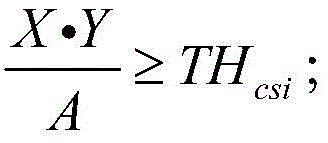 Wherein, A is the number of reference effective resource units which can be used for time offset measurement in a system synchronization block period; THcsiIs a second threshold value; x is the number of channel quality information reference signal resource units on each channel quality information reference signal symbol in a channel quality information reference signal period; y is the channel qualityMeasuring the number of OFDM symbols occupied by the information reference signal;
when it is satisfied with Determining that the second time offset measurement result is better than the first time offset measurement result;
when it is not satisfied And determining that the second time offset measurement result is not superior to the first time offset measurement result.
5. A system for jointly measuring time offsets by multiple reference signals, comprising:
a demodulation reference signal detection module of the physical downlink shared channel, configured to detect whether a demodulation reference signal of the physical downlink shared channel exists;
a resource judging module, configured to judge whether a resource of a demodulation reference signal of the physical downlink shared channel meets a requirement when the demodulation reference signal of the physical downlink shared channel exists;
a first time offset measurement result determining module, configured to measure a time offset by using the demodulation reference signal of the physical downlink shared channel when the demodulation reference signal of the physical downlink shared channel meets a requirement, so as to obtain a final time offset measurement result;
the first time offset measurement module is used for measuring the periodic time offset of the NR wireless communication system based on the system synchronization block when the demodulation reference signal of the physical downlink shared channel does not meet the requirement or does not exist, so as to obtain a first time offset measurement result;
a channel quality information reference signal detection module for detecting whether a channel quality information reference signal exists;
the second time offset measurement module is used for measuring time offset by adopting the channel quality information reference signal when the channel quality information reference signal exists to obtain a second time offset measurement result;
a second time offset measurement result determining module, configured to determine a final time offset measurement result according to the first time offset result and the second time offset result;
a third time offset measurement result determining module, configured to determine the first time offset measurement result as a final time offset measurement result when the channel quality information reference signal does not exist.
6. The system for multiple reference signal joint measurement time offset according to claim 5, wherein the resource determining module specifically includes:
a resource parameter obtaining unit, configured to obtain the number M of resource blocks of a scheduled physical downlink shared channel, and the number N of OFDM symbols occupied by a demodulation reference signal of the physical downlink shared channel in a time slot;
a resource judging unit for judging whether M.N ≧ TH is satisfieddmrs(ii) a Wherein TH isdmrsIs a first threshold value;
a resource satisfaction requirement determination unit for determining whether M.N.gtoreq.TH is satisfieddmrsThen, determining that the resource of the demodulation reference signal of the physical downlink shared channel meets the requirement;
a resource unsatisfied requirement determining unit for determining TH when M.N ≧ TH is unsatisfieddmrsAnd then determining that the resource of the demodulation reference signal of the physical downlink shared channel does not meet the requirement.
7. The system of claim 5, wherein the second time offset measurement result determining module specifically comprises:
a measurement result judging unit, configured to judge whether the second time offset measurement result is better than the first time offset measurement result;
a second time offset measurement result determining unit, configured to determine the second time offset measurement result as a final time offset measurement result when the second time offset measurement result is better than the first time offset measurement result; and when the second time offset measurement result is not superior to the first time offset measurement result, determining the first time offset measurement result as a final time offset measurement result.
8. The system according to claim 7, wherein the measurement result determining unit specifically comprises:
a judging subunit for judging whether the condition is satisfied Wherein, A is the number of reference effective resource units which can be used for time offset measurement in a system synchronization block period; THcsiIs a second threshold value; x is the number of channel quality information reference signal resource units on each channel quality information reference signal symbol in a channel quality information reference signal period; y is the number of OFDM symbols occupied by the channel quality information reference signal;
a first determining subunit for determining if satisfied Determining that the second time offset measurement result is better than the first time offset measurement result;
a second determining subunit for determining if it is not satisfied And determining that the second time offset measurement result is not superior to the first time offset measurement result.
Priority Applications (1)
| Application Number | Priority Date | Filing Date | Title |
|---|---|---|---|
| CN202011231126.1A CN112422250B (en) | 2020-11-06 | 2020-11-06 | Method and system for multi-reference signal joint measurement time offset |
Applications Claiming Priority (1)
| Application Number | Priority Date | Filing Date | Title |
|---|---|---|---|
| CN202011231126.1A CN112422250B (en) | 2020-11-06 | 2020-11-06 | Method and system for multi-reference signal joint measurement time offset |
Publications (2)
| Publication Number | Publication Date |
|---|---|
| CN112422250A true CN112422250A (en) | 2021-02-26 |
| CN112422250B CN112422250B (en) | 2021-08-06 |
Family
ID=74782018
Family Applications (1)
| Application Number | Title | Priority Date | Filing Date |
|---|---|---|---|
| CN202011231126.1A Active CN112422250B (en) | 2020-11-06 | 2020-11-06 | Method and system for multi-reference signal joint measurement time offset |
Country Status (1)
| Country | Link |
|---|---|
| CN (1) | CN112422250B (en) |
Cited By (3)
| Publication number | Priority date | Publication date | Assignee | Title |
|---|---|---|---|---|
| CN113507353A (en) * | 2021-06-18 | 2021-10-15 | 展讯通信(上海)有限公司 | Time offset adjustment method, system, electronic device and storage medium |
| CN113507352A (en) * | 2021-06-18 | 2021-10-15 | 展讯通信(上海)有限公司 | Time offset adjusting method, system, electronic device and storage medium |
| CN113810326A (en) * | 2021-09-27 | 2021-12-17 | 新华三技术有限公司 | Method and device for estimating time offset, electronic equipment and storage medium |
Citations (16)
| Publication number | Priority date | Publication date | Assignee | Title |
|---|---|---|---|---|
| CN102378110A (en) * | 2010-08-16 | 2012-03-14 | 中国移动通信集团公司 | Methods for sending and receiving demodulated reference signal (DM-RS) and devices for sending and receiving DM-RS |
| CN103067312A (en) * | 2012-07-23 | 2013-04-24 | 东南大学 | Long-term evolution system self-adaptation frequency deviation precorrection method under environment of high-speed rail |
| CN103269322A (en) * | 2013-05-08 | 2013-08-28 | 京信通信系统(广州)有限公司 | Method and device for determining frequency deviation value |
| CN103312474A (en) * | 2012-03-16 | 2013-09-18 | 华为技术有限公司 | Method, device and system for transmitting, receiving and identifying timing reference information |
| CN107689857A (en) * | 2016-08-06 | 2018-02-13 | 北京信威通信技术股份有限公司 | The method of demodulated reference signal and configuration |
| CN108886462A (en) * | 2018-07-11 | 2018-11-23 | 北京小米移动软件有限公司 | Reference signal transmission and reception method and device, base station and user equipment |
| CN109391391A (en) * | 2017-08-08 | 2019-02-26 | 维沃移动通信有限公司 | A kind of method and device being used for transmission reference signal |
| US20190141546A1 (en) * | 2017-11-09 | 2019-05-09 | Comcast Cable Communications, Llc | Csi transmission with multiple bandwidth parts |
| US20190207737A1 (en) * | 2017-12-29 | 2019-07-04 | Comcast Cable Communications, Llc | Selection of Grant and CSI |
| US20190215781A1 (en) * | 2018-01-10 | 2019-07-11 | Comcast Cable Communications, Llc | Power Control for Channel State Information |
| CN110352571A (en) * | 2017-03-04 | 2019-10-18 | Lg 电子株式会社 | The method and device thereof of synchronization signal are sent in a wireless communication system |
| CN110493156A (en) * | 2019-08-22 | 2019-11-22 | 西安电子科技大学 | Frequency offset estimation method based on constellation point diversity in 5G mobile communication system |
| US10582489B2 (en) * | 2018-01-12 | 2020-03-03 | Telefonaktiebolaget Lm Ericsson (Publ) | Signaling in RRC and MAC for PDSCH resource mapping for periodic and semipersistent reference signal assumptions |
| US10638253B1 (en) * | 2016-05-13 | 2020-04-28 | Telefonaktiebolaget Lm Ericsson (Publ) | Network architecture, methods, and devices for a wireless communications network |
| CN111404850A (en) * | 2020-03-23 | 2020-07-10 | 北京星网锐捷网络技术有限公司 | A method and device for uplink channel estimation based on 5G system |
| CN111511030A (en) * | 2020-04-23 | 2020-08-07 | 展讯通信(上海)有限公司 | Frequency adjustment method, device and equipment |
-
2020
- 2020-11-06 CN CN202011231126.1A patent/CN112422250B/en active Active
Patent Citations (16)
| Publication number | Priority date | Publication date | Assignee | Title |
|---|---|---|---|---|
| CN102378110A (en) * | 2010-08-16 | 2012-03-14 | 中国移动通信集团公司 | Methods for sending and receiving demodulated reference signal (DM-RS) and devices for sending and receiving DM-RS |
| CN103312474A (en) * | 2012-03-16 | 2013-09-18 | 华为技术有限公司 | Method, device and system for transmitting, receiving and identifying timing reference information |
| CN103067312A (en) * | 2012-07-23 | 2013-04-24 | 东南大学 | Long-term evolution system self-adaptation frequency deviation precorrection method under environment of high-speed rail |
| CN103269322A (en) * | 2013-05-08 | 2013-08-28 | 京信通信系统(广州)有限公司 | Method and device for determining frequency deviation value |
| US10638253B1 (en) * | 2016-05-13 | 2020-04-28 | Telefonaktiebolaget Lm Ericsson (Publ) | Network architecture, methods, and devices for a wireless communications network |
| CN107689857A (en) * | 2016-08-06 | 2018-02-13 | 北京信威通信技术股份有限公司 | The method of demodulated reference signal and configuration |
| CN110352571A (en) * | 2017-03-04 | 2019-10-18 | Lg 电子株式会社 | The method and device thereof of synchronization signal are sent in a wireless communication system |
| CN109391391A (en) * | 2017-08-08 | 2019-02-26 | 维沃移动通信有限公司 | A kind of method and device being used for transmission reference signal |
| US20190141546A1 (en) * | 2017-11-09 | 2019-05-09 | Comcast Cable Communications, Llc | Csi transmission with multiple bandwidth parts |
| US20190207737A1 (en) * | 2017-12-29 | 2019-07-04 | Comcast Cable Communications, Llc | Selection of Grant and CSI |
| US20190215781A1 (en) * | 2018-01-10 | 2019-07-11 | Comcast Cable Communications, Llc | Power Control for Channel State Information |
| US10582489B2 (en) * | 2018-01-12 | 2020-03-03 | Telefonaktiebolaget Lm Ericsson (Publ) | Signaling in RRC and MAC for PDSCH resource mapping for periodic and semipersistent reference signal assumptions |
| CN108886462A (en) * | 2018-07-11 | 2018-11-23 | 北京小米移动软件有限公司 | Reference signal transmission and reception method and device, base station and user equipment |
| CN110493156A (en) * | 2019-08-22 | 2019-11-22 | 西安电子科技大学 | Frequency offset estimation method based on constellation point diversity in 5G mobile communication system |
| CN111404850A (en) * | 2020-03-23 | 2020-07-10 | 北京星网锐捷网络技术有限公司 | A method and device for uplink channel estimation based on 5G system |
| CN111511030A (en) * | 2020-04-23 | 2020-08-07 | 展讯通信(上海)有限公司 | Frequency adjustment method, device and equipment |
Non-Patent Citations (2)
| Title |
|---|
| PETRE STOICA等: "《TR AINED SPACE-TIME BLOCK DECODING FOR FADING CHANNELS WITH》", 《2002 11TH EUROPEAN SIGNAL PROCESSING CONFERENCE》 * |
| 龚继华: "《基于联合时频偏估计的上行同步技术研究》", 《信息科技缉》 * |
Cited By (6)
| Publication number | Priority date | Publication date | Assignee | Title |
|---|---|---|---|---|
| CN113507353A (en) * | 2021-06-18 | 2021-10-15 | 展讯通信(上海)有限公司 | Time offset adjustment method, system, electronic device and storage medium |
| CN113507352A (en) * | 2021-06-18 | 2021-10-15 | 展讯通信(上海)有限公司 | Time offset adjusting method, system, electronic device and storage medium |
| CN113507353B (en) * | 2021-06-18 | 2022-08-30 | 展讯通信(上海)有限公司 | Time offset adjusting method, system, electronic device and storage medium |
| CN113507352B (en) * | 2021-06-18 | 2022-09-09 | 展讯通信(上海)有限公司 | Time offset adjustment method, system, electronic device and storage medium |
| CN113810326A (en) * | 2021-09-27 | 2021-12-17 | 新华三技术有限公司 | Method and device for estimating time offset, electronic equipment and storage medium |
| CN113810326B (en) * | 2021-09-27 | 2023-07-25 | 新华三技术有限公司 | Time offset estimation method, device, electronic equipment and storage medium |
Also Published As
| Publication number | Publication date |
|---|---|
| CN112422250B (en) | 2021-08-06 |
Similar Documents
| Publication | Publication Date | Title |
|---|---|---|
| CN112422249A (en) | Method and system for jointly measuring frequency offset by multiple reference signals | |
| JP2020523829A5 (en) | ||
| TWI772649B (en) | Reference signal sending method, receiving method and device | |
| CN112422250B (en) | Method and system for multi-reference signal joint measurement time offset | |
| CN102448088B (en) | Method for indicating measurement resource, measurement method and device thereof | |
| US9435876B2 (en) | Autonomous muting indication to enable improved time difference of arrival measurements | |
| EP4604627A2 (en) | Rlm adjustment and/or bfd adjustment method and device | |
| AU2023274157B2 (en) | Communication method and device | |
| CN102835084B (en) | In cordless communication network for the method and apparatus of the quiet detection of reference signal | |
| CN115706627B (en) | Method for sending, method for receiving and device for direct link positioning reference signal | |
| JP6732955B2 (en) | Radio link quality measurement method and terminal | |
| RU2012148722A (en) | TRACKING THE RADIO LINK (RLM) AND MEASURING THE ACCEPTED REFERENCE SIGNAL POWER (RSRP) FOR HETEROGENEOUS NETWORKS | |
| CN102143578A (en) | Method and apparatus for estimating a position of a node in a communication network | |
| CN109495413B (en) | Method for transmitting synchronization signal block, method for measuring cell quality, base station and terminal | |
| BR112018002505B1 (en) | SIGNAL PROCESSING METHOD, USER EQUIPMENT, BASE STATION AND COMPUTER READABLE STORAGE MEDIA | |
| CN104349454A (en) | Positioning processing method, user equipment, and positioning server | |
| WO2018000440A1 (en) | Method and device for signal detection | |
| CN114745289A (en) | Method, device, storage medium and equipment for predicting network performance data | |
| KR20250002470A (en) | Positioning method, device, terminal and readable storage medium | |
| KR20160057423A (en) | Signal measurement method, user equipment, and base station | |
| CN114362906A (en) | Rate matching method, device, electronic equipment and readable medium | |
| CN112399462B (en) | A communication device and a wireless communication method | |
| CN109150335B (en) | Method and device for measuring uplink signal strength of target terminal in complex environment | |
| CN104038313A (en) | Signal Decoding In The Presence Of Almost-Blank Subframes (ABS) | |
| CN114285706B (en) | Frequency offset estimation method, device, electronic device and storage medium |
Legal Events
| Date | Code | Title | Description |
|---|---|---|---|
| PB01 | Publication | ||
| PB01 | Publication | ||
| SE01 | Entry into force of request for substantive examination | ||
| SE01 | Entry into force of request for substantive examination | ||
| GR01 | Patent grant | ||
| GR01 | Patent grant |