CN112250552B - Preparation method of perfluorohexanone - Google Patents
Preparation method of perfluorohexanone Download PDFInfo
- Publication number
- CN112250552B CN112250552B CN202010966807.6A CN202010966807A CN112250552B CN 112250552 B CN112250552 B CN 112250552B CN 202010966807 A CN202010966807 A CN 202010966807A CN 112250552 B CN112250552 B CN 112250552B
- Authority
- CN
- China
- Prior art keywords
- reaction
- perfluoro
- perfluorohexanone
- epoxy
- methylpentane
- Prior art date
- Legal status (The legal status is an assumption and is not a legal conclusion. Google has not performed a legal analysis and makes no representation as to the accuracy of the status listed.)
- Active
Links
- WVSNNWIIMPNRDB-UHFFFAOYSA-N 1,1,1,3,3,4,4,5,5,6,6,6-dodecafluorohexan-2-one Chemical compound FC(F)(F)C(=O)C(F)(F)C(F)(F)C(F)(F)C(F)(F)F WVSNNWIIMPNRDB-UHFFFAOYSA-N 0.000 title claims abstract description 39
- 238000002360 preparation method Methods 0.000 title claims abstract description 11
- 238000006243 chemical reaction Methods 0.000 claims abstract description 74
- 239000003054 catalyst Substances 0.000 claims abstract description 34
- NOESGFSFSJKFIF-UHFFFAOYSA-N 2-fluoro-2-(1,1,2,2,2-pentafluoroethyl)-3,3-bis(trifluoromethyl)oxirane Chemical compound FC(F)(F)C(F)(F)C1(F)OC1(C(F)(F)F)C(F)(F)F NOESGFSFSJKFIF-UHFFFAOYSA-N 0.000 claims abstract description 30
- 238000000034 method Methods 0.000 claims abstract description 22
- 238000006317 isomerization reaction Methods 0.000 claims abstract description 19
- 239000012044 organic layer Substances 0.000 claims abstract description 18
- 239000002904 solvent Substances 0.000 claims abstract description 17
- 239000012295 chemical reaction liquid Substances 0.000 claims abstract description 13
- 239000007800 oxidant agent Substances 0.000 claims abstract description 10
- 230000001590 oxidative effect Effects 0.000 claims abstract description 10
- 238000003756 stirring Methods 0.000 claims description 43
- WEVYAHXRMPXWCK-UHFFFAOYSA-N Acetonitrile Chemical compound CC#N WEVYAHXRMPXWCK-UHFFFAOYSA-N 0.000 claims description 27
- 239000007788 liquid Substances 0.000 claims description 20
- 239000000243 solution Substances 0.000 claims description 19
- ZMXDDKWLCZADIW-UHFFFAOYSA-N N,N-Dimethylformamide Chemical compound CN(C)C=O ZMXDDKWLCZADIW-UHFFFAOYSA-N 0.000 claims description 14
- FAEGGADNHFKDQX-UHFFFAOYSA-N 1,1,1,3,4,4,5,5,5-nonafluoro-2-(trifluoromethyl)pent-2-ene Chemical compound FC(F)(F)C(C(F)(F)F)=C(F)C(F)(F)C(F)(F)F FAEGGADNHFKDQX-UHFFFAOYSA-N 0.000 claims description 11
- KFZMGEQAYNKOFK-UHFFFAOYSA-N Isopropanol Chemical compound CC(C)O KFZMGEQAYNKOFK-UHFFFAOYSA-N 0.000 claims description 10
- 239000003377 acid catalyst Substances 0.000 claims description 10
- 239000005708 Sodium hypochlorite Substances 0.000 claims description 9
- SUKJFIGYRHOWBL-UHFFFAOYSA-N sodium hypochlorite Chemical group [Na+].Cl[O-] SUKJFIGYRHOWBL-UHFFFAOYSA-N 0.000 claims description 9
- ZUHZGEOKBKGPSW-UHFFFAOYSA-N tetraglyme Chemical compound COCCOCCOCCOCCOC ZUHZGEOKBKGPSW-UHFFFAOYSA-N 0.000 claims description 9
- ZAMOUSCENKQFHK-UHFFFAOYSA-N Chlorine atom Chemical compound [Cl] ZAMOUSCENKQFHK-UHFFFAOYSA-N 0.000 claims description 8
- 239000000460 chlorine Substances 0.000 claims description 8
- 229910052801 chlorine Inorganic materials 0.000 claims description 8
- 239000007864 aqueous solution Substances 0.000 claims description 7
- HQABUPZFAYXKJW-UHFFFAOYSA-N butan-1-amine Chemical compound CCCCN HQABUPZFAYXKJW-UHFFFAOYSA-N 0.000 claims description 7
- SBZXBUIDTXKZTM-UHFFFAOYSA-N diglyme Chemical compound COCCOCCOC SBZXBUIDTXKZTM-UHFFFAOYSA-N 0.000 claims description 6
- MUDUFRFJYXOJGQ-UHFFFAOYSA-N 8-benzyl-3-prop-2-enyl-3,8-diazabicyclo[3.2.1]octane Chemical compound C1N(CC=C)CC2CCC1N2CC1=CC=CC=C1 MUDUFRFJYXOJGQ-UHFFFAOYSA-N 0.000 claims description 5
- 239000002253 acid Substances 0.000 claims description 5
- IOXXVNYDGIXMIP-UHFFFAOYSA-N n-methylprop-2-en-1-amine Chemical compound CNCC=C IOXXVNYDGIXMIP-UHFFFAOYSA-N 0.000 claims description 5
- UHUUYVZLXJHWDV-UHFFFAOYSA-N trimethyl(methylsilyloxy)silane Chemical compound C[SiH2]O[Si](C)(C)C UHUUYVZLXJHWDV-UHFFFAOYSA-N 0.000 claims description 5
- 230000035484 reaction time Effects 0.000 claims description 4
- 239000012299 nitrogen atmosphere Substances 0.000 claims description 2
- 238000005406 washing Methods 0.000 abstract description 6
- 230000008569 process Effects 0.000 abstract description 5
- 230000000694 effects Effects 0.000 abstract description 4
- 230000007613 environmental effect Effects 0.000 abstract description 3
- 238000010992 reflux Methods 0.000 description 19
- 238000010907 mechanical stirring Methods 0.000 description 18
- IJGRMHOSHXDMSA-UHFFFAOYSA-N Atomic nitrogen Chemical compound N#N IJGRMHOSHXDMSA-UHFFFAOYSA-N 0.000 description 6
- 239000005457 ice water Substances 0.000 description 6
- -1 fluoride ions Chemical class 0.000 description 5
- 239000002994 raw material Substances 0.000 description 5
- XJHCXCQVJFPJIK-UHFFFAOYSA-M caesium fluoride Chemical compound [F-].[Cs+] XJHCXCQVJFPJIK-UHFFFAOYSA-M 0.000 description 4
- 230000003197 catalytic effect Effects 0.000 description 4
- 238000004821 distillation Methods 0.000 description 4
- 238000006735 epoxidation reaction Methods 0.000 description 4
- 239000000203 mixture Substances 0.000 description 4
- 238000004321 preservation Methods 0.000 description 4
- PBVZTJDHQVIHFR-UHFFFAOYSA-N 1,1,2,3,3,3-hexafluoroprop-1-ene Chemical compound FC(F)=C(F)C(F)(F)F.FC(F)=C(F)C(F)(F)F PBVZTJDHQVIHFR-UHFFFAOYSA-N 0.000 description 3
- IAZDPXIOMUYVGZ-UHFFFAOYSA-N Dimethylsulphoxide Chemical compound CS(C)=O IAZDPXIOMUYVGZ-UHFFFAOYSA-N 0.000 description 3
- 230000009471 action Effects 0.000 description 3
- 239000007789 gas Substances 0.000 description 3
- 238000010438 heat treatment Methods 0.000 description 3
- 238000006459 hydrosilylation reaction Methods 0.000 description 3
- 239000000463 material Substances 0.000 description 3
- 229910052757 nitrogen Inorganic materials 0.000 description 3
- YLCLKCNTDGWDMD-UHFFFAOYSA-N 2,2,3,3,3-pentafluoropropanoyl fluoride Chemical compound FC(=O)C(F)(F)C(F)(F)F YLCLKCNTDGWDMD-UHFFFAOYSA-N 0.000 description 2
- 238000009776 industrial production Methods 0.000 description 2
- 238000001819 mass spectrum Methods 0.000 description 2
- NROKBHXJSPEDAR-UHFFFAOYSA-M potassium fluoride Chemical compound [F-].[K+] NROKBHXJSPEDAR-UHFFFAOYSA-M 0.000 description 2
- KGAHKQBZVJJFBW-UHFFFAOYSA-N 1,1,1,2,2,6,6,7,7,7-decafluoro-3,3,5,5-tetrakis(trifluoromethyl)heptan-4-one Chemical compound FC(F)(F)C(F)(F)C(C(F)(F)F)(C(F)(F)F)C(=O)C(C(F)(F)F)(C(F)(F)F)C(F)(F)C(F)(F)F KGAHKQBZVJJFBW-UHFFFAOYSA-N 0.000 description 1
- SAPOZTRFWJZUFT-UHFFFAOYSA-N 1,1,1,2,3,4,5,5,5-nonafluoro-4-(trifluoromethyl)pent-2-ene Chemical compound FC(F)(F)C(F)=C(F)C(F)(C(F)(F)F)C(F)(F)F SAPOZTRFWJZUFT-UHFFFAOYSA-N 0.000 description 1
- XEZNGIUYQVAUSS-UHFFFAOYSA-N 18-crown-6 Chemical compound C1COCCOCCOCCOCCOCCO1 XEZNGIUYQVAUSS-UHFFFAOYSA-N 0.000 description 1
- LLRDUIXNNHUYLY-UHFFFAOYSA-N 2,2,3,4,4,5-hexafluoro-3,5-bis(trifluoromethyl)oxolane Chemical compound FC(F)(F)C1(F)OC(F)(F)C(F)(C(F)(F)F)C1(F)F LLRDUIXNNHUYLY-UHFFFAOYSA-N 0.000 description 1
- OKTJSMMVPCPJKN-UHFFFAOYSA-N Carbon Chemical compound [C] OKTJSMMVPCPJKN-UHFFFAOYSA-N 0.000 description 1
- PXGOKWXKJXAPGV-UHFFFAOYSA-N Fluorine Chemical compound FF PXGOKWXKJXAPGV-UHFFFAOYSA-N 0.000 description 1
- 229920004449 Halon® Polymers 0.000 description 1
- 238000007259 addition reaction Methods 0.000 description 1
- 229910001508 alkali metal halide Inorganic materials 0.000 description 1
- 150000008045 alkali metal halides Chemical class 0.000 description 1
- 150000001412 amines Chemical class 0.000 description 1
- 230000009286 beneficial effect Effects 0.000 description 1
- 230000015572 biosynthetic process Effects 0.000 description 1
- 229910052799 carbon Inorganic materials 0.000 description 1
- 239000003795 chemical substances by application Substances 0.000 description 1
- 239000002131 composite material Substances 0.000 description 1
- 150000001875 compounds Chemical class 0.000 description 1
- 230000007547 defect Effects 0.000 description 1
- 150000002118 epoxides Chemical class 0.000 description 1
- 150000002170 ethers Chemical class 0.000 description 1
- 150000004673 fluoride salts Chemical class 0.000 description 1
- 229910052731 fluorine Inorganic materials 0.000 description 1
- 239000011737 fluorine Substances 0.000 description 1
- IYRWEQXVUNLMAY-UHFFFAOYSA-N fluoroketone group Chemical group FC(=O)F IYRWEQXVUNLMAY-UHFFFAOYSA-N 0.000 description 1
- HCDGVLDPFQMKDK-UHFFFAOYSA-N hexafluoropropylene Chemical group FC(F)=C(F)C(F)(F)F HCDGVLDPFQMKDK-UHFFFAOYSA-N 0.000 description 1
- 230000006872 improvement Effects 0.000 description 1
- 239000012535 impurity Substances 0.000 description 1
- 238000002329 infrared spectrum Methods 0.000 description 1
- 238000004519 manufacturing process Methods 0.000 description 1
- RMLFHPWPTXWZNJ-UHFFFAOYSA-N novec 1230 Chemical compound FC(F)(F)C(F)(F)C(=O)C(F)(C(F)(F)F)C(F)(F)F RMLFHPWPTXWZNJ-UHFFFAOYSA-N 0.000 description 1
- 238000007344 nucleophilic reaction Methods 0.000 description 1
- SBOJXQVPLKSXOG-UHFFFAOYSA-N o-amino-hydroxylamine Chemical compound NON SBOJXQVPLKSXOG-UHFFFAOYSA-N 0.000 description 1
- 150000007530 organic bases Chemical class 0.000 description 1
- 239000003960 organic solvent Substances 0.000 description 1
- 239000012071 phase Substances 0.000 description 1
- 235000003270 potassium fluoride Nutrition 0.000 description 1
- 239000011698 potassium fluoride Substances 0.000 description 1
- 125000006308 propyl amino group Chemical group 0.000 description 1
- 238000006462 rearrangement reaction Methods 0.000 description 1
- 238000000926 separation method Methods 0.000 description 1
- 229910000077 silane Inorganic materials 0.000 description 1
- 238000003786 synthesis reaction Methods 0.000 description 1
- 230000002194 synthesizing effect Effects 0.000 description 1
- 239000013638 trimer Substances 0.000 description 1
- 238000005292 vacuum distillation Methods 0.000 description 1
- 239000012808 vapor phase Substances 0.000 description 1
- 239000002699 waste material Substances 0.000 description 1
Images


Classifications
-
- C—CHEMISTRY; METALLURGY
- C07—ORGANIC CHEMISTRY
- C07C—ACYCLIC OR CARBOCYCLIC COMPOUNDS
- C07C45/00—Preparation of compounds having >C = O groups bound only to carbon or hydrogen atoms; Preparation of chelates of such compounds
- C07C45/56—Preparation of compounds having >C = O groups bound only to carbon or hydrogen atoms; Preparation of chelates of such compounds from heterocyclic compounds
- C07C45/57—Preparation of compounds having >C = O groups bound only to carbon or hydrogen atoms; Preparation of chelates of such compounds from heterocyclic compounds with oxygen as the only heteroatom
- C07C45/58—Preparation of compounds having >C = O groups bound only to carbon or hydrogen atoms; Preparation of chelates of such compounds from heterocyclic compounds with oxygen as the only heteroatom in three-membered rings
-
- B—PERFORMING OPERATIONS; TRANSPORTING
- B01—PHYSICAL OR CHEMICAL PROCESSES OR APPARATUS IN GENERAL
- B01J—CHEMICAL OR PHYSICAL PROCESSES, e.g. CATALYSIS OR COLLOID CHEMISTRY; THEIR RELEVANT APPARATUS
- B01J31/00—Catalysts comprising hydrides, coordination complexes or organic compounds
- B01J31/02—Catalysts comprising hydrides, coordination complexes or organic compounds containing organic compounds or metal hydrides
- B01J31/0272—Catalysts comprising hydrides, coordination complexes or organic compounds containing organic compounds or metal hydrides containing elements other than those covered by B01J31/0201 - B01J31/0255
- B01J31/0274—Catalysts comprising hydrides, coordination complexes or organic compounds containing organic compounds or metal hydrides containing elements other than those covered by B01J31/0201 - B01J31/0255 containing silicon
-
- B—PERFORMING OPERATIONS; TRANSPORTING
- B01—PHYSICAL OR CHEMICAL PROCESSES OR APPARATUS IN GENERAL
- B01J—CHEMICAL OR PHYSICAL PROCESSES, e.g. CATALYSIS OR COLLOID CHEMISTRY; THEIR RELEVANT APPARATUS
- B01J31/00—Catalysts comprising hydrides, coordination complexes or organic compounds
- B01J31/02—Catalysts comprising hydrides, coordination complexes or organic compounds containing organic compounds or metal hydrides
- B01J31/0272—Catalysts comprising hydrides, coordination complexes or organic compounds containing organic compounds or metal hydrides containing elements other than those covered by B01J31/0201 - B01J31/0255
- B01J31/0275—Catalysts comprising hydrides, coordination complexes or organic compounds containing organic compounds or metal hydrides containing elements other than those covered by B01J31/0201 - B01J31/0255 also containing elements or functional groups covered by B01J31/0201 - B01J31/0269
-
- C—CHEMISTRY; METALLURGY
- C07—ORGANIC CHEMISTRY
- C07D—HETEROCYCLIC COMPOUNDS
- C07D301/00—Preparation of oxiranes
- C07D301/02—Synthesis of the oxirane ring
- C07D301/03—Synthesis of the oxirane ring by oxidation of unsaturated compounds, or of mixtures of unsaturated and saturated compounds
-
- C—CHEMISTRY; METALLURGY
- C07—ORGANIC CHEMISTRY
- C07D—HETEROCYCLIC COMPOUNDS
- C07D303/00—Compounds containing three-membered rings having one oxygen atom as the only ring hetero atom
- C07D303/02—Compounds containing oxirane rings
- C07D303/48—Compounds containing oxirane rings with hetero atoms or with carbon atoms having three bonds to hetero atoms with at the most one bond to halogen, directly attached to ring carbon atoms, e.g. ester or nitrile radicals
-
- C—CHEMISTRY; METALLURGY
- C07—ORGANIC CHEMISTRY
- C07F—ACYCLIC, CARBOCYCLIC OR HETEROCYCLIC COMPOUNDS CONTAINING ELEMENTS OTHER THAN CARBON, HYDROGEN, HALOGEN, OXYGEN, NITROGEN, SULFUR, SELENIUM OR TELLURIUM
- C07F7/00—Compounds containing elements of Groups 4 or 14 of the Periodic Table
- C07F7/02—Silicon compounds
- C07F7/08—Compounds having one or more C—Si linkages
- C07F7/10—Compounds having one or more C—Si linkages containing nitrogen having a Si-N linkage
-
- B—PERFORMING OPERATIONS; TRANSPORTING
- B01—PHYSICAL OR CHEMICAL PROCESSES OR APPARATUS IN GENERAL
- B01J—CHEMICAL OR PHYSICAL PROCESSES, e.g. CATALYSIS OR COLLOID CHEMISTRY; THEIR RELEVANT APPARATUS
- B01J2231/00—Catalytic reactions performed with catalysts classified in B01J31/00
- B01J2231/50—Redistribution or isomerisation reactions of C-C, C=C or C-C triple bonds
- B01J2231/52—Isomerisation reactions
Landscapes
- Chemical & Material Sciences (AREA)
- Organic Chemistry (AREA)
- Engineering & Computer Science (AREA)
- Materials Engineering (AREA)
- Chemical Kinetics & Catalysis (AREA)
- Catalysts (AREA)
Abstract
The invention discloses a preparation method of perfluorohexanone, which comprises the following steps: (1) Reacting perfluoroolefin with an oxidant in a first solvent, separating an organic layer after the reaction is finished, washing and rectifying the organic layer to obtain perfluoro-2,3-epoxy-2-methylpentane; (2) And (2) carrying out isomerization reaction on the perfluoro-2,3-epoxy-2-methylpentane obtained in the step (1) and a diazasilane amino-based catalyst in a second solvent, and rectifying reaction liquid after the reaction is finished to obtain a perfluorohexanone product. The method has the advantages of simple process, high reaction activity of the isomerization catalyst, environmental protection and the like.
Description
Technical Field
The invention relates to a preparation method of fluoroketone, in particular to a preparation method of perfluorohexanone.
Background
In the 70's of the 20 th century, scientists in Soviet Union synthesized perfluorohexanone as an intermediate, but did not put it into production on a large scale, and until 2001, 3M company in the United states used it as a substitute for halons and fluoroalkanes as fire extinguishing agents (under the trade name Novec l 230), the synthesis and application thereof had been attracting increasing attention. The novel substitute has more excellent performance aiming at the current environmental policy trend.
Many synthetic routes for perfluorohexanone have been reported, most of which use hexafluoropropylene, hexafluoropropylene oxide, hexafluoropropylene dimer, etc. as raw materials.
For example, US patent 6478979 discloses the addition reaction of perfluoropropionyl fluoride with hexafluoropropylene under anhydrous conditions and in the presence of fluoride ions to produce perfluorohexanone. Small amounts of hexafluoropropylene dimer and trimer impurities are removed by distillation. The raw material perfluoropropionyl fluoride is high in price, is not easy to obtain, and is difficult to meet the requirement of industrial production.
For another example, chinese patent CN102992986a proposes that hexafluoropropylene dimer mixture, perfluoro-4-methyl-2-pentene or perfluoro 2-methyl-2-pentene are used as raw materials, perfluoro 2-methyl-2-pentene is oxidized into perfluoro-2, 3-epoxy-2-methylpentane in a targeted manner, and then the structure of the epoxide is rearranged to obtain perfluoroethyl isopropyl ketone. The catalyst used in the method is organic base, amino oxide, amide compound, alkali metal halide or other compounds capable of dissociating fluorine. In the examples, sodium hypochlorite and cesium fluoride are used as catalysts. Although this method can produce perfluorohexanone, there is room for further improvement in the yield.
For example, CN103787854a proposes that perfluoro 2-methyl-2-pentene is used as a raw material, and undergoes epoxidation and catalytic isomerization to obtain perfluorohexanone, which comprises preparing intermediate perfluoro-2-methyl-2,3-cyclopentane epoxide as a raw material, and then, under the action of a carrier catalyst, performing continuous vapor-phase catalytic isomerization at a reaction temperature of 100-250 ℃ and a pressure of 0-0.25 MPa to obtain a crude perfluorohexanone product, and rectifying to obtain a refined perfluorohexanone product. The carrier catalyst used in the method is active carbon or DMSO solvent as a carrier, and a complex of cesium fluoride or potassium fluoride and 18-crown-6 as an active component of the catalyst. In the examples, the reaction temperature for synthesizing perfluoro-2-methyl-3-pentanone by the gas phase method is about 180 ℃. Obviously, the method has the disadvantages of higher reaction temperature, complex reaction flow and difficult industrial production.
For another example, CN103508868A proposes that perfluoro-2,3-epoxy-2-methylpentane undergoes catalytic rearrangement reaction to generate perfluorohexanone at 10-70 ℃ in the presence of fluoride salt and ether compounds. The patent uses a composite catalyst, which is easy to deactivate and unstable in reaction yield.
Disclosure of Invention
Aiming at the defects of the prior art, the invention provides the preparation method of the perfluorohexanone, which has the advantages of simple process, high isomerization catalyst reaction activity and environmental protection.
In order to realize the purpose, the invention adopts the technical scheme that: a preparation method of perfluorohexanone comprises the following steps:
(1) Reacting perfluoroolefin with an oxidant in a first solvent, wherein the mass ratio of the perfluoroolefin to the oxidant is 0.05-0.5, the reaction temperature is-10-50 ℃, the reaction time is 1-10 h, an organic layer is separated after the reaction is finished, and the organic layer is washed and rectified to obtain perfluoro-2,3-epoxy-2-methylpentane;
(2) And (2) carrying out isomerization reaction on the perfluoro-2,3-epoxy-2-methylpentane obtained in the step (1) and a diazasilane amine-based catalyst in a second solvent, wherein the mass ratio of the perfluoro-2,3-epoxy-2-methylpentane to the isomerization catalyst is 5-70, the reaction temperature is 20-60 ℃, the reaction time is 1-8 h, and after the reaction is finished, rectifying the reaction liquid to obtain a kettle bottom liquid and a perfluorohexanone product.
Preferably, the perfluoroolefin is perfluoro-2-methyl-2-pentene.
Preferably, the oxidant is sodium hypochlorite aqueous solution with effective chlorine content of 5-15wt% (wt%, mass percentage content).
In the invention, the perfluoroolefin epoxidation reaction belongs to nucleophilic reaction, and under the condition of the existence of an organic solvent, the perfluoroolefin and an oxidant act, so that an epoxidation product with high yield can be obtained in a short time. Preferably, the first solvent is at least one of acetonitrile, diglyme, and N, N-dimethylformamide.
In the invention, the diazasilane amine-based catalyst is prepared by the following method:
(1) Adding 5-15 parts by weight of chloroplatinic acid into 200-300 parts by weight of anhydrous isopropanol, stirring and dissolving for 10-20 minutes to prepare a chloroplatinic acid catalyst solution for later use;
(2) According to the weight portion, 600-700 portions of tetramethyldisiloxane, 300-400 portions of N-methyl allyl amine, 30-50 portions of 3-allyl-8-benzyl-3,8-diazabicyclo [3.2.1] octane and 0.08-0.2 portion of chloroplatinic acid catalyst solution obtained in the step (1) are reacted under the nitrogen atmosphere, the reaction temperature is 50-70 ℃, 4-10 portions of N-butylamine are added after the reaction is carried out for 30-40 minutes, the reaction is continued for 2-5 hours, the reaction is finished, and the reaction liquid is vacuum distilled to obtain the diazasilane amine-based catalyst.
Preferably, the vacuum degree of the vacuum distillation is 0.096 to 0.1MPa.
Preferably, the second solvent is at least one of acetonitrile, diglyme, N-dimethylformamide, and tetraglyme.
Preferably, the bottom liquid of the kettle in the step (2) is directly recycled without being treated to participate in the isomerization reaction.
The preparation method of perfluorohexanone comprises the steps of carrying out epoxidation reaction on perfluoroolefin and an oxidant to prepare perfluoro-2,3-epoxy-2-methylpentane; perfluoro-2,3-epoxy-2-methylpentane is isomerized into perfluorohexanone under the action of isomerization catalyst. The invention has simple process and high reaction activity of the isomerization catalyst, the reaction liquid can be purified by conventional rectification in the field to obtain the perfluorohexanone product with the purity of more than 99.9 percent, and the bottom liquid after rectification is a mixture of a solvent and the catalyst and can be repeatedly used.
Compared with the prior art, the invention has the following beneficial effects:
1. the process is simple, perfluoroolefin reacts with an oxidant to prepare perfluoro-2,3-epoxy-2-methylpentane; perfluoro-2,3-epoxy-2-methylpentane is isomerized into perfluorohexanone under the action of an isomerization catalyst, and the reaction liquid is rectified and purified conventionally in the field to obtain a perfluorohexanone product with the purity of over 99.9 percent, so that the method has the advantages of short reaction step, mild reaction conditions, simple operation and remarkably simplified process;
2. the catalyst has high activity, the diaza-silanyl amine catalyst has diaza-bicyclo and propyl amine functional groups, the catalytic activity can be effectively improved, the perfluoro-2,3-epoxy-2-methylpentane completely reacts, the separation difficulty is reduced, and the isomerization reaction yield is over 97.2 percent and can reach 98.2 percent at most;
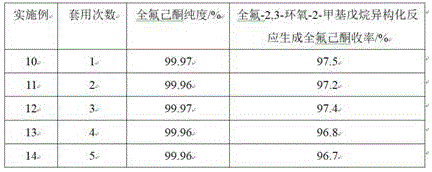
3. the method is green and environment-friendly, the reaction solution can be rectified and purified conventionally in the field to obtain the perfluorohexanone product with the purity of more than 99.9 percent, the rectified kettle bottom solution is a mixture of a solvent and an isomerization catalyst, the mixture can be repeatedly applied, the perfluoro-2,3-epoxy-2-methylpentane is isomerized into the perfluorohexanone with the yield of more than 96.7 percent after being applied mechanically for 5 times, and the three-waste discharge is obviously reduced.
Drawings
FIG. 1 is a gas chromatographic profile of the perfluorohexanone product prepared in example 4;
FIG. 2 is an infrared spectrum of a perfluorohexanone product prepared in example 4;
FIG. 3 is a mass spectrum of a perfluorohexanone product prepared in example 4;
FIG. 4 is a mass spectrum of perfluoro-2,3-epoxy-2-methylpentane prepared in example 4.
Detailed Description
The present invention will be described in further detail with reference to specific examples, but the present invention is not limited to only the following examples.
The intermediate and product contents in the examples were analyzed by means of a Furli 9790 gas chromatograph equipped with a FID detector, the column being a 105 m X0.25 mm X0.5 μm RTX-1 capillary column.
Examples 1 to 3 are preparation examples of diaza-silane-based catalysts
Example 1
(1) Adding 200g of anhydrous isopropanol into a 1L flask provided with a reflux condenser pipe and a mechanical stirring device, adding 5g of chloroplatinic acid, stirring and dissolving at the rotating speed of 400rpm for 10 minutes to prepare a chloroplatinic acid catalyst solution for later use;
(2) Adding 600g of tetramethyldisiloxane, 300g of N-methylallylamine, 30g of 3-allyl-8-benzyl-3,8-diazabicyclo [3.2.1] octane and 0.08g of chloroplatinic acid catalyst solution obtained in the step (1) into a 2L flask provided with a reflux condenser pipe and a mechanical stirring device, starting stirring, introducing nitrogen at the stirring speed of 200rpm, heating to 55 ℃ for hydrosilylation reaction, after reacting for 30 minutes, adding 4g of n-butylamine into the reaction solution, continuing the reaction for 2 hours, pouring the reacted materials into a distillation kettle, and distilling under the vacuum degree of 0.096MPa to obtain 480g of diazasilamino-based catalyst.
Example 2
(1) Adding 230g of anhydrous isopropanol into a 1L flask provided with a reflux condenser tube and a mechanical stirring device, adding 12g of chloroplatinic acid, stirring and dissolving at the rotating speed of 300rpm for 15 minutes to prepare a chloroplatinic acid catalyst solution for later use;
(2) Adding 620g of tetramethyldisiloxane, 350g of N-methylallylamine, 38g of 3-allyl-8-benzyl-3,8-diazabicyclo [3.2.1] octane and 0.12g of chloroplatinic acid catalyst solution obtained in the step (1) into a 2L flask provided with a reflux condenser pipe and a mechanical stirring device, starting stirring, introducing nitrogen at the stirring speed of 300rpm, heating to 58 ℃ for hydrosilylation reaction, after reacting for 35 minutes, adding 6g of n-butylamine into the reaction solution, continuing the reaction for 3 hours, pouring the reacted materials into a distillation kettle, and distilling under the vacuum degree of 0.097MPa to obtain 560g of diazasilamino-based catalyst.
Example 3
(1) Adding 300g of anhydrous isopropanol into a 1L flask provided with a reflux condenser pipe and a mechanical stirring device, adding 15g of chloroplatinic acid, stirring and dissolving at the rotating speed of 200rpm for 20 minutes to prepare a chloroplatinic acid catalyst solution for later use;
(2) Adding 700g of tetramethyldisiloxane, 400g of N-methylallylamine, 50g of 3-allyl-8-benzyl-3,8-diazabicyclo [3.2.1] octane and 0.2g of chloroplatinic acid catalyst solution obtained in the step (1) into a 2L flask provided with a reflux condenser pipe and a mechanical stirring device, starting stirring, introducing nitrogen at the stirring speed of 400rpm, heating to 60 ℃ for hydrosilylation reaction, after reacting for 40 minutes, adding 10g of n-butylamine into the reaction solution, continuing the reaction for 5 hours, pouring the reacted materials into a distillation kettle, and distilling under the vacuum degree of 0.098MPa to obtain 640g of diazasilamino-based catalyst.
Examples 4 to 9 are preparation examples of perfluorohexanone
Example 4
(1) Adding 100g of sodium hypochlorite aqueous solution with the effective chlorine content of 15wt% and 10g of acetonitrile into a 500ml four-neck flask provided with a reflux condenser tube and a mechanical stirring device, starting stirring, controlling the stirring speed to be 300rpm, controlling the reaction temperature to be minus 5 ℃, dropwise adding 30g of perfluoro-2-methyl-2-pentene, keeping the temperature for reaction for 6 hours after the dropwise adding is finished, stopping stirring to finish the reaction, separating an organic layer, washing the organic layer for 2 times by using equal amount of ice water, and rectifying to obtain 24.1g of perfluoro-2,3-epoxy-2-methylpentane, wherein the yield is 76.1%, and the purity is 99.8%;
(2) 200g of perfluoro-2,3-epoxy-2-methylpentane obtained by the method in the step (1), 3g of the diaza-silylamine catalyst prepared in the example 3 and 20g of acetonitrile are added into a 500ml four-neck flask provided with a reflux condenser tube and a mechanical stirring device, stirring is started, the stirring speed is 400rpm, the reaction temperature is kept at 20 ℃ for reaction for 8 hours, and after the reaction is finished, the reaction liquid is rectified to obtain a kettle bottom liquid and perfluorohexanone with the purity of 99.95%, wherein the yield is 97.2%.
Example 5
(1) Adding 200g of sodium hypochlorite aqueous solution with the effective chlorine content of 8wt% and 20g of diglyme into a 500ml four-neck flask provided with a reflux condenser tube and a mechanical stirring device, starting stirring, controlling the stirring speed to 350rpm, controlling the reaction temperature to be 0 ℃, dropwise adding 30g of perfluoro-2-methyl-2-pentene for 0.5h, continuously preserving heat after dropwise adding for 2h, stopping stirring to finish the reaction, separating an organic layer, washing the organic layer for 1 time by using equal amount of ice water, and rectifying to obtain 24.2g of perfluoro-2,3-epoxy-2-methylpentane, wherein the yield is 76.6 percent and the purity is 99.7 percent;
(2) 200g of perfluoro-2,3-epoxy-2-methylpentane obtained by the method in the step (1), 6g of the diaza-silazane catalyst prepared in the example 3 and 50g of diethylene glycol dimethyl ether are added into a 500ml four-neck flask provided with a reflux condenser tube and a mechanical stirring device, stirring is started, the stirring speed is 450rpm, the reaction temperature is kept at 30 ℃ for reaction for 6 hours, and after the reaction is finished, the reaction liquid is rectified to obtain a kettle bottom liquid and perfluorohexanone with the purity of 99.96%, wherein the yield is 97.5%.
Example 6
(1) Adding 200g of sodium hypochlorite aqueous solution with the effective chlorine content of 10wt% and 30g of N, N-dimethylformamide into a 500ml four-neck flask provided with a reflux condenser tube and a mechanical stirring device, starting stirring, controlling the stirring speed to be 200rpm, controlling the reaction temperature to be 10 ℃, dropwise adding 30g of perfluoro-2-methyl-2-pentene for 2h, continuing carrying out heat preservation reaction for 5h after the dropwise adding is finished, stopping stirring, finishing the reaction, separating an organic layer, washing the organic layer for 2 times by using equal amount of ice water, and rectifying to obtain 24.6g of perfluoro-2,3-epoxy-2-methylpentane, wherein the yield is 77.8 percent and the purity is 99.9 percent;
(2) 200g of perfluoro-2,3-epoxy-2-methylpentane obtained by the method in the step (1), 9g of the diaza-silylamine catalyst prepared in the example 3 and 100g of solvent N, N-dimethylformamide are added into a 500ml four-neck flask provided with a reflux condenser tube and a mechanical stirring device, stirring is started, the stirring speed is 400rpm, the reaction temperature is kept at 40 ℃ for reaction for 3 hours, and after the reaction is finished, the reaction liquid is rectified to obtain a kettle bottom liquid and perfluorohexanone with the purity of 99.98%, and the yield is 97.5%.
Example 7
(1) Adding 300g of sodium hypochlorite aqueous solution with the effective chlorine content of 10wt% and 30g of acetonitrile into a 500ml four-neck flask provided with a reflux condenser tube and a mechanical stirring device, starting stirring, controlling the stirring speed to be 250rpm, controlling the reaction temperature to be 20 ℃, dropwise adding 30g of perfluoro-2-methyl-2-pentene for 1h, continuing heat preservation reaction for 4h after dropwise adding, stopping stirring, finishing the reaction, separating an organic layer, washing the organic layer for 2 times by using equal amount of ice water, and rectifying to obtain 23.9g of perfluoro-2,3-epoxy-2-methylpentane, wherein the yield is 75.6%, and the purity is 99.6%;
(2) 200g of perfluoro-2,3-epoxy-2-methylpentane obtained by the method in the step (1), 12g of the diaza-silazane catalyst prepared in the example 2 and 100g of solvent tetraethylene glycol dimethyl ether are added into a 500ml four-neck flask provided with a reflux condenser tube and a mechanical stirring device, stirring is started, the stirring speed is 250rpm, the reaction temperature is kept at 40 ℃ for reaction for 3 hours, and after the reaction is finished, the reaction liquid is rectified to obtain a kettle bottom liquid and perfluorohexanone with the purity of 99.94%, and the yield is 97.7%.
Example 8
(1) Adding 300g of sodium hypochlorite aqueous solution with the effective chlorine content of 12wt% and 20g of acetonitrile into a 500ml four-neck flask provided with a reflux condenser tube and a mechanical stirring device, starting stirring, controlling the stirring speed to be 400rpm, controlling the reaction temperature to be 40 ℃, dropwise adding 30g of perfluoro-2-methyl-2-pentene for 2h, continuing heat preservation reaction for 3h after dropwise adding, stopping stirring, finishing the reaction, separating an organic layer, washing the organic layer for 2 times by using equal amount of ice water, and rectifying to obtain 22.8g of perfluoro-2,3-epoxy-2-methylpentane, wherein the yield is 72.2%, and the purity is 99.6%;
(2) 200g of perfluoro-2,3-epoxy-2-methylpentane obtained by the method in the step (1), 15g of the diaza-silazane catalyst prepared in the example 1 and 200g of solvent tetraethylene glycol dimethyl ether are added into a 500ml four-neck flask provided with a reflux condenser tube and a mechanical stirring device, stirring is started, the stirring speed is 350rpm, the reaction temperature is kept at 50 ℃ for reaction for 4 hours, and after the reaction is finished, the reaction liquid is rectified to obtain a kettle bottom liquid and perfluorohexanone with the purity of 99.96%, and the yield is 97.7%.
Example 9
(1) Into a 1000ml four-necked flask equipped with a reflux condenser and a mechanical stirring device, 400g of an aqueous sodium hypochlorite solution having an available chlorine content of 5% by weight and 40g of acetonitrile were charged. Stirring is started, the stirring speed is 400rpm, the reaction temperature is controlled to be minus 10 ℃,30g of perfluoro-2-methyl-2-pentene is dropwise added for 3h, after the dropwise addition is finished, the heat preservation reaction is continued for 1h, the stirring is stopped, the reaction is ended, an organic layer is separated, the organic layer is washed for 2 times by using ice water with the same amount, 20.4g of perfluoro-2,3-epoxy-2-methylpentane is obtained by rectification, the yield is 64.5 percent, and the purity is 99.5 percent.
(2) 200g of perfluoro-2,3-epoxy-2-methylpentane obtained by the method in the step (1), 30g of the diaza-silazane catalyst prepared in the example 2 and 200g of solvent tetraethylene glycol dimethyl ether are added into a 500ml four-neck flask provided with a reflux condenser tube and a mechanical stirring device, stirring is started, the stirring speed is 300rpm, the reaction temperature is kept at 60 ℃ for reaction for 1h, and after the reaction is finished, the reaction liquid is rectified to obtain a kettle bottom liquid and perfluorohexanone with the purity of 99.98%, wherein the yield is 98.2%.
Examples 10 to 14 are examples of applying a bottom liquid of a perfluorohexanone rectifying still
Example 10
The bottom solution rectified in the step (2) of example 6 and 200g of perfluoro-2,3-epoxy-2-methylpentane were added to a 500ml four-neck flask equipped with a reflux condenser tube and a mechanical stirrer, the stirring was started, the stirring speed was 400rpm, the reaction temperature was maintained at 40 ℃ for reaction for 3 hours, after the reaction was completed, the reaction solution was rectified, perfluorohexanone was separated, and the remaining bottom solution was used mechanically, the test results are shown in table 1.
Example 11
The experimental apparatus and parameters were the same as those in example 10, except that the bottom liquid after rectification was added as the remaining bottom liquid in example 10, and the experimental results are shown in table 1.
Example 12
The experimental setup and parameters were the same as in example 10, except that the bottom liquid after rectification was added as the remaining bottom liquid in example 11, and the experimental results are shown in table 1.
Example 13
The experimental setup and parameters were the same as in example 10, except that the bottom liquid after rectification was added as the remaining bottom liquid in example 12, and the experimental results are shown in table 1.
Example 14
The experimental setup and parameters were the same as in example 10, except that the bottom liquid after rectification was added as the remaining bottom liquid in example 13, and the experimental results are shown in table 1.
TABLE 1 results of bottom liquid application of perfluorohexanone rectifying still
Claims (2)
1. The preparation method of perfluorohexanone is characterized by comprising the following steps of:
(1) Reacting perfluoroolefin with an oxidant in a first solvent, wherein the mass ratio of the perfluoroolefin to the oxidant is 0.05-0.5, the reaction temperature is-10-50 ℃, the reaction time is 1-10 h, an organic layer is separated after the reaction is finished, the organic layer is washed and rectified to obtain perfluoro-2,3-epoxy-2-methylpentane, the perfluoroolefin is perfluoro-2-methyl-2-pentene, the oxidant is a sodium hypochlorite aqueous solution with the effective chlorine content of 5-15wt%, and the first solvent is one of acetonitrile, diglyme and N, N-dimethylformamide;
(2) Carrying out isomerization reaction on the perfluoro-2,3-epoxy-2-methylpentane obtained in the step (1) and an isomerization catalyst in a second solvent, wherein the mass ratio of the perfluoro-2,3-epoxy-2-methylpentane to the isomerization catalyst is 5-70, the reaction temperature is 20-60 ℃, the reaction time is 1-8 h, after the reaction is finished, the reaction liquid is rectified to obtain a kettle bottom liquid and a perfluorohexanone product, the second solvent is one of acetonitrile, diethylene glycol dimethyl ether, N-dimethylformamide and tetraethylene glycol dimethyl ether, and the isomerization catalyst is prepared by the following method:
1) Adding 5-15 parts by weight of chloroplatinic acid into 200-300 parts by weight of anhydrous isopropanol, stirring and dissolving for 10-20 minutes to prepare a chloroplatinic acid catalyst solution for later use;
2) According to the weight portion, 600 to 700 portions of tetramethyldisiloxane, 300 to 400 portions of N-methyl allyl amine, 30 to 50 portions of 3-allyl-8-benzyl-3,8-diazabicyclo [3.2.1] octane and 0.08 to 0.2 portion of chloroplatinic acid catalyst solution obtained in the step (1) are reacted under the nitrogen atmosphere, the reaction temperature is 50 to 70 ℃,4 to 10 portions of N-butylamine are added after the reaction is carried out for 30 to 40 minutes, the reaction is continued for 2 to 5 hours, the reaction is finished, and the reaction liquid is vacuum distilled under the vacuum degree of 0.096 to 0.1MPa to obtain the isomerization catalyst.
2. The method for preparing perfluorohexanone according to claim 1, wherein the still bottoms of step (2) is recycled without treatment to participate in the isomerization reaction.
Priority Applications (1)
| Application Number | Priority Date | Filing Date | Title |
|---|---|---|---|
| CN202010966807.6A CN112250552B (en) | 2020-09-15 | 2020-09-15 | Preparation method of perfluorohexanone |
Applications Claiming Priority (1)
| Application Number | Priority Date | Filing Date | Title |
|---|---|---|---|
| CN202010966807.6A CN112250552B (en) | 2020-09-15 | 2020-09-15 | Preparation method of perfluorohexanone |
Publications (2)
| Publication Number | Publication Date |
|---|---|
| CN112250552A CN112250552A (en) | 2021-01-22 |
| CN112250552B true CN112250552B (en) | 2023-02-03 |
Family
ID=74232336
Family Applications (1)
| Application Number | Title | Priority Date | Filing Date |
|---|---|---|---|
| CN202010966807.6A Active CN112250552B (en) | 2020-09-15 | 2020-09-15 | Preparation method of perfluorohexanone |
Country Status (1)
| Country | Link |
|---|---|
| CN (1) | CN112250552B (en) |
Families Citing this family (4)
| Publication number | Priority date | Publication date | Assignee | Title |
|---|---|---|---|---|
| CN114014782B (en) * | 2021-10-20 | 2023-10-27 | 化学与精细化工广东省实验室 | Method for continuously preparing heptafluoroisobutyronitrile in gas phase using one-pot amination-dehydration method |
| CN115504871A (en) * | 2022-10-17 | 2022-12-23 | 内蒙古永和氟化工有限公司 | Preparation method of perfluorohexanone |
| CN116854574B (en) * | 2023-09-04 | 2023-12-12 | 哲弗智能系统(上海)有限公司 | Preparation method of perfluoro hexanone |
| CN116969825B (en) * | 2023-09-25 | 2023-12-15 | 山东华夏神舟新材料有限公司 | A kind of purification method of perfluorohexanone |
Citations (11)
| Publication number | Priority date | Publication date | Assignee | Title |
|---|---|---|---|---|
| US3238241A (en) * | 1963-09-20 | 1966-03-01 | Pennsalt Chemicals Corp | Secondary perhaloalkyl chlorosulfates and fluorosulfates |
| JPH06184208A (en) * | 1992-12-16 | 1994-07-05 | Asahi Glass Co Ltd | Fluoropolymer manufacturing method |
| WO2011090992A1 (en) * | 2010-01-25 | 2011-07-28 | 3M Innovative Properties Company | Perfluoroketones as gaseous dielectrics |
| CN103787854A (en) * | 2014-01-24 | 2014-05-14 | 奥瑞安有限公司 | Preparation process of perfluoro-2-methyl-3-pentanone |
| CN104379548A (en) * | 2012-06-15 | 2015-02-25 | 中化蓝天集团有限公司 | A kind of preparation method of perfluoro-2-methyl-3-pentanone and intermediate |
| CN105439835A (en) * | 2015-12-02 | 2016-03-30 | 上海三爱富新材料股份有限公司 | Preparation method of C6-fluoroketone |
| CN106542984A (en) * | 2016-10-13 | 2017-03-29 | 巨化集团技术中心 | A kind of preparation method of 2 methyl of perfluor, 3 pentanone |
| CN107382692A (en) * | 2017-09-06 | 2017-11-24 | 北京天康达科技发展有限公司 | The synthetic method of perfluor hexanone and application |
| CN107501038A (en) * | 2017-09-06 | 2017-12-22 | 北京天康达科技发展有限公司 | A kind of preparation method of perfluor hexanone and application |
| CN108929212A (en) * | 2018-08-17 | 2018-12-04 | 浙江利化新材料科技有限公司 | A kind of preparation method of perfluor hexanone |
| CN111004100A (en) * | 2019-12-26 | 2020-04-14 | 西安元创化工科技股份有限公司 | Method for synthesizing perfluorohexanone |
-
2020
- 2020-09-15 CN CN202010966807.6A patent/CN112250552B/en active Active
Patent Citations (11)
| Publication number | Priority date | Publication date | Assignee | Title |
|---|---|---|---|---|
| US3238241A (en) * | 1963-09-20 | 1966-03-01 | Pennsalt Chemicals Corp | Secondary perhaloalkyl chlorosulfates and fluorosulfates |
| JPH06184208A (en) * | 1992-12-16 | 1994-07-05 | Asahi Glass Co Ltd | Fluoropolymer manufacturing method |
| WO2011090992A1 (en) * | 2010-01-25 | 2011-07-28 | 3M Innovative Properties Company | Perfluoroketones as gaseous dielectrics |
| CN104379548A (en) * | 2012-06-15 | 2015-02-25 | 中化蓝天集团有限公司 | A kind of preparation method of perfluoro-2-methyl-3-pentanone and intermediate |
| CN103787854A (en) * | 2014-01-24 | 2014-05-14 | 奥瑞安有限公司 | Preparation process of perfluoro-2-methyl-3-pentanone |
| CN105439835A (en) * | 2015-12-02 | 2016-03-30 | 上海三爱富新材料股份有限公司 | Preparation method of C6-fluoroketone |
| CN106542984A (en) * | 2016-10-13 | 2017-03-29 | 巨化集团技术中心 | A kind of preparation method of 2 methyl of perfluor, 3 pentanone |
| CN107382692A (en) * | 2017-09-06 | 2017-11-24 | 北京天康达科技发展有限公司 | The synthetic method of perfluor hexanone and application |
| CN107501038A (en) * | 2017-09-06 | 2017-12-22 | 北京天康达科技发展有限公司 | A kind of preparation method of perfluor hexanone and application |
| CN108929212A (en) * | 2018-08-17 | 2018-12-04 | 浙江利化新材料科技有限公司 | A kind of preparation method of perfluor hexanone |
| CN111004100A (en) * | 2019-12-26 | 2020-04-14 | 西安元创化工科技股份有限公司 | Method for synthesizing perfluorohexanone |
Non-Patent Citations (2)
| Title |
|---|
| 全氟己酮合成工艺优化研究;屈文良;《中国知网 硕士学位论文》;20140715(第07期);1-44 * |
| 全氟己酮的合成与应用研究进展;丁元胜等;《浙江化工》;20051228(第12期);25-27 * |
Also Published As
| Publication number | Publication date |
|---|---|
| CN112250552A (en) | 2021-01-22 |
Similar Documents
| Publication | Publication Date | Title |
|---|---|---|
| CN112250552A (en) | Preparation method of perfluorohexanone | |
| CN111116302B (en) | Synthesis method of halogenated butene | |
| CN107501038A (en) | A kind of preparation method of perfluor hexanone and application | |
| CN105330836B (en) | A kind of synthetic method of epoxy terminated allyl alcohol polyethenoxy ether | |
| JP5603169B2 (en) | (E) Process for producing 3-methyl-2-cyclopentadecenone | |
| US8039680B2 (en) | Process for producing 4-methyl-2,3,5,6-tetrafluorobenzyl alcohol | |
| EP2862850A1 (en) | Preparation method for perfluoro-2-methyl-3-pentanone and intermediate | |
| CN108383681B (en) | Preparation method of perfluoro-2-methyl-2-pentene | |
| CN111116307B (en) | Preparation method of high-purity trifluoromethane | |
| JPWO1999033771A1 (en) | Method for producing a compound having a —CH2—CHF— group | |
| JPWO1997043233A1 (en) | Method for producing fluorinated olefins | |
| CN106187691B (en) | A method of recycling hexafluoroisopropanol from the gaseous mixture containing hexafluoroisopropanol and hydrogen | |
| JP6219884B2 (en) | (Z) -3-Methyl-2-cyclopentadecenone production method and (R)-(-)-3-methylcyclopentadecanone production method | |
| JPS582210B2 (en) | Method for producing 2,3-dimethyl-2,3-butanediol | |
| US20070191652A1 (en) | Process for production of 1,1,1,2- tetrafluoroethane and/or pentafluorethane and applications of the same | |
| JP2006219419A (en) | Method for producing perfluorovinyl ether monomer | |
| JPWO2017022571A1 (en) | Method for producing fluorinated hydrocarbon | |
| JP2002544248A (en) | Production of 1,1,1,2,3,3,3-heptafluoropropane | |
| KR102913335B1 (en) | Method for manufacturing hexafluoro-2-butyne and 1,1,1,4,4,4-hexafluoro-2-butene | |
| JP3613635B2 (en) | Method for producing 3,4-caranediol | |
| JP2006008519A (en) | Method for producing triethylene glycol divinyl ether | |
| JP2019034901A (en) | Method of processing composition | |
| WO2022176837A1 (en) | Method for producing cyclohexenone compound | |
| JP3613636B2 (en) | Method for producing 3,4-caranediol | |
| JP3673600B2 (en) | Method for producing high purity cyclohexene oxide |
Legal Events
| Date | Code | Title | Description |
|---|---|---|---|
| PB01 | Publication | ||
| PB01 | Publication | ||
| SE01 | Entry into force of request for substantive examination | ||
| SE01 | Entry into force of request for substantive examination | ||
| GR01 | Patent grant | ||
| GR01 | Patent grant |