Disclosure of Invention
The invention aims to solve the problems in the prior art, and provides a set of automatic analysis device for sludge sedimentation performance, which realizes automatic detection of sludge performance through automatic operation and analysis and ensures stable operation of an activated sludge process.
The invention adopts the following specific technical scheme:
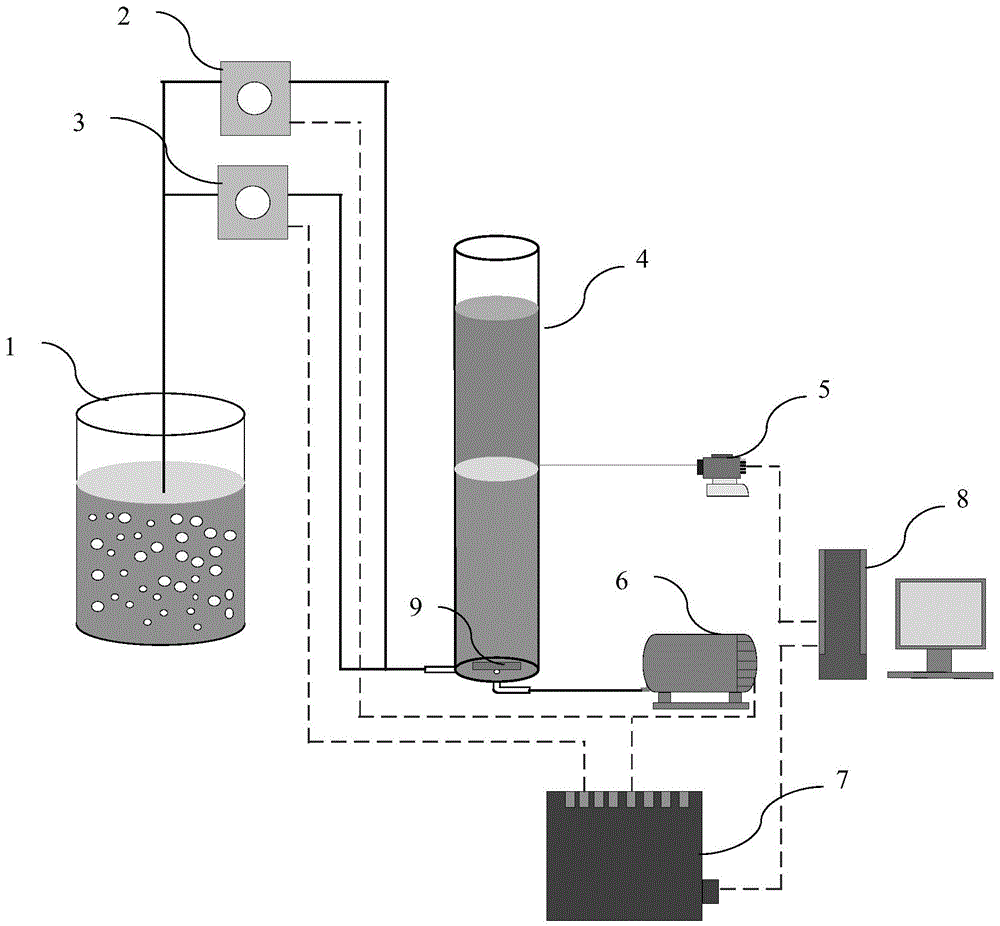
an automatic analysis device for sludge sedimentation characteristics based on MATLAB image conversion comprises a sample introduction/output device, an observation cylinder main body, a sludge stirring device and an imaging analysis system; the sample feeding/discharging device comprises a sludge conveying pipe, a sludge discharging pipe and a PLC control system, one end of the sludge conveying pipe and one end of the sludge discharging pipe are respectively connected with a sludge sampling port of the device to be monitored, the other end of the sludge conveying pipe and the other end of the sludge discharging pipe are respectively connected with the bottom of the observation cylinder main body, and a first conveying pump and a second conveying pump are respectively arranged on the sludge conveying pipe and the sludge discharging pipe; the side wall of the observation cylinder main body is made of transparent materials, a first identification point is arranged at the bottom of the side wall of a reaction area of the reactor, a second identification point is arranged at the top of the side wall of the reaction area, and the two identification points are used for positioning an imaging analysis system;
the sludge stirring device comprises an aeration device and an air pump, the aeration device is arranged at the bottom of the inner cavity of the observation cylinder main body, and the air pump is used for supplying air to the aeration device; the first delivery pump, the second delivery pump and the air pump are all connected with the PLC control system, and the start and stop of the first delivery pump, the second delivery pump and the air pump are all controlled by the PLC control system;
the imaging analysis system comprises an imaging device and an upper computer, wherein the imaging device is used for carrying out continuous image shooting on the observation cylinder main body and obtaining a reaction area image between the first identification point and the second identification point; the imaging device and the PLC control system are both connected to an upper computer; and an MATLAB analysis module is arranged in the upper computer and used for analyzing the images of the reaction area, identifying the position of a mud-water interface in each image and obtaining the height of the sludge layer.
Preferably, the aeration device is a microporous aeration head.
Preferably, the first conveying pump and the second conveying pump are peristaltic pumps, and the start-stop time and the start-stop period of the first conveying pump, the second conveying pump and the air pump are automatically controlled by inputting control parameters in a PLC control system in advance.
Preferably, the imaging device takes a horizontal imaging angle of view to photograph the vertically arranged observation cylinder main body to reduce image distortion.
Preferably, the imaging device adopts a camera.
Preferably, the MATLAB analysis module in the upper computer identifies the position of the muddy water interface in the image through binarization and image optimization, and the identification method comprises the following steps:
firstly, importing a reaction zone image into MATLAB, identifying the positions of a first identification point and a second identification point in the image according to the tristimulus value characteristics, and obtaining a longitudinal coordinate difference value Y between the central coordinates of the two identification points0;
Then, converting the image of the reaction area into a gray-scale image, and carrying out binarization processing on the gray-scale image to obtain a binarized image;
then, filtering and denoising the binary image, and then analyzing a connected domain to remove a noise point image caused by the discrete sludge flocs above the mud-water interface to obtain a denoised image;
and finally, calculating a difference value Y of longitudinal coordinates of the position of the muddy water interface in the denoised image and the position of the central point of the first identification point in the image1And calculating to obtain the height H of the sludge layer in the current image0×(Y1/Y0) In which H is0The actual height difference of the center coordinates of the first identification point and the second identification point on the observation cylinder main body is obtained.
Preferably, the upper computer is also provided with a data export module, and the data export module is used for reading the height of the sludge layer obtained from the images at different moments and outputting a sludge sedimentation curve.
Preferably, in the running process of the equipment to be monitored, sludge in the equipment is periodically extracted to the observation cylinder main body for sludge sedimentation characteristic analysis.
Another object of the present invention is to provide an automatic analysis method for sludge sedimentation characteristics using the analysis apparatus according to any of the above aspects, comprising the steps of:
s1: emptying the muddy water mixture in the observation cylinder main body and keeping the inside of the observation cylinder main body in an emptying state;
s2: opening a first delivery pump, and pumping sludge to be analyzed in the equipment to be monitored into the observation cylinder main body until the liquid level of the mud-water mixture in the reaction area is flush with the second identification point;
s3: after the sludge in the observation cylinder main body is stabilized by standing, starting an air pump to supply air to the aeration device, and stirring the sludge in the reaction zone through the aeration and air stripping action;
s4: after the sludge in the reaction area is fully mixed, stopping aeration and starting an imaging device at the same time, and continuously shooting images of the reaction area in the observation cylinder main body to obtain image frames at different sedimentation moments;
s5: inputting the image frame at each settling moment into an MATLAB analysis module, and identifying the position of a muddy water interface in the image through binarization and image optimization to obtain the height of a sludge layer in the image frame;
s6: and processing the sludge layer heights obtained from the image frames at different moments, and outputting a sludge settlement curve.
Preferably, after the imaging device shoots the whole sludge sedimentation process, the second delivery pump is started to re-pump the mud-water mixture in the observation cylinder main body into the equipment to be monitored.
Compared with the prior art, the invention has the beneficial effects that:
(1) the invention can realize the continuous measurement of the sludge sedimentation performance by PLC time sequence control and sludge measurement cycle process control.
(2) According to the invention, the sludge sedimentation characteristic is efficiently analyzed based on MATLAB, and both the sedimentation experiment and the image analysis can be performed in a laboratory/field environment without depending on expensive equipment and software.
(3) The method can perform settlement experiments and data analysis under long time or high measurement frequency, and realizes SBH registration automation through algorithm optimization, thereby preventing human errors and subjective analysis.
Detailed Description
The device is further described with reference to the accompanying drawings and the specific embodiments
As shown in fig. 1, in a preferred embodiment of the present invention, an automatic analysis apparatus for sludge sedimentation characteristics based on MATLAB image transformation is provided, and its main structure includes a sample injection/output device, an observation cylinder body 4, a sludge stirring device and an imaging analysis system. Wherein, advance appearance/go out appearance device and include sludge conveying pipe, sludge discharge pipe and PLC control system 7, the sludge sampling mouth of treating monitoring facilities 1 is connected respectively to the one end of sludge conveying pipe and sludge discharge pipe, and the other end is connected the 4 bottoms of observation section of thick bamboo main parts respectively, is equipped with first delivery pump 2 and second delivery pump 3 on sludge conveying pipe and the sludge discharge pipe respectively. The device 1 to be monitored is water treatment equipment which needs to be monitored for the sludge sedimentation performance, such as a sedimentation tank, a reactor and the like.
In this apparatus, the side wall of the observation tube main body 4 is made of a transparent material in order to obtain an image of the sludge inside the observation tube main body by an imaging device. In order to facilitate automatic acquisition of a reference for calculating the height of a sludge layer during image analysis, a first identification point needs to be arranged at the bottom of the side wall of the reaction zone of the reactor, a second identification point is arranged at the top of the side wall of the reaction zone, and the two identification points are used for positioning of an imaging analysis system. The identification point may be a mark of a different color than both the outer wall of the reactor and the internal slurry mixture, which is subsequently identified by the RGB values in the image.
In the device, the sludge stirring device comprises an aeration device 9 and an air pump 6, the aeration device 9 is arranged at the bottom of the inner cavity of the observation cylinder main body 4, and the aeration device 9 in the embodiment is a microporous aeration head. The outside air pump 6 is connected through the trachea to the micropore aeration head, can supply air to aeration equipment 9 when air pump 6 starts, and a large amount of bubbles are discharged from the aeration head, rise under the buoyancy effect and then stir muddy water mixture, promote to remove misce bene.
When the device is applied, the sludge in the equipment 1 to be monitored needs to be continuously extracted for carrying out sedimentation experiments, so that the first conveying pump 2, the second conveying pump 3 and the air pump 6 are connected with the PLC control system 7, and the start and stop of the PLC control system 7 are controlled in order to save labor and improve the automation degree. The start-stop time and the start-stop period of the first delivery pump 2, the second delivery pump 3 and the air pump 6 are automatically controlled by inputting control parameters in the PLC control system 7 in advance. The first delivery pump 2 and the second delivery pump 3 can adopt peristaltic pumps so as to facilitate quantitative control.
In the device, the imaging analysis system comprises an imaging device 5 and an upper computer 8, wherein the imaging device 5 is used for carrying out continuous image shooting on the observation cylinder body 4 and acquiring a reaction area image between a first identification point and a second identification point. The imaging device 5 photographs the vertically arranged observation tube main body 4 with a horizontal imaging angle of view to reduce image distortion. The height of the imaging device 5 is preferably located between the two identification points. The imaging device 5 may be implemented using a camera to continuously capture a video of the settling process, each video frame representing the settling state at a different time.
The imaging device 5 and the PLC control system 7 are both connected to an upper computer 8, the upper computer 8 can receive the reaction area image shot by the imaging device 5, and meanwhile, control parameters of the PLC control system 7 serving as a lower computer can be set. An MATLAB analysis module and a data export module are arranged in the upper computer 8.
The MATLAB analysis module is used for analyzing the images of the reaction area, identifying the position of a mud-water interface in each image and obtaining the height of the sludge layer. In the MATLAB analysis module, the specific identification method is as follows:
1) firstly, importing a reaction zone image into MATLAB, identifying the positions of a first identification point and a second identification point in the image according to the tristimulus value characteristics, and obtaining a longitudinal coordinate difference value Y between the central coordinates of the two identification points0;
2) Then, image data conversion is carried out: converting the reaction area image into a gray scale image, and performing binarization processing on the gray scale image to obtain a binarized image;
3) then, carrying out a self-optimization process: filtering and denoising the binary image, and then analyzing a connected domain to remove a noise point image caused by discrete sludge flocs above a mud-water interface to obtain a denoised image;
4) and finally, data processing is carried out: calculating the difference value Y of the longitudinal coordinates of the position of the muddy water interface in the denoised image and the position of the central point of the first identification point in the image1And calculating to obtain the height H of the sludge layer in the current image0×(Y1/Y0) In which H is0The actual height difference of the center coordinates of the first identification point and the second identification point on the observation cylinder main body 4.
The data export module is used for reading the height of a sludge layer obtained from images at different moments and outputting a sludge sedimentation curve.
In the running process of the device 1 to be monitored, sludge in the device is periodically extracted to the observation cylinder main body 4 for sludge sedimentation characteristic analysis. The process can be automatically controlled by a PLC, so that labor is greatly saved, and the accuracy of measurement is ensured. After one-time sampling analysis is finished, the method can be started again after the set time, and the process is repeated until the set times are reached.
The following further illustrates a specific implementation form of the present invention by an embodiment.
Example 1
In this embodiment, the sludge settling property measuring device includes a sample introduction/discharge unit, an observation cylinder main body, a sludge stirring unit, and an imaging analysis system, and the specific structure is as described in fig. 1 and is not described again. The following mainly describes the specific parameters of each component. The inner diameter of the sample inlet pipe/sample outlet pipe is 0.8mm, and the conveying flow of the two conveying pumps is 5.2 ml/min to 252 ml/min; the sludge conveying pipe/discharging pipe is connected with the bottom of the observation cylinder main body. The observation cylinder main body is designed by 3D printing, three sets of systems with different specifications, namely 10ml, 100ml and 1000ml, can be designed according to a sample system, are made of transparent photosensitive resin, and are respectively provided with red identification points at the bottom and the head for positioning an imaging analysis system. The sludge stirring device is composed of a micropore aeration system, and the start/stop of the sludge stirring device is controlled by a PLC device. The continuous sludge measuring process includes the steps of firstly setting parameters of a PLC and a host computer, starting sampling circulation by the PLC: in the process, the PLC device controls the first conveying pump to sample sludge at a target position, then aeration stirring is carried out, the sludge begins to settle after full stirring and mixing, and finally the sludge is discharged back to the original position after the settlement is finished. Meanwhile, a camera is used for carrying out real-time image microscopic acquisition in the sedimentation process, and a PC host is used for recording and converting data. The data processing flow in the PC host mainly includes data transformation analysis and data export processes as shown in fig. 2, specifically refer to the foregoing steps 1) to 4). In this embodiment, the data import form is wav, the video reader and imwrite functions are used to import the captured image, the boundary parameter optimization is performed on the sludge layer interface based on imb2b and b2m functions, the video oinput and Timer Period are used to set the image capturing timing sequence and interval, and the final program is an exe package generated by MATLAB GUI and MATLAB compiler and can be executed on a host computer without MATLAB.
In the example, to determine the effect of filamentous bacteria growth on the sedimentation performance of activated sludge, the filamentous bacteria Gordonia australis. Because the organic matter composition of the system is low, the sludge sedimentation performance needs to be continuously detected within 24 hours. For this purpose, a 100mL sampling system was used, with sampling intervals set to 1h and settling curve times set to 0.5 h. The experimental process is carried out in a constant temperature shaking table, and the sampling process does not need to stop the microorganism culture process through a sludge conveying pipe and a discharge pipe (the inner diameter is 0.8mm and a 7# standard pipe).
In the sampling circulation, a first conveying pump is started by a PLC device, the running time is 125s, the sludge conveying flow rate is 0.8ml/L, the conveying is finished, then the sampling period is kept still for 175s, and the total time of the sampling period is 5 min. Then, the slurry enters a stirring section, and the PLC controls the air pump and the micropore aeration device to start and operate for 5min, so that the slurry and the water are fully and uniformly mixed. After the aeration is stopped, the camera is started to shoot and record the sludge sedimentation process in the PC. And aerating and stirring the sludge again after 30min, and discharging the sludge from the bottom to the original activated sludge system by starting a second delivery pump, wherein the sludge discharge time is set to be 5 min.
The image obtained at one time is subjected to data analysis to obtain a sludge settlement curve as an example: in MATLAB, the video is converted to display a sample size of 54100 with an image size of 640 × 368 pixels. Extracting the feature region center coordinates of two identification points as A (23, 178) based on the three-element color difference (R >230, G <100, B <100) of the image identification points; b (338, 168), further extracting a matrix [23,338; 168,178]. The method comprises the steps of sequentially carrying out graying and binarization on an image analysis area, removing noise points in an image through filtering (an imfilter function), and then, introducing noise point images introduced by binarization of discrete sludge flocs above a mud-water interface into the image through connected domain analysis (a bwleabel function) of image blocks with the number of connected domain pixels below 50 so as to obtain a sludge layer image with clear boundary through self-optimization. The sludge blanket height is read from the image, and then the actual sludge blanket height information is calculated from the actual height (15mm) of the recognition site.
And (4) carrying out the above treatment on different frames in the video shot by the camera to obtain the sludge layer heights at different moments. Because the sludge sedimentation speed is low, the image files in the video file have redundancy, the calculation amount is too large when each frame is calculated, and the first frame image per second is analyzed by default in the program in the embodiment, so that 24 × 1800 data points are finally obtained. The final result is output on a GUI interface and stored in a CSV UTF-8 format, and the sludge sedimentation curve is displayed on the GUI interface as shown in FIG. 3.
Therefore, the device can realize the monitoring of the sludge sedimentation performance in laboratories and on-site (sewage treatment plants), realize the automatic monitoring of the sludge sedimentation performance in the sewage treatment process, and realize the pre-control of the long-term risks of sludge bulking and the like in the sewage treatment plants.
The above-described embodiments are merely preferred embodiments of the present invention, which should not be construed as limiting the invention. Various changes and modifications may be made by one of ordinary skill in the pertinent art without departing from the spirit and scope of the present invention. Therefore, the technical scheme obtained by adopting the mode of equivalent replacement or equivalent transformation is within the protection scope of the invention.