CN111769552B - Source-load linear coordination optimization method for participating in peak shaving of waste incineration power plant - Google Patents
Source-load linear coordination optimization method for participating in peak shaving of waste incineration power plant Download PDFInfo
- Publication number
- CN111769552B CN111769552B CN202010637710.0A CN202010637710A CN111769552B CN 111769552 B CN111769552 B CN 111769552B CN 202010637710 A CN202010637710 A CN 202010637710A CN 111769552 B CN111769552 B CN 111769552B
- Authority
- CN
- China
- Prior art keywords
- load
- linear
- flue gas
- waste incineration
- incineration power
- Prior art date
- Legal status (The legal status is an assumption and is not a legal conclusion. Google has not performed a legal analysis and makes no representation as to the accuracy of the status listed.)
- Active
Links
Images




Classifications
-
- H—ELECTRICITY
- H02—GENERATION; CONVERSION OR DISTRIBUTION OF ELECTRIC POWER
- H02J—ELECTRIC POWER NETWORKS; CIRCUIT ARRANGEMENTS OR SYSTEMS FOR SUPPLYING OR DISTRIBUTING ELECTRIC POWER; SYSTEMS FOR STORING ELECTRIC ENERGY
- H02J3/00—Circuit arrangements for AC mains or AC distribution networks
-
- H—ELECTRICITY
- H02—GENERATION; CONVERSION OR DISTRIBUTION OF ELECTRIC POWER
- H02J—ELECTRIC POWER NETWORKS; CIRCUIT ARRANGEMENTS OR SYSTEMS FOR SUPPLYING OR DISTRIBUTING ELECTRIC POWER; SYSTEMS FOR STORING ELECTRIC ENERGY
- H02J3/00—Circuit arrangements for AC mains or AC distribution networks
- H02J3/17—Demand-responsive operation of AC power transmission or distribution networks
-
- H—ELECTRICITY
- H02—GENERATION; CONVERSION OR DISTRIBUTION OF ELECTRIC POWER
- H02J—ELECTRIC POWER NETWORKS; CIRCUIT ARRANGEMENTS OR SYSTEMS FOR SUPPLYING OR DISTRIBUTING ELECTRIC POWER; SYSTEMS FOR STORING ELECTRIC ENERGY
- H02J3/00—Circuit arrangements for AC mains or AC distribution networks
- H02J3/28—Arrangements for balancing of the load in networks by storage of energy
-
- H—ELECTRICITY
- H02—GENERATION; CONVERSION OR DISTRIBUTION OF ELECTRIC POWER
- H02J—ELECTRIC POWER NETWORKS; CIRCUIT ARRANGEMENTS OR SYSTEMS FOR SUPPLYING OR DISTRIBUTING ELECTRIC POWER; SYSTEMS FOR STORING ELECTRIC ENERGY
- H02J3/00—Circuit arrangements for AC mains or AC distribution networks
- H02J3/38—Arrangements for feeding a single network from two or more generators or sources in parallel; Arrangements for feeding already energised networks from additional generators or sources in parallel
- H02J3/46—Controlling the sharing of generated power between the generators, sources or networks
- H02J3/466—Scheduling or selectively controlling the operation of the generators or sources, e.g. connecting or disconnecting generators to meet a demand
-
- H—ELECTRICITY
- H02—GENERATION; CONVERSION OR DISTRIBUTION OF ELECTRIC POWER
- H02J—ELECTRIC POWER NETWORKS; CIRCUIT ARRANGEMENTS OR SYSTEMS FOR SUPPLYING OR DISTRIBUTING ELECTRIC POWER; SYSTEMS FOR STORING ELECTRIC ENERGY
- H02J2101/00—Supply or distribution of decentralised, dispersed or local electric power generation
- H02J2101/20—Dispersed power generation using renewable energy sources
- H02J2101/22—Solar energy
- H02J2101/24—Photovoltaics
-
- H—ELECTRICITY
- H02—GENERATION; CONVERSION OR DISTRIBUTION OF ELECTRIC POWER
- H02J—ELECTRIC POWER NETWORKS; CIRCUIT ARRANGEMENTS OR SYSTEMS FOR SUPPLYING OR DISTRIBUTING ELECTRIC POWER; SYSTEMS FOR STORING ELECTRIC ENERGY
- H02J2101/00—Supply or distribution of decentralised, dispersed or local electric power generation
- H02J2101/20—Dispersed power generation using renewable energy sources
- H02J2101/28—Wind energy
-
- H—ELECTRICITY
- H02—GENERATION; CONVERSION OR DISTRIBUTION OF ELECTRIC POWER
- H02J—ELECTRIC POWER NETWORKS; CIRCUIT ARRANGEMENTS OR SYSTEMS FOR SUPPLYING OR DISTRIBUTING ELECTRIC POWER; SYSTEMS FOR STORING ELECTRIC ENERGY
- H02J2101/00—Supply or distribution of decentralised, dispersed or local electric power generation
- H02J2101/40—Hybrid power plants, i.e. a plurality of different generation technologies being operated at one power plant
-
- H—ELECTRICITY
- H02—GENERATION; CONVERSION OR DISTRIBUTION OF ELECTRIC POWER
- H02J—ELECTRIC POWER NETWORKS; CIRCUIT ARRANGEMENTS OR SYSTEMS FOR SUPPLYING OR DISTRIBUTING ELECTRIC POWER; SYSTEMS FOR STORING ELECTRIC ENERGY
- H02J2103/00—Details of circuit arrangements for mains or AC distribution networks
- H02J2103/30—Simulating, planning, modelling, reliability check or computer assisted design [CAD] of electric power networks
-
- H—ELECTRICITY
- H02—GENERATION; CONVERSION OR DISTRIBUTION OF ELECTRIC POWER
- H02J—ELECTRIC POWER NETWORKS; CIRCUIT ARRANGEMENTS OR SYSTEMS FOR SUPPLYING OR DISTRIBUTING ELECTRIC POWER; SYSTEMS FOR STORING ELECTRIC ENERGY
- H02J2103/00—Details of circuit arrangements for mains or AC distribution networks
- H02J2103/30—Simulating, planning, modelling, reliability check or computer assisted design [CAD] of electric power networks
- H02J2103/35—Grid-level management of power transmission or distribution systems, e.g. load flow analysis or active network management
-
- Y—GENERAL TAGGING OF NEW TECHNOLOGICAL DEVELOPMENTS; GENERAL TAGGING OF CROSS-SECTIONAL TECHNOLOGIES SPANNING OVER SEVERAL SECTIONS OF THE IPC; TECHNICAL SUBJECTS COVERED BY FORMER USPC CROSS-REFERENCE ART COLLECTIONS [XRACs] AND DIGESTS
- Y02—TECHNOLOGIES OR APPLICATIONS FOR MITIGATION OR ADAPTATION AGAINST CLIMATE CHANGE
- Y02B—CLIMATE CHANGE MITIGATION TECHNOLOGIES RELATED TO BUILDINGS, e.g. HOUSING, HOUSE APPLIANCES OR RELATED END-USER APPLICATIONS
- Y02B70/00—Technologies for an efficient end-user side electric power management and consumption
- Y02B70/30—Systems integrating technologies related to power network operation and communication or information technologies for improving the carbon footprint of the management of residential or tertiary loads, i.e. smart grids as climate change mitigation technology in the buildings sector, including also the last stages of power distribution and the control, monitoring or operating management systems at local level
- Y02B70/3225—Demand response systems, e.g. load shedding, peak shaving
-
- Y—GENERAL TAGGING OF NEW TECHNOLOGICAL DEVELOPMENTS; GENERAL TAGGING OF CROSS-SECTIONAL TECHNOLOGIES SPANNING OVER SEVERAL SECTIONS OF THE IPC; TECHNICAL SUBJECTS COVERED BY FORMER USPC CROSS-REFERENCE ART COLLECTIONS [XRACs] AND DIGESTS
- Y02—TECHNOLOGIES OR APPLICATIONS FOR MITIGATION OR ADAPTATION AGAINST CLIMATE CHANGE
- Y02E—REDUCTION OF GREENHOUSE GAS [GHG] EMISSIONS, RELATED TO ENERGY GENERATION, TRANSMISSION OR DISTRIBUTION
- Y02E10/00—Energy generation through renewable energy sources
- Y02E10/50—Photovoltaic [PV] energy
- Y02E10/56—Power conversion systems, e.g. maximum power point trackers
-
- Y—GENERAL TAGGING OF NEW TECHNOLOGICAL DEVELOPMENTS; GENERAL TAGGING OF CROSS-SECTIONAL TECHNOLOGIES SPANNING OVER SEVERAL SECTIONS OF THE IPC; TECHNICAL SUBJECTS COVERED BY FORMER USPC CROSS-REFERENCE ART COLLECTIONS [XRACs] AND DIGESTS
- Y04—INFORMATION OR COMMUNICATION TECHNOLOGIES HAVING AN IMPACT ON OTHER TECHNOLOGY AREAS
- Y04S—SYSTEMS INTEGRATING TECHNOLOGIES RELATED TO POWER NETWORK OPERATION, COMMUNICATION OR INFORMATION TECHNOLOGIES FOR IMPROVING THE ELECTRICAL POWER GENERATION, TRANSMISSION, DISTRIBUTION, MANAGEMENT OR USAGE, i.e. SMART GRIDS
- Y04S20/00—Management or operation of end-user stationary applications or the last stages of power distribution; Controlling, monitoring or operating thereof
- Y04S20/20—End-user application control systems
- Y04S20/222—Demand response systems, e.g. load shedding, peak shaving
Landscapes
- Engineering & Computer Science (AREA)
- Power Engineering (AREA)
- Incineration Of Waste (AREA)
- Management, Administration, Business Operations System, And Electronic Commerce (AREA)
Abstract
本发明公开一种垃圾焚烧电厂参与调峰的源荷线性协调优化方法,步骤包括:S1.根据现有烟气处理装置能耗模型,建立细化后的烟气处理能耗模型;S2.获取日前负荷预测时间序列,将负荷线性回归,负荷预测时间序列减去线性负荷时间序列,得到无线性趋势的负荷;S3.建立垃圾焚烧电厂参与调峰的源荷线性协调优化模型,模型以风光出力预测时间序列和去除线性趋势的负荷预测曲线为基础数据,进行日前调度计划优化,以降低系统运行成本为目标;S4.将垃圾焚烧电厂作为调峰资源参与源荷协调优化,通过所述线性协调优化模型对所述垃圾焚烧电厂发电和烟气处理设备资源进行优化控制,同时将线性负荷计入传统机组出力,从而减少系统运行成本和弃风弃光。
The invention discloses a source-load linear coordination optimization method for a waste incineration power plant to participate in peak regulation. Day-ahead load forecasting time series, linear regression of load, subtracting linear load time series from load forecasting time series, to obtain load with no linear trend; S3. Establish a source-load linear coordination optimization model for waste incineration power plants to participate in peak regulation, and the model is based on wind and solar output. The forecast time series and the load forecast curve with the linear trend removed are used as the basic data, and the day-ahead scheduling plan is optimized with the goal of reducing the operating cost of the system; S4. The waste incineration power plant is used as a peak-shaving resource to participate in the source-load coordination optimization, and through the linear coordination The optimization model optimally controls the power generation and flue gas treatment equipment resources of the waste incineration power plant, and at the same time includes the linear load into the output of the traditional unit, thereby reducing the system operating cost and abandoning wind and light.
Description
技术领域technical field
本发明涉及电力系统源网荷储协调调度优化领域,尤其涉及一种垃圾焚烧电厂参与调峰的源荷协调优化方法。The invention relates to the field of source-network-load-storage coordination dispatch optimization of electric power systems, in particular to a source-load coordination optimization method for waste incineration power plants to participate in peak regulation.
背景技术Background technique
目前,源网荷储协调调度通过协调源侧和负荷侧的可调度资源,提高系统运行的灵活性和可靠性,减少弃风弃光。源荷协调互动是在源、荷各个环节上进行能量转移消费和采用控制手段,使系统功率达到动态平衡,或者使系统获得的总收益最大,提高新能源消纳率。在源荷协调调度中,灵活电源和可控负荷的选择是其关键因素,随着垃圾发电装机容量和城市垃圾数量的不断增加,因其发电和运行特点,利用垃圾焚烧电厂作为灵活的调度电源和可控的负荷称为可能。关于垃圾焚烧电厂的应用主要集中在处理费定价、污染处理、垃圾燃烧效果评价等技术方面。但对垃圾焚烧发电特性上的应用仍处于初步探索阶段。如何提高垃圾焚烧电厂效益,同时应用垃圾焚烧电厂特性对电力系统做出有效贡献是有待解决的问题。At present, the coordinated scheduling of source-network-load-storage improves the flexibility and reliability of system operation by coordinating the schedulable resources on the source side and the load side, and reduces the curtailment of wind and solar. Source-load coordination and interaction is to carry out energy transfer consumption and adopt control means in each link of source and load, so that the system power can reach a dynamic balance, or maximize the total revenue obtained by the system, and improve the new energy consumption rate. In the coordinated dispatching of source and load, the choice of flexible power supply and controllable load is the key factor. With the continuous increase of waste-to-energy installed capacity and the amount of urban waste, due to its power generation and operation characteristics, waste incineration power plants are used as flexible dispatching power sources And controllable load is called possible. The application of waste incineration power plants mainly focuses on the technical aspects of treatment fee pricing, pollution treatment, and evaluation of waste incineration effects. However, the application of waste incineration power generation characteristics is still in the preliminary exploration stage. How to improve the efficiency of waste incineration power plants and at the same time make effective contributions to the power system by using the characteristics of waste incineration power plants is a problem to be solved.
垃圾焚烧电厂运行特性主要表现在其发电和烟气处理的相关关系。垃圾焚烧电厂中烟气处理系统能耗高,且与其发电量有耦合关系,通过装设烟气储气装置,不仅可实现发电时间与烟气处理时间的解耦,也可通过控制烟气处理时段,作为可控负荷参与调度。但是现阶段对于烟气处理系统的能耗刻画不充分。目前采用的方式是烟气处理能耗仅与烟气处理量有关,不符合实际运行的规律。为了精确地调用该负荷,亟需提供一种考虑烟气处理量与处理效率关系的烟气处理能耗模型,更符合实际运行状况。The operating characteristics of waste incineration power plants are mainly reflected in the correlation between power generation and flue gas treatment. The flue gas treatment system in waste incineration power plants consumes a lot of energy and has a coupling relationship with its power generation. By installing a flue gas storage device, not only the decoupling of power generation time and flue gas treatment time can be realized, but also by controlling the flue gas treatment Time period, participate in scheduling as a controllable load. However, the energy consumption of the flue gas treatment system is not fully described at this stage. The current method is that the energy consumption of flue gas treatment is only related to the amount of flue gas treatment, which does not conform to the law of actual operation. In order to accurately call the load, it is urgent to provide a flue gas treatment energy consumption model that considers the relationship between flue gas treatment capacity and treatment efficiency, which is more in line with the actual operating conditions.
由此,根据垃圾焚烧电厂发电特性及解耦特性,将其分为电源和负荷,分别计入电源出力调控和负荷调控。利用垃圾焚烧电厂发电特性,参与源荷协调优化,同时应用火电机组可以线性爬坡的特点,使其具有线性出力特点,减少火电机组出力调节和系统总运行成本。并且通过将垃圾电厂纳入当前新能源渗透率增加的电力系统调峰优化中,可以使其获得额外的系统调峰电价收益,增加其参与调峰的意愿。Therefore, according to the power generation characteristics and decoupling characteristics of the waste incineration power plant, it is divided into power supply and load, which are included in the power output regulation and load regulation respectively. Utilize the power generation characteristics of waste incineration power plants, participate in the coordination and optimization of source and load, and at the same time apply the characteristics of thermal power units that can climb linearly, so that they have linear output characteristics, reducing the output adjustment of thermal power units and the total operating cost of the system. And by including waste power plants in the current peak-shaving optimization of the current power system with increased penetration of new energy, it can obtain additional system peak-shaving electricity price benefits and increase its willingness to participate in peak-shaving.
发明内容Contents of the invention
本发明要解决的技术问题就在于:针对现有技术存在的技术问题,本发明提供一种实现方法简单、调节灵活性好且经济效益高的垃圾焚烧电厂参与调峰的源荷线性协调优化方法,能够有效减少电力系统运行的总成本,同时发挥垃圾焚烧电厂在系统中的调峰作用,使垃圾焚烧电厂增加调峰收益。The technical problem to be solved by the present invention is: aiming at the technical problems existing in the prior art, the present invention provides a source-load linear coordination optimization method for waste incineration power plants participating in peak regulation with simple implementation method, good adjustment flexibility and high economic benefits , can effectively reduce the total cost of power system operation, and at the same time give full play to the peak-shaving role of the waste incineration power plant in the system, so that the waste incineration power plant can increase the peak-shaving revenue.
为解决上述技术问题,本发明提出的技术方案为:In order to solve the problems of the technologies described above, the technical solution proposed by the present invention is:
一种垃圾焚烧电厂参与调峰的源荷线性协调优化方法,步骤包括:A source-load linear coordination optimization method for waste incineration power plants to participate in peak regulation, the steps include:
S1.烟气处理装置能耗模型的建立:根据现有烟气处理装置能耗模型,建立细化后的烟气处理能耗模型;S1. Establishment of the energy consumption model of the flue gas treatment device: according to the existing energy consumption model of the flue gas treatment device, a refined energy consumption model of the flue gas treatment is established;
S2.无线性趋势的负荷时间序列的获取:获取日前负荷预测时间序列,将负荷线性回归,负荷预测时间序列减去线性负荷时间序列,得到无线性趋势的负荷;S2. Acquisition of load time series without linear trend: obtain the load forecast time series of the day before, linearly regress the load, and subtract the linear load time series from the load forecast time series to obtain the load without linear trend;
S3.构建源荷协调优化模型:建立垃圾焚烧电厂参与调峰的源荷线性协调优化模型,模型以风光出力预测时间序列和去除线性趋势的负荷预测曲线为基础数据,进行日前调度计划优化,以降低系统运行成本为目标;S3. Construct a source-load coordination optimization model: establish a source-load linear coordination optimization model for waste incineration power plants to participate in peak regulation. The model uses wind and solar output forecast time series and load forecast curves that remove linear trends as basic data to optimize day-ahead dispatching plans. The goal is to reduce system operating costs;
S4.优化控制:将垃圾焚烧电厂作为调峰资源参与源荷协调优化,通过所述线性协调优化模型对所述垃圾焚烧电厂发电和烟气处理设备资源进行优化控制,同时将线性负荷计入传统机组出力,从而减少系统运行成本和弃风弃光。S4. Optimal control: The waste incineration power plant is used as a peak-shaving resource to participate in the coordinated optimization of source and load, and the power generation and flue gas treatment equipment resources of the waste incineration power plant are optimally controlled through the linear coordination optimization model, and the linear load is included in the traditional Unit output, thereby reducing system operating costs and curtailment of wind and light.
作为本发明的进一步改进,所述步骤S1中根据现有烟气处理装置能耗模型,建立细化后的烟气处理能耗模型,即增加考虑了储气罐进出烟气时的气泵能耗和烟气处理的单位能耗函数。As a further improvement of the present invention, in the step S1, according to the energy consumption model of the existing flue gas treatment device, a refined energy consumption model for flue gas treatment is established, that is, the energy consumption of the air pump when the gas storage tank enters and exits the flue gas is added into consideration And the unit energy consumption function of flue gas treatment.
储气罐进出烟气时的气泵能耗:The energy consumption of the air pump when the gas storage tank enters and exits the flue gas:
PS,t=w1(α2,t+α3,t),t=1,...,TP S,t =w 1 (α 2,t +α 3,t ),t=1,...,T
式中:w1为气泵的单位能耗系数,α2,t为时段t焚烧产生的烟气进入储气罐中的烟气量,α3,t为时段t从储气罐进入反应塔的烟气量,T为周期。In the formula: w 1 is the unit energy consumption coefficient of the air pump, α 2,t is the amount of flue gas that enters the gas storage tank from the incineration during period t, and α 3,t is the amount of flue gas that enters the reaction tower from the gas storage tank during period t Flue gas volume, T is period.
烟气处理的单位能耗函数:Unit energy consumption function of flue gas treatment:
wα,t=wα(1.5-(α1,t+α3,t)/θ),t=1,...,Tw α,t =w α (1.5-(α 1,t +α 3,t )/θ),t=1,...,T
上式中:w1为气泵的单位能耗系数;α3,t为时段t从储气罐进入反应塔的烟气量;wα为烟气处理的固定单位能耗系数;θ为单位时段最大烟气处理量。In the above formula: w 1 is the unit energy consumption coefficient of the air pump; α 3,t is the amount of flue gas entering the reaction tower from the gas storage tank in the time period t; w α is the fixed unit energy consumption coefficient of flue gas treatment; θ is the unit time period The maximum flue gas treatment capacity.
作为本发明的进一步改进,所述步骤S2无线性趋势的负荷时间序列获取的具体步骤为:As a further improvement of the present invention, the specific steps of obtaining the load time series without linear trend in step S2 are as follows:
获取日前预测负荷时间序列PL,然后按照负荷变化趋势分三段进行线性回归得到负荷变化的斜率βk,k=1,2,3。Obtain the time series PL of the forecast load before the day, and then perform linear regression in three segments according to the load change trend to obtain the slope β k of the load change, k=1,2,3.
最后获得无线性趋势的预测负荷时间序列,参与优化控制:Finally, the predicted load time series without linear trend is obtained, and participates in optimal control:

式中:PLoad,t为无线性趋势的负荷时间序列,PL,t为日前负荷预测时间序列,βt为日前负荷预测时间序列线性回归的斜率。In the formula: P Load,t is the load time series without linear trend, P L,t is the time series of the day-ahead load forecasting, β t is the slope of the linear regression of the day-ahead load forecasting time series.
作为本发明的进一步改进,所述步骤S3构建的垃圾焚烧电厂参与调峰的源荷线性协调优化模型。模型以风光出力预测时间序列和去除线性趋势的负荷预测曲线为基础数据,进行日前调度计划优化,以降低系统运行成本为目标;As a further improvement of the present invention, the waste incineration power plant constructed in step S3 participates in the peak-shaving linear coordination optimization model of source and load. The model uses the wind and solar output forecast time series and the load forecast curve with the linear trend removed as the basic data to optimize the day-ahead scheduling plan, with the goal of reducing system operating costs;
所述系统运行成本目标函数根据系统总运行成本最小化所确定,其运行总成本包括传统机组运行成本、需求响应成本和弃风弃光成本;The system operation cost objective function is determined according to the minimization of the total system operation cost, and the total operation cost includes the operation cost of traditional units, demand response cost and wind and solar curtailment cost;
所述传统机组运行成本目标函数根据传统机组总出力最小化和出力调节最小化两部分所确定。The operating cost objective function of the traditional unit is determined according to the minimization of the total output of the traditional unit and the minimization of output regulation.
作为本发明的进一步改进,所述垃圾焚烧电厂参与调峰的源荷线性协调优化模型如下式所示:As a further improvement of the present invention, the source-load linear coordination optimization model of the waste incineration power plant participating in peak regulation is shown in the following formula:
f1=min(CG(Pg,t)+CD(ΔPt)+CW(ΔPw,t))f 1 =min(C G (P g,t )+C D (ΔP t )+C W (ΔP w,t ))
其中,f1为系统总运行成本,包括传统机组运行成本CG(Pg,t)、需求响应成本CD(ΔPt)和弃风弃光成本CW(ΔPw,t)。Among them, f 1 is the total operating cost of the system, including the operating cost of traditional units C G (P g,t ), the cost of demand response C D (ΔP t ) and the cost of curtailment of wind and solar C W (ΔP w,t ).
所述传统机组运行成本、需求响应成本和弃风弃光成本目标函数如下式所示:The objective functions of the operating cost of the traditional unit, the cost of demand response and the cost of abandoning wind and solar are shown in the following formula:

其中,a,b,c表示传统机组的燃料成本参数;d表示机组出力调节成本参数;ρ为需求响应负荷的单位补偿成本参数,ΔPt为时段t系统中的需求响应量,即优化得到的预测负荷时间序列PL,t减去预测负荷;CW为弃风弃光惩罚参数,ΔPw,t为时段t的弃风弃光功率,即优化得到的风光新能源出力Pw,t与预测新能源出力的差值。Among them, a, b, and c represent the fuel cost parameters of the traditional unit; d represents the unit output adjustment cost parameter; ρ is the unit compensation cost parameter of the demand response load; The predicted load time series P L,t is subtracted from the predicted load; C W is the penalty parameter for wind and solar curtailment; Forecast the difference in new energy output.
作为本发明的进一步改进,所述步骤S3建立的源荷线性协调优化模型,还设置有源荷线性协调功率平衡约束,源荷线性协调功率平衡约束包含负荷线性回归函数和烟气处理能耗和垃圾焚烧电厂出力。As a further improvement of the present invention, the source-load linear coordination optimization model established in step S3 also sets active source-load linear coordination power balance constraints, and the source-load linear coordination power balance constraints include load linear regression functions and flue gas treatment energy consumption and Waste incineration power plant output.
作为本发明的进一步改进,所述源荷线性协调功率平衡约束如下式所示:As a further improvement of the present invention, the source-load linear coordination power balance constraint is shown in the following formula:
Pg,t+PW,t+PG,t-PLoad,t-βtt-Pα,t=0,t=1,...,TP g,t +P W,t +P G,t -P Load,t -β t tP α,t =0,t=1,...,T
式中:Pg,t为传统火电机组出力,PW,t为新能源出力,PG,t为垃圾焚烧电厂出力,Pα,t为烟气处理能耗PLoad,t为无线性趋势的负荷时间序列,βt为日前负荷预测时间序列线性回归的斜率。In the formula: P g,t is the output of traditional thermal power units, P W,t is the output of new energy, P G,t is the output of waste incineration power plants, P α,t is the energy consumption of flue gas treatment P Load,t is the wireless trend The load time series of , β t is the slope of the linear regression of the day-ahead load forecasting time series.
作为本发明的进一步改进,所述步骤S4中优化控制的具体步骤为:获得日期预测负荷时间序列和风光预测出力时间序列,通过所述线性协调优化模型对所述垃圾焚烧电厂发电和烟气处理设备资源进行优化控制,同时将线性负荷计入传统机组出力,从而减少系统运行成本和弃风弃光。As a further improvement of the present invention, the specific steps of optimization control in step S4 are: obtaining the time series of date forecast load and wind and wind forecast output time series, and using the linear coordination optimization model to perform power generation and flue gas treatment of the waste incineration power plant The equipment resources are optimized and controlled, and at the same time, the linear load is included in the output of the traditional unit, thereby reducing system operating costs and curtailment of wind and light.
与现有技术相比,本发明的优点在于:Compared with the prior art, the present invention has the advantages of:
1、本实施例在垃圾焚烧电厂发电-烟气处理解耦后的模型中,针对现有模型不能精确反映烟气处理能耗的问题,增加考虑了储气罐进出烟气时的气泵能耗和烟气处理的单位能耗函数,提出了改进的烟气处理系统能耗模型,能更准确反应烟气处理系统能耗,同时使其作为负荷时,能得到精确调用。1. In this embodiment, in the decoupled model of waste incineration power plant power generation-flue gas treatment, the energy consumption of the air pump when the gas storage tank enters and exits the flue gas is added to consider the problem that the existing model cannot accurately reflect the energy consumption of the flue gas treatment and the unit energy consumption function of flue gas treatment, an improved energy consumption model of the flue gas treatment system is proposed, which can more accurately reflect the energy consumption of the flue gas treatment system, and at the same time, it can be accurately called when it is used as a load.
2、本实施例采用垃圾焚烧电厂参与调峰,使垃圾焚烧电厂可以额外获得调峰收益,同时系统的传统火电机组出力无需频繁调节,并且进一步通过将线性负荷计入传统机组出力中,充分利用了传统机组爬坡性能的线性特点。基于此提出了垃圾焚烧电厂参与系统调峰的源荷线性协调优化模型,降低了系统总运行成本和弃风弃光率。2. In this embodiment, the waste incineration power plant is used to participate in peak regulation, so that the waste incineration power plant can obtain additional peak shaving benefits. At the same time, the output of the traditional thermal power unit of the system does not need to be frequently adjusted, and the linear load is further included in the output of the traditional unit to make full use of The linear characteristic of the climbing performance of the traditional unit is overcome. Based on this, a source-load linear coordination optimization model for waste incineration power plants participating in system peak regulation is proposed, which reduces the total operating cost of the system and the curtailment rate of wind and light.
3、本实施例考虑垃圾焚烧电厂容量逐渐增加,通过将其纳入电力辅助服务范围,即通过参与系统调峰,获得更高电厂效益。同时垃圾焚烧电厂的灵活运行、系统调峰和对烟气处理负荷的调控,也是增加需求侧响应能力和消纳新能源的可行措施,使得所制定的策略更具有实际应用意义。3. In this embodiment, considering the gradual increase in the capacity of waste incineration power plants, by including them in the scope of power auxiliary services, that is, by participating in system peak regulation, higher power plant benefits can be obtained. At the same time, the flexible operation of waste incineration power plants, system peak regulation and regulation of flue gas treatment load are also feasible measures to increase demand-side response capabilities and absorb new energy, making the strategies formulated more practically applicable.
附图说明Description of drawings
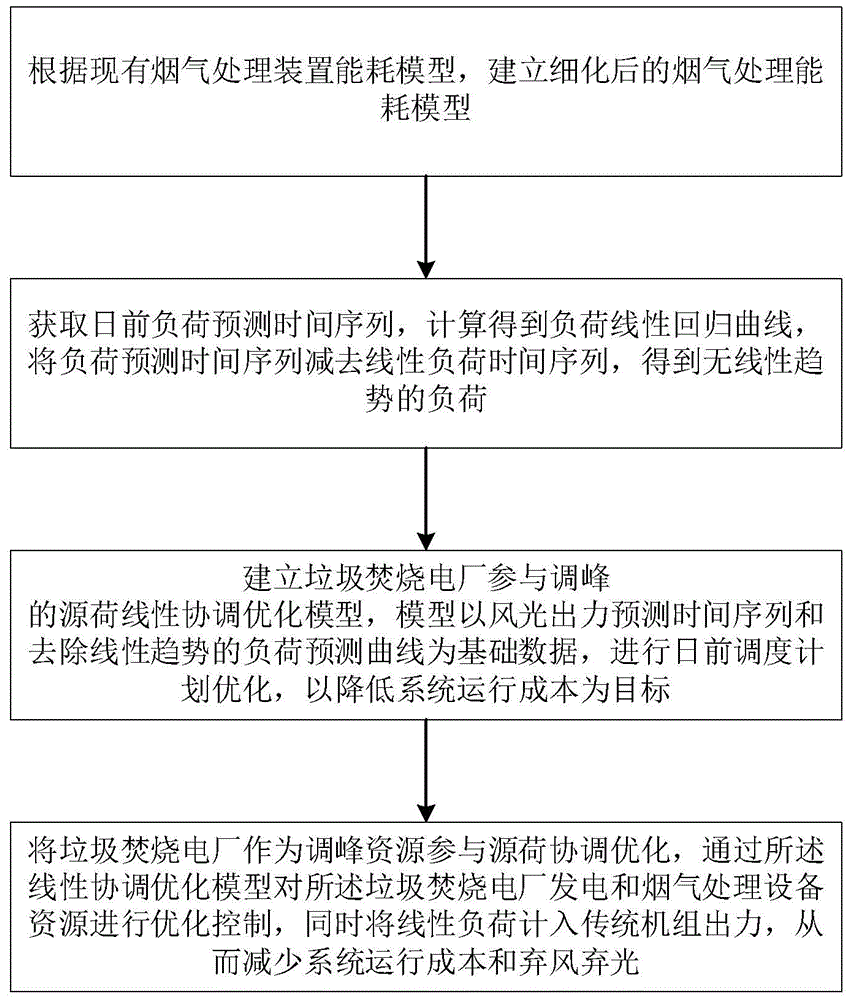
图1是本实施例垃圾焚烧电厂参与调峰的源荷线性协调优化方法的实现流程示意图。Fig. 1 is a schematic diagram of the implementation flow of the waste incineration power plant participating in the peak shaving linear coordination optimization method of the source and load in this embodiment.
图2是本实施例垃圾焚烧电厂参与调峰调度的系统图。Fig. 2 is a system diagram of the waste incineration power plant participating in peak shaving scheduling in this embodiment.
图3是在具体应用实施例中所述烟气处理装置能耗模型与传统模型能耗对比示意图。Fig. 3 is a schematic diagram of a comparison between the energy consumption model of the flue gas treatment device in the specific application example and the traditional model.
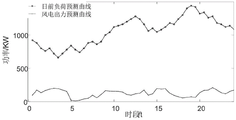
图4是在具体应用实施例中日前预测负荷曲线示意图和风光预测出力曲线示意图。Fig. 4 is a schematic diagram of a day-ahead forecast load curve and a wind-solar forecast output curve in a specific application embodiment.
图5是在具体应用实施例中垃圾焚烧电厂不参与调峰时的以系统运行总成本最小为目标时的系统日前协调调度示意图。Fig. 5 is a schematic diagram of the day-ahead coordination and scheduling of the system when the waste incineration power plant does not participate in peak shaving in a specific application embodiment and the goal is to minimize the total operating cost of the system.
图6是在具体应用实施例中垃圾焚烧电厂参与调峰时的以系统运行总成本最小为目标时的系统日前协调调度示意图。Fig. 6 is a schematic diagram of the day-ahead coordination and scheduling of the system when the waste incineration power plant participates in peak shaving in a specific application embodiment with the goal of minimizing the total operating cost of the system.
图7是在具体应用实施例中垃圾焚烧电厂参与调峰时的以系统运行总成本最小为目标时的系统日前线性协调调度示意图。Fig. 7 is a schematic diagram of the day-ahead linear coordination scheduling of the system when the waste incineration power plant participates in peak shaving in a specific application embodiment with the goal of minimizing the total operating cost of the system.
具体实施方式Detailed ways
以下结合说明书附图和具体优选的实施例对本发明作进一步描述,但并不因此而限制本发明的保护范围。The present invention will be further described below in conjunction with the accompanying drawings and specific preferred embodiments, but the protection scope of the present invention is not limited thereby.
如图1所示,本实施例的一种垃圾焚烧电厂参与调峰的源荷线性协调优化方法,步骤包括:As shown in Figure 1, a source-load linear coordination optimization method in which a waste incineration power plant participates in peak regulation in this embodiment, the steps include:
S1.烟气处理装置能耗模型的建立:根据现有烟气处理装置能耗模型,建立细化后的烟气处理能耗模型;S1. Establishment of the energy consumption model of the flue gas treatment device: according to the existing energy consumption model of the flue gas treatment device, a refined energy consumption model of the flue gas treatment is established;
S2.无线性趋势的负荷时间序列的获取:获取日前负荷预测时间序列,将负荷线性回归,负荷预测时间序列减去线性负荷时间序列,得到无线性趋势的负荷;S2. Acquisition of load time series without linear trend: obtain the load forecast time series of the day before, linearly regress the load, and subtract the linear load time series from the load forecast time series to obtain the load without linear trend;
S3.构建源荷协调优化模型:建立垃圾焚烧电厂参与调峰的源荷线性协调优化模型,模型以风光出力预测时间序列和去除线性趋势的负荷预测曲线为基础数据,进行日前调度计划优化,以降低系统运行成本为目标;S3. Construct a source-load coordination optimization model: establish a source-load linear coordination optimization model for waste incineration power plants to participate in peak regulation. The model uses wind and solar output forecast time series and load forecast curves that remove linear trends as basic data to optimize day-ahead dispatching plans. The goal is to reduce system operating costs;
S4.优化控制:将垃圾焚烧电厂作为调峰资源参与源荷协调优化,通过所述线性协调优化模型对所述垃圾焚烧电厂发电和烟气处理设备资源进行优化控制,同时将线性负荷计入传统机组出力,从而减少系统运行成本和弃风弃光。S4. Optimal control: The waste incineration power plant is used as a peak-shaving resource to participate in the coordinated optimization of source and load, and the power generation and flue gas treatment equipment resources of the waste incineration power plant are optimally controlled through the linear coordination optimization model, and the linear load is included in the traditional Unit output, thereby reducing system operating costs and curtailment of wind and light.
当垃圾焚烧电厂参与调峰后,相当于在系统中加入了可调负荷和电源,主要是通过调节烟气处理的可调负荷。由于系统负荷和新能源出力呈现出明显的峰谷特性,导致机组出力调节频繁,系统运行成本较高。垃圾焚烧电厂日焚烧量基本为一定值,故其日总发电量基本固定,发电功率可分时段调节。垃圾焚烧电厂烟气处理功率大,当设置烟气存储装置后,可视为可时移、可调节负荷功率,故调整控制烟气处理时段,相当于调节电力负荷。调度协调调节垃圾焚烧电厂出力、新能源上网出力、需求侧响应负荷和传统火电机组出力。垃圾焚烧电厂参与调峰调度的系统图如图2所示。When the waste incineration power plant participates in peak regulation, it is equivalent to adding an adjustable load and power supply to the system, mainly by adjusting the adjustable load of flue gas treatment. Due to the obvious peak-valley characteristics of the system load and new energy output, the output of the unit is frequently adjusted, and the operating cost of the system is relatively high. The daily incineration capacity of waste incineration power plants is basically a certain value, so the total daily power generation is basically fixed, and the power generation can be adjusted by time periods. The waste incineration power plant has a large flue gas processing power. When the flue gas storage device is installed, it can be regarded as time-shifting and adjustable load power. Therefore, adjusting and controlling the flue gas treatment period is equivalent to adjusting the power load. Scheduling coordinates and adjusts the output of waste incineration power plants, new energy on-grid output, demand-side response loads, and traditional thermal power unit output. The system diagram of waste incineration power plants participating in peak shaving scheduling is shown in Figure 2.
本实施例步骤S1中,根据现有烟气处理装置能耗模型,建立细化后的烟气处理能耗模型,即增加考虑了储气罐进出烟气时的气泵能耗和烟气处理的单位能耗函数。In step S1 of this embodiment, based on the energy consumption model of the existing flue gas treatment device, a refined energy consumption model for flue gas treatment is established, that is, the energy consumption of the gas pump when the gas storage tank enters and exits the flue gas and the energy consumption of the flue gas treatment are added. unit energy consumption function.
储气罐进出烟气时的气泵能耗:The energy consumption of the air pump when the gas storage tank enters and exits the flue gas:
PS,t=w1(α2,t+α3,t),t=1,...,T (1)P S,t =w 1 (α 2,t +α 3,t ),t=1,...,T (1)
式(1)中:w1为气泵的单位能耗系数,α2,t为时段t焚烧产生的烟气进入储气罐中的烟气量,α3,t为时段t从储气罐进入反应塔的烟气量,T为周期。In formula (1): w 1 is the unit energy consumption coefficient of the air pump, α 2,t is the amount of flue gas entering the gas storage tank from incineration during period t, and α 3,t is the amount of flue gas entering the gas storage tank during period t The amount of flue gas in the reaction tower, T is the period.
烟气处理的单位能耗函数:Unit energy consumption function of flue gas treatment:
wα,t=wα(1.5-(α1,t+α3,t)/θ),t=1,...,T (2)w α,t =w α (1.5-(α 1,t +α 3,t )/θ),t=1,...,T (2)
式(2)中:w1为气泵的单位能耗系数;α3,t为时段t从储气罐进入反应塔的烟气量;wα为烟气处理的固定单位能耗系数;θ为单位时段最大烟气处理量。In formula (2): w 1 is the unit energy consumption coefficient of the air pump; α 3,t is the amount of flue gas entering the reaction tower from the gas storage tank at time t; w α is the fixed unit energy consumption coefficient of flue gas treatment; θ is The maximum flue gas treatment capacity per unit period.
同时,需要完善烟气处理装置的能耗模型:At the same time, it is necessary to improve the energy consumption model of the flue gas treatment device:
进入储气罐的烟气量总和与离开储气罐的烟气量总和应当相等:The sum of the flue gas volumes entering the gas receiver and the sum of the flue gas leaving the gas tank should be equal:

式(3)中:α2,t为时段t焚烧产生的烟气进入储气罐中的烟气量,α3,t为时段t从储气罐进入反应塔的烟气量。In formula (3): α 2,t is the amount of flue gas entering the gas storage tank from the incineration during period t, and α 3,t is the amount of flue gas entering the reaction tower from the gas storage tank during period t.
储气罐的烟气量不能大于最大储气量:The flue gas volume of the gas storage tank cannot be greater than the maximum gas storage capacity:

其中:η为储气罐容量。Where: η is the capacity of the gas storage tank.
且进出烟气管道有最大流量限制:And there is a maximum flow limit in and out of the flue gas pipe:
0≤α1,t,α2,t,α3,t≤δ,t=1,...,T (5)0≤α 1,t ,α 2,t ,α 3,t ≤δ,t=1,...,T (5)
其中:δ为烟气管道最大流量。Where: δ is the maximum flow rate of the flue gas pipeline.
在本实施例步骤S2中,无线性趋势的负荷时间序列获取的具体步骤为:In step S2 of this embodiment, the specific steps for obtaining the load time series without linear trend are as follows:
获取日前预测负荷时间序列PL,然后按照负荷变化趋势分三段进行线性回归得到负荷变化的斜率βk,k=1,2,3。Obtain the time series PL of the forecast load before the day, and then perform linear regression in three segments according to the load change trend to obtain the slope β k of the load change, k=1,2,3.
最后获得无线性趋势的预测负荷时间序列,参与优化控制:Finally, the predicted load time series without linear trend is obtained, and participates in optimal control:

式中:PLoad,t为无线性趋势的负荷时间序列,PL,t为日前负荷预测时间序列,βt为日前负荷预测时间序列线性回归的斜率。In the formula: P Load,t is the load time series without linear trend, P L,t is the time series of the day-ahead load forecasting, β t is the slope of the linear regression of the day-ahead load forecasting time series.
在本实施例步骤S3中,建立的垃圾焚烧电厂参与调峰的源荷线性协调优化模型,模型以风光出力预测时间序列和去除线性趋势的负荷预测曲线为基础数据,进行日前调度计划优化,以降低系统运行成本为目标;In step S3 of this embodiment, the established waste incineration power plant participates in the peak-shaving linear coordination optimization model of source and load. The model uses the wind and solar output forecast time series and the load forecast curve with the linear trend removed as the basic data to optimize the day-ahead scheduling plan. The goal is to reduce system operating costs;
f1=min(CG(Pg,t)+CD(ΔPt)+CW(ΔPw,t)) (7)f 1 =min(C G (P g,t )+C D (ΔP t )+C W (ΔP w,t )) (7)
其中,f1为系统总运行成本,包括传统机组运行成本CG(Pg,t)、需求响应成本CD(ΔPt)和弃风弃光成本CW(ΔPw,t)。Among them, f 1 is the total operating cost of the system, including the operating cost of traditional units C G (P g,t ), the cost of demand response C D (ΔP t ) and the cost of curtailment of wind and solar C W (ΔP w,t ).
所述传统机组运行成本、需求响应成本和弃风弃光成本目标函数如下式所示:The objective functions of the operating cost of the traditional unit, the cost of demand response and the cost of abandoning wind and solar are shown in the following formula:

其中,a,b,c表示传统机组的燃料成本参数;d表示机组出力调节成本参数;ρ为需求响应负荷的单位补偿成本参数,ΔPt为时段t系统中的需求响应量,即优化得到的预测负荷时间序列PL,t减去预测负荷;CW为弃风弃光惩罚参数,ΔPw,t为时段t的弃风弃光功率,即优化得到的风光新能源出力Pw,t与预测新能源出力的差值。Among them, a, b, and c represent the fuel cost parameters of the traditional unit; d represents the unit output adjustment cost parameter; ρ is the unit compensation cost parameter of the demand response load; The predicted load time series P L,t is subtracted from the predicted load; C W is the penalty parameter for wind and solar curtailment, and ΔP w,t is the power of wind and solar curtailment for period t, that is, the optimized output of wind and solar new energy P w,t and Forecast the difference in new energy output.
本实施例在步骤S3中建立的源荷线性协调优化模型时,还设置有源荷线性协调功率平衡约束,源荷线性协调功率平衡约束包含负荷线性回归函数、烟气处理能耗和垃圾焚烧电厂发电。In this embodiment, in the source-load linear coordination optimization model established in step S3, an active source-load linear coordination power balance constraint is also set. The source-load linear coordination power balance constraint includes load linear regression function, flue gas treatment energy consumption and waste incineration power plant generate electricity.
作为本发明的进一步改进,所述源荷线性协调功率平衡约束如下式所示:As a further improvement of the present invention, the source-load linear coordination power balance constraint is shown in the following formula:
Pg,t+PW,t+PG,t-PLoad,t-βtt-Pα,t=0,t=1,...,T (9)P g,t +P W,t +P G,t -P Load,t -β t tP α,t =0,t=1,...,T (9)
式中:Pg,t为传统火电机组出力,PW,t为新能源出力,PG,t为垃圾焚烧电厂出力,Pα,t为烟气处理能耗PLoad,t为无线性趋势的负荷时间序列,βt为日前负荷预测时间序列线性回归的斜率。In the formula: P g,t is the output of traditional thermal power units, P W,t is the output of new energy, P G,t is the output of waste incineration power plants, P α,t is the energy consumption of flue gas treatment P Load,t is the wireless trend The load time series of , β t is the slope of the linear regression of the day-ahead load forecasting time series.
本实施例在步骤S4中,垃圾焚烧电厂参与调峰的源荷线性协调优化方法的具体步骤为:获得日期预测负荷时间序列和风光预测出力时间序列,通过所述线性协调优化模型对所述垃圾焚烧电厂发电和烟气处理设备资源进行优化控制,同时将线性负荷计入传统机组出力,从而减少系统运行成本和弃风弃光。In step S4 of this embodiment, the specific steps of the source-load linear coordination optimization method for the waste incineration power plant to participate in peak regulation are as follows: obtain the time series of date forecast load and the time series of wind and solar forecast output, and use the linear coordination optimization model to analyze the waste The power generation and flue gas treatment equipment resources of the incineration power plant are optimally controlled, and the linear load is included in the output of the traditional unit, thereby reducing system operating costs and curtailment of wind and light.
本实施例中,建立的源荷线性协调优化模型时,还包括传统机组出力和爬坡约束、需求响应负荷约束、垃圾焚烧电厂总出力约束等:In this embodiment, when the source-load linear coordination optimization model is established, it also includes traditional unit output and ramp constraints, demand response load constraints, total output constraints of waste incineration power plants, etc.:
①传统机组约束①Traditional unit constraints
传统机组参与调度主要受到出力约束、爬坡出力波动约束。Traditional units participating in dispatching are mainly subject to output constraints and slope climbing output fluctuation constraints.
Pgmin≤Pg,t≤Pgmax (10)P gmin ≤ P g,t ≤ P gmax (10)
-Pgc≤Pg,t-Pg,t-1≤Pgc (11)-P gc ≤P g,t -P g,t-1 ≤P gc (11)
式中:Pgmin为传统火电机组出力下限值,Pgmax为传统火电机组出力上限值,Pgc为最大爬坡功率限制值。In the formula: P gmin is the lower limit value of the traditional thermal power unit output, P gmax is the upper limit value of the traditional thermal power unit output, and P gc is the limit value of the maximum climbing power.
②需求响应负荷约束② Demand response load constraints
各个时段可供调用的需求侧负荷是有限的。The demand-side load available for call in each time period is limited.
PDmin≤ΔPt≤PDmax (12)P Dmin ≤ΔP t ≤P Dmax (12)

式中:PDmax和PDmin分别表示需求响应负荷的上下限。Spmax和Spmin分别表示需求响应负荷在周期T内的总容量上下限。In the formula: P Dmax and P Dmin represent the upper and lower limits of demand response load, respectively. S pmax and S pmin represent the upper and lower limits of the total capacity of the demand response load in period T, respectively.
③垃圾焚烧电厂总出力约束。③ Total output constraints of waste incineration power plants.

垃圾焚烧电厂具有恒定的总出力,可以安排其每个时间间隔的出力大小。The waste incineration power plant has a constant total output, and the output size of each time interval can be arranged.
为验证本发明的有效性,选取如图2的电力系统为分析对象,设一个调度周期为24小时,每一个调度时段为30分钟。火电机组总装机容量1500MW,风电装机容量为150MW,光伏装机容量50MW。垃圾焚烧电厂的参数如下:垃圾焚烧电厂装机容量200MW,日总发电量为4000MW,最大出力200MW,烟气排放强度eα=0.96,固定烟气处理能耗系数wα=0.6;气泵的单位能耗系数w1=0.8;最大烟气处理量θ=180;储气罐最大容量η=600;储气罐初始储气量200;烟气管道最大流量δ=100。设一个调度周期为24h,每个调度时段为30min。系统负荷预测曲线和风光联合出力预测曲线如图3所示。需求侧响应的出力限制如表1所示。需求响应负荷的单位调节成本和弃风弃光惩罚取值180元/MW·h。In order to verify the effectiveness of the present invention, the power system as shown in Figure 2 is selected as the analysis object, a dispatch period is set to 24 hours, and each dispatch period is 30 minutes. The total installed capacity of thermal power units is 1500MW, the installed capacity of wind power is 150MW, and the installed capacity of photovoltaic is 50MW. The parameters of the waste incineration power plant are as follows: the installed capacity of the waste incineration power plant is 200MW, the total daily power generation is 4000MW, the maximum output is 200MW, the flue gas emission intensity e α = 0.96, the fixed flue gas treatment energy consumption coefficient w α = 0.6; the unit energy of the air pump The consumption coefficient w 1 =0.8; the maximum flue gas treatment capacity θ=180; the maximum capacity of the gas storage tank η=600; the initial gas storage capacity of the
表1需求响应出力限制Table 1 Demand response output limit
首先进行所述改进烟气处理能耗模型与传统烟气处理能耗模型对比由图4可以看出,传统烟气处理系统能耗和处理量成正比,但是实际过程中,处理效率并非常数,故原烟气处理函数无法精确描述处理系统能耗,实际低估了烟气处理系统的整体能耗。而所述改进烟气处理系统能耗模型则更能反应出实际处理系统能耗趋势:当烟气处理量较低时,烟气处理系统能耗会比未改进的能耗高,当烟气处理量比较高时,反而能耗比较低,并且所述能耗模型计及了烟气处理系统气泵能耗,其最大值为80MW,使得烟气处理系统在作为可调负荷时,能得到更加精确的调用。Firstly, compare the improved flue gas treatment energy consumption model with the traditional flue gas treatment energy consumption model. It can be seen from Figure 4 that the energy consumption of the traditional flue gas treatment system is directly proportional to the processing capacity, but in the actual process, the treatment efficiency is not constant , so the original flue gas treatment function cannot accurately describe the energy consumption of the treatment system, and actually underestimates the overall energy consumption of the flue gas treatment system. The energy consumption model of the improved flue gas treatment system can better reflect the energy consumption trend of the actual treatment system: when the flue gas treatment capacity is low, the energy consumption of the flue gas treatment system will be higher than that of the unimproved one. When the processing capacity is relatively high, the energy consumption is relatively low, and the energy consumption model takes into account the energy consumption of the air pump of the flue gas treatment system, and its maximum value is 80MW, so that when the flue gas treatment system is used as an adjustable load, it can be more efficient. exact call.
垃圾焚烧电厂参与调峰的源荷线性协调优化模型以系统总运行成本最小化为目标,设置3种场景进行对比分析,分别为:The source-load linear coordination optimization model of waste incineration power plants participating in peak regulation aims to minimize the total operating cost of the system, and sets up three scenarios for comparative analysis, respectively:
场景一:垃圾焚烧电厂不参与调峰时的以系统运行总成本最小为目标时的系统日前协调调度的传统运行方式;Scenario 1: When the waste incineration power plant does not participate in peak shaving, the traditional operation mode of the system's coordinated scheduling before the goal is to minimize the total operating cost of the system;
场景二:垃圾焚烧电厂参与调峰时的以系统运行总成本最小为目标时的系统日前协调调度示意图;Scenario 2: Schematic diagram of the day-ahead coordination and scheduling of the system when the waste incineration power plant participates in peak shaving with the goal of minimizing the total operating cost of the system;
场景三:垃圾焚烧电厂参与调峰时的以系统运行总成本最小为目标时的系统日前线性协调调度示意图。Scenario 3: Schematic diagram of the system’s day-ahead linear coordination scheduling when the waste incineration power plant participates in peak shaving with the goal of minimizing the total operating cost of the system.
图5为垃圾焚烧电厂不参与调峰时的以系统运行总成本最小为目标时的系统日前协调调度的传统运行方式;图6为垃圾焚烧电厂参与调峰时的以系统运行总成本最小为目标时的系统日前协调调度示意图。图7为垃圾焚烧电厂参与调峰时的以系统运行总成本最小为目标时的系统日前线性协调调度示意图;由以上三幅图可以看出,图7减少了火电机组出力波动。并且考虑到传统机组在实际中出力可在一定范围内爬坡,使得传统机组出力具有线性爬坡特性。需求响应呈现出明显的削峰填谷规律。Figure 5 shows the traditional operation mode of day-ahead coordinated scheduling when the waste incineration power plant does not participate in peak shaving and aims to minimize the total system operation cost; Figure 6 shows the minimum total system operation cost as the goal when the waste incineration power plant participates in peak shaving Schematic diagram of day-ahead coordination and scheduling of the system at that time. Figure 7 is a schematic diagram of the day-ahead linear coordination scheduling of the system when the waste incineration power plant participates in peak shaving with the goal of minimizing the total cost of system operation; it can be seen from the above three figures that Figure 7 reduces the output fluctuation of thermal power units. And considering that the output of the traditional unit can climb within a certain range in practice, the output of the traditional unit has a linear climbing characteristic. The demand response shows an obvious law of shaving peaks and filling valleys.
表2和表3分别为不同场景下系统运行费用的对比情况和新能源的消纳情况对比,场景一传统优化运行方式机组燃料成本、启停成本、总运行成本均最大,新能源消纳量最小;场景二加入了垃圾焚烧电厂,调节能力增强,且能够为传统机组分担一些调节成本,减少弃风弃光,并且总成本最优。场景三,传统机组出力平稳,机组调节成本有较为显著的下降,并且传统机组出力跟随了日负荷变化规律,减少了需求响应成本,从而系统总运行成本较低,同时新能源消纳率较大。Table 2 and Table 3 respectively show the comparison of system operating costs and the consumption of new energy in different scenarios. In scenario 1, the fuel cost, start-stop cost, and total operating cost of the unit in the traditional optimized operation mode are the largest, and the consumption of new energy is the largest. Minimal; Scenario 2 includes waste incineration power plants, the regulation ability is enhanced, and some regulation costs can be shared for the traditional units, reducing wind and solar curtailment, and the total cost is optimal. Scenario 3: The output of the traditional unit is stable, and the adjustment cost of the unit is significantly reduced, and the output of the traditional unit follows the law of daily load changes, reducing the cost of demand response, so that the total operating cost of the system is low, and the new energy consumption rate is relatively large. .
表2三种场景下运行费用对比Table 2 Comparison of operating costs under three scenarios

表3三种场景下新能源的消纳情况对比Table 3 Comparison of new energy consumption under three scenarios
由上述试验结果可得,本实施例利用垃圾焚烧电厂参与调峰,能够使垃圾焚烧电厂获得额外的调峰收益,并且减少传统机组出力调节。通过提出系统调峰的源荷线性协调关系,使传统机组出力具有爬坡性能的线性特点。基于此提出了垃圾焚烧电厂参与系统调峰的源荷线性协调优化模型。随着垃圾焚烧电厂容量增加,可参加电力辅助服务,通过参与系统调峰,获得更高效益。垃圾焚烧电厂的灵活运行、系统调峰和对烟气处理负荷的调控,也是增加需求侧响应能力和消纳新能源的可行措施。From the above test results, it can be concluded that this embodiment utilizes the waste incineration power plant to participate in peak shaving, which can enable the waste incineration power plant to obtain additional peak shaving benefits and reduce the output adjustment of traditional units. By proposing the linear coordination relationship of source and load for system peak regulation, the output of traditional units has the linear characteristic of ramp performance. Based on this, a source-load linear coordination optimization model for waste incineration power plants participating in system peak regulation is proposed. As the capacity of the waste incineration power plant increases, it can participate in power auxiliary services and obtain higher benefits by participating in system peak regulation. The flexible operation of waste incineration power plants, system peak shaving and regulation of flue gas treatment load are also feasible measures to increase demand-side response capabilities and absorb new energy.
上述只是本发明的较佳实施例,并非对本发明作任何形式上的限制。虽然本发明已以较佳实施例揭露如上,然而并非用以限定本发明。因此,凡是未脱离本发明技术方案的内容,依据本发明技术实质对以上实施例所做的任何简单修改、等同变化及修饰,均应落在本发明技术方案保护的范围内。The above are only preferred embodiments of the present invention, and do not limit the present invention in any form. Although the present invention has been disclosed above with preferred embodiments, it is not intended to limit the present invention. Therefore, any simple modifications, equivalent changes and modifications made to the above embodiments according to the technical essence of the present invention shall fall within the protection scope of the technical solution of the present invention.
Claims (6)


Priority Applications (1)
| Application Number | Priority Date | Filing Date | Title |
|---|---|---|---|
| CN202010637710.0A CN111769552B (en) | 2020-07-02 | 2020-07-02 | Source-load linear coordination optimization method for participating in peak shaving of waste incineration power plant |
Applications Claiming Priority (1)
| Application Number | Priority Date | Filing Date | Title |
|---|---|---|---|
| CN202010637710.0A CN111769552B (en) | 2020-07-02 | 2020-07-02 | Source-load linear coordination optimization method for participating in peak shaving of waste incineration power plant |
Publications (2)
| Publication Number | Publication Date |
|---|---|
| CN111769552A CN111769552A (en) | 2020-10-13 |
| CN111769552B true CN111769552B (en) | 2022-11-11 |
Family
ID=72723736
Family Applications (1)
| Application Number | Title | Priority Date | Filing Date |
|---|---|---|---|
| CN202010637710.0A Active CN111769552B (en) | 2020-07-02 | 2020-07-02 | Source-load linear coordination optimization method for participating in peak shaving of waste incineration power plant |
Country Status (1)
| Country | Link |
|---|---|
| CN (1) | CN111769552B (en) |
Families Citing this family (1)
| Publication number | Priority date | Publication date | Assignee | Title |
|---|---|---|---|---|
| CN116742686A (en) * | 2022-03-01 | 2023-09-12 | 国网上海市电力公司 | Distribution network path recovery optimization method using waste incineration power plant as black start power source |
Citations (3)
| Publication number | Priority date | Publication date | Assignee | Title |
|---|---|---|---|---|
| CN106655478A (en) * | 2017-01-25 | 2017-05-10 | 云南水务投资股份有限公司 | Low-voltage emergency safety power supply system of household garbage power plant and control method of system |
| CN109888840A (en) * | 2019-02-28 | 2019-06-14 | 内蒙古科技大学 | Dispatch optimization method and device of wind-solar-waste-to-energy comprehensive utilization system |
| CN110163768A (en) * | 2019-05-16 | 2019-08-23 | 长沙理工大学 | A kind of wind-powered electricity generation-waste incineration virtual plant Optimization Scheduling |
Family Cites Families (1)
| Publication number | Priority date | Publication date | Assignee | Title |
|---|---|---|---|---|
| WO2010083334A1 (en) * | 2009-01-14 | 2010-07-22 | Integral Analytics, Inc. | Optimization of microgrid energy use and distribution |
-
2020
- 2020-07-02 CN CN202010637710.0A patent/CN111769552B/en active Active
Patent Citations (3)
| Publication number | Priority date | Publication date | Assignee | Title |
|---|---|---|---|---|
| CN106655478A (en) * | 2017-01-25 | 2017-05-10 | 云南水务投资股份有限公司 | Low-voltage emergency safety power supply system of household garbage power plant and control method of system |
| CN109888840A (en) * | 2019-02-28 | 2019-06-14 | 内蒙古科技大学 | Dispatch optimization method and device of wind-solar-waste-to-energy comprehensive utilization system |
| CN110163768A (en) * | 2019-05-16 | 2019-08-23 | 长沙理工大学 | A kind of wind-powered electricity generation-waste incineration virtual plant Optimization Scheduling |
Non-Patent Citations (1)
| Title |
|---|
| 含烟气储存装置的风电–垃圾焚烧虚拟电厂双阶段优化调度;周任军 等;《中国电力》;20190228;第52卷(第2期);全文 * |
Also Published As
| Publication number | Publication date |
|---|---|
| CN111769552A (en) | 2020-10-13 |
Similar Documents
| Publication | Publication Date | Title |
|---|---|---|
| CN112417652B (en) | An optimization scheduling method and system for an electricity-gas-heat integrated energy system | |
| CN111950808B (en) | Comprehensive energy system random robust optimization operation method based on comprehensive demand response | |
| CN110288152B (en) | Regional comprehensive energy system energy storage configuration method considering electric/thermal flexible load | |
| WO2025103217A1 (en) | Optimized dispatching method for virtual power plant | |
| CN116109076A (en) | Optimal scheduling method for virtual power plants considering demand response in energy and peak shaving markets | |
| CN102930351B (en) | A kind of synthesis energy saving Optimized Operation daily planning generation method | |
| CN112990523A (en) | Regional comprehensive energy system layered optimization operation method based on multi-objective model predictive control | |
| CN110807588A (en) | An optimal scheduling method for a multi-energy coupled integrated energy system | |
| CN116826867B (en) | Optimized scheduling and cost compensation allocation method for improving source load multielement peak regulation initiative | |
| CN111768108A (en) | A combined heat and power economic dispatch method for virtual power plants with comprehensive heat consumption satisfaction | |
| CN113673739A (en) | Multi-time-space scale collaborative optimization operation method of distributed comprehensive energy system | |
| CN118278664A (en) | Comprehensive energy system optimization scheduling method, device and storage medium | |
| CN118611030A (en) | A low-carbon economic dispatch strategy for power system load-storage coordination considering carbon flow model | |
| CN113592200A (en) | Low-carbon optimized operation method for regional comprehensive energy system containing water source heat pump | |
| CN117526451A (en) | Configuration optimization method of regional integrated energy system considering flexible load | |
| CN115640894A (en) | Double-time-scale-based optimization scheduling method for comprehensive energy system | |
| CN116823020A (en) | A comprehensive assessment method for low-carbon operation in Taiwan area considering load-side carbon reduction potential | |
| CN110163768A (en) | A kind of wind-powered electricity generation-waste incineration virtual plant Optimization Scheduling | |
| CN115659666A (en) | Virtual power plant wind-solar combined optimization scheduling method considering comprehensive demand response | |
| CN119726738A (en) | Carbon-green trading optimization scheduling method for virtual power plants considering the coupling relationship between green electricity and carbon emissions | |
| CN113989072B (en) | Dynamic adjustment strategy for the allocation ceiling of trading entities in the peak-shaving auxiliary service market | |
| CN113541195B (en) | Method for consuming high-proportion renewable energy in future power system | |
| CN121055472A (en) | A tiered optimization method considering the regulation of high-energy-consuming loads of fused magnesium and deep peak shaving of thermal power plants. | |
| CN120822742A (en) | Optimal scheduling method for farm integrated energy system based on energy-carbon incentive | |
| CN114400652A (en) | Multi-energy power generation optimization scheduling method considering active participation of nuclear power in peak shaving |
Legal Events
| Date | Code | Title | Description |
|---|---|---|---|
| PB01 | Publication | ||
| PB01 | Publication | ||
| SE01 | Entry into force of request for substantive examination | ||
| SE01 | Entry into force of request for substantive examination | ||
| GR01 | Patent grant | ||
| GR01 | Patent grant |