CN111286552B - PCR-HRM primer and method for identifying wild strains and vaccine strains of riemerella anatipestifer - Google Patents
PCR-HRM primer and method for identifying wild strains and vaccine strains of riemerella anatipestifer Download PDFInfo
- Publication number
- CN111286552B CN111286552B CN202010175854.9A CN202010175854A CN111286552B CN 111286552 B CN111286552 B CN 111286552B CN 202010175854 A CN202010175854 A CN 202010175854A CN 111286552 B CN111286552 B CN 111286552B
- Authority
- CN
- China
- Prior art keywords
- riemerella anatipestifer
- strain
- primer
- pcr
- hrm
- Prior art date
- Legal status (The legal status is an assumption and is not a legal conclusion. Google has not performed a legal analysis and makes no representation as to the accuracy of the status listed.)
- Active
Links
- 241001478212 Riemerella anatipestifer Species 0.000 title claims abstract description 75
- 229960005486 vaccine Drugs 0.000 title claims abstract description 54
- 238000000034 method Methods 0.000 title abstract description 22
- 238000002844 melting Methods 0.000 claims description 21
- 230000008018 melting Effects 0.000 claims description 21
- 230000003321 amplification Effects 0.000 claims description 16
- 238000003199 nucleic acid amplification method Methods 0.000 claims description 16
- 239000013612 plasmid Substances 0.000 claims description 16
- 238000004458 analytical method Methods 0.000 claims description 12
- 239000013641 positive control Substances 0.000 claims description 12
- 238000006243 chemical reaction Methods 0.000 claims description 10
- 238000012408 PCR amplification Methods 0.000 claims description 8
- 238000000137 annealing Methods 0.000 claims description 6
- 238000004925 denaturation Methods 0.000 claims description 6
- 230000036425 denaturation Effects 0.000 claims description 6
- 238000002360 preparation method Methods 0.000 claims description 5
- 238000012257 pre-denaturation Methods 0.000 claims description 3
- 239000002773 nucleotide Substances 0.000 claims 2
- 125000003729 nucleotide group Chemical group 0.000 claims 2
- 238000001514 detection method Methods 0.000 abstract description 20
- 230000002349 favourable effect Effects 0.000 abstract description 2
- 230000004907 flux Effects 0.000 abstract description 2
- 239000000523 sample Substances 0.000 description 22
- 108020004414 DNA Proteins 0.000 description 8
- 238000011880 melting curve analysis Methods 0.000 description 8
- 108020004707 nucleic acids Proteins 0.000 description 8
- 150000007523 nucleic acids Chemical class 0.000 description 8
- 102000039446 nucleic acids Human genes 0.000 description 8
- 238000012360 testing method Methods 0.000 description 8
- 238000010586 diagram Methods 0.000 description 7
- 239000000047 product Substances 0.000 description 7
- 238000002474 experimental method Methods 0.000 description 6
- 208000015181 infectious disease Diseases 0.000 description 6
- 241000272525 Anas platyrhynchos Species 0.000 description 5
- 241001492342 Anatid alphaherpesvirus 1 Species 0.000 description 5
- 241001664991 Duck circovirus Species 0.000 description 5
- 241000588724 Escherichia coli Species 0.000 description 5
- 241001517118 Goose parvovirus Species 0.000 description 5
- 230000035945 sensitivity Effects 0.000 description 5
- 206010058556 Serositis Diseases 0.000 description 4
- 230000002458 infectious effect Effects 0.000 description 4
- 241000272517 Anseriformes Species 0.000 description 3
- 241000894006 Bacteria Species 0.000 description 3
- 241001244708 Moroccan pepper virus Species 0.000 description 3
- 239000013642 negative control Substances 0.000 description 3
- XLYOFNOQVPJJNP-UHFFFAOYSA-N water Substances O XLYOFNOQVPJJNP-UHFFFAOYSA-N 0.000 description 3
- FWMNVWWHGCHHJJ-SKKKGAJSSA-N 4-amino-1-[(2r)-6-amino-2-[[(2r)-2-[[(2r)-2-[[(2r)-2-amino-3-phenylpropanoyl]amino]-3-phenylpropanoyl]amino]-4-methylpentanoyl]amino]hexanoyl]piperidine-4-carboxylic acid Chemical compound C([C@H](C(=O)N[C@H](CC(C)C)C(=O)N[C@H](CCCCN)C(=O)N1CCC(N)(CC1)C(O)=O)NC(=O)[C@H](N)CC=1C=CC=CC=1)C1=CC=CC=C1 FWMNVWWHGCHHJJ-SKKKGAJSSA-N 0.000 description 2
- 241000684283 Duck parvovirus Species 0.000 description 2
- 241000606860 Pasteurella Species 0.000 description 2
- 241000286209 Phasianidae Species 0.000 description 2
- 230000009286 beneficial effect Effects 0.000 description 2
- 239000003153 chemical reaction reagent Substances 0.000 description 2
- 238000013461 design Methods 0.000 description 2
- 201000010099 disease Diseases 0.000 description 2
- 208000037265 diseases, disorders, signs and symptoms Diseases 0.000 description 2
- 230000000694 effects Effects 0.000 description 2
- 229940031551 inactivated vaccine Drugs 0.000 description 2
- 238000012986 modification Methods 0.000 description 2
- 230000004048 modification Effects 0.000 description 2
- 238000006467 substitution reaction Methods 0.000 description 2
- 241000271566 Aves Species 0.000 description 1
- 108020000946 Bacterial DNA Proteins 0.000 description 1
- 208000035473 Communicable disease Diseases 0.000 description 1
- 206010059866 Drug resistance Diseases 0.000 description 1
- 238000002965 ELISA Methods 0.000 description 1
- 238000002768 Kirby-Bauer method Methods 0.000 description 1
- 241001465754 Metazoa Species 0.000 description 1
- 108091028043 Nucleic acid sequence Proteins 0.000 description 1
- 241000700605 Viruses Species 0.000 description 1
- 230000004520 agglutination Effects 0.000 description 1
- 239000003242 anti bacterial agent Substances 0.000 description 1
- 229940088710 antibiotic agent Drugs 0.000 description 1
- 230000001580 bacterial effect Effects 0.000 description 1
- 238000009835 boiling Methods 0.000 description 1
- 238000010367 cloning Methods 0.000 description 1
- 238000010835 comparative analysis Methods 0.000 description 1
- 238000003745 diagnosis Methods 0.000 description 1
- 238000010790 dilution Methods 0.000 description 1
- 239000012895 dilution Substances 0.000 description 1
- 229940079593 drug Drugs 0.000 description 1
- 239000003814 drug Substances 0.000 description 1
- 230000036541 health Effects 0.000 description 1
- 238000010438 heat treatment Methods 0.000 description 1
- 238000010166 immunofluorescence Methods 0.000 description 1
- 239000007788 liquid Substances 0.000 description 1
- 239000000463 material Substances 0.000 description 1
- 239000000203 mixture Substances 0.000 description 1
- 230000001717 pathogenic effect Effects 0.000 description 1
- 244000144977 poultry Species 0.000 description 1
- 230000002265 prevention Effects 0.000 description 1
- 230000008569 process Effects 0.000 description 1
- 238000003753 real-time PCR Methods 0.000 description 1
- 230000009467 reduction Effects 0.000 description 1
- 238000012216 screening Methods 0.000 description 1
- 238000000926 separation method Methods 0.000 description 1
- 238000012163 sequencing technique Methods 0.000 description 1
- 239000000243 solution Substances 0.000 description 1
- 230000007480 spreading Effects 0.000 description 1
- 239000000126 substance Substances 0.000 description 1
- 239000006228 supernatant Substances 0.000 description 1
- 238000002255 vaccination Methods 0.000 description 1
Images


Classifications
-
- C—CHEMISTRY; METALLURGY
- C12—BIOCHEMISTRY; BEER; SPIRITS; WINE; VINEGAR; MICROBIOLOGY; ENZYMOLOGY; MUTATION OR GENETIC ENGINEERING
- C12Q—MEASURING OR TESTING PROCESSES INVOLVING ENZYMES, NUCLEIC ACIDS OR MICROORGANISMS; COMPOSITIONS OR TEST PAPERS THEREFOR; PROCESSES OF PREPARING SUCH COMPOSITIONS; CONDITION-RESPONSIVE CONTROL IN MICROBIOLOGICAL OR ENZYMOLOGICAL PROCESSES
- C12Q1/00—Measuring or testing processes involving enzymes, nucleic acids or microorganisms; Compositions therefor; Processes of preparing such compositions
- C12Q1/68—Measuring or testing processes involving enzymes, nucleic acids or microorganisms; Compositions therefor; Processes of preparing such compositions involving nucleic acids
- C12Q1/6876—Nucleic acid products used in the analysis of nucleic acids, e.g. primers or probes
- C12Q1/6888—Nucleic acid products used in the analysis of nucleic acids, e.g. primers or probes for detection or identification of organisms
- C12Q1/689—Nucleic acid products used in the analysis of nucleic acids, e.g. primers or probes for detection or identification of organisms for bacteria
-
- C—CHEMISTRY; METALLURGY
- C12—BIOCHEMISTRY; BEER; SPIRITS; WINE; VINEGAR; MICROBIOLOGY; ENZYMOLOGY; MUTATION OR GENETIC ENGINEERING
- C12Q—MEASURING OR TESTING PROCESSES INVOLVING ENZYMES, NUCLEIC ACIDS OR MICROORGANISMS; COMPOSITIONS OR TEST PAPERS THEREFOR; PROCESSES OF PREPARING SUCH COMPOSITIONS; CONDITION-RESPONSIVE CONTROL IN MICROBIOLOGICAL OR ENZYMOLOGICAL PROCESSES
- C12Q1/00—Measuring or testing processes involving enzymes, nucleic acids or microorganisms; Compositions therefor; Processes of preparing such compositions
- C12Q1/68—Measuring or testing processes involving enzymes, nucleic acids or microorganisms; Compositions therefor; Processes of preparing such compositions involving nucleic acids
- C12Q1/6844—Nucleic acid amplification reactions
- C12Q1/686—Polymerase chain reaction [PCR]
Landscapes
- Chemical & Material Sciences (AREA)
- Life Sciences & Earth Sciences (AREA)
- Organic Chemistry (AREA)
- Proteomics, Peptides & Aminoacids (AREA)
- Zoology (AREA)
- Wood Science & Technology (AREA)
- Analytical Chemistry (AREA)
- Health & Medical Sciences (AREA)
- Engineering & Computer Science (AREA)
- Biophysics (AREA)
- Immunology (AREA)
- Microbiology (AREA)
- Molecular Biology (AREA)
- Biotechnology (AREA)
- Physics & Mathematics (AREA)
- Chemical Kinetics & Catalysis (AREA)
- Biochemistry (AREA)
- Bioinformatics & Cheminformatics (AREA)
- General Engineering & Computer Science (AREA)
- General Health & Medical Sciences (AREA)
- Genetics & Genomics (AREA)
- Measuring Or Testing Involving Enzymes Or Micro-Organisms (AREA)
Abstract
The invention discloses a PCR-HRM primer and a method for quickly identifying a wild strain of riemerella anatipestifer and a GD12 vaccine strain. The PCR-HRM detection method capable of quickly distinguishing the riemerella anatipestifer wild strain and the GD12 vaccine strain is established for the first time, is simple to operate and high in flux, obviously shortens the time required by identification and detection of the riemerella anatipestifer wild strain and the GD12 vaccine strain, is high in accuracy, good in specificity and good in repeatability, and is favorable for popularization and application in clinical practice.
Description
Technical Field
The invention belongs to the technical field of molecular biology, and particularly relates to a PCR-HRM primer and a method for rapidly identifying a wild strain of riemerella anatipestifer and a GD12 vaccine strain.
Background
Riemerella Anatipestifer (RA) infection is a contact infectious disease of ducks, geese, turkeys and wild birds, also called as duck infectious serositis, and mainly attacks 1-8 weeks (particularly 2-3 weeks) young ducks, goslings, young turkeys and the like. The serotype of riemerella anatipestifer is relatively complex, 21 serotypes are provided, and no obvious cross immune protection effect exists among different serotypes, so that certain difficulty is brought to prevention and treatment of the infectious serositis of the duck.
Due to the abuse of antibiotics in clinic, the drug resistance of bacteria is more and more serious, so that the number of drugs which can be used for treating the infectious serositis of the duck is very small at present, and the vaccination is the most effective way for preventing the disease from spreading. The currently marketed riemerella anatipestifer vaccines comprise riemerella anatipestifer polyvalent inactivated vaccines and riemerella anatipestifer polyvalent concatenated inactivated vaccines, and also duck infectious serositis live vaccines (type 1 GD12 strain) which are applied and approved by clinical trials of the unit in 2018 and 12 months. Since the clinical use of live vaccines may bring certain difficulty to the accurate diagnosis of the disease, it is difficult to distinguish whether clinically isolated riemerella anatipestifer is a wild strain or a vaccine strain, and therefore, it is necessary to establish a method for identifying and detecting the wild strain and the vaccine strain of the riemerella anatipestifer.
At present, detection methods for riemerella anatipestifer mainly comprise bacteria separation identification, agglutination test, agar diffusion test, ELISA, immunofluorescence technology, common PCR, fluorescent quantitative PCR and the like, but no identification detection method for riemerella anatipestifer wild strains and vaccine strains exists, and the key reason is that reliable and effective amplification primers can not be used for identifying the riemerella anatipestifer wild strains and the vaccine strains at present. Therefore, the method provides an effective amplification primer which can be used for identifying wild strains and vaccine strains, and establishes a set of identification detection method and system, and has important significance.
Disclosure of Invention
The invention aims to provide a PCR-HRM primer and a method for quickly identifying a wild strain of riemerella anatipestifer and a GD12 vaccine strain.
The technical scheme adopted by the invention is as follows:
in a first aspect of the present invention, there is provided:
a primer for identifying a riemerella anatipestifer wild strain and a vaccine strain comprises the following nucleotide sequences:
primer P1: 5'-CTAAGCAAGATACCGTAGAAT-3' (SEQ ID NO: 1);
primer P2: 5 '-GGTTAGCAAGAAGYTCGT-3' (SEQ ID NO: 2).
In some examples, the vaccine strain is riemerella anatipestifer GD12 vaccine strain.
In a second aspect of the present invention, there is provided:
a PCR-HRM kit for rapidly identifying a riemerella anatipestifer wild strain and a vaccine strain comprises the primer.
In some examples, it further comprises a positive standard;
wherein the positive control is a wild strain positive plasmid p-RA1 of riemerella anatipestifer and a positive plasmid p-RA2 of a GD12 vaccine strain of riemerella anatipestifer.
In a third aspect of the present invention, there is provided:
a PCR-HRM identification method for identifying a riemerella anatipestifer wild strain and a vaccine strain GD12 comprises the following specific steps:
(1) collecting a strain sample, and extracting DNA;
(2) carrying out PCR amplification by using the primers to obtain an amplification product;
(3) HRM analysis is carried out on the amplified product, positive control is compared, and the strain type is judged.
In some examples, the amplification system in step (2) is
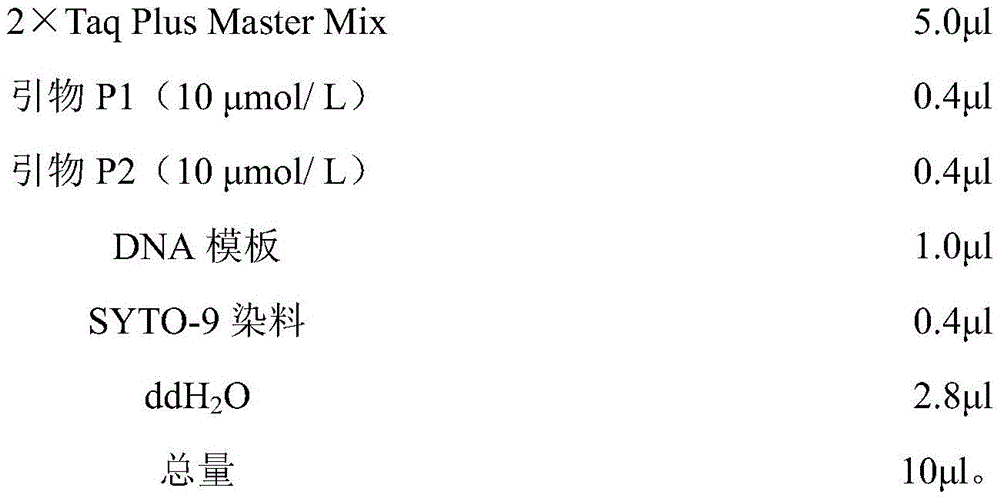
In some examples, the reaction conditions of the amplification system in step (2) are: pre-denaturation at 94 ℃ for 5 min; denaturation at 94 ℃ for 20s, annealing at 56 ℃ for 20s, and extension at 72 ℃ for 20 s; circulating for 35 times; final extension at 72 ℃ for 8 min.
In some examples, the HRM analysis conditions are: denaturation at 95 ℃ for 10s, annealing at 40 ℃ for 120s, and collecting fluorescence signals for analysis; wherein the fluorescent signal acquisition temperature is 70-80 ℃, and the acquisition frequency is 0.3 ℃/step.
In some examples, the HRM analysis method described above operates specifically as follows:
(1) if the absolute value of the delta Tm value of the melting temperature of the sample amplification product and the melting temperature of the riemerella anatipestifer wild strain positive plasmid p-RA1 is less than 1.0 ℃, judging that the sample is the riemerella anatipestifer wild strain;
(2) and if the absolute value of the melting temperature of the sample amplification product and the delta Tm value of the melting temperature of the positive plasmid p-RA2 of the riemerella anatipestifer vaccine strain GD12 is less than 1.0 ℃, judging that the sample is the riemerella anatipestifer vaccine strain GD 12.
The invention has the beneficial effects that:
(1) the invention establishes a PCR-HRM primer and a method for rapidly identifying the riemerella anatipestifer wild strain and the GD12 vaccine strain for the first time, the detection method is simple to operate, and the identification and detection of the riemerella anatipestifer wild strain and the GD12 vaccine strain can be realized by only one reaction; the detection speed is high, the high flux is realized, the whole operation process is within 2 hours, the time required by detection and identification of wild strains and vaccine strains is obviously shortened, the accuracy is high, the specificity is good, the repeatability is good, the analysis can be accurately, quickly and highly-flux, and the method is favorable for popularization and application in clinical practice.
(2) The PCR-HRM primer pair P1 and P2 can specifically amplify the riemerella anatipestifer, is beneficial to improving the PCR efficiency and reducing the time for identifying and typing bacteria; meanwhile, the primer pairs P1 and P2 are not combined with other common duck pathogenic nucleic acids, so that the accuracy of the result analysis in the invention is improved.
(3) The PCR-HRM detection method for distinguishing the riemerella anatipestifer wild strain and the GD12 vaccine strain has the advantages that the lowest detection limit can reach single copy of each reaction, and the sensitivity is high.
Drawings
FIG. 1 is a melting curve diagram of a standardized sample of Riemerella anatipestifer;
FIG. 2 is a melting curve diagram of a specificity test of a riemerella anatipestifer PCR-HRM detection method; the samples are positive plasmids p-RA1 of wild strains of riemerella anatipestifer and positive plasmids p-RA2 of a riemerella anatipestifer GD12 vaccine strain, Escherichia Coli (EC), Pasteurella (PM), Duck Plague Virus (DPV), duck parvovirus (MPV), Goose Parvovirus (GPV) and duck circovirus (DuCV); wherein, the wild strain positive plasmid p-RA1 of riemerella anatipestifer and the positive plasmid p-RA2 of riemerella anatipestifer GD12 vaccine strain are used as positive controls, and water is used as a negative control;
FIG. 3 is a melting curve diagram of a sensitivity test of Riemerella anatipestifer nucleic acid;
FIG. 4 is a melting curve diagram of a Riemerella anatipestifer clinical sample.
Detailed Description
The invention will be described in further detail with reference to the drawings and specific experiments. The experimental procedures and drawings are only for explaining the present invention and are not intended to limit the scope of the present invention. The experimental methods used in the implementation are all conventional experimental methods if not specifically stated.
The experimental materials and reagents used are, unless otherwise specified, all consumables and reagents which are conventionally available from commercial sources.
Primer design, standard sample preparation, PCR amplification and melting curve analysis
(1) Primer design
After screening a large number of designed primers, the base sequences of the primers SEQ ID NO:1 and SEQ ID NO:2 the effect of distinguishing the riemerella anatipestifer wild strain from the GD12 vaccine strain by the PCR-HRM method is best, and the base sequences are as follows:
primer P1: 5'-CTAAGCAAGATACCGTAGAAT-3' (SEQ ID NO: 1);
primer P2: 5 '-GGTTAGCAAGAAGYTCGT-3' (SEQ ID NO: 2).
(2) Preparation of Riemerella anatipestifer DNA
Taking the preserved strain sample (the strain sample is separated from sick poultry and is screened and identified), boiling for 5min, centrifuging at 10000rpm for 1min, and taking the supernatant for later use, namely the sample DNA.
(3) Preparation of Standard Positive samples
In order to verify the feasibility of the method, a standard positive sample (determined correctly by sequence) is constructed to provide a positive control for clinical sample detection, and in this embodiment, positive standard samples p-RA1 of wild strain positive standard samples of riemerella anatipestifer and p-RA2 of GD12 vaccine strains are preferentially prepared.
The preparation steps of the positive standard sample of the riemerella anatipestifer wild strain p-RA1 and the positive standard sample of the GD12 vaccine strain RA2 are as follows: and respectively preparing DNA of the wild strain and the vaccine strain by taking the bacterial liquid which is determined to be the wild strain and the GD12 vaccine strain through sequencing, and carrying out PCR amplification by taking a primer P1 and a primer P2 as amplification primers. And respectively recovering and purifying amplified products, and cloning the products into PMD18T-Vector as a positive standard sample p-RA1 of a riemerella anatipestifer wild strain and a positive control sample p-RA2 of a GD12 vaccine strain.
(4) PCR-HRM of Positive Standard sample
Respectively taking the two obtained positive standard samples as DNA templates, and carrying out PCR-HRM amplification reaction and melting curve analysis;
PCR reaction solution was prepared according to the following composition for testing.

The reaction procedure for PCR amplification was:
pre-denaturation at 94 ℃ for 5 min; denaturation at 94 ℃ for 20s, annealing at 56 ℃ for 20s, and extension at 72 ℃ for 20 s; circulating for 35 times; final extension at 72 ℃ for 8 min.
The melting curve analysis program was:
denaturation at 95 ℃ for 10s, annealing at 40 ℃ for 120s, heating to 70 ℃, starting to collect fluorescence signals at the rate of 0.3 ℃/step until 80 ℃, and performing melting curve analysis.
(5) Analysis of results of melting curve analysis of positive standard sample
The PCR amplification products were analyzed using a Rotor-Gene Q analyzer. The melting curve analysis results of the positive standard samples of the riemerella anatipestifer wild strain and the GD12 vaccine strain are shown in figure 1.
The following results can be obtained in conjunction with fig. 1:
(1) the melting temperature of the wild strain of riemerella anatipestifer is 77.50 +/-0.15;
(2) the melting temperature of the riemerella anatipestifer GD12 vaccine strain is 75.01 +/-0.25.
Therefore, the wild strain of riemerella anatipestifer and the GD12 vaccine strain can be completely distinguished by the melting curve peak type and the Tm value difference.
Second, specificity test
To test the specificity of the primers and methods used in this application to distinguish between wild strains of riemerella anatipestifer and GD12 vaccine strain, the following experiments were performed:
respectively extracting nucleic acids of Escherichia Coli (EC), Pasteurella (PM), Duck Plague Virus (DPV), duck parvovirus (MPV), Goose Parvovirus (GPV) and duck circovirus (DuCV), analyzing by using the nucleic acids of the viruses as PCR templates and water as negative control by using the PCR amplification reaction and melting curve analysis methods, and carrying out comparative analysis on the nucleic acids and positive standard samples p-RA1 of wild strain of riemerella anatipestifer and p-RA2 of GD12 vaccine strain, wherein a melting curve peaking diagram is shown in figure 2.
As can be seen from FIG. 2, the detection method of the invention can only specifically amplify and form the melting peak of the wild strain of the riemerella anatipestifer and the GD12 vaccine strain, but does not amplify and form the specific melting peak for EC, PM, DPV, MPV, GPV and DuCV nucleic acids, which shows that the primers P1 and P2 designed by the invention have good specificity and can be used for PCR-HRM detection of the riemerella anatipestifer vaccine strain GD12 and the wild strain. The detection method has good specificity.
Third, sensitivity test
To test the sensitivity of the primers and methods of the present application for distinguishing wild strains of riemerella anatipestifer from GD12 vaccine strain, the following experiments were performed:
performing nucleic acid detection on a riemerella anatipestifer wild strain positive standard sample p-RA1 and a GD12 vaccine strain positive standard sample p-RA2, converting the number of plasmids, and performing 10-time gradient dilution to form 1.0x10⁹、1.0x10⁸、1.0x10⁷、1.0x10⁶、1.0x10⁵、1.0x10⁴、1.0x10³、1.0x10²、1.0x10110 gradients of 1.0X10 ℃ copies/. mu.l were analyzed by the PCR amplification reaction and melting curve analysis method described above, and the melting curve peaking diagram is shown in FIG. 3.
As can be seen from FIG. 3, the wild strain of Riemerella anatipestifer and the GD12 vaccine strain targeted by the detection method are obviously reduced along with the reduction of the plasmid concentration, and the lowest detection limit is 1.0x10 degrees copies/reaction, which indicates that the method can be used for distinguishing the wild strain of Riemerella anatipestifer and the GD12 vaccine strain, and the sensitivity of the method is higher.
Fourth, clinical sample detection
(1) DNA was extracted from 12 clinical isolates of riemerella anatipestifer: the same method is used for extracting the nucleic acid in the step (4).
(2) The extracted bacterial DNA is used as a template, primers P1 and P2 designed by the invention are used for amplification, and meanwhile, a positive standard P-RA1 of a wild strain of riemerella anatipestifer and a positive standard P-RA2 of a GD12 vaccine strain are used as positive controls.
(3) Melting curve analysis of clinical samples
The invention detects 12 clinical isolates of Riemerella anatipestifer, and the analysis result of the melting curve is shown in figure 4, wherein a positive standard substance is used as a positive control, and water is used as a negative control.
As can be seen from the peak-type melting curve diagram of the riemerella anatipestifer clinical isolates shown in FIG. 4, the absolute values of the delta Tm values of the 12 clinical isolates and the riemerella anatipestifer wild strain positive control p-RA1 are all less than 1.0 ℃, and the 12 clinical isolates and the riemerella anatipestifer wild strain are all wild strains of riemerella anatipestifer.
The above embodiments are preferred embodiments of the present invention, but the present invention is not limited to the above embodiments, and any other changes, modifications, substitutions, combinations, and simplifications which do not depart from the spirit and principle of the present invention should be construed as equivalents thereof, and all such changes, modifications, substitutions, combinations, and simplifications are intended to be included in the scope of the present invention.
SEQUENCE LISTING
<110> institute of animal health of academy of agricultural sciences of Guangdong province
<120> PCR-HRM primer and method for identifying riemerella anatipestifer wild strain and vaccine strain
<130>
<160> 2
<170> PatentIn version 3.5
<210> 1
<211> 21
<212> DNA
<213> Artificial sequence
<400> 1
ctaagcaaga taccgtagaa t 21
<210> 2
<211> 18
<212> DNA
<213> Artificial sequence
<400> 2
ggttagcaag aagytcgt 18
Claims (5)
1. A PCR-HRM kit for identifying a riemerella anatipestifer wild strain and a GD12 vaccine strain is characterized by comprising a primer and a positive control;
the nucleotide sequence of the primer is as follows:
primer P1: 5'-CTAAGCAAGATACCGTAGAAT-3', respectively;
primer P2: 5 '-GGTTAGCAAGAAGYTCGT-3';
the positive control is positive plasmid p-RA1 of wild strain of riemerella anatipestifer and positive plasmid p-RA2 of the riemerella anatipestifer GD12 vaccine strain.
The application of the PCR-HRM primer in the preparation of the kit for identifying the wild strain of the riemerella anatipestifer and the GD12 vaccine strain is characterized in that the kit is used by the following steps:
(1) collecting a strain sample, and extracting DNA;
(2) performing PCR amplification by using a PCR-HRM primer to obtain an amplification product;
(3) performing HRM analysis on the amplification product, comparing positive control, and judging the strain type;
the HRM analysis method specifically comprises the following operations:
(1) if the absolute value of the Δ Tm value of the melting temperature of the sample amplification product and the melting temperature of the riemerella anatipestifer wild strain positive plasmid p-RA1 is less than 1.0 ℃, judging that the sample is the riemerella anatipestifer wild strain;
(2) if the absolute value of the melting temperature of the sample amplification product and the Tm value of the melting temperature of the positive plasmid p-RA2 of the riemerella anatipestifer vaccine strain GD12 is less than 1.0 ℃, judging that the sample is the riemerella anatipestifer vaccine strain GD 12;
the nucleotide sequence of the PCR-HRM primer is as follows:
primer P1: 5'-CTAAGCAAGATACCGTAGAAT-3';
primer P2: 5 '-GGTTAGCAAGAAGYTCGT-3';
the positive control is positive plasmid p-RA1 of wild strain of riemerella anatipestifer and positive plasmid p-RA2 of the riemerella anatipestifer GD12 vaccine strain.
3. The use of claim 2, wherein the amplification system in step (2) is as follows:
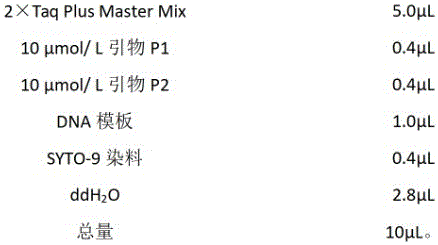
4. the use of claim 2, wherein the reaction conditions of the amplification system in step (2) are as follows: pre-denaturation at 94 ℃ for 5 min; denaturation at 94 ℃ for 20s, annealing at 56 ℃ for 20s, and elongation at 72 ℃ for 20 s; circulating for 35 times; final extension at 72 ℃ for 8 min.
5. Use according to claim 2, wherein the HRM analysis conditions are: denaturation at 95 ℃ for 10s, annealing at 40 ℃ for 120s, and collecting fluorescence signals for analysis;
wherein the collection temperature of the fluorescence signal is 70-80 ℃, and the collection frequency is 0.3 ℃/step.
Priority Applications (1)
| Application Number | Priority Date | Filing Date | Title |
|---|---|---|---|
| CN202010175854.9A CN111286552B (en) | 2020-03-13 | 2020-03-13 | PCR-HRM primer and method for identifying wild strains and vaccine strains of riemerella anatipestifer |
Applications Claiming Priority (1)
| Application Number | Priority Date | Filing Date | Title |
|---|---|---|---|
| CN202010175854.9A CN111286552B (en) | 2020-03-13 | 2020-03-13 | PCR-HRM primer and method for identifying wild strains and vaccine strains of riemerella anatipestifer |
Publications (2)
| Publication Number | Publication Date |
|---|---|
| CN111286552A CN111286552A (en) | 2020-06-16 |
| CN111286552B true CN111286552B (en) | 2022-06-24 |
Family
ID=71030262
Family Applications (1)
| Application Number | Title | Priority Date | Filing Date |
|---|---|---|---|
| CN202010175854.9A Active CN111286552B (en) | 2020-03-13 | 2020-03-13 | PCR-HRM primer and method for identifying wild strains and vaccine strains of riemerella anatipestifer |
Country Status (1)
| Country | Link |
|---|---|
| CN (1) | CN111286552B (en) |
Families Citing this family (2)
| Publication number | Priority date | Publication date | Assignee | Title |
|---|---|---|---|---|
| CN107513510A (en) * | 2017-09-04 | 2017-12-26 | 广东省农业科学院动物卫生研究所 | Riemerella anatipestifer disease attenuated live vaccines and preparation method thereof |
| CN112899385A (en) * | 2021-03-19 | 2021-06-04 | 广东省农业科学院动物卫生研究所 | Primer group and probe for identifying Brucella S2 vaccine strain and wild strain and application of primer group and probe |
Citations (3)
| Publication number | Priority date | Publication date | Assignee | Title |
|---|---|---|---|---|
| CN104560853A (en) * | 2015-01-07 | 2015-04-29 | 四川农业大学 | Riemerella anatipestifer CH1 attenuated strain, as well as construction method and application thereof |
| CN106086186A (en) * | 2016-06-22 | 2016-11-09 | 武汉大学 | A kind of HRM method of Clinical detection deaf-related gene mutation and test kit |
| CN107287304A (en) * | 2017-06-30 | 2017-10-24 | 北京美莱博医学科技有限公司 | A kind of application for the Primer composition that gene pleiomorphism is detected based on HRM |
Family Cites Families (7)
| Publication number | Priority date | Publication date | Assignee | Title |
|---|---|---|---|---|
| KR101518872B1 (en) * | 2013-05-14 | 2015-05-22 | 대한민국(관리부서 : 농림축산식품부 농림축산검역본부) | Primer set for detection of systemic bacterial diseases of Poultry and PCR kits thereof |
| SG11201602686YA (en) * | 2013-10-07 | 2016-05-30 | Mitsui Chemicals Inc | Pcr primer set for bacterial dna amplification, kit for detecting and/or identifying bacterial species, and method for detecting and/or identifying bacterial species |
| CN103614370A (en) * | 2013-11-12 | 2014-03-05 | 广东省农业科学院动物卫生研究所 | Method for quickly extracting genome DNA of riemerella anatipestifer, and kit |
| CN107513510A (en) * | 2017-09-04 | 2017-12-26 | 广东省农业科学院动物卫生研究所 | Riemerella anatipestifer disease attenuated live vaccines and preparation method thereof |
| CN108315483B (en) * | 2018-03-30 | 2021-06-25 | 广东省农业科学院动物卫生研究所 | Combination of primers and probes for distinguishing wild strains and vaccine strains of duck tembusu virus |
| CN110117671A (en) * | 2019-06-25 | 2019-08-13 | 江苏省家禽科学研究所 | Riemerellosis Anatipestifer Specific PCR primers are to, PCR detection method and kit |
| CN110241184A (en) * | 2019-06-28 | 2019-09-17 | 中国农业科学院兰州兽医研究所 | A kind of RPA kit and application thereof of quick detection riemerella anatipestifer |
-
2020
- 2020-03-13 CN CN202010175854.9A patent/CN111286552B/en active Active
Patent Citations (3)
| Publication number | Priority date | Publication date | Assignee | Title |
|---|---|---|---|---|
| CN104560853A (en) * | 2015-01-07 | 2015-04-29 | 四川农业大学 | Riemerella anatipestifer CH1 attenuated strain, as well as construction method and application thereof |
| CN106086186A (en) * | 2016-06-22 | 2016-11-09 | 武汉大学 | A kind of HRM method of Clinical detection deaf-related gene mutation and test kit |
| CN107287304A (en) * | 2017-06-30 | 2017-10-24 | 北京美莱博医学科技有限公司 | A kind of application for the Primer composition that gene pleiomorphism is detected based on HRM |
Also Published As
| Publication number | Publication date |
|---|---|
| CN111286552A (en) | 2020-06-16 |
Similar Documents
| Publication | Publication Date | Title |
|---|---|---|
| Wise et al. | Development of a real-time reverse-transcription PCR for detection of Newcastle disease virus RNA in clinical samples | |
| CN107841575B (en) | A nano-multiplex PCR method for differentiating four serotypes of avian adenovirus group I | |
| CN106065419A (en) | The quick real-time fluorescence quantitative PCR detection primer differentiating duck circovirus genotype and detection method thereof | |
| CN113046484B (en) | Primer probe, kit and method for detecting African swine fever virus p72 gene | |
| CN110699489B (en) | Real-time fluorescence PCR detection primer probe set, kit and method for African swine fever virus CD2V gene | |
| CN108315483B (en) | Combination of primers and probes for distinguishing wild strains and vaccine strains of duck tembusu virus | |
| CN113186312B (en) | Molecular marker for distinguishing Brucella A19 vaccine strain and wild strain | |
| KR101149422B1 (en) | Primers and its application in multiplex PCR to identify Rinderpest, Peste-des-petits-ruminants virus, Bluetongue virus and Rift Valley fever | |
| CN108950068B (en) | A kit for identification and detection of QX strain of chicken infectious bronchitis virus | |
| CN110964857A (en) | Kit for detecting bovine sarcoidosis virus by excluding capripoxvirus, preparation method and application thereof | |
| CN114085929B (en) | Kit for detecting African swine fever virus wild strain and vaccine strain | |
| CN107099621B (en) | PCR-HRM detection method for rapidly identifying PRRSV vaccine strain GDr180 strain and other strains | |
| CN111286552A (en) | PCR-HRM primer and method for identifying wild strains and vaccine strains of riemerella anatipestifer | |
| CN111876502A (en) | Method for identifying Brucella S2 vaccine strain by dual real-time fluorescent quantitative PCR and kit used by same | |
| CN105648114B (en) | Fluorescent RT-PCR (reverse transcription-polymerase chain reaction) primer, probe and kit for detecting new variant type highly pathogenic porcine reproductive and respiratory syndrome virus and detection method | |
| CN105018628A (en) | Kit for recognizing Brucella A19 vaccine strain and wild strain | |
| CN104232802A (en) | Kit for detecting infectious laryngotracheitis virus, newcastle disease virus and infectious bronchitis virus | |
| CN113789398A (en) | Amplification primer and kit for detecting mycoplasma synoviae and application | |
| CN112176105A (en) | Special primer for virus BVDV, BRV and BCV one-tube multiplex fluorescence PCR detection and application thereof | |
| CN104195265B (en) | The PCR-HRM primer of a kind of quick differentiation canine parvovirus street strain and vaccine strain and method | |
| CN111534642A (en) | Reverse transcription-real-time fluorescence quantitative PCR kit for specific detection of TWI infectious bronchitis virus and its application | |
| Liu et al. | Rapid and visual detection of an isolated and identified goose parvovirus (GPV) strain by a loop-mediated isothermal amplification assay | |
| CN112522446A (en) | Detection primer pair and kit for wild strain of porcine pseudorabies virus | |
| Homayounimehr et al. | Detection and identification of infectious bronchitis virus by RT-PCR in Iran | |
| CN104531901A (en) | PCR detection method for detecting four kinds of poultry respiratory disease pathogens simultaneously |
Legal Events
| Date | Code | Title | Description |
|---|---|---|---|
| PB01 | Publication | ||
| PB01 | Publication | ||
| SE01 | Entry into force of request for substantive examination | ||
| SE01 | Entry into force of request for substantive examination | ||
| GR01 | Patent grant | ||
| GR01 | Patent grant |